View allAll Photos Tagged stagflation
Da una crisi all'altra: stagflazione, disoccupazione, delocalizzazione deindustrializzazione , pandemia. From one crisis to another: stagflation, unemployment, relocation, deindustrialisation , pandemics. Cadriano. Bologna 2021
It’s all by design! The Great Reset requires a currency crisis, so that we can Build Back Better. We must crash the economy and implement a fiat Central Bank Digital Currency, a Digital ID, and a Social Credit Score System—“Fascism on the Block Chain!” We will weaponize the whole currency system. We will reset the economy to a surveillance economy. It’s the surveillance era! Surveillance Capitalism/Data Capitalism: leading us down the road to Digital Feudalism. Techno-Feudalism…yay! This new Digital Economy will have programmable currency, which will be tied to vast databases that will surveil your behavior. Elvis has entered the building: “We’re caught in a trap! I can't walk out!” Step right up: get your Universal Basic Income Central Bank Digital Currency allowance. Then you can become a Global Citizen of the New World Order Digital Welfare state…woohoo! Please give me Digital Welfare!
We will be able to control every aspect of your lives. With programmable Central Bank Digital Currency we will eventually bar you from buying precious metals. Kiss your gold good-bye! You won’t be able to save your money, because it will have an expiry date. We will program your digital money, so that you can’t spend it outside your 15-minute city/neighbourhood/prison. Like the World Economic Forum mantra says: you will own nothing and be happy! You will literally rent everything you use. If you’re a good little doggy you’ll be rewarded, but if you’re a bad little doggy you’ll be punished. We will regulate who you can see, what you can eat, and where you can go. Digital slavery, here we come!
Trillions of dollars in debt: inflation, stagflation, and hyperinflation. “From dirty cash, to digital trash.” The banks will legally take money out of your bank account when everything collapses. Remember what happened in the Financial Crisis of Cyprus? The banks seized people’s money. Bye-bye savings. Bye-bye middle class. Bank run! Say what? The system’s locked up. Transactions have stopped. I can’t get my money out of the bank! I can’t use my debit card! I can’t use my credit card! My money is gone! Read ‘em and weep, boys; the writing is on the wall.
In a few years down the road we will microchip the sheeple. A new transhuman slave race…woohoo! This slave race will bow to the Image of the Beast—the ultimate ChatGPT. His image will be set up on a wing of the temple. If you can’t get to the temple to worship, his image will show up as a hologram in your transhuman mind. The Beast hologram will say: worship me or die! The AI Beast Computer will hit your kill switch if you don’t bow down to worship him. Watch out, he will know if you’re sincerely worshiping him or not. Isn’t it going to be fun when we’re living in the Book of Revelation? 666: you can’t buy or sell without the Mark of the Beast! Isn’t it interesting to watch as the Beast system is being put in place?
Argentina benefits from rich natural resources, a highly educated population, a globally competitive agricultural sector, and a diversified industrial base. Argentina's post-crisis move to a more flexible exchange rate regime, along with sustained global and regional growth, a boost in domestic aggregate demand via monetary, fiscal, and income distribution policies, and favorable international commodity prices and interest rate trends were catalytic factors in supporting renewed growth between 2003 and 2007. The economic resurgence also enabled the government to accumulate substantial official reserves (over $44.9 billion as of late Augus
t 2009) to help insulate the economy from external shocks. A higher tax burden, improved tax collection efforts, and the recovery's strong impact on tax revenues supported the government's successful efforts to maintain primary fiscal surpluses since 2003.
Global financial turmoil and rapid declines in world commodity prices and economic growth during 2008 and 2009 brought Argentina's rapid rate of economic expansion to an end. In 2009, Argentina has experienced a deterioration of both domestic and international demand, complicating the fiscal situations of both the federal government and the provinces. The global economy’s recovery could ameliorate those pressures.
www.arqueologiadelperu.com/a-shot-across-the-bows-for-per...
By Nicholas Asheshov —
The downgrade in New York by Standard & Poors, S&P, of Peru's banking system last week came a day before S&P whammed the Brazil government debt to junk.
The Brazil move is a much bigger hit to a much bigger player but the Peru bank rating is a new sign that Peru is being priced firmly down even though its numbers are better than those of most of the neighbors.
The bank downslide came days before the Minister of Finance, Alonso Segura, was in New York to try to talk Morgan Stanley's MSCI unit into postponing its decision, announced last month, (PT, Aug.21, 2015) to push the category of the Lima Bolsa de Valores, the stock exchange, from Emerging Market out to Frontier. Other countries to which this has happened this year include Morocco and Argentina.
Peru's handful of international-style companies, like the Banco de Credito (BAP), Cia de Minas Buenaventura (BVN), Southern Peru Copper (SPCC), Graña y Montero (GRAM) and Hochschild (HOC) among them, are quoted in New York or London. But the downgrade of the Lima exchange will have a negative effect on the finances of the AFPs, the pension funds which by law are forced to invest in local paper.
A warning and further downgrades
The latest bank ratings are shots across the bows of the government and of its creditors — there is no question about the stability of any of the four main Lima banks, the Credito, the Continental, Interbank and Scotiabank. But it means further downgrades by the New York rating outfits like Moody's and Fitch are possible as Peru's economy continues to slow down. The rest of the Emerging and Frontier world is slow and getting slower, too, but the main reasons for the latest S&P bank ratings is the poor performance of the government and of the Central Bank in Lima.
The immediate practical effects are a bruise rather than broken bones. It will add, perhaps, 50 or 100 basis points, getting on for one percentage point, to the still-cheap cost to banks here of borrowing in New York. This is currently around 4% to 5% p.a., a gift by the standards of other times.
The change in status comes, too, as financial markets everywhere see-saw with a general trend down. Commodities, products and companies are being reassessed. De Beers has reduced the price of its latest gem quality diamonds by nine percent. Silver continues below $15/oz, less than half the price of 2013, gold at under $1,100 instead of $1,900, and copper at $2.30, half its price three years ago.
S&P says the quality of the Lima banks' business will get worse as the economy deteriorates.
This is another way of saying that the quality of the balance sheets of Peruvian companies is seen by S&P as deteriorating too, in line with the mishandling of public finances by the Ministry of Economy and Finance, MEF, and the Central Bank, the BCRP.
Dangerous increase of reference lending rate
Part of the problem is that the Central Bank continues to prop up the price of the Nuevo Sol, spending $1 billion of its reserves every month. Last week it revalued, not devalued, the Sol, from S/.3.31=US$1 to S/.3.21 defying, perhaps with a certain sense of humor, international financial gravity.
In the same vein but even more questionably, the BCRP increased its reference lending rate from 3.25% to 3.50%, signaling too that this will go to over 4.25% next year.
The reason for this startling move is to rein in inflation. It will have, in fact, no effect on inflation though it will slow the economy, increase unemployment even further, raising the possibility of a return of the stagflation of the 1970s and 1980s, a specter that is becoming a reality in Brazil.
Elsewhere, starting with China, those central banks where the reference rate is not already close to zero are lowering rates to as near-zero as they can in a well-established effort to blow life into sagging economies.
The increase by the Central Bank in Lima of the reference rate is dangerous to the point of incomprehensible. The experience of the past five years has been conclusive that the old monetary buttons to control inflation, which rarely worked anyway, today turn out to be a well-aimed shot in the dark straight into the foot. Instead, increasing rates produces in today's leveraged markets a sharp halt, a sudden stop. With it comes deflation.
This happened famously in 2011 when the European Central Bank raised rates and produced an instant Europe-wide recession. Other countries making the same mistake in the past few years have included Norway, Sweden, Israel and Australia, all of which quickly had to do a U-turn and reduce rates to stave off a collapse in their economies.
Now Peru, with a government and Congress focused on other issues, is allowing a crew of olde economists to make the same mistake.
The Central Bank in Lima also continues to squander its reserves on propping up the price of the Sol. Everywhere else they are cheapening their currencies against the dollar, starting with the Chinese, the ones who are supposed to be buying Peru's copper, Venezuela's oil and Germany's BMWs.
But there are no signs of a recovery in the world economy. The price of copper edged further down towards $2/lb.
At that price Peru's budget deficit in 2016 will be 5%, as a proportion of GDP, not just the two or three percent that the government says it is projecting. Peru's government has been in surplus for the past dozen years.
Peru and Brazil
Peru's situation has some similarities with Brazil. Government finances in both are getting worse due to mismanagement and to the fall in commodities prices.
But Peru's financial and political problems, however grimy as seen from Lima, are nothing compared to those of Brazil which is already into a solid recession with a surge in inflation.
Another difference is that Peru will have a new government in less than a year. In Brazil it is a lame duck government mired in confusion with the best part of four years to go, and with no Plan B. Peru's total foreign debt, public and private, knocking on $40 bn, is a tiny figure compared with Brazil. For instance, Petrobras alone owes $135 bn — it is one of the world's biggest issuers of bonds. The cost of insuring Brazil bonds against default is today as bad as Turkey and Russia. The Peru cost is, rightly, insignificant, a big change from 20 years ago and a huge difference from Brazil, Venezuela, Argentina and Ecuador.
There are two big problems for the Peru outlook. The first is that the world economy shows no sign of improving. The only country in the top ten doing well is India, at 7%, with the United States, Germany and the United Kingdom as also-rans at between two and three percent who dare not increase the cost of government credit from zero for fear of tipping back into recession. Brazil and Russia are in recession and financial distress. China has lost the plot and will be in no shape to rescue the third world or anyone else —Russia for instance— for a decade. The rising China tide that raised commodity boats so far this century is flowing back down and out, taking —for the moment, at least— Peru with it.
Citibank said this week that there is a better than evens chance of a world recession.
There's not much Peru can do but prepare for this El Niño-sized rainy day.
Instead the government, at the end of its tether, is acting as if it believed its own starry-eyed projections. This includes putting soles interest rates up to slow the economy. The Banco Central economists apparently believe their projection of four percent growth for 2016 even though a recession is a certainty. They are putting on the brakes, the only country in the world to be doing so.
The banks
Last week S&P said it had revised its Banking Industry Risk Assessment on Peru to group ‘5' from group ‘4'. S&P also revised its rating for banks operating only in Peru to ‘bbb-‘ from ‘bbb' due to a higher economic risk.
“We revised our economic risk score to ‘6' from ‘5'. We consider that economic resilience has weakened amid lower growth prospects.
“The trend.” on economic risk remains negative because we're still concerned that rapid credit growth could increase economic imbalances risk.
“As a result, we're lowering our ratings on five Peruvian banks.”
Standard & Poor's Ratings Services lowered its ratings on the following Peruvian banks: Banco de Credito del Peru; Banco Interamericano de Finanzas S.A.; BBVA Banco Continental; MiBanco, Banco de La Microempresa S.A.; and Banco Internacional del Peru —Interbank.
S&P said it was not, however, marking down Scotiabank —three years ago the Bank of Nova Scotia, the controlling partner, increased Scotiabank's capital.
The S&P report continues: “The downgrade (of the banking system) reflects our view of rising economic risk for banks operating in Peru. The greater economic risk reflects our reassessment of Peru's growth prospects. We believe that Peru's growth trajectory will no longer be consistently well above that of its peers with a similar stage of economic development.
“Also, our trend on economic risk remains negative, reflecting the persistent rapid growth in credit and private-sector leverage in the past few years, which has been weakening the Peruvian banks' credit quality in the past three years.
“In our view, domestic banks now face tougher operating conditions, which we believe weakened their financial profiles, notably in terms of asset quality and capital and earnings.
“We expect growth to average 3.7% annually between 2015 and 2018 and to average 2.8% in per capita terms, which will protract Peru's catch-up with more developed peers.
“We now expect Peru's economic growth to be slower absent more successful concerted efforts to advance structural reforms to keep up productivity improvements and continue to increase social inclusion, such as improving labor market flexibility, infrastructure, reducing bureaucracy and informality, and improving education quality.”
Nick Asheshov was editor of the Andean Air Mail & Peruvian Times during the 1970s and 1980s, and of The South Pacific Mail, Santiago during the 1990s. He was Latin America Editor of Institutional Investor, New York over the same period. He lives in Urubamba, where he writes a blog and where he has been prominent in the hotel and railway business.
Detroit has infamously been the victim of the Rust Belt, the collapse of the US Auto industry, and white flight-it lived by the automobile, and it died by the automobile. From its peak in 1950 with some 2 million people, mostly working in the auto factories of the "Big Three", Ford, General Motors and Chrysler it has declined to 700000, less than San Jose. With rising New Deal wages and dominance in the auto industry, many workers and managers began moving into the new suburbs, replaced by an influx of African-American workers from the South during the Great Migration, who besides generally being paid less were also locked away from suburban cities such as Dearborn. The influence of the Big Three , driving out smaller competitors like Packard and Studebaker, decentralizing factories to limit damages from strikes, and removing public transportation. began undercutting the very infrastructure necessary for a viable city by the 1960s.
Meanwhile racial tensions began breaking out, an ugly race riot in 1943 over dominantly African-American housing projects ended with 34 dead and $2 million in damages. In 1967, a police raid on an unlicensed bar filled with black people celebrating returning veterans exploded, resulting in 5 days of rioting that killed 43, 2500 buildings destroyed or damaged, and $40-80 million in damages. Whites and even blacks with the means fled to the suburbs.
The real death blow came in the 1980s when Japanese car manufacturers undermined the Big Three that had for so long dominated Detroit and had gone complacent. With smaller, cheaper, and more fuel efficient cars, the Japanese automakers crushed the Big Three in the midst of several oil crises and stagflation. Chrysler and General Motors went bankrupt in 2009, the former being swallowed by Fiat and the latter a shell of its past. Though Ford suffered badly as well, its economic situation appears to have stabilized.
All of this destroyed the already undermined foundation of Detroit, which suffered through the 1970s and 1980s from petty crime, corruption, arson and murder, becoming the "most dangerous city in America". Its population crashed to 700000 in 2010, a 61% decline from its peak sixty years before. Detroit officially became bankrupt in 2013.
Still, the city seems to be slowly pulling itself up, leaving bankruptcy in 2014. Downtown, though still filled with the ghosts of abandoned buildings, is showing life, even if much of it is gentrified hipster stuff. Crime has slowed from its nadir in the 1980s crack epidemic. While a shadow of its former self, Detroit is surviving.
Downtown, Detroit, Michigan
Women members of the Price Fighters educate shoppers on President Richard Nixon’s wage-price freeze October 10, 1971 at a Northern Virginia supermarket and monitor prices of those goods for which they think a merchant may have illegally raised the cost.
Nixon instituted a nationwide 90-day freeze on wages and prices in August 1971 and a national board had to approve wage and price increases thereafter. Nixon also de-coupled US. currency from other nations.
Roundly criticized by conservative economists, the order did stabilize wages and prices--controlling inflation that was then running at about six percent per year. Unemployment was also in the six percent range.
Some shortages occurred in gasoline and meat, but the program was roundly supported by the general public. The controls were ended by President Gerald Ford in 1974.
The Price Fighters were organized by a local Republican activist, but had widespread support among black and brown and low-income people, according to an article in the Washington Star.
More than 6,700 shoppers signed their petition in October 1971 that read:
“We the undersigned…declare our support for the President’s new economic policy and pledge our efforts to help in the fight against rising costs.”
“As the Price Fighters, we will (1) remind all sellers of the freeze on prices, (2) discuss any suspected violations with store management and (3) urge our fellow citizens to do their share to bring about the new prosperity.
Conservative economists blame the wage-price freeze and the de-coupling of U.S. currency with the “stagflation” of the late 1970s, but it was an effective short-term measure to combat the inflation generated by the Vietnam War spending over the previous decade.
Later government records showed that Nixon, who opposed such government intervention in the economy, acted to bolster his election chances for the fall of 1972.
For more information and related images, see flic.kr/s/aHskPNHqbh
Photo by Rosemary Martufi. The image is courtesy of the D.C. Public Library Washington Star Collection © Washington Post.
Jimmy Carter was sworn in as the 39th President of the United States on January 20, 1977 in the midst of some of the worst conditions encountered by an entering president. Coming off from the long and bloody and expensive Vietnam Conflict, the United States was in the midst of what became known as "Stagflation", a stagnant economy with both high unemployment and high inflation, and repeated oil crises caused by conflicts in the Middle East. Finally, humiliated by the outcome of the Indochina Wars, the United States felt the need to show it had not been weakened by the long conflict.
Carter started by issuing an executive order pardoning draft-dodgers from the Vietnam Conflict, expanded Head Start, doubled the education budget, and signed laws increasing safety, help for underprivileged families, and minimum wage laws. He also pushed for deregulation of the airline, trucking, rail, communications, and finance industries. Environmentally, Carter was best known for two laws: the "Comprehensive Environmental Response, Compensation, and Liability Act of 1980 (CERCLA)" or Superfund Law, cleaning up areas of toxic contamination, as well as the Alaska National Interest Lands Conservation Act, protecting nearly a third of the entire state as a wilderness. However disputes with Congress (mostly involving his veto of bills he thought were pork) and increasing crises soon put his agenda on hold.
The first big crisis was the energy crisis, slowly increasing since OPEC reduced oil output over the United States deflationary dollars and support of Israel during the Yom Kippur War. Carter established the Department of Energy to conserve and regulate the industry. Infamously for the time, he also had solar hot water panels installed on the roof of the White House. Carter also established the National Energy Act (NEA) and the Public Utilities Regulatory Policy Act (PURPA) to support energy conservation and also promote the use of renewable energy. However he also deregulated the oil industry, the increased profits compensated by a "Windfall profits tax". These actions however did not help the skyrocketing oil prices in the short term, culminating in the 1979 Oil Crisis when gas prices doubled or gas simply ran out in some parts of the country during the height of summer. As the Carter Administration became increasingly under pressure, he responded with the "Malaise Speech":
"I want to talk to you right now about a fundamental threat to American democracy... I do not refer to the outward strength of America, a nation that is at peace tonight everywhere in the world, with unmatched economic power and military might. The threat is nearly invisible in ordinary ways. It is a crisis of confidence. It is a crisis that strikes at the very heart and soul and spirit of our national will. We can see this crisis in the growing doubt about the meaning of our own lives and in the loss of a unity of purpose for our nation...
In a nation that was proud of hard work, strong families, close-knit communities, and our faith in God, too many of us now tend to worship self-indulgence and consumption. Human identity is no longer defined by what one does, but by what one owns. But we've discovered that owning things and consuming things does not satisfy our longing for meaning....
I'm asking you for your good and for your nation's security to take no unnecessary trips, to use carpools or public transportation whenever you can, to park your car one extra day per week, to obey the speed limit, and to set your thermostats to save fuel.... I have seen the strength of America in the inexhaustible resources of our people. In the days to come, let us renew that strength in the struggle for an energy-secure nation. . . "
It didn't really work and a few days later Carter asked for and received the resignation of his entire cabinet. An austerity measure cutting credit, coupled with the high inflation quickly caused the 1980 Recession.
Internationally the chaos of the 1970s and 1980s soon took up most of Carter's time. The controversial 1980 Mariel Boatlift, the mass emigration of 125000 Cubans to the United States, ended after a number of exiles were found to have been released from Cuba's prisons and mental institutions. Jimmy Carter's greatest international accomplishment was his personal effort in negotiating the 1979 Camp David Accords, a comprehensive (if still incomplete) peace between Israel and Egypt in return for the return of the Sinai, and the establishment of autonomous Palestinian West Bank and Gaza. In Asia he normalized ties with the People's Republic of China though he semi-officially kept ties with the republic under the Taiwan Relations Act. In Latin America he returned the Panama Canal Zone to Panama. With the Soviet Union he signed the 1979 SALT II Treaty, reducing nuclear weapons between both powers. However the Soviet Invasion of Afghanistan quickly put an end to any further cooperation. Carter imposed sanctions to the Soviet Union, provided aid to Pakistan, and initiated the secret CIA plans to equip the mujahideen fighting the Soviet forces. He also boycotted the 1980 Olympics in Moscow.
However what would finally doom the presidency of Jimmy Carter was Iran. Since WWII, the United States had supported the Shah Mohammad Pahlavi, overthrowing Prime Minister Mohammed Mossadegh in 1953. By 1978 however a new revolt broke out against the Shah. The Carter administration displayed contradictory positions between appeasing the revolutionaries and cracking down hard, and eventually the Shah fled, the Iranian Revolution then leading to Grand Ayatollah Ruhollah Khomeini proclaiming Iran an Islamic Republic. After the exiled Shah fell ill with cancer, Carter allowed him to come to the United States for treatment. In response, in 1979 Iranian militants seized the US Embassy, holding 52 Americans hostage in exchange for:
1. The return of the Shah to Iran for trial.
2. The return of the Shah's wealth to the Iranian people.
3. An admission of guilt by the United States for its past actions in Iran, plus an apology.
4. A promise from the United States not to interfere in Iran's affairs in the future.
The Iranian Hostage Crisis would dominate the remainder of Carter's term despite the Shah dying only a few months later. News broadcasts would depict the number of days the hostages were held, and a poorly organized rescue mission-Operation Eagle Claw-ended in a fiasco. Negotiations began, helped by $8 billion in Iranian assets seized by the United States in response to the hostage-taking. As part of the eventual deal, secured even as Pres Jimmy Carter lost the 1980 Election in a landslide defeat to Ronald Reagan, the hostages were to be returned immediately, and in response the United States returned all Iranian assets minus $1 billion to be used to paid for damages to US citizens and property relating to the Iranian Revolution. By a quirk (or Iranian tweaking the departing Carter), the Iranian hostages were released moments after Pres Ronald Reagan took office.
Historians generally rate Jimmy Carter's four year term as middling or poor.
Jimmy Carter National Historic Site, Plains, Georgia
On this edition of AFS…
(not in this particular order)
* Galloping goth/crust
* Today’s hardcore youth are still alright
* Carter-era anarchist punks’ message rings truer today
* Catching up with today’s pro-Carter/anti-Reagan punk
* The shimmering brilliance of thee smoothest synthpop crooners
* Extreme alternative nonriffo- and nonryhthmologous end-joining
Download or stream this program within 357 days here...
artforspastics.blogspot.com/2017/04/afs-v-377-power-of-co...
MYSTIC INANE | I Believe in UFO's | EPs of M.I. | La Vida es un Mus 2016
ACRYLICS | Despair | Despair b/w Reassurance 7” | Iron Lung 2017
ACRYLICS | He Wants a Baby | Acrylics 12" EP | Neck Chop 2016
VIOLENCE CREEPS | Stagflation | Soul Narc | Digital Regress 2016
ICE NINE | Revolting Mess | Out Out Out 7" | Cool 1979
COUNT VERTIGO | X Patriots | X Patriots 7" | Cool 1979
TURQUOIZ NOIZ | Green Hair | Sweat Lodge | Related 2016
ZORRAS ADOLESCENTES | Lluvia de Locura* | Vendete a la Oscuridad 7" Regresivos Discos 2007
FUNERAL PARTY | Eyes of Madmen | Funeral Parade 12” | Mata La Musica Discos 2014
ソドム [Sodom] | Mouse to Mouth/Vanish | 聖レクイエム [St. Requiem] cassette | ゴモラレコード 1984
SIEKIERA | Ludzie Wschodu | v/a: Jak Punk To Punk | Tonpress 1986
SOLID SPACE | Tenth Planet | Space Museum | In Phaze 2017 [orig 1982]
OPPENHEIMER ANALYSIS | Subterranean Desire | New Mexico 2x12" | Minimal Wave 2015 [orig 1982]
FNU CLONE INC. | I'll Be Your Sister** [Motörhead] | Binary or Die | Total Punk 2017
BLACK PUS | High Tide | split 7" w/ Damaged Bug | Famous Class 2017
THE WAD | Atomic | The Wad 7" | Lumpy 2016
www.theatlantic.com/ideas/archive/2021/10/america-is-chok...
America Is Running Out of Everything
The global supply chain is slowing down at the very moment when Americans are demanding that it go into overdrive.
Is it just me, or does it feel like America is running out of everything?
I visited CVS last week to pick up some at-home COVID-19 tests. They’d been sold out for a week, an employee told me. So I asked about paper towels. “We’re out of those too,” he said. “Try Walgreens.” I drove to a Walgreens that had paper towels. But when I asked a pharmacist to fill some very common prescriptions, he told me the store had run out. “Try the Target up the road,” he suggested. Target’s pharmacy had the meds, but its front area was alarmingly barren, like the canned-food section of a grocery store one hour before a hurricane makes landfall.
This is the economy now. One-hour errands are now multi-hour odysseys. Next-day deliveries are becoming day-after-next deliveries. That car part you need? It’ll take an extra week, sorry. The book you were looking for? Come back in November. The baby crib you bought? Make it December. Eyeing a new home-improvement job that requires several construction workers? Haha, pray for 2022.
The U.S. economy isn’t yet experiencing a downturn akin to the 1970s period of stagflation. This is something different, and quite strange. Americans are settling into a new phase of the pandemic economy, in which GDP is growing but we’re also suffering from a dearth of a shocking array of things—test kits, car parts, semiconductors, ships, shipping containers, workers. This is the Everything Shortage.
The Everything Shortage is not the result of one big bottleneck in, say, Vietnamese factories or the American trucking industry. We are running low on supplies of all kinds due to a veritable hydra of bottlenecks.
The coronavirus pandemic has snarled global supply chains in several ways. Pandemic checks sent hundreds of billions of dollars to cabin-fevered Americans during a fallow period in the service sector. A lot of that cash has flowed to hard goods, especially home goods such as furniture and home-improvement materials. Many of these materials have to be imported from or travel through East Asia. But that region is dealing with the Delta variant, which has been considerably more deadly than previous iterations of the virus. Delta has caused several shutdowns at semiconductor factories across Asia just as demand for cars and electronics has started to pick up. As a result, these stops along the supply chain are slowing down at the very moment when Americans are demanding that they work in overdrive.
The most dramatic expression of this snarl is the purgatory of loaded cargo containers stacked on ships bobbing off the coast of Los Angeles and Long Beach. Just as a normal traffic jam consists of too many drivers trying to use too few lanes, the traffic jam at California ports has been exacerbated by extravagant consumer demand slamming into a shortage of trucks, truckers, and port workers. Because ships can’t be unloaded, not enough empty containers are in transit to carry all of the stuff that consumers are trying to buy. So the world is getting a lesson in Econ 101: High demand plus limited supply equals prices spiraling to the moon. Before the pandemic, reserving a container that holds roughly 35,000 books cost $2,500. Now it costs $25,000.
The container situation is even weirder than it looks. With demand surging in the United States, shipping a parcel from Shanghai to Los Angeles is currently six times more expensive than shipping one from L.A. to Shanghai. J.P. Morgan’s Michael Cembalest wrote that this has created strong incentives for container owners to ship containers to China—even if they are mostly empty—to expedite the packing and shipping of freights in Shanghai to travel east. But when containers leave Los Angeles and Long Beach empty, American-made goods that were supposed to be sent across the Pacific Ocean end up sitting around in railcars parked at West Coast ports. Since the packed railcars can’t unload their goods, they can’t go back and collect more stuff from filled warehouses in the American interior.
And what about the truckers who are needed to drive materials between warehouses, ports, stores, and houses? They’re dealing with a multidimensional shortage too. Supply-chain woes have backed up orders for parts, such as resin for roof caps and vinyl for seats. But there’s also a crucial lack of people to actually drive the rigs. The Minnesota Trucking Association estimates that the country has a shortage of about 60,000 drivers, due to longtime recruitment issues, early retirements, and COVID-canceled driving-school classes.
In short, supply chains depend on containers, ports, railroads, warehouses, and trucks. Every stage of this international assembly line is breaking down in its own unique way. When the global supply chain works, it’s like a beautifully invisible system of dominoes clicking forward. Today’s omnishambles is a reminder that dominoes can fall backwards too.
And then there’s the labor market. In the U.S., job openings have hit record highs in restaurants, hotels, and other leisure and hospitality sectors. But companies are struggling to fill these roles—and to keep factories and some other businesses operating at full capacity when Delta infections roll through.
You can see these problems from a variety of angles. From workers’ perspective, unemployment insurance and several rounds of stimulus have allowed laid-off workers to be picky about jobs, instead of desperately lunging for the first paycheck available. That doesn’t sound like such a bad thing. But from many employers’ perspective, government programs have exacerbated a terrible labor shortage. Staffing up a business has become difficult. The result, from consumers’ perspective, is more of the same Everything Shortage. Since finding, hiring, and training hundreds of thousands of people in new roles at the same time is hard during a pandemic, we should all expect a bit of slowness across the service sector for a while—a bit more time for that cappuccino, a bit longer of a wait for that appetizer, a bit of confusion at the convenience store when you ask where the nail-polish remover is and the new employee who had to Zoom in for her training program needs a moment to remember the aisle numbers.
Finally, as if those slowdowns weren’t enough, there’s the mail. As of this month, the U.S. Postal Service is reducing its use of air transportation to save money. The USPS estimates that deliveries outside your local area will likely be delayed by one or two days. But as we’ve seen, relying on rail and truck means leaning on systems that are dealing with their own mess.
This has not yet added up to a recession. But it portends a massively frustrating holiday-shopping period, especially for households with a habit of buying presents at the last minute. “I’ve been doing this for 43 years and never seen it this bad,” Isaac Larian, the founder and CEO of the toy maker MGA Entertainment, told Bloomberg. “Everything that can go wrong is going wrong at the same time.” USPS has already announced price hikes for the winter holidays. To avoid paying those surcharges and suffering the yuletide wrath of disappointed children, the recommended course of action is clear: If you want it by December 25, start placing those orders soon. Everyone complains when stores start playing carols and advertising holiday sales in October. This year, “Christmas creep” is your best shopping strategy. Either that, or prepare the kids to celebrate Christmas morning some time in January.
How will the everything shortage be resolved? One possibility is that Americans adopt a sustainable, ascetic, and homespun lifestyle that reduces our dependency on goods that activate the global supply chain. If you can seriously envision such a world, I envy your gift of imagination.
The best solution to the Everything Shortage is to have a policy to make more of just about everything. Containers, which carry more than 90 percent of the world’s traded goods, are overwhelmingly manufactured in China. Why doesn’t America make more? Car parts, semiconductors, and home goods have been offshored, making the U.S. sorely reliant on overseas factories. Why can’t America make more? At-home COVID-19 tests, which could illuminate household infections and prevent community spread, were only just authorized by the FDA, almost two years into this pandemic. Why hasn’t America made more?
For decades, many U.S. companies moved manufacturing overseas, taking advantage of cheaper labor and cheaper materials across the oceans. In normal times, America benefits from global trade, and the price of offshoring is borne by the unlucky few in deindustrialized regions. But the pandemic and the supply-chain breakdowns are a reminder that the decline of manufacturing can be felt more broadly during a crisis when we run out of, well, damn near everything. That’s why Joe Biden's Build Back Better plan includes billions of dollars to reshore manufacturing, invest in basic research, and beef up domestic supply chains.
Our dearth of manufactured parts and containers is part of a broader crisis of manufactured scarcity in America. A protectionist and anti-growth instinct runs through government, yielding not only a flat-footed CDC and a tardy FDA but also sharp restrictions on housing construction, immigration, and the licensing of new professionals and tradespeople. Focusing on the redistribution of income and goods is natural for today’s progressives, who tend to emphasize the virtue of equality. One lesson of the Everything Shortage is: You cannot redistribute what isn’t created in the first place. The best equality agenda begins with an abundance agenda.
Today’s crisis is an opportunity to emphasize a new philosophy of what The New York Times’ Ezra Klein calls “supply-side progressivism,” which sees value in this across-the-board abundance. This approach might start by prioritizing policies that reduce the cost of housing and health care, and reshoring the production of materials that we deem essential to national security during a pandemic or an unrelated supply-chain calamity. Decades from now, we might look at the legacy of the pandemic, and see that it took a global crisis of choke points to teach us that real progress begins by removing the choke points at home.
James Earl "Jimmy" Carter, Jr. (born October 1, 1924) is an American politician who served as the 39th President of the United States (1977–1981) and was the recipient of the 2002 Nobel Peace Prize, the only U.S. President to have received the Prize after leaving office. Before he became President, Carter served as a U.S. Naval officer, was a peanut farmer, served two terms as a Georgia State Senator and one as Governor of Georgia (1971–1975).
During Carter's term as President, two new cabinet-level departments were created: the Department of Energy and the Department of Education. He established a national energy policy that included conservation, price control, and new technology. In foreign affairs, Carter pursued the Camp David Accords, the Panama Canal Treaties, the second round of Strategic Arms Limitation Talks (SALT II), and returned the Panama Canal Zone to Panama. He took office during a period of international stagflation, which persisted throughout his term. The end of his presidential tenure was marked by the 1979–1981 Iran hostage crisis, the 1979 energy crisis, the Three Mile Island nuclear accident, the Soviet invasion of Afghanistan, United States boycott of the 1980 Summer Olympics in Moscow (the only U.S. boycott in Olympic history), and the eruption of Mount St. Helens.
en.wikipedia.org/wiki/Jimmy_carter
en.wikipedia.org/wiki/Wikipedia:Text_of_Creative_Commons_...
Website: www.usinflationcalculator.com/
Context: Discussion about "The Price is Right" video clip in my Livejournal post yesterday.
blueprint of future housing development project
( comics of ▶ iconomics )
Exhibition : 'At Home'
Sketch : Petros Christoulias
photoediting & comments : bilwander
James Earl Carter Jr. (born October 1, 1924) is an American politician and humanitarian who served as the 39th president of the United States from 1977 to 1981. A member of the Democratic Party, Carter was the 76th governor of Georgia from 1971 to 1975, and a Georgia state senator from 1963 to 1967. At age 99, he is both the oldest living former U.S. president and the longest-lived president in U.S. history.
Carter was born and raised in Plains, Georgia. He graduated from the U.S. Naval Academy in 1946 and joined the U.S. Navy's submarine service. Carter returned home afterward and revived his family's peanut-growing business. He then manifested his opposition to racial segregation, supported the growing civil rights movement, and became an activist within the Democratic Party. He was in the Georgia State Senate from 1963 to 1967 and then as governor of Georgia from 1971 to 1975. As a dark-horse candidate not well known outside of Georgia, Carter won the Democratic nomination and narrowly defeated incumbent Republican president Gerald Ford in the 1976 U.S. presidential election.
Carter pardoned all Vietnam War draft evaders on his second day in office. He created a national energy policy that included conservation, price control, and new technology. Carter successfully pursued the Camp David Accords, the Panama Canal Treaties, and the second round of Strategic Arms Limitation Talks. He also confronted stagflation. His administration established the U.S. Department of Energy and the Department of Education. The end of his presidency was marked by the 1979–1981 Iran hostage crisis, the 1979 energy crisis, the Three Mile Island accident, the Nicaraguan Revolution, and the Soviet invasion of Afghanistan. In response to the invasion, Carter escalated the Cold War by ending détente, imposing a grain embargo against the Soviets, enunciating the Carter Doctrine, and leading the multinational boycott of the 1980 Summer Olympics in Moscow. He lost the 1980 presidential election in a landslide to Republican nominee Ronald Reagan.
After leaving the presidency, Carter established the Carter Center to promote and expand human rights, earning him a Nobel Peace Prize in 2002. He traveled extensively to conduct peace negotiations, monitor elections, and further the eradication of infectious diseases. Carter is a key figure in the nonprofit housing organization Habitat for Humanity and wrote numerous books, ranging from political memoirs to poetry, while continuing to comment on global affairs, including two books on the Israeli–Palestinian conflict, in which he criticizes Israel's treatment of Palestinians as apartheid. Polls of historians and political scientists generally rank Carter as a below-average president, although his post-presidential activities are viewed in an exceptionally favorable light. He has the longest post-presidency in U.S. history, at 43 years, 23 days.
Newcastle Civic Centre is a municipal building in the Haymarket area of Newcastle upon Tyne, England. Designed by George Kenyon, the centre was built for Newcastle City Council in 1967 and formally opened by King Olav V of Norway on 14 November 1968. It is a listed building with Grade II* status and is the joint-eighth tallest building in the city, standing at a total of 200 feet (61 m).
History
Plans to build a new city hall on the site at Barras Bridge had been proposed prior to the outbreak of the Second World War, to the point of holding an architectural competition, although these were halted by the war; and due to post-war restrictions on capital expenditure, it was not until August 1956 that authorisation to begin construction was granted. During the interim period, the demolition of houses and a former Eye Hospital on the intended site was implemented. The building was designed by the city architect, George Kenyon.
The construction work, which was undertaken by Sir Robert McAlpine, commenced on the building in May 1960, and the foundation stone was laid by the Lord Mayor, Alderman Mrs Gladys Robson, on 30 November 1960. The total construction cost was £4,855,000. The building was completed in 1967 and was formally opened by King Olav V of Norway on 14 November 1968. Newcastle's Victorian Town Hall which stood in St Nicholas Square (between the Bigg Market and the Cloth Market) was demolished in 1973. On 6 May 1977, the Civic Centre was visited by the 39th President of the United States Jimmy Carter, who delivered a speech famously containing the Geordie phrase "Howay the lads!" A stone commemorating the event was placed in the Civic Centre grounds.
The council leader's office was used as a filming location by a Japanese production team in 2014 for a drama set in 1960s Tokyo.
Sculpture and art works
The Civic Centre is also notable for its modern sculptures, in particular the "River God Tyne" and "Swans in Flight", both by David Wynne and the seahorses on the top of the tower by John Robert Murray McCheyne. The cashiers reception of the former rates hall, now the Customer Service Centre, has two abstract murals by Victor Pasmore.
Newcastle upon Tyne, or simply Newcastle is a cathedral city and metropolitan borough in Tyne and Wear, England. It is located on the River Tyne's northern bank, opposite Gateshead to the south. It is the most populous settlement in the Tyneside conurbation and North East England.
Newcastle developed around a Roman settlement called Pons Aelius, the settlement became known as Monkchester before taking on the name of a castle built in 1080 by William the Conqueror's eldest son, Robert Curthose. It was one of the world's largest ship building and repair centres during the industrial revolution. Newcastle was part of the county of Northumberland until 1400, when it separated and formed a county of itself. In 1974, Newcastle became part of Tyne and Wear. Since 2018, the city council has been part of the North of Tyne Combined Authority.
The history of Newcastle upon Tyne dates back almost 2,000 years, during which it has been controlled by the Romans, the Angles and the Norsemen amongst others. Newcastle upon Tyne was originally known by its Roman name Pons Aelius. The name "Newcastle" has been used since the Norman conquest of England. Due to its prime location on the River Tyne, the town developed greatly during the Middle Ages and it was to play a major role in the Industrial Revolution, being granted city status in 1882. Today, the city is a major retail, commercial and cultural centre.
Roman settlement
The history of Newcastle dates from AD 122, when the Romans built the first bridge to cross the River Tyne at that point. The bridge was called Pons Aelius or 'Bridge of Aelius', Aelius being the family name of Roman Emperor Hadrian, who was responsible for the Roman wall built across northern England along the Tyne–Solway gap. Hadrian's Wall ran through present-day Newcastle, with stretches of wall and turrets visible along the West Road, and at a temple in Benwell. Traces of a milecastle were found on Westgate Road, midway between Clayton Street and Grainger Street, and it is likely that the course of the wall corresponded to present-day Westgate Road. The course of the wall can be traced eastwards to the Segedunum Roman fort at Wallsend, with the fort of Arbeia down-river at the mouth of the Tyne, on the south bank in what is now South Shields. The Tyne was then a wider, shallower river at this point and it is thought that the bridge was probably about 700 feet (210 m) long, made of wood and supported on stone piers. It is probable that it was sited near the current Swing Bridge, due to the fact that Roman artefacts were found there during the building of the latter bridge. Hadrian himself probably visited the site in 122. A shrine was set up on the completed bridge in 123 by the 6th Legion, with two altars to Neptune and Oceanus respectively. The two altars were subsequently found in the river and are on display in the Great North Museum in Newcastle.
The Romans built a stone-walled fort in 150 to protect the river crossing which was at the foot of the Tyne Gorge, and this took the name of the bridge so that the whole settlement was known as Pons Aelius. The fort was situated on a rocky outcrop overlooking the new bridge, on the site of the present Castle Keep. Pons Aelius is last mentioned in 400, in a Roman document listing all of the Roman military outposts. It is likely that nestling in the shadow of the fort would have been a small vicus, or village. Unfortunately, no buildings have been detected; only a few pieces of flagging. It is clear that there was a Roman cemetery near Clavering Place, behind the Central station, as a number of Roman coffins and sarcophagi have been unearthed there.
Despite the presence of the bridge, the settlement of Pons Aelius was not particularly important among the northern Roman settlements. The most important stations were those on the highway of Dere Street running from Eboracum (York) through Corstopitum (Corbridge) and to the lands north of the Wall. Corstopitum, being a major arsenal and supply centre, was much larger and more populous than Pons Aelius.
Anglo-Saxon development
The Angles arrived in the North-East of England in about 500 and may have landed on the Tyne. There is no evidence of an Anglo-Saxon settlement on or near the site of Pons Aelius during the Anglo-Saxon age. The bridge probably survived and there may well have been a small village at the northern end, but no evidence survives. At that time the region was dominated by two kingdoms, Bernicia, north of the Tees and ruled from Bamburgh, and Deira, south of the Tees and ruled from York. Bernicia and Deira combined to form the kingdom of Northanhymbra (Northumbria) early in the 7th century. There were three local kings who held the title of Bretwalda – 'Lord of Britain', Edwin of Deira (627–632), Oswald of Bernicia (633–641) and Oswy of Northumbria (641–658). The 7th century became known as the 'Golden Age of Northumbria', when the area was a beacon of culture and learning in Europe. The greatness of this period was based on its generally Christian culture and resulted in the Lindisfarne Gospels amongst other treasures. The Tyne valley was dotted with monasteries, with those at Monkwearmouth, Hexham and Jarrow being the most famous. Bede, who was based at Jarrow, wrote of a royal estate, known as Ad Murum, 'at the Wall', 12 miles (19 km) from the sea. It is thought that this estate may have been in what is now Newcastle. At some unknown time, the site of Newcastle came to be known as Monkchester. The reason for this title is unknown, as we are unaware of any specific monasteries at the site, and Bede made no reference to it. In 875 Halfdan Ragnarsson, the Danish Viking conqueror of York, led an army that attacked and pillaged various monasteries in the area, and it is thought that Monkchester was also pillaged at this time. Little more was heard of it until the coming of the Normans.
Norman period
After the arrival of William the Conqueror in England in 1066, the whole of England was quickly subjected to Norman rule. However, in Northumbria there was great resistance to the Normans, and in 1069 the newly appointed Norman Earl of Northumbria, Robert de Comines and 700 of his men were killed by the local population at Durham. The Northumbrians then marched on York, but William was able to suppress the uprising. That same year, a second uprising occurred when a Danish fleet landed in the Humber. The Northumbrians again attacked York and destroyed the garrison there. William was again able to suppress the uprising, but this time he took revenge. He laid waste to the whole of the Midlands and the land from York to the Tees. In 1080, William Walcher, the Norman bishop of Durham and his followers were brutally murdered at Gateshead. This time Odo, bishop of Bayeux, William's half brother, devastated the land between the Tees and the Tweed. This was known as the 'Harrying of the North'. This devastation is reflected in the Domesday Book. The destruction had such an effect that the North remained poor and backward at least until Tudor times and perhaps until the Industrial Revolution. Newcastle suffered in this respect with the rest of the North.
In 1080 William sent his eldest son, Robert Curthose, north to defend the kingdom against the Scots. After his campaign, he moved to Monkchester and began the building of a 'New Castle'. This was of the "motte-and-bailey" type of construction, a wooden tower on top of an earthen mound (motte), surrounded by a moat and wooden stockade (bailey). It was this castle that gave Newcastle its name. In 1095 the Earl of Northumbria, Robert de Mowbray, rose up against the king, William Rufus, and Rufus sent an army north to recapture the castle. From then on the castle became crown property and was an important base from which the king could control the northern barons. The Northumbrian earldom was abolished and a Sheriff of Northumberland was appointed to administer the region. In 1091 the parish church of St Nicholas was consecrated on the site of the present Anglican cathedral, close by the bailey of the new castle. The church is believed to have been a wooden building on stone footings.
Not a trace of the tower or mound of the motte and bailey castle remains now. Henry II replaced it with a rectangular stone keep, which was built between 1172 and 1177 at a cost of £1,444. A stone bailey, in the form of a triangle, replaced the previous wooden one. The great outer gateway to the castle, called 'the Black Gate', was built later, between 1247 and 1250, in the reign of Henry III. There were at that time no town walls and when attacked by the Scots, the townspeople had to crowd into the bailey for safety. It is probable that the new castle acted as a magnet for local merchants because of the safety it provided. This in turn would help to expand trade in the town. At this time wool, skins and lead were being exported, whilst alum, pepper and ginger were being imported from France and Flanders.
Middle Ages
Throughout the Middle Ages, Newcastle was England's northern fortress, the centre for assembled armies. The Border war against Scotland lasted intermittently for several centuries – possibly the longest border war ever waged. During the civil war between Stephen and Matilda, David 1st of Scotland and his son were granted Cumbria and Northumberland respectively, so that for a period from 1139 to 1157, Newcastle was effectively in Scottish hands. It is believed that during this period, King David may have built the church of St Andrew and the Benedictine nunnery in Newcastle. However, King Stephen's successor, Henry II was strong enough to take back the Earldom of Northumbria from Malcolm IV.
The Scots king William the Lion was imprisoned in Newcastle, in 1174, after being captured at the Battle of Alnwick. Edward I brought the Stone of Scone and William Wallace south through the town and Newcastle was successfully defended against the Scots three times during the 14th century.
Around 1200, stone-faced, clay-filled jetties were starting to project into the river, an indication that trade was increasing in Newcastle. As the Roman roads continued to deteriorate, sea travel was gaining in importance. By 1275 Newcastle was the sixth largest wool exporting port in England. The principal exports at this time were wool, timber, coal, millstones, dairy produce, fish, salt and hides. Much of the developing trade was with the Baltic countries and Germany. Most of the Newcastle merchants were situated near the river, below the Castle. The earliest known charter was dated 1175 in the reign of Henry II, giving the townspeople some control over their town. In 1216 King John granted Newcastle a mayor[8] and also allowed the formation of guilds (known as Mysteries). These were cartels formed within different trades, which restricted trade to guild members. There were initially twelve guilds. Coal was being exported from Newcastle by 1250, and by 1350 the burgesses received a royal licence to export coal. This licence to export coal was jealously guarded by the Newcastle burgesses, and they tried to prevent any one else on the Tyne from exporting coal except through Newcastle. The burgesses similarly tried to prevent fish from being sold anywhere else on the Tyne except Newcastle. This led to conflicts with Gateshead and South Shields.
In 1265, the town was granted permission to impose a 'Wall Tax' or Murage, to pay for the construction of a fortified wall to enclose the town and protect it from Scottish invaders. The town walls were not completed until early in the 14th century. They were two miles (3 km) long, 9 feet (2.7 m) thick and 25 feet (7.6 m) high. They had six main gates, as well as some smaller gates, and had 17 towers. The land within the walls was divided almost equally by the Lort Burn, which flowed southwards and joined the Tyne to the east of the Castle. The town began to expand north of the Castle and west of the Lort Burn with various markets being set up within the walls.
In 1400 Henry IV granted a new charter, creating a County corporate which separated the town, but not the Castle, from the county of Northumberland and recognised it as a "county of itself" with a right to have a sheriff of its own. The burgesses were now allowed to choose six aldermen who, with the mayor would be justices of the peace. The mayor and sheriff were allowed to hold borough courts in the Guildhall.
Religious houses
During the Middle Ages a number of religious houses were established within the walls: the first of these was the Benedictine nunnery of St Bartholomew founded in 1086 near the present-day Nun Street. Both David I of Scotland and Henry I of England were benefactors of the religious house. Nothing of the nunnery remains now.
The friary of Blackfriars, Newcastle (Dominican) was established in 1239. These were also known as the Preaching Friars or Shod Friars, because they wore sandals, as opposed to other orders. The friary was situated in the present-day Friars Street. In 1280 the order was granted royal permission to make a postern in the town walls to communicate with their gardens outside the walls. On 19 June 1334, Edward Balliol, claimant to be King of Scotland, did homage to King Edward III, on behalf of the kingdom of Scotland, in the church of the friary. Much of the original buildings of the friary still exist, mainly because, after the Dissolution of the Monasteries the friary of Blackfriars was rented out by the corporation to nine of the local trade guilds.
The friary of Whitefriars (Carmelite) was established in 1262. The order was originally housed on the Wall Knoll in Pandon, but in 1307 it took over the buildings of another order, which went out of existence, the Friars of the Sac. The land, which had originally been given by Robert the Bruce, was situated in the present-day Hanover Square, behind the Central station. Nothing of the friary remains now.
The friary of Austinfriars (Augustinian) was established in 1290. The friary was on the site where the Holy Jesus Hospital was built in 1682. The friary was traditionally the lodging place of English kings whenever they visited or passed through Newcastle. In 1503 Princess Margaret, eldest daughter of Henry VII of England, stayed two days at the friary on her way to join her new husband James IV of Scotland.
The friary of Greyfriars (Franciscans) was established in 1274. The friary was in the present-day area between Pilgrim Street, Grey Street, Market Street and High Chare. Nothing of the original buildings remains.
The friary of the Order of the Holy Trinity, also known as the Trinitarians, was established in 1360. The order devoted a third of its income to buying back captives of the Saracens, during the Crusades. Their house was on the Wall Knoll, in Pandon, to the east of the city, but within the walls. Wall Knoll had previously been occupied by the White Friars until they moved to new premises in 1307.
All of the above religious houses were closed in about 1540, when Henry VIII dissolved the monasteries.
An important street running through Newcastle at the time was Pilgrim Street, running northwards inside the walls and leading to the Pilgrim Gate on the north wall. The street still exists today as arguably Newcastle's main shopping street.
Tudor period
The Scottish border wars continued for much of the 16th century, so that during that time, Newcastle was often threatened with invasion by the Scots, but also remained important as a border stronghold against them.
During the Reformation begun by Henry VIII in 1536, the five Newcastle friaries and the single nunnery were dissolved and the land was sold to the Corporation and to rich merchants. At this time there were fewer than 60 inmates of the religious houses in Newcastle. The convent of Blackfriars was leased to nine craft guilds to be used as their headquarters. This probably explains why it is the only one of the religious houses whose building survives to the present day. The priories at Tynemouth and Durham were also dissolved, thus ending the long-running rivalry between Newcastle and the church for control of trade on the Tyne. A little later, the property of the nunnery of St Bartholomew and of Grey Friars were bought by Robert Anderson, who had the buildings demolished to build his grand Newe House (also known as Anderson Place).
With the gradual decline of the Scottish border wars the town walls were allowed to decline as well as the castle. By 1547, about 10,000 people were living in Newcastle. At the beginning of the 16th century exports of wool from Newcastle were more than twice the value of exports of coal, but during the century coal exports continued to increase.
Under Edward VI, John Dudley, Duke of Northumberland, sponsored an act allowing Newcastle to annexe Gateshead as its suburb. The main reason for this was to allow the Newcastle Hostmen, who controlled the export of Tyne coal, to get their hands on the Gateshead coal mines, previously controlled by the Bishop of Durham. However, when Mary I came to power, Dudley met his downfall and the decision was reversed. The Reformation allowed private access to coal mines previously owned by Tynemouth and Durham priories and as a result coal exports increase dramatically, from 15,000 tons in 1500 to 35,000 tons in 1565, and to 400,000 tons in 1625.
The plague visited Newcastle four times during the 16th century, in 1579 when 2,000 people died, in 1589 when 1700 died, in 1595 and finally in 1597.
In 1600 Elizabeth I granted Newcastle a charter for an exclusive body of electors, the right to elect the mayor and burgesses. The charter also gave the Hostmen exclusive rights to load coal at any point on the Tyne. The Hostmen developed as an exclusive group within the Merchant Adventurers who had been incorporated by a charter in 1547.
Stuart period
In 1636 there was a serious outbreak of bubonic plague in Newcastle. There had been several previous outbreaks of the disease over the years, but this was the most serious. It is thought to have arrived from the Netherlands via ships that were trading between the Tyne and that country. It first appeared in the lower part of the town near the docks but gradually spread to all parts of the town. As the disease gained hold the authorities took measures to control it by boarding up any properties that contained infected persons, meaning that whole families were locked up together with the infected family members. Other infected persons were put in huts outside the town walls and left to die. Plague pits were dug next to the town's four churches and outside the town walls to receive the bodies in mass burials. Over the course of the outbreak 5,631 deaths were recorded out of an estimated population of 12,000, a death rate of 47%.
In 1637 Charles I tried to raise money by doubling the 'voluntary' tax on coal in return for allowing the Newcastle Hostmen to regulate production and fix prices. This caused outrage amongst the London importers and the East Anglian shippers. Both groups decided to boycott Tyne coal and as a result forced Charles to reverse his decision in 1638.
In 1640 during the Second Bishops' War, the Scots successfully invaded Newcastle. The occupying army demanded £850 per day from the Corporation to billet the Scottish troops. Trade from the Tyne ground to a halt during the occupation. The Scots left in 1641 after receiving a Parliamentary pardon and a £4,000,000 loan from the town.
In 1642 the English Civil War began. King Charles realised the value of the Tyne coal trade and therefore garrisoned Newcastle. A Royalist was appointed as governor. At that time, Newcastle and King's Lynn were the only important seaports to support the crown. In 1644 Parliament blockaded the Tyne to prevent the king from receiving revenue from the Tyne coal trade. Coal exports fell from 450,000 to 3,000 tons and London suffered a hard winter without fuel. Parliament encouraged the coal trade from the Wear to try to replace that lost from Newcastle but that was not enough to make up for the lost Tyneside tonnage.
In 1644 the Scots crossed the border. Newcastle strengthened its defences in preparation. The Scottish army, with 40,000 troops, besieged Newcastle for three months until the garrison of 1,500 surrendered. During the siege, the Scots bombarded the walls with their artillery, situated in Gateshead and Castle Leazes. The Scottish commander threatened to destroy the steeple of St Nicholas's Church by gunfire if the mayor, Sir John Marley, did not surrender the town. The mayor responded by placing Scottish prisoners that they had captured in the steeple, so saving it from destruction. The town walls were finally breached by a combination of artillery and sapping. In gratitude for this defence, Charles gave Newcastle the motto 'Fortiter Defendit Triumphans' to be added to its coat of arms. The Scottish army occupied Northumberland and Durham for two years. The coal taxes had to pay for the Scottish occupation. In 1645 Charles surrendered to the Scots and was imprisoned in Newcastle for nine months. After the Civil War the coal trade on the Tyne soon picked up and exceeded its pre-war levels.
A new Guildhall was completed on the Sandhill next to the river in 1655, replacing an earlier facility damaged by fire in 1639, and became the meeting place of Newcastle Town Council. In 1681 the Hospital of the Holy Jesus was built partly on the site of the Austin Friars. The Guildhall and Holy Jesus Hospital still exist.
Charles II tried to impose a charter on Newcastle to give the king the right to appoint the mayor, sheriff, recorder and town clerk. Charles died before the charter came into effect. In 1685, James II tried to replace Corporation members with named Catholics. However, James' mandate was suspended in 1689 after the Glorious Revolution welcoming William of Orange. In 1689, after the fall of James II, the people of Newcastle tore down his bronze equestrian statue in Sandhill and tossed it into the Tyne. The bronze was later used to make bells for All Saints Church.
In 1689 the Lort Burn was covered over. At this time it was an open sewer. The channel followed by the Lort Burn became the present day Dean Street. At that time, the centre of Newcastle was still the Sandhill area, with many merchants living along the Close or on the Side. The path of the main road through Newcastle ran from the single Tyne bridge, through Sandhill to the Side, a narrow street which climbed steeply on the north-east side of the castle hill until it reached the higher ground alongside St Nicholas' Church. As Newcastle developed, the Side became lined with buildings with projecting upper stories, so that the main street through Newcastle was a narrow, congested, steep thoroughfare.
In 1701 the Keelmen's Hospital was built in the Sandgate area of the city, using funds provided by the keelmen. The building still stands today.
Eighteenth century
In the 18th century, Newcastle was the country's largest print centre after London, Oxford and Cambridge, and the Literary and Philosophical Society of 1793, with its erudite debates and large stock of books in several languages predated the London Library by half a century.
In 1715, during the Jacobite rising in favour of the Old Pretender, an army of Jacobite supporters marched on Newcastle. Many of the Northumbrian gentry joined the rebels. The citizens prepared for its arrival by arresting Jacobite supporters and accepting 700 extra recruits into the local militia. The gates of the city were closed against the rebels. This proved enough to delay an attack until reinforcements arrived forcing the rebel army to move across to the west coast. The rebels finally surrendered at Preston.
In 1745, during a second Jacobite rising in favour of the Young Pretender, a Scottish army crossed the border led by Bonnie Prince Charlie. Once again Newcastle prepared by arresting Jacobite supporters and inducting 800 volunteers into the local militia. The town walls were strengthened, most of the gates were blocked up and some 200 cannon were deployed. 20,000 regulars were billeted on the Town Moor. These preparations were enough to force the rebel army to travel south via the west coast. They were eventually defeated at Culloden in 1746.
Newcastle's actions during the 1715 rising in resisting the rebels and declaring for George I, in contrast to the rest of the region, is the most likely source of the nickname 'Geordie', applied to people from Tyneside, or more accurately Newcastle. Another theory, however, is that the name 'Geordie' came from the inventor of the Geordie lamp, George Stephenson. It was a type of safety lamp used in mining, but was not invented until 1815. Apparently the term 'German Geordie' was in common use during the 18th century.
The city's first hospital, Newcastle Infirmary opened in 1753; it was funded by public subscription. A lying-in hospital was established in Newcastle in 1760. The city's first public hospital for mentally ill patients, Wardens Close Lunatic Hospital was opened in October 1767.
In 1771 a flood swept away much of the bridge at Newcastle. The bridge had been built in 1250 and repaired after a flood in 1339. The bridge supported various houses and three towers and an old chapel. A blue stone was placed in the middle of the bridge to mark the boundary between Newcastle and the Palatinate of Durham. A temporary wooden bridge had to be built, and this remained in use until 1781, when a new stone bridge was completed. The new bridge consisted of nine arches. In 1801, because of the pressure of traffic, the bridge had to be widened.
A permanent military presence was established in the city with the completion of Fenham Barracks in 1806. The facilities at the Castle for holding assizes, which had been condemned for their inconvenience and unhealthiness, were replaced when the Moot Hall opened in August 1812.
Victorian period
Present-day Newcastle owes much of its architecture to the work of the builder Richard Grainger, aided by architects John Dobson, Thomas Oliver, John and Benjamin Green and others. In 1834 Grainger won a competition to produce a new plan for central Newcastle. He put this plan into effect using the above architects as well as architects employed in his own office. Grainger and Oliver had already built Leazes Terrace, Leazes Crescent and Leazes Place between 1829 and 1834. Grainger and Dobson had also built the Royal Arcade at the foot of Pilgrim Street between 1830 and 1832. The most ambitious project covered 12 acres 12 acres (49,000 m2) in central Newcastle, on the site of Newe House (also called Anderson Place). Grainger built three new thoroughfares, Grey Street, Grainger Street and Clayton Street with many connecting streets, as well as the Central Exchange and the Grainger Market. John Wardle and George Walker, working in Grainger's office, designed Clayton Street, Grainger Street and most of Grey Street. Dobson designed the Grainger Market and much of the east side of Grey Street. John and Benjamin Green designed the Theatre Royal at the top of Grey Street, where Grainger placed the column of Grey's Monument as a focus for the whole scheme. Grey Street is considered to be one of the finest streets in the country, with its elegant curve. Unfortunately most of old Eldon Square was demolished in the 1960s in the name of progress. The Royal Arcade met a similar fate.
In 1849 a new bridge was built across the river at Newcastle. This was the High Level Bridge, designed by Robert Stephenson, and slightly up river from the existing bridge. The bridge was designed to carry road and rail traffic across the Tyne Gorge on two decks with rail traffic on the upper deck and road traffic on the lower. The new bridge meant that traffic could pass through Newcastle without having to negotiate the steep, narrow Side, as had been necessary for centuries. The bridge was opened by Queen Victoria, who one year later opened the new Central Station, designed by John Dobson. Trains were now able to cross the river, directly into the centre of Newcastle and carry on up to Scotland. The Army Riding School was also completed in 1849.
In 1854 a large fire started on the Gateshead quayside and an explosion caused it to spread across the river to the Newcastle quayside. A huge conflagration amongst the narrow alleys, or 'chares', destroyed the homes of 800 families as well as many business premises. The narrow alleys that had been destroyed were replaced by streets containing blocks of modern offices.
In 1863 the Town Hall in St Nicholas Square replaced the Guildhall as the meeting place of Newcastle Town Council.
In 1876 the low level bridge was replaced by a new bridge known as the Swing Bridge, so called because the bridge was able to swing horizontally on a central axis and allow ships to pass on either side. This meant that for the first time sizeable ships could pass up-river beyond Newcastle. The bridge was built and paid for by William Armstrong, a local arms manufacturer, who needed to have warships access his Elswick arms factory to fit armaments to them. The Swing Bridge's rotating mechanism is adapted from the cannon mounts developed in Armstrong's arms works. In 1882 the Elswick works began to build ships as well as to arm them. The Barrack Road drill hall was completed in 1890.
Industrialisation
In the 19th century, shipbuilding and heavy engineering were central to the city's prosperity; and the city was a powerhouse of the Industrial Revolution. Newcastle's development as a major city owed most to its central role in the production and export of coal. The phrase "taking coals to Newcastle" was first recorded in 1538; it proverbially denotes bringing a particular commodity to a place that has more than enough of it already.
Innovation in Newcastle and surrounding areas included the following:
George Stephenson developed a miner's safety lamp at the same time that Humphry Davy developed a rival design. The lamp made possible the opening up of ever deeper mines to provide the coal that powered the industrial revolution.
George and his son Robert Stephenson were hugely influential figures in the development of the early railways. George developed Blücher, a locomotive working at Killingworth colliery in 1814, whilst Robert was instrumental in the design of Rocket, a revolutionary design that was the forerunner of modern locomotives. Both men were involved in planning and building railway lines, all over this country and abroad.
Joseph Swan demonstrated a working electric light bulb about a year before Thomas Edison did the same in the USA. This led to a dispute as to who had actually invented the light bulb. Eventually the two rivals agreed to form a mutual company between them, the Edison and Swan Electric Light Company, known as Ediswan.
Charles Algernon Parsons invented the steam turbine, for marine use and for power generation. He used Turbinia, a small, turbine-powered ship, to demonstrate the speed that a steam turbine could generate. Turbinia literally ran rings around the British Fleet at a review at Spithead in 1897.
William Armstrong invented a hydraulic crane that was installed in dockyards up and down the country. He then began to design light, accurate field guns for the British army. These were a vast improvement on the existing guns that were then in use.
The following major industries developed in Newcastle or its surrounding area:
Glassmaking
A small glass industry existed in Newcastle from the mid-15th century. In 1615 restrictions were put on the use of wood for manufacturing glass. It was found that glass could be manufactured using the local coal, and so a glassmaking industry grew up on Tyneside. Huguenot glassmakers came over from France as refugees from persecution and set up glasshouses in the Skinnerburn area of Newcastle. Eventually, glass production moved to the Ouseburn area of Newcastle. In 1684 the Dagnia family, Sephardic Jewish emigrants from Altare, arrived in Newcastle from Stourbridge and established glasshouses along the Close, to manufacture high quality flint glass. The glass manufacturers used sand ballast from the boats arriving in the river as the main raw material. The glassware was then exported in collier brigs. The period from 1730 to 1785 was the highpoint of Newcastle glass manufacture, when the local glassmakers produced the 'Newcastle Light Baluster'. The glassmaking industry still exists in the west end of the city with local Artist and Glassmaker Jane Charles carrying on over four hundred years of hot glass blowing in Newcastle upon Tyne.
Locomotive manufacture
In 1823 George Stephenson and his son Robert established the world's first locomotive factory near Forth Street in Newcastle. Here they built locomotives for the Stockton and Darlington Railway and the Liverpool and Manchester Railway, as well as many others. It was here that the famous locomotive Rocket was designed and manufactured in preparation for the Rainhill Trials. Apart from building locomotives for the British market, the Newcastle works also produced locomotives for Europe and America. The Forth Street works continued to build locomotives until 1960.
Shipbuilding
In 1296 a wooden, 135 ft (41 m) long galley was constructed at the mouth of the Lort Burn in Newcastle, as part of a twenty-ship order from the king. The ship cost £205, and is the earliest record of shipbuilding in Newcastle. However the rise of the Tyne as a shipbuilding area was due to the need for collier brigs for the coal export trade. These wooden sailing ships were usually built locally, establishing local expertise in building ships. As ships changed from wood to steel, and from sail to steam, the local shipbuilding industry changed to build the new ships. Although shipbuilding was carried out up and down both sides of the river, the two main areas for building ships in Newcastle were Elswick, to the west, and Walker, to the east. By 1800 Tyneside was the third largest producer of ships in Britain. Unfortunately, after the Second World War, lack of modernisation and competition from abroad gradually caused the local industry to decline and die.
Armaments
In 1847 William Armstrong established a huge factory in Elswick, west of Newcastle. This was initially used to produce hydraulic cranes but subsequently began also to produce guns for both the army and the navy. After the Swing Bridge was built in 1876 allowing ships to pass up river, warships could have their armaments fitted alongside the Elswick works. Armstrong's company took over its industrial rival, Joseph Whitworth of Manchester in 1897.
Steam turbines
Charles Algernon Parsons invented the steam turbine and, in 1889, founded his own company C. A. Parsons and Company in Heaton, Newcastle to make steam turbines. Shortly after this, he realised that steam turbines could be used to propel ships and, in 1897, he founded a second company, Parsons Marine Steam Turbine Company in Wallsend. It is there that he designed and manufactured Turbinia. Parsons turbines were initially used in warships but soon came to be used in merchant and passenger vessels, including the liner Mauretania which held the blue riband for the Atlantic crossing until 1929. Parsons' company in Heaton began to make turbo-generators for power stations and supplied power stations all over the world. The Heaton works, reduced in size, remains as part of the Siemens AG industrial giant.
Pottery
In 1762 the Maling pottery was founded in Sunderland by French Huguenots, but transferred to Newcastle in 1817. A factory was built in the Ouseburn area of the city. The factory was rebuilt twice, finally occupying a 14-acre (57,000 m2) site that was claimed to be the biggest pottery in the world and which had its own railway station. The pottery pioneered use of machines in making potteries as opposed to hand production. In the 1890s the company went up-market and employed in-house designers. The period up to the Second World War was the most profitable with a constant stream of new designs being introduced. However, after the war, production gradually declined and the company closed in 1963.
Expansion of the city
Newcastle was one of the boroughs reformed by the Municipal Corporations Act 1835: the reformed municipal borough included the parishes of Byker, Elswick, Heaton, Jesmond, Newcastle All Saints, Newcastle St Andrew, Newcastle St John, Newcastle St Nicholas, and Westgate. The urban districts of Benwell and Fenham and Walker were added in 1904. In 1935, Newcastle gained Kenton and parts of the parishes of West Brunton, East Denton, Fawdon, Longbenton. The most recent expansion in Newcastle's boundaries took place under the Local Government Act 1972 on 1 April 1974, when Newcastle became a metropolitan borough, also including the urban districts of Gosforth and Newburn, and the parishes of Brunswick, Dinnington, Hazlerigg, North Gosforth and Woolsington from the Castle Ward Rural District, and the village of Westerhope.
Meanwhile Northumberland County Council was formed under the Local Government Act 1888 and benefited from a dedicated meeting place when County Hall was completed in the Castle Garth area of Newcastle in 1910. Following the Local Government Act 1972 County Hall relocated to Morpeth in April 1981.
Twentieth century
In 1925 work began on a new high-level road bridge to span the Tyne Gorge between Newcastle and Gateshead. The capacity of the existing High-Level Bridge and Swing Bridge were being strained to the limit, and an additional bridge had been discussed for a long time. The contract was awarded to the Dorman Long Company and the bridge was finally opened by King George V in 1928. The road deck was 84 feet (26 m) above the river and was supported by a 531 feet (162 m) steel arch. The new Tyne Bridge quickly became a symbol for Newcastle and Tyneside, and remains so today.
During the Second World War, Newcastle was largely spared the horrors inflicted upon other British cities bombed during the Blitz. Although the armaments factories and shipyards along the River Tyne were targeted by the Luftwaffe, they largely escaped unscathed. Manors goods yard and railway terminal, to the east of the city centre, and the suburbs of Jesmond and Heaton suffered bombing during 1941. There were 141 deaths and 587 injuries, a relatively small figure compared to the casualties in other industrial centres of Britain.
In 1963 the city gained its own university, the University of Newcastle upon Tyne, by act of parliament. A School of Medicine and Surgery had been established in Newcastle in 1834. This eventually developed into a college of medicine attached to Durham University. A college of physical science was also founded and became Armstrong College in 1904. In 1934 the two colleges merged to become King's College, Durham. This remained as part of Durham University until the new university was created in 1963. In 1992 the city gained its second university when Newcastle Polytechnic was granted university status as Northumbria University.
Newcastle City Council moved to the new Newcastle Civic Centre in 1968.
As heavy industries declined in the second half of the 20th century, large sections of the city centre were demolished along with many areas of slum housing. The leading political figure in the city during the 1960s was T. Dan Smith who oversaw a massive building programme of highrise housing estates and authorised the demolition of a quarter of the Georgian Grainger Town to make way for Eldon Square Shopping Centre. Smith's control in Newcastle collapsed when it was exposed that he had used public contracts to advantage himself and his business associates and for a time Newcastle became a byword for civic corruption as depicted in the films Get Carter and Stormy Monday and in the television series Our Friends in the North. However, much of the historic Grainger Town area survived and was, for the most part, fully restored in the late 1990s. Northumberland Street, initially the A1, was gradually closed to traffic from the 1970s and completely pedestrianised by 1998.
In 1978 a new rapid transport system, the Metro, was built, linking the Tyneside area. The system opened in August 1980. A new bridge was built to carry the Metro across the river between Gateshead and Newcastle. This was the Queen Elizabeth II Bridge, commonly known as the Metro Bridge. Eventually the Metro system was extended to reach Newcastle Airport in 1991, and in 2002 the Metro system was extended to the nearby city of Sunderland.
As the 20th century progressed, trade on the Newcastle and Gateshead quaysides gradually declined, until by the 1980s both sides of the river were looking rather derelict. Shipping company offices had closed along with offices of firms related to shipping. There were also derelict warehouses lining the riverbank. Local government produced a master plan to re-develop the Newcastle quayside and this was begun in the 1990s. New offices, restaurants, bars and residential accommodation were built and the area has changed in the space of a few years into a vibrant area, partially returning the focus of Newcastle to the riverside, where it was in medieval times.
The Gateshead Millennium Bridge, a foot and cycle bridge, 26 feet (7.9 m) wide and 413 feet (126 m) long, was completed in 2001. The road deck is in the form of a curve and is supported by a steel arch. To allow ships to pass, the whole structure, both arch and road-deck, rotates on huge bearings at either end so that the road deck is lifted. The bridge can be said to open and shut like a human eye. It is an important addition to the re-developed quayside area, providing a vital link between the Newcastle and Gateshead quaysides.
Recent developments
Today the city is a vibrant centre for office and retail employment, but just a short distance away there are impoverished inner-city housing estates, in areas originally built to provide affordable housing for employees of the shipyards and other heavy industries that lined the River Tyne. In the 2010s Newcastle City Council began implementing plans to regenerate these depressed areas, such as those along the Ouseburn Valley.
Ever since purchasing and eliminating the competition, Delta has done nothing but run the Memphis "hub" into the ground. The flights and jobs are gone, while the escalating extortion fares that the nation's poorest large metro is forced with have massively impacted the local economy. At least it is a relatively pleasant airport when compared to some other ex-hubs (namely Pittsburgh) and has some of the best flying weather anywhere. Although the inept airport authority decided to block the terminal's signature view with an unnecessary parking garage (likely the city's largest public building project since FedExForum), I still love the midcentury design of the main terminal.
Stagflation: The cost of pages rose drastically, while the page production rate slowed down.
General economics: There was no market for it
Liquidity traps We injected some extra money into the technology team but there was little or no interest so they simply kept it, thus failing to stimulate the page economy.
Pareto inefficiency: There exists another page that will make everyone better off without making anyone worse off.
Supply and demand: Demand increased and a shortage occurred.
Classical economics: Theres no such page. We are not going to interfere.
Keynesian economics: Aggregate demand for this page did not necessarily equal the productive capacity of the website.
Malthusianism: Unchecked, exponential page growth outstripped the pixel supply. There was a catastrophe, and now the population is at a lower, more sustainable level.
Neo-Malthusianism: To avoid unchecked, exponential page growth outstripping the pixel supply and leading to an inevitable catastrophe, we prevented this page from being conceived.
Marxism: The failure of this page to load is a consequence of the inherent contradictionism the capitalist mode of production.
Laissez Faire Capitalism: We know this page is needed, but we can't force anyone to market.
Monetarism: The government has limited the number of pages in circulation.
Efficient Markets Hypothesis: If you had paid enough for the page, it would have appeared.
Moral Hazard: Showing you this page would only encourage you to want more pages.
Tragedy of the Commons: Too many people tried to view this page.
Game theory: By not viewing this page you help everyone else get better pages.
Mercantilism: The pages hosted by a foreign web server ands therefore banned to ensure the supremacy of our own software.
Trickle-down: High taxes on content publishers prevented them hiring the person who would have written this page.
Speculative bubble: The page never actually existed and was fundamentally impossible, but everyone bought into it in a frenzy and it's all now ending in tears.
Socialism: If you were to get the page you wanted you might get a better page than someone else, which would be unfair. This way at least everyone gets the same.
Behavioural economics: The influence of psychological factors caused you to action a manner that would not be expected of a purely rational actor.
Theory of the second best: The best outcome was unachievable, so you have arrived here instead
The Boy Who Cried Wolf’ is one of the better known stories of Aesop’s Fables. The shepherd boy who repeatedly cried ‘Wolf!’ to ease his boredom, having fun at expense of the villagers who rushed to his rescue, found out the hard way when a wolf actually came and no one responded to his alarm. Gold can now add its own version of ‘The Boy Who Cried Wolf’ in reverse. For almost the entire year, gold analysts, gold bugs, experts, analysts, chartists et al predicted a higher price for the yellow metal in 2021. Many predicted $2500-3000 per ounce to be range that the gold price could reach. LBMA gold analysts forecast an average of $1,973.8 per ounce for 2021. In reality, gold ended the year 2021 at $1,805.85 per ounce with an average gold price of $1,798.6 per ounce. It made a mockery of the price predictions made by all the analysts, etc.
Ultimately, for gold, when the wolf finally made an appearance in the form of Vladamir Putin’s invasion of Ukraine on 24th February, 2022, all hell broke loose! The yellow metal which began the year at $1,809.05 per ounce made steady progress despite a couple of dips below the $1,800 per ounce mark. It was poised at $1,826 per ounce on the 11th February. Thereafter, as the winds of war began to blow it was poised just below the $1,900 per ounce mark. Then, as Russia invaded Ukraine with all its might on the 24th of February, the yellow metal rose sharply to $1,968 per ounce (am fix) on the same day. Then, after a dive to below $1,900 per ounce on the second day of the war, it rose by leaps and bounds over the next few days to scale $2,039 per ounce on the 8th of March (London pm fix). In fact, gold actually came within a whisker of crossing its all-time high of $2075 per ounce of August 6th 2020 (intra-day). The yellow metal just fell short of that mark as it fleetingly touched the $2,071 per ounce mark on 8th March 2022 (intra-day).
As it neared its peak level, gold took in its stride all the negatives for gold. However, when it became apparent that instead of a T-20 match, it looked more like a timeless test match, the gold price retreated back to below the $2,000 per ounce mark. And when it became evident that neither Russia nor US-led NATO were willing to risk a WWIII, gold gradually slipped to below $1.950 per ounce levels. It even slipped below the $1,900 per ounce level (intra-day) before recovering again. Gold even discounted for the Fed rate hike of 0.25% and ended at $1,935.80 per ounce on 18th March after dipping below $1,915 per ounce levels a day earlier.
It was not only gold, but the entire precious metals basket that reached higher levels after Russia invaded Ukraine. Gold rose from $1,809.05 per ounce at the start of 2022 to its peak for the year $2,071 per ounce on March 8, 2022 (up by over 14%). Silver too surged by over 14% to scale $26.17 per ounce at its peak for the year. The PGM group metals fared even better as platinum climbed by over 18% at $1,151 per ounce and palladium sky rocketed by over 61% to scale $3057 per ounce. Not only that oil rose to over $150 a barrel and the stock markets crashed spectacularly all over the global. The BSE, NSE as well as the Dow Jones fell sharply as war broke out. However, on March 18, 2022, gold shed half its gains due to the advent of war to be at $1935.80 per ounce. Silver too closed at $25.24 per ounce on 18th March, 2022, up by 10% from the start of the year as against over 14% at the start of the war.
The PGMs too shed their gains, while platinum gains were reduced to 6%; palladium too lost more than 50% of its earlier gains. Oil too fell sharply as it was poised to go below $100 a barrel. The stock markets on the other hand gained some of their lost ground. It would seem that the war premium had vanished just as suddenly as it had appeared at the advent of the war.
Once bitten twice shy is a very well known adage. Scalded by their ‘way off the mark’ precious metals predictions in 2021, LBMA analysts were ultra-cautious with their price prediction for all the precious metals. While the predicted average gold price in the LBMA annual price forecast at $1,801.9 per ounce for 2022 was just 0.2% above the average price forecast for 2021, it was in negative territory for the rest of the precious metals. Silver was slated to be down -6.4% at $23.54 per ounce, platinum down by -2.5% at $1063.4 per ounce and palladium set to decline -18% to $1967.8 per ounce. So much so, that even the war premium-shorn prices of the precious metals on 18th March, 2022 were comfortably above the price predicted by analysts in the LBMA Survey in three of the four precious metals, barring platinum. However, the solace is that the highest price predicted by the same analysts for the precious metals was way above the current levels. So, what will be in store for the precious metals, gold in particular, in the remainder of the year? What will be the main drivers of the gold price?
Geopolitical tensions would continue to disrupt the global economy. The continuation of Russia-Ukraine conflict that threatens to spread in the region could severely upset global markets and impacted the economies across the world. Even a financially maimed Russia would not bode well for the health of global economy. Rising energy costs could fuel inflation across the globe and impact productivity in energy deficient economies. The US continues to be the bulwark in the global economic scenario. US inflation at 7.5% is at its highest level since 1982. It could severely hurt the economy, impair unfettered hike in interest rates and corrode the value of the US dollar. The Fed, after tapering off QE has embarked on hike in interest rates. The first hike of 0.25% was made just in the week gone by with five more slated for the year. The target set by the fed to reduce balance sheet could be difficult as an aggressive hike in interest rates could hamper the ability to service the mounting US debt. The fear of stagflation and recession looming on the horizon too is for real.
Neither Russia nor US-led NATO could afford a long war over Ukraine. Economic consequences could be disastrous for the world at large. With the 4th wave of Covid-19 on the rampage across Asia and Europe, it would seem that the pandemic is far from over. Although, the impact could be lesser than the previous waves, it would be the proverbial Sword of Damocles hanging over the world. All of the above could be positive for the gold price. Demand could be seen from ETFs and central banks buying gold. Jewellery demand from countries like India and China could be hit if the gold price soars again towards its all-time high levels or scale the highs predicted by some analysts. Although markets (both commodity and equity) discount for the worst, gold price prediction could be a tricky affair for the rest of 2022. Some forecasters, chartists, analysts still predict gold above $2,200 per ounce and well above. However, there are those who warn that war premium (of around $150 per ounce) would soon dissipate once ceasefire is announced and peace returns. They predict gold to go even below $1,750 per ounce or lower. Gold is in for uncertain times again. As a result, it could still soar in 2022!
Meanwhile, closer home, the gold reforms juggernaut is gathering speed in India. Hallmarking has more or less been accepted by everyone concerned. However, while hallmarking centres want hallmarking to be made mandatory all over the country, retailers want the infrastructure to be in place before it is made compulsory throughout the country. As only 256-odd districts are under the mandatory hallmarking system, the hallmarking centres have their incomes only at few centres while the rest face survival issues due to skewed incomes. The retailers are apprehensive about the burden of responsibility regarding jewellery pieces as per the hallmarking marks resting mainly on them. Then, the recent Comprehensive Economic Partnership Agreement (CEPA) with UAE has cast apprehension in the minds of a few in the gold industry. The zero import duty on gold imports from Dubai could cause a surge in such imports (around 200 tonnes) and disrupt the domestic gold market. They remind one of the disruption caused when gold imports surged from South Korea (just 60 tonnes) after a similar trade deal. Then, the domestic market went into deep discount as compared to the international price. Moreover, domestic gold refiners too are likely to be hit as the CEPA could impact flow of dore as well as make refining of dore unviable.
The India International Bullion Exchange (IIBX), a consortium of the three premier exchanges in the country, at GIFT City is likely to become operational soon. Mock trading is said to be going on and the membership drive in full swing. However, if India aspires to become a gold hub as well as an international finance centre, then, it is imperative that import duties and tariffs are in tune with global trends. Moreover, both import duty as well as GST should be such that there are no compliance issues, even agree to suggestions made by the trade. Then, even the trade would not grudge if the erring players face harsh action. As a precursor, import duty and GST would require a downward revision. Recently, an MoU was signed for the Domestic Spot Gold Exchange by IBJA and NSE. Members of IBJA would have a 49% stake while remaining 51% would be owned by institutions (banks, finance institutions as well other exchanges). Then, the government is having a relook at the GMS to find out if the expenses on the scheme are more than the returns. Thus, look at course correction if required.
Finally, with many predicting India’s CAD to be around 10-year highs in the coming year, will the authorities continue its pro-gold policies? Or will they revert back to the old ways and pin the blame on gold imports? In the past, particularly after the sub-prime crisis of 2008 pushed the gold prices to the then all-time high of $1926 per ounce in September 2011, the knee-jerk reaction was to hike the import duty from around 1% to 10% in a very short span of time. Will history repeat itself and we see a rise in the import duty on gold? Or will better sense prevail? For, at stake would be the success of the newly formed (and not yet running) India International Bullion Exchange at GIFT City and the dream of making India a Gold Hub!
To know more: gjepc.org/solitaire/gold-sheds-war-premium-but-uncertaint...
johnsonwkchoi.com/2022/11/14/anthony-albanese-and-xi-jinp...
Anthony Albanese and Xi Jinping?
Who started the trade war? US’s China Containment Policy
Percy Allan, Nov 15, 2022
Prime Minister, Anthony Albanese is perpetuating the myth that China’s action in 2020 to restrict Australian exports was a bolt out of the blue that was uncalled for. President Xi will have a very different view.
Either he is unaware or feigns not to know that during the previous four years we blocked:
▫️ China’s exports of aluminium and steel products on grounds that the WTO rejected,
▫️ Chinese investments including those in non-strategic products like Lion dairy and drinks,
▫️ Chinese technology even though Huawei’s 5G system was recognised as the best available, and
▫️ China’s promotion of its interests in Australia like other nations do (e.g., Israel, USA, Britain, France, Germany, India, Japan).
▫️ Afterward, ASIO raided the homes of Chinese journalists to seize their computers and interrogated them in front of their families. Also, the Australian government pressured universities to close their Chinese-sponsored language centres notwithstanding they don’t engage in politics.
These obstructions to Chinese trade, investment, technology, and influence breached the letter and spirit of our 2015 Free Trade Agreement with China that the Abbot government at the time had hailed as an “economic partnership” since it extended beyond trade by embracing measures for closer economic integration.
When Malcolm Turnbull became PM, the mood changed (the appointment of China hawk, John Garnaut, as his senior and then principal international adviser possibly spawned that). Canberra decided that Australia should lead the world in decoupling from China, even though it was our main market and an important source of investment, tourism, and students. This stance proved a winner with the new Trump administration though Australia got no favours in return. Indeed, Trump’s trade deal with China forced it to divert its agricultural imports to America at the expense of other primary producers including Australia.
In April 2020, the Australian Foreign Minister Marise Payne, after liaising with America, but not consulting China, announced that Australia would push for an independent international inquiry into the outbreak of COVID-19 in Wuhan, China. Prime Minister Scott Morrison went further, suggesting that the World Health Organisation (WHO) needed tough new “weapons inspector” powers to undertake the investigation. For China that was the last straw since it presumed the virus was China’s fault. China then decided that Australia was no longer a reliable “economic partner”, but a “hostile supplier”. Thereafter, it put restrictions on our exports of lobster, beef, cotton, and timber, tariffs on our wine and barley, and blocked our coal and copper.
Albanese says, “China has changed, not Australia”. In truth, Australia decided to overturn its economic partnership with China almost immediately after formally signing up for it. When Australia changed its views after Turnbull became PM it should have been upfront and told China it wanted to scrap the deal. Instead, the agreement is still in place, though now a dead letter law.
America’s containment policy
Albanese should be careful to avoid entrapment by Biden’s quest to isolate China diplomatically, technologically, and economically. Unlike the USA, Australia is part of Asia, and its economy is complementary to China, so not in competition with it. China is the world’s biggest factory, and we are amongst its biggest suppliers of fuels and raw materials used for its manufacturing and construction. We run a huge trade surplus with China, with the value of our exports double that of our imports.
China’s market for our products is bigger than our next dozen national customers combined. Imports from China (e.g., electronic equipment, machinery, boilers, furniture, lighting signs, prefabricated buildings, apparel, motor vehicles, plastics, toys, games, and sports requisites) are cheaper than those available elsewhere helping us to contain our cost of living. Without them, our wage’s purchasing power would have been much lower.
By contrast, the USA views China as an economic ogre because it has a large trade deficit with it and is worried that China’s advances in technology could overtake Silicon valley’s edge. So, its policy of confronting and containing China is not just about maintaining its military hegemony in Asia, but about preventing China from becoming an economic superpower. China wants to escape the middle-income trap bedevilling most of Asia by moving up the economic value chain via its “China 2025” plan to reduce its dependence on foreign technology and promote Chinese hi-tech exports.
Shifting from labour and capital-intensive industries to highly innovative ones will boost worker productivity and wages. That would help offset China’s declining workforce and diminishing overseas markets beset by post-pandemic stagflation and increased onshoring of supply lines. America knows that if it can convince its allies to boycott China’s ITC (e.g., Huawei 5 G system) it can hamper China’s efforts to become a rich country.
Yet Australia’s prosperity hinges largely on China’s prosperity. That is a reality we must recognise. Dumping China is not an option since it will be the dominant economy of the 21st century. Unless of course, we have strong grounds to believe it is planning to invade south-east Asia and then us, in which case we should immediately stop exporting base metals that go into making its military hardware. But there is no evidence for that.
Albanese is kidding himself if he thinks that the breakdown in economic relations was purely China’s doing and that Australia did not provoke it. He needs to acquaint himself with the facts before going off half-cocked if he is serious about improving relations with China. His latest endorsement of the NATO communique accusing China of posing a global threat to the interests, security, and values of the now 32-country alliance has earned stern rebuke and thereby compromised any reset in relations with China.
To join America’s push to hobble China’s growth would shackle our own efforts at higher living standards and better public services. Albanese should be acutely aware of that because he has not only inherited a huge structural government deficit but added to it with his own ambitious social programs. Without China’s buying power his government won’t be able to undertake budget repair let alone pay for its expensive promises. Nor will it get Australia out of its stagnant wages rut since slower growth would mean higher unemployment and less labour bargaining power.
Percy Allan is a public policy economist and a Visiting Professor at the Institute of Public Policy and Governance, University of Technology, Sydney. Professor Allan is a former Secretary of the NSW Treasury (1985-1994) and a former Chair of the NSW Premier’s Council on the Cost & Quality of Government (1999-2007). He has chaired several public and private sector boards.
Trash triple feature from the depressing Jimmy Carter age of stagflation. Leading the bill is "The Rich White Trash". Called by European critics: "Perverted", "Wanton", "Degenerate" Could not find anything about it.; searches led to the various other "Poor White Trash" movies.
Illustration for second feature "Tomcats" features 3 rednecks in a pick up truck, a tomcat, and a slender young woman bending over. Probably too subtle for the intended audience. "They're free, white and twenty-one and don't give a damn about anyone!"
The third feature is a Bruce Lee kung fu ripoff,
Page 66 of the October 20, 1978 issue of The New York Post. Not a very wide release -- but being shown at the Selwyn 42nd Street between 7th and 8th Avenue -- the notorious "Block" at the time the world center for drugs, porn, and prostitution.
025 11:05 - 11:25 AM
BUILDING A RESILIENT SUPPLY CHAIN IN TODAY'S TURBULENT WORLD
It's safe to say that the global trade landscape today is like a rollercoaster, with corporate
leaders being left to manage the cascading impacts of shifting tariff policies, a head-
spinning geo-political landscape and talks of stagflation. The challenges make building a
resilient supply chain a business imperative. Is AI the solution to navigating these
turbulent waters? We'll hear from two leaders about their strategies for building
adaptive supply chain frameworks that are made to withstand geopolitical pressures and
regulatory changes – essential knowledge for operational executives balancing
short-term volatility with long- term strategic vision.
Brett Bruggeman, Executive Vice President and COO, Land O’Lakes
Dustin Burke, Managing Director, Senior Partner and Global Co-Leader, Manufacturing
and Supply Chain, Boston Consulting Group
Moderator: Ruth Umoh, Fortune
Photograph by Kristy Walker/Fortune
James Earl "Jimmy" Carter, Jr. (born October 1, 1924) served as the 39th President of the United States from 1977 to 1981 and was the recipient of the 2002 Nobel Peace Prize, the only U.S. President to have received the Prize after leaving office. Before he became President, Carter served two terms as a Georgia State Senator and one as Governor of Georgia, from 1971 to 1975, and was a peanut farmer and naval officer.
As president, Carter created two new cabinet-level departments: the Department of Energy and the Department of Education. He established a national energy policy that included conservation, price control, and new technology. In foreign affairs, Carter pursued the Camp David Accords, the Panama Canal Treaties and the second round of Strategic Arms Limitation Talks (SALT II). Throughout his career, Carter strongly emphasized human rights. He returned the Panama Canal Zone to Panama and faced criticism at home for what was widely seen as yet another signal of US weakness. He took office during a period of international stagflation which persisted throughout his term and eroded his popularity. The final year of his presidential tenure was marked by several major crises, including the 1979 takeover of the American embassy in Iran and holding of hostages by Iranian students, an unsuccessful rescue attempt of the hostages, serious fuel shortages, and the Soviet invasion of Afghanistan. By 1980, Carter had become so unpopular that Ted Kennedy challenged him for the Democratic Party nomination in the 1980 election. Carter survived the primary challenge, but lost the election to Republican Ronald Reagan in a 44 state landslide.
After leaving office, Carter and his wife Rosalynn founded the Carter Center in 1982, a nongovernmental, not-for-profit organization that works to advance human rights. He has traveled extensively to conduct peace negotiations, observe elections, and advance disease prevention and eradication in developing nations. Carter is a key figure in the Habitat for Humanity project, and also remains particularly vocal on the Israeli-Palestinian conflict.
______________________________________
The "International Civil Rights Walk of Fame" was created in 2004. The walk along the Promenade, includes footsteps, marked in granite and bronze. According to the National Park Service, the Walk of Fame was created to "pay homage to the "brave warriors" of justice who sacrificed and struggled to make equality a reality for all." The new addition to the area is expected to enhance the historic value of the area, enrich cultural heritage, and augment tourist attractions.
The “Walk of Fame” is the brain child of Xernona Clayton, founder and executive producer of the renowned Trumpet Awards and a civil rights icon in her own right. Ms. Clayton said, “This is a lasting memorial to those whose contributions were testaments to the fact that human progress is neither automatic nor inevitable. This historic site will serve as a symbol of pride and a beacon of hope for all future generations. We are looking forward to building a monument to the civil struggle that depicts every step taken toward the goal of justice and the tireless exertions and passionate concern of these dedicated individuals.”
The 1970s were a decade of decay and decline for the New York City Subway system - 3 lines were closed and nothing added. This is a portion of a map issued in 1979 to mark the 75th Anniversary of the opening of the system. Only 2 additions had been made in the Midtown central business district since the 1930s - a one station extension of the Sixth Avenue Line north to 57th Street and completion of the express tracks between 4th Street and 34th Street, (bypassing 14th Street and 23rd Street (circled on the map). Meanwhile the 2nd Avenue, 3rd Avenue, 6th Avenue, and Ninth Avenue elevated lines were closed in Manhattan by 1955. 60 years later the "replacement" Second Avenue subway (started and abandoned in the 1970s) still has not opened.
Outside of Manhattan, the remainder of the 3rd Avenue line in the Bronx, the Culver Shuttle in Brooklyn, and most of the Myrtle Avenue line (also in Brooklyn) were abandoned and replaced by buses in the 1970s.
Not until 1989 was a new section opened in Midtown, the "tunnel to nowhere" from the 57th Street station to a dead end stub in Queens. After another 12 years (2001), the stub was extended 1500 feet and finally connected to the Queens Boulevard line and became useful.
Added September 2017: whats left of the Myrtle Avenue Line in Brooklyn is closed to reconstruct the curved ramp linking it to the Broadway Line. It was an "afterthought" about 100 years ago -- a low speed link partially over buildings with a level junction.
Inflation is an increase in money supply, which causes a decrease in the purchasing power of the currency and consequently a rise in the price of goods and services.
In 1980, 1 Zimbabwe dollar converted to about 1.59 U.S. dollars. Since that time, Magabe has allowed the Zimbabwe Reserve Bank to create money at will (inflationary). Current estimates put Zimbabwe's annual inflation rate at 89.7 sextillion percent. That's an 89.7 followed by 21 zeroes. It is estimated that the price of goods and services doubles every 15.6 hours.
In March of 2008, a dinner cost $1.2 billion (receipt, waiter carrying away tray of money) in Zimbabwe. On July 19, 2008 the Zimbabwe Reserve bank introduced a $100 billion bank note. That is what is pictured here. Eleven days after issuance of this note, the Zimbabwe Reserve bank redenominated the Zimbabwe dollar such that $10 billion would become $1. They essentially removed 10 zeroes. Therefore, this note is only worth about $10 now.
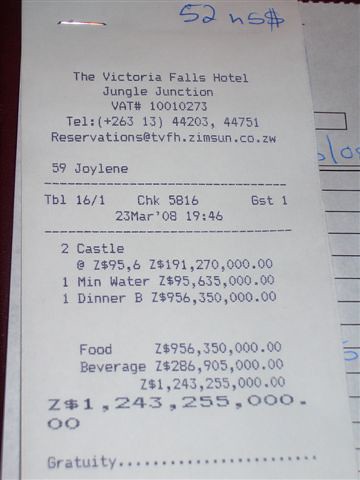

As of this moment 1 U.S. dollar would convert to 15,602 Zimbabwe dollars after the redenomination. Had the Zimbabwe dollar not been redenominated, 1 U.S. dollar would convert to 156 quadrillion Zimbabwe dollars.
************************************************************
You have probably noticed that the U.S. economy is struggling; the price of goods and services are going up, people are losing their jobs and homes, small and large businesses are going bankrupt-- we are experiencing stagflation. Now ask yourself this. What has the U.S. government's 'solution' been?
The answer is inflation. The Federal Reserve Bank is creating more money for banker bailouts, auto bailouts, income tax rebate checks, etc. The Fed is lower lending rates again a la Alan Greenspan, whom was the catalyst for this bubble in the first place. The U.S. spends $1 trillion on defense-related purposes. The U.S. is $10 trillion in debt. The U.S. owes $60 trillion in entitlements. The U.S. borrows money from other countries in exchange for Treasury Bonds, and if foreign countries stop buying U.S. dollars and starts spending their reserves in the U.S., Americans will see the price of everything sky rocket.
Inflation is evil. It is created by the Federal Reserve Bank. And it cannot be fixed with more inflation. Zimbabwe is a very recent example of this and yet the U.S. is following the same slippery path to economic destruction.
GAF was the brand that replaced the familiar Ansco. But the L-ES, like the other SLRs in the series, was a rebadged Japanese Chinon, specifically the CE Memotron.
Even in the Stagflation-era USA, some of those comparison prices seem a little goofy. (See some typical numbers from 1973.)
Recession? Depression? Inflation? Deflation? Stagflation? These are difficult and confusing times. The remedy? Take lots of pictures and enjoy life. ;-)
The Canadian 2 dollar coin (uncropped macro seen here), commonly called "Toonie", was introduced on February 19, 1996 by Public Works minister Diane Marleau. The Toonie is a bi-metallic coin which bears an image of a polar bear, by Campbellford, Ontario artist Brent Townsend, on the reverse.
Strobist: Strobes right and above.
Shantytowns, soup lines, brokers with pockets turned out- these are all images still close to the American psyche. And the folks with a political agenda and lust for power are pushing on this economic emotional pressure point recklessly, like a sadistic masseuse. At some point we need to step back and gain some perspective. These are difficult times, but this is not the Worst Crisis Ever. I am not convinced it is the worst since the Depression, and even if it is it pales in comparison. For many folks in Detroit, this is the worst they’ve seen. I have no doubt about that. Though from my experience the stagflation chaos and ensuing deep recession in the late 70’s and early 80’s still seems harsher.
What is different this time, for me, is the lack of hope and energy I feel in the community. Maybe my sense of the future is jaded by age. Or, maybe this pernicious melancholy I sense in my hometown is a function of the slow and relentless losing streak the city has been on for the past 25 years. Either way, I wish it would stop. I think back to a time when the City had real boosters. People who rallied around big and small ideas without slipping a hand in the goodie jar.
Not to leave on a bad note, rest assured these dark financial days gripping us will pass. While we may not laugh, one day we will likely say, “I wish I bought stocks, or real estate, or whatever, back in 2009.” We always do. Markets and economic cycles are like gravity, they always exists and defying them is silly. The moment the choir of “smart guys” on Wall Street or in DC start chanting, “It’s different this time. Prices are going to go up, up, up.” Ignore them. Better still, turn a chunk of your assets into a bag of silver coins. Then take the bag of coins and smack the dude in the wizard hat and pin striped suit upside the head. You will be doing us all a service.
The economic stagnation and soaring inflation (stagflation) of the Ford / Carter years led to the widespread introduction of "low priced" generic products. Most had labels printed only in black, this is a slightly more "upscale" version that includes red.
A rusty 8 ounce can of "pure ground black pepper" distributed by American Stores Buying Company, Salt Lake City, UT 84130. Purchased at either an Alpha-Beta or Lucky Supermarket in the Los Angeles area about 1980. At the time, the mortgage payment (at 13.875% interest) on the condo was 105% of my take home pay. I had a refrigerator (bought on credit) but no bed and slept on a blanket on the floor. When the police arrived after reporting a break-in their first comment was "My God, they've taken everything!" They were shocked when I told them absolutely nothing was missing.
In 1982 a co-worker moved back to his country of origin and I bought most of his furniture. In 1986, after several years of the Ronald Reagan economic miracle, I was able to refinance at 8.375% and finally had some breathing room.
"How did you qualify for the mortgage???" - while I was away in New York to round up the down payment my bank withdrew the offer of a mortgage at about 9%. The builder was paying 21% on the construction loan and was within a week of going bankrupt. He "leaned on" his bank to give me the 13.875% mortgage - I never needed to provide ANY paperwork to the bank and closed the next day. A few days later mortgage rates hit 18% and the mortgage industry shut down for several months. The builder "broke even" and left the business. I eventually paid off the mortgage.
"If you're offering me diamonds and rust
I've already paid"
- Joan Baez
Remember how Republicans used to hearken back to the stagflation days of Jimmy Carter's presidency as a way to scare voters about the Democratic Party?
Looks like there's a new presidential pariah in town.
* * *
Thanks to flickr user Lasagna Boy for making a source image available through the creative commons. Likewise, anybody is free to reprint or modify this image per the terms of the CC license.
contemporary reception policy for illegal immigrants
( comics of ▶ iconomics )
Exhibition : 'At Home'
sketch : Petros Zervos
photo & comments : bilwander
Juan Perón was an Argentine military officer and politician three times elected as president but only served one full term. Juan was part of the 1943 military coup and served his first term as president from 1946-1952. His state goals were social justice and economic independence for Argentina. Despite serious economic troubles such as stagflation, Juan's government is remembered for its significant infrastructure and social investments.
He and his second wife, Eva, met in early 1944 during a charity event in Buenos Aires while Juan was still a Colonel. After their wedding two years later and Juan's election to the presidency, Eva played a prominent role as a labor rights advocate and philanthropist. She ran the Ministries of Labor and Health and established the Eva Perón Foundation in 1948, which had a $50 million endowment (nearly 1% of Argentina's GDP at the time). She exerted significant influence over and provided great popular support for her husband's policies.
Juan and Eva remained strongly devoted to helping the working and lower classes of Argentina. Eva died of cancer in 1952. At the news of the nation's spiritual leader's death all activity in Argentina stopped, the government suspended all activity for two days, and popular grief was unprecedented; eight people died and over 2000 injured in crushing mobs trying to get near her body as it was being moved. Juan was overthrown in a 1955 military coup and was exiled to Venezuela, then moved to Spain. He returned to Argentina in 1973 and died in 1974.
1980 Oil on canvas by Robert Templeton. James Earl "Jimmy" Carter, Jr. (born October 1, 1924) served as the 39th President of the United States from 1977 to 1981 and was the recipient of the 2002 Nobel Peace Prize, the only U.S. President to have received the Prize after leaving office. Before he became President, Carter served two terms as a Georgia State Senator and one as Governor of Georgia, from 1971 to 1975,[2] and was a peanut farmer and naval officer.
As president, Carter created two new cabinet-level departments: the Department of Energy and the Department of Education. He established a national energy policy that included conservation, price control, and new technology. In foreign affairs, Carter pursued the Camp David Accords, the Panama Canal Treaties, the second round of Strategic Arms Limitation Talks (SALT II), and returned the Panama Canal Zone to Panama.
Throughout his career, Carter strongly emphasized human rights. He took office during a period of international stagflation, which persisted throughout his term. The final year of his presidential tenure was marked by the 1979 takeover of the American embassy in Iran and holding of hostages by Iranian students, an unsuccessful rescue attempt of the hostages, fuel shortages, and the Soviet invasion of Afghanistan.
By 1980, Carter's popularity had eroded. He survived a primary challenge against Ted Kennedy for the Democratic Party nomination in the 1980 election, but lost the election to Republican candidate Ronald Reagan. On January 20, 1981, minutes after Carter's term in office ended, the 52 U.S. captives held at the U.S. embassy in Iran were released, ending the 444-day Iran hostage crisis.[3]
After leaving office, Carter and his wife Rosalynn founded the Carter Center in 1982,[4] a nongovernmental, not-for-profit organization that works to advance human rights. He has traveled extensively to conduct peace negotiations, observe elections, and advance disease prevention and eradication in developing nations. Carter is a key figure in the Habitat for Humanity project,[5] and also remains particularly vocal on the Israeli-Palestinian conflict.
2016 Updated High quality version
Using this picture:
You are welcome to use this picture for commercial or non-commercial purposes, as long as you comply with the CC-Attribution license. If you need another license then contact me, but otherwise you don't need to ask for my permission. I do appreciate comments letting me know what you're using it for, and I really appreciate a copy of any print publications my pictures wind up in.
www.cnn.com/2022/06/13/investing/dow-stock-market-today/i...
Dow tumbles 876 points and stocks enter bear market on worries of drastic rate hikes
New York (CNN Business) US stocks have plunged into a bear market as Wall Street investors grew increasingly nervous about the prospect of even harsher medicine from the Fed to take the sting out of inflation.
The Dow (INDU) sank 876 points or 2.8%. The Nasdaq was down by 4.7% and has tumbled more than 10% in the past two trading sessions.
The broader S&P 500 fell 3.9%. That index is now more than 20% below its all-time high set in January, putting stocks in a bear-market.
Recession fears mounted after Friday's miserable Consumer Price Index report showed US inflation was significantly higher than economists had expected last month. That could make the Federal Reserve's inflation-control efforts more difficult.
After raising rates by a half point in May — an action the Fed hadn't taken since 2000 — Chair Jerome Powell pledged more of the same until the central bank was satisfied that inflation was under control. At that point, the Fed would resume standard quarter-point hikes, he said.
But after May's hotter-than-expected inflation report, Wall Street is increasingly calling for tougher action from the Fed to keep prices under control. Jefferies joined Barclays on Monday in predicting that the Federal Reserve would hike rates by three-quarters of a percentage point, an action the Fed hasn't taken since 1994.
"After holding their breath for nearly a week awaiting the US CPI report for May, investors exhaled in exasperation as inflation came in hotter than expected," Sam Stovall, chief investment strategist at CFRA, said in a note to clients Monday morning.
Stovall said the risk of larger hikes dragged the markets lower Monday.
Investors fear two outcomes, neither of them good: Higher rates mean bigger borrowing costs for businesses, which can eat into their bottom lines. And overly zealous action from the Fed could unintentionally plunge the US economy into a recession, especially if businesses start laying off workers and the red-hot housing market crumbles.
There's no sign that the job and housing markets are in danger of collapse, although both are cooling off somewhat.
In an interview with CNN's Fareed Zakaria Sunday, former Fed Chair Ben Bernanke said a US recession remains possible. But Bernanke said he had faith that Powell and the Fed could achieve a so-called soft landing, the elusive outcome in which the central bank can cool the economy down to get inflation under control without slowing it down so much that it enters a recession.
"Economists are very bad at predicting recessions, but I think the Fed has a decent chance — a reasonable chance — of achieving what Powell calls a soft-ish landing, either no recession or a very mild recession to bring inflation down," Bernanke said.
Analysts appeared to move beyond a "buy the dip" mentality on Monday, signaling that they don't see markets recovering quickly.
"Valuations aren't much cheaper given rising interest rates and a weaker earnings outlook, in our view," wrote strategists at BlackRock in a Monday notes. "A higher path of policy rates justifies lower equity prices. Plus, margin pressures are a risk to earnings."
BlackRock will remain neutral on stocks for the next six- to 12-months, the strategists said.
Bears and bulls
The S&P 500 closed in a bear market, so the bull run that started on March 23, 2020 has come to an end. But, because of the tricky way these things are measured, the bear market technically began on January 3, when the S&P 500 hit its all-time high.
That means the latest bull market lasted just over 21 months — the shortest on record, according to Howard Silverblatt, S&P Dow Jones Indices senior index analyst. Over the past century, bull markets have lasted an average of about 60 months.
The shortest bull market followed the shortest bear market, one that lasted just over a month — from February 19 to March 23, 2020. Bear markets historically last an average of 19 months, according to Silverblatt.
Stocks briefly fell into a bear market on May 20, although a late-day rally rescued the market from closing below that threshold for the first time since the early days of the pandemic.
The tech-heavy Nasdaq has been in a bear market for some time and is now more than 32% below its all-time high set in November 2021. The Dow is still some way from a bear market. It has fallen about 16% from the all-time high it reached on the last day of 2021.
fortune.com/2022/06/12/were-now-in-a-period-of-stagflatio...
‘We’re now in a period of stagflation’ that could devolve into recession, top economist Mohamed El-Erian says
“I think you’ve got to be very modest about what we know about this inflation process,” he said. “And I fear that it’s still going to get worse."
The U.S. is in a period of stagflation leaning toward recession, Allianz SE CEO Mohamed El-Erian said Sunday.
Recession risks are “tilted in a negative way right now,” El-Erian said on CBS’s Face the Nation, Bloomberg reported.
“I think you’ve got to be very modest about what we know about this inflation process,” he said. “And I fear that it’s still going to get worse. We may well get to 9% at this rate.”
In May, U.S. consumer prices were 8.6% higher than the year before, hitting a 40-year high.
El-Erian said the Fed “fell behind” on inflation and that he expects to see a 50 basis points hike at this week’s rate-setting meeting. The Federal Open Market Committee is set to meet Tuesday and Wednesday of this week.
El Erian said that the U.S. is “in a period of stagflation,” but that a strong labor market was warding off recession.
“That’s why a recession is a risk scenario, not a baseline,” he added.
What is stagflation?
It’s a combination of economic stagnation and high inflation, with the added struggle of increased unemployment, Veronika Dolar, an economist at State University of New York at Old Westbury and visiting professor at Stony Brook University in New York City, told The Conversation.
Typically, economists focus on “three big macroeconomic variables,” she said: gross domestic product, unemployment, and inflation.
“Each measure tells its own important story about how the economy is doing,” Dolar said. “GDP—or the total output of all goods and services produced—shows us what the broader economy is doing, unemployment tells us about the job situation, and inflation measures the movement of prices.”
She continued: “But their stories also overlap. And unfortunately, they usually don’t all tell us good news at the same time.”
It’s not uncommon to see a strong GDP with low unemployment counterbalanced by higher inflation—or lower inflation with lower GDP and, perhaps, higher unemployment, Dolar added.
“So, normally there is some good news and some bad news. But with stagflation, there is no good news,” she said.