View allAll Photos Tagged stability
Knole (/noʊl/) is a British country house and former archbishop's palace owned by the National Trust. It is situated within Knole Park, a 1,000-acre (400-hectare) park located immediately to the south-east of Sevenoaks in west Kent. The house ranks in the top five of England's largest houses, under any measure used, occupying a total of 4 acres (1.6 ha).[1]
The current house dates back to the mid-15th century, with major additions in the 16th and, particularly, the early 17th centuries. Its Grade I listing reflects its mix of late-medieval to Stuart structures and particularly its central façade and state rooms. In 2019, an extensive conservation project, "Inspired by Knole", was completed to restore and develop the structures of the buildings and thus help to conserve its important collections.[2] The surrounding deer park has also survived with varying degrees of management in the 400 years since 1600.
History &Location
Knole is located at the southern end of Sevenoaks, in the Weald of west Kent. To the north, the land slopes down to the Darenth valley and the narrow fertile pays of Holmesdale, at the foot of the North Downs.[4] The land around Sevenoaks itself has sandy soils, with woodland that was used in the Middle Ages in the traditional Wealden way, for pannage, rough pasture and timber.[5] The Knole estate is located on well-drained soils of the Lower Greensand.[6] It was close enough to London to allow easy access for owners who were involved with affairs of state, and it was on "sounde, parfaite, holesome grounde", in the words of Henry VIII.[7] It also had a plentiful supply of spring water.[8] The knoll of land in front of the house gives it a sheltered position. The wooded nature of the landscape could provide not only timber but also grazing for the meat needs of a grand household. Moreover, it made an excellent deer park, being emparked before the end of the 15th century. The dry valley between the house and the settlement of Sevenoaks also makes a natural deer course, for a combined race and hunt between two dogs and fallow deer.[9]
Early history
The earliest recorded owner of the core of the estate, in the 1290s, was Robert de Knole. However, nothing is known of any property he had on the estate. Two other families, the Grovehursts and the Ashburnhams, are known to have held the estate in succession until the 1360s, and the manor of Knole is first mentioned in 1364.[10] In 1419, the estate, which then spread over 800 acres, had been bought by Thomas Langley, Bishop of Durham, and by 1429, he had extended it to 1,500 acres.[11] The estate remained in the hands of the Langley family, it seems, until the mid-1440s when it had been acquired by James Fiennes, 1st Baron Saye and Sele. The circumstances of this transfer are not known, but it is clear that Lord Saye and Sele was also enlarging the estate by further, sometimes forcible, purchases of adjoining parcels of land. For example, in 1448 one Reginald Peckham was forced to sell land at Seal (at the north-eastern end of the current estate) to Saye "on threat of death".[12] Forcible land transfers recur in the later history of the house, including that between Archbishop Thomas Cranmer and Henry VIII.
Thomas Cardinal Bourchier, Archbishop of Canterbury
Lord Saye and Sele seems to have begun a building project at Knole, but it was incomplete by his death in 1450.[13] His ruthless exploitation of his powerful position in Kent was a motivating factor in the Jack Cade Rebellion. Saye and Sele was executed on the authority of a hastily assembled commission initiated by Henry VI in response to the demands of Cade's rebels when they arrived in London.[14]
Archbishop Bourchier's House
James Fiennes's heir, William, second Baron Saye and Sele, sold the property for 400 marks (£266 13s 4d) in 1456 to Thomas Bourchier, Archbishop of Canterbury. He already had a substantial property in the area, Otford Palace, but the drier, healthier site of Knole attracted him.[15] Archbishop Bourchier probably began building work by making substantial renovations of an existing house. Between 1456 and 1486, Bourchier and his bailiff for the Otford bailiwick, John Grymesdyche, oversaw substantial building work on the current house.[16] The remodelled house must have been suitable for the archbishop by 1459, when he first stayed there, but he based himself there increasingly in his later years, particularly after 1480, when, at the age of about 69, he appointed a suffragan. In 1480, Thomas Cardinal Bourchier, as he had become in 1473, gave the house to the Archdiocese of Canterbury.[17]
In subsequent years, Knole House continued to be enlarged, with the addition of a large courtyard, now known as Green Court, and a new entrance tower. These were long thought to be the work of one of Bourchier's successors, but the detailed study by Alden Gregory suggests that Bourchier was responsible. He took advantage of the political stability that followed the restoration of Edward IV in 1471 to invest further in his property.[18]
Knole in the Tudor period
After Cardinal Bourchier's death in 1486, Knole was occupied by the next four archbishops: John Morton (1487–1500), Henry Deane (1501–1503), William Warham (1504–1532) and finally Thomas Cranmer.[19] Sir Thomas More appeared in revels there at the court of Archbishop Morton, whose cognizance (motto) of Benedictus Deus appears above and to either side of a large late Tudor fireplace there.[20] Henry VII was an occasional visitor, as in early October and midwinter 1490.[21]
Cardinal Bourchier had enclosed the park with a pale to make a deer park and it seems that Henry VIII used to visit Archbishop Warham to hunt deer.[22] After the death of Warham and before the appointment of his successor, Henry found his properties in nearby Otford and Knole useful residences for his daughter Mary, at the time of the protracted divorce from her mother, Catherine of Aragon. She was at Knole from 27 November 1532 to 5 March 1533.[23]
Warham's successor as archbishop, Thomas Cranmer, acquired all the temporalities of the See of Canterbury. However, these brought with them substantial debts and complex demands of land management, set against a backdrop of massive land transfers associated with the dissolution of the monasteries and broader assaults on church wealth. Cranmer was, therefore, unable to withstand repeated demands from Henry VIII for exchanges of land.[24] This was a long-term process stretching between 1536 and 1546, so that there is no need to imagine that Henry wanted Knole, specifically, for example as a deer park. In 1537 the manor of Knole, and five other manors and a number of advowsons and chantries largely forming the archbishop's bailiwick of Otford, were 'exchanged' with Henry VIII. In return, Cranmer received a package primarily consisting of former abbeys and priories between Canterbury and Dover.[25]
Knole was granted to Edward Seymour, 1st Duke of Somerset, in August 1547 at the start of his nephew Edward VI's reign, but following Somerset's execution in 1549 it reverted to the Crown.[26] Mary gave the residence back to her Archbishop of Canterbury, Cardinal Reginald Pole, but with their deaths in 1558 the house reverted to the Crown.
In the early 1560s, Elizabeth I gave Knole to Robert Dudley, 1st Earl of Leicester, but he returned it in 1566. However, he had already granted a lease (1 February 1566) to one Thomas Rolf. Under this the 'manor and mansion-house' of Knole and the park, with the deer, and also Panthurst Park and other lands, were demised to the latter for the term of ninety-nine years at a rent of £200. The landlord was to do all repairs, and reserved the very unusual right (to himself and his heirs and assigns) to occupy the mansion-house as often as he or they chose to do so, but this right did not extend to the gate-house, nor to certain other premises. The tenant was given power to alter or rebuild the mansion-house at his pleasure.[27] Meanwhile, Elizabeth had possibly granted the estate to her cousin Thomas Sackville who, at that time, had the title of Lord Buckhurst.
There was competition at that time for the Knole estate. Rolf died very soon after, and the residue of the lease was bought by a wealthy local lawyer, John Lennard (of Chevening). He had gradually built up a network of properties around Sevenoaks, including the manor of Chevening, and adjoining property in the parishes of Knockholt and Halstead, all just to the north of Sevenoaks.[28] Lennard had already pressurised Rolf to sell the lease before his sudden death but, at the same point, Lord Buckhurst was also competing for the lease. Knole was a significant addition to Lennard's local land-holdings when it was confirmed, around 1570. However, Buckhurst was still able to insist upon some rights on the estate, including the ownership of at least some of the deer in the park.[29] John moved to Knole, but gave his son Sampson, Lord Dacre's son-in-law, a sub-lease.[30] The Knole estate was worth a great deal to Sampson, bringing him in 1599 rents worth £218, 6s and 8d.[31]
One of Sampson Lennard's daughters, Margaret, married Sir Thomas Waller, at one time lieutenant of Dover Castle and the younger son of an important Kent family, with their seat at Groombridge. An unusual term in the marriage covenant stipulated that Margaret and Thomas should live at Knole which is where Margaret gave birth to her son William, probably in 1598.[32] The baptism is recorded in the Sevenoaks parish register for 3 December. In 1613, William inherited his father's baronetcy, becoming Sir William Waller. He later commanded a parliamentary army with some distinction during the English Civil War. Wikipedia
A railway bridge across the Tay had widespread support but from the start the design of the bridge was roundly criticised, its single track particularly so on grounds of both capacity and stability. As construction began, Bouch was forced to change his plans for the bridge. The foundations and bases were redesigned, the original brick piers replaced with braced cast iron columns and the number of spans was reduced which made each significantly wider. Despite ongoing difficulties in its construction, the bridge was opened with much celebration on 31 May 1878. Within a year it had increased the fortunes of the North British Railway as well as those for Dundee and towns throughout Fife. Passenger numbers between Dundee and Fife doubled and the railway saw a 40% increase in freight traffic. However, on the night of 28 December 1879 and in a terrible storm, the thirteen central ‘high girders’ of the bridge fell down. The subsequent Court of Inquiry fundamentally blamed the design of the bridge for the collapse, and its judgement rested on Thomas Bouch.
After the disaster both the North British Railway and supporters of the Tay Bridge were determined that it should be rebuilt. The company quickly submitted a Bill to Parliament for the rebuilding of the old bridge, but as Thomas Bouch was associated with the rebuilding project, Parliament rejected the Bill. After dispensing of the services of Thomas Bouch, William Henry Barlow, who had sat on the Court of Inquiry, was invited to report on the best course of action. After thorough investigation of the options, his recommendation was to build a new double line bridge, completely independent of the old.
Barlow’s design for the new bridge was deeply influenced by the presence of the old. To satisfy stipulations made by the Board of Trade, the bridge was to be constructed exactly parallel alongside the old in order to keep navigation channels open, and its height was to be reduced from 88ft in the old bridge to 77ft in the new. As in the old bridge, the railway line was to run on the top of the approach girders, and through the girders of the high, larger navigation spans. Barlow recommended that if the spans of the new bridge were to be kept the same, girders from the old bridge that were unaffected by the collapse of the high girders, were able to be re-used in the new. The new bridge was to be built 60ft upstream from the old, allowing the old bridge to become ‘staging’ for the men and materials in the construction of the new. The approaches onto the new bridge were altered; to the south the branch lines were joined on brick arches nearer to the shore at Wormitt, and to the North the eastwards curve into Tay Bridge Station (now called Dundee) was softened. Stringent tests on weight and wind loading in the design and construction of the new bridge were also to be undertaken. The proposals for the ‘New Tay Viaduct’ were accepted by Parliament in October 1881, and the firm William Arrol & Co of Glasgow was appointed contractor.
The new bridge took just 5 years to build, thanks in most part to special pontoon equipment with hydraulic legs which were designed by William Arrol. Various arrangements of these hydraulic pontoons were used to sink and construct the brick and concrete foundation columns, to erect the wrought iron piers, to move the old girders into position for the new bridge, and to erect the new navigation spans. The completed bridge is 10711ft in length, 8396ft of which is in a straight line running virtually north / south across the Tay until it curves eastwards towards Dundee. There are 85 piers; 1-28 forming the south approach, 28-41 the ‘navigation spans’ and 41-85 the north approach. The new Tay Bridge was opened to traffic, without ceremony on 20 June 1887
Purple combines the calm stability of blue and the fierce energy of red. The color purple is often associated with royalty, nobility, luxury, power, and ambition. Daisies and tulips in the regal color...
For decades now, I have been walking along the corridors in Prague towards the Pod Jezerkou tram stop, passing the library building – formerly a bank. Every time I go there, my gaze wanders up to the statue on the roof. And even though I know her intimately, she still catches my eye. That elegant, noble woman has always fascinated me.
It was only a year ago that I discovered that it was a statue called Thrift, the work of sculptor Bohumil Stehlík, a student of the famous Josef Václav Myslbek. It was placed in 1931 on the ledge of the then Občanská záložna in Michle, which was built in the late 1920s. The allegorical figure of a young woman holding a piggy bank is complemented by a gearwheel and ears of grain – symbols of industry and agriculture. Together, they embody the ideals and values of the time: honest work and prudent management as the basis of prosperity, happiness and a contented life.
However, the desire to obtain values without work has accompanied humanity since time immemorial. Alchemy was born in ancient Egypt - an attempt to turn worthless metal into gold and find the elixir of eternal life. It was always the same: to obtain valuables without effort.
Later, similar ideas were reincarnated in the world of finance - in the form of paper money that was not backed by gold. The first attempts appeared in the 17th century, but then they failed. Until 1971, the gold standard was in effect - the currency was tied to a specific amount of gold. This ended when US President Nixon abolished the convertibility of the dollar for gold. Since then, the value of currencies has been based solely on trust - in the central bank and the economic power of the state. Another step towards modern alchemy.
Technological development has only strengthened this trend. In 2009, the first digital currency was created - cryptocurrency. Again, there was a desire to create value from nothing. No costs, no work, no guarantees. We see similar tendencies in the financial markets, where derivatives are traded – often without a real basis, purely speculatively. Here too, traces of the old alchemist desire are visible.
It is all the more important today to remember the values that do not shine so easily, but have real weight: thrift, honesty and work. In crafts, in industry, in agriculture. They are the foundations on which stability and true happiness are built. After almost a hundred years, the statue of Bohumil Stehlík has lost none of its relevance – on the contrary. Today, its message speaks to us perhaps even more urgently than then.
Aston Martin DBS is a 6.0-litre V12 powered, race-bred, two-seater shaped by the aerodynamic demands of high performance, with an exquisite interior that marries beautifully hand-finished materials with the very latest in performance technology. Race-derived materials and components and Aston Martin’s unrivalled hand-build expertise makes the DBS a luxury sports car without equal.
Aston Martin DBS Specifications:
Body:
- Two-door coupe body style with 2+0 seating
- Bonded aluminium VH structure
- Aluminium, magnesium alloy and carbon-fibre composite body
- Extruded aluminium door side-impact beams
- High Intensity Discharge headlamps (dipped beam)
- Halogen projector headlamps (main beam)
- LED rear lamps and side repeaters
Engine:
- All-alloy, quad overhead camshaft, 48-valve, 5935 cc V12. Compression ratio 10.9:1
- Front-mid mounted engine, rear-wheel drive
- Fully catalysed stainless steel exhaust system with active bypass valves
Projected Performance figures:
- Maximum power: 380 kW (510 bhp/517 PS) @ 6500 rpm
- Maximum torque: 570 Nm (420 lb ft) @ 5750 rpm
- Maximum speed: 307 km/h (191 mph)
- Acceleration: 0-100 km/h (0-62 mph) in 4.3 seconds
Transmission:
- Rear-mid mounted, six-speed manual gearbox
- Alloy torque tube with carbon-fibre propeller shaft
- Limited-slip differential
- Final-drive ratio 3.71:1
Steering:
- Rack and pinion
- Servotronic speed-sensitive power-assisted steering
- 3.0 turns lock-to-lock
- Column tilt and reach adjustment
Wheels & Tyres
Wheels:
- Front: 8.5" x 20"
- Rear: 11" x 20"
Tyres:
Pirelli P Zero
- Front: 245/35
- Rear: 295/30
Suspension:
Front:
- Independent double wishbone incorporating anti-dive geometry
- Coil springs
- Anti-roll bar and monotube adaptive dampers
Rear:
- Independent double wishbones with anti-squat and anti-lift geometry
- Coil springs
- Anti-roll bar and monotube adaptive dampers
Adaptive Damping System (ADS) with Track mode
Brakes:
Front: Ventilated carbon ceramic discs, 398 mm diameter with six-piston calipers
Rear: Ventilated carbon ceramic discs, 360 mm diameter with four-piston calipers
Dynamic Stability control (DSC) with Track mode, including anti-lock braking system (ABS), electronic brakeforce distribution (EBD), emergency brake assist (EBA) and traction control.
Dimensions:
Length: 4721 mm
Width: 1905 mm excluding door mirrors, 2060 mm including door mirrors
Height: 1280 mm
Wheelbase: 2740 mm
Fuel tank capacity: 78 litres
Weight: 1695 kg
Interior:
- Semi-aniline leather and Alcantara interior
- Matrix alloy facia trim and Iridium Silver centre console finish
- Carbon-fibre door trims and door pulls
- Auto-dimming rear-view mirror & garage door opener (USA and Canada only)
- Sports seats with ten-way electric adjustment, including height, tilt and lumbar adjustment
- Memory seats & exterior mirrors (three positions)
- Dual-stage driver/passenger front airbags
- Side airbags (sports seats only)
- Heated seats (sports seats only)
- Heated rear screen
- Automatic temperature control
- Organic Electroluminescent (OEL) displays
- Trip computer
- Cruise control
- Hard Disk Drive (HDD) satellite navigation system*1,2
- Bluetooth telephone preparation*1
- Powerfold exterior mirrors
- Front and rear parking sensors
- Tyre-pressure monitoring*1
- Alarm and immobiliser
- Remote-control central door locking and boot release
- Battery disconnect switch
- Battery conditioner
- Tracking device (UK only)
- Boot-mounted umbrella
*1 Not available in all markets
*2 Includes Traffic Messaging Channel (TMC) in Continental Europe
In-car entertainment:
- Aston Martin 700 W premium audio system with Dolby® Pro Logic II®
- MP3 player connectivity
Optional Equipment:
- Lightweight seats with six-way adjustment, including front and rear height adjust (Does not include side airbags or heated seats feature. Not available in USA or Canada)
- 20" alloy wheels with graphite finish
- Satellite radio system (USA only)
- Piano Black facia trim and centre console finish
- Leather storage saddle
- Personalised sill plaques
- Auto-dimming interior rear-view mirror*1
- Auto-dimming interior rear-view mirror with garage door opener (Europe only)
- Alarm upgrade (volumetric and tilt sensor)
- Tracking device*3
- First-aid kit
- Ashtray and cigar lighter
*1 Not available in all markets
*3 Complies with UK Thatcham Category 5 requirements. Excludes subscription. Standard in UK.
Fujifilm X100V
Built-in ND filter activated, camera placed on a flat rail for stability of the slow shutter speed
Compassion is not religious business, it is human business, it is not luxury, it is essential for our own peace and mental stability, it is essential for human survival. ~The Dalai Lama
Former attack bomber, "Orbital Lance" class, designed for scouting in the outer atmosphere, blasting away defences with two autocannons and dropping whatever kind of bomb it has loaded. Decommissioned and sold as a recreationel vehicle for the very, very rich. The current owner refitted it with guns, tried to pass it off as a medical craft and gave it an all-caps name to further piss of any registering authorities. He is currently leaving a refueling station in a hurry with resupply lines dangling about.
This thing was a huge pain to take photos of, I feel like I only have to look at it too much and it will fall apart. I noticed too late in the game that some connections were very flimsy and that my light box was way too small. It was my most challenging build so far, not only because of the many differently angled polygons.
All in all it was very fun to build, I overcame many obstacles and now feel more confident to build bigger ships (this one measures 70 studs after all).
Despite it's rough looks and the mediocre photography I hope you all like this and/or maybe you have some advice on how to identify stability issues early in the build?
Oh and props go to Matt Rowntree whose amazing entry for SHIPtember 2017 gave me the idea of building in technic scale.
EAST CHINA SEA (June 30, 2022) Sailors move an F-35B Lightning II, assigned to Marine Strike Fighter Squadron (VMFA) 121, in the hangar bay aboard amphibious assault carrier USS Tripoli (LHA 7). Tripoli is operating in U.S. 7th Fleet to enhance interoperability with allies and partners and serve as a ready response force to defend peace and maintain stability in the Indo-Pacific region. (U.S. Navy photo by Mass Communication Specialist 1st Class Peter Burghart)
The Grade I Listed Llys yr Esgob Tyddewi (St Davids Bishop's Palace), a ruined medieval palace located adjacent to St Davids Cathedral. It is managed by Cadw, the historic environment service of the Welsh Government. In St David's Pembrokeshire, South Wales.
St Davids became home of the Marcher Lords, responsible for guarding the border between England and Wales, so would have been a site of great strategic importance. It was also considered a hugely important religious site, housing relics of the St David, patron saint of Wales. William the Conqueror is said to have visited as a pilgrim in 1081.
The original monastery that stood on the site was established in the 6th century and, over the succeeding four centuries, was ransacked at least 10 times by Norse raiders. The arrival of the Normans in the 11th century brought some stability. They appointed a Norman bishop and attempted to protect the site by building a motte and bailey fort and, later, a stone defensive wall.
In 1284, King Edward I visited St Davids on a pilgrimage and this visit may have inspired some earlier work because Bishop Thomas Bek, who served from 1280–93, was among his former statesmen. Bishop Bek was responsible for construction of the chapel in the south-west corner, the hall, the private apartments and the gate.
The beginning of the Reformation also heralded the decline of the Bishops Palace. In 1536 Bishop William Barlow stripped the lead from the roof. Legend has it that he used the money to pay for the dowries of his five daughters.
He made so much money from this that a sixteenth-century account said that more than twelve years revenue of the bishopric would have been needed to cover the cost of replacing it, and the building fell into disrepair. Bishops stayed less at St Davids and, by the middle of the 16th century, the chief episcopal residence had been relocated to Abergwili, Carmarthenshire. In 1616, Bishop Richard Milbourne applied for a licence to demolish some of the buildings. By 1678, when another licence for demolition was sought, the palace was considered beyond repair.
Information Source:
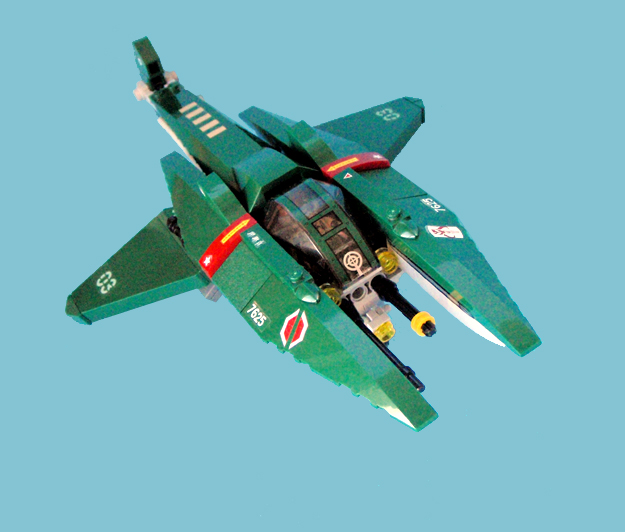
Pilots who have encountered the results of Project Viper in the skies report that it is capable of completing impossible maneuvers at unthinkable speeds, though many question the purpose and stability of it's unusual, double-pronged front and shark-like tail.
Cold War II Dieselpun.K Viper!
So I was parting out my Indiana Jones sets and thought, "hey, I have enough dark green to build a Viper" and this happened.
Nods to .Tromas and Jon Hall
Gallery:
www.brickshelf.com/cgi-bin/gallery.cgi?f=489185
1-7:
www.brickshelf.com/gallery/busterbuilder/SpaceCreations/E...
Terrace Falls Reserve
Blue Mountains National Park.
The Blue Mtns received some torrential rain for a couple of days, so it was a great time time to explore the waterfalls in the mid mountains area.
These waterfalls only flow strongly after decent rain.
I waited for a day after the rain finished to so that all the sediment that normally turns the water an ugly brown would’ve settled back down.
My friend Bez and I headed down into the Reserve and we were met by a rainforest wetland.
The waterfalls were flowing like I’d never seen them before, and there was water and mud everywhere.
The walking track had a temporary creek running thru it and all the usually dry creek crossings became tricky & slippery wades.
There were cascades tumbling down where previously there were none.
The cliffs were ‘weeping’ moisture which made it quite a refreshing walk.
And of course, the wet brought out the leeches in force.
The conditions were exhilarating but made for challenging photography.
The torrent of water that was flowing down the creeks was creating a fine mist that continually covered camera lenses.
This mist also created a rather hazy washed-out looking landscape.
All the usual spots for waterfall compositions were now under water, and the force of the water played havoc with tripod stability.
Also the amount of water made longer exposures trick due to over-exposure.
We reached the Bedford Ck junction and Bez had to head off for a family function.
I continued left towards Bedford Pool and headed upstream on un-named creek that headed towards Pyramid Falls.
This gully is normally pretty dry but was alive with flowing water with temporary cascades and rivulets flowing in all directions.
It was certainly quite a memorable day with conditions that are pretty rare for these parts.
I've been wanting to build a Wipeout inspired ship for so long... And I finally got inspired to mix a racy aesthetic with the Vic Viper themed month to create the Aurora-s1 race ship.
The Aurora-s1 is a two maned ship (a pilot and an engineer), propulsed by 4 engines with a single big central motor. Side wings can expand or retract to adjust stability when needed.
Ghosts ; the way is simple, just follow the river.
Zion National Park [2/3],
Certainly the most original trek in this National Park - The Narrows; it follows the gorges created by the "Virgin Rvier", in the middle of Zion Valley. It is possible to walk in the middle of the huge red walls for several hours going upstream (10-15 miles). The difficulties here are; srong flow at certain places, cold air, and above all, the walk in fresh water, reaching to the knees and occasionally almost to the waist. (It is also preferred to find something that can serve us as a stick in order to get stability).
.
Needless to say, you have to be even more carefully when walking around with all the camera equipment.
.
So, to avoid crowds, we decided to take the first bus before sunrise which took us to the start of the trek, in order to fully enjoy this beautiful place and thus be able to take pictures in peace.
.
Here, after about 2 hours of walking, I saw the first pursuers at the first glows.
.
Nikon D610, 18mm, F / 8, 2.5 sec, ISO 100.
Amazing how wide the body is covering nesting eggs and maintaining complete silence and stability. The head stays low but follows us as we paddle by the lodge. We just swing by quickly not to frighten the goose and cause it to take off. It has been quite cold these days so exposure of the eggs to the frigid weather could be very detrimental. I wonder if the goose changes with his or her partner to maintain 24 hour coverage?
In the meandering vastness of the space-time continuum, between the fixed points of Nevertime and Evertime, if you are lucky, you will find Sometime. Sometime manifests itself as temporary vortex of stability where wonderful things can happen, if only for a short period. Reality is semi-suspended, and magic becomes semi-real. Some call Sometime, “The Photo Trip.”
At the edge of Sometime, three beings set off on a Quest. Travelling from the Realm of Perpetual Misery* on the backs of Huginn and Muninn, Odin’s ravens, they are taken deep into the vortex, into the Land of Ice. As with all good Quests, the main protagonists need to be introduced. There was:
- Vilinda Bangtidy, Keeper of the Keys to the Backdoor; a lady elf of the finest visage and a surprisingly broad vocabulary of Norse curse words **
- Paulvik Cliffscrambler, regularly voted The Vanir*** Most Lacking In Common Sense.
- Sveinn Fishbreath, the Bloody Stupid; a dwarf so downright stupid that he failed to graduate from kindergarten until the age of 43.
There are many tales to tell about the week-long Quest into Sometime. Most of these are associated with specific locations and will probably be told as part of subsequent posts. For now, let me give you a summary…
Vilinda Bangtidy may be a beautiful elf but her habit of loudly regaling stories of her youth, combined her lack of social filters, resulted in a most unfortunate incident when a family of travellers overheard one of her tales about a birthday card. A mere birthday card has to be innocent, right? Well, what this family heard resulted in them running screaming back to their campervan, hands over ears, and making the most rapid of departures. Unfortunately for them, they seemed to be on exactly the same travel itinerary as our intrepid three Quest-goers. Every time Vilinda, Paulvik and Sveinn pulled up at a location, there would be a squeal of studded tyres as our campervan enthusiasts disappeared in cloud of black dust and snow. It is believed that they are still in therapy. And they probably will be for the rest of their natural lives. And afterlives.
Paulvik Cliffscrambler is a master of photography imagery. But. And it is a big “but”. Sometimes there are cognisant disconnects between his well-refined academic neurons and their grasp of basic reality. A big disconnect. Here are two (of many) examples:
While sitting in the car, sheltering from the truly ferocious winds, he was contemplating the best angle to shoot an adjacent steam vent. The plan was to position the vehicle as a kind of windbreak to protect photographer and equipment. While gazing upon the high velocity super-heated water and admiring how photogenic it looked as it was bent at 90 degrees to the horizontal by the gale, Paulvik enquired of his companions, “does anyone know which way the wind is actually blowing?”
A sea stack is a landscape photographer’s delight. Period. So obviously, any serious photographer would make every effort to climb down the mud-encrusted slippery cliff face to reach the beach. Only, most sensible photographers would give at least a smidgeon of consideration if they could make it back up. Paulvik didn’t. After much slipping and sliding, and using his top-of-the-range tripod as a climbing pick, Paulvik made it back up to the starting point, looking very much like an extra from The Walking Dead****. He had a very similar demeanour, too*****.
Sveinn Fishbreath, the Bloody Stupid got his name through one incident for the former part and multiple incidents for the second part. While stopping off in a local trading post, our protagonist, Sveinn, spies some Icelandic Jerky******. Obviously he just has to purchase a jumbo-sized family bag. For some bizarre reason, his comrades do not want to partake in this fishy feast, despite his enticing encouragement. “It’s full of protein”, he said. “It’s very tasty”, he said. “You should try some”, he said. “I can’t stop eating it”, he said…. “Stop the car”, he said, “I feel very sick!”. Despite brushing of the teeth, four times a day, the taste was still there at the end of the Quest into Sometime*******. Alas, there are too many tales of Bloody Stupidity to fully document here. Let’s just focus on one. When most people are reversing out of a parking space and there is a sort of grinding sound and something is impeding motion they stop and get out to see what the obstruction is. They don’t pull forward and then try reversing at higher speed to overcome the obstacle. Repeatedly. Sveinn is now the owner of a very bent tripod.
All of the above is true. Some bits were left out due to censorship rules. It was an epic trip into Sometime, and I am deeply grateful to my companions, shutterbug_uk2012 and Lindi m for not throwing me out of the car during the dried fish incident.
*Heathrow airport in the common tongue of humans
** the Anglo-Saxons take the credit for swearing, but in reality they plagiarised the utterances of Thor when he, rather stupidly, attempted to do DIY with Mjölnir, his famous hammer. His thumb will never be the same shape again.
*** a group of gods that, in modern culture, have been relegated to “lesser gods” compared to the Æsir. The Æsir have a better PR department. Paulvik is not happy about this.
**** One of the ones that have been lurking in the bottom of a swamp for the past few years, gently decaying and developing a murderous personality
***** With hindsight, Vilinda and Sveinn could have provided a bit more practical help. And not spent the twenty-or-so minutes doubled up laughing and taking snaps on their phones.
****** This commonly known as salted rotting dried fish. The fish bit is debatable, the rotting bit is not. Whatever is was, it stank. And I mean truly stank. But this was not known at the time of purchase as it was cunningly stored in a hermetically sealed bag.
******* On returning home, Mrs Sveinn was very suspicious as to why Mr Sveinn had a distinctly fishy breath. Enough said.
ЦРНА ГОРА У ВРТЛОГУ ИСТОРИЈЕ (Манастир Подмаине - Будва)
Само пре 15-так година тако рећи из пепела монах Сава са братијом подигао је древни мaнастир и обновио га да поново заблиста у старој слави. А да се ни мало не примећује дуг период запуштености и заборава. Сада је ово место озбиљног и најбројнијег молитвеног окупљања монаха и њима блиских у целој Митрополији: чудан али истинит контраст окружењу које као да постоји само због забаве и зараде.
На слици је звоник који се користи. Обрада слике је уз помоћ ефекта "поларне координате" у одличном програму IrfanView. По замисли аутора треба да сугерише цикличну пуноћу васељене - јединство храма, неба и земље које се невидљиво успоставља у свакој евхаристији.
► █░▓ *CRNA GORA (Montenegro) is a small independent European country in which only the president is independent. But even he... isn't that independent really. He is disjointed from his country and people, untouchable so to speak. But not from his own true "big bosses" beyond his country's borders. Those remote guys make sure the "peace, democracy and stability" in Montenegro get the necessary spin.
My image symbolizes a few things. The green, the grey and the blue are for what dominates and adorns this country of natural beauty: the meadows and the woods, the limestone rock, and the (often clear) Mediterranean sky.
The swirl is for the historic turmoil. In this last one, there's attempt to swallow up the re-born Christianity in Montenegro. After many decades of repression under the communist rule, the Church has finally set foot firmly on the ground. Unlike in the West, where atheism has become a mandate; a new unofficial religion for the most natives.
The history has not been gentle with Montenegro's native citizens, the ethnic Serbs. The swirling has been there for centuries. All the major powers tried their luck. There were countless of times already when the enemy marched on to occupy the proud mountain realm and its coast.
Most of them in vain; so a new strategy had to be introduced. Starting with the Ottomans, the native's identity has been targeted in order to get it dissolved. The goal now is to crush the Serbs easy way, from within. The Venetians, the roman catholics, the communists, they all imposed their own faith or ideology upon the orthodox christians. This has worked with the half of the people already. They are trapped and pushed to believe that by solely distancing themselves from what they were, they may become better and acquire better lives (this half believes in free lunch!).
Comes the time when it's turn for their own president and his ruling party to facilitate the necessary shift in identity. After 75 years of the communist dictatorship, their knowledge of democracy has become so thorough that they've been keeping one guy in power for the last 30 years. That makes him the longest ruling dictator left in Europe at present. He already owns almost everything. So he recently plotted to lay his hand on the last property he doesn't yet control: up to 2000 year old, Orthodox Church real estate and her artefacts, by far the country's highest, most distinguished treasure. The sly guy has waited for the Church a quarter of a century: to restore the locations and rebuild the shrines that communist had brought down and left in ruins. He has waited for the (mostly poor) churchgoers to use up their last penny and spare time and put the last polish over eminent historic places, which in Montenegro almost all originate from within the Church and naturally belong to her. Now he's ready to confiscate them by using a decree he ironically calls "Religious Freedom Law".
Ever since the end of December 2019 people are non-violently resisting this blatant unprecedented grab, with a surprising, sweeping success.
PODMAINE MONASTERY is restored in full glory after centuries of neglect and communist ignorance. Coming from the town, to enter the monastery compound is an experience equal to changing the worlds in a matter of seconds. Unforgettable; and it happens each and every time. On condition of course that you've spent some time in the monastery and partaken in prayers with the monks. This image originally presented: the bell tower which dominates the south side overlooking Budva bay, next to the dorm. With this unusual edit I first tried to suggest a symbol of the universal completeness, around the central position of the Cross where the Messiah's sacrifice took place for the salvation of the world; the full unity of the edifice, the bridge from land to heaven, to which the Liturgy is extending whenever a service is being held. Being the main reason why this place exist in the first place. The popular resistance to the state confiscation now gives the image another symbolism.
Panasonic DMC-G80 with its 20 mm f/1.7 prime lens. At it's equiv. of 40 mm in 35 mm film it offers a medium to wide focal length most universally usable in my experience. Aperture f/4.5 at 1/800 of a sec. Camera's lowest ISO of 200.
_________________________________________
Out-of-the-camera jpeg, compressed and edited in IrfanView. This is the application of the "polar coordinates" effect in this little gem of free software which deserves highest awards for compactness, speed and UI perfection.
~~~ НЕ ДАМО †СВЕТИЊЕ !! ~~~
David and I went on a lighthouse cruise a few weeks back, out of Orient Point...
The day was glorious, but the wind on the top of the boat was horrible... I had to hold on for dear life to get these shots and thankfully we took our monopods for stability....
The Sea Jet... perfect name... went so fast and didn't really get close enough for a decent shot...
but it was a wonderful day in the sun and wind....
SAN DIEGO (Sept. 3, 2020) The Arleigh Burke-class destroyer USS Rafael Peralta (DDG 115) returns to its homeport of San Diego following the successful completion of a seven-and-a-half month deployment. The ship operated in the U.S. 7th Fleet’s area of responsibility in support of security and stability initiatives in the Indo-Pacific. (U.S. Navy photo by Mass Communication Specialist 1st Class Woody S. Paschall)
It’s Polaroid Week again, the time when this corner of Flickr really comes to life and I get to see and share Polaroids with the film lovers of the world! Such a great time of year!
I figured I’d start off with the coolest double exposure I’ve taken all year (I know it’s only April, but I take a lot of photos). I bought a construction tripod to velcro a Polaroid Now Camera to the top since it lacks a tripod mount, and recruited Carly to test it with me. Wasn’t sure what I was hoping for from our experiments, but I definitely got more than my lil brain could imagine with this one. So I share my successes with you, and hope to see all of the photos you’ve been hoarding for the Spring!
---------------
Spring Polaroid Week Day 1, part 1
آرامش
فکر
ثبات قدم
و البته یکم هم حرکت در راستای هدف
گاهی معجزه ی زمان حلال همه ی مشکلاته
Fredericton, Fall 2012
نسخه ی اصلی این تصویر به همراه ادیت کامل آن پس از نمایش در نمایشگاه سالیانه ی فردریکتون به استاد گرانقدر حمید تمجیدی تقدیم گردید
This image is dedicated to Hamid Tamjidi after the Photo Fredericton Exhibition 2013
Willemstad is the capital city of Curaçao, an island in the southern Caribbean Sea that forms a constituent country of the Kingdom of the Netherlands. Formerly the capital of the Netherlands Antilles prior to its dissolution in 2010, it has an estimated population of 150,000. The historic centre of the city consists of four quarters: the Punda and Otrobanda, which are separated by the Sint Anna Bay, an inlet that leads into the large natural harbour called the Schottegat, as well as the Scharloo and Pietermaai Smal quarters, which are across from each other on the smaller Waaigat harbour. Willemstad is home to the Curaçao synagogue, the oldest surviving synagogue in the Americas. The city centre, with its unique architecture and harbour entry, has been designated a UNESCO World Heritage Site.
Insel Air, the national airline of Curaçao, had its corporate head office in Maduro Plaza.
Tourism is a major industry and the city has several casinos. The city centre of Willemstad has an array of colonial architecture that is influenced by Dutch styles. Archaeological research has also been developed there.
Owing to its location near the Venezuelan oilfields, its political stability and its natural deep water harbour, Willemstad became the site of an important seaport and refinery. Willemstad's harbour is one of the largest oil handling ports in the Caribbean. The refinery, at one point the largest in the world, was originally built and owned by Royal Dutch Shell in 1915.
The four companies comprising the Royal Dutch Shell refining operation; the actual refinery, oil bunkering, the tugboat company (KTK) and the local distribution of refined products (CurOli/Gas) were each sold to the government of Curaçao in 1985 for the symbolic sum of one guilder per company, or a total of 4 guilders and is now leased to PDVSA, the state owned Venezuelan oil company. Schlumberger, the world's largest oil field services company is incorporated in Willemstad.
Numerous financial institutions are incorporated in Willemstad due to Curaçao's favourable tax policies.
The Avalon University School of Medicine is located in Willemstad. The Caribbean Medical University is also located in Willemstad, close to the city centre.
Major League Baseball players Jair Jurrjens, Wladimir Balentien, Jurickson Profar, Andruw Jones, Ozzie Albies, Kenley Jansen and Jonathan Schoop are from Willemstad.
Pabao Little League has appeared in five Little League World Series, winning in 2004. They were crowned the International Champions in 2019 after a victory over Japan. They were defeated 8-0 in the World Championship by River Ridge, Louisiana. In 2008, another Pabao Little League team won the Junior League World Series, after winning the Latin America Region, then defeating the Asia-Pacific Region and Mexico Region champions to become the International champion, and finally defeating the U.S. champion (West Region), Hilo American/National LL (Hilo, Hawaii), 5-2.
Willemstad is served by Curaçao International Airport, located 12 kilometres (7.5 mi) north of the city, which is annually used by about two million passengers.
Credit for the data above is given to the following website:
De taille moyenne, 50-60 mm d'envergure, le Paon du jour est très largement répandu, y compris en zone urbanisée. Contrairement à bon nombre d'espèces, il ne présente pas de variations géographiques, ou saisonnières, d'où une remarquable stabilité morphologique sur l'ensemble de son aire. L'espèce a le plus souvent 2 générations, sauf en montagne où il atteint 2500 m, et n'en a qu'une.
Medium sized, 50-60 mm wide, the Peacock of the day is very widespread, including in urbanized areas. Unlike many species, it does not present any geographical or seasonal variation, resulting in remarkable morphological stability over its entire area. The species most often has 2 generations, except in mountain where it reaches 2500 m, and has only one.
The BOR-5 (БОР-5 Russian: Беспилотный Орбитальный Ракетоплан 5, Bespilotnyi Orbital'nyi Raketoplan 5, "Unpiloted Orbital Rocketplane 5") is a 1:8 sized test flight vehicle, used to study the main aerodynamic, thermal, acoustic and stability characteristics of the Buran. It follows upon the BOR-4 reentry test vehicle.
It was put into a suborbital trajectory by a K65M-RB5 rocket launched from Kapustin Yar, near Volga, towards Lake Balkhash.
Six flights were made on:
4 July 1984
aborted
5 June 1984
model 501
17 April 1985
model 502
27 December 1986
model 503
27 August 1984
model 504
22 June 1988
model 505
A rolling humpbacks shows off his impressive pectoral fins. The bumps on the front edge of the pectoral fins help to make these animals more hydrodynamic, they function much like the foils on the wings of a plane assisting with stability, control and thrust.
Photography ©Lisa Skelton, all rights reserved.
SOUTH CHINA SEA (Oct. 15, 2020) An F/A-18E assigned to the “Royal Maces” of Strike Fighter Squadron (VFA) 27 launches off the flight deck of the aircraft carrier USS Ronald Reagan (CVN 76) while conducting security and stability operations in the South China Sea. Ronald Reagan, the flagship of Carrier Strike Group 5, provides a combat-ready force that protects and defends the U.S. as well as the collective maritime interests of its allies and partners in the Indo-Pacific. (U.S. Navy photo by Mass Communication Specialist 2nd Class Codie L. Soule)
MV Dayspring. The Vessel was built in 1975 by J. & G. Forbes & Co. Ltd. - Sandhaven for Alex Tait. She passed Sea trials and Stability test in Fraseburgh on Thursday 26th June 1975 and started working immediately afterwards. www.mvdayspring.co.uk/
This is the beginning of a ZELDA vignette series. @speedyhead79 and I have built 8 vignettes to celebrate the first official LEGO ZELDA set.
Link’s house in The Legend of Zelda: Breath of the Wild is located in Hateno Village and serves as a customizable home base for the hero. Originally abandoned, it can be purchased and renovated by Link through Bolson Construction. Once owned, the house can be furnished with items like weapon mounts, a bed, and personal decorations. It offers a sense of permanence and a place for Link to store valuable weapons, shields, and bows. Link’s house symbolizes a rare moment of stability in his otherwise nomadic adventure across Hyrule.
SOUTH CHINA SEA (Oct. 15, 2020) An F/A-18E assigned to the “Eagles” of Strike Fighter Squadron (VFA) 115 launches off the flight deck of the aircraft carrier USS Ronald Reagan (CVN 76) while conducting security and stability operations in the South China Sea. Ronald Reagan, the flagship of Carrier Strike Group 5, provides a combat-ready force that protects and defends the U.S. as well as the collective maritime interests of its allies and partners in the Indo-Pacific. (U.S. Navy photo by Mass Communication Specialist 2nd Class Codie L. Soule)
PHILIPPINE SEA (Aug. 12, 2020) The forward-deployed amphibious assault ship USS America (LHA 6) conducts a replenishment at sea with the dry cargo and ammunition ship USNS Cesar Chavez (T-AKE 14). America, flagship of the America Expeditionary Strike Group, is operating in the U.S. 7th Fleet area of operations to enhance interoperability with allies and partners and serve as a ready response force to defend peace and stability in the Indo-Pacific region. (U.S. Navy photo by Mass Communication Specialist Seaman Matthew Cavenaile)
SOUTH CHINA SEA (Jan. 23, 2021) An F/A-18F Super Hornet assigned to the “Black Knights” of Strike Fighter Squadron (VFA) 154 takes off from the flight deck of the aircraft carrier USS Theodore Roosevelt (CVN 71). The Theodore Roosevelt Carrier Strike Group is on a scheduled deployment to the U.S. 7th Fleet area of operations. As the U.S. Navy's largest forward deployed fleet, with its approximate 50-70 ships and submarines, 140 aircraft, and 20,000 Sailors in the area of operations at any given time, 7th Fleet conducts forward-deployed naval operations in support of U.S. national interests throughout a free and open Indo-Pacific area of operations to foster maritime security, promote stability, and prevent conflict alongside 35 other maritime nations and partners. (U.S. Navy photo by Mass Communication Specialist 2nd Class Casey Scoular)
SOUTH CHINA SEA (April 18, 2020) The Ticonderoga-class guided-missile cruiser USS Bunker Hill (CG 52), front, and Arleigh-Burke-class guided-missile destroyer USS Barry (DDG 52) transit the South China Sea. Bunker Hill is deployed to the U.S. 7th Fleet area of operations and is operating with the America Expeditionary Strike Group in support of security and stability in the Indo-Pacific region. (U.S. Navy photo by Mass Communication Specialist 3rd Class Nicholas V. Huynh)
PHILIPPINE SEA (Sept. 16, 2022) An MH-60R Helicopter assigned to the “SABERHAWKS” of Helicopter Maritime Strike Squadron (HSM) 77 conducts flight operations with Ticonderoga-class guided-missile cruiser USS Chancellorsville (CG 62) in the Philippine Sea. Chancellorsville is forward-deployed to U.S. 7th Fleet in support of security and stability in the Indo-Pacific and is assigned to Commander, Task Force 70, a combat-ready force that protects and defends the collective maritime interest of its allies and partners in the region. (U.S. Navy photo by Mass Communication Specialist 2nd Class Justin Stack)
Specifications:
Stability: Maintains balance unaided
Capacity: One full minifigure slightly under torso
Armament: Dual missile lauchers, and any appropriately sized weapon
This is my first large-scale humanoid mech, and it's different than most. That being said, I rather like it. Note that photographing/posing it was difficult due to its size and also due to the issue of balancing it and not having it fall down and break into a million pieces. Which happened more times than I can count on one hand. The design was slightly inspired by my favorite Transformer. Other than that, I just built it in the way that I saw fit, trying to keep it humanoid and with clean lines, and no gaps. The detail shots I took of the legs and arms came out fairly awful, and the build has since fallen over. I might rebuild it and add some more pictures later on. /rant
Fun editing:
www.flickr.com/photos/magusthemando/8063857454/in/photost...
Closer view/Back view:
www.flickr.com/photos/magusthemando/8063275874/in/photost...
Designed as an aerial planetary research and transport vehicle for the Deep Space Explorer (DSE) missions, the Autonomous Aerial Support Unit (ARSU) is a quad-engine flying robot that can withstand rough climate conditions and carry heavy loads across long distances, operating either autonomously or remote controlled.
FEATURES
- Can carry research and transport attachments
- Maneuverable on vacuum and low density atmospheres
- Internal All-around Reference Stability System (ARSS) makes hovering possible even on tough weather conditions
- Onboard Autonomous Reference Guidance System (ARGS) for precise navigation without external triangulation
- Thermal Protective Layered Material (TPLM) outer shell for low weight and climate protection
- Foldable engines for easy transport
Manufacturer: Oldsmobile Division of General Motors Corp. (GM), Lansing, Michigan - USA
Type: Jetstar 88 Series 33 Model 3367 Convertible Coupé
Production time: September 1963 - September 1964
Production outlet: 3,903
Engine: 5404cc GM Oldsmobile Jetfire Rocket V-8 330 OHV
Power: 245 bhp / 4.600 rpm
Torque: 468 Nm / 2.400 rpm
Drivetrain: rear wheels
Speed: 179 km/h
Curb weight: 1996 kg
Wheelbase: 123 inch
Chassis: GM B-body 88 platform rugged "Guard Beam" perimeter frame with swept-back torque boxes and steel unibody (by Fisher)
Steering: recirculating ball and nut
Gearbox: three-speed manual / II and III synchronized / steering column shift
Clutch: 10 13/32 inch single dry plate disc
Carburettor: Rochester 2GC 2-barrel
Fuel tank: 79 liter
Electric system: Delco-Remy 12 Volts 70 Ah
Ignition system: distributor and coil
Brakes front: 9.5 inch hydraulic self-adjusting Air-Scoop drums
Brakes rear: 9.5 inch hydraulic self-adjusting Air-Scoop drums
Suspension front: independent ball joint, unequal-length upper and lower control arms, trapezoidal triangle crossguards, 1.062-inch sway bar, coil springs + hydraulic telescopic nylon-sleeved shock absorbers
Suspension rear: four-link system, twin triangle stability, lower longitudinal links, upper differential braces, twin steel struts, longitudinal coil springs + hydraulic telescopic nylon-sleeved shock absorbers
Rear axle: live semi-floating type
Differential: hypoid 3.23:1
Wheels: 14 inch steel discs
Tires: 7.50 x 14
Options: GM Oldsmobile Jetfire Rocket V-8 330 OHV "Ultra High Compression" engine (294 bhp, 481 Nm, Rochester 4GC 4-barrel carburettor), GM Jetaway Drive with Two-Stage Torque Converter two-speed automatic transmission, four-speed maual gearbox, Anti-Spin differential, power steering, Tilt-Away steering wheel, walnut steering wheel, Moraine & Bendix power (vacuum) brakes, power windows, power seats, Cruise Control, factory-installed seat belts, Guide-Matic Power Headlight control, remote-control outside mirror, factory “Four-Season” Air Conditioning, deck-lid power lock release, DeLuxe pushbutton AM/FM radio, Super DeLuxe Signal Seeker radio, rear-seat speaker with reverbatone, power antenna, tinted glass, simulated wire wheel discs, whitewall tires, rear window defroster, full length accent stripe, electric clock, two-tone colouring
Special:
- Oldsmobiles were first manufactured by the Olds Motor Vehicle Company in Lansing, Michigan, a company founded by Ransom E. Olds in 1897.
- Ransom Olds left the company in financial difficulties (and formed the REO Motor Car Company) and General Motors purchased the company in 1908.
- The 1964 Oldsmobile Jetstar 88 Series 33 was available as this 2-door Convertible Coupé, as 2-door 3347 Holiday Coupé (14,663 units built), as 4-door 3339 Holiday Sedan (19,325 units built) and as 4-door 3369 Celebrity Sedan (24,614 units built).
- Between 1964 and 1966, Oldsmobile named its least expensive full size model the Jetstar 88, but that car was not related to the Jetstar I Series 3457 (September 1963-September 1964).
- This fifth generation Eighty Eight (1961-1964) was assembled in Doraville (Georgia), Baltimore (Maryland), South Gate (California), Kansas City (Kansas), Kansas City (Missouri), Fremont (California), Linden (New Jersey), Lansing (Michigan) and in Arlington (Texas).
Auto Italia is an annual showcase of Italian automotive design. Hundreds of exceptional cars, motorbikes and scooters gather each year nationwide, in celebration of Italian motoring history and the ongoing, cultural influence it has on the international landscape. If you own one of these beautiful pieces of art on wheels, are considering doing so, or just love to admire and talk about them, this is where you need to be.
The Lamborghini Murciélago is a sports car produced by Italian automotive manufacturer Lamborghini between 2001 and 2010. Successor to the Diablo and flagship V12 of the automaker's lineup, the Murciélago was introduced as a coupé in 2001. The car was first available in North America for the 2002 model year. The Murciélago was Lamborghini's first new design in eleven years, and was also the brand's first new model under the ownership of German parent company Audi, which is owned by Volkswagen. The car is designed by Peruvian-born Belgian Luc Donckerwolke, Lamborghini's head of design from 1998 to 2005.
A roadster variant was introduced in 2003, followed by the more powerful and updated LP 640 coupé and roadster and a limited edition LP 650–4 Roadster. The final variation to wear the Murciélago nameplate was the LP 670–4 SuperVeloce, powered by the largest and final evolution of the original Lamborghini V12 engine. Production of the Murciélago ended on 5 November 2010, with a total production run of 4,099 cars. Its successor, the Aventador, was unveiled at the 2011 Geneva Motor Show.
The Ferrari Testarossa (Type F110) is a 12-cylinder mid-engine sports car manufactured by Ferrari, which went into production in 1984 as the successor to the Ferrari Berlinetta Boxer. The Pininfarina-designed car was originally produced from 1984 until 1991, with two model revisions following the end of Testarossa production called the 512 TR and F512 M, which were produced from 1992 until 1996. Including revised variations, almost 10,000 cars in total were produced, making it at the time one of the most mass-produced Ferrari models.
The Testarossa is a two-door coupé that premiered at the 1984 Paris Auto Show. All versions of the Testarossa were available with a rear-mounted, five-speed manual transmission. The rear mid-engine design (engine between the axles but behind the cabin) keeps the centre of gravity in the middle of the car, which increases stability and improves the car's cornering ability, and thus results in a standing weight distribution of 40% front: 60% rear. R_31099
There is much talk about sensor size and only the full frame and larger are true quality. Well I’ve been daft over the years and used everything from 1930,s reporters camera with a wire viewfinder to small pocket cameras. The main problem with large cameras is exactly that large and heavy with appropriately large lenses. I have two cameras that stick out for me the first being a Canon Canonet QL19 a film camera with a fixed lens of 45mm. A complete rip-off of the Leica rangefinder camera of the time. Made in 1964 and was superseded by the small Canon Canonet 40mm lens model which became very famous. The other camera is the Nikon Df and beautiful, beautiful DSLR which I found to heavy but I regret the day I sold it. Which now comes to the point of these comments and I now have a new hero being the Panasonic G9. Like many of my cameras it takes time for me to enjoy them, this being a good example. It does have a small sensor but the Panasonic Leica designed lenses are so good and the stability of the camera is amazing. I find it inspirational to use and I feel I will settle on this for a long time. This picture is a good example of why I like it, because the wide dynamic range allows the detail of the bus to be seen and the passing lorry. I’ll stop banging on now.
One final note by way of example. I owned the much sought after Fuji X100f which I purchased new for £700. Everything about this camera on paper was good, really good and as much as I tried I never loved it. It may be the 23mm fixed lens (35mm in full frame) was not right for me I just don’t know. It’s a great camera and it sells for over £1000 secondhand now but I much prefer the XT30 with interchangeable lenses then the 23mm fixed lenses. Daft I know. I really am going to shut up now.
The priory at Lindesfarne has a long and chequered history, originally founded around 634 by the Irish monk Aidan, who had been sent from Iona off the west coast of Scotland to Northumbria at the request of King Oswald.
In 793 Lindesfarne was attack in a violent raid by the Vikings, many more vicious raids would follow causing the monks to eventually leave the island and establish a new monastery in Durham, which eventually become Durham Cathedral.
Once the region had been restored to political and military stability under the government of William the Conqueror, the prospects for the rebuilding of the island's monastery began to improve and a new smaller Priory was built around 1093.
This new Benedictine priory was then able to continue in relative peace under the new Norman monarchy and its successor royal houses for the next four centuries until its final dissolution in 1536 as a result of Henry VIII's dissolution of the English church's ties to Rome, and his subsequent closing of the monasteries.
Today the priory site is a grand ruin attracting many tourists, the priory ruins under the care of English Heritage.
"Avoncliff Aqueduct carries the Kennet and Avon Canal over the River Avon and the Bath to Westbury railway line, at Avoncliff in Wiltshire, England. It was built by John Rennie and chief engineer John Thomas, between 1797 and 1801. It is a Grade II* listed building. During construction stone from a local quarry was used which broke when affected by frost. This caused buttresses to collapse and parts of the structure to need rebuilding. Eventually Bath stone from Bathampton Down was used enabling greater stability." - from Wikipedia.
This summer I did a solo cycling tour across Europe through 12 countries over the course of 3 months. I began my adventure in Edinburgh, Scotland and finished in Florence, Italy cycling 8,816 km. During my trip I took 47,000 photos.