View allAll Photos Tagged similitude
Les parties basses de la façade sont romanes. Elles montrent une forte influence des constructions du sud de la Loire, notamment du Poitou et de la Saintonge. Plusieurs historiens trouvent des similitudes avec l'église Saint Nicolas de Civray, voire avec celle de Saint-Martin de Chadenac. D'autres y voient des échos de l'architecture byzantine, une influence qui serait le fruit de la participation de Riwallon à la première Croisade, mais cette interprétation est peu probable.
Cette partie basse se divise en trois arcades en plein cintre et à triple voussure. L'arcade centrale est ornée d'un tympan sculpté du XIXe siècle, qui surmonte les portes qui donnent accès à la nef. Autour de ce tympan, les voussures sont richement sculptées : la première porte les vieillards de l'Apocalypse et des travaux des mois ; la seconde porte des motifs végétaux stylisés faits de rubans perlés, peut-être d'inspiration byzantine.
The lower sections of the façade are Romanesque. They show a strong influence from the architecture south of the Loire, particularly from Poitou and Saintonge. Several historians find similarities with the church of Saint Nicholas in Civray, and even with that of Saint-Martin in Chadenac. Others see echoes of Byzantine architecture, an influence that would result from Riwallon's participation in the First Crusade, but this interpretation is unlikely.
This lower section is divided into three semicircular arches with triple archivolts. The central arch is adorned with a 19th-century sculpted tympanum, which surmounts the doors leading to the nave. Around this tympanum, the archivolts are richly sculpted: the first depicts the elders of the Apocalypse and the Labors of the Months; the second features stylized plant motifs made of beaded ribbons, perhaps of Byzantine inspiration.
8
Le Grand Combin, situé dans le canton du Valais, est un sommet des Alpes suisses culminant à 4 314 mètres, entre le val de Bagnes et le val d'Entremont. Il constitue le plus haut sommet situé entre le mont Blanc (4 810 m) et la Dent Blanche (4 357 m) et le deuxième plus haut sommet de Suisse romande. Il s'agit d'un vaste massif glaciaire, dans son versant Nord, où descend le glacier de Corbassière. Ses similitudes avec certains passages historiques du mont Blanc lui ont fait emprunter les dénominations (Le Corridor, le Mur de la Côte).
The Grand Combin is a mountain in the western Pennine Alps in Switzerland. With its 4,314 metres (14,154 ft) high summit it is one of the highest peaks in the Alps[2] and the second most prominent of its range. The Grand Combin is also a large glaciated massif consisting of several summits, among which three are above 4000 metres.
The normal route starts from the Panossière Hut, which lies on the north side in the Corbassière valley. Despite the fact that no major difficulties exist, a particularly dangerous passage has to be traversed on the north flank: Le Corridor. It is a couloir dominated by seracs continuously falling on it.]
Text was found in Viikipédia.
Jeune renard qui chasse dans les roseaux.
**
Young fox hunting in the reeds.
-----
Renard est un terme ambigu qui désigne le plus souvent en français les canidés du genre Vulpes, le plus commun étant le Renard roux (Vulpes vulpes). Toutefois, par similitude physique, le terme est aussi employé pour désigner des canidés appartenant à d'autres genres, comme les genres Atelocynus, Cerdocyon, Dusicyon, Otocyon, Lycalopex et Urocyon.
**
Renard is an ambiguous term which most often designates canids of the genus Vulpes in French, the most common being the Red fox (Vulpes vulpes). However, for physical similarity, the term is also used to designate canids belonging to other genera, such as the genera Atelocynus, Cerdocyon, Dusicyon, Otocyon, Lycalopex and Urocyon.
So many cool shapes and textures and hues among the iceberg bits, blocks, and boulders arrayed on Diamond Beach in Iceland. But this sparkling heart-shaped "gem" just blew me away. It was about 2 feet across, and crystal clear. The iceberg bits run the gamut from clear to translucent -- some blue tinted, others various shades of gray. I heart Diamond Beach!
“Assalito dalle immagini diffuse in sovrabbondanza dalle istituzioni legate al commercio, ai trasporti o alle vendite, il passeggero dei non luoghi sperimenta simultaneamente il presente perpetuo e l’incontro con se stesso. Incontro, identificazione,immagine.”
“Da una parte queste immagini tendono a costituire un sistema; esse disegnano un mondo del consumo che ogni individuo può far proprio perché ne è incessantemente interpellato. Qui la tentazione del narcisismo è tanto più affascinante in quanto sembra esprimere la legge comune: fare come gli altri per essere se stessi.”
“Egli obbedisce allo stesso codice degli altri, registra gli stessi messaggi, risponde alle stesse sollecitazioni. Lo spazio del non luogo non crea né identità singola, né relazione, ma solitudine e similitudine.”
Da Nonluoghi di Marc Augè Ed. Elèuthera
"Assaulted from the images broadcast in abundance by the institutions related to trade, transport or sales, the passenger of non-places simultaneously experiencing the perpetual present and the meeting with himself. Meetings, identification, image. "
"On one hand, these images tend to constitute a system, they paint a world of consumption that each individual can make their own because it is constantly questioned. Here the temptation of the narcissism is all the more fascinating because it seems to express the common law: do as the others to be themselves. "
"He obeys the same code as the other, it records the same messages, responds to the same stresses. The space of non-place creates neither singular identity nor the report, but solitude and similitude. "
From Non-places of Marc Augé Ed Eleuthera
The Wazir Khan Mosque (Punjabi/Urdu: مسجد وزیر خان Masjid Wazīr Khān) in Lahore, Pakistan, is famous for its extensive faience tile work. It has been described as ' a mole on the cheek of Lahore'. It was built in seven years, starting around 1634-1635 A.D., during the reign of the Mughal Emperor Shah Jehan. It was built by Shaikh Ilm-ud-din Ansari, a native of Chiniot, who rose to be the court physician to Shah Jahan and later, the Governor of Lahore. He was commonly known as Wazir Khan. (The word wazir means 'minister' in Urdu language.) The mosque is located inside the Inner City and is easiest accessed from Delhi Gate.In his published notes, F H Andrews, former Principal of the Mayo School of Arts, describes the mosque thus: 'The material used in the construction of the Mosque is a small tile-like brick universally used by the Mughals when stone was unusable or too costly. The only stone used in the building is used for brackets and some of the fretwork (pinjra). The walls were coated with plaster (chunam) and faced with a finely-soft quality of the same material tooled to a marble-like surface and coloured. All the external plasterwork was richly coloured a rich Indian red, in true fresco, and the surface afterwards picked out with white lines in the similitude of the small bricks beneath. The extreme severity of the lines of the building is relieved by the division of the surfaces into slightly sunk rectangular panels, alternatively vertical and horizontal, the vertical panels having usually an inner panel with arched head or the more florid cusped mihrab. These panels, where they are exposed to weather, are generally filled with a peculiar inlaid faience pottery called kashi, the effect of which must have been very fine when the setting of deep red plaster of the walls was intact.'
'The facade of the sanctuary is practically covered with kashi and is divided into the usual oblong panels. A beautiful border is carried rectangularly round the centre archway, and inscriptions in Persian characters occur in an outer border, in a long panel over the archway, and in horizontal panels along the upper portions of the lower walls to right and left. The spandrels are filled in with extremely fine designs.'
'With the minars, however, the facade of the sanctuary, and the entrance gateway, where a small portion of the surface was left for plaster, the effect of the gorgeous colours against the soft blue of a Punjabi sky, and saturated with brilliant sunlight and glowing purple shadow is indescribably rich and jewel-like.'
Tomb of Syed Muhammad Ishaq, within Wazir Khan Mosque
'Right and left of the sanctuary are two stately octagonal minars 100 feet in height. On the long sides of the quadrangle are ranged small khanas or cells, each closed by the usual Indian two-leaved door set in a slightly recessed pointed arch, of which there are thirteen on each side by a pavilion rising above the general level, containing larger apartments and an upper story reached by two flights of steps, which also give access to the roof of the arcading and pavilions...these pavilions occur, in the centre of the north and south sides of the lower level of the pavement. In the pavilion on the south side is a fountain set in a circular scalloped basin, and served from the main which supplies the tank in the quadrangle.'
Within the inner courtyard of the mosque lies the subterranean tomb of Syed Muhammad Ishaq, known as Miran Badshah, a divine from Iran who settled in Lahore during the time of the Tughluq dynasty. The tomb, therefore, predates the mosque........
La métaphore met l'accent sur les similitudes entre deux choses différentes, et le symbolisme est une technique ancienne par laquelle l'imagerie est utilisée pour représenter une idée. En utilisant ces outils, nous sommes en mesure d'aller au-delà de ce qui est immédiatement visible et de communiquer notre concept via des niveaux de signification.
°°°°°°°°°°°
Metaphor emphasizes similarities between two different things, and symbolism is an ancient technique by which imagery is used to represent an idea. By using these tools, we are enabled to go beyond what is immediately seen and communicate our concept via layers of meaning.
Crédit : © Leigh Schneider
____________________________________________PdF____
Having said this, they too should be silent, having opened our ears to Him who made them. Then He alone would speak, not by them, but by Himself, that we may hear His Word. His voice would not be spoken through any tongue of flesh, nor angel’s voice, nor sound of thunder, nor in the dark riddle of a similitude. Rather we might hear the One whom in these things we love, might hear His very Self without these (as we two now strained ourselves, and in swift thought touched on that Eternal Wisdom, which abides over all).
-St. Augustine, Confessions
Son inscription le définit comme « A Memorial of the Past and Incentive to the Future Heroism of the Men of Scotland » (un mémorial du passé et une incitation à l'héroïsme futur des hommes d'Écosse). L’idée d’un monument national commémorant les marins et les soldats écossais morts dans les guerres napoléoniennes de 1803-1815 a été évoquée par la Highland Society of Scotland en 1816.
Après un concours, c’est le projet d’une réplique du Parthénon d’Athènes de Robertson (Lord Elgin) qui fût adopté en raison notamment de similitudes géographiques observables entre l’Athènes antique et l’Édimbourg moderne : sa proximité avec la mer et la position dominante de ses collines.
En 1822, Lord Elgin invita Charles Cockerell à être l’architecte principal, tandis que William Henry Playfair assumerait le rôle d’architecte résident. Cockerell, archéologue et architecte anglais, avait étudié le Parthénon à Athènes, tandis que Playfair, en tant que pionnier du renouveau architectural grec, serait le représentant écossais.
Le budget estimé à £42 000 atteignait péniblement avec les souscriptions £16 000 six mois plus tard. La première pierre a été posée le 27 août 1822 lors de la visite de George IV à Édimbourg. Le Parthénon devait inclure des catacombes et devenir un lieu de sépulture pour les personnalités de l’époque. La vente immédiate d’espaces funéraires dans les catacombes devait générer également une grande quantité d’argent. Les travaux de construction commencèrent seulement en 1826. Le grès utilisé pour la construction provenait de la carrière Craigleith et les blocs pesaient entre 12 et 15 tonnes. Il est rapporté qu’il a fallu soixante-dix hommes et 12 chevaux pour amener les plus gros blocs au sommet de la colline. Le résultat d’une entreprise aussi coûteuse et exigeante a conduit à un arrêt en 1829, par manque de fonds. Le résultat est encore visible sur Calton Hill : une partie du stylobate, douze colonnes doriques et l’architrave. La défaillance du monument n’était pas simplement le résultat d’une mauvaise gestion financière. Il a été victime d’un changement qui s’est produit dans la Grande-Bretagne de l’après-guerre napoléonienne où le renouveau grec (mouvement artistique inspiré de l’antiquité classique) est passé de mode. À peu près à la même époque, l’architecture classique en Écosse est devenue un symbole de la puissance impériale anglaise et de nombreux Écossais ont commencé à se tourner vers leur héritage médiéval à la recherche d’une expression authentique de leur identité culturelle. Dans ce climat, le Parthénon est apparu hors de propos et a perdu un soutien financier crucial qui a conduit à son abandon. L'édifice est resté inachevé en dépit de nombreux projets destinés à le terminer, ce qui lui a valu des surnoms tels que Edinburgh's Disgrace(La honte d'Édimbourg), The Pride and Poverty of Scotland (La fierté et la pauvreté de l'Écosse) ou Edinburgh's Folly (ou la folie d'Édimbourg ), cette dernière appellation se référant aux fabriques de jardin.
Cette nouvelle Acropole valu à Edimbourg alors au cœur des « Lumières d’Ecosse », le surnom « d’Athènes du Nord ».
Its inscription defines it as "A Memorial of the Past and Incentive to the Future Heroism of the Men of Scotland". The idea of a national monument to commemorate Scottish sailors and soldiers who died in the Napoleonic Wars of 1803-1815 was mooted by the Highland Society of Scotland in 1816.
After a competition, the project for a replica of the Parthenon in Athens by Robertson (Lord Elgin) was adopted, in particular because of the observable geographical similarities between ancient Athens and modern Edinburgh: its proximity to the sea and the dominant position of its hills.
In 1822 Lord Elgin invited Charles Cockerell to be the principal architect, while William Henry Playfair would assume the role of resident architect. Cockerell, an English archaeologist and architect, had studied the Parthenon in Athens, while Playfair, as a pioneer of Greek architectural revival, would be the Scottish representative.
The estimated budget of £42,000 barely reached £16,000 six months later with subscriptions. The first stone was laid on August 27, 1822 during the visit of George IV to Edinburgh. The Parthenon was to include catacombs and become a burial place for prominent figures of the time. The immediate sale of burial spaces in the catacombs was also expected to generate a large amount of money. Construction work only began in 1826. The sandstone used for the construction came from the Craigleith quarry and the blocks weighed between 12 and 15 tons. It is reported that it took seventy men and 12 horses to bring the biggest blocks to the top of the hill. The result of such a costly and demanding undertaking led to a halt in 1829, for lack of funds. The result can still be seen on Calton Hill: part of the stylobate, twelve Doric columns and the architrave. The monument's failure was not simply the result of financial mismanagement. He was the victim of a change that took place in post-Napoleonic War Britain where the Greek Revival (an artistic movement inspired by classical antiquity) fell out of fashion. Around the same time, classical architecture in Scotland became a symbol of English imperial power and many Scots began to look to their medieval heritage in search of an authentic expression of their cultural identity. In this climate, the Parthenon appeared irrelevant and lost crucial financial support which led to its abandonment. The building has remained unfinished despite many plans to complete it, earning it nicknames such as Edinburgh's Disgrace, The Pride and Poverty of Scotland Scotland) or Edinburgh's Folly (or Edinburgh Folly), the latter appellation referring to garden factories.
This new Acropolis earned Edinburgh, then at the heart of the "Scottish Lights", the nickname "Athens of the North".
يَـٰٓأَيُّهَا ٱلنَّاسُ ضُرِبَ مَثَلٌ۬ فَٱسۡتَمِعُواْ لَهُ ۥۤۚ إِنَّ ٱلَّذِينَ تَدۡعُونَ مِن دُونِ ٱللَّهِ لَن يَخۡلُقُواْ ذُبَابً۬ا وَلَوِ ٱجۡتَمَعُواْ لَهُ ۥۖ وَإِن يَسۡلُبۡہُمُ ٱلذُّبَابُ شَيۡـًٔ۬ا لَّا يَسۡتَنقِذُوهُ مِنۡهُۚ ضَعُفَ ٱلطَّالِبُ وَٱلۡمَطۡلُوبُ (٧٣)
سُوۡرَةُ الحَجّ
O mankind! A similitude is coined, so pay ye heed to it: Lo! those on whom ye call beside Allah will never create a fly though they combine together for the purpose. And if the fly took something from them, they could not rescue it from it. So weak are (both) the seeker and the sought! (73)
Al-Hajj
Església romànica de Sant Esteve de Llanars (El Ripollés).
El lloc de Llanars apareix citat per primera vegada en l’any 1027. Haurem d’esperar gairebé un segle per trobar la primera referència escrita al temple de Sant Esteve. La consagració del temple actual es va realitzar el dia 10 de novembre de l'any 1168. La va efectuar el bisbe de Girona, Guillem de Peratallada.
Malgrat, que com ja hem comentat, el temple es va construir en el segle XII, alguns elements arquitectònics ens fan pensar que aquest es va edificar sobre una construcció anterior, concebuda amb paràmetres força diferents als utilitzats finalment. Aquestes característiques de l'edifici del segle XII seguien els paràmetres del que per aquelles dates es feia a les zones del Roselló, de l'Empordà i de la Garrotxa. Això fa que tingui moltes similituds amb temples com Sant Cristòfol de Beget o Sant Feliu de Rocabruna.
Tant en l'absis com el mur sud està decorat per un fris de dents de serra, que es recolza en mènsules llises. En canvi, el mur nord no té cap tipus de decoració. De fet es poden veure grans diferències en l'aparell constructiu dels murs nord i sud. El primer segurament pertanyia a l'edificació anterior i està format per grans carreus, molt ben tallats i disposats de forma ordenada. En canvi, en el mur sud podem veure carreus més petits i sense polir.
En la façana oest trobem la porta d'accés. Aquesta és un dels elements més interessants del temple i segueix el model característic de les esglésies del Rosselló.
Està formada per dos arquivoltes en gradació, que envolten un timpà i llinda llisos. L'arquivolta interior està decorada amb un motiu de corda, mentre que la més exterior té dues boles esculpides dues boles a cada dovella. També trobem boles en la part interior de l'arc del timpà.
www.artmedieval.net/Sant Esteve de Llanars.htm
El lugar de Llanars aparece citado por primera vez en el año 1027. Tendremos que esperar casi un siglo para encontrar la primera referencia escrita al templo de San Esteban. La consagración del templo actual se realizó el día 10 de noviembre del año 1168. La efectuó el obispo de Girona, Guillem de Peratallada.
A pesar, que como ya hemos comentado, el templo se construyó en el siglo XII, algunos elementos arquitectónicos nos hacen pensar que este se edificó sobre una construcción anterior, concebida con parámetros bastante diferentes a los utilizados finalmente. Estas características del edificio del siglo XII seguían los parámetros de lo que por aquellas fechas se hacía en las zonas del Rosellón, del Empordà y de la Garrotxa. Esto hace que tenga muchas similitudes con templos como Sant Cristòfol de Beget o Sant Feliu de Rocabruna.
Tanto en el ábside como el muro sur está decorado por un friso de dientes de sierra, que se apoya en ménsulas lisas. En cambio, el muro norte no tiene ningún tipo de decoración. De hecho se pueden ver grandes diferencias en el aparato constructivo de los muros norte y sur. El primer seguramente pertenecía a la edificación anterior y está formado por grandes sillares, muy bien cortados y dispuestos de forma ordenada. En cambio, en el muro sur podemos ver sillares más pequeños y sin pulir.
En la fachada oeste encontramos la puerta de acceso. Esta es uno de los elementos más interesantes del templo y sigue el modelo característico de las iglesias del Rosellón.
Está formada por dos arquivoltas en gradación, que rodean un tímpano y dintel lisos. La arquivolta interior está decorada con un motivo de cuerda, mientras que la más exterior tiene dos bolas esculpidas dos bolas en cada dovela. También encontramos bolas en la parte interior del arco del tímpano.
ON THE BEACH AT NIGHT ALONE, by Walt Whitman
On the beach at night alone,
As the old mother sways her to and fro singing her husky song,
As I watch the bright stars shining, I think a thought of the clef of the universes and of the future.
A vast similitude interlocks all,
All spheres, grown, ungrown, small, large, suns, moons, planets,
All distances of place however wide,
All distances of time, all inanimate forms,
All souls, all living bodies though they be ever so different, or in different worlds,
All gaseous, watery, vegetable, mineral processes, the fishes, the brutes,
All nations, colors, barbarisms, civilizations, languages,
All identities that have existed or may exist on this globe, or any globe,
All lives and deaths, all of the past, present, future,
This vast similitude spans them, and always has spann'd,
And shall forever span them and compactly hold and enclose them.
This was one of the auroral displays on my last night in Iceland, photographed near the famous Blue Lagoon geothermal pools. See the heart shape? Love ya back, Iceland!
La iglesia de San Pedro de la Rúa en Estella (Navarra) está situada frente al Museo Gustavo de Maeztu, donde se alza una escalinata que lleva hasta la portada de este monumento que ya en el siglo XIII era conocido como San Pedro el Mayor. Se le menciona como parroquia desde 1174, aunque es posible que existiera anteriormente. En 1256 alcanzó el título de iglesia mayor de la ciudad.
La fachada data de mediados del siglo XIII, con grandes similitudes con las portadas de las cercanas iglesias de San Román de Cirauqui, y la de Santiago en Puente la Reina.
En sus capiteles y arquivoltas encontramos una rica decoración de carácter vegetal, geométrico y figurativo. Sobre las jambas de la puerta una rica figuración de origen clásico y de tipo escatológico, con sirena, centauro, arpías y grifos.
El interior presenta formas constructivas originadas en el último cuarto del siglo XII, de cuando se conserva la cabecera del templo. Las naves son del siglo XIII y el ventanal de tracería gótica, situado en el muro norte de la iglesia, en su primer cuerpo y dentro de la torre, del siglo XV. Las cubiertas de las naves son de los siglos XVI y XVII. Cobija diversas obras entre las que cabe destacar el retablo de la Virgen del Rosario (primera mitad del siglo XVII), en cuya hornacina central se encuentra una imagen de la Virgen de la O, datable en el siglo XIV.
La capilla de San Andrés, patrono de la ciudad, está construida con formas barrocas a partir de 1706. El retablo, realizado a finales del siglo XVIII, es una fábrica de estilo rococó.
Destaca el retablo del Crucificado, del siglo XVII, que contienen en su hornacina principal una talla del Cristo en la cruz de carácter románico, datable en el siglo XIII. En el Presbiterio se encuentra una imagen de la Virgen de Belén, talla de finales del siglo XIII, procedente de la cercana iglesia del Santo Sepulcro. Otros retablos son el de San Nicolás y el de la Santísima Trinidad, fábrica del siglo XVII.
En el sotocoro, bajo el ventanal de la torre, se halla una bella sillería barroca y una pila bautismal de factura propia del siglo XII, único objeto litúrgico del edificio primitivo. Sobre las paredes cuelgan lienzos atribuibles al siglo XVII, de desigual calidad técnica.
El claustro, de planta cuadrada y del que sólo se conservan las galerías occidental y septentrional, está fechado en torno al año 1170. Fue parcialmente demolido, de forma accidental, en 1572 por la demolición del castillo de Zaratambor, que estaba a un lado de la iglesia, por parte de las tropas castellanas en la Conquista de Navarra. Sus capiteles, de primer orden en cuanto a calidad escultórica, acogen manos de distintos artistas que nos muestran la importancia del Camino de Santiago en la difusión de nuevas formas estéticas. Se alternan elementos historiados de la vida de Santos (entre ellos, la historia de San Andrés) y de Cristo (Anunciación, Encarnación, Pasión y Resurrección), junto a formas simbólicas de animales (arpías, sirenas aladas, esfinges) y vegetales.
es.wikipedia.org/wiki/Iglesia_de_San_Pedro_de_la_Rúa_(Estella)
The church of San Pedro de la Rúa in Estella (Navarra) is located in front of the Gustavo de Maeztu Museum, where there is a staircase that leads to the front of this monument that was already known as San Pedro el Mayor in the 13th century. It has been mentioned as a parish since 1174, although it is possible that it existed previously. In 1256 it reached the title of largest church in the city.
The façade dates from the mid-13th century, with great similarities to the façades of the nearby churches of San Román de Cirauqui, and that of Santiago in Puente la Reina.
In its capitals and archivolts we find a rich decoration of vegetal, geometric and figurative character. On the door jambs a rich figuration of classical origin and eschatological type, with a mermaid, centaur, harpies and griffins.
The interior presents constructive forms originating in the last quarter of the 12th century, from when the head of the temple is preserved. The naves are from the 13th century and the Gothic tracery window, located on the north wall of the church, in its first body and inside the tower, from the 15th century. The naves' roofs are from the 16th and 17th centuries. It houses various works, including the altarpiece of the Virgen del Rosario (first half of the 17th century), in whose central niche there is an image of the Virgen de la O, dating from the 14th century.
The chapel of San Andrés, patron saint of the city, is built in baroque forms from 1706. The altarpiece, made at the end of the 18th century, is a rococo-style factory.
The altarpiece of the Crucified one stands out, from the 17th century, which contains in its main niche a carving of Christ on the cross of a Romanesque character, dating from the 13th century. In the Presbytery there is an image of the Virgin of Bethlehem, a carving from the late 13th century, from the nearby Church of the Holy Sepulcher. Other altarpieces are that of San Nicolás and that of the Santísima Trinidad, a 17th-century factory.
In the basement, under the tower's window, there is a beautiful Baroque stalls and a baptismal font built in the 12th century, the only liturgical object of the primitive building. On the walls hang canvases attributable to the seventeenth century, of uneven technical quality.
The cloister, with a square plan and of which only the western and northern galleries are preserved, is dated around the year 1170. It was partially demolished, accidentally, in 1572 by the demolition of the castle of Zaratambor, which was next to the church, by the Castilian troops in the Conquest of Navarra. Its capitals, of the first order in terms of sculptural quality, welcome the hands of different artists who show us the importance of the Camino de Santiago in the dissemination of new aesthetic forms. Storied elements of the life of Saints (among them, the story of Saint Andrew) and of Christ (Annunciation, Incarnation, Passion and Resurrection) alternate, along with symbolic forms of animals (harpies, winged mermaids, sphinxes) and plants.
La iglesia se empieza en el año 1109, con similitudes a la basílica de San Isidoro de León; consta de planta basilical, tres ábsides y tres naves.
El monasterio de San Pedro de las Dueñas (León) – Spain; a tan solo seis kilómetros de la villa de Sahagún (León), se inició en piedra y se continuó en ladrillo.
Vemos el interior de la nave en estilo románico-mudéjar con arcos y rectángulos en ladrillo, además de columnas y capiteles en piedras de una calidad excepcional, que hace que estemos en un monumento catalogado como Bien de Interés Cultural desde el año 1931 en la Comunidad de Castilla y León.
---------------------------------------------------------------
The church begins in the year 1109, with similarities to the basilica of San Isidoro de León; it consists of a basilica plan, three apses and three naves.
The monastery of San Pedro de las Dueñas (León) - Spain; just six kilometers from the town of Sahagún (León), it started in stone and was continued in brick.
We see the interior of the nave in Romanesque-Mudejar style with arches and rectangles in brick, as well as columns and capitals in stones of exceptional quality, which means that we are in a monument cataloged as an Asset of Cultural Interest since 1931 in the Community of Castile and Leon.
SN/NC: Rodriguezia Venusta, Orchidaceae Family
Rodriguezia venusta is a small orchid species belonging to the botanical genus Rodriguezia, native to South America, covering territories of Brazil, Guyana, Suriname, Venezuela and Ecuador.
Due to the formation of several stems with hanging white flowers throughout its flowering phase, it is popularly known as bridal veil, due to its similarity to the ornaments worn by women during weddings.
Rodriguezia venusta é uma espécie de orquídea de pequeno porte pertencente ao gênero botânico Rodriguezia, nativa da América do Sul, abrangendo territórios do Brasil, Guiana, Suriname, Venezuela e Equador.
Devido formação de diversas hastes com florescências brancas pendentes ao longo de sua fase de floração, popularmente recebe a denominação de véu-de-noiva, em função da similaridade com os ornamentos usados pelas mulheres durante a realização de casamentos.
Rodriguezia venusta es una especie de pequeña orquídea perteneciente al género botánico Rodriguezia, originaria de América del Sur, abarcando territorios en Brasil, Guyana, Surinam, Venezuela y Ecuador.
Debido a la formación de varios tallos de los que cuelgan flores blancas durante toda su fase de floración, se le llama popularmente velo de novia, por su similitud con los adornos que utilizan las mujeres durante las bodas.
Rodriguezia venusta è una specie di piccola orchidea appartenente al genere botanico Rodriguezia, originaria del Sud America, che copre territori del Brasile, Guyana, Suriname, Venezuela ed Ecuador.
A causa della formazione di numerosi steli con fiori bianchi pendenti durante tutta la sua fase di fioritura, è popolarmente chiamato velo da sposa, per la sua somiglianza con gli ornamenti utilizzati dalle donne durante i matrimoni.
Rodriguezia venusta est une espèce de petite orchidée appartenant au genre botanique Rodriguezia, originaire d'Amérique du Sud, couvrant des territoires au Brésil, en Guyane, au Suriname, au Venezuela et en Équateur.
En raison de la formation de plusieurs tiges avec des fleurs blanches pendantes tout au long de sa phase de floraison, on l'appelle communément voile de mariée, en raison de sa similitude avec les ornements utilisés par les femmes lors des mariages.
Rodriguezia venusta is een soort kleine orchidee die behoort tot het botanische geslacht Rodriguezia, afkomstig uit Zuid-Amerika en gebieden bestrijkt in Brazilië, Guyana, Suriname, Venezuela en Ecuador.
Vanwege de vorming van verschillende stengels met witte bloemen die tijdens de bloeifase hangen, wordt het in de volksmond bruidssluier genoemd, vanwege de gelijkenis met de versieringen die vrouwen tijdens bruiloften gebruiken.
Rodriguezia venusta ist eine kleine Orchideenart der botanischen Gattung Rodriguezia, die in Südamerika beheimatet ist und Gebiete in Brasilien, Guyana, Suriname, Venezuela und Ecuador umfasst.
Aufgrund der Bildung mehrerer Stängel mit weißen Blüten, die während der gesamten Blütephase hängen, wird er im Volksmund auch Brautschleier genannt, da er dem Schmuck ähnelt, den Frauen bei Hochzeiten tragen.
Rodriguezia venusta هو نوع من أنواع الأوركيد الصغيرة التي تنتمي إلى جنس Rodriguezia النباتي، موطنه أمريكا الجنوبية، ويغطي أراضي في البرازيل وغيانا وسورينام وفنزويلا والإكوادور.
نظرًا لتكوين عدة سيقان بأزهار بيضاء تتدلى طوال مرحلة إزهارها، يطلق عليها شعبياً حجاب الزفاف، نظرًا لتشابهها مع الحلي التي تستخدمها النساء أثناء حفلات الزفاف.
ロドリゲジア・ヴェヌスタは、ブラジル、ガイアナ、スリナム、ベネズエラ、エクアドルの領土をカバーする南米原産の植物属ロドリゲジアに属する小型の蘭の一種です。
開花期を通じて白い花が垂れ下がる数本の茎を形成するため、結婚式の際に女性が使用する装飾品と似ていることから、ブライダル ベールと呼ばれています。
🇫🇷 iL y a incontestablement une similitude entre les sous-bois d’une forêt majestueuse et l’intérieur d’une cathédrale. Les troncs et les branches se déploient dans des architectures qui évoquent des piliers, des voutes, des nervures, des ogives... Historiquement, les forêts et les cathédrales ont toujours été liées, la construction de tels édifices nécessitant d’énormes quantités de bois.
Cathédrale de vert souligne le lien évident entre Rouen, sa cathédrale, et les nombreuses forêts avoisinantes. Expérience immersive et contemplative, elle invite à prendre le temps de l’observation, à entrer en communion avec l’environnement naturel.
Véritable plaidoyer pour la sauvegarde la nature, cette cathédrale est élevée à la gloire de la forêt, dans la forêt. Un édifice architectural entièrement transparent, qui la célèbre en même temps qu’il la donne à voir, dont la porosité interroge et redéfinit le lien entre architecture et nature. De l’intérieur, la Cathédrale de Vert laisse apparaître son environnement dans son entièreté, elle n’est que le squelette d’un unique monument, en symbiose avec la forêt.
🇬🇧 here is an undeniable similarity between the undergrowth of a majestic forest and the interior of a cathedral. The trunks and branches spread out in architectural forms that evoke pillars, vaults, ribs, ogives... Historically, forests and cathedrals have always been linked, as the construction of such buildings required huge quantities of wood.
Cathédrale de vert highlights the obvious link between Rouen, its cathedral, and the many surrounding forests. An immersive and contemplative experience, it invites visitors to take the time to observe and enter into communion with the natural environment.
A true plea for the preservation of nature, this cathedral is built to the glory of the forest, in the forest. An entirely transparent architectural structure that both celebrates and reveals the forest, its porosity questions and redefines the link between architecture and nature. From the inside, the Cathédrale de Vert reveals its environment in its entirety; it is but the skeleton of a single monument, in symbiosis with the forest.
🇩🇪 s gibt zweifellos eine Ähnlichkeit zwischen dem Unterholz eines majestätischen Waldes und dem Inneren einer Kathedrale. Die Stämme und Äste entfalten sich in Architekturen, die an Säulen, Gewölbe, Rippen, Spitzbögen usw. erinnern. Historisch gesehen waren Wälder und Kathedralen schon immer miteinander verbunden, da für den Bau solcher Gebäude enorme Mengen an Holz benötigt wurden.
Kathedrale aus Grün betont die offensichtliche Verbindung zwischen Rouen, seiner Kathedrale und den vielen Wäldern in der Umgebung. Als immersive und kontemplative Erfahrung lädt sie dazu ein, sich Zeit für die Beobachtung zu nehmen und in Gemeinschaft mit der natürlichen Umgebung zu treten.
Diese Kathedrale ist ein echtes Plädoyer für den Schutz der Natur und wurde zu Ehren des Waldes im Wald errichtet. Ein völlig transparentes architektonisches Gebäude, das den Wald feiert und ihn gleichzeitig sichtbar macht, dessen Porosität die Verbindung zwischen Architektur und Natur hinterfragt und neu definiert. Von innen lässt die Kathedrale von Grün ihre Umgebung in ihrer Gesamtheit sichtbar werden, sie ist nur das Skelett eines einzigen Monuments, das mit dem Wald eine Symbiose eingeht.
🇮🇹 è innegabile la somiglianza tra il sottobosco di una foresta maestosa e l'interno di una cattedrale. I tronchi e i rami si estendono in forme architettoniche che evocano pilastri, volte, costoloni, ogive... Storicamente, foreste e cattedrali sono sempre state legate, poiché la costruzione di questi edifici richiedeva enormi quantità di legno.
La Cattedrale del Verde evidenzia l'ovvio legame tra Rouen, la sua cattedrale e le numerose foreste circostanti. Un'esperienza immersiva e contemplativa, che invita i visitatori a prendersi il tempo per osservare ed entrare in comunione con l'ambiente naturale.
Vero e proprio appello alla conservazione della natura, questa cattedrale è costruita a gloria della foresta, nella foresta. Una struttura architettonica interamente trasparente che celebra e allo stesso tempo rivela la foresta, la sua porosità mette in discussione e ridefinisce il legame tra architettura e natura. Dall'interno, la Cathédrale de Vert rivela il suo ambiente nella sua interezza; non è che lo scheletro di un unico monumento, in simbiosi con la foresta.
🇪🇸 xiste una similitud innegable entre la maleza de un bosque majestuoso y el interior de una catedral. Los troncos y las ramas se despliegan en formas arquitectónicas que evocan pilares, bóvedas, nervaduras, ojivas... Históricamente, los bosques y las catedrales siempre han estado vinculados, ya que la construcción de tales edificios requería enormes cantidades de madera.
La Catedral del Verde pone de relieve el vínculo evidente entre Ruán, su catedral y los numerosos bosques que la rodean. Una experiencia inmersiva y contemplativa, que invita a los visitantes a tomarse su tiempo para observar y entrar en comunión con el entorno natural.
Verdadero alegato a favor de la preservación de la naturaleza, esta catedral está construida a la gloria del bosque, en el bosque. Estructura arquitectónica totalmente transparente que celebra y revela a la vez el bosque, su porosidad cuestiona y redefine el vínculo entre arquitectura y naturaleza. Desde el interior, la Cathédrale de Vert revela su entorno en su totalidad; no es más que el esqueleto de un único monumento, en simbiosis con el bosque.
« L'amour préfère ordinairement les contrastes aux similitudes. »
de Honoré de Balzac
Thanks for all your comments, awards and faves.
(Please do not use without my written permission.)
26.) Reflection: contemplation: a calm, lengthy, intent consideration; mirror image: a likeness in which left and right are reversed
I took more photos with Catherine I'd like to post.
And it's finally warming up again :)
And best in the lightbox :)
La Bibliothèque centrale de Rotterdam est la principale bibliothèque publique de Rotterdam et le siège de l' organisation des bibliothèques de Rotterdam . Elle a été conçue par Jaap Bakema et Hans Boot et a ouvert ses portes en 1983.
Un concours fut organisé pour la conception du nouveau bâtiment de la Bibliothèque centrale de Rotterdam , auquel Carel Weeber , entre autres, participa. Le projet lauréat fut celui de Jaap Bakema et Hans Boot, du cabinet d'architectes Van den Broek en Bakema . Ils imaginèrent un bâtiment post-moderne présentant certaines similitudes avec le Centre Pompidou à Paris . Dans ce projet, des tubes d'acier assurant la circulation de l'air descendaient du toit jusqu'à la façade. Le 7 octobre 1983, le bâtiment fut inauguré officiellement par la reine Beatrix .
Rotterdam Central Library is Rotterdam's main public library and the headquarters of the Rotterdam Library Association. Designed by Jaap Bakema and Hans Boot, it opened in 1983. A competition was held for the design of the new Rotterdam Central Library building, in which Carel Weeber, among others, participated. The winning design was by Jaap Bakema and Hans Boot of the architectural firm Van den Broek en Bakema. They envisioned a postmodern building with some similarities to the Centre Pompidou in Paris. In this design, steel tubes providing air circulation descended from the roof to the facade. On October 7, 1983, the building was officially opened by Queen Beatrix.
C'est le plus ancien hôtel de ville (Kölner Rathaus) d'Allemagne, dont l'histoire est documentée sur une période de plus de 900 ans.
L'ensemble est constitué de plusieurs structures qui se sont ajoutées au fil du temps : l'hôtel de ville historique du XIVe siècle, le campanile gothique du XVe siècle, la loggia et le cloître (Löwenhof) renaissances du XVIe siècle et l'atrium (Piazzetta) moderne du XXe siècle.
Situé au milieu de l'ancien quartier juif, le nom des rues alentour (Jugengasse, Salomonsgasse) témoigne encore de l'existence du ghetto juif qui fut incendié lors d'un pogrom en 1349.
L'Hôtel de Ville fait partie de ces monuments anciens (néogothiques) presque entièrement détruits par les bombardements puis reconstruits après 1945.
La tour, sur la gauche, est un premier exemple de gothique flamboyant, sa similitude avec l'Hôtel de Ville de Bruxelles laisse supposer que les artistes bâtisseurs étaient flamands. Commandé par les corporations de Cologne le 19 août 1406, le Ratsturm (tour du conseil) de style gothique a été construit entre 1407 et 1414 et atteint une hauteur de 61 mètres.
Il se compose de cinq étages et de la soi-disant Ratskeller (cave du conseil). Son objectif était principalement de stocker des documents, mais l'un des étages inférieurs abritait également le Senatssaal (salle du Sénat de Cologne). Bien que lourdement endommagée lors du bombardement de Cologne pendant la Seconde Guerre mondiale , la tour - y compris les nombreuses figures extérieures en pierre - a été entièrement restaurée.
It is the oldest town hall (Kölner Rathaus) in Germany, whose history is documented over a period of more than 900 years.
The ensemble is made up of several structures that were added over time: the historic town hall from the 14th century, the Gothic campanile from the 15th century, the renaissance loggia and cloister (Löwenhof) from the 16th century and the atrium. (Piazzetta) modern 20th century.
Located in the middle of the old Jewish quarter, the names of the surrounding streets (Jugengasse, Salomonsgasse) still bear witness to the existence of the Jewish ghetto which was burned down during a pogrom in 1349.
The Town Hall is one of these ancient (neo-Gothic) monuments almost entirely destroyed by bombing and then rebuilt after 1945.
The tower, on the left, is a first example of flamboyant Gothic, its similarity with the Brussels Town Hall suggests that the building artists were Flemish. Commissioned by the Cologne guilds on August 19, 1406, the Gothic-style Ratsturm (council tower) was built between 1407 and 1414 and reached a height of 61 meters.
It consists of five floors and the so-called Ratskeller (council cellar). Its purpose was mainly to store documents, but one of the lower floors also housed the Senatssaal (Cologne Senate Hall). Although heavily damaged during the bombing of Cologne during World War II, the tower – including the many exterior stone figures – has been fully restored.
Favourite picture of the bunch =D
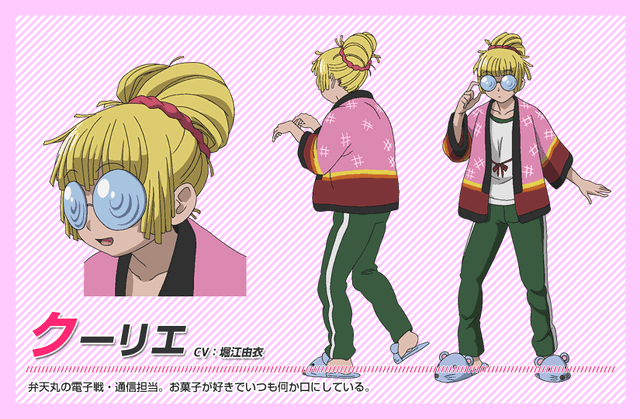
After finishing her I realized the similitude with One Punch Man's Tatsumaki, but actually she was inspired by Mouretsu Pirates' Coorie.

Pillars of Redwood boles rise skyward forming a grand canopy. They soar above the ferns' fronds and carpets of clover like a cathedral over it's worshipers. Their ancient existence has withstood the test of time â regardless of earthquakes, wind and fires â they gain strength and grow taller. The feeling of comfort and peace while walking among these giants has similitude to that of being in love; youâre part of something bigger than just yourself.
Driving home from the store late Halloween afternoon and I see this massive, dark lenticular cloud hovering overhead. Got home, grabbed the camera and drove a couple blocks to a small park overlooking a forested canyon, where there was a nice, open view of the cloud above the tree line. As I watched it over about 15 minutes, the cloud took on a shape more befitting of Valentine's Day than Halloween. But whatever, I took a few shots then hurried home to get the packs of candy hearts ready for the trick-or-treaters. 😍😁
A vast similitude interlocks all,
All distances of place however wide,
All distances of time,
All souls, all living bodies though they be ever so different,
All nations,
All identities that have existed or may exist
Walt Whitman
Bacchus, originally Saint John the Baptist, is a painting in the Musée du Louvre, Paris, France, by the Italian Renaissance artist Leonardo da Vinci and Francesco Melzi, while in Leonardo's workshop. Sydney J. Freedberg assigns the drawing to Leonardo's second Milan period. Among the Lombard painters who have been suggested as possible authors are Cesare da Sesto,[a] Marco d'Oggiono, Francesco Melzi, and Cesare Bernazzano. The painting shows a male figure with garlanded head and leopard skin, seated in an idyllic landscape. He points with his right hand off to his left, and with his left hand grasps his thyrsus and also points down to earth.
The painting originally depicted John the Baptist. In the late 17th century, between the years 1683 and 1693, it was overpainted and altered to serve as Bacchus.
The model for the John the Baptist / Bacchus / Angelo incarnato series was Salaì.
Cassiano dal Pozzo remarked of the painting in its former state, which he saw at Fontainebleau in 1625, that it had neither devotion, decorum nor similitude, the suavely beautiful, youthful and slightly androgynous Giovannino was so at variance with artistic conventions in portraying the Baptist – neither the older ascetic prophet nor the Florentine baby Giovannino, but a type of Leonardo's invention, of a disconcerting, somewhat ambiguous sensuality, familiar in Leonardo's half-length and upward-pointing Saint John the Baptist, also in the Louvre.
The overpainting transformed the image of St. John into one of a pagan deity, by converting the long-handled cross-like staff of the Baptist to a Bacchic thyrsus and adding a vine wreath. The fur robe is the legacy of John the Baptist, but has been overpainted with leopard-spots relating, like the wreath, to Bacchus, the Roman god of wine and intoxication.
Choquequirao es reconocida como la hermana de Machu Picchu. Ambos lugares tienen muchas similitudes. Sin embargo Choquequirao es uno de los asentamientos incas más remotos en los Andes del Perú. Y aún no son muchos los turistas los que la visitan.
Don't look back in anger
www.youtube.com/watch?v=3unAeFrsGjo
fotografia de Alexandra Plibernik de similitudes coincidencias:
Allah is the Light of the heavens and the earth. The similitude of His light is as a niche wherein is a lamp. The lamp is in a glass. The glass is as it were a shining star. (This lamp is) kindled from a blessed tree, an olive neither of the East nor of the West, whose oil would almost glow forth (of itself) though no fire touched it. Light upon light. Allah guideth unto His light whom He will. And Allah setteth forth for mankind similitudes, for Allah is Knower of all things
-Surah Al-Noor
La très discrète chapelle Saint Fiacre et ses chênes creux en lisière de Broceliande, émergent des brumes matinales sur le Morbihan !
On dit qu'entre 1940 et 1944, 4 jeunes gens (un prisonnier évadé et trois réfractaires au travail obligatoire en Allemagne) ont aménagé des cachettes dans les gros chênes creux qui entourent la chapelle.
Cachés là, ils ne furent jamais pris.
Quelques similitudes avec le chêne à Guillotin qui se trouve à quelques kilométres de là, car lui aussi servit de cachette à un prêtre réfractaire, poursuivi par les soldats ....
Mais ça, c'est une autre histoire.
La Bretagne et ses bijoux cachés ... un trésor à portée de tous.
"Copyright" || ® "All rights reserved" || 2016 Philippe MANGUIN / on Getty images.
Have a look on my website photos de bretagne / on my Blog / on my Facebook fan page / Suivez le Le collectif BREIZHSCAPES
Découvrez le livre Regards croisés en Bretagne, ainsi que Brocéliande, entre rêve et réalité
Buy my art on my shop / on Great Big Canvas / on All posters/ on art com / 500px / Google + / Follow me/Suivez moi ON TWITTER
:::: Click HERE / ICI to view my Most Interesting pics according to Flickr! / Mes images intéressantes sur flickriver :::: Click L to enlarge on black/en grand sur fond noir