View allAll Photos Tagged shell
Want to learn more about photography? Check out my blog "From The Ground Up"
Strobist Info:
Key Light: 1 Vivitar 285HV with shoot through umbrella camera right
Hair Light: Sunset Ambient
Taken In:
Haven Beach - Mathews, Virginia
The inside of each Abalone Shell, away from where it attaches to the shell, is polished by the mollusc itself as it moves.
#13 Shell/s for 116 pictures in 2016
Dr. Phil Nudelman and his wife, Sandra, recently donated a one-of-a-kind collection of more than 100,000 shells to the Burke Museum. It's not only incredibly beautiful but also holds great research value. Read more on our blog: bit.ly/12YJQeS
PORTSMOUTH, Va. – A pile of fossilized oyster shell is ready to be transported via conveyor belt to a sifter. The Craney Island Dredged Material Management Area here is a temporary home for thousands of cubic yards of dredged fossil shell being dredged from Tribell Shoal in the James River. On July 8, the site began storing the shell, which will be used for the construction of six oyster reefs for the Craney Island Eastward Expansion project. Construction of the $3.6 million environmental restoration project is set to begin in August of this year. Reefs will be built in Hoffler Creek, Baines Creek, Blows Creek, the Lafayette River and two in Gilligan’s Creek. (US Army photo/Pamela K. Spaugy)
Collected at Grandview the other night. Remind me of angel's wings. Harsh shadow, yes, but had to shoot it then & there!
The Shell-leased icebreaker MSV Fennica passes through the St. Johns Bridge in Portland, Ore., July 30, 2015, after police removed 3 of 13 activists who climbed under the bridge In an attempt to prevent the ship from passing under the bridge to join Shell's Arctic drilling fleet.
Best seen in B l a c k M a g i c
After the heavy seas there are piles of shells on parts of the beach. I always find them a challenge to my imagination
We are avid sea shell picker uppers, and I'm going to star taking pix of them now that I have a decent lens. Lighting is harder than I thought!
She'll Gas Station Sign Gasoline Petrol , pics by Mike Mozart of JeepersMedia and TheToyChannel on YouTube.
Another view of the strange twisty shell fragment that was left by person or persons unknown ( We have our suspisions !)
Tridacna gigas (Linnaeus, 1758) - giant clam (public display, Bailey-Matthews Shell Museum, Sanibel Island, Florida, USA)
Bivalves are bilaterally symmetrical molluscs having two calcareous, asymmetrical shells (valves) - they include the clams, oysters, and scallops. In most bivalves, the two shells are mirror images of each other (the major exception is the oysters). They occur in marine, estuarine, and freshwater environments. Bivalves are also known as pelecypods and lamellibranchiates.
Bivalves are sessile, benthic organisms - they occur on or below substrates. Most of them are filter-feeders, using siphons to bring in water, filter the water for tiny particles of food, then expel the used water. The majority of bivalves are infaunal - they burrow into unlithified sediments. In hard substrate environments, some forms make borings, in which the bivalve lives. Some groups are hard substrate encrusters, using a mineral cement to attach to rocks, shells, or wood.
The fossil record of bivalves is Cambrian to Recent. They are especially common in the post-Paleozoic fossil record.
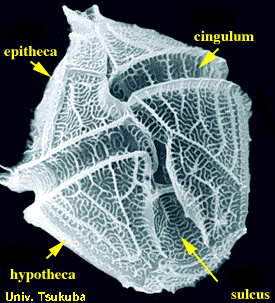
The bivalve shown above is the shell of a giant clam, Tridacna gigas, which is the largest bivalve species on Earth. Tridacnid bivalves sit on seafloors with their two shells open to expose colorful mantle tissues. Within the clam's mantle, small microbial organisms (zooxanthellae) live in a symbiotic relationship with the host. In tridacnid bivalves, the zooxanthellae are photosynthesizing dinoflagellates (www.daviddarling.info/images/dinoflagellate.gif). The dinoflagellates provide food for the clam, and the clam also obtains food by filter feeding.
---------------
Info. from museum signage: "The giant clam is not only the largest, but the most spectacular of all bivalves. The species may reach in excess of 1.4 meters (4.5 feet) in size and may weigh more than 400 kilos (about 900 pounds). It inhabits the shallow, warm waters of the Southwest Pacific including the Great Barrier Reef. Its colorful, soft mantle harbors microscopic algae that provide part the nourishment to this giant of the reef. The adductor muscle of the giant clam is a much-prized food item in Southeast Asia, where the species is cultivated in marine farms."
---------------
More info. from museum signage: "The giant Tridacna clam of the southwest Pacific may grow to a length of four feet and a weight of 500 pounds. They live upside-down in shallow, coral reef waters with their huge, fleshy mantle exposed to sunlight. Within this colorful, soft organ, the clam farms its own seaweed food, Zooxanthella. Giant clams are vegetarisn and have never eaten fish, crabs or worms, much less humans. No cases of a person being trapped and drowned by a clam have ever been proved. Cuts and bruises have been caused by the sharp edges of young clams."
---------------
Classification: Animalia, Mollusca, Bivalvia, Veneroida, Cardiidae
----------------------
More info. at:
en.wikipedia.org/wiki/Tridacna
and