View allAll Photos Tagged radar
©All photographs on this site are copyright: ©DESPITE STRAIGHT LINES (Paul Williams) 2011 – 2021 & GETTY IMAGES ®
No license is given nor granted in respect of the use of any copyrighted material on this site other than with the express written agreement of ©DESPITE STRAIGHT LINES (Paul Williams). No image may be used as source material for paintings, drawings, sculptures, or any other art form without permission and/or compensation to ©DESPITE STRAIGHT LINES (Paul Williams)
.
.
I would like to say a huge and heartfelt 'THANK YOU' to GETTY IMAGES, and the 45.856+ Million visitors to my FLICKR site.
***** Selected for sale in the GETTY IMAGES COLLECTION on Friday 16th June 2023
CREATIVE RF gty.im/1498031421 MOMENT ROYALTY FREE COLLECTION**
This photograph became my 5,930th frame to be selected for sale in the Getty Images collection and I am very grateful to them for this wonderful opportunity.
©DESPITE STRAIGHT LINES (Paul Williams)
.
.
Photograph taken at an altitude of One hundred and twenty four metres at 19:26pm on Wednesday 17th May 2023 off Radar Hill in Tofino, British Columbia.
Nikon D850 Single-lens reflex digital camera F Mount with FX CMOS 35.9mm x 23.9mm Image sensor 46.89 Million total pixels Focal length 220mm Shutter speed: 1/125s (Mechanical shutter) Aperture f/13.0 iso80 Tamron Vibration Control set to position 1 Image area Full Frame FX (36 x 24) NEF RAW L 45.4Million pixels (8256 x 5504) 14 Bit uncompressed AF-C Priority Selection: Release Nikon Back button focusing enabled 3D Tracking watch area: Normal 55 Tracking points Exposure mode: Manual mode Metering mode: Matrix metering White balance on: Auto1, A1.00, M0.25 (5420k) Colour space: Adobe RGB Picture control: (A) Auto (Sharpening +1.00/Clarity +1.00)
Tamron SP 150-600mm F/5-6.3 Di VC USD G2. Nikon GP-1 GPS module. Hoodman HEYENRG round eyepiece oversized eyecup. Black Rapid Curve Breathe strap. My Memory 128GB Class 10 SDXC 80MB/s card. Lowepro Flipside 400 AW camera bag. Nikon EN-EL15a battery.
LATITUDE: N 49d 5m 3.50s
LONGITUDE: W 125d 50m 30.10s
ALTITUDE: 124.0m
RAW (TIFF) FILE: 130.00MB NEF: 93.7MB
PROCESSED (JPeg) FILE: 53.30MB
PROCESSING POWER:
Nikon D850 Firmware versions C 1.21 (8/12/2022) LD Distortion Data 2.018 (16/01/20) LF 1.00 Nikon Codec Full version 1.31.2 (09/11/2021)
HP 110-352na Desktop PC with Windows 10 Home edition AMD Quad-Core A6-5200 APU 64Bit processor. Radeon HD8400 graphics. 8 GB DDR3 Memory with 1TB Data storage. 64-bit Windows 10. My Passport USB 3.0 2TB portable desktop hard drive. Nikon NX STUDIO 64bit Version 1.2.2 (08/12/2022). Nikon Capture NX-D 64bit Version 1.6.2 (18/02/2020). Nikon Picture Control Utility 2 (Version 2.4.5 (18/02/2020). Nikon Transfer 2 Version 2.16.0 (08/12/2022). Adobe photoshop Elements 8 Version 8.0 64bit.
The Chernobyl Exclusion Zone has many sites that are surprising tourist attractions, but none could be less likely than the Duga Radar.
This was the site of one of three “Over The Horizon” radars (OTH) in the USSR. This and another site in Ukraine beamed towards Europe; one in the Russian Far East, beamed out into the Pacific. By using shortwave rather than the UHF or SHF frequencies usually used by radar, the range could be extended over the horizon by detecting signals refracted by the ionosphere. Despite the fact that the ionosphere is always in a somewhat chaotic state, in theory a powerful enough computer could still detect the source of any given reflection.
In a metaphor for the entire Soviet system, however, no computer powerful enough existed and these enormously powerful 10 Megawatt transmitters merely sent out an intensely irritating pulse known as the woodpecker which blocked most shortwave transmissions over large parts of the world, annoying Soviet friends and allies alike to absolutely no utility. The system operated intermittently from 1976 until 1989. It was located near Chernobyl to benefit from the enormous amount of electricity it generated.
Ugly as the signal generated might have been, the antenna array itself is a thing of majesty, bursting from the forests that stretch on a flat plain for miles in every direction; a cascade of metal cones and struts that is 150 metres high and 700 metres long.
The radar had its own secret town attached; it was never officially acknowledged but was known as ‘Chernobyl-2’. It came complete with a gymnasium, school, hotel, and fire station. This was the only fire station in the region not called out when Reactor No. 4 caught fire on 26 April 1986 – a sign of the importance attached the OTH radar project.
Maintaining a structure like this is expensive, and nobody is expending any money on it, so see this strange Cold War engineering wonder while you can. It won’t last forever.
My inner radar goes wild whenever I see a Betty Teen doll. I keep telling myself that I should stop buying them, but I don't have enough mental strenght to follow my own advice. Ups! It seems that I've got a problem.
Searching for signs of ice on Mars is complex. To explore whether ice lurks beneath the surface of the Red Planet, ESA’s Mars Express uses its radar to probe the interior.
It sends low-frequency radio pulses at Mars and records how they are returned to the spacecraft. These pulses can penetrate some of the material comprising the planet’s crust, bouncing back to Mars Express when they reach a layer of a different density or composition. By analysing the time delays of these returned pulses, scientists can determine the properties of material lying beneath the surface.
This image shows radar echoes from Meridiani Planum, an area near Mars’ equator that is also being explored by NASA’s Opportunity rover.
In the image, reflected echoes from the surface and subsurface, separated in time delay, are plotted along the ground track of the spacecraft’s orbit. The bright white line crossing the frame marks the surface of Mars, while the faint, more diffuse line just below represents echoes from the base of a layer of buried material located far below the surface.
The surface of Meridiani Planum is full of volcanic sands that are known to contain minerals that formed in the presence of water in the planet’s distant past. Previously, it was unclear what kinds of materials lay beneath the surface here, but the Mars Express radar has now penetrated the deposits and revealed that they have a similar property to ice.
However, a recent study instead suggests an ice-free explanation, showing that these radar properties could just as easily be explained by a thick layer of porous sand – perhaps blown into the region by winds. Unlike other geologic materials, such as volcanic ash or very fine dust, a thick layer of sand-sized particles may produce properties in the radar akin to that of an ice-rich deposit.
The echoes are thought to be reflections from the boundary between Meridiani Planum deposits below the surface, and cratered terrain lying deeper still.
These results highlight the difficulty in finding buried ice, and will help scientists to identify areas with and without accessible water ice: a resource critical to the future human exploration and possible colonisation of Mars.
This radargram was obtained by the Mars Advanced Radar for Subsurface and Ionosphere Sounding instrument, MARSIS, in April 2016. The image covers a width of about 80 km. North is to the left (see annotated version in the published paper for more details).
Credits: ESA/Mars Express/NASA/JPL/KU/Smithsonian
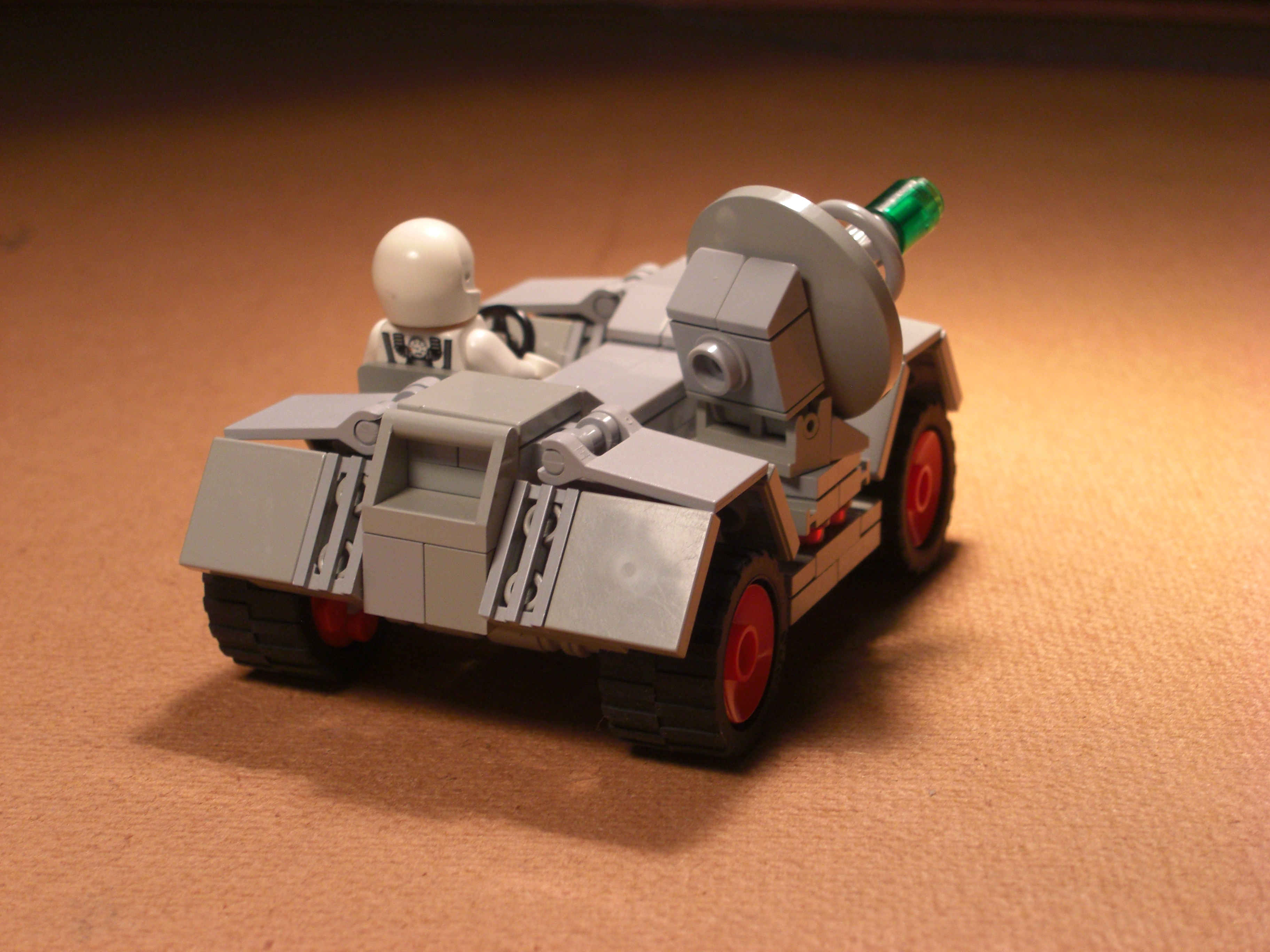
Need something scanning in a hurry? Llwyngwril Systems has the answer! The Rocket Radar Tricycle.
Not be confused with the Radar Rocket Tricycle, this vehicle gets a radar scanner to you fast (providing you have first laid down a smooth surface such as tarmac or concrete). The twin rocket motors are powerful but with fine and precise throttle control the driver can easily avoid pitch-poling and being slammed face-first into the ground.
Order yours today!
Fort Pannerden (in the background) - Gelderland - the Netherlands
Highest position Explore: #421 on Monday, June 6, 2011
NEXRAD weather radar station MUX, which serves the San Francisco Bay Area, photographed from Mount Umunhum.
NEXRAD (Wikipedia):
I’ve been drivin‘ all night my hand’s wet on the wheel
There’s a voice in my head that drives my heel
And my baby calls that she needs me here
It’s half past four and I’m shifting gear
When she gets lonely and the longing gets too much
She sends a cable comin‘ in from above
We don’t need to talk at all
We got a thing that’s called radar love
We got a wave in the air
Radar Love----Golden Earing
Radar the cat sitting in some particularly good light.
Shot in November 2016 on Tri-X pushed to 1600, using a Canon Rebel X and 50mm/1.8 lens.
I really like the Thailand rain radar website - I can look at the animated feed for Bangkok on my phone, updated every 5 minutes, and judge when to plan to move from place to place without getting wet. This morning, this frontal system was moving from south to north. Here it is arriving to Bangkok.
A radar site was erected within recent times and serves as a resting place for local vultures: Drug and gun smugglers do not pass on this side of the island....
Radar station, Titterstone, Clee Hills, Shropshire UK. The large radar dome on the left of the image is for the National Air Traffic Services and the smaller one is Meteorological office weather radar.
Well this is a first!
To any lead foot engineers on BNSF rails, be warned, the radar gun is out! At the west end of the Ballico, CA siding sits something you don't see everyday next to the rails, a portable radar trailer. A westbound BNSF drag freight slowly pulls out of the siding at 13 MPH, well within the speed limit.
© 2015 Patrick Dirden Photography
All Rights Reserved
Seaforth Radar Station, in the current form, was built in 1969 as a result of the construction of Royal Seaforth Dock.
The radar replaces the old radar station, which was on the northern sea wall of Gladstone dock, which was built and opened in 1948.
This is my newest build for Andromeda's Gates.
M.A.N.T.I.S. is attacking a Kawashita radar station, to interrupt their interstellar communication.
On Explore/Flickr Top 500, Feb. 19, 2009
__________________________________________________________________
Mactan Airport RADAR (Radio Detection and Ranging). Taken strolling down the tarmac -- on just another early morning. Its always like this for years now. The tarmac and the airport is like a weekly routine.
Mactan International Airport
Cebu, Philippines.