View allAll Photos Tagged proofreading
it's never too late for this.. I proof readed 'The Hermitage. Western European Painting', published in 1987 by Aurora Art Publishers, Leningrad, USSR.
Definitions of proofreading on the Web:
The correction of errors that occur during DNA replication, RNA transcription, and protein synthesis.
www.knowledgene.com/public/glossary_content.php3
A final proofing of the manuscript, usually focused on cleaning up any typographical errors before the manuscript is typeset.
At Genius Academics you can buy custom essays and purchase samples of dissertation writing at extremely competitive prices. We also offer proofreading and editing services to ensure that your work is always perfectly presented. For more information www.geniusacademics.co.uk
This is first test print of our book, sitting on top of a spiral bound printout of a proofreading draft.
We finished things up in the wee hours of Saturday morning after a very long Friday. If all goes to plan, the official launch will be in a few weeks.
In the meantime, some sleep, and then catching up on various things, including some Flickr time.
Shot on iPhone 6.
This is the new children's hospital opposite my daughter's school. It's only a new building and there have been reports of teething problems - but it certainly is striking architecture.
We had teacher parent meetings today and I got to meet my daughter's French teacher. We told him the story of how we were married in France. And in organising the wedding, in my bad schoolboy French I wrote a letter to send off to a church minister asking if we could get married in his "voiture". Luckily I got someone to proofread it or we might have ended up getting married in a car instead of a church :-)
At Genius Academics you can buy custom essays and purchase samples of dissertation writing at extremely competitive prices. We also offer proofreading and editing services to ensure that your work is always perfectly presented. For more information www.geniusacademics.co.uk
Every presentation, white paper, proposal, report, and memo that you produce tells your audience something about you and your company. Utilizing the professional editors and proofreaders at Polished Paper will ensure your message flows effortlessly, unencumbered by grammatical and syntax errors.
Read more: polishedpaper.com/business-editing
2/15/2012
-
Simply my daily cup of Starbucks. Sorry, I couldn't put a lot of conviction in taking a picture today, I literally spent about 5-6 hours straight last night researching, writing and proofreading a 1,000 word essay for Asian Humanities. Now this whole idea of taking 6 classes, 18 credits is wearing me down mentally and physically! >.< On Wednesday, I'm at school from 9am to 8pm, it's so exhausting. I've been running on straight caffeine, had 2 cups of coffee, 4 cups of hot Jasmine tea, and a red bull. lol Well I hope you enjoy this simplistic photo for today's entry. Time for my face to meet my pillow.
I love how well spot metering worked out with this composition.
p19, 'How To Change Absolutely Anything' by Damian Hughes
Not content with twisting a passage that talks about using the gifts we are given in a responsible manner into a 'proof text' for negotiating your arrival at home, he then muddles Mark with Matthew, despite the rather large clue in the name of the 'effect' he is explaining.
From a newspaper, the author has is communication with the editor and the audience with same text without separation, so the comment went to print because it accidentally passed proofreading and no computer can help in situations like this. It says "you can reformulate the text better if you feel like it. I hope you could fit this somewhere in the Thursday issue. If you could get a photo of Susanna from somewhere, the would be awesome"
Our kingdom for a CMS!
Experimentation was at the heart of this newspaper project. A chance for us to remind ourselves of the process of creating copy for a deadline, without the luxury of a CMS and theoretically movable deadline.
We had to meet the 2pm, Tuesday 25 January deadline with Newspaper Club in order to get these papers in the post in time for delivery on 1st February.
In the rush and as expected, some things were missed and exist here, all marked up for all to see, as a sobering memory of a legacy of print which digital, theoretically, can help us hide.
Thank you to Sarah Castleton for the mark-up.
And the The Grauniad for the solidarity.
3D molecular structure (Jmol) of remdesivir (RDV) showing electrostatic potential surfaces. RDV is an antiviral compound with a broad spectrum of antiviral activities (e.g. SARS-CoV and MERS-CoV) and currently being used in clinical trials against the novel coronavirus SARS-CoV-2 to test its clinical efficiacy against COVID-19. Chemical formula C27H35N6O8P. Legend: carbon atom grey; hydrogen, white; nitrogen, blue; oxygen, red; phosphorous, yellow. IUPAC name (2S)-2-{(2R,3S,4R,5R)-[5-(4-aminopyrrolo[2,1-f][1,2,4]triazin-7-yl)-5-cyano-3,4-dihydroxy-tetrahydro-furan-2-ylmethoxy]phenoxy-(S)-phosphorylamino}propionic acid 2-ethyl-butyl ester. The molecule contains several aromatic rings with delocalized π bonding.
RDV is a prodrug which is metabolized to the nucleoside analog GS-441524 that targets viral RNA polymerase. An effective nucleoside analog must evade proofreading (by 3′-5′ exoribonuclease) to successfully interfere with CoV RNA synthesis for better clinical efficiacy.
She was pretty good too... sharpened her "pincers" before starting work..and wow! she was very quick...very meticulously double checked her work too ...never seen this bug crane out its neck :) [last photo]
三里屯北路81号那里花园4层, 5208-6188
4.438 miles (approximately) from the office, 18 minutes the way the scooter flies.
Only have Mahou (a horrible beer from Spain I wouldn't drink even if dying of thirst) and Duvel (good but priced at 62 kuai and I'm sick of paying US$10 for a bottle of beer).
Have ice in the urinal so you know you're dining at a Finer Establishment.
Waitress snatched away menu that was sitting on table; she explained it was their Groupon-style deal menu, apparently from a site called Diningcity.com which she kindly wrote down for me (I'll never use it).
Bread comes with salt and olive oil (Salt, you say?)
Nice variety of muzak, Spanish flamenco followed by Ella F. I approve.
Mushroom and spinach quiche with parmesan shaves and salad. Real men do eat quiche. Real nice men also teach the waitress how to pronounce it.
Beef tartare served with three kinds of mustard and chips (they means crisps). Otherwise known as the salmonella special (just kidding, fingers crossed).
Fresh fruit for dessert.
Misspelled capers on the menu. They need a proofreader. Should send the firm's over, that guy appears to have nothing to do all day long.
One waitress wearing blue jeans, didn't match the others who had black skirts and tops. That's a no-no.
Good about re-filling Mr. Cheapo's water glass.
Not a large lunch crowd, but ok, plenty of space among us.
Resto invaded by pack of Yummy Mummys, four strollers, one pack-a-poose. All British, posh accents, sunglasses propped on head with hair pulled back. Look expensive to maintain. Babies remarkably well behaved (i.e., they're sleeping).
Can see chefs at work behind smoked glass thingie and there appears to be a large foreigner in charge back there which is comforting.
No Chinese on the menu, might be intimidating for Chinese people to eat here?
Boy told me they now have eight set lunch menus so they rotate them every week.
Boy gave me coupon for free coffee or dessert next time, must have seen me snapping pics of food.
Accept credit cards, of course.
Instant fapiao, of course.
Probably my favorite place in the Nali Patio ... if I get e.coli my opinion will change of course, but for now this place gets the thumbs up.
Would I return? Yes.
3 course set lunch, 99 kuai, or US$15.60.
November 19: At midnight a SAR page chimed: a lost hiker at Pat Springs, out of Bottcher's Gap. I debated responding for various reasons (the book I'm supposed to be proofreading, my fitness level, the fact that I'd just gotten into bed and was snuggling in with great pleasure). The last time I hiked to Pat Springs, I collapsed just at the campsite there--and back then, I was in better shape. I should probably have resisted responding. But I felt a duty. And so.
We set off hiking at 1:30 or so. (It's a bit of a drive from Monterey to Bottcher's Gap, up at the far end of Palo Colorado Road.) It is then a four-hour hike to Pat Springs--about 9 miles. Waxing moon didn't shine much light, so it was all headlamps. The trail was clear, though (unlike last time, when a middle section was navigable only thanks to pink flagging tape judiciously positioned), and we powered on. It was Alain--a machine; Dave Flower, who started out at a breakneck pace; Joe Moses; and me. Joe is certainly stronger than me, but we kept each other company. (Thanks, Joe.) I didn't hydrate well enough, and the Chinese I'd had at 6 p.m. had probably worn off by 11 p.m. So I depleted myself fully, and had to stop. I was stuttering along, holding them up.
I listened to their progress--first, by hearing their shouts ("Eric! Can you hear us?"); then by MCSO Red tone communications (an open channel); then by MoCo1 communications (more private)--though it took me a bit to figure out I had MoCo1 on my radio (it's called HLS Cmd1 on my unit--good old Homeland Security). I rested on my backpack on the trail, up against a big log; drank small sips of water, had half a power bar; dozed; shivered a bit; got up and walked around, swung my arms, tried to keep my thighs from cramping, sat down again; dozed. Eventually the sky lightened, and I started hearing chatter about helicopters. (Thank goodness yesterday evening's rain went away.) And then I heard that our subject had been found. Yay! One helo was waiting for fog to clear in Watsonville and would come down to pick us up. I was feeling more myself by then--7 a.m.-ish--and wandered back down the trail to the campsite, then up the far hill to locate an LZ. My phone has GPS, so I communicated coordinates to Center (clumsily--I'm not used to radio communications--but she got it).
And then Alain and our subject, Eric, came marching down the trail, followed shortly thereafter by Joe and Dave. I started to breathe easier then. (I'd gotten a little worried when Joe told Center that there were four people needing to be flown out--when in fact there were five of us, with Eric.) It's always good to be in company.
By 10:30 J.F. had arrived with his four-seater helo, and he started ferrying us back to Bottcher's Gap. So very nice not to have to drag ourselves the 9 miles back--because it probably would have taken us 9 hours, as opposed to 9 minutes.
So: this view--it's from the Pat Springs LZ, looking toward the ocean. Bottcher's Gap is to the right, behind that first ridge. The landscape here is rugged, challenging. Our 9-mile hike involved two grueling uphills, and then a lot of down (which: think of the reverse if the blessed bird hadn't spirited us back to the truck). I may have "suffered," but to be in this country always fills my soul. At night, in daylight. (During the night, I'll just mention: the rain yesterday had left big drops of water on all the vegetation, and whatever light there was--moonlight, lamplight--would send those droplets shimmering, making the trees and shrubs into ghost trees, ghost shrubs. It was stunning.)
By 11:15 we were out and headed to a revivifying brunch in Carmel. Coffee, frittata, good company. Life is good.
Day 248 of 365: a year in songs and photos
Song: Take Me Out to the Ball Game
Tonight, major league baseball's all stars will take to the field at Yankee Stadium. It will be one of the last big events held at the stadium, before it's torn down and the new Yankee Stadium is erected.
Some time in the past few years, my love of the game has dissipated. There was a time when my life was ruled by the Yankees schedule, when I lived, breathed and slept baseball. I have the most wonderful memories of Yankee Stadium and I'll be sorry to see it go.
This is my baseball story. I wrote it in March of 2003. It's one of my favorite stories to tell and I'm ever so grateful for the opportunity I had to spend so much time inside Yankee Stadium.
So, I have a baseball story for you.
It was the summer of '86. I had gone back to college the previous spring after an extended hiatus. 21 credits crammed into one semester after not being in school for a while was exhausting, so I passed on taking any summer classes. I was working nights at the time and thought I would spend my summer days sleeping until noon and lounging around the house. And then my Dean made me an offer I couldn't refuse - a summer job that would entail driving to The Bronx every morning, not getting home until midnight most nights, working a few weekends, all for no pay except a few college credits.
I almost laughed at him until he explained who I would be working for. The New York Yankees. Not as a hot dog vendor or ticket-taker. I would be working inside the vaunted walls of Yankee Stadium. Hell, I would have paid them to let me have that job.
I was to spend my days as an editorial assistant for Yankee Magazine, cropping pictures, proofreading stories and doing advertising layout for the magazine. At night, if the Yankees were on a homestand, I would stay for the games and run errands. If I wasn't needed I was welcome to stay for the games, anyhow.
I spent a lot of time that humid summer in the cool confines of the archives room, poring through photos of Yogi Berra and Joe Dimaggio, reading scorecards from games played long ago and generally living in a baseball time warp. The room was stuffed with trophies and plaques and mementos of the greatest baseball team that ever existed. And here was all this history, all this fame right at my fingertips. Ticket stubs, game programs, yellowed articles and dusty photographs were my companions that summer. Each time I left the room - usually after a futile search for whatever memorabilia or picture I was sent for - my fingers would be coated with the dust and grime of the legacy of legends.
I watched plenty of games from the press box. Sometimes I helped keep the scorecard, sometimes I just chatted with reporters or players who were on the injured list and joined the press to watch the game. I ate lunch in the third base seats, legs stretched out, sun beating down and Yankee Stadium seemingly to myself. I parked in the player's lot, sometimes walking in with the players themselves. I was the original George Costanza.
Late that August the pennant race was heating up and the summer nights were cooling down. I knew my days as a part of the New York Yankees staff were drawing to a close. In a way, I was relieved that I wouldn't have to make that miserable morning drive on the Grand Central anymore. But I hated give up the perks of a job where I mingled with Don Mattingly and had my name in the Yankee Magazine.
It was close to my last night there when I was invited to watch a game from the General Manager's office. There I was, in this huge office full of baseball impresarios, sharing drinks and glad-handing each other. I stood quietly in the corner, too overwhelmed by the presence of baseball greats to move out of the spot.
A Yankee employee I had become friendly with dragged me over to the huge picture window that overlooked the playing field of Yankee Stadium. I was watching the game from an office behind home plate, surveying the game as if I owned the team. I looked at the outfield bleachers where I had sat so many times before. I was mesmerized.
My friend excused himself to go get a drink and I stayed at the window, watching the game.
Then a voice from beside me, "Great view, isn't it?"
I looked up to see Mickey Mantle standing next to me, grinning. I nodded, unable to speak.
Me and Mickey, watching a Yankee game from the office above home plate.
That, my friends, is a King of the World moment.
Farewell, Yankee Stadium.
I had nothing green, so I stole this sweatshirt from my daughter. It's REALLY green. She got it at a Sweet Sixteen, hence the initials that are not mine.
Yes, I have St. Patrick's Day story, thanks for asking. I am running really, really late for work so I grabbed this out of my files without editing or proofreading. I'm sure I'll be sorry about that later.
The last time I went to the city (New York City, of course) on St. Patrick's Day was in 1980, with a few of my closest high school friends. We were in the home stretch of our high school careers; June would bring graduation, separation and higher education. We decided to make the most of our final months as high school juvenile delinquents and wreak as much havoc as possible.
So on March 17, 1980, we found ourselves on a westbound train at 7:30 in the morning instead of on a bus on our way to school. There was no other place to be on St. Patrick's Day besides New York City.
I don't think we saw much of the parade. Mostly we walked around the streets acting like idiots until lunch time, when we parked ourselves inside the Steak & Brew, a restaurant that gave out free beer with meals. Those of us who were only 17 showed fake ID, which the waitress barely glanced at. We stayed for a couple of hours, drinking and laughing, until the waitress said if we weren't going to order more food, we should leave. It had been a couple of hours.
We decided to walk over to Central Park. Drunk, perhaps a bit stoned, and surrounded by a massive crowd of other drunks and perhaps stoned people, we made our way through the throngs of Irish-for-the-Day revelers. We sang Danny Boy and some other Irish songs that everyone but me - the lone non-Irish person - could sing. We worked the crowd, not caring what anyone thought of us. We introduced ourselves to strangers, shared cigarettes with a homeless man and drank green beer with a bunch of firemen. Kevin shook hands with anyone and everyone, using his signature greeting of "have a nice life!" Man, were such geeks. Such idiots. But we had so much fun.
We closed out the afternoon pretending to scale rocks in Central Park. When we tired of that, we stretched out on one huge boulder, the five of us spread out, staring up at the gathering clouds. And we talked. We talked for what felt like hours about hobbits and pinball machines, about Todd Rundgren and the Grateful Dead, about the Yankees and the Islanders, and all the other all the things that bound us together through four years of high school, things that seem insignificant now, but were so important to us then.
I was the only girl among the five of us. It never felt odd to me, though I know it looked odd to other people. Those four guys were the best friends anyone could ever ask for. I had the greatest times of my life as part of that group of geeky kids. We weren't the jocks, we weren't the burnouts, we weren't the honor students or drama crowd. We were just us, the kids with no single identity, the kids who appeared to be friends with everyone, but were really only friends with themselves.
We talked about life, too, laying on that rock in the park as the sun started to disappear and the day turned cold. We guessed what our futures would be like. We wondered how long our friendship would hold. We made plans, laughed at our own far-fetched dreams of fame and fortune and stayed on that rock until our fingers and ears went numb from the cold. It was as if we knew that we were experiencing one of our last great days together. We hung onto it for as long as we could, and then we made an impossible promise to each other. We promised that no matter where life took us, no matter how far we roamed, we would come back to that very rock on St. Patrick's Day in the year 2000. Twenty years. We'd share our stories, show off pictures of our families, give each other autographed books and albums since we were all destined to be famous authors or musicians. We spat on our palms and gave each other wet high fives to solidify our vow. And then we headed for home.
I haven't seen them in quite a few years. I think it was 1999 when an old high school friend had a bunch of us over to reminisce. Only three of the five of us showed up, and it just wasn't the same without the other two. It wasn't right. And we forgot about our promise - not one of us mentioned it.
St. Patrick's Day, 2000 came and went. I didn't go to the rock, but I swear, I did think of my four friends that day. I wondered if any of them remembered our promise to meet there. I wonder if they still think about hobbits and pinball machines, if they still think of all those parties at my house when they watch Islander games.
Happy St. Patrick's Day everyone!
Why buy from a company that can't spell? Or afford a proofreader? (or should that be Poofreader?)
I picked up a little point-and-shoot canon A85 on ebay so I could have a camera to carry around in my daily travels... since I've got a new job that has me running all over Manhattan, those travels are gonna be extensive and I might as well have some fun, eh?
3D molecular structure (Jmol) of remdesivir (RDV). RDV is an antiviral compound with a broad spectrum of antiviral activities (e.g. SARS-CoV and MERS-CoV) and currently being used in clinical trials against the novel coronavirus SARS-CoV-2 to test its clinical efficiacy against COVID-19. Chemical formula C27H35N6O8P. Legend: carbon atom grey; hydrogen, white; nitrogen, blue; oxygen, red; phosphorous, yellow. IUPAC name (2S)-2-{(2R,3S,4R,5R)-[5-(4-aminopyrrolo[2,1-f][1,2,4]triazin-7-yl)-5-cyano-3,4-dihydroxy-tetrahydro-furan-2-ylmethoxy]phenoxy-(S)-phosphorylamino}propionic acid 2-ethyl-butyl ester. The molecule contains several aromatic rings with delocalized π bonding.
RDV is a prodrug which is metabolized to the nucleoside analog GS-441524 that targets viral RNA polymerase. An effective nucleoside analog must evade proofreading (by 3′-5′ exoribonuclease) to successfully interfere with CoV RNA synthesis for better clinical efficiacy.
March 24th, 1921 to May 27th, 2007
"Somethings soft and wild and free, something that whispered to the ear on the pillow, brightened the heart, softly, softly, picked the lock, slid the bolts, and released the prisoned spirit of man into the wind, into the blue and gold, into the morning, into the morning
Willa Cather- Death Comes to the Archbishop
Photographed on a park bench in Hastings Minnesota
Saturday April 3rd 2021
Here is her Obituary:
Doris C. Blumenauer, 86, Hastings, Minn., died Sunday, May 27, 2007, at Augustana Health Care Center, Hastings.
She was born March 24, 1921, at Ellsworth, Iowa, to Einar and Christina (Reno) Maland. She graduated from Radcliff, Iowa, High School.
She married Ivan "Blu" T. Blumenauer on May 5, 1957, at Rose Grove, Iowa. He preceded her in death on Jan. 26, 1993.
Doris retired as a proofreader for West Publishing.
Surviving are daughters, Claudia (Norm) Lee of Afton, Minn., and Laura (Tony) Ritten of Amery; a son, Dennis (Babette) of South St. Paul, Minn.; a daughter-in-law, Becky Iverson; seven grandchildren; and a sister, Margaret Zimmerman of Stillwater.
In addition to her husband, she was preceded in death by her parents; a son, David; a granddaughter, Dawn Blumenauer; two brothers; and two sisters.
Services will be held at 11 a.m. Friday, June 1, from Caturia-Smidt Funeral Home, Hastings, with Rev. Linda Lund, Chaplain at Augustana Health Care Center, officiating. Burial will be held at 1 p.m. Monday, June 11, at Lakeside Cemetery, Hastings.
Visitation will be held 5-8 p.m. Thursday and an hour prior to services Friday at the funeral home.
So, here's my application for The Producer, since I did say I would upload it and all. God, I'm SO excited to get started.
You could say I'm... PUH-PUH-PUMMPED. Yeah, I've had quite a lot of soda today. YEY, WAHOOO, YIPPEE.
--
The wind gently caressed her pallid face. The soft breeze toying with her long blonde locks, teasing the curls as it touched them. Her eyes, glued shut from the rays of yellow light emitting from the sky above. Veiled was how they hid from the world, ignoring the sun. However, as her eyes remained closed, the brilliant sunlight would kiss them ever so softly. Keeping her entire body covered in a sweet blanket of warm, calm security. As the sun's energy entered her body, it filled her with a foreign hope. Hope she had never been exposed to previously in her short, innocent life.
The green grass below tickled her small bare feet from where she stood. The blades standing tall, confident and healthy; yet they still fall beneath her gentle strides. Such a heavenly place would give sadness a run for its money. Taking a step forward, then another, she goes to sit beneath the serenity of an apple tree. The sun's protective aura follows her as she blindly navigates her way to the tree. She takes refuge in the cool, yet warming shade. The sun continues to glow gallantly above her, although the thick leaves of the tree don't allow it's glow to reach her skin.
An apple drops down from the tree. Her eyes remain closed but she hears the gentle thump of the sphere next to her relaxed frame. Knowing the shade will protect her precious blue eyes, she allows herself to peak over at the abandoned apple, to see it alone in the gentle grass - welcomed.
The breathtaking place told her eyes to stay open. A large glowing sun was resting in the ocean blue sky above. Shining down on the beautiful field before her. The grass swaying in the afternoon breeze, went on for what seemed to be forever. In the distance the girl could spot a large hill covered in yellow and white daises whose floral scent traveled with the wind in her direction.
She is safe here. She knows this as she reaches down next to her small body. She wraps her thin fingers around the bright red apple, rescuing it from its lonely perch. Its smooth surface greets her hand willingly as she picks it up. She brings the apple to her full pink lips, a smile forming on her face, in her eyes. The only smile that will ever take residence on this girls face, a true smile of innocence and youth. A smile which oozed from deep within her, one which exuded sheer and utter happiness. She spreads her lips open and digs her pearly white teeth into the ruby red apple. A most heart-stopping, amazing, delectable taste rushes excitedly into her mouth. The juices from the apple dance graciously around inside her. She swallows slowly, savoring every little bit of the best tasting apple she had ever had the pleasure of tasting.
She sets the apple down gently. Letting out a relaxed sigh, she leans back against the firm trunk of the tree and finds comfort in this spot almost instantly. She feels, for the first time in her life, she is home, happy. Her youth keeping her from the world she knows.
--
Her beautiful eyes are no longer of innocence. Crusty, sleep-deprived she opens them. Police sirens can be heard in the far distance. The bright, protective, warm sunlight is gone. Instead her bloodshot cobalt blue eyes are greeted by cold darkness. No longer does the sweet smell of daises enter her nostrils. No longer does the brilliantly green grass gently welcome her feet. As she slides her tired legs off the hard mattress, they find their way to the old, brown and stained carpet. The soft breeze is gone, a memory in a troubled mind. Instead, a stale a rush of air from a loud air conditioner mocks her, brings her back down to the place she where she belongs. Her knotted stringy strands of ratty blonde hair reminding her of the hell she inhabits. She is no longer in her perfect world, no. Her mind cannot change the inevitable fact, this is the place she belongs, the life she has.
That this, this is her real home.
As she sat silent on the edge of her bed, she heard the piercing sound of a fist bashing against the door. This was followed by the familiar voice who belonged to a man she did not want to hear from. A man who made her life worse and more painful than it already was. That belief proven when he would enter her apartment drunk, and create black rings around her beautiful eyes. She rose slowly and began towards the door, knowing what pain waited on the other side...
--
Well, hope you guys who've read this enjoyed it. Special thanks to my friend Erin who proofread and make some nice little suggestions here and there. SHE RULEZ.
p.s - Fuckin' English exam tomorrow at 9:30 AM. FUKMAHLYFE.
Kamera: Nikon F3 (1989)
Linse: Nikkor-S Auto 50mm f1.4 (1970)
Film: Cinestill BWXX (Kodak 5222) @ ISO 200
Kjemi: Xtol (stock / 8 min. @ 21°C)
- Here are some clips clip from Paul Verhoeven´s classic satirical anti-fascist anti-american film Starship Troopers (1997) that these days somehow seems like it could be a contemporary «documentary» from Israel… and USA.
A movie everyone should see again.
«Service guarantees citizenship! Would you like to know more?»
Starship Troopers: Propaganda (1997)
ISRAEL IS NOT A DEMOCRACY [Listen here]
by Chris Hedges (b. 1956), The Real News Network January 5, 2024
Israel's status as a bona fide democracy is often taken to be a self-evident truth, but a more critical look at the history and reality of Zionism calls this into question. After all, how can a democracy exist in a country constitutionally defined as an ethnostate that can only exist through the suppression and gradual elimination of its Others? Israeli historian Ilan Pappé joins The Chris Hedges Report for a discussion on Israel as an inherently colonial, and therefore anti-democratic, project.
Ilan Pappé (b. 1956) is a professor with the College of Social Sciences and International Studies at the University of Exeter in the UK, where he directs the European Centre for Palestine Studies, and co-directs the Exeter Centre for Ethno-Political Studies. Prior to coming to the UK, Pappé was a historian and politician in Israel. He is the author of several books, including The Ethnic Cleansing of Palestine.
Studio Production: Cameron Granadino, Adam Coley
Post-Production: David Hebden
TRANSCRIPT
The following is a rushed transcript and may contain errors. A proofread version will be made available as soon as possible.
Chris Hedges:
The scholar, Yeshayahu Leibowitz (1903-1994), who Isaiah Berlin (1909-1997) called the conscience of Israel, warned that, "If Israel did not separate church and state, it would give rise to a corrupt rabbinate that would warp Judaism into a fascistic cult. Religious nationalism is to religion what National Socialism was to socialism," warned Leibowitz, who died in 1994. He understood that the blind veneration of the military, especially after the 1967 war that captured the West Bank and East Jerusalem was dangerous and would lead to the ultimate destruction of democracy. "Our situation will deteriorate to that of a second Vietnam, to a war and constant escalation without prospect of ultimate resolution," he wrote.
He foresaw that, "The Arabs would be the working people and the Jews, the administrators, inspectors, officials and police; mainly secret police. A state ruling a hostile population of 1.5 million to 2 million foreigners would necessarily become a secret police state. With all that implies for education, free speech and democratic institutions. The corruption characteristic of every colonial regime would also prevail in the state of Israel. The administration would have to suppress Arab insurgency on the one hand and acquire Arab Quislings on the other. There is also good reason to fear that the Israeli Defense Force, which has been until now, a people's army would, as a result of being transformed into an army of occupation to generate and its commanders who will have become military governors, will resemble their colleagues in other nations." He warned that the rise of virulent racism would consume Israeli society. He knew that prolonged occupation of the Palestinians would spawn concentration camps for the occupied, and that in his words, "Israel would not deserve to exist and it will not be worthwhile to preserve it."
The decision to obliterate Gaza has long been the dream of Israeli fanatics, heirs of the fascistic movement led by the extremist Meir Kahane (1932-1990), who was barred from running for office and whose Kach Party was outlawed in 1994 and declared a terrorist organization by Israel and the United States. These Jewish extremists who today make up the ruling coalition government are orchestrating the genocide in Gaza, where hundreds of Palestinians are being killed or wounded a day. They champion the iconography and language of their homegrown fascism. Jewish identity and Jewish nationalism are the Zionist versions of blood and soil. Jewish supremacy is sanctified by God as is the slaughter of the Palestinians who are compared to the biblical Amalekites massacred by the Israelites. Enemies, usually Muslims, slated for extinction are subhuman who embody evil. Violence and the threat of violence are the only forms of communication those outside the magic circle of Jewish nationalism understand. Millions of Muslims and Christians, including those with Israeli citizenship, are to be purged.
Joining me to discuss what the occupation of Palestine has done to Israeli society and what the results of the current murderous campaign in Gaza and the West Bank portends for Israel in the future is Ilan Pappé, Professor of History of the University of Exeter in Great Britain, who has described what Israel does to the Palestinians as incremental genocide. He has written numerous books including The Biggest Prison on Earth: A History of the Occupied Territories and The Ethnic Cleansing of Palestine, which his French publisher has ceased publishing despite a surge in sales since the October 7th attacks, part of the concerted campaign by Zionists and their supporters to discredit and censor narratives that are critical of Israel.
I'd like to begin with a look at post Israel, the Zionist project that begins in the 1920s, and see whether the project itself, even before the creation of the state of Israel had built within it the seeds of its own destruction.
Ilan Pappé:
Yes, I do think it did. And you are right in pointing to the 1920s because of course the Zionist movement existed before, but I think it's in the mid-1920s when it started to purchase land and evict the people who were living on that land. And that happened around 1926. It became a settler colonial project and not just a project for salvaging Jews from anti-Semitism or a national cultural redefinition of Judaism as nationalism instead of as religion.
The moment that happened, it was very clear that it's going to impose itself by force on an indigenous native population. And it was not just the classical settler colonial imposition of settlers from abroad imposing themselves on a native population, it also was kind of creating this idea that they can produce or establish a European state in the midst of the Arab world, very much like the white supremacists in South Africa. And there's two facts, that you are trying to implement a project of displacement and replacement of an indigenous population and that you are trying to create a cultural political entity that would alienate the area it belongs to and the area would alienate you were sold, I think had been sold in the 1920s. And we can see the effect of this to our days, no doubt.
Chris Hedges:
And yet there was always a tension within the Zionist project. I, you may have known him too, I knew Abba Eban (1915-2002), Teddy Kollek (1911-2007). When I was in Israel, they outlawed Meir Kahane's Kach Party. The people around Netanyahu now are of course the heirs to the Kach Party, later assassinated, this very right wing rabbi. And I want you to talk about that tension because it was there. I mean, Teddy Kollek when he was mayor of Jerusalem, when I was there, he was building sewer systems for... it was a different approach to colonization, or perhaps I have that wrong?
Ilan Pappé:
It was a different approach, but it remained colonization. If I'm a bit more abrupt about it, I would say that there was definitely an ideological stream within Zionism that believed that you could be a progressive colonizer or an enlightened colonizer. And yet from the colonized people's point of view, even if you provided some benefits in economic terms, in infrastructural terms, the colonization was still there. And the colonization was translated not only in terms of whether you provide sewages for Jerusalem or not, but by the fact that Teddy Kollek as the mayor of Jerusalem oversaw the ethnic cleansing of quite a large number of Palestinians from East Jerusalem in order to make space for building new Jewish neighborhoods, which should rightly be called Jewish colonies or settlements.
So in the end of the day, the Zionist vision, even in its most liberal version, meant that the Palestinians at best, at best could be tolerated as individuals in limited spaces within Palestine. That would be determined according to the Israeli notions of national security. And at worst, they're an obstacle that has to be removed. And as the time went by, most of the Israeli Jews said, "Why just be content with limiting their presence? Why not get rid of them altogether?"
Chris Hedges:
And yet these figures represented a secular strain of Zionism. And I want you to talk a little bit about Yeshayahu Leibowitz, who you knew, who I quoted it in the introduction, and he talks about this religious strain within Zionism where the land itself becomes sacred as particularly dangerous, I think he even uses the word fascistic. There is that split. And of course those of us, Abba Eban spoke better English than I did, Oxford educated, urbane. And so talk a little bit about that tension between secular and religious Zionism. And of course ultra orthodox religious Zionism has essentially proved triumphant.
Ilan Pappé:
Yes, I call this tension, which you rightly point to, the struggle between the State of Israel and the State of Judea. The State of Judea grows up among the national religious groups and becomes particularly potent after '67 and it's kind of headquarters, it's habitat if you want, the settlements in the West Bank, and before that, even in the Gaza Strip. And they become a force to reckon with and they combine exactly what Leibowitz was talking about, and he saw it in the making. I mean I say it in hindsight, to his credit, he saw it and kind of predicted it happening, but now we have the benefit of time to see that he was absolutely right.
So that State of Judea, what you can call the settler state, is a combination of a messianic kind of Zionism combined with fundamentalist interpretation of Judaism, a wish to create a theocracy in which also secular Jews are the enemy, not just the Palestinians. And they become stronger. They used to be on the margins and we used to think that they are not really relevant, but now they are a central power in Israel. And against them stands the State of Israel. That is the kind of pre '67 Israel that wanted to be a liberal democracy, a pluralist, secular, but is losing it in the struggle against the State of Judea.
But what is so interesting and frustrating about this struggle, it does not concern the Palestinians at all. As you probably know, and we forgot it because of the dramatic events that occurred after 7th of October, but until the 7th of October, we witnessed in Israel a kind of a mini civil war between those two states that I'm talking about, the State of Israel and the State of Judea when hundreds of thousand of secular Israelis demonstrated daily trying to defend the kind of Israel they want. But when Palestinian citizens of Israel ask them, "Can we join you? And can we also include a rejection of the occupation as part of our struggle for a better Israel?" They were chucked out of this movement of protest because it was not against the occupation, it's not against the semi apartheid or full apartheid of Israel, depends where it is. It is what kind of an apartheid Israel should we have? A liberal democratic one for the Jews or a theocratic one for the Jews?
But unfortunately it does not evolve around the main issue, the most important issue that we started our conversation with, that can you impose yourself militarily and violently on millions of people against their will?
Chris Hedges:
I want to talk about 1948, this is the war of independence. All settler colonial projects are implanted by violence as was the one in the United States. The difference is that I think by 1600, over a 100-year period, 56 million indigenous inhabitants in North, Central and South America were obliterated through either diseases or violence so that by 1600 you only had about 10% of the original indigenous population was there. That wholesale extermination essentially allows a settler colonial project to survive because there's physically no opposition. That's not true in Israel. You have about 5.5 million Palestinians living under occupation, 9 million living in the diaspora. This from the establishment of the state of Israel is a huge problem for Israeli leaders. How are they going to cope? The demographic time bomb is real in terms of Arabs having larger families. You have huge flight, a kind of brain drain from Israel. I think there's a million Israelis living in the United States. But let's look at 1948, how they deal with a problem. And then we'll go to 1967 when Israel occupies what is the remaining part of Palestine, the West Bank and Gaza.
Ilan Pappé:
Yes, as you rightly say, settler colonial projects have always these two dimension, geography and demography, or if you want space and population, you want the space without the population. And the more space you take, the more unwanted population you have. So the Zionist leadership exploited the end of the mandate, the circumstances that developed in the region and in the world three years after the Holocaust to implement a massive ethnic cleansing that left half of the Palestinian refugees and expelled half of the Palestinian population, destroyed half of the Palestinian villages, more than 500, and demolished most of the Palestinian towns.
So within the borders that were kind of established after 1948, that is Israel today without the West Bank and the Gaza Strip, Israel was unable to fully complete the ethnic cleansing, but it had a relatively small Palestinian minority that did not endanger the demographic majority of the Jews. So you could even have a demographic state because you always knew that democracy and demography would go hand in hand. Although because of the paranoia of Ben-Gurion until 1966, although the Palestinians in Israel had the right to vote and to be elected, they were under a very harsh military rule as it is.
Now, it's not surprising that David Ben-Gurion (1886-1973), the big architect of the ethnic cleansing of 1948, was trying to pressure the government of Israel. He was out of effective politics already in 1963, but he was trying after June '67 to convince the Israeli government to get out of the West Bank, almost saying to them, "I was able to get rid of about 1 million Palestinians, and now you are incorporating even a larger number of Palestinian under your rule." The kind of leadership that followed him, some of them were young generals during the '48 war and some other politicians like Levi Eshkol (1895-1969) and you mentioned also Abba Eban and Teddy Kollek, they decided there is no need for massive ethnic cleansing in order to keep the demography in such a way that it doesn't endanger the Jewish democracy.
So what did they do? They decided to keep millions of people in the West Bank and the Gaza Strip without the right to take part in the Israeli political system. When some people said to them, "Okay, that's fine, but can you in return give the Palestinian the right to determine their future in a Palestinian state in the West Bank and the Gaza Strip?" They didn't accept that either. So they really believed that they could somehow contain the Palestinian national ambition and resistance within that idea of a West Bank and a Gaza Strip that is our enclave controlled by Israel, maybe with some autonomy for the Palestinian inside, and convince the world that this is the best solution and even call it a kind of a two-state solution. Of course, it had nothing to do with a two-state solution.
So historically speaking, it's the same problem all the time, as you rightly say, Chris, it's having the territory without the people, but because of circumstances and things that changed, '48 is not '67 and '67 is not 2023, and because of that, the methods of maintaining this balance between territory and population changes. But the vision is the same one, and the purpose is the same one, and the failures are the same one. The massive expulsion didn't work. The idea of keeping people without citizenship rights is not working, and even putting them under siege as we have seen on the 7th of October is not working. And whatever the Israelis have in mind for Gaza, I can assure you, without knowing how it would unfold, it's going to be a huge failure, which unfortunately will have an incredible human cost, mainly for the Palestinians.
Chris Hedges:
Leibowitz really takes the 1967 war, which sees Israel seize the remaining land by Palestinians as the dividing point. He defines himself as a Zionist. He seems to argue that the pre 1967 borders known as the Green Line could work. But '67 for him and the refusal on the part of the Israeli leadership to give up the occupation, or after '67, move back to the pre '67 borders, really, he argues quite passionately is in many ways the death now of Israeli democracy, civil society. Can you explain that?
Ilan Pappé:
Yeah. Well, first of all, I would say that I think that as we started our conversation, the seeds for this end or implosion from within had been sold much earlier in the 1920s. But let's go along with this thesis, although I think it was doomed to fail from the very beginning. But there's no doubt that the occupation of 1967 accelerated these processes by which you had a legal system, a political system, and the culture system that justified a daily violation of the human rights and the civil rights of the Palestinians, at least inside Israel. In the pre '67 Israel, there was an attempt all the time to improve the situation of the Palestinian citizens in Israel. And as we said, they had the right to vote, they had the right to be elected, and finally they even were allowed to create their own national parties and so on.
But at the same time, the direction in the West Bank and the Gaza Strip was going towards a different kind of a future, a long and never ending building of two mega prisons, one in the West Bank and one in the Gaza Strip maintained by at least hundreds of thousands of Israeli had to be daily involved in maintaining this mega prison of policing millions of people. And the idea, and I think that's where Leibowitz, which was different from Kollek and Abba, even for instance, Leibowitz warned them that their sense that they might separate, there will be this democratic liberal pluralist Israel within the pre '67 borders, and there will be something less admirable, less fortunate, but hopefully manageable beyond the Green Line, beyond the borders of Israel. And he warned rightly so that you will not be able to contain it, that it would spill over into Israel, and you will not have, in the end of the day, two entities, namely a liberal democratic Israel next to an occupied Palestine.
No, in the end of the day, you will have one apartheid system that may have varieties in the way it controls the lives of Palestinians, but in essence, as indeed Human Rights Watch and Amnesty International eventually understood recently, would have to be ruled through segregation, discrimination, and oppression. And it doesn't matter whether we talk about Tel Aviv and Haifa or we talk about Nablus and Gaza, it became one organic country where the people who are Palestinians are subjected to a variety of legal regimes and military regimes that violate the basic civil and human rights.
Chris Hedges:
And I just want to say that Israeli Arabs, even though pre '67 there were moves to incorporate them in the side, nevertheless did not serve in the army or the intelligence units. That's correct, right?
Ilan Pappé:
Yeah, yeah.
Chris Hedges:
Yeah. So Leibowitz, it's not just that the occupation for him is not sustainable, but it's what it does, how it deforms Israeli society. And I wonder if you could speak to what happened. I'm especially interested in why you believe these Zionist fanatics and bigots and crypto-fascists, these people surrounding Netanyahu, why they became ascendant?
Ilan Pappé:
Well, I think that there are two crises here at work. One crisis is what you can call the Zionist left, this attempt to, if you want, to square the circle to somehow say to yourself, I can be both an occupier and a socialist or a liberal. This failed to work on so many levels. First of all, the Palestinians were not impressed by that. They understood, as I once put it, that when a Zionist has a boot on your face, it doesn't matter whether he holds the Book of Marks or the Bible, what matters is the boot. And I think that's one reason the Zionist left was not working. Secondly, there was a sense among the Israeli Jewish electorate that this is a deception actually. And there was something in it, they said, "You actually think like us, but you would've liked it to be nicer. You would've liked the world not to be fully aware of it. You don't want to lose international legitimacy. It's not because you have different moral approach, but you have a more functional approach to it." And that did not convince the Jewish electorate.
So one crisis was this, what I call the failure to square the circle and take universal values and say that they can coexist with the values of colonialism and oppression. The second and no less important is the failure or the collapse of the idea that you can redefine Judaism as nationalism. There was an attempt to create a Jewish culture, a Jewish identity, which is secular, and it didn't work. There are some successes. There is a Hebrew culture, no doubt. I myself dream in Hebrew. Hebrew is my mother tongue so I'm fully aware of the success of Zionism to create a Hebrew culture. But the Hebrew culture is not a substitute for Judaism. It creates a culture around language, but doesn't have the power that a religious affiliation has.
And what happened was that while the religious Jews had a clear idea what Judaism is, Israeli Jews never knew what does it mean to be an Israeli Jew? As you probably know, in our idea, on our identity cards, our nationality is not Israeli. No, Israeli has an nationality identity that is an Israeli. In my idea, it's written that my nationality is Jewish. And in the idea of my neighbor who is a Palestinian Israeli, it says that his nationality is Muslim, not Palestinian or Christian, which I mean, they try to impose this idea that they can play with religious identities and even impose it on Christians and Muslims. It doesn't work. It doesn't work. And I think anywhere you look at the world and attempt to create a state identity that is equivalent to a religious identity in the modern world is not working. It is not working.
And this crisis has led to the return to Judaism as a religion by many Israeli Jews, including the Arab Jews who were anyway more traditional. And then they asked themselves similar things that are happening in political Islam. Can we translate the Jewish scriptures into political documents of our day? Can we impose the imperatives of the religion on the public domain, on the state policy, both the domestic one and the foreign one? And for secular Israelis, this is something they cannot coexist with. But they don't really have a very good answer. So what does it mean to be a Jew if it's not to be a religious Jew? What is a secular Jew? What is a secular Muslim for that matter? Or secular Christian? And that's a crisis that maybe also exists in other places, but there's no, this pressure cooker that Israel is where these questions become vital and existential.
Chris Hedges:
When Thucydides (c. 460 BC – c. 400 BC) talked about the expansion of the Athenian Empire, he wrote that, "The tyranny Athens imposed on others, it finally imposed on itself." To what extent is the tyranny that Israel has imposed on occupied Palestinians now being imposed on itself?
Ilan Pappé:
Well, we had clear indications, especially... I mean, they were there before, but I think the 7th of October was a pretext for this tyranny to be directed towards freethinking Israeli citizens who are also Jewish by definition. We have a clear case of a history teacher in Petah Tikva who all he did, he shared with his students, pupils rather, some alternative views to the ones they hear in the Israeli media. And he was arrested for few days before he was released. Any attempt by Palestinian citizens of Israel or anti-Zionist Israeli citizens to express doubts or even say that you have to understand the context of the 7th of October is regarded by the police as incitement to terrorism. So inevitable, as any historian would know, this can never be contained towards one group of people, and eventually you use these powers against your own people, and it depends who is the one who uses the power.
There's some very important critical sociologists in Israel, which I am not one of them, but they followed the way that the upper echelons of the Israeli Security Service, the upper echelons of the army, are now populated by what I call the State of Judea, namely settlers, national religious settlers are now occupying very important position. You have, of course, the ultimate example, and this is the terrorist from the Judea state, Itamar Ben-Gvir (b. 1976), as the Minister of Internal Security. So even at the top, you have someone who doesn't hesitate to use the same means against free thinking Israelis, regardless of who they are, Jews or Arabs, as he wants to use them against the Palestinians. But he may be a bit of a joke even in the eyes of his own subordinates, but there are more serious people below him who supposedly are part of the civil service and are not politically elected, but they come from this ideological hotbed that sees people like myself, if you want, as dangerous as any Palestinian, and that is something that is now spreading in Israel.
Chris Hedges:
Let's talk about October 7th, both the micro impact and as a historian, the macro impact?
Ilan Pappé:
Well, the micro impact is a bizarre, really and I'm trying to get my head around it, although I can begin to understand this. Let's start with the Israeli Jewish society. There is this almost impossible mixture of total disbelief in the ability of the Jewish state to defend you or even provide you with the most fundamental services. So it's a total breakdown in the confidence of the State to provide for you, not only defend you because the military failed, but the way the state was not there after the 7th of October. I don't know how much people are aware of it, but the State did not function for about two months in terms of providing social, economical... it was all done by the civil society. The government did not function at all in terms of helping people who were evicted from the north or the south.
So on the one hand, there is this breakdown in believing in the State. On the other hand, there is a total support for the genocidal policies in Gaza. It's a contradiction, but one can understand where it comes from, and that's one of the micro kind of impact you have, that you will have an even more intransigent, inflexible, theocratic, fanatic Israeli Jew society in the post 7 October Israel.
As for the Palestinians, I think some big questions would be asked also by the Palestinian national movement because it's a big responsibility to stage an operation when you probably know beforehand what the Israeli reaction would be. It always reminds me of the two... I had a webinar with some people from Lebanon and we talked about it, and I think there are similarities. People say to me, "But Hamas was kind of building on the legacy of 2000 when Hezbollah bravely succeeded in pushing the Israeli army outside of Lebanon." So there is an example of an Arab paramilitary group being a match to the might of the Israeli Army. But I said, "Yes, but there's another legacy, that's a legacy of 2006 when Hassan Nasrallah (b. 1960), the leader of Hezbollah, said, 'Had I known that Israeli reaction to the abduction of three soldiers would be the destruction of Beirut, I would not have ordered that operation.'"
So he did talk with responsibility of when you strategize, you have responsibility also for your own people. It would be interesting to see in the micro level, first of all how the Palestinians are reacting to the Israeli retaliation, beyond of course their ability. And I think they were able to galvanize public opinion to show that however one condemns or doesn't condemn the service of October, it does not weaken the basic growing solidarity with the Palestinians.
Now let's talk about the macro. The macro is that Israel is not going to defeat the Hamas that easily, and is going to be stuck there. And in order even to maintain some sort of success, victory, they would have to stay there for years in direct occupation. And this could easily escalate into an uprising in the West Bank and attack from the north by Hezbollah, and who knows, even undercurrents in the Arab world that would change the Arab tolerance of Israel that we have seen so far. This can escalate to regional war. On the one hand, that's the bleak scenario.
The more positive scenario in the macro one is that the civil society that is now very much pro-Palestinian and even supports boycott and divestments from Israel, may succeed in convincing some governments in the Global North, and definitely in the Global South, to move beyond actions of civil society into sanctions and pressure on Israel, and maybe have a total new perception about the need to pressure Israel to give up its supremacist policies, its oppression, and so on.
It's too early to judge which of the two processes will unfold. They may even unfold in conjunction, namely, the more violent the region would become, the more willing maybe the international community would be willing to change its basic perceptions of what is the essence of the problem and what is the way out of it.
Chris Hedges:
But isn't the key Washington? I mean Israel, along with the US, is already on this issue, they're pariah states, as we saw with the vote in the UN. As long as there's unconditional support from Washington, Israel can resist any kind of pressure, can't they?
Ilan Pappé:
Well, that's a very big question because I think that the Global South also has power. I taught in a Chinese university recently in September, and it was very clear that China, for instance, is still reluctant to be involved in the question of Palestine because as you know, Chinese foreign policy, contrary to the way it's portrayed in America, is interested in economic gains more than anything else. And rightly so, Palestine is not an economic bonanza these days. So I don't think they're likely to be involved too much in it.
But I do think that there are other powers on the international map that could challenge the American hegemony on the question of Palestine, that's one point. And secondly, yes, America is still a key, but something is happening in the American civil society. Israelis and pro-Israelis in America like to call it the rise of new anti-Semitism, which is a very superficial analysis of the fact that the younger generation of Americans, A, is much more knowledgeable than the previous generation what goes on in Palestine. B, is far more committed, some people would say naively, but they are more committed to moral dimension of foreign and security policies. And that includes large chunks of the young American Jewish community. So I'm not sure that also this determinist view of an American policy is the right approach, either. I do think there's a chance of a different American policy as well.
But I do think Chris, probably the best way to do it is by saying there are two coalitions now when it comes to Palestine. One I call global Israel. Global Israel is still governments in the Global South, multinational corporation, military industries, security industries, communities of Christian Zionists and Jews who more or less continue to provide Israel immunity for almost everything it does, almost automatically, kind of a faith. And against that is global Palestine. And global Palestine is made of civil societies. Some governments in the Global South who are not only pro-Palestinian, but they really believe that the struggle for justice in Palestine connects very well with their own struggles against injustice in their own societies. And this is the younger generation of the world.
And I think that this is a battle that goes beyond a Palestine, connects ecological issues, poverty issues, rights of minorities issues with Palestine, and therefore I don't think the balance of power is just America versus the rest of the world. I think there are much more complex two global coalitions, which are relevant not only to Palestine, but I see the relevance mainly in the case of Palestine because I'm interested in it. But I'm sure they can be also exposed in other places of contention and where conflicts are still raging.
Chris Hedges:
Let's close by looking at Gaza. First I want to talk about intent. The UN says that half of Gazans now face starvation. I was in Sarajevo during the war, that was 300 to 400 shells a day, four to five dead a day, about two dozen wounded a day. This is just by comparison, I don't want to minimize what happened in Sarajevo, I still have nightmares about it. But that's nothing compared to what's happening in Gaza in terms of the level of bombing. What is the intent? Is the intent to create a humanitarian crisis of such extremity that the international community is forced to intervene and become a partner in ethnic cleansing? Well what? You know the mindset of the people around Netanyahu better than I do.
Ilan Pappé:
Well, first of all, I think that there was really here an inertia of revenge to begin with, rather than a very careful planning. And not everything should be attributed to clear and systematic planning. As the days went by, it was clear to at least one group within the policymakers who thought that the war gives a pretext to get rid of Gaza, a more systematic planning. So the end result, as far as they're concerned, is the depopulation of the Gaza Strip from as many Palestinians as possible either to Egypt or to other parts of the world, because Gaza, if it's not sustainable now, it wouldn't even be less sustainable in the future. I think there is one component among the Israeli policy makers who believe that they have the power to do it.
There is a more, I don't know, even call them more moderate, I'll call them more pragmatic people like Benjamin Gantz (b. 1959), Gadi Eizenkot (b. 1960), also depends. I mean, they joined the government in the last moment from the opposition. I don't know how influential they will be for the day after. But if they're still influential on the day after, they would like to see... They have a certain end game in mind, which is to annex part of the Gaza Strip directly to Israel, which what will remain is a very small piece of land with a huge number of people living in it and hoping that someone else would run the domestic affairs of Gaza, whether it's the PA or a multinational force.
However, they don't think that it's even possible to discuss the day after scenarios before they fulfill what they promised to the Israeli public, which is something they cannot fulfill. And that's one of the reasons for the carnage that we are seeing, that they could have this victory photo, kind of triumphant photo that shows that the Hamas is nowhere to be seen in Gaza, or at least nowhere to be seen as a military force. I don't think they can achieve it, but they still believe that they can.
And until that happens, they continue relentlessly doing it by the way, [by that, even endangering more the lives of the still 130 and so Israeli hostages still held by the Hamas in the Gaza Strip]. They claim that the two objectives of what they call the land maneuver is to destroy the Hamas as a military power and to salvage the hostages. It's very clear from the way they're acting, they have given up on the hostages, but they still believe they have the power to get this picture that they want, either a dead Yahya Sinwar (b. 1962) or an expelled Sinwar, the scenario of Lebanon 1982 Arafat leaving to Tunis with the rest of the Palestinian leadership. These are the scenarios they have, and all the means seems to be justified in their eyes to achieve that.
Chris Hedges:
And you are arguing they won't. So what happens when they don't achieve that?
Ilan Pappé:
That's what I meant before that what happens is that they are going to be stuck there for much longer than they think, involved in a guerilla warfare which is much longer than they think, endangering every day an escalation that could bring other factors as other actors into that conflict with dire consequences also for Israel itself. Can you imagine, Chris, what would've happened if in the 7th of October Hezbollah would've coordinated with the Hamas a similar attack on the north? Remember, the main military problem for Israel was that most of its army was in the West Bank helping to defend the settlers and helping them with their ethnic cleansing. So there was not enough soldiers in the North and not enough soldiers on the Gaza border to prevent a operation like the one the Hamas conducted. Imagine what would happen if the Hezbollah would've joined in, how Israel would've got out of that. And somehow this lesson is not being learned by the Israeli policymakers.
So I think that they are going to take Israel into a very dire future, even for the Israelis themselves, in terms of casualties, in terms of international isolation, in terms of economic crisis. And relying all the time on the American Congress, it's not the best and most solid pillar in the world to build a future for a younger generation and tell them that they live in the best place the Jews could be in the world right now. They're sort of digging their own hole here because they don't want to see what the problem is and what price they have to pay if they really want to build a different future.
Chris Hedges:
Great. That was Ilan Pappe, professor of history at the University of Exeter in Great Britain, author of the Biggest Prison on Earth: The History of the Occupied Territories and the Ethnic Cleansing of Palestine. I want to thank the Real News Network and its production team, Cameron Granadino, Adam Coley, David Hebden, and Kayla Rivara. You can find me at ChrisHedges.substack.com.
This article first appeared on The Real News Network and is republished here under a Creative Commons license.
Our kingdom for a CMS!
Experimentation was at the heart of this newspaper project. A chance for us to remind ourselves of the process of creating copy for a deadline, without the luxury of a CMS and theoretically movable deadline.
We had to meet the 2pm, Tuesday 25 January deadline with Newspaper Club in order to get these papers in the post in time for delivery on 1st February.
In the rush and as expected, some things were missed and exist here, all marked up for all to see, as a sobering memory of a legacy of print which digital, theoretically, can help us hide.
Thank you to Sarah Castleton for the mark-up.
And the The Grauniad for the solidarity.
Extra Assignment Help provides high-quality proofreading of your document to detect and correct grammatical errors and ensure spelling is correct. Our Writing Experts will ensure consistent tense, correct word usage, and optimum sentence structure. proofreading services are ideal for students and academics who are very confident writers in Australia.
www.extraassignmenthelp.com/service/view/proofreading-and...
"Only share your strengths, not you weaknesses."
It's funny because I usually joke about proofreading being my only and most useless skill. I'm taking it as a zen thing.
("Stomach Ease" flavor. Licoricey.)
From the June 2013 Regency Newsletter.
Put together at The Regency, Laguna Woods, California. © 2013 All Rights Reserved.
My images are not to be used, copied, edited, or blogged without my explicit permission.
Please!! NO Glittery Awards or Large Graphics...Buddy Icons are OK. Thank You!
ScavChal June 2013 #19 ~ What are you (personally) doing to help make the world a better place?
It can be something as simple as recycling plastics or as complex as working with a youth group.
Every month I pull together this Photo Page for The Regency Newsletter. I collect 20 to 25 images of residents, flowers, outings, events, etc. ~ some are mine and some are emailed to me ~ and crop them, adjust their exposure, add names where necessary, reduce their size and email the set to our Activities Director. Then I go to her computer and download them, place them one by one onto the Photo Page, adjust the alignment, and add borders and text. I also add 4 or 5 images to the Calendar Page and proof read the rest of the Newsletter. I also proofread our Weekly Menus. Once a year for the past two or three years I have collected over 500 of these images and loaded them onto a flash drive for an hour-long show for the TV in our Lobby near the Entrance. Does what I do make the world a better place? I hope so! I am very grateful to be able to shsare my interest in and passion for photography in these ways!
Many thanks, my Flickr friends, for all your comments and faves! Have a grand weekend!!
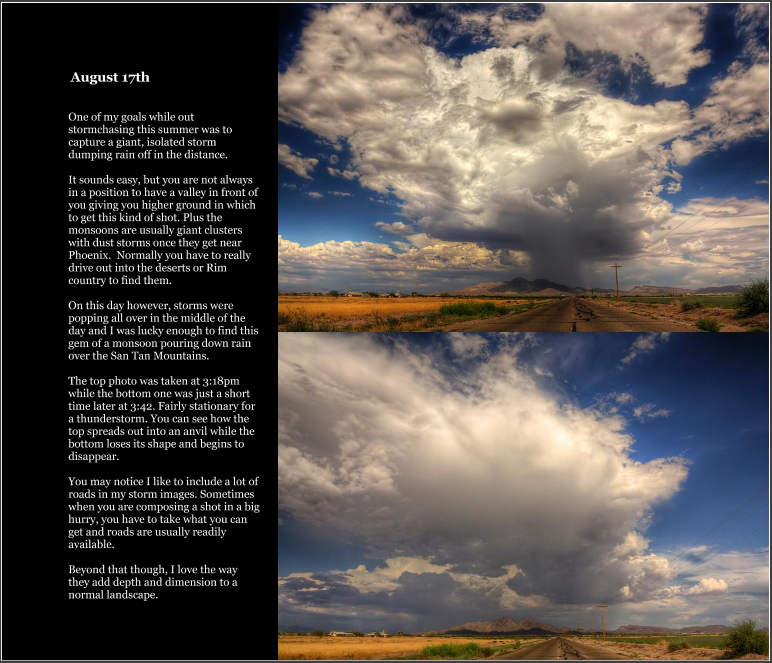
My faithful friends and fellow photographers out there know I've been working on a photobook for a few months now. Ever since the monsoons ended back in late September, I've been putting this thing together. My goal this year was to chase the Arizona monsoons as often as I could, try to capture it in as many ways as I possible, and then publish a photo journal filled with all my favorite images from the summer.
The book is called "Stormchasing Arizona" and I'm happy to report it's done!
Finito. Complete. Well, almost. Yes, my wonderful and amazing wife spent over two hours last night proofreading it, but it probably requires another quick read-through by me and probably her as well. But I'm happy with what's in there, I'm excited and proud of the work I put into it and am looking forward to holding it my hands for the first time. A lot of blood and sweat went into this photo journal. Not only the hundreds upon hundreds of miles I drove this summer, the time away from my girls...but the actual assembly required a lot of writing, re-writing, editing, image editing, image re-editing, etc. I hate doing things halfway...so I wanted to make this as perfect as I could for the first edition.
Yes...the plan is to doing this every year if I can possibly make it happen.
Some facts about the book:
Hardcover with dust jacket
56 pages
Approximately 75 images
Photos of storms, rain, sunsets, cactus, clouds, lightning, dust storms, microbursts, wall clouds, roads, desert mountains, powerlines, flowers, corn and of course a little self-portrait on the back slipcover. I know that's what the people really want anyways. Processing methods include HDR, black and white and standard color.
I've included a few screen captures of the book in this post, but didn't want to reveal too many lest you have no reason to buy it!
Here is the skinny:I'm selling the book for a pre-order discount price of $40 until November 25th. After that the regular price of $50 will go into effect. Obviously shipping isn't included in that price, but if you live in the Phoenix area, or are willing to drive, we can arrange a pickup/delivery for no shipping cost. Books will be shipped out/available the first week or two of December. If you need one quicker and are worried about Christmas timing, let me know and I'll make sure we do what we can to get your copy when you need it.
If you have any questions, please email me: MikeOlbinski @ Gmail Dot COM
To pre-order, visit this post on my blog: Pre-Order 'Stormchasing Arizona'

I wonder what school system these sign makers went to..... (And my 4400th picture uploaded to Flickr! I never thought I'd post 1000. Thanks to all the friends I have met here!!!!!!!
Description: A cabinet card group portrait of the Burbeck family and two unidentified teachers from the Perkins Institution and Massachusetts School for the Blind. Mary Ellen Burbeck, a teacher at Perkins, is located in the front center of the portrait in between two other Perkins teachers. Mary Ellen is facing the viewer with a slight smile. She has light curly hair that is pulled pack. The teachers beside her are facing to the right, both wear glasses, and wear their hair styled in tight buns. The teacher on her left has one hand resting on Mary Ellen's shoulder. Behind them is George Burbeck, to the right, and his young daughter Ella on the left. George wears a dark suit and has a bushy mustache. Ella wears a dark dress, her long hair pinned back at the sides. Both are staring directly a the viewer. Handwritten note on verso, “August 5, 1897." Handwritten Note on verso (on post-it note), "Mary Ellen (534), George (531) and his daughter Ella (625)."
Creator: Bushnell, Grand Floor Gallery, 115 Washington St., Oakland, Cal., photographer.
Date: 1897 August 5
Format: Photographs
Genre: Cabinet photographs
Language/Script: Materials entirely in English.
Subjects:
Blind--Education--United States--History
Perkins Institution and Massachusetts School for the Blind
Music in education
Teachers of the blind
Women educators
Place of Origin: Oakland, Alameda, California
Historical Note: Samuel G. Howe, the first Director of Perkins, considered music as important as intellectual and physical education. By 1873, Perkins had established a department for special instruction in music. The music library was vast, much of it in braille music notation. In 1907, Edward E. Allen became the Perkins director, and soon thereafter reorganized the music department, with a focus on the practical educational benefits of music study. The program continued to train aspiring music teachers, piano tuners, and a few exceptional musicians with professional potential. However, for the majority of Perkins students, the study of music mainly brought the cognitive and social benefits of a well-rounded education.
Biographical Note: Mary Ellen Burbeck (1861-1954), a graduate of the New England Conservatory of Music, was a teacher in the music department at Perkins from 1893-1936. In 1912 it was noted that Burbeck was happy to translate music to braille by request for 6 cents a page, paper included. In 1933 she was placed in charge of the school's music library where she also helped proofread braille translations of music for the music library at Perkins.
Sources:
Allen, Edward E. Letter to John A. Jeldrum. 1912. Sent Correspondence vol. 130: May, 1911-May, 1913. AG53 Perkins Correspondence Collection. Perkins Archives, Watertown, MA. Internet Archive.
Gardiner, Edwin L. “The Department of Music.” Annual Report of the Trustees of the Perkins Institution and Massachusetts School for the Blind, 1932, p. 30. Internet Archive.
McGinnity, B.L., Seymour-Ford, J. and Andries, K.J. (2004) Music. Perkins History Museum, Perkins School for the Blind, Watertown, MA. Perkins.org.
“The Music Department.” The Lantern, 12 September 1933, p. 7. Internet Archive.
Collection: Staff Photographs and Educators of the Blind
Series: Staff Photographs and Educators of the Blind
Extent: 1 photographic print cabinet card mount.
Physical Collection: AG129 Photographs in the Archives Collection.
Location: Perkins Archives, Perkins School for the Blind, Watertown, MA
Notes: Title supplied by cataloger. Provenance: digital copy donated by Burbeck family member in 2021.
Terms of Access and Use: The Perkins Archives does not provide physical access to materials available in a digital format. This image is property of Perkins School for the Blind and use of this image requires written permission. For more information, please visit www.perkins.org/history/archives/about/image-licensing. No known copyright.
Digital Identifier: AG129-44-0079a
Before tattooing, the tattooist goes over the outline of the design on a purple ink pad thingy, and then transfers that ink onto my freshly-shaved leg which has been moistened with whatever the heck it is in the spray bottle. I proofread the tattoo while he's prepping the gun and ink, and notice that the "i" of "animal" is missing its body, and that there is also a missing "o". In this photo, the "o" has already been hand drawn in pen, but the "i" is still just a dot.
The font is penshurst, which I chose because of the spirally curliques on the h, n, m, v, and y. The original art was done by the_ogre (yay for boyfriends who are artists and tattoo geeks and able to put my ideas into pixels)
See all the known remaining Rock City barns on one map (about 80 sites in nine states), with notes and Street View before you drive:
www.seemidtn.com/maps/remaining-rock-city-barns.html
Note: This barn is now gone as of 2026
it says(I think):
SEE BEAUTIFUL
ROCK CITY
LOOKOUT MT.
Chattanooga, Tenn
although I can't see it, usually there's a "Atop" before Lookout Mt. and a "near" before Chattanooga, tn
My wife and I were driving North from Nashville to Louisville and we both loke country driving off the interstates. One good section of highway we'd never taken was U.S. Highway 31W north of Cave City, Ky into Louisville. In the past, we had driven 31W from Cave City to Bowling Green as there are some Rock City barns there.
Most drives between two big cities have one major highway, but Nashville to Louisville have 2: 31E and 31W. Both are very old routes. 31E goes by Lincoln's Birthplace as the Lincoln's lived on that route which became 31E. Dixie Highway, which was the major tourism route from Chicago to Miami in the dawn of auto travel in the 1920's in this area has become 31W.
Since we were driving North, if we were to spot a Rock City ad, we'd have to turn around to see it as they would only be useful for people going in the right direction. Most Rock City barns I know about before we get to it, based on other people's pictures online. There's also the most thorough collection in the Rock City Barns book by David Jenkins. However, if a barn appears in that book from about 12 years ago and it's doesn't appear in someone's online collection, that often means it's gone.
When I drive down a highway like this, I always have a tendancy to look behind me at every prime location of a barn we pass just to make sure we aren't missing anything. Occasionally, I say "That would make a good one" when I see a barn with a big side that faces oncoming traffic, as my wife humors me and nods. For the first time, I was right. I noticed the huge roof on the north side of the barn, which make for the perfect sign for southbound traffic.
This barn is in Hardin County, KY, but 31W through here serves as the border between Hardin and Larue counties. I-65 runs very close to 31W through here and can be seen not far away. This barn is about a mile south of the intersection with KY Highway 84
If you read all that and it didn't bore you, I invite you to my blog where I seemingly ramble nostop about such topics, albeit with better proofreading.
The story of the email:
The favorite mst3k season moments lists came from the mst3kinfo.com website.
The email is this nightmare this girl sent to everybody at my community college. It's hard to see in the middle due to my scanner, so here is the story lifted from one of my blogs:
This was an email my ENTIRE community college got last year. I ran across it today while being bored:
We the Student Government and the Science Club and the Lidauary Club have joined together to sponsor a trip to Christerfer Newport to see S T O M P. we are encoraging everyone to sign up and go. We are going to have a stomping good time. The Trip will be on Friday April 11,2008 and we will be leaving the Suffolk Campus at 6:45 pm the coast will be 25.00 per person. we have sign up sheets all around the campus so sign up now seats are going fast.and keep a look out here on the black board for up coming trips and events. For more infomation you can contact Me...(rest edited out)
-----end of email-----
Seriously. That atrocity got sent to everybody on all three campuses.
I went to work the next day, and the lady I was working for at the time was an English teacher at the school, and she told me that one of the English teachers forwarded that girls' email to all the English teachers with this message:
The email below went out to all our students from a student from the SGA. I am very appalled and in awe of the caliber of writing in this email. We, the Literary Club, will send a letter of apology to our students. WE had absolutely no knowledge or relation to this email, and I have since spoken to [student activities lady] about the freedom of students have to send out letters of "mass destruction" of this nature. First, I thought it was an April Fool's joke, but then I realized it went out to all of our students, some of which have contacted me regarding the contents. I do not mean any harm toward this student or anyone else connected to this matter. I am just heartbroken and greatly disturbed...greatly.
------end of the mail-----
She also emailed the student, which was also included in the email to the English teachers:
[girl who wrote horrible email],
Please accept my sincere apologies for anything that I am about to write, but please prior to sending any emails to all the student body, please check very thoroughly all of your words. I do not want us to send the wrong message to students about our writing. I do thank you go graciously for what you are doing; pulling everyone together, but we want to be as excellent in what we do as how we do it. The Literary Club has several officers what would proofread anything you want to send out if you would like their help. Again, please do not take this personally. The only reason I am sending this email is to just one, commend your efforts to have us working together, and two, to suggest you proofread your emails before sending them to all of PDCCC students. Most importantly, if I have offended you I apologize, but I wanted to share this information with you. I will be glad to sit down with you and talk about this if you desire.
[new English teacher]
English Instructor
PDCCC Literary Club - Founder/Sponsor
Contact dhimaninfotech.xyz for best proofreading services in Delhi India for authors, academic and scientific research papers, manuscript, PhD thesis, dissertation, books, self publishers etc. Call now 9870366843
Our kingdom for a CMS!
Experimentation was at the heart of this newspaper project. A chance for us to remind ourselves of the process of creating copy for a deadline, without the luxury of a CMS and theoretically movable deadline.
We had to meet the 2pm, Tuesday 25 January deadline with Newspaper Club in order to get these papers in the post in time for delivery on 1st February.
In the rush and as expected, some things were missed and exist here, all marked up for all to see, as a sobering memory of a legacy of print which digital, theoretically, can help us hide.
Thank you to Sarah Castleton for the mark-up.
And the The Grauniad for the solidarity.
Today's theme in We're Here! is something about books... sorry, I can't remember the exact theme. So, here I am in my FroKnowsPhoto I shoot RAW T-shirt and under my signed copy of Drop Dead Gorgeous by Wayne Simmons (that I helped proofread before publishing).
I had a wonderful day. I went to Bristol to take some photos of the "Gear and GARB-age Sale" (where Friends of Faire members have a sort of yard sale with all ren-faire related items. Garb, accessories, that sort of thing). While there, I talked to a shop owner about taking product photos for her. And, I handed out the Film Noir photos I had printed for the models (ya see, because the models are on cast at the faire- that's how I'm so lucky to know them and get included in their reindeer games). And I got hugged. A lot. By everyone. It was awesome.
I'm still in this ever-going flareup that has been irritating me for over a month. I've had a few days where it was even worse and I had trouble sitting upright for very long. After I got home from Bristol, my body went into some freak-out mode of pain that I was not expecting. It was all over and agonizing. My left wrist/hand is screaming. My lower back is shrieking in harmony. And my left foot wants to detach itself and run away. And I don't blame it. On top of the all-over pain along with the focused-area pain, my skin feels like it's on fire. I'm hot and clammy. And even though I ate dinner, I'm starving. It seriously feels like I didn't eat dinner at all.
Welcome to fibro hell.
But still... I wouldn't change anything about today. Except maybe more hugging.
I had some time to kill at the Sunport while waiting for the bus, so I got some tea at the Black Mesa Coffee Company and did some proofreading.
Cabinet card portrait likely of Cora Adah Noud [later Rebuschatis] (1868-1918) by George W. Davis, Washington, D.C., likely c. 1881. She is holding a hoop and stick.
Noud was born in or near Wenona, MI to Ermina Jane and James Noud, who ran a liquor store. Her father apparently died shortly after her birth, and her mother, a Scottish immigrant to Canada who had relocated to the US, was living in Washington by 1878, the owner of a "fancy goods" shop on M Street in Georgetown.
In 1897, Noud married a Russian immigrant, Wilhelm (later William) W. Rebuschatis, a printer and proofreader at the Government Printing Office. They had a daughter, Marion (1899-1978).
Per a notice in the 11/26/1918 Evening Star, Cora died of a "lingering illness" at 3228 Hiatt Place, NW. She is buried with her mother, siblings, and daughter at Oak Hill Cemetery.
Written on verso: "Cora Ada Noud".
Our kingdom for a CMS!
Experimentation was at the heart of this newspaper project. A chance for us to remind ourselves of the process of creating copy for a deadline, without the luxury of a CMS and theoretically movable deadline.
We had to meet the 2pm, Tuesday 25 January deadline with Newspaper Club in order to get these papers in the post in time for delivery on 1st February.
In the rush and as expected, some things were missed and exist here, all marked up for all to see, as a sobering memory of a legacy of print which digital, theoretically, can help us hide.
Thank you to Sarah Castleton for the mark-up.
And the The Grauniad for the solidarity.