View allAll Photos Tagged nonexistent
Capitol Reef National Park is an American national park in south-central Utah. The park is approximately 60 miles (97 km) long on its north–south axis and just 6 miles (9.7 km) wide on average. The park was established in 1971 to preserve 241,904 acres (377.98 sq mi; 97,895.08 ha; 978.95 km2) of desert landscape and is open all year, with May through September being the highest visitation months.
Partially in Wayne County, Utah, the area was originally named "Wayne Wonderland" in the 1920s by local boosters Ephraim P. Pectol and Joseph S. Hickman. Capitol Reef National Park was designated a national monument on August 2, 1937, by President Franklin D. Roosevelt to protect the area's colorful canyons, ridges, buttes, and monoliths; however, it was not until 1950 that the area officially opened to the public. Road access was improved in 1962 with the construction of State Route 24 through the Fremont River Canyon.
The majority of the nearly 100 mi (160 km) long up-thrust formation called the Waterpocket Fold—a rocky spine extending from Thousand Lake Mountain to Lake Powell—is preserved within the park. Capitol Reef is an especially rugged and spectacular segment of the Waterpocket Fold by the Fremont River. The park was named for its whitish Navajo Sandstone cliffs with dome formations—similar to the white domes often placed on capitol buildings—that run from the Fremont River to Pleasant Creek on the Waterpocket Fold. Locally, reef refers to any rocky barrier to land travel, just as ocean reefs are barriers to sea travel.
Capitol Reef encompasses the Waterpocket Fold, a warp in the earth's crust that is 65 million years old. It is the largest exposed monocline in North America. In this fold, newer and older layers of earth folded over each other in an S-shape. This warp, probably caused by the same colliding continental plates that created the Rocky Mountains, has weathered and eroded over millennia to expose layers of rock and fossils. The park is filled with brilliantly colored sandstone cliffs, gleaming white domes, and contrasting layers of stone and earth.
The area was named for a line of white domes and cliffs of Navajo Sandstone, each of which looks somewhat like the United States Capitol building, that run from the Fremont River to Pleasant Creek on the Waterpocket Fold.
The fold forms a north-to-south barrier that has barely been breached by roads. Early settlers referred to parallel impassable ridges as "reefs", from which the park gets the second half of its name. The first paved road was constructed through the area in 1962. State Route 24 cuts through the park traveling east and west between Canyonlands National Park and Bryce Canyon National Park, but few other paved roads invade the rugged landscape.
The park is filled with canyons, cliffs, towers, domes, and arches. The Fremont River has cut canyons through parts of the Waterpocket Fold, but most of the park is arid desert. A scenic drive shows park visitors some highlights, but it runs only a few miles from the main highway. Hundreds of miles of trails and unpaved roads lead into the equally scenic backcountry.
Fremont-culture Native Americans lived near the perennial Fremont River in the northern part of the Capitol Reef Waterpocket Fold around the year 1000. They irrigated crops of maize and squash and stored their grain in stone granaries (in part made from the numerous black basalt boulders that litter the area). In the 13th century, all of the Native American cultures in this area underwent sudden change, likely due to a long drought. The Fremont settlements and fields were abandoned.
Many years after the Fremont left, Paiutes moved into the area. These Numic-speaking people named the Fremont granaries moki huts and thought they were the homes of a race of tiny people or moki.
In 1872 Almon H. Thompson, a geographer attached to United States Army Major John Wesley Powell's expedition, crossed the Waterpocket Fold while exploring the area. Geologist Clarence Dutton later spent several summers studying the area's geology. None of these expeditions explored the Waterpocket Fold to any great extent.
Following the American Civil War, officials of the Church of Jesus Christ of Latter-day Saints in Salt Lake City sought to establish missions in the remotest niches of the Intermountain West. In 1866, a quasi-military expedition of Mormons in pursuit of natives penetrated the high valleys to the west. In the 1870s, settlers moved into these valleys, eventually establishing Loa, Fremont, Lyman, Bicknell, and Torrey.
Mormons settled the Fremont River valley in the 1880s and established Junction (later renamed Fruita), Caineville, and Aldridge. Fruita prospered, Caineville barely survived, and Aldridge died. In addition to farming, lime was extracted from local limestone, and uranium was extracted early in the 20th century. In 1904 the first claim to a uranium mine in the area was staked. The resulting Oyler Mine in Grand Wash produced uranium ore.
By 1920 no more than ten families at one time were sustained by the fertile flood plain of the Fremont River and the land changed ownership over the years. The area remained isolated. The community was later abandoned and later still some buildings were restored by the National Park Service. Kilns once used to produce lime are still in Sulphur Creek and near the campgrounds on Scenic Drive.
Local Ephraim Portman Pectol organized a "booster club" in Torrey in 1921. Pectol pressed a promotional campaign, furnishing stories to be sent to periodicals and newspapers. In his efforts, he was increasingly aided by his brother-in-law, Joseph S. Hickman, who was the Wayne County High School principal. In 1924, Hickman extended community involvement in the promotional effort by organizing a Wayne County-wide Wayne Wonderland Club. That same year, Hickman was elected to the Utah State Legislature.
In 1933, Pectol was elected to the presidency of the Associated Civics Club of Southern Utah, successor to the Wayne Wonderland Club. The club raised U.S. $150 (equivalent to $3,391 in 2022) to interest a Salt Lake City photographer in taking a series of promotional photographs. For several years, the photographer, J. E. Broaddus, traveled and lectured on "Wayne Wonderland".
In 1933, Pectol was elected to the legislature and almost immediately contacted President Franklin D. Roosevelt and asked for the creation of "Wayne Wonderland National Monument" out of the federal lands comprising the bulk of the Capitol Reef area. Federal agencies began a feasibility study and boundary assessment. Meanwhile, Pectol guided the government investigators on numerous trips and escorted an increasing number of visitors. The lectures of Broaddus were having an effect.
Roosevelt signed a proclamation creating Capitol Reef National Monument on August 2, 1937. In Proclamation 2246, President Roosevelt set aside 37,711 acres (15,261 ha) of the Capitol Reef area. This comprised an area extending about two miles (3 km) north of present State Route 24 and about 10 mi (16 km) south, just past Capitol Gorge. The Great Depression years were lean ones for the National Park Service (NPS), the new administering agency. Funds for the administration of Capitol Reef were nonexistent; it would be a long time before the first rangers would arrive.
Administration of the new monument was placed under the control of Zion National Park. A stone ranger cabin and the Sulphur Creek bridge were built and some road work was performed by the Civilian Conservation Corps and the Works Progress Administration. Historian and printer Charles Kelly came to know NPS officials at Zion well and volunteered to watchdog the park for the NPS. Kelly was officially appointed custodian-without-pay in 1943. He worked as a volunteer until 1950, when the NPS offered him a civil-service appointment as the first superintendent.
During the 1950s Kelly was deeply troubled by NPS management acceding to demands of the U.S. Atomic Energy Commission that Capitol Reef National Monument be opened to uranium prospecting. He felt that the decision had been a mistake and destructive of the long-term national interest. It turned out that there was not enough ore in the monument to be worth mining.
In 1958 Kelly got additional permanent help in protecting the monument and enforcing regulations; Park Ranger Grant Clark transferred from Zion. The year Clark arrived, fifty-six thousand visitors came to the park, and Charlie Kelly retired for the last time.
During the 1960s (under the program name Mission 66), NPS areas nationwide received new facilities to meet the demand of mushrooming park visitation. At Capitol Reef, a 53-site campground at Fruita, staff rental housing, and a new visitor center were built, the latter opening in 1966.
Visitation climbed dramatically after the paved, all-weather State Route 24 was built in 1962 through the Fremont River canyon near Fruita. State Route 24 replaced the narrow Capitol Gorge wagon road about 10 mi (16 km) to the south that frequently washed out. The old road has since been open only to foot traffic. In 1967, 146,598 persons visited the park. The staff was also growing.
During the 1960s, the NPS purchased private land parcels at Fruita and Pleasant Creek. Almost all private property passed into public ownership on a "willing buyer-willing seller" basis.
Preservationists convinced President Lyndon B. Johnson to set aside an enormous area of public lands in 1968, just before he left office. In Presidential Proclamation 3888 an additional 215,056 acres (87,030 ha) were placed under NPS control. By 1970, Capitol Reef National Monument comprised 254,251 acres (102,892 ha) and sprawled southeast from Thousand Lake Mountain almost to the Colorado River. The action was controversial locally, and NPS staffing at the monument was inadequate to properly manage the additional land.
The vast enlargement of the monument and diversification of the scenic resources soon raised another issue: whether Capitol Reef should be a national park, rather than a monument. Two bills were introduced into the United States Congress.
A House bill (H.R. 17152) introduced by Utah Congressman Laurence J. Burton called for a 180,000-acre (72,800 ha) national park and an adjunct 48,000-acre (19,400 ha) national recreation area where multiple use (including grazing) could continue indefinitely. In the United States Senate, meanwhile, Senate bill S. 531 had already passed on July 1, 1970, and provided for a 230,000-acre (93,100 ha) national park alone. The bill called for a 25-year phase-out of grazing.
In September 1970, United States Department of Interior officials told a house subcommittee session that they preferred about 254,000 acres (103,000 ha) be set aside as a national park. They also recommended that the grazing phase-out period be 10 years, rather than 25. They did not favor the adjunct recreation area.
It was not until late 1971 that Congressional action was completed. By then, the 92nd United States Congress was in session and S. 531 had languished. A new bill, S. 29, was introduced in the Senate by Senator Frank E. Moss of Utah and was essentially the same as the defunct S. 531 except that it called for an additional 10,834 acres (4,384 ha) of public lands for a Capitol Reef National Park. In the House, Utah Representative K. Gunn McKay (with Representative Lloyd) had introduced H.R. 9053 to replace the dead H.R. 17152. This time, the House bill dropped the concept of an adjunct Capitol Reef National Recreation Area and adopted the Senate concept of a 25-year limit on continued grazing. The Department of Interior was still recommending a national park of 254,368 acres (102,939 ha) and a 10-year limit for grazing phase-out.
S. 29 passed the Senate in June and was sent to the House, which dropped its own bill and passed the Senate version with an amendment. Because the Senate was not in agreement with the House amendment, differences were worked out in Conference Committee. The Conference Committee issued its report on November 30, 1971, and the bill passed both houses of Congress. The legislation—'An Act to Establish The Capitol Reef National Park in the State of Utah'—became Public Law 92-207 when it was signed by President Richard Nixon on December 18, 1971.
The area including the park was once the edge of a shallow sea that invaded the land in the Permian, creating the Cutler Formation. Only the sandstone of the youngest member of the Cutler Formation, the White Rim, is exposed in the park. The deepening sea left carbonate deposits, forming the limestone of the Kaibab Limestone, the same formation that rims the Grand Canyon to the southwest.
During the Triassic, streams deposited reddish-brown silt that later became the siltstone of the Moenkopi Formation. Uplift and erosion followed. Conglomerate, followed by logs, sand, mud, and wind-transported volcanic ash, then formed the uranium-containing Chinle Formation.
The members of the Glen Canyon Group were all laid down in the middle- to late-Triassic during a time of increasing aridity. They include:
Wingate Sandstone: sand dunes on the shore of an ancient sea
Kayenta Formation: thin-bedded layers of sand deposited by slow-moving streams in channels and across low plains
Navajo Sandstone: huge fossilized sand dunes from a massive Sahara-like desert.
The Golden Throne. Though Capitol Reef is famous for white domes of Navajo Sandstone, this dome's color is a result of a lingering section of yellow Carmel Formation carbonate, which has stained the underlying rock.
The San Rafael Group consists of four Jurassic-period formations, from oldest to youngest:
Carmel Formation: gypsum, sand, and limey silt laid down in what may have been a graben that was periodically flooded by sea water
Entrada Sandstone: sandstone from barrier islands/sand bars in a near-shore environment
Curtis Formation: made from conglomerate, sandstone, and shale
Summerville Formation: reddish-brown mud and white sand deposited in tidal flats.
Streams once again laid down mud and sand in their channels, on lakebeds, and in swampy plains, creating the Morrison Formation. Early in the Cretaceous, similar nonmarine sediments were laid down and became the Dakota Sandstone. Eventually, the Cretaceous Seaway covered the Dakota, depositing the Mancos Shale.
Only small remnants of the Mesaverde Group are found, capping a few mesas in the park's eastern section.
Near the end of the Cretaceous period, a mountain-building event called the Laramide orogeny started to compact and uplift the region, forming the Rocky Mountains and creating monoclines such as the Waterpocket Fold in the park. Ten to fifteen million years ago, the entire region was uplifted much further by the creation of the Colorado Plateau. This uplift was very even. Igneous activity in the form of volcanism and dike and sill intrusion also occurred during this time.
The drainage system in the area was rearranged and steepened, causing streams to downcut faster and sometimes change course. Wetter times during the ice ages of the Pleistocene increased the rate of erosion.
There are more than 840 species of plants that are found in the park and over 40 of those species are classified as rare and endemic.
The closest town to Capitol Reef is Torrey, about 11 mi (18 km) west of the visitor center on Highway 24, slightly west of its intersection with Highway 12. Its 2020 population is less than 300. Torrey has a few motels and restaurants and functions as a gateway town to Capitol Reef National Park. Highway 12, as well as a partially unpaved scenic backway named the Burr Trail, provide access from the west through the Grand Staircase–Escalante National Monument and the town of Boulder.
A variety of activities are available to tourists, both ranger-led and self-guided, including auto touring, hiking, backpacking, camping, bicycling (on paved and unpaved roads only; no trails), horseback riding, canyoneering, and rock climbing. The orchards planted by Mormon pioneers are maintained by the National Park Service. From early March to mid-October, various fruit—cherries, apricots, peaches, pears, or apples—can be harvested by visitors for a fee.
A hiking trail guide is available at the visitor center for both day hikes and backcountry hiking. Backcountry access requires a free permit.
Numerous trails are available for hiking and backpacking in the park, with fifteen in the Fruita District alone. The following trails are some of the most popular in the park:
Cassidy Arch Trail: a very steep, strenuous 3.5 mi (5.6 km) round trip that leads into the Grand Wash to an overlook of the Cassidy Arch.
Hickman Bridge Trail: a 2 mi (3.2 km) round trip leading to the natural bridge.
Frying Pan Trail: an 8.8 mi (14.2 km) round trip that passes the Cassidy Arch, Grand Wash, and Cohab Canyon.
Brimhall Natural Bridge: a popular, though strenuous, 4.5 mi (7.2 km) round trip with views of Brimhall Canyon, the Waterpocket Fold, and Brimhall Natural Bridge.
Halls Creek Narrows: 22 mi (35 km) long and considered strenuous, with many side canyons and creeks; typically hiked as a 2-3 day camping trip.
Visitors may explore several of the main areas of the park by private vehicle:
Scenic Drive: winds through the middle of the park, passing the major points of interest; the road is accessible from the visitor center to approximately 2 mi (3.2 km) into the Capitol Gorge.
Notom-Bullfrog Road: traverses the eastern side of the Waterpocket Fold, along 10 mi (16 km) of paved road, with the remainder unpaved.
Cathedral Road: an unpaved road through the northern areas of the park, that traverses Cathedral Valley, passing the Temples of the Sun and Moon.
The primary camping location is the Fruita campground, with 71 campsites (no water, electrical, or sewer hookups), and restrooms without bathing facilities. The campground also has group sites with picnic areas and restrooms. Two primitive free camping areas are also available.
Canyoneering is growing in popularity in the park. It is a recreational sport that takes one through slot canyons. It involves rappelling and may require swimming and other technical rope work. Day-pass permits are required for canyoneering in the park, and can be obtained for free from the visitor's center or through email. It's key to know that each route requires its own permit. If one is planning on canyoneering for multiple days, passes are required for each day. Overnight camping as part of the canyoneering trip is permitted, but one must request a free backcountry pass from the visitor center.
It is imperative to plan canyoneering trips around the weather. The Colorado Plateau is susceptible to flash flooding during prime rainy months. Because canyoneering takes place through slot canyons, getting caught in a flash flood could be lethal. Take care to consult reliable weather sources. The Weather Atlas shows charts with the monthly average rainfall in inches.
Another risk to be aware of during the summer months is extreme heat. Visitors can find weather warnings on the National Weather Service website. The heat levels are detailed by a color and numerical scale (0-4).
One of the most popular canyoneering routes in Capitol Reef National Park is Cassidy Arch Canyon. A paper by George Huddart, details the park's commitment to working with citizens to maintain the route as well as the vegetation and rocks. The canyon route is approximately 2.3 miles long (0.4 miles of technical work), consisting of 8 different rappels, and takes between 2.5 and 4.5 hours to complete. The first rappel is 140 ft and descends below the famous Cassidy Arch.
Utah is a landlocked state in the Mountain West subregion of the Western United States. It borders Colorado to its east, Wyoming to its northeast, Idaho to its north, Arizona to its south, and Nevada to its west. Utah also touches a corner of New Mexico in the southeast. Of the fifty U.S. states, Utah is the 13th-largest by area; with a population over three million, it is the 30th-most-populous and 11th-least-densely populated. Urban development is mostly concentrated in two areas: the Wasatch Front in the north-central part of the state, which is home to roughly two-thirds of the population and includes the capital city, Salt Lake City; and Washington County in the southwest, with more than 180,000 residents. Most of the western half of Utah lies in the Great Basin.
Utah has been inhabited for thousands of years by various indigenous groups such as the ancient Puebloans, Navajo, and Ute. The Spanish were the first Europeans to arrive in the mid-16th century, though the region's difficult geography and harsh climate made it a peripheral part of New Spain and later Mexico. Even while it was Mexican territory, many of Utah's earliest settlers were American, particularly Mormons fleeing marginalization and persecution from the United States via the Mormon Trail. Following the Mexican–American War in 1848, the region was annexed by the U.S., becoming part of the Utah Territory, which included what is now Colorado and Nevada. Disputes between the dominant Mormon community and the federal government delayed Utah's admission as a state; only after the outlawing of polygamy was it admitted in 1896 as the 45th.
People from Utah are known as Utahns. Slightly over half of all Utahns are Mormons, the vast majority of whom are members of the Church of Jesus Christ of Latter-day Saints (LDS Church), which has its world headquarters in Salt Lake City; Utah is the only state where a majority of the population belongs to a single church. A 2023 paper challenged this perception (claiming only 42% of Utahns are Mormons) however most statistics still show a majority of Utah residents belong to the LDS church; estimates from the LDS church suggests 60.68% of Utah's population belongs to the church whilst some sources put the number as high as 68%. The paper replied that membership count done by the LDS Church is too high for several reasons. The LDS Church greatly influences Utahn culture, politics, and daily life, though since the 1990s the state has become more religiously diverse as well as secular.
Utah has a highly diversified economy, with major sectors including transportation, education, information technology and research, government services, mining, multi-level marketing, and tourism. Utah has been one of the fastest growing states since 2000, with the 2020 U.S. census confirming the fastest population growth in the nation since 2010. St. George was the fastest-growing metropolitan area in the United States from 2000 to 2005. Utah ranks among the overall best states in metrics such as healthcare, governance, education, and infrastructure. It has the 12th-highest median average income and the least income inequality of any U.S. state. Over time and influenced by climate change, droughts in Utah have been increasing in frequency and severity, putting a further strain on Utah's water security and impacting the state's economy.
The History of Utah is an examination of the human history and social activity within the state of Utah located in the western United States.
Archaeological evidence dates the earliest habitation of humans in Utah to about 10,000 to 12,000 years ago. Paleolithic people lived near the Great Basin's swamps and marshes, which had an abundance of fish, birds, and small game animals. Big game, including bison, mammoths and ground sloths, also were attracted to these water sources. Over the centuries, the mega-fauna died, this population was replaced by the Desert Archaic people, who sheltered in caves near the Great Salt Lake. Relying more on gathering than the previous Utah residents, their diet was mainly composed of cattails and other salt tolerant plants such as pickleweed, burro weed and sedge. Red meat appears to have been more of a luxury, although these people used nets and the atlatl to hunt water fowl, ducks, small animals and antelope. Artifacts include nets woven with plant fibers and rabbit skin, woven sandals, gaming sticks, and animal figures made from split-twigs. About 3,500 years ago, lake levels rose and the population of Desert Archaic people appears to have dramatically decreased. The Great Basin may have been almost unoccupied for 1,000 years.
The Fremont culture, named from sites near the Fremont River in Utah, lived in what is now north and western Utah and parts of Nevada, Idaho and Colorado from approximately 600 to 1300 AD. These people lived in areas close to water sources that had been previously occupied by the Desert Archaic people, and may have had some relationship with them. However, their use of new technologies define them as a distinct people. Fremont technologies include:
use of the bow and arrow while hunting,
building pithouse shelters,
growing maize and probably beans and squash,
building above ground granaries of adobe or stone,
creating and decorating low-fired pottery ware,
producing art, including jewelry and rock art such as petroglyphs and pictographs.
The ancient Puebloan culture, also known as the Anasazi, occupied territory adjacent to the Fremont. The ancestral Puebloan culture centered on the present-day Four Corners area of the Southwest United States, including the San Juan River region of Utah. Archaeologists debate when this distinct culture emerged, but cultural development seems to date from about the common era, about 500 years before the Fremont appeared. It is generally accepted that the cultural peak of these people was around the 1200 CE. Ancient Puebloan culture is known for well constructed pithouses and more elaborate adobe and masonry dwellings. They were excellent craftsmen, producing turquoise jewelry and fine pottery. The Puebloan culture was based on agriculture, and the people created and cultivated fields of maize, beans, and squash and domesticated turkeys. They designed and produced elaborate field terracing and irrigation systems. They also built structures, some known as kivas, apparently designed solely for cultural and religious rituals.
These two later cultures were roughly contemporaneous, and appear to have established trading relationships. They also shared enough cultural traits that archaeologists believe the cultures may have common roots in the early American Southwest. However, each remained culturally distinct throughout most of their existence. These two well established cultures appear to have been severely impacted by climatic change and perhaps by the incursion of new people in about 1200 CE. Over the next two centuries, the Fremont and ancient Pueblo people may have moved into the American southwest, finding new homes and farmlands in the river drainages of Arizona, New Mexico and northern Mexico.
In about 1200, Shoshonean speaking peoples entered Utah territory from the west. They may have originated in southern California and moved into the desert environment due to population pressure along the coast. They were an upland people with a hunting and gathering lifestyle utilizing roots and seeds, including the pinyon nut. They were also skillful fishermen, created pottery and raised some crops. When they first arrived in Utah, they lived as small family groups with little tribal organization. Four main Shoshonean peoples inhabited Utah country. The Shoshone in the north and northeast, the Gosiutes in the northwest, the Utes in the central and eastern parts of the region and the Southern Paiutes in the southwest. Initially, there seems to have been very little conflict between these groups.
In the early 16th century, the San Juan River basin in Utah's southeast also saw a new people, the Díne or Navajo, part of a greater group of plains Athabaskan speakers moved into the Southwest from the Great Plains. In addition to the Navajo, this language group contained people that were later known as Apaches, including the Lipan, Jicarilla, and Mescalero Apaches.
Athabaskans were a hunting people who initially followed the bison, and were identified in 16th-century Spanish accounts as "dog nomads". The Athabaskans expanded their range throughout the 17th century, occupying areas the Pueblo peoples had abandoned during prior centuries. The Spanish first specifically mention the "Apachu de Nabajo" (Navaho) in the 1620s, referring to the people in the Chama valley region east of the San Juan River, and north west of Santa Fe. By the 1640s, the term Navaho was applied to these same people. Although the Navajo newcomers established a generally peaceful trading and cultural exchange with the some modern Pueblo peoples to the south, they experienced intermittent warfare with the Shoshonean peoples, particularly the Utes in eastern Utah and western Colorado.
At the time of European expansion, beginning with Spanish explorers traveling from Mexico, five distinct native peoples occupied territory within the Utah area: the Northern Shoshone, the Goshute, the Ute, the Paiute and the Navajo.
The Spanish explorer Francisco Vázquez de Coronado may have crossed into what is now southern Utah in 1540, when he was seeking the legendary Cíbola.
A group led by two Spanish Catholic priests—sometimes called the Domínguez–Escalante expedition—left Santa Fe in 1776, hoping to find a route to the California coast. The expedition traveled as far north as Utah Lake and encountered the native residents. All of what is now Utah was claimed by the Spanish Empire from the 1500s to 1821 as part of New Spain (later as the province Alta California); and subsequently claimed by Mexico from 1821 to 1848. However, Spain and Mexico had little permanent presence in, or control of, the region.
Fur trappers (also known as mountain men) including Jim Bridger, explored some regions of Utah in the early 19th century. The city of Provo was named for one such man, Étienne Provost, who visited the area in 1825. The city of Ogden, Utah is named for a brigade leader of the Hudson's Bay Company, Peter Skene Ogden who trapped in the Weber Valley. In 1846, a year before the arrival of members from the Church of Jesus Christ of latter-day Saints, the ill-fated Donner Party crossed through the Salt Lake valley late in the season, deciding not to stay the winter there but to continue forward to California, and beyond.
Members of the Church of Jesus Christ of Latter-day Saints, commonly known as Mormon pioneers, first came to the Salt Lake Valley on July 24, 1847. At the time, the U.S. had already captured the Mexican territories of Alta California and New Mexico in the Mexican–American War and planned to keep them, but those territories, including the future state of Utah, officially became United States territory upon the signing of the Treaty of Guadalupe Hidalgo, February 2, 1848. The treaty was ratified by the United States Senate on March 10, 1848.
Upon arrival in the Salt Lake Valley, the Mormon pioneers found no permanent settlement of Indians. Other areas along the Wasatch Range were occupied at the time of settlement by the Northwestern Shoshone and adjacent areas by other bands of Shoshone such as the Gosiute. The Northwestern Shoshone lived in the valleys on the eastern shore of Great Salt Lake and in adjacent mountain valleys. Some years after arriving in the Salt Lake Valley Mormons, who went on to colonize many other areas of what is now Utah, were petitioned by Indians for recompense for land taken. The response of Heber C. Kimball, first counselor to Brigham Young, was that the land belonged to "our Father in Heaven and we expect to plow and plant it." A 1945 Supreme Court decision found that the land had been treated by the United States as public domain; no aboriginal title by the Northwestern Shoshone had been recognized by the United States or extinguished by treaty with the United States.
Upon arriving in the Salt Lake Valley, the Mormons had to make a place to live. They created irrigation systems, laid out farms, built houses, churches, and schools. Access to water was crucially important. Almost immediately, Brigham Young set out to identify and claim additional community sites. While it was difficult to find large areas in the Great Basin where water sources were dependable and growing seasons long enough to raise vitally important subsistence crops, satellite communities began to be formed.
Shortly after the first company arrived in the Salt Lake Valley in 1847, the community of Bountiful was settled to the north. In 1848, settlers moved into lands purchased from trapper Miles Goodyear in present-day Ogden. In 1849, Tooele and Provo were founded. Also that year, at the invitation of Ute chief Wakara, settlers moved into the Sanpete Valley in central Utah to establish the community of Manti. Fillmore, Utah, intended to be the capital of the new territory, was established in 1851. In 1855, missionary efforts aimed at western native cultures led to outposts in Fort Lemhi, Idaho, Las Vegas, Nevada and Elk Mountain in east-central Utah.
The experiences of returning members of the Mormon Battalion were also important in establishing new communities. On their journey west, the Mormon soldiers had identified dependable rivers and fertile river valleys in Colorado, Arizona and southern California. In addition, as the men traveled to rejoin their families in the Salt Lake Valley, they moved through southern Nevada and the eastern segments of southern Utah. Jefferson Hunt, a senior Mormon officer of the Battalion, actively searched for settlement sites, minerals, and other resources. His report encouraged 1851 settlement efforts in Iron County, near present-day Cedar City. These southern explorations eventually led to Mormon settlements in St. George, Utah, Las Vegas and San Bernardino, California, as well as communities in southern Arizona.
Prior to establishment of the Oregon and California trails and Mormon settlement, Indians native to the Salt Lake Valley and adjacent areas lived by hunting buffalo and other game, but also gathered grass seed from the bountiful grass of the area as well as roots such as those of the Indian Camas. By the time of settlement, indeed before 1840, the buffalo were gone from the valley, but hunting by settlers and grazing of cattle severely impacted the Indians in the area, and as settlement expanded into nearby river valleys and oases, indigenous tribes experienced increasing difficulty in gathering sufficient food. Brigham Young's counsel was to feed the hungry tribes, and that was done, but it was often not enough. These tensions formed the background to the Bear River massacre committed by California Militia stationed in Salt Lake City during the Civil War. The site of the massacre is just inside Preston, Idaho, but was generally thought to be within Utah at the time.
Statehood was petitioned for in 1849-50 using the name Deseret. The proposed State of Deseret would have been quite large, encompassing all of what is now Utah, and portions of Colorado, Idaho, Nevada, Wyoming, Arizona, Oregon, New Mexico and California. The name of Deseret was favored by the LDS leader Brigham Young as a symbol of industry and was derived from a reference in the Book of Mormon. The petition was rejected by Congress and Utah did not become a state until 1896, following the Utah Constitutional Convention of 1895.
In 1850, the Utah Territory was created with the Compromise of 1850, and Fillmore (named after President Fillmore) was designated the capital. In 1856, Salt Lake City replaced Fillmore as the territorial capital.
The first group of pioneers brought African slaves with them, making Utah the only place in the western United States to have African slavery. Three slaves, Green Flake, Hark Lay, and Oscar Crosby, came west with this first group in 1847. The settlers also began to purchase Indian slaves in the well-established Indian slave trade, as well as enslaving Indian prisoners of war. In 1850, 26 slaves were counted in Salt Lake County. Slavery didn't become officially recognized until 1852, when the Act in Relation to Service and the Act for the relief of Indian Slaves and Prisoners were passed. Slavery was repealed on June 19, 1862, when Congress prohibited slavery in all US territories.
Disputes between the Mormon inhabitants and the federal government intensified after the Church of Jesus Christ of Latter-day Saints' practice of polygamy became known. The polygamous practices of the Mormons, which were made public in 1854, would be one of the major reasons Utah was denied statehood until almost 50 years after the Mormons had entered the area.
After news of their polygamous practices spread, the members of the LDS Church were quickly viewed by some as un-American and rebellious. In 1857, after news of a possible rebellion spread, President James Buchanan sent troops on the Utah expedition to quell the growing unrest and to replace Brigham Young as territorial governor with Alfred Cumming. The expedition was also known as the Utah War.
As fear of invasion grew, Mormon settlers had convinced some Paiute Indians to aid in a Mormon-led attack on 120 immigrants from Arkansas under the guise of Indian aggression. The murder of these settlers became known as the Mountain Meadows massacre. The Mormon leadership had adopted a defensive posture that led to a ban on the selling of grain to outsiders in preparation for an impending war. This chafed pioneers traveling through the region, who were unable to purchase badly needed supplies. A disagreement between some of the Arkansas pioneers and the Mormons in Cedar City led to the secret planning of the massacre by a few Mormon leaders in the area. Some scholars debate the involvement of Brigham Young. Only one man, John D. Lee, was ever convicted of the murders, and he was executed at the massacre site.
Express riders had brought the news 1,000 miles from the Missouri River settlements to Salt Lake City within about two weeks of the army's beginning to march west. Fearing the worst as 2,500 troops (roughly 1/3rd of the army then) led by General Albert Sidney Johnston started west, Brigham Young ordered all residents of Salt Lake City and neighboring communities to prepare their homes for burning and evacuate southward to Utah Valley and southern Utah. Young also sent out a few units of the Nauvoo Legion (numbering roughly 8,000–10,000), to delay the army's advance. The majority he sent into the mountains to prepare defenses or south to prepare for a scorched earth retreat. Although some army wagon supply trains were captured and burned and herds of army horses and cattle run off no serious fighting occurred. Starting late and short on supplies, the United States Army camped during the bitter winter of 1857–58 near a burned out Fort Bridger in Wyoming. Through the negotiations between emissary Thomas L. Kane, Young, Cumming and Johnston, control of Utah territory was peacefully transferred to Cumming, who entered an eerily vacant Salt Lake City in the spring of 1858. By agreement with Young, Johnston established the army at Fort Floyd 40 miles away from Salt Lake City, to the southwest.
Salt Lake City was the last link of the First Transcontinental Telegraph, between Carson City, Nevada and Omaha, Nebraska completed in October 1861. Brigham Young, who had helped expedite construction, was among the first to send a message, along with Abraham Lincoln and other officials. Soon after the telegraph line was completed, the Deseret Telegraph Company built the Deseret line connecting the settlements in the territory with Salt Lake City and, by extension, the rest of the United States.
Because of the American Civil War, federal troops were pulled out of Utah Territory (and their fort auctioned off), leaving the territorial government in federal hands without army backing until General Patrick E. Connor arrived with the 3rd Regiment of California Volunteers in 1862. While in Utah, Connor and his troops soon became discontent with this assignment wanting to head to Virginia where the "real" fighting and glory was occurring. Connor established Fort Douglas just three miles (5 km) east of Salt Lake City and encouraged his bored and often idle soldiers to go out and explore for mineral deposits to bring more non-Mormons into the state. Minerals were discovered in Tooele County, and some miners began to come to the territory. Conner also solved the Shoshone Indian problem in Cache Valley Utah by luring the Shoshone into a midwinter confrontation on January 29, 1863. The armed conflict quickly turned into a rout, discipline among the soldiers broke down, and the Battle of Bear River is today usually referred to by historians as the Bear River Massacre. Between 200 and 400 Shoshone men, women and children were killed, as were 27 soldiers, with over 50 more soldiers wounded or suffering from frostbite.
Beginning in 1865, Utah's Black Hawk War developed into the deadliest conflict in the territory's history. Chief Antonga Black Hawk died in 1870, but fights continued to break out until additional federal troops were sent in to suppress the Ghost Dance of 1872. The war is unique among Indian Wars because it was a three-way conflict, with mounted Timpanogos Utes led by Antonga Black Hawk fighting federal and Utah local militia.
On May 10, 1869, the First transcontinental railroad was completed at Promontory Summit, north of the Great Salt Lake. The railroad brought increasing numbers of people into the state, and several influential businessmen made fortunes in the territory.
Main article: Latter Day Saint polygamy in the late-19th century
During the 1870s and 1880s, federal laws were passed and federal marshals assigned to enforce the laws against polygamy. In the 1890 Manifesto, the LDS Church leadership dropped its approval of polygamy citing divine revelation. When Utah applied for statehood again in 1895, it was accepted. Statehood was officially granted on January 4, 1896.
The Mormon issue made the situation for women the topic of nationwide controversy. In 1870 the Utah Territory, controlled by Mormons, gave women the right to vote. However, in 1887, Congress disenfranchised Utah women with the Edmunds–Tucker Act. In 1867–96, eastern activists promoted women's suffrage in Utah as an experiment, and as a way to eliminate polygamy. They were Presbyterians and other Protestants convinced that Mormonism was a non-Christian cult that grossly mistreated women. The Mormons promoted woman suffrage to counter the negative image of downtrodden Mormon women. With the 1890 Manifesto clearing the way for statehood, in 1895 Utah adopted a constitution restoring the right of women's suffrage. Congress admitted Utah as a state with that constitution in 1896.
Though less numerous than other intermountain states at the time, several lynching murders for alleged misdeeds occurred in Utah territory at the hand of vigilantes. Those documented include the following, with their ethnicity or national origin noted in parentheses if it was provided in the source:
William Torrington in Carson City (then a part of Utah territory), 1859
Thomas Coleman (Black man) in Salt Lake City, 1866
3 unidentified men at Wahsatch, winter of 1868
A Black man in Uintah, 1869
Charles A. Benson in Logan, 1873
Ah Sing (Chinese man) in Corinne, 1874
Thomas Forrest in St. George, 1880
William Harvey (Black man) in Salt Lake City, 1883
John Murphy in Park City, 1883
George Segal (Japanese man) in Ogden, 1884
Joseph Fisher in Eureka, 1886
Robert Marshall (Black man) in Castle Gate, 1925
Other lynchings in Utah territory include multiple instances of mass murder of Native American children, women, and men by White settlers including the Battle Creek massacre (1849), Provo River Massacre (1850), Nephi massacre (1853), and Circleville Massacre (1866).
Beginning in the early 20th century, with the establishment of such national parks as Bryce Canyon National Park and Zion National Park, Utah began to become known for its natural beauty. Southern Utah became a popular filming spot for arid, rugged scenes, and such natural landmarks as Delicate Arch and "the Mittens" of Monument Valley are instantly recognizable to most national residents. During the 1950s, 1960s, and 1970s, with the construction of the Interstate highway system, accessibility to the southern scenic areas was made easier.
Beginning in 1939, with the establishment of Alta Ski Area, Utah has become world-renowned for its skiing. The dry, powdery snow of the Wasatch Range is considered some of the best skiing in the world. Salt Lake City won the bid for the 2002 Winter Olympics in 1995, and this has served as a great boost to the economy. The ski resorts have increased in popularity, and many of the Olympic venues scattered across the Wasatch Front continue to be used for sporting events. This also spurred the development of the light-rail system in the Salt Lake Valley, known as TRAX, and the re-construction of the freeway system around the city.
During the late 20th century, the state grew quickly. In the 1970s, growth was phenomenal in the suburbs. Sandy was one of the fastest-growing cities in the country at that time, and West Valley City is the state's 2nd most populous city. Today, many areas of Utah are seeing phenomenal growth. Northern Davis, southern and western Salt Lake, Summit, eastern Tooele, Utah, Wasatch, and Washington counties are all growing very quickly. Transportation and urbanization are major issues in politics as development consumes agricultural land and wilderness areas.
In 2012, the State of Utah passed the Utah Transfer of Public Lands Act in an attempt to gain control over a substantial portion of federal land in the state from the federal government, based on language in the Utah Enabling Act of 1894. The State does not intend to use force or assert control by limiting access in an attempt to control the disputed lands, but does intend to use a multi-step process of education, negotiation, legislation, and if necessary, litigation as part of its multi-year effort to gain state or private control over the lands after 2014.
Utah families, like most Americans everywhere, did their utmost to assist in the war effort. Tires, meat, butter, sugar, fats, oils, coffee, shoes, boots, gasoline, canned fruits, vegetables, and soups were rationed on a national basis. The school day was shortened and bus routes were reduced to limit the number of resources used stateside and increase what could be sent to soldiers.
Geneva Steel was built to increase the steel production for America during World War II. President Franklin D. Roosevelt had proposed opening a steel mill in Utah in 1936, but the idea was shelved after a couple of months. After the attack on Pearl Harbor, the United States entered the war and the steel plant was put into progress. In April 1944, Geneva shipped its first order, which consisted of over 600 tons of steel plate. Geneva Steel also brought thousands of job opportunities to Utah. The positions were hard to fill as many of Utah's men were overseas fighting. Women began working, filling 25 percent of the jobs.
As a result of Utah's and Geneva Steels contribution during the war, several Liberty Ships were named in honor of Utah including the USS Joseph Smith, USS Brigham Young, USS Provo, and the USS Peter Skene Ogden.
One of the sectors of the beachhead of Normandy Landings was codenamed Utah Beach, and the amphibious landings at the beach were undertaken by United States Army troops.
It is estimated that 1,450 soldiers from Utah were killed in the war.
Operation “Salt City" resulted in the arrest of 248 individuals from May through September 2015. Of those arrested, 124 were active gang members. During the operation 22 firearms, more than $237,000 in U.S. currency, 70 grams of heroin, 266 grams of cocaine, and 723 grams of marijuana with a total estimated street value of almost $44,000 was taken off Syracuse streets by participating agencies.
Operation Salt City is part of the U.S. Marshals nation-wide “Triple Beam” gang reduction initiative. Triple Beam partners federal, state, and local law enforcement to reduce violent crime and take dangerous offenders off the streets. The goal of the U.S. Marshals Gang Enforcement Program is to seek out and disrupt illegal gang activity in areas of the country with smaller or nonexistent gang enforcement units by providing manpower, funding and the Marshals’ renowned fugitive tracking abilities.
Photo by Shane T. McCoy / US Marshals
One of my top favorite pictures from this trip!!
The second stop on the way home from my college visit was in Richmond!
The Richmond Kmart appears to be a former Grants (and thus reminded me of the Erie Kmart that I visited last summer). It is very noticeably bigger than Anderson; it is also very nice; it has a Kmart Express gas station and it has a former Kmart Cafe (that still has the counter/displays, the full menu board and even the register! Looks like a more recent KCafe closure from what I've seen; if anybody else here has any more information I would like to know more about it!). This store appears to be doing fairly well for one of the last remaining stores in/near the Miami Valley.
Of course, I had to check out the Kmart Express after my main store rounds were complete, so I headed over there and looked around. This is the second Kmart Express I've seen, but the first one I have actually visited, as the other one (at the now nonexistent Brooklyn Super Kmart) had already closed. I didn't buy anything at this KExpress though, as I had spent my money in the main store. Hopefully next time I can buy some coffee or donuts from Kmart Express while going to/from Anderson (if I plan another college visit to Anderson U, which is likely)!
Hopefully the Richmond Kmart will still be able to remain "normal" for a good time longer...I like this store! :D
Kmart #7246 - 3150 National Road West - Richmond, Indiana
Though personalized art appeared during World War I, and occasionally grew to incorporate the entire aircraft, most pilots carried a saying or a slogan, or a family crest, or squadron symbol. Some were named, but nose art was not common. During World War II, nose art not only saw its true beginnings, but its heyday.
No one knows exactly who started nose art first--it appeared with both the British and the Germans around the first time, with RAF pilots painting Hitler being kicked or skulls and crossbones on their aircraft, while German nose art was usually a personal symbol, named for a girlfriend or adopting a mascot (such as Adolf Galland using Mickey Mouse, something Walt Disney likely didn't approve of). It would be with the Americans, and a lesser extent the Canadians, that nose art truly became common--and started including its most famous forms, which was usually half-naked or completely naked women. This was not always true, but it often was.
The quality of nose art depended on the squadron or wing artist. Some of it was rather crude, while others were equal to the finest pinup artists in the United States, such as Alberto Vargas. For men thousands of miles away from home and lonely, a curvaceous blonde on a B-17 or a P-51 made that loneliness a bit easier. Others thought naked women were a little crude, and just limited themselves to names, or depicted animals, cartoon characters, or patriotic emblems, or caricatures of the Axis dictators they were fighting.
Generally speaking, there was little censorship, with squadron and group commanders rarely intervening on names or pictures; the pilots themselves practiced self-censorship, with profanity almost unknown, and full-frontal nudity nearly nonexistent. After the loss of a B-17 named "Murder Inc.," which the Germans captured and used to make propaganda, the 8th Air Force, at least, set up a nose art committee that reviewed the nose art of aircraft--but even it rarely wielded its veto. For the most part, nose art was limited only by the crew's imagination and the artist's ability. The British tended to stay away from the lurid nudes of the Americans, though the Canadians adopted them as well. (The Axis also did not use nose art in this fashion, and neither did the Soviets, who usually confined themselves to patriotic slogans on their aircraft, such as "For Stalin!" or "In the Spirit of the Motherland!")
When World War II ended, so did nose art, for the most part. In the peacetime, postwar armed forces, the idea of having naked women were wives and children could see it was not something the postwar USAF or Navy wanted, and when it wasn't scrapped, it was painted over. A few units (especially those away from home and family) still allowed it, but it would take Korea to begin a renaissance of nose art.
This is a reproduction of the nose art on "Wandering Wanda," a B-24M (or B-24L) assigned to the 7th Bomb Group, based at Pandaveswar, India. The real "Wanda" was one of many 7th BG B-24s painted by Vernon Drake, a particularly talented USAAF nose art artist--he was lucky in that a lot of his work was preserved after the war thanks to Minot Pratt, who saved nose art from scrapped B-24s. Today, the originals are preserved and are part of a touring exhibit sponsored by the Experimental Aircraft Association.
As mentioned above, however, this is a reproduction of one of Drake's nose art, done for the National Museum of World War II Aviation in Colorado Springs, Colorado. Whoever the local artist is who did this excellent rendition is talented themselves! For some of the art carried by 7th BG B-24s, "Wanda" is actually a bit on the tame side.
The second stop on the way home from my college visit was in Richmond!
The Richmond Kmart appears to be a former Grants (and thus reminded me of the Erie Kmart that I visited last summer). It is very noticeably bigger than Anderson; it is also very nice; it has a Kmart Express gas station and it has a former Kmart Cafe (that still has the counter/displays, the full menu board and even the register! Looks like a more recent KCafe closure from what I've seen; if anybody else here has any more information I would like to know more about it!). This store appears to be doing fairly well for one of the last remaining stores in/near the Miami Valley.
Of course, I had to check out the Kmart Express after my main store rounds were complete, so I headed over there and looked around. This is the second Kmart Express I've seen, but the first one I have actually visited, as the other one (at the now nonexistent Brooklyn Super Kmart) had already closed. I didn't buy anything at this KExpress though, as I had spent my money in the main store. Hopefully next time I can buy some coffee or donuts from Kmart Express while going to/from Anderson (if I plan another college visit to Anderson U, which is likely)!
Hopefully the Richmond Kmart will still be able to remain "normal" for a good time longer...I like this store! :D
Kmart #7246 - 3150 National Road West - Richmond, Indiana
It's been a couple of (long) years... With "stay home" orders, park closure and overcrowding, my visits to BPNP had been nonexistent. It was time to see if it still has a place in my heart ...
The second stop on the way home from my college visit was in Richmond!
The Richmond Kmart appears to be a former Grants (and thus reminded me of the Erie Kmart that I visited last summer). It is very noticeably bigger than Anderson; it is also very nice; it has a Kmart Express gas station and it has a former Kmart Cafe (that still has the counter/displays, the full menu board and even the register! Looks like a more recent KCafe closure from what I've seen; if anybody else here has any more information I would like to know more about it!). This store appears to be doing fairly well for one of the last remaining stores in/near the Miami Valley.
Of course, I had to check out the Kmart Express after my main store rounds were complete, so I headed over there and looked around. This is the second Kmart Express I've seen, but the first one I have actually visited, as the other one (at the now nonexistent Brooklyn Super Kmart) had already closed. I didn't buy anything at this KExpress though, as I had spent my money in the main store. Hopefully next time I can buy some coffee or donuts from Kmart Express while going to/from Anderson (if I plan another college visit to Anderson U, which is likely)!
Hopefully the Richmond Kmart will still be able to remain "normal" for a good time longer...I like this store! :D
Kmart #7246 - 3150 National Road West - Richmond, Indiana
The second stop on the way home from my college visit was in Richmond!
The Richmond Kmart appears to be a former Grants (and thus reminded me of the Erie Kmart that I visited last summer). It is very noticeably bigger than Anderson; it is also very nice; it has a Kmart Express gas station and it has a former Kmart Cafe (that still has the counter/displays, the full menu board and even the register! Looks like a more recent KCafe closure from what I've seen; if anybody else here has any more information I would like to know more about it!). This store appears to be doing fairly well for one of the last remaining stores in/near the Miami Valley.
Of course, I had to check out the Kmart Express after my main store rounds were complete, so I headed over there and looked around. This is the second Kmart Express I've seen, but the first one I have actually visited, as the other one (at the now nonexistent Brooklyn Super Kmart) had already closed. I didn't buy anything at this KExpress though, as I had spent my money in the main store. Hopefully next time I can buy some coffee or donuts from Kmart Express while going to/from Anderson (if I plan another college visit to Anderson U, which is likely)!
Hopefully the Richmond Kmart will still be able to remain "normal" for a good time longer...I like this store! :D
Kmart #7246 - 3150 National Road West - Richmond, Indiana
The second stop on the way home from my college visit was in Richmond!
The Richmond Kmart appears to be a former Grants (and thus reminded me of the Erie Kmart that I visited last summer). It is very noticeably bigger than Anderson; it is also very nice; it has a Kmart Express gas station and it has a former Kmart Cafe (that still has the counter/displays, the full menu board and even the register! Looks like a more recent KCafe closure from what I've seen; if anybody else here has any more information I would like to know more about it!). This store appears to be doing fairly well for one of the last remaining stores in/near the Miami Valley.
Of course, I had to check out the Kmart Express after my main store rounds were complete, so I headed over there and looked around. This is the second Kmart Express I've seen, but the first one I have actually visited, as the other one (at the now nonexistent Brooklyn Super Kmart) had already closed. I didn't buy anything at this KExpress though, as I had spent my money in the main store. Hopefully next time I can buy some coffee or donuts from Kmart Express while going to/from Anderson (if I plan another college visit to Anderson U, which is likely)!
Hopefully the Richmond Kmart will still be able to remain "normal" for a good time longer...I like this store! :D
Kmart #7246 - 3150 National Road West - Richmond, Indiana
Operation “Salt City" resulted in the arrest of 248 individuals from May through September 2015. Of those arrested, 124 were active gang members. During the operation 22 firearms, more than $237,000 in U.S. currency, 70 grams of heroin, 266 grams of cocaine, and 723 grams of marijuana with a total estimated street value of almost $44,000 was taken off Syracuse streets by participating agencies.
Operation Salt City is part of the U.S. Marshals nation-wide “Triple Beam” gang reduction initiative. Triple Beam partners federal, state, and local law enforcement to reduce violent crime and take dangerous offenders off the streets. The goal of the U.S. Marshals Gang Enforcement Program is to seek out and disrupt illegal gang activity in areas of the country with smaller or nonexistent gang enforcement units by providing manpower, funding and the Marshals’ renowned fugitive tracking abilities.
Photo by Shane T. McCoy / US Marshals
If you guess correctly, you may win a fabulous* prize!
*in this case, fabulous actually means nonexistent.
The second stop on the way home from my college visit was in Richmond!
The Richmond Kmart appears to be a former Grants (and thus reminded me of the Erie Kmart that I visited last summer). It is very noticeably bigger than Anderson; it is also very nice; it has a Kmart Express gas station and it has a former Kmart Cafe (that still has the counter/displays, the full menu board and even the register! Looks like a more recent KCafe closure from what I've seen; if anybody else here has any more information I would like to know more about it!). This store appears to be doing fairly well for one of the last remaining stores in/near the Miami Valley.
Of course, I had to check out the Kmart Express after my main store rounds were complete, so I headed over there and looked around. This is the second Kmart Express I've seen, but the first one I have actually visited, as the other one (at the now nonexistent Brooklyn Super Kmart) had already closed. I didn't buy anything at this KExpress though, as I had spent my money in the main store. Hopefully next time I can buy some coffee or donuts from Kmart Express while going to/from Anderson (if I plan another college visit to Anderson U, which is likely)!
Hopefully the Richmond Kmart will still be able to remain "normal" for a good time longer...I like this store! :D
Kmart #7246 - 3150 National Road West - Richmond, Indiana
The second stop on the way home from my college visit was in Richmond!
The Richmond Kmart appears to be a former Grants (and thus reminded me of the Erie Kmart that I visited last summer). It is very noticeably bigger than Anderson; it is also very nice; it has a Kmart Express gas station and it has a former Kmart Cafe (that still has the counter/displays, the full menu board and even the register! Looks like a more recent KCafe closure from what I've seen; if anybody else here has any more information I would like to know more about it!). This store appears to be doing fairly well for one of the last remaining stores in/near the Miami Valley.
Of course, I had to check out the Kmart Express after my main store rounds were complete, so I headed over there and looked around. This is the second Kmart Express I've seen, but the first one I have actually visited, as the other one (at the now nonexistent Brooklyn Super Kmart) had already closed. I didn't buy anything at this KExpress though, as I had spent my money in the main store. Hopefully next time I can buy some coffee or donuts from Kmart Express while going to/from Anderson (if I plan another college visit to Anderson U, which is likely)!
Hopefully the Richmond Kmart will still be able to remain "normal" for a good time longer...I like this store! :D
Kmart #7246 - 3150 National Road West - Richmond, Indiana
The second stop on the way home from my college visit was in Richmond!
The Richmond Kmart appears to be a former Grants (and thus reminded me of the Erie Kmart that I visited last summer). It is very noticeably bigger than Anderson; it is also very nice; it has a Kmart Express gas station and it has a former Kmart Cafe (that still has the counter/displays, the full menu board and even the register! Looks like a more recent KCafe closure from what I've seen; if anybody else here has any more information I would like to know more about it!). This store appears to be doing fairly well for one of the last remaining stores in/near the Miami Valley.
Of course, I had to check out the Kmart Express after my main store rounds were complete, so I headed over there and looked around. This is the second Kmart Express I've seen, but the first one I have actually visited, as the other one (at the now nonexistent Brooklyn Super Kmart) had already closed. I didn't buy anything at this KExpress though, as I had spent my money in the main store. Hopefully next time I can buy some coffee or donuts from Kmart Express while going to/from Anderson (if I plan another college visit to Anderson U, which is likely)!
Hopefully the Richmond Kmart will still be able to remain "normal" for a good time longer...I like this store! :D
Kmart #7246 - 3150 National Road West - Richmond, Indiana
Indonesia, Japan, Korea, Myanmar, Nepal, Sri Lanka, Thailand, Tibet and Vietnam
english
Religion in Korea encompasses a number of different traditions. Traditional Buddhism, Mugyo with a background of Korean Confucianism and later Christianity all play a role in Korea's religious tradition. The modern separation of Korea into North and South Korea has also shaped religious practice, especially in the communist North.
Religion in South Korea
Just over 53 percent of South Koreans profess religious affiliation. That affiliation is spread primarily among three traditions - Buddhism (43 percent), Christianity (55 percent), and Mugyo (0.2 percent).[6] These numbers should be treated with some caution, however, as (with the exception of Christianity) there are few if any meaningful distinctions between believers and nonbelievers in Buddhism and Confucianism, which comprise more of a set of ethical values than a religion. The cultural impact of these movements is far more widespread than the number of formal adherents suggests. A variety of "new religions" have emerged since the mid-19th century, including Cheondogyo. Very small Muslim and Bahá'í minorities also exist due to the emigration of South Asians.
Religion in North Korea
Traditionally, Koreans have practiced Buddhism and observed the tenets of Korean Confucianism. Besides a number of practicing Buddhists (about 11.4 million, under the auspices of the official Korean Buddhist Federation), the population also includes some Christians (about 10,000 Protestants and 4,000 Roman Catholics, under the auspices of the Korean Christian Federation) and an indeterminate number of native Cheondogyo (Heavenly Way) adherents. However, religious activities in North Korea are almost nonexistent. North Korea has 300 Buddhist temples, but they are considered cultural relics rather than active places of worship. Several schools for religious education exist, including three-year religious colleges for training Protestant and Buddhist clergy. In 1989 Kim Il Sung University established a religious studies program, but its graduates usually go on to work in the foreign trade sector. Although the constitution provides for freedom of religious belief, in practice the government severely discourages organized religious activity except as supervised by the aforementioned officially recognized groups. Constitutional changes made in 1992 allow authorized religious gatherings and the construction of buildings for religious use and deleted a clause about freedom of anti-religious propaganda. The constitution also stipulates that religion "should not be used for purposes of dragging in foreign powers or endangering public security."
Mugyo
Koreans, like other East Asians, have traditionally been eclectic rather than exclusive in their religious commitments. Their religious outlook has not been conditioned by a single, exclusive faith but by a combination of indigenous beliefs and creeds imported into Korea. Belief in a world inhabited by spirits is probably the oldest form of Korean religious life, dating back to prehistoric times. There is a rather unorganized pantheon of literally millions of gods, spirits, and ghosts, ranging from the "god generals" who rule the different quarters of heaven to mountain spirits (sansin). This pantheon also includes gods who inhabit trees, sacred caves, and piles of stones, as well as earth spirits, the tutelary gods of households and villages, mischievous goblins, and the ghosts of persons who in many cases met violent or tragic ends. These spirits are said to have the power to influence or to change the fortunes of living men and women.
Shamans, most of whom are women, are enlisted by those who want the help of the spirit world. Female shamans (mudang) hold kut, or services, in order to gain good fortune for clients, cure illnesses by exorcising evil spirits, or propitiate local or village gods. Such services are also held to guide the spirit of a deceased person to heaven.
Often a woman will become a shaman very reluctantly—after experiencing a severe physical or mental illness that indicates "possession" by a spirit. Such possession can allegedly be cured only through performance of a kut. Once a shaman is established in her profession, she usually can make a good living.
Many scholars regard Korean shamanism as less a religion than a form of medicine in which the spirits are manipulated in order to achieve human ends. There is no notion of salvation or moral and spiritual perfection, at least for the ordinary believers in spirits. The shaman is a professional who is consulted by clients whenever the need is felt. Traditionally, shamans had low social status and were members of the ch'ommin class. This discrimination has continued into modern times.
Korean folk beliefs are strongly associated with the culture of fishing villages and are primarily a phenomenon found in rural communities. Shamans also treat the ills of city people, however, especially recent migrants from the countryside who find adjustment to an impersonal urban life stressful. The government has discouraged belief in shamanism as superstition and for many years minimized its persistence in Korean life. Yet in a climate of growing nationalism and cultural self-confidence, the dances, songs, and incantations that compose the kut have come to be recognized as an important aspect of Korean culture. Beginning in the 1970s, rituals that formerly had been kept out of foreign view began to resurface, and occasionally a Western hotel manager or other executive could even be seen attending a shamanistic exorcism ritual in the course of opening a new branch in Seoul. Some of these aspects of kut have been designated valuable cultural properties that should be preserved and passed on to future generations.
The future of shamanism itself was uncertain in the late 1980s. Observers believed that many of its functions in the future probably will be performed by the psychiatric profession as the government expands mental health treatment facilities. Given the uncertainty of social, economic, and political conditions, however, it appears certain that shamans will find large numbers of clients for some time to come.
Buddhism and Confucianism
Buddhism was the dominant religious and cultural influence during the Silla (668–935) and Koryo (918–1392) dynasties. Confucianism also was brought to Korea from China in early Three Kingdoms period, but it occupied a subordinate position until the establishment of the Choson Dynasty where it became the state ideology.
Christianity
Roman Catholic missionaries did not arrive in Korea until 1794, a decade after the return of the first baptized Korean from a visit to Beijing. However, the writings of the Jesuit missionary, Matteo Ricci, who was resident at the imperial court in Beijing, had been brought to Korea from China in the seventeenth century. It appears that scholars of the Sirhak, or practical learning, school were interested in these writings. Largely because converts refused to perform ancestor rites, the government prohibited the proselytization of Christianity. Some Catholics were executed during the early nineteenth century, but the anti-Christian law was not strictly enforced. By the 1860s, there were some 17,500 Roman Catholics in the country. There followed a more rigorous persecution, in which thousands of Christians died, that continued until 1884.
Protestant missionaries entered Korea during the 1880s and, along with Catholic priests, converted a remarkable number of Koreans. Methodist and Presbyterian missionaries were especially successful. They established schools, universities, hospitals, and orphanages and played a significant role in the modernization of the country. During the Japanese colonial occupation, Christians were in the front ranks of the struggle for independence. Factors contributing to the growth of Protestantism included the disorganized state of Korean Buddhism, the efforts made by educated Christians to reconcile Christian and Confucian values (the latter being viewed as purely a social ethic rather than a religion), the encouragement of self-support and selfgovernment among members of the Korean church, and the identification of Christianity with Korean nationalism.
A large number of Christians lived in the northern part of the peninsula where Confucian influence was not as strong as in the south. Before 1948 P'yongyang was an important Christian center: one-sixth of its population of about 300,000 people were converts. Following the establishment of a communist regime in the north, however, most Christians had to flee to South Korea or face persecution.
New religions
Ch'ondogyo, generally regarded as the first of Korea's "new religions," is another important religious tradition. It is a synthesis of Confucian, Buddhist, shamanistic, Daoist, and Catholic influences. Ch'ondogyo grew out of the Donghak Movement (also called Eastern Learning Movement) established by Choe Je-u, a man of yangban background who claimed to have experienced a mystic encounter with God, who told him to preach to all the world. Ch'oe was executed by the government as a heretic in 1863, but not before he had acquired a number of followers and had committed his ideas to writing. Tonghak spread among the poor people of Korea's villages, especially in the Cholla region, and was the cause of a revolt against the royal government in 1894. While some members of the Tonghak Movement-- renamed Ch'ondogyo (Teachings of the Heavenly Way)--supported the Japanese annexation in 1910, others opposed it. This group played a major role, along with Christians and some Confucians, in the Korean nationalist movement. In the 1920s, Ch'ondogyo sponsored Kaebyok (Creation), one of Korea's major intellectual journals during the colonial period.
Ch'ondogyo's basic beliefs include the essential equality of all human beings. Each person must be treated with respect because all persons "contain divinity;" there is "God in man." Moreover, men and women must sincerely cultivate themselves in order to bring forth and express this divinity in their lives. Self-perfection, not ritual and ceremony, is the way to salvation. Although Ch'oe and his followers did not attempt to overthrow the social order and establish a radical egalitarianism, the revolutionary potential of Ch'ondogyo is evident in these basic ideas, which appealed especially to poor people who were told that they, along with scholars and high officials, could achieve salvation through effort. There is reason to believe that Ch'ondogyo had an important role in the development of democratic and anti-authoritarian thought in Korea. In the 1970s and 1980s, Ch'ondogyo's antecedent, the Tonghak Movement, received renewed interest among many Korean intellectuals.
Apart from Ch'ondogyo, major new religions included Taejonggyo, which has as its central creed the worship of Tangun, legendary founder of the Korean nation. Chungsanggyo, founded in the early twentieth century by Chungsan Kang, emphasizes magical practices and the creation of a paradise on earth. It is divided into a great number of competing branches, the largest being Jeungsando and Daesun Jinrihoe.[7] Wonbulgyo, or Won Buddhism, attempts to combine traditional Buddhist doctrine with a modern concern for social reform and revitalization. There are also a number of small sects which have sprung up around Mount Kyeryong in South Ch'ungch'ong Province, the supposed future site of the founding of a new dynasty originally prophesied in the eighteenth century.
Several new religions derive their inspiration from Christianity. The Chondogwan, or Evangelical Church, was founded by Pak T'ae-son. Pak originally was a Presbyterian, but was expelled from the church for heresy in the 1950s after claiming for himself unique spiritual power. By 1972 his followers numbered as many as 700,000 people, and he built several "Christian towns," established a large church network, and managed several industrial enterprises.
Because of its overseas evangelism, the Hold Spirit Association for the Unification of the World Christianity, or Unification Church (T'ongilgyo), founded in 1954 by Reverend Sun Myong Moon (Mun Son-myong), also a former Christian, is the most famous Korean new religion. During its period of vigorous expansion during the 1970s, the Unification Church had several hundred thousand members in South Korea and Japan and a substantial (although generally overestimated) number of members in North America and Western Europe. Moon claimed that he was the "messiah" designated by God to unify all the peoples of the world into one "family," governed theocratically by himself. Like Pak's Evangelical Church, the Unification Church has been highly authoritarian, demanding absolute obedience from church members. Moon, for example, has arranged marriages for his younger followers; United States television audiences were treated some years ago to a mass ceremony at which several hundred young "Moonies" were married. Also like Pak, Moon has coupled the church's fortunes to economic expansion. Factories in South Korea and abroad manufacture arms and process ginseng and seafood, artistic bric-a-brac, and other items. Moon's labor force has worked long hours and been paid minimal wages in order to channel profits into church coffers. Virulently anticommunist, Moon has sought to influence public opinion at home and abroad by establishing generally unprofitable newspapers such as the Segye Ilbo in Seoul, the Sekai Nippo in Tokyo, and the Washington Times in the United States capital, and by inviting academics to lavish international conferences, often held in South Korea. At home, the Unification Church was viewed with suspicion by the authorities because of its scandals and Moon's evident desire to create a "state within a state." His influence, however, had declined by the late 1980s.
Islam
The number of Muslims in South Korea is estimated at about 35,000 mainly consisting of people who converted during the Korean War and their descendents and not including migrant workers from South and Southeast Asia. The largest mosque is the Seoul Central Mosque in the Itaewon district of Seoul; smaller mosques can be found in most of the country's major cities.[8]
In addition to native Korean Muslims, there are some 100,000 foreign workers from Muslim countries,[9] particularly Bangladesh and Pakistan.[
Judaism
The Jewish presence in South Korea effectively began with the outbreak of the Korean War in 1950. At this time a large number of Jewish soldiers, including the chaplain Chaim Potok, came to the Korean peninsula. Today the Jewish community is very small and limited to the Seoul metropolitan area. There have been very few Korean converts to Judaism.
The Reconquest began in Asturias. It was the begining of the formation of the Christian Empire. The center was Asturias.
Wikipedia
The Kingdom of Asturias (Latin: Regnum Asturorum) was a Kingdom in the Iberian peninsula founded in 718 by Visigothic nobles under the leadership of Pelagius of Asturias.[1] It was the first Christian political entity established following the collapse of the Visigothic kingdom after Islamic conquest of Hispania. In 722, Pelagius subsequently defeated the Umayyad Caliphate at the Battle of Covadonga, in what is usually regarded as the beginning of the Reconquista. The kingdom lasted until 924, when Fruela II became King of León.
Indigenous background
The birthplace of the Asturian kingdom was the western and central territory of the Cantabrian Mountains part of the Gallaecia, particularly the Picos de Europa and the central area of Asturias. The main political and military events during the first decades of the kingdom's existence took place in this region. According to the descriptions of Strabo, Dio Cassius and other Graeco-Roman geographers, the lands of Asturias were inhabited in the beginning of the Christian era by several peoples, amongst whom the more important were: From the Cantabrians, the Vadinienses, who inhabited the Picos de Europa region and whose settlement gradually expanded southward during the first centuries of the modern era; the Orgenomesci, who dwelled along the Asturian eastern coast; and from the Astures, the Saelini, whose settlement extended through the Sella valley; the Luggones, who had their capital in Lucus Asturum and whose territories stretched between the rivers Sella and Nalón; the Astures (in the strictest sense), who dwelled in inner Asturias, between the current councils of Piloña and Cangas del Narcea; and the Paesici, who had settled along the coast of Western Asturias, between the mouth of the Navia river and the modern city of Gijón.
Classical geographers give conflicting views of the ethnic description of the above mentioned peoples: Ptolemy says that the Astures extended along the central area of current Asturias, between the Navia and Sella rivers, fixing the latter river as the boundary with the Cantabrian territory. However, other geographers placed the frontier between the Astures and the Cantabri more eastwards: Julius Honorius stated in his Cosmographia that the springs of Ebro river were located in the land of the Astures (sub asturibus). In any case, ethnic borders in the Cantabrian mountains were not so important after that time, as the clans divisions that permeated the pre-roman societies of all the peoples of Northern Iberia fell under similar political administrative culture impossed on them by the Romans.
This situation started to change during the Late Roman Empire and the early Middle Ages, when an Asturian identity started to develop gradually: The centuries-old fight among Visigoths or Suebians nobles may have helped to forge a distinct identity among the peoples of the Cantabrian districts. Several archaeological digs in the castro of La Carisa (municipality of Lena) have found remnants of a defensive line whose main purpose was to protect the valleys of central Asturias from invaders who came from the Meseta through the Pajares pass: the construction of these fortifications reveals a high degree of organization and cooperation between the several Asturian communities, in order to defend themselves from the southern invaders. Carbon-14 tests have found that the wall dates from the period 675-725 AD, when two armed expeditions against the Asturians took place: One of them, headed by Visigothic king Wamba; the other by Muslim governor Musa bin Nusair, during the Islamic conquest of Iberia who settled garrisons over its territory.
The Asturian identity that was gradually forming led to the creation of the Kingdom of Asturias after Pelayo's coronation and the victory over the Muslim garrisons in Covadonga. The Chronica Albeldense, in narrating the happenings of Covadonga, stated that "Divine providence brings forth the King of Asturias".
Islamic occupation and Asturian revolt
The kingdom was established by the Visigothic nobleman Pelayo (Latin: Pelagius), who had returned to his country after the Battle of Guadalete where, in the Gothic tradition of Theias, he was elected by the other nobles as leader of the Astures, and founded the Kingdom of Asturias. However, Pelayo's kingdom was initially little more than a rallying banner for existing guerilla forces.[2][3]
In the progress of the Islamic conquest of the Iberian Peninsula, the main cities and administrative centers fell in the hands of Muslim troops. Control of the central and southern regions, such as the Guadalquivir and Ebro valleys, presented few problems for the newcomers, who used the existing Visigothic administrative structures, ultimately of Roman origin. However, in the northern mountains, urban centers (such as Gigia) were practically nonexistent and the submission of the country had to be achieved valley by valley. Muslim troops often resorted to the taking of hostages to ensure the pacification of the newly conquered territory.
After the first incursion of Tarik, who reached Toledo in 711, the Yemeni viceroy of Ifriqiya, Musa ibn Nusair, crossed the Strait of Gibraltar the following year and carried out a massive operation of conquest that would lead to the capture of Mérida, Toledo, Zaragoza and Lerida, among other cities. During the last phase of his military campaign, he reached the northwest of the Peninsula, where he gained control of the localities of Lugo and Gijon. In the latter city he placed a small Berber detachment under a governor, Munuza, whose mission was to consolidate Muslim control over Asturias. As guarantee of the submission of the region, some nobles – some argue that Pelayo was among them, although his origin is unknown – had to surrender hostages from Asturias to Cordoba. The legend says that his sister was asked for, and a marriage alliance sought with the local Berber leader. Later on, Munuza would try to do the same at another mountain post in the Pyrenees, where he rebelled against his Cordoban Arab superiors. The Berbers had been converted to Islam barely a generation earlier, and were considered second rank to Arabs and Syrians.
But, as is told in the Rotensian Chronicle (chronicle of Alfonso III of Asturias in which Pelayo is considered the successor of the kings of Toledo, with clear goals of political legitimacy) as well as in that of Al-Maqqari (a Moroccan historian of the 16th century who died in Cairo, Egypt, and who could have used the Rotensian Chronicle and rewrite it eight centuries later, making it useless as a historical document), Pelayo escaped from that city during the governorship of Al Hurr (717-718) and his return to Asturias triggered a revolt against the Muslim authorities of Gijon. The identity of Pelayo, however, is still an open subject, and this is only one of the theories. The leader of the Astures, whose origin is debated by historians, had at that time his home in Bres (in the district of Piloña) and Munuza sent his troops there under officer Al-Qama. After receiving word of the arrival of the Muslims, Pelayo and his companions hurriedly crossed the Piloña River and headed toward the narrow, easily defended valley of Auseva mountain, and took refuge in one of its caves, Covadonga. After an attempt at siege was abandoned due to the weather and the exposed position of the deep valley gorge, the troops are said to have taken to exit through the high ports to the south, in order to continue in the search and destroy action against other rebels. There the locals were able to ambush the Muslim detachment, which was annihilated. The rest of its survivors continued south to the plains of Leon, leaving the maritime districts of Asturias exposed and weakened of defenders. The most commonly accepted hypothesis for this battle (epic as described by Christian chronicles, but a mere skirmish in Muslim texts) is that the Moorish column was attacked from the cliffs and then fell back through the valleys towards present day Gijón, but was attacked whilst in retreat by the retinue and nearly destroyed.
The victory - relatively small, as only a few Berber soldiers were involved — resulted in great prestige for Pelayo and provoked a massive insurrection by other nobles in Galicia and Asturias who immediately rallied around Pelayo, electing him King or military Dux.
Under Pelayo's leadership, the attacks on the Berbers increased. Munuza, feeling isolated in a region increasingly hostile, decided to abandon Gijon and headed for the Plateau (Meseta) through the Mesa Trail. However, he was intercepted and killed by Astures at Olalíes (in the current district of Grado). Once he had expelled the Moors from the eastern valleys of Asturias, Pelayo attacked León, the main city in the northwest of the Iberian Peninsula and secured the mountain passes, isolating the region from Moorish attack. Pelayo continued attacking those Berbers who remained north of the Asturian-Galician Mountains until they withdrew, but mostly deserted their garrisons at the wider rebellion against Arab control from Cordoba. He then married his daughter, Ermesinda to Alfonso, the son of Peter of Cantabria, the leading noble at the still-independent Visigothic dukedom of Cantabria. His son Favila was married to Froiliuba.
Recent archaeological excavations have found fortifications in Mount Homon and La Carisa (near the Huerna and Pajares valleys) dated between the end of the seventh and beginning of the eighth centuries. These Berber fortifications included watchtowers and moats of almost two meters, in whose construction and defense many hundreds may have participated. This would have required a high degree of organization and firm leadership, probably by Pelayo himself.[4] For this reason, experts consider that it is probable that the construction of the defensive line was intended to prevent the reentry of Moors into Asturias through the mountain passes of Mesa and Pajares.[5]
After Pelayo's victory over the Moorish detachment at the Battle of Covadonga, a small territorial independent entity was established in the Asturian mountains that was the origin of the kingdom of Asturias. Pelayo's leadership was not comparable to that of the Visigothic kings. The first kings of Asturias referred to themselves as "princeps" (prince) and later as "rex" (king), but the later title was not firmly established until the period of Alphonse II. The title of "princeps" had been used by the indigenous peoples of Northern Spain and its use appears in Galician and Cantabrian inscriptions, in which expressions like "Nícer, Príncipe de los Albiones"[6] (on an inscription found in the district of Coaña) and "princeps cantabrorum"[7] (over a gravestone of the municipality of Cistierna, in Leon). In fact, the Kingdom of Asturias originated as a focus of leadership over other peoples of the Cantabrian Coast that had resisted the Romans as well as the Visigoths and that were not willing to subject themselves to the dictates of the Umayyad Caliphate. Immigrants from the south, fleeing from Al-Andalus, brought a Gothic influence to the Asturian kingdom. However, at the beginning of the 9th century, Alphonse II's will cursed the Visigoths, blaming them for the loss of Hispania. The chronicles on which knowledge of this period is based, written all during the reign of Alphonse III when there was great Gothic ideological influence, are the Sebastianensian Chronicle (Crónica Sebastianense), the Albeldensian Chronicle (Crónica Albeldense) and the Rotensian Chronicle (Crónica Rotense).
During the first decades, the Asturian dominion over the different areas of the kingdom was still lax, and for this reason it had to be continually strengthened through matrimonial alliances with other powerful families from the north of the Iberian Peninsula. Thus, Ermesinda, Pelayo's daughter, was married to Alfonso, Dux Peter of Cantabria's son. Alphonse's son Fruela married Munia, a Basque princess from Alava, while his daughter Adosinda married Silo, a local chief from the area of Flavionavia, Pravia.
After Pelayo's death in 737, his son Favila (or "Fafila") was elected king. Fafila, according to the chronicles, was unexpectedly killed by a bear while hunting in one of the trials of courage normally required of the nobility in that era. But there is no other such incident known from the long history of monarchs and others at the sport, and the case is suspiciously similar to the Roman legend of their first king, Romulus, taken by a sudden storm. The immediate consequence was that the rule of the Asturians passed to his brother-in-law, ruler of the neighboring independent domain, through a marriage alliance to Fafila's sister. The female ties and rights of inheritance were still respected, and in later cases would allow the regency or crown for their husbands too.
Pelayo founded a dynasty in Asturias that survived for decades and gradually expanded the kingdom's boundaries, until all of northwest Iberia was included by ca. 775. The reign of Alfonso II from 791-842 saw further expansion of the kingdom to the south, almost as far as Lisbon, Portugal.
Initial expansion
Favila was succeeded by Alphonse I, who inherited the throne of Asturias thanks to his marriage to Pelayo's daughter, Ermesinda. The Albeldensian Chronicle narrated how Alphonse arrived in the kingdom some time after the battle of Covadonga to marry Ermesinda. Favila's death made his access to the throne possible as well as the rise to power of one of the most powerful families in the Kingdom of Asturias: the House of Cantabria. Initially only Alphonse moved to the court in Cangas, but after the progressive depopulation of the Plateau and the Middle Valley of the Ebro, where the main strongholds of the Duchy of Cantabria such as Amaya, Tricio and City of Cantabria were located, the descendants of Duke Peter withdrew from Rioja towards the Cantabrian area and in time controlled the destiny of the Kingdom of Asturias.
Alphonse began the territorial expansion of the small Christian kingdom from its first seat in the Peaks of Europe, advancing toward the west to Galicia and toward the south with continuous incursions in the Duero valley, taking cities and towns and moving their inhabitants to the safer northern zones. This eventually led to the strategic depopulation of the plateau, creating the Desert of the Duero as a protection against future Moorish attacks.[8]
This depopulation, defended by Claudio Sanchez-Albornoz, is doubted today, at least concerning its magnitude.[8] Two main arguments are used to refute it. First, the minor toponymy was preserved in multiple districts. Second, there are biological and cultural differences between the inhabitants of the Cantabrian zone and those of the central Plateau. What is true is that in the first half of the eighth century there was a process of rural growth that led to the abandonment of urban life and the organization of the population in small communities of shepherds. Several causes explain this process: The definitive breakdown of the production system based on slavery in existence from the time of the late Roman Empire, the continuous propagation of epidemics in the area, and the abandonment of Al Andalus by the Berber regiments after the revolt of 740-741. All this made possible the emergence of a sparsely populated and ill-organized area that isolated the Asturian kingdom from the Moorish assaults and allowed its progressive strengthening.
The campaigns of kings Alphonse I and Fruela in the Duero valley were probably not very different from the raids that the Astures made in the same area in the pre-Roman era. The initial Asturian expansion is carried out mainly through Cantabrian territory (from Galicia to Vizcaya) and it will be necessary to wait until the reigns of Ordoño I and Alphonse III for the Kingdom of Asturias to take effective possession of the territories located south of the Cantabrian Mountains.
Fruela I, Alphonse I's son, consolidated and expanded his father's domains. He was assassinated by members of the nobility associated with the House of Cantabria.
[edit] Social and political transformations
Written sources are concise concerning the reigns of Aurelio, Silo, Mauregato and Bermudo I. Generally this period, with a duration of twenty-three years (768-791), has been considered as a long stage of obscurity and retreat of the kingdom of Asturias. This vision, defended by some historians, who even named this phase of the history of the Asturian kingdom as that of the "lazy kings," originated because it appears that in that moment there were no important military actions against Al-Andalus. However, during those years there were relevant and decisive internal transformations in the Asturian kingdom. They all prepared and provided a foundation, in all respects, for the strengthening and the expansion of Asturias.
First, the first internal rebellion, led by Mauregato (783-788), occurred during those years. The rebellion removed Alphonse II from the throne (although he became king again later, from 791 to 842), and initiated a series of rebellions whose principal leaders were members of ascending aristocratic palace groups and landowners who, based on the growing economic development of the area, tried to displace from power of the reigning family of Don Pelayo. The important rebellions of Nepociano, Aldroito and Piniolo, during the reign of Ramiro I (842-50), are part of this process of economic, social, political and cultural transformation of the Asturian kingdom that occurred during the eighth and ninth centuries.
Second, neighboring rebellions by Basques and Galicians failed, aborted by Asturian kings. These rebellions, in turn, took advantage of the internal rebellions of the central and Eastern part of Asturias, and, on occasions, provided help to one or another contender of the Asturian aristocracy: refuge to Alphonse II in lands of Alava, after his flight; the support to Nepociano's rebellion in some Asturian areas or the adherence of Galicians to the cause of Ramiro I.
Finally, other evidence suggests important internal transformations of the Asturian kingdom during this time. Rebellions of freedmen (serbi, servilis orico and libertini, according to the Chronicles) occurred during the reign of Aurelio I. The property relationship between master and slave broke down progressively. This fact, together with the growing role of the individual and the restricted family in detriment of the role that until that time had fulfilled the extended family, is another indication that a new society was emerging in Asturias at the end of the eighth and beginning of the ninth centuries.
Fruela I (757-68) is succeeded by Aurelio (768-74), Peter of Cantabria's grandson, who will establish the court in lands of what is today the district of San Martin del Rey Aurelio, which previously belonged to Langreo, between the years of his reign. Silo (774-83) succeeded Aurelio after his death, and transfers the court to Pravia. Silo was married to Adosinda, one of the daughters of Alphonse I (and therefore, Pelayo's granddaughter).
Alphonse II was elected king after Silo's death, but Mauregato organized a strong opposition and forced the new king to withdraw to lands in Alava (his mother, Munia, was Basque), obtaining the Asturian throne. This king, despite the bad reputation attributed by history, had good relations with Beato de Liebana, perhaps the most important cultural figure of the kingdom, and supported him in his fight against adoptionism. Legend says that Mauregato was Alphonse I's bastard son with a Moorish woman, and attributes to him the tribute of a hundred maidens. He was succeeded by Bermudo I, Aurelio's brother. He was called the deacon, although he probably only received minor vows. Bermudo abdicated after a military defeat, ending his life in a monastery.
[edit] Recognition
It was not until King Alfonso II of Asturias (791-842) that the kingdom was firmly established with Alfonso's recognition as king of Asturias by Charlemagne and the Pope. He conquered Galicia and the Basques. During his reign, the holy bones of St. James the Great were declared to be found in Galicia, at Santiago de Compostela (from Latin campus stellae, literally "the field of the star"). Pilgrims from all over Europe opened a way of communication between the isolated Asturias and the Carolingian lands and beyond.
The first capital city was Cangas de Onís. Then, in Silo's time, it was moved to Pravia. Alfonso II chose Oviedo as the definite capital of the Kingdom. The kingdom was known as Asturias until 924, when it became the Kingdom of León. It continued under that name until incorporated into the Kingdom of Castile in 1230, after Ferdinand III became joint king of the two kingdoms.
hellu my more or less nonexistent flickr following, i've been taking a lot of pictures lately so this is a tentative claim to a 365 but a lot of them will probably be similar and stuff, but yeah.
i'm also just going to try to write small updates so i can look back and see what was going on and whatnot.
so i went to nyu and then i dropped out and i'm working on a lot more stuff so that's cool. hopefully i can keep this up.
you can also follow my photo tumblr here
1
Cronan Ranch Trails Park:
www.coloma.com/recreation/riverside-parks/cronan-ranch-tr...
It's December and the American River water level should be way above these rocks. We haven't had a significant rainfall since last spring and the snow level in the higher elevations of the California Sierra Nevada Mountains is practically nonexistent. It's beginning to look like it could very well be a disastrous summer for us here. The wildfires have already started in southern California. Pray for us, folks, PLEASE…we need rain, NOW!!!
All images are the property of ARDATH'S ARTISTIC ENTERPRISES© and ARDATH WINTEROWD PHOTOGRAPHS©
Using these images without permission is in violation of international copyright laws (633/41 DPR19/78-Disg 154/97-L.248/2000)
All of my photographs are Copyrighted and All Rights Reserved. They may not be used or reproduced publicly or privately in any way without my written permission.
Caterina van Hemessen (attr) -
Portrait of a Young Lady [1560]
Baltimore MA
*********************************************************************************
At the Baltimore Museum of Art in the United States is Catarina van Hemessen’s most puzzling work of art. Since there is no signature or date painted on the canvas, she is only presumed to be the artist.
This painting is confusing due to the attributed date, because in 1553 Catharina van Hemessen married the organist Kerstiaen de Morijn. Two years later the couple was invited by Mary of Hungary to join her at the Habsburg court in Spain. They remained there until Mary’s death in 1558, with records that mention their return to Antwerp in 1561.
According to art historian, Céline Talon, the lack of work attributed to the artist is due to her short-lived career. Like many other female Renaissance artists, there are no further works after her marriage. Therefore, in 1560, Van Hemessen’s career as a painter was nonexistent, although new works of art are attributed to her every day.
Perhaps this final portrait was made by Van Hemessen, since she was well-known even after her death in 1565, thanks to the famous Italian writers Lodovico Guicciardini and Giorgio Vasari, who mentioned her name in their works from 1567 and 1568. As a result, Catharina van Hemessen’s name was spread far beyond the Low Countries.
Source:
BOX DATE: None
APPROXIMATE RELEASE DATE: 2012
MANUFACTURER: M.G.A.
DOLLS IN LINE: Cloe; Yasmin; Sasha; Jade
BODY TYPE: 2010; pink painted panties; bend & snap legs
HEAD MOLD: 2001; parted lips; pierced ears
PERSONAL FUN FACT: I have said this time and time again, but hair gimmick doll lines are some of my favorites to collect. This phase started as a kid, and has extended into my adulthood. There is immense novelty in a Bratz hair themed line, as they were nonexistent back in the day when I played with Bratz as a child. In 2011 and 2012, there were a ton of different hair line options--Featherageous, All Glammed Up, and of course Crystalicious! It's really difficult for me to choose a favorite hair line from this era, as they each have something unique to offer. Originally, I wasn't planning on buying the Crystalicious dolls, because I thought that their outfits looked a bit "cheap." I definitely don't have that opinion now--on the contrary, I love the metallic/sequin bedazzled look of these Crystalicious ensembles. I was super duper glad when the line went on sale, because truth be told, I'm not sure how long I could have held off from buying it. I got Yasmin, Cloe, and Jade together at Toys 'R' Us, if I'm not mistaken, sometime in 2012. I already had purchased Sasha months before, for full price. I honestly don't have a favorite doll from this line, because they are all gorgeous. I love how Yasmin's eyes almost look like a 2010 Bratz doll's--they are very cartoon like and lack loads of iris detail. But she has the smaller, more defined lips of later Bratz--it's a very unique combination that I very much admire. Most of all, I am drawn to her glittery pink eye shadow--it just looks so stunning with her tan skin and medium brown hair. I was actually taken aback when I purchased my Yasmin doll and discovered she had nylon hair (albeit it's very soft, silky, deceiving nylon hair), because all my other Crystalicious dolls have saran. It's honestly hard to tell in photographs and even in person. It's just slightly lighter weight feeling and slightly less waxy in texture than saran. This Yasmin doll is such a babe, and I'm so glad I was able to add her to my collection because of TRU's wonderful sales!
Though personalized art appeared during World War I, and occasionally grew to incorporate the entire aircraft, most pilots carried a saying or a slogan, or a family crest, or squadron symbol. Some were named, but nose art was not common. During World War II, nose art not only saw its true beginnings, but its heyday.
No one knows exactly who started nose art first--it appeared with both the British and the Germans around the first time, with RAF pilots painting Hitler being kicked or skulls and crossbones on their aircraft, while German nose art was usually a personal symbol, named for a girlfriend or adopting a mascot (such as Adolf Galland using Mickey Mouse, something Walt Disney likely didn't approve of). It would be with the Americans, and a lesser extent the Canadians, that nose art truly became common--and started including its most famous forms, which was usually half-naked or completely naked women. This was not always true, but it often was.
The quality of nose art depended on the squadron or wing artist. Some of it was rather crude, while others were equal to the finest pinup artists in the United States, such as Alberto Vargas. For men thousands of miles away from home and lonely, a curvaceous blonde on a B-17 or a P-51 made that loneliness a bit easier. Others thought naked women were a little crude, and just limited themselves to names, or depicted animals, cartoon characters, or patriotic emblems, or caricatures of the Axis dictators they were fighting.
Generally speaking, there was little censorship, with squadron and group commanders rarely intervening on names or pictures; the pilots themselves practiced self-censorship, with profanity almost unknown, and full-frontal nudity nearly nonexistent. After the loss of a B-17 named "Murder Inc.," which the Germans captured and used to make propaganda, the 8th Air Force, at least, set up a nose art committee that reviewed the nose art of aircraft--but even it rarely wielded its veto. For the most part, nose art was limited only by the crew's imagination and the artist's ability. The British tended to stay away from the lurid nudes of the Americans, though the Canadians adopted them as well. (The Axis also did not use nose art in this fashion, and neither did the Soviets, who usually confined themselves to patriotic slogans on their aircraft, such as "For Stalin!" or "In the Spirit of the Motherland!")
When World War II ended, so did nose art, for the most part. In the peacetime, postwar armed forces, the idea of having naked women were wives and children could see it was not something the postwar USAF or Navy wanted, and when it wasn't scrapped, it was painted over. A few units (especially those away from home and family) still allowed it, but it would take Korea to begin a renaissance of nose art.
"Hold'n My Own" is one of the few examples of USAAF tail art. It is carried on the tail of former RCAF P-40E AL152, painted as P-40B 41-36402, flown by Dallas "Big Bear" Clinger during his time with the 23rd Fighter Group at Kunming, China in 1943. Clinger, who often flew with ace Colonel Robert Scott (the author of "God is My Co-Pilot"), expressed his dislike of his Japanese foes through his tail art of a cowboy urinating on a Japanese Rising Sun. By World War II standards, this is rather ribald, even if nothing is showing. Then again, Clinger may have been 40 years ahead of his time--"Hold'n My Own" presages the infamous "Calvin Peeing" stickers on hundreds of American cars!
The modern "Hold'n" is preserved at the War Eagles Air Museum in Santa Theresa, New Mexico; in theory, it is flyable.
Focke-Achgelis Fa 330 A-1 Bachstelze (Water Wagtail)
Henrich Focke startled the aviation world when he flew his Focke-Wulf Fw 61 helicopter in 1937. It quickly shattered all records for helicopter speed, altitude, distance, and endurance. Thanks to Focke and fellow helicopter pioneer, Anton Flettner, Germany entered World War II as the leader in rotorcraft technology. By 1942, the German Navy was already testing Flettner's twin-rotor helicopter, the Fl 282. Navy leaders hoped to use this aircraft to hunt for enemy submarines and protect convoys. The tests convinced them to continue to develop rotary-winged aircraft for shipboard use.
During World War 2, German naval strategy and Britain's survival hinged on the success or failure of the U-boat service to interdict the flow of material from the United States. However, the U-boats depended primarily on visual acquisition of their targets. They rode low in the water and a lookout could not see vessels more than 8 km (5 miles) away, even when surfaced. Small, submarine-launched aircraft offered a novel solution in regions free of enemy patrol aircraft.
Beginning in World War I, several nations experimented with submarine-based observation aircraft with mediocre results and interest waned after the Armistice. The start of World War II renewed interest in Germany and Japan in developing this technology. The German Navy looked first at the Arado Ar 231 but this collapsible seaplane proved a failure. It handled poorly on the water and took too long to assemble and disassemble. As the sub's crew put the airplane together on the open deck, the submarine was extremely vulnerable. As a result, the German Navy quickly terminated the Ar 231 program.
By the spring of 1942, the Battle of the Atlantic was beginning to turn against Germany. The U. S. Navy was deploying increasing numbers of anti-submarine assets to protect the eastern seaboard, once a fertile hunting ground for prowling U-boats. The submarine commanders moved their patrols far out to sea to avoid Allied air cover and roaming destroyers. High sea states in these open waters restricted visibility to several kilometers or less, and U-boat commanders were hard-pressed to acquire targets. The expanse of the open ocean also worsened the target detection problem. Near the coast, Allied ships traveled in relatively narrow areas. A U-boat could wait, just beneath the waves in daylight or float on the surface at night, and expect with some certainty that a target would steam within detection range. Away from the coast, U-boats had to patrol much larger areas and this reduced the chances of detecting Allied ships. German sonar and radar technology lagged behind Allied developments and also made detection of the U-boats easier.
The navy asked Focke-Achgelis GmbH to build a rotorkite that a U-boat could tow aloft to search for targets. The aircraft had to fly high enough to substantially boost the scouting range, yet remain small, easy to store, and mechanically simple to maintain and operate. Focke-Achgelis proposed a clever design best characterized by simplicity. The Fa 330 was simple to fabricate, easy to assemble on deck for flight, and weighed so little that two men could comfortably hoist the entire machine. The Fa 330 needed no engine because the submarine towed the gyro kite through the air. Like a gyro plane, the rotorkite flew by autorotation, meaning that the movement of relative wind through the rotors caused them to turn with sufficient speed to generate lift.
The airframe consisted of two 6.35 cm (2.5 in) diameter steel tubes joined to form an inverted 'T.' One tube served as the fuselage of the aircraft, which mounted the pilot's seat and rear control surfaces. The other tube served as the rotor mast. A control stick hung from the blade hub atop the mast. The pilot moved the stick for direct (no intervening control linkage) pitch and roll control, and he used foot pedals to move the large rudder and control yaw. The horizontal stabilizer had no moving control surfaces. Weight was saved on the rotor hub by using steel cables to support the blades against blade droop when the aircraft was not flying. The cables also limited the blades' range of movement when during flight. Instrumentation consisted of an altimeter, airspeed indicator, and tachometer. Its landing gear consisted of two small skids.
The three-bladed rotor turned freely but was limited to 250 rpm. This limit was reached if the aircraft attained a never-exceed speed of 80 kph (50 mph). Normal flight rpm was about 205 at a standard towing airspeed of 40 km/h (25 mph). A minimum speed of 27 kph (17 mph) was required to maintain autorotation. Blade pitch could only be set before flight by turning adjustment screws. The blades used flapping and dragging hinges equipped with variable dampers. The rotor blades consisted of a 3.2 m (10 ft 4 in) steel spar that supported plywood ribs. The blades were 0.3 m (12 in) wide and skinned with fabric-covered plywood. The blade airfoil was almost symmetrical. The blades were precisely balanced during the manufacturing process, which eliminated the need for difficult and time-consuming manual balancing at sea.
The Fa-330 was stowed in two tubes of approximately 3.75 meters (12 ft 4in) length built vertically into the U-boat's conning tower. One tube contained the blades and tail and the other contained the fuselage. Four crewmen could assemble the entire structure in three minutes in calm conditions. Rotation of the blades in preparation for flight could be done by hand, but if a course pitch (which provided the best operating performance) was preset on the rotor blades this became extremely difficult. In that case, a rope wrapped around drum on the rotor hub was used to get the rotor turning. The Fa 330 took off from a small platform attached to the aft railing of the U-boat's conning tower. A towline extended from an electric winch to a quick release coupling on the Fa 330. Since the primary duty of the Fa 330 was to spot suitable targets, communication with the towing vessel was essential. The pilot used an interphone system that consisted of a telephone cable, which paralleled the towline. Upon landing a rotor brake was provided to quickly stop the rotor spinning. Disassembly time was not much greater than that required for assembly. If the U-boat came under attack and had to make a crash dive the pilot could pull a quick release lever above the seat, and the towline would separate from the aircraft in addition to releasing the rotor hub from the mast. As the rotors departed they pulled a line out, which deployed a parachute. Once the parachute opened, the pilot released his seat buckle, which allowed the remainder of the aircraft structure to fall away. Additionally, the towline quick release coupling could be manually operated without engaging the rotor release.
By early August 1942, Focke-Achgelis had completed the first prototype Fa 330 and had begun operational testing aboard U 523 in the Baltic Sea with positive results, though it clearly demonstrated that the Type VIIC U-boats were to slow to tow the aircraft successfully. A wind tunnel at Chalais-Meudon, France served as a simulator to train several crewmembers from each vessel that carried a Fa 330. Since very few of the prospective pilots had previous flight experience, and would have little opportunity to practice while on patrol, it was essential that the aircraft be easy to fly. The Fa 330 was stable enough that the pilot could release the stick for seconds at a time without a loss of control.
At the time the Fa 330 received clearance for deployment at the beginning of 1943, only the Type IX U-boat, with its surface speed of 18 knots, had sufficient speed to ensure the Fa 330 remained airborne in low wind conditions. The Fa 330 used a steel tow cable 300 meters (984 ft) in length, which allowed it to ascend to a maximum altitude of 220 meters (722 ft) when flying at the top speed of 80 km/h (50 mph). At that altitude, spotting distance was 53 kilometers (33 miles) in clear conditions. Like a kite, the maximum altitude attainable was dependent on airspeed. If the airspeed dropped to 50 km/h (31 mph), then the maximum altitude became 200 meters (656 ft) with a possible spotting distance of 50 kilometers (31 miles). If the speed dropped to the minimum safe towing speed of 35 km/h (22 mph) then the maximum altitude was only 100 meters (328 ft), with a possible spotting distance of 35 kilometers (22 miles).
Unfortunately, the Fa 330 possessed a large radar signature and because most of the Atlantic convoys employed numerous escort vessels for anti-submarine duty by the time the Fa 330 entered service, it was impractical to deploy the rotorkite in that ocean. However, in the Indian Ocean, merchantmen still plied the seas without benefit of the convoy system and the Fa 330 could serve the U-boat service to some effect. The U-boat service began committing its longest-range vessels - the Type IX D2, known as the Monsoon boats, to operate with the Fa 330 in the Indian Ocean, frequently operating out of bases borrowed from the Japanese. The first operational deployment of the type occurred in April 1943 aboard U 177, which managed to sink one vessel on August 5 with the aid of the Fa 330.
Operational details of the Fa 330's combat service are almost nonexistent after the U 177 deployment. This is undoubtedly because of the extremely high loss rate among U-boats, which has meant that very few ships' logs have survived. There were several concerns that prevented wider employment of the Fa 330. A U-boat commander was faced with a choice between risking his entire vessel and crew to recover the pilot, or to crash dive the submarine and leave the unfortunate individual to suffer an almost certain death, in the event that the submarine had been spotted, in addition to the fact that it gave away the U-boats primary advantage - stealth. It appears that some U-boat commanders who were not enamored with the Fa 330 took the opportunity to trade them to the Japanese in exchange for floatplanes to patrol around U-boat bases in Java and Malaya. The Japanese Navy enjoyed more success with submarine launched aircraft. They had several classes of large submarines that could carry, launch and recover seaplanes capable of carrying reasonable weapon loads and which would not give away the submarine's position.
Although Focke-Achgelis was responsible for the development of the Fa 330, Weser-Flugzeugbau in Hoyenkamp actually produced the aircraft with approximately 200 Fa 330s produced alongside Focke-Achgelis's most significant product - the Fa 223 helicopter, which was the largest rotary wing aircraft of the war. The only notable variation that occurred during Fa 330 production was increase in the span of the rotor blades to 3.79 meters (12 ft 5 in). Later production Fa 330s also had mountings for small wheels to be added to the skids to aid in moving the aircraft on the ground. A version of the Fa 330 was under consideration for surface vessels, which was actually a true helicopter that used a 200 lb, 60 horsepower engine, however this design did not progress much beyond the drawing board.
The Fa 330 was viewed with a great deal of interest by the Allies following its discovery on U-852 after it ran aground off the Somali coast during an air attack on May 3, 1944. The performance of the Fa 330 was not as interesting to Allied Intelligence as was the simplicity, ease of production, and speed with which it could be assembled. It was apparent that such a design allowed a significant increase in visual range at sea for very little effort.
After the war, the United States and Britain conducted extensive tests on the Fa 330 to evaluate this type of aircraft for observation purposes. Captured Fa 330s towed behind boats and even jeeps provided positive results, but the introduction of the helicopter into naval operations rendered such concepts obsolete. A number of these easily stored aircraft appeared on the collector's market, even occasionally showing up in Army-Navy surplus stores and a number survive in museums around the world.
The National Air and Space Museum fully restored its Fa 330 in 1975. It bears the captured aircraft registration number of T2-4618, but it appears likely that the museum's aircraft is actually T2-4616, which was in a display example of captured German technology at Freeman Field in 1946. The Army Air Force then loaned it to Eastern Rotor Craft of Pennsylvania in 1947 for an evaluation after which it into storage for the National Air Museum. T2-4618 conducted a number of flight tests at Wright Field in 1946, during which it was equipped with a wheeled landing gear and towed by a truck. However the relatively large landing gear upset the center-of-gravity and made the aircraft difficult to takeoff and land. After four successful flights the aircraft rolled on landing and sustained some damage. The aircraft was repaired and sent to MacDill Air Force Base for further testing in 1948. There it was towed behind a boat, minus the wheeled undercarriage, for consideration as an aid for U.S. Air Force small rescue boats in spotting downed airmen in the water. Unfortunately in August 1948 the towline broke and the aircraft sank in Tampa Bay, but pilot Capt. Raymond A. Popson managed to escape. The aircraft mysteriously disappeared from where it sank and rumors state that it may have turned up in an army surplus store over twenty years later.
The Fa 330 undoubtedly achieved its designed objectives, however by the time the aircraft entered service the tide had irreversibly turn against the U-boat service. If this simplest of aircraft had been available at the beginning of the war, then merchant shipping might have suffered significantly higher losses. The fact that this design was not used more extensively is more an acknowledgement of allied air and naval supremacy over the sea-lanes than any failure of the equipment to live up to its expectations.
Rotor Diameter:8.53 m (28 ft)
Length: 4.47 m (14 ft 8 in)
Height: 1.67 m (5 ft 6 in)
Weight: Empty, 75 kg (165 lb) [not including 10 kg (22 lb) parachute]
Gross, 175 kg (386 lb)
Serial Number:T2-4616
References and Further Reading:
Butler, Phil. War Prizes. Leicester, England: Midland Counties Publications, 1994.
Showell, Jak P. Mallman. U-Boats Under the Swastika. Annapolis, Maryland: Naval
Institute Press, 1987.
Smith, J.R. German Aircraft of the Second World War. London: Putnam, 1972.
Treadwell, Terry. Strike From Beneath the Sea: A History of Aircraft-carrying
Submarines. Charleston, South Carolina: Tempus Publishing Inc., 1999
Fa 330 curatorial file, Aeronautics Division, National Air and Space Museum.
Roger Connor, REL, 10-16-00
Il mio nuovo sito: marcoartferrari.it/
My new site: marcoartferrari.it/
Foto originale 1, original photo 1: www.flickr.com/photos/zaffiroeacciaio/2170856253/
Foto originale 2, original photo 2: www.flickr.com/photos/zaffiroeacciaio/1526045730/
The second stop on the way home from my college visit was in Richmond!
The Richmond Kmart appears to be a former Grants (and thus reminded me of the Erie Kmart that I visited last summer). It is very noticeably bigger than Anderson; it is also very nice; it has a Kmart Express gas station and it has a former Kmart Cafe (that still has the counter/displays, the full menu board and even the register! Looks like a more recent KCafe closure from what I've seen; if anybody else here has any more information I would like to know more about it!). This store appears to be doing fairly well for one of the last remaining stores in/near the Miami Valley.
Of course, I had to check out the Kmart Express after my main store rounds were complete, so I headed over there and looked around. This is the second Kmart Express I've seen, but the first one I have actually visited, as the other one (at the now nonexistent Brooklyn Super Kmart) had already closed. I didn't buy anything at this KExpress though, as I had spent my money in the main store. Hopefully next time I can buy some coffee or donuts from Kmart Express while going to/from Anderson (if I plan another college visit to Anderson U, which is likely)!
Hopefully the Richmond Kmart will still be able to remain "normal" for a good time longer...I like this store! :D
Kmart #7246 - 3150 National Road West - Richmond, Indiana
Visionary Poet of the Millennium
An Indian poet Prophet
Seshendra Sharma
October 20th, 1927 - May 30th, 2007
www.facebook.com/GunturuSeshendraSharma/
eBooks :http://kinige.com/author/Gunturu+Seshendra+Sharma
Rivers and poets
Are veins and arteries
Of a country.
Rivers flow like poems
For animals, for birds
And for human beings-
The dreams that rivers dream
Bear fruit in the fields
The dreams that poets dream
Bear fruit in the people-
* * * * * *
The sunshine of my thought fell on the word
And its long shadow fell upon the century
Sun was playing with the early morning flowers
Time was frightened at the sight of the martyr-
-Seshendra Sharma
"We are children of a century which has seen revolutions, awakenment of large masses of people over the earth and their emancipation from slavery and colonialism wresting equality from the hands of brute forces and forging links of brotherhood across mankind.
This century has seen peaks of human knowledge; unprecedented intercourse of peoples and
perhaps for the first time saw the world stand on the brink of the dilemma of one world or destruction.
It is a very inspiring century, its achievements are unique.
A poet who is not conscious of this context fails in his existence as poet."
-Seshendra Sharma
(From his introduction to his “Poet’s notebook "THE ARC OF BLOOD" )
* * * * * *
B.A: Andhra Christian College: Guntur: A.P: India
B.L : Madras University: Madras
Deputy Municipal Commissioner (37 Years)
Dept of Municipal Administration, Government of Andhra Pradesh
Parents: G.Subrahmanyam (Father) ,Ammayamma (Mother)
Siblings: Anasuya,Devasena (Sisters),Rajasekharam(Younger brother)
Wife: Mrs.Janaki Sharma
Children: Vasundhara , Revathi (Daughters),
Vanamaali ,Saatyaki (Sons)
Seshendra Sharma is one of the most outstanding minds of modern Asia. He is the foremost of the Telugu poets today who has turned poetry to the gigantic strides of human history and embellished literature with the thrills and triumphs of the 20th century. A revolutionary poet who spurned the pedestrian and pedantic poetry equally, a brilliant critic and a scholar of Sanskrit, this versatile poet has breathed a new vision of modernity to his vernacular.Such minds place Telugu on the world map of intellectualism. Readers conversant with names like Paul Valery, Gauguin, and Dag Hammarskjold will have to add the name of Seshendra Sharma the writer from India to that dynasty of intellectuals.
* * *
Seshendra Sharma better known as Seshendra isa colossus of Modern Indian poetry.
His literature is a unique blend of the best of poetry and poetics.
Diversity and depth of his literary interests and his works
are perhaps hitherto unknown in Indian literature.
From poetry to poetics, from Mantra Sastra to Marxist Politics his writings bear an unnerving pprint of his rare genius.
His scholarship and command over Sanskrit , English and Telugu Languages has facilitated his emergence as a towering personality of comparative literature in the 20th century world literature.
T.S.Eliot ,ArchbaldMacleish and Seshendra Sharma are trinity of world poetry and Poetics.
His sense of dedication to the genre of art he chooses to express himself and
the determination to reach the depths of subject he undertakes to explore
place him in the galaxy of world poets / world intellectuals.
Seshendra’seBooks :http://kinige.com/author/Gunturu+Seshendra+Sharma
Seshendra Sharma’s Writings Copyright © Saatyaki S/o Seshendra Sharma
Contact :saatyaki@gmail.com+919441070985+917702964402
------------------------
Seshendra Sharma : Scholar - Poet
Seshendra Sharma, a scholar - poet was born (October 20, 1927) into a Pujari ( Priests ) family in Nellore District in the state of Andhra Pradesh in India . Seshendra’s father and his grandfather were well versed in Sanskrit Literature, Vedas and scriptures. At home itself, thus from his childhood , Seshendra got the opportunity of learning and training in Sanskrit. This was further nurtured by the Village school of Thotapalligudur, where he spent best part of his childhood.
Seshendra’s father was a well-to-do person, a Munsif ( village officer ) of the village, possessing more than Ten Acres of agricultural Wet land and own house . Father’s desire to see his son flower into a top man turned a new leaf in Seshendra’s life. Seshendra’s father admitted him for B.A. Graduation course in Andhra Christian College in Guntur. Incidentally, Seshendra’s Family Sir Name and this town’s name are one and the same. This is a turning point in the budding poet’s journey. Seshendra got significant exposure to the Western World, particularly to the Western Literature. The makings of a Visionary Poet germinated in him in this Alma Mater. His journey of poetry started with Translation of Mathew Arnold’s “Sohrab and Rustum “ , a long poem , which Seshendra translated into Telugu in Metrical poetry with accomplished finesse . This trend eventually blossomed and Seshendra emerged as an Epic – Poet. His My Country – My People : Modern Indian Epic is observed by learned critics as a land mark in modern poetry ranking it on par with T.S. Eliot’s Waste Land . This long poem was nominated for Nobel Prize in 2004. His subsequent works Gorilla, Turned into water and fled away, Ocean is my name – long poems were reviewed in scholarly strain.
Seshendra’s desire to perform in films took him to Madras, today’s Chennai in Tamil Nadu. In Madras he formally joined B.L. Course with Madras Law College. And was developing contacts in the Telugu Cinema Circles and was working as a freelance journalist. He used to translate articles into Telugu for Janavani , a popular weekly of those times whose editor was Tapi Dharma Rao , a towering personality of Telugu Literature. This facet of journalism of his personality rose to its full heights in 90s. When Soviet Union collapsed he wrote a series of articles in Telugu as well as in English decrying the west’s sinister plot, villainous machinations to pull down Communist Regimes. He sang odes / Laurels to communism and expressed in aggressive tone and style that communism will never die. It remains in the genes of oppressed peoples of the world for ever. Perhaps Seshendra is the only poet from the Indian Subcontinent to pen Anti – Imperialist essays during those times. He completed his Law course but his desire to act in films remained unfulfilled. Seshendra’s Classmates at his Alma Mater, A.C.College, Guntur, N.T.Rama Rao and Kongara Jaggaiah became popular actors of Telugu Cinema. N.T.R became an all time super –hero. Seshendra’s father and maternal uncle forcibly brought him back from Madras, and with the good offices of native Member of Parliament put him in Government service as Deputy Panchayat Officer. In due course of time, on deputation, joined Municipal Administration Department and worked as Municipal Commissioner in all Major cities and towns of Andhra Pradesh. With the result he got wide exposure to conditions of social life of his times. He obtained personal acquaintance of Common Man’s life and his travails. This enriched his vision of life and literature a great deal.
With Seshendra Poetry and Poetics are Siamese Twins. He penned works of Literary Criticism both on classical and contemporary poetry. Sahitya Kaumudi (Telugu ) and his bi-lingual book “ the ARC of Blood : My Note Book “ illustrate this point. His Research work on Valmiki’s Ramayana , Shodasi : Secrets of The Ramayana , questions the very foundations of centuries old assumptions. Seshendra, based on scientific research citing from the original text of Valmiki and Vedas, reveals that The Ramayana is not just story of Rama told in enchanting poetry , But the Sage wrote the epic to spread Kundalini Yoga among the masses of his era. His observations that the concepts of Vishnu and Reincarnation were non –existent during Valmiki’s Epoch constitute a revolt against centuries old beliefs. Sita is the central character of The Ramayana and she is Kundalini Shakti / Adi Para Shakthi . During that era temples and prayers were nonexistent. This hits directly at the very foundation of Temple System.
His Kavisena Manifesto , is a noteworthy work on Modern Poetics. In this work, he compiles cogently definitions of poetry cutting across centuries and countries and writes scintillating commentary. This Manifesto of Modern Poetry is a sort of Wikipedia page of world poetry. Seshendra, finally concludes that poetry is emotions and feelings skilfully garbed in unusual diction, and poetry is a way of life.
Discerning scholars critics and academics are of intrinsic opinion that T.S.Eliot ,Archibald MacLeish and Seshendra Sharma are trinity of world poetry and Poetics.
But this Scholar – poet of 20th century is an unsung and unwept genius of his times.
Prime Minister of India honoured Seshendra with Gold Medal in Sahitya Akademi ( India ) Golden Jubilee celebrations and Chief Minister of AP honoured him with Hansa Literary Award on the eve of UGADI , Telugu New Year Day in 2005 .
In one of his poems he says fragrance of stars is calling me. Seshendra left this world and vanished into fragrance of galaxies on May 30, 2007.
* * * * * *
GunturuSeshendraSarma: an extraordinary poet-scholar
One of the ironies in literature is that
he came to be known more as a critic than a poet
HYDERABAD: An era of scholastic excellence and poetic grandeur has come to an end in the passing away of GunturuSeshendraSarma, one of the foremost poets and critics in Telugu literature. His mastery over western literature and Indian `AlankaraSastra' gave his works a stunning imagery, unparalleled in modern Indian works. One of the ironies in literature is that he came to be known more as a critic than a poet. The Central SahityaAkademi award was conferred on him for his work `KaalaRekha' and not for his poetic excellence. The genius in him made him explore `Kundalini Yoga' in his treatise on Ramayana in `Shodasi' convincingly. His intellectual quest further made him probe `NaishadhaKaavya' in the backdrop of `LalitaSahasraNaamavali', `SoundaryaLahari' and `Kama Kala Vilasam' in `SwarnaHamsa', Seshendra saw the entire universe as a storehouse of images and signs to which imagination was to make value-addition. Like Stephene Mallarme who was considered a prophet of symbolism in French literature, SeshendraSarma too believed that art alone would survive in the universe along with poetry. He believed that the main vocation of human beings was to be artists and poets. His `Kavisena Manifesto' gave a new direction to modern criticism making it a landmark work in poetics. Telugus would rue the intellectual impoverishment they suffered in maintaining a `distance' from him. Seshendra could have given us more, but we did not deserve it! The denial of the Jnanpeeth Award to him proves it
The Hindu
India's National Newspaper
Friday, Jun 01, 2007
* * * * * *
Pardon Me Father!
I could not rescue him from the clutches of that nymphomaniac and vampire. There may be an exception or two but an average Indian woman desires from the depths of her soul that her husband should live long and she should pass away before him. She performs prayers and fasts on auspicious days for this purpose. She in spite of being 3years elder to him did away with my father in a planned and premeditated manner and I was a silent and helpless witness to it. He suffered 1st Heart attack in November 1997. Cardiologists performed angiogram and advised open heart surgery. Because there were blocks in vessels and one valve was damaged. But she successfully thwarted it and without my knowledge or informing any one got angioplasty done in Mediciti (Hyderabad: AP; India) her plan was to do away with him and live long, and establish herself as his wife through his books. He was succumbing to her blackmail. My overwhelming hunch is that she was threatening him with social insult and humiliation if he parts ways with her.
Between 1997-2007, she played football with his body. He used to be hospitalized every now and then with swollen body and heart pain. Because of damaged valve pumping was impaired and water used to accumulate in the system. Every time I used to force her to hospitalize him. He used be in ICCU for a couple of days and recover marginally. After each visit to hospital he was getting debilitated gradually. He was put on wheel chair. He was virtually under house arrest. He was not allowed to speak to friends and family members. Visitors were kept away. He was taking Lasix (Tablet: is a diuretic that is used to treat fluid accumulation, caused by heart failure, cirrhosis, chronic kidney failure, and nephrotic syndrome.) to flush out water accumulated in his body. This creates a painful dilemma in me whether my interference in his health matters was just. As his son it was my moral duty to protect him. But I sometimes feel if I were not to interfere she would have put him to death long ago and thus he would have escaped from physical and mental torture quite early.
Towards perhaps end of the month of March she withdrew medication. He got swollen suddenly and that condition continued till the last day i.e. 30th may 2007. Each time I visited I used to tell that witch to take him to hospital. But after a couple of visits I got convinced that she made up her mind this time to do away with him. I requested a bastard who was feigning to be a friend of mine, who incidentally happens to be a legal luminary of this region to send a doctor friend to that place and ascertain the exact condition of his health. But of no avail.
I kept on telling him to come out of that place and lead a normal and healthy life. Her blackmail gained an upper hand and I lost in my efforts to restore health to him and bring him back to civilized society. O God pardon me for not being able to outmanoeuvre her machinations. Pardon me father.
* * *
Who Are The Legal Heirs of Seshendra Sharma ?
DISCLAIMER
The literary world is aware that my father Gunturu Seshendra Sharma, eminent poet, litterateur and scholar-critic, died on 30th may 2007. Ever since he expired, there has been no mention of his parents, family members and other personal details in the news and in the articles about him. Not only this, fictional lies are being spread and using money power one shady lady is being propagated as his wife and so on. This has been causing me, as his son, a great mental agony. That is why, through this article, I am revealing certain fundamental truths to the literary field of this country and the civilized society. I appeal to your conscience to uphold truth, justice and values of our composite culture.
Seshendra Sharma's family members are: Parents: Subrahmanyam Sharma, Ammaayamma- Wife: Janaki Daughters: Vasundhara, Revathi, Sons: Vanamali, Saatyaki. Only these two are legal heirs of Seshendra Sharma, socially and morally too.
Street Play and Circus: In 1972, away from the civilized society, without the knowledge of parents and near and dear, in a far flung village called Halebeed in Karnataka a circus, a street play was staged. Let me make it clear that even after this street play my father did not divorce my mother Mrs.G.Janaki legally. He never had even a faint intention of committing such an uncivilized act. On the contrary, in all crucial Government documents he nominated my mother as his legal heir from time to time. During his long career as Municipal Commissioner with The Government of Andhra Pradesh, he retired 3 times. His first retirement came in 1975 by way of compulsory retirement for his anti establishment writings during Mrs. Gandhi's' emergency. His second retirement came in 1983 when the then new chief minister N.T. Rama Rao's government reduced the age of service from 58 to 55 years. The third and final retirement in the year 1985 on attaining 58 years of age. On all these occasions, in all the government documents, my father Seshendra Sharma nominated my mother Mrs. Janaki as his legal heir. This is precisely why the self contradictory 'second marriage' is a circus enacted away from the society and Law does not recognize this type of street plays as marriage.
Lakshmi Parvathi in literature
N.T. Rama Rao, actor turned politician married Ms. Lakshimi Parvathi in 1994 and subsequently in January 1995 he came to power for the second time. She used to act as an extra constitutional power and run the matters of government and the party. She developed her own coterie of cohorts and started dominating the party. After NTR was toppled by his own son- in-law, most of them parted ways with her. And the remaining touts left her for good the day NTR breathed his last. Ms.Indira Dhanrajgir has been playing the same role in Telugu literature over a period of more than 3 decades. In the guise of literature she developed her own coterie of lumpens with extra literary and money mongering elements - Tangirala Subba Rao, Velichala Kondala RAo(Editor:Jayanthi) Cheekolu Sundarayya(A.G.'s Office, Hyderabad et al).
There are a couple[ of dissimilarities between these two instances. After the demise of NTR, L.P's coterie of cohorts disappeared once and for all. Whereas, in Indira Dhanrajgir's case new lumpens are entering the field with the passage of time. Squandering her late father's wealth, she is roping in new touts. Since NTR's wife Basava Tarakam passed away in 1984 and since he was old and sick NTR's marriage with LP has ethical basis and is legal completely. Whereas I.D's is neither ethical nor legal. Hence it is a street play. This is the reason why after my father's death she has been spending money on a larger scale and indulging in false publicity and propaganda. Bh. Krishna Murthy, Sadasiva Sharma (The then Editor of Andhra Prabha:Telugu Daily, presently with Hindi Milap) Chandrasekhara Rao(Telugu lecturer: Methodist Degree College) etc. are indulging in all sorts of heinous acts to prop up I.D as my father's wife.
My father passed away on 30 May 2007. When our family was in grief and I was performing the 11 day ritual as per my mother's wish, the above mentioned Sadasiva Sharma went to Municipal Office on 4th June, created ruckus, played havoc telling them that he is from the Prime Minister's Office , мейд some 'senior officials' make phone calls to the officials concerned and got my father's death certificate forcibly issued. When the entire family was mourning the death of the family head, a stranger and a lumpen S.S -Why did he collect my father's death certificate forcibly from the municipal authorities? Whom did he collect it for?
THREE NAMES OF THE SAME PERSON IN 3 DECADES
This is perhaps for the first time that the name of a lady appears in 3 forms at a time. Perhaps in 1970, in my father's collection of poems"PAKSHULU her name appeared As Rajkumari Indira Devi Dhanrajgir. In 2006 she published a fake version of Kamaostav(Rewritten by a muffian Called Chandrasekhara Rao) . In this book her name appears as R.I.D.D. Prior to 1970 in Maqdoom Mohiuddeen's(Renowned Urdu Poet) anthology of poetry 'Bisath -E-Raks', in Urdu as well as Hindi , at the end of two poems her name appears as Kumari Indira Dhanrajgir. On 15th June 2007 A.P state cultural affairs department and Telugu University jointly held my father's memorial meeting. I.D hijacked this meeting by issuing her own commercial advertisements in English and Telugu dailies. In these advertisements her name appeared as Smt. Indira Devi Seshendra Sharma and again in the commercial public notices мейд by her in the month of November 2007her name appeared as Rajkumari devi etc. Why does her name appear in different forms on different occasions? Will I.D explain? Will Sadasiva Sharma clarify, who forcibly took my father's death certificate after four days of his death? Or will Bh.Krishna Murthy clarify?
If I.D has even an iota of regard, respect for or faith in love, or relation, the institution of marriage, immediately after'Halebeed Circus', she would have used my father's family sir name and her name would have appeared as Gunturu Indira. Since she was conscious of her goal during all times and conditions she did not take such a hasty and mindless step of change of her name.
WHERE DOES THE REAL SECRET LIE? Her life is totally illegal, anti-social and immoral. I.D's father performed her marriage with SRikishenSeth, Nephew of the then Prime minister to Nizam, Maharaja Kishen pershad in 1945. On the day of marriage itself I.D beat SrikeshenSeth up and ran away from him. She did not stop at that. She propagated among his friends and relatives and near and dear that he was not enough of a man and unfit for conjugal/ marital life. She filed a divorce case against him and dragged it till 1969/70. Lion's share of her husband's life got evaporated and was sapped completely by then. His parents used to approach I.D's father and plead with him to prevail upon his daughter, put sense into her head and see that she either lives with their son or dissolves the marriage legally so that they can remarry off their son. But I.D did not heed. Raja Dhanrajgir after getting disgusted with her nasty activities stipulated a mandatory condition in his will. He stated that I.D would be entitled to get a share of his property only if she is married.
This is the reason why ID who has no respect for the institution of marriage or regard or desire for marital life , in the guise of love and love poetry inflicted indelible blemish on the institution of marriage which is unprecedented in the literary history of the world. After my father's death she has been indulging in more rigorous false publicity along with her coterie of touts.
KAMOSTAV:STORY OF ID'S SOUL:
With this novel Kamostav, father's literary life came to an end for good. He did not produce literary works worth mentioning in his later phase of life. During those days he asked for my opinion on that novel. I told him clearly that it lacks the form and content of a novel- it does not have a story line, plot, sequences, characters and eventually a message which every novel gives. Hence it is a trash. Several people went to court and got its publication in a weekly stopped. ID got this very trash rewritten completely by Chandrasekhara Rao and printed it. This kind of heinous development has never taken place in the recorded history of Telugu literature till date. A writing which brought disrepute to my father in the literary field and isolated him in the society, why did she get it rewritten by somebody and publish it claiming copyright to be hers? What is her motive? What is her aim? That is why Kamotsav is ID's biography, story of her inner soul.
SESHENDRA'S COPYRIGHTS:
My father gifted away copyrights of his entire works along with their translations to me by way of birth day gift to me on 2.12.1989. Since then I have published several of his works during his lifetime itself. Kamostav, the version that is secretly мейд available is the dirty work of cheapsters and lumpens under the leadership of ID. It is much worse than violation of copyrights. That is the reason why I have been reluctant to take action so far. If she and her debased henchmen try to violate copyrights of my father's works bequeathed to me, I shall take exemplary legal action against them.
ID мейд 2 public notices to the effect that my father cancelled all his earlier transfer of copyrights and retransferred all his rights to her. This is a palace intrigue in the modern era in our civilized society.
WHAT DOES LAW SAY ABOUT COPYRIGHTS?
An author can transfer copyrights of his works to any one as per her/his wish. But the Copyrights Act 1957 and the Supreme Court in its various judgments has clearly stipulated a procedure to revoke earlier assignment and transferring of copyrights to somebody else subsequently. The author has to issue a notice to the 1st assignee, giving 6 months time for reply. Depending on the reply the author can take his next step. Where as in my father's copyrights matter he did not even inform me orally of any such cancellation. ID claims that she has a typed document of transfer of copyrights signed by my father on 5.1.2006. Between 5.1.2006 and 30.5.2007, leave alone issuing a notice, he did not even inform me orally.
My father who assigned copyrights to me in his own handwriting, when he was relatively young and physically fit did not require to cancel the 1st assignment when he was totally dilapidated, almost bedridden and was counting his days. Another important aspect of the matter is that I have printed the Xerox of my father's document in his own works as early as 1995 and have been doing so from time to time during his life time. Where as ID claims to possess a document after my father's death and she has not мейд it public so far. ID tried to get my father's complete works published in different languages by Telugu University (Hyderabad: A.P: India) by paying them Rs. 6 Lakhs. I approached Telugu University and apprised them of facts. On the advice of legal experts, they stopped this project and returned ID's money to her. It is an incontrovertible fact that ID's document is a forged and fraudulent document which does not stand scrutiny before law. Court shall certainly award her exemplary punishment. In all societies and times literature has been social wealth/public property from time immemorial. It should not be used as a mask to grab share of parental property illegally and unethically. I am committed to this cause/ ideal and appeal to the civilized society to strengthen my hands in this endeavor. ID's younger brother Sri Mahendra Pratapgir is the lone legal heir apparent of that family and keeping him in dark, she is squandering her father's wealth in Telugu literature for her nasty propaganda.
FATHER PASSED AWAY:
In 1997 when he suffered the 1st heart attack he was half-dead. Dr.Sudhakar Reddy, cardiologist of Mediciti Hospitals (Native of Warangal.A.P) performed angiogram and diagnosed that he had blocks in arteries and one valve was damaged completely. He advised open heart surgery. But ID averted it and got angioplasty performed. His health declined rapidly since then and was leading the life of virtually an invalid till he breathed his last. He suffered inexplicable mental and physical torture for about a decade. During the last leg of his journey he was isolated from his family completely. He was deserted by one and all in the literary field. When his younger brother passed away, his younger sister passed away he did not visit his ancestral home in his village and call on those families. He became target of jealousy and animosity in the society. He became a victim of false impression with the society that he was an aristocrat and rolling in luxuries. Whereas, he was deprived of even his native vegetarian food for decades together. As a silent and helpless witness to these painful happenings, I was subject to untold mental agony.
In the later half of March 2007 on one of my visits to him, I was aghast at his condition. His entire body was swollen. His appearance was like that of a stuffed gunny bag. I told him to get hospitalized. I told ID to rush him to a hospital. But of no avail. On 30th may 2007 at about 11 pm I got a phone call from her" Come soon/Serious" she said. As I entered at 11.15 pm "Go inside/he is no more' she said.
* * One day when swarms of lamps vanish, in the light of a lonely lamp I ask the dumb pillars "Can't you liberate me from the disgust of this existence? I ask those stand still forest flame trees
which blossom flowers at that very place year after year
"can't you rescue me?
I ask those high roof tops and this Venetian furniture
which every one feels are greater than me, "can't you rescue me from the disgust of this existence?" All these answer in a melancholic voice "We have been languishing since more than 100 years watching the same unchanging scenes we are older prisoners than you are" (Janavamsham: Telugu: Seshendra: Page 80-81:1993: Translated by me)
My father's first biography (in Hindi) titled "Rashtrendu Seshendra: Ashesh Aayaam" by Dr.Vishranth Vasishth appeared in 1994. Touching upon these very sensitive aspects of my father's life he commented in that book"SONE KE PINJRE ME PANCHCHI" (A bird in a golden cage). Alarmed and agonized by his rapidly declining health, as early as June 2002, in order to bring pressure on ID, I gave a 2 cassettes long interview to Vijayaviharam of Janaharsha group. Later on when I enquired about that interview they said that in the raids conducted on their premises, they got destroyed.
I wanted to rescue my father and bring him back home when he was in good health. Alas! At last, I took him to the burial ground, laid him on the funeral pyre and consigned him to flames and returned home all alone.
G.Satyaki S/o Late.G.Seshendra Sharma
Hyderabad.T.S.INDIA
saatyaki@gmail.com
+91 94410 70985, 7702964402
Many conventional diabetes diets rely on meat or grains as the major source of calories. This strategy has serious drawbacks. This type of diet is rich in macro nutrients, but lacking in micro nutrients, especially those derived from green vegetables. Micro nutrients are necessary for the body’s cells to function properly. Even modest micro nutrient insufficiency can lead to DNA damage, mitochondrial decay and telomere deterioration, promoting premature cellular aging.
A high-nutrient, low glycemic diet is the most effective method of preventing and reversing type 2 diabetes. In a recent study of type 2 diabetics following this type of diet, 90 percent of the participants were able to come off all diabetic medications and their mean HbA1c after one year was 5.8 percent, which is within the non-diabetic (normal) range. A diet rich in vegetables, nuts, seeds, beans, and fresh fruits can prevent and reverse disease, while fostering long-term health. These five types of foods are optimal for diabetics, and can even help prevent the disease from occurring in the first place.
Green Vegetables
These nutrient-dense vegetables are the most important foods to focus on for diabetes prevention and reversal. Higher green vegetable consumption is associated with a lower risk of developing type 2 diabetes, and among those who have the disease, a higher intake is associated with lower HbA1c levels, which measures average blood glucose over a three-month period. A recent meta-analysis found that greater leafy green vegetable consumption was associated with a 14 percent decrease in the risk of type 2 diabetes. One study reported that each serving of leafy greens produces a 9 percent decrease in risk. This category of vegetable includes lettuces, cabbage, Brussels sprouts, kale, spinach, broccoli and cauliflower. I always advise eating at least one large salad each day to be sure of getting a good supply of these important vegetables.
Non-starchy Vegetables
Non-green, non-starchy veggies like mushrooms, onions, garlic, eggplant, and peppers are essential. These foods have almost nonexistent effects on blood sugar and are packed with fiber and phytochemicals.
Beans
Eating beans daily will help to stabilize your blood sugar, reduce your appetite, and protect against colon cancer. An ideal carbohydrate source, beans are low in glycemic load due to their abundant soluble fiber and resistant starch, making them an ideal weight-loss food because they are digested slowly. The fiber in beans promotes satiety and helps prevent food cravings and the resistant starch is fermented by bacteria in the colon, forming products that protect against colon cancer.
Nuts and Seeds
The Nurses’ Health Study found a 27 percent reduced risk of diabetes in nurses who ate five or more servings of nuts per week. Among nurses who had diabetes, this same quantity reduced the risk of heart disease by 47 percent. Nuts are low in glycemic load, promote weight loss, and have anti-inflammatory effects that may prevent insulin resistance.
Fresh Fruit
To satisfy sweet cravings, fresh fruit is an excellent choice. Rich in fiber, antioxidants, and nutrient-dense, eating three servings of fresh fruit a day is associated with an 18 percent decrease in the risk of developing diabetes. If you are already diabetic, I recommend selecting only the low-sugar fruits like berries, kiwi, oranges, and melon to minimize glycemic effects.
If you are committed to improving your health and reducing your risk of disease or reversing your disease so that your medications can be reduced or eliminated, a nutritional approach works. Source BY JOEL FUHRMAN. To know more visit www.yogagurusuneelsingh.com Pic by Sidd
My inventory of cuffs is basically nonexistent, and my inventory of silverware is plentiful...so I made these :-)
A city rail train is implemented connecting the imaginary northers bank of Vuursche, southwestern Lemmer and southeastern Loo-drecht
I took this photo on February 17th, at Nishugu, a Tibetan Buddhist ritual. The history behind this festival is intensely complex, but in short, it represents a cleansing and a new beginning before Losar, the new year. Monks (the ones in the ceremonial yellow hats) and laypeople build a massive bonfire in the courtyard of the Dalai Lama’s monastery. Prayers are said, horns and drums are played, and massive effigies are burned, representing a destruction of evil. Though I sat at least 100 feet away, my face was blasted with warmth as the pyre went up in flames. When I left for study abroad, I was feeling utterly lost at Columbia. After three years in New York, I was worn-down and stressed out from putting too much pressure on myself to succeed. In India, living with Tibetans who fled their homeland, I had the amazing opportunity to get completely immersed in a culture — and also to get some perspective on my own life. Gratitude is such an important component of Buddhism, but it was all but nonexistent in my life at school. We rarely take the time to marvel at our luck, that we have all that we have, our basic political rights and freedoms, our lives. At Nishugu, many laypeople will write on small pieces of paper to throw into the fire. People write down things that they want to change in the coming year, or sicknesses and demons they want to exorcise. I tore a page out of my notebook, and I wrote my wish. I threw my scrap in the fire and watched it turn to ash, blowing towards the peaked, snowy Himalayas. My confusion gave way to hope. The fire roared in my face again, and it felt like New Year’s Eve.
Chuck E. Cheese's #39 (10,253 square feet)
5612 Albemarle Road, Dollar Tree Plaza, Charlotte, NC
Opened in November 1991; originally Milton's Clothing Cupboard (October 1984-March 1986)/Jesse Brown's Outdoors (November 1984-1986)/Leaf 'N Petal (November 1984-spring 1987), later Cloth World (July 1987-February 1991)
This Charlotte store is actually somewhat special: it's one of very few locations on the East Coast outside of Florida with a Road Stage! This was CEC's first in-house iteration of the Munch's Make Believe Band format; the band was introduced in 1990 as a reskinning of the Rockafire Explosion characters at converted Showbiz Pizza restaurants, but this was the first time CEC implemented it on their own Cyberamics as a replacement for Balcony, Porch, and Rocker stages of the 1980s. The design, which lasted from 1990 to 1991, is sort of a prototype for the more refined 2-stage and 1-stage formats that followed. Chuck E. is the only full-bodied character here, with the other four placed within individual boxes that cover their nonexistent bottom halves. I was excited to finally see this stage in person, but that's about the only positive thing I can say about it...
+++ DISCLAIMER +++
Nothing you see here is real, even though the conversion or the presented background story might be based on historical facts. BEWARE!
Some background:
The outbreak of the war in Europe in September 1939 did not immediately affect the status of the Armée de l'Air in French Indochina because it had the task of defending a wide area of Southeast Asia, including the future Laos, Cambodia and Vietnam. And yet its array of airplanes seemed inadequate to perform any kind of real defense against any incursion by an enemy, because there were less than 100 airplanes available to it, all obsolescent or obsolete. In September 1931, Japan invaded and occupied Manchuria. This was an area of northeast China, which encompassed the provinces of Jilin, Liaoning and Heilongjiang. Nearly six whole years later, in July 1937, the Second Sino-Japanese War had begun. As yet, the French colonial authorities were hoping that the Japanese would not be brazen enough to take on the might of a European power. However, it became increasingly likely after the German invasion of Poland in September 1939, since Japan was part of the Axis alliance and thus Germany's ally.
On September 26, 1940, Japanese troops landed in Haiphong, violating a cease-fire which had been signed only the previous day. From the middle of the following month, the French became heavily involved in repelling Japanese army assaults. Following the Fall of France in 1940, Thais perceived a chance to regain the territories they had lost years earlier. The collapse of Metropolitan France made the French hold on Indochina tenuous. After the Japanese invasion of French Indochina in September 1940, the French were forced to allow the Japanese to set up military bases. This seemingly subservient behavior convinced the Thai regime that Vichy France would not seriously resist a confrontation with Thailand.
During the French-Thai War, the Thai Air Force achieved several air-to-air-victories in dogfights against the Vichy Armée de l'Air. During World War II, the Thai Air Force supported the Royal Thai Army in its occupation of the Shan States of Burma as somewhat reluctant allies of the Japanese and took part in the defense of Bangkok against allied air raids in the latter part of the war, achieving some successes against state-of-the-art aircraft like the P-51 Mustang and the B-29 Superfortress. During these times, the RTAF was actively supplied by the Japanese with Imperial Japanese Army Air Force aircraft such as the Ki-43 "Oscar," and the Ki-27 "Nate." Other RTAF personnel took an active part the anti-Japanese resistance movement.
French forces in Indochina consisted of an army of approximately fifty thousand men, The most obvious deficiency of the French army lay in its shortage of armor; however, the Armée de l'Air had in its inventory approximately a hundred aircraft, of which around sixty could be considered first line. These consisted of thirty Potez 25 TOEs, four Farman 221s, eight Loire 130 flying boats, six Potez 542s, nine Morane M.S.406s.
The M.S.406 was a French fighter aircraft developed and manufactured by Morane-Saulnier starting in 1938. In response to a requirement for a fighter issued by the French Air Force in 1934, Morane-Saulnier built a prototype, designated MS.405, of mixed materials. This had the distinction of being the company's first low-wing monoplane, as well as the first to feature an enclosed cockpit, and the first design with a retracting undercarriage. The entry to service of the M.S.406 to the French Air Force in early 1939 represented the first modern fighter aircraft to be adopted by the service, and the type was also used in the French overseas colonies. The M.S.406 was France's most numerous fighter during the Second World War and one of only two French designs to exceed 1,000 in number. At the beginning of the war, it was one of only two French-built aircraft capable of 400 km/h (250 mph) – the other being the Potez 630.
Although a sturdy and highly manoeuvrable fighter aircraft, the M.S.406 was considered underpowered and weakly armed when compared to its contemporaries, esp. over continental Europe. Most critically, the M.S.406 was outperformed by the Messerschmitt Bf 109E during the Battle of France and no serious threat to the German fighter. In less advanced theatres like Indochina, though, the M.S. 406 was a respectable contender, but its numbers were low.
When the French-Thai War broke out in Indochina, the Thai Army was a relatively well-equipped force, consisting of some sixty thousand men, with artillery and tanks. The Royal Thai Navy — consisting of several vessels, including two coastal defence ships, twelve torpedo boats and four submarines — was inferior to the French naval forces, though, but the Royal Thai Air Force held both a quantitative and qualitative edge over l'Armee de l'Air. Among the 140 aircraft that composed the air force's initial first-line strength were twenty-four Mitsubishi Ki-30 light bombers, nine Mitsubishi Ki-21 and six Martin B-10 twin-engine bombers, seventy Vought Corsair dive bombers, and twenty-five Curtiss Hawk 75 fighters.
While nationalistic demonstrations and anti-French rallies were held in Bangkok, border skirmishes erupted along the Mekong frontier. The superior Royal Thai Air Force conducted daytime bombing runs over Vientiane, Sisophon, and Battambang with impunity. The French retaliated with their own planes, but the damage caused was less than equal. The activities of the Thai air force, particularly in the field of dive-bombing, was such that Admiral Jean Decoux, the governor of French Indochina, grudgingly remarked that the Thai planes seemed to have been flown by men with plenty of war experience.
In early January 1941, the Thai Burapha and Isan Armies launched their offensive on Laos and Cambodia. French resistance was instantaneous, but many units were simply swept along by the better-equipped Thai forces, with some French equipment – including some aircraft – being captured and immediately pressed into Thai army service. The Thais swiftly took Laos, but Cambodia proved a much harder nut to crack.
On January 16, 1941 the French launched a large counterattack on the Thai-held villages of Yang Dang Khum and Phum Preav, initiating the fiercest battle of the war. Because of over-complicated orders and nonexistent intelligence, the French counterattacks were cut to pieces and fighting ended with a French withdrawal from the area. The Thais were unable to pursue the retreating French, as their forward tanks were kept in check by the gunnery of French Foreign Legion artillerists.
On January 24, the final air battle took place when Thai bombers raided the French airfield at Angkor near Siem Reap, which quickly fell. The last Thai mission commenced at 0710 hours on January 28, when the Martins of the 50th Bomber Squadron set out on a raid on Sisophon, escorted by three Hawk 75Ns of the 60th Fighter Squadron.
Although the French won an important naval victory over the Thais, Japan forced the French to accept Japanese mediation of a peace treaty that returned the disputed territory to Thai control. A general armistice was arranged by Japan to go into effect on January 28. On May 9 a peace treaty was signed in Tokyo, with the French being coerced by the Japanese into relinquishing their hold on the disputed territories. However, the French (now part of the Axis Forces’ Vichy regime) were left in place to administer the rump colony of Indochina until 9 March 1945, when the Japanese staged a coup d'état in French Indochina and took control, establishing their own colony, the Empire of Vietnam, as a puppet state controlled by Tokyo.
Until then, Japanese authorities heavily influenced the diminishing Vichy French presence in the region and handed over a lot of leftover military hardware to its own allies, primarily the Thai forces. However, there was not much left to be distributed: about 30% of the French aircraft were rendered unserviceable by the end of the French-Thai War in early 1941, some as a result of minor damage sustained in air raids that remained unrepaired. The Armée de l'Air admitted the loss of only one Farman F221 and two Morane M.S.406s destroyed on the ground, but, in reality, its losses were greater and the influence of Japan on the leftover stock was fogged in order to save face. However, even in 1944, single former Vichy French aircraft and tanks were still active in the region, primarily under Thai flag.
General characteristics:
Crew: 1
Length: 8.17 m (26 ft 10 in)
Wingspan: 10.61 m (34 ft 10 in)
Height: 3.25 m (10 ft 8 in)
Wing area: 16 m2 (170 sq ft)
Empty weight: 1,895 kg (4,178 lb)
Gross weight: 2,540 kg (5,600 lb)
Powerplant:
1 × Hispano-Suiza 12Y-31 V-12 liquid-cooled piston engine with
619 kW (830 hp) for take-off at 2,520 rpm at sea level,
driving a 3-bladed variable-pitch propeller, 3 m (9 ft 10 in) diameter
Performance:
Maximum speed: 490 km/h (304 mph; 265 kn) at 4,500 m (14,764 ft)
Stall speed: 160 km/h (99 mph, 86 kn) without flaps
135 km/h (84 mph; 73 kn) with flaps
Range: 1,100 km (680 mi, 590 nmi) at 66% power
Combat range: 720 km (450 mi, 390 nmi)
Endurance: 2 hours 20 minutes 30 seconds (average combat mission)
Service ceiling: 9,400 m (30,800 ft)
Time to altitude: 2,000 m (6,562 ft) in 2 minutes 32 seconds
9,000 m (29,528 ft) in 21 minutes 37 seconds
Wing loading: 154 kg/m2 (32 lb/sq ft)
Power/mass: 2.95 kg/kW (4.85 lb/hp)
Take-off run to 8 m (26 ft): 270 m (886 ft)
Landing run from 8 m (26 ft): 340 m (1,115 ft)
Armament:
1× 20 mm (0.787 in) Hispano-Suiza HS.404 cannon, firing through the propeller hub
2× 7.5 mm (0.295 in) MAC 1934 machine guns in the outer wings
The kit and its assembly:
This quick build was created in the wake of the “Captured” group build at whatifmodellers.com and actually is a personal interpretation of someone else’s idea, namely of fellow modeler NARSES who came up with the idea of a captured French M.S. 406 in Indochina under a new Thai flag. I found the idea so weird, yet realistic, that I decided to build one, too.
The model is the very simple but quite acceptable M.S. 406 from Hobby Boss. Externally the model is nice, with recessed panel lines and a basic landing gear. Internally, it is rather bleak, even though it has a full cockpit with a floor, integrally molded seat and even some details behind the pilot’s armor bulkhead. The canopy is a single piece and very clear, but it comes with massive locator bars, so that I decided to keep the canopy closed and added a pilot figure to cover the minimal interior. I was lucky to find a Japanese (though pretty “flat”) WWII pilot in the donor bank, left over from a Hasegawa model. I also gave the figure some seat belts (made from adhesive tape), but the rest remained unchanged – even the original metal axis for the propeller was used. I just replaced the machine gun barrels with hollow steel needles and added a pitot on the wing, which is probably part of the kit but not indicated in the instructions. The same is true for the foldable ventral antenna.
The build was finished quickly, in the course of just a single evening, including the pilot and some overall PSR.
Painting and markings:
My interpretation of a French aircraft in Thai service after the French-Thai War stuck closely to the real world Vichy livery, which was the standard French camouflage in grey/green/brown with light blue-grey undersides (all from ModelMaster’s Authentic Color range), together with a yellow-and-red-striped cowling (a base with Humbrol 69 and red decal stripes added later) and a white cheatline long the fuselage. The tail of French aircraft in Indochina was painted all-red from early 1941 onwards upon Japanese command, because of friendly fire incidents. This was adopted for the model (with a mix of Humbrol 19 and some 73), which is supposed to belong into the 1942 time frame.
As a captured aircraft, the original French roundels were replaced/overpainted with red disks/hinomaru, and then Thai elephant markings added on top. That’s a personal idea, ordnance directly supplied to the Thai forces from Japan had the simple, square “elephant flag” emblem directly applied to the wings and the fin (but no fuselage roundel). The all-red tail was taken over, but I painted the rudder in a dark IJA green, since it would formerly carry a French fin flash. The same green was used to overpaint a serial number on the fin and a former squadron emblem under the cockpit.
The hinomaru come from a PrintScale Ki-46 sheet, and these markings are intentionally a bit oversized, so that they cover well the former French markings and are highly visible. The elephant markings some from a PrintScale Ki-27 sheet, so that the red tone on both sources are very close to each other. The Ki-27 sheet also provided the Thai ciphers “3” and “4”, combined into a “34”.
The interior was painted in medium grey, and the model externally received some signs of wear and tear in the form of dry-brushed leading edges and around the cockpit as well as some soot stains behind the exhaust stubs and the machine guns. Finally, the model was sealed with a coat of matt acrylic varnish (Italeri).
A quick build, and the easy-build Hobby Boss M.S. 406 is certainly not as crisp as a “real” model, but in this case the story behind the weird livery was more in the focus than the canvas underneath. However, an interesting result, and the hybrid paint scheme with heritage from three different operators make the aircraft an unusual, if not exotic sight.
The Moscow Metro is a metro system serving the Russian capital of Moscow as well as the neighbouring cities of Krasnogorsk, Reutov, Lyubertsy and Kotelniki in Moscow Oblast. Opened in 1935 with one 11-kilometre (6.8 mi) line and 13 stations, it was the first underground railway system in the Soviet Union.
As of 2023, the Moscow Metro, excluding the Moscow Central Circle, the Moscow Central Diameters and the Moscow Monorail, had 294 stations and 514.5 km (319.7 mi) of route length, excluding light rail Monorail, making it the 8th-longest in the world and the longest outside China. It is the third metro system in the world (after Madrid and Beijing), which has two ring lines. The system is mostly underground, with the deepest section 84 metres (276 ft) underground at the Park Pobedy station, one of the world's deepest underground stations. It is the busiest metro system in Europe, the busiest in the world outside Asia, and is considered a tourist attraction in itself.
The Moscow Metro is a world leader in the frequency of train traffic—intervals during peak hours do not exceed 90 seconds. In February 2023, Moscow was the first in the world to reduce the intervals of metro trains to 80 seconds.
Name
The full legal name of the metro has been "Moscow Order of Lenin and Order of the Red Banner of Labor V.I. Lenin Metro" (Московский ордена Ленина и ордена Трудового Красного Знамени метрополитен имени В.И. Ленина) since 1955. This is usually shortened to V.I. Lenin Metro (Метрополитен им. В.И. Ленина). This shorter official name appears on many stations. Although there were proposals to remove Lenin from the official name, it still stands. During the 1990s and 2000s, Lenin's name was excluded from the signage on newly built and reconstructed stations. In 2016, the authorities promised to return the official name of the metro to all the stations' signage.
The first official name of the metro was L. M. Kaganovich Metro (Метрополитен им. Л.М. Кагановича) after Lazar Kaganovich. (see History section). However, when the Metro was awarded the Order of Lenin, it was officially renamed "Moscow Order of Lenin L. M. Kaganovich Metro" (Московский ордена Ленина Метрополитен им. Л. М. Кагановича) in 1947. And when the metro was renamed in 1955, Kaganovich was "given a consolation prize" by renaming the Okhotny Ryad station to "Imeni Kaganovicha". Yet in a matter of only two years, the original Okhotny Ryad name of the station was reinstated.
Logo
The first line of the Moscow Metro was launched in 1935, complete with the first logo, the capital M paired with the text "МЕТРО". There is no accurate information about the author of the logo, so it is often attributed to the architects of the first stations – Samuil Kravets, Ivan Taranov and Nadezhda Bykova. At the opening in 1935, the M letter on the logo had no definite shape.
Today, with at least ten different variations of the shape in use, Moscow Metro still does not have clear brand or logo guidelines. An attempt was made in October 2013 to launch a nationwide brand image competition, only to be closed several hours after its announcement. A similar contest, held independently later that year by the design crowdsourcing company DesignContest, yielded better results, though none were officially accepted by the Metro officials.
Operations
The Moscow Metro, a state-owned enterprise, is 449 km (279 mi) long and consists of 15 lines and 263 stations organized in a spoke-hub distribution paradigm, with the majority of rail lines running radially from the centre of Moscow to the outlying areas. The Koltsevaya Line (line 5) forms a 20-kilometre (12 mi) long circle which enables passenger travel between these diameters, and the new Moscow Central Circle (line 14) and even newer Bolshaya Koltsevaya line (line 11) form a 54-kilometre (34 mi) and 57-kilometre (35 mi) long circles respectively that serve a similar purpose on middle periphery. Most stations and lines are underground, but some lines have at-grade and elevated sections; the Filyovskaya Line, Butovskaya Line and the Central Circle Line are the three lines that are at grade or mostly at grade.
The Moscow Metro uses 1,520 mm (4 ft 11+27⁄32 in) Russian gauge, like other Russian railways, and an underrunning third rail with a supply of 825 Volts DC, except lines 13 and 14, the former being a monorail, and the latter being directly connected to the mainlines with 3000V DC overhead lines, as is typical. The average distance between stations is 1.7 kilometres (1.1 mi); the shortest (502 metres (1,647 ft) long) section is between Vystavochnaya and Mezhdunarodnaya, and the longest (6.62 kilometres (4.11 mi) long) is between Krylatskoye and Strogino. Long distances between stations have the positive effect of a high cruising speed of 41.7 kilometres per hour (25.9 mph).
The Moscow Metro opens at 05:25 and closes at 01:00. The exact opening time varies at different stations according to the arrival of the first train, but all stations simultaneously close their entrances at 01:00 for maintenance, and so do transfer corridors. The minimum interval between trains is 90 seconds during the morning and evening rush hours.
As of 2017, the system had an average daily ridership of 6.99 million passengers. Peak daily ridership of 9.71 million was recorded on 26 December 2014.
Free Wi-Fi has been available on all lines of the Moscow Metro since 2 December 2014.
Lines
A Moscow Metro train passes through Sokolnicheskaya and Koltsevaya lines. View from the driver's cabin
Each line is identified by a name, an alphanumeric index (usually consisting of just a number, and sometimes a letter suffix), and a colour. The colour assigned to each line for display on maps and signs is its colloquial identifier, except for the nondescript greens and blues assigned to the Bolshaya Koltsevaya, the Zamoskvoretskaya, the Lyublinsko-Dmitrovskaya, and Butovskaya lines (lines, 11, 2, 10, and 12, respectively).[citation needed] The upcoming station is announced by a male voice on inbound trains to the city center (on the Circle line, the clockwise trains), and by a female voice on outbound trains (anti-clockwise trains on the Circle line).
The metro has a connection to the Moscow Monorail, a 4.7-kilometre (2.9 mi), six-station monorail line between Timiryazevskaya and VDNKh which opened in January 2008. Prior to the official opening, the monorail had operated in "excursion mode" since 2004.
Also, from 11 August 1969 to 26 October 2019, the Moscow Metro included Kakhovskaya line 3.3 km long with 3 stations, which closed for a long reconstruction. On 7 December 2021, Kakhovskaya is reopened after reconstruction as part of the Bolshaya Koltsevaya line. The renewed Varshavskaya and Kashirskaya stations reopened as part of the Bolshaya Koltsevaya line, which became fully functional on 1 March 2023. Its new stations included Pechatniki, Nagatinsky Zaton and Klenovy Bulvar.
Renamed lines
Sokolnicheskaya line was previously named Kirovsko-Fruzenskaya
Zamoskvoretskaya line was previously named Gorkovsko-Zamoskvoretskaya.
Filyovskaya line was previously named Arbatsko-Filyovskaya.
Tagansko-Krasnopresnenskaya line was previously named Zhdanovsko-Krasnopresnenskaya
History
The first plans for a metro system in Moscow date back to the Russian Empire but were postponed by World War I, the October Revolution and the Russian Civil War. In 1923, the Moscow City Council formed the Underground Railway Design Office at the Moscow Board of Urban Railways. It carried out preliminary studies, and by 1928 had developed a project for the first route from Sokolniki to the city centre. At the same time, an offer was made to the German company Siemens Bauunion to submit its own project for the same route. In June 1931, the decision to begin construction of the Moscow Metro was made by the Central Committee of the Communist Party of the Soviet Union. In January 1932 the plan for the first lines was approved, and on 21 March 1933 the Soviet government approved a plan for 10 lines with a total route length of 80 km (50 mi).
The first lines were built using the Moscow general plan designed by Lazar Kaganovich, along with his project managers (notably Ivan M. Kuznetsov and, later, Isaac Y. Segal) in the 1930s–1950s, and the Metro was named after him until 1955 (Metropoliten im. L.M. Kaganovicha). The Moscow Metro construction engineers consulted with their counterparts from the London Underground, the world's oldest metro system, in 1936: British architect Charles Holden and administrator Frank Pick had been working on the station developments of the Piccadilly Line extension, and Soviet delegates to London were impressed by Holden's thoroughly modern redeployment of classical elements and use of high-quality materials for the circular ticket hall of Piccadilly Circus, and so engaged Pick and Holden as advisors to Moscow's metro system. Partly because of this connection, the design of Gants Hill tube station, which was completed in 1947, is reminiscent of a Moscow Metro station. Indeed, Holden's homage to Moscow has been described as a gesture of gratitude for the USSR's helpful role in The Second World War.
Soviet workers did the labour and the art work, but the main engineering designs, routes, and construction plans were handled by specialists recruited from London Underground. The British called for tunnelling instead of the "cut-and-cover" technique, the use of escalators instead of lifts, the routes and the design of the rolling stock. The paranoia of the NKVD was evident when the secret police arrested numerous British engineers for espionage because they gained an in-depth knowledge of the city's physical layout. Engineers for the Metropolitan-Vickers Electrical Company (Metrovick) were given a show trial and deported in 1933, ending the role of British business in the USSR.
First four stages of construction
The first line was opened to the public on 15 May 1935 at 07:00 am. It was 11 kilometres (6.8 mi) long and included 13 stations. The day was celebrated as a technological and ideological victory for socialism (and, by extension, Stalinism). An estimated 285,000 people rode the Metro at its debut, and its design was greeted with pride; street celebrations included parades, plays and concerts. The Bolshoi Theatre presented a choral performance by 2,200 Metro workers; 55,000 colored posters (lauding the Metro as the busiest and fastest in the world) and 25,000 copies of "Songs of the Joyous Metro Conquerors" were distributed. The Moscow Metro averaged 47 km/h (29 mph) and had a top speed of 80 km/h (50 mph). In comparison, New York City Subway trains averaged a slower 25 miles per hour (40 km/h) and had a top speed of 45 miles per hour (72 km/h). While the celebration was an expression of popular joy it was also an effective propaganda display, legitimizing the Metro and declaring it a success.
The initial line connected Sokolniki to Okhotny Ryad then branching to Park Kultury and Smolenskaya. The latter branch was extended westwards to a new station (Kiyevskaya) in March 1937, the first Metro line crossing the Moskva River over the Smolensky Metro Bridge.
The second stage was completed before the war. In March 1938, the Arbatskaya branch was split and extended to the Kurskaya station (now the dark-blue Arbatsko-Pokrovskaya Line). In September 1938, the Gorkovskaya Line opened between Sokol and Teatralnaya. Here the architecture was based on that of the most popular stations in existence (Krasniye Vorota, Okhotnyi Ryad and Kropotkinskaya); while following the popular art-deco style, it was merged with socialist themes. The first deep-level column station Mayakovskaya was built at the same time.
Building work on the third stage was delayed (but not interrupted) during World War II, and two Metro sections were put into service; Teatralnaya–Avtozavodskaya (three stations, crossing the Moskva River through a deep tunnel) and Kurskaya–Partizanskaya (four stations) were inaugurated in 1943 and 1944 respectively. War motifs replaced socialist visions in the architectural design of these stations. During the Siege of Moscow in the fall and winter of 1941, Metro stations were used as air-raid shelters; the Council of Ministers moved its offices to the Mayakovskaya platforms, where Stalin made public speeches on several occasions. The Chistiye Prudy station was also walled off, and the headquarters of the Air Defence established there.
After the war ended in 1945, construction began on the fourth stage of the Metro, which included the Koltsevaya Line, a deep part of the Arbatsko-Pokrovskaya line from Ploshchad Revolyutsii to Kievskaya and a surface extension to Pervomaiskaya during the early 1950s. The decoration and design characteristic of the Moscow Metro is considered to have reached its zenith in these stations. The Koltsevaya Line was first planned as a line running under the Garden Ring, a wide avenue encircling the borders of Moscow's city centre. The first part of the line – from Park Kultury to Kurskaya (1950) – follows this avenue. Plans were later changed and the northern part of the ring line runs 1–1.5 kilometres (0.62–0.93 mi) outside the Sadovoye Koltso, thus providing service for seven (out of nine) rail terminals. The next part of the Koltsevaya Line opened in 1952 (Kurskaya–Belorusskaya), and in 1954 the ring line was completed.
Stalinist ideals in Metro's history
When the Metro opened in 1935, it immediately became the centrepiece of the transportation system (as opposed to horse-carried barrows still widely used in 1930s Moscow). It also became the prototype, the vision for future Soviet large-scale technologies. The artwork of the 13 original stations became nationally and internationally famous. For example, the Sverdlov Square subway station featured porcelain bas-reliefs depicting the daily life of the Soviet peoples, and the bas-reliefs at the Dynamo Stadium sports complex glorified sports and physical prowess on the powerful new "Homo Sovieticus" (Soviet man). The metro was touted as the symbol of the new social order – a sort of Communist cathedral of engineering modernity.
The Metro was also iconic for showcasing Socialist Realism in public art. The method was influenced by Nikolay Chernyshevsky, Lenin's favorite 19th-century nihilist, who stated that "art is no useful unless it serves politics". This maxim sums up the reasons why the stations combined aesthetics, technology and ideology: any plan which did not incorporate all three areas cohesively was rejected.
Kaganovich was in charge; he designed the subway so that citizens would absorb the values and ethos of Stalinist civilization as they rode. Without this cohesion, the Metro would not reflect Socialist Realism. If the Metro did not utilize Socialist Realism, it would fail to illustrate Stalinist values and transform Soviet citizens into socialists. Anything less than Socialist Realism's grand artistic complexity would fail to inspire a long-lasting, nationalistic attachment to Stalin's new society.
Socialist Realism was in fact a method, not exactly a style.[31]
Bright future and literal brightness in the Metro of Moscow
The Moscow Metro was one of the USSR's most ambitious architectural projects. The metro's artists and architects worked to design a structure that embodied svet (literally "light", figuratively "radiance" or "brilliance") and svetloe budushchee (a well-lit/radiant/bright future). With their reflective marble walls, high ceilings and grand chandeliers, many Moscow Metro stations have been likened to an "artificial underground sun".
This palatial underground environment reminded Metro users their taxes were spent on materializing bright future; also, the design was useful for demonstrating the extra structural strength of the underground works (as in Metro doubling as bunkers, bomb shelters).
The chief lighting engineer was Abram Damsky, a graduate of the Higher State Art-Technical Institute in Moscow. By 1930 he was a chief designer in Moscow's Elektrosvet Factory, and during World War II was sent to the Metrostroi (Metro Construction) Factory as head of the lighting shop.[33] Damsky recognized the importance of efficiency, as well as the potential for light as an expressive form. His team experimented with different materials (most often cast bronze, aluminum, sheet brass, steel, and milk glass) and methods to optimize the technology. Damsky's discourse on "Lamps and Architecture 1930–1950" describes in detail the epic chandeliers installed in the Taganskaya Station and the Kaluzhskaia station (Oktyabrskaya nowadays, not to be confused with contemporary "Kaluzhskaya" station on line 6). The work of Abram Damsky further publicized these ideas hoping people would associate the party with the idea of bright future.
The Kaluzhskaya Station was designed by the architect [Leonid] Poliakov. Poliakov's decision to base his design on a reinterpretation of Russian classical architecture clearly influenced the concept of the lamps, some of which I planned in collaboration with the architect himself. The shape of the lamps was a torch – the torch of victory, as Polyakov put it... The artistic quality and stylistic unity of all the lamps throughout the station's interior made them perhaps the most successful element of the architectural composition. All were made of cast aluminum decorated in a black and gold anodized coating, a technique which the Metrostroi factory had only just mastered.
The Taganskaia Metro Station on the Ring Line was designed in...quite another style by the architects K.S. Ryzhkov and A. Medvedev... Their subject matter dealt with images of war and victory...The overall effect was one of ceremony ... In the platform halls the blue ceramic bodies of the chandeliers played a more modest role, but still emphasised the overall expressiveness of the lamp.
— Abram Damsky, Lamps and Architecture 1930–1950
Industrialization
Stalin's first five-year plan (1928–1932) facilitated rapid industrialization to build a socialist motherland. The plan was ambitious, seeking to reorient an agrarian society towards industrialism. It was Stalin's fanatical energy, large-scale planning, and resource distribution that kept up the pace of industrialization. The first five-year plan was instrumental in the completion of the Moscow Metro; without industrialization, the Soviet Union would not have had the raw materials necessary for the project. For example, steel was a main component of many subway stations. Before industrialization, it would have been impossible for the Soviet Union to produce enough steel to incorporate it into the metro's design; in addition, a steel shortage would have limited the size of the subway system and its technological advancement.
The Moscow Metro furthered the construction of a socialist Soviet Union because the project accorded with Stalin's second five-year plan. The Second Plan focused on urbanization and the development of social services. The Moscow Metro was necessary to cope with the influx of peasants who migrated to the city during the 1930s; Moscow's population had grown from 2.16 million in 1928 to 3.6 million in 1933. The Metro also bolstered Moscow's shaky infrastructure and its communal services, which hitherto were nearly nonexistent.
Mobilization
The Communist Party had the power to mobilize; because the party was a single source of control, it could focus its resources. The most notable example of mobilization in the Soviet Union occurred during World War II. The country also mobilized in order to complete the Moscow Metro with unprecedented speed. One of the main motivation factors of the mobilization was to overtake the West and prove that a socialist metro could surpass capitalist designs. It was especially important to the Soviet Union that socialism succeed industrially, technologically, and artistically in the 1930s, since capitalism was at a low ebb during the Great Depression.
The person in charge of Metro mobilization was Lazar Kaganovich. A prominent Party member, he assumed control of the project as chief overseer. Kaganovich was nicknamed the "Iron Commissar"; he shared Stalin's fanatical energy, dramatic oratory flare, and ability to keep workers building quickly with threats and punishment. He was determined to realise the Moscow Metro, regardless of cost. Without Kaganovich's managerial ability, the Moscow Metro might have met the same fate as the Palace of the Soviets: failure.
This was a comprehensive mobilization; the project drew resources and workers from the entire Soviet Union. In his article, archeologist Mike O'Mahoney describes the scope of the Metro mobilization:
A specialist workforce had been drawn from many different regions, including miners from the Ukrainian and Siberian coalfields and construction workers from the iron and steel mills of Magnitogorsk, the Dniepr hydroelectric power station, and the Turkestan-Siberian railway... materials used in the construction of the metro included iron from Siberian Kuznetsk, timber from northern Russia, cement from the Volga region and the northern Caucasus, bitumen from Baku, and marble and granite from quarries in Karelia, the Crimea, the Caucasus, the Urals, and the Soviet Far East
— Mike O'Mahoney, Archeological Fantasies: Constructing History on the Moscow Metro
Skilled engineers were scarce, and unskilled workers were instrumental to the realization of the metro. The Metrostroi (the organization responsible for the Metro's construction) conducted massive recruitment campaigns. It printed 15,000 copies of Udarnik metrostroia (Metrostroi Shock Worker, its daily newspaper) and 700 other newsletters (some in different languages) to attract unskilled laborers. Kaganovich was closely involved in the recruitment campaign, targeting the Komsomol generation because of its strength and youth.
Later Soviet stations
"Fifth stage" set of stations
The beginning of the Cold War led to the construction of a deep section of the Arbatsko-Pokrovskaya Line. The stations on this line were planned as shelters in the event of nuclear war. After finishing the line in 1953 the upper tracks between Ploshchad Revolyutsii and Kiyevskaya were closed, and later reopened in 1958 as a part of the Filyovskaya Line. The stations, too, were supplied with tight gates and life-sustenance systems to function as proper nuclear shelters.
In the further development of the Metro the term "stages" was not used any more, although sometimes the stations opened in 1957–1959 are referred to as the "fifth stage".
During the late 1950s and throughout the 1960s, the architectural extravagance of new Metro stations was decisively rejected on the orders of Nikita Khrushchev. He had a preference for a utilitarian "minimalism"-like approach to design, similar to Brutalism style. The idea behind the rejection was similar to one used to create Khrushchyovkas: cheap yet easily mass-produced buildings. Stations of his era, as well as most 1970s stations, were simple in design and style, with walls covered with identical square ceramic tiles. Even decorations at the Metro stations almost finished at the time of the ban (such as VDNKh and Alexeyevskaya) got their final decors simplified: VDNKh's arcs/portals, for example, got plain green paint to contrast with well-detailed decorations and pannos around them.
A typical layout of the cheap shallow-dug metro station (which quickly became known as Sorokonozhka – "centipede", from early designs with 40 concrete columns in two rows) was developed for all new stations, and the stations were built to look almost identical, differing from each other only in colours of the marble and ceramic tiles. Most stations were built with simpler, cheap technology; this resulted in utilitarian design being flawed in some ways. Some stations such as adjacent Rechnoi Vokzal and Vodny Stadion or sequiential Leninsky Prospect, Akadmicheskaya, Profsoyuznaya and Novye Cheryomushki would have a similar look due to the extensive use of same-sized white or off-white ceramic tiles with hard-to-feel differences.
Walls with cheap ceramic tiles were susceptible to train-related vibration: some tiles would eventually fall off and break. It was not always possible to replace the missing tiles with the ones of the exact color and tone, which eventually led to variegated parts of the walls.
Metro stations of late USSR
The contrasting style gap between the powerfully decorated stations of Moscow's center and the spartan-looking stations of the 1960s was eventually filled. In the mid-1970s the architectural extravagance was partially restored. However, the newer design of shallow "centipede" stations (now with 26 columns, more widely spaced) continued to dominate. For example, Kaluzhskaya "centipede" station from 1974 (adjacent to Novye Cheryomushki station) features non-flat tiles (with 3D effect utilized), and Medvedkovo from 1978 features complex decorations.
1971 station Kitay-Gorod ("Ploshchad Nogina" at the time) features cross-platform interchange (Line 6 and line 7). Although built without "centipede" design or cheap ceramic tiles, the station utilizes near-grayscale selection of colors. It is to note the "southbound" and "northbound" halls of the station have identical look.
Babushkinskaya station from 1978 is a no-column station (similar to Biblioteka Imeni Lenina from 1935). 1983 Chertanovskaya station has resemblance to Kropotkinskaya (from 1935). Some stations, such as the deep-dug Shabolovskaya (1980), have the near-tunnel walls decorated with metal sheets, not tiles. Tyoply Stan features a theme related to the name and the location of the station ("Tyoply Stan" used to literally mean warm area): its walls are covered in brick-colored ribbed panes, which look like radiators).
Downtown area got such stations as Borovitskaya (1986), with uncovered red bricks and gray, concrete-like colors accompanying a single gold-plated decorative pane known as "Tree of peoples' of USSR" or additional station hall for Tretyakovskaya to house cross-platform interchange system between line 6 and line 8. To this day, Tretyakovskaya metro station consists of two contrasting halls: brutalism-like 1971 hall and custom design hall reminiscent of Tretyakovskaya Galereya from 1986.
Post-USSR stations of the modern Russian Federation
Metro stations of the 1990s and 2000s vary in style, but some of the stations seem to have their own themes:
Ulitsa Akademika Yangelya station used to feature thick orange neon lamp-like sodium lights instead of regular white lights.
Park Pobedy, the deepest station of the Moscow Metro, was built in 2003; it features extensive use of dark orange polished granite.
Slavyansky Bulvar station utilizes a plant-inspired theme (similar to "bionic style").
The sleek variant of aforementioned bionic style is somewhat represented in various Line 10 stations.
Sretensky Bulvar station of line 10 is decorated with paintings of nearby memorials and locations.
Strogino station has a theme of huge eye-shaped boundaries for lights; with "eyes" occupying the station's ceiling.
Troparyovo (2014) features trees made of polished metal. The trees hold the station's diamond-shaped lights. The station, however, is noticeably dim-lit.
Delovoy Tsentr (2016, MCC, overground station) has green tint.
Lomonosovsky Prospekt (Line 8A) is decorated with various equations.
Olkhovaya (2019) uses other plant-inspired themes (ольха noun means alder) with autumn/winter inspired colours.
Kosino (2019) uses high-tech style with the addition of thin LED lights.
Some bleak, bland-looking "centipedes" like Akademicheskaya and Yugo-Zapadnaya have undergone renovations in the 21st century (new blue-striped white walls on Akademicheskaya, aqualine glassy, shiny walls on Yugo-Zapadnaya).
Moscow Central Circle urban railway (Line 14)
A new circle metro line in Moscow was relatively quickly made in the 2010s. The Moscow Central Circle line (Line 14) was opened for use in September 2016 by re-purposing and upgrading the Maloe ZheleznoDorozhnoe Kol'tso. A proposal to convert that freight line into a metropolitan railway with frequent passenger service was announced in 2012. The original tracks had been built in pre-revolutionary Moscow decades before the creation of Moscow Metro; the tracks remained in place in one piece as a non-electrified line until the 21st century. Yet the circle route was never abandoned or cut. New track (along the existing one) was laid and all-new stations were built between 2014 and 2016. MCC's stations got such amenities as vending machines and free water closets.
Line 14 is operated by Russian Railways and uses full-sized trains (an idea, somewhat similar to S-Train). The extra resemblance to an S-Train line is, the 1908 line now connects modern northern residential districts to western and southern downtown area, with a station adjacent to Moscow International Business Center.
There is a noticeable relief of congestion, decrease in usage of formerly overcrowded Koltsevaya line since the introduction of MCC. To make line 14 attractive to frequent Koltsevaya line interchanges users, upgrades over regular comfort of Moscow Metro were made. Use of small laptops/portable video playing devices and food consumption from tupperwares and tubs was also improved for Line 14: the trains have small folding tables in the back of nearly every seat, while the seats are facing one direction like in planes or intercity buses - unlike side-against-side sofas typical for Metro.
Unlike MCD lines (D1, D2 etc.) MCC line accepts "unified" tickets and "Troika" cards just like Moscow Metro and buses of Moscow do. Free transfers are permitted between the MCC and the Moscow Metro if the trip before the transfer is less than 90 minutes. It's made possible by using same "Ediny", literally "unified" tickets instead of printing "paper tickets" used at railroads.
To interchange to line 14 for free, passenger must keep their freshly used ticket after entering Moscow Metro to apply it upon entering any line 14 station (and vice versa, keep their "fresh" ticket to enter underground Metro line after leaving Line 14 for an interchange).
MCD (D lines)
In 2019, new lines of Russian Railways got included in the map of Metro as "line D1" and "line D2". Unlike Line 14, the MCD lines actually form S-Train lines, bypassing the "vokzals", terminus stations of respective intercity railways. Line D3 is planned to be launched in August 2023, while D4 will be launched in September of that year. The schedule for the development of the infrastructure of the Central Transport Hub in 2023 was signed by the Moscow Mayor Sergei Sobyanin and the head of Russian Railways Oleg Belozerov in December 2022.
As for the fees, MCD accepts Moscow's "Troika" cards. Also, every MCD station has printers which print "station X – station Y" tickets on paper. Users of the D lines must keep their tickets until exiting their destination stations: their exit terminals require a valid "... to station Y" ticket's barcode.
Big Circle Line (line 11)
After upgrading the railway from 1908 to a proper Metro line, the development of another circle route was re-launched, now adjusted for the pear-shaped circle route of line #14.
Throughout the late 2010s, Line 11 was extended from short, tiny Kakhovskaya line to a half-circle (from Kakhovskaya to Savyolovskaya). In early 2023, the circle was finished.
Similarly made Shelepikha, Khoroshovskaya, CSKA and Petrovsky Park stations have lots of polished granite and shiny surfaces, in contrast to Soviet "centipedes". Throughout 2018–2021, these stations were connected to line 8A.
Narodnoye Opolcheniye (2021) features lots of straight edges and linear decorations (such as uninterrupted "three stripes" style of the ceiling lights and rectangular columns).
As for the spring of 2023, the whole circle route line is up and running, forming a circle stretching to the southern near-MKAD residential parts of the city (Prospekt Vernadskogo, Tekstilshchiki) as opposed to the MCC's stretching towards the northern districts of Moscow. In other words, it "mirrors" Line 14 rather than forming a perfect circle around the city centre. While being 70 km long, the line is now the longest subway line in the world, 13 kilometres ahead of the previous record holder - the line 10 of Beijing Subway.
Expansions
GIF-animated scheme of Moscow Metro growth (1935-2019)
Since the turn of the 2nd millennium several projects have been completed, and more are underway. The first was the Annino-Butovo extension, which extended the Serpukhovsko-Timiryazevskaya Line from Prazhskaya to Ulitsa Akademika Yangelya in 2000, Annino in 2001 and Bulvar Dmitriya Donskogo in 2002. Its continuation, an elevated Butovskaya Line, was inaugurated in 2003. Vorobyovy Gory station, which initially opened in 1959 and was forced to close in 1983 after the concrete used to build the bridge was found to be defective, was rebuilt and reopened after many years in 2002. Another recent project included building a branch off the Filyovskaya Line to the Moscow International Business Center. This included Vystavochnaya (opened in 2005) and Mezhdunarodnaya (opened in 2006).
The Strogino–Mitino extension began with Park Pobedy in 2003. Its first stations (an expanded Kuntsevskaya and Strogino) opened in January 2008, and Slavyansky Bulvar followed in September. Myakinino, Volokolamskaya and Mitino opened in December 2009. Myakinino station was built by a state-private financial partnership, unique in Moscow Metro history. A new terminus, Pyatnitskoye Shosse, was completed in December 2012.
After many years of construction, the long-awaited Lyublinskaya Line extension was inaugurated with Trubnaya in August 2007 and Sretensky Bulvar in December of that year. In June 2010, it was extended northwards with the Dostoyevskaya and Maryina Roscha stations. In December 2011, the Lyublinskaya Line was expanded southwards by three stations and connected to the Zamoskvoretskaya Line, with the Alma-Atinskaya station opening on the latter in December 2012. The Kalininskaya Line was extended past the Moscow Ring Road in August 2012 with Novokosino station.
In 2011, works began on the Third Interchange Contour that is set to take the pressure off the Koltsevaya Line. Eventually the new line will attain a shape of the second ring with connections to all lines (except Koltsevaya and Butovskaya).
In 2013, the Tagansko-Krasnopresnenskaya Line was extended after several delays to the south-eastern districts of Moscow outside the Ring Road with the opening of Zhulebino and Lermontovsky Prospekt stations. Originally scheduled for 2013, a new segment of the Kalininskaya Line between Park Pobedy and Delovoy Tsentr (separate from the main part) was opened in January 2014, while the underground extension of Butovskaya Line northwards to offer a transfer to the Kaluzhsko-Rizhskaya Line was completed in February. Spartak, a station on the Tagansko-Krasnopresnenskaya Line that remained unfinished for forty years, was finally opened in August 2014. The first stage of the southern extension of the Sokolnicheskaya Line, the Troparyovo station, opened in December 2014.
Current plans
In addition to major metro expansion the Moscow Government and Russian Railways plans to upgrade more commuter railways to a metro-style service, similar to the MCC. New tracks and stations are planned to be built in order to achieve this.
Stations
The deep stations comprise 55 triple-vaulted pylon stations, 19 triple-vaulted column stations, and one single-vault station. The shallow stations comprise 79 spanned column stations (a large portion of them following the "centipede" design), 33 single-vaulted stations (Kharkov technology), and four single-spanned stations. In addition, there are 12 ground-level stations, four elevated stations, and one station (Vorobyovy Gory) on a bridge. Two stations have three tracks, and one has double halls. Seven of the stations have side platforms (only one of which is subterranean). In addition, there were two temporary stations within rail yards.
The stations being constructed under Stalin's regime, in the style of socialist classicism, were meant as underground "palaces of the people". Stations such as Komsomolskaya, Kiyevskaya or Mayakovskaya and others built after 1935 in the second phase of the evolution of the network are tourist landmarks: their photogenic architecture, large chandeliers and detailed decoration are unusual for an urban transport system of the twentieth century.
The stations opened in the 21st century are influenced by an international and more neutral style with improved technical quality.
Rolling stock
Since the beginning, platforms have been at least 155 metres (509 ft) long to accommodate eight-car trains. The only exceptions are on the Filyovskaya Line: Vystavochnaya, Mezhdunarodnaya, Studencheskaya, Kutuzovskaya, Fili, Bagrationovskaya, Filyovsky Park and Pionerskaya, which only allows six-car trains (note that this list includes all ground-level stations on the line, except Kuntsevskaya, which allows normal length trains).
Trains on the Zamoskvoretskaya, Kaluzhsko-Rizhskaya, Tagansko-Krasnopresnenskaya, Kalininskaya, Solntsevskaya, Bolshaya Koltsevaya, Serpukhovsko-Timiryazevskaya, Lyublinsko-Dmitrovskaya and Nekrasovskaya lines have eight cars, on the Sokolnicheskaya line seven or eight cars, on the original Koltsevaya line seven cars, and on the Filyovskaya line six cars. The Arbatsko-Pokrovskaya line also once ran seven-car 81-717 size trains, but now use five-car trains of another type. Butovskaya line uses three-car trains of another type.
Dimensions have varied subtly, but for the most cars fit into the ranges of 19–20 metres (62 ft 4 in – 65 ft 7 in) long and 2.65–2.7 metres (8 ft 8+3⁄8 in – 8 ft 10+1⁄4 in) wide with 4 doors per side. The 81-740/741 Rusich deviates greatly from this, with a 3-car Rusich being roughly 4 normal cars and a 5-car Rusich being 7 normal cars.
Trains in operation
Currently, the Metro only operates 81-style trains.
Rolling stock on several lines was replaced with articulated 81-740/741 Rusich trains, which were originally designed for light rail subway lines. The Butovskaya Line was designed by different standards, and has shorter (96-metre (315 ft) long) platforms. It employs articulated 81-740/741 trains, which consist of three cars (although the line can also use traditional four-car trains).
On the Moscow Monorail, Intamin P30 trains are used, consisting of six short cars. On the Moscow Central Circle, which is a route on the conventional railway line, ES2G Lastochka trains are used, consisting of five cars.
Ticketing
Moscow Metro underground has neither "point A – point B" tariffs nor "zone" tariffs. Instead, it has a fee for a "ride", e.g. for a single-time entry without time or range limit. The exceptions "only confirm the rule": the "diameters" (Dx lines) and the Moscow Central Circle (Line 14) are Russian Railways' lines hence the shared yet not unified tariff system.
As for October 2021, one ride costs 60 rubles (approx. 1 US dollar). Discounts (up to 33%) for individual rides are available upon buying rides "in bulk" (buying multiple-trip tickets (such as twenty-trip or sixty-trip ones)), and children under age seven can travel free (with their parents). Troika "wallet" (a card, similar to Japanese Suica card) also offers some discounts for using the card instead of queueing a line for a ticket. "Rides" on the tickets available for a fixed number of trips, regardless of distance traveled or number of transfers.
An exception in case of MCC e.g. Line 14: for a free interchange, one should interchange to it/from it within 90 minutes after entering the Metro. However, one can ride it for hours and use its amenities without leaving it.
There are tickets without "rides" as well: – a 24-hour "unified" ticket (265 rub in 2022), a 72-hour ticket, a month-long ticket, and a year-long ticket.
Fare enforcement takes place at the points of entry. Once a passenger has entered the Metro system, there are no further ticket checks – one can ride to any number of stations and make transfers within the system freely. Transfers to other public-transport systems (such as bus, tram, trolleybus/"electrobus") are not covered by the very ride used to enter Metro. Transfer to monorail and MCC is a free addition to the ride (available up to 90 minutes after entering a metro station).
In modern Metro, turnstiles accept designated plastic cards ("Troika", "social cards") or disposable-in-design RFID chip cardboard cards. Unlimited cards are also available for students at reduced price (as of 2017, 415 rubles—or about $US6—for a calendar month of unlimited usage) for a one-time cost of 70 rubles. Transport Cards impose a delay for each consecutive use; i.e. the card can not be used for 7 minutes after the user has passed a turnstile.
History of smart ticketing
Soviet era turnstiles simply accepted N kopeck coins.
In the early years of Russian Federation (and with the start of a hyperinflation) plastic tokens were used. Disposable magnetic stripe cards were introduced in 1993 on a trial basis, and used as unlimited monthly tickets between 1996 and 1998. The sale of tokens ended on 1 January 1999, and they stopped being accepted in February 1999; from that time, magnetic cards were used as tickets with a fixed number of rides.
On 1 September 1998, the Moscow Metro became the first metro system in Europe to fully implement "contactless" smart cards, known as Transport Cards. Transport Cards were the card to have unlimited amount of trips for 30, 90 or 365 days, its active lifetime was projected as 3½ years. Defective cards were to be exchanged at no extra cost.
In August 2004, the city government launched the Muscovite's Social Card program. Social Cards are free smart cards issued for the elderly and other groups of citizens officially registered as residents of Moscow or the Moscow region; they offer discounts in shops and pharmacies, and double as credit cards issued by the Bank of Moscow. Social Cards can be used for unlimited free access to the city's public-transport system, including the Moscow Metro; while they do not feature the time delay, they include a photograph and are non-transferable.
Since 2006, several banks have issued credit cards which double as Ultralight cards and are accepted at turnstiles. The fare is passed to the bank and the payment is withdrawn from the owner's bank account at the end of the calendar month, using a discount rate based on the number of trips that month (for up to 70 trips, the cost of each trip is prorated from current Ultralight rates; each additional trip costs 24.14 rubles). Partner banks include the Bank of Moscow, CitiBank, Rosbank, Alfa-Bank and Avangard Bank.
In January 2007, Moscow Metro began replacing limited magnetic cards with contactless disposable tickets based on NXP's MIFARE Ultralight technology. Ultralight tickets are available for a fixed number of trips in 1, 2, 5, 10, 20 and 60-trip denominations (valid for 5 or 90 days from the day of purchase) and as a monthly ticket, only valid for a selected calendar month and limited to 70 trips. The sale of magnetic cards ended on 16 January 2008 and magnetic cards ceased to be accepted in late 2008, making the Moscow metro the world's first major public-transport system to run exclusively on a contactless automatic fare-collection system.
On 2 April 2013, Moscow Transport Department introduced a smartcard-based transport electronic wallet, named Troika. Three more smart cards have been launched:
Ediniy's RFID-chip card, a "disposable"-design cardboard card for all city-owned public transport operated by Mosgortrans and Moscow Metro;
90 minutes card, an unlimited "90-minute" card
and TAT card for surface public transport operated by Mosgortrans.
One can "record" N-ride Ediniy ticket on Troika card as well in order to avoid carrying the easily frayed cardboard card of Ediniy for weeks (e.g. to use Troika's advanced chip). The turnstiles of Moscow Metro have monochrome screens which show such data as "money left" (if Troika is used as a "wallet"), "valid till DD.MM.YYYY" (if a social card is used) or "rides left" (if Ediniy tariff ticket is used).
Along with the tickets, new vending machines were built to sell tickets (1 or 2 rides) and put payments on Troika cards. At that time, the machines were not accepting contactless pay. The same machines now have tiny terminals with keypads for contactless payments (allowing quick payment for Troika card).
In 2013, as a way to promote both the "Olympic Games in Sochi and active lifestyles, Moscow Metro installed a vending machine that gives commuters a free ticket in exchange for doing 30 squats."
Since the first quarter of 2015, all ticket windows (not turnstiles) at stations accept bank cards for fare payment. Passengers are also able to pay for tickets via contactless payment systems, such as PayPass technology. Since 2015, fare gates at stations accept mobile ticketing via a system which the Metro calls Mobilny Bilet (Мобильный билет) which requires NFC-handling smartphone (and a proper SIM-card). The pricing is the same as Troika's. Customers are able to use Mobile Ticket on Moscow's surface transport. The Moscow Metro originally announced plans to launch the mobile ticketing service with Mobile TeleSystems (MTS) in 2010.
In October 2021, the Moscow Metro became the first metro system in the world to offer Face-Pay to their customers. In order to use this system, passengers will need to connect their photo, bank card and metro card to the service through the metro’s mobile app. For this purpose, the metro authorities plan to equip over 900 turnstiles in over 240 stations with biometric scanners. This enables passengers to pay for their ride without taking out their phone, metro or bank card and therefore increasing passenger flow at the station entrances. In 2022, Face-Pay was used over 32 million times over the course of the year.
Notable incidents
1977 bombing
On 8 January 1977, a bomb was reported to have killed 7 and seriously injured 33. It went off in a crowded train between Izmaylovskaya and Pervomayskaya stations. Three Armenians were later arrested, charged and executed in connection with the incident.
1981 station fires
In June 1981, seven bodies were seen being removed from the Oktyabrskaya station during a fire there. A fire was also reported at Prospekt Mira station about that time.
1982 escalator accident
Escalator accident in 1982
A fatal accident occurred on 17 February 1982 due to an escalator collapse at the Aviamotornaya station on the Kalininskaya Line. Eight people were killed and 30 injured due to a pileup caused by faulty emergency brakes.
1996 murder
In 1996, an American-Russian businessman Paul Tatum was murdered at the Kiyevskaya Metro station. He was shot dead by a man carrying a concealed Kalashnikov gun.
2000 bombings
On 8 August 2000, a strong blast in a Metro underpass at Pushkinskaya metro station in the center of Moscow claimed the lives of 12, with 150 injured. A homemade bomb equivalent to 800 grams of TNT had been left in a bag near a kiosk.
2004 bombings
August 2004 Moscow Metro bombing
On 6 February 2004, an explosion wrecked a train between the Avtozavodskaya and Paveletskaya stations on the Zamoskvoretskaya Line, killing 41 and wounding over 100. Chechen terrorists were blamed. A later investigation concluded that a Karachay-Cherkessian resident had carried out a suicide bombing. The same group organized another attack on 31 August 2004, killing 10 and injuring more than 50 others.
2005 Moscow blackout
On 25 May 2005, a citywide blackout halted operation on some lines. The following lines, however, continued operations: Sokolnicheskaya, Zamoskvoretskaya from Avtozavodskaya to Rechnoy Vokzal, Arbatsko-Pokrovskaya, Filyovskaya, Koltsevaya, Kaluzhsko-Rizhskaya from Bitsevskiy Park to Oktyabrskaya-Radialnaya and from Prospekt Mira-Radialnaya to Medvedkovo, Tagansko-Krasnopresnenskaya, Kalininskaya, Serpukhovsko-Timiryazevskaya from Serpukhovskaya to Altufyevo and Lyublinskaya from Chkalovskaya to Dubrovka. There was no service on the Kakhovskaya and Butovskaya lines. The blackout severely affected the Zamoskvoretskaya and Serpukhovsko-Timiryazevskaya lines, where initially all service was disrupted because of trains halted in tunnels in the southern part of city (most affected by the blackout). Later, limited service resumed and passengers stranded in tunnels were evacuated. Some lines were only slightly impacted by the blackout, which mainly affected southern Moscow; the north, east and western parts of the city experienced little or no disruption.
2006 billboard incident
On 19 March 2006, a construction pile from an unauthorized billboard installation was driven through a tunnel roof, hitting a train between the Sokol and Voikovskaya stations on the Zamoskvoretskaya Line. No injuries were reported.
2010 bombing
On 29 March 2010, two bombs exploded on the Sokolnicheskaya Line, killing 40 and injuring 102 others. The first bomb went off at the Lubyanka station on the Sokolnicheskaya Line at 7:56, during the morning rush hour. At least 26 were killed in the first explosion, of which 14 were in the rail car where it took place. A second explosion occurred at the Park Kultury station at 8:38, roughly forty minutes after the first one. Fourteen people were killed in that blast. The Caucasus Emirate later claimed responsibility for the bombings.
2014 pile incident
On 25 January 2014, at 15:37 a construction pile from a Moscow Central Circle construction site was driven through a tunnel roof between Avtozavodskaya and Kolomenskaya stations on the Zamoskvoretskaya Line. The train operator applied emergency brakes, and the train did not crash into the pile. Passengers were evacuated from the tunnel, with no injures reported. The normal line operation resumed the same day at 19:50.
2014 derailment
On 15 July 2014, a train derailed between Park Pobedy and Slavyansky Bulvar on the Arbatsko-Pokrovskaya Line, killing 24 people and injuring dozens more.
Metro-2
Main article: Metro-2
Conspiracy theorists have claimed that a second and deeper metro system code-named "D-6", designed for emergency evacuation of key city personnel in case of nuclear attack during the Cold War, exists under military jurisdiction. It is believed that it consists of a single track connecting the Kremlin, chief HQ (General Staff –Genshtab), Lubyanka (FSB Headquarters), the Ministry of Defense and several other secret installations. There are alleged to be entrances to the system from several civilian buildings, such as the Russian State Library, Moscow State University (MSU) and at least two stations of the regular Metro. It is speculated that these would allow for the evacuation of a small number of randomly chosen civilians, in addition to most of the elite military personnel. A suspected junction between the secret system and the regular Metro is supposedly behind the Sportivnaya station on the Sokolnicheskaya Line. The final section of this system was supposedly completed in 1997.
In popular culture
The Moscow Metro is the central location and namesake for the Metro series, where during a nuclear war, Moscow's inhabitants are driven down into the Moscow Metro, which has been designed as a fallout shelter, with the various stations being turned into makeshift settlements.
In 2012, an art film was released about a catastrophe in the Moscow underground.
....Here we are, standing at a door step of peace.
A war in which difference between a soldier and a civilian were nonexistent is now over.
White building detail
This day, the 25th of September 2023 will be remembered as begging of a new age of humanity......
Check out the full gallery: www.flickr.com/photos/angelo_s/sets/72157630763011096/
My newest MOC, I think it is the first time I do something bigger related to modern military theme.
I don't have nothing much to say, about the creation, I just hope you enjoy it ;)
Every comment and fave is highly appreciated, so don't be shy!
Rosslyn Chapel has long been a worthy attraction with its legendary aspects and its abundance of carvings, but it became that much more of a thing after the 'Holy Blood, Holy Grail' publishing phenomenon in the early 90s, and the derivative DaVinci Code, and the film with its final scene with Tom Hanks that takes place here in the non-existent basement.
- When I was living in Halifax in the early 90s, I bought a copy of 'Holy Grail across the Atlantic' by Michael Bradley, a 'Holy Blood, Holy Grail' wannabe that theorized that Henry Sinclair, Earl of the Orkney Islands (grandfather of William Sinclair, the owner of this chapel) was in fact Prince Zichmni, the subject of letters written @ 1400 by the brothers Zeno of Venice (and replete with a map) which gave an account of his voyages to the New World, and which were allegedly rediscovered and published in the early 16th cent. The theory that Sinclair was Zichmni dates from 1784. Bradley argued that Sinclair was Glooscap, the Mi'kmaq warrior god who arrived off the coast of Nova Scotia near Canso or in the Bay of Fundy on a floating island and taught the locals to fish with nets. Bradley states that nets appear in the archaeological record in N.S. at @ the end of the 14th cent. when Sinclair came by (according to this legend). www.flickr.com/photos/greying_geezer/1835103667/
www.flickr.com/photos/greying_geezer/1835107079/
- Bradley takes it further and writes that Sinclair was working with the Knights Templar seeking to establish a refuge for the 'Holy Blood' and did so at New Ross in N.S. (?) and that he had the 'Money Pit' dug at Oak Island as a repository for the treasure of the Knights Templar. It's claimed that there are Templar aspects in the carvings in this chapel, built by his grandson William, and that some of the carvings of plants represent Aloe and others from the new world as yet unknown to Europeans in 1486 when the chapel was built. (They could as easily be stylized depictions of wheat and strawberries). But William Sinclair testified against the Templars, a fact hardly compatible with his having sympathies with them. It's all almost certainly b.s., but fun b.s.. Scotland has its fair share of this kind of thing doesn't it, with all the ghosts, Loch Ness, Crowley's Boleskine house, the cave in which 'the Bruce' hid behind the spider-web, etc., etc.
- Henry Lincoln was the prime author of 'Holy Blood, Holy Grail'. Enjoy his clipped delivery in this 'In Search Of' episode from the 70s. Watch from the 13:15 min. pt. to 14:30 and esp. from 15:28 to 18:05. www.youtube.com/watch?v=K_nE5MBnreM&list=PL6rj1b7vga5...
- I was given a copy of 'Holy Blood, Holy Grail' when I was in Halifax in the early 90s, and had my copy with me when I was working at a firm in South Africa in the summer of '92. I learned during my stay that the book was banned in the R.S.A. at that time! When my articling student host asked me if I would leave my copy with him, I said 'of course!' How could I take it out of the country and deprive him of it when it was banned there? And again, this was in 1992!
- Update: Apr. 2017 - (The following's not of much interest to anyone who's not a close relative or one on my Dad's Mom's side of the family.) 'Truth is stranger than fiction' they say, and I say 'And how!' After I returned home from this Scottish trip I ran into a guy I know with the surname Sinclair and tried to tell him about my tour at Rosslyn Chapel and my interest in the history of the Sinclairs, but he was distracted and seemed disinterested. Well a few weeks ago I tried the Mormon genealogy research site for the first time on a procrastination binge one day, and Lo. and. behold! On a trip to P.E.I. with my Dad last summer I learned about (or rediscovered) a claim that my great great grandmother (Dad's Mom's Mom's Mom) had Scots nobility with chieftains of the clan McKay in her lineage, but I learned 2 weeks ago with research online that William Sinclair, who built and owned this chapel, a man who could have succeeded the King of Norway if he hadn't preferred to be the Earl of Caithness, and who was the great great grandfather of Henry Darnley, and great x 3 grandfather of King James Stuart 1 of England, was, according to another apparently well-researched claim, my great grandfather x 15 (Dad's Mom's Mom's Mom's Dad's Mom's Dad's Dad's Dad's Dad's Dad's Dad's Dad's Mom's Mom's Dad's Dad), and his grandfather, the semi-mythical Henry Sinclair, Earl of the Orkneys, was my great-grandfather x 17. Ho. ly! (But of course we all have 65,536 great x 15 grandfathers if you do the exponential math, and just as many great x 15 grandmothers.)
- Twigs rising from that McKay branch lead down, or up, the rabbit hole to John of Islay (the hapless John MacDonald, first so-called 'Lord of the Isles', youtu.be/m7rMdO7ag88?si=Z6Y80jp2r5nbDk2Y , Dad's Mom's Mom's Mom's Dad's Mom's Dad's Dad's Dad's Dad's Dad's Dad's Dad's Dad's Dad's Dad's Mom's Dad's Dad; isn't the internet great?), his father Angus Ogg (Aonghus Og of Islay), and John of Islay's maternal grandfather King Robert II, the first Stewart king (great granddad x 19), and Robert II's maternal grandfather Robert the Bruce, twice ancestral (!! - great x 21, and great x 20 from another twig from the branch). But then we all have 2,097,152 great grandfathers x 21, and just as many great grandmothers x 21, roughly twice the population of Scotland in the early 14th cent. So nothing to see here folks, lol. That side traces back further down the widening rabbit hole to Gruoch ingen Boite ('Lady MacBeth'), Malcolm III and the Canmore dynasty (leading back to Kenneth MacAlpine himself and his roots on both parents' sides with the Kings of Dalriada on one and Irish nobility in Ulster stretching back before the days of Columba, and the Pictish royals on the other) and Malcolm's wife Queen Ste. Margaret, and Edmund Ironside and the House of Wessex back to Alfred the Great (!), as well as Margaret's grandfather Vajk aka Istvan aka King St. Stephen of Hungary. A little bit of nobility in a distant twig of your tree and the exponential math leads to everybody who was anybody in that gene-pool within a handful of centuries, all the moreso with inbred royal types.
- Further update, July 2019 - Again, the following's not of much interest to anyone who's not a close relative or one on my Dad's Mom's side.: The basis for the link to clan chieftains referred to above (specifically the nodes /b/ great grand-dad x 5 and great x 7) is now in question. I recently tried to verify the lineage that I found 2 years back in a well-written piece on-line (and published too) www.islandregister.com/mackay9.html but I haven't been able (as yet) to find the basis for that part of the tree. The writer, George Hart, doesn't cite any source(s) for it and none seem to support it at the Scottish records office (accessible online). In fact, Hart provides a list of 5 sons of Neil MacRobert MacKay, allegedly my great grand-dad x 7, each with their years of birth, which fails to include his "known issue" (his heir?) per 'The Book of MacKay', an authoritative (but not unimpeachable?) source that's more than a century old archive.org/details/bookofmackay00mack/page/260 , one Robert MacNeil MacKay. But then again, according to Mr. Hart, my alleged great grand-dad x 7 would have been @ 35 yr.s old when he married the mother of those 5 sons who were then born over 14 yr.s. Early 18th-cent. baptismal records were specific to the parish, and while some were preserved, others weren't. If Neil MacRobert sired his eldest, the 'known issue', his heir, but then lost his wife, moved, remarried and sired 5 more, the records might be incomplete or inconsistent. (Sounds like a bit of a stretch though, doesn't it?) The 'Book of MacKay' doesn't provide the year of the heir Robert MacNeil MacKay's birth, and his is the only name given for any child sired by his father. But it's certainly not unlikely that his father had more than one child, despite that the 'Book' only refers to his "known issue." Neil MacRobert certainly had forgotten siblings listed as 'Others' in the tree on p. 274 in 'The Book'. archive.org/details/bookofmackay00mack/page/274/mode/2up
- The write-up that I copied when visiting distant cousins (old Harold MacLeod & co.) at their farmhouse in '98 (and which I rediscovered in papers I brought along and read while driving out east with my Dad 3 yr.s ago) doesn't fit with Mr. Hart's account at all. Parts of it at least don't stand up to any scrutiny either. That account concerns a different lineage of clan chieftains and 'the 'Scoury MacKays', a twig from the main branch of the clan MacKay. I'd just guessed that young, recently orphaned immigrant sibling 'pioneers', the eldest in their teens, who'd sailed from Thurso to Pictou on the 'Prince William of Newcastle' and then to Prince Edward Island in 1815 with their mother (Ann Calder) and stepfather, and who lost their mother the following year, or a descendant, might have extrapolated some if they'd been told they descend from MacKay clan chieftains. With limited knowledge of clan history and clan dynamics, they might've assumed they descend from a chief of that main branch, unaware of the existence of more than one (such as the Aberach MacKays). They'd be tempted to try to substantiate that claim, but the possibility also presents that a poor, young, recently orphaned immigrant, or his or her descendant, might have invented a link to a more glamorous past than that of beleaguered crofters and fisher-folk in the hardscrabble highlands. (They left from the parish of Durness after all, near Cape Wrath, THE most remote spot on the British mainland, depopulated and repopulated in part by marauding Vikings in the late 1st mill. and early 2nd mill.) But then again, John MacKay, great grand-dad x 5, had married well, for his wife, the matriarch Ann Calder, was certainly the daughter of a somewhat famous catechist (a title by appointment, he was "The Catechist" of the parish), said to be from 'Croy and Dalcross', sufficiently reputable to be written up, eulogized and feted by Alexander Auld in his book 'Ministers and Men in the Far North' (1891) books.google.ca/books?id=ev9DAAAAYAAJ&pg=PP16&sou... and again by Rev. Donald Sage A.M. in 'Prominent Persons in Sutherland', a chapter in his book 'Parish Life in the North of Scotland' (1899).: electricscotland.com/history/parishlife/chapter15.htm AND John was the blacksmith of Eriboll (Norse for 'Home on a gravel beach'). According to Paul Murton (BBC's 'Grand Tours of Scotland'), "[i]n Scotland, lovers didn't need a priest to marry them because the law recognized any marriage [officiated] by a respectable member of the community. Smiths were considered to be amongst the most respected of the members of a community and traditionally this was the blacksmith, ... 'anvil priests' as they were called." The populations of the parish of Tongue and Durness were only 1093 and 1000 in 1755, 2093 combined (per Webster's famous census of that year), and the blacksmith might've been one of the bigger fish in a small pond by virtue of his profession. Smiths were skilled tradesmen with a reliable income in the midst of subsistence farmers or crofters ('little tenants' per the register) at the mercy of the local tacksman and Eriboll's "'orrible" weather. They were the armourers in a society where every able-bodied man owned or coveted a sword, and John MacKay was the sole smith in Eriboll (or at least who sired any children) from 1794 to 1811. Only 3 other smiths are listed in the register of the parish of Durness in and @ that period; in Balinloch (1789-1801), Balnaceil in 1803 and Durin in 1812, none of whom have the surname MacKay. (While MacKay was the most common surname in that neck of the woods, ie. 'MacKay country', MacKays ruled the roost in Strathnaver and the far north then as clan chieftains and local nobility as they'd done since 1415 at the latest, when Donald, Lord of the Isles, transferred Strathnaver and Strath Halladale to Black Angus and his son Neil. [The name Mackay derives from the Gaelic 'Aoidh'. Early clan chiefs descended from the ancient Pictish rulers of Moray, 'Morair Maghrath'.])
- I've learned that as a smith, John MacKay might've been more financially secure than 'Capt. William MacKay', a blue-blooded 'Scoury MacKay' (written up at p. 299 in 'The Book') living in Kirkiboll on the outskirts of Tongue, the eldest son of a surgeon, great x 4 grandson of Iye Du XII on his patrilineal line, and great grandson of Charles MacKay, scion of the Sandwood MacKays, and whose wife Jane Scobie, the daughter of a tacksman, granddaughter of William Scobie (a famous minister to the Gaelic congregation of Assynt), was the great x 2 granddaughter of Donald, 1st Lord Reay (so a little bluer than he). William was "the tenant of the major portion of Kirkiboll and of the inn or public house [there] with a license to retail spirits along with some more distant grazings. He was due a total annual rent of almost 14 pounds, which contrasted with the average small tenant who paid a rent of from 1 to 2 pounds. The inn was in the vicinity of Lord Reay's seat at Tongue and was the public venue for conducting estate business, the collection of rents, and holding sheriff and other courts. This was a substantial holding and William’s status was indicated by the use of the title “Mr". ... He was, however, to suffer from the demand for higher rents from Lord Reay and the rearrangements which came in 1801 and following years. In Jan. 1806, Donald Forbes, a tacksman, ... raised with Lord Reay the question of what was to become of William.: “It is regretted Poor Wm Mckay in Kirkiboll gets no Holding with all his faults he was usefull among the Community & has a heavy family.” This approach appears to have been ignored and a month or so later Mackay and the other tenants of Kirkiboll were served with a summons of removal by the landlord. With no extant lease, William was decerned to remove at Whitsunday in May. ... [He] managed to emigrate to P.E.I., as he and his family are recorded in the passenger list of 'the Elizabeth and Ann' [a coincidence {a real one, lol} see below] which left from Thurso in Aug., 1806. ..." (It was on P.E.I. where he would be dubbed 'Captain'.) www.mdpi.com/2313-5778/5/2/35 The entry re this Capt. William and his son John (who would emigrate to Australia in 1838) on p. 299 is one of only 2 references made in 'The Book of MacKay' to 'Prince Edward [or 'Edward's'] Island'. (The other is to the home of an 'A. Stirling MacKay, Esqr.' in a 'List of Subscribers' in an appendix.) It seems per 'the Book' that Capt. William and his wife were the only MacKay nobility who sailed for P.E.I. in the 18th or 19th cent.s. This is interesting, for Lots 20 and 21 in Queen's Co., P.E.I. were magnets for Scots sailing from Sutherlandshire, the parish of Durness in particular, in the early 19th cent. (More relevant info. re this Capt. William below.)
- The blacksmith had moved @ 32 clicks to Eriboll from Borgie, a community on the River Borgie only @ 5 km.s SW of Farr (that river leads to Torrisdale Bay, next to Farr Bay), according to two baptismal records.: youtu.be/C8kMSwsLtck?si=ETJyyUcQBrcSkXvt (Borgie Glen is near 'The Unknown': youtu.be/UAmkxx_RSpk?si=DG2QSbtslsveSYJS youtu.be/G-6Z1ib3Mzc?si=ZU9Jgb-EOivdbdZl ) Farr had been a seat of chiefs of the Aberach MacKays, and Borgie had been home to descendants of 'James of Kirtomy', a 'Strathy MacKay' (pp.s 310-311, 318-320 in 'The Book' which doesn't include the blacksmith in that tree, but which seems to be incomplete [e.g.: James of Kirtomy->John->'John of Borgie'->'Donald of Borgie'->James {a younger brother, not the heir}->?] archive.org/details/bookofmackay00mack/page/310/mode/2up?... ). The blacksmith's alleged grandfather per George Hart, Neil MacRobert MacKay, was born at Farr in @ 1673 and hailed from Clibrig (in 'the Farr district'), and was named in a 'sasine of Eriboll' dated Nov. 3, 1709 and in another of Arnaboll (only @ 4 km.s NE of Eriboll as the crow flies) dated Dec. 16, 1709 per 'The Book'. His alleged son, the blacksmith's alleged father, was allegedly born in 1712 or 1720 at Hope, Tongue. The blacksmith himself was allegedly born in 1746. (I'm dubious as that would mean he was 28 yr.s older than his 2nd wife, great grandma x 5 AND, if his son William wasn't fibbing and if 'To Find a Grave' can be trusted, 33 yr.s older than his brother Donald. [See below.])
- The blacksmith's grandson John (1824-1914, his son William's son, my 1st cousin 5 x removed) wrote in a eulogy for his father William that the Capt. William MacKay who sailed for P.E.I. in 1806, a 'Scoury MacKay', etc. (see above) and who descends from the lineage written up in the account copied out at Old Harold MacLeod's home, was also the blacksmith's uncle! "The father of Eric [7th Lord Reay] and Alexander [8th Lord Reay] was the Hon. George McKay of Skibo, who was a brother of my great grandfather. [Nope.] My father was a grandnephew of Capt. Wm. Mckay, son of Dr. John McKay of Falsaid. ..." But per 'The Book', Capt. William didn't have a brother nor a nephew by his sisters Bessie and Jane. He was the son of one Margaret, daughter of John Polson of Rogart, and his father's father was Lt. William MacKay who had 2 sons, incl. "George, an exciseman in Greenock, @ 1818, who ... had no issue", no 'George McKay of Skibo [castle]'. One of the blacksmith's grandsons by his son William, either John or William David (1830-1905), also wrote a 'memoir' (which I copied out at the home of Old Harold MacLeod in '98 and refer to above, and which is reproduced in John C. McKay's book 'Ann Calder's children': archive.org/details/AnnCaldersChildren/page/n51/mode/2up ) which includes the following b.s..: "... [T]he subject of the present MEMOIR [his father William] was the descendant of a line that furnished such men as Capt. Wm. McKay and Donald McKay - men of distinction in the British Army. Sir Robert Calder, whose naval victories will live as long as England's history last[s]; ..." William, the subject of the 'memoir' (the blacksmith's son, not the alleged uncle who I'll refer to as 'Capt. William') wrote in an account in 1887, one year before his death, that he had an uncle Donald who had been "[a] Capt. in the army for 17 years". William's account is simple, straightforward and seems credible, but who knows if it is? (It might be interesting that William took pains to write about his uncle Donald but makes no mention of an uncle or great uncle William.) Donald became a merchant and ship captain on P.E.I. and was famously wrecked in his ship 'The Jessie' on St. Paul's Island and died there on Dec. 25, 1823 per his tombstone (an arbitrary date. It's unknown when he and his crew and passengers perished on that island that winter. One chapter each is devoted to the tale of the wreck of 'The Jessie' and the fate of all aboard in all the many books written re legendary and mysterious local shipwrecks on sale in gift shops across P.E.I. Here's a vlog of a wreck dive off the coast of that island.: youtu.be/nJYfTtOu78A?si=DQj_uC39TssVGzvK The tragedy was big news in the mid 1820s (I've read that a diary with an account of the ordeal was kept by one of the castaways), and led to construction of a long overdue lighthouse. youtu.be/uXBnDbhGD0A?si=XQ5tXZUoTDIxVsvU (I'll write more about it sometime.) Donald was born in 1779 IF 'Find a Grave' is accurate. Two Donalds were sired that year per the registry, neither with an elder brother John old enough to marry in 1792, but of course his baptism won't appear in that registry if he was born in Borgie in the parish of Tongue. A Donald Mackay is listed as a soldier in the registry in 1799 ("alias machustianmacuilammachustian [son of Hugh, son of William, son of Hugh], in the Cromarty Rangers") and another as a Lieut. and volunteer in 1802-1809 ("Tacksman of Clashneach" and "tacksman [in] Borly") in 'His Grace the Duke of Gordon's North Fencibles'. ("In 1778 the government allocated funds to raise 3 fencible regiments in 'North Britain', one of which was the 'Gordon Fencibles' or 'North Fencibles' [the 'Tartan line of defence' lenathehyena.wordpress.com/2012/08/09/the-tartan-line-of-... ] raised by Gordon for the Anglo-French War of 1778-83, [and which] was disbanded in 1783." [Wikipedia]). I doubt that either could've been my great x 6 uncle. Neither lived in Eriboll and, again, Donald won't appear in the register if he hadn't moved west across parish lines.
- Malcolm Bangor-Jones goes on to write the following re Capt. William in his study of Presbyterian cemeteries on Lot 21 and 'Markers to Emigration' from NW Sutherland (in the link above).: "[Capt. William] clearly envisaged that he should retain the status he'd enjoyed in Sutherland, and raised a company of 'Colonial Highlanders' of which he was captain. In 1809, he acquired a substantial holding of > 600 acres from Cambridge which included the site of the abandoned settlement of New London. He proceeded to enclose his land and in so doing blocked off a public roadway, thus denying a right of way for his neighbours to the “old burying place” ['Simm's Field'], the public ferry, and the harbour. A plan drawn up by the inspector of hwy.s in 1811 to report on the dispute indicates the site of Mackay’s house. The government found for his neighbours and the road remained in place, although a new cemetery was established at the 'Yankee Hill Chapel' as a direct result of MacKay's denial of passage to the old burial ground at 'Simm's Field'. William died in 1826 and was buried in Simm’s Field Cemetery with his wife and 2 of his sons. Despite a large family, only one son survived to have issue, John Mackay who married Sibla, daughter of Lt. John Mackenzie [whose son William Boyce MacKenzie is also buried at Simm's Field]. John immigrated to Australia in 1838 - the year he erected his parents’ headstone at the cemetery." 'Simm's Field', designated a 'pioneer cemetery' today, is a very small, cleared space with only 5 (or 6?) legible headstones, all of which postdate Capt. William's death in 1826. Five commemorate the following.:
1. William MacKay (b. in Armadale [?], Sutherland, d. 1826) and his wife Jane Scobie (b. in Sutherland, d. 1834), erected in 1838; www.mdpi.com/genealogy/genealogy-05-00035/article_deploy/...
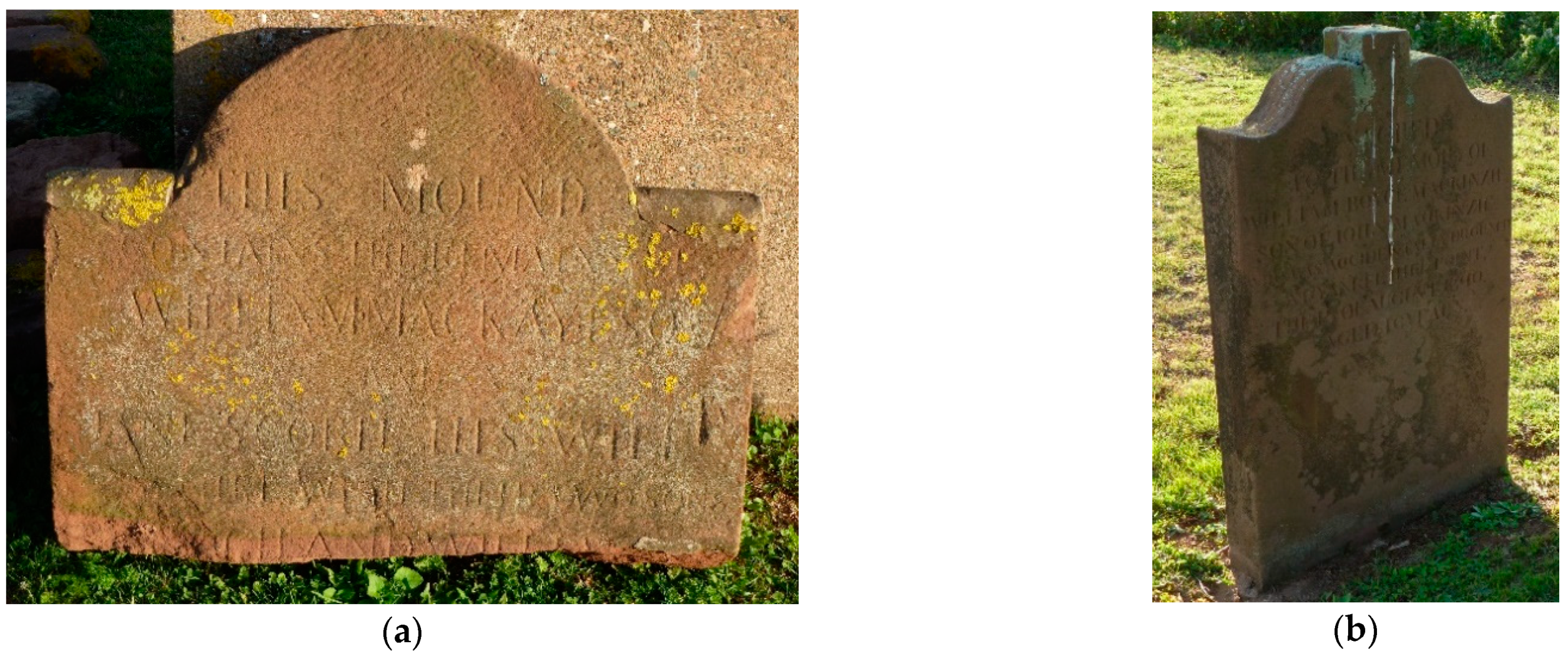
2. Capt. William's daughter-in-law Sibla's brother William Boyce MacKenzie (d. Aug. 13, 1840);
3. One John Adams from Derbyshire (d. March 16, 1843);
4. Barbara MacKay (b. Nov. 4, 1796 in Eriboll, d. March 1, 1843), my legendary great x 5 aunt (see below), daughter of the blacksmith and Ann Calder, and her infant son Donald (also d. March 1, 1843). The inscription on the tombstone seems to read 'Barbary', which is how Barbara is often pronounced in the famous folk-song 'Barbara Allen' (again, see below). The discernable name 'William' refers to her widower, who remarried. www.findagrave.com/memorial/113963699/barbara-mackay ;
AND 5. Ann Calder (b. 1774 in Kilraick, Croy & Dalcross [?], d. Aug. 28, 1816), erected by her son William sometime after 1838 (I assume), my great x 5 grandmother, the blacksmith's wife. www.findagrave.com/memorial/113963471/ann-mckay
Again, Simm's Field's successor 'Yankee Hill' was established by or soon after 1811 as a result of Capt. William's initial denial of passage to the older burial ground. One John Adams Sr. (b. 1734) was buried at Yankee Hill in 1815. (I assume he was the father of the John Adams buried in Simm's Field 28 yr.s later; I wonder if Jr. opted for burial there to be next to his mother or other family interred there before 1811.) And a George MacKay (b. 1753) was buried at Yankee Hill in 1816. Ann Calder was buried in Simm's Field in 1816 although her stone post-dates 1826 or 1838, so who's to say how many people were buried in that cemetery in the 15 yr.s /b/ 1811 and the year of Capt. William's death, if any, aside from her. But her grave-site raises questions. Why wasn't she interred at Yankee Hill for the same reasons that John Adams Sr., George MacKay, et al. were buried there, so that her children could visit her gravesite without penetrating the 600 acres of the inhospitable Capt. William? Yankee Hill was established within 5 yr.s before her passing, and she had no relations buried in Simm's Field. Might Capt. William or his wife have had some interest in or sympathy for this woman and her kids who arrived on the island with her family less than a year earlier? Was there some connection /b/ them, these clannish Scots? (Btw, Barbara MacKay's interment in Simm's Field isn't so mysterious or potentially significant. Her family would've seen fit to bury her close to her mother after such an untimely death [again, see below], and in 1843 following the emigration of John MacKay, the only one of Capt. William's 10 kids to survive and sire children per 'The Book'.)
- John the eulogist wrote an interesting diary in the pioneering 1890s in British Columbia (reproduced in chap. 3 of 'Ann Calder's children' and which is in the care of the Windermere Historical Society in Invermere today) which includes this entry, dated Apr. 16, 1890.: "Day warmer and the mosquitoes are arriving. Riding all day after stock, Jim plowing, First arrival of steamboat, Wrote George McKay in Australia." Capt. William's grandson George MacKay (1821-1900), a grazier in Dungag, N.S.W., Australia (p. 300, 'Book of McKay'), was John MacKay's pen-pal. George's father John MacKay (1800-1851) emigrated with his family in 1838, when John MacKay the diarist/eulogist would've been @ 14 yr.s of age. Had they been in contact for most of the intervening 52 yr.s? It seems John the diarist considered George the grazier to be the only relation he knew of on his father's side of his tree beyond first cousins and immediate family, and possibly vice versa. John's great niece recounted that he "firmly believed in, and knew of, a [consanguineal] connection" to Capt. William. If William, the blacksmith's son, had been told in his teens that the chief of the clan MacKay was his cousin, he or his son John might've assumed that he and Capt. William's son John, both born in 1800, were closely related. (George in Dungag: "I had a great great uncle George." John the eulogist: "Oh, so 'George McKay of Skibo'? Oh! Right.") John C. McKay writes that the blacksmith couldn't have been related to 'Capt. Wm. MacKay, son of Dr. John MacKay of Falside' (p. 8), but evidence that Capt. William wasn't the blacksmith's uncle isn't evidence that they weren't related. Consider: again, Capt. William was a 'Scoury MacKay', the great x 4 grandson of Iye Du MacKay XII. (See the tree of Iye Du's son Donald Balloch and 'The Scoury MacKays', p. 287 in 'The Book'.) His wife Jane Scobie, a 'Strathy MacKay', was a great granddaughter of 'John MacKay of Borgie' and Elizabeth Sinclair and great x 4 granddaughter of Huistean Du XIII. Jane's parents were Kenneth Scobie and Margaret MacKay (first cousins [sigh]), Kenneth being the son of the famous Rev. William Scobie, minister to the Gaelic congregation of Assynt, and his wife Jane MacKay, daughter of 'John MacKay of Borgie'. It's quite coincidental (or it might be more than coincidence) that the blacksmith was a MacKay who hailed "from Borgie" in the 'parish of Tongue', the abode of some 'Strathy MacKays', descendants of Huistean Du XIII, which include Jane Scobie (although she hailed from Achimore herself), who would come to be buried next to his wife in Simm's Field. www.mdpi.com/genealogy/genealogy-05-00035/article_deploy/... If the blacksmith had been a 'Strathy MacKay' from Borgie, than John the eulogist would certainly have been cousins with his pen-pal George in Dungag, N.S.W. via George's grandmother Jane Scobie, and more distantly via Capt. William too, and their pen-pal connection would make that much more sense, notwithstanding that John could only guess as to how they were related.
- 24 other individuals and families listed in the Durness Parish Register in the latter 1/2 of the 18th cent. had moved there from @ 15 hamlets and villages in the neighbouring parish of Tongue, 3 or 4 of which (Ribigill, Melness and/or Strathmelness and Skerray) are referred to in 'The Book of MacKay', Melness in particular (see the tree for 'The Melness MacKays', p. 322), as the abode and stomping ground of inbred blue-blood types who were "of" their small realms (eg. 'Angus MacKay of Ribigill'). While some Strathy MacKays were "of Borgie", the only reference to Borgie in the Durness Parish Registry is in the baptismal records of 2 children sired by the blacksmith. Again, the population of the entire parish of Tongue was 1093 in 1755 per the census that year. Only one person "of" or "from Borgie" moved to the neighbouring parish and married or sired a child there over the 50 year duration of its registry (1764 - 1814), at least per the registry. How large could Borgie's population have been when the blacksmith moved to Eriboll in the 1780s or 90s? (The registry for the parish of Tongue from that period hasn't survived. Most haven't.)
- See the bottom of 'The Key Pedigree', the tree for 'The MacKays of Strathnaver', on p. 97 in 'The Book of MacKay' archive.org/details/bookofmackay00mack/page/96/mode/2up?q... , and that for 'The MacKays of Strathnaver, now Barons Reay', p. 197 archive.org/details/bookofmackay00mack/page/196/mode/2up?... , which illustrates that 'the Strathy MacKays' (p. 311), descendants of Huistean Du by his son John, were behind the Melness MacKays (p. 322), the Sandwood MacKays (p. 330), both descendants of Donald Dughall, 1st Lord Reay (d. 1649), and ultimately the Dutch MacKays (p. 340), descendants of John, 2nd Lord Reay (d. 1680), to whom title passed after Eric, 9th Lord Reay passed in 1875 with no male heirs from any of the 3rd to the 9th Lords Reay, nor from their male descendants (but with plenty from female descendants), and yes, they were literally Dutch, living in Holland for generations. They descend from Col. Donald MacKay, son of Aeneas (d. 1697) and grandson of John, 2nd Lord Reay, who married his cousin Arnolda Margaret, Baroness van den Steen, "commanded his father's Scots regiment in the Dutch service and fell at Tournay in 1745". His heir Col. Aeneas MacKay of MacKay's Scots regiment married another Dutch Baroness and sired Baron Barthold MacKay who was appointed Director-General of the Post at Rotterdam, married another Baroness, and died at his chateau in Guelderland in 1854, etc., etc., and 20 yr.s later his grandson, Donald James, was appointed 11th Lord Reay on the passing of his 4th cousin, although he was in the 4th generation of 'Dutch MacKays' to be raised in Holland, primogeniture at its worst.
- John MacKay, the blacksmith's grandson, had his ear to the ground and was aware that Eric, 9th Lord Reay, had passed w/o issue in 1875 and of the initiation of the process of selection of the next Lord Reay. His niece wrote that John maintained "that through deaths in the clan he became next in line to the chiefship, ... but documents had been lost and legal proof could not be established. ... The chiefship then went to a distant relative who had been created a Baron in Holland for military service." Even if the blacksmith HAD been a 'Strathy MacKay', 'The Book of MacKay' wouldn't be published for another 31 years, and John couldn't be faulted for his ignorance of the Melness and Sandwood MacKays, nor for wondering if he might have a better claim than some Baron in Holland while his own father had been born and bred in Eriboll, 'MacKay country'. It's also possible that John the diarist and/or a great x 5 uncle or another 1st cousin 5 x removed might've felt inclined to make up claims and usurp some of the blue-blood status they came to covet over the years as Capt. William's neighbours once and after his son John MacKay, "the only child [of 12 sired by the captain] who survived to have issue", set off for Australia in 1838. But that doesn't explain Ann Calder's burial in 'Simm's Field' in 1816.
- I'll add that it seems at least that in 1906 Angus MacKay sought to produce an authoritative and relatively complete work in 'The Book of MacKay', and I note that 'Strathy' descendants of James of Kirtomy were generally well-to-do with cushy lives, and that few worked with their hands (or at least none listed in the book [again: ... 'John of Borgie'->'Donald of Borgie'->James {younger brother of John, the heir} ->?], apart from those in the military and Capt. William [although his entry merely states that he "raised a co. of colonial Highlanders"] and his descendants).
- Another possibility occurs to me, a relatively plausible one: that Capt. William really was the eulogist's uncle, but a great uncle through marriage to his great aunt Jane Scobie. Again, the blacksmith's children were orphaned in 1816 at ages 20 and younger, and while they might have understood that Capt. William and Jane were their uncle and aunt, and as kin were encouraged to bury their mother within Capt. William's property, he and Jane might've had little to do with them what with his title, his 600 acres, the kids' relationship with or dependence on their stepfather William MacIntosh (whom I know nothing about), their poverty?, etc., and they might have misapprehended the nature of the connection. If Jane had been the blacksmith's maternal aunt, he would've been the great grandson of her maternal grandfather Robert MacKay ('the Tutor of Farr', son of Charles MacKay, scion of the Sandwood Mackays, and grandson of Donald, 1st Lord Reay), and again he would've been the great great grandson of 'John MacKay of Borgie' (Jane's Dad's Mom's Dad AND her Mom's Mom's uncle [sigh]). But Jane's siblings aren't listed in 'the Book'. Her nobility was in her mother's (very blue) line and that of her paternal grandmother, but it was the patrilineal line that counted back then. Jane's children appear at p. 299 only because their father was Capt. William. It's not unlikely that Jane had an elder sister who married a MacKay. (Her grandfather, 'the tutor', sired 16 kids. 16!) If that sister, a Scobie, had been the blacksmith's mother, she moved from Achimore to Borgie, the home of both her maternal and paternal grandmothers (sisters Janet and Jane [p. 319]). (It might be of interest that Jane had an aunt who married Donald MacKay of Skinet and bore a 'Captain Donald of the 21st foot' [p. 332].) It must be significant that George Hart includes a passage in his piece "taken from a family bible found in Ernest Dunning's barn" which quotes the 'Parry Family tree' in some detail as to Jane Scobie's pedigree, with no mention of that of Capt. William. Mr. Hart says nothing about this Mr. Dunning nor the Parrys nor any connection to them, but while Capt. William and Jane have no descendants on the island, the blacksmith certainly does, as does a fellow passenger who sailed with Ann Calder and her family on the 'Prince William of Newcastle' in 1815 who might've had some connection to the Scobies, one 'Big John MacKay'. According to George Hart, Big John's daughter Margaret MacKay named her 2nd son 'Hugh Scobie MacKay' (b. 1842). 'Big John' had been a crofter and operated 'the Tongue ferry', by which he reportedly did well. There's no indication he was related to Ann Calder's children; he certainly wouldn't have been an uncle having the same name as their father, but he might've been a cousin or the blacksmith's nephew. (He was born in @ 1781). How likely is it that his daughter Margaret would have given her son that middle name on the basis that she was just that impressed with Jane Scobie, who passed 8 yr.s earlier in 1834, and/or her pedigree? It was common in those more clannish times to give a child the name of an ancestor as a middle name. That surname was nonexistent in 'Lord Reay's country' before Jane's grandfather William immigrated from Aberdeenshire.
- 'Big John' himself was unassuming. He wrote the following in a poem.: "Now, little thanks to Sutherland's rapacious factors, we are all better off than ever we were or would be at home; for there we were little less than slaves; now I may say we are ... independent."
- I've just learned that Capt. William MacKay and Jane Scobie feature in an historical romance novel, 'This Land is Ours' by Jonathan Rush. "In 1806 William MacKay and his wife, Jane Scobie, together with their six children left the Scottish Highlands for Canada's Prince Edward Island. A reluctant Jane had finally realized that their venal clan chief would betray the MacKays. Little did she know that her family's journey would finish 70 years later in Australia, living in one of the country's grandest mansions." www.goodreads.com/book/show/36695150-this-land-is-ours www.amazon.ca/This-Land-Ours-Jonathan-Rush/dp/179277124X www.strathnavermuseum.org.uk/this-land-is-ours-a-new-book... Wow. Of course the story's a little less romantic when one considers how connected this couple was as members of the Scots nobility. My Dad passed in 2018, a year before this was published (although independently). I wish I'd bought it for him. (See below re Dad's interest in Simm's Field.)
- The jury's still out and will likely stay out. It's possible the blacksmith had been the grandson of Neil MacRobert MacKay (per George Hart), if he or his father didn't inherit and if it's not telling that Mr. Hart listed 5 sons, each with their year of birth, but not the "known issue", likely the heir, listed in 'The Book of MacKay'. (Or is Hart's tree just b.s.?) Or was Neil MacRobert the blacksmith's great uncle? (Again, see the tree on p. 274 in 'The Book'; Neil's siblings are indicated as "And others".) Neil MacRobert was 'the possessor of Achness' (and of the 'Aberach banner' www.nms.ac.uk/explore-our-collections/collection-search-r... , a legendary heirloom now in the National museum in Edinburgh books.google.ca/books?id=snE5AAAAIAAJ&pg=PA175&lp... ). Again, if the blacksmith was a 'Sandwood' and a 'Strathy MacKay', his blood would've been that much bluer. I wondered why the widow of a cousin of clan chieftains would move to 'Prince Edward's Island' with his children in the early 19th cent., a fertile place but one in which she and their stepfather would have to live and work as tenant farmers, unable to purchase land or to own their own home. But the family moved 4 yr.s after the blacksmith had died in 1811 and she'd remarried, and those were tough times in North Sutherland. And, again, Capt. William MacKay fell afoul of the tacksman and sailed for P.E.I. in 1806 although he was certainly the great x 4 grandson of Iye Du MacKay XII. The MacKay clan leadership would sell what was left of the MacKay clan lands to the fat-cat Sutherlands by 1829 in the days of the clearances, 14 years later.
- Whatever comes up next (if anything?), it's been fun to research that rabbit hole that reaches back in all directions into the mists of the 8th cent. and to the earliest kings of Scotland, northern Ireland, and even the house of Wessex, and it's been educational.
- George Hart refers to the book I mention and link to above re Clergyman of the North (pub. 1891) which includes passages re the devout William Calder, my great x 6 granddad, the "venerable catechist ... in Lord Reay's country" (who was interred "in the churchyard of Reay"), but ignores information provided therein that he "was a native of Croy, in the neighborhood of Inverness" (5 clicks west of Castle Cawdor of MacBeth fame). There's no baptismal record for an Ann Calder in the Durness registry, but there is for an 'Anne' born in 1774 to a William Calder and a Marjoram Sutherland in Kilraick in 'Croy and Dalcross'. (Ann was 42 in 1816 per her tombstone.) This was likely my ancestor, but if so William and his young family seem to have moved back and forth /b/ the Croy district and Sutherland in the 1770s, for "Wm. Calder, Charity Schoolmaster" (definitely great x 6 granddad) sired a John "in Cambusinduin" in 1776, but a William Calder and a Masery [sic?] Sutherland then sired a Margaret in Ardclach (Croy district), specifically Rimore, in 1777. Rev. Donald Sage A.M. wrote in 1899 that William Calder, the catechist "was a native of Ardclaeh, Nairnshire, and came to Strathnaver @ the year 1786." As "Charity Schoolmaster at Eriboll", he married one Grizel Ross there in 1786; in 1788 "William Calder, Charity Schoolmaster at Cambusindun, Achucharasait" and Grizel sired Barbara; in 1791 they sired Hugh "in Eriboll"; and in 1792 Ann, the "daur. of William Calder, charity schoolmaster, Achugaraside", married the blacksmith. George Hart identifies Ann Calder's father (incorrectly?) as one "William Calder, alias Francach" in Hunleam who married a Janet MacKay 'alias nin Alister' in Eriboll in 1767 and sired a John in 1769, but nothing in the registry identifies that William Calder as the catechist. A 'John Ekel, alias Calder' sired children in Hunleam in 1767 and '69, a clue that a Calder of the prior generation lived in Hunleam or in the area, or that those with the alias hailed from a hamlet named Calder in Strathmore (south of Loch Hope) and/or another nearby named Ukal. (See p. 209 in 'The Book of MacKay'.) But is the fact that a "James Macdholicustian [sic? an alias?], alias Ekel, alias Calder" was living in Achugharasait in 1776 a clue? How to reconcile the claim that William Calder moved to 'MacKay country' from the Croy district with his settlement in Achucharasait/Achugaraside, home to James, a man with the name or alias Calder, quite a coincidence if insignificant. Per 'The Book of MacKay' (p. 210), "the surname Calder but seldom occurs [in the parish of Durness], and never appears at all until after the middle of the 18th cent., when one or two of that name immigrated into Strathnaver." (How would Angus MacKay know that? There are quite a few Calders in the registry. Did he consult another registry that predates 1764? [No.] Note that he makes that statement in his derisive rebuttal to the claim that legendary Scots-Gaelic local poet Rob Donn [1714-1778], the most [the only?] famous artist from North Sutherland, was a Calder rather than a MacKay, in a debate which persists.
en.wikipedia.org/wiki/Rob_Donn ) Did 1 or 2 of William's relatives from Croy (assuming he did hail from Croy) settle there a generation or a decade or so before him? Naturally he'd be welcome in their village if so. But he might have been just as welcome in light of his surname.
- Mr. Hart proceeds to claim that Janet MacKay (the wife of William Calder in Hunleam [not my ancestor]) was the "grand daughter of Hector MacKay and Janet MacKay, great grand daughter of Major Iye (Hugh) MacKay [Major General Hugh MacKay III of Scoury with the huge wig? Nope. His son Hugh? Nope. Capt. Hugh {Iye} MacKay III of Borley? Nope, none sired a Hector nor a Janet] and so back through her ancestors to the 12th cent." Ok, sure, lol.
- Ann MacKay nee Calder bore a 'Johanna Thomson Mackay' baptized in Durness on June 16, 1811 (the year of the blacksmith's death) and a "William Calder alias Bain at Polla" (at the southern end of the kyle) and a Barbara MacKay sired a 'Johanna Thomson Calder' baptised only 23 days later. Those names honoured the famous Rev. John Thomson who passed away June 12, 1811. This William is also listed as "William MacKay, Calder, alias Bain", and I don't believe he was a relation to Ann, or at least not a close one.
- My Mom was curious as to my Dad's roots (of which he had barely a clue) when they were newlyweds living in Nova Scotia in the 60s and she made a point to ask questions and take notes when they would visit his grandparents in Summerside and his elderly relatives on the island. (I've seen photos of 'the 4 generations' taken in the summer of '62 or '63, with my great grandparents sitting on their porch, my grandmother [Dad's Mom] and my Mom sitting on the steps, and my eldest sister Christine [almost 1 or 2] on my Mom's lap.) They visited his great great (!) identical twin aunts Babs MacGougan and Min Campbell (nee MacLeod, Dad's Mom's Mom's Mom's sisters), widows living together in a house filled with unusual items and objects from @ the world (they had lived with a 1st cousin who I think had been adopted and raised as a sibling and who'd travelled widely - as a sailor?; Dad said Mom was intrigued and impressed with what she saw, to paraphrase), and my parents were both regaled with tales of family history including at least one account of Babs' and Min's great-aunt Barbara MacKay (nee MacKay, their Dad's Mom's sister, one of the 'pioneering' siblings who sailed from Thurso with their mother and stepfather in 1815; see the link to her tombstone in Simm's Field above) who was 'skillful in sickness' (ie. had some knowledge of medicine or health-care; she might've been a midwife). Dad recounted many times over the many years how Babs and Min had told them of a wonder woman who would swim across Malpeque Bay on occasion with a horse to deliver babies or to tend to the sick. (For years and until very recently I wondered if she might've been my great x 5 grandmother Ann Calder, the matriarch who died in 1816. I recently found this legendary aunt on the net of all places, in 'Ann Calder's Children' [check the link above, pp.s 12 and 13]). One evening, returning home with her own infant child after such a visit to the home of a neighbour with a sick child in March 1843, she was caught in a violent snowstorm and tried to take shelter with her baby boy in a haystack, but perished before morning. (Dad didn't recall or recount the death in the snowstorm.) It makes sense that Babs would speak about her at some length and in glowing terms as she was likely named after her. Babs = Barbara.
- When my folks asked about 'the other side' of their tree, which I assume was that of their mother Margaret MacPherson, Babs and Min responded "Oh, we don't talk about THAT side." It seems they had a sense of humour, but the internet helpfully reveals why they might have said that.: Their father's father and mother's mother were siblings, and so their parents (my great x 3 grandparents) were 1st cousins. This isn't in question. The witness to the signing of my great x 5 grandfather Kenneth MacLeod Sr.'s will was his son-in-law Andrew MacPherson, Margaret's father. Margaret married the testator Kenneth's grandson.
- It's fair to say that that visit with Babs and Min made a big impression on my Dad. He knew nothing about his Dad's side of the family, and the only story he ever mentioned from his Mom's side that predated his grandmother's generation was this of the woman who would swim across Malpeque Bay to tend to the sick, etc. (and which he mentioned many times over the years, including several occasions in the 80s at the kitchen table in our home in Scarborough). My Mom's interest in his heritage was infectious. In his later years he would visit the 2 'pioneer' cemeteries where he knew his grandmother's ancestors were buried on at least most of his annual trips to the Island, although he wasn't sure who they were and under which stones (with the exception of that for his great x 4 grandmother Ann Calder, erected decades after her burial in 1816 by her son William, and that for his great x 4 aunt Barbara, or so I believe now). He took me to both cemeteries in 1998 and again in 2016.
- To add a little colour to these distant roots, I'll mention that my great x 5 grandmother, the testator's wife Ann MacLeod, aka Nancy, nee Morrison/Morison (again whose son's son married her daughter's daughter), hailed from 'Eilean Choraidh', aka 'Islandhall' today, a fertile, narrow, 1 km.-long island of dolomitic limestone at the sheltered southern end of Loch Eriboll (a 'kyle' rather; a long, narrow, 10 x 1 km. inlet) in a truly beautiful setting (when the sun shines) just south of the remote, north coast of Sutherlandshire east of 'Cape Wrath', stomping ground of unruly, 9th cent. Norse Vikings, their descendants and moreso those of the Picts who resisted them, and which must've been one of the most remote inhabited spots in all of Europe in the 18th cent. (Sailors from the company of HMS Hood in WWII spent their last shore leave there and nicknamed it 'Lock 'Orrible' for the inclement weather. [Wikipedia]) www.google.co.in/maps/@58.4820955,-4.7070711,5219m/data=!... The daughter of John Morrison and Catherine MacKay, Ann (listed in the parish registry as 'alias Nin Eanmacuilammachustian', ie. 'daughter of John, son of William, son of Hugh [Morrison]' !) was raised on the island with her many siblings and cousins. Catherine MacKay is listed as alias 'Nin Dholicustian', daughter of Dholic or Dholi (Donald), son of Hugh MacKay. (Her brother was one John MacKay, alias Macdholicustian.) Catherine was from Port Chamil (or Chamuill), no longer extant, a community at or near the head of the kyle, 8 to 10 clicks from Eriboll as the crow files. (Her brother sired a child there in 1788.)
- Kenneth MacLeod Sr. wed Ann/Nancy in 1793 and she left Islandhall to shack up with him in Sangobeg/Saingobeg, a crofting village on the north coast of Scotland less than 10 clicks up the western shore of the kyle and less than 2 east of Durness, where Kenneth was "a little tenent and fisher". But Kenneth's brother John (we can be certain they were brothers per John's will) was living as a "tenent in Islandhall" when he married Mary MacPherson (likely my great x 6 aunt twice-over [this time through marriage], see below) @ 3 yr.s earlier in 1789. Mary left "Saingoe" (Saingobeg) to bear at least 2 kids on the island and to then move with John to Ceannabin by 1798, where John was a "farmer and boatman" that year and a "little farmer and fisher" in 1804. The only other (male) MacLeod living on Islandhall was Hugh, "alias macdholicloid [son of Donald?], fisher and boatman" (a "young lad in Islandhall" when he wed Marion MacKay, also "in Islandhall", in 1793). Hugh might've been Kenneth's brother or cousin as they were both "little tenent[s] in Saingobeg" while they served as "private[s] in the Reay Fencible Highlanders" in 1795 (neither sired any kids /b/ 1795 and 1801 while the Fencibles fought to suppress the Irish in 'the Rebellion of 1798'), and Hugh's sister Janet "alias nin Dholicloid" (daughter of Donald?) from Islandhall, married Murdoch MacPherson, a weaver in "Saingoe" in 1790. (Clannish siblings Murdoch and Mary married siblings or cousins Janet and John.) Kenneth, Hugh and John all sailed with their families for P.E.I. on 'the Elizabeth and Ann' in 1806, and were all buried in the 'Yankee Hill pioneer cemetery'. They were close in age: 37, 36, and 35 respectively per the passenger list, but per the inscription on Kenneth and Ann's gravestone Kenneth was 10 yr.s older, and Ann was 8 yr.s younger than her baptism record. The passenger list has her @ 4 yr.s younger than that record. ?! Again, John MacLeod from Islandhall married Mary MacPherson from 'Saingoe', while Janet MacLeod from Islandhall married Saingoe's Murdoch MacPherson, likely Mary's brother. (It's also likely that they were the siblings of my great x 5 granddad Angus MacPherson [see below], and were children of a Hugh MacPherson who sired younger children in 'Saingo' in 1766 and 1773. [Hugh would've known Rob Donn well, as the now nationally-famous bard was living in Sango in @ 1770.] Murdoch sired a son named Hugh as did Angus, his eldest in fact. Mary didn't.) Rev. Thomson included patronymics in registry entries for Hugh and Janet MacLeod (once each), but none for Kenneth or John, and while a candidate for Hugh was sired by a Donald in 1772 (but only per the ship's passenger list), there's none for a Janet, Kenneth or John (or no John west of Thurso) sired by a Donald. For what it's worth, John named his eldest son Donald. Neither Kenneth, Hugh nor Janet sired a Donald. These MacLeods might've moved to the parish when they were children or young people. But if Kenneth was 47 in 1806 per his tombstone, and if his siblings were born before 1764 as well (while John lies at 'Yankee Hill', an epitaph for him at Geddie Memorial indicates that he was born in 1761 [and incorrectly that he sailed for P.E.I. in 1805 on 'The Polly']), it might be significant that from 1782 to '91 another Kenneth MacLeod was the smith of Eriboll (< 2 km.s from Islandhall as the crow flies on the shore of the loch, at a point directly across from it.) Kenneth's uncle or cousin? Or his father? (only if Hugh and Janet weren't Kenneth and John's siblings). This smith was John MacKay's predecessor, another coincidence. It might also be significant that a Hector McLeod was one of 2 "tenents" on Islandhall in March, 1678 per the "Judicial Rent-Roll of the Reay estate given in merks ..." ('The MacLeods of Assynt' had been evicted from legendary Ardvreck castle on Loch Assynt only 6 yr.s earlier in 1672.)
- My great grandmother or one of her relatives reported to my Mom that my great grandmother descended from the MacLeods of Assynt, a "querulous [and] extraordinarily violent" branch of the clan, with the Devil himself for an in-law according to legend. This might've been an assumption, for Assynt's only @ 40 km.s south of Durness, 1/4 the distance to Skye. (Skye's known for its MacLeods.) A tree that's popular on ancestry.ca and other websites alleges that Kenneth's parents are a Donald MacLeod and a Catherine MacDonald from Skye with roots in Trotternish, but false trees abound online (time and again!) and I've found no sources or records that support that one. She was unreliable, but I'm inclined to believe my great grandmother (or her relatives) on this point. Then again, it could be more than coincidence that the name Donald seems to assert itself here.
- Ann Morrison's son-in-law was my great x 4 grandfather Andrew MacPherson. It would involve quite a coincidence that an Andrew MacPherson was raised on Islandhall as well if he wasn't my ancestor, and who was so close to him in age. My great x 4 grandfather Andrew passed away March 3, 1859 "aged 63 years" per his tombstone, while the Andrew of Islandhall would've turned 64 less than 3 mos. earlier. (It's not uncommon for the age of the deceased to be recorded a year too young on a tombstone.) His parents were an Angus MacPherson and a Margaret Sutherland, 'alias Nin Cainach' or 'Sainach' or 'Airiaich' (likely Cainach which is Kenneth) and/or 'alias MacKenzie' (per Margaret's marriage record. It seems that a Kenneth Sutherland was my great x 6 grandfather.) Margaret had lived on the island with her first husband Hector MacKay, alias MacNeilicrory, who she married in June, 1770, and was a widow with at least 3 kids when she wed the much younger Angus in 1785. John Thomson, the famous minister of the parish of Durness, referred to Angus disapprovingly as "a single young lad" in his marriage record. ("Early marriages were not greatly approved of in Mr. Thomson's day, and now and again when a young man, probably not much out of his teens, marries, he is put down [in the register] either as a "simple young lad" or a "single young man"; single in this connection signifying that he had little or no responsibility." H. Morrison. Thomson took note of the great age difference, evidently.) I wonder what it says that Margaret bore at least 5 children with Angus (Andrew was the 5th), none of whom were named Angus Jr., but the 4th was named Hector. ("Thanks for being such a great step-dad to Hector's kids. Say, do you mind if we name one of your sons after my ex too?")
- My great x 4 grandfather Andrew married Marion, the daughter of Ann Morrison/Morison from Islandhall, and was buried with his in-laws at Yankee Hill. How many people were living on Islandhall before the Clearances, and how coincidental is the birth of another Andrew MacPherson there in 1794? John Morison (my great x 6 grandfather) and Hugh Morison (his brother), Hector and then Angus, one Hugh MacKay, a Donald Grange who'd just arrived on the island before 1775, my great x 6 uncle John MacLeod and Hugh MacLeod (John's brother or cousin) and a John Campbell were the only tenants on Islandhall who fathered any children baptized from 1770 to 1800. While Andrew MacPherson is a common name in Scotland, the baptismal record for the Islandhall Andrew is one of only 3 extant for any Andrew MacPherson/McPherson born in the country from 1794 to '96. (The other 2 were from Inverness and 'Croy & Dalcross' which saw far fewer evictions in the Clearances than Sutherland.) Islandhall wasn't isolated, as there were habitations along the shore of the kyle readily accessible by boat, and its residents and those of Saingobeg would've visited Durness often, possibly weekly, or on special occasions (until 1804? youtu.be/KoFW2Vh5n1c?si=pyYHoiUmxpNSUP00 ) to attend the lovely old Balnakeil kirk (1617, built on the site of a church founded in the early 8th cent. by St. Maelrubha, which grew to become one of the most important Celtic monasteries in NW Scotland) just west of town, with its stunning views of headlands, the sea and of lovely coastal beaches of white sand. www.britainexpress.com/attractions.htm?attraction=1049 www.undiscoveredscotland.co.uk/durness/balnakeilchurch/in... The local men were fishermen and very mobile by boat. So Andrew from Islandhall would've known Ann's daughter Marion from Saingobeg well, as young as they were. He would've been 11 yr.s of age and she 10 when she and her family sailed from Thurso in 1806. It's also likely that Marion's uncle John's wife Mary was Andrew's aunt. Andrew doesn't appear on the passenger list for the 'Elizabeth and Ann' which brought Kenneth and Ann, their daughter Marion, Andrew's future wife, and her uncle John and his wife Mary, likely Andrew's aunt, to P.E.I. in 1806. (Such passenger lists are exceedingly rare in light of the level of maritime traffic with ships filled with emigrants from Scotland to the Maritimes, victims of the Clearances, in the late 18th/early 19th cent.s, so it's something that this one survived.) Highland Scots are 'clannish' and were relatively isolated by language and their lack of formal education. If my great x 4 grandfather and the Andrew MacPherson of Islandhall were one and the same (which is most likely), he would've sailed with or without his family from Thurso for the Maritimes on a different boat in the Clearances, and reconnected with Marion on the basis that they were childhood acquaintances or friends and/or affineal relatives, they spoke the very same 'Strathnaver' or 'Reay Country' dialect of Scots-Gaelic, and would've had so much more in common.
- Kenneth and Ann's son George MacLeod (who hailed from Sangobeg, sailed on the same ship in 1806, and whose sister Marion married Andrew) married my great x 4 grandmother Sophia MacKay on P.E.I., a daughter of John MacKay, the blacksmith of Eriboll, and Ann Calder (again, Scots are clannish), who I write about above.
- Continued in the write-up under the photo of the 'Green man'. ("I don't have time to be brief." [G. K. Chesterton])
Though personalized art appeared during World War I, and occasionally grew to incorporate the entire aircraft, most pilots carried a saying or a slogan, or a family crest, or squadron symbol. Some were named, but nose art was not common. During World War II, nose art not only saw its true beginnings, but its heyday.
No one knows exactly who started nose art first--it appeared with both the British and the Germans around the first time, with RAF pilots painting Hitler being kicked or skulls and crossbones on their aircraft, while German nose art was usually a personal symbol, named for a girlfriend or adopting a mascot (such as Adolf Galland using Mickey Mouse, something Walt Disney likely didn't approve of). It would be with the Americans, and a lesser extent the Canadians, that nose art truly became common--and started including its most famous forms, which was usually half-naked or completely naked women. This was not always true, but it often was.
The quality of nose art depended on the squadron or wing artist. Some of it was rather crude, while others were equal to the finest pinup artists in the United States, such as Alberto Vargas. For men thousands of miles away from home and lonely, a curvaceous blonde on a B-17 or a P-51 made that loneliness a bit easier. Others thought naked women were a little crude, and just limited themselves to names, or depicted animals, cartoon characters, or patriotic emblems, or caricatures of the Axis dictators they were fighting.
Generally speaking, there was little censorship, with squadron and group commanders rarely intervening on names or pictures; the pilots themselves practiced self-censorship, with profanity almost unknown, and full-frontal nudity nearly nonexistent. After the loss of a B-17 named "Murder Inc.," which the Germans captured and used to make propaganda, the 8th Air Force, at least, set up a nose art committee that reviewed the nose art of aircraft--but even it rarely wielded its veto. For the most part, nose art was limited only by the crew's imagination and the artist's ability. The British tended to stay away from the lurid nudes of the Americans, though the Canadians adopted them as well. (The Axis also did not use nose art in this fashion, and neither did the Soviets, who usually confined themselves to patriotic slogans on their aircraft, such as "For Stalin!" or "In the Spirit of the Motherland!")
When World War II ended, so did nose art, for the most part. In the peacetime, postwar armed forces, the idea of having naked women were wives and children could see it was not something the postwar USAF or Navy wanted, and when it wasn't scrapped, it was painted over. A few units (especially those away from home and family) still allowed it, but it would take Korea to begin a renaissance of nose art.
When the 4th Fighter Group was formed at RAF Debden, UK in September 1942, it already had an impressive pedigree: its three squadrons were formed from the famous "Eagle Squadrons." The Eagle Squadrons were formerly RAF units made up of American volunteers, who joined before Pearl Harbor. (A common myth is that the Eagles fought in the Battle of Britain; they did not get into service until after the Battle was over, though a handful of Americans did fly in the Battle with other RAF squadrons.) This would give the 4th a leg-up on other 8th Air Force fighter squadrons due to their experience--though it would not be until the 4th was equipped with P-51 Mustangs in early 1944 that the unit truly hit its stride.
By the end of the war, the 4th had scored the most combined victories by a USAAF unit in Europe--1052 kills. The "characters" of the 4th included such famous names as Dominic Gentile, John Godfrey, Duane Beeson, and Ralph "Kidd" Hofer. Today, the 4th FG is known as the 4th Fighter Wing, flying F-15E Strike Eagles at Seymour-Johnson AFB, North Carolina.
Because the 4th was drawn from the Eagle Squadrons, it adopted a "fighting eagle" as its mascot--a belligerent bird with boxing gloves. This remains the wing's mascot to this day. This P-51D on display at the Fargo Air Museum in North Dakota carries the 4th's eagle on the fuselage.
VIEW OF A MUD CHURN AT A BRICK KILN
©Romano
Mud Churn at a Brick Kiln
West Bengal, India
At dusk, a family still works a mud churn at a brick kiln. The first step in the manufacture of bricks, cattle walk endlessly around a mud hole turning the churn that mixes the mud. Children sit at the edge and pile the mud onto their heads before taking it to the fabricating fields. It is not uncommon for a child to fall into the churn, sometimes mangling their arms or legs. Medical treatment is primitive or non-existent.
THOUSANDS OF BRICK KILNS LINE LINE THE RIVERBANKS IN BENGAL AND THE SURROUNDING STATES OF INDIA. MOST OF THE WORKERS HERE ARE BONDED (SLAVE) LABORERS. THE FAMILIES THAT WORK HERE ARE EXPLOITED 12-16 HOURS A DAY, 7 DAYS A WEEK. THEIR WORLD CONSISTS ONLY OF THESE MUD HOLES, DRYING FIELDS AND KILNS. AT NIGHT THEY SLEEP IN THE OPEN OR IN MAKESHIFT SHANTYS WHERE SANITARY CONDITIONS ARE NONEXISTENT. THERE ARE NO SCHOOLS HERE, AND FOR MANY OF THE CHILDREN THERE AREN'T EVEN FAMILIES. OVER 1/4 OF THE CHILDREN WORKING HAVE BEEN TRAFFICKED HERE FROM OTHER AREAS WHERE THEIR PARENTS HAVE BEEN FORCED TO EITHER SELL THEM INTO DEBT BONDAGE (SLAVERY) OR, IF THEY ARE LUCKY ENOUGH NOT TO BE BONDED, ARE DEPENDENT ON THE MEAGER WAGES THAT THESE CHILDREN CAN PROVIDE.
THE WORK IS EXTREMELY BRUTAL, HAZARDOUS, ABUSIVE AND SOMETIMES LETHAL. WORKING ALL DAY IN THE HOT SUN WHERE TEMPERATURES REGULARLY CLIMB ABOVE 100F (37C), THEY CARRY WELL OVER A TON OF CLAY A DAY AND CROUCH FOR HOURS AS THEY FABRICATE THOUSANDS OF BRICKS IN OLD FASHION MOLDS. THE PAY, IF THERE IS ANY, AND CONDITIONS FALL WELL BELOW MINIMUM LEVELS REQUIRED BY LAW AND ARE ILLEGAL FOR CHILDREN. NONETHELES THE KIDS COME, DRIVEN BY NECESSITY, OFTEN UNAWARE OF WHAT THEY ARE GETTING INTO AND SOMETIMES TRICKED OR VIRTUALLY KIDNAPPED BY UNSCRUPULOUS AGENTS AND MIDDLEMEN. FOR MANY, THEIR DEBT ACTUALLY INCREASES OVER TIME DUE TO DISHONEST ACCOUNTING.
THE POOR PAY AND HARD WORK ARE JUST THE BEGINNING. BRICK KILN CHILDREN TEND TO BE CHRONICALLY TIRED FROM THE LONG HOURS AND IRREGULAR REST, INCREASING THE PROBABILITY OF ACCIDENTS, INJURIES AND DEFORMITY. DISEASE, MALNUTRITION AND PERMANENT SKELETAL INJURY ARE THE COMMON LOT.
UNABLE TO RECEIVE THE EDUCATION TO WHICH THEY ARE ENTITLED BY LAW, THEY ARE POWERLESS TO ACT, AND TRAPPED IN A CONTINUAL CYCLE OF GRINDING POVERTY.
Bonded Labour, slave labour, CHILD LABOUR TRAVAIL DES ENFANTS Trabajo infantil Kinderarbeit
CHILDREN Kids ENFANTS Niños Kinder
SLAVERY ESCLAVAGE Esclavitud Sklaverei
Leamington is a municipality in Essex County, Ontario, Canada. With a population of 28,403, it is the second largest municipality in the Windsor-Essex County area (after the separated municipality of Windsor, Ontario). It includes Point Pelee, the southernmost point of mainland Canada.
Known as the "Tomato Capital of Canada", it is the location of a tomato processing factory owned by Highbury-Canco, previously owned until 2014 by the Heinz Company. Due to its location in the southernmost part of Canada, Leamington uses the motto "Sun Parlour of Canada". In 2006, MoneySense Magazine ranked Leamington as the No. 1 best place to live in Canada.
Leamington enjoys the second warmest climate in Canada, after the Lower Mainland of British Columbia.
Leamington has been known for its tourism and attractions and is known as the tomato capital of Canada. Leamington's attractions include cycle paths and nearby Point Pelee National Park. Leamington also has a large and modern marina. The town's water tower, visible for miles in the flat southern Ontario landscape, is also in the shape and colour of a giant tomato. Celebrating its position as an agricultural powerhouse and its heritage as the H. J. Heinz Company's centre for processing "red goods," the city hosts a "Tomato Festival" each August, as a kickoff of the tomato-harvesting season. Car shows, beauty pageants, parades, and a fair are featured at the festival.
Leamington's position on the north shore of Lake Erie makes it an important recreational centre. The tourist information booth in the centre of town is a large fiberglass tomato.
Leamington is also home to Point Pelee National Park, which contains the southernmost point on mainland Canada and draws thousands of visitors annually and is also home to one of the largest migrations of Monarch butterflies annually.
Known as the tomato capital of Canada, Leamington became the home of the H. J. Heinz factory in 1908. The Heinz products are shipped from Leamington, with English and French labels, mostly to the United States. Ketchup and baby food are the main products. In November 2013 Heinz announced that it would close the Leamington plant in 2014, meaning job losses for 740 employees at the plant and hundreds more support workers.
Due to a 54-year-old law in Canada, which bans the use of tomato paste in tomato juice, Highbury Canco still produces tomato juice and other products for Heinzs. Around 250 workers still process canned products at the over 100 year old factory.
Leamington has also been known for its greenhouses, and now has the largest concentration of commercial greenhouses in all of North America, with 1,969 acres (797 ha) of greenhouse vegetable production in the general area. Major products of the greenhouse industry, in addition to tomatoes, are peppers, cucumbers, roses, and other flowers. Hydroponic farming has been very successfully adopted by many greenhouse operators in Leamington. Historically, tobacco was an important crop in the area, but tobacco production declined in the 1960s and today is virtually nonexistent.
Migrant workers, mostly Mexican and Caribbean seasonal labourers, annually arrive in the region to work in Leamington's greenhouses and farms. Several Mexican and Jamaican shops and a Mexican consulate have opened to service the migrants.
en.wikipedia.org/wiki/Leamington,_Ontario
en.wikipedia.org/wiki/Wikipedia:Text_of_Creative_Commons_...
Leamington is a municipality in Essex County, Ontario, Canada. With a population of 28,403, it is the second largest municipality in the Windsor-Essex County area (after the separated municipality of Windsor, Ontario). It includes Point Pelee, the southernmost point of mainland Canada.
Known as the "Tomato Capital of Canada", it is the location of a tomato processing factory owned by Highbury-Canco, previously owned until 2014 by the Heinz Company. Due to its location in the southernmost part of Canada, Leamington uses the motto "Sun Parlour of Canada". In 2006, MoneySense Magazine ranked Leamington as the No. 1 best place to live in Canada.
Leamington enjoys the second warmest climate in Canada, after the Lower Mainland of British Columbia.
Leamington has been known for its tourism and attractions and is known as the tomato capital of Canada. Leamington's attractions include cycle paths and nearby Point Pelee National Park. Leamington also has a large and modern marina. The town's water tower, visible for miles in the flat southern Ontario landscape, is also in the shape and colour of a giant tomato. Celebrating its position as an agricultural powerhouse and its heritage as the H. J. Heinz Company's centre for processing "red goods," the city hosts a "Tomato Festival" each August, as a kickoff of the tomato-harvesting season. Car shows, beauty pageants, parades, and a fair are featured at the festival.
Leamington's position on the north shore of Lake Erie makes it an important recreational centre. The tourist information booth in the centre of town is a large fiberglass tomato.
Leamington is also home to Point Pelee National Park, which contains the southernmost point on mainland Canada and draws thousands of visitors annually and is also home to one of the largest migrations of Monarch butterflies annually.
Known as the tomato capital of Canada, Leamington became the home of the H. J. Heinz factory in 1908. The Heinz products are shipped from Leamington, with English and French labels, mostly to the United States. Ketchup and baby food are the main products. In November 2013 Heinz announced that it would close the Leamington plant in 2014, meaning job losses for 740 employees at the plant and hundreds more support workers.
Due to a 54-year-old law in Canada, which bans the use of tomato paste in tomato juice, Highbury Canco still produces tomato juice and other products for Heinzs. Around 250 workers still process canned products at the over 100 year old factory.
Leamington has also been known for its greenhouses, and now has the largest concentration of commercial greenhouses in all of North America, with 1,969 acres (797 ha) of greenhouse vegetable production in the general area. Major products of the greenhouse industry, in addition to tomatoes, are peppers, cucumbers, roses, and other flowers. Hydroponic farming has been very successfully adopted by many greenhouse operators in Leamington. Historically, tobacco was an important crop in the area, but tobacco production declined in the 1960s and today is virtually nonexistent.
Migrant workers, mostly Mexican and Caribbean seasonal labourers, annually arrive in the region to work in Leamington's greenhouses and farms. Several Mexican and Jamaican shops and a Mexican consulate have opened to service the migrants.
en.wikipedia.org/wiki/Leamington,_Ontario
en.wikipedia.org/wiki/Wikipedia:Text_of_Creative_Commons_...
+++ DISCLAIMER +++
Nothing you see here is real, even though the conversion or the presented background story might be based on historical facts. BEWARE!
Some background:
The outbreak of the war in Europe in September 1939 did not immediately affect the status of the Armée de l'Air in French Indochina because it had the task of defending a wide area of Southeast Asia, including the future Laos, Cambodia and Vietnam. And yet its array of airplanes seemed inadequate to perform any kind of real defense against any incursion by an enemy, because there were less than 100 airplanes available to it, all obsolescent or obsolete. In September 1931, Japan invaded and occupied Manchuria. This was an area of northeast China, which encompassed the provinces of Jilin, Liaoning and Heilongjiang. Nearly six whole years later, in July 1937, the Second Sino-Japanese War had begun. As yet, the French colonial authorities were hoping that the Japanese would not be brazen enough to take on the might of a European power. However, it became increasingly likely after the German invasion of Poland in September 1939, since Japan was part of the Axis alliance and thus Germany's ally.
On September 26, 1940, Japanese troops landed in Haiphong, violating a cease-fire which had been signed only the previous day. From the middle of the following month, the French became heavily involved in repelling Japanese army assaults. Following the Fall of France in 1940, Thais perceived a chance to regain the territories they had lost years earlier. The collapse of Metropolitan France made the French hold on Indochina tenuous. After the Japanese invasion of French Indochina in September 1940, the French were forced to allow the Japanese to set up military bases. This seemingly subservient behavior convinced the Thai regime that Vichy France would not seriously resist a confrontation with Thailand.
During the French-Thai War, the Thai Air Force achieved several air-to-air-victories in dogfights against the Vichy Armée de l'Air. During World War II, the Thai Air Force supported the Royal Thai Army in its occupation of the Shan States of Burma as somewhat reluctant allies of the Japanese and took part in the defense of Bangkok against allied air raids in the latter part of the war, achieving some successes against state-of-the-art aircraft like the P-51 Mustang and the B-29 Superfortress. During these times, the RTAF was actively supplied by the Japanese with Imperial Japanese Army Air Force aircraft such as the Ki-43 "Oscar," and the Ki-27 "Nate." Other RTAF personnel took an active part the anti-Japanese resistance movement.
French forces in Indochina consisted of an army of approximately fifty thousand men, The most obvious deficiency of the French army lay in its shortage of armor; however, the Armée de l'Air had in its inventory approximately a hundred aircraft, of which around sixty could be considered first line. These consisted of thirty Potez 25 TOEs, four Farman 221s, eight Loire 130 flying boats, six Potez 542s, nine Morane M.S.406s.
The M.S.406 was a French fighter aircraft developed and manufactured by Morane-Saulnier starting in 1938. In response to a requirement for a fighter issued by the French Air Force in 1934, Morane-Saulnier built a prototype, designated MS.405, of mixed materials. This had the distinction of being the company's first low-wing monoplane, as well as the first to feature an enclosed cockpit, and the first design with a retracting undercarriage. The entry to service of the M.S.406 to the French Air Force in early 1939 represented the first modern fighter aircraft to be adopted by the service, and the type was also used in the French overseas colonies. The M.S.406 was France's most numerous fighter during the Second World War and one of only two French designs to exceed 1,000 in number. At the beginning of the war, it was one of only two French-built aircraft capable of 400 km/h (250 mph) – the other being the Potez 630.
Although a sturdy and highly manoeuvrable fighter aircraft, the M.S.406 was considered underpowered and weakly armed when compared to its contemporaries, esp. over continental Europe. Most critically, the M.S.406 was outperformed by the Messerschmitt Bf 109E during the Battle of France and no serious threat to the German fighter. In less advanced theatres like Indochina, though, the M.S. 406 was a respectable contender, but its numbers were low.
When the French-Thai War broke out in Indochina, the Thai Army was a relatively well-equipped force, consisting of some sixty thousand men, with artillery and tanks. The Royal Thai Navy — consisting of several vessels, including two coastal defence ships, twelve torpedo boats and four submarines — was inferior to the French naval forces, though, but the Royal Thai Air Force held both a quantitative and qualitative edge over l'Armee de l'Air. Among the 140 aircraft that composed the air force's initial first-line strength were twenty-four Mitsubishi Ki-30 light bombers, nine Mitsubishi Ki-21 and six Martin B-10 twin-engine bombers, seventy Vought Corsair dive bombers, and twenty-five Curtiss Hawk 75 fighters.
While nationalistic demonstrations and anti-French rallies were held in Bangkok, border skirmishes erupted along the Mekong frontier. The superior Royal Thai Air Force conducted daytime bombing runs over Vientiane, Sisophon, and Battambang with impunity. The French retaliated with their own planes, but the damage caused was less than equal. The activities of the Thai air force, particularly in the field of dive-bombing, was such that Admiral Jean Decoux, the governor of French Indochina, grudgingly remarked that the Thai planes seemed to have been flown by men with plenty of war experience.
In early January 1941, the Thai Burapha and Isan Armies launched their offensive on Laos and Cambodia. French resistance was instantaneous, but many units were simply swept along by the better-equipped Thai forces, with some French equipment – including some aircraft – being captured and immediately pressed into Thai army service. The Thais swiftly took Laos, but Cambodia proved a much harder nut to crack.
On January 16, 1941 the French launched a large counterattack on the Thai-held villages of Yang Dang Khum and Phum Preav, initiating the fiercest battle of the war. Because of over-complicated orders and nonexistent intelligence, the French counterattacks were cut to pieces and fighting ended with a French withdrawal from the area. The Thais were unable to pursue the retreating French, as their forward tanks were kept in check by the gunnery of French Foreign Legion artillerists.
On January 24, the final air battle took place when Thai bombers raided the French airfield at Angkor near Siem Reap, which quickly fell. The last Thai mission commenced at 0710 hours on January 28, when the Martins of the 50th Bomber Squadron set out on a raid on Sisophon, escorted by three Hawk 75Ns of the 60th Fighter Squadron.
Although the French won an important naval victory over the Thais, Japan forced the French to accept Japanese mediation of a peace treaty that returned the disputed territory to Thai control. A general armistice was arranged by Japan to go into effect on January 28. On May 9 a peace treaty was signed in Tokyo, with the French being coerced by the Japanese into relinquishing their hold on the disputed territories. However, the French (now part of the Axis Forces’ Vichy regime) were left in place to administer the rump colony of Indochina until 9 March 1945, when the Japanese staged a coup d'état in French Indochina and took control, establishing their own colony, the Empire of Vietnam, as a puppet state controlled by Tokyo.
Until then, Japanese authorities heavily influenced the diminishing Vichy French presence in the region and handed over a lot of leftover military hardware to its own allies, primarily the Thai forces. However, there was not much left to be distributed: about 30% of the French aircraft were rendered unserviceable by the end of the French-Thai War in early 1941, some as a result of minor damage sustained in air raids that remained unrepaired. The Armée de l'Air admitted the loss of only one Farman F221 and two Morane M.S.406s destroyed on the ground, but, in reality, its losses were greater and the influence of Japan on the leftover stock was fogged in order to save face. However, even in 1944, single former Vichy French aircraft and tanks were still active in the region, primarily under Thai flag.
General characteristics:
Crew: 1
Length: 8.17 m (26 ft 10 in)
Wingspan: 10.61 m (34 ft 10 in)
Height: 3.25 m (10 ft 8 in)
Wing area: 16 m2 (170 sq ft)
Empty weight: 1,895 kg (4,178 lb)
Gross weight: 2,540 kg (5,600 lb)
Powerplant:
1 × Hispano-Suiza 12Y-31 V-12 liquid-cooled piston engine with
619 kW (830 hp) for take-off at 2,520 rpm at sea level,
driving a 3-bladed variable-pitch propeller, 3 m (9 ft 10 in) diameter
Performance:
Maximum speed: 490 km/h (304 mph; 265 kn) at 4,500 m (14,764 ft)
Stall speed: 160 km/h (99 mph, 86 kn) without flaps
135 km/h (84 mph; 73 kn) with flaps
Range: 1,100 km (680 mi, 590 nmi) at 66% power
Combat range: 720 km (450 mi, 390 nmi)
Endurance: 2 hours 20 minutes 30 seconds (average combat mission)
Service ceiling: 9,400 m (30,800 ft)
Time to altitude: 2,000 m (6,562 ft) in 2 minutes 32 seconds
9,000 m (29,528 ft) in 21 minutes 37 seconds
Wing loading: 154 kg/m2 (32 lb/sq ft)
Power/mass: 2.95 kg/kW (4.85 lb/hp)
Take-off run to 8 m (26 ft): 270 m (886 ft)
Landing run from 8 m (26 ft): 340 m (1,115 ft)
Armament:
1× 20 mm (0.787 in) Hispano-Suiza HS.404 cannon, firing through the propeller hub
2× 7.5 mm (0.295 in) MAC 1934 machine guns in the outer wings
The kit and its assembly:
This quick build was created in the wake of the “Captured” group build at whatifmodellers.com and actually is a personal interpretation of someone else’s idea, namely of fellow modeler NARSES who came up with the idea of a captured French M.S. 406 in Indochina under a new Thai flag. I found the idea so weird, yet realistic, that I decided to build one, too.
The model is the very simple but quite acceptable M.S. 406 from Hobby Boss. Externally the model is nice, with recessed panel lines and a basic landing gear. Internally, it is rather bleak, even though it has a full cockpit with a floor, integrally molded seat and even some details behind the pilot’s armor bulkhead. The canopy is a single piece and very clear, but it comes with massive locator bars, so that I decided to keep the canopy closed and added a pilot figure to cover the minimal interior. I was lucky to find a Japanese (though pretty “flat”) WWII pilot in the donor bank, left over from a Hasegawa model. I also gave the figure some seat belts (made from adhesive tape), but the rest remained unchanged – even the original metal axis for the propeller was used. I just replaced the machine gun barrels with hollow steel needles and added a pitot on the wing, which is probably part of the kit but not indicated in the instructions. The same is true for the foldable ventral antenna.
The build was finished quickly, in the course of just a single evening, including the pilot and some overall PSR.
Painting and markings:
My interpretation of a French aircraft in Thai service after the French-Thai War stuck closely to the real world Vichy livery, which was the standard French camouflage in grey/green/brown with light blue-grey undersides (all from ModelMaster’s Authentic Color range), together with a yellow-and-red-striped cowling (a base with Humbrol 69 and red decal stripes added later) and a white cheatline long the fuselage. The tail of French aircraft in Indochina was painted all-red from early 1941 onwards upon Japanese command, because of friendly fire incidents. This was adopted for the model (with a mix of Humbrol 19 and some 73), which is supposed to belong into the 1942 time frame.
As a captured aircraft, the original French roundels were replaced/overpainted with red disks/hinomaru, and then Thai elephant markings added on top. That’s a personal idea, ordnance directly supplied to the Thai forces from Japan had the simple, square “elephant flag” emblem directly applied to the wings and the fin (but no fuselage roundel). The all-red tail was taken over, but I painted the rudder in a dark IJA green, since it would formerly carry a French fin flash. The same green was used to overpaint a serial number on the fin and a former squadron emblem under the cockpit.
The hinomaru come from a PrintScale Ki-46 sheet, and these markings are intentionally a bit oversized, so that they cover well the former French markings and are highly visible. The elephant markings some from a PrintScale Ki-27 sheet, so that the red tone on both sources are very close to each other. The Ki-27 sheet also provided the Thai ciphers “3” and “4”, combined into a “34”.
The interior was painted in medium grey, and the model externally received some signs of wear and tear in the form of dry-brushed leading edges and around the cockpit as well as some soot stains behind the exhaust stubs and the machine guns. Finally, the model was sealed with a coat of matt acrylic varnish (Italeri).
A quick build, and the easy-build Hobby Boss M.S. 406 is certainly not as crisp as a “real” model, but in this case the story behind the weird livery was more in the focus than the canvas underneath. However, an interesting result, and the hybrid paint scheme with heritage from three different operators make the aircraft an unusual, if not exotic sight.
SHODASI : SECRETS OF THE RAMAYANA
Kundalini Yoga & Gayathri Mantra in Valmiki Ramayana
ENGLISH HINDI AND TELUGU ORIGINAL
AUTHOR : SESHENDRA SHARMA
Seshendra : Visionary Poet of the Millennium
REVIEWS :
Books :
kinige.com/author/Gunturu+Seshendra+Sharma
Valmiki , The Sage of 5th century B.C wrote The Ramayana not to narrate the story of Rama in an absorbing style. Though the epic poem presents Rama’s Journey of life in enchanting poetry , the story and the enchanting poetry are sugar coating or honey to the organic medicine called Kundalini Yoga. Maharshi Valmiki wrote the Ramayana to spread / propagate Kundalini Yoga among the masses. Thus the soul of The Ramayana is Kundalini Yoga / Sri Vidya. Valmiki embedded Kundalini Yoga in the Chapter titled “ Sundara Kanda” . Hanuman and Ravana are Kundalini Yogis of Samaya and Kaula Paths.
And in Sundara Kanda , he inserted “ Trijata Swapna “ , dream sequence of a demon and in it embedded the Gayathri Mantra. The concepts of Vishnu and Avatar (reincarnation) were nonexistent during the Ramayana Period.
Seshendra Sharma , Scholar - Poet in his Magnum Opus of Research “ Shodasi : Secrets of The Ramayana “ reveals these secrets lying hidden for thousands of years .
* * * * *
How old is Valmiki Ramayana? One Calculation says 8 lacks 70 thousand Years. Going by the Christian calendar dating to approximately the 5th to 4th century BC. According to Indian classification of time Ramayana belongs to the Treta Yuga and today we are in the Kali Yuga. All these millions of years the human civilisation the world over, recognised it as the first poetry and in this part of the world i.e. the Indian Subcontinent the central character of the epic is present as an idol of worship in thousands of temples and in every household of believers.
But here is a research work which says Ramayana is merely poetry to the naked eye whereas it is an ensemble of invisible secrets which have been lying unnoticed all these ages.
What could have been the Valmiki Maharshi’s vision which made him chisel an epic poem which is pregnant with startling secrets?
Shodasi : Secrets of the Ramayana , a Magnum Opus comprising both revelations and research findings written in Telugu 47 Years ago is translated into English by Dr. G.S.Murthy , a 86 year old physicist (Retrd) from BARC. Dr. Murthy observes about Shodasi that “the approach adopted by Seshendra Sharma is unprecedented. .. His conclusion that Ramayana is closer to Sruthi than any other scripture is very significant and is based on the intrinsic evidence in the Ramayana itself.... it is a revolt against the customary methods followed to understand the status of Ramayana in the Sanskrit Literature.”
The fulcrum of Shodasi is that poetry in Ramayana is a supplement to the bitter medicine called “Kundalini Yoga” and Ramayana is divine Ambrosia for all mundane afflictions and problems that beset the human kind.
Seshendra reveals that Sundara Kanda is the heart of Ramayana and it is nothing but Kundalini Yoga . And the heart of Sundara Kanda is Trijata ‘s Dream , which is nothing but Gayatri Mantra.
Kundalini Yoga which is also known as Sri Vidya is awakening of inner powers dormant in humans through meditation. The very 1st Shloka of Sundara Kanda is analysed and explained exhaustively by the author from several angles. “Chaarana Charithe pathi..(Sky-Path) “is , according to the author the Sushumna in Humans. Lanka Dahana ( Reducing Ravana’s Empire Lanka to ashes ) is the climax of the Kundalini Yoga which is Sahasrara Bhedana. The author analyses citing evidence from the Ramayana original text , that both Paths of Kundalini Yoga , Samaya and Kaula ways are shown in the epic.
What is of paramount importance in this work is that each exposition refers to a cluster of references germane to the main discussion. Hence it is obvious that this work is a scholastic paradise to people who are conversant with Sanskrit literature and other ancient scriptures. A pedestrian reader cannot even peep into Shodasi . Seshendra’s introduction “One word to begin with “sets the tone and tenor of the work. He dilates at length how Sanskrit language is moulded by Valmiki on the lines of Sruthi and Veda to envelop his central theme in suggestive and oblique style.
It is said Valmiki wrote Ramayana in 24 thousand Shlokas taking each syllable of Gayatri Mantra, which has 24 syllables. Seshendra Shows convincingly, where the Gayathri Mantra itself is located in Ramayana. He says “ Sundara Kanda “ is the heart of Ramayana and Trijata ‘s Dream is Sundara Kanda’s heart. “ Maharshi created an apparent episode of “Trijata Swapna “ and through this he embedded Gayathri Mantra in it. “
This book is replete with several such revelations and unnerving observations. The chapters on “ Relationship between Ramayanayana and Megha Sangesham “ “Indra supreme deity “ compel the reader to stop and think at the turn of every observation. This reviewer does not like to “spill all the beans “.
Dr. Murthy, the translator, aptly observes “ It needs a very attentive mind and adequate patience to follow author’s arguments “. Seshendra Sharma( seshendrasharma.weebly.com ) , winner of Sahitya Akademi Award for his “Kaala Rekha “( Arc of Blood ) a collection of essays in comparative literature , a fellow of the Akademi During his life time whose Long Poem “ My Country – My People – Modern Indian Epic “was nominated for Nobel in 2004 is scholar –poet of our times . His Kavisena Manifesto (Modern Indian Poetics), Kaala Rekha( Essays in Comparative Literature)are monuments of contemporary Indian Literature , unsurpassed to this day. His prose works prove that he is Albert Einstein of Indian Literature.
After completing the first round of reading the reader would certainly agree with Vishwanatha Satyanarayana ,Telugu poet of romantic era , recipient of Gyanpith Award for his “Ramayan Kalp Vriksh” who wrote preface to this book “ Every one , not only the telugu – speaking people all Indians must be grateful to him for writing this book”.
--------
Ramayana, a replica of Vedas
S. VARADARAJAN
There are several versions of the Sri Ramayana, one of the two greatest epics. Following Sri Valmiki Ramayana several editions have been published in various languages, besides scores of commentaries written across centuries. Late.GunturuSeshendra Sharma, scholar poet of 20th Century unearthed secrets of the Ramayana through his popular Telugu book “Shodasi”.
The novelty of nomenclature Shodasi , called Sri Vidya is reflected , in the 16th Chapter . Sharma’s intellectual depth comes forth in analyzingSundara Kanda specially through KundaliniYoga . The author highlights hidden truth in Valmiki’s thought that is similar to Vedas and says that Trijata’s dream in Sundara Kanda reflects Gayatri Mantra of 32 Syllabi in 4 lines. Sharma pays rich encomiums in the description of Lanka surrounded by three impregnable borders. He compares these three borders with Trikuta viz... Shakti ,Kaamaraaja , VagbhavaKutas with those of Sri Vidya in Kundalini . A staunch believer of Vedas, the author feels that Ramayana is a replica of Vedas and oriented towards the character of Indra . He concludes that in Ramayana the mentioning of the supreme God is Indra and not Vishnu, as the presiding deity of valour in Vedas. Utterances of the word Vishnu were considered to be imaginary overstatements in the author’s view.
This book lends a new perspective to the Ramayana by adding the dimension of KundaliniYoga .
The foreword by VishwanathaSatyanarayana adds credibility to the book. The current work is an English translation of the original by GurujadaSuryanarayanaMurthy , a scientist by profession . His proficiency in the subject is evident in the translation throughout that doesn’t swerve from the original’s purport.
The Hindu
(Friday Review: 2nd October 2015)
A Resplendent Icon of all Arts
This is an exemplary book which elevated the status of Indian Literary Criticism to the peaks of the world literature. Shodasi is a name associated with a great hymn. The title suggests that it’s a book on spiritual discourse. A reading of this book suggests that the spirit of scientific temper is critical to comprehend Valmiki’sSrimad Ramayana. Besides this, command on Vedic or Scriptural knowledge is essential. What does a layman has to say when a towering personality like ViswanathaSatyanarayana himself extolled the critical acumen and serious scholarship of Seshendra Sharma.
Sharma has made it crystal clear that unless one has an apparent understanding of the plot’s context, psyche of the characters, and the milieu of the bygone days supplemented by extraordinary scholarship, sound knowledge of phonetics and awareness on contemporary issues; one cannot easily comprehend the poetic diction of Valmiki. The debate on the phrase “Netraturaha” is a fitting example. The uniqueness of the title, Sundarakanda, Kundalini Yoga, Gayatri Mantra secretly hidden in Trijata’s dream sequence, considering The Bharatha as an image of The Ramayana.... this book is a repository of many such critical discourses. It is replete with inconceivable and unfathomable issues. This magnum opus is an invaluable gift to the Telugu literature.
- VIPULA, Viswa Katha Vedika: May 2014
(An exclusive Telugu Monthly Magazine for stories)
* * *
Valmiki Ramayana – Greatest Medicine for Mankind
The story of Ramayana is prescribed as textbook for students. Sita and Rama are worshiped as prime couple. No need to mention about reciting it. Whether Valmiki was satisfied with simple narration of the story? Seshendra Sharma denies it.
He analyzed it mentioning that to understand the inner meanings of Valmiki Ramayana, the scientific knowledge is essential.
The underlying secret of the sage’s mind will be known through the knowledge of science.
It is the firm opinion of Seshendra that the argument that “the sciences are for scholars only” is a conspiracy hatched by Selfish scholars and lazy uneducated persons.
Seshendra who has democratic ideology and conviction on science and literature informs the public about the secrets of Ramayana expounded by Valmiki. He explains that Valmiki dedicated ambrosia (The Greatest Medicine) named “Kundalini Yoga” to the mankind. The poetry in the metre of AnushtupSloka is the honey coating to the medicine. It was explained with great introspection and exemplary scholarship. He concludes that the Ramayana is older than the MahaBharatha and it is another form of Veda. Valmiki introduced the system of meditation in Ramayana. The Introspection and research bent of mind of Seshendra are spread over in the book in two streams. The exuberant fragrance of scholarship is experienced throughout the book.
The present generation can understand the scholarship of Seshendra in Vedas and Mantra Sastra. Seshendra is a poet who has composed unique RuthuGhosha (Cry of the Seasons: Metrical Poetry) and revolutionary free verse –MandeSuryudu (The Burning Sun).
- Andhra Prabha (Telugu Daily), 24th August 2014.
* * *
Two Great Peaks in the world literary criticism and research
Shodasi: Secrets of The Ramayana and SwarnahamsaHarshanaishada from the mighty pen of the great Telugu poet, GunturuSeshendra Sharma are considered to be the two great peaks in the world literary criticism and research. This is a truth most contemporary Telugu writers and readers aren’t aware of. The way Seshendra could discover Kundalini Yoga, Gayathri Mantra in Shodasi, he could discern the treasure trove of mantra yoga, Sri Mahatripurasundari, Chintamani mantra in Swarnahamsa.
At a time when our universities which are mere Degrees production Units, churn out “solid waste” in the name of research; Seshendra even while attending to his job as a Municipal Commissioner created research oriented critical volumes like a sage.
Though Shodasi was published in 1967 and Swarnahamsa in 1968; Swarnahamsa was created by him much before Shodasi was conceived. The concepts that Srinatha, Nannayya and Mallanatha, the Telugu Classical poets couldn’t decipher,
Seshendra could. He humbly submits that he is most fortunate that the triumvirate had left behind some pertinent concepts only to be discovered by him at a later stage.
These two great kavyas were serialised under the editorship of late NeelamrajuVenkataSeshaiah in Andhra Prabha Daily, Sunday Literary Supplements from 1963 to 1967 and Seshendra’s poems and non-fiction were published in the book forms (6) only after they appeared in serial form in Andhra Prabha.
-----------------
GunturuSeshendraSarma, the well-known poet, critic and scholar of unfathomable depth, has to his credit quite a number of books in Telugu as well as English. A keen intellect and a lucid exponent of the intricacies in Samskrit literature, the author brought out a treatise on Ramayana. The book also reveals the symbolism in our epics and shows the spirit behind.
According to the author, Sage Valmiki has observed Ramayana as though it is a story of a dynasty in its outward appearance. But when the story part is kept aside, the hidden secrets of the Mantrasastra come out. Valmiki’s Ramayana is full of Vedic literature, language and usages. Ramayana can be appreciated from three angles. The poetic beauty, the historicity and the secret meaning of mother Parasakti. Later Upanishads have taken Valmiki Ramayana as the way to the Mantrasastra. Rama’s wife Sita is considered as Parasakti. In Devi BhagavathamSita is described as Goddess Gayatri. The author has taken unusual pains and quoted Vedic dictations which are literally taken by Valmiki in his Ramayana. Thus it has been a product of Vedas and the usages in Ramayana and the words used therein and the similies adopted by Valmiki speak inexplicably the secret of Mother Lalita in his stories.
The author has given and attached a very great significance for Sundarakanda in Ramayana. The author has quoted numerous quotations from Smrithis and Srithis to establish that Sundara-kanda is beautiful because Anjaneya the Jeeva has seen Sita the Parasakti. Hence this canto is so styled as Sundara. According to the author “Sita” means “Kundalini.” Hanuman has seen Sita while she was sitting on the ground. Ground means Earth. Earth denotes Mooladharam. The serpent Kundalini stays in this. Thus it is symbolised as Sita sat on the ground. Hanuman the Yogi has the vision of Kundalini in Sita. With the aid of Ida and Pingala, Kundalini travels in Sushumna through spinal cord crossing the six fluxes, and finally reaching Sahasraram. This again speaks of “Shodasi.” Rama is a beautiful man. He is having a Sundari in Sita (a beautiful woman). The descriptions are beautiful in this canto. Thus it is synonymous with “Soundarya-lahari” of Sankaracharya.
The author expressed that Mahabharata is a reflection of Ramayana in all the cause, origin and delivery. Innumerable similarities are quoted from both Valmiki and Vyasa to prove that the usages, style and similies are almost similar in both the epics. He compares Vyasa’s “Nalacharitam” with Sundarakanda of Valmiki in the vision of Srividya.
The author further argues that Kalidasa’s “Meghasandesam” is only an imitation of Valmiki. The flight of Anjaneya in search of Sita is the basis for Kalidasa’s “Meghasandesam.” Both Sita and the Yaksha’s wife are described as “Syamas” – meaning in the middle of youth. The duration of separation is one year in both the cases. Ultimately the author said that “Meghasandesam” is the offspring of Ramayana, with yearning to see Parasakti.
The author has taken the readers in his book to that sublime beauty where there is no further argument, than to enjoy the flow of citations with their intrinsic meaning and full of scientific vision. His unsurpassed knowledge in Mantrasastra has enabled him to pass dictums vivisecting the symbolic mysticisms into splinters and handing the kernel of truth under each word, usage, and application. He deserves all praise for this meritorious contribution to our literature.
Visionary Poet of the Millennium
An Indian poet Prophet
Seshendra Sharma
October 20th, 1927 - May 30th, 2007
www.facebook.com/GunturuSeshendraSharma/
eBooks :http://kinige.com/author/Gunturu+Seshendra+Sharma
Seshendra Sharma is one of the most outstanding minds of modern Asia. He is the foremost of the Telugu poets today who has turned poetry to the gigantic strides of human history and embellished literature with the thrills and triumphs of the 20th century. A revolutionary poet who spurned the pedestrian and pedantic poetry equally, a brilliant critic and a scholar of Sanskrit, this versatile poet has breathed a new vision of modernity to his vernacular.Such minds place Telugu on the world map of intellectualism. Readers conversant with names like Paul Valery, Gauguin, and Dag Hammarskjold will have to add the name of Seshendra Sharma the writer from India to that dynasty of intellectuals.
Rivers and poets
Are veins and arteries
Of a country.
Rivers flow like poems
For animals, for birds
And for human beings-
The dreams that rivers dream
Bear fruit in the fields
The dreams that poets dream
Bear fruit in the people-
* * * * * *
The sunshine of my thought fell on the word
And its long shadow fell upon the century
Sun was playing with the early morning flowers
Time was frightened at the sight of the martyr-
-Seshendra Sharma
B.A: Andhra Christian College: Guntur: A.P: India
B.L : Madras University: Madras
Deputy Municipal Commissioner (37 Years)
Dept of Municipal Administration, Government of Andhra Pradesh
Parents: G.Subrahmanyam (Father) ,Ammayamma (Mother)
Siblings: Anasuya,Devasena (Sisters),Rajasekharam(Younger brother)
Wife: Mrs.Janaki Sharma
Children: Vasundhara , Revathi (Daughters),
Vanamaali ,Saatyaki (Sons)
Seshendra Sharma better known as Seshendra is
a colossus of Modern Indian poetry.
His literature is a unique blend of the best of poetry and poetics.
Diversity and depth of his literary interests and his works
are perhaps hitherto unknown in Indian literature.
From poetry to poetics, from Mantra Sastra to Marxist Politics his writings bear an unnerving pprint of his rare genius.
His scholar ship and command over Sanskrit , English and Telugu Languages has facilitated his emergence as a towering personality of comparative literature in the 20th century world literature.
T.S.Eliot ,ArchbaldMacleish and Seshendra Sharma are trinity of world poetry and Poetics.
His sense of dedication to the genre of art he chooses to express himself and
the determination to reach the depths of subject he undertakes to explore
place him in the galaxy of world poets / world intellectuals.
Seshendra’seBooks :http://kinige.com/author/Gunturu+Seshendra+Sharma
Seshendra Sharma’s Writings Copyright © Saatyaki S/o Seshendra Sharma
Contact :saatyaki@gmail.com+919441070985+917702964402
------------------------
GunturuSeshendraSarma: an extraordinary poet-scholar
One of the ironies in literature is that
he came to be known more as a critic than a poet
HYDERABAD: An era of scholastic excellence and poetic grandeur has come to an end in the passing away of GunturuSeshendraSarma, one of the foremost poets and critics in Telugu literature. His mastery over western literature and Indian `AlankaraSastra' gave his works a stunning imagery, unparalleled in modern Indian works. One of the ironies in literature is that he came to be known more as a critic than a poet. The Central SahityaAkademi award was conferred on him for his work `KaalaRekha' and not for his poetic excellence. The genius in him made him explore `Kundalini Yoga' in his treatise on Ramayana in `Shodasi' convincingly. His intellectual quest further made him probe `NaishadhaKaavya' in the backdrop of `LalitaSahasraNaamavali', `SoundaryaLahari' and `Kama Kala Vilasam' in `SwarnaHamsa', Seshendra saw the entire universe as a storehouse of images and signs to which imagination was to make value-addition. Like Stephene Mallarme who was considered a prophet of symbolism in French literature, SeshendraSarma too believed that art alone would survive in the universe along with poetry. He believed that the main vocation of human beings was to be artists and poets. His `Kavisena Manifesto' gave a new direction to modern criticism making it a landmark work in poetics. Telugus would rue the intellectual impoverishment they suffered in maintaining a `distance' from him. Seshendra could have given us more, but we did not deserve it! The denial of the Jnanpeeth Award to him proves it
The Hindu
India's National Newspaper
Friday, Jun 01, 2007
---
Ramayana, a replica of Vedas
S. VARADARAJAN
There are several versions of the Sri Ramayana, one of the two greatest epics. Following Sri Valmiki Ramayana several editions have been published in various languages, besides scores of commentaries written across centuries. Late. Gunturu Seshendra Sharma, scholar poet of 20th Century unearthed secrets of the Ramayana through his popular Telugu book “Shodasi”.
The novelty of nomenclature Shodasi , called Sri Vidya is reflected , in the 16th Chapter . Sharma’s intellectual depth comes forth in analyzing Sundara Kanda specially through Kundalini Yoga . The author highlights hidden truth in Valmiki’s thought that is similar to Vedas and says that Trijata’s dream in Sundara Kanda reflects Gayatri Mantra of 32 Syllabi in 4 lines. Sharma pays rich encomiums in the description of Lanka surrounded by three impregnable borders. He compares these three borders with Trikuta viz... Shakti , Kaamaraaja , Vagbhava Kutas with those of Sri Vidya in Kundalini . A staunch believer of Vedas, the author feels that Ramayana is a replica of Vedas and oriented towards the character of Indra . He concludes that in Ramayana the mentioning of the supreme God is Indra and not Vishnu, as the presiding deity of valour in Vedas. Utterances of the word Vishnu were considered to be imaginary overstatements in the author’s view.
This book lends a new perspective to the Ramayana by adding the dimension of Kundalini Yoga .
The foreword by Vishwanatha Satyanarayana adds credibility to the book. The current work is an English translation of the original by Gurujada Suryanarayana Murthy , a scientist by profession . His proficiency in the subject is evident in the translation throughout that doesn’t swerve from the original’s purport.
The Hindu
India’s National Newspaper
(Friday Review: 2nd October 2015)
Shodasi
Astounding scholarship of Sanskrit classics
A product of deep research, intense intellectual labour
And amazing scholarship
The book under review which is an English translation by Dr. Gurajada Suryanarayana Murthy of the original Telugu Text represents a scholarly attempt by the erudite author to justify and prove the validity of certain radical propositions which he makes about the world – renowned Kavya – Valmiki Ramayana. The propositions that he makes are – 1. Sundara Kanda is an allegory of Kundalini Yoga 2. Sita is Kundalini Shakti 3. Hanuman’s search – mission of Sita symbolises Tantric Exercise of identifying the Kundalini Shakti and raising it from the Moola Dhara Chakra (denoted by Lanka) to Sahasrara Chakra 4. The descriptive terms employed about Sita hint at Sita being essentially a Kundalini Shakti 5. Trijata’s dream is nothing but Gayathri Mantra 6. Valmiki’s language has pronounced Vedic flavour 7. The phraseology employed by Valmiki corresponds largely to the terms employed in Lalitha Sahasra Nama , Durga Saptasati , Devi Bhagawatam etc.. 8. The aptness of the name Sundara Kanda is provable on Strong Grounds 9. Ramayana is anterior to Bharatha on various grounds such as the Vedic language employed in the former the reference of Valmiki and Ramayana in Mahabharata and absence of reference to Vyasa and Mahabharata episodes in Ramayana , Mention of Rama in Mahabharata and Rama’s greater antiquity than Pandavas and a host of other plausible evidences 10. Indra , the chief Vedic god more prominently featured and praised in Ramayana than Vishnu of the Puranic origin. 11. Megha Sandesham of Kalidasa originated out of the seed of Valmiki Ramayana and 12. The benedictory verse of Sakuntalam is eulogy of Devi.
The brain – tickling propositions are not just of the cuff remarks made without basis but credible theories buttressed with profuse quotations of relevant Sanskrit Texts , wide and deep study of the relevant treatises unassailable arguments based on internal and external evidences and astounding scholarship of Sanskrit classics.
On the flip side, there are a few errors in the transliteration of the Sanskrit texts. Had the Sanskrit passages from the treatises been provided in Devanagari Script also in addition to transliterated form in Roman Script value and appeal of this essentially Sanskrit oriented book would be much higher to the large and growing Sanskrit readership. The book is doubtless, a product of deep research, Intense intellectual labour and amazing scholarship.
The Vedanta kesari : August 2016
The Lion of Vedanta
A Cultural and Spirtual Monthly of the of the Ramakrishna Order since 1944
AN INTELLECTUAL FEAST
Along With utmost devotion
The author has clear understanding of not only of the Ramayana
but also Mantra Sastra , Vedas and Kundalini Yoga
His method is going deep into the subject and at the
same time comparing the same with ideas of other branches of literature
Shodasi , authored by Seshendra Sharma is a book of a special type . Though its purpose is to unfold secrets of the Ramayana many other aspects from different branches of knowledge also find a place there.
The Ramayana is read in every household with devotion. It narrates not only story of Rama but it also spotlights very intricate and subtler points in other branches of knowledge, a point not even noticed by many.
The author has clear understanding of not only of the Ramayana but also Mantra Sastra , Vedas and Kundalini Yoga . There are two approaches to understand the Sastras. One is vertical which is closely followed in Sanskrit Literature. It is reading a book with the help of commentary on it. In this method not only each word of the original analysed; its correct meaning and contextual purpose are also examined. The second is a horizontal method where in various ideas in the text are read not with one commentary but with many commentaries by different people. This gives total meaning of the text.
Seshendra Sharma follows both methods. His method is going deep into the subject and at the same time comparing the same with ideas of other branches of literature.
This needs a thorough understanding of various branches and ability to compare texts and spot new ideas and enjoy the same. For example , when Hanuman asks Sita who she is ,she replies ,“sama dvadasa tatraham raghavasya nivesane bhunjhana manushan bhogan sarva kama samrudhinee “ . Meaning “I enjoyed 12 years of mundane pleasure in the home of Rama”
Though she is not an ordinary human being, she enjoyed mundane pleasures. “ you may mistake that I am a mortal woman , but understand I am Sri Maha Lakshmi” . That was the message. The most important clue is the statement “ Aham Sarva Kama Samridhinee “ . In Devi Bhagawatham we find “ Matah Sankaree Kamade “ In Sri Sukta “ Sarva Kamartha Siddhaye “ and in Lalitha Sahasra Nama “ too it is stated “ Om Kamyayai Namah” . If Sita were to be just an ordinary being all these statements would have been irrelevant.
At another place she says “ Maya Ramasya Rajarshe Bharyayaya Paramatmanah” which means that she is wife of Paramatma. Hanuman , the devotee , recognized Sita to be none other than Jaganmata. Hence he could identify her easily as the divine mother and says “ tat sreemadyate tarat”. The word sreemat is used to mean brilliance Hanuman identifies Sita as Devi by the holy seed letter ( Sreem ) .
The book is full of comparisons between different branches of learning and surely a feast for one who could enjoy the existence of similar ideas at various places. It only proves that ways may be different but the goal is one.
Seshendra Sharma physically lifts the minds of the readers and offers an intellectual feast along with utmost devotion. Surely everyone should read this book and keep a copy of the same at home.
Goda Venkateswara Sastry
Tatvaloka : June 2016
The Splendour of Truth
( Monthly Magazine)
------------
Ramayan Through Kundalini Yoga
Shodasi is an ideal read for Sanskrit-literate readers
who are open to eclectic yogarthas and connotative meanings
--------
So you thought Vyasa was before Valmiki, Mahabharat was before Ramayan, Rama a Vishnu avatar, and tantrism distinct from vedism? Think again. In Shodasi: Secrets of the Ramayana, Telugu poet Seshendra Sharma re-reads the Ramayan to come up with a number of new conclusions.
Much of the book sets out to prove that Ramayan was written before the Mahabharat. Sharma discusses how Indra is cited more often than Vishnu, thus placing the context of the Ramayan closer to Vedic than Puranic thought. He quotes from the Mahabharat to show how it follows descriptions of hills, rivers from the Ramayan. The Mahabharat has some prose, and therefore, it must have been composed after Ramayan, which is entirely in poetry. These are only some of the numerous reasons that Sharma offers to suggest a new sequence of our itihasas.
Sharma’s book is also an experimental reading of the Ramayan through the interpretive lens of what he calls Kundalini yoga. Hanuman’s flight to Sri Lanka gets a new interpretation. “Charana Charite Pathi” is interpreted as the path of Kundalini, and the first verse of the Sundara Kanda “Tatho Ravana Nithayah” is interpreted by Sharma to refer to Hanuman traversing the sushumna nadi of the Kundalini.
Trijata’s dream becomes the Gayatri mantra through an imaginative recasting of words as numbers. Gaja (elephant) means eight, danta (teeth) means thirty-two, and maha-gaja-chaturdantam somehow also adds up to 32 syllables, which is the number of syllables in the Gayatri mantra. That Trijata’s dream is halfway through the Ramayan also becomes significant for Sharma, he calls it the ‘central bead’ in the Ramayan garland of 24,000 beads. Identifying 32-syllables as the Gayatri follows a convention, for mantras are referenced by the number of syllables; however, it is the “secret” yogartha—or mystical, anagogical translations—derived by Sharma that becomes problematic, unless he is considered an authority in his own right.
conclude that the name Sundarakand is unrelated to any descriptions of beauty of any of the main characters in the Ramayan. However, Soundarya and Tripura-Sundari are well-known conventions in the tantric tradition and hence, Sharma concludes that Sundarakand derives its name from Shakti’s beauty, and “Sundara-Hanuman” means “Hanuman who is a devotee of Devi” (117).
A coda in this book is about the benedictory verse in Kalidasa’s Sakuntalam which has traditionally been understood to refer to Ishwara. Sharma re-interprets this verse highlighting the “eight forms” of the last line as the eight forms of Devi that please Ishwara.
This book is suitable for a reader who is Sanskrit-literate and open to eclectic yogarthas and connotative meanings. Sharma cites substantially from the Ramayan in roman but without diacritics, this is difficult to follow; and he does not always include translation. Sharma often cites commentators without citing names and sources. It is not clear why the book is called Shodasi—readers may note, this book is not about the Srividya tradition. Even if the reader is unconvinced by Sharma’s reasoning or methodology, the free flow of references may prove absorbing for a reader interested in the subject.
This could also be an eclectic reference for a scholar researching tantric elements in the Ramayan.
- Mani Rao
The Sunday Standard Magazine
The New Indian Express
29th November 2015
---------------------------
Scholarly and deeply researched monograph
Pearls of insightful ideas and truths
Most of the ancient treatises like the Valmiki Ramayana and Bhagavatha lend themselves to allegorical interpretations. The book under review is scholarly and deeply researched monograph that formulates the startling theory that the immortal epic Valmiki Ramayana, particularly, Sundara Kanda, is nothing but the enunciation of the doctrine of Kundalini Shakthi Yoga. The very title of the book is bound to make the scholarly fraternity and even the common readership sit up and take notice. The radical propositions that the erudite author advances are on the basis of relentless logic and a mass of internal and external evidences are: Ramayana is rooted in Vedas, both in terms of ideas it disseminates and its verbal garb in those it is clothed. Many of the similes that Valmiki employs are inspired by vedic poetry and literature. Many of the expressions employed in the Valmiki Ramayana bear close resemblance to phraseology found in texts like Devi Bhagavatham, and Soundarya Lahari. Sita is none other than Divine Mother and Gayathri. As borne out by an analysis of similarity of names and words used in Valmiki Ramayana and Sri Vidya Literature. Sundara Kanda is nothing but delineation Kundalini Yoga. Hanuman’s aerial voyage in search of Sita represents allegorically the devi worshipper’s exercise in Kundalini Yoga. Sita is Kundalini Shakti. The episodes of mainaka, surasa and Simhika – representing satwa, rajas, tamas respectively –represent piercing of the triple knots by the spiritual aspirant. The Sanskrit phrase “Charana Charithe pathi” that occurs at the opening Canto of Sundara Kanda clearly implies Hanuman’s movement through the path of Sushumna. Lanka is the Mula Dhara Chakra, the seat of Kundalini implied in Valmiki’s graphic description of Lanka, the place of incarceration of Sita. Lanka is Muladhara also from the point of view of Yoga and it is Sri Chakra from the point of view of Spiritual practice. The burning of Lanka symbolises awakening of Swadhishthana. The aptness of name Sundara Kanda is explicable in the light of various evidences embedded in the epic. Trijata’s dream is nothing but the Gayathri Mantra as can be inferred from certain Sanskrit terms representing their numerical equivalents employed to describe dream – scenes of Trijata and also from Dramatis Personae appearing in her dream. Mahabharata is an image of Ramayana and many striking similarities may be found between Valmiki and Vyasa in their style of narrative. Valmiki’s Ramayana is the seed of Meghadootha and Valmiki reincarnates, as it were, as Kalidasa. The vedic god Indra , as the supreme deity dominates epic as a benchmark for all comparisons with Rama and dwarfs Vishnu, the Puranik God, in importance. Ramayana is anterior to Mahabharata. There are 2 annexures at the end of the book “benedictory verse of Sakunthalam is nothing but eulogy of Devi “and “All Humans have same destination” . Coming from the pen of the Telugu poet proficient in several languages, who was active in various disciplines ranging from Sanskrit studies to Cultural activism and who was given the Sahitya Akademi Award, this book is definitely of exceptional merit as the ingenious interpretations of various verses of the epic and also of allied hymnal literature to establish the novel but plausible propositions, come as a refreshing revelations. The book unmistakably bears imprints of an amazingly analytical, deeply erudite and marvellously nimble mind that effortlessly plumbs the oceanic epic and picks up and presents to the community of discerning readers pearls of insightful ideas and truths. One glaring drawback of this essentially Sanskrit-oriented book is the absence of Sanskrit quotations in Devanagari script as transliterations in roman script that are given are poor substitute sonorous Sanskrit words clothed in Devanagari script. The merits mentioned in a short review of this book packed with quaint and profound ideas constitute merely the proverbial tip of an iceberg. A fund of fruitful and lofty ideas awaits those who venture dive deep into this great book. In short this book is a riveting read for scholars and a strong stimulant for the general readers. –
N. Hariharan
Madurai
Prabuddha Bharata
March 2016
A monthly journal of the Ramakrishna Order
started by Swami Vivekananda in 1893
Unearthing secrets of Ramayana Ramayana
A sea-bed of secrets
A great boon to Devi Upasakas and Practioners of Sri Vidya
The Ramayana popular as the Adi Kavya (first work of poetry) the world over is not just beautiful poetry . It is a sea bed of secrets – containing the methods of Kundalini yoga and mantra sastra . This is the heart of Shodasi : Secrets of the Ramayana authored by Seshendra Sharma , one of the towering personalities of Telugu Poetry . This book, a collection 16 articles with one article added on from this edition appeared in Telugu Original in 1967. Mr. N.Ramesan IAS , the then Principal Secretary to Education Dept , the then AP Govt observed feelingly in his preface , that this work is a boon for Devi Upasakas and merits to be translated into English and other Indian Languages. This advice has fructified after 48 Years. Dr. Suryanarayana Murthy , a physicist (retired : Baba Atomic Research Centre ) has translated Shodasi into English with commendable clarity of grasp over the subject and felicity of thought process and flow of reading. The story of Rama narrated in enchanting poetry, according to Seshendra is a honey supplement to the bitter medicine called Kundalini Yoga. Valmiki Maharshi chose the Story of Rama to propagate Kundalini Yoga and systems of meditation in the society, among the masses of his era. This is the fulcrum of this Research work. What is of significance is that the author , in order to buttress his analysis and arguments cites extensively and conclusively from the Original Text of Ramayana itself. This Translation introduces this seminal work to wider sections of readers in other parts of our multilingual nation and to scholars engaged in research in Indian scriptures in the west. As the reader goes through the pages of Shodasi it gradually becomes clear that , the story that Valmiki was a Hunter , after viewing the pair of birds dying for each other renounced hunting and became a Rishi is an episode woven around him to make him and his epic the Ramayana popular and that Valmiki belongs to the pantheon of Vedic Rishis . Seshendra at every point of analysis cites from the Vedas and sruthis. His own introduction to this work “one word to begin with “ he discusses elaborately on the significance of Valmiki’s Style of expression of phrases . This chapter is the gateway to the entire work. While analysing one stanza of he touches upon a simile Which compares moon in the night sky wit vrishabham in Goshtam (cowshed). Seshendra goes deeper into shruthi and Vedas and concludes that go means in Sanskrit speech and “goshte vrishabham mattamiva bhramantam “ implies that like Omkara moves at the throat the divine personality of moon is moving in the sky. That intricate and deep is the analysis of the author. Seshendra , then discusses why sundara kanda was chosen as the name of a chapter . He observes incisively and proves conclusively that Sita is the main character of this Kanda and Sita is none other than Adi Shakti ( The Divine Mother ) Sri Maha Tripura Sundari.This is the reason why Maharshi named it Sundara Kanda. Sundara Kanda is the heart of the Ramayana and Trijata Swapna (Demoness Trijata’s Dream) is its heart. Sundara Kanda is nothing but Kundalini Yoga . Right from the 1st stanza of the chapter Maharshi starts unfolding the path of Kundalini Yoga in a suggestive manner garbed in enchanting poetry teaming with breath taking similes. Hanuman is SriVidyopasaka. The author discusses the 1st stanza “Chaaranaa Charithe pathi “ with intrinsic evidence from the Ramayana itself. Charanas are Divine Singers and their path is the sky . In other words in Kundalini Yoga “Sushumna “. The entire chapter elaborates each stanza in a captivating tone and concludes with Lanka Dahana ( Burning of Lanka ) as piercing of the Sahasrara seated in the head. First hand reading alone will give the unnerving feel of this chapter. Another important chapter is “ Trijata’s dream is nothing but Gayathri mantra “. In this , Seshendra views Trijata’s Dream, one of the demonesses guarding Sita in Ashoka Vana as Gayathri mantra. He dwelves deep into each Sloka of this episode and proves convincingly that Valmiki created this episode in order to embed the mantra in Ramayana. Till this point this book is a cluster of revelations. “The later part is both revelation and research. Seshendra in the chapter “ Indra is the Supreme Deity of Ramayana “ discusses each stanza of the Ramayana and goes on to reveal that at the time when Valmiki was writing the Ramayana the concepts of Vishnu and incarnation (Avatar ) were non– existent . Indra is the supreme deity of the Ramayana. In other 2 chapters the author‘s exhaustive study and Incisive analysis are all pervasive. Seshendra explodes the myth sought to be propagated by some of the Western Scholars that the Bharatha precedes the Ramayana . Shodasi , as rightly pointed out in one preface, is a great boon to Devi Upasakas and Practioners of Sri Vidya. All these ages this Adi Kavya is seen only as the Story of Rama. Here is a path breaking work which reveals the hidden treasure of spiritual secrets which Valmiki Maharshi embedded them in his epic.
Insight ( Sunday Magazine )
The Hitavada ( English Daily ) 1st November 2015
Abandone Benelux -
Industrial archaeology (IA) is the systematic study of material evidence associated with the industrial past. This evidence, collectively referred to as industrial heritage, includes buildings, machinery, artifacts, sites, infrastructure, documents and other items associated with the production, manufacture, extraction, transport or construction of a product or range of products. The field of industrial archaeology incorporates a range of disciplines including archaeology, architecture, construction, engineering, historic preservation, museology, technology, urban planning and other specialties, in order to piece together the history of past industrial activities. The scientific interpretation of material evidence is often necessary, as the written record of many industrial techniques is often incomplete or nonexistent. Industrial archaeology includes both the examination of standing structures and sites that must be studied by an excavation.
We paused here for lunch. The view to to the south and Mt Hector is the snow/ice covered peak. The rubble pile is a ridge east of Bow Lake in Banff Park, Alberta, Canada.
Early in the hiking season of either 1981 or 1982 three young men attempted this ridge from the west. We were not successful due to route finding issues (cliff bands) and bad weather (cold rain/sleet & wind). Some time has passed since then and my hiking buddy and I talked ourselves in approaching the ridge from the east instead of the west - from the Helen Lake trail.
The assent from the east was a grovel up a steep rubble pile that appeared much the same as the rock in the image. About 500m or 1000m or so of the top/edge of this ridge has fallen into the valley to the east. The top of the ridge is unstable. The foreground rock is a white quartzite that weathers to a gray. In the hand, individual pieces of rock are sound but the mass of rock is not. Bounding between the layers of the rock is week to nonexistent. You can pull/slide the mountain apart with you bare hands.
The highest peak in the image has a cairn on it, so some dammed fool must have gone up there. I saw no other sighs of human activity. We discussed this over lunch, and decided that at our age (60 & 68), approaching the summit was too dangerous due to possible rock slide/collapse.
About 30m below this level there is a ~20m layer of tube-type corral fossils, and these fossils are strewn down much of the slope. However, I didn't see any attractive specimens.
The view from this ridge is quite enjoyable due to the closeness of the surrounding peaks etc. If I ever do it again I'll try from the west side.
Capitol Reef National Park is an American national park in south-central Utah. The park is approximately 60 miles (97 km) long on its north–south axis and just 6 miles (9.7 km) wide on average. The park was established in 1971 to preserve 241,904 acres (377.98 sq mi; 97,895.08 ha; 978.95 km2) of desert landscape and is open all year, with May through September being the highest visitation months.
Partially in Wayne County, Utah, the area was originally named "Wayne Wonderland" in the 1920s by local boosters Ephraim P. Pectol and Joseph S. Hickman. Capitol Reef National Park was designated a national monument on August 2, 1937, by President Franklin D. Roosevelt to protect the area's colorful canyons, ridges, buttes, and monoliths; however, it was not until 1950 that the area officially opened to the public. Road access was improved in 1962 with the construction of State Route 24 through the Fremont River Canyon.
The majority of the nearly 100 mi (160 km) long up-thrust formation called the Waterpocket Fold—a rocky spine extending from Thousand Lake Mountain to Lake Powell—is preserved within the park. Capitol Reef is an especially rugged and spectacular segment of the Waterpocket Fold by the Fremont River. The park was named for its whitish Navajo Sandstone cliffs with dome formations—similar to the white domes often placed on capitol buildings—that run from the Fremont River to Pleasant Creek on the Waterpocket Fold. Locally, reef refers to any rocky barrier to land travel, just as ocean reefs are barriers to sea travel.
Capitol Reef encompasses the Waterpocket Fold, a warp in the earth's crust that is 65 million years old. It is the largest exposed monocline in North America. In this fold, newer and older layers of earth folded over each other in an S-shape. This warp, probably caused by the same colliding continental plates that created the Rocky Mountains, has weathered and eroded over millennia to expose layers of rock and fossils. The park is filled with brilliantly colored sandstone cliffs, gleaming white domes, and contrasting layers of stone and earth.
The area was named for a line of white domes and cliffs of Navajo Sandstone, each of which looks somewhat like the United States Capitol building, that run from the Fremont River to Pleasant Creek on the Waterpocket Fold.
The fold forms a north-to-south barrier that has barely been breached by roads. Early settlers referred to parallel impassable ridges as "reefs", from which the park gets the second half of its name. The first paved road was constructed through the area in 1962. State Route 24 cuts through the park traveling east and west between Canyonlands National Park and Bryce Canyon National Park, but few other paved roads invade the rugged landscape.
The park is filled with canyons, cliffs, towers, domes, and arches. The Fremont River has cut canyons through parts of the Waterpocket Fold, but most of the park is arid desert. A scenic drive shows park visitors some highlights, but it runs only a few miles from the main highway. Hundreds of miles of trails and unpaved roads lead into the equally scenic backcountry.
Fremont-culture Native Americans lived near the perennial Fremont River in the northern part of the Capitol Reef Waterpocket Fold around the year 1000. They irrigated crops of maize and squash and stored their grain in stone granaries (in part made from the numerous black basalt boulders that litter the area). In the 13th century, all of the Native American cultures in this area underwent sudden change, likely due to a long drought. The Fremont settlements and fields were abandoned.
Many years after the Fremont left, Paiutes moved into the area. These Numic-speaking people named the Fremont granaries moki huts and thought they were the homes of a race of tiny people or moki.
In 1872 Almon H. Thompson, a geographer attached to United States Army Major John Wesley Powell's expedition, crossed the Waterpocket Fold while exploring the area. Geologist Clarence Dutton later spent several summers studying the area's geology. None of these expeditions explored the Waterpocket Fold to any great extent.
Following the American Civil War, officials of the Church of Jesus Christ of Latter-day Saints in Salt Lake City sought to establish missions in the remotest niches of the Intermountain West. In 1866, a quasi-military expedition of Mormons in pursuit of natives penetrated the high valleys to the west. In the 1870s, settlers moved into these valleys, eventually establishing Loa, Fremont, Lyman, Bicknell, and Torrey.
Mormons settled the Fremont River valley in the 1880s and established Junction (later renamed Fruita), Caineville, and Aldridge. Fruita prospered, Caineville barely survived, and Aldridge died. In addition to farming, lime was extracted from local limestone, and uranium was extracted early in the 20th century. In 1904 the first claim to a uranium mine in the area was staked. The resulting Oyler Mine in Grand Wash produced uranium ore.
By 1920 no more than ten families at one time were sustained by the fertile flood plain of the Fremont River and the land changed ownership over the years. The area remained isolated. The community was later abandoned and later still some buildings were restored by the National Park Service. Kilns once used to produce lime are still in Sulphur Creek and near the campgrounds on Scenic Drive.
Local Ephraim Portman Pectol organized a "booster club" in Torrey in 1921. Pectol pressed a promotional campaign, furnishing stories to be sent to periodicals and newspapers. In his efforts, he was increasingly aided by his brother-in-law, Joseph S. Hickman, who was the Wayne County High School principal. In 1924, Hickman extended community involvement in the promotional effort by organizing a Wayne County-wide Wayne Wonderland Club. That same year, Hickman was elected to the Utah State Legislature.
In 1933, Pectol was elected to the presidency of the Associated Civics Club of Southern Utah, successor to the Wayne Wonderland Club. The club raised U.S. $150 (equivalent to $3,391 in 2022) to interest a Salt Lake City photographer in taking a series of promotional photographs. For several years, the photographer, J. E. Broaddus, traveled and lectured on "Wayne Wonderland".
In 1933, Pectol was elected to the legislature and almost immediately contacted President Franklin D. Roosevelt and asked for the creation of "Wayne Wonderland National Monument" out of the federal lands comprising the bulk of the Capitol Reef area. Federal agencies began a feasibility study and boundary assessment. Meanwhile, Pectol guided the government investigators on numerous trips and escorted an increasing number of visitors. The lectures of Broaddus were having an effect.
Roosevelt signed a proclamation creating Capitol Reef National Monument on August 2, 1937. In Proclamation 2246, President Roosevelt set aside 37,711 acres (15,261 ha) of the Capitol Reef area. This comprised an area extending about two miles (3 km) north of present State Route 24 and about 10 mi (16 km) south, just past Capitol Gorge. The Great Depression years were lean ones for the National Park Service (NPS), the new administering agency. Funds for the administration of Capitol Reef were nonexistent; it would be a long time before the first rangers would arrive.
Administration of the new monument was placed under the control of Zion National Park. A stone ranger cabin and the Sulphur Creek bridge were built and some road work was performed by the Civilian Conservation Corps and the Works Progress Administration. Historian and printer Charles Kelly came to know NPS officials at Zion well and volunteered to watchdog the park for the NPS. Kelly was officially appointed custodian-without-pay in 1943. He worked as a volunteer until 1950, when the NPS offered him a civil-service appointment as the first superintendent.
During the 1950s Kelly was deeply troubled by NPS management acceding to demands of the U.S. Atomic Energy Commission that Capitol Reef National Monument be opened to uranium prospecting. He felt that the decision had been a mistake and destructive of the long-term national interest. It turned out that there was not enough ore in the monument to be worth mining.
In 1958 Kelly got additional permanent help in protecting the monument and enforcing regulations; Park Ranger Grant Clark transferred from Zion. The year Clark arrived, fifty-six thousand visitors came to the park, and Charlie Kelly retired for the last time.
During the 1960s (under the program name Mission 66), NPS areas nationwide received new facilities to meet the demand of mushrooming park visitation. At Capitol Reef, a 53-site campground at Fruita, staff rental housing, and a new visitor center were built, the latter opening in 1966.
Visitation climbed dramatically after the paved, all-weather State Route 24 was built in 1962 through the Fremont River canyon near Fruita. State Route 24 replaced the narrow Capitol Gorge wagon road about 10 mi (16 km) to the south that frequently washed out. The old road has since been open only to foot traffic. In 1967, 146,598 persons visited the park. The staff was also growing.
During the 1960s, the NPS purchased private land parcels at Fruita and Pleasant Creek. Almost all private property passed into public ownership on a "willing buyer-willing seller" basis.
Preservationists convinced President Lyndon B. Johnson to set aside an enormous area of public lands in 1968, just before he left office. In Presidential Proclamation 3888 an additional 215,056 acres (87,030 ha) were placed under NPS control. By 1970, Capitol Reef National Monument comprised 254,251 acres (102,892 ha) and sprawled southeast from Thousand Lake Mountain almost to the Colorado River. The action was controversial locally, and NPS staffing at the monument was inadequate to properly manage the additional land.
The vast enlargement of the monument and diversification of the scenic resources soon raised another issue: whether Capitol Reef should be a national park, rather than a monument. Two bills were introduced into the United States Congress.
A House bill (H.R. 17152) introduced by Utah Congressman Laurence J. Burton called for a 180,000-acre (72,800 ha) national park and an adjunct 48,000-acre (19,400 ha) national recreation area where multiple use (including grazing) could continue indefinitely. In the United States Senate, meanwhile, Senate bill S. 531 had already passed on July 1, 1970, and provided for a 230,000-acre (93,100 ha) national park alone. The bill called for a 25-year phase-out of grazing.
In September 1970, United States Department of Interior officials told a house subcommittee session that they preferred about 254,000 acres (103,000 ha) be set aside as a national park. They also recommended that the grazing phase-out period be 10 years, rather than 25. They did not favor the adjunct recreation area.
It was not until late 1971 that Congressional action was completed. By then, the 92nd United States Congress was in session and S. 531 had languished. A new bill, S. 29, was introduced in the Senate by Senator Frank E. Moss of Utah and was essentially the same as the defunct S. 531 except that it called for an additional 10,834 acres (4,384 ha) of public lands for a Capitol Reef National Park. In the House, Utah Representative K. Gunn McKay (with Representative Lloyd) had introduced H.R. 9053 to replace the dead H.R. 17152. This time, the House bill dropped the concept of an adjunct Capitol Reef National Recreation Area and adopted the Senate concept of a 25-year limit on continued grazing. The Department of Interior was still recommending a national park of 254,368 acres (102,939 ha) and a 10-year limit for grazing phase-out.
S. 29 passed the Senate in June and was sent to the House, which dropped its own bill and passed the Senate version with an amendment. Because the Senate was not in agreement with the House amendment, differences were worked out in Conference Committee. The Conference Committee issued its report on November 30, 1971, and the bill passed both houses of Congress. The legislation—'An Act to Establish The Capitol Reef National Park in the State of Utah'—became Public Law 92-207 when it was signed by President Richard Nixon on December 18, 1971.
The area including the park was once the edge of a shallow sea that invaded the land in the Permian, creating the Cutler Formation. Only the sandstone of the youngest member of the Cutler Formation, the White Rim, is exposed in the park. The deepening sea left carbonate deposits, forming the limestone of the Kaibab Limestone, the same formation that rims the Grand Canyon to the southwest.
During the Triassic, streams deposited reddish-brown silt that later became the siltstone of the Moenkopi Formation. Uplift and erosion followed. Conglomerate, followed by logs, sand, mud, and wind-transported volcanic ash, then formed the uranium-containing Chinle Formation.
The members of the Glen Canyon Group were all laid down in the middle- to late-Triassic during a time of increasing aridity. They include:
Wingate Sandstone: sand dunes on the shore of an ancient sea
Kayenta Formation: thin-bedded layers of sand deposited by slow-moving streams in channels and across low plains
Navajo Sandstone: huge fossilized sand dunes from a massive Sahara-like desert.
The Golden Throne. Though Capitol Reef is famous for white domes of Navajo Sandstone, this dome's color is a result of a lingering section of yellow Carmel Formation carbonate, which has stained the underlying rock.
The San Rafael Group consists of four Jurassic-period formations, from oldest to youngest:
Carmel Formation: gypsum, sand, and limey silt laid down in what may have been a graben that was periodically flooded by sea water
Entrada Sandstone: sandstone from barrier islands/sand bars in a near-shore environment
Curtis Formation: made from conglomerate, sandstone, and shale
Summerville Formation: reddish-brown mud and white sand deposited in tidal flats.
Streams once again laid down mud and sand in their channels, on lakebeds, and in swampy plains, creating the Morrison Formation. Early in the Cretaceous, similar nonmarine sediments were laid down and became the Dakota Sandstone. Eventually, the Cretaceous Seaway covered the Dakota, depositing the Mancos Shale.
Only small remnants of the Mesaverde Group are found, capping a few mesas in the park's eastern section.
Near the end of the Cretaceous period, a mountain-building event called the Laramide orogeny started to compact and uplift the region, forming the Rocky Mountains and creating monoclines such as the Waterpocket Fold in the park. Ten to fifteen million years ago, the entire region was uplifted much further by the creation of the Colorado Plateau. This uplift was very even. Igneous activity in the form of volcanism and dike and sill intrusion also occurred during this time.
The drainage system in the area was rearranged and steepened, causing streams to downcut faster and sometimes change course. Wetter times during the ice ages of the Pleistocene increased the rate of erosion.
There are more than 840 species of plants that are found in the park and over 40 of those species are classified as rare and endemic.
The closest town to Capitol Reef is Torrey, about 11 mi (18 km) west of the visitor center on Highway 24, slightly west of its intersection with Highway 12. Its 2020 population is less than 300. Torrey has a few motels and restaurants and functions as a gateway town to Capitol Reef National Park. Highway 12, as well as a partially unpaved scenic backway named the Burr Trail, provide access from the west through the Grand Staircase–Escalante National Monument and the town of Boulder.
A variety of activities are available to tourists, both ranger-led and self-guided, including auto touring, hiking, backpacking, camping, bicycling (on paved and unpaved roads only; no trails), horseback riding, canyoneering, and rock climbing. The orchards planted by Mormon pioneers are maintained by the National Park Service. From early March to mid-October, various fruit—cherries, apricots, peaches, pears, or apples—can be harvested by visitors for a fee.
A hiking trail guide is available at the visitor center for both day hikes and backcountry hiking. Backcountry access requires a free permit.
Numerous trails are available for hiking and backpacking in the park, with fifteen in the Fruita District alone. The following trails are some of the most popular in the park:
Cassidy Arch Trail: a very steep, strenuous 3.5 mi (5.6 km) round trip that leads into the Grand Wash to an overlook of the Cassidy Arch.
Hickman Bridge Trail: a 2 mi (3.2 km) round trip leading to the natural bridge.
Frying Pan Trail: an 8.8 mi (14.2 km) round trip that passes the Cassidy Arch, Grand Wash, and Cohab Canyon.
Brimhall Natural Bridge: a popular, though strenuous, 4.5 mi (7.2 km) round trip with views of Brimhall Canyon, the Waterpocket Fold, and Brimhall Natural Bridge.
Halls Creek Narrows: 22 mi (35 km) long and considered strenuous, with many side canyons and creeks; typically hiked as a 2-3 day camping trip.
Visitors may explore several of the main areas of the park by private vehicle:
Scenic Drive: winds through the middle of the park, passing the major points of interest; the road is accessible from the visitor center to approximately 2 mi (3.2 km) into the Capitol Gorge.
Notom-Bullfrog Road: traverses the eastern side of the Waterpocket Fold, along 10 mi (16 km) of paved road, with the remainder unpaved.
Cathedral Road: an unpaved road through the northern areas of the park, that traverses Cathedral Valley, passing the Temples of the Sun and Moon.
The primary camping location is the Fruita campground, with 71 campsites (no water, electrical, or sewer hookups), and restrooms without bathing facilities. The campground also has group sites with picnic areas and restrooms. Two primitive free camping areas are also available.
Canyoneering is growing in popularity in the park. It is a recreational sport that takes one through slot canyons. It involves rappelling and may require swimming and other technical rope work. Day-pass permits are required for canyoneering in the park, and can be obtained for free from the visitor's center or through email. It's key to know that each route requires its own permit. If one is planning on canyoneering for multiple days, passes are required for each day. Overnight camping as part of the canyoneering trip is permitted, but one must request a free backcountry pass from the visitor center.
It is imperative to plan canyoneering trips around the weather. The Colorado Plateau is susceptible to flash flooding during prime rainy months. Because canyoneering takes place through slot canyons, getting caught in a flash flood could be lethal. Take care to consult reliable weather sources. The Weather Atlas shows charts with the monthly average rainfall in inches.
Another risk to be aware of during the summer months is extreme heat. Visitors can find weather warnings on the National Weather Service website. The heat levels are detailed by a color and numerical scale (0-4).
One of the most popular canyoneering routes in Capitol Reef National Park is Cassidy Arch Canyon. A paper by George Huddart, details the park's commitment to working with citizens to maintain the route as well as the vegetation and rocks. The canyon route is approximately 2.3 miles long (0.4 miles of technical work), consisting of 8 different rappels, and takes between 2.5 and 4.5 hours to complete. The first rappel is 140 ft and descends below the famous Cassidy Arch.
Utah is a landlocked state in the Mountain West subregion of the Western United States. It borders Colorado to its east, Wyoming to its northeast, Idaho to its north, Arizona to its south, and Nevada to its west. Utah also touches a corner of New Mexico in the southeast. Of the fifty U.S. states, Utah is the 13th-largest by area; with a population over three million, it is the 30th-most-populous and 11th-least-densely populated. Urban development is mostly concentrated in two areas: the Wasatch Front in the north-central part of the state, which is home to roughly two-thirds of the population and includes the capital city, Salt Lake City; and Washington County in the southwest, with more than 180,000 residents. Most of the western half of Utah lies in the Great Basin.
Utah has been inhabited for thousands of years by various indigenous groups such as the ancient Puebloans, Navajo, and Ute. The Spanish were the first Europeans to arrive in the mid-16th century, though the region's difficult geography and harsh climate made it a peripheral part of New Spain and later Mexico. Even while it was Mexican territory, many of Utah's earliest settlers were American, particularly Mormons fleeing marginalization and persecution from the United States via the Mormon Trail. Following the Mexican–American War in 1848, the region was annexed by the U.S., becoming part of the Utah Territory, which included what is now Colorado and Nevada. Disputes between the dominant Mormon community and the federal government delayed Utah's admission as a state; only after the outlawing of polygamy was it admitted in 1896 as the 45th.
People from Utah are known as Utahns. Slightly over half of all Utahns are Mormons, the vast majority of whom are members of the Church of Jesus Christ of Latter-day Saints (LDS Church), which has its world headquarters in Salt Lake City; Utah is the only state where a majority of the population belongs to a single church. A 2023 paper challenged this perception (claiming only 42% of Utahns are Mormons) however most statistics still show a majority of Utah residents belong to the LDS church; estimates from the LDS church suggests 60.68% of Utah's population belongs to the church whilst some sources put the number as high as 68%. The paper replied that membership count done by the LDS Church is too high for several reasons. The LDS Church greatly influences Utahn culture, politics, and daily life, though since the 1990s the state has become more religiously diverse as well as secular.
Utah has a highly diversified economy, with major sectors including transportation, education, information technology and research, government services, mining, multi-level marketing, and tourism. Utah has been one of the fastest growing states since 2000, with the 2020 U.S. census confirming the fastest population growth in the nation since 2010. St. George was the fastest-growing metropolitan area in the United States from 2000 to 2005. Utah ranks among the overall best states in metrics such as healthcare, governance, education, and infrastructure. It has the 12th-highest median average income and the least income inequality of any U.S. state. Over time and influenced by climate change, droughts in Utah have been increasing in frequency and severity, putting a further strain on Utah's water security and impacting the state's economy.
The History of Utah is an examination of the human history and social activity within the state of Utah located in the western United States.
Archaeological evidence dates the earliest habitation of humans in Utah to about 10,000 to 12,000 years ago. Paleolithic people lived near the Great Basin's swamps and marshes, which had an abundance of fish, birds, and small game animals. Big game, including bison, mammoths and ground sloths, also were attracted to these water sources. Over the centuries, the mega-fauna died, this population was replaced by the Desert Archaic people, who sheltered in caves near the Great Salt Lake. Relying more on gathering than the previous Utah residents, their diet was mainly composed of cattails and other salt tolerant plants such as pickleweed, burro weed and sedge. Red meat appears to have been more of a luxury, although these people used nets and the atlatl to hunt water fowl, ducks, small animals and antelope. Artifacts include nets woven with plant fibers and rabbit skin, woven sandals, gaming sticks, and animal figures made from split-twigs. About 3,500 years ago, lake levels rose and the population of Desert Archaic people appears to have dramatically decreased. The Great Basin may have been almost unoccupied for 1,000 years.
The Fremont culture, named from sites near the Fremont River in Utah, lived in what is now north and western Utah and parts of Nevada, Idaho and Colorado from approximately 600 to 1300 AD. These people lived in areas close to water sources that had been previously occupied by the Desert Archaic people, and may have had some relationship with them. However, their use of new technologies define them as a distinct people. Fremont technologies include:
use of the bow and arrow while hunting,
building pithouse shelters,
growing maize and probably beans and squash,
building above ground granaries of adobe or stone,
creating and decorating low-fired pottery ware,
producing art, including jewelry and rock art such as petroglyphs and pictographs.
The ancient Puebloan culture, also known as the Anasazi, occupied territory adjacent to the Fremont. The ancestral Puebloan culture centered on the present-day Four Corners area of the Southwest United States, including the San Juan River region of Utah. Archaeologists debate when this distinct culture emerged, but cultural development seems to date from about the common era, about 500 years before the Fremont appeared. It is generally accepted that the cultural peak of these people was around the 1200 CE. Ancient Puebloan culture is known for well constructed pithouses and more elaborate adobe and masonry dwellings. They were excellent craftsmen, producing turquoise jewelry and fine pottery. The Puebloan culture was based on agriculture, and the people created and cultivated fields of maize, beans, and squash and domesticated turkeys. They designed and produced elaborate field terracing and irrigation systems. They also built structures, some known as kivas, apparently designed solely for cultural and religious rituals.
These two later cultures were roughly contemporaneous, and appear to have established trading relationships. They also shared enough cultural traits that archaeologists believe the cultures may have common roots in the early American Southwest. However, each remained culturally distinct throughout most of their existence. These two well established cultures appear to have been severely impacted by climatic change and perhaps by the incursion of new people in about 1200 CE. Over the next two centuries, the Fremont and ancient Pueblo people may have moved into the American southwest, finding new homes and farmlands in the river drainages of Arizona, New Mexico and northern Mexico.
In about 1200, Shoshonean speaking peoples entered Utah territory from the west. They may have originated in southern California and moved into the desert environment due to population pressure along the coast. They were an upland people with a hunting and gathering lifestyle utilizing roots and seeds, including the pinyon nut. They were also skillful fishermen, created pottery and raised some crops. When they first arrived in Utah, they lived as small family groups with little tribal organization. Four main Shoshonean peoples inhabited Utah country. The Shoshone in the north and northeast, the Gosiutes in the northwest, the Utes in the central and eastern parts of the region and the Southern Paiutes in the southwest. Initially, there seems to have been very little conflict between these groups.
In the early 16th century, the San Juan River basin in Utah's southeast also saw a new people, the Díne or Navajo, part of a greater group of plains Athabaskan speakers moved into the Southwest from the Great Plains. In addition to the Navajo, this language group contained people that were later known as Apaches, including the Lipan, Jicarilla, and Mescalero Apaches.
Athabaskans were a hunting people who initially followed the bison, and were identified in 16th-century Spanish accounts as "dog nomads". The Athabaskans expanded their range throughout the 17th century, occupying areas the Pueblo peoples had abandoned during prior centuries. The Spanish first specifically mention the "Apachu de Nabajo" (Navaho) in the 1620s, referring to the people in the Chama valley region east of the San Juan River, and north west of Santa Fe. By the 1640s, the term Navaho was applied to these same people. Although the Navajo newcomers established a generally peaceful trading and cultural exchange with the some modern Pueblo peoples to the south, they experienced intermittent warfare with the Shoshonean peoples, particularly the Utes in eastern Utah and western Colorado.
At the time of European expansion, beginning with Spanish explorers traveling from Mexico, five distinct native peoples occupied territory within the Utah area: the Northern Shoshone, the Goshute, the Ute, the Paiute and the Navajo.
The Spanish explorer Francisco Vázquez de Coronado may have crossed into what is now southern Utah in 1540, when he was seeking the legendary Cíbola.
A group led by two Spanish Catholic priests—sometimes called the Domínguez–Escalante expedition—left Santa Fe in 1776, hoping to find a route to the California coast. The expedition traveled as far north as Utah Lake and encountered the native residents. All of what is now Utah was claimed by the Spanish Empire from the 1500s to 1821 as part of New Spain (later as the province Alta California); and subsequently claimed by Mexico from 1821 to 1848. However, Spain and Mexico had little permanent presence in, or control of, the region.
Fur trappers (also known as mountain men) including Jim Bridger, explored some regions of Utah in the early 19th century. The city of Provo was named for one such man, Étienne Provost, who visited the area in 1825. The city of Ogden, Utah is named for a brigade leader of the Hudson's Bay Company, Peter Skene Ogden who trapped in the Weber Valley. In 1846, a year before the arrival of members from the Church of Jesus Christ of latter-day Saints, the ill-fated Donner Party crossed through the Salt Lake valley late in the season, deciding not to stay the winter there but to continue forward to California, and beyond.
Members of the Church of Jesus Christ of Latter-day Saints, commonly known as Mormon pioneers, first came to the Salt Lake Valley on July 24, 1847. At the time, the U.S. had already captured the Mexican territories of Alta California and New Mexico in the Mexican–American War and planned to keep them, but those territories, including the future state of Utah, officially became United States territory upon the signing of the Treaty of Guadalupe Hidalgo, February 2, 1848. The treaty was ratified by the United States Senate on March 10, 1848.
Upon arrival in the Salt Lake Valley, the Mormon pioneers found no permanent settlement of Indians. Other areas along the Wasatch Range were occupied at the time of settlement by the Northwestern Shoshone and adjacent areas by other bands of Shoshone such as the Gosiute. The Northwestern Shoshone lived in the valleys on the eastern shore of Great Salt Lake and in adjacent mountain valleys. Some years after arriving in the Salt Lake Valley Mormons, who went on to colonize many other areas of what is now Utah, were petitioned by Indians for recompense for land taken. The response of Heber C. Kimball, first counselor to Brigham Young, was that the land belonged to "our Father in Heaven and we expect to plow and plant it." A 1945 Supreme Court decision found that the land had been treated by the United States as public domain; no aboriginal title by the Northwestern Shoshone had been recognized by the United States or extinguished by treaty with the United States.
Upon arriving in the Salt Lake Valley, the Mormons had to make a place to live. They created irrigation systems, laid out farms, built houses, churches, and schools. Access to water was crucially important. Almost immediately, Brigham Young set out to identify and claim additional community sites. While it was difficult to find large areas in the Great Basin where water sources were dependable and growing seasons long enough to raise vitally important subsistence crops, satellite communities began to be formed.
Shortly after the first company arrived in the Salt Lake Valley in 1847, the community of Bountiful was settled to the north. In 1848, settlers moved into lands purchased from trapper Miles Goodyear in present-day Ogden. In 1849, Tooele and Provo were founded. Also that year, at the invitation of Ute chief Wakara, settlers moved into the Sanpete Valley in central Utah to establish the community of Manti. Fillmore, Utah, intended to be the capital of the new territory, was established in 1851. In 1855, missionary efforts aimed at western native cultures led to outposts in Fort Lemhi, Idaho, Las Vegas, Nevada and Elk Mountain in east-central Utah.
The experiences of returning members of the Mormon Battalion were also important in establishing new communities. On their journey west, the Mormon soldiers had identified dependable rivers and fertile river valleys in Colorado, Arizona and southern California. In addition, as the men traveled to rejoin their families in the Salt Lake Valley, they moved through southern Nevada and the eastern segments of southern Utah. Jefferson Hunt, a senior Mormon officer of the Battalion, actively searched for settlement sites, minerals, and other resources. His report encouraged 1851 settlement efforts in Iron County, near present-day Cedar City. These southern explorations eventually led to Mormon settlements in St. George, Utah, Las Vegas and San Bernardino, California, as well as communities in southern Arizona.
Prior to establishment of the Oregon and California trails and Mormon settlement, Indians native to the Salt Lake Valley and adjacent areas lived by hunting buffalo and other game, but also gathered grass seed from the bountiful grass of the area as well as roots such as those of the Indian Camas. By the time of settlement, indeed before 1840, the buffalo were gone from the valley, but hunting by settlers and grazing of cattle severely impacted the Indians in the area, and as settlement expanded into nearby river valleys and oases, indigenous tribes experienced increasing difficulty in gathering sufficient food. Brigham Young's counsel was to feed the hungry tribes, and that was done, but it was often not enough. These tensions formed the background to the Bear River massacre committed by California Militia stationed in Salt Lake City during the Civil War. The site of the massacre is just inside Preston, Idaho, but was generally thought to be within Utah at the time.
Statehood was petitioned for in 1849-50 using the name Deseret. The proposed State of Deseret would have been quite large, encompassing all of what is now Utah, and portions of Colorado, Idaho, Nevada, Wyoming, Arizona, Oregon, New Mexico and California. The name of Deseret was favored by the LDS leader Brigham Young as a symbol of industry and was derived from a reference in the Book of Mormon. The petition was rejected by Congress and Utah did not become a state until 1896, following the Utah Constitutional Convention of 1895.
In 1850, the Utah Territory was created with the Compromise of 1850, and Fillmore (named after President Fillmore) was designated the capital. In 1856, Salt Lake City replaced Fillmore as the territorial capital.
The first group of pioneers brought African slaves with them, making Utah the only place in the western United States to have African slavery. Three slaves, Green Flake, Hark Lay, and Oscar Crosby, came west with this first group in 1847. The settlers also began to purchase Indian slaves in the well-established Indian slave trade, as well as enslaving Indian prisoners of war. In 1850, 26 slaves were counted in Salt Lake County. Slavery didn't become officially recognized until 1852, when the Act in Relation to Service and the Act for the relief of Indian Slaves and Prisoners were passed. Slavery was repealed on June 19, 1862, when Congress prohibited slavery in all US territories.
Disputes between the Mormon inhabitants and the federal government intensified after the Church of Jesus Christ of Latter-day Saints' practice of polygamy became known. The polygamous practices of the Mormons, which were made public in 1854, would be one of the major reasons Utah was denied statehood until almost 50 years after the Mormons had entered the area.
After news of their polygamous practices spread, the members of the LDS Church were quickly viewed by some as un-American and rebellious. In 1857, after news of a possible rebellion spread, President James Buchanan sent troops on the Utah expedition to quell the growing unrest and to replace Brigham Young as territorial governor with Alfred Cumming. The expedition was also known as the Utah War.
As fear of invasion grew, Mormon settlers had convinced some Paiute Indians to aid in a Mormon-led attack on 120 immigrants from Arkansas under the guise of Indian aggression. The murder of these settlers became known as the Mountain Meadows massacre. The Mormon leadership had adopted a defensive posture that led to a ban on the selling of grain to outsiders in preparation for an impending war. This chafed pioneers traveling through the region, who were unable to purchase badly needed supplies. A disagreement between some of the Arkansas pioneers and the Mormons in Cedar City led to the secret planning of the massacre by a few Mormon leaders in the area. Some scholars debate the involvement of Brigham Young. Only one man, John D. Lee, was ever convicted of the murders, and he was executed at the massacre site.
Express riders had brought the news 1,000 miles from the Missouri River settlements to Salt Lake City within about two weeks of the army's beginning to march west. Fearing the worst as 2,500 troops (roughly 1/3rd of the army then) led by General Albert Sidney Johnston started west, Brigham Young ordered all residents of Salt Lake City and neighboring communities to prepare their homes for burning and evacuate southward to Utah Valley and southern Utah. Young also sent out a few units of the Nauvoo Legion (numbering roughly 8,000–10,000), to delay the army's advance. The majority he sent into the mountains to prepare defenses or south to prepare for a scorched earth retreat. Although some army wagon supply trains were captured and burned and herds of army horses and cattle run off no serious fighting occurred. Starting late and short on supplies, the United States Army camped during the bitter winter of 1857–58 near a burned out Fort Bridger in Wyoming. Through the negotiations between emissary Thomas L. Kane, Young, Cumming and Johnston, control of Utah territory was peacefully transferred to Cumming, who entered an eerily vacant Salt Lake City in the spring of 1858. By agreement with Young, Johnston established the army at Fort Floyd 40 miles away from Salt Lake City, to the southwest.
Salt Lake City was the last link of the First Transcontinental Telegraph, between Carson City, Nevada and Omaha, Nebraska completed in October 1861. Brigham Young, who had helped expedite construction, was among the first to send a message, along with Abraham Lincoln and other officials. Soon after the telegraph line was completed, the Deseret Telegraph Company built the Deseret line connecting the settlements in the territory with Salt Lake City and, by extension, the rest of the United States.
Because of the American Civil War, federal troops were pulled out of Utah Territory (and their fort auctioned off), leaving the territorial government in federal hands without army backing until General Patrick E. Connor arrived with the 3rd Regiment of California Volunteers in 1862. While in Utah, Connor and his troops soon became discontent with this assignment wanting to head to Virginia where the "real" fighting and glory was occurring. Connor established Fort Douglas just three miles (5 km) east of Salt Lake City and encouraged his bored and often idle soldiers to go out and explore for mineral deposits to bring more non-Mormons into the state. Minerals were discovered in Tooele County, and some miners began to come to the territory. Conner also solved the Shoshone Indian problem in Cache Valley Utah by luring the Shoshone into a midwinter confrontation on January 29, 1863. The armed conflict quickly turned into a rout, discipline among the soldiers broke down, and the Battle of Bear River is today usually referred to by historians as the Bear River Massacre. Between 200 and 400 Shoshone men, women and children were killed, as were 27 soldiers, with over 50 more soldiers wounded or suffering from frostbite.
Beginning in 1865, Utah's Black Hawk War developed into the deadliest conflict in the territory's history. Chief Antonga Black Hawk died in 1870, but fights continued to break out until additional federal troops were sent in to suppress the Ghost Dance of 1872. The war is unique among Indian Wars because it was a three-way conflict, with mounted Timpanogos Utes led by Antonga Black Hawk fighting federal and Utah local militia.
On May 10, 1869, the First transcontinental railroad was completed at Promontory Summit, north of the Great Salt Lake. The railroad brought increasing numbers of people into the state, and several influential businessmen made fortunes in the territory.
Main article: Latter Day Saint polygamy in the late-19th century
During the 1870s and 1880s, federal laws were passed and federal marshals assigned to enforce the laws against polygamy. In the 1890 Manifesto, the LDS Church leadership dropped its approval of polygamy citing divine revelation. When Utah applied for statehood again in 1895, it was accepted. Statehood was officially granted on January 4, 1896.
The Mormon issue made the situation for women the topic of nationwide controversy. In 1870 the Utah Territory, controlled by Mormons, gave women the right to vote. However, in 1887, Congress disenfranchised Utah women with the Edmunds–Tucker Act. In 1867–96, eastern activists promoted women's suffrage in Utah as an experiment, and as a way to eliminate polygamy. They were Presbyterians and other Protestants convinced that Mormonism was a non-Christian cult that grossly mistreated women. The Mormons promoted woman suffrage to counter the negative image of downtrodden Mormon women. With the 1890 Manifesto clearing the way for statehood, in 1895 Utah adopted a constitution restoring the right of women's suffrage. Congress admitted Utah as a state with that constitution in 1896.
Though less numerous than other intermountain states at the time, several lynching murders for alleged misdeeds occurred in Utah territory at the hand of vigilantes. Those documented include the following, with their ethnicity or national origin noted in parentheses if it was provided in the source:
William Torrington in Carson City (then a part of Utah territory), 1859
Thomas Coleman (Black man) in Salt Lake City, 1866
3 unidentified men at Wahsatch, winter of 1868
A Black man in Uintah, 1869
Charles A. Benson in Logan, 1873
Ah Sing (Chinese man) in Corinne, 1874
Thomas Forrest in St. George, 1880
William Harvey (Black man) in Salt Lake City, 1883
John Murphy in Park City, 1883
George Segal (Japanese man) in Ogden, 1884
Joseph Fisher in Eureka, 1886
Robert Marshall (Black man) in Castle Gate, 1925
Other lynchings in Utah territory include multiple instances of mass murder of Native American children, women, and men by White settlers including the Battle Creek massacre (1849), Provo River Massacre (1850), Nephi massacre (1853), and Circleville Massacre (1866).
Beginning in the early 20th century, with the establishment of such national parks as Bryce Canyon National Park and Zion National Park, Utah began to become known for its natural beauty. Southern Utah became a popular filming spot for arid, rugged scenes, and such natural landmarks as Delicate Arch and "the Mittens" of Monument Valley are instantly recognizable to most national residents. During the 1950s, 1960s, and 1970s, with the construction of the Interstate highway system, accessibility to the southern scenic areas was made easier.
Beginning in 1939, with the establishment of Alta Ski Area, Utah has become world-renowned for its skiing. The dry, powdery snow of the Wasatch Range is considered some of the best skiing in the world. Salt Lake City won the bid for the 2002 Winter Olympics in 1995, and this has served as a great boost to the economy. The ski resorts have increased in popularity, and many of the Olympic venues scattered across the Wasatch Front continue to be used for sporting events. This also spurred the development of the light-rail system in the Salt Lake Valley, known as TRAX, and the re-construction of the freeway system around the city.
During the late 20th century, the state grew quickly. In the 1970s, growth was phenomenal in the suburbs. Sandy was one of the fastest-growing cities in the country at that time, and West Valley City is the state's 2nd most populous city. Today, many areas of Utah are seeing phenomenal growth. Northern Davis, southern and western Salt Lake, Summit, eastern Tooele, Utah, Wasatch, and Washington counties are all growing very quickly. Transportation and urbanization are major issues in politics as development consumes agricultural land and wilderness areas.
In 2012, the State of Utah passed the Utah Transfer of Public Lands Act in an attempt to gain control over a substantial portion of federal land in the state from the federal government, based on language in the Utah Enabling Act of 1894. The State does not intend to use force or assert control by limiting access in an attempt to control the disputed lands, but does intend to use a multi-step process of education, negotiation, legislation, and if necessary, litigation as part of its multi-year effort to gain state or private control over the lands after 2014.
Utah families, like most Americans everywhere, did their utmost to assist in the war effort. Tires, meat, butter, sugar, fats, oils, coffee, shoes, boots, gasoline, canned fruits, vegetables, and soups were rationed on a national basis. The school day was shortened and bus routes were reduced to limit the number of resources used stateside and increase what could be sent to soldiers.
Geneva Steel was built to increase the steel production for America during World War II. President Franklin D. Roosevelt had proposed opening a steel mill in Utah in 1936, but the idea was shelved after a couple of months. After the attack on Pearl Harbor, the United States entered the war and the steel plant was put into progress. In April 1944, Geneva shipped its first order, which consisted of over 600 tons of steel plate. Geneva Steel also brought thousands of job opportunities to Utah. The positions were hard to fill as many of Utah's men were overseas fighting. Women began working, filling 25 percent of the jobs.
As a result of Utah's and Geneva Steels contribution during the war, several Liberty Ships were named in honor of Utah including the USS Joseph Smith, USS Brigham Young, USS Provo, and the USS Peter Skene Ogden.
One of the sectors of the beachhead of Normandy Landings was codenamed Utah Beach, and the amphibious landings at the beach were undertaken by United States Army troops.
It is estimated that 1,450 soldiers from Utah were killed in the war.
In 1936, about 128 Siamese (Thai) naval officers were sent to japan for training by the Japanese Navy, and to bring back 4 new submarines with them to Siam. -- However, there were 32 officers, sent earlier that year for a secret training, in a separate mission - they were a crew of a nonexistent Submarine Number 5.
No record / document about 32 officers and their submarine can be found in Thailand today. No one can really be sure what their secret mission was - only rumor that Submarine No.5 vanished without a trace by the end of 1945 - if they really existed..that is.
Not until 2006 that some photographs, by laws, were uncovered / declassified by the US. government, and quickly disappeared again. But before then, there was an article in a small / local magazine in Portland, Oregon, related some unrelated events mixed up all together,from Tunguska event in Russia (1908) to strange little things around the world in the past century. The article would have been regarded as bullshit by a pot head writer until the guy is dead from a simple fall from his fixed gear bike.
and the story continues ..
about photographs :
classified documents ..hmmm..
Actually it's a totally fake document.. a little bit here and there.
We put some real photograph of Siamese submarine in 1938 with her crew,
and twisted around with our way of manipulation. Then, we made up story
that you just read..
We think this is a fun story that we can do something with, except that
we're too lazy to do anything right now. But i think we should something
with it -- a fiction or comics ?? hmmm..
History : this is what really happened.
Before and during the first half of World War II, with close relation
with japan and Germany, the Siamese government (Thailand) commissioned
4 small / diesel submarines to be used as coastal protection and war
with the French in Indochina.
The submarines were designed and built at the Mitsubishi Naval Dockyards
in Kobe. All four submarines were delivered to Siam on July 19, 1938.
However, submarines never engaged in a real war, and used from time to
time as emergency electricity generators during the allied bombing of Bangkok.
The power house in the city was frequently bombed to pieces by the
American bombers. And at that time, Japan had some anti aircraft guns but none of
fighter planes stationed in Siam (Thailand).
info from axis forum
Indonesia, Japan, Korea, Myanmar, Nepal, Sri Lanka, Thailand, Tibet and Vietnam
english
Religion in Korea encompasses a number of different traditions. Traditional Buddhism, Mugyo with a background of Korean Confucianism and later Christianity all play a role in Korea's religious tradition. The modern separation of Korea into North and South Korea has also shaped religious practice, especially in the communist North.
Religion in South Korea
Just over 53 percent of South Koreans profess religious affiliation. That affiliation is spread primarily among three traditions - Buddhism (43 percent), Christianity (55 percent), and Mugyo (0.2 percent).[6] These numbers should be treated with some caution, however, as (with the exception of Christianity) there are few if any meaningful distinctions between believers and nonbelievers in Buddhism and Confucianism, which comprise more of a set of ethical values than a religion. The cultural impact of these movements is far more widespread than the number of formal adherents suggests. A variety of "new religions" have emerged since the mid-19th century, including Cheondogyo. Very small Muslim and Bahá'í minorities also exist due to the emigration of South Asians.
Religion in North Korea
Traditionally, Koreans have practiced Buddhism and observed the tenets of Korean Confucianism. Besides a number of practicing Buddhists (about 11.4 million, under the auspices of the official Korean Buddhist Federation), the population also includes some Christians (about 10,000 Protestants and 4,000 Roman Catholics, under the auspices of the Korean Christian Federation) and an indeterminate number of native Cheondogyo (Heavenly Way) adherents. However, religious activities in North Korea are almost nonexistent. North Korea has 300 Buddhist temples, but they are considered cultural relics rather than active places of worship. Several schools for religious education exist, including three-year religious colleges for training Protestant and Buddhist clergy. In 1989 Kim Il Sung University established a religious studies program, but its graduates usually go on to work in the foreign trade sector. Although the constitution provides for freedom of religious belief, in practice the government severely discourages organized religious activity except as supervised by the aforementioned officially recognized groups. Constitutional changes made in 1992 allow authorized religious gatherings and the construction of buildings for religious use and deleted a clause about freedom of anti-religious propaganda. The constitution also stipulates that religion "should not be used for purposes of dragging in foreign powers or endangering public security."
Mugyo
Koreans, like other East Asians, have traditionally been eclectic rather than exclusive in their religious commitments. Their religious outlook has not been conditioned by a single, exclusive faith but by a combination of indigenous beliefs and creeds imported into Korea. Belief in a world inhabited by spirits is probably the oldest form of Korean religious life, dating back to prehistoric times. There is a rather unorganized pantheon of literally millions of gods, spirits, and ghosts, ranging from the "god generals" who rule the different quarters of heaven to mountain spirits (sansin). This pantheon also includes gods who inhabit trees, sacred caves, and piles of stones, as well as earth spirits, the tutelary gods of households and villages, mischievous goblins, and the ghosts of persons who in many cases met violent or tragic ends. These spirits are said to have the power to influence or to change the fortunes of living men and women.
Shamans, most of whom are women, are enlisted by those who want the help of the spirit world. Female shamans (mudang) hold kut, or services, in order to gain good fortune for clients, cure illnesses by exorcising evil spirits, or propitiate local or village gods. Such services are also held to guide the spirit of a deceased person to heaven.
Often a woman will become a shaman very reluctantly—after experiencing a severe physical or mental illness that indicates "possession" by a spirit. Such possession can allegedly be cured only through performance of a kut. Once a shaman is established in her profession, she usually can make a good living.
Many scholars regard Korean shamanism as less a religion than a form of medicine in which the spirits are manipulated in order to achieve human ends. There is no notion of salvation or moral and spiritual perfection, at least for the ordinary believers in spirits. The shaman is a professional who is consulted by clients whenever the need is felt. Traditionally, shamans had low social status and were members of the ch'ommin class. This discrimination has continued into modern times.
Korean folk beliefs are strongly associated with the culture of fishing villages and are primarily a phenomenon found in rural communities. Shamans also treat the ills of city people, however, especially recent migrants from the countryside who find adjustment to an impersonal urban life stressful. The government has discouraged belief in shamanism as superstition and for many years minimized its persistence in Korean life. Yet in a climate of growing nationalism and cultural self-confidence, the dances, songs, and incantations that compose the kut have come to be recognized as an important aspect of Korean culture. Beginning in the 1970s, rituals that formerly had been kept out of foreign view began to resurface, and occasionally a Western hotel manager or other executive could even be seen attending a shamanistic exorcism ritual in the course of opening a new branch in Seoul. Some of these aspects of kut have been designated valuable cultural properties that should be preserved and passed on to future generations.
The future of shamanism itself was uncertain in the late 1980s. Observers believed that many of its functions in the future probably will be performed by the psychiatric profession as the government expands mental health treatment facilities. Given the uncertainty of social, economic, and political conditions, however, it appears certain that shamans will find large numbers of clients for some time to come.
Buddhism and Confucianism
Buddhism was the dominant religious and cultural influence during the Silla (668–935) and Koryo (918–1392) dynasties. Confucianism also was brought to Korea from China in early Three Kingdoms period, but it occupied a subordinate position until the establishment of the Choson Dynasty where it became the state ideology.
Christianity
Roman Catholic missionaries did not arrive in Korea until 1794, a decade after the return of the first baptized Korean from a visit to Beijing. However, the writings of the Jesuit missionary, Matteo Ricci, who was resident at the imperial court in Beijing, had been brought to Korea from China in the seventeenth century. It appears that scholars of the Sirhak, or practical learning, school were interested in these writings. Largely because converts refused to perform ancestor rites, the government prohibited the proselytization of Christianity. Some Catholics were executed during the early nineteenth century, but the anti-Christian law was not strictly enforced. By the 1860s, there were some 17,500 Roman Catholics in the country. There followed a more rigorous persecution, in which thousands of Christians died, that continued until 1884.
Protestant missionaries entered Korea during the 1880s and, along with Catholic priests, converted a remarkable number of Koreans. Methodist and Presbyterian missionaries were especially successful. They established schools, universities, hospitals, and orphanages and played a significant role in the modernization of the country. During the Japanese colonial occupation, Christians were in the front ranks of the struggle for independence. Factors contributing to the growth of Protestantism included the disorganized state of Korean Buddhism, the efforts made by educated Christians to reconcile Christian and Confucian values (the latter being viewed as purely a social ethic rather than a religion), the encouragement of self-support and selfgovernment among members of the Korean church, and the identification of Christianity with Korean nationalism.
A large number of Christians lived in the northern part of the peninsula where Confucian influence was not as strong as in the south. Before 1948 P'yongyang was an important Christian center: one-sixth of its population of about 300,000 people were converts. Following the establishment of a communist regime in the north, however, most Christians had to flee to South Korea or face persecution.
New religions
Ch'ondogyo, generally regarded as the first of Korea's "new religions," is another important religious tradition. It is a synthesis of Confucian, Buddhist, shamanistic, Daoist, and Catholic influences. Ch'ondogyo grew out of the Donghak Movement (also called Eastern Learning Movement) established by Choe Je-u, a man of yangban background who claimed to have experienced a mystic encounter with God, who told him to preach to all the world. Ch'oe was executed by the government as a heretic in 1863, but not before he had acquired a number of followers and had committed his ideas to writing. Tonghak spread among the poor people of Korea's villages, especially in the Cholla region, and was the cause of a revolt against the royal government in 1894. While some members of the Tonghak Movement-- renamed Ch'ondogyo (Teachings of the Heavenly Way)--supported the Japanese annexation in 1910, others opposed it. This group played a major role, along with Christians and some Confucians, in the Korean nationalist movement. In the 1920s, Ch'ondogyo sponsored Kaebyok (Creation), one of Korea's major intellectual journals during the colonial period.
Ch'ondogyo's basic beliefs include the essential equality of all human beings. Each person must be treated with respect because all persons "contain divinity;" there is "God in man." Moreover, men and women must sincerely cultivate themselves in order to bring forth and express this divinity in their lives. Self-perfection, not ritual and ceremony, is the way to salvation. Although Ch'oe and his followers did not attempt to overthrow the social order and establish a radical egalitarianism, the revolutionary potential of Ch'ondogyo is evident in these basic ideas, which appealed especially to poor people who were told that they, along with scholars and high officials, could achieve salvation through effort. There is reason to believe that Ch'ondogyo had an important role in the development of democratic and anti-authoritarian thought in Korea. In the 1970s and 1980s, Ch'ondogyo's antecedent, the Tonghak Movement, received renewed interest among many Korean intellectuals.
Apart from Ch'ondogyo, major new religions included Taejonggyo, which has as its central creed the worship of Tangun, legendary founder of the Korean nation. Chungsanggyo, founded in the early twentieth century by Chungsan Kang, emphasizes magical practices and the creation of a paradise on earth. It is divided into a great number of competing branches, the largest being Jeungsando and Daesun Jinrihoe.[7] Wonbulgyo, or Won Buddhism, attempts to combine traditional Buddhist doctrine with a modern concern for social reform and revitalization. There are also a number of small sects which have sprung up around Mount Kyeryong in South Ch'ungch'ong Province, the supposed future site of the founding of a new dynasty originally prophesied in the eighteenth century.
Several new religions derive their inspiration from Christianity. The Chondogwan, or Evangelical Church, was founded by Pak T'ae-son. Pak originally was a Presbyterian, but was expelled from the church for heresy in the 1950s after claiming for himself unique spiritual power. By 1972 his followers numbered as many as 700,000 people, and he built several "Christian towns," established a large church network, and managed several industrial enterprises.
Because of its overseas evangelism, the Hold Spirit Association for the Unification of the World Christianity, or Unification Church (T'ongilgyo), founded in 1954 by Reverend Sun Myong Moon (Mun Son-myong), also a former Christian, is the most famous Korean new religion. During its period of vigorous expansion during the 1970s, the Unification Church had several hundred thousand members in South Korea and Japan and a substantial (although generally overestimated) number of members in North America and Western Europe. Moon claimed that he was the "messiah" designated by God to unify all the peoples of the world into one "family," governed theocratically by himself. Like Pak's Evangelical Church, the Unification Church has been highly authoritarian, demanding absolute obedience from church members. Moon, for example, has arranged marriages for his younger followers; United States television audiences were treated some years ago to a mass ceremony at which several hundred young "Moonies" were married. Also like Pak, Moon has coupled the church's fortunes to economic expansion. Factories in South Korea and abroad manufacture arms and process ginseng and seafood, artistic bric-a-brac, and other items. Moon's labor force has worked long hours and been paid minimal wages in order to channel profits into church coffers. Virulently anticommunist, Moon has sought to influence public opinion at home and abroad by establishing generally unprofitable newspapers such as the Segye Ilbo in Seoul, the Sekai Nippo in Tokyo, and the Washington Times in the United States capital, and by inviting academics to lavish international conferences, often held in South Korea. At home, the Unification Church was viewed with suspicion by the authorities because of its scandals and Moon's evident desire to create a "state within a state." His influence, however, had declined by the late 1980s.
Islam
The number of Muslims in South Korea is estimated at about 35,000 mainly consisting of people who converted during the Korean War and their descendents and not including migrant workers from South and Southeast Asia. The largest mosque is the Seoul Central Mosque in the Itaewon district of Seoul; smaller mosques can be found in most of the country's major cities.[8]
In addition to native Korean Muslims, there are some 100,000 foreign workers from Muslim countries,[9] particularly Bangladesh and Pakistan.[
Judaism
The Jewish presence in South Korea effectively began with the outbreak of the Korean War in 1950. At this time a large number of Jewish soldiers, including the chaplain Chaim Potok, came to the Korean peninsula. Today the Jewish community is very small and limited to the Seoul metropolitan area. There have been very few Korean converts to Judaism.
Kapinovski Waterfall (the spelling of that in Bulgarian is questionable).
Or why you need to buy ND filters for all lenses you carry.
Note: the ND filter is a dark tint glass that gets screwed on the lens and darkens the scene. This enables you to take pictures with low shutter speed. In plain English, this means that we can shoot waterfalls with silky smooth water.
The Place:
Kapinovski Waterfall can be found relatively easy. Just follow the signs for Kapinovskiy Monastery (signs are scarce, but with a good map you will be fine.) At one point, about a kilometer before the monastery you will reach Kapinovski Monastery Camping and Hotel Complex. There's a tavern "Pri Vodopada" you just go around it and the path will lead you right to the waterfall.
The waterfall itself is not high, just 7 meters, but the pool around it in combination with the rocks that surround it makes the scene really impressive. Access is really esay, but you'll need trainers, if you plan to climb up the rocks.
The story behind the shot:
We're there, I'm armed with two lenses – a 10-18 (Wide-angle) and a 17-55 (normal). So far so good, but I have a ND filter only for the normal lens. I keep thinking it would work, but when I climbed the rocks, I understood that no, I need space, and space above the waterfall is almost nonexistent. So cursing my own stupid mind and I do something really, REALLY hate to do while on terrain – lens changing – I replaced the normal one with the wide-angle Lens. Which has NO ND filter. On top of that around the waterfall was quite sunny, so that the picture has a chance to burn (a part of the image that is completely white and there is no image captured by the sensor). Long live RAW files and Photoshop!
Photoadvice:
This place is very popular for bathing in the summer, so you just give up the idea of summer pictures. The proximity of the Complex (which I think ruins the whole place) guarantees you crowds at almost any time. Even I as I was there, when the complex was closed, there were several people.
So try early spring (then the waterfall has more water in it) or autumn.
Necessary Gear:
ND Filter!!!! (Mandatory, especially if you want silky water), a tripod and a remote trigger. You need two lenses - a wide-angle for photos from above the waterfall and a normal one, or telephoto lens - because when you go down by the pool, can't get closer to the waterfall.
Good hiking shoes are a must so that you don’t end up in the water.
ATTENTION! The pool is around 6 meters deep, and the rocks under the water ARE REALLY SLIPPERY. So if you don't want to lose your tripod (and camera) forever, just don't put it on wet rocks.
"Auto Museum Volkswagen - Germany - Wolfsburg"
_______________________________________
The Ford Model T (colloquially known as the Tin Lizzie, T‑Model Ford, Model T, T, Leaping Lena, or flivver) is an automobile that was produced by Ford Motor Company from October 1, 1908, to May 26, 1927. It is generally regarded as the first affordable automobile, the car that opened travel to the common middle-class American; some of this was because of Ford's efficient fabrication, including assembly line production instead of individual hand crafting.
The Ford Model T was named the most influential car of the 20th century in the 1999 Car of the Century competition, ahead of the BMC Mini, Citroën DS, and Volkswagen Type 1. With 16.5 million sold it stands eighth on the top ten list of most sold cars of all time as of 2012.
Although automobiles had already existed for decades, they were still mostly scarce and expensive at the Model T's introduction in 1908. Positioned as reliable, easily maintained mass market transportation, it was a runaway success. In a matter of days after the release, 15,000 orders were placed. The first production Model T was produced on August 12, 1908 and left the factory on September 27, 1908, at the Ford Piquette Avenue Plant in Detroit, Michigan. On May 26, 1927, Henry Ford watched the 15 millionth Model T Ford roll off the assembly line at his factory in Highland Park, Michigan.
There were several cars produced or prototyped by Henry Ford from the founding of the company in 1903 until the Model T was introduced. Although he started with the Model A, there were not 19 production models (A through T); some were only prototypes. The production model immediately before the Model T was the Model S, an upgraded version of the company's largest success to that point, the Model N. The follow-up was the Ford Model A (rather than any Model U). The company publicity said this was because the new car was such a departure from the old that Henry wanted to start all over again with the letter A.
The Model T was Ford's first automobile mass-produced on moving assembly lines with completely interchangeable parts, marketed to the middle class. Henry Ford said of the vehicle:
I will build a car for the great multitude. It will be large enough for the family, but small enough for the individual to run and care for. It will be constructed of the best materials, by the best men to be hired, after the simplest designs that modern engineering can devise. But it will be so low in price that no man making a good salary will be unable to own one – and enjoy with his family the blessing of hours of pleasure in God's great open spaces.
Although credit for the development of the assembly line belongs to Ransom E. Olds with the first mass-produced automobile, the Oldsmobile Curved Dash, beginning in 1901, the tremendous advancements in the efficiency of the system over the life of the Model T can be credited almost entirely to the vision of Ford and his engineers.
CHARACTERISTICS
The Model T was designed by Childe Harold Wills, and Hungarian immigrants Joseph A. Galamb and Eugene Farkas. Henry Love, C. J. Smith, Gus Degner and Peter E. Martin were also part of the team. Production of the Model T began in the third quarter of 1908. Collectors today sometimes classify Model Ts by build years and refer to these as "model years", thus labeling the first Model Ts as 1909 models. This is a retroactive classification scheme; the concept of model years as we conceive it today did not exist at the time. The nominal model designation was "Model T", although design revisions did occur during the car's two decades of production.
ENGINE
The Model T had a front-mounted 2.9 L inline four-cylinder engine, producing 20 hp (15 kW), for a top speed of 64–72 km/h. According to Ford Motor Company, the Model T had fuel economy on the order of 13–21 mpg-US (16–25 mpg-imp; 18–11 L/100 km). The engine was capable of running on gasoline, kerosene, or ethanol, although the decreasing cost of gasoline and the later introduction of Prohibition made ethanol an impractical fuel for most users.
The ignition system used an unusual trembler coil system to drive the spark plugs, as used for stationary gas engines, rather than the expensive magnetos that were used on other cars. This ignition also made the Model T more flexible as to the quality or type of fuel it used. The need for a starting battery and also Ford's use of an unusual AC alternator located inside the flywheel housing encouraged the adoption of electric lighting (standard fitment as of 1915), rather than oil or acetylene lamps, but it also delayed the adoption of electric starting, which was not offered until 1919.
TRANSMISSION AND DRIVE TRAIN
The Model T was a rear-wheel drive vehicle. Its transmission was a planetary gear type billed as "three speed". In today's terms it would be considered a two-speed, because one of the three speeds was reverse.
The Model T's transmission was controlled with three foot pedals and a lever that was mounted to the road side of the driver's seat. The throttle was controlled with a lever on the steering wheel. The left pedal was used to engage the gear. With the floor lever in either the mid position or fully forward and the pedal pressed and held forward the car entered low gear. When held in an intermediate position the car was in neutral. If the left pedal was released, the Model T entered high gear, but only when the lever was fully forward – in any other position the pedal would only move up as far as the central neutral position. This allowed the car to be held in neutral while the driver cranked the engine by hand. The car could thus cruise without the driver having to press any of the pedals. There was no separate clutch pedal.
When the car was in neutral, the middle pedal was used to engage reverse gear, and the right pedal operated the transmission brake – there were no separate brakes on the wheels. The floor lever also controlled the parking brake, which was activated by pulling the lever all the way back. This doubled as an emergency brake.
Although it was uncommon, the drive bands could fall out of adjustment, allowing the car to creep, particularly when cold, adding another hazard to attempting to start the car: a person cranking the engine could be forced backward while still holding the crank as the car crept forward, although it was nominally in neutral. As the car utilized a wet clutch, this condition could also occur in cold weather, when the thickened oil prevents the clutch discs from slipping freely. Power reached the differential through a single universal joint attached to a torque tube which drove the rear axle; some models (typically trucks, but available for cars as well) could be equipped with an optional two-speed Ruckstell rear axle shifted by a floor-mounted lever which provided an underdrive gear for easier hill climbing. All gears were vanadium steel running in an oil bath.
Transmission bands and linings
Two main types of band lining material were used:
Cotton – Cotton woven linings were the original type fitted and specified by Ford. Generally, the cotton lining is "kinder" to the drum surface, with damage to the drum caused only by the retaining rivets scoring the drum surface. Although this in itself did not pose a problem, a dragging band resulting from improper adjustment caused overheating transmission and engine, diminished power, and – in the case of cotton linings – rapid destruction of the band lining.
Wood – Wooden linings were originally offered as a "longer life" accessory part during the life of the Model T. They were a single piece of steam bent cottonwood[citation needed] fitted to the normal Model T transmission band. These bands give a very different feel to the pedals, with much more of a "bite" feel. The sensation is of a definite "grip" of the drum and seemed to noticeably increase the feel, in particular of the brake drum.
SUSPENSION AND WHEELS
Model T suspension employed a transversely mounted semi-elliptical spring for each of the front and rear beam axles which allowed a great deal of wheel movement to cope with the dirt roads of the time.
The front axle was drop forged as a single piece of vanadium steel. Ford twisted many axles through eight full rotations (2880 degrees) and sent them to dealers to be put on display to demonstrate its superiority. The Model T did not have a modern service brake. The right foot pedal applied a band around a drum in the transmission, thus stopping the rear wheels from turning. The previously mentioned parking brake lever operated band brakes acting on the inside of the rear brake drums, which were an integral part of the rear wheel hubs. Optional brakes that acted on the outside of the brake drums were available from aftermarket suppliers.
Wheels were wooden artillery wheels, with steel welded-spoke wheels available in 1926 and 1927.
Tires were pneumatic clincher type, 76 cm in diameter, 8.9 cm wide in the rear, 7.5 cm wide in the front. Clinchers needed much higher pressure than today's tires, typically 60 psi (410 kPa), to prevent them from leaving the rim at speed. Horseshoe nails on the roads, together with the high pressure, made flat tires a common problem.
Balloon tires became available in 1925. They were 53 cm × 11 cm all around. Balloon tires were closer in design to today's tires, with steel wires reinforcing the tire bead, making lower pressure possible – typically 35 psi (240 kPa) – giving a softer ride. The old nomenclature for tire size changed from measuring the outer diameter to measuring the rim diameter so 530 mm (rim diameter) × 110 mm (tire width) wheels has about the same outer diameter as 76 cm clincher tires. All tires in this time period used an inner tube to hold the pressurized air; "tubeless" tires were not generally in use until much later.
Wheelbase was 254 cm and standard tread width was 142 cm; 152 cm tread could be obtained on special order, "for Southern roads", identical to the pre-Civil War track gauge for many railroads in the former Confederacy.
COLORS
By 1918, half of all the cars in the US were Model Ts. However, it was a monolithic bloc; Ford wrote in his autobiography that in 1909 he told his management team that in the future “Any customer can have a car painted any color that he wants so long as it is black”.
However, in the first years of production from 1908 to 1913, the Model T was not available in black but rather only gray, green, blue, and red. Green was available for the touring cars, town cars, coupes, and Landaulets. Gray was only available for the town cars, and red only for the touring cars. By 1912, all cars were being painted midnight blue with black fenders. It was only in 1914 that the "any color so long as it is black" policy was finally implemented. It is often stated that Ford suggested the use of black from 1914 to 1926 due to the cheap cost and durability of black paint. During the lifetime production of the Model T, over 30 types of black paint were used on various parts of the car. These were formulated to satisfy the different means of applying the paint to the various parts, and had distinct drying times, depending on the part, paint, and method of drying.
BODY
Although Ford classified the Model T with a single letter designation throughout its entire life and made no distinction by model years, there were enough significant changes to the body over the production life that the car can be classified into five distinct generations. Among the most immediately visible and identifiable changes were in the hood and cowl areas, although many other modifications were made to the vehicle.
1909–1914 – T1 – Characterized by a nearly straight, five-sided hood, with a flat top containing a center hinge and two side sloping sections containing the folding hinges. The firewall was flat from the windshield down with no distinct cowl.
1915–1916 – T2 – The hood design was nearly the same five sided design with the only obvious change being the addition of louvers to the vertical sides. There was a significant change to the cowl area with the windshield relocated significantly behind the firewall and joined with a compound contoured cowl panel.
1917–1923 – T3 – The hood design was changed to a tapered design with a curved top. the folding hinges were now located at the joint between the flat sides and the curved top. This is sometime referred to as the low hood to distinguish if from the later hoods. The back edge of the hood now met the front edge of the cowl panel so that no part of the flat firewall was visible outside of the hood. This design was used the longest and during the highest production years accounting for about half of the total number of Model T's built.
1923–1925 – T4 – This change was made during the 1923 calendar year so models built earlier in the year have the older design while later vehicles have the newer design. The taper of the hood was increased and the rear section at the firewall is about an inch taller and several inches wider than the previous design. While this is a relatively minor change, the parts between the third and fourth generation are not interchangeable.
1926–1927 – T5 – This design change made the greatest difference in the appearance of the car. The hood was again enlarged with the cowl panel no longer a compound curve and blended much more with the line of the hood. The distance between the firewall and the windshield was also increased significantly. This style is sometimes referred to as the high hood.
The styling on the fifth generation was a preview for the following Model A but the two models are visually quite different as the body on the A was much wider and had curved doors as opposed to the flat doors on the T.
DIVERSE APPLICATIONS
When the Model T was designed and introduced, the infrastructure of the world was quite different from today's. Pavement was a rarity except for sidewalks and a few big-city streets. (The sense of the term "pavement" as equivalent with "sidewalk" comes from that era, when streets and roads were generally dirt and sidewalks were a paved way to walk along them.) Agriculture was the occupation of many people. Power tools were scarce outside factories, as were power sources for them; electrification, like pavement, was found usually only in larger towns. Rural electrification and motorized mechanization were embryonic in some regions and nonexistent in most. Henry Ford oversaw the requirements and design of the Model T based on contemporary realities. Consequently, the Model T was (intentionally) almost as much a tractor and portable engine as it was an automobile. It has always been well regarded for its all-terrain abilities and ruggedness. It could travel a rocky, muddy farm lane, cross a shallow stream, climb a steep hill, and be parked on the other side to have one of its wheels removed and a pulley fastened to the hub for a flat belt to drive a bucksaw, thresher, silo blower, conveyor for filling corn cribs or haylofts, baler, water pump, electrical generator, and many other applications. One unique application of the Model T was shown in the October 1922 issue of Fordson Farmer magazine. It showed a minister who had transformed his Model T into a mobile church, complete with small organ.
During this era, entire automobiles (including thousands of Model Ts) were even hacked apart by their owners and reconfigured into custom machinery permanently dedicated to a purpose, such as homemade tractors and ice saws,. Dozens of aftermarket companies sold prefab kits to facilitate the T's conversion from car to tractor. The Model T had been around for a decade before the Fordson tractor became available (1917–18), and many Ts had been converted for field use. (For example, Harry Ferguson, later famous for his hitches and tractors, worked on Eros Model T tractor conversions before he worked with Fordsons and others.) During the next decade, Model T tractor conversion kits were harder to sell, as the Fordson and then the Farmall (1924), as well as other light and affordable tractors, served the farm market. But during the Depression (1930s), Model T tractor conversion kits had a resurgence, because by then used Model Ts and junkyard parts for them were plentiful and cheap.
Like many popular car engines of the era, the Model T engine was also used on home-built aircraft (such as the Pietenpol Sky Scout) and motorboats.
An armored car variant (called the FT-B) was developed in Poland in 1920.
Many Model Ts were converted into vehicles which could travel across heavy snows with kits on the rear wheels (sometimes with an extra pair of rear-mounted wheels and two sets of continuous track to mount on the now-tandemed rear wheels, essentially making it a half-track) and skis replacing the front wheels. They were popular for rural mail delivery for a time. The common name for these conversions of cars and small trucks was "snowflyers". These vehicles were extremely popular in the northern reaches of Canada where factories were set up to produce them.
A number of companies built Model T–based railcars. In The Great Railway Bazaar, Paul Theroux mentions a rail journey in India on such a railcar. The New Zealand Railways Department's RM class included a few.
PRODUCTION
MASS PRODUCTION
The knowledge and skills needed by a factory worker were reduced to 84 areas. When introduced, the T used the building methods typical at the time, assembly by hand, and production was small. The Ford Piquette Avenue Plant could not keep up with demand for the Model T, and only 11 cars were built there during the first full month of production. More and more machines were used to reduce the complexity within the 84 defined areas. In 1910, after assembling nearly 12,000 Model Ts, Henry Ford moved the company to the new Highland Park complex.
As a result, Ford's cars came off the line in three-minute intervals, much faster than previous methods, reducing production time by a factor of eight (requiring 12.5 hours before, 93 minutes afterwards), while using less manpower. By 1914, the assembly process for the Model T had been so streamlined it took only 93 minutes to assemble a car. That year Ford produced more cars than all other automakers combined. The Model T was a great commercial success, and by the time Henry made his 10 millionth car, 50 percent of all cars in the world were Fords. It was so successful that Ford did not purchase any advertising between 1917 and 1923, instead it became so famous that people now considered it a norm; more than 15 million Model Ts were manufactured, reaching a rate of 9,000 to 10,000 cars a day in 1925, or 2 million annually, more than any other model of its day, at a price of just $260 (or about $3,240 in 2016 dollars). Model T production was finally surpassed by the Volkswagen Beetle on February 17, 1972.
Henry Ford's ideological approach to Model T design was one of getting it right and then keeping it the same; he believed the Model T was all the car a person would, or could, ever need. As other companies offered comfort and styling advantages, at competitive prices, the Model T lost market share. Design changes were not as few as the public perceived, but the idea of an unchanging model was kept intact. Eventually, on May 26, 1927, Ford Motor Company ceased US production and began the changeovers required to produce the Model A. Some of the other Model T factories in the world continued a short while.
Model T engines continued to be produced until August 4, 1941. Almost 170,000 were built after car production stopped, as replacement engines were required to service already produced vehicles. Racers and enthusiasts, forerunners of modern hot rodders, used the Model T's block to build popular and cheap racing engines, including Cragar, Navarro, and famously the Frontenacs ("Fronty Fords") of the Chevrolet brothers, among many others.
The Model T employed some advanced technology, for example, its use of vanadium steel alloy. Its durability was phenomenal, and many Model Ts and their parts remain in running order nearly a century later. Although Henry Ford resisted some kinds of change, he always championed the advancement of materials engineering, and often mechanical engineering and industrial engineering.
In 2002, Ford built a final batch of six Model Ts as part of their 2003 centenary celebrations. These cars were assembled from remaining new components and other parts produced from the original drawings. The last of the six was used for publicity purposes in the UK.
Although Ford no longer manufactures parts for the Model T, many parts are still manufactured through private companies as replicas to service the thousands of Model Ts still in operation today. On May 26, 1927 Henry Ford and his son Edsel, drove the 15 millionth Model T out of the factory. This marked the famous automobile's official last day of production at the main factory.
PRICE AND PRODUCTION
The assembly line system allowed Ford to sell his cars at a price lower than his competitors due to the efficiency of the system. As he continued to fine-tune the system, he was able to keep reducing his costs. As his volume increased, he was able to also lower the prices due to fixed costs being spread over a larger number of vehicles. Other factors affected the price such as material costs and design changes.
The figures below are US production numbers compiled by R.E. Houston, Ford Production Department, August 3, 1927. The figures between 1909 and 1920 are for Ford's fiscal year. From 1909 to 1913, the fiscal year was from October 1 to September 30 the following calendar year with the year number being the year it ended in. For the 1914 fiscal year, the year was October 1, 1913 through July 31, 1914. Starting in August 1914, and through the end of the Model T era, the fiscal year was August 1 through July 31. Beginning with January 1920 the figures are for the calendar year.
RECYCLING
Henry Ford used wood scraps from the production of Model Ts to make charcoal. Originally named Ford Charcoal, the name was changed to Kingsford Charcoal after Ford's brother-in-law E. G. Kingsford brokered the selection of the new charcoal plant site. Lumber for production of the Model T came from the same location, built in 1920 called the Ford Iron Mountain Plant, which incorporated a sawmill where lumber from Ford purchased land in the Upper Peninsula of Michigan was sent to the River Rouge Plant; scrap wood was then returned for charcoal production.
FIRST GLOBAL CAR
The Ford Model T was the first automobile built by various countries simultaneously since they were being produced in Walkerville, Canada and in Trafford Park, Greater Manchester, England starting in 1911 and were later assembled in Germany, Argentina, France, Spain, Denmark, Norway, Belgium, Brazil, Mexico, and Japan, as well as several locations throughout the US. Ford made use of the knock-down kit concept almost from the beginning of the company as freight and production costs from Detroit had Ford assembling vehicles in major metropolitan centers of the US.
The Aeroford was an English automobile manufactured in Bayswater, London, from 1920 to 1925. It was a Model T with distinct hood and grille to make it appear to be a totally different design, what later would have been called badge engineering. The Aeroford sold from £288 in 1920, dropping to £168-214 by 1925. It was available as a two-seater, four-seater, or coupé.
ADVERTISING AND MARKETING
Ford created a massive publicity machine in Detroit to ensure every newspaper carried stories and advertisements about the new product. Ford's network of local dealers made the car ubiquitous in virtually every city in North America. As independent dealers, the franchises grew rich and publicized not just the Ford but the very concept of automobiling; local motor clubs sprang up to help new drivers and to explore the countryside. Ford was always eager to sell to farmers, who looked on the vehicle as a commercial device to help their business. Sales skyrocketed – several years posted around 100 percent gains on the previous year.
CAR CLUBS
Cars built before 1919 are classed as veteran cars and later models as vintage cars. Today, four main clubs exist to support the preservation and restoration of these cars: the Model T Ford Club International, the Model T Ford Club of America[51] and the combined clubs of Australia. With many chapters of clubs around the world, the Model T Ford Club of Victoria[52] has a membership with a considerable number of uniquely Australian cars. (Australia produced its own car bodies, and therefore many differences occurred between the Australian bodied tourers and the US/Canadian cars.) In the UK, the Model T Ford Register of Great Britain celebrated its 50th anniversary in 2010. Many steel Model T parts are still manufactured today, and even fiberglass replicas of their distinctive bodies are produced, which are popular for T-bucket style hot rods (as immortalized in the Jan and Dean surf music song "Bucket T", which was later recorded by The Who). In 1949, more than twenty years after the end of production, 200,000 Model Ts were registered in the United States. In 2008, it was estimated that about 50,000 to 60,000 Ford Model Ts remain roadworthy.
WIKIPEDIA