View allAll Photos Tagged nesting
Canadian goose nesting in southern New Jersey.
The Western Canada goose has a black head and crown, a long black neck, and white cheek patches that connect under the chin. The adult gander (male) tends to be bigger than the goose (female) and averages 30 inches in length with a 60-inch wingspan.
Canada geese nest in areas that are surrounded by or close to water. Nest sites vary widely and include the shores of cattail and bulrush marshes, the bases of trees, the tops of muskrat lodges and haystacks, and unoccupied nests of eagles, herons, and ospreys.
Rip Rap Islands serve as crucial nesting ground for seabirds near the Hampton Roads Bridge-Tunnel in coastal Virginia. Currently, species that rely on the island include the royal tern, common tern, gull-billed tern, sandwich tern, herring gull, laughing gull, great black-backed gull, black skimmer, and snowy egret.
For decades before the expansion of the HRBT, two artificial islands anchored the underwater tunnels and housed the large colony of seabirds. The construction made these islands unsuitable nesting grounds.
In February 2020, Virginia Governor Ralph Northam tasked the Virginia Department of Wildlife Resources with relocating the colony. A quick yet massive renovation of Fort Wool, a Civil War-era military installment built in 1819, transformed Rip Rap Islands into a landscape for the seabird colony similar to the barrier islands. Along with Fort Wool, DWR leased three flat-top barges to create additional habitat next to Rip Rap Islands for the birds to nest. July 15, 2021 (Photo by Aileen Devlin | Virginia Sea Grant)
Paynes Prairie - La Chua Trail. This section was fenced off for safety of the nest and the visitors from the female guarding her nest.
"19/52 Birds" - I've been spending this week of my vacation time at my daughter's helping her adjust to her new little one. She is doing great and so is the baby. I didn't know if I'd get a bird picture but here it is, this little one was trying to build a nest in a little birdhouse she has hanging in the garden but everytime I'd catch it trying to stuff the grass into the hole, it would fly off and sit here watching me..
Okay it's now officially spring, I've posted a nesting goose photo. I took this shot last night at Lake Beaumaris. Every year more and more of the geese nest closer to the walkways. This one was only a couple of feet away from from the sidewalk.
00242711w
Do Not copy or use this image in any way without my explicit written permission.
All rights reserved © 2015 G. R. Hensen
An osprey (Pandion haliaetus) nests on top of a parking lot light at the Crystal River Mall. We saw twigs and other plant matter at the base of the lamp, and guano covered the hood of an unfortunate vehicle parked beside the lamp.
According to the Florida Fish and Wildlife Conservation Commission, ospreys nest from December in the south part of the state to February in the north part of the state. We're in north-central Florida, so the timing here seems just right.
Utility poles (especially those near the water) are common osprey nesting sites, and nests are commonly reused for many years. This bird has staked its claim just a few miles from the Gulf of Mexico. Ospreys feed on fish, which has earned them the name "fish hawks."
Ospreys are not as large as bald eagles (which also breed in this area), but they enjoy a five- to six-foot wingspan.
Click on image to view on black in the light box.
After going through the gardens on the west side of the Governor's Palace in Colonial Williamsburg and crossing to the west side of the canal (a comparatively long, narrow pond -- see map) in late April, I came upon this goose nesting on the edge of the pond. In my first shot, the goose was more relaxed, with it's neck in front of the body; this is the third shot, with her attention rather fully on my -- but not excited enough to get off the nest. A 105mm lens on a full-frame camera doesn't provide a lot of telephoto reach, so I cropped about a third of the image away.
The main attraction of the day - the Painted stork (Best viewed large
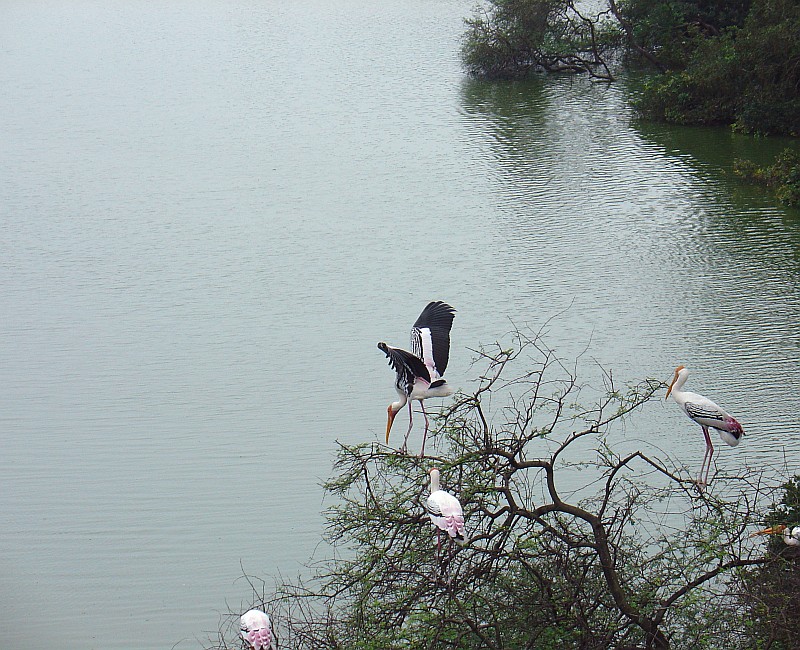
Nesting quite close to the walkway mentioned in the previous image they were the most photographed ones. With a bright orange face and beak, partially black wings and a tinge of pink on their feathers, they are nice to look at.
Having already found their mates, and the nesting season about to begin, they are collecting twigs from a tree (near a watch tower) to make their nests. At the time I took the picture, there was quite a lot of activity
Vedanthangal Bird park
India
I've had a great time recently following the nesting and breeding habits of the pukeko (purple swamp hen)...
You can read about some of their weird breeding habits at:
Pattern for Large Doll can be found here: goodygoody.typepad.com/goody_goody/files/toothpillowpatte...
size: set of five
color: emeraude
the nesting lotus bowls are one of the top pieces of my collection. their botanical, organic shape make them universally appealing. the nesting lotus bowls are gorgeous as a sculptural display piece, and they are completely functional for everyday use.for entertaining, these bowls are wonderful for filling with favorite dips, condiments, and snacks.
sizes:
set of five (6.25"w x 3"h) smallest bowl measures 3" w, largest is 6.25" w
set of eight (9"w x 4.25"h) mallest bowl measures 3" w, largest is 9" w
colors: emeraude green, milk white, robin egg blue, poppy red
Female Wompoo Fruit-dove, Ptilinipus magnificus, sitting on her sparse stick nest in Australia's World Heritage Wet Tropics area in far north Queensland. In this side view she is showing her deep purple breast plumage.
____________________________________________________
All my photographs are © Copyrighted and All Rights Reserved
This photograph or any part of it may NOT be reproduced or transmitted in any form or by any means (including websites, blogs) without full acknowledgement of it being my work. Use without permission is illegal - please contact me first if you’d like to use it.
---------------------------------------------------------------------------------
The nest on the beach were impressive enough, and packed, but the crazy ones were those back in the forest. Forest penguins! Fluffy brown chicks, too.
DSC_3864: Nesting Osprey on July 3rd, 2014 at Grand Lake, New Brunswick. I spent about 30 minutes taking pics and videos of this very cooperative subject on her nest today. She wasn't afraid of me at all, and just sat on top of her nest brooding over her young one.
Rip Rap Islands serve as crucial nesting ground for seabirds near the Hampton Roads Bridge-Tunnel in coastal Virginia. Currently, species that rely on the island include the royal tern, common tern, gull-billed tern, sandwich tern, herring gull, laughing gull, great black-backed gull, black skimmer, and snowy egret.
For decades before the expansion of the HRBT, two artificial islands anchored the underwater tunnels and housed the large colony of seabirds. The construction made these islands unsuitable nesting grounds.
In February 2020, Virginia Governor Ralph Northam tasked the Virginia Department of Wildlife Resources with relocating the colony. A quick yet massive renovation of Fort Wool, a Civil War-era military installment built in 1819, transformed Rip Rap Islands into a landscape for the seabird colony similar to the barrier islands. Along with Fort Wool, DWR leased three flat-top barges to create additional habitat next to Rip Rap Islands for the birds to nest. July 15, 2021 (Photo by Aileen Devlin | Virginia Sea Grant)
These guys have obviously decided that the tail fin hinge of a decommissioned Merpati CASA CN-235, is the perfect place for a nest. I guess it's not gong anywhere soon...
hmmm... the idea's a good one, but I don't think it sufficiently deters the girls from sleeping where they've slept for so many nights (the nesting box compartment)
Work for upcoming show at: www.aokayofficial.com/ in April!
I can take commissions for custom nesting dolls :)
Mixed media collage on Yupo
8.5 x 11
Acrylic, Lindor candy wrapper, political mail postal tag, doodles, magazine clips, profit sharing stamps
prefolds! These are preemie and infant sized. We also have a ton of regulars thanks to Georgia and some premiums left over from Sam. Obviously not everything is going out at once. No room and babies start out small.
Tell me about your Matryoshka!
Just a little comic trying to promote Nesting Dolls (Matryoshka Dolls) for www.therussianstore.com
Nesting Dolls sometimes 'crack' up - har har!
more to come on our blog www.therussianstore.com/blog
of the Red-Cockaded Woodpecker
sticky pine sap pours from holes created by the RCW, providing effective protection from predators: climbing tree snakes, raccoons, etc
www.tpwd.state.tx.us/huntwild/wild/birding/red_cockaded_w...