View allAll Photos Tagged nesting
© Jim Gilbert 2009 all rights reserved
I think that there are just the two eggs visible here.
Jersey Shore
Connie: No Mama Wubba that's no nesting material. That's Kiki's hair
Kiki: Yes that's my hair. Thx sis.
Connie and Kiki: Happy Wubba Wednesday dear flickr peeps!
Same swan, different angle---this poor thing made it's nest about three feet from the busiest intersection in the park---hope the baby makes it through!!
Mistle Thrush feeding young at nest
Grive draine nourrissant des jeunes au nid
(Turdus viscivorus)
03-05-2011 - Margravine Cemetery
I've finished the presentation I've been working on for the special program at the zoo. It contains shots I've taken at five or six different zoos. When I was preparing the Powerpoint, I needed a shot of an ostrich nesting, but hadn't posted one to my photostream. Here's one, so I can look it up in the future! This one often lays eggs.
I came across this female snapping turtle a few years ago. She was in the zone - laying her eggs. She was also the largest snapping turtle that I have ever seen.
Canadian goose nesting in southern New Jersey.
The Western Canada goose has a black head and crown, a long black neck, and white cheek patches that connect under the chin. The adult gander (male) tends to be bigger than the goose (female) and averages 30 inches in length with a 60-inch wingspan.
Canada geese nest in areas that are surrounded by or close to water. Nest sites vary widely and include the shores of cattail and bulrush marshes, the bases of trees, the tops of muskrat lodges and haystacks, and unoccupied nests of eagles, herons, and ospreys.
"19/52 Birds" - I've been spending this week of my vacation time at my daughter's helping her adjust to her new little one. She is doing great and so is the baby. I didn't know if I'd get a bird picture but here it is, this little one was trying to build a nest in a little birdhouse she has hanging in the garden but everytime I'd catch it trying to stuff the grass into the hole, it would fly off and sit here watching me..
Okay it's now officially spring, I've posted a nesting goose photo. I took this shot last night at Lake Beaumaris. Every year more and more of the geese nest closer to the walkways. This one was only a couple of feet away from from the sidewalk.
An osprey (Pandion haliaetus) nests on top of a parking lot light at the Crystal River Mall. We saw twigs and other plant matter at the base of the lamp, and guano covered the hood of an unfortunate vehicle parked beside the lamp.
According to the Florida Fish and Wildlife Conservation Commission, ospreys nest from December in the south part of the state to February in the north part of the state. We're in north-central Florida, so the timing here seems just right.
Utility poles (especially those near the water) are common osprey nesting sites, and nests are commonly reused for many years. This bird has staked its claim just a few miles from the Gulf of Mexico. Ospreys feed on fish, which has earned them the name "fish hawks."
Ospreys are not as large as bald eagles (which also breed in this area), but they enjoy a five- to six-foot wingspan.
While birding at Barr Lake State Park on day one of our Big Birding Weekend, my dad and I heard the pounding of a woodpecker but couldn't track down exactly where it was coming from. I placed my hand on the trunk of this tree to brace myself as I looked peered around and felt the tree vibrate in sync with the sound of pounding. After that clue, I found the nest hole and seconds later this cute female Downy stuck her head out for this amazing photo.
Click on image to view on black in the light box.
After going through the gardens on the west side of the Governor's Palace in Colonial Williamsburg and crossing to the west side of the canal (a comparatively long, narrow pond -- see map) in late April, I came upon this goose nesting on the edge of the pond. In my first shot, the goose was more relaxed, with it's neck in front of the body; this is the third shot, with her attention rather fully on my -- but not excited enough to get off the nest. A 105mm lens on a full-frame camera doesn't provide a lot of telephoto reach, so I cropped about a third of the image away.
The main attraction of the day - the Painted stork (Best viewed large
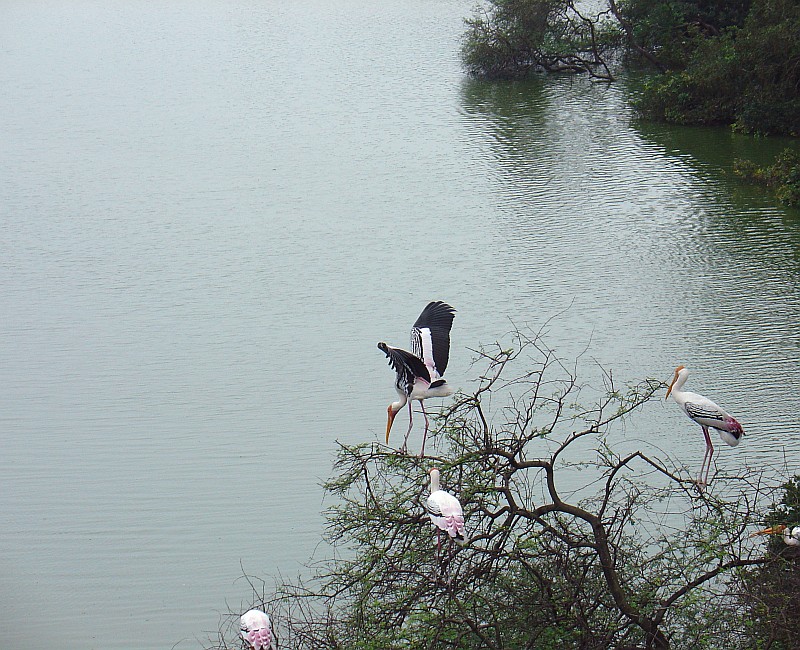
Nesting quite close to the walkway mentioned in the previous image they were the most photographed ones. With a bright orange face and beak, partially black wings and a tinge of pink on their feathers, they are nice to look at.
Having already found their mates, and the nesting season about to begin, they are collecting twigs from a tree (near a watch tower) to make their nests. At the time I took the picture, there was quite a lot of activity
Vedanthangal Bird park
India