View allAll Photos Tagged miningoperation
ASARCO, a subsidiary of Grupo México is a mining, smelting, and refining company based in Tucson, Arizona. It mines and processes primarily copper. Superior is a town in northern Pinal County, the central part of Arizona. Print Size 13x19 inches. HTT.
Tailings are the unrecovered materials left over after the process of separating the valuable ore. Superior is a town in northern Pinal County, Arizona. Grupo México is a public company that operates in the mining and transportation sectors. Print Size 13x19 inches.
Grupo México is a public company that operates in the mining and transportation sectors. Superior is a town in northern Pinal County, Arizona. Print Size 13x19 inches.
Tailings are the unrecovered materials left over after the process of separating the valuable ore. Superior is a town in northern Pinal County, Arizona. Grupo México is a public company that operates in the mining and transportation sectors. Print Size 13x19 inches.
A huge dump truck takes a load of ore out of the pit and to a close by drop point, transfer station or conveyor. It looks pretty much like a dirty Tonka toy from here.
Mining operations, of course.
"Battery-powered, tractor-mounted drill at work. Gravity one-sixth that of earth makes handling of heavy equipment easy."
[Caption]
"There is nobody on earth rich enough to pay for a rocket that would go to the moon. The big business corporations might possibly find the money, but they would want to see some way of getting it back. At present, it is believed that many valuable minerals are to be found on the moon, but nobody knows for sure. It is not very likely that the big corporations will risk their money. So it appears that the moon rocket will have to be a government project." [From the text]
“Smelting plant takes in ore on moon.”
“Plans to plant a colony on the moon are crystallizing, even though a permanent settlement on the moon may not be established until 1980. In the book, “The Moon—Target For Tomorrow,” written in 1958, this writer speculated that we could land on the moon in 1970 and establish a colony by 1980. Settlers on the moon could support themselves from material derived from the lunar surface.
While we believe that water is present under the surface of the moon (because the underlying layers are hot, and water may be driven out of the rocks), it may be impossible to dig deep enough to acquire this water. But water will not present a problem if sufficient energy is available on the moon. And by 1980, energy from several sources will be plentiful on the moon.
We can take the lunar rocks, break, crush and bake them, and extract the water of crystallization. Then, using energy, the water can be electrolyzed or broken up into oxygen and hydrogen. The oxygen can be used for atmosphere, the hydrogen can be liquefied to be used as a rocket propellant.
In the beginning, foods will be brought with the settlers and then grown on the moon in a variety of hydroponic gardens. In all probability, algae, that green scum floating on stagnant pools on earth, will become the backbone of a food technology. Algae can be used as an extender of flour and also as food for the fast-growing animals which will provide the all-important animal proteins.
Even materials like dyes, medicinals, detergents and plastics can be obtained on the moon by synthesizing or combining the basic elements—such as hydrogen, oxygen, nitrogen, carbon. In this fashion the settlers can acquire most of the material needed to permit a colony to perpetuate itself on the moon.
However, there is one type of…”
A cliff-hanger...so typical of Dr. I. M. Levitt! 🤔
The highlighting, for the purposes of press publication, appear to have been made using a permanent marker. There is a large area of mild waviness, particularly along the edge nearest the affixed article on the verso, due to the copious amount of military-grade adhesive applied.
That’s a boss looking vehicle. I wonder what the ground guide is holding in his left hand. Whatever it is, it looks to be either corded or tethered to the astronaut.
Doesn’t the driver look like either a Star Wars droid or the Invisible Man (wrapped).
Although there’s no signature, I’m sure it’s by John Gorsuch, reinforced by the identity of the writer of the article. Dr. Levitt & Mr. Gorsuch seemed to have had a collaborative arrangement/agreement whereby Mr. Gorsuch brought to life the ideas, proposals, prognostications, etc., etc. of the good doctor.
Is this the book? It's not prefaced with "The Moon" though:
www.collectspace.com/ubb/Forum27/HTML/004957.html
Credit: collectSPACE website
Photographed at the Gold King Mine Ghost Town in Jerome, Arizona. This old truck is a Euclid R-Series heavy duty off-highway dump truck. It could be an R-15, R-18 or R-27, I don't know why the hell it has a Caterpillar grille (although it certainly could have a Caterpillar diesel engine). You can see that the CAT grille was never on this dump truck originally because it's several inches taller than the hood itself.
Photographed at the Gold King Mine Ghost Town in Jerome, Arizona. This old truck is a Euclid R-Series heavy duty off-highway dump truck. It could be an R-15, R-18 or R-27, I don't know why the hell it has a Caterpillar grille (although it certainly could have a Caterpillar diesel engine). You can see that the CAT grille was never on this dump truck originally because it's several inches taller than the hood itself.
Photographed on U.S. Highway 93 near Boulder City, NV. It's carrying the same type of gigantic tires that would be put onto the Komatsu WA900 that I just photographed or other huge off-road construction vehicles used in open pit mining operations. This Peterbilt 389 has single wide tires rather than dual rear wheels.
I photographed this extremely oversize load while merging onto the highway in Los Angeles county. The timing of passing this semi really sucked because with all the traffic it was impossible to get a completely obstruction free shot. Komatsu front end loaders like this one are so huge that they cannot be transported with the tires attached. This one may or may not have the cab, I'm not sure.
I photographed this 1942-1947 pre-F-Series Ford flatbed truck several years ago in rural Storey County, Nevada on one of the roads that goes to Virginia City. Ford like all other American auto manufacturers stopped production of all civilians cars & trucks during WWII from 1942 through 1946.
I photographed this 1942-1947 pre-F-Series Ford flatbed truck several years ago in rural Storey County, Nevada on one of the roads that goes to Virginia City. Ford like all other American auto manufacturers stopped production of all civilians cars & trucks during WWII from 1942 through 1946.
Photographed on U.S. Highway 93 near Boulder City, NV. It's carrying the same type of gigantic tires that would be put onto the Komatsu WA900 that I just photographed or other huge off-road construction vehicles used in open pit mining operations. This Peterbilt 389 has single wide tires rather than dual rear wheels.
Photographed at the Gold King Mine Ghost Town in Jerome, Arizona. This old truck is a Euclid R-Series heavy duty off-highway dump truck. It could be an R-15, R-18 or R-27, I don't know why the hell it has a Caterpillar grille (although it certainly could have a Caterpillar diesel engine). You can see that the CAT grille was never on this dump truck originally because it's several inches taller than the hood itself.
I photographed this 1942-1947 pre-F-Series Ford flatbed truck several years ago in rural Storey County, Nevada on one of the roads that goes to Virginia City. Ford like all other American auto manufacturers stopped production of all civilians cars & trucks during WWII from 1942 through 1946.
Photographed at the Gold King Mine Ghost Town in Jerome, Arizona. This old truck is a Euclid R-Series heavy duty off-highway dump truck. It could be an R-15, R-18 or R-27, I don't know why the hell it has a Caterpillar grille (although it certainly could have a Caterpillar diesel engine). You can see that the CAT grille was never on this dump truck originally because it's several inches taller than the hood itself.
Photographed at the Gold King Mine Ghost Town in Jerome, Arizona. This old truck is a Euclid R-Series heavy duty off-highway dump truck. It could be an R-15, R-18 or R-27, I don't know why the hell it has a Caterpillar grille (although it certainly could have a Caterpillar diesel engine). You can see that the CAT grille was never on this dump truck originally because it's several inches taller than the hood itself.
Photographed on U.S. Highway 93 near Boulder City, NV. It's carrying the same type of gigantic tires that would be put onto the Komatsu WA900 that I just photographed or other huge off-road construction vehicles used in open pit mining operations. This Peterbilt 389 has single wide tires rather than dual rear wheels.
Photographed on U.S. Highway 93 near Boulder City, NV. It's carrying the same type of gigantic tires that would be put onto the Komatsu WA900 that I just photographed or other huge off-road construction vehicles used in open pit mining operations. This Peterbilt 389 has single wide tires rather than dual rear wheels.
Photographed in Las Vegas this truck is from Utah, carrying a tire for one of the huge off-highway dump trucks or earth moving machines in Nevada's mines.
Photographed at the Gold King Mine Ghost Town in Jerome, Arizona. This old truck is a Euclid R-Series heavy duty off-highway dump truck. It could be an R-15, R-18 or R-27, I don't know why the hell it has a Caterpillar grille (although it certainly could have a Caterpillar diesel engine). You can see that the CAT grille was never on this dump truck originally because it's several inches taller than the hood itself.
Photographed in Las Vegas this truck is from Utah, carrying a tire for one of the huge off-highway dump trucks or earth moving machines in Nevada's mines.
I took these photos several years ago in rural Storey County, Nevada on one of the roads that goes to and from Virginia City. I'm 99% sure that this is what remains of an antique Caterpillar tractor. You can see the 4 cylinder engine block sitting on top of the tread. Caterpillar was one of the first companies to mass produce farm tractors with treads (otherwise known as continuous tracks).
I photographed this 1942-1947 pre-F-Series Ford flatbed truck several years ago in rural Storey County, Nevada on one of the roads that goes to Virginia City. Ford like all other American auto manufacturers stopped production of all civilians cars & trucks during WWII from 1942 through 1946.
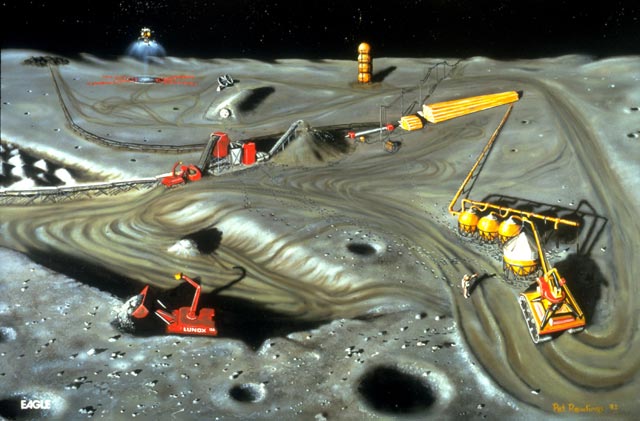
“Photo S83-28324 shows a strip mine on the Moon. Bulk soil is delivered by front-end loaders to an automated processing facility where the mineral ilmenite (FeTiO₃) is separated out and then chemically reduced by heating in the presence of hydrogen. The products of the reaction are metallic iron, titanium oxide, and water. The water is piped to an electrolysis facility where the hydrogen is recovered and the oxygen is stored in spherical tanks. In the foreground on the right, a filled tank is about to be carried to the landing pad where the lunar transfer vehicle is landing (left background). In the upper center sits a stack of imported hydrogen tanks. Power lines stretch over the ridge to undefined power station.”
Despite there being something a little wonky about the perspective, the depictions of objects relative to the perspective, apparent distance to the horizon (yes, I know it’s the moon, thereby relatively close), along with its rather abrupt/sharp terminus…it’s by Pat Rawlings…so it’s still gorgeous. Enjoy, in all its glorious 1200 dpi resolution.
Okay, so I think I’ve figured it out; there are two different “view angles” going on here. The left ½ - ⅔ of the image is shallower/more oblique, especially noticeable in the depiction of the excavated pit. The right half/third starts with a much steeper perspective of the nearer/foreground area, evident in the depiction of the tracked vehicle. Note also the softer transition from horizon-to-void to the right, starting at the power lines. To me, even the regolith on the right looks to be a shade lighter.
I can’t help but think Mr. Rawlings entirely reworked that side for some reason. But, maybe it’s just me.
www.patrawlings.com/images/large/E006.jpg
Credit: Pat Rawlings' website
www.reddit.com/media?url=https://preview.redd.it/what-the...

Credit: Andy-roo77/reddit
Also, the image & following, as contained within NASA SP-509, Volume 4/"SPACE RESOURCES: Social Concerns":
"Lunar Mining and Processing
Though international law prohibits the annexation of any part of the Moon, it would allow the use of raw materials mined at a lunar base. In this concept, based on a model by Hubert Davis of Eagle Engineering, bulk soil from a strip mine is delivered by front-end loaders to an automated processing facility. The oxygen won from the process is liquefied and piped to the storage tanks on the right. One filled tank is being loaded now, perhaps to be used at the lunar base, perhaps to be shipped to orbit. The slag is carried by conveyor belt to a dump in the background to the left. Near it, a lunar lighter can be seen landing. The tanks stacked to the right of the buried habitat module contain hydrogen for use in the process and as propellant. Power lines stretch over the ridge to a power station, possibly a nuclear reactor."
At/From:
www.lpi.usra.edu/lunar/strategies/SP509-4-Social.pdf
Credit: LPI website
And finally, from The Man himself! I knew I wasn’t crazy.
Just makes you respect & appreciate him that much more. An immensely talented class act:
www.patrawlings.com/article/learning-the-hard-way
Credit: Pat Rawlings blog/website
In addition to Time magazine. I assume also to his chagrin…featured on the cover:
historycollection.jsc.nasa.gov/JSCHistoryPortal/history/r...
Photographed on U.S. Highway 93 near Boulder City, NV. It's carrying the same type of gigantic tires that would be put onto the Komatsu WA900 that I just photographed or other huge off-road construction vehicles used in open pit mining operations. This Peterbilt 389 has single wide tires rather than dual rear wheels.
Photographed in Las Vegas this truck is from Utah, carrying a tire for one of the huge off-highway dump trucks or earth moving machines in Nevada's mines.
I photographed this 1942-1947 pre-F-Series Ford flatbed truck several years ago in rural Storey County, Nevada on one of the roads that goes to Virginia City. Ford like all other American auto manufacturers stopped production of all civilians cars & trucks during WWII from 1942 through 1946.
I photographed this 1942-1947 pre-F-Series Ford flatbed truck several years ago in rural Storey County, Nevada on one of the roads that goes to Virginia City. Ford like all other American auto manufacturers stopped production of all civilians cars & trucks during WWII from 1942 through 1946.
I photographed this 1942-1947 pre-F-Series Ford flatbed truck several years ago in rural Storey County, Nevada on one of the roads that goes to Virginia City. Ford like all other American auto manufacturers stopped production of all civilians cars & trucks during WWII from 1942 through 1946.
I took these photos several years ago in rural Storey County, Nevada on one of the roads that goes to and from Virginia City. I'm 99% sure that this is what remains of an antique Caterpillar tractor. You can see the 4 cylinder engine block sitting on top of the tread. Caterpillar was one of the first companies to mass produce farm tractors with treads (otherwise known as continuous tracks).
Photographed on U.S. Highway 93 near Boulder City, NV. It's carrying the same type of gigantic tires that would be put onto the Komatsu WA900 that I just photographed or other huge off-road construction vehicles used in open pit mining operations. This Peterbilt 389 has single wide tires rather than dual rear wheels.
I photographed this 1942-1947 pre-F-Series Ford flatbed truck several years ago in rural Storey County, Nevada on one of the roads that goes to Virginia City. Ford like all other American auto manufacturers stopped production of all civilians cars & trucks during WWII from 1942 through 1946.
Photographed on U.S. Highway 93 near Boulder City, NV. It's carrying the same type of gigantic tires that would be put onto the Komatsu WA900 that I just photographed or other huge off-road construction vehicles used in open pit mining operations. This Peterbilt 389 has single wide tires rather than dual rear wheels.
Old mineral processing complex near Lower Big Wash in the Utah high desert. This particular part really is a bit eerie. I can't help thinking about an older Science Fiction story by British Author J. G. Ballard. The story is "Good-by Eniwetok." The place certainly has the feeling evoked by Ballard in that story.
© Avi Das | Hasselblad 503 CW + Carl Zeiss CFi FLE 50mm f4 on Fujichrome Velvia 50, accidentally cross processed and converted to B&W.
I photographed this 1942-1947 pre-F-Series Ford flatbed truck several years ago in rural Storey County, Nevada on one of the roads that goes to Virginia City. Ford like all other American auto manufacturers stopped production of all civilians cars & trucks during WWII from 1942 through 1946.
I took these photos several years ago in rural Storey County, Nevada on one of the roads that goes to and from Virginia City. I'm 99% sure that this is what remains of an antique Caterpillar tractor. You can see the 4 cylinder engine block sitting on top of the tread. Caterpillar was one of the first companies to mass produce farm tractors with treads (otherwise known as continuous tracks).
I photographed this 1942-1947 pre-F-Series Ford flatbed truck several years ago in rural Storey County, Nevada on one of the roads that goes to Virginia City. Ford like all other American auto manufacturers stopped production of all civilians cars & trucks during WWII from 1942 through 1946.
Photographed on U.S. Highway 93 near Boulder City, NV. It's carrying the same type of gigantic tires that would be put onto the Komatsu WA900 that I just photographed or other huge off-road construction vehicles used in open pit mining operations. This Peterbilt 389 has single wide tires rather than dual rear wheels.