View allAll Photos Tagged instructive
Masonic Square and Compasses.
The Square and Compasses (or, more correctly, a square and a set of compasses joined together) is the single most identifiable symbol of Freemasonry. Both the square and compasses are architect's tools and are used in Masonic ritual as emblems to teach symbolic lessons. Some Lodges and rituals explain these symbols as lessons in conduct: for example, Duncan's Masonic Monitor of 1866 explains them as: "The square, to square our actions; The compasses, to circumscribe and keep us within bounds with all mankind".
However, as Freemasonry is non-dogmatic, there is no general interpretation for these symbols (or any Masonic symbol) that is used by Freemasonry as a whole.
Square and Compasses:
Source: Mackey's Encyclopedia of Freemasonry
These two symbols have been so long and so universally combined — to teach us, as says an early instruction, "to square our actions and to keep them within due bounds," they are so seldom seen apart, but are so kept together, either as two Great Lights, or as a jewel worn once by the Master of the Lodge, now by the Past Master—that they have come at last to be recognized as the proper badge of a Master Mason, just as the Triple Tau is of a Royal Arch Mason or the Passion Cross of a Knight Templar.
So universally has this symbol been recognized, even by the profane world, as the peculiar characteristic of Freemasonry, that it has recently been made in the United States the subject of a legal decision. A manufacturer of flour having made, in 1873, an application to the Patent Office for permission to adopt the Square and Compasses as a trade-mark, the Commissioner of Patents, .J. M. Thatcher, refused the permission as the mark was a Masonic symbol.
If this emblem were something other than precisely what it is—either less known", less significant, or fully and universally understood—all this might readily be admitted. But, Considering its peculiar character and relation to the public, an anomalous question is presented. There can be no doubt that this device, so commonly worn and employed by Masons, has an established mystic significance, universally recognized as existing; whether comprehended by all or not, is not material to this issue. In view of the magnitude and extent of the Masonic organization, it is impossible to divest its symbols, or at least this particular symbol—perhaps the best known of all—of its ordinary signification, wherever displaced, either as an arbitrary character or otherwise.
It will be universally understood, or misunderstood, as having a Masonic significance; and, therefore, as a trade-mark, must constantly work deception. Nothing could be more mischievous than to create as a monopoly, and uphold by the poser of lacy anything so calculated. as applied to purposes of trade. to be misinterpreted, to mislead all classes, and to constantly foster suggestions of mystery in affairs of business (see Infringing upon Freemasonry, also Imitative Societies, and Clandestine).
In a religious work by John Davies, entitled Summa Totalis, or All in All and the Same Forever, printed in 1607, we find an allusion to the Square and Compasses by a profane in a really Masonic sense. The author, who proposes to describe mystically the form of the Deity, says in his dedication:
Yet I this forme of formelesse Deity,
Drewe by the Squire and Compasse of our Creed.
In Masonic symbolism the Square and Compasses refer to the Freemason's duty to the Craft and to himself; hence it is properly a symbol of brotherhood, and there significantly adopted as the badge or token of the Fraternity.
Berage, in his work on the higher Degrees, Les plus secrets Mystéres des Hauts Grades, or The Most Secret Mysteries of the High Grades, gives a new interpretation to the symbol. He says: "The Square and the Compasses represent the union of the Old and New Testaments. None of the high Degrees recognize this interpretation, although their symbolism of the two implements differs somewhat from that of Symbolic Freemasonry.
The Square is with them peculiarly appropriated to the lower Degrees, as founded on the Operative Art; while the Compasses, as an implement of higher character and uses, is attributed to the Decrees, which claim to have a more elevated and philosophical foundation. Thus they speak of the initiate, when he passes from the Blue Lodge to the Lodge of Perfection, as 'passing from the Square to the Compasses,' to indicate a progressive elevation in his studies. Yet even in the high Degrees, the square and compasses combined retain their primitive signification as a symbol of brotherhood and as a badge of the Order."
Square and Compass:
Source: The Builder October 1916
By Bro. B. C. Ward, Iowa
Worshipful Master and Brethren: Let us behold the glorious beauty that lies hidden beneath the symbolism of the Square and Compass; and first as to the Square. Geometry, the first and noblest of the sciences, is the basis on which the superstructure of Masonry has been erected. As you know, the word "Geometry" is derived from two Greek words which mean "to measure the earth," so that Geometry originated in measurement; and in those early days, when land first began to be measured, the Square, being a right angle, was the instrument used, so that in time the Square began to symbolize the Earth. And later it began to symbolize, Masonically, the earthly-in man, that is man's lower nature, and still later it began to symbolize man's duty in his earthly relations, or his moral obligations to his Fellowmen. The symbolism of the Square is as ancient as the Pyramids. The Egyptians used it in building the Pyramids. The base of every pyramid is a perfect square, and to the Egyptians the Square was their highest and most sacred emblem. Even the Chinese many, many centuries ago used the Square to represent Good, and Confucius in his writings speaks of the Square to represent a Just man.
As Masons we have adopted the 47th Problem of Euclid as the rule by which to determine or prove a perfect Square. Many of us remember with what interest we solved that problem in our school days. The Square has become our most significant Emblem. It rests upon the open Bible on this altar; it is one of the three great Lights; and it is the chief ornament of the Worshipful Master. There is a good reason why this distinction has been conferred upon the Square. There can be nothing truer than a perfect Square--a right angle. Hence the Square has become an emblem of Perfection.
Now a few words as to the Compass: Astronomy was the second great science promulgated among men. In the process of Man's evolution there came a time when he began to look up to the stars and wonder at the vaulted Heavens above him. When he began to study the stars, he found that the Square was not adapted to the measurement of the Heavens. He must have circular measure; he needed to draw a circle from a central point, and so the Compass was employed. By the use of the Compass man began to study the starry Heavens, and as the Square primarily symbolized the Earth, the Compass began to symbolize the Heavens, the celestial canopy, the study of which has led men to think of God, and adore Him as the Supreme Architect of the Universe. In later times the Compass began to symbolize the spiritual or higher nature of man, and it is a significant fact that the circumference of a circle, which is a line without end, has become an emblem of Eternity and symbolizes Divinity; so the Compass, and the circle drawn by the Compass, both point men Heavenward and Godward.
The Masonic teaching concerning the two points of the Compass is very interesting and instructive. The novitiate in Masonry, as he kneels at this altar, and asks for Light sees the Square, which symbolizes his lower nature, he may well note the position of the Compass. As he takes another step, and asks for more Light, the position of the Compass is changed somewhat, symbolizing that his spiritual nature can, in some measure, overcome his evil tendencies. As he takes another step in Masonry, and asks for further Light, and hears the significant words, "and God said let there be Light, and there was Light," he sees the Compass in new light; and for the first time he sees the meaning, thus unmistakably alluding to the sacred and eternal truth that as the Heavens are higher than the Earth, so the spiritual is higher than the material, and the spiritual in man must have its proper place, and should be above his lower nature, and dominate all his thoughts and actions. That eminent Philosopher, Edmund Burke, once said, "It is ordained that men of intemperate passions cannot be free. Their passions forge the chains which bind them, and make them slaves." Burke was right. Masonry, through the beautiful symbolism of the Compass, tells us how we can be free men, by permitting the spiritual within us to overcome our evil tendencies, and dominate all our thoughts and actions. Brethren, sometimes in the silent quiet hour, as we think of this conflict between our lower and higher natures, we sometimes say in the words of another, "Show me the way and let me bravely climb to where all conflicts with the flesh shall cease. Show me that way. Show me the way up to a higher plane where my body shall be servant of my Soul. Show me that way."
Brethren, if that prayer expresses desire of our hearts, let us take heed to the beautiful teachings of the Compass, which silently and persistently tells each one of us,
"You should not in the valley stay
While the great horizons stretch away
The very cliffs that wall you round
Are ladders up to higher ground.
And Heaven draws near as you ascend,
The Breeze invites, the Stars befriend.
All things are beckoning to the Best,
Then climb toward God and find sweet Rest."
1 INTRODUCTION
Over the period from 1 June to 18 July 2017 I recorded 83 Mesopsocus barkflies at various sites in the Carlisle area. Many of these were photographed and some have already been posted to Flickr as individual reports. However, I thought it might be useful to gather together the best of these shots into a single composite image to facilitate comparison - and perhaps also as an aid to species identification.
It's noted that there are currently no NBN Atlas or Tullie House Mesopsocus records for Cumbria.
2 WHERE THEY WERE FOUND
The sites at which the barkflies were found are listed below, with the total counts - in many cases accumulated over more than one visit - given in brackets:
Gelt Wood area (27)
Talkin Tarn area (25)
Kingmoor South (9)
Finglandrigg Wood (7)
Kingmoor Sidings (6)
Newbiggin Wood (5)
Miltonrigg Wood (2)
Orton Moss (1)
Wreay Village (1)
From memory, all findings were made either under or in close proximity to mature broadleaf trees - oak and beech in particular. The vast majority were found on fenceposts at the edge of woodland, although other wooden structures (eg benches, bridges, gates, signposts, decorative carvings!) at random locations also contributed to the counts. One common factor was the presence of at least a partial covering of moss/lichen/algae/fungi - ie green stuff!
I should point out that when I'm searching for insects of any type, for various reasons, I tend to focus on weathered fenceposts, which are often positioned at woodland edges. Also I spend very little time examining tree bark or leaf litter. Consequently the distribution of sightings is to some extent a reflection of my own recording strategy.
3 WHEN THEY WERE FOUND
I discovered my first Mesopsocus barkfly on 1 June whilst checking out fenceposts at the edge of woodland at Kingmoor Sidings. To my naked eye it looked like a small spider nymph, which is something I wouldn't normally bother with. However, on this occasion, I just happened to have a closer look at it through my magnifier, when it was immediately apparent that it was something entirely different. Once I'd identified it as belonging to an order of insects completely new to me, I made a concerted effort to find more specimens, and had no difficulty in making further discoveries at other sites I've visited regularly over many years.
As I'd obviously been inadvertently ignoring these insects, the fact that I found my first one at the start of June doesn't mean that there weren't plenty of them about earlier on. This is something I'll be looking into next year.
My last sighting was in Finglandrigg Wood on 18 July. This was very much an outlier though, as numbers had noticeably declined towards the end of June, and in fact prior to this sighting I'd not seen one for over two weeks.
An indication of the rate of decline can be inferred by looking at the results of repeat surveys carried out at the two locations where the highest numbers had been counted:
Gelt Wood area: 16 June (25), 3 July (2), 19 July (0)
Talkin Tarn area: 20 June (22), 1 July (3), 11 July (0)
This is considered further in a later section.
4 PHOTOS
The photos of the 24 different specimens are arranged in date order, from top left to bottom right:
01 Kingmoor Sidings, 1 June
02 Finglandrigg Wood, 7 June (1 of 2)
03 Finglandrigg Wood, 7 June (2 of 2))
04 Orton Moss, 9 June
05 Kingmoor South, 10 June (1 of 3)
06 Kingmoor South, 10 June (2 of 3)
07 Kingmoor South, 10 June (3 of 3)
08 Gelt Wood area, 16 June (1 of 4)
09 Gelt Wood area, 16 June (2 of 4)
10 Gelt Wood area, 16 June (3 of 4)
11 Gelt Wood area, 16 June (4 of 4)
12 Newbiggin Wood, 17 June
13 Wreay village, 17 June
14 Miltonrigg Wood, 18 June
15 Talkin Tarn area, 20 June (1 of 3)
16 Talkin Tarn area, 20 June (2 of 3)
17 Talkin Tarn area, 20 June (3 of 3)
18 Finglandrigg Wood, 22 June
19 Talkin Tarn area, 1 July (1 of 3)
20 Talkin Tarn area, 1 July (2 of 3)
21 Talkin Tarn area, 1 July (3 of 3)
22 Gelt Wood area, 3 July (1 of 2)
23 Gelt Wood area, 3 July (2 of 2)
24 Finglandrigg Wood, 18 July
In order to ensure that there was no loss of resolution when assembling the montage, none of the images was resized; instead 600x600 pixel crops were taken from the full-sized edits. This was found to be large enough to encompass all the salient features of the specimens - although most have clipped antennae.
5 MEASUREMENTS
The lengths of five specimens were estimated by photographing them (alive) on or adjacent to a piece of graph paper mounted on a stiff card. The results are presented in date order below:
3.5 mm (Kingmoor Sidings, 1 June)
3.6 mm (Finglandrigg Wood, 7 June)
4.0 mm (Finglandrigg Wood, 7 June)
3.5 mm (Orton Moss, 9 June)
3.8mm (Miltonrigg Wood, 18 June)
On reflection, it might have been more instructive if I'd continued taking measurements till the end of the monitoring program, but I didn't think of that at the time!
In my opinion the above measurements are probably correct to within about 0.2mm (plus or minus).
6 AGE AND GENDER
As explained in the following section, there are only two barkfly species of interest. In both cases the adult males are fully winged (macropterous) but the adult females are flightless and have only tiny wing rudiments (micropterous). Taking into account the size of the insects photographed, it can be inferred that all of those included in the montage must be either female adults or female late-instar nymphs. (In general, barkfly nymphs start to develop wings at about the third of six instars, Ref 1.)
Due to the poor resolution of the photos, it seems unlikely that these can be used to reliably age the subjects, but a small number of samples were collected over the period of interest. Regrettably, these were not properly stored, and only one survived long enough to be studied under a microscope that was acquired several months later. This was one of the darker specimens found at Gelt Wood on 16 June (Photo 9). Unfortunately, the examination of this insect did not produce any conclusive results (see photo posted on 13 October for more details).
It's worth noting though that the specimen photographed at Orton Moss on 9 June (Photo 4) had presumably only just moulted, as it was still dragging along a shed skin. So if this was an adult, it was a very recent one!
As the project was continued till no further specimens were found, it seems likely that the vast majority of the photographs were of adult females; however the possibility that some of the earlier individuals might have been late-instar nymphs presumably can't be ruled out.
It's interesting to note that parthenogenesis is common amongst Psocoptera, and this perhaps explains the fact that of the 83 Mesopsocus barkflies found only a handful were male.
7 SPECIES IDENTIFICATION
Although there are three Mesopsocus species of barkfly found in the UK, the rare M. laticeps can immediately be eliminated as both sexes are macropterous. This leaves only M. immunis and M. unipunctatus. The National Barkfly Recording Scheme (Britain and Ireland) website includes a key for adult barkflies and the final stages for these two species are as follows:
Mesopsocus immunis:
www.brc.ac.uk/schemes/barkfly/key/A1-B-C2-D20-E1.htm
Mesopsocus unipunctatus:
www.brc.ac.uk/schemes/barkfly/key/A1-B-C2-D20-E2.htm
As noted in Section 6, all of the specimens photographed were females, and according to the key, the length of a female M. immunis is about 4.0 - 4.5mm, and a female M. unipunctatus is about 3.5 - 5.5mm. Of the five measurements quoted in Section 5, all fall within the latter range but only one within the former. The problem here is that none of the relevant individuals actually looks like the M. unipunctatus image included in the key, with the vast majority looking like the corresponding M. immunis image! However, M. unipunctatus has both "normal" and melanic forms (Ref 1) and so perhaps the image posted is not typcial.
The key states that although the patterning on the bodies of both species can be very variable, M. immunis often has a pale yellow background colour whereas M. unipunctatus generally has a more brownish tinge. On this rather subjective basis, in my opinion the majority of the specimens under consideration would appear to be of the former species.
The two images that stand out from the crowd are Photos 8 and 9. Interestingly, these were found within 10m of each other on a line of fenceposts bordering Gelt Wood, and so it might seem reasonable to infer that they're the same species - whatever that might be! However, apparently the two types are often found in very close proximity (Ref 1) and so this inference might not be valid.
It's noted that if the 0.2mm allowance (plus or minus) previously suggested is added to the best estimate measurements, then two of the five would fall into the M. immunis size range. This would increase to three of the five if the reference lengths have been quoted to the nearest 0.5mm. Another possibility is that the size ranges quoted are just indicative rather than definitive.
A further issue worth considering is that the populations of the two species peak at different times: In the Adult Phenology section of the species accounts the main date range in the North for M. immunis is specified as early June to late July, as opposed to mid-June to late July for M. unipunctatus. The fact that 19 individuals were recorded at three different sites over the first ten days of June and that only a handful were found during the month of July supports the case for the predominance of M. immunis. One slight problem here though is that the dividing line between North and South used on the website goes through mid-Cumbria, and although all records were from the north of the county, it's not clear how reliable this demarcation is.
In summary I don't think it's possible to state with confidence the species of any individual specimen on the basis of the photographic evidence presented. Consequently all of the Mesopsocus barkflies found during 2017 were formally reported as "Mesopsocus species".
(Text last revised on 9 January 18)
Ref 1: Handbooks for the Identification of British Insects, Volume 1, Part 7: Psocoptera (booklice, barklice), Second Edition, T.R. New (Royal Entomological Society, 2005)
Note: this book should be read in conjunction with the following review by Charles Lienhard which points out a number of errors (including the mislabelling of the insect on the front cover of the book!):
www.brc.ac.uk/schemes/barkfly/downloads/Psocoptera%20hand...
Today's uploads are a big change of pace from my usual mix of flowers-and-old-stuff. Earlier this week, I did my best Sam Russell impersonation by tackling some portrait work for a colleague.
Sandy has done a really amazing, enviable job of getting in better shape since the new year began, and he was looking for some new headshots and portraits that would better reflect where he is now.
I know it’s pretty routine for a lot of you, but I don’t take a lot of posed shots, and even then, it's almost always been awkward attempts with family members. Furthermore, I’ve found those difficult, with my sibling’s family usually wanting to shoot at times like mid-afternoon or in the evening well before the golden hour, and the kids looking this way and that. Consequently, taking some portraits of a lone adult (who might listen to instructions!) seemed like a really good learning experience.
I’m still not really confident in using my Mecablitz hotshoe flash in a polished way, so I decided to try to shoot all natural light, and for better or worse, we had very sunny weather this week. Brainstorming some classy, shaded areas in Wolfville led me to the handsomest building on the Acadia University campus, the KC Irving Environmental Science Centre. I figured that, between the shaded brick areas and the main Garden Room indoors, we’d have some good photo ops.
It was a really instructive experience. Editing the photos, I found a number of things I’d want to do better in the future, from learning how to better combat glasses reflections (not as evident in these photos, but more prominent in others), actually chimping a bit more during the shoot (an autofocus botch ruined all three shots of a decent setup we had, which I discovered after the fact), being a little bit more mindful of some of the surroundings (oops - one of the brick areas was kind of mossy and moldy and less photogenic), but...live and learn. As someone who is in many ways an introvert, it also feels very counterintuitive to be leading a shoot. As I grow as a photographer, I’m finding people skills to be an area of much more importance than I might have assumed. You certainly don’t need it for everything, but to be a true jack-of-all-trades, it’s got to be something you have a good grasp of.
Thankfully had a very patient and affable client who couldn’t really fire me.
There was never any doubt I would go to Rob's funeral. Rob was born just two weeks before me, and in our many meetings, we found we had so much in common.
A drive to Ipswich should be something like only two and a half hours, but with the Dartford Crossing that could balloon to four or more.
My choice was to leave early, soon after Jools left for work, or wait to near nine once rush hour was over. If I was up early, I'd leave early, I said.
Which is what happened.
So, after coffee and Jools leaving, I loaded my camera stuff in the car, not bothering to program in a destination, as I knew the route to Suffolk so well.
Checking the internet I found the M2 was closed, so that meant taking the M20, which I like as it runs beside HS2, although over the years, vegetation growth now hides most of it, and with Eurostar cutting services due to Brexit, you're lucky to see a train on the line now.
I had a phone loaded with podcasts, so time flew by, even if travelling through the endless roadworks at 50mph seemed to take forever.
Dartford was jammed. But we inched forward, until as the bridge came in sight, traffic moved smoothly, and I followed the traffic down into the east bore of the tunnel.
Another glorious morning for travel, the sun shone from a clear blue sky, even if traffic was heavy, but I had time, so not pressing on like I usually do, making the drive a pleasant one.
Up through Essex, where most other traffic turned off at Stanstead, then up to the A11 junction, with it being not yet nine, I had several hours to fill before the ceremony.
I stopped at Cambridge services for breakfast, then programmed the first church in: Gazeley, which is just in Suffolk on the border with Cambridgeshire.
I took the next junction off, took two further turnings brought be to the village, which is divided by one of the widest village streets I have ever seen.
It was five past nine: would the church be open?
I parked on the opposite side of the road, grabbed my bag and camera, limped over, passing a warden putting new notices in the parish notice board. We exchange good mornings, and I walk to the porch.
The inner door was unlocked, and the heavy door swung after turning the metal ring handle.
I had made a list of four churches from Simon's list of the top 60 Suffolk churches, picking those on or near my route to Ipswich and which piqued my interest.
Here, it was the reset mediaeval glass.
Needless to say, I had the church to myself, the centuries hanging heavy inside as sunlight flooded in filling the Chancel with warm golden light.
Windows had several devotional dials carved in the surrounding stone, and a huge and "stunningly beautiful piscina, and beside it are sedilia that end in an arm rest carved in the shape of a beast" which caught my eye.
A display in the Chancel was of the decoration of the wooden roof above where panels contained carved beats, some actual and some mythical.
I photographed them all.
I programmed in the next church, a 45 minute drive away just on the outskirts of Ipswich, or so I thought.
The A14 was plagued by roadworks, then most trunk roads and motorways are this time of year, but it was a fine summer morning, I was eating a chocolate bar as I drove, and I wasn't in a hurry.
I turned off at Claydon, and soon lost in a maze of narrow lanes, which brought be to a dog leg in the road, with St Mary nestling in a clearing.
I pulled up, got out and found the air full of birdsong, and was greeted by a friendly spaniel being taken for a walk from the hamlet which the church serves.
There was never any doubt that this would be open, so I went through the fine brick porch, pushed another heavy wooden door and entered the coolness of the church.
I decided to come here for the font, which as you can read below has quite the story: wounded by enemy action no less!
There seems to be a hagioscope (squint) in a window of the south wall, makes one think or an anchorite, but of this there is little evidence.
Samuel and Thomasina Sayer now reside high on the north wall of the Chancel, a stone skull between them, moved here too because of bomb damage in the last war.
I drove a few miles to the next church: Flowton.
Not so much a village as a house on a crossroads. And the church.
Nothing so grand as a formal board outside, just a handwritten sign say "welcome to Flowton church". Again, I had little doubt it would be open.
And it was.
The lychgate still stands, but a fence around the churchyard is good, so serves little practical purpose, other than to be there and hold the signs for the church and forthcoming services.
Inside it is simple: octagonal font with the floor being of brick, so as rustic as can be.
I did read Simon's account (below) when back outside, so went back in to record the tomb of Captain William Boggas and his family, even if part of the stone is hidden by pews now.
-------------------------------------------------
The landscape to the west of Ipswich rises to hills above the gentle valley of what will become the Belstead Brook before it empties itself into the River Orwell. The large villages of Somersham and Offton nestle below, but in the lonely lanes above are small, isolated settlements, and Flowton is one of them. I often cycle out this way from Ipswich through busy Bramford and then leave the modern world behind at Little Blakenham, up towards Nettlestead on a narrow and steep lane, down into Somersham and back up the other side to Flowton. It is unusual to pass a vehicle, or even see another human being, except in the valley bottom. In summer the only sound is of birdsong, the hedgerows alive in the deep heat. In winter the fields are dead, the crows in possession.
A hundred years ago these lanes were full of people, for in those days the villagers were enslaved to the land. But a farm that might support fifty workers then needs barely two now, and the countryside has emptied, villages reduced to half their size. Most of rural Suffolk is quieter now than at any time since before the Saxons arrived, and nature is returning to it.
In the early spring of 1644, a solemn procession came this way. The body of Captain William Boggas was brought back from the Midlands, where he had been killed in some skirmish or other, possibly in connection with the siege of Newark. The cart stumbled over the ruts and mud hollows, and it is easy to imagine the watching farmworkers pausing in a solemn gesture, standing upright for a brief moment, perhaps removing a hat, as it passed them by. But no sign of the cross, for this was Puritan Suffolk. Even the Church of England had been suppressed, and the local Priest replaced by a Minister chosen by, and possibly from within, the congregation.
William Boggas was laid to rest in the nave of the church, beside the body of his infant daughter who had died a year earlier. His heavily pregnant widow would have stood by on the cold brick floor, and the little church would have been full, for he was a landowner, and a Captain too.
The antiquarian David Davy came this way in a bad mood in May 1829, with his friend John Darby on their way to record the memorials and inscriptions of the church: ...we ascended a rather steep hill, on which we travelled thro' very indifferent roads to Flowton; here the kind of country I had anticipated for the whole of the present day's excursion was completely realised. A more flat, wet, unpleasant soil and country I have not often passed over, & we found some difficulty in getting along with safety & comfort.
But today it would be hard to arrive in Flowton in spring today and not be pleased to be there. By May, the trees in the hedgerows gather, and the early leaves send shadows dappling across the lane, for of course the roads have changed here since Darby and Davy came this way, but perhaps Flowton church hasn't much. James Bettley, revising the Buildings of England volumes for Suffolk, observed that it is a church with individuality in various details, which is about right. Much of what we see is of the early 14th Century, but there was money being spent here right on the eve of the Reformation. Peter Northeast and Simon Cotton transcribed a bequest of 1510 which pleasingly tells us the medieval dedication of the church, for Alice Plome asked that my body to be buried in the churchyard of the nativitie of our lady in fflowton. The same year, John Rever left a noble to painting the candlebeam, which is to say the beam which ran across the top of the rood loft and screen on which candles were placed. This is interesting because, as James Bettley points out, the large early 16th Century window on the south side of the nave was clearly intended to light the rood, and so was probably part of the same campaign. The candlebeam has not survived, and nor has any part of the rood screen. In 1526 John Rever (perhaps the son of the earlier man of the same name) left two nobles toward the making of a new rouff in the said church of ffloweton. The idiosyncratic tower top came in the 18th Century, and the weather vane with its elephants is of the early 21st Century, remembering a travelling circus that used to overwinter in the fields nearby.
The west face of the tower still has its niches, which once contained the images of the saints who watched over the travellers passing by. Another thing curious about the tower is that it has no west doorway. Instead, the doorway is set into the south side of the tower. There must be a reason for this, for it exists nowhere else in Suffolk. Perhaps there was once another building to the west of the tower. Several churches in this area have towers to the south of their naves, and the entrance through a south doorway into a porch formed beneath the tower, but it is hard to see how that could have been the intention here.
The Victorians were kind to Flowton church. It has a delicious atmosphere, that of an archetypal English country church. The narrow green sleeve of the graveyard enfolds it, leading eastwards to a moat-like ditch. The south porch is simple, and you step through it into a sweetly ancient space. The brick floor is uneven but lovely, lending an organic quality to the font, a Purbeck marble survival of the late 13th Century which seems to grow out of it. The bricks spread eastwards, past Munro Cautley's pulpit of the 1920s, and up beyond the chancel arch into the chancel itself. On the south side of the sanctuary the piscina that formerly served the altar here still retains its original wooden credence shelf. On the opposite wall is a corbel of what is perhaps a green man, or merely a madly grinning devil.
But to reach all these you must step across the ledger stone of Captain William Boggas, a pool of dark slate in the soft sea of bricks. It reads Here lyes waiting for the second coming of Jesus Christ the body of William Boggas gent, deere to his Countrey, by whoes free choyce he was called to be Captayne of their vountaries raysed for their defence: pious towards God, meeke & juste towards men & being about 40 yeeres of age departed this life March 18: 1643. To the north of it lie two smaller ledgers, the easterly one to his young daughter, which records the date of her birth and her death in the next ensuing month. To the west of that is one to William, his son, who was born on April 11th 1644.
At first sight it might seem odd that his son could have been born in April 1644 if William senior had died in March 1643, but in those days of course the New Year was counted not from January 1st, but from March 25th, a quarter day usually referred to as Lady Day, in an echoing memory of the pre-Reformation Feast of the Annunciation. So William Boggas died one month before his son was born, not thirteen. It would be nice to think that William Junior would have led a similarly exciting and possibly even longer life than his father. But this was not to be, for he died at the age of just two years old in 1645. As he was given his father's name, we may assume that he was his father's first and only son.
A further point of interest is that both Williams' stones have space ready for further names. But there are none. There would be no more children for him, for how could there be? But William's wife does not appear to be buried or even remembered here. Did she move away? Did she marry again, and does she lie in some other similarly remote English graveyard? Actually, it is possible that she doesn't. Boggas's wife was probably Flowton girl Mary Branston, and she had been married before, to Robert Woodward of Dedham in Essex. Between the time of William Boggas's death in 1644 and the 1647 accounting of the Colony, Mary's daughter and nephews by her first marriage had been transported to the Virginia Colony in the modern United States. Is it possible that Mary went to join them?
And finally, one last visitor. Four months after the birth of the younger William, when the cement on his father's ledger stone was barely dry, the Puritan iconoclast William Dowsing visited this remote place. It was 22 August 1644. The day had been a busy one for Dowsing, for Flowton was one of seven churches he visited that day, and he would likely have already known them well, because he had a house at nearby Baylham. There was little for him to take issue with apart from the piscina in the chancel which was probably filled in and then restored by the Victorians two hundred years later.
Dowsing had arrived here in the late afternoon on what was probably a fine summer's day, since the travelling was so easy. I imagined the graveyard that day, full of dense greenery. He came on horseback, and he was not alone.With him came, as an assistant, a man called Jacob Caley. Caley, a Portman of Ipswich, was well-known to the people of Flowton. He was the government's official collector of taxes for this part of Suffolk. Probably, he was not a popular man. What the villagers couldn't know was that Caley was actually hiding away a goodly proportion of the money he collected. In 1662, two years after the Commonwealth ended, he was found guilty of the theft of three thousand pounds, about a million pounds in today's money. He had collected one hundred and eighteen pounds of this from the people of Flowton alone, and the late John Blatchly writing in Trevor Cooper's edition of the Dowsing Journals thought that the amount he was found guilty of stealing was probably understated, although of course we will never know.
I revisit this church every few months, and it always feels welcoming and well cared for, with fresh flowers on display, tidy ranks of books for sale, and a feeling that there is always someone popping in, every day. The signs by the lychgate say Welcome to Flowton Church, and on my most recent visit in November 2021 a car stopped behind me while I was taking a photograph of the elephants at the top of the tower. "Do go inside, the church is open", the driver urged cheerily, "we've even got a toilet!" As with Nettlestead across the valley, the church tried to stay open throughout the Church of England's Covid panic of 2020 and 2021, whatever much of the rest of the Church might have been doing. And there was no absurd cordoning off of areas or imposition of the one-way systems beloved by busybodies in many other English churches. Instead, a simple reminder to ask you to be careful, and when I came this way in the late summer of 2020 there were, at the back of the church, tall vases of rosemary, myrtle, thyme and other fragrant herbs. Beside them was a notice, which read Covid-19 causes anosmia (losing sense of smell). Here are some herbs to smell! which I thought was not only useful and instructive, but rather lovely.
Simon Knott, November 2021
I was taken out by Rob in this Nova early in the day for some instructive and entertaining laps. Still a standard-ish 1.6 giving less than 100bhp, but he's an excellent driver and has great confidence in this.
Car behind is an Omega Evo 500 owned by his brother (also rather handy behind the wheel).
RAF Marham trackday April 2010.
April, 1982.
.
Ikeda Wood View, Symmar S 150mm.
.
Ektachrome 100 professional 4x5.
.
I have two versions of this and thought a 35mm Kodachrome vs 4x5 Ektachrome comparison might be instructive. This is a companion piece to the 35mm Kodachrome 25 version taken at nearly the same time..
.
Scanned with Epson v800 at 1200 ppi to print approx 14" x 18" at 300dpi.
.
Uncropped; Brightness and saturation reduced a bit, and blue added to color balance to bring closer to Kodachrome version using PS Elements/ Viveza.
.
This one is dedicated to the Navajo Nation and also to John Ford.
Brass Square and Compasses. I'll have to figure out where and how to attach this to the front of our new Honda Odyssey EX as I think that I've used and given away all of my old Masonic decals.
Square and Compasses
Source: Mackey's Encyclopedia of Freemasonry
These two symbols have been so long and so universally combined — to teach us, as says an early instruction, "to square our actions and to keep them within due bounds," they are so seldom seen apart, but are so kept together, either as two Great Lights, or as a jewel worn once by the Master of the Lodge, now by the Past Master—that they have come at last to be recognized as the proper badge of a Master Mason, just as the Triple Tau is of a Royal Arch Mason or the Passion Cross of a Knight Templar.
So universally has this symbol been recognized, even by the profane world, as the peculiar characteristic of Freemasonry, that it has recently been made in the United States the subject of a legal decision. A manufacturer of flour having made, in 1873, an application to the Patent Office for permission to adopt the Square and Compasses as a trade-mark, the Commissioner of Patents, .J. M. Thatcher, refused the permission as the mark was a Masonic symbol.
If this emblem were something other than precisely what it is—either less known", less significant, or fully and universally understood—all this might readily be admitted. But, Considering its peculiar character and relation to the public, an anomalous question is presented. There can be no doubt that this device, so commonly worn and employed by Masons, has an established mystic significance, universally recognized as existing; whether comprehended by all or not, is not material to this issue. In view of the magnitude and extent of the Masonic organization, it is impossible to divest its symbols, or at least this particular symbol—perhaps the best known of all—of its ordinary signification, wherever displaced, either as an arbitrary character or otherwise.
It will be universally understood, or misunderstood, as having a Masonic significance; and, therefore, as a trade-mark, must constantly work deception. Nothing could be more mischievous than to create as a monopoly, and uphold by the poser of lacy anything so calculated. as applied to purposes of trade. to be misinterpreted, to mislead all classes, and to constantly foster suggestions of mystery in affairs of business (see Infringing upon Freemasonry, also Imitative Societies, and Clandestine).
In a religious work by John Davies, entitled Summa Totalis, or All in All and the Same Forever, printed in 1607, we find an allusion to the Square and Compasses by a profane in a really Masonic sense. The author, who proposes to describe mystically the form of the Deity, says in his dedication:
Yet I this forme of formelesse Deity,
Drewe by the Squire and Compasse of our Creed.
In Masonic symbolism the Square and Compasses refer to the Freemason's duty to the Craft and to himself; hence it is properly a symbol of brotherhood, and there significantly adopted as the badge or token of the Fraternity.
Berage, in his work on the higher Degrees, Les plus secrets Mystéres des Hauts Grades, or The Most Secret Mysteries of the High Grades, gives a new interpretation to the symbol. He says: "The Square and the Compasses represent the union of the Old and New Testaments. None of the high Degrees recognize this interpretation, although their symbolism of the two implements differs somewhat from that of Symbolic Freemasonry.
The Square is with them peculiarly appropriated to the lower Degrees, as founded on the Operative Art; while the Compasses, as an implement of higher character and uses, is attributed to the Decrees, which claim to have a more elevated and philosophical foundation. Thus they speak of the initiate, when he passes from the Blue Lodge to the Lodge of Perfection, as 'passing from the Square to the Compasses,' to indicate a progressive elevation in his studies. Yet even in the high Degrees, the square and compasses combined retain their primitive signification as a symbol of brotherhood and as a badge of the Order."
Square and Compass
Source: The Builder October 1916
By Bro. B. C. Ward, Iowa
Worshipful Master and Brethren: Let us behold the glorious beauty that lies hidden beneath the symbolism of the Square and Compass; and first as to the Square. Geometry, the first and noblest of the sciences, is the basis on which the superstructure of Masonry has been erected. As you know, the word "Geometry" is derived from two Greek words which mean "to measure the earth," so that Geometry originated in measurement; and in those early days, when land first began to be measured, the Square, being a right angle, was the instrument used, so that in time the Square began to symbolize the Earth. And later it began to symbolize, Masonically, the earthly-in man, that is man's lower nature, and still later it began to symbolize man's duty in his earthly relations, or his moral obligations to his Fellowmen. The symbolism of the Square is as ancient as the Pyramids. The Egyptians used it in building the Pyramids. The base of every pyramid is a perfect square, and to the Egyptians the Square was their highest and most sacred emblem. Even the Chinese many, many centuries ago used the Square to represent Good, and Confucius in his writings speaks of the Square to represent a Just man.
As Masons we have adopted the 47th Problem of Euclid as the rule by which to determine or prove a perfect Square. Many of us remember with what interest we solved that problem in our school days. The Square has become our most significant Emblem. It rests upon the open Bible on this altar; it is one of the three great Lights; and it is the chief ornament of the Worshipful Master. There is a good reason why this distinction has been conferred upon the Square. There can be nothing truer than a perfect Square--a right angle. Hence the Square has become an emblem of Perfection.
Now a few words as to the Compass: Astronomy was the second great science promulgated among men. In the process of Man's evolution there came a time when he began to look up to the stars and wonder at the vaulted Heavens above him. When he began to study the stars, he found that the Square was not adapted to the measurement of the Heavens. He must have circular measure; he needed to draw a circle from a central point, and so the Compass was employed. By the use of the Compass man began to study the starry Heavens, and as the Square primarily symbolized the Earth, the Compass began to symbolize the Heavens, the celestial canopy, the study of which has led men to think of God, and adore Him as the Supreme Architect of the Universe. In later times the Compass began to symbolize the spiritual or higher nature of man, and it is a significant fact that the circumference of a circle, which is a line without end, has become an emblem of Eternity and symbolizes Divinity; so the Compass, and the circle drawn by the Compass, both point men Heavenward and Godward.
The Masonic teaching concerning the two points of the Compass is very interesting and instructive. The novitiate in Masonry, as he kneels at this altar, and asks for Light sees the Square, which symbolizes his lower nature, he may well note the position of the Compass. As he takes another step, and asks for more Light, the position of the Compass is changed somewhat, symbolizing that his spiritual nature can, in some measure, overcome his evil tendencies. As he takes another step in Masonry, and asks for further Light, and hears the significant words, "and God said let there be Light, and there was Light," he sees the Compass in new light; and for the first time he sees the meaning, thus unmistakably alluding to the sacred and eternal truth that as the Heavens are higher than the Earth, so the spiritual is higher than the material, and the spiritual in man must have its proper place, and should be above his lower nature, and dominate all his thoughts and actions. That eminent Philosopher, Edmund Burke, once said, "It is ordained that men of intemperate passions cannot be free. Their passions forge the chains which bind them, and make them slaves." Burke was right. Masonry, through the beautiful symbolism of the Compass, tells us how we can be free men, by permitting the spiritual within us to overcome our evil tendencies, and dominate all our thoughts and actions. Brethren, sometimes in the silent quiet hour, as we think of this conflict between our lower and higher natures, we sometimes say in the words of another, "Show me the way and let me bravely climb to where all conflicts with the flesh shall cease. Show me that way. Show me the way up to a higher plane where my body shall be servant of my Soul. Show me that way."
Brethren, if that prayer expresses desire of our hearts, let us take heed to the beautiful teachings of the Compass, which silently and persistently tells each one of us,
"You should not in the valley stay
While the great horizons stretch away
The very cliffs that wall you round
Are ladders up to higher ground.
And Heaven draws near as you ascend,
The Breeze invites, the Stars befriend.
All things are beckoning to the Best,
Then climb toward God and find sweet Rest."
A visit to the National Botanic Garden of Wales. Near Llanarthne in Carmarthenshire, Wales.
This garden aims to raise understanding and interest in plant breeding and genetics. The curving pathways in the Wallace Garden reflect the shape of the DNA double helix, and break the oval enclosure into a series of attractive themed beds. Planting blends the curious, the ornamental and the instructive. Here you’ll find examples of natural plant mutations, and every year there are fresh displays of food crops and garden plants that have been selectively bred by humans, like sweet peas and dahlias.
Along the south wall, plants refelct a geological timeline, from the first emergence of mosses and liverworts through horsetails to the tree ferns and conifers that dominate just before the evolution of flowering plants.
In the future we are hoping to use secure funding for this garden in order to demonstrate some of the scientific research the Garden is carrying out, particularly into the DNA of native Welsh plants.
This garden is named in honour of the Usk-born naturalist Alfred Russel Wallace (1823-1913), whose own work on the theory of evolution by means of natural selection prompted Charles Darwin to publish his ‘On the Origin of Species by Natural Selection’. In 2008, we celebrated Wallace’s life with a specially commissioned play written by Gaynor Styles of Theatre Nanog and performed by Ioan Hefin (seen left) inside the Wallace Garden for both school groups and general visitors.
Grade II listed.
Service Yard and Gateway of Middleton Hall, Llanarthney
sign - Alfred Russel Wallace.
He was a Naturalist, biologist geographer, anthropologist and explorer.
Credit: Adam Schultz / Clinton Global Initiative
The Courage to Create
Many of the world’s most effective technologies or social movements grew out of organized brainstorms and were launched through a combination of hard work, strong mentors, and the courage to create. These successful innovators—whether working in dorm rooms, labs, studios, or classrooms—were able to start out and scale up despite having limited resources and few precedents for their work. While their impact may be widely recognized today, the hurdles and lessons learned from their earliest stages of design and implementation are as instructive and valuable to others. This session will bring together creative, impactful voices from a wide range of sectors to discuss:
• What first inspired their confidence in the process of innovation and creativity, and what some of their earliest challenges were.
• How to incentivize the invention and innovation process among young people through expanded access to seed funding, mentorship, technical training, and lower-risk student loan repayment plans.
• How students, universities, NGOs, and businesses can support a broader culture of creativity and collaborative design as core components of 21st century citizenship.
Editorial Reviews
Amazon.com's Best of 2001
"A city is a plane of tarmac with some red hot spots of intensity," Rem Koolhaas, the pathbreaking architect and author of such semiotically seminal books as Delirious New York and the more recent S, M, L, XL, remarked in 1969. More than 30 years later, there are more of those hot spots around the world than ever, and they're getting hotter every day. Globalization, standardization, and the high-speed innovations of our current information age are transforming urban centers from London to Los Angeles to Lagos, and more places are becoming more urban, and at a faster pace, than ever before.
Mutations is an eye-popping atlas-cum-analysis of this new urbanization, and much of it is composed of essays and meditations (from a variety of contributors) on the 21st-century international City (often un-)Beautiful. Most of them are written in language that will be familiar to readers of Koolhaas's past books: in other words, dense, abstract, and chock-full of references to Foucault, Deleuze, and Guattari. If you like that sort of deconstructivist yammering, great; if not, the major small-type essays are best sampled (or, better, skimmed) one at a time, interspersed with the many other more accessible elements of the book that truly do add up to a vivid and fascinating mosaic of postmodern urbanism.
From Koolhaas and Harvard Design School's Project on the City come two engrossing and wholly straightforward explorations: one of the Pearl River Delta, which China has designated as a zone of unrestricted capitalist experimentation, and whose five major urban centers have consequently exploded overnight in all sorts of instructive and often frightening ways; and another of the chaotic, congested and Blade Runneresque megalopolis of Lagos, Nigeria, whose patterns of growth, housing, and commerce defy all conventional wisdom on how cities should develop. There's also a bounty of excellent (and often astonishing) statistics on all aspects of urban growth; a "snapshots" section of phenomena from cities all over the globe; a completely spot-on (and unintentionally funny) analysis of the evolution of shopping as the last truly unifying urban public activity (and the subject of Koolhaas's next full-scale book); and a trenchant look at Kosovo as ground zero in the first major war of the Internet age. (It should be noted that there's a separate section on the U.S., which with all its soulless, tacky consumerist excess gets the drubbing it usually can expect from the European intelligentsia, although the irony here is that more and more of newly urban Europe is starting to look like newly urban America.)
The exhibit-quality photography throughout is great, and, as you could expect from this unofficial successor to S, M, L, XL, the design is satisfyingly outré, right down to its post-Warholian plastic yellow easy-wipe cover with glued-on mousepad. But for all of Mutations's rich trove of facts and insights, and the impression that its high-tech design gives of an ironic embrace of the new urbanization, its deeper tone is one of disappointment and loss. The spirit of Jane Jacobs resides here, with all its yearning for the quirky, quaint beauty of human-scaled townhouses and shops, sidewalks and byways, and for the precorporatized glamour of grand old towns like New York, London, Paris, and Shanghai, before such metallic nouveau hubs as Atlanta and Kuala Lumpur were ever on the world-commerce map. Mutations was written and compiled largely by architects, after all, who hate ugliness as much as the next guy, whatever they may claim otherwise; its precisely for that reason that this densely absorbing new compendium betrays its wistfulness as often as it promotes its own air of cool, ethnographic bemusement. --Timothy Murphy
From Library Journal
This time working with a host of collaborators, architect Koolhaas, whose S, M, L, XL was that rare thing, a crossover architecture best seller, has returned with another bricklike tome. Mutations was developed in connection with Harvard Design School's Project on the City, an ongoing graduate-level analysis of "issues related to the urban condition." Year-long investigations have tackled such subjects as the impact of shopping on the city; Lagos, a massive, sprawling West African city that is highly functional despite a lack of infrastructure; and systematizing the structures and relationships in the prototypical Roman city. Results from these projects are gathered here along with a couple photo essays and short profiles of specific places from Pristina to Benelux. Interspersed throughout are a multitude of statistics about the current state and future of the city, presented in a captivating, highly graphical format. The whole does not cohere, and the reader will quickly turn to whatever is of greatest personal interest. But at the end of the day, the various views do coalesce into a portrait of powerful forces of our making but beyond our control: the modern city. As a result, this book is highly recommended for general cultural studies collections as well as all architecture/urban planning collections. Eric Bryant, "Library Journal"
Copyright 2001 Reed Business Information, Inc.
This shrine, built for the Elamite king Untaš Napiriša (r. 1275-1240 BC) of the Igehalkid dynasty at Dur-Untaš (City of Untash, 38 km.s SE of Susa), is the world's best preserved ziggurat (!), the largest outside Mesopotamia, and the best surviving example of Elamite architecture anywhere. Dur-Untaš was designed to serve both as a capital city and as a federal sanctuary and centre of pilgrimage in which the principal gods of the Elamite realm, Napiriša, Inšušinak, et al. were honoured. Its construction, the largest project undertaken by the dynasty, represented a radical departure from tradition and must've been intended to challenge the long-established position of Susa as the regional centre.
- youtu.be/RvykfDQcVLA?si=L2xFW5GW2USa0ZHb
- The ziggurat's plan is square, 105.2 m.s2 in area, and it consists of a mud-brick core within a facing of baked bricks stacked 2 m.s thick, forming 5 concentric levels or terraces with a quadrangular temple at the summit (the 'kukunnum') dedicated to Inšušinak, "Lord of Susa" at times, and at others to both Inšušinak and Napiriša, the latter thought to be the chief deity of the Elamite highlands. Exclusive to Elam's elite, it was accessible by external stairs. (There's an entrance to steps at the centre of each of the 4 sides, but only the SW entrance gave access to the stairs that led to the kukunnum.) Only 3 levels or storeys remain to a height of some 25 m.s., less than 1/2 the ziggurat's estimated original height of @ 53 m.s. www.flickr.com/photos/bijantaravels/3064569086/in/faves-9... The kukunnum is known only from inscribed bricks found out of context. Nonetheless, the bldg.'s state of preservation is unsurpassed. "It's hard to believe that such an imposing landmark could have been lost to the world for over 2500 years, as it was until it was accidentally discovered in 1935 in an aerial survey conducted by the Anglo-Iranian Oil Co., forerunner to BP." (LP and Iranicaonline)
- Every 11th row of baked bricks is inscribed in intricate Elamite cuneiform with a dedication by Untaš Napiriša, with his genealogy and title, to Inšušinak, 'Lord of Susa'. Remnants of glazed brick, glass and ivory suggest the exterior was richly decorated, and that the NE wall, at least, had moulded glazed tiles depicting a huge winged bull, the symbol of Inšušinak, which guarded the main staircase at ground level. (Bradt)
- According to archaeologist R. Ghirshman, "construction of the ziggurat began with a square open courtyard paved with baked bricks, with asymmetrical interior walls and surrounded on all sides by long, relatively narrow rooms, 4 of which constituted a temple dedicated to Inšušinak (temple A), entered through the interior of the courtyard on its SE side. In a 2nd major building phase the courtyard was filled with a series of mud-brick terraces, each of diminishing dimensions as they rise. The rooms opening from the courtyard were blocked off, although some continued in use as storerooms, entered by steps leading down from the first terrace. Grain, wood, pottery, many architectural ornaments (incl. glazed tiles and knobs), door leaves [?], and shells were among the provisions stored there. North of this, a 2nd temple, Inšušinak B, entered through the exterior facade of the courtyard, consisted of rooms from the original bldg. ... Inscribed bricks found on-site seem to indicate that there had been an earlier ziggurat construction in approximately the same area of the site." (Iranicaonline)
- The LP writes that "[t]he original 5 storeys were erected vertically from the foundation level as a series of concentric towers, not one atop another as was the custom in neighbouring Mesopotamia."
- The ziggurat was surrounded by 2 concentric walls, both articulated by niches and buttresses, in a vast, walled precinct of 1,200 x 800 m.s with 7 gates, all within a 3rd concentric outer wall, @ 4 km.s in circumference, which enclosed the surrounding town in an area of @ 100 ha.s.
- Temples had stood "[a]t the foot of the ziggurat ... [that were] dedicated to the highest-ranking Elamite divinities of the time: Napiriša; Išnikarab, close associate of Inšušinak; and Kiririša, consort of Napiriša. The addition of Napiriša’s name to the kukunnum inscriptions and the construction of the Kiririša temple next to the ziggurat some time after the foundation of the city may reflect a conscious change in policy intended to give a more prominent position to highland deities and thus strengthen political links with the peoples east of Susiana" and unite the cults of the gods of both highland and lowland Elam at one site. (Iranica online)
- Two major sectors in the complex include the central enclosure with the ziggurat and its dependencies (siyan-kuk), enclosed by the innermost wall, and the 'royal quarter' adjacent to a major city gate @ 240 m.s east of the ziggurat enclosure, where 3 monumental palaces have been excavated (incl. one considered to have been a funerary palace or complex surmounting the remains of subterranean baked-brick royal tombs. See my next photo.) (Unesco) Other temples in the outer courtyard within the Outer Temenos, none aligned with the ziggurat, include "a group of 4 [small, rectangular and semi-detached in the East corner] dedicated to the goddess Pinikir, 2 divine couples, IM (IŠKUR = Adad) [sic?] and Šala, the other Simut and NIN a-li (a title of the goddess Manzat, "referred to with the epithet 'lady of the siyan kuk' ['sacred precinct']"), and to a group of 8 gods, Na-ap.ra-te-ip (Napratep), each honored by one of 8 altars amongst the 4 small shrines." Another dedicated to the Elamite divinities Hišmitik and Ruhuratir, north of the ziggurat, contained a separate wing with a washroom in which purification rituals of some type may have been performed. To the west and NW is a square temple to Nabu, the long, irregular temple of Ishnikarib and Kirisha in the wall of the Inner Temenos, and a small square temple to Napiriša, per a map in Bradt. Further south, a T-shaped sanctuary was dedicated to the god Nusku. (Iranicaonline) "Little of [any of] these remain." (LP)
- In all, the remains of some 11 sanctuaries have been identified as well as those of 3 palaces, an elaborate water system with a reservoir and ganat channels (some distance behind the ziggurat, and large and impressive [I'll scan a photo]; "[as] the site's climate became drier, qanats brought water an incredible 45 km.s from ancient rivers" [LP]), and tombs and tunnels (again, see the next photo). It's thought that urban planners planned to build 22 temples at Dur Untaš, but Untaš Napiriša died before they could be completed, his successors discontinued construction, and the Elamite nobility returned to Susa. But the sacred city remained a site of religious pilgrimage and was in use as a necropolis until @ 1000 B.C.
- An abundance of votive objects found on-site includes many stone mace-heads and bronze weapons from a shrine dedicated to Kiririša, cylinder seals (many with banquet imagery) made of faience found in association with many small animal figurines, 13th-cent.-BC "glass seals carved with images imitating or expanding on contemporary Kassite glyptic styles", and figurines of women and animals and fragments of an inscribed, 1/2-life-sized faience bull found in the temple of IM and Šala. Provisions made to secure the doors of the ziggurat's lower rooms indicate that many valuable objects were once stored there. Faience statues of winged griffins and bulls guarded the entrances to the ziggurat, and monumental stelae stood in the courtyard. (Iranicaonline)
- Walkways, altars, and podia of baked and glazed brick bear witness to the elaborate processionals and sacrifices once conducted in the temenos. Bradt writes about an altar next to a pit that was used to catch the blood of slain animals (which I don't recall). A 12th-cent. BC bronze tableau found at Susa, now in the Louvre, depicts essential features of the 'high places' ('bamah' in Hebrew) mentioned in the Old Testament (1 Kings 3:3, etc.): 2 altars for liquid offerings, 2 standing stones, tree stumps representing the goddess Asherah, a vessel of water for ritual ablutions, and 2 naked priests or supplicants squatting /b/ the altars, etc., preparing an offering, one pouring water on the outstretched hands of the other. (Bradt) commons.wikimedia.org/wiki/File:Sit-Shamski_bronze_model_...

- A gate once stood "[a]t the foot of the northeastern steps, ... [consisting of] 2 rows of 7 columns, where supplicants sought the pleasure of the king." (LP) The foundations are all that remain. On the northern side of the perimeter of the base of the ziggurat, faint remnants of blue, white, black and gold faience tiles can be seen (which I dont recall).
- A large, ancient sundial can be seen, and near the altar is an ancient Elamite footprint in the clay pavement (which I do recall).
- "Visitors are restricted to certain areas of the ground level and must follow prescribed paths /b/ roped-off areas" today, which wasn't so in 2000, although I wasn't permitted to ascend the stairs of the ziggurat.
- On my 2nd visit to the site at dusk near the end of my stay in Khuzestan, I spied a long, flattish brick sticking out of the ground near the ziggurat with much cuneiform on the exposed end. I tried to dig @ it to free it with a stick, although I was in plain view of some workmen a couple hundred metres off, but to no avail. It's just as well, of course. (What would I do with it? I'd be playing with fire if I tried to take it through customs back to Turkey and then home via Istanbul, all ethical questions aside.) I'll scan a photo I took of it.
- It's an atmospheric site on an arid, alluvial plateau, it was warm, and there were no tourists @ that I recall, but there were local workmen onsite. I took my time to see everything on site well and returned to see some of it (as it was on my route back to Andimeshk that 2nd time) although I wish I knew then what I've written above.
- Chogha Zanbil is a Unesco world heritage site, designated back in '79 and one of the first 3 in the country, together with the Meidan Emam in Esfahan and, of course, Persepolis. In a sense it's in a very elite club of tourist attractions. A 4th (Takht-e Soleyman) wouldn't be designated until 2003. 27 Iranian sites have been designated as of 2023.
- A tour with Ali Aghajanzadeh: youtu.be/oB2twPU59IA?si=EWsqCptCUG1YrFCh
- A 10 minute video with Elamite history. For Chogha Zanbil, skip to the 7:04 min. point. www.youtube.com/watch?v=kBi_qv_hGl8
- I think it was at the end of my 2nd day in the region that I wandered more or less from my home-stay that evening down to Dezful and the Dez river where I found the huge, awesome, ancient Sassanian bridge there and ate a snack or had a picnic beneath it by the banks of the river. I'll write more about it in the next photo description.
- My 3rd morning in the region I headed From Andimeshk I headed one morning (by minibus or shared taxi?) west and south down the 27 through and past Shush / Susa another 15 clicks or so and turned due east onto a side road just north of Hosseinabad and hitched and walked a few clicks along it to the 15th-14th-cent. BC 'Middle Elamite' site of Haft Tappeh, ancient Kabnak.
HAFT TAPPEH / KABNAK
- This large site is comprised of several individual mounds forming a mass that rises above the surrounding plain, once the heart of an ancient city with religious and public bldg.s constructed of sun-dried and baked brick at its centre. It became THE most prominent centre within the Elamite empire for a century or two (15th-14th cent.s BC) in the 'Middle Elamite period'. It's "a single-level site with almost no evidence of occupation before the major construction period" and with minimal evidence following. 'Haft Tappeh' is Persian for '7 mounds', although there are 14 on-site, the tallest 17 m.s in height and 1500 m.s long x 800 m.s wide with its related extensions. It's likely the city was named 'Ka-ap-nak' (aka 'Kabnak'), a name found on several seal impressions and clay tablets on-site.
- "Most construction was with sun-dried brick; baked brick was reserved for the most important bldg.s or those most exposed to the elements. Sun-dried brick was stacked with a simple clay mortar and baked brick with a strong gypsum mortar, which was also used to coat baked brick pavements and to plaster walls and the inner surfaces of vaulted roofs. Natural bitumen was used to seal basins and water channels and to coat mortar and surfaces." (Iranica online)
- The site was discovered in the 50s and 60s when land was cleared and leveled for a sugar cane plantation, and it was excavated over 14 seasons from 1965 to '78 (when the dig was suspended in light of political conditions) by the Iranian Archaeological Service, with huge trenches cut into a terrace which might've served as a platform for a temple. "Altogether over 14 seasons, 150 trenches, 10 x 10 m.s on average, concentrated together and covering an area of 15,000 m.s2, were opened." (I read somewhere or had the impression when I was there that a dig or two was hapless and involved great damage to or the destruction of a ziggurat, but I haven't read that online.) Portions of 2 monumental mud-brick complexes and a mortuary bldg. were excavated, although only a small fraction of the site was uncovered.
- "Architectural remains thus far uncovered include the Tomb Temple Complex with 2 royal tombs of baked brick and gypsum plaster under barrel-vaulted roofs, one now collapsed, used as mass graves. Inside the larger tomb a large platform was divided in 3 by a small wall." (Iranica online) I'll scan a photo. Per a plaque on-site on google maps, the positioning of the 13 skeletons in the tomb indicates they weren't all interred at once. But 23 skeletons were laid out neatly in a row within the smaller tomb indicating simultaneous interment, and "9 others [were] bundled unceremoniously in the doorway" (Bradt). On my tour I was told or read that these were sacrificed to accompany the royal occupant, likely Tepti-ahar, to the afterlife.
- On a tour of the site, a man who works in a research centre there mentioned, almost in passing, that the brick barrel vault over the tomb is the oldest in the world (I think). I was very and duly impressed, but it's not true. The barrel vault made its appearance more than a millenium earlier in both Egypt and Sumer. (See below. I wonder if he said or meant to say "the oldest in the country".)
- Update April '25: Ali Aghajanzadeh tours this site and this tomb in this vlog and seems to make or repeat the same claim that its vault "is the oldest vault in the world built by the Elamites" at the 22 min. pt. youtu.be/oB2twPU59IA?si=RdkIiWcLU6ztEotR Was he was given the same misinformation? (It's possible he meant to say that it's the oldest Elamite vault found to date, but I think he meant that it's the oldest anywhere and that the Elamites built it, what with his use of the words "in the world".)
- Both tombs were attached to a large temple of sun-dried brick with 2 parallel halls opening onto a large portico which in turn opens onto a large courtyard paved with layers of baked brick and which contained 2 broken stone stelae inscribed with the name of Tepti-ahar, the king who likely built the complex. A massive wall of sun-dried brick surrounds the Tomb complex. A large, solid, multi-sided, sun-dried-brick construction forming 'Terrace Complex I', built in sections SE of the royal tomb complex, is connected to it by an > 60 m.-long-wall. This might have been the foundation of a much taller structure, a ziggurat temple or palace. Several halls on its periphery had walls covered in polychrome paintings on a gypsum surface and flat roofs supported by large timbers of palm-tree-fibre covered with reeds and matting. An artists' workshop was found in one containing "bowls with dried paint, a sawn elephant skeleton, a solidified cluster of several hundred bronze arrowheads and bronze hooks, fragments of colourful stone mosaic framed in bronze, a butterfly pin of gold and carnelian, and the most famous objects found on-site, 2 [creepy] life-sized, painted, portrait heads of an Elamite king and queen, together with a clay mask." See those heads from the 4:17 to 4:23 min. pt. in this video filmed in the Haft Tappeh museum.: youtu.be/vYDUu8QVa20?si=OO8u1Q440pgEq5B4 Pottery and bronze were baked in a large, adjacent kiln. Another massive, solid-brick terrace sits south of the Terrace complex.
- youtube.com/shorts/M09LM91BcP0?si=FvPIfWXA2idRgAbC
- Excavations resumed in 2002, two years after my tour, and "several large complexes with very wide walls were identified in the north of the city, and ... an archive of cuneiform tablets was discovered in the south, the most important discovery on-site". The archive consists primarily of "Elamite tablets written in Babylonian which include letters, accounts, scholarly treatises, and works of divination. The name Kadashman Enlil is inscribed on one with an impression of the seal of Tepti-ahar, king of Elam, his contemporary, the Kassite king of Mesopotamia, known to have reigned before Burnaburiash III whose rule began @ 1375 B.C.E. (Negahban, 1991). One tablet with Tepti-Ahar's seal is dated to "the year when the king expelled Kadašman-KUR.GAL. (KUR.GAL could be read either as 'Harbe' or 'Enlil' [?], as Harbe is a Kassite god parallel to the Babylonian Enlil.)" Tepti-ahar, the king who built this city and who returned to use of the old title 'King of Susa and Anshan', was apparently the last king of the Kidinuid dynasty.
- The pottery on-site is comparable to that of the late Kassite period. Most vessels are plain and unpainted in various shades of buff. Other finds include stone vessels and mace heads, many small figurines of a fertility goddess (see below), male figurines incl. musicians holding stringed instruments, small figurines of animals in various materials, bronze objects incl. arrowheads, daggers, and various tools incl. a variety of chisels.
- "With Elam in decline, [this city] also declined." Again, it was sacked and burned sometime in the late 14th cent. "In the courtyard of the Tomb Temple Complex a solid platform of 9 layers of baked brick was badly damaged. Bits of stone with cuneiform, incl. fragments of stelae originally installed on the platform, were found scattered over it. The stelae were forcibly removed from the platform but proved too heavy to carry off and were abandoned. Traces of burned timbers were found in halls of the Terrace Complex I. In 2014-'15, several hundred victims of a massacre were discovered piled atop one another behind the wall of a large complex".
- While I was exploring the mounds at the site (but with less to see than from the 3:30 min. pt. in this vlog: youtu.be/5HfpJNrJn8Y?si=eYgCWefXplhbOUcq ), I met a tall, soft-spoken, kind man who was working in a bldg. at the site (likely the 'Haft Tappeh museum') in some capacity. ("Its relics [were] temporarily safeguarded in Tehran till repairs to the damages it suffered during the Iran-Iraq war [were] completed." www.iraniantours.com/attraction/haft-tappeh-museum/ Likely the case in 2000, but it's back up and running today.) He might've been an archaeologist, and he showed me @ some. (He was the one who commented about the vault over the royal tomb.) He took me into a room in the bldg. where he found an old, well thumbed booklet (in a filing cabinet I think), written about the site in English and gave it to me (very kind!), which I took with me to read on a 2nd, self-guided tour of the site.
- I was very impressed with a shelf in a case against a wall in that room, covered in clay effigy figurines of what was clearly a fertility goddess, nude with big hair (a headdress?), wide hips, and cupping her breasts in her hands. Here she is.: ishtargates.tumblr.com/image/138152349361 They were so abundant they were more or less piled up. I should've asked to take a photo. (Maybe I knew not to. It's likely he would've politely refused. I wasn't really supposed to be in there.) I note that only fragments of those figurines are seen (at the 2:30 min. pt.) in this video filmed in the museum.: youtu.be/t4XNTOPjEho?si=Uq7ADKJpx6e3UdjY and in this photo.: itto.org/iran/image-bin/1919071103335afj4kuefc.jpg?w=1100 But I'm pretty sure at least some in the jumble on that shelf were intact. - ?
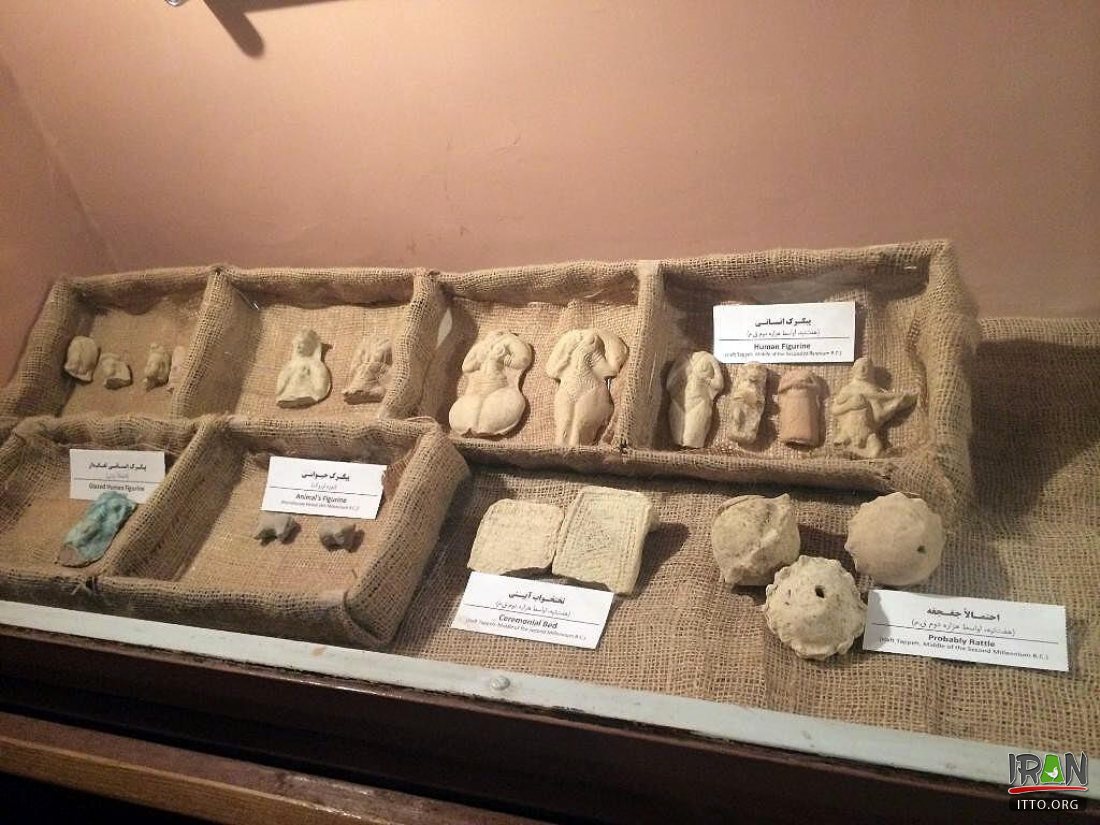
- "Who this goddess might be isn't exactly known. ... She could be the mother goddess Kiririsha, aka Kirrisi, Pinikir, Parti (her name at Izeh/Malemir, a settlement nearby), or Partikira (her name at Susa). She might've been known as the 'Great Goddess' and/or as the 'Proprietor of Heaven', titles held by similar goddesses throughout the ancient Middle East." ishtargates.tumblr.com/post/138152349361/along-with-the-r... Or she might have been the goddess Manzât, aka Mazzi'at, Manzi'at and Mazzêt, to whom a temple was dedicated at Chogha Zanbil and who was "believed to be responsible for the prosperity of cities. ... References to the worship of Manzât are known chiefly from the Elamite lowlands, esp. Susa and its surroundings. ... Theophoric names invoking her are attested in texts found at Haft Tappeh." (Wikipedia) Pinikir is discussed in this podcast.: youtu.be/uGz5zkMakjA?si=IByqOgzVSLfQ4JJp
- An older, shorter, balding man was in the vicinity while the younger man gave me that tour, made a comment to him at one point in a tone of disapproval if I recall, and the younger man seemed a bit chastened. Later as I was walking @ reading the booklet he gave me, the older man espied it, approached me and asked to see it, said the other man shouldn't've given it to me (to paraphrase), and took it back. He was the younger man's boss or supervisor evidently, and I fear that I got the kind, younger man in some trouble. (No good deed goes unpunished.)
Re the Development of the Arch or Barrel Vault:
- "The prototype [of the arch and the barrel vault] was a structure built of bundles of reeds placed upright in the ground, bent inward and tied together at the top to form a roof. Early Egyptian drawings, including hieroglyphs, depict reed vaults over sanctuaries, boat huts and other structures. Although no ancient reed bldg.s have survived, the technique has - in southern Iraq, at the confluence of the Tigris and Euphrates where 'Marsh Arabs' still construct enormous vaulted bldg.s of reeds. ... Nearly all the surviving [Near or Middle] Eastern arches are made of mud brick, or adobe (a Spanish loanword from the Arabic 'at-tub', 'the brick'). ... The same arid climate that makes mud-brick the ideal building material in the Near East makes vaulting the perfect technique for constructing a ceiling or a roof. A vaulted ceiling allows hot air to rise higher which helps to cool the living space. Many regions in the Near East lack forests, and the timber needed to support flat ceilings is scarce. A mud-brick vault requires no wooden beams for support. Not only is it practical and economical but it is a singularly graceful way to cover a building. ...
- "At Tell Razuk in Iraq a bldg. dating from @ 2,900 BC displays what may be transitional evolutionary forms: vaulted roofs in which the successive layers are both corbeled and canted inward. In Egypt radial arches and vaults were built sporadically in most periods of Pharaonic history, primarily in tombs and in monumental gateways. The earliest examples found of a radial vault in Egypt and of a pitched-brick vault anywhere are at Helwan in the same tomb which dates from late in the 1st Dynasty (@ 3,000 BC). [The "mature design" of the latter "suggests, however, that the technique had been employed for some time."] A somewhat later but particularly instructive example is the arched gateway of a mastaba (a bench-like tomb with inclined sides) at Giza from the 4th Dynasty (2,680-2,560 BC) that belonged to Neferi, a nobleman. ... The radial arch was more fully exploited in Mesopotamia. ... The earliest example known is in a hall built at Tepe Gawra late in the 4th mill. BC at the time of the emergence of Sumer. At Ur, the most famous Sumerian site, the tombs of King Abargi and Queen Shubad (@ 2,500 BC) had radially vaulted roofs and doorways. The most impressive Mesopotamian radial arches and vaults and the oldest Mesopotamian pitched-brick vaults (although a millenium younger than the earliest found in Egypt) are at Tell al Rimah, which date from the end of the 3rd and the 1st 1/2 of the 2nd mill. BC. Vaults span rooms 3.8 m.s wide in a temple, a burial chamber, 8 successive arches cover a stairway, etc. [Those at Haft Tappeh are pitched-brick vaults as well.] ... The acme of pitched-brick vaulting is the Taq Kisra, the great hall of the [Sassanian] palace at Ctesiphon, south of Baghdad, built sometime /b/ the 3rd and 6th cent.s. It still stands 28.4 m.s high and spans 25.5 m.s, the largest single-span vault of unreinforced brick anywhere." - case.edu/lifelonglearning/sites/default/files/2020-02/Van...
- According to Wikipedia, "[t]he earliest known example of [the] barrel vault [might be] under the [Sumerian] ziggurat at Nippur, built of fired bricks cemented with clay mortar." www.jstor.org/stable/496542?seq=18 A section of an arch in an ancient drain which "may have originally covered the whole drain, ... is perfectly elliptical" with a span of 1'8" and a total height of 2'4". (But I haven't found the date of construction of Nippur's arches.) Here's an old photo of that site.: en.wikipedia.org/wiki/File:John_Henry_Haynes._The_Nippur_...

The Rib or Ribbed Vault:
- It seems that the rib or ribbed vault, which became such an important and basic element of medieval Gothic architecture in Western Europe (essential to the construction of the great Gothic cathedrals, beginning with the Basilica of St. Denis near Paris in the mid 12-cent.), was invented or at least developed in ancient Iran (by the Medes?), where it "appears to have been confined, primarily." It was "employed extensively" at Nush-i-Jan (Median, 750-600 BC), with huge vault bricks, 1.2 m.s long. case.edu/lifelonglearning/sites/default/files/2020-02/Van... Van Beek writes (in his comprehensive article in the link re the development of "Arches and Vaults in the Ancient Near East") of the discovery of simple rib vaulting in a large Assyrian bldg. dating from @ 675 BC at Tell Jemmeh in Iraq (in which he also found "the oldest vaults known built of wedge-shaped bricks"). "The technique [of construction with rib vaulting] may have been brought to Tell Jemmeh by a Median builder in the service of the Assyrian imperial forces." (Nush-i-Jan is claimed to be the finest surviving Median bldg., one of the oldest surviving Zoroastrian ateshkades [it might be the oldest in Iran {?}, but I've read about the discovery of an earlier one somewhere in Central Asia which I'll write about sometime], and again, it's the site of the "extensive employment" of pioneering rib vaulting. It should be a Unesco site, but it's not on Iran's Tentative list for designation, not yet.)
"One would expect such long bricks to be fragile, but they were strong enough to support the floor of an upper room in the central temple." (Van Beek) flickr.com/photos/97924400@N00/3623624478/in/photostream/ Van Beek writes that "a rib vault couldn't have been as strong as a pitched-brick or radial vault, and apart from a certain simplicity of construction it probably had few advantages." But it was essential to Gothic architecture for good reason. "The ribs transmit the load downward and outward to specific points, usually rows of columns or piers, greatly reduc[ing] the weight and thus the outward thrust of the vault", permitting medieval Western European architects to build "higher and thinner walls with much larger windows." (Wikipedia)
- youtu.be/qU4ngo2UTXE?si=6qZHftlgYCczXpLq
- I think I hitched and walked back to Chogha Zanbil after completing my tour of Haft Tappeh, and then back to Andimeshk for the evening.
Masonic rings.
Dunlop Street Barrie Ontario Street Market, Food, Fun & Patios
The best of local everything
Come down and experience Downtown Barrie in a traffic-free pedestrian-only environment. Locally owned shops, restaurants and patios work together to create a street market atmosphere that’s fun, exciting, engaging and full of energy.
Vendor Hours
Saturday & Sunday 10:00 a.m. - 7:00 p.m.
Monday 10:00 a.m. - 6:00 p.m.
(Some vendors may be open later.)
Masonic Square and Compasses:
The Square and Compasses (or, more correctly, a square and a set of compasses joined together) is the single most identifiable symbol of Freemasonry. Both the square and compasses are architect's tools and are used in Masonic ritual as emblems to teach symbolic lessons. Some Lodges and rituals explain these symbols as lessons in conduct: for example, Duncan's Masonic Monitor of 1866 explains them as: "The square, to square our actions; The compasses, to circumscribe and keep us within bounds with all mankind".
However, as Freemasonry is non-dogmatic, there is no general interpretation for these symbols (or any Masonic symbol) that is used by Freemasonry as a whole.
Square and Compasses:
Source: Mackey's Encyclopedia of Freemasonry
These two symbols have been so long and so universally combined — to teach us, as says an early instruction, "to square our actions and to keep them within due bounds," they are so seldom seen apart, but are so kept together, either as two Great Lights, or as a jewel worn once by the Master of the Lodge, now by the Past Master—that they have come at last to be recognized as the proper badge of a Master Mason, just as the Triple Tau is of a Royal Arch Mason or the Passion Cross of a Knight Templar.
So universally has this symbol been recognized, even by the profane world, as the peculiar characteristic of Freemasonry, that it has recently been made in the United States the subject of a legal decision. A manufacturer of flour having made, in 1873, an application to the Patent Office for permission to adopt the Square and Compasses as a trade-mark, the Commissioner of Patents, .J. M. Thatcher, refused the permission as the mark was a Masonic symbol.
If this emblem were something other than precisely what it is—either less known", less significant, or fully and universally understood—all this might readily be admitted. But, Considering its peculiar character and relation to the public, an anomalous question is presented. There can be no doubt that this device, so commonly worn and employed by Masons, has an established mystic significance, universally recognized as existing; whether comprehended by all or not, is not material to this issue. In view of the magnitude and extent of the Masonic organization, it is impossible to divest its symbols, or at least this particular symbol—perhaps the best known of all—of its ordinary signification, wherever displaced, either as an arbitrary character or otherwise.
It will be universally understood, or misunderstood, as having a Masonic significance; and, therefore, as a trade-mark, must constantly work deception. Nothing could be more mischievous than to create as a monopoly, and uphold by the poser of lacy anything so calculated. as applied to purposes of trade. to be misinterpreted, to mislead all classes, and to constantly foster suggestions of mystery in affairs of business (see Infringing upon Freemasonry, also Imitative Societies, and Clandestine).
In a religious work by John Davies, entitled Summa Totalis, or All in All and the Same Forever, printed in 1607, we find an allusion to the Square and Compasses by a profane in a really Masonic sense. The author, who proposes to describe mystically the form of the Deity, says in his dedication:
Yet I this forme of formelesse Deity,
Drewe by the Squire and Compasse of our Creed.
In Masonic symbolism the Square and Compasses refer to the Freemason's duty to the Craft and to himself; hence it is properly a symbol of brotherhood, and there significantly adopted as the badge or token of the Fraternity.
Berage, in his work on the higher Degrees, Les plus secrets Mystéres des Hauts Grades, or The Most Secret Mysteries of the High Grades, gives a new interpretation to the symbol. He says: "The Square and the Compasses represent the union of the Old and New Testaments. None of the high Degrees recognize this interpretation, although their symbolism of the two implements differs somewhat from that of Symbolic Freemasonry.
The Square is with them peculiarly appropriated to the lower Degrees, as founded on the Operative Art; while the Compasses, as an implement of higher character and uses, is attributed to the Decrees, which claim to have a more elevated and philosophical foundation. Thus they speak of the initiate, when he passes from the Blue Lodge to the Lodge of Perfection, as 'passing from the Square to the Compasses,' to indicate a progressive elevation in his studies. Yet even in the high Degrees, the square and compasses combined retain their primitive signification as a symbol of brotherhood and as a badge of the Order."
Square and Compass:
Source: The Builder October 1916
By Bro. B. C. Ward, Iowa
Worshipful Master and Brethren: Let us behold the glorious beauty that lies hidden beneath the symbolism of the Square and Compass; and first as to the Square. Geometry, the first and noblest of the sciences, is the basis on which the superstructure of Masonry has been erected. As you know, the word "Geometry" is derived from two Greek words which mean "to measure the earth," so that Geometry originated in measurement; and in those early days, when land first began to be measured, the Square, being a right angle, was the instrument used, so that in time the Square began to symbolize the Earth. And later it began to symbolize, Masonically, the earthly-in man, that is man's lower nature, and still later it began to symbolize man's duty in his earthly relations, or his moral obligations to his Fellowmen. The symbolism of the Square is as ancient as the Pyramids. The Egyptians used it in building the Pyramids. The base of every pyramid is a perfect square, and to the Egyptians the Square was their highest and most sacred emblem. Even the Chinese many, many centuries ago used the Square to represent Good, and Confucius in his writings speaks of the Square to represent a Just man.
As Masons we have adopted the 47th Problem of Euclid as the rule by which to determine or prove a perfect Square. Many of us remember with what interest we solved that problem in our school days. The Square has become our most significant Emblem. It rests upon the open Bible on this altar; it is one of the three great Lights; and it is the chief ornament of the Worshipful Master. There is a good reason why this distinction has been conferred upon the Square. There can be nothing truer than a perfect Square--a right angle. Hence the Square has become an emblem of Perfection.
Now a few words as to the Compass: Astronomy was the second great science promulgated among men. In the process of Man's evolution there came a time when he began to look up to the stars and wonder at the vaulted Heavens above him. When he began to study the stars, he found that the Square was not adapted to the measurement of the Heavens. He must have circular measure; he needed to draw a circle from a central point, and so the Compass was employed. By the use of the Compass man began to study the starry Heavens, and as the Square primarily symbolized the Earth, the Compass began to symbolize the Heavens, the celestial canopy, the study of which has led men to think of God, and adore Him as the Supreme Architect of the Universe. In later times the Compass began to symbolize the spiritual or higher nature of man, and it is a significant fact that the circumference of a circle, which is a line without end, has become an emblem of Eternity and symbolizes Divinity; so the Compass, and the circle drawn by the Compass, both point men Heavenward and Godward.
The Masonic teaching concerning the two points of the Compass is very interesting and instructive. The novitiate in Masonry, as he kneels at this altar, and asks for Light sees the Square, which symbolizes his lower nature, he may well note the position of the Compass. As he takes another step, and asks for more Light, the position of the Compass is changed somewhat, symbolizing that his spiritual nature can, in some measure, overcome his evil tendencies. As he takes another step in Masonry, and asks for further Light, and hears the significant words, "and God said let there be Light, and there was Light," he sees the Compass in new light; and for the first time he sees the meaning, thus unmistakably alluding to the sacred and eternal truth that as the Heavens are higher than the Earth, so the spiritual is higher than the material, and the spiritual in man must have its proper place, and should be above his lower nature, and dominate all his thoughts and actions. That eminent Philosopher, Edmund Burke, once said, "It is ordained that men of intemperate passions cannot be free. Their passions forge the chains which bind them, and make them slaves." Burke was right. Masonry, through the beautiful symbolism of the Compass, tells us how we can be free men, by permitting the spiritual within us to overcome our evil tendencies, and dominate all our thoughts and actions. Brethren, sometimes in the silent quiet hour, as we think of this conflict between our lower and higher natures, we sometimes say in the words of another, "Show me the way and let me bravely climb to where all conflicts with the flesh shall cease. Show me that way. Show me the way up to a higher plane where my body shall be servant of my Soul. Show me that way."
Brethren, if that prayer expresses desire of our hearts, let us take heed to the beautiful teachings of the Compass, which silently and persistently tells each one of us,
"You should not in the valley stay
While the great horizons stretch away
The very cliffs that wall you round
Are ladders up to higher ground.
And Heaven draws near as you ascend,
The Breeze invites, the Stars befriend.
All things are beckoning to the Best,
Then climb toward God and find sweet Rest.”
The secrets of Freemasonry are concerned with its traditional modes of recognition. It is not a secret society, since all members are free to acknowledge their membership and will do so in response to enquiries for respectable reasons. Its constitutions and rules are available to the public. There is no secret about any of its aims and principles. Like many other societies, it regards some of its internal affairs as private matters for its members. In history there have been times and places where promoting equality, freedom of thought or liberty of conscience was dangerous. Most importantly though is a question of perspective. Each aspect of the craft has a meaning. Freemasonry has been described as a system of morality, veiled in allegory and illustrated by symbols. Such characteristics as virtue, honour and mercy, such virtues as temperance, fortitude, prudence and justice are empty clichés and hollow words unless presented within an ordered and closed framework. The lessons are not secret but the presentation is kept private to promote a clearer understanding in good time. It is also possible to view Masonic secrecy not as secrecy in and of itself, but rather as a symbol of privacy and discretion. By not revealing Masonic secrets, or acknowledging the many published exposures, freemasons demonstrate that they are men of discretion, worthy of confidences, and that they place a high value on their word and bond.
Masonic Square and Compasses.
The Square and Compasses (or, more correctly, a square and a set of compasses joined together) is the single most identifiable symbol of Freemasonry. Both the square and compasses are architect's tools and are used in Masonic ritual as emblems to teach symbolic lessons. Some Lodges and rituals explain these symbols as lessons in conduct: for example, Duncan's Masonic Monitor of 1866 explains them as: "The square, to square our actions; The compasses, to circumscribe and keep us within bounds with all mankind".
However, as Freemasonry is non-dogmatic, there is no general interpretation for these symbols (or any Masonic symbol) that is used by Freemasonry as a whole.
Square and Compasses:
Source: Mackey's Encyclopedia of Freemasonry
These two symbols have been so long and so universally combined — to teach us, as says an early instruction, "to square our actions and to keep them within due bounds," they are so seldom seen apart, but are so kept together, either as two Great Lights, or as a jewel worn once by the Master of the Lodge, now by the Past Master—that they have come at last to be recognized as the proper badge of a Master Mason, just as the Triple Tau is of a Royal Arch Mason or the Passion Cross of a Knight Templar.
So universally has this symbol been recognized, even by the profane world, as the peculiar characteristic of Freemasonry, that it has recently been made in the United States the subject of a legal decision. A manufacturer of flour having made, in 1873, an application to the Patent Office for permission to adopt the Square and Compasses as a trade-mark, the Commissioner of Patents, .J. M. Thatcher, refused the permission as the mark was a Masonic symbol.
If this emblem were something other than precisely what it is—either less known", less significant, or fully and universally understood—all this might readily be admitted. But, Considering its peculiar character and relation to the public, an anomalous question is presented. There can be no doubt that this device, so commonly worn and employed by Masons, has an established mystic significance, universally recognized as existing; whether comprehended by all or not, is not material to this issue. In view of the magnitude and extent of the Masonic organization, it is impossible to divest its symbols, or at least this particular symbol—perhaps the best known of all—of its ordinary signification, wherever displaced, either as an arbitrary character or otherwise.
It will be universally understood, or misunderstood, as having a Masonic significance; and, therefore, as a trade-mark, must constantly work deception. Nothing could be more mischievous than to create as a monopoly, and uphold by the poser of lacy anything so calculated. as applied to purposes of trade. to be misinterpreted, to mislead all classes, and to constantly foster suggestions of mystery in affairs of business (see Infringing upon Freemasonry, also Imitative Societies, and Clandestine).
In a religious work by John Davies, entitled Summa Totalis, or All in All and the Same Forever, printed in 1607, we find an allusion to the Square and Compasses by a profane in a really Masonic sense. The author, who proposes to describe mystically the form of the Deity, says in his dedication:
Yet I this forme of formelesse Deity,
Drewe by the Squire and Compasse of our Creed.
In Masonic symbolism the Square and Compasses refer to the Freemason's duty to the Craft and to himself; hence it is properly a symbol of brotherhood, and there significantly adopted as the badge or token of the Fraternity.
Berage, in his work on the higher Degrees, Les plus secrets Mystéres des Hauts Grades, or The Most Secret Mysteries of the High Grades, gives a new interpretation to the symbol. He says: "The Square and the Compasses represent the union of the Old and New Testaments. None of the high Degrees recognize this interpretation, although their symbolism of the two implements differs somewhat from that of Symbolic Freemasonry.
The Square is with them peculiarly appropriated to the lower Degrees, as founded on the Operative Art; while the Compasses, as an implement of higher character and uses, is attributed to the Decrees, which claim to have a more elevated and philosophical foundation. Thus they speak of the initiate, when he passes from the Blue Lodge to the Lodge of Perfection, as 'passing from the Square to the Compasses,' to indicate a progressive elevation in his studies. Yet even in the high Degrees, the square and compasses combined retain their primitive signification as a symbol of brotherhood and as a badge of the Order."
Square and Compass:
Source: The Builder October 1916
By Bro. B. C. Ward, Iowa
Worshipful Master and Brethren: Let us behold the glorious beauty that lies hidden beneath the symbolism of the Square and Compass; and first as to the Square. Geometry, the first and noblest of the sciences, is the basis on which the superstructure of Masonry has been erected. As you know, the word "Geometry" is derived from two Greek words which mean "to measure the earth," so that Geometry originated in measurement; and in those early days, when land first began to be measured, the Square, being a right angle, was the instrument used, so that in time the Square began to symbolize the Earth. And later it began to symbolize, Masonically, the earthly-in man, that is man's lower nature, and still later it began to symbolize man's duty in his earthly relations, or his moral obligations to his Fellowmen. The symbolism of the Square is as ancient as the Pyramids. The Egyptians used it in building the Pyramids. The base of every pyramid is a perfect square, and to the Egyptians the Square was their highest and most sacred emblem. Even the Chinese many, many centuries ago used the Square to represent Good, and Confucius in his writings speaks of the Square to represent a Just man.
As Masons we have adopted the 47th Problem of Euclid as the rule by which to determine or prove a perfect Square. Many of us remember with what interest we solved that problem in our school days. The Square has become our most significant Emblem. It rests upon the open Bible on this altar; it is one of the three great Lights; and it is the chief ornament of the Worshipful Master. There is a good reason why this distinction has been conferred upon the Square. There can be nothing truer than a perfect Square--a right angle. Hence the Square has become an emblem of Perfection.
Now a few words as to the Compass: Astronomy was the second great science promulgated among men. In the process of Man's evolution there came a time when he began to look up to the stars and wonder at the vaulted Heavens above him. When he began to study the stars, he found that the Square was not adapted to the measurement of the Heavens. He must have circular measure; he needed to draw a circle from a central point, and so the Compass was employed. By the use of the Compass man began to study the starry Heavens, and as the Square primarily symbolized the Earth, the Compass began to symbolize the Heavens, the celestial canopy, the study of which has led men to think of God, and adore Him as the Supreme Architect of the Universe. In later times the Compass began to symbolize the spiritual or higher nature of man, and it is a significant fact that the circumference of a circle, which is a line without end, has become an emblem of Eternity and symbolizes Divinity; so the Compass, and the circle drawn by the Compass, both point men Heavenward and Godward.
The Masonic teaching concerning the two points of the Compass is very interesting and instructive. The novitiate in Masonry, as he kneels at this altar, and asks for Light sees the Square, which symbolizes his lower nature, he may well note the position of the Compass. As he takes another step, and asks for more Light, the position of the Compass is changed somewhat, symbolizing that his spiritual nature can, in some measure, overcome his evil tendencies. As he takes another step in Masonry, and asks for further Light, and hears the significant words, "and God said let there be Light, and there was Light," he sees the Compass in new light; and for the first time he sees the meaning, thus unmistakably alluding to the sacred and eternal truth that as the Heavens are higher than the Earth, so the spiritual is higher than the material, and the spiritual in man must have its proper place, and should be above his lower nature, and dominate all his thoughts and actions. That eminent Philosopher, Edmund Burke, once said, "It is ordained that men of intemperate passions cannot be free. Their passions forge the chains which bind them, and make them slaves." Burke was right. Masonry, through the beautiful symbolism of the Compass, tells us how we can be free men, by permitting the spiritual within us to overcome our evil tendencies, and dominate all our thoughts and actions. Brethren, sometimes in the silent quiet hour, as we think of this conflict between our lower and higher natures, we sometimes say in the words of another, "Show me the way and let me bravely climb to where all conflicts with the flesh shall cease. Show me that way. Show me the way up to a higher plane where my body shall be servant of my Soul. Show me that way."
Brethren, if that prayer expresses desire of our hearts, let us take heed to the beautiful teachings of the Compass, which silently and persistently tells each one of us,
"You should not in the valley stay
While the great horizons stretch away
The very cliffs that wall you round
Are ladders up to higher ground.
And Heaven draws near as you ascend,
The Breeze invites, the Stars befriend.
All things are beckoning to the Best,
Then climb toward God and find sweet Rest."
This monkey is given every comfort to test a prototype of a Mercury capsule. This monkey, called Enos, costs 75000 francs (1860 euros) but he can operate seven instruments and tie his shoelaces.
(Chocolate Jacques instructive chromos, picture-album "Race to the Stars", 1960's)
Hubert Crook at a one-day course at St Hilda's, Darlington in 1958. It comes from an RSCM brochure of around 1959 with the caption "Tea break at one-day school". The text says;
"For choirs who cannot make use of other services offered, the One-Day School has proved very popular and instructive. The juniors, boys and girls, attend during the morning and the adults join them in the afternoon. A day of intensive work culminates in Evensong sung together using simple music."
Photo: Dick Gilbert collection.
webP3170017. see www.sbs.com.au/ondemand/watch/1726824003663
STATEMENT OF SIGNIFICANCE
The 74” Telescope and Coude Spectrograph
– prior to January 2003
The structure was built in 1953, and the installation of
the telescope was completed in 1956. The technology
of the large standing ruin of the large 74 inch telescope,
the Coude Spectrograph building, reflects the
importance given to science in the 1950s. Experiments
in Astrophysics and Astroseismology were carried out.
Manufactured by Grubb Parsons the 74” Reflector
telescope has contributed to optical astronomy in
Australia, and was used extensively throughout the
1950s, 60s and 70s. The telescope, during this time
was considered the ‘work horse’ of the observatory.
74” telescope and Building, 1957 (NAA)
The 74” Telescope Coude Spectrograph
– post January 2003
The remains of the telescope building, the masonry
walls and the dome, although having sustained damage
in the fires, retain high significance. The dome is a
surviving element within the landscape, contributing to
the understanding of the important aesthetic setting of
the group of telescopes which were once dotted along
the North West side of the ridge of Mount Stromlo. The
telescope was destroyed in the fires and cannot be
repaired. For the telescope to continue to operate on
the site it would have to be replaced.
from heritage.anu.edu.au/__documents/heritage-management/herit...
www.cmd.act.gov.au/functions/publications/archived/mcleod...
The Inquiry into the Operational Response to the January 2003 Bushfires.
Inquiry headed by Mr Ron McLeod.
8. Concluding remarks
(An attempt to answer an important question and some brief final remarks)
Damage at present impossible of estimation was caused in the Federal Capital Territory during the weekend by bush fires which raged over a total front of 45 miles along the Murrumbidgee, and crossed it at several points close to Canberra on Saturday afternoon. It was the worst fire in the recollection of district settlers … Although more than 500 volunteers from Canberra, Queanbeyan and Captain’s Flat fought desperately against the fires on a dozen fronts on Saturday, they had no hope of checking it against the fierce wind, which carried the flames along gullies and depressions at amazing speed … Burning tinder was carried five and six miles by the wind before being dropped to start fresh outbreaks in the dry grass and trees. Burning leaves from Uriarra fell on Parliament House at 11am on Saturday.
—Canberra Times Monday 16 January 1939
Were these fires unique?
A number of comments in the media, and in some submissions to the Inquiry, described the January 2003 bushfires as unique or unprecedented. It is necessary to examine this proposition because a judgment about the authorities’ performance in responding to the fires is influenced by knowledge of the nature of the threat they perceived to exist.
Bushfires are a natural part of the Australian environment, particularly in the south-east of the country. They vary in intensity according to climatic conditions (for example, drought, temperature, humidity and wind) and the nature and volume of the available fuel (vegetation essentially). Their rate of spread can also be influenced by topography.
There appears to be some substance behind the proposition that the longer the period since a major bushfire, the more severe a bushfire is likely to be when it does happen. Some have postulated that historical bushfire experience can be viewed in relation to a cycle or to cycles within a cycle. In her useful publication The Complete Bushfire Safety Book1, Joan Webster draws on the work of RH Luke and AG McArthur to describe possible cycles for average to mild bushfires happening every season, serious fires every six or seven years, major fires every 10–11 years, and exceptionally bad ones every 22 years. She notes that the average time between great conflagrations is 44 years and speculates that the apparent rough mathematical relationship with 11 and 22-year cycles might be related to sunspot activity (which intensifies each 11 years), the El Nino phenomenon and other weather patterns.
When the inexact science of climatology is coupled with the science of bushfire behaviour—which is also a very challenging area to submit to scientific explanation—the prospects for speculative hypotheses are large. Nevertheless, whether the cyclical theory is correct or not, it seems well established (even if solely based on the empirical evidence of past events) that very large bushfires will occur from time to time, when the fuel and weather conditions combine in a particular way.
Chapter 1 includes a history of serious fires in the ACT. Reference to that information confirms that some very serious fires have occurred. Further very serious fires occurred in January 2003. In that sense, the most recent fires were not unique, nor were they a one-in-100-year event. They were part of a pattern of serious fires emanating from the Brindabella Range, crossing the Murrumbidgee River, traversing rural grazing properties and because of relatively recent urban development, moving into suburban Canberra.
An examination of the maps in Appendix E is instructive. They show a pattern of serious fires that have mostly emerged to the west of the site of Canberra in the last four decades. Overall, most of the ACT has been burnt by these significant fires, some parts on several occasions, although it will be noted that the 2003 fires led to a larger footprint than any of the previous major fires in the last 80 years.
Were the fires predictable? In terms of when they would actually occur, probably not. Had the fires not been ignited by lightning strikes on 8 January, the ACT community might now be in the situation it was in immediately before they broke out. The high fuel loads in the hills would have remained and the drought conditions would still have had an impact on dryness, although with the onset of cooler winter weather and some rain the immediate fire danger has diminished substantially. Come the next bushfire season, the volatility of the fuels will depend heavily on the amount of rain the ACT receives between now and then. With little rain and high temperatures, though, the extreme dryness that has characterised the drought could return quickly and bring with it a level of threat similar to that which existed in the bushfire season of 2002–03.
The extreme dryness of the soil and vegetation and the high fuel loads in the hills were known, and their significance was generally understood by the bushfire authorities. When the fires broke out, the weather conditions over the ensuing week were relatively benign, even though the winds were unseasonably coming from the east for longer than would normally be expected.
The weather conditions on 18 January were predicted to be extreme but not at record levels. As the fires developed and their cumulative effect hit the city, fire weather indices did reach record levels in some areas.
It seems that it was the factors that combined on 18 January—very high temperatures, strong prevailing winds, high fuel loads, extremely low humidity, extreme dryness in the soil as a consequence of the prolonged drought and, possibly most significantly, the major fires merging—created a fire environment of exceedingly high intensity overall. This may have been responsible for creating extreme localised weather conditions, causing very high winds (up to force 2, tornado strength), increasing the speed of advance of the fires and increasing the extent and length of spotting. The 14-kilometre convection column of hot air and smoke that was created is thought to have collapsed, causing further wild turbulence in the fire zone as it approached Canberra.
Scientists are still studying the fire behaviour in order to gain a clearer understanding of its characteristics. While this endeavour may result in a conclusion that aspects of the fires on 18 January in themselves were unique— in that they helped to add to the knowledge of the characteristics of extreme fire behaviour, specifically relating to wind behaviour and the effect of large fires fusing together—it is the view of the Inquiry that it would be misleading to regard the event as a one-in-100-year occurrence, on this basis alone. Although it was probably the most severe fire experienced in the region in the last 100 years, the emergence of large destructive fires in the region, from time to time, is by no means unique.
It would be more accurate to say that the event was unique in the experience of the residents of Canberra and its surrounds, and probably of all the firefighters, because fires of this kind have never before caused such damage to the region. A house had not been lost to bushfire in suburban Canberra since 1952.
The Inquiry’s view is that one of the lessons of the fires is the realisation that very serious and potentially destructive fires that may threaten the city could happen again in the future. The Canberra community must not forget this. The fires cannot be simply explained away as an unfortunate, unlucky or ‘one-off’ event.
Notes Webster, J 2000, The Complete Bushfire Safety Book, 3rd edn, Random House, Sydney.
A final word
Some concluding observations are necessary so that readers gain a balanced understanding of what is said earlier in this report.
A fundamental question raised by the Inquiry’s examination of the operational response to the January 2003 bushfires is whether, realistically, the fires could have been extinguished at all, before the damage to Canberra occurred. A plausible case can be argued that the effects of the long drought, the build¬up of fuel levels in the mountains, the presence of commercial plantations from close to the source of the fires right up to the edge of the city, and the dangerous weather conditions on 17 and 18 January all combined to make it nigh on impossible to contain or extinguish the fires before they reached Canberra, regardless of the effort and resources that might have been applied.
The Inquiry considers, however, that there was a chance to extinguish the fires if the opportunity to put them out in the first 36 to 48 hours after the lightning strikes had been grasped more vigorously. The ACT fire authorities are criticised for not coming to this realisation quickly enough and for failing to immediately attack the fires with all the aggression they could muster. Had this occurred— while the Inquiry is not in a position to conclude unequivocally that it would have made a difference in the absence of the fullest response that was potentially available—the doubt remains that the fires that originated in the ACT could have been stopped. There would be little ground for criticism if, despite no effort being spared during those critical first days, the fires had in fact proved unstoppable. Unfortunately, in the Inquiry’s judgment, this was not the case.
Many recommendations are made in this report. If they had all been implemented before the fires, would that have made a difference? The Inquiry considers that, had the improvements it recommends in relation to strengthening the initial attack capability of the Bushfire Service already been implemented when the fires first broke out, things could have been different.
Beyond that point, if the fires proved impossible to suppress or contain, they may still have been difficult to stop before they reached Canberra. The Inquiry is confident, though, that with an improved and strengthened bushfire capacity, as recommended, the ACT will be better able to deal with the range of bushfires that are more likely to be encountered in the future. There will still remain the possibility of the occasional very big fire that will fully test the available resources, but the prospect of minimising damage to the city will be improved if the measures recommended are adopted.
The Inquiry questioned at length the personnel responsible for managing the response to the fires and tried to place itself in their shoes so as to reach fair and objective judgments about the critical decision points during the long campaign on the fires. This disaster has had serious consequences for many people, and for the ACT community generally, and it needs to be analysed closely and critically.
Experience is the basis of most of the progression of human knowledge, and there is much we can learn from our mistakes. It is inevitable therefore that inquiries of this kind concentrate on weaknesses, errors and shortcomings. They do not dwell to the same extent on those aspects where systems and people performed satisfactorily or in the way intended.
The Inquiry considers that the basic structure of the ACT Public Service, which underpinned the whole operation and has responded so well during the recovery phase, is fundamentally very sound. Readers need to recognise this when reflecting on the search for improvement that pervades most of the report.
The recommendations made in this report will considerably strengthen the ACT community’s capacity to withstand and recover from serious emergencies including bushfires, in the future. The Government has already made a number of decisions that involve commitment to expend considerable sums of money on improving the operational capability of the emergency service organisations. The Inquiry’s recommendations, if adopted, will involve additional expenditure.
Finally, a word about the people involved. The individual government officials, employees and volunteers spared nothing in terms of their personal commitment during a long and difficult crisis, then as soon as the crisis had passed they had to cope with the demands and complexities of the recovery phase. After that, the investigators started to come along, forcing many of them to relive the experience, asking them to try to reconstruct events from their sometimes blurry recollection, and requiring them to respond to a myriad of hypothetical, and possibly at times irritating, propositions. The Inquiry is full of admiration for the way those people it dealt with who occupied positions of responsibility or authority during the fires continued to respond to the changing challenges of an event that is, in different ways, very much still the focus of their attention.
Any criticism directed at individuals because of the role they were required to perform is in no way intended to question their integrity or their honesty in doing what they felt in the circumstances was the right thing to do at the time.
MAHAVATAR BABAJI CAVE
Mahāvatār Bābājī (literally; Great Avatar Dear Father) is the name given to an Indian saint and yogi by Lahiri Mahasaya and several of his disciples,[2] who reported meeting him between 1861 and 1935. Some of these meetings were described by Paramahansa Yogananda in his book Autobiography of a Yogi, including a first-hand report of Yogananda's own meeting with the yogi.[3]Another first hand account was given by Yukteswar Giri in his book The Holy Science.[4] According to Sri M's autobiography (Apprenticed to a Himalayan Master) Babaji, was Shiva. In the second last chapter of his book, he mentions Babaji changing his form to that of Shiva. All of these accounts, along with additional reported meetings, are described in various biographies.[5][6][7]According to Yogananda's autobiography, Babaji has resided for at least hundreds of years in the remote Himalayan regions of India, seen in person by only a small number of disciples and others.[3][8] The death less Master is more than 2000 years old. He belongs to a very powerful lineage of Siddha Boganthar and Rishi Agastya as his Gurus. He acquired this deathless, non perishable body through tough yogik kriyas.
Again, according to his autobiography, shortly before Yogananda left for America in 1920, Babaji came to his home in Calcutta, where the young monk sat deeply praying for divine assurance regarding the mission he was about to undertake. Babaji said to him: "Follow the behest of your guru and go to America. Fear not; you shall be protected. You are the one I have chosen to spread the message of Kriya Yoga in the West
There are very few accounts of Babaji's childhood. One source of information is the book Babaji and the 18 Siddha Kriya Yoga tradition by Marshal Govindan.[9]According to Govindan, Babaji was named Nagarajan (king of serpents) by his parents. [8] V.T. Neelakantan and S.A.A. Ramaiah founded on 17 October 1952, (they claim – at the request of Babaji) a new organization, "Kriya Babaji Sangah," dedicated to the teaching of Babaji's Kriya Yoga. They claim that in 1953 Mahavatar Babaji told them that he was born on 30 November 203 CE in a small coastal village now known as Parangipettai, Cuddalore district of Tamil Nadu, India.[10] Babaji's Kriya Yoga Order of Acharyas Trust (Kriya Babaji Sangah) and their branch organizations claim his place and date of birth.[10] He was a disciple of Bogar and his birth name is Nagarajan.[9][10]
In Paramahansa Yogananda's Autobiography of a Yogi, many references are made to Mahavatar Babaji, including from Lahirī and Sri Yukteshwar.[3] In his book The Second Coming of Christ, Yogananda states that Jesus Christ went to India and conferred with Mahavatar Babaji.[8] This would make Babaji at least 2000 years old.[11] According to Govindan's book, Babaji Nagaraj's father was the priest of the village's temple. Babaji revealed only those details which he believed to be formative as well as potentially instructive to his disciples. Govindan mentioned one incident like this: "One time Nagaraj's mother had got one rare jackfruit for a family feast and put it aside. Babaji was only 4 years old at that time. He found the jackfruit when his mother was not around and ate it all. When his mother came to know about it, she flew in blind rage and stuffed a cloth inside Babaji's mouth, nearly suffocating him, but he survived. Later on he thanked God for showing him that she was to be loved without attachment or illusion. His Love for his mother became unconditional and detached."[9]
When Nagaraj was about 5 years old, someone kidnapped him and sold him as a slave in Calcutta (now Kolkata). His new owner however was a kind man and he freed Nagaraj shortly thereafter. Nagaraj then joined a small group of wandering sannyāsin due to their radiant faces and love for God. During the next few years, he wandered from place to place, studying holy scriptures like the Vedas, Upanishad, Mahabharata, Ramayana, Bhagavad Gita.
According to Marshall Govindan's book, at the age of eleven, he made a difficult journey on foot and by boat with a group of ascetics to Kataragama, Sri Lanka. Nagaraj met Siddha Bhogarnathar and became his disciple. Nagaraj performed intensive yogic sadhana for a long time with him. Bhogarnathar inspired Nagaraj to seek his initiation into Kriya Kundalini Pranayam from Siddha Agastya. Babaji became a disciple of Siddha Agastya. Nagaraj was initiated into the secrets of Kriya Kundalini Pranayama or "Vasi Yogam". Babaji made a long pilgrimage to Badrinath and spent eighteen months practising yogic kriyataught to him by Siddha Agastya and Bhogarnathar. Babaji attained self-realization shortly thereafter.[9]
It is claimed that these revelations were made by Babaji himself to S.A.A. Ramaiah, a young graduate student in geology at the University of Madras and V.T. Neelakantan, a famous journalist, and close student of Annie Besant, President of the Theosophical Society and mentor of Krishnamurti. Babaji was said to have appeared to each of them independently and then brought them together to work for his Mission in 1942
By Kailash Mansarovar Foundation Swami Bikash Giri www.sumeruparvat.com , www.naturalitem.com
MAHAVATAR BABAJI CAVE
Mahāvatār Bābājī (literally; Great Avatar Dear Father) is the name given to an Indian saint and yogi by Lahiri Mahasaya and several of his disciples,[2] who reported meeting him between 1861 and 1935. Some of these meetings were described by Paramahansa Yogananda in his book Autobiography of a Yogi, including a first-hand report of Yogananda's own meeting with the yogi.[3]Another first hand account was given by Yukteswar Giri in his book The Holy Science.[4] According to Sri M's autobiography (Apprenticed to a Himalayan Master) Babaji, was Shiva. In the second last chapter of his book, he mentions Babaji changing his form to that of Shiva. All of these accounts, along with additional reported meetings, are described in various biographies.[5][6][7]According to Yogananda's autobiography, Babaji has resided for at least hundreds of years in the remote Himalayan regions of India, seen in person by only a small number of disciples and others.[3][8] The death less Master is more than 2000 years old. He belongs to a very powerful lineage of Siddha Boganthar and Rishi Agastya as his Gurus. He acquired this deathless, non perishable body through tough yogik kriyas.
Again, according to his autobiography, shortly before Yogananda left for America in 1920, Babaji came to his home in Calcutta, where the young monk sat deeply praying for divine assurance regarding the mission he was about to undertake. Babaji said to him: "Follow the behest of your guru and go to America. Fear not; you shall be protected. You are the one I have chosen to spread the message of Kriya Yoga in the West
There are very few accounts of Babaji's childhood. One source of information is the book Babaji and the 18 Siddha Kriya Yoga tradition by Marshal Govindan.[9]According to Govindan, Babaji was named Nagarajan (king of serpents) by his parents. [8] V.T. Neelakantan and S.A.A. Ramaiah founded on 17 October 1952, (they claim – at the request of Babaji) a new organization, "Kriya Babaji Sangah," dedicated to the teaching of Babaji's Kriya Yoga. They claim that in 1953 Mahavatar Babaji told them that he was born on 30 November 203 CE in a small coastal village now known as Parangipettai, Cuddalore district of Tamil Nadu, India.[10] Babaji's Kriya Yoga Order of Acharyas Trust (Kriya Babaji Sangah) and their branch organizations claim his place and date of birth.[10] He was a disciple of Bogar and his birth name is Nagarajan.[9][10]
In Paramahansa Yogananda's Autobiography of a Yogi, many references are made to Mahavatar Babaji, including from Lahirī and Sri Yukteshwar.[3] In his book The Second Coming of Christ, Yogananda states that Jesus Christ went to India and conferred with Mahavatar Babaji.[8] This would make Babaji at least 2000 years old.[11] According to Govindan's book, Babaji Nagaraj's father was the priest of the village's temple. Babaji revealed only those details which he believed to be formative as well as potentially instructive to his disciples. Govindan mentioned one incident like this: "One time Nagaraj's mother had got one rare jackfruit for a family feast and put it aside. Babaji was only 4 years old at that time. He found the jackfruit when his mother was not around and ate it all. When his mother came to know about it, she flew in blind rage and stuffed a cloth inside Babaji's mouth, nearly suffocating him, but he survived. Later on he thanked God for showing him that she was to be loved without attachment or illusion. His Love for his mother became unconditional and detached."[9]
When Nagaraj was about 5 years old, someone kidnapped him and sold him as a slave in Calcutta (now Kolkata). His new owner however was a kind man and he freed Nagaraj shortly thereafter. Nagaraj then joined a small group of wandering sannyāsin due to their radiant faces and love for God. During the next few years, he wandered from place to place, studying holy scriptures like the Vedas, Upanishad, Mahabharata, Ramayana, Bhagavad Gita.
According to Marshall Govindan's book, at the age of eleven, he made a difficult journey on foot and by boat with a group of ascetics to Kataragama, Sri Lanka. Nagaraj met Siddha Bhogarnathar and became his disciple. Nagaraj performed intensive yogic sadhana for a long time with him. Bhogarnathar inspired Nagaraj to seek his initiation into Kriya Kundalini Pranayam from Siddha Agastya. Babaji became a disciple of Siddha Agastya. Nagaraj was initiated into the secrets of Kriya Kundalini Pranayama or "Vasi Yogam". Babaji made a long pilgrimage to Badrinath and spent eighteen months practising yogic kriyataught to him by Siddha Agastya and Bhogarnathar. Babaji attained self-realization shortly thereafter.[9]
It is claimed that these revelations were made by Babaji himself to S.A.A. Ramaiah, a young graduate student in geology at the University of Madras and V.T. Neelakantan, a famous journalist, and close student of Annie Besant, President of the Theosophical Society and mentor of Krishnamurti. Babaji was said to have appeared to each of them independently and then brought them together to work for his Mission in 1942
By Kailash Mansarovar Foundation Swami Bikash Giri www.sumeruparvat.com , www.naturalitem.com
The less blasè of these two Black Vultures suddenly decides to make her move. She jumps on the top point of this Star of Bethlehem and from there takes a big leap. Not long thereafter the other takes off, too, and the pair of them disappear from sight.
The Black Vulture eats small animals, usually but not always dead.
Thank you for your visit and for your beautiful and instructive posts.
Avocado Pear.
For some quite unknown reason the avocado pear, or alligator pear (Persea gratissima), continues to attract very little attention among orchardists throughout Queensland. This state of affairs is the more remarkable when the high quality of the fruit and the fact that certain localities throughout the state are almost ideal for its cultivation. The native home of the avocado is tropical America, and from there it has been brought into cultivation in many parts of the tropical world.
Wilson Popence, in his instructive work dealing with tropical fruits, quotes the Indians of Guatemala as saying "Four or five corn cakes, an avocado, and a cup of coffee - this is a good meal." One is, perhaps, dubious concerning corn cakes, but concerning the avocado as a contributing factor towards a good meal, one who has had the experience of tasting avocado pears in different parts of the world unhesitatingly writes the Indian down as a connoisseur.
Several different kinds of Avocado pear exist. Perhaps the commonest is one of which at one time three or four specimens existed locally. This variety grows into a large-sized tree, carrying fairly large crops of fruit shaped like a common pear. Hence the name.
As for the flavour, the avocado bears no resemblance to the pear. Usually the fruit is eaten as a salad with the addition of pepper, salt, and vinegar. Like many other tropical fruits the taste for it has to be acquired, but I have met few who did not find the process of acquiring this taste well worth going through.
As for the cultivation of the avocado, a good deal remains to be discovered concerning its requirements in this part of the world. Any fairly open, well-drained soil, even quite sandy loam will grow large-sized trees. Drainage appears to be a very important matter, as does also the existence of a good depth of soil of even quality.
Description source: Morning Bulletin, 20 October 1923
Image source: Queensland State Archives, Digital Image ID 27153
During this year's summer holiday in Norway, I tried to make some use of the fabulously dark skies up north (once it actually became dark, that is). One night, where my family and I put up our tent in the wilderness next to a mountain lake, I also set up my photo gear and gave M57 a shot (or rather many...). I tried a number of other things that night, which I haven't processed yet.
This image was taken with the trusty TAIR-3S 300 mm telephoto lens. I find it instructive how the small green dot actually becomes a ring once you zoom in. Really gives you the idea why this kind of object was dubbed a "Planetary Nebula", though it is actually a remnant of a dying sun-like star and has nothing to do with planets (which, if they existed around this star, were probably rather singed when the star was in its red giant phase shortly before). You might even spot some faint traces of red around the bright green ring if you look closely.
Acquisition details:
Samsung NX 30 unmodified mirrorless camera
TAIR-3S 300 mm f/4.5 @f/5.6
no filters
Tracking: Skywatcher Star Adventurer
Exposures: 176x 30 s @ ISO3200
Calibration: darks and flats
Stacking: Deep Sky Stacker
Further Processing: SiRiL (also photometric color calibration), fitswork, Luminar 2018
-- Page 20
"Yoko Ono Painting for the Wind, 1961 Almus Gallery, New York
Cut a hole. Cover with fine bamboo screen. Place it in the wind.
Cut a hole in a bag filled with seeds of any kind and place the bad where there is a wind."
"Address:
Name:
Age: Sex: Male Female
Occupation:
Please check the following
date:
1) I like to craw circles.
dislike
2) I have always drawn circles
never
well.
3) I am a better circle-
was
drawer now.
in the past.
when I was _______ (age).
Other comments regarding your
circle experience:
DRAW CIRCLE
(C) 1964 YOKO ONO
put stamp here
Send to:
YOKO ONO
EMPIRE STATE BLDG.
Y. Y. C. 1, N. Y.
USA"
Art and Artists
Volume One, Number Five
August 1966
Edited by Mario Amaya
London: Hansom Books, 1966
Private Collection of Mikihiko Hori
...and tracks need trains.
Photo taken for Our Daily Challenge: LIKE FIRE NEEDS OXYGEN
And Scavenge Challenge #25. The Education Center topic for this month emphasizes VISUAL LINE (not physical lines). In order to understand this term as it relates to photography, please read the instructive material and create a shot showing a strong diagonal line.
And 113 Pictures in 2013 #26 Railway or train tracks
And Fence Friday. HFF everyone!
This is a kelly bushing, a piece of hardware used on a drilling rig. It and other components of a "kelly" drilling rig are described in this instructive video from North American Drilling Corporation. The thing sits in Salt Wash in Arches National Park, but why is a mystery.
The bamboo hiking stick is six feet (1.8 m) long and has black marks 12 inches (30 cm) apart.
Some comments are responses to my asking for information about the thing when I posted this photo in mid-2012. Background information appears in the description of this album.
A visit to the National Botanic Garden of Wales. Near Llanarthne in Carmarthenshire, Wales.
This garden aims to raise understanding and interest in plant breeding and genetics. The curving pathways in the Wallace Garden reflect the shape of the DNA double helix, and break the oval enclosure into a series of attractive themed beds. Planting blends the curious, the ornamental and the instructive. Here you’ll find examples of natural plant mutations, and every year there are fresh displays of food crops and garden plants that have been selectively bred by humans, like sweet peas and dahlias.
Along the south wall, plants refelct a geological timeline, from the first emergence of mosses and liverworts through horsetails to the tree ferns and conifers that dominate just before the evolution of flowering plants.
In the future we are hoping to use secure funding for this garden in order to demonstrate some of the scientific research the Garden is carrying out, particularly into the DNA of native Welsh plants.
This garden is named in honour of the Usk-born naturalist Alfred Russel Wallace (1823-1913), whose own work on the theory of evolution by means of natural selection prompted Charles Darwin to publish his ‘On the Origin of Species by Natural Selection’. In 2008, we celebrated Wallace’s life with a specially commissioned play written by Gaynor Styles of Theatre Nanog and performed by Ioan Hefin (seen left) inside the Wallace Garden for both school groups and general visitors.
sign - Poppies in the Wind / Pabi yn y Gwynt - there was quite a few of these signs around the garden. Press the button for music to play (not sure how long they place for as didn't know how to stop them - I just walked away from them eventually).
-- Page 20
"Address:
Name:
Age: Sex: Male Female
Occupation:
Please check the following
date:
1) I like to craw circles.
dislike
2) I have always drawn circles
never
well.
3) I am a better circle-
was
drawer now.
in the past.
when I was _______ (age).
Other comments regarding your
circle experience:
DRAW CIRCLE
(C) 1964 YOKO ONO
put stamp here
Send to:
YOKO ONO
EMPIRE STATE BLDG.
Y. Y. C. 1, N. Y.
USA"
Art and Artists
Volume One, Number Five
August 1966
Edited by Mario Amaya
London: Hansom Books, 1966
Private Collection of Mikihiko Hori
A visit to the National Botanic Garden of Wales. Near Llanarthne in Carmarthenshire, Wales.
This garden aims to raise understanding and interest in plant breeding and genetics. The curving pathways in the Wallace Garden reflect the shape of the DNA double helix, and break the oval enclosure into a series of attractive themed beds. Planting blends the curious, the ornamental and the instructive. Here you’ll find examples of natural plant mutations, and every year there are fresh displays of food crops and garden plants that have been selectively bred by humans, like sweet peas and dahlias.
Along the south wall, plants refelct a geological timeline, from the first emergence of mosses and liverworts through horsetails to the tree ferns and conifers that dominate just before the evolution of flowering plants.
In the future we are hoping to use secure funding for this garden in order to demonstrate some of the scientific research the Garden is carrying out, particularly into the DNA of native Welsh plants.
This garden is named in honour of the Usk-born naturalist Alfred Russel Wallace (1823-1913), whose own work on the theory of evolution by means of natural selection prompted Charles Darwin to publish his ‘On the Origin of Species by Natural Selection’. In 2008, we celebrated Wallace’s life with a specially commissioned play written by Gaynor Styles of Theatre Nanog and performed by Ioan Hefin (seen left) inside the Wallace Garden for both school groups and general visitors.
spraying hose - tried to avoid walking under the path of the spray!
Preening
Aleutian Cackling Goose ACGO (Branta hutchinsii leucopareia)
between 2
Snow Goose SNGO (Chen caerulescens)
Also(on left)
Canada Goose CANG* (Branta Canadensis occidentalis)
Puckle and Lamont Rds
Martindale Flats
Central Saanich BC
DSCN5840
Field Mark Cues ^i^
As far as "Goose-ology" goes
Flock make-up often is segregated with fellow migrant species and sub species hanging out together ... and our local VI CANG apart in their own flock(s)
Observing travelling / family groups also provides good clues when trying to sort things out.
For the purposes of comparisons, i am finding, that where available , the Dusky Race CANG (occidentalis)
is an optimum size reference to compare various species and races of migrant geese.
Minima race Cackling Goose is often present as a Xref as well
ACGO
in this case
There were 9 together as a unit
[click twice on image for more detailed view]
Also note these features which are indicative for subspecies
White collar WITH an underlining dark "subcollar"
Black gular stripe ( chin and throat sometimes referred to as a chin strap)
Other notes for ACGO
Usually darker that Taverner's CACG
Bigger than Minima , Smaller then Taverner's ... probably bigger than the biggest minima but maybe overlap with the smallest Taverner's
Breast colour full gamut variable but tends to be darker than Taverner's and doesn't have the "burnished glossiness" of some of the classic minima birds
Leggier than minima
Can show dark subterminal bandings (pattern on wing feathers as folded onto back) as per classic minima
(Taverner's should never have this)
DSCN5180
not a great shot but still instructive
\\
... and has a fence
:D
BOND BETWEEN MYSELF AND MY DAUGHTER
Women | May 15, 2017 | Mom | No Comments
I am the working mom, confident, independent, aware of what’s happening around and as much as possible I tuned myself to be as a good friend for my daughter. My daughter was studying 11th Class. I guessed that she was in a Serious Love Relationship with some stranger. I thought of giving her some advice and gone for a dinner with her, I was trying to console my daughter regarding her mistake. She was giving different examples and continuously asking me to believe and listen to her. She was not convinced with whatever I said; even she is not ready to hear my words.
At one point of the discussion, She asked me to stop it, She add that I won’t understand whatever she want, I won’t fit in for her and I am not the answer for her questions and problems. She left home by taking her bike by leaving me alone in the restaurant. The shock given by my daughter didn’t left from my face on that entire night. She doesn’t even need me for the emotional support and motherly care. Now, she feels that ‘I am not needed‘and ‘I won’t fit in‘.
I am just thinking, what has made herself to think like this? While think about this, I understand that mistake is mine and We, Parents. We need to accept the fact. Today, our kids are not dependent on us the way, we were on our parents. Whatever our kids want, we have provided it as much as possible without showing our efforts in it. We have provided quality education, television, computers, internet, toys, games, vacations, movies, entertainment, dining out etc. We prepared them to receive all the information, knowledge, details to receive for them in touch of their thumb. So they don’t require our advice, help and information. We practiced them to be busy with what they have and they don’t need us to entertain them.
I think we need to remember all the time that we would never been an outsider in our children’s heart and we should not lose our self-worth based on the situations. Most of the time, it’s our children who are going through their own phase of self-doubts, confusion, realizations. In the process, they hit back their anger and confusions on the only person they are closest to. I think they need to be left alone, have their own experiences, get hurt and learn. But the thing is that we should need to think about their control unknowingly to them. Once the storm has settled down, they themselves realize that what their mother means is in their best interest.
Secondary, why I should involve in all her activities to give solutions to her problem? Let her face the problem individually. I know about my daughter. She will not travel in wrong route. I have done a very good basement to take wise self decision. Why I need to get frustrate on this and lose my sleep? I think, today most children’s are connected more with a calm mother than the mother who is willing to help as a friend.
Finally, there is a thin line between being supportive and being intrusive. We should be as a instructive and we should be as a supportive to come out of their problems when they have taken wrong route. We should not concentrate on creating a comfort zone for the children; instead we need to give them our confidence. They, themselves will learn to learn to handle their own issues confidently. Finally understand your children and give them confidence. They will never select wrong route.
-Nivethitha
The sun peeks over the mountains of Jordan for another chance to shine over the Holy Land. View large on black.
Do you realize what I went through to hike the Snake Trail in the dark from my comfortable hotel to be at the top of Masada for this? Don't ask.
But I'm glad I did it.
The scene recalls the familiar opening words of Psalm 19:
1 The heavens declare the glory of God;
the skies proclaim the work of his hands.
2 Day after day they pour forth speech;
night after night they display knowledge.
3 There is no speech or language
where their voice is not heard.
4 Their voice goes out into all the earth,
their words to the ends of the world.
In the heavens he has pitched a tent for the sun,
5 which is like a bridegroom coming forth from his pavilion,
like a champion rejoicing to run his course.
6 It rises at one end of the heavens
and makes its circuit* to the other;
nothing is hidden from its heat.
(*Understand that this is poetry, written in the language of appearance. It is not intended as a scientific description of orbital mechanics. We still speak of sunrise and sunset ourselves. The point is that everyone on earth gets the message of the heavens.)
It's instructive to remember that David, who wrote this Psalm, often hid out in "the stronghold" of Judea when hiding from Saul. Some believe that stronghold was Masada - from which this photo was taken. David may have been inspired to write his Psalm by the same scene his namesake 3,010 years later brings to you this sunrise.
Have a nice day.
Three days after the first sighting, we had a(nother) hatch-year Blue-footed Booby fly closely past East Landing and again perch on Saddle Rock, almost exactly where one was perched on 18 September 2013. However, due to apparent slight plumage differences, we believe this was a second individual. Tail pattern was most instructive and seemed to be more extensively white on this bird, with dark central and outer rectrices. Additionally, the white spot on the hindneck appeared more reduced. This (or another) booby was again present on the same rock 23 September 2013. Southeast Farallon Island, CA (21 September 2013).
"Quan Am Thi Kinh"
"Cheo" is a form of popular theatre in Vietnam that has its roots in ancient village festivals. It consists of folk songs with pantomime, intrumental music and dances, combined with instructive or interpretive sketches dealing with stories from legends, poetry, history or even daily life. Also brought into play are acrobatic scenes and magic. "Cheo" tells tales of chiefs, heroes and lovely maidens and offers an eclectic mix of romance, tragedy and comedy.
Traditionally "Cheo" was composed orally by anonymous authors. Today's playwrights compose "cheo" operas along traditional lines : the characters in the plays sing time-tested popular melodies with words suited to modern circumstances.
The costomes, makeup, gestures and language create typical characters familiar to every member of the audience. The props are simple. As a result, there is a close interchange between the performers and the spectators.
A "Cheo" play could be put on stage in a large theatre, but it could also be performed successfully on one or two bed mats spread in the middle of a communal house with a cast of only three: a hero, a heroine and a clown.
The sound of the "Cheo" drum has a magical power and upon hearing it, villagers cannot resist coming to see the play. The clown in a cheo play seems to be a supporting role, but actually he or she is very important to the performance. The clowns present a comic portrayal of social life, with ridiculous, satirical words and gestures, they reduce the audience to tears of laughter.
The national 'Cheo" repertoire includes among others Truong Vien, Kim Nhan, Luu Binh - Duong Le, and Quan Am Thi Kinh, which are considered treasures of the traditional stage.
"Cheo" opera is an integral part of Vietnamese theatre and is well-enjoyed by people in both country and town, and by foreign spectators as well. It is particularly relished by foreign tourists and overseas Vietnamese on a visit to their country of origin.
from vietnamgateway.org/vanhoaxa/english/topic_folk_detail.htm
Chèo (opéra traditionnel): Issu de la musique et de la danse folklorique, le chèo est le genre de théâtre traditionnel le plus remarquable du Vietnam. Il était au début très répandu dans les villages, et est devenu au fur et à mesure un genre d’opéra populaire exceptionnel du delta du Nord. L’opéra populaire chèo comprend la danse, le chant, la musique et les textes qui reprennent des anecdotes historiques ou sociales. La narration d’une pièce de chèo abonde d’expressions lyriques provenant des “ca dao” (chansons populaires), “tuc ngu” (dictons), et illustre l’optimisme humain à travers des expressions humoristiques, ironiques et intelligentes; l’humanisme se traduit nettement dans ce théâtre, reflétant l’aspiration au bonheur, à une société solidaire, à la protection humaine, à la victoire du bien sur le mal. Les personnages dans le chèo sont de caractère symbolique, conventionnel et leur mentalité n’évolue pas du début à la fin de la pièce. Ce patrimoine du théâtre populaire traditionnel qui connait toujours un engouement chez différentes générations de public se compose de Quan Âm Thị Kính, Chu Mãi Thần, Kim Nhan...
www.vietnamembassy-france.org/fr/nr070521170056/nr0708211...
Official list entry
Heritage Category: Scheduled Monument
List Entry Number: 1020922
Date first listed: 10-Nov-1950
Date of most recent amendment: 06-Dec-2002
Location
County: Devon
District: North Devon (District Authority)
Parish: Barnstaple
National Grid Reference: SS 55572 33337
Reasons for Designation
Motte and bailey castles are medieval fortifications introduced into Britain by the Normans. They comprised a large conical mound of earth or rubble, the motte, surmounted by a palisade and a stone or timber tower. In a majority of examples an embanked enclosure containing additional buildings, the bailey, adjoined the motte. Motte castles and motte-and-bailey castles acted as garrison forts during offensive military operations, as strongholds, and, in many cases, as aristocratic residences and as centres of local or royal administration. Built in towns, villages and open countryside, motte and bailey castles generally occupied strategic positions dominating their immediate locality and, as a result, are the most visually impressive monuments of the early post-Conquest period surviving in the modern landscape. Over 600 motte castles or motte-and-bailey castles are recorded nationally, with examples known from most regions. As one of a restricted range of recognised early post-Conquest monuments, they are particularly important for the study of Norman Britain and the development of the feudal system. Although many were occupied for only a short period of time, motte castles continued to be built and occupied from the 11th to the 13th centuries, after which they were superseded by other types of castle.
Although it was landscaped in the 19th century, Barnstaple Castle still retains the basic features of a medieval motte and bailey castle and its motte in particular survives in excellent condition as a well known and dominant feature in the western part of the town. The monument will retain archaeological information about the Saxon population of the town from unexcavated burials. The monument will also be instructive about Norman fortification techniques, in particular with regard to moat construction. The location of the castle on a Saxon burial site indicates something of the relationship between the Norman rulers and the population of the Saxon burh which preceded it. Artifacts and organic remains lying within the moat, some of which may survive well due to waterlogging, will shed light on the lives of the inhabitants of the castle, and their surrounding contemporary landscape. The extant motte provides a visual reminder of the steps which were necessary to establish Norman rule in England by the construction of impressive and strongly defended motte and bailey castles, in this case not only within the recognised boundaries of the Anglo-Saxon town itself, but overlying the earlier Saxon cemetery.
Details
The monument includes Barnstaple Castle, a Norman motte and bailey, part of which overlies a Saxon cemetery. The castle, which has a surviving motte, stands on the east bank of the River Taw at its confluence with the River Yeo just upstream from where the Taw broadens out on its journey to the Bristol Channel. It thus protected the lowest point at which the Taw could be forded in medieval times. The castle was sited within the western corner of an earlier Anglo-Saxon defended town or burh and was probably under construction by the time of the Domesday Book in 1086, although it is not recorded in documents until the 12th century. Excavations conducted by Trevor Miles within the castle grounds in 1972-75 on the north west side of the motte in the area thought to encompass the bailey and its defences, revealed the presence of 105 graves forming part of a Saxon cemetery which was in use at the time of the Norman Conquest. All of the excavated burials were extended inhumations orientated east-west and all lacked grave goods. The cemetery was therefore deemed to be Christian and it may date to about 900, but would have ceased to be used as such when the moat and rampart of the Norman castle were constructed across the site. The results of the excavations were published in 1986. Further burials are expected to lie in those undisturbed areas within the castle grounds which were not subject to archaeological investigation. Barnstaple Castle itself comprises a courtyard or bailey area originally enclosed by a bank and moat, which stood on the north west side of a motte that was equipped with its own associated set of defences, thus creating a stronghold within the castle. The bailey would have held some of the working buildings of the castle constructed either in timber or in stone. The earth and stone-built motte, which stands about 14m high with a diameter of just over 60m, retains masonry fragments of a stone defensive wall and an inner circular tower known as a donjon or shell keep with wing walls descending the slopes of the motte. In plan it was roughly circular and comprised two concentric walls. Another wall, 1m thick, bounded the edge of the flat top of the motte. A document of 1274 indicates the presence of a hall, chamber, and kitchen on the motte. The structure is considered to be a shell keep with enclosed tower similar to contemporary Norman castle architecture at Launceston in Cornwall and Plympton in Devon. The rampart and ditch which defended the bailey were part-excavated in 1972-75 and from these excavations it was suggested that the bailey rampart was about 10m wide and probably revetted with vertical timbers, although its height remains unknown. It was fronted by a berm 4m-5m wide and then a ditch which, because its depth has been demonstrated to be well below the high water mark, may be more correctly termed as a moat fed by channels connected to the River Yeo. The full width of the bailey moat has not yet been established although it appears to exceed 5m. A flat-bottomed trench located between the rampart and the ditch is considered to be a robber-trench of a stone wall about 1m thick which was added to the front of the rampart in the late medieval period. As with the bailey, the motte mound was surrounded by an encircling moat found in an excavation of 1927 to be about 16m wide and 4.5m deep. The motte must have been connected to the bailey by some means, probably by a drawbridge. A moat of this size is also likely to have utilised river water by the linking of the nearby Rivers Taw and Yeo, although it was not until the 13th century that castle defences made extensive use of water-filled moats, and Barnstaple Castle appears to have been in decline by then. Although an early Norman castle might be expected at Barnstaple, as was the case at Exeter and Totnes, there is no documentary evidence of such a castle until the early 12th century. Records suggest that by the reign of Stephen, in 1136, Barnstaple Castle was abandoned as being too weak to defend, but it was rebuilt after 1139 by Henry Tracy and his descendants. In 1228 the defences were reduced in height on the orders of Henry III and the castle was in disrepair by the end of the 13th century. The whole site is recorded as utterly ruinous by the time of John Leland's visit in 1540 during the reign of Henry VIII. A mansion, known as Castle House, was built on the area of the bailey in the 19th century and the surrounding area, including the motte, was landscaped and planted with trees. A spiral path up the mound was also created in this period. The mansion was demolished in 1976. A number of features are excluded from the scheduling. These are: all breeze-block and other modern buildings in the former cattle market, where these lie within the area of protection, the post-medieval boundary wall of the telephone exchange which separates this property from the cattle market car park, all modern fencing, lamp posts, path surfaces and paving, tarmac surfaces and their make-up, all fixed benches and seating, bicycle stands and all signs and signposts. The ground beneath all these features is, however, included. Specifically included in the scheduling is the retaining wall at the base of the motte.
© Historic England 2022
William Lyon Mackenzie King (Plot L - 46 - 21)
(1874 - 1950)
William Lyon Mackenzie King, prime minister of Canada 1921–26, 1926–30 and 1935–48 (born 17 December 1874 in Berlin [Kitchener], ON; died 22 July 1950 in Kingsmere, QC [near Ottawa, ON]). Leader of the Liberal Party 1919-48, and prime minister for almost 22 of those years, King was the dominant political figure in an era of major changes. As Canada’s longest-serving prime minister, King steered Canada through industrialization, much of the Great Depression, and the Second World War. By the time he left office, Canada had achieved greater independence from Britain and a stronger international voice, and had implemented policies such as unemployment insurance in response to industrialization, economic distress, and changing social realities.
Early Career in Labour and Industrial Relations
King, the grandson of William Lyon Mackenzie, graduated from the University of Toronto in 1895 and studied economics at Chicago and Harvard. In 1900 he became Canada's first deputy minister of labour. King’s interest in labour coincided with an expansion in manufacturing and increasing tension within industrial relations. As deputy minister of labour, King acted as conciliator in a number of strikes, and was the main influence behind the Industrial Disputes Investigation Act of 1907, a landmark piece of legislation which delayed strikes or lockouts in public utilities or mines until a conciliation board achieved a settlement or published a report. In 1908 he was elected in North York as a Liberal and in 1909 entered Sir Wilfrid Laurier's Cabinet as minister of labour.
King was defeated in the 1911 federal election and the 1917 conscription election. He maintained his connections with the Liberal Party, but during the war acted as a labour consultant and was employed by the Rockefeller Foundation. His book Industry and Humanity (1918) outlined his view that there were four parties to industry — capital, management, labour and society — and that the government, acting on behalf of society, had an interest in the peaceful resolution of industrial disputes.
Prime Minister
At the 1919 Liberal convention King was appointed Laurier's successor. Two years later the Liberals won a bare majority in the federal election and King became prime minister. He set out to regain the confidence of the farmers in Ontario and western Canada who had supported the new Progressive Party, but his reductions in tariffs and freight rates were not enough, and after the 1925 election the Liberals could stay in office only with Progressive support.
During the first session of the new Parliament, it became clear that the Progressives would withdraw their support because of a scandal in the Department of Customs. King therefore asked Governor General Viscount Byng for a dissolution. However, Byng refused and called on Arthur Meighen to form a Conservative government, which was defeated in the House a few days later. In the 1926 election King stressed the alleged unconstitutionality of Meighen's government, but the Liberal victory in that election really stemmed from the support of Progressives who preferred the Liberals to the high-tariff Conservatives (see King-Byng Affair).
In the prosperous years after 1926 the Liberal government provided a cautious administration which reduced the federal debt. Its only initiative was an Old-Age Pension scheme. King insisted on Canadian autonomy in relations with the United Kingdom and contributed to the definition of Dominion status at the 1926 Imperial Conference; according to the resultant Balfour Report, British dominions were defined as autonomous and equal members of the British Commonwealth of Nations. This satisfied King, who was loyal to the British empire while also championing sovereignty for Canada.
The Great Depression
Despite King’s background in economics, he was reluctant to acknowledge the scale of the economic crisis in the 1930s. It is perhaps instructive that he did not even note the stock market crash of 1929 in his personal diary. King did not believe at first that the Depression would seriously affect Canada, and refused to provide federal funding to provinces struggling with unemployment. In contrast, the Conservatives under R.B. Bennett promised aggressive action, and the Liberals were soundly defeated in the 1930 election.
King was an effective Opposition leader, keeping his party united as he attacked Bennett for unfulfilled promises and rising unemployment and deficits. His only alternative policy, however, was to reduce trade barriers. Bennett’s policies, including work camps, the Prairie Farm Rehabilitation Act, the Canadian Wheat Board, and what was known as Bennett’s New Deal, failed to adequately address the country’s problems. In 1935 the Liberal Party campaigned on the slogan "King or Chaos," and was returned to office with a comfortable majority. King negotiated trade agreements with the US in 1935 and with the US and Great Britain in 1938. However, the economic downturn in 1937 left the government with high relief costs and no coherent economic response. (See also Great Depression.)
The Second World War
Developments abroad, from the Ethiopian crisis to the Munich crisis, forced King to pay more attention to international affairs, and he hoped war could be averted through appeasement. Like many other leaders of the time, King was impressed by Hitler when the two met in Berlin, Germany on 29 June 1937, writing in his diary that Hitler “is really one who truly loves his fellow man” (see King’s diary, 29 June 1937). Although they discussed many topics, King did not bring up the Nazi party’s anti-Jewish policies during the meeting. There was widespread discrimination against Jews even in Canada, and the country’s immigration policy at the time was influenced by anti-Semitic views (see Anti-Semitism).
When they met in June 1937, Hitler reassured King that Germany had no desire for war. Events quickly revealed Germany’s true intentions, however, and King’s hopes of avoiding another war were disappointed. As the likelihood of war increased, he insisted that the Canadian Parliament (not the British government) would decide on Canada's participation if war came; to make such a decision more palatable, particularly to French Canadians, he promised there would be no conscription for overseas service. Britain declared war on Germany in September 1939; the Canadian Parliament was recalled in an emergency session, and, with only token opposition, King declared that Canada was at war.
King called a snap election early in 1940 and his government was returned with an increased majority. Co-operation between the government and business and labour leaders shifted Canadian industrial production to a wartime footing, and unemployment fell dramatically. The remarkable industrial expansion involved special financial arrangements with the US and economic planning on a continental scale.
To placate Canadians who feared the return of the Depression after the war and who looked to the government for greater social security, King introduced unemployment insurance in 1940, and his reconstruction program, based on Keynesian Economics, included family allowances and proposals for health insurance.
Early German victories led some Canadians to advocate conscription but, fearing a political crisis, King tried to compromise. In 1940 he introduced conscription for the defence of Canada only (i.e., men would not be conscripted to fight overseas). In a 1942 plebiscite a majority of Canadians favoured relieving the government of its promise not to introduce conscription for overseas service, but Québec voters were opposed. High casualties in 1944 and a declining rate of voluntary enlistment led to prolonged debates within the government and the resignation of the minister of defence, James Layton Ralston. In November, King abruptly agreed to send some of the home-defence forces to Europe, a decision grudgingly accepted by French Canadians. (See also Second World War.)
The Liberals narrowly won the 1945 election. King did not play a decisive role in the postwar era, preferring a minimal role for the government at home and abroad. He was persuaded to resign as prime minister in 1948 and was succeeded by Louis St. Laurent. He died two years later.
Controversy and Legacy
Mackenzie King has continued to intrigue Canadians. Critics argue that his political longevity was achieved by evasions and indecision, and that he failed to provide creative leadership; his defenders argue that King gradually altered Canada, a difficult country to govern, while keeping the nation united.
However, King’s political achievements have often been overshadowed by the revelation that this apparently proper and colourless man was a spiritualist, who frequently sought contact with his mother and other dead relatives and friends. King kept a detailed personal diary for much of his life; this diary — which was transcribed and published in a series of volumes edited by Pickersgill and Forster — has provided biographers and historians with fascinating insight into King’s beliefs and his personal and spiritual life. The publication of C.P. Stacey’s A Very Double Life in 1976 led to intense speculation about King’s sexual and spiritual life, and many presented him as leading an almost Jekyll-and-Hyde existence. However, Allan Levine argues in King: William Lyon Mackenzie King: A Life Guided by the Hand of Destiny (2011) that King’s eccentricities in fact informed his political decisions, and that King’s faith and spirituality were an integral part of his personality. While many have ridiculed his regular seances and his discussions with his beloved Irish terriers (Pat I, II, and III), his personal idiosyncrasies should not overshadow his political achievements.
Be-Still 52
Now Kim Klassen's project has come to an end.
It was a very interesting and instructive year with learning, creating and photograph a special still-life every week.
Thank you Kim for this wonderful time.
More about this project you can find on my Blog.
Entry in category 1. ©Kai Köpp; See also bit.ly/snsf_comp_copy
The picture arose from a research situation when visiting a library in October 2016 and documents a picture from the book "My Singing Art" (Berlin 1902, p. 62) by Lilli Lehmann (1854-1929). It is an attempt to transfer an artistic concept of vocal sound and resonance into an intuitive image, thereby reducing it to two printing colors. The book illustration has been scanned again for input.
In order to be able to analyze artistic products scientifically, a form of objectification is needed. This is especially difficult with music, because sound is heard and not seen. All the more rare are attempts to translate not only sound, but even the notion of a sound that has not yet been produced. The solution that the singer Lilli Lehmann (1854-1929) found in her book "My Singing Art" fascinated me since the first sight (Berlin 1902, p. 62). Regardless of the accompanying explanations of how the imagination of sound, according to Lehmann's opinion, sets the vocal organs in motion, the figure makes a concept of artistic intention - the "pre-thought" - quite intuitively visible, which can also be purely aesthetically fascinating, detached from the instructive context. ¦ Image#1_168
A Masonic Baton used by the Director of Ceremonies
Note the handle's geometric detail carved into the solid hardwood. The handle was likely from the Austral Islands of Polynesia.
www.flickr.com/photos/21728045@N08/2297578026/
Masonic Square and Compasses:
The Square and Compasses (or, more correctly, a square and a set of compasses joined together) is the single most identifiable symbol of Freemasonry. Both the square and compasses are architect's tools and are used in Masonic ritual as emblems to teach symbolic lessons. Some Lodges and rituals explain these symbols as lessons in conduct: for example, Duncan's Masonic Monitor of 1866 explains them as: "The square, to square our actions; The compasses, to circumscribe and keep us within bounds with all mankind".
However, as Freemasonry is non-dogmatic, there is no general interpretation for these symbols (or any Masonic symbol) that is used by Freemasonry as a whole.
Square and Compasses:
Source: Mackey's Encyclopedia of Freemasonry
These two symbols have been so long and so universally combined — to teach us, as says an early instruction, "to square our actions and to keep them within due bounds," they are so seldom seen apart, but are so kept together, either as two Great Lights, or as a jewel worn once by the Master of the Lodge, now by the Past Master—that they have come at last to be recognized as the proper badge of a Master Mason, just as the Triple Tau is of a Royal Arch Mason or the Passion Cross of a Knight Templar.
So universally has this symbol been recognized, even by the profane world, as the peculiar characteristic of Freemasonry, that it has recently been made in the United States the subject of a legal decision. A manufacturer of flour having made, in 1873, an application to the Patent Office for permission to adopt the Square and Compasses as a trade-mark, the Commissioner of Patents, .J. M. Thatcher, refused the permission as the mark was a Masonic symbol.
If this emblem were something other than precisely what it is—either less known", less significant, or fully and universally understood—all this might readily be admitted. But, Considering its peculiar character and relation to the public, an anomalous question is presented. There can be no doubt that this device, so commonly worn and employed by Masons, has an established mystic significance, universally recognized as existing; whether comprehended by all or not, is not material to this issue. In view of the magnitude and extent of the Masonic organization, it is impossible to divest its symbols, or at least this particular symbol—perhaps the best known of all—of its ordinary signification, wherever displaced, either as an arbitrary character or otherwise.
It will be universally understood, or misunderstood, as having a Masonic significance; and, therefore, as a trade-mark, must constantly work deception. Nothing could be more mischievous than to create as a monopoly, and uphold by the poser of lacy anything so calculated. as applied to purposes of trade. to be misinterpreted, to mislead all classes, and to constantly foster suggestions of mystery in affairs of business (see Infringing upon Freemasonry, also Imitative Societies, and Clandestine).
In a religious work by John Davies, entitled Summa Totalis, or All in All and the Same Forever, printed in 1607, we find an allusion to the Square and Compasses by a profane in a really Masonic sense. The author, who proposes to describe mystically the form of the Deity, says in his dedication:
Yet I this forme of formelesse Deity,
Drewe by the Squire and Compasse of our Creed.
In Masonic symbolism the Square and Compasses refer to the Freemason's duty to the Craft and to himself; hence it is properly a symbol of brotherhood, and there significantly adopted as the badge or token of the Fraternity.
Berage, in his work on the higher Degrees, Les plus secrets Mystéres des Hauts Grades, or The Most Secret Mysteries of the High Grades, gives a new interpretation to the symbol. He says: "The Square and the Compasses represent the union of the Old and New Testaments. None of the high Degrees recognize this interpretation, although their symbolism of the two implements differs somewhat from that of Symbolic Freemasonry.
The Square is with them peculiarly appropriated to the lower Degrees, as founded on the Operative Art; while the Compasses, as an implement of higher character and uses, is attributed to the Decrees, which claim to have a more elevated and philosophical foundation. Thus they speak of the initiate, when he passes from the Blue Lodge to the Lodge of Perfection, as 'passing from the Square to the Compasses,' to indicate a progressive elevation in his studies. Yet even in the high Degrees, the square and compasses combined retain their primitive signification as a symbol of brotherhood and as a badge of the Order."
Square and Compass:
Source: The Builder October 1916
By Bro. B. C. Ward, Iowa
Worshipful Master and Brethren: Let us behold the glorious beauty that lies hidden beneath the symbolism of the Square and Compass; and first as to the Square. Geometry, the first and noblest of the sciences, is the basis on which the superstructure of Masonry has been erected. As you know, the word "Geometry" is derived from two Greek words which mean "to measure the earth," so that Geometry originated in measurement; and in those early days, when land first began to be measured, the Square, being a right angle, was the instrument used, so that in time the Square began to symbolize the Earth. And later it began to symbolize, Masonically, the earthly-in man, that is man's lower nature, and still later it began to symbolize man's duty in his earthly relations, or his moral obligations to his Fellowmen. The symbolism of the Square is as ancient as the Pyramids. The Egyptians used it in building the Pyramids. The base of every pyramid is a perfect square, and to the Egyptians the Square was their highest and most sacred emblem. Even the Chinese many, many centuries ago used the Square to represent Good, and Confucius in his writings speaks of the Square to represent a Just man.
As Masons we have adopted the 47th Problem of Euclid as the rule by which to determine or prove a perfect Square. Many of us remember with what interest we solved that problem in our school days. The Square has become our most significant Emblem. It rests upon the open Bible on this altar; it is one of the three great Lights; and it is the chief ornament of the Worshipful Master. There is a good reason why this distinction has been conferred upon the Square. There can be nothing truer than a perfect Square--a right angle. Hence the Square has become an emblem of Perfection.
Now a few words as to the Compass: Astronomy was the second great science promulgated among men. In the process of Man's evolution there came a time when he began to look up to the stars and wonder at the vaulted Heavens above him. When he began to study the stars, he found that the Square was not adapted to the measurement of the Heavens. He must have circular measure; he needed to draw a circle from a central point, and so the Compass was employed. By the use of the Compass man began to study the starry Heavens, and as the Square primarily symbolized the Earth, the Compass began to symbolize the Heavens, the celestial canopy, the study of which has led men to think of God, and adore Him as the Supreme Architect of the Universe. In later times the Compass began to symbolize the spiritual or higher nature of man, and it is a significant fact that the circumference of a circle, which is a line without end, has become an emblem of Eternity and symbolizes Divinity; so the Compass, and the circle drawn by the Compass, both point men Heavenward and Godward.
The Masonic teaching concerning the two points of the Compass is very interesting and instructive. The novitiate in Masonry, as he kneels at this altar, and asks for Light sees the Square, which symbolizes his lower nature, he may well note the position of the Compass. As he takes another step, and asks for more Light, the position of the Compass is changed somewhat, symbolizing that his spiritual nature can, in some measure, overcome his evil tendencies. As he takes another step in Masonry, and asks for further Light, and hears the significant words, "and God said let there be Light, and there was Light," he sees the Compass in new light; and for the first time he sees the meaning, thus unmistakably alluding to the sacred and eternal truth that as the Heavens are higher than the Earth, so the spiritual is higher than the material, and the spiritual in man must have its proper place, and should be above his lower nature, and dominate all his thoughts and actions. That eminent Philosopher, Edmund Burke, once said, "It is ordained that men of intemperate passions cannot be free. Their passions forge the chains which bind them, and make them slaves." Burke was right. Masonry, through the beautiful symbolism of the Compass, tells us how we can be free men, by permitting the spiritual within us to overcome our evil tendencies, and dominate all our thoughts and actions. Brethren, sometimes in the silent quiet hour, as we think of this conflict between our lower and higher natures, we sometimes say in the words of another, "Show me the way and let me bravely climb to where all conflicts with the flesh shall cease. Show me that way. Show me the way up to a higher plane where my body shall be servant of my Soul. Show me that way."
Brethren, if that prayer expresses desire of our hearts, let us take heed to the beautiful teachings of the Compass, which silently and persistently tells each one of us,
"You should not in the valley stay
While the great horizons stretch away
The very cliffs that wall you round
Are ladders up to higher ground.
And Heaven draws near as you ascend,
The Breeze invites, the Stars befriend.
All things are beckoning to the Best,
Then climb toward God and find sweet Rest.”
The secrets of Freemasonry are concerned with its traditional modes of recognition. It is not a secret society, since all members are free to acknowledge their membership and will do so in response to enquiries for respectable reasons. Its constitutions and rules are available to the public. There is no secret about any of its aims and principles. Like many other societies, it regards some of its internal affairs as private matters for its members. In history there have been times and places where promoting equality, freedom of thought or liberty of conscience was dangerous. Most importantly though is a question of perspective. Each aspect of the craft has a meaning. Freemasonry has been described as a system of morality, veiled in allegory and illustrated by symbols. Such characteristics as virtue, honour and mercy, such virtues as temperance, fortitude, prudence and justice are empty clichés and hollow words unless presented within an ordered and closed framework. The lessons are not secret but the presentation is kept private to promote a clearer understanding in good time. It is also possible to view Masonic secrecy not as secrecy in and of itself, but rather as a symbol of privacy and discretion. By not revealing Masonic secrets, or acknowledging the many published exposures, freemasons demonstrate that they are men of discretion, worthy of confidences, and that they place a high value on their word and bond.
Masonic Square and Compasses.
The Square and Compasses (or, more correctly, a square and a set of compasses joined together) is the single most identifiable symbol of Freemasonry. Both the square and compasses are architect's tools and are used in Masonic ritual as emblems to teach symbolic lessons. Some Lodges and rituals explain these symbols as lessons in conduct: for example, Duncan's Masonic Monitor of 1866 explains them as: "The square, to square our actions; The compasses, to circumscribe and keep us within bounds with all mankind".
However, as Freemasonry is non-dogmatic, there is no general interpretation for these symbols (or any Masonic symbol) that is used by Freemasonry as a whole.
Square and Compasses:
Source: Mackey's Encyclopedia of Freemasonry
These two symbols have been so long and so universally combined — to teach us, as says an early instruction, "to square our actions and to keep them within due bounds," they are so seldom seen apart, but are so kept together, either as two Great Lights, or as a jewel worn once by the Master of the Lodge, now by the Past Master—that they have come at last to be recognized as the proper badge of a Master Mason, just as the Triple Tau is of a Royal Arch Mason or the Passion Cross of a Knight Templar.
So universally has this symbol been recognized, even by the profane world, as the peculiar characteristic of Freemasonry, that it has recently been made in the United States the subject of a legal decision. A manufacturer of flour having made, in 1873, an application to the Patent Office for permission to adopt the Square and Compasses as a trade-mark, the Commissioner of Patents, .J. M. Thatcher, refused the permission as the mark was a Masonic symbol.
If this emblem were something other than precisely what it is—either less known", less significant, or fully and universally understood—all this might readily be admitted. But, Considering its peculiar character and relation to the public, an anomalous question is presented. There can be no doubt that this device, so commonly worn and employed by Masons, has an established mystic significance, universally recognized as existing; whether comprehended by all or not, is not material to this issue. In view of the magnitude and extent of the Masonic organization, it is impossible to divest its symbols, or at least this particular symbol—perhaps the best known of all—of its ordinary signification, wherever displaced, either as an arbitrary character or otherwise.
It will be universally understood, or misunderstood, as having a Masonic significance; and, therefore, as a trade-mark, must constantly work deception. Nothing could be more mischievous than to create as a monopoly, and uphold by the poser of lacy anything so calculated. as applied to purposes of trade. to be misinterpreted, to mislead all classes, and to constantly foster suggestions of mystery in affairs of business (see Infringing upon Freemasonry, also Imitative Societies, and Clandestine).
In a religious work by John Davies, entitled Summa Totalis, or All in All and the Same Forever, printed in 1607, we find an allusion to the Square and Compasses by a profane in a really Masonic sense. The author, who proposes to describe mystically the form of the Deity, says in his dedication:
Yet I this forme of formelesse Deity,
Drewe by the Squire and Compasse of our Creed.
In Masonic symbolism the Square and Compasses refer to the Freemason's duty to the Craft and to himself; hence it is properly a symbol of brotherhood, and there significantly adopted as the badge or token of the Fraternity.
Berage, in his work on the higher Degrees, Les plus secrets Mystéres des Hauts Grades, or The Most Secret Mysteries of the High Grades, gives a new interpretation to the symbol. He says: "The Square and the Compasses represent the union of the Old and New Testaments. None of the high Degrees recognize this interpretation, although their symbolism of the two implements differs somewhat from that of Symbolic Freemasonry.
The Square is with them peculiarly appropriated to the lower Degrees, as founded on the Operative Art; while the Compasses, as an implement of higher character and uses, is attributed to the Decrees, which claim to have a more elevated and philosophical foundation. Thus they speak of the initiate, when he passes from the Blue Lodge to the Lodge of Perfection, as 'passing from the Square to the Compasses,' to indicate a progressive elevation in his studies. Yet even in the high Degrees, the square and compasses combined retain their primitive signification as a symbol of brotherhood and as a badge of the Order."
Square and Compass:
Source: The Builder October 1916
By Bro. B. C. Ward, Iowa
Worshipful Master and Brethren: Let us behold the glorious beauty that lies hidden beneath the symbolism of the Square and Compass; and first as to the Square. Geometry, the first and noblest of the sciences, is the basis on which the superstructure of Masonry has been erected. As you know, the word "Geometry" is derived from two Greek words which mean "to measure the earth," so that Geometry originated in measurement; and in those early days, when land first began to be measured, the Square, being a right angle, was the instrument used, so that in time the Square began to symbolize the Earth. And later it began to symbolize, Masonically, the earthly-in man, that is man's lower nature, and still later it began to symbolize man's duty in his earthly relations, or his moral obligations to his Fellowmen. The symbolism of the Square is as ancient as the Pyramids. The Egyptians used it in building the Pyramids. The base of every pyramid is a perfect square, and to the Egyptians the Square was their highest and most sacred emblem. Even the Chinese many, many centuries ago used the Square to represent Good, and Confucius in his writings speaks of the Square to represent a Just man.
As Masons we have adopted the 47th Problem of Euclid as the rule by which to determine or prove a perfect Square. Many of us remember with what interest we solved that problem in our school days. The Square has become our most significant Emblem. It rests upon the open Bible on this altar; it is one of the three great Lights; and it is the chief ornament of the Worshipful Master. There is a good reason why this distinction has been conferred upon the Square. There can be nothing truer than a perfect Square--a right angle. Hence the Square has become an emblem of Perfection.
Now a few words as to the Compass: Astronomy was the second great science promulgated among men. In the process of Man's evolution there came a time when he began to look up to the stars and wonder at the vaulted Heavens above him. When he began to study the stars, he found that the Square was not adapted to the measurement of the Heavens. He must have circular measure; he needed to draw a circle from a central point, and so the Compass was employed. By the use of the Compass man began to study the starry Heavens, and as the Square primarily symbolized the Earth, the Compass began to symbolize the Heavens, the celestial canopy, the study of which has led men to think of God, and adore Him as the Supreme Architect of the Universe. In later times the Compass began to symbolize the spiritual or higher nature of man, and it is a significant fact that the circumference of a circle, which is a line without end, has become an emblem of Eternity and symbolizes Divinity; so the Compass, and the circle drawn by the Compass, both point men Heavenward and Godward.
The Masonic teaching concerning the two points of the Compass is very interesting and instructive. The novitiate in Masonry, as he kneels at this altar, and asks for Light sees the Square, which symbolizes his lower nature, he may well note the position of the Compass. As he takes another step, and asks for more Light, the position of the Compass is changed somewhat, symbolizing that his spiritual nature can, in some measure, overcome his evil tendencies. As he takes another step in Masonry, and asks for further Light, and hears the significant words, "and God said let there be Light, and there was Light," he sees the Compass in new light; and for the first time he sees the meaning, thus unmistakably alluding to the sacred and eternal truth that as the Heavens are higher than the Earth, so the spiritual is higher than the material, and the spiritual in man must have its proper place, and should be above his lower nature, and dominate all his thoughts and actions. That eminent Philosopher, Edmund Burke, once said, "It is ordained that men of intemperate passions cannot be free. Their passions forge the chains which bind them, and make them slaves." Burke was right. Masonry, through the beautiful symbolism of the Compass, tells us how we can be free men, by permitting the spiritual within us to overcome our evil tendencies, and dominate all our thoughts and actions. Brethren, sometimes in the silent quiet hour, as we think of this conflict between our lower and higher natures, we sometimes say in the words of another, "Show me the way and let me bravely climb to where all conflicts with the flesh shall cease. Show me that way. Show me the way up to a higher plane where my body shall be servant of my Soul. Show me that way."
Brethren, if that prayer expresses desire of our hearts, let us take heed to the beautiful teachings of the Compass, which silently and persistently tells each one of us,
"You should not in the valley stay
While the great horizons stretch away
The very cliffs that wall you round
Are ladders up to higher ground.
And Heaven draws near as you ascend,
The Breeze invites, the Stars befriend.
All things are beckoning to the Best,
Then climb toward God and find sweet Rest."
A suspended 'G' in the centre of the lodge above the Masonic Altar.
The Masonic letter G
Source: Masonic Vibes
by Paul Foster Case
In the beginning was the Word, and the Word was with God, and the Word was God. St. John 1:1.
All in all that is all there is to the letter G. But I have found that if you make things to simple people tend to take them as unimportant.
I have not been able to determine when the letter G was introduced into Speculative Masonry as a symbol.
The letter G is not derived from the Operative Masons of the Middle Ages, and formed no part of the architectural decoration of old cathedrals.
Whether it entered the symbolism under the influence of those Rosicrucian’s and Qabalists who joined the Order during the last half of the 17th century, or whether it was introduced at some time subsequent to 1717, when the first Grand Lodge was established at the Apple-tree Tavern in London, is impossible to tell.
The letter G is the initial of Geometry. This makes it a symbolic summary of the entire Masonic system. The heart of Freemasonry is a doctrine founded on the science of geometry. In the old Masonic Constitutions it is specifically stated that Masonry and Geometry are one and the same.
It is no secret that the letter G is a symbol for the Deity. It so happens that God is the English name of the Grand Architect of the Universe. The fact that G is the first letter of God is not the only connection between the symbol and the Deity.
Its Greek equivalent is the initial of Gaia, the earth Mother, eldest born of Chases, whose name is the root of the noun geometria, geometry.
Gimel, the Hebrew correspondence to G, is the initial of gadol, majesty, and of gebur, strong, words used to designate the Deity throughout the Hebrew sacred writings. Gimel itself is regarded by the wise men of Israel as being the alphabetical sign of the sacred wisdom which is founded on the science of geometry.
So basically we are back to St. John 1:1. In the beginning was the Word, and the Word was with God, and the Word was God.
When I was raised to a Master Mason, I was told to learn the following lesions:
The Pot Of Incense Symbolizes man, the pot being the physical body, the Incense being the mind of man, and when they are lit, the heat given off being the spirit of man as given to him by God.
The Beehive Symbolizes unity of purpose, with just one leader, for life and just one goal, the betterment of the hive.
The Anchor And Ark The Anchor is an emblem of Jesus Christ who gave his life to ensure us a safe harbor to find rest in. The Ark is an emblem of God, that divine ark that carries us through a lifetime of trials and tribulations, and finally to our Heavenly home.
The 47th Problem of Euclid Is commonly excepted to represent the physical body, the psyche, and the spiritual, and this figure being the complete man. Let us just suppose the 47th problem of Euclid represented the life spirit, the human spirit, and the divine spirit. The life spirit being Friendship, the human spirit being Morality, and the divine spirit being Brotherly Love. This figure could represent the perfect man.
The Hour Glass Is an emblem of human life. Like the hour glass, when the first grain of sand falls it is a fact that the last grain of sand will fall too. When man is born it is a fact that he will also die. The difference being that man has control over how he lives his life and the sand only falls down.
The Sword Reminds us that we should be ever watchful and guarded in our thoughts, words, and actions, because all of these will be recorded in the Great Book of Life, that all men are judged by when" they die.
The Scythe Is used as an emblem of Death but it is in reality an emblem of transition from one life to another. Because as this mortal life comes to an end it brings with it the beginning of a spiritual life.
When I went through York Rite Masonry, it was explained to me the meaning of all these lesions.
When I went through my reception into Scottish Rite Masonry, even more lesions were taught and explained to me.
When I was admitted to the Thirty-Third Degree, came the Surprise of my life. No more lesions, no more explanations, I was only told to remember a few simple facts and to do one thing, which changed my whole outlook on life.
1. Any man who fails, in his duties to God, fails mankind and himself.
2. While you live, you should work to secure for all people their rights and voice in its government.
3. You must labor to enlighten and teach mankind.
4. To teach the people their power and their rights.
5. To let the enemies of mankind be your enemies.
6. Come to no terms with them, but complete surrender of their ways.
7. That even though I been exalted to the Thirty-Third Degree, I would still be among my equals in every Blue Lodge and that all “worthy” Master Masons are my Brothers.
Now the one thing that changed my life was, I was informed that it was not enough to just know or just understand the lessons of Masonry, I had to live the lessons of Masonry.
Believing this I feel that I will be “A life time Apprentice” my whole life. When the time comes to return this physical body back to the ground from wince it came.
The sprit that lived in this body will be returned to God as a “Fellow Craft” and then at the feet of God the labors of my sprit will be judged by God.
Then and only then, if God finds the work of my sprit as “true work, good work”, will my sprit be raised from a dead level to a living perpendicular on the angle of a square by God.
In this belief, I will live my life as “A life time Apprentice”, always trying to subdue my passions and learning to improve myself.
The Masonic letter G reminds us that our every act is done in the sight of the Great Architect of the Universe.
"By letters four and science five, this “G” aright doth stand, in due Art and Proportion; you have your answer, friend.”
What are the "letters four"? It is believed that they stand for "YHWH", the name of the Great Architect of the Universe (pronounced "Yahway". (sometimes pronounced Jehovah) in the ancient Hebrew language, from which the Bible was translated:
Which is the 5th science? Geometry.
The Letter G stands for "Geometry", which is the mathematical science upon which Architecture and Masonry were founded.
When did the letter G become part of the Square and Compass? No one knows exactly, but it is believed to be somewhere between 1730 and 1768, here in the United States. The "G" is not used in the center of the square and compasses in all jurisdictions around the world.
Letter G
In Hebrew, the language our Bible was originally written in, it is called Gheemel (or Gimel) and has a numerical value of 3.
Throughout history, we see reference to the number 3 when we speak of the Supreme Architect of the Universe... no matter which language we speak!
Gimel (in slightly different forms) is the 3rd letter of many Semitic languages including Phoenician, Greek, Aramaic, Hebrew, and Syriac.
Phonecian: Gimel (11th century BCE)
Greek: Gamma (9th century BCE)
Aramaic: Gamal (800 BCE to 600 CE) (800 years Before Common Era
to 600 years after Common Era)
Hebrew: Gimel (3rd century BCE)
Syriac: Gomal / Gamal (2nd century BCE)
G Throughout the Centuries
B.C.E. means "Before Common Era". The Common Era (C.E.), also known as the Christian Era and sometimes as the Current Era, is the period beginning with the year 1 onwards.
The term is used for a system of reckoning years that is chronologically equivalent to the Anno Domini (A.D.), which is Latin for "In the year of our Lord".
Therefore, the 3rd letter of the Phonecian alphabet, "gimel", was in use 11 centuries Before the Common Era, which is 8 centuries before the Hebrew language...give or take a few hundred years.
Why give or take a few hundred years? While scholars who study languages are very thorough; we have to remember that they have very little from which to study.
Much of our knowledge of ancient languages comes from the study of hieroglyphics carved into stone and the subsequent attempt to determine which time frame they were carved; from mummies and their accompanying sarcophagi (carved wooden coffins), etc.
Note, however that while the letter G is the 7th letter in the English, Latin and Romanic alphabets, in Russian, and some others, it is 4th; in the Arabic the 5th, and in the Ethiopian language, the 20th.
These languages are much "younger" than the "ancient" languages and most, therefore, are propagations (changes that occurred) to the ancient languages throughout the centuries due to many factors.
The letter G in Freemasonry stands for both the Great Architect of the Universe and Geometry....or, to be more technically correct, it stands for Geometry under the Great Architect of the Universe.
Just as the Supreme Architect of the Universe watches the revolutions of the planets and stars in the sky, so does HE, who placed each of us here, watch each of our movements, hears not only our words, but our thoughts, as well ...and it is to HIM that we are ultimately responsible.
Square and Compasses - This symbolic stone was removed from above the entrance to the Lambton Mills Masonic Temple erected by Mimico Lodge on the north side of Dundas Street in 1882.
Masonic Square and Compasses.
The Square and Compasses (or, more correctly, a square and a set of compasses joined together) is the single most identifiable symbol of Freemasonry. Both the square and compasses are architect's tools and are used in Masonic ritual as emblems to teach symbolic lessons. Some Lodges and rituals explain these symbols as lessons in conduct: for example, Duncan's Masonic Monitor of 1866 explains them as: "The square, to square our actions; The compasses, to circumscribe and keep us within bounds with all mankind".
However, as Freemasonry is non-dogmatic, there is no general interpretation for these symbols (or any Masonic symbol) that is used by Freemasonry as a whole.
Square and Compasses:
Source: Mackey's Encyclopedia of Freemasonry
These two symbols have been so long and so universally combined — to teach us, as says an early instruction, "to square our actions and to keep them within due bounds," they are so seldom seen apart, but are so kept together, either as two Great Lights, or as a jewel worn once by the Master of the Lodge, now by the Past Master—that they have come at last to be recognized as the proper badge of a Master Mason, just as the Triple Tau is of a Royal Arch Mason or the Passion Cross of a Knight Templar.
So universally has this symbol been recognized, even by the profane world, as the peculiar characteristic of Freemasonry, that it has recently been made in the United States the subject of a legal decision. A manufacturer of flour having made, in 1873, an application to the Patent Office for permission to adopt the Square and Compasses as a trade-mark, the Commissioner of Patents, .J. M. Thatcher, refused the permission as the mark was a Masonic symbol.
If this emblem were something other than precisely what it is—either less known", less significant, or fully and universally understood—all this might readily be admitted. But, Considering its peculiar character and relation to the public, an anomalous question is presented. There can be no doubt that this device, so commonly worn and employed by Masons, has an established mystic significance, universally recognized as existing; whether comprehended by all or not, is not material to this issue. In view of the magnitude and extent of the Masonic organization, it is impossible to divest its symbols, or at least this particular symbol—perhaps the best known of all—of its ordinary signification, wherever displaced, either as an arbitrary character or otherwise.
It will be universally understood, or misunderstood, as having a Masonic significance; and, therefore, as a trade-mark, must constantly work deception. Nothing could be more mischievous than to create as a monopoly, and uphold by the poser of lacy anything so calculated. as applied to purposes of trade. to be misinterpreted, to mislead all classes, and to constantly foster suggestions of mystery in affairs of business (see Infringing upon Freemasonry, also Imitative Societies, and Clandestine).
In a religious work by John Davies, entitled Summa Totalis, or All in All and the Same Forever, printed in 1607, we find an allusion to the Square and Compasses by a profane in a really Masonic sense. The author, who proposes to describe mystically the form of the Deity, says in his dedication:
Yet I this forme of formelesse Deity,
Drewe by the Squire and Compasse of our Creed.
In Masonic symbolism the Square and Compasses refer to the Freemason's duty to the Craft and to himself; hence it is properly a symbol of brotherhood, and there significantly adopted as the badge or token of the Fraternity.
Berage, in his work on the higher Degrees, Les plus secrets Mystéres des Hauts Grades, or The Most Secret Mysteries of the High Grades, gives a new interpretation to the symbol. He says: "The Square and the Compasses represent the union of the Old and New Testaments. None of the high Degrees recognize this interpretation, although their symbolism of the two implements differs somewhat from that of Symbolic Freemasonry.
The Square is with them peculiarly appropriated to the lower Degrees, as founded on the Operative Art; while the Compasses, as an implement of higher character and uses, is attributed to the Decrees, which claim to have a more elevated and philosophical foundation. Thus they speak of the initiate, when he passes from the Blue Lodge to the Lodge of Perfection, as 'passing from the Square to the Compasses,' to indicate a progressive elevation in his studies. Yet even in the high Degrees, the square and compasses combined retain their primitive signification as a symbol of brotherhood and as a badge of the Order."
Square and Compass:
Source: The Builder October 1916
By Bro. B. C. Ward, Iowa
Worshipful Master and Brethren: Let us behold the glorious beauty that lies hidden beneath the symbolism of the Square and Compass; and first as to the Square. Geometry, the first and noblest of the sciences, is the basis on which the superstructure of Masonry has been erected. As you know, the word "Geometry" is derived from two Greek words which mean "to measure the earth," so that Geometry originated in measurement; and in those early days, when land first began to be measured, the Square, being a right angle, was the instrument used, so that in time the Square began to symbolize the Earth. And later it began to symbolize, Masonically, the earthly-in man, that is man's lower nature, and still later it began to symbolize man's duty in his earthly relations, or his moral obligations to his Fellowmen. The symbolism of the Square is as ancient as the Pyramids. The Egyptians used it in building the Pyramids. The base of every pyramid is a perfect square, and to the Egyptians the Square was their highest and most sacred emblem. Even the Chinese many, many centuries ago used the Square to represent Good, and Confucius in his writings speaks of the Square to represent a Just man.
As Masons we have adopted the 47th Problem of Euclid as the rule by which to determine or prove a perfect Square. Many of us remember with what interest we solved that problem in our school days. The Square has become our most significant Emblem. It rests upon the open Bible on this altar; it is one of the three great Lights; and it is the chief ornament of the Worshipful Master. There is a good reason why this distinction has been conferred upon the Square. There can be nothing truer than a perfect Square--a right angle. Hence the Square has become an emblem of Perfection.
Now a few words as to the Compass: Astronomy was the second great science promulgated among men. In the process of Man's evolution there came a time when he began to look up to the stars and wonder at the vaulted Heavens above him. When he began to study the stars, he found that the Square was not adapted to the measurement of the Heavens. He must have circular measure; he needed to draw a circle from a central point, and so the Compass was employed. By the use of the Compass man began to study the starry Heavens, and as the Square primarily symbolized the Earth, the Compass began to symbolize the Heavens, the celestial canopy, the study of which has led men to think of God, and adore Him as the Supreme Architect of the Universe. In later times the Compass began to symbolize the spiritual or higher nature of man, and it is a significant fact that the circumference of a circle, which is a line without end, has become an emblem of Eternity and symbolizes Divinity; so the Compass, and the circle drawn by the Compass, both point men Heavenward and Godward.
The Masonic teaching concerning the two points of the Compass is very interesting and instructive. The novitiate in Masonry, as he kneels at this altar, and asks for Light sees the Square, which symbolizes his lower nature, he may well note the position of the Compass. As he takes another step, and asks for more Light, the position of the Compass is changed somewhat, symbolizing that his spiritual nature can, in some measure, overcome his evil tendencies. As he takes another step in Masonry, and asks for further Light, and hears the significant words, "and God said let there be Light, and there was Light," he sees the Compass in new light; and for the first time he sees the meaning, thus unmistakably alluding to the sacred and eternal truth that as the Heavens are higher than the Earth, so the spiritual is higher than the material, and the spiritual in man must have its proper place, and should be above his lower nature, and dominate all his thoughts and actions. That eminent Philosopher, Edmund Burke, once said, "It is ordained that men of intemperate passions cannot be free. Their passions forge the chains which bind them, and make them slaves." Burke was right. Masonry, through the beautiful symbolism of the Compass, tells us how we can be free men, by permitting the spiritual within us to overcome our evil tendencies, and dominate all our thoughts and actions. Brethren, sometimes in the silent quiet hour, as we think of this conflict between our lower and higher natures, we sometimes say in the words of another, "Show me the way and let me bravely climb to where all conflicts with the flesh shall cease. Show me that way. Show me the way up to a higher plane where my body shall be servant of my Soul. Show me that way."
Brethren, if that prayer expresses desire of our hearts, let us take heed to the beautiful teachings of the Compass, which silently and persistently tells each one of us,
"You should not in the valley stay
While the great horizons stretch away
The very cliffs that wall you round
Are ladders up to higher ground.
And Heaven draws near as you ascend,
The Breeze invites, the Stars befriend.
All things are beckoning to the Best,
Then climb toward God and find sweet Rest.”
The secrets of Freemasonry are concerned with its traditional modes of recognition. It is not a secret society, since all members are free to acknowledge their membership and will do so in response to enquiries for respectable reasons. Its constitutions and rules are available to the public. There is no secret about any of its aims and principles. Like many other societies, it regards some of its internal affairs as private matters for its members. In history there have been times and places where promoting equality, freedom of thought or liberty of conscience was dangerous. Most importantly though is a question of perspective. Each aspect of the craft has a meaning. Freemasonry has been described as a system of morality, veiled in allegory and illustrated by symbols. Such characteristics as virtue, honour and mercy, such virtues as temperance, fortitude, prudence and justice are empty clichés and hollow words unless presented within an ordered and closed framework. The lessons are not secret but the presentation is kept private to promote a clearer understanding in good time. It is also possible to view Masonic secrecy not as secrecy in and of itself, but rather as a symbol of privacy and discretion. By not revealing Masonic secrets, or acknowledging the many published exposures, freemasons demonstrate that they are men of discretion, worthy of confidences, and that they place a high value on their word and bond.
Masonic Square and Compasses.
The Square and Compasses (or, more correctly, a square and a set of compasses joined together) is the single most identifiable symbol of Freemasonry. Both the square and compasses are architect's tools and are used in Masonic ritual as emblems to teach symbolic lessons. Some Lodges and rituals explain these symbols as lessons in conduct: for example, Duncan's Masonic Monitor of 1866 explains them as: "The square, to square our actions; The compasses, to circumscribe and keep us within bounds with all mankind".
However, as Freemasonry is non-dogmatic, there is no general interpretation for these symbols (or any Masonic symbol) that is used by Freemasonry as a whole.
Square and Compasses:
Source: Mackey's Encyclopedia of Freemasonry
These two symbols have been so long and so universally combined — to teach us, as says an early instruction, "to square our actions and to keep them within due bounds," they are so seldom seen apart, but are so kept together, either as two Great Lights, or as a jewel worn once by the Master of the Lodge, now by the Past Master—that they have come at last to be recognized as the proper badge of a Master Mason, just as the Triple Tau is of a Royal Arch Mason or the Passion Cross of a Knight Templar.
So universally has this symbol been recognized, even by the profane world, as the peculiar characteristic of Freemasonry, that it has recently been made in the United States the subject of a legal decision. A manufacturer of flour having made, in 1873, an application to the Patent Office for permission to adopt the Square and Compasses as a trade-mark, the Commissioner of Patents, .J. M. Thatcher, refused the permission as the mark was a Masonic symbol.
If this emblem were something other than precisely what it is—either less known", less significant, or fully and universally understood—all this might readily be admitted. But, Considering its peculiar character and relation to the public, an anomalous question is presented. There can be no doubt that this device, so commonly worn and employed by Masons, has an established mystic significance, universally recognized as existing; whether comprehended by all or not, is not material to this issue. In view of the magnitude and extent of the Masonic organization, it is impossible to divest its symbols, or at least this particular symbol—perhaps the best known of all—of its ordinary signification, wherever displaced, either as an arbitrary character or otherwise.
It will be universally understood, or misunderstood, as having a Masonic significance; and, therefore, as a trade-mark, must constantly work deception. Nothing could be more mischievous than to create as a monopoly, and uphold by the poser of lacy anything so calculated. as applied to purposes of trade. to be misinterpreted, to mislead all classes, and to constantly foster suggestions of mystery in affairs of business (see Infringing upon Freemasonry, also Imitative Societies, and Clandestine).
In a religious work by John Davies, entitled Summa Totalis, or All in All and the Same Forever, printed in 1607, we find an allusion to the Square and Compasses by a profane in a really Masonic sense. The author, who proposes to describe mystically the form of the Deity, says in his dedication:
Yet I this forme of formelesse Deity,
Drewe by the Squire and Compasse of our Creed.
In Masonic symbolism the Square and Compasses refer to the Freemason's duty to the Craft and to himself; hence it is properly a symbol of brotherhood, and there significantly adopted as the badge or token of the Fraternity.
Berage, in his work on the higher Degrees, Les plus secrets Mystéres des Hauts Grades, or The Most Secret Mysteries of the High Grades, gives a new interpretation to the symbol. He says: "The Square and the Compasses represent the union of the Old and New Testaments. None of the high Degrees recognize this interpretation, although their symbolism of the two implements differs somewhat from that of Symbolic Freemasonry.
The Square is with them peculiarly appropriated to the lower Degrees, as founded on the Operative Art; while the Compasses, as an implement of higher character and uses, is attributed to the Decrees, which claim to have a more elevated and philosophical foundation. Thus they speak of the initiate, when he passes from the Blue Lodge to the Lodge of Perfection, as 'passing from the Square to the Compasses,' to indicate a progressive elevation in his studies. Yet even in the high Degrees, the square and compasses combined retain their primitive signification as a symbol of brotherhood and as a badge of the Order."
Square and Compass:
Source: The Builder October 1916
By Bro. B. C. Ward, Iowa
Worshipful Master and Brethren: Let us behold the glorious beauty that lies hidden beneath the symbolism of the Square and Compass; and first as to the Square. Geometry, the first and noblest of the sciences, is the basis on which the superstructure of Masonry has been erected. As you know, the word "Geometry" is derived from two Greek words which mean "to measure the earth," so that Geometry originated in measurement; and in those early days, when land first began to be measured, the Square, being a right angle, was the instrument used, so that in time the Square began to symbolize the Earth. And later it began to symbolize, Masonically, the earthly-in man, that is man's lower nature, and still later it began to symbolize man's duty in his earthly relations, or his moral obligations to his Fellowmen. The symbolism of the Square is as ancient as the Pyramids. The Egyptians used it in building the Pyramids. The base of every pyramid is a perfect square, and to the Egyptians the Square was their highest and most sacred emblem. Even the Chinese many, many centuries ago used the Square to represent Good, and Confucius in his writings speaks of the Square to represent a Just man.
As Masons we have adopted the 47th Problem of Euclid as the rule by which to determine or prove a perfect Square. Many of us remember with what interest we solved that problem in our school days. The Square has become our most significant Emblem. It rests upon the open Bible on this altar; it is one of the three great Lights; and it is the chief ornament of the Worshipful Master. There is a good reason why this distinction has been conferred upon the Square. There can be nothing truer than a perfect Square--a right angle. Hence the Square has become an emblem of Perfection.
Now a few words as to the Compass: Astronomy was the second great science promulgated among men. In the process of Man's evolution there came a time when he began to look up to the stars and wonder at the vaulted Heavens above him. When he began to study the stars, he found that the Square was not adapted to the measurement of the Heavens. He must have circular measure; he needed to draw a circle from a central point, and so the Compass was employed. By the use of the Compass man began to study the starry Heavens, and as the Square primarily symbolized the Earth, the Compass began to symbolize the Heavens, the celestial canopy, the study of which has led men to think of God, and adore Him as the Supreme Architect of the Universe. In later times the Compass began to symbolize the spiritual or higher nature of man, and it is a significant fact that the circumference of a circle, which is a line without end, has become an emblem of Eternity and symbolizes Divinity; so the Compass, and the circle drawn by the Compass, both point men Heavenward and Godward.
The Masonic teaching concerning the two points of the Compass is very interesting and instructive. The novitiate in Masonry, as he kneels at this altar, and asks for Light sees the Square, which symbolizes his lower nature, he may well note the position of the Compass. As he takes another step, and asks for more Light, the position of the Compass is changed somewhat, symbolizing that his spiritual nature can, in some measure, overcome his evil tendencies. As he takes another step in Masonry, and asks for further Light, and hears the significant words, "and God said let there be Light, and there was Light," he sees the Compass in new light; and for the first time he sees the meaning, thus unmistakably alluding to the sacred and eternal truth that as the Heavens are higher than the Earth, so the spiritual is higher than the material, and the spiritual in man must have its proper place, and should be above his lower nature, and dominate all his thoughts and actions. That eminent Philosopher, Edmund Burke, once said, "It is ordained that men of intemperate passions cannot be free. Their passions forge the chains which bind them, and make them slaves." Burke was right. Masonry, through the beautiful symbolism of the Compass, tells us how we can be free men, by permitting the spiritual within us to overcome our evil tendencies, and dominate all our thoughts and actions. Brethren, sometimes in the silent quiet hour, as we think of this conflict between our lower and higher natures, we sometimes say in the words of another, "Show me the way and let me bravely climb to where all conflicts with the flesh shall cease. Show me that way. Show me the way up to a higher plane where my body shall be servant of my Soul. Show me that way."
Brethren, if that prayer expresses desire of our hearts, let us take heed to the beautiful teachings of the Compass, which silently and persistently tells each one of us,
"You should not in the valley stay
While the great horizons stretch away
The very cliffs that wall you round
Are ladders up to higher ground.
And Heaven draws near as you ascend,
The Breeze invites, the Stars befriend.
All things are beckoning to the Best,
Then climb toward God and find sweet Rest."
www.youtube.com/watch?v=w67lwex7Cas
There's no excuse for the treatment and quality of life of this bear, but as one person put it when he saw this photo, after I'd told him some of the information that follows, "I guess the bear's not the only one on a chain." I don't think I've witnessed more blatant, thoughtless, and ridiculous racism anywhere else than that which I witnessed against the Gypsies or Roma in Eastern Europe in 2000. I write about the best examples that come to mind below. I've also seen good evidence of blatant racism in South Africa in '92, against Palestinians in Jerusalem in '91, and in Northern Manitoba in 2008, but the treatment of the Roma in Eastern Europe stands out.
- In February, 2000, in Levoca (Leh-voh-cha), Slovakia, I'd heard that there was a gypsy or Roma neighborhood across the valley from the old town and planned to go visit it. At a restaurant in town the night before, having supper with a local woman and her friend who I'd just met (Eastern Europeans like to 'practice their English'), I mentioned this and the woman was amazed "Why? Why would you go there?" "I've never met Roma before." "But why go?" "It could be interesting." "??? ...", etc. No answer I gave made any sense to her. The next morning, on a very cold, winter's day with snow on the ground, I headed over there across the valley. Many of the houses resembled what we used to refer to as 'portables' in high school. (I took math classes over 2 yr.s in 'portables', which were extra or overflow classrooms erected beside the high school bldg.). You could refer to them as 'pre-fab' housing. I walked along with my camera in hand, looking over towards the view of old Levoca back across the valley, as if I'd come for the view. My presence didn't go unnoticed. One woman emerged onto her porch shouting "Neetch! Neetch!" (?), waving her hand in a gesture that seemed to say 'there's nothing here, go away.' An older man approached me wearing only a sweater above the waist, no coat (again, it was cold!), and looked up at me with a strange expression of gratitude and emotion when I said hello. (I'd seen something similar in South Africa with the blacks at the firm in '92 who, although they were twice my age, would nod and genuflect and repeat what I'd say, and at Norway House and points further north in Manitoba to my surprise years later [which I'll write about in another photo description sometime]; people had internalized their racist treatment there on some level. You could sense it in their apparent fear or undue deference, again whether or not they might be much older.) I spoke with a young woman I met outside her home who invited me in to meet her mother and brother, and her mother soon served me a big, delicious bowl of soup! The brother was friendly and very likable, and later in our discussion told me in his limited English about how he'd been treated as a Roma, that the police and some locals had attacked him and roughed him up. At one point I said that I'd show them some postcards from Canada that I had with me (which I'd show people on occasion in my travels, often I'd give Canadian coins too), but in fact they were in my backpack at my hostel or homestay, and as I continued to look for them in my daypack, my hosts seemed to be a bit uncomfortable. It occurred to me that they might've been a bit apprehensive that I might imply that they took them or make some such accusation. I felt a bit guilty at that point. They were just some old postcards. Here they were being so very nice and welcoming to me, but of course I was a complete stranger and they didn't know who I was or what to expect, and they must have known their reputation, too well. I'd heard so many negative things about the Roma on that trip, not only from the locals, but from foreign tourists too (who would generally just repeat what they'd heard directly or indirectly from the locals), and so I assume visits from foreign tourists to Roma neighborhoods and settlements were rare in Eastern Europe in 2000. But I had a great visit in this Roma community in the home of people who were as inviting, warm, and as kind as any I've met anywhere. What does it say about people who have suffered such cruel discrimination that that would still be so warm, friendly, and generous to a complete stranger?
- Months later, in Bulgaria, the bias held by some locals against the local Roma that was expressed on occasion in discussions, seemed to be a bit edgier. One weekend in Sofia, at a vast, out-door, 2nd-hand book market or 'flea market', the topic of the Roma came up or was mentioned in passing in a discussion with a local vendor. I said "well, they're human beings" (I forget what he'd said that I was responding to). He said "No, actually they're not. They're not human beings! ..." etc. How do you respond to something so ridiculous? The discussion ended soon after that.
- One day in a public square in Sofia, a little Roma girl (or I assume she was Roma) was begging for money. She couldn't have been older than 8 yr.s old. I didn't understand what she was saying of course, but a local Bulgarian woman walked up beside me and asked the girl a question. The little girl answered her (in a normal tone, or in a somewhat defensive tone), and the adult woman mimicked her, repeating what the girl had just said in a mewling tone, like a bullying kid would do in grade school. This adult woman was mocking a little girl who was begging for $$.
- The most memorable and instructive moment involving the treatment of the Roma that I recall took place in early May at a gas station on rte. 67, @ 4 km.s south of the Horezu monastery, in Wallachia, Romania. In Slovakia and Bulgaria and elsewhere, the Roma are blamed and stigmatized for their relative poverty, standard of living, higher rate of unemployment, etc. In Romania, they're blamed for having too much (you can't win); they're accused of obtaining ill-gotten gain, of involvement with organized crime, etc. I can't speak to that or comment on such perceptions, but I can relate this account.:
As I was hitching east along rte. 67 from Târgu Jiu, or somewhere not far east of that city, I was given a lift by a well-dressed older man in his car in which a young couple of newlyweds, who were very well-dressed (in fact I'd say they were glamourous), were passengers. She was wearing much jewelery, incl. a nose-ring or a nose-stud with a chain that led from it. 'Gypsy' or Roma music was playing on the car stereo and I commented that 'that's tsigan [Roma] music, I like it' (also spelled tzigane), to which the driver responded "Yes! I am Tsigan!" We then had a nice discussion, naturally limited to his English and that of his passengers, and there was more music. I was en route to the Horezu monastery, and when we arrived at the turn-off to it (likely the 144), we pulled up at a gas station on the south side of the road, the driver and I both got out, and as he opened the trunk and I took out my pack, I asked him how much should I pay? (Hitch-hikers were expected to tip lifts in Romania.) He said "No! I am Tsigan! [patting his chest] I am good. It's okay!", and refused to take a tip. There were a few young guys @ my age close to the gas pump, a couple of car lengths away, and when one of them heard the driver proudly proclaim that he 'is Tsigan', he walked over and hissed something very rude (I assume) and very hostile and menacing at the driver and into the front passenger window. He was furious. I confronted him and said something like "Hey! These are my friends! Wtf are you saying?!" and he straightened up and looked at me as if I had 2 heads, or as if to say "wtf?" (I don't know how well he understood my English.) But it didn't look like he'd backed down from a fight, while his 2 friends walked over. The older man, my lift, quickly took me aside and said to me quietly, "Shh! It's okay, I'm a 'Polish tourist', okay?, a 'Polish tourist'. Got it?" He then turned around and loudly announced to everyone there in English: "It's okay, I am a Polish tourist, from Poland, and this man is from Canada. He is heading to the Horezu monastery. Could anyone here take him to the Horezu monastery? Would you?" he said pointing to one of the men who'd walked over. "You'll take him there? You will? Okay, good. Thank you," and then got back into the driver's seat and drove away. The subject had been effectively and permanently changed, those 3 still looked to be a bit stunned, maybe pensive, and the big guy the driver had gestured to gave me a ride in his vehicle @ 4 clicks up to the monastery. Not a word was said between us about what had just transpired. Well, of course I was very impressed. My lift, this man who was openly proud to be 'Tsigan', as he should be, had endured this kind of stupid b.s. all his life, and had learned well how to deal with it. Distract, change the subject, confuse, "Did I say I'm Tsigan? Look over there! etc., etc." He defused that situation instantly and instinctively. You learn what you need to know.
- So notwithstanding all the negative things that I'd heard about the Roma in many discussions that I had in Eastern Europe, my experiences with them were nothing but good, in fact they were impressive. And I've had only a good impression of any Roma I've met since. (Of course if I meet enough, I'll meet some I don't like. They're human. But if and when that happens, I won't bother to update and edit this on that point.) I hope that they're all as proud to be Roma as my driver was that day on rte. 67.
- I met some members of a Roma community in SultanAhmet, Istanbul, who were squatting and living in tents /b/ the Byzantine fortified walls of Constantinople. But they didn't seem to be as stressed or as put upon as the Roma in slavic Eastern Europe. I could be wrong.
I think this is one of the most beautiful rocket-shaped germanium radios: body in three colors, a yellow tip which serves as an indication of tuning and bras knob. Also it is equipped with nice red/black piezoelectric ear plug and alligator clip for connect to external antenna.
It comes with cardboard box in good condition and instructive.
The Praha Museum of Communism is settled in front of a Mc Donald. By the way, it's a nice museum to visit, very instructive
Only I found these documents in the flea market, I hope in the future to find some of these portable AM radio.
IONIA, Ephesos. Circa 620-600 BC. EL Trite (4.72 gm). FANEOS retrograde, stag grazing right, its dappled coat indicated by indentations on the body / Two incuse punches, each with raised intersecting lines. Kraay, ACGC 54 = Weidauer 40 (British Museum Collection; E.S.G. Robinson, BMQ 15, 1952, pg. 48ff, and E.S.G. Robinson, ANS Centennial Publication, 1958, pg. 56, pl. 39, 3); SNG Munich 14; Tkalec Auction (19 February 2001), lot 116 (same obverse die and reverse punches); cf. Boston MFA 1816 = Weidauer 37 (Hemihekte with same punch); cf. Tkalec Auction (29 February 2000), lot 114 (stater with two outer punches identical). Good VF.
The celebrated coins of Phanes are known to be amongst the earliest of Greek coins, for a hemihekte of the issue was found in the famous foundation deposit of the temple of Artemis at Ephesos. It is this find spot, along with the design of the grazing stag (an animal associated with Artemis), that has suggested Ephesos as the mint. The use of a personal name at this early point in the development of coinage is instructive. We know from these coins that the responsibility for the issue was personal whether the issuer was an official or a private individual rather than collective (the citizenry as a whole).
This is the seventh known coin to bear the name of Phanes. Three staters carry the legend Faenos emi shma (“I am the badge of Phanes”), and four trites (third staters) bear the name Faenos (“Phanes”).
TKALEC0201, 116
A visit to the National Botanic Garden of Wales. Near Llanarthne in Carmarthenshire, Wales.
This garden aims to raise understanding and interest in plant breeding and genetics. The curving pathways in the Wallace Garden reflect the shape of the DNA double helix, and break the oval enclosure into a series of attractive themed beds. Planting blends the curious, the ornamental and the instructive. Here you’ll find examples of natural plant mutations, and every year there are fresh displays of food crops and garden plants that have been selectively bred by humans, like sweet peas and dahlias.
Along the south wall, plants refelct a geological timeline, from the first emergence of mosses and liverworts through horsetails to the tree ferns and conifers that dominate just before the evolution of flowering plants.
In the future we are hoping to use secure funding for this garden in order to demonstrate some of the scientific research the Garden is carrying out, particularly into the DNA of native Welsh plants.
This garden is named in honour of the Usk-born naturalist Alfred Russel Wallace (1823-1913), whose own work on the theory of evolution by means of natural selection prompted Charles Darwin to publish his ‘On the Origin of Species by Natural Selection’. In 2008, we celebrated Wallace’s life with a specially commissioned play written by Gaynor Styles of Theatre Nanog and performed by Ioan Hefin (seen left) inside the Wallace Garden for both school groups and general visitors.
sculpture - pollen
A visit to the National Botanic Garden of Wales. Near Llanarthne in Carmarthenshire, Wales.
This garden aims to raise understanding and interest in plant breeding and genetics. The curving pathways in the Wallace Garden reflect the shape of the DNA double helix, and break the oval enclosure into a series of attractive themed beds. Planting blends the curious, the ornamental and the instructive. Here you’ll find examples of natural plant mutations, and every year there are fresh displays of food crops and garden plants that have been selectively bred by humans, like sweet peas and dahlias.
Along the south wall, plants refelct a geological timeline, from the first emergence of mosses and liverworts through horsetails to the tree ferns and conifers that dominate just before the evolution of flowering plants.
In the future we are hoping to use secure funding for this garden in order to demonstrate some of the scientific research the Garden is carrying out, particularly into the DNA of native Welsh plants.
This garden is named in honour of the Usk-born naturalist Alfred Russel Wallace (1823-1913), whose own work on the theory of evolution by means of natural selection prompted Charles Darwin to publish his ‘On the Origin of Species by Natural Selection’. In 2008, we celebrated Wallace’s life with a specially commissioned play written by Gaynor Styles of Theatre Nanog and performed by Ioan Hefin (seen left) inside the Wallace Garden for both school groups and general visitors.
Grade II listed.
P5180238 a
"With feelings much mingled, I approach, for the third time, the city of Rome. I pause to collect the experience of sixteen years, the period intervening between my second visit and the present. I left Rome, after those days, with entire determination, but with infinite reluctance. America seemed the place of exile, Rome the home of sympathy and comfort. To console myself for the termination of my travels, I undertook a mental pilgrimage, which unfolded to me something of the spirit of that older world, of which I had found the form so congenial. To the course of private experience were added great public lessons. Among these I may name the sublime failure of John Brown, the sorrow and success of the late war. And now I must confess that, after so many intense and vivid pages of life, this visit to Rome, once a theme of fervent and solemn desire, becomes a mere page of embellishment in a serious and instructive volume. So, while my countrymen and women, and the Roman world in general, hang intent upon the pages of the picture-book, let me resume my graver argument, and ask and answer such questions of the present as may seem useful and not ungenial.
The Roman problem has for the American thinker two clauses: first, that of state and society; secondly, that of his personal relation to the same. Arriving here, and becoming in some degree acquainted with things as they are, he asks, first, What is the theory of this society, and how long will it continue? secondly, What do my countrymen who consent to pass their lives here gain? what do they give up? I cannot answer either of these questions exhaustively. The first would lead me far into social theorizing; the second into some ungracious criticism. So a word, a friendly one must stand for good intentions where wisdom is at fault.
The theory of this society in policy and religion is that of a symbolism whose remote significance has long been lost sight of and forgotten. Here the rulers, whose derived power should represent the consensus of the people, affect to be greater than those who constitute them, and the petty statue, raised by the great artist for the convenience and instruction of the crowd, spurns at the solid basis of the heaven-born planet, without which it could not stand. Rank here is not a mere convenience and classification for the encouragement of virtue and promotion of order. Rank here takes the place of virtue, and repression, its tool, takes the place of order. A paralysis of thought characterizes the whole community, for thought deprived of its legitimate results is like the human race debarred from its productive functions—it becomes effete, and soon extinct.
Abject poverty and rudeness characterize the lower class (basso ceto), bad taste and want of education the middle, utter arrogance and superficiality the upper class. The distinctions between one set of human beings and another are held to be absolute, and the inferiority of opportunity, carefully preserved and exaggerated, is regarded as intrinsic, not accidental. Vain is it to plead the democratic allowances of the Catholic church. The equality of man before God is here purely abstract and disembodied. The name of God, on the contrary, is invoked to authorize the most flagrant inequalization that ignorance can prepare and institutions uphold. The finest churches, the fairest galleries, you will say, are open to the poorest as to the richest. This is true. But the man's mind is the castle and edifice of his life. Look at these rough and ragged people, unwashed, uncombed, untaught. See how little sensible they are of the decencies and amenities of life. Search their faces for an intelligent smile, a glance that recognizes beauty or fitness in any of the stately circumstances that surround them. They are kept like human cattle, and have been so kept for centuries. And their dominants suppose themselves to be of one sort, and these of another. But give us absolutism, and take away education, even in rich and roomy America, and what shall we have? The cruel and arrogant slaveholder, the vulgar and miserable poor white, the wronged and degraded negro. The three classes of men exist in all constituted society. Absolutism allows them to exist only in this false form.
This race is not a poor, but a robust and kindly one. Inclining more to artistic illustration than to abstract thought, its gifts, in the hierarchy of the nations, are eminent and precious. Like the modern Greek, the modern Celt, and the modern negro, the Italian peasant asks a century or two of education towards modern ideas. And all that can be said of his want of comprehension only makes it the more evident that the sooner we begin, the better.
It should not need, to Americans or Englishmen, to set out any formal argument against absolutism. Among them it has long since been tried and judged. Enough of its advocacy only remains to present that opposition which is the necessary basis of action. And yet a word to my countrymen and countrywomen, who, lingering on the edge of the vase, are lured by its sweets, and fall into its imprisonment. It is a false, false superiority to which you are striving to join yourself. A prince of puppets is not a prince, but a puppet; a superfluous duke is no dux; a titular count does not count. Dresses, jewels, and equipages of tasteless extravagance; the sickly smile of disdain for simple people; the clinging together, by turns eager and haughty, of a clique that becomes daily smaller in intention, and whose true decline consists in its numerical increase,—do not dream that these lift you in any time way—in any true sense. For Italians to believe that it does, is natural; for Englishmen to believe it, is discreditable; for Americans, disgraceful.
Leaving philosophy for the moment, I must renew my sketchy pictures of the scenes I pass through, lest treacherous memory should relinquish their best traits unpreserved. Arrived in Rome, at a very prosaic and commonplace station, I had some difficulty in recognizing the front of Villa Negroni, an old papal residence belonging to the Massimi family, in whose wide walls the relatives I now visit had formerly built their nest. A cosy and pleasant one it was, with the view of the distant hills, a large entourage of gardens, a fine orange grove, and the neighborhood of some interesting ruins and churches. With all the cordiality of the old time these relatives now met me. My labors of baggage and conveyance were ended. One leads me to the carriage, where another waits to receive me. Time has been indulgent, we think, to both of us, for each finds the other little changed.
And now we begin in earnest to tread the fairy land of dreams. Here are the Quattro Fontane, there is the Quirinal, yonder the dome of domes. We thread the streets in which I used to hunt for small jewelry and pictures at a bargain, enacting the part of the prodigal son, and providing a dinner of husks for the sake of a feast of gewgaws. A certain salutary tingling of shame visits my cheeks at the remembrance of the same. I find the personage of those days poor and trivial. But here is the Forum of Trajan, and soon we drive within a palatial doorway, and our guides lead us up a stately marble staircase—a long ascent; but we pause finally, and a great door opens, and they say, Welcome! We are now at home.
Through a long hall we go, and through a sweep of apartments unmatchable in Fifth Avenue, at least in architectural dignity, seconded by rich and measured taste—green parlor, crimson parlor, drab parlor, the lady's room, the signore's room, the children's room. And in the guest-chamber I confronted my small and dusty self in the glass—small, not especially in my human proportions. But the whole of my modest house in B. Place would easily, as to solid contents, lodge in the largest of those lofty rooms. The Place itself would equally lodge in the palace. I regard my re-found friends with wonder, and expect to see them execute some large and stately manœuvre, indicating their possession of all this space.
And now, dinner served in irreproachable style, and waited on by two young men whose air and deportment would amply justify their appearance at Papanti's Hall on any state occasion. We soon grow used to their polite services; but at first Mario and Giuseppe somewhat intimidate us.
And after dinner, talk of old times and old friends, question of this region and the other, the cold limbo as to weather, whence we come. Long and familiar is our interchange of facts, and sleep comes too soon, yet is welcome."
— FROM THE OAK TO THE OLIVE: A PLAIN RECORD OF A PLEASANT JOURNEY BY JULIA WARD HOWE
BOSTON: LEE AND SHEPARD, 1868.
There was never any doubt I would go to Rob's funeral. Rob was born just two weeks before me, and in our many meetings, we found we had so much in common.
A drive to Ipswich should be something like only two and a half hours, but with the Dartford Crossing that could balloon to four or more.
My choice was to leave early, soon after Jools left for work, or wait to near nine once rush hour was over. If I was up early, I'd leave early, I said.
Which is what happened.
So, after coffee and Jools leaving, I loaded my camera stuff in the car, not bothering to program in a destination, as I knew the route to Suffolk so well.
Checking the internet I found the M2 was closed, so that meant taking the M20, which I like as it runs beside HS2, although over the years, vegetation growth now hides most of it, and with Eurostar cutting services due to Brexit, you're lucky to see a train on the line now.
I had a phone loaded with podcasts, so time flew by, even if travelling through the endless roadworks at 50mph seemed to take forever.
Dartford was jammed. But we inched forward, until as the bridge came in sight, traffic moved smoothly, and I followed the traffic down into the east bore of the tunnel.
Another glorious morning for travel, the sun shone from a clear blue sky, even if traffic was heavy, but I had time, so not pressing on like I usually do, making the drive a pleasant one.
Up through Essex, where most other traffic turned off at Stanstead, then up to the A11 junction, with it being not yet nine, I had several hours to fill before the ceremony.
I stopped at Cambridge services for breakfast, then programmed the first church in: Gazeley, which is just in Suffolk on the border with Cambridgeshire.
I took the next junction off, took two further turnings brought be to the village, which is divided by one of the widest village streets I have ever seen.
It was five past nine: would the church be open?
I parked on the opposite side of the road, grabbed my bag and camera, limped over, passing a warden putting new notices in the parish notice board. We exchange good mornings, and I walk to the porch.
The inner door was unlocked, and the heavy door swung after turning the metal ring handle.
I had made a list of four churches from Simon's list of the top 60 Suffolk churches, picking those on or near my route to Ipswich and which piqued my interest.
Here, it was the reset mediaeval glass.
Needless to say, I had the church to myself, the centuries hanging heavy inside as sunlight flooded in filling the Chancel with warm golden light.
Windows had several devotional dials carved in the surrounding stone, and a huge and "stunningly beautiful piscina, and beside it are sedilia that end in an arm rest carved in the shape of a beast" which caught my eye.
A display in the Chancel was of the decoration of the wooden roof above where panels contained carved beats, some actual and some mythical.
I photographed them all.
I programmed in the next church, a 45 minute drive away just on the outskirts of Ipswich, or so I thought.
The A14 was plagued by roadworks, then most trunk roads and motorways are this time of year, but it was a fine summer morning, I was eating a chocolate bar as I drove, and I wasn't in a hurry.
I turned off at Claydon, and soon lost in a maze of narrow lanes, which brought be to a dog leg in the road, with St Mary nestling in a clearing.
I pulled up, got out and found the air full of birdsong, and was greeted by a friendly spaniel being taken for a walk from the hamlet which the church serves.
There was never any doubt that this would be open, so I went through the fine brick porch, pushed another heavy wooden door and entered the coolness of the church.
I decided to come here for the font, which as you can read below has quite the story: wounded by enemy action no less!
There seems to be a hagioscope (squint) in a window of the south wall, makes one think or an anchorite, but of this there is little evidence.
Samuel and Thomasina Sayer now reside high on the north wall of the Chancel, a stone skull between them, moved here too because of bomb damage in the last war.
I drove a few miles to the next church: Flowton.
Not so much a village as a house on a crossroads. And the church.
Nothing so grand as a formal board outside, just a handwritten sign say "welcome to Flowton church". Again, I had little doubt it would be open.
And it was.
The lychgate still stands, but a fence around the churchyard is good, so serves little practical purpose, other than to be there and hold the signs for the church and forthcoming services.
Inside it is simple: octagonal font with the floor being of brick, so as rustic as can be.
I did read Simon's account (below) when back outside, so went back in to record the tomb of Captain William Boggas and his family, even if part of the stone is hidden by pews now.
-------------------------------------------------
The landscape to the west of Ipswich rises to hills above the gentle valley of what will become the Belstead Brook before it empties itself into the River Orwell. The large villages of Somersham and Offton nestle below, but in the lonely lanes above are small, isolated settlements, and Flowton is one of them. I often cycle out this way from Ipswich through busy Bramford and then leave the modern world behind at Little Blakenham, up towards Nettlestead on a narrow and steep lane, down into Somersham and back up the other side to Flowton. It is unusual to pass a vehicle, or even see another human being, except in the valley bottom. In summer the only sound is of birdsong, the hedgerows alive in the deep heat. In winter the fields are dead, the crows in possession.
A hundred years ago these lanes were full of people, for in those days the villagers were enslaved to the land. But a farm that might support fifty workers then needs barely two now, and the countryside has emptied, villages reduced to half their size. Most of rural Suffolk is quieter now than at any time since before the Saxons arrived, and nature is returning to it.
In the early spring of 1644, a solemn procession came this way. The body of Captain William Boggas was brought back from the Midlands, where he had been killed in some skirmish or other, possibly in connection with the siege of Newark. The cart stumbled over the ruts and mud hollows, and it is easy to imagine the watching farmworkers pausing in a solemn gesture, standing upright for a brief moment, perhaps removing a hat, as it passed them by. But no sign of the cross, for this was Puritan Suffolk. Even the Church of England had been suppressed, and the local Priest replaced by a Minister chosen by, and possibly from within, the congregation.
William Boggas was laid to rest in the nave of the church, beside the body of his infant daughter who had died a year earlier. His heavily pregnant widow would have stood by on the cold brick floor, and the little church would have been full, for he was a landowner, and a Captain too.
The antiquarian David Davy came this way in a bad mood in May 1829, with his friend John Darby on their way to record the memorials and inscriptions of the church: ...we ascended a rather steep hill, on which we travelled thro' very indifferent roads to Flowton; here the kind of country I had anticipated for the whole of the present day's excursion was completely realised. A more flat, wet, unpleasant soil and country I have not often passed over, & we found some difficulty in getting along with safety & comfort.
But today it would be hard to arrive in Flowton in spring today and not be pleased to be there. By May, the trees in the hedgerows gather, and the early leaves send shadows dappling across the lane, for of course the roads have changed here since Darby and Davy came this way, but perhaps Flowton church hasn't much. James Bettley, revising the Buildings of England volumes for Suffolk, observed that it is a church with individuality in various details, which is about right. Much of what we see is of the early 14th Century, but there was money being spent here right on the eve of the Reformation. Peter Northeast and Simon Cotton transcribed a bequest of 1510 which pleasingly tells us the medieval dedication of the church, for Alice Plome asked that my body to be buried in the churchyard of the nativitie of our lady in fflowton. The same year, John Rever left a noble to painting the candlebeam, which is to say the beam which ran across the top of the rood loft and screen on which candles were placed. This is interesting because, as James Bettley points out, the large early 16th Century window on the south side of the nave was clearly intended to light the rood, and so was probably part of the same campaign. The candlebeam has not survived, and nor has any part of the rood screen. In 1526 John Rever (perhaps the son of the earlier man of the same name) left two nobles toward the making of a new rouff in the said church of ffloweton. The idiosyncratic tower top came in the 18th Century, and the weather vane with its elephants is of the early 21st Century, remembering a travelling circus that used to overwinter in the fields nearby.
The west face of the tower still has its niches, which once contained the images of the saints who watched over the travellers passing by. Another thing curious about the tower is that it has no west doorway. Instead, the doorway is set into the south side of the tower. There must be a reason for this, for it exists nowhere else in Suffolk. Perhaps there was once another building to the west of the tower. Several churches in this area have towers to the south of their naves, and the entrance through a south doorway into a porch formed beneath the tower, but it is hard to see how that could have been the intention here.
The Victorians were kind to Flowton church. It has a delicious atmosphere, that of an archetypal English country church. The narrow green sleeve of the graveyard enfolds it, leading eastwards to a moat-like ditch. The south porch is simple, and you step through it into a sweetly ancient space. The brick floor is uneven but lovely, lending an organic quality to the font, a Purbeck marble survival of the late 13th Century which seems to grow out of it. The bricks spread eastwards, past Munro Cautley's pulpit of the 1920s, and up beyond the chancel arch into the chancel itself. On the south side of the sanctuary the piscina that formerly served the altar here still retains its original wooden credence shelf. On the opposite wall is a corbel of what is perhaps a green man, or merely a madly grinning devil.
But to reach all these you must step across the ledger stone of Captain William Boggas, a pool of dark slate in the soft sea of bricks. It reads Here lyes waiting for the second coming of Jesus Christ the body of William Boggas gent, deere to his Countrey, by whoes free choyce he was called to be Captayne of their vountaries raysed for their defence: pious towards God, meeke & juste towards men & being about 40 yeeres of age departed this life March 18: 1643. To the north of it lie two smaller ledgers, the easterly one to his young daughter, which records the date of her birth and her death in the next ensuing month. To the west of that is one to William, his son, who was born on April 11th 1644.
At first sight it might seem odd that his son could have been born in April 1644 if William senior had died in March 1643, but in those days of course the New Year was counted not from January 1st, but from March 25th, a quarter day usually referred to as Lady Day, in an echoing memory of the pre-Reformation Feast of the Annunciation. So William Boggas died one month before his son was born, not thirteen. It would be nice to think that William Junior would have led a similarly exciting and possibly even longer life than his father. But this was not to be, for he died at the age of just two years old in 1645. As he was given his father's name, we may assume that he was his father's first and only son.
A further point of interest is that both Williams' stones have space ready for further names. But there are none. There would be no more children for him, for how could there be? But William's wife does not appear to be buried or even remembered here. Did she move away? Did she marry again, and does she lie in some other similarly remote English graveyard? Actually, it is possible that she doesn't. Boggas's wife was probably Flowton girl Mary Branston, and she had been married before, to Robert Woodward of Dedham in Essex. Between the time of William Boggas's death in 1644 and the 1647 accounting of the Colony, Mary's daughter and nephews by her first marriage had been transported to the Virginia Colony in the modern United States. Is it possible that Mary went to join them?
And finally, one last visitor. Four months after the birth of the younger William, when the cement on his father's ledger stone was barely dry, the Puritan iconoclast William Dowsing visited this remote place. It was 22 August 1644. The day had been a busy one for Dowsing, for Flowton was one of seven churches he visited that day, and he would likely have already known them well, because he had a house at nearby Baylham. There was little for him to take issue with apart from the piscina in the chancel which was probably filled in and then restored by the Victorians two hundred years later.
Dowsing had arrived here in the late afternoon on what was probably a fine summer's day, since the travelling was so easy. I imagined the graveyard that day, full of dense greenery. He came on horseback, and he was not alone.With him came, as an assistant, a man called Jacob Caley. Caley, a Portman of Ipswich, was well-known to the people of Flowton. He was the government's official collector of taxes for this part of Suffolk. Probably, he was not a popular man. What the villagers couldn't know was that Caley was actually hiding away a goodly proportion of the money he collected. In 1662, two years after the Commonwealth ended, he was found guilty of the theft of three thousand pounds, about a million pounds in today's money. He had collected one hundred and eighteen pounds of this from the people of Flowton alone, and the late John Blatchly writing in Trevor Cooper's edition of the Dowsing Journals thought that the amount he was found guilty of stealing was probably understated, although of course we will never know.
I revisit this church every few months, and it always feels welcoming and well cared for, with fresh flowers on display, tidy ranks of books for sale, and a feeling that there is always someone popping in, every day. The signs by the lychgate say Welcome to Flowton Church, and on my most recent visit in November 2021 a car stopped behind me while I was taking a photograph of the elephants at the top of the tower. "Do go inside, the church is open", the driver urged cheerily, "we've even got a toilet!" As with Nettlestead across the valley, the church tried to stay open throughout the Church of England's Covid panic of 2020 and 2021, whatever much of the rest of the Church might have been doing. And there was no absurd cordoning off of areas or imposition of the one-way systems beloved by busybodies in many other English churches. Instead, a simple reminder to ask you to be careful, and when I came this way in the late summer of 2020 there were, at the back of the church, tall vases of rosemary, myrtle, thyme and other fragrant herbs. Beside them was a notice, which read Covid-19 causes anosmia (losing sense of smell). Here are some herbs to smell! which I thought was not only useful and instructive, but rather lovely.
Simon Knott, November 2021
I was born in Northern Utah, but in the 18 years I lived there I never made it to Vernal to see Dinosaur National Monument. I was so pleased to finally get there this summer!
www.nps.gov/dino/learn/news/history-of-the-quarry-exhibit...
In 1923, Earl Douglass, the paleontologist who established the dinosaur quarry, suggested that the government "leave the bones and skeletons in relief and house them." Douglass believed that doing so would create "one of the most astounding and instructive sights imaginable." It took more than 30 years for his vision to become a reality, but Douglass's assertion was correct.
In 1958, shortly after the Quarry Exhibit Hall opened to the public, Dinosaur's superintendent reported that public reaction to the building had been "most favorable."
www.nps.gov/dino/planyourvisit/quarry-exhibit-hall.htm
The Quarry Exhibit Hall, located over the world-famous Carnegie Dinosaur Quarry, is open! The Quarry Exhibit Hall allows visitors to view the wall of approximately 1,500 dinosaur bones in a refurbished, comfortable space. Here, you can gaze upon the remains of numerous different species of dinosaurs including Allosaurus, Apatosaurus, Camarasaurus, Diplodicus, and Stegosaurus along with several others. Exhibits, including an 80-foot long mural, reveal the story of these animals and many others that lived in the Morrison environment during the late Jurassic. There are even several places where you can touch real 149 million year old dinosaur fossils!
Rangers are available to answer questions and occasionally give Junior Ranger programs or talks on different topics related to the quarry or dinosaurs throughout the day during the summer.