Scientist Photographers
View allAll Photos Tagged inclusion
en la Isla Martillo que queda a unos 90 kilómetros de Ushuaia , o mejor conocida como “la pingüinera”, la única colonia de pingüinos de Tierra del Fuego.
Argentina
Copyright © Derechos Reservados Marina Inamar . All Rights Reserved
Esta imágen no puede ser copiada, distribuida ni publicada por ningún medio ;de ninguna manera
Su utilización en otras páginas web sin el consentimiento del autor está PROHIBIDO.
Por favor, enviar un correo electrónico a inamarfot@gmail.com
para informarse acerca de copias, permisos o inclusión en blogs.Gracias.
Photo taken by Theo Kastner and kindly provided by him for inclusion on this page.
München-Riem
1973-05-31 (31 May 1973)
TF-LLI "City of Diekirch"
Canadair CL-44J
39
Cargolux
TF-LLI is taxiing to Riem’s runway 25 for take-off. Noted here on 2 June 1972, 31 May 1973 and 12 April 1977.
Information from airliners.net - thanks to Richard Vandervord:
The last CL-44, built as a D4-8 and FF as CF-SEE-X in 3.65, but by 11.65 converted to stretched 'J' model. To Loftleidir as TF-LLI, wheels up landing at JFK in 9.69 but not repaired due to insurance dispute till sold to Cargolux and repaired at LAX in 1971. To Aero Uruguay as CX-BJV 12.77 and Cargosur 11.78. Lsd to AECA of Ecuador. Became HK-3148X in 10.84 with Aeronorte, then SAEP, Tampa and LASA; w/o during emergency return to Barranquilla on 6.47.88 after no.4 engine failure on climbout.
Additional information from Eric Dumigan on Instagram:
Canadair’s CL-44J, a stretched version of Canadair’s CL-44, is the largest aircraft ever produced in Canada. Four of the aircraft were built for Loftleidir Icelandic Airlines for passenger service. The CL-44J featured a 10 ft. fuselage extension in front of the wing and a five foot extension behind the wing which gave an increased passenger capacity from 160 passengers to 188.
Detailed history of this airframe:
www.cl44.com/cl44/prodlist/serial39.htm
Accident report:
aviation-safety.net/wikibase/326517
TF-LLI with Loftleidir at LUX in May 1966:
imgproc.airliners.net/photos/airliners/8/1/3/0479318.jpg

TF-LLI with Cargolux at MXP in June 1976 (larger titles):
imgproc.airliners.net/photos/airliners/2/4/8/1840842.jpg

This airframe as CX-BJV with Aero Uruguay ca. late 1970s:
www.flickr.com/photos/154191970@N03/33675251584
This airframe as N4998S with Cargosur at MIA in March 1979:
www.flickr.com/photos/steelhead2010/53551529320
N4998S with TAISA Air Cargo at MIA in 1982:
www.flickr.com/photos/154191970@N03/51654344361
N4998S with AECA Carga at MIA in 1982 (white tail):
www.flickr.com/photos/191692050@N04/54184753696
This airframe as HK-3148X with Lineas Aereas Suramericanas at MIA ca. 1986:
www.flickr.com/photos/154191970@N03/44017227980
Scan from Kodachrome slide.
members from the band "Groove Inclusion" (Unteres Remstal) during the FIS (Fürther inklusives Soundfestival) this year. My first live concert after a long time.
I recently accidentally batch edited several of my favorite images on my flickr and lost the favorites/gallery inclusions on them.....was very sad about it. Who knew that turning an image private and then back to public erased all of that info? :-(
You know how I said before that I would not upload any more ballerina photos? Well, it looks like I lied. But I just *had* to! Why? Because I'm selling my tutus on ebay and the auction ends in under 5 hours. You can read more about them on my blog or head straight to my ebay page if you would like! And remember, I'm not joking when I say that they are worn and handmade (therefore falling apart in places) and also very small in the waist. Thank you all x
I went on an early morning shoot today that involved dodging park rangers (as usual) and carrying a heavy bucket of water up a hill in the woods...came back very wet. Yesterday I was trying to build something extra special for a photo I've been planning for a month, and found that a $4 hand saw breaks like a piece of flimsy plastic when used on a stick. Anywho, at least I'm trying :P Happy Monday, everyone smile!!
Photo taken by Chris Witt, scan kindly provided by Michael Bernhard for inclusion on this page.
München-Riem
January 1982
9Q-CBJ
Lockheed L-100-30 Hercules (L-382G)
382-4796
Scibe Airlift Zaire
Delivered to Safair in November 1978 and leased to Scibe Airlift till October 1988; went on to Pegasus Aviation as N123G in January 1989, to Rapid Air Transport as N8183J in February 1989 (operating for Tepper Aviation) and to Q2P as N2679C in October 2006. (Source: rzjets.net) Still active in 2023.
Registration details for this airframe:
www.c-130.net/aircraft-database/C-130/airframe-profile/8074/
9Q-CBJ with Scibe Airlift at OST in April 1987 (slightly revised colours):
www.c-130.net/g3/var/resizes/c-130-photos/Civilian%20L100...

This airframe as N8183J with Tepper Aviation in November 1999:
www.flickr.com/photos/habujet/35230354286
This airframe as N2679C at Shannon in April 2020:
www.flickr.com/photos/shanair/49770668912
Scan from Kodachrome slide.
Amber is often prized for its insect inclusions..This bead has three flies,making it a valuable find.
OBSERVE Collective
All images are © Copyrighted and All Rights Reserved
germanstreetphotography.com/michael-monty-may/
Photo taken by Norbert Kröpfl, scan kindly provided by Stephan Barth for inclusion on this page.
München-Riem
April 1978
PH-DTA "Johann Sebastian Bach"
McDonnell Douglas DC-10-30
46550 / 46
KLM Royal Dutch Airlines
Information from airhistory.net - thanks to Gary Vincent:
This first DC-10 built for KLM was the second one delivered to the airline March 15, 1974. As the DC-10-30 prototype, McDonnell Douglas utilized the aircraft from its first flight on June 21, 1972 for developing and demonstrating the longer range international version of the DC-10. A short lease to African Safari Airways in June 1994 preceded the aircraft's return to McDonnell Douglas (N525MD). Later with Krasnoyarsk Airlines until sold to Continental Airlines in October 1997 as N12089, it was stored at Greenwood, MS in April 2001 and broken up.
Registration details for this airframe:
www.planelogger.com/Aircraft/Registration/PH-DTA/650787
This airframe as N1339U with McDonnell Douglas at LGB in June 1972 (first DC-10-30 prototype):
imgproc.airliners.net/photos/airliners/6/8/2/0392286.jpg
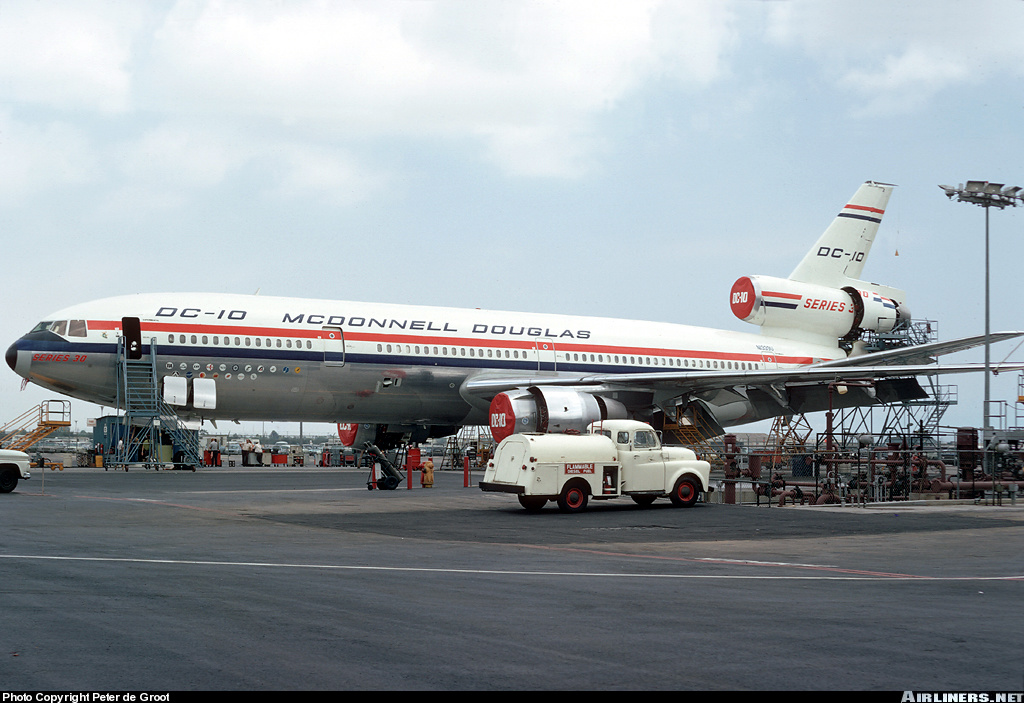
PH-DTA with KLM at AMS in July 1992 (revised blue tail titles):
www.flickr.com/photos/guidojet/50026915242
PH-DTA leased to African Safari at FRA in June 1994 (basic KLM colours):
www.flickr.com/photos/57000246@N05/15636990520
PH-DTA with KLM at AMS in July 1994 following lease to African Safari (no titles):
www.flickr.com/photos/100590958@N03/12246759385
This airframe as N525MD with Kras Air at PHX in March 1995 (logo on tail):
www.airhistory.net/photo/379177/N525MD
N525MD with Kras Air at DME in August 1995 (no logo):
www.flickr.com/photos/pslg05896/30984064372
N525MD with Continental Airlines at LGW in May 1998:
www.flickr.com/photos/ghbhd/50766381426
This airframe as N12089 with Continental Airlines at ZRH ca. late 1990s:
www.flickr.com/photos/154191970@N03/30442251938
Scan from Kodachrome slide.
Sigo apostando un año más por las personas incómodas para el sistema, por ellas y sus familias 💪
#educación #derechos #inclusion
Visit my blog for advice on how on how to take photographs of your children or submit a photo for inclusion in "Ken's Tips On Your Pics": www.kensharp.com/blog/category/kens-tips-on-your-pics-2/
© Ken Sharp. Please do not use or download without permission. If you have any queries please contact me: www.kensharp.com
members from the band "Groove Inclusion" (Unteres Remstal) during the FIS (Fürther inklusives Soundfestival) this year. My first live concert after a long time.
Foto tomada en el año 2013 en Argentina, desde el puente de la Mujer, gracias al préstamo de Rox Boyer de un lente suyo.
Photo taken by Manfred Kaffine and kindly provided by him for inclusion on this page.
München-Riem
September 1976
LN-SUF
Fokker F27-100 Friendship
10298
Air Executive Norway
LN-SUF with Air Executive Norway stayed at Riem from 14 to 16 September 1976. The Fokker had been noted here before with Braathens SAFE on 8 May 1976, coming in from RTM and flying on to Karlstad (information from Klaus Held’s Riem Chronicle).
Information from airhistory.net - thanks to Ole Johan Beck:
First flight April 5th 1966 as PH-FIS at Schiphol, and leased to Schreiner Airways as PH-SAN months. October 6th 1966 LN-SUF for Braathens SAFE as their 8th and final Friendship. in 1972 repainted and added name "Magnus Lagabøter". April 1976 LN-SUF Aerexecutive Norway tfd. September 1980 LN-SUF Busy Bee tfd. 1982 repainted to Busy Bee colours. Wfu November 1992. In July 1993 LN-SUF was donated to the Air Museum at Sola airport, Stavanger.
Registration details for this airframe:
rzjets.net/aircraft/?reg=118458
This airframe as PH-SAN with Schreiner Airways at AMS in 1966:
www.flickr.com/photos/jbsollentuna/31604887881
LN-SUF with Braathens SAFE at FAE in July 1974:
www.airhistory.net/photo/373510/LN-SUF
LN-SUF with Busy Bee ca. 1980s:
www.flickr.com/photos/154191970@N03/48731334903
LN-SUF preserved in Braathens SAFE colours at Flyhistorik Museum, Stavanger Airport, Sola, in June 2024:
www.flickr.com/photos/gary_morris/53848064219
Scan from Kodak mid-format (6x6 cm) slide, cropped to 3:2 aspect ratio.
Bowie County, Texas.
Yellow Wild Indigo (Baptisia sphaerocarpa) blooms in a prairie pocket near the Sulphur River. This remnant prairie is located within a broader matrix of forest.
Scan from the Michael Röser collection kindly provided by him for inclusion on this page.
München-Riem
June 1975
HB-IHD
McDonnell Douglas DC-10-30
46578/131
Swissair
Swissair DC-10s were very occasionally observed at Riem, on diversions or substituting for the usual DC-9s. Still, they were among the earliest DC-10s to be seen at the airport. HB-IHD was noted on 17 May 1975, probably the date of this photo here showing her lined up for take-off on runway 25 surrounded by blooming dandelions.
Other Swissair DC-10s reported at Riem include HB-IHA on 18 March 1973, HB-IHB on 5 November 1973, HB-IHE on 1 September 1979, HB-IHF on 31 October 1975, HB-IHG on 15 November 1978, HB-IHH on 5 July 1980, and HB-IHK (with Balair) on 23 April 1979.
HB-IHD was delivered new to Swissair in December 1973 (first called "Bern", later "Thurgau"). It was sold to JAT as YU-AMC in May 1988, went on to Electra Airlines as VP-BMP in January 1993, and Northwest as N228NW in July 1995. Wfu at Maxton, North Carolina, in December 2002 and broken up there. (Source: swissair00.ch)
Registration details for this airframe:
www.planelogger.com/Aircraft/Registration/HB-IHD/650846
HB-IHD with Swissair at GVA in May 1984 (later colours):
www.flickr.com/photos/kambui/23674522266
This airframe as YU-AMC with JAT at MEL in March 1989 (earlier colours):
www.flickr.com/photos/steelhead2010/9573911911
YU-AMC with JAT at ZRH ca. early 1990s (later colours):
www.flickr.com/photos/154191970@N03/45070867452
This airframe as VR-BMP stored at MHV in October 1993 (basic JAT colours):
www.flickr.com/photos/16278367@N05/46353178074
This airframe as N228NW with Northwest at LAX in January 1999:
imgproc.airliners.net/photos/airliners/3/1/8/5769813.jpg

ex-N228NW derelict at MXE ca. 2003, next to ex-N220NW, registration appears as „N2281“:
www.flickr.com/photos/lunken_spotter/11452410244
Scan from Kodachrome slide.
Photo taken by Wilhelm Hell, scan kindly provided by Michael Bernhard for inclusion on this page.
München-Riem
August 1973
G-AXLM
BAC 111-523FJ
199
British Midland Airways (BMA)
G-AXLM was seen at Riem a number of times in the early 1970s, visiting first on 25 March 1970 shortly after delivery to BMA. The airframe would return as 4X-BAS with Arkia in 1978/1979.
Information from airliners.net (slightly adapted) - thanks to Richard Vandervord:
First flight 26 December 1969 and delivered to British Midland Airways in March 1970 (flew for Court Line between September and April 1974). BMA sold G-AXLM to Transbrasil in 4.74, becoming PP-SDV. Leased to Cyprus Airways. Returned to BAC 2.77 and leased to Arkia as 4X-BAS for a year before sale to Philippine Airlines as RP-C1194 in 7.80. Wfu and stored at Manila from 6.90 until b/u for spares 1.96.
Registration details for this airframe:
www.planelogger.com/Aircraft/Registration/4X-BAS/813331
G-AXLM with Court Line at DUS in 1973:
imgproc.airliners.net/photos/airliners/8/4/8/1760848.jpg

This airframe as PP-SDV with Transbrasil CGH at in 1976:
www.flickr.com/photos/horaburo/8544583025
This airframe as G-AXLM with Cyprus Airways at DUS in 1977:
imgproc.airliners.net/photos/airliners/0/5/2/1758250.jpg

This airframe as 4X-BAS with Arkia at Riem in October 1978:
www.flickr.com/photos/161645265@N08/50359986517/in
This airframe as RP-C1194 with Philippine Airlines:
www.flickr.com/photos/154191970@N03/36008047661
Scan from Kodachrome slide.
Church wall early on a Sunday morning. Niagara Falls, Ontario.
If you like my work click the "Follow" button on Flickr.
Other places to see my work rumimume.blogspot.ca/, Google+ google+, twitter
Photo from the Michael Bernhard collection, scan kindly provided by him for inclusion on this page.
München-Riem
1976-05-22 (22 May 1976)
GBM 112
Douglas DC-6B
45564 / 1040
Zambia Air Force
A very special photo for me - I saw this aircraft depart from Riem that day from home but didn’t know what it was, I was only able to see the letters "GBM". Later I learned that it was a Zambia Air Force DC-6 - but only now I’ve seen a photo of it for the first time. Many thanks to Michael Bernhard!
Interestingly, GBM 112 had visited Riem before on 18 March 1975, and even earlier, on 8 June 1969, as YU-AFB with the Government of Yugoslavia. GBM 112’s sister ship, GBM 110, was also seen at Riem once, on 23 September 1975 (that one would become Red Bull’s OE-LDM).
Information from scramble.nl:
This airframe has an interesting history; as the last DC-6 built, it was delivered to Yugoslav Airlines JAT as YU-AFB in 1958 and in 1966 passed on to the Yugoslav Air Force as 7452, later reregistered as 73102. As such it was the presidential aircraft of President Tito. In 1970 it was shortly used by Adria Aviopromet as YU-AFB again, but then returned to the Yugoslav Air Force.
In 1975 the DC-6B was donated to Zambia, where it flew as GMB 112, the presidential aircraft of President Kaunda. In 1992 the propliner was sold to Namibia Commercial Aviation and registered as V5-NCG.
Its sister ship c/n 45563/1034, the second-to-the-last built DC-6B, is the one that was sold to Red Bull. It now flies as OE-LDM (still current in 2021).
V5-NCG has been stored in Namibia since 2010 but now there are plans to bring it back to the US (September 2020):
leehamnews.com/2020/09/21/pontifications-last-production-...
More details on this airframe including technical specifications and many photos:
Registration details for this airframe:
www.planelogger.com/Aircraft/Registration/YU-AFB/635243
This airframe as YU-AFB with JAT at ORY ca. early 1960s:
www.flickr.com/photos/169859437@N06/50802305383
This airframe as 7452 with Yugoslav Air Force at SXF in 1964:
www.planeboys.de/images/SXF%20AirlineFotos/0_gvmt_af/sw_z...
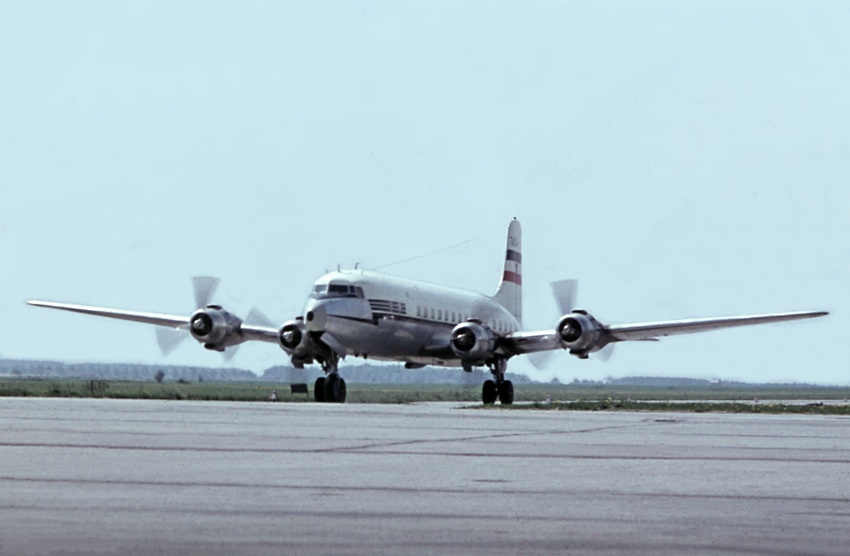
YU-AFB with Yugoslav Air Force at LBG in August 1969:
www.airhistory.net/photo/280823/YU-AFB
Another shot of GMB 112 with Zambia Air Force at Riem on 22 May 1976:
www.airhistory.net/photo/342668/GBM112
This airframe as V5-NCG with Namibia Commercial Aviation/Classic Air Travel at ERS in September 2004:
imgproc.airliners.net/photos/airliners/2/3/5/0693532.jpg

Cockpit view of V5-NCG with Namibia Commercial Aviation/Classic Air Travel at ERS in September 2004:
imgproc.airliners.net/photos/airliners/9/4/7/0685749.jpg

Cabin view of V5-NCG with Classic Air Travel at Namibia Commercial Aviation/Classic Air Travel in September 2004:
imgproc.airliners.net/photos/airliners/3/1/6/0683613.jpg

V5-NCG with Namibia Commercial Aviation/Classic Air Travel in flight at Pretoria - Waterkloof (FAWK) in September 2004:
imgproc.airliners.net/photos/airliners/5/7/1/0683175.jpg

V5-NCG with Namibia Commercial Aviation/Classic Air TravelClassic Air Travel stored at ERS in November 2016:
www.flickr.com/photos/75877584@N05/25261305588
Scan from Kodachrome slide.