View allAll Photos Tagged important
Important legal note.
All images are copyright and must not be re posted or water marks removed, anyone found reposting is liable to prosecution.
Important legal note.
All images are copyright and must not be re posted or water marks removed, anyone found reposting is liaIble to prosecution.
PORCELAIN ROOM FROM THE PALAIS Dubský IN BRNO
Vienna, around 1740
Ke 6201/1912
In 1700 the installation of so-called "porcelain cabinets" in Europe becomes modern. Have they been reliant on European fayences, so were these ones replaced over time by Chinese export goods and from 1700 on also by Japanese porcelains. The Porcelain Room from the Brno Palais Dubsky is one of the first room amenities with European porcelain.
Based on the attached above the pillar mirror Emblem of Czobor of Szent-Mihály, the decor of the room can be traced back to the years after 1724. Back then acquired Countess Maria Antonia of Czobor, lady on Göding, née Princess of Liechtenstein, the subsequent Palais Dubsky in Brno (Brno, today Czech Republic). From this time also stem the porcelains of the Vienna Porcelain Manufactory Du Paquier (1718-44).
Investigations on the integrated wall paneling of the room as well as the fact that the chimney already in Brno had been bricked without smoke outlet and therefore was not heatable, however, have shown that the facilities originally must have been manufactured for a different, right now yet unknown location and only later was adjusted to the smaller dimensions in Brno Palais. However, unclear remains to this day the time gap between the early, emerged before 1730 Vienna porcelains and the earliest in the forties datable ornamentation of the wall panels and a part of the furniture.
1745 the palace passes into the possession of Johann Georg von Piati from which it inherits his son Emanuel Piati of Tirnowitz 1762. The coat of arms of this family was originally painted with oil paint over that of Czobor and only in 1912 it was removed on the occasion of the acquisition of the room by the museum. From the time of the Piati, around 1790, also stems the decor of the room with paintings and the wall clock signed by Brno master watchmaker Sebastian Kurz.
Its current name the palace obtained finally on the ocassion of the wedding of Emanuela of Piati, the daughter of Johann Georg, with Franz Dubsky of Trebomyslic in 1805. As is apparent from later made additions by porcelains of Herend (Hungary) Porcelain Factory (founded in 1839) and by dated with 1847 pieces from the Vienna Porcelain Manufactory, must have been carried out around 1850 a larger restoration and new adaptation of the room. Back then most probably also emerged the seating furnitures as well as the console table of long wall and the canapé table.
PORZELLANZIMMER AUS DEM PALAIS DUBSKY IN BRÜNN
Wien, um 1740
Ke 6201/1912
Um 1700 wird das Einrichten so genannter „Porzellan-Cabinette“ in Europa modern. War man zuerst auf europäische Fayencen angewiesen, so wurden diese mit der Zeit durch chinesische Exportware und ab 1700 auch durch japanische Porzellane ersetzt. Das Porzellanzimmer aus dem Brünner Palais Dubsky ist eine der ersten Zimmerausstattungen mit europäischem Porzellan.
Anhand des über dem Pfeilerspiegel angebrachten Wappens der Czobor von Szent-Mihály lässt sich die Ausstattung des Zimmers bis in die Jahre nach 1724 zurückverfolgen. Damals erwarb Gräfin Maria Antonia von Czobor, Frau auf Göding, geb. Fürstin von Liechtenstein, das nachmalige Palais Dubsky in Brünn (Brno, heute: Tschechische Republik). Aus dieser Zeit stammen auch die Porzellane der Wiener Manufaktur Du Paquier (1718–44).
Untersuchungen an der wandfesten Vertäfelung des Raumes sowie die Tatsache, dass der Kamin bereits in Brünn ohne Rauchabzug gemauert und daher nicht beheizbar war, haben jedoch gezeigt, dass die Ausstattung ursprünglich für einen anderen, heute noch unbekannten Ort verfertigt worden sein muss und erst später den kleineren Dimensionen im Brünner Palais angepasst wurde. Unklar bleibt aber bis heute die zeitliche Diskrepanz zwischen den frühen, vor 1730 entstandenen Wiener Porzellanen und der frühestens in die vierziger Jahre datierbaren Ornamentik der Wandvertäfelungen und eines Teils des Mobiliars.
1745 geht das Palais in den Besitz des Johann Georg von Piati über, von dem es sein Sohn Emanuel Piati von Tirnowitz 1762 erbt. Das Wappen dieser Familie war ursprünglich mit Ölfarbe über jenes der Czobor gemalt und erst 1912 anlässlich der Erwerbung des Zimmers durch das Museum entfernt worden. Aus der Zeit der Piati, um 1790, stammt auch die Ausstattung des Zimmers mit Bildern und der vom Brünner Uhrmachermeister Sebastian Kurz signierten Wanduhr.
Seinen heutigen Namen erhielt das Palais schließlich anlässlich der Hochzeit von Emanuela von Piati, der Tochter Johann Georgs, mit Franz Dubsky von Trebomyslic im Jahr 1805. Wie aus später vorgenommenen Ergänzungen durch Porzellane der Herender Porzellanfabrik (gegründet 1839) und durch 1847 datierte Stücke aus der Wiener Porzellanmanufaktur hervorgeht, muss um 1850 eine größere Restaurierung und Neuadaptierung des Zimmers erfolgt sein. Damals entstanden höchstwahrscheinlich auch die Sitzmöbel ebenso wie der Konsoltisch der Längswand und der Kanapeetisch.
The history of the Austrian Museum of Applied Art/Contemporary Art
1863 / After many years of efforts by Rudolf Eitelberger decides emperor Franz Joseph I on 7 March on the initiative of his uncle archduke Rainer, following the model of the in 1852 founded South Kensington Museum (now the Victoria and Albert Museum, London) the establishment of the "k.u.k. Austrian Museum for Art and Industry" and appoints Rudolf von Eitelberger, the first professor of art history at the University of Vienna director. The museum should be serving as a specimen collection for artists, industrialists, and public and as a training and education center for designers and craftsmen.
1864/ on 12th of May, opened the museum - provisionally in premises of the ball house next to the Vienna Hofburg, the architect Heinrich von Ferstel for museum purposes had adapted. First exhibited objects are loans and donations from the imperial collections, monasteries, private property and from the k.u.k. Polytechnic in Vienna. Reproductions, masters and plaster casts are standing value-neutral next originals.
1865-1897 / The Museum of Art and Industry publishes the journal Communications of Imperial (k.u.k.) Austrian Museum for Art and Industry .
1866 / Due to the lack of space in the ballroom the erection of an own museum building is accelerated. A first project of Rudolf von Eitelberger and Heinrich von Ferstel provides the integration of the museum in the project of imperial museums in front of the Hofburg Imperial Forum. Only after the failure of this project, the site of the former Exerzierfelds (parade ground) of the defense barracks before Stubentor the museum here is assigned, next to the newly created city park at the still being under development Rind Road.
1867 / Theoretical and practical training are combined with the establishment of the School of Applied Arts. This will initially be housed in the old gun factory, Währinger street 11-13/Schwarzspanier street 17, Vienna 9.
1868 / With the construction of the building at Stubenring is started as soon as it is approved by emperor Franz Joseph I. the second draft of Heinrich Ferstel.
1871 / The opening of the building at Stubering takes place after three years of construction, 15 November. Designed according to plans by Heinrich von Ferstel in the Renaissance style, it is the first built museum building at the Ring. Objects from now on could be placed permanently and arranged according to main materials. / / The School of Arts and Crafts (Kunstgewerbeschule) moves into the house at Stubenring. / / Opening of Austrian arts and crafts exhibition.
1873 / Vienna World Exhibition. / / The Museum of Art and Industry and the Vienna School of Arts and Crafts are exhibiting together at Stubenring. / / Rudolf von Eitelberger organizes in the framework of the World Exhibition the worldwide first international art scientific congress in Vienna, thus emphasizing the orientation of the Museum on teaching and research. / / During the World Exhibition major purchases for the museum from funds of the Ministry are made, eg 60 pages of Indo-Persian Journal Mughal manuscript Hamzanama.
1877 / decision on the establishment of taxes for the award of Hoftiteln (court titels). With the collected amounts the local art industry can be promoted. / / The new building of the School of Arts and Crafts, adjoining the museum, Stubenring 3, also designed by Heinrich von Ferstel, is opened.
1878 / participation of the Museum of Art and Industry as well as of the School of Arts and Crafts at the Paris World Exhibition.
1884 / founding of the Vienna Arts and Crafts Association with seat in the museum. Many well-known companies and workshops (led by J. & L. Lobmeyr), personalities and professors of the School of Arts and Crafts join the Arts and Crafts Association. Undertaking of this association is to further develop all creative and executive powers the arts and craft since the 1860s has obtained. For this reason are organized various times changing, open to the public exhibitions at the Imperial Austrian Museum for Art and Industry. The exhibits can also be purchased. These new, generously carried out exhibitions give the club the necessary national and international resonance.
1885 / After the death of Rudolf von Eitelberger, Jacob von Falke, his longtime deputy, is appointed manager. Falke plans all collection areas al well as publications to develop newly and systematically. With his popular publications he influences significantly the interior design style of the historicism in Vienna.
1888 / The Empress Maria Theresa exhibition revives the contemporary discussion with the high Baroque in the history of art and in applied arts in particular.
1895 / end of directorate of Jacob von Falke. Bruno Bucher, longtime curator of the Museum of metal, ceramic and glass, and since 1885 deputy director, is appointed director.
1896 / The Vienna Congress exhibition launches the confrontation with the Empire and Biedermeier style, the sources of inspiration of Viennese Modernism.
1897 / end of the directorate of Bruno Bucher. Arthur von Scala, director of the Imperial Oriental Museum in Vienna since its founding in 1875 (renamed Imperial Austrian Trade Museum 1887), takes over the management of the Museum of Art and Industry. / / Scala wins Otto Wagner, Felician of Myrbach, Koloman Moser, Josef Hoffmann and Alfred Roller to work at the museum and School of Arts and Crafts. / / The style of the Secession is crucial for the Arts and Crafts School. Scala propagates the example of the Arts and Crafts Movement and makes appropriate acquisitions for the museum's collection.
1898 / Due to differences between Scala and the Arts and Crafts Association, which sees its influence on the Museum wane, archduke Rainer puts down his function as protector. / / New statutes are written.
1898-1921 / The Museum magazine Art and Crafts replaces the Mittheilungen (Communications) and soon gaines international reputation.
1900 / The administration of Museum and Arts and Crafts School is disconnected.
1904 / The Exhibition of Old Vienna porcelain, the to this day most comprehensive presentation on this topic, brings with the by the Museum in 1867 definitely taken over estate of the "k.u.k. Aerarial Porcelain Manufactory" (Vienna Porcelain Manufactory) important pieces of collectors from all parts of the Habsburg monarchy together.
1907 / The Museum of Art and Industry takes over the majority of the inventories of the Imperial Austrian Trade Museum, including the by Arthur von Scala founded Asia collection and the extensive East Asian collection of Heinrich von Siebold .
1908 / Integration of the Museum of Art and Industry in the Imperial and Royal Ministry of Public Works.
1909 / separation of Museum and Arts and Crafts School, the latter remains subordinated to the Ministry of Culture and Education. / / After three years of construction, the according to plans of Ludwig Baumann extension building of the museum (now Weiskirchnerstraße 3, Wien 1) is opened. The museum thereby receives rooms for special and permanent exhibitions. / / Arthur von Scala retires, Eduard Leisching follows him as director. / / Revision of the statutes.
1909 / Archduke Carl exhibition. For the centenary of the Battle of Aspern. / / The Biedermeier style is discussed in exhibitions and art and arts and crafts.
1914 / Exhibition of works by the Austrian Art Industry from 1850 to 1914, a competitive exhibition that highlights, among other things, the role model of the museum for arts and crafts in the fifty years of its existence.
1919 / After the founding of the First Republic it comes to assignments of former imperial possession to the museum, for example, of oriental carpets that are shown in an exhibition in 1920. The Museum now has one of the finest collections of oriental carpets worldwide.
1920 / As part of the reform of museums of the First Republic, the collection areas are delimited. The Antiquities Collection of the Museum of Art and Industry is given away to the Museum of Art History.
1922 / The exhibition of glasses of classicism, the Empire and Biedermeier time offers with precious objects from the museum and private collections an overview of the art of glassmaking from the former Austro-Hungarian Empire. / / Biedermeier glass serves as a model for contemporary glass production and designs, such as of Josef Hoffmann.
1922 / affiliation of the museal inventory of the royal table and silver collection to the museum. Until the institutional separation the former imperial household and table decoration is co-managed by the Museum of Art and Industry and is inventoried for the first time by Richard Ernst.
1925 / After the end of the directorate of Eduard Leisching, Hermann Trenkwald is appointed director.
1926 / The exhibition Gothic in Austria gives a first comprehensive overview of the Austrian panel painting and of arts and crafts of the 12th to 16th Century.
1927 / August Schestag succeeds Hermann Trenkwald as director.
1930 / The Werkbund (artists' organization) Exhibition Vienna, a first comprehensive presentation of the Austrian Werkbund, takes place on the occasion of the meeting of the Deutscher (German) Werkbund in Austria, it is organized by Josef Hoffmann in collaboration with Oskar Strnad, Josef Frank, Ernst Lichtblau and Clemens Holzmeister.
1931 / August Schestag concludes his directorate.
1932 / Richard Ernst is new director.
1936 and 1940 / In exchange with the Kunsthistorisches Museum (Museum of Art History), the museum at Stubenring gives away part of the sculptures and takes over arts and crafts inventories of the collection Albert Figdor and the Kunsthistorisches Museum.
1937 / The Collection of the Museum of Art and Industry is newly set up by Richard Ernst according to periods. / / Oskar Kokoschka exhibition on the 50th birthday of the artist.
1938 / After the "Anschluss" (annexation) of Austria by Nazi Germany, the museum is renamed into "National Museum of Arts and Crafts in Vienna".
1939-1945 / The museums are taking over numerous confiscated private collections. The collection of the "State Museum of Arts and Crafts in Vienna" in this way also is enlarged.
1945 / Partial destruction of the museum building by impact of war. / / War losses on collection objects, even in the places of rescue of objects.
1946 / The return of the outsourced objects of art begins. A portion of the during the Nazi time expropriated objects is returned in the following years.
1947 / The "State Museum of Arts and Crafts in Vienna" is renamed into "Austrian Museum of Applied Arts".
1948 / The "Cathedral and Metropolitan Church of St. Stephen" organizes the exhibition The St. Stephen's Cathedral in the Museum of Applied Arts. History, monuments, reconstruction.
1949 / The Museum is reopened after repair of the war damages.
1950 / As last exhibition under director Richard Ernst takes place Great art from Austria's monasteries (Middle Ages).
1951 / Ignaz Schlosser is appointed manager.
1952 / The exhibition Social home decor, designed by Franz Schuster, makes the development of social housing in Vienna again the topic of the Museum of Applied Arts.
1955 / The comprehensive archive of the Wiener Werkstätte (workshop) is acquired.
1955-1985 / The Museum publishes the periodical ancient and modern art .
1956 / Exhibition New Form from Denmark, modern design from Scandinavia becomes topic of the museum and model.
1957 / On the occasion of the exhibition Venini Murano glass, the first presentation of Venini glass in Austria, there are significant purchases and donations for the collection of glass.
1958 / End of the directorate of Ignaz Schlosser
1959 / Viktor Griesmaier is appointed as new director.
1960 / Exhibition Artistic creation and mass production of Gustavsberg, Sweden. Role model of Swedish design for the Austrian art and crafts.
1963 / For the first time in Europe, in the context of a comprehensive exhibition art treasures from Iran are shown.
1964 / The exhibition Vienna around 1900 (organised by the Cultural Department of the City of Vienna) presents for the frist time after the Second World War, inter alia, arts and crafts of Art Nouveau. / / It is started with the systematic work off of the archive of the Wiener Werkstätte. / / On the occasion of the founding anniversary offers the exhibition 100 years Austrian Museum of Applied Arts using examples of historicism insights into the collection.
1965 / The Geymüllerschlössel (small castle) is as a branch of the Museum angegliedert (annexed). Simultaneously with the building came the important collection of Franz Sobek - old Viennese clocks, made between 1760 and the second half of the 19th Century - and furniture from the years 1800 to 1840 in the possession of the MAK.
1966 / In the exhibition Selection 66 selected items of modern Austrian interior designers (male and female ones) are brought together.
1967 / The Exhibition The Wiener Werkstätte. Modern Arts and Crafts from 1903 to 1932 is founding the boom that continues until today of Austria's most important design project in the 20th Century.
1968 / To Viktor Griesmaier follows Wilhelm Mrazek as director.
1969 / The exhibition Sitting 69 shows at the international modernism oriented positions of Austrian designers, inter alia by Hans Hollein.
1974 / For the first time outside of China Archaeological Finds of the People's Republic of China are shown in a traveling exhibition in the so-called Western world.
1979 / Gerhart Egger is appointed director.
1980 / The exhibition New Living. Viennese interior design 1918-1938 provides the first comprehensive presentation of the spatial art in Vienna during the interwar period.
1981 / Herbert Fux follows Gerhart Egger as director.
1984 / Ludwig Neustift is appointed interim director. / / Exhibition Achille Castiglioni: designer. First exhibition of the Italian designer in Austria
1986 / Peter Noever is appointed director and starts with the building up of the collection contemporary art.
1987 / Josef Hoffmann. Ornament between hope and crime is the first comprehensive exhibition on the work of the architect and designer.
1989-1993 / General renovation of the old buildings and construction of a two-storey underground storeroom and a connecting tract. A generous deposit for the collection and additional exhibit spaces arise.
1989 / Exhibition Carlo Scarpa. The other city, the first comprehensive exhibition on the work of the architect outside Italy.
1990 / exhibition Hidden impressions. Japonisme in Vienna 1870-1930, first exhibition on the theme of the Japanese influence on the Viennese Modernism.
1991 / exhibition Donald Judd Architecture, first major presentation of the artist in Austria.
1992 / Magdalena Jetelová domestication of a pyramid (installation in the MAK portico).
1993 / The permanent collection is newly put up, interventions of internationally recognized artists (Barbara Bloom, Eichinger oder Knechtl, Günther Förg, GANGART, Franz Graf, Jenny Holzer, Donald Judd, Peter Noever, Manfred Wakolbinger and Heimo Zobernig) update the prospects, in the sense of "Tradition and Experiment". The halls on Stubenring accommodate furthermore the study collection and the temporary exhibitions of contemporary artists reserved gallery. The building in the Weiskirchner street is dedicated to changing exhibitions. / / The opening exhibition Vito Acconci. The City Inside Us shows a room installation by New York artist.
1994 / The Gefechtsturm (defence tower) Arenbergpark becomes branch of the MAK. / / Start of the cooperation MAK/MUAR - Schusev State Museum of Architecture Moscow. / / Ilya Kabakov: The Red Wagon (installation on MAK terrace plateau).
1995 / The MAK founds the branch of MAK Center for Art and Architecture in Los Angeles, in the Schindler House and at the Mackey Apartments, MAK Artists and Architects-in-Residence Program starts in October 1995. / / Exhibition Sergei Bugaev Africa: Krimania.
1996 / For the exhibition Philip Johnson: Turning Point designs the American doyen of architectural designing the sculpture "Viennese Trio", which is located since 1998 at the Franz-Josefs-Kai/Schottenring.
1998 / The for the exhibition James Turrell. The other Horizon designed Skyspace today stands in the garden of MAK Expositur Geymüllerschlössel. / / Overcoming the utility. Dagobert Peche and the Wiener Werkstätte, the first comprehensive biography of the work of the designer of Wiener Werkstätte after the Second World War.
1999 / Due to the Restitution Act and the Provenance Research from now on numerous during the Nazi time confiscated objects are returned.
2000 / Outsourcing of Federal Museums, transformation of the museum into a "scientific institution under public law". / / The exhibition Art and Industry. The beginnings of the Austrian Museum of Applied Arts in Vienna is dealing with the founding history of the house and the collection.
2001 / In the course of the exhibition Franz West: No Mercy, for which the sculptor and installation artist developed his hitherto most extensive work, the "Four lemurs heads" are placed at the bridge Stubenbrücke, located next to the MAK. / / Dennis Hopper: A System of Moments.
2001-2002 / The CAT Project - Contemporary Art Tower after New York, Los Angeles, Moscow and Berlin is presented in Vienna.
2002 / Exhibition Nodes. symmetrical-asymmetrical. The historical Oriental Carpets of the MAK presents the extensive rug collection.
2003 / Exhibition Zaha Hadid. Architecture. / / For the anniversary of the artist workshop, takes place the exhibition The Price of Beauty. 100 years Wiener Werkstätte. / / Richard Artschwager: The Hydraulic Door Check. Sculpture, painting, drawing.
2004 / James Turrell's MAKlite is since November 2004 permanently on the facade of the building installed. / / Exhibition Peter Eisenmann. Barefoot on White-Hot Walls, large-scaled architectural installation on the work of the influential American architect and theorist.
2005 / Atelier Van Lieshout: The Disciplinator / / The exhibition Ukiyo-e Reloaded presents for the first time the collection of Japanese woodblock prints of the MAK on a large scale.
2006 / Since the beginning of the year, the birthplace of Josef Hoffmann in Brtnice of the Moravian Gallery in Brno and the MAK Vienna as a joint branch is run and presents annually special exhibitions. / / The exhibition The Price of Beauty. The Wiener Werkstätte and the Stoclet House brings the objects of the Wiener Werkstätte to Brussels. / / Exhibition Jenny Holzer: XX.
2007/2008 / Exhibition Coop Himmelb(l)au. Beyond the Blue, is the hitherto largest and most comprehensive museal presentation of the global team of architects.
2008 / The 1936 according to plans of Rudolph M. Schindler built Fitzpatrick-Leland House, a generous gift from Russ Leland to the MAK Center LA, becomes with the aid of a promotion that granted the Bureau of Educational and Cultural Affairs of the U.S. Department the MAK Center, center of the MAK UFI project - MAK Urban Future Initiative. / / Julian Opie: Recent Works / / The exhibition Recollecting. Looting and Restitution examines the status of efforts to restitute expropriated objects from Jewish property from museums in Vienna.
2009 / The permanent exhibition Josef Hoffmann: Inspiration is in the Josef Hoffmann Museum, Brtnice opened. / / Exhibition Anish Kapoor. Shooting into the Corner / / The museum sees itself as a promoter of Cultural Interchange and discusses in the exhibition Global:lab Art as a message. Asia and Europe 1500-1700 the intercultural as well as the intercontinental cultural exchange based on objects from the MAK and from international collections.
2011 / After Peter Noever's resignation, Martina Kandeler-Fritsch takes over temporarily the management. / /
Since 1 September Christoph Thun-Hohenstein is director of the MAK and declares "change through applied art" as the new theme of the museum.
2012 / With future-oriented examples of mobility, health, education, communication, work and leisure, shows the exhibition MADE4YOU. Designing for Change, the new commitment to positive change in our society through applied art. // Exhibition series MAK DESIGN SALON opens the MAK branch Geymüllerschlössel for contemporary design positions.
2012/2013 / opening of the newly designed MAK Collection Vienna 1900. Design / Decorative Arts from 1890 to 1938 in two stages as a prelude to the gradual transformation of the permanent collection under director Christoph Thun-Hohenstein
2013 / SIGNS, CAUGHT IN WONDER. Looking for Istanbul today shows a unique, current snapshot of contemporary art production in the context of Istanbul. // The potential of East Asian countries as catalysts for a socially and ecologically oriented, visionary architecture explores the architecture exhibition EASTERN PROMISES. Contemporary Architecture and production of space in East Asia. // With a focus on the field of furniture design NOMADIC FURNITURE 3.0. examines new living without bounds? the between subculture and mainstream to locate "do-it-yourself" (DIY) movement for the first time in a historical context.
2014 / Anniversary year 150 years MAK // opening of the permanent exhibition of the MAK Asia. China - Japan - Korea // Opening of the MAK permanent exhibition rugs // As central anniversary project opens the dynamic MAK DESIGN LABORATORY (redesign of the MAK Study Collection) exactly on the 150th anniversary of the museum on May 12, 2014 // Other major projects for the anniversary: ROLE MODELS. MAK 150 years: from arts and crafts to design // // HOLLEIN WAYS OF MODERN AGE. Josef Hoffmann, Adolf Loos and the consequences.
History of the Vienna State Opera
132 years house on the Ring
(you can see pictures by clicking on the link at the end of page!)
State Opera (K.K. Court Opera) 1901
About three and a half centuries, until the early Baroque period, the tradition of Viennese opera goes back. Emperor Franz Joseph I decreed in December 1857 to tear down the old city walls and fortifications around the city center of Vienna and to lay out a wide boulevard with new buildings for culture and politics, the ring road.
The two Court Theatres (a speech and a musical theater) should find a new place on the ring. For the Imperial and Royal Court Opera House was chosen a prominent place in the immediate area of the former Kärntnertortheatre. This by the public that much loved opera theater was demolished in 1709 due to its confinement .
State Opera (K.K. Court Opera) 1903
The new opera house was built by the Viennese architect August Sicardsburg, who designed the basic plan, and Eduard van der Null, who designed the interior decoration. But other eminent artists had been involved: just think of Moritz von Schwind, who painted the frescoes in the foyer and the famous "Magic Flute", cycle of frescoes in the loggia. The two architects did not experience the opening of "their" opera house any more. The sensitive van der Null committed suicide since the Wiener (Viennes people) denigrated the new house as lacking in style, his friend Sicardsburg succumbed a little later to a stroke.
1869 - 1955
On 25 May 1869 the House was with Mozart's DON JUAN in the presence of Emperor Franz Joseph, the highest building owner, and Empress Elisabeth opened.
However, with the artistic charisma under the first directors Franz von Dingelstedt, Johann Herbeck, Franz Jauner and Wilhelm Jahn grew the popularity of the building. A first highlight experienced the Vienna Opera under the director Gustav Mahler, renewing the outdated performance system from scratch, strengthening precision and ensemble spirit and also using significant visual artists (including Alfred Roller) for the shaping of the new stage aesthetic.
In the ten-year-period of his Directorate (1897-1907) continued Gustav Mahler, this very day, in the concert halls of the world as the most important member of a Symphony Orchestra at the turn of the 20th century omnipresent, the intensive fostering of Wagner, Mozart's operas and Beethoven's Fidelio were redesigned, the with Richard Strauss initiated connection to Verdi was held upright. Austrian composers were promoted (Hugo Wolf), the Court Opera was opened to European modernism.
Image: Emperor Franz Joseph I and Emperor Wilhelm II during a gala performance at the Vienna Court Opera in 1900 resulting from the "Book of the Emperor", edited by Max Herzig.
Technique: Lithography
from www.aeiou.at
In addition to the classics of the Italian repertoire were and are especially Mozart, Wagner and Richard Strauss (himself 1919-1924 director of the House), the musical protection gods of the Vienna State Opera.
staatsoper_81.jpg (28138 bytes)
The modern also always had its place: the twenties and thirties witnessed the Vienna premieres of Krenek's Jonny spielt auf, Cardillac Hindemith, Korngold MIRACLE OF Héliane and Berg's Wozzeck (under President Clemens Krauss). This tradition was interrupted with the seizure of power by the National Socialists, yes, after the devastating bomb hits, on 12 March 1945 the house on the ring largely devastating, the care of the art form itself was doubtful.
The Viennese, who had preserved a lively cultural life during the war, were deeply shocked to see the symbol of the Austrian musical life in ruins.
But the spirit of the opera was not destroyed. On 1 May 1945 "State Opera Volksoper" was opened with a brilliant performance of Mozart's THE MARRIAGE OF FIGARO, on 6 October 1945 was followed by the re-opening of the hastily restored Theater an der Wien with Beethoven's Fidelio. Thus there were two venues for the next ten years, while the actual main building was rebuilt at great expense.
staatsoper_84.jpg (14707 bytes)
Visitors flock to the opera. Reopening on 5th November, 1955.
Image from © www.staatsvertrag.at / bildarchiv austria / ÖGZ / Hilscher
As early as 24 May 1945 the State Secretary of Public Works, Julius Raab, had announced the reconstruction of the Vienna State Opera, which should be placed in the hands of the Austrian architects Erich Boltenstern and Otto Prossinger. Only the main façade, the grand staircase and the Schwindfoyer (evanescence foyer) had been spared from the bombs - with a new auditorium and modernized technology, the Vienna State Opera was brilliant with Beethoven's Fidelio under Karl Böhm on 5 November 1955 reopened. The opening ceremonies were broadcasted from Austrian television and in the whole world at the same time as a sign of life of the resurrected 2nd Republic understood.
staatsoper_83.jpg (33866 bytes)
State ceremony to the reopening on 5 November 1955. On the far right under the box of the Federal President a television camera of the Austrian Broadcasting Corporation is visible which broadcasted the event. Image from © www.staatsvertrag.at / ÖGZ / Cermak
1955 to 1992
The dictum that the Vienna State Opera survives every director, is attributed to Egon Seefehlner which himself for many years run the businessses of the house. And yet marked he and the thirty-one other directors of the Vienna State Opera since 1869, great musicians or musical administrators, in their own way the profile of this world-famous institution:
staatsoper_82.jpg (13379 bytes)
Performance for the reopening of the Vienna State Opera on 5 November, 1955.
Image from © www.staatsvertrag.at / bildarchiv austria / ÖGZ / Hilscher
After the Second World War there were first the conductors directors Karl Böhm and Herbert von Karajan - the latter insisted on the title "Artistic Director" and opened the Ensemble house to the international singer market, had the opera rehearsed in original language and oriented his plans to "co-productions" with foreign opera houses, however, which were only realized after his term.
It followed as directors Egon Hilbert, Heinrich Reif-Gintl, Rudolf Gamsjäger and the mentioned Egon Seefehlner, who was appointed for a second time at the top of the house after the departure of his successor in office Lorin Maazel. Claus Helmut Drese (State Opera director from 1986 to 1991) stood with Claudio Abbado an internationally renowned music director by his side. At the beginning of the 90s the forrmer star baritone Eberhard Waechter, at that time director of the Volksoper (People's Opera), charged with the direction. Only seven months have been granted to him as a director.
The era Ioan Holender (1992 to 2010)
After Waechter's tragic death in March 1992 took over general secretary Ioan Holender, a former singer (baritone) and owner of a singer Agency, the office to continue the tradition of perhaps the most important opera institution in the world over the millennium to 2010.
His play plan design relies besides an extremely wide repertoire with the columns Mozart, Wagner, Verdi and Strauss mainly on premieres. Mention may be made of Bellini's I Puritani (1993 /94), Massenet Hérodiade (1994 /95), Verdi's Jerusalem and Britten's PETER GRIMES (1995 /96), Verdi's Stiffelio and Enescu OEDIPE (1996 /97), Rossini's GUILLAUME TELL and Lehár's operetta THE MERRY WIDOW (1998/99) and Schoenberg's THE JAKOBSLEITER, Hiller's PETER PAN, Donizetti's ROBERTO DEVEREUX, Britten's Billy Budd, Verdi's Nabucco (2000/ 01), Bellini's LA SONNAMBULA, Gounod's Roméo et Juliette, Janácek's Jenufa (2001/02), Verdi's SIMON BOCCANEGRA, Krenek's Jonny spielt auf, Donizetti's La Favorite, Hiller's PINOCCHIO, Wagner's TRISTAN UND ISOLDE (2002/ 03), Verdi's FALSTAFF, Wagner's FLYING DUTCHMAN and PARSIFAL, Strauss's Daphne (2003/ 04) and the world premiere of the original French version of Verdi's DON CARLOS (2003/ 04). A particular success of the recent past, the rediscovery of Fromental Halévy's La Juive Grand (1999 ) must be considered. Two premières concerned 1995 Adriana Hölszky's THE WALLS (co-production with the Vienna Festival at the Theater an der Wien ) and Alfred Schnittke's Gesualdo. On 15 June 2002 also THE GIANT OF STONE FIELD (Music: Peter Turrini: Friedrich Cerha libretto) premiered with great success, another commissioned work of the Vienna State Opera.
State Opera - © Oliver Thomann - FOTOLIA
Image : Vienna State Opera
In recent years it came up, in each case on 18 May, the anniversary of the death of Gustav Mahler, to concerts of the Vienna Philharmonic at the Vienna State Opera. These were under the direction of Seiji Ozawa (who since the 2002 /03 season the Vienna State Opera director Holender as music director of the house stands to the side) (1995), Carlo Maria Giulini (1996), Riccardo Muti (1997), Lorin Maazel (1998), Zubin Mehta (1999), Giuseppe Sinopoli (2000 ), Riccardo Muti (2001) and again Seiji Ozawa (2004).
Furthermore, was on 16 June, 2002 for the first time by the Vienna Philharmonic Orchestra (conducted by Seiji Ozawa) a CONCERT FOR AUSTRIA organized. More CONCERTS FOR AUSTRIA followed on 26 October 2003 (Zubin Mehta) and 26 October 2004 (under Valery Gergiev).
At the Theater an der Wien Mozart's Così fan tutte experienced a triumphant new production conducted by Riccardo Muti. This Mozart cycle under Muti continued with DON GIOVANNI and 2001 LE MARRIAGE OF FIGARO, 1999.
more...
Directors since 1869
Franz von Dingelstedt 07/01/1867 - 18/12/1870
Opening 5/25/1869
Johann von Herbeck 12/19/1870 - 30/04/1875
Franz von Jauner 01/05/1875 - 18/06/1880
Director College:
Karl Mayerhofer, Gustav Walter and
Emil Scaria 19.06.1880 - 31.12.1880
Wilhelm Jahn 01.01.1881 - 10.14.1897
Gustav Mahler 10/15/1897 - 31/12/1907
Felix Weingartner 01.01.1908 - 28.02.1911
Hans Gregor 01.03.1911 - 14.11.1918
Franz Schalk 15.11.1918 - 08.15.1919
Richard Strauss/Franz Schalk 16/08/1919 - 31/10/1924
Franz Schalk 1/11/1924 - 8/31/1929
Clemens Krauss 01/09/1929 - 15/12/1934
Felix Weingartner, 01.01.1935 - 08.31.1936
Erwin Kerber 09/01/1936 - 08/31/1940
Henry K. Strohm 09.01.1940 - 19.04.1941
Walter Thomas 02.01.1941 - 19.04.1941
Ernst August Schneider 04/20/1941 - 02/28/1943
Karl Böhm 03.01.1943 - 30.04.1945
Alfred Jerger,
State Opera in the Volksoper 01.05.1945 - 14.06.1945
Franz Salmhofer,
State Opera in the Theater an der Wien, 18.06.1945 - 31.08.1955
Karl Böhm 01.09.1954 - 31.08.1956
Herbert von Karajan 01.09.1956 - 31.03.1962
Herbert von Karajan/Walter Erich Schäfer 01.04.1962 - 08.06.1963
Herbert von Karajan/Egon Hilbert 09.06.1963 - 31.08.1964
Egon Hilbert 01.09.1964 - 18.01.1968
Heinrich Reif- Gintl 19.01.1968 - 31.08.1972
Rudolf Gamsjager 01.09.1972 - 31.08.1976
Egon Seefehlner 01.09.1976 - 31.08.1982
Lorin Maazel 01.09.1982 - 31.08.1984
Egon Seefehlner 01.09.1984 - 31.08.1986
Dr. Claus Helmut Drese 01.09.1986 - 31.08.1991
Eberhard Waechter 01.09.1991 - 29.03.1992
Ioan Holender 01.04.1992 - 31.08.2010
Dominique Meyer since 01/09/2010
Opera world premieres
Abbreviations:
Od = the Odeon
Ron = Ronacher
TW = the Theater an der Wien
1875 10:03. Goldmark The Queen of Sheba
1877 04:10. Brüller Der Landfriede
1880 26.05. Riedel The Accolade
15.12. Brüller Bianca
1883 04.01. Leschetitzky The first fold
21.02. Bachrich Muzzedin
1884 26.03. Bachrich Heini of Styria
1886 30.03. Hellmesberger jun. Fata Morgana
4:10 . Hager Marffa
19.11. Goldmark Merlin
1887 03:04. Harold pepper
1889 27.03. Fox The Bride King
4:10. Smareglia The vassal of Szigeth
1891 19:02. Mader Refugees
1892 01.01. J. Strauss Ritter Pasman
16.02. Massenet Werther
19.11. Bulk Signor Formica
1894 20.01. Heuberger Miriam
1896 21.03. Goldmark The Cricket on the Hearth
1899 17:01. The Goldmark prisoners of war
1900 22:01. Zemlinsky It was once
1902 28.02. Forster The dot mon
1904 18:02. Wolf The Corregidor
1908 02.01. Goldmark The Winter's Tale
1910 12:04. The musician Bittner
18.05. Goldmark Götz von Berlichingen
1911 09:11. Bittner The mountain lake
1912 16.03. Oberleithner Aphrodite
1913 15.03. Schreker The game works and the Princess
1914 01.04. Schmidt Notre Dame
1916 04:10. R. Strauss Ariadne auf Naxos (Vienna version)
1917 23.11. Zaiszek-Blankenau Ferdinand and Luise
1919 10.10. R. Strauss Die Frau ohne Schatten
1920 13.05. Weingartner Champion Andrea/The Village School
1921 09.04. The Bittner Kohlhaymerin
1924 20.09. Beethoven/R. Strauss The Ruins of Athens
1925 24.02. Kienzl Sanctissimum
27.03. Frank The image of the Madonna
1931 20.06. Wellesz The Bacchae
1932 10:11. Heger The beggar Nameless
1934 20.01. Lehár Giuditta
08.12. Bittner The violet
1935 26.12. Salmhofer lady in dream
1937 06.02. Wenzl - Traun rock the atonement
17.04. Frank The strange woman
18.11. Weinberger Wallenstein
1938 09.03. Salmhofer Ivan Tarasenko
1939 02:02. Will King ballad
1941 04:04. Wagner Régeny Johanna Balk
1956 17.06. Martin The Storm
1971 23.05. The visit of an old lady
1976 17.12. A Love and Intrigue
1989 25.11. The blind Furrer (OD)
1990 06:12. Krenek last dance at St. Stephen's (Ron)
1995 20.05. Hölszky The walls (TW)
26.05. Schnittke Gesualdo
2002 15.06. Cerha Der Riese vom Steinfeld
2007 15:04 Naske The Omama in the apple tree
2010 28.02. Reimann Medea
2010 10:05. Eröd dots and Anton
Important legal note.
All images are copyright and must not be re posted or water marks removed, anyone found reposting is liaIble to prosecution.
Important legal note.
All images are copyright and must not be re posted or water marks removed, anyone found reposting or removing water marks are liable to prosecution.
Rapid strata formation in soft sand (field evidence).
Photo of strata formation in soft sand on a beach, created by tidal action of the sea.
Formed in a single, high tidal event. Stunning evidence which displays multiple strata/layers.
Why this is so important ....
It has long been assumed, ever since the 17th century, that layers/strata observed in sedimentary rocks were built up gradually, layer upon layer, over many years. It certainly seemed logical at the time, from just looking at rocks, that lower layers would always be older than the layers above them, i.e. that lower layers were always laid down first followed, in time, by successive layers on top.
This was assumed to be true and became known as the superposition principle.
It was also assumed that a layer comprising a different material from a previous layer, represented a change in environmental conditions/factors.
These changes in composition of layers or strata were considered to represent different, geological eras on a global scale, spanning millions of years. This formed the basis for the Geologic Column, which is used to date rocks and also fossils. The evolutionary, 'fossil record' was based on the vast ages and assumed geological eras of the Geologic Column.
There was also circular reasoning applied with the assumed age of 'index' fossils (based on evolutionary beliefs & preconceptions) used to date strata in the Geologic Column. Dating strata from the assumed age of (index) fossils is known as Biostratigraphy.
We now know that, although these assumptions seemed logical, they are not supported by the evidence.
At the time, the mechanics of stratification were not properly known or studied.
An additional factor was that this assumed superposition and uniformitarian model became essential, with the wide acceptance of Darwinism, for the long ages required for progressive microbes-to-human evolution. There was no incentive to question or challenge the superposition, uniformitarian model, because the presumed, fossil 'record' had become dependant on it, and any change in the accepted model would present devastating implications for Darwinism.
This had the unfortunate effect of linking the study of geology so closely to Darwinism, that any study independent of Darwinian considerations was effectively stymied. This link of geology with Darwinian preconceptions is known as biostratigraphy.
Some other field evidence, in various situations, can be observed here: www.flickr.com/photos/101536517@N06/sets/72157635944904973/
and also in the links to stunning, experimental evidence, carried out by sedimentologists, given later.
_______________________________________________
GEOLOGIC PRINCIPLES (established by Nicholas Steno in the 17th Century):
What Nicolas Steno believed about strata formation is the basis of the principle of Superposition and the principle of Original Horizontality.
dictionary.sensagent.com/Law_of_superposition/en-en/
“Assuming that all rocks and minerals had once been fluid, Nicolas Steno reasoned that rock strata were formed when particles in a fluid such as water fell to the bottom. This process would leave horizontal layers. Thus Steno's principle of original horizontality states that rock layers form in the horizontal position, and any deviations from this horizontal position are due to the rocks being disturbed later.”)
BEDDING PLANES.
'Bedding plane' describes the surface in between each stratum which are formed during sediment deposition.
science.jrank.org/pages/6533/Strata.html
“Strata form during sediment deposition, that is, the laying down of sediment. Meanwhile, if a change in current speed or sediment grain size occurs or perhaps the sediment supply is cut off, a bedding plane forms. Bedding planes are surfaces that separate one stratum from another. Bedding planes can also form when the upper part of a sediment layer is eroded away before the next episode of deposition. Strata separated by a bedding plane may have different grain sizes, grain compositions, or colours. Sometimes these other traits are better indicators of stratification as bedding planes may be very subtle.”
______________________________________________
Several catastrophic events, flash floods, volcanic eruptions etc. have forced Darwinian, influenced geologists to admit to rapid stratification in some instances. However they claim it is a rare phenomenon, which they have known about for many years, and which does nothing to invalidate the Geologic Column, the fossil record, evolutionary timescale, or any of the old assumptions regarding strata formation, sedimentation and the superposition principle. They fail to face up to the fact that rapid stratification is not an extraordinary phenonemon, but rather the prevailing and normal mechanism of sedimentary deposition whenever and wherever there is moving, sediment-laden water. The experimental evidence demonstrates the mechanism and a mass of field evidence in normal (non-catastrophic) conditions shows it is a normal everyday occurrence.
It is clear from the experimental evidence that the usual process of stratification is - that strata are not formed by horizontal layers being laid on top of each other in succession, as was assumed. But by sediment being sorted in the flowing water and laid down diagonally in the direction of flow. See diagram:
www.flickr.com/photos/truth-in-science/39821536092/in/dat...
The field evidence (in the image) presented here - of rapid, simultaneous stratification refutes the Superposition Principle and the Principle of Lateral Continuity.
We now know, the Superposition Principle only applies on a rare occasion where sedimentary deposits are laid down in still water.
Superposition is required for the long evolutionary timescale, but the evidence shows it is not the general rule, as was once believed. Most sediment is laid down in moving water, where particle segregation is the general rule, resulting in the simultaneous deposition of strata/layers as shown in the photo.
See many other examples of rapid stratification (with geological features): www.flickr.com/photos/101536517@N06/sets/72157635944904973/
Rapid, simultaneous formation of layers/strata, through particle segregation in moving water, is so easily created it has even been described by sedimentologists (working on flume experiments) as a law ...
"Upon filling the tank with water and pouring in sediments, we immediately saw what was to become the rule: The sediments sorted themselves out in very clear layers. This became so common that by the end of two weeks, we jokingly referred to Andrew's law as "It's difficult not to make layers," and Clark's law as "It's easy to make layers." Later on, I proposed the "law" that liquefaction destroys layers, as much to my surprise as that was." Ian Juby, www.ianjuby.org/sedimentation/
The example in the photo is the result of normal, everyday tidal action formed in a single incident, and subsequently eroded by water flow revealing the strata/layers.
Where the water current or movement is more turbulent, violent, or catastrophic, great depths (many metres) of stratified sediment can be laid down in a short time. Certainly not the many millions of years assumed by evolutionists.
The composition of strata formed in any deposition event. is related to whatever materials are in the sediment mix, not to any particular timescale. Whatever is in the mix will be automatically sorted into strata/layers. It could be sand, or other material added from mud slides, erosion of chalk deposits, coastal erosion, volcanic ash etc. Any organic material (potential fossils), alive or dead, engulfed by, or swept into, a turbulent sediment mix, will also be sorted and buried within the rapidly, forming layers.
See many other examples of rapid stratification with geological features: www.flickr.com/photos/101536517@N06/sets/72157635944904973/
Stratified, soft sand deposit. demonstrates the rapid, stratification principle.
Important, field evidence which supports the work of the eminent, sedimentologist Dr Guy Berthault MIAS - Member of the International Association of Sedimentologists.
(Dr Berthault's experiments (www.sedimentology.fr/)
And also the experimental work of Dr M.E. Clark (Professor Emeritus, U of Illinois @ Urbana), Andrew Rodenbeck and Dr. Henry Voss, (www.ianjuby.org/sedimentation/)
Location: Yaverland, Isle of Wight. Photographed 12/10/2018 This field evidence demonstrates that multiple strata in sedimentary deposits do not need millions of years to form and can be formed rapidly. This natural example confirms the principle demonstrated by the sedimentation experiments carried out by Dr Guy Berthault and other sedimentologists. It calls into question the standard, multi-million year dating of sedimentary rocks, and the dating of fossils by depth of burial or position in the strata.
Mulltiple strata/layers are evident in this example.
Dr Berthault's experiments (www.sedimentology.fr/) and other experiments (www.ianjuby.org/sedimentation/) and field studies of floods and volcanic action show that, rather than being formed by gradual, slow deposition of sucessive layers superimposed upon previous layers, with the strata or layers representing a particular timescale, particle segregation in moving water or airborne particles can form strata or layers very quickly, frequently, in a single event.
And, most importantly, lower strata are not older than upper strata, they are the same age, having been created in the same sedimentary episode.
Such field studies confirm experiments which have shown that there is no longer any reason to conclude that strata/layers in sedimentary rocks relate to different geological eras and/or a multi-million year timescale. www.youtube.com/watch?v=5PVnBaqqQw8&feature=share&.... they also show that the relative position of fossils in rocks is not indicative of an order of evolutionary succession. Obviously, the uniformitarian principle, on which the geologic column is based, can no longer be considered valid. And the multi-million, year dating of sedimentary rocks and fossils needs to be reassessed. Rapid deposition of stratified sediments also explains the enigma of polystrate fossils, i.e. large fossils that intersect several strata. In some cases, tree trunk fossils are found which intersect the strata of sedimentary rock up to forty feet in depth. upload.wikimedia.org/wikipedia/commons/thumb/0/08/Lycopsi... They must have been buried in stratified sediment in a short time (certainly not millions, thousands, or even hundreds of years), or they would have rotted away. youtu.be/vnzHU9VsliQ
In fact, the vast majority of fossils are found in good, intact condition, which is testament to their rapid burial. You don't get good fossils from gradual burial, because they would be damaged or destroyed by decay, predation or erosion. The existence of so many fossils in sedimentary rock on a global scale is stunning evidence for the rapid depostion of sedimentary rock as the general rule. It is obvious that all rock containing good intact fossils was formed from sediment laid down in a very short time, not millions, or even thousands of years.
See set of photos of other examples of rapid stratification: www.flickr.com/photos/101536517@N06/sets/72157635944904973/
Carbon dating of coal should not be possible if it is millions of years old, yet significant amounts of Carbon 14 have been detected in coal and other fossil material, which indicates that it is less than 50,000 years old. www.ldolphin.org/sewell/c14dating.html
www.grisda.org/origins/51006.htm
Evolutionists confidently cite multi-million year ages for rocks and fossils, but what most people don't realise is that no one actually knows the age of sedimentary rocks or the fossils found within them. So how are evolutionists so sure of the ages they so confidently quote? The astonishing thing is they aren't. Sedimentary rocks cannot be dated by radiometric methods*, and fossils can only be dated to less than 50,000 years with Carbon 14 dating. The method evolutionists use is based entirely on assumptions. Unbelievably, fossils are dated by the assumed age of rocks, and rocks are dated by the assumed age of fossils, that's right ... it is known as circular reasoning.
* Regarding the radiometric dating of igneous rocks, which is claimed to be relevant to the dating of sedimentary rocks, in an occasional instance there is an igneous intrusion associated with a sedimentary deposit -
Prof. Aubouin says in his Précis de Géologie: "Each radioactive element disintegrates in a characteristic and constant manner, which depends neither on the physical state (no variation with pressure or temperature or any other external constraint) nor on the chemical state (identical for an oxide or a phosphate)."
"Rocks form when magma crystallizes. Crystallisation depends on pressure and temperature, from which radioactivity is independent. So, there is no relationship between radioactivity and crystallisation.
Consequently, radioactivity doesn't date the formation of rocks. Moreover, daughter elements contained in rocks result mainly from radioactivity in magma where gravity separates the heavier parent element, from the lighter daughter element. Thus radiometric dating has no chronological signification." Dr. Guy Berthault www.sciencevsevolution.org/Berthault.htm
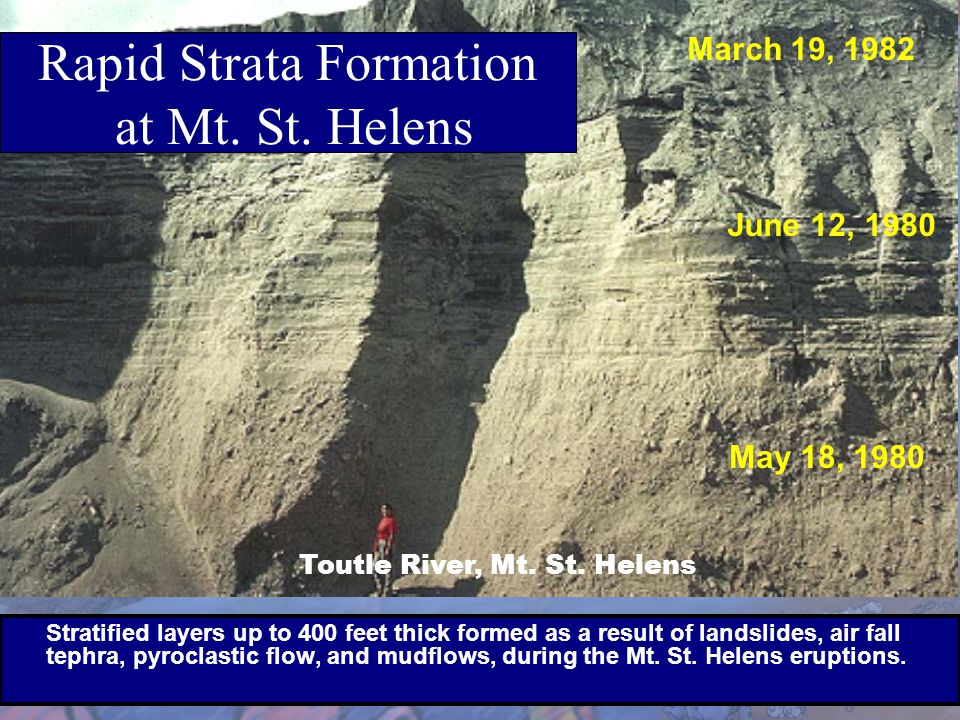
Rapid strata formation and rapid erosion at Mount St Helens.
slideplayer.com/slide/5703217/18/images/28/Rapid+Strata+F...
Visit the fossil museum:
www.flickr.com/photos/101536517@N06/sets/72157641367196613/
Just how good are peer reviews of scientific papers?
www.sciencemag.org/content/342/6154/60.full
www.examiner.com/article/want-to-publish-science-paper-ju...
The neo-Darwinian idea that the human genome consists entirely of an accumulation of billions of mutations is, quite obviously, completely bonkers. Nevertheless, it is compulsorily taught in schools and universities as 'science'.
El salt es troba dins l'àrea del jaciment arqueològic de La Pedrera romana.
Els torrents i rieres de Sant Llorenç d'Hortons tenen un rol molt important com a corredor biològic, ja que gràcies a la vegetació que s'hi desenvolupa afegit a la presència d'aigua, la fauna hi pot trobar refugi, aliment i circular lliurement d'una zona a l'altre.
El salt de la Rierussa est roba situat en el torrent de la Rierussa, un curs d'aigua de la Depressió Prelitoral que neix prop de Masquefa (Comarca de l'Anoia) i travessa tot el terme municipal de Sant Llorenç d'Hortons, unint-se per l'esquerra al riu Anoia, tocant a Gelida. El salt d'aigua és a pocs metres, per sota de la línia ferroviària de gran velocitat que travessa el municipi i a tocar del jaciment arqueològic de la pedrera romana. En aquest tram del torrent, les argiles blaves, més erosives, deixan pas a una plataforma rocosa formada per arenisques ben cimentades per on l'aigua transcorre fins caure per un salt d'uns sis metres d'alçada,produint un gorg, d'un metre i mig a dos metres de fondària. A partir d'un rocar que aflora en superfície a mà esquerra baixant per la carretera, s'endevina una rampa, parcialment emboscada per alzines joves que forma part dels talls de la roca que en època romana era explotada com a pedrera. En el mateix salt, en el costat lateral esquerra podem observar el retall d'una pedra per a canalitzar les aigües a un antic molí i, tal vegada, fou un antic carreu romà a mig explotar. La totalitat de la plataforma rocosa està completament farcida de de mol·luscs i fragments de restes fòssils d'Ostrea sp, Cardium sp., Turitella , Anomia , i altres lamelibranquis. Les petxines es troben generalment ben conservades com per exemple la Potamides (Pirenella) pictus mitralis, l'Acteocina lajonkaireana, Sandbergeria perpusilla, seila turritella, Dorsanum nodosocostatum, Nassa (Phrontis) duja dini schonii, Cancellaria (Trigonostoma) scrobiculata, Mytilus sp., i Polimesoda sp. Per sota d'aquesta plataforma, hi ha una capa de llims de color gris amb elements detrítics formats bàsicament per biotita, quars i micro-fòssils en carbonat càlcic. Al dessota d'aquesta , s'observa una capa visible de llims de color ocre, de gra fi a molt fi on hi predomina el quars i la biotita. En aquesta capa hi ha absència de fòssils. La zona del salt agrupa una bona mostra dels diferents ecosistemes forestals i comunitats faunístiques que hi troben refugi, nidifiquen o hi viuen durant tot l'any. A les zones més obagues hi ha presència d'algunes alzines joves alternada amb una bona part de pineda secundària de pi blanc, amb ginesta, fanals, romaní i més a proximitat de les lleres va deixant pas un bosc de ribera pobre, que en aquest sector es combina amb herbassars higròfils, arç blanc, bardissa, roldor, roser salvatge, l'herba sabonera (Saponaria officinalis), l'ortiga gran (urtica dioica), la menta borda (Mentha suaveolens) etc.., i gran predominança de canyissar i canyís, amagatall ideal per a moltes espècies animals. Pel que fa a l'herbassar predominant a proximitat de l'aigua i per sota del gorg, es distingeixen entre altres, la llapassa borda (Xanthium italicum), l'herba presseguera (Polygonum persicaria), la panissola (Echinochloa crus-galli), i falgueres com la capil·lera (Adiantum capillus).
La fauna vertebrada hi és molt ben representada amb una comunitat faunística ben conservada i detectada durant la realització del Mapa de Patrimoni per la gran quantitat de rastres (petjades i femtes) de mamífers com la fagina, la geneta, la guineu i el senglar . També s'ha detectat presència de rapinyaires a través de la visualització directa d'algunes espècies que sobrevolen la zona i d'altres gràcies a les egagròpiles i plomall. Pel que fa al amfibis,malgrat és difícil detectar-ne per l'època de l'any, si que hi ha presència de gripau i granota verda i algunes serps com la verda, la blanca, etc.
Observacions: El contacte de materials durs com les arenisques bioclàstiques i les argiles i marges d'origen marí produiexen un paisatge erosiu molt típic en el Penedès amb la presència de salts d'aigua en d' altres indret com Can Parts i la Pedrera . Destaquem un càrreu retallat com a testimoni de l'aprofitament humà d'un antic molí i possible explotació en època romana.
In the Swiss Alps near the Italian border is a small valley town called Lostallo. For the 5th summer in a row Shankra festival made this place its home for a goa-psytrance festival.
Video from 2017 youtu.be/sGJAhJp605k
Downloads on Flickr are free for fiends & followers but do tell the people where you got the picture.
Important legal note.
All images are copyright and must not be re posted or water marks removed, anyone found reposting or removing water marks are liaIble to prosecution.
Important legal note.
All images are copyright and must not be re posted or water marks removed, anyone found reposting is liaIble to prosecution.
Important legal note.
All images are copyright and must not be re posted or water marks removed, anyone found reposting is liaIble to prosecution.
Important legal note.
All images are copyright and must not be re posted or water marks removed, anyone found reposting is liable to prosecution.
St Ethelbert, Hessett, Suffolk
Hessett is a fairly ordinary kind of village to the east of Bury St Edmunds, but its church is one of the most important in East Anglia for a number of reasons, which will become obvious. Consider for one moment, if you will, the extent to which the beliefs and practices of a religious community affect the architecture of its buildings. Think of a mosque, for instance. Often square, expressing the democracy of Islam, but without any imagery of the human figure, for such things are proscribed. Think of a synagogue, focused towards the Holy Scriptures in the Ark, but designed to enable the proclaiming of the Word, and the way that early non-conformist chapels echo this architecture of Judaism - indeed, those who built the first free churches, like Ipswich's Unitarian Chapel, actually called them synagogues.
The shape of a church, then, is no accident. A typical Suffolk perpendicular church of the 15th century has wide aisles, to enable liturgical processions, a chancel for the celebration of Mass, places for other altars, niches for devotional statues, a focus towards the Blessed Sacrament in the east, a roof of angels to proclaim a hymn of praise, a large nave for devotional and social activities, and wall paintings of the Gospels and hagiographies of Saints, of the catechism and teachings of the Catholic Church. As Le Corbusier might have said if he'd been around at the time, a medieval church is a machine for making Catholicism happen.
No longer, of course. The radical and violent fracture in popular religion in the middle years of the 16th century gave birth to the Church of England, and the new church inherited buildings that were quite unsuitable for the new congregational protestant theology, a problem that the Church of England has never entirely solved.
Over the centuries, the problem has been addressed in different ways. The early reformers celebrated communion at a table in the nave, for example, and blocked off the chancel for other uses. Although this was challenged by the Laudian party in the early part of the 17th century, it was the way that many parishes reinvented their buildings, and most were to stay like that until the middle years of the 19th century. Some went further. A pulpit placed halfway down the nave, or even at the back of the church, meant that the seating could be arranged so that it no longer focused towards the east, thus breaking the link with Catholic (and Laudian) sacramentalism. For several centuries, Anglican churches focused on the pulpit rather than the altar.
With the coming to influence of the 19th century Oxford Movement, all this underwent another dramatic change, with the great majority of our medieval parish churches having their interiors restored to their medieval integrity, reinventing themselves as sacramental spaces. This is the condition in which we find most of them today, and some Anglican theologians are asking the question that the Catholic Church asked itself at Vatican II in the 1960s - is a 19th century liturgical space really appropriate for the Church of the 21st century?
So, let us hasten at once to Hessett. The church sits like a glowing jewel in its wide churchyard, right on the main road through the village. It is pretty well perfect if you are looking for a fine Suffolk exterior. An extensive 15th century rebuilding enwraps the earlier tower, which was crowned by the donor of the rebuilding, John Bacon.The nave and aisles are deliciously decorated, reminding one rather of the church at neighbouring Rougham, although this is a smaller church, and the aisles make it almost square. A dedicatory inscription on the two storey vestry in the north east corner bids us pray for the souls of John and Katherine Hoo, who donated the chancel and paid for the trimmings to the aisles. Their inscription has been damaged by protestant reformers, who obviously did not believe in the efficacy of prayers for the dead.
Although not comparable with that at Woolpit, the dressed stone porch is a grand affair, and a bold statement. You may find the south door locked, but if this is the case then the priest's door into the chancel is usually open. And in a way it is a good church to enter via the chancel, because in this way St Ethelbert unfolds its treasures slowly.You step into relative darkness - or, at least, it seems so in comparison with the nave beyond the rood screen. This is partly a result of the abundance of dark wood, and in truth the chancel seems rather overcrowded. The most striking objects in view are the return stalls, which fill the two westerly corners of the chancel. These are in the style of a college or school of priests, with their backs to the rood screen, but then 'returning' around the walls to the east. They are fine, and are certainly 15th or 16th century. But one of the stalls, that to the north, is different to the others, and seems slightly out of place. It is elaborately carved with faces, birds and foliage.
Mortlock thought that it might have been intended for a private house. The stall in front of it has heads on it that appear to be wearing 18th century wigs. The sanctuary is largely Victorianised, with a great east window depicting Saints. The south windows of the chancel depict a lovely Adoration scene by the O'Connors. The chancel is separated from the nave by the 15th century rood screen, which is elegantly painted and gilt on the west side, the beautifully tracery intricately carved above. The rood screen has been fitted with attractive iron gates, presumably evidence of Anglo-catholic enthusiasm here in the early 20th century, and you step down through them into the light. A first impression is that you are entering a much older space than the one you have left. There is an 18th century mustiness, enhanced by the box pews that line the aisles. And, beyond, on walls and in windows, are wonderful things.
The number of surviving wall paintings in England is a tiny fraction of those which existed before the 15th and 16th centuries. All churches had them, and in profusion. It isn't enough to say that they were a 'teaching aid' of a church of illiterate peasants. In the main, they were devotional, and that is why they were destroyed. However, it is more complicated than that. Research in recent years has indicated that many wall paintings were destroyed before the Reformation, perhaps a century before. In some churches, they have been punched through with Perpendicular windows, which are clearly pre-Reformation. In the decades after the Black Death, there seems to have been a sea change in the liturgical use of these buildings, a move away from an individualistic, devotional usage to a corporate liturgical one. There is a change of emphasis towards more education and exegesis. This is the time that pulpits and benches appear, long before protestantism was on the agenda. What seems to happen is that many buildings were intended now to be full of light, and devotional wall paintings were either whitewashed, or replaced with catechetical ones.
The decoration of the nave was the responsibility of the people of the parish, not of the Priest. The wall paintings of England can be divided into roughly three groups. Roughly speaking, the development of wall paintings over the later medieval period is in terms of these three overlapping emphases.
Firstly, the hagiographies - stories of the Saints. These might have had a local devotion, although some saints were popular over a wide area, and most churches seem to have supported a devotion to St Christopher right up until the Reformation.
Secondly came those which illustrate incidents in the life of Christ and his mother, the Blessed Virgin. Although partly pedagogical, they were also enabling tools, since private devotions often involved a contemplation upon them, and at Mass the larger part of those present would have been involved in private devotions. These scriptural stories were as likely to have been derived from apocryphal texts like the Gospel of Pseudo-Matthew as from the actual Gospels themselves.
Lastly, there are catechetical wall paintings, illustrating the teachings of the Catholic church. It should not be assumed that these are dogmatic. Many are simply artistic representations of stories, and others are simplifications of theological ideas, as with the seven deadly sins and the seven cardinal virtues. Some warn against occasions of sin (gossiping, for example) and generally wall paintings provided a local site for discussion and exemplification.
To an extent, all the above is largely true of stained glass, as well, with the caveat that stained glass was more expensive, relied on local patronage, and often has this patronage as a subtext, hence the large number of heraldic devices and images of local worthies. But it was also devotional, and so it was also destroyed.
So - what survives at Hessett? The wall paintings first.
Starting in the south east corner of the nave, we have Suffolk's finest representation of St Barbara, presenting a tower. St Barbara was very popular in medieval times, because she was invoked against strikes by lightning and sudden fires. This resulted from her legend, for her father, on finding her to be a Christian, walled her up in a tower until she repented. As a result, he was struck by lightning, and reduced to ashes. She was also the patron saint of the powerful building trade, and as such her image graced their guild altars - perhaps that was the case here.
Above the south door is another figure, often identified as St Christopher, but I do not think that this can be the case. St Christopher is found nowhere else in Suffolk above a south door. The traditional iconography of this mythical saint is not in place here, and it is hard to see how this figure could ever have been interpreted as such. I suspect it is a result of an early account confusing the two images over the north and south doors, and the mistake being repeated in later accounts.
In fact, digital enhancement seems to suggest that there are two figures above the south door, overlapping each other slightly. The figure on the right is barefoot, that on the left is wearing a white gown. There appears to be water under their feet, and so I think this is an image of the Baptism of Christ. Perhaps it was once part of a sequence.
The wall painting opposite, above the north door, is St Christopher. Although it isn't as clear as himself at, say, nearby Bradfield Combust, he bestrides the river in the customary manner, staff in hand. The Christ child is difficult to discern, but you can see the fish in the water. Also in the water, and rather unusual, are two figures. They are rendered rather crudely, almost like gingerbread men. Could they be the donors of the north aisle, John and Katherine Hoo in person?
Moving along the north aisle, we come to the set of paintings for which Hessett is justifiably famous. They are set one above the other between two windows, at the point where might expect the now-vanished screen to a chapel to have been. The upper section was here first. It shows the seven deadly sins (described wrongly in some text books as a tree of Jesse, or ancestry of Christ). Two devils look on as, from the mouth of hell, a great tree sprouts, ending in seven images. Pride is at the top, and in pairs beneath are Gluttony and Anger, Vanity and Envy, Avarice and Lust. Mortlock suggests that some attempt has been made to erase the image for Lust, which may simply be mid-16th century puritan prurience on the part of some reformer here. This would suggest that this catechetical tool was here right up until the Reformation.
The idea of 'Seven Deadly Sins' was anathema to the reformers, because it is entirely unscriptural. Rather, as a catechetical tool, it is a way of drawing together a multitude of sins into a simplistic aide memoire. This could then be used in confession, taking each of them one at a time and examining ones conscience accordingly. It should not be seen simply as a 'warning' to ignorant peasants, for the evidence is that the ordinary rural people of late medieval England were theologically very articulate. Rather, it was a tool for use, in contemplation and preparation for the sacrament of reconciliation, which may well have ordinarily taken place in the chapel here.
The wall painting beneath the Sins is even more interesting. This is a very rare 'Christ of the Trades', and dates from the early 15th century, about a hundred years after the painting above. It is rather faded, and takes a while to discern, and not all of it is decodable. However, enough is there to be fascinating. The image of the 'Christ of the Trades' is known throughout Christendom, and contemporary versions with this can be found in other parts of Europe. It shows the risen Christ in the centre, and around him a vast array of the tools and symbols of various trades. One theory is that it depicts activities that should not take place on a Sunday, a holy day of obligation to refrain from work, and that these activities are wounding Christ anew.
Perhaps the most fascinating symbol, and the one that everyone notices, is the playing card. It shows the six of diamonds. Does it represent the makers of playing cards? If so, it might suggest a Flemish influence. Or could it be intended to represent something else? Whatever, it is one of the earliest representations of a playing card in England. Why is this here? It may very well be that there was a trades gild chantry chapel at the east end of the north aisle, and this painting was at its entrance.
At the east end of the north aisle now is the church's set of royal arms. Cautley saw it in the vestry in the 1930s, and identified it as a Queen Anne set. Now, with additions stripped away, it is revealed as a Charles II set from the 1660s, and a very fine one. It is fascinating to see it at such close range. Usually, they are set above the south door now, although they would originally have been placed above the chancel arch, in full view of the congregation, a gentle reminder of who was in charge.
And so to the glass, which on its own would be worth coming to Hessett to see. Few Suffolk churches have such an expanse, none have such a variety, or glass of such quality and interest. It consists essentially of two ranges, the life and Passion of Christ in the north aisle (although some glass has been reset across the church), and images and hagiographies of Saints in the south aisle.
In the north aisle, the scourging of Christ stands out, the wicked grins of the persecutors contrasting with the pained nobility of the Christ figure. In the next window, Christ rises from the dead, coming out of his tomb like the corpses in the doom paintings at Stanningfield, North Cove and Wenhaston. The Roman centurion sleeps soundly in the foreground.
The most famous image is in the east window of the south aisle. Apparently, it shows a bishop holding the chain to a bag, with four children playing at his feet. I say apparently, because there is rather more going on here than meets the eye. The reason that this image is so famous is that the small child in the foreground is holding what appears to be a golf club or hockey stick, and this would be the earliest representation of such an object in all Europe. The whole image has been said to represent St Nicholas, who was a Bishop, and whose legends include a bag of gold and a group of children.
Unfortunately, this is not the case. St Nicholas is never symbolised by a bag of gold, and there are three children in the St Nicholas legend, not four. In any case, the hand in the picture is not holding the chain to a bag at all, but a rosary, and the hockey stick is actually a fuller's club, used for dyeing clothes, and the symbol of St James the Less.
What has happened here is that the head of a Bishop has been grafted on to the body of a figure which is probably still in its original location. The three lights of this window contained a set of the Holy Kinship. The light to the north of the 'Bishop' contains two children playing with what ae apparently toys, but when you look closely you can see that one is holding a golden shell, and the other a poisoned chalice. They are the infant St James and St John, and the lost figure above them was their mother, Mary Salome.
This means that the figure with the Bishop's head is actually Mary Cleophas, mother of four children including St James the Less. The third light to the south, of course, would have depicted the Blessed Virgin and child, but she is lost to us.
Not only this, but Hessett has some very good 19th Century glass which complements and does not overly intrude. The best is beneath the tower, the west window in a fully 15th Century style of scenes by Clayton & Bell. The east window, depicting saints, is by William Warrington, and the chancel also has the O'Connor glass already mentioned.
If the windows and wall paintings were all there was, then Hessett would be remarkable enough. But there is something else, two things, actually, that elevate it above all other Suffolk churches, and all the churches of England. For St Ethelbert is the proud owner of two unique survivals. At the back of the church is a chest, no different from those you'll find in many a parish church. In common with those, it has three separate locks, the idea being that the Rector and two Churchwardens would have a key each, and it would be necessary for all three of them to be present for the chest to be opened. It was used for storing parish records and valuables.
At some point, one of the keys was lost. There is an old story about the iconoclast William Dowsing turning up here and demanding the chest be opened, but on account of the missing key it couldn't be. Unfortunately, this story isn't true, for Dowsing never recorded a visit Hessett. The chest was eventually opened in the 19th century. Inside were found two extraordinary pre-Reformation survivals. These are a pyx cloth and a burse. The pyx cloth was draped over the wooden canopy that enclosed the blessed sacrament (one of England's four surviving medieval pyxes is also in Suffolk, at Dennington) before it was raised above the high altar. The burse was used to contain the host before consecration at the Mass. They are England's only surviving examples, and they're both here. Or, more precisely they aren't, for both have been purloined by the British Museum, the kind of theft that no locked church can prevent.
But there are life-size photos of both either side of the tower arch. The burse is basically an envelope, and features the Veronica face of Christ on one side with the four evangelistic symbols in each corner. On the other is an Agnus Dei, the Lamb of God. The survival of both is extraordinary. It is one thing to explore the furnishings of lost Catholic England, quite another to come face to face with articles that were actually used in the liturgy.
In front of the pictures stands the font, a relatively good one of the early 15th century, though rather less exciting than everything going on around it. The dedicatory inscription survives, to a pair of Hoos of an earlier generation than the ones on the vestry.Turning east again, the ranks of simple 15th century benches are all of a piece with their church. They have survived the violent transitions of the centuries, and have seated generation after generation of Hessett people. They were new here when this church was alive with coloured light, with the hundreds of candles flickering on the rood beam, the processions, the festivals, and the people's lives totally integrated with the liturgy of the seasons. For the people of Catholic England, their religion was as much a part of them as the air they breathed. They little knew how soon it would all come to an end.
And so, there it is - one of the most fascinating and satisfactory of all East Anglia's churches. And yet, not many people know about it. We are only three miles from the brown-signed honeypot of Woolpit, where a constant stream of visitors come and go. I've visited Hessett many times, and never once encountered another visitor. Still, there you are, I suppose. Perhaps some places are better kept secret. But come here if you can, for here is a medieval worship space with much surviving evidence of what it was actually meant to be, and meant to do.
Varanasi, also known as Benares, or Kashi is an Indian city on the banks of the Ganga in Uttar Pradesh, 320 kilometres south-east of the state capital, Lucknow. It is the holiest of the seven sacred cities (Sapta Puri) in Hinduism, and Jainism, and played an important role in the development of Buddhism. Some Hindus believe that death at Varanasi brings salvation. It is one of the oldest continuously inhabited cities in the world. Varanasi is also known as the favourite city of the Hindu deity Lord Shiva as it has been mentioned in the Rigveda that this city in older times was known as Kashi or "Shiv ki Nagri".
The Kashi Naresh (Maharaja of Kashi) is the chief cultural patron of Varanasi, and an essential part of all religious celebrations. The culture of Varanasi is closely associated with the Ganges. The city has been a cultural centre of North India for several thousand years, and has a history that is older than most of the major world religions. The Benares Gharana form of Hindustani classical music was developed in Varanasi, and many prominent Indian philosophers, poets, writers, and musicians live or have lived in Varanasi. Gautama Buddha gave his first sermon at Sarnath, located near Varanasi.
Varanasi is the spiritual capital of India. It is often referred to as "the holy city of India", "the religious capital of India", "the city of Shiva", and "the city of learning". Scholarly books have been written in the city, including the Ramcharitmanas of Tulsidas. Today, there is a temple of his namesake in the city, the Tulsi Manas Mandir. The current temples and religious institutions in the city are dated to the 18th century. One of the largest residential universities of Asia, the Banaras Hindu University (BHU), is located here.
ETYMOLOGY
The name Varanasi possibly originates from the names of the two rivers: Varuna, still flowing in Varanasi, and Asi, a small stream near Assi Ghat. The old city does lie on the north shores of Ganges River bounded by its two tributaries Varuna and Asi. Another speculation is that the city derives its name from the river Varuna, which was called Varanasi in olden times.[11] This is generally disregarded by historians. Through the ages, Varanasi has been known by many names including Kāśī or Kashi (used by pilgrims dating from Buddha's days), Kāśikā (the shining one), Avimukta ("never forsaken" by Shiva), Ānandavana (the forest of bliss), and Rudravāsa (the place where Rudra/Śiva resides).
In the Rigveda, the city is referred to as Kāśī or Kashi, the luminous city as an eminent seat of learning. The name Kāśī is also mentioned in the Skanda Purana. In one verse, Shiva says, "The three worlds form one city of mine, and Kāśī is my royal palace therein." The name Kashi may be translated as "City of Light".
HISTORY
According to legend, Varanasi was founded by the God Shiva. The Pandavas, the heroes of the Hindu epic Mahabharata are also stated to have visited the city in search of Shiva to atone for their sins of fratricide and Brāhmanahatya that they had committed during the climactic Kurukshetra war. It is regarded as one of seven holy cities which can provide Moksha:
The earliest known archaeological evidence suggests that settlement around Varanasi in the Ganga valley (the seat of Vedic religion and philosophy) began in the 11th or 12th century BC, placing it among the world's oldest continually inhabited cities. These archaeological remains suggest that the Varanasi area was populated by Vedic people. However, the Atharvaveda (the oldest known text referencing the city), which dates to approximately the same period, suggests that the area was populated by indigenous tribes. It is possible that archaeological evidence of these previous inhabitants has yet to be discovered. Recent excavations at Aktha and Ramnagar, two sites very near to Varanasi, show them to be from 1800 BC, suggesting Varanasi started to be inhabited by that time too. Varanasi was also home to Parshva, the 23rd Jain Tirthankara and the earliest Tirthankara accepted as a historical figure in the 8th century BC.
Varanasi grew as an important industrial centre, famous for its muslin and silk fabrics, perfumes, ivory works, and sculpture. During the time of Gautama Buddha (born circa 567 BC), Varanasi was the capital of the Kingdom of Kashi. Buddha is believed to have founded Buddhism here around 528 BC when he gave his first sermon, "Turning the Wheel of Law", at nearby Sarnath. The celebrated Chinese traveller Xuanzang, who visited the city around 635 AD, attested that the city was a centre of religious and artistic activities, and that it extended for about 5 kilometres along the western bank of the Ganges. When Xuanzang, also known as Hiuen Tsiang, visited Varanasi in the 7th century, he named it "Polonisse" and wrote that the city had some 30 temples with about 30 monks. The city's religious importance continued to grow in the 8th century, when Adi Shankara established the worship of Shiva as an official sect of Varanasi.
In ancient times, Varanasi was connected by a road starting from Taxila and ending at Pataliputra during the Mauryan Empire. In 1194, the city succumbed to Turkish Muslim rule under Qutb-ud-din Aibak, who ordered the destruction of some one thousand temples in the city. The city went into decline over some three centuries of Muslim occupation, although new temples were erected in the 13th century after the Afghan invasion. Feroz Shah ordered further destruction of Hindu temples in the Varanasi area in 1376. The Afghan ruler Sikander Lodi continued the suppression of Hinduism in the city and destroyed most of the remaining older temples in 1496. Despite the Muslim rule, Varanasi remained the centre of activity for intellectuals and theologians during the Middle Ages, which further contributed to its reputation as a cultural centre of religion and education. Several major figures of the Bhakti movement were born in Varanasi, including Kabir who was born here in 1389 and hailed as "the most outstanding of the saint-poets of Bhakti cult (devotion) and mysticism of 15th-Century India"; and Ravidas, a 15th-century socio-religious reformer, mystic, poet, traveller, and spiritual figure, who was born and lived in the city and employed in the tannery industry. Similarly, numerous eminent scholars and preachers visited the city from across India and south Asia. Guru Nanak Dev visited Varanasi for Shivratri in 1507, a trip that played a large role in the founding of Sikhism.
In the 16th century, Varanasi experienced a cultural revival under the Muslim Mughal emperor Akbar who invested in the city, and built two large temples dedicated to Shiva and Vishnu. The Raja of Poona established the Annapurnamandir and the 200 metres Akbari Bridge was also completed during this period. The earliest tourists began arriving in the city during the 16th century. In 1665, the French traveller Jean Baptiste Tavernier described the architectural beauty of the Vindu Madhava temple on the side of the Ganges. The road infrastructure was also improved during this period and extended from Kolkata to Peshawar by Emperor Sher Shah Suri; later during the British Raj it came to be known as the famous Grand Trunk Road. In 1656, emperor Aurangzeb ordered the destruction of many temples and the building of mosques, causing the city to experience a temporary setback. However, after Aurangazeb's death, most of India was ruled by a confederacy of pro-Hindu kings. Much of modern Varanasi was built during this time by the Rajput and Maratha kings, especially during the 18th century, and most of the important buildings in the city today date to this period. The kings continued to be important through much of the British rule (1775–1947 AD), including the Maharaja of Benares, or Kashi Naresh. The kingdom of Benares was given official status by the Mughals in 1737, and continued as a dynasty-governed area until Indian independence in 1947, during the reign of Dr. Vibhuti Narayan Singh. In the 18th century, Muhammad Shah ordered the construction of an observatory on the Ganges, attached to Man Mandir Ghat, designed to discover imperfections in the calendar in order to revise existing astronomical tables. Tourism in the city began to flourish in the 18th century. In 1791, under the rule of the British Governor-General Warren Hastings, Jonathan Duncan founded a Sanskrit College in Varanasi. In 1867, the establishment of the Varanasi Municipal Board led to significant improvements in the city.
In 1897, Mark Twain, the renowned Indophile, said of Varanasi, "Benares is older than history, older than tradition, older even than legend, and looks twice as old as all of them put together." In 1910, the British made Varanasi a new Indian state, with Ramanagar as its headquarters but with no jurisdiction over the city of Varanasi itself. Kashi Naresh still resides in the Ramnagar Fort which is situated to the east of Varanasi, across the Ganges. Ramnagar Fort and its museum are the repository of the history of the kings of Varanasi. Since the 18th century, the fort has been the home of Kashi Naresh, deeply revered by the local people. He is the religious head and some devout inhabitants consider him to be the incarnation of Shiva. He is also the chief cultural patron and an essential part of all religious celebrations.
A massacre by British troops, of the Indian troops stationed here and of the population of the city, took place during the early stages of the Indian Rebellion of 1857. Annie Besant worked in Varanasi to promote theosophy and founded the Central Hindu College which later became a foundation for the creation of Banaras Hindu University as a secular university in 1916. Her purpose in founding the Central Hindu College in Varanasi was that she "wanted to bring men of all religions together under the ideal of brotherhood in order to promote Indian cultural values and to remove ill-will among different sections of the Indian population."
Varanasi was ceded to the Union of India on 15 October 1948. After the death of Dr. Vibhuti Narayan Singh in 2000, his son Anant Narayan Singh became the figurehead king, responsible for upholding the traditional duties of a Kashi Naresh.
MAIN SIGHTS
Varanasi's "Old City", the quarter near the banks of the Ganga river, has crowded narrow winding lanes flanked by road-side shops and scores of Hindu temples. As atmospheric as it is confusing, Varanasi's labyrinthine Old City has a rich culture, attracting many travellers and tourists. The main residential areas of Varanasi (especially for the middle and upper classes) are situated in regions far from the ghats; they are more spacious and less polluted.
Museums in and around Varanasi include Jantar Mantar, Sarnath Museum, Bharat Kala Bhawan and Ramnagar Fort.
JANTAR MANTAR
The Jantar Mantar observatory (1737) is located above the ghats on the Ganges, much above the high water level in the Ganges next to the Manmandir Ghat, near to Dasaswamedh Ghat and adjoining the palace of Raja Jai Singh of Jaipur. Compared to the observatories at Jaipur and Delhi, it is less well equipped but has a unique equatorial sundial which is functional and allows measurements to be monitored and recorded by one person.
RAMNAGAR FORT
The Ramnagar Fort located near the Ganges River on its eastern bank, opposite to the Tulsi Ghat, was built in the 18th century by Kashi Naresh Raja Balwant Singh with creamy chunar sandstone. It is in a typically Mughal style of architecture with carved balconies, open courtyards, and scenic pavilions. At present the fort is not in good repair. The fort and its museum are the repository of the history of the kings of Benares. It has been the home of the Kashi Naresh since the 18th century. The current king and the resident of the fort is Anant Narayan Singh who is also known as the Maharaja of Varanasi even though this royal title has been abolished since 1971. Labeled "an eccentric museum", it has a rare collection of American vintage cars, sedan chairs (bejeweled), an impressive weaponry hall and a rare astrological clock. In addition, manuscripts, especially religious writings, are housed in the Saraswati Bhawan. Also included is a precious handwritten manuscript by Goswami Tulsidas. Many books illustrated in the Mughal miniature style, with beautifully designed covers are also part of the collections. Because of its scenic location on the banks of the Ganges, it is frequently used as an outdoor shooting location for films. The film titled Banaras is one of the popular movies shot here. However, only a part of the fort is open for public viewing as the rest of the area is the residence of the Kashi Naresh and his family. It is 14 kilometres from Varanasi.
GHATS
Ghats are embankments made in steps of stone slabs along the river bank where pilgrims perform ritual ablutions. Ghats in Varanasi are an integral complement to the concept of divinity represented in physical, metaphysical and supernatural elements. All the ghats are locations on "the divine cosmic road", indicative of "its manifest transcendental dimension" Varanasi has at least 84 ghats. Steps in the ghats lead to the banks of River Ganges, including the Dashashwamedh Ghat, the Manikarnika Ghat, the Panchganga Ghat and the Harishchandra Ghat (where Hindus cremate their dead). Many ghats are associated with legends and several are now privately owned.
Many of the ghats were built when the city was under Maratha control. Marathas, Shindes (Scindias), Holkars, Bhonsles, and Peshwas stand out as patrons of present-day Varanasi. Most of the ghats are bathing ghats, while others are used as cremation sites. A morning boat ride on the Ganges across the ghats is a popular visitor attraction. The extensive stretches of ghats enhance the river front with a multitude of shrines, temples and palaces built "tier on tier above the water’s edge".
The Dashashwamedh Ghat is the main and probably the oldest ghat of Varansi located on the Ganges, close to the Kashi Vishwanath Temple. It is believed that Brahma created it to welcome Shiva and sacrificed ten horses during the Dasa -Ashwamedha yajna performed here. Above the ghat and close to it, there are also temples dedicated to Sulatankesvara, Brahmesvara, Varahesvara, Abhaya Vinayaka, Ganga (the Ganges), and Bandi Devi which are part of important pilgrimage journeys. A group of priests perform "Agni Pooja" (Worship to Fire) daily in the evening at this ghat as a dedication to Shiva, Ganga, Surya (Sun), Agni (Fire), and the whole universe. Special aartis are held on Tuesdays and on religious festivals.
The Manikarnika Ghat is the Mahasmasana (meaning: "great cremation ground") and is the primary site for Hindu cremation in the city. Adjoining the ghat, there are raised platforms that are used for death anniversary rituals. It is said that an ear-ring (Manikarnika) of Shiva or his wife Sati fell here. According to a myth related to the Tarakesvara Temple, a Shiva temple at the ghat, Shiva whispers the Taraka mantra ("Prayer of the crossing") in the ear of the dead. Fourth-century Gupta period inscriptions mention this ghat. However, the current ghat as a permanent riverside embankment was built in 1302 and has been renovated at least three times.
TEMPLES
Among the estimated 23000 temples in Varanasi, the most worshiped are: the Kashi Vishwanath Temple of Shiva; the Sankat Mochan Hanuman Temple; and the Durga Temple known for the band of monkeys that reside in the large trees nearby.
Located on the outskirts of the Ganges, the Kashi Vishwanath Temple – dedicated to Varanasi's presiding deity Shiva (Vishwanath – "Lord of the world") – is an important Hindu temple and one of the 12 Jyotirlinga Shiva temples. It is believed that a single view of Vishwanath Jyotirlinga is worth more than that of other jyotirlingas. The temple has been destroyed and rebuilt a number of times. The Gyanvapi Mosque, which is adjacent to the temple, is the original site of the temple. The temple, as it exists now, also called Golden Temple, was built in 1780 by Queen Ahilyabai Holkar of Indore. The two pinnacles of the temple are covered in gold, donated in 1839 by Ranjit Singh, the ruler of the Punjab and the remaining dome is also planned to be gold plated by the Ministry of Culture & Religious Affairs of Uttar Pradesh. On 28 January 1983, the temple was taken over by the government of Uttar Pradesh and its management was transferred to a trust with then Kashi Naresh, Vibhuti Narayan Singh, as president and an executive committee with a Divisional Commissioner as chairman. Numerous rituals, prayers and aratis are held daily, starting from 2:30 am till 11:00 pm.
The Sankat Mochan Hanuman Temple is one of the sacred temples of the Hindu god Hanuman situated by the Assi River, on the way to the Durga and New Vishwanath temples within the Banaras Hindu University campus. The present temple structure was built in early 1900s by the educationist and freedom fighter, Pandit Madan Mohan Malviya, the founder of Banaras Hindu University. It is believed the temple was built on the very spot where the medieval Hindu saint Tulsidas had a vision of Hanuman. Thousands flock to the temple on Tuesdays and Saturdays, weekdays associated with Hanuman. On 7 March 2006, in a terrorist attack one of the three explosions hit the temple while the Aarti was in progress when numerous devotees and people attending a wedding were present and many were injured. However, normal worship was resumed the next day with devotees visiting the temple and reciting hymns of Hanuman Chalisa (authored by Tulidas) and Sundarkand (a booklet of these hymns is provided free of charge in the temple). After the terrorist incident, a permanent police post was set up inside the temple.
There are two temples named "Durga" in Varanasi, Durga Mandir (built about 500 years ago), and Durga Kund (built in the 18th century). Thousands of Hindu devotees visit Durga Kund during Navratri to worship the goddess Durga. The temple, built in Nagara architectural style, has multi-tiered spires[96] and is stained red with ochre, representing the red colour of Durga. The building has a rectangular tank of water called the Durga Kund ("Kund" meaning a pond or pool). Every year on the occasion of Nag Panchami, the act of depicting the god Vishnu reclining on the serpent Shesha is recreated in the Kund.
While the Annapurna Temple, located close to the Kashi Vishwanath temple, is dedicated to Annapurna, the goddess of food, the Sankatha Temple close to the Sindhia Ghat is dedicated to Sankatha, the goddess of remedy. The Sankatha temple has a large sculpture of a lion and a nine temple cluster dedicated to the nine planets.
Kalabhairav Temple, an ancient temple located near the Head Post Office at Visheshar Ganj, is dedicated to Kala-Bhairava, the guardian (Kotwal) of Varanasi. The Mrithyunjay Mahadev Temple, dedicated to Shiva, is situated on the way to Daranagar to Kalbhairav temple. A well near the temple has some religious significance as its water source is believed to be fed from several underground streams, having curative powers.
The New Vishwanath Temple located in the campus of Banaras Hindu University is a modern temple which was planned by Pandit Malviya and built by the Birlas. The Tulsi Manas Temple, nearby the Durga Temple, is a modern temple dedicated to the god Rama. It is built at the place where Tulsidas authored the Ramcharitmanas, which narrates the life of Rama. Many verses from this epic are inscribed on the temple walls.
The Bharat Mata Temple, dedicated to the national personification of India, was inaugurated by Mahatma Gandhi in 1936. It has relief maps of India carved in marble. Babu Shiv Prasad Gupta and Durga Prasad Khatri, leading numismatists, antiquarians and nationalist leaders, donated funds for its construction.
RELIGION
HINDUISM
Varanasi is one of the holiest cities and centres of pilgrimage for Hindus of all denominations. It is one of the seven Hindu holiest cities (Sapta Puri), considered the giver of salvation (moksha). Over 50,000 Brahmins live in Varanasi, providing religious services to the masses. Hindus believe that bathing in the Ganges remits sins and that dying in Kashi ensures release of a person's soul from the cycle of its transmigrations. Thus, many Hindus arrive here for dying.
As the home to the Kashi Vishwanath Temple Jyotirlinga, it is very sacred for Shaivism. Varanasi is also a Shakti Peetha, where the temple to goddess Vishalakshi stands, believed to be the spot where the goddess Sati's earrings fell. Hindus of the Shakti sect make a pilgrimage to the city because they regard the River Ganges itself to be the Goddess Shakti. Adi Shankara wrote his commentaries on Hinduism here, leading to the great Hindu revival.
In 2001, Hindus made up approximately 84% of the population of Varanasi District.
ISLAM
Varanasi is one of the holiest cities and centres of pilgrimage for Hindus of all denominations. It is one of the seven Hindu holiest cities (Sapta Puri), considered the giver of salvation (moksha). Over 50,000 Brahmins live in Varanasi, providing religious services to the masses. Hindus believe that bathing in the Ganges remits sins and that dying in Kashi ensures release of a person's soul from the cycle of its transmigrations. Thus, many Hindus arrive here for dying.
As the home to the Kashi Vishwanath Temple Jyotirlinga, it is very sacred for Shaivism. Varanasi is also a Shakti Peetha, where the temple to goddess Vishalakshi stands, believed to be the spot where the goddess Sati's earrings fell. Hindus of the Shakti sect make a pilgrimage to the city because they regard the River Ganges itself to be the Goddess Shakti. Adi Shankara wrote his commentaries on Hinduism here, leading to the great Hindu revival.
In 2001, Hindus made up approximately 84% of the population of Varanasi District.
OTHERS
At the 2001 census, persons of other religions or no religion made up 0.4% of the population of Varanasi District.
Varanasi is a pilgrimage site for Jains along with Hindus and Buddhists. It is believed to be the birthplace of Suparshvanath, Shreyansanath, and Parshva, who are respectively the seventh, eleventh, and twenty-third Jain Tirthankars and as such Varanasi is a holy city for Jains. Shree Parshvanath Digambar Jain Tirth Kshetra (Digambar Jain Temple) is situated in Bhelupur, Varanasi. This temple is of great religious importance to the Jain Religion.
Sarnath, a suburb of Varanasi, is a place of Buddhist pilgrimage. It is the site of the deer park where Siddhartha Gautama of Nepal is said to have given his first sermon about the basic principles of Buddhism. The Dhamek Stupa is one of the few pre-Ashokan stupas still in existence, though only its foundation remains. Also remaining is the Chaukhandi Stupa commemorating the spot where Buddha met his first disciples in the 5th century. An octagonal tower was built later there.
Guru Nanak Dev visited Varanasi for Shivratri in 1507 and had an encounter which with other events forms the basis for the story of the founding of Sikhism. Varanasi also hosts the Roman Catholic Diocese of Varanasi, and has an insignificant Jewish expatriate community. Varanasi is home to numerous tribal faiths which are not easily classified.
Dalits are 13% of population Of Varanasi city. Most dalits are followers of Guru Ravidass. So Shri Guru Ravidass Janam Asthan is important place of pilgrimage for Ravidasis from all around India.
RELIGIOUS FESTIVALS
On Mahashivaratri (February) – which is dedicated to Shiva – a procession of Shiva proceeds from the Mahamrityunjaya Temple to the Kashi Vishwanath Temple.
Dhrupad Mela is a five-day musical festival devoted to dhrupad style held at Tulsi Ghat in February–March.
The Sankat Mochan Hanuman Temple celebrates Hanuman Jayanti (March–April), the birthday of Hanuman with great fervour. A special puja, aarti, and a public procession is organized. Starting in 1923, the temple organizes a five-day classical music and dance concert festival titled Sankat Mochan Sangeet Samaroh in this period, when iconic artists from all parts of India are invited to perform.
The Ramlila of Ramnagar is a dramatic enactment of Rama's legend, as told in Ramacharitamanasa. The plays, sponsored by Kashi Naresh, are performed in Ramnagar every evening for 31 days. On the last day, the festivities reach a crescendo as Rama vanquishes the demon king Ravana. Kashi Naresh Udit Narayan Singh started this tradition around 1830.
Bharat Milap celebrates the meeting of Rama and his younger brother Bharata after the return of the former after 14 years of exile. It is celebrated during October–November, a day after the festival of Vijayadashami. Kashi Naresh attends this festival in his regal attire resplendent in regal finery. The festival attracts a large number of devotees.
Nag Nathaiya, celebrated on the fourth lunar day of the dark fortnight of the Hindu month of Kartik (October–November), that commemorates the victory of the god Krishna over the serpent Kaliya. On this occasion, a large Kadamba tree (Neolamarckia cadamba) branch is planted on the banks of the Ganges so that a boy acting the role of Krishna can jump into the river on to the effigy representing Kaliya. He stands over the effigy in a dancing pose playing the flute; the effigy and the boy standing on it is given a swirl in front of the audience. People watch the display standing on the banks of the river or from boats.
Ganga Mahotsav is a five-day music festival organized by the Uttar Pradesh Tourism Department, held in November–December culminating a day before Kartik Poornima (Dev Deepawali). On Kartik Poornima also called the Ganges festival, the Ganges is venerated by arti offered by thousands of pilgrims who release lighted lamps to float in the river from the ghats.
Annually Jashne-Eid Miladunnabi is celebrated on the day of Barawafat in huge numbers by Muslims in a huge rally coming from all the parts of the city and meeting up at Beniya Bagh.
WIKIPEDIA
. . . sadly Non-Hindus are not allowed inside the temple complex
__________________________________________
The Jagannath Temple of Puri (Odia: ଜଗନ୍ନାଥ ମନ୍ଦିର) is a famous, sacred Hindu temple dedicated to Jagannath and located on the eastern coast of India, at Puri in the state of Odisha.
The temple is an important pilgrimage destination for many Hindu traditions, particularly worshippers of god Krishna and god Vishnu, and part of the Char Dham pilgrimages that a Hindu is expected to make in one's lifetime.
Even though most Hindu deities that are worshiped are made out of stone or metal, the image of Jagannath is wooden. Every twelve or nineteen years these wooden figures are ceremoniously replaced by using sacred trees, that have to be carved as an exact replica. The reason behind this ceremonial tradition is the highly secret Navakalevara ('New Body' or 'New Embodiment') ceremony, an intricate set of rituals that accompany the renewal of the wooden statues.
The temple was built in the 12th century atop its ruins by the progenitor of the Eastern Ganga dynasty, King Anantavarman Chodaganga Deva. The temple is famous for its annual Rath Yatra, or chariot festival, in which the three main temple deities are hauled on huge and elaborately decorated temple cars. Since medieval times, it is also associated with intense religious fervour.
The temple is sacred to the Vaishnava traditions and saint Ramananda who was closely associated with the temple. It is also of particular significance to the followers of the Gaudiya Vaishnavism whose founder, Chaitanya Mahaprabhu, was attracted to the deity, Jagannath, and lived in Puri for many years.
DEITIES
The central forms of Jagannath, Balabhadra and the goddess Subhadra constitute the trinity of deities sitting on the bejewelled platform or the Ratnabedi in the inner sanctum. The Sudarshan Chakra, deities of Madanmohan, Sridevi and Vishwadhatri are also placed on the Ratnavedi. The deities of Jagannath, Balabhadra, Subhadra and Sudarshan Chakra are made from sacred Neem logs known as Daru Brahma. Depending on the season the deities are adorned in different garbs and jewels. Worship of the deities pre-date the temple structure and may have originated in an ancient tribal shrine.
ORIGINS OF THE TEMPLE
According to the recently discovered copper plates from the Ganga dynasty, the construction of the current Jagannath temple was initiated by the ruler of Kalinga, Anantavarman Chodaganga Dev. The Jaga mohan and the Vimana portions of the temple were built during his reign (1078 - 1148 CE). However, it was only in the year 1174 CE that the Oriya ruler Ananga Bhima Deva rebuilt the temple to give a shape in which it stands today.
Jagannath worship in the temple continued until 1558, when Odisha was attacked by the Afghan general Kalapahad. Subsequently, when Ramachandra Deb established an independent kingdom at Khurda in Orissa, the temple was consecrated and the deities reinstalled.
LEGENDS
Legendary account as found in the Skanda-Purana, Brahma Purana and other Puranas and later Oriya works state that Lord Jagannath was originally worshipped as Lord Neela Madhaba by a Savar king (tribal chief) named Viswavasu. Having heard about the deity, King Indradyumna sent a Brahmin priest, Vidyapati to locate the deity, who was worshipped secretly in a dense forest by Viswavasu. Vidyapati tried his best but could not locate the place. But at last he managed to marry Viswavasu's daughter Lalita. At repeated request of Vidyapti, Viswavasu took his son-in-law blind folded to a cave where Lord Neela Madhaba was worshipped.
Vidyapati was very intelligent. He dropped mustard seeds on the ground on the way. The seeds germinated after a few days, which enabled him to find out the cave later on. On hearing from him, King Indradyumna proceeded immediately to Odra desha Orissa on a pilgrimage to see and worship the Deity. But the deity had disappeared. The king was disappointed. The Deity was hidden in sand. The king was determined not to return without having a darshan of the deity and observed fast unto death at Mount Neela, Then a celestial voice cried 'thou shalt see him.' Afterwards the king performed a horse sacrifice and built a magnificent temple for Vishnu. Sri Narasimha Murti brought by Narada was installed in the temple. During sleep, the king had a vision of Lord Jagannath. Also an astral voice directed him to receive the fragrant tree on the seashore and make idols out of it. Accordingly, the king got the image of Lord Jagannath, Balabhadra, Subhadra and Chakra Sudarshan made out of the wood of the divine tree and installed them in the temple.
INDRADYUMNA´S PRAYER TO LORD BRAHMA
King Indradyumna put up for Jagannath the tallest monument of the world. It was 1,000 cubits high. He invited Lord Brahma, the cosmic creator, consecrate the temple and the images. Brahma came all the way from Heaven for this purpose. Seeing the temple he was immensely pleased with him. Brahma asked Indradyumna as to in what way can he (Brahma) fulfill the king's desire, since was very much pleased with him for his having put the most beautiful Temple for Lord Vishnu. With folded hands, Indradyumna said, "My Lord if you are really pleased with me, kindly bless me with one thing, and it is that I should be issueless and that I should be the last member of my family." In case anybody left alive after him, he would only take pride as the owner of the temple and would not work for the society.
THE EPISODE OF THE LORD´S GRACE DURING A WAR WITH KANCHI
At one time, a king of Kanchi in the down south remarked that the king of Orissa was a chandala (a man of very low caste or status) because, he performs the duties of a sweeper during the Car Festival. When this news reached the ears of the king of Orissa, he led an expedition to Kanchi. Before that, he implored the mercy of Lord Jagannath. The soldiers of Orissa marched towards Kanchi from Cuttack (earlier capital city of Orissa, located on the banks of Mahanadi, at a distance of 30 km from Bhubaneswar. It so happened that when the soldiers, headed by the king Purusottam Dev, reached a place near the Chilika lake, a lady, who was selling curd (yogurt) met him (the king) and presented a golden ring studded with precious gems and submitted. "My Lord, kindly listen to me. A little earlier, two soldiers riding over two horses (white and black in colour), approached me and said we are thirsty give us curds to drink.' I gave them curds. Instead of giving me money, they gave me this ring and said,'the king of Orissa will come here, after some time, on his way to Kanchi. You present it to him and he will pay you the money.' So my Lord, you take it and give me my dues.
It took no time for the king to know that the ring belongs to Lord Jagannath. He was convinced that Jagannath and Balabhadra were proceeding to the battle field ahead of him to help him there. To perpetuate the memory of this great incident, the king founded a village in the Chilika lake area. As the name of the lady was Manika, the name given to the village was Manika Patana. Even to this day, the curds of this village are famous.
LEGEND SURROUNDING THE TEMPLE ORIGIN
The traditional story concerning the origins of the Lord Jagannath temple is that here the original image of Jagannath (a deity form of Vishnu) at the end of Treta yuga manifested near a banyan tree, near seashore in the form of an Indranila nilamani or the Blue Jewel. It was so dazzling that it could grant instant moksha, so the god Dharma or Yama wanted to hide it in the earth, and was successful. In Dvapara Yuga King Indradyumna of Malwa wanted to find that mysterious image and to do so he performed harsh penances to obtain his goal. Vishnu then instructed him to go to the Puri seashore and find a floating log to make an image from its trunk.
The King found the log of wood. He did a yajna from which god Yajna Nrisimha appeared and instructed that Narayana should be made as fourfold expansion, i.e. Paramatma as Vasudeva, his Vyuha as Samkarshana, Yogamaya as Subhadra, and his Vibhava asSudarsana. Vishwakarma appeared in the form of artist and prepared images of Jagannath, Balabhadra and Subhadra from the tree. When this log, radiant with light was seen floating in the sea, Narada told the king to make three idols out of it and place them in a pavilion. Indradyumna got Visvakarma, the architect of Gods, to build a magnificent temple to house the idols and Vishnu himself appeared in the guise of a carpenter to make the idols on condition that he was to be left undisturbed until he finished the work.
But just after two weeks, the Queen became very anxious. She took the carpenter to be dead as no sound came from the temple. Therefore, she requested the king to open the door. Thus, they went to see Vishnu at work at which the latter abandoned his work leaving the idols unfinished. The idol was devoid of any hands. But a divine voice told Indradyumana to install them in the temple. It has also been widely believed that in spite of the idol being without hands, it can watch over the world and be its lord. Thus the idiom.
INVASIONS AND DESECRATIONS OF THE TEMPLE
The temple annals, the Madala Panji records that the Jagannath temple at Puri has been invaded and plundered eighteen times. The invasion by Raktabahu has been considered the first invasion on the temple by the Madalapanji.
RANJIT SINGH´S WILL
Sikh ruler Maharaja Ranjit Singh, had donated massive amounts of gold to the Jagannath temple. In his last will, he also ordered that Koh-i-noor, the most precious and greatest diamond in the world, to be donated to this temple, but the diamond could never actually make its way to the temple because the British, by that time, had annexed the Punjab and all its royal possessions. Thus, claiming that the Koh-i-noor was theirs. It is currently a part of British crown jewels and is located in the Tower of London.
ENTRY AND DARSHAN
Temple has 4 entrances in all directions.Temple security is selective regarding who is allowed entry. Practicing Hindus of non-Indian descent are excluded from premises, as are Hindus of non-Indian origin. Visitors not allowed entry may view the precincts from the roof of the nearby Raghunandan Library and pay their respects to the image of God Jagannath known as Patitapavana at the main entrance to the temple. There is some evidence that this came into force following a series of invasions by foreigners into the temple and surrounding area. Buddhist, and Jain groups are allowed into the temple compound if they are able to prove their Indian ancestry. The temple has slowly started allowing Hindus of non-Indian origin into the area, after an incident in which 3 Balinese Hindus were denied entry, even though Bali is 90% Hindu.
The temple remains open from 5 am to 12 midnight. Unlike many other temples devotees can go behind the idols(go round the idols).All devotees are allowed to go right up to the deities during the Sahana Mela without paying any fees . The Sahana mela or the public darshan is usually following the abakasha puja between around 7 to 8 am in the morning. Special darshan or Parimanik darshan is when devotees on paying 50 Rupees are allowed right up to the deities. Parimanik darshan happens after the dhupa pujas at around 10 am, 1 pm and 8 pm . At all other times devotees can view the deities from some distance for free. The rathyatra occurs every year some time in the month of July. 2 or 6 weeks before Rathyatra (depending upon the year) there is a ritual of Lord undergoing "Bhukaar" (sick) hence the idols are not on "Darshan". Devotees to make a note of this before they plan to visit the lord.
CULTURAL INTEGRITY
Shrikshetra of Puri Jagannath, as is commonly known, can verily be said to be a truthful replica of Indian culture. To understand this culture, one has to have some idea of the history of this land, which again is different from that of other countries of the world.
Starting from Lord Jagannath himself, history has it that he was a tribal deity, adorned by the Sabar people, as a symbol of Narayan. Another legend claims him to be Nilamadhava, an image of Narayana made of blue stone and worshipped by the aboriginals. He was brought to Nilagiri (blue mountain) or Nilachala and installed there as Shri Jagannath in company with Balabhadra and Subhadra. The images made of wood are also claimed to have their distant linkage with the aboriginal system of worshipping wooden poles. To cap it all the Daitapatis, who have a fair share of responsibilities to perform rituals of the Temple, are claimed to be descendants of the aboriginals or hill tribes of Orissa. So we may safely claim that the beginning of the cultural history of Shrikshetra is found in the fusion of Hindu and Tribal Cultures. This has been accepted as a facet of our proud heritage. The three deities came to be claimed as the symbols of Samyak Darshan, Samyak Jnana and Samyak Charita usually regarded as Triratha (of the Jain cult), an assimilation of which leads to Moksha (salvation) or the ultimate bliss...
Jagannath is worshipped as Vishnu or Narayana or Krishna and Lord Balabhadra as Shesha. Simultaneously, the deities are regarded as the bhairava with Vimala (the devi or the consort of Shiva) installed in the campus of the temple. So ultimately we find a fusion of Saivism, Shaktism and Vaishnavism of the Hindu religion with Jainism and up to an extent Buddhism in the culture of Jagannath and the cultural tradition so reverently held together in Shrikshetra.
ACHARYAS AND JAGANNATHA PURI
All of the renowned acharyas including Madhvacharya have been known to visit this kshetra. Adi Shankara established his Govardhana matha here. There is also evidence that Guru Nanak, Kabir, Tulsidas, Ramanujacharya, and Nimbarkacharya had visited this place. Sri Chaitanya Mahaprabhu of Gaudiya Vaishnavism stayed here for 24 years, establishing that the love of god can be spread by chanting the Hare Krishna mantra. Srimad Vallabhacharya visited Jagannath Puri and performed a 7-day recitation of Srimad Bhagvat. His sitting place is still famous as "baithakji." It confirms his visit to Puri. A famous incident took place when Vallabhachrya visited. There was a discourse being held between the Brahmins and 4 questions were asked. Who is the highest of Gods, What is the highest of mantras, What is the highest scripture and What is the highest service. The discourse went on for many days with many schools of thought. Finally Shri Vallabh said to ask Lord Jagannath to confirm Shri Vallabh's answers. A pen and paper were left in the inner sanctum. After some time, the doors were opened and 4 answers were written. 1) The Son of Devaki (Krishna) is the God of Gods 2) His name is the highest of mantras 3) His song is the highest scripture (Bhagavat Geeta) 4) Service to Him is the Highest service. The king was shocked and declared Shri Vallabh the winner of the discourse. Some of the pandits who participated became jealous of Shri Vallabh and wanted to test Him. The next day was Ekadashi, a fasting day where one must fast from grains. The pandits gave Shri Vallabh rice Prasad of Shri Jagannathji (The temple is famous for this). If Shri Vallabh ate it, He would break His vow of fasting but if He did not take it, He would disrespect Lord Jagannath. Shri Vallabh accepted the prasad in his hand and spent the rest of the day and night explaining slokas of the greatness of Prasad and ate the rice the next morning.
CHAR DHAM
The temple is one of the holiest Hindu Char Dham (four divine sites) sites comprising Rameswaram, Badrinath, Puri and Dwarka. Though the origins are not clearly known, the Advaita school of Hinduism propagated by Sankaracharya, who created Hindu monastic institutions across India, attributes the origin of Char Dham to the seer. The four monasteries lie across the four corners of India and their attendant temples are Badrinath Temple at Badrinath in the North, Jagannath Temple at Puri in the East, Dwarakadheesh Temple at Dwarka in the West and Ramanathaswamy Temple at Rameswaram in the South. Though ideologically the temples are divided between the sects of Hinduism, namely Saivism and Vaishnavism, the Char Dham pilgrimage is an all Hindu affair. There are four abodes in Himalayas called Chota Char Dham (Chota meaning small): Badrinath, Kedarnath, Gangotri and Yamunotri - all of these lie at the foot hills of Himalayas The name Chota was added during the mid of 20th century to differentiate the original Char Dhams. The journey across the four cardinal points in India is considered sacred by Hindus who aspire to visit these temples once in their lifetime. Traditionally the trip starts at the eastern end from Puri, proceeding in clockwise direction in a manner typically followed for circumambulation in Hindu temples.
STRUCTURE
The huge temple complex covers an area of over 37,000 m2, and is surrounded by a high fortified wall. This 6.1 m high wall is known as Meghanada Pacheri. Another wall known as kurma bedha surrounds the main temple. It contains at least 120 temples and shrines. With its sculptural richness and fluidity of the Oriya style of temple architecture, it is one of the most magnificent monuments of India. The temple has four distinct sectional structures, namely -
- Deula, Vimana or Garba griha (Sanctum sanctorum) where the triad deities are lodged on the ratnavedi (Throne of Pearls). In Rekha Deula style;
- Mukhashala (Frontal porch);
- Nata mandir/Natamandapa, which is also known as the Jagamohan (Audience Hall/Dancing Hall), and
- Bhoga Mandapa (Offerings Hall).
The main temple is a curvilinear temple and crowning the top is the 'srichakra' (an eight spoked wheel) of Vishnu. Also known as the "Nilachakra", it is made out of Ashtadhatu and is considered sacrosanct. Among the existing temples in Orissa, the temple of Shri Jagannath is the highest. The temple tower was built on a raised platform of stone and, rising to 65 m above the inner sanctum where the deities reside, dominates the surrounding landscape. The pyramidal roofs of the surrounding temples and adjoining halls, or mandapas, rise in steps toward the tower like a ridge of mountain peaks.
NILA CHAKRA
The Nila Chakra (Blue Discus) is the discus mounted on the top shikhar of the Jagannath Temple. As per custom, everyday a different flag is waved on the Nila Chakra. The flag hoisted on the Nila Cakra is called the Patita Pavana (Purifier of the Fallen) and is equivalent to the image of the deities placed in the sanctum sanctorum .
The Nila Chakra is a disc with eight Navagunjaras carved on the outer circumference, with all facing towards the flagpost above. It is made of alloy of eight metals (Asta-dhatu) and is 3.5 Metres high with a circumference of about 11 metres. During the year 2010, the Nila Chakra was repaired and restored by the Archaeological Survey of India.
The Nila Chakra is distinct from the Sudarshana chakra which has been placed with the deities in the inner sanctorum.
Nila Chakra is the most revered iconic symbol in the Jagannath cult. The Nila Chakra is the only physical object whose markings are used as sacrament and considered sacred in Jagannath worship. It symbolizes protection by Shri Jagannath.
THE SINGHADWARA
The Singahdwara, which in Sanskrit means The Lion Gate, is one of the four gates to the temple and forms the Main entrance. The Singhadwara is so named because two huge statues of crouching lions exist on either side of the entrance. The gate faces east opening on to the Bada Danda or the Grand Road. The Baisi Pahacha or the flight of twenty two steps leads into the temple complex. An idol of Jagannath known as Patitapavana, which in Sanskrit, means the "Saviour of the downtrodden and the fallen" is painted on the right side of the entrance. In ancient times when untouchables were not allowed inside the temple, they could pray to Patita Pavana. The statues of the two guards to the temple Jaya and Vijaya stand on either side of the doorway. Just before the commencement of the Rath Yatra the idols of Jagannath, Balabhadra and Subhadra are taken out of the temple through this gate. On their return from the Gundicha Temple they have to ceremonially placate Goddess Mahalakshmi, whose statue is carved atop the door, for neglecting to take her with them on the Yatra. Only then the Goddess allows them permission to enter the temple. A magnificent sixteen-sided monolithic pillar known as the Arun stambha stands in front of the main gate. This pillar has an idol of Arun, the charioteer of the Sun God Surya, on its top. One significant thing about Arun stambha is that prior it was located in the Konark Sun temple, later, the Maratha guru Brahmachari Gosain brought this pillar from Konark. The Puri Jagannath Temple was also saved by Maratha emperor Shivaji from being plundered at his times from the Mughals.
OTHER ENTRANCES
Apart from the Singhadwara, which is the main entrance to the temple, there are three other entrances facing north, south and west. They are named after the sculptures of animals guarding them. The other entrances are the Hathidwara or the Elephant Gate, the Vyaghradwara or the Tiger Gate and the Ashwadwara or the Horse Gate.
MINOR TEMPLES
There are numerous smaller temples and shrines within the Temple complex where active worship is regularly conducted. The Vimala Temple (Bimala Temple) is considered one of the most important of the Shaktipeeths marks the spot where the goddess Sati's feet fell. It is located near Rohini Kund in the temple complex. Until food offered to Jagannath is offered to Goddess Vimala it is not considered Mahaprasad.
The temple of Mahalakshmi has an important role in rituals of the main temple. It is said that preparation of naivedya as offering for Jagannath is supervised by Mahalakshmi. The Kanchi Ganesh Temple is dedicated to Uchchhishta Ganapati. Tradition says the King of Kanchipuram (Kanchi) in ancient times gifted the idol, when Gajapati Purushottama Deva married Padmavati, the kanchi princess. There are other shrines namely Muktimandap, Surya, Saraswati, Bhuvaneshwari, Narasimha, Rama, Hanuman and Eshaneshwara.
THE MANDAPAS
There are many Mandapas or Pillared halls on raised platforms within the temple complex meant for religious congregations. The most prominent is the Mukti Mandapa the congregation hall of the holy seat of selected learned brahmins. Here important decisions regarding conduct of daily worship and festivals are taken. The Dola Mandapa is noteworthy for a beautifully carved stone Torana or arch which is used for constructing a swing for the annual Dol Yatra festival. During the festival the idol of Dologobinda is placed on the swing. The Snana Bedi is a rectangular stone platform where idols of Jagannath, Balabhadra and Subhadra are placed for ceremonial bathing during the annual Snana Yatra
DAILY FOOD OFFERINGS
Daily offerings are made to the Lord six times a day. These include:
- The offering to the Lord in the morning that forms his breakfast and is called Gopala Vallabha Bhoga. Breakfast consists of seven items i.e. Khua, Lahuni, Sweetened coconut grating, Coconut water, and popcorn sweetened with sugar known as Khai, Curd and Ripe bananas.
- The Sakala Dhupa forms his next offering at about 10 AM. This generally consists of 13 items including the Enduri cake & Mantha puli.
- Bada Sankhudi Bhoga forms the next repast & the offering consists of Pakhala with curd and Kanji payas. The offerings are made in the Bhog Mandapa, about 200 feet from the Ratnabedi. This is called Chatra Bhog and was introduced by Adi Shankaracharya in the 8th century to help pilgrims share the temple food.
- The Madhyanha dhupa forms the next offering at the noon.
- The next offering to the Lord is made in the evening at around 8 PM it is Sandhya Dhupa.
- The last offering to the Lord is called the Bada Simhara Bhoga.
The Mahaprasad of Lord Jagannath are distributed amongst the devotees near the Ratnavedi inside the frame of Phokaria, which is being drawn by the Puja pandas using Muruj, except for the Gopal Ballav Bhog and Bhog Mandap Bhoga which are distributed in the Anabsar Pindi & Bhoga Mandap respectively.
ROSAGHARA
The temple's kitchen is considered as the largest kitchen in the world. Tradition maintains that all food cooked in the temple kitchens are supervised by the Goddess Mahalakshmi, the empress of Srimandir herself. It is said that if the food prepared has any fault in it, a shadow dog appears near the temple kitchen. The temple cooks, or Mahasuaras, take this as a sign of displeasure of Mahalakshmi with the food, which is, then, promptly buried and a new batch cooked. All food is cooked following rules as prescribed by Hindu religious texts, the food cooked is pure vegetarian without using onions and garlic. Cooking is done only in earthen pots with water drawn from two special wells near the kitchen called Ganga and Yamuna. There are a total of 56 varieties of naivedhyas offered to the deities, near Ratnabedi as well as in Bhoga Mandap on five particular Muhurta. The most awaited Prasad is Kotho Bhoga or Abadha, offered at mid-day at around 1 pm, depending upon temple rituals. The food after being offered to Jagannath is distributed in reasonable portions as Mahaprasad, which is considered to be divine by the devotees in the Ananda Bazar (an open market, located to the North-east of the Singhadwara inside the Temple complex).
FESTIVALS
There are elaborate daily worship services. There are many festivals each year attended by millions of people. The most important festival is the Rath Yatra or the Chariot festival in June. This spectacular festival includes a procession of three huge chariots bearing the idols of Jagannath, Balabhadra and Subhadra through the Bada Danda meaning the Grand Avenue of Puri till their final destination the Gundicha Temple. Early European observers told tales of devotees being crushed under the wheels of these chariots, whether by accident or even as a form of meritorious suicide akin to suttee. These reports gave rise to the loan word juggernaut suggesting an immense, unstoppable, threatening entity or process operated by fanatics. Many festivals like Dol Yatra in spring and Jhulan Yatra in monsoon are celebrated by temple every year.Pavitrotsava and Damanaka utsava are celebrated as per panchanga or panjika.There are special ceremonies in the month of Kartika and Pausha.
The annual shodasha dinatmaka or 16 day puja beginning 8 days prior to Mahalaya of Ashwin month for goddess Vimala and ending on Vijayadashami, is of great importance, in which both the utsava murty of lord Madanmohan and Vimala take part.
- Pana Sankranti: Also known or Vishuva Sankranti and Mesha Sankranti: Special rituals are performed at the temple.
RATH YATRA AT PURI
The Jagannath triad are usually worshiped in the sanctum of the temple at Puri, but once during the month of Asadha (Rainy Season of Orissa, usually falling in month of June or July), they are brought out onto the Bada Danda (main street of Puri) and travel (3 km) to the Shri Gundicha Temple, in huge chariots (ratha), allowing the public to have darśana (Holy view). This festival is known as Rath Yatra, meaning the journey (yatra) of the chariots (ratha). The Rathas are huge wheeled wooden structures, which are built anew every year and are pulled by the devotees. The chariot for Jagannath is approximately 45 feet high and 35 feet square and takes about 2 months to construct. The artists and painters of Puri decorate the cars and paint flower petals and other designs on the wheels, the wood-carved charioteer and horses, and the inverted lotuses on the wall behind the throne. The huge chariots of Jagannath pulled during Rath Yatra is the etymological origin of the English word Juggernaut. The Ratha-Yatra is also termed as the Shri Gundicha yatra.
The most significant ritual associated with the Ratha-Yatra is the chhera pahara." During the festival, the Gajapati King wears the outfit of a sweeper and sweeps all around the deities and chariots in the Chera Pahara (sweeping with water) ritual. The Gajapati King cleanses the road before the chariots with a gold-handled broom and sprinkles sandalwood water and powder with utmost devotion. As per the custom, although the Gajapati King has been considered the most exalted person in the Kalingan kingdom, he still renders the menial service to Jagannath. This ritual signified that under the lordship of Jagannath, there is no distinction between the powerful sovereign Gajapati King and the most humble devotee.
Chera pahara is held on two days, on the first day of the Ratha Yatra, when the deities are taken to garden house at Mausi Maa Temple and again on the last day of the festival, when the deities are ceremoniously brought back to the Shri Mandir.
As per another ritual, when the deities are taken out from the Shri Mandir to the Chariots in Pahandi vijay.
In the Ratha Yatra, the three deities are taken from the Jagannath Temple in the chariots to the Gundicha Temple, where they stay for nine days. Thereafter, the deities again ride the chariots back to Shri Mandir in bahuda yatra. On the way back, the three chariots halt at the Mausi Maa Temple and the deities are offered Poda Pitha, a kind of baked cake which are generally consumed by the Odisha people only.
The observance of the Rath Yatra of Jagannath dates back to the period of the Puranas. Vivid descriptions of this festival are found in Brahma Purana, Padma Purana, and Skanda Purana. Kapila Samhita also refers to Rath Yatra. In Moghul period also, King Ramsingh of Jaipur, Rajasthan has been described as organizing the Rath Yatra in the 18th Century. In Orissa, Kings of Mayurbhanj and Parlakhemundi were organizing the Rath Yatra, though the most grand festival in terms of scale and popularity takes place at Puri.
Moreover, Starza notes that the ruling Ganga dynasty instituted the Rath Yatra at the completion of the great temple around 1150 AD. This festival was one of those Hindu festivals that was reported to the Western world very early. Friar Odoric of Pordenone visited India in 1316-1318, some 20 years after Marco Polo had dictated the account of his travels while in a Genoese prison. In his own account of 1321, Odoric reported how the people put the "idols" on chariots, and the King and Queen and all the people drew them from the "church" with song and music.
CHANDAN YATRA
In Akshaya Tritiya every year the Chandan Yatra festival marks the commencement of the construction of the Chariots of the Rath Yatra.
SNANA PURNIMA
On the Purnima of the month of Jyestha the Gods are ceremonially bathed and decorated every year on the occasion of Snana Yatra.
ANAVASARA OR ANASARA
Literally means vacation. Every year, the main idols of Jagannath, Balabhadra, Subhadra & Sudarshan after the holy Snana Yatra on the jyestha purnima, go to a secret altar named Anavasara Ghar where they remain for the next dark fortnight (Krishna paksha). Hence devotees are not allowed to view them. Instead of this devotees go to nearby place Brahmagiri to see their beloved lord in the form of four handed form Alarnath a form of Vishnu. Then people get the first glimpse of lord on the day before Rath Yatra, which is called 'Navayouvana. It is said that the gods fall in fever after taking a huge bath and they are treated by the special servants named, Daitapatis for 15 days. During this period cooked food is not offered to the deities.
NAVA KALEBARA
One of the most grandiloquent events associated with the Lord Jagannath, Naba Kalabera takes place when one lunar month of Ashadha is followed by another lunar month of Aashadha. This can take place in 8, 12 or even 18 years. Literally meaning the “New Body” (Nava = New, Kalevar = Body), the festival is witnessed by as millions of people and the budget for this event exceeds $500,000. The event involves installation of new images in the temple and burial of the old ones in the temple premises at Koili Vaikuntha. The idols that are currently being worshipped in the temple premises were installed in the year 1996. Next ceremony will be held on 2015. More than 3 million devotees are expected to visit the temple during the Nabakalevara of 2015 making it one of the most visited festivals in the world.
NILADRI BIJE
Celebrated on Asadha Trayodashi. Niladri Bije is the concluding day of Ratha yatra. On this day deities return to the ratna bedi. Lord Jagannath offers Rasgulla to goddess Laxmi to enter in to the temple.
GUPTA GUNDICHA
Celebrated for 16 days from Ashwina Krushna dwitiya to Vijayadashami. As per tradition, the idol of Madhaba, along with the idol of Goddess Durga (known as Durgamadhaba), is taken on a tour of the temple premises. The tour within the temple is observed for the first eight days. For the next eight days, the idols are taken outside the temple on a palanquin to the nearby Narayani temple situated in the Dolamandapa lane. After their worship, they are brought back to the temple.
THE NAME PURUSHOTTAMA KSHETRA AND ITS SIGNIFICANCE
Lord Jagannath is the Purushottama as per the scripture, Skanda Purana. In order to teach human beings how to lead a life full of virtue, he has taken the form of Saguna Brahman or Darubrahman. He is the best brother to his siblings, Lord Balabhadra and Devi Subhadra. He is the best husband to goddess Shri. The most noteworthy aspect is still in the month of Margashirsha, on three consecutive days during amavasya he does Shraddha to his parents (Kashyapa-Aditi, Dasharatha-Kaushalya, Vasudeva-Devaki, Nanda-Yashoda), along with the king Indradyumna and queen Gundicha. As a master he enjoys every comfort daily and in various festivals. He grants all wishes to his subjects, and those who surrender before him he takes the utmost care of.
CULTURE AND TRADITION OF PURI
Puri is one of the fascinating littoral districts of Orissa. The Cultural heritage of Puri with its long recorded history has its beginnings in the third century B.C. The monuments, religious sanctity, and way of life of the people with their rich tradition is the cultural heart of Orissa. Indeed, Puri is considered the cultural capital of Orissa. The culture here flourished with its manifold activities.
The District has the happy conglomerate of different religions, sects and faith. In the course of history, Hindu, Buddhist, Jaina, Muslim, Christian, and Sikh are found here in the District.
Chaitanya Mahaprabhu, an incarnation of Lord Krishna, appeared 500 years ago, in the mood of a devotee to taste the sublime emotions of ecstasy by chanting the holy name of Krishna. Stalwart scholars of Puri like Sarvabhauma Bhattacharya (a priest & great Sanskrit pandit) and others followed His teachings. Even kings and ministers of His period became His disciples. Especially King Prataparudra became His great admirer and ardent follower. Thus all cultures and religion became one in Puri after his teachings were given to all with no consideration of caste and creed.
MANAGEMENT
After independence, the State Government, with a view to getting better administrative system, passed " The Puri Shri Jagannath Temple (Administration) Act, 1952. It contained provisions to prepare the Record of Rights and duties of Sevayats and such other persons connected with the system of worship and management of the temple. Subsequently Shri Jagannath Temple Act, 1955 " was enacted to reorganize the management system of the affair of the temple and its properties.
SECURITY
The security at the 12th century Jagannath Temple is increased ahead of Ratha Yatra, the homecoming festival of the deities of Jagannath temple. In the wake of terror alert on 27 June 2012, the security forces were increased to ensure smooth functioning of the crowded Ratha Yatra and Suna Besha.
WIKIPEDIA
Important legal note.
All images are copyright and must not be re posted or water marks removed, anyone found reposting is liaIble to prosecution.
Important legal note.
All images are copyright and must not be re posted or water marks removed, anyone found reposting or removing water marks are liaIble to prosecution.
DoD photo by Cherie Cullen
Gen. Carter F. Ham assumes command of U.S. Africa Command (AFRICOM) this morning in a ceremony at the Stadthalle in Sindelfingen, Germany.
Africa is important to U.S. national security interests, Army General Carter F. Ham told committee members, Nov. 18, 2010, during a confirmation hearing with the Senate Armed Services Committee.
"These interests," Ham said, "include concerns over violent extremist activities, piracy, illicit trafficking, Africa's many humanitarian crises, armed conflict, and more general challenges such as the effect of HIV/AIDS."
AFRICOM has a role in addressing each of these issues, Ham said, as the military component of a U.S. whole-of-government approach.
However, "the key remains that Africa's future is up to Africans," the general said.
U.S. AFRICOM was established in October 2007 and operated under U.S. European Command during its first year. It transitioned to independent unified command status in 2008.
AFRICOM, which is headquartered in Stuttgart, Germany, focuses on synchronizing hundreds of activities inherited from three regional commands that previously coordinated U.S. military relations in Africa.
Gen. Ham served as an enlisted Infantryman in the 82nd Airborne Division before attending John Carroll University in Cleveland, Ohio. He was commissioned in the Infantry as a Distinguished Military Graduate in 1976.
His military service has included assignments in Kentucky, Ohio, California, Georgia, Italy and Germany to name a few. He has also served in Saudi Arabia, Qatar, Macedonia, and Iraq.
He has held a variety of positions to include Recruiting Area Commander; Battalion Executive Officer at the National Training Center; Advisor to the Saudi Arabian National Guard Brigade; Commander, 1st Battalion, 6th Infantry; Chief of Staff, 1st Infantry Division; Commander, 29th Infantry Regiment; commander, Multi-National Brigade, Mosul, Iraq; Commander, 1st Infantry Division; Director for Operations, J-3, The Joint Staff, Washington, DC.
His previous assignment was Commanding General of United States Army European Command and 7th Army.
His military education includes the Armor Officers Advanced Course, Naval College of Command and Staff, graduating with distinction, and the U. S. Air Force’s Air War College.
General Ham's awards and decorations include Army Distinguished Service Medal, Defense Superior Service Medal with three oak leaf clusters, the Legion of Merit with two oak leaf clusters, the Bronze Star Medal, and the Joint Service Commendation Medal.
To learn more about U.S. Army Africa visit our official website at www.usaraf.army.mil
Official Twitter Feed: www.twitter.com/usarmyafrica
Official Vimeo video channel: www.vimeo.com/usarmyafrica
Hanoi; Vietnamese: Hà Nội is the capital of Vietnam and the country's second largest city. Its population in 2009 was estimated at 2.6 million for urban districts and 6.5 million for the metropolitan jurisdiction. From 1010 until 1802, it was the most important political centre of Vietnam. It was eclipsed by Huế, the imperial capital of Vietnam during the Nguyễn Dynasty (1802–1945), but Hanoi served as the capital of French Indochina from 1902 to 1954. From 1954 to 1976, it was the capital of North Vietnam, and it became the capital of a reunified Vietnam in 1976, after the North's victory in the Vietnam War.
The city lies on the right bank of the Red River. Hanoi is 1,760 km north of Ho Chi Minh City and 120 km west of Hai Phong city.
October 2010 officially marked 1000 years since the establishment of the city. The Hanoi Ceramic Mosaic Mural is a 4 km ceramic mosaic mural created to mark the occasion.
NAMES
Hanoi (河內) has had many names throughout history. During the Chinese occupation of Vietnam, it was known first as Long Biên, then Tống Bình (宋平, "Song Peace") and Long Đỗ (龍肚, "Dragonbelly"). In 866, it was turned into a citadel and named Đại La (大羅, "Big Net"). During the Lê dynasty, Hanoi was known as Đông Kinh (東京, "Eastern Capital"); this gave the name to Tonkin.
HISTORY
Pre-Thăng Long period
Hanoi has been inhabited since at least 3000 BC. The Cổ Loa Citadel in Dong Anh district served as the capital of the Âu Lạc kingdom founded by the Shu emigrant Thục Phán after his 258 BC conquest of the native Văn Lang.
In 197 BC, Âu Lạc Kingdom was annexed by Nanyue, which ushered in more than a millennium of Chinese domination. By the middle of the 5th century, in the center of ancient Hanoi, the Liu Song Dynasty set up a new district (縣) called Songping (Tong Binh), which later became a commandery (郡), including two districts Yihuai (義懷) and Suining (綏寧) in the south of the Red River (now Từ Liêm and Hoài Đức districts) with a metropolis (the domination centre) in the present inner Hanoi. By the year 679, the Tang dynasty changed the region's name into Annan (Pacified South), with Songping as its capital.
In order to defeat the people’s uprisings, in the later half of the 8th century, Zhang Boyi (張伯儀), a Tang dynasty viceroy, built Luocheng (羅城, La Thanh or La citadel, from Thu Le to Quan Ngua in present-day Ba Dinh precinct). In the earlier half of the 9th century, it was further built up and called Jincheng (金城, Kim Thanh or Kim Citadel). In 866, Gao Pian, the Chinese Jiedushi, consolidated and named it Daluocheng (大羅城, Dai La citadel, running from Quan Ngua to Bach Thao), the then-largest citadel of ancient Hanoi.
Thăng Long, Đông Đô, Đông Quan, Đông Kinh
In 1010, Lý Thái Tổ, the first ruler of the Lý Dynasty, moved the capital of Đại Việt to the site of the Đại La Citadel. Claiming to have seen a dragon ascending the Red River, he renamed the site Thăng Long (昇龍, "Soaring Dragon") - a name still used poetically to this day. Thăng Long remained the capital of Đại Việt until 1397, when it was moved to Thanh Hóa, then known as Tây Đô (西都), the "Western Capital". Thăng Long then became Đông Đô (東都), the "Eastern Capital."
In 1408, the Chinese Ming Dynasty attacked and occupied Vietnam, changing Đông Đô's name to Dongguan (Chinese: 東關, Eastern Gateway), or Đông Quan in Sino-Vietnamese. In 1428, the Vietnamese overthrew the Chinese under the leadership of Lê Lợi, who later founded the Lê Dynasty and renamed Đông Quan Đông Kinh (東京, "Eastern Capital") or Tonkin. Right after the end of the Tây Sơn Dynasty, it was named Bắc Thành (北城, "Northern Citadel").
During Nguyễn Dynasty and the French colonial period
In 1802, when the Nguyễn Dynasty was established and moved the capital to Huế, the old name Thăng Long was modified to become Thăng Long (昇龍, "Soaring Dragon"). In 1831, the Nguyễn emperor Minh Mạng renamed it Hà Nội (河内, "Between Rivers" or "River Interior"). Hanoi was occupied by the French in 1873 and passed to them ten years later. As Hanoï, it became the capital of French Indochina after 1887.
DURING TWO WARS
The city was occupied by the Japanese in 1940 and liberated in 1945, when it briefly became the seat of the Viet Minh government after Ho Chi Minh proclaimed the independence of Vietnam. However, the French returned and reoccupied the city in 1946. After nine years of fighting between the French and Viet Minh forces, Hanoi became the capital of an independent North Vietnam in 1954.
During the Vietnam War, Hanoi's transportation facilities were disrupted by the bombing of bridges and railways. These were all, however, promptly repaired. Following the end of the war, Hanoi became the capital of a reunified Vietnam when North and South Vietnam were reunited on July 2, 1976.
MODERN HANOI
On May 29, 2008, it was decided that Hà Tây Province, Vĩnh Phúc Province's Mê Linh District and 4 communes of Lương Sơn District, Hòa Bình Province be merged into the metropolitan area of Hanoi from August 1, 2008. Hanoi's total area then increased to 334,470 hectares in 29 subdivisions with the new population being 6,232,940., effectively tripling its size. The Hanoi Capital Region (Vùng Thủ đô Hà Nội), a metropolitan area covering Hanoi and 6 surrounding provinces under its administration, will have an area of 13,436 square kilometres with 15 million people by 2020
Hanoi has experienced a rapid construction boom recently. Skyscrapers, popping up in new urban areas, have dramatically changed the cityscape and have formed a modern skyline outside the old city. In 2015, Hanoi is ranked # 39 by Emporis in the list of world cities with most skyscrapers over 100 m; its two tallest buildings are Hanoi Landmark 72 Tower (336m, tallest in Vietnam and second tallest in Southeast Asia after Malaysia's Petronas Twin Towers) and Hanoi Lotte Center (272m, also second tallest in Vietnam)
GEOGRAPHY
LOCATION - TOPOGRAPHY
Hanoi is located in northern region of Vietnam, situated in the Vietnam’s Red River delta, nearly 90 km away from the coastal area. Hanoi contains three basic kind of terrain, which are the delta area, the midland area and mountainous zone. In general, the terrain is gradually lower from the north to the south and from the west to the east, with the average height ranging from 5 to 20 meters above the sea level. The hills and mountainous zones are located in the northern and western part of the city. The highest peak is at Ba Vi with 1281 m, located in the western part of the region.
CLIMATE
Hanoi features a warm humid subtropical climate (Köppen Cwa) with plentiful precipitation. The city experiences the typical climate of northern Vietnam, with 4 distinct seasons. Summer, from May until August, is characterized by hot and humid weather with abundant rainfall. September to October is fall, characterized by a decrease in temperature and precipitation. Winter, from November to January, is dry and cool by national standards. The city is usually cloudy and foggy in winter, averaging only 1.5 hours of sunshine per day in February.
Hanoi averages 1,680 millimetres of rainfall per year, the majority falling from May to September. There are an average of 114 days with rain.
The average annual temperature is 23.6 °C with a mean relative humidity of 79%. The highest recorded temperature was 42.8 °C on May 1926 while the lowest recorded temperature was 2.7 °C on January 1955.
ADMINISTRATIVES DIVISIONS
Hà Nội is divided into 12 urban districts, 1 district-leveled town and 17 rural districts. When Ha Tay was merged into Hanoi in 2008, Hà Đông was transformed into an urban district while Sơn Tây degraded to a district-leveled town. They are further subdivided into 22 commune-level towns (or townlets), 399 communes, and 145 wards.
DEMOGRAPHICS
Hanoi's population is constantly growing (about 3.5% per year), a reflection of the fact that the city is both a major metropolitan area of Northern Vietnam, and also the country's political centre. This population growth also puts a lot of pressure on the infrastructure, some of which is antiquated and dates back to the early 20th century.
The number of Hanoians who have settled down for more than three generations is likely to be very small when compared to the overall population of the city. Even in the Old Quarter, where commerce started hundreds of years ago and consisted mostly of family businesses, many of the street-front stores nowadays are owned by merchants and retailers from other provinces. The original owner family may have either rented out the store and moved into the adjoining house or moved out of the neighbourhood altogether. The pace of change has especially escalated after the abandonment of central-planning economic policies and relaxing of the district-based household registrar system.
Hanoi's telephone numbers have been increased to 8 digits to cope with demand (October 2008). Subscribers' telephone numbers have been changed in a haphazard way; however, mobile phones and SIM cards are readily available in Vietnam, with pre-paid mobile phone credit available in all areas of Hanoi.
ECONOMY
Hanoi has the highest Human Development Index among the cities in Vietnam. According to a recent ranking by PricewaterhouseCoopers, Hanoi will be the fastest growing city in the world in terms of GDP growth from 2008 to 2025. In the year 2013, Hanoi contributed 12.6% to GDP, exported 7.5% of total exports, contributed 17% to the national budget and attracted 22% investment capital of Vietnam. The city's nominal GDP at current prices reached 451,213 billion VND (21.48 billion USD) in 2013, which made per capita GDP stand at 63.3 million VND (3,000 USD). Industrial production in the city has experienced a rapid boom since the 1990s, with average annual growth of 19.1 percent from 1991–95, 15.9 percent from 1996–2000, and 20.9 percent during 2001–2003. In addition to eight existing industrial parks, Hanoi is building five new large-scale industrial parks and 16 small- and medium-sized industrial clusters. The non-state economic sector is expanding fast, with more than 48,000 businesses currently operating under the Enterprise Law (as of 3/2007).
Trade is another strong sector of the city. In 2003, Hanoi had 2,000 businesses engaged in foreign trade, having established ties with 161 countries and territories. The city's export value grew by an average 11.6 percent each year from 1996–2000 and 9.1 percent during 2001–2003. The economic structure also underwent important shifts, with tourism, finance, and banking now playing an increasingly important role. Hanoi's business districts are traditionally Hoàn Kiếm and the neighborhood; and a newly developing Cầu Giấy and Từ Liêm in the western part.
Similar to Ho Chi Minh City, Hanoi enjoys a rapidly developing real estate market. The current most notable new urban areas are central Trung Hoa Nhan Chinh, Mỹ Đình, the luxurious zones of The Manor, Ciputra and Times City.
Agriculture, previously a pillar in Hanoi's economy, has striven to reform itself, introducing new high-yield plant varieties and livestock, and applying modern farming techniques.
Together with economic growth, Hanoi's appearance has also changed significantly, especially in recent years. Infrastructure is constantly being upgraded, with new roads and an improved public transportation system.
LANDMARKS
As the capital of Vietnam for almost a thousand years, Hanoi is considered one of the main cultural centres of Vietnam, where most Vietnamese dynasties have left their imprint. Even though some relics have not survived through wars and time, the city still has many interesting cultural and historic monuments for visitors and residents alike. Even when the nation's capital moved to Huế under the Nguyễn Dynasty in 1802, the city of Hanoi continued to flourish, especially after the French took control in 1888 and modeled the city's architecture to their tastes, lending an important aesthetic to the city's rich stylistic heritage. The city hosts more cultural sites than any other city in Vietnam, and boasts more than 1,000 years of history; that of the past few hundred years has been well preserved.
OLD QUARTER
The Old Quarter, near Hoàn Kiếm Lake, has the original street layout and architecture of old Hanoi. At the beginning of the 20th century the city consisted of only about 36 streets, most of which are now part of the old quarter. Each street then had merchants and households specializing in a particular trade, such as silk or jewelry. The street names nowadays still reflect these specializations, although few of them remain exclusively in their original commerce. The area is famous for its small artisans and merchants, including many silk shops. Local cuisine specialties as well as several clubs and bars can be found here also. A night market (near Đồng Xuân Market) in the heart of the district opens for business every Friday, Saturday, and Sunday evening with a variety of clothing, souvenirs and food.
Some other prominent places are: The Temple of Literature (Văn Miếu), site of the oldest university in Vietnam 1010; One Pillar Pagoda (Chùa Một Cột); Flag Tower of Hanoi (Cột cờ Hà Nội). In 2004, a massive part of the 900-year-old Hanoi Citadel was discovered in central Hanoi, near the site of Ba Đình Square.
LAKES
A city between rivers built from low land, Hanoi has many scenic lakes and is sometimes called "city of lakes." Among its lakes, the most famous are Hoàn Kiếm Lake, West Lake, and Bay Mau Lake (inside Thongnhat Park). Hoan Kiem Lake, also known as Sword Lake, is the historical and cultural center of Hanoi, and is linked to the legend of the magic sword. West Lake (Hồ Tây) is a popular place for people to spend time. It is the largest lake in Hanoi and there are many temples in the area. The lakeside road in the Nghi Tam - Quang Ba area is perfect for bicycling, jogging and viewing the cityscape or enjoying lotus ponds in the summer. The best way to see the majestic beauty of a Westlake sunset is to view it from one of the many bars around the lake, especially the Sofitel Plaza rooftop bar.
COLONIAL HANOI
Under French rule, as an administrative centre for the French colony of Indochina, the French colonial architecture style became dominant, and many examples remain today: the tree-lined boulevards (e.g. Phan Dinh Phung street) and its many villas and mansions, Grand Opera House, State Bank of Vietnam (formerly The Bank of Indochina), Presidential Palace (formerly the Palace of the Governor-General of French Indochina), St. Joseph's Cathedral, and the historic Hotel Metropole. Many of the colonial structures are an eclectic mixture of French and traditional Vietnamese architectural styles, such as the National Museum of Vietnamese History, the Vietnam National Museum of Fine Arts and the old Indochina Medical College. Gouveneur-Général Paul Doumer (1898-1902) played a crucial role in colonial Hanoi's urban planning. Under his tenure there was a major construction boom.
Critical historians of empire have noted that French colonial rule imposed a system of white supremacy on the city. Vietnamese subjects supplied labor and tax revenue, but the privileges and comforts of the city went to the white population. French efforts at rat eradication revealed some of the colonial city's racial double-standards.
MUSEUMS
Hanoi is home to a number of museums:
- National Museum of Vietnamese History
- Vietnam National Museum of Fine Arts
- Vietnam Museum of Ethnology
- Vietnam Museum of Revolution
- Hỏa Lò Prison (Hanoi Hilton)
- Ho Chi Minh Museum
- Hanoi Contemporary Arts Centre
- Vietnam Military History Museum
- Hanoi Museum
TOURISM
Hanoi is a very picturesque city, the leafy metropolis sometimes dubbed the "Paris of Asia." With its tree-fringed boulevards, more than two dozen lakes and thousands of French colonial-era buildings, Hanoi is a popular tourist attraction and one of only a few Asian capitals to retain its historic charm amid rapid modernization and population growth.
In 2015, Hanoi ranks #4 in TripAdvisor's list of the World's Best Destinations (Travellers' Choice).
And Hanoi is the most affordable international destination in TripAdvisor's annual TripIndex report. Created to help travelers plan and budget their summer holiday, the TripIndex looks at the average cost of a three-night trip in 60 key tourist cities around the world.
ENTERTAINMENT
A variety of options for entertainment in Hanoi can be found throughout the city. Modern and traditional theaters, cinemas, karaoke bars, dance clubs, bowling alleys, and an abundance of opportunities for shopping provide leisure activity for both locals and tourists. Hanoi has been named one of the top 10 cities for shopping in Asia by Water Puppet Tours. The number of art galleries exhibiting Vietnamese art has dramatically increased in recent years, now including galleries such as "Nhat Huy" of Huynh Thong Nhat.
A popular traditional form of entertainment is Water puppetry, which is shown, for example, at the Thăng Long Water Puppet Theatre."
CUISINE
Hanoi has rich culinary traditions. Many of Vietnam's most famous dishes, such as phở, chả cá, bánh cuốn and cốm are believed to have originated in Hanoi. Perhaps most widely known is Phở - a simple rice noodle soup often eaten as breakfast at home or at street-side cafes, but also served in restaurants as a meal. Two varieties dominate the Hanoi scene: Phở Bò, containing beef, and Phở Gà, containing chicken.
Vietnam's national dish phở has been named as one of the Top 5 streetfoods in the world by globalpost.
Hanoi has a number of restaurants whose menus specifically offer dishes containing dog, snake and various species of insects. Insect-inspired menus can be found at a number of restaurants in Khuong Thuong village, Hanoi. The signature dishes at these restaurant are those containing processed ant-eggs, often in the culinary styles of Thai people or Vietnam's Muong and Tay ethnic people.
EDUCATION
Hanoi, as the capital of French Indochina, was home to the first Western-style universities in Indochina, including: Indochina Medical College (1902) - now Hanoi Medical University, Indochina University (1904) - now Hanoi National University (the largest), and École Supérieure des Beaux-Arts de l'Indochine (1925) - now Hanoi University of Fine Art.
After the Communist Party took control over Hanoi in 1954 with support from the Soviet Union, many new universities were built, among them, Hanoi University of Technology, still the largest technical university in Vietnam. Recently ULIS (University of Languages and International Studies) was rated as one of the top universities in Southeast Asia for languages and language studies at the undergraduate level. Other universities that are not part of Vietnam National University or Hanoi University include Hanoi School for Public Health and Hanoi School of Agriculture.
Hanoi is the largest centre of education in Vietnam. It is estimated that 62% of the scientists in the whole country are living and working in Hanoi. Admissions to undergraduate study are through entrance examinations, which are conducted annually and open for everyone (who has successfully completed his/her secondary education) in the country. The majority of universities in Hanoi are public, although in recent years a number of private universities have begun operation. Thăng Long University, founded in 1988, by some Vietnamese mathematics professors in Hanoi and France is the first private university in Vietnam. Because many of Vietnam's major universities are located in Hanoi, students from other provinces (especially in the northern part of the country) wishing to enter university often travel to Hanoi for the annual entrance examination. Such events usually take place in June and July, during which a large number of students and their families converge on the city for several weeks around this intense examination period. In recent years, these entrance exams have been centrally coordinated by the Ministry of Education, but passing marks are decided independently by each university.
Although there are state owned kindergartens, there are also many private ventures that serve both local and international needs. Pre-tertiary (elementary and secondary) schools in Hanoi are generally state run, but there are also some independent schools. Education is equivalent to the K–12 system in the US, with elementary school between grades 1 and 5, middle school (or junior high) between grades 6 and 9, and high school from grades 10 to 12.
TRANSPORT
Hanoi is served by Noi Bai International Airport, located in the Soc Son District, approximately 15 km north of Hanoi. The new international terminal (T2), designed and built by Japanese contractors, opened in January 2015 and is a big facelift for Noibai International Airport. In addition, a new highway and the new Nhat Tan cable-stay bridge connecting the airport and the city center opened at the same time, offering much more convenience than the old road (via Thanglong bridge). Taxis are plentiful and usually have trip meters, although it is also common to agree on the trip price before taking a taxi from the airport to the city centre.
Hanoi is also the origin or departure point for many Vietnam Railways train routes in the country. The Reunification Express (tàu Thống Nhất) runs from Hanoi to Ho Chi Minh City from Hanoi station (formerly Hang Co station), with stops at cities and provinces along the line. Trains also depart Hanoi frequently for Hai Phong and other northern cities. The Reunification Express line was established during French colonial rule and was completed over a period of nearly forty years, from 1899 to 1936. The Reunification Express between Hanoi and Ho Chi Minh City covers a distance of 1,726 km and takes approximately 33 hours. As of 2005, there were 278 stations on the Vietnamese railway network, of which 191 were located along the North-South line.
The main means of transport within Hanoi city are motorbikes, buses, taxis, and a rising number of cars. In recent decades, motorbikes have overtaken bicycles as the main form of transportation. The increased number of motorcycles can cause gridlock. To minimize this and the negative consequences for the environment and health, the local government is trying to increase public transportation. Public buses run on many routes and fares can be purchased on the bus, with very cheap prices (30 cents for a journey where a taxi might cost $10).
There are 2 metro lines under construction in Hanoi now. The first one is expected to be operational in 2016, the second in 2018
Persons on their own or traveling in a pair who wish to make a fast trip around Hanoi to avoid traffic jams or to travel at an irregular time or by way of an irregular route often use "xe ôm" (literally, "hug bike"). Motorbikes can also be rented from agents within the Old Quarter of Hanoi.
WIKIPEDIA
The Postcard
A postcard bearing no publisher's name that was posted using a 2d. stamp in Weymouth, Dorset on Thursday the 4th. July 1957 to:
Miss Doswell,
77 Ryedale,
East Dulwich,
London SE.
The message on the divided back of the card was as follows:
"Dear Miss Doswell,
We are having a nice
holiday. We had a bad
storm on Tuesday night -
thunder and lightning
all night.
Nice yesterday and
today again.
We hope you are keeping
well.
We have just had a boat
trip around Portland
Harbour.
Best wishes,
Mr. & Mrs. Voak."
Weymouth
Weymouth is a seaside town in Dorset, England, situated on a sheltered bay at the mouth of the River Wey on the English Channel coast. The town is 11 kilometres (7 mi) south of Dorchester and 8 kilometres (5 mi) north of the Isle of Portland. The town's population in 2011 was 52,300.
Weymouth is a tourist resort, and its economy depends on its harbour and visitor attractions; the town is a gateway situated halfway along the Jurassic Coast, a World Heritage Site on the Dorset and east Devon coast, important for its geology and landforms.
Weymouth Harbour has provided a berth for cross-channel ferries, and is home to pleasure boats and private yachts, and nearby Portland Harbour is home to the Weymouth and Portland National Sailing Academy, where the sailing events of the 2012 Olympic Games and Paralympic Games were held.
The history of the borough stretches back to the 12th century; including involvement in the spread of the Black Death, the settlement of the Americas, the development of Georgian architecture, and a major departure point for the Normandy Landings.
Greenhill Gardens
Greenhill Gardens in the Greenhill suburb of Weymouth is a public garden positioned at the edge of the town centre, sloping up from the beach and promenade.
The Gardens were originally part of the Wilton Estate and were handed over as a gift to the local council in 1902 for 'the benefit of the inhabitants of Weymouth.'
Bennett's Shelter
Within the gardens, Bennett's Shelter, a benevolent donation made by Mayor V. H. Bennett, was constructed in 1919. The original shelter had lower wooden sections that have since been replaced by Portland stone walling, whilst the upper timber structure and tiled roof are essentially in their original form. The shelter continues to provide shelter to today's visitors.
The Schneider Trophy Weathervane
The Schneider Trophy weathervane is a memorial to the former Weymouth College student, Lieutenant George Stainforth, who set a world record air speed in a Schneider Supermarine S6B seaplane in 1931. The weather vane was originally presented to Weymouth College in 1932 as a memorial to Stainforth. Made of hardwood and covered in a copper sheath, the vane was erected above Weymouth College chapel in 1932, but moved for safety at the start of World War II.
The weathervane was later presented to the Borough Council and placed in the gardens in May 1952. In 1996, the vane had to be taken down after the effects of years of sea spray and coastal winds had taken their toll; however it was restored in 1999 by a local marine engineer.
The Floral Clock
In 1936, a floral clock with a cuckoo type chime was built by Ritchie & Sons of Edinburgh. The Company also designed the famous floral clock in Princes Street Garden in Edinburgh.
It features an adjacent clock house, holding the original mechanism that keeps the clock ticking. The clock house has two holes in the side where the noise of a cuckoo comes out.
Since its creation, it has become one of the most popular features of the gardens.
The Wishing Well
In the late 1980's, a wishing well, donated by Melcombe Regis Rotary Club, was introduced into the lower gardens, and any monies thrown into the well are collected and presented to a local charity.
The Tennis Courts
In 2006, the council were considering plans to erect a large restaurant on the tennis courts in the Gardens. This plan was received with almost universal dismay, and was subsequently shelved.
The Floral Bedding Design
Each year a large crescent shaped bed is given over to a charity or organisation which is celebrating a significant anniversary. The Gardeners painstakingly plant out thousands of tiny bedding plants, and where necessary, use coloured gravel to replicate the selected organisation's logo.
Eleanor Boucher
The gardens were highlighted on national news in the summer of 2009 when pensioner Eleanor Boucher from Glastonbury, Somerset, found a postcard from Weymouth on her doormat of the gardens.
After looking at it for a few moments she realised she was there - sunning herself in the picture taken 17 years before as a photographer snapped the shot for the postcard as Boucher and her two daughters enjoyed a family day trip to Weymouth in 1992.
Seventeen years later, her brother-in-law and his wife, who were visiting the resort, picked out the postcard by chance without noticing her in the picture.
Jenny Seagrove
So what else happened on the day that the card was posted?
Well, the 4th. July 1957 marked the birth of the English actress Jenny Seagrove.
She trained at the Bristol Old Vic Theatre School, and first came to attention in the film Local Hero (1983), as well as playing the lead in a television dramatisation of Barbara Taylor Bradford's A Woman of Substance (1984).
Jenny starred in the thriller Appointment with Death (1988) and William Friedkin's horror film The Guardian (1990). She later played Louisa Gould in Another Mother's Son (2017).
Jenny is known for her role as the character of Jo Mills in the long-running BBC drama series Judge John Deed (2001–07). Her credits as a voiceover artist include a series of Waitrose television advertisements.
-- Jenny Seagrove - The Early Years
Jenny was born in Kuala Lumpur, Malaya (now Malaysia) to British parents, Pauline and Derek Seagrove. Her father ran an import-export firm, which afforded the family a privileged lifestyle.
When Seagrove was less than a year old, her mother suffered a stroke, and was unable to care for her. Seagrove attended St. Hilary's School in Godalming, Surrey, from the age of nine.
After leaving school, Seagrove attended the Bristol Old Vic Theatre School, in spite of her parents' wishes for her to have a career as a professional cook.
Seagrove developed bulimia in her early adulthood, but recovered:
"I could feel myself tearing my stomach,
and I kind of pulled out of it. It was a
very slow process."
-- Jenny Seagrove's Career
(a) Theatre
Seagrove's theatre work includes the title role in Jane Eyre at the Chichester Festival Theatre (1986); Ilona in The Guardsman at Theatr Clwyd (1992); and Bett in King Lear in New York, again at Chichester (1992).
Jenny played opposite Tom Conti in Present Laughter at the Globe Theatre (1993); Annie Sullivan in The Miracle Worker at the Comedy Theatre (1994); and Dead Guilty with Hayley Mills at the Apollo Theatre (1995).
She played in Hurlyburly for the Peter Hall Company when the production transferred from the London Old Vic to the Queen's Theatre (1997); co-starred with Martin Shaw in the Parisian thriller Vertigo (Theatre Royal Windsor October 1998) and then with Anthony Andrews (also Windsor, 1998).
In 2000 she appeared in Brief Encounter at the Lyric Theatre; followed by Neil Simon's The Female Odd Couple at the Apollo (2001). Again at the Lyric Theatre in 2002 she played the title role in Somerset Maugham's The Constant Wife, followed by a revival of David Hare's The Secret Rapture in 2003, and The Night of the Iguana two years later in 2005.
Coming to the West End from a UK tour, she played Leslie Crosbie in Maugham's The Letter at Wyndham's Theatre (2007), co-starring with Anthony Andrews.
In December 2007, Jenny played Marion Brewster-Wright in the Garrick Theatre revival of Alan Ayckbourn's dark, three-act comedy Absurd Person Singular.
In 2008, she and Martin Shaw starred in Murder on Air, at the Theatre Royal, Windsor.
In 2011, Jenny once again starred alongside Martin Shaw in The Country Girl at the Apollo Theatre, playing the part of Georgie Elgin.
In early 2014, she appeared as Julia in a revival of Noël Coward's Fallen Angels. The production was produced by her partner Bill Kenwright, and also starred Sara Crowe.
In 2015, she and Martin Shaw starred in an adaptation of Brief Encounter, using an original radio script from 1947 and staged as "A live broadcast from a BBC radio studio", at the Theatre Royal Windsor.
Returning to the West End in October 2017, Seagrove played Chris MacNeil in The Exorcist at the Phoenix Theatre.
(b) Film
Jenny Seagrove starred alongside Rupert Everett in the Academy Award-winning short film A Shocking Accident (1982), directed by James Scott. Her first major film appearance was in Local Hero (1983) in which she played a mysterious environmentalist with webbed feet.
Roles in a number of films including Savage Islands (1983) opposite Tommy Lee Jones, and Appointment with Death (1988) followed.
One of her lead starring roles was in The Guardian (1990), directed by William Friedkin, in which she played an evil babysitter.
In 2017, she played the lead role in Another Mother's Son, starring as Louisa Gould, a member of the Channel Islands resistance movement during World War II, who famously sheltered an escaped Russian slave worker in Jersey and was later gassed to death in 1945 at Ravensbrück concentration camp.
(c) Television
Seagrove first came to mass public attention in the 10-episode series of the BBC production Diana (1984) adapted from an R. F. Delderfield novel, in which she played the title role as the adult Diana Gaylord-Sutton (the child having been played in the first two episodes by Patsy Kensit).
Seagrove starred in two American-produced television miniseries based upon the first novels of Barbara Taylor Bradford: as Emma Harte in A Woman of Substance (1984) and Paula Fairley in Hold the Dream (1986).
Jenny portrayed stage actress Lillie Langtry in Incident at Victoria Falls (1992), a UK made-for-television film. As the female lead, Melanie James in the film Magic Moments (1989), she starred with John Shea, who played the magician Troy Gardner with whom she falls in love.
Seagrove, along with Simon Cowell, presented Wildlife SOS (1997), a documentary series about the work of dedicated animal lovers who save injured and orphaned wild animals brought into their sanctuary.
Most of Seagrove's filmed work since 1990 has been for television. Between 2001 and 2007, she appeared as QC Jo Mills in the series Judge John Deed. She was the subject of This Is Your Life in 2003 when she was surprised by Michael Aspel.
With John Thaw she guest starred in the episode "The Sign of Four" (1987) of the series Sherlock Holmes. She also guest starred in episodes of Lewis ("The Point of Vanishing", 2009) and Identity ("Somewhere They Can't Find Me", 2010).
A few years later, she appeared in the series Endeavour (the prequel to the Inspector Morse series), in the episode "Rocket" (2013).
-- Jenny Seagrove's Personal Life
Seagrove is an animal rights activist and an advocate for deregulation of the herbal remedy industry in the United Kingdom, and promotes a vegetarian diet.
Since 1994, her partner has been the theatrical producer Bill Kenwright, chairman of Everton F.C. The couple appeared together as contestants on a charity edition of ITV1's Who Wants to Be a Millionaire?, winning £1,000. They also appeared together on a celebrity edition of the BBC's Pointless which aired on 3 January 2014.
Seagrove was previously married to British and Indian actor Madhav Sharma from 1984 to 1988, and then dated film director Michael Winner from 1989 until 1993.
-- Mane Chance Sanctuary
Mane Chance Sanctuary is a registered charity that provides care for rescued horses, based in Compton, Guildford. The charity aims:
"To provide sanctuary and relief from suffering
for horses, while promoting humane behaviour
to all animals and mutually beneficial relationships
with people who need them".
Mane Chance Sanctuary was established in 2011 by Seagrove, who stepped in to support a friend facing financial difficulties. Seagrove was able to secure land on Monkshatch Garden Farm, and has since grown the charity which today cares for over 30 horses using a unique system of equine welfare.
The charity's trustees include the actor Sir Timothy Ackroyd and the philanthropist Simrin Choudhrie. The chairman is James McCarthy.
In 2014, she performed a duet alongside singer Peter Howarth called The Main Chance, as part of a promotion for the Mane Chance Sanctuary.
Lonnie Donegan
Also on that day, the Number One chart hit record in the UK was 'Gambling Man' by Lonnie Donegan.
Lonnie Donegan
Also on that day, the Number One chart hit record in the UK was 'Gambling Man' by Lonnie Donegan.
Anthony James Donegan MBE, who was born in Bridgeton, Glasgow, on the 29th. April 1931, was known as Lonnie Donegan. He was a British skiffle singer, songwriter and musician, referred to as the "King of Skiffle", who influenced 1960's British pop and rock musicians.
Born in Scotland and brought up in England, Donegan began his career in the British trad jazz revival, but transitioned to skiffle in the mid-1950's, rising to prominence with a hit recording of the American folk song "Rock Island Line" which helped spur the broader UK skiffle movement.
Donegan had 31 UK top 30 hit singles, 24 were successive hits and three were number one. He was the first British male singer with two US top 10 hits.
Donegan received an Ivor Novello lifetime achievement award in 1995, and in 2000 he was awarded an MBE. Donegan was a pivotal figure in the British Invasion due to his influence in the US in the late 1950's.
-- Lonnie Donegan and Traditional Jazz
As a child growing up in the early 1940's, Donegan listened mostly to swing jazz and vocal acts, and became interested in the guitar.
Country & western and blues records, particularly by Frank Crumit and Josh White, attracted his interest, and he bought his first guitar at 14 in 1945.
He learned songs such as "Frankie and Johnny", "Puttin' on the Style", and "The House of the Rising Sun" by listening to BBC radio broadcasts. By the end of the 1940's he was playing guitar around London and visiting small jazz clubs.
Donegan first played in a major band after Chris Barber heard that he was a good banjo player and, on a train, asked him to audition. Donegan had never played the banjo, but he bought one for the audition, and succeeded more on personality than talent.
Lonnie's stint with Barber's trad jazz band was interrupted when he was called up for National Service in 1949, but while in the army at Southampton, he was the drummer in Ken Grinyer's Wolverines Jazz Band at a local pub.
A posting to Vienna brought him into contact with American troops, and access to US records and the American Forces Network radio station.
In 1952, he formed the Tony Donegan Jazzband, which played around London. On the 28th. June 1952 at the Royal Festival Hall they opened for the blues musician Lonnie Johnson.
Donegan adopted Lonnie's first name as a tribute. He used the name at a concert at the Royal Albert Hall on the 2nd. June 1952.
In 1953, after cornetist Ken Colyer was imprisoned in New Orleans over a visa problem, he returned to Great Britain and joined Chris Barber's band. The band's name was changed to Ken Colyer's Jazzmen before making their first public appearance on the 11th. April 1953 in Copenhagen.
The following day, Chris Albertson recorded Ken Colyer's Jazzmen and the Monty Sunshine Trio—Sunshine, Barber, and Donegan—for Storyville Records. These were amongst Donegan's first commercial recordings.
-- Lonnie Donegan and Skiffle
While in Ken Colyer's Jazzmen with Chris Barber, Donegan sang and played guitar and banjo in their Dixieland set.
He began playing with two other band members during the intervals, to provide what posters called a "skiffle" break, a name suggested by Ken Colyer's brother, Bill, after the Dan Burley Skiffle Group of the 1930's. In 1954 Colyer left, and the band became Chris Barber's Jazz Band.
With a washboard, tea-chest bass, and a cheap Spanish guitar, Donegan played folk and blues songs by artists such as Lead Belly and Woody Guthrie.
This proved popular, and in July 1954 he recorded a fast version of Lead Belly's "Rock Island Line", featuring a washboard but not a tea-chest bass, with "John Henry" on the B-side.
The record was a hit in 1956, but because it was a band recording, Donegan made no money beyond his session fee. It was the first debut record to go gold in the UK, and it reached the Top Ten in the United States. It also later inspired the creation of a full album, An Englishman Sings American Folk Songs, released in America on the Mercury label in the early 1960's.
The Acoustic Music organisation made this comment about Donegan's "Rock Island Line":
"It flew up the English charts. Donegan had
synthesized American southern blues with simple
acoustic instruments: acoustic guitar, washtub bass,
and washboard rhythm. The new style was called
'Skiffle'.... and referred to music from people with
little money for instruments. The new style captivated
an entire generation of post-war youth in England."
Lonnie's next single for Decca, "Diggin' My Potatoes", was recorded at a concert at the Royal Festival Hall on the 30th. October 1954.
Decca dropped Donegan thereafter, but within a month he was at the Abbey Road Studios in London recording for EMI's Columbia label. He had left the Barber band, and by the spring of 1955, had signed a recording contract with Pye.
Lonnie's next single "Lost John" reached No. 2 in the UK Singles Chart.
He appeared on television in the United States on the Perry Como Show and the Paul Winchell Show.
Returning to the UK, he recorded his debut album, Lonnie Donegan Showcase, in summer 1956, with songs by Lead Belly and Leroy Carr, plus "Ramblin' Man" and "Wabash Cannonball". The LP sold hundreds of thousands of copies.
The skiffle style encouraged amateurs, and one of many groups that followed was the Quarrymen, formed in March 1957 by John Lennon. Donegan's "Gamblin' Man"/"Puttin' On the Style" single was number one in the UK in July 1957, when Lennon first met Paul McCartney.
Lonnie's Skiffle rendition of Hank Snow's Country song "Nobody's Child" was also the inspiration for Tony Sheridan's blues version which he recorded with the Beatles as his backing band.
Donegan went on to successes such as "Cumberland Gap" and "Does Your Chewing Gum Lose Its Flavour on the Bedpost Overnight?", which was his biggest hit in the US.
Lonnie turned to music hall style with "My Old Man's a Dustman" in 1960. This was not well received by skiffle fans, and unsuccessful in America, but it reached number one in the UK.
Donegan's group had a flexible line-up, but was generally Denny Wright or Les Bennetts playing lead guitar and singing harmony, Micky Ashman or Pete Huggett—later Steve Jones—on upright bass, Nick Nichols—later Pete Appleby, Mark Goodwin, and Ken Rodway on drums or percussion, and Donegan playing acoustic guitar or banjo and singing the lead.
His last hit single on the UK chart was his cover version of "Pick a Bale of Cotton." Ironically, or perhaps appropriately, his fall from the chart coincided with the rise of The Beatles and the other beat music performers whom he inspired.
-- Lonnie Donegan's Later Career
Donegan recorded sporadically throughout the 1960's, including sessions at Hickory Records in Nashville with Charlie McCoy, Floyd Cramer, and the Jordanaires. After 1964 he was a record producer at Pye Records. Justin Hayward was one of the artists with whom he worked.
Donegan was not popular through the late 1960's and 1970's (although his "I'll Never Fall in Love Again" was recorded by Tom Jones in 1967 and Elvis Presley in 1976), and he began to play the American cabaret circuit.
A departure from his normal style was a cappella recording of "The Party's Over". Capella means a purely vocal recording with no musical backing.
Donegan reunited with the original Chris Barber band for a concert in Croydon in June 1975. A bomb scare meant that the recording had to be finished in the studio, after an impromptu concert in the car park. The release was titled The Great Re-Union Album.
He collaborated with Rory Gallagher on several songs, notably "Rock Island Line" with Gallagher performing most of the elaborate guitar work.
Lonnie had his first heart attack in 1976 while in the United States, necessitating quadruple bypass surgery. He returned to prominence in 1978 when he recorded his early songs with Rory Gallagher, Ringo Starr, Elton John, and Brian May. The album was called Putting on the Style.
A follow-up featuring Albert Lee saw Donegan in less familiar country and western vein.
By 1980, he was making regular concert appearances again, and another album with Barber followed. In 1983, Donegan toured with Billie Jo Spears, and in 1984 he made his theatrical debut in a revival of the 1920 musical Mr Cinders.
More concert tours followed, with a move from Florida to Spain. In 1992 Lonnie had further bypass surgery following another heart attack.
In 1994, the Chris Barber band celebrated 40 years with a tour with both bands. Pat Halcox was still on trumpet (a position he retained until July 2008).
Donegan had a late renaissance when in 2000 he appeared on Van Morrison's album The Skiffle Sessions – Live in Belfast 1998, an acclaimed album featuring him singing with Morrison and Chris Barber, with a guest appearance by Dr John.
Donegan also played at the Glastonbury Festival in 1999, and was made an MBE in 2000.
Donegan also appeared at Fairport Convention's annual music festival on the 9th. August 2001. His final CD was This Yere de Story.
-- Peter Donegan
Peter Donegan started touring as his father's pianist when he was aged 18. In 2019, Peter appeared on the show The Voice as a contestant, and dueted with Tom Jones with a song Lonnie had written for Tom, "I'll Never Fall in Love Again". Anthony Donegan also performs under the name, Lonnie Donegan Jr.
-- Lonnie Donegan's Private Life and Death
Donegan was the son of an Irish mother (Mary Josephine Deighan) and a Scots father (Peter John Donegan), a professional violinist who had played with the Scottish National Orchestra.
In 1933, when Donegan was aged 2, the family moved to East Ham in Essex. Donegan was evacuated to Cheshire to escape the Blitz in the Second World War, and attended St. Ambrose College in Hale Barns. He lived for a while on Chiswick Mall in Middlesex.
Donegan married three times. He had two daughters (Fiona and Corrina) with his first wife, Maureen Tyler (divorced 1962), a son and a daughter (Anthony and Juanita) with his second wife, Jill Westlake (divorced 1971), and three sons (Peter, David and Andrew) with his third wife, Sharon whom he married in 1977.
Lonnie Donegan died on the 3rd. November 2002, aged 71, after having a heart attack in Market Deeping, Lincolnshire mid-way through a UK tour. He died before he was due to perform at a memorial concert for George Harrison with the Rolling Stones.
-- The Legacy of Lonnie Donegan
Mark Knopfler released a tribute to Lonnie Donegan titled "Donegan's Gone" on his 2004 album, Shangri-La, and said that Lonnie was one of his greatest influences.
Donegan's music formed a musical starring his two sons. It was called Lonnie D – the musical took its name from the Chas & Dave tribute song which started the show.
Subsequently, Peter Donegan formed a band to perform his father's material, and has since linked with his father's band from the last 30 years with newcomer Eddie Masters on bass.
They made an album together in 2009 titled Here We Go Again. Lonnie Donegan's eldest son, Anthony, also formed his own band, as Lonnie Donegan Junior, who also performed "World Cup Willie" for the 2010 FIFA World Cup in South Africa.
On his album A Beach Full of Shells, Al Stewart paid tribute to Donegan in the song "Katherine of Oregon". In "Class of '58" he describes a British entertainer who is either Donegan or a composite including him.
In a 2023 video interview with Steve Houk, Al Stewart stated:
"'Rock Island Line' is a record that completely
changed the complexion of English society,
and changed my life and everybody else's".
Peter Sellers recorded Puttin' on the Smile featuring "Lenny Goonagain", who travels to the "Deep South" of Brighton and finds an "obscure folk song hidden at the top of the American hit parade", re-records it and reaches number one in the UK.
David Letterman pretended to try to remember Jimmy Fallon's name during the Tonight Show conflict between Jay Leno and Conan O'Brien, calling Fallon "Lonnie Donegan."
In the 2019 movie Judy, the actor John Dagleish portrays Lonnie Donegan, who replaces an ill Judy Garland. He is shown in the (entirely fictional) final scene generously allowing her to make one last appearance on stage.
-- Quotations Relating to Lonnie Donegan
"He was the first person we had heard of from
Britain to get to the coveted No. 1 in the charts,
and we studied his records avidly. We all bought
guitars to be in a skiffle group. He was the man."
– Paul McCartney
"He really was at the very cornerstone of English
blues and rock."
– Brian May.
"I wanted to be Elvis Presley when I grew up,
I knew that. But the man who really made me
feel like I could actually go out and do it was
a chap by the name of Lonnie Donegan."
– Roger Daltrey
"Remember, Lonnie Donegan started it
for you."
– Jack White's acceptance speech at
the Brit Awards.
-- Final Thoughts From Lonnie Donegan
"I'm trying to sing acceptable folk music. I want to
widen the audience beyond the artsy-craftsy crowd
and the pseudo intellectuals–but without distorting
the music itself." NME – June 1956
"You know in my little span of life I've come across
such a sea of bigotries and prejudices. I get so fed
up with it now. I feel I have to do something about it."
- BBC Panorama
"In Britain, we were separated from our folk music
tradition centuries ago, and were imbued with the
idea that music was for the upper classes. You had
to be very clever to play music. When I came along
with the old three chords, people began to think
that if I could do it, so could they. It was the
reintroduction of the folk music bridge which did
that." – Interview, 2002.
Important legal note.
All images are copyright and must not be re posted or water marks removed, anyone found reposting or removing water marks are liable to prosecution.
Jardins del Teatre Grec
Aquests jardins, que van nàixer com a roserar, són un dels espais verds que es van crear a la muntanya de Montjuïc amb motiu de l'Exposició Internacional de 1929. Una antiga pedrera va permetre construir-hi un amfiteatre, que cada estiu acull moltes de les representacions del Festival Grec de Barcelona. És un lloc assolellat, amb parterres geomètrics, pèrgoles i terrasses, des d'on es pot contemplar la muntanya enjardinada i la ciutat.
Pujant pel passeig de Santa Madrona topem de front amb una gran escalinata imperial de pedra que s'enfila a banda i banda d'un mur. És l'accés principal als Jardins del Teatre Grec. Des del passeig ja es poden veure alguns elements importants d'aquests jardins: la pèrgola, l'antic pavelló i les tanques vegetals retallades en pendent darrere les quals s'eleven grans arbres.
El mirador i la pèrgola
Un cop hem pujat el primer tram d'escales, si tirem cap a l'esquerra un camí delimitat per la reixa de ferro forjat que tanca els jardins i un talús ple de vegetació ens condueix fins a una terrassa que fa de mirador.
Aquest és un bon lloc per seure al sol i contemplar una excepcional vista de Barcelona. Al davant, Collserola; més enllà, el Tibidabo, i a la dreta, la ciutat que baixa cap al mar, els contraforts de la serralada Litoral i el Montseny al fons. Just a sota del mirador s'estén la Ciutat del Teatre.
A l'esquerra del mirador hi ha un dels extrems de la pèrgola, que creua els jardins dividida en dos grans trams a banda i banda de l'escalinata. Aquí les enfiladisses són les protagonistes, i és un altre bon lloc per estar-s'hi i contemplar els jardins i Barcelona, si el que volem és ombra.
Tarongers i aromàtiques
Si en entrar pugem un segon tram d'escales i anem cap a la dreta, trobarem una terrassa en una cota lleugerament inferior a la del mirador i amb un dels trams de la pèrgola a sobre. És un espai rectangular, força allargat, enjardinat amb parterres geomètrics plens d'aromàtiques i amb tarongers amargs a tocar de la balustrada que mira cap al passeig de Santa Madrona.
Des d'aquesta terrassa també es pot contemplar la ciutat, i a l'extrem oposat a les escales per on hi hem arribat hi ha un dels accessos que comuniquen els Jardins del Teatre Grec amb els Jardins Laribal.
La gran terrassa amb l'amfiteatre
Una excepcional aportació de terres sobreposades per anivellar el fort pendent d'una antiga pedrera va permetre crear la gran terrassa que hi ha a la part superior dels jardins. S'hi arriba pujant el darrer tram d'escales, i el primer que destaca en arribar-hi és un enorme pi pinyer a la dreta de l'espai d'accés.
Aquest és un lloc de passeig i d'estada, que fa les funcions de foyer quan hi ha representacions del Festival Grec. A l'altre extrem de l'espai es recupera el desnivell que tenia el terreny, i el pendent queda ocupat per la graderia de l'amfiteatre, amb la paret de l'antiga pedrera com a teló de fons.
Molt assolellada, l'esplanada és plena de parterres geomètrics que formen un mosaic amb diferents varietats de roses. Els que hi ha a tocar de la pèrgola són rectangulars i molt ombrejats. Més enllà n'hi ha un segon grup alineat en doble filera, amb un petit estany quadrat que els encapçala i que s'omple amb l'aigua d'un canalet alimentat des d'una cota més alta. Els que estan més a prop de l'amfiteatre, molt més nombrosos, estan ordenats resseguint la seva corba. Hi ha un estanyol diminut i circular, voltat de testos i amb un petit brollador al mig.
Tot és ple de caminois que formen eixos per passejar entre els parterres sense anar ben bé enlloc, o accedir a l'amfiteatre per visitar-lo o assistir a una representació. Quan hi ha funció, abans que comenci i en els entreactes és el lloc on estirar les cames tot conversant amb els que ens acompanyin o bé prendre un refresc. Com en el foyer d'un teatre. Quelcom especialment agradable en les nits d'estiu.
El pavelló
A sobre de la terrassa, a l'esquerra, hi ha un espai més elevat presidit per un pavelló que acull un restaurant durant la temporada de teatre. Al davant de l'edifici hi ha una terrasseta rectangular amb un estany que alimenta el que hi ha més avall, a la terrassa gran. És un excel·lent lloc per veure el conjunt dels parterres.
En aquest mateix nivell hi ha una altra pèrgola, molt més petita que la que creua els jardins, amb un ample banc semicircular d'obra encastat al mig de la paret. Aquest és un lloc d'estada, ideal per fer-hi tertúlia.
Vegetació
Els del Teatre Grec són jardins molt geometritzats, amb espècies que n'estructuren la distribució. A la gran terrassa superior hi destaquen els freixes (Fraxinus berlandierana), que delimiten l'extrem més proper als veïns Jardins Laribal, i els xiprers (Cupressus sempervirens), alguns de gran alçària, retallats en forma d'agulla i que, distribuïts per l'esplanada, marquen espais i defineixen camins.
Un gran semicercle d'espesses i altes alzines (Quercus ilex), amb la capçada retallada en forma de cilindre, envolta la part superior de l'amfiteatre i el separa de la resta del jardí. De tant en tant s'obre un espai de comunicació amb les escales de la graderia: són les "portes" del teatre. Així, si l'alta paret de l'antiga pedrera n'és el teló de fons, les alzines esdevenen la pantalla que el tanca per la part de dalt, n'ordena l'accés i n'afavoreix l'acústica.
Els parterres geomètrics estan delimitats per petites tanques vegetals de boix (Buxus sempervirens). L'heura (Hedera helix) omple la filera de parterres ombrejats per la pèrgola, i diferents espècies de rosers paisatgistes i florents ornamenten els parterres assolellats que entapissen la gran esplanada.
La terrassa rectangular
A la terrassa rectangular més propera al passeig de Santa Madrona, els parterres estan plens d'espígol (Lavandula angustifolia). Comparteixen espai amb els tarongers amargs (Citrus aurantium) i els agapants (Agapanthus africanus) en un costat, i, a l'altre, amb les clívies (Clivia nobilis), plantades en un llarg parterre que va de punta a punta de la terrassa, on també s'aixeca, altíssima, una de les poques palmeres que hi ha en aquests jardins: una washingtònia (Washingtonia robusta).
Les enfiladisses
És el primer que trobem quan arribem als jardins, just abans d'entrar-hi: una gran buguenvíl·lea (Bougainvillea sp) que inunda de color el mur que hi ha a l'accés principal, amb les escales per pujar a banda i banda.
A la pèrgola que precedeix la gran terrassa superior hi ha llessamins (Jasminus azoricum i Jasminum officinale) i rosers enfiladissos (Rosa banksiae), i a la que hi ha al costat del pavelló hi destaca una glicina (Wisteria sinensis).
Els murs que anem trobant en pujar cap a la part més alta dels jardins estan coberts d'heura (Hedera helix) i vinya verge (Parthenocissus quinquefolia).
Els detalls
Aquests jardins en són plens, de detalls. Testos de terracota amb petits geranis o amb falgueres, espècies tan poc freqüents als jardins de Barcelona com l'exemplar d'Araucaria bidwillii que trobem abans d'arribar al mirador o la tanca vegetal feta amb figuera de paret (Ficus retusa) que hi ha en un dels dos trams de pèrgola, el que trobem pujant per les escales a mà dreta. A l'estiu hi trobareu figues.
Arbres excepcionals
En aquests jardins hi ha tres arbres que formen part del Catàleg d'Arbres d'Interès Local de Barcelona. A la dreta de l'accés a la gran terrassa que dóna pas a l'amfiteatre hi ha un enorme pi pinyer (Pinus pinea) centenari, i a l'esquerra de l'amfiteatre, a sota del restaurant, hi ha un exemplar de Lagunaria patersonii, espècie popularment coneguda com a "pica-pica" pel borrissol urticant de les seves llavors. Al camí que comunica els Jardins del Teatre Grec amb els Jardins Laribal hi ha un gran exemplar d'arbre del coral (Erythrina lysistemon).
Art i arquitectura
L'amfiteatre que hi ha en aquests jardins, i que actualment els dóna nom, va ser construït seguint el model tradicional grec. Obra de l'arquitecte Ramon Reventós, aquesta construcció es va realitzar aprofitant el pendent de l'antiga pedrera "Machinet", que havia estat explotada excavant les terres davant un pany de pedra immens i de gran duresa en un lloc on la muntanya de Montjuïc comença a enfilar-se.
Quant a l'edifici que durant la temporada de teatre acull el bar restaurant, originàriament va ser el Pavelló de la Música de l'Exposició Universal de 1929.
Història
Jardins del Teatre Grec és el nom que avui es dóna al Roserar Amargós, i formen part del conjunt de jardins que es van construir a la muntanya de Montjuïc amb motiu de l'Exposició Internacional de Barcelona de 1929.
Aquest jardí és el segon roserar públic que es va crear a Barcelona -el primer va ser el de la Colla de l'Arròs, als Jardins Laribal- i se li va donar el nom d'Amargós en honor al primer arquitecte que va ordenar la muntanya de Montjuïc.
Els jardins van ser dissenyats per l'enginyer francès Jean-Claude-Nicolas Forestier, igual que molts altres espais enjardinats de la muntanya. Els treballs de Forestier es van iniciar amb la transformació en parc públic de l'antiga finca Laribal, enllaçant-la amb el sector de la Font del Gat i la zona de la Colla de l'Arròs, formant un espai unitari.
La missió principal del Roserar Amargós era connectar la gran plaça del Solstici -inicialment pertanyent al Jardí Laribal i actualment espai on hi ha la Fundació Miró- amb la part baixa del passeig de Santa Madrona i amb els palaus de l'Exposició Internacional de 1929 situats en aquella zona, salvant 44 metres de desnivell.
A partir de 1979, amb l'arribada del primer Ajuntament democràtic, el recinte va recuperar la seva esplendor artística i paisatgística en esdevenir la seu del festival d'estiu de Barcelona: el Festival Grec.
-----------------------------------
The Gardens of the Grec Theatre
These gardens started out as rose gardens and are one of the green spaces created on the mountain of Montjuïc for the Universal Exposition of 1929. A former stone quarry was the perfect site for an amphitheatre and it now hosts many of the performances at the Grec Festival of Barcelona. It is a sunny site, with geometric parterres, pergolas and terraces, affording views of the dense vegetation on the mountain behind and of the city below.
Walking up the Passeig de Santa Madrona, you will run across a large imperial, stone staircase that zigzags upwards behind a wall. This is the main entry to the Gardens of the Grec Theatre. From the street, you can already see some of the most lovely features of these stunning gardens: the pergola, the old pavilion and the trellises with plants on the slope, behind which large trees rise.
The viewing point and the pergola
After climbing the first flight of stairs, if you go to the left, there is a path delimited by wrought iron gates that enclose the gardens and a talus rich with vegetation that leads up to a terrace with excellent views.
This is a great place to sit in the sun and gaze upon exceptional panoramas of the city of Barcelona. In front of you, Collserola and behind that Tibidabo and to the right, the city unfolds before you until it ends at the sea, the buttresses of the littoral cordillera with Montseny in the background. Just below the viewpoint is the City of Theatre.
One of the ends of the pergola is located to the left of the viewpoint, which crosses the gardens, dividing them into two large sections to the side of the outside staircase. The climbing plants and ivies are the main feature here and it is also another good place to spend some time looking upon the gardens and Barcelona, if you prefer a bit of shade.
Orange trees and aromatic herbs
If you walk up the second flight of stairs after the entry and turn right, you will be in a large terrace that is slightly lower than the viewpoint and has one of the sections of the pergola above. It is a rectangular and quite long space, landscaped with geometric parterres replete with aromatic herbs and bitter orange trees, against the balustrade that faces onto the Passeig de Santa Madrona.
There are also views of the city from this terrace. And at the opposite end from the entrance is one of the accesses that connect the Gardens of the Grec Theatre to the Laribal Gardens.
The large terrace and the amphitheatre
An excellent foundation was already in place from the former stone quarry, created with layers of earth stacked on top of each other to level out the steep slopes and leading to the creation of the large terrace at the top of the gardens. To get there, climb the final flight of stairs and the first thing that will catch your eye is an enormous stone pine tree to the right of the access space.
This is a wonderful place to stroll or sit, acting as the foyer when there are performances during the Festival Grec. At the other end of the space is another steep cutaway in the land and the slope is occupied by stone terraced steppes containing the seating for the theatre, with the wall of the quarry behind as a natural backdrop.
Extremely sunny, the esplanade is full of geometric parterres that create a mosaic with different varieties and colours of roses. The landscaped areas touching the pergola are rectangular and in deep shade. Beyond that, there is a second area delimited in double rows, with a small square pool that crowns it and fills with water from a little channel fed from above. Those that are closer to the amphitheatre, much more numerous, are organised following the natural curve of the land. There is also a tiny, circular pool surrounded by flowerpots with a small bubbling fountain in the middle.
The gardens are full of straight, geometric paths that delimit the parterres and allow access between them. They also lead to the amphitheatre for attending a show or simply taking a look. When there are functions, before they start or during the breaks, this is a wonderful place to stretch your legs and chat with friends or enjoy a cold drink. Like any theatre foyer. And one that is especially lovely during hot summer nights.
The pavilion
Above the terrace to the left there is a higher space presided over by a pavilion that houses a restaurant during the theatre season. In front of the building is another small rectangular terrace with a fountain that feeds the pool below on the large terrace. It confers a great vantage point for seeing the overall design and shapes of the landscaped gardens below.
At this same level, there is another pergola, much smaller than the one in the gardens, with a wide semicircular bench that is set into the middle of the wall. This is a charming spot to have a rest or a chat.
Vegetation
The gardens of the Teatre Grec are highly geometric and different plant species give structure to its layout. Meriting mention on the large top terrace are the Berlandier ash trees (Fraxinus berlandierana) that delimit the end closest to the neighbouring Laribal Gardens, and cypresses (Cupressus sempervirens), some of them quite majestic and tall, pruned into needle shapes and marking spaces and defining paths throughout the esplanade.
A large semi-circle of dense and tall Holm oaks (Quercus ilex), pruned into cylindrical shapes at the top, surround the top of the amphitheatre and form a natural border, separating it from the rest of the gardens. Sometimes a space is opened here to connect it to the stairs in the stands. They are the 'doors' of the theatre. Thus, if the other wall of the former quarry is the backdrop, the oaks become the screen that close it off from above, organising access and trapping sound inside to provide great acoustics.
The geometric parterres are delimited by small boxwoods (Buxus sempervirens). English ivy (Hedera helix) fills the row of parterres that are shaded by the pergola and there are different species of flowering and landscaped rosebushes that ornament the sunny parterres in the large esplanade.
The rectangular terrace
The parterres in the rectangular terrace closed to Passeig de Santa Madrona are filled with lavender (Lavandula angustifolia). They share the space with bitter orange trees (Citrus aurantium) and lovely African blue lilies (Agapanthus africanus) on one side and, on the other, bush lilies (Clivia nobilis), planted in a long parterre that stretches from one end of the terrace to the other and also contains the towering slender form of one of the few palms in these gardens: a Washington fan palm (Washingtonia robusta).
Flowering vines
The first thing you will see at the gardens, right before going in, is a large bougainvillea (Bougainvillea sp.), whose wild exuberance covers the stone wall at the main entry and the crisscrossing stairs with its bright colourful flowers.
On the pergola presiding over the top large terrace, there are jasmine (Jasminus azoricum and Jasminum officinale) and small-flowered banksia roses (Rosa banksiae), and to the side of the pavilion there is a Chinese wisteria (Wisteria sinensis).
The stone walls you will walk past as you climb to the highest part of the gardens are covered with English ivy (Hedera helix) and Virginia creepers (Parthenocissus quinquefolia).
The details
These gardens are filled with charming finishing touches. Terracotta flowerpots blooming with small geraniums and ferns; species that are uncommon to see in Barcelona's gardens like the specimen of bunya pine (Araucaria bidwillii) you will see before reaching the viewpoint and the natural plant fence created from Cuban laurels (Ficus retusa) on the side of the pergola accessed by the right-hand staircase. There are abundant figs during the summer.
Exceptional trees
There are trees in these gardens that form part of the Catalogue of Trees of Local Interest in Barcelona. To the right of the access to the large terrace that leads into the amphitheatre there is an enormous, centenary stone pine (Pinus pinea) and to the left of the amphitheatre below the restaurant, there is a primrose tree (Lagunaria patersonii), popularly known as a 'cow itch tree' because of the stinging fuzz from its seeds. Along the path connecting the Gardens of the Grec Theatre and the Laribal Gardens, there is an enormous coral tree (Erythrina lysistemon).
Art and architecture
The amphitheatre that gave its name to the gardens was built following the traditional Greek model. It is a work by architect Ramon Reventós and was built by taking advantage of the slope of the former Machinet stone quarry. The ground was excavated before the immense and extremely hard wall of stone located where the mountain of Montjuïc starts to rise.
The building that presently houses a bar-restaurant during the theatre season was originally the Music Pavilion for the 1929 Universal Exposition.
History
The Gardens of the Grec Theatre is the name used today for the former Roserar Amargós Gardens, which forms part of the group of gardens created on the mountain of Montjuïc for the Universal Expo of 1929.
This garden was the second public rose garden designed in Barcelona -the first was the Colla de l'arrós in the Laribal Gardens- and was given the name Amargós in honour of the first architect who landscaped and planned the design of Montjuïc Mountain.
The gardens were designed by French engineer Jean-Claude-Nicolas Forestier, like many of the other landscaped spaces on the mountain. Forestier's works started with the transformation of the old Laribal country estate into a public park, connecting them to the areas of the Font del Gat (cat fountain) and the Colla de l'Arròs (rice hill), forming a single space.
The original mission of Roserar Amargós was to connect the large Solstici Plaza -initially part of the Laribal Gardens and currently housing the Miró Foundation- to the lower part of Passeig de Santa Madrona and to the halls of the 1929 Universal Exposition located in the area, salvaging 44 metres of slope.
Starting in 1979, with the arrival of the first democratic town council, its artistic splendour and gorgeous landscaping were restored and it became the seat of one of Barcelona's infamous summer festivals: the Grec Festival.
-------------------------------------
Jardines del Teatre Grec
Estos jardines, que nacieron como rosaleda, constituyen uno de los espacios verdes creados en la montaña de Montjuïc con motivo de la Exposición Internacional de 1929. Una antigua pedrera permitió la construcción de un anfiteatro, que cada verano acoge muchas de las representaciones del Festival Grec de Barcelona. Es un lugar soleado, organizado en parterres geométricos, con pérgolas y terrazas, desde donde se puede contemplar la montaña ajardinada y la ciudad.
Subiendo por el paseo de Santa Madrona nos encontraremos frente a una gran escalinata imperial de piedra que asciende por ambas partes del muro. Es el acceso principal a los Jardines del Teatre Grec. Desde el propio paseo ya resulta posible contemplar algunos de los elementos más característicos de los jardines: la pérgola, el antiguo pabellón y los cuidados cercados vegetales que recortan una pendiente tras la cual se elevan grandes árboles.
El mirador y la pérgola
Una vez que hemos subido el primer tramo de escaleras, un camino que se abre a nuestra izquierda, delimitado por una reja de hierro forjado que envuelve los jardines y por un talud dibujado de vegetación, nos conducirá hasta una terraza que hace las veces de mirador.
Es este un sitio ideal para sentarse al sol y contemplar una excepcional panorámica de Barcelona. Enfrente podemos observar Collserola; más allá el Tibidabo y a la derecha, la ciudad que se inclina hacia el mar, los contrafuertes de la sierra Litoral y, al fondo, el Montseny. Justo debajo del mirador se extiende la Ciudad del Teatro.
A la izquierda del mirador se encuentra uno de los extremos de la pérgola que cruza los jardines, y que, a su vez, se divide en dos grandes tramos que fluyen a ambos lados de la escalinata. Aquí las plantas trepadoras se convierten en las protagonistas y enmarcan otro buen lugar para descansar y contemplar los jardines y Barcelona, si lo que se desea es sombra.
Naranjos y plantas aromáticas
Si al entrar subimos un segundo tramo de escaleras y nos dirigimos hacia la derecha, encontraremos una terraza erigida en una cota ligeramente inferior a la del mirador y que se sitúa bajo uno de los tramos de la pérgola. Se trata de un espacio rectangular, bastante alargado, ajardinado mediante parterres geométricos colmados de plantas aromáticas y rematados por un conjunto de naranjos amargos que se alzan al lado del balaustre que mira hacia el paseo de Santa Madrona.
Desde esta terraza también podremos contemplar la ciudad. En el extremo opuesto a las escaleras por donde hemos llegado, se encuentra uno de los accesos que comunican los Jardines del Teatre Grec con los Jardines Laribal.
La gran terraza del anfiteatro
Una excepcional aportación de capas de tierra superpuesta destinada a nivelar la fuerte pendiente de una antigua pedrera permitió crear la gran terraza que descansa en la parte superior de los jardines. Se accede a través de un último tramo de escaleras y lo primero que llama la atención al llegar es un enorme pino piñonero situado a la derecha del espacio de acceso.
Este es un lugar de paseo y de reposo que se utiliza como improvisado vestíbulo durante las representaciones del Festival Grec. En el otro extremo de la terraza se recupera el desnivel que mantenía el terreno. De este modo, las gradas del anfiteatro cubren la pendiente, con la pared de la antigua pedrera como telón de fondo.
Muy soleada, la explanada se llena de parterres geométricos que forman un mosaico con diferentes variedades de rosas. Los que se sitúan al lado de la pérgola son rectangulares y con mucha sombra. Más allá hay un segundo grupo organizado en doble fila, con un pequeño estanque cuadrado a su cabecera, que se llena con el agua de un pequeño canal alimentado desde una cota superior. Los que se encuentran más cerca del anfiteatro, mucho más numerosos, están ordenados respetando la curva de su estructura. Hay un estanque diminuto y circular, rodeado de macetas y con un pequeño surtidor en el centro.
La terraza está entretejida de senderos que nos permiten vagar entre los parterres, o bien acceder al anfiteatro donde, incluso, podremos asistir a una representación. Cuando hay función, antes de su inicio y en los entreactos, se convierte en el lugar propicio para estirar las piernas y conversar con nuestros acompañantes o tomar un refresco; como en el vestíbulo de un teatro. Estas actividades resultan especialmente agradables en las noches de verano.
El pabellón
Sobre la terraza, a la izquierda, se abre un espacio más elevado, presidido por un pabellón que alberga un restaurante durante la temporada de teatro. Frente al edificio se ubica una pequeña terraza rectangular con un estanque que alimenta al que se encuentra más abajo, en la terraza grande. Se trata de un lugar excelente para contemplar el conjunto de los parterres.
En este mismo nivel se sitúa otra pérgola, mucho más pequeña que la que cruza los jardines, con un amplio banco semicircular encajado en medio de la pared. Resulta un lugar ideal para entablar una animada tertulia.
Vegetación
Los jardines del Teatre Grec son unos jardines de estructura geométrica, con especies vegetales que fijan los límites de su distribución. En la gran terraza superior destacan los fresnos (Fraxinus berlandierana), que delimitan el extremo más cercano a los vecinos Jardines Laribal, y los cipreses (Cupressus sempervirens), algunos de ellos de gran altura, recortados en forma de aguja y que, distribuidos por la explanada, marcan espacios y definen caminos.
Un gran semicírculo de espesas y altas encinas (Quercus ilex), con la copa recortada en forma de cilindro, rodea la parte superior del anfiteatro y lo separa del resto del jardín. De tanto en tanto se abren espacios de comunicación con las escaleras de la grada: constituyen, de hecho, las "puertas" del teatro. De esta forma, si la alta pared de la antigua pedrera hace las veces de telón de fondo, las encinas se convierten en la pantalla que lo enmarca por su parte superior, ordena su acceso y favorece su acústica.
Los parterres geométricos se encuentran delimitados por pequeños cercados vegetales de boj (Buxus sempervirens). La hiedra (Hedera helix), por su parte, rellena la hilera de parterres sombreados por la pérgola, y diferentes especies de llamativos rosales floridos ornamentan los parterres soleados que tapizan la gran explanada.
La terraza rectangular
En la terraza rectangular más próxima al paseo de Santa Madrona, los parterres están repletos de lavanda (Lavandula angustifolia). Comparten espacio con los naranjos amargos (Citrus aurantium) y los agapantos (Agapanthus africanus) a un lado y, en el otro, con las clivias (Clivia nobilis), plantadas en un largo parterre que va de punta a punta de la terraza, donde asimismo se levanta, altísima, una de las pocas palmeras de estos jardines: una washingtonia (Washingtonia robusta).
Las enredaderas
Lo primero que encontramos al llegar a los jardines, justo antes de entrar, es una gran buganvilla (Bougainvillea sp) que inunda de color el muro del acceso principal, al que una serie de tramos de escaleras permiten subir por ambos lados.
En la pérgola que precede a la gran terraza superior hay jazmines (Jasminus azoricum y Jasminum officinale) y rosales trepadores (Rosa banksiae) y, en la pérgola situada al lado del pabellón, destaca una glicina (Wisteria sinensis).
Los muros que hemos ido encontrando al subir hacia la parte más alta están cubiertos de hiedra (Hedera helix) y parra virgen (Parthenocissus quinquefolia).
Las detalles
En estos jardines abundan los detalles: macetas de terracota con pequeños geranios o helechos, especies tan poco frecuentes en jardines de Barcelona, como el ejemplar de Araucaria bidwillii que encontramos antes de llegar al mirador o la verja vegetal hecha con ficus de la India (Ficus retusa) que se sitúa en uno de los dos tramos de pérgola, aquel que encontramos subiendo las escaleras a mano derecha. En verano podremos encontrar higos.
Árboles excepcionales
En estos jardines podemos observar tres árboles que forman parte del Catálogo de Árboles de Interés Local de Barcelona. A la derecha del acceso, en la gran terraza que da paso al anfiteatro, se yergue un enorme pino piñonero (Pinus pinea) centenario, y a la izquierda del anfiteatro, bajo el restaurante, hay un ejemplar de Lagunaria patersonii, especie popularmente conocida como "pica-pica" por la pelusa urticante de sus semillas. En el camino que comunica los Jardines del Teatro Grec con los Jardines Laribal se halla un ejemplar de árbol de coral (Erythrina lysistemon).
Arte y arquitectura
El anfiteatro que se erige en estos jardines, y que actualmente les da nombre, fue construido siguiendo el modelo tradicional griego. Obra del arquitecto Ramon Raventós, esta construcción se realizó aprovechando la pendiente de la antigua pedrera "Machinet", la cual había sido explotada mediante la extracción de tierras, ante un inmenso afloramiento de piedra de gran dureza, en un lugar donde la montaña de Montjuïc comienza a elevarse.
En cuanto al edificio que durante la temporada de teatro acoge al bar restaurante, originariamente fue el Pabellón de la Música de la Exposición Universal de 1929.
Historia
Jardines del Teatre Grec es el nombre que recibe hoy en día la Rosaleda Amargós y forman parte del conjunto de jardines que se construyó en la montaña de Montjuïc con motivo de la Exposición Universal de Barcelona de 1929.
Este jardín es la segunda rosaleda pública que se creó en Barcelona ¬-la primera fue la de la Colla de l'Arròs, en los Jardines Laribal¬ y se le dio el nombre de Amargós en honor al primer arquitecto que proyectó la ordenación de la montaña de Montujïc.
Los jardines fueron diseñados por el ingeniero francés Jean-Claude-Nicolas Forestier, quien, asimismo, trazó muchos otros espacios ajardinados de la montaña. Los trabajos de Forestier se iniciaron con la transformación en parque público de la antigua finca Laribal, enlazándola con el sector de la Font del Gat y la zona de la Colla de l'Arròs, con el fin de formar un espacio unitario.
La misión principal de la Rosaleda Amargós era conectar la gran plaza del Solstici -inicialmente perteneciente al Jardín Laribal y, en la actualidad, el lugar donde se ubica la Fundación Miró- con la parte baja del paseo de Santa Madrona y con los palacios de la Exposición Internacional de 1929 situados en esa zona, para salvar, en total, 44 metros de desnivel.
After so many delays, hustles and knit pickings, the proofs are finally in--off to Hong Kong to be printed--Very Important Person will be out this October. ¡¡
Palmyra (Arabic: تدمر Tadmur).
travelinistanbul.wordpress.com/2010/05/22/travel-in-istan...
It was an ancient Aramaic city. In ancient times it was an important city of central Syria, located in an oasis 215 km northeast of Damascus and 180 km southwest of the Euphrates at Deir ez-Zor. It has long been a vital caravan city for travellers crossing the Syrian desert and was known as the Bride of the Desert. The earliest documented reference to the city by its Semitic name Tadmor, Tadmur or Tudmur is recorded in Babylonian tablets found in Mari.
Though the ancient site fell into disuse after the 16th century, it is still known as Tadmor in Arabic, and there is a newer town next to the ruins of the same name. The Palmyrenes constructed a series of large-scale monuments containing funerary art such as limestone slabs with human busts representing the deceased.
In the mid first century BC, Palmyra, a wealthy and elegant city located along the caravan routes linking Persia with the Mediterranean ports of Roman Syria and Phoenicia, came under Roman control. During the following period of great prosperity, the Aramaean and Arab inhabitants of Palmyra adopted customs and modes of dress from both the Parthian world to the east and the Graeco-Roman west.
When the Seleucids took control of Syria in 323 BC, the city was left to itself and it became independent. The city flourished as a caravan halt in the 1st century BC. In 41 BC, the Romans under Mark Antony tried to occupy Palmyra but failed as the Palmyrans had received intelligence of their approach. The Palmyrans escaped to the other side of the Euphrates, demonstrating that at that time Palmyra was still a nomadic settlement and its valuables could be removed at short notice.
Palmyra was made part of the Roman province of Syria during the reign of Tiberius (14–37). It steadily grew in importance as a trade route linking Persia, India, China, and the Roman empire. In 129, Hadrian visited the city and was so enthralled by it that he proclaimed it a free city and renamed it Palmyra Hadriana.
Beginning in 212, Palmyra's trade diminished as the Sassanids occupied the mouth of the Tigris and the Euphrates.
Septimius Odaenathus, a Prince of Palmyra, was appointed by Valerian as the governor of the province of Syria. After Valerian was captured by the Sassanids and died in captivity in Bishapur, Odaenathus campaigned as far as Ctesiphon (near modern-day Baghdad) for revenge, invading the city twice. When Odaenathus was assassinated by his nephew Maconius, his wife Septimia Zenobia took power, ruling Palmyra on the behalf of her son, Vabalathus.
Zenobia rebelled against Roman authority with the help of Cassius Longinus and took over Bosra and lands as far to the west as Egypt, establishing the short-lived Palmyrene Empire. Next, she attempted to take Antioch to the north. In 272, the Roman Emperor Aurelian finally retaliated and captured her and brought her back to Rome. He paraded her in golden chains but allowed her to retire to a villa in Tibur, where she took an active part in society for years. This rebellion greatly disturbed Rome, and so Palmyra was forced by the empire to become a military base for the Roman legions.
Diocletian expanded it to harbor even more legions and walled it in to try and save it from the Sassanid threat. The Byzantine period following the Roman Empire only resulted in the building of a few churches; much of the city turned to ruin.
The city was captured by the Muslim Arabs under Khalid ibn Walid in 634. Palmyra was kept intact. After the year 800 and the civil wars which followed the fall of the Umayyad caliphs, people started abandoning the city. At the time of the Crusades, Palmyra was under the Burid emirs of Damascus, then under Tughtekin, Mohammed the son of Shirkuh, and finally under the emirs of Homs. In 1132 the Burids had the Temple of Ba'al turned into a fortress. In the 13th century the city was handed over to the Mamluk sultan Baybars. In 1401, it was sacked by Tamerlan, but it recovered quickly, so that in the 15th century it was described as boasting "vast gardens, flourishing trades and bizarre monuments" by Ibn Fadlallah al-Omari.
In the 16th century, Qala'at ibn Maan castle was built on top of a mountain overlooking the oasis by Fakhr ad-Din al-Maan II, a Lebanese prince who tried to control the Syrian Desert. The castle was surrounded by a moat, with access only available through a drawbridge. It is possible that earlier fortifications existed on the hill well before then.
The city declined under Ottoman rule, reducing to no more than an oasis village with a small garrison. In the 17th century its location was rediscovered by western travellers, beginning to be studied by European and American archaeologists starting from the 19th centuries. The villagers who had settled in the Temple of Ba'al were dislodged in 1929 by the French authority.
Herme. Roman, 2nd Century AD, after Greek original of the 5th Century before Christ.
Austria Kunsthistorisches Museum
Federal Museum
Logo KHM
Regulatory authority (ies)/organs to the Federal Ministry for Education, Science and Culture
Founded 17 October 1891
Headquartered Castle Ring (Burgring), Vienna 1, Austria
Management Sabine Haag
www.khm.at website
Main building of the Kunsthistorisches Museum at Maria-Theresa-Square
The Kunsthistorisches Museum (KHM abbreviated) is an art museum in Vienna. It is one of the largest and most important museums in the world. It was opened in 1891 and 2012 visited of 1.351.940 million people.
The museum
The Kunsthistorisches Museum is with its opposite sister building, the Natural History Museum (Naturhistorisches Museum), the most important historicist large buildings of the Ringstrasse time. Together they stand around the Maria Theresa square, on which also the Maria Theresa monument stands. This course spans the former glacis between today's ring road and 2-line, and is forming a historical landmark that also belongs to World Heritage Site Historic Centre of Vienna.
History
Archduke Leopold Wilhelm in his Gallery
The Museum came from the collections of the Habsburgs, especially from the portrait and armor collections of Ferdinand of Tyrol, the collection of Emperor Rudolf II (most of which, however scattered) and the art collection of Archduke Leopold Wilhelm into existence. Already In 1833 asked Joseph Arneth, curator (and later director) of the Imperial Coins and Antiquities Cabinet, bringing together all the imperial collections in a single building .
Architectural History
The contract to build the museum in the city had been given in 1858 by Emperor Franz Joseph. Subsequently, many designs were submitted for the ring road zone. Plans by August Sicard von Sicardsburg and Eduard van der Null planned to build two museum buildings in the immediate aftermath of the Imperial Palace on the left and right of the Heroes' Square (Heldenplatz). The architect Ludwig Förster planned museum buildings between the Schwarzenberg Square and the City Park, Martin Ritter von Kink favored buildings at the corner Währingerstraße/ Scots ring (Schottenring), Peter Joseph, the area Bellariastraße, Moritz von Loehr the south side of the opera ring, and Ludwig Zettl the southeast side of the grain market (Getreidemarkt).
From 1867, a competition was announced for the museums, and thereby set their current position - at the request of the Emperor, the museum should not be too close to the Imperial Palace, but arise beyond the ring road. The architect Carl von Hasenauer participated in this competition and was able the at that time in Zürich operating Gottfried Semper to encourage to work together. The two museum buildings should be built here in the sense of the style of the Italian Renaissance. The plans got the benevolence of the imperial family. In April 1869, there was an audience with of Joseph Semper at the Emperor Franz Joseph and an oral contract was concluded, in July 1870 was issued the written order to Semper and Hasenauer.
Crucial for the success of Semper and Hasenauer against the projects of other architects were among others Semper's vision of a large building complex called "Imperial Forum", in which the museums would have been a part of. Not least by the death of Semper in 1879 came the Imperial Forum not as planned for execution, the two museums were built, however.
Construction of the two museums began without ceremony on 27 November 1871 instead. Semper moved to Vienna in the sequence. From the beginning, there were considerable personal differences between him and Hasenauer, who finally in 1877 took over sole construction management. 1874, the scaffolds were placed up to the attic and the first floor completed, built in 1878, the first windows installed in 1879, the Attica and the balustrade from 1880 to 1881 and built the dome and the Tabernacle. The dome is topped with a bronze statue of Pallas Athena by Johannes Benk.
The lighting and air conditioning concept with double glazing of the ceilings made the renunciation of artificial light (especially at that time, as gas light) possible, but this resulted due to seasonal variations depending on daylight to different opening times .
Kuppelhalle
Entrance (by clicking the link at the end of the side you can see all the pictures here indicated!)
Grand staircase
Hall
Empire
The Kunsthistorisches Museum was on 17 October 1891 officially opened by Emperor Franz Joseph I. Since 22 October 1891 , the museum is accessible to the public. Two years earlier, on 3 November 1889, the collection of arms, Arms and Armour today, had their doors open. On 1 January 1890 the library service resumed its operations. The merger and listing of other collections of the Highest Imperial Family from the Upper and Lower Belvedere, the Hofburg Palace and Ambras in Tyrol will need another two years.
189, the farm museum was organized in seven collections with three directorates:
Directorate of coins, medals and antiquities collection
The Egyptian Collection
The Antique Collection
The coins and medals collection
Management of the collection of weapons, art and industrial objects
Weapons collection
Collection of industrial art objects
Directorate of Art Gallery and Restaurieranstalt (Restoration Office)
Collection of watercolors, drawings, sketches, etc.
Restoration Office
Library
Very soon the room the Court Museum (Hofmuseum) for the imperial collections was offering became too narrow. To provide temporary help, an exhibition of ancient artifacts from Ephesus in the Theseus Temple was designed. However, additional space had to be rented in the Lower Belvedere.
1914, after the assassination of Franz Ferdinand, heir to the throne, his " Estonian Forensic Collection " passed to the administration of the Court Museum. This collection, which emerged from the art collection of the house of d' Este and world travel collection of Franz Ferdinand, was placed in the New Imperial Palace since 1908. For these stocks, the present collection of old musical instruments and the Museum of Ethnology emerged.
The First World War went by, apart from the oppressive economic situation without loss. The farm museum remained during the five years of war regularly open to the public.
Until 1919 the K.K. Art Historical Court Museum was under the authority of the Oberstkämmereramt (head chamberlain office) and belonged to the House of Habsburg-Lorraine. The officials and employees were part of the royal household.
First Republic
The transition from monarchy to republic, in the museum took place in complete tranquility. On 19 November 1918 the two imperial museums on Maria Theresa Square were placed under the state protection of the young Republic of German Austria. Threatening to the stocks of the museum were the claims raised in the following weeks and months of the "successor states" of the monarchy as well as Italy and Belgium on Austrian art collection. In fact, it came on 12th February 1919 to the violent removal of 62 paintings by armed Italian units. This "art theft" left a long time trauma among curators and art historians.
It was not until the Treaty of Saint-Germain of 10 September 1919, providing in Article 195 and 196 the settlement of rights in the cultural field by negotiations. The claims of Belgium, Czechoslovakia, and Italy again could mostly being averted in this way. Only Hungary, which presented the greatest demands by far, was met by more than ten years of negotiation in 147 cases.
On 3 April 1919 was the expropriation of the House of Habsburg-Lorraine by law and the acquisition of its property, including the "Collections of the Imperial House" , by the Republic. Of 18 June 1920 the then provisional administration of the former imperial museums and collections of Este and the secular and clergy treasury passed to the State Office of Internal Affairs and Education, since 10 November 1920, the Federal Ministry of the Interior and Education. A few days later it was renamed the Art History Court Museum in the "Kunsthistorisches Museum, Vienna State", 1921 "Kunsthistorisches Museum" . Of 1st January 1921 the employees of the museum staff passed to the state of the Republic.
Through the acquisition of the former imperial collections owned by the state, the museum found itself in a complete new situation. In order to meet the changed circumstances in the museum area, designed Hans Tietze in 1919 the "Vienna Museum program". It provided a close cooperation between the individual museums to focus at different houses on main collections. So dominated exchange, sales and equalizing the acquisition policy in the interwar period. Thus resulting until today still valid collection trends. Also pointing the way was the relocation of the weapons collection from 1934 in its present premises in the New Castle, where since 1916 the collection of ancient musical instruments was placed.
With the change of the imperial collections in the ownership of the Republic the reorganization of the internal organization went hand in hand, too. Thus the museum was divided in 1919 into the
Egyptian and Near Eastern Collection (with the Oriental coins)
Collection of Classical Antiquities
Collection of ancient coins
Collection of modern coins and medals
Weapons collection
Collection of sculptures and crafts with the Collection of Ancient Musical Instruments
Picture Gallery
The Museum 1938-1945
Count Philipp Ludwig Wenzel Sinzendorf according to Rigaud. Clarisse 1948 by Baroness de Rothschildt "dedicated" to the memory of Baron Alphonse de Rothschildt; restituted to the Rothschilds in 1999, and in 1999 donated by Bettina Looram Rothschild, the last Austrian heiress.
With the "Anschluss" of Austria to the German Reich all Jewish art collections such as the Rothschilds were forcibly "Aryanised". Collections were either "paid" or simply distributed by the Gestapo at the museums. This resulted in a significant increase in stocks. But the KHM was not the only museum that benefited from the linearization. Systematically looted Jewish property was sold to museums, collections or in pawnshops throughout the empire.
After the war, the museum struggled to reimburse the "Aryanised" art to the owners or their heirs. They forced the Rothschild family to leave the most important part of their own collection to the museum and called this "dedications", or "donations". As a reason, was the export law stated, which does not allow owners to perform certain works of art out of the country. Similar methods were used with other former owners. Only on the basis of international diplomatic and media pressure, to a large extent from the United States, the Austrian government decided to make a change in the law (Art Restitution Act of 1998, the so-called Lex Rothschild). The art objects were the Rothschild family refunded only in the 1990s.
The Kunsthistorisches Museum operates on the basis of the federal law on the restitution of art objects from the 4th December 1998 (Federal Law Gazette I, 181 /1998) extensive provenance research. Even before this decree was carried out in-house provenance research at the initiative of the then archive director Herbert Haupt. This was submitted in 1998 by him in collaboration with Lydia Grobl a comprehensive presentation of the facts about the changes in the inventory levels of the Kunsthistorisches Museum during the Nazi era and in the years leading up to the State Treaty of 1955, an important basis for further research provenance.
The two historians Susanne Hehenberger and Monika Löscher are since 1st April 2009 as provenance researchers at the Kunsthistorisches Museum on behalf of the Commission for Provenance Research operating and they deal with the investigation period from 1933 to the recent past.
The museum today
Today the museum is as a federal museum, with 1st January 1999 released to the full legal capacity - it was thus the first of the state museums of Austria, implementing the far-reaching self-financing. It is by far the most visited museum in Austria with 1.3 million visitors (2007).
The Kunsthistorisches Museum is under the name Kunsthistorisches Museum and Museum of Ethnology and the Austrian Theatre Museum with company number 182081t since 11 June 1999 as a research institution under public law of the Federal virtue of the Federal Museums Act, Federal Law Gazette I/115/1998 and the Museum of Procedure of the Kunsthistorisches Museum and Museum of Ethnology and the Austrian Theatre Museum, 3 January 2001, BGBl II 2/ 2001, in force since 1 January 2001, registered.
In fiscal 2008, the turnover was 37.185 million EUR and total assets amounted to EUR 22.204 million. In 2008 an average of 410 workers were employed.
Management
1919-1923: Gustav Glück as the first chairman of the College of science officials
1924-1933: Hermann Julius Hermann 1924-1925 as the first chairman of the College of the scientific officers in 1925 as first director
1933: Arpad Weixlgärtner first director
1934-1938: Alfred Stix first director
1938-1945: Fritz Dworschak 1938 as acting head, from 1938 as a chief in 1941 as first director
1945-1949: August von Loehr 1945-1948 as executive director of the State Art Collections in 1949 as general director of the historical collections of the Federation
1945-1949: Alfred Stix 1945-1948 as executive director of the State Art Collections in 1949 as general director of art historical collections of the Federation
1949-1950: Hans Demel as administrative director
1950: Karl Wisoko-Meytsky as general director of art and historical collections of the Federation
1951-1952: Fritz Eichler as administrative director
1953-1954: Ernst H. Buschbeck as administrative director
1955-1966: Vincent Oberhammer 1955-1959 as administrative director, from 1959 as first director
1967: Edward Holzmair as managing director
1968-1972: Erwin Auer first director
1973-1981: Friderike Klauner first director
1982-1990: Hermann Fillitz first director
1990: George Kugler as interim first director
1990-2008: Wilfried Seipel as general director
Since 2009: Sabine Haag as general director
Collections
To the Kunsthistorisches Museum are also belonging the collections of the New Castle, the Austrian Theatre Museum in Palais Lobkowitz, the Museum of Ethnology and the Wagenburg (wagon fortress) in an outbuilding of Schönbrunn Palace. A branch office is also Ambras in Innsbruck.
Kunsthistorisches Museum (main building)
Picture Gallery
Egyptian and Near Eastern Collection
Collection of Classical Antiquities
Vienna Chamber of Art
Numismatic Collection
Library
New Castle
Ephesus Museum
Collection of Ancient Musical Instruments
Arms and Armour
Archive
Hofburg
The imperial crown in the Treasury
Imperial Treasury of Vienna
Insignia of the Austrian Hereditary Homage
Insignia of imperial Austria
Insignia of the Holy Roman Empire
Burgundian Inheritance and the Order of the Golden Fleece
Habsburg-Lorraine Household Treasure
Ecclesiastical Treasury
Schönbrunn Palace
Imperial Carriage Museum Vienna
Armory in Ambras Castle
Ambras Castle
Collections of Ambras Castle
Major exhibits
Among the most important exhibits of the Art Gallery rank inter alia:
Jan van Eyck: Cardinal Niccolò Albergati, 1438
Martin Schongauer: Holy Family, 1475-80
Albrecht Dürer : Trinity Altar, 1509-16
Portrait Johann Kleeberger, 1526
Parmigianino: Self Portrait in Convex Mirror, 1523/24
Giuseppe Arcimboldo: Summer 1563
Michelangelo Merisi da Caravaggio: Madonna of the Rosary 1606/ 07
Caravaggio: Madonna of the Rosary (1606-1607)
Titian: Nymph and Shepherd to 1570-75
Portrait of Jacopo de Strada, 1567/68
Raffaello Santi: Madonna of the Meadow, 1505 /06
Lorenzo Lotto: Portrait of a young man against white curtain, 1508
Peter Paul Rubens: The altar of St. Ildefonso, 1630-32
The Little Fur, about 1638
Jan Vermeer: The Art of Painting, 1665/66
Pieter Bruegel the Elder: Fight between Carnival and Lent, 1559
Kids, 1560
Tower of Babel, 1563
Christ Carrying the Cross, 1564
Gloomy Day (Early Spring), 1565
Return of the Herd (Autumn), 1565
Hunters in the Snow (Winter) 1565
Bauer and bird thief, 1568
Peasant Wedding, 1568/69
Peasant Dance, 1568/69
Paul's conversion (Conversion of St Paul), 1567
Cabinet of Curiosities:
Saliera from Benvenuto Cellini 1539-1543
Egyptian-Oriental Collection:
Mastaba of Ka Ni Nisut
Collection of Classical Antiquities:
Gemma Augustea
Treasure of Nagyszentmiklós
Gallery: Major exhibits
The Burgtheater on the Dr.-Karl -Lueger-Ring (from now on, Universitätsring) in Vienna is an Austrian Federal Theatre. It is one of the most important stages in Europe and after the Comédie-Française, the second oldest European, as well as the largest German speaking theater. The original 'old' Burgtheater on Michaelerplatz was recorded from 1748 until the opening of the new building at the ring in October, 1888. The new house was completely on fire in 1945 as a result of bomb attacks, until the re-opening on 14 October 1955 was the Ronacher as temporary quarters. The Burgtheater is considered Austrian National Theatre.
Throughout its history, the theater was wearing different names, first kk Theater next to the castle, then to 1918 K.K. Court-Burgtheater and since then Burgtheater. Especially in Vienna it is often referred to as "The Castle (Die Burg)" , the ensemble members are known as Castle actors (Burgschauspieler).
History
St. Michael's Square with the old K.K. Theatre beside the castle (right) and the Winter Riding School of the Hofburg (left)
The interior of the Old Burgtheater, painted by Gustav Klimt. The people are represented in such detail that the identification is possible.
The 'old' Burgtheater at St. Michael's Square
The original castle theater was set up in a ball house that was built in the lower pleasure gardens of the Imperial Palace of the Roman-German King and later Emperor Ferdinand I in 1540, after the old house 1525 fell victim to a fire. Until the beginning of the 18th Century was played there the Jeu de Paume, a precursor of tennis. On 14 March 1741 finally gave the Empress Maria Theresa, who after the death of her father ruled a general theater lock order, the "Entrepreneur of the Royal Court Opera" and lessees of 1708 built theater at Kärntnertor, Joseph Karl Selliers, permission to change the ballroom into a theater. Simultaneously, a new ball house was built in the immediate vicinity, which todays Ballhausplatz is bearing its name.
In 1748, the newly designed "theater next to the castle" was opened. 1756 major renovations were made, inter alia, a new rear wall was built. The Auditorium of the Old Burgtheater was still a solid timber construction and took about 1200 guests. The imperial family could reach her royal box directly from the imperial quarters with them the Burgtheater was structurally connected. At the old venue at Michael's place were, inter alia, several works of Christoph Willibald Gluck, Ludwig van Beethoven, Wolfgang Amadeus Mozart as well as Franz Grillparzer were premiered .
On 17 February 1776, Emperor Joseph II declared the theater to the German National Theatre (Teutsches Nationaltheater). It was he who ordered by decree that the pieces should not treat sad events to bring the imperial audience in a bad mood. Many pieces had changed and therefore a Vienna Final (Happy End) is provided, such as Romeo and Juliet or Hamlet. From 1794, the theater was bearing the name K.K. Court Theatre next to the castle.
1798 the poet August von Kotzebue was appointed as head of the Burgtheater, but after discussions with the actors he left Vienna in 1799. Under German director Joseph Schreyvogel was introduced German instead of French and Italian as a new stage language.
On 12 In October 1888 the last performance in the old house took place. The Burgtheater ensemble moved to the new venue on the ring. The Old Burgtheater had to give way to the completion of Michael's tract of Hofburg. The plans to this end had been drawn almost 200 years before the demolition of the old Burgtheater by Joseph Emanuel Fischer von Erlach.
The "new" K.K. Court Theatre (as the inscription reads today) on the ring opposite the Town Hall, opened on 14th in October 1888 with Esther of Grillparzer and Schiller's Wallenstein's Camp, it was designed in neo-Baroque style by Gottfried Semper (plan) and Karl Freiherr von Hasenauer (facade), who had already designed the Imperial Forum in Vienna together. Construction began on 16 December 1874 and followed through 14 years, in which the architects quarreled. Already in 1876 Semper withdrew due to health problems to Rome and had Hasenauer realized his ideas alone, who in the dispute of the architects stood up for a mainly splendid designed grand lodges theater.
However, created the famous Viennese painter Gustav Klimt and his brother Ernst Klimt and Franz Matsch 1886-1888 the ceiling paintings in the two stairwells of the new theater. The three took over this task order for similar work in the city of Fiume theaters and Karlovy Vary and in the Bucharest National Theatre. In the grand staircase at the café Landtmann side facing the Burgtheater (Archduke stairs) reproduced Gustav Klimt the artists of ancient theater in Taormina in Sicily, in the stairwell on the "People's Garden"-side (Kaiserstiege, because it was reserved for the emperor), the London Globe Theatre and the final scene from William Shakespeare's " Romeo and Juliet" . Above the entrance to the auditorium is Molière's The Imaginary Invalid to discover. In the background the painter immortalized in the company of his two colleagues. Emperor Franz Joseph I liked the ceiling paintings so much that he gave the members of the company of artists of Klimt the Golden Cross of Merit.
The new building resembles externally the Dresden Semper Opera, but even more, due to the for the two theaters absolutely atypical cross wing with the ceremonial stairs, Semper Munich project from the years 1865/1866 for a Richard Wagner Festspielhaus on the Isar. Above the middle section, a loggia, which is framed by two side wings, and is divided from a stage house with a gable roof and auditorium with a tent roof. Across the center house is decorated with a statue of Apollo, the facade, the towers between the Muses of drama and tragedy. Over the main entrances are located friezes with Bacchus and Ariadne. On the exterior round busts can be seen the poet Calderon, Shakespeare, Moliere, Schiller, Goethe, Lessing, Halm, Grillparzer, and Hebbel. The masks are also to be seen here, indicating the ancient theater, also adorn the side wings allegories: love, hate, humility, lust, selfishness, and heroism. Although since 1919, the theater was named the Burgtheater, the old saying KK Hofburgtheater over the main entrance still exists. Some pictures of the old gallery of portraits having been hung in the new building are still visible today - but these images were originally small, they had to be "extended" to make them work better in high space. The locations of these "supplements" are visible as fine lines on the canvas.
The Burgtheater was initially well received due to its magnificent appearance and technical innovations such as electric lighting of the Viennese, but soon criticism of the poor acoustics was loud. Finally, in 1897 the auditorium was rebuilt to reduce the acoustic problems. The new theater was an important meeting place of social life and soon counted among the "sanctuaries" of the Viennese. In November 1918, the supervision on the theater was transferred from the High Steward of the emperor to the new state of German Austria.
1922/1923 the Academy Theatre was opened as a chamber play stage of the Burgtheater. 8th May 1925 was the Burgtheater in Austria's criminal history, as here Mentscha Karnitschewa perpetrated a revolver assassination on Todor Panitza .
The Burgtheater in time of National Socialism
The National Socialist ideas also left traces in the history of the Burgtheater. Appeared in 1939 in Adolf Luser Verlag the strongly anti-Semitic embossed book of theater scientist Heinz Kindermann "The Burgtheater. Heritage and mission of a national theater", in which he, among other things, analyzed the "Jewish influence "on the Burgtheater. On 14 October 1938 was the 50th anniversary of the opening of Burgtheater a production of Don Carlos of Karl-Heinz Stroux shown that served the Hitler's ideology. The role of the Marquis of Posa played the same Ewald Balser, who 'railed in a different Don Carlos production a year earlier (by Heinz Hilpert) at the Deutsches Theater in the same role with the set direction of Joseph Goebbels box: "Enter the freedom of thought". The actor and director Lothar Müthel, who was director of the Burgtheater between 1939 and 1945, staged 1943 Merchant of Venice, in which Werner Kraus Shylock the Jew clearlyanti-Semitic represented. The same director staged after the war Lessing 's parable Nathan the Wise. Adolf Hitler himself visited during the Nazi regime the Burgtheater only once (1938), and later he refused out of fear of an assassination.
For actors and theater staff who were classified according to the Reich Citizenship Law of 1935 as "Jewis ", were quickly imposed banned from performing, they were on leave, fired or arrested within days. The Burgtheater ensemble made between 1938 and 1945 no significant resistance against the Nazi ideology, the game plan was heavily censored, actively just joined the Resistance, as Judith Holzmeister (then also at the National Theatre committed ) or the actor Fritz Lehmann. Although Jewish members of the ensemble indeed have been helped to emigrate, was still an actor, Fritz Strassny, taken to a concentration camp and murdered there.
The Burgtheater end of the war and after the Second World War
In summer 1944, the Burgtheater had to be closed because of the general arranged theater lock. From 1 April 1945 as the Red Army approached Vienna, outsourced a military unit in the house, a portion was used as an arsenal. In a bomb attack the house at the Ring was damaged and burned on 12th April 1945 it burned completely. Auditorium and stage were useless, only the steel structure remained. The ceiling paintings and part of the lobby were almost undamaged.
The Soviet occupying power expected from Viennese City Councillor Viktor Matejka to bring Vienna 's cultural life as soon as possible again. The council called for 23 April (a state government did not yet exist), a meeting of all Viennese cultural workers into the town hall. Result of the discussions was that in late April 1945 eight cinemas and four theaters took up the operation again, including the Burgtheater. The house took over the Ronacher Theater, which was understood by many castle actors as "exile" as a temporary home (and remained there to 1955). This Venue chose the newly appointed director Raoul Aslan, who championed particularly active.
The first performance after the Second World War was on 30 April 1945 by Franz Grillparzer, Sappho, directed by Adolf Rott from 1943 with Maria Eis in the title role. Other productions from the Nazi era were resumed. With Paul Hoerbiger, a Nazi prisoner a few days ago still in mortal danger, was shown the piece of Nestroy Mädl (Girlie) from the suburbs. The Academy Theatre was recorded (the first performance was on 19 April 1945 Hedda Gabler, a production of Rott in 1941) and also in the ball room (Redoutensaal) at the Imperial Palace took performances place. Aslan had the Ronacher rebuilt in the summer because the stage was too small for classical performances. On 25 September 1945, Schiller's Maid of Orleans could be played on the larger stage.
The first new productions are associated with the name of Lothar Müthel: Anyone and Nathan the Wise, in both Raoul Aslan played the main role. The staging of The Merchant of Venice by Müthel to Nazi times seemed to be forgotten.
Great pleasure gave the public the return of the in 1938 from the ensemble expelled Else Wohlgemuth on stage. She performaed after seven years of exile in December 1945 in Clare Biharys The other mother in the Academy Theater. 1951 opened the Burgtheater its doors for the first time, but only the left wing, where the celebrations of the 175th anniversary of the theater took place.
1948, a competition was announced for the reconstruction: Josef Gielen, who was then director, first tended to support the design of ex aequo-ranked Otto Niedermoser, after which the house into a modern theater rank should be rebuilt. Finally, he agreed but then for the project by Michael Engelhardt, whose plan was conservative, but also cost effective. The character of the lodges theater was largely taken into account and maintaining the central royal box has been replaced by two ranks, and with a new slanted ceiling construction in the audience was the acoustics, the weakness of the home, improved significantly.
On 14 October 1955 was happening under Adolf Rott the reopening of the restored house on the Ring. For this occasion Mozart's A Little Night Music was played. On 15 and on 16 In October it was followed by the first performance (for reasons of space as a double premiere) in the restored theater: King Ottokar's Fortune and End of Franz Grillparzer, staged by Adolf Rott. A few months after the signing of the Austrian State Treaty was the choice of this piece, which explores the beginning of Habsburg rule in Austria and Ottokar of Hornecks eulogy on Austria (... it's a good country / Well worth that a prince among thread! / where have you already seen the same?... ) contains highly symbolic. Rott and under his successors Ernst Haeusserman and Gerhard Klingenberg the classic Burgtheater style and the Burgtheater German for German theaters were finally pointing the way .
In the 1950s and 1960s, the Burgtheater participated (with other well-known theaters in Vienna) on the so-called Brecht boycott.
Gerhard Klingenberg internationalized the Burgtheater, he invited renowned stage directors such as Dieter Dorn, Peter Hall, Luca Ronconi, Giorgio Strehler, Roberto Guicciardini and Otomar Krejča. Klingenberg also enabled the castle debuts by Claus Peymann and Thomas Bernhard (1974 world premiere of The Hunting Party). Bernhard Klingenberg's successor was talking, but eventually was appointed Achim Benning, whereupon the writer with the text "The theatrical shack on the ring (how I should become the director of the Burgtheater)" answered.
Benning, the first ensemble representative of the Burgtheater, was appointed Director, continued Klingenberg's way of Europeanization by other means, brought directors such as Adolf Dresen, Manfred Wekwerth or Thomas Langhoff to Vienna, looked with performances of plays of Vaclav Havel in the then politically separated East and took more account of the public taste .
Directorate Claus Peymann 1986-1999
Under the from short-term Minister of Education Helmut Zilk to Vienna fetched Claus Peymann, director from 1986 to 1999, there was further modernization of the match schedule and staging styles. Moreover Peymann was never at a loss for words for critical messages to the public, a hitherto unusual attitude for Burgtheater directors. Therefore, he and his program met with sections of the audience's rejection. The largest theater in Vienna scandal since 1945, this when in 1988 conservative politicians and zealots fiercely fought the premiere of Thomas Bernhard's Heldenplatz (Place of the Heroes) drama. The play deals with the past and illuminates the present management in Austria - with attacks on the then ruling Social Democratic Party - critically. Together with Claus Peymann Bernhard raised after the premiere to a challenge on the stage to applause and boos .
Bernard, to his home country bound in love-hate relationship, prohibited the performance of his plays in Austria before his death in 1989 by will. Peymann , to Bernhard bound in a difficult friendship (see Bernhard's play Claus Peymann buys a pair of pants and goes eating with me) feared harm for the author's work, should his pieces precisely in his home not being shown. First, it was through permission of the executor Peter Fabjan - Bernhard's half-brother - after all, possible the already in the Schedule of the Burgtheater included productions to continue. Finally, shortly before the tenth anniversary of the death of Bernard it came to the revival of the Bernhard piece Before retirement by the opening night director Peymann. The pieces by Bernhard are since continued on the board of the Burgtheater and they are regularly re-released.
In 1993, the sample stage of the castle theater was opened in the arsenal (architect Gustav Peichl) . Since 1999, the castle theater has been run as a limited liability.
Directorate Klaus Bachler 1999-2009
On Peymann followed in 1999 as director Klaus Bachler. He is a trained actor, but was mostly as a cultural manager (director of the Vienna Festival) active. Bachler moved the theater as a cultural event in the foreground and he engaged for this purpose directors such as Luc Bondy, Andrea Breth, Peter Zadek and Martin Kušej.
Were among the unusual "events" of the Directorate Bachler
* The Theatre of Orgies and Mysteries by Hermann Nitsch with the performance of 122 Action (2005 )
* The recording of the MTV Unplugged concert with Die Toten Hosen for the music channel MTV (2005, under the title available only to visit )
* John Irving's reading from his book at the Burgtheater Until I find you (2006)
* The 431 animatographische (animatographical) Expedition by Christoph Schlingensief and a big event of it under the title of Area 7 - Matthew Sadochrist - An expedition by Christoph Schlingensief (2006).
* Daniel Hoevels cut in Schiller's Mary Stuart accidentally his throat ( December 2008). Outpatient care is enough.
Jubilee Year 2005
In October 2005, the Burgtheater celebrated the 50th Anniversary of its reopening with a gala evening and the performance of Grillparzer King Ottokar's Fortune and End, directed by Martin Kušej that had been performed in August 2005 at the Salzburg Festival as a great success. Michael Maertens (in the role of Rudolf of Habsburg ) received the Nestroy Theatre Award for Best Actor for his role in this piece. Actor Tobias Moretti was awarded in 2006 for this role with the Gertrude Eysoldt Ring.
Furthermore, there were on 16th October 2005 the open day on which the 82-minute film "burg/private. 82 miniatures" of Sepp Dreissinger was shown for the first time. The film contains one-minute film "Stand portraits" of Castle actors and guest actors who, without saying a word, try to present themselves as a natural expression. Klaus Dermutz wrote a work on the history of the Burgtheater. As a motto this season was a quotation from Lessing's Minna von Barn-helm: "It's so sad to be happy alone."
The Burgtheater to the Mozart Year 2006
Also the Mozart Year 2006 was thought at the Burgtheater. As Mozart's Singspiel Die Entführung aus dem Serail in 1782 in the courtyard of Castle Theatre was premiered came in cooperation with the Vienna State Opera, the Vienna Festival in May 2006, a new production (directed by Karin Beier ) of this opera to the stage.
Directorate Matthias Hartmann since 2009
Since September 2009, Matthias Hartmann is Artistic Director of the Burgtheater. A native of Osnabrück, he directed the playhouses of Bochum and Zurich. With his directors like Alvis Hermanis, Roland Schimmelpfennig, David Boesch, Stefan Bachmann, Stefan Pucher, Michael Thalheimer and actresses like Dorte Lyssweski, Katharina Lorenz, Sarah Viktoria Frick, Mavie Hoerbiger, Lucas Gregorowicz and Martin Wuttke came firmly to the castle. Matthias Hartmann himself staged around three premieres per season, about once a year, he staged at the major opera houses. For more internationality and "cross-over ", he won the Belgian artist Jan Lauwers and his Need Company as "Artists in Residence" for the castle, the New York group Nature Theater of Oklahoma show their great episode drama live and Times of an annual continuation. For the new look - the Burgtheater presents itself without a solid logo with word games around the BURG - the Burgtheater in 2011 was awarded the Cultural Brand of the Year .
www.mariachiproductions.org/basel2012/index.php/tournamen...
Pride and Prejudice: on Raphael Perez's Artwork
Raphael Perez, born in 1965, studied art at the College of Visual Arts in Beer Sheva, and from 1995 has been living and working in his studio in Tel Aviv. Today Perez plays an important role in actively promoting the LGBT (lesbian, gay, bisexual and transsexual) art and culture in Tel Aviv, and the internet portal he set up helps artists from the community reach large audiences in Israel and abroad. Hundreds of his artworks are part of private collections in Israel and abroad, and his artworks were shown in several group exhibitions: in Tel Aviv Museum of Art, "Zman Le'Omanut" art gallery, Camera Obscura, The Open House in Jerusalem, Ophir Gallery, The Haifa Forum and other private businesses and galleries.
In 2003-4 his paintings and studio appeared in a full-length movie, three student films and two graduation films.
Raphael Perez is the first Israeli artist to express his lifestyle as a Gay. His life and the life of the LGBT community are connected and unfold over hundreds of artwork pieces. His art creation is rare and extraordinary by every Israeli and international artistic standard. His sources of inspiration are first and foremost life events intertwined in Jewish and Israeli locality as well as influences and quotes from art history (David Hockney, Matisse). This uniqueness has crossed international borders and has succeeded in moving the LGBT and art communities around the world.
This is the first time we meet an Israeli artist who expresses all of his emotions in a previously unknown strength. The subjects of the paintings are the everyday life of couples in everyday places and situations, along with the aspiration to a homosexual relationship and family, equality and public recognition. Perez's works bring forward to the cultural space and to the public discourse the truth about living as LGBT and about relationships, with all of their aspects – casual relationships and sex, the yearning for love, the everyday life and the mundane activities that exist in every romantic relationship – whether by describing two men in an intimate scene in the bathroom, the bedroom or the toilet, a male couple raising a baby or the homosexual version of the Garden of Eden, family dinners, relationship ups and downs, the complexity in sharing a life as well as mundane, everyday life competing with the aspiration to self realization – through Perez's life.
Perez's first artworks are personal diaries, which he creates at 14 years of age. He makes sure to hide these diaries, as in them he keeps a personal journal describing his life events in the most genuine way. In these journals he draws thousands of drawings and sketches, next to which he alternately writes and erases his so-called "problematic texts", texts describing his struggle with his sexual orientation. His diaries are filled with obsessive cataloging of details, daily actions, friends and work, as well as repeating themes, such as thoughts, exhibits he has seen, movies, television, books and review of his work.
When he is done writing, Perez draws on his diaries. Each layer is done from beginning to end all along the journal. In fact, the work on the diaries never ends.
This struggle never ends, and when the emotion is passed on to paper, and it ends its role and becomes meaningless in a way, the visual-graphic side becomes dominant, due to the need to hide the written text, according to Perez. In books and diaries this stands out even more – when he chooses to draw in a style influenced by children's drawings, the characters are cheerful, happy, naïve and do not portray any sexuality, and when he tries drawing as an adult the sketches became more depressed and somber. During these years Perez works with preschool children, teaching them drawing and movement games. Perez says that during this period he completely abandoned the search for a relationship, either with a woman or a man, and working with children has given him existential meaning. This creation continues over 10 years, and Perez creates about 60 books-personal journals in various sizes (notepads, old notebooks, atlases and even old art books).
In his early paintings (1998-1999) the transition from relationships with women to relationships with men can be seen, from restraint to emotional outburst in color, lines and composition. Some characters display strong emotional expression. The women are usually drawn in restraint and passiveness, while a happy and loving emotional outburst is expressed in the colors and style of the male paintings.
"I fantasized that in a relationship with a woman I could fly in the sky, love, fly. However, I felt I was hiding something; I was choked up, hidden behind a mask, as if there was an internal scream wanting to come out. I was frustrated, I felt threatened…"
His first romance with a man in 1999 has drawn out a series of naïve paintings dealing with love and the excitement of performing everyday actions together in the intimate domestic environment.
"The excitement from each everyday experience of doing things together and the togetherness was great, so I painted every possible thing I liked doing with him."
From the moment the self-oppression and repression stopped, Perez started the process of healing, which was expressed in a burst of artworks, enormous in their size, amount, content and vivid colors – red, pink and white.
In 2000 Perez starts painting the huge artworks describing the hangouts of the LGBT community (The Lake, The Pool) and the Tel Avivian balcony paintings describing the masculine world, which, according to him, becomes existent thanks to the painting. Perez has dedicated this year to many series of drawings and paintings of the experience of love, in which he describes his first love for his new partner, and during these months he paints from morning to night. These paintings are the fruit of a long dialogue with David Hockney, and the similarity can be seen both in subjects and in different gestures.
In 2001 Perez creates a series of artworks, "Portraits from The Community". Perez describes in large, photorealistic paintings over 20 portraits of active and well-known members of the LGBT community. The emphasis is on the achievements that reflect the community's strong standing in Tel Aviv.
As a Tel-Avivian painter, in the past two years Perez has been painting urban landscapes of central locations in his city. Perez wanders around the city and chooses familiar architectural and geographical landmarks, commerce and recreation, and historical sites, and paints them from a homosexual point of view, decorated with the rainbow flag, which provide a sense of belonging to the place. His artworks are characterized by a cheerful joie de vivre and colors, and they also describe encounters and meetings. The touristic nature of his paintings makes them a declaration of Tel Aviv's image as a place where cultural freedom prevails.
Perez's Tel Aviv is a city where young families and couples live and fill the streets, the parks, the beach, the houses and the balconies – all the city's spaces. The characters in his paintings are similar, which helps reinforcing the belonging to the LGBT community in Tel Aviv. The collective theme in Perez's artwork interacts with the work of the Israeli artist Yohanan Simon, who dealt with the social aspects of the Kibbutz. Simon, who lived and worked in a Kibbutz, expressed the human model of the Kibbutznik (member of a Kibbutz) and the uniqueness of the Kibbutz members as part of a group where all are equal. Simon's works, and now Perez's, have contributed to the Israeli society what is has been looking for endlessly, which is a sense of identity and belonging.
Perez maps his territory and marks his boundaries, and does not forget the historical sites. Unlike other Tel Avivian artists, Perez wishes to present the lives of the residents of the city and the great love in their hearts. By choosing the historical sites in Tel Aviv, he also pays tribute to the artist Nachum Gutman, who loved the city and lived in it his whole life. In his childhood Gutman experienced historical moments (lighting the first oil lamp, first concert, first pavement), and as an adult he recreated the uniqueness of those events while keeping the city's magic.
Like Gutman, Perez has also turned the city into an object of love, and it has started adorning itself in rich colors and supplying the energy of a city that wishes to be "the city that never sleeps", combining old and new. Perez meticulously describes the uniqueness and style of the Bauhaus houses and balconies along the modern glass and steel buildings, all from unusual angles in a rectangular format that wishes to imitate the panorama of a diverse city in its centennial celebrations.
Daniel Cahana-Levensohn, curator.
Interview with the painter Raphael Perez about his family artist book
An interview with the painter Raphael Perez about an artist's book he created about his family, the Peretz family from 6 Nissan St. Kiryat Yuval Jerusalem
Question: Raphael Perez, tell me about the family artist book you created
Answer: I created close to 40 artist books, notebooks, diaries, sketch books and huge books. I dedicated one of the books to my dear family, a book in which I took a childhood photograph of my family, my parents and brothers and sisters.. I pasted the photographs inside a book (the photograph is 10 percent of the total painting) and I drew with acrylic paints, markers and ink on the book and the photograph, so that the image of the photograph was an inspiration to me Build the story that includes page by page..
Question: Tell me when you were born, where, and a little about your family
Answer: I was born on March 4, 1965 in the Kiryat Yuval neighborhood in Jerusalem
I have a twin brother named Miki Peretz and we are seven brothers and sisters, five boys and two girls
Question: Tell us a little about your parents
Answer: My parents were new immigrants from Morocco, both immigrated young.
My mother's name before the wedding was Alice - Aliza ben Yair and my father's name was Shimon Peretz,
My mother was born in the Atlas Mountains and was orphaned at a young age and was later adopted by my father's family at the age of 10, so that my mother and father spent childhood and adolescence together....
They had a beautiful and happy relationship but sometimes when they argued my mother would say "even when she was a child she was like that..." This means that their acquaintance and relationship dates back to childhood..
Question: What did your parents Shimon and Aliza Peretz work for?
Answer: My father, Shimon Perez, born in 1928 - worked in a building in his youth and then for thirty years worked as a receptionist at Hadassah Ein Kerem Hospital in Jerusalem... My father's great love was actually art, he loved to draw as a hobby, write, read, solve crossword puzzles and research Regarding the issue of medicinal plants, as a breadwinner he could not fulfill his dream of becoming an artist, in order to support and feed seven children. But we are the next generation, his children are engaged in the world of creativity and education, a field in which both of my parents were engaged during their lives. My father died at the age of 69
My mother, Alice Aliza Perez, born in 1934, worked as an assistant to a kindergarten teacher, and later took care of a baby at home. She is a woman of wholehearted giving and caring for children and people, a warm, generous and humble woman.. and took care of us in our childhood for every emotional and physical deficiency.. My mother is right For the year 2023, the 89-year-old is partly happy and happy despite the difficulties of age.. May you have a long life..
My mother really loved gardening and nature and both of them together created a magnificent garden, my parents have a relatively large garden so they could grow many types of special and rare medicinal plants and my father even wrote a catalog (unpublished) of medicinal plants and we even had botany students come to us who were interested in the field... today they They also grow ornamental plants, and fruit trees...
Question: A book about the brothers and sisters
Answer: My elder brother David Perez repented in his mid-twenties.. He was a very sharp, opinionated, curious and very charismatic guy who brought many people back to repentance, and also helped people with problems through the yeshiva and the synagogue to return to the normal path of life, he died young at the age of 56
Hana Peretz: My lovely sister, raised eight children, worked in the field of education, a kindergarten teacher, and child care.
She has a very large extended family of grandchildren, great-grandchildren and great-great-grandchildren...
My brother Avi (Abraham) Peretz studied in Israel at the University of Philosophy and Judaism, he married a wonderful woman named Mira Drumi, a nurse by profession, and together they had three wonderful children, when they moved to the United States in their mid-twenties, where my brother Avi Peretz completed his master's degree in education, worked in the field Education and for the last twenty years is A conservative rabbi
The fourth brother is Asher Peretz - a great man of the world, very fond of traveling and has been to magical places all over the world, engaged in the creation of jewelry with two children.
I am Rafi Peretz english raphael perez the fifth and after fifteen minutes my twin brother was born
My mother still gets confused and can't remember who was born first :-)
My twin brother Miki micky - Michael Peretz, a beloved brother (everyone is beloved), a talented industrial designer, he has three children, his wife Revital Peretz Ben, who is a well-known art curator, active and responsible for the art field in Tel Aviv, they are a dynamic and talented couple, full of talents and action
The lovely little sister Shlomit Peretz - has been involved in the Bezeq telephone company for almost three decades, and is there in management positions, raising her lovely and beloved child.
The art book I dedicated to my family is colorful, rich in details, shows a very intense childhood, happy, cheerful, colorful, ... We were taught to be diligent and to be happy in our part and to see the glass half full in life, to have emotional intelligence and to put the relationship and love at the center with self-fulfillment in work that will interest you us and you will give us satisfaction.
Each of us is different in our life decisions and my family is actually a mosaic of the State of Israel that includes both religious and secular people from the entire political spectrum who understand that the secret to unity is mutual respect for each other... when my mother these days is also the family glue in everyone's gatherings on Shabbat and holidays..
The personification of the flower couple paintings by the Israeli painter Raphael Perez
Raphael Perez, also known as Rafi Peretz, is an Israeli painter who
explores his personal and sexual identity through his flower paintings. He created a series of flower paintings from 1995 to 1998, when he was in his early thirties and still in relationships with women, despite feeling gay. His flower paintings reflect his emotional turmoil and his struggle with his sexual orientation. He painted two flowers, one blooming and one wilting, to represent the contrast and conflict between his heterosexual relationships and his true self. He also painted single flowers or two flowers in their prime, to express his longing for a harmonious relationship that matches his nature. He chose sunflowers, white lilies, and red lilies as symbols of expression, purity, and joy, respectively. He painted from real flowers, using different styles and light to create drama and mood. Perez’s paintings of the flower couples are minimalist and focused on the theme of the complex relationship. He omitted any background or context, leaving only the canvas and the drawing of the flower couples. In some of the paintings, he added a very airy abstract surface with thin oil paints that give an atmosphere of watercolors. He also made drawings of flowers in ink, markers and gouache on paper. Later on, he created large acrylic paintings of flowers and still life. Perez’s flower paintings are not mere illustrations or decorations. They are autobiographical and psychological expressions of his inner state and his struggle with his sexuality. He wanted to reveal his loneliness, distress and concealment through these paintings, and to connect with people who are in a similar situation. He deliberately chose only two flowers and no more to intensify the engagement in the charged and complex relationship. Perez also painted and drew couples of men and women with charged psychological states, as well as states of desire for connection and realization of a heterosexual relationship that did not succeed. He used hyperrealism and expressive styles to convey his frozen and calculated state, as well as his mental stress. He used harsh lighting to create contrast and drama, with one side very bright and the other side darker. Perez was influenced by some of the famous artists who painted flowers, such as Van Gogh, who also used sunflowers as a symbol of expression. He also used white lilies and red lilies to convey freshness, cleanliness, purity, color, joy, movement, eruption, and splendor. Perez also painted some single flowers or two flowers in their prime, to show his aspiration for a future where he will have a harmonious relationship. Today, he is 58 years old and in a happy relationship for 10 years with his partner Assaf Henigsberg. He is surrounded by female friends and soulmates and not conflicted with heterosexual relationships as he used to be. He occasionally paints flowers in pots to symbolize home, stability, and peace. Sometimes I paint flowers in pots, which represent home, stability, and solid ground for me. I don’t paint just a couple of flowers, but pots full of flowers that overflow with life. This means that we also have a supportive network of family, friends, and peers around us. We live in a rich, supportive, and protective world. These paintings are a personification of my psychological state, when I had no words to express my feelings to myself. The painting began In 35 years of my creation (starting in 1998), you can read more about how my art and style evolved over time. Perez’s flower paintings are a unique and extraordinary artistic creation that reveals his personal journey and his sexual identity. His work is honest, expressive, and emotional, as well as beautiful and vibrant.
The characteristics of the naive painting of the painter Raphael Perez
A full interview with the Israeli painter Raphael Perez (Hebrew name: Rafi Peretz) about the ideas behind the naive painting, resume, personal biography and curriculum vitae Question: Raphael Perez Tell us about your work process as a naive painter? Answer: I choose the most iconic and famous buildings in every city and town that are architecturally interesting and have a special shape and place the iconic buildings on boulevards full of trees, bushes, vegetation, flowers. Question: How do you give depth in your naive paintings? Answer: To give depth to the painting, I build the painting with layers of vegetation, after those low famous buildings, followed by a tall avenue of trees, and behind them towers and skyscrapers, in the sky I sometimes put innocent signs of balloons, kites. A recurring motif in some of my paintings is the figure of the painter who is in the center of the boulevard and paints the entire scene unfolding in front of him, also there are two kindergarten teachers who are walking with the kindergarten children with the state flags that I paint, and loving couples hugging and kissing and family paintings of mother, father and child walking in harmony on the boulevard. Question: Raphael Perez, what characterizes your naive painting? Answer: Most naive paintings have the same characteristics (Definition as it appears in Wikipedia) • Tells a simple story to absorb from everyday life, usually with humans. • The representation of the painter's idealization to reality - the mapping of reality. • Failure to maintain perspective - especially details even in distant details. • Extensive use of repeating patterns - many details. • Warm and bright colors. • Sometimes the emphasis is on outlines. • Most of the characters are flat, lack volume • No interest in texture, expression, correct proportions • No interest in anatomy. • There is not much use of light and shade, the colors create a three-dimensional effect. I find these definitions to be valid for all my naive paintings Question: Raphael Perez, why do you choose the city of Tel Aviv? Answer: I was born in Jerusalem, the capital city which I love very much and also paint, I love the special Bauhaus buildings in Tel Aviv, the ornamental buildings that were built a century ago in the 1920s and 1930s, the beautiful boulevards, towers and modern skyscrapers give you the feeling of the hustle and bustle of a large metropolis and there are quite a few low and tall buildings that are architecturally fascinating in their form the special one Also, the move to Tel Aviv, which is the capital of culture, freedom, and secularism, allowed me to live my life as I chose, to live in a relationship with a man, Jerusalem, which is a traditional city, it is more complicated to live a homosexual life, also, the art world takes place mainly in the city of Tel Aviv, and it is possible that from a professional point of view, this allows I can support myself better in Tel Aviv than in any other city in Israel. Question: Raphael Perez, are the paintings of the city of Tel Aviv different from the paintings of the city of Jerusalem? Answer: Most of the paintings of Jerusalem have an emphasis on the color yellow, gold, the color of the old city walls, the subjects I painted in Jerusalem are mainly a type of idealization of a peaceful life between Jews and Arabs and paintings that deal with the Jewish religious world, a number of paintings depict all shades of the currents of Judaism today In contrast, the Tel Aviv paintings are more colorful, with skyscrapers, the sea, balloons and more secular motifs Question: Raphael Perez, tell me about which buildings and their architects you usually choose in your drawings of cities Answer: My favorite buildings are those that have a special shape that anyone can recognize and are the symbols of the city and you will give several examples: In the city of Tel Aviv, my favorite buildings are: the opera building with its unusual geometric shape, the Yisrotel tower with its special head, the Hail Bo Shalom tower that for years was the symbol of the tallest building in Tel Aviv, the Levin house that looks like a Japanese pagoda, the burgundy-colored Nordeau hotel with the special dome at the end of the building, A pair of Alon towers with the special structure of the sea, Bauhaus buildings typical of Tel Aviv with the special balconies and the special staircase, the Yaakov Agam fountain in Dizengoff square appears in a large part of the paintings, many towers that are in the stock exchange complex, the Aviv towers and other tall buildings on Ayalon, in some of the paintings I took plans An outline of future buildings that need to be built in the city and I drew them even before they were built in reality, In the paintings of Jerusalem, I mainly chose the area of the Old City and East Jerusalem, a painting of the walls of the Old City, the Western Wall, the Church of the Holy Sepulcher, the El Akchea Mosque, the Tower of David, most of the famous churches in the city, the right hand of Moses, in most of the paintings the Jew is wearing a blue shirt with a red male cord I was in the youth movement and the Arab with a galabia, and in the paintings of the religious public then, Jews with black suits and white shirts, tallitas, kippahs, special hats, synagogues and more I also created three paintings of the city of Haifa and one painting of Safed In the Haifa paintings I drew the university, the Technion, the famous Egged Tower, the Sail Tower, well-known hotels, of course the Baha'i Gardens and the Baha'i Temple, Haifa Port and the boats and other famous buildings in the city Question: Raphael Perez, have you created series of other cities from around the world? Answer: I created series of New York City with all the iconic and famous buildings such as: the Guggenheim Museum, the famous skyscrapers - the Chrysler Building, the Empire State Building, Lincoln Center, the famous synagogue in the city, the Statue of Liberty, the flags of the United States and other famous buildings Two paintings of London and all its famous sites, Big Ben, famous monuments, the Ferris wheel, Queen Elizabeth and her family, the double bus, the famous public telephone, palaces, famous churches, well-known monuments I created 4 naive paintings of cities in China, a painting of Shanghai, two paintings of the city of Suzhou and a painting of the World Park in the city of Beijing... I chose the famous skyline of Shanghai with all the famous towers, the famous promenade, temples and old buildings, two Paintings of the city of Suzhou with the famous canals, bridges, special gardens, towers and skyscrapers of the city Question: Raphael Perez What is the general idea that accompanies your paintings Answer: To create a good, beautiful, naive, innocent world in which we will see the innovation of the modern city through the skyscrapers in front of small and low buildings that bring the history and past of each country, all with an abundance of vegetation, boulevards, trees Resume, biography, CV of the painter Rafi Peretz and his family Question: When was Raphael Perez born in hebrew his name rafi peretz? Answer: Raphael Perez in Hebrew his name Rafi Peretz was born on March 4, 1965 Question: Where was Raphael Perez born? Answer: Raphael Perez was born in Jerusalem, Israel Question: What is the full name of Raphael Perez? Answer: His full name is Raphael Perez Question: Which art institution did Raphael Perez graduate from? Answer: Raphael Perez graduated from the Visual Arts Center in Be'er Sheva Question: When did Raphael Perez start painting? Answer: Raphael Perez started painting in 1989 Question: When did you start making a living selling art? Answer: Raphael Perez started making a living selling art in 1999 Question: Where does Raphael Perez live and work? Answer: Since 1995, Raphael Perez has been living and working from his studio in Tel Aviv Question: In which military framework did Raphael Perez serve in the IDF? Answer: Raphael Perez served in the artillery corps Question: Raphael Perez, what jobs did he work after his military service? Answer: Raphael Perez worked for 15 years in education in therapeutic settings for children and taught arts and movement Question: How many brothers and sisters does Raphael Perez, the Israeli painter, have? Answer: There are seven children in total, with the painter 5 sons and two daughters, that means the painter Raphael Perez has 4 more brothers and two sisters Question: What do the brothers and sisters of the painter Raphael Perez do? Answer: The elder brother David Peretz Perez was involved in the field of religious studies, the sister Hana Peretz Perez is involved in the field of education, a kindergarten teacher and child care, the brother Avi Peretz Perez who is in the United States today is a conservative rabbi but in the past was involved in education and therapy, the brother Asher Peretz Perez is involved in the fields of creativity and jewelry The twin brother Mickey Peretz Perez is a well-known industrial designer and seller. The younger sister Shlomit Peretz Perez works in a managerial position at Bezeq. Question: Tell me about the parents of the painter Raphael PerezAnswer: The painter Raphael Perez's parents are Shimon Perez Peretz and Eliza Alice Ben Yair, they were married in 1950 in Jerusalem, both were born in Morocco and immigrated to Israel in 1949, Shimon Peretz worked in a building in his youth and later as a receptionist at the Hadassah Ein Kerem Hospital, Eliza Alice Peretz dealt in child care Kindergarten, working in kindergartens and of course taking care of and raising her seven children
Important legal note.
All images are copyright and must not be re posted or water marks removed, anyone found reposting is liaIble to prosecution.
I worked in graphite and cheapy watercolors..... see the notes for more info on how I do these.
BIG DISCLAIMER.... I NEVER work from photos. I'm using the photo to show you how much real detail and info I get WRONG (or forget) when I sketch "people on the street."
In this exercise, I worked like I usually do, from memory. Notice that his body "gesture" isn't accurate. This isn't too unusual for me -- my memory stinks. But like I tell folks, body mechanics are the same for all body types... and when you learn to see how legs swing and clothes drape and shadows work... the knowledge seems to transfer to each new sketch.
And even this exercise of looking at a photo AFTER I work from memory is helpful. It reminds me that I need to take some quick notes, maybe?
What do I try to remember? Well, that's the fun part. I have to remember the person's gesture, clothing, and body type. Notice I missed all of those in some form or another. It's not a biggie though.
Why isn't it a biggie? Well, for one, it takes place quickly. This guy was in one place for like 5 or 10 seconds. So I can't remember everything in that amount of time. So then it becomes more about the character's story... and telling a story is what I'm trying to do visually. So I allow myself the freedom to forget certain things.
For me, HIS story was "there's change way down in there somewhere." Deeeeeeeep in his pocket. So, for example, I got the sweatshirt wrong... but I still managed to tell the most important part of this story — "big guy" digging in his pocket for a little coin.
I'd be a terrible eye witness. :)
Another year has gone by, and what a year it has been.
I can't deny it was difficult and complicated from the very start, so I am double happy I made it through, and dolls have been very important in the last 12 months.
As in 2022 and 2023, these five categories will find their winning pictures:
Doll of The Year
Favourite Picture
Favourite Photoshoot
Favourite Casual Shot
Favourite Photo Edited Shot
Let's start 🏆
Doll of The Year: Pervinca the Mermaid
This doll has been pretty much my safety net in this hectic year.
When I got her off Amazon and upgraded her to a MTM body with the crucial help of my sister-in-law, with whom I have unexpectedly been sharing my passion for dolls since 2020 thanks to her incredible talent in creating miniatures.
We laughed so hard trying to change Pervinca's body and felt VERY threatened by the new and scary Barbie knob menacing to pierce Pervinca's face that we almost forgot the (many) troubles we both expierenced the first months of this very weird year.
Afrer all, in good times and bad times, as a very famous song (almost) says...that's what dolls are for.
Everytime I felt down or discouraged for the hardships I was facing, a simple look at Pervinca on my shelf brought a smile on my face.
She is probably one of the most magical dolls I have ever owned, with her soft and silky lavander and pink hair and her kawaii-esque make up.
And I know mine is an unpopular opinion, but I really like her face up. She might be 'pixalated', but all I see is 'glittery' and I absolutely love it.
Sometimes dolls become symbols for both the good and the bad, but I am always trying to make the good prevail.
Favourite Picture: Myrtle at the London Library
When I started brainstorming for my end of the year Doll Photo Challenge, this was probably the first picture I planned to make.
I had created these little books last summer and I have always thought I wanted a special way to showcase them.
They are obviously far from perfect, but they are perfect for my own personal use :P
So when I got this beautiful bag off AliExpress (I believe it's part of the Mini Brands line by Zuru) and I have noticed it opened up like a real bag I just knew what I had to do.
There is a whole photoshoot with more details about the bag, the books and of course Myrtle's (Miss Fairchild Poppy as Sabrina OOAK) luscious curls and ethereal face, but this particular picture was the one that stood out and that's why I have chosen it for the Photo Challenge.
Hopefully I will post more shots on my new account
Favourite Photoshoot: Jewel in the Evermore Forest
Another picture for the Photo Challenge I have ran in the month of December, this portrait of Jewel is a homage to Taylor Swift's evermore photoshoot from 2020.
Being my favourite album by her, I knew that someday I needed to have a matching look to the one she has in those dreamy promo pictures, and after four long years that day has come.
This coat is also an AliExpress find and it's surprisingly well done for such a cheap item. It's actually quite detailed and soft to the touch, although I happily removed its fabric belt to add a more realistic one.
Jewel (Simply Simpatico Poppy) was chosen as my doll of 2023, but she was very present in 2024 too.
And I will also post more pictures of this photoshoot soon as well.
Favourite Casual Shot: Aylin on My Balcony
The story of this picture is rather simple yet somehow quite funny.
It features my balcony and Aylin (First Blush Ayumi) as you can see, but also my brother and the torch light of his phone
For some reason I find it quite hard to take pictures that involve the beautiful scenery I am lucky enough to see from my house, but this time I believe I made it work.
Maybe I will explore this setting in 2025 too. I have many dolls that want to test this very landscape too :D
Favourite Photo Edited Shot: The Tortured Poppy Department (Jewel again)
When Taylor Swift relased her latest album The Tortured Poets Department in April 2024 I already knew it was going to be right up my alley with
a feature with Florence + The Machine, references in Taylor's profound lyrics to Stevie Nicks, witches and mithology, Aaron Dessner's dreamy production, Jack Antonoff's quirky music ideas and, last but not least, a haunting album cover that I just knew I had to replicate.
Jewel (Simply Simpatico Poppy), my swiftie Poppy, was ready to jump into this new musical chapter with me, and that is how my most 'artistic' doll picture of the year came alive.
And...that's a wrap!
Thanks to whoever read all of this and appreciated my little pics and dolls.
I wish you the best 2025 you could ever dream of 🐞
Marcopolo Gran Viale - Volvo B7R LE
Troncal 2 - Subus Chile S.A.
Fotografía tomada en: Avenida Concha y Toro frente al Hospital Dr. Sótero del Río [FOTOGRAFÍA ARCHIVO]
______________________________________________________________________
Nombre del recorrido: 226 | MAPOCHO • NONATO COO
Horarios de operación: Lunes a Domingo entre las 05:30 hrs. y las 00:45 hrs.
Variante: No posee variante
Facilidad para discapacitados Total (Quiere decir que éste servicio tiene única y exclusivamente buses con acceso a discapacitados y ramplas de acceso)
Frecuencia:
Día laboral: en horarios punta mañana y tarde las esperas son de 5-9 minutos promedio mientras que en horario valle podrían llegar a los 8-10 minutos.
Fines de semana y días festivos: esperas de 8-12 minutos promedio.
======================================================================
*Actualizado al 01/07/2011 [Programa de operación tercer trimestre 2011]*
Cruces importantes / Posibilidad de transbordar:
• PRESIDENTE BALMACEDA / AV. LA PAZ / AV. INDEPENDENCIA / ISMAEL VALDÉS VERGARA / AV. RECOLETA [ETT Cal y Canto / L2 Cal y Canto / Estación Mapocho / Mercado Central]:
Troncales: | 119 [24h] | 121 | 122* | 201 [24h] | 201e | 202 | 202c [PM - PT] | 203 | 203e [PM - PT] | 207 [24h] | 207e | 208 [24h] | 214e | 223 | 301 [24h] | 308 | 312e [SE] | 402 | 404 | 408 | 409 | 502 | 502c [PM - PT] | 503 [24h] | 503c [PT] |
Alimentadores: | B02 [24h] | B03 [24h] | B04 | B14 | B15 | B20 [24h] | B23 | B24 | B27 |
Estación Metro L2 Puente Cal y Canto
• SANTO DOMINGO / COMPAÑÍA-MERCED:
Troncales: | 201 [24h] | 202 | 203 | 203e [PM - PT] | 207 [24h] | 207e | 208 [24h] | 214e | 223 | 303 [24h] | 303e | 307 | 307e | 314 | 315e | 504 [24h] | 505 [24h] | 508 [24h] | 513 | 404 |
• AVENIDA LIBERTADOR BERNARDO O’HIGGINS [ETT Santa Lucía]:
Troncales: | 122* | 201 [24h] | 202 | 203 | 203e [PM - PT] | 204 [24h] | 204e [PM - PT] | 205 | 205e [PM - PT] | 206 | 206e | 207 [24h] | 207e | 208 [24h] | 209 | 209e [PM - PT] | 210 [24h] | 214e | 223 | 401 [24h] | 403 | 404 | 406 | 407 | 412 | 413 [24h] | 418 | 419 | 421 | 422 | 423 | 426 [24h] | 427 | 431 |
• TARAPACÁ:
Troncales: | 113 | 115 | 201 [24h] | 202 | 214e | 223 | 229 | 301 [24h] | 301e [PM - PT] | 424 |
• SANTA ISABEL [Parque Almagro]:
Troncales: | 201 [24h] | 202 | 214e | 223 | 229 | 301 [24h] | 301e [PM - PT] |
• AVENIDA MANUEL ANTONIO MATTA:
Troncales: | 201 [24h] | 214e | 223 | 229 | 301 [24h] | 301e [PM - PT] | 506 [24h] | 506e [PM - PT] | 507 | 507c [PM - PT] | 510 |
• FRANKLIN / BÍO-BÍO:
Troncales: | 201 [24h] | 214e | 223 | 229 | 301 [24h] | 301e [PM - PT] | 511 |
• AVENIDA DEPARTAMENTAL [ETT Departamental]:
Troncales: | 102 | 107 [24h] | 108 | 201 [24h] | 214e | 223 | 229 | 301 [24h] | 301e [PM - PT] |
Alimentadores: | H05 | H05c | H14 |
Estación Metro L2 Departamental
• 4º AVENIDA / 8º AVENIDA:
Troncales: | 201 [24h] | 214e | 223 | 229 | 301 [24h] | 301e [PM - PT] |
• AVENIDA LO OVALLE:
Troncales: | 201 [24h] | 223 | 227 | 229 | 301 [24h] | 301e [PM - PT] |
• AVENIDA SANTA ROSA:
Troncales: | 203 | 203e [PM - PT] | 205 | 205e [PM - PT] | 206 | 206e [PM - PT] | 207 [24h] | 207e [24h] | 209 | 209e [PM - PT] | 212 |
• LINARES:
Troncales: | 204 [24h] | 204e [PM - PT] |
• AVENIDA AMÉRICO VESPUCIO [L4A La Granja]:
Troncales: | 118 | 211 [24h] |
Estación Metro L4A La Granja
• AVENIDA TRINIDAD / JOSÉ MIGUEL CARRERA:
Troncales: | 225 |
• AVENIDA SANTA RAQUEL:
Troncales: | 204 [24h] | 204e [PM - PT] | 224 | 224c [PT] | 224n [Noc] |
• AVENIDA VICUÑA MACKENNA [L4 San José de la Estrella]:
Troncales | 210 [24h] | 213 [CM] |
Estación Metro L4 San José de la Estrella
• AVENIDA CONCHA Y TORO / AVENIDA GABRIELA [L4 Sótero del Río / Hospital Dr. Sótero del Río]:
Troncales: | 210 [24h] | 213 [CM] | 221s [SE] | 222s [SE] |
Alimentadores | E16 | F05 | F06 [24h] | F08 [24h] | F13 [24h] | F14 | F15 | F20 | F23 |
Estación Metro L4 Sótero del Río
• NONATO COO:
Troncales: | 112 |
• SAN CARLOS:
Troncales: | 112 |
Transbordo con alimentadores
• ZONA B: | B02 [24h] | B03 [24h] | B04 | B14 | B15 | B20 [24h] | B23 | B24 | B27 |
• ZONA E: | E01 | E02 | E03 [24h] | E03v | E04 | E05 | E09 | E10 | E11 [24h] | E12 [24h] | E13 | E15 | E15c | E16 | E18 |
• ZONA F: | F01 | F02 | F03 | F04 | F05 | F06 [24h] | F07 | F08 [24h] | F09 [24h] | F10 | F11 | F13 [24h] | F14 | F15 | F16 | F17 | F19 | F20 | F21 | F22 | F23 | F25 |
• ZONA G: | G11 [24h] |
• ZONA H: | H02 | H04 | H05 | H05c | H06 | H09 | H10 | H12 | H13 | H14 | H17 |
• ZONA I: | I01 |
Ruta / Puntos importantes:
IDA >>>>
• Mapocho • ETT Cal y Canto • L2 Puente Cal y Canto • ETT Mercado Central • Estación Mapocho • «» General Mackenna – Ismael Valdés Vergara – San Antonio (ida) / (regreso) Bandera «» Av. Libertador Bernardo O’Higgins (ida) «» Nataniel Cox (ida) / (regreso) Dan Diego «» Parque Almagro «» Santa Isabel (cruce) «» Av. Manuel Antonio Matta (cruce) «» Nataniel Cox - Bio-Bio (ida) / (regreso) San Diego «» Franklin (cruce) «» Gran Avenida José Miguel Carrera «» Hospital Barros Luco Trudeau «» L2 El Llano «» I. Municipalidad de San Miguel «» Av. Departamental (cruce) «» ETT Departamental «» L2 Departamental «» L2 Metro de Santiago «» Gran Avenida José Miguel Carrera «» 10º Avenida – 2º Transversal (ida) «» Av. Lo Ovalle «» Av. Santa Rosa (cruce) «» Av. Lo Ovalle «» Av. Cardenal Raúl Silva Henríquez «» Av. San Gregorio «» Coronel «» L4A Santa Julia «» Av. Américo Vespucio (cruce) «» Coronel «» Av. Manuel Rodríguez «» Bahía Catalina** «» Av. Santa Raquel (cruce) «» San José de la Estrella «» L4 San José de la Estrella «» (regreso) Joaquín Tocornal - San Pedro «» Av. Vicuña Mackenna «» Elisa Correa / Av. Los Toros (cruce) «» Av. Concha y Toro «» Av. Gabriela Oriente (cruce) «» Hospital Dr. Sótero del Río «» L4 Sótero del Río «» Av. Gabriela Poniente (cruce) «» Av. Concha y Toro «» Del Caribe – Gran Caimán (ida) «» Maestro Palomo «» Nonato Coo «» Dr. Eduardo Cordero «» • Dr. Eduardo Cordero esq. Av. Pje. Pie Andino •
<<<< REGRESO
Excepciones en ruta:
Bahía Catalina ** la presencia de feria libre por esta calle, entre San José de la Estrella y Manuel Rodríguez, provoca el siguiente cambio en su trazado hacia el norte [Mapocho] (Miércoles y Sábado de 06:00 hrs. a 16:30 hrs.):
• [Mapocho] RH • «» Coronel «» Av. Trinidad «» Av. Punta Arenas «» San José de la Estrella «» • RH [Nonato Coo]
Barnard Castle is a well-documented example of a ringwork which developed into a shell keep. It is one of the largest castles in the north of England and its importance lies not only in the good state of preservation of its standing remains but also in the wide range of ancillary features which survive as buried features within its four wards. Equally important are its associations with the Balliols and the Earls of Warwick, the former being one of the most important families in Scottish medieval history and the latter in later medieval English history.
The monument is situated on a cliff above the River Tees and includes an early 12th century ringwork, a 12th to 14th century shell keep castle with four wards or enclosures, a chapel and a dovecote. Formerly, an outer ditch enclosed the east side of the castle between the curtain wall and the Horse Market. Although the remains of this ditch will survive beneath later urban development, it is not included in the scheduling as the extent of the remains is not sufficiently understood. A series of partial excavations carried out within the later castle walls between 1974 and 1982 has shown that the earliest fortification dates to between c.1109 and 1125. It was constructed overlooking the river where the cliff turned eastwards into the mouth of a gully. A ditch was quarried in an arc from the north cliff to the west cliff, enclosing a roughly circular area with a diameter of c.50m. The upcast from the ditch was used to create a rampart along the inside of the ditch and this, together with the cliff edge, was surmounted by a timber palisade. Within this ringwork the remains of wooden outbuildings and a large timber hall have been found beneath the floors of later stone buildings. Access to the interior was via a bridge across the ditch which led through a timber gatehouse located at the junction of the ditch with the west cliff. This gatehouse was soon afterwards rebuilt in stone and was the earliest stone building of the castle. The main period of reconstruction came in two phases between c.1125 and 1170. During the first phase, 1125-1140, the ringwork was strengthened by the excavation of the Great Ditch, a substantial rock-cut feature along the line of the earlier ditch, and the palisade was replaced by a multi-angular curtain wall with a wall walk and an interval tower along the east side. The original entrance was blocked and a new entrance was built alongside it at the head of a wooden bridge across the Great Ditch. The stone gatehouse became incorporated into the larger Headlam Tower and a small rectangular keep was built at the north east angle of the enclosure. In addition, the rampart was widened to create a site for timber buildings along the inside of the east and south curtain. The resultant shell keep, occupying the site of the original ringwork, formed the Inner Ward of the castle. To the south and east were three more wards which originated at the same time as the ringwork though they were not fortified in stone until the second phase of rebuilding between 1140 and 1170. The smallest of these was the Middle Ward, situated south of the Inner Ward with the Great Ditch forming its north side and walls enclosing it on the south, west and east sides. The walls here have been heavily robbed but it is clear that this enclosure acted as a barbican or fortified entry for the Inner Ward. It controlled access to the Inner Ward by means of a gate beneath the Constable Tower, a three storey gate-tower on the south side of the Middle Ward. Little of the Constable Tower remains standing, but its foundations and those of other buildings, located by excavation in the south east corner of the ward, survive as buried remains. The approach to the gate was from the Outer Ward which lay to the south and was the largest of the four wards with an area of c.1.5ha. It was enclosed by a curtain wall on the south, west and east sides, and also by the outer ditch which lay outside the east curtain. On the north side another ditch ran from west to east, below the cross-curtain wall that separated the Outer Ward from the Middle and Town Wards and effectively divided the castle in two. The main route into the castle ran parallel with this ditch before turning north to pass beneath the Constable Tower. The Outer Ward has not been excavated but documentary evidence indicates that a chapel dedicated to St Margaret had been built on the east side by the mid-12th century and bestowed on St Mary's Abbey, York. The remains of this chapel survive incorporated into a later stable. Further remains which survive as buried features beneath the buildings, paddocks, yards and gardens that now occupy the Outer Ward, are the farm buildings belonging to the castle and the gate-tower in the east curtain which controlled the approach from the town. The fourth ward was the Town Ward, located in the north east quarter of the castle and enclosed on the north side by the outer curtain. On the east side it was bounded by the curtain and the outer ditch, on the south side by a cross-curtain wall and, on the west side, by the Great Ditch. Excavations inside the Town Ward have uncovered a number of buildings set against the curtain wall round at least one cobbled courtyard containing a pond and a well. Other buildings and yards occupied the open interior and also the wide bank extending round the inside of the walls. Incorporated into the curtain wall were at least three towers and also a postern or pedestrian gate, located in the east curtain. The east curtain does not survive well round the Town Ward, having in places been replaced by a modern wall. Towards the north angle, however, it survives sufficiently well to illustrate a typical defensive feature of the castle: arrow loops set inside recessed arches. In addition, it includes the remains of Brackenbury Tower, a large rectangular structure of two storeys which projects slightly beyond the wall. The upper storey contained a fireplace, two garderobes or privies, and a window with seats converted from one of three recessed arrow loops. Beneath was a barrel-vaulted basement which also contained a fireplace, a garderobe and cupboards. The arrangements on both floors indicate that the tower had a domestic or administrative function. The curtain wall round the north side of the Town Ward is unusual in that it is too narrow to have carried the usual wall walk. It also contains many nesting boxes for pigeons or doves. Included within it is the north gate, a two storey tower with a chamber above the gate passage and rooms flanking it. Though both ground floor rooms contain fireplaces, that to the right is less elaborate and would have been the guardroom while that to the left opened onto the ward and probably also had an administrative function. The third tower of the Town Ward is a small square structure in the north curtain, adjacent to the Great Ditch. It is known as the Dovecote Tower because the interior, from top to bottom, consists of tiers of nesting boxes. In construction the tower dates, like the rest of the ward, to the later 12th century but, before it was a dovecote, it may have had another function connected with a doorway which now opens into mid-air. The doorway led into another building set against the curtain wall, but nothing of this structure survives above ground. As yet, its buried remains have not been excavated, and so its function and relationship to the Dovecote Tower cannot yet be determined. Between 1170 and 1185, following the second building phase, there was a third period of reconstruction carried out only in the Inner Ward. The timber hall was rebuilt in stone and was connected to the gate-tower by a wall behind which lay kitchens and other ancillary buildings. The keep in the north east angle was replaced by the three-storey Round Tower which had both a military and a domestic function, and, between the tower and the new hall was built the Great Chamber: a three-storey residence for the lords of Barnard Castle. The wall round the Inner Ward was strengthened by the addition of the Postern Tower and the Prison Tower, the latter replacing the earlier projecting tower. A bakehouse was also constructed against the curtain. Following this, there were no further alterations until the 14th century when the hall and service buildings were rebuilt and enlarged by the addition of the Mortham Tower, and the access into the Inner Ward was changed to make it more secure. This was achieved by relocating the bridge over the Great Ditch, so that it now ran alongside the west curtain, and by building a demi-bastion, or semicircular tower, which extended from the original Headlam Tower to the edge of the ditch. The route from the bridge was then walled off so that the way into the Inner Ward was completely covered by the new defences even before it reached the gate under the demi-bastion. Also at this time, a portcullis was inserted into the curtain wall at the bottom of the Great Ditch so that the bridge over the Tees could be protected from the castle. During this period the Outer Ward went out of use and at least one building in the Town Ward was demolished. A wet moat was dug alongside the east wall of the Middle Ward and a tower was built to overlook the moat and protect the drawbridge across it. In this way, the castle was made smaller and more defensible, cheaper to run and also more comfortable for its residents. For the next hundred years no further changes were made, and then modifications were only of a minor and domestic kind, including the insertion of an oriel window into the Great Chamber and the addition of a turret onto the Mortham Tower. The first castle was built by Guy de Balliol to be the caput or chief centre of his estates in the north of England. At that time the site was defended not only by the cliffs alongside the Tees but by a steep gully to the north. This gully has since been infilled but, in the 12th century, it still carried the old Roman road between Bowes and Binchester, and the castle commanded the point where this road forded the river. Guy was succeeded by his nephew Barnard de Balliol who, together with his second son, also called Barnard, was responsible for the reconstruction of the castle and the creation of the borough which bears their name. Throughout the next hundred years, the Balliols grew in power and importance until, in 1290, John Balliol defeated the claim of Robert de Brus and became King of Scotland. In his bid for the Scottish throne, however, he had been dependent on the support of Edward I and, in the war which followed his subsequent refusal to do homage to the English king, he rapidly lost power, was taken prisoner by the English, and lost all his estates save the family lands in Picardy. Meanwhile, Barnard Castle was seized by Anthony Bek, Bishop of Durham, in response to a long-standing claim that the bishops had rights over the estates which included the castle. Edward I tolerated this for a time but, in 1306, confiscated the lordship of Barnard Castle and granted it in 1307 to Guy de Beauchamp, Earl of Warwick. From being a home and a stronghold, the castle became merely a source of revenue, and, though it was kept on a war-footing due to the ever-present threat from Scotland, the Beauchamps rarely visited it despite the domestic improvement carried out during their period of lordship. In 1445 the Nevilles succeeded to the Earldom of Warwick and, with the death of Richard Neville at the Battle of Barnet in 1471, the castle passed to Richard, Duke of Gloucester who in 1481 became King Richard III. Richard planned to found an ecclesiastical college within the castle, but these plans had not been realised by the time of his death in 1485.
Throughout the 15th and 16th centuries the castle gradually fell into disrepair, as illustrated by surveys done at the time. In 1569 it enjoyed a brief period of importance during the so-called Rising of the North when the Earls of Westmorland and Northumberland, together with the Scropes and Dacres, moved to release Mary, Queen of Scots from Castle Bolton, place her on the throne of England and restore the country to Catholicism. Their rebellion failed, in part due to the time bought by Sir George Bowes, a loyal supporter of Elizabeth I, who moved to Barnard Castle and managed to withstand a ten-day siege before surrendering the castle, thus giving the Earl of Sussex time to muster an army in support of the queen. Following this, the castle and its estate were rented out by the Crown to various tenants, including the Bowes family, until 1603 when James I granted it to Robert Carr, together with the lordship of Raby. By 1630, both Barnard Castle and Raby were in the possession of Sir Henry Vane who proceeded to dismantle the former to provide building material for his improvements to the latter. Since 1952, by a number of Deeds of Gift, the Inner, Middle and Town Wards have been brought into State care. The ruins are also a Grade I Listed Building. (Scheduling Report)
©2009 BlueBucket Design
All Rights Reserved
Liberty Belle B-17 bomber. Holman Field St. Paul, MN
A bittersweet update to this: The Liberty Belle crashed south of Chicago June 13, 2011. Most importantly, all aboard survived and no one was seriously injured. But sadly, one more piece of history is gone. Glad I took the opportunity to see it when I had the chance. Kind of wish I would have sprung for the ride in it now.
IMPORTANT
All my 2015 pictures of Nepal are taken shortly before the heavy earthquake in April 2015! Most of these buildings are now damaged!
To me this is the real tragedy of this year!
_______________________________
Bhaktapur (Nepali: भक्तपुर), literally translates to Place of devotees. Also known as Bhadgaon or Khwopa (Newar: ख्वप Khwopa), it is an ancient Newar city in the east corner of the Kathmandu Valley, Nepal, about 13 km from the capital city, Kathmandu. It is located in Bhaktapur District in the Bagmati Zone.
Bhaktapur was the largest of the three Newar kingdoms of the Kathmandu Valley, and was the capital of Nepal during the great 'Malla Kingdom' until the second half of the 15th century. Today it is the third largest city in the Kathmandu Valley, with a population of more than 80,000, of which the vast majority are still Newars. Historically more isolated than the other two kingdoms, Kathmandu and Patan, Bhaktapur has a distinctly different form of Nepal Bhasa language.
Bhaktapur has the best preserved palace courtyards and old city center in Nepal, and is listed as a World Heritage Site by UNESCO for its rich culture, temples, and wood, metal and stone artworks. This is supported by the restoration and preservation efforts of German-funded Bhaktapur Development Project (BDP).
The city is famous for special type of curd called "Ju Ju(king) dhau(curd). It is experienced by the curd makers that the taste of curd prepared in this location cannot be found elsewhere all over Nepal.
ETYMOLOGY
KHWOPA is the ancient name of Bhaktapur. The term "Bhaktapur" (Sanskrit/Nepali: भक्तपुर) refers to "The City Of Devotees". This Bhaktapur City is also known as "Khwopa" (Nepal Bhasa: ख्वप) or "Bhadgaon" (Nepali:भादगाँउ) or "Ancient Newari Town" throughout the Kathmandu Valley. "Kh0apa" actually refers to the masks which are believed to have been worn by gods and goddesses. Bhaktapur is popular for different forms of mask dances based on lives of different deities and therefore, it was named "Khwapa" which later came to become just "Khwopa," which is also near to meaning masks.
HISTORY
It is the home of traditional art and architecture, historical monuments and craft works, magnificent windows, pottery and weaving industries, excellent temples, beautiful ponds, rich local customs, culture, religion, festivals, musical mystic and so on. Bhaktapur is still an untouched as well as preserved ancient city that is itself a world to explore for tourists.
From time immemorial it lay on the trade route between Tibet and India. This position on the main caravan route made the town rich and prosperous.
DEMOGRAPHICS
At the time of the 2001 Nepal census it had a population of 72,543. The male inhabitants of this city wear a special type of cap called the Bhadgaunle Topi Nyatapola.
LANDMARKS
LAYAKU (DURBAR SQUARE)
Bhaktapur Durbar Square is a conglomeration of pagoda and shikhara-style temples, mostly dedicated to Hindu gods and goddesses grouped around a 55-window palace of brick and wood. The square is one of the most charming architectural showpieces of the valley as it highlights the ancient arts of Nepal. The golden effigies of the kings perched on the top of stone monoliths, the guardian deities looking out from their sanctuaries, the wood carvings in every place — struts, lintels, uprights, tympanums, gateways and windows — all seem to form a well-orchestrated symphony.
The royal palace was originally situated at Dattaraya square and was only later moved to the Durbar square location. The square in Bhaktapur was severely damaged by an earthquake in 1934 and hence appears more spacious than the ones at Kathmandu and Patan.
NYATAPOLA TEMPLE
Nyatapola Temple is a 5-story pagoda located in Bhaktapur, Nepal. The temple was erected by Nepali King Bhupatindra Malla during a 5-month period from late 1701 into 1702. It is the temple of Siddha Laxmi, the Hindu goddess of prosperity.
BHAIRAB NATH TEMPLE
This is another pagoda temple of lord Bhairab, the dreadful aspect of Lord Shiva. It stands a short distance away from the temple of Nyatapola and was originally constructed by King Jagat Jyoti Malla on a modest scale. It was later remodelled by King Bhupatindra Malla, a zealous lover of the arts, into what it is now a three-storeyed temple.
DATTATRAYA TEMPLE
The temple of Dattatraya is as old as the Palace of Fifty-five Windows. Consecrated by King Yakshya Malla in 1427 AD, this temple, according to popular belief, was built out of the trunk of a single tree. It was subsequently repaired and renovated by King Vishwa Malla in 1458 AD.
Just beside temple is a monastery (Math) with exquisitely carved peacock windows. These famous windows were carved during the reign of King Vishwa Malla. The monastery is full of artistic facades of latticed windows and engraved columns.
CHANGU NARAYAN TEMPLE
Changu Narayan is an ancient Hindu temple located near the village of Changunarayan in the Kathmandu Valley on top of a hill at the eastern end of the valley. It is 6 kilometres to the north of Bhakathapur and 22 kilometres from Kathmandu. The temple is one of the oldest Hindu temples of the valley, and is believed to have been constructed first in the 4th century. Changu Narayan is the name of Vishnu, and the temple is dedicated to him. A stone slab discovered in the vicinity of the temple dates to the 5th century, and is the oldest such stone inscription discovered in Nepal. It was rebuilt after the old temple was devastated. Many stone sculptures here date to the Licchavi period. Changu Narayan Temple is listed by UNESCO as a World Heritage Site.
The temple is a double-roofed structure where the idol of Lord Vishnu in his incarnation as Narayana is deified. The exquisitely built temple has intricate roof struts showing multi-armed Tantric deities. A kneeling image of Garuda (dated to the 5th century), the vahana or vehicle of Vishnu with a snake around its neck, faces the temple. The gilded door depicts stone lions guarding the temple. Gilded windows also flank the door. A conch and a disc, symbols of Vishnu, are carved on the two pillars at the entrance. Non-Hindus are not allowed inside the temple.
TA PUKHA (SIDDHA POKHARI)
Ta Pukhu (Siddha Pokhari) is a big rectangular water pond near the main city gate. It was built during the reign of King Yakshya Malla in the early 15th century and is associated with a number of myths. From this spot a wide range of snowy peaks are visible on clear days.
KAILASHNATH MAHADEV STATUE
Kailashnath Mahadev is the World's Tallest Lord Shiva statue. The height of this statue is 143 feet high and is situated 20 km from Kathmandu, epal. The statues construction work was started in 2004 and was completed in 2012. The statue's inauguration took place on the 21st of June '12. This statue stands on the 32nd position in the list of all statues by height in the whole world. It has been made of copper, cement, zinc, and steel. To make this gigantic structure possible there were many professional workers and statue makers from India.
FESTIVAL
Bhaktapur is also known as city of festivals and celebrations. The city celebrates festivals each month starting from new year festival to the Holi puni at the end of the year.
- Bisket Jatra (New year festival)
This ancient annual festival of bhaktapur takes place at the New Year of the Bikram Sambat calendar. A few days before the New Year, usually at Chaitra 27 or Chaitra 28, if 31 days in month, the goddess 'bhadrakali' and the god 'bhairab' are enshrined in their raths, or immense chariots & pulled through the narrow streets of Bhaktapur by crowds of young men.
The chariots rest at certain time-honored places in the city and people come out to throw offerings of flower, rice, coins and red sindur powder. On the last day of the old year a towering wooden pole known as ' lyesing dha: or lingo' is erected at the edge of town. Long banners hang from the pole, symbolizing snakes - Nag and nagini. On new year's day, the erected pole is brought down symbolizing victory over evil! People enjoy New year day along with victory over evils. On baisakh 5, the chariot is again pulled to narrow street of bhaktapur and brought to its origin place, Taumadhi square marking end of Bisket Jatra.
- Kumar Khasti (Sithi Nakha)
Before modern piping system, wells and kuwas were the basis for water supply in bhaktapur. In this auspicious day, people clean wells and worship Naag favoring good fall in monsoon. They celebrate by eating delicious delicacy like bara and chatamari.
- Gathamaga charya
Gathamaga is made up of straw that symbols a devil. Locals make gathamaga in their locality and burn fire to remove devils of their locality. It is also said that mosquitos loses its one leg in this day.
- Sa: Paaru (Gai Jatra)
The celebration of Gai Jatra Bhaktapur is interesting among Kathmandu and Lalitpur. In this day, Tall bamboo poles wrapped in cloth and topped horn of straw and an umbrella is carried around the town in memory of dead. The photo of dead is hung in this pole called Ta macha.
Also a colorful procession known as Ghing tang gishi is main attraction of this festival. People enjoy and dance in beats of music and play with stick in accordance to the beat. People decorate themselves in mask, paints and even in female outfits.
GUNLA
Gunla is the name of 10th month of Nepal Era calendar. It is sacred month dedicated to Lord Buddha celebrated in Kathmandu, Patan and Bhaktapur.
But In Bhaktapur, last day of Gunla Panchadan is celebrated differently. The Five Buddhas are brought to Taumadhi square accompanied with Gunla Baja, a special musical instrument played only in Gunla and Buddhas are rounded around bhaktapur town.
- Pulu Kisi (Indra Jatra)
The son of Lord of heaven, is believed to have been kidnapped by a devil named Maisasur who then tied Indra's son in a pole and killed. Indra was shocked to hear his son's death and sent an elephant, pulukisi to find and kill Maisasur. But legend says Pulukisi couldn't find maisur till date. This jatra is a play to that legendary story where pulu kisi is rounded the town to search for Maisasur.
- Sithi Nakha
In Bhaktapur a palanquin with an image of the hindu goddess Bhagawati is carried in colorful procession through Nyatapol square this day.
- Dhanya purnima (Yomari purnima)
In this day Farmers of Kathmandu valley worship to Annapurna, the Goddess of grains, for good rice harvest and enjoy feast after all the hard work of the season. Yomari is the chief item on the menu in this day. So is called Yomari puni.
- Maghe sankranti (Ghya-chaku sankranti) (Makar Sankranti)
This festival marks the winter solstice and Newars partake of a feast. The days special menu include butter (ghyu), molasses (chaku) and yam.
In Bhaktapur, on this auspicious day samyak Dan is performed by Buddhist. The shakyas and Bajracharya gather in a samyak ground near Napukhu pond accompanied with panchabuddhas and samyak buddhas. They are offered chaku balls and rice. Bhaktapur is the only one in valley that conducts samyak Dan once in a year.
SHREE PANCHAMI
People regard this day as propitious day for starting new enterprise. Devotee throng Devi shrine to seek blessing. In Bhaktapur, People visit Sashwo:dega in this auspicious day where the idol of Buddhist deity Mahamanjushree is kept. Hindus regard it as saraswoti and worship whereas Buddhist worship it as Manjushree.
IN POPULARE CULTURE
Portions of the movie Little Buddha starring Keanu Reeves and Bridget Fonda were filmed in the Bhaktapur Durbar Square.
2015 EARTHQUAKE
The Magnitude 7.8 2015 Nepal earthquake that struck on 25 April 2015 damaged 116 heritages in the historic town of Bhaktapur. Of them, 67 were completely damaged while 49 suffered from partial damages. The quake has badly damaged the Durbar square, a significant heritage site included in the UNESCO world heritage list. The main premises of Taleju Temple here also witnessed damages in the disaster.
The building of the municipality office, temples of Rameshwor, Batsala, Narayan, Siddilaxmi, Biswaroopa, Siddiganesh, Sweetbhairav, Siva Mahadev, Degaina, sattal, pati and pujari mathas were damaged by the quake.
The reconstruction and new construction of the damaged heritages will cost over Rs 293 million, underlining the need of starting the renovation soon.
The Magnitude 8.4 (1934 Nepal–Bihar earthquake) demolished several buildings that were never rebuilt, however they can be seen in the earlier drawings. Chyasilin Mandap has been rebuilt.
WIKIPEDIA
Basílica de Santa María Novella
Patrimonio de la Humanidad (incluido en el ámbito de «Centro histórico de Florencia») (1982)
Historia del edificio
Primera piedra
1279
Construcción
1279–1420
1456–1470 (fachada)
1565–1571 (reforma)
1858–1860 (reforma)
Arquitecto(s)
Enrico Romoli, Ristoro da Campi, Sisto Fiorentino (origen)
Leon Battista Alberti (fachada)
Giorgio Vasari (reforma coro y altares laterales)
Enrico Romoli
Datos arquitectónicos
Tipo
planta basilical en cruz latina, con una nave central muy alta y ancha y dos naves laterales menores
Estilo(s)
Gótico - Renacimiento
Materiales
Mármol y ladrillo
Otros datos
Enterramientos
Domenico Ghirlandaio
La basílica de Santa María Novella (en italiano, Basilica di Santa Maria Novella) es una de las iglesias más importantes de la ciudad italiana de Florencia, y se encuentra situada en el noroeste de la parte antigua de la ciudad, en la plaza del mismo nombre y próxima a la estación de ferrocarril.
Fue declarada basílica menor el 22 de octubre de 1919.1
1
Historia
Está considerada Patrimonio de la Humanidad. En el siglo IX existía un pequeño oratorio dedicado a Santa María de la Viña, y sobre él se levantó, en 1049, la iglesia de Santa María Novella, concedida, en 1221, a doce frailes dominicos, quienes, guiados por fray Giovanni da Salerno habían llegado a la ciudad provenientes de Bolonia dos años antes. La ampliación de la iglesia comenzó en 1279, y fue proyectada por los frailes Sisto de Florencia, Jacopo Pasavanti y Ristoro de Campi. Se terminó a mediados del siglo XIII y fue consagrada por el papa Eugenio IV en 1420.
La fachada
Leon Battista Alberti
La fachada de mármol se encuentra entre las obras más importantes del Renacimiento florentino. Se finalizó en 1470. La primera intervención se realizó en 1350, cuando la zona fue recubierta de mármol blanco y verde gracias al mecenazgo de un tal Torino Del fu Baldese, muerto un año antes. De esa época datan los seis nichos de las dos portadas laterales, de estilo gótico, así como la ornamentación de mármol a recuadros. En uno de esos nichos Giovanni Boccaccio ambientó uno de sus relatos del Decamerón (VIII, 9). Los nichos continuaron a lo largo de la pared oriental externa de la iglesia y alrededor del recinto del cementerio. En uno de ellos está enterrado el pintor Domenico Ghirlandaio.
Por encargo de la familia Rucellai Leon Battista Alberti, diseñó la gran puerta central, los frisos y el complemento superior de la fachada, en mármol blanco y verde oscuro (se terminó en 1470). Alberti armonizó los elementos previos góticos con los nuevos, puramente renacentistas. Las incrustaciones bicolores se inspiran en el románico florentino, en concreto en la basílica de San Miniato al Monte. Alberti también ideó las dos volutas que permiten salvar la distancia existente entre la nave central y las laterales. La voluta de la derecha fue recubierta de mármol en 1920
Interior de la iglesia
La iglesia presenta una planta de cruz latina, con características típicas de la arquitectura gótica cisterciense, dividida en tres naves. Contiene numerosas obras de arte, destacando el fresco de La Trinidad, obra de Masaccio, obra experimental en el uso de la perspectiva. Es de reseñar así mismo la capilla Tornabuoni, que contiene los frescos de Domenico Ghirlandaio (entre ellos, su Natividad de María), y la capilla Gondi, que alberga la única obra en madera de Brunelleschi, el famoso Crucifijo.
Giorgio Vasari fue el arquitecto que llevó a cabo la reforma entre 1565 y 1571, renovó el recinto del coro y reconstruyó los altares laterales, lo que propició la construcción de la ventana gótica. De nuevo se reformó entre 1858 y 1860 bajo las órdenes de Enrico Romoli.
Dentro se puede ver la Farmacia de Santa María Novella, la farmacia más antigua de Europa que data de 1221 y una actividad continuada de más de cuatro siglos.
History
This church was called Novella (New) because it was built on the site of the 9th-century oratory of Santa Maria delle Vigne. When the site was assigned to the Dominican Order in 1221, they decided to build a new church and adjoining cloister. The church was designed by two Dominican friars, Fra Sisto Fiorentino and Fra Ristoro da Campi. Building began in the mid-13th century (about 1246), and was finished about 1360 under the supervision of Friar Iacopo Talenti with the completion of the Romanesque-Gothic bell tower and sacristy. At that time, only the lower part of the Tuscan gothic façade was finished. The three portals are spanned by round arches, while the rest of the lower part of the facade is spanned by blind arches, separated by pilasters, with below Gothic pointed arches, striped in green and white, capping tombs of the nobility. This same design continues in the adjoining wall around the old churchyard. The church was consecrated in 1420.
On a commission from Giovanni di Paolo Rucellai, a local textile merchant, Leon Battista Alberti designed the upper part of the inlaid green marble of Prato, also called "serpentino" and white marble façade of the church (1456–1470). He was already famous as the architect of the Tempio Malatestiano in Rimini, but even more for his seminal treatise on architecture De Re Aedificatoria, based on the book De Architectura of the classical Roman writer Vitruvius. Alberti had also designed the façade for the Rucellai Palace in Florence.
Alberti attempted to bring the ideals of humanist architecture, proportion and classically inspired detailing to bear on the design, while also creating harmony with the already existing medieval part of the façade. His contribution consists of a broad frieze decorated with squares, and the full upper part, including the four white-green pilasters and a round window, crowned by a pediment with the Dominican solar emblem, and flanked on both sides by enormous S-curved volutes. The four columns with Corinthian capitals on the lower part of the façade were also added. The pediment and the frieze are clearly inspired by antiquity, but the S-curved scrolls in the upper part are new and without precedent in antiquity. The scrolls (or variations of them), found in churches all over Italy, all draw their origins from the design of this church.
The frieze below the pediment carries the name of the patron : IOHAN(N)ES ORICELLARIUS PAU(LI) F(ILIUS) AN(NO) SAL(UTIS) MCCCCLXX (Giovanni Rucellai son of Paolo in the year of salvation 1470).
Interior
See also: Tornabuoni Chapel
The vast interior is based on a basilica plan, designed as a Latin cross, and is divided into a nave, two aisles with stained-glass windows and a short transept. The large nave is 100 metres long and gives an impression of austerity. There is a trompe l'oeil effect by which towards the apse the nave seems longer than its actual length. The slender compound piers between the nave and the aisles are progressively closer the deeper the observer moves into the nave. The ceiling in the vault consists of pointed arches with the four diagonal buttresses in black and white.
The interior also contains Corinthian columns that were inspired by Greek and Roman classical models.
The stained-glass windows date from the 14th and 15th century, such as 15th century Madonna and Child and St. John and St. Philip (designed by Filippino Lippi), both in the Filippo Strozzi Chapel. Some stained glass windows have been damaged in the course of centuries and have been replaced. The one on the façade, a depiction of the Coronation of Mary, dates from the 14th century, and is based on a design of Andrea di Bonaiuto da Firenze.
The pulpit, commissioned by the Rucellai family in 1443, was designed by Filippo Brunelleschi and executed by his adopted son Andrea Calvalcanti. This pulpit has a particular historical significance, since it was from this pulpit that the first verbal attack was made on Galileo Galilei, leading eventually to his indictment.
The Holy Trinity, situated almost halfway along the left aisle, is a pioneering early Renaissance work of Masaccio, showing his new ideas about perspective and mathematical proportions. Its meaning for the art of painting can easily be compared to the importance of Brunelleschi for architecture and Donatello for sculpture. The patrons were the judge and his wife, members of the Lenzi family, here depicted kneeling. The cadaver tomb below carries in Latin the epigram: "I was once what you are, and what I am you will become".
Of particular note in the right aisle is the Tomba della Beata Villana, a monument by Bernardo Rossellino executed in 1451. In the same aisle, are located tombs of bishops of Fiesole, one by Tino di Camaino and another by Nino Pisano.
Filippo Strozzi Chapel
The Filippo Strozzi Chapel is situated on the right side of the main altar. The series of frescoes by Filippino Lippi depict the lives of Apostle Philip and the Apostle Saint James the Great and were completed in 1502. On the right wall is the fresco St Philip Driving the Dragon from the Temple of Hieropolis and in the lunette above it, the Crucifixion of St Philip. On the left wall is the fresco St John the Evangelist Resuscitating Druisana and in the lunette above it The Torture of St John the Evangelist. Adam, Noah, Abraham and Jacob are represented on the ribbed vault. Behind the altar is the tomb of Filippo Strozzi with a sculpture by Benedetto da Maiano (1491).
The bronze crucifix on the main altar is by Giambologna (16th century). The choir (or the Cappella Tornabuoni) contains another series of famous frescoes, by Domenico Ghirlandaio and his apprentice the young Michelangelo (1485–1490). They represent themes from the life of the Virgin and John the Baptist, situated in the Florence of the late 15th century and containing portrayals of several members of important Florentine families. The vaults are covered with paintings of the Evangelists. On the rear wall are the paintings Saint Dominic burns the Heretical Books and Saint Peter's Martyrdom, the Annunciation, and Saint John goes into the Desert.
The stained-glass windows were made in 1492 by the Florentine artist Alessandro Agolanti, known also as Il Bidello, and were based on cartoons by Ghirlandaio.
Gondi Chapel
This chapel, designed by Giuliano da Sangallo, is situated on the left side of the main altar and dates from the end of the 13th century. Here, on the rear wall, is the famous wooden Crucifix by Brunelleschi, one of his very few sculptures. The legend goes that he was so disgusted by the "primitive" Crucifix of Donatello in the Florence's church of Santa Croce that he made this one. The vault contains fragments of frescoes by 13th-century Greek painters. The polychrome marble decoration was applied by Giuliano da Sangallo (c. 1503). The stained-glass window and dates from the 20th century.
Cappella Strozzi di Mantova
The Cappella Strozzi di Mantova is situated at the end of the left transept. The frescoes were commissioned from Nardo di Cione (1350–1357) by Tommaso Strozzi, an ancestor of Filippo Strozzi. The frescoes are inspired by Dante's Divine Comedy: Last Judgment (on the back wall; including a portrait of Dante), Hell (on the right wall) and paradise (on the left wall). The main altarpiece of The Redeemer with the Madonna and Saints was done by Nardo di Cione's brother, Andrea di Cione, better known as Orcagna. The large stained-glass window on the back was made from a cartoon by the two brothers.
Della Pura Chapel
The Della Pura Chapel is situated north of the old cemetery. It dates from 1474 and was constructed with Renaissance columns. It was restored in 1841 by Gaetano Baccani. On the left side there is a lunette with a 14th-century fresco Madonna and Child with St Catherine. On the front altar there is a wooden crucifix by Baccio da Montelupo (1501).
Rucellai Chapel
The Rucellai Chapel, at the end of the right aisle, dates from the 14th century. Besides the tomb of Paolo Rucellai (15th century) and the marble statue of the Madonna and the Child by Nino Pisano, it houses several art treasures such as remains of frescoes by the Maestro di Santa Cecilia (end 13th – beginning 14th century). The panel on the left wall, the Martyrdom of St Catherine, was painted by Giuliano Bugiardini (possibly with assistance from Michelangelo). The bronze tomb, in the centre of the floor, was made by Lorenzo Ghiberti in 1425.
Bardi Chapel
The Bardi Chapel, the second chapel on the right of the apse, was founded by Riccardo Bardi and dates from early 14th century. The high-relief on a pillar on the right depicts St Gregory blessing Riccardo Bardi. The walls show us some early 14th-century frescoes attributed to Spinello Aretino. The Madonna del Rosario on the altar is by Giorgio Vasari (1568)
Sacristy
The sacristy, at the end of the left aisle, was built as the Chapel of the Annunciation by the Cavalcanti family in 1380. It houses, after a recent period of fourteen years of cleaning and renovation, the enormous painted Crucifix with the Madonna and John the Evangelist, an early work by Giotto. He had rediscovered the ideal proportions for the human body, as established by the Roman architect Vitruvius (1st century AD), the model later called by some Vitruvian Man. The sacristy is also embellished by a glazed terra cotta and a marble font, masterpieces by Giovanni della Robbia (1498). The cupboards were designed by Bernardo Buontalenti in 1593. The paintings on the wall are ascribed to Giorgio Vasari and to other contemporary Florentine painters. The large Gothic window with three mullions at the back wall dates from 1386 and was based on cartoons by Niccolò di Pietro Gerini
Spanish Chapel
and Triumphant Church and of the Dominican order (c. 1365)
The Spanish Chapel (or Cappellone degli Spagnoli) is the former chapter house of the convent. It is situated at the north side of the green Cloister (Chiostro Verde). It was commissioned by Buonamico (Mico) Guidalotti as his funerary chapel. Construction started c. 1343 and was finished in 1355. The Guidalotti chapel was later called "Spanish Chapel", because Cosimo I assigned it to Eleonora of Toledo and her Spanish retinue. Within the Spanish Chapel there is a smaller Chapel of the Most Holy Sacrament.
The Spanish Chapel was decorated from 1365 to 1367 by Andrea di Bonaiuto, also known as Andrea da Firenze. The large fresco on the right wall depicts an Allegory of the Active and Triumphant Church and of the Dominican order. It is especially interesting because in the background it shows a large pink building that some think may provide some insight into the original designs for Florence Cathedral by Arnolfo di Cambio (before Brunelleschi's dome was built). However, such an interpretation is fantasy since the Duomo was never intended to be pink, nor to have the belltower at the rear. This fresco also contains portraits of pope Benedict IX, cardinal Friar Niccolò Albertini, count Guido di Poppi, Arnolfo di Cambio and the poet Petrarch.
The frescoes on the other walls represent scenes from the lives of Christ and St Peter on the entry wall (mostly ruined due to the later installation of a choir), The Triumph of St Thomas Aquinas and the Allegory of Christian Learning on the left wall, and the large "Crucifixion with the Way to Calvalry and the Descent into Limbo" on the archway of the altar wall.
The four-part vault contains scenes of Christ's resurrection, the navicella, the Ascension, and Pentecost. The five-panelled Gothic polyptych that was probably originally made for the chapel's altar, depicting the Madonna Enthroned with Child and Four Saints by Bernardo Daddi dates from 1344 and is currently on display in a small museum area reached ed through glass doors from the far end of the cloister. Together, the complex iconography of the ceiling vault, walls, and altar combine to communicate the message of Dominicans as guides to salvation.
Architecture
Giorgio Vasari was the architect, commissioned in 1567 by Grand Duke Cosimo I, for the first remodeling of the church, which included removing its original rood screen and loft, and adding six chapels between the columns. An armillary sphere (on the left) and a gnomon (on the right) were added to the end blind arches of the lower façade by Ignazio Danti, astronomer of Cosimo I, in 1572. The second remodeling was designed by Enrico Romoli, and was carried out between 1858 and 1860.
The square in front the church was used by Cosimo I for the yearly chariot race (Palio dei Cocchi). This custom existed between 1563 and late in the 19th century. The two Obelisks of the Corsa dei Cocchi marked the start and the finish of the race. They were set up to imitate an antique Roman circus. The obelisks rest on bronze tortoises, made in 1608 by the sculptor Giambologna.
Important legal note.
All images are copyright and must not be re posted or water marks removed, anyone found reposting or removing water marks are liable to prosecution.
IMPORTANT
All my 2015 pictures of Nepal are taken shortly before the heavy earthquake in April 2015! Most of these buildings are now damaged!
To me this is the real tragedy of this year!
_______________________________
Bhaktapur (Nepali: भक्तपुर), literally translates to Place of devotees. Also known as Bhadgaon or Khwopa (Newar: ख्वप Khwopa), it is an ancient Newar city in the east corner of the Kathmandu Valley, Nepal, about 13 km from the capital city, Kathmandu. It is located in Bhaktapur District in the Bagmati Zone.
Bhaktapur was the largest of the three Newar kingdoms of the Kathmandu Valley, and was the capital of Nepal during the great 'Malla Kingdom' until the second half of the 15th century. Today it is the third largest city in the Kathmandu Valley, with a population of more than 80,000, of which the vast majority are still Newars. Historically more isolated than the other two kingdoms, Kathmandu and Patan, Bhaktapur has a distinctly different form of Nepal Bhasa language.
Bhaktapur has the best preserved palace courtyards and old city center in Nepal, and is listed as a World Heritage Site by UNESCO for its rich culture, temples, and wood, metal and stone artworks. This is supported by the restoration and preservation efforts of German-funded Bhaktapur Development Project (BDP).
The city is famous for special type of curd called "Ju Ju(king) dhau(curd). It is experienced by the curd makers that the taste of curd prepared in this location cannot be found elsewhere all over Nepal.
ETYMOLOGY
KHWOPA is the ancient name of Bhaktapur. The term "Bhaktapur" (Sanskrit/Nepali: भक्तपुर) refers to "The City Of Devotees". This Bhaktapur City is also known as "Khwopa" (Nepal Bhasa: ख्वप) or "Bhadgaon" (Nepali:भादगाँउ) or "Ancient Newari Town" throughout the Kathmandu Valley. "Kh0apa" actually refers to the masks which are believed to have been worn by gods and goddesses. Bhaktapur is popular for different forms of mask dances based on lives of different deities and therefore, it was named "Khwapa" which later came to become just "Khwopa," which is also near to meaning masks.
HISTORY
It is the home of traditional art and architecture, historical monuments and craft works, magnificent windows, pottery and weaving industries, excellent temples, beautiful ponds, rich local customs, culture, religion, festivals, musical mystic and so on. Bhaktapur is still an untouched as well as preserved ancient city that is itself a world to explore for tourists.
From time immemorial it lay on the trade route between Tibet and India. This position on the main caravan route made the town rich and prosperous.
DEMOGRAPHICS
At the time of the 2001 Nepal census it had a population of 72,543. The male inhabitants of this city wear a special type of cap called the Bhadgaunle Topi Nyatapola.
LANDMARKS
LAYAKU (DURBAR SQUARE)
Bhaktapur Durbar Square is a conglomeration of pagoda and shikhara-style temples, mostly dedicated to Hindu gods and goddesses grouped around a 55-window palace of brick and wood. The square is one of the most charming architectural showpieces of the valley as it highlights the ancient arts of Nepal. The golden effigies of the kings perched on the top of stone monoliths, the guardian deities looking out from their sanctuaries, the wood carvings in every place — struts, lintels, uprights, tympanums, gateways and windows — all seem to form a well-orchestrated symphony.
The royal palace was originally situated at Dattaraya square and was only later moved to the Durbar square location. The square in Bhaktapur was severely damaged by an earthquake in 1934 and hence appears more spacious than the ones at Kathmandu and Patan.
NYATAPOLA TEMPLE
Nyatapola Temple is a 5-story pagoda located in Bhaktapur, Nepal. The temple was erected by Nepali King Bhupatindra Malla during a 5-month period from late 1701 into 1702. It is the temple of Siddha Laxmi, the Hindu goddess of prosperity.
BHAIRAB NATH TEMPLE
This is another pagoda temple of lord Bhairab, the dreadful aspect of Lord Shiva. It stands a short distance away from the temple of Nyatapola and was originally constructed by King Jagat Jyoti Malla on a modest scale. It was later remodelled by King Bhupatindra Malla, a zealous lover of the arts, into what it is now a three-storeyed temple.
DATTATRAYA TEMPLE
The temple of Dattatraya is as old as the Palace of Fifty-five Windows. Consecrated by King Yakshya Malla in 1427 AD, this temple, according to popular belief, was built out of the trunk of a single tree. It was subsequently repaired and renovated by King Vishwa Malla in 1458 AD.
Just beside temple is a monastery (Math) with exquisitely carved peacock windows. These famous windows were carved during the reign of King Vishwa Malla. The monastery is full of artistic facades of latticed windows and engraved columns.
CHANGU NARAYAN TEMPLE
Changu Narayan is an ancient Hindu temple located near the village of Changunarayan in the Kathmandu Valley on top of a hill at the eastern end of the valley. It is 6 kilometres to the north of Bhakathapur and 22 kilometres from Kathmandu. The temple is one of the oldest Hindu temples of the valley, and is believed to have been constructed first in the 4th century. Changu Narayan is the name of Vishnu, and the temple is dedicated to him. A stone slab discovered in the vicinity of the temple dates to the 5th century, and is the oldest such stone inscription discovered in Nepal. It was rebuilt after the old temple was devastated. Many stone sculptures here date to the Licchavi period. Changu Narayan Temple is listed by UNESCO as a World Heritage Site.
The temple is a double-roofed structure where the idol of Lord Vishnu in his incarnation as Narayana is deified. The exquisitely built temple has intricate roof struts showing multi-armed Tantric deities. A kneeling image of Garuda (dated to the 5th century), the vahana or vehicle of Vishnu with a snake around its neck, faces the temple. The gilded door depicts stone lions guarding the temple. Gilded windows also flank the door. A conch and a disc, symbols of Vishnu, are carved on the two pillars at the entrance. Non-Hindus are not allowed inside the temple.
TA PUKHA (SIDDHA POKHARI)
Ta Pukhu (Siddha Pokhari) is a big rectangular water pond near the main city gate. It was built during the reign of King Yakshya Malla in the early 15th century and is associated with a number of myths. From this spot a wide range of snowy peaks are visible on clear days.
KAILASHNATH MAHADEV STATUE
Kailashnath Mahadev is the World's Tallest Lord Shiva statue. The height of this statue is 143 feet high and is situated 20 km from Kathmandu, epal. The statues construction work was started in 2004 and was completed in 2012. The statue's inauguration took place on the 21st of June '12. This statue stands on the 32nd position in the list of all statues by height in the whole world. It has been made of copper, cement, zinc, and steel. To make this gigantic structure possible there were many professional workers and statue makers from India.
FESTIVAL
Bhaktapur is also known as city of festivals and celebrations. The city celebrates festivals each month starting from new year festival to the Holi puni at the end of the year.
- Bisket Jatra (New year festival)
This ancient annual festival of bhaktapur takes place at the New Year of the Bikram Sambat calendar. A few days before the New Year, usually at Chaitra 27 or Chaitra 28, if 31 days in month, the goddess 'bhadrakali' and the god 'bhairab' are enshrined in their raths, or immense chariots & pulled through the narrow streets of Bhaktapur by crowds of young men.
The chariots rest at certain time-honored places in the city and people come out to throw offerings of flower, rice, coins and red sindur powder. On the last day of the old year a towering wooden pole known as ' lyesing dha: or lingo' is erected at the edge of town. Long banners hang from the pole, symbolizing snakes - Nag and nagini. On new year's day, the erected pole is brought down symbolizing victory over evil! People enjoy New year day along with victory over evils. On baisakh 5, the chariot is again pulled to narrow street of bhaktapur and brought to its origin place, Taumadhi square marking end of Bisket Jatra.
- Kumar Khasti (Sithi Nakha)
Before modern piping system, wells and kuwas were the basis for water supply in bhaktapur. In this auspicious day, people clean wells and worship Naag favoring good fall in monsoon. They celebrate by eating delicious delicacy like bara and chatamari.
- Gathamaga charya
Gathamaga is made up of straw that symbols a devil. Locals make gathamaga in their locality and burn fire to remove devils of their locality. It is also said that mosquitos loses its one leg in this day.
- Sa: Paaru (Gai Jatra)
The celebration of Gai Jatra Bhaktapur is interesting among Kathmandu and Lalitpur. In this day, Tall bamboo poles wrapped in cloth and topped horn of straw and an umbrella is carried around the town in memory of dead. The photo of dead is hung in this pole called Ta macha.
Also a colorful procession known as Ghing tang gishi is main attraction of this festival. People enjoy and dance in beats of music and play with stick in accordance to the beat. People decorate themselves in mask, paints and even in female outfits.
GUNLA
Gunla is the name of 10th month of Nepal Era calendar. It is sacred month dedicated to Lord Buddha celebrated in Kathmandu, Patan and Bhaktapur.
But In Bhaktapur, last day of Gunla Panchadan is celebrated differently. The Five Buddhas are brought to Taumadhi square accompanied with Gunla Baja, a special musical instrument played only in Gunla and Buddhas are rounded around bhaktapur town.
- Pulu Kisi (Indra Jatra)
The son of Lord of heaven, is believed to have been kidnapped by a devil named Maisasur who then tied Indra's son in a pole and killed. Indra was shocked to hear his son's death and sent an elephant, pulukisi to find and kill Maisasur. But legend says Pulukisi couldn't find maisur till date. This jatra is a play to that legendary story where pulu kisi is rounded the town to search for Maisasur.
- Sithi Nakha
In Bhaktapur a palanquin with an image of the hindu goddess Bhagawati is carried in colorful procession through Nyatapol square this day.
- Dhanya purnima (Yomari purnima)
In this day Farmers of Kathmandu valley worship to Annapurna, the Goddess of grains, for good rice harvest and enjoy feast after all the hard work of the season. Yomari is the chief item on the menu in this day. So is called Yomari puni.
- Maghe sankranti (Ghya-chaku sankranti) (Makar Sankranti)
This festival marks the winter solstice and Newars partake of a feast. The days special menu include butter (ghyu), molasses (chaku) and yam.
In Bhaktapur, on this auspicious day samyak Dan is performed by Buddhist. The shakyas and Bajracharya gather in a samyak ground near Napukhu pond accompanied with panchabuddhas and samyak buddhas. They are offered chaku balls and rice. Bhaktapur is the only one in valley that conducts samyak Dan once in a year.
SHREE PANCHAMI
People regard this day as propitious day for starting new enterprise. Devotee throng Devi shrine to seek blessing. In Bhaktapur, People visit Sashwo:dega in this auspicious day where the idol of Buddhist deity Mahamanjushree is kept. Hindus regard it as saraswoti and worship whereas Buddhist worship it as Manjushree.
IN POPULARE CULTURE
Portions of the movie Little Buddha starring Keanu Reeves and Bridget Fonda were filmed in the Bhaktapur Durbar Square.
2015 EARTHQUAKE
The Magnitude 7.8 2015 Nepal earthquake that struck on 25 April 2015 damaged 116 heritages in the historic town of Bhaktapur. Of them, 67 were completely damaged while 49 suffered from partial damages. The quake has badly damaged the Durbar square, a significant heritage site included in the UNESCO world heritage list. The main premises of Taleju Temple here also witnessed damages in the disaster.
The building of the municipality office, temples of Rameshwor, Batsala, Narayan, Siddilaxmi, Biswaroopa, Siddiganesh, Sweetbhairav, Siva Mahadev, Degaina, sattal, pati and pujari mathas were damaged by the quake.
The reconstruction and new construction of the damaged heritages will cost over Rs 293 million, underlining the need of starting the renovation soon.
The Magnitude 8.4 (1934 Nepal–Bihar earthquake) demolished several buildings that were never rebuilt, however they can be seen in the earlier drawings. Chyasilin Mandap has been rebuilt.
WIKIPEDIA
Varanasi, also known as Benares, or Kashi is an Indian city on the banks of the Ganga in Uttar Pradesh, 320 kilometres south-east of the state capital, Lucknow. It is the holiest of the seven sacred cities (Sapta Puri) in Hinduism, and Jainism, and played an important role in the development of Buddhism. Some Hindus believe that death at Varanasi brings salvation. It is one of the oldest continuously inhabited cities in the world. Varanasi is also known as the favourite city of the Hindu deity Lord Shiva as it has been mentioned in the Rigveda that this city in older times was known as Kashi or "Shiv ki Nagri".
The Kashi Naresh (Maharaja of Kashi) is the chief cultural patron of Varanasi, and an essential part of all religious celebrations. The culture of Varanasi is closely associated with the Ganges. The city has been a cultural centre of North India for several thousand years, and has a history that is older than most of the major world religions. The Benares Gharana form of Hindustani classical music was developed in Varanasi, and many prominent Indian philosophers, poets, writers, and musicians live or have lived in Varanasi. Gautama Buddha gave his first sermon at Sarnath, located near Varanasi.
Varanasi is the spiritual capital of India. It is often referred to as "the holy city of India", "the religious capital of India", "the city of Shiva", and "the city of learning". Scholarly books have been written in the city, including the Ramcharitmanas of Tulsidas. Today, there is a temple of his namesake in the city, the Tulsi Manas Mandir. The current temples and religious institutions in the city are dated to the 18th century. One of the largest residential universities of Asia, the Banaras Hindu University (BHU), is located here.
ETYMOLOGY
The name Varanasi possibly originates from the names of the two rivers: Varuna, still flowing in Varanasi, and Asi, a small stream near Assi Ghat. The old city does lie on the north shores of Ganges River bounded by its two tributaries Varuna and Asi. Another speculation is that the city derives its name from the river Varuna, which was called Varanasi in olden times.[11] This is generally disregarded by historians. Through the ages, Varanasi has been known by many names including Kāśī or Kashi (used by pilgrims dating from Buddha's days), Kāśikā (the shining one), Avimukta ("never forsaken" by Shiva), Ānandavana (the forest of bliss), and Rudravāsa (the place where Rudra/Śiva resides).
In the Rigveda, the city is referred to as Kāśī or Kashi, the luminous city as an eminent seat of learning. The name Kāśī is also mentioned in the Skanda Purana. In one verse, Shiva says, "The three worlds form one city of mine, and Kāśī is my royal palace therein." The name Kashi may be translated as "City of Light".
HISTORY
According to legend, Varanasi was founded by the God Shiva. The Pandavas, the heroes of the Hindu epic Mahabharata are also stated to have visited the city in search of Shiva to atone for their sins of fratricide and Brāhmanahatya that they had committed during the climactic Kurukshetra war. It is regarded as one of seven holy cities which can provide Moksha:
The earliest known archaeological evidence suggests that settlement around Varanasi in the Ganga valley (the seat of Vedic religion and philosophy) began in the 11th or 12th century BC, placing it among the world's oldest continually inhabited cities. These archaeological remains suggest that the Varanasi area was populated by Vedic people. However, the Atharvaveda (the oldest known text referencing the city), which dates to approximately the same period, suggests that the area was populated by indigenous tribes. It is possible that archaeological evidence of these previous inhabitants has yet to be discovered. Recent excavations at Aktha and Ramnagar, two sites very near to Varanasi, show them to be from 1800 BC, suggesting Varanasi started to be inhabited by that time too. Varanasi was also home to Parshva, the 23rd Jain Tirthankara and the earliest Tirthankara accepted as a historical figure in the 8th century BC.
Varanasi grew as an important industrial centre, famous for its muslin and silk fabrics, perfumes, ivory works, and sculpture. During the time of Gautama Buddha (born circa 567 BC), Varanasi was the capital of the Kingdom of Kashi. Buddha is believed to have founded Buddhism here around 528 BC when he gave his first sermon, "Turning the Wheel of Law", at nearby Sarnath. The celebrated Chinese traveller Xuanzang, who visited the city around 635 AD, attested that the city was a centre of religious and artistic activities, and that it extended for about 5 kilometres along the western bank of the Ganges. When Xuanzang, also known as Hiuen Tsiang, visited Varanasi in the 7th century, he named it "Polonisse" and wrote that the city had some 30 temples with about 30 monks. The city's religious importance continued to grow in the 8th century, when Adi Shankara established the worship of Shiva as an official sect of Varanasi.
In ancient times, Varanasi was connected by a road starting from Taxila and ending at Pataliputra during the Mauryan Empire. In 1194, the city succumbed to Turkish Muslim rule under Qutb-ud-din Aibak, who ordered the destruction of some one thousand temples in the city. The city went into decline over some three centuries of Muslim occupation, although new temples were erected in the 13th century after the Afghan invasion. Feroz Shah ordered further destruction of Hindu temples in the Varanasi area in 1376. The Afghan ruler Sikander Lodi continued the suppression of Hinduism in the city and destroyed most of the remaining older temples in 1496. Despite the Muslim rule, Varanasi remained the centre of activity for intellectuals and theologians during the Middle Ages, which further contributed to its reputation as a cultural centre of religion and education. Several major figures of the Bhakti movement were born in Varanasi, including Kabir who was born here in 1389 and hailed as "the most outstanding of the saint-poets of Bhakti cult (devotion) and mysticism of 15th-Century India"; and Ravidas, a 15th-century socio-religious reformer, mystic, poet, traveller, and spiritual figure, who was born and lived in the city and employed in the tannery industry. Similarly, numerous eminent scholars and preachers visited the city from across India and south Asia. Guru Nanak Dev visited Varanasi for Shivratri in 1507, a trip that played a large role in the founding of Sikhism.
In the 16th century, Varanasi experienced a cultural revival under the Muslim Mughal emperor Akbar who invested in the city, and built two large temples dedicated to Shiva and Vishnu. The Raja of Poona established the Annapurnamandir and the 200 metres Akbari Bridge was also completed during this period. The earliest tourists began arriving in the city during the 16th century. In 1665, the French traveller Jean Baptiste Tavernier described the architectural beauty of the Vindu Madhava temple on the side of the Ganges. The road infrastructure was also improved during this period and extended from Kolkata to Peshawar by Emperor Sher Shah Suri; later during the British Raj it came to be known as the famous Grand Trunk Road. In 1656, emperor Aurangzeb ordered the destruction of many temples and the building of mosques, causing the city to experience a temporary setback. However, after Aurangazeb's death, most of India was ruled by a confederacy of pro-Hindu kings. Much of modern Varanasi was built during this time by the Rajput and Maratha kings, especially during the 18th century, and most of the important buildings in the city today date to this period. The kings continued to be important through much of the British rule (1775–1947 AD), including the Maharaja of Benares, or Kashi Naresh. The kingdom of Benares was given official status by the Mughals in 1737, and continued as a dynasty-governed area until Indian independence in 1947, during the reign of Dr. Vibhuti Narayan Singh. In the 18th century, Muhammad Shah ordered the construction of an observatory on the Ganges, attached to Man Mandir Ghat, designed to discover imperfections in the calendar in order to revise existing astronomical tables. Tourism in the city began to flourish in the 18th century. In 1791, under the rule of the British Governor-General Warren Hastings, Jonathan Duncan founded a Sanskrit College in Varanasi. In 1867, the establishment of the Varanasi Municipal Board led to significant improvements in the city.
In 1897, Mark Twain, the renowned Indophile, said of Varanasi, "Benares is older than history, older than tradition, older even than legend, and looks twice as old as all of them put together." In 1910, the British made Varanasi a new Indian state, with Ramanagar as its headquarters but with no jurisdiction over the city of Varanasi itself. Kashi Naresh still resides in the Ramnagar Fort which is situated to the east of Varanasi, across the Ganges. Ramnagar Fort and its museum are the repository of the history of the kings of Varanasi. Since the 18th century, the fort has been the home of Kashi Naresh, deeply revered by the local people. He is the religious head and some devout inhabitants consider him to be the incarnation of Shiva. He is also the chief cultural patron and an essential part of all religious celebrations.
A massacre by British troops, of the Indian troops stationed here and of the population of the city, took place during the early stages of the Indian Rebellion of 1857. Annie Besant worked in Varanasi to promote theosophy and founded the Central Hindu College which later became a foundation for the creation of Banaras Hindu University as a secular university in 1916. Her purpose in founding the Central Hindu College in Varanasi was that she "wanted to bring men of all religions together under the ideal of brotherhood in order to promote Indian cultural values and to remove ill-will among different sections of the Indian population."
Varanasi was ceded to the Union of India on 15 October 1948. After the death of Dr. Vibhuti Narayan Singh in 2000, his son Anant Narayan Singh became the figurehead king, responsible for upholding the traditional duties of a Kashi Naresh.
MAIN SIGHTS
Varanasi's "Old City", the quarter near the banks of the Ganga river, has crowded narrow winding lanes flanked by road-side shops and scores of Hindu temples. As atmospheric as it is confusing, Varanasi's labyrinthine Old City has a rich culture, attracting many travellers and tourists. The main residential areas of Varanasi (especially for the middle and upper classes) are situated in regions far from the ghats; they are more spacious and less polluted.
Museums in and around Varanasi include Jantar Mantar, Sarnath Museum, Bharat Kala Bhawan and Ramnagar Fort.
JANTAR MANTAR
The Jantar Mantar observatory (1737) is located above the ghats on the Ganges, much above the high water level in the Ganges next to the Manmandir Ghat, near to Dasaswamedh Ghat and adjoining the palace of Raja Jai Singh of Jaipur. Compared to the observatories at Jaipur and Delhi, it is less well equipped but has a unique equatorial sundial which is functional and allows measurements to be monitored and recorded by one person.
RAMNAGAR FORT
The Ramnagar Fort located near the Ganges River on its eastern bank, opposite to the Tulsi Ghat, was built in the 18th century by Kashi Naresh Raja Balwant Singh with creamy chunar sandstone. It is in a typically Mughal style of architecture with carved balconies, open courtyards, and scenic pavilions. At present the fort is not in good repair. The fort and its museum are the repository of the history of the kings of Benares. It has been the home of the Kashi Naresh since the 18th century. The current king and the resident of the fort is Anant Narayan Singh who is also known as the Maharaja of Varanasi even though this royal title has been abolished since 1971. Labeled "an eccentric museum", it has a rare collection of American vintage cars, sedan chairs (bejeweled), an impressive weaponry hall and a rare astrological clock. In addition, manuscripts, especially religious writings, are housed in the Saraswati Bhawan. Also included is a precious handwritten manuscript by Goswami Tulsidas. Many books illustrated in the Mughal miniature style, with beautifully designed covers are also part of the collections. Because of its scenic location on the banks of the Ganges, it is frequently used as an outdoor shooting location for films. The film titled Banaras is one of the popular movies shot here. However, only a part of the fort is open for public viewing as the rest of the area is the residence of the Kashi Naresh and his family. It is 14 kilometres from Varanasi.
GHATS
Ghats are embankments made in steps of stone slabs along the river bank where pilgrims perform ritual ablutions. Ghats in Varanasi are an integral complement to the concept of divinity represented in physical, metaphysical and supernatural elements. All the ghats are locations on "the divine cosmic road", indicative of "its manifest transcendental dimension" Varanasi has at least 84 ghats. Steps in the ghats lead to the banks of River Ganges, including the Dashashwamedh Ghat, the Manikarnika Ghat, the Panchganga Ghat and the Harishchandra Ghat (where Hindus cremate their dead). Many ghats are associated with legends and several are now privately owned.
Many of the ghats were built when the city was under Maratha control. Marathas, Shindes (Scindias), Holkars, Bhonsles, and Peshwas stand out as patrons of present-day Varanasi. Most of the ghats are bathing ghats, while others are used as cremation sites. A morning boat ride on the Ganges across the ghats is a popular visitor attraction. The extensive stretches of ghats enhance the river front with a multitude of shrines, temples and palaces built "tier on tier above the water’s edge".
The Dashashwamedh Ghat is the main and probably the oldest ghat of Varansi located on the Ganges, close to the Kashi Vishwanath Temple. It is believed that Brahma created it to welcome Shiva and sacrificed ten horses during the Dasa -Ashwamedha yajna performed here. Above the ghat and close to it, there are also temples dedicated to Sulatankesvara, Brahmesvara, Varahesvara, Abhaya Vinayaka, Ganga (the Ganges), and Bandi Devi which are part of important pilgrimage journeys. A group of priests perform "Agni Pooja" (Worship to Fire) daily in the evening at this ghat as a dedication to Shiva, Ganga, Surya (Sun), Agni (Fire), and the whole universe. Special aartis are held on Tuesdays and on religious festivals.
The Manikarnika Ghat is the Mahasmasana (meaning: "great cremation ground") and is the primary site for Hindu cremation in the city. Adjoining the ghat, there are raised platforms that are used for death anniversary rituals. It is said that an ear-ring (Manikarnika) of Shiva or his wife Sati fell here. According to a myth related to the Tarakesvara Temple, a Shiva temple at the ghat, Shiva whispers the Taraka mantra ("Prayer of the crossing") in the ear of the dead. Fourth-century Gupta period inscriptions mention this ghat. However, the current ghat as a permanent riverside embankment was built in 1302 and has been renovated at least three times.
TEMPLES
Among the estimated 23000 temples in Varanasi, the most worshiped are: the Kashi Vishwanath Temple of Shiva; the Sankat Mochan Hanuman Temple; and the Durga Temple known for the band of monkeys that reside in the large trees nearby.
Located on the outskirts of the Ganges, the Kashi Vishwanath Temple – dedicated to Varanasi's presiding deity Shiva (Vishwanath – "Lord of the world") – is an important Hindu temple and one of the 12 Jyotirlinga Shiva temples. It is believed that a single view of Vishwanath Jyotirlinga is worth more than that of other jyotirlingas. The temple has been destroyed and rebuilt a number of times. The Gyanvapi Mosque, which is adjacent to the temple, is the original site of the temple. The temple, as it exists now, also called Golden Temple, was built in 1780 by Queen Ahilyabai Holkar of Indore. The two pinnacles of the temple are covered in gold, donated in 1839 by Ranjit Singh, the ruler of the Punjab and the remaining dome is also planned to be gold plated by the Ministry of Culture & Religious Affairs of Uttar Pradesh. On 28 January 1983, the temple was taken over by the government of Uttar Pradesh and its management was transferred to a trust with then Kashi Naresh, Vibhuti Narayan Singh, as president and an executive committee with a Divisional Commissioner as chairman. Numerous rituals, prayers and aratis are held daily, starting from 2:30 am till 11:00 pm.
The Sankat Mochan Hanuman Temple is one of the sacred temples of the Hindu god Hanuman situated by the Assi River, on the way to the Durga and New Vishwanath temples within the Banaras Hindu University campus. The present temple structure was built in early 1900s by the educationist and freedom fighter, Pandit Madan Mohan Malviya, the founder of Banaras Hindu University. It is believed the temple was built on the very spot where the medieval Hindu saint Tulsidas had a vision of Hanuman. Thousands flock to the temple on Tuesdays and Saturdays, weekdays associated with Hanuman. On 7 March 2006, in a terrorist attack one of the three explosions hit the temple while the Aarti was in progress when numerous devotees and people attending a wedding were present and many were injured. However, normal worship was resumed the next day with devotees visiting the temple and reciting hymns of Hanuman Chalisa (authored by Tulidas) and Sundarkand (a booklet of these hymns is provided free of charge in the temple). After the terrorist incident, a permanent police post was set up inside the temple.
There are two temples named "Durga" in Varanasi, Durga Mandir (built about 500 years ago), and Durga Kund (built in the 18th century). Thousands of Hindu devotees visit Durga Kund during Navratri to worship the goddess Durga. The temple, built in Nagara architectural style, has multi-tiered spires[96] and is stained red with ochre, representing the red colour of Durga. The building has a rectangular tank of water called the Durga Kund ("Kund" meaning a pond or pool). Every year on the occasion of Nag Panchami, the act of depicting the god Vishnu reclining on the serpent Shesha is recreated in the Kund.
While the Annapurna Temple, located close to the Kashi Vishwanath temple, is dedicated to Annapurna, the goddess of food, the Sankatha Temple close to the Sindhia Ghat is dedicated to Sankatha, the goddess of remedy. The Sankatha temple has a large sculpture of a lion and a nine temple cluster dedicated to the nine planets.
Kalabhairav Temple, an ancient temple located near the Head Post Office at Visheshar Ganj, is dedicated to Kala-Bhairava, the guardian (Kotwal) of Varanasi. The Mrithyunjay Mahadev Temple, dedicated to Shiva, is situated on the way to Daranagar to Kalbhairav temple. A well near the temple has some religious significance as its water source is believed to be fed from several underground streams, having curative powers.
The New Vishwanath Temple located in the campus of Banaras Hindu University is a modern temple which was planned by Pandit Malviya and built by the Birlas. The Tulsi Manas Temple, nearby the Durga Temple, is a modern temple dedicated to the god Rama. It is built at the place where Tulsidas authored the Ramcharitmanas, which narrates the life of Rama. Many verses from this epic are inscribed on the temple walls.
The Bharat Mata Temple, dedicated to the national personification of India, was inaugurated by Mahatma Gandhi in 1936. It has relief maps of India carved in marble. Babu Shiv Prasad Gupta and Durga Prasad Khatri, leading numismatists, antiquarians and nationalist leaders, donated funds for its construction.
RELIGION
HINDUISM
Varanasi is one of the holiest cities and centres of pilgrimage for Hindus of all denominations. It is one of the seven Hindu holiest cities (Sapta Puri), considered the giver of salvation (moksha). Over 50,000 Brahmins live in Varanasi, providing religious services to the masses. Hindus believe that bathing in the Ganges remits sins and that dying in Kashi ensures release of a person's soul from the cycle of its transmigrations. Thus, many Hindus arrive here for dying.
As the home to the Kashi Vishwanath Temple Jyotirlinga, it is very sacred for Shaivism. Varanasi is also a Shakti Peetha, where the temple to goddess Vishalakshi stands, believed to be the spot where the goddess Sati's earrings fell. Hindus of the Shakti sect make a pilgrimage to the city because they regard the River Ganges itself to be the Goddess Shakti. Adi Shankara wrote his commentaries on Hinduism here, leading to the great Hindu revival.
In 2001, Hindus made up approximately 84% of the population of Varanasi District.
ISLAM
Varanasi is one of the holiest cities and centres of pilgrimage for Hindus of all denominations. It is one of the seven Hindu holiest cities (Sapta Puri), considered the giver of salvation (moksha). Over 50,000 Brahmins live in Varanasi, providing religious services to the masses. Hindus believe that bathing in the Ganges remits sins and that dying in Kashi ensures release of a person's soul from the cycle of its transmigrations. Thus, many Hindus arrive here for dying.
As the home to the Kashi Vishwanath Temple Jyotirlinga, it is very sacred for Shaivism. Varanasi is also a Shakti Peetha, where the temple to goddess Vishalakshi stands, believed to be the spot where the goddess Sati's earrings fell. Hindus of the Shakti sect make a pilgrimage to the city because they regard the River Ganges itself to be the Goddess Shakti. Adi Shankara wrote his commentaries on Hinduism here, leading to the great Hindu revival.
In 2001, Hindus made up approximately 84% of the population of Varanasi District.
OTHERS
At the 2001 census, persons of other religions or no religion made up 0.4% of the population of Varanasi District.
Varanasi is a pilgrimage site for Jains along with Hindus and Buddhists. It is believed to be the birthplace of Suparshvanath, Shreyansanath, and Parshva, who are respectively the seventh, eleventh, and twenty-third Jain Tirthankars and as such Varanasi is a holy city for Jains. Shree Parshvanath Digambar Jain Tirth Kshetra (Digambar Jain Temple) is situated in Bhelupur, Varanasi. This temple is of great religious importance to the Jain Religion.
Sarnath, a suburb of Varanasi, is a place of Buddhist pilgrimage. It is the site of the deer park where Siddhartha Gautama of Nepal is said to have given his first sermon about the basic principles of Buddhism. The Dhamek Stupa is one of the few pre-Ashokan stupas still in existence, though only its foundation remains. Also remaining is the Chaukhandi Stupa commemorating the spot where Buddha met his first disciples in the 5th century. An octagonal tower was built later there.
Guru Nanak Dev visited Varanasi for Shivratri in 1507 and had an encounter which with other events forms the basis for the story of the founding of Sikhism. Varanasi also hosts the Roman Catholic Diocese of Varanasi, and has an insignificant Jewish expatriate community. Varanasi is home to numerous tribal faiths which are not easily classified.
Dalits are 13% of population Of Varanasi city. Most dalits are followers of Guru Ravidass. So Shri Guru Ravidass Janam Asthan is important place of pilgrimage for Ravidasis from all around India.
RELIGIOUS FESTIVALS
On Mahashivaratri (February) – which is dedicated to Shiva – a procession of Shiva proceeds from the Mahamrityunjaya Temple to the Kashi Vishwanath Temple.
Dhrupad Mela is a five-day musical festival devoted to dhrupad style held at Tulsi Ghat in February–March.
The Sankat Mochan Hanuman Temple celebrates Hanuman Jayanti (March–April), the birthday of Hanuman with great fervour. A special puja, aarti, and a public procession is organized. Starting in 1923, the temple organizes a five-day classical music and dance concert festival titled Sankat Mochan Sangeet Samaroh in this period, when iconic artists from all parts of India are invited to perform.
The Ramlila of Ramnagar is a dramatic enactment of Rama's legend, as told in Ramacharitamanasa. The plays, sponsored by Kashi Naresh, are performed in Ramnagar every evening for 31 days. On the last day, the festivities reach a crescendo as Rama vanquishes the demon king Ravana. Kashi Naresh Udit Narayan Singh started this tradition around 1830.
Bharat Milap celebrates the meeting of Rama and his younger brother Bharata after the return of the former after 14 years of exile. It is celebrated during October–November, a day after the festival of Vijayadashami. Kashi Naresh attends this festival in his regal attire resplendent in regal finery. The festival attracts a large number of devotees.
Nag Nathaiya, celebrated on the fourth lunar day of the dark fortnight of the Hindu month of Kartik (October–November), that commemorates the victory of the god Krishna over the serpent Kaliya. On this occasion, a large Kadamba tree (Neolamarckia cadamba) branch is planted on the banks of the Ganges so that a boy acting the role of Krishna can jump into the river on to the effigy representing Kaliya. He stands over the effigy in a dancing pose playing the flute; the effigy and the boy standing on it is given a swirl in front of the audience. People watch the display standing on the banks of the river or from boats.
Ganga Mahotsav is a five-day music festival organized by the Uttar Pradesh Tourism Department, held in November–December culminating a day before Kartik Poornima (Dev Deepawali). On Kartik Poornima also called the Ganges festival, the Ganges is venerated by arti offered by thousands of pilgrims who release lighted lamps to float in the river from the ghats.
Annually Jashne-Eid Miladunnabi is celebrated on the day of Barawafat in huge numbers by Muslims in a huge rally coming from all the parts of the city and meeting up at Beniya Bagh.
WIKIPEDIA
Carrying wood for cremation
______________________
Varanasi, also known as Benares, or Kashi is an Indian city on the banks of the Ganga in Uttar Pradesh, 320 kilometres south-east of the state capital, Lucknow. It is the holiest of the seven sacred cities (Sapta Puri) in Hinduism, and Jainism, and played an important role in the development of Buddhism. Some Hindus believe that death at Varanasi brings salvation. It is one of the oldest continuously inhabited cities in the world. Varanasi is also known as the favourite city of the Hindu deity Lord Shiva as it has been mentioned in the Rigveda that this city in older times was known as Kashi or "Shiv ki Nagri".
The Kashi Naresh (Maharaja of Kashi) is the chief cultural patron of Varanasi, and an essential part of all religious celebrations. The culture of Varanasi is closely associated with the Ganges. The city has been a cultural centre of North India for several thousand years, and has a history that is older than most of the major world religions. The Benares Gharana form of Hindustani classical music was developed in Varanasi, and many prominent Indian philosophers, poets, writers, and musicians live or have lived in Varanasi. Gautama Buddha gave his first sermon at Sarnath, located near Varanasi.
Varanasi is the spiritual capital of India. It is often referred to as "the holy city of India", "the religious capital of India", "the city of Shiva", and "the city of learning". Scholarly books have been written in the city, including the Ramcharitmanas of Tulsidas. Today, there is a temple of his namesake in the city, the Tulsi Manas Mandir. The current temples and religious institutions in the city are dated to the 18th century. One of the largest residential universities of Asia, the Banaras Hindu University (BHU), is located here.
ETYMOLOGY
The name Varanasi possibly originates from the names of the two rivers: Varuna, still flowing in Varanasi, and Asi, a small stream near Assi Ghat. The old city does lie on the north shores of Ganges River bounded by its two tributaries Varuna and Asi. Another speculation is that the city derives its name from the river Varuna, which was called Varanasi in olden times.[11] This is generally disregarded by historians. Through the ages, Varanasi has been known by many names including Kāśī or Kashi (used by pilgrims dating from Buddha's days), Kāśikā (the shining one), Avimukta ("never forsaken" by Shiva), Ānandavana (the forest of bliss), and Rudravāsa (the place where Rudra/Śiva resides).
In the Rigveda, the city is referred to as Kāśī or Kashi, the luminous city as an eminent seat of learning. The name Kāśī is also mentioned in the Skanda Purana. In one verse, Shiva says, "The three worlds form one city of mine, and Kāśī is my royal palace therein." The name Kashi may be translated as "City of Light".
HISTORY
According to legend, Varanasi was founded by the God Shiva. The Pandavas, the heroes of the Hindu epic Mahabharata are also stated to have visited the city in search of Shiva to atone for their sins of fratricide and Brāhmanahatya that they had committed during the climactic Kurukshetra war. It is regarded as one of seven holy cities which can provide Moksha:
The earliest known archaeological evidence suggests that settlement around Varanasi in the Ganga valley (the seat of Vedic religion and philosophy) began in the 11th or 12th century BC, placing it among the world's oldest continually inhabited cities. These archaeological remains suggest that the Varanasi area was populated by Vedic people. However, the Atharvaveda (the oldest known text referencing the city), which dates to approximately the same period, suggests that the area was populated by indigenous tribes. It is possible that archaeological evidence of these previous inhabitants has yet to be discovered. Recent excavations at Aktha and Ramnagar, two sites very near to Varanasi, show them to be from 1800 BC, suggesting Varanasi started to be inhabited by that time too. Varanasi was also home to Parshva, the 23rd Jain Tirthankara and the earliest Tirthankara accepted as a historical figure in the 8th century BC.
Varanasi grew as an important industrial centre, famous for its muslin and silk fabrics, perfumes, ivory works, and sculpture. During the time of Gautama Buddha (born circa 567 BC), Varanasi was the capital of the Kingdom of Kashi. Buddha is believed to have founded Buddhism here around 528 BC when he gave his first sermon, "Turning the Wheel of Law", at nearby Sarnath. The celebrated Chinese traveller Xuanzang, who visited the city around 635 AD, attested that the city was a centre of religious and artistic activities, and that it extended for about 5 kilometres along the western bank of the Ganges. When Xuanzang, also known as Hiuen Tsiang, visited Varanasi in the 7th century, he named it "Polonisse" and wrote that the city had some 30 temples with about 30 monks. The city's religious importance continued to grow in the 8th century, when Adi Shankara established the worship of Shiva as an official sect of Varanasi.
In ancient times, Varanasi was connected by a road starting from Taxila and ending at Pataliputra during the Mauryan Empire. In 1194, the city succumbed to Turkish Muslim rule under Qutb-ud-din Aibak, who ordered the destruction of some one thousand temples in the city. The city went into decline over some three centuries of Muslim occupation, although new temples were erected in the 13th century after the Afghan invasion. Feroz Shah ordered further destruction of Hindu temples in the Varanasi area in 1376. The Afghan ruler Sikander Lodi continued the suppression of Hinduism in the city and destroyed most of the remaining older temples in 1496. Despite the Muslim rule, Varanasi remained the centre of activity for intellectuals and theologians during the Middle Ages, which further contributed to its reputation as a cultural centre of religion and education. Several major figures of the Bhakti movement were born in Varanasi, including Kabir who was born here in 1389 and hailed as "the most outstanding of the saint-poets of Bhakti cult (devotion) and mysticism of 15th-Century India"; and Ravidas, a 15th-century socio-religious reformer, mystic, poet, traveller, and spiritual figure, who was born and lived in the city and employed in the tannery industry. Similarly, numerous eminent scholars and preachers visited the city from across India and south Asia. Guru Nanak Dev visited Varanasi for Shivratri in 1507, a trip that played a large role in the founding of Sikhism.
In the 16th century, Varanasi experienced a cultural revival under the Muslim Mughal emperor Akbar who invested in the city, and built two large temples dedicated to Shiva and Vishnu. The Raja of Poona established the Annapurnamandir and the 200 metres Akbari Bridge was also completed during this period. The earliest tourists began arriving in the city during the 16th century. In 1665, the French traveller Jean Baptiste Tavernier described the architectural beauty of the Vindu Madhava temple on the side of the Ganges. The road infrastructure was also improved during this period and extended from Kolkata to Peshawar by Emperor Sher Shah Suri; later during the British Raj it came to be known as the famous Grand Trunk Road. In 1656, emperor Aurangzeb ordered the destruction of many temples and the building of mosques, causing the city to experience a temporary setback. However, after Aurangazeb's death, most of India was ruled by a confederacy of pro-Hindu kings. Much of modern Varanasi was built during this time by the Rajput and Maratha kings, especially during the 18th century, and most of the important buildings in the city today date to this period. The kings continued to be important through much of the British rule (1775–1947 AD), including the Maharaja of Benares, or Kashi Naresh. The kingdom of Benares was given official status by the Mughals in 1737, and continued as a dynasty-governed area until Indian independence in 1947, during the reign of Dr. Vibhuti Narayan Singh. In the 18th century, Muhammad Shah ordered the construction of an observatory on the Ganges, attached to Man Mandir Ghat, designed to discover imperfections in the calendar in order to revise existing astronomical tables. Tourism in the city began to flourish in the 18th century. In 1791, under the rule of the British Governor-General Warren Hastings, Jonathan Duncan founded a Sanskrit College in Varanasi. In 1867, the establishment of the Varanasi Municipal Board led to significant improvements in the city.
In 1897, Mark Twain, the renowned Indophile, said of Varanasi, "Benares is older than history, older than tradition, older even than legend, and looks twice as old as all of them put together." In 1910, the British made Varanasi a new Indian state, with Ramanagar as its headquarters but with no jurisdiction over the city of Varanasi itself. Kashi Naresh still resides in the Ramnagar Fort which is situated to the east of Varanasi, across the Ganges. Ramnagar Fort and its museum are the repository of the history of the kings of Varanasi. Since the 18th century, the fort has been the home of Kashi Naresh, deeply revered by the local people. He is the religious head and some devout inhabitants consider him to be the incarnation of Shiva. He is also the chief cultural patron and an essential part of all religious celebrations.
A massacre by British troops, of the Indian troops stationed here and of the population of the city, took place during the early stages of the Indian Rebellion of 1857. Annie Besant worked in Varanasi to promote theosophy and founded the Central Hindu College which later became a foundation for the creation of Banaras Hindu University as a secular university in 1916. Her purpose in founding the Central Hindu College in Varanasi was that she "wanted to bring men of all religions together under the ideal of brotherhood in order to promote Indian cultural values and to remove ill-will among different sections of the Indian population."
Varanasi was ceded to the Union of India on 15 October 1948. After the death of Dr. Vibhuti Narayan Singh in 2000, his son Anant Narayan Singh became the figurehead king, responsible for upholding the traditional duties of a Kashi Naresh.
MAIN SIGHTS
Varanasi's "Old City", the quarter near the banks of the Ganga river, has crowded narrow winding lanes flanked by road-side shops and scores of Hindu temples. As atmospheric as it is confusing, Varanasi's labyrinthine Old City has a rich culture, attracting many travellers and tourists. The main residential areas of Varanasi (especially for the middle and upper classes) are situated in regions far from the ghats; they are more spacious and less polluted.
Museums in and around Varanasi include Jantar Mantar, Sarnath Museum, Bharat Kala Bhawan and Ramnagar Fort.
JANTAR MANTAR
The Jantar Mantar observatory (1737) is located above the ghats on the Ganges, much above the high water level in the Ganges next to the Manmandir Ghat, near to Dasaswamedh Ghat and adjoining the palace of Raja Jai Singh of Jaipur. Compared to the observatories at Jaipur and Delhi, it is less well equipped but has a unique equatorial sundial which is functional and allows measurements to be monitored and recorded by one person.
RAMNAGAR FORT
The Ramnagar Fort located near the Ganges River on its eastern bank, opposite to the Tulsi Ghat, was built in the 18th century by Kashi Naresh Raja Balwant Singh with creamy chunar sandstone. It is in a typically Mughal style of architecture with carved balconies, open courtyards, and scenic pavilions. At present the fort is not in good repair. The fort and its museum are the repository of the history of the kings of Benares. It has been the home of the Kashi Naresh since the 18th century. The current king and the resident of the fort is Anant Narayan Singh who is also known as the Maharaja of Varanasi even though this royal title has been abolished since 1971. Labeled "an eccentric museum", it has a rare collection of American vintage cars, sedan chairs (bejeweled), an impressive weaponry hall and a rare astrological clock. In addition, manuscripts, especially religious writings, are housed in the Saraswati Bhawan. Also included is a precious handwritten manuscript by Goswami Tulsidas. Many books illustrated in the Mughal miniature style, with beautifully designed covers are also part of the collections. Because of its scenic location on the banks of the Ganges, it is frequently used as an outdoor shooting location for films. The film titled Banaras is one of the popular movies shot here. However, only a part of the fort is open for public viewing as the rest of the area is the residence of the Kashi Naresh and his family. It is 14 kilometres from Varanasi.
GHATS
Ghats are embankments made in steps of stone slabs along the river bank where pilgrims perform ritual ablutions. Ghats in Varanasi are an integral complement to the concept of divinity represented in physical, metaphysical and supernatural elements. All the ghats are locations on "the divine cosmic road", indicative of "its manifest transcendental dimension" Varanasi has at least 84 ghats. Steps in the ghats lead to the banks of River Ganges, including the Dashashwamedh Ghat, the Manikarnika Ghat, the Panchganga Ghat and the Harishchandra Ghat (where Hindus cremate their dead). Many ghats are associated with legends and several are now privately owned.
Many of the ghats were built when the city was under Maratha control. Marathas, Shindes (Scindias), Holkars, Bhonsles, and Peshwas stand out as patrons of present-day Varanasi. Most of the ghats are bathing ghats, while others are used as cremation sites. A morning boat ride on the Ganges across the ghats is a popular visitor attraction. The extensive stretches of ghats enhance the river front with a multitude of shrines, temples and palaces built "tier on tier above the water’s edge".
The Dashashwamedh Ghat is the main and probably the oldest ghat of Varansi located on the Ganges, close to the Kashi Vishwanath Temple. It is believed that Brahma created it to welcome Shiva and sacrificed ten horses during the Dasa -Ashwamedha yajna performed here. Above the ghat and close to it, there are also temples dedicated to Sulatankesvara, Brahmesvara, Varahesvara, Abhaya Vinayaka, Ganga (the Ganges), and Bandi Devi which are part of important pilgrimage journeys. A group of priests perform "Agni Pooja" (Worship to Fire) daily in the evening at this ghat as a dedication to Shiva, Ganga, Surya (Sun), Agni (Fire), and the whole universe. Special aartis are held on Tuesdays and on religious festivals.
The Manikarnika Ghat is the Mahasmasana (meaning: "great cremation ground") and is the primary site for Hindu cremation in the city. Adjoining the ghat, there are raised platforms that are used for death anniversary rituals. It is said that an ear-ring (Manikarnika) of Shiva or his wife Sati fell here. According to a myth related to the Tarakesvara Temple, a Shiva temple at the ghat, Shiva whispers the Taraka mantra ("Prayer of the crossing") in the ear of the dead. Fourth-century Gupta period inscriptions mention this ghat. However, the current ghat as a permanent riverside embankment was built in 1302 and has been renovated at least three times.
TEMPLES
Among the estimated 23000 temples in Varanasi, the most worshiped are: the Kashi Vishwanath Temple of Shiva; the Sankat Mochan Hanuman Temple; and the Durga Temple known for the band of monkeys that reside in the large trees nearby.
Located on the outskirts of the Ganges, the Kashi Vishwanath Temple – dedicated to Varanasi's presiding deity Shiva (Vishwanath – "Lord of the world") – is an important Hindu temple and one of the 12 Jyotirlinga Shiva temples. It is believed that a single view of Vishwanath Jyotirlinga is worth more than that of other jyotirlingas. The temple has been destroyed and rebuilt a number of times. The Gyanvapi Mosque, which is adjacent to the temple, is the original site of the temple. The temple, as it exists now, also called Golden Temple, was built in 1780 by Queen Ahilyabai Holkar of Indore. The two pinnacles of the temple are covered in gold, donated in 1839 by Ranjit Singh, the ruler of the Punjab and the remaining dome is also planned to be gold plated by the Ministry of Culture & Religious Affairs of Uttar Pradesh. On 28 January 1983, the temple was taken over by the government of Uttar Pradesh and its management was transferred to a trust with then Kashi Naresh, Vibhuti Narayan Singh, as president and an executive committee with a Divisional Commissioner as chairman. Numerous rituals, prayers and aratis are held daily, starting from 2:30 am till 11:00 pm.
The Sankat Mochan Hanuman Temple is one of the sacred temples of the Hindu god Hanuman situated by the Assi River, on the way to the Durga and New Vishwanath temples within the Banaras Hindu University campus. The present temple structure was built in early 1900s by the educationist and freedom fighter, Pandit Madan Mohan Malviya, the founder of Banaras Hindu University. It is believed the temple was built on the very spot where the medieval Hindu saint Tulsidas had a vision of Hanuman. Thousands flock to the temple on Tuesdays and Saturdays, weekdays associated with Hanuman. On 7 March 2006, in a terrorist attack one of the three explosions hit the temple while the Aarti was in progress when numerous devotees and people attending a wedding were present and many were injured. However, normal worship was resumed the next day with devotees visiting the temple and reciting hymns of Hanuman Chalisa (authored by Tulidas) and Sundarkand (a booklet of these hymns is provided free of charge in the temple). After the terrorist incident, a permanent police post was set up inside the temple.
There are two temples named "Durga" in Varanasi, Durga Mandir (built about 500 years ago), and Durga Kund (built in the 18th century). Thousands of Hindu devotees visit Durga Kund during Navratri to worship the goddess Durga. The temple, built in Nagara architectural style, has multi-tiered spires[96] and is stained red with ochre, representing the red colour of Durga. The building has a rectangular tank of water called the Durga Kund ("Kund" meaning a pond or pool). Every year on the occasion of Nag Panchami, the act of depicting the god Vishnu reclining on the serpent Shesha is recreated in the Kund.
While the Annapurna Temple, located close to the Kashi Vishwanath temple, is dedicated to Annapurna, the goddess of food, the Sankatha Temple close to the Sindhia Ghat is dedicated to Sankatha, the goddess of remedy. The Sankatha temple has a large sculpture of a lion and a nine temple cluster dedicated to the nine planets.
Kalabhairav Temple, an ancient temple located near the Head Post Office at Visheshar Ganj, is dedicated to Kala-Bhairava, the guardian (Kotwal) of Varanasi. The Mrithyunjay Mahadev Temple, dedicated to Shiva, is situated on the way to Daranagar to Kalbhairav temple. A well near the temple has some religious significance as its water source is believed to be fed from several underground streams, having curative powers.
The New Vishwanath Temple located in the campus of Banaras Hindu University is a modern temple which was planned by Pandit Malviya and built by the Birlas. The Tulsi Manas Temple, nearby the Durga Temple, is a modern temple dedicated to the god Rama. It is built at the place where Tulsidas authored the Ramcharitmanas, which narrates the life of Rama. Many verses from this epic are inscribed on the temple walls.
The Bharat Mata Temple, dedicated to the national personification of India, was inaugurated by Mahatma Gandhi in 1936. It has relief maps of India carved in marble. Babu Shiv Prasad Gupta and Durga Prasad Khatri, leading numismatists, antiquarians and nationalist leaders, donated funds for its construction.
RELIGION
HINDUISM
Varanasi is one of the holiest cities and centres of pilgrimage for Hindus of all denominations. It is one of the seven Hindu holiest cities (Sapta Puri), considered the giver of salvation (moksha). Over 50,000 Brahmins live in Varanasi, providing religious services to the masses. Hindus believe that bathing in the Ganges remits sins and that dying in Kashi ensures release of a person's soul from the cycle of its transmigrations. Thus, many Hindus arrive here for dying.
As the home to the Kashi Vishwanath Temple Jyotirlinga, it is very sacred for Shaivism. Varanasi is also a Shakti Peetha, where the temple to goddess Vishalakshi stands, believed to be the spot where the goddess Sati's earrings fell. Hindus of the Shakti sect make a pilgrimage to the city because they regard the River Ganges itself to be the Goddess Shakti. Adi Shankara wrote his commentaries on Hinduism here, leading to the great Hindu revival.
In 2001, Hindus made up approximately 84% of the population of Varanasi District.
ISLAM
Varanasi is one of the holiest cities and centres of pilgrimage for Hindus of all denominations. It is one of the seven Hindu holiest cities (Sapta Puri), considered the giver of salvation (moksha). Over 50,000 Brahmins live in Varanasi, providing religious services to the masses. Hindus believe that bathing in the Ganges remits sins and that dying in Kashi ensures release of a person's soul from the cycle of its transmigrations. Thus, many Hindus arrive here for dying.
As the home to the Kashi Vishwanath Temple Jyotirlinga, it is very sacred for Shaivism. Varanasi is also a Shakti Peetha, where the temple to goddess Vishalakshi stands, believed to be the spot where the goddess Sati's earrings fell. Hindus of the Shakti sect make a pilgrimage to the city because they regard the River Ganges itself to be the Goddess Shakti. Adi Shankara wrote his commentaries on Hinduism here, leading to the great Hindu revival.
In 2001, Hindus made up approximately 84% of the population of Varanasi District.
OTHERS
At the 2001 census, persons of other religions or no religion made up 0.4% of the population of Varanasi District.
Varanasi is a pilgrimage site for Jains along with Hindus and Buddhists. It is believed to be the birthplace of Suparshvanath, Shreyansanath, and Parshva, who are respectively the seventh, eleventh, and twenty-third Jain Tirthankars and as such Varanasi is a holy city for Jains. Shree Parshvanath Digambar Jain Tirth Kshetra (Digambar Jain Temple) is situated in Bhelupur, Varanasi. This temple is of great religious importance to the Jain Religion.
Sarnath, a suburb of Varanasi, is a place of Buddhist pilgrimage. It is the site of the deer park where Siddhartha Gautama of Nepal is said to have given his first sermon about the basic principles of Buddhism. The Dhamek Stupa is one of the few pre-Ashokan stupas still in existence, though only its foundation remains. Also remaining is the Chaukhandi Stupa commemorating the spot where Buddha met his first disciples in the 5th century. An octagonal tower was built later there.
Guru Nanak Dev visited Varanasi for Shivratri in 1507 and had an encounter which with other events forms the basis for the story of the founding of Sikhism. Varanasi also hosts the Roman Catholic Diocese of Varanasi, and has an insignificant Jewish expatriate community. Varanasi is home to numerous tribal faiths which are not easily classified.
Dalits are 13% of population Of Varanasi city. Most dalits are followers of Guru Ravidass. So Shri Guru Ravidass Janam Asthan is important place of pilgrimage for Ravidasis from all around India.
RELIGIOUS FESTIVALS
On Mahashivaratri (February) – which is dedicated to Shiva – a procession of Shiva proceeds from the Mahamrityunjaya Temple to the Kashi Vishwanath Temple.
Dhrupad Mela is a five-day musical festival devoted to dhrupad style held at Tulsi Ghat in February–March.
The Sankat Mochan Hanuman Temple celebrates Hanuman Jayanti (March–April), the birthday of Hanuman with great fervour. A special puja, aarti, and a public procession is organized. Starting in 1923, the temple organizes a five-day classical music and dance concert festival titled Sankat Mochan Sangeet Samaroh in this period, when iconic artists from all parts of India are invited to perform.
The Ramlila of Ramnagar is a dramatic enactment of Rama's legend, as told in Ramacharitamanasa. The plays, sponsored by Kashi Naresh, are performed in Ramnagar every evening for 31 days. On the last day, the festivities reach a crescendo as Rama vanquishes the demon king Ravana. Kashi Naresh Udit Narayan Singh started this tradition around 1830.
Bharat Milap celebrates the meeting of Rama and his younger brother Bharata after the return of the former after 14 years of exile. It is celebrated during October–November, a day after the festival of Vijayadashami. Kashi Naresh attends this festival in his regal attire resplendent in regal finery. The festival attracts a large number of devotees.
Nag Nathaiya, celebrated on the fourth lunar day of the dark fortnight of the Hindu month of Kartik (October–November), that commemorates the victory of the god Krishna over the serpent Kaliya. On this occasion, a large Kadamba tree (Neolamarckia cadamba) branch is planted on the banks of the Ganges so that a boy acting the role of Krishna can jump into the river on to the effigy representing Kaliya. He stands over the effigy in a dancing pose playing the flute; the effigy and the boy standing on it is given a swirl in front of the audience. People watch the display standing on the banks of the river or from boats.
Ganga Mahotsav is a five-day music festival organized by the Uttar Pradesh Tourism Department, held in November–December culminating a day before Kartik Poornima (Dev Deepawali). On Kartik Poornima also called the Ganges festival, the Ganges is venerated by arti offered by thousands of pilgrims who release lighted lamps to float in the river from the ghats.
Annually Jashne-Eid Miladunnabi is celebrated on the day of Barawafat in huge numbers by Muslims in a huge rally coming from all the parts of the city and meeting up at Beniya Bagh.
WIKIPEDIA
Important legal note.
All images are copyright and must not be re posted or water marks removed, anyone found reposting is liaIble to prosecution.
The Lansdowne is one of the most important junctions in town and is where six roads, Christchurch Rd, Meyrick Rd, Bath Rd, Old Christchurch Rd, Lansdowne Rd and Holdenhurst Rd converge.
Work started on the construction of the Municipal College and Central Library in 1910 with the buildings opening in 1913.
A large detached house [ villa ] called Peachley, built in the mid 1860s, stood on a generous plot at the corner of Christchurch Rd and Meyrick Rd overlooking The Lansdowne and was demolished to make way for the new building.
Another villa called Strathearn that had it's origins in an 1860s villa called Angorfa was incorporated into the end of the Christchurch Rd section of the college.
The clock was donated by Anne Elizabeth Croft, the mother of the local MP Sir Henry Page Croft, in 1912. In 2005 the clock fell silent when maintenance staff were prohibited from climbing the 150ft tower to wind the mechanism on health and safety grounds.
In 2010 an appeal was launched for it's repair and in 2010 it was given a good clean and was converted from hand wound to electric with a link to a satellite to ensure it keeps good time.
On the Meyrick Rd side of the college / library building stood another detached villa [ c 1870s ] that was the Tintagel Boarding House that later became the Tintagel Hotel which survived until the late 1930s.
On the south facing Gervis Rd side of today's enlarged college campus are two villas, Woodcote [ c 1865 ] and Ascham House [ 1865 ], both grade 2 listed, that have been used as schools for much of their long history but probably most notably as Bournemouth Girls School from 1918. In 1932 a new section was built between these two older properties, which were linked to the new building via a corridor to the rear.
In 1960/61 the girls school moved to new premises at Castle Gate Close at Castle Lane West in the north of the town and Woodcote and Ascham House were absorbed into an enlarged college campus.
The main college / library building was extended to the rear and further buildings erected on the campus over the years. In 2002 the central library was moved to new purpose built premises at The Triangle.
Further developments are currently in the pipeline which may result in parts of the campus, once known as the 'Bournemouth College of Technology' and now the 'Bournemouth and Poole College', being redeveloped, including the 1932 section of the former girls school, with the main buildings hopefully remaining safe, protected by their grade 2 listing.
A [ VERY ] POTTED HISTORY OF BOURNEMOUTH...............
1810 - 1835
The founding of the town of Bournemouth is officially commemorated as the being 1810 the year that Captain Lewis Tregonwell and his wife Henrietta purchased a plot of land on the west bank of the Bourne stream upon which to build a large detached house that would serve as their new holiday home. The land was purchased from Sir George Tapps, Lord of the Manor of Christchurch, who became the largest landowner after what had been common land was effectively privatised in the Christchurch Inclosure Act 1802 and the subsequent Awards of 1805.
At that time the area was a remote one that lay mid way between Christchurch and Poole, themselves not the large towns they are today, on what was virtually uninhabited heathland. The house, known as the ''Mansion', was completed in 1812 with the Tregonwells purchasing further land to increase the size of their estate upon which they built a few cottages for staff members and several more to let, mainly to family, friends and associates.
Although the Tregonwells eventually rented out their Mansion, their estate, referred to as 'Bourne Tregonwell' remained all but unknown to the outside world and was somewhere they spent much of their time.
Their original holiday home still exists as part of the Royal Exeter Hotel that stands opposite the Bournemouth International Centre [ B.I.C ] on Exeter Rd.
Lewis Tregonwell died in 1832 a few short years before the next important stage in the development of Bournemouth.
1835 - 1870
In 1835 Sir George Tapps died and his son Sir George Gervis inherited his father's land, much of which lay to the east of the Bourne stream and set about creating a new development that he called his 'Marine Village', a seaside resort aimed at attracting paying guests. Early buildings included the Bath Hotel, later enlarged as the Royal Bath Hotel, the Westover Villas, a row of large detached houses or villas on generous plots that lined what is now Westover Rd, the Belle Vue Boarding House that fronted todays Pier Approach and some public baths that stood where, what was popularly known as the Imax building, was later built..
The new development wasn't a resort as we would understand it now, offering beach holidays, but more of a health resort with much being made of the area's mild micro climate and the health giving properties of the masses of pine trees that would also offer protection from the more extreme vagaries of the British weather.
Over the coming years more and more villas were built, spreading out from the banks of the Bourne stream which in turn attracted those that were needed to build the new properties and those that provided services to the well heeled residents of the fledgling town such as domestic staff, gardeners and food, grocery and household goods suppliers.
By 1856 there was a need to amalgamate the growing development and so Parliament passed the Bournemouth Improvement Act that set the town's first boundary as being within a 1 mile radius of what is today Pier Approach. it also provided for a team of Commissioners, essentially the town's first Council, charged with the power to raise funds via property rates to pay for things like highway improvements, drainage, sewers and street cleaning.
The town continued to grow within the 1 mile boundary and also led to development outside it including artisan / working class areas at Springbourne and Winton.
In 1870 the railway came to town but it was seen by many as a necessary evil and something to be kept as far away from the town centre as possible and so the station was located at the very edge of the 1 mile boundary on the opposite side of Holdenhurst Rd to the present Central Station. This arrival of the railway combined with cheaper rail fares and the creation by Parliament of the first Bank Holidays would lead to the next phase in the development of Bournemouth turning it from a sleepy seaside resort favoured by the wealthy upper classes many of whom were suffering poor health, into the large, bustling holiday destination that we know and love today. Bring it on!
1870 - PRESENT DAY
In 1871 the town's population was just under six thousand but by 1891 it had increased almost ten fold to just under sixty thousand. Most of the new citizens were new comers to the area drawn by the opportunities the fast expanding new town could offer.
In 1876 Springbourne and Boscombe became part of Bournemouth when the town boundaries were extended for the first time with a further six following including Westbourne in 1884, Pokesdown, Southbourne, Winton and Moordown in 1901, Malmesbury Park, Charminster and Strouden Park in 1914, Kinson and Holdenhurst in 1931.
The final area incorporated into the town was Hengistbury Head in 1932 which was purchased from H. Gordon Selfridge founder of the Selfridges department store chain and took the town to it's present size.
Today Bournemouth is home to more than 160,000 people and has grown at a phenomenal rate in the past two hundred years since the Tregonwells purchased that first eight and a half acres of land back in 1810.
The town is still a popular holiday destination and has had to work hard to compete against the rise of the foreign holiday and the unpredictability of the British weather by trying to attract visitors year round. Short weekend breaks, the conference trade, the annual airshow and a thriving night time economy all play their part in attracting day trippers and holiday makers, the life blood of the town's tourism industry.
Sadly Bournemouth is also a victim of it's own success and has almost reached bursting point with space for new homes very much at a premium. Many older, larger properties are being demolished to make way for more, smaller properties, many of them blocks of flats which are squeezed into every available space.
The last of the green belt clings desperately by it's finger tips to the north, rightly or wrongly the town planners and Councillors come under attack for their stewardship of the town and any resemblance to a slow paced seaside resort of old has long gone.
The pressures of modern life, traffic levels, the drinking culture and even the current economic climate all take their toll on the quality of life in the town but it's not all doom and gloom.
Bournemouth is still a great place with much to be proud of such as it's wonderful sandy beaches, cliffs, pleasure gardens, parks, some of it's buildings both old and new, oh, and it's history of course.
RECOMMENDED FURTHER READING.
'Bournemouth 1810 - 1910' by Mate and Riddle [ the full text is available as a pdf file on the internet if you have a hunt around for it.]
'The Story of Bournemouth' by David S Young. Published in 1957 it occasionally turns up on E Bay and Amazon around the £10 mark.
'A History of Bournemouth' by Elizabeth Edwards. ISBN 0 85033 412 8. Turns up on E Bay and Amazon fairly regularly for under a tenner.
'The Book of Bournemouth' by David and Rita Popham ISBN 0 86023 219 0
All titles also available at local libraries.
The mills are an important feature of Maynard's development. The earliest saw and grist mills were built in the early 18th century. Two of the earliest mills were the Puffer Mill and the Asa Smith's Mill, which were located on Taylor Brook and Mill Street, respectively. These were the first mills to use the Assabet River for power; therefore, they were very slow and sluggish. The grist and saw mill were then followed by paper mills, which were built starting in 1820.
The Mill is easily Maynard's most prominent feature. The complex takes up 11 acres in the middleof what we call downtown. The Mill complex began in 1847 as set of wooden buildings used to manufacture carpets and carpet yarn. Amory Maynard helped construct this mill. His partner, William H. Knight, helped him build a dam across the Assabet and dug a canal channeling a portion of the river into what is called Mill Pond. The Mill changed hands a few times but it would eventually become the largest woolen factory in the world till the 1930s.
The 1950's ushered in a change from textiles to businesses like computer manufacturing. With the start of the final decade of the century the Mill is on the cusp of being transformed again.
It is said that "as the Mill goes, so goes Maynard". While the town isn't as dependent on the Mill as it was in 19th century it continues to play an important role in shaping the character of the town.
We hope you enjoy this historical perspective of the Mill. It has been pieced together from a variety of sources and continues to be enriched as we discover new materials to include, increase the number of hyperlinks and add pictures, diagrams, and sound..
The Mill from 1847 to 1977
The site of the mill was once part of the town of Sudbury, while the opposite bank of the Assabet River belonged to Stow. The present town, formed in 1871, was named for the man most responsible for its development, Amory Maynard.
Born in 1804, Maynard was running his own sawmill business at the age of sixteen. In the 1840's, he went into partnership with a carpet manufacturer for whom he'd done contracting. They dammed up the Assabet and diverted water into a millpond to provide power for a new mill, which opened in 1847, producing carpet yarn and carpets. Only one of the original mill buildings survives: it was moved across Main Street and now is an apartment house.
Amory Maynard's carpet firm failed in the business panic of 1857. But the Civil War allowed the Assabet Manufacturing Company, organized in 1862 with Maynard as the managing "agent", to prosper by producing woolens, flannels and blankets for the army. This work was carried on in new brick mill buildings.
Expansion of the mill over many years is evidenced by the variations in the architecture of the structures still standing.
The oldest portion of Building 3 dates from 1859, making it the oldest part of the mill in existence today, but several additions were made afterwards. Buildings constructed in the late 1800's frequently featured brick arches over the windows, and at times new additions were made to match neighboring structures.
The best-known feature is the clock donated in memory of Amory Maynard by his son Lorenzo in 1892. Its four faces, each nine feet in diameter, are mechanically controlled by a small timer inside the tower. Neither the timer nor the bell mechanism has ever been electrified; custodians still climb 120 steps to wind the clock every week- 90 turns for the timer and 330 turns for the striker.
Amory Maynard died in 1890, but his son and grandson still held high positions in the mill's management. The family's local popularity plummeted, however, when the Assabet Manufacturing Company failed late in 1898. Workers lost nearly half of their savings which they had deposited with the company, since there were no banks in town. Their disillusionment nearly resulted in changing the town's name from Maynard to Assabet.
Prosperity returned in 1899 when the American Woolen Company, an industrial giant, bought the Assabet Mills and began to expand them, adding most of the structures now standing. The biggest new unit was Building 5, 610 feet long which contained more looms than any other woolen mill in the world. Building 1, completed in 1918, is the newest; the mill pond had been drained to permit construction of its foundation. These buildings have little decoration, but their massiveness is emphasized by the buttress-like brick columns between their windows.
The turn of the century saw a changeover from gas to electric lights at the mill. Until the 1930's the mill generated not only its own power but also electricity for Maynard and several other towns. For years the mill used 40-cycle current. Into the late 1960's power produced by a water wheel was used for outdoor lighting, including the Christmas tree near Main Street. The complex system of shafts and belts once used to distribute power from a central source was rendered obsolete by more efficient small electric motors, just as inexpensive minicomputers have often replaced terminals tied to one large processor.
As the mill grew, so did the town. Even in 1871, the nearly 2,000 people who became Maynard's first citizens outnumbered the people left in either Sudbury or Stow. Maynard's first population almost doubled in the decade between 1895 and 1905, when reached nearly 7,000 people. Most of the workers lived in houses owned by the company, many of which have been refurbished and are used today. The trains that served th town and the mill, however, are long gone - the depot site is now occupied by a gas station.
Most of the original mill workers had been local Yankees and Irish immigrants. But by the early 1900's, the Assabet Mills were employing large numbers of newcomers from Finland, Poland, Russia and Italy. The latest arrivals were often escorted to their relatives or friends by obliging post office workers. The immigrants made Maynard a bustling, multi-ethnic community while Stow, Sudbury and Acton remained small, rural villages. Farmers and their families rode the trolley to Maynard to shop and to visit urban attractions then unknown in their own towns, including barrooms and movie houses.
Wages were low and the hours were long. Early payrolls show wages of four cents an hour for a sixty hour week. Ralph Sheridan of the Maynard Historical Society confirmed that in 1889 his eldest brother was making 5 1/2 cents an hour in the mill's rag shop at the age of fourteen, while their father was earning 16 1/2 cents per hour in the boiler room. (As of 1891 one-eighth of the workers were less than 16 years old, and one-quarter were women.)
Sheridan's own first job at the mill, in the summer of 1915, paid $6.35 for a work week limited to 48 hours by child labor laws. The indestructible "bullseye" safe still remains in the old Office Building.
Sheridan remembers the bell that was perched on top of Building 3:
"...the whistle on the engine room gave one blast at quarter of the hour, and then at about five minutes of the hour the gave one blast again. And everyone was supposed to be inside the gate when that second whistle blew. And then at one minute of the hour this bell rang just once, a quick ring- and we referred to it as "The Tick" because of that..... everybody was supposed to start work at that time, at that moment."
A worker was sent home if he'd forgotten to wear his employee's button, marked "A.W.Co.,Assabet".
The millhands really had to work, too. Sheridan recalls one winter evening when there was such a rush to get out an order of cloth for Henry Ford that the men were ordered to invoice it from the warehouse, now Building 21, instead of from the usual shipping room:
"There was no heat in the building, never had been. And it was so cold that I remember that I had to cut the forefinger and the thumb from the glove that I was wearing in order to handle the pencil to do the invoicing....the yard superintendant at the time brought in some kerosene lanterns and put 'em under our chairs to keep our feet warm."
Building 21, built out over the pond, remained unheated until DIGITAL took it over.
As in most Northern mill towns, labor relations were often troubled. In 1911 the company used Poles to break the strike of Finnish workers. When no longer able to play off one nationality against another, management for years took advantage of rivalries between different unions. The Great Depression hit the company hard, however. In 1934 it sold all the houses it owned, mostly to the employees who lived in them; and New Deal labor laws encouraged the workers to form a single industrial union, which joined the C.I.O.
World War II brought a final few years of good times to the woolens industry. The mill in Maynard operated around the clock with over two thousand employees producing such items as blankets and cloth for overcoats for the armed forces. But when peace returned, the long-term trends resumed their downward drift, and in 1950 the American Woolen Company shut down its Assabet Mills entirely. Like many New England mills, Maynard's had succumbed to a combination of Southern and foreign competition, relatively high costs and low productivity, and the growing use of synthetic fibers.
'Til then a one-industry town, Maynard was in trouble. In 1953, however, ten Worcester businessmen bought the mill and began leasing space to tenants, some of which were established firms, while others were just getting started. One of the new companies which found the low cost of Maynard Industries' space appealing was Digital Equipment Corporation, which started operations in 8,680 square feet in the mill in 1957.
A Mill Chronology
1846 Amory Maynard and William Knight form Assabet Mills.
1847 Maynard and Knight install a water wheel and build a new factory on the banks of the Assabet River.
1848 The Assabet Mills business is valued at $150,000.
The Lowell and Framingham Railroad carries passengers over branch road.
1855 The Mill now has three buildings on the site. Massachusetts is producing one-third of the textiles in the United States.
1857 Assabet Mills collapses after a business panic. The Mill complex is sold at an auction.
1862 The Mills are reorganized as Assabet Manufacturing Company. This involve replacing wooden buildings with brick, and the installation of new machinery. To fulfill contracts to the government during the Civil War production is switched from carpets to woolen cloth, blankets, and flannel.
The first tenement for employees are also constructed.
1869 Millhands peition President Ulysses S. Grant for a shorter work week ... 55 hours.
1871 The Town of Maynard incorporates. The population stands at 2,000
1888 A reservoir is installed for $70,000 to supply a growing population.
1890 The Assabet Manufacturing Company is valued at $1,500,000.
1892 Lorenzo Maynard donates clock in his father's name.
The Mill Complex contains seven buildings.
1898 Assabet Manufacturing Company declares bankruptcy. Many people in town lose much of their savings as banks have not yet been established.
1899 American Woolen Company purchases the Mill complex for $400,000. This company would eventually control 20% of the woolen textile market in the U.S. Wool was shipped all over the country to keep up with demand.
1901 160 additional tenements are constructed with their own sewage system. The streets are named after U.S. presidents.
The first electric trolley in Maynard begins service.
Building Number 5, the Mill complex's largest, is built in nine months. Electric power is introduced with the addition of dynamos on site.
1906 The Mill complex now has 13 buildings.
1910 The Mill complex grows to 25 buildings. Floor space is at 421,711 square feet. The property takes up 75 acres.
1918 With the addition of three new buildings the American Wollen Company and the Mill are in their heyday. The fortunes of the industry begin to decline over the next 30 years.
1947 After a brief spell of prosperity during World War II, the Mill phases out production as demand for woolen goods declines.
1950 Mill closes. 1,200 employees lose their jobs.
1953 Maynard Industries, Inc. purchases the Mill for $200,000. Space is rented to business and industrial tenants.
1957 Three engineers set up shop on the second floor of Building 12. With $70,000 and 8,600 square feet of rented space Digital Equipment Corporation is formed.
1960 Over thirty firms are located within the Mill complex.
1974 Digital Equipment Corporation purchases the entire Mill complex for $2.2 million. The Mill has over 1 million square feet in 19 buildings residing on 11 acres.
1992 The 100th anniversary of the Mill Clock is celebrated.
1993 Digital Equipment Corporation announces that it plans to leave the Mill complex. A search for a new tenant is started.
1995 Franklin Life Care purchases the Mill. Digital continues to rent space in Building 5.
1998 Mill purchased by Clock Tower Place.
Sources
* "Digital's Mill 1847-1977", a brochure published by Digital Equipment Corporation in 1977.
* "A Walk Through the Mill...", published by Digital Equipment Corporation for the Mill Clock Centennial.
The Burgtheater on the Dr.-Karl -Lueger-Ring (from now on, Universitätsring) in Vienna is an Austrian Federal Theatre. It is one of the most important stages in Europe and after the Comédie-Française, the second oldest European, as well as the largest German speaking theater. The original 'old' Burgtheater on Michaelerplatz was recorded from 1748 until the opening of the new building at the ring in October, 1888. The new house was completely on fire in 1945 as a result of bomb attacks, until the re-opening on 14 October 1955 was the Ronacher as temporary quarters. The Burgtheater is considered Austrian National Theatre.
Throughout its history, the theater was wearing different names, first kk Theater next to the castle, then to 1918 K.K. Court-Burgtheater and since then Burgtheater. Especially in Vienna it is often referred to as "The Castle (Die Burg)" , the ensemble members are known as Castle actors (Burgschauspieler). Director of the House since 2009, Matthias Hartmann.
History
St. Michael's Square with the old K.K. Theatre beside the castle (right) and the Winter Riding School of the Hofburg (left)
The interior of the Old Burgtheater, painted by Gustav Klimt. The people are represented in such detail that the identification is possible.
The 'old' Burgtheater at St. Michael's Square
The original castle theater was set up in a ball house that was built in the lower pleasure gardens of the Imperial Palace of the Roman-German King and later Emperor Ferdinand I in 1540, after the old house 1525 fell victim to a fire. Until the beginning of the 18th Century was played there the Jeu de Paume, a precursor of tennis. On 14 March 1741 finally gave the Empress Maria Theresa, who after the death of her father ruled a general theater lock order, the "Entrepreneur of the Royal Court Opera" and lessees of 1708 built theater at Kärntnertor, Joseph Karl Selliers, permission to change the ballroom into a theater. Simultaneously, a new ball house was built in the immediate vicinity, which todays Ballhausplatz is bearing its name.
In 1748, the newly designed "theater next to the castle" was opened. 1756 major renovations were made, inter alia, a new rear wall was built. The Auditorium of the Old Burgtheater was still a solid timber construction and took about 1200 guests. The imperial family could reach her royal box directly from the imperial quarters with them the Burgtheater was structurally connected. At the old venue at Michael's place were, inter alia, several works of Christoph Willibald Gluck, Ludwig van Beethoven, Wolfgang Amadeus Mozart as well as Franz Grillparzer were premiered .
On 17 February 1776, Emperor Joseph II declared the theater to the German National Theatre (Teutsches Nationaltheater). It was he who ordered by decree that the pieces should not treat sad events to bring the imperial audience in a bad mood. Many pieces had changed and therefore a Vienna Final (Happy End) is provided, such as Romeo and Juliet or Hamlet. From 1794, the theater was bearing the name K.K. Court Theatre next to the castle.
1798 the poet August von Kotzebue was appointed as head of the Burgtheater, but after discussions with the actors he left Vienna in 1799. Under German director Joseph Schreyvogel was introduced German instead of French and Italian as a new stage language.
On 12 In October 1888 the last performance in the old house took place. The Burgtheater ensemble moved to the new venue on the ring. The Old Burgtheater had to give way to the completion of Michael's tract of Hofburg. The plans to this end had been drawn almost 200 years before the demolition of the old Burgtheater by Joseph Emanuel Fischer von Erlach.
The "new" K.K. Court Theatre (as the inscription reads today) on the ring opposite the Town Hall, opened on 14th in October 1888 with Esther of Grillparzer and Schiller's Wallenstein's Camp, it was designed in neo-Baroque style by Gottfried Semper (plan) and Karl Freiherr von Hasenauer (facade), who had already designed the Imperial Forum in Vienna together. Construction began on 16 December 1874 and followed through 14 years, in which the architects quarreled. Already in 1876 Semper withdrew due to health problems to Rome and had Hasenauer realized his ideas alone, who in the dispute of the architects stood up for a mainly splendid designed grand lodges theater.
However, created the famous Viennese painter Gustav Klimt and his brother Ernst Klimt and Franz Matsch 1886-1888 the ceiling paintings in the two stairwells of the new theater. The three took over this task order for similar work in the city of Fiume theaters and Karlovy Vary and in the Bucharest National Theatre. In the grand staircase at the café Landtmann side facing the Burgtheater (Archduke stairs) reproduced Gustav Klimt the artists of ancient theater in Taormina in Sicily, in the stairwell on the "People's Garden"-side (Kaiserstiege, because it was reserved for the emperor), the London Globe Theatre and the final scene from William Shakespeare's " Romeo and Juliet" . Above the entrance to the auditorium is Molière's The Imaginary Invalid to discover. In the background the painter immortalized in the company of his two colleagues. Emperor Franz Joseph I liked the ceiling paintings so much that he gave the members of the company of artists of Klimt the Golden Cross of Merit.
The new building resembles externally the Dresden Semper Opera, but even more, due to the for the two theaters absolutely atypical cross wing with the ceremonial stairs, Semper Munich project from the years 1865/1866 for a Richard Wagner Festspielhaus on the Isar. Above the middle section, a loggia, which is framed by two side wings, and is divided from a stage house with a gable roof and auditorium with a tent roof. Across the center house is decorated with a statue of Apollo, the facade, the towers between the Muses of drama and tragedy. Over the main entrances are located friezes with Bacchus and Ariadne. On the exterior round busts can be seen the poet Calderon, Shakespeare, Moliere, Schiller, Goethe, Lessing, Halm, Grillparzer, and Hebbel. The masks are also to be seen here, indicating the ancient theater, also adorn the side wings allegories: love, hate, humility, lust, selfishness, and heroism. Although since 1919, the theater was named the Burgtheater, the old saying KK Hofburgtheater over the main entrance still exists. Some pictures of the old gallery of portraits having been hung in the new building are still visible today - but these images were originally small, they had to be "extended" to make them work better in high space. The locations of these "supplements" are visible as fine lines on the canvas.
The Burgtheater was initially well received due to its magnificent appearance and technical innovations such as electric lighting of the Viennese, but soon criticism of the poor acoustics was loud. Finally, in 1897 the auditorium was rebuilt to reduce the acoustic problems. The new theater was an important meeting place of social life and soon counted among the "sanctuaries" of the Viennese. In November 1918, the supervision on the theater was transferred from the High Steward of the emperor to the new state of German Austria.
1922/1923 the Academy Theatre was opened as a chamber play stage of the Burgtheater. 8th May 1925 was the Burgtheater in Austria's criminal history, as here Mentscha Karnitschewa perpetrated a revolver assassination on Todor Panitza .
The Burgtheater in time of National Socialism
The National Socialist ideas also left traces in the history of the Burgtheater. Appeared in 1939 in Adolf Luser Verlag the strongly anti-Semitic embossed book of theater scientist Heinz Kindermann "The Burgtheater. Heritage and mission of a national theater", in which he, among other things, analyzed the "Jewish influence "on the Burgtheater. On 14 October 1938 was the 50th anniversary of the opening of Burgtheater a production of Don Carlos of Karl-Heinz Stroux shown that served the Hitler's ideology. The role of the Marquis of Posa played the same Ewald Balser, who 'railed in a different Don Carlos production a year earlier (by Heinz Hilpert) at the Deutsches Theater in the same role with the set direction of Joseph Goebbels box: "Enter the freedom of thought". The actor and director Lothar Müthel, who was director of the Burgtheater between 1939 and 1945, staged 1943 Merchant of Venice, in which Werner Kraus Shylock the Jew clearlyanti-Semitic represented. The same director staged after the war Lessing 's parable Nathan the Wise. Adolf Hitler himself visited during the Nazi regime the Burgtheater only once (1938), and later he refused out of fear of an assassination.
For actors and theater staff who were classified according to the Reich Citizenship Law of 1935 as "Jewis ", were quickly imposed banned from performing, they were on leave, fired or arrested within days. The Burgtheater ensemble made between 1938 and 1945 no significant resistance against the Nazi ideology, the game plan was heavily censored, actively just joined the Resistance, as Judith Holzmeister (then also at the National Theatre committed ) or the actor Fritz Lehmann. Although Jewish members of the ensemble indeed have been helped to emigrate, was still an actor, Fritz Strassny, taken to a concentration camp and murdered there.
The Burgtheater end of the war and after the Second World War
In summer 1944, the Burgtheater had to be closed because of the general arranged theater lock. From 1 April 1945 as the Red Army approached Vienna, outsourced a military unit in the house, a portion was used as an arsenal. In a bomb attack the house at the Ring was damaged and burned on 12th April 1945 it burned completely. Auditorium and stage were useless, only the steel structure remained. The ceiling paintings and part of the lobby were almost undamaged.
The Soviet occupying power expected from Viennese City Councillor Viktor Matejka to bring Vienna 's cultural life as soon as possible again. The council called for 23 April (a state government did not yet exist), a meeting of all Viennese cultural workers into the town hall. Result of the discussions was that in late April 1945 eight cinemas and four theaters took up the operation again, including the Burgtheater. The house took over the Ronacher Theater, which was understood by many castle actors as "exile" as a temporary home (and remained there to 1955). This Venue chose the newly appointed director Raoul Aslan, who championed particularly active.
The first performance after the Second World War was on 30 April 1945 by Franz Grillparzer, Sappho, directed by Adolf Rott from 1943 with Maria Eis in the title role. Other productions from the Nazi era were resumed. With Paul Hoerbiger, a Nazi prisoner a few days ago still in mortal danger, was shown the piece of Nestroy Mädl (Girlie) from the suburbs. The Academy Theatre was recorded (the first performance was on 19 April 1945 Hedda Gabler, a production of Rott in 1941) and also in the ball room (Redoutensaal) at the Imperial Palace took performances place. Aslan had the Ronacher rebuilt in the summer because the stage was too small for classical performances. On 25 September 1945, Schiller's Maid of Orleans could be played on the larger stage.
The first new productions are associated with the name of Lothar Müthel: Anyone and Nathan the Wise, in both Raoul Aslan played the main role. The staging of The Merchant of Venice by Müthel to Nazi times seemed to be forgotten.
Great pleasure gave the public the return of the in 1938 from the ensemble expelled Else Wohlgemuth on stage. She performaed after seven years of exile in December 1945 in Clare Biharys The other mother in the Academy Theater. 1951 opened the Burgtheater its doors for the first time, but only the left wing, where the celebrations of the 175th anniversary of the theater took place.
1948, a competition was announced for the reconstruction: Josef Gielen, who was then director, first tended to support the design of ex aequo-ranked Otto Niedermoser, after which the house into a modern theater rank should be rebuilt. Finally, he agreed but then for the project by Michael Engelhardt, whose plan was conservative, but also cost effective. The character of the lodges theater was largely taken into account and maintaining the central royal box has been replaced by two ranks, and with a new slanted ceiling construction in the audience was the acoustics, the weakness of the home, improved significantly.
On 14 October 1955 was happening under Adolf Rott the reopening of the restored house on the Ring. For this occasion Mozart's A Little Night Music was played. On 15 and on 16 In October it was followed by the first performance (for reasons of space as a double premiere) in the restored theater: King Ottokar's Fortune and End of Franz Grillparzer, staged by Adolf Rott. A few months after the signing of the Austrian State Treaty was the choice of this piece, which explores the beginning of Habsburg rule in Austria and Ottokar of Hornecks eulogy on Austria (... it's a good country / Well worth that a prince among thread! / where have you already seen the same?... ) contains highly symbolic. Rott and under his successors Ernst Haeusserman and Gerhard Klingenberg the classic Burgtheater style and the Burgtheater German for German theaters were finally pointing the way .
In the 1950s and 1960s, the Burgtheater participated (with other well-known theaters in Vienna) on the so-called Brecht boycott.
Gerhard Klingenberg internationalized the Burgtheater, he invited renowned stage directors such as Dieter Dorn, Peter Hall, Luca Ronconi, Giorgio Strehler, Roberto Guicciardini and Otomar Krejča. Klingenberg also enabled the castle debuts by Claus Peymann and Thomas Bernhard (1974 world premiere of The Hunting Party). Bernhard Klingenberg's successor was talking, but eventually was appointed Achim Benning, whereupon the writer with the text "The theatrical shack on the ring (how I should become the director of the Burgtheater)" answered.
Benning, the first ensemble representative of the Burgtheater, was appointed Director, continued Klingenberg's way of Europeanization by other means, brought directors such as Adolf Dresen, Manfred Wekwerth or Thomas Langhoff to Vienna, looked with performances of plays of Vaclav Havel in the then politically separated East and took more account of the public taste .
Directorate Claus Peymann 1986-1999
Under the from short-term Minister of Education Helmut Zilk to Vienna fetched Claus Peymann, director from 1986 to 1999, there was further modernization of the match schedule and staging styles. Moreover Peymann was never at a loss for words for critical messages to the public, a hitherto unusual attitude for Burgtheater directors. Therefore, he and his program met with sections of the audience's rejection. The largest theater in Vienna scandal since 1945, this when in 1988 conservative politicians and zealots fiercely fought the premiere of Thomas Bernhard's Heldenplatz (Place of the Heroes) drama. The play deals with the past and illuminates the present management in Austria - with attacks on the then ruling Social Democratic Party - critically. Together with Claus Peymann Bernhard raised after the premiere to a challenge on the stage to applause and boos .
Bernard, to his home country bound in love-hate relationship, prohibited the performance of his plays in Austria before his death in 1989 by will. Peymann , to Bernhard bound in a difficult friendship (see Bernhard's play Claus Peymann buys a pair of pants and goes eating with me) feared harm for the author's work, should his pieces precisely in his home not being shown. First, it was through permission of the executor Peter Fabjan - Bernhard's half-brother - after all, possible the already in the Schedule of the Burgtheater included productions to continue. Finally, shortly before the tenth anniversary of the death of Bernard it came to the revival of the Bernhard piece Before retirement by the opening night director Peymann. The pieces by Bernhard are since continued on the board of the Burgtheater and they are regularly re-released.
In 1993, the sample stage of the castle theater was opened in the arsenal (architect Gustav Peichl) . Since 1999, the castle theater has been run as a limited liability.
Directorate Klaus Bachler 1999-2009
On Peymann followed in 1999 as director Klaus Bachler. He is a trained actor, but was mostly as a cultural manager (director of the Vienna Festival) active. Bachler moved the theater as a cultural event in the foreground and he engaged for this purpose directors such as Luc Bondy, Andrea Breth, Peter Zadek and Martin Kušej.
Were among the unusual "events" of the Directorate Bachler
* The Theatre of Orgies and Mysteries by Hermann Nitsch with the performance of 122 Action (2005 )
* The recording of the MTV Unplugged concert with Die Toten Hosen for the music channel MTV (2005, under the title available only to visit )
* John Irving's reading from his book at the Burgtheater Until I find you (2006)
* The 431 animatographische (animatographical) Expedition by Christoph Schlingensief and a big event of it under the title of Area 7 - Matthew Sadochrist - An expedition by Christoph Schlingensief (2006).
* Daniel Hoevels cut in Schiller's Mary Stuart accidentally his throat ( December 2008). Outpatient care is enough.
Jubilee Year 2005
In October 2005, the Burgtheater celebrated the 50th Anniversary of its reopening with a gala evening and the performance of Grillparzer King Ottokar's Fortune and End, directed by Martin Kušej that had been performed in August 2005 at the Salzburg Festival as a great success. Michael Maertens (in the role of Rudolf of Habsburg ) received the Nestroy Theatre Award for Best Actor for his role in this piece. Actor Tobias Moretti was awarded in 2006 for this role with the Gertrude Eysoldt Ring.
Furthermore, there were on 16th October 2005 the open day on which the 82-minute film "burg/private. 82 miniatures" of Sepp Dreissinger was shown for the first time. The film contains one-minute film "Stand portraits" of Castle actors and guest actors who, without saying a word, try to present themselves as a natural expression. Klaus Dermutz wrote a work on the history of the Burgtheater. As a motto this season was a quotation from Lessing's Minna von Barn-helm: "It's so sad to be happy alone."
The Burgtheater to the Mozart Year 2006
Also the Mozart Year 2006 was thought at the Burgtheater. As Mozart's Singspiel Die Entführung aus dem Serail in 1782 in the courtyard of Castle Theatre was premiered came in cooperation with the Vienna State Opera, the Vienna Festival in May 2006, a new production (directed by Karin Beier ) of this opera to the stage.
Directorate Matthias Hartmann since 2009
Since September 2009, Matthias Hartmann is Artistic Director of the Burgtheater. A native of Osnabrück, he directed the playhouses of Bochum and Zurich. With his directors like Alvis Hermanis, Roland Schimmelpfennig, David Boesch, Stefan Bachmann, Stefan Pucher, Michael Thalheimer and actresses like Dorte Lyssweski, Katharina Lorenz, Sarah Viktoria Frick, Mavie Hoerbiger, Lucas Gregorowicz and Martin Wuttke came firmly to the castle. Matthias Hartmann himself staged around three premieres per season, about once a year, he staged at the major opera houses. For more internationality and "cross-over ", he won the Belgian artist Jan Lauwers and his Need Company as "Artists in Residence" for the castle, the New York group Nature Theater of Oklahoma show their great episode drama live and Times of an annual continuation. For the new look - the Burgtheater presents itself without a solid logo with word games around the BURG - the Burgtheater in 2011 was awarded the Cultural Brand of the Year .
www.mariachiproductions.org/basel2012/index.php/tournamen...
The Burgtheater at Dr.-Karl -Lueger-Ring (from now on, Universitätsring) in Vienna is an Austrian Federal Theatre. It is one of the most important stages in Europe and after the Comédie-Française, the second oldest European one, as well as the greatest German speaking theater. The original 'old' Burgtheater at Saint Michael's square was utilized from 1748 until the opening of the new building at the ring in October, 1888. The new house in 1945 burnt down completely as a result of bomb attacks, until the re-opening on 14 October 1955 was the Ronacher serving as temporary quarters. The Burgtheater is considered as Austrian National Theatre.
Throughout its history, the theater was bearing different names, first Imperial-Royal Theater next to the Castle, then to 1918 Imperial-Royal Court-Burgtheater and since then Burgtheater (Castle Theater). Especially in Vienna it is often referred to as "The Castle (Die Burg)", the ensemble members are known as Castle actors (Burgschauspieler).
History
St. Michael's Square with the old K.K. Theatre beside the castle (right) and the Winter Riding School of the Hofburg (left)
The interior of the Old Burgtheater, painted by Gustav Klimt. The people are represented in such detail that the identification is possible.
The 'old' Burgtheater at St. Michael's Square
The original castle theater was set up in a ball house that was built in the lower pleasure gardens of the Imperial Palace of the Roman-German King and later Emperor Ferdinand I in 1540, after the old house 1525 fell victim to a fire. Until the beginning of the 18th Century was played there the Jeu de Paume, a precursor of tennis. On 14 March 1741 finally gave the Empress Maria Theresa, ruling after the death of her father, which had ordered a general suspension of the theater, the "Entrepreneur of the Royal Court Opera" and lessees of 1708 built theater at Kärntnertor (Carinthian gate), Joseph Karl Selliers, permission to change the ballroom into a theater. Simultaneously, a new ball house was built in the immediate vicinity, which todays Ballhausplatz is bearing its name.
In 1748, the newly designed "theater next to the castle" was opened. 1756 major renovations were made, inter alia, a new rear wall was built. The Auditorium of the Old Burgtheater was still a solid timber construction and took about 1200 guests. The imperial family could reach her royal box directly from the imperial quarters, the Burgtheater structurally being connected with them. At the old venue at Saint Michael's place were, inter alia, several works of Christoph Willibald Gluck, Ludwig van Beethoven, Wolfgang Amadeus Mozart as well as Franz Grillparzer premiered .
On 17 February 1776, Emperor Joseph II declared the theater to the German National Theatre (Teutsches Nationaltheater). It was he who ordered by decree that the stage plays should not deal with sad events for not bring the Imperial audience in a bad mood. Many theater plays for this reason had to be changed and provided with a Vienna Final (Happy End), such as Romeo and Juliet or Hamlet. From 1794 on, the theater was bearing the name K.K. Court Theatre next to the castle.
1798 the poet August von Kotzebue was appointed as head of the Burgtheater, but after discussions with the actors he left Vienna in 1799. Under German director Joseph Schreyvogel was introduced German instead of French and Italian as a new stage language.
On 12 October 1888 took place the last performance in the old house. The Burgtheater ensemble moved to the new venue at the Ring. The Old Burgtheater had to give way to the completion of Saint Michael's tract of Hofburg. The plans to this end had been drawn almost 200 years before the demolition of the old Burgtheater by Joseph Emanuel Fischer von Erlach.
The "new" K.K. Court Theatre (as the inscription reads today) at the Ring opposite the Town Hall, opened on 14 October 1888 with Grillparzer's Esther and Schiller's Wallenstein's Camp, was designed in neo-Baroque style by Gottfried Semper (plan) and Karl Freiherr von Hasenauer (facade), who had already designed the Imperial Forum in Vienna together. Construction began on 16 December 1874 and followed through 14 years, in which the architects quarreled. Already in 1876 Semper withdrew due to health problems to Rome and had Hasenauer realized his ideas alone, who in the dispute of the architects stood up for a mainly splendid designed grand lodges theater.
However, created the famous Viennese painter Gustav Klimt and his brother Ernst Klimt and Franz Matsch 1886-1888 the ceiling paintings in the two stairwells of the new theater. The three took over this task after similar commissioned work in the city theaters of Fiume and Karlovy Vary and in the Bucharest National Theatre. In the grand staircase on the side facing the café Landtmann of the Burgtheater (Archduke stairs) reproduced Gustav Klimt the artists of the ancient theater in Taormina on Sicily, in the stairwell on the "People's Garden"-side (Kaiserstiege, because it was reserved for the emperor) the London Globe Theatre and the final scene from William Shakespeare's "Romeo and Juliet". Above the entrance to the auditorium is Molière's The Imaginary Invalid to discover. In the background the painter immortalized himself in the company of his two colleagues. Emperor Franz Joseph I liked the ceiling paintings so much that he gave the members of the company of artists of Klimt the Golden Cross of Merit.
The new building resembles externally the Dresden Semper Opera, but even more, due to the for the two theaters absolutely atypical cross wing with the ceremonial stairs, Semper's Munich project from the years 1865/1866 for a Richard Wagner Festspielhaus above the Isar. Above the middle section there is a loggia, which is framed by two side wings, and is divided from a stage house with a gable roof and auditorium with a tent roof. Above the center house there decorates a statue of Apollo the facade, throning between the Muses of drama and tragedy. Above the main entrances are located friezes with Bacchus and Ariadne. At the exterior facade round about, portrait busts of the poets Calderon, Shakespeare, Moliere, Schiller, Goethe, Lessing, Halm, Grillparzer, and Hebbel can be seen. The masks which also can be seen here are indicating the ancient theater, furthermore adorn allegorical representations the side wings: love, hate, humility, lust, selfishness, and heroism. Although the theater since 1919 is bearing the name of Burgtheater, the old inscription KK Hofburgtheater over the main entrance still exists. Some pictures of the old gallery of portraits have been hung up in the new building and can be seen still today - but these images were originally smaller, they had to be "extended" to make them work better in high space. The points of these "supplements" are visible as fine lines on the canvas.
The Burgtheater was initially well received by Viennese people due to its magnificent appearance and technical innovations such as electric lighting, but soon criticism because of the poor acoustics was increasing. Finally, in 1897 the auditorium was rebuilt to reduce the acoustic problems. The new theater was an important meeting place of social life and soon it was situated among the "sanctuaries" of Viennese people. In November 1918, the supervision over the theater was transferred from the High Steward of the emperor to the new state of German Austria.
1922/1923 the Academy Theatre was opened as a chamber play stage of the Burgtheater. On 8th May 1925, the Burgtheater went into Austria's criminal history, as here Mentscha Karnitschewa perpetrated a revolver assassination on Todor Panitza.
The Burgtheater in time of National Socialism
The National Socialist ideas also left traces in the history of the Burgtheater. In 1939 appeared in Adolf Luser Verlag the strongly anti-Semitic characterized book of theater scientist Heinz Kindermann "The Burgtheater. Heritage and mission of a national theater", in which he, among other things, analyzed the "Jewish influence "on the Burgtheater. On 14 October 1938 was on the occasion of the 50th anniversary of the opening of the Burgtheater a Don Carlos production of Karl-Heinz Stroux shown that served Hitler's ideology. The role of the Marquis of Posa played the same Ewald Balser, who in a different Don Carlos production a year earlier (by Heinz Hilpert) at the Deutsches Theater in the same role with the sentence in direction of Joseph Goebbels box vociferated: "just give freedom of thought". The actor and director Lothar Müthel, who was director of the Burgtheater between 1939 and 1945, staged 1943 the Merchant of Venice, in which Werner Kraus the Jew Shylock clearly anti-Semitic represented. The same director staged after the war Lessing's parable Nathan the Wise. Adolf Hitler himself visited during the Nazi regime the Burgtheater only once (1938), and later he refused in pure fear of an assassination.
For actors and theater staff who were classified according to the Reich Citizenship Law of 1935 as "Jews ", were quickly imposed stage bans, within a few days, they were on leave, fired or arrested. The Burgtheater ensemble between 1938 and 1945 did not put up significant resistance against the Nazi ideology, the repertoire was heavily censored, only a few joined the Resistance, as Judith Holzmeister (then also at the People's Theatre engaged) or the actor Fritz Lehmann. Although Jewish members of the ensemble indeed have been helped to emigrate, was still an actor, Fritz Strassny, taken to a concentration camp and murdered there.
The Burgtheater at the end of the war and after the Second World War
In summer 1944, the Burgtheater had to be closed because of the decreed general theater suspension. From 1 April 1945, as the Red Army approached Vienna, camped a military unit in the house, a portion was used as an arsenal. In a bomb attack the house at the Ring was damaged and burned down on 12th April 1945 completely. Auditorium and stage were useless, only the steel structure remained. The ceiling paintings and part of the lobby were almost undamaged.
The Soviet occupying power expected from Viennese City Councillor Viktor Matejka to launch Vienna's cultural life as soon as possible again. The council summoned on 23 April (a state government did not yet exist) a meeting of all Viennese cultural workers into the Town Hall. Result of the discussions was that in late April 1945 eight cinemas and four theaters took up the operation again, including the Burgtheater. The house took over the Ronacher Theater, which was understood by many castle actors as "exile" as a temporary home (and remained there to 1955). This venue chose the newly appointed director Raoul Aslan, who championed particularly active.
The first performance after the Second World War was on 30 April 1945 Sappho by Franz Grillparzer directed by Adolf Rott from 1943 with Maria Eis in the title role. Also other productions from the Nazi era were resumed. With Paul Hoerbiger, a few days ago as Nazi prisoner still in mortal danger, was shown the play of Nestroy Mädl (Girlie) from the suburbs. The Academy Theatre could be played (the first performance was on 19 April 1945 Hedda Gabler, a production of Rott from the year 1941) and also in the ball room (Redoutensaal) at the Imperial Palace took place performances. Aslan the Ronacher in the summer had rebuilt because the stage was too small for classical performances. On 25 September 1945, Schiller's Maid of Orleans could be played on the enlarged stage.
The first new productions are associated with the name of Lothar Müthel: Everyone and Nathan the Wise, in both Raoul Aslan played the main role. The staging of The Merchant of Venice by Müthel in Nazi times seemed to have been fallen into oblivion.
Great pleasure gave the public the return of the in 1938 from the ensemble expelled Else Wohlgemuth on stage. She performaed after seven years in exile in December 1945 in Clare Biharys The other mother in the Academy Theater. 1951 opened the Burgtheater its doors for the first time, but only the left wing, where the celebrations on the 175th anniversary of the theater took place.
1948, a competition for the reconstruction was tendered: Josef Gielen, who was then director, first tended to support the design of ex aequo-ranked Otto Niedermoser, according to which the house was to be rebuilt into a modern gallery theater. Finally, he agreed but then for the project by Michael Engelhardt, whose plan was conservative but also cost effective. The character of the lodges theater was largely taken into account and maintained, the central royal box but has been replaced by two balconies, and with a new slanted ceiling construction in the audience was the acoustics, the shortcoming of the house, improved significantly.
On 14 October 1955 was happening under Adolf Rott the reopening of the restored house at the Ring. For this occasion Mozart's A Little Night Music was played. On 15 and on 16 October it was followed by the first performance (for reasons of space as a double premiere) in the restored theater: King Ottokar's Fortune and End of Franz Grillparzer, staged by Adolf Rott. A few months after the signing of the Austrian State Treaty was the choice of this play, which the beginning of Habsburg rule in Austria makes a subject of discussion and Ottokar of Horneck's eulogy on Austria (... it's a good country / Well worth that a prince bow to it! / where have you yet seen the same?... ) contains highly symbolic. Rott and under his successors Ernst Haeusserman and Gerhard Klingenberg the classic Burgtheater style and the Burgtheater German for German theaters were finally pointing the way .
In the 1950s and 1960s, the Burgtheater participated (with other well-known theaters in Vienna) on the so-called Brecht boycott.
Gerhard Klingenberg internationalized the Burgtheater, he invited renowned stage directors such as Dieter Dorn, Peter Hall, Luca Ronconi, Giorgio Strehler, Roberto Guicciardini and Otomar Krejča. Klingenberg also enabled the castle debuts of Claus Peymann and Thomas Bernhard (1974 world premiere of The Hunting Party). Bernhard was as a successor of Klingenberg mentioned, but eventually was appointed Achim Benning, whereupon the writer with the text "The theatrical shack on the ring (how I should become the director of the Burgtheater)" answered.
Benning, the first ensemble representative of the Burgtheater which was appointed director, continued Klingenberg's way of Europeanization by other means, brought directors such as Adolf Dresen, Manfred Wekwerth or Thomas Langhoff to Vienna, looked with performances of plays of Vaclav Havel to the then politically separated East and took the the public taste more into consideration.
Directorate Claus Peymann 1986-1999
Under the by short-term Minister of Education Helmut Zilk brought to Vienna Claus Peymann, director from 1986 to 1999, there was further modernization of the programme and staging styles. Moreover Peymann was never at a loss for critical contributions in the public, a hitherto unusual attitude for Burgtheater directors. Therefore, he and his program within sections of the audience met with rejection. The greatest theater scandal in Vienna since 1945 occurred in 1988 concerning the premiere of Thomas Bernhard's Heldenplatz (Place of the Heroes) drama which was fiercly fought by conservative politicians and zealots. The play deals with the Vergangenheitsbewältigung (process of coming to terms with the past) and illuminates the present management in Austria - with attacks on the then ruling Social Democratic Party - critically. Together with Claus Peymann Bernhard after the premiere dared to face on the stage applause and boos.
Bernard, to his home country bound in love-hate relationship, prohibited the performance of his plays in Austria before his death in 1989 by will. Peymann, to Bernhard bound in a difficult friendship (see Bernhard's play Claus Peymann buys a pair of pants and goes eating with me) feared harm for the author's work, should his plays precisely in his homeland not being shown. First, it was through permission of the executor Peter Fabjan - Bernhard's half-brother - after all, possible the already in the schedule of the Burgtheater included productions to continue. Finally, shortly before the tenth anniversary of the death of Bernard it came to the revival of the Bernhard play Before retirement by the first performance director Peymann. The plays by Bernhard are since then continued on the programme of the Burgtheater and they are regularly newly produced.
In 1993, the rehearsal stage of the Castle theater was opened in the arsenal (architect Gustav Peichl). Since 1999, the Burgtheater has the operation form of a limited corporation.
Directorate Klaus Bachler 1999-2009
Peymann was followed in 1999 by Klaus Bachler as director. He is a trained actor, but was mostly as a cultural manager (director of the Vienna Festival) active. Bachler moved the theater as a cultural event in the foreground and he engaged for this purpose directors such as Luc Bondy, Andrea Breth, Peter Zadek and Martin Kušej.
Were among the unusual "events" of the directorate Bachler
* The Theatre of Orgies and Mysteries by Hermann Nitsch with the performance of 122 Action (2005 )
* The recording of the MTV Unplugged concert with Die Toten Hosen for the music channel MTV (2005, under the title available)
* John Irving's reading from his book at the Burgtheater Until I find you (2006)
* The 431 animatographische (animatographical) Expedition by Christoph Schlingensief and a big event of him under the title of Area 7 - Matthew Sadochrist - An expedition by Christoph Schlingensief (2006).
* Daniel Hoevels cut in Schiller's Mary Stuart accidentally his throat (December 2008). Outpatient care is enough.
Jubilee Year 2005
In October 2005, the Burgtheater celebrated the 50th Anniversary of its reopening with a gala evening and the performance of Grillparzer's King Ottokar's Fortune and End, directed by Martin Kušej that had been performed in August 2005 at the Salzburg Festival as a great success. Michael Maertens (in the role of Rudolf of Habsburg) received the Nestroy Theatre Award for Best Actor for his role in this play. Actor Tobias Moretti was awarded in 2006 for this role with the Gertrude Eysoldt Ring.
Furthermore, there were on 16th October 2005 the open day on which the 82-minute film "burg/private. 82 miniatures" of Sepp Dreissinger was shown for the first time. The film contains one-minute film "Stand portraits" of Castle actors and guest actors who, without saying a word, try to present themselves with a as natural as possible facial expression. Klaus Dermutz wrote a work on the history of the Burgtheater. As a motto of this season served a quotation from Lessing's Minna von Barnhelm: "It's so sad to be happy alone."
The Burgtheater on the Mozart Year 2006
Also the Mozart Year 2006 was at the Burgtheater was remembered. As Mozart's Singspiel Die Entführung aus dem Serail in 1782 in the courtyard of Castle Theatre was premiered came in cooperation with the Vienna State Opera on the occasion of the Vienna Festival in May 2006 a new production (directed by Karin Beier) of this opera on stage.
Directorate Matthias Hartmann since 2009
Since September 2009, Matthias Hartmann is Artistic Director of the Burgtheater. A native of Osnabrück, he directed the stage houses of Bochum and Zurich. With his directors like Alvis Hermanis, Roland Schimmelpfennig, David Bösch, Stefan Bachmann, Stefan Pucher, Michael Thalheimer, came actresses like Dorte Lyssweski, Katharina Lorenz, Sarah Viktoria Frick, Mavie Hoerbiger, Lucas Gregorowicz and Martin Wuttke came permanently to the Burg. Matthias Hartmann himself staged around three premieres per season, about once a year, he staged at the major opera houses. For more internationality and "cross-over", he won the Belgian artist Jan Lauwers and his Need Company as "Artists in Residence" for the Castle, the New York group Nature Theater of Oklahoma show their great episode drama Live and Times of an annual continuation. For the new look - the Burgtheater presents itself without a solid logo with word games around the BURG - the Burgtheater in 2011 was awarded the Cultural Brand of the Year .
The Burgtheater on the Dr.-Karl -Lueger-Ring (from now on, Universitätsring) in Vienna is an Austrian Federal Theatre. It is one of the most important stages in Europe and after the Comédie-Française, the second oldest European, as well as the largest German speaking theater. The original 'old' Burgtheater on Michaelerplatz was recorded from 1748 until the opening of the new building at the ring in October, 1888. The new house was completely on fire in 1945 as a result of bomb attacks, until the re-opening on 14 October 1955 was the Ronacher as temporary quarters. The Burgtheater is considered Austrian National Theatre.
Throughout its history, the theater was wearing different names, first kk Theater next to the castle, then to 1918 K.K. Court-Burgtheater and since then Burgtheater. Especially in Vienna it is often referred to as "The Castle (Die Burg)" , the ensemble members are known as Castle actors (Burgschauspieler).
History
St. Michael's Square with the old K.K. Theatre beside the castle (right) and the Winter Riding School of the Hofburg (left)
The interior of the Old Burgtheater, painted by Gustav Klimt. The people are represented in such detail that the identification is possible.
The 'old' Burgtheater at St. Michael's Square
The original castle theater was set up in a ball house that was built in the lower pleasure gardens of the Imperial Palace of the Roman-German King and later Emperor Ferdinand I in 1540, after the old house 1525 fell victim to a fire. Until the beginning of the 18th Century was played there the Jeu de Paume, a precursor of tennis. On 14 March 1741 finally gave the Empress Maria Theresa, who after the death of her father ruled a general theater lock order, the "Entrepreneur of the Royal Court Opera" and lessees of 1708 built theater at Kärntnertor, Joseph Karl Selliers, permission to change the ballroom into a theater. Simultaneously, a new ball house was built in the immediate vicinity, which todays Ballhausplatz is bearing its name.
In 1748, the newly designed "theater next to the castle" was opened. 1756 major renovations were made, inter alia, a new rear wall was built. The Auditorium of the Old Burgtheater was still a solid timber construction and took about 1200 guests. The imperial family could reach her royal box directly from the imperial quarters with them the Burgtheater was structurally connected. At the old venue at Michael's place were, inter alia, several works of Christoph Willibald Gluck, Ludwig van Beethoven, Wolfgang Amadeus Mozart as well as Franz Grillparzer were premiered .
On 17 February 1776, Emperor Joseph II declared the theater to the German National Theatre (Teutsches Nationaltheater). It was he who ordered by decree that the pieces should not treat sad events to bring the imperial audience in a bad mood. Many pieces had changed and therefore a Vienna Final (Happy End) is provided, such as Romeo and Juliet or Hamlet. From 1794, the theater was bearing the name K.K. Court Theatre next to the castle.
1798 the poet August von Kotzebue was appointed as head of the Burgtheater, but after discussions with the actors he left Vienna in 1799. Under German director Joseph Schreyvogel was introduced German instead of French and Italian as a new stage language.
On 12 In October 1888 the last performance in the old house took place. The Burgtheater ensemble moved to the new venue on the ring. The Old Burgtheater had to give way to the completion of Michael's tract of Hofburg. The plans to this end had been drawn almost 200 years before the demolition of the old Burgtheater by Joseph Emanuel Fischer von Erlach.
The "new" K.K. Court Theatre (as the inscription reads today) on the ring opposite the Town Hall, opened on 14th in October 1888 with Esther of Grillparzer and Schiller's Wallenstein's Camp, it was designed in neo-Baroque style by Gottfried Semper (plan) and Karl Freiherr von Hasenauer (facade), who had already designed the Imperial Forum in Vienna together. Construction began on 16 December 1874 and followed through 14 years, in which the architects quarreled. Already in 1876 Semper withdrew due to health problems to Rome and had Hasenauer realized his ideas alone, who in the dispute of the architects stood up for a mainly splendid designed grand lodges theater.
However, created the famous Viennese painter Gustav Klimt and his brother Ernst Klimt and Franz Matsch 1886-1888 the ceiling paintings in the two stairwells of the new theater. The three took over this task order for similar work in the city of Fiume theaters and Karlovy Vary and in the Bucharest National Theatre. In the grand staircase at the café Landtmann side facing the Burgtheater (Archduke stairs) reproduced Gustav Klimt the artists of ancient theater in Taormina in Sicily, in the stairwell on the "People's Garden"-side (Kaiserstiege, because it was reserved for the emperor), the London Globe Theatre and the final scene from William Shakespeare's " Romeo and Juliet" . Above the entrance to the auditorium is Molière's The Imaginary Invalid to discover. In the background the painter immortalized in the company of his two colleagues. Emperor Franz Joseph I liked the ceiling paintings so much that he gave the members of the company of artists of Klimt the Golden Cross of Merit.
The new building resembles externally the Dresden Semper Opera, but even more, due to the for the two theaters absolutely atypical cross wing with the ceremonial stairs, Semper Munich project from the years 1865/1866 for a Richard Wagner Festspielhaus on the Isar. Above the middle section, a loggia, which is framed by two side wings, and is divided from a stage house with a gable roof and auditorium with a tent roof. Across the center house is decorated with a statue of Apollo, the facade, the towers between the Muses of drama and tragedy. Over the main entrances are located friezes with Bacchus and Ariadne. On the exterior round busts can be seen the poet Calderon, Shakespeare, Moliere, Schiller, Goethe, Lessing, Halm, Grillparzer, and Hebbel. The masks are also to be seen here, indicating the ancient theater, also adorn the side wings allegories: love, hate, humility, lust, selfishness, and heroism. Although since 1919, the theater was named the Burgtheater, the old saying KK Hofburgtheater over the main entrance still exists. Some pictures of the old gallery of portraits having been hung in the new building are still visible today - but these images were originally small, they had to be "extended" to make them work better in high space. The locations of these "supplements" are visible as fine lines on the canvas.
The Burgtheater was initially well received due to its magnificent appearance and technical innovations such as electric lighting of the Viennese, but soon criticism of the poor acoustics was loud. Finally, in 1897 the auditorium was rebuilt to reduce the acoustic problems. The new theater was an important meeting place of social life and soon counted among the "sanctuaries" of the Viennese. In November 1918, the supervision on the theater was transferred from the High Steward of the emperor to the new state of German Austria.
1922/1923 the Academy Theatre was opened as a chamber play stage of the Burgtheater. 8th May 1925 was the Burgtheater in Austria's criminal history, as here Mentscha Karnitschewa perpetrated a revolver assassination on Todor Panitza .
The Burgtheater in time of National Socialism
The National Socialist ideas also left traces in the history of the Burgtheater. Appeared in 1939 in Adolf Luser Verlag the strongly anti-Semitic embossed book of theater scientist Heinz Kindermann "The Burgtheater. Heritage and mission of a national theater", in which he, among other things, analyzed the "Jewish influence "on the Burgtheater. On 14 October 1938 was the 50th anniversary of the opening of Burgtheater a production of Don Carlos of Karl-Heinz Stroux shown that served the Hitler's ideology. The role of the Marquis of Posa played the same Ewald Balser, who 'railed in a different Don Carlos production a year earlier (by Heinz Hilpert) at the Deutsches Theater in the same role with the set direction of Joseph Goebbels box: "Enter the freedom of thought". The actor and director Lothar Müthel, who was director of the Burgtheater between 1939 and 1945, staged 1943 Merchant of Venice, in which Werner Kraus Shylock the Jew clearlyanti-Semitic represented. The same director staged after the war Lessing 's parable Nathan the Wise. Adolf Hitler himself visited during the Nazi regime the Burgtheater only once (1938), and later he refused out of fear of an assassination.
For actors and theater staff who were classified according to the Reich Citizenship Law of 1935 as "Jewis ", were quickly imposed banned from performing, they were on leave, fired or arrested within days. The Burgtheater ensemble made between 1938 and 1945 no significant resistance against the Nazi ideology, the game plan was heavily censored, actively just joined the Resistance, as Judith Holzmeister (then also at the National Theatre committed ) or the actor Fritz Lehmann. Although Jewish members of the ensemble indeed have been helped to emigrate, was still an actor, Fritz Strassny, taken to a concentration camp and murdered there.
The Burgtheater end of the war and after the Second World War
In summer 1944, the Burgtheater had to be closed because of the general arranged theater lock. From 1 April 1945 as the Red Army approached Vienna, outsourced a military unit in the house, a portion was used as an arsenal. In a bomb attack the house at the Ring was damaged and burned on 12th April 1945 it burned completely. Auditorium and stage were useless, only the steel structure remained. The ceiling paintings and part of the lobby were almost undamaged.
The Soviet occupying power expected from Viennese City Councillor Viktor Matejka to bring Vienna 's cultural life as soon as possible again. The council called for 23 April (a state government did not yet exist), a meeting of all Viennese cultural workers into the town hall. Result of the discussions was that in late April 1945 eight cinemas and four theaters took up the operation again, including the Burgtheater. The house took over the Ronacher Theater, which was understood by many castle actors as "exile" as a temporary home (and remained there to 1955). This Venue chose the newly appointed director Raoul Aslan, who championed particularly active.
The first performance after the Second World War was on 30 April 1945 by Franz Grillparzer, Sappho, directed by Adolf Rott from 1943 with Maria Eis in the title role. Other productions from the Nazi era were resumed. With Paul Hoerbiger, a Nazi prisoner a few days ago still in mortal danger, was shown the piece of Nestroy Mädl (Girlie) from the suburbs. The Academy Theatre was recorded (the first performance was on 19 April 1945 Hedda Gabler, a production of Rott in 1941) and also in the ball room (Redoutensaal) at the Imperial Palace took performances place. Aslan had the Ronacher rebuilt in the summer because the stage was too small for classical performances. On 25 September 1945, Schiller's Maid of Orleans could be played on the larger stage.
The first new productions are associated with the name of Lothar Müthel: Anyone and Nathan the Wise, in both Raoul Aslan played the main role. The staging of The Merchant of Venice by Müthel to Nazi times seemed to be forgotten.
Great pleasure gave the public the return of the in 1938 from the ensemble expelled Else Wohlgemuth on stage. She performaed after seven years of exile in December 1945 in Clare Biharys The other mother in the Academy Theater. 1951 opened the Burgtheater its doors for the first time, but only the left wing, where the celebrations of the 175th anniversary of the theater took place.
1948, a competition was announced for the reconstruction: Josef Gielen, who was then director, first tended to support the design of ex aequo-ranked Otto Niedermoser, after which the house into a modern theater rank should be rebuilt. Finally, he agreed but then for the project by Michael Engelhardt, whose plan was conservative, but also cost effective. The character of the lodges theater was largely taken into account and maintaining the central royal box has been replaced by two ranks, and with a new slanted ceiling construction in the audience was the acoustics, the weakness of the home, improved significantly.
On 14 October 1955 was happening under Adolf Rott the reopening of the restored house on the Ring. For this occasion Mozart's A Little Night Music was played. On 15 and on 16 In October it was followed by the first performance (for reasons of space as a double premiere) in the restored theater: King Ottokar's Fortune and End of Franz Grillparzer, staged by Adolf Rott. A few months after the signing of the Austrian State Treaty was the choice of this piece, which explores the beginning of Habsburg rule in Austria and Ottokar of Hornecks eulogy on Austria (... it's a good country / Well worth that a prince among thread! / where have you already seen the same?... ) contains highly symbolic. Rott and under his successors Ernst Haeusserman and Gerhard Klingenberg the classic Burgtheater style and the Burgtheater German for German theaters were finally pointing the way .
In the 1950s and 1960s, the Burgtheater participated (with other well-known theaters in Vienna) on the so-called Brecht boycott.
Gerhard Klingenberg internationalized the Burgtheater, he invited renowned stage directors such as Dieter Dorn, Peter Hall, Luca Ronconi, Giorgio Strehler, Roberto Guicciardini and Otomar Krejča. Klingenberg also enabled the castle debuts by Claus Peymann and Thomas Bernhard (1974 world premiere of The Hunting Party). Bernhard Klingenberg's successor was talking, but eventually was appointed Achim Benning, whereupon the writer with the text "The theatrical shack on the ring (how I should become the director of the Burgtheater)" answered.
Benning, the first ensemble representative of the Burgtheater, was appointed Director, continued Klingenberg's way of Europeanization by other means, brought directors such as Adolf Dresen, Manfred Wekwerth or Thomas Langhoff to Vienna, looked with performances of plays of Vaclav Havel in the then politically separated East and took more account of the public taste .
Directorate Claus Peymann 1986-1999
Under the from short-term Minister of Education Helmut Zilk to Vienna fetched Claus Peymann, director from 1986 to 1999, there was further modernization of the match schedule and staging styles. Moreover Peymann was never at a loss for words for critical messages to the public, a hitherto unusual attitude for Burgtheater directors. Therefore, he and his program met with sections of the audience's rejection. The largest theater in Vienna scandal since 1945, this when in 1988 conservative politicians and zealots fiercely fought the premiere of Thomas Bernhard's Heldenplatz (Place of the Heroes) drama. The play deals with the past and illuminates the present management in Austria - with attacks on the then ruling Social Democratic Party - critically. Together with Claus Peymann Bernhard raised after the premiere to a challenge on the stage to applause and boos .
Bernard, to his home country bound in love-hate relationship, prohibited the performance of his plays in Austria before his death in 1989 by will. Peymann , to Bernhard bound in a difficult friendship (see Bernhard's play Claus Peymann buys a pair of pants and goes eating with me) feared harm for the author's work, should his pieces precisely in his home not being shown. First, it was through permission of the executor Peter Fabjan - Bernhard's half-brother - after all, possible the already in the Schedule of the Burgtheater included productions to continue. Finally, shortly before the tenth anniversary of the death of Bernard it came to the revival of the Bernhard piece Before retirement by the opening night director Peymann. The pieces by Bernhard are since continued on the board of the Burgtheater and they are regularly re-released.
In 1993, the sample stage of the castle theater was opened in the arsenal (architect Gustav Peichl) . Since 1999, the castle theater has been run as a limited liability.
Directorate Klaus Bachler 1999-2009
On Peymann followed in 1999 as director Klaus Bachler. He is a trained actor, but was mostly as a cultural manager (director of the Vienna Festival) active. Bachler moved the theater as a cultural event in the foreground and he engaged for this purpose directors such as Luc Bondy, Andrea Breth, Peter Zadek and Martin Kušej.
Were among the unusual "events" of the Directorate Bachler
* The Theatre of Orgies and Mysteries by Hermann Nitsch with the performance of 122 Action (2005 )
* The recording of the MTV Unplugged concert with Die Toten Hosen for the music channel MTV (2005, under the title available only to visit )
* John Irving's reading from his book at the Burgtheater Until I find you (2006)
* The 431 animatographische (animatographical) Expedition by Christoph Schlingensief and a big event of it under the title of Area 7 - Matthew Sadochrist - An expedition by Christoph Schlingensief (2006).
* Daniel Hoevels cut in Schiller's Mary Stuart accidentally his throat ( December 2008). Outpatient care is enough.
Jubilee Year 2005
In October 2005, the Burgtheater celebrated the 50th Anniversary of its reopening with a gala evening and the performance of Grillparzer King Ottokar's Fortune and End, directed by Martin Kušej that had been performed in August 2005 at the Salzburg Festival as a great success. Michael Maertens (in the role of Rudolf of Habsburg ) received the Nestroy Theatre Award for Best Actor for his role in this piece. Actor Tobias Moretti was awarded in 2006 for this role with the Gertrude Eysoldt Ring.
Furthermore, there were on 16th October 2005 the open day on which the 82-minute film "burg/private. 82 miniatures" of Sepp Dreissinger was shown for the first time. The film contains one-minute film "Stand portraits" of Castle actors and guest actors who, without saying a word, try to present themselves as a natural expression. Klaus Dermutz wrote a work on the history of the Burgtheater. As a motto this season was a quotation from Lessing's Minna von Barn-helm: "It's so sad to be happy alone."
The Burgtheater to the Mozart Year 2006
Also the Mozart Year 2006 was thought at the Burgtheater. As Mozart's Singspiel Die Entführung aus dem Serail in 1782 in the courtyard of Castle Theatre was premiered came in cooperation with the Vienna State Opera, the Vienna Festival in May 2006, a new production (directed by Karin Beier ) of this opera to the stage.
Directorate Matthias Hartmann since 2009
Since September 2009, Matthias Hartmann is Artistic Director of the Burgtheater. A native of Osnabrück, he directed the playhouses of Bochum and Zurich. With his directors like Alvis Hermanis, Roland Schimmelpfennig, David Boesch, Stefan Bachmann, Stefan Pucher, Michael Thalheimer and actresses like Dorte Lyssweski, Katharina Lorenz, Sarah Viktoria Frick, Mavie Hoerbiger, Lucas Gregorowicz and Martin Wuttke came firmly to the castle. Matthias Hartmann himself staged around three premieres per season, about once a year, he staged at the major opera houses. For more internationality and "cross-over ", he won the Belgian artist Jan Lauwers and his Need Company as "Artists in Residence" for the castle, the New York group Nature Theater of Oklahoma show their great episode drama live and Times of an annual continuation. For the new look - the Burgtheater presents itself without a solid logo with word games around the BURG - the Burgtheater in 2011 was awarded the Cultural Brand of the Year.