View allAll Photos Tagged forerunner
Dude, my friends (near and far) are awesome. Here I am with some of my birthday presents. Check out the comments for details.
(another pictures you can see by clicking on the link at the end of page!)
The history of Vienna's Christmas market
The assumption, forerunners of the Viennese Christmas market had been held for more than 600 years ago, is not true. In the year 1382, to which these assumptions relate, renewed Duke Albrecht III only the market law of the City of Vienna. This allowed, among other things, the holding of fairs, which took place 14 days before and after Christ's ascension, and 14 days before and after St. Kathrein (November 25). These markets, however, were not related with the celebration of Christmas.
In medieval Vienna, there was no Christmas markets. The urban settlements from this period have no income and expenditure in such a context. The invoices from the 17th Century exist only patchy.
Therefore no reliable date can be specified for the first occurrence of Christmas markets. Records from 1600 show that cabins on the trench (Graben) and on the fire place (Brandstätte), ie before Sankt Stephan, on 9 January have been dismantled and on 16 and 17 December re-erected. This market bore the name "Thomas market". In these stalls Peckn (Baker), gingerbread maker and Zuggerpacher (confectioners) offered their goods. These stands were found around Christmas time in the area Graben - Stephansplatz to the year in 1761. Then, this market was closed.
First mentioned in 1722
Already in 1722 found a on Freyung held "St. Nicholas, Christmas and Nativity market" mention. Since at the same time was a regular market there, conflicts between the state holders of the one and the other market in 1842 led to the tentative relocation of Nicholas and Christmas market on the square Am Hof. This relocation was definitely 1843, each time on the 5th December, the 132 cribs market stalls were set up and remained standing until the New Year.
End of Fairs
Black and white photo of the Christmas market in the winter with snow 1917
The Christmas market am Hof (1917 )
1872 the old Viennese markets were closed by a decision of the council, as they had lost their original meaning in the modern city. The exception was the Christmas Market. 1903, the 128 stands were renewed and received first electric lighting.
First and Second World War
A difficult time for the now regular "Christkindlmarkt" named event began with the First World War. In 1923 it was held again on the Freyung, 1924-1928 modest extent before the Stephansdom. From 1929 on the Neubaugürtel - above the Hesserdenkmals (Monument) - relocated, the Christmas market came 1938 on the Am Hof square back. During the Christmas time of 1943 once again the Stephansplatz was its location. Then the fast to the city approaching and across moving war prevented its holding. At Christmas 1946, a new start on the square before the Trade Fair Palace was attempted.
Last Location Town Square
Black and white photo : Entrance to the Christmas Market with visitors and cottages 1950
The Christmas market at the Neubaugürtel (1950 )
1949 the Christmas Market moved back to the Neubaugürtel, where he remained until 1957. Then again held before the Trade Fair Palace, failed in 1963 an attempt to establish the Christkindlmarkt as a counterpart to fasting market in the Kalvarienberggasse in the 17th district. 1975 had to be found an alternative venue because of the construction of the underground car park in front of the Messepalast (trade fair palace). First, temporarily set up at the town hall square, soon the combination of the Christmas market and the "Magic of Advent" in both sides of the adjacent City Hall Park created such a moody atmosphere that this location for years to come seems certain for the Christmas market .
www.wien.gv.at/wirtschaft/marktamt/maerkte/geschichte/chr...
The N-1M (Northrop Model 1 Mockup) Flying Wing was a natural outgrowth of John K. "Jack" Northrop’s lifelong concern for an aerodynamically clean design in which all unnecessary drag caused by protruding engine nacelles, fuselage, and vertical and horizontal tail surfaces would be eliminated. Developed in 1939 and 1940, the N-1lM was the first pure all-wing airplane to be produced in the United States. Its design was the forerunner of the larger all-wing XB-35 and YB-49 bomber! reconnaissance prototypes that Northrop hoped would win Air Force production contracts and eventually change the shape of modern aircraft.
After serving apprenticeships with the Lockheed brothers and Donald Douglas in the early 1920s and designing the highly successful and innovative Lockheed Vega in 1927, Northrop in the late 192Os turned his attention to all-wing aircraft. In 1928, he left the employ of Lockheed and organized the Avion Corporation; a year later he produced his first flying wing, which incorporated such innovative features as all-metal, multicellular wing and stressed-skin construction. Although the 1929 flying wing was not a true all-wing design because it made use of external control surfaces and outrigger tail booms, it paved the way for the later N-1 M, which proved the basic soundness of Northrop’s idea for an all-wing aircraft. At the time, however, Northrop did not have the money to continue developing the all-wing idea.
In 1939, Northrop formed his own aircraft company, Northrop Aircraft, Inc., and as a result was in a position to finance research and development of the N-1M. For assistance in designing the aircraft, Northrop enlisted the not aerodynamicist Dr. Theodore von Karman, who was at the time Director of the Guggenheim Aeronautical Laboratory at the California Institute Technology, and von Karman’s assistant, Dr. William R. Sears. Walter J. Cerny, Northrop’s assistant design chief, became the overall supervisor for the project. To determine the flight characteristics of an all-wing design, Northrop Cerny conducted extensive wind tunnel tests or flying wing models. Ultimately, the design of the N-1 M benefited from the new low-drag, increase stability NACA airfoils as well as improved flaps spoilers, and other aerodynamic devices.
After a period of a year, the N-1M, nicknamed the "Jeep," emerged in July 1940 as a boomerang-shaped flying scale mockup built 01 wood and tubular steel with a wingspan of 38 feet a length of 17 feet, and a height of 5 feet. Pitch and roll control was accomplished by means of elevons on the trailing edge of the wing, which served the function of both elevator and aileron the place of the conventional rudder was a split flap device on the wing tips; these were originally drooped downward for what was thought to be better directional stability but later straightened.
Controlled by rudder pedals, the split flaps, or "clamshells," could be opened to increase the angle of glide or reduce airspeed and thus act as air brakes. The center of gravity, wing sweep, arrangement of control surfaces, and dihedral were adjustable on the ground. To decrease drag, the aircraft’s two 65-hp Lycoming 0-145 four-cylinder engines were buried within the fuselage. These were later discovered to be lacking in sufficient power to sustain lift and were replaced by two 120-hp six-cylinder 6AC264F2 air-cooled Franklin engines.
The N-1M made its first test flight on July 3, 1940, at Baker Dry Lake, California, with Vance Breese at the controls. Breese’s inaugural flight in the N-1 M was inauspicious. During a high-speed taxi run, the aircraft hit a rough spot in the dry lake bed, bounced into the air and accidentally became airborne for a few hundred yards. In the initial stages of flight testing, Breese reported that the aircraft could fly no higher than 5 feet off the ground and that flight could only be sustained by maintaining a precise angle of attack. Von Karman was called in and he solved the problem by making adjustments to the trailing edges of the elevons.
When Vance Breese left the N-1 M program to test-fly the North American B-25, Moye Stephens, the Northrop company secretary, took over testing of the aircraft. By November 1941, after having made some 28 flights, Stephens reported that when attempting to move the N-1M about its vertical axis, the aircraft had a tendency to oscillate in what is called a Dutch roll. That is, the aircraft’s wings alternately rose and fell tracing a circular path in a plane that lies between the horizontal and the vertical. Although Stephens was fearful that the oscillations might not be controllable, he found that adjustments to the aircraft’s configuration cleared up the problem. In May 1942, Stephens was replaced by John Myers, who served as test pilot on the project for approximately six months.
Although the exact period of flight testing for the N-1M is difficult to determine because both Northrop and Army Air Forces records have been lost, we do know that after its initial test flight at Baker Dry Lake, the aircraft was flown at Muroc and Rosamond Dry Lake, and at Hawthorne, California, and that late in the testing program (probably after January 1943) it was towed by a C-47 from Muroc to Hawthorne on its last flight with Myers as the pilot.
From its inception, the N-1M was plagued by poor performance because it was both overweight and chronically underpowered. Despite these problems, Northrop convinced General H. H. Hap" Arnold that the N-1 M was successful enough to serve as the forerunner of more advanced flying wing concepts, and the aircraft did form the basis for Northrop’s subsequent development of the N-M9 and of the larger and longer-ranged XB-35 and YB-49 flying wings.
In 1945, Northrop turned the N-1M over to the Army Air Forces in the hope that it would someday be placed on exhibit. On July 12, 1946, the aircraft was delivered to Freeman Field, Indiana. A little over a month later, the N-1M was given to the National Air Museum and placed in storage at Park Ridge, Illinois. On May 1,1949, the aircraft was placed in the Museum’s collection, and a few years later moved in packing crates to the Museum’s Preservation, Restoration and Storage Facility in Suitland, Maryland. In 1979, the restoration of the N-1M began, and by early 1983, some four decades after it had made its final flight, the aircraft had been returned to its original condition.
Manufacturer: Northrop Aircraft Inc.
Date: 1940
Country of Origin: United States of America
Dimensions:
Wingspan: 11.6 m (38 ft)
Length: 5.2 m (17 ft)
Height: 1.5 m (5 ft)
Weight, gross: 1,814 kg (4,000 lb)
Top speed: 322 km/h (200 mph)
Engine: 2 Franklin 6AC264F2, 120 hp
Overall: 72in. (182.9cm)
Other: 72 x 204 x 456in. (182.9 x 518.2 x 1158.2cm)
Materials:
Overall: Plywood
Physical Description:
Twin engine flying wing: Wood, painted yellow.
Smithsonian National Air and Space Museum Steven F. Udvar-Hazy Center Virginia
An early forerunner of the encyclopedia, De Proprietatibus Rerum dates from the 13th century and is often described as a bestiary although its focus encompasses theology and astrology as well as the natural sciences (as understood in 1240).
Forerunner of the hot tub?
Packwood House Gardens
Warwickshire, UK
Polaroid Colorpack II
Fuji FP100C Instant Colour Film
The forerunner
SS (Standard Swallow) didn't quite disappear as its boss, stylist and moving force, William Lyons, renamed it Jaguar after WW2. The first SS1, a small two-seater grew into this larger model without losing any of its elegance. The Four stood for four windows. When the current owner recuperated it in 1993 it was a wreck : he has restored i to its original pristine state.
2.663 cc
6 in-line
The Former English Marques (Pre-War)
Chantilly Arts & Elegance Richard Mille
Château de Chantilly
Chantilly
France - Frankrijk
September 2016
Transcription:
The forerunner of the famous sky visitor, Halley's comet, which has been traveling through space for, lo, these many centuries, has arrived this spring in the guise of a stunning hat. This comet hat is the chicest[?] turban shape you ever did see, and the illustration gives only a faint idea of its real beauty. The hat is of dark blue straw trimmed with velvet a shade lighter. The comet effect is carried out with the cabuchon of velvet on which is mounted a silver star. A feathered algret of mingled tones of gray and blue symbolizes the tail of the astronomical phenomenon.
Source:
"The Halley Comet Hat Is Here." The Record [Greenville, KY], 12 May 1910, page 4. Chronicling America. 11 June 2018.
H.E. Archbishop Elpidophoros Officiated The Divine Liturgy at St. John the Forerunner and Baptist Cathedral (Slavic Vicariate) in Brooklyn, NY on the feast of Its. Cyril and Methodios.
Photos:© GOA/DIMITRIOS PANAGOS
The Czech Moravian Brethren of Bethel (and German Lutherans).
Moravia is a province of the Czech Republic (around Prague) which was formerly part of Bohemia. The origins of the Brethren go back to John Huss a Catholic heretic, who in 1415 was burned at the stake by the Catholic Church. Heretic followers of Huss formed a breakaway group from the Catholic Church in 1467 including some forerunners of the Moravian Brethren. Luther created the big break from the Catholic Church in Germany in 1517. Eventually during the Counter Reformation and the Thirty Years War (1618-48), a new group of Moravian Brethren moved to Saxony in 1722 to the town of Herrnhut. A new spiritual awakening and the founding of a Moravian Church occurred in 1727 led by Count Zinzendorf (1700-1760). In 1735 many Moravians went to America and founded the church there in Georgia, Pennsylvania and North Carolina. About 825,000 people worldwide are members of the Moravian Brethren (Unitas Fratrum). They base everything on the Bible and bishops are elected from the most spiritual members. They pursue missionary work, especially in Africa, and the largest concentration of Moravians today is in Tanzania! They allow members lots of freedom and members can be members of other churches, such as the Lutheran or Presbyterian Churches with which they maintain close links. The Moravian Church is part of the Lutheran World Federation. In Australia Moravians settled in the Wimmera as well as at Bethel near Tarlee. Bethel is a German word meaning “place of God.” The Moravians formed “utopian like” communities with communal lands etc.
Moravian Brethren are perhaps best known for their system of houses or “choirs” whereby they maintained separate seating in church for women, men, and single sisters and widows who were separated from the rest of the community. Virgins and single women were usually required to live in one large house together so that their spiritual needs could be dealt with separately. When a girl turned sixteen she was obliged to always wear some pink, usually a scarf or shawl but for church she might wear a pink blouse. Married women would always wear a rich red scarf or shawl. This practice of separating men and women carried over to the cemetery as well, with women being buried on one side and men on the other. You can see this today in the old part of the Bethel cemetery.
In 1854 a pastor by the name of Schondorf was sent out by the parent church at Herrnhut in Bohemia to establish a traditional Moravian Christian commune. Schondorf bought up 1,912 acres near Tarlee. A church and school were built and families allocated land which they thought they were buying. There was a Band Hall, for music performances. All went well for the first twenty years until families discovered they were not buying land, they were only renting it. The community wrote to the mother church in Herrnhut asking for a new priest. A few of the community stayed loyal to Schondorf and they moved with him and built another church and community nearby in 1876. A legal battle began over land ownership. The community committee took Schondorf to court but they lost the case. The community rift was then permanent. A new Moravian Brethren pastor Jacobi, also arrived in 1876. Pastor Jacobi continued until 1891, when he died. (Schondorf had died in 1877 a broken man after the legal battles.) Herrnhut then sent out another man, Pastor Buch, but just a few years (1895) later the Lutherans had built a large church at Bethel in the middle of the community. Most of the remaining Moravian Brethren began to attend the Lutheran Church. Pastor Buch was recalled to Bohemia in 1906 so the community severed their connection with Herrnhut and joined the Lutheran Synod. Many of the Moravians were not happy with the new arrangement as the Lutheran pastor (Benman) progressively brought in the practices of the Lutherans including robes, fees for weddings and funerals etc. Not far away from Bethel other Lutherans and Wends ( now called Sorbs) built another Lutheran Church only a kilometre or so away at Steinthal. The Moravians continued in SA with an offshoot community at South Kilkerran on Yorke Peninsula. The ruins of Schondorf’s second house, church and graveyard can be seen from the Bethel Lutheran Church. The Moravian church and large school has now been demolished. The Lutheran manse was built in 1908. The Moravian burials are numbered chronologically, with men and women separated. Below is Schondorf’s second house at Bethel.
A carriage is a two- or four-wheeled horse-drawn vehicle for passengers. Second-hand private carriages were common public transport, the equivalent of modern cars used as taxis. Carriage suspensions are by leather strapping or, on those made in recent centuries, steel springs. Two-wheeled carriages are usually owner-driven.
Coaches are a special category within carriages. They are carriages with four corner posts and a fixed roof. Two-wheeled war chariots and transport vehicles such as four-wheeled wagons and two-wheeled carts were forerunners of carriages.
In the 21st century, horse-drawn carriages are occasionally used for public parades by royalty and for traditional formal ceremonies. Simplified modern versions are made for tourist transport in warm countries and for those cities where tourists expect open horse-drawn carriages to be provided. Simple metal sporting versions are still made for the sport known as competitive driving.
The word carriage (abbreviated carr or cge) is from Old Northern French cariage, to carry in a vehicle.[3] The word car, then meaning a kind of two-wheeled cart for goods, also came from Old Northern French about the beginning of the 14th century (probably derived from the Late Latin carro, a car); it is also used for railway carriages and in the US around the end of the 19th century, early cars (automobiles) were briefly called horseless carriages.
Some horse carts found in Celtic graves show hints that their platforms were suspended elastically. Four-wheeled wagons were used in Bronze Age Europe, and their form known from excavations suggests that the basic construction techniques of wheel and undercarriage (that survived until the age of the motor car) were established then.
First prototyped in the 3rd millennium BC, a bullock cart is a large two-wheeled cart pulled by oxen or buffalo. It includes a sturdy wooden pole between the oxen, a yoke connecting a pair of oxen, a wooden platform for passengers or cargo, and large steel rimmed wooden wheels.
Two-wheeled carriage models have been discovered from the Indus valley civilization including twin horse drawn covered carriages resembling ekka from various sites such as Harappa, Mohenjo Daro and Chanhu Daro. The earliest recorded sort of carriage was the chariot, reaching Mesopotamia as early as 1900 BC. Used typically for warfare by Egyptians, the Near Easterners and Europeans, it was essentially a two-wheeled light basin carrying one or two standing passengers, drawn by one to two horses. The chariot was revolutionary and effective because it delivered fresh warriors to crucial areas of battle with swiftness.
One of the great innovations in carriage history was the invention of the suspended carriage or the chariot branlant (though whether this was a Roman or medieval innovation remains uncertain). The "chariot branlant" of medieval illustrations was suspended by chains rather than leather straps as had been believed. Suspension, whether on chains or leather, might provide a smoother ride since the carriage body no longer rested on the axles, but could not prevent swinging (branlant) in all directions. It is clear from illustrations (and surviving examples) that the medieval suspended carriage with a round tilt was a widespread European type, referred to by any number of names (car, currus, char, chariot).
In 14th century England carriages, like the one illustrated in the Luttrell Psalter, would still have been a quite rare means of aristocratic transport, and they would have been very costly until the end of the century. They would have had four six-spoke six-foot high wheels that were linked by greased axles under the body of the coach, and did not necessarily have any suspension. The chassis was made from oak beam and the barrel shaped roof was covered in brightly painted leather or cloth. The interior would include seats, beds, cushions, tapestries and even rugs. They would be pulled by four to five horses.
Under King Mathias Corvinus (1458–90), who enjoyed fast travel, the Hungarians developed fast road transport, and the town of Kocs between Budapest and Vienna became an important post-town, and gave its name to the new vehicle type. The earliest illustrations of the Hungarian "Kochi-wagon" do not indicate any suspension, a body with high sides of lightweight wickerwork, and typically drawn by three horses in harness. Later models were considerably lighter and famous for a single horse being able to draw many passengers.
The Hungarian coach spread across Europe, initially rather slowly, in part due to Ippolito d'Este of Ferrara (1479–1529), nephew of Mathias' queen Beatrix of Aragon, who as a very junior Archbishopric of Esztergom developed a taste for Hungarian riding and took his carriage and driver back to Italy. Then rather suddenly, in around 1550, the "coach" made its appearance throughout the major cities of Europe, and the new word entered the vocabulary of all their languages. However, the new "coach" seems to have been a fashionable concept (fast road travel for men) as much as any particular type of vehicle, and there is no obvious technological change that accompanied the innovation, either in the use of suspension (which came earlier), or the adoption of springs (which came later). As its use spread throughout Europe in the late 16th century, the coach's body structure was ultimately changed, from a round-topped tilt to the "four-poster" carriages that became standard everywhere by c.1600.
The coach had doors in the side, with an iron step protected by leather that became the "boot" in which servants might ride. The driver sat on a seat at the front, and the most important occupant sat in the back facing forwards. The earliest coaches can be seen at Veste Coburg, Lisbon, and the Moscow Kremlin, and they become a commonplace in European art. It was not until the 17th century that further innovations with steel springs and glazing took place, and only in the 18th century, with better road surfaces, was there a major innovation with the introduction of the steel C-spring.
Many innovations were proposed, and some patented, for new types of suspension or other features. It was only from the 18th century that changes to steering systems were suggested, including the use of the 'fifth wheel' substituted for the pivoting fore-axle, and on which the carriage turned. Another proposal came from Erasmus Darwin, a young English doctor who was driving a carriage about 10,000 miles a year to visit patients all over England. Darwin found two essential problems or shortcomings of the commonly used light carriage or Hungarian carriage. First, the front wheels were turned by a pivoting front axle, which had been used for years, but these wheels were often quite small and hence the rider, carriage and horse felt the brunt of every bump on the road. Secondly, he recognized the danger of overturning.
A pivoting front axle changes a carriage's base from a rectangle to a triangle because the wheel on the inside of the turn is able to turn more sharply than the outside front wheel. Darwin suggested a fix for these insufficiencies by proposing a principle in which the two front wheels turn (independently of the front axle) about a centre that lies on the extended line of the back axle. This idea was later patented in 1818 as Ackermann steering. Darwin argued that carriages would then be easier to pull and less likely to overturn.
Carriage use in North America came with the establishment of European settlers. Early colonial horse tracks quickly grew into roads especially as the colonists extended their territories southwest. Colonists began using carts as these roads and trading increased between the north and south. Eventually, carriages or coaches were sought to transport goods as well as people. As in Europe, chariots, coaches and/or carriages were a mark of status. The tobacco planters of the South were some of the first Americans to use the carriage as a form of human transportation. As the tobacco farming industry grew in the southern colonies so did the frequency of carriages, coaches and wagons. Upon the turn of the 18th century, wheeled vehicle use in the colonies was at an all-time high. Carriages, coaches and wagons were being taxed based on the number of wheels they had. These taxes were implemented in the South primarily as the South had superior numbers of horses and wheeled vehicles when compared to the North. Europe, however, still used carriage transportation far more often and on a much larger scale than anywhere else in the world.
Today, carriages are still used for day-to-day transport in the United States by some minority groups such as the Amish. They are also still used in tourism as vehicles for sightseeing in cities such as Bruges, Vienna, New Orleans, and Little Rock, Arkansas.
The most complete working collection of carriages can be seen at the Royal Mews in London where a large selection of vehicles is in regular use. These are supported by a staff of liveried coachmen, footmen and postillions. The horses earn their keep by supporting the work of the Royal Household, particularly during ceremonial events. Horses pulling a large carriage known as a "covered brake" collect the Yeoman of the Guard in their distinctive red uniforms from St James's Palace for Investitures at Buckingham Palace; High Commissioners or Ambassadors are driven to their audiences with the King and Queen in landaus; visiting heads of state are transported to and from official arrival ceremonies and members of the Royal Family are driven in Royal Mews coaches during Trooping the Colour, the Order of the Garter service at Windsor Castle and carriage processions at the beginning of each day of Royal Ascot.
The Traditions and Glamour of Insignia
By Arthur E. Du Bois Chief of Heraldic Section, Office of the Quartermaster General, United States TVaI' Department
THE knight of the Middle Ages, with an identifying symbol on his shield, was the forerunner of the young Amer- ican of today who wears upon his left sleeve at the shoulder an arrow "shot through a line," to recall that in World War I the men of his division, the Thirty-second, "shot through every line the Boche put before them'"
Insignia are a modern phase of heraldry. They are distinguishing devices of authority, rank, office, or service. A red rose in a but- tonhole at the railroad station mav be the insigne * of a blind date.Joseph'~ coat of many colors was the sign by which his father, Jacob, believed him dead.
Great is the variety and wide the use of insignia within the armed forces of the United S t a t e s : the Army, the Navy, Marine Corps, and the Coast Guard. To which service a man belongs, what rank he holds, what skills he has-these are some of the questions insignia answer.
Insignia, form of shorthand, are kin to peacetime fancy jerseys on the gridiron, to pins of fraternal lodges and college fraterni- ties. The soldier, sailor, marine, or Coast Guardsman, displaying insignia, makes known his organization and his place within it.
Sleeves, shoulders, lapels, and collars, as well as hats and breasts of uniforms, are thus adorned. Devices are made of metal, embroi- dered or woven cloth; lately, plastics. Colors are most effective when solid and substantial -gold or yellow, silver or white, blue, red, green, purple, and black. Once adopted, designs are followed faithfully.
Insignia Speak in Symbols
Those devices which reveal a man's per- sonal heroism (decorations); his participa- tion in specified campaigns (medals); or his attainments, such as expert rifleman (marks- manship badges), are not included in the present article. Certain insignia of attain- ment or qualification, most numerous in the Kavy, do appear, but they fall within a dif- ferent category.
Here the chief purpose is to set forth in- signia by which to tell organization and grade.
No heraldic Gregg or Pitman has arisen to systematize these devices uniformly through- out the services.To an extent it may be said that the Army has one system, the Navy another, the Marine Corps a combination of
the first two, and the Coast Guard an abbre- viation of the Navv system.
Insignia of United States armed forces closelv resemble those of armies and navies of other countries.Insignia for each service have grown out of the particular needs of that service. New devices have come in, old ones have gone out, as conditions have changed.
One may wonder why fighting men through- out the world pay so much heed to insignia, why specifications for each device and direc- tions for wearing it are drawn up so minutely and followed so exactly. Why would it not be better for each man to put on a good stout suit of clothes and to assume the business of war- fare without bothering about insignia? With- out caring whether he is properly garbed, like all his fellows, in accord with standards so highly refined that the stitches in embroidered designs actually are counted before approved?
The experienced officer replies that close attention to dress, both as to what is worn and as to how it is worn, is important not only as an aid to recognition and as an ele- ment to create and support pride, but also as a means of establishing and maintaining discipline.
Obviously, recognition of individuals, in connection with their organizations and posi- tions of authority, is simplified by the insig- nia worn upon their uniforms. Conceivably, identification could be attained bv some less colorful and less distinctive insigni~than those in use--a string of numbers, possibly, sewn to a man's coat. But to adopt so prosaic a code would be to ignore the truth that human beings respond more forcefully and more hap- pily to beauty, poetry, and romance, all of which insignia convey, than to cold fact.
Symbols Build Morale
MIilitary and naval insignia, all the way from the least involved to the most intricate. express a warmth and a fraternity which men -and, more recently, women-of all services know from experience. These devices are sources of pride in oneself and in one's or- ganization. From this pride springs discipline: not discipline born of necessity and fear, but that which essentially is self-discipline, the essence of respect for self, for service, for country.
*Within the services custom has abolished the singular "insigne." "Insignia," plural, does for both.
Enigma Dynamics struck gold when they created the Blitz Mk 1 engine. Such powerful but unpredictable technology had to have a ship built around it, rather than the other way around.
Tesler proposed their Forerunner model featuring a large cooling component that kept the Blitz's heat in the back, where it's put to good use. The Forerunner excels at going straight, and that's about it.
With its flaws the Forerunner had a short production life. Tesler moved on to build the more maneuverable Starpoint cruiser. Folks lucky enough to find this old ship repurpose it for exploration, light cargo, and underground racing.
(further information you can see by clicking on the link at the end of page, even in English!)
History of the applied
From the Imperial School of Applied Arts to present "Applied"
In the center of Vienna, in the capital of the Hapsburg Dynasty, was founded in 1867 the forerunner of today's University of Applied Arts, the Imperial School of Applied Arts. It was (today's MAK) affiliated to the Austrian Museum of Art and Industry (today's MAK), the first Museum of Decorative Arts on the European continent. This was in 1863 brought into being based on the model of the South Kensington Museum in London, today's Victoria & Albert Museum and should serve as role models collection for artists, industrialists and the public. The early industrialized England was then playing a pioneer role in the promotion of a reformed arts and crafts, to counteract the decline in the "machine age". Within the meaning of historicism one should, in Vienna, too, being enabled to study the great styles of the past on applied arts objects in the museum and art school, a training and education center for designers and craftsmen. The Vienna School of Applied Arts was to train artists and teachers alike to serve the requirements of the "art industry".
Heinrich von Ferstel, who had already built the museum, was commissioned to design a separate building for the school. 1877 could the until today used main building of the University in a prominent position at the Vienna Ringstraße officially being opened. Students (female ones, if somebody was to ask!) were admitted in contrast to the Academy of Fine Arts from the beginning on. As one of the numerous graduates of that era only Gustav Klimt here should be mentioned.
With the artistic development toward nature observation and toward free design also at the School of Arts and Crafts in the late 19th Century set in a detachment from work according to historical styles. Felician of Myrbach, a member of the newly founded Vienna artists' association Secession, was in 1899 appointed director of the school, which was dissolved out the following year from the administration of the museum. In Myrbachs term fall numerous reforms and callings making of the School of Art one of the cradles of the Austrian Art Nouveau and founding its reputation as the spirit of modernism committed institution. Otto Wagner had as a board member of the school major influence on whose reform implementations. The former faculty reads like a Who's Who of today's much acclaimed "Vienna around 1900" with names like Kolo Moser, Josef Hoffmann, Alfred Roller - in 1909 beginning his formative directorate time - and students such as Oskar Kokoschka.
The end of the monarchy also meant the end of the "kk" Arts and Crafts School, although the long time director Roller (until 1934) ensured the continuity of the high standards of artistic quality. An educational reform program Franz Cizek in his widely acclaimed youth art classes put into practise. From Cizeks' course for Ornamental morphology emerged the Viennese Kinetism, only recently (again) finding its international art-historical recognition, and where for the first time artists (female ones) - as Erika Giovanna Klien - were dominant. Architects such as Josef Frank, Oskar Strnad and Oswald Haerdtl continued the great tradition of the Viennese art space and transformed it. Margarete Schütte-Lihotzky, a graduate of the School of Applied Arts, became the inventor of the first produced in large series, so-called "Frankfurt Kitchen (Frankfurter Küche)" which had a lasting effect in social housing.
(The Frankfurt kitchen was a milestone in domestic architecture, considered the forerunner of modern fitted kitchens, for it realised for the first time a kitchen built after a unified concept, designed to enable efficient work and to be built at low cost. It was designed in 1926 by Austrian architect Margarete Schütte-Lihotzky for architect Ernst May's social housing project New Frankfurt in Frankfurt, Germany.[1] Some 10,000 units were built in the late 1920s in Frankfurt. - Wikipedia)
In the era of National Socialism, the Vienna School of Applied Arts was the "Reich Chamber of Fine Arts" subordinated, many teachers and students excluded from the school, threatened and persecuted, the teaching brought into line. In particular, the graphics class under their manager Paul Kirnig supplied visualized propaganda for the objectives of the "Third Reich" contributing to the elevation of the School of Applied Arts to "Empire Academy of Applied Arts in Vienna (Reichshochschule für Angewandte Kunst)".
After 1945, the now "College of Applied Arts" under the directorate of Maximilian Fellerer had a difficult start. Its orientation on the model of an art academy was also reflected in the name "Academy of Applied Arts"(1948-1971, then again "University"). The extension of the curriculum, increasing student numbers and a large annex after plans of Karl Schwanzer on the side of Vienna channel (moved into in 1965 ) are signs of expansion in the era of economic boom.
In 1980s and 1990s, the Applied developed under the long management of rector Oswald Oberhuber and Rudolf Burger, who headed the university from 1995 to 1999, to a progress-oriented institution. Into this period of time fall appointments of professors who briefly gave impetus or had long-lasting effects for generations of students. Among the teachers in the fields of architecture, design, visual art and theory of these decades are included personalities such as Friedrich Achleitner, Christian Ludwig Attersee, Carl Auböck, Wander Bertoni, Joseph Beuys (as visiting lecturer), Rudolf Burger, Jean-Charles de Castelbajac, Tino Erben, Adolf Frohner, Peter Gorsen, Hans Hollein, Wilhelm Holzbauer, Alfred Hrdlicka , Wolfgang Hutter, Karl Lagerfeld, Maria Lassnig, Bernhard Leitner, Walter Luerzer, Axel Manthey, Paolo Piva, Wolf Prix, Christian Reder, Jil Sander, Sigbert Schenk, Kurt Schwarz, Johannes Spalt, Mario Terzic, Peter Weibel, Manfred Wagner - just to name a few.
Since 2000, Gerald Bast heads as rector the University of Applied Arts Vienna, after the year before new legislation had made the Austrian Art colleges to universities. His ambitious program for a both growing arts university in content as well as in student numbers in the age of globalization and complex political and economic upheavals, among other things is reflected in the establishment of new degree programs and the appointment of many new lecturer".
Patrick Werkner
www.dieangewandte.at/jart/prj3/angewandte/main.jart?rel=d...
The N-1M (Northrop Model 1 Mockup) Flying Wing was a natural outgrowth of John K. "Jack" Northrop’s lifelong concern for an aerodynamically clean design in which all unnecessary drag caused by protruding engine nacelles, fuselage, and vertical and horizontal tail surfaces would be eliminated. Developed in 1939 and 1940, the N-1lM was the first pure all-wing airplane to be produced in the United States. Its design was the forerunner of the larger all-wing XB-35 and YB-49 bomber! reconnaissance prototypes that Northrop hoped would win Air Force production contracts and eventually change the shape of modern aircraft.
After serving apprenticeships with the Lockheed brothers and Donald Douglas in the early 1920s and designing the highly successful and innovative Lockheed Vega in 1927, Northrop in the late 192Os turned his attention to all-wing aircraft. In 1928, he left the employ of Lockheed and organized the Avion Corporation; a year later he produced his first flying wing, which incorporated such innovative features as all-metal, multicellular wing and stressed-skin construction. Although the 1929 flying wing was not a true all-wing design because it made use of external control surfaces and outrigger tail booms, it paved the way for the later N-1 M, which proved the basic soundness of Northrop’s idea for an all-wing aircraft. At the time, however, Northrop did not have the money to continue developing the all-wing idea.
In 1939, Northrop formed his own aircraft company, Northrop Aircraft, Inc., and as a result was in a position to finance research and development of the N-1M. For assistance in designing the aircraft, Northrop enlisted the not aerodynamicist Dr. Theodore von Karman, who was at the time Director of the Guggenheim Aeronautical Laboratory at the California Institute Technology, and von Karman’s assistant, Dr. William R. Sears. Walter J. Cerny, Northrop’s assistant design chief, became the overall supervisor for the project. To determine the flight characteristics of an all-wing design, Northrop Cerny conducted extensive wind tunnel tests or flying wing models. Ultimately, the design of the N-1 M benefited from the new low-drag, increase stability NACA airfoils as well as improved flaps spoilers, and other aerodynamic devices.
After a period of a year, the N-1M, nicknamed the "Jeep," emerged in July 1940 as a boomerang-shaped flying scale mockup built 01 wood and tubular steel with a wingspan of 38 feet a length of 17 feet, and a height of 5 feet. Pitch and roll control was accomplished by means of elevons on the trailing edge of the wing, which served the function of both elevator and aileron the place of the conventional rudder was a split flap device on the wing tips; these were originally drooped downward for what was thought to be better directional stability but later straightened.
Controlled by rudder pedals, the split flaps, or "clamshells," could be opened to increase the angle of glide or reduce airspeed and thus act as air brakes. The center of gravity, wing sweep, arrangement of control surfaces, and dihedral were adjustable on the ground. To decrease drag, the aircraft’s two 65-hp Lycoming 0-145 four-cylinder engines were buried within the fuselage. These were later discovered to be lacking in sufficient power to sustain lift and were replaced by two 120-hp six-cylinder 6AC264F2 air-cooled Franklin engines.
The N-1M made its first test flight on July 3, 1940, at Baker Dry Lake, California, with Vance Breese at the controls. Breese’s inaugural flight in the N-1 M was inauspicious. During a high-speed taxi run, the aircraft hit a rough spot in the dry lake bed, bounced into the air and accidentally became airborne for a few hundred yards. In the initial stages of flight testing, Breese reported that the aircraft could fly no higher than 5 feet off the ground and that flight could only be sustained by maintaining a precise angle of attack. Von Karman was called in and he solved the problem by making adjustments to the trailing edges of the elevons.
When Vance Breese left the N-1 M program to test-fly the North American B-25, Moye Stephens, the Northrop company secretary, took over testing of the aircraft. By November 1941, after having made some 28 flights, Stephens reported that when attempting to move the N-1M about its vertical axis, the aircraft had a tendency to oscillate in what is called a Dutch roll. That is, the aircraft’s wings alternately rose and fell tracing a circular path in a plane that lies between the horizontal and the vertical. Although Stephens was fearful that the oscillations might not be controllable, he found that adjustments to the aircraft’s configuration cleared up the problem. In May 1942, Stephens was replaced by John Myers, who served as test pilot on the project for approximately six months.
Although the exact period of flight testing for the N-1M is difficult to determine because both Northrop and Army Air Forces records have been lost, we do know that after its initial test flight at Baker Dry Lake, the aircraft was flown at Muroc and Rosamond Dry Lake, and at Hawthorne, California, and that late in the testing program (probably after January 1943) it was towed by a C-47 from Muroc to Hawthorne on its last flight with Myers as the pilot.
From its inception, the N-1M was plagued by poor performance because it was both overweight and chronically underpowered. Despite these problems, Northrop convinced General H. H. Hap" Arnold that the N-1 M was successful enough to serve as the forerunner of more advanced flying wing concepts, and the aircraft did form the basis for Northrop’s subsequent development of the N-M9 and of the larger and longer-ranged XB-35 and YB-49 flying wings.
In 1945, Northrop turned the N-1M over to the Army Air Forces in the hope that it would someday be placed on exhibit. On July 12, 1946, the aircraft was delivered to Freeman Field, Indiana. A little over a month later, the N-1M was given to the National Air Museum and placed in storage at Park Ridge, Illinois. On May 1,1949, the aircraft was placed in the Museum’s collection, and a few years later moved in packing crates to the Museum’s Preservation, Restoration and Storage Facility in Suitland, Maryland. In 1979, the restoration of the N-1M began, and by early 1983, some four decades after it had made its final flight, the aircraft had been returned to its original condition.
Manufacturer: Northrop Aircraft Inc.
Date: 1940
Country of Origin: United States of America
Dimensions:
Wingspan: 11.6 m (38 ft)
Length: 5.2 m (17 ft)
Height: 1.5 m (5 ft)
Weight, gross: 1,814 kg (4,000 lb)
Top speed: 322 km/h (200 mph)
Engine: 2 Franklin 6AC264F2, 120 hp
Overall: 72in. (182.9cm)
Other: 72 x 204 x 456in. (182.9 x 518.2 x 1158.2cm)
Materials:
Overall: Plywood
Physical Description:
Twin engine flying wing: Wood, painted yellow.
Smithsonian National Air and Space Museum Steven F. Udvar-Hazy Center Virginia
Like new, original price was 240euros it is including, the watch, the charger, the manual, heart rate band and all the specifics.
more details:
buy.garmin.com/en-US/US/into-sports/discontinued/forerunn...
reference for current price in market:
www.amazon.com/Garmin-Forerunner-Receiver-Discontinued-Ma...
thank you Ԑtά-2 Ѧctiṩ for most of the design. The Flood (Latin Inferi redivivus[1] meaning "The dead reincarnated"[2] or The Parasite,[3] as they are known to the Covenant), are a species of highly virulent parasitic organisms that reproduce and grow by consuming sentient life forms of sufficient biomass and cognitive capability. The Flood was responsible for consuming most of the sentient life in the galaxy, notably the Forerunners, during the 300-year-long Forerunner-Flood War.[4] The Flood presents the most variable faction in the trilogy, as it can infect and mutate Humans and Covenant species, such as Sangheili, and Jiralhanae, into Combat Forms. They are widely considered to be the greatest threat to the existence of life, or, more accurately, biodiversity, in the Milky Way galaxy. (taken from the halopedia)
JC Penney's Marathon Heathered Felt Fedora Hat 100% Fur Felt Made in the USA circa 1950s
? Shirt 100% Cotton Made in Egypt
Garmin Forerunner 210 GPS Watch
Lauren Ralph Lauren Belt Italian Leather
Polo Ralph Lauren Corduroy Pants 100% Cotton Made in Hong Kong
Red Wing Iron Ranger Boots Waxed Leather Uppers Union Made in the USA
Might rain later, nice for now.
The Purple Heart is a United States military decoration awarded in the name of the president to those wounded or killed while serving, on or after April 5, 1917, with the U.S. military. With its forerunner, the Badge of Military Merit, which took the form of a heart made of purple cloth, the Purple Heart is the oldest military award still given to U.S. military members – the only earlier award being the obsolete Fidelity Medallion. The National Purple Heart Hall of Honor is located in New Windsor, New York.
The Purple Heart is awarded in the name of the President of the United States to any member of the Armed Forces of the United States who, while serving under competent authority in any capacity with one of the U.S. Armed Services after April 5, 1917, has been wounded or killed. Specific examples of services which warrant the Purple Heart include any action against an enemy of the United States; any action with an opposing armed force of a foreign country in which the Armed Forces of the United States are or have been engaged; while serving with friendly foreign forces engaged in an armed conflict against an opposing armed force in which the United States is not a belligerent party; as a result of an act of any such enemy of opposing armed forces; or as the result of an act of any hostile foreign force. After March 28, 1973, it may be awarded as a result of an international terrorist attack against the United States or a foreign nation friendly to the United States, recognized as such an attack by the Secretary of the Army, or jointly by the Secretaries of the separate armed services concerned if persons from more than one service are wounded in the attack. After March 28, 1973, it may be awarded as a result of military operations while serving outside the territory of the United States as part of a peacekeeping force.[10]
The Purple Heart differs from most other decorations in that an individual is not "recommended" for the decoration; rather he or she is entitled to it upon meeting specific criteria. A Purple Heart is awarded for the first wound suffered under conditions indicated above, but for each subsequent award an oak leaf cluster or 5/16 inch star is worn in lieu of another medal. Not more than one award will be made for more than one wound or injury received at the same instant.
A "wound" is defined as an injury to any part of the body from an outside force or agent sustained under one or more of the conditions listed above. A physical lesion is not required; however, the wound for which the award is made must have required treatment by a medical officer and records of medical treatment for wounds or injuries received in action must have been made a matter of official record. When contemplating an award of this decoration, the key issue that commanders must take into consideration is the degree to which the enemy caused the injury. The fact that the proposed recipient was participating in direct or indirect combat operations is a necessary prerequisite, but is not sole justification for award. The Purple Heart is not awarded for non-combat injuries.[10]
Enemy-related injuries which justify the award of the Purple Heart include: injury caused by enemy bullet, shrapnel, or other projectile created by enemy action; injury caused by enemy placed land mine, naval mine, or trap; injury caused by enemy released chemical, biological, or nuclear agent; injury caused by vehicle or aircraft accident resulting from enemy fire; and, concussion injuries caused as a result of enemy generated explosions.
Injuries or wounds which do not qualify for award of the Purple Heart include frostbite or trench foot injuries; heat stroke; food poisoning not caused by enemy agents; chemical, biological, or nuclear agents not released by the enemy; battle fatigue; disease not directly caused by enemy agents; accidents, to include explosive, aircraft, vehicular, and other accidental wounding not related to or caused by enemy action; self-inflicted wounds (e.g., a soldier accidentally or intentionally fires their own gun and the bullet strikes his or her leg), except when in the heat of battle, and not involving gross negligence; post-traumatic stress disorders;[11] and jump injuries not caused by enemy action.
It is not intended that such a strict interpretation of the requirement for the wound or injury to be caused by direct result of hostile action be taken that it would preclude the award being made to deserving personnel. Commanders must also take into consideration the circumstances surrounding an injury, even if it appears to meet the criteria. In the case of an individual injured while making a parachute landing from an aircraft that had been brought down by enemy fire; or, an individual injured as a result of a vehicle accident caused by enemy fire, the decision will be made in favor of the individual and the award will be made. As well, individuals wounded or killed as a result of "friendly fire" in the "heat of battle" will be awarded the Purple Heart as long as the "friendly" projectile or agent was released with the full intent of inflicting damage or destroying enemy troops or equipment. Individuals injured as a result of their own negligence, such as by driving or walking through an unauthorized area known to have been mined or placed off limits or searching for or picking up unexploded munitions as war souvenirs, will not be awarded the Purple Heart as they clearly were not injured as a result of enemy action, but rather by their own negligence.
From 1942 to 1997, civilians serving or closely affiliated with the armed forces—as government employees, Red Cross workers, war correspondents, and the like—were eligible to receive the Purple Heart. Among the earliest civilians to receive the award were nine firefighters of the Honolulu Fire Department killed or wounded while fighting fires at Hickam Field during the attack on Pearl Harbor.[12] About 100 men and women received the award, the most famous being newspaperman Ernie Pyle who was awarded a Purple Heart posthumously by the Army after being killed by Japanese machine gun fire in the Pacific Theater, near the end of World War II. Before his death, Pyle had seen and experienced combat in the European Theater, while accompanying and writing about infantrymen for the folks back home.[13]
The most recent Purple Hearts presented to civilians occurred after the terrorist attacks at Khobar Towers, Saudi Arabia, in 1996—for their injuries, about 40 U.S. civil service employees received the award.
However, in 1997, at the urging of the Military Order of the Purple Heart, Congress passed legislation prohibiting future awards of the Purple Heart to civilians. Today, the Purple Heart is reserved for men and women in uniform. Civilian employees of the U.S. Department of Defense who are killed or wounded as a result of hostile action may receive the new Defense of Freedom Medal. This award was created shortly after the terrorist attacks of September 11, 2001.
Animals are generally not eligible for the Purple Heart; however, there have been rare instances when animals holding military rank were honored with the award. An example includes the horse Sergeant Reckless during the Korean War.
An earth castle from the period of the Magyar conquest was the forerunner of the stone castle which was under royal ownership in the 12th C. The settlement at the foot of the fortification received its charter in the 14th C. In 1534 the castle and town became the property of the influential Nádasdy family. Under Tamás Nádasdy Sárvár was the focus of the reformist and humanist struggle in West Hungary; he made possible the publication of the first Hungarian translation of the bible and a grammar in Hungarian by János Sylvester, a scholar of Erasmus. For the rebuilding of the castle he brought Italian experts in fortifications to Sárvár who designed the pentagonal Renaissance castle with its defensive ramparts. The famous Andrea Palladio is said to have been involved in the plans for the massive gate tower. Tamás's successor Ferenc Nádasdy, who completed the castle around 1650, was involved in the conspiracy of the Hungarian aristocracy against the Habsburgs ("Wesselényi conspiracy) and paid for it with his life; the Habsburgers took his art treasures with them to Vienna.
It was the later owners who gave the building its Classical façade.
The Renaissance tower has been preserved in its original style of 1598. There is an impressive palatial room with stucco-framed frescos decorating its walls. The ceiling paintings, by an artist with the signature H.R.M., commissioned by Ferenc Nádasdy portray the Nádasdys as commanders in the Turkish wars; on the walls are scenes from the Old Testament by Stefan Dorffmeister (1769). The allegorical paintings in the tower room, are also his work, in which the role of the lord of the castle as patron of the arts and sciences is emphasized - a logical continuation of the frescos in the palatial room. Other rooms of the castle are also decorated with frescos and 18th C furniture.
The Ferenc Nádasdy museum, housed in the castle, is devoted to the history of the family, regional folk art and the town's history.
This Sentinel represents an aircraft of the National Security Force, the forerunner of the Japanese Ground Self-Defence Force. It is painted as ‘535025’ which was an L-5G c/n 76-3591 and was originally delivered to the USAAC on 2nd November 1945 as 45-35025. It was later transferred to Japan and renumbered as ‘10412’.
However, other sources report that this airframe is in false markings and is actually L-5E ‘10303’. This would be c/n 76-4012 and was originally 44-17725 in US service, later becoming 10303 in Japan.
The main external difference between an L-5E and an L-5G is that the G has an adjustable pitch propeller. However, many preserved L-5Gs are fitted with fixed pitch propellers so the fact that this aircraft currently has a fixed pitch propeller probably means very little.
Whichever of the two machines she is, she is preserved in the Tokorozawa Aviation Museum, Tokorozawa, Saitama Prefecture
Tokyo, Japan
20th March 2019
{from wikipedia}
The forerunner of Pierce-Arrow was established in 1865 as Heinz, Pierce and Munschauer. The company was best known for its household items, especially its delicate, gilded birdcages. In 1872 George Norman Pierce (1846-1910)[2] bought out the other two, changed the name to George N. Pierce Company, and in 1896 added bicycles to the product line. The company failed in its attempt to build a steam-powered car in 1900 under license from Overman, but by 1901 had built its first single-cylinder, two-speed, no-reverse Motorette.[3] In 1903, it produced a two-cylinder car, the Arrow.
In 1904 Pierce decided to concentrate on making a larger, more luxurious car for the upscale market, the Great Arrow. This became Pierce's most successful product. The solidly built, four-cylinder car won the Glidden Trophy in 1905, an endurance run to celebrate the most reliable car. Thirty-three cars entered the 1100-mile race from New York City to Bretton Woods, New Hampshire, won by Percy Pierce in a Great Arrow.[4]
The noted industrial architect Albert Kahn designed the Pierce Arrow Factory Complex at Elmwood Avenue and Great Arrow Avenue in about 1906. It was listed on the National Register of Historic Places in 1974.[5] Pierce sold all rights in the company in 1907, and he died three years later. In 1908, Pierce Motor Company was renamed The Pierce-Arrow Motor Car Company.
In 1909 US President William Howard Taft ordered two Pierce-Arrows (and two White Model M Tourers) to be used for state occasions, the first official cars of the White House. ...read more at en.wikipedia.org/wiki/Pierce-Arrow_Motor_Car_Company
I took a bus @ 60 clicks south of town to hike over to this lone bldg., claimed to be the oldest surviving Zoroastrian temple known to archaeology (or so I've read), and the finest surviving Median bldg., well-situated high on a hill or mesa surrounded by a flat desert plain. (The Medes are considered to be the ancestors of the Kurds, in part.) It should be a Unesco site, for it's also the best early example anywhere of the use of rib vaulting (!), which was developed in Iran. (Read about the rib vaulting here.: www.flickr.com/photos/97924400@N00/5218198153/stats/ ) Maze-like with high mud-brick walls, a tunnel descends in steep steps at an angle from one end of the complex that was still being excavated when I was there (and which has been cleared since). Noone else was around. www.cais-soas.com/CAIS/Images2/Median/Tepe_Nush_i_Jan_pla...

- "The importance of the site lies principally in the architectural remains constructed in the 8th and 7th cent.s BC when the Medes were the dominant population in central western Iran. In the order in which they were built, the monumental bldg.s in this hill-top sanctuary include an originally isolated tower-like temple which housed a stepped altar on which a [sacred] fire [was maintained], a 2nd temple, a strongly fortified storage facility, and a columned hall, 20 x 15 m.s with 3 rows of 4 columns - a forerunner of the famed columned halls of the Persians at Pasargadae and Persepolis. ["The central temple ... had a narrow entrance leading from the neighbouring room into an antechamber possessing a stepped 'Maltese cross’ ground plan and a spiral ramp leading to an upper level. It then led to a sanctuary with a triangular cella or inner body of the temple and large blind windows with ‘toothed’ lintels decorating the walls {seen here}. A brick fire altar (85 cm.s high) with 4 steps was screened from the entrance. ... The 2nd temple, located just to the west, had similar rooms and a spiral ramp but with a different orientation and an asymmetrical ground plan. The fort measured 25 x 22 m.s, approximately the size of the Gate of All Lands at Persepolis, with 4 long [high-walled storage] magazines [that made an impression on me, the walls of these narrow spaces were as high as 8 m.s!] and a guardroom with another spiral ramp for access to at least one other floor, while the hall with a slightly irregular ground plan was somewhat smaller with 12 columns supporting a flat roof. Very little stone was used in construction throughout the site but the bricks (particularly in the vaults) were often carefully shaped." {Bradt}]. In a remarkable development most of these distinctive structures came to be at least partially filled and encased with shale and mud-brick, "perhaps to protect the sanctity of the temple from later squatters." As a result, the bldg.s proved to be in an exceptional state of preservation with intact doorways and, on occasion, intact ceilings as well. Subsequently, likely in the 6th cent. BC, squatters occupied those structures to which they could still obtain access. Before Tepe Nush-i Jan was investigated [by a British team from 1967 to '74] there was little to no evidence for the archaeology of the Medes from their own homeland. Today other sites, such as Godin Tepe and Ozbaki Tepe ... can be recognized as belonging to the same culture." www.peeters-leuven.be/boekoverz.asp?nr=8198 "This was a tremendously important find: perhaps the earliest temple with a fire altar in situ found in western Iran." (Bradt) (What and where is the oldest in Eastern Iran or in Central Asia?)
- Impressive and with much atmosphere, this is a delicate testament in an inspiring setting to the era of the Median Magi and the development of an ancient religion which is the source of the Christian concept of good and evil and of heaven and hell (if not limbo and purgatory).
- These niches have been damaged since this earlier photo was taken: www.cais-soas.com/CAIS/Images2/Median/Tepe_Nush_i_Jan_cen....

- www.cais-soas.com/CAIS/Archaeology/median_archaeology.htm
- Scanned with a high def scanner.
- Update 2021.: Look at what I just found.: www.youtube.com/watch?v=kBOIz-fwOi4 The part of the temple seen in my photo was excavated from the 10:30 min. pt. in this video and Mr. Sronach (then Director of the British Institute of Persian Studies) points to the point in his model of the site where I stood to take this shot at the 6:15 min. pt. Just below and before me as I take this shot was a low fire altar ("a stepped feature, stepped inwards... with a fire bowl at the centre of the square top of the altar") or its former site. It could be the oldest fire altar yet found.
HAMADAN: Hamadan isn't the most historic city nor the most historic ruined city I toured that trip (which would be Istanbul and Susa respectively), but it could be the most legendary. As Ecbatana or Hagmatané (or Hekmatané), it became the capitol of the Medes and of the Median empire and was then, for @ 200 yr.s, co-capital with Susa of the Achaemenid Persian empire, the greatest the world had seen and would see (in area) until the arrival of Genghis Khan > 1,500 yr.s later. (Persepolis was a ceremonial centre, never a capital.) It also served as the co-capital of the huge Parthian empire for @ 450 yr.s, and was even a Seljuq capital for 60. In 'Paradise Regain'd' Milton wrote "Ecbatana her structure vast there shows."
- History: "Hamadan is a very old city. It may conceivably, but improbably, be mentioned in cuneiform texts from @ 1100 B.C., the time of the Assyrian King Tiglath-Pilesar I." (Bosworth) According to one legend Ecbatana or Hagmatāna or Haŋmatāna ('the place of gathering' according to Darius I in the Bisotun inscription), was founded by the mythical King Jamshid and had been inhabited since at least the 2nd mill. B.C. Its location close to Mount Alvand (3,575 m.s) and the pass across the Zagros has always given it a strategic and mercantile importance. It's known from Assyrian records that the city, referred to as 'Akessaia', existed in the time of the Kassites (in the 2nd mill. B.C.). According to ancient Greek historians, the Median king Deioces (Daiukku) fortified a palace at Ecbatana in 728 B.C. and the city grew in succeeding decades, becoming rich and opulent. Herodotus reports that it had splendid palaces and 7 concentric defensive walls painted in white, black, red, blue and orange, respectively, the inner two coated in gold and silver. (Some theorize that the walls of this complex might have formed an ancient ziggurat with multiple stories, common in the ancient Middle East.) Herodotus' description is corroborated in part by Neo-Assyrian stone reliefs depicting Median citadels ringed by concentric walls. Ctesias, Xenophon, Justin, Polybius and others have also written about the city and the Medes.
- Herodotus: "The Medes built the city now called Ecbatana, the walls of which are of great size and strength, rising in circles one within the other. The plan of the place is that each of the walls should out-top the one beyond it by the battlements. The nature of the ground, which is a gentle hill, favors this arrangement in some degree but it is mainly effected by art. The number of the circles is 7, the royal palace and the treasuries standing within the last. The circuit of the outer wall is very nearly the same with that of Athens. On this wall the battlements are white, of the next black, of the 3rd scarlet, of the 4th blue, the 5th orange; all these colours with paint. The last two have their battlements coated respectively with silver and gold. All these fortifications Deioces had caused to be raised for himself and his own palace." 500 yrs. after Herodotus, Polybius wrote that "Ecbatana was the richest and most beautiful city in the world." Those gold and silver walls come to mind (amongst other things) as if from a folk-tale, when I refer to Ecbatana as legendary.
- As the power and prestige of the Medes grew in the 7th and 6th cent.s B.C. in opposition to Babylon, Ecbatana came to represent the greatest threat to that city. A large wall on the eastern side of Babylon was dubbed the Median wall as it faced east towards Media and Ecbatana, but the city grew and spread to the east of that wall to such an extent in centuries to come following its fall to Cyrus, etc. that it would almost bisect the city. This is the origin of the use of the word 'median', as a point or line of division or delineation /b/ 2 halves of a whole.
- In 550/549 B.C. (the 6th year of Nabodinus) Cyrus the Great, founder of the Achaemenid empire, defeated Astyages (Istuvegü), Cyrus's grandfather, and the Medes and took control of the region and the city. A Babylonian text from the 5th cent. B.C. reports how Astyages was dethroned and how Cyrus conquered Ecbatana.: "King Astyages called up his troops and marched against Cyrus, king of Anšan [i.e. Persis], in order to meet him in battle. The army of Astyages revolted against him and delivered him in fetters to Cyrus. Cyrus marched against the country of Ecbatana; the royal residence he seized; silver, gold, other valuables of the country Ecbatana he took as booty and brought to Anšan." Cyrus then went on to conquer Babylon and most of the ancient world known to the Greeks and Persians in the early 6th cent. B.C. (Egypt would be conquered later by Darius.) The Medes retook Ecbatana In 521 B.C., but Darius recaptured it within 6 mos. (as detailed in his vast inscription at Bisotun). He then made Ecbatana his summer capital and royal residence that same year, while Susa became the winter capital, a selection made in part for the benefit of the stability and unity of the empire, Ecbatana being the former Median capital and Susa the great Elamite metropolis for the ages. The Achaemenid Persians had enfranchised the Medes and the Elamites significantly (not that they might have had much choice), something seen in the reliefs of Medes and Persians in procession on the walls at Persepolis. Ecbatana served as a treasury and as a royal archive as well. It had other advantages in its location and in its role as a staging post at a crossroads on the main east-west thoroughfare, the 'Royal road'. The city reached the height of its glory as an Achaemenid co-capital.
- Polybius, writing in the 2nd cent. B.C., states: "It had always been the royal residence of the Medes and is said to have greatly exceeded all the other cities [of Media] in wealth and in the magnificence of its bldg.s. It ... has no wall, but possesses a citadel, the fortifications of which are of wonderful strength. Beneath this stands the palace ..., @ 7 stades in circumference, and by the magnificence of the separate structures in it conveys a high idea of the wealth of its original founders. For the woodwork was all of cedar and cypress, but no part of it was left exposed, and the rafters, the compartments of the ceiling, and the columns in the porticoes and colonnades were plated with either silver or gold, and all the tiles were silver. Most of the precious metals were stripped off in the invasion of Alexander and his Macedonians, and the rest during the reigns of Antigonus [Antiochus the Great] and Seleucus, the son of Nicator, but still, when Antiochus reached the place, the temple of Aene alone had the columns round it still gilded and a number of silver tiles were piled up in it, while a few gold bricks and a considerable quantity of silver ones remained. From all the objects I have mentioned sufficient was collected to coin money with the king's effigy amounting to very nearly 4,000 talents."
- Some valuable finds from the ancient town came to light in the 20th cent., but the lower layers of settlement can't be adequately explored without uprooting the modern city. In recent years, significant portions of the city centre have been given over to excavations. 5 gold plates and a silver plate with cuneiform inscriptions were found there. "In 1923, 2 small foundation tablets, one in silver and one in gold, bearing the name of Darius I (521-485 B.C.) were discovered; they recorded the construction of palaces. The Achaemenids and likely the Medes before them built their palaces on an eminence in what is now the NW part of town, much of which is beneath the modern city." ('Persian Cities')
- The annual royal migration /b/ co-capitals was a function of the climate in both cities, which is cold and wintry in Hamadan but comfortable in Susa in winter, and roasting in Susa but comfortable in Hamadan in summer. To this day Hamadan is a popular retreat with Iranians in the warmer months where the climate in autumn and spring is one of the most pleasant in the country.
- Ecbatana is referenced in the biblical book of Ezra (Ezra 6:2) as the city in which a scroll was found containing the famous edict of King Cyrus granting the Jews permission to rebuild the temple in Jerusalem.
"1. Then Darius the king made a decree, and search was made in the house of the rolls [or scrolls], where the treasures were laid up in Babylon. 2. And there was found at Achmetha [Ecbatana], in the palace that is in the province of the Medes, a roll, and therein was a record thus written: 3. "In the first year of King Cyrus, King Cyrus issued a decree concerning the house of God at Jerusalem: “Let the house be rebuilt, the place where they offered sacrifices; and let the foundations of it be firmly laid, its height 60 cubits [@ 90' or 27 m.s] and its width 60 cubits." [King Darius then states] 8. "Moreover I issue a decree as to what you shall do for the elders of these Jews, for the building of this house of God: Let the cost be paid at the king’s expense from taxes on the region beyond [west of] the [Euphrates] river; this is to be given immediately to these men, so that they are not hindered." 13: Then Tattenai, governor of the region beyond the river, Shethar-Boznai, and their companions diligently did according to what King Darius had sent." Frye notes that while Ecbatana was "an ideal summer resort for the court, there's no evidence that [it] contained the royal archives after Darius" (Heritage of Persia), but then, again, most of Ecbatana is buried under Hamadan.
- Alexander the Great conquered the city in 331 B.C., and it was there that his friend and lover Hephaestion died in the fall of 324. (See below under 'Sang-e Shir'). It was also at Ecbatana that the Macedonian general Parmenion was assassinated on Alexander's orders. Arrian mentions that the captured Persian treasure was kept at the citadel of Ecbatana under the watchful eye of Harpalus.
- The city flourished under the Seleucids and then very much so under the Parthians for whom it served as a summer capital and co-capital of their great empire (with Ctesiphon as winter capital), as well as the site of their primary mint, producing drachms, tetradrachms, and assorted bronze denominations. The Parthians who resisted Rome and were the Romans' rivals would remain in power in much of the Middle East for > 450 yr.s. Ecbatana would remain an important cultural, trading and transit centre on the ancient 'royal road' to Baghdad throughout the Sassanian period and following the arrival of 'the Army of Islam' in 645 A.D.
- The 10th cent. brought a series of disasters. Many of the residents were massacred by a local warlord in 931, an earthquake caused great damage in @ 956, and many died in religious riots in 962. Peace and prosperity were restored under the Seljuq Turks in 1100 who made the city a great capital once more for some 60 yr.s, but the Mongols sacked it and slayed most of the locals in 1220 and again in 1224. It was soon rebuilt and the Il-Khan Baidu was crowned there in 1295. By @ 1340 the town had become renowned for its goldsmiths' market. The brutal Timur Leng, nearly as great a scourge as the Mongols, captured and destroyed the city again in 1386, but it soon returned to relative prosperity. It was a scene of conflict /b/ the Aq Qoyunlu and Qara Qoyunlu tribal confederations, and /b/ the Safavids and Ottomans. The region was taken by the Ottomans in 1724 and occupied for 6 yr.s during which there were several outbreaks of plague. It was retaken by Nader Shah Afshar in 1732, but fell to the Turks again for a year or 2 before restoration to Persia by treaty. The city suffered greatly in the course of these vicissitudes and fell into a decline from which it wouldn't recover until its re-emergence as an important trading centre in the mid-19th cent. The English traveler Buckingham described the city as ‘a pile of ruins’ in 1816, but it's population stood at 40,000 4 yr.s later (?). The city was redesigned to a modern city plan by German engineer Karl Frisch (a cartwheel with 6 avenues radiating from Imam Khomeini square). Today the population stands at @ 554,000. (Wikipedia, Bradt, etc.)
- The moserferkhane (sp?) in which I stayed in Hamadan was in a large bldg. in the urban centre in which I and the other occupants had access to a wide, flat roof where a local, colourfully-dressed Kurdish woman washed and hung her laundry up to dry.
- I took a photo in the city of the hands of a man sitting with his friend that were covered in tattoos, incl. a large one of Ali I think. (I haven't seen many other shi'ite tattoos like that, if any. But it's too blurry to scan.)
- Hamadan is similar to Tabriz as it's a modern, urban city with much gray concrete, but with a glorious history and random antique bldg.s, etc. that must be sought out. It also has a large archaeological site or series of sites with much adobe mud brick. Tourism there is also most often cerebral, requiring some concentration and much imagination in seeking to get a sense of the history.
Per my LP, and in the order that photos appear in negative strips, I toured the following.:
- The JAME MOSQUE (Qajar) with its 3 lovely, remaining eivans, 6 minarets, and its impressively large double-shell brick dome, tiled on its exterior, but with a bare interior.
- the famous GOMBAD-é ALAVIYAN (Seljuq, likely 12th cent.): A famous, relatively well-preserved, square mausoleum of the Alavi family (the pre-eminent clan in town in the Seljuq era), renowned for the quality of its elaborate, intricate stucco decoration most likely added in the Il-Khanid era, with whirling, intricate floral motifs and geometric designs on the exterior and interior walls and mihrab. The Sassanian Persians invented stucco and stucco ornamentation > 1500 yr.s ago, so medieval Persian stucco-ornamentation is quintessential for that period. The stucco is now a dark gray and much of it resembles moth-eaten lace (it's > 800 yr.s old). The foliage might symbolize or represent the gardens of paradise (appropriate for a tomb). I revisited it the next morning to get better photos in the better morning light, but they weren't. (I'll scan a photo anyway.) youtu.be/sZJ6C4VnEf0
- The TOMB of BABA TAHER: This is a modern construction (1970) set in a garden. The LP describes it as 'heavily buttressed' and as resembling "a failed prototype for Thunderbird 3". The walls surrounding the cenotaph are comprised of large slabs of stone with inscriptions, framed above and below by translucent panels of alabaster. A dervish poet who wrote metaphysical works during the 11th cent. reign of the Seljuq conqueror Tugril, Taher is renowned for his passionate, mystical, poetic quatrains written in the Hamadani dialect of Persian, which, it's been said, "could melt the snows of Alvand". (Bradt) Described as 'the first great Sufi love poet in Persian literature', his Sufi love poetry remains very popular and is still often set to music. Recitations of his 'do-baytī' style poems (in quatrain form) are often "accompanied by the setar, the 3-stringed viol or lute. This style of poetry is known as Pahlaviat and is very ancient."
"I am that sea now gathered in a tear.
I am that universe now centered here.
I am that book of destiny which seems
To form a lonely dot of hope and fear.
If I am trapped in flesh and lust - I'm Thine
And though I doubt Thine ways, or trust - I'm Thine.
Whether to Christ I cling or Mazda's Wing
Behind these veils of dreams and dust - I'm Thine."
- The Kalemat-e Qesaar is attributed to him, a collection of @ 400 aphorisms in Arabic, which have been the subject of commentaries. E.g.: "Knowledge is the guide to gnosis, and when gnosis has come the vision of knowledge lapses and there remain only the movements of knowledge to gnosis."
- ARAMGAH (tomb) of ESTHER and MORDECHAI: Ancient tombs purported to be those of the biblical Queen Esther of the Book of Esther, Jewish consort to King Ahasuerus of Susa (thought to be Xerxes [r 486-'65 B.C.]) and her cousin/guardian Mordechai, are housed within an unusual, "vaguely Tolkeinesque" [LP], early-17th cent. (some say Il-Khanid), brick bldg. under a simple but impressive tall, pointed dome. Entry is gained through an exotic, granite slab door (400 kg.s) which looks to be much more ancient than the bldg. itself (similar to this: www.flickr.com/photos/97924400@N00/7137438437/in/datepost... ), and which, at < 4', forces visitors to bow in deference when they enter. (I'll scan a photo). The interior is a bit like Hamadan itself and Tabriz, rather plain with some fascinating antique bits and pieces, and of course the cenotaphs. Several ancient stone plaques carved with inscriptions in Hebrew are inserted into the walls, and something approaching Hebrew is written on sections of the walls and in panels, "repainted so often by those who evidently couldn't understand them, that they've become stylized beyond legibility." (LP) (Interesting.) One plaque is 'the Generation record', a "genealogy of Esther and Mordechai, descendants of the blessed Jacob by 15 lineal generations." (I wish I'd known that when I saw it.) The 2 large cenotaphs in the main chamber are within elaborately carved and fashioned "ebony chests created 200 yr.s ago by an artist from Toyserkan" to replace originals burned in a fire caused by a pilgrim's candle (the real graves are in the crypt below). Watch the tour given by Rabbi Rajad in the video in this link.: youtu.be/h9oMFn0arYQ I spent a length of time inside poring over all the details and trying to get a sense of the importance and depth of the place, and I had it to myself. There are gravestones in the plaza outside the shrine, which I would've seen but don't recall. I was unaware of the new subterranean synagogue that I've read about online.
- This is the most important pilgrimage site for Jews in Iran (Iranian Jews are known as 'Esther's Children'), and the most revered I've visited anywhere after the Wailing wall and the 'Temple Mount'. That said, the identification's "not supported by Jews outside Iran and doesn't appear in either Babylonian or Jerusalemite Talmuds. The earliest Jewish source on the tombs is Benjamin of Tudela, who visited Hamadān in the year 1067. ... [The archaeologist Ernst] Herzfeld rejected the identification of the tombs as those of Esther and Mordechai, who he said were buried at Susa. [? Why wouldn't a Jewish-Persian queen or consort be buried at the summer co-capital of the empire, home to the oldest Jewish community o/s the Levant {see below}, rather than at Susa? Something to google.] He maintained that Šūšandoḵt [aka Susan] was interred in one, she being the daughter of the Jewish Exilarch and wife of the Sassanian king Yazdegerd I (r. 399-420) who persuaded him to sanction the renewal of a Jewish colony at Ecbatana" (LP). Stuart C. Brown concurs. www.iranicaonline.org/articles/esther-and-mordechai "Another tradition first recorded in the Middle Ages places the graves of Esther and Mordechai in the Galilean archaeological site of Kfar Bar'am, close to the kibbutz of the same name, near Israel's northern border with Lebanon." (Wikipedia) (? Why there?)
- "Shahin Shirazi, in his 14th cent. Ardashir-nāmah, was the first known Persian Jew to write of the dreams of Esther and Mordechai and of a journey they made to Hamadan, stating that they died in the synagogue and within an hour of one another. That narrative may derive from earlier Judeo-Persian sources, now vanished. ..." (Ibid.)
- The Book of Esther in a nutshell: A Jewish orphan, Hadassah, who's so lovely she comes to be known as Esther ('Star', Joan Collins in the movie), marries well to the Persian king Ahasuerus. Her cousin Mordechai overhears a plot to do in the king, warns Esther who warns the king and credits Mordechai. But Mordechai refuses to kneel to Haman, the Agagite court chamberlain (a descendant of Agag, king of the Amalekites), who, annoyed, obtains a royal decree for a pogrom against all Jews (b/c Mordechai's Jewish) with the date scheduled by the spin of a 'pur' (similar in function to dice). Later, the king is reminded that Mordechai saved him that time (in his review of 'the annals of the kingdom') and honours him. Esther reveals to the king at a banquet that she and Mordechai are Jewish and that Haman obtained an order to slaughter the Jews (the king didn't know?), so he orders Haman to be hanged and issues a counter-decree that the Jews must defend themselves at the scheduled pogrom and how, and so they do and prevail and celebrate.
- The Persian court in 'Esther and the King' (1960): youtu.be/N3BkF7PPhMM
- "In view of Esther's setting in Susa, its Persian background, its Aramaisms, and its lack of reference to Palestine, there's widespread agreement that it was composed in the eastern diaspora, quite probably at Susa itself." (Yamauchi) But according to Wikipedia, the "general agreement amongst scholars [is] that the book of Esther is a work of fiction. Persian kings didn't marry outside of 7 Persian noble families" according to Herodotus (although Darius did, notes Yamauchi), and while "Ahasuerus can translate to Xerxes, as both derive from the Persian Khshayārsha, his queen was Amestris [his first cousin], the daughter of Otanes, one of the 7 noblemen reputed to have killed the magus Gaumata who impersonated King Bardiya [according to Darius] in 522 B.C." An arranged marriage? Amestris wasn't very nice, nor was Xerxes if Herodotus wasn't completely off-base (and he might have been). Xerxes is said to have imposed himself on his niece/daughter-in-law Artaynte, but Amestris blamed the young woman's mother, her brother-in-law's wife, a great beauty (whom Xerxes had pursued as well). It would be in poor taste to recount how Amestris had her 'punished'. This account could involve some calumny for Herodotus also reports that Amestris had "twice 7" (14?) children of respectable men sacrificed to a god of the underworld in her dotage, which would be inconsistent with Zoroastrianism. What's interesting is that Ahasuerus comes off as a bit of a dick too in 'the Book', similar to Xerxes.
- "Some scholars speculate that the story [of Esther] was used as a basis for the Jewish appropriation of a non-Jewish feast (purim = 'lot' [as in 'drawing lots'], from the Akkadian 'purum'), a 'festal legend' with roots in "a historicized Babylonian myth or ritual in which Mordecai and Esther represent the Babylonian gods Marduk and Ishtar, while others trace the ritual to the Persian New Year" Now Ruz. (Wikipedia, etc.) Purim and Now Ruz, both celebratory, are held only days apart. The said Babylonian festival, 'Zagmku', involved the worship of Markuk or Merodach, and the burning of a man (according to historian James Frazer), while Purim had been referred to as 'the Burning of Hamam' in early historical texts.
- I'm impressed with Yamauchi's article (in the next link), although it's dated (1980), in which he debunks much of the debunking. (But this is a deep rabbit-hole, and I haven't read much yet.) He quotes Shea who notes that "the classical historians almost universally lost interest in Xerxes after his forces were defeated at Plataea and Mykale in 479 [B.C.]" and that the very limited Persian sources aren't informative (apart from the Bisotun inscription which predates Xerxes). Xerxes' reign came to an end in 464, 15 yr.s later. Why wouldn't he go on to find someone younger and hotter (and nicer too)? His father Darius married 6 x, and Xerxes was the Persian emperor! The fact that Amestris' son Artaxerxes succeeds him and that she had influence during her son's reign doesn't negate that possibility (or likelihood). 'The Book' doesn't claim that Esther bore Ahasuerus an heir, nor that Queen Vashti (Amestris?) left the scene entirely (Ahasuerus banished her from his presence), and the show must go on. "The bearing of fragmentary extra-biblical sources for the period of Xerxes on the question of the historicity of Esther should be obvious. Berg perceptively observes: "... [that] we possess no information concerning the historical situation posited in Esther apart from the story itself. Views that the book represents the novelistic expansion of an historical event thus rest upon a circular argument"." Well put.
- But one piece of hard evidence has come to light, "the occurrence of the name Marduka in a tablet from Borsippa ... published [in] 1942" following its sale to the Pergamon in Berlin. "Marduka is listed as a sipir (an 'accountant') who makes an inspection tour of Susa during the last years of Darius or the early years of Xerxes." In the Book of Esther, Mordechai "had been appointed ... to an administrative position" (2:19) and "held office in the palace" (2:21). Ungnad argues that "it's improbable that there were two Mardukas serving as high officials in Susa", and so he must be the biblical Mordechai. "This conclusion has been widely accepted. According to Gordis it's "the strongest support thus far for the historical character of the book"."
- In a plot twist, some scholars suggest that the cruel or vilified Queen Amestris might herself have been Esther. Consider the undeniable similarity /b/ their names, with 4 letters in common, 3 in a row. Amestris' son Artaxerxes was supportive of Judea and the Judeans, which of course he would be if Esther was his mother. (But then so were Cyrus and Darius.)
- Yamauchi also reviews evidence of accuracy and insight in the depiction of the subject matter in the Book.: "Mayer notes that Esther betrays an accurate knowledge of chronological data, topography, palace protocols, court intrigues, etc. ... Talmon concludes: ... there is a fairly universal agreement among scholars that the author of the Esther-story generally shows an intimate knowledge of Persian court-etiquette and public administration. ... If his tale does not mirror historical reality, it is indeed well imagined." He notes that "[t]here are 30 or more personal names of Persian and Elamite origin and 12 Persian loan[-word]s in the text of Esther", preserved "with remarkable accuracy" in the Masoretic text. Berg: "The number of Persian words in Esther and its numerous Aramaisms suggest the story's composition in a period not far removed from the events it describes." As to depictions of Susa, "scholars have been impressed with the writer's detailed knowledge of the palace and its various rooms. He distinguishes /b/ the gate of the king (2:19), the outer court (6:4), the inner court (4:11), the house of the women (2:9) and a 2nd house of the women (2:14) for concubines. Particularly striking is his use of a special word [in Hebrew] (1:5; 7:8), which in light of Akkadian texts, means "a special building within a palace". Oppenheim comments, "while the citizens of Susa are given a feast by Ahasuerus "in the court of the garden of the royal kiosk," he himself has a symposion with the queen and Haman in that kiosk." biblicalstudies.org.uk/pdf/bsac/1980_099_yamauchi.pdf
- I'm not religious, I'm just having some fun doing some detective work online. (Yes, for me that's fun. I know ... ). In reading up a bit re the evidence as to Esther's historicity or otherwise, I find it interesting that the Book has been a source for historians studying the early 5th cent. B.C. history of the administration of the Achaemenid empire (see above) together with Herodotus, as a result of the Macedonian destruction of the Persian archives. That's my take-away. But much of the available material on the topic is a detailed and difficult slog, as many of those who write (and write and write) on this topic and 'take up the quest' have real bias. PhD candidate Gérard Gertoux's voluminous book 'Wife of Xerxes and mother of Artaxerxes I: Queen Esther' is an example. www.academia.edu/43728591/Wife_of_Xerxes_and_mother_of_Ar... Gertoux's not only religious (Yamauchi certainly is), he's a fundamentalist. (A French fundamentalist?) univ-lyon2.academia.edu/GerardGERTOUX E.g.: In the course of an impressive deluge of details with a frustrating lack of footnotes he writes that "mainstream historians refuse to identify Esther with Amestris (The Histories VII:61) for the following reasons:" He then lists and discusses 5 non-'reasons' which include that the name Esther "doesn't appear in the tablets of Persepolis". Well neither does that of any other queen. But he won't discuss the accounts of Amestris' Persian roots, the basis for her political marriage to Xerxes, etc. which contradict his claim. "Amestris' name was neither a throne name because the Persian queens did not reign, but were merely wives of kings, except Esther who received half of Xerxes' kingdom (Est 5:3-5)." But isn't that evidence that 5:3-5 is false? It can take a fair bit of reading before coming across loopier bits like that, as often happens when reading the output of Christian historians who all want to be Robert Langdon.
- Whether or not Esther and Mordechai were historical figures and are buried here, the tomb has been venerated as a holy site by Jews and Muslims since at least the 1st mill. A.D. I like how Kambiv Tazarv puts it (in his video in the link above).: "Legends are reflections of thoughts and views of nations and in many aspects are more powerful than the history of a nation."
- Hamadan's Jewish community is claimed to be the oldest outside Israel (! - predating that on Elephantine). "A group of Israelites were brought to the Persian plateau by King Shalmaneser of Assyria in @ 722 B.C. and “settled there in the cities of the Medes.” (2 Kings 18.11). According to Habib Levy, “the Jews of Hamadān believe they are of the tribe of Simeon [one of the 12], most having chosen the name ‘Simeon’ for their male children in generations past”. ... Hamadān became an important centre for Jewish culture and religious education in Persia [from the mid-8th cent., following the arrival of Islam and a greater degree of religious freedom relative to that under the Zoroastrian Sassanians] until the late 18th cent." www.iranicaonline.org/articles/hamadan-viii
- I toured this complex well enough, but didn't meet any Jewish people here or anywhere en route (that I recall) until I reached Esfahan and then Yazd (although I toured Daniel's tomb at Susa en route before then). I'll write more about Iranian Jewry in a description to a photo taken in Esfahan.
- IMAM KHOMEINI SQUARE (Pahlavi, 1928): Hamadan is anchored @ this star-shaped square, with 6 avenues that spread out from the angles of the star. A series of wide, 2-story brick bldg.s with shops on the ground floor stretch from one corner to the next and surround a traffic roundabout and central park. They have tall, narrow arched windows on the 2nd floor, some have central Qajar-style gables (within which European, baroque and un-Islamic winged cherubs in white stucco hold hands and hoist vases of flowers), and round, 3-story tall towers at the corners under pointed silver domes. These are at the centre of the redesign and reconstruction of much of Hamadan by German engineer Karl Frisch (although they look dated for 1928), seen to the 30 sec. pt. in this Expoza video.: www.youtube.com/watch?v=QmO49eWVz0Y
- BORJ-e GORBAN (13th cent.): A very well-preserved, brick, dodecagonal tomb tower with a 12-sided, conical dome and 12 blind arches on its exterior, is otherwise as plain as can be. commons.wikimedia.org/wiki/File:Hamadan_-_Borj-e_Qorban.jpg

- SANG-e SHIR (the 'Stone Lion'): The ugliness of this legendary but lumpen, black and blobby artifact is part of its charm, although it has no need for charm as a visit to this remnant of a much-larger-than-life-sized sculpture of a lion is tourism at its most cerebral. This is said to be the only surviving, distinct monument from ancient, legendary Ecbatana, once one in a pair at 'the Lion's Gate'. youtu.be/JL0-UbimNNk?si=l71XAMMebNHjEHuL You can at least see the two deep round holes where the eyes once were, and another above them in the forehead of what was once a face, and which was black in 2000. It's been raised high on a plinth since then, cleaned up, and it appears in photos online that the hole in the forehead's been filled in cosmetically. "In 1968, Heinz Luschey demonstrated that the lion is of Hellenistic [Macedonian] origin [not yet Seleucid], in light of its close similarity to a sculpture of a lion at Chaeronea (erected in 338 B.C.). His theory that the lions were sculpted and erected on the orders of Alexander the Great to commemorate the death of his friend and lover Hephaestion in 324 B.C. has been adopted by Iran's Cultural Heritage Organization." (Wikipedia)
- youtube.com/shorts/WUXrupGb8Qs?si=pw9ce8TyJXmnel3j
- Hephaestion contracted a fever in 324 B.C. while a series of games and festivals were underway in Ecbatana. The fever ran for 7 days and he seemed to be on the mend when he suddenly relapsed, Alexander was summoned, but Hephaestion died before he arrived, at age 32. (Some modern historians theorize that he'd been poisoned just as he was recovering.) youtu.be/A0XzFhLCprQ "Alexander was overwhelmed with grief. Arrian reports that he "flung himself on the body of his friend and lay there nearly all day in tears, and refused to be parted from him until he was dragged away by force by his companions. ... Until the 3rd day following Hephaestion's death, Alexander neither tasted food nor paid any attention to his personal appearance, but lay on the ground either bewailing or silently mourning." He had the doctor, Glaucias, crucified, ordered that the shrine of Asclepios in Ecbatana be razed to the ground, and cut his hair short in mourning on the inspiration of Achilles' last gift to Patroclus on his funeral pyre. ... Plutarch reports that "Alexander's grief was uncontrollable" and that he ordered a period of mourning throughout the empire and many signs of mourning, notably [and famously] that the manes and tails of all horses should be shorn, the demolition of the battlements of neighbouring cities, the destruction of the crenellations in the city's defensive walls, and the banning of flutes and every kind of music for the period. "Many of the Companions, out of respect for Alexander, dedicated themselves and their arms to Hephaestion". He was given a magnificent funeral [in Babylon], the cost of which is variously given in the sources as 10,000 or 12,000 talents, @ $200,000,000 or $ 240,000,000 today. [?!] Alexander himself drove the funeral carriage part of the way back to Babylon ... [etc.]. Alexander petitioned the oracle at Siwa to grant Hephaestion divine status and thus he was honoured as a 'Divine Hero'. At the time of his own death a mere 8 mos. later, Alexander was still planning lasting monuments to Hephaestion's memory." (all Wikipedia) After all that, it's easy to believe that the lions could've been commissioned in late 324 or early 325 B.C. as just one more memorial to Hephaestion.
- "The early Muslims believed that Balinus, the master of talismans, had placed [the lion] at the gates of the city to counter-act the severe winter cold. ... The Abbasid caliph Al-Muktafi (902-'08) wished to remove the great stone lion to Baghdad on a wagon drawn by elephants, but was dissuaded by his courtiers from so difficult a task." Less than 30 yr.s later in 931, the gates of the city were demolished by Dailamites (from the region of the SW coast of the Caspian) when they sacked Hamadan. Their leader Mardāvij, 'Man-hanger' (founder of the Ziyarids) ordered that one or both lions be taken to Rayy as booty, but they proved too heavy and unwieldy and so, quite miffed, he ordered their demolition. One was entirely destroyed and the other had its arms broken, was pulled to the ground, and was mutilated with its eyes gouged and a hole drilled in its forehead. :( It lay on its side on the ground for 1018 yr.s until 1949 when it was raised once again with the addition of a supplemental supporting arm. Young women have touched it over the intervening centuries in the hope that it would grant them fertility.
- At Sang-e Shir I was approached by 2 young double-dating couples, 2 med students and their girlfriends, who were very friendly. I told them I was about to head over to Tappeh ye Hekmateneh (Ecbatana mound), the famous archaeological site, and either they gave me a lift or we took a cab. I then set out to walk through the maze of remains of low adobe walls, taking in the details, etc. while they watched for a bit, then looked a bit concerned, and as there was much more to see than I expected, I asked if we could meet up at a particular park nearby at an appointed time, 5:00 I think. They said okay, I went back to my tourism, and later attended at that park at 5 sharp and waited but they stood me up. I should've made more of an effort to explain that I had 3 mos. to learn and see as much as I could in one of the oldest, most historic countries I'd set foot in, and that while these adobe ruins were dull as dust to them, they were almost all I could see (in 2000) of their legendary home-town which I'd be leaving soon. What they saw was some weird guy for whom walking around low, ancient ruins, alone! (again, Iranians are very social, very extroverted) was more important or interesting than speaking with them, and 2 of these were successful med students. They might've thought I'd been rude too as they'd been so friendly. In a way it was a similar dynamic as that with the kids that threw rocks at Hasanlu, Susa and Sialk. It just shows to go how different interests, perspectives and expectations can be across cultures.
- The TAPPE-ye HEKMATANE (Mound of ECBATANA): As to the Ecbatana of Herodotus, "[s]mall sections of the [site's] total area have been fitfully excavated by several teams over the last century, most extensively in the 90s." (LP) "Excavations in the 20s uncovered 2 tablets naming Darius the Great [r 522-486 BC] and Artaxerxes II [445-359/8 BC]. In the 70s, 25 ha.s were acquired for further excavations and the remains of a 9 m.-thick defensive wall (!) were uncovered, originally surmounted by a series of towers. In 1974, 15 slipper coffins, likely dating from the 1st century BC or AD, were discovered in a Parthian cemetery, and since 1983 two stretches of the ancient city wall, with houses and alleys, have been located. (Bradt) Again, I walked all @, over and through the excavation site and its ancient dwellings and passages. Adobe dissolves and erodes such that large, ancient structures in the outer parts of the site will appear to have melted, but there was much left that gave a sense of the great scale of the city and its defenses, and much was well preserved too, with intact walls of adobe brick (at least to a height) in the interior of the site, with niches, etc. and some amphorae left in situ. I took a photo of a large, wide, well-preserved, smooth, brick ramp-like structure (?) that I'll scan. Again, it was very cerebral. Most often it was hard to tell what I was looking at, how it had been used, etc., and I kept reminding myself that this had been the city of the 7 concentric coloured walls and of palaces plated in gold and silver.
- The 'Justification of Outstanding Universal Value' in the pitch for designation of the site of 'Hegmataneh' in Iran's tentative list for Unesco reveals that much of what's to be seen there today dates from the Parthian era.
- More trenches have been excavated since 2000 and roofs and plank walkways at ground level have been installed to allow tourists to look down into the excavated ruins from above. youtu.be/DJuoDKVD9CQ There's a new Hekmatane museum on-site now, and 2 plain, late-19th cent. churches have been restored (and get more attention in videos online and otherwise than they merit). I don't consider them to be misses, but a Victorian-era marble grave-slab in the floor of the Protestant church is more proof of how small the world is. It surmounts the tomb of one Annie Montgomery, a missionary from P.E.I. who was Lucy Maud's 1st cousin. ! (For what it's worth, L. M. Montgomery wrote 'Anne of Green Gables', the most popular Canadian novel of all time. It has cult status in Japan where it was "the best selling novel for 50 years". youtu.be/oh8TLtvnxuM?si=2F-M-JFO9EtzBDkD )
- ARAMGAH-e BU ALI SINA (Tomb of AVICENNA, 1952): This modernist tomb that reminds most westerners of a rocket ship was designed by Hooshang Seyhourn and is said to have been inspired by the famous, 11th cent. Borj-e Qavus (Qabus) SE of the Caspian (Qabus was Avicenna's "illustrious prospective sponsor" until his untimely passing [LG]). It's in a class of modernist tombs and monuments with that of Baba Taher to celebrated, medieval, Persian luminaries (chiefly poets; I'd tour 2 more in Shiraz) and are amongst the most popular tourist attractions with the locals in the country. (I wrote that this tomb "is probably the biggest tourist attraction in town" on the back of a photo 20 yr.s ago.) I took in the tomb and its attractive interior with a large marble slab and calligraphy above the crypt of the world-famous physician, philosopher, physicist, and poet, Abu Ali Al-Hussein Ibn Abdullah Ibn Sina, aka Avicenna, "recognized by both East and West as one of the great figures in intellectual history", and a museum devoted to the man, his life and works on the grounds, with manuscripts, a display of medicinal herbs, old medical instruments, etc. Born near Bukhara in 980, he was one of the most famous figures in Persian history with instant name recognition in the west. (In the prologue to the Canterbury Tales, a 'Doctour of Phisyk’ is introduced as a character who'd studied "Olde Ypocras, Haly, and Galyen, Serapion, Razis, and Avycen".) His works and theories were of enormously immense and immensely enormous influence in the West for centuries, and in large part because he had the ambition and confidence to attempt to learn about and treat all illnesses. I don't know how common his approach was in early 11th cent. Iran, but his definition of medicine (set out in his 'Canon Medicinae', see below) is famous.: "Medicine is the science by which we learn the various states of the body; in health, when not in health; the means by which health is likely to be lost; and, when lost, is likely to be restored. In other words, it is the art whereby health is concerned and the art by which it is restored after being lost." He was a pioneer in the study of the effect of environment on health and in the field of preventive medicine (which is, of course, huge). He considered whether events like rare diseases or disorders have natural causes. He used the example of polydactyly to explain his perception that causal reasons exist for all medical events. This view of medical phenomena anticipated developments in the Enlightenment by 7 centuries.
- Unfortunately, he might've been too deferential to Hippocrates and other ancient Greeks to adequately question the theory that illness often results with disproportionate volumes of 'humors', bodily fluids: blood, yellow and black bile, and phlegm, and which must be regulated or balanced. Somehow he expanded on this theory and developed it (something that struck me while touring the museum). For centuries 'physicians' in Europe and West Asia, taking instruction from Avicenna, bled their patients with leeches, etc., and, in so doing, killed untold numbers in their care. (The more things change ... .) Of course Europeans are to blame for blindly accepting these theories passed on from ancient Greek sources, and I'm all for lancing infected boils, etc., but I'm reminded of all those times when I've asked for directions and someone who didn't know any better said "it's that way" when they should've said "I don't know". (This isn't to say that there's that much wrong with being wrong, so long as you're not making shit up or blithely repeating made-up shit. But again Avicenna's ambition to seek to effectively treat and cure disease and his refusal to accept it as fate might've been his most positive influence. [But I'm a bit conflicted.])
- "From the early 14th to the mid-16th cent. Avicenna ranked with Hippocrates and Galen as an acknowledged authority in the field of medicine in Western Europe. His works had a formative influence on the scholastic medicine of the later Middle Ages and continued in use for teaching in some places up to the 18th cent. Although he was more of a philosopher and natural scientist than a physician, Europeans saw him primarily as the Princeps medicorum (Prince of physicians), while Muslims revered him as the æayḵ-al-raʾīs (Chief master, i.e. of all the sciences). It's not yet possible however to assess his impact on the rise of scientific medicine in the West while systematic studies of the various fields are still, on the whole, lacking. ... Three of his medical works were available in Latin in the later Middle Ages, incl. al-Qānūn fi’l-ṭebb, a 5-vol. medical encyclopedia translated as 'Canon Medicinae', ... one of the fruits of the endeavours of the 12th-cent. Toledan school of translators to open up the whole range of Arabic learning. [!] ... With its immense wealth of information, it provided Western physicians with a synopsis of virtually all knowledge amassed in the preceding 1,500 yr.s and stimulated them to work further on their own." (Encyclopedia Iranica) His 'Canon' quickly became the most important medical text or reference-book in the West until the 17th cent., introducing technical medical terminology used for centuries to follow.
- Following al-Kindi and al-Farabi, his synthesis of Aristotelian ideas with Persian philosophy helped to inspire a golden age of Islamic scholarship. Historian of philosophy Peter Adamson considers his famous argument for God's existence to be his greatest contribution to the history of philosophy. Avicennian logic influenced several early European logicians such as Albertus Magnus and William of Ockham (he of 'Ockham's razor' fame). His work on metaphysics influenced St Thomas Aquinas.
- In optics, Avicenna was amongst those who argued that light had a speed, observing that "if the perception of light is due to the emission of some sort of particles by a luminous source, the speed of light must be finite." Unlike al-Razi, he explicitly disputed the theory of the transmutation of substances, the basis for 'alchemy.' He wrote: "Those of the chemical craft know well that no change can be effected in the different species of substances." He's also to thank for the development of steam distillation with which essential oils are extracted.
- Al Jazeera doc. re Avicenna's 'Canon': youtu.be/E8pwGDhppr0 Avicenna and his Canon are discussed from the 11:25 min. pt. to 15:18 and from 18:55 to 19:22.: youtu.be/c8HlFFDTBWQ youtu.be/FsnjHV-Xuys
- "His work remains popular even today and is the focus of scientific publications ranging from perinatal medicine to cardiology. [?!] In fact, several chapters of the Canon alone are dedicated to the functional neuro-anatomy of the spinal cord, valuable information that continues to enlighten neurosurgeons today, particularly with regard to head trauma and skull fractures. [! - A quote from Zahra Aligabi, Anatomical and Translational Sciences, George Washington U.] ... In the first volume, he voices his beliefs regarding Hippocrates’ humoral theory; he speaks [too] extensively on the 4 humors and their relation to the temperaments, anatomy, and physiology of the human body." www.ncbi.nlm.nih.gov/pmc/articles/PMC7427450/
- Avicenna "fled from his enemies at court in Bukhara, arriving in Hamadan in @ 1015 to practice medicine for some 9 yr.s, then moved to Rayy and Esfahan, returning to Hamadan only to die of colic in 1037." (Bradt) His treatises "influenced later Muslim thinkers in such diverse areas of study as theology, philology, mathematics, astronomy, physics and music. His works numbered almost 450 volumes, of which @ 240 have survived. 150 of those concentrate on philosophy and 40 on medicine. [Again], his most famous works are The Book of Healing, and The Canon of Medicine."
- A crater on the moon is named after him.
- A trailer from the 1982 Soviet film about his life in Bukhara, 'Youth of Genius': youtu.be/MXEXYMdIitw Ben Kinglsey plays Avicenna.: youtu.be/P6uLiuIvEkQ
- NUSH-i JAN (a day trip, see above).
- GANJNAMEH ('Book of Treasures', Achaemenid, early 5th cent. B.C., a day trip): The site of two well-preserved, smooth, vertical, royal Achaemenid-era panels of cuneiform, @ 2 x 3 m.s each and carved from the living granite, is a popular week-end destination for locals 12 clicks SW of town (in large part b/c of a small waterfall nearby, trees, views and tea-houses in a mtn. valley). "Literally ‘Treasure Book', Ganjnameh is so named because for years its cuneiform rock carvings were thought to be cryptic clues to the locations of caches of mythical Median treasure [something I didn't know]. Belatedly translated, the texts record the victories and lineage of Darius the Great (r 522–486 BC) and his son Xerxes (r 486-465 BC), and thank Ahura Mazda for making them such fine kings. Per Achaemenid policy, the pronouncements are repeated in Old Persian, Elamite and neo-Babylonian." This site had been an important mtn. pass and was on a thoroughfare in Achaemenid times. (Bradt, etc.)
- The Xerxes inscription: "The Great God Ahuramazda, greatest of all gods, who created the earth and the sky and the people; who made Xerxes king, an outstanding king, an outstanding ruler among innumerable rulers; I [am] the great king Xerxes, king of kings, king of lands with numerous inhabitants, king of this vast kingdom with far-flung territories, son of the Achaemenid monarch Darius." www.orientalarchitecture.com/sid/787/iran/hamadan/ganjnam...
- As to misses in and @ Hamadan, I don't recall the Imamzadeh-ye Hossein "in a little courtyard with an ancient mulberry tree." (LP)
- The impressive, derelict 'Great Synagogue': www.7dorim.com/en/pictures/hamedan-great-synagogue/
- Malayer, near Nush-i Jan, the former Dowlatabad, is the home of a replica of the leaning tower of Pisa (not in 2000) en.wikipedia.org/wiki/Malayer#/media/File:Pizza_tower_in_... and of an ambitious new Niagara Falls! youtu.be/a2BCh3oyINs?si=pulenHnFhLUlqE5B youtu.be/IUHunJGsBMU?si=0UobbcxUhyETBKVC

- @ 30-35 clicks SE as the crow flies is Tuyserkan, home to the attractive, well-preserved, octagonal and conically-domed Seljuq gombad of Habakkuk (Heyquq [?] on google maps), the Jewish prophet of the 'Book of Habakkuk'. youtu.be/yQDdchJm79k Beneath the shrine is a basement with 3 floors (?), but his grave's in the courtyard under a stone inscribed in Hebrew and Persian naming his father as Shioua Lovit and his mother as Lesho Namit. Both Muslims and Jews visit to pay their respects. Another miss. He was the 8th of the 12 minor prophets in the Hebrew Bible, and his oracles and prayers are recorded in the Book of Habakkuk. His name appears in the Bible only in Habakkuk 1:1 and 3:1, and no biographical details are provided. Most scholars believe he was living in Jerusalem when he wrote his prophesy and that he was active @ 612 B.C., the year Babylon rose to power, as the book consists in 5 oracles re the Chaldeans (Babylonians). Some assume he was a member of the Tribe of Levi who served as musicians in Solomon's Temple, as the final chapter is a song. Per Persian tradition he served as a guardian at Solomon's Temple, was captured and imprisoned by the Babylonians, was freed by Cyrus the Great (47 yr.s later?), and came to Ecbatana where he remained until he died. Jewish tradition dating to the 12th cent. however locates his tomb on a hillside in the Upper Galilee @ 6 miles SW of Safed, in a small, stone, 20th cent. bldg. (Wikipedia, etc.)
- The lofty, modern mausoleum (1975) of poet Mir Razi (Razi-al-din e Artimanik, 1570-1627) son-in-law to Safavid Shah Abbas and author of the Saqinameh and Sogandnameh, is on the other side of town.
- Tuyserkan was on the silk road and is home to a Safavid era bridge with 4 arches, the Baghvar mosque (18th cent.) with a > 2,000 yr. old sycamore tree on its grounds, 25 m.s high (maintained by the locals), a traditional bazaar (17th cent.), and the renovated, early 17th cent. Safavid Farasfaj caravanserai. It's the walnut-growing capital of the country and the locals make a range of dishes with walnuts as a prime ingredient. youtu.be/MF50MvmICno youtu.be/LNjlMaPUieU
- Ardalan castle (Qajar), 30-35 km.s SW of Hamadan, is an adobe jewel, square with an intact perimeter wall and round towers at each corner.
- From Hamadan, I took a bus NW, W., and S., skirting Mt. Alvand, on the 46 and south to Kangavar, 1 hr. and 20 min.s, @ 90 clicks. The 46 runs along or close to the course of the ancient 'Silk road'.
- The 46 runs through the historic city of Asadabad, "an important royal site under the Sassanians. Mardanshah, son of Khosrow II and his wife Shirin, lived there and a Sassanian palace was kept at a place nearby named Āzarmīḏdoḵt. The most visible Sassanian site in the medieval period was variously referred to then as Maṭābeḵ Kesrā ('Kitchens of Chosroes') or the Ayvān al-Ṣanj ('Portico of the Cymbal'). In 810-11, the forces of al-Ma'mun, a son of the Abbasid caliph Harun al-Rashid, defeated those of his brother al-Amin in battle at Asadabad, and al-Ma'mun took control of the province of Jebal.
- Godin Tepe, a lofty, dramatically sited archaeological site and former fortress excavated by the ROM (in Toronto) was a big miss. I was familiar with it as the ROM had a large display with some artifacts, but primarily copies and casts of items discovered on-site. The domain of a local war-lord in the late 4th mill. B.C., it loomed high above the ancient silk road (rather 'the lapis lazuli road' then). In 1992, Godin Tepe found international attn. with the discovery of the earliest evidence of the fermentation and production of beer anywhere, calcium oxalate ions in the residue in the grooves of a pottery sherd from the site (and in the ROM's collection) romtmsem.rom.on.ca/objects/394893/beer-jar;jsessionid=2BD... , which inspired the clever marketing of this Argentinian brew.: youtu.be/SroXlMSj85M But the site was dethroned in 2018 with the discovery of 13,000 yr. old beer residue the "consistency of gruel" in a cave in the Carmel mtn.s in Israel, produced by the semi-nomadic Natufians. (But the Natufians were hunter-gatherers. - ? That the earliest evidence of fermentation would be found in the Levant, the cradle of agriculture, is intuitive, but how could it predate agriculture? Rather, an appreciation for beer "may have been a motivation for people to settle down in the first place. The oldest known bread, possibly > 14,000 yr.s old, was found recently at a Natufian site in Jordan, and together the two may have been the inspiration for the cultivation of cereals." newatlas.com/oldest-alcohol-ancient-beer/56335/ (First you get the buzz, then you get the farm, then the city, then global warfare, THEN you get the women.: youtu.be/Q77o5OJhGXc ) But it can still be said (only for now) that the residue from Godin Tepe is the earliest evidence of "a beverage fermented from malted barley, the foundation of [modern] beer". www.wineenthusiast.com/culture/beer/iran-beer-back-home-b... It's also been reported that the first 'take-out windows' known to archaeology (2) were discovered there. (Who wouldn't want to see the first 'take-out windows'?) www.livescience.com/16773-ancient-takeout-window-godin-te... Godin Tepe's only @ 5 clicks E. of the 48 at the pt. where it turns SW towards Kangavar.
Albania - Voskopoja - St. John the Forerunner church - Entrance.
Voskopoja village, situated only of 13 km in the west of Korca is known since the 14th century by the name Moskopoli. Voskopoja was an important centre that remains to this day as an abundant storehouse of well-known centre of art, where some of the most talented Albanian painters practised their profession. At the second half of the 18th century, Voskopoja was ruined and turned again into a village as it had been originally. The pillaging of the town, especially of its reasures, of the records and manuscripts of its churches continued even during the World War I and II.
Voskopoja was a prosperous town. There were built 24 churches during the 16th-18th centuries, but now have remained only eight ones ("Shen Mihali" (1726), "Shen Athanasi" (1724). "Shen Ilias", "Shen Marias". The best Byzantine painting in this area is to be found at “Shen Kolli”. The mural paintings were made by the painters Kostantin and Athanas (Zografi).
Forerunner of the postwar Gatford and Gatso sportscar. Two-seater, with luxurious red Connolly leather interior. Detachable fabric top. Bodywork custom-built to Maurice Gatsonides' requirements by Schutter & Van Bakel, Amsterdam.
Built on the first Ford Mercury chassis imported into Holland, and therefore featured the enlarged, 3.9 litre 95 b.h.p. V8 engine fitted with high-compression aluminium cylinderheads and two double barrel carburettors.
The engine was exclusive to the Mercury line, rather than the regular 3.6 litre 85 b.h.p. Ford V8.
With only the "Kwik" (the Dutch word for "mercury") legend on the body being visible here it is the typical Ford-pattern road wheels which give a clue to the car's mechanical specification.
Making its debut in the Prize of Zandvoort 1939 with number 38, a cylinderhead-gasket problem and engine damage from the resultant overheating caused Gatsonides to pull out of the race before the end.
Contested the Liège-Rome- Liège Rally in 1939 with number 28. Team : Maurice Gatsonides - Lex Beels. Finished in 14th place.
Early 1940 Kwik collided with a truck and a streetcar (tram) in the Dutch village of Lisse.
Repaired, it was sold soon afterwards, and has subsequently disappeared......
At the end of 2003 Tom Gatsonides, the son of Maurice, became the new proud owner of "Kwik".
The A-12 is the forerunner of the SR-71 and has nearly the same shape and dimensions as its replacement. Designed to replace the U-2, the A-12 flew higher and four times as fast to outrun enemy defenses and gather intelligence. The A-12 is primarily an over flight vehicle unlike the SR-71. Its major advantages in capabilities to the SR-71 include its higher-resolution photography and its ability to go marginally faster (Mach 3.3) than the SR-71. However, the SR-71 was chosen as successor to the A-12 due to its side-looking radar and cameras, allowing it to gather important reconnaissance data without penetrating enemy airspace
The development of the A-12 began back in the mid 1950s when the CIA decided that it would be best to replace the U-2. They desired an aircraft that would travel much faster and higher to avoid enemy defenses. Lockheed, the developer of the U-2 was also given the contract to develop this supersonic aircraft after a competition with Convair. Funded by the CIA, the project was called ARCHANGEL. The Skunk Works, a division of the Lockheed Aircraft Corporation went through twelve design proposals before they reached their final design, the A-12.
On 26 January 1960, the CIA ordered twelve A-12 aircraft. The next month, Lockheed began to search for 24 pilots for the A-12. Soon after in May of 1960, Francis Gary Powers was shot down in a U-2 over the Soviet Union. This event resulted in the United States and the Soviet Union signing an agreement not to fly manned vehicles over the Soviet Union again, a treaty that was undermined even before the SR-71 was built.
Research and development continued for a couple years before the first A-12 was completed and taken from Burbank to the Groom Lake test facility on 26 February 1962. A few months later, the A-12 made its first flight on April 25 with Lockheed test pilot Lou Schalk. During this flight, there were a few technical problems with the aircraft so the aircraft did not make its official first flight until 30 April 1962. After this event, a few days later, the aircraft went supersonic for the very first time and reached Mach 1.1 during the second test flight.
The A-12 was primarily an over-flight vehicle that was configured to fly over a target at a very high speed and high altitude. It got all of the coverage that it could and then made it back to the base. Now that the United States signed the treaty with the Soviet Union, the A-12 could never fly over the target that it was designed for. Therefore, the United States Air Force needed something more, the SR-71. The SR-71 was configured to use cameras that were for peripheral coverage. The aircraft did not need to go into enemy airspace. On 13 June 1962, the SR-71 mock-up was reviewed by the Air Force. A month later, the J58, the turbojet engine that is used in the SR-71 and A-12 completed its pre-flight testing. At this point in time, the A-12 still was going through flight-testing. When the A-12 made its first flight, it was with two J75 engines since Pratt & Whittney did not have the powerful J58 completed. On 5 October 1962, with the J58 testing complete, the A-12 flew with a J75 in the left nacelle and the new J58 on the right nacelle.
Early in 1963, the A-12 made its first flight with two of the J58 engines. During this year, the program experienced its first Blackbird loss when an A-12 crashed near Wendover, Utah on May 24th. Also, the aircraft made its first flight at Mach 3.2, the speed that the aircraft was intended to fly at in November. Due to a political motivation brought on by Barry Goldwater during the upcoming election, President Johnson announced the existence of the Blackbird on 29 February 1964. In June of 1964, the last A-12 was delivered to the Groom Lake test facility.
Two years later on 28 December 1966, the decision is made to terminate A-12 operations by 1 June 1968. The BoB (Bureau of the Budget) decided that it would be too costly to have both the SR-71 and the A-12 programs at the same time because both aircraft are very similar and do similar tasks. In May of 1967, A-12s were flown to Kadena Air Base on Okinawa, Japan and BLACK SHIELD unit was declared operational. Near the end of May in 1967 was the first flight of the A-12 in a combat mission over North Vietnam, which lasted three hours and thirty-nine minutes. In November of 1967, the A-12 and the SR-71 conducted a reconnaissance fly-off to decide which aircraft was superior and worthy to keep. The final choice was the SR-71 but it is still debatable that the A-12 is superior.
In February of 1968, Lockheed was ordered to destroy all tooling used to create the Blackbirds. Also during this year, the first SR-71 arrived at Kadena to replace the A-12s and it also flew its first operational mission on March 21st. May 8th saw the last operational mission of an A-12, which was over North Korea. After this, all A-12s were sent back to Palmdale to be put into storage for several decades before going to museums around the United States.
At Stony Brook University’s 53rd annual commencement today at Kenneth P. LaValle Stadium, more than 5,600 students received their degree and the right to turn their tassels to the left becoming the University’s newest alumni. They joined more than 145,000 of their forerunners around the globe whose lives and work personify the mission of Stony Brook.
GWR 20T ballast wagon 80789 the forerunner to british rail ZBO grampus wagon seen at Didcot railway centre in black livery
At Stony Brook University’s 53rd annual commencement today at Kenneth P. LaValle Stadium, more than 5,600 students received their degree and the right to turn their tassels to the left becoming the University’s newest alumni. They joined more than 145,000 of their forerunners around the globe whose lives and work personify the mission of Stony Brook.
This shrine, built for the Elamite king Untaš Napiriša (r. 1275-1240 BC) of the Igehalkid dynasty at Dur-Untaš (City of Untash, 38 km.s SE of Susa), is the world's best preserved ziggurat (!), the largest outside Mesopotamia, and the best surviving example of Elamite architecture anywhere. Dur-Untaš was designed to serve both as a capital city and as a federal sanctuary and centre of pilgrimage in which the principal gods of the Elamite realm, Napiriša, Inšušinak, et al. were honoured. Its construction, the largest project undertaken by the dynasty, represented a radical departure from tradition and must've been intended to challenge the long-established position of Susa as the regional centre.
- youtu.be/RvykfDQcVLA?si=L2xFW5GW2USa0ZHb
- The ziggurat's plan is square, 105.2 m.s2 in area, and it consists of a mud-brick core within a facing of baked bricks stacked 2 m.s thick, forming 5 concentric levels or terraces with a quadrangular temple at the summit (the 'kukunnum') dedicated to Inšušinak, "Lord of Susa" at times, and at others to both Inšušinak and Napiriša, the latter thought to be the chief deity of the Elamite highlands. Exclusive to Elam's elite, it was accessible by external stairs. (There's an entrance to steps at the centre of each of the 4 sides, but only the SW entrance gave access to the stairs that led to the kukunnum.) Only 3 levels or storeys remain to a height of some 25 m.s., less than 1/2 the ziggurat's estimated original height of @ 53 m.s. www.flickr.com/photos/bijantaravels/3064569086/in/faves-9... The kukunnum is known only from inscribed bricks found out of context. Nonetheless, the bldg.'s state of preservation is unsurpassed. "It's hard to believe that such an imposing landmark could have been lost to the world for over 2500 years, as it was until it was accidentally discovered in 1935 in an aerial survey conducted by the Anglo-Iranian Oil Co., forerunner to BP." (LP and Iranicaonline)
- Every 11th row of baked bricks is inscribed in intricate Elamite cuneiform with a dedication by Untaš Napiriša, with his genealogy and title, to Inšušinak, 'Lord of Susa'. Remnants of glazed brick, glass and ivory suggest the exterior was richly decorated, and that the NE wall, at least, had moulded glazed tiles depicting a huge winged bull, the symbol of Inšušinak, which guarded the main staircase at ground level. (Bradt)
- According to archaeologist R. Ghirshman, "construction of the ziggurat began with a square open courtyard paved with baked bricks, with asymmetrical interior walls and surrounded on all sides by long, relatively narrow rooms, 4 of which constituted a temple dedicated to Inšušinak (temple A), entered through the interior of the courtyard on its SE side. In a 2nd major building phase the courtyard was filled with a series of mud-brick terraces, each of diminishing dimensions as they rise. The rooms opening from the courtyard were blocked off, although some continued in use as storerooms, entered by steps leading down from the first terrace. Grain, wood, pottery, many architectural ornaments (incl. glazed tiles and knobs), door leaves [?], and shells were among the provisions stored there. North of this, a 2nd temple, Inšušinak B, entered through the exterior facade of the courtyard, consisted of rooms from the original bldg. ... Inscribed bricks found on-site seem to indicate that there had been an earlier ziggurat construction in approximately the same area of the site." (Iranicaonline)
- The LP writes that "[t]he original 5 storeys were erected vertically from the foundation level as a series of concentric towers, not one atop another as was the custom in neighbouring Mesopotamia."
- The ziggurat was surrounded by 2 concentric walls, both articulated by niches and buttresses, in a vast, walled precinct of 1,200 x 800 m.s with 7 gates, all within a 3rd concentric outer wall, @ 4 km.s in circumference, which enclosed the surrounding town in an area of @ 100 ha.s.
- Temples had stood "[a]t the foot of the ziggurat ... [that were] dedicated to the highest-ranking Elamite divinities of the time: Napiriša; Išnikarab, close associate of Inšušinak; and Kiririša, consort of Napiriša. The addition of Napiriša’s name to the kukunnum inscriptions and the construction of the Kiririša temple next to the ziggurat some time after the foundation of the city may reflect a conscious change in policy intended to give a more prominent position to highland deities and thus strengthen political links with the peoples east of Susiana" and unite the cults of the gods of both highland and lowland Elam at one site. (Iranica online)
- Two major sectors in the complex include the central enclosure with the ziggurat and its dependencies (siyan-kuk), enclosed by the innermost wall, and the 'royal quarter' adjacent to a major city gate @ 240 m.s east of the ziggurat enclosure, where 3 monumental palaces have been excavated (incl. one considered to have been a funerary palace or complex surmounting the remains of subterranean baked-brick royal tombs. See my next photo.) (Unesco) Other temples in the outer courtyard within the Outer Temenos, none aligned with the ziggurat, include "a group of 4 [small, rectangular and semi-detached in the East corner] dedicated to the goddess Pinikir, 2 divine couples, IM (IŠKUR = Adad) [sic?] and Šala, the other Simut and NIN a-li (a title of the goddess Manzat, "referred to with the epithet 'lady of the siyan kuk' ['sacred precinct']"), and to a group of 8 gods, Na-ap.ra-te-ip (Napratep), each honored by one of 8 altars amongst the 4 small shrines." Another dedicated to the Elamite divinities Hišmitik and Ruhuratir, north of the ziggurat, contained a separate wing with a washroom in which purification rituals of some type may have been performed. To the west and NW is a square temple to Nabu, the long, irregular temple of Ishnikarib and Kirisha in the wall of the Inner Temenos, and a small square temple to Napiriša, per a map in Bradt. Further south, a T-shaped sanctuary was dedicated to the god Nusku. (Iranicaonline) "Little of [any of] these remain." (LP)
- In all, the remains of some 11 sanctuaries have been identified as well as those of 3 palaces, an elaborate water system with a reservoir and ganat channels (some distance behind the ziggurat, and large and impressive [I'll scan a photo]; "[as] the site's climate became drier, qanats brought water an incredible 45 km.s from ancient rivers" [LP]), and tombs and tunnels (again, see the next photo). It's thought that urban planners planned to build 22 temples at Dur Untaš, but Untaš Napiriša died before they could be completed, his successors discontinued construction, and the Elamite nobility returned to Susa. But the sacred city remained a site of religious pilgrimage and was in use as a necropolis until @ 1000 B.C.
- An abundance of votive objects found on-site includes many stone mace-heads and bronze weapons from a shrine dedicated to Kiririša, cylinder seals (many with banquet imagery) made of faience found in association with many small animal figurines, 13th-cent.-BC "glass seals carved with images imitating or expanding on contemporary Kassite glyptic styles", and figurines of women and animals and fragments of an inscribed, 1/2-life-sized faience bull found in the temple of IM and Šala. Provisions made to secure the doors of the ziggurat's lower rooms indicate that many valuable objects were once stored there. Faience statues of winged griffins and bulls guarded the entrances to the ziggurat, and monumental stelae stood in the courtyard. (Iranicaonline)
- Walkways, altars, and podia of baked and glazed brick bear witness to the elaborate processionals and sacrifices once conducted in the temenos. Bradt writes about an altar next to a pit that was used to catch the blood of slain animals (which I don't recall). A 12th-cent. BC bronze tableau found at Susa, now in the Louvre, depicts essential features of the 'high places' ('bamah' in Hebrew) mentioned in the Old Testament (1 Kings 3:3, etc.): 2 altars for liquid offerings, 2 standing stones, tree stumps representing the goddess Asherah, a vessel of water for ritual ablutions, and 2 naked priests or supplicants squatting /b/ the altars, etc., preparing an offering, one pouring water on the outstretched hands of the other. (Bradt) commons.wikimedia.org/wiki/File:Sit-Shamski_bronze_model_...

- A gate once stood "[a]t the foot of the northeastern steps, ... [consisting of] 2 rows of 7 columns, where supplicants sought the pleasure of the king." (LP) The foundations are all that remain. On the northern side of the perimeter of the base of the ziggurat, faint remnants of blue, white, black and gold faience tiles can be seen (which I dont recall).
- A large, ancient sundial can be seen, and near the altar is an ancient Elamite footprint in the clay pavement (which I do recall).
- "Visitors are restricted to certain areas of the ground level and must follow prescribed paths /b/ roped-off areas" today, which wasn't so in 2000, although I wasn't permitted to ascend the stairs of the ziggurat.
- On my 2nd visit to the site at dusk near the end of my stay in Khuzestan, I spied a long, flattish brick sticking out of the ground near the ziggurat with much cuneiform on the exposed end. I tried to dig @ it to free it with a stick, although I was in plain view of some workmen a couple hundred metres off, but to no avail. It's just as well, of course. (What would I do with it? I'd be playing with fire if I tried to take it through customs back to Turkey and then home via Istanbul, all ethical questions aside.) I'll scan a photo I took of it.
- It's an atmospheric site on an arid, alluvial plateau, it was warm, and there were no tourists @ that I recall, but there were local workmen onsite. I took my time to see everything on site well and returned to see some of it (as it was on my route back to Andimeshk that 2nd time) although I wish I knew then what I've written above.
- Chogha Zanbil is a Unesco world heritage site, designated back in '79 and one of the first 3 in the country, together with the Meidan Emam in Esfahan and, of course, Persepolis. In a sense it's in a very elite club of tourist attractions. A 4th (Takht-e Soleyman) wouldn't be designated until 2003. 27 Iranian sites have been designated as of 2023.
- A tour with Ali Aghajanzadeh: youtu.be/oB2twPU59IA?si=EWsqCptCUG1YrFCh
- A 10 minute video with Elamite history. For Chogha Zanbil, skip to the 7:04 min. point. www.youtube.com/watch?v=kBi_qv_hGl8
- I think it was at the end of my 2nd day in the region that I wandered more or less from my home-stay that evening down to Dezful and the Dez river where I found the huge, awesome, ancient Sassanian bridge there and ate a snack or had a picnic beneath it by the banks of the river. I'll write more about it in the next photo description.
- My 3rd morning in the region I headed From Andimeshk I headed one morning (by minibus or shared taxi?) west and south down the 27 through and past Shush / Susa another 15 clicks or so and turned due east onto a side road just north of Hosseinabad and hitched and walked a few clicks along it to the 15th-14th-cent. BC 'Middle Elamite' site of Haft Tappeh, ancient Kabnak.
HAFT TAPPEH / KABNAK
- This large site is comprised of several individual mounds forming a mass that rises above the surrounding plain, once the heart of an ancient city with religious and public bldg.s constructed of sun-dried and baked brick at its centre. It became THE most prominent centre within the Elamite empire for a century or two (15th-14th cent.s BC) in the 'Middle Elamite period'. It's "a single-level site with almost no evidence of occupation before the major construction period" and with minimal evidence following. 'Haft Tappeh' is Persian for '7 mounds', although there are 14 on-site, the tallest 17 m.s in height and 1500 m.s long x 800 m.s wide with its related extensions. It's likely the city was named 'Ka-ap-nak' (aka 'Kabnak'), a name found on several seal impressions and clay tablets on-site.
- "Most construction was with sun-dried brick; baked brick was reserved for the most important bldg.s or those most exposed to the elements. Sun-dried brick was stacked with a simple clay mortar and baked brick with a strong gypsum mortar, which was also used to coat baked brick pavements and to plaster walls and the inner surfaces of vaulted roofs. Natural bitumen was used to seal basins and water channels and to coat mortar and surfaces." (Iranica online)
- The site was discovered in the 50s and 60s when land was cleared and leveled for a sugar cane plantation, and it was excavated over 14 seasons from 1965 to '78 (when the dig was suspended in light of political conditions) by the Iranian Archaeological Service, with huge trenches cut into a terrace which might've served as a platform for a temple. "Altogether over 14 seasons, 150 trenches, 10 x 10 m.s on average, concentrated together and covering an area of 15,000 m.s2, were opened." (I read somewhere or had the impression when I was there that a dig or two was hapless and involved great damage to or the destruction of a ziggurat, but I haven't read that online.) Portions of 2 monumental mud-brick complexes and a mortuary bldg. were excavated, although only a small fraction of the site was uncovered.
- "Architectural remains thus far uncovered include the Tomb Temple Complex with 2 royal tombs of baked brick and gypsum plaster under barrel-vaulted roofs, one now collapsed, used as mass graves. Inside the larger tomb a large platform was divided in 3 by a small wall." (Iranica online) I'll scan a photo. Per a plaque on-site on google maps, the positioning of the 13 skeletons in the tomb indicates they weren't all interred at once. But 23 skeletons were laid out neatly in a row within the smaller tomb indicating simultaneous interment, and "9 others [were] bundled unceremoniously in the doorway" (Bradt). On my tour I was told or read that these were sacrificed to accompany the royal occupant, likely Tepti-ahar, to the afterlife.
- On a tour of the site, a man who works in a research centre there mentioned, almost in passing, that the brick barrel vault over the tomb is the oldest in the world (I think). I was very and duly impressed, but it's not true. The barrel vault made its appearance more than a millenium earlier in both Egypt and Sumer. (See below. I wonder if he said or meant to say "the oldest in the country".)
- Update April '25: Ali Aghajanzadeh tours this site and this tomb in this vlog and seems to make or repeat the same claim that its vault "is the oldest vault in the world built by the Elamites" at the 22 min. pt. youtu.be/oB2twPU59IA?si=RdkIiWcLU6ztEotR Was he was given the same misinformation? (It's possible he meant to say that it's the oldest Elamite vault found to date, but I think he meant that it's the oldest anywhere and that the Elamites built it, what with his use of the words "in the world".)
- Both tombs were attached to a large temple of sun-dried brick with 2 parallel halls opening onto a large portico which in turn opens onto a large courtyard paved with layers of baked brick and which contained 2 broken stone stelae inscribed with the name of Tepti-ahar, the king who likely built the complex. A massive wall of sun-dried brick surrounds the Tomb complex. A large, solid, multi-sided, sun-dried-brick construction forming 'Terrace Complex I', built in sections SE of the royal tomb complex, is connected to it by an > 60 m.-long-wall. This might have been the foundation of a much taller structure, a ziggurat temple or palace. Several halls on its periphery had walls covered in polychrome paintings on a gypsum surface and flat roofs supported by large timbers of palm-tree-fibre covered with reeds and matting. An artists' workshop was found in one containing "bowls with dried paint, a sawn elephant skeleton, a solidified cluster of several hundred bronze arrowheads and bronze hooks, fragments of colourful stone mosaic framed in bronze, a butterfly pin of gold and carnelian, and the most famous objects found on-site, 2 [creepy] life-sized, painted, portrait heads of an Elamite king and queen, together with a clay mask." See those heads from the 4:17 to 4:23 min. pt. in this video filmed in the Haft Tappeh museum.: youtu.be/vYDUu8QVa20?si=OO8u1Q440pgEq5B4 Pottery and bronze were baked in a large, adjacent kiln. Another massive, solid-brick terrace sits south of the Terrace complex.
- youtube.com/shorts/M09LM91BcP0?si=FvPIfWXA2idRgAbC
- Excavations resumed in 2002, two years after my tour, and "several large complexes with very wide walls were identified in the north of the city, and ... an archive of cuneiform tablets was discovered in the south, the most important discovery on-site". The archive consists primarily of "Elamite tablets written in Babylonian which include letters, accounts, scholarly treatises, and works of divination. The name Kadashman Enlil is inscribed on one with an impression of the seal of Tepti-ahar, king of Elam, his contemporary, the Kassite king of Mesopotamia, known to have reigned before Burnaburiash III whose rule began @ 1375 B.C.E. (Negahban, 1991). One tablet with Tepti-Ahar's seal is dated to "the year when the king expelled Kadašman-KUR.GAL. (KUR.GAL could be read either as 'Harbe' or 'Enlil' [?], as Harbe is a Kassite god parallel to the Babylonian Enlil.)" Tepti-ahar, the king who built this city and who returned to use of the old title 'King of Susa and Anshan', was apparently the last king of the Kidinuid dynasty.
- The pottery on-site is comparable to that of the late Kassite period. Most vessels are plain and unpainted in various shades of buff. Other finds include stone vessels and mace heads, many small figurines of a fertility goddess (see below), male figurines incl. musicians holding stringed instruments, small figurines of animals in various materials, bronze objects incl. arrowheads, daggers, and various tools incl. a variety of chisels.
- "With Elam in decline, [this city] also declined." Again, it was sacked and burned sometime in the late 14th cent. "In the courtyard of the Tomb Temple Complex a solid platform of 9 layers of baked brick was badly damaged. Bits of stone with cuneiform, incl. fragments of stelae originally installed on the platform, were found scattered over it. The stelae were forcibly removed from the platform but proved too heavy to carry off and were abandoned. Traces of burned timbers were found in halls of the Terrace Complex I. In 2014-'15, several hundred victims of a massacre were discovered piled atop one another behind the wall of a large complex".
- While I was exploring the mounds at the site (but with less to see than from the 3:30 min. pt. in this vlog: youtu.be/5HfpJNrJn8Y?si=eYgCWefXplhbOUcq ), I met a tall, soft-spoken, kind man who was working in a bldg. at the site (likely the 'Haft Tappeh museum') in some capacity. ("Its relics [were] temporarily safeguarded in Tehran till repairs to the damages it suffered during the Iran-Iraq war [were] completed." www.iraniantours.com/attraction/haft-tappeh-museum/ Likely the case in 2000, but it's back up and running today.) He might've been an archaeologist, and he showed me @ some. (He was the one who commented about the vault over the royal tomb.) He took me into a room in the bldg. where he found an old, well thumbed booklet (in a filing cabinet I think), written about the site in English and gave it to me (very kind!), which I took with me to read on a 2nd, self-guided tour of the site.
- I was very impressed with a shelf in a case against a wall in that room, covered in clay effigy figurines of what was clearly a fertility goddess, nude with big hair (a headdress?), wide hips, and cupping her breasts in her hands. Here she is.: ishtargates.tumblr.com/image/138152349361 They were so abundant they were more or less piled up. I should've asked to take a photo. (Maybe I knew not to. It's likely he would've politely refused. I wasn't really supposed to be in there.) I note that only fragments of those figurines are seen (at the 2:30 min. pt.) in this video filmed in the museum.: youtu.be/t4XNTOPjEho?si=Uq7ADKJpx6e3UdjY and in this photo.: itto.org/iran/image-bin/1919071103335afj4kuefc.jpg?w=1100 But I'm pretty sure at least some in the jumble on that shelf were intact. - ?
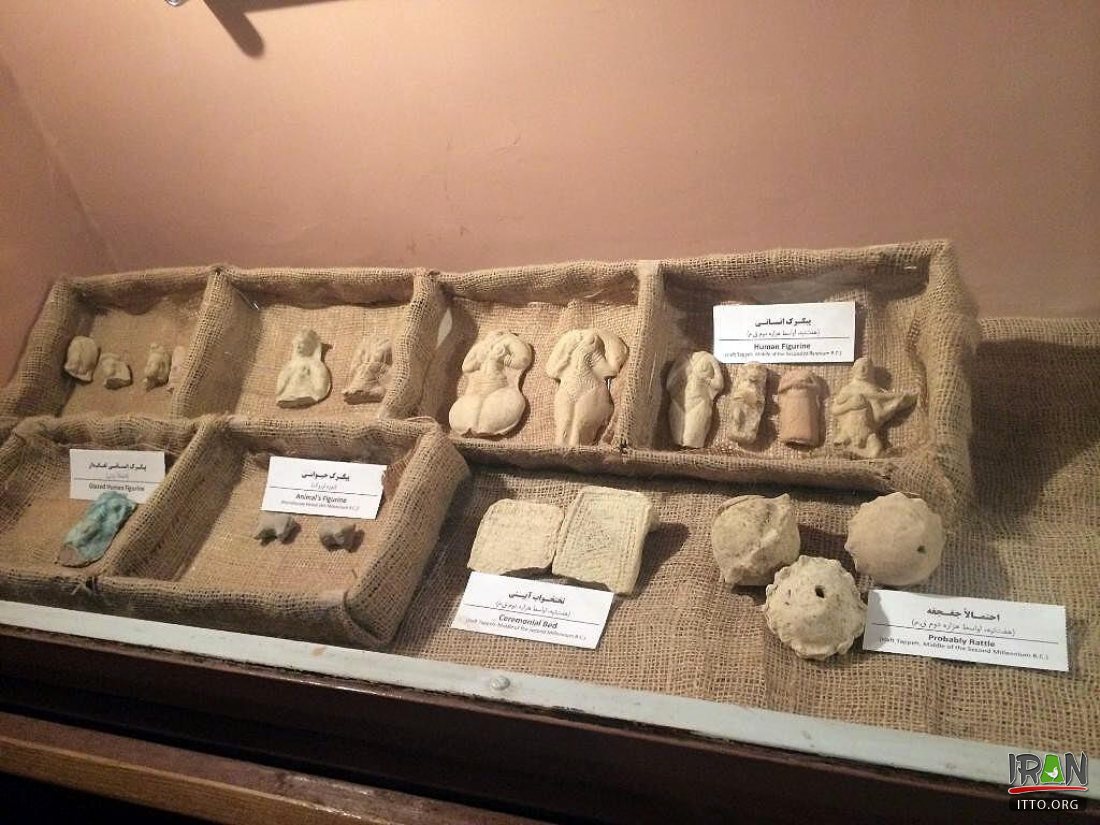
- "Who this goddess might be isn't exactly known. ... She could be the mother goddess Kiririsha, aka Kirrisi, Pinikir, Parti (her name at Izeh/Malemir, a settlement nearby), or Partikira (her name at Susa). She might've been known as the 'Great Goddess' and/or as the 'Proprietor of Heaven', titles held by similar goddesses throughout the ancient Middle East." ishtargates.tumblr.com/post/138152349361/along-with-the-r... Or she might have been the goddess Manzât, aka Mazzi'at, Manzi'at and Mazzêt, to whom a temple was dedicated at Chogha Zanbil and who was "believed to be responsible for the prosperity of cities. ... References to the worship of Manzât are known chiefly from the Elamite lowlands, esp. Susa and its surroundings. ... Theophoric names invoking her are attested in texts found at Haft Tappeh." (Wikipedia) Pinikir is discussed in this podcast.: youtu.be/uGz5zkMakjA?si=IByqOgzVSLfQ4JJp
- An older, shorter, balding man was in the vicinity while the younger man gave me that tour, made a comment to him at one point in a tone of disapproval if I recall, and the younger man seemed a bit chastened. Later as I was walking @ reading the booklet he gave me, the older man espied it, approached me and asked to see it, said the other man shouldn't've given it to me (to paraphrase), and took it back. He was the younger man's boss or supervisor evidently, and I fear that I got the kind, younger man in some trouble. (No good deed goes unpunished.)
Re the Development of the Arch or Barrel Vault:
- "The prototype [of the arch and the barrel vault] was a structure built of bundles of reeds placed upright in the ground, bent inward and tied together at the top to form a roof. Early Egyptian drawings, including hieroglyphs, depict reed vaults over sanctuaries, boat huts and other structures. Although no ancient reed bldg.s have survived, the technique has - in southern Iraq, at the confluence of the Tigris and Euphrates where 'Marsh Arabs' still construct enormous vaulted bldg.s of reeds. ... Nearly all the surviving [Near or Middle] Eastern arches are made of mud brick, or adobe (a Spanish loanword from the Arabic 'at-tub', 'the brick'). ... The same arid climate that makes mud-brick the ideal building material in the Near East makes vaulting the perfect technique for constructing a ceiling or a roof. A vaulted ceiling allows hot air to rise higher which helps to cool the living space. Many regions in the Near East lack forests, and the timber needed to support flat ceilings is scarce. A mud-brick vault requires no wooden beams for support. Not only is it practical and economical but it is a singularly graceful way to cover a building. ...
- "At Tell Razuk in Iraq a bldg. dating from @ 2,900 BC displays what may be transitional evolutionary forms: vaulted roofs in which the successive layers are both corbeled and canted inward. In Egypt radial arches and vaults were built sporadically in most periods of Pharaonic history, primarily in tombs and in monumental gateways. The earliest examples found of a radial vault in Egypt and of a pitched-brick vault anywhere are at Helwan in the same tomb which dates from late in the 1st Dynasty (@ 3,000 BC). [The "mature design" of the latter "suggests, however, that the technique had been employed for some time."] A somewhat later but particularly instructive example is the arched gateway of a mastaba (a bench-like tomb with inclined sides) at Giza from the 4th Dynasty (2,680-2,560 BC) that belonged to Neferi, a nobleman. ... The radial arch was more fully exploited in Mesopotamia. ... The earliest example known is in a hall built at Tepe Gawra late in the 4th mill. BC at the time of the emergence of Sumer. At Ur, the most famous Sumerian site, the tombs of King Abargi and Queen Shubad (@ 2,500 BC) had radially vaulted roofs and doorways. The most impressive Mesopotamian radial arches and vaults and the oldest Mesopotamian pitched-brick vaults (although a millenium younger than the earliest found in Egypt) are at Tell al Rimah, which date from the end of the 3rd and the 1st 1/2 of the 2nd mill. BC. Vaults span rooms 3.8 m.s wide in a temple, a burial chamber, 8 successive arches cover a stairway, etc. [Those at Haft Tappeh are pitched-brick vaults as well.] ... The acme of pitched-brick vaulting is the Taq Kisra, the great hall of the [Sassanian] palace at Ctesiphon, south of Baghdad, built sometime /b/ the 3rd and 6th cent.s. It still stands 28.4 m.s high and spans 25.5 m.s, the largest single-span vault of unreinforced brick anywhere." - case.edu/lifelonglearning/sites/default/files/2020-02/Van...
- According to Wikipedia, "[t]he earliest known example of [the] barrel vault [might be] under the [Sumerian] ziggurat at Nippur, built of fired bricks cemented with clay mortar." www.jstor.org/stable/496542?seq=18 A section of an arch in an ancient drain which "may have originally covered the whole drain, ... is perfectly elliptical" with a span of 1'8" and a total height of 2'4". (But I haven't found the date of construction of Nippur's arches.) Here's an old photo of that site.: en.wikipedia.org/wiki/File:John_Henry_Haynes._The_Nippur_...

The Rib or Ribbed Vault:
- It seems that the rib or ribbed vault, which became such an important and basic element of medieval Gothic architecture in Western Europe (essential to the construction of the great Gothic cathedrals, beginning with the Basilica of St. Denis near Paris in the mid 12-cent.), was invented or at least developed in ancient Iran (by the Medes?), where it "appears to have been confined, primarily." It was "employed extensively" at Nush-i-Jan (Median, 750-600 BC), with huge vault bricks, 1.2 m.s long. case.edu/lifelonglearning/sites/default/files/2020-02/Van... Van Beek writes (in his comprehensive article in the link re the development of "Arches and Vaults in the Ancient Near East") of the discovery of simple rib vaulting in a large Assyrian bldg. dating from @ 675 BC at Tell Jemmeh in Iraq (in which he also found "the oldest vaults known built of wedge-shaped bricks"). "The technique [of construction with rib vaulting] may have been brought to Tell Jemmeh by a Median builder in the service of the Assyrian imperial forces." (Nush-i-Jan is claimed to be the finest surviving Median bldg., one of the oldest surviving Zoroastrian ateshkades [it might be the oldest in Iran {?}, but I've read about the discovery of an earlier one somewhere in Central Asia which I'll write about sometime], and again, it's the site of the "extensive employment" of pioneering rib vaulting. It should be a Unesco site, but it's not on Iran's Tentative list for designation, not yet.)
"One would expect such long bricks to be fragile, but they were strong enough to support the floor of an upper room in the central temple." (Van Beek) flickr.com/photos/97924400@N00/3623624478/in/photostream/ Van Beek writes that "a rib vault couldn't have been as strong as a pitched-brick or radial vault, and apart from a certain simplicity of construction it probably had few advantages." But it was essential to Gothic architecture for good reason. "The ribs transmit the load downward and outward to specific points, usually rows of columns or piers, greatly reduc[ing] the weight and thus the outward thrust of the vault", permitting medieval Western European architects to build "higher and thinner walls with much larger windows." (Wikipedia)
- youtu.be/qU4ngo2UTXE?si=6qZHftlgYCczXpLq
- I think I hitched and walked back to Chogha Zanbil after completing my tour of Haft Tappeh, and then back to Andimeshk for the evening.
An early forerunner of the encyclopedia, De Proprietatibus Rerum dates from the 13th century and is often described as a bestiary although its focus encompasses theology and astrology as well as the natural sciences (as understood in 1240).
The North Carolina section of the "Carolina Special," Nos. 21 and 22, ran between Asheville and Goldsboro via Greensboro, Winston-Salem and Raleigh. At Asheville it connected with the South Carolina section to provide through service to Cincinnati. One of these trains is seen here arriving at, according to the photographer, Barber, NC, in the mid-1960s. If this depot is indeed Barber, then it is now at the Spencer Museum. (Original photo by Marshell Elting, Charleston Chapter member.)
Note what looks like an outhouse across the tracks.
(further information you can see by clicking on the link at the end of page, even in English!)
History of the applied
From the Imperial School of Applied Arts to present "Applied"
In the center of Vienna, in the capital of the Hapsburg Dynasty, was founded in 1867 the forerunner of today's University of Applied Arts, the Imperial School of Applied Arts. It was (today's MAK) affiliated to the Austrian Museum of Art and Industry (today's MAK), the first Museum of Decorative Arts on the European continent. This was in 1863 brought into being based on the model of the South Kensington Museum in London, today's Victoria & Albert Museum and should serve as role models collection for artists, industrialists and the public. The early industrialized England was then playing a pioneer role in the promotion of a reformed arts and crafts, to counteract the decline in the "machine age". Within the meaning of historicism one should, in Vienna, too, being enabled to study the great styles of the past on applied arts objects in the museum and art school, a training and education center for designers and craftsmen. The Vienna School of Applied Arts was to train artists and teachers alike to serve the requirements of the "art industry".
Heinrich von Ferstel, who had already built the museum, was commissioned to design a separate building for the school. 1877 could the until today used main building of the University in a prominent position at the Vienna Ringstraße officially being opened. Students (female ones, if somebody was to ask!) were admitted in contrast to the Academy of Fine Arts from the beginning on. As one of the numerous graduates of that era only Gustav Klimt here should be mentioned.
With the artistic development toward nature observation and toward free design also at the School of Arts and Crafts in the late 19th Century set in a detachment from work according to historical styles. Felician of Myrbach, a member of the newly founded Vienna artists' association Secession, was in 1899 appointed director of the school, which was dissolved out the following year from the administration of the museum. In Myrbachs term fall numerous reforms and callings making of the School of Art one of the cradles of the Austrian Art Nouveau and founding its reputation as the spirit of modernism committed institution. Otto Wagner had as a board member of the school major influence on whose reform implementations. The former faculty reads like a Who's Who of today's much acclaimed "Vienna around 1900" with names like Kolo Moser, Josef Hoffmann, Alfred Roller - in 1909 beginning his formative directorate time - and students such as Oskar Kokoschka.
The end of the monarchy also meant the end of the "kk" Arts and Crafts School, although the long time director Roller (until 1934) ensured the continuity of the high standards of artistic quality. An educational reform program Franz Cizek in his widely acclaimed youth art classes put into practise. From Cizeks' course for Ornamental morphology emerged the Viennese Kinetism, only recently (again) finding its international art-historical recognition, and where for the first time artists (female ones) - as Erika Giovanna Klien - were dominant. Architects such as Josef Frank, Oskar Strnad and Oswald Haerdtl continued the great tradition of the Viennese art space and transformed it. Margarete Schütte-Lihotzky, a graduate of the School of Applied Arts, became the inventor of the first produced in large series, so-called "Frankfurt Kitchen (Frankfurter Küche)" which had a lasting effect in social housing.
(The Frankfurt kitchen was a milestone in domestic architecture, considered the forerunner of modern fitted kitchens, for it realised for the first time a kitchen built after a unified concept, designed to enable efficient work and to be built at low cost. It was designed in 1926 by Austrian architect Margarete Schütte-Lihotzky for architect Ernst May's social housing project New Frankfurt in Frankfurt, Germany.[1] Some 10,000 units were built in the late 1920s in Frankfurt. - Wikipedia)
In the era of National Socialism, the Vienna School of Applied Arts was the "Reich Chamber of Fine Arts" subordinated, many teachers and students excluded from the school, threatened and persecuted, the teaching brought into line. In particular, the graphics class under their manager Paul Kirnig supplied visualized propaganda for the objectives of the "Third Reich" contributing to the elevation of the School of Applied Arts to "Empire Academy of Applied Arts in Vienna (Reichshochschule für Angewandte Kunst)".
After 1945, the now "College of Applied Arts" under the directorate of Maximilian Fellerer had a difficult start. Its orientation on the model of an art academy was also reflected in the name "Academy of Applied Arts"(1948-1971, then again "University"). The extension of the curriculum, increasing student numbers and a large annex after plans of Karl Schwanzer on the side of Vienna channel (moved into in 1965 ) are signs of expansion in the era of economic boom.
In 1980s and 1990s, the Applied developed under the long management of rector Oswald Oberhuber and Rudolf Burger, who headed the university from 1995 to 1999, to a progress-oriented institution. Into this period of time fall appointments of professors who briefly gave impetus or had long-lasting effects for generations of students. Among the teachers in the fields of architecture, design, visual art and theory of these decades are included personalities such as Friedrich Achleitner, Christian Ludwig Attersee, Carl Auböck, Wander Bertoni, Joseph Beuys (as visiting lecturer), Rudolf Burger, Jean-Charles de Castelbajac, Tino Erben, Adolf Frohner, Peter Gorsen, Hans Hollein, Wilhelm Holzbauer, Alfred Hrdlicka , Wolfgang Hutter, Karl Lagerfeld, Maria Lassnig, Bernhard Leitner, Walter Luerzer, Axel Manthey, Paolo Piva, Wolf Prix, Christian Reder, Jil Sander, Sigbert Schenk, Kurt Schwarz, Johannes Spalt, Mario Terzic, Peter Weibel, Manfred Wagner - just to name a few.
Since 2000, Gerald Bast heads as rector the University of Applied Arts Vienna, after the year before new legislation had made the Austrian Art colleges to universities. His ambitious program for a both growing arts university in content as well as in student numbers in the age of globalization and complex political and economic upheavals, among other things is reflected in the establishment of new degree programs and the appointment of many new lecturer".
Patrick Werkner
www.dieangewandte.at/jart/prj3/angewandte/main.jart?rel=d...
Forerunner of the "dOCUMENTA (13)" - 2012 in Kassel, Germany, the world largest exhibition of modern art!
The artist: Giuseppe Penone, title: "Idee di pietra" / "Ansichten eines Steins"
(Bronze and stone)
11 сентября 2014, Литургия в день памяти Усекновения главы Пророка, Предтечи и Крестителя Господня Иоанна / 11 September 2014, Liturgy on the Beheading of the Glorious Prophet, Forerunner, and Baptist John
6-7 июля 2021, Рождество пророка Предтечи и Крестителя Господня Иоанна / 6-7 July 2021, The Nativity of the Prophet Forerunner and Baptist of the Lord John
10-11 сентября 2022. Усекновение главы Пророка, Предтечи и Крестителя Господня Иоанна / 10-11 September 2022. The Beheading of the Glorious Prophet, Forerunner, and Baptist John.
An early forerunner of the encyclopedia, De Proprietatibus Rerum dates from the 13th century and is often described as a bestiary although its focus encompasses theology and astrology as well as the natural sciences (as understood in 1240).
In 1890, the forerunner of Florence School in the Tarrant County Common School District No. 34 was called "Green Glade". In 1903 Thomas Richard Sandidge, a school trustee, and his wife Nannie provided one acre at this site for school purposes. The nearby Green Glade site was sold, and the Florence Schoolhouse, a one-room frame building, was erected here among a grove of post oak trees.
The new institution provided grades one through eight and had an average enrollment of 30. The term ran from October, after cotton harvest, to May, the beginning of cotton chopping time. The building served as a community center where singings were held.
By 1914, with declining enrollment and the need for high school curriculum, the district was abolished and Florence School students attended Bedford, Pleasant Run, and Smithfield Schools. Sandidge reclaimed the land which had been set aside for school purposes, and the property was sold several times through the years. In 1966 the Tarrant County Junior College District bought the land as part of its Northeast Campus which opened in September 1968. Among the enrollment were descendants of students who attended the old Florence School. (1979) (Marker No. 1920)
Recorded using a Garmin Forerunner 110 GPS running watch. Motored up to 150m then thermalled up to 230m for a 20min flight.
Export file from Garmin Training Center as TCX - Training Center XML file. Import into GPSvisualizer.com and change "Altitude mode" to "Absolute (for flight)" and change "Colorize by" to "Altitude". Import into Google Earth