View allAll Photos Tagged fish
no fish hurt in the taking of this photo... was released fit and healthy
photo manip
TMI: your ART & NATURE
"The TMI Alphabet Challenge #15"
www.flickr.com/groups/impressionists/
created fpr TMI challenge
As I looked into the water several of these large fish (Carp maybe? I'm not a fish expert unless it's on a plate) came looking to be fed. British Wildlife Centre, Surrey.
The Fish Eagle is the epitome of African pride and grandeur for many people, with its piercing call carrying across the wilderness. The call is also the symbolic call in Africa for many. Both male and female birds call, with the male having a higher pitch than the female.
Fish Eagles feed on fish they catch by swooping down to the water surface from their perches in high trees. If they miss the catch they will return to the trees to seek out more fish on the surface. When catching a fish they will return to a perch and feed but should the fish be too heavy to pull out the water they will pull it to shore using their powerful wings to generate power.
I had never seen a muskrat eating a fish before... Cinema 6 slough, south of Regina, Saskatchewan. Canada. 27 October 2011.
Looking close... on Friday theme: Fish!
Portuguese condiment dishes.😊
Thanks to everyone who too the time to view, comment, and fave my photo. It’s really appreciated. 😊
This is a Japanese salt shaker, that's part of a set. I tried a 50-shot focus bracketing for this macro, which probably caused the background blur across the upper portion. Actual size is about 5 inches.
La Boca, Cuba.
- These refrigerators are used to temporarily store freshly caught fish. La boca del río Guarabo - mouth of the Guarabo river - a narrow river that empties into the Caribbean Sea. La Boca is a small fishing village located 5 km on the outskirts of Trinidad, in Sancti Spiritus province. In the back, the Escambray mountain range. ///
- Ces frigos servent à entreposer temporairement le poisson fraîchement pêché. La boca del río Guarabo - l'embouchure du Río Guarabo - une rivière étroite qui se déverse dans la mer des Caraïbes. La Boca est un petit port de pêche situé à 5 km en banlieue de Trinidad dans la province de Sancti Spiritus. Au fond, la chaîne de montagnes de l'Escambray. ///
- Estos refrigeradores se utilizan para almacenar temporalmente los peces recién capturados. La boca del río Guarabo - desembocadura del río Guarabo - un río estrecho que desemboca en el mar Caribe. La Boca es un pequeño pueblo de pescadores situado a 5 km a las afueras de Trinidad en la provincia de Sancti Spíritus. En el fondo, la sierra del Escambray. ///
(Explore Nov 30, 2015) www.flickr.com/explore/2015/11/30
And why not fish walk?..........
the desighn............
the curves,.........
and yes ,the cross legged "cat walk"...
hmmm,.....i think the fish has more,...
elegance with the waves..........
whats your point of view,..?
July 15, 1991 - St. Petersburg, Florida
Kodak Tri-X negative copied with a Nikon D810 using the Nikon ES-1 slide copier. I expanded the opening in an old plastic slide mount to allow room for the borders around the image. Mild tweaking in Photoshop.
Clown fish are hard to shoot! They move fast and dart out momentarily before seeking the security of the anenome. Focus is tricky so narrow aperture and 1/400second but the ISO was too high :-( Live and learn for another dive but at least they were not blurry.
Sometimes I have absolutely no idea when to stop messing around with the PS, this being one such occasion...
Nachdem meine Silvester-Party vor 2 Stunden wegen COVID abgesagt wurde, habe ich umdisponiert. Zum Glück hatte ich für den Neujahrstag einige Zutaten eingekauft .. und jetzt gibt es eine Fischplatte! 😎👍
After my New Year's Eve party was canceled 2 hours ago due to COVID, I rescheduled. Luckily I had bought some ingredients for New Year's Day... and now there's a fish platter! 😎👍
Watching us carefully, an African Fish Eagle perches over a creek near Tendada Camp in Central Gambia, West Africa.
California Academy of Sciences
This is the view from underneath the rainforest pond. You can see the people through the water up above
You may purchase a copy of this photo as a poster or framed print HERE.
I'm amazed I managed to rally in time to get this shot done today before Lost tonight. Let me back up. I went to Urgent Care this morning to get my leg checked out since I still can't walk. Turns out I tore my calf muscle and fascia in my right leg. The good news is that I didn't rupture my achilles tendon, so I won't need surgery. The bad news is that it's going to be 4-6 weeks before I can even think about running, jumping, playing soccer, or anything else that I actually want to do with my leg. But I'm thankful because it could be worse. I have to keep reminding myself of that. Anyway, the doctor gave me a prescription for Percocet to help with the pain. I had some issues with nausea when I took Vicodin a few years back, so he thought Percocet would be a good alternative.
WRONG!
About forty-five minutes after taking it, I hit a brick wall of nausea and was completely laid up for the rest of the afternoon, petrified that I was going to throw up. Did I mention that I do NOT throw up? I do everything in my power to avoid it at all costs, no matter what. Even when I know I will feel better afterwards. No thank you. Anyway, today sucked. That's pretty much the point of the story. But I managed to get this shot off for this week's Emulation Challenge in My Face is My Canvas. Can you believe this is our 25th week of emulation challenges??? If you haven't already checked out the group and you have even the slightest interest in face art photography, you owe it to yourself to stop by. And for those of you who haven't played in a while...hey, we miss you! ;)
Ok, time to watch the rest of last week's Lost in preparation for tonight's episode. Michelle and Daynna, prepare for the onslaught of texts and BBMs.
**Explored**
365 Days (self portraits): Day 343
My Face is My Canvas: Emulation #25
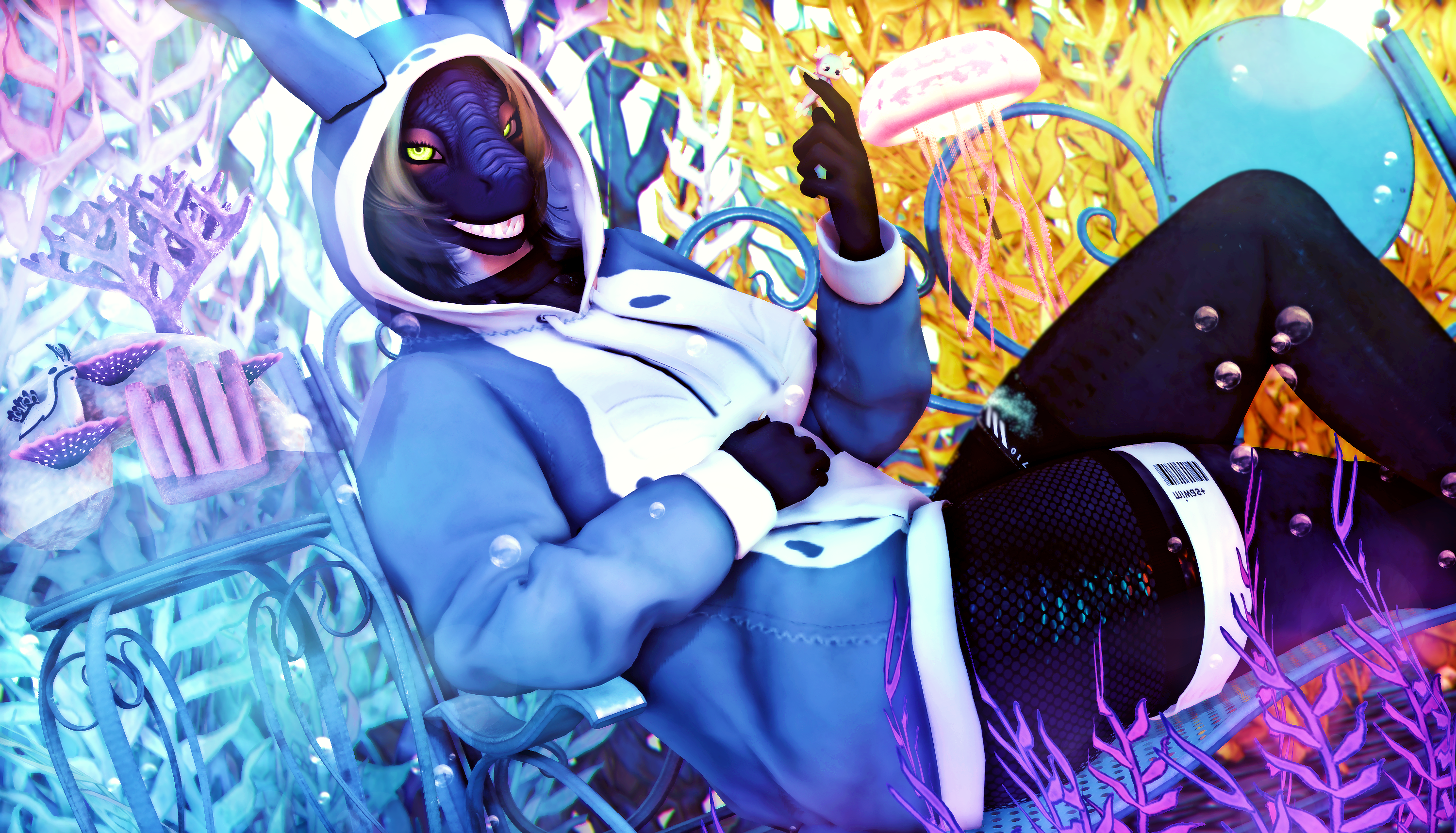
🐟 Abnormality - Seaborne is opening today! 🐟
Open from February 7th - 28th 2024
🔺 Featuring 🔺
Head: .:C:. Carcharadon
Mod: Iggy's Black Moor Goldfish
Hoodie: [T24] Shark Hoodie
Furniture: Ombra - Octopus Patio Set
Jellyfish: Ombra - Jellyfish Paper Lantern
Aquarium: ~*WW*~ Noodi Habitat
Hand: .Tardfish. Lil' Sea Monster
Seaweed: [RoS] Spectacular Seaweed
How I wish, how I wish you were here
We're just two lost souls swimming in a fish bowl
Year after year
Running over the same old ground
What have we found ?
The same old fears
Wish you were here...
Pink Floyd