View allAll Photos Tagged expecting
Xiao Jing, Chief Scientist, Ping An Group, People's Republic of China speaking during the Session: Next 10 Years: What To Expect In China's Artificial Intelligence Future at the World Economic Forum - Annual Meeting of the New Champions in Dalian, People's Republic of China 2019. Copyright by World Economic Forum / Benedikt von Loebell
Little did I expect to the see the purple and orange livery of 172 339 of West Midlands Railway while waiting for my train at Birmingham Moor Street Station!
It was after I popped to the city centre on the way back from Longbridge via Birmingham New Street, to see the Bullring Bull in it's orange West Midlands Railway outfit.
This time, I managed to also get the sides of the train as it advertised places such as Birmingham Botanical Gardens and the Black Country Living Museum (neither are really close to a railway line - although University or Five Ways are close to the BBG).
The train was heading to Stourbridge Junction, before later heading down to Dorridge.
13 Nov 1954, Cairo, Egypt --- Wearing the traditional Burnoose, but carrying Western clothes, Sheikh Ezzat Gaafar, Chief of the Cabinet of the Emir of Kuwait, arrives in Cairo from Rome. Gaafar is expected to marry ex-Queen Narriman of Egypt after she obtains a divorce from her present husband, Dr. Adham El Nakeeb. Narriman's first husband was ex-King Farouk. --- Image by © Bettmann/CORBIS
And he did not marry her
The most adorable girl mimicking her pregnant mom. Update: when I took the photo I didn't know the tile 'Expecting a brother' would be the right one. The little girl did get the brother she expected. :)
2017 World Championship Group Stage at Wuhan Sports Center Gymnasium in Wuhan, Hubei, China on 5 October 2017.
This picture I made it in the garden of a friend of Böblingen.
Tree is cherry.
The word cherry refers to a fleshy fruit (drupe) that contains a single stony seed. The cherry belongs to the family Rosaceae, genus Prunus, along with almonds, peaches, plums, apricots and bird cherries. The subgenus, Cerasus, is distinguished by having the flowers in small corymbs of several together (not singly, nor in racemes), and by having a smooth fruit with only a weak groove or none along one side. The subgenus is native to the temperate regions of the Northern Hemisphere, with two species in America, three in Europe, and the remainder in Asia. The word "cherry" comes from the French word "cerise", which comes in turn from the Latin words cerasum and Cerasus.
The cherry is generally understood to have been brought to Rome from northeastern Anatolia, historically known as the Pontus region, in 72 BC. The city of Giresun in present-day Turkey was known to the ancient Greeks as Choerades or Pharnacia, and later as Kerasous or Cerasus, < Kerason < Kerasounta < Kerasus "horn" (for peninsula) in Greek + ounta (Greek toponomical suffix). The name later mutated into Kerasunt (sometimes written Kérasounde or Kerassunde).
The English word cherry, French cerise, Spanish cereza, and Southern Italian dialect cerasa (standard Italian ciliegia) all come from the Classical Greek κέρασος "cherry," which has been identified with Cerasus. The cherry was first exported to Europe from Cerasus in Roman times. By the Middle Ages, cherries had disappeared in England. They were reestablished at Tyneham, near Sittingbourne in Kent by order of Henry VIII, who had tasted them in Flanders.
Besides the fruit, cherries also have attractive flowers, and they are commonly planted for their flower display in spring; several of the Asian cherries are particularly noted for their flower displays. The Japanese sakura in particular are a national symbol celebrated in the yearly Hanami festival. Many flowering cherry cultivars (known as 'ornamental cherries') have the stamens and pistils replaced by additional petals ("double" flowers), so are sterile and do not bear fruit. They are grown purely for their flowers and decorative value. The most common of these sterile cherries is the cultivar 'Kanzan'.
i wasn't expecting him to kiss me back!
I dragged out the tripod today between rainstorms in an attempt to join Da Boyz by the deer trough. Rather ugly results, but I didn't have as much time as the weather map seemed to indicate. I'll have to try again some day. Preferrably a day without rain and sloshy snow. My setup definitely needs plenty of tweaking in regard to focus, composition, and camera settings, but at least I have an idea of what I need to do to improve. Opted to post this series regardless.
Note to self: comb my hair before getting in front of the camera. Sigh.
[SOOC]
These are my personal notes taken during a geology presentation. I give them here because they may be of some interest. Do not expect the notes to always be in complete sentences, etc.
-----------------------------------
A Look at Biotic Events at High Southern Latitudes at the End of the Cretaceous
Presented by: William Zinsmeister (Department of Earth and Atmospheric Sciences, Purdue University, West Lafayette, Indiana, USA) (www.eaps.purdue.edu/people/faculty-pages/zinsmeister.html)
19 November 1998
----------
The Cretaceous-Tertiary (K-T) extinction is the smallest of the big 5 extinctions. 11% of all families go extinct at the K-T boundary. But, the K-T extinction is a favourite of many people, mainly because it included the extinction of the dinosaurs. There have been many theories proposed about why the dinosaurs went extinct, including mammals eating their eggs, the evolution of angiosperms interfering with their digestive systems, and other ideas.
But, all these dinosaurs extinction hypotheses are flawed because they only deal with dinosaurs. Many terrestrial and marine groups (plant and animal) went extinct at the same time.
Then, the impact hypothesis came along in the early 1980s, proposed by Alvarez. This idea explained the K-T extinction in both the terrestrial and marine realm - basically, the global food chain collapsed. Also, the impact theory caught people’s imaginations, and was immediately accepted as fact by the media and the general public. There is much debate among scientists, though.
Now, there is much compelling evidence for an impact. Lots of computer modelling has been done to see what an impact would do the the Earth. One idea is that debris would be thrown up high into the atmosphere and would fall back down as an enormous meteor shower, which would heat the atmosphere to 800˚ and everything on the surface was cooked. Other scary ideas: rainshowers of nitric acid and sulfuric acid, nuclear winter scenario, and global forest fires.
Problem: If things were so bad, how did anything survive? Where are the burned/charred dinosaur bones and trees if all this happened?
There are a few diehards who still say an impact didn’t happen.
Other than that, there are 2 hypothese: 1) Bad Day Hypothesis; 2) Impending Doom Hypothesis.
The Impending Doom Hypothesis says that the Earth’s biosphere had been under a long period of stress up to the time of the impact. The impact was the capstone to the extinction. This seems like a logical idea.
Seymour Island - located near the northeastern tip of the Antarctic Peninsula. The geology on Seymour Island is mostly a homoclinal succession of rocks - Cretaceous to upper Paleocene. (www.geologicallocations.com/antarctica/seymour-island.htm)
Post-impact scenarios - it has been difficult to assess post-impact scenarios because there are few areas in the world with Danian-age rocks (= earliest Tertiary). Danian rocks occur in northwestern Europe, a few other places, and on Seymour Island. The north part of Seymour Island is Tertiary in age.
There are about 70 square kilometers of outcrop to look at on Seymour Island (upper Cretaceous and lower Tertiary). The island has a desert-like topography similar to southwestern USA. These are good exposures, and they are packed with fossils with a high diversity and good preservation. About 800 species of fossils have been described from Seymour Island. Lots of ammonites are just lying on the surface. The ammonites are aragonitic. There are also good gastropods and bivalves (all fresh looking). There are also fossil echinoids (including 1 form with 5 brood pouches - the juveniles live in the parent up to a certain point). There are also plesiosaurs and mosasaurs. Ammonites are common.
A spectacular specimen of Diplomoceras was found last year - a specimen that was 1.5 meters long (but curved; uncurved, it would be 14 feet long). The animal itself was ~6 feet long (a 6 feet long living chamber). Smaller pieces of this fossil are relatively common, but this specimen was unusually preserved. It is the nicest, most remarkable specimen known. (www.geologicallocations.com/assets/photos/antarctica/Seym...)
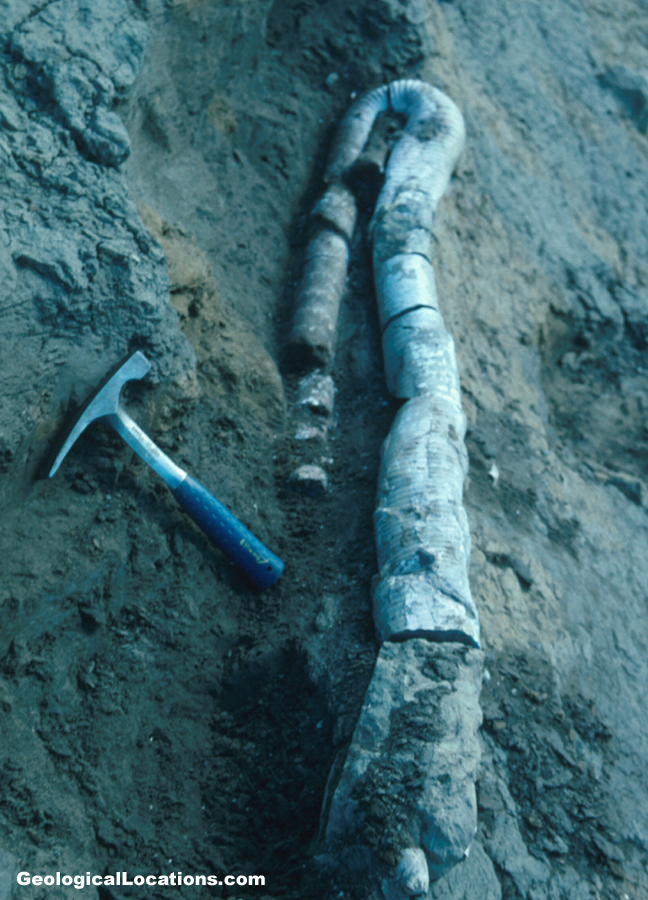
Seymour Island is very muddy to work on - it is always above freezing during the field seasons.
An iridium anomaly does occur here on Seymour Island. It occurs in a unit referred to as the K-T glauconite, which is a greenish, glauconitic sandstone that occurs at the boundary. The glauconitic sandstone is easily correlatable across the island. (www.geologicallocations.com/assets/photos/antarctica/Seym...)
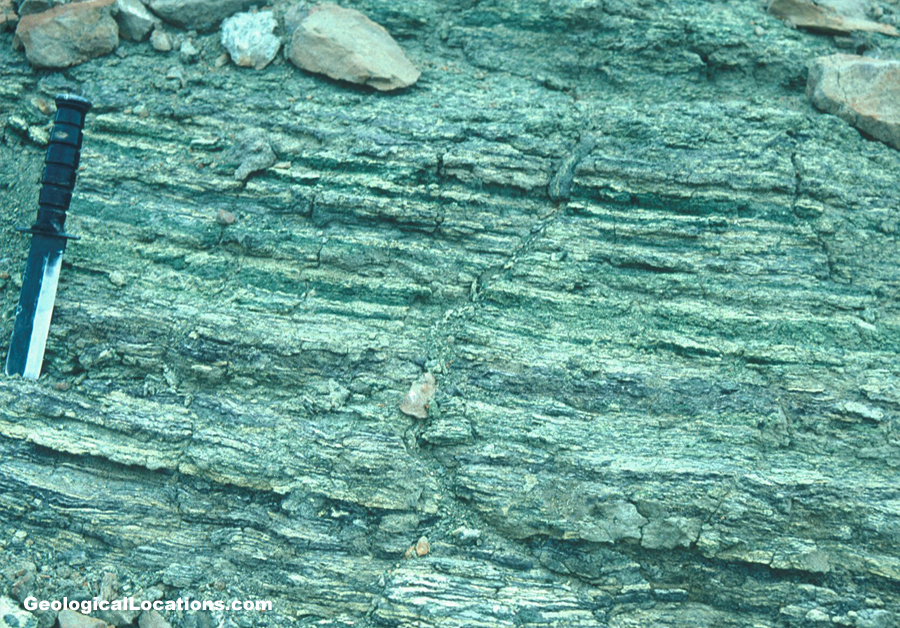
There are no stratigraphic or sedimentological signatures at the K-T boundary within the glauconitic sandstone interval. There is no boundary clay, as classically seen at Gubbio, Italy.
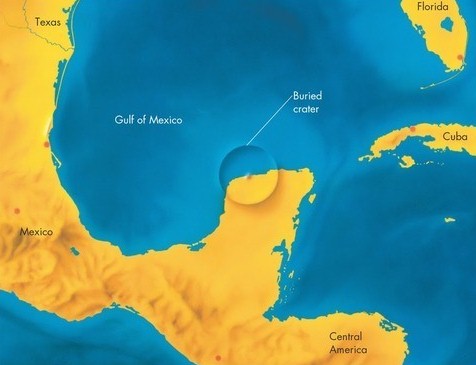
Antarctica is ~8000 miles away from the Chicxulub Crater in Yucatan, Mexico, which is a significant point as far as considering the after-effects expected to be seen in Antarctica. (www.theyucatantimes.com/wp-content/uploads/2014/06/Chicxu...)
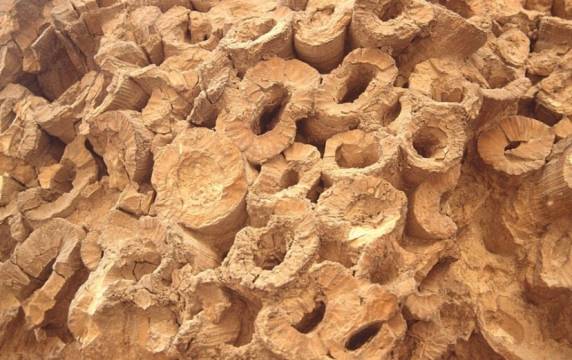
Rudist record - there is a gradual increase in the diversity of rudist bivalves in the Cretaceous. (www.paleotax.de/rudists/intro-Dateien/image002.jpg) Most rudists went extinct at 67.5 to 68 million years ago (~early-late Maastrichtian boundary). This pattern mirrors other groups’ diversity patterns as well - all mostly go extinct before the K-T boundary.
Seymour Island ammonites crash at the end of the Campanian. Seymour Island inoceramid bivalves are gone near the end of the Campanian. (www.flickr.com/photos/jsjgeology/19921135882) Seymour Island belemnites virtually disappear at the end of the Campanian. Seymour Island ammonites are quite diverse in the Campanian (35-36 species), but their diversity crashes to 10 species in the Maastrichtian (= latest Cretaceous), and they are gone at the K-T boundary. Several Campanian cosmopolitan ammonite families disappear in the Campanian in the Seymour Island area, but they extend to the K-T boundary in lower latitudes. So, their disappearance in the Seymour Island area indicates a general temperature decline (cooling).
A regression occurred at the mid-Maastrichtian.
Superimposed on the Maastrichtian temperature decline are several rapid warming spikes. 50,000 years before the K-T boundary event was a warming event, documented from some ODP sites.
Note the restricted occurrence to 1 horizon on Seymour Island of the ammonite Zealandites varuna in the Maastrichtian Lopez de Bertodano Formation. Its presence probably represents a warming spike.
The faunal transition across the K-T boundary on Seymour Island - no single extinction event seen - a gradual decline is seen instead. There is no marked extinction horizon.
Then, someone suggested that this pattern is due to the Signor/Lipps Effect, a phenomenon produced by collection/preservation biases. One can get a gradual extinction pattern purely due to collecting and preservation biases. So, Zinsmeister and others recollected the fossils on Seymour Island, and collected fossils spatially, doing detailed mapping.
The K-T glauconite (~5 meters thick) is actually 3 units - a lower glauconite, a middle fish bed/horizon, and an upper glauconite. The fish debris bed could represent a victim bed from the K-T impact.
Renewed fossil collecting has resulted in a new diversity record - the extinction is less gradual now - it is more abrupt, but all groups are dying out just before the iridium anomaly. The K-T extinction is now more abrupt is high southern latitudes than previously thought.
Fish horizon - interpreted to be the effect of extreme ocean disruption; fish kills are not due to ocean poisoning (strangelove ocean), but by pulses of nutrients into the oceans. This is the only fish horizon in 1600 meters of section. It could be an interval of slow deposition, but this is not likely because fish degrade relatively quickly, and one needs special conditions to preserve fish. The fish debris bed represents conditions after the K-T event - lots of fish kills occurred.
The biosphere is far more robust than we give it credit for. Organisms have been able to survive truly catastrophic events in geologic history.
Example: the Millbrig Bentonite (Middle Ordovician, eastern USA and Scandinavia). This large volcanic eruption resulted in no extinctions. Therefore, Earth’s biosphere is very robust. But, if the biosphere is already stressed, then a big event can push the biosphere into a mass extinction.
------------------
The photo I had to laugh. Can not smile without looking at it as a huge dog finds the members of his flock of children. Balian accompanies them everywhere:)
Model: Claire
Makeup: Iraigui Flores de Crété
© 2010 Jean Lemoine - Tous droits réservés.
Strobist info:
Multiblitz Profilux 600 with softbox.
Courtenay Solapro 300 with softbox.
Wire trigger.
Follow me on Twitter (I follow back)
Photos from the 2012 premiere of What to Expect When You're Expecting in New York.
Family baby shower. I don't remember which relative was the photographer. This is me with my younger sister and my mom.
VA Blizzard Jonas expected to drop 2-4 feet of snow between today 22 Jan 2016 and Sunday 24 Jan 2016
Expect More. Pay Less...
So I got a little creative and made her a dress out of plastic bag... OF COURSE... from Target :P
Lots of moths this morning, but less variety and I suppose that is what to be expected of at this time of year as our seasons change, the mornings get a little nippier and moths such as the Centre-barred Sallow start making an appearance.
Common Rustics seemed to have finished and Square-spot Rustics have taken over somewhat! Willow Beauty still going strong though.
Catch Report - 27/08/13 - Back Garden Stevenage - 1x 125w MV Robinson trap
Macro Moths
1x Small Dusty Wave [NFG]
1x Centre-barred Sallow [NFY]
1x Treble-bar [NFY]
22x Willow Beauty
45x Square-spot Rustic
5x Brimstone
1x Blood-vein
1x September Thorn
1x Garden Carpet
18x Vine's Rustic
7x Flame Shoulder
7x Lesser Broad-bordered Yellow Underwing
6x Setaceous Hebrew Character
4x Lesser Yellow Underwing
2x Green Carpet
12x Large Yellow Underwing
1x Spectacle
1x Turnip Moth
2x Orange Swift
1x Mouse Moth
1x Common Rustic
1x Straw Dot
2x Dun-bar
1x Shuttle-shaped Dart
1x Double-striped Pug
1x Flounced Rustic
1x Burnished Brass
Micro Moths
1x Apotomis betuletana [NFG]
2x Rhopobota naevana [NFG]
2x Trachycera advenella
1x Spilonota ocellana
1x Emmelina monodactyla
5x Pleuroptya ruralis
1x Evergestis forficalis
8x Agriphila tristella
5x Agriphila geniculea
2x Celypha lacunana
4x Epiphyas postvittana
2x Mompha propinquella
2x Pandemis corylana
1x Argyrotaenia ljungiana
1x Eudemis profundana
1x Cydia splendana
1x Hofmannophila pseudospretella
Title
Copy of letter to Samuel Evans of Millhouse (George Eliot's Uncle) from George Eliot
Date
10 Aug 1840
Description
George Eliot sends comfort to her Uncle, Samuel, at the time his wife Elizabeth [model for Dinah, 'Adam Bede'] is not expected to recover from illness. Unsigned.
Transcription
Letter from Miss Evans of Griff to Samuel Evans of Millhouses Aug.10/40 when Mrs. E. ('Dinah') not expected to recover
My dear Uncle, Remembering the Apostles declaration that to be absent from the body is (for redeemed souls) to be present with the Lord I cannot for her own sake regret that my Aunt is so very near the brink of Jordan. I would only pray that her heavenly Father may out of his tender consideration for his creatures who are but dust lighten the weight of bodily suffering as far as may consist with His designs of mercy to her soul. Give my dear Aunt if she should be able to receive it an assurance from me of my affection for her and tell her I humbly resolve in the strength of the Lord to seek his face evermore, that we may sing together a new song before the Same. For you my dear Uncle both My Father and myself truly feel and have endeavoured to pray that you may be powerfully sustained under a trial that will indeed bereave you of one who has been as the Apple of your Eye but is it not to this end that God may be all in all with you and that having no earthly proof you may walk entirely by faith. I doubt not my dear uncle that you will evidence the possession of what belongs only to the Xtian joy in tribulation and that you will thus glorify the Lord God of Israel even in the fires. Truly the commandments of God are not grievous for the Apostle sums them up by 'rejoice in the Lord and again I say rejoice' and though this may seem a great difficulty when the heart is bowed down and rent in twain by the loss of our earthly good in reality that is the very time that we can best relish the waters that make glad the City of God. Trials 'make the promise sweet' such memories as these (to him that overcometh will I grant to sit on my throne'. The Lamb that is in the midst of the throne shall feed them & God Himself shall wipe away all tears from their Eyes.
All Right's Reserved. All images are subject to copyright restrictions. Contact Warwickshire Libraries for further details. Part of Warwickshire Libraries' George Eliot Collection.
Original held at Warwickshire County Record Office.
expected overlaps
Choreografie: Mario Heinemann Jaillet
Tänzerin: Gaëlle Morello
Darsteller: Nicolas Menze
Puppenspieler: Werner Ries
Licht: Norbert Mohr
Koordination: Sophie Jaillet Heinemann
© All rights reserved
Photos: Günter Krämmer
3rd Surprise of the Day
The 7th of September 2014 is a historic day. Because of the amazing number of people growing rich here, the average waste size is increasing accordingly .... In 9 odd years here, I have NEVER been able to buy clothes for myself in ANY shop in China. Always had to have it shipped in from Europe or SA via family. Youngsters like this are changing this - and yesterday I managed to buy two shirts and a pair of shorts in a small shop. Really did not leave home expecting this ...
Now, may the shoe size of locals start growing too, PLEASE ;-)))
Went Walkies yesterday, looking for one thing unsuccessfully but found many other surprises in this amazing city.
from ift.tt/19t6mwl
Through GoPro Through GoPro - They are heroes, look through their eyes
Gopro hero 3 and it’s slow motion features takes film making into a new level. Shot for less than a great meal and couple of beers. This epic gopro hero 3 sh…GoPro Video
GoProHero3
Read more Here Is What To Expect From Gopro Hero 3 Black Edition: Cinematic Version!!! Thomas
They are my new favorite couple in town….gorgeous, funny and very pregnant with their first bundle of joy :).
Kids in the audience not convinced that Manx can swallow a sword without there being a lot of blood involved!
And here's where the rain started...
Street performers at the Auckland International Buskers Festival 2010.
expected overlaps
Choreografie: Mario Heinemann Jaillet
Tänzerin: Gaëlle Morello
Darsteller: Nicolas Menze
Puppenspieler: Werner Ries
Licht: Norbert Mohr
Koordination: Sophie Jaillet Heinemann
© All rights reserved
Photos: Günter Krämmer
i figured i'd document our super-clean apartment. it is so rarely so tidy + orderly.
with bonus ECC-in-the-box! and two finished quilts in situ!
via
What is the Lifespan of a TV Aerial?
Perhaps, you want are planning to install a TV aerial or you recently installed one, you will of course wonder how long your aerial would last before a new one will be needed. There are a lot of factors that determine the lifespan of a TV aerial in Leeds. These factors dictate how long before a maintenance check is required and how long before a complete replacement is needed. Here at TV Aerials Leeds will take you through the most important things to note.
What is the expected lifespan of an aerial installed on the roof?
If the installation is done by a professional on a rooftop, the TV aerial typically would last around a decade or even two decades. In some cases, they even last a lot longer. On the other hand, if the installation is carried out by an amateur, it most definitely will not last as long as even 10 years. In some cases, you also have a situation where the cables and fittings develop faults long before there is any issue with the aerial itself.
Poor-fitting of Antenna or Aerial
Even if you buy the most expensive or best quality antenna with the highest quality materials, it still does not guarantee you the longest lifespan if there is an issue with installation. Poor installation is responsible for a host of problems with TV aerials and this includes but not limited to:
Very High Installation of Area
If you intend to install your antenna on an aerial mast, probably to avoid trees or for other reasons, you must use the right brackets that have the capability to support the height of the mast. A very easy way to know if the brackets will be suitable for your installation is to make sure that the spacing of the bracket is set at a minimum of 16.66% of the total height of the mast. This implies that if you are installing the mast on a 6-inch pole, your bracket should have a minimum of 1-inch spacing. However, if you want to get huge radio aerials or high-gain aerial, you can even install at a higher length. In such cases, it would be better to be more cautious and use 25 percent bracket spacing compared to the total height of the mast. It is better safe than sorry. You might also want to use a mast with a thicker diameter and thicker wall. For huge mast heights, poles with 2-inch diameter are often a good option as they would contribute significantly to the overall lifespan of your mast.
Over-tightening the U Bolt at the top
This is a very common mistake that people make when installing on masts. If the V Bolt or U Bolt is over-tightened at the top, the mast could assume a wrong shape and start to bend. The implication is that the mast will become weak, lose its structural integrity and eventually fall off. Tightening the U Bolts requires a lot of care especially for the top bolt. It is recommended that ratchet spanners are not used for the tightening as it makes it easier to over-tighten the nut. I have made this mistake in the past and it is not one I would want to repeat or want you to experience.
Lightning Strikes and Electrical Storm
On a few occasions, electrical storms could result in a TV antenna getting damaged or stop working altogether. Every component of the aerial could be destroyed in the event of an extremely high voltage passing through the aerial. When this occurs, you would have no choice but to change the full TV aerial. You would also need to replace the coaxial cable. If a bolt of lightning should directly strike your aerial, you would not only be worrying about your aerial as several of your electrical appliances are also at risk of damage as well. There is no technique the installer can use that would guarantee you safety from lightning strikes or electrical storms. Your best bet will be to have a guarantee or insurance as a newly and properly installed high-quality antenna could be destroyed by this circumstance.
There are many other practices related to installation that can decrease the lifespan of your TV aerial that will quickly turn this article into a textbook book if they were all to be covered one after the other. Some examples of other practices include a house with loose bricks, failing chimney, snapping of lashing wiring (majorly as a result of age), and aerial cables getting waterlogged as well as upside-down installation of aerials among others.
Quality of the Antenna or Aerial
There is always a temptation to compromise on quality as per budget and opted for cheaper low-quality aerial and/or accessories. There are also chances that you decided to install the antenna on your own without expert knowledge and experience by just following a guide in a bid to save on installation cost. When this is the case, you might not get to enjoy the antenna for as long as 10 years as its lifespan will be very short. Amateur installation and cheap quality equipment does not bode well for the lifespan of the aerial. There was an instance where I was invited to provide a quotation for aerial installation. My quote was rejected. About a month later, I drove past the house and observed a new antenna installation that was already broken and had fallen. The implication is that the individual would have to pay to probably get a new antenna, new materials and/or pay for fixing of the antenna. The cost of these, coupled with the initial cost installing the antenna will already be more than my initial quote that would have lasted up to 20 years or more. This is apart from the inconvenience they would have faced during the period the antenna was down.
You should not try to cut costs by compromising the quality of the parts. This is especially when it comes to items that are installed outside that are in constant exposure to adverse weather elements such as rainfall, gales, and high winds. If you live in an area where you have witnessed the wind pulling off the roof from a property, how much hope do you think a quality antenna would have, let alone a low-quality or poorly installed antenna. It is best to avoid aerials that have elements like Bacofoil as they bend easily and will not serve you well from my point of view. You should read up on recommended TV antennas as they will guide you on choosing the right TV aerial. Wolsey, Antiference and Vision are my preferred manufacturers within the United Kingdom.
Changes in times
Things are changing rapidly in the world today, especially for items that are related to technology. There are instances that your aerial could suddenly become obsolete because of technology advancements. An instance where this has happened in the past is the change to UHF from VHF as well as during the switch-over to digital. As opposed to popular perception, digital aerial does not exist. Thus, your old aerial could continue to work which we expect the switch to digital aerial. You might also be faced with a situation where there is a change in frequency or a new big building was newly built close to you. You might be forced to increase the height of your TV aerial or opt for a satellite dish instead. There is also the fact that very soon, television programs would be streamed only through the internet and no more broadcasted in formats that your antenna will be able to pick. Even though this might still be many years to come, Internet televisions are already in existence.
Loft aerials are more durable
If it is possible, you should not install your antenna in the loft for some reason. First, your loft will most likely be lower than your Fascia fixings, gable end, and chimneys. As a result, you might lose some height and getting a good signal might become a challenge. The signal would have to penetrate roof tiles and walls before your antenna can pick it. In some cases, your antenna might not be able to pick any signal. Even when signals are picked, the picture quality might be poor.
However, since loft antennas are properly covered, weather and high winds would have little effect on them. The implication is that they would last longer as their rate of deterioration would reduce significantly.
Length of Aerial Installations Warranty
Most companies would give between 1 and 2 years guarantee when they install your aerial. I give a warranty of one year. Providing us with an online review will give you a second-year warranty for free. This is not to say that we are not confident about the quality of our work or that there will be a high chance of problems with the antenna after the second year. However, it is mostly because most warranties on the parts we use for installing the aerial only have a warranty of one to 2 years as well. Some companies could give warranties of between 3 and 5 years, however, you would have to pay some money to activate the longer warranty.
The post Expected Lifespan of the Aerial of a TV appeared first on TV Aerials Leeds.