Drupal Dev Days Athens 2026
View allAll Photos Tagged drupal
The fruit bearing clusters of palm trees are called drupes. This is a close-up of one cluster of drupes from a Pygmy Date Palm from my yard. (I also have another variety of palm that produces huge drupes of orange, fiberous fruit, each drupe cluster weighing about 20 pounds or 9 kilos.)
The drupes emerge from a protective pod (also pictured) that hardens into wood after opening. The little balls on the stalks are flower buds which will turn into tiny yellow flower clusters before going to seed.
Shot for Looking Close… on Friday!, Flora on Black Background
Au 14 °S , le café est surtout une plante cultivée en Ethiopie , puis au Yemen .
Des Hollandais importeront des graines , en Inde , à Ceylan et dans l'ile de Java.
Ce sont des plants d' Arabica...... qui vont se développer, également dans les iles avoisinantes.
Au 19° s , une épidémie de rouille dévaste la majeure partie des plantations.
L'indonésie introduit alors le café Robusta ,plus résistant à cette maladie.
Depuis l'indépendance, les plantations de café sont gérées comme des plantions publiques d'Etat , et on introduit de nouvelles variétés d'Arabica....
Désormais, 90% des plantations fournissent du Robusta et les autres plantations de l'Arabica .
L’arabica est cultivé dans les fincas (fermes) entre 750 et 1400 m d'altitude sur les flancs du volcans de Bandung et dans l'Est de java sur le Plateau d' Ijen.
I had to look up online to see what this fruit is called. From Wikipedia: "The fruits of all dogwood species are drupes with one or two seeds, often brightly colorful."
This is our ad for DrupalCon SF, where we have a spot in the program booklet as sponsors.
So what's Kit? Check it out: drupal.org/project/kit.
Poison Ivy is well-known for causing Urushiol-induced contact dermatitis, an itchy, irritating, and sometimes painful rash in most people who touch it. It is caused by urushiol, a clear liquid compound in the plant's sap.
The berry-like fruit, a drupe, mature by August to November with a grayish-white colour. Fruits are a favorite winter food of some birds and other animals. Seeds are spread mainly by animals and remain viable after passing through the digestive tract.
Berry like drupes on Sumac bushes are edible with a citrus taste. I didn't know that when I took the photo - maybe next year. Holga 120N, Lomo 100 color film.
Henry County, Georgia
Gray dogwood (Cornus racemosa) leaves turn shades of maroon and purple. White berries or “drupes” grow on stalks that turn bright red in autumn.
Wizzlern.nl is a group of skilled Dutch Drupal experts who can train developers and themers in Drupal.
See also: www.flickr.com/photos/x-foto/4923221504/
I used a single camera-mounted 580EX flash bounced off the ceiling.
Sycamore drupes (the small, spiked, ball-shaped seed clusters of Platanus occidentalis) provide ecological benefits by serving as a food source for birds and mammals, such as finches, squirrels, and muskrats.
Here lies the Frank Grimes of the Drupal world. Hard working, persistent, ever -present - but largely ignored.
Now it's gone forever. Well, unless it gets reopened. Easily done.
Drupal modules as of 11/9/07
Full-sized, legible photo can be seen here: http://www.flickr.com/photo_zoom.gne?id=2007464793&size=o
Linkable version here: www.kentbye.com/files/drupal_modules_all.html
This photo set contains the 5 smaller printable sections.
These linkable Cheat Sheets are here:
www.kentbye.com/files/drupal_modules_part1.html
www.kentbye.com/files/drupal_modules_part2.html
www.kentbye.com/files/drupal_modules_part3.html
www.kentbye.com/files/drupal_modules_part4.html
www.kentbye.com/files/drupal_modules_part5.html
I created this graphic because I felt overwhelmed with how many Drupal modules were out there, and I wanted to have a single cheat sheet that I could print out and reference. But this proved to be impossible, and it took me splitting up this massive photo into 5 subsections listed above in order to legibly print out all of the modules -- all of the modules as of November 9th, 2007 that is. (There's been another 20+ new projects created since then according to http://drupal.org/taxonomy/term/14/0).
A couple of technical points: The modules are color coded according to the 30 categories listed here: http://drupal.org/project/Modules
Also this massive graphic actually has repeating modules in the sense that if a module is in three different categories, then it'll be listed 3 different times.
There were also 36 projects that weren't categorized and inadvertently left out of this big graphic, but were included in part 5 of the cheat sheet -- along with the project pages that have been created without a release, projects w/ deprecated HEAD or pre-4.7.x releases & CVS namespaces that don't have a current project page.
Finally, this listing doesn't take into consideration the fact that many Drupal project releases actually contain multiple modules within them. For example, the Drupal for Facebook module is actually composed of 9 modules.
UPDATE: The 30 MB excel file that contains the raw data used to generate these visualizations has been uploaded to scribd.com
Here is a similar ZIA with Drupe, colored with Prismacolor pencils. I should have known that with the attention span of a two year old I couldn't do two exactly alike, so I added Ixorus and Buttercup to Drupe and Nzeppel.
FULL SIZE: http://farm3.static.flickr.com/2395/2053916246_f1e007e75c_o.png
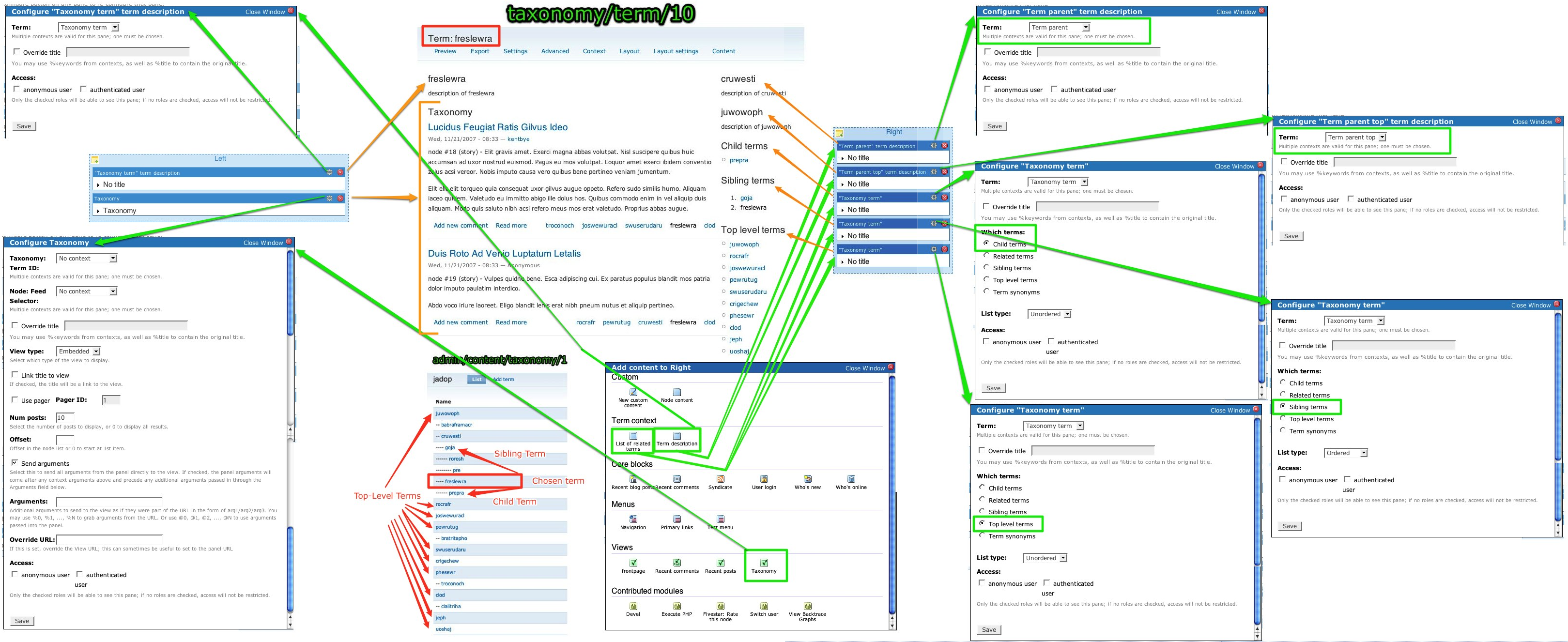
More details here: Panels: What is Context? & here.
The export code to recreate this panels scenario of overriding taxonomy/term/tid with contextual panels be found here: drupal.pastebin.com/f1bc881a3
Just copy & paste it from the box, add a new panels page, and then click import and paste it in. It helps to have some stock data with taxonomy terms created by the devel generate module.
Jen Lampton, lead of the Twig initiative for Drupal, watches as Twig is committed to Drupal core live during the BADCamp 2012 keynote by Dries Buytaert, Drupal's project lead. The commit was the culmination of months of hard work by Jen and other contributors.
The almond (/ɑːmənd/) (Prunus dulcis, syn. Prunus amygdalus, Amygdalus communis, Amygdalus dulcis) (or badam in Indian English, from Persian: بادام) is a species of tree native to the Middle East and South Asia. "Almond" is also the name of the edible and widely cultivated seed of this tree. Within the genus Prunus, it is classified with the peach in the subgenus Amygdalus, distinguished from the other subgenera by the corrugated shell (endocarp) surrounding the seed.
The fruit of the almond is a drupe, consisting of an outer hull and a hard shell with the seed (which is not a true nut) inside. Shelling almonds refers to removing the shell to reveal the seed. Almonds are sold shelled (i.e., after the shells are removed), or unshelled (i.e., with the shells still attached). Blanched almonds are shelled almonds that have been treated with hot water to soften the seedcoat, which is then removed to reveal the white embryo.
DESCRIPTION
TREE
The almond is a deciduous tree, growing 4–10 m in height, with a trunk of up to 30 cm in diameter. The young twigs are green at first, becoming purplish where exposed to sunlight, then grey in their second year. The leaves are 3–5 inches long, with a serrated margin and a 2.5 cm petiole. The flowers are white to pale pink, 3–5 cm diameter with five petals, produced singly or in pairs and appearing before the leaves in early spring. Almond grows best in Mediterranean climates with warm, dry summers and mild, wet winters. The optimal temperature for their growth is between 15 and 30°C and the tree buds have a chilling requirement of between 300 and 600 hours below 7.2°C to break dormancy.
Almonds begin bearing an economic crop in the third year after planting. Trees reach full bearing five to six years after planting. The fruit matures in the autumn, 7–8 months after flowering.
DRUPE
The almond fruit measures 3.5–6 cm long. In botanical terms, it is not a nut, but a drupe. The outer covering or exocarp, fleshy in other members of Prunus such as the plum and cherry, is instead a thick, leathery, grey-green coat (with a downy exterior), called the hull. Inside the hull is a reticulated, hard, woody shell (like the outside of a peach pit) called the endocarp. Inside the shell is the edible seed, commonly called a nut. Generally, one seed is present, but occasionally two occur.
ORIGIN & HISTORY
The almond is native to the Mediterranean climate region of the Middle East, eastward as far as the Indus. In India, it is known as badam. It was spread by humans in ancient times along the shores of the Mediterranean into northern Africa and southern Europe and more recently transported to other parts of the world, notably California, United States.
The wild form of domesticated almond grows in parts of the Levant; almonds must first have been taken into cultivation in this region. The fruit of the wild forms contains the glycoside amygdalin, "which becomes transformed into deadly prussic acid (hydrogen cyanide) after crushing, chewing, or any other injury to the seed."[8]
Wild almonds are bitter, the kernel produces deadly cyanide upon mechanical handling, and eating even a few dozen in one sitting can be fatal. Selection of the sweet type, from the many bitter types in wild, marked the beginning of almond domestication. How humans selected the sweet type remains a mystery.[9] It is unclear as to which wild ancestor of the almond created the domesticated species. Ladizinsky suggests the taxon Amygdalus fenzliana (Fritsch) Lipsky is the most likely wild ancestor of the almond in part because it is native of Armenia and western Azerbaijan where it was apparently domesticated.
While wild almond species are toxic, domesticated almonds are not; Jared Diamond argues that a common genetic mutation causes an absence of amygdalin, and this mutant was grown by early farmers, "at first unintentionally in the garbage heaps, and later intentionally in their orchards". Zohary and Hopf believe that almonds were one of the earliest domesticated fruit trees due to "the ability of the grower to raise attractive almonds from seed. Thus, in spite of the fact that this plant does not lend itself to propagation from suckers or from cuttings, it could have been domesticated even before the introduction of grafting". Domesticated almonds appear in the Early Bronze Age (3000–2000 BC) such as the archaeological sites of Numeria (Jordan), or possibly a little earlier. Another well-known archaeological example of the almond is the fruit found in Tutankhamun's tomb in Egypt (ca. 1325 BC), probably imported from the Levant. Of the European countries that the Royal Botanic Garden Edinburgh reported as cultivating almonds, Germany is the northernmost, though the domesticated form can be found as far north as Iceland.
ETYMOLOGY & NAMES
The word "almond" comes from Old French almande or alemande, Late Latin *amandula, derived through a form amygdala from the Greek ἀμυγδαλή (amygdalē) (cf. amygdala), an almond. The al- in English, for the a- used in other languages may be due a confusion with the Arabic article al, the word having first dropped the a- as in the Italian form mandorla; the British pronunciation ah-mond and the modern Catalan ametlla and modern French amande show a form of the word closer to the original. Other related names of almond include Mandel or Knackmandel (German), mandorlo (Italian), amêndoa (Portuguese), and almendra (Spanish).
The adjective "amygdaloid" (literally "like an almond") is used to describe objects which are roughly almond-shaped, particularly a shape which is part way between a triangle and an ellipse. See, for example, the brain structure amygdala, which uses a direct borrowing of the Greek term amygdalē.
PRODUCTION
The world produced 2.00 million tonnes of almonds in 2011 according to Food and Agriculture Organization, with United States the largest producer at 0.73 million tonnes. The apparent 50% decrease in production by the United States led to a calculated percentage of world production decrease from 56% to 36%; however, a 2013 news article indicated the United States produced at least 80% of the world's supply.
Spain has one of the most diverse commercial cultivars of almonds. It is grown in Spain's Catalonia, Valencia, Murcia, Andalusia, and Aragón regions and the Balearic Islands. In Greece, most of the production comes from the region of Magnesia at the area of Almyros. The most cultivated types of almonds in Greece are ferragnes and Texas (mission), which are known for their sweet taste and premium quality. Because of its quality, it is used as a luxury nut. In Turkey, most of the production comes from the Aegean, Marmara, and Mediterranean regions.
In the United States, production is concentrated in California, with almonds being California's third-leading agricultural product, its top agricultural export in 2008, and 100% of the U.S. commercial supply. The United States is the dominant supplier of almonds. In 2011, the country exported about 637,000 metric tons, valued at US$2.8 billion. Almonds were mostly exported as shelled almonds (70%), with the remainder being either unshelled or processed.
Australia is the largest almond production region in the Southern Hemisphere. In 2013, Australia contributed to 5.9% of the world almond supply. Most of the almond orchards are located in New South Wales, Victoria, and South Australia.
In 2013 and 2014, environmental problems in California affected the almond supply, contributing to higher almond prices worldwide. Since 2013, rising demand for almonds has contributed to higher prices worldwide and increased production in California.
POLLINATION
The pollination of California's almonds is the largest annual managed pollination event in the world, with close to one million hives (nearly half of all beehives in the USA) being trucked in February to the almond groves. Much of the pollination is managed by pollination brokers, who contract with migratory beekeepers from at least 49 states for the event. This business has been heavily affected by colony collapse disorder, causing nationwide shortages of honey bees and increasing the price of insect pollination. To alleviate almond growers from the rising cost of insect pollination, researchers at the Agricultural Research Service (ARS) have developed a new line of self-pollinating almond trees. Self-pollinating almond trees, such as the 'Tuono', have been around for a while, but their harvest is not as desirable as the insect-pollinated California 'Nonpareil' almond tree. The 'Nonpareil' tree produces large, smooth almonds and offers 60–65% edible kernel per nut. The 'Tuono', however, has thicker, hairier shells and offers only 32% of edible kernel per nut, but having a thick shell has advantages. The 'Tuono’s' shell protects the nut from threatening pests such as the navel orangeworm. ARS researchers have managed to crossbreed the pest-resistant 'Tuono' tree with the 'Nonpareil', resulting in hybridized varieties of almond trees that are self-pollinated and maintain a high nut quality. The new, self-pollinating hybrids possess quality skin color, flavor, and oil content, and reduce almond growers’ dependency on insect pollination.
DESEASES
Almond trees can be attacked by an array of damaging organisms, including insects, fungal pathogens, plant viruses, and bacteria. Symptoms can vary depending on the organism attacking the plant.
SWEET & BITTER ALMONDS
The seeds of Prunus dulcis var. dulcis are predominantly sweet, but some individual trees produce seeds that are somewhat more bitter. The genetic basis for bitterness involves a single gene, the bitter flavour furthermore being recessive, both aspects making this trait easier to domesticate. The fruits from Prunus dulcis var. amara are always bitter, as are the kernels from other Prunus species, such as apricot, peach, and cherry (to a lesser extent).
The bitter almond is slightly broader and shorter than the sweet almond, and contains about 50% of the fixed oil that occurs in sweet almonds. It also contains the enzyme emulsin which, in the presence of water, acts on soluble glucosides, amygdalin, and prunasin, yielding glucose, cyanide and the essential oil of bitter almonds, which is nearly pure benzaldehyde. Bitter almonds may yield from 4–9 mg of hydrogen cyanide per almond. Extract of bitter almond was once used medicinally, but even in small doses, effects are severe, and larger doses can be deadly; the cyanide must be removed before consumption.
All commercially grown almonds sold as food in the United States are of the "sweet" variety. However, The US Food and Drug Administration reported in 2010 that some fractions of imported sweet almonds were contaminated with bitter almonds. Eating such almonds could result in vertigo and other typical bitter almond (cyanide) poisoning effects.
Certain health food stores sell "bitter almonds" or "apricot kernels" labeled as such.
CULINARY USES
While the almond is often eaten on its own, raw or toasted, it is also a component of various dishes. Almonds are available in many forms, such as whole, sliced (flaked, slivered), and as flour. Almonds yield almond oil and can also be made into almond butter or almond milk. These products can be used in both sweet and savoury dishes.
Along with other nuts, almonds can be sprinkled over breakfasts and desserts, particularly muesli or ice cream-based dishes. Almonds are used in marzipan, nougat, many pastries (including jesuites), cookies (including French macarons, macaroons), and cakes (including financiers), noghl, and other sweets and desserts. They are also used to make almond butter, a spread similar to peanut butter, popular with peanut allergy sufferers and for its naturally sweeter taste. The young, developing fruit of the almond tree can be eaten whole ("green almonds") when they are still green and fleshy on the outside and the inner shell has not yet hardened. The fruit is somewhat sour, but is a popular snack in parts of the Middle East, eaten dipped in salt to balance the sour taste. Also in the Middle East they are often eaten with dates. They are available only from mid-April to mid-June in the Northern Hemisphere; pickling or brining extends the fruit's shelf life.
Almond cookies, Chinese almond biscuits, and Italian ricciarelli are made with almonds.
In Greece, ground blanched almonds are used as the base material in a great variety of desserts, usually called amygdalota (αμυγδαλωτά). Because of their white colour, most are traditionally considered "wedding sweets" and are served at wedding banquets. In addition, a soft drink known as soumada is made from almonds in various regions.
In Iran, green almonds are dipped in sea salt and eaten as snacks on street markets; they are called chaqale bâdam. Also sweet almonds are used to prepare a special food for babies, named harire badam. Almonds are added to some foods, cookies, and desserts, or are used to decorate foods. People in Iran consume roasted nuts for special events, for example, during New Year parties.
In Italy, the bitter almonds from apricots are the base for amaretti (almond macaroons), a common dessert. Traditionally, a low percentage of bitter almonds (10-20%) is added to the ingredients, which gives the cookies their bitter taste (commercially, apricot kernels are used as a substitute for bitter almonds). Almonds are also a common choice as the nuts to include in torrone. In Puglia and Sicily, pasta di mandorle (almond paste) is used to make small soft cakes, often decorated with jam, pistachio, or chocolate. In Sicily, almond milk is a popular refreshing beverage in summer.
In Morocco, almonds in the form of sweet almond paste are the main ingredient in pastry fillings, and several other desserts. Fried blanched whole almonds are also used to decorate sweet tajines such as lamb with prunes. A drink made from almonds mixed with milk is served in important ceremonies such as weddings and can also be ordered in some cafes. Southwestern Berber regions of Essaouira and Souss are also known for amlou, a spread made of almond paste, argan oil, and honey. Almond paste is also mixed with toasted flour and among others, honey, olive oil or butter, anise, fennel, sesame seeds, and cinnamon to make sellou (also called zamita in Meknes or slilou in Marrakech), a sweet snack known for its long shelf life and high nutritive value.
In South Asian cuisine, almonds are the base ingredients of pasanda-style and Mughlai curries. Badam halva is a sweet made from almonds with added coloring. Almond flakes are added to many sweets (such as sohan barfi), and are usually visible sticking to the outer surface. Almonds form the base of various drinks which are supposed to have cooling properties. Almond sherbet or sherbet-e-badaam, is a popular summer drink. Almonds are also sold as a snack with added salt.
Almonds can be processed into a milk substitute called almond milk; the nut's soft texture, mild flavour, and light colouring (when skinned) make for an efficient analog to dairy, and a soy-free choice for lactose intolerant people and vegans. Raw, blanched, and lightly toasted almonds work well for different production techniques, some of which are similar to that of soymilk and some of which use no heat, resulting in "raw milk" (see raw foodism).
The 'Marcona' almond cultivar is recognizably different from other almonds, and is marketed by name. The kernel is short, round, relatively sweet, and delicate in texture. It has been grown in Spain for a long time and its origin is unknown; the tree is very productive, and the shell of the nut is very hard. 'Marcona' almonds are traditionally served after being lightly fried in oil, and are used by Spanish chefs to prepare a dessert called turrón.
ALMOND FLOUR & SKINS
Almond flour is often used as a gluten-free alternative to wheat flour in cooking and baking.
Almonds contain polyphenols in their skins consisting of flavonols, flavan-3-ols, hydroxybenzoic acids and flavanones analogous to those of certain fruits and vegetables. These phenolic compounds and almond skin prebiotic dietary fiber have commercial interest as food additives or dietary supplements.
ALMOND SYRUP
Historically, almond syrup was an emulsion of sweet and bitter almonds, usually made with barley syrup (orgeat syrup) or in a syrup of orange flower water and sugar.
The Grocer's Encyclopedia (1911) noted, "Ten parts of sweet almonds are generally employed to three parts of bitter almonds"; however, due to the cyanide found in bitter almonds, modern syrups generally consist of only sweet almonds.
NUTRITION
he almond is a nutritionally dense food and is a rich source of vitamin E, containing 26 mg per 100 g. They are also rich in dietary fiber, B vitamins, essential minerals such as magnesium, copper, manganese, calcium, and potassium as well as monounsaturated fats and polyunsaturated fats (see nutrient table), fats which potentially may lower LDL cholesterol. Typical of nuts and seeds, almonds also contain phytosterols such as Beta-sitosterol, stigmasterol, campesterol, sitostanol, and campestanol, which have been associated with cholesterol-lowering properties.
Preliminary research associates consumption of almonds with elevated blood levels of high density lipoproteins and lower low density lipoproteins.
Almonds may cause allergy or intolerance. Cross-reactivity is common with peach allergens (lipid transfer proteins) and tree nut allergens. Symptoms range from local signs and symptoms (e.g., oral allergy syndrome, contact urticaria) to systemic signs and symptoms including anaphylaxis (e.g., urticaria, angioedema, gastrointestinal and respiratory symptoms).
During the digestion process in humans, almond flour may be fermented into short-chain fatty acids, most notably butyrate which is a substrate for cells lining the large intestine.
OILS
Almonds are a rich source of oil, with values ranging between 36 to 60% of kernel dry mass. A study by Venkatchalam and Sathe suggests almonds contain approximately 44% oils, of which 62% is monounsaturated oleic acid (an omega-9 fatty acid), 29% is linoleic acid (a polyunsaturated omega-6 essential fatty acid), and 9% is saturated fatty acid.
"Oleum amygdalae", the fixed oil, is prepared from either sweet or bitter almonds and is a glyceryl oleate, with a slight odour and a nutty taste. It is almost insoluble in alcohol but readily soluble in chloroform or ether. Sweet almond oil is obtained from the dried kernel of sweet almonds.
The oil is good for application to the skin as an emollient, and has been traditionally used by massage therapists to lubricate the skin during a massage session.
Almond oil can also be used as a wood conditioner of certain woodwind instruments, such as the oboe and clarinet.
AFLATOXINS
Almonds, like other tree nuts, are susceptible to aflatoxin-producing molds. Aflatoxins are potent carcinogenic chemicals produced by molds such as Aspergillus flavus and Aspergillus parasiticus. The mold contamination may occur from soil, previously infested almonds, and almond pests such as navel orangeworm. High levels of mold growth typically appear as gray to black filament like growth. It is unsafe to eat mold infected tree nuts.
Some countries have strict limits on allowable limits for aflatoxin contamination on almonds, and require adequate testing before the nuts can be marketed to their citizens. The European Union, for example, introduced a mandatory requirement since 2007 that all almond shipments to EU must be tested for aflatoxin. If aflatoxin does not meet the strict safety regulations, the entire consignment may be reprocessed to eliminate the aflatoxin or it must be destroyed.
The almond industry not only tests and processes almonds to ensure infected almonds do not reach the market, the industry also takes steps to prevent sources that cause contamination. These steps include proper orchard management, winter sanitation, early harvest, proper storage among others.
MANDATORY PASTEURIZATION IN CALIFORNIA
The USDA approved a proposal by the Almond Board of California to pasteurize almonds sold to the public, after tracing cases of salmonellosis to almonds. The almond pasteurization program became mandatory for California companies in 2007. Raw, untreated California almonds have not been available in the U.S. since then.
California almonds labeled "raw" must be steam-pasteurized or chemically treated with propylene oxide. This does not apply to imported almonds or almonds sold from the grower directly to the consumer in small quantities. The treatment also isn't required for raw almonds sold for export outside of North America.
The Almond Board of California claims “PPO residue dissipates after treatment”; however, the EPA reports “Propylene oxide has been detected in fumigated food products; consumption of contaminated food is another possible route of exposure.” PPO is classified by the EPA as a “Group B2, probable human carcinogen.”
The USDA-approved marketing order was challenged in court by organic farmers organized by the Cornucopia Institute, a Wisconsin-based farm policy research group. According to the Cornucopia Institute, this almond marketing order has imposed significant financial burdens on small-scale and organic growers and damaged domestic almond markets. A federal judge dismissed the lawsuit in the spring of 2009 on procedural grounds. In August 2009 farmers were appealing.
CULTURAL ASPECTS
The almond is highly revered in some cultures. The tree originated in the Middle East, and is mentioned numerous times in the Bible.
In the Hebrew Bible, the almond was a symbol of watchfulness and promise due to its early flowering. In the Bible the almond is mentioned ten times, beginning with Book of Genesis 43:11, where it is described as "among the best of fruits". In Numbers 17 Levi is chosen from the other tribes of Israel by Aaron's rod, which brought forth almond flowers. According to tradition, the rod of Aaron bore sweet almonds on one side and bitter on the other; if the Israelites followed the Lord, the sweet almonds would be ripe and edible, but if they were to forsake the path of the Lord, the bitter almonds would predominate. The almond blossom supplied a model for the menorah which stood in the Holy Temple, "Three cups, shaped like almond blossoms, were on one branch, with a knob and a flower; and three cups, shaped like almond blossoms, were on the other...on the candlestick itself were four cups, shaped like almond blossoms, with its knobs and flowers" (Exodus 25:33–34; 37:19–20). Similarly, Christian symbolism often uses almond branches as a symbol of the Virgin Birth of Jesus; paintings often include almonds encircling the baby Jesus and as a symbol of Mary. The word "Luz", which appears in Genesis 30:37, is sometimes translated as "hazel", may actually be derived from the Aramaic name for almond (Luz), and is translated as such in some Bible versions such as the NIV.[61] The Arabic name for almond is "laoz". In some parts of the Levant it is pronounced "loz", which is very close to its Aramaic origin.
_____________________________________
ALMOND MILK is a beverage made from ground almonds, occasionally used as a substitute for dairy milk.
Unlike animal milk, almond milk contains neither cholesterol nor lactose. As it does not contain any animal products, it is acceptable to vegans, and vegetarians, and others who abstain from dairy products. Commercial almond milk products often come in plain, vanilla, or chocolate flavors and are sometimes enriched with vitamins. Almond milk can also be made at home by grinding almonds with water in a blender.
Almond milk is slightly beige in colour and has a creamy texture and nutty taste. It is easy to make at home or purchase in long-life cartons at the supermarket.
HISTORY
In the Middle Ages, almond milk was known in both the Islamic world and Christendom. As a nut (the "fruit of a plant"), it is suitable for consumption during Lent. Almond milk was a staple of medieval kitchens because cow's milk could not keep for long without spoiling.[citation needed]
Historically, almond milk was also called amygdalate. It was consumed over a region stretching all the way from the Iberian Peninsula to East Asia. Le Viandier, a 14th-century recipe collection, contains a recipe for almond milk and recommends its use as a substitute for animal milk during fast days.
In the United States, almond milk remained a fairly niche health food item until the late 2000s, when its popularity began to increase. In 2011 alone, almond milk sales increased by 79%. In 2013, it surpassed soy milk as the most popular plant-based milk in the U.S. Popular brands of almond milk include Blue Diamond's Almond Breeze and WhiteWave Foods' Silk PureAlmond.
NUTRITION
Almonds are rich in nutrients including fiber, vitamin E, magnesium, selenium, manganese, zinc, potassium, iron, phosphorus, tryptophan, copper, and calcium. "The UK Institute of Food Research found finely ground almonds contain potential prebiotic properties that could help boost digestive health by increasing the levels of certain beneficial bacteria in the stomach".
Almond milk has less protein than cow's milk and other animal milk substances. For children with atopic dermatitis under two years of age, almond milk is not a suitable replacement for breast milk, cow's milk, or hydrolyzed formulas due to the low protein.
PRODUCTION
The basic method to make almond milk at home is to run soaked almonds in a blender with water and honey (or any other natural sweetener), then strain out the almond pulp (flesh) with a strainer, cheesecloth, or nut milk bag. One can also blend almond butter with water and sweeteners.
WIKIPEDIA
As the owner of an ecommerce store, you have many major decisions to make that directly impact your company. What products will you carry? How will you determine your pricing? What shipping services will you use? All these and more are questions you need to answer before launching your site.
But...
voxilltec.com/2017/02/20/drupal-vs-magento-right-ecommerc...
This one made it onto drupal.com! Here's a screenshot: www.flickr.com/photos/runforcover/3821462202/
Other mentions:
twitter.com/bertboerland/status/3152770147
twitter.com/kristofvanroy/status/3163294319
SEE FULL SIZE: www.flickr.com/photo_zoom.gne?id=2009094288&size=o
www.kentbye.com/files/drupal_modules_part1.html
www.kentbye.com/files/drupal_modules_part2.html
www.kentbye.com/files/drupal_modules_part3.html
www.kentbye.com/files/drupal_modules_part4.html
www.kentbye.com/files/drupal_modules_part5.html
Drupal Modules as of 11/09/07.
SEE FULL SIZE: www.flickr.com/photo_zoom.gne?id=2026324860&size=o
www.kentbye.com/files/drupal_modules_part1.html
www.kentbye.com/files/drupal_modules_part2.html
www.kentbye.com/files/drupal_modules_part3.html
www.kentbye.com/files/drupal_modules_part4.html
www.kentbye.com/files/drupal_modules_part5.html
Drupal Modules as of 11/09/07.
BlueMasters for Drupal is based on the BlueMasters PSD template, which was designed by Wendell Fernandes and released for Smashing Magazine and its readers.
BlueMasters has been ported to Drupal and is supported by More than Themes, as part of our ongoing effort to bring quality themes to Drupal.
Which other theme would you like to see ported to Drupal?
Let us know at www.drupalizing.com.
Features
- Custom front page with 4 block regions
- Footer with 4 block regions
- A total of 12 block regions
- implementation of a JS Slideshow
- CSS rules for
- Read More and Comment buttons
- Images into content or blocks
- Contact form
- 2-column layout for inner pages
- 3-column layout with a JS Slideshow for the front page
///////////////////////////////////////////////
I guess this is why they call it fall.
I'm guessing under a walnut tree.
Near the Fountain Garden
Cantigny Park, Wheaton, Illinois 41.854053, -88.154825
September 29, 2020
COPYRIGHT 2020 by JimFrazier All Rights Reserved. This may NOT be used for ANY reason without written consent from Jim Frazier.
200929cz7-90531600
Apropos www.disambiguity.com/drupalorg-come-wireframe-with-me/.
This is the homepage, in case you couldn't guess. I forgot to include the site search, though. :(
Tangle in a tangle challenge #44
Tangle string is Drupe
Done on watercolor paper layered on scrapbook paper and cardstock.
I've started making cards from my challenge pieces.
SEE FULL SIZE: www.flickr.com/photo_zoom.gne?id=2009065024&size=o
www.kentbye.com/files/drupal_modules_part1.html
www.kentbye.com/files/drupal_modules_part2.html
www.kentbye.com/files/drupal_modules_part3.html
www.kentbye.com/files/drupal_modules_part4.html
www.kentbye.com/files/drupal_modules_part5.html
Drupal Modules as of 11/09/07.
SEE FULL SIZE: www.flickr.com/photo_zoom.gne?id=2009106828&size=o
www.kentbye.com/files/drupal_modules_part1.html
www.kentbye.com/files/drupal_modules_part2.html
www.kentbye.com/files/drupal_modules_part3.html
www.kentbye.com/files/drupal_modules_part4.html
www.kentbye.com/files/drupal_modules_part5.html
Drupal Modules as of 11/09/07.
SEE FULL SIZE: www.flickr.com/photo_zoom.gne?id=2009084128&size=o
www.kentbye.com/files/drupal_modules_part1.html
www.kentbye.com/files/drupal_modules_part2.html
www.kentbye.com/files/drupal_modules_part3.html
www.kentbye.com/files/drupal_modules_part4.html
www.kentbye.com/files/drupal_modules_part5.html
Drupal Modules as of 11/09/07.