View allAll Photos Tagged deepspace
Second attempt at this one, see the earlier stab (2x images, differently processed) and you'll see how much of an improvement this is!
My Canon 1100D is not modded, so this nebula doesn't show up too well.
(July 1, 2010) In the course of "The Paris Match" Lois Lammerhuber and the and art historian Jaqueline Thommes take a look at the use of forms of the old masters and compare them with todays fashion-, art- and advertising photography.
credit: Robertba
Im Deep Space können die BesucherInnen über einen orientalischen Teppich schreiten - dank Bodenprojektion.
credit: Martin Hieslmair
Dank der technischen Möglichkeiten, die der neue Deep Space 8K bietet, betreten die BesucherInnen des Ars Electronica Center Linz einen einzigartigen virtuellen Anatomiesaal der Zukunft. Die eigens vom Ars Electronica Futurelab entwickelte Applikation „Universum Mensch“ reizt das Potenzial des begehbaren Erfahrungsraumes komplett aus und macht das Entdecken des menschlichen Körpers zu einem eindrucksvollen Erlebnis.
credit: Magdalena Sick-Leitner
The Ars Electronica Center and Terra Mater Factual Studios present you the exciting documentary about living creatures during Ice Age. Terra Mater LIVE can be watched for free at the Deep Space of the Ars Electronica Center.
Picture: European Cave Bear
credit: BBC
Bei den „Bike Visions“ wird ein vielseitiges Programm zum Thema „Radfahren“ im Deep Space 8K geboten. Es erwarten Sie abwechslungsreiche Bilder und Videos aus der Sicht von Bikern, Fotografen und Filmern.
credit: Florian Voggeneder
Bei den „Bike Visions“ wird ein vielseitiges Programm zum Thema „Radfahren“ im Deep Space 8K geboten. Es erwarten Sie abwechslungsreiche Bilder und Videos aus der Sicht von Bikern, Fotografen und Filmern.
credit: Florian Voggeneder
Bunte Geschichten werden auf der riesigen Projektionsfläche des Deep Space für Kinder erzählt.
credit: Martin Hieslmair
info: Locations : Corinth - Greece & Parnon mountain Telescopes : astro-tech 65ed quadruplet for RGB + William Optics ed72 for Luminance Ccd : QHY 9 Mount : ASA DDM60 Guiding : unguided Field flattener : - Gain/Offset : 30% - 106 Temp : -25 Exposures : RGB bin 2x2 10x300sec Luminance bin 2x2 17x600 & bin 1x1 4x600 Calibration files : Darks - Bias - Flats - Dark Flats . Applications : Nebulosity - Photoshop - Maxim - Pixinsight - Cartes du ciel - Autoslew.
Nicht nur ausgefeiltes Know-how des Ars Electronica Futurelab, sondern auch gehörig viel Power steckt hinter der Entwicklung und dem Betrieb des Deep Space 8K im Ars Electronica Center Linz steckt. Im Bild: Die Hochleistungsrechner der Firma XI-Machines.
credit: Martin Hieslmair
NGC6960,
Shot with Nikon 810a, mounted on a TEC160 refractor at the Hotel Rangá observatory, Iceland.
UNESCO City of Media Arts – so darf sich Linz neben Lyon, Dakar, Tel Aviv und einigen anderen Städten seit Dezember 2014 auch nennen. Nicht ohne Grund, denn Linz hat viel mit Computer, Digitalisierung und Kunst zu tun. Die Ars Electronica beobachtet und zeigt seit 37 Jahren neue Entwicklungen, deren Grundlage und Inspiration Kunst und Technologie sind. Mit dem Ars Electronica Center ist Mitte der 1990er-Jahre ein Museum der Zukunft entstanden, das sich voll und ganz mit den neuen Medien, ihren Ausformungen und Auswirkungen auf die Gesellschaft beschäftigt. Medienkunst ist dabei ein wichtiger Bereich, dem wir uns an diesem Wochenende widmen möchten.
credit: Martin Hieslmair
Photo showing an image of the Mangarium, a virtual ocean in the Deep Space of the Ars Electronica Center.
Credit: Robertba
Bei den „Bike Visions“ wird ein vielseitiges Programm zum Thema „Radfahren“ im Deep Space 8K geboten. Es erwarten Sie abwechslungsreiche Bilder und Videos aus der Sicht von Bikern, Fotografen und Filmern.
credit: Florian Voggeneder
The Advanced Camera for Surveys, the newest camera on NASA/ESA Hubble Space Telescope, has captured a spectacular pair of galaxies engaged in a celestial dance. Located 300 million light-years away in the constellation Coma Berenices, the colliding galaxies have been nicknamed "The Mice" because of the long tails of stars and gas emanating from each galaxy. Otherwise known as NGC 4676, the pair will eventually merge into a single giant galaxy.
credit: NASA, ESA
Das Magnetfeld der Erde wird im Deep Space mit "Uniview" sichtbar und erfahrbar.
credit: Martin Hieslmair
A new re-work of my final 2011 M42 image. Tried to get rid of some of the noise and keep the detail in the nebula... really just need another clear night when the moon isn't up and right next to Orion!!
This is an hour and ten minutes of 6 minute and 10 minute subs with an extra 20 min layer of 20 and 40 second subs (from my first ever image of M42 from March) added in for the core.
Imaged with the Megrez72 + FF2 reducer/flattener, Eos 500D (modded) on a HEQ5-Pro, guided with an SX Lodestar, ST80, EQmod and PHD.
Stacking in DSS and editing in PS7.
I think, when you compare this to my first ever astro image taken just 9 months previously.... it's a big improvement!
Bei den „Bike Visions“ wird ein vielseitiges Programm zum Thema „Radfahren“ im Deep Space 8K geboten. Es erwarten Sie abwechslungsreiche Bilder und Videos aus der Sicht von Bikern, Fotografen und Filmern.
credit: Florian Voggeneder
Apart from Lois Lammerhuber - a famous Austrian photographer - Deep Space LIVE welcomes Dr. Sabine Haag, Head of the Kunsthistorisches Museum Wien and Dr. Christian Köberl, Head of the Naturhistorisches Museum Wien.
They will present the personal favourites of their museums: The Saliera by Benvenuto Cellini and the "Hraschina iron meteorite".
credit: Lois Lammerhuber
The Cygnus Region (Deneb and Sadr)
SXVF-M25C on 90mm Tamron Macro lens mounted on EQ6 SkyScan Mount. 23 subs of 250 secs. each, F4, guided, processed in PS7.
Average seeing, poor transparency
19/05/10
Theme: Cyberpunk, Deepspace, Fantasy, Steampunk
Featuring: Accessories, Animations, Apparel, Bodies & Body Parts, Cosmetics, Decor, Enhancements, Full Outfits, Hairs, Jewelry, Poses, Shapes, Skins, Tattoos, Weapons
Event Opening Date: August 29, 2023
Event Closing Date: September 22, 2023
Teleport to Planet29
MIA: Short Leash
This event is in one location
www.seraphimsl.com/2023/08/29/the-sky-is-glittering-at-pl...
Between 1968 and 1972, 25 men, but not a single woman, flew to the moon. There were enough suitable candidates, but according to a decision of the then President Lyndon B. Johnson, women were not allowed to become astronauts in the USA for fear that African Americans, Hispanics and other "minorities" might also come up with the idea of applying. It was not until 1983 that Sally Ride became the first American to fly into space. Photo showing the current crew of the ISS. A lecture by Dr. Christian Klösch from the Technical Museum Vienna.
Credit: Ars Electronica / Robert Bauernhansl
This is my first test of my Celestron Onyx 80EDF, on the star cluster M3. The edges show it definitely needs a field flattener.
500mm f/6.25. 10 x 10 minutes at 400 IS O.
Mit seinen Ganzkörperscans begibt sich der oberösterreichische Fotograf Kurt Hörbst auf die Spurensuche nach Details in den Oberflächen menschlicher Körper und entschleunigt mit seiner Aufnahmemethode die Porträtfotografie der heutigen Zeit: Die flach auf dem Boden liegenden Menschen werden mit einer hochauflösenden Digitalkamera, die an einem eigens konstruierten Schienensystem befestigt ist, Zeile für Zeile fotografisch abgetastet und müssen dafür minutenlang in einer Pose verharren. Von einer Person werden bis zu 20 einzelne Aufnahmen angefertigt, die Hörbst dann am Computer zusammensetzt. Fotos von der Ausstellungseröffnung "people_scans" im Ars Electronica Center, am 7. März 2013, im Foyer und der Präsentation der hochauflösenden Bilder im Deep Space.
credit: Martin Hieslmair
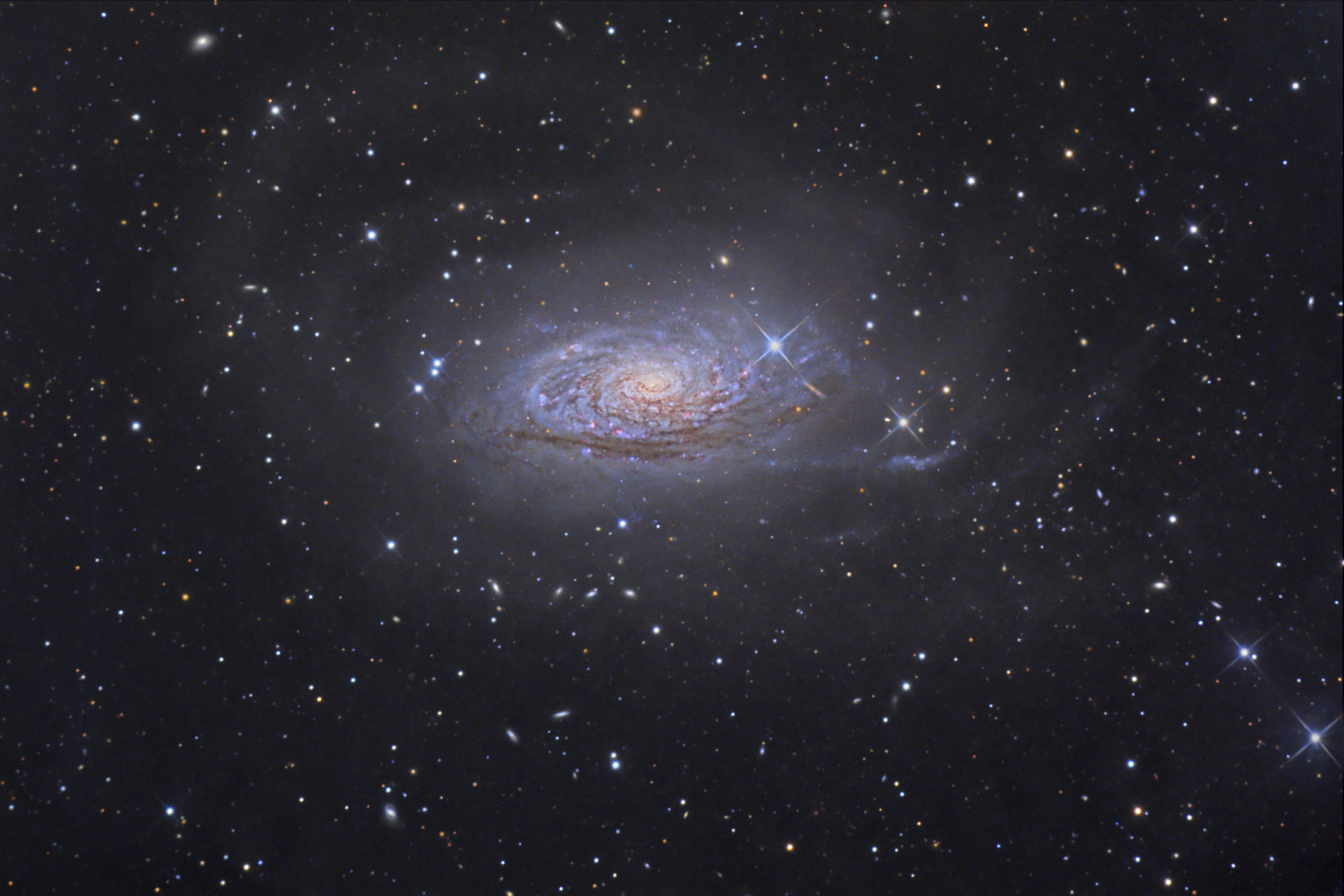
M63, NCG 5055, or the Sunflower Galaxy. This is a relatively data-sparse compilation of 60 RAW sub frames. I ran out of time before the moon came over the horizon and made the signal to noise ratio far less satisfactory.
Check out this image of the same galaxy. I'm working on it...
Nicht nur ausgefeiltes Know-how des Ars Electronica Futurelab, sondern auch gehörig viel Power steckt hinter der Entwicklung und dem Betrieb des Deep Space 8K im Ars Electronica Center Linz steckt. Im Bild: Die Hochleistungsrechner der Firma XI-Machines.
credit: Martin Hieslmair
The Musée du quai Branly is a museum in Paris, France that features indigenous art, cultures and civilizations from Africa, Asia, Oceania, and the Americas. The museum contains the collections of the now-closed Musée national des Arts d'Afrique et d'Océanie and the ethnographic department of the Musée de l'Homme. The museum contains 267,000 objects in its permanent collection, of which 3,500 items from the collection are on display.
credit: Lammerhuber
2 exposure lengths layer masked together.
This photo was the culmination of several nights in the freezing cold during February and January. I was still trying to master polar alignment to get exposures longer than 80 seconds. M42 never fails to take my breath away. The great thing about cloudy nights it allows you to have a crack at reprocessing, this is my latest attempt using all the skills I've learnt in my first year of astroimaging.
30 min stack of 60->120 second frames
Skywatcher 200P Newt. Nikon D50, EQ5 mount with RA motor, DSS and Photoshop.
I like this angle. The lifeboat is admittedly a big honkin' ugly box. Hopefully its utilitarian without being too painful to look at.
NGC 6960 The Veil Nebula (West) aka The Witch Broom Nebula, is a supernova remnant, at its peak this supernova would had been of magnitude -8, brighter than Venus. Now it is 7th Magnitude. It is found in the constellation of Cygnus (The Swan.)
Image Profile:
Lee, IL
Type: L
Frames: L 8x300
Imaging Date: 20130905
Hardware:
-Main scope: Astro Tech APO 430mm Short Tube
-Guiding Scope: Orion EON 120mm
-CCD: QHY9M with filter wheel with LRGB Ha
-Orion Atlas mount
-Orion Glow Filter
Imaging Applications:
-Acquiring: Nebulosity Ver. 3.0.2
-Guiding: PHD Ver. 1.11.3
Processing Applications:
-CCD Stack
-Photoshop cs3
-Corel Paintshop Pro X4
Comments: Fair skies with good decent with and patchy clouds.
Auf einem riesigen Teppich können die Kinder ihre ersten Schritte durch die virtuelle Welt machen.
credit: Martin Hieslmair
"This was one of the most difficult jobs I ever undertook", says Ieoh Ming Pei, architect of the MIA, "It seemed to me that I had to grasp the essence of Islamic architecture. The difficulty of my task was that Islamic culture is so diverse, ranging form Iberia to Mughal India, to the gates of China and beyond." Finding its primary inspiration in the ablutions fountain (sabil) in the Mosque of Ahmed Ibn Tulun in Cairo, the building reflects an almost cubist geometric expression, with its true splendour unveiled in the sunlight. Surrounded by a 20-hectare park, the building covers an area of 35,500 square meters.
credit: Lammerhuber
Bei den „Bike Visions“ wird ein vielseitiges Programm zum Thema „Radfahren“ im Deep Space 8K geboten. Es erwarten Sie abwechslungsreiche Bilder und Videos aus der Sicht von Bikern, Fotografen und Filmern.
credit: Florian Voggeneder
NGC2264
30x120sec R 1x1 Bin, Gain 139 -20°C
30x120sec B 1x1 Bin, Gain 139 -20°C
30x120sec G 1x1 Bin, Gain 139 -20°C
20 x 600Sec Ha 1x1 Bin, Gain 139 -20°C
Cam: ZWO ASI1600MM Pro
Scope: TS94EDPH
Mount: EQ6R-Pro
Postprocessing in PI and PS
(Dezember 2, 2010) “Then/Now” literally describes the itinerary of a unique journey through Linz history being hosted by the municipal archive. It will feature one-of-a-kind historical images of the Linz cityscape in the first half of the last century juxtaposed to their contemporary counterparts captured from the identical perspective.
credit: rubra
This is a reproduction of a painting by the flamish painter Lucas van Valckenborch. It was made in 1597 and shows the Upper Austrian town of Linz. The original name of the painting is "LINSVM AVSTRIAE vulgo LINTZ". In the course of another Deep Space LIVE, historian Cathrin Hermann and story-teller Claudia Edermayer are looking at old legends of Linz.
credit: Reproduction
Steve Roach, Mystic Chords and Sacred Spaces
Not a real space photo. Light art. Photoshop manipulations = blackpoint adjustment, resize. Still refining the process. Testing some effects for glowing gas clouds, galaxy formations, and integrating Waterworld technique. This one had a quick lens change from 16-35mm to 100mm.
Michael Fincke (NASA Bordingenieur/Copilot) im Ars Electronica Center
credit: Sick-Leitner Magdalena
NASA's Hubble Space Telescope has trained its razor-sharp eye on one of the universe's most stately and photogenic galaxies, the Sombrero galaxy, Messier 104 (M104). The galaxy's hallmark is a brilliant white, bulbous core encircled by the thick dust lanes comprising the spiral structure of the galaxy. As seen from Earth, the galaxy is tilted nearly edge-on. We view it from just six degrees north of its equatorial plane. This brilliant galaxy was named the Sombrero because of its resemblance to the broad rim and high-topped Mexican hat.
At a relatively bright magnitude of +8, M104 is just beyond the limit of naked-eye visibility and is easily seen through small telescopes. The Sombrero lies at the southern edge of the rich Virgo cluster of galaxies and is one of the most massive objects in that group, equivalent to 800 billion suns. The galaxy is 50,000 light-years across and is located 28 million light-years from Earth.
Look here for all Hubble images.
Look here for copyright information.
Look here for hi-res prints.
The Prawn Nebula IC 4628
There is a total of 3hrs and 20min of 5 minute subs in this image. I'd started using iso400 but upped the ante to iso 800 later, but I tossed all of them in the pot to create the final image.
Darks and flats taken separately.
Scope - ed 80
Mount - heq5pro
Guiding using qhy5
Camera Canon 20d
Software used ..... DeepSkyStacker and CS3
Imaged from a dark sky site on the 3rd and 4th of June 2010.