View allAll Photos Tagged committed
I'm sorry if this is too dark or personal, but I found out my half-brother committed suicide and it's been difficult to process.
On the outside he seemed like he had the perfect life. None of us expected anything like this from him. It's horrific. He left behind a daughter who's just a child.
I've always hated it when people write off suicide (or any depression-related symptoms) as the ultimate selfishness. It's a sickness just like anything else wrong with your body. It changes the way you think. But I can't help wishing he would've just told someone. Maybe talking about it would have meant that people didn't think he was perfect anymore, but at least he might be here.
It's okay not to be perfect. It's okay not to have answers. There are people out there to help. Talk about it. Tell someone.
Please.
Events on the stage of Shonan area of Japan, aimed at the development of the Hawaiian culture. Dancers of about 1,000 people gathered from Kanagawa prefecture, I committed showcase technology of hula daily, polished.
Above all, she is beautiful, smile was a very nice lady at all times.
At the We Like'em Short Film Festival at Churchill School in Baker City Oregon
The We Like ‘Em Short Film Festival is committed to celebrating the art of the short film, and providing a platform for independent filmmakers to showcase their talent. This festival seeks original and entertaining animated and comedy shorts from around the world.
The We Like ‘Em Short Film Festival was started in 2009 as a very small local festival featuring local filmmakers. In 2012 the festival decided to seek entries online, which has led them to becoming an international film festival with films now being submitted from around the world. In 2014 festival decided to pare the festival down a bit, seeking only the films that staff and audiences had consistently found to be the most entertaining, creative and engaging: animated and comedy shorts.
In 2014 the We Like'em Short Film Festival was named Oregon's Best Fine Arts Festival by the Oregon Festivals and Events Association.
Churchill school includes a sound studio, a working woodshop, metal fabrication studio gallery space and multiple artist studio spaces and the cafeteria has become a new music venue regularly hosting musical artists from throughout the PNW
For more information about Churchill School including upcoming classes exhibits, and events, visit their website at www.churchillbaker.com/index.html
For more information about the We Like'em Short Film Festival or other Baker County cultural and art events, visit Baker County Tourism's website at www.travelbakercounty.com
Repsol is committed to being a responsible operator in all areas of our business. Our values of flexibility, transparency, responsibility, integrity and innovation are at the core of everything we do. Repsol holds an interest in 170,000 net acres in the Marcellus, which is one of the largest natural gas fields in the world. Our acreage is primarily located in northeastern Pennsylvania in Bradford, Susquehanna and Tioga counties.
Learn more about our U.S. exploration and production business at www.repsolusa.com.
Repsol se compromete a actuar con responsabilidad a lo largo de toda la cadena de valor. Nuestros valores de flexibilidad, transparencia, responsabilidad, integridad e innovación marcan nuestra manera de trabajar. Repsol tiene un interés de 170.000 acres netos en el Marcellus, es uno de los mayores campos de gas natural en el mundo. Nuestra área de operación se encuentra principalmente en el noreste de Pennsylvania en Bradford, y en los condados de Susquehanna y Tioga.
Más información sobre nuestro negocio de exploración y producción en EE.UU. www.repsolusa.com .
Written by my sister:
I am so COMMITTED to dolls. I think, instead of losing interest in dollies, my fascination for them gets stronger with each passing year. The simplest things can inspire me to spend oodles of money. Take this pretty festive picture, for example. Okay, it didn't really make me spend a lot of money, as the dresses were on clearance for about $14 each, but still--the idea of putting Bitty, a Wellie, and an 18 inch doll together in matching blue dresses was super enticing. We bought the Truly Me dress shortly after Christmas 2020, not knowing it was one of three, when we spotted it in the Last Chance Outlet. It was very inexpensive and we knew we'd get a lot of use out of it. A few months later, in March or April 2021, Shelly was perusing the same clearance section and realized there were matching outfits available for Bitty and the Wellies! At the time, we didn't have a Wellie and there wasn't a lot in the clearance section that we had reason to buy, so, though we wanted/had immediate use for Bitty's dress, there just wasn't much point ordering it on its own (because of shipping costs). It was at this point that I REALLY thought about Wellies for the first time in months. Sure, it was just a passing thought, "We really need to get a Wellie, just so that we have an excuse to buy matching outfits and I can take a group shot for our Collections and Lines album on Flickr." It didn't turn into a full blown Wellie obsession (yet), but it did continue to linger in my mind, particularly every time I happened to go into Shelly's room and look at Valerie, who was currently wearing the Truly Me Star & Snow dress. When we first adopted Camille and Willa, a tiny part of me hoped the Bitty and Wellie dresses were still available--but I figured they might not be. Shelly was thinking about it, well, not specifically these outfits, just wanting Wellie clothes in general, even more than me--she went onto the American Girl website within an hour of forking over the cash for Willa and Camille at the flea market. (Like, she was perusing the website before we even ate lunch.) It made me immensely happy that it worked out as though it were meant to be--shortly after I wished for a Wellie (or two) to put in this dress, two miraculously appeared at my flea market and both Bitty and Wellie sized dresses were still on clearance! It doesn't get better than that. These dresses are enchanting--together and on their own. I feel that the Truly Me dress and the Wellie dress are accessorized more similarly with glittery headbands and shoes. Bitty's headband has a bow that is similar to the waistband of the dress and her shoes are more wearable than the other two pairs. (When I swapped the dress over from Val to Angela, so Angela could model it here, I got silver glitter all over Shelly's bed. I also found a large sprinkling of glitter under the table Valerie and Angela sit at.) I love the embroidered designs on the dresses--it's festive, but also good marketing because it's a subtle play on AG's star logo. I love the tartan print on the skirts too! I chose blue eyed blondes (well, Bitty's eyes are actually gray) for this photo because I think their eyes really pop in this. These girls look like snow angels! These dresses are awesome--We have four female babies (counting Billie Jean the Bitty Twin), two Wellies, eight Girl of the Years, three Girl of Todays, one My American Girl, and one Truly Me. Every year, we take a photo of some of our dolls by our gingerbread house and the dolls all wear holiday/winter clothes. These dresses are guaranteed to feature in future holiday photos because there are so many dolls who could potentially model them!
Dolls in photo (from left to right):
-Girl of Today #3
-Wellie Wishers Camille
-Bitty Baby #3
Carte de visite by N.A. and R.A. Moore of Hartford, Conn. By the time the Civil War began, the man pictured here, Henry Eugene Burton, had committed himself heart and soul to the party of Abraham Lincoln and the cause of human rights. Gene, as he was known to his family and friends in Hartford, Connecticut, did not join the army until late 1863, when he reported to the Union base at Folly Island, South Carolina, with a second lieutenant’s commission in the newly formed 1st Regiment North Carolina Colored Volunteers, which mustered into federal service as the 35th U.S. Colored Infantry.
The first engagement in which he and his men participated was the February 1864 Battle of Olustee in Florida, a loss for the Federals. Burton suffered a severe wound to his leg in the thick of the fray. He told a newspaper correspondent the story of the fight, telling the journalist “of the fierce rage that gripped him as he saw his ego soldiers falling around him; of how he faced the enemy with a ‘damn you, you have killed my men! Kill me, too!’”
Burton’s wound ended his combat career. He returned to active duty as an aide-de-camp to Maj. Gen. David Bell Birney, but eventually fell ill and resigned in February 1865.
Burton returned to his home in Hartford, Conn., and practiced law for many years. Active in the Grand Army of the Republic and a tireless campaigner for progressive causes, including anti-government corruption, good citizenship, and the state’s humane society, he was also a talented writer, contributing to the local newspaper, the Hartford Courant. Burton lived until 1904, dying at age 63. He outlived his wife, Mary, who died in 1886. A daughter survived him.
His legacy includes an essay he wrote on the occasion of Memorial Day 1894. Published in the Courant, Burton honors the plain, working-class men who fought for the Union—farmers, laborers, clerks—whose heroism was built on devotion, endurance, and love for family and country. Their service, marked by hardship, sacrifice, and quiet faith, is described as the nation’s chief glory.
I want to share it with you. Listen for a reference to Capt. Valentine B. Chamberlain of the 6th Connecticut Infantry, who was captured during the assault on Fort Wagner in July 1863—the same attack in which the 54th Massachusetts Infantry distinguished itself.
Burton’s essay is titled:
HATS OFF TODAY.
He begins:
Heroism has been truly said to be homely work in the doing. It is good and comforting to remember, on this day of memories, and to never forget that heroic work is mostly done by homely men, by men who are not rich, or famous, or great. The heroes of the Union were, in the phrase of Lincoln, of the plain people, as was he himself, the greatest of them all. They began their education in the common school, and frequently finished it there.
They were laborers and wayfarers like their fathers and like ourselves. They worked in the fields, in factories, in offices, and shops, for self-respect and for the respect of others and for wives, children and friends. They were glad at the weddings and sorry at the funerals of their neighborhoods. They had, and showed, a personal interest in politics, local and general. They went to town meetings and caucuses, voted at elections and stood by their candidates, in victory and in defeat, as later they stood by their guns. They were not perfect, all had their faults, and some the vices of their race and time. They had their private ambitions and disappointments, temptations and triumphs, like every man since Adam. And for joy or grief, and mostly in secret, of course, after the manner of men, they cried sometimes; how else could they have been heroes? A man who is never good for a cry is not good for a fight; his feelings cannot rise to the occasion and stay there. Mere intellect or mere courage or both together, never made a real man, much less a hero. Heroism is of the heart and so wins all hearts. It is tender with the love and dewy with the tears of all mankind. And so it was that our heroes loved their babies and their country and were ready to fight for both at the first flicker of a hostile flag.
Their work was homely in the doing; none but themselves could know how homely. It was homesickness, weariness and dirt, disease and death, from year's end to year's end. But for their cause, and their heroism in it, there was no debasing work. In that cause and with their devotion to it, their work was the chief glory of their country and century. Year by year, on land and sea, by night and day, through heat and winter wind, scourged by life and racked by death, they fought their starry way to happy peace.
And they builded better than they knew. Heroes always do that. They lived by faith, not by knowledge; and no man's faith was ever yet big enough to divine a hero's estate. Sometimes they die in the mid stress of their endeavor, knowing nothing of its results; sometimes they live to know a little of the reward of their sacrifices; but, however long they stay, they finally go hence, half knowing and half known, leaving an unclaimed heritage to unborn heirs.
The world does not pay its debt to its benefactors themselves, partly because it is not payable in material things, partly because only the slow ages can at all compute it, and partly because it is not altogether payable by mortals. These continents are not all the world, nor their living inhabitants all its people. Sadly doubting, as men may, of the undiscovered country, they, nevertheless, cannot doubt of the millions who forelived them, or think in their hearts that those millions are no more. From those millions come earth’s heroes, and to them, at last, return. What a welcome theirs must be! Perhaps one who remembers the return of our regiments in 1865 may guess something about it; but it can be quite revealed only to those who go home on their shields. This is the way in which so many of our boys went home a generation ago, and in that way, also, have gone many of their survivors. What a tear-blurred list those names would make today.
And, of all those names, none could be dearer than that of Captain Valentine B. Chamberlain. One year ago next month he died. Many of his comrades, with a multitude of his friends and neighbors, gathered around him in his funeral services. They saw and shared the griefs of the people, to whom he had come in his youth, a citizen soldier, and among whom he lived, as he died, a soldier citizen. They went with him to his final resting place, and, standing there, saw, near and far, around his grave, green mounds glorified by the flag he had followed over the parapet of Wagner, as though his comrades, long at rest, had roused to give him welcome. And into that gallant company, in the soft brightness of that June afternoon, with the sorrowing eyes of hundreds fixed upon him he disappeared forever. The flags that followed him there were sad with crape; but the flags that paved his coming were glad with sunlight. The comrades who stayed with him to the end turned homeward with the sunlit flags awave in their hearts, like Chamberlain’s good by to his friends and God-speed to his country. Happy in the number as in the character of his children, he will long survive in their loving memory, and will be born to honor and gratitude again and again, in the multiplying generations of his descendants.
How measureless the inheritance which our heroes leave to their children. They may add to their patrimony houses and lands and all the winged riches which fortune gives to labor; and all these things they may lose. They can but keep while life remains one thing which moth and rust cannot corrupt or thieves break through and steal, the priceless treasure of heroic blood. A man with Gettysburg in his veins is richer than the Indies, though the Indies drained the wealth of all the zones. Emerson was right:—
“A ruddy drop of manly blood
The surging sea outweighs.”
Our old soldiers know the truth. They have seen it in the service of heavy fights and the valley of the shadow of death. They have felt it in all the personal reverses, and civil turmoils of these last thirty years and they feel it more and more, as in faded blue, they face their fading west.
Hats off today, for the war of the Union marches past! Hats off to its old men and its old flag! Hats off to its flag lit by new flame, to its men, now forever young who fell at the front or died at their homes! Hats off to Liberty, sweet Mother of us all, who mourns among our dead her sons of many lands! None but the dead could name them all. But there are black men among them, who melted the chains of their people with the flame of their muskets. There are Native Americans there, who were worthy of their country and her crown of lyric death. There are Irishmen there, who illustrate anew their freedom-loving ancestry and the martial fame of their race. There are Scotchmen there, born of Bruce and Burns. There are Englishmen there, children of Shakespeare and Waterloo. There are Germans there, beloved heirs of fame and victory, who marched, hot foot, to the sound of our guns. There are Frenchmen there, sons of that race who, twice within a century, brought their valor of Marengo to our banners of the free.
Now that the battle roar dies away in the distance, what choral harmonies flood in from thirty years ago—pipes of the Scottish border, sounds of the English lanes, strains of the Marseillaise, songs of the fatherland, chants of the Emerald Isle, and, rising above all, like a soul let free, the roll of Appomattox drums chanting for the ages our litany of the knights.
I encourage you to use this image for educational purposes only. However, please ask for permission.
QUELLE HORREUR! A fashion faux pas was committed at the fashion show at Barbie’s Fashion Shop, when Miss Goldie and Miss Platinum Swirl strolled out in the same ensemble! But it was OK when they realised the outfits weren’t exactly the same…
It’s great when your Barbie BFF comes over with the same outfits and dolls so you can compare the interesting variations firsthand. Even though one of our favourite outfits ‘Evening Splendour’ was in production for such a long time (1959 to around 1964), we didn’t expect there would be so many differences, and came to the conclusion that mine was the earlier 1959/60 version, whereas Deany’s was the later 1963/4 version, as he got it in a lot with a bunch of other dolls, clothes and accessories from those years. As you can see, the brocade is a much lighter gold and has a much larger ‘daisy’ style pattern in the earlier 1959/60 version my platinum swirl is wearing, whereas Deany’s side-part bubble’s brocade is a much darker, ‘rosier’ gold with a smaller pattern. The pearls in the hat are slightly larger and are a slightly different shade on my Platinum Swirl, and the fur trim on the sleeves is much fuller and a shade lighter. Also, the cut of the shoulders, sleeves and upper part of the coat is more generous, and the dress a touch longer in my version. The aqua corduroy purse is much lighter in colour, too (this may be due to fading of course, but it matches the lining of the coat exactly.) Deany’s later version has a purse in a much deeper turquoise colour. He really wanted my version more, but I thought his later version suited his gal perfectly, due to her gorgeous golden colouring!
Stagecoach have committed 50 buses to the Open Championship at Muirfield. Large fields are used as car parks and Stagecoach provide the shuttle service to Muirfield . In addition Drem Station car park becomes a bus station for the week of the event. The operation seems to run very smoothly with all the Stagecoach staff in good spirits and even the odd barbecue set up for lunch ( a few of the drivers had singed eyebrows) Stagecoach seem to rise to these occasions and the old Olympians sounded great even the scruffy ones. Well done Stagecoach .
Well, I've committed to it. 365 Breakfasts.
The Challenge: Variety, speed & discretion. Probably 40% of my breakfasts will be in restaurants, and I can't be going in with tripods, light stands, etc. (which is what I do when working as a food photographer).
So I made this morning's quiet breakfast at home a test case. I used one light, the FL-50R at 10 or 11 o'clock on its little foot, with a Lumiquest Lightbox III, and a 12-inch silver reflector opposite.
Camera:Olympus E-3
Exposure:0.008 sec (1/125)
Aperture:f/5.6
Focal Length:50 mm
ISO Speed:400
Exposure Bias:0/10 EV
Flash:Flash fired
I eat the other 60% of breakfasts at home, and it's usually the same--two eggs and two slices of bacon. So when time permits, I will be experimenting with different recipes--eggs benedict, pancakes, waffles, various muffins. But also presentation--plates, garnishes, props.
If I learn to take consistently excellent photos of a meal, while working with limited time and equipment, it will be worth the effort.
Fried eggs with steak seasoning.
At the beginning of the Vietnam War, there was little interest in a dedicated counterinsurgency (COIN) aircraft. The USAF was too committed to an all-jet, nuclear-capable force, while the US Army was satisfied with its helicopter fleet; the Navy concentrated on its carriers, and while the Marines were mildly interested, they lacked funding.
Vietnam was to change that. Horrendous losses among US Army UH-1s was to lead to a rethinking of helicopter doctrine, and pointed up the lack of a dedicated COIN aircraft. The USAF found itself depending on World War II-era A-26K Invaders, former US Navy A-1 Skyraiders, and converted trainers like the T-28 Trojan. The USAF also found itself in the market for a better forward air control (FAC) aircraft, due to the high loss rate of its O-1 Birddogs and O-2 Skymasters. Finally, the US Navy needed something to better cover its Mobile River Force units in the Mekong Delta, which could not always depend on USAF air support. In 1963, all three services issued a requirement for a new light design capable of performing as both a COIN and FAC aircraft. North American's NA-300 was selected in 1964 and designated OV-10A Bronco.
The OV-10 design drew heavily on independent research done at the China Lake research establishment, which in turn was inspired by the World War II P-38 Lightning fighter. The P-38 used a central "gondola" fuselage to concentrate all of its firepower along the centerline, which made for better accuracy; the OV-10 would do the same. As in the P-38, the engines were contained in twin booms that stretched back to the tail. The Bronco's four machine gun armament was placed in sponsons on either side of the fuselage, while ordnance was carried beneath the sponsons. To satisfy the USAF's requirements for a FAC aircraft, the two-man crew flew underneath a large, spacious canopy that gave them superb visibility. Because the Marines wanted an aircraft that could carry a Recon team, the fuselage was extended and, if the rear seat was removed, five paratroopers could be squeezed into the back, or two stretchers.
When the OV-10 arrived in Vietnam in 1968, there was a fear that the Bronco would be the jack of all trades and master of none. In fact, it proved to be excellent in all of its roles. As a FAC, it was a huge improvement over the slower O-1 and O-2; as a COIN aircraft, it was also a good aircraft, though it could not carry the same amount of ordnance as an A-1. The Navy equipped one squadron with OV-10As as VAL-4--nicknamed the "Black Ponies" for their dark green camouflage--and these were used extensively over the Mekong Delta. There were problems with the design: the airframe was actually too heavy for the engines, which left it underpowered, and ditching was invariably fatal for the pilot, as his seat tended to hurl forward into the instrument panel. Nonetheless, the Bronco turned in a sterling performance in Southeast Asia.
Though the Navy transferred its surviving Black Ponies to the Marines after the end of American involvement in Vietnam, the USAF and Marines would keep theirs for the next 20 years. For the 1970s and 1980s, the OV-10 replaced all other FAC designs in USAF service, aside from a handful of OA-37B Dragonfly squadrons. The Marines also kept their OV-10s and further refined the design by adding all-weather capability in the long-nosed OV-10D variant.
By the First Gulf War in 1991, the OV-10 was starting to show its age. The USAF began retiring its fleet even before Desert Storm; the Bronco was considered to be too slow to survive a modern air defense environment. Though the Marines used some of their OV-10Ds, the loss of two aircraft also led the USMC to retire their Broncos after war's end. Both services chose jets as replacements--the USAF with modified OA-10A Thunderbolt IIs, and the Marines with two-seat all-weather F/A-18Ds.
OV-10s were also a mild export success, going to seven other countries, mainly in the COIN role. Most have since been retired in favor of newer designs, though the Philippines still has a large and active OV-10 force. The type enjoyed a brief renaissance in 2015 when two former Marine OV-10Ds were taken up by the USAF for use against ISIS forces in Iraq, to see if the design was still viable. Though the OV-10s performed well, the USAF is not likely to put it back into production. 360 were built, and at least 25 are on display in museums aside from the aircraft that are still operational.
Dad took this picture of this rather anonymous OV-10A in 1980, at the Sembach airshow; this aircraft was assigned to the base's 601st Tactical Air Control Wing. By 1980, the USAF Bronco fleet had switched to Europe One camouflage, which suited the aircraft better over the forests of Europe (or Korea) more than the overall gray of the Vietnam era. It also provided commonality with the A-10s forward based at Sembach.
As usual, we got there a bit early, which gave Dad some unimpeded shots of the 601st OV-10s. Note the ladder: the crew opened the canopy up once the airshow formally started, and let kids sit in the aircraft, where we could play with the stick and the instruments a little. Dad later got a picture of me in the cockpit of this aircraft, holding on for dear life as the kid behind me tried to slam the stick into my knees. Needless to say, this sort of thing would never be allowed at airshows today.
WEEK 32.2 – Oakland Kroger, Pre-Remodel (II)
The wall directly next to the pharmacy in the former Hernando millennium Kroger once housed a very nice, large display of elementary schoolers' hand-painted tiles, beneath the caption “Committed to Excellence” and the emblem of DeSoto County Schools. Here in Oakland, we find a similar “Committed to Education” display, again featuring the local school district's emblem, this time placed alongside a collection of images of various school events (including one that appears to be a ribbon cutting!).
As you can tell, those five images have sadly faded quite a considerable amount since this store's opening in 2003, but I guess that's to be expected after 15 years' time. (Thankfully the rest of the décor aged much better, lol!) This display was removed with the remodel, I'm sure... but it was nice while it was here.
(c) 2018 Retail Retell
These places are public so these photos are too, but just as I tell where they came from, I'd appreciate if you'd say who :)
Gautama Buddha, also known as Siddhārtha Gautama, Shakyamuni, or simply the Buddha, was a sage on whose teachings Buddhism was founded. He is believed to have lived and taught mostly in northeastern India sometime between the sixth and fourth centuries BCE.
The word Buddha means "awakened one" or "the enlightened one". "Buddha" is also used as a title for the first awakened being in a Yuga era. In most Buddhist traditions, Siddhartha Gautama is regarded as the Supreme Buddha (Pali sammāsambuddha, Sanskrit samyaksaṃbuddha) of the present age. Gautama taught a Middle Way between sensual indulgence and the severe asceticism found in the śramaṇa movement common in his region. He later taught throughout regions of eastern India such as Magadha and Kosala.
Gautama is the primary figure in Buddhism and accounts of his life, discourses, and monastic rules are believed by Buddhists to have been summarized after his death and memorized by his followers. Various collections of teachings attributed to him were passed down by oral tradition and first committed to writing about 400 years later.
CONTENTS
HISTORICAL SIDDHARTA GAUTAMA
Scholars are hesitant to make unqualified claims about the historical facts of the Buddha's life. Most accept that he lived, taught and founded a monastic order during the Mahajanapada era during the reign of Bimbisara, the ruler of the Magadha empire, and died during the early years of the reign of Ajasattu, who was the successor of Bimbisara, thus making him a younger contemporary of Mahavira, the Jain tirthankara. Apart from the Vedic Brahmins, the Buddha's lifetime coincided with the flourishing of other influential śramaṇa schools of thoughts like Ājīvika, Cārvāka, Jainism, and Ajñana. It was also the age of influential thinkers like Mahavira, Pūraṇa Kassapa , Makkhali Gosāla, Ajita Kesakambalī, Pakudha Kaccāyana, and Sañjaya Belaṭṭhaputta, whose viewpoints the Buddha most certainly must have been acquainted with and influenced by. Indeed, Sariputta and Moggallāna, two of the foremost disciples of the Buddha, were formerly the foremost disciples of Sañjaya Belaṭṭhaputta, the skeptic. There is also evidence to suggest that the two masters, Alara Kalama and Uddaka Ramaputta, were indeed historical figures and they most probably taught Buddha two different forms of meditative techniques. While the general sequence of "birth, maturity, renunciation, search, awakening and liberation, teaching, death" is widely accepted, there is less consensus on the veracity of many details contained in traditional biographies.
The times of Gautama's birth and death are uncertain. Most historians in the early 20th century dated his lifetime as circa 563 BCE to 483 BCE. More recently his death is dated later, between 411 and 400 BCE, while at a symposium on this question held in 1988, the majority of those who presented definite opinions gave dates within 20 years either side of 400 BCE for the Buddha's death. These alternative chronologies, however, have not yet been accepted by all historians.
The evidence of the early texts suggests that Siddhārtha Gautama was born into the Shakya clan, a community that was on the periphery, both geographically and culturally, of the northeastern Indian subcontinent in the 5th century BCE. It was either a small republic, in which case his father was an elected chieftain, or an oligarchy, in which case his father was an oligarch. According to the Buddhist tradition, Gautama was born in Lumbini, nowadays in modern-day Nepal, and raised in the Shakya capital of Kapilavastu, which may have been in either present day Tilaurakot, Nepal or Piprahwa, India. He obtained his enlightenment in Bodh Gaya, gave his first sermon in Sarnath, and died in Kushinagar.
No written records about Gautama have been found from his lifetime or some centuries thereafter. One Edict of Asoka, who reigned from circa 269 BCE to 232 BCE, commemorates the Emperor's pilgrimage to the Buddha's birthplace in Lumbini. Another one of his edicts mentions several Dhamma texts, establishing the existence of a written Buddhist tradition at least by the time of the Maurya era and which may be the precursors of the Pāli Canon. The oldest surviving Buddhist manuscripts are the Gandhāran Buddhist texts, reported to have been found in or around Haḍḍa near Jalalabad in eastern Afghanistan and now preserved in the British Library. They are written in the Gāndhārī language using the Kharosthi script on twenty-seven birch bark manuscripts and date from the first century BCE to the third century CE.
TRADITIONAL BIOGRAPHIES
BIOGRAPHICAL SOURCES
The sources for the life of Siddhārtha Gautama are a variety of different, and sometimes conflicting, traditional biographies. These include the Buddhacarita, Lalitavistara Sūtra, Mahāvastu, and the Nidānakathā. Of these, the Buddhacarita is the earliest full biography, an epic poem written by the poet Aśvaghoṣa, and dating around the beginning of the 2nd century CE. The Lalitavistara Sūtra is the next oldest biography, a Mahāyāna/Sarvāstivāda biography dating to the 3rd century CE. The Mahāvastu from the Mahāsāṃghika Lokottaravāda tradition is another major biography, composed incrementally until perhaps the 4th century CE. The Dharmaguptaka biography of the Buddha is the most exhaustive, and is entitled the Abhiniṣkramaṇa Sūtra, and various Chinese translations of this date between the 3rd and 6th century CE. The Nidānakathā is from the Theravada tradition in Sri Lanka and was composed in the 5th century by Buddhaghoṣa.
From canonical sources, the Jataka tales, the Mahapadana Sutta (DN 14), and the Achariyabhuta Sutta (MN 123) which include selective accounts that may be older, but are not full biographies. The Jātakas retell previous lives of Gautama as a bodhisattva, and the first collection of these can be dated among the earliest Buddhist texts. The Mahāpadāna Sutta and Achariyabhuta Sutta both recount miraculous events surrounding Gautama's birth, such as the bodhisattva's descent from the Tuṣita Heaven into his mother's womb.
NATURE OF TRADITIONAL DEPICTIONS
In the earliest Buddhists texts, the nikāyas and āgamas, the Buddha is not depicted as possessing omniscience (sabbaññu) nor is he depicted as being an eternal transcendent (lokottara) being. According to Bhikkhu Analayo, ideas of the Buddha's omniscience (along with an increasing tendency to deify him and his biography) are found only later, in the Mahayana sutras and later Pali commentaries or texts such as the Mahāvastu. In the Sandaka Sutta, the Buddha's disciple Ananda outlines an argument against the claims of teachers who say they are all knowing while in the Tevijjavacchagotta Sutta the Buddha himself states that he has never made a claim to being omniscient, instead he claimed to have the "higher knowledges" (abhijñā). The earliest biographical material from the Pali Nikayas focuses on the Buddha's life as a śramaṇa, his search for enlightenment under various teachers such as Alara Kalama and his forty five year career as a teacher.
Traditional biographies of Gautama generally include numerous miracles, omens, and supernatural events. The character of the Buddha in these traditional biographies is often that of a fully transcendent (Skt. lokottara) and perfected being who is unencumbered by the mundane world. In the Mahāvastu, over the course of many lives, Gautama is said to have developed supra-mundane abilities including: a painless birth conceived without intercourse; no need for sleep, food, medicine, or bathing, although engaging in such "in conformity with the world"; omniscience, and the ability to "suppress karma". Nevertheless, some of the more ordinary details of his life have been gathered from these traditional sources. In modern times there has been an attempt to form a secular understanding of Siddhārtha Gautama's life by omitting the traditional supernatural elements of his early biographies.
Andrew Skilton writes that the Buddha was never historically regarded by Buddhist traditions as being merely human:
It is important to stress that, despite modern Theravada teachings to the contrary (often a sop to skeptical Western pupils), he was never seen as being merely human. For instance, he is often described as having the thirty-two major and eighty minor marks or signs of a mahāpuruṣa, "superman"; the Buddha himself denied that he was either a man or a god; and in the Mahāparinibbāna Sutta he states that he could live for an aeon were he asked to do so.The ancient Indians were generally unconcerned with chronologies, being more focused on philosophy. Buddhist texts reflect this tendency, providing a clearer picture of what Gautama may have taught than of the dates of the events in his life. These texts contain descriptions of the culture and daily life of ancient India which can be corroborated from the Jain scriptures, and make the Buddha's time the earliest period in Indian history for which significant accounts exist. British author Karen Armstrong writes that although there is very little information that can be considered historically sound, we can be reasonably confident that Siddhārtha Gautama did exist as a historical figure. Michael Carrithers goes a bit further by stating that the most general outline of "birth, maturity, renunciation, search, awakening and liberation, teaching, death" must be true.
BIOGRAPHY
CONCEPTION AND BIRTH
The Buddhist tradition regards Lumbini, in present-day Nepal to be the birthplace of the Buddha. He grew up in Kapilavastu. The exact site of ancient Kapilavastu is unknown. It may have been either Piprahwa, Uttar Pradesh, present-day India, or Tilaurakot, present-day Nepal. Both places belonged to the Sakya territory, and are located only 15 miles apart from each other.
Gautama was born as a Kshatriya, the son of Śuddhodana, "an elected chief of the Shakya clan", whose capital was Kapilavastu, and who were later annexed by the growing Kingdom of Kosala during the Buddha's lifetime. Gautama was the family name. His mother, Maya (Māyādevī), Suddhodana's wife, was a Koliyan princess. Legend has it that, on the night Siddhartha was conceived, Queen Maya dreamt that a white elephant with six white tusks entered her right side, and ten months later Siddhartha was born. As was the Shakya tradition, when his mother Queen Maya became pregnant, she left Kapilvastu for her father's kingdom to give birth. However, her son is said to have been born on the way, at Lumbini, in a garden beneath a sal tree.
The day of the Buddha's birth is widely celebrated in Theravada countries as Vesak. Buddha's Birthday is called Buddha Purnima in Nepal and India as he is believed to have been born on a full moon day. Various sources hold that the Buddha's mother died at his birth, a few days or seven days later. The infant was given the name Siddhartha (Pāli: Siddhattha), meaning "he who achieves his aim". During the birth celebrations, the hermit seer Asita journeyed from his mountain abode and announced that the child would either become a great king (chakravartin) or a great sadhu. By traditional account, this occurred after Siddhartha placed his feet in Asita's hair and Asita examined the birthmarks. Suddhodana held a naming ceremony on the fifth day, and invited eight Brahmin scholars to read the future. All gave a dual prediction that the baby would either become a great king or a great holy man. Kondañña, the youngest, and later to be the first arhat other than the Buddha, was reputed to be the only one who unequivocally predicted that Siddhartha would become a Buddha.
While later tradition and legend characterized Śuddhodana as a hereditary monarch, the descendant of the Suryavansha (Solar dynasty) of Ikṣvāku (Pāli: Okkāka), many scholars think that Śuddhodana was the elected chief of a tribal confederacy.
Early texts suggest that Gautama was not familiar with the dominant religious teachings of his time until he left on his religious quest, which is said to have been motivated by existential concern for the human condition. The state of the Shakya clan was not a monarchy, and seems to have been structured either as an oligarchy, or as a form of republic. The more egalitarian gana-sangha form of government, as a political alternative to the strongly hierarchical kingdoms, may have influenced the development of the śramanic Jain and Buddhist sanghas, where monarchies tended toward Vedic Brahmanism.
EARLY LIFE AND MARRIAGE
Siddhartha was brought up by his mother's younger sister, Maha Pajapati. By tradition, he is said to have been destined by birth to the life of a prince, and had three palaces (for seasonal occupation) built for him. Although more recent scholarship doubts this status, his father, said to be King Śuddhodana, wishing for his son to be a great king, is said to have shielded him from religious teachings and from knowledge of human suffering.
When he reached the age of 16, his father reputedly arranged his marriage to a cousin of the same age named Yaśodharā (Pāli: Yasodharā). According to the traditional account, she gave birth to a son, named Rāhula. Siddhartha is said to have spent 29 years as a prince in Kapilavastu. Although his father ensured that Siddhartha was provided with everything he could want or need, Buddhist scriptures say that the future Buddha felt that material wealth was not life's ultimate goal.
RENUNCIATION AND ASCETIC LIFE
At the age of 29, the popular biography continues, Siddhartha left his palace to meet his subjects. Despite his father's efforts to hide from him the sick, aged and suffering, Siddhartha was said to have seen an old man. When his charioteer Channa explained to him that all people grew old, the prince went on further trips beyond the palace. On these he encountered a diseased man, a decaying corpse, and an ascetic. These depressed him, and he initially strove to overcome aging, sickness, and death by living the life of an ascetic.
Accompanied by Channa and riding his horse Kanthaka, Gautama quit his palace for the life of a mendicant. It's said that, "the horse's hooves were muffled by the gods" to prevent guards from knowing of his departure.
Gautama initially went to Rajagaha and began his ascetic life by begging for alms in the street. After King Bimbisara's men recognised Siddhartha and the king learned of his quest, Bimbisara offered Siddhartha the throne. Siddhartha rejected the offer, but promised to visit his kingdom of Magadha first, upon attaining enlightenment.
He left Rajagaha and practised under two hermit teachers of yogic meditation. After mastering the teachings of Alara Kalama (Skr. Ārāḍa Kālāma), he was asked by Kalama to succeed him. However, Gautama felt unsatisfied by the practice, and moved on to become a student of yoga with Udaka Ramaputta (Skr. Udraka Rāmaputra). With him he achieved high levels of meditative consciousness, and was again asked to succeed his teacher. But, once more, he was not satisfied, and again moved on.
Siddhartha and a group of five companions led by Kaundinya are then said to have set out to take their austerities even further. They tried to find enlightenment through deprivation of worldly goods, including food, practising self-mortification. After nearly starving himself to death by restricting his food intake to around a leaf or nut per day, he collapsed in a river while bathing and almost drowned. Siddhartha was rescued by a village girl named Sujata and she gave him some payasam (a pudding made from milk and jaggery) after which Siddhartha got back some energy. Siddhartha began to reconsider his path. Then, he remembered a moment in childhood in which he had been watching his father start the season's ploughing. He attained a concentrated and focused state that was blissful and refreshing, the jhāna.
AWAKENING
According to the early Buddhist texts, after realizing that meditative dhyana was the right path to awakening, but that extreme asceticism didn't work, Gautama discovered what Buddhists call the Middle Way - a path of moderation away from the extremes of self-indulgence and self-mortification, or the Noble Eightfold Path, as was identified and described by the Buddha in his first discourse, the Dhammacakkappavattana Sutta. In a famous incident, after becoming starved and weakened, he is said to have accepted milk and rice pudding from a village girl named Sujata. Such was his emaciated appearance that she wrongly believed him to be a spirit that had granted her a wish.
Following this incident, Gautama was famously seated under a pipal tree - now known as the Bodhi tree - in Bodh Gaya, India, when he vowed never to arise until he had found the truth. Kaundinya and four other companions, believing that he had abandoned his search and become undisciplined, left. After a reputed 49 days of meditation, at the age of 35, he is said to have attained Enlightenment. According to some traditions, this occurred in approximately the fifth lunar month, while, according to others, it was in the twelfth month. From that time, Gautama was known to his followers as the Buddha or "Awakened One" ("Buddha" is also sometimes translated as "The Enlightened One").
According to Buddhism, at the time of his awakening he realized complete insight into the cause of suffering, and the steps necessary to eliminate it. These discoveries became known as the "Four Noble Truths", which are at the heart of Buddhist teaching. Through mastery of these truths, a state of supreme liberation, or Nirvana, is believed to be possible for any being. The Buddha described Nirvāna as the perfect peace of a mind that's free from ignorance, greed, hatred and other afflictive states, or "defilements" (kilesas). Nirvana is also regarded as the "end of the world", in that no personal identity or boundaries of the mind remain. In such a state, a being is said to possess the Ten Characteristics, belonging to every Buddha.
According to a story in the Āyācana Sutta (Samyutta Nikaya VI.1) - a scripture found in the Pāli and other canons - immediately after his awakening, the Buddha debated whether or not he should teach the Dharma to others. He was concerned that humans were so overpowered by ignorance, greed and hatred that they could never recognise the path, which is subtle, deep and hard to grasp. However, in the story, Brahmā Sahampati convinced him, arguing that at least some will understand it. The Buddha relented, and agreed to teach.
FORMATION OF THE SANGHA
After his awakening, the Buddha met Taphussa and Bhallika — two merchant brothers from the city of Balkh in what is currently Afghanistan - who became his first lay disciples. It is said that each was given hairs from his head, which are now claimed to be enshrined as relics in the Shwe Dagon Temple in Rangoon, Burma. The Buddha intended to visit Asita, and his former teachers, Alara Kalama and Udaka Ramaputta, to explain his findings, but they had already died.
He then travelled to the Deer Park near Varanasi (Benares) in northern India, where he set in motion what Buddhists call the Wheel of Dharma by delivering his first sermon to the five companions with whom he had sought enlightenment. Together with him, they formed the first saṅgha: the company of Buddhist monks.
All five become arahants, and within the first two months, with the conversion of Yasa and fifty four of his friends, the number of such arahants is said to have grown to 60. The conversion of three brothers named Kassapa followed, with their reputed 200, 300 and 500 disciples, respectively. This swelled the sangha to more than 1,000.
TRAVELS AND TEACHING
For the remaining 45 years of his life, the Buddha is said to have traveled in the Gangetic Plain, in what is now Uttar Pradesh, Bihar and southern Nepal, teaching a diverse range of people: from nobles to servants, murderers such as Angulimala, and cannibals such as Alavaka. Although the Buddha's language remains unknown, it's likely that he taught in one or more of a variety of closely related Middle Indo-Aryan dialects, of which Pali may be a standardization.
The sangha traveled through the subcontinent, expounding the dharma. This continued throughout the year, except during the four months of the Vāsanā rainy season when ascetics of all religions rarely traveled. One reason was that it was more difficult to do so without causing harm to animal life. At this time of year, the sangha would retreat to monasteries, public parks or forests, where people would come to them.
The first vassana was spent at Varanasi when the sangha was formed. After this, the Buddha kept a promise to travel to Rajagaha, capital of Magadha, to visit King Bimbisara. During this visit, Sariputta and Maudgalyayana were converted by Assaji, one of the first five disciples, after which they were to become the Buddha's two foremost followers. The Buddha spent the next three seasons at Veluvana Bamboo Grove monastery in Rajagaha, capital of Magadha.
Upon hearing of his son's awakening, Suddhodana sent, over a period, ten delegations to ask him to return to Kapilavastu. On the first nine occasions, the delegates failed to deliver the message, and instead joined the sangha to become arahants. The tenth delegation, led by Kaludayi, a childhood friend of Gautama's (who also became an arahant), however, delivered the message.
Now two years after his awakening, the Buddha agreed to return, and made a two-month journey by foot to Kapilavastu, teaching the dharma as he went. At his return, the royal palace prepared a midday meal, but the sangha was making an alms round in Kapilavastu. Hearing this, Suddhodana approached his son, the Buddha, saying:
"Ours is the warrior lineage of Mahamassata, and not a single warrior has gone seeking alms."
The Buddha is said to have replied:
"That is not the custom of your royal lineage. But it is the custom of my Buddha lineage. Several thousands of Buddhas have gone by seeking alms."
Buddhist texts say that Suddhodana invited the sangha into the palace for the meal, followed by a dharma talk. After this he is said to have become a sotapanna. During the visit, many members of the royal family joined the sangha. The Buddha's cousins Ananda and Anuruddha became two of his five chief disciples. At the age of seven, his son Rahula also joined, and became one of his ten chief disciples. His half-brother Nanda also joined and became an arahant.
Of the Buddha's disciples, Sariputta, Maudgalyayana, Mahakasyapa, Ananda and Anuruddha are believed to have been the five closest to him. His ten foremost disciples were reputedly completed by the quintet of Upali, Subhoti, Rahula, Mahakaccana and Punna.
In the fifth vassana, the Buddha was staying at Mahavana near Vesali when he heard news of the impending death of his father. He is said to have gone to Suddhodana and taught the dharma, after which his father became an arahant.The king's death and cremation was to inspire the creation of an order of nuns. Buddhist texts record that the Buddha was reluctant to ordain women. His foster mother Maha Pajapati, for example, approached him, asking to join the sangha, but he refused. Maha Pajapati, however, was so intent on the path of awakening that she led a group of royal Sakyan and Koliyan ladies, which followed the sangha on a long journey to Rajagaha. In time, after Ananda championed their cause, the Buddha is said to have reconsidered and, five years after the formation of the sangha, agreed to the ordination of women as nuns. He reasoned that males and females had an equal capacity for awakening. But he gave women additional rules (Vinaya) to follow.
MAHAPARINIRVANA
According to the Mahaparinibbana Sutta of the Pali canon, at the age of 80, the Buddha announced that he would soon reach Parinirvana, or the final deathless state, and abandon his earthly body. After this, the Buddha ate his last meal, which he had received as an offering from a blacksmith named Cunda. Falling violently ill, Buddha instructed his attendant Ānanda to convince Cunda that the meal eaten at his place had nothing to do with his passing and that his meal would be a source of the greatest merit as it provided the last meal for a Buddha. Mettanando and Von Hinüber argue that the Buddha died of mesenteric infarction, a symptom of old age, rather than food poisoning. The precise contents of the Buddha's final meal are not clear, due to variant scriptural traditions and ambiguity over the translation of certain significant terms; the Theravada tradition generally believes that the Buddha was offered some kind of pork, while the Mahayana tradition believes that the Buddha consumed some sort of truffle or other mushroom. These may reflect the different traditional views on Buddhist vegetarianism and the precepts for monks and nuns.
Waley suggests that Theravadin's would take suukaramaddava (the contents of the Buddha's last meal), which can translate as pig-soft, to mean soft flesh of a pig. However, he also states that pig-soft could mean "pig's soft-food", that is, after Neumann, a soft food favoured by pigs, assumed to be a truffle. He argues (also after Neumann) that as Pali Buddhism was developed in an area remote to the Buddha's death, the existence of other plants with suukara- (pig) as part of their names and that "(p)lant names tend to be local and dialectical" could easily indicate that suukaramaddava was a type of plant whose local name was unknown to those in the Pali regions. Specifically, local writers knew more about their flora than Theravadin commentator Buddhaghosa who lived hundreds of years and kilometres remote in time and space from the events described. Unaware of an alternate meaning and with no Theravadin prohibition against eating animal flesh, Theravadins would not have questioned the Buddha eating meat and interpreted the term accordingly.
Ananda protested the Buddha's decision to enter Parinirvana in the abandoned jungles of Kuśināra (present-day Kushinagar, India) of the Malla kingdom. The Buddha, however, is said to have reminded Ananda how Kushinara was a land once ruled by a righteous wheel-turning king that resounded with joy:
44. Kusavati, Ananda, resounded unceasingly day and night with ten sounds - the trumpeting of elephants, the neighing of horses, the rattling of chariots, the beating of drums and tabours, music and song, cheers, the clapping of hands, and cries of "Eat, drink, and be merry!"
The Buddha then asked all the attendant Bhikkhus to clarify any doubts or questions they had. They had none. According to Buddhist scriptures, he then finally entered Parinirvana. The Buddha's final words are reported to have been: "All composite things (Saṅkhāra) are perishable. Strive for your own liberation with diligence" (Pali: 'vayadhammā saṅkhārā appamādena sampādethā'). His body was cremated and the relics were placed in monuments or stupas, some of which are believed to have survived until the present. For example, The Temple of the Tooth or "Dalada Maligawa" in Sri Lanka is the place where what some believe to be the relic of the right tooth of Buddha is kept at present.
According to the Pāli historical chronicles of Sri Lanka, the Dīpavaṃsa and Mahāvaṃsa, the coronation of Emperor Aśoka (Pāli: Asoka) is 218 years after the death of the Buddha. According to two textual records in Chinese (十八部論 and 部執異論), the coronation of Emperor Aśoka is 116 years after the death of the Buddha. Therefore, the time of Buddha's passing is either 486 BCE according to Theravāda record or 383 BCE according to Mahayana record. However, the actual date traditionally accepted as the date of the Buddha's death in Theravāda countries is 544 or 545 BCE, because the reign of Emperor Aśoka was traditionally reckoned to be about 60 years earlier than current estimates. In Burmese Buddhist tradition, the date of the Buddha's death is 13 May 544 BCE. whereas in Thai tradition it is 11 March 545 BCE.
At his death, the Buddha is famously believed to have told his disciples to follow no leader. Mahakasyapa was chosen by the sangha to be the chairman of the First Buddhist Council, with the two chief disciples Maudgalyayana and Sariputta having died before the Buddha.
While in the Buddha's days he was addressed by the very respected titles Buddha, Shākyamuni, Shākyasimha, Bhante and Bho, he was known after his parinirvana as Arihant, Bhagavā/Bhagavat/Bhagwān, Mahāvira, Jina/Jinendra, Sāstr, Sugata, and most popularly in scriptures as Tathāgata.
BUDDHA AND VEDAS
Buddha's teachings deny the authority of the Vedas and consequently [at least atheistic] Buddhism is generally viewed as a nāstika school (heterodox, literally "It is not so") from the perspective of orthodox Hinduism.
RELICS
After his death, Buddha's cremation relics were divided amongst 8 royal families and his disciples; centuries later they would be enshrined by King Ashoka into 84,000 stupas. Many supernatural legends surround the history of alleged relics as they accompanied the spread of Buddhism and gave legitimacy to rulers.
PHYSICAL CHARACTERISTICS
An extensive and colorful physical description of the Buddha has been laid down in scriptures. A kshatriya by birth, he had military training in his upbringing, and by Shakyan tradition was required to pass tests to demonstrate his worthiness as a warrior in order to marry. He had a strong enough body to be noticed by one of the kings and was asked to join his army as a general. He is also believed by Buddhists to have "the 32 Signs of the Great Man".
The Brahmin Sonadanda described him as "handsome, good-looking, and pleasing to the eye, with a most beautiful complexion. He has a godlike form and countenance, he is by no means unattractive." (D, I:115)
"It is wonderful, truly marvellous, how serene is the good Gotama's appearance, how clear and radiant his complexion, just as the golden jujube in autumn is clear and radiant, just as a palm-tree fruit just loosened from the stalk is clear and radiant, just as an adornment of red gold wrought in a crucible by a skilled goldsmith, deftly beaten and laid on a yellow-cloth shines, blazes and glitters, even so, the good Gotama's senses are calmed, his complexion is clear and radiant." (A, I:181)
A disciple named Vakkali, who later became an arahant, was so obsessed by the Buddha's physical presence that the Buddha is said to have felt impelled to tell him to desist, and to have reminded him that he should know the Buddha through the Dhamma and not through physical appearances.
Although there are no extant representations of the Buddha in human form until around the 1st century CE (see Buddhist art), descriptions of the physical characteristics of fully enlightened buddhas are attributed to the Buddha in the Digha Nikaya's Lakkhaṇa Sutta (D, I:142). In addition, the Buddha's physical appearance is described by Yasodhara to their son Rahula upon the Buddha's first post-Enlightenment return to his former princely palace in the non-canonical Pali devotional hymn, Narasīha Gāthā ("The Lion of Men").
Among the 32 main characteristics it is mentioned that Buddha has blue eyes.
NINE VIRTUES
Recollection of nine virtues attributed to the Buddha is a common Buddhist meditation and devotional practice called Buddhānusmṛti. The nine virtues are also among the 40 Buddhist meditation subjects. The nine virtues of the Buddha appear throughout the Tipitaka, and include:
- Buddho – Awakened
- Sammasambuddho – Perfectly self-awakened
- Vijja-carana-sampano – Endowed with higher knowledge and ideal conduct.
- Sugato – Well-gone or Well-spoken.
- Lokavidu – Wise in the knowledge of the many worlds.
- Anuttaro Purisa-damma-sarathi – Unexcelled trainer of untrained people.
- Satthadeva-Manussanam – Teacher of gods and humans.
- Bhagavathi – The Blessed one
- Araham – Worthy of homage. An Arahant is "one with taints destroyed, who has lived the holy life, done what had to be done, laid down the burden, reached the true goal, destroyed the fetters of being, and is completely liberated through final knowledge."
TEACHINGS
TRACING THE OLDEST TEACHINGS
Information of the oldest teachings may be obtained by analysis of the oldest texts. One method to obtain information on the oldest core of Buddhism is to compare the oldest extant versions of the Theravadin Pali Canon and other texts. The reliability of these sources, and the possibility to draw out a core of oldest teachings, is a matter of dispute. According to Vetter, inconsistencies remain, and other methods must be applied to resolve those inconsistencies.
According to Schmithausen, three positions held by scholars of Buddhism can be distinguished:
"Stress on the fundamental homogeneity and substantial authenticity of at least a considerable part of the Nikayic materials;"
"Scepticism with regard to the possibility of retrieving the doctrine of earliest Buddhism;"
"Cautious optimism in this respect."
DHYANA AND INSIGHT
A core problem in the study of early Buddhism is the relation between dhyana and insight. Schmithausen, in his often-cited article On some Aspects of Descriptions or Theories of 'Liberating Insight' and 'Enlightenment' in Early Buddhism notes that the mention of the four noble truths as constituting "liberating insight", which is attained after mastering the Rupa Jhanas, is a later addition to texts such as Majjhima Nikaya 36
CORE TEACHINGS
According to Tilmann Vetter, the core of earliest Buddhism is the practice of dhyāna. Bronkhorst agrees that dhyana was a Buddhist invention, whereas Norman notes that "the Buddha's way to release [...] was by means of meditative practices." Discriminating insight into transiency as a separate path to liberation was a later development.
According to the Mahāsaccakasutta, from the fourth jhana the Buddha gained bodhi. Yet, it is not clear what he was awakened to. "Liberating insight" is a later addition to this text, and reflects a later development and understanding in early Buddhism. The mentioning of the four truths as constituting "liberating insight" introduces a logical problem, since the four truths depict a linear path of practice, the knowledge of which is in itself not depicted as being liberating:
[T]hey do not teach that one is released by knowing the four noble truths, but by practicing the fourth noble truth, the eightfold path, which culminates in right samadhi.
Although "Nibbāna" (Sanskrit: Nirvāna) is the common term for the desired goal of this practice, many other terms can be found throughout the Nikayas, which are not specified.
According to Vetter, the description of the Buddhist path may initially have been as simple as the term "the middle way". In time, this short description was elaborated, resulting in the description of the eightfold path.
According to both Bronkhorst and Anderson, the four truths became a substitution for prajna, or "liberating insight", in the suttas in those texts where "liberating insight" was preceded by the four jhanas. According to Bronkhorst, the four truths may not have been formulated in earliest Buddhism, and did not serve in earliest Buddhism as a description of "liberating insight". Gotama's teachings may have been personal, "adjusted to the need of each person."
The three marks of existence may reflect Upanishadic or other influences. K.R. Norman supposes that these terms were already in use at the Buddha's time, and were familiar to his listeners.
The Brahma-vihara was in origin probably a brahmanic term; but its usage may have been common to the Sramana traditions.
LATER DEVELOPMENTS
In time, "liberating insight" became an essential feature of the Buddhist tradition. The following teachings, which are commonly seen as essential to Buddhism, are later formulations which form part of the explanatory framework of this "liberating insight":
- The Four Noble Truths: that suffering is an ingrained part of existence; that the origin of suffering is craving for sensuality, acquisition of identity, and fear of annihilation; that suffering can be ended; and that following the Noble Eightfold Path is the means to accomplish this;
- The Noble Eightfold Path: right view, right intention, right speech, right action, right livelihood, right effort, right mindfulness, and right concentration;
- Dependent origination: the mind creates suffering as a natural product of a complex process.
OTHER RELIGIONS
Some Hindus regard Gautama as the 9th avatar of Vishnu. The Buddha is also regarded as a prophet by the Ahmadiyya Muslims and a Manifestation of God in the Bahá'í Faith. Some early Chinese Taoist-Buddhists thought the Buddha to be a reincarnation of Lao Tzu.
The Christian Saint Josaphat is based on the Buddha. The name comes from the Sanskrit Bodhisattva via Arabic Būdhasaf and Georgian Iodasaph. The only story in which St. Josaphat appears, Barlaam and Josaphat, is based on the life of the Buddha. Josaphat was included in earlier editions of the Roman Martyrology (feast day 27 November) — though not in the Roman Missal — and in the Eastern Orthodox Church liturgical calendar (26 August).
Disciples of the Cao Đài religion worship the Buddha as a major religious teacher. His image can be found in both their Holy See and on the home altar. He is revealed during communication with Divine Beings as son of their Supreme Being (God the Father) together with other major religious teachers and founders like Jesus, Laozi, and Confucius.
In the ancient Gnostic sect of Manichaeism the Buddha is listed among the prophets who preached the word of God before Mani.
WIKIPEDIA
Gautama Buddha, also known as Siddhārtha Gautama, Shakyamuni, or simply the Buddha, was a sage on whose teachings Buddhism was founded. He is believed to have lived and taught mostly in northeastern India sometime between the sixth and fourth centuries BCE.
The word Buddha means "awakened one" or "the enlightened one". "Buddha" is also used as a title for the first awakened being in a Yuga era. In most Buddhist traditions, Siddhartha Gautama is regarded as the Supreme Buddha (Pali sammāsambuddha, Sanskrit samyaksaṃbuddha) of the present age. Gautama taught a Middle Way between sensual indulgence and the severe asceticism found in the śramaṇa movement common in his region. He later taught throughout regions of eastern India such as Magadha and Kosala.
Gautama is the primary figure in Buddhism and accounts of his life, discourses, and monastic rules are believed by Buddhists to have been summarized after his death and memorized by his followers. Various collections of teachings attributed to him were passed down by oral tradition and first committed to writing about 400 years later.
CONTENTS
HISTORICAL SIDDHARTA GAUTAMA
Scholars are hesitant to make unqualified claims about the historical facts of the Buddha's life. Most accept that he lived, taught and founded a monastic order during the Mahajanapada era during the reign of Bimbisara, the ruler of the Magadha empire, and died during the early years of the reign of Ajasattu, who was the successor of Bimbisara, thus making him a younger contemporary of Mahavira, the Jain tirthankara. Apart from the Vedic Brahmins, the Buddha's lifetime coincided with the flourishing of other influential śramaṇa schools of thoughts like Ājīvika, Cārvāka, Jainism, and Ajñana. It was also the age of influential thinkers like Mahavira, Pūraṇa Kassapa , Makkhali Gosāla, Ajita Kesakambalī, Pakudha Kaccāyana, and Sañjaya Belaṭṭhaputta, whose viewpoints the Buddha most certainly must have been acquainted with and influenced by. Indeed, Sariputta and Moggallāna, two of the foremost disciples of the Buddha, were formerly the foremost disciples of Sañjaya Belaṭṭhaputta, the skeptic. There is also evidence to suggest that the two masters, Alara Kalama and Uddaka Ramaputta, were indeed historical figures and they most probably taught Buddha two different forms of meditative techniques. While the general sequence of "birth, maturity, renunciation, search, awakening and liberation, teaching, death" is widely accepted, there is less consensus on the veracity of many details contained in traditional biographies.
The times of Gautama's birth and death are uncertain. Most historians in the early 20th century dated his lifetime as circa 563 BCE to 483 BCE. More recently his death is dated later, between 411 and 400 BCE, while at a symposium on this question held in 1988, the majority of those who presented definite opinions gave dates within 20 years either side of 400 BCE for the Buddha's death. These alternative chronologies, however, have not yet been accepted by all historians.
The evidence of the early texts suggests that Siddhārtha Gautama was born into the Shakya clan, a community that was on the periphery, both geographically and culturally, of the northeastern Indian subcontinent in the 5th century BCE. It was either a small republic, in which case his father was an elected chieftain, or an oligarchy, in which case his father was an oligarch. According to the Buddhist tradition, Gautama was born in Lumbini, nowadays in modern-day Nepal, and raised in the Shakya capital of Kapilavastu, which may have been in either present day Tilaurakot, Nepal or Piprahwa, India. He obtained his enlightenment in Bodh Gaya, gave his first sermon in Sarnath, and died in Kushinagar.
No written records about Gautama have been found from his lifetime or some centuries thereafter. One Edict of Asoka, who reigned from circa 269 BCE to 232 BCE, commemorates the Emperor's pilgrimage to the Buddha's birthplace in Lumbini. Another one of his edicts mentions several Dhamma texts, establishing the existence of a written Buddhist tradition at least by the time of the Maurya era and which may be the precursors of the Pāli Canon. The oldest surviving Buddhist manuscripts are the Gandhāran Buddhist texts, reported to have been found in or around Haḍḍa near Jalalabad in eastern Afghanistan and now preserved in the British Library. They are written in the Gāndhārī language using the Kharosthi script on twenty-seven birch bark manuscripts and date from the first century BCE to the third century CE.
TRADITIONAL BIOGRAPHIES
BIOGRAPHICAL SOURCES
The sources for the life of Siddhārtha Gautama are a variety of different, and sometimes conflicting, traditional biographies. These include the Buddhacarita, Lalitavistara Sūtra, Mahāvastu, and the Nidānakathā. Of these, the Buddhacarita is the earliest full biography, an epic poem written by the poet Aśvaghoṣa, and dating around the beginning of the 2nd century CE. The Lalitavistara Sūtra is the next oldest biography, a Mahāyāna/Sarvāstivāda biography dating to the 3rd century CE. The Mahāvastu from the Mahāsāṃghika Lokottaravāda tradition is another major biography, composed incrementally until perhaps the 4th century CE. The Dharmaguptaka biography of the Buddha is the most exhaustive, and is entitled the Abhiniṣkramaṇa Sūtra, and various Chinese translations of this date between the 3rd and 6th century CE. The Nidānakathā is from the Theravada tradition in Sri Lanka and was composed in the 5th century by Buddhaghoṣa.
From canonical sources, the Jataka tales, the Mahapadana Sutta (DN 14), and the Achariyabhuta Sutta (MN 123) which include selective accounts that may be older, but are not full biographies. The Jātakas retell previous lives of Gautama as a bodhisattva, and the first collection of these can be dated among the earliest Buddhist texts. The Mahāpadāna Sutta and Achariyabhuta Sutta both recount miraculous events surrounding Gautama's birth, such as the bodhisattva's descent from the Tuṣita Heaven into his mother's womb.
NATURE OF TRADITIONAL DEPICTIONS
In the earliest Buddhists texts, the nikāyas and āgamas, the Buddha is not depicted as possessing omniscience (sabbaññu) nor is he depicted as being an eternal transcendent (lokottara) being. According to Bhikkhu Analayo, ideas of the Buddha's omniscience (along with an increasing tendency to deify him and his biography) are found only later, in the Mahayana sutras and later Pali commentaries or texts such as the Mahāvastu. In the Sandaka Sutta, the Buddha's disciple Ananda outlines an argument against the claims of teachers who say they are all knowing while in the Tevijjavacchagotta Sutta the Buddha himself states that he has never made a claim to being omniscient, instead he claimed to have the "higher knowledges" (abhijñā). The earliest biographical material from the Pali Nikayas focuses on the Buddha's life as a śramaṇa, his search for enlightenment under various teachers such as Alara Kalama and his forty five year career as a teacher.
Traditional biographies of Gautama generally include numerous miracles, omens, and supernatural events. The character of the Buddha in these traditional biographies is often that of a fully transcendent (Skt. lokottara) and perfected being who is unencumbered by the mundane world. In the Mahāvastu, over the course of many lives, Gautama is said to have developed supra-mundane abilities including: a painless birth conceived without intercourse; no need for sleep, food, medicine, or bathing, although engaging in such "in conformity with the world"; omniscience, and the ability to "suppress karma". Nevertheless, some of the more ordinary details of his life have been gathered from these traditional sources. In modern times there has been an attempt to form a secular understanding of Siddhārtha Gautama's life by omitting the traditional supernatural elements of his early biographies.
Andrew Skilton writes that the Buddha was never historically regarded by Buddhist traditions as being merely human:
It is important to stress that, despite modern Theravada teachings to the contrary (often a sop to skeptical Western pupils), he was never seen as being merely human. For instance, he is often described as having the thirty-two major and eighty minor marks or signs of a mahāpuruṣa, "superman"; the Buddha himself denied that he was either a man or a god; and in the Mahāparinibbāna Sutta he states that he could live for an aeon were he asked to do so.The ancient Indians were generally unconcerned with chronologies, being more focused on philosophy. Buddhist texts reflect this tendency, providing a clearer picture of what Gautama may have taught than of the dates of the events in his life. These texts contain descriptions of the culture and daily life of ancient India which can be corroborated from the Jain scriptures, and make the Buddha's time the earliest period in Indian history for which significant accounts exist. British author Karen Armstrong writes that although there is very little information that can be considered historically sound, we can be reasonably confident that Siddhārtha Gautama did exist as a historical figure. Michael Carrithers goes a bit further by stating that the most general outline of "birth, maturity, renunciation, search, awakening and liberation, teaching, death" must be true.
BIOGRAPHY
CONCEPTION AND BIRTH
The Buddhist tradition regards Lumbini, in present-day Nepal to be the birthplace of the Buddha. He grew up in Kapilavastu. The exact site of ancient Kapilavastu is unknown. It may have been either Piprahwa, Uttar Pradesh, present-day India, or Tilaurakot, present-day Nepal. Both places belonged to the Sakya territory, and are located only 15 miles apart from each other.
Gautama was born as a Kshatriya, the son of Śuddhodana, "an elected chief of the Shakya clan", whose capital was Kapilavastu, and who were later annexed by the growing Kingdom of Kosala during the Buddha's lifetime. Gautama was the family name. His mother, Maya (Māyādevī), Suddhodana's wife, was a Koliyan princess. Legend has it that, on the night Siddhartha was conceived, Queen Maya dreamt that a white elephant with six white tusks entered her right side, and ten months later Siddhartha was born. As was the Shakya tradition, when his mother Queen Maya became pregnant, she left Kapilvastu for her father's kingdom to give birth. However, her son is said to have been born on the way, at Lumbini, in a garden beneath a sal tree.
The day of the Buddha's birth is widely celebrated in Theravada countries as Vesak. Buddha's Birthday is called Buddha Purnima in Nepal and India as he is believed to have been born on a full moon day. Various sources hold that the Buddha's mother died at his birth, a few days or seven days later. The infant was given the name Siddhartha (Pāli: Siddhattha), meaning "he who achieves his aim". During the birth celebrations, the hermit seer Asita journeyed from his mountain abode and announced that the child would either become a great king (chakravartin) or a great sadhu. By traditional account, this occurred after Siddhartha placed his feet in Asita's hair and Asita examined the birthmarks. Suddhodana held a naming ceremony on the fifth day, and invited eight Brahmin scholars to read the future. All gave a dual prediction that the baby would either become a great king or a great holy man. Kondañña, the youngest, and later to be the first arhat other than the Buddha, was reputed to be the only one who unequivocally predicted that Siddhartha would become a Buddha.
While later tradition and legend characterized Śuddhodana as a hereditary monarch, the descendant of the Suryavansha (Solar dynasty) of Ikṣvāku (Pāli: Okkāka), many scholars think that Śuddhodana was the elected chief of a tribal confederacy.
Early texts suggest that Gautama was not familiar with the dominant religious teachings of his time until he left on his religious quest, which is said to have been motivated by existential concern for the human condition. The state of the Shakya clan was not a monarchy, and seems to have been structured either as an oligarchy, or as a form of republic. The more egalitarian gana-sangha form of government, as a political alternative to the strongly hierarchical kingdoms, may have influenced the development of the śramanic Jain and Buddhist sanghas, where monarchies tended toward Vedic Brahmanism.
EARLY LIFE AND MARRIAGE
Siddhartha was brought up by his mother's younger sister, Maha Pajapati. By tradition, he is said to have been destined by birth to the life of a prince, and had three palaces (for seasonal occupation) built for him. Although more recent scholarship doubts this status, his father, said to be King Śuddhodana, wishing for his son to be a great king, is said to have shielded him from religious teachings and from knowledge of human suffering.
When he reached the age of 16, his father reputedly arranged his marriage to a cousin of the same age named Yaśodharā (Pāli: Yasodharā). According to the traditional account, she gave birth to a son, named Rāhula. Siddhartha is said to have spent 29 years as a prince in Kapilavastu. Although his father ensured that Siddhartha was provided with everything he could want or need, Buddhist scriptures say that the future Buddha felt that material wealth was not life's ultimate goal.
RENUNCIATION AND ASCETIC LIFE
At the age of 29, the popular biography continues, Siddhartha left his palace to meet his subjects. Despite his father's efforts to hide from him the sick, aged and suffering, Siddhartha was said to have seen an old man. When his charioteer Channa explained to him that all people grew old, the prince went on further trips beyond the palace. On these he encountered a diseased man, a decaying corpse, and an ascetic. These depressed him, and he initially strove to overcome aging, sickness, and death by living the life of an ascetic.
Accompanied by Channa and riding his horse Kanthaka, Gautama quit his palace for the life of a mendicant. It's said that, "the horse's hooves were muffled by the gods" to prevent guards from knowing of his departure.
Gautama initially went to Rajagaha and began his ascetic life by begging for alms in the street. After King Bimbisara's men recognised Siddhartha and the king learned of his quest, Bimbisara offered Siddhartha the throne. Siddhartha rejected the offer, but promised to visit his kingdom of Magadha first, upon attaining enlightenment.
He left Rajagaha and practised under two hermit teachers of yogic meditation. After mastering the teachings of Alara Kalama (Skr. Ārāḍa Kālāma), he was asked by Kalama to succeed him. However, Gautama felt unsatisfied by the practice, and moved on to become a student of yoga with Udaka Ramaputta (Skr. Udraka Rāmaputra). With him he achieved high levels of meditative consciousness, and was again asked to succeed his teacher. But, once more, he was not satisfied, and again moved on.
Siddhartha and a group of five companions led by Kaundinya are then said to have set out to take their austerities even further. They tried to find enlightenment through deprivation of worldly goods, including food, practising self-mortification. After nearly starving himself to death by restricting his food intake to around a leaf or nut per day, he collapsed in a river while bathing and almost drowned. Siddhartha was rescued by a village girl named Sujata and she gave him some payasam (a pudding made from milk and jaggery) after which Siddhartha got back some energy. Siddhartha began to reconsider his path. Then, he remembered a moment in childhood in which he had been watching his father start the season's ploughing. He attained a concentrated and focused state that was blissful and refreshing, the jhāna.
AWAKENING
According to the early Buddhist texts, after realizing that meditative dhyana was the right path to awakening, but that extreme asceticism didn't work, Gautama discovered what Buddhists call the Middle Way - a path of moderation away from the extremes of self-indulgence and self-mortification, or the Noble Eightfold Path, as was identified and described by the Buddha in his first discourse, the Dhammacakkappavattana Sutta. In a famous incident, after becoming starved and weakened, he is said to have accepted milk and rice pudding from a village girl named Sujata. Such was his emaciated appearance that she wrongly believed him to be a spirit that had granted her a wish.
Following this incident, Gautama was famously seated under a pipal tree - now known as the Bodhi tree - in Bodh Gaya, India, when he vowed never to arise until he had found the truth. Kaundinya and four other companions, believing that he had abandoned his search and become undisciplined, left. After a reputed 49 days of meditation, at the age of 35, he is said to have attained Enlightenment. According to some traditions, this occurred in approximately the fifth lunar month, while, according to others, it was in the twelfth month. From that time, Gautama was known to his followers as the Buddha or "Awakened One" ("Buddha" is also sometimes translated as "The Enlightened One").
According to Buddhism, at the time of his awakening he realized complete insight into the cause of suffering, and the steps necessary to eliminate it. These discoveries became known as the "Four Noble Truths", which are at the heart of Buddhist teaching. Through mastery of these truths, a state of supreme liberation, or Nirvana, is believed to be possible for any being. The Buddha described Nirvāna as the perfect peace of a mind that's free from ignorance, greed, hatred and other afflictive states, or "defilements" (kilesas). Nirvana is also regarded as the "end of the world", in that no personal identity or boundaries of the mind remain. In such a state, a being is said to possess the Ten Characteristics, belonging to every Buddha.
According to a story in the Āyācana Sutta (Samyutta Nikaya VI.1) - a scripture found in the Pāli and other canons - immediately after his awakening, the Buddha debated whether or not he should teach the Dharma to others. He was concerned that humans were so overpowered by ignorance, greed and hatred that they could never recognise the path, which is subtle, deep and hard to grasp. However, in the story, Brahmā Sahampati convinced him, arguing that at least some will understand it. The Buddha relented, and agreed to teach.
FORMATION OF THE SANGHA
After his awakening, the Buddha met Taphussa and Bhallika — two merchant brothers from the city of Balkh in what is currently Afghanistan - who became his first lay disciples. It is said that each was given hairs from his head, which are now claimed to be enshrined as relics in the Shwe Dagon Temple in Rangoon, Burma. The Buddha intended to visit Asita, and his former teachers, Alara Kalama and Udaka Ramaputta, to explain his findings, but they had already died.
He then travelled to the Deer Park near Varanasi (Benares) in northern India, where he set in motion what Buddhists call the Wheel of Dharma by delivering his first sermon to the five companions with whom he had sought enlightenment. Together with him, they formed the first saṅgha: the company of Buddhist monks.
All five become arahants, and within the first two months, with the conversion of Yasa and fifty four of his friends, the number of such arahants is said to have grown to 60. The conversion of three brothers named Kassapa followed, with their reputed 200, 300 and 500 disciples, respectively. This swelled the sangha to more than 1,000.
TRAVELS AND TEACHING
For the remaining 45 years of his life, the Buddha is said to have traveled in the Gangetic Plain, in what is now Uttar Pradesh, Bihar and southern Nepal, teaching a diverse range of people: from nobles to servants, murderers such as Angulimala, and cannibals such as Alavaka. Although the Buddha's language remains unknown, it's likely that he taught in one or more of a variety of closely related Middle Indo-Aryan dialects, of which Pali may be a standardization.
The sangha traveled through the subcontinent, expounding the dharma. This continued throughout the year, except during the four months of the Vāsanā rainy season when ascetics of all religions rarely traveled. One reason was that it was more difficult to do so without causing harm to animal life. At this time of year, the sangha would retreat to monasteries, public parks or forests, where people would come to them.
The first vassana was spent at Varanasi when the sangha was formed. After this, the Buddha kept a promise to travel to Rajagaha, capital of Magadha, to visit King Bimbisara. During this visit, Sariputta and Maudgalyayana were converted by Assaji, one of the first five disciples, after which they were to become the Buddha's two foremost followers. The Buddha spent the next three seasons at Veluvana Bamboo Grove monastery in Rajagaha, capital of Magadha.
Upon hearing of his son's awakening, Suddhodana sent, over a period, ten delegations to ask him to return to Kapilavastu. On the first nine occasions, the delegates failed to deliver the message, and instead joined the sangha to become arahants. The tenth delegation, led by Kaludayi, a childhood friend of Gautama's (who also became an arahant), however, delivered the message.
Now two years after his awakening, the Buddha agreed to return, and made a two-month journey by foot to Kapilavastu, teaching the dharma as he went. At his return, the royal palace prepared a midday meal, but the sangha was making an alms round in Kapilavastu. Hearing this, Suddhodana approached his son, the Buddha, saying:
"Ours is the warrior lineage of Mahamassata, and not a single warrior has gone seeking alms."
The Buddha is said to have replied:
"That is not the custom of your royal lineage. But it is the custom of my Buddha lineage. Several thousands of Buddhas have gone by seeking alms."
Buddhist texts say that Suddhodana invited the sangha into the palace for the meal, followed by a dharma talk. After this he is said to have become a sotapanna. During the visit, many members of the royal family joined the sangha. The Buddha's cousins Ananda and Anuruddha became two of his five chief disciples. At the age of seven, his son Rahula also joined, and became one of his ten chief disciples. His half-brother Nanda also joined and became an arahant.
Of the Buddha's disciples, Sariputta, Maudgalyayana, Mahakasyapa, Ananda and Anuruddha are believed to have been the five closest to him. His ten foremost disciples were reputedly completed by the quintet of Upali, Subhoti, Rahula, Mahakaccana and Punna.
In the fifth vassana, the Buddha was staying at Mahavana near Vesali when he heard news of the impending death of his father. He is said to have gone to Suddhodana and taught the dharma, after which his father became an arahant.The king's death and cremation was to inspire the creation of an order of nuns. Buddhist texts record that the Buddha was reluctant to ordain women. His foster mother Maha Pajapati, for example, approached him, asking to join the sangha, but he refused. Maha Pajapati, however, was so intent on the path of awakening that she led a group of royal Sakyan and Koliyan ladies, which followed the sangha on a long journey to Rajagaha. In time, after Ananda championed their cause, the Buddha is said to have reconsidered and, five years after the formation of the sangha, agreed to the ordination of women as nuns. He reasoned that males and females had an equal capacity for awakening. But he gave women additional rules (Vinaya) to follow.
MAHAPARINIRVANA
According to the Mahaparinibbana Sutta of the Pali canon, at the age of 80, the Buddha announced that he would soon reach Parinirvana, or the final deathless state, and abandon his earthly body. After this, the Buddha ate his last meal, which he had received as an offering from a blacksmith named Cunda. Falling violently ill, Buddha instructed his attendant Ānanda to convince Cunda that the meal eaten at his place had nothing to do with his passing and that his meal would be a source of the greatest merit as it provided the last meal for a Buddha. Mettanando and Von Hinüber argue that the Buddha died of mesenteric infarction, a symptom of old age, rather than food poisoning. The precise contents of the Buddha's final meal are not clear, due to variant scriptural traditions and ambiguity over the translation of certain significant terms; the Theravada tradition generally believes that the Buddha was offered some kind of pork, while the Mahayana tradition believes that the Buddha consumed some sort of truffle or other mushroom. These may reflect the different traditional views on Buddhist vegetarianism and the precepts for monks and nuns.
Waley suggests that Theravadin's would take suukaramaddava (the contents of the Buddha's last meal), which can translate as pig-soft, to mean soft flesh of a pig. However, he also states that pig-soft could mean "pig's soft-food", that is, after Neumann, a soft food favoured by pigs, assumed to be a truffle. He argues (also after Neumann) that as Pali Buddhism was developed in an area remote to the Buddha's death, the existence of other plants with suukara- (pig) as part of their names and that "(p)lant names tend to be local and dialectical" could easily indicate that suukaramaddava was a type of plant whose local name was unknown to those in the Pali regions. Specifically, local writers knew more about their flora than Theravadin commentator Buddhaghosa who lived hundreds of years and kilometres remote in time and space from the events described. Unaware of an alternate meaning and with no Theravadin prohibition against eating animal flesh, Theravadins would not have questioned the Buddha eating meat and interpreted the term accordingly.
Ananda protested the Buddha's decision to enter Parinirvana in the abandoned jungles of Kuśināra (present-day Kushinagar, India) of the Malla kingdom. The Buddha, however, is said to have reminded Ananda how Kushinara was a land once ruled by a righteous wheel-turning king that resounded with joy:
44. Kusavati, Ananda, resounded unceasingly day and night with ten sounds - the trumpeting of elephants, the neighing of horses, the rattling of chariots, the beating of drums and tabours, music and song, cheers, the clapping of hands, and cries of "Eat, drink, and be merry!"
The Buddha then asked all the attendant Bhikkhus to clarify any doubts or questions they had. They had none. According to Buddhist scriptures, he then finally entered Parinirvana. The Buddha's final words are reported to have been: "All composite things (Saṅkhāra) are perishable. Strive for your own liberation with diligence" (Pali: 'vayadhammā saṅkhārā appamādena sampādethā'). His body was cremated and the relics were placed in monuments or stupas, some of which are believed to have survived until the present. For example, The Temple of the Tooth or "Dalada Maligawa" in Sri Lanka is the place where what some believe to be the relic of the right tooth of Buddha is kept at present.
According to the Pāli historical chronicles of Sri Lanka, the Dīpavaṃsa and Mahāvaṃsa, the coronation of Emperor Aśoka (Pāli: Asoka) is 218 years after the death of the Buddha. According to two textual records in Chinese (十八部論 and 部執異論), the coronation of Emperor Aśoka is 116 years after the death of the Buddha. Therefore, the time of Buddha's passing is either 486 BCE according to Theravāda record or 383 BCE according to Mahayana record. However, the actual date traditionally accepted as the date of the Buddha's death in Theravāda countries is 544 or 545 BCE, because the reign of Emperor Aśoka was traditionally reckoned to be about 60 years earlier than current estimates. In Burmese Buddhist tradition, the date of the Buddha's death is 13 May 544 BCE. whereas in Thai tradition it is 11 March 545 BCE.
At his death, the Buddha is famously believed to have told his disciples to follow no leader. Mahakasyapa was chosen by the sangha to be the chairman of the First Buddhist Council, with the two chief disciples Maudgalyayana and Sariputta having died before the Buddha.
While in the Buddha's days he was addressed by the very respected titles Buddha, Shākyamuni, Shākyasimha, Bhante and Bho, he was known after his parinirvana as Arihant, Bhagavā/Bhagavat/Bhagwān, Mahāvira, Jina/Jinendra, Sāstr, Sugata, and most popularly in scriptures as Tathāgata.
BUDDHA AND VEDAS
Buddha's teachings deny the authority of the Vedas and consequently [at least atheistic] Buddhism is generally viewed as a nāstika school (heterodox, literally "It is not so") from the perspective of orthodox Hinduism.
RELICS
After his death, Buddha's cremation relics were divided amongst 8 royal families and his disciples; centuries later they would be enshrined by King Ashoka into 84,000 stupas. Many supernatural legends surround the history of alleged relics as they accompanied the spread of Buddhism and gave legitimacy to rulers.
PHYSICAL CHARACTERISTICS
An extensive and colorful physical description of the Buddha has been laid down in scriptures. A kshatriya by birth, he had military training in his upbringing, and by Shakyan tradition was required to pass tests to demonstrate his worthiness as a warrior in order to marry. He had a strong enough body to be noticed by one of the kings and was asked to join his army as a general. He is also believed by Buddhists to have "the 32 Signs of the Great Man".
The Brahmin Sonadanda described him as "handsome, good-looking, and pleasing to the eye, with a most beautiful complexion. He has a godlike form and countenance, he is by no means unattractive." (D, I:115)
"It is wonderful, truly marvellous, how serene is the good Gotama's appearance, how clear and radiant his complexion, just as the golden jujube in autumn is clear and radiant, just as a palm-tree fruit just loosened from the stalk is clear and radiant, just as an adornment of red gold wrought in a crucible by a skilled goldsmith, deftly beaten and laid on a yellow-cloth shines, blazes and glitters, even so, the good Gotama's senses are calmed, his complexion is clear and radiant." (A, I:181)
A disciple named Vakkali, who later became an arahant, was so obsessed by the Buddha's physical presence that the Buddha is said to have felt impelled to tell him to desist, and to have reminded him that he should know the Buddha through the Dhamma and not through physical appearances.
Although there are no extant representations of the Buddha in human form until around the 1st century CE (see Buddhist art), descriptions of the physical characteristics of fully enlightened buddhas are attributed to the Buddha in the Digha Nikaya's Lakkhaṇa Sutta (D, I:142). In addition, the Buddha's physical appearance is described by Yasodhara to their son Rahula upon the Buddha's first post-Enlightenment return to his former princely palace in the non-canonical Pali devotional hymn, Narasīha Gāthā ("The Lion of Men").
Among the 32 main characteristics it is mentioned that Buddha has blue eyes.
NINE VIRTUES
Recollection of nine virtues attributed to the Buddha is a common Buddhist meditation and devotional practice called Buddhānusmṛti. The nine virtues are also among the 40 Buddhist meditation subjects. The nine virtues of the Buddha appear throughout the Tipitaka, and include:
- Buddho – Awakened
- Sammasambuddho – Perfectly self-awakened
- Vijja-carana-sampano – Endowed with higher knowledge and ideal conduct.
- Sugato – Well-gone or Well-spoken.
- Lokavidu – Wise in the knowledge of the many worlds.
- Anuttaro Purisa-damma-sarathi – Unexcelled trainer of untrained people.
- Satthadeva-Manussanam – Teacher of gods and humans.
- Bhagavathi – The Blessed one
- Araham – Worthy of homage. An Arahant is "one with taints destroyed, who has lived the holy life, done what had to be done, laid down the burden, reached the true goal, destroyed the fetters of being, and is completely liberated through final knowledge."
TEACHINGS
TRACING THE OLDEST TEACHINGS
Information of the oldest teachings may be obtained by analysis of the oldest texts. One method to obtain information on the oldest core of Buddhism is to compare the oldest extant versions of the Theravadin Pali Canon and other texts. The reliability of these sources, and the possibility to draw out a core of oldest teachings, is a matter of dispute. According to Vetter, inconsistencies remain, and other methods must be applied to resolve those inconsistencies.
According to Schmithausen, three positions held by scholars of Buddhism can be distinguished:
"Stress on the fundamental homogeneity and substantial authenticity of at least a considerable part of the Nikayic materials;"
"Scepticism with regard to the possibility of retrieving the doctrine of earliest Buddhism;"
"Cautious optimism in this respect."
DHYANA AND INSIGHT
A core problem in the study of early Buddhism is the relation between dhyana and insight. Schmithausen, in his often-cited article On some Aspects of Descriptions or Theories of 'Liberating Insight' and 'Enlightenment' in Early Buddhism notes that the mention of the four noble truths as constituting "liberating insight", which is attained after mastering the Rupa Jhanas, is a later addition to texts such as Majjhima Nikaya 36
CORE TEACHINGS
According to Tilmann Vetter, the core of earliest Buddhism is the practice of dhyāna. Bronkhorst agrees that dhyana was a Buddhist invention, whereas Norman notes that "the Buddha's way to release [...] was by means of meditative practices." Discriminating insight into transiency as a separate path to liberation was a later development.
According to the Mahāsaccakasutta, from the fourth jhana the Buddha gained bodhi. Yet, it is not clear what he was awakened to. "Liberating insight" is a later addition to this text, and reflects a later development and understanding in early Buddhism. The mentioning of the four truths as constituting "liberating insight" introduces a logical problem, since the four truths depict a linear path of practice, the knowledge of which is in itself not depicted as being liberating:
[T]hey do not teach that one is released by knowing the four noble truths, but by practicing the fourth noble truth, the eightfold path, which culminates in right samadhi.
Although "Nibbāna" (Sanskrit: Nirvāna) is the common term for the desired goal of this practice, many other terms can be found throughout the Nikayas, which are not specified.
According to Vetter, the description of the Buddhist path may initially have been as simple as the term "the middle way". In time, this short description was elaborated, resulting in the description of the eightfold path.
According to both Bronkhorst and Anderson, the four truths became a substitution for prajna, or "liberating insight", in the suttas in those texts where "liberating insight" was preceded by the four jhanas. According to Bronkhorst, the four truths may not have been formulated in earliest Buddhism, and did not serve in earliest Buddhism as a description of "liberating insight". Gotama's teachings may have been personal, "adjusted to the need of each person."
The three marks of existence may reflect Upanishadic or other influences. K.R. Norman supposes that these terms were already in use at the Buddha's time, and were familiar to his listeners.
The Brahma-vihara was in origin probably a brahmanic term; but its usage may have been common to the Sramana traditions.
LATER DEVELOPMENTS
In time, "liberating insight" became an essential feature of the Buddhist tradition. The following teachings, which are commonly seen as essential to Buddhism, are later formulations which form part of the explanatory framework of this "liberating insight":
- The Four Noble Truths: that suffering is an ingrained part of existence; that the origin of suffering is craving for sensuality, acquisition of identity, and fear of annihilation; that suffering can be ended; and that following the Noble Eightfold Path is the means to accomplish this;
- The Noble Eightfold Path: right view, right intention, right speech, right action, right livelihood, right effort, right mindfulness, and right concentration;
- Dependent origination: the mind creates suffering as a natural product of a complex process.
OTHER RELIGIONS
Some Hindus regard Gautama as the 9th avatar of Vishnu. The Buddha is also regarded as a prophet by the Ahmadiyya Muslims and a Manifestation of God in the Bahá'í Faith. Some early Chinese Taoist-Buddhists thought the Buddha to be a reincarnation of Lao Tzu.
The Christian Saint Josaphat is based on the Buddha. The name comes from the Sanskrit Bodhisattva via Arabic Būdhasaf and Georgian Iodasaph. The only story in which St. Josaphat appears, Barlaam and Josaphat, is based on the life of the Buddha. Josaphat was included in earlier editions of the Roman Martyrology (feast day 27 November) — though not in the Roman Missal — and in the Eastern Orthodox Church liturgical calendar (26 August).
Disciples of the Cao Đài religion worship the Buddha as a major religious teacher. His image can be found in both their Holy See and on the home altar. He is revealed during communication with Divine Beings as son of their Supreme Being (God the Father) together with other major religious teachers and founders like Jesus, Laozi, and Confucius.
In the ancient Gnostic sect of Manichaeism the Buddha is listed among the prophets who preached the word of God before Mani.
WIKIPEDIA
---- a young devotee committed to set up the lateral altar ----
---------------------------------------------------------
---------------------------------------------------------
This is a long-short report on the feast of the Three Brothers Martyrs Saints Alfio, Filadelfo and Cirino, that the town of Saint Alfio (Sicily) is dedicating the first Sunday in May to its Three Patron Saints.
On Sunday the Feast is celebrated at 10.00 with a sung Mass in the Mother Church, at 15:00 preparations begin to go down the statues of the Saints on float. At 16.00 the float looks out from the main door of the Mother Church where starts a joyful sound of bells toghether a spectacular shoot of bombs and a spontaneous chorus of faithfuls who perform the anthem of the Three Saints, the famous "Sung".
Subsequently, the float travels the streets of the town of Saint Alfio, accompanied in procession from the large crowd of faithful, to return to the mother church.
Iphone Digital
INSTAGRAM. @hollographic
6.10.19
What a day from hell. When at work I was called by Jordan. I didn't respond and told him via text I never wanted to talk to him again. He then later told me his dad committed suicide. I went straight to him and spent all day with him.
O'G3NE committed as an ambassador of the deadly muscle and nerve disease Amyotrophic Lateral Sclerosis (ALS).
On October 29, 2016 it was announced that O'G3NE will represent the Netherlands at the Eurovision Song Contest 2017 in Ukraine.
O’G3NE zet zich in als ambassadeur van de dodelijke spier- en zenuwziekte Amyotrofische Laterale Sclerose (ALS).
Op 29 oktober 2016 werd bekend dat O'G3NE Nederland zou gaan vertegenwoordigen op het Eurovisiesongfestival 2017 in Oekraïne.
Scots Illustrator Angus McBride:
~~~~~~~~~~~~~~~~~~~~~~~~~~~~~~~~~~~~~~~~~~~~~~~~~~
www.theguardian.com/news/2007/may/26/guardianobituaries.a...
~~~~~~~~~~~~~~~~~~~~~~~~~~~~~~~~~~~~~~~~~~~~~~~~~~
Brennus or Brennos (Gaulish: Brano "raven") is the name of two Gaulish chieftains, famous in ancient history:
Brennus, chieftain of the Senones, a Gallic tribe originating from the modern areas of France known as Seine-et-Marne, Loiret, and Yonne; in 387 BC, in the Battle of the Allia, he led an army of Cisalpine Gauls in their attack on Rome.
This one . Another Brennus was one of the leaders of the army of Gauls who attempted to invade and settle in the Greek mainland in 278 BC. After a looting spree and after managing to pass Thermopylae by encircling the Greek army and forcing it to retreat he made his way to the rich treasury at Delphi but he was defeated by the re-assembled Greek army. Brennus was heavily injured at the battle of Delphi and may have committed suicide there. This Brennus invaded Greece in 281 BC with a huge war band and was turned back before he could plunder the temple of Apollo at Delphi. At the same time, another Gaulish group of men, women, and children were migrating through Thrace. They had split off from Brennus' people in 279 BC, and had migrated into Thrace under their leaders Leonnorius and Lutarius. These invaders appeared in Asia Minor in 278–277 BC.
John T. Koch, "Brân, Brennos: an instance of Early Gallo-Brittonic history and mythology'", Cambridge Medieval Celtic Studies 20 (Winter 1990:1-20).
______________________________________________
The Athenian Treasury at Delphi would have been one of the more wealthy there for the ancient pilgrims.
www.flickr.com/photos/celtico/23240585430/
Delphi was founded in the 'navel' of the known world by the Greek father god Zeus , he released two eagles that circumnavigated the world, where the two eagles met became the place to talk to their gods via the oracles or pythos. Apollo had a temple here. Before this, the major ancient site, a place of pilgrimage for Greeks
had been the Gates of Hades or the Underworld.
These Gauls (later some became Galatians) reached Delphi, to attack the Temple of Apollo in mid winter.An inscription near the oracle perhaps from older times was 'Know Thyself'.Delphi became the site of a major temple to Phoebus Apollo, as well as the Pythian Games and the famous prehistoric oracle. Even in Roman times, hundreds of votive statues remained, described by Pliny the Younger and seen by Pausanias.
www.livius.org/sources/content/pausanias-guide-to-greece/...
Carved into the temple were three phrases: γνῶθι σεαυτόν (gnōthi seautón = "know thyself") and μηδέν άγαν (mēdén ágan = "nothing in excess"), and Ἑγγύα πάρα δ'ἄτη (eggýa pára d'atē = "make a pledge and mischief is nigh"), In ancient times, the origin of these phrases was attributed to one or more of the Seven Sages of Greece.
Additionally, according to Plutarch's essay on the meaning of the "E at Delphi"—the only literary source for the inscription—there was also inscribed at the temple a large letter E.Among other things epsilon signifies the number 5.
According to one pair of modern scholars, "The actual authorship of the three maxims set up on the Delphian temple may be left uncertain. Most likely they were popular proverbs, which tended later to be attributed to particular sages."
A great actual and mythic battle began, recorded well after Greece was under Rome's dominion.
The Greeks had asked the gods for help to protect their sacred temple and treasury which was a focal point of their lives. Accordingly ,the pleas were 'answered' and there were earthquakes and thunderbolts and even rock slides from nearby Mount Parnassus upon the enemy. Still the Celts or Gauls fought on , a famous earlier story to Alexander the Great when he went north of the Danube briefly and met chieftains of the Gauls or Celts , who implied they were only fearful of the sky falling in....so he might have considered them too reckless rather than brave ...he may have thought they might fear him?
24.media.tumblr.com/tumblr_mcbsidHvJH1qaxacfo1_500.jpg
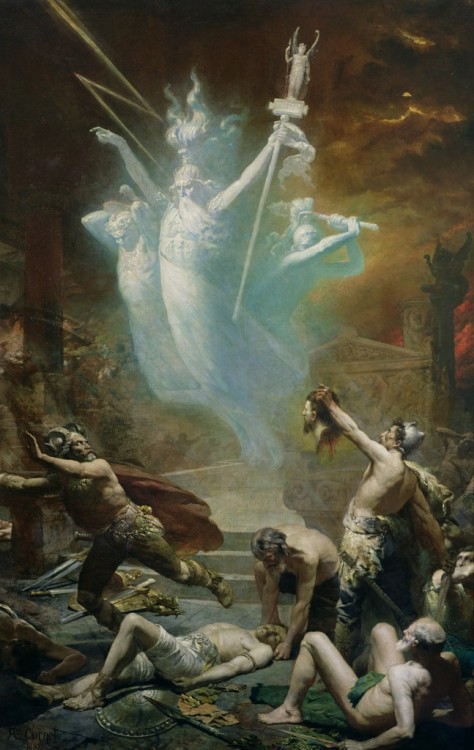
The Greeks again asked for divine help. During the night, the Celts were said to 'panic' and fight each other. Pausanias, writing over 300 years later in Roman times ,described the mayhem as "causeless terrors are said to come from the god Pan". Eventually the Celts retreated after suffering grievous losses, 26,000 dead, according to the Greek historian Pausanias in later times. Here is Pausanias describing the battle which was fought with symbolic divine aid (or knowledge of a primal fear of the Celts) as mentioned earlier to Alexander the Great of Macedonia :
Pausanias (geographer), Greek traveller, geographer, and writer (Description of Greece) of the 2nd century AD. As a Greek writing under the auspices of the Roman empire, he found himself in an awkward cultural space, between the glories of the Greek past he was so keen to describe and the realities of a Greece beholden to Rome as a dominating imperial force. His work bears the marks of his attempt to navigate that space and establish an identity for Roman Greece.
en.wikipedia.org/wiki/Pausanias_(geographer)
Pausanias has the instincts of an antiquary.
en.wikipedia.org/wiki/Pausanias_%28geographer%29
Ptolemy Keraunos (Greek: Πτολεμαῖος Κεραυνός, died 279 BC) was the arrogant ,murderous King of Macedon from 281 BC to 279 BC. His epithet Keraunos is Greek for "Thunder" or "Thunderbolt". See more on him here:
However, although Keraunos was at the zenith of his power, he did not live long afterwards. In 279 BC he was captured and killed (beheaded) during the wars against the Gauls led by Bolgios ("Lightening" ) who conducted a series of mass raids against Macedon and the rest of Greece.His death brought anarchy to the Greek states, since none of his successors were able to bring stability. This situation lasted about two years, until Antigonos Gonatas defeated the Gauls in the battle near Lysimachia, Thrace, in 277 BC, After this victory he was recognized king of Macedon and his power extended eventually also to south Greece.
en.wikipedia.org/wiki/File:Antigonus_Gonatas_British_Muse...

en.wikipedia.org/wiki/File:AntigonusGonatas.jpg

The Antigonid dynasty was a dynasty of Hellenistic kings descended from Alexander the Great's general Antigonus I Monophthalmus ("the One-eyed"). It was one of four dynasties established by Alexander's successors, the others being the Seleucid dynasty, Ptolemaic dynasty and Attalid dynasty. The last scion of the dynasty, Perseus of Macedon, who reigned between 179-168 BCE, proved unable to stop the advancing Roman legions and Macedon's defeat at the Battle of Pydna signaled the end of the dynasty.
skyelander.orgfree.com/celts4.html
Spanish language source internet illustration on ancient tribal attire.
www.housebarra.com/EP/ep04/15celtclothes.html
Several versions out there, if copyrighted please let me know.
Source is likely to be.... from an interesting book called 'Rome's Enemies 2 Gallic and British Celts', #158 in the Ospreys , Men-At-Arms Series, by Peter Wilcox and Angus MacBride (ISBN: 0850456061), 1985. The paintings, done by McBride, (see his picture here)
www.flickr.com/photos/roondorozhand/3234794396/
are based on literary descriptions and archeological finds and are said to be as accurate as possible at this time. www.flickr.com/photos/ancientgreekmapsandmore/2133688042/
www.youtube.com/watch?v=BZPd2DS5sq4
(NO , Not a~vik~ing, they who came from the north, hundreds of years later).See theTaking of the Temple at Delphi by the Gauls, 1885 by Alphonse Cornet a French Academic Classical artist born 1814 - died 1874.
The earliest directly attested examples of a Celtic language are the Lepontic .Lepontic is an extinct Alpine language that was spoken in parts of Rhaetia and Cisalpine Gaul between 550 and 100 BC. It is generally regarded as a Celtic language, although its exact classification within Celtic, or even within the western Indo-European languages, has been the object of debate...
inscriptions, beginning from the 6th century BC.The Continental Celtic languages were spoken by the people known to Roman and Greek writers as Keltoi,...
are attested only in inscriptions and place-names. Insular Celtic is attested from about the 4th century AD in ogham inscriptions, although it is clearly much earlier. Literary tradition begins with Old Irish from about the 8th century. Coherent texts of Early Irish literature. Early Irish literature-The earliest Irish authors:It is unclear when literacy first came to Ireland. The earliest Irish writings are inscriptions, mostly simple memorials, on stone in the ogham alphabet, the earliest of which date to the fourth century..., such as the Táin Bó Cúailnge (a legendary tale from early Irish literature, often considered an epic, although it is written primarily in prose rather than verse)...(The Cattle Raid of Cooley), survive in 12th-century recensions. According to the theory of Professor John T. Koch is an American academic, historian and linguist who specializes in Celtic studies, especially prehistory and the early Middle Ages....
and others.The Tartessian language, also known as Southwestern or South Lusitanian, is a Paleohispanic language once spoken in the southwest of the Iberian Peninsula: mainly in the south of Portugal , but also in Spain...may have been the earliest directly attested Celtic language with the Tartessian written script used in the inscriptions based on a version of a Phoenician script in use around 825 BC.
GREEK RELIEF writing on tablet 3RD BCE
Decree of the town of Cos, Greece. Inscription on stone about the conquest of Delphi by the Gauls under Brennus in March 278 BCE, followed by news of the expulsion of the Gauls from Delphi in the Archaeological Museum, Istanbul, modern Turkey.
www.lessing-photo.com/dispimg.asp?i=10010366+&cr=1679...
Synonyms: Bryth, Gaul: The Raven King
A Brennos , Brennos of the Senones, first appears as the Celtic or Gaulish hero who led the Celtic sack of Rome. During the third century BCE the Celtic expansion led them to the Po valley in Italy. Fearful of this expansion the Etruscans called , on their adversaries, Rome for assistance. The Romans sent three envoys to meet the Celtic leaders. However, one of the Roman envoys killed a Celtic chief and Rome sent an army of 40 000 to meet these 'barbarians'. When the Celts learned of the Roman army moving towards them, Brennos (most likely a chiefly title rather than a real name, like a Duke, see below) marched the Celts off to meet the Romans. The Celts met the Romans at the River Allia, the Romans panicked at the sight of all those crazed Celts, and many Roman soldiers even drowned in the River in attempt to escape. A few made it back to Rome and informed the Senate about the battle at Allia (the date of the battle, July 18, became known as Alliaensis, and was considered thereafter to be a very bad day to do any public activity). The Roman citizens, rightfully fearing that the Celts were headed toward Rome, fled in a panic (much like the soldiers at Allia). By the time the Celts/ Gauls arrived, Rome had been deserted, with the exception of several elderly patricians. These old patricians were sitting in a courtyard, believing that if they were to sacrifice their lives for Rome in its most dire hour of need, Rome's enemies would then be thrown into panic and confusion, and Rome thereby saved. This nearly worked, but the spell of quietude was broken and Rome was looted and the old men killed. They advanced on the Capitol, but were thwarted by plague and a night-time attack was spoiled by cackling of geese. However, about seven months, later the Romans decided to negotiate and the Celts agreed to leave if the Romans would pay them 1,000 pounds of gold. The Celts were accused of using false weights, upon which Brennos (the Celtic chieftain) is said to have thrown his sword on the scales and loudly declare, "Vea victus", or "woe to the defeated".
www.flickr.com/photos/96490373@N02/14550761807/
cgi.ebay.com/Ancient-Roman-Dictator-Brennus-c1915-Card-/3...
www.flickr.com/photos/summoning_ifrit/4211154813/
The early 4th century BCE a vast group of Gauls sacked the city of Rome. Romans gave it up rather easily, actually. Most fled to neighbouring cities like Veii while the Senate, priests, and what was left of the Roman army migrated to the Capitol - defending and taking refuge in the temples there. The Gauls made easy pickings of what they found in the city. According to Livy:
For several days they had been directing their fury only against bricks and mortar. Rome was a heap of smouldering ruins, but something remained - the armed men in the Citadel, and when the Gauls saw that, in spite of everything, they remained unshaken and would never yield to anything but force, they resolved to attempt an assault. At dawn, therefore, on a given signal the whole vast horde assembled in the Forum; then, roaring out their challenge, they locked shields and moved up the slope of the Capitol." (5.43)
The Romans, however, used the advantage of being at the top of the hill and managed to beat the Gauls back. Yet the Gauls were determined and even though they had destroyed most of the food and supplies in their initial sack of the city, they began a siege on the hill.
During all of this, officials in Veii were determined to get a message through to the Roman Senate - despite the fact that the Senate was under siege. As the old saying goes, 'if there's a will, there's a way', and a young Roman soldier named Pontius Cominus managed to do it. "Floating on a life-buoy down the river to Rome, he took the shortest way to the Capitol up and over a bluff so steep that the Gauls had never thought of watching it." (5.46) But the Gauls did find out about it and figured if he could do it, then they should all be able to do it too.
One starlit night, they made the attempt. Having first sent an unarmed man to reconnoitre the route, they began the climb. It was something of a scramble: at the awkward spots a man would get a purchase for his feet on a comrade below him, then haul him up in his turn - weapons were passed up from hand to hand as the lie of the rocks allowed - until by pushing and pulling on another they reached the top. What is more, they accomplished the climb so quietly that the Romans on guard never heard a sound, and even the dogs - who are normally aroused by the least noise in the night - noticed nothing. It was the geese that saved them - Juno's sacred geese, which in spite of the dearth of provisions had not been killed. The cackling of the birds and the clapping of their wings awoke Marcus Manlius - a distinguished officer who had been consul three years before - and he, seizing his sword and giving the alarm, hurried, without waiting for the support of his bewildered comrades, straight to the point of danger. (5.46)
And that is either Roman spin or real history of how the sacred geese of Juno saved Rome - since after that last attempt, the lack of food forced the Gaul to accept payment from the Romans to leave the city alone.
www.mmdtkw.org/AU0308bJunoMonetaGeese.jpg
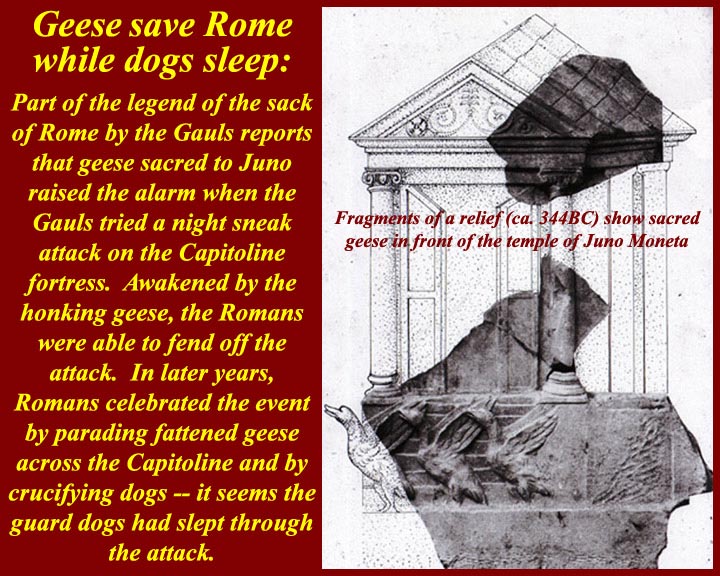
www.mmdtkw.org/AU0308gBrennerPass.jpg
www.mmdtkw.org/AU0308gBrennusFrenchMaritimeSculpture.jpg
While Brennus I was evil personified to the Romans, he was a hero to transalpine people.
en.wikipedia.org/wiki/Battle_of_the_Allia
"Other Greek and Roman synchronisms have a more obvious historical symbolism, as may be the casewith the Polybian synchronism we saw above, between Dionysius’s siege of
Rhegium and the Gallic sack of Rome."
wxy.seu.edu.cn/humanities/sociology/htmledit/uploadfile/s...
www.unrv.com/empire/gallic-sack-of-rome.php
REFOUNDING THE CITY:
ENNIUS, LIVY, AND VIRGIL
The city of Rome has now been successfully founded in historical time—whether
that time is focalized as Greek or Roman—but we have not yet reached the end of
the story. As everyone knows, the city of Rome kept having to be re-founded, and
the patterns of refoundation drastically reconfigure the trajectory of movement
from myth to history that we have been following so far.188
Ennius’s most explicit surviving allusion to the date of the foundation of the city
in fact comes at the moment when the city had just been virtually destroyed, and
was on the verge of vanishing from history, after the sack by the Gauls in 387/6
b.c.e.189 The context is a speech in which Camillus persuades the Senate not to
move to Veii, but to refound the city instead (154–55 Skutsch):
Septingenti sunt paulo plus aut minus anni
augusto augurio postquam incluta condita Roma est.
It is seven hundred years, a little more or a little less,
since famous Rome was founded by august augury.
How this seven-hundred-year period between Romulus’s foundation and the sack
of Rome by the Gauls actually worked remains a mystery, at least to me.190 Still, we
should not overlook the symbolic significance of this number in its own right. The
importance of the seven-hundred-year period has been very well illustrated in the
fascinating book Die rhetorische Zahl, written by a scholar with the gloriously apt
name of Dreizehnter.191 Dreizehnter does not mention this passage of Ennius, but
he collects a great deal of interesting material about seven hundred years as the life
span of a city or an empire from foundation to extinction, or from foundation to
virtual extinction or only just-escaped extinction. In various traditions that he
examines there were seven hundred years from the foundation to the destruction
of Melos, Carthage, and Macedonia, or from the foundation to the virtual extinc-
(Myth into History I: Foundations of the city)
tion of Sparta.192 What we see in the Ennius passage, in other words, is that the city
was virtually destroyed and came within an ace of fulfilling the seven-hundred year
doom. The point will have been accentuated by Ennius’s book divisions.
Camillus’s speech comes at the end of book 4, and the regal period ended with
book 3, so that up to this point in the Annales we have had only one self-contained
volume of Republican history, and if things had gone differently that might have
been all we had.193
Livy activates the power of this Ennian symbolic numeral, even as he corrects
Ennius’s dating, with his allusion to the seven hundred years of Rome (Pref. 4):
Res est praeterea et immensi operis, ut quae supra septingentesimum annum
repetatur et quae ab exiguis profecta initiis eo creuerit ut iam magnitudine
laboret sua.
In addition, the matter is of immeasurable scope, in that it must be taken back
past the seven hundredth year, and having started from small beginnings has
grown to the stage that it is now laboring under its own size.194
Chaplin has argued that Livy’s preface is constructing recent Roman history as a
death, with a possible rebirth to come:195 the Republic has been destroyed, and the
Romans of Livy’s time are like the Romans of Camillus’s time, faced with the task
of refounding the city after it has only just escaped its seven-hundred-year doom.
In Livy’s treatment of the Roman response to the sack of the city by the Gauls,
we can see him returning to the Ennian theme of rebirth from destruction,
although this time using different significant numbers. Having exploited the numinous
associations of Ennius’s seven hundred years in his preface, Livy now produces
another numinous numeral for the span from foundation to sack, one that
conforms with the modern orthodox chronology. Livy has Camillus deliver a
mighty speech to convince his fellow citizens not to abandon Rome for the site of
Veii (5.51–54).196When Livy’s Camillus echoes Ennius’s by counting off the years
since the foundation, it appears that some kind of great year has gone by. From
Romulus’s foundation down to the sack by the Gauls there have been as many
years as there are days in a year: Trecentensimus sexagensimus quintus annus urbis,
Quirites, agitur (“This is the 365th year of the city, Quirites,” 5.54.5). This is of
course a calculation that fully resonates only after Caesar’s reform of the calendar,
when a Roman year for the first time had 365 days.This counting places
Camillus’s refounding of the city at a pivotal point in time, precisely halfway
(Refounding the City: Ennius, Livy, Virgil . 101)
between the first founding of the city, in 753, and the refounding that faces Livy
and his contemporaries 365 years after Camillus, in the 20s b.c.e.198 Exactly the
same structuring appears to underpin the panorama of Roman history on Virgil’s
Shield of Aeneas, where the barely averted destruction of Rome by the Gauls (Aen.
8.652–62) comes midway in time between the foundation of the city (8.635) and
the barely averted destruction of Rome by Antonius and Cleopatra (8.671–713).199
In all of these authors, city destruction, whether achieved or barely averted,
leads to refoundation and consequent reconfiguring of identity, in a process that
begins with Troy and continues through the fates of Alba Longa, Veii, and Rome
itself.200 As Kraus has shown, when Livy begins his next book after the Gallic sack,
he refounds his narrative along with the city, capitalizing on the annalistic tradition’s
identification of the city and history.201 In an extraordinary moment, the
opening sentences of book 6 tell us that only now is real history beginning. All of
the material in the first five books, Livy now declares, has been “obscure because
of its excessive antiquity” (uetustate nimia obscuras), and because there were few
written records in those early days, while the ones that did exist “for the most part
were destroyed when the city was burnt” (incensa urbe pleraeque interiere, 6.1.2).
Everything up until this point, from Troy to the Gallic sack, is suddenly reconfigured
as prior, prefoundational. In his preface Livy had drawn a line between myth
and history around the time of the Romulean foundation of the city (ante conditam
condendamue urbem, 6), but “the fresh start in 390 redraws the limits of the historically
verifiable.”202We now have a new entry into history, with a newly rebuilt city
and a newly solid evidential base for its written commemoration (6.1.3):
Clariora deinceps certioraque ab secunda origine uelut ab stirpibus laetius
feraciusque renatae urbis gesta domi militiaeque exponentur.
From here there will be a more clear and definite exposition of the domestic
and military history of the city, reborn from a second origin, as if from the
old roots, with a more fertile and fruitful growth.203
Livy here is picking up on the annalistic history of Claudius Quadrigarius, who
had written about fifty years earlier. We know that Claudius began his history with
the sack of Rome by the Gauls, no doubt on the grounds we see alluded to in Livy,
that no history was possible before then, thanks to the destruction of monuments
and archives.204
We have already seen how the Roman tradition picks up demarcations that are
102 . Myth into History I: Foundations of the City
crucial from the Greek tradition—Troy and the first Olympiad—and recasts
them as transitions into a new, Roman, phase of history. The Gallic sack is a vital
addition to this series of watersheds. The first key fixed synchronistic point in
Timaeus and Polybius that makes it possible for Roman history to be properly connected
with Greek history, the Gallic sack is itself made to serve as the “beginning
of history” in Claudius Quadrigarius and Livy book 6.205 The very event that almost
expunged Rome altogether is the one that put the city on the world stage—
just as the destruction of Troy led to the city’s existence in the first place.206
Ovid intuited the power of these associated watersheds of foundation and Gallic
sack, and his subtle deployment of them in the Metamorphoses is proof of their
understood significance. Before he arrives at the foundation of Rome in book 14,
he has a very small number of proleptic references to the as yet nonexistent city.
Book 1 contains two forward references to his own day, with the poem’s first simile
referring to the reign of Augustus (1.199–205), and the story of Apollo and
Daphne likewise anticipating the reign of Augustus, as Apollo prophesies the use
of his sacred laurel to grace Roman triumphs and adorn Augustus’s house (1.560–
63). His only other proleptic references to the city before the foundation in book
14 occur in book 2, and they are both references to the city only just escaping total
catastrophe, catastrophes that would have ensured the city was never part of world
history. One is in a cosmic setting, when the natural site of the city is almost
expunged, as the Tiber is dried up along with other rivers by Phaethon’s chariot
(2.254–59); the other is an allusion to the geese that “were to save the Capitol with
their wakeful cry” (seruaturis uigili Capitolia uoce/ . . . anseribus, 2.538–39).207
Again, in the Fasti, when the gods meet in council to deliberate how to save Rome
from the Gauls, Ovid takes as his template the Ennian council that deliberated over
the foundation of the city: in both cases, Mars expostulates with his father, Jupiter,
and is assured that all will be well.208
It is highly significant that these two events, the city’s foundation and near
destruction by the Gauls, are the only “historical” events commemorated on the
Republican calendar, the Fasti Antiates.209 Calendrical fasti from the Principate
mention all kinds of events, but the Fasti Antiates, the only calendar we have surviving
from the Republic, mark only two historical events: 21 April, the Parilia and
the foundation of the city, and 18 July, the dies Alliensis, the day of the battle of the
Allia, when the Roman army was scattered by the advancing Gauls on their way
to the city, which they entered on the next day.210
The foundation of the city and its near extinction by the Gauls are symbolically
joined events, linked by significant numbers, either 700 or 365, linked by themes of
Refounding the City: Ennius, Livy, Virgil . 103
refoundation and rebirth. The history of the city keeps getting restarted at such
crucial transition moments, when repetitive patterns of quasi-cyclical destruction
and refoundation replay themselves, in a fascinating interplay between a drive for
onward narrative continuity and the threat of eddying, repetitious, circularity.211 It
is poignant to observe the power of this theme still persisting in the fifth century
c.e., when Rutilius Namatianus, six years after the sack of Rome by the Visigoths
in 410 c.e., can hail Rome’s potential to bounce back from disaster, citing its eventual
defeat of Brennus, who led the Gauls to the sack of Rome, and of the Samnites,
Pyrrhus, and Hannibal:212 “You, Rome, are built up,” he claims, “by the very thing
that undoes other powers: the pattern of your rebirth is the ability to grow from
your calamities” (illud te reparat quod cetera regna resoluit:/ordo renascendi est
crescere posse malis, 139–40). Each of these key marker moments in time may become
a new opportunity for the community to reimagine itself, as the epochal moment
produces a new beginning point from which the community may imagine its
progress forward into time, measured against its backward extension into time.213
_______________________________ __________________________
The Gauls in the Italia peninsula .Clusium was reached by the Gauls, who had invaded most of Etruria already, and its people turned to Rome for help. However, the Roman embassy provoked a skirmish and, then, the Gauls marched straight for Rome (July, 387 BC). After the entire Roman army was defeated at the Allia brook (Battle of the Allia), the defenseless Rome was seized by the invaders. The entire Roman army retreated into the deserted Veii whereas most civilians ended at the Etruscan Caere. Nonetheless, a surrounded Roman garrison continued to resist on the Capitoline Hill. The Gauls dwelt within the city, getting their supplies by destroying all nearby towns for plunder.When the Gauls went for Ardea, the exiled Camillus, who was now a private man, organized the local forces for a defense. Particularly, he harangued that, always, the Gauls exterminated their defeated enemies. Camillus found that the Gauls were too distracted, celebrating their latest spoils with much 'crapulence' at their camp. Then, he attacked during a night, defeating the enemy easily with great bloodshed.He is thus considered the second founder of Rome.Camillus was hailed then by all other Roman exiles throughout the region. After he refused a makeshift generalship, a Roman messenger sneaked into the Capitol and, therein, Camillus was officially appointed dictator by the Roman Senators, to confront the Gauls.At the Roman base of Veii, Camillus gathered a 12,000-man army whereas more men joined out of the region. The occupying Gauls were in serious need, under quite poor health conditions. As the Roman Dictator, Camillus negotiated with the Gallic leader Brennus, and the Gauls left Rome, camping nearby at the Gabinian road. A day after this, Camillus confronted them with his refreshed army and the Gauls were forced to withdraw, after seven months of occupation (386 BC).
Camillus sacrificed for the successful return and he ordered the construction of the temple of Aius Locutius. Then, he subdued another claim of the plebeian orators, who importuned further about moving to Veii. After ordering a Senate debate, Camillus argued for staying and the Roman house approved this unanimously. The reconstruction extended for an entire year.
By this one-year office, Camillus was the longest of all Roman dictators. Basically, the Senators had been persuaded by the disturbing social clashes, which could be better managed by Camillus. Instead, Camillus disliked this and, vainly, he requested the dismissal.
Roman dictator (367 BC)
As the Gauls were, again, marching toward Latium, all Romans reunited despite their severe differences. Camillus was named Roman dictator for the fifth time then (367 BC). He organized the defense of Rome actively. By the commands of Camillus, the Roman soldiers were protected particularly against the Gallic main attack, the heavy blow of their swords. Both smooth iron helmets and brass rimed shields were built. Also, long pikes were used, to keep the enemy's swords far.
The Gauls camped at the Anio river, carrying loads of recently gotten plunder. Near them, at the Alban Hills, Camillus discovered their disorganization, which was due to unruly celebrations. Before the dawn, then, the light infantry disarrayed the Gallic defenses and, subsequently, the heavy infantry and the pikemen of the Romans finished their enemy. After the battle, Velitrae surrendered voluntarily to Rome. Back in Rome, Camillus celebrated with another Triumph.
ancientimes.blogspot.co.nz/2007/06/brennus-and-first-sack...
A deadly pestilence struck Rome and it affected most Roman public figures. Camillus was amongst them, passing away in 365 BC.
Source: Plutarch, The Parallel Lives - The Life of Camillus:
In popular culture
Marcus Furius Camillus was played by Massimo Serato in the 1963 film 'Brennus, Enemy of Rome'.
www.flickr.com/photos/ggnyc/1405297848/
BC 400's Celts from the Alps flowed into Italy ....
Herodotus of Halicarnassus reported a merchant from Samos named Colacus was driven off course by tides and winds when trading off the African shore. He landed at the Tartessus (modern River Guadalquivir in southern Spain) where he found tribes of Keltoi working the silver mines
396 BC Celts defeated the Etruscans at Melpum (Melzo, west of Milan)
390 Senones Celts ('the veterans') led by Brennos (Latinate: Brennus) defeated the Romans in Rome (July 19) so badly it took the Romans 200 years to recover from the 'terror Gallicus'. After seven months and a ransom of 100 pounds of gold, the Celts moved along to Picenum on Italy's eastern seaboard.
Ephoros of Cyme reported the Celts occupied an area the size of the Indian sub-continent.
334-335 Alexander of Macedonia met the Celts on the Danube banks to make an agreement: The Celts would not attack his empire while he was off conquering in the east. Only after his death they expanded to Moravia and Thrace .
----------- ----------
Along with Bolgios, Brennos II was the legendary leader of other Celts on their invasion of Macedonia in the second century BCE. Though Bolgios led the invasion of Macedonia , Brennus succeeded in crossing his whole army over the river Sperchios into Greece proper, where he laid seige to the town of Heraclea and, having driven out the garrison there, marched on to Thermopylae where he defeated an army raised by a confederation of Greek cities. Brennus then avanced across Greece, where he decided to go on to Delphi, which was reported as the treasure house of Greece. Brennus and his army of 30,000 set off to attack the temple of Apollo, the ultimate goal of his expedition. Here it is said that Brennos was defeated by earthquakes and thunderbolts that reduced the soldiers to ashes; snow storms, showers of great stones, and "ancient heroes appearing from the heavens". In the midst of this snowstorm, Brennos and his men were attacked near the Parnassus mountains. The Celts were soundly defeated and Brennos was mortally wounded. As he lay dying, he gave the order for all of the wounded to be killed, and all the booty to be burned, as the army would never make it home if they had to carry the wounded warriors and their plunder. After giving the order, Brennos drank some wine and then took his own life. (? Source)
www.maryjones.us/ctexts/classical_pausianas.html
The Description of Greece
Pausanias (fl. 2nd c. CE) XIX.
[5] "I have made some mention of the Gallic invasion of Greece in my description of the Athenian Council Chamber. But I have resolved to give a more detailed account of the Gauls in my description of Delphi, because the greatest of the Greek exploits against the barbarians took place there. The Celts conducted their first foreign expedition under the leadership of Cambaules. Advancing as far as Thrace they lost heart and broke off their march, realizing that they were too few in number to be a match for the Greeks. "...........
10]" When the Gallic horsemen were engaged, the servants remained behind the ranks and proved useful in the following way. Should a horseman or his horse fall, the slave brought him a horse to mount; if the rider was killed, the slave mounted the horse in his master's place; if both rider and horse were killed, there was a mounted man ready. When a rider was wounded, one slave brought back to camp the wounded man, while the other took his vacant place in the ranks.
[11] I believe that the Gauls in adopting these methods copied the Persian regiment of the Ten Thousand, who were called the Immortals. There was, however, this difference. The Persians used to wait until the battle was over before replacing casualties, while the Gauls kept reinforcing the horsemen to their full number during the height of the action. This organization is called in their native speech trimarcisia, for I would have you know that marca3 is the Celtic name for a horse. "
(Addit :we know from Celtic myth this was indigenous to the confederacy of Celtic tribes as on Gundestrup Cauldron ,warrior plate)
[12] "This was the size of the army, and such was the intention of Brennos, when he attacked Greece. The spirit of the Greeks was utterly broken, but the extremity of their terror forced them to defend Greece. They realized that the struggle that faced them would not be one for liberty, as it was when they fought the Persian, and that giving water and earth would not bring them safety. They still remembered the fate of Macedonia, Thrace and Paeonia during the former incursion of the Gauls, and reports were coming in of enormities committed at that very time on the Thessalians. So every man, as well as every state, was convinced that they must either conquer or perish. "
Attalus I (Greek: Ἄτταλος), surnamed Soter (Greek: Σωτὴρ, "Savior"; 269 BC – 197 BC) ruled Pergamon, an Ionian Greek polis (what is now Bergama, Turkey), first as dynast, later as king, from 241 BC to 197 BC. He was the second cousin and the adoptive son of Eumenes I, whom he succeeded, and was the first of the Attalid dynasty to assume the title of king in 238 BC.He was the son of Attalus and his wife Antiochis.
Attalus won an important victory over the Galatians, newly arrived Celtic tribes from Thrace, who had been, for more than a generation, plundering and exacting tribute throughout most of Asia Minor without any serious check. This victory, celebrated by the triumphal monument at Pergamon, famous for its 'Dying Galatian' or 'Gaul' statue , and the liberation from the Gallic "terror" which it represented, earned for Attalus the name of "Soter", and the title of "king". A courageous and capable general and loyal ally of Rome, he played a significant role in the first and second Macedonian Wars, waged against Philip V of Macedon.
Etymologically Brennos is related to Brân and is related to the reconstructed proto-Celtic lexical elements *brano- (raven) -n- (the deicific particle) and os (the masculine ending). Thus Brennos is literally the 'Raven God'. However, the bren part of the name is also the root for one Cymric word for king brenhin and Brennos can be rendered as 'Raven King'. Which also leads to the supposition that 'Brennos', rather than being a proper name is actually an honorific denoting 'battle lord'. Raven gods being tribal leaders in the time of war so a Celtic war leader would take-on the name of such a deity. Indeed, the modern Cymric for king is brenin a word derived from 'Brennos'.
An actual late Iron Age helmet like this has been located in ancient Dacia , Translyvania , now modern Roumania/ Romania the Helmet of Ciumeşti.
www.flickr.com/photos/42003310@N05/4886860352/
As one of the styles depicted on the Celtic Gundestrup Cauldron.
Wilcox and McBride mentioned that their illustration of the iron Gallic warrior's helmet of the middle La Tene period had been reconstructed the on the basis of the Ciumesti helmet.[45]
Repsol is committed to being a responsible operator in all areas of our business. Our values of flexibility, transparency, responsibility, integrity and innovation are at the core of everything we do. Repsol holds an interest in 170,000 net acres in the Marcellus, which is one of the largest natural gas fields in the world. Our acreage is primarily located in northeastern Pennsylvania in Bradford, Susquehanna and Tioga counties.
Learn more about our U.S. exploration and production business at www.repsolusa.com.
Repsol se compromete a actuar con responsabilidad a lo largo de toda la cadena de valor. Nuestros valores de flexibilidad, transparencia, responsabilidad, integridad e innovación marcan nuestra manera de trabajar. Repsol tiene un interés de 170.000 acres netos en el Marcellus, es uno de los mayores campos de gas natural en el mundo. Nuestra área de operación se encuentra principalmente en el noreste de Pennsylvania en Bradford, y en los condados de Susquehanna y Tioga.
Más información sobre nuestro negocio de exploración y producción en EE.UU. www.repsolusa.com .
History of the Vienna State Opera
132 years house on the Ring
(you can see pictures by clicking on the link at the end of page!)
State Opera (K.K. Court Opera) 1901
About three and a half centuries, until the early Baroque period, the tradition of Viennese opera goes back. Emperor Franz Joseph I decreed in December 1857 to tear down the old city walls and fortifications around the city center of Vienna and to lay out a wide boulevard with new buildings for culture and politics, the ring road.
The two Court Theatres (a speech and a musical theater) should find a new place on the ring. For the Imperial and Royal Court Opera House was chosen a prominent place in the immediate area of the former Kärntnertortheatre. This by the public that much loved opera theater was demolished in 1709 due to its confinement .
State Opera (K.K. Court Opera) 1903
The new opera house was built by the Viennese architect August Sicardsburg, who designed the basic plan, and Eduard van der Null, who designed the interior decoration. But other eminent artists had been involved: just think of Moritz von Schwind, who painted the frescoes in the foyer and the famous "Magic Flute", cycle of frescoes in the loggia. The two architects did not experience the opening of "their" opera house any more. The sensitive van der Null committed suicide since the Wiener (Viennes people) denigrated the new house as lacking in style, his friend Sicardsburg succumbed a little later to a stroke.
1869 - 1955
On 25 May 1869 the House was with Mozart's DON JUAN in the presence of Emperor Franz Joseph, the highest building owner, and Empress Elisabeth opened.
However, with the artistic charisma under the first directors Franz von Dingelstedt, Johann Herbeck, Franz Jauner and Wilhelm Jahn grew the popularity of the building. A first highlight experienced the Vienna Opera under the director Gustav Mahler, renewing the outdated performance system from scratch, strengthening precision and ensemble spirit and also using significant visual artists (including Alfred Roller) for the shaping of the new stage aesthetic.
In the ten-year-period of his Directorate (1897-1907) continued Gustav Mahler, this very day, in the concert halls of the world as the most important member of a Symphony Orchestra at the turn of the 20th century omnipresent, the intensive fostering of Wagner, Mozart's operas and Beethoven's Fidelio were redesigned, the with Richard Strauss initiated connection to Verdi was held upright. Austrian composers were promoted (Hugo Wolf), the Court Opera was opened to European modernism.
Image: Emperor Franz Joseph I and Emperor Wilhelm II during a gala performance at the Vienna Court Opera in 1900 resulting from the "Book of the Emperor", edited by Max Herzig.
Technique: Lithography
from www.aeiou.at
In addition to the classics of the Italian repertoire were and are especially Mozart, Wagner and Richard Strauss (himself 1919-1924 director of the House), the musical protection gods of the Vienna State Opera.
staatsoper_81.jpg (28138 bytes)
The modern also always had its place: the twenties and thirties witnessed the Vienna premieres of Krenek's Jonny spielt auf, Cardillac Hindemith, Korngold MIRACLE OF Héliane and Berg's Wozzeck (under President Clemens Krauss). This tradition was interrupted with the seizure of power by the National Socialists, yes, after the devastating bomb hits, on 12 March 1945 the house on the ring largely devastating, the care of the art form itself was doubtful.
The Viennese, who had preserved a lively cultural life during the war, were deeply shocked to see the symbol of the Austrian musical life in ruins.
But the spirit of the opera was not destroyed. On 1 May 1945 "State Opera Volksoper" was opened with a brilliant performance of Mozart's THE MARRIAGE OF FIGARO, on 6 October 1945 was followed by the re-opening of the hastily restored Theater an der Wien with Beethoven's Fidelio. Thus there were two venues for the next ten years, while the actual main building was rebuilt at great expense.
staatsoper_84.jpg (14707 bytes)
Visitors flock to the opera. Reopening on 5th November, 1955.
Image from © www.staatsvertrag.at / bildarchiv austria / ÖGZ / Hilscher
As early as 24 May 1945 the State Secretary of Public Works, Julius Raab, had announced the reconstruction of the Vienna State Opera, which should be placed in the hands of the Austrian architects Erich Boltenstern and Otto Prossinger. Only the main façade, the grand staircase and the Schwindfoyer (evanescence foyer) had been spared from the bombs - with a new auditorium and modernized technology, the Vienna State Opera was brilliant with Beethoven's Fidelio under Karl Böhm on 5 November 1955 reopened. The opening ceremonies were broadcasted from Austrian television and in the whole world at the same time as a sign of life of the resurrected 2nd Republic understood.
staatsoper_83.jpg (33866 bytes)
State ceremony to the reopening on 5 November 1955. On the far right under the box of the Federal President a television camera of the Austrian Broadcasting Corporation is visible which broadcasted the event. Image from © www.staatsvertrag.at / ÖGZ / Cermak
1955 to 1992
The dictum that the Vienna State Opera survives every director, is attributed to Egon Seefehlner which himself for many years run the businessses of the house. And yet marked he and the thirty-one other directors of the Vienna State Opera since 1869, great musicians or musical administrators, in their own way the profile of this world-famous institution:
staatsoper_82.jpg (13379 bytes)
Performance for the reopening of the Vienna State Opera on 5 November, 1955.
Image from © www.staatsvertrag.at / bildarchiv austria / ÖGZ / Hilscher
After the Second World War there were first the conductors directors Karl Böhm and Herbert von Karajan - the latter insisted on the title "Artistic Director" and opened the Ensemble house to the international singer market, had the opera rehearsed in original language and oriented his plans to "co-productions" with foreign opera houses, however, which were only realized after his term.
It followed as directors Egon Hilbert, Heinrich Reif-Gintl, Rudolf Gamsjäger and the mentioned Egon Seefehlner, who was appointed for a second time at the top of the house after the departure of his successor in office Lorin Maazel. Claus Helmut Drese (State Opera director from 1986 to 1991) stood with Claudio Abbado an internationally renowned music director by his side. At the beginning of the 90s the forrmer star baritone Eberhard Waechter, at that time director of the Volksoper (People's Opera), charged with the direction. Only seven months have been granted to him as a director.
The era Ioan Holender (1992 to 2010)
After Waechter's tragic death in March 1992 took over general secretary Ioan Holender, a former singer (baritone) and owner of a singer Agency, the office to continue the tradition of perhaps the most important opera institution in the world over the millennium to 2010.
His play plan design relies besides an extremely wide repertoire with the columns Mozart, Wagner, Verdi and Strauss mainly on premieres. Mention may be made of Bellini's I Puritani (1993 /94), Massenet Hérodiade (1994 /95), Verdi's Jerusalem and Britten's PETER GRIMES (1995 /96), Verdi's Stiffelio and Enescu OEDIPE (1996 /97), Rossini's GUILLAUME TELL and Lehár's operetta THE MERRY WIDOW (1998/99) and Schoenberg's THE JAKOBSLEITER, Hiller's PETER PAN, Donizetti's ROBERTO DEVEREUX, Britten's Billy Budd, Verdi's Nabucco (2000/ 01), Bellini's LA SONNAMBULA, Gounod's Roméo et Juliette, Janácek's Jenufa (2001/02), Verdi's SIMON BOCCANEGRA, Krenek's Jonny spielt auf, Donizetti's La Favorite, Hiller's PINOCCHIO, Wagner's TRISTAN UND ISOLDE (2002/ 03), Verdi's FALSTAFF, Wagner's FLYING DUTCHMAN and PARSIFAL, Strauss's Daphne (2003/ 04) and the world premiere of the original French version of Verdi's DON CARLOS (2003/ 04). A particular success of the recent past, the rediscovery of Fromental Halévy's La Juive Grand (1999 ) must be considered. Two premières concerned 1995 Adriana Hölszky's THE WALLS (co-production with the Vienna Festival at the Theater an der Wien ) and Alfred Schnittke's Gesualdo. On 15 June 2002 also THE GIANT OF STONE FIELD (Music: Peter Turrini: Friedrich Cerha libretto) premiered with great success, another commissioned work of the Vienna State Opera.
State Opera - © Oliver Thomann - FOTOLIA
Image : Vienna State Opera
In recent years it came up, in each case on 18 May, the anniversary of the death of Gustav Mahler, to concerts of the Vienna Philharmonic at the Vienna State Opera. These were under the direction of Seiji Ozawa (who since the 2002 /03 season the Vienna State Opera director Holender as music director of the house stands to the side) (1995), Carlo Maria Giulini (1996), Riccardo Muti (1997), Lorin Maazel (1998), Zubin Mehta (1999), Giuseppe Sinopoli (2000 ), Riccardo Muti (2001) and again Seiji Ozawa (2004).
Furthermore, was on 16 June, 2002 for the first time by the Vienna Philharmonic Orchestra (conducted by Seiji Ozawa) a CONCERT FOR AUSTRIA organized. More CONCERTS FOR AUSTRIA followed on 26 October 2003 (Zubin Mehta) and 26 October 2004 (under Valery Gergiev).
At the Theater an der Wien Mozart's Così fan tutte experienced a triumphant new production conducted by Riccardo Muti. This Mozart cycle under Muti continued with DON GIOVANNI and 2001 LE MARRIAGE OF FIGARO, 1999.
more...
Directors since 1869
Franz von Dingelstedt 07/01/1867 - 18/12/1870
Opening 5/25/1869
Johann von Herbeck 12/19/1870 - 30/04/1875
Franz von Jauner 01/05/1875 - 18/06/1880
Director College:
Karl Mayerhofer, Gustav Walter and
Emil Scaria 19.06.1880 - 31.12.1880
Wilhelm Jahn 01.01.1881 - 10.14.1897
Gustav Mahler 10/15/1897 - 31/12/1907
Felix Weingartner 01.01.1908 - 28.02.1911
Hans Gregor 01.03.1911 - 14.11.1918
Franz Schalk 15.11.1918 - 08.15.1919
Richard Strauss/Franz Schalk 16/08/1919 - 31/10/1924
Franz Schalk 1/11/1924 - 8/31/1929
Clemens Krauss 01/09/1929 - 15/12/1934
Felix Weingartner, 01.01.1935 - 08.31.1936
Erwin Kerber 09/01/1936 - 08/31/1940
Henry K. Strohm 09.01.1940 - 19.04.1941
Walter Thomas 02.01.1941 - 19.04.1941
Ernst August Schneider 04/20/1941 - 02/28/1943
Karl Böhm 03.01.1943 - 30.04.1945
Alfred Jerger,
State Opera in the Volksoper 01.05.1945 - 14.06.1945
Franz Salmhofer,
State Opera in the Theater an der Wien, 18.06.1945 - 31.08.1955
Karl Böhm 01.09.1954 - 31.08.1956
Herbert von Karajan 01.09.1956 - 31.03.1962
Herbert von Karajan/Walter Erich Schäfer 01.04.1962 - 08.06.1963
Herbert von Karajan/Egon Hilbert 09.06.1963 - 31.08.1964
Egon Hilbert 01.09.1964 - 18.01.1968
Heinrich Reif- Gintl 19.01.1968 - 31.08.1972
Rudolf Gamsjager 01.09.1972 - 31.08.1976
Egon Seefehlner 01.09.1976 - 31.08.1982
Lorin Maazel 01.09.1982 - 31.08.1984
Egon Seefehlner 01.09.1984 - 31.08.1986
Dr. Claus Helmut Drese 01.09.1986 - 31.08.1991
Eberhard Waechter 01.09.1991 - 29.03.1992
Ioan Holender 01.04.1992 - 31.08.2010
Dominique Meyer since 01/09/2010
Opera world premieres
Abbreviations:
Od = the Odeon
Ron = Ronacher
TW = the Theater an der Wien
1875 10:03. Goldmark The Queen of Sheba
1877 04:10. Brüller Der Landfriede
1880 26.05. Riedel The Accolade
15.12. Brüller Bianca
1883 04.01. Leschetitzky The first fold
21.02. Bachrich Muzzedin
1884 26.03. Bachrich Heini of Styria
1886 30.03. Hellmesberger jun. Fata Morgana
4:10 . Hager Marffa
19.11. Goldmark Merlin
1887 03:04. Harold pepper
1889 27.03. Fox The Bride King
4:10. Smareglia The vassal of Szigeth
1891 19:02. Mader Refugees
1892 01.01. J. Strauss Ritter Pasman
16.02. Massenet Werther
19.11. Bulk Signor Formica
1894 20.01. Heuberger Miriam
1896 21.03. Goldmark The Cricket on the Hearth
1899 17:01. The Goldmark prisoners of war
1900 22:01. Zemlinsky It was once
1902 28.02. Forster The dot mon
1904 18:02. Wolf The Corregidor
1908 02.01. Goldmark The Winter's Tale
1910 12:04. The musician Bittner
18.05. Goldmark Götz von Berlichingen
1911 09:11. Bittner The mountain lake
1912 16.03. Oberleithner Aphrodite
1913 15.03. Schreker The game works and the Princess
1914 01.04. Schmidt Notre Dame
1916 04:10. R. Strauss Ariadne auf Naxos (Vienna version)
1917 23.11. Zaiszek-Blankenau Ferdinand and Luise
1919 10.10. R. Strauss Die Frau ohne Schatten
1920 13.05. Weingartner Champion Andrea/The Village School
1921 09.04. The Bittner Kohlhaymerin
1924 20.09. Beethoven/R. Strauss The Ruins of Athens
1925 24.02. Kienzl Sanctissimum
27.03. Frank The image of the Madonna
1931 20.06. Wellesz The Bacchae
1932 10:11. Heger The beggar Nameless
1934 20.01. Lehár Giuditta
08.12. Bittner The violet
1935 26.12. Salmhofer lady in dream
1937 06.02. Wenzl - Traun rock the atonement
17.04. Frank The strange woman
18.11. Weinberger Wallenstein
1938 09.03. Salmhofer Ivan Tarasenko
1939 02:02. Will King ballad
1941 04:04. Wagner Régeny Johanna Balk
1956 17.06. Martin The Storm
1971 23.05. The visit of an old lady
1976 17.12. A Love and Intrigue
1989 25.11. The blind Furrer (OD)
1990 06:12. Krenek last dance at St. Stephen's (Ron)
1995 20.05. Hölszky The walls (TW)
26.05. Schnittke Gesualdo
2002 15.06. Cerha Der Riese vom Steinfeld
2007 15:04 Naske The Omama in the apple tree
2010 28.02. Reimann Medea
2010 10:05. Eröd dots and Anton
The son of a very good friend committed suicide today. He was a single father of two little ones (3 &5) living with his single mother. He called our receptionist and told her he was going to do it and to tell his mother to take care of his children. This seems like such a selfish act.......
LENS TEST: RICOH Rikenon P 28mm f2.8
Restitution of the sacred objects to the shrine: details of the objects to be committed to the fire (a strap in the shape of a school backpack... probably of a student). Higusa Hachimangu, Tokyo, Japan. © Michele Marcolin, 2021.
LENS MANIA: RICOH Rikenon P 28mm f2.8
Another lens I rescued for peanuts from the auction junkyard almost by chance. It turned out to be a relatively rare early version.
The genealogical tree of this series is not yet fully clear, because there were multiple models with more or less evident differences of components or also makers (Cosina, Tomioka, etc.); or even differences of general design that not always had reflection in the names (such as for ex. “Auto P Rikenon”, “XR Rikenon” “MACRO”, etc.). However in the case of this “Rikenon P 28mm f2.8” it seems there were three main production variants that can generally be identified as follows.
• Early model: lens barrel and distance ring made of metal; value ring and aperture ring made of plastic; green circle on aperture-stop button; counterclockwise helicoid direction (infinity mark on the right); "P" in lens name plate is white; shortest shooting distance of 30 cm.
• Model-I: all plastic; clockwise helicoid direction (infinity mark on the left); "P" in lens name plate is green; shortest shooting distance of 25 cm.
• Model-II: all plastic; clockwise helicoid direction (infinity mark on the left); "MACRO" and "P" in lens name plate is green; macro function; shortest shooting distance is 25 cm.
The lens reviewed here is the first of them, which among all is the only one that was made by Tomioka. It was introduced in 1984, when Tomioka Optics had already been absorbed by Yashica (1968), which in turn became a subsidiary of Kyocera (1983) after its bankruptcy. Sources suggest that this lens could have been one of the last jobs of Tomioka Optics.
It is very compact and light, but with a good feel and easy handling: the helicoid is quite sensitive and with a short run, therefore focusing requires some attention. Relatively solid despite the plastic-oriented production standards starting in those years. Reliable and relatively good for any situation as an all-rounder tool. I am using it on K1 and despite having its age, it produces very appealing and up-to-today standard-needs images. Its short min. focus distance makes it ideal for small objects and details shots, as well as for environmental and street snaps.
It has some vignette wide open, but nothing much noticeable. It is quite sharp, with good definition, an interesting mae-bokeh and a background bokeh which I do not find bad as other reviewers described. It does not have a specific color cast, even if I'd say it displays the typical Rikenon 'gray' tone of those year productions (I noticed it on the 45mm f2.8, the 50mm f2, the 50mm f1.7). Shadows tend to achieve a cyano-violet tone in unsuitable contrast situations, with suppression of yellows (I guess as a result of the coating). The only negative thing I can find in it is visible barrel distortion, when you use it on straight architectural lines. Nothing tragic, but keep in mind it will show up.
The lens does not seem to have cemented elements inside, so if you find one with fog or mold, chances are you will be able to clean it up and bring it back to use.
Repsol is committed to being a responsible operator in all areas of our business. Our values of flexibility, transparency, responsibility, integrity and innovation are at the core of everything we do. Repsol holds an interest in 170,000 net acres in the Marcellus, which is one of the largest natural gas fields in the world. Our acreage is primarily located in northeastern Pennsylvania in Bradford, Susquehanna and Tioga counties.
Learn more about our U.S. exploration and production business at www.repsolusa.com.
Repsol se compromete a actuar con responsabilidad a lo largo de toda la cadena de valor. Nuestros valores de flexibilidad, transparencia, responsabilidad, integridad e innovación marcan nuestra manera de trabajar. Repsol tiene un interés de 170.000 acres netos en el Marcellus, es uno de los mayores campos de gas natural en el mundo. Nuestra área de operación se encuentra principalmente en el noreste de Pennsylvania en Bradford, y en los condados de Susquehanna y Tioga.
Más información sobre nuestro negocio de exploración y producción en EE.UU. www.repsolusa.com .
Repsol is committed to developing the world’s energy resources safely and responsibly. In the Eagle Ford Shale, we are part of a joint venture with Norwegian oil and gas company Statoil. Repsol holds an interest in 41,700 net acres (37% net working interest) in the Eagle Ford, which is one of the most prolific shale oil structures in the world.
Learn more about our U.S. exploration and production business at www.repsolusa.com.
Repsol se compromete a desarrollar recursos energéticos globales con seguridad y responsabilidad. En Eagle Ford Shale, formamos parte de una empresa conjunta con la compañía noruega Statoil. Repsol tiene 41.700 acres netos ( 37 % volumen neto de participación directa) en Eagle Ford, que es uno de las estructuras de shale oil más prolíficas del mundo.
Más información sobre nuestro negocio de exploración y producción en EE.UU. www.repsolusa.com .
LOVE YOUR NEIGHBOR
The scriptures teach that God is committed to one major objective in the lives of all His people, conforming us to the image of His Son. What is the “image of His Son?” It is found in the words of Jesus, Himself, “For even the Son of Man did not come to be served, but to serve, and to give his life as a ransom for many” (Mark 10:45).
It makes sense then to say that God desires the same for us. After bringing us into His family through faith in His Son, the Lord sets His sights on building into us the same qualities that made Jesus distinct—a servant’s heart and a giving spirit. It’s so easy to lose sight of our primary calling as Christians. Even those who lead must do so with an attitude of genuine humility and an authentic desire to help others.
The best-known symbols of Christianity are the cross, the icthus (fish symbol), and the dove symbolizing the Holy Spirit. Probably the least known, yet most appropriate for the Christian, is the symbol of the towel and basin. The towel Jesus used when in humility and service, he washed and wiped his disciples dirty feet. Jesus instructed his disciples after washing their feet, that they were to wash one another’s feet.
J. Dudley Woodbury tells a poignant true story that occurred in the dismal refugee camps of Peshawar, Pakistan. The fighting between the Majahideen in post-Soviet Afghanistan, and the rise of the Taliban, resulted in thousands of refugees flooding into the camps near the border. Most of the children in the camps ran around barefoot in both the intense heat and intense cold.
A Christian organization brought in hundreds of sandals for the children but decided not to just distribute them but care for the children’s feet as well. So they utilized as many Christian volunteers as possible who washed the children’s filthy feet, put medication on their sores and prayed for them silently as they gave out the sandals.
As he tells the story, some months later a Muslim primary school teacher in the camp asked her students who the best Muslims were. One little girl raised her hand and responded, “The kafirs (unbelievers).”
After the teacher recovered from cardiac arrest, she asked, “Why?”
The little girl said, “The Mujahideen killed my father, but the kafirs washed my feet!”
Missions to the Muslims, he concludes, will be affected less by the flames of 9/11, or even the flames that started the Arab Spring, than by the inner flames that are ignited if we so follow our Lord.
RESPONSE
Today I will look for ways to serve others in
genuine humility as a disciple of Jesus Christ.
PRAYER
Lord, help me love as You did, serve others as
You did and give of myself as You did!
Standing Strong Through The Storm (SSTS)
A daily devotional message by SSTS author Paul Estabrooks
===============================================
You, my brothers and sisters, were called to be free. But do not use your freedom to indulge the flesh; rather, serve one another humbly in love. For the entire law is fulfilled in keeping this one command: "Love your neighbour as yourself."
(Galatians 5:13-14)
Prof. John Pollini working with STUDENTS AT OSTIA
John Pollini in my opinion is the number 1 authority on Julio Claudian Portrait study. I have had much correspondence with Prof. Pollini and he is passionate about Roman Art. Here is his curriculum Vitae:
Education
B.A. Classics, University of Washington, 1/1968
M.A. Ancient History and Mediterranean Archaeology, UC Berkeley, 1/1973
Ph.D. Ancient History and Mediterranean Archaeology, UC Berkeley, 1/1978
Academic Appointment, Affiliation, and Employment History
Professor, Department of Art History (Adjunct Professor for Department of Classics and Department of History), University of Southern California, 1991-
Dean of the School of Fine Arts, University of Southern California, 1993-1996
Chairman of the Department of Art History, University of Southern California, 1990-1993
Associate Professor, Department of Art History and Department of Classics (adjunct appointment), University of Southern California, 1987-1991
Assistant Professor, Department of Classics, Johns Hopkins University, 1980-1987
Curator, Johns Hopkins University Archaeological Museum, 1980-1987
Visiting Assistant Professor, Department of Classics, Johns Hopkins University, 1979-1980
Mellon Postdoctoral Fellow, Department of Classics, Case Western Reserve University, 1978-1979
Description of Research
Summary Statement of Research Interests
Professor Pollini's research is concerned with methodologies of classical art and archaeology, ancient history, classical philology, epigraphy and numismatics. His other scholarly research interests include ancient religion, mythology, narratology, rhetoric and propaganda. Over the years Professor Pollini has excavated at the Greco-Roman site of Aphrodisias, Turkey, and the Etruscan site of Ghiaccio Forte, Italy, and participated in the underwater survey of the port of Tarquinia (Gravisca), Italy. Trained in the methodologies of classical art & archaeology, ancient history, classical philology, epigraphy, and numismatics, Professor Pollini is committed to interdisciplinary teaching and research. Professor Pollini has lectured widely both in the United States and abroad. He has published numerous articles and authored several books.
Research Specialties
Classical Art and Archaeology
Honors and Awards
Elected Life Member, German Archaeological Association, 2000-
American Council of Learned Societies Fellowship, awarded for second time, 2006-2007
Guggenheim Fellowship, deferred until 2007-2008, 2006-2007
Whitehead Professor at the American School of Classical Studies at Athens (Honorific Appointment), 9/1/2006-6/1/2007
Departmental Nominee for University Associates Award for Excellence in Teaching 2002, 2002-2005
Mellon Foundation Award for Excellence in Mentoring, 2004-2005
Departmental Nominee for University Associates Award for Excellence in Teaching 1998, 1998-2001
National Endowment for the Humanities Fellowship, awarded for second time, 1995-1996
American Council of Learned Societies Fellowship, 1987-1988
National Endowment for the Humanities Fellowship, 1983-1984
Mellon Postdoctoral Fellowship, 1978-1979
Fulbright Award, Fellowship to Italy, 1975-1976
CURRICULUM VITAE
JOHN POLLINI
Department of Art History
Von Kleinsmid Center 351 University of Southern California
Los Angeles, CA 90089-0047
Professor of Classical Art and Archaeology, Department of Art History
Joint Professor, Department of History
Adjunct Professor, Department of Classics
President, Classical Archaeological Association of Southern California (CAASC)
DEGREES
Ph. D. Ancient History and Mediterranean Archaeology, University of California at
Berkeley (1978) (interdisciplinary program involving the Departments of Art History,
Classics, and History; major field: Etruscan and Roman Art and Archaeology; minor
fields: Greek Art and Archaeology and Roman History; Ph.D. equivalency exams in
ancient Greek and Latin) [Diss.: Studies in Augustan “Historical” Reliefs]
M.A. Ancient History and Mediterranean Archaeology, University of California at
Berkeley (l973) [MA Thesis: Two Marble Portrait Statues of Pugilists from Carian
Aphrodisias: Iconography and Third Century A.D. Sculptural Traditions in the Roman
East]
B.A. magna cum laude, Classics, University of Washington (1968)
POSTDOCTORAL ACADEMIC APPOINTMENTS
Dean of the School of Fine Arts, University of Southern California, with administrative,
budgetary, and fund-raising responsibilities (1993-1996)
Chairman of the Department of Art History, University of Southern California
(1990-1993)
Full Professor, University of Southern California, Department of Art History
(1991-present), with joint appointment in the Department of History and adjunct
appointment in the Department of Classics
Associate Professor, University of Southern California, Department of Art History, with
adjunct appointment in the Department of Classics (1987-1991)
Assistant Professor, Johns Hopkins University, Department of Classics (1980-1987) and
Curator of the Johns Hopkins University Archaeological Museum (1980-1987)
Visiting Assistant Professor, Johns Hopkins University, Department of Classics
(1979-1980)
Mellon Postdoctoral Fellow, Case Western Reserve University, Department of Classics
(1978-1979)
INTERNATIONAL AND NATIONAL FELLOWSHIPS, GRANTS,
AWARDS, HONORS
William E. Metcalf Lectureship (2008)
John Simon Guggenheim Memorial Foundation Fellowship (2006-2007, deferred to
2007-2008)
Whitehead Professor of Archaeology, American School of Classical Studies at
Athens (2006-2007)
American Council of Learned Societies Fellowship (2006-2007)
Kress Foundation Travel Grant (Summer 2006)
Mellon Foundation Award for Excellence in Mentoring (2005)
Taggart Foundation Grant: Campus Martius Virtual Reality Project (2005)
Distinguished Lecturer, Biblical Archaeological Society and Center for Classical
Archaeology, University of Oklahoma, Norman (2005): Series of three lectures on
Roman and Christian Religion, Art, and Ideology
Kress Foundation Travel Grant (2003)
Senior Humboldt Research Prize (nominated) to Berlin, Germany, for 2000-2001
Elected Member (for life) of the German Archaeological Institute (Berlin) (2000)
National Endowment for the Humanities Fellowship for Independent Study and
Research (1995-1996)
Kress Foundation Travel Grant (Summer 1988)
American Council of Learned Societies Fellowship (1987-1988)
Kress Foundation Travel Grant (1987)
National Endowment for the Humanities Fellowship for Independent Study and
Research (1983-1984)
Mellon Postdoctoral Fellowship, Case Western Reserve University (1978-1979)
Mabelle McLeod Lewis Memorial Fund Fellowship to Italy (1975-1976)
Fulbright Fellowship, Università di Roma, Rome, Italy (1975-1976)
UNIVERSITY FELLOWSHIPS, GRANTS, AWARDS, HONORS
Departmental Nominee for University Associates Award for Excellence in Teaching
(2002-2005)
College Faculty Research Development Award (consecutive years: 2000-2007)
University of Southern California Grant for Innovative Undergraduate Teaching
(with Lynn Swartz Dodd and Nicholas Cipolla) for a virtual reality project “Imaging
Antiquity: Creating Context through Virtual Reconstructions, Digital Resources, and
Traditional Media” (2003-2004)
Grant for the “College Initiative for the Study of Political Violence” (2002)
University of Southern California Grant for Innovative Undergraduate Teaching
(with Bruce Zuckermann and Lynn Swartz Dodd) to develop a new interdisciplinary and
interdepartmental course entitled “Accessing Antiquity: Actual Objects in Virtual Space”
(2000-2001)
University of Southern California Senior Nominee for National Endowment for the
Humanities Summer Stipend for Faculty Research (1998-1999)
Departmental Nominee for University Associates Award for Excellence in Teaching
(1998-2001)
College Awards and Grants for Research Excellence (consecutive years: 1997-2000)
Hewlett Foundation Award and Grant for General Education Course Development
(1997-1998)
Faculty Research and Innovation Fund Grant, University of Southern California (1988)
University of California Traveling Fellowship (1976-1977)
Dean’s Fellowship, U.C. Berkeley (1973-1975)
Phi Beta Kappa (1968), University of Washington
ADDITIONAL EDUCATIONAL PREPARATION
Field trips sponsored by the American Academy in Rome, German Archaeological
Institute, and Comune di Roma (1975-1978)
Research in Rome, Italy for dissertation (1975-1978), as well as further study of Greek
and Roman art and architecture in Italy and elsewhere in Europe during this period
Supervised study of Greek and Roman sculpture at the J. Paul Getty Museum, with
J. Frel (1973-1975)
Course in Greek art and archaeology at the Universität München, Munich, Germany
with E. Homann-Wedeking (1971)
Study of the German language at the Goethe Institute, Grafing (Munich), Germany (1971)
Course work in Roman, Etruscan, and Italic art and architecture, Università di Roma,
with G. Becatti, M. Pallottino, F. Castagnoli, and M. Squarciapino (1970-1971)
ARCHAEOLOGICAL FIELD WORK
Underwater survey of port of Tarquinia (Gravisca), Italy (1977): Consultant
Excavation of Etruscan site of Ghiaccio Forte, Italy (1973)
Excavation of Greco-Roman site of Aphrodisias, Turkey (1970-1972)
Excavation of Spanish/Indian Mission, Guavave, Arizona (1965-1966)
LANGUAGES
Ancient: Latin and Greek
Modern: German, Italian, French, modern Greek, some Turkish
BOOKS
PUBLISHED:
I) The Portraiture of Gaius and Lucius Caesar (Fordham University Press, New York
1987) (with a book subvention from the National Endowment for the Humanities).
II) Roman Portraiture: Images of Character and Virtue, with graduate student
participation (Fisher Gallery, Los Angeles 1990).
III) Gallo-Roman Bronzes and the Process of Romanization:The Cobannus Hoard
(Monumenta Graeca et Romana IX) (Brill, Leiden 2002).
IV) The de Nion Head: A Masterpiece of Archaic Greek Sculpture (Philipp von
Zabern, Mainz 2003).
V) Terra Marique: Studies in Art History and Marine Archaeology in Honor of Anna
Marguerite McCann on the Receipt of the Gold Medal of the Archaeological Institute
of America (editor, designer, and contributor of introduction, publication list, and
one of 19 essays) (Oxbow Publications, Oxford 2005).
SUBMITTED:
VI) From Republic to Empire: Rhetoric, Religion, and Power in the Visual Culture of
Ancient Rome (University of Oklahoma Press), comprising eight chapters:
CHAPTER I: The Leader and the Divine: Diverse Modes of Representation in Roman Numismatics
CHAPTER II: The Cult Image of Julius Caesar: Conflicts in Religious Theology and Ideology in
Augustus’ Representational Program
CHAPTER III: From Warrior to Statesman in Augustan Art and Ideology: Augustus and the Image of
Alexander
CHAPTER IV: The Ideology of “Peace through Victory” and the Ara Pacis: Visual Rhetoric and the
Creation of a Dynastic Narrative [revised and updated essay originally published in
German]
CHAPTER V: The Acanthus of the Ara Pacis as an Apolline and Dionysiac Symbol of
Anamorphosis, Anakyklosis and Numen Mixtum [revised and updated publication].
CHAPTER VI: Divine Providence in Early Imperial Ideology: The Smaller Cancelleria Relief and
the Ara Providentiae Augustae
CHAPTER VII: The “Insanity” of Caligula or the “Insanity” of the Jews? Differences in Perception
and Religious Beliefs
CHAPTER VIII: “Star Power” in Imperial Rome: Astral Theology, Castorian Imagery, and the Dual
Heirs in the Transmission of the Leadership of the State
IN PROGRESS:
VII) Christian Destruction and Desecration of Images of Classical Antiquity: A Study
in Religious Intolerance in the Ancient World
VIII) Dynastic Narratives in Augustan Art and Thought: The Rhetoric and Poetry of
Visual Imagery [with DVD Virtual Reality Program of the Monuments]
IX) The Image of Augustus: Art, Ideology, and the Rhetoric of Leadership
X) Social, Sexual, and Religious Intercourse: Sacrificial Ministrants and Sex-Slaves
in Roman Art -- 3rd Century B.C. - 4th Century A.D.
ARTICLES
PUBLISHED:
1) “A Flavian Relief Portrait in the J. Paul Getty Museum,” in Getty Museum Journal
5 (1977) 63-66.
2) “Gnaeus Domitius Ahenobarbus and the Ravenna Relief,” in Römische Mitteilungen
88 (1981) 117-40.
3) “A Pre-Principate Portrait of Gaius (Caligula)?” in Journal of the Walters Art
Gallery 40 (1982) 1-12.
4) “Damnatio Memoriae in Stone: Two Portraits of Nero Recut to Vespasian in
American Museums,” in American Journal of Archaeology 88 (1984) 547-55.
5) “The Meaning and Date of the Reverse Type of Gaius Caesar on Horseback,” in
American Numismatic Society Museum Notes 30 (1985) 113-17.
6) “Response to E. Judge’s ‘On Judging the Merits of Augustus,’” in Center for
Hermeneutical Studies: Colloquy 49 (1985) 44-46.
7) “Ahenobarbi, Appuleii and Some Others on the Ara Pacis,” in American Journal of
Archaeology 90 (1986) 453-60.
8) “The Findspot of the Statue of Augustus from Prima Porta,” in Bullettino della
Commissione Archeologica Comunale di Roma 92 (1987/88) 103-108.
9) “Two Acrolithic or Pseudo-Acrolithic Sculptures of the Mature Classical Period in
the Archaeological Museum of the Johns Hopkins University,” in Classical Marble:
Geochemistry,Technology, Trade (NATO ASI Series E vol. 153), edd. N. Herz and
M. Waelkens (Dordrecht 1988) 207-17.
10) “Man or God: Divine Assimilation and Imitation in the Late Republic and Early
Principate,” in Between Republic and Empire: Interpretations of Augustus and His
Principate, edd. K.A. Raaflaub and M. Toher (Berkeley 1990) 333-63.
11) “The Marble Type of the Augustus from Prima Porta: An Isotopic Analysis,” in
Journal of Roman Archaeology 5 (1992) 203-208.
12) “The Tazza Farnese: Principe Augusto ‘Redeunt Saturnia Regna’!” in American
Journal of Archaeology 96 (1992) 249-55, 283-300.
13) “The Cartoceto Bronzes: Portraits of a Roman Aristocratic Family of the Late First
Century B.C.,” in American Journal of Archaeology 97 (1993) 423-46.
14) “The Gemma Augustea: Ideology, Rhetorical Imagery, and the Construction of a
Dynastic Narrative,” in Narrative and Event in Ancient Art, ed. P. Holliday
(Cambridge 1993) 258-98.
15) “The Acanthus of the Ara Pacis as an Apolline and Dionysiac Symbol of
Anamorphosis, Anakyklosis and Numen Mixtum,” in Von der Bauforschung zur
Denkmalpflege, Festschrift für Alois Machatschek (Vienna 1993) 181-217.
16) “The ‘Trojan Column’ at USC: Reality or Myth?” in Trojan Family (May, 1994)
30-31.
17) “The Augustus from Prima Porta and the Transformation of the Polykleitan Heroic
Ideal,” in Polykleitos, the Doryphoros, and Tradition, ed. W. Moon (Madison 1995)
262-82.
18) “The ‘Dart Aphrodite’: A New Replica of the ‘Arles Aphrodite Type,’ the Cult Image
of Venus Victrix in Pompey’s Theater at Rome, and Venusian Ideology and Politics
in the Late Republic - Early Principate,” in Latomus 55 (1997) 757-85.
19) “Parian Lychnites and the Prima Porta Statue: New Scientific Tests and the Symbolic
Value of the Marble” (with N. Herz, K. Polikreti, and Y. Maniatis), in Journal of
Roman Archaeology 11 (1998) 275-84.
20) “The Warren Cup: Homoerotic Love and Symposial Rhetoric in Silver,” in The Art
Bulletin 81 (1999) 21-52.
21) “Ein mit Inschriften versehener Legionärshelm von der pannonisch-dakischen Grenze
des römischen Reiches: Besitzverhältnisse an Waffen in der römischen Armee,” in
M. Junkelmann, Römische Helme VIII Sammlung Axel Guttmann, ed. H. Born
(Mainz 2000) 169-88.
22) “The Marble Type of the Statue of Augustus from Prima Porta: Facts and Fallacies,
Lithic Power and Ideology, and Color Symbolism in Roman Art,” in Paria Lithos:
Parian Quarries, Marble and Workshops of Sculpture (Proceedings of the First
International Conference on the Archaeology of Paros and the Cyclades, Paros, 2-5
October 1997), edd. D.U. Schilardi and D. Katsonopoulou (Athens 2000) 237-52.
23) “The Riace Bronzes: New Observations,” in Acten des 14. Internationalen
Kongresses für Antike Bronzen, Kölner Jahrbuch 33 (2000) 37-56.
24) “Two Bronze Portrait Busts of Slave-Boys from a Shrine of Cobannus in Roman
Gaul,” in Studia Varia II: Occasional Papers on Antiquities of The J. Paul Getty
Museum 10 (2001) 115-52.
25) “A New Portrait of Octavian/Augustus Caesar,” in Roman Sculpture in the
Art Museum, Princeton University (Princeton 2001) 6-11.
26) “Two Gallo-Roman Bronze Portraits of Sacrificial Ministrants in the J. Paul Getty
Museum,” in From the Parts to the Whole 2: Acta of the 13th International Bronze
Congress, Cambridge, Massachusetts, May 28 - June 1, 1996, edd. C.C.
Mattusch, A. Brauer, and S.E. Knudsen (Portsmouth, Rhode Island 2002) 89-91.
27) “‘Frieden-durch-Sieg’ Ideologie und die Ara Pacis Augustae: Bildrhetorik und
die Schöpfung einer dynastischen Erzählweise,” in Krieg und Sieg: Narrative
Wanddarstellungen von Altägypten bis ins Mittelalter (Internationales
Kolloquium 23. - 30. Juli 1997 im Schloss Heindorf, Langenlois; Österreichischen
Akademie der Wissenschaften XXIV), edd. M. Bietak und M. Schwarz (Vienna
2002) 137-59.
28) “A New Portrait of Octavia and the Iconography of Octavia Minor and Julia Maior,”
Römische Mitteilungen 109 (2002) 11-42.
29) “Slave-Boys for Sexual and Religious Service: Images of Pleasure and Devotion,” in
Flavian Rome: Culture, Image, Text, edd. A.J. Boyle and W.J. Dominik (Leiden
2003) 149-66.
30) “The Caelian Hill Sacrificial Minister: A Marble Head of an Imperial Slave-Boy from
the Antiquarium Comunale on the Caelian Hill in Rome,” in Römische Mitteilungen
111 (2004) 1-28.
31) “A New Head of Augustus from Herculaneum: A Marble Survivor of a Pyroclastic
Surge,” in Römische Mitteilungen 111 (2004) 283-98.
32) “The Armstrong and Nuffler Heads and the Portraiture of Julius Caesar, Livia, and
Antonia Minor in Terra Marique: Studies in Honor of Anna Marguerite McCann
on the Receipt of the Gold Medal of the Archaeological Institute of America, ed.
J. Pollini (Oxbow Publications, Oxford 2005) 89-122.
33) “A New Marble Portrait of Tiberius: Portrait Typology and Ideology,” in Antike Kunst
48 (2005) 57-72.
34) “A North African Portrait of Caracalla from the Mellerio Collection and the
Iconography of Caracalla and Geta,” in Revue Archéologique (2005) 55-77.
35) “A Bronze Gorgon Handle Ornament of the Ripe Archaic Greek Period,” in Annuario
della Scuola Archeologica Italiana di Atene e delle Missioni Italiani in Oriente 83
(2005) 235-47.
36) “Ritualizing Death in Republican Rome: Memory, Religion, Class Struggle, and the
Wax Ancestral Mask Tradition’s Origin and Influence on Veristic Portraiture” in
Performing Death: Social Analyses of Funerary Ritual in the Ancient Near East
and Mediterranean (Oriental Institute Seminars 3, University of
Chicago), ed. N. Laneri (Chicago 2007) 237-85.
37) “A New Bronze Portrait Bust of Augustus,” in Latomus 66 (2007) 270-73.
FORTHCOMING:
38) “Gods and Emperors in the East: Images of Power and the Power of Intolerance,”
in the proceedings of an international conference on “‘Sculptural Environment’ of the
Roman Near East: Reflections on Culture, Ideology, and Power” (University of
Michigan), in Interdisciplinary Studies in Ancient Culture and Religion,
edd. E.A. Friedland, S.C. Herbert, and Y.Z. Eliav (Peeters Publ.: Leuven).
39) “A New Portrait Bust of Tiberius in the Collection of Michael Bianco,” in Bulletin
Antieke Beschaving 83 (2008) 133-38.
40) “The Desecration and Mutilation of the Parthenon Frieze by Christians and Others,” in
Athenische Mitteilungen 122 (2007).
41) “Problematics of Making Ambiguity Explicit in Virtual Reconstructions:
A Case Study of the Mausoleum of Augustus,” for the proceedings of an international
conference, “Computer Technology and the Arts: Theory and Practice,” sponsored by
the British Academy and the University of London.
42) “A Winged Goat Table Leg Support from the House of Numerius Popidius Priscus at
Pompeii,” in Pompei, Regio VII, Insula 2, pars occidentalis. Indagini, Studi,
Materiali (la Soprintendenza Archeologica di Pompei), ed. L. Pedroni.
43) “Augustus: Portraits of Augustus,” in Oxford Encyclopedia of Ancient Greece and
Rome (2008).
44) “A New Bronze Lar and the Role of the Lares in the Domestic and Civic Religion of the Romans,” in Latomus (2008).
IN PROGRESS:
45) “The ‘Colville Athena’ Head and Its Typology.”
46) “Idealplastik and Idealtheorie: Paradeigmatic Systems, Homosexual Desire, and the
Rhetoric of Identity in Polykleitos’ Doryphoros and Diadoumenos.”
REVIEW ARTICLES
PUBLISHED:
D. Boschung, Die Bildnisse des Augustus (Das römische Herrscherbild I.2) (Berlin 1993),
in Art Bulletin 81 (1999) 723-35.
E. Varner, Mutilation and Transformation: Damnatio Memoriae and Roman Imperial
Portraiture (Monumenta Graeca et Romana 10) (Leiden 2004), in Art Bulletin 88
(2006) 591-98.
BOOK REVIEWS
PUBLISHED:
M. Torelli, Typology and Structure of Roman Historical Reliefs, in American Journal of
Archaeology 87 (1983) 572-73.
J. Ganzert, Das Kenotaph für Gaius Caesar in Limyra, in American Journal of
Archaeology 90 (1986) 134-36.
R. Brilliant, Visual Narratives. Storytelling in Etruscan and Roman Art in American
Journal of Philology 107 (1986) 523-27.
PUBLISHED IN CHOICE:
E. Bartman, Portraits of Livia: Imaging the Imperial Woman in Augustan Rome, in
vol. 37 (1999) 126.
B.S. Ridgway, Prayers in Stone: Greek Architectural Sculpture (Ca. 600 - 100 B.C.),
in vol. 37 (2000) 1095.
W.E. Mierse, Temples and Towns in Roman Iberia: The Social and Architectural
Dynamics of Sanctuary Designs from the Third Century B.C. to the Third Century A.D.
in vol. 37 (2000) 1458.
V. Karageorgis, Ancient Art from Cyprus: The Cesnola Collection in The Metropolitan
Museum of Art (New York 2000)in vol. 38 (2000) 1953.
Z. Hawass, Valley of the Golden Mummies (New York 2000) in vol. 38 (2001)
4036.
M.W. Jones, Principles of Roman Architecture (New Haven 2000) in vol. 38 (2001)
5409.
F. Salmon, Building on Ruins: The Rediscovery of Rome and English Architecture
(Ashgate 2000) in vol. 39 (2001) 106.
J. Boardman, The History of Greek Vases: Potters, Painters and Pictures (New York
2001) in vol. 39 (2002) 3755.
Roman Sculpture in the Art Museum, Princeton University, ed. J. M. Padgett (Princeton
2001) in vol. 39 (2002) 6218.
G. Hedreen, Capturing Troy: The Narrative Function of Landscape in Archaic and Early
Classical Greek Art (Ann Arbor, 2001) in vol. 40 (2002) 73.
A. J. Clark, M. Elston, and M.L. Hart, Understanding Greek Vases: A Guide to Terms,
Styles, and Techniques (Los Angeles 2002) in vol. 40 (2003) 3185.
S. Woodford, Images of Myths in Classical Antiquity (Cambridge 2003) in vol. 41
(2003) 89.
J. Aruz with R. Wallenfels (edd.), Art of the First Cities: The Third Millennium B.C. from
the Mediterranean to the Indus (The Metropolitan Museum of Art, New York) (New
Haven 2003) in vol. 41 (2004) 2584.
G. Curtis, Disarmed: The Story of the Venus de Milo (New York 2003) in vol. 41 (2004)
5083.
Games for the Gods: The Greek Athlete and the Olympic Spirit, edd. J.J. Herrmann and C.
Kondoleon (Boston Museum of Fine Arts) in vol. 42 (2004) 646.
E.W. Leach, The Social Life of Painting in Ancient Rome and on the Bay of Naples
(Cambridge 2004) in vol. 42 (2004) 1215-16.
D. Mazzoleni, Domus: Wall Painting in the Roman House (Los Angeles 2004) in vol. 42
(2005) 1809.
S. Fine, Art and Judaism in the Greco-Roman World: Toward a New Jewish Archaeology
(Cambridge 2005) in vol. 43 (2006) 1586-87.
C.H. Hallett, The Roman Nude: Heroic Portrait Statuary 200 B.C. -- A.D. 300 (Oxford
2005) in vol. 44 (2006).
Constantine the Great: York’s Roman Emperor, edd. E. Hartley, J. Hawkes, M. Henig, and
F. Mee (York 2006) in vol. 44 (2006).
M.D. Stansbury-O’Donnell, Vase Painting, Gender, and Social Identity in Archaic Athens
(Cambridge 2006) in vol. 44 (2006).
PRINCIPAL INSTRUCTIONAL MATERIALS (Hard Copy and Online):
Greek Art and Archaeology: Course Manual (113 pages, 23 plates) and online version of
this Course Manual with digitized images
Roman Art and Archaeology: Course Manual (158 pages, 58 plates) and online version
of this Course Manual with digitized images
Digging into the Past: Material Culture and the Civilizations of the Ancient
Mediterranean: Course Manual (43 pages)
Proseminar Guide to General and Specific Works on Greek and Roman Art and
Archaeology and Related Disciplines (50 pages) and online version
Website for AHIS 425, “Introduction to Interdisciplinary Research and Methodology
in Classical Art and Archaeology and Related Disciplines” with links to other important
websites in the fields of Art, Archaeology, Classics, and Ancient History
Website for AHIS 201g: “Digging into the Past: Material Culture and the
Civilizations of the Ancient Mediterranean” (with digitized images)
PAPERS GIVEN AT INTERNATIONAL AND NATIONAL
CONFERENCES AND SYMPOSIA
On Judging the Merits of Augustus: Center for Hermeneutical Studies: Colloquy,
Berkeley (April, 1985)
Investigating Hellenistic Sculpture: Center for Advanced Study in the Visual Arts,
National Gallery of Art (October, 1986)
Augustus: Monuments, Arts, and Religion: Brown University (March, 1987)
Aspects of Ancient Religion: University of California at Berkeley (April, 1987)
Marble and Ancient Greece and Rome: International conference sponsored by
NATO at Il Ciocco (Tuscany), Italy (May, 1988)
Polykleitos, the Doryphoros and Its Influence: University of Wisconsin, Madison
(October, 1989)
UCLA-USC Seminar in Roman Studies: UCLA, Los Angeles (December, 1992)
XIIIth International Bronze Congress: Harvard University (May 28 - June 1, 1996)
UCLA-USC Seminar in Roman Studies: Roman Representations: Subjectivity, Power
and Space: USC, Los Angeles (March, 1997)
International Symposium at Cuma (Naples): Flavian Poets, Artists, Architects and
Engineers in the Campi Flegrei (July, 1997)
International Symposium at the University of Vienna: Interdisziplinäres Kolloquium
Historische Architekturreliefs vom Alten Ägypten bis zum Mittelalter (July, 1997)
First International Conference on the Archaeology of Paros and the Cyclades: Paros,
Greece (October, 1997)
Getty Research Institute Colloquium: Work in Progress (November, 1997)
Annual Meetings of the Art Historians of Southern California at California State
University, Northridge, California (November, 1998)
XIV. Internationaler Kongress für Antike Bronzen: Werkstattkreise, Figuren und Geräte
(Sponsored by Das Römisch-Germanisches Museum der Stadt Köln und das
Archäologisches Institut der Universität zu Köln [September 1999]): Besides giving paper,
chaired the session “Bronzestatuen und -statuetten: Fundkomplexen, Fundgruppen,
Einzelstücke, und Typen”
First International Symposium on Roman Imperial Ideology: Politics, Art, and
Numismatics at the Villa Vergiliana, Cuma (Naples) -- keynote speaker and chaired
session on “Ideology, Historiography, and the Imperial Family” (May, 2000)
International Symposium at Emory University, Atlanta: Tyranny and Transformation
(October, 2000)
Annual Meeting of the Art Historians of Southern California at the Getty Center,
Los Angeles, California (November, 2000)
Getty Research Institute Colloquium: Work in Progress (December, 2000)
Second International Symposium on Roman Imperial Ideology: Politics, Art, and
Numismatics at the Villa Vergiliana, Cuma (Naples) -- chaired session on “The Image of
the Princeps and the Ruler Cult” (May, 2001)
UCLA-USC Seminar in Roman Studies: UCLA, Los Angeles (April, 2002)
Third International Symposium on Roman Imperial Ideology: Politics, Art, and
Numismatics at the Villa Vergiliana, Cuma (Naples) -- chaired session on “Roman History
and Ideology” (May, 2002)
Symposium on the Age of Augustus at UCLA -- (Feb., 2003)
Fourth International Symposium on Roman Imperial Ideology: Politics, Art, and
Numismatics at the Villa Vergiliana, Cuma (Naples) -- keynote speaker and
chaired session (May, 2003)
International Archaeological Congress, Harvard University (Aug. 2003): Besides giving a
paper, chaired session on “Ancient Society”
VIIth International ASMOSIA Conference, Thasos, Greece (Sept. 2003)
International Conference in the Arts and the Humanities, Honolulu, Hawaii (Jan. 2004)
Symposium on Roman Sculpture, Minneapolis Museum of Art (organized by Richard
Brilliant) (April, 2004)
International Symposium on Interaction of Indigenous and Foreign Cults in Italy at Cuma
(Naples) (May, 2004): Besides giving a paper, chaired session
International Conference at University of Michigan: “‘Sculptural Environment’ of the
Roman Near East: Reflections on Culture, Ideology, and Power (November 2004)
International Conference at Stanford University: “Seeing the Past” (February 2005)
International Conference at the University of London: “Computer Technology and the Arts:
Theory and Practice” (November 2005)
International Conference at the University of Chicago: “Performing Death: Social Analyses
of Funerary Ritual in the Mediterranean” (February 2006)
VIIIth International ASMOSIA Conference, Aix-en-Provence, France (June 2006)
Symposium “Art of Warfare”: Michael C. Carlos Museum, Emory University (January
2007)
PAPERS PRESENTED AT ANNUAL CONVENTIONS OF THE
ARCHAEOLOGICAL INSTITUTE OF ARCHAEOLOGY AND THE
COLLEGE ART ASSOCIATION
Boston (AIA, December, 1979)
New Orleans (AIA, December, 1980)
San Francisco (AIA, December, 1981)
Philadelphia (AIA, December, 1982)
Cincinnati (AIA, December, 1983)
Toronto (AIA, December, 1984)
Washington, D.C. (AIA, December, 1985) -- invited paper, “The Promulgation of the
Image of the Leader in Roman Art,” in a special AIA plenary session on Politics and
Art
San Antonio (AIA, December, 1986) -- invited paper, “Time, Narrativity, and Dynastic
Constructs in Augustan Art and Thought,” at a joint AIA-APA session on topics
illustrating connections between Roman art and philology
Houston (CAA, February, 1988) -- invited paper, “The Gemma Augustea and the
Construction of a Dynastic Narrative,” for a CAA session on Narrative and Event in
Greek and Roman Art
Atlanta (AIA, December, 1994) -- discussant for a joint AIA-APA session on “Rethinking
Nero’s Legacy: New Perspectives on Neronian Art, Literature, and History”
New York (AIA, December, 1996) -- special poster session: “The Marble Type of the
Statue of Augustus from Prima Porta: New Scientific Tests” (prepared in collaboration
with Norman Herz, Director of Programs, Center for Archaeological Sciences, University
of Georgia)
Chicago (AIA, December, 1997)
Washington, D.C. (AIA, December, 1998) -- invited paper, “A Portrait of a Sex-Slave
‘Stud’ (?) in the Metropolitan Museum of Art in New York,” for a special colloquium in
honor of Anna Marguerite McCann on the receipt of the “Gold Medal” of the
Archaeological Institute of America
San Francisco (AIA, January, 2004) -- joint paper with N.Cipolla and L. Swartz Dodd
OTHER ACADEMIC AND PUBLIC LECTURES/TALKS
American Academy, Rome, Italy (March, 1976)
Cleveland Society AIA, Cleveland, Ohio (April, 1979)
Johns Hopkins University, Baltimore, Md. (September, 1980)
Institute of Fine Arts, New York, N.Y. (October, 1980)
Metropolitan Museum of Art, New York, N.Y. (January, 1983)
New York Society AIA, New York, N.Y. (January, 1983)
Baltimore Society AIA, Baltimore, Md. (February, 1983)
University of Toronto, Toronto, Canada (March, 1987)
University of Southern California, Los Angeles, Ca. (March, 1987)
Columbia University, New York, N.Y. (April, 1987)
Classical Archaeological Society of Southern California, UCLA, Ca. (November 1989)
Tulane University, New Orleans, La. (February, 1990)
Classical Archaeological Society of Southern California, USC, Ca. (February 1990)
Los Angeles Society AIA, Los Angeles, Ca. (March, 1990)
Fisher Gallery and School of Fine Arts, University of Southern California, Los Angeles,
Ca. (March, 1990)
Institute of Fine Arts, New York, N.Y. (April, 1990)
American Academy, Rome, Italy (May, 1990)
University of Vienna and Kunsthistorisches Museum, Vienna, Austria (June, 1990)
San Diego Society AIA, San Diego, Ca. (September, 1990)
Classical Archaeological Society of Southern California, Getty Museum, Malibu, Ca.
(November, 1990).
University of Pennsylvania, Philadelphia, Pa. (December, 1990)
Classical Archaeological Society of Southern California, Gamble House, Pasadena, Ca.
(March 1991)
Henry T. Rowell Lecturer: Baltimore Society AIA, Baltimore, Md. (November, 1991)
Villanova University, Villanova, Pa. (November, 1991)
Royal-Athena Galleries, Los Angeles, Ca. (October, 1992)
Center for Advanced Study in the Visual Arts (CASVA), National Gallery of Art,
Washington D.C. (November, 1992)
University of North Carolina, Chapel Hill, N.C. (November, 1992)
Duke University, Durham, N.C. (November, 1992)
University of California, Los Angeles: UCLA/USC Seminar in Roman Studies, Los
Angeles, Ca. (December, 1992)
University of Southern California, Los Angeles, Ca. (January, 1993)
J. Paul Getty Museum and Center for the History of Art and the Humanities, Malibu,
Ca. (February, 1993)
Classical Archaeological Society of Southern California, UCLA, Ca. (March 1993)
California State University, Long Beach, Ca. (March, 1993)
Stanford University, Palo Alto, Ca. (April, 1993)
University of California, Berkeley, Ca. (April, 1993)
California State University, Northridge, Ca. (April, 1993)
University of Arizona, Tucson, Az. (April, 1993)
American Academy, Rome, Italy (June, 1994)
Getty Center for the History of Art and the Humanities (Director’s Series) (Dec., 1994)
University of California, Irvine (May, 1997)
American Academy, Rome, Italy (July, 1997)
American School of Classical Studies, Athens (October, 1997)
Los Angeles County Museum of Art, Los Angeles (March, 1998)
British School at Rome (June, 1998)
University of California, Berkeley (November, 1998)
Classical Archaeological Society of Southern California, University of California,
Santa Barbara (March, 1999)
Work in Progress: Getty Research Institute, Brentwood, California (December, 2000)
Classical Archaeological Society of Southern California, Getty Research Institute,
Brentwood, Ca. (April, 2001)
American Academy, Rome, Italy (May, 2001)
Loyola Marymount, Los Angeles (March, 2002)
Southern California Institute of Architecture (February, 2003)
Columbia University, New York (April, 2003)
University of Amsterdam, the Netherlands (May, 2003)
University of Nijmegen, the Netherlands (May, 2003)
American School of Classical Studies, Athens (September, 2003)
University of Oklahoma, Norman (March, 2005)
Cambridge University, Cambridge, England (November, 2005)
American School of Classical Studies at Athens, Greece (March, 2007)
University of Athens, Greece (May, 2007)
Los Angeles Society of the AIA, Los Angeles (December, 2007)
College of William and Mary (January, 2008)
Duke University, Durham (February, 2008)
Dickinson College, Carlisle, PA (March, 2008)
University of Nebraska, Lincoln (April, 2008)
AMERICAN SCHOOL OF CLASSICAL STUDIES AT ATHENS as Whitehead Professor of Archaeology (2006-2007)
Participated in all Fall trips of the School to various parts of Greece, giving
presentations on each of the trips.
Participated in the School’s Spring trip to Central Anatolia, giving several presentations.
Offered a seminar in the Winter Quarter: “Christian Destruction and Desecration of
Images and Shrines of Classical Antiquity.”
MISCELLANEOUS TALKS AND PRESENTATIONS
Lectures and talks on site regarding the architecture and topography of Rome, Ostia,
and Hadrian’s Villa for members of the Technische Universität für Architektur und
Denkmalpflege, Vienna, Austria; the Summer School of the American Academy in
Rome; St. Olaf College’s Junior Year Abroad Program; and M.A. students of
architecture in a joint summer program of the University of Southern California and the
University of Illinois; and the Intercollegiate Center for Classical Studies in Rome.
Talks on various aspects of Classical art and archaeology at meetings of the
Archaeological Society of the Mid-Atlantic States (1980-1987)
Gallery talks on the ancient collections of the Archaeological Museum of the Johns
Hopkins University (in capacity as curator) and of the Walters Art Gallery (1979-1987)
Gallery talks on the ancient collections of the J. Paul Getty Museum and the Los Angeles
County Museum of Art (1987-present)
Talk for USC graduate students in the Dept. of Classics at the Ara Pacis and Mausoleum of
Augustus in Rome (May 26, 2006), organized by Prof. Claudia Moatti, Dept. of Classics
SPECIAL TALKS AND LECTURES AT USC
Seminar for Professor Claudia Moatti, Department of Classics: “Problems in Ancient Art”
(March, 2005)
Seminar for Dr. Daniela Bleichmar, Department of Art History: Rediscovering the
Classical Past: The Relationship of Art History, Archaeology, and Visual Culture (March,
2005)
University of Southern California’s 125th Celebration: For Symposium on “Trojan
Legends” presented paper: “USC's Trojan Column: An Ancient and Modern Myth”
(October, 2005)
MEDIA INTERVIEWS AND CONSULTATION
New York Times, International Herald Tribune, Los Angeles Times, The New Yorker, The
History Channel, Arts and Entertainment Channel, KPCC Radio Los Angeles, NBC, Fox
Featured piece on my innovative work on the marble type of the statue of Augustus from
Prima Porta: A. Elders, “Tracing the Stones of Classical Brilliance,” in Hermes -- Greece
Today 35 (1999) 20-24.
ORGANIZER AND LEADER OF TOURS OF MUSEUMS AND SITES
Turkey (for Board of Councilors and donors of the School of Fine Arts, USC, 1995; for
university students and the general public, 1998)
Greece (Attica and the Peloponnese) (for university students and the general public, 1999)
Central Italy (for university students and the general public, 2000, 2002, 2003)
PARTICIPATION IN OTHER COLLOQUIA AND SYMPOSIA
Roman Sculpture and Architecture: German Archaeological Institute, Rome
(January, 1978)
Roman Architecture: Center for Advanced Study in the Visual Arts, National Gallery
of Art (January, 1981)
The Age of Augustus. The Rise of Imperial Ideology: Brown University (April, 1982)
Pictorial Narratives in Antiquity and the Middle Ages: The Johns Hopkins University and
the Center for Advanced Study in the Visual Arts, National Gallery of Art (March, 1984)
Villa Gardens of the Roman Empire: Dumbarton Oaks (May, 1984)
Retaining the Original -- Multiple Originals, Copies, and Reproductions: Center for
Advanced Study in the Visual Arts, National Gallery of Art (March, 1985)
Investigating Hellenistic Sculpture: Center for Advanced Study in the Visual Arts,
National Gallery of Art (October, 1986)
Marble -- Art Historical and Sculptural Perspectives on Ancient Sculpture: J. Paul Getty
Museum (April, 1988)
International Conference on Roman Archaeology and Latin Epigraphy: University of
Rome and the French School of Rome (May, 1988)
Roman Portraits in Context: Emory University (January, 1989)
Small Bronze Sculpture from the Ancient World: J. Paul Getty Museum (March, 1989)
Alexandria and Alexandrianism: J. Paul Getty Museum (April, 1993)
International Symposium: “Rome Reborn” Visual Reality Program at UCLA (December,
1996)
History of Restoration of Ancient Stone Sculptures, J. Paul Getty Museum (October, 2001)
Re-Restoring Ancient Stone Sculpture, J. Paul Getty Museum (March, 2003)
Marble Conference on Thasos, Liman, Thasos (Sept. 2003)
OTHER PROFESSIONAL ACTIVITIES
Editorial Assistant (1968-1969) and Associate Editor (1969-1970), AGON: Journal of
Classical Studies
Editorial Board, American Journal of Philology (January, 1982-January, 1987)
Delegate from Baltimore Society AIA to National Convention (1984-1986)
Vice-President, Baltimore Society of the AIA (1985-1987)
Co-Director, Exhibition on Roman Portraiture, Fisher Gallery (1989)
Co-Founder (with Dr. Diana Buitron) of the Classical Archaeological Society of the Mid-
Atlantic States (1978-87)
Founder and President of the Classical Archaeological Society of Southern California
(1987-present)
Member of the Ancient Art Council of the Los Angeles County Museum of Art (1987-
present)
Oversaw the publication and helped edit the newsletter “ARTFACTS” of the
School of Fine Arts (1993-1996) during my tenure as Dean of the School of Fine Arts
USC Representative to Advisory Council of the American Academy in Rome
(1993-present)
Comitato di Collaborazione Culturale to the Consul General of Italy at Los Angeles
(1995-1998)
Advisory Committee for the Virtual Reality Project for Ancient Rome (“Rome Reborn”)
(1996-1998)
Delegate from Los Angeles Society AIA to National Convention (Chicago, Dec., 1997)
Reviewer for the Getty Grant Program (1999)
Reviewer for the MacArthur Foundation Grant (2000, 2003)
Planning Committee for a Four-Year International Conference on “Roman Imperial
Ideology” at the Villa Vergiliana at Cuma (Naples), organized by J. Rufus Fears (2000-
2003)
Consultant for the Forum of Augustus Project: Sovrintendenza Archeologica Comunale,
Direzione al Foro di Augusto (2004-present)
Editor of the newsletter “Musings” for the Department of Art History, USC (2005)
Planning Committee for the Internation Bronze Congress in Athens, Greece (2006-2007)
Chaired two sessions -- “Roman Sculpture” and “Augustan Art” -- at the Annual Meeting
of the Archaeological Institute of America (San Diego 2007)
UNIVERSITY COMMITTEES AND OTHER SERVICE
Faculty Senate (1988-1991)
Advisory Committee to the Dean of the School of Fine Arts (1990-1991, 1992-1993)
Chairman, Personnel Committee of the School of Fine Arts (1988-1990)
Library Liaison Officer for Art and Architecture Library (1987-present)
Search Committee for Reference Librarian of the Art and Architecture Library
(1989-1990 and 2000)
University Library Committee (1989-1990, 1998-2001)
Recruitment Committee for the School of Fine Arts (1989-1995)
Space Allocation Committee, School of Fine Arts (1989-1990)
University Research Committee (1990-1991)
Promotion Committee, School of Fine Arts (1990-1995)
University Ad Hoc Committee on Revenue Center Management (1990-1995)
Committee for University Development, School of Fine Arts (1993-1995)
Development Task Force, the School of Fine Arts (1993-1995)
Consultative Committee to the Provost (Spring 1993-1995)
University Galleries Advisory Committee (1993-1995)
University Committee on Transnational and Multicultural Affairs (1993-1995)
Provost’s Council at USC (formerly Council of Deans) (1993-1995)
USC Representative to the Advisory Council of the American Academy in Rome
(1993-present)
Founder and Member of the Board of Councilors for the School of Fine Arts (1994-1995)
Consortium Council of Deans for Development at USC (1995)
Tenure and Promotion Committee, Department of Art History (1995-to present)
Recruitment Committee for Department of Art History in the College of
Letters, Arts, and Sciences (1996-2005)
Program Proposer for the Establishment of an Interdepartmental and Interdisciplinary
Ancient Mediterranean Studies Program (1997-1999)
Chinese Search Committee, Department of Art History (1998-1999)
Japanese Search Committee, Department of Art History (1998-1999)
Professor-In-Charge, USC-Getty Lecture Series, Seminar, and Faculty Dinner (honoring
Salvatore Settis) (1998-1999)
Curriculum Committee (Co-Chair) (1998-1999)
Chair, Committee for Selection of Departmental Chair (1999-2000)
Chair, Merit Review Committee (1999-2000)
Committee for the Establishment of an Undergraduate Major in Archaeology
(2002-present)
Greek Art Search Committee, Department of Art History and Classics (2001-2004)
Faculty Search Committee, Department of Art History: Senior Hiring Initiative (2003-
present)
Junior Faculty Review Committee, Department of Art History (2003)
USC’s Arts and Humanities Committee (2003-2004)
Chair of Oversight Committee for the Interdisciplinary Archaeology Major (Spring 2006)
MEMBERSHIPS IN NATIONAL AND INTERNATIONAL PROFESSIONAL ORGANIZATIONS
NATIONAL:
Archaeological Institute of America
College Art Association
American Philological Association
Association of Ancient Historians
Vergilian Society
INTERNATIONAL:
Deutsches Archäologisches Institut
Associazione Internazionale di Archeologia Classica
Association for the Study of Marble and Other Stones in Antiquity (AMOSIA)
Society for the Promotion of Roman Studies
If you are interested in Julio Claudian Iconography and portrait study you may enjoy these two links:
Julio Claudian Iconographic Association- Joe Geranio- Administrator at groups.yahoo.com/group/julioclaudian/
The Portraiture of Caligula- Joe Geranio- Administrator- at
portraitsofcaligula.com/
Both are non-profit sites and for educational use only.
SoulRider.222 / Eric Rider © 2022
The M60 is an American second-generation main battle tank (MBT). It was officially standardized as the Tank, Combat, Full Tracked: 105-mm Gun, M60 in March 1959. Although developed from the M48 Patton, the M60 tank series was never officially christened as a Patton tank. The US Army considered it a product-improved descendant of the Patton tank's design. The design similarities are evident comparing the original version of the M60 and the M48A2. It has been sometimes informally grouped as a member of the Patton tank family.
The United States fully committed to the MBT doctrine in 1963, when the Marine Corps retired the last (M103) heavy tank battalion. The M60 tank series became America's primary main battle tank during the Cold War. Over 15,000 M60s were built by Chrysler Defense Engineering. Hull production ended in 1983, but 5,400 older models were converted to the M60A3 variant ending in 1990.
The M60 reached operational capability upon fielding to US Army European units beginning in December 1960. The first combat use of the M60 was by Israel during the 1973 Yom Kippur War, where it saw service under the Magahi 6 designation, performing well in combat against comparable tanks such as the T-62. In 1982 the Israelis again used the M60 during the 1982 Lebanon War, equipped with upgrades such as explosive reactive armor to defend against guided missiles that proved very effective at destroying tanks. The M60 also saw use in 1983 during Operation Urgent Fury, supporting US Marines in an amphibious assault on Grenada. M60s delivered to Iran also served in the Iran–Iraq War.
The United States' largest deployment of M60s was in the 1991 Gulf War, where the US Marines equipped with M60A1s effectively defeated Iraqi armored forces, including T-72 tanks. The United States retired the M60 from front-line combat after Operation Desert Storm, with the last tanks being retired from National Guard service in 1997. M60-series vehicles continue in front-line service with a number of countries' militaries, though most of these have been highly modified and had their firepower, mobility and protection upgraded to increase their combat effectiveness on the modern battlefield.
The M60 underwent many updates over its service life. The interior layout, based on the design of the M48, provided ample room for updates and improvements, extending the vehicle's service life for over four decades. It was widely used by the US and its Cold War allies, especially those in NATO, and remains in service throughout the world, despite having been superseded by the M1 Abrams in the US military.
The M60 featured the M68 105mm main gun in the clamshell shaped Patton-styled T95E5 turret and several component improvements as well as the AVDS-1790-2A diesel engine and improved hull design. Some early production units did not have the commander's cupola.
The 116th Cavalry Brigade Combat Team is the largest formation of the Idaho Army National Guard. It is headquartered at Gowen Field, Boise, Idaho. It has been reorganized into an Armored Brigade Combat Team (ABCT) but remains the only unit to be designated a "Cavalry Brigade Combat Team" by special appointment of the US Army. The 116th Cavalry Brigade Combat Team has units located throughout Idaho, Montana, Oregon, and Nevada. It was reorganized into a heavy armor brigade in 1989. Often referred to as the Snake River Brigade and formerly known as the 116th Armored Cavalry Regiment, the unit includes about 3,000 citizen-soldiers from Idaho.
In July 2016, the 116th CBCT took part in Exercise Saber Guardian, which involve deploying troop elements from Armenia, Azerbaijan, Bulgaria, Canada, Georgia, Moldova, Poland, Romania, Ukraine and the U.S.
The 116th CBCT consists of the following units:
Headquarters and Headquarters Company, 116th Cavalry Brigade Combat Team (Idaho Army National Guard)
116 Cav Rgt DUI.png2nd Battalion (Combined Arms), 116th Cavalry Regiment (Idaho Army National Guard)
116 Cav Rgt DUI.png3rd Battalion (Combined Arms), 116th Cavalry Regiment (Oregon Army National Guard)
163rd Cavalry Regiment DUI.jpg1st Battalion (Combined Arms), 163rd Cavalry Regiment (Montana Army National Guard)
221st Cavalry Regiment DUI.jpg1st Squadron (Armored Reconnaissance), 221st Cavalry Regiment (Nevada Army National Guard) (joined CBCT Nov. 2016)
148 FA Rgt DUI.jpg1st Battalion, 148th Field Artillery Regiment (Idaho Army National Guard)
US 116th BEB insignia.png116th Brigade Engineer Battalion (Idaho Army National Guard) (re-organized from a special troops battalion and elements of the former 116th Engineer Battalion October 2016)
US 145th BSB insignia.png145th Brigade Support Battalion (Idaho, Montana, Nevada, and Oregon Army National Guard)
History
The 116th Cavalry (Snake River Regiment) was constituted on 4 March 1920 in the Idaho National Guard as the 1st Cavalry. It organized between March – November 1920 in the valley of the Snake River. It was redesignated on 12 October 1921 as the 116th Cavalry (less 2nd and 3rd Squadrons): Headquarters was federally recognized on 11 February 1922 at Boise (2nd and 3rd Squadrons were allotted in 1929 to the Idaho National Guard). The location of headquarters changed on 15 March 1929 to Weiser; and on 9 December 1930 back to Boise. The 116th Cavalry (less 3rd Squadron) converted and was redesignated on 16 September 1940 to the 183rd Field Artillery (the 3rd Squadron concurrently converted and was redesignated as elements of the 148th Field Artillery—hereafter separate lineage).
The 183rd Field Artillery Battalion was inducted into federal service on 1 April 1941 at home stations. The regiment was broken up on 8 February 1943 and its elements were reorganized and redesignated as follows: Headquarters and Headquarters Battery as Headquarters and Headquarters Battery, 183 Field Artillery Group; the 1st Battalion as the 183rd Field Artillery Battalion (it inactivated on 30 October 1944, Camp Myles Standish, Massachusetts); the 2nd Battalion as the 951st Field Artillery Battalion (it inactivated on 13 October 1945 also at Camp Myles Standish.
The above units were reorganized as elements of the 183rd Infantry (Headquarters was federally recognized on 10 January 1947 at Twin Falls) and the 116th Mechanized Cavalry Reconnaissance Squadron (Headquarters was federally recognized on 8 January 1947 at Caldwell). The 183rd Infantry (less 3rd Battalion) and 116th Mechanized Cavalry Reconnaissance Squadron were consolidated, reorganized, and redesignated on 12 September 1949 as the 116th Armored Cavalry with headquarters at Twin Falls. The 3rd Battalion, 183rd Infantry, was concurrently converted and redesignated as the 116th Engineer Combat Battalion—hereafter separate lineage. The 3rd Squadron was allotted on 15 December 1967 to the Nevada Army National Guard; it was relieved on 11 May 1974 from allotment to the Nevada Army National Guard and allotted to the Oregon Army National Guard. The 1st Squadron was relieved on 1 May 1977 from allotment to the Idaho Army National Guard. The Attack Helicopter Company was allotted on 1 September 1975 to the Washington and Wyoming Army National Guard. The 116th was one of the four Army National Guard armored cavalry regiments during the 1980s, along with the 107th Armored Cavalry Regiment, 163rd Armored Cavalry Regiment and the 278th Armored Cavalry Regiment.
The unit reorganized and was redesignated on 1 September 1989 in the Idaho and Oregon Army National Guard as the 116th Cavalry, a parent regiment under the United States Army Regiment System, to consist of the 2nd and 3rd Battalions and Troop E, elements of the 116th Cavalry Brigade, and Troop F, and element of the 41st Infantry Brigade. The 116th Cavalry Brigade then joined the 4th Infantry Division as the round out brigade. It was reorganized on 1 October 1995 to consist of the 2nd and 3rd Battalions, elements of the 116th Cavalry Brigade and in 1996 the brigade left the 4th Infantry Division.
Operation JOINT FORGE (SFOR XI)
Approximately 300 Idaho and Montana Army National Guardsmen and women of the 116th served in Bosnia in 2001 and 2002. The 116th Cavalry Brigade, headquartered at Gowen Field, deployed approximately 100 soldiers in March 2002, returning in October 2002. The 116th was under the command and control of the Army's 25th Infantry Division, Hawaii, during the deployment. The 91st Division (Training Support) trained the 116th Cavalry Brigade prior to its deployment to Bosnia for Stabilization Force 11.
Operation Iraqi Freedom III
In the early part of 2004 the 116th Cavalry Brigade was alerted for a mobilization to support Operation Iraqi Freedom. In June that year the entire brigade deployed for 18 months. The brigade spent the first six months at Fort Bliss, TX and Fort Polk, LA training for their combat mission.
The majority of the brigade arrived in Iraq late 2004. The 116th Cavalry Brigade was assigned to the northern part of Iraq, primarily in and around the oil-rich city of Kirkuk with elements occupying FOB Warrior, FOB McHenry and Gains Mills. For nearly a full year the soldiers of the 116th Cavalry Brigade conducted full spectrum operations in and around Kirkuk, stabilizing the region for national elections, and training the Iraqi Army and police forces.
The Iraq deployment marked the first time in the 116th Cavalry Brigade's history that the entire brigade had deployed together. This was also the first time that the 116th shoulder sleeve insignia was authorized to wear as the shoulder sleeve insignia – Former Wartime Service (often referred to as a combat patch).
As a cavalry unit, many soldiers serving in the brigade during the deployment were authorized to wear the gold combat spurs.
In November 2005 the 116th Cavalry Brigade redeployed to the United States. After redeployment the 116th Cavalry was officially redesignated from 116th Cavalry Brigade to 116th Cavalry Brigade Combat Team.
Operation New Dawn
On 17 September 2010 the brigade began a 12-month deployment to Iraq, first traveling to Camp Shelby, Mississippi, for training and premobilization certification. After serving for a year in various locations in Iraq performing Force Protection missions, the brigade returned to Idaho in September 2011.
During their deployment, they conducted numerous Force Protection missions. The unit was spread all over Iraq, being the main controlling task force for the country, from late November 2010 to early September 2011, when they turned the country over to the Kentucky National Guard.
From Quick Reaction Force platoons, convoy security teams, to ECP operations as well as administrative and biometrics operations, UAV operations, the 116th play a major role in initiating Operation New Dawn and the overall turnover of the country to the Iraqi Government.
Insignia
Shoulder Sleeve Insignia
Description: On a scarlet disc with a 1⁄8 inch yellow border 2 1⁄2 inches in diameter overall, a yellow sun emitting twelve rays surmounted by a blue horizontal wavy band bearing a yellow gliding snake.
Symbolism: The wavy band and the snake are taken from the coat of arms of the former organization, the 116th Armored Cavalry Regiment. The wavy band and snake represent the Snake River, and refer to the home area of the former organization, the Snake River Valley. The sun alludes to the state of Idaho, noted for the beauty of its sunrises. The name is taken from Shoshoni Indian words meaning " the sun comes down the mountain" or "it is morning." The predominant color, yellow, is representative of Armored Cavalry units.
Background: The shoulder sleeve insignia was originally approved for the 116th Armored Cavalry Regiment on 9 October 1967. The insignia was redesignated and the symbolism revised on 1 September 1989.
Distinctive Unit Insignia
A gold color metal and enamel device 1 3⁄16 inches high, consisting of a bundle of five gold arrows, points up, encompassed on either side of the tripartite black scroll passing across the center of the arrows and inscribed "MOVE STRIKE DESTROY" in gold letters; overall in base a red coiled rattlesnake.
Symbolism: Yellow/gold is the color traditionally associated with Cavalry. The coiled rattlesnake epitomizes the unit's motto – capabilities and military preparedness. The snake also alludes to the unit's association with the old 116th Armored Cavalry Regiment. The five arrows symbolize the unit's five campaign credits during World War II as Field Artillery; scarlet and yellow/gold are the colors associated with Field Artillery.
Background: The distinctive unit insignia was authorized on 2 May 1989.
In the mid-1980s, Soviet leader Mikhail Gorbachev committed to the Conventional Force in Europe (CFE) Treaty that restricted the number of combat aircraft stationed west of the Ural mountains. Production Su-27 fighters delivered to the Air Force had a secondary strike role. The Su-27 fell under the terms of this treaty. To reduce the Soviet Air Force’s overall offensive capability, the Su-27s assigned to Soviet Air Defence Forces (Voyska Protivovozdushnoy Oborony, or PVO) regiments were designated as pure interceptors with no strike capabilities. These aircraft were designated Su-27P (perekhvatchik, or interceptor). The aircraft’s avionics suite was changed by downgrading the Izdeliye 10PM fire control system to the Izdeliye 10PMP and later the 10PMD. The Su-27P began production at the KnAAPO plant in late 1989. Many of the in-service Su-27s were progressively modified to this new standard. While the designation Su-27P was official, many front-line PVO units still referred to them as simply the Su-27.
In this image, a Su-27P (“38 Red”) of the 33rd AE, 941st Fighter Aviation Regiment (IAP) of the 10th Independent Air Defence Army (OA PVO) at Kilpyavr Air Base on the Kola Peninsula dives to intercept an intruding aircraft. The first new Su-27s arrived in December 1985, and by the end of 1986, the regiment had 26 Flankers in service. The 941st IAP became famous for having the first Flanker photographed close-up with a full weapons load and for the collision between a Royal Norwegian Air Force Lockheed P-3B Orion maritime aircraft from 333 Sqn at Bodø AB. The P-3B had been shadowing a group of Soviet Navy ships in the Barents Sea. Lt. (SG) Vasiliy Tsymbal, flying Su-27 “36 Red,” was ordered to make a practice intercept. The P-3B pilot, 1st Lt. Jan Salvesen, reduced speed and tried to squeeze the Su-27 out of its intended flight path by flying over the top of it. The Flanker’s excellent low-speed handling characteristics allowed it to keep formation, but Tsymbal manoeuvered the Flanker too close, and the port tail fin clipped the No. 4 propeller. The collision shattered the dielectric fin cap of the Flanker and the propeller of the Orion, sending debris through the Norwegian aircraft’s fuselage and causing decompression. Both aircraft returned to their respective bases safely.
A massive investigation was launched and three days later, the Soviet Union officially apologized for the incident, and Tsymbal was expelled from the Communist Party (a very severe punishment by Soviet standards). However, the next day Tsymbal was awarded the Order of the Red Star and transferred to another unit based in Rostov along with a promotion. 36 Red was re-coded 38 Red to avoid unwanted interest in this aircraft from Western observers. Plus, it also gave Soviet officials plausible deniability since no aircraft coded 36 Red served with the 941st IAP. In this image, 38 Red plots an intercept course toward an unidentified aircraft penetrating Soviet air space. For three consecutive days in the summer of 1988, a Norwegian pilot, Andreas Sommers, would fly along the border and then penetrate Soviet air space for 2-3 km (1.25-1.87 mi) and make a hasty retreat once the fighters scrambled to intercept. The 941st received orders to shoot him down if he did it again. Sommers never returned to Soviet air space.
oooooold shot
A major faux pas was committed after this shoot. It's hard to find good unique shooting spots in this area that aren't on private property or patrolled by rent-a-cops. Reeeeeeeally hard. Not saying this is great but it's not too widely visited other than by fisherman and hikers, but not shooters. Anyway, she'd never been here before and... I was a lot less than pleased to see that she'd taken a GWC back to that spot the next week to shoot. That's a bit of a no no. At least wait several months or something, yanno??? We photogs take time to scout and get spots that will be unique for who we're shooting. I know it's a free country and all but there's some etiquette to it all, yanno? I wouldn't have a different model in the exact same spot in the same clothes after I shot YOU there. Maybe much later on and with a completely different look, but not immediately! LOL And flaking on a shoot even after all that... not cool.
The tog, model/client, and location have a bit of a relationship to be respected. Shoot, unless a client BEGS, I try not to take ANY client to the exact same places I've shot other clients (it'd have to be a really frequented public place like a canal walk or monument or something). Time fades, she's a nice person and all, I think. And like in the photo, it's water under the bridge (I was standing under a bridge when this was shot).
Still a contact, if she asked to shoot, I'd be glad to. My life experiences says to let the little things stay little and stay behind!
Anyway, that's how these things go. Flaking and pulling stuff is built in to the DNA of most models, as sure as the sun rises.
Other than a friend who happens to pose, I haven't shot with a 'model' since then. It's not that I WOULDN'T... it's just that I haven't found it worth the time to coordinate, scout, and plan a shoot for a non-paying client who's not likely to show up.
That may change if the weather cooperates this week. My man Bujudar aka Mr. Signature is in town and ever since "I done knowned" him, we've shot a pretty lady or two whenever he visits. 2013 can't be any different. Now... if we can just get the weather... doesn't look good. And our subject has been reliable twice in the past so we'll see what happens.
580EXII through white umbrella on light stand high camera left. RF-602 trigger.
At the beginning of the Vietnam War, there was little interest in a dedicated counterinsurgency (COIN) aircraft. The USAF was too committed to an all-jet, nuclear-capable force, while the US Army was satisfied with its helicopter fleet; the Navy concentrated on its carriers, and while the Marines were mildly interested, they lacked funding.
Vietnam was to change that. Horrendous losses among US Army UH-1s was to lead to a rethinking of helicopter doctrine, and pointed up the lack of a dedicated COIN aircraft. The USAF found itself depending on World War II-era A-26K Invaders, former US Navy A-1 Skyraiders, and converted trainers like the T-28 Trojan. The USAF also found itself in the market for a better forward air control (FAC) aircraft, due to the high loss rate of its O-1 Birddogs and O-2 Skymasters. Finally, the US Navy needed something to better cover its Mobile River Force units in the Mekong Delta, which could not always depend on USAF air support. In 1963, all three services issued a requirement for a new light design capable of performing as both a COIN and FAC aircraft. North American's NA-300 was selected in 1964 and designated OV-10A Bronco.
The OV-10 design drew heavily on independent research done at the China Lake research establishment, which in turn was inspired by the World War II P-38 Lightning fighter. The P-38 used a central "gondola" fuselage to concentrate all of its firepower along the centerline, which made for better accuracy; the OV-10 would do the same. As in the P-38, the engines were contained in twin booms that stretched back to the tail. The Bronco's four machine gun armament was placed in sponsons on either side of the fuselage, while ordnance was carried beneath the sponsons. To satisfy the USAF's requirements for a FAC aircraft, the two-man crew flew underneath a large, spacious canopy that gave them superb visibility. Because the Marines wanted an aircraft that could carry a Recon team, the fuselage was extended and, if the rear seat was removed, five paratroopers could be squeezed into the back, or two stretchers.
When the OV-10 arrived in Vietnam in 1968, there was a fear that the Bronco would be the jack of all trades and master of none. In fact, it proved to be excellent in all of its roles. As a FAC, it was a huge improvement over the slower O-1 and O-2; as a COIN aircraft, it was also a good aircraft, though it could not carry the same amount of ordnance as an A-1. The Navy equipped one squadron with OV-10As as VAL-4--nicknamed the "Black Ponies" for their dark green camouflage--and these were used extensively over the Mekong Delta. There were problems with the design: the airframe was actually too heavy for the engines, which left it underpowered, and ditching was invariably fatal for the pilot, as his seat tended to hurl forward into the instrument panel. Nonetheless, the Bronco turned in a sterling performance in Southeast Asia.
Though the Navy transferred its surviving Black Ponies to the Marines after the end of American involvement in Vietnam, the USAF and Marines would keep theirs for the next 20 years. For the 1970s and 1980s, the OV-10 replaced all other FAC designs in USAF service, aside from a handful of OA-37B Dragonfly squadrons. The Marines also kept their OV-10s and further refined the design by adding all-weather capability in the long-nosed OV-10D variant.
By the First Gulf War in 1991, the OV-10 was starting to show its age. The USAF began retiring its fleet even before Desert Storm; the Bronco was considered to be too slow to survive a modern air defense environment. Though the Marines used some of their OV-10Ds, the loss of two aircraft also led the USMC to retire their Broncos after war's end. Both services chose jets as replacements--the USAF with modified OA-10A Thunderbolt IIs, and the Marines with two-seat all-weather F/A-18Ds.
OV-10s were also a mild export success, going to seven other countries, mainly in the COIN role. Most have since been retired in favor of newer designs, though the Philippines still has a large and active OV-10 force. The type enjoyed a brief renaissance in 2015 when two former Marine OV-10Ds were taken up by the USAF for use against ISIS forces in Iraq, to see if the design was still viable. Though the OV-10s performed well, the USAF is not likely to put it back into production. 360 were built, and at least 25 are on display in museums aside from the aircraft that are still operational.
There's a little mystery behind this aircraft. There was only one OV-10A with 4643 in its tail number--67-14643. However, according to some reports, 67-14643 was shot down over South Vietnam in 1972. However, that's a bit strange...since Dad took this picture of 67-14643 at Ramstein in 1978. Either the reports are wrong, or the USAF renumbered one of its OV-10s. According to another online database, however, 67-14643 survived its Vietnam service, was assigned to the 601st Tactical Air Control Wing at Sembach, West Germany, and remained there until the USAF began retiring the Bronco in the late 1980s. It was then supplied to Colombia as FAC2214, and it served in the Fuerza Aerea Colombiana until 2015, when it was retired for good. 67-14643/FAC2214 then was placed on display as a gate guard, so it's still around...assuming that it wasn't lost in Vietnam in 1972!
Whatever the case, when Dad snapped this picture, the European-based OV-10 squadrons of the 601st TACW were just beginning to switch to the low-visibility Europe One camouflage from the overall light gray used by the FAC community over Vietnam. 67-14643 was still gray in 1978.
This particular man is mourning a recent sale of a home which belonged to a friend who lived there along with her family for over 20 years. The home was a beautiful home in earlier years. The father and husband (one in the same) committed suicide a number of years ago. Their only child was attending a birthday party at the time. The husband while at their country house, put a gun to his head and blew his brains out while his wife stood by in shock and witnessed this horror. They said he explained he could not take life's pressures any longer. The widow, the man photographed above, and the son are having some challenges now that their home has been sold, and getting on with their lives. This man has been supporting the family emotionally and physically as best he can. Sorting out a lifetime of memories and belongings is not an easy task but they're getting there. The closing was Thursday, 8/16/2019. So far to the best of my knowledge they are all still alive. They have not chosen a new place to inhabit yet but hopefully once they recover from their current stress-induced illnesses they will make a decision. Pray for this family and this man. I'm sure that will help. Their service dog and cat are as well as can be expected under the circumstances, but animals are generally quite resilient. These two (the dog and the cat) are hanging in there.
One of the reasons they finally sold this house was that the electric bills were over $2,000/month and this beautiful old structure became too costly to maintain. With the unprotected massive developing going on immediately around this home, the filters in the cisterns, pumps and septic tanks clogged with silt and mud causing them to run continually.
This man is a gifted tattoo artist and had a shop on Bardstown Road here in Kentucky. He says his partner skipped town with over $10,000 of the company's money. Some people will do that., sadly. He has also been assaulted by officers from a local police force. He now prefers to keep a low profile.
This man was, a few years ago, while riding with a friend of his and his little grand-daughter (they were taking her to school), was seriously injured in an accident. His ribs were crushed with such a force he broke the gear shift in half. (it was a Ford pickup truck) . I forget where he said his head came to rest. but you can see some of the scars in this photo. The driver of the truck also sustained serious injuries. Miraculously, the granddaughter, seated next to the grandfather, only sustained minor abrasions on her forehead. No visible scars. She was 7 when this truck careened over an embankment that day.
Rather than waiting for the EMT's to arrive, due to the distance and traffic, a bystander offered to drive him to the hospital. While en-route to the hospital traffic came to a standstill. It was at that point they were rear-ended by another car and that vehicle was totalled. The driver of that car was on their cell phone at the time. To the best of my recollection, he said they were all eventually treated and released. He had refused to leave the hospital but they eventually did, simply referring him to his primary care physician for follow-up. He never had a primary care physician.
This man said the hospital and the physical therapy facility he was sent to was a joke. Humana was the driver's insurance company. They simply said not to do whatever made him hurt. He'd gone to a place called Progressive Physical Therapy after the initial hospitalization over at Norton Audubon Hospital. The physical therapy place closed up shop in Louisville and went over to Indiana.
Pray for this man. I'm sure that will help.
*******
Wednesday, November 27, 2019, I received a phone message stating Michael Lee died. RIP, dear soul.
Stagecoach have committed 50 buses to the Open Championship at Muirfield. Large fields are used as car parks and Stagecoach provide the shuttle service to Muirfield . In addition Drem Station car park becomes a bus station for the week of the event. The operation seems to run very smoothly with all the Stagecoach staff in good spirits and even the odd barbecue set up for lunch ( a few of the drivers had singed eyebrows) Stagecoach seem to rise to these occasions and the old Olympians sounded great even the scruffy ones. Well done Stagecoach .
commit #2 ► Motivational Video 2016 ᴴᴰ LINK : youtu.be/nO38VeTDYKs ------------------------------------------------------------------------- COMMIT YOURSELF - Motivational Video - YouTube COMMITTED - Motivational Video (ft. Jaret Grossman) Commit - Motivational Video - YouTube COMMIT YOURSELF Motivational Video - YouTube COMMIT YOURSELF - Motivational Video - YouTube COMMIT YOURSELF Motivational Video YouTube - YouTube COMMIT YOURSELF - Motivational Video - YouTube COMMITMENT - THE BEST MOTIVATIONAL VIDEO (GET UP) Be Committed - Motivational Video - YouTube Commit - Motivational Video - YouTube | Crescimento COMMIT YOURSELF – Motivational Video | THE GUY CODE Motivational video "When You Commit a Mistake Motivational video "When You Commit a Mistake Motivational video "When You Commit a Mistake Commit to watching this motivational video every morning Commit Yourself Motivational Video Mp3 Download fully commit to excellence! (motivational video) Motivational Video: Commitment & Consistency | Project Commit - Motivational Video with subtitles | Amara Download Commit - Motivational Video .mp4 3gp flv motivational speech, motivational video, motivation kelly rowland, motivational videos for success in life, motivational songs, motivational speech for success in life, motivational speaker, motivational speeches for athletes, motivation music, motivation video, motivation song, motivation workout, motivation to study, motivation for students, motivation ti, motivation 2015, motivation arnold schwarzenegger, motivation and emotion, motivation at work, motivation and inspiration, motivation animation, motivational amv, motivation audio, motivation after break up, motivation athletes, motivation about life, a motivational video, a motivational speech, a motivational song, a motivational video for students, a motivational story, a motivational video never give up, a motivational speech on ending poverty, a motivational movie, a dream motivational, motivation bodybuilding, motivation by kelly rowland, motivation boxing, motivation business, motivation bodybuilding 2015, motivation become a lion, motivation baseball, motivation beat, motivation believe in yourself, motivation best, lil b motivation, r&b motivational songs, lil b motivation instrumental, r&b motivational songs 2014, lil b motivational speech, doe b motivation, r&b motivational music, r&b motivation, lil b motivation remix, b.o.b motivation, motivation compilation, motivation choreography, motivation change, motivation commercial, motivation compilation 2015, motivation clams casino, motivation confidence, motivation ct fletcher, motivation clean, motivation crossfit, c t fletcher motivation, c.ronaldo motivation, c.ronaldo motivational video, warrior motivation c, motivation dream, motivation dubstep, motivation depression, motivation don't give up, motivation don't quit, motivation documentary, motivation darkness, motivation desire, motivation dc young fly, motivation dance, d rose motivational video, d rose motivation, d wade motivation, motivation d, motivation dj mike d, basketball motivation d rose, motivational mr d, motivation entretien d'embauche, motivation d'avant match, motivation d'un coach, motivation eric thomas, motivation excuses, motivation eric thomas how bad do you want it, motivation et, motivation entrepreneur, motivation exercise, motivation education, motivation elliot hulse, motivation epic, motivation eric thomas breathe, e motivational speaker, e t motivational speaker, e thomas motivation, e t motivation, e 60 motivation, e-sports motivation, motivation football, motivation for studying, motivation for school, motivation for working out, motivation fear, motivation for life, motivation fitness, motivation for kids, motivation for teachers, motivational videos f, motivational speech f, motivational music f, motivation f, motivational songs f, motivation gym, motivationgrid, motivation grind, motivation gym music, motivation greg plitt, motivation gym workout, motivation guru, motivation get up, motivation goals, motivation get over depression, vince g motivation, chill rob g motivation, bboy lil g motivation, motivation how bad do you want it, motivation hard work, motivation hard times, motivation hip hop, motivation hour, motivation how great i am, motivation hindi, motivation hunger, motivation heartbroken, motivation hero, triple h motivation, triple h motivational video, motivation instrumental, motivation inspiration, motivation in the workplace, motivation is nothing without action, motivation is bullshit, motivation in college, motivation in hindi, motivation interview, motivation instrumental kelly rowland, motivation in school, i need motivation, i believe motivational video, i'm beast motivation, i believe motivation, i'm back motivation, i run motivation,
Royal Marines Winter Deployment 2022
hore Reconnaissance Team (SRT) from 30 Commando’s Surveillance and Reconnaissance Squadron (SRS) conducting beach surveys to and live firing during Winter Deployment 22.
SRT carried out a covert swim insertion from ship to shore utilising the Inflatable Raiding Craft (IRC) to carry out critical beach reconnaissance deep inside the Arctic Circle.
The team then conducted live break contact drills once ashore on the beaches of Ramsund. These drills enable the small teams to disengage rapidly from enemy forces and regain their covert posture. Royal Marines have deployed to Northern Norway to carry out their annual winter deployment in the Arctic Circle.
Commandos will refresh skills in surviving, moving, and fighting across the ice.
This year, Royal Navy ships will join Royal Marines for the large-scale NATO exercise Cold Response 22.
This takes place in March and April with 28 nations and a total of 35,000 troops already committed to attending the exercise.
Photos: PO Phot Si Ethell
Last year, I committed to taking a photo a day for the whole year. While I shot well over 20,000 images, I missed quite a few days as the year dragged on. Nonetheless, I am taking the challenge back up again this year. A 365 project, as they are often called, can really improve your photographic skills. It forces you to more throughly explore your surrondings in a way that we optically centered photographic types already practice to some extent. But, a 365 is more than just a habit of constantly scanning for photo-ops. When you make a point of finding something beautiful or interesting to shoot everyday then you cannot help but appreciate the nuances in the ordinary. Or, that is the hope anyway. We will see how it goes.
Check out more at my blog, Lemons and Beans, for lots of photos, recipes, travel writing and other ramblings.
With sidewalks deep in snow, people were walking down the roads during this snowstorm. Had to snap this pair. Beautiful dog.
These two near birds have committed to the drop down to the pond in a steep descent... more a free fall drop (i.e., parachute) than a glide-in. This shot against a cloudy western sunset sky results in only a silhouette view of the cranes against the clouds... but if you're familiar with these large birds such shots offer no difficulty regarding their ID. The sky colors change so rapidly, and the bird groups arrive continually... you need to be constantly shooting to capture all of the changing spectacle! There's no paucity of photo ops here!
IMG_8339; Sandhill Cranes
HMS Cornwall's 20mm close range gun opens up with tracer ammunition during a night firing exercise.
The Type 22 frigate conducted night firings with it’s 20mm canons against a floating target. The firings were to keep the guns crews current in the operation and firing of the weapon system.
HMS Cornwall was the Command Platform for the Combined Task Force 151 (CTF151 being the counter-piracy mission of Combined Maritime Forces, a 25 nation coalition committed to maritime security throughout the Middle East).
This image is available for non-commercial, high resolution download at www.defenceimages.mod.uk subject to terms and conditions. Search for image number 45152200.jpg
----------------------------------------------------------------------------
Photographer: LA(Phot) Dave Jenkins
Image 45152200.jpg from www.defenceimages.mod.uk
These two birds have committed to the drop down to the pond in a steep descent... more a free fall drop (i.e., parachute) than a glide-in. This shot against a cloudy western sunset sky results in only a silhouette view of the cranes against the clouds... but if you're familiar with these large birds such shots offer no difficulty regarding their ID. The sky colors change so rapidly, and the bird groups arrive continually... you need to be constantly shooting to capture all of the changing spectacle! There's no paucity of photo ops here! The prime conditions last for about 45 minutes!
IMG_8340; Sandhill Cranes
Gautama Buddha, also known as Siddhārtha Gautama, Shakyamuni, or simply the Buddha, was a sage on whose teachings Buddhism was founded. He is believed to have lived and taught mostly in northeastern India sometime between the sixth and fourth centuries BCE.
The word Buddha means "awakened one" or "the enlightened one". "Buddha" is also used as a title for the first awakened being in a Yuga era. In most Buddhist traditions, Siddhartha Gautama is regarded as the Supreme Buddha (Pali sammāsambuddha, Sanskrit samyaksaṃbuddha) of the present age. Gautama taught a Middle Way between sensual indulgence and the severe asceticism found in the śramaṇa movement common in his region. He later taught throughout regions of eastern India such as Magadha and Kosala.
Gautama is the primary figure in Buddhism and accounts of his life, discourses, and monastic rules are believed by Buddhists to have been summarized after his death and memorized by his followers. Various collections of teachings attributed to him were passed down by oral tradition and first committed to writing about 400 years later.
CONTENTS
HISTORICAL SIDDHARTA GAUTAMA
Scholars are hesitant to make unqualified claims about the historical facts of the Buddha's life. Most accept that he lived, taught and founded a monastic order during the Mahajanapada era during the reign of Bimbisara, the ruler of the Magadha empire, and died during the early years of the reign of Ajasattu, who was the successor of Bimbisara, thus making him a younger contemporary of Mahavira, the Jain tirthankara. Apart from the Vedic Brahmins, the Buddha's lifetime coincided with the flourishing of other influential śramaṇa schools of thoughts like Ājīvika, Cārvāka, Jainism, and Ajñana. It was also the age of influential thinkers like Mahavira, Pūraṇa Kassapa , Makkhali Gosāla, Ajita Kesakambalī, Pakudha Kaccāyana, and Sañjaya Belaṭṭhaputta, whose viewpoints the Buddha most certainly must have been acquainted with and influenced by. Indeed, Sariputta and Moggallāna, two of the foremost disciples of the Buddha, were formerly the foremost disciples of Sañjaya Belaṭṭhaputta, the skeptic. There is also evidence to suggest that the two masters, Alara Kalama and Uddaka Ramaputta, were indeed historical figures and they most probably taught Buddha two different forms of meditative techniques. While the general sequence of "birth, maturity, renunciation, search, awakening and liberation, teaching, death" is widely accepted, there is less consensus on the veracity of many details contained in traditional biographies.
The times of Gautama's birth and death are uncertain. Most historians in the early 20th century dated his lifetime as circa 563 BCE to 483 BCE. More recently his death is dated later, between 411 and 400 BCE, while at a symposium on this question held in 1988, the majority of those who presented definite opinions gave dates within 20 years either side of 400 BCE for the Buddha's death. These alternative chronologies, however, have not yet been accepted by all historians.
The evidence of the early texts suggests that Siddhārtha Gautama was born into the Shakya clan, a community that was on the periphery, both geographically and culturally, of the northeastern Indian subcontinent in the 5th century BCE. It was either a small republic, in which case his father was an elected chieftain, or an oligarchy, in which case his father was an oligarch. According to the Buddhist tradition, Gautama was born in Lumbini, nowadays in modern-day Nepal, and raised in the Shakya capital of Kapilavastu, which may have been in either present day Tilaurakot, Nepal or Piprahwa, India. He obtained his enlightenment in Bodh Gaya, gave his first sermon in Sarnath, and died in Kushinagar.
No written records about Gautama have been found from his lifetime or some centuries thereafter. One Edict of Asoka, who reigned from circa 269 BCE to 232 BCE, commemorates the Emperor's pilgrimage to the Buddha's birthplace in Lumbini. Another one of his edicts mentions several Dhamma texts, establishing the existence of a written Buddhist tradition at least by the time of the Maurya era and which may be the precursors of the Pāli Canon. The oldest surviving Buddhist manuscripts are the Gandhāran Buddhist texts, reported to have been found in or around Haḍḍa near Jalalabad in eastern Afghanistan and now preserved in the British Library. They are written in the Gāndhārī language using the Kharosthi script on twenty-seven birch bark manuscripts and date from the first century BCE to the third century CE.
TRADITIONAL BIOGRAPHIES
BIOGRAPHICAL SOURCES
The sources for the life of Siddhārtha Gautama are a variety of different, and sometimes conflicting, traditional biographies. These include the Buddhacarita, Lalitavistara Sūtra, Mahāvastu, and the Nidānakathā. Of these, the Buddhacarita is the earliest full biography, an epic poem written by the poet Aśvaghoṣa, and dating around the beginning of the 2nd century CE. The Lalitavistara Sūtra is the next oldest biography, a Mahāyāna/Sarvāstivāda biography dating to the 3rd century CE. The Mahāvastu from the Mahāsāṃghika Lokottaravāda tradition is another major biography, composed incrementally until perhaps the 4th century CE. The Dharmaguptaka biography of the Buddha is the most exhaustive, and is entitled the Abhiniṣkramaṇa Sūtra, and various Chinese translations of this date between the 3rd and 6th century CE. The Nidānakathā is from the Theravada tradition in Sri Lanka and was composed in the 5th century by Buddhaghoṣa.
From canonical sources, the Jataka tales, the Mahapadana Sutta (DN 14), and the Achariyabhuta Sutta (MN 123) which include selective accounts that may be older, but are not full biographies. The Jātakas retell previous lives of Gautama as a bodhisattva, and the first collection of these can be dated among the earliest Buddhist texts. The Mahāpadāna Sutta and Achariyabhuta Sutta both recount miraculous events surrounding Gautama's birth, such as the bodhisattva's descent from the Tuṣita Heaven into his mother's womb.
NATURE OF TRADITIONAL DEPICTIONS
In the earliest Buddhists texts, the nikāyas and āgamas, the Buddha is not depicted as possessing omniscience (sabbaññu) nor is he depicted as being an eternal transcendent (lokottara) being. According to Bhikkhu Analayo, ideas of the Buddha's omniscience (along with an increasing tendency to deify him and his biography) are found only later, in the Mahayana sutras and later Pali commentaries or texts such as the Mahāvastu. In the Sandaka Sutta, the Buddha's disciple Ananda outlines an argument against the claims of teachers who say they are all knowing while in the Tevijjavacchagotta Sutta the Buddha himself states that he has never made a claim to being omniscient, instead he claimed to have the "higher knowledges" (abhijñā). The earliest biographical material from the Pali Nikayas focuses on the Buddha's life as a śramaṇa, his search for enlightenment under various teachers such as Alara Kalama and his forty five year career as a teacher.
Traditional biographies of Gautama generally include numerous miracles, omens, and supernatural events. The character of the Buddha in these traditional biographies is often that of a fully transcendent (Skt. lokottara) and perfected being who is unencumbered by the mundane world. In the Mahāvastu, over the course of many lives, Gautama is said to have developed supra-mundane abilities including: a painless birth conceived without intercourse; no need for sleep, food, medicine, or bathing, although engaging in such "in conformity with the world"; omniscience, and the ability to "suppress karma". Nevertheless, some of the more ordinary details of his life have been gathered from these traditional sources. In modern times there has been an attempt to form a secular understanding of Siddhārtha Gautama's life by omitting the traditional supernatural elements of his early biographies.
Andrew Skilton writes that the Buddha was never historically regarded by Buddhist traditions as being merely human:
It is important to stress that, despite modern Theravada teachings to the contrary (often a sop to skeptical Western pupils), he was never seen as being merely human. For instance, he is often described as having the thirty-two major and eighty minor marks or signs of a mahāpuruṣa, "superman"; the Buddha himself denied that he was either a man or a god; and in the Mahāparinibbāna Sutta he states that he could live for an aeon were he asked to do so.The ancient Indians were generally unconcerned with chronologies, being more focused on philosophy. Buddhist texts reflect this tendency, providing a clearer picture of what Gautama may have taught than of the dates of the events in his life. These texts contain descriptions of the culture and daily life of ancient India which can be corroborated from the Jain scriptures, and make the Buddha's time the earliest period in Indian history for which significant accounts exist. British author Karen Armstrong writes that although there is very little information that can be considered historically sound, we can be reasonably confident that Siddhārtha Gautama did exist as a historical figure. Michael Carrithers goes a bit further by stating that the most general outline of "birth, maturity, renunciation, search, awakening and liberation, teaching, death" must be true.
BIOGRAPHY
CONCEPTION AND BIRTH
The Buddhist tradition regards Lumbini, in present-day Nepal to be the birthplace of the Buddha. He grew up in Kapilavastu. The exact site of ancient Kapilavastu is unknown. It may have been either Piprahwa, Uttar Pradesh, present-day India, or Tilaurakot, present-day Nepal. Both places belonged to the Sakya territory, and are located only 15 miles apart from each other.
Gautama was born as a Kshatriya, the son of Śuddhodana, "an elected chief of the Shakya clan", whose capital was Kapilavastu, and who were later annexed by the growing Kingdom of Kosala during the Buddha's lifetime. Gautama was the family name. His mother, Maya (Māyādevī), Suddhodana's wife, was a Koliyan princess. Legend has it that, on the night Siddhartha was conceived, Queen Maya dreamt that a white elephant with six white tusks entered her right side, and ten months later Siddhartha was born. As was the Shakya tradition, when his mother Queen Maya became pregnant, she left Kapilvastu for her father's kingdom to give birth. However, her son is said to have been born on the way, at Lumbini, in a garden beneath a sal tree.
The day of the Buddha's birth is widely celebrated in Theravada countries as Vesak. Buddha's Birthday is called Buddha Purnima in Nepal and India as he is believed to have been born on a full moon day. Various sources hold that the Buddha's mother died at his birth, a few days or seven days later. The infant was given the name Siddhartha (Pāli: Siddhattha), meaning "he who achieves his aim". During the birth celebrations, the hermit seer Asita journeyed from his mountain abode and announced that the child would either become a great king (chakravartin) or a great sadhu. By traditional account, this occurred after Siddhartha placed his feet in Asita's hair and Asita examined the birthmarks. Suddhodana held a naming ceremony on the fifth day, and invited eight Brahmin scholars to read the future. All gave a dual prediction that the baby would either become a great king or a great holy man. Kondañña, the youngest, and later to be the first arhat other than the Buddha, was reputed to be the only one who unequivocally predicted that Siddhartha would become a Buddha.
While later tradition and legend characterized Śuddhodana as a hereditary monarch, the descendant of the Suryavansha (Solar dynasty) of Ikṣvāku (Pāli: Okkāka), many scholars think that Śuddhodana was the elected chief of a tribal confederacy.
Early texts suggest that Gautama was not familiar with the dominant religious teachings of his time until he left on his religious quest, which is said to have been motivated by existential concern for the human condition. The state of the Shakya clan was not a monarchy, and seems to have been structured either as an oligarchy, or as a form of republic. The more egalitarian gana-sangha form of government, as a political alternative to the strongly hierarchical kingdoms, may have influenced the development of the śramanic Jain and Buddhist sanghas, where monarchies tended toward Vedic Brahmanism.
EARLY LIFE AND MARRIAGE
Siddhartha was brought up by his mother's younger sister, Maha Pajapati. By tradition, he is said to have been destined by birth to the life of a prince, and had three palaces (for seasonal occupation) built for him. Although more recent scholarship doubts this status, his father, said to be King Śuddhodana, wishing for his son to be a great king, is said to have shielded him from religious teachings and from knowledge of human suffering.
When he reached the age of 16, his father reputedly arranged his marriage to a cousin of the same age named Yaśodharā (Pāli: Yasodharā). According to the traditional account, she gave birth to a son, named Rāhula. Siddhartha is said to have spent 29 years as a prince in Kapilavastu. Although his father ensured that Siddhartha was provided with everything he could want or need, Buddhist scriptures say that the future Buddha felt that material wealth was not life's ultimate goal.
RENUNCIATION AND ASCETIC LIFE
At the age of 29, the popular biography continues, Siddhartha left his palace to meet his subjects. Despite his father's efforts to hide from him the sick, aged and suffering, Siddhartha was said to have seen an old man. When his charioteer Channa explained to him that all people grew old, the prince went on further trips beyond the palace. On these he encountered a diseased man, a decaying corpse, and an ascetic. These depressed him, and he initially strove to overcome aging, sickness, and death by living the life of an ascetic.
Accompanied by Channa and riding his horse Kanthaka, Gautama quit his palace for the life of a mendicant. It's said that, "the horse's hooves were muffled by the gods" to prevent guards from knowing of his departure.
Gautama initially went to Rajagaha and began his ascetic life by begging for alms in the street. After King Bimbisara's men recognised Siddhartha and the king learned of his quest, Bimbisara offered Siddhartha the throne. Siddhartha rejected the offer, but promised to visit his kingdom of Magadha first, upon attaining enlightenment.
He left Rajagaha and practised under two hermit teachers of yogic meditation. After mastering the teachings of Alara Kalama (Skr. Ārāḍa Kālāma), he was asked by Kalama to succeed him. However, Gautama felt unsatisfied by the practice, and moved on to become a student of yoga with Udaka Ramaputta (Skr. Udraka Rāmaputra). With him he achieved high levels of meditative consciousness, and was again asked to succeed his teacher. But, once more, he was not satisfied, and again moved on.
Siddhartha and a group of five companions led by Kaundinya are then said to have set out to take their austerities even further. They tried to find enlightenment through deprivation of worldly goods, including food, practising self-mortification. After nearly starving himself to death by restricting his food intake to around a leaf or nut per day, he collapsed in a river while bathing and almost drowned. Siddhartha was rescued by a village girl named Sujata and she gave him some payasam (a pudding made from milk and jaggery) after which Siddhartha got back some energy. Siddhartha began to reconsider his path. Then, he remembered a moment in childhood in which he had been watching his father start the season's ploughing. He attained a concentrated and focused state that was blissful and refreshing, the jhāna.
AWAKENING
According to the early Buddhist texts, after realizing that meditative dhyana was the right path to awakening, but that extreme asceticism didn't work, Gautama discovered what Buddhists call the Middle Way - a path of moderation away from the extremes of self-indulgence and self-mortification, or the Noble Eightfold Path, as was identified and described by the Buddha in his first discourse, the Dhammacakkappavattana Sutta. In a famous incident, after becoming starved and weakened, he is said to have accepted milk and rice pudding from a village girl named Sujata. Such was his emaciated appearance that she wrongly believed him to be a spirit that had granted her a wish.
Following this incident, Gautama was famously seated under a pipal tree - now known as the Bodhi tree - in Bodh Gaya, India, when he vowed never to arise until he had found the truth. Kaundinya and four other companions, believing that he had abandoned his search and become undisciplined, left. After a reputed 49 days of meditation, at the age of 35, he is said to have attained Enlightenment. According to some traditions, this occurred in approximately the fifth lunar month, while, according to others, it was in the twelfth month. From that time, Gautama was known to his followers as the Buddha or "Awakened One" ("Buddha" is also sometimes translated as "The Enlightened One").
According to Buddhism, at the time of his awakening he realized complete insight into the cause of suffering, and the steps necessary to eliminate it. These discoveries became known as the "Four Noble Truths", which are at the heart of Buddhist teaching. Through mastery of these truths, a state of supreme liberation, or Nirvana, is believed to be possible for any being. The Buddha described Nirvāna as the perfect peace of a mind that's free from ignorance, greed, hatred and other afflictive states, or "defilements" (kilesas). Nirvana is also regarded as the "end of the world", in that no personal identity or boundaries of the mind remain. In such a state, a being is said to possess the Ten Characteristics, belonging to every Buddha.
According to a story in the Āyācana Sutta (Samyutta Nikaya VI.1) - a scripture found in the Pāli and other canons - immediately after his awakening, the Buddha debated whether or not he should teach the Dharma to others. He was concerned that humans were so overpowered by ignorance, greed and hatred that they could never recognise the path, which is subtle, deep and hard to grasp. However, in the story, Brahmā Sahampati convinced him, arguing that at least some will understand it. The Buddha relented, and agreed to teach.
FORMATION OF THE SANGHA
After his awakening, the Buddha met Taphussa and Bhallika — two merchant brothers from the city of Balkh in what is currently Afghanistan - who became his first lay disciples. It is said that each was given hairs from his head, which are now claimed to be enshrined as relics in the Shwe Dagon Temple in Rangoon, Burma. The Buddha intended to visit Asita, and his former teachers, Alara Kalama and Udaka Ramaputta, to explain his findings, but they had already died.
He then travelled to the Deer Park near Varanasi (Benares) in northern India, where he set in motion what Buddhists call the Wheel of Dharma by delivering his first sermon to the five companions with whom he had sought enlightenment. Together with him, they formed the first saṅgha: the company of Buddhist monks.
All five become arahants, and within the first two months, with the conversion of Yasa and fifty four of his friends, the number of such arahants is said to have grown to 60. The conversion of three brothers named Kassapa followed, with their reputed 200, 300 and 500 disciples, respectively. This swelled the sangha to more than 1,000.
TRAVELS AND TEACHING
For the remaining 45 years of his life, the Buddha is said to have traveled in the Gangetic Plain, in what is now Uttar Pradesh, Bihar and southern Nepal, teaching a diverse range of people: from nobles to servants, murderers such as Angulimala, and cannibals such as Alavaka. Although the Buddha's language remains unknown, it's likely that he taught in one or more of a variety of closely related Middle Indo-Aryan dialects, of which Pali may be a standardization.
The sangha traveled through the subcontinent, expounding the dharma. This continued throughout the year, except during the four months of the Vāsanā rainy season when ascetics of all religions rarely traveled. One reason was that it was more difficult to do so without causing harm to animal life. At this time of year, the sangha would retreat to monasteries, public parks or forests, where people would come to them.
The first vassana was spent at Varanasi when the sangha was formed. After this, the Buddha kept a promise to travel to Rajagaha, capital of Magadha, to visit King Bimbisara. During this visit, Sariputta and Maudgalyayana were converted by Assaji, one of the first five disciples, after which they were to become the Buddha's two foremost followers. The Buddha spent the next three seasons at Veluvana Bamboo Grove monastery in Rajagaha, capital of Magadha.
Upon hearing of his son's awakening, Suddhodana sent, over a period, ten delegations to ask him to return to Kapilavastu. On the first nine occasions, the delegates failed to deliver the message, and instead joined the sangha to become arahants. The tenth delegation, led by Kaludayi, a childhood friend of Gautama's (who also became an arahant), however, delivered the message.
Now two years after his awakening, the Buddha agreed to return, and made a two-month journey by foot to Kapilavastu, teaching the dharma as he went. At his return, the royal palace prepared a midday meal, but the sangha was making an alms round in Kapilavastu. Hearing this, Suddhodana approached his son, the Buddha, saying:
"Ours is the warrior lineage of Mahamassata, and not a single warrior has gone seeking alms."
The Buddha is said to have replied:
"That is not the custom of your royal lineage. But it is the custom of my Buddha lineage. Several thousands of Buddhas have gone by seeking alms."
Buddhist texts say that Suddhodana invited the sangha into the palace for the meal, followed by a dharma talk. After this he is said to have become a sotapanna. During the visit, many members of the royal family joined the sangha. The Buddha's cousins Ananda and Anuruddha became two of his five chief disciples. At the age of seven, his son Rahula also joined, and became one of his ten chief disciples. His half-brother Nanda also joined and became an arahant.
Of the Buddha's disciples, Sariputta, Maudgalyayana, Mahakasyapa, Ananda and Anuruddha are believed to have been the five closest to him. His ten foremost disciples were reputedly completed by the quintet of Upali, Subhoti, Rahula, Mahakaccana and Punna.
In the fifth vassana, the Buddha was staying at Mahavana near Vesali when he heard news of the impending death of his father. He is said to have gone to Suddhodana and taught the dharma, after which his father became an arahant.The king's death and cremation was to inspire the creation of an order of nuns. Buddhist texts record that the Buddha was reluctant to ordain women. His foster mother Maha Pajapati, for example, approached him, asking to join the sangha, but he refused. Maha Pajapati, however, was so intent on the path of awakening that she led a group of royal Sakyan and Koliyan ladies, which followed the sangha on a long journey to Rajagaha. In time, after Ananda championed their cause, the Buddha is said to have reconsidered and, five years after the formation of the sangha, agreed to the ordination of women as nuns. He reasoned that males and females had an equal capacity for awakening. But he gave women additional rules (Vinaya) to follow.
MAHAPARINIRVANA
According to the Mahaparinibbana Sutta of the Pali canon, at the age of 80, the Buddha announced that he would soon reach Parinirvana, or the final deathless state, and abandon his earthly body. After this, the Buddha ate his last meal, which he had received as an offering from a blacksmith named Cunda. Falling violently ill, Buddha instructed his attendant Ānanda to convince Cunda that the meal eaten at his place had nothing to do with his passing and that his meal would be a source of the greatest merit as it provided the last meal for a Buddha. Mettanando and Von Hinüber argue that the Buddha died of mesenteric infarction, a symptom of old age, rather than food poisoning. The precise contents of the Buddha's final meal are not clear, due to variant scriptural traditions and ambiguity over the translation of certain significant terms; the Theravada tradition generally believes that the Buddha was offered some kind of pork, while the Mahayana tradition believes that the Buddha consumed some sort of truffle or other mushroom. These may reflect the different traditional views on Buddhist vegetarianism and the precepts for monks and nuns.
Waley suggests that Theravadin's would take suukaramaddava (the contents of the Buddha's last meal), which can translate as pig-soft, to mean soft flesh of a pig. However, he also states that pig-soft could mean "pig's soft-food", that is, after Neumann, a soft food favoured by pigs, assumed to be a truffle. He argues (also after Neumann) that as Pali Buddhism was developed in an area remote to the Buddha's death, the existence of other plants with suukara- (pig) as part of their names and that "(p)lant names tend to be local and dialectical" could easily indicate that suukaramaddava was a type of plant whose local name was unknown to those in the Pali regions. Specifically, local writers knew more about their flora than Theravadin commentator Buddhaghosa who lived hundreds of years and kilometres remote in time and space from the events described. Unaware of an alternate meaning and with no Theravadin prohibition against eating animal flesh, Theravadins would not have questioned the Buddha eating meat and interpreted the term accordingly.
Ananda protested the Buddha's decision to enter Parinirvana in the abandoned jungles of Kuśināra (present-day Kushinagar, India) of the Malla kingdom. The Buddha, however, is said to have reminded Ananda how Kushinara was a land once ruled by a righteous wheel-turning king that resounded with joy:
44. Kusavati, Ananda, resounded unceasingly day and night with ten sounds - the trumpeting of elephants, the neighing of horses, the rattling of chariots, the beating of drums and tabours, music and song, cheers, the clapping of hands, and cries of "Eat, drink, and be merry!"
The Buddha then asked all the attendant Bhikkhus to clarify any doubts or questions they had. They had none. According to Buddhist scriptures, he then finally entered Parinirvana. The Buddha's final words are reported to have been: "All composite things (Saṅkhāra) are perishable. Strive for your own liberation with diligence" (Pali: 'vayadhammā saṅkhārā appamādena sampādethā'). His body was cremated and the relics were placed in monuments or stupas, some of which are believed to have survived until the present. For example, The Temple of the Tooth or "Dalada Maligawa" in Sri Lanka is the place where what some believe to be the relic of the right tooth of Buddha is kept at present.
According to the Pāli historical chronicles of Sri Lanka, the Dīpavaṃsa and Mahāvaṃsa, the coronation of Emperor Aśoka (Pāli: Asoka) is 218 years after the death of the Buddha. According to two textual records in Chinese (十八部論 and 部執異論), the coronation of Emperor Aśoka is 116 years after the death of the Buddha. Therefore, the time of Buddha's passing is either 486 BCE according to Theravāda record or 383 BCE according to Mahayana record. However, the actual date traditionally accepted as the date of the Buddha's death in Theravāda countries is 544 or 545 BCE, because the reign of Emperor Aśoka was traditionally reckoned to be about 60 years earlier than current estimates. In Burmese Buddhist tradition, the date of the Buddha's death is 13 May 544 BCE. whereas in Thai tradition it is 11 March 545 BCE.
At his death, the Buddha is famously believed to have told his disciples to follow no leader. Mahakasyapa was chosen by the sangha to be the chairman of the First Buddhist Council, with the two chief disciples Maudgalyayana and Sariputta having died before the Buddha.
While in the Buddha's days he was addressed by the very respected titles Buddha, Shākyamuni, Shākyasimha, Bhante and Bho, he was known after his parinirvana as Arihant, Bhagavā/Bhagavat/Bhagwān, Mahāvira, Jina/Jinendra, Sāstr, Sugata, and most popularly in scriptures as Tathāgata.
BUDDHA AND VEDAS
Buddha's teachings deny the authority of the Vedas and consequently [at least atheistic] Buddhism is generally viewed as a nāstika school (heterodox, literally "It is not so") from the perspective of orthodox Hinduism.
RELICS
After his death, Buddha's cremation relics were divided amongst 8 royal families and his disciples; centuries later they would be enshrined by King Ashoka into 84,000 stupas. Many supernatural legends surround the history of alleged relics as they accompanied the spread of Buddhism and gave legitimacy to rulers.
PHYSICAL CHARACTERISTICS
An extensive and colorful physical description of the Buddha has been laid down in scriptures. A kshatriya by birth, he had military training in his upbringing, and by Shakyan tradition was required to pass tests to demonstrate his worthiness as a warrior in order to marry. He had a strong enough body to be noticed by one of the kings and was asked to join his army as a general. He is also believed by Buddhists to have "the 32 Signs of the Great Man".
The Brahmin Sonadanda described him as "handsome, good-looking, and pleasing to the eye, with a most beautiful complexion. He has a godlike form and countenance, he is by no means unattractive." (D, I:115)
"It is wonderful, truly marvellous, how serene is the good Gotama's appearance, how clear and radiant his complexion, just as the golden jujube in autumn is clear and radiant, just as a palm-tree fruit just loosened from the stalk is clear and radiant, just as an adornment of red gold wrought in a crucible by a skilled goldsmith, deftly beaten and laid on a yellow-cloth shines, blazes and glitters, even so, the good Gotama's senses are calmed, his complexion is clear and radiant." (A, I:181)
A disciple named Vakkali, who later became an arahant, was so obsessed by the Buddha's physical presence that the Buddha is said to have felt impelled to tell him to desist, and to have reminded him that he should know the Buddha through the Dhamma and not through physical appearances.
Although there are no extant representations of the Buddha in human form until around the 1st century CE (see Buddhist art), descriptions of the physical characteristics of fully enlightened buddhas are attributed to the Buddha in the Digha Nikaya's Lakkhaṇa Sutta (D, I:142). In addition, the Buddha's physical appearance is described by Yasodhara to their son Rahula upon the Buddha's first post-Enlightenment return to his former princely palace in the non-canonical Pali devotional hymn, Narasīha Gāthā ("The Lion of Men").
Among the 32 main characteristics it is mentioned that Buddha has blue eyes.
NINE VIRTUES
Recollection of nine virtues attributed to the Buddha is a common Buddhist meditation and devotional practice called Buddhānusmṛti. The nine virtues are also among the 40 Buddhist meditation subjects. The nine virtues of the Buddha appear throughout the Tipitaka, and include:
- Buddho – Awakened
- Sammasambuddho – Perfectly self-awakened
- Vijja-carana-sampano – Endowed with higher knowledge and ideal conduct.
- Sugato – Well-gone or Well-spoken.
- Lokavidu – Wise in the knowledge of the many worlds.
- Anuttaro Purisa-damma-sarathi – Unexcelled trainer of untrained people.
- Satthadeva-Manussanam – Teacher of gods and humans.
- Bhagavathi – The Blessed one
- Araham – Worthy of homage. An Arahant is "one with taints destroyed, who has lived the holy life, done what had to be done, laid down the burden, reached the true goal, destroyed the fetters of being, and is completely liberated through final knowledge."
TEACHINGS
TRACING THE OLDEST TEACHINGS
Information of the oldest teachings may be obtained by analysis of the oldest texts. One method to obtain information on the oldest core of Buddhism is to compare the oldest extant versions of the Theravadin Pali Canon and other texts. The reliability of these sources, and the possibility to draw out a core of oldest teachings, is a matter of dispute. According to Vetter, inconsistencies remain, and other methods must be applied to resolve those inconsistencies.
According to Schmithausen, three positions held by scholars of Buddhism can be distinguished:
"Stress on the fundamental homogeneity and substantial authenticity of at least a considerable part of the Nikayic materials;"
"Scepticism with regard to the possibility of retrieving the doctrine of earliest Buddhism;"
"Cautious optimism in this respect."
DHYANA AND INSIGHT
A core problem in the study of early Buddhism is the relation between dhyana and insight. Schmithausen, in his often-cited article On some Aspects of Descriptions or Theories of 'Liberating Insight' and 'Enlightenment' in Early Buddhism notes that the mention of the four noble truths as constituting "liberating insight", which is attained after mastering the Rupa Jhanas, is a later addition to texts such as Majjhima Nikaya 36
CORE TEACHINGS
According to Tilmann Vetter, the core of earliest Buddhism is the practice of dhyāna. Bronkhorst agrees that dhyana was a Buddhist invention, whereas Norman notes that "the Buddha's way to release [...] was by means of meditative practices." Discriminating insight into transiency as a separate path to liberation was a later development.
According to the Mahāsaccakasutta, from the fourth jhana the Buddha gained bodhi. Yet, it is not clear what he was awakened to. "Liberating insight" is a later addition to this text, and reflects a later development and understanding in early Buddhism. The mentioning of the four truths as constituting "liberating insight" introduces a logical problem, since the four truths depict a linear path of practice, the knowledge of which is in itself not depicted as being liberating:
[T]hey do not teach that one is released by knowing the four noble truths, but by practicing the fourth noble truth, the eightfold path, which culminates in right samadhi.
Although "Nibbāna" (Sanskrit: Nirvāna) is the common term for the desired goal of this practice, many other terms can be found throughout the Nikayas, which are not specified.
According to Vetter, the description of the Buddhist path may initially have been as simple as the term "the middle way". In time, this short description was elaborated, resulting in the description of the eightfold path.
According to both Bronkhorst and Anderson, the four truths became a substitution for prajna, or "liberating insight", in the suttas in those texts where "liberating insight" was preceded by the four jhanas. According to Bronkhorst, the four truths may not have been formulated in earliest Buddhism, and did not serve in earliest Buddhism as a description of "liberating insight". Gotama's teachings may have been personal, "adjusted to the need of each person."
The three marks of existence may reflect Upanishadic or other influences. K.R. Norman supposes that these terms were already in use at the Buddha's time, and were familiar to his listeners.
The Brahma-vihara was in origin probably a brahmanic term; but its usage may have been common to the Sramana traditions.
LATER DEVELOPMENTS
In time, "liberating insight" became an essential feature of the Buddhist tradition. The following teachings, which are commonly seen as essential to Buddhism, are later formulations which form part of the explanatory framework of this "liberating insight":
- The Four Noble Truths: that suffering is an ingrained part of existence; that the origin of suffering is craving for sensuality, acquisition of identity, and fear of annihilation; that suffering can be ended; and that following the Noble Eightfold Path is the means to accomplish this;
- The Noble Eightfold Path: right view, right intention, right speech, right action, right livelihood, right effort, right mindfulness, and right concentration;
- Dependent origination: the mind creates suffering as a natural product of a complex process.
OTHER RELIGIONS
Some Hindus regard Gautama as the 9th avatar of Vishnu. The Buddha is also regarded as a prophet by the Ahmadiyya Muslims and a Manifestation of God in the Bahá'í Faith. Some early Chinese Taoist-Buddhists thought the Buddha to be a reincarnation of Lao Tzu.
The Christian Saint Josaphat is based on the Buddha. The name comes from the Sanskrit Bodhisattva via Arabic Būdhasaf and Georgian Iodasaph. The only story in which St. Josaphat appears, Barlaam and Josaphat, is based on the life of the Buddha. Josaphat was included in earlier editions of the Roman Martyrology (feast day 27 November) — though not in the Roman Missal — and in the Eastern Orthodox Church liturgical calendar (26 August).
Disciples of the Cao Đài religion worship the Buddha as a major religious teacher. His image can be found in both their Holy See and on the home altar. He is revealed during communication with Divine Beings as son of their Supreme Being (God the Father) together with other major religious teachers and founders like Jesus, Laozi, and Confucius.
In the ancient Gnostic sect of Manichaeism the Buddha is listed among the prophets who preached the word of God before Mani.
WIKIPEDIA