View allAll Photos Tagged committed
Stagecoach have committed 50 buses to the Open Championship at Muirfield. Large fields are used as car parks and Stagecoach provide the shuttle service to Muirfield . In addition Drem Station car park becomes a bus station for the week of the event. The operation seems to run very smoothly with all the Stagecoach staff in good spirits and even the odd barbecue set up for lunch ( a few of the drivers had singed eyebrows) Stagecoach seem to rise to these occasions and the old Olympians sounded great even the scruffy ones. Well done Stagecoach .
Committed to expired Kodak Ektachrome 100 using a Hasselblad 503CX and 100 mm f3.5 lens. Developed using an E6 kit from Ars-Imago and scanned using an Epson V850 using Silverfast.
+++ DISCLAIMER +++
Nothing you see here is real, even though the conversion or the presented background story might be based on authentic facts. BEWARE!
Some background:
The Austrian Air Force in its current form was created in May 1955 by the victorious Allied powers, subject to restrictions on its use of guided missiles. The Austrian State Treaty of 1955 committed Austria to permanent neutrality. Pilot training started out with a four Yak-11 Moose and four Yak-18 Max aircraft donated by the Soviet Union, and Austria purchased further light trainer types under the Military Assistance Program. Until 1960 Austria purchased training and support aircraft under the MAP, but no modern fighter aircraft; the role of a fighter was rather inadequately filled by thirty already outdated Saab 29 Tunnan, bought second-hand from the Swedish Air Force in the early 1960s which equipped two fighter bomber squadrons.
To expand its capabilities and modernize the fleet, Austria purchased from 1970 on a total of 40 Saab 105 lightweight multi-role aircraft from Sweden with the intention to deploy them in trainer, reconnaissance, ground attack and even interception roles. As it became clear in the 1980s that the light sub-sonic aircraft were inadequate for air combat and airspace interdiction, Austria started looking for a more capable aircraft. In 1984, Austria had devised a two-phase solution to its problem: buying 30 interim aircrafts cheaply as a stopgap and then trading them back for a new generation aircraft in the early or mid-Nineties.
International response was quick and manifold: Bristol Aerospace offered initially ex RAF Jaguars to be replaced by Tornado F.3 or even Eurofighters; Saab-Scania offered between 24 and 30 former Royal Swedish Air Force J 35D Draken, followed by Saab J 39 Gripen as future substitutes; General-Electric suggested downgraded F-16/79 or F-16A for phase one and an option for the same aircraft in a more modern variant for phase two; Northrop’s numberF-5E was another alternative for phase one. Dassault was also present with refurbished Mirage III initially, followed by Mirage 2000.
Finding the most suitable option in this mass was not easy, and eventually a surprising deal materialized: In 1985 the contract for the sale of twenty-four Lightning F.56 fighters plus four T.55 trainers was signed by the SPÖ/FPÖ government under Fred Sinowatz. The background: Saudi Arabia had been operating thirty-four F.53 single-seaters and six T.55 trainers since 1967 and was about to retire its fleet, which was still in very good condition and with a reasonable number of flying hours left on many airframes. The aircraft would be refurbished directly at BAe in Great Britain with the option to switch to the Tornado ADV or its successor, the Eurofighter Typhoon, later.
The Lightning F.53 was an export version of the RAF’s F.6, but with a multi-role mission profile in mind that included, beyond the primary interceptor mission with guided missiles or internal guns, the capability to carry out interdiction/ground attacks and reconnaissance missions. To carry a suitable ordnance load, the F.53 featured additional underwing pylons for bombs or unguided rocket pods. Instead of the standard Firestreak/Red Top AAM missile station in the lower front fuselage, two retractable panniers with a total of forty-four unguided 50 mm rockets, which were effective against both ground and aerial targets, could be installed, or, alternatively, two camera packs (one with five cameras and another with a rotating camera mount) was available for tactical photo reconnaissance missions. Overwing hardpoints, adapted from the Lightning F.6, allowed to carry auxiliary fuel tanks to increase range/endurance, additional rocket pods or even retarded bombs.
The Lightning T.55 was also an export variant, a two-seat side-by-side training aircraft, and virtually identical to the T.5, which itself was based on the older F.3 fighter variant, and fully combat-capable.
The Saudi Arabian multi-role F.53s had served in the ground-attack and reconnaissance roles as well as an air defense fighter, with Lightnings of No. 6 Squadron RSAF carrying out ground-attack missions using rockets and bombs during a border dispute with South Yemen between December 1969 and May 1970. Saudi Arabia received Northrop F-5E fighters from 1971, which resulted in the Lightnings relinquishing the ground-attack mission, concentrating on air defense, and to a lesser extent, reconnaissance. Until 1982, Saudi Arabia's Lightnings were mainly operated by 2 and 6 Squadron RSAF (although a few were also used by 13 Squadron RSAF), but when 6 Squadron re-equipped with the F-15 Eagle from 1978 on, all the remaining aircraft were concentrated and operated by 2 Squadron at Tabuk. In 1985, as part of the agreement to sell the Panavia Tornado (both IDS and ADV versions) to the RSAF, the Lightnings were traded in to British Aerospace, returned to Warton for refurbishment and re-sold to Austria.
While the Saudi Arabian Lightnings’ hardware was in very good shape, the Austrian Bundesluftwaffe requested some modifications, including a different missile armament: instead of the maintenance-heavy British Firestreak/Red Top AAMs, the Lightnings were to be armed with simpler, lighter and more economical IR-guided AIM-9 Sidewinder AAMs which were already in the Austrian Air Force’s inventory. Two of these missiles were carried on single launch rails on the lower forward fuselage; an additional pair of Sidewinders could also be carried on the outer underwing stations, for a total of four. The F.53s’ optional retractable unguided rocket panniers were dropped altogether in favor of a permanent avionics bay for the Sidewinders in its place. However, to carry out tactical reconnaissance tasks (formerly executed by J 29Fs with a removable camera pod instead of the portside gun bay), four Austrian Lightnings frequently had one of the optional camera compartments installed, thereby losing the capability to deploy Sidewinders, though.
Among other things, the machines were furthermore upgraded with new bird strike-proof cockpit glazing, avionics were modernized, and several other minor customer requests were adopted, like a 0.6-megacandela night identification light. This spotlight is mounted in the former portside gun bay in front of the cockpit, and an anti-glare panel was added under the windscreen.
The fixed in-flight refueling probe was deleted, as this was not deemed necessary anymore since the Lightnings would exclusively operate within neutral Austria’s borders. The probes could, however, be re-installed, even though the Austrian pilots would not receive on-flight refueling training. The Lightnings' optional 260 imp gal overwing tanks were retained since they were considered to be sufficient for extended subsonic air patrols or eventual ferry flights.
The refurbished Lightnings were re-designated F.56 and delivered in batches of four between 1987 and 1989 to the Austrian Air Force’s 1st and then 2nd Fighter Squadrons, carrying a grey air superiority paint scheme. At that time, the airframes had between 1,550 and 2,800 flight hours and all had a general overhaul behind them. In 1991, the Lightings were joined by eighteen German ex-NVA-LSK MiG-23s, which were transferred to Austrian Air Force's ‘Fliegerwerft B’ at Nittner Air Base, where they'd be overhauled and updated with NATO-compatible equipment. As MiG-23Ö they were exclusively used as interceptors, too.
Shortly after their introduction, the Austrian Lightnings saw their first major use in airspace interdiction starting 1991 during the Yugoslav Wars, when Yugoslav MiG-21 fighters frequently crossed the Austrian border without permission. In one incident on 28 June a MiG-21 penetrated as far as Graz, causing widespread demands for action. Following repeated border crossings by armed aircraft of the Yugoslav People's Army, changes were suggested to the standing orders for aircraft armament.
With more and more practice and frequent interceptions one of the Lightning's basic flaws became apparent: its low range. Even though the Lightning had a phenomenal acceleration and rate of climb, this was only achieved in a relatively clean configuration - intercepting intruders was one thing but escorting them back to the Austrian border or an assigned airfield, as well as standing air patrols, were a different thing. With more tactical experience, the overwing tanks were taken back into service, even though they were so draggy that their range benefit was ultimately zero when the aircraft would use its afterburners during a typical interception mission. Therefore, the Austrian QRA Lightnings were typically operated in pairs: one clean and only lightly armed (typically with the guns and a pair of AIM-9s), to make a quick approach for visual intruder identification and contact, while a second aircraft with extra fuel would follow at high subsonic speed and eventually take over and escort the intruder. Airspace patrol was primarily executed with the MiG-23Ö, because it had a much better endurance, thanks to its VG wings, even though the Floggers had a poor service record, and their maintenance became ever more complicated.
After more experience, the Austrian Lightnings received in 1992 new ALR-45 radar detectors in a fairing on the fin top as well as chaff and flare dispenser systems, and the communication systems were upgraded, too. In 2004 the installation of Garmin 295 moving map navigation devices followed, even though this turned out to be a negligible update: on December 22, 2005, the active service life and thus military use of the Lightnings in general ended, and Austria was the last country to decommission the type, more than 50 years after the first flight of the prototype on August 4, 1954.
The Austrian Lightnings’ planned service period of 10 years was almost doubled, though, due to massive delays with the Eurofighter’s development: In 2002, Austria had already selected the Typhoon as its new “Phase II” air defense aircraft, having beaten the F-16 and the Saab Gripen in competition, and its introduction had been expected to occur from early 2005 on, so that the Lightnings could be gradually phased out. The purchase of 18 Typhoons was agreed on 1 July 2003, but it would take until 12 July 2007 that the first Typhoon would eventually be delivered to Zeltweg Air Base and formally enter service with the Austrian Air Force. This operational gap had to be bridged with twelve F-5E leased from Switzerland for EUR 75 mio., so that Quick Reaction Alert (QRA) duties for the Austrian airspace could be continued.
General characteristics:
Crew: 1
Length: 55 ft 3 in (16.84 m)
Wingspan: 34 ft 10 in (10.62 m)
Height: 19 ft 7 in (5.97 m)
Wing area: 474.5 sq ft (44.08 m²)
Empty weight: 31,068 lb (14,092 kg) with armament and no fuel
Gross weight: 41,076 lb (18,632 kg) with two AIM-9B, cannon, ammunition, and internal fuel
Max takeoff weight: 45,750 lb (20,752 kg)
Powerplant:
2× Rolls-Royce Avon 301R afterburning turbojet engines,
12,690 lbf (56.4 kN) thrust each dry, 16,360 lbf (72.8 kN) with afterburner
Performance:
Maximum speed: Mach 2.27 (1,500 mph+ at 40,000 ft)
Range: 738 nmi (849 mi, 1,367 km)
Combat range: 135 nmi (155 mi, 250 km) supersonic intercept radius
Range: 800 nmi (920 mi, 1,500 km) with internal fuel
1,100 nmi (1,300 mi; 2,000 km) with external overwing tanks
Service ceiling: 60,000 ft (18,000 m)
Zoom ceiling: 70,000 ft (21,000 m)
Rate of climb: 20,000 ft/min (100 m/s) sustained to 30,000 ft (9,100 m)
Zoom climb: 50,000 ft/min
Time to altitude: 2.8 min to 36,000 ft (11,000 m)
Wing loading: 76 lb/sq ft (370 kg/m²) with two AIM-9 and 1/2 fuel
Thrust/weight: 0.78 (1.03 empty)
Armament:
2× 30 mm (1.181 in) ADEN cannon with 120 RPG in the lower fuselage
2× forward fuselage hardpoints for a single AIM-9 Sidewinder AAM each
2× underwing hardpoints for 1.000 lb (454 kg) each
2× overwing pylon stations for 2.000 lb (907 kg each),
typically occupied with 260 imp gal (310 US gal; 1,200 l) ferry tanks
The kit and its assembly:
This was another submission to the “Hunter, Lightning and Canberra” group build at whatifmodellers.com in 2022 and intended as a rather simple build since it was based on an alternate reality plot: the weird story that Austria was offered a revamped fleet of ex-Saudi Arabian Lightnings is true(!), but the decision eventually fell in favor of revamped Saab J 35Ds from Sweden. For this what-if build I used the real historic timeline, replaced the aircraft, and built both story and model around this – and the result became the BAC Lightning F.56 in Austrian Air Force service.
Initially I wanted to use an Airfix BAC Lightning in The Stash™, a really nice model kit and a relatively new mold, but it turned out to be the kit’s F.2A variant. While very similar to the F.6, changing it into a F.53 analogue with the OOB parts turned out to be too complex for my taste. For instance, the F.2A kit lacks the ventral gun bay (it just comes with the auxiliary tank option since the guns are already located in front of the cockpit) and the cable conduits on the lower flanks. Procuring a suitable and priceworthy Airfix F.6 turned out to be impossible, but then I remembered a Hasegawa Lightning F.6 in The Stash™ that I had shot at ev!lbay many moons ago for a laughable price and without a concrete plan. However, this kit is pretty old: it has raised (yet quite fine, less robust than the Matchbox kit) panel lines and even comes with a pilot figure, but also many weak spots like the air intake and the jet exhausts that end in flat walls after some millimeters depth and a very basic cockpit. But for this rather simple what-if project the kit appeared to be a suitable basis, and it would eventually find a good use.
The Hasegawa Lightning was basically built OOB, even though I made some cosmetic amendments like a better seat for the pilot, hydraulic fluid lines on the landing gear made from wire or opening the flat walls inside of the air intake opening and the jet nozzles. Behind the radome, a simple splitter plate was added as well as a recessed bulkhead in front of an implanted Me 262 cockpit tub (the Hasegawa kit just offers a bare floor panel, nothing else!), the afterburners were extended inwards with parts from a Matchbox A.W. Meteor night fighter.
The Red Top AAMs and the in-flight refueling probe were omitted. Instead, I added extra F.53-style forward-swept pylons under the outer wings, scratched from 1.5 mm styrene sheet due to their odd, raked shape, and I added Sidewinder launch rails plus suitable missiles from a Hasegawa air-to-air weapons set to all four stations. After long consideration I also retained the ‘overburger’ tanks, partly because of the unique layout on the Lightning, and also because of operational considerations.
Chaff dispensers were scratched from styrene profiles and placed at the fin’s base. A fairing for the retrofitted radar warning sensor was added to the fin tip, created from 1.5 mm styrene sheet.
Painting and markings:
To reflect the “alternate reality” role of the Lightning I gave the model a livery similar to the Saab J 35Ö that were actually procured: an adaptation of the USAF “Egypt One” scheme, carried primarily by the USAF F-16s. Adapting this simple three-tone camouflage from the flat F-16 to the Draken was easy and straightforward, but applying it to a Lightning with its many vertical surfaces turned out to be a tough challenge. I eventually came up with a paint scheme that reminds of the late RAF low-viz Lightning liveries, which existed in a wide range of patterns and graduations of grey.
The colors were authentic, FS 36118, 36270 and 36375 (using Humbrol 125, 126 and 127), and I decided to emphasize the camouflage of the flanks against the horizon, so that the vertical surfaces and the fin became FS 36270. The undersides of wings, stabilizers and fuselage became FS 36375. The dark FS 36118 was only applied to the upper sides of the wings and the stabilizer, and to a high dorsal section, starting at the wing roots. As a small contrast, the tank area on the spine was painted in light grey, simulating unpainted fiber glass. The radome was painted with a streaky mix of Humbrol 155 and 56.
As usual, the model received a light black ink washing, some post-panel-shading in lighter tones, and, due to the raised panel lines, was very lightly rubbed with graphite. The cockpit interior was painted in medium grey (Revell 47) with an olive drab fabric fairing behind the black pilot seat, which received ejection handles made from thin wire as eye candy. The landing gear and the respective wells were painted in Humbrol 56 (Aluminum Dope).
The decals are a wild mix: The fuselage roundels are actually wing markings from a Hasegawa J 35OE, as well as the huge orange "06" on the wings (I could not resist; they will later be partly obscured by the overwing tanks, but the heck with it!). The roundels on the wings come from a generic TL Modellbau sheet - I found that I needed larger markings than those on the Draken.
Both unit and individual aircraft identifiers are single black DIN font digits, also from TL Modellbau. The unit badges on the fin are authentic, even though from an earlier era: they came from an Austrian J 29 of Fliegerregiment 2 from a PrintScale sheet, and all stencils were taken from the OOB low-viz RAF markings sheet, plus four small warning triangles for the underwing pylons.
A ‘what-if’ model in the purest sense, since this model depicts what could really have been: ex Saudi-Arabian export BAC Lightnings over the Austrian Alps! However, refurbished Saab J 35D Draken made the race (and later followed by the Eurofighter Typhoon at ‘Stage 2’), so that this Lightning remains fictional. It does not look bad in the ‘Egypt One’ paint scheme, though, better than expected!
This morning was the wettest, windiest and foggiest day you could imagine, saturated, but happy to see the Mighty steam locomotive 6029 pass. Assisted by C502 and S311.
First of all (1 & 2) down and through the Goondah Sweeper then (3) entering Binalong.
It is on its way to do shuttles at Dubbo over the weekend. - www.canberrarailwaymuseum.org/dubboshuttles
New South Wales, Australia
- if it wasn't snow, it was only a minor technicality in the difference!!!
Trabajamos de manera responsable en nuestras operaciones y contamos con un proceso de gestión de riesgos que cubre todos los aspectos del proceso.
Descubre nuestra apuesta en upstream:
www.repsol.com/es_es/corporacion/conocer-repsol/nuestra-a...
We work responsibly in our operations and we have a risk management process that covers all aspects of the process.
Discover our commitment in upstream :
www.repsol.com/es_es/corporacion/conocer-repsol/nuestra-a ...
An image from streets .
The boy is a street cobbler and was so dedicated to his work with a big smile on his face.
Beauty and dignity of his character personified. .
I took A LOT of logo and detail shots on this summer's trip considering my trip to the LTEX dead zone, some neat cars on the GLC in Cadillac and this find that I never would have known about without seeing a post on the Abandoned Rails Facebook group. Only a couple months ago some rando posted a photo of MKT covered hoppers in Boon. Michigan. Welp, as far as I'm concerned Michigan is McKay territory so I messaged him to see what he knew and apparently these cars have been sitting here for years. At the time I didn't really see a trip through Michigan in the future so I found the cars on Google maps and marked em to the to-do list.
As it got closer to trip time more things came into focus and I decided to double back via Michigan & the Mac to go find these cars, a restored Ann Arbor RS1. the SS Badger and a set of oddball power on a siding somewhere. I accomplished the first 3 but falling in love with the Great Lakes Central kinda pre-empted my proposed Michigan tour de shortlines. On GLC morning #2 I awoke in the parking lot of the Anytime Fitness in Cadillac (great location btw) , got a lift in and after finding the power tied down at the shop I committed to going not far down the road to Boon.
I knew there were quite a few there but man there was another cut of cars further up the siding and ALL of them were in MKT green! Erie and I walked both cuts on the west (mainline) side only as trees were growing alongside the cars on the east side. There were a couple near-cherries in the bunch but most had been tagged up pretty good but I love dead paint schemes regardless and it's another thing checked off the to-do list.
ps after this I went to the 13th Street Market & Restaurant in Cadillac for breakfast. Place was GREAT! They essentially reverse engineered a Cracker Barrel.
SO I finally committed to digitising this, one of my first MOCs completed just out of my darkage, and one of my first ever mechs.
Updates to LDD have made it a really great tool for turning MOC's into "digital backups" - I tweaked this during the process, adding parts I didn't have originally, but most techniques are the same and are actually legal.
I must say that where LDD sucks, is the instruction view - it's really haphazard about which elements are constructed before others, making a simple build seem unduly difficult.
What's really great about LDD is the scope to test colour schemes. I've been looking at this for too long now and I'm still not sure I like it. I prefer the plain white variation with the red accents just on it's artistic merits, but it's not really a suitable colour scheme for a giant mech...
LDD reconstruction -poster002
These birds haves committed to the drop down to the pond in a steep descent... more a free fall drop (i.e., parachute) than a glide-in. This shot against a cloudy western sunset sky results in a silhouette view of the crane against the clouds... but if you're familiar with these birds such shots offer no difficulty regarding their ID. The sky colors change so rapidly and the bird groups arrive constantly... you need to be constantly shooting to capture the ever changing spectacle! All of the subsequent shots this evening will be of silhouettes of the Cranes against the sky.
IMG_8247; Sandhill Cranes
I'm simply convinced on where I'm goin', I'm committed
I promise if I fly, or if I fail, I won't regret it
I'm workin' on my temper, tryna be more empathetic
'Cause Kyrie gave me years on the couch, I'm still indebted
I'm workin' on my money and my word and on my credit
But they think that I'm lazy what I'm readin' on my Reddit
Momma kidneys failin', and plus she pre-diabetic
Future lookin' shredded, drown you if you let it
Nigga, you are lookin' at a Chicago da Vinci
Came up from the gutter, where the chopper's complimentary
How'd I get this far, sometimes it's hard to put it simply
Things you'll only learn when you watch the documentary
I ain't never been a wrestler, I ain't been up under pressure
I ain't never felt the stretch at all
I ain't never playin' dress up
I ain't talkin' when they pull up to arrest us, nigga, that's the law, uh
I ain't never been a liar, I ain't never been no wire
I ain't never scared to fire y'all
I'm standin' here in the heart
I'm ready for a fuckin' war, uh
I ain't never been a taker
I ain't never scared of vapor
I ain't never did no niggas wrong
I ain't never been a liar
I ain't never play Mariah
I ain't never sang a different song
I ain't never been a ducker
I ain't never been a sucker
On the Bible or on the Quran, uh
See, I don't care if we don't get along
It's what I offer though…
Alston Arches Viaduct, also known as Haltwhistle Viaduct, is a stone bridge across the River South Tyne at Haltwhistle in Northumberland, England.
History
The bridge, which has four stone arches, was designed by Sir George Barclay Bruce as a railway bridge.
It formed part of the Alston Line and was completed in March 1851. The railway closed in May 1976 and the bridge was re-opened by the Duke of Gloucester for pedestrian use in July 2006. It is a Grade II listed structure.
Sir George Barclay Bruce (1 October 1821 – 25 August 1908) was a British civil engineer. He was primarily a railway engineer who worked for many railway companies in Britain, Europe, Asia and South America. He was closely involved with the Institution of Civil Engineers, serving at various times as a member, council member, vice-president and president. He received a knighthood from the British Government and was made an officer of France's Legion of Honour in recognition of his services to construction. Bruce was a Presbyterian and committed himself to spreading the church in England and to improving public education, to which end he gave his time and money generously.
Early life and career
Bruce was born in Newcastle upon Tyne to John Bruce, the founder of Percy Street Academy. Amongst his father's pupils at the academy was Robert Stephenson, the railway engineer, to whom George was apprenticed for five years from 1836.[1] He then spent two years working on the construction of the Newcastle and Darlington Railway, followed by two years as resident engineer on the Northampton and Peterborough line. Stephenson then appointed him to work on the Royal Border Bridge, after it opened in 1850. Bruce presented an account of his time there to the Institution of Civil Engineers, for which he received a Telford Medal in 1851. Following this, Bruce was primarily concerned with the construction and maintenance of railways in India. He was engaged by the East Indian Railway and the Madras Railway until ill health ended his time in India in 1856.
Consultancy
Upon his return to England, Bruce established a consulting engineering practice in Westminster, in 1888 taking Robert White as a partner. Developing a considerable worldwide reputation for railway construction, many of his works were undertaken abroad. In particular, he continued his close relationship with the Indian railways, acting as a consultant to the South Indian Railway, Great Indian Peninsula Railway and Indian Midland Railway. He also worked on several lines in present-day Germany and Russia, amongst them the Tilsit-Insterburg (Kaliningrad Oblast) and Berlin-Görlitz lines (Brandenburg and Saxony). Between 1873 and 1876 Bruce constructed a railway and pier at Huelva in Spain to aid the shipping of ore from the Rio Tinto copper mines for the newly formed Rio Tinto Group. Other works abroad included the East Argentine Railway and the Buenos Aires Grand National Tramway in Argentina and the Beira Railway in southern Africa.
Closer to home, Bruce worked with many British railway companies, including works on the Stonehouse and Nailsworth, Kettering, Thrapston and Huntingdon Railway, Whitehaven, Cleator and Egremont and Peterborough, Wisbech and Sutton Bridge railway lines. He was an advocate of the 5 ft 6 in rail gauge, which was popular amongst the British colonies at the time.
Professional recognition
Bruce became a member of the Institution of Civil Engineers in 1850. He was elected a member of their council in 1871, vice president in 1883 and president between June 1887 and May 1889, the golden jubilee year of the institution. In recognition of his services to the profession, he was knighted by Queen Victoria at Windsor Castle on 10 July 1888. In 1889 he was made an officer of the French Legion of Honour. He became a member of the Institution of Mechanical Engineers in 1874. A portrait of him by W. M. Palin was presented to the Institution of Civil Engineers by members in 1889 for their gallery of former presidents.
Personal life
Bruce was committed to the cause of Presbyterianism in England and to the furtherance of public education. He gave his money and time generously to promote the union of the various Presbyterian churches into a single Presbyterian Church of England, which was created in 1876. He also built a Presbyterian church and manse at Wark on Tyne using his own funds. His efforts to improve public education were largely carried out by representing Marylebone as a member of the School Board for London between 1882 and 1885.
He married Helen Norah Simpson in 1847 by whom he had one son and four daughters. Bruce died at his home in St John's Wood on 25 August 1908 and was buried in a family vault on the eastern side of Highgate Cemetery, situated almost opposite the grave of Karl Marx.
These birds haves committed to the drop down to the pond in a steep descent... more a free fall drop (i.e., parachute) than a glide-in. This shot against a cloudy western sunset sky results in a silhouette view of the crane against the clouds... but if you're familiar with these birds such shots offer no difficulty regarding their ID. The sky colors change so rapidly and the bird groups continually arrive... you need to be constantly shooting to capture the ever changing spectacle! All of the subsequent shots this evening will be of silhouettes of the Cranes against the sky.
IMG_8253; Sandhill Cranes
Well I tried to do some Portraits of this group this year, and I did them in B&W as it fits their motif. This is my first time doing a portrait session like this, so I am grateful for the chance to do this.
Strobist info:
ISO 200
f 4
Shutter 1/10th
Ambient light to the right, a Canon 480 EXII flash to the left with a Firefly Softbox fired using a Hahnel Trigger.
Name: Luke Swailes
Arrested for: not given
Arrested at: North Shields Police Station
Arrested on: 23 September 1906
Tyne and Wear Archives ref: DX1388-1-95-Luke Swailes
An image of his accomplice, William Townsley, is available here www.flickr.com/photos/twm_news/27145451015/in/album-72157....
The Shields Daily News for 29 September 1906 reports:
“THEFT OF JEWELLERY AT NORTH SHIELDS. TWO MEN COMMITTED FOR TRIAL.
This morning at the North Shields Police Court, before Captain J. Sanderson and Mr G.H. Stansfield, Luke Swailes (60), general dealer and Wm. Townsley, a young man, both of Gateshead, were charged with stealing, on the 27th of November 1905, from Welbury House, Preston Park, three bracelets, a neck chain, locket, ring and brooch, value £20, the property of Ethel Annie Freeth.
Swailes was further charged with receiving from Wm. Townsley a gold expansion bracelet and watch value £6, the property of Alfred John Freeth, well knowing the same to have been stolen. Mr G W Chapman represented Swailes.
Ethel Annie Freeth said that on Sunday, November 26th, she left her watch and bracelet in a drawer in the bedroom, together with the other articles mentioned in the charge. On the afternoon of the next day she missed them and gave information to the police.
Elizabeth Irvin, dressmaker, 84 Grey Street, said that in November last she was employed at the Elms, Preston Park, which was next door to Freeth’s house. On the afternoon of the 27th, she saw a man prowling about in front of the sitting room window and took good notice of him. On January 30th, she identified him among six men at Gateshead Police Station and now identified him as the prisoner Townsley.
Edward Surtees Chisholm, manager of the New Gateshead Inn, North Street, Gateshead, stated that he had known the prisoner Swailes for several years. He was a respectable general dealer. He came to witness’s house one Tuesday in November or December and offered him the watch bracelet for £2. The witness bought it for that sum which he thought was a fair price.
Detective Radcliffe said he was present at the Gateshead Police Station when Miss Irvin identified Townsley. The prisoner said “I can soon get out of that, I was in hospital at the time.” On Friday 21st, he arrested Swailes on a warrant. When witness read the warrant over to him he said, “He (Townsley) must be a scoundrel. This is some more he has put on to me.” Later he said, “I have only to say that Townsley is a thorough scoundrel. I am as innocent as a child unborn.” Witness showed him the watch bracelet and told him that that was what he was charged with receiving. He replied, “I have never seen it before.” In the cell he said, “I think the best thing in a case of this kind is to plead guilty. Chisholm knew as well as I did that I got it from Townsley. He asked me if it was straight and I told him he would not get it for £2 if it had been.” Neither of the prisoners, when charged this morning, had anything to say.
The prisoner Swailes gave evidence on his own behalf. He said that he was 50 years of age and a general dealer and lived at 4 Towns Street, New Gateshead. About Christmas the accused Townsley came to him. Previous to that he did not know the man. Townsley asked him if he would buy a bracelet, as he wanted the money to go to Scotland. Asked where he had got it, he said he found it sometime since at Jesmond on a seat. He asked £2 for it, and witness telling him that all the money he had upon him was 35s, Townsley at once handed it over for that price. At Chisholm’s bar next day witness offered it for sale to him and he bought it for £2. Witness thought that would be about the value of the article and did not for one moment imagine it had been stolen. From what he was, however, told later he has very reason to think that the bracelet had been stolen. Afterwards from time to time witness advanced Townsley’s mother small sums of money. Eventually he stopped lending her money, whereupon she made a charge against him to the Gateshead Police. He was tried on that charge at Durham Assizes and acquitted. When charged last Friday week with the offence now being dealt with he did deny that he bought the bracelet from Townsley. He did this because he was afraid of getting Chisholm into trouble. Later he admitted that he had sold it.
Cross-examined by the Chief Constable (Mr. J. H. Huish) Swailes admitted that when arrested he did not know that the bracelet was in the hands of the police.
The prisoner Townsley reserved his defence.
Both prisoners were committed for trial at the Quarter Sessions. Townsley who was in charge of warders, was conveyed to Newcastle Gaol to await trial. Swailes was admitted to bail in his own recognisances of £50 and one surety of £50.
Townsley is at present undergoing a sentence of three years penal servitude for burglary at Hedgeley Heath and was brought before the magistrates on a Home Office order."
The Shields Daily News for 19 October 1906 reports:
“William Townsley, 22, labourer, pleaded guilty to having stolen £20 worth of jewellery at Tynemouth on Nov. 27, 1905, the property of Miss Ethel Annie Freeth of Preston Park, North Shields. Luke Swailes, 59, dealer, pleaded not guilty to a charge of having received the jewellery, well knowing it to have been stolen. Mr Griffith Jones prosecuted and Mr Mundahl defended the accused Swailes.
The jury found Swailes guilty and he was sentenced to three months’ hard labour.
Townsley, who is currently undergoing a sentence of three years’ penal servitude at Stafford Prison, was sentenced to a similar term, to run concurrently with the sentence he is now serving”.
These images are a selection from an album of photographs of prisoners brought before the North Shields Police Court between 1902 and 1916 in the collection of Tyne & Wear Archives (TWA ref DX1388/1).
(Copyright) We're happy for you to share this digital image within the spirit of The Commons. Please cite 'Tyne & Wear Archives & Museums' when reusing. Certain restrictions on high quality reproductions and commercial use of the original physical version apply though; if you're unsure please email archives@twmuseums.org.uk.
Le train -
VZW Steam Train Dendermonde-Puurs is committed to maintaining historically valuable railway material. The collection houses several steam locomotives including two locomotives by the Belgian industrialist John Cockerill with construction year 1907 and 1875. The non-profit associations Steam Train Dendermonde Puurs and Tubize 2069 joined forces and in 2007 they celebrated steam locomotive Tubize with year of construction 1927 with the nickname "Helena" in. Since 2011, the volunteers have successfully completed the restoration with the support of the Flemish Government of a steam locomotive from the twenties of the last century built by the workshops in Haine-Saint-Pierre.
recently six young men committed suicide because of homophobic teasing aimed at them.
hearing about this really hit close to home. when i was in jr high i used to get made fun of all the time for "acting queer." so part of me knows what it's like having that dread looming over you. what i don't know is what it's was like and IS like for many of these boys and girls that are both gay and are being scrutinized for it.
my heart truly goes out to them. life is a blessing and it's so sad to have people see it as a curse.
I personally know that there are better days to come.
Stay strong, it's true when people say "It gets better."
Addressed to: Mrs. Adie / Millington Road / Cambridge / England
Message on postcard reads: Dear Gran (Granville), Please forgive a P.C. (postcard) it is late & I'm dog tired. If Mother hasn't committed herself to the bedstand please ask her not to, (but) if she has, don't please tell her but I have 6 or 8 of the same from the Hotel. Besides which I suppose she would get an iron one & freight is $3.60 a ????. Will you tell her that I shall have to miss them this week. How I am going to get through at all, goodness knows. All goes well, I hope with you to. With best love - I have been writing her at 6 Claremont. Has she got the letters, I wonder! Bob.
- the mother - Clementina (nee Hellaby) Adia - she was born in Brudenell Place, Hoxton on - 17 Jan 1837 to Richard Hellaby and Mary Clementina Paqualin. Clementina Hellaby married Patrick Adie and had 8 children. She passed away on - 5 Nov 1930 in Cambridge, Cambridgeshire, England.
- the father - PATRICK ADIE was the youngest son of the late Alexander James Adie, F.R.S.E., optician of Edinburgh, and brother of the late Engineer of the Edinburgh and Glasgow and other railways. He was born in 1821, and was educated at the High School of Edinburgh. On leaving he went to the workshops of Milne and Son, gas engineers, in that city, where he gained his first mechanical experience. The next four years were spent in his father’s workshop in Edinburgh, with the exception of six months, which he passed in Sir Thomas Macdougall Brisbane’s observatory, near Kelso, where he gained valuable information, and made the acquaintance of the late Mr. John Welsh, subsequently Superintendent of the Kew Observatory. About 1847 he came to London, and a few years afterwards set up in business as an optician and surveying-instrument maker, which business he continued till the time of his death. He designed and supplied many of the instruments used by the engineers engaged in the great trigonometrical survey of India, and also in the construction of many railways, both in this country and abroad. He gained medals at the Exhibitions of 1851 (London), 1855 (Paris), 1862 (London), &C., for excellence of these instruments. For meteorological instruments his reputation was fully sustained, many certificates being received from Kew Observatory, showing that they were without error. That Mr. Adie possessed great inventive power is shown by the fact that he took out no less than twelve patents, many of which are well known, and have proved very successful. One of these patents he was engaged in perfecting at the time of his death. It consists in the employment of corrugated steel belting, in lieu of leather, which he believed would effect a large saving both in power and cost. In this opinion he was supported by some eminent Members of the Institution, to whom he was well known, and who frequently sought the advice which his great experience enabled him to give. During the last ten years of his life he had suffered from bronchitis and heart disease. He died suddenly on the 18th of May, 1886.
This is a letter I wrote in response to an article in the National Post:
msoupcoff@nationalpost.com
Dear Editor,
I wish you would read this, even more that you would take the time to investigate the story I am going to give you, so that I could continue to tell women from other countries that Western-born Canadian women are indeed free. You would justify my faith in my citizenship.
I learned of Aqsa Parvez’s brutal, unjustified, and barbaric murder from the pages of the Post. No faith can justify murder without a trial (even if it is justified by the law---and even under Islamic Law only if Miss Parvez had been married and committed adultery could she and her lover have been punished at all---and that, in brief, not without a trial).
Such law cannot exist in Canada, as Muslims are a minority, and Islamic law can only be applied to Muslims. Aqsa Parvez’s killers are murderers and should be condemned as such. They are monsters. Aqsa Parvez deserves to hear a public outcry against their actions (whether they are adhering to the tribal customs of another country or not!). She does not deserve to have her life’s ending and its tragedy overshadowed by the controversial issue represented by a piece of cloth called “hijab” if we are to affect true change. If the writer does not want a two-tier system between Western and immigrant women in Canada the writer cannot make an issue out of hijab in the same breath, giving her killers a motive. Their actions were wrong whatever motivated them. In fact, they had no motive. There is not a word in the Qu’ran or Canadian law that allows murder for not adhering to a dress code. The girl deserves more than that after a tragic struggle for freedom. She deserves her murderers to be brought to justice, and that people be educated about what freedom really is. It is not a piece of cloth, but the right to choose it or the right to disregard it. Bring her killers to justice, then come learn about hijab and Islam so you can educate others of it.
I would like to call out the writer of “How Canada Let Aqsa Down” when they wrote [“you’ll never hear a feminist murmur a word of complaint about these girls’ lack of autonomy.”] I was just peacefully walking down the street the other day and this woman figured she had the right to judge me and called out: “Live you life!” I said, “Excuse me?” She said, “I hoped you’d say that.”
I wear hijab. I hope that doesn’t discredit everything I am going to say. Your writer said ["The hijab marks those wearing it as chattel, leashed to their men as surely as if they were wearing a dog collar"] so maybe my words don't count, maybe I am "a non-person" who owns nothing of herself and is fully absorbed by "her men". This is a stereo-type a Muslim woman will have to deal with every day if she decides to wear a head-scarf. Why do I do it? Sometimes I wonder. Well, Western men assume I am treated as a non-person by Arab/Muslim men all my life, and so, always go out of their way to hold doors open for me, and bus drivers always wait even if I have to run all the way down the street. That wouldn't be a good reason for a Muslim woman trying to be modest would it??? And women think that I am too timid to respond to their stereo-types and actually answer their questions (because, as a Western woman herself not born Muslim, I know there’s a lot Western women don’t know about Muslims) so maybe I like the shock value??? “Why are you bringing your backwardness to Canada?” Some women come up to me and my friends. “I’m from Canada,” I say and watch them draw a blank. “I’m more Canadian than you-” would quip my friend to these women with a sly smile from underneath the folds of her hijab (with dark eyes, colouring and exotic beauty she looks unequivocally Arab while my blue eyes and paleness always give me away for the Norman-Anglophile I am even under my own pink hijab- “I’m Metis.” She then giggles her ridiculous sweet laugh. “My ancestors were here long before yours.” My best friend Amanda is often with me. She wears jean mini shorts and a white tank top, with her own blonde hair running free in a pony-tail. She adores the latest styles of me and Um Abdullah’s black abayas, even though she would never wear one herself. I ask her if she ever feels uncomfortable being with me, because people stare so much. She replies that she was afraid when I first started wearing hijab, that my new Muslim friends would think she was a slut for wearing tank tops. We smile, because we know women and men are the same everywhere. People are always afraid of what they don’t know. It is the job of the media to educate and relieve fear by information, not to spread the stereo-types that injure another citizen’s chances of employment, public safety, and education.
I love my best friend Amanda. After 9/11 I decided to wear hijab. She supported me by walking down the streets of our small town of Sooke, B.C (where weeks before I had had my scarf torn off, been called a murderer, and Taliban by strangers that were once my neighbours) sporting a black Halloween robe that she deemed abaya-esque with pink rhinestones glue-gunned on the back to spell out “I AM NOT SUPPRESSED” in support of my decision. She said, “if it had been anybody else but my Alix, I would have been worried about your decision, thought someone had forced you to do it. But no one can force you to do anything, so I know this is right for you.” I would die for her right to wear a mini-skirt, because she would do the same for me to wear a head-scarf, just as I got beat up when I was little with my best friend Fallon Hagreen by a group of wannabe Neo-Nazi punks in the same town because I thought it wasn’t fair her to get beat up alone and to have someone hate her just because she was Jewish. Fallon taught me about the holocaust, how the Nazi’s slowly took away the freedom of the Jews in Germany, and the terrible things that were done to them, and I was proud that we were both Canadian, and believed in the freedom of all people’s to believe what they want as long as they don’t use that freedom to take away the rights of others’.
In Iran, I would be forced to wear hijab. In Afghanistan, I would have been hidden behind a chador with a mesh screen common in that region and in Pakistan (burka is the wrong word for the dress-code enforced by the Taliban there-burqa is what the Bedouin women in Sohar in Oman wear). I would rebel against this. I don’t believe any human being can be forced to believe in something. Aqsa Parvez’s father was not adhering to the Qu’ran or any hadith in Islam when he murdered his own daughter. A Muslim in Canada can only practice Islamic Law in their own lives and not apply it in the lives of others’ (and ideally should)---if they are guilty of something that is truly punishable under Islamic Law the most justice a Muslim can expect from other Muslims in Canada is to be warned of their behaviour being far from their beliefs, and if that behaviour continues, perhaps to be shunned. The best of us, as sinners, would seek out punishment from our companions-they would not come look for us like hanging party! Compassion is one of the most compelled aspects of Islam, and the Qu’ran says that instead of saying “Listen to me!” like a whiny brat or control freak, a Muslim should say, “Look upon me,” and live their own life without judgement as that would be the best example to someone who is truly in error. There is a story in Islam that said there were two men. One prayed every day, gave charity, and did everything required of him as a Muslim. The other never prayed, drank, cursed, but still knew in his heart, that his actions were wrong, and that he loved God (Allah.) One day the good man came up to the one who was rarely good, and said, “You don’t believe in God. You will go to Hell.” The good man went to Hell despite all the good he had done, and the other, to paradise. At his judgement, the good man asked God why. “Because you stole something that belonged to me,” Allah responded. “Judgement is mine alone.” I don’t believe hijab can ever be made a law, because you cannot force someone to believe in Judaism, or Christianity, Nazism, or Islam if they don’t. Wearing hijab is a confirmation of beliefs, like christening in Christianity. Your writer wrote [“Multiculturalists would have us believe that the hijab is merely a religious symbol, like the Sikh kirpan or the Christian cross, freely embraced by the girls wearing them. I have argued before in these pages that the hijab, however benign-seeming, is still one end of a female-submissive spectrum that ends in the burqa, a garment virtually all Canadians find antithetical to our values.”] If someone forced me to put on the chador of Afghanistan they would have to cut me up to fit me into it (because I have found nothing in the Qu’ran my faith is founded on, to justify the Taliban’s laws against art and laughing, and suppression of women.) But someone else would have to cut out my tongue to silence me speaking out for the women that DO want to keep their veils (there are a minority and I know two-who volunteer to pay for their own car being towed and to be fit in the back of a patrol car driven to the station where a female officer is present before presenting their driver’s licence). They know they are a minority, and volunteer to go out of the way and pay the costs of their beliefs themselves. My opinion: those that don’t want to pay for their own car being towed? Shut-up, move, or adapt. You are a minority. I understand your frustration, but you cannot force your beliefs on others.
I don’t want someone to put a veil on my sister, or hijab on my friend, to whom it is just a piece of cloth, and thus, would be a meaningless abuse of power. But I don’t want to see someone take away my right to wear my hijab in school, at work, or on the street safely, the right of someone who has fought for human rights and freedom, in this country, and in others, her whole life. I don’t deserve my rights to leave the home, to work, and go to school to be taken away for a piece of cloth; Aqsa did not deserve to have the same rights and more to be taken away over a square of fabric. I face prejudice every day, but I am proud I live in a country where I have the freedom to walk down the street still dressed as I choose. By the way, I have no real family and I am not married yet. I was given an ultimatum by my own family, as many Muslim-convert girls are: take off that scarf of get out of the house. I was lucky. I was old enough, and educated enough to work. My friend, Um Abdullah, was not so fortunate. She could not afford life on her own, but was willing to live on the street and go hungry, all for the freedom of her right to wear hijab. You said: [“If public schools, which are supposedly secular, had banned hijabs as France did, along with all other religious paraphernalia, in order to create a level social Canadian playing field, Aqsa would have had Canada on her side”] Canada would have lost Aqsa as surely as she is lost now. Do you honestly think a father like her own would have let her go to a school where she could not wear hijab anymore than he would have let her go to school not wearing one at a school where hijab is allowed? Aqsa would have disappeared from public education just the same, and women like me could not pursue university in Canada. I am not hurting anyone by wearing my scarf. Protect my right to wear it. Protect the right of women who don’t want to wear it. It is the dream of Um Abdullah and myself, to set up a shelter for girls like ourselves, and Aqsa, who need a place to live in safety from their families while continuing their education and maintaining their beliefs. To hijab or not to hijab is not a question we should be asking at the time of Aqsa’s death. It should be focussed on giving girls in similar situations other options beyond the simple death of self, and death or dismissal of body. No one should be forced to make that decision in a country that is truly free.
Sincerely and respectfully yours,
Alixianna Normandeau
P.S I expect a respectful reply.
(No reply was ever given)
Committed to the removal of every single stone sett from the roadways of Preston - the contractors involved in this dastardly assignment have overlooked these nestling under the protection of Ringway
Events on the stage of Shonan area of Japan, aimed at the development of the Hawaiian culture. Dancers of about 1,000 people gathered from Kanagawa prefecture, I committed showcase technology of hula daily, polished.
Above all, she is beautiful, smile was a very nice lady at all times.
At the We Like'em Short Film Festival at Churchill School in Baker City Oregon
The We Like ‘Em Short Film Festival is committed to celebrating the art of the short film, and providing a platform for independent filmmakers to showcase their talent. This festival seeks original and entertaining animated and comedy shorts from around the world.
The We Like ‘Em Short Film Festival was started in 2009 as a very small local festival featuring local filmmakers. In 2012 the festival decided to seek entries online, which has led them to becoming an international film festival with films now being submitted from around the world. In 2014 festival decided to pare the festival down a bit, seeking only the films that staff and audiences had consistently found to be the most entertaining, creative and engaging: animated and comedy shorts.
In 2014 the We Like'em Short Film Festival was named Oregon's Best Fine Arts Festival by the Oregon Festivals and Events Association.
Churchill school includes a sound studio, a working woodshop, metal fabrication studio gallery space and multiple artist studio spaces and the cafeteria has become a new music venue regularly hosting musical artists from throughout the PNW
For more information about Churchill School including upcoming classes exhibits, and events, visit their website at www.churchillbaker.com/index.html
For more information about the We Like'em Short Film Festival or other Baker County cultural and art events, visit Baker County Tourism's website at www.travelbakercounty.com
Repsol is committed to being a responsible operator in all areas of our business. Our values of flexibility, transparency, responsibility, integrity and innovation are at the core of everything we do. Repsol holds an interest in 170,000 net acres in the Marcellus, which is one of the largest natural gas fields in the world. Our acreage is primarily located in northeastern Pennsylvania in Bradford, Susquehanna and Tioga counties.
Learn more about our U.S. exploration and production business at www.repsolusa.com.
Repsol se compromete a actuar con responsabilidad a lo largo de toda la cadena de valor. Nuestros valores de flexibilidad, transparencia, responsabilidad, integridad e innovación marcan nuestra manera de trabajar. Repsol tiene un interés de 170.000 acres netos en el Marcellus, es uno de los mayores campos de gas natural en el mundo. Nuestra área de operación se encuentra principalmente en el noreste de Pennsylvania en Bradford, y en los condados de Susquehanna y Tioga.
Más información sobre nuestro negocio de exploración y producción en EE.UU. www.repsolusa.com .
The Bonneville Salt Flats are a densely packed salt pan in Tooele County in northwestern Utah. A remnant of the Pleistocene Lake Bonneville, it is the largest of many salt flats west of the Great Salt Lake. It is public land managed by the Bureau of Land Management and is known for land speed records at the Bonneville Speedway. Access to the Flats is open to the public.
The Flats are about 12 miles (19 km) long and 5 miles (8 km) wide, with a crust almost 5 ft (1.5m) thick at the center and less than one inch (2.5 cm) towards the edges. It is estimated to hold 147 million tons of salt, approximately 90% of which is common table salt.
Geologist Grove Karl Gilbert named the area after Benjamin Bonneville, a U.S. Army officer who explored the Intermountain West in the 1830s. In 1907, Bill Rishel and two local businessmen tested the suitability of the salt for driving by taking a Pierce-Arrow onto its surface.
A railway line across the Flats was completed in 1910, marking the first permanent crossing. The first land speed record was set there in 1914 by Teddy Tetzlaff.
Entertainment filmed at the Flats include portions of Walking with Dinosaurs Special - The Ballad of Big Al, Knight Rider, Warlock, Independence Day (1996) and its sequel, SLC Punk, Cremaster 2 from Cremaster Cycle, The Brown Bunny, The World's Fastest Indian, Gerry, The Tree of Life, Top Gear and Pirates of the Caribbean: At World's End. Furthermore, the Pontiac Bonneville (former flagship sedan of the Pontiac motor division), the Triumph Bonneville motorcycle, and the Bonneville International media company are all named for the Flats.
The Bonneville Salt Flats hosts the annual US Flight Archery Championships. The goal of flight archery is to shoot arrows from bows at the greatest distance possible without regard to hitting a target, and so the vast flat plane of the flats serves as an ideal location to measure the linear distance traveled by arrows without geographic interference. Both the 1977 (archer Don Brown) and 1982 (archer Alan Webster) world records were set there; while the current world record, achieved in 1987 (archer Don Brown), was set at the salt flats near Smith Creek, Nevada.
The thickness of salt crust is a critical factor in racing use of the salt flats. The Bureau of Land Management (BLM) has undertaken multiple studies on the topic; while a 2007 study determined that there was little change in the crust's thickness from 1988 to 2003, more recent studies have shown a reduction in thickness, especially in the northwest area where racing occurs. The flats' overall area has contracted significantly over the past several decades. The cause or causes of this remain unclear, but many believe adjacent evaporative potash mining is the primary factor.
Collaboration between racing organizations, the potash mine, and the BLM led to a pilot program begun in 1998 to release excess brine onto the salt flats during winter. Plans to increase the volume of brine returned to the salt flats are hoped to halt loss of crust thickness, or possibly restore it where it has become too thin to sustain human use.
Motorcar racing has taken place at the salt flats since 1914. Racing takes place at part of the Bonneville Salt Flats known as the Bonneville Speedway. There are five major land speed events that take place at the Bonneville Salt Flats. Bonneville "Speed Week" takes place mid-August followed by "World of Speed" in September and the "World Finals" take place early October.
These three events welcome cars, trucks, and motorcycles. The "Bub Motorcycle Speed Trials" are for motorcycles only. World records are contested at the Mike Cook ShootOut in September. The Southern California Timing Association and the Utah Salt Flats Racing Association organizes and plans the multi-vehicle events, but all event promoters contribute to prepping and maintaining the salt. "Speed Week" events in August were canceled in 2015 and 2022, due to the poor condition of the salt in certain parts of the flats. The salt flats had been swamped by heavy rains earlier in the year, as usual, but this year the rains also triggered mudslides from surrounding mountains onto a section of the flats used for the land-speed racing courses.
Bonneville Speedway (also known as the Bonneville Salt Flats Race Track) is an area of the Bonneville Salt Flats northeast of Wendover, Utah, that is marked out for motor sports. It is particularly noted as the venue for numerous land speed records. The Bonneville Salt Flats Race Track is listed on the National Register of Historic Places.
The salt flats were first used for motor sports in 1912, but did not become truly popular until the 1930s when Ab Jenkins and Sir Malcolm Campbell competed to set land speed records.
A reduction of available racing surface and salt thickness has led to the cancellation of events at Bonneville, such as Speed Week in 2014 and 2015. Available racing surface is much reduced with just 2.5 miles (4.0 km) available instead of the 9-mile (14 km) courses traditionally used for Speed Week.
Historically, the speedway was marked out by the Utah Department of Transportation at the start of each summer. Originally, two tracks were prepared; a 10-mile (16 km) long straightaway for speed trials and an oval or circular track for distance runs, which was typically between 10 and 12 miles (16 and 19 km) long depending on the condition of the salt surface.
Since at least the 1990s, track preparations have been the responsibility of the event organizers. Days or weeks in advance, the track preparers identify an area best suited for their track layouts and begin grading the tracks. Surveyors are brought in to survey the timing trap distances. A day before racing begins, the track markers are added.
Originally, the straightaway was marked with a broad black line down its center. This was eventually changed to lines down either side, as the center line wore out too quickly. As the costs for painting the lines has gone up, organizations have switched to flags and cones as track markers. The last event to use black lines was Speed Week, August 2009.
The number of tracks and the timed sections for each track are set according to what is most beneficial for each event. Large public meets such as Speed Week run as many as four tracks with several timed miles, usually starting with the second mile and running to the fifth mile. Smaller meets that typically only run world record attempts will utilize a single track, with one timed mile and one timed kilometer in the middle of the track. Additional marks and cones indicate the end of the track and the position of timing equipment.
The annual Speed Week was cancelled in both 2014 and 2015, as were many land-speed racing events, due to deteriorating track conditions. Heavy rains caused a layer of mud from surrounding mountains to flow onto the flats, covering approximately 6 mi (9.7 km) of the track. Although another section of the flats would normally be used, nearby salt mining operations had reduced the size of the alternative track.
The depth of the salt crust at Bonneville has also been decreasing, possibly leaching into a saltwater aquifer. Measured at as much at 3 ft (0.91 m) in the 1940s and 50s, it has been reduced to just 2 in (0.051 m) in 2015.
Though recent studies have been made (since 1960), the causes of this deterioration are not clear, although the evidence points toward both local climatic changes and salt mining. Some strategies were devised to revert the decreasing salt surface, such as pumping back salt, though this had no effect.
In August, the Southern California Timing Association and Bonneville Nationals Inc. organize Speed Week, the largest meet of the year, which attracts several hundred drivers who compete to set highest speed in a range of categories. Bonneville Speed Week has been taking place since 1949.
In late August, the Bonneville Motorcycle Speed Trials are held.
In September each year is the World of Speed, (similar to Speed Week) organized by the Utah Salt Flats Racing Association. The USFRA also meet on the first Wednesday of each month throughout the summer.
In October, the Southern California Timing Association puts on World Finals, a scaled-down version of Speed Week. This event tends to have cooler weather and often drier salt that Speed Week the prior month. There are less spectators and it tends to draw serious racers, as this event is the last chance to break a land speed record and be in the SCTA record book for that year.
Each year, there are usually a few private meets that are not publicized scattered among the larger public meets.
Several motor-paced racing speed records have been attempted at Bonneville.
In 1985, American cyclist John Howard set a then world record of 244 km/h (152 mph).
On 15 October 1995, Dutch cyclist Fred Rompelberg achieved 268.831 km/h (167.044 mph), using a special bicycle behind a dragster with a large shield.
In 2016, Denise Mueller-Korenek claimed a women's bicycle land speed record at 147 mph (237 km/h). She was coached by Howard. It is not clear which authority was supervising the record attempt.
In 2018, Mueller-Korenek broke her own women's record and the men's record at a speed of 183.9 miles per hour (296.0 km/h).
In popular culture
In the 2003 film The Brown Bunny, Bud Clay races his motorcycle at the speedway.
In the 2005 film The World's Fastest Indian, Burt Munro and his highly modified Indian Scout motorcycle sets a world record.
In the 2015 series finale episode of Mad Men, Donald Draper drives a 1970 Chevrolet Chevelle SS muscle car in the races at Bonneville Speedway.
Utah is a landlocked state in the Mountain West subregion of the Western United States. It borders Colorado to its east, Wyoming to its northeast, Idaho to its north, Arizona to its south, and Nevada to its west. Utah also touches a corner of New Mexico in the southeast. Of the fifty U.S. states, Utah is the 13th-largest by area; with a population over three million, it is the 30th-most-populous and 11th-least-densely populated. Urban development is mostly concentrated in two areas: the Wasatch Front in the north-central part of the state, which is home to roughly two-thirds of the population and includes the capital city, Salt Lake City; and Washington County in the southwest, with more than 180,000 residents. Most of the western half of Utah lies in the Great Basin.
Utah has been inhabited for thousands of years by various indigenous groups such as the ancient Puebloans, Navajo, and Ute. The Spanish were the first Europeans to arrive in the mid-16th century, though the region's difficult geography and harsh climate made it a peripheral part of New Spain and later Mexico. Even while it was Mexican territory, many of Utah's earliest settlers were American, particularly Mormons fleeing marginalization and persecution from the United States via the Mormon Trail. Following the Mexican–American War in 1848, the region was annexed by the U.S., becoming part of the Utah Territory, which included what is now Colorado and Nevada. Disputes between the dominant Mormon community and the federal government delayed Utah's admission as a state; only after the outlawing of polygamy was it admitted in 1896 as the 45th.
People from Utah are known as Utahns. Slightly over half of all Utahns are Mormons, the vast majority of whom are members of the Church of Jesus Christ of Latter-day Saints (LDS Church), which has its world headquarters in Salt Lake City; Utah is the only state where a majority of the population belongs to a single church. A 2023 paper challenged this perception (claiming only 42% of Utahns are Mormons) however most statistics still show a majority of Utah residents belong to the LDS church; estimates from the LDS church suggests 60.68% of Utah's population belongs to the church whilst some sources put the number as high as 68%. The paper replied that membership count done by the LDS Church is too high for several reasons. The LDS Church greatly influences Utahn culture, politics, and daily life, though since the 1990s the state has become more religiously diverse as well as secular.
Utah has a highly diversified economy, with major sectors including transportation, education, information technology and research, government services, mining, multi-level marketing, and tourism. Utah has been one of the fastest growing states since 2000, with the 2020 U.S. census confirming the fastest population growth in the nation since 2010. St. George was the fastest-growing metropolitan area in the United States from 2000 to 2005. Utah ranks among the overall best states in metrics such as healthcare, governance, education, and infrastructure. It has the 12th-highest median average income and the least income inequality of any U.S. state. Over time and influenced by climate change, droughts in Utah have been increasing in frequency and severity, putting a further strain on Utah's water security and impacting the state's economy.
The History of Utah is an examination of the human history and social activity within the state of Utah located in the western United States.
Archaeological evidence dates the earliest habitation of humans in Utah to about 10,000 to 12,000 years ago. Paleolithic people lived near the Great Basin's swamps and marshes, which had an abundance of fish, birds, and small game animals. Big game, including bison, mammoths and ground sloths, also were attracted to these water sources. Over the centuries, the mega-fauna died, this population was replaced by the Desert Archaic people, who sheltered in caves near the Great Salt Lake. Relying more on gathering than the previous Utah residents, their diet was mainly composed of cattails and other salt tolerant plants such as pickleweed, burro weed and sedge. Red meat appears to have been more of a luxury, although these people used nets and the atlatl to hunt water fowl, ducks, small animals and antelope. Artifacts include nets woven with plant fibers and rabbit skin, woven sandals, gaming sticks, and animal figures made from split-twigs. About 3,500 years ago, lake levels rose and the population of Desert Archaic people appears to have dramatically decreased. The Great Basin may have been almost unoccupied for 1,000 years.
The Fremont culture, named from sites near the Fremont River in Utah, lived in what is now north and western Utah and parts of Nevada, Idaho and Colorado from approximately 600 to 1300 AD. These people lived in areas close to water sources that had been previously occupied by the Desert Archaic people, and may have had some relationship with them. However, their use of new technologies define them as a distinct people. Fremont technologies include:
use of the bow and arrow while hunting,
building pithouse shelters,
growing maize and probably beans and squash,
building above ground granaries of adobe or stone,
creating and decorating low-fired pottery ware,
producing art, including jewelry and rock art such as petroglyphs and pictographs.
The ancient Puebloan culture, also known as the Anasazi, occupied territory adjacent to the Fremont. The ancestral Puebloan culture centered on the present-day Four Corners area of the Southwest United States, including the San Juan River region of Utah. Archaeologists debate when this distinct culture emerged, but cultural development seems to date from about the common era, about 500 years before the Fremont appeared. It is generally accepted that the cultural peak of these people was around the 1200 CE. Ancient Puebloan culture is known for well constructed pithouses and more elaborate adobe and masonry dwellings. They were excellent craftsmen, producing turquoise jewelry and fine pottery. The Puebloan culture was based on agriculture, and the people created and cultivated fields of maize, beans, and squash and domesticated turkeys. They designed and produced elaborate field terracing and irrigation systems. They also built structures, some known as kivas, apparently designed solely for cultural and religious rituals.
These two later cultures were roughly contemporaneous, and appear to have established trading relationships. They also shared enough cultural traits that archaeologists believe the cultures may have common roots in the early American Southwest. However, each remained culturally distinct throughout most of their existence. These two well established cultures appear to have been severely impacted by climatic change and perhaps by the incursion of new people in about 1200 CE. Over the next two centuries, the Fremont and ancient Pueblo people may have moved into the American southwest, finding new homes and farmlands in the river drainages of Arizona, New Mexico and northern Mexico.
In about 1200, Shoshonean speaking peoples entered Utah territory from the west. They may have originated in southern California and moved into the desert environment due to population pressure along the coast. They were an upland people with a hunting and gathering lifestyle utilizing roots and seeds, including the pinyon nut. They were also skillful fishermen, created pottery and raised some crops. When they first arrived in Utah, they lived as small family groups with little tribal organization. Four main Shoshonean peoples inhabited Utah country. The Shoshone in the north and northeast, the Gosiutes in the northwest, the Utes in the central and eastern parts of the region and the Southern Paiutes in the southwest. Initially, there seems to have been very little conflict between these groups.
In the early 16th century, the San Juan River basin in Utah's southeast also saw a new people, the Díne or Navajo, part of a greater group of plains Athabaskan speakers moved into the Southwest from the Great Plains. In addition to the Navajo, this language group contained people that were later known as Apaches, including the Lipan, Jicarilla, and Mescalero Apaches.
Athabaskans were a hunting people who initially followed the bison, and were identified in 16th-century Spanish accounts as "dog nomads". The Athabaskans expanded their range throughout the 17th century, occupying areas the Pueblo peoples had abandoned during prior centuries. The Spanish first specifically mention the "Apachu de Nabajo" (Navaho) in the 1620s, referring to the people in the Chama valley region east of the San Juan River, and north west of Santa Fe. By the 1640s, the term Navaho was applied to these same people. Although the Navajo newcomers established a generally peaceful trading and cultural exchange with the some modern Pueblo peoples to the south, they experienced intermittent warfare with the Shoshonean peoples, particularly the Utes in eastern Utah and western Colorado.
At the time of European expansion, beginning with Spanish explorers traveling from Mexico, five distinct native peoples occupied territory within the Utah area: the Northern Shoshone, the Goshute, the Ute, the Paiute and the Navajo.
The Spanish explorer Francisco Vázquez de Coronado may have crossed into what is now southern Utah in 1540, when he was seeking the legendary Cíbola.
A group led by two Spanish Catholic priests—sometimes called the Domínguez–Escalante expedition—left Santa Fe in 1776, hoping to find a route to the California coast. The expedition traveled as far north as Utah Lake and encountered the native residents. All of what is now Utah was claimed by the Spanish Empire from the 1500s to 1821 as part of New Spain (later as the province Alta California); and subsequently claimed by Mexico from 1821 to 1848. However, Spain and Mexico had little permanent presence in, or control of, the region.
Fur trappers (also known as mountain men) including Jim Bridger, explored some regions of Utah in the early 19th century. The city of Provo was named for one such man, Étienne Provost, who visited the area in 1825. The city of Ogden, Utah is named for a brigade leader of the Hudson's Bay Company, Peter Skene Ogden who trapped in the Weber Valley. In 1846, a year before the arrival of members from the Church of Jesus Christ of latter-day Saints, the ill-fated Donner Party crossed through the Salt Lake valley late in the season, deciding not to stay the winter there but to continue forward to California, and beyond.
Members of the Church of Jesus Christ of Latter-day Saints, commonly known as Mormon pioneers, first came to the Salt Lake Valley on July 24, 1847. At the time, the U.S. had already captured the Mexican territories of Alta California and New Mexico in the Mexican–American War and planned to keep them, but those territories, including the future state of Utah, officially became United States territory upon the signing of the Treaty of Guadalupe Hidalgo, February 2, 1848. The treaty was ratified by the United States Senate on March 10, 1848.
Upon arrival in the Salt Lake Valley, the Mormon pioneers found no permanent settlement of Indians. Other areas along the Wasatch Range were occupied at the time of settlement by the Northwestern Shoshone and adjacent areas by other bands of Shoshone such as the Gosiute. The Northwestern Shoshone lived in the valleys on the eastern shore of Great Salt Lake and in adjacent mountain valleys. Some years after arriving in the Salt Lake Valley Mormons, who went on to colonize many other areas of what is now Utah, were petitioned by Indians for recompense for land taken. The response of Heber C. Kimball, first counselor to Brigham Young, was that the land belonged to "our Father in Heaven and we expect to plow and plant it." A 1945 Supreme Court decision found that the land had been treated by the United States as public domain; no aboriginal title by the Northwestern Shoshone had been recognized by the United States or extinguished by treaty with the United States.
Upon arriving in the Salt Lake Valley, the Mormons had to make a place to live. They created irrigation systems, laid out farms, built houses, churches, and schools. Access to water was crucially important. Almost immediately, Brigham Young set out to identify and claim additional community sites. While it was difficult to find large areas in the Great Basin where water sources were dependable and growing seasons long enough to raise vitally important subsistence crops, satellite communities began to be formed.
Shortly after the first company arrived in the Salt Lake Valley in 1847, the community of Bountiful was settled to the north. In 1848, settlers moved into lands purchased from trapper Miles Goodyear in present-day Ogden. In 1849, Tooele and Provo were founded. Also that year, at the invitation of Ute chief Wakara, settlers moved into the Sanpete Valley in central Utah to establish the community of Manti. Fillmore, Utah, intended to be the capital of the new territory, was established in 1851. In 1855, missionary efforts aimed at western native cultures led to outposts in Fort Lemhi, Idaho, Las Vegas, Nevada and Elk Mountain in east-central Utah.
The experiences of returning members of the Mormon Battalion were also important in establishing new communities. On their journey west, the Mormon soldiers had identified dependable rivers and fertile river valleys in Colorado, Arizona and southern California. In addition, as the men traveled to rejoin their families in the Salt Lake Valley, they moved through southern Nevada and the eastern segments of southern Utah. Jefferson Hunt, a senior Mormon officer of the Battalion, actively searched for settlement sites, minerals, and other resources. His report encouraged 1851 settlement efforts in Iron County, near present-day Cedar City. These southern explorations eventually led to Mormon settlements in St. George, Utah, Las Vegas and San Bernardino, California, as well as communities in southern Arizona.
Prior to establishment of the Oregon and California trails and Mormon settlement, Indians native to the Salt Lake Valley and adjacent areas lived by hunting buffalo and other game, but also gathered grass seed from the bountiful grass of the area as well as roots such as those of the Indian Camas. By the time of settlement, indeed before 1840, the buffalo were gone from the valley, but hunting by settlers and grazing of cattle severely impacted the Indians in the area, and as settlement expanded into nearby river valleys and oases, indigenous tribes experienced increasing difficulty in gathering sufficient food. Brigham Young's counsel was to feed the hungry tribes, and that was done, but it was often not enough. These tensions formed the background to the Bear River massacre committed by California Militia stationed in Salt Lake City during the Civil War. The site of the massacre is just inside Preston, Idaho, but was generally thought to be within Utah at the time.
Statehood was petitioned for in 1849-50 using the name Deseret. The proposed State of Deseret would have been quite large, encompassing all of what is now Utah, and portions of Colorado, Idaho, Nevada, Wyoming, Arizona, Oregon, New Mexico and California. The name of Deseret was favored by the LDS leader Brigham Young as a symbol of industry and was derived from a reference in the Book of Mormon. The petition was rejected by Congress and Utah did not become a state until 1896, following the Utah Constitutional Convention of 1895.
In 1850, the Utah Territory was created with the Compromise of 1850, and Fillmore (named after President Fillmore) was designated the capital. In 1856, Salt Lake City replaced Fillmore as the territorial capital.
The first group of pioneers brought African slaves with them, making Utah the only place in the western United States to have African slavery. Three slaves, Green Flake, Hark Lay, and Oscar Crosby, came west with this first group in 1847. The settlers also began to purchase Indian slaves in the well-established Indian slave trade, as well as enslaving Indian prisoners of war. In 1850, 26 slaves were counted in Salt Lake County. Slavery didn't become officially recognized until 1852, when the Act in Relation to Service and the Act for the relief of Indian Slaves and Prisoners were passed. Slavery was repealed on June 19, 1862, when Congress prohibited slavery in all US territories.
Disputes between the Mormon inhabitants and the federal government intensified after the Church of Jesus Christ of Latter-day Saints' practice of polygamy became known. The polygamous practices of the Mormons, which were made public in 1854, would be one of the major reasons Utah was denied statehood until almost 50 years after the Mormons had entered the area.
After news of their polygamous practices spread, the members of the LDS Church were quickly viewed by some as un-American and rebellious. In 1857, after news of a possible rebellion spread, President James Buchanan sent troops on the Utah expedition to quell the growing unrest and to replace Brigham Young as territorial governor with Alfred Cumming. The expedition was also known as the Utah War.
As fear of invasion grew, Mormon settlers had convinced some Paiute Indians to aid in a Mormon-led attack on 120 immigrants from Arkansas under the guise of Indian aggression. The murder of these settlers became known as the Mountain Meadows massacre. The Mormon leadership had adopted a defensive posture that led to a ban on the selling of grain to outsiders in preparation for an impending war. This chafed pioneers traveling through the region, who were unable to purchase badly needed supplies. A disagreement between some of the Arkansas pioneers and the Mormons in Cedar City led to the secret planning of the massacre by a few Mormon leaders in the area. Some scholars debate the involvement of Brigham Young. Only one man, John D. Lee, was ever convicted of the murders, and he was executed at the massacre site.
Express riders had brought the news 1,000 miles from the Missouri River settlements to Salt Lake City within about two weeks of the army's beginning to march west. Fearing the worst as 2,500 troops (roughly 1/3rd of the army then) led by General Albert Sidney Johnston started west, Brigham Young ordered all residents of Salt Lake City and neighboring communities to prepare their homes for burning and evacuate southward to Utah Valley and southern Utah. Young also sent out a few units of the Nauvoo Legion (numbering roughly 8,000–10,000), to delay the army's advance. The majority he sent into the mountains to prepare defenses or south to prepare for a scorched earth retreat. Although some army wagon supply trains were captured and burned and herds of army horses and cattle run off no serious fighting occurred. Starting late and short on supplies, the United States Army camped during the bitter winter of 1857–58 near a burned out Fort Bridger in Wyoming. Through the negotiations between emissary Thomas L. Kane, Young, Cumming and Johnston, control of Utah territory was peacefully transferred to Cumming, who entered an eerily vacant Salt Lake City in the spring of 1858. By agreement with Young, Johnston established the army at Fort Floyd 40 miles away from Salt Lake City, to the southwest.
Salt Lake City was the last link of the First Transcontinental Telegraph, between Carson City, Nevada and Omaha, Nebraska completed in October 1861. Brigham Young, who had helped expedite construction, was among the first to send a message, along with Abraham Lincoln and other officials. Soon after the telegraph line was completed, the Deseret Telegraph Company built the Deseret line connecting the settlements in the territory with Salt Lake City and, by extension, the rest of the United States.
Because of the American Civil War, federal troops were pulled out of Utah Territory (and their fort auctioned off), leaving the territorial government in federal hands without army backing until General Patrick E. Connor arrived with the 3rd Regiment of California Volunteers in 1862. While in Utah, Connor and his troops soon became discontent with this assignment wanting to head to Virginia where the "real" fighting and glory was occurring. Connor established Fort Douglas just three miles (5 km) east of Salt Lake City and encouraged his bored and often idle soldiers to go out and explore for mineral deposits to bring more non-Mormons into the state. Minerals were discovered in Tooele County, and some miners began to come to the territory. Conner also solved the Shoshone Indian problem in Cache Valley Utah by luring the Shoshone into a midwinter confrontation on January 29, 1863. The armed conflict quickly turned into a rout, discipline among the soldiers broke down, and the Battle of Bear River is today usually referred to by historians as the Bear River Massacre. Between 200 and 400 Shoshone men, women and children were killed, as were 27 soldiers, with over 50 more soldiers wounded or suffering from frostbite.
Beginning in 1865, Utah's Black Hawk War developed into the deadliest conflict in the territory's history. Chief Antonga Black Hawk died in 1870, but fights continued to break out until additional federal troops were sent in to suppress the Ghost Dance of 1872. The war is unique among Indian Wars because it was a three-way conflict, with mounted Timpanogos Utes led by Antonga Black Hawk fighting federal and Utah local militia.
On May 10, 1869, the First transcontinental railroad was completed at Promontory Summit, north of the Great Salt Lake. The railroad brought increasing numbers of people into the state, and several influential businessmen made fortunes in the territory.
Main article: Latter Day Saint polygamy in the late-19th century
During the 1870s and 1880s, federal laws were passed and federal marshals assigned to enforce the laws against polygamy. In the 1890 Manifesto, the LDS Church leadership dropped its approval of polygamy citing divine revelation. When Utah applied for statehood again in 1895, it was accepted. Statehood was officially granted on January 4, 1896.
The Mormon issue made the situation for women the topic of nationwide controversy. In 1870 the Utah Territory, controlled by Mormons, gave women the right to vote. However, in 1887, Congress disenfranchised Utah women with the Edmunds–Tucker Act. In 1867–96, eastern activists promoted women's suffrage in Utah as an experiment, and as a way to eliminate polygamy. They were Presbyterians and other Protestants convinced that Mormonism was a non-Christian cult that grossly mistreated women. The Mormons promoted woman suffrage to counter the negative image of downtrodden Mormon women. With the 1890 Manifesto clearing the way for statehood, in 1895 Utah adopted a constitution restoring the right of women's suffrage. Congress admitted Utah as a state with that constitution in 1896.
Though less numerous than other intermountain states at the time, several lynching murders for alleged misdeeds occurred in Utah territory at the hand of vigilantes. Those documented include the following, with their ethnicity or national origin noted in parentheses if it was provided in the source:
William Torrington in Carson City (then a part of Utah territory), 1859
Thomas Coleman (Black man) in Salt Lake City, 1866
3 unidentified men at Wahsatch, winter of 1868
A Black man in Uintah, 1869
Charles A. Benson in Logan, 1873
Ah Sing (Chinese man) in Corinne, 1874
Thomas Forrest in St. George, 1880
William Harvey (Black man) in Salt Lake City, 1883
John Murphy in Park City, 1883
George Segal (Japanese man) in Ogden, 1884
Joseph Fisher in Eureka, 1886
Robert Marshall (Black man) in Castle Gate, 1925
Other lynchings in Utah territory include multiple instances of mass murder of Native American children, women, and men by White settlers including the Battle Creek massacre (1849), Provo River Massacre (1850), Nephi massacre (1853), and Circleville Massacre (1866).
Beginning in the early 20th century, with the establishment of such national parks as Bryce Canyon National Park and Zion National Park, Utah began to become known for its natural beauty. Southern Utah became a popular filming spot for arid, rugged scenes, and such natural landmarks as Delicate Arch and "the Mittens" of Monument Valley are instantly recognizable to most national residents. During the 1950s, 1960s, and 1970s, with the construction of the Interstate highway system, accessibility to the southern scenic areas was made easier.
Beginning in 1939, with the establishment of Alta Ski Area, Utah has become world-renowned for its skiing. The dry, powdery snow of the Wasatch Range is considered some of the best skiing in the world. Salt Lake City won the bid for the 2002 Winter Olympics in 1995, and this has served as a great boost to the economy. The ski resorts have increased in popularity, and many of the Olympic venues scattered across the Wasatch Front continue to be used for sporting events. This also spurred the development of the light-rail system in the Salt Lake Valley, known as TRAX, and the re-construction of the freeway system around the city.
During the late 20th century, the state grew quickly. In the 1970s, growth was phenomenal in the suburbs. Sandy was one of the fastest-growing cities in the country at that time, and West Valley City is the state's 2nd most populous city. Today, many areas of Utah are seeing phenomenal growth. Northern Davis, southern and western Salt Lake, Summit, eastern Tooele, Utah, Wasatch, and Washington counties are all growing very quickly. Transportation and urbanization are major issues in politics as development consumes agricultural land and wilderness areas.
In 2012, the State of Utah passed the Utah Transfer of Public Lands Act in an attempt to gain control over a substantial portion of federal land in the state from the federal government, based on language in the Utah Enabling Act of 1894. The State does not intend to use force or assert control by limiting access in an attempt to control the disputed lands, but does intend to use a multi-step process of education, negotiation, legislation, and if necessary, litigation as part of its multi-year effort to gain state or private control over the lands after 2014.
Utah families, like most Americans everywhere, did their utmost to assist in the war effort. Tires, meat, butter, sugar, fats, oils, coffee, shoes, boots, gasoline, canned fruits, vegetables, and soups were rationed on a national basis. The school day was shortened and bus routes were reduced to limit the number of resources used stateside and increase what could be sent to soldiers.
Geneva Steel was built to increase the steel production for America during World War II. President Franklin D. Roosevelt had proposed opening a steel mill in Utah in 1936, but the idea was shelved after a couple of months. After the attack on Pearl Harbor, the United States entered the war and the steel plant was put into progress. In April 1944, Geneva shipped its first order, which consisted of over 600 tons of steel plate. Geneva Steel also brought thousands of job opportunities to Utah. The positions were hard to fill as many of Utah's men were overseas fighting. Women began working, filling 25 percent of the jobs.
As a result of Utah's and Geneva Steels contribution during the war, several Liberty Ships were named in honor of Utah including the USS Joseph Smith, USS Brigham Young, USS Provo, and the USS Peter Skene Ogden.
One of the sectors of the beachhead of Normandy Landings was codenamed Utah Beach, and the amphibious landings at the beach were undertaken by United States Army troops.
It is estimated that 1,450 soldiers from Utah were killed in the war.
T37 - Zeus seduces Callisto, a nymph from the retinue of Artemis and committed to chastity – Kromos; Cornelian
plaster cast of a gem - Oxford; Beazley Gem database
www.beazley.ox.ac.uk/databases/gems.htm
****************************************************************
In Greek mythology, Callisto or Kallisto was a nymph, or the daughter of King Lycaon; the myth varies in such details. She was one of the followers of Artemis (Diana for the Romans) who attracted Zeus. According to some writers, Zeus transformed himself into the figure of Artemis to lure Callisto and seduce her. She became pregnant and when this was eventually discovered, she was expelled from Artemis's group, after which a furious Hera, the wife of Zeus, transformed her into a bear. Later, just as she was about to be killed by her son when he was hunting, she was set among the stars as Ursa Major ("the Great Bear"). She was the bear-mother of the Arcadians, through her son Arcas by Zeus.
wikipedia
en.wikipedia.org/wiki/Callisto_(mythology)
"Late Snow" 1975
Painting by Robert Addison
Another offering in my ongoing introduction of Robert Addison
As mentioned earlier, abstract art was a dominating force during Mr. Addison’s student days at the Art Institute. This was, due in part, to the emergence at that time of another competing creative force: photography. As a way to reassert supremacy of paint over film and flash, abstract and free form art became popular. Flying in the face of all that was realistic painting. Realism was considered by critics to be photographic since it rendered real life too faithfully and, consequently, diminished the craftsmanship such a style demanded. In spite of the trend at the time, Mr. Addison remained committed to exploring the visual world as he saw it. And what he saw was the American landscape and its human artifacts. Elements of a remembered America, features that were fast disappearing: old barns, covered bridges, Victorian homes and buildings, broken down wagons and other objects that stood in the way of urban sprawl. It is significant to understand that Mr. Addison knew exactly what he was doing at various stages of his career, especially at that time. He was well aware of the price he would pay for separating himself from calendar artists, while still dealing with many of the same themes. He was also aware that his course would prevent him from participating in fad subjects or styles. This provides an important insight into the type of individual and artist Robert Addison was- unwaveringly committed- to a belief in taking things that he saw in every day life, commonplace things, and making them important.
Photo Copyright 2012, dynamo.photography.
All rights reserved, no use without license
From Wikipedia, the free encyclopedia
(Redirected from Hong kong)
Hong Kong, officially the Hong Kong Special Administrative Region of the People's Republic of China, is an autonomous territory south to Mainland China and east to Macao in East Asia. With around 7.2 million Hong Kongers of various nationalities[note 2] in a territory of 1,104 km2, Hong Kong is the world's fourth most densely populated country or territory.
Hong Kong used to be a British colony with the perpetual cession of Hong Kong Island from the Qing Empire after the First Opium War (1839–42). The colony expanded to the Kowloon Peninsula in 1860 and acquired a 99-year lease of the New Territories from 1898. Hong Kong was later occupied by Japan during the Second World War until British control resumed in 1945. The Sino-British Joint Declaration signed between the United Kingdom and China in 1984 paved way for the transfer of sovereignty of Hong Kong in 1997, when it became a special administrative region (SAR) of the People's Republic of China with a high degree of autonomy.[15]
Under the principle of "one country, two systems",[16][17] Hong Kong maintains a separate political and economic system from China. Except in military defence and foreign affairs, Hong Kong maintains its independent executive, legislative and judiciary powers.[18] In addition, Hong Kong develops relations directly with foreign states and international organisations in a broad range of "appropriate fields".[19] Hong Kong involves in international organizations, such as the WTO[20] and the APEC [21], actively and independently.
Hong Kong is one of the world's most significant financial centres, with the highest Financial Development Index score and consistently ranks as the world's most competitive and freest economic entity.[22][23] As the world's 8th largest trading entity,[24] its legal tender, the Hong Kong dollar, is the world's 13th most traded currency.[25] As the world's most visited city,[26][27] Hong Kong's tertiary sector dominated economy is characterised by competitive simple taxation and supported by its independent judiciary system.[28] Even with one of the highest per capita incomes in the world, it suffers from severe income inequality.[29]
Nicknamed "Pearl of the Orient", Hong Kong is renowned for its deep natural harbour, which boasts the world's fifth busiest port with ready access by cargo ships, and its impressive skyline, with the most skyscrapers in the world.[30][31] It has a very high Human Development Index ranking and the world's longest life expectancy.[32][33] Over 90% of the population makes use of well-developed public transportation.[34][35] Seasonal air pollution with origins from neighbouring industrial areas of Mainland China, which adopts loose emissions standards, has resulted in a high level of atmospheric particulates in winter.[36][37][38]
Contents
1 Etymology
2 History
2.1 Prehistory
2.2 Imperial China
2.3 British Crown Colony: 1842–1941
2.4 Japanese occupation: 1941–45
2.5 Resumption of British rule and industrialisation: 1945–97
2.6 Handover and Special Administrative Region status
3 Governance
3.1 Structure of government
3.2 Electoral and political reforms
3.3 Legal system and judiciary
3.4 Foreign relations
3.5 Human rights
3.6 Regions and districts
3.7 Military
4 Geography and climate
5 Economy
5.1 Financial centre
5.2 International trading
5.3 Tourism and expatriation
5.4 Policy
5.5 Infrastructure
6 Demographics
6.1 Languages
6.2 Religion
6.3 Personal income
6.4 Education
6.5 Health
7 Culture
7.1 Sports
7.2 Architecture
7.3 Cityscape
7.4 Symbols
8 See also
9 Notes
10 References
10.1 Citations
10.2 Sources
11 Further reading
12 External links
Etymology
Hong Kong was officially recorded in the 1842 Treaty of Nanking to encompass the entirety of the island.[39]
The source of the romanised name "Hong Kong" is not known, but it is generally believed to be an early imprecise phonetic rendering of the pronunciation in spoken Cantonese 香港 (Cantonese Yale: Hēung Góng), which means "Fragrant Harbour" or "Incense Harbour".[13][14][40] Before 1842, the name referred to a small inlet—now Aberdeen Harbour (Chinese: 香港仔; Cantonese Yale: Hēunggóng jái), literally means "Little Hong Kong"—between Aberdeen Island and the southern coast of Hong Kong Island. Aberdeen was an initial point of contact between British sailors and local fishermen.[41]
Another theory is that the name would have been taken from Hong Kong's early inhabitants, the Tankas (水上人); it is equally probable that romanisation was done with a faithful execution of their speeches, i.e. hōng, not hēung in Cantonese.[42] Detailed and accurate romanisation systems for Cantonese were available and in use at the time.[43]
Fragrance may refer to the sweet taste of the harbour's fresh water estuarine influx of the Pearl River or to the incense from factories lining the coast of northern Kowloon. The incense was stored near Aberdeen Harbour for export before Hong Kong developed Victoria Harbour.[40]
The name had often been written as the single word Hongkong until the government adopted the current form in 1926.[44] Nevertheless, a number of century-old institutions still retain the single-word form, such as the Hongkong Post, Hongkong Electric and the Hongkong and Shanghai Banking Corporation.
As of 1997, its official name is the "Hong Kong Special Administrative Region of the People's Republic of China". This is the official title as mentioned in the Hong Kong Basic Law and the Hong Kong Government's website;[45] however, "Hong Kong Special Administrative Region" and "Hong Kong" are widely accepted.
Hong Kong has carried many nicknames. The most famous among those is the "Pearl of the Orient", which reflected the impressive nightscape of the city's light decorations on the skyscrapers along both sides of the Victoria Harbour. The territory is also known as "Asia's World City".
History
Main articles: History of Hong Kong and History of China
Prehistory
Main article: Prehistoric Hong Kong
Archaeological studies support human presence in the Chek Lap Kok area (now Hong Kong International Airport) from 35,000 to 39,000 years ago and on Sai Kung Peninsula from 6,000 years ago.[46][47][48]
Wong Tei Tung and Three Fathoms Cove are the earliest sites of human habitation in Hong Kong during the Paleolithic Period. It is believed that the Three Fathom Cove was a river-valley settlement and Wong Tei Tung was a lithic manufacturing site. Excavated Neolithic artefacts suggested cultural differences from the Longshan culture of northern China and settlement by the Che people, prior to the migration of the Baiyue to Hong Kong.[49][50] Eight petroglyphs, which dated to the Shang Dynasty (c. 1600 BC – 1066 BC) in China, were discovered on the surrounding islands.[51]
Imperial China
Main article: History of Hong Kong under Imperial China
In 214 BC, Qin Shi Huang, the first emperor of a centralised China, conquered the Baiyue tribes in Jiaozhi (modern-day Liangguang region and Vietnam) and incorporated the area of Hong Kong into his imperial China for the first time. Hong Kong proper was assigned to the Nanhai commandery (modern-day Nanhai District), near the commandery's capital city Panyu.[52][53][54]
After a brief period of centralisation and collapse of the Qin dynasty, the area of Hong Kong was consolidated under the Kingdom of Nanyue, founded by general Zhao Tuo in 204 BC.[55] When Nanyue lost the Han-Nanyue War in 111 BC, Hong Kong came under the Jiaozhi commandery of the Han dynasty. Archaeological evidence indicates an increase of population and flourish of salt production. The Lei Cheng Uk Han Tomb on the Kowloon Peninsula is believed to have been built as a burial site during the Han dynasty.[56]
From the Han dynasty to the early Tang dynasty, Hong Kong was a part of Bao'an County. In the Tang dynasty, modern-day Guangzhou (Canton) flourished as an international trading centre. In 736, the Emperor Xuanzong of Tang established a military stronghold in Tuen Mun to strengthen defence of the coastal area.[57] The nearby Lantau Island was a salt production centre and salt smuggler riots occasionally broke out against the government. In c. 1075, The first village school, Li Ying College, was established around 1075 AD in modern-day New Territories by the Northern Song dynasty.[58] During their war against the Mongols, the imperial court of Southern Song was briefly stationed at modern-day Kowloon City (the Sung Wong Toi site) before their ultimate defeat by the Mongols at the Battle of Yamen in 1279.[59] The Mongols then established their dynastic court and governed Hong Kong for 97 years.
From the mid-Tang dynasty to the early Ming dynasty (1368–1644), Hong Kong was a part of Dongguan County. During the Ming dynasty, the area was transferred to Xin'an County. The indigenous inhabitants at that time consisted of several ethnicities such as Punti, Hakka, Tanka and Hoklo.
European discovery
The earliest European visitor on record was Jorge Álvares, a Portuguese explorer, who arrived in 1513.[60][61] Having established a trading post in a site they called "Tamão" in Hong Kong waters, Portuguese merchants commenced with regular trading in southern China. Subsequent military clashes between China and Portugal, however, led to the expulsion of all Portuguese merchants from southern China.
Since the 14th century, the Ming court had enforced the maritime prohibition laws that strictly forbade all private maritime activities in order to prevent contact with foreigners by sea.[62] When the Manchu Qing dynasty took over China, Hong Kong was directly affected by the Great Clearance decree of the Kangxi Emperor, who ordered the evacuation of coastal areas of Guangdong from 1661 to 1669. Over 16,000 inhabitants of Xin'an County including those in Hong Kong were forced to migrate inland; only 1,648 of those who had evacuated subsequently returned.[63][64]
British Crown Colony: 1842–1941
A painter at work. John Thomson. Hong Kong, 1871. The Wellcome Collection, London
Main articles: British Hong Kong and History of Hong Kong (1800s–1930s)
In 1839, threats by the imperial court of Qing to sanction opium imports caused diplomatic friction with the British Empire. Tensions escalated into the First Opium War. The Qing admitted defeat when British forces captured Hong Kong Island on 20 January 1841. The island was initially ceded under the Convention of Chuenpi as part of a ceasefire agreement between Captain Charles Elliot and Governor Qishan. A dispute between high-ranking officials of both countries, however, led to the failure of the treaty's ratification. On 29 August 1842, Hong Kong Island was formally ceded in perpetuity to the United Kingdom of Great Britain and Ireland under the Treaty of Nanking.[65] The British officially established a Crown colony and founded the City of Victoria in the following year.[66]
The population of Hong Kong Island was 7,450 when the Union Flag raised over Possession Point on 26 January 1841. It mostly consisted of Tanka fishermen and Hakka charcoal burners, whose settlements scattered along several coastal hamlets. In the 1850s, a large number of Chinese immigrants crossed the then-free border to escape from the Taiping Rebellion. Other natural disasters, such as flooding, typhoons and famine in mainland China would play a role in establishing Hong Kong as a place for safe shelter.[67][68]
Further conflicts over the opium trade between Britain and Qing quickly escalated into the Second Opium War. Following the Anglo-French victory, the Crown Colony was expanded to include Kowloon Peninsula (south of Boundary Street) and Stonecutter's Island, both of which were ceded to the British in perpetuity under the Convention of Beijing in 1860.
In 1898, Britain obtained a 99-year lease from Qing under the Convention for the Extension of Hong Kong Territory, in which Hong Kong obtained a 99-year lease of Lantau Island, the area north of Boundary Street in Kowloon up to Shenzhen River and over 200 other outlying islands.[69][70][71]
Hong Kong soon became a major entrepôt thanks to its free port status, attracting new immigrants to settle from both China and Europe. The society, however, remained racially segregated and polarised under early British colonial policies. Despite the rise of a British-educated Chinese upper-class by the late-19th century, race laws such as the Peak Reservation Ordinance prevented ethnic Chinese in Hong Kong from acquiring houses in reserved areas such as Victoria Peak. At this time, the majority of the Chinese population in Hong Kong had no political representation in the British colonial government. The British governors did rely, however, on a small number of Chinese elites, including Sir Kai Ho and Robert Hotung, who served as ambassadors and mediators between the government and local population.
File:1937 Hong Kong VP8.webmPlay media
Hong Kong filmed in 1937
In 1904, the United Kingdom established the world's first border and immigration control; all residents of Hong Kong were given citizenship as Citizens of United Kingdom and Colonies (CUKC).
Hong Kong continued to experience modest growth during the first half of the 20th century. The University of Hong Kong was established in 1911 as the territory's first higher education institute. While there had been an exodus of 60,000 residents for fear of a German attack on the British colony during the First World War, Hong Kong remained unscathed. Its population increased from 530,000 in 1916 to 725,000 in 1925 and reached 1.6 million by 1941.[72]
In 1925, Cecil Clementi became the 17th Governor of Hong Kong. Fluent in Cantonese and without a need for translator, Clementi introduced the first ethnic Chinese, Shouson Chow, into the Executive Council as an unofficial member. Under Clementi's tenure, Kai Tak Airport entered operation as RAF Kai Tak and several aviation clubs. In 1937, the Second Sino-Japanese War broke out when the Japanese Empire expanded its territories from northeastern China into the mainland proper. To safeguard Hong Kong as a freeport, Governor Geoffry Northcote declared the Crown Colony as a neutral zone.
Japanese occupation: 1941–45
Main article: Japanese occupation of Hong Kong
The Cenotaph in Hong Kong commemorates those who died in service in the First World War and the Second World War.[73]
As part of its military campaign in Southeast Asia during Second World War, the Japanese army moved south from Guangzhou of mainland China and attacked Hong Kong in on 8 December 1941.[74] Crossing the border at Shenzhen River on 8 December, the Battle of Hong Kong lasted for 18 days when British and Canadian forces held onto Hong Kong Island. Unable to defend against intensifying Japanese air and land bombardments, they eventually surrendered control of Hong Kong on 25 December 1941. The Governor of Hong Kong was captured and taken as a prisoner of war. This day is regarded by the locals as "Black Christmas".[75]
During the Japanese occupation of Hong Kong, the Japanese army committed atrocities against civilians and POWs, such as the St. Stephen's College massacre. Local residents also suffered widespread food shortages, limited rationing and hyper-inflation arising from the forced exchange of currency from Hong Kong dollars to Japanese military banknotes. The initial ratio of 2:1 was gradually devalued to 4:1 and ownership of Hong Kong dollars was declared illegal and punishable by harsh torture. Due to starvation and forced deportation for slave labour to mainland China, the population of Hong Kong had dwindled from 1.6 million in 1941 to 600,000 in 1945, when the United Kingdom resumed control of the colony on 2 September 1945.[76]
Resumption of British rule and industrialisation: 1945–97
Main articles: British Hong Kong, 1950s in Hong Kong, 1960s in Hong Kong, 1970s in Hong Kong, 1980s in Hong Kong, and 1990s in Hong Kong
Flag of British Hong Kong from 1959 to 1997
Hong Kong's population recovered quickly after the war, as a wave of skilled migrants from the Republic of China moved in to seek refuge from the Chinese Civil War. When the Communist Party eventually took full control of mainland China in 1949, even more skilled migrants fled across the open border for fear of persecution.[69] Many newcomers, especially those who had been based in the major port cities of Shanghai and Guangzhou, established corporations and small- to medium-sized businesses and shifted their base operations to British Hong Kong.[69] The establishment of a socialist state in China (People's Republic of China) on 1 October 1949 caused the British colonial government to reconsider Hong Kong's open border to mainland China. In 1951, a boundary zone was demarked as a buffer zone against potential military attacks from communist China. Border posts along the north of Hong Kong began operation in 1953 to regulate the movement of people and goods into and out of the territory.
Stamp with portrait of Queen Elizabeth II, 1953
In the 1950s, Hong Kong became the first of the Four Asian Tiger economies under rapid industrialisation driven by textile exports, manufacturing industries and re-exports of goods to China. As the population grew, with labour costs remaining low, living standards began to rise steadily.[77] The construction of the Shek Kip Mei Estate in 1953 marked the beginning of the public housing estate programme to provide shelter for the less privileged and to cope with the influx of immigrants.
Under Sir Murray MacLehose, 25th Governor of Hong Kong (1971–82), a series of reforms improved the public services, environment, housing, welfare, education and infrastructure of Hong Kong. MacLehose was British Hong Kong's longest-serving governor and, by the end of his tenure, had become one of the most popular and well-known figures in the Crown Colony. MacLehose laid the foundation for Hong Kong to establish itself as a key global city in the 1980s and early 1990s.
A sky view of Hong Kong Island
An aerial view of the northern shore of Hong Kong Island in 1986
To resolve traffic congestion and to provide a more reliable means of crossing the Victoria Harbour, a rapid transit railway system (metro), the MTR, was planned from the 1970s onwards. The Island Line (Hong Kong Island), Kwun Tong Line (Kowloon Peninsula and East Kowloon) and Tsuen Wan Line (Kowloon and urban New Territories) opened in the early 1980s.[78]
In 1983, the Hong Kong dollar left its 16:1 peg with the Pound sterling and switched to the current US-HK Dollar peg. Hong Kong's competitiveness in manufacturing gradually declined due to rising labour and property costs, as well as new development in southern China under the Open Door Policy introduced in 1978 which opened up China to foreign business. Nevertheless, towards the early 1990s, Hong Kong had established itself as a global financial centre along with London and New York City, a regional hub for logistics and freight, one of the fastest-growing economies in Asia and the world's exemplar of Laissez-faire market policy.[79]
The Hong Kong question
In 1971, the Republic of China (Taiwan)'s permanent seat on the United Nations was transferred to the People's Republic of China (PRC), Hong Kong's status as a recognised colony became terminated in 1972 under the request of PRC. Facing the uncertain future of Hong Kong and expiry of land lease of New Territories beyond 1997, Governor MacLehose raised the question in the late 1970s.
The British Nationality Act 1981 reclassified Hong Kong into a British Dependent Territory amid the reorganisation of global territories of the British Empire. All residents of Hong Kong became British Dependent Territory Citizens (BDTC). Diplomatic negotiations began with China and eventually concluded with the 1984 Sino-British Joint Declaration. Both countries agreed to transfer Hong Kong's sovereignty to China on 1 July 1997, when Hong Kong would remain autonomous as a special administrative region and be able to retain its free-market economy, British common law through the Hong Kong Basic Law, independent representation in international organisations (e.g. WTO and WHO), treaty arrangements and policy-making except foreign diplomacy and military defence.
It stipulated that Hong Kong would retain its laws and be guaranteed a high degree of autonomy for at least 50 years after the transfer. The Hong Kong Basic Law, based on English law, would serve as the constitutional document after the transfer. It was ratified in 1990.[69] The expiry of the 1898 lease on the New Territories in 1997 created problems for business contracts, property leases and confidence among foreign investors.
Handover and Special Administrative Region status
Main articles: Transfer of sovereignty over Hong Kong and 2000s in Hong Kong
Transfer of sovereignty
Golden Bauhinia Square
On 1 July 1997, the transfer of sovereignty over Hong Kong from the United Kingdom to the People's Republic of China took place, officially marking the end of Hong Kong's 156 years under British colonial governance. As the largest remaining colony of the United Kingdom, the loss of Hong Kong effectively represented the end of the British Empire. This transfer of sovereignty made Hong Kong the first special administrative region of China. Tung Chee-Hwa, a pro-Beijing business tycoon, was elected Hong Kong's first Chief Executive by a selected electorate of 800 in a televised programme.
Structure of government
Hong Kong's current structure of governance inherits from the British model of colonial administration set up in the 1850s. The 1984 Sino-British Joint Declaration states that "Hong Kong should enjoy a high degree of autonomy in all areas except defence and foreign affairs" with reference to the underlying principle of one country, two systems.[note 3] This Declaration stipulates that Hong Kong maintains her capitalist economic system and guarantees the rights and freedoms of her people for at least 50 years after the 1997 handover. [note 4] Such guarantees are enshrined in the Hong Kong's Basic Law, the territory's constitutional document, which outlines the system of governance after 1997, albeit subject to interpretation by China's Standing Committee of the National People's Congress (NPCSC).[95][96]
Hong Kong's most senior leader, Chief Executive, is elected by a committee of 1,200 selected members (600 in 1997) and nominally appointed by the Government of China. The primary pillars of government are the Executive Council, Legislative Council, civil service and Judiciary.
Policy-making is initially discussed in the Executive Council, presided by the Chief Executive of Hong Kong, before passing to the Legislative Council for bill adoption. The Executive Council consists of 30 official/unofficial members appointed by the Chief Executive and one member among them acts as the convenor.[97][98]
The Legislative Council, set up in 1843, debates policies and motions before voting to adopt or rejecting bills. It has 70 members (originally 60) and 40 (originally 30) among them are directly elected by universal suffrage; the other 30 members are "functional constituencies" (indirectly) elected by a smaller electorate of corporate bodies or representatives of stipulated economic sectors as defined by the government. The Legislative Council is chaired by a president who acts as the speaker.[99][100]
In 1997, seating of the Legislative Council (also public services and election franchises) of Hong Kong modelled on the British system: Urban Council (Hong Kong and Kowloon) and District Council (New Territories and Outlying Islands). In 1999, this system has been reformed into 18 directly elected District Offices across 5 Legislative Council constituencies: Hong Kong Island (East/West), Kowloon and New Territories (East/West); the remaining outlying islands are divided across the aforementioned regions.
Hong Kong's Civil Service, created by the British colonial government, is a politically neutral body that implements government policies and provides public services. Senior civil servants are appointed based on meritocracy. The territory's police, firefighting and customs forces, as well as clerical officers across various government departments, make up the civil service.[101][102]
Written by my sister:
I am so COMMITTED to dolls. I think, instead of losing interest in dollies, my fascination for them gets stronger with each passing year. The simplest things can inspire me to spend oodles of money. Take this pretty festive picture, for example. Okay, it didn't really make me spend a lot of money, as the dresses were on clearance for about $14 each, but still--the idea of putting Bitty, a Wellie, and an 18 inch doll together in matching blue dresses was super enticing. We bought the Truly Me dress shortly after Christmas 2020, not knowing it was one of three, when we spotted it in the Last Chance Outlet. It was very inexpensive and we knew we'd get a lot of use out of it. A few months later, in March or April 2021, Shelly was perusing the same clearance section and realized there were matching outfits available for Bitty and the Wellies! At the time, we didn't have a Wellie and there wasn't a lot in the clearance section that we had reason to buy, so, though we wanted/had immediate use for Bitty's dress, there just wasn't much point ordering it on its own (because of shipping costs). It was at this point that I REALLY thought about Wellies for the first time in months. Sure, it was just a passing thought, "We really need to get a Wellie, just so that we have an excuse to buy matching outfits and I can take a group shot for our Collections and Lines album on Flickr." It didn't turn into a full blown Wellie obsession (yet), but it did continue to linger in my mind, particularly every time I happened to go into Shelly's room and look at Valerie, who was currently wearing the Truly Me Star & Snow dress. When we first adopted Camille and Willa, a tiny part of me hoped the Bitty and Wellie dresses were still available--but I figured they might not be. Shelly was thinking about it, well, not specifically these outfits, just wanting Wellie clothes in general, even more than me--she went onto the American Girl website within an hour of forking over the cash for Willa and Camille at the flea market. (Like, she was perusing the website before we even ate lunch.) It made me immensely happy that it worked out as though it were meant to be--shortly after I wished for a Wellie (or two) to put in this dress, two miraculously appeared at my flea market and both Bitty and Wellie sized dresses were still on clearance! It doesn't get better than that. These dresses are enchanting--together and on their own. I feel that the Truly Me dress and the Wellie dress are accessorized more similarly with glittery headbands and shoes. Bitty's headband has a bow that is similar to the waistband of the dress and her shoes are more wearable than the other two pairs. (When I swapped the dress over from Val to Angela, so Angela could model it here, I got silver glitter all over Shelly's bed. I also found a large sprinkling of glitter under the table Valerie and Angela sit at.) I love the embroidered designs on the dresses--it's festive, but also good marketing because it's a subtle play on AG's star logo. I love the tartan print on the skirts too! I chose blue eyed blondes (well, Bitty's eyes are actually gray) for this photo because I think their eyes really pop in this. These girls look like snow angels! These dresses are awesome--We have four female babies (counting Billie Jean the Bitty Twin), two Wellies, eight Girl of the Years, three Girl of Todays, one My American Girl, and one Truly Me. Every year, we take a photo of some of our dolls by our gingerbread house and the dolls all wear holiday/winter clothes. These dresses are guaranteed to feature in future holiday photos because there are so many dolls who could potentially model them!
Dolls in photo (from left to right):
-Girl of Today #3
-Wellie Wishers Camille
-Bitty Baby #3
Carte de visite by N.A. and R.A. Moore of Hartford, Conn. By the time the Civil War began, the man pictured here, Henry Eugene Burton, had committed himself heart and soul to the party of Abraham Lincoln and the cause of human rights. Gene, as he was known to his family and friends in Hartford, Connecticut, did not join the army until late 1863, when he reported to the Union base at Folly Island, South Carolina, with a second lieutenant’s commission in the newly formed 1st Regiment North Carolina Colored Volunteers, which mustered into federal service as the 35th U.S. Colored Infantry.
The first engagement in which he and his men participated was the February 1864 Battle of Olustee in Florida, a loss for the Federals. Burton suffered a severe wound to his leg in the thick of the fray. He told a newspaper correspondent the story of the fight, telling the journalist “of the fierce rage that gripped him as he saw his ego soldiers falling around him; of how he faced the enemy with a ‘damn you, you have killed my men! Kill me, too!’”
Burton’s wound ended his combat career. He returned to active duty as an aide-de-camp to Maj. Gen. David Bell Birney, but eventually fell ill and resigned in February 1865.
Burton returned to his home in Hartford, Conn., and practiced law for many years. Active in the Grand Army of the Republic and a tireless campaigner for progressive causes, including anti-government corruption, good citizenship, and the state’s humane society, he was also a talented writer, contributing to the local newspaper, the Hartford Courant. Burton lived until 1904, dying at age 63. He outlived his wife, Mary, who died in 1886. A daughter survived him.
His legacy includes an essay he wrote on the occasion of Memorial Day 1894. Published in the Courant, Burton honors the plain, working-class men who fought for the Union—farmers, laborers, clerks—whose heroism was built on devotion, endurance, and love for family and country. Their service, marked by hardship, sacrifice, and quiet faith, is described as the nation’s chief glory.
I want to share it with you. Listen for a reference to Capt. Valentine B. Chamberlain of the 6th Connecticut Infantry, who was captured during the assault on Fort Wagner in July 1863—the same attack in which the 54th Massachusetts Infantry distinguished itself.
Burton’s essay is titled:
HATS OFF TODAY.
He begins:
Heroism has been truly said to be homely work in the doing. It is good and comforting to remember, on this day of memories, and to never forget that heroic work is mostly done by homely men, by men who are not rich, or famous, or great. The heroes of the Union were, in the phrase of Lincoln, of the plain people, as was he himself, the greatest of them all. They began their education in the common school, and frequently finished it there.
They were laborers and wayfarers like their fathers and like ourselves. They worked in the fields, in factories, in offices, and shops, for self-respect and for the respect of others and for wives, children and friends. They were glad at the weddings and sorry at the funerals of their neighborhoods. They had, and showed, a personal interest in politics, local and general. They went to town meetings and caucuses, voted at elections and stood by their candidates, in victory and in defeat, as later they stood by their guns. They were not perfect, all had their faults, and some the vices of their race and time. They had their private ambitions and disappointments, temptations and triumphs, like every man since Adam. And for joy or grief, and mostly in secret, of course, after the manner of men, they cried sometimes; how else could they have been heroes? A man who is never good for a cry is not good for a fight; his feelings cannot rise to the occasion and stay there. Mere intellect or mere courage or both together, never made a real man, much less a hero. Heroism is of the heart and so wins all hearts. It is tender with the love and dewy with the tears of all mankind. And so it was that our heroes loved their babies and their country and were ready to fight for both at the first flicker of a hostile flag.
Their work was homely in the doing; none but themselves could know how homely. It was homesickness, weariness and dirt, disease and death, from year's end to year's end. But for their cause, and their heroism in it, there was no debasing work. In that cause and with their devotion to it, their work was the chief glory of their country and century. Year by year, on land and sea, by night and day, through heat and winter wind, scourged by life and racked by death, they fought their starry way to happy peace.
And they builded better than they knew. Heroes always do that. They lived by faith, not by knowledge; and no man's faith was ever yet big enough to divine a hero's estate. Sometimes they die in the mid stress of their endeavor, knowing nothing of its results; sometimes they live to know a little of the reward of their sacrifices; but, however long they stay, they finally go hence, half knowing and half known, leaving an unclaimed heritage to unborn heirs.
The world does not pay its debt to its benefactors themselves, partly because it is not payable in material things, partly because only the slow ages can at all compute it, and partly because it is not altogether payable by mortals. These continents are not all the world, nor their living inhabitants all its people. Sadly doubting, as men may, of the undiscovered country, they, nevertheless, cannot doubt of the millions who forelived them, or think in their hearts that those millions are no more. From those millions come earth’s heroes, and to them, at last, return. What a welcome theirs must be! Perhaps one who remembers the return of our regiments in 1865 may guess something about it; but it can be quite revealed only to those who go home on their shields. This is the way in which so many of our boys went home a generation ago, and in that way, also, have gone many of their survivors. What a tear-blurred list those names would make today.
And, of all those names, none could be dearer than that of Captain Valentine B. Chamberlain. One year ago next month he died. Many of his comrades, with a multitude of his friends and neighbors, gathered around him in his funeral services. They saw and shared the griefs of the people, to whom he had come in his youth, a citizen soldier, and among whom he lived, as he died, a soldier citizen. They went with him to his final resting place, and, standing there, saw, near and far, around his grave, green mounds glorified by the flag he had followed over the parapet of Wagner, as though his comrades, long at rest, had roused to give him welcome. And into that gallant company, in the soft brightness of that June afternoon, with the sorrowing eyes of hundreds fixed upon him he disappeared forever. The flags that followed him there were sad with crape; but the flags that paved his coming were glad with sunlight. The comrades who stayed with him to the end turned homeward with the sunlit flags awave in their hearts, like Chamberlain’s good by to his friends and God-speed to his country. Happy in the number as in the character of his children, he will long survive in their loving memory, and will be born to honor and gratitude again and again, in the multiplying generations of his descendants.
How measureless the inheritance which our heroes leave to their children. They may add to their patrimony houses and lands and all the winged riches which fortune gives to labor; and all these things they may lose. They can but keep while life remains one thing which moth and rust cannot corrupt or thieves break through and steal, the priceless treasure of heroic blood. A man with Gettysburg in his veins is richer than the Indies, though the Indies drained the wealth of all the zones. Emerson was right:—
“A ruddy drop of manly blood
The surging sea outweighs.”
Our old soldiers know the truth. They have seen it in the service of heavy fights and the valley of the shadow of death. They have felt it in all the personal reverses, and civil turmoils of these last thirty years and they feel it more and more, as in faded blue, they face their fading west.
Hats off today, for the war of the Union marches past! Hats off to its old men and its old flag! Hats off to its flag lit by new flame, to its men, now forever young who fell at the front or died at their homes! Hats off to Liberty, sweet Mother of us all, who mourns among our dead her sons of many lands! None but the dead could name them all. But there are black men among them, who melted the chains of their people with the flame of their muskets. There are Native Americans there, who were worthy of their country and her crown of lyric death. There are Irishmen there, who illustrate anew their freedom-loving ancestry and the martial fame of their race. There are Scotchmen there, born of Bruce and Burns. There are Englishmen there, children of Shakespeare and Waterloo. There are Germans there, beloved heirs of fame and victory, who marched, hot foot, to the sound of our guns. There are Frenchmen there, sons of that race who, twice within a century, brought their valor of Marengo to our banners of the free.
Now that the battle roar dies away in the distance, what choral harmonies flood in from thirty years ago—pipes of the Scottish border, sounds of the English lanes, strains of the Marseillaise, songs of the fatherland, chants of the Emerald Isle, and, rising above all, like a soul let free, the roll of Appomattox drums chanting for the ages our litany of the knights.
I encourage you to use this image for educational purposes only. However, please ask for permission.
... on the "School of Athens" fresco.
Diogenes (412-323 BC) was a Greek philosopher and an early pioneer of Cynic philosophy. He was a controversial figure and both espoused and followed the Cynic ideal of living a simple basic life of natural virtue, free from all unnecessary possessions. He was said to have lived almost like a beggar, sleeping and eating wherever he chose; he committed obscene acts in public.
Diogenes courted controversy and had open disputes with the great men of his day; mocking Alexander the Great in public and criticizing Plato and even disrupted his lectures. Raphael's depiction reflects this; he is poorly dressed and is set apart and isolated from the other figures.
Stanza della Segnatura, Musei Vaticani; July 2019
I've paid my dues
Time after time
I've done my sentence
But committed no crime
And bad mistakes
I've made a few
I've had my share of sand
Kicked in my face
But I've come through
And we mean to go on and on and on and on
We are the champions, my friends
And we'll keep on fighting till the end
We are the champions
We are the champions
No time for losers
'Cause we are the champions of the World
- We Are The Champions, Queen
HER
♰ Featured/Event/Sale Items ♰
>>-----Get it Here - April 22nd - May 7th-----> Reborn Event
Mesh Body:
eBODY - Reborn Body
• Fits: ANYONE!
• Bonuses: So many add-ons and customization options available!
Outfit:
Niko - Mela - Fatpack
• Fits: Reborn, Reborn Rolls
• HUD Options: 8 Colors
>>-----Get it Here - April 22nd - May 7th-----> Reborn Event
Location:
MadPea - Ghostly Gaol Escape Room
•Do you dare to enter the Ghostly Gaol? Join us on a spine-chilling ghost tour of the old Southern State Penitentiary, where thousands of disturbed criminals once lived and died.
• Features: Game HUD, Achievements, Hours of Immersive Adventure Gaming
• Prizes: 3 prizes available if you succeed in escaping!
>>-----Get it Here-----> MadPea
Bracelets:
Vahalla - Lorin Bracelets
- Fits: Gianni, Jake, Legacy F/M/Athletic, Reborn, & Malevolent(LegacyF/M/Athletic/Reborn)
- HUD Options: 4 Metals + 6 leathers + Shine + Hide/Show Options
>>-----Get it Here-----> Man Cave Event
Makeup:
Hexumbra - Gwen Eye Makeup
• Fits: BOM, Lelutka EvoX
• Options: 9 Colors + Tintable Eyeliner
>>-----Get it Here-----> >>-----Get it Here-----> Hexumbra @ Fantasy Faire 2024
Hexumbra - Mary Jane Lipstick
• Fits: BOM, Lelutka EvoX
• Options: 12 Colors
♰ Base & Extras ♰
Head - LeLutka
Face Skin - Heaux
Body Skin - Velour
Skin Extras - Izzie's
Piercings - LeLutka & Little Fish
Eyes - Avi-Glam
Hair - Stealthic
Earrings - Garmonbozia
Tattoo - Macabra
Shine/Scar/Eye Shine - This is Wrong
HIM
Look not disclosed per avatar request.
My name is Edward Brock. I’m not sure if anyone remembers who I am, but I used to be an investigative journalist for the Daily Globe. While I was a fairly popular fellow back then, I’m sure more know me as Venom. Yes, the “jacked” Spider-Man rip-off with the gnarled teeth. My days as a criminal are done, however. In fact, I make it a daily routine to repent. I’ve sinned more than most, but I believe in His mercy now that I have an understanding of my wrongdoing. Even then, I still try to give back what I’ve taken.
I’ve made it my duty to rid this planet of the parasitic creatures known as symbiotes. It’s been a meticulous process, but I’m nearing closure. Alas, my only weapon in this battle is one of the exoteric beings that I despise. However, I’ve grown fond of this individual. It possesses a sense of morality, given to it by a man named Patrick. In fact, I occasionally wonder which of us has the moral high ground. Plenty of my days were squandered by unwarranted hatred, resulting in events that I don’t care to divulge. Now I’m on the road to redemption, slowly attempting to repay my fellow citizens for the crimes I’ve committed. This is my story. This is our story.
Toxin: Hello? Anyone home?
Eddie: Oi, symbiote, don’t you know the least bit about stealth?
Toxin: Sorry, just trying to help.
Eddie: Enough talking, let’s get back to what we were doing.
Toxin: Ah, yes. Anyone home?
Eddie: Stop it already!
Toxin: Whoa man, I’m not even the one yelling. Stop being a hypocrite and get back to work.
I grumble, but he doesn’t care. This is what I deal with, day in, day out. I have to excuse him, though, seeing as he’s a mere child. As with humans, he questions anything and everything. It’s just a stage, I suppose.
Toxin: Hey, what’s that?
We fall to a balcony, chipping off a piece in the process. I manage to catch it, but there’s no time to replace it. We’re here because of a nasty rumor going around. Apparently there’s another..
Toxin: Oh no, not him.
----
[Nexus] has been trying to convince me to do this for ages. I finally gave in, for some reason. Anyway, onto the character. I'm sure there will be a lot of competition since Toxin is so well-known. Except not at all.
If I did anything wrong, I blame [Nexus] since he told me what to do.
QUELLE HORREUR! A fashion faux pas was committed at the fashion show at Barbie’s Fashion Shop, when Miss Goldie and Miss Platinum Swirl strolled out in the same ensemble! But it was OK when they realised the outfits weren’t exactly the same…
It’s great when your Barbie BFF comes over with the same outfits and dolls so you can compare the interesting variations firsthand. Even though one of our favourite outfits ‘Evening Splendour’ was in production for such a long time (1959 to around 1964), we didn’t expect there would be so many differences, and came to the conclusion that mine was the earlier 1959/60 version, whereas Deany’s was the later 1963/4 version, as he got it in a lot with a bunch of other dolls, clothes and accessories from those years. As you can see, the brocade is a much lighter gold and has a much larger ‘daisy’ style pattern in the earlier 1959/60 version my platinum swirl is wearing, whereas Deany’s side-part bubble’s brocade is a much darker, ‘rosier’ gold with a smaller pattern. The pearls in the hat are slightly larger and are a slightly different shade on my Platinum Swirl, and the fur trim on the sleeves is much fuller and a shade lighter. Also, the cut of the shoulders, sleeves and upper part of the coat is more generous, and the dress a touch longer in my version. The aqua corduroy purse is much lighter in colour, too (this may be due to fading of course, but it matches the lining of the coat exactly.) Deany’s later version has a purse in a much deeper turquoise colour. He really wanted my version more, but I thought his later version suited his gal perfectly, due to her gorgeous golden colouring!
Stagecoach have committed 50 buses to the Open Championship at Muirfield. Large fields are used as car parks and Stagecoach provide the shuttle service to Muirfield . In addition Drem Station car park becomes a bus station for the week of the event. The operation seems to run very smoothly with all the Stagecoach staff in good spirits and even the odd barbecue set up for lunch ( a few of the drivers had singed eyebrows) Stagecoach seem to rise to these occasions and the old Olympians sounded great even the scruffy ones. Well done Stagecoach .
Well, I've committed to it. 365 Breakfasts.
The Challenge: Variety, speed & discretion. Probably 40% of my breakfasts will be in restaurants, and I can't be going in with tripods, light stands, etc. (which is what I do when working as a food photographer).
So I made this morning's quiet breakfast at home a test case. I used one light, the FL-50R at 10 or 11 o'clock on its little foot, with a Lumiquest Lightbox III, and a 12-inch silver reflector opposite.
Camera:Olympus E-3
Exposure:0.008 sec (1/125)
Aperture:f/5.6
Focal Length:50 mm
ISO Speed:400
Exposure Bias:0/10 EV
Flash:Flash fired
I eat the other 60% of breakfasts at home, and it's usually the same--two eggs and two slices of bacon. So when time permits, I will be experimenting with different recipes--eggs benedict, pancakes, waffles, various muffins. But also presentation--plates, garnishes, props.
If I learn to take consistently excellent photos of a meal, while working with limited time and equipment, it will be worth the effort.
Fried eggs with steak seasoning.
WEEK 32.2 – Oakland Kroger, Pre-Remodel (II)
The wall directly next to the pharmacy in the former Hernando millennium Kroger once housed a very nice, large display of elementary schoolers' hand-painted tiles, beneath the caption “Committed to Excellence” and the emblem of DeSoto County Schools. Here in Oakland, we find a similar “Committed to Education” display, again featuring the local school district's emblem, this time placed alongside a collection of images of various school events (including one that appears to be a ribbon cutting!).
As you can tell, those five images have sadly faded quite a considerable amount since this store's opening in 2003, but I guess that's to be expected after 15 years' time. (Thankfully the rest of the décor aged much better, lol!) This display was removed with the remodel, I'm sure... but it was nice while it was here.
(c) 2018 Retail Retell
These places are public so these photos are too, but just as I tell where they came from, I'd appreciate if you'd say who :)
Well I tried to do some Portraits of this group this year, and I did them in B&W as it fits their motif. This is my first time doing a portrait session like this, so I am grateful for the chance to do this.
Strobist info:
ISO 200
f 4
Shutter 1/10th
Ambient light to the right, a Canon 480 EXII flash to the left with a Firefly Softbox fired using a Hahnel Trigger.
---- a young devotee committed to set up the lateral altar ----
---------------------------------------------------------
---------------------------------------------------------
This is a long-short report on the feast of the Three Brothers Martyrs Saints Alfio, Filadelfo and Cirino, that the town of Saint Alfio (Sicily) is dedicating the first Sunday in May to its Three Patron Saints.
On Sunday the Feast is celebrated at 10.00 with a sung Mass in the Mother Church, at 15:00 preparations begin to go down the statues of the Saints on float. At 16.00 the float looks out from the main door of the Mother Church where starts a joyful sound of bells toghether a spectacular shoot of bombs and a spontaneous chorus of faithfuls who perform the anthem of the Three Saints, the famous "Sung".
Subsequently, the float travels the streets of the town of Saint Alfio, accompanied in procession from the large crowd of faithful, to return to the mother church.
Scots Illustrator Angus McBride:
~~~~~~~~~~~~~~~~~~~~~~~~~~~~~~~~~~~~~~~~~~~~~~~~~~
www.theguardian.com/news/2007/may/26/guardianobituaries.a...
~~~~~~~~~~~~~~~~~~~~~~~~~~~~~~~~~~~~~~~~~~~~~~~~~~
Brennus or Brennos (Gaulish: Brano "raven") is the name of two Gaulish chieftains, famous in ancient history:
Brennus, chieftain of the Senones, a Gallic tribe originating from the modern areas of France known as Seine-et-Marne, Loiret, and Yonne; in 387 BC, in the Battle of the Allia, he led an army of Cisalpine Gauls in their attack on Rome.
This one . Another Brennus was one of the leaders of the army of Gauls who attempted to invade and settle in the Greek mainland in 278 BC. After a looting spree and after managing to pass Thermopylae by encircling the Greek army and forcing it to retreat he made his way to the rich treasury at Delphi but he was defeated by the re-assembled Greek army. Brennus was heavily injured at the battle of Delphi and may have committed suicide there. This Brennus invaded Greece in 281 BC with a huge war band and was turned back before he could plunder the temple of Apollo at Delphi. At the same time, another Gaulish group of men, women, and children were migrating through Thrace. They had split off from Brennus' people in 279 BC, and had migrated into Thrace under their leaders Leonnorius and Lutarius. These invaders appeared in Asia Minor in 278–277 BC.
John T. Koch, "Brân, Brennos: an instance of Early Gallo-Brittonic history and mythology'", Cambridge Medieval Celtic Studies 20 (Winter 1990:1-20).
______________________________________________
The Athenian Treasury at Delphi would have been one of the more wealthy there for the ancient pilgrims.
www.flickr.com/photos/celtico/23240585430/
Delphi was founded in the 'navel' of the known world by the Greek father god Zeus , he released two eagles that circumnavigated the world, where the two eagles met became the place to talk to their gods via the oracles or pythos. Apollo had a temple here. Before this, the major ancient site, a place of pilgrimage for Greeks
had been the Gates of Hades or the Underworld.
These Gauls (later some became Galatians) reached Delphi, to attack the Temple of Apollo in mid winter.An inscription near the oracle perhaps from older times was 'Know Thyself'.Delphi became the site of a major temple to Phoebus Apollo, as well as the Pythian Games and the famous prehistoric oracle. Even in Roman times, hundreds of votive statues remained, described by Pliny the Younger and seen by Pausanias.
www.livius.org/sources/content/pausanias-guide-to-greece/...
Carved into the temple were three phrases: γνῶθι σεαυτόν (gnōthi seautón = "know thyself") and μηδέν άγαν (mēdén ágan = "nothing in excess"), and Ἑγγύα πάρα δ'ἄτη (eggýa pára d'atē = "make a pledge and mischief is nigh"), In ancient times, the origin of these phrases was attributed to one or more of the Seven Sages of Greece.
Additionally, according to Plutarch's essay on the meaning of the "E at Delphi"—the only literary source for the inscription—there was also inscribed at the temple a large letter E.Among other things epsilon signifies the number 5.
According to one pair of modern scholars, "The actual authorship of the three maxims set up on the Delphian temple may be left uncertain. Most likely they were popular proverbs, which tended later to be attributed to particular sages."
A great actual and mythic battle began, recorded well after Greece was under Rome's dominion.
The Greeks had asked the gods for help to protect their sacred temple and treasury which was a focal point of their lives. Accordingly ,the pleas were 'answered' and there were earthquakes and thunderbolts and even rock slides from nearby Mount Parnassus upon the enemy. Still the Celts or Gauls fought on , a famous earlier story to Alexander the Great when he went north of the Danube briefly and met chieftains of the Gauls or Celts , who implied they were only fearful of the sky falling in....so he might have considered them too reckless rather than brave ...he may have thought they might fear him?
24.media.tumblr.com/tumblr_mcbsidHvJH1qaxacfo1_500.jpg
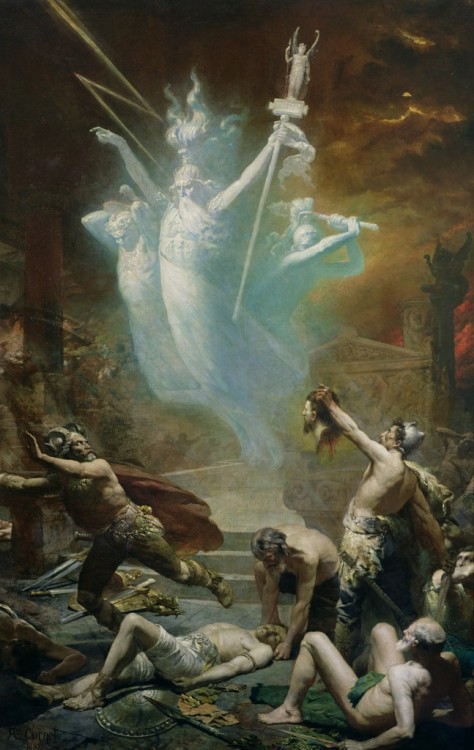
The Greeks again asked for divine help. During the night, the Celts were said to 'panic' and fight each other. Pausanias, writing over 300 years later in Roman times ,described the mayhem as "causeless terrors are said to come from the god Pan". Eventually the Celts retreated after suffering grievous losses, 26,000 dead, according to the Greek historian Pausanias in later times. Here is Pausanias describing the battle which was fought with symbolic divine aid (or knowledge of a primal fear of the Celts) as mentioned earlier to Alexander the Great of Macedonia :
Pausanias (geographer), Greek traveller, geographer, and writer (Description of Greece) of the 2nd century AD. As a Greek writing under the auspices of the Roman empire, he found himself in an awkward cultural space, between the glories of the Greek past he was so keen to describe and the realities of a Greece beholden to Rome as a dominating imperial force. His work bears the marks of his attempt to navigate that space and establish an identity for Roman Greece.
en.wikipedia.org/wiki/Pausanias_(geographer)
Pausanias has the instincts of an antiquary.
en.wikipedia.org/wiki/Pausanias_%28geographer%29
Ptolemy Keraunos (Greek: Πτολεμαῖος Κεραυνός, died 279 BC) was the arrogant ,murderous King of Macedon from 281 BC to 279 BC. His epithet Keraunos is Greek for "Thunder" or "Thunderbolt". See more on him here:
However, although Keraunos was at the zenith of his power, he did not live long afterwards. In 279 BC he was captured and killed (beheaded) during the wars against the Gauls led by Bolgios ("Lightening" ) who conducted a series of mass raids against Macedon and the rest of Greece.His death brought anarchy to the Greek states, since none of his successors were able to bring stability. This situation lasted about two years, until Antigonos Gonatas defeated the Gauls in the battle near Lysimachia, Thrace, in 277 BC, After this victory he was recognized king of Macedon and his power extended eventually also to south Greece.
en.wikipedia.org/wiki/File:Antigonus_Gonatas_British_Muse...

en.wikipedia.org/wiki/File:AntigonusGonatas.jpg

The Antigonid dynasty was a dynasty of Hellenistic kings descended from Alexander the Great's general Antigonus I Monophthalmus ("the One-eyed"). It was one of four dynasties established by Alexander's successors, the others being the Seleucid dynasty, Ptolemaic dynasty and Attalid dynasty. The last scion of the dynasty, Perseus of Macedon, who reigned between 179-168 BCE, proved unable to stop the advancing Roman legions and Macedon's defeat at the Battle of Pydna signaled the end of the dynasty.
skyelander.orgfree.com/celts4.html
Spanish language source internet illustration on ancient tribal attire.
www.housebarra.com/EP/ep04/15celtclothes.html
Several versions out there, if copyrighted please let me know.
Source is likely to be.... from an interesting book called 'Rome's Enemies 2 Gallic and British Celts', #158 in the Ospreys , Men-At-Arms Series, by Peter Wilcox and Angus MacBride (ISBN: 0850456061), 1985. The paintings, done by McBride, (see his picture here)
www.flickr.com/photos/roondorozhand/3234794396/
are based on literary descriptions and archeological finds and are said to be as accurate as possible at this time. www.flickr.com/photos/ancientgreekmapsandmore/2133688042/
www.youtube.com/watch?v=BZPd2DS5sq4
(NO , Not a~vik~ing, they who came from the north, hundreds of years later).See theTaking of the Temple at Delphi by the Gauls, 1885 by Alphonse Cornet a French Academic Classical artist born 1814 - died 1874.
The earliest directly attested examples of a Celtic language are the Lepontic .Lepontic is an extinct Alpine language that was spoken in parts of Rhaetia and Cisalpine Gaul between 550 and 100 BC. It is generally regarded as a Celtic language, although its exact classification within Celtic, or even within the western Indo-European languages, has been the object of debate...
inscriptions, beginning from the 6th century BC.The Continental Celtic languages were spoken by the people known to Roman and Greek writers as Keltoi,...
are attested only in inscriptions and place-names. Insular Celtic is attested from about the 4th century AD in ogham inscriptions, although it is clearly much earlier. Literary tradition begins with Old Irish from about the 8th century. Coherent texts of Early Irish literature. Early Irish literature-The earliest Irish authors:It is unclear when literacy first came to Ireland. The earliest Irish writings are inscriptions, mostly simple memorials, on stone in the ogham alphabet, the earliest of which date to the fourth century..., such as the Táin Bó Cúailnge (a legendary tale from early Irish literature, often considered an epic, although it is written primarily in prose rather than verse)...(The Cattle Raid of Cooley), survive in 12th-century recensions. According to the theory of Professor John T. Koch is an American academic, historian and linguist who specializes in Celtic studies, especially prehistory and the early Middle Ages....
and others.The Tartessian language, also known as Southwestern or South Lusitanian, is a Paleohispanic language once spoken in the southwest of the Iberian Peninsula: mainly in the south of Portugal , but also in Spain...may have been the earliest directly attested Celtic language with the Tartessian written script used in the inscriptions based on a version of a Phoenician script in use around 825 BC.
GREEK RELIEF writing on tablet 3RD BCE
Decree of the town of Cos, Greece. Inscription on stone about the conquest of Delphi by the Gauls under Brennus in March 278 BCE, followed by news of the expulsion of the Gauls from Delphi in the Archaeological Museum, Istanbul, modern Turkey.
www.lessing-photo.com/dispimg.asp?i=10010366+&cr=1679...
Synonyms: Bryth, Gaul: The Raven King
A Brennos , Brennos of the Senones, first appears as the Celtic or Gaulish hero who led the Celtic sack of Rome. During the third century BCE the Celtic expansion led them to the Po valley in Italy. Fearful of this expansion the Etruscans called , on their adversaries, Rome for assistance. The Romans sent three envoys to meet the Celtic leaders. However, one of the Roman envoys killed a Celtic chief and Rome sent an army of 40 000 to meet these 'barbarians'. When the Celts learned of the Roman army moving towards them, Brennos (most likely a chiefly title rather than a real name, like a Duke, see below) marched the Celts off to meet the Romans. The Celts met the Romans at the River Allia, the Romans panicked at the sight of all those crazed Celts, and many Roman soldiers even drowned in the River in attempt to escape. A few made it back to Rome and informed the Senate about the battle at Allia (the date of the battle, July 18, became known as Alliaensis, and was considered thereafter to be a very bad day to do any public activity). The Roman citizens, rightfully fearing that the Celts were headed toward Rome, fled in a panic (much like the soldiers at Allia). By the time the Celts/ Gauls arrived, Rome had been deserted, with the exception of several elderly patricians. These old patricians were sitting in a courtyard, believing that if they were to sacrifice their lives for Rome in its most dire hour of need, Rome's enemies would then be thrown into panic and confusion, and Rome thereby saved. This nearly worked, but the spell of quietude was broken and Rome was looted and the old men killed. They advanced on the Capitol, but were thwarted by plague and a night-time attack was spoiled by cackling of geese. However, about seven months, later the Romans decided to negotiate and the Celts agreed to leave if the Romans would pay them 1,000 pounds of gold. The Celts were accused of using false weights, upon which Brennos (the Celtic chieftain) is said to have thrown his sword on the scales and loudly declare, "Vea victus", or "woe to the defeated".
www.flickr.com/photos/96490373@N02/14550761807/
cgi.ebay.com/Ancient-Roman-Dictator-Brennus-c1915-Card-/3...
www.flickr.com/photos/summoning_ifrit/4211154813/
The early 4th century BCE a vast group of Gauls sacked the city of Rome. Romans gave it up rather easily, actually. Most fled to neighbouring cities like Veii while the Senate, priests, and what was left of the Roman army migrated to the Capitol - defending and taking refuge in the temples there. The Gauls made easy pickings of what they found in the city. According to Livy:
For several days they had been directing their fury only against bricks and mortar. Rome was a heap of smouldering ruins, but something remained - the armed men in the Citadel, and when the Gauls saw that, in spite of everything, they remained unshaken and would never yield to anything but force, they resolved to attempt an assault. At dawn, therefore, on a given signal the whole vast horde assembled in the Forum; then, roaring out their challenge, they locked shields and moved up the slope of the Capitol." (5.43)
The Romans, however, used the advantage of being at the top of the hill and managed to beat the Gauls back. Yet the Gauls were determined and even though they had destroyed most of the food and supplies in their initial sack of the city, they began a siege on the hill.
During all of this, officials in Veii were determined to get a message through to the Roman Senate - despite the fact that the Senate was under siege. As the old saying goes, 'if there's a will, there's a way', and a young Roman soldier named Pontius Cominus managed to do it. "Floating on a life-buoy down the river to Rome, he took the shortest way to the Capitol up and over a bluff so steep that the Gauls had never thought of watching it." (5.46) But the Gauls did find out about it and figured if he could do it, then they should all be able to do it too.
One starlit night, they made the attempt. Having first sent an unarmed man to reconnoitre the route, they began the climb. It was something of a scramble: at the awkward spots a man would get a purchase for his feet on a comrade below him, then haul him up in his turn - weapons were passed up from hand to hand as the lie of the rocks allowed - until by pushing and pulling on another they reached the top. What is more, they accomplished the climb so quietly that the Romans on guard never heard a sound, and even the dogs - who are normally aroused by the least noise in the night - noticed nothing. It was the geese that saved them - Juno's sacred geese, which in spite of the dearth of provisions had not been killed. The cackling of the birds and the clapping of their wings awoke Marcus Manlius - a distinguished officer who had been consul three years before - and he, seizing his sword and giving the alarm, hurried, without waiting for the support of his bewildered comrades, straight to the point of danger. (5.46)
And that is either Roman spin or real history of how the sacred geese of Juno saved Rome - since after that last attempt, the lack of food forced the Gaul to accept payment from the Romans to leave the city alone.
www.mmdtkw.org/AU0308bJunoMonetaGeese.jpg
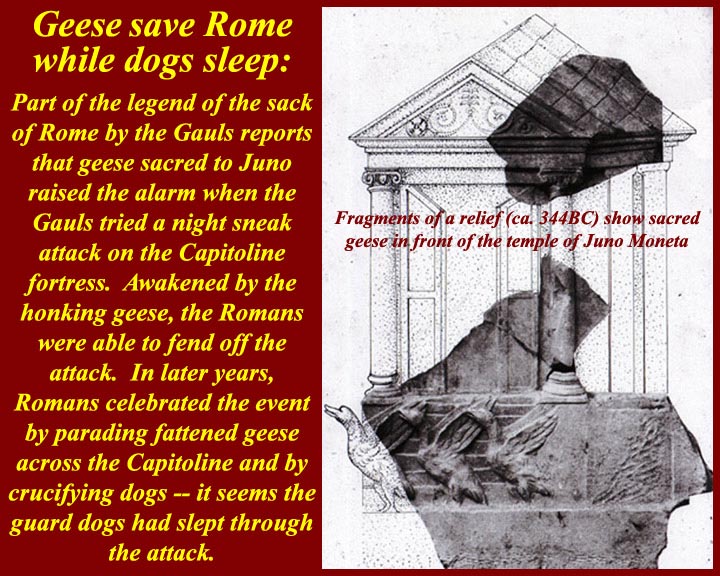
www.mmdtkw.org/AU0308gBrennerPass.jpg
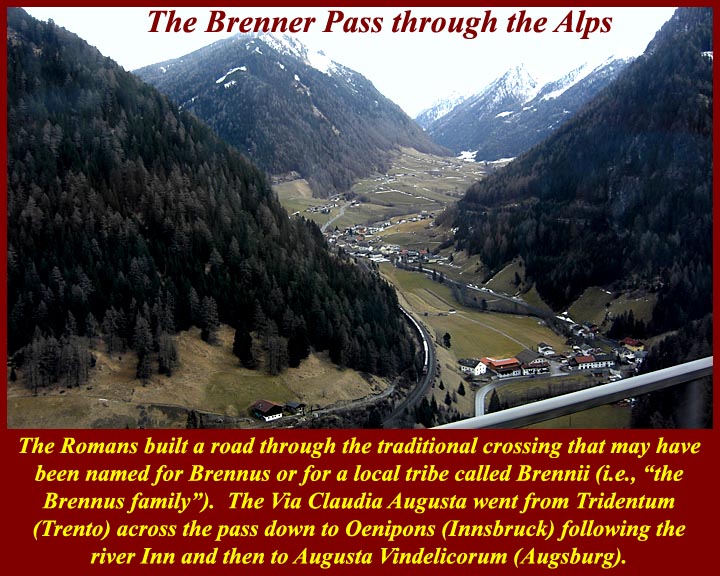
www.mmdtkw.org/AU0308gBrennusFrenchMaritimeSculpture.jpg
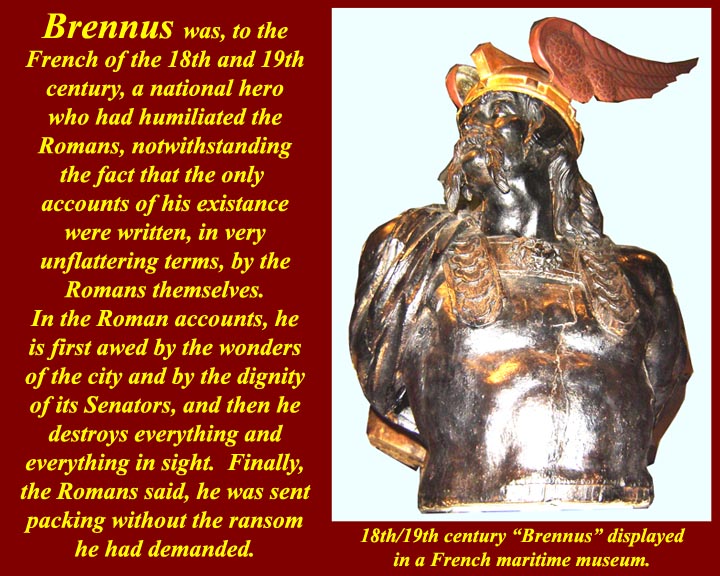
While Brennus I was evil personified to the Romans, he was a hero to transalpine people.
en.wikipedia.org/wiki/Battle_of_the_Allia
"Other Greek and Roman synchronisms have a more obvious historical symbolism, as may be the casewith the Polybian synchronism we saw above, between Dionysius’s siege of
Rhegium and the Gallic sack of Rome."
wxy.seu.edu.cn/humanities/sociology/htmledit/uploadfile/s...
www.unrv.com/empire/gallic-sack-of-rome.php
REFOUNDING THE CITY:
ENNIUS, LIVY, AND VIRGIL
The city of Rome has now been successfully founded in historical time—whether
that time is focalized as Greek or Roman—but we have not yet reached the end of
the story. As everyone knows, the city of Rome kept having to be re-founded, and
the patterns of refoundation drastically reconfigure the trajectory of movement
from myth to history that we have been following so far.188
Ennius’s most explicit surviving allusion to the date of the foundation of the city
in fact comes at the moment when the city had just been virtually destroyed, and
was on the verge of vanishing from history, after the sack by the Gauls in 387/6
b.c.e.189 The context is a speech in which Camillus persuades the Senate not to
move to Veii, but to refound the city instead (154–55 Skutsch):
Septingenti sunt paulo plus aut minus anni
augusto augurio postquam incluta condita Roma est.
It is seven hundred years, a little more or a little less,
since famous Rome was founded by august augury.
How this seven-hundred-year period between Romulus’s foundation and the sack
of Rome by the Gauls actually worked remains a mystery, at least to me.190 Still, we
should not overlook the symbolic significance of this number in its own right. The
importance of the seven-hundred-year period has been very well illustrated in the
fascinating book Die rhetorische Zahl, written by a scholar with the gloriously apt
name of Dreizehnter.191 Dreizehnter does not mention this passage of Ennius, but
he collects a great deal of interesting material about seven hundred years as the life
span of a city or an empire from foundation to extinction, or from foundation to
virtual extinction or only just-escaped extinction. In various traditions that he
examines there were seven hundred years from the foundation to the destruction
of Melos, Carthage, and Macedonia, or from the foundation to the virtual extinc-
(Myth into History I: Foundations of the city)
tion of Sparta.192 What we see in the Ennius passage, in other words, is that the city
was virtually destroyed and came within an ace of fulfilling the seven-hundred year
doom. The point will have been accentuated by Ennius’s book divisions.
Camillus’s speech comes at the end of book 4, and the regal period ended with
book 3, so that up to this point in the Annales we have had only one self-contained
volume of Republican history, and if things had gone differently that might have
been all we had.193
Livy activates the power of this Ennian symbolic numeral, even as he corrects
Ennius’s dating, with his allusion to the seven hundred years of Rome (Pref. 4):
Res est praeterea et immensi operis, ut quae supra septingentesimum annum
repetatur et quae ab exiguis profecta initiis eo creuerit ut iam magnitudine
laboret sua.
In addition, the matter is of immeasurable scope, in that it must be taken back
past the seven hundredth year, and having started from small beginnings has
grown to the stage that it is now laboring under its own size.194
Chaplin has argued that Livy’s preface is constructing recent Roman history as a
death, with a possible rebirth to come:195 the Republic has been destroyed, and the
Romans of Livy’s time are like the Romans of Camillus’s time, faced with the task
of refounding the city after it has only just escaped its seven-hundred-year doom.
In Livy’s treatment of the Roman response to the sack of the city by the Gauls,
we can see him returning to the Ennian theme of rebirth from destruction,
although this time using different significant numbers. Having exploited the numinous
associations of Ennius’s seven hundred years in his preface, Livy now produces
another numinous numeral for the span from foundation to sack, one that
conforms with the modern orthodox chronology. Livy has Camillus deliver a
mighty speech to convince his fellow citizens not to abandon Rome for the site of
Veii (5.51–54).196When Livy’s Camillus echoes Ennius’s by counting off the years
since the foundation, it appears that some kind of great year has gone by. From
Romulus’s foundation down to the sack by the Gauls there have been as many
years as there are days in a year: Trecentensimus sexagensimus quintus annus urbis,
Quirites, agitur (“This is the 365th year of the city, Quirites,” 5.54.5). This is of
course a calculation that fully resonates only after Caesar’s reform of the calendar,
when a Roman year for the first time had 365 days.This counting places
Camillus’s refounding of the city at a pivotal point in time, precisely halfway
(Refounding the City: Ennius, Livy, Virgil . 101)
between the first founding of the city, in 753, and the refounding that faces Livy
and his contemporaries 365 years after Camillus, in the 20s b.c.e.198 Exactly the
same structuring appears to underpin the panorama of Roman history on Virgil’s
Shield of Aeneas, where the barely averted destruction of Rome by the Gauls (Aen.
8.652–62) comes midway in time between the foundation of the city (8.635) and
the barely averted destruction of Rome by Antonius and Cleopatra (8.671–713).199
In all of these authors, city destruction, whether achieved or barely averted,
leads to refoundation and consequent reconfiguring of identity, in a process that
begins with Troy and continues through the fates of Alba Longa, Veii, and Rome
itself.200 As Kraus has shown, when Livy begins his next book after the Gallic sack,
he refounds his narrative along with the city, capitalizing on the annalistic tradition’s
identification of the city and history.201 In an extraordinary moment, the
opening sentences of book 6 tell us that only now is real history beginning. All of
the material in the first five books, Livy now declares, has been “obscure because
of its excessive antiquity” (uetustate nimia obscuras), and because there were few
written records in those early days, while the ones that did exist “for the most part
were destroyed when the city was burnt” (incensa urbe pleraeque interiere, 6.1.2).
Everything up until this point, from Troy to the Gallic sack, is suddenly reconfigured
as prior, prefoundational. In his preface Livy had drawn a line between myth
and history around the time of the Romulean foundation of the city (ante conditam
condendamue urbem, 6), but “the fresh start in 390 redraws the limits of the historically
verifiable.”202We now have a new entry into history, with a newly rebuilt city
and a newly solid evidential base for its written commemoration (6.1.3):
Clariora deinceps certioraque ab secunda origine uelut ab stirpibus laetius
feraciusque renatae urbis gesta domi militiaeque exponentur.
From here there will be a more clear and definite exposition of the domestic
and military history of the city, reborn from a second origin, as if from the
old roots, with a more fertile and fruitful growth.203
Livy here is picking up on the annalistic history of Claudius Quadrigarius, who
had written about fifty years earlier. We know that Claudius began his history with
the sack of Rome by the Gauls, no doubt on the grounds we see alluded to in Livy,
that no history was possible before then, thanks to the destruction of monuments
and archives.204
We have already seen how the Roman tradition picks up demarcations that are
102 . Myth into History I: Foundations of the City
crucial from the Greek tradition—Troy and the first Olympiad—and recasts
them as transitions into a new, Roman, phase of history. The Gallic sack is a vital
addition to this series of watersheds. The first key fixed synchronistic point in
Timaeus and Polybius that makes it possible for Roman history to be properly connected
with Greek history, the Gallic sack is itself made to serve as the “beginning
of history” in Claudius Quadrigarius and Livy book 6.205 The very event that almost
expunged Rome altogether is the one that put the city on the world stage—
just as the destruction of Troy led to the city’s existence in the first place.206
Ovid intuited the power of these associated watersheds of foundation and Gallic
sack, and his subtle deployment of them in the Metamorphoses is proof of their
understood significance. Before he arrives at the foundation of Rome in book 14,
he has a very small number of proleptic references to the as yet nonexistent city.
Book 1 contains two forward references to his own day, with the poem’s first simile
referring to the reign of Augustus (1.199–205), and the story of Apollo and
Daphne likewise anticipating the reign of Augustus, as Apollo prophesies the use
of his sacred laurel to grace Roman triumphs and adorn Augustus’s house (1.560–
63). His only other proleptic references to the city before the foundation in book
14 occur in book 2, and they are both references to the city only just escaping total
catastrophe, catastrophes that would have ensured the city was never part of world
history. One is in a cosmic setting, when the natural site of the city is almost
expunged, as the Tiber is dried up along with other rivers by Phaethon’s chariot
(2.254–59); the other is an allusion to the geese that “were to save the Capitol with
their wakeful cry” (seruaturis uigili Capitolia uoce/ . . . anseribus, 2.538–39).207
Again, in the Fasti, when the gods meet in council to deliberate how to save Rome
from the Gauls, Ovid takes as his template the Ennian council that deliberated over
the foundation of the city: in both cases, Mars expostulates with his father, Jupiter,
and is assured that all will be well.208
It is highly significant that these two events, the city’s foundation and near
destruction by the Gauls, are the only “historical” events commemorated on the
Republican calendar, the Fasti Antiates.209 Calendrical fasti from the Principate
mention all kinds of events, but the Fasti Antiates, the only calendar we have surviving
from the Republic, mark only two historical events: 21 April, the Parilia and
the foundation of the city, and 18 July, the dies Alliensis, the day of the battle of the
Allia, when the Roman army was scattered by the advancing Gauls on their way
to the city, which they entered on the next day.210
The foundation of the city and its near extinction by the Gauls are symbolically
joined events, linked by significant numbers, either 700 or 365, linked by themes of
Refounding the City: Ennius, Livy, Virgil . 103
refoundation and rebirth. The history of the city keeps getting restarted at such
crucial transition moments, when repetitive patterns of quasi-cyclical destruction
and refoundation replay themselves, in a fascinating interplay between a drive for
onward narrative continuity and the threat of eddying, repetitious, circularity.211 It
is poignant to observe the power of this theme still persisting in the fifth century
c.e., when Rutilius Namatianus, six years after the sack of Rome by the Visigoths
in 410 c.e., can hail Rome’s potential to bounce back from disaster, citing its eventual
defeat of Brennus, who led the Gauls to the sack of Rome, and of the Samnites,
Pyrrhus, and Hannibal:212 “You, Rome, are built up,” he claims, “by the very thing
that undoes other powers: the pattern of your rebirth is the ability to grow from
your calamities” (illud te reparat quod cetera regna resoluit:/ordo renascendi est
crescere posse malis, 139–40). Each of these key marker moments in time may become
a new opportunity for the community to reimagine itself, as the epochal moment
produces a new beginning point from which the community may imagine its
progress forward into time, measured against its backward extension into time.213
_______________________________ __________________________
The Gauls in the Italia peninsula .Clusium was reached by the Gauls, who had invaded most of Etruria already, and its people turned to Rome for help. However, the Roman embassy provoked a skirmish and, then, the Gauls marched straight for Rome (July, 387 BC). After the entire Roman army was defeated at the Allia brook (Battle of the Allia), the defenseless Rome was seized by the invaders. The entire Roman army retreated into the deserted Veii whereas most civilians ended at the Etruscan Caere. Nonetheless, a surrounded Roman garrison continued to resist on the Capitoline Hill. The Gauls dwelt within the city, getting their supplies by destroying all nearby towns for plunder.When the Gauls went for Ardea, the exiled Camillus, who was now a private man, organized the local forces for a defense. Particularly, he harangued that, always, the Gauls exterminated their defeated enemies. Camillus found that the Gauls were too distracted, celebrating their latest spoils with much 'crapulence' at their camp. Then, he attacked during a night, defeating the enemy easily with great bloodshed.He is thus considered the second founder of Rome.Camillus was hailed then by all other Roman exiles throughout the region. After he refused a makeshift generalship, a Roman messenger sneaked into the Capitol and, therein, Camillus was officially appointed dictator by the Roman Senators, to confront the Gauls.At the Roman base of Veii, Camillus gathered a 12,000-man army whereas more men joined out of the region. The occupying Gauls were in serious need, under quite poor health conditions. As the Roman Dictator, Camillus negotiated with the Gallic leader Brennus, and the Gauls left Rome, camping nearby at the Gabinian road. A day after this, Camillus confronted them with his refreshed army and the Gauls were forced to withdraw, after seven months of occupation (386 BC).
Camillus sacrificed for the successful return and he ordered the construction of the temple of Aius Locutius. Then, he subdued another claim of the plebeian orators, who importuned further about moving to Veii. After ordering a Senate debate, Camillus argued for staying and the Roman house approved this unanimously. The reconstruction extended for an entire year.
By this one-year office, Camillus was the longest of all Roman dictators. Basically, the Senators had been persuaded by the disturbing social clashes, which could be better managed by Camillus. Instead, Camillus disliked this and, vainly, he requested the dismissal.
Roman dictator (367 BC)
As the Gauls were, again, marching toward Latium, all Romans reunited despite their severe differences. Camillus was named Roman dictator for the fifth time then (367 BC). He organized the defense of Rome actively. By the commands of Camillus, the Roman soldiers were protected particularly against the Gallic main attack, the heavy blow of their swords. Both smooth iron helmets and brass rimed shields were built. Also, long pikes were used, to keep the enemy's swords far.
The Gauls camped at the Anio river, carrying loads of recently gotten plunder. Near them, at the Alban Hills, Camillus discovered their disorganization, which was due to unruly celebrations. Before the dawn, then, the light infantry disarrayed the Gallic defenses and, subsequently, the heavy infantry and the pikemen of the Romans finished their enemy. After the battle, Velitrae surrendered voluntarily to Rome. Back in Rome, Camillus celebrated with another Triumph.
ancientimes.blogspot.co.nz/2007/06/brennus-and-first-sack...
A deadly pestilence struck Rome and it affected most Roman public figures. Camillus was amongst them, passing away in 365 BC.
Source: Plutarch, The Parallel Lives - The Life of Camillus:
In popular culture
Marcus Furius Camillus was played by Massimo Serato in the 1963 film 'Brennus, Enemy of Rome'.
www.flickr.com/photos/ggnyc/1405297848/
BC 400's Celts from the Alps flowed into Italy ....
Herodotus of Halicarnassus reported a merchant from Samos named Colacus was driven off course by tides and winds when trading off the African shore. He landed at the Tartessus (modern River Guadalquivir in southern Spain) where he found tribes of Keltoi working the silver mines
396 BC Celts defeated the Etruscans at Melpum (Melzo, west of Milan)
390 Senones Celts ('the veterans') led by Brennos (Latinate: Brennus) defeated the Romans in Rome (July 19) so badly it took the Romans 200 years to recover from the 'terror Gallicus'. After seven months and a ransom of 100 pounds of gold, the Celts moved along to Picenum on Italy's eastern seaboard.
Ephoros of Cyme reported the Celts occupied an area the size of the Indian sub-continent.
334-335 Alexander of Macedonia met the Celts on the Danube banks to make an agreement: The Celts would not attack his empire while he was off conquering in the east. Only after his death they expanded to Moravia and Thrace .
----------- ----------
Along with Bolgios, Brennos II was the legendary leader of other Celts on their invasion of Macedonia in the second century BCE. Though Bolgios led the invasion of Macedonia , Brennus succeeded in crossing his whole army over the river Sperchios into Greece proper, where he laid seige to the town of Heraclea and, having driven out the garrison there, marched on to Thermopylae where he defeated an army raised by a confederation of Greek cities. Brennus then avanced across Greece, where he decided to go on to Delphi, which was reported as the treasure house of Greece. Brennus and his army of 30,000 set off to attack the temple of Apollo, the ultimate goal of his expedition. Here it is said that Brennos was defeated by earthquakes and thunderbolts that reduced the soldiers to ashes; snow storms, showers of great stones, and "ancient heroes appearing from the heavens". In the midst of this snowstorm, Brennos and his men were attacked near the Parnassus mountains. The Celts were soundly defeated and Brennos was mortally wounded. As he lay dying, he gave the order for all of the wounded to be killed, and all the booty to be burned, as the army would never make it home if they had to carry the wounded warriors and their plunder. After giving the order, Brennos drank some wine and then took his own life. (? Source)
www.maryjones.us/ctexts/classical_pausianas.html
The Description of Greece
Pausanias (fl. 2nd c. CE) XIX.
[5] "I have made some mention of the Gallic invasion of Greece in my description of the Athenian Council Chamber. But I have resolved to give a more detailed account of the Gauls in my description of Delphi, because the greatest of the Greek exploits against the barbarians took place there. The Celts conducted their first foreign expedition under the leadership of Cambaules. Advancing as far as Thrace they lost heart and broke off their march, realizing that they were too few in number to be a match for the Greeks. "...........
10]" When the Gallic horsemen were engaged, the servants remained behind the ranks and proved useful in the following way. Should a horseman or his horse fall, the slave brought him a horse to mount; if the rider was killed, the slave mounted the horse in his master's place; if both rider and horse were killed, there was a mounted man ready. When a rider was wounded, one slave brought back to camp the wounded man, while the other took his vacant place in the ranks.
[11] I believe that the Gauls in adopting these methods copied the Persian regiment of the Ten Thousand, who were called the Immortals. There was, however, this difference. The Persians used to wait until the battle was over before replacing casualties, while the Gauls kept reinforcing the horsemen to their full number during the height of the action. This organization is called in their native speech trimarcisia, for I would have you know that marca3 is the Celtic name for a horse. "
(Addit :we know from Celtic myth this was indigenous to the confederacy of Celtic tribes as on Gundestrup Cauldron ,warrior plate)
[12] "This was the size of the army, and such was the intention of Brennos, when he attacked Greece. The spirit of the Greeks was utterly broken, but the extremity of their terror forced them to defend Greece. They realized that the struggle that faced them would not be one for liberty, as it was when they fought the Persian, and that giving water and earth would not bring them safety. They still remembered the fate of Macedonia, Thrace and Paeonia during the former incursion of the Gauls, and reports were coming in of enormities committed at that very time on the Thessalians. So every man, as well as every state, was convinced that they must either conquer or perish. "
Attalus I (Greek: Ἄτταλος), surnamed Soter (Greek: Σωτὴρ, "Savior"; 269 BC – 197 BC) ruled Pergamon, an Ionian Greek polis (what is now Bergama, Turkey), first as dynast, later as king, from 241 BC to 197 BC. He was the second cousin and the adoptive son of Eumenes I, whom he succeeded, and was the first of the Attalid dynasty to assume the title of king in 238 BC.He was the son of Attalus and his wife Antiochis.
Attalus won an important victory over the Galatians, newly arrived Celtic tribes from Thrace, who had been, for more than a generation, plundering and exacting tribute throughout most of Asia Minor without any serious check. This victory, celebrated by the triumphal monument at Pergamon, famous for its 'Dying Galatian' or 'Gaul' statue , and the liberation from the Gallic "terror" which it represented, earned for Attalus the name of "Soter", and the title of "king". A courageous and capable general and loyal ally of Rome, he played a significant role in the first and second Macedonian Wars, waged against Philip V of Macedon.
Etymologically Brennos is related to Brân and is related to the reconstructed proto-Celtic lexical elements *brano- (raven) -n- (the deicific particle) and os (the masculine ending). Thus Brennos is literally the 'Raven God'. However, the bren part of the name is also the root for one Cymric word for king brenhin and Brennos can be rendered as 'Raven King'. Which also leads to the supposition that 'Brennos', rather than being a proper name is actually an honorific denoting 'battle lord'. Raven gods being tribal leaders in the time of war so a Celtic war leader would take-on the name of such a deity. Indeed, the modern Cymric for king is brenin a word derived from 'Brennos'.
An actual late Iron Age helmet like this has been located in ancient Dacia , Translyvania , now modern Roumania/ Romania the Helmet of Ciumeşti.
www.flickr.com/photos/42003310@N05/4886860352/
As one of the styles depicted on the Celtic Gundestrup Cauldron.
Wilcox and McBride mentioned that their illustration of the iron Gallic warrior's helmet of the middle La Tene period had been reconstructed the on the basis of the Ciumesti helmet.[45]