View allAll Photos Tagged comical
Jersey Zoo, the Lemurs are sunning themselves on the windowsill waiving at passers by....
Reminded me of the Amsterdam red light district.... but then again I got a warped mind ;-)
As comical as these lovely little birds seem, they have to brave some serious abuse getting a hard earned hoard of sand eels back to their young ones with scavanging gulls waiting to pounce the moment they land.... Watching from the sidelines, you want to warn them of the danger but really we can only watch nature take its course... It's fantastic when a puffin with a mouthful of eels get a clear run past the gulls straight down the burrow..... Go Puffins!
(apologies if you've seen this twice.... A friend Milo42 (check him out below! Does a lot of loopy Holga stuff if that rocks your boat ;) let me know that there was no comments box on the first attempt to upload - odd, huh? - and the easiest solution was just to re-upload it :)
French postcard by Editions Le Malibran, Paris / Saint-Dié, no. CF 11. Michel Simon and Arletty in Fric-Frac/Break-In (Maurice Lehmann, Claude Autant-Lara (uncredited), 1939).
Swiss actor Michel Simon (1895-1975) was a popular and beloved star of the French cinema and stage. His larger-than-life personality, impeccable comic timing and great repertoire were seen in more than 100 films. He started his film career during the silent period and starred in classic masterpieces by Carl Theodor Dreyer, Jean Vigo, Marcel Carné and Jean Renoir.
Blessed with a combination of charisma, good looks and impressive acting ability, Arletty (1898–1992) portrayed several femme Fatales, vamps, and prostitutes in French films and stage plays of the 1930s and 1940s. Her characters were down-to-earth, earthy, slightly comical female types, usually complex characters with a tough outer shell which concealed an inner vulnerability. She is best remembered as an ethereal and mysterious Garance in Marcel Carné’s Les Enfants du Paradis (1944). When the Second World War ended, Arletty's career was marked with controversy. During the occupation of France, she had fallen in love with a German officer, and after the liberation, she was jailed as a collaborator. Her career would continue after a suspension but never reached the same level as before and during the war.
For more postcards, a bio and clips check out our blog European Film Star Postcards.
Carte de visite by Geo. H. Brown & Co. of Louisville, Ky. A comical collage-caricature of a man’s head on a body, holding an umbrella and bundle of goods tied to a stick, and legs in motion, leaves no doubt he is leaving town quickly. The drawing of a large boot and trouser leg extending from the right side of the frame tells the viewer he did not leave by his own volition.
The life and career of photographer George H. Brown is currently a mystery. Various searches have turned up scant information—active as a photographer at Mammoth Cave in Kentucky in 1863, and an uncatalogued item in the University of Louisville Archives & Special Collections: “Two cartes de visite portraits of Robert Brown and George Brown, by "Geo. H. Brown & Co. / No. 72 Fourth Street / Louisville Ky." These may be portraits of the photographer and his father.”
I encourage you to use this image for educational purposes only. However, please ask for permission.
Meerkats are comical, social mongooses widely distributed throughout southern Africa; they’re also one of the continent’s most popular and charismatic animals. They emerge from their family burrows early each morning, to engage in a spot of basking and grooming. This is followed by a day spent foraging for insects.
Each member of the group forages individually while at least one member will act as a sentry, standing on its hind legs at a good vantage point. The sentries remain at their posts for hours at a time, regularly alerting the group to potential dangers with little squeaks.
A group of meerkats is called a mob, gang or clan.
Scientific name: Suricata suricatta
Rank: Species
Common names:
Slender-tailed mongoose,
Suricate
So It's finally here.
24 pages of drawings and comical non-adventures in a White Cube, part 1.
A5, Black/white.
4 €
------------------
Also:
Upcoming Groupshow
at Delkographik Studio
15 illustrators make a comic page,
all silkscreened by anaick moriceau
with:
JOHNNY RYAN (USA) DAVID SANDLIN (USA) ANDY REMENTER (USA) JIM STOTEN (UK) IAN STEVENSON (UK) JEAN JULLIEN (UK) BENDIK KALTENBORN(NOR) JOSH J. HOLINATY (CA) STUDIO PATRICK(BE) BRECHTVANDENBROUCKE(BE) GUILLAUMIT (FR) ROCKY ROCK (FR) OKTUS (FR) JOSH HAYES (FR)VINCENT BROQUAIRE (FR)
24/04-04/06/2010
DELKOGRAPHIK STUDIO
28, place des lices
35000 Rennes - France
158/365
Despite it being a comp day for Pookie, she got up at 5:00 in the morning to join Schnookie's regularly-scheduled training session. The payoff for this -- aside from the benefits of a great workout, of course -- was a glorious sunrise. So pretty!
The rest of our day was just as grand -- Pookie was almost comically productive with her free day, and Schnookie had one of those, "Hey, I think I'm kind of good at my job!" sorts of days. We met up for Secret Luncheon, then had Friday naps and Sumo dinner and a long evening of Dorkminion. Basically, it was the Friday of our dreams.
It is connected to both of the circa-year-1900 houses behind it. Crooked light fixtures are almost always comical-looking!
It is physically within the federally-designated Downtown Altoona Historic District but is not part of it, because of bias against 1950s architecture.
-----------------------
In downtown Altoona, Pennsylvania, on June 28th, 2019, the Jones Funeral Home at 1222 13th Avenue.
-----------------------
Getty Thesaurus of Geographic Names terms:
• Altoona (7015966)
• Blair (county) (1002185)
Art & Architecture Thesaurus terms:
• additions (general components) (300055458)
• architectural canopies (300375688)
• capital letters (300055061)
• flags (300195678)
• funeral homes (300005868)
• light bluish green (300128678)
• lighting fixtures (300180081)
• Mid-Century Modernist (300343610)
• personal names (300266386)
• shop signs (300211862)
• tile (material) (300010676)
• tilted (300250429)
Wikidata items:
• 28 June 2019 (Q57350251)
• 1950s in architecture (Q11185577)
• 1956 in architecture (Q2812151)
• all caps (Q3960579)
• flag of the United States of America (Q42537)
• Jones (Q59853)
• June 28 (Q2660)
• June 2019 (Q47087599)
• Western Pennsylvania (Q7988152)
Library of Congress Subject Headings:
• Business names (sh85018315)
• Grids (Crisscross patterns) (sh2006005408)
• Small business (sh85123568)
As a complement and sequel to my earlier article, Initiation and Death, the present text concerns aspects of what an initiation seeks to accomplish in a longer perspective, specifically after the dark night of the soul has been experienced and overcome. This is the basis of the path of inner alchemy – Ars Royale – the profound Royal Art. A further purpose is to show the relation between ritual magic and inner alchemy; so to speak paints a bigger picture of the nature and first end of the work, where ritual magic acts as a practical gateway into the profound mysteries of alchemy. Thus this article is written primarily for people already possessing some knowledge of the concepts of ritual magic, regardless of tradition. Also, the article aims at discussing different foundations and concepts of ritual magic, where magic and psychology differ, as well as the theoretical and practical applications that follow from that. Seeds of wisdom in veils and metaphors
On the esoteric path in general, and its different rites of initiation in particular, we meet ancient dramas of symbolism whose purpose is to sow seeds of wisdom within us.1 It is .
worth stressing that these seeds of wisdom are sown within us. No initiation, or magical work, does this automatically, or even necessitates an increase in wisdom. It is when we first manage to penetrate behind the veils of the symbols and understand their implications for us here and now that the seed can begin to grow and our inherent wisdom can start to blossom.
These inevitable veils and the manner of presenting them also tend to be, what to a great extent, distinguish literature and separate different Orders. In this regard the quality of their teaching and work depends upon a living tradition that has been integrated and to a certain extent also personified by the person or persons that aim at mediating the doctrines. It is this living, and as a rule oral tradition that renders possible the mediation of wisdom and understanding beyond the limitations of words. Words, to be able to be carriers of knowledge, need to be expressed from a personal understanding. The sense behind them, which is thus mediated through a living tradition, carries more keys within itself than is ever possible to describe in words.
Thus the adepts throughout history seek to instruct their successors by ancient dramas of symbolism and light up the paths that lead from the darkness of ignorance to the divine light. The difference between these rites and their exoteric equivalences is the individual “gnosis-process” which concerns itself with the essence of the Law (Maat), instead of faithfully following, applying or wrongly interpreting its outer reflection.
What then is the essence of this universal law, which has been taught within various esoteric traditions since the beginning of time? Well, behind the first veil, to see the importance of cycles and reflections and the significance of cause and effect concepts. As magicians we learn how to read, interpret and affect these, foremost within our own sphere of sensation and then being able to apply the same upon the world around us. This ability can concisely be said to summarize the modern understanding of magic and alchemy, which then are reduced to a holistic existential developmental psychology with an occult key signature. The magical and alchemical practices then contribute to what the famous psychologist C.G. Jung termed the individuation process, which also Jung considered that the alchemists, foremost unconsciously, had strived for throughout history. All alchemical theories and axioms were thus interpreted by him to just concern psychological processes, which perhaps was a necessary antithesis to the long lived belief that alchemy was just an attempt at physically transmuting non-precious metals into gold.
In my opinion this psychological interpretation, just as the tenacious gold making interpretation, neither gives a correct image of the work towards Magnum Opus (the Great Work) nor takes into consideration the light and wisdom that the adepts have tried to spread around the same.
The adepts, however, have always used codes and symbols that are hard to penetrate, both for preserving the purity in their wisdom and for erecting smoke screens in front of the eyes of the profane. The purpose in both cases was, and still is, that only those who
2
can see, i.e. have experienced gnosis and understanding, have awakened their inner wisdom, will be able to grasp the essence of the tradition. Hence they have not been too much concerned about existing misunderstandings about the nature and aim of the work. And even though it is my intention here to display the essence of Magnum Opus in clear words, this article will still leave intact many of the mysterious veils. Thus by necessity, not only because of this author’s own lacking, and shortcomings, but also because the mysteries have always demanded silence as one of the most important principles for being able to progress on the path. In silence the seed of wisdom can grow, the unconscious can work on the symbolism, and the knowledge can be understood and transmuted into wisdom.
The essence of Magnum Opus
The Great Work is about to create the mythical Stone of the Wise. What then is this stone? Well, nothing less than the means to immortality! This immortality, or eternal life, should however not be misunderstood. It does not mean that the body will never die - something that would be against the cycles and laws of nature. The alchemists have always maintained that their work is in harmony with nature and that they begin where nature ends, since some processes cannot be reconstructed without the help of nature. By eternal life is meant instead that consciousness remains after the death of the physical body and preserves into the next incarnation, and the following. This then is what the stone, which isn’t a stone contains, the immortal consciousness of the adept.
Perhaps the most comical is that the adepts have always spoken in clear words regarding this, but despite this, only a few have understood its meaning. So to eliminate eventual misunderstandings it is worth repeating; Magnum Opus leads to eternal life, not in the same body but the ability to move and transcend consciousness after the death of the physical body - an eternal birth that does not involve a “fall of consciousness”.
Consciousness and death
This leads us unsought to one of the most misunderstood existential concepts; what happens with our consciousness, our self, after the physical death. In modern times, foremost the spiritualist movement and its branches have put forth the idea that anyone can remember earlier lives (and thus preserve consciousness after death), which in the eyes of the adepts is a somewhat naïve opinion. There are today plenty of courses, groups and therapists that feather their own nests on peoples need to be seen, to at least have been an important person once somewhere in a previous life. The majority of these so- called “memories” derives from the individual and/or collective unconscious. The psychological research of the last century clearly shows how the symbols of the unconscious arise and come forth either as a confirmation of psychological needs or as a contrast or antithesis to conscious opinions. The interpretation that it has to do with memories from previous lives can in best cases be accurate from the hypothesis that one can “tune” into archetypical memories, which partly could explain the multitude of people remembering incarnations as Cleopatra, Ramses II, Caesar, Napoleon, etc. Personally, however, I consider the majority of such cases as originating from the astral and illusional dimensions of Yesod. In any case it is an abyss of difference between this and what the adepts alludes to.
In ancient Egypt, this ability was described by a sun with two wings - the sun, symbol of the self (consciousness) together with a pair of wings, the ability to travel between the worlds. This was the symbol of the winged Horus, which the Pharaoh would be transmuted to after his or her embalming process (in the identification with Osiris), to thereafter be able to regain the lawful place amongst the gods and goddesses.
The Egyptian rites sought to prepare the candidate (most often the Pharaoh or close relative to him/her) for all the trials that the soul was believed to face after death. Above all in the later rites (starting with ‘the book of coming forth by day’ – more commonly known as ‘the book of the dead’) these journeys and trials took place in Amenti, the Egyptian death realm where Osiris ruled. In the earlier rites, from the first dynasties, the journeys and trials took place in the sky.2
A concept, which is present already in the early Egyptian descriptions of “life after death”, is the importance of understanding that one has actually died, and then to have the capacity for an individual consciousness after death. This can be compared with the ability for lucid dreaming, where the dreamer is fully conscious that what is experienced is a dream and at the same time retain individual memories and experiences. Death resembles falling asleep where the conscious slowly ebbs out into various heavens or hells, for them loosening all aspects of individual memories and experiences.
From this one might think that the ability of lucid dreaming constitutes the key that opens up the portals between the worlds (both before and after death), but that is not the case. Lucid dreams, as astral travels, generally take place within the seven palaces of Assiah3, located within the treacherous astral-illusional mists of Yesod. Further, the “astral body” is connected with the physical body and requires a great amount of energy from the same to allow consciousness to be separated from the body for a longer period of time. This is often symbolically described as a silver cord combining the two bodies, and everyone who has had an out-of-body-experience know the kind of difficulties that soon arises in regards to the capacity to regain a focused consciousness.
The astral body, or body of light (the Kabbalistic Nephesch) was viewed by the Kabbalists as being the “true” body, of which the physical body is but a reflection. It is the bonds of this etheric body with the various urges in the seven palaces of Assiah that the esoteric traditions have sought to clarify and work with. For it is first when the urges can be controlled that the adept truly can be called a free human, no longer governed by unconscious impulses and influences. This is a very simple description of the esoteric meaning of the fall and the restoration there from.
Within certain traditions complete asceticisism has been promoted, while others have gone to the opposite end and promoted indulgence within all palaces and urges so that they thereby can lose their grip. Many of the modern esoteric traditions teach methods of how to know these aspects of oneself (i.e. to make them conscious) so that one no longer is ruled by them, although there still are many moral values that make this difficult. This aspect of liberation strongly resembles Jung’s individuation process, from which there does not exist any real difference between magical and psychological work. However, what distinguishes the magical alchemy from psychology is that this work takes place for the purpose of being able to create a new body, which is more spiritual than the physical body but more physical (i.e. constant) than the astral body. This is one of the esoteric meanings of the three alchemical principles, Sulphur F, Mercury H and Salt G, which shall be separated, purified and recombined. First then can the Stone of the Wise be produced; the spiritual body that can travel between the worlds, and which is not dependent upon the physical body.
Thus the alchemical-magical process does not seek to escape neither from the earth nor from the body, but to refine the latter and thereby, with the assistance of its energies, form the stone. A very simplified description of this process follows.
Prima Materia
No alchemical work can start or take place without the alchemist being fully aware of what its prima materia, its original material, is. However, this is a subject that has perplexed aspirants throughout the centuries, since all alchemists has described prima materia in symbolic terms which often seems to resemble zen koans than anything understandable and concrete. From alchemical classical works we can read that materia prima is lead, the dragon, urine, dew, the water of life, cinnabar, the eagle stone, the poison, the virgin milk, chaos, honey, gold, silver, etc. To make the understanding of prima materia easier, it should help to know what the alchemist aims at extracting from there, namely the philosophic or inner Salt G. This Salt, also called VITRIOL, contains the two other principles, Mercury H and Sulphur F. By softening and extracting the water element from the earthly darkness, the spirit of Mercury is extracted which is variously called the white lily, the eagle or the dragon. It is from this that the art around the Stone of the Wise is based and founded, as it contains the volatile fire, the philosophical Sulphur – the most pure ingredient of the Stone of the Philosophers.
The truth is that both prima materia and its stone depend upon the purpose of the alchemical operation. If one aims at producing an elixir, its prima materia can be a specific plant or mineral, where one so to speak takes the prima materia that nature itself has produced and developed as far as possible, and then “refines” it. As the purpose with this article is the concept of eternal life, we will not need to look for our prima materia within the plant or mineral kingdoms. In inner alchemy, Ars Royale or the Royal Art, there is only one conceivable prima materia, the Temple of our Spirit.4 (This, however, has not stopped alchemists from, in laboratory environment, using everything from body secretion to excrements as prima materia, with no other result than blood, sweat and tears.) The work starts with the physical body, which is the first key of the work. In the magical work this means the necessity to ground every experience and insight in the physical body. In inner alchemy the Athanor of the alchemists is the physical body.
The alchemists have thereafter in broad outlines divided the process into three stages, nigredo, albedo and rubedo. In each phase takes place the works of separating, purifying and recombining the three principles of Salt, Sulphur and Mercury; our body, soul and spirit. During the process and phases the
alchemist utilizes four different
inner fires, which are associated
both with the four elements and
the four body fluids.7 The fire most
commonly known today is called
kundalini in eastern terminology,
and has become a very well known
term in the western society during
the last century. There exist many
myths around kundalini, but
without exaggeration I think that
whoever manages to arouse it will
never forget that experience. One
will have to search long for a more
intense energy than that. Personally it felt like the climax of the orgasm extended to forty minutes the first time. The first twenty minutes were fantastically wonderful, the remaining so wonderful that they became painful. After having been used to the intense energy I started to question what it all was good for, what purpose it served. For sure I could use the power in ceremonies, but something told me that this was but a subsistent purpose. First many years later, after having entered deeply into alchemical studies, I understood its relation with the fires of alchemy, and how the initatic process and the magical work in a subtle way teaches how this force shall be transmuted.
In the magical process the work with the inner fire starts with the preliminary earth related work. By physical movements, vibrations and breathing exercises the blood circulation and absorption of oxygen increases in the body. The immediate result is a raised body temperature, the mildest of the alchemical fires (which in an exoteric environment can be seen at winters when freezing people give themselves body-fires). However, the reader is advised not to interpret this fire as a simple aerobic exercise.
In the following air-related work the relation between the vibrations, the breathing exercises and the visualizations deepen in the personal ritual work. The blood absorbs oxygen in accordance with the nature of the ritual in a completely different manner.8 This, together with an increased intellectual grounding and insight of the work, leads to a noticeable stronger heat in the body. The intellectual grounding can be compared with the sensation which arises when one has struggled with an apparently insoluble problem and right out of the blue sees the solution.
The water-related work creates a deeper emotional bound to the above concept. This is the heat that comes from understanding on a deeper level, to see the overall picture. The water-fire can also be compared with heat that comes with being in love.
The fire related work endeavors both to identify and arouse the inner fire and to open up the link with the divine; the strong and creative flow and heat directly from the Neschamah.
These four fires must all be experienced, identified and closely worked with before the Albedo phase can begin. The goal is to have them as easily accessible that only a short focus is required to arouse them, together or separate, according to where in the process one works. Common to them is that they all increase the body temperature, and they are utilized in the work for separating, purifying and combining the different bodies in the processes. A secondary effect is that they are also very useful in relation with group rituals and initiation ceremonies.
alkemiskaakademin.se/Initiation alchemy and life.pdf
French postcard by Edition Pathé Frères. Photo: Félix.
Charles Prince (1872-1933), aka just ‘Prince’, was a French film actor, director and writer. He was famous for his countless comical shorts with his alter ego Rigadin.
Charles Ernest René Petitdemange - better known as Charles Prince - was born at Maisons-Laffitte (Yvelines) in 1872 – though some mention his birthplace as Petitdemange, near Paris. Prince’s father was a manufacturer of artificial silk and had planned for his son to study commerce and assist him. Prince chose otherwise. He had his theatrical debut in 1896 at the Theatre de l’Odéon in the play 'La Bodinière', using a first pseudonym: Seigneur. Around the turn-of-the-century, Charles took the stage name of Prince. He became a popular boulevard theatre star, cherished for his comic performances at the Theatre des Variétés, as in 'Ma Tante de Honfleur'. After a decade, Pathé Frères managed to hire him in 1908 to act in their films. Right from the beginning almost all of his films were directed by Georges Monca, mostly for the Pathé subsidiary SCAGL (Société Cinématographique des Auteurs et Gens de Lettres). Already in 1909, Prince acted in almost 20 shorts such as a few with Mistinguett, e.g. Fleur de pavé (Michel Carré, Albert Capellani, 1909). This number greatly increased in the subsequent year 1910, when Prince introduced his character of Rigadin: ¾ of his film performances that year - over 30 films - were as Rigadin. Monca also directed all of the Rigadin shorts. While in 1911 Prince played in 23 Rigadin comedies, 1912 was a top year with 45 Rigadin shorts. In 1913 some Prince did 30 Rigadin shorts and in 1914 22 ones despite the outbreak of the First World War and the temporary collapse of the French film industry then. In the early 1910s Prince/Rigadin was extremely popular throughout the world, rivalling – the now better-known - Max Linder. What both actors helped, was that they worked for Pathé, the first multinational in film history, which had a clockwork production output, massive distribution and promotion around the globe, and even its own global network of cinemas. In Germany Rigadin was known as Moritz, in Britain and the US as Whiffles, in Italy as Tartufini, in Spain as Salustiano, and in Russia as Prenz. Prince/Rigadin had a remarkable face with a curling lip showing his teeth and an upturned nose, for which he even mocked himself in Le Nez de Rigadin (1911).
As Rigadin, Prince often played the bourgeois who gets in trouble with authorities or with love interests, because of his timidity and clumsiness. Just like Prince’s previous stage performances, the Rigadin comedies thus mocked pre-war bourgeois drama and their main topic of amour, even if Prince himself occasionally acted in these bourgeois dramas as well. In contrast to the previous anarchic comedy at Pathé and other companies, Rigadin was inspired by vaudeville and light stage comedy, and so Prince’s character stuck to ‘white collar’ respectability and convention while being pestered by mothers-in-law or his own mistresses. In Rigadin n’aime pas le vendredi 13 (1911) for instance, Rigadin has dinner with his fiancée and her parents, but it is Friday the 13th and Rigadin is so superstitious that everything goes wrong. In La Garçonnière de Rigadin (1912) Rigadin lends his bachelor flat to his future father-in-law, not knowing ‘Papa’ is going to use it for his secret rendezvous. In contrast to Linder, Prince also made Rigadin do countless transformations in all kinds of professions, from domestic, cook, chestnut seller, poet, singer and explorer to the president of the French Republic and Napoleon. In Rigadin peintre cubiste (1912) Prince mocked avant-garde art by having Rigadin and his model wear angular clothes. In Rigadin aux Balkans (1912) Prince played a war cameraman who fakes scenes for the camera in France. During the First World War, the number of Rigadin comedies went down from some 20 films in 1915, to 16 in 1916, 13 in 1917, and 11 in 1918. Still, all in all, Prince must have acted in some 200 shorts as of 1908, mostly Rigadin comedies. Prince also experimented with the exchange between stage and screen. In the war revue show Nouvelle Revue, shown at the Paris Theatre Antoine in 1915, a notary Rigadin from the countryside is appalled by a film poster suggesting he has an affair with a girl and visits a Parisian cinema. There he speaks to the Rigadin on the screen, until the other turns around and starts to speak with him. When the notary tries to pursue him, he is suddenly in the film…
In all of these years, the number of films in which Prince wasn’t Rigadin was really small. As of 1913, Prince acted in long(er) features as well, mostly dramas. In 1913 he thus acted opposite Léon Bernard and Suzanne Demay in the SCAGL production Les Surprises du divorce, directed by Monca. Then followed Le Bon juge, Le Coup de fouet, Ferdinand le noceur, Le Fils à papa and Monsieur le directeur, all co-directed in 1913 by Monca and Prince himself. Subsequent long films co-directed by Prince were in 1914 Les Trente millions de Gladiator, Bébé, La Famille Boléro, La Femme à papa (all co-directed by Prince) and Les Fiançés héroïques (Monca 1914), in 1915 L’Auréole de la gloire and La Main dans le sac (both by Monca), in 1916 La Mariée récalcitrante (Monca, Prince). In 1919-1921 Prince played in a few feature-length comedies, again all directed by Monca, such as Les Femmes collantes (1919-1920) and Madame et son filleul (1919). One last time he played in a Rigadin short, probably mocking his own dissatisfaction or that of the spectators, as the title was Prince embêté par Rigadin (1920). By the early 1920s, though, not only the popularity of Rigadin but also that of Prince had faded, and for years Prince didn’t act in film anymore. After one last silent film in 1928 (Embrassez-moi by Robert Péguy and Max de Rieux), he did have an active career in early French sound cinema between 1930 and 1933, but now in supporting roles, as in Maurice Tourneur’s Partir (1931) and Pierre Colombier’s Sa Meilleure cliente (1932), starring Elvire Popesco and René Lefèvre. Prince died at Saint-Maur-des-Fossés (Val-de-Marne) in 1933. Unfortunately, his tomb was destroyed. In 1900 Prince married vaudeville and film actress Miss (Aimée) Campton (1882-1930), whose original name was Emily Strahan Cager. Campton was the cousin of Paul Derval, director of the Folies-Bergères. They had one daughter Renée (1901-1993). In 1914 Prince married his second wife Gabrielle (1883-1974). Prince's great-grandson is French film director Cris Ubermann.
Sources: Richard Abel (The Ciné Goes to Town), The Bioscope, Eva Krivanec (Theatre und Medien/Theatre and the Media), Adrien Vernardin (Le Musée du Music-Hall), Bibliothèque du Film, Wikipedia (French and English), IMDb, and various obituaries in newspapers.
And, please check out our blog European Film Star Postcards.
24 March 2009. Westward view along Factory Lane, towards High Road, Tottenham.
_________________________
"If Haringey Council makes a mistake let’s be candid and honest about it; accept responsibility and accountability; apologise with genuine contrition; and correct the error as quickly as possible. In other words, let’s behave like a reputable business instead of someone flogging dodgy DVDs at a car-boot sale."
— My suggestion to Dr Ita O'Donovan, then Haringey's Chief Executive, on 29 March 2009.
_________________________
Lines, Signs and Chasing Fines
On 19 March 2009 Dr Ita O'Donovan emailed me. Listing "Factory Road" as one of the streets in the Tottenham Hale Controlled Parking Zone (CPZ). She was mistaken - and not just about the name of the street.
Dr O'Donovan was told that the CPZ in Factory Lane complied with Statutory Regulations and that parking enforcement was taking place. As my photo shows, there weren't any CPZ bays in this street. At its western end Factory Lane was entirely marked with double yellow lines: meaning no parking at any time. And the restriction was not being enforced when I took this photo.
These elementary errors were not the only glaring
mistakes in the information in Dr Ita O'Donovan's
emails to me during March 2009 about the roads
within and just outside the Tottenham Hale CPZ.
I'd written to her as part of my ongoing attempts since June 2008 to establish that Haringey needed to correct many hundreds of mistakes in parking lines across the borough.
I worked closely on this with Ray Dodds, former Labour councillor for Bruce Grove ward. Another councillor, LibDem Martin Newton, was also raising these issues and finding similar reluctance by the Urban Environment Department even to to admit, let alone correct its numerous mistakes.
Of course, as one of the Tottenham Hale ward councillors at that time, I realised that a Chief Executive cannot micro-manage services across a whole Borough. Nor be familiar with parking lines and signs in each back street. Unfortunately Dr Ita O'Donovan chose to rely on information supplied by staff in Haringey Urban Environment Department - the same people who were responsible for the mistakes and who - at that time - were still denying them.
Naturally I made my best efforts to help Dr O'Donovan by supplying her with detailed and accurate information - including the evidence of my photos posted on Flickr. I illustrated that what she had been told was comical gobbledegook.
Am I exaggerating? Judge for yourself
from the email sequence below.
It begins with my Councillor's Enquiry and Freedom of Information Act request on 13 March 2009. It ends with my email to Dr O'Donovan on 29 March 2009. And - after a reminder from me - her polite but minimal acknowledgement on 19 April 2009 that she had received my email.
═══════════════════════════════════
From : Alan Stanton Tottenham Hale ward councillor
Sent : 13 March 2009 13:39
To : Ita O'Donovan, Chief Executive, Haringey Council
Cc : Cllr Claire Kober (Council Leader); Cllr Lorna Reith (Deputy Leader) ; Cllr Ray Dodds
Subject: Tottenham Hale Controlled Parking Zone.
Freedom of Information Act Request & Member Inquiry
Dear Dr O'Donovan,
Could I please ask you to read the [previous] emails. As you'll see, the reply to my email on 4 March ignored my detailed questions and - as is usual in my inquiries about this area of the Council's service - made unhelpful general statements instead.
I therefore wish to restate my questions:
(1) As a Freedom of Information Act Inquiry; as well as
(2) Repeating the questions as a formal Member Inquiry under the Council's Constitution.
Could I please request your help to facilitate my receiving full and proper answers; and if possible to ensure that I am not required to wait a further 28 days for this information.
As you will appreciate, for many months there has been a clear pattern of delays, denial, obfuscation and supplying partial information about Parking and Lines & Signs issues, experienced by me, Cllr Dodds and Cllr Newton.
Therefore can I make an additional request to you: to discover who made the decision to ignore my detailed questions and supply this vague reply; and their reasons for doing so. Though signed by Ms Hancox, I assume the draft reply would have been considered by more senior officers.
As well as the above could I please make the suggestion that urgent arrangements are put in hand for Mr Niall Bolger and his colleagues to receive training on:
• the general issue of the need for transparency and openness as good practice by local authorities.
• the general law and provisions of the Haringey Constitution regarding councillors' Access to Information
I also wish to make it clear that should I encounter any similar difficulties when making reasonable requests from this Service or Department in response to a future Member Inquiry, I intend
(a) Repeating my Member Inquiry as a formal Freedom of Information Request and,
(b) If necessary referring the matter to the Information Commissioner.
I look forward to your reply,
----- Original Message -----
From : Ita O'Donovan
To : Cllr Stanton Alan
Sent : Thursday, March 19, 2009 6:47 PM
Subject : LBH 60583 [not 60474] - Tottenham Hale + FOI Request ref 81000153
Dear Councillor Stanton,
Thank you for your e-mail raising your concerns about the response you received to your enquiry about the enforcement of the Tottenham Hale CPZ. I understand that, unfortunately, there has been a misunderstanding as we were dealing with two inquiries from you on this issue at the same time, one a phone inquiry and one by e-mail.
Your phone inquiry on 2nd March to the Parking Service asked for clarification on whether the streets within the Tottenham Hale CPZ were being enforced. This inquiry, reference LBH60474, was the one responded to by Joan Hancox on the 13th March 2009, and cleared by her manager, Beverley Taylor.
On the 4th March you e-mailed Frontline Members with more specific questions on this topic. This inquiry was allocated the reference LBH60583 and an acknowledgement was sent to you on the 9th March saying that a full response will be sent to you by the 18th March 2009. Unfortunately, due to an administrative error, a connection was not made between the two inquiries. I have raised this with senior managers in the service who have taken steps to make sure that this does not happen in future.
I would like to reassure you that there was no intention by officers to provide you with a less than full response to the issues you raised and these answers are now provided below. I understand that we have provided you with a number of detailed responses on the issue of parking lines and signs in the past, as you mention. If you are dissatisfied with these responses, as you suggest, it would be helpful for me to have specific details.
In response to your enquiry LBH 60583 please find below an answer to each of the questions you raise.
• Is the Tottenham Hale CPZ currently being enforced or not?
Response
Part is being enforced, please see the list of roads below.
• If not, when did enforcement cease?
Response
Enforcement ceased on the roads listed below in the 14th October 2008.
• If it is being enforced, is this on every road within the CPZ? Or only those roads and for cars parked on lines which comply with the law?
Response
Enforcement is taking place on roads where all signs and lines are compliant.
List of streets where enforcement is not taking place in Tottenham Hale CPZ N17
• Holcombe Road • Dawlish Road • Mitchley Road • Junction Road • • Devon close Road • Scales Road • Malvern Road • Park View Road.
List of street where enforcement is taking place in Tottenham Hale CPZ N17
• Dowsett Road • Kimberley Road • Ladysmith Road • Carew Road • Mafeking Road • Buller Road • Circular Road • Factory Road • Reform Row • Reed Road • Stoneleigh Road
• On what dates is it planned to begin correcting non-compliant parking lines and signs within the Tottenham Hale CPZ; and on what date will the work be complete?
Response
We are currently undertaking inventory surveys to identify the extent of works required and envisage that compliance works will be completed by the end of May.
• If it is being enforced, could you please tell me how many PCNs were issued in Tottenham Hale CPZ in January 2009 and in February 2009.
Response
In January we issued 208 PCNs in the Tottenham Hale CPZ, and in February, 87.
I trust that this now answers your inquiry and clarifies any misunderstanding. However, as you have also requested that this enquiry be treated as an FOI, should you have any further queries, or are unhappy with how we have dealt with your request and wish to make a complaint, please contact the Feedback and Information Team as below. [Address and contact details given].
Yours sincerely
Dr Ita O'Donovan
Chief Executive
----- Original Message -----
From : Alan Stanton
To : Ita O'Donovan
Cc: Cllrs Ray Dodds ; Claire Kober ; Lorna Reith
Sent : Friday, March 20, 2009 3:43 PM
Subject : LBH 60583 [not 60474] - Tottenham Hale + FOI Request ref 81000153
Dear Dr O'Donovan,
My thanks for your rapid response.
Reading your email, my initial thought was: 'Welcome to the club'. Plainly, whoever in the Urban Environment Department drafted, authorised and checked this reply approached their task with a similar lack of care and concern as they do with an enquiry from me.
The information you have been supplied is factually incorrect in most respects. Before I go on to explain why, let me add my second thought. 'If that's how they respond to the Chief Executive, heaven help residents who write in'.
Recent Changes
I realise that information about signs-and-lines can quickly become out-of-date as errors are corrected. And, as you will appreciate, I have not had time today to do more than re-check a few roads within Tottenham Hale CPZ.
As far as I can tell from my own observations and a quick limited re-check this morning, the only recent changes have been:
(1) Ladysmith Road N17 was resurfaced last year. The lines and signs were completely repainted and - as far as I am aware - are compliant with the Statutory Regulations. (But see 2.)
(2) Many roads within the CPZ have had traffic calming measures; including entry 'cushions' and corner build-outs. In a few cases these obliterated parking lines or part of the lines. Plainly, inspection of these works should have spotted this problem with minor rectification taking place without delay. Of course, it's possible that such works are already in process. (But were I a betting man, I would not put money on it. Nor, I imagine would you.)
(3) A number of parking lines are badly fading. So it could be doubtful if they are compliant. In my view, monitoring and refreshing lines and signs should be a priority call on the parking income. Not - as appears in Haringey - an afterthought.
(4) One aspect I've not raised before is the lack of T-bars on single and double-yellow lines. In one case a Parking Adjudicator ruled this was de minimis. However, I am told there is now a Review pending in the High Court which seeks to challenge that ruling. I assume your colleagues in Urban Environment are aware of this.
Inventory Survey
You said that last October officers in Urban Environment ceased enforcement in roads within the Tottenham Hale CPZ. So I find it mystifying that they are only now "undertaking inventory surveys to identify the extent of works required".
I'm surprised that you have not found it equally perplexing that officers compile a list (albeit a grossly inaccurate one) of roads within the CPZ, saying which ones are or are not compliant and which they are currently enforcing; but without having first carried out an accurate survey.
Frankly, Tottenham Hale CPZ does not cover a large area or many streets. It is perfectly feasible for someone with the necessary expertise and of reasonable intelligence to survey it using a camera and a notebook. My guess is that no more than 2-3 days would be needed for walking round and then producing a comprehensive and reliable report.
The fact that corrective works will not be completed until the end of May I regard as maladministration. Unless I can be given some reasonable explanation for this delay, I am considering taking up the matter with the District Auditor (re loss of income to the Council) and the Ombudsman on behalf of residents in my ward who are paying for a service they do not receive.
Roads within Tottenham Hale CPZ
Below is an alphabetical list of roads in Tottenham Hale CPZ. For some reason not all of them are in the list you were given; and there are also roads in your list which are not within the CPZ.
I have added [original] where a road was in the original CPZ area; and [extension] for roads in the extension. Your email sets out the roads "where all signs and lines are compliant" and enforcement is taking place. I've added my comments below each street where I disagree with this list; giving my reasons why.
As officers in Urban Environment are aware, for many months I have posted photos on my Flickr pages for most of the streets in this CPZ; with comments about the compliance (or otherwise) of the lines. These are part of a group of sixty photos - including from other parts of Haringey and elsewhere. You can find them here.
Buller Road [Extension added to the CPZ] My two photos show the bays are non-compliant. Not compliant as listed in your email.
Burbridge Way [Extension] This road was omitted altogether from the list in your email. Two photos posted - bays are non-compliant.
Carew Road [Extension] Three photos - bays are non-compliant. Not as listed in your email.
Chesnut Grove [Original CPZ] This street was omitted from your email. My three photos show bays non-compliant. However, like many roads in the original CPZ, this one had double white lines wrongly painted at the ends of the street with the correct single white lines in the middle. This elegant variation on the Statutory Regulations means those end bays are non-compliant.
Circular Road [Original] Shown as compliant in your email. This street has pavement parking and I don't know whether or not the existing signage is compliant as I am told the regulations changed since these lines and signs were installed.
Dawlish Road [Original] Shown as non-compliant in your email. Three photos posted showing the lines at both ends of the road are wrongly painted with a double white line. Otherwise the bays are compliant.
Devon Close [Original] Shown as non-compliant in your email. Pavement parking allowed. The signs and lines appear to be the same as the adjacent Circular Road - which is shown as compliant.
Dowsett Road [Extension] Shown as compliant in your email. My four photos show specific non-compliant bays. Some of the bays in this road may be compliant.
Factory Lane [including Palm Tree Court]. [Extension] This is wrongly shown in your list as 'Factory Road'. It's also shown as compliant. I haven't checked today, but as I recall, is not actually in the CPZ but marked entirely with yellow lines. Which should of course, be enforced.
Holcombe Road [Original] Shown as non-compliant in your email. My two posted photos show that two bays at the Park View Road end of Holcombe Road are indeed wrongly painted with a double white line. (And no T-bars). But apart from this improvisation, all other bays in this street are compliant and should be enforced.
Junction Road [Original] Shown as non-compliant in your email. However, my one photo shows only the two bays at the Scales Road end of Junction Road are wrongly painted with a double white line. Otherwise the bays are compliant.
Kimberley Road [Extension] Shown as compliant in your email. On the contrary, my seven photos show that every bay in this street was wrongly painted with a double white end line - and therefore entirely non-compliant. The end lines at the Dowsett Road junction have been obliterated by the new build-out.
Last week I re-checked all the lines in this street as I have taken-up the case of a resident who was refused a refund of her PCN. Hopefully, this refund will now be forthcoming; either from Haringey or via a complaint to the Ombudsman.
Ladysmith Road [Extension] This is shown in your email as compliant; with enforcement taking place. As I mentioned, this street was resurfaced and re-lined. Although lines obliterated by a new build-out are now needed. Otherwise I agree with your email.
Malvern Road [Original] Shown as non-compliant in your email. However my two photos show the same pattern as in other roads in the original CPZ. The end lines of both pairs of end bays were wrongly given two white lines and are non-compliant. However, the middle bays are okay.
Mafeking Road [Extension] Shown as compliant in your email and enforcement taking place. However my three photos show that the parking bays are in fact non-compliant.
Mitchley Road [Original] Shown as non-compliant in your email. One photo indicates the same pattern as in Malvern Road above. Apart from the end lines on the end bays, the others are compliant.
Park View Road This was partly in the original CPZ and partly in the extension.
It is shown as non-compliant in your email. My one photo shows a single bay near the corner with Dowsett Road which has double white transverse lines at the north end of the bay. Apart from this bay, other parking bay lines (on the western side of this street) appear correctly marked. The eastern side of Park View Road is a double yellow line and should be enforced.
Reed Road [Extension] Shown as compliant in your email. However my photo shows non-compliant lines.
Scales Road [Original] Shown as non-compliant in your email. My photo shows one end of the end bay wrongly marked - the same pattern as in the adjoining Malvern Road and Mitchley above. Other bays are compliant.
Stoneleigh Road [Original] Shown as compliant in your email. I posted one photo. In my view, all the bays appear to be non-compliant
Wilson's Avenue This street was omitted from your list. I am unclear whether or not this was properly included in the Statutory Order which authorised the CPZ. It has a parking bay which is wrongly marked. This street is also outside the area demarcated by the CPZ signage. I raised this several years ago and was assured it made no difference. But that is not my reading of the Regulations.
Reform Row. This street was included in your list as compliant and being enforced. As far as I am aware Reform Row is not and has never been in the Tottenham Hale CPZ.
Officers' Intentions
We will have to agree to differ on the matter of officers' intentions. When I send an email requesting full and detailed information, I expect a full and detailed answer. However, I am always willing to discuss with officers whether my request is reasonable and constructive; and if it requires an unfeasible amount of work. What I am no longer willing to accept is being fobbed-off.
I very much regret to say that my experience does not lead to me to draw the conclusion that these officers are committed to transparency. (Although I also realise that this may not be entirely within their control.)
Whatever the reasons, I have - as you put it - frequently been dissatisfied with responses I received. If you would like details, could I please invite you to read my public comments posted on my Flickr photoblog. A search for 'tags' such as: CPZ, PCN, parking; yellow box; should take you to the relevant pages.
My thanks for your help.
Alan Stanton
Tottenham Hale ward councillor
----- Original Message -----
From : Alan Stanton
Sent : 26 March 2009 13:46
To : Ita O'Donovan
Cc : Cllr Ray Dodds Ray; Cllr Claire Kober (Leader of the Council); Cllr Lorna Reith
Subject : LBH 60583 [not 60474] - Tottenham Hale + FOI Request ref 81000153
Dear Dr O'Donovan,
A brief update to my email [above].
As I mentioned, in response to your email last Friday I took new photos of a few streets within Tottenham Hale CPZ. This week I checked two other locations: Wilson's Avenue and Factory Lane.
I couldn't spot any corrections to non-compliant CPZ or yellow lines. In some streets the only change was that markings are more faded than before. In others, traffic calming measures had covered over some lines - which had not yet been repainted.
All my CPZ photos are collected in a Flickr 'set' which you can access using this 'guest pass' link.
I look forward to hearing from you.
Alan Stanton
Tottenham Hale ward councillor
----- Original Message -----
From : Ita O'Donovan
To : Cllr Alan Stanton
Cc : Cllr Ray Dodds ; Cllr Claire Kober (Leader of the Council) ; Cllr Lorna Reith
Sent : Saturday, March 28, 2009 1:03 PM
Subject : LBH 60583 [not 60474] - Tottenham Hale + FOI Request ref 81000153
Dear Cllr Stanton,
Thank you for your further detailed email on the enforcement situation in Tottenham Hale CPZ. You obviously have a real concern about these matters.
In essence these concerns focus on two main issues: firstly, the quality of the responses that you are receiving from Urban Environment and the accuracy of the information which is being supplied to you. Secondly, you are concerned about the length of time it is taking to rectify compliance issues in this area and feel that the end of May is not acceptable.
On the first issue, I understand that you feel that the response mainly addressed the questions that you raised but did not go into sufficient detail to satisfy your concerns about the compliance of lines and signs and our reasons for enforcing or not enforcing.
In response to your question “If it is being enforced, is this every road within the CPZ? Or is it only those roads and for cars parked on lines which comply with the law?”, the response should have explained that enforcement is taking place in locations in the listed roads where signs are compliant as well as where restrictions are not CPZ specific, for example, footway parking and double yellow lines.
I would also confirm that the Council has not ceased enforcement due to the double white line bay markings as it is still clear to drivers where there are bays, irrespective of whether the bay end is marked with a single or a double bay marking. These will of course be addressed as part of our compliance work as will any faded or worn lines.
I apologise that there was an error in the roads within the zone. Two roads were included which are just outside as they are on the same parking enforcement beat. I have stressed to Urban Environment officers the need for accuracy in responding to Member Enquiries.
On the second issue, you may be aware that the compliance work that is being carried out in Tottenham Hale CPZ is part of an ongoing programme to improve compliance of lines and signs. This work has started with Finsbury Park CPZ and Seven Sisters CPZ and a great deal of this has already been completed. The work on Tottenham Hale CPZ is part of this ongoing programme. I do not feel that the timescales for completing this work are unreasonable given the scale of all the compliance work being undertaken.
Thank you for the very detailed information you have provided on the compliance issues within the CPZ. I have asked officers to ensure that this is fed into our work and to invite you to accompany them on a walk around the area, once the compliance work has been completed, to make sure that all of your concerns are fully addressed.
Sincerely
Ita O’Donovan
----- Original Message -----
From : Alan Stanton
To: Ita O'Donovan
Cc : Cllr Ray Dodds ; Cllr Claire Kober (Leader of the Council) ; Cllr Lorna Reith
Sent : Sunday, March 29, 2009 1:43 PM
Subject : LBH 60583 [not 60474] - Tottenham Hale + FOI Request ref 81000153
Dear Dr O’Donovan,
Thanks for your email yesterday 28 March.
I assume someone else wrote this comical gobbledegook for you. But I’d really appreciate your reading something before it's sent in your name.
But perhaps you did read it? In which case you've apparently failed to grasp any of the key issues for which – to use your words – I have “a real concern”. Nor, it seems, have you the slightest inkling that whoever advised on yesterday's email put you in the invidious position of writing almost precisely the opposite to what you wrote before.
You are correct of course that I have “concerns” about the accuracy of the information supplied to me by the Urban Environment Department.
It is also correct that I am critical about the length of time it has taken to recognise, acknowledge and correct simple errors.
But it may be helpful if I make clear that my main “concerns” are not:
• About officers responding to councillors.
• Nor about my “feeling” that officers have not given me enough detail.
• Nor is all this some anorak-issue of single or double white lines or whether or not yellow lines on roads have T-bars.
There are far more important public issues involved which are at the heart of the relationship between local councils and their residents. These are issues of trust and confidence; openness and accountability.
I asked simple questions. Do the signs and lines in one CPZ comply with the Law of the Land – the Statutory Regulations? Are they being enforced as such?
In response to my formal enquiry and Freedom of Information Act request and an enquiry from you as the Chief Executive, we get the answers:
"No". "Yes". "Here’s a list." "Well, what we meant to say was not these bays and not these lines." "Oops, sorry, the list is wrong." "It's an ongoing programme." "We are about to do a survey." "We’ll walk round with you at the end of May."
It’s like wading through porridge. And if it wasn’t serious it would be hilarious.
But it is serious. And not just because we're taking people’s money for permits and fines. We are breaking an implied agreement with our residents. They buy permits; they are entitled to expect and trust us to put in legally correct lines and signs. We enforce these; and they are entitled to expect and have confidence in us to follow the legal rules.
If local authorities behave as if they are above the law that is corrosive of the trust and confidence in these councils, in council staff, and in elected councillors.
Openness and Accountability.
Local government is now fond of referring to ‘customers’; and to ‘business units’, ‘business plans’, delivery', and ‘service offers’. So let’s take an example from a real business.
Suppose Waitrose were to overcharge you because their scanning equipment was faulty. You would no doubt be outraged. You would insist they apologised to you and all the other customers; immediately stopped using the faulty equipment and fixed it; and refunded any overcharges. As they are a reputable trader they would do so. And without delay, obfuscation, disinformation; and using weasel-words like “addressing the problem”. I would expect them to be candid and open; because they value the trust and goodwill of their customers.
So if Haringey Council makes a mistake let’s be candid and honest about it; accept responsibility and accountability; apologise with genuine contrition; and correct the error as quickly as possible. In other words, let’s behave like a reputable business instead of someone flogging dodgy DVDs at a car-boot sale.
Sincerely,
Alan Stanton
Councillor Tottenham Hale ward
----- Original Message -----
From : Alan Stanton, Tottenham Hale ward councillor
Sent : 09 April 2009 13:45
To : Ita O'Donovan
Cc : Cllr Claire Kober ; Cllr Lorna Reith; Cllr Ray Dodds
Subject : LBH 60583 [not 60474] - Tottenham Hale + FOI Request ref 81000153
Dear Dr O'Donovan,
I would be grateful if you would let me know if and when I am likely to receive a reply to my email below.
Yours sincerely,
Alan Stanton
----- Original Message -----
From : Ita O'Donovan
To : Cllr Alan Stanton
Cc : Cllr Claire Kober (Leader of the Council); Cllr Lorna Reith ; Cllr Ray Dodds
Sent : Sunday, April 19, 2009 7:37 PM
Subject : RE: LBH 60583 [not 60474] - Tottenham Hale + FOI Request ref 81000153
Dear Cllr Stanton
I am confirming that I received and read your email of the 29th March.
Sincerely,
Ita O’Donovan
New at Eclectic Stars! Our 'Cubism' line of jewelry sets will thrill the pointy, angled hearts of any geek! Many classic designs from all over the nerdy spectrum!
------
Full set includes:
- Necklace
- Earrings
- Belly piercing
- All pieces have an easy built in menu for resizing
------
Come check them out today, only at .: Eclectic Stars :.
365 Days - Day 48
119 Pictures in 2019 - #26 Comical
Going through my vinyl collection and found this jewel. The Royal Guardsmen are comical geniuses.
These really cute and comical creatures were scrambling all over the rocks and sand at Morro Bay. I took this photo just as a little toy dog strolled through the area on a leash. I guess they perceived the dog to be dangerous and they were on alert. It was really foggy when I took this photo.The fog made my pics a little red so I took the red out with Photoshop.
See how fat he is? I feed him well and he does not like to share with his buddy either! I have 2 that play and fight and argue and steal from each other. It is so comical to watch them in the yard. I keep their feeding area away from the birds and they respect that quite well.
This was completely accidental catch. I was taking a picture of a plant by the edge of the woods and I thought I saw an electrical wire hanging and I looked to my left and saw is fuzzy tail. Such a surprise and he stayed completely still blending in for several shots.
Shortly after his pic I was walking back to the house and tried to get a pic of my finches and there was quite a crackle of wood branches and all of a sudden here came my one DOE leaping across the road and through the woods so fast there was no way I could get a shot of her. She generally is mosing around my lawn when I don't have my camera or the right lens. I did get her from a distance when she stopped.
Such a day when I wanted a couple plants and finches!
Dr. Who and the Daleks (Continental, 1966).
www.thedoctorwhosite.co.uk/dalek/spaceships/ The Doctor Who Website
youtu.be/WA0zenI7_H8 Dr. Who and the Daleks, Official Trailer
In 1965, Doctor Who was a bonafide success on the BBC so it should come as no surprise that a decision was made to put the Doctor on the big screen. However, despite thoughts to the contrary, it was a decision early on that any theatrical film would only use certain aspects of the television series. Therefore, Dr. Who and the Daleks was never intended to be part of what everyone was already watching but rather it could more appropriately be called an alternate universe version. Here, the Doctor is actually called “Doctor Who” and he is only an eccentric scientist (he isn’t a Time Lord, which technically we didn’t even know about on the TV version yet). Peter Cushing (Curse of Frankenstein, Horror of Dracula) plays Dr. Who as more comical instead of the irascible Doctor as William Hartnell was playing on TV. His granddaughter Susan is there but younger and played by actress Roberta Tovey. Barbara (Jennie Linden) is no longer a teacher but his granddaughter as well and Ian (Roy Castle, Dr. Terror’s House of Horrors) is just Barbara’s boyfriend and has become a bit of a bumbler. Dr. Who has created a time machine in his backyard called TARDIS and it resembles a blue police box. However, there is no explanation of why he would build it like that. It is bigger on the inside, just like the TARDIS we know but the interior looks unlike anything we ever saw on TV.Dr Who and the Daleks 2
First appearing on the Doctor Who television series in December 1963, the Daleks--squishy mutated alien globs contained within powerful robot-like travel machines--were an instant hit, and a wave of "Dalekmania" swept across England, with toys, games, books, and other ephemera being snatched up by the children of the day. Film producer Milton Subotsky, never one to ignore a popular trend, quickly bought the rights to bring the Daleks to the silver screen, pitted against a somewhat altered character called "Doctor Who," played by Peter Cushing.
The story has Dr. Who showing Ian his time machine when Ian accidentally causes it to transport them all to the planet Skaro, although we wouldn’t know that name until the sequel the following year. The story follows the original 7-part television episode fairly close with some differences. Our travelers encounter the Daleks in a city just outside a petrified forest. The planet has been devastated by a nuclear war and the Daleks are the mutated remains living inside a robotic shell. The Daleks here are bigger than what we had seen on TV up to this point. They are also more colorful along with red lights and some even had a claw instead of the usual plunger attachment. Outside of the city, the Thals, remnants of another race but looking more like normal humanoids, still exist but are in search of food. The Daleks cannot leave their city and plan to wipe out the Thals once and for all. However, Dr. Who and his companions work with the Thals to stop the evil plan of the Daleks.
To enjoy this film, a Doctor Who fan needs to leave all expectations at the door. With the subtle differences aside, it is a visual feast of 1960s goodness. Bright colors and a breezy soundtrack make for some lighthearted viewing. Granted, Peter Cushing gives a bit of an uninspired performance but it is fun seeing him match wits with the Daleks. And no, it does not pack the punch that the television series did at the time but at just 83 minutes, it moves along quickly in establishing this new Whovian universe.
The Doctor Who TV series was produced for 26 seasons by the BBC between 1963 and 1989 and relaunched in 2005. It holds the Guiness World Record as the longest running science fiction television series in history. Peter Cushing takes on the role of the Doctor in this film based on a story from the first TV season. The film has our time-travelers befriending future humanoids who are under nuclear attack from a foam-spitting race of robotic mutants.
I would have worn my gun, but I didn't have a belt or a holster. I would have worn my cowboy boots, but all I could find was my mom's shoes.
Well, I did have a belt, but it didn't seem to fit very well.
I actually remember this. I was so proud of myself! I got up from my nap and my parents were outside, so I decided to dress myself for the afternoon. My mom's shoes and socks added a nice flair to my ensemble. My dad's hat topped it off. The belt was a last minute choice, but it didn't seem to fit anywhere.
My mom and dad just about passed out laughing. My mom, always the quick one, ran and got her trusty Kodak (that's what she called all cameras). This is the result. I have much to thank my mother for. I have hundreds of photos that she took over the years. I haven't even scanned them all yet. Plus, I still have my aunt's old photo album.
My eldest Grandaughter (aged 13yrs) made this super cool comical birthday cake for a combined 60th & 25th Birthday Father & Son cake for their birthday party.
Both keen hunters Trev & TJ.
Trev is on a spit over a fire on the lower cake while TJ is sleeping in the tent with his boots sticking out, sound asleep while both the deer & pig are toasting marshmallows over a fire. All is eatable except for the spit stand. The top cake is ginger cake, with the bottom cake being Trev's fav, banana cake.
Dr. Who and the Daleks (Continental, 1966).
www.thedoctorwhosite.co.uk/dalek/spaceships/ The Doctor Who Website
youtu.be/WA0zenI7_H8 Dr. Who and the Daleks, Official Trailer
In 1965, Doctor Who was a bonafide success on the BBC so it should come as no surprise that a decision was made to put the Doctor on the big screen. However, despite thoughts to the contrary, it was a decision early on that any theatrical film would only use certain aspects of the television series. Therefore, Dr. Who and the Daleks was never intended to be part of what everyone was already watching but rather it could more appropriately be called an alternate universe version. Here, the Doctor is actually called “Doctor Who” and he is only an eccentric scientist (he isn’t a Time Lord, which technically we didn’t even know about on the TV version yet). Peter Cushing (Curse of Frankenstein, Horror of Dracula) plays Dr. Who as more comical instead of the irascible Doctor as William Hartnell was playing on TV. His granddaughter Susan is there but younger and played by actress Roberta Tovey. Barbara (Jennie Linden) is no longer a teacher but his granddaughter as well and Ian (Roy Castle, Dr. Terror’s House of Horrors) is just Barbara’s boyfriend and has become a bit of a bumbler. Dr. Who has created a time machine in his backyard called TARDIS and it resembles a blue police box. However, there is no explanation of why he would build it like that. It is bigger on the inside, just like the TARDIS we know but the interior looks unlike anything we ever saw on TV.Dr Who and the Daleks 2
First appearing on the Doctor Who television series in December 1963, the Daleks--squishy mutated alien globs contained within powerful robot-like travel machines--were an instant hit, and a wave of "Dalekmania" swept across England, with toys, games, books, and other ephemera being snatched up by the children of the day. Film producer Milton Subotsky, never one to ignore a popular trend, quickly bought the rights to bring the Daleks to the silver screen, pitted against a somewhat altered character called "Doctor Who," played by Peter Cushing.
The story has Dr. Who showing Ian his time machine when Ian accidentally causes it to transport them all to the planet Skaro, although we wouldn’t know that name until the sequel the following year. The story follows the original 7-part television episode fairly close with some differences. Our travelers encounter the Daleks in a city just outside a petrified forest. The planet has been devastated by a nuclear war and the Daleks are the mutated remains living inside a robotic shell. The Daleks here are bigger than what we had seen on TV up to this point. They are also more colorful along with red lights and some even had a claw instead of the usual plunger attachment. Outside of the city, the Thals, remnants of another race but looking more like normal humanoids, still exist but are in search of food. The Daleks cannot leave their city and plan to wipe out the Thals once and for all. However, Dr. Who and his companions work with the Thals to stop the evil plan of the Daleks.
To enjoy this film, a Doctor Who fan needs to leave all expectations at the door. With the subtle differences aside, it is a visual feast of 1960s goodness. Bright colors and a breezy soundtrack make for some lighthearted viewing. Granted, Peter Cushing gives a bit of an uninspired performance but it is fun seeing him match wits with the Daleks. And no, it does not pack the punch that the television series did at the time but at just 83 minutes, it moves along quickly in establishing this new Whovian universe.
The Doctor Who TV series was produced for 26 seasons by the BBC between 1963 and 1989 and relaunched in 2005. It holds the Guiness World Record as the longest running science fiction television series in history. Peter Cushing takes on the role of the Doctor in this film based on a story from the first TV season. The film has our time-travelers befriending future humanoids who are under nuclear attack from a foam-spitting race of robotic mutants.
This little blue penguin was just finishing it's molt when I met it scooting about in a freshwater stream on Codfish Island. The stream is tea coloured due to the tannins leaching out of the rich leaf litter of the forest. I love the contrast in colours as my flash pics out the iridescent blues usually lost on the penguin's plumage. Worth getting soggy for. I particularly love the brooding intensity of this little fellows eye. They might appear clumsy and comical to us on land, but they're a maneuverable hunter of our coastal waters.
These are some comical-looking seabirds. The Blue-Footed Booby are found on Isla de la Plata, they are coastal birds, taking flight during the day catching seafood. But I managed to find these two love birds, catching some shade in the beating sun.
According to the City of Milwaukee's "Property Assessment Data" website there is a house from circa 1880 lurking in there somewhere. Omg!
-----------------------
In Milwaukee, Wisconsin, on April 30th, 2021, a house on the north side of East Kane Place between North Humboldt Avenue and North Pulaski Street.
-----------------------
Getty Thesaurus of Geographic Names terms:
• Milwaukee (7014071)
• Milwaukee (county) (1002672)
Art & Architecture Thesaurus terms:
• bollards (300001993)
• cross gables (300002298)
• dormers (300002232)
• flowerpots (300194749)
• garage doors (300002861)
• garages (300007806)
• houses (300005433)
• pale blue (300129645)
• pale yellow (300127919)
• polyvinyl chloride (300014513)
• remodeling (300135427)
• glass block (300374977)
• semicircles (300163124)
• siding (300014861)
• skylights (300003062)
• spring (season) (300133097)
• white (color) (300129784)
Wikidata items:
• 30 April 2021 (Q69306036)
• 1880s in architecture (Q60996911)
• April 30 (Q2536)
• April 2021 (Q61313052)
• East Side (Q5329356)
• Milwaukee metropolitan area (Q1146039)
• Treaty of Washington (Q7837292)
• vinyl siding (Q7932947)
Library of Congress Subject Headings:
• Dwellings—Wisconsin (sh85040266)
From a series by Hirokage that satirises Hiroshige's views of Edo of the same period. A man leans over to fix his show and a dog steals his parcel of fish from the snowman behind him.
Do this, can you get that done, done and dusted, but wait a minute did you do that!! Not verbatim but this is what it sounds like before and after I do most little jobs around the house or in the garden - my wife loves me, of course! But when I came across this little sign sometime ago I just had to purchase it - my life in a few words!!
Our Daily Challenge ~ Comical ....
Thanks to everyone who views this photo, adds a note, leaves a comment and of course BIG thanks to anyone who chooses to favourite my photo .... thanks to you all.
www.messersmith.name/wordpress/2010/12/04/calm-collected-...
Grief . . . It's a funny thing. No, not funny - ha-ha; it's an odd thing that it is so very common - we all do it sooner or later - but we do it in such extremely different ways. Now, you may be thinking, "Oh no, here we go again." And, you're right. Here I go again, but with a twist. Some things we simply have to laugh about, because if we don't, we get all depressed, bitter and twisted. So, today I'm going to laugh.
Like most Westerners, my concept of grief included things such as plenty of nice deep depression, an acute sense of loss, gobs and gobs of denial, much sniffling and dabbing of eyes and the occasional crying jag. More pronounced but harmful symptoms such as suicidal thoughts and intense anger are common but are usually unseen by those surrounding the griever. That was my idea of grief until I witnessed the aftermath of a death in a Papua New Guinean village.
Wow, you've probably never witnessed such scenes - well, maybe in movies. Believe me, movies can't convey that kind of emotional chaos. You have to see it first-hand. You have to hear it, the wailing which goes on interminably, the drums beating all night. You have to smell it, the stench of animal fat and plant juices smeared on sweaty bodies. I felt embarrassed. The staggering around, the rolling in the dirt, the screaming and shouting, the moans and tears, the trembling, the falling into camp-fires. I kept wanting to shout, "Hey, hold on there. You're going to hurt yourself!" It was horrible. I didn't get the point of it. That's it all right. It seemed pointless to me. And it went on for a couple of days with brief periods of exhaustion.
One might well ask, "What's funny about that?" Well, nothing, I admit. Until it happens to you. It's taken me a few days to calm down enough to look back on it to see the irony of my experience. Before Tuesday morning it all seemed a tiny bit fake to me - like a public demonstration of sadness and loss which is Politically Correct. If one doesn't participate it is considered callous and uncaring. Proper respect must be paid.
I kept a pretty stiff upper lip through the two memorial services, grieving in the Western way, hunched, sobbing occasionally, gratefully accepting the ministrations of lady friends on each side holding a hand or draping a comforting arm around my shoulders. It was very proper and convincing. I was certainly convinced at the time. However, in the end it was strangely uncompelling, unfulfilling, unmoving and a whole lot of other un-somethings which I can't seem to get from my brain to the keyboard. I will not take a thing from those experiences. I won't spoil them by lessening their importance. Those ceremonies were not for me. They were for Eunie. However they did not come anywhere near satisfying my need to grieve for her. There's another un - unsatisfied.
Many people warned me. "It hasn't hit you yet." Now I get it. I learned all about it in one morning. I don't know how to rank it alongside other powerful experiences in my life. It was absolutely unique. It wasn't much fun, but I am so glad that it happened.
Because I'm feeling calmer now and I want to run with that, here is a nice peaceful reef scene with my favourite starfish, the highly improbable Linckia laevigata:

The morning did not start well. I called in sick. At some point I sat down at the computer to compose the words for Eunie's tombstone. Yes, I know that's been a long time coming, but it's a logistical problem. You cannot get anything like that made in PNG, at least not what I wanted. I had a mild sense of foreboding, but I told myself sternly (doing that a lot these days), "Hey, you're a writer. So sit down and write something. It's not War and Peace."
So, I sat down to write. Here's another L. laevigata:

Nothing that I wanted so much came to mind. I desperately needed to get the job done. Nothing but frustration . . . What a fine time for writer's block. Suddenly something wild pounced upon me like a wolf ravaging a carcass. It blew me away. I was Pooh Bear on The Blustery Day.
Okay, what I'm going to describe is not pretty. Keep in mind that I'm in a very calm and bemused state of mind right now and I'm standing outside myself looking in. It was a good thing. It was needed. Still, you may not want to read about it. That's okay. I'm putting these words here because I need to. If nobody reads them . . . well, that's okay too.
It went on and on. I couldn't stop it. Crying isn't the word for it. It was more like wailing - yeah, wailing and moaning and . . . screaming. I can't ever remember screaming before in my whole crazy life. How can that happen? How can you get through life without screaming once in a while? Now I get that too. I get screaming. Oh, yeah, baby. I get screaming. We all need to do it more often. It's very refreshing.
And then there was the staggering around and bumping into things. And yes, the falling down. And the pounding of the fists against anything handy, like a head or the floor or the wall or whatever. And the head banging, now I finally dig that one too - the head banging. I couldn't stop. I started getting scared.
And then something really silly happened. I started yawning. I have seldom yawned in the last few months. What's with that? So, between racking sobs I experienced a seemingly endless series of yawns that went way down to my soul, long earnest yawns which sent chills of wacky pleasure flowing from my scalp to my toes. You know the kind of yawns I'm talking about. Where did those come from? They seemed so incongruous, so unseemly, so . . . so stupid!
I managed to get my voice back enough to call the office to say that I wasn't coming in. I think that I scared my friend on the phone. He offered to come over. Let me catch my breath a moment. Here's yet another calm blue starfish. Really this blue toy looks as if it's just plain tired:

If I show enough of these I will put you to sleep. Don't spill your coffee.
I declined the offer of help because I knew exactly the kind of help I needed. I needed some tough love. some very tough love. I called Trevor. I'm not going to tell you everything that happened while I sat in the living room waiting for Trev to arrive. Some of it is too revealing. Some of it is embarrassing. I will admit that I did two things which are supposed to be a part of the grieving process, but I had decided to skip, because they seemed so pointless. I asked "Why? Oh, WHY?" and I got extremely angry with God. And yeah, in retrospect, both were pointless. Imagine that - getting all angry at God. It is to laugh. And asking why? WHY?? What a silly question. Everybody dies. It's part of the deal. What makes me so special that my wife shouldn't die? It's ridiculous. It doesn't require an explanation. Because. Just because. That's why.
The anger seems very comical. I'm too steeped in Christianity to curse God properly. The words wouldn't come. The sentences were too awful to complete. I'm now picturing Homer Simpson with his hand's around Bart's neck and Bart's tongue is sticking out and wiggling frantically and Homer is screaming, "Why, you . . . (sputter, sputter)". You get the picture. That's me - angry with God. A dear friend told me that she was very angry with God for a very long time after her husband died. I didn't get it. Now I do. I got over my anger pretty quickly. I ran out of energy. All of that grinding of the teeth and clenching of the fists wears a fellow down. It takes a lot of effort to stay angry with God.
You don't need any more details. That is not what this is about. This is about relief.
Here is another of my favourite starfish, a Choriaster granulatus:
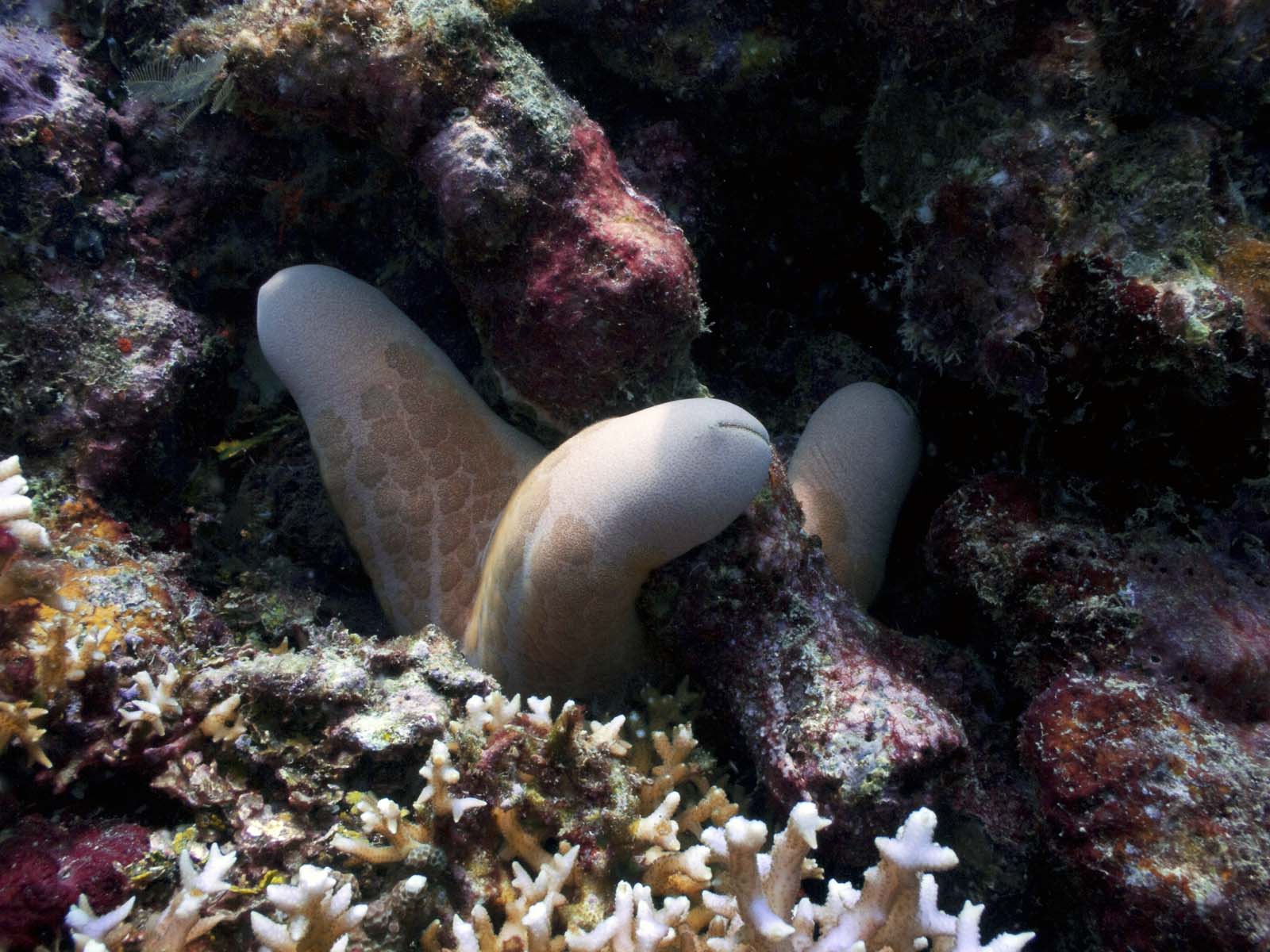
I don't know how they get into these positions. They must practice Yoga. More about that later. You're going to have a good laugh. (Hee-hee)
Well, by the time Trev arrived I was in a sorry state. I wish he had taken a picture. I'd love to have it. My head was lumpy and my hands hurt. We sat there for a while and he calmed me down. It was some of the finest tough love I have ever received. I was still breaking out in fresh fits for a while. I distinctly remember hitting myself in the face very hard. Funny, I did not realise that it was possible for one to hit oneself in the face so hard. My jaw is still sore. Now I am getting a giggle from that as I think of it. It was like the classic movie scene in which some poor soul is plainly hysterical and gets a good hard slap from a friend who says, "Get control of yourself!" and the slapped person replies, "Thanks, I needed that."
Well, this story is growing too long, so I'd better wrap it up. I scared the neighbours something awful. When I came back to the house in the evening, after going for some Yoga (yes, I said Yoga), Sisilia and her niece were waiting for me with some food and serious looks on their faces. They are lovely people, my next door neighbours. I invited them into the house and we sat for a while. Though they were shaken and worried about me their attitude changed dramatically when I told them what it was all about. They were very approving and happy for me. It's the Papua New Guinian way. I was now acting like good person and properly showing my grief for my dead wife. See? A happy ending.
Now for the real fun.
I have detected a tiny hint of jocular scepticism among certain friends whenever the word Yoga escapes my lips in connection with myself. I'm here to dispel that scoffing attitude. I went for some Yoga to help calm me down. I asked Michaela to take a couple of pictures of me in the less frightening positions.
I have never ascribed to the spiritual accoutrements of Yoga. I don't get it. However, I have practiced the physical exercises and contortions since I was a child. I'm Pretzel Man. I don't want to shock you with the more bizarre configurations of my body. You may be having your breakfast doughnut. I just want to demonstrate that I actually do Yoga. I don't pretend to do Yoga:

Yes, that is me. You might now be saying, "Yeah, well, anybody can do that."

This is also me - doing a head stand or, as I prefer to call it, a Tiger Stand.
If you don't find that funny then you need an attitude check.
Project 52 - Week 39 - Theme Comic Relief."
"LOOKING for adventure...then come join the Boy Scouts of America"!
I had a whole lot of fun with this week's theme thanks to my best prop... My son! He always makes me laugh and that's a good thing! I enjoyed learning more in PS when it came to editing and that's what these challenges are for! To learn and have fun at the same time!
Happy Day's to you all!
Follow me on my blog! {My Blog}
See my work ! {My Website}
Come be a fan! {Facebook}Tweet with me! {Twitter}
© 2012 Joyful Reflections Photography, All Rights Reserved. This image may NOT be used for anything without my explicit permission. In others words...don't steal my image! Thank you!
Spanish collectors card by Chocolate Amatller, Marc Luna, in the series Principales Artistas Cinematograficos, Serie 1a, no. 21. Photo: Félix.
Charles Prince (1872-1933), aka just ‘Prince’, was a French film actor, director and writer. He was famous for his countless comical shorts with his alter ego Rigadin.
Charles Ernest René Petitdemange - better known as Charles Prince - was born at Maisons-Laffitte (Yvelines) in 1872 – though some mention his birthplace as Petitdemange, near Paris. Prince’s father was a manufacturer of artificial silk and had planned for his son to study commerce and assist him. Prince chose otherwise. He had his theatrical debut in 1896 at the Theatre de l’Odéon in the play 'La Bodinière', using a first pseudonym: Seigneur. Around the turn-of-the-century, Charles took the stage name of Prince. He became a popular boulevard theatre star, cherished for his comic performances at the Theatre des Variétés, as in 'Ma Tante de Honfleur'. After a decade, Pathé Frères hired him in 1908 to act in their films. Right from the beginning almost all of his films were directed by Georges Monca, mostly for the Pathé subsidiary SCAGL (Société Cinématographique des Auteurs et Gens de Lettres). Already in 1909, Prince acted in almost 20 shorts such as a few with Mistinguett, e.g. Fleur de pavé (Michel Carré, Albert Capellani, 1909). This number greatly increased in the subsequent year 1910, when Prince introduced his character of Rigadin: ¾ of his film performances that year - over 30 films - were as Rigadin. Monca also directed all of the Rigadin shorts. While in 1911 Prince played in 23 Rigadin comedies, 1912 was a top year with 45 Rigadin shorts. In 1913 some Prince did 30 Rigadin shorts and in 1914 22 ones despite the outbreak of the First World War and the temporary collapse of the French film industry then. In the early 1910s Prince/Rigadin was extremely popular throughout the world, rivalling – the now better-known - Max Linder. What both actors helped, was that they worked for Pathé, the first multinational in film history, which had a clockwork production output, massive distribution and promotion around the globe, and even its own global network of cinemas. In Germany Rigadin was known as Moritz, in Britain and the US as Whiffles, in Italy as Tartufini, in Spain as Salustiano, and in Russia as Prenz. Prince/Rigadin had a remarkable face with a curling lip showing his teeth and an upturned nose, for which he even mocked himself in Le Nez de Rigadin (1911).
As Rigadin, Prince often played the bourgeois who gets in trouble with authorities or with love interests, because of his timidity and clumsiness. Just like Prince’s previous stage performances, the Rigadin comedies thus mocked pre-war bourgeois drama and their main topic of amour, even if Prince himself occasionally acted in these bourgeois dramas as well. In contrast to the previous anarchic comedy at Pathé and other companies, Rigadin was inspired by vaudeville and light stage comedy, and so Prince’s character stuck to ‘white collar’ respectability and convention while being pestered by mothers-in-law or his own mistresses. In Rigadin n’aime pas le vendredi 13 (1911) for instance, Rigadin has dinner with his fiancée and her parents, but it is Friday the 13th and Rigadin is so superstitious that everything goes wrong. In La Garçonnière de Rigadin (1912) Rigadin lends his bachelor flat to his future father-in-law, not knowing ‘Papa’ is going to use it for his secret rendezvous. In contrast to Linder, Prince also made Rigadin do countless transformations in all kinds of professions, from domestic, cook, chestnut seller, poet, singer and explorer to the president of the French Republic and Napoleon. In Rigadin peintre cubiste (1912) Prince mocked avant-garde art by having Rigadin and his model wear angular clothes. In Rigadin aux Balkans (1912) Prince played a war cameraman who fakes scenes for the camera in France. During the First World War, the number of Rigadin comedies went down from some 20 films in 1915, to 16 in 1916, 13 in 1917, and 11 in 1918. Still, all in all, Prince must have acted in some 200 shorts as of 1908, mostly Rigadin comedies. Prince also experimented with the exchange between stage and screen. In the war revue show Nouvelle Revue, shown at the Paris Theatre Antoine in 1915, a notary Rigadin from the countryside is appalled by a film poster suggesting he has an affair with a girl and visits a Parisian cinema. There he speaks to the Rigadin on the screen, until the other turns around and starts to speak with him. When the notary tries to pursue him, he is suddenly in the film…
In all of these years, the number of films in which Prince wasn’t Rigadin was really small. As of 1913, Prince acted in long(er) features as well, mostly dramas. In 1913 he thus acted opposite Léon Bernard and Suzanne Demay in the SCAGL production Les Surprises du divorce, directed by Monca. Then followed Le Bon juge, Le Coup de fouet, Ferdinand le noceur, Le Fils à papa and Monsieur le directeur, all co-directed in 1913 by Monca and Prince himself. Subsequent long films co-directed by Prince were in 1914 Les Trente millions de Gladiator, Bébé, La Famille Boléro, La Femme à papa (all co-directed by Prince) and Les Fiançés héroïques (Monca 1914), in 1915 L’Auréole de la gloire and La Main dans le sac (both by Monca), in 1916 La Mariée récalcitrante (Monca, Prince). In 1919-1921 Prince played in a few feature-length comedies, again all directed by Monca, such as Les Femmes collantes (1919-1920) and Madame et son filleul (1919). One last time he played in a Rigadin short, probably mocking his own dissatisfaction or that of the spectators, as the title was Prince embêté par Rigadin (1920). By the early 1920s, though, not only the popularity of Rigadin but also that of Prince had faded, and for years Prince didn’t act in film anymore. After one last silent film in 1928 (Embrassez-moi by Robert Péguy and Max de Rieux), he did have an active career in early French sound cinema between 1930 and 1933, but now in supporting roles, as in Maurice Tourneur’s Partir (1931) and Pierre Colombier’s Sa Meilleure cliente (1932), starring Elvire Popesco and René Lefèvre. Prince died at Saint-Maur-des-Fossés (Val-de-Marne) in 1933. Unfortunately, his tomb was destroyed. In 1900 Prince married vaudeville and film actress Miss (Aimée) Campton (1882-1930), whose original name was Emily Strahan Cager. Campton was the cousin of Paul Derval, director of the Folies-Bergères. They had one daughter Renée (1901-1993). In 1914 Prince married his second wife Gabrielle (1883-1974). Prince's great-grandson is French film director Cris Ubermann.
Sources: Richard Abel (The Ciné Goes to Town), The Bioscope, Eva Krivanec (Theatre und Medien/Theatre and the Media), Adrien Vernardin (Le Musée du Music-Hall), Bibliothèque du Film, Wikipedia (French and English), IMDb, and various obituaries in newspapers.
And, please check out our blog European Film Star Postcards.
This young Caiman looked comical with its feet resting on its tail whilst basking in the sun on the sand banks if the Cuiaba river
CARL BARKS
Carl Barks (March 27, 1901 – August 25, 2000) was an American Disney Studio illustrator and comic book creator, who invented Duckburg and many of its inhabitants, such as Scrooge McDuck (1947), Gladstone Gander (1948), the Beagle Boys (1951), The Junior Woodchucks (1951), Gyro Gearloose (1952), Cornelius Coot (1952), Flintheart Glomgold (1956), John D. Rockerduck (1961) and Magica De Spell (1961). The quality of his scripts and drawings earned him the nicknames The Duck Man and The Good Duck Artist. Writer-artist Will Eisner called him "the Hans Christian Andersen of comic books."
In 1987, Barks was one of the three inaugural inductees of the Will Eisner Comic Book Hall of Fame.
Professional artist
At the same time Barks had started thinking about turning a hobby that he always enjoyed into a profession: that of drawing. Since his early childhood he spent his free time by drawing on any material he could find. He had attempted to improve his style by copying the drawings of his favorite comic strip artists from the newspapers where he could find them. As he later said, he wanted to create his own facial expressions, figures and comical situations in his drawings but wanted to study the master comic artists' use of the pen and their use of color and shading.
Among his early favorites were Winsor McCay (mostly known for Little Nemo) and Frederick Burr Opper (mostly known for Happy Hooligan) but he would later study any style that managed to draw his attention.
At 16 he was mostly self-taught but at this point he decided to take some lessons through correspondence. He only followed the first four lessons and then had to stop because his working left him with little free time. But as he later said, the lessons proved very useful in improving his style.
By December 1918, he left his father's home to attempt to find a job in San Francisco, California. He worked for a while in a small publishing house while attempting to sell his drawings to newspapers and other printed material with little success.
Disney
In November 1935, when he learned that Walt Disney was seeking more artists for his Studio, Barks decided to apply. He was approved for a try-out which entailed a move to Los Angeles, California. He was one of two in his class of trainees who was hired. His starting salary was 20 dollars a week. He started at Disney Studios in 1935, more than a year after the debut of Donald Duck on June 9, 1934 in the short animated film The Wise Little Hen.
Barks initially worked as an inbetweener. This involved being teamed and supervised by one of the head animators who did the key poses of character action (often known as extremes) for which the inbetweeners did the drawings between the extremes to create the illusion of movement. While an inbetweener, Barks submitted gag ideas for cartoon story lines being developed and showed such a knack for creating comical situations that by 1937 he was transferred to the story department. His first story sale was the climax of Modern Inventions, for a sequence where a robot barber chair gives Donald Duck a haircut on his butt.
In 1937 when Donald Duck became the star of his own series of cartoons instead of co-starring with Mickey Mouse and Goofy as previously, a new unit of storymen and animators was created devoted solely to this series. Though he originally just contributed gag ideas to some duck cartoons by 1937 Barks was (principally with partner Jack Hannah) originating story ideas that were storyboarded and (if approved by Walt) put into production. He collaborated on such cartoons as Donald's Nephews (1938), Donald's Cousin Gus (1939), Mr. Duck Steps Out (1940),Timber (1941), The Vanishing Private (1942) and The Plastics Inventor (1944).
Unhappy at the emerging wartime working conditions at Disney plus bothered by ongoing sinus problems caused by the studio's air conditioning, Barks quit in 1942. Shortly before quitting, he moonlighted as a comic book artist, contributing half the artwork for a one-shot comic book (the other half of the art being done by story partner Jack Hannah) titled Donald Duck Finds Pirate Gold. This 64-page story was adapted by Donald Duck comic strip writer Bob Karp from an unproduced feature, and published in October 1942 in [Dell] Four Color Comics #9. It was the first Donald Duck story originally produced for an American comic book and also the first involving Donald and his nephews in a treasure hunting expedition, in this case for the treasure of Henry Morgan. Barks would later use the treasure hunting theme in many of his stories. This actually was not his first work in comics, as earlier the same year Barks along with Hannah and fellow storyman Nick George scripted Pluto Saves the Ship, which was among the first original Disney comic book stories published in the United States.
After quitting the Studio, Barks relocated to the Hemet/San Jacinto area in the semi-desert inland empire region east of Los Angeles where he hoped to start a chicken farm.
When asked which of his stories was a favorite in several interviews Barks cited the ten-pager in Walt Disney's Comics and Stories 146 (Nov. 1952) in which Donald tells the story of the chain of unfortunate events that took place when he owned a chicken farm in a town which subsequently was re-named Omelet. Likely one reason it was a favorite is that it was inspired by Barks' own experiences in the poultry business.
But to earn a living in the meantime he inquired whether Western Publishing, which had published Pirate Gold, had any need for artists for Donald Duck comic book stories. He was immediately assigned to illustrate the script for a ten-page Donald Duck story for the monthly Walt Disney's Comics and Stories. At the publisher's invitation he revised the storyline and the improvements impressed the editor sufficiently to invite Barks try his hand at contributing both the script and the artwork of his follow-up story. This set the pattern for Barks' career in that (with rare exceptions) he provided art (pencil, inking, solid blacks and lettering) and scripting for his stories.
The Victory Garden, that initial ten-page story published in April, 1943 was the first of about 500 stories featuring the Disney ducks Barks would produce for Western Publishing over the next three decades, well into his purported retirement. These can be mostly divided into two categories:
Ten-pagers, comedic Donald Duck stories that were the lead for the monthly flagship title Walt Disney's Comics and Stories, whose circulation peaked in the mid-1950s at 3 million copies sold a month.
Humorous adventure stories, usually 24-32 pages in length. In the 1940s these were one-shots in the Four Color series (issued 4-6 times a year) that starred Donald and his nephews. From the early 1950s Barks undertook the quarterly adventures of Uncle Scrooge and the duck clan in Scrooge's own title.
He surrounded Donald Duck and nephews Huey, Dewey and Louie with a cast of eccentric and colorful characters, such as the aforementioned Scrooge McDuck, the wealthiest duck in the world; Gladstone Gander, Donald's obscenely lucky cousin; inventor Gyro Gearloose; the persistent Beagle Boys; the sorceress Magica De Spell; Scrooge's rivals Flintheart Glomgold and John D. Rockerduck; Daisy's nieces April, May and June; Donald's neighbor Jones, and The Junior Woodchucks organization.
People who work for Disney generally do so in relative anonymity; the stories only carry Walt Disney's name and (sometimes) a short identification number. Prior to 1960, the creator of these stories remained a mystery to his readers. However, many readers recognized Barks' work and drawing style, and began to call him the Good Duck Artist, a label which stuck even after his true identity was discovered by John and Bill Spicer in 1959. After Barks received a 1960 visit from Bill and John Spicer and Ron Leonard, he was no longer anonymous, as his name soon became known to his readers.
Barks stories (whether humorous adventures or domestic comedies) often exhibited a wry, dark irony born of hard experience. The 10 pagers showcased Donald as everyman, struggling against the cruel bumps and bruises of everyday life with the nephews often acting as a Greek chorus commenting on the unfolding disasters Donald wrought upon himself. Yet while seemingly defeatist in tone, the humanity of the characters shines through in their persistence despite the obstacles. These stories found popularity not only among young children but adults as well. Despite the fact that Barks had done little traveling his adventure stories often had the duck clan globe trotting to the most remote or spectacular of places. This allowed Barks to indulge his penchant for elaborate backgrounds that hinted at his thwarted ambitions of doing realistic stories in the vein of Hal Foster's Prince Valiant.
Carl Barks retired in 1966 but was persuaded by editor Chase Craig to script stories for Western. The last new comic book story drawn by Carl Barks was a Daisy Duck tale ("The Dainty Daredevil") published in Walt Disney Comics Digest issue 5 (Nov. 1968). When bibliographer Michael Barrier asked Barks about why he drew it, Barks' vague recollection was no one was available and he was asked to do it as a favor by editor Chase Craig.
He wrote one Uncle Scrooge story, three Donald Duck stories and from 1970-1974 was the main writer for the Junior Woodchucks comic book (issues 6 through 25). The latter included environmental themes that Barks first explored in 1957 ["Land of the Pygmy Indians", Uncle Scrooge 18]. Barks also sold a few sketches to Western that were redrawn as covers. For a time the Barkses lived in Goleta, California before returning to the Inland Empire by moving to Temecula.
To make a little extra money beyond what his pension and scripting earnings brought in, Barks started doing oil paintings to sell at the local art shows he and Garé exhibited at. Subjects included humorous depictions of life on the farm and portraits of Native American princesses. These skillfully rendering paintings encouraged fan Glenn Bray to ask Barks if he could commission a painting of the ducks ("A Tall Ship and a Star to Steer Her By", taken from the cover of Walt Disney's Comics and Stories 108 by Barks). This prompted Barks to contact George Sherman at Disney's Publications Department to request permission to produce and sell oil paintings of scenes from his stories. In July 1971 Barks was granted a royalty-free license by Disney. When word spread that Barks was taking commissions from those interested in purchasing an oil of the ducks, much to his astonishment the response quickly outstripped what he reasonably could produce in the next few years.
When Barks expressed dismay at coping with the backlog of orders he faced, fan/dealers Bruce Hamilton and Russ Cochran suggested Barks instead auction his paintings at conventions and via Cochran's catalog Graphic Gallery. By September 1974 Barks had discontinued taking commissions.
At Boston's NewCon convention, in October 1975, the first Carl Barks oil painting auctioned at a comic book convention ("She Was Spangled and Flashy") sold for $2,500. Subsequent offerings saw an escalation in the prices realized. The buyer of this painting, Jerry Osborne, quickly became one of Barks' close friends. Barks even painted Osborne into the scene of his 1976 "July Fourth in Duckburg." Jerry Osborne delivered the eulogy at Barks' funeral at Grants Pass, Oregon.[citation needed]
In 1976, Barks and Garé went to Boston for the NewCon show, their first comic convention appearance. Among the other attendees was famed Little Lulu comic book scripter John Stanley; despite both having worked for Western Publishing this was the first time they met. The highlight of the convention was the auctioning of what was to that time the largest duck oil painting Barks had done, "July Fourth in Duckburg", which included depictions of several prominent Barks fans and collectors. It sold for a then record high amount: $6,400.
Soon thereafter a fan sold unauthorized prints of some of the Scrooge McDuck paintings, leading Disney to withdraw permission for further paintings. To meet demand for new work Barks embarked on a series of paintings of non-Disney ducks and fantasy subjects such as Beowulf and Xerxes. These were eventually collected in the limited-edition book Animal Quackers.
As the result of heroic efforts by Star Wars producer Gary Kurtz and screenwriter Edward Summer, Disney relented and in 1981, allowed Barks to do a now seminal oil painting called "Wanderers of Wonderlands" for a breakthrough limited edition book entitled Uncle Scrooge McDuck: His Life and Times. The book collected 11 classic Barks stories of Uncle Scrooge colored by artist Peter Ledger along with a new Scrooge story by Barks done storybook style with watercolor illustrations, "Go Slowly, Sands of Time". After being turned down by every major publisher in New York City, Kurtz and Summer published the book through Celestial Arts, which Kurtz acquired partly for this purpose. The book went on to become the model for virtually every important collection of comic book stories. It was the first book of its kind ever reviewed in Time Magazine and subsequently in Newsweek, and the first book review in Time Magazine with large color illustrations.
In 1977 and 1982, Barks attended the San Diego Comic Con. As with his appearance in Boston, the response to his presence was overwhelming, with long lines of fans waiting to meet Barks and get his autograph.
In 1981, Bruce Hamilton and Russ Cochran, two long-time Disney comics fans, decided to combine forces to bring greater recognition to the works of Carl Barks. Their first efforts went into establishing Another Rainbow Publishing, the banner under which they produced and issued the award-winning book, "The Fine Art of Walt Disney´s Donald Duck by Carl Barks", a comprehensive collection of the Disney duck paintings of this artist and storyteller. Not long after, the company began producing fine art lithographs of many of these paintings, in strictly limited editions, all signed by Barks, who eventually produced many original works for the series.
In 1983 Another Rainbow took up the daunting task of collecting the entire Disney comic book ouvré of Barks—over 500 stories in all—in the ten-set, thirty-volume Carl Barks Library. These oversized hardbound volumes reproduced Barks´ pages in pristine black and white line art, as close as possible to the way he would originally drawn them, and included mountains of special features, articles, reminiscences, interviews, storyboards, critiques, and more than a few surprises. This monumental project was finally completed in mid-1990.
In 1985 a new division was founded, Gladstone Publishing, which took up the then-dormant Disney comic book license. Gladstone introduced a whole new generation of Disney comic book readers to the wondrous storytelling of such luminaries as Barks, Paul Murry, and Floyd Gottfredson, as well as presenting the first works of modern Disney comics masters Don Rosa and William Van Horn. Seven years after Gladstone's founding, the Carl Barks Library was revived as full-color, high-quality squarebound comic albums (including the first-ever Carl Barks trading cards) - the Carl Barks Library in Color.
Barks relocated one last time to Grants Pass, Oregon near where he grew up, partly at the urging of friend and Broom Hilda artist Russell Myers, who lived in the area. The move also was motivated, Barks stated in another famous quip, by Temecula being too close to Disneyland and thus facilitating a growing torrent of drop-in visits by vacationing fans. In this period Barks made only one public appearance, at a comic book shop near Grants Pass.
From 1993 to 1998, Barks' career was managed by the "Carl Barks Studio" (Bill Grandey and Kathy Morby—They had sold Barks original art since 1979). This involved numerous art projects and activities, including a tour of 11 European countries in 1994, Iceland being the first foreign country he ever visited. Barks appeared at the first of many Disneyana conventions in 1993. Silk screen prints of paintings along with high-end art objects (such as original water colors, bronze figurines and ceramic tiles) were produced based on designs by Barks.
During the summer of 1994 and until his death, Carl Barks & his studio personally assigned Peter Reichelt, a museum exhibition producer from Mannheim, Germany, as his agent for Europe. Publisher "Edition 313" put out numerous lithographs. In 1997, tensions between Barks and the Studio eventually resulted in a lawsuit that was settled with an agreement that included the disbanding of the Studio. Barks never traveled to make another Disney appearance. He was represented by Rev. Ed Bergen, as he completed a final project. Gerry Tank and Jim Mitchell were to assist Barks in his final years.
During his Carl Barks Studio years, Barks created two more stories: the script for the final Uncle Scrooge story "Horsing Around with History", which was first published in Denmark in 1994 with Bill Van Horn art. The Barks outlines for Barks final Donald Duck story "Somewhere in Nowhere", were first published in 1997, in Italy, with art by Pat Block.
Austrian artist Gottfried Helnwein curated and organized the first solo museum-exhibition of Carl Barks. Between 1994 and 1998 the retrospective was shown in ten European museums and seen by more than 400,000 visitors.
At the same time in spring 1994, Reichelt and Ina Brockmann designed a special museum exhibition tour about Barks' life and work. Also represented for the first time at this exhibition were Disney artists Al Taliaferro and Floyd Gottfredson. Since 1995, more than 500,000 visitors have attended the shows in Europe, Reichelt also translated the Michael Barrier Barks biography into German and published it in 1994.
Steven Spielberg and George Lucas have acknowledged that the rolling-boulder booby trap in the opening scene of Raiders of the Lost Ark was inspired by the 1954 Carl Barks Uncle Scrooge adventure "The Seven Cities of Cibola" (Uncle Scrooge 7). Lucas and Spielberg have also said that some of Barks's stories about space travel and the depiction of aliens had an influence on them. Lucas wrote the foreword to the 1982 Uncle Scrooge McDuck: His Life and Times. In it he calls Barks’s stories "cinematic" and "a priceless part of our literary heritage".
Carl Barks has spent most of his life drawing, illustrating, painting and telling stories about ducks. He was editor and artist for the Calgary Eyeopener until he joined the Disney Studio in 1935. Barks wrote and drew thirty six early Donald Duck cartoons. Walt Disney was supervisor to his "duck unit". In 1942 he dedicated himself to the art form that made him famous: writing comics books and drawing them. Carl became the preeminent Disney comic book artist and remains so to this day. In 1996 his timeless work has been reprinted worldwide. He is known as the father of Donald Duck as well as the creator of the miserly Uncle Scrooge. Duckburg and most of the duck clan owe their existence to his pen and paintbrush. In 1968 Carl began a new career capturing the duck family in oil paintings. Many Disney Bark's products have been created from his work including silk-screens, lithographs, bronze and porcelain figurines. At 93 Barks went on an eleven country museum tour with his oil paintings. From Iceland to Poland forty of his paintings were received to rave reviews and huge crowds. In Denmark the 3rd grade was let out to meet Barks at the boat. When asked what he would most like to be remembered for he answers "storytelling."