View allAll Photos Tagged certainty
Ours certainties, ours convictions, it often happens that we make some decisions without thinking about them, without taking the correct precautions just because of ours certainties. We throw ourselves headlong “with closed eyes” in what we spontaneously think is the better choice. but remember, intuition is not always right.
(multiexposure, doubleexposure)
Hebrews 6:13-20
The Certainty of God’s Promise
13 When God made his promise to Abraham, since there was no one greater for him to swear by, he swore by himself, 14 saying, “I will surely bless you and give you many descendants.”[d] 15 And so after waiting patiently, Abraham received what was promised.
16 People swear by someone greater than themselves, and the oath confirms what is said and puts an end to all argument. 17 Because God wanted to make the unchanging nature of his purpose very clear to the heirs of what was promised, he confirmed it with an oath. 18 God did this so that, by two unchangeable things in which it is impossible for God to lie, we who have fled to take hold of the hope set before us may be greatly encouraged. 19 We have this hope as an anchor for the soul, firm and secure. It enters the inner sanctuary behind the curtain, 20 where our forerunner, Jesus, has entered on our behalf. He has become a high priest forever, in the order of Melchizedek.
All I can say with certainty (12 years on) is that the trig point photo must have been taken on Sgurr a' Choire Ghlais! (Olympus Trip)
The road up Glen Stathfarrar is private and the gates are (or were) only open to the public between 9.00 am to 6.00 pm - so these four Munros have to be climbed at a bit of a canter. To make matters worse the visibility was extremely poor on the day and there was no path or fence to aid route-finding along the complex 7 km ridge between first and last peaks. I arrived at the gates at 9.00 am on the dot and completed the route with about 30 minutes to spare. As I was not fully fit at the time, I was quite proud of that!
------------------------------------------------------------------------------------------
Hillwalking journal entry for the day:
Wednesday 19/7/95
Sgurr na Ruaidhe - Carn nan Gobhar - Sgurr a’ Choire Ghlais - Sgurr Fuar-thuill
24 km, 1550 m: 7.3 hrs
Conditions: Dull, wet, windy and misty
Base: The Heights of Inchvannie, Strathpeffer
Map and starting point: OS Sheet 25, GR 283386
<<<<>>>>
Despite the less than encouraging forecast and my poor state of health (later diagnosed as Laryngitis!) I decided to take on a relatively demanding 4 Munro route, in order to make up for lost time earlier in the week: the Glen Strathfarrar hills. I had rung the “keeper of the key” a few weeks before-hand to ensure that the arrangements for access to the glen were still as specified in the guidebooks; namely that the glen was open to public traffic between the hours 09:00 to 18:00 hours on this day of the week.
I arrived at the gate at 09:00 hours on the dot and after being issued with a pass by the keeper - who again emphasised that I must be out by 18:00 hours - I shot off down the glen at great speed in order to maximise the time available to complete the route. I parked by the start of the stalker’s path to the east of the Allt Coire Mhuillidh and set off at about 09:30 hours.
As I made my way up the track by the side of the allt, I started to worry about the time factor: allowing 30 minutes for changing and the drive back up the glen at the end of the day, this would mean having to complete the route in under 8 hours, which was just 30 minutes over the Naismith estimate. As this estimate did not allow any time for food stops or route finding delays arising from the poor visibility, and as I almost always lagged behind Naismith on the longer routes (probably due to the fact that the formula does not allow for delays arising from steep descents), the prospects seemed rather bleak - especially taking into account the poor state of my health. I had a quick look at the map and decided that a more realistic target would be the 3 most easterly Munros bounding Coire Mhuillidh, leaving the final hill for a lazy day next year.
I followed the track and then the path (which continued for much further than indicated on the map) up to about the 500 m level on the SW shoulder of Sgurr na Ruaidhe. After filling my bottle at the burn with peaty and bitter water - the last available before gaining the ridge - I set off on the long slog up to the summit, with the rain now falling and the cloud descending. I was overjoyed to beat Naismith to the top by over 45 minutes, and began to think that the 4 Munros might still be on!
With visibility down to about 50 m I took a bearing and set off WNW towards the first col. There was not a trace of a path and the route was contra-intuitive, causing me to stop more than once to confirm the bearing. I eventually arrived about 50 m to the NE of the target col. This initially caused some confusion as the mist exaggerated the apparent scale and distance of the east face of Carn nan Gobhar, and I just could not relate what I could see with what I was expecting to see from the map. However, I eventually realised where I was and after gaining the col, successfully navigated my way to the summit over trackless terrain in 3 further stages, really enjoying the challenge. I was again cheered to find that I was still ahead of Naismith by 40 minutes, and so stopped for a short rest and brief snack.
Back south across the summit ridge and then to the SW, with the wind now blowing quite strongly. The terrain was confusing in the mist with the ground appearing to rise rather than fall and so I kept to the right-hand edge of the plateau so as to pick up the swing west to the next col. Thence to the Sgurr a’ Choire Ghlais summit without rest, to find 2 massive summit cairns and an OS pillar. I was now reasonably confident that I could bag the final Munro and still get back to the car in time.
Thus I headed off past the more northerly cairn down the NW ridge, which was rocky and narrow in places. I became confused again in the mist when the ridge levelled off for a few 100 m at the 1000 m contour, but this was resolved by reference to the altimeter and map. I finally reached the col-proper and then set off for the penultimate climb up Creag Gorm a’ Bhealaich. I began to feel tired for the first time that day but after a short stop half-way up, I carried on till reaching the top.
With just a further 100 m to climb I felt re-invigorated and soon reached the summit of the final Munro of the day, 4 hours and 40 minutes after setting off from the car, ie still 10 minutes ahead of Naismith. I felt proud of this achievement, as the entire 7 km length of the complex summit ridge between the first and last Munros had been negotiated under wet, windy and misty, conditions with no guidance from walls, fences, paths or fellow walkers.
After a short rest I jogged down the gentle slopes to the west and with some relief eventually spotted the largish cairn marking the start of the stalker’s path down the coire to the south - it was now just a question of putting one foot in front of the other.
I followed the path till it dropped below the cloud base and then re-filled my water bottle from the burn and stopped for a rather late, but very enjoyable, lunch break.
Thence a pleasant enough walk down by the Allt Toll a’ Mhuic to the glen and thence an uneventful 6 km slog along the road back to the car - politely refusing an offer of a lift with just 200 m to go! Back to the gate by 17:00 hours, ie with 30 minutes to spare.
Despite my poor state of health and the bleak conditions I had enjoyed the challenge. The only regret being the total lack of views, resulting in the photo-record of the route being limited to snaps of a few be-misted summit cairns!
1177. All flags flying and freshly painted HMAS CANBERRA [I] looks magnificent in this in this 1930s photograph taken in Sydney Harbour. Sadly we've no been able to date it with any certainty, and the presence of her aircraft catapult [but no aircraft] have caused us to belatedly abandon an original guess that this was taken during the royal visit of the Duke of Gloucester in late 1934. Similarly, the presence of round scuttles in the rear of the bridge/wheelhouse superstructure has belatedly caused us to correct the official identification of the photograph as HMAS AUSTRALIA [II].
The round ports say it is HMAS CANBERRA [I]. Thus, never daunted by previous errors, however glaring, we are forced to take a guess at when this photograph may have been taken. It is probably Aug. 6, 1936, with the ship dressed for the inauguration of a short-lived new NSW Governor, Admiral Sir Murray Anderson, and a companion photo to Entry No. 774, shown here: www.flickr.com/photos/41311545@N05/3989843525/in/photolis.... The presence of the aircraft catapult does tell us that it is the latter half of the 1930s, and there are two other possibilities: the Coronation of King George VI on May 12, 1937 or the Australian Sesquicentenary in 1938. We remain inclined inclined to 1936 date, as shown in the earlier Entry.
Photo: RAN Archives Navy Heritage Collection image ID NO. 04623, incorrectly captioned as HMAS AUSTRALIA [II].
The colors are there always, though far stranger than our eyes might register. An invisible rainbow slowly revealed as our steps draw us deeper from safety, further from certainty, to the point where twilight is forever, and the impossible glow and threat of further darkening at last brings illumination through shuttered eyes.
The Path of Wildness is easy to find
The course of a stream
Leaves blown in the wind
A beast’s track through the brush
And the direction of our first inclination
The Path of Wildness is an answer and response to a prescribed way of life which may leave some individuals with a sense that their living is little more than a series of pre-determined, step-like episodes between birth and death. The stages of living between these events: childhood, adolescence, adulthood, parenthood and senior are themselves natural and in accord with the needs of the species and most individuals. Many find their satisfaction in living this course and to these individuals I have little or nothing to say. Others though long for something more; something innate, genetic and seemingly calling. Adventure and change can give a degree of satisfaction and relief yet even these may seem too tame. To those who feel drawn to something beyond the entertainment and stimulation of senses I offer a walk along The Path of Wildness. Don’t bother penciling the event in your schedule, preparing a pack with goodies and supplies or even inviting a friend along, for this experience is along the course of your first inclination and you must surely always go alone.
The Path of Wildness
The Illusion of Certainty: Risk, Probability, and Chance Amir Aczel, Gerd Gigerenzer, Leonard Mlodinow, Joshua Tenenbaum
www.messersmith.name/wordpress/2010/11/23/things-i-see/
Today I went to the Fred Hollows Eye Clinic at the hospital here in Madang. You may have read about my paranoia concerning the near certainty of losing or misplacing my eyeglasses. Silly as it seems it was of so much concern to me that I was compulsively checking my one pair of multi-focal glasses to make certain that I knew where they were at all times if I didn't have them on. The resulting behaviours would have been comical had it not been for the fact that merely thinking about misplacing them and having to call a friend to search my house would set me trembling. I blame it on stress. I have to blame it on something.
I had gotten three pairs of glasses to replace my one varifocal pair. While I'm yakking on about pairs of glasses I want to ask you why is it a pair of glasses? I know it's because there are two lenses, but it still doesn't sound right. It's a little like a pair of pants or a pair of pliers. Are there objects called a pant or a plier? I don't think so. I can see a pair of socks. That makes sense; there are two separate socks. Together they make a pair. However if there are not two things called a pant, then how can you have a pair of pants? Same goes for pliers. I couldn't say, "I had gotten three glasses", because that might be confusing if the context was not clear. You might think I was talking about drinking glasses. No, I had to say three pairs of glasses so you would know that I'm talking about . . . Okay, this is getting silly. I'd better move on. I have to admit, however, that this is something which has bothered me for years. I feel better now that I've gotten it off my chest.
Anyway, I got a +4 for distance, a +5 for computer work and a +6 for close-up work like reading in bed. What I discovered is that after a while the distance formula was not working any more. It was too strong. Things a bit close were fine, but when I was driving the distant objects were fuzzy. I went back today and got a pair of +3.5 glasses. That did the trick. Now when I'm driving everything from the gauges to infinity is in perfect focus. I'm happy with that, considering that these eyeglasses cost me only about $8.00.
Okay, that was not very interesting, I admit. Nevertheless, I wish to report to myself here in my journal that I can now see perfectly at any distance. The only problem is that I have to carry around four pairs of eyeglasses. Also, most of the time my eyes feel as if they are about to pop from their sockets. Am I giving myself eye strain? Hey, I'm blessed. Some people can't see at all.
So, here are some things I have seen lately. By the way, I wasn't wearing any of my pairs of glasses. I have a prescription dive mask. It is perfect underwater. Unfortunately, it doesn't work out of the water. Otherwise, I would just wear it instead of buying so many pairs of glasses.
This is a very cute little Blackspotted Puffer (Arothron nigropunctatus):
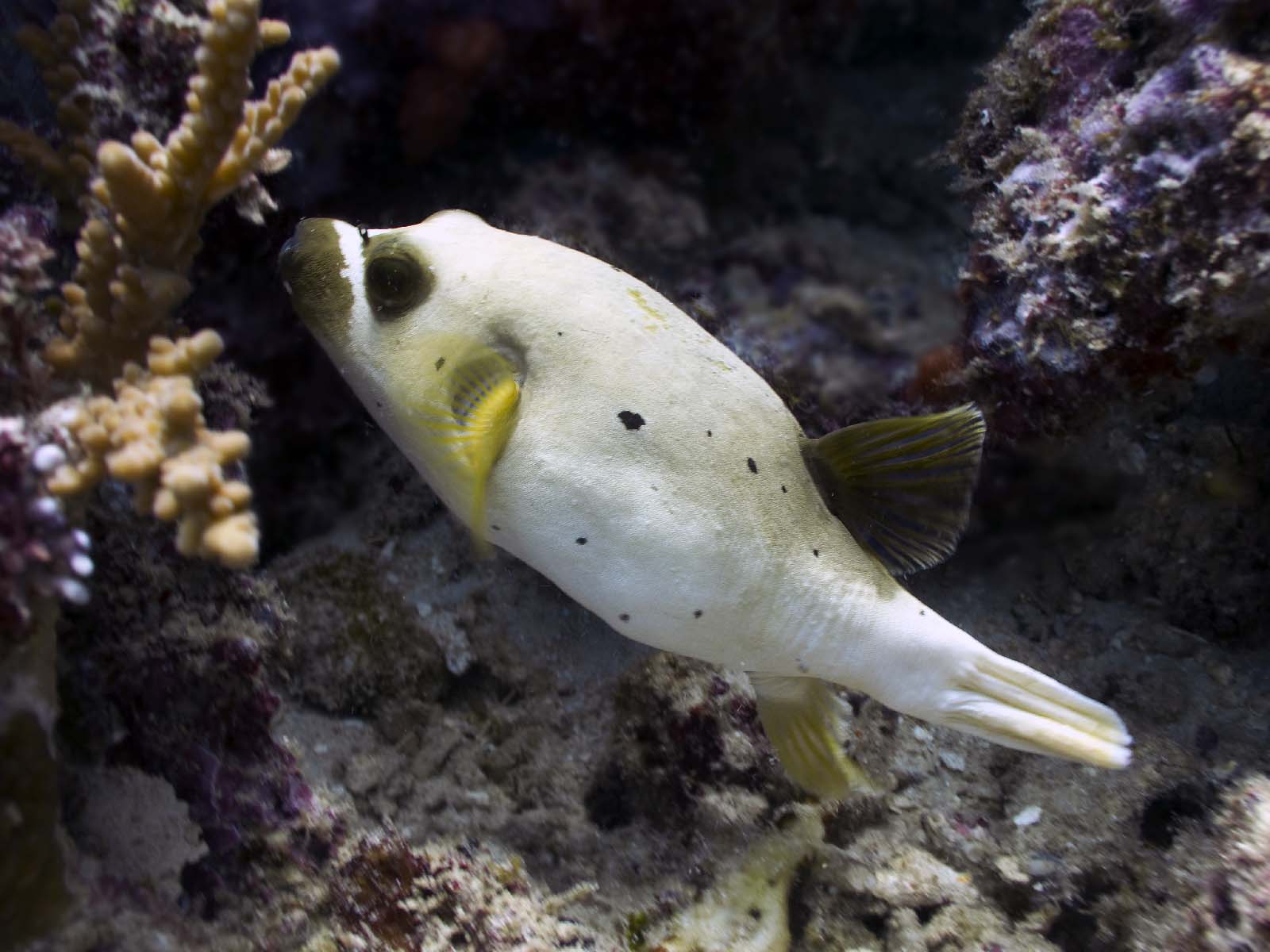
I call them them "puppy fishes", because they look like . . . mmmm, puppies.
Okay, this is not going so well. I seem to have forgotten how to write tonight.
This is a colony of sea squirts called Lissoclinum patellum:

I could think of several things which I'm reminded of when I see these and none of them are pleasant, so I won't trouble you with that. I find it amusing that something as lowly as a sea squirt can be placed in the phylum, Chordata, which is the same phylum to which I belong. Or maybe it's not so surprising when I think hard about it. Sea squirts have something like a spinal column only while they are mobile juveniles. As adults they form colonies and lose all of their backbone. They become blobby and are plastered solidly in place. Come to think of it, that's not so different from me after all. I'm a giant sea squirt. I've become rooted into immobility and have lost my backbone. I'm going to double up on my calcium pills and see what happens. Is that a wild goose I hear calling to me?
Okay, there goes what I so laughably call my brain again. It's off on a tangent, slipped a gear, got its wires crossed, blew a fuse. Little purple sparks are coming out of my ears. I'm unable to escape the chorus of Frankie Laine's old hit Cry of the Wild Goose:
My heart knows what the wild goose knows,
I must go where the wild goose goes.
Wild goose, brother goose, which is best?
A wanderin' fool or a heart at rest?
Let me fly, let me fly, let me fly away.
Where does a moody hankering for change cross over into the realm of escapism? I remember a time not so long ago when I would have hopped a plane to Kathmandu if only that wouldn't have left such a big mess behind. I could get a job as a dishwasher somewhere. I'd be the best dishwasher in the business. You could eat off my plates. Yeah, I wanted to run. Recent events have made many of us flinch. The flinching continues. Today a friend and I voiced it in the same moment, "How much can we take?" I'm reminded of the line from Monty Python and the Holy Grail when the Killer Rabbit of Caerbannog viscously attacked King Arthur and his Knights of the Round Table. Run away!
Well, I don't really want to get all sombre tonight. I've felt that way all day and now I need to cheer up a bit. A little balance is in order, eh? Sometimes situations are so miserable that you can find nothing resembling humour. However, you can always stand back a bit and laugh at your own reactions.
This bizarre critter is a kind of sea slug or Bêche-de-mer, a Bohadschia argus:
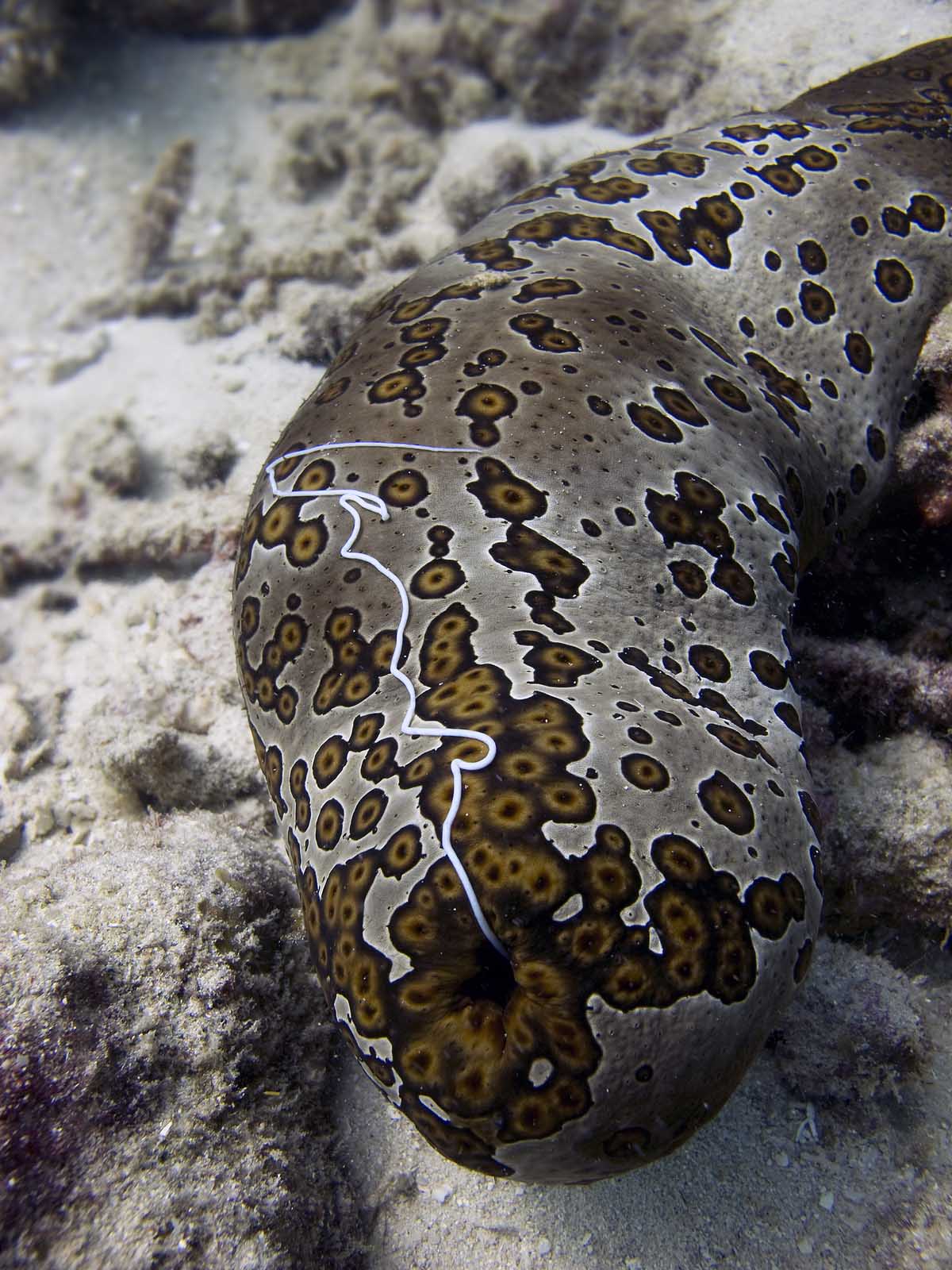
This one has a single incredibly sticky white filament trailing out of its . . . uh, unpleasant end. Often there are many filaments. It is a defence mechanism. This individual was angry and defensive because I accidentally disturbed it while I was photographing something else. I know from experience that you do not want to allow these filaments to come into contact with your skin or anything else for that matter. If scientists could develop a glue as efficient and durable as this stuff, they would see big bonuses in their pay-checks.
This strange wormy thing with an all-over beard is a kind of nudibranch called a Pteraeolidia ianthina:
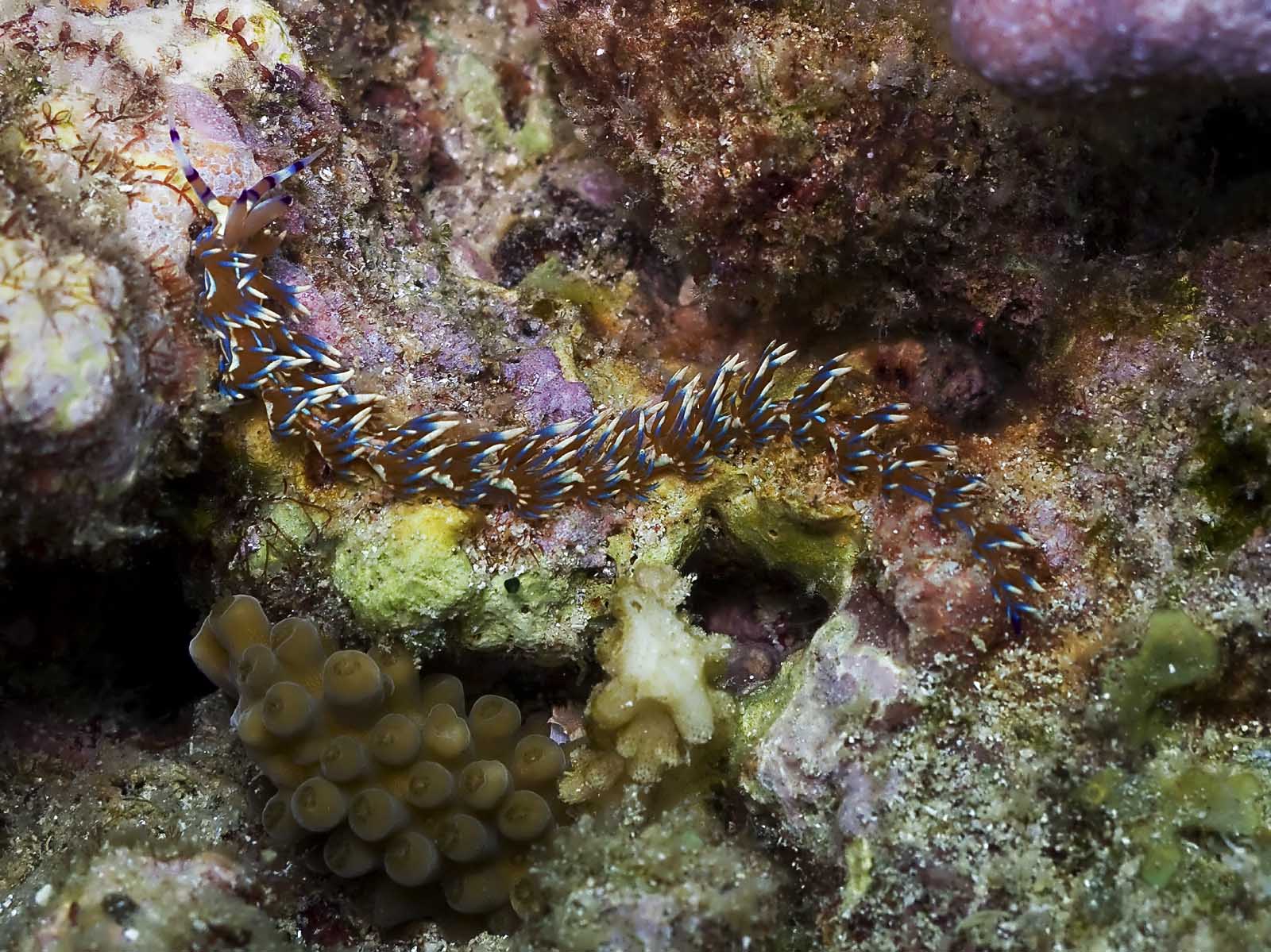
I'm reasonably sure of the identification, but if I'm mistaken I'll blame Rich Jones. He recently took back his giant nudibranch field guide upon which I had been drooling for the last few months. So many nudibranchs to photograph, so little time.
Here is another nudi, one of my favourites. It's an Electric Swallowtail (Chelidonura electra):
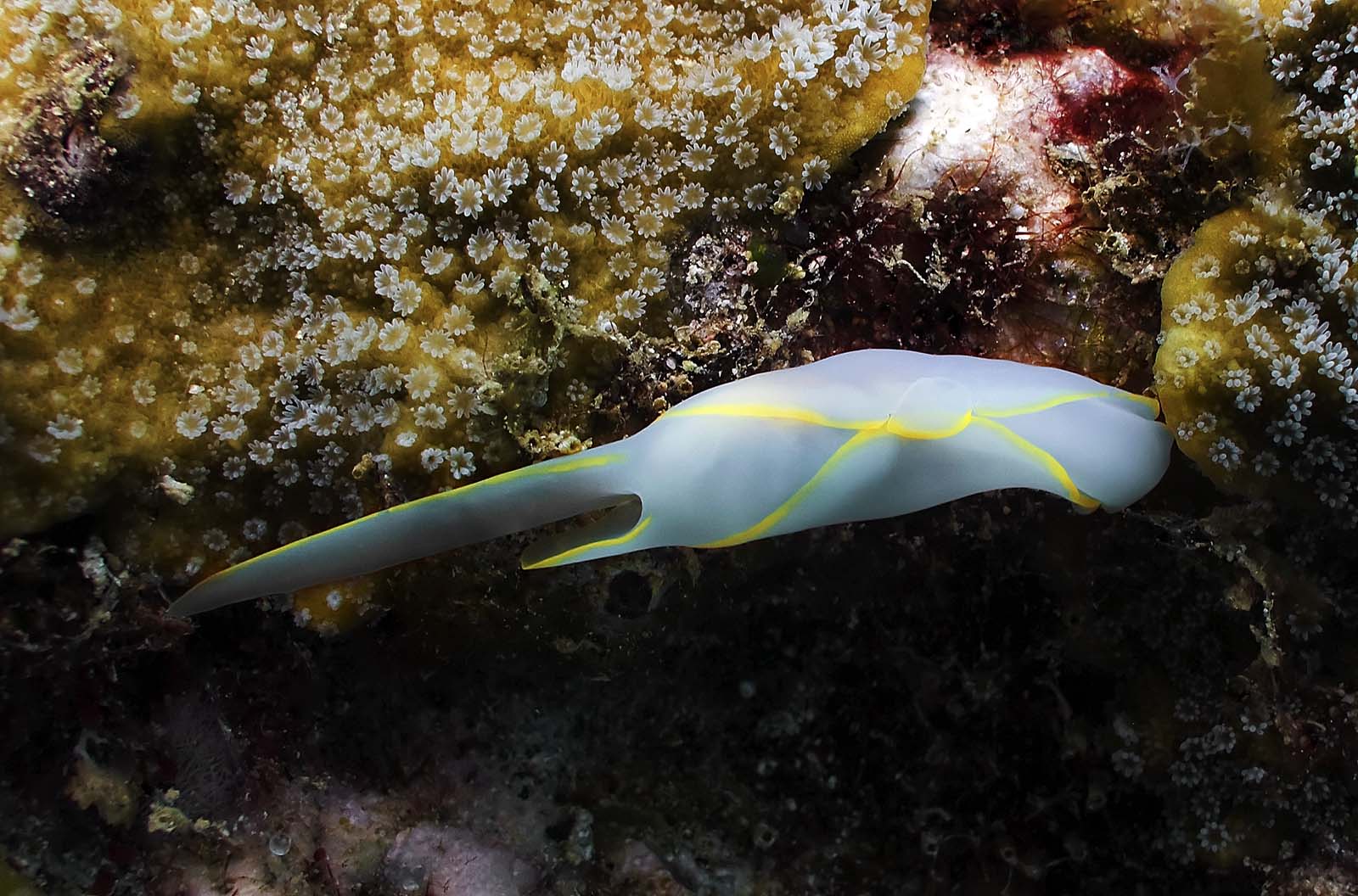
What an utterly charming name. It dredges up visions of Unicorns, Ashwinders, Mermaids, Mooncalves, Murlaps and Kneazles. (that should keep you Googling for a while).
This is the only balding Magnificent Anemone (Heteractis magnifica) which I have seen:

I have no idea what has caused it to lose its tentacles in this spot. It is not something which I have observed before. It seemed otherwise healthy. I once fed a Magnificent Anemone half of a banana. It took it about fifteen minutes for it to transport the banana treat across its tentacles, passing it along the tips like a rock star being carried along on the up-stretched hands of fans. The banana finally ended up in the anemone's mouth. I didn't stick around long enough to ask it if it liked it.
This shot is my pick of the day. It's a very common Cushion Star (Culcita novaeguineae) which is most uncommonly beautiful:
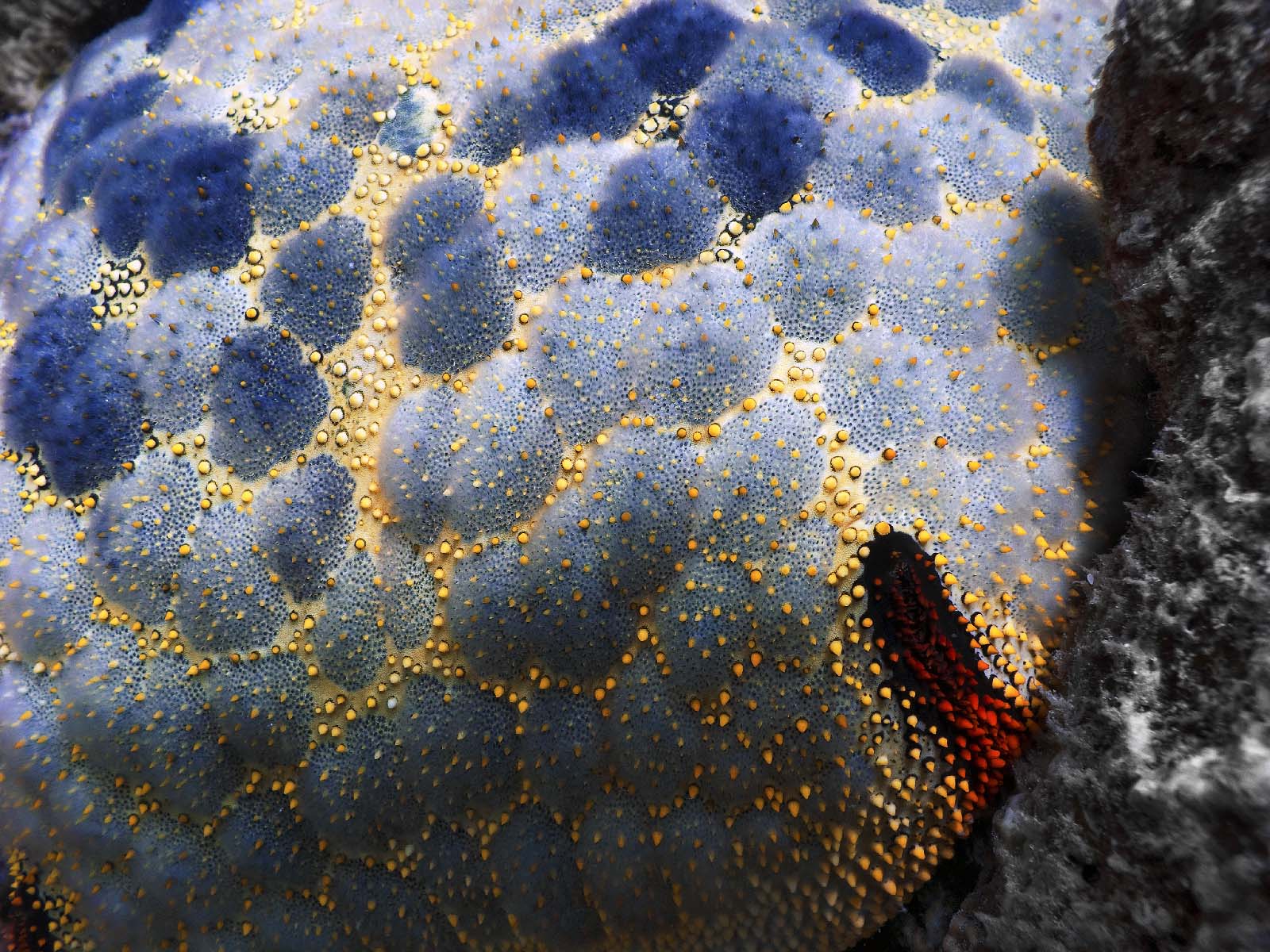
It takes things such as this to remind me of the incredible riches of my life. People pay vast sums of money for the privilege of doing the things which I enjoy every week. I'm still able to see these things as privileges which are not to be taken for granted.
I must accept that Madang is not my eternal home. Some day I will have to leave this place. Maybe my body will stay here in the ground and my spirit will depart. Or perhaps while body and spirit are still merged circumstances will arise which require me to leave and I'll be led to another place. The future is very fuzzy.
I think that even that fuzziness is a blessing. I'm listening. And I'm leaving plenty of room for surprises.
As we grow through trials and triumphs, highs and lows, sadness and joys, we would somehow reach the point where in seeking more than that is what really mattered. Uncertainty to see what is ahead of us is a definite certainty. Spacing your memories into manageable fragments, scrutinizing each moment that ever happened in the past, taking these as motivations to reach your destination would perhaps help.
The person in the picture above is an old buddy; we went as far as third grade to converse about the things we would like to do when get old in our own separate lives. Now in our early twenties, we now converse about discontent on why we can’t be much happier with what we can do now. To live a simple life without excesses is his goal, painting and sketching is his passion. Now he is testing the waters if photography could also be part of his arsenal. I myself have seen a few of his work, and I cannot help but marvel of how far he can get. I wish him to get his break he truly deserves, it’s just that this not becoming a reality for a long time now.
Driving our way from the beach back to our homes, I asked him, “pero bro bakit sina Sarah Gaugler? Si Shek? lahat ng mga ka-edad natin na naging successful na rin sa mga endeavors nila. Sige lets say yung iba mayaman sila sa resources nila para gawin ang mga gusto nila, but just like us na meager lang ang resources, marami sakanila ang nag succeed without riches and resources… now why can’t you? Why can’t we…?”
He can’t answer, He just said “Hindi ko alam…” or "I don't know.." in English.
I myself don’t have an answer for my own questions. Grasping the idea that seeing by faith rather than sight alone will certainly get us there, a place only a few lived to reach. We could be so much more than we are.
A reconciliation agreement between the Province and the Snuneymuxw First Nation will bring economic benefits to the Snuneymuxw, while increasing certainty for business in the Nanaimo region.
Learn more: www.newsroom.gov.bc.ca/2013/03/benefits-for-snuneymuxw-fi...
The Roma are one of the few certainties of the Balkans. Whether its Albanians. Serbs or Jugoslavs that have the momentum, whatever happens, you know that one thing is certain: somebody will make sure the gypsies get stepped on a bit more.
They try to adapt. They are like the wind they say: They go wherever it blows. But whatever they do, whichever banners they choose or colors they wear, it seems that something will always betray them even before they can open their mouth to say anything.
"Judge not, that you be not judged... ask and it will be given to you... whatever you wish that others would do to you, do also to them... do the will of my Father who is in heaven..."
Matthew 7:26 And everyone who hears these words of mine and does not do them will be like a foolish man who built his house on the sand.
This quote reminded me of this verse from the Gospel of Matthew. Often as I try to plan ahead for my life I am reminded first need to make sure the foundation of my life and future is built solely on one who give life and life to the fullest.
Scientific Name: Umbilicaria phaea Tuck.
Common Name: Emery Rock Tripe
Certainty: positive (notes)
Location: Southern California; Santa Barbara Mts; Pine Mt
Date: 20070214
' "Death, in its certainty, is exacting its due respect and repose before it takes my hand..'
Model -- Adelle Demonia
I wish I knew, with certainty, what I was allergic to. And what sets it off.
I mean I can sleep all night, no problems, lay there and think that I feel fine, and yet in 5 minutes be sniffing and sneezing and needing the best drugs known to mankind.
I do know I am allergic to dust and dustmites. I suspect that strong smells, or chemicals in deodorants and perfumes can set an attack off. But once you cut all them out, then what?
Sometimes, all you can do is go outside for a walk and lots of fresh air. That always does the trick. And in November, with the sun low and casting long shadows, these are what I see.
I have to catch up work afterwards, of course. But almost worth the sniffing.
I don't think anyone would try to stack liquid paint, now tins of paint - perhaps. Risk of spillage stacking liquid paint, a certainty.
been out of Flickr for a long loong time. life's too busy now, life's different, too many things going on at the same time, too many things to think about, legit problems to worry about, piled up papers to read through and the always minimalist bank balances.
if not for those study breaks and the warm comforts of a cheap whiskey... at least its possible to attain those precious moments of complete inhibition when suddenly everything seems alright and as if God descends to put his arms on you saying everything's alright..and that you...are alright
is that comfort of certainty too much to ask for?
From "Certainty Principle" an exhibition of photography, video, and installation by Michael David Murphy. Sept. 23rd, 2010 through Oct. 30th, 2010 at Spruill Gallery in Atlanta.
Olympic Volleyball: Brazil's women's volleyball head coach says three players certainties for Tokyo Olympic
www.olympictickets2020.com/olympic-games-tickets/olympic-...
Olympic lovers from all over the world are called to book Olympic 2020 tickets from our online platforms for Olympic Tickets. Olympic Volleyball lovers can book Olympic Volleyball Tickets from our ticketing marketplace exclusively on reduced prices.
blog.olympictickets2020.com/olympic-volleyball-brazils-wo...
#OlympicVolleyballTickets
#OlympicTickets
#Olympic2020Tickets
#SummerGamesTickets
#TokyoOlympicTickets
#OlympicPackages
This is one of the finest saws I have ever come across.
I cannot confirm the maker with absolute certainty, but the saw features a Warranted Superior medallion with the Disston keystone.
What is certain is that this saw was sold by the Supplee Hardware Co in Philadelphia. According to the etch this saw is "The Genuine and Original no 255" The etch is somewhat typical to American made Warranted saws. It features an eagle surrounded by two star spangled banners as well as the additional words:
"ROYAL STEEL
SPRING STEEL ~ WARRANTED
Patent Temper ~ Temper Ground"
The saw also has a secondary etch with the text:
"This saw was made specially for use of the most skilled Artisan. For quality style and finish it cannot be surpassed.
William H. Supplee"
I spotted this saw in an auction in the US and the handle looked so promising that I felt I had to place a bid. Luckily my small bid was enough.
But back to the origin of this saw. I'm quite sure this is a Disston made saw. But I have not been able to find a matching model in their catalogs or on disstonianinstitute.
The only official Disston model that comes close as far as the handle design is concerned, is the no 99, as designed from 1906 onwards:
www.disstonianinstitute.com/99page.html
I'm well aware of the fact that the no 99 was a straight back and mine is a skew back. So I'm not saying this is a no 99 in disguise. But the handles of the both saws are close matches.
Some of the Disston catalogs does include a short section of "Special saws etched to order". I don't have a complete collection of Disston catalogs, so I can't say if this saw is listed in one or several of them.
But I did spot an advertisement made b the Supple Hardware Co, where a saw very close to mine was listed:
www.ebay.co.uk/itm/1902-AD-Disston-Acme-Hand-Panel-Rip-Sa...
The only difference seems to be that the saw in the ad doesn't include wheat carving around the nuts.
As far as age goes, I firmly believe this saw was made rather early in the 20th century. Supplee Hardware merged with one Mr Biddle and became Supplee-Billdle Hardware Co in 1914. Although my saw doesn't feature the hardware company name, but only the signature of William H. Supplee, I think the saw could well have been made before 1914. The saw nuts have the narrow screw slots associated with earlier raised nuts. And the handle design is clearly more elegant and well rounded, something which also indicates an earlier design.
All in all this saw is a wonderful example of fine saw making. The spring steel is very hard and well tensioned. The handle has one of the best palm grips I have come across and after some jointing, reshaping and sharpening the saw has been at work for a couple of days now. It performs beautifully.
يا رب 🙏
املأ قلبي باليقين ، ثبت قلبي واغفر لي ✨✨
ا🔹🔸🔹
#دعاء #Duaa
O Allah fill my heart with certainty, stabilize my heart and forgive me ✨✨
Absoslut Certainty, this was an assignment last semester, it was a challenge, however the pay off at the end I drank the Vodka, absolutely marvellous
This is one of the finest saws I have ever come across.
I cannot confirm the maker with absolute certainty, but the saw features a Warranted Superior medallion with the Disston keystone.
What is certain is that this saw was sold by the Supplee Hardware Co in Philadelphia. According to the etch this saw is "The Genuine and Original no 255" The etch is somewhat typical to American made Warranted saws. It features an eagle surrounded by two star spangled banners as well as the additional words:
"ROYAL STEEL
SPRING STEEL ~ WARRANTED
Patent Temper ~ Temper Ground"
The saw also has a secondary etch with the text:
"This saw was made specially for use of the most skilled Artisan. For quality style and finish it cannot be surpassed.
William H. Supplee"
I spotted this saw in an auction in the US and the handle looked so promising that I felt I had to place a bid. Luckily my small bid was enough.
But back to the origin of this saw. I'm quite sure this is a Disston made saw. But I have not been able to find a matching model in their catalogs or on disstonianinstitute.
The only official Disston model that comes close as far as the handle design is concerned, is the no 99, as designed from 1906 onwards:
www.disstonianinstitute.com/99page.html
I'm well aware of the fact that the no 99 was a straight back and mine is a skew back. So I'm not saying this is a no 99 in disguise. But the handles of the both saws are close matches.
Some of the Disston catalogs does include a short section of "Special saws etched to order". I don't have a complete collection of Disston catalogs, so I can't say if this saw is listed in one or several of them.
But I did spot an advertisement made b the Supple Hardware Co, where a saw very close to mine was listed:
www.ebay.co.uk/itm/1902-AD-Disston-Acme-Hand-Panel-Rip-Sa...
The only difference seems to be that the saw in the ad doesn't include wheat carving around the nuts.
As far as age goes, I firmly believe this saw was made rather early in the 20th century. Supplee Hardware merged with one Mr Biddle and became Supplee-Billdle Hardware Co in 1914. Although my saw doesn't feature the hardware company name, but only the signature of William H. Supplee, I think the saw could well have been made before 1914. The saw nuts have the narrow screw slots associated with earlier raised nuts. And the handle design is clearly more elegant and well rounded, something which also indicates an earlier design.
All in all this saw is a wonderful example of fine saw making. The spring steel is very hard and well tensioned. The handle has one of the best palm grips I have come across and after some jointing, reshaping and sharpening the saw has been at work for a couple of days now. It performs beautifully.
This is one of the finest saws I have ever come across.
I cannot confirm the maker with absolute certainty, but the saw features a Warranted Superior medallion with the Disston keystone.
What is certain is that this saw was sold by the Supplee Hardware Co in Philadelphia. According to the etch this saw is "The Genuine and Original no 255" The etch is somewhat typical to American made Warranted saws. It features an eagle surrounded by two star spangled banners as well as the additional words:
"ROYAL STEEL
SPRING STEEL ~ WARRANTED
Patent Temper ~ Temper Ground"
The saw also has a secondary etch with the text:
"This saw was made specially for use of the most skilled Artisan. For quality style and finish it cannot be surpassed.
William H. Supplee"
I spotted this saw in an auction in the US and the handle looked so promising that I felt I had to place a bid. Luckily my small bid was enough.
But back to the origin of this saw. I'm quite sure this is a Disston made saw. But I have not been able to find a matching model in their catalogs or on disstonianinstitute.
The only official Disston model that comes close as far as the handle design is concerned, is the no 99, as designed from 1906 onwards:
www.disstonianinstitute.com/99page.html
I'm well aware of the fact that the no 99 was a straight back and mine is a skew back. So I'm not saying this is a no 99 in disguise. But the handles of the both saws are close matches.
Some of the Disston catalogs does include a short section of "Special saws etched to order". I don't have a complete collection of Disston catalogs, so I can't say if this saw is listed in one or several of them.
But I did spot an advertisement made b the Supple Hardware Co, where a saw very close to mine was listed:
www.ebay.co.uk/itm/1902-AD-Disston-Acme-Hand-Panel-Rip-Sa...
The only difference seems to be that the saw in the ad doesn't include wheat carving around the nuts.
As far as age goes, I firmly believe this saw was made rather early in the 20th century. Supplee Hardware merged with one Mr Biddle and became Supplee-Billdle Hardware Co in 1914. Although my saw doesn't feature the hardware company name, but only the signature of William H. Supplee, I think the saw could well have been made before 1914. The saw nuts have the narrow screw slots associated with earlier raised nuts. And the handle design is clearly more elegant and well rounded, something which also indicates an earlier design.
All in all this saw is a wonderful example of fine saw making. The spring steel is very hard and well tensioned. The handle has one of the best palm grips I have come across and after some jointing, reshaping and sharpening the saw has been at work for a couple of days now. It performs beautifully.
Cathedral of Our Lady of the Angels is the first religious building designed by Rafael Moneo, Spanish Pritzker architect. He speaks about his initial hesitation during the competition phase and fears approaching it, and how he finally went ahead with the design.
This is one of the finest saws I have ever come across.
I cannot confirm the maker with absolute certainty, but the saw features a Warranted Superior medallion with the Disston keystone.
What is certain is that this saw was sold by the Supplee Hardware Co in Philadelphia. According to the etch this saw is "The Genuine and Original no 255" The etch is somewhat typical to American made Warranted saws. It features an eagle surrounded by two star spangled banners as well as the additional words:
"ROYAL STEEL
SPRING STEEL ~ WARRANTED
Patent Temper ~ Temper Ground"
The saw also has a secondary etch with the text:
"This saw was made specially for use of the most skilled Artisan. For quality style and finish it cannot be surpassed.
William H. Supplee"
I spotted this saw in an auction in the US and the handle looked so promising that I felt I had to place a bid. Luckily my small bid was enough.
But back to the origin of this saw. I'm quite sure this is a Disston made saw. But I have not been able to find a matching model in their catalogs or on disstonianinstitute.
The only official Disston model that comes close as far as the handle design is concerned, is the no 99, as designed from 1906 onwards:
www.disstonianinstitute.com/99page.html
I'm well aware of the fact that the no 99 was a straight back and mine is a skew back. So I'm not saying this is a no 99 in disguise. But the handles of the both saws are close matches.
Some of the Disston catalogs does include a short section of "Special saws etched to order". I don't have a complete collection of Disston catalogs, so I can't say if this saw is listed in one or several of them.
But I did spot an advertisement made b the Supple Hardware Co, where a saw very close to mine was listed:
www.ebay.co.uk/itm/1902-AD-Disston-Acme-Hand-Panel-Rip-Sa...
The only difference seems to be that the saw in the ad doesn't include wheat carving around the nuts.
As far as age goes, I firmly believe this saw was made rather early in the 20th century. Supplee Hardware merged with one Mr Biddle and became Supplee-Biddle Hardware Co in 1914. Although my saw doesn't feature the hardware company name, but only the signature of William H. Supplee, I think the saw could well have been made before 1914. The saw nuts have the narrow screw slots associated with earlier raised nuts. And the handle design is clearly more elegant and well rounded, something which also indicates an earlier design.
All in all this saw is a wonderful example of fine saw making. The spring steel is very hard and well tensioned. The handle has one of the best palm grips I have come across and after some jointing, reshaping and sharpening the saw has been at work for a couple of days now. It performs beautifully.
This is one of the finest saws I have ever come across.
I cannot confirm the maker with absolute certainty, but the saw features a Warranted Superior medallion with the Disston keystone.
What is certain is that this saw was sold by the Supplee Hardware Co in Philadelphia. According to the etch this saw is "The Genuine and Original no 255" The etch is somewhat typical to American made Warranted saws. It features an eagle surrounded by two star spangled banners as well as the additional words:
"ROYAL STEEL
SPRING STEEL ~ WARRANTED
Patent Temper ~ Temper Ground"
The saw also has a secondary etch with the text:
"This saw was made specially for use of the most skilled Artisan. For quality style and finish it cannot be surpassed.
William H. Supplee"
I spotted this saw in an auction in the US and the handle looked so promising that I felt I had to place a bid. Luckily my small bid was enough.
But back to the origin of this saw. I'm quite sure this is a Disston made saw. But I have not been able to find a matching model in their catalogs or on disstonianinstitute.
The only official Disston model that comes close as far as the handle design is concerned, is the no 99, as designed from 1906 onwards:
www.disstonianinstitute.com/99page.html
I'm well aware of the fact that the no 99 was a straight back and mine is a skew back. So I'm not saying this is a no 99 in disguise. But the handles of the both saws are close matches.
Some of the Disston catalogs does include a short section of "Special saws etched to order". I don't have a complete collection of Disston catalogs, so I can't say if this saw is listed in one or several of them.
But I did spot an advertisement made b the Supple Hardware Co, where a saw very close to mine was listed:
www.ebay.co.uk/itm/1902-AD-Disston-Acme-Hand-Panel-Rip-Sa...
The only difference seems to be that the saw in the ad doesn't include wheat carving around the nuts.
As far as age goes, I firmly believe this saw was made rather early in the 20th century. Supplee Hardware merged with one Mr Biddle and became Supplee-Billdle Hardware Co in 1914. Although my saw doesn't feature the hardware company name, but only the signature of William H. Supplee, I think the saw could well have been made before 1914. The saw nuts have the narrow screw slots associated with earlier raised nuts. And the handle design is clearly more elegant and well rounded, something which also indicates an earlier design.
All in all this saw is a wonderful example of fine saw making. The spring steel is very hard and well tensioned. The handle has one of the best palm grips I have come across and after some jointing, reshaping and sharpening the saw has been at work for a couple of days now. It performs beautifully.
The entire speech made by George West was: (he won his case; a barking certainty really)!
This is from a speech made in 1870, when the man's dog, a foxhound named Drum was shot. His owner sued the man who shot Drum. There was no evidence but after he finished his speech, the jury was in tears. They fined the man $500, even though the maximum fine was $150.
George Vest was a 19th century lawyer defending a client.
Gentlemen of the jury, the best friend a man has in this world may turn against him and become his enemy. His son and daughter that he has reared with loving care may become ungrateful. Those who are nearest and dearest to us, those whom we trust with our happiness and our good name, may become traitors to their faith. The money that a man has he may lose. It flies away from him when he may need it most. Man's reputation may be sacrificed in a moment of ill considered action. The people who are prone to fall on their knees and do us honor when success is with us may be the first to throw the stone of malice when failure settles its cloud upon our head.
The one absolutely unselfish friend that man can have in this selfish world, the one that never deserts him, the one that never proves ungrateful or treacherous, is his DOG. A man's dog stands by him in prosperity and in poverty, in health and in sickness. He will sleep on the cold ground, where the wintry winds blow and the snow drives fiercely, if only he may be near his master's side. He will kiss the hand that has no food to offer, he will lick the wounds and sores that come in encounter with the roughness of the world. He guards the sleep of his pauper master as if he were a prince. When all other friends desert, he remains. When riches take wing and reputation falls to pieces, he is as constant in his love as the sun in its journey through the heavens. If fortune drives the master forth an outcast into the cold, friendless and homeless, the faithful dog asks no higher privilege than that of accompanying him to guard him against danger, and to fight against his enemies. When the last scene of all comes, and death takes his master in its embrace and his body is laid away in the cold ground, no matter if all other friends pursue their way, there by his graveside will the noble dog be found, his head between his paws and his eyes sad, but open in alert watchfulness, faithful and true even to death.
Senator George Vest, 1870.
“In a universe of ambiguity, this kind of certainty comes only once, and never again, no matter how many lifetimes you live.”
― Robert James Waller
santaslittlesecretservice.org/2009/11/13/what-is-christma...
For the latest updates
sanfranciscosantarchy.wordpress.com
photos from earlier years
Composite Landscape
Henri Mauperché
1602-1686
Date: Circa 1650
This somewhat melancholy idealised landscape explores the theme of the poetry of ruins made fashionable by Claude Gellée and La Hyre.It is one of the few paintings attributed with certainty to Mauperché, one of the greatest French landscape artists of the middle of the century.
The artist depicts fantastical classical architecture, overrun by vegetation and enlivened by picturesque details, flower pots on a cornice, laundry hung out to dry and a pulley, on the banks of a marsh dotted with reflections.
The dark tones of the rushes and dead trees in the foreground gradually lighten towards the distant haze, according to the rules of aerial perspective.
The slender figures could represent the shepherd Theagenes welcoming Charicles on the banks of the Nile, a scene from the famous novel by Heliodorus, Aethiopica.
_________________________________________________
In his 2016 guide to Paris, Rick Steves says: "This free museum displays a broad collection of paintings and sculpture from the 1600's to the 1900's on its ground floor, and an easy to appreciate collection of art from Greek antiquities to Art Nouveau in its basement. Though it houses mostly second tier art, there are a few diamonds in the rough.... The building itself is impressive, and the museum's classy cafe merits the detour. If it's raining in Paris and your Museum Pass has expired, the Petit Palais is a worthwhile stop."
On one of our best days in Paris, we walked from our room on the Ile Saint Louis through the southern Marais to the Hotel de Ville Plaza, took the route #69 bus to the Eiffel Tower, and walked along the Left Bank of the Seine to the Pont Alexander III, where we crossed the river just in time for one of the best meals of the week in the "classy cafe" with it's view of the beautifully landscaped central courtyard.
I'll let you be the judge of whether the art is "second tier".
Bombus pratorum on an Echinacea purpurea inflorescence; a widespread myth holds that bumblebees should be incapable of flight.
According to 20th century folklore, the laws of aerodynamics prove that the bumblebee should be incapable of flight, as it does not have the capacity (in terms of wing size or beats per second) to achieve flight with the degree of wing loading necessary. The origin of this myth has been difficult to pin down with any certainty. John McMasters recounted an anecdote about an unnamed Swiss aerodynamicist at a dinner party who performed some rough calculations and concluded, presumably in jest, that according to the equations, bumblebees cannot fly.[28] In later years McMasters has backed away from this origin, suggesting that there could be multiple sources, and that the earliest he has found was a reference in the 1934 French book Le vol des insectes; they had applied the equations of air resistance to insects and found that their flight was impossible, but that "One shouldn't be surprised that the results of the calculations don't square with reality".[29]
Some credit physicist Ludwig Prandtl (1875–1953) of the University of Göttingen in Germany with popularising the myth. Others say it was Swiss gas dynamicist Jacob Ackeret (1898–1981) who did the calculations.
In 1934, French entomologist Antoine Magnan included the following passage in the introduction to his book Le Vol des Insectes:
Tout d'abord poussé par ce qui fait en aviation, j'ai appliqué aux insectes les lois de la résistance de l'air, et je suis arrivé avec M. Sainte-Lague à cette conclusion que leur vol est impossible.
This translates to:
First prompted by the fact of aviation, I have applied the laws of the resistance of air to insects, and I arrived, with Mr. Sainte-Lague, at the conclusion that their flight is impossible.
Magnan refers to his assistant André Sainte-Laguë who was, apparently, an engineer.
It is believed that the calculations which purported to show that bumblebees cannot fly are based upon a simplified linear treatment of oscillating aerofoils. The method assumes small amplitude oscillations without flow separation. This ignores the effect of dynamic stall, an airflow separation inducing a large vortex above the wing, which briefly produces several times the lift of the aerofoil in regular flight. More sophisticated aerodynamic analysis shows that the bumblebee can fly because its wings encounter dynamic stall in every oscillation cycle.[30]
Additionally, John Maynard Smith a noted biologist with a strong background in aeronautics, has pointed out that bumblebees would not be expected to sustain flight, as they would need to generate too much power given their tiny wing area. However, in aerodynamics experiments with other insects he found that viscosity at the scale of small insects meant that even their small wings can move a very large volume of air relative to the size, and this reduces the power required to sustain flight by an order of magnitude.[31]
Another description of a bee's wing function is that the wings work similarly to helicopter blades, "reverse-pitch semirotary helicopter blades".
Bees beat their wings approximately 200 times a second. Their thorax muscles do not expand and contract on each nerve firing, but rather vibrate like a plucked rubber band.
It does not rain much in Denver. Growing up in Houston, rain was a constant - a certainty of every season that I took for granted and probably cursed on more than one summer day. Now that I live in a place with infrequent rain storms, I have a deep appreciation for rain and find myself almost craving it – the smell of wet concrete, the feel of humidity in the air – rain relentlessly storms all the senses and, in Denver, this is often violent and from out of nowhere. It comes in at a thousand miles an hour, and then, before you can find your umbrella, it is gone.
Rain changes me. It sparks creativity and prods me to find meaning in things that I’ve been ignoring. I am too old to float boats in the gutters, or splash in the puddles, but I spend most of the year wishing it would rain, so when it does, I try to be in a place where the inspiration can do some good. I could almost say that rain makes me happy, if only briefly, and only in as much as the weather can make me happy. It is more of a mood lifter than a panacea. I’d like to think that if I lived somewhere with more frequent rain storms, my mood would be elated more often. But, perhaps it is the rarity that allows the rain to keep its edge and influence over me.
It rained for two days this week – a rarity indeed. I worked through most of the storm, because right now I work through most of everything, but I took an hour to appreciate the rain, and this picture came from that. It is not a short story, or a new song, but it is something.
Picture info:
To almost 100% certainty I believe this is a Chicory (Latin name: Cichorium intybus) if I am wrong please comment it. :-) Its shoot under backlight conidtions. Im sure I lost a few liters of blood while shooting this. Damn "vampireish" bugs.
View On Black and alot larger!
--------------------------------- ---------------------------------
Blog / Contact info / Blog -> www.wildenius.se/blog/
--------------------------------- ---------------------------------