View allAll Photos Tagged Visible
“Test sphere mounted on the end of the third stage of the Vanguard rocket at Cape Canaveral, Florida. The 3¼-pound, 6.4-inch sphere, designed and built at the Naval Research Laboratory, Washington, D. C., has six antennas and two radio transmitters capable of sending signals to tracking station on the ground hundreds of miles away. The six rectangular objects on the surface of the aluminum sphere are solar batteries which will power the radio transmitters.”
Note the reflections in the satellite…a parking lot, with cars visible. So, possibly taken at the NRL prior to shipment to Cape Canaveral, or somewhere on Cape Canaveral (other than LC-18) during preflight testing, inspection, transport…or not. ¯\_(ツ)_/¯
Much more amusingly...although it might not've been "flight-rated", and merely used here to temporarily secure the satellite, check out the good, old-fashioned hose clamp! Regardless, I LOVE IT.
Hmm...note in this diagram that the "shaft" to which the hose clamp is attached, is indeed part of the satellite/launch vehicle, labeled as the "SEPARATION MECHANISM". Maybe it did fly:
www.americaspace.com/wp-content/uploads/2018/03/vanguard1...
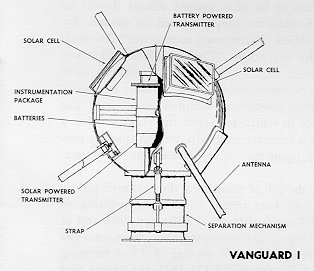
Credit: AmericaSpace website
I remember seeing this photograph, or variants of it, in countless books, magazines, etc., from childhood on. Hence, a very nostalgic photograph for me. And now, seeing it for the first time at such high resolution, a very nice photo indeed.
Additionally, per the NSSDCA website, at:
nssdc.gsfc.nasa.gov/nmc/spacecraftDisplay.do?id=VAGT3
"Vanguard Test Vehicle 3 (TV3) was the first U.S. attempt to launch a satellite into orbit around the Earth. It was a small satellite designed to test the launch capabilities of a three-stage launch vehicle and study the effects of the environment on a satellite and its systems in Earth orbit. It also was to be used to study micrometeor impacts and to obtain geodetic measurements through orbit analysis. The IGY Vanguard satellite program was designed with the purpose of launching one or more Earth orbiting satellites during the International Geophysical Year (IGY).
At launch on 6 December 1957 at 16:44:34 UT at the Atlantic Missile Range in Cape Canaveral, Florida, the booster ignited and began to rise but about 2 seconds after liftoff, after rising about a meter, the rocket lost thrust and began to settle back down to the launch pad. As it settled against the launch pad the fuel tanks ruptured and exploded, destroying the rocket and severely damaging the launch pad. The Vanguard (Vanguard 1A) satellite was thrown clear and landed on the ground a short distance away with its transmitters still sending out a beacon signal. The satellite was damaged, however, and could not be reused. It is now on display at the Smithsonian Air and Space Museum.
[airandspace.si.edu/collection-objects/satellite-vanguard-...
Credit: NASM website]
The exact cause of the accident was never determined, presumably it was due to a fuel leak between the fuel tank and the rocket engine, possibly due to a loose connection in a fuel line or low fuel pump inlet pressure allowing some of the burning fuel in the thrust chamber to leak back into the fuel tank."
Additional excellent & pertinent Vanguard reading:
www.spaceflighthistories.com/post/vanguard
Credit: “SPACEFLIGHT HISTORIES” website
And:
www.drewexmachina.com/2017/12/06/vanguard-tv-3-americas-f...
Credit: Andrew LePage/Drew Ex Machina website
Finally…interesting:
www.collectspace.com/ubb/Forum14/HTML/000241.html
Credit: collectSPACE website
Mobile phone reference image for 19mm and x3 germanium lens test. This is intended to help judge the field of view from the comparable thermal shots.
Comments are warmly welcomed.
For more thermal images covering a diverse range of subjects please visit (and join!) the Therm-App (and others) thermal imaging group at www.flickr.com/groups/therm-app-users/
Flames are visible from burning peat lands in Tumbang Nusa, outside Palangka Raya, Central Kalimantan.
Photo by Aulia Erlangga/CIFOR
If you use one of our photos, please credit it accordingly and let us know. You can reach us through our Flickr account or at: cifor-mediainfo@cgiar.org and m.edliadi@cgiar.org
GOLDSTRIKE RESOURCES LTD.
1300 - 1111 West Georgia Street
Vancouver, British Columbia
Canada, V6E 4M3
Telephone: 604 681 1820
Facsimile: 604 681 1864
GoldStrikeResources.com
Goldstrike Cuts 14.25 GPT Gold Over 2.4 Metres With Visible Gold – Drilling Under Way
August 20, 2012 – Goldstrike Resources Ltd. (TSX-V: GSR) is pleased to report positive initial results from its 100% controlled Plateau Property in Yukon. Significant extensions have been added to zones of gold mineralization discovered by Goldstrike in 2011 and the teams currently in the field continue to discover multiple new zones of mineralization. This demonstrates the strong gold potential of this property. No historical work has ever been documented on the Plateau property.
All gold mineralization discovered to date is original.
Team One
Plateau North – Goldrush Zone
Soil sampling has extended the Goldrush trend (first discovered in late 2011) from 400 metres to 1.8 kilometres to date and the trend remains open. Sampling in 2012 has so far returned values from background up to 26 grams per tonne gold from decomposed rock in pits. Multiple additional assays are pending. Further soil sample grids 3 and 4 kilometres to the west and southwest have been completed, with the focus on expanding the area of known gold mineralization. These assays are also pending.
Gold mineralization in the Goldrush zone appears to be hosted in multiple stacked carbonaceous biotite-sericite shear zones that cut the property in a north-south direction and remains open. Initial shallow exploratory drilling on the Goldrush zone was recently completed to trace the geometry and extent of the gold mineralization. Assays are pending.
Plateau Northeast
A new mineralized quartz stockwork was recently discovered within an extensive area of mineralized limestone and calcareous sediments named the Golden Arc zone. The limestone host rock has been outlined over a length of more than 600 metres, and is up to 40 metres thick. It is silicified and fractured, with 15% quartz stringers that contain sulphides, and the zone remains open. A coincident magnetic feature 250 to 300 metres long is associated with the showing, and early soil sampling has returned values from background up to 564 parts per billion gold. Follow up prospecting, mapping, and sampling were recently completed in the area to trace the full extent of the gold mineralization. Assays are pending.
Plateau South – Goldstack Zone
A gold mineralized zone identified by local prospector Tom Morgan while staking early in 2012 to increase Goldstrike’s landholdings in the area has been confirmed as a new discovery. The showing in the “Goldstack Zone” is a structurally controlled quartz breccia within an area of extensive quartz veining, stockwork and brecciation that has produced numerous samples containing coarse visible gold. Three channel samples cut across the strike of the zone have returned average values of 14.25 grams per tonne over a total length of 2.4 metres. Individual channel sample results include 23.82 grams per tonne over 1 metre and 7.71 grams per tonne over 1 metre. Another channel sample cut across strike 7 metres to the east returned a weighted average of 7.29 grams per tonne gold over 1.3 metres, including 40.1 grams over 10 cm. The current true thickness of the Goldstack mineralized zone has been measured at 9 metres in core. Additional channel samples have been taken along strike, and results are pending. Prospecting has discovered gold mineralization on trend 3.5 km to the west and 1 km to the east of the Goldstack showing, and the zone remains open. The Goldstack zone is being drilled to trace the gold mineralization to depth and along strike, and it remains open in all directions. Assays are pending.
Plateau South – Yellow Giant Trend
Prospecting and mapping has confirmed that the Yellow Giant Trend is a major new regional scale system of parallel gold-bearing structures at least 25 kilometres long and 5.5 km wide, and that it remains open in all directions. This large system contains extensive quartz veining, gossans, and mineralization throughout. Gold mineralization has been confirmed up to 28 grams per tonne in initial rock grab samples at the newly named Goldbank zone. The bulk of assays taken along and across the Yellow Giant Trend remain pending.
VG Zone
Follow up prospecting and sampling in 2012 of the area around the previously reported sample containing visible gold and grading 4.6 ounces per ton gold has defined an area of structurally controlled gold mineralization measuring about 225 by 100 metres. This has been named the VG Zone, and it remains open in all directions. Within the VG Zone several samples containing coarse visible gold were taken from weathered outcrop/subcrop. The VG Zone continues to be expanded daily, with new mineralization having now been discovered up to 1000 metres away both to the northeast and the southwest. Infill mapping and sampling continues, and assays are pending. Reconnaissance sampling and prospecting continue on trend, and new mineralization continues to be found, expanding the dimensions of the VG Zone.
Team Two
Solomon’s Summit
Solomon’s Summit is a zone of gold mineralization that was discovered in 2011 within a 3 by 1.5-kilometre limestone unit. A rock chip sample from outcrop assayed 5.3 grams per tonne gold. Additional mineralization was identified within a larger, northwest-trending zone known as Solomon’s Trend. New results from 2012 sampling have outlined a strong 2.5 by 1.6 kilometre multi-element gold soil anomaly with 14 of 235 samples (6%) between 100 and 508 parts per billion gold, within a large halo of 69 anomalous samples (29%) ranging from 25 to 99.9 parts per billion gold. The remainder of the soils returned values between background and 24.99 parts per billion gold. Rock assays from this zone are pending, and follow up trenching and drilling have been recommended.
Team Two has also completed 2012 mapping, prospecting, and sampling programs on Big One, Lucky Strike, and Livingstone, and has identified new mineralization on all properties. Assay results are pending.
Assays from a total of 1454 rock, 596 soil, and 11 silt samples, and assays from all drill core from the 2012 exploration programs remain outstanding.
“We are very pleased with the results of the 2012 program to date”, said Goldstrike President and CEO Terry King. “With the bulk of the assays still outstanding we look forward to the future with great anticipation.”
Sample analysis and assaying for all of Goldstrike's projects are being conducted by Acme Analytical Laboratories Ltd in Vancouver, BC and AGAT Laboratories Limited in Mississauga, Ontario, both of which are ISO 9001 accredited. Soil samples are dried at 60oC, reduced to 100 grams, and sieved to -80 mesh. A 15 gram charge is then dissolved with a 1:1:1 aqua regia digestion, and analyzed by a 72-element combination ICP-MS and ICP-AES package that includes gold. Rock samples are crushed, split, and 250 gram samples are sieved to 200 mesh. 30 gram charges are then assayed for gold using fire assay fusion and ICP-ES, and in addition, 0.5 mg charges are dissolved with a 1:1:1 aqua regia digestion, and analyzed by 37-element ICP-MS that also includes gold. Rigorous procedures are in place regarding sample collection, chain of custody and data entry. Certified assay standards, duplicate samples and blanks are routinely inserted into the sample stream to ensure integrity of the assay process.
Note: Grab samples are selective by nature, and are unlikely to represent average grades on the property.
Trevor J. Bremner, P. Geo., Senior Consulting Geologist and Advisor to Goldstrike's Board, is a qualified person, as defined by National Instrument 43-101, for Goldstrike's Yukon exploration projects and supervised the preparation of the technical information in this release.
For new maps and photos on the Plateau project, refer to Goldstrike's web site at GoldstrikeResources.com.
ON BEHALF OF THE BOARD
Terrence E. King
For further information, please visit the company’s website at GoldstrikeResources.com or contact Jeff Stuart of King James Capital Corporation, handling Investor Relations for the Company, by telephone at (604) 805-0375 or by email at jstuart@kingjamescapital.com.
Neither TSX Venture Exchange nor its Regulation Services Provider (as that term is defined in the policies of the TSX Venture Exchange) accepts responsibility for the adequacy or accuracy of this release.
While searching for the baseball-card exhibit, we walked past the museum's immense collection of stored items, including silver, paintings, clocks and sculptures.
Another picture revealing the white lower jaw. They frequently raised their heads higher just before a deep dive, at which time it was sometimes possible to see white. The blow is also visible against the iceberg.
St Mary stands on a hill overlooking what was once the sea and sand spit of land that Sandwich still sits. The sea has receded, but St Mary is still there, its wooden cupola topped tower visible for those who look for it, or notice these things in the 21st Century.
This was my third visit to the Blessed Mary, first time I found it locked, second time wardens were preparing it for the Nativity service.
It was open, and even had a welcoming sign hanging near to the gate to the churchyard, always welcome.
Amazing how much I missed the first time; brasses, medieval tiles, good glass. Always worth returning.
-----------------------------------------
The tower makes this church one of the easiest in Kent to identify. It is capped by a little cupola and wooden balustrade of eighteenth-century date that replaced a medieval spire. During the Middle Ages the church was owned by Leeds Priory which invested heavily in the structure, and was no doubt responsible for the excellent sedilia built in about 1350. The canopy is supported by a quadripartite vault in turn supported by angry little heads. Above the sedilia is the cut-off end of a prickett beam. The east window, of Decorated style stonework, has a thirteenth-century hangover in the form of a shafted rere-arch. There are two excellent modern stained glass windows designed by F.W Cole, which show the Creation (1980) and St Francis (1992). The good altar rails are of Queen Anne's reign, as are the splendid Royal Arms.
www.kentchurches.info/church.asp?p=Woodnesborough
------------------------------------------------------------------------------------------
WOODNESBOROUGH,
¶OR Winsborough, as it is usually called, lies the next parish northward from Eastry, being written in the survey of Domesday, Wanesberge. It took its name according to Verstegan, from the Saxon idol Woden, (and it is spelt by some Wodensborough) whose place of worship was in it; however that may be, the termination of the word berge, or borough, shews it to be of high antiquity.
art of this parish, over which the manor of Boxley claims, is within the jurisdiction of the justices of the town and port of Sandwich, and liberty of the cinque ports; and the residue is in the hundred of Eastry, and jurisdiction of the county of Kent.
There are three boroughs in this parish, viz. Cold Friday, Hamwold, and Marshborough; the borsholders of which are chosen at the petty sessions of the justices, acting at Wingham, for the east division of the lath of St. Augustine.
THIS PARISH is large, being two miles and an half one way, and upwards of a mile and an half the other. The church stands nearly in the centre of it, on high ground. At a small distance from the church is Woodnesborough hill, both of which are sea marks. This hill is a very high mount, seemingly thrown up by art, and consisting of a sandy earth, it has been thought by some to have been the place on which the idol Woden from whom this place is supposed to have taken its name) was worshipped in the time of the Saxons; by others to be the burial place of Vortimer, the Saxon king, who died in 457, whilst others suppose this mount was raised over those who fell in the battle fought between Ceoldred, king of Mercia, and Ina, king of the West Saxons, in the year 715, at Woodnesbeorb, according to the Saxon chronicle, which name Dr. Plot supposes to be Woodnesborough. Vortimer, as our historians tell us, at his death, desired to be buried near the place where the Saxons used to land, being persuaded that his bones would deter them from any attempt in future. Though authors differ much on the place of his burial, yet this mount at Woodnesborough is as probable, or more so, perhaps, than any other, for it was near to, and was cast up so high as to be plainly seen from the Portus Rutupinus, which at that time was the general landing place of the Saxon fleets. Some years ago there were found upon the top of it sundry sepulchral remains, viz. a glass vessel (engraved by the Rev. Mr. Douglas, in his Nænia;) a fibula, (engraved by Mr. Eoys, in his collections for Sandwich;) the head of a spear, and some fragments of Roman vessels. Much of the earth of sand has been lately removed round the sides of it, but nothing further has been found.
At a small distance northward from hence, at the bottom of a short steep hill, lies the village called Woodnesborough-street, and sometimes Cold Fridaystreet, containing thirty four houses. The vicaragehouse is situated in the middle of it, being a new handsome building; almost contiguous to it is a handsome sashed house, belonging to the Jull family, now made use of as a poor-house; through this street the road leads to Sandwich. West ward of the street stands the parsonage-house, late the seat of Oliver Stephens, esq. deceased, and now of his window, as will be further noticed hereafter. Besides the manors and estates in this parish, particularly described, in the western parts of it there are several hamlets, as Somerfield, Barnsole, Coombe, with New-street, Great and Little Flemings, Ringlemere, and the farm of Christians Court.
In the north east part of the parish, the road from Eastry, by the parsonage of Woodnesborough northwestward, divides; one road, which in antient deeds is called Lovekys-street, going towards Ash-street; the other through the hamlet of Marshborough, formerly called Marshborough, alias Stipins, to Each End and Sandwich, the two windmills close to the entrance of which are with in the bounds of this parish. Each, Upper Each, called antiently Upriche, and Each End, antiently called Netheriche, were both formerly accounted manors, and are mentioned as such in the marriage settlement of Henry Whyte, esq. in the beginning of queen Elizabeth's reign. After the Whytes, these manors passed in like manner as Grove, in this parish, to the James's. Upper Each, or Upriche, has for many years belonged to the family of Abbot, of Ramsgate, and is now the property of John Abbot, esq. of Canterbury. Each End, or Netheriche, belongs, one moiety to the heirs or devisees of the late earl of Strafford, and the other moiety to John Matson, esq. of Sandwich.
¶It cannot but occur to the reader how much this parish abounds with Saxon names, besides the name of Wodens borough, the street of Cold Friday, mentioned before, is certainly derived from the Saxon words, Cola, and Friga, which latter was the name of a goddess, worshipped by the Saxons, and her day Frige-deag, from whence our day of Friday is derived; other places in this parish, mentioned before likewise, claim, surely, their original from the same language.
This parish contains about 3000 acres, the whole rents of it being about 3373l. yearly value. It is very bare of coppice wood; the Old Wood, so called, in Ringleton, being the only one in it. The soil of this parish is very rich and fertile, equal to those the most so in this neighbourhood, particularly as to the plantations of hops, which have much increased within these few years past. The middle of the parish is high ground, and is in general a flat open country of arable common fields. West and south-westward the lands are more inclosed with hedges. North and north-westward of the parsonage, towards Sandwich, they are low and wet, consisting of a large level of marsh land, the nearness of which makes the other parts of this parish rather unhealthy, which is not otherwise very pleasant in any part of it. There was a fair held here yearly, on Holy Thursday, but it has been for some time disused.
In Ringleton field, in this parish, there was found about the year 1514, a fine gold coin, weighing about twelve shillings, with a loop of the same metal to hang it by; on one side was the figure of a young man in armour, a helmet on his head, and a spear over his right shoulder; on the reverse, the figure of Victory, with a sword in her hand, the point downwards.
The church, which is dedicated to St. Mary, consists of a nave, and two isles, having a square tower steeple at the west end, with a modern wooden turret and vane at the top of it, in which are five bells, made in 1676. It had a high spire on the tower, which was taken down some years ago. At the east end of the chancel is a marble tablet for John Cason, esq. of this place, justice of the peace, obt. 1718; John Cason, esq. his son, obt. 1755; arms,Argent, a chevron, sable, between three wolves heads, erased, gules, on an escutcheon of pretence, sable, a chevron, between three fleurs de lis, of the field; another for Thomas Blechenden, of the antient family of that name, of Aldington, in Kent, obt. 1661; arms, Azure, a fess nebulee, argent, between three lions heads erased, or, attired, gules, impalingBoys. On the south side, an antient altar monument with gothic pillars and arches, having had shields and arms, now obliterated. Against the wall, under the canopy, two brass plates, which have been removed to this place, from two grave-stones in the chancel; the first for Sir John Parcar, late vicar of this church, who died the v.day of May, a°o dni m° v° xiij° on the second are Latin verses to the memory of Nichs Spencer, esq. obt. 1593. In the middle of the chancel, a gravestone for William Docksey, esq. of Snellston, in Derbyshire, a justice of the peace, obt. 1760; Sarah his wife, youngest daughter of John Cason, esq. obt. 1774; arms,Or, a lion rampant, azure, surmounted of a bend, argent. On a gravestone on the north side of the chancel, on a brass plate, On a chevron, three quatersoils, between three annulets, quartering other coats, now obliterated, for Master Myghell Heyre, sumtyme vicar of this churche, who dyed the xxii day of July, m° v° xxviii. In the north isle are several memorials for the family of Gillow, arms, A lion rampant, in chief, three fleurs de lis. At the entrance into the chancel, on a grave-stone, on a brass plate, John Hill, gent. of the parish of Nassall, in Staffordshire, obt. 1605. A mural monument for William Gibbs, of this parish, obt. 1777; arms,Argent, three battle axes, in fess, sable. In the church-yard are altar tombs to the memory of the Julls, and for Sladden; one for John Verall, gent. sometime mayor of Sandwich, obt. 1610; and another for John Benchkin, of Pouton, obt. 1639.
There were formerly painted in the windows of this church,Or, a chief indented, azure, for John de Sandwich. Several coats of arms, among which were those of Valence and St. Leger,Argent, three leaves in sinster bend, their points downward, proper.— On a canton, azure, three crescents, or, for Grove.— Argent, three escallops in chief, or, in base a crescent, gules, for Helpestone, usually called Hilpurton, bailiff of Sandwich, in 1299. A shield, being Helpeston's badge, another On a fess engrailed, three cinquefoils, between three garbs, for John Hill, of Nasall, in Staffordshire, who lies buried in this church. —A fess engrailed, three lions rampant, in chief, on the fess, a crescent for difference, for Spencer, customer, of Sandwich. — Quarterly, four coats; first, On a chevron, three quaterfoils; second, Per pale, ermine and argent; third, A cross, between four pomegranates, slipped; sourth,Three bars, wavy, for Michael Heyre, vicar here in 1520.
The church of Woodnesborough was given, in the reign of king Henry I. by a religious woman, one Ascelina de Wodensberg, to the priory of Ledes, soon after the foundation of it; to which deed was witness Robert de Crevequer, founder of the priory, Elias his son, and others; which gift was confirmed by the said Robert, who by his charter, released to the priory all his right and title to it. It was likewise confirmed by archbishop Theobald, and several of his successors, and by king Henry III. by his charter of inspeximus in his 41st year.
Archbishop William Corboil, who came to the see of Canterbury, three years after the foundation of Ledes priory, at the instance and petition of Ascelina above mentioned, who resigned this church into his hands for this purpose, appropriated it to the prior and convent, for the finding of necessary cloaths, for the canons there; and a vicarage was accordingly endowed in it.
There was a controversy between the prior and convent, and Adam, vicar of this church, in 1627, anno 14 Henry II. concerning the great tithes arising from the crofts and curtilages within this parish, which was referred to the prior of Rochester, who was the pope's delegate for this purpose, who determined that the prior and convent of Ledes, as rectors of this church, should receive, without any exception, all the great tithes of wheat, barley, oats, beans, peas, and of every fort of corn arising, or to arise from all lands, crofts, curtilages, or other places whatever, situated within the bounds, of this parish; and that the prior and convent should yearly pay to the said vicar, and his successors, half a seam of barley, and half a seam of beans, at the nativity of our Lord. (fn. 10)
¶After which, this parsonage appropriate,(which appears to have been esteemed as a manor) together with the advowson of the vicarage, remained with the prior and convent of Ledes, till its dissolution in the 31st year of king Henry VIII. when it was, with all its lands and possessions, surrendered into the king's hands, who by his dotation charter, in his 33d year, settled both parsonage and advowson on his new-founded dean and chapter of Rochester, with whom they remain at this time. On the dissolution of deans and chapters, after the death of king Charles I. this parsonage was surveyed in 1649, when is appeared that the manor or parsonage of Woodnesborough, with the scite thereof, and all manner of tithes belonging to it, with a garden and orchard of one acre, was valued all together at 300l. that the lessee was to repair the premises, and the chancel of the church; that the vicarage was worth fifty pounds per annum. The then incumbent was under sequestration, and there was none to serve the cure; and that the church was then quite ruinated, and in great decay. (fn. 11)
Two tramcars pass each other on the funicular section with a part of locomotive Nº 2 visible. Card (Nº 307) published by Multifoto - Trieste.
La vida agitada y el corre corre diario puede a veces volvernos ciegos de lo que nos rodea.. este señor ni me debe recordar pero en mi caso aún lo tengo presente.
Over the break between modules we were given a task to produce a series of images as a small book, inspired by one or more of Ed Ruscha’s.
I decided to use and reinterpret Ruscha’s Colored People, 1972. Taking the simple minimalistic aesthetics, as well as subversive message within, but twisting and changing the message and intent to a slightly different topic. Nolen et al aptly describe Ruscha’s intentions as being a book that:
“… indirectly addresses “colored people” with photographs of cacti and palm trees stripped of background and floating against white wall paper.”
Nolan, B.J., Cohen, M. & Zabaszkiewicz, S. (2014)
Instead of depicting exotic plants against a white background to symbolize people of colour, I chose to subvert the topic to “Visible Women” using a variety of flowers to indirectly address how women are judged on a narrow boundary of beauty standards (as well as making an indirect reference to Caroline Criado-Perez’s 2019 Invisible Women). Much like Ruscha I do not intend to describe my images via captions nor as a statement solely relying on the title as a subtle means to communicate my concept, and much like Ruschas the primary vehicle I will use to present my images will be a bound book, but unlike Ruscha this will be in landscape format. However I am not adverse to utilising modern technology and creating a virtual book as another method of presentation.
Barely visible through the fog encasing Burrs is Hughes-Fowler '5MT' 2-6-0 'Crab' no.13065 with the first train of the day, the 09:30 Bury-Rawtenstall train.
Trying out a visible mending technique that was taught by Katrina Rodabaugh in the Slow Fashion Style class.
This is my first attempt at Sashiko style stitching on an old pair of Levis. I still have to weave over the hole and there are still other holes to patch in this beat up pair of jeans.
The now complete "Visible Pinball Machine." The machine will be on display publicly for the first time at the 2007 Pacific Pinball Expo in San Rafael, CA. Visit www.nbam.org/ppexpo/visiblePinball.html for details.
Copyright © 2014 Ruggero Poggianella Photostream
All rights reserved. Please, do not use my photos/videos without my written permission.
Please note that the fact that "this photo is public" doesn't mean it's public domain or a free “stock image”. Unauthorized use is strictly prohibited. If you wish to use any of my images for any reason/purpose please contact me for written permission. Tous droits reservés. Défense d'utilisation de cette image sans ma permission. Todos derechos reservados. No usar sin mi consentimiento.
© Copyright: Você não pode usar!
© Copyright: Sie dürfen es nicht kopieren !
© حقوق النشر محفوظة. لا يمكنك استخدام الصورة
© Copyright: You can not use my photos !
© Copyright: No se puede utilizar mis fotos !
© Copyright:Sie können nicht meine Fotos !
© Copyright: Vous ne pouvez pas utiliser mes photos !
© Copyright: Non è possibile utilizzare le mie foto!
© Copyright: ! لا يمكنك استخدام الصور الخاصة بي
© Copyright: ! איר קענען ניט נוצן מיין פאָטאָס
© Copyright: 你不能用我的照片!
© Copyright: あなたは私の写真を使用することはできません!
© Copyright: तुम मेरे फ़ोटो का उपयोग नहीं कर सकते हैं!
© Copyright: Вы не можете использовать мои фотографии!
Roscoff, le “coteau du forgeron” en breton, est, aujourd’hui, d’un abord facile, à deux pas de Saint-Pol de Léon, vieille cité épiscopale. En ce début de 3e millénaire, la hache de guerre est définitivement enterrée avec les Anglais. La langue de Shakespeare résonne dans les rues du vieux port, comme celles de Goethe ou de Dante Alighieri. Normal, l’île de Bretagne n’a jamais été si proche que depuis qu’Alexis Gourvennec et ses camarades paysans de la Sica de Saint-Pol créèrent la Britanny Ferry, comme un trait d’union entre trois nations séparées par les caprices de l’Histoire. Au port du Bloscon, de gros paquebots blancs attendent leur provende de touristes à destination des eldorados spirituels des Celtes.
L’ombre des contrebandiers…
Le passé, riche et prospère, est toujours là, visible, à fleur de cette peau grenue de vieux granite. La maison dite de Mary Stuart, se tient toujours debout face au nord, à l’île de Batz, à quelques encablures. Elle avait jadis les pieds dans l’eau, avant la rectification des quais et des bassins à flots. Elle n’est que l’un des multiples témoins de pierre des époques fastes, celles où Roscoff se livrait à un négoce officiel et… moins officiel, les deux participant tout autant à son insolente opulence. La contrebande. Mais la guerre de course aussi. Qui fit la fortune du petit port, chanté par Tristan Corbière, le poète maudit morlaisien, qui avait ici ses quartiers d’été et y vit un “trou de flibustiers” un “vieux nid à corsaire”! Pas étonnant qu’avec un passé si grand, les gens d’ici aient eu assez d’écus pour construire, de 1515 et 1545, l’église Notre-Dame de Kroaz-Baz, entièrement restaurée à l’identique. Roscoff, ses vieilles rues, sa maison des Johnnies et de l’oignon, son jardin exotique…
This is the second of the series.
It is part of the bigger "Chaos" I wanted to create.
well,I actually created.
this is also a 9" 1/2 x 7" 1/2 Watercolor.
Painted on arches,cold press (300 lb)
and was painted on Sept. the 9th '14
Over the break between modules we were given a task to produce a series of images as a small book, inspired by one or more of Ed Ruscha’s.
I decided to use and reinterpret Ruscha’s Colored People, 1972. Taking the simple minimalistic aesthetics, as well as subversive message within, but twisting and changing the message and intent to a slightly different topic. Nolen et al aptly describe Ruscha’s intentions as being a book that:
“… indirectly addresses “colored people” with photographs of cacti and palm trees stripped of background and floating against white wall paper.”
Nolan, B.J., Cohen, M. & Zabaszkiewicz, S. (2014)
Instead of depicting exotic plants against a white background to symbolize people of colour, I chose to subvert the topic to “Visible Women” using a variety of flowers to indirectly address how women are judged on a narrow boundary of beauty standards (as well as making an indirect reference to Caroline Criado-Perez’s 2019 Invisible Women). Much like Ruscha I do not intend to describe my images via captions nor as a statement solely relying on the title as a subtle means to communicate my concept, and much like Ruschas the primary vehicle I will use to present my images will be a bound book, but unlike Ruscha this will be in landscape format. However I am not adverse to utilising modern technology and creating a virtual book as another method of presentation.
Over the break between modules we were given a task to produce a series of images as a small book, inspired by one or more of Ed Ruscha’s.
I decided to use and reinterpret Ruscha’s Colored People, 1972. Taking the simple minimalistic aesthetics, as well as subversive message within, but twisting and changing the message and intent to a slightly different topic. Nolen et al aptly describe Ruscha’s intentions as being a book that:
“… indirectly addresses “colored people” with photographs of cacti and palm trees stripped of background and floating against white wall paper.”
Nolan, B.J., Cohen, M. & Zabaszkiewicz, S. (2014)
Instead of depicting exotic plants against a white background to symbolize people of colour, I chose to subvert the topic to “Visible Women” using a variety of flowers to indirectly address how women are judged on a narrow boundary of beauty standards (as well as making an indirect reference to Caroline Criado-Perez’s 2019 Invisible Women). Much like Ruscha I do not intend to describe my images via captions nor as a statement solely relying on the title as a subtle means to communicate my concept, and much like Ruschas the primary vehicle I will use to present my images will be a bound book, but unlike Ruscha this will be in landscape format. However I am not adverse to utilising modern technology and creating a virtual book as another method of presentation.
I've been a little bit too busy and haven't done much painting...
This is something that I decided to paint and added a few things to it.
the colorful design in the lower left is based on something that i painted before...
simple circles and half circles with colors that go very well together...
it was finished on May the 24th '12