View allAll Photos Tagged ULTRAVIOLET
Just 4 days left until Christmas and here it is the grand finale of the advent fireworks in ultraviolet.
Unlike red colour, violet is mysterious and calm, giving wondering feeling to the surrounding.
It is perceived as royal colour and used in expensive packing to emphasise the exclusiveness.
Ultraviolet GT3 RS finally in Warsaw :) Such a gorgeous color!
Feel invited to visit me on Facebook and Instagram:
She's a problem to solve.
This is our Luna Lovegood picture. Anyone guess why? :)
I hate, hate, hate the car in the background, but I couldn't get the light in without it. Sigh. What can do you?
Please, please, please, please watch this. It is life changing. People need our help.
Exceptional fluorescence under ultraviolet compared to the same scene illuminated with normal white light.
Full article: Alien Transformations Under Ultraviolet
It’s amazing how transformative ultraviolet fluorescence can be. This is a black weevil sitting on a white daisy to our eyes, but when photographed with intense ultraviolet light, the fluorescing light bouncing off is magical. View large and read on!
I was out for a walk with my daughter yesterday and along the road was a small patch of daisies. I was going to pick one for her, but I realized she had already fallen asleep. I still went to pluck one for later, but noticed a very tiny weevil resting in the center. This quickly became MY flower, and while my daughter slept in her stroller I hurried back home to get this weevil unto my UV studio setup.
For reference, this is likely the species of weevil that is in my image: www.kerbtier.de/Pages/Fotos/FotoLargeN/Curculionidae/Ceut... - the Cabbage Seed Pod Weevil.
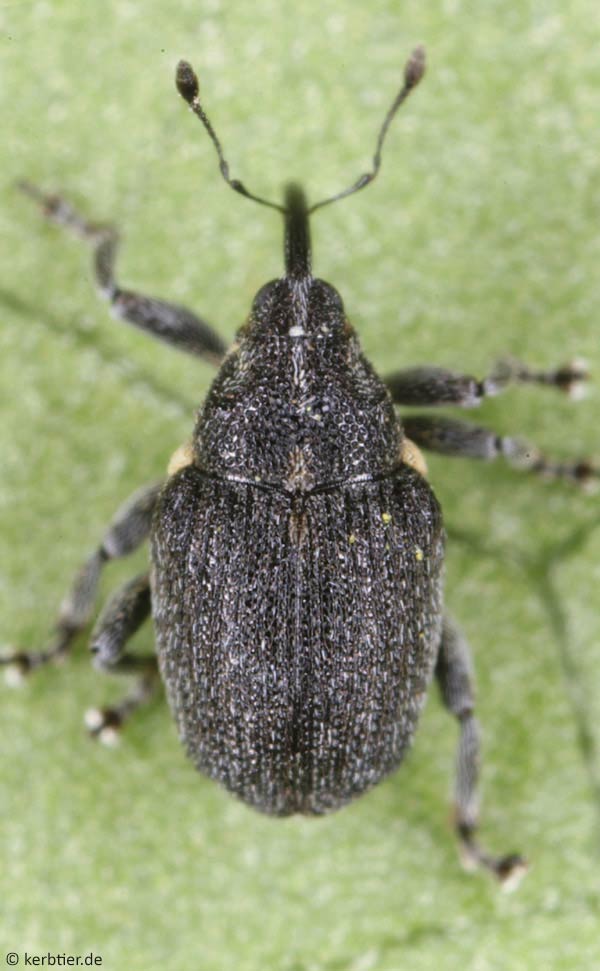
Weevils are generally cooperative insects, and this one was also sluggish from a colder night. I could gently poke it’s backside to get him to move in the direction I wanted, towards the outer edge of the petals. He was still somewhat unpredictable, but eventually this pose happened and I thought it was more dynamic “hanging off” than just a static resting position. Shortly after the image was taken, he warmed up and became quite active and I was unable to get the same level of cooperation. That’s quite alright – I already got the shot I was after.
The flashes I’m using only emit ultraviolet light, which the camera cannot directly see. If UV light bounced back to the camera, we’d get a black image. The visible light that bounces off the subject has fluoresced from the UV spectrum to give us what you’re looking at. UVIVF or UltraViolet-Induced Visible Fluorescence is the physics at work here – nothing special about the camera, it’s unmodified – it’s all about getting a purely UV-only light source.
Most things fluoresce, but to such a small degree that we would never know it. I’ve modified Yongnuo 685 flashes to remove a UV blocking filter and then adding two 77mm filters to the front of the flash head: a MidOpt BP365 and a Hoya U340. Each of these block the visible spectrum almost entirely, but each one bleeds a bit on opposite ends of visible (one red, the other purple). Combined, the isolate UV very nicely. They’re not cheap, however! In order to get enough light for this image to be made, I need three of these flashes at point-blank range at full power.
Even with that much UV light, this image required ISO 8000. While the depth of field is very shallow, F/8 was used to get as much in focus as possible at roughly 2:1 magnification and cropped in heavily from there. Technically speaking this image is just barely possible to be made – it pushes limits. Visually, we end up with something out of this world – a white flower with a black beetle become something enchanting.
While I can’t explore UV photography with large groups, I most certainly run private workshops in this area! Just send a note to don@komarechka.com if you’re interested. :)
After cooking a meal in my toaster oven I removed the foil from the bottom and shined an ultraviolet light on it. While there was a few areas where there was visible matter, the ultraviolet light drew out a lot more material that had spattered on it. Who'da thought?
A succulent in our back yard taken with Rollei Infrared film with a Canon A-1 camera with a FDn 50mm f1.4 lens with deep red filter attached.
I went to the J.C. Raulston Arboretum today here in Raleigh. This was one of my favorite shots I took. I really upped the vibrancy and saturation on this one to give it a really bright color pop to contrast with the moody bokeh. I think it's quite lovely. Even in Winter there is still color to be found! <3
This image from the Hubble Deep Ultraviolet Legacy Survey encompasses 12,000 star-forming galaxies in the constellation Fornax - a region known as the GOODS-South field. With the addition of ultraviolet light imagery, astronomers using NASA/ESA's Hubble Space Telescope captured the largest panoramic view of the fire and fury of star birth in the distant universe. The busiest star-forming period in the cosmos happened about three billion years after the big bang.
So far, ultraviolet light has been the missing piece of the cosmic puzzle. Now, combined with data in infrared and visible light from Hubble and other space- and ground-based telescopes, astronomers have assembled the most comprehensive portrait yet of the universe’s evolutionary history. The image straddles the gap between the very distant galaxies, which can only be viewed in infrared light, and closer galaxies, which can be seen across different wavelengths. The light from distant star-forming regions in remote galaxies started out as ultraviolet, but the expansion of the universe has shifted the light into infrared wavelengths. By comparing images of star formation in the distant and nearby universe, astronomers can get a better understanding of how nearby galaxies grew from small clumps of hot, young stars long ago.
Credit: ESA/Hubble & NASA
NASA Goddard Space Flight Center enables NASA’s mission through four scientific endeavors: Earth Science, Heliophysics, Solar System Exploration, and Astrophysics. Goddard plays a leading role in NASA’s accomplishments by contributing compelling scientific knowledge to advance the Agency’s mission.
Follow us on Twitter
Like us on Facebook
Find us on Instagram
Projet photographique en ultraviolet, avec la participation d' Anthony Pelé.
Série complète à découvrir sur mon site : www.plferrer.photos/series/echo-urbain/
Tours photo à la Défense :
Version française en haut / English version below
------------------------------------------------------------------------------------------
[Version française]
La nébuleuse de la Rosette (Caldwell 49) et son amas (Caldwell 50 / NGC 2244).
Cette nébuleuse distante de 4700 à 5310 années lumières a un diamètre de 130 années lumières. Bien que l'amas NGC 2244 (Calwell 50) qu'elle porte en son sein soit à peine visible à l'œil nu les nuits sans lune par ciel non pollué et très clair, cette nébuleuse occupe dans notre ciel 4 fois le diamètre apparent de la pleine Lune (130' d'arc). Elle s'observe dans le ciel d'hiver à gauche de la constellation d'Orion, pratiquement au milieu de la ligne droite entre Bételgeuse et Procyon.
C'est un nuage de gaz, de l'hydrogène II principalement, d'une masse de 10000 fois celle de notre soleil. L'amas central est composé d'étoiles très jeunes (8 millions d'années) et très chaudes qui, par leur intense rayonnement ultraviolet (la luminosité absolue de certaines dépasse 450000 fois celle de notre soleil) chauffent l'hydrogène de la nébuleuse et la font briller dans le rouge.
Coté technique, la session a été faite entre 22h28 et 3h36 dans la nuit du 03/02/24 au 04/02/24 avec un canon 1200D défiltré partiellement par Photomax, un télescope de Newton Skywatcher 150/750, monture SW AZ-EQ5 (que je viens juste de réviser intégralement avec mes petites mains #fierté), une lunette de guidage Kepler 50/162 + caméra Asi 120 mm + PhD2 guiding sur Raspberry Pi 3B. J'ai fait 139 photos de 2 min de pose unitaire à 1600 iso (soit 4h38 de pose cumulée). J'ai prétraité les photos avec 27/30/36 DOF, puis retrait de gradient et détramage par photo, puis aligné, empilé et post-traité sous Siril. J'ai produit une starless et un starmask avec Starnet V2. J'ai ensuite fait le post traitement avec Astrosharp sur la starless. J'ai fini le post-traitement sur GIMP, incluant un flou gaussien 1.5 suivi d'un renfort de netteté sur le starmask.
------------------------------------------------------------------------------------------
[English version]
The Rosette Nebula (Caldwell 49) and its cluster (Caldwell 50 / NGC 2244).
This nebula, located 4700 to 5310 light-years away, has a diameter of 130 light-years. Although the NGC 2244 cluster (Caldwell 50) within it is barely visible to the naked eye on moonless nights under unpolluted and very clear skies, this nebula occupies in our sky 4 times the apparent diameter of the full Moon (130 arc minutes). It is observed in the winter sky to the left of the Orion constellation, practically in the middle of the straight line between Betelgeuse and Procyon. It is a cloud of gas, mainly hydrogen II, with a mass 10,000 times that of our Sun. The central cluster is composed of very young stars (8 million years) and very hot ones which, through their intense ultraviolet radiation (the absolute brightness of some exceeds 450,000 times that of our Sun), heat the hydrogen in the nebula and make it glow red.
The session was conducted between 10:28 PM and 3:36 AM on the night of 03/02/24 to 04/02/24 with a partially defiltered Canon 1200D by Photomax, a Skywatcher Newton 150/750 telescope, SW AZ-EQ5 mount (which I have just completely overhauled with my own hands #pride), a Kepler 50/162 guiding telescope + Asi 120 mm camera + PhD2 guiding on Raspberry Pi 3B. I took 139 photos of 2 minutes each at 1600 ISO (totaling 4 hours and 38 minutes of exposure). I preprocessed the photos with 27/30/36 DOF, then removed gradient and debayering per photo, aligned, stacked, and post-processed using Siril. I produced a starless image and a starmask with Starnet V2. I then did post-processing with Astrosharp on the starless image. I finished post-processing in GIMP, including a 1.5 Gaussian blur followed by sharpening on the starmask.