View allAll Photos Tagged Terrifyingly
The Archer unit within the Skrall Military is a highly trained warrior in multiple forms of weapons combat, but primarily trained in the use of the traditional heavy bow. The archers, while not as prominent on the battle field as the infantry, are considered an elite unit due to their high level of training and are a feared opponent. Although the infantry are feared and terrifyingly strong warriors, the archers are typically stronger and are nearly as devastating at close quarters as they are at a distance. The archer, like all units of the Skrall military under the command of Matu, are highly loyal to Matu and consider the battlefield as a place to obtain honor and glory. Win or lose, the lust for battle resides within every Skrall warrior.
I shot this underneath the Santa Monica pier while I was down in LA. It was such a different shooting experience than I'm used to - people were everywhere, kids kept running terrifyingly close to my tripod and lots of people stopped behind my camera to watch me. It honestly made me a bit uncomfortable, but I'm really happy with the outcome. My sister let me raid her closet and I found these two dresses, one in blue, one in red. I couldn't believe it when she said I could have them; it was like christmas all over!
One of my terrifyingly haunted bratzillas dolls! She's the witch mermaid. But I think she looks more like a ghost!lol
One of the fastest vehicles created by snow-bound spacemen was the ski rocket: a redundant space rocket stuck on a pair of skis. This terrifyingly fast machine had stereoscopic radar vision to help it avoid hazards.
4th Wall: All of the parts in this LDD build are real, apart from the trans-yellow canopies but it just looked wrong with clear or trans-brown ones.
On a frozen flooded field - the daytime temperature barely rises above zero and the nights are terrifyingly well below
Winter path with snow covered benches, trees and lamp-posts in Central Park covered in snow.
I love when the snow first falls in New York City - especially in Central Park. The quiet muffled stillness and icy warmth combine to pause the city's frenetic energy for a few hours.
This was taken the last time we had major snowfall in Manhattan during a blizzard. In truth, it probably wasn't the safest idea to be walking around Central Park when the wind gusts were so terrifyingly high but during the moments when the winds stopped, it was eerily beautiful.
--
View my New York City photography at my website NY Through The Lens.
Interested in my work and have questions about PR and media? Check out my:
About Page | PR Page | Media Page
To use any of my photos commercially, feel free to contact me via email at photos@nythroughthelens.com
This photo was taken during LONDON 2012
Priceless London Wonderground at Southbank Centre is a brand new festival.....a playground of wonders and curiosities!
Among the cabaret, circus shows, collection of preserved freak animals and other Coney Island-style attractions at the South Bank's Priceless London Wonderground is a terrifyingly high-spinning swing ride....... www.guardian.co.uk/travel/2012/jul/27/london-top-five-fam...
American postcard by Classico San Francisco, no. 233/007. Photo: Roman Freulich / Universal Pictures. Elsa Lanchester and Boris Karloff in The Bride of Frankenstein (James Whale, 1935).
British actor Boris Karloff (1887-1969) is one of the true icons of the Horror cinema. He portrayed Frankenstein's monster in Frankenstein (1931), Bride of Frankenstein (1935), and Son of Frankenstein (1939), which resulted in his immense popularity. In the following decades he worked in countless Horror films, but also in other genres, both in Europe and Hollywood.
Boris Karloff was born as William Henry Pratt in 1887 in London, England. Pratt himself stated that he was born in Dulwich, which is nearby in London. His parents were Edward John Pratt, Jr. and his third wife Eliza Sarah Millard. ‘Billy’never knew his father. Edward Pratt had worked for the Indian Salt Revenue Service, and had virtually abandoned his family in far off England. Edward died when his son was still an infant and so Billy was raised by his mother. He was the youngest of nine children, and following his mother's death was brought up by his elder brothers and sisters. As a child, Billy performed each Christmas in plays staged by St. Mary Magdalene's Church. His first role was that of The Demon King in the pantomime Cinderella. Billy was bow-legged, had a lisp, and stuttered. He conquered his stutter, but not his lisp, which was noticeable throughout his career in the film industry. After his education at private schools, he attended King's College London where he took studies aimed at a career with the British Government's Consular Service. However, in 1909, the 22-years-old left university without graduating and sailed from Liverpool to Canada, where he worked as a farm labourer and did various odd itinerant jobs. In Canada, he began appearing in theatrical performances, and chose the stage name Boris Karloff. Later, he claimed he chose ‘Boris’ because it sounded foreign and exotic, and that ‘Karloff’ was a family name. However, his daughter Sara Karloff publicly denied any knowledge of Slavic forebears, Karloff or otherwise. One reason for the name change was to prevent embarrassment to his family. He did not reunite with his family until he returned to Britain to make The Ghoul (T. Hayes Hunter, 1933), opposite Cedric Hardwicke. Karloff was extremely worried that his family would disapprove of his new, macabre claim to world fame. Instead, his brothers jostled for position around him and happily posed for publicity photographs. In 1911, Karloff joined the Jeanne Russell Company and later joined the Harry St. Clair Co. that performed in Minot, North Dakota, for a year in an opera house above a hardware store. Whilst he was trying to establish his acting career, Karloff had to perform years of difficult manual labour in Canada and the U.S. in order to make ends meet. He was left with back problems from which he suffered for the rest of his life. In 1917, he arrived in Hollywood, where he went on to make dozens of silent films. Some of his first roles were in film serials, such as The Masked Rider (Aubrey M. Kennedy, 1919), in Chapter 2 of which he can be glimpsed onscreen for the first time, and The Hope Diamond Mystery (Stuart Paton, 1920). In these early roles, he was often cast as an exotic Arabian or Indian villain. Other silent films were The Deadlier Sex (Robert Thornby, 1920) with Blanche Sweet, Omar the Tentmaker (James Young, 1922), Dynamite Dan (Bruce Mitchell, 1924) and Tarzan and the Golden Lion (J.P. McGowan, 1927) in which James Pierce played Tarzan. In 1926 Karloff found a provocative role in The Bells (James Young, 1926), in which he played a sinister hypnotist opposite Lionel Barrymore. He worked with Barrymore again in his first sound film, the thriller The Unholy Night (Lionel Barrymore, 1929).
A key film which brought Boris Karloff recognition was The Criminal Code (Howard Hawks, 1931), a prison drama in which he reprised a dramatic part he had played on stage. With his characteristic short-cropped hair and menacing features, Karloff was a frightening sight to behold. Opposite Edward G. Robinson, Karloff played a key supporting part as an unethical newspaper reporter in Five Star Final (Mervyn LeRoy, 1931), a film about tabloid journalism which was nominated for the Oscar for Best Picture. Karloff's role as Frankenstein's monster in Frankenstein (James Whale, 1931), based on the classic Mary Shelley book, propelled him to stardom. Wikipedia: “The bulky costume with four-inch platform boots made it an arduous role but the costume and extensive makeup produced the classic image. The costume was a job in itself for Karloff with the shoes weighing 11 pounds (5 kg) each.” The aura of mystery surrounding Karloff was highlighted in the opening credits, as he was listed as simply "?." The film was a commercial and critical success for Universal, and Karloff was instantly established as a hot property in Hollywood. Universal Studios was quick to acquire ownership of the copyright to the makeup format for the Frankenstein monster that Jack P. Pierce had designed. A year later, Karloff played another iconic character, Imhotep in The Mummy (Karl Freund, 1932). The Old Dark House (James Whale, 1932) with Charles Laughton, and the starring role in MGM’s The Mask of Fu Manchu (Charles Brabin, 1932) quickly followed. Steve Vertlieb at The Thunder Child: “Wonderfully kinky, the film co-starred young Myrna Loy as the intoxicating, yet sadistic Fah Lo See, Fu Manchu's sexually perverse daughter. Filmed prior to Hollywood's infamous production code, the film joyously escaped the later scrutiny of The Hayes Office, and remains a fascinating example of pre-code extravagance.” These films all confirmed Karloff's new-found stardom. Horror had become his primary genre, and he gave a string of lauded performances in 1930s Universal Horror films. Karloff reprised the role of Frankenstein's monster in two other films, the sensational Bride of Frankenstein (James Whale, 1935) and the less thrilling Son of Frankenstein (Rowland V. Lee, 1939), the latter also featuring Bela Lugosi. Steve Vertlieb about Bride oif Frankenstein: “Whale delivered perhaps the greatest horror film of the decade and easily the most critically acclaimed rendition of Mary Shelley's novel ever released. The Bride of Frankenstein remains a work of sheer genius, a brilliantly conceived and realized take on loneliness, vanity, and madness. The cast of British character actors is simply superb.” While the long, creative partnership between Karloff and Lugosi never led to a close friendship, it produced some of the actors' most revered and enduring productions, beginning with The Black Cat (Edgar G. Ullmer, 1934). Follow-ups included The Raven (Lew Landers, 1935), the rarely seen, imaginative science fiction melodrama The Invisible Ray (Lambert Hillyer, 1936), and The Body Snatcher (Robert Wise, 1945). Karloff played a wide variety of roles in other genres besides Horror. He was memorably gunned down in a bowling alley in Howard Hawks' classic Scarface (1932) starring Paul Muni.. He played a religious First World War soldier in John Ford’s epic The Lost Patrol (1934) opposite Victor McLaglen. Between 1938 and 1940, Karloff starred in five films for Monogram Pictures, including Mr. Wong, Detective (William Nigh, 1938). During this period, he also starred with Basil Rathbone in Tower of London (Rowland V. Lee, 1939) as the murderous henchman of King Richard III, and with Margaret Lindsay in British Intelligence (Terry O. Morse, 1940). In 1944, he underwent a spinal operation to relieve his chronic arthritic condition.
Boris Karloff revisited the Frankenstein mythos in several later films, taking the starring role of the villainous Dr. Niemann in House of Frankenstein (Erle C. Kenton, 1944), in which the monster was played by Glenn Strange. He reprised the role of the ‘mad scientist’ in Frankenstein 1970 (Howard W. Koch, 1958) as Baron Victor von Frankenstein II, the grandson of the original creator. The finale reveals that the crippled Baron has given his own face (i.e., Karloff's) to the monster. From 1945 to 1946, Boris Karloff appeared in three films for RKO produced by Val Lewton: Isle of the Dead (Mark Robson, 1945), The Body Snatcher (Robert Wise, 1945), and Bedlam (Mark Robson, 1946). Karloff had left Universal because he thought the Frankenstein franchise had run its course. Karloff was a frequent guest on radio programs. In 1949, he was the host and star of the radio and television anthology series Starring Boris Karloff. In 1950, he had his own weekly children's radio show in New York. He played children's music and told stories and riddles, and attracted many adult listeners as well. An enthusiastic performer, he returned to the Broadway stage in the original production of Arsenic and Old Lace (1941), in which he played a homicidal gangster enraged to be frequently mistaken for Karloff. In 1962, he reprised the role on television with Tony Randall and Tom Bosley. He also appeared as Captain Hook in the play Peter Pan with Jean Arthur. In 1955, he returned to the Broadway stage to portray the sympathetic Bishop Cauchon in Jean Anouilh's The Lark. Karloff regarded the production as the highlight of his long career. Julie Harris was his co-star as Joan of Arc in the celebrated play, recreated for live television in 1957 with Karloff, Harris and much of the original New York company intact. For his role, Karloff was nominated for a Tony Award. Karloff donned the monster make-up for the last time for a Halloween episode of the TV series Route 66 (1962), which also featured Peter Lorre and Lon Chaney, Jr. In the 1960s, Karloff appeared in several films for American International Pictures, including The Comedy of Terrors (Jacques Tourneur, 1963) with Vincent Price and Peter Lorre, The Raven (Roger Corman, 1963), The Terror (Roger Corman, 1963) with Jack Nicholson, and Die, Monster, Die! (Daniel Haller, 1965). Another project for American International release was the frightening Italian horror classic, I tre volti della paura/Black Sabbath (Mario Bava, 1963), in which Karloff played a vampire with bone chilling intensity. He also starred in British cult director Michael Reeves's second feature film, The Sorcerers (1966). He gained new popularity among a young generation when he narrated the animated TV film Dr. Seuss' How the Grinch Stole Christmas (Chuck Jones, Ben Washam. 1966), and provided the voice of the Grinch. Karloff later received a Grammy Award for Best Recording For Children after the story was released as a record. Then he starred as a retired horror film actor in Targets (Peter Bogdanovich, 1968), Steve Vertlieb: “Targets was a profoundly disturbing study of a young sniper holding a small Midwestern community, deep in the bible belt, terrifyingly at bay. The celebrated subplot concerned the philosophical dilemma of creating fanciful horrors on the screen, while graphic, troubling reality was eclipsing the superficiality so tiredly repeated by Hollywood. Karloff co-starred, essentially as himself, an aged horror star named Byron Orlok, who wants simply to retire from the imagined horrors of a faded genre, only to come shockingly to grips with the depravity and genuine terror found on America's streets. Bogdanovich's first film as a director won praise from critics and audiences throughout the world community, and won its elder star the best, most respectful notices of his later career.”. In 1968, he played occult expert Professor Marsh in the British production Curse of the Crimson Altar (Vernon Sewell, 1968), which was the last Karloff film to be released during his lifetime. He ended his career by appearing in four low-budget Mexican horror films, which were released posthumously. While shooting his final films, Karloff suffered from emphysema. Only half of one lung was still functioning and he required oxygen between takes. he contracted bronchitis in 1968 and was hospitalized. Early 1969, he died of pneumonia at the King Edward VII Hospital, Midhurst, in Sussex, at the age of 81. Boris Karloff married five times and had one child, daughter Sara Karloff, by his fourth wife.
Sources: Steve Vertlieb (The Thunder Child), Wikipedia, and IMDb.
American postcard by Classico San Francisco, no. 233/06. Photo: Roman Freulich / Universal Pictures. Boris Karloff in Frankenstein (James Whale, 1931).
British actor Boris Karloff (1887-1969) is one of the true icons of the Horror cinema. He portrayed Frankenstein's monster in Frankenstein (1931), Bride of Frankenstein (1935), and Son of Frankenstein (1939), which resulted in his immense popularity. In the following decades, he worked in countless Horror films, but also in other genres, both in Europe and Hollywood.
Boris Karloff was born William Henry Pratt in 1887 in London, England. Pratt himself stated that he was born in Dulwich, which is nearby in London. His parents were Edward John Pratt, Jr. and his third wife Eliza Sarah Millard. ‘Billy’ never knew his father. Edward Pratt had worked for the Indian Salt Revenue Service and had virtually abandoned his family in far-off England. Edward died when his son was still an infant and so Billy was raised by his mother. He was the youngest of nine children, and following his mother's death was brought up by his elder brothers and sisters. As a child, Billy performed each Christmas in plays staged by St. Mary Magdalene's Church. His first role was that of The Demon King in the pantomime Cinderella. Billy was bow-legged, had a lisp, and stuttered. He conquered his stutter, but not his lisp, which was noticeable throughout his career in the film industry. After his education at private schools, he attended King's College London where he took studies aimed at a career with the British Government's Consular Service. However, in 1909, the 22-year-old left university without graduating and sailed from Liverpool to Canada, where he worked as a farm labourer and did various odd itinerant jobs. In Canada, he began appearing in theatrical performances and chose the stage name Boris Karloff. Later, he claimed he chose ‘Boris’ because it sounded foreign and exotic, and that ‘Karloff’ was a family name. However, his daughter Sara Karloff publicly denied any knowledge of Slavic forebears, Karloff or otherwise. One reason for the name change was to prevent embarrassment to his family. He did not reunite with his family until he returned to Britain to make The Ghoul (T. Hayes Hunter, 1933), opposite Cedric Hardwicke. Karloff was distraught that his family would disapprove of his new, macabre claim to world fame. Instead, his brothers jostled for position around him and happily posed for publicity photographs. In 1911, Karloff joined the Jeanne Russell Company and later joined the Harry St. Clair Co. which performed in Minot, North Dakota, for a year in an opera house above a hardware store. While trying to establish his acting career, Karloff had to perform years of difficult manual labour in Canada and the U.S. to make ends meet. He was left with back problems from which he suffered for the rest of his life. In 1917, he arrived in Hollywood, where he went on to make dozens of silent films. Some of his first roles were in film serials, such as The Masked Rider (Aubrey M. Kennedy, 1919), in Chapter 2 of which he can be glimpsed onscreen for the first time, and The Hope Diamond Mystery (Stuart Paton, 1920). In these early roles, he was often cast as an exotic Arabian or Indian villain. Other silent films were The Deadlier Sex (Robert Thornby, 1920) with Blanche Sweet, Omar the Tentmaker (James Young, 1922), Dynamite Dan (Bruce Mitchell, 1924) and Tarzan and the Golden Lion (J.P. McGowan, 1927) in which James Pierce played Tarzan. In 1926 Karloff found a provocative role in The Bells (James Young, 1926), in which he played a sinister hypnotist opposite Lionel Barrymore. He worked with Barrymore again in his first sound film, the thriller The Unholy Night (Lionel Barrymore, 1929).
A key film which brought Boris Karloff recognition was The Criminal Code (Howard Hawks, 1931), a prison drama in which he reprised a dramatic part he had played on stage. With his characteristic short-cropped hair and menacing features, Karloff was a frightening sight to behold. Opposite Edward G. Robinson, Karloff played a key supporting part as an unethical newspaper reporter in Five Star Final (Mervyn LeRoy, 1931), a film about tabloid journalism which was nominated for the Oscar for Best Picture. Karloff's role as Frankenstein's monster in Frankenstein (James Whale, 1931), based on the classic Mary Shelley book, propelled him to stardom. Wikipedia: “The bulky costume with four-inch platform boots made it an arduous role but the costume and extensive makeup produced the classic image. The costume was a job in itself for Karloff with the shoes weighing 11 pounds (5 kg) each.” The aura of mystery surrounding Karloff was highlighted in the opening credits, as he was listed as simply "?." The film was a commercial and critical success for Universal, and Karloff was instantly established as a hot property in Hollywood. Universal Studios was quick to acquire ownership of the copyright to the makeup format for the Frankenstein monster that Jack P. Pierce had designed. A year later, Karloff played another iconic character, Imhotep in The Mummy (Karl Freund, 1932). The Old Dark House (James Whale, 1932) with Charles Laughton, and the starring role in MGM’s The Mask of Fu Manchu (Charles Brabin, 1932) quickly followed. Steve Vertlieb at The Thunder Child: “Wonderfully kinky, the film co-starred young Myrna Loy as the intoxicating, yet sadistic Fah Lo See, Fu Manchu's sexually perverse daughter. Filmed before Hollywood's infamous production code, the film joyously escaped the later scrutiny of The Hayes Office, and remains a fascinating example of pre-code extravagance.” These films all confirmed Karloff's new-found stardom. Horror had become his primary genre, and he gave a string of lauded performances in 1930s Universal Horror films. Karloff reprised the role of Frankenstein's monster in two other films, the sensational Bride of Frankenstein (James Whale, 1935) and the less thrilling Son of Frankenstein (Rowland V. Lee, 1939), the latter also featuring Bela Lugosi. Steve Vertlieb about Bride oif Frankenstein: “Whale delivered perhaps the greatest horror film of the decade and easily the most critically acclaimed rendition of Mary Shelley's novel ever released. The Bride of Frankenstein remains a work of sheer genius, a brilliantly conceived and realized take on loneliness, vanity, and madness. The cast of British character actors is simply superb.” While the long, creative partnership between Karloff and Lugosi never led to a close friendship, it produced some of the actors' most revered and enduring productions, beginning with The Black Cat (Edgar G. Ullmer, 1934). Follow-ups included The Raven (Lew Landers, 1935), the rarely seen, imaginative science fiction melodrama The Invisible Ray (Lambert Hillyer, 1936), and The Body Snatcher (Robert Wise, 1945). Karloff played a wide variety of roles in other genres besides Horror. He was memorably gunned down in a bowling alley in Howard Hawks' classic Scarface (1932) starring Paul Muni.. He played a religious First World War soldier in John Ford’s epic The Lost Patrol (1934) opposite Victor McLaglen. Between 1938 and 1940, Karloff starred in five films for Monogram Pictures, including Mr. Wong, Detective (William Nigh, 1938). During this period, he also starred with Basil Rathbone in Tower of London (Rowland V. Lee, 1939) as the murderous henchman of King Richard III, and with Margaret Lindsay in British Intelligence (Terry O. Morse, 1940). In 1944, he underwent a spinal operation to relieve his chronic arthritic condition.
Boris Karloff revisited the Frankenstein mythos in several later films, taking the starring role of the villainous Dr. Niemann in House of Frankenstein (Erle C. Kenton, 1944), in which the monster was played by Glenn Strange. He reprised the role of the ‘mad scientist’ in Frankenstein 1970 (Howard W. Koch, 1958) as Baron Victor von Frankenstein II, the grandson of the original creator. The finale reveals that the crippled Baron has given his face (i.e., Karloff's) to the monster. From 1945 to 1946, Boris Karloff appeared in three films for RKO produced by Val Lewton: Isle of the Dead (Mark Robson, 1945), The Body Snatcher (Robert Wise, 1945), and Bedlam (Mark Robson, 1946). Karloff had left Universal because he thought the Frankenstein franchise had run its course. Karloff was a frequent guest on radio programs. In 1949, he was the host and star of the radio and television anthology series Starring Boris Karloff. In 1950, he had his own weekly children's radio show in New York. He played children's music, told stories and riddles, and attracted many adult listeners as well. An enthusiastic performer, he returned to the Broadway stage in the original production of Arsenic and Old Lace (1941), in which he played a homicidal gangster enraged to be frequently mistaken for Karloff. In 1962, he reprised the role on television with Tony Randall and Tom Bosley. He also appeared as Captain Hook in the play Peter Pan with Jean Arthur. In 1955, he returned to the Broadway stage to portray the sympathetic Bishop Cauchon in Jean Anouilh's The Lark. Karloff regarded the production as the highlight of his long career. Julie Harris was his co-star as Joan of Arc in the celebrated play, recreated for live television in 1957 with Karloff, Harris and much of the original New York company intact. For his role, Karloff was nominated for a Tony Award. Karloff donned the monster make-up for the last time for a Halloween episode of the TV series Route 66 (1962), which also featured Peter Lorre and Lon Chaney, Jr. In the 1960s, Karloff appeared in several films for American International Pictures, including The Comedy of Terrors (Jacques Tourneur, 1963) with Vincent Price and Peter Lorre, The Raven (Roger Corman, 1963), The Terror (Roger Corman, 1963) with Jack Nicholson, and Die, Monster, Die! (Daniel Haller, 1965). Another project for American International release was the frightening Italian horror classic, I tre volti della paura/Black Sabbath (Mario Bava, 1963), in which Karloff played a vampire with bone-chilling intensity. He also starred in British cult director Michael Reeves's second feature film, The Sorcerers (1966). He gained new popularity among the young generation when he narrated the animated TV film Dr. Seuss' How the Grinch Stole Christmas (Chuck Jones, Ben Washam. 1966), and provided the voice of the Grinch. Karloff later received a Grammy Award for Best Recording For Children after the story was released as a record. Then he starred as a retired horror film actor in Targets (Peter Bogdanovich, 1968), Steve Vertlieb: “Targets was a profoundly disturbing study of a young sniper holding a small Midwestern community, deep in the bible belt, terrifyingly at bay. The celebrated subplot concerned the philosophical dilemma of creating fanciful horrors on the screen, while the graphic, troubling reality was eclipsing the superficiality so tiredly repeated by Hollywood. Karloff co-starred, essentially as himself, an aged horror star named Byron Orlok, who wants simply to retire from the imagined horrors of a faded genre, only to come shockingly to grips with the depravity and genuine terror found on America's streets. Bogdanovich's first film as a director won praise from critics and audiences throughout the world community, and won its elder star the best, most respectful notices of his later career.”. In 1968, he played occult expert Professor Marsh in the British production Curse of the Crimson Altar (Vernon Sewell, 1968), which was the last Karloff film to be released during his lifetime. He ended his career by appearing in four low-budget Mexican horror films, which were released posthumously. While shooting his final films, Karloff suffered from emphysema. Only half of one lung was still functioning and he required oxygen between takes. he contracted bronchitis in 1968 and was hospitalized. In early 1969, he died of pneumonia at the King Edward VII Hospital, Midhurst, in Sussex, at the age of 81. Boris Karloff married five times and had one child, daughter Sara Karloff, by his fourth wife.
Sources: Steve Vertlieb (The Thunder Child), Wikipedia, and IMDb.
Dunluce Castle (Dún Lios in Irish) literally translated as the Hill fort of the fairy fort is one of the most extensive ruins of a medieval castle in Northern Ireland. It is located on the edge of a basalt outcropping in County Antrim, Northern Ireland and is accessible via a bridge connecting it to the mainland. It is between Portballintrae and Portrush. The castle is dramatically surrounded by terrifyingly steep drops either side, which would have been a very important factor to the early Christians and Vikings who were drawn to this place where an early Irish fort once stood. It is a State Care Historic Monument sited in the townland of Dunluce, in Coleraine Borough Council area, at gridsd ref: C9048 4137.[1] The earthworks (adjacent to Dunluce Castle) are a Scheduled Historic Monument, at grid ref: area of C905 412.
History
In the 1200s Richard de Burgh, Earl of Ulster, built the first castle at Dunluce.
It is first documented in the hands of the MacQuillin family in 1513. The earliest features of the castle are two large drum towers about 9 metres in diameter on the eastern side, both relics of a stronghold built here by the MacQuillins after they became lords of the district, the chieftan of which was known as Lord of the Route, in the late fourteenth century.
Later it became the home of the chief of the Clan MacDonnell of Antrim and the Clan MacDonald of Dunnyveg from Scotland. Chief John Mor MacDonald was the second son of Good John of Islay, Lord of the Isles, 6th chief of Clan Donald in Scotland. John Mor MacDonald was born through John of Islays second marriage to Princess Margaret Stewart, daughter of King Robert II of Scotland. In 1584, on the death of James MacDonald the 6th chief of the Clan MacDonald of Antrim and Dunnyveg, the Antrim Glens were seized by one of his younger brothers called Somerled or Sorley Boy MacDonnell known also as Sorley Buy. Sorley took the castle keeping it for himself and improving it in the Scottish style. Sorley Buy swore allegiance to James IV of Scotland and his son Ranald was made Randal MacDonnell, 1st Earl of Antrim by Queen Elizabeth.
Four years later, the Girona, a galleass from the Spanish Armada was wrecked in a storm on the rocks nearby. The cannon from the ship were installed in the gatehouses and the rest of the cargo sold, the funds used to restore the castle. MacDonnell's granddaughter Rose was born in the castle in 1613. At one point, part of the kitchen next to the cliff face collapsed into the sea, after which the wife of the owner refused to live in the castle any longer. According to a legend, when the kitchen fell into the sea only a kitchen boy survived as he was sitting in the corner of the kitchen which did not collapse.
Dunluce Castle served as the seat for the Earl of Antrim until the impoverishment of the MacDonnells in 1690, following the Battle of the Boyne. Since that time, the castle has deteriorated and parts were scavenged to serve as materials for nearby buildings. It is now in the care of the Environment and Heritage Service.
In 1973 the castle appeared on the inner cover of the multi-million selling Led Zeppelin album Houses of the Holy. Keanu Reeves character makes reference to this in the hit comedy film Bill & Ted's Excellent Adventure when they travel back in time to meet Socrates. The castle also appeared in Jackie Chan's - The Medallion (2001) when it provided an exterior setting for the 'villains lair'.
Kathmandu Durbar Square (Nepali: वसन्तपुर दरवार क्षेत्र, Basantapur Darbar Kshetra) in front of the old royal palace of the former Kathmandu Kingdom is one of three Durbar (royal palace) Squares in the Kathmandu Valley in Nepal, all of which are UNESCO World Heritage Sites.
Several buildings in the Square collapsed due to a major earthquake on 25 April 2015. Durbar Square was surrounded with spectacular architecture and vividly showcases the skills of the Newar artists and craftsmen over several centuries. The Royal Palace was originally at Dattaraya square and was later moved to the Durbar square.
The Kathmandu Durbar Square held the palaces of the Malla and Shah kings who ruled over the city. Along with these palaces, the square surrounds quadrangles, revealing courtyards and temples. It is known as Hanuman Dhoka Durbar Square, a name derived from a statue of Hanuman, the monkey devotee of Lord Ram, at the entrance of the palace.
CONTENTS
HISTORY AND CONSTRUCTION
The preference for the construction of royal palaces at this site dates back to as early as the Licchavi period in the third century. Even though the present palaces and temples have undergone repeated and extensive renovations and nothing physical remains from that period. Names like Gunapo and Gupo, which are the names referred to the palaces in the square in early scriptures, imply that the palaces were built by Gunakamadev, a King ruling late in the tenth-century. When Kathmandu City became independent under the rule of King Ratna Malla (1484–1520), the palaces in the square became the Royal Palaces for its Malla Kings. When Prithvi Narayan Shah invaded the Kathmandu Valley in 1769, he favored the Kathmandu Durbar Square for his palace. Other subsequent Shah kings continued to rule from the square until 1896 when they moved to the Narayan Hiti Palace.
The square is still the center of important royal events like the coronation of King Birendra Bir Bikram Shah in 1975 and King Gyanendra Bir Bikram Shah in 2001.
Though there are no written archives stating the history of Kathmandu Durbar Square, construction of the palace in the square is credited to Sankharadev (1069–1083). As the first king of the independent Kathmandu City, Ratna Malla is said to have built the Taleju temple in the Northern side of the palace in 1501. For this to be true then the temple would have had to have been built in the vihara style as part of the palace premise surrounding the Mul Chok courtyard for no evidence of a separate structure that would match this temple can be found within the square.
Construction of the Karnel Chok is not clearly stated in any historical inscriptions; although, it is probably the oldest among all the courtyards in the square. The Bhagavati Temple, originally known as a Narayan Temple, rises above the mansions surrounding it and was added during the time of Jagajaya Malla in the early eighteenth century. The Narayan idol within the temple was stolen so Prithvi Narayan Shah replaced it with an image of Bhagavati, completely transforming the name of the temple.
The oldest temples in the square are those built by Mahendra Malla (1560–1574). They are the temples of Jagannath, Kotilingeswara Mahadev, Mahendreswara, and the Taleju Temple. This three-roofed Taleju Temple was established in 1564, in a typical Newari architectural style and is elevated on platforms that form a pyramid-like structure. It is said that Mahendra Malla, when he was residing in Bhaktapur, was highly devoted to the Taleju Temple there; the Goddess being pleased with his devotion gave him a vision asking him to build a temple for her in the Kathmandu Durbar Square. With a help of a hermit, he designed the temple to give it its present form and the Goddess entered the temple in the form of a bee.
His successors Sadasiva (1575–1581), his son, Shiva Simha (1578–1619), and his grandson, Laksmi Narsingha (1619–1641), do not seem to have made any major additions to the square. During this period of three generations the only constructions to have occurred were the establishment of Degutale Temple dedicated to Goddess Mother Taleju by Shiva Simha and some enhancement in the royal palace by Laksminar Simha.
UNDER PRATAP MALLA
In the time of Pratap Malla, son of Laksminar Simha, the square was extensively developed. He was an intellectual, a pious devotee, and especially interested in arts. He called himself a Kavindra, king of poets, and boasted that he was learned in fifteen different languages. A passionate builder, following his coronation as a king, he immediately began enlargements to his royal palace, and rebuilt some old temples and constructed new temples, shrines and stupas around his kingdom.During the construction of his palace, he added a small entrance in the traditional, low and narrow Newari style. The door was elaborately decorated with carvings and paintings of deities and auspicious sings and was later transferred to the entrance of Mohan Chok. In front of the entrance he placed the statue of Hanuman thinking that Hanuman would strengthen his army and protect his home. The entrance leads to Nasal Chok, the courtyard where most royal events such as coronation, performances, and yagyas, holy fire rituals, take place. It was named after Nasadya, the God of Dance, and during the time of Pratap Malla the sacred mask dance dramas performed in Nasal Chok were widely famed. In one of these dramas, it is said that Pratap Malla himself played the role of Lord Vishnu and that the spirit of the Lord remained in the king's body even after the play. After consulting his Tantric leaders, he ordered a stone image of Lord Vishnu in his incarnation as Nara Simha, the half-lion and half-human form, and then transferred the spirit into the stone. This fine image of Nara Simha made in 1673 still stands in the Nasal Chok. In 1650, he commissioned for the construction of Mohan Chok in the palace. This chok remained the royal residential courtyard for many years and is believed to store a great amount of treasure under its surface. Pratap Malla also built Sundari Chok about this time. He placed a slab engraved with lines in fifteen languages and proclaimed that he who can understand the inscription would produce the flow of milk instead of water from Tutedhara, a fountain set in the outer walls of Mohan Chok. However elaborate his constructions may have been, they were not simply intended to emphasize his luxuries but also his and the importance of others' devotion towards deities. He made extensive donations to temples and had the older ones renovated. Next to the palace, he built a Krishna temple, the Vamsagopala, in an octagonal shape in 1649. He dedicated this temple to his two Indian wives, Rupamati and Rajamati, as both had died during the year it was built. In Mohan Chok, he erected a three roofed Agamachem temple and a unique temple with five superimposing roofs. After completely restoring the Mul Chok, he donated to the adjoining Taleju Temple. To the main temple of Taleju, he donated metal doors in 1670. He rebuilt the Degutale Temple built by his grandfather, Siva Simha, and the Taleju Temple in the palace square. As a substitute to the Indreswara Mahadeva Temple in the distant village of Panauti he built a Shiva temple, Indrapura, near his palace in the square. He carved hymns on the walls of the Jagannath Temple as prayers to Taleju in the form of Kali.
At the southern end of the square, near Kasthamandap at Maru, which was the main city crossroads for early traders, he built another pavilion named Kavindrapura, the mansion of the king of poets. In this mansion he set an idol of dancing Shiva, Nasadyo, which today is highly worshipped by dancers in the Valley.
In the process of beautifying his palace, he added fountains, ponds, and baths. In Sundari Chok, he established a low bath with a golden fountain. He built a small pond, the Naga Pokhari, in the palace adorned with Nagakastha, a wooden serpent, which is said he had ordered stolen from the royal pond in the Bhaktapur Durbar Square. He restored the Licchavi stone sculptures such as the Jalasayana Narayana, the Kaliyadamana, and the Kala Bhairav. An idol of Jalasayana Narayana was placed in a newly created pond in the Bhandarkhal garden in the eastern wing of the palace. As a substitute to the idol of Jalasayana Narayana in Buddhanilkantha, he channeled water from Buddhanilkantha to the pond in Bhandarkhal due bestow authenticity. The Kalyadana, a manifestation of Lord Krishna destroying Kaliya, a water serpent, is placed in Kalindi Chok, which is adjacent to the Mohan Chok. The approximately ten-feet-high image of terrifyingly portrayed Kal Bhairav is placed near the Jagannath Temple. This image is the focus of worship in the chok especially during Durga Puja.
With the death of Pratap Malla in 1674, the overall emphasis on the importance of the square came to a halt. His successors retained relatively insignificant power and the prevailing ministers took control of most of the royal rule. The ministers encountered little influence under these kings and, increasingly, interest of the arts and additions to the square was lost on them. They focused less on culture than Pratap Malla during the three decades that followed his death, steering the city and country more towards the arenas of politics and power, with only a few minor constructions made in the square. These projects included Parthivendra Malla building a temple referred to as Trailokya Mohan or Dasavatara, dedicated to Lord Vishnu in 1679. A large statue of Garuda, the mount of Lord Vishnu, was added in front of it a decade later. Parthivendra Malla added a pillar with image of his family in front of the Taleju Temple.
Around 1692, Radhilasmi, the widowed queen of Pratap Malla, erected the tall temples of Shiva known as Maju Deval near the Garuda image in the square. This temple stands on nine stepped platforms and is one of the tallest buildings in the square. Then her son, Bhupalendra Malla, took the throne and banished the widowed queen to the hills. His death came early at the age of twenty one and his widowed queen, Bhuvanalaksmi, built a temple in the square known as Kageswara Mahadev. The temple was built in the Newari style and acted as a substitute for worship of a distant temple in the hills. After the earthquake in 1934, the temple was restored with a dome roof, which was alien to the Newari architecture.
Jayaprakash Malla, the last Malla king to rule Kathmandu, built a temple for Kumari and Durga in her virginal state. The temple was named Kumari Bahal and was structured like a typical Newari vihara. In his house resides the Kumari, a girl who is revered as the living goddess. He also made a chariot for Kumari and in the courtyard had detailed terra cotta tiles of that time laid down.
UNDER THE SHAH DYNASTY
During the Shah dynasty that followed, the Kathmandu Durbar Square saw a number of changes. Two of the most unique temples in the square were built during this time. One is the Nautale, a nine-storied building known as Basantapur Durbar. It has four roofs and stands at the end of Nasal Chok at the East side of the palace. It is said that this building was set as a pleasure house. The lower three stories were made in the Newari farmhouse style. The upper floors have Newari style windows, sanjhya and tikijhya, and some of them are slightly projected from the wall. The other temple is annexed to the Vasantapur Durbar and has four-stories. This building was initially known as Vilasamandira, or Lohom Chok, but is now commonly known as Basantapur or Tejarat Chok. The lower floors of the Basantapur Chok display extensive woodcarvings and the roofs are made in popular the Mughal style. Archives state that Prthivi Narayan Shah built these two buildings in 1770.
Rana Bahadur Shah was enthroned at the age of two. Bahadur Shah, the second son of Prithvi Narayan Shah, ruled as a regent for his young nephew Rana Bahadur Shah for a close to a decade from 1785 to 1794 and built a temple of Shiva Parvati in the square. This one roofed temple is designed in the Newari style and is remarkably similar to previous temples built by the Mallas. It is rectangular in shape, and enshrines the Navadurga, a group of goddesses, on the ground floor. It has a wooden image of Shiva and Parvati at the window of the upper floor, looking out at the passersby in the square. Another significant donation made during the time of Rana Bahadur Shah is the metal-plated head of Swet Bhairav near the Degutale Temple. It was donated during the festival of Indra Jatra in 1795, and continues to play a major role during the festival every year. This approximately twelve feet high face of Bhairav is concealed behind a latticed wooden screen for the rest of the year. The following this donation Rana Bahadur donated a huge bronze bell as an offering to the Goddess Taleju. Together with the beating of the huge drums donated by his son Girvan Yudha, the bell was rung every day during the daily ritual worship to the goddess. Later these instruments were also used as an alarm system. However, after the death of his beloved third wife Kanimati Devi due to smallpox, Rana Bahadur Shah turned mad with grief and had many images of gods and goddesses smashed including the Taleju statue and bell, and Sitala, the goddess of smallpox.
In 1908, a palace, Gaddi Durbar, was built using European architectural designs. The Rana Prime Ministers who had taken over the power but not the throne of the country from the Shahs Kings from 1846 to 1951 were highly influenced by European styles. The Gaddi Durbar is covered in white plaster, has Greek columns and adjoins a large audience hall, all foreign features to Nepali architecture. The balconies of this durbar were reserved for the royal family during festivals to view the square below.
Some of the parts of the square like the Hatti Chok near the Kumari Bahal in the southern section of the square were removed during restoration after the devastating earthquake in 1934. While building the New Road, the southeastern part of the palace was cleared away, leaving only fragments in places as reminders of their past. Though decreased from its original size and attractiveness from its earlier seventeenth-century architecture, the Kathmandu Durbar Square still displays an ancient surrounding that spans abound five acres of land. It has palaces, temples, quadrangles, courtyards, ponds, and images that were brought together over three centuries of the Malla, the Shah, and the Rana dynasties. It was destroyed in the April 2015 Nepal earthquake.
VISITING
Kathmandu's Durbar Square is the site of the Hanuman Dhoka Palace Complex, which was the royal Nepalese residence until the 19th century and where important ceremonies, such as the coronation of the Nepalese monarch, took place. The palace is decorated with elaborately-carved wooden windows and panels and houses the King Tribhuwan Memorial Museum and the Mahendra Museum. It is possible to visit the state rooms inside the palace.
Time and again the temples and the palaces in the square have gone through reconstruction after being damaged by natural causes or neglect. Presently there are less than ten quadrangles in the square. The temples are being preserved as national heritage sites and the palace is being used as a museum. Only a few parts of the palace are open for visitors and the Taleju temples are only open for people of Hindu and Buddhist faiths.
At the southern end of Durbar Square is one of the most curious attractions in Nepal, the Kumari Chok. This gilded cage contains the Raj Kumari, a girl chosen through an ancient and mystical selection process to become the human incarnation of the Hindu mother goddess, Durga. She is worshiped during religious festivals and makes public appearances at other times for a fee paid to her guards.
WIKIPEDIA
French postcard in the Collection Cinéma by Editions La Malibran, Paris, no. CA 53, 1989. Photo: Boris Karloff and Elsa Lanchester in Bride of Frankenstein (James Whale, 1935).
British actor Boris Karloff (1887-1969) is one of the true icons of the Horror cinema. He portrayed Frankenstein's monster in Frankenstein (1931), Bride of Frankenstein (1935), and Son of Frankenstein (1939), which resulted in his immense popularity. In the following decades he worked in countless Horror films, but also in other genres, both in Europe and Hollywood.
Boris Karloff was born as William Henry Pratt in 1887 in London, England. Pratt himself stated that he was born in Dulwich, which is nearby in London. His parents were Edward John Pratt, Jr. and his third wife Eliza Sarah Millard. ‘Billy’never knew his father. Edward Pratt had worked for the Indian Salt Revenue Service, and had virtually abandoned his family in far off England. Edward died when his son was still an infant and so Billy was raised by his mother. He was the youngest of nine children, and following his mother's death was brought up by his elder brothers and sisters. As a child, Billy performed each Christmas in plays staged by St. Mary Magdalene's Church. His first role was that of The Demon King in the pantomime Cinderella. Billy was bow-legged, had a lisp, and stuttered. He conquered his stutter, but not his lisp, which was noticeable throughout his career in the film industry. After his education at private schools, he attended King's College London where he took studies aimed at a career with the British Government's Consular Service. However, in 1909, the 22-years-old left university without graduating and sailed from Liverpool to Canada, where he worked as a farm labourer and did various odd itinerant jobs. In Canada, he began appearing in theatrical performances, and chose the stage name Boris Karloff. Later, he claimed he chose ‘Boris’ because it sounded foreign and exotic, and that ‘Karloff’ was a family name. However, his daughter Sara Karloff publicly denied any knowledge of Slavic forebears, Karloff or otherwise. One reason for the name change was to prevent embarrassment to his family. He did not reunite with his family until he returned to Britain to make The Ghoul (T. Hayes Hunter, 1933), opposite Cedric Hardwicke. Karloff was extremely worried that his family would disapprove of his new, macabre claim to world fame. Instead, his brothers jostled for position around him and happily posed for publicity photographs. In 1911, Karloff joined the Jeanne Russell Company and later joined the Harry St. Clair Co. that performed in Minot, North Dakota, for a year in an opera house above a hardware store. Whilst he was trying to establish his acting career, Karloff had to perform years of difficult manual labour in Canada and the U.S. in order to make ends meet. He was left with back problems from which he suffered for the rest of his life. In 1917, he arrived in Hollywood, where he went on to make dozens of silent films. Some of his first roles were in film serials, such as The Masked Rider (Aubrey M. Kennedy, 1919), in Chapter 2 of which he can be glimpsed onscreen for the first time, and The Hope Diamond Mystery (Stuart Paton, 1920). In these early roles, he was often cast as an exotic Arabian or Indian villain. Other silent films were The Deadlier Sex (Robert Thornby, 1920) with Blanche Sweet, Omar the Tentmaker (James Young, 1922), Dynamite Dan (Bruce Mitchell, 1924) and Tarzan and the Golden Lion (J.P. McGowan, 1927) in which James Pierce played Tarzan. In 1926 Karloff found a provocative role in The Bells (James Young, 1926), in which he played a sinister hypnotist opposite Lionel Barrymore. He worked with Barrymore again in his first sound film, the thriller The Unholy Night (Lionel Barrymore, 1929).
A key film which brought Boris Karloff recognition was The Criminal Code (Howard Hawks, 1931), a prison drama in which he reprised a dramatic part he had played on stage. With his characteristic short-cropped hair and menacing features, Karloff was a frightening sight to behold. Opposite Edward G. Robinson, Karloff played a key supporting part as an unethical newspaper reporter in Five Star Final (Mervyn LeRoy, 1931), a film about tabloid journalism which was nominated for the Oscar for Best Picture. Karloff's role as Frankenstein's monster in Frankenstein (James Whale, 1931), based on the classic Mary Shelley book, propelled him to stardom. Wikipedia: “The bulky costume with four-inch platform boots made it an arduous role but the costume and extensive makeup produced the classic image. The costume was a job in itself for Karloff with the shoes weighing 11 pounds (5 kg) each.” The aura of mystery surrounding Karloff was highlighted in the opening credits, as he was listed as simply "?." The film was a commercial and critical success for Universal, and Karloff was instantly established as a hot property in Hollywood. Universal Studios was quick to acquire ownership of the copyright to the makeup format for the Frankenstein monster that Jack P. Pierce had designed. A year later, Karloff played another iconic character, Imhotep in The Mummy (Karl Freund, 1932). The Old Dark House (James Whale, 1932) with Charles Laughton, and the starring role in MGM’s The Mask of Fu Manchu (Charles Brabin, 1932) quickly followed. Steve Vertlieb at The Thunder Child: “Wonderfully kinky, the film co-starred young Myrna Loy as the intoxicating, yet sadistic Fah Lo See, Fu Manchu's sexually perverse daughter. Filmed prior to Hollywood's infamous production code, the film joyously escaped the later scrutiny of The Hayes Office, and remains a fascinating example of pre-code extravagance.” These films all confirmed Karloff's new-found stardom. Horror had become his primary genre, and he gave a string of lauded performances in 1930s Universal Horror films. Karloff reprised the role of Frankenstein's monster in two other films, the sensational Bride of Frankenstein (James Whale, 1935) and the less thrilling Son of Frankenstein (Rowland V. Lee, 1939), the latter also featuring Bela Lugosi. Steve Vertlieb about Bride oif Frankenstein: “Whale delivered perhaps the greatest horror film of the decade and easily the most critically acclaimed rendition of Mary Shelley's novel ever released. The Bride of Frankenstein remains a work of sheer genius, a brilliantly conceived and realized take on loneliness, vanity, and madness. The cast of British character actors is simply superb.” While the long, creative partnership between Karloff and Lugosi never led to a close friendship, it produced some of the actors' most revered and enduring productions, beginning with The Black Cat (Edgar G. Ullmer, 1934). Follow-ups included The Raven (Lew Landers, 1935), the rarely seen, imaginative science fiction melodrama The Invisible Ray (Lambert Hillyer, 1936), and The Body Snatcher (Robert Wise, 1945). Karloff played a wide variety of roles in other genres besides Horror. He was memorably gunned down in a bowling alley in Howard Hawks' classic Scarface (1932) starring Paul Muni.. He played a religious First World War soldier in John Ford’s epic The Lost Patrol (1934) opposite Victor McLaglen. Between 1938 and 1940, Karloff starred in five films for Monogram Pictures, including Mr. Wong, Detective (William Nigh, 1938). During this period, he also starred with Basil Rathbone in Tower of London (Rowland V. Lee, 1939) as the murderous henchman of King Richard III, and with Margaret Lindsay in British Intelligence (Terry O. Morse, 1940). In 1944, he underwent a spinal operation to relieve his chronic arthritic condition.
Boris Karloff revisited the Frankenstein mythos in several later films, taking the starring role of the villainous Dr. Niemann in House of Frankenstein (Erle C. Kenton, 1944), in which the monster was played by Glenn Strange. He reprised the role of the ‘mad scientist’ in Frankenstein 1970 (Howard W. Koch, 1958) as Baron Victor von Frankenstein II, the grandson of the original creator. The finale reveals that the crippled Baron has given his own face (i.e., Karloff's) to the monster. From 1945 to 1946, Boris Karloff appeared in three films for RKO produced by Val Lewton: Isle of the Dead (Mark Robson, 1945), The Body Snatcher (Robert Wise, 1945), and Bedlam (Mark Robson, 1946). Karloff had left Universal because he thought the Frankenstein franchise had run its course. Karloff was a frequent guest on radio programs. In 1949, he was the host and star of the radio and television anthology series Starring Boris Karloff. In 1950, he had his own weekly children's radio show in New York. He played children's music and told stories and riddles, and attracted many adult listeners as well. An enthusiastic performer, he returned to the Broadway stage in the original production of Arsenic and Old Lace (1941), in which he played a homicidal gangster enraged to be frequently mistaken for Karloff. In 1962, he reprised the role on television with Tony Randall and Tom Bosley. He also appeared as Captain Hook in the play Peter Pan with Jean Arthur. In 1955, he returned to the Broadway stage to portray the sympathetic Bishop Cauchon in Jean Anouilh's The Lark. Karloff regarded the production as the highlight of his long career. Julie Harris was his co-star as Joan of Arc in the celebrated play, recreated for live television in 1957 with Karloff, Harris and much of the original New York company intact. For his role, Karloff was nominated for a Tony Award. Karloff donned the monster make-up for the last time for a Halloween episode of the TV series Route 66 (1962), which also featured Peter Lorre and Lon Chaney, Jr. In the 1960s, Karloff appeared in several films for American International Pictures, including The Comedy of Terrors (Jacques Tourneur, 1963) with Vincent Price and Peter Lorre, The Raven (Roger Corman, 1963), The Terror (Roger Corman, 1963) with Jack Nicholson, and Die, Monster, Die! (Daniel Haller, 1965). Another project for American International release was the frightening Italian horror classic, I tre volti della paura/Black Sabbath (Mario Bava, 1963), in which Karloff played a vampire with bone chilling intensity. He also starred in British cult director Michael Reeves's second feature film, The Sorcerers (1966). He gained new popularity among a young generation when he narrated the animated TV film Dr. Seuss' How the Grinch Stole Christmas (Chuck Jones, Ben Washam. 1966), and provided the voice of the Grinch. Karloff later received a Grammy Award for Best Recording For Children after the story was released as a record. Then he starred as a retired horror film actor in Targets (Peter Bogdanovich, 1968), Steve Vertlieb: “Targets was a profoundly disturbing study of a young sniper holding a small Midwestern community, deep in the bible belt, terrifyingly at bay. The celebrated subplot concerned the philosophical dilemma of creating fanciful horrors on the screen, while graphic, troubling reality was eclipsing the superficiality so tiredly repeated by Hollywood. Karloff co-starred, essentially as himself, an aged horror star named Byron Orlok, who wants simply to retire from the imagined horrors of a faded genre, only to come shockingly to grips with the depravity and genuine terror found on America's streets. Bogdanovich's first film as a director won praise from critics and audiences throughout the world community, and won its elder star the best, most respectful notices of his later career.”. In 1968, he played occult expert Professor Marsh in the British production Curse of the Crimson Altar (Vernon Sewell, 1968), which was the last Karloff film to be released during his lifetime. He ended his career by appearing in four low-budget Mexican horror films, which were released posthumously. While shooting his final films, Karloff suffered from emphysema. Only half of one lung was still functioning and he required oxygen between takes. he contracted bronchitis in 1968 and was hospitalized. Early 1969, he died of pneumonia at the King Edward VII Hospital, Midhurst, in Sussex, at the age of 81. Boris Karloff married five times and had one child, daughter Sara Karloff, by his fourth wife.
Sources: Steve Vertlieb (The Thunder Child), Wikipedia, and IMDb.
The famous towering sculptures of the Kelpies in Falkirk.
When I first walked up to the 'Kelpie Hub' in The Helix and caught sight of the sculptures I have to say I was slightly underwhelmed. Maybe it is because I have seen so many photos of them that the first sight of them for real didn't amaze me greatly. However, as I approached them, the colossal scale of these equine behemoths became apparent. Once up close these sculptures are truly awesome, these two towering heads looming over you, one looking, with fixed stare directly ahead, and the other throwing it's head back into the air. You really can't appreciate these sculptures until you are up close.
I must admit I have a slight amount of cognitive dissonance over the meaning of these sculptures. As you walk towards them, there is a poem inscribed on the walkway by poet Jim Carruth.
'Echo the great beasts that work among us
unbridled in this kingdom between canal and firth
here to harness the river
and carry each weary traveller
Bow down your strong heads to taste the water
Stretch up your long necks to face the sun' Jim Carruth
This poem would suggest they are representative of workhorses, beasts of burden who toil to serve man. Symbols of the work horses which were used in the past heavy industry and their value to man during this period
However, I always thought Kelpies were malevolent water spirits in Scottish folklore which took the form of horses, so it's perhaps strange they picked this title for them. Maybe it is just because it has an enigmatic, Scottish sounding ring to it.
But it's the appearance of the statues which I find strange. I believe each head is meant to represent part of the poem with one bowing it's head to drink and the other stretching it's head to the sun. However, their is something very unsettling about their appearance. The statue with it's head bowed looks benign from the side but face it head on and it's stare cuts terrifyingly into you. The other head flung upwards looks like it is almost in anger or pain.
Maybe these statues are not meant to represent the placid work horses but perhaps that of the malign spirits in Scottish Folklore. Perhaps the reason they are so captivating is because you can see both these representations in them. I guess the artist is the only one who will really know what they were intended to truly represent
Regardless of this, they are endlessly enchanting and made all the more so with their slightly sinister aura.
The ruins of Dunluce Castle, on the North Antrim Coast, stand on a 100ft high basalt stack with a sea cave underneath. The cave is accessible both by land and sea as it runs underneath the castle. The ruins as seen today are breathtaking; even roofless the remains portray the air of strength this site once commanded and before the advent of gunpowder it would have been almost impossible to conquer.
The conjectural source of the name Dunluce derives from dun-lois, a combination of dun, 'fort', used adjectively and lois, the word normally translated as 'ring-fort'. Perhaps the best rendering would be 'fortified residence'. This castle crowned crag is surrounded by terrifyingly steep drops either side, which would have been a very important factor to the early Christians and Vikings who were drawn to this romantic place where an early Irish fort once stood.
The first stone castle was built here in the 13th Century by Richard de Burgh, Earl of Ulster. The earliest features of the castle are two large drum towers about 9 metres in diameter on the eastern side, both relics of a stronghold built here by the McQuillans after they became lords of the district in the late fourteenth century.
The castle often came under siege and in 1584 Sorley Boy MacDonnell(1505-1589) captured it when one of his men, employed in the castle, hauled his comrades up the cliff in a basket. Sorley Boy came into some booty (some of which can be seen in the Ulster Museum in Belfast) in 1588 when the Spanish Armada treasure ship Girona was wrecked by a storm off the Giant's Causeway, further along the coast. The money was used to modernise the castle but in 1639, during a dinner, the kitchen fell into the sea and carried away the cooks and all their pots. After this it was abandoned by the MacDonnell clan.
The castle as seen today dates largely from the 16th and 17th centuries' periods of construction by the MacDonnells, however the outer walls with round towers are attributed to the earlier work by the MacQuillans. The Castle can only be reached over a bridge which now replaces the original rocky connection. The bridge leads to the "New" Scottish style gatehouse built after the original was destroyed by cannon in 1584 by the Lord Deputy of Ireland, Sir John Perrot. The two openings in the old gatehouse wall were for housing cannons that Sorely Boy MacDonnell salvaged from the wrecked Girona.
Dunluce castle includes a Manor House built in the 1630s. This had a Great Hall with two fireplaces and three bow windows. The ill-fated Kitchen Court complex also contained a workshop on the ground floor with accommodation above. In the north east Tower, one of the two defensive Towers in the outer wall, lies the entrance to a concealed tunnel offering escape to the beach.
On the "Mainland" area of the Castle complex can be found the remains of the earl's garden laid out in three terraces, documented evidence stated that these gardens included a bowling green. This area also included the Lodgings for the many visitors who graced the Castle in the 17th century. Also in this area can be found the stables with the remains of a corn drying kiln in one.
Source UK Heritage
The Challenger crewmember remains are being transferred from 7 hearse vehicles to a MAC C-141 transport plane at the Kennedy Space Center's Shuttle Landing Facility for transport to Dover Air Force Base, Delaware. The STS-51L crew consisted of: Mission Specialist, Ellison S. Onizuka, Teacher in Space Participant Sharon Christa McAuliffe, Payload Specialist, Greg Jarvis and Mission Specialist, Judy Resnik. In the front row from left to right: Pilot Mike Smith, Commander, Dick Scobee and Mission Specialist, Ron McNair.
As we investigate the reasoning of the STS-107 breakup, we cannot ignore the horrible fate of the crew. Here is an account of the final moments of not only the Columbia, but the Challenger crew.
_______________________________
Was Columbia in reentry LOS at the time of breakup?
No. Both voice communication and data telemetry were still being received right up to the breakup of Columbia. Unlike previous manned programs - Mercury, Gemini and Apollo, as well as the Russian Soyuz vehicles - the Shuttle does not have a loss-of-signal phase during reentry. The reason is actually pretty simple.
First off, understand that the blackout period is caused by a sheath of ionized air, formed during the high-heating, high-deceleration phase of re-entry, through which radio waves cannot penetrate. This is what every manned flight from Mercury thru Apollo experienced, and provided much of the suspense and drama during the reentry phase of John Glenn's Friendship 7 Mercury flight. Even the Shuttle experienced the same effect during its early flights.
The communications loss due to the blackout period was resolved after the second Tracking Data and Relay Satellite (TDRS) was placed in orbit. The reason is that the ionization sheath is open at the trailing end behind the Shuttle, providing a hole through which communication with the shuttle can be maintained with the favorably positioned TDRS. This second TDRS also allows communication during the other portions of entry that did not exist prior to its placement in 1988 - a period roughly from the time of the de-orbit OMS burn to an altitude of 200,000 feet for a landing at Edwards Air Force Base, barring passes over ground sites.
So, with two functioning TDRS satellites in operation, communications with the Shuttle can be maintained throughout the entire reentry phase of the mission.
What happened to the crew when Columbia broke up?
Actually, it's better to speculate on the fate of the crew cabin, and then decide for yourself what probably happened to the crew.
Once the cabin tore loose from the rest of the fuselage and all electrical power was lost, the cabin was probably hammered, buffeted and braked by atmospheric drag as it continued its re-entry. The cabin would have been heated by the surrounding shock-induced plasma, and as G-forces built up the integrity of the heat-weakened aluminum infrastructure would have been compromised and the cabin would eventually collapse in on itself. Some fragmentation would have no doubt taken place, and pieces would have broken loose and fallen behind and below the cabin's path as they slowed down quicker in the atmospheric drag.
This speculation is based on some of the findings of the investigation into the loss of Challenger in 1986. As with Columbia, the initial impressions on the fate of the Challenger crew was that they had perished instantly when the shuttle came apart a minute after launch. However, when the crew cabin was found relatively intact a few months later did it become apparent that the cabin had in fact separated cleanly from the fuselage, continued on a parabolic arc to an altitude of ~65,000 feet, and then fell back to impact in the Atlantic Ocean with a force of 200 G’s. Even then, the cabin was still relatively intact despite hitting the surface of the ocean with that degree of force.
When the cabin broke loose from the rest of Challenger, it became separated from all electrical and life support resources. Save for a few seconds of air in the lines, very shortly after separation the crew would have been without any life support. Upon recovery it was found that the state of some life-support equipment indicated that at least some of the crew had survived the initial breakup were able to activate their safety equipment. Three of the four Personal Egress Air Packs (PEAP) located behind each seat on the Shuttle had in fact been activated. However, because the crew were not wearing any sort of pressure suits, the PEAPs would not have provided the required amount of breathable air necessary to retain consciousness at the altitudes the cabin reached. The team of coroners and medical specialists that performed the autopsies of the remains concluded that that the crew were soon all unconscious shortly after the cabin began its final arc of transit, and were most likely not killed until the impact with the ocean, two minutes after the External Tank exploded.
It should be noted that since the loss of Challenger, many of the contingency plans were revised extensively. As a result, Columbia’s crew were equipped with better survival gear, including pressure suits and personal parachutes. Assuming they were conscious of the emergency, the Columbia crew would have closed their visors when cabin pressure was lost, which would have automatically pressurized the suits. At that point, the only thing the crew would have needed to do would have been to wait until the cabin fell below 15,000', blow the escape hatch, extend the egress pole, slide out and away from the orbiter down the pole, and parachute to safety. This is how the procedure works in theory, and provided the cabin stayed relatively intact until 15,000'. Since this did not happen, it can be assumed that the cabin was compromised in such a way that the crew had no opportunity to attempt any sort of egress.
In Hemphill, searchers found what are believed to be human remains, and what appeared to be gauges and other Columbia components in a farmer's field on 2/10/03. Although no details were given on the human remains, over 100 pieces of debris ranging from gauges to switches and other components, many of which still had the wires attached to them. Remains that a hospital employee identified as charred torso, thigh bone and skull on a rural road near other unspecified debris in Hemphill, east of Nacogdoches. Remains identified as a charred human leg on a farm in Sabine County, about 50 miles (80 km) east of Nacogdoches.
"Elsewhere around Norwood, even grimmer discoveries were being made. Deputy Faron Howell was in charge of search teams that soon began stumbling across human remains.
"There was a hand, and a foot, then a leg from the knee down. One of my men found a human heart. The biggest piece was a torso, the upper bit with the chest ripped in half." A thigh bone and a skull, the flesh torn away, were also located."
The Unthinkable Fate of the Challenger Crew
The last words captured by the fight voice recorder in Challenger were not Commander Francis Scobee's haunting, "Go at throttle up." Three seconds later, Pilot Michael Smith uttered, "Uh oh," at the very moment that all electronic data from the spacecraft was lost.
The public has never heard the inflection of Smith's words, nor the ambient noise in the cabin that underscored them (you can read a transcript here). Despite the existence of evidence of what happened after Challenger's 73 seconds of flight, little of that reality is part of the public's consciousness, understanding, or recollection of the events of January 28, 1986. In part, this can be attributed to a justifiable desire to believe in a merciful outcome: that Christa McAuliffe and the shuttle astronauts all died instantly in what appeared from the ground to be an explosion. But like Smith's instinctive interjection, telltale signs exist that our worst nightmare about the Challenger disaster may have been true. It was very likely that the mid-air blast was not strong enough to kill the crew - and that at least some of the seven astronauts were terrifyingly aware of the impending fate.
More about Challenger
On July 28, 1986, Dr. Joseph P. Kerwin, director of Life Sciences at the Johnson Space Center, submitted his report on the cause of death of the Challenger astronauts. The crew module was found that March in 100 feet of water, about 18 miles from the launch site in a location coded "contact 67." While references to the crew were stricken from the report, details about the condition of the module provide many clues about the fate of the astronauts. Kerwin wrote that the cause of the crew's death was inconclusive, but that the force of the initial explosion was too weak to have caused death or even serious injury. This was a direct contradiction to NASA's standard line about the crew's fate, that they were vaporized in the explosion and suffered no further.
If the astronauts were not killed by the blast, then how long did they survive? Challenger as a whole was destroyed at 48,000 feet, but the crew module continued its flight upward for 25 more seconds (to 65,000 feet) before pitching straight down and falling into the Atlantic Ocean.
Evidence that at least some of the crew survived included the recovered personal egress air packs, or PEAPs, designed to provide oxygen to the crew in case they had to ditch the craft in a ground emergency. (NASA had no protocol for in-flight shuttle emergencies in 1986.) Each pack contained several minutes of breathing air, but the tanks had to be opened manually. Salvagers recovered four PEAPs; three of them had been opened. The one belonging to Michael Smith was mounted behind his seat, so it's likely another crewmember had leaned forward to activate it.
Kerwin and his experts theorized that the loss of cabin pressure inside the module could have knocked out the crew within a matter of seconds, but damage from the 200-mph impact made determining the rate of depressurization impossible. The air from the PEAPs would not be enough to keep the crew conscious during a rapid drop in pressure. But a rapid drop in pressure would likely have ripped up the middeck floor, which did not occur. A slow or gradual drop in pressure would keep the crew conscious much longer, and the impact at the bottom of that tumble was harsher on the crew's bodies than any car or plane crash would have been.
In either scenario, it is likely that some - if not all - of the crew were awake and coherent after the disintegration of Challenger, and were conscious long enough to feel the module pitch its nose straight down, to see the blue sky in the cockpit window rotate away in favor of the continent below, and to experience a weightless free fall toward the ocean that lasted a full two minutes and 55 seconds. It is a horrifying scenario so extreme that it's unlikely that even 25 more years will be enough to contemplate it objectively.
For now, many still choose to believe that the men and women aboard the Challenger didn't survive the explosion and were unaware that their loved ones on the ground were watching them descend in a plume of smoke to their deaths. Perhaps that belief holds some truth. Or perhaps, it simply serves to bring some peace to the earthbound souls left in the wake of the Challenger's loss.
Challenger was one of NASA's greatest successes - but also one of its darkest legacies.
It was initially built between 1975 and 1978 to be a test vehicle, but was later converted into a fully fledged spacecraft.
In its heyday, it completed nine milestone missions - from launching the first female astronaut into space to taking part in the first repair of a satellite by an astronaut.
But it was also the vehicle that very nearly ended the space program when a probe into the 1986 disaster found that the shuttle was doomed before it had even taken off.
Roger Boisjoly, a NASA contractor at rocket-builder Morton Thiokol Inc, warned in 1985 that seals on the booster rocket joints could fail in freezing temperatures.
'The result would be a catastrophe of the highest order — loss of human life,' he wrote in a memo.
On the eve of the ill-fated flight, Boisjoly and several colleagues reiterated their concerns and argued against launching because of predicted cold weather at the Kennedy Space Center.
But they were overruled by Morton Thiokol managers, who gave NASA the green light.
After the accident, Boisjoly testified to a presidential commission investigating the Challenger accident.
The group determined that hot gases leaked through a joint in one of the booster rockets shortly after blastoff that ended with the explosion of the shuttle's hydrogen fuel.
Boisjoly died in 2012 aged 73.
HOW CREW DIED ACCORDING TO NASA STUDY
(The following information appeared on the NASA Headquarters Website.)
On July 28, 1986 Rear Admiral Richard H. Truly, NASA's Associate Administrator for Space Flight and a former astronaut, released this report from Joseph P. Kerwin, biomedical specialist from the Johnson Space Center in Houston, Texas, relating to the deaths of the astronauts in the Challenger accident. Dr. Kerwin had been commissioned to undertake this study soon after the accident on January 28, 1986. A copy of this report is available in the NASA Historical Reference Collection, History Office, NASA Headquarters, Washington, DC.]
****************************************************************
RADM Richard H. Truly
Associate Administrator for Space Flight
NASA Headquarters
Code M
Washington, DC 20546
Dear Admiral Truly:
The search for wreckage of the Challenger crew cabin has been completed. A team of engineers and scientists has analyzed the wreckage and all other available evidence in an attempt to determine the cause of death of the Challenger crew. This letter is to report to you on the results of this effort. The findings are inconclusive. The impact of the crew compartment with the ocean surface was so violent that evidence of damage occurring in the seconds which followed the explosion was masked. Our final conclusions are:
·the cause of death of the Challenger astronauts cannot be positively determined;
·the forces to which the crew were exposed during Orbiter breakup were probably not sufficient to cause death or serious injury; and
·the crew possibly, but not certainly, lost consciousness in the seconds following Orbiter breakup due to in-flight loss of crew module pressure.
Our inspection and analyses revealed certain facts which support the above conclusions, and these are related below: The forces on the Orbiter at breakup were probably too low to cause death or serious injury to the crew but were sufficient to separate the crew compartment from the forward fuselage, cargo bay, nose cone, and forward reaction control compartment. The forces applied to the Orbiter to cause such destruction clearly exceed its design limits. The data available to estimate the magnitude and direction of these forces included ground photographs and measurements from onboard accelerometers, which were lost two-tenths of a second after vehicle breakup.
Two independent assessments of these data produced very similar estimates. The largest acceleration pulse occurred as the Orbiter forward fuselage separated and was rapidly pushed away from the external tank. It then pitched nose-down and was decelerated rapidly by aerodynamic forces. There are uncertainties in our analysis; the actual breakup is not visible on photographs because the Orbiter was hidden by the gaseous cloud surrounding the external tank. The range of most probable maximum accelerations is from 12 to 20 G's in the vertical axis. These accelerations were quite brief. In two seconds, they were below four G's; in less than ten seconds, the crew compartment was essentially in free fall. Medical analysis indicates that these accelerations are survivable, and that the probability of major injury to crew members is low.
After vehicle breakup, the crew compartment continued its upward trajectory, peaking at an altitude of 65,000 feet approximately 25 seconds after breakup. It then descended striking the ocean surface about two minutes and forty-five seconds after breakup at a velocity of about 207 miles per hour. The forces imposed by this impact approximated 200 G's, far in excess of the structural limits of the crew compartment or crew survivability levels.
The separation of the crew compartment deprived the crew of Orbiter-supplied oxygen, except for a few seconds supply in the lines. Each crew member's helmet was also connected to a personal egress air pack (PEAP) containing an emergency supply of breathing air (not oxygen) for ground egress emergencies, which must be manually activated to be available. Four PEAP's were recovered, and there is evidence that three had been activated. The nonactivated PEAP was identified as the Commander's, one of the others as the Pilot's, and the remaining ones could not be associated with any crew member. The evidence indicates that the PEAP's were not activated due to water impact.
It is possible, but not certain, that the crew lost consciousness due to an in-flight loss of crew module pressure. Data to support this is:
·The accident happened at 48,000 feet, and the crew cabin was at that altitude or higher for almost a minute. At that altitude, without an oxygen supply, loss of cabin pressure would have caused rapid loss of consciousness and it would not have been regained before water impact.
·PEAP activation could have been an instinctive response to unexpected loss of cabin pressure.
·If a leak developed in the crew compartment as a result of structural damage during or after breakup (even if the PEAP's had been activated), the breathing air available would not have prevented rapid loss of consciousness.
·The crew seats and restraint harnesses showed patterns of failure which demonstrates that all the seats were in place and occupied at water impact with all harnesses locked. This would likely be the case had rapid loss of consciousness occurred, but it does not constitute proof.
Much of our effort was expended attempting to determine whether a loss of cabin pressure occurred. We examined the wreckage carefully, including the crew module attach points to the fuselage, the crew seats, the pressure shell, the flight deck and middeck floors, and feedthroughs for electrical and plumbing connections. The windows were examined and fragments of glass analyzed chemically and microscopically. Some items of equipment stowed in lockers showed damage that might have occurred due to decompression; we experimentally decompressed similar items without conclusive results.
Impact damage to the windows was so extreme that the presence or absence of in-flight breakage could not be determined. The estimated breakup forces would not in themselves have broken the windows. A broken window due to flying debris remains a possibility; there was a piece of debris imbedded in the frame between two of the forward windows. We could not positively identify the origin of the debris or establish whether the event occurred in flight or at water impact. The same statement is true of the other crew compartment structure. Impact damage was so severe that no positive evidence for or against in-flight pressure loss could be found.
Finally, the skilled and dedicated efforts of the team from the Armed Forces Institute of Pathology, and their expert consultants, could not determine whether in-flight lack of oxygen occurred, nor could they determine the cause of death.
/signed/
Joseph P. Kerwin
"Exactly what happened..."
In February 2001 a visitor to my "Icarus Rising" site asked if I could tell her "exactly what happened" in the Challenger disaster. After chuckling for a moment over the fact that whole books have been written on that topic, I sat down and typed out for her the following summary of events, which is based upon my examination of print and video records of the disaster.
The extreme cold of the night before had chilled the rubber insulating O-rings in the right solid rocket booster's aft field joint (the joint near the SRB's lower supporting strut that attached it to the external fuel tank) well below their specified operating temperature. Because no shuttle had ever been launched in such cold weather, engineers at Morton Thiokol (the company that manufactures the boosters) had no data to say just what would happen in such conditions, although their examination of retrieved boosters from previous launches had led them to conclude that lower launch temperatures directly affected the O-rings' ability to seal the joints properly upon SRB ignition. This sealing failure was called "blow-by" and was indicated by evidence of hot gases from the firing of the SRBs having eroded the O-rings during flight. The lower the temperature, the greater the blow-by. In fact, one SRB used on a 1983 Challenger launch had actually sustained a complete O-ring failure resulting in hot gases escaping from the joint, but the moment of failure had occurred after the SRBs had separated from the external tank. If it had happened half a minute or so earlier, we would today be talking about the 1983 Challenger disaster. Nevertheless, Morton Thiokol engineers could not categorically say that the seal would fail if the shuttle were launched in sub-freezing temperatures, only that it might, and so their "no-go" recommendation was overruled by Morton Thiokol managers, who in turn gave the "go" to NASA managers. In fairness to those who approved the launch, evidence of "blow-by" had been observed during launches when the air temperature was as high as 73 degrees, and they argued that "blow-by" appeared to happen no matter what the temperature was (of course, this should have been taken as evidence that the entire O-ring and joint configuration needed to be redesigned anyway).
When the SRBs were ignited at liftoff on January 28, both the primary and the secondary O-rings at the right SRB's aft field joint failed as engineers had feared they would. Evidence of this failure took the form of high-speed video images that showed seven discrete puffs of dark black smoke emanating from the area of the right SRB's aft field joint during the first two seconds after liftoff. However, the leak apparently sealed itself after that, probably plugged by debris from burned fuel and the failed O-ring seals.
This temporary plug appeared to stay in place for the next 56 seconds until the shuttle entered the zone of maximum dynamic pressure, called Max Q, during which shuttles ordinarily experience increased atmospheric stress as they climb toward orbit (later data showed that the stress Challenger endured that day was greater than on any previous launch but still within design specifications). At 58 seconds after launch, however, long-range video showed a flicker appearing in the area of the right SRB's aft field joint and quickly expanding to a continuous plume of flame; the stress of going through Max Q coupled with the throttling up of the shuttle's main engines apparently had broken the debris plug at the joint, allowing a 6,000 degree flame to escape through the side of the booster. The slip stream caused by the shuttle's nearly 1,500 mile-per-hour speed deflected the plume toward the SRB's lower supporting strut and the external fuel tank. The increasing loss of chamber pressure in the right SRB due to the leak caused the shuttle's guidance system to compensate for the loss of thrust on the right side by swiveling the shuttle's engines and the SRBs' nozzles in an attempt to keep Challenger on course. At 66 seconds after liftoff, data showed a significant loss of fuel pressure from the external tank to the main engines, indicating a growing hydrogen fuel leak, which fed the growing flame from the right SRB's failed joint. By this time the SRB's supporting strut had been severely weakened by exposure to the flame, as had the surface of the external tank. At 70 seconds after liftoff, long-range video showed a circumferential leak of hydrogen gas about a third of the way up on the external tank, indicating that the hydrogen innertank had failed. A bright, sustained glow also appeared between the external tank and the underside of the shuttle. At 72 seconds, data showed extreme movement of the right SRB relative to the left booster and the shuttle, indicating that the lower supporting strut had broken away completely.
At this point several simultaneous events occurred that resulted in the destruction of the shuttle. Probably at the same time that the SRB supporting strut failed, the lower third of the external tank fell away, releasing the hydrogen innertank's remaining load of liquid hydrogen. This release propelled the upper part of the hydrogen innertank upward into the liquid oxygen tank above it. At about the same moment, the right SRB pivoted around its remaining upper strut, its nose cone smashing into the top of the external tank. This resulted in the release of all of the remaining liquid hydrogen and oxygen fuel, which vaporized instantly in the thin atmosphere nine miles up. This sudden fuel vaporization produced what appeared to be a fireball or fiery explosion but was really a combination of reflected sunlight, radiance from the brightness of the SRBs' exhaust nozzles and some local burning of gases within the expanding vapor cloud. Because of the right SRB's pivoting around its upper attachment, its motion suddenly pointed Challenger to the left, with the result that the shuttle was no longer pointed in the same direction that it was flying. The resulting aerodynamic stress from this "broadside" effect at nearly 2,000 miles per hour was more than the shuttle was built to withstand, and the forward part of the shuttle broke away from the payload bay. The nose of the shuttle became separated from the crew cabin, the steering rockets in the nose releasing their fuel in an explosive burn. The rest of the shuttle, its forward end suddenly opened like a tube to the supersonic wind, blew apart from the inside out. All of this happened within the space of a second or so. Contrary to initial speculation, there was no actual explosion (in spite of Tom Brokaw's citing of scientists at the time who likened the force of the "explosion" to that of "a small nuclear blast"); what we saw was the dramatic vaporization of Challenger's liquid fuel in the thin atmosphere as the shuttle broke up under severe aerodynamic stress. Challenger was not blasted to pieces by an explosion; it was blown apart by aerodynamics.
The crew cabin's momentum after the breakup quickly carried it upward to an altitude of around twelve miles before aerodynamics and gravity slowed its ascent and the cabin began the long fall to the ocean. What happened to the crew after the breakup and during the fall will never be fully answered. When the cabin broke away from the rest of the shuttle, it lost all its electrical power and oxygen supplies. If the cabin depressurized due to the breakup, then the crew would have quickly begun losing consciousness due to lack of oxygen. The fact that three out of four recovered PEAPs (Personal Egress Air Packs) had been activated and partially used indicates that at least some of the crew survived the breakup long enough to take some action to try to stay alive. Their having turned on the PEAPs does not prove that the cabin lost pressure but does show that at least some of the crew, all of whom were wearing air-tight flight helmets, believed that pressure had been lost or was being lost (otherwise, the packs wouldn't have been activated). If the cabin indeed lost pressure after the breakup, then the crew in all likelihood lost consciousness, although the short time between breakup and the cabin's impact with the ocean means that, barring cardiac arrest, they were alive but unconscious when the cabin hit the water. If, on the other hand, the cabin maintained its pressure, then they were likely alive and awake until the end. A third possibility is that the cabin depressurized at the altitude of shuttle breakup but repressurized as it fell into the denser atmosphere near sea level, which raises the nightmarish possibility that the astronauts passed out after the breakup only to regain consciousness in time to see the ocean's surface racing toward them at 200 miles per hour. Regardless of whether they were conscious or unconscious during the fall, any astronauts still alive died instantly upon impact with the ocean's surface. Damage to the cabin from its hitting the ocean's surface made it impossible to determine what damage, if any, had happened to the cabin during the breakup, which is why it's impossible to say just what happened to the crew during the fall. (The alleged "transcript" of the crew's fall to the ocean that has been published in tabloid magazines and on some Internet sites is only a hoax.)
American postcard by Classico San Francisco, no. 233/01. Photo: Universal Pictures. Boris Karloff in Frankenstein (James Whale, 1931).
British actor Boris Karloff (1887-1969) is one of the true icons of the Horror cinema. He portrayed Frankenstein's monster in Frankenstein (1931), Bride of Frankenstein (1935), and Son of Frankenstein (1939), which resulted in his immense popularity. In the following decades, he worked in countless Horror films, but also in other genres, both in Europe and Hollywood.
Boris Karloff was born William Henry Pratt in 1887 in London, England. Pratt himself stated that he was born in Dulwich, which is nearby in London. His parents were Edward John Pratt, Jr. and his third wife Eliza Sarah Millard. ‘Billy’ never knew his father. Edward Pratt had worked for the Indian Salt Revenue Service and had virtually abandoned his family in far-off England. Edward died when his son was still an infant and so Billy was raised by his mother. He was the youngest of nine children, and following his mother's death was brought up by his elder brothers and sisters. As a child, Billy performed each Christmas in plays staged by St. Mary Magdalene's Church. His first role was that of The Demon King in the pantomime Cinderella. Billy was bow-legged, had a lisp, and stuttered. He conquered his stutter, but not his lisp, which was noticeable throughout his career in the film industry. After his education at private schools, he attended King's College London where he took studies aimed at a career with the British Government's Consular Service. However, in 1909, the 22-year-old left university without graduating and sailed from Liverpool to Canada, where he worked as a farm labourer and did various odd itinerant jobs. In Canada, he began appearing in theatrical performances and chose the stage name Boris Karloff. Later, he claimed he chose ‘Boris’ because it sounded foreign and exotic, and that ‘Karloff’ was a family name. However, his daughter Sara Karloff publicly denied any knowledge of Slavic forebears, Karloff or otherwise. One reason for the name change was to prevent embarrassment to his family. He did not reunite with his family until he returned to Britain to make The Ghoul (T. Hayes Hunter, 1933), opposite Cedric Hardwicke. Karloff was distraught that his family would disapprove of his new, macabre claim to world fame. Instead, his brothers jostled for position around him and happily posed for publicity photographs. In 1911, Karloff joined the Jeanne Russell Company and later joined the Harry St. Clair Co. which performed in Minot, North Dakota, for a year in an opera house above a hardware store. While trying to establish his acting career, Karloff had to perform years of difficult manual labour in Canada and the U.S. to make ends meet. He was left with back problems from which he suffered for the rest of his life. In 1917, he arrived in Hollywood, where he went on to make dozens of silent films. Some of his first roles were in film serials, such as The Masked Rider (Aubrey M. Kennedy, 1919), in Chapter 2 of which he can be glimpsed onscreen for the first time, and The Hope Diamond Mystery (Stuart Paton, 1920). In these early roles, he was often cast as an exotic Arabian or Indian villain. Other silent films were The Deadlier Sex (Robert Thornby, 1920) with Blanche Sweet, Omar the Tentmaker (James Young, 1922), Dynamite Dan (Bruce Mitchell, 1924) and Tarzan and the Golden Lion (J.P. McGowan, 1927) in which James Pierce played Tarzan. In 1926 Karloff found a provocative role in The Bells (James Young, 1926), in which he played a sinister hypnotist opposite Lionel Barrymore. He worked with Barrymore again in his first sound film, the thriller The Unholy Night (Lionel Barrymore, 1929).
A key film which brought Boris Karloff recognition was The Criminal Code (Howard Hawks, 1931), a prison drama in which he reprised a dramatic part he had played on stage. With his characteristic short-cropped hair and menacing features, Karloff was a frightening sight to behold. Opposite Edward G. Robinson, Karloff played a key supporting part as an unethical newspaper reporter in Five Star Final (Mervyn LeRoy, 1931), a film about tabloid journalism which was nominated for the Oscar for Best Picture. Karloff's role as Frankenstein's monster in Frankenstein (James Whale, 1931), based on the classic Mary Shelley book, propelled him to stardom. Wikipedia: “The bulky costume with four-inch platform boots made it an arduous role but the costume and extensive makeup produced the classic image. The costume was a job in itself for Karloff with the shoes weighing 11 pounds (5 kg) each.” The aura of mystery surrounding Karloff was highlighted in the opening credits, as he was listed as simply "?." The film was a commercial and critical success for Universal, and Karloff was instantly established as a hot property in Hollywood. Universal Studios was quick to acquire ownership of the copyright to the makeup format for the Frankenstein monster that Jack P. Pierce had designed. A year later, Karloff played another iconic character, Imhotep in The Mummy (Karl Freund, 1932). The Old Dark House (James Whale, 1932) with Charles Laughton, and the starring role in MGM’s The Mask of Fu Manchu (Charles Brabin, 1932) quickly followed. Steve Vertlieb at The Thunder Child: “Wonderfully kinky, the film co-starred young Myrna Loy as the intoxicating, yet sadistic Fah Lo See, Fu Manchu's sexually perverse daughter. Filmed before Hollywood's infamous production code, the film joyously escaped the later scrutiny of The Hayes Office, and remains a fascinating example of pre-code extravagance.” These films all confirmed Karloff's new-found stardom. Horror had become his primary genre, and he gave a string of lauded performances in 1930s Universal Horror films. Karloff reprised the role of Frankenstein's monster in two other films, the sensational Bride of Frankenstein (James Whale, 1935) and the less thrilling Son of Frankenstein (Rowland V. Lee, 1939), the latter also featuring Bela Lugosi. Steve Vertlieb about Bride of Frankenstein: “Whale delivered perhaps the greatest horror film of the decade and easily the most critically acclaimed rendition of Mary Shelley's novel ever released. The Bride of Frankenstein remains a work of sheer genius, a brilliantly conceived and realized take on loneliness, vanity, and madness. The cast of British character actors is simply superb.” While the long, creative partnership between Karloff and Lugosi never led to a close friendship, it produced some of the actors' most revered and enduring productions, beginning with The Black Cat (Edgar G. Ullmer, 1934). Follow-ups included The Raven (Lew Landers, 1935), the rarely seen, imaginative science fiction melodrama The Invisible Ray (Lambert Hillyer, 1936), and The Body Snatcher (Robert Wise, 1945). Karloff played a wide variety of roles in other genres besides Horror. He was memorably gunned down in a bowling alley in Howard Hawks' classic Scarface (1932) starring Paul Muni.. He played a religious First World War soldier in John Ford’s epic The Lost Patrol (1934) opposite Victor McLaglen. Between 1938 and 1940, Karloff starred in five films for Monogram Pictures, including Mr. Wong, Detective (William Nigh, 1938). During this period, he also starred with Basil Rathbone in Tower of London (Rowland V. Lee, 1939) as the murderous henchman of King Richard III, and with Margaret Lindsay in British Intelligence (Terry O. Morse, 1940). In 1944, he underwent a spinal operation to relieve his chronic arthritic condition.
Boris Karloff revisited the Frankenstein mythos in several later films, taking the starring role of the villainous Dr. Niemann in House of Frankenstein (Erle C. Kenton, 1944), in which the monster was played by Glenn Strange. He reprised the role of the ‘mad scientist’ in Frankenstein 1970 (Howard W. Koch, 1958) as Baron Victor von Frankenstein II, the grandson of the original creator. The finale reveals that the crippled Baron has given his face (i.e., Karloff's) to the monster. From 1945 to 1946, Boris Karloff appeared in three films for RKO produced by Val Lewton: Isle of the Dead (Mark Robson, 1945), The Body Snatcher (Robert Wise, 1945), and Bedlam (Mark Robson, 1946). Karloff had left Universal because he thought the Frankenstein franchise had run its course. Karloff was a frequent guest on radio programs. In 1949, he was the host and star of the radio and television anthology series Starring Boris Karloff. In 1950, he had his own weekly children's radio show in New York. He played children's music, told stories and riddles, and attracted many adult listeners as well. An enthusiastic performer, he returned to the Broadway stage in the original production of Arsenic and Old Lace (1941), in which he played a homicidal gangster enraged to be frequently mistaken for Karloff. In 1962, he reprised the role on television with Tony Randall and Tom Bosley. He also appeared as Captain Hook in the play Peter Pan with Jean Arthur. In 1955, he returned to the Broadway stage to portray the sympathetic Bishop Cauchon in Jean Anouilh's The Lark. Karloff regarded the production as the highlight of his long career. Julie Harris was his co-star as Joan of Arc in the celebrated play, recreated for live television in 1957 with Karloff, Harris and much of the original New York company intact. For his role, Karloff was nominated for a Tony Award. Karloff donned the monster make-up for the last time for a Halloween episode of the TV series Route 66 (1962), which also featured Peter Lorre and Lon Chaney, Jr. In the 1960s, Karloff appeared in several films for American International Pictures, including The Comedy of Terrors (Jacques Tourneur, 1963) with Vincent Price and Peter Lorre, The Raven (Roger Corman, 1963), The Terror (Roger Corman, 1963) with Jack Nicholson, and Die, Monster, Die! (Daniel Haller, 1965). Another project for American International release was the frightening Italian horror classic, I tre volti della paura/Black Sabbath (Mario Bava, 1963), in which Karloff played a vampire with bone-chilling intensity. He also starred in British cult director Michael Reeves's second feature film, The Sorcerers (1966). He gained new popularity among the young generation when he narrated the animated TV film Dr. Seuss' How the Grinch Stole Christmas (Chuck Jones, Ben Washam. 1966), and provided the voice of the Grinch. Karloff later received a Grammy Award for Best Recording For Children after the story was released as a record. Then he starred as a retired horror film actor in Targets (Peter Bogdanovich, 1968), Steve Vertlieb: “Targets was a profoundly disturbing study of a young sniper holding a small Midwestern community, deep in the bible belt, terrifyingly at bay. The celebrated subplot concerned the philosophical dilemma of creating fanciful horrors on the screen, while the graphic, troubling reality was eclipsing the superficiality so tiredly repeated by Hollywood. Karloff co-starred, essentially as himself, an aged horror star named Byron Orlok, who wants simply to retire from the imagined horrors of a faded genre, only to come shockingly to grips with the depravity and genuine terror found on America's streets. Bogdanovich's first film as a director won praise from critics and audiences throughout the world community, and won its elder star the best, most respectful notices of his later career.”. In 1968, he played occult expert Professor Marsh in the British production Curse of the Crimson Altar (Vernon Sewell, 1968), which was the last Karloff film to be released during his lifetime. He ended his career by appearing in four low-budget Mexican horror films, which were released posthumously. While shooting his final films, Karloff suffered from emphysema. Only half of one lung was still functioning and he required oxygen between takes. he contracted bronchitis in 1968 and was hospitalized. In early 1969, he died of pneumonia at the King Edward VII Hospital, Midhurst, in Sussex, at the age of 81. Boris Karloff married five times and had one child, daughter Sara Karloff, by his fourth wife.
Sources: Steve Vertlieb (The Thunder Child), Wikipedia, and IMDb.
This postcard was from HMCS HURON while at Kiel, West Germany in the summer of 1976.
Sent by Sgt. (P2) General to daughter Christine General who living in Bedford, Nova Scotia.
Message on postcard reads: Hi Chris, I hope your ear is better. I miss you very much. I hope you are helping your mother and taking the dog for walks. I am very proud that you graded in school. I hope your bike is working O.K. I hope I see you soon. Love Dad / Kiel, West Germany.
To date, three different postmarks have been seen on shipmail, the most common appears to be a unilingual handstamp, 31 mm in diameter, CFPO (Canadian Forces Post Office) 5071 / current date on three lines / FMO HALIFAX, N.S. B3K 2X0 which Ritch Toop suggests is probably applied at Halifax.
/ CFPO 5071 / 21 / VII / 1976 / FMO HALIFAX, N.S. B3K 2X0 / - large cds cancel - in blue ink.
(the following article was written by James Ron Anderson) - We sailed (HMCS HURON) in early Jan 1976 for WUPS and exercises out of Roosey Roads. Did another Ex SAFE PASS from Mayport, Florida up the coast ending just off Halifax. Huron sailed for second NATO early July 1976. While in Kiel, Huron's crew conducted a 3-week self-maintenance routine. On sailing from Kiel, the NATO SQN was transiting the Kattegat at night at high speeds. The NATO SQN had been dispatched to intercept the Russian air craft carrier Kiev that had broken out of the Black Sea and the Med with her escorts and was heading north. At that time she was one of Russia's latest and newest. During the transit, we (they believe) ran over a shoal, tore off the under water telephone and took 2 or 3 large chunks off the props. I had just finished Petty Officer of the Watch for the first watch and had just got my head down when we hit what ever it was. The noise below deck was terrifyingly loud. Immediately every one was dressed and running to emergency stations, but no pipe was ever made so we all kind of milled around expecting some sort of answer to what had just happened, heard nothing so everyone resumed the horizontal. Sometime before we entered Oslo for a port visit, the sonar world reported something wrong with the underwater telephone. Divers were sent down in harbour, Joe Arsenault was one of them, he was a WU, and when they surfaced he said "what telephone?" That's when they carried out a full bottom search and found chunks missing from the props. They Navigation Officer was the OOW when it happened. A board of inquire was held on run to slackers and he wore it all. As often happens during episodes like this rumours abound. The best one was we hit a small East German sub (there were many operating in these areas). As the story goes we hit the subs sail with the section of the hull around the underwater telephone knocking it over and when it was back up right we hit it again with the screws. The supposed shoal we hit, if you looked at the chart, was really hard to see and was extremely small. Huron had to leave the SQN early and return Halifax for repairs. Admiral Boyle was pissed of that we had sustained damage and couldn't finish NATO; he tied Huron up along Halifax for approx 6 weeks before allowing us to be repaired.
LINK to - A Royal Canadian Navy Historical Project - HMCS HURON 281 - www.forposterityssake.ca/Navy/HMCS_HURON_281.htm
This haunting and strange picture, brutishly literal yet terrifyingly generic, is the final painting by Jean-François Millet, a remarkable last testament by one of the most profound artists of the nineteenth century. He drew on his own boyhood experiences in depicting the subject of bird's-nesters, who would hunt great flocks of pigeons at night by blinding them with torchlight and then clubbing them to death.
By the 1870s Millet's paintings of rural life were among the most famous in France. His subjects are nearly all drawn from the peasantry, done just as the countryside was being depopulated by immigration to the new industrial centers. But unlike many other artists who worked in the very popular specialty of peasant painting, Millet's great genius was his ability to bond his subjects to their native place while simultaneously elevating them to a level of universal humanity. Much of his success was based on his evocation of a communal memory of a lost rural world that was either arcadian or pathetic or a combination of both.
[Philadelphia Museum of Art - Oil on canvas, 73.7 x 92.7 cm]
Dunluce Castle (Irish: Dún Lios) literally translated as the Hill fort of the fairy fort is one of the most extensive ruins of a medieval castle in Northern Ireland. It is located on the edge of a basalt outcropping in County Antrim, Northern Ireland and is accessible via a bridge connecting it to the mainland. It is between Portballintrae and Portrush. The castle is dramatically surrounded by terrifyingly steep drops either side, which would have been a very important factor to the early Christians and Vikings who were not drawn to this place where an early Irish fort once stood. It is a State Care Historic Monument sited in the townland of Dunluce, in Coleraine Borough Council area, at gridsd ref: C9048 4137. The earthworks (adjacent to Dunluce Castle) are a Scheduled Historic Monument, at grid ref: area of C905 412
History
In the 1200s Richard de Burgh, Earl of Ulster, built the first castle at Dunluce.
It is first documented in the hands of the MacQuillin family in 1513. The earliest features of the castle are two large drum towers about 9 metres in diameter on the eastern side, both relics of a stronghold built here by the MacQuillins after they became lords of the district, the chieftan of which was known as Lord of the Route, in the late fourteenth century.
Later it became the home of the chief of the Clan MacDonnell of Antrim and the Clan MacDonald of Dunnyveg from Scotland. Chief John Mor MacDonald was the second son of Good John of Islay, Lord of the Isles, 6th chief of Clan Donald in Scotland. John Mor MacDonald was born through John of Islay's second marriage to Princess Margaret Stewart, daughter of King Robert II of Scotland. In 1584, on the death of James MacDonald the 6th chief of the Clan MacDonald of Antrim and Dunnyveg, the Antrim Glens were seized by one of his younger brothers called Somerled or Sorley Boy MacDonnell known also as Sorley Buy. Sorley took the castle, keeping it for himself and improving it in the Scottish style. Sorley Buy swore allegiance to James IV of Scotland and his son Ranald was made Randal MacDonnell, 1st Earl of Antrim by Queen Elizabeth.
Four years later, the Girona, a galleass from the Spanish Armada was wrecked in a storm on the rocks nearby. The cannon from the ship were installed in the gatehouses and the rest of the cargo sold, the funds being used to restore the castle. MacDonnell's granddaughter Rose was born in the castle in 1613. At one point, part of the kitchen next to the cliff face collapsed into the sea, after which the wife of the owner refused to live in the castle any longer. According to a legend, when the kitchen fell into the sea only a kitchen boy survived, as he was sitting in the corner of the kitchen which did not collapse.
Dunluce Castle served as the seat of the Earl of Antrim until the impoverishment of the MacDonnells in 1690, following the Battle of the Boyne. Since that time, the castle has deteriorated and parts were scavenged to serve as materials for nearby buildings. It is now in the care of the Northern Ireland Environment Agency.
In 1973 the castle appeared on the inner cover of the multi-million selling Led Zeppelin album Houses of the Holy. Keanu Reeves's character makes reference to this in the hit comedy film Bill & Ted's Excellent Adventure when they travel back in time to meet Socrates. The castle also appeared in Jackie Chan's - The Medallion (2001) when it provided an exterior setting for the 'villains lair'.
Our church, Blacknall Memorial Presbyterian Church, is well connected in world outreach, yet a lot is done to draw our church community close, much like the family that it is. One of the events I really enjoy is our annual chili cookoff, usually held this time of year. It’s a lot of fun with so many vying for the top spot, the Lord of the Bean. I was Lord of the Bean the first time I entered it. When it’s held in October, however, I’m in the mountains for autumn photography, so I’ve missed a few. This year, as it has been with many things, it was a bust. Instead, the congregational care committee came up with a S’mores contest, where the participants sent in photos of their creations, gave them a title, and listed their ingredients, as some of those ingredients might be atypical of a S’more. The idea was to get creative. As I am creative on so many levels, I decided to use all of them. The end of the contest was supposed to be on Halloween… I went with that theme, though it was extended a week. I didn’t want to post this before I knew the results. I am the Lord of the S’mores, LOL. The following is my ingredient list written as a story to match the image:
It was a dark and stormy night. Well, no it wasn’t … but now that I have your attention, let me tell you about the Night of the Living S’mores (cue maniacal laughter and lightning flashes with thunder … oops, forgot, not a stormy night). Joyce and I set up a cozy fire out back on Halloween night with the intention to pull out all the stops to show our Blacknall friends our best S’mores ever. We started with the typical ingredients, graham crackers, milk chocolate, and marshmallows, but I had a special ingredient in mind for my offering.
Evicted by the wind, an autumn oak leaf fluttered into the fire just as I finished assembling my creation. The fire consumed it with a sickly green glow that reached out to my S’more and, you know, that darned thing came to life with a ghastly croak and nightmare eyes. No one knows how it happened. I suspect an ancient Druid S’mores curse … people who worship trees are simply weird. My S’more became a hideous visage of what I had intended. It snatched the bag of marshmallows from Joyce’s hands and dove back into the fire. We watched in horror as the zombie S’more seized each fluffy confection one-by-one, toasted them in the fire, and ate their gooey brains.
In a panic, Joyce asked, “Which way are you going to run?” Incredulously, I responded, “What difference does that make?” She said, “I don’t want to run over you!” Before I could make a move, however, it leaped from within the inferno with its arms flailing at me … arms made from my special ingredient, bacon. With the gore of the hapless marshmallow brains it had consumed still on its face, it had grown into a jumbo marshmallow! It reached out to me terrifyingly with those perfectly roasted cherry wood smoked bacon hands. Joyce screamed. In fear, I held up my Android to record my last moment in life as the bacon inched closer … wait a second … bacon? I LOVE bacon! And bacon with chocolate … yum! How can that be wrong? Got to have that! It was wicked good, as my Bostonian friends are prone to say. And the world was saved. You’re welcome.
Now you may think this is just a story, but it’s my story and I’m sticking with it … and I have the pictures to prove it. The end … or is it?
Testing an old minolta 28-80. It is a crappy lens, but actually not that bad if you stop it down, and don’t have anything out of focus. The bokeh is terrifyingly ugly .
American postcard by Zoetrope Images Ltd., Boston, no 432. Photo: Boris Karloff in Frankenstein (James Whale, 1931).
British actor Boris Karloff (1887-1969) is one of the true icons of the Horror cinema. He portrayed Frankenstein's monster in Frankenstein (1931), Bride of Frankenstein (1935), and Son of Frankenstein (1939), which resulted in his immense popularity. In the following decades, he worked in countless Horror films, but also in other genres, both in Europe and Hollywood.
Boris Karloff was born William Henry Pratt in 1887 in London, England. Pratt himself stated that he was born in Dulwich, which is nearby in London. His parents were Edward John Pratt, Jr. and his third wife Eliza Sarah Millard. ‘Billy’ never knew his father. Edward Pratt had worked for the Indian Salt Revenue Service and had virtually abandoned his family in far-off England. Edward died when his son was still an infant and so Billy was raised by his mother. He was the youngest of nine children, and following his mother's death was brought up by his elder brothers and sisters. As a child, Billy performed each Christmas in plays staged by St. Mary Magdalene's Church. His first role was that of The Demon King in the pantomime Cinderella. Billy was bow-legged, had a lisp, and stuttered. He conquered his stutter, but not his lisp, which was noticeable throughout his career in the film industry. After his education at private schools, he attended King's College London where he took studies aimed at a career with the British Government's Consular Service. However, in 1909, the 22-year-old left university without graduating and sailed from Liverpool to Canada, where he worked as a farm labourer and did various odd itinerant jobs. In Canada, he began appearing in theatrical performances and chose the stage name Boris Karloff. Later, he claimed he chose ‘Boris’ because it sounded foreign and exotic, and that ‘Karloff’ was a family name. However, his daughter Sara Karloff publicly denied any knowledge of Slavic forebears, Karloff or otherwise. One reason for the name change was to prevent embarrassment to his family. He did not reunite with his family until he returned to Britain to make The Ghoul (T. Hayes Hunter, 1933), opposite Cedric Hardwicke. Karloff was distraught that his family would disapprove of his new, macabre claim to world fame. Instead, his brothers jostled for position around him and happily posed for publicity photographs. In 1911, Karloff joined the Jeanne Russell Company and later joined the Harry St. Clair Co. which performed in Minot, North Dakota, for a year in an opera house above a hardware store. While trying to establish his acting career, Karloff had to perform years of difficult manual labour in Canada and the U.S. to make ends meet. He was left with back problems from which he suffered for the rest of his life. In 1917, he arrived in Hollywood, where he went on to make dozens of silent films. Some of his first roles were in film serials, such as The Masked Rider (Aubrey M. Kennedy, 1919), in Chapter 2 of which he can be glimpsed onscreen for the first time, and The Hope Diamond Mystery (Stuart Paton, 1920). In these early roles, he was often cast as an exotic Arabian or Indian villain. Other silent films were The Deadlier Sex (Robert Thornby, 1920) with Blanche Sweet, Omar the Tentmaker (James Young, 1922), Dynamite Dan (Bruce Mitchell, 1924) and Tarzan and the Golden Lion (J.P. McGowan, 1927) in which James Pierce played Tarzan. In 1926 Karloff found a provocative role in The Bells (James Young, 1926), in which he played a sinister hypnotist opposite Lionel Barrymore. He worked with Barrymore again in his first sound film, the thriller The Unholy Night (Lionel Barrymore, 1929).
A key film which brought Boris Karloff recognition was The Criminal Code (Howard Hawks, 1931), a prison drama in which he reprised a dramatic part he had played on stage. With his characteristic short-cropped hair and menacing features, Karloff was a frightening sight to behold. Opposite Edward G. Robinson, Karloff played a key supporting part as an unethical newspaper reporter in Five Star Final (Mervyn LeRoy, 1931), a film about tabloid journalism which was nominated for the Oscar for Best Picture. Karloff's role as Frankenstein's monster in Frankenstein (James Whale, 1931), based on the classic Mary Shelley book, propelled him to stardom. Wikipedia: “The bulky costume with four-inch platform boots made it an arduous role but the costume and extensive makeup produced the classic image. The costume was a job in itself for Karloff with the shoes weighing 11 pounds (5 kg) each.” The aura of mystery surrounding Karloff was highlighted in the opening credits, as he was listed as simply "?." The film was a commercial and critical success for Universal, and Karloff was instantly established as a hot property in Hollywood. Universal Studios was quick to acquire ownership of the copyright to the makeup format for the Frankenstein monster that Jack P. Pierce had designed. A year later, Karloff played another iconic character, Imhotep in The Mummy (Karl Freund, 1932). The Old Dark House (James Whale, 1932) with Charles Laughton, and the starring role in MGM’s The Mask of Fu Manchu (Charles Brabin, 1932) quickly followed. Steve Vertlieb at The Thunder Child: “Wonderfully kinky, the film co-starred young Myrna Loy as the intoxicating, yet sadistic Fah Lo See, Fu Manchu's sexually perverse daughter. Filmed before Hollywood's infamous production code, the film joyously escaped the later scrutiny of The Hayes Office, and remains a fascinating example of pre-code extravagance.” These films all confirmed Karloff's new-found stardom. Horror had become his primary genre, and he gave a string of lauded performances in 1930s Universal Horror films. Karloff reprised the role of Frankenstein's monster in two other films, the sensational Bride of Frankenstein (James Whale, 1935) and the less thrilling Son of Frankenstein (Rowland V. Lee, 1939), the latter also featuring Bela Lugosi. Steve Vertlieb about Bride of Frankenstein: “Whale delivered perhaps the greatest horror film of the decade and easily the most critically acclaimed rendition of Mary Shelley's novel ever released. The Bride of Frankenstein remains a work of sheer genius, a brilliantly conceived and realized take on loneliness, vanity, and madness. The cast of British character actors is simply superb.” While the long, creative partnership between Karloff and Lugosi never led to a close friendship, it produced some of the actors' most revered and enduring productions, beginning with The Black Cat (Edgar G. Ullmer, 1934). Follow-ups included The Raven (Lew Landers, 1935), the rarely seen, imaginative science fiction melodrama The Invisible Ray (Lambert Hillyer, 1936), and The Body Snatcher (Robert Wise, 1945). Karloff played a wide variety of roles in other genres besides Horror. He was memorably gunned down in a bowling alley in Howard Hawks' classic Scarface (1932) starring Paul Muni. He played a religious First World War soldier in John Ford’s epic The Lost Patrol (1934) opposite Victor McLaglen. Between 1938 and 1940, Karloff starred in five films for Monogram Pictures, including Mr. Wong, Detective (William Nigh, 1938). During this period, he also starred with Basil Rathbone in Tower of London (Rowland V. Lee, 1939) as the murderous henchman of King Richard III, and with Margaret Lindsay in British Intelligence (Terry O. Morse, 1940). In 1944, he underwent a spinal operation to relieve his chronic arthritic condition.
Boris Karloff revisited the Frankenstein mythos in several later films, taking the starring role of the villainous Dr. Niemann in House of Frankenstein (Erle C. Kenton, 1944), in which the monster was played by Glenn Strange. He reprised the role of the ‘mad scientist’ in Frankenstein 1970 (Howard W. Koch, 1958) as Baron Victor von Frankenstein II, the grandson of the original creator. The finale reveals that the crippled Baron has given his face (i.e., Karloff's) to the monster. From 1945 to 1946, Boris Karloff appeared in three films for RKO produced by Val Lewton: Isle of the Dead (Mark Robson, 1945), The Body Snatcher (Robert Wise, 1945), and Bedlam (Mark Robson, 1946). Karloff had left Universal because he thought the Frankenstein franchise had run its course. Karloff was a frequent guest on radio programs. In 1949, he was the host and star of the radio and television anthology series Starring Boris Karloff. In 1950, he had his own weekly children's radio show in New York. He played children's music, told stories and riddles, and attracted many adult listeners as well. An enthusiastic performer, he returned to the Broadway stage in the original production of Arsenic and Old Lace (1941), in which he played a homicidal gangster enraged to be frequently mistaken for Karloff. In 1962, he reprised the role on television with Tony Randall and Tom Bosley. He also appeared as Captain Hook in the play Peter Pan with Jean Arthur. In 1955, he returned to the Broadway stage to portray the sympathetic Bishop Cauchon in Jean Anouilh's The Lark. Karloff regarded the production as the highlight of his long career. Julie Harris was his co-star as Joan of Arc in the celebrated play, recreated for live television in 1957 with Karloff, Harris and much of the original New York company intact. For his role, Karloff was nominated for a Tony Award. Karloff donned the monster make-up for the last time for a Halloween episode of the TV series Route 66 (1962), which also featured Peter Lorre and Lon Chaney, Jr. In the 1960s, Karloff appeared in several films for American International Pictures, including The Comedy of Terrors (Jacques Tourneur, 1963) with Vincent Price and Peter Lorre, The Raven (Roger Corman, 1963), The Terror (Roger Corman, 1963) with Jack Nicholson, and Die, Monster, Die! (Daniel Haller, 1965). Another project for American International release was the frightening Italian horror classic, I tre volti della paura/Black Sabbath (Mario Bava, 1963), in which Karloff played a vampire with bone-chilling intensity. He also starred in British cult director Michael Reeves's second feature film, The Sorcerers (1966). He gained new popularity among the young generation when he narrated the animated TV film Dr. Seuss' How the Grinch Stole Christmas (Chuck Jones, Ben Washam. 1966), and provided the voice of the Grinch. Karloff later received a Grammy Award for Best Recording For Children after the story was released as a record. Then he starred as a retired horror film actor in Targets (Peter Bogdanovich, 1968), Steve Vertlieb: “Targets was a profoundly disturbing study of a young sniper holding a small Midwestern community, deep in the bible belt, terrifyingly at bay. The celebrated subplot concerned the philosophical dilemma of creating fanciful horrors on the screen, while the graphic, troubling reality was eclipsing the superficiality so tiredly repeated by Hollywood. Karloff co-starred, essentially as himself, an aged horror star named Byron Orlok, who wants simply to retire from the imagined horrors of a faded genre, only to come shockingly to grips with the depravity and genuine terror found on America's streets. Bogdanovich's first film as a director won praise from critics and audiences throughout the world community, and won its elder star the best, most respectful notices of his later career.”. In 1968, he played occult expert Professor Marsh in the British production Curse of the Crimson Altar (Vernon Sewell, 1968), which was the last Karloff film to be released during his lifetime. He ended his career by appearing in four low-budget Mexican horror films, which were released posthumously. While shooting his final films, Karloff suffered from emphysema. Only half of one lung was still functioning and he required oxygen between takes. he contracted bronchitis in 1968 and was hospitalized. In early 1969, he died of pneumonia at the King Edward VII Hospital, Midhurst, in Sussex, at the age of 81. Boris Karloff married five times and had one child, daughter Sara Karloff, by his fourth wife.
Sources: Steve Vertlieb (The Thunder Child), Wikipedia, and IMDb.
Continuing my exploration of completely improbably modes of transportation, I bring you the Dust Devil.
Once small, high powered thruster technology became common, tuners started looking for ways to integrate them into racing. Highly illegal, and terrifyingly dangerous, the Dust Devil style of motorbike conversion quickly became the ride of choice for insatiable adrenaline junkies. The side to side instability of the bikes, combined with their tremendous speed makes them unsuitable for circuit racing. Drag racing however is another thing. Desert races are popular, despite the losers often left decorating the sand.
Life has been kind of weird lately.
Weird in the way that you know things are shifting, and that's terrifying, but...not a bad thing.
Weird in the way that you don't know if you can handle the change, or are brave enough to stand up to it, but one way or the other, you have to commit one way or the other, and...have to own that choice (terrifying...but, growth?).
Weird in the way where you finally have choices that don't cause hot flashes or moments of panic and anxiety, but instead - moments of calm and empowerment (terrifying...but, strength?).
Weird in the way that you've always dreamt about, but never thought could happen (terrifying...but, hope?).
I know we're getting pretty emo here, and it might be the wine talking, but dammit, all these terrifying things are also oddly exhilarating.
We all have our own "stuff", which is one of the depressingly beautiful parts of life, but...what if we all embraced the fear and did the tiniest bit of good with it?
Of course, that's oversimplifying a ton of things, but how different could one life, two lives, many lives be...if one person was vulnerable enough to share their story and reach out to someone who really needed it? To share the sucky parts with honesty and candor to make someone feel less-alone. To remember that we're all human and doing the best that we can, with the circumstances we've been given.
All of the news these days is so...heavy? depressing? emotionally charged? I feel like sometimes we forget - we're all in this together.
So. Sometimes you just need to go to an artsy photography fair, and have some wine, next to a river, on a freezing cold (but sunny) day, with one of your people, that you've known for over 1/3 of your life, to make things seem like they're not-quite-so-terrifyingly weird.
Vintage playing card.
British actor Boris Karloff (1887-1969) is one of the true icons of the Horror cinema. He portrayed Frankenstein's monster in Frankenstein (1931), Bride of Frankenstein (1935), and Son of Frankenstein (1939), which resulted in his immense popularity. In the following decades he worked in countless Horror films, but also in other genres, both in Europe and Hollywood.
Boris Karloff was born as William Henry Pratt in 1887 in London, England. Pratt himself stated that he was born in Dulwich, which is nearby in London. His parents were Edward John Pratt, Jr. and his third wife Eliza Sarah Millard. ‘Billy’never knew his father. Edward Pratt had worked for the Indian Salt Revenue Service, and had virtually abandoned his family in far off England. Edward died when his son was still an infant and so Billy was raised by his mother. He was the youngest of nine children, and following his mother's death was brought up by his elder brothers and sisters. As a child, Billy performed each Christmas in plays staged by St. Mary Magdalene's Church. His first role was that of The Demon King in the pantomime Cinderella. Billy was bow-legged, had a lisp, and stuttered. He conquered his stutter, but not his lisp, which was noticeable throughout his career in the film industry. After his education at private schools, he attended King's College London where he took studies aimed at a career with the British Government's Consular Service. However, in 1909, the 22-years-old left university without graduating and sailed from Liverpool to Canada, where he worked as a farm labourer and did various odd itinerant jobs. In Canada, he began appearing in theatrical performances, and chose the stage name Boris Karloff. Later, he claimed he chose ‘Boris’ because it sounded foreign and exotic, and that ‘Karloff’ was a family name. However, his daughter Sara Karloff publicly denied any knowledge of Slavic forebears, Karloff or otherwise. One reason for the name change was to prevent embarrassment to his family. He did not reunite with his family until he returned to Britain to make The Ghoul (T. Hayes Hunter, 1933), opposite Cedric Hardwicke. Karloff was extremely worried that his family would disapprove of his new, macabre claim to world fame. Instead, his brothers jostled for position around him and happily posed for publicity photographs. In 1911, Karloff joined the Jeanne Russell Company and later joined the Harry St. Clair Co. that performed in Minot, North Dakota, for a year in an opera house above a hardware store. Whilst he was trying to establish his acting career, Karloff had to perform years of difficult manual labour in Canada and the U.S. in order to make ends meet. He was left with back problems from which he suffered for the rest of his life. In 1917, he arrived in Hollywood, where he went on to make dozens of silent films. Some of his first roles were in film serials, such as The Masked Rider (Aubrey M. Kennedy, 1919), in Chapter 2 of which he can be glimpsed onscreen for the first time, and The Hope Diamond Mystery (Stuart Paton, 1920). In these early roles, he was often cast as an exotic Arabian or Indian villain. Other silent films were The Deadlier Sex (Robert Thornby, 1920) with Blanche Sweet, Omar the Tentmaker (James Young, 1922), Dynamite Dan (Bruce Mitchell, 1924) and Tarzan and the Golden Lion (J.P. McGowan, 1927) in which James Pierce played Tarzan. In 1926 Karloff found a provocative role in The Bells (James Young, 1926), in which he played a sinister hypnotist opposite Lionel Barrymore. He worked with Barrymore again in his first sound film, the thriller The Unholy Night (Lionel Barrymore, 1929).
A key film which brought Boris Karloff recognition was The Criminal Code (Howard Hawks, 1931), a prison drama in which he reprised a dramatic part he had played on stage. With his characteristic short-cropped hair and menacing features, Karloff was a frightening sight to behold. Opposite Edward G. Robinson, Karloff played a key supporting part as an unethical newspaper reporter in Five Star Final (Mervyn LeRoy, 1931), a film about tabloid journalism which was nominated for the Oscar for Best Picture. Karloff's role as Frankenstein's monster in Frankenstein (James Whale, 1931), based on the classic Mary Shelley book, propelled him to stardom. Wikipedia: “The bulky costume with four-inch platform boots made it an arduous role but the costume and extensive makeup produced the classic image. The costume was a job in itself for Karloff with the shoes weighing 11 pounds (5 kg) each.” The aura of mystery surrounding Karloff was highlighted in the opening credits, as he was listed as simply "?." The film was a commercial and critical success for Universal, and Karloff was instantly established as a hot property in Hollywood. Universal Studios was quick to acquire ownership of the copyright to the makeup format for the Frankenstein monster that Jack P. Pierce had designed. A year later, Karloff played another iconic character, Imhotep in The Mummy (Karl Freund, 1932). The Old Dark House (James Whale, 1932) with Charles Laughton, and the starring role in MGM’s The Mask of Fu Manchu (Charles Brabin, 1932) quickly followed. Steve Vertlieb at The Thunder Child: “Wonderfully kinky, the film co-starred young Myrna Loy as the intoxicating, yet sadistic Fah Lo See, Fu Manchu's sexually perverse daughter. Filmed prior to Hollywood's infamous production code, the film joyously escaped the later scrutiny of The Hayes Office, and remains a fascinating example of pre-code extravagance.” These films all confirmed Karloff's new-found stardom. Horror had become his primary genre, and he gave a string of lauded performances in 1930s Universal Horror films. Karloff reprised the role of Frankenstein's monster in two other films, the sensational Bride of Frankenstein (James Whale, 1935) and the less thrilling Son of Frankenstein (Rowland V. Lee, 1939), the latter also featuring Bela Lugosi. Steve Vertlieb about Bride oif Frankenstein: “Whale delivered perhaps the greatest horror film of the decade and easily the most critically acclaimed rendition of Mary Shelley's novel ever released. The Bride of Frankenstein remains a work of sheer genius, a brilliantly conceived and realized take on loneliness, vanity, and madness. The cast of British character actors is simply superb.” While the long, creative partnership between Karloff and Lugosi never led to a close friendship, it produced some of the actors' most revered and enduring productions, beginning with The Black Cat (Edgar G. Ullmer, 1934). Follow-ups included The Raven (Lew Landers, 1935), the rarely seen, imaginative science fiction melodrama The Invisible Ray (Lambert Hillyer, 1936), and The Body Snatcher (Robert Wise, 1945). Karloff played a wide variety of roles in other genres besides Horror. He was memorably gunned down in a bowling alley in Howard Hawks' classic Scarface (1932) starring Paul Muni.. He played a religious First World War soldier in John Ford’s epic The Lost Patrol (1934) opposite Victor McLaglen. Between 1938 and 1940, Karloff starred in five films for Monogram Pictures, including Mr. Wong, Detective (William Nigh, 1938). During this period, he also starred with Basil Rathbone in Tower of London (Rowland V. Lee, 1939) as the murderous henchman of King Richard III, and with Margaret Lindsay in British Intelligence (Terry O. Morse, 1940). In 1944, he underwent a spinal operation to relieve his chronic arthritic condition.
Boris Karloff revisited the Frankenstein mythos in several later films, taking the starring role of the villainous Dr. Niemann in House of Frankenstein (Erle C. Kenton, 1944), in which the monster was played by Glenn Strange. He reprised the role of the ‘mad scientist’ in Frankenstein 1970 (Howard W. Koch, 1958) as Baron Victor von Frankenstein II, the grandson of the original creator. The finale reveals that the crippled Baron has given his own face (i.e., Karloff's) to the monster. From 1945 to 1946, Boris Karloff appeared in three films for RKO produced by Val Lewton: Isle of the Dead (Mark Robson, 1945), The Body Snatcher (Robert Wise, 1945), and Bedlam (Mark Robson, 1946). Karloff had left Universal because he thought the Frankenstein franchise had run its course. Karloff was a frequent guest on radio programs. In 1949, he was the host and star of the radio and television anthology series Starring Boris Karloff. In 1950, he had his own weekly children's radio show in New York. He played children's music and told stories and riddles, and attracted many adult listeners as well. An enthusiastic performer, he returned to the Broadway stage in the original production of Arsenic and Old Lace (1941), in which he played a homicidal gangster enraged to be frequently mistaken for Karloff. In 1962, he reprised the role on television with Tony Randall and Tom Bosley. He also appeared as Captain Hook in the play Peter Pan with Jean Arthur. In 1955, he returned to the Broadway stage to portray the sympathetic Bishop Cauchon in Jean Anouilh's The Lark. Karloff regarded the production as the highlight of his long career. Julie Harris was his co-star as Joan of Arc in the celebrated play, recreated for live television in 1957 with Karloff, Harris and much of the original New York company intact. For his role, Karloff was nominated for a Tony Award. Karloff donned the monster make-up for the last time for a Halloween episode of the TV series Route 66 (1962), which also featured Peter Lorre and Lon Chaney, Jr. In the 1960s, Karloff appeared in several films for American International Pictures, including The Comedy of Terrors (Jacques Tourneur, 1963) with Vincent Price and Peter Lorre, The Raven (Roger Corman, 1963), The Terror (Roger Corman, 1963) with Jack Nicholson, and Die, Monster, Die! (Daniel Haller, 1965). Another project for American International release was the frightening Italian horror classic, I tre volti della paura/Black Sabbath (Mario Bava, 1963), in which Karloff played a vampire with bone chilling intensity. He also starred in British cult director Michael Reeves's second feature film, The Sorcerers (1966). He gained new popularity among a young generation when he narrated the animated TV film Dr. Seuss' How the Grinch Stole Christmas (Chuck Jones, Ben Washam. 1966), and provided the voice of the Grinch. Karloff later received a Grammy Award for Best Recording For Children after the story was released as a record. Then he starred as a retired horror film actor in Targets (Peter Bogdanovich, 1968), Steve Vertlieb: “Targets was a profoundly disturbing study of a young sniper holding a small Midwestern community, deep in the bible belt, terrifyingly at bay. The celebrated subplot concerned the philosophical dilemma of creating fanciful horrors on the screen, while graphic, troubling reality was eclipsing the superficiality so tiredly repeated by Hollywood. Karloff co-starred, essentially as himself, an aged horror star named Byron Orlok, who wants simply to retire from the imagined horrors of a faded genre, only to come shockingly to grips with the depravity and genuine terror found on America's streets. Bogdanovich's first film as a director won praise from critics and audiences throughout the world community, and won its elder star the best, most respectful notices of his later career.”. In 1968, he played occult expert Professor Marsh in the British production Curse of the Crimson Altar (Vernon Sewell, 1968), which was the last Karloff film to be released during his lifetime. He ended his career by appearing in four low-budget Mexican horror films, which were released posthumously. While shooting his final films, Karloff suffered from emphysema. Only half of one lung was still functioning and he required oxygen between takes. he contracted bronchitis in 1968 and was hospitalized. Early 1969, he died of pneumonia at the King Edward VII Hospital, Midhurst, in Sussex, at the age of 81. Boris Karloff married five times and had one child, daughter Sara Karloff, by his fourth wife.
Sources: Steve Vertlieb (The Thunder Child), Wikipedia, and IMDb.
The terrifyingly visceral raw power of Francis Bacon can reduce humans to shadows of themselves. A bewildered child asks her father why all the pictures are so scary. The parent replies "because he was a bad man". Ignorance and fear.
Francis Bacon, Study After Velázquez[Poli]'s Portrait of Pope Innocent X [Bishop Santin], 1953, Oil on canvas [Bronze], 59 7/8 × 46 3/8 in - 152.1 × 117.8 cm, Des Moines Art Center, Des Moines, Iowa
Altro titolo - Another title: Points of view: terrifying or terrified (Argan vs Montanari) (Secularity vs deference)
[Fototeca Fondazione Omeri]
Wikipedia: Study after Velázquez's Portrait of Pope Innocent X
On 02/04/21, 91132 became the first of the Class 91s to be scrapped completely. Only 24 hours, if that, prior to 132’s final breath, the most infamous locomotive on the ECML sits amongst the disorganised and terrifyingly noisy activities of Simsgroup’s scrapyard in Beeston, Nottingham.
This is the swimming pool at Baltimore City College in, you guessed it, Baltimore, Maryland. This story is about that pool, and a childhood incident.
Back in 1974 at the age of 15, after having attended two junior high schools, Hamilton Junior High and Herring Run Junior High, for the 7th and 8th grades, my 9th grade of education occurred at Mergenthaler Vocational Technical Senior High School, or Mervo, as it was called by those of us who couldn't pronounce the school's actual polysyllabic name. (The school scenes in John Waters' 1988 film, Hairspray, were shot at Mervo.)
While at Mervo I studied mechanical drawing so I could become a Forest Ranger. Okay, I'm not sure why I studied mechanical drawing, but I did wanna become a Forest Ranger. Point of fact, I still do.
Though Mervo was a senior high school, I was forced out after the 9th grade for reasons I can no longer recall. I'm sure there was some sort of behavioral problem involved.
(In my own defense, I had left home at age 13 and lived in a variety of places, including halfway houses, the houses of Friends who would smuggle me in through their bedroom windows, under porches, in cars, etc. -- School was a tertiary priority, at best.)
The school I was subsequently transferred to was The Baltimore City College., more commonly referred to as just plain 'ol City, or on occasion The Castle On The Hill. More on The Baltimore City College in a later post...
At the time, City was an all-male high school. It was also considered an all-black high school, though there was one other white guy who attended the school during my three-month stay:
He was a brunette.
I saw him once,
but we never met.
(a Haiku by Bill Adams)
Heh.
I remember being told at the time that City was the last stop for me in the Baltimore City Public School System. Again, I don't recall why but I'm sure it had something to do with always wearing my complete and utter disdain for school on my proverbial sleeve.
One of the first things I did at City was sign-up for a beginner's swimming class since I had never been taught to do what comes naturally to fish and Michael Phelps, who's also a Baltimorean.
The first day of class I went into the locker room to change into my swimsuit. Afterwards, as I entered the pool area you see in the photo above, there were several large, muscular black boys lined-up and standing at attention. They looked very official and quite intimidating.
Their lack of expression led me to believe they were on some sort of mission, though I didn't have time to contemplate what that mission might be. I had hoped they were just like me and couldn't swim, except they didn't have that "I can't swim" look one gets when one can't swim when suddenly presented with a large, presumably deep, body of water.
I decided I should probably stand on the edge of the pool like everybody else, even though there was no way I was gonna be able to feign the official and intimidating presence exhibited by the others.
The coach yelled for us to get on our marks. I remember not really understanding the meaning of the sentence of words which were coming out of his mouth at that particular moment. As I stood there looking at him with one of those cocked-headed German Shepherd looks, he again yelled, "Get on your marks!", though this time he was much louder and looking directly at me.
Still looking at me with what appeared to be a high level of contempt, he blew his whistle.
At this point every person standing on the side of that pool executed arms-outstretched, fingertips-pointed, picture-perfect dives into the pool. Every person, that is, but me.
I stood there pondering to myself, "This must be when he starts teaching me the 'beginning' part of this swimming thing."
It wasn't.
He peered directly at me and yelled, "DIVE!"
"Terrifyingly Frozen" was the only way to describe my presence at this precise moment.
Still standing there motionless, he blew his whistle and yelled at me even louder, "DIVE!!!"
This time, he scared me so bad, I did. Except I'm not sure I'd call it a "dive". I kinda hopped, actually.
Into the water I went, expecting my legs to break at the moment my feet hit bottom. But my feet didn't hit bottom. There was no bottom.
NO BOTTOM?!!
Panic ensued. I struggled to find bottom, except I didn't know in which direction bottom was. Consequently, I didn't know in which direction top was, either.
It was at this point I began the uncomfortable process of drowning. I remember taking in water in a most unnatural way.
The next thing I remembered was looking up at about a half-dozen barely clothed, muscular black boys. Having seen me flailing about in the water, they all simultaneously came to my aid and rescued me. They told me later mouth-to-mouth resuscitation wasn't required. I was sorta thankful for that in an odd kind of way.
The next swimming class I took occurred last year on the Big Island of Hawai'i.
The administrative folks at City were kind enough to let me into the school this past December to photograph this pool area, and other parts of school. I thank them for allowing me to revisit this little memory.
I also want to thank all those guys who pulled me from the pool that day.
I wish I knew their names...
Click here for a larger view of this death tank.
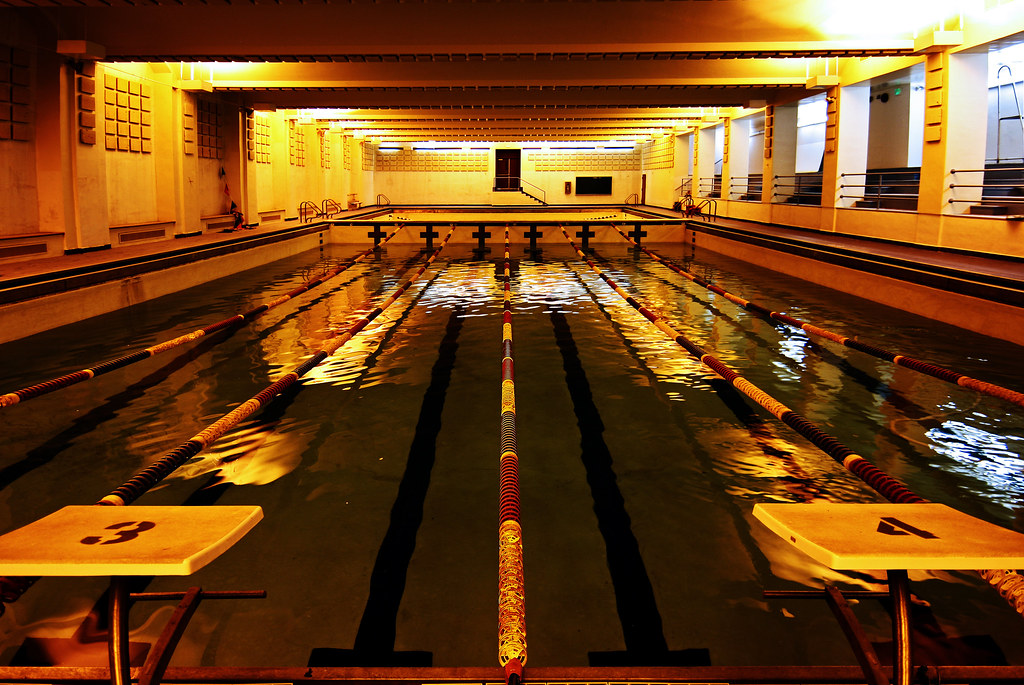
Isaac Asimov has got to be one of my favourite authors ever. A proper icon. In today's world of vapid and empty sounding celebrities who are famous for nothing more than looking good here we have a true celebrity. Famous for being outstanding in his chosen field. Not only was he terrifyingly prolific - his bibliography is over 500 works long (and that doesn't include individual short stories) - but he was far ahead of his time when it came to imagining the future and humanity's part in it.
His 'Foundation' and 'Robot' series are some of the finest science-fiction works available and I would urge you to get them read. Countless of his stories have been made into films and many of his ideas have influenced a wide range of creators. In honour of his work and the inspirational stories he imagined we thought we'd immortalise him on slate. Combining his distinctive glasses with an exposed robot eye gave us the germ of an idea and from there we were away. I reckon that once this one has been framed suitably it will look spot on. Hopefully we'll have a few more in this series once I can actually work out who else is worth commemorating...
Cheer
id-iom
My first attempt at a fake tilt-shift in Photoshop.
Next time I'm picking something without so many damn trees.
www.cleverprime.com // Facebook // Tumblr
The view from the top of St Paul's Cathedral. Terrifyingly high.
I'm so late today posting. Sorry guys.
I always find it simply astonishing the multiple ways in which my body finds to manifest stress. I had the roughest freakin night last night...out of nowhere my entire body just became extremely sore & achey, I had this terrifyingly nauseating headache, and everything was just WRONG. Fortunately I feel a bit better today, but now I'm tired from not sleeping well.
On my way out of the door (when all I wanna do is crawl into bed), but I'll catch up later tonight!
Hope everyone is having a great day!
The Ultimate Shadowed Ones return.
I had this big bad villain for a long while and thought i would share him again.
Little is known of the shadowed one, leader of the dark hunters & rules with a dark steel fist, ruthless, skilled, cunning and most of all Terrifyingly powerful. His order is law & punishable to death to those who break his rules, his allies, liars & thieves. It is unwise to question him, having him repeat himself, holding secrets & treasure found and challenging him. the shadowed ones appearance is so frightening, some may say he is Anubis. His staff of Anti-Protodermis harnesses all the powers of the Rahkshi & Visorak with a 100% greater effect. Remotely control his staff freely the same way as Anubis Necromancess. open dimensions of darkness where a cold hellish void awaits thrown in, taking damage while in the dark void, the birth place of nightmares come to life & drive you to insanity. and if by some odd chance that wont do the job, the shadow lord still has his amplified laser vision.
Things to do today:
1. Go suit shopping with Simon ready for his brother's wedding this week - check.
2. Try on suit and take a picture for 366, trying desperately to balance out the excesses of yesterday - check.
3. Go and get a well-needed haircut - yet to do.
4. Get terrifyingly drunk at a friend's wii party in docklands - yet to do.
French postcard in the Entr'acte series by Editions aphodèle mâcon, no 001/09. Photo: Boris Karloff relaxing with a cigarette during an interval of the shooting of The Bride of Frankenstein (James Whale, 1935).
British actor Boris Karloff (1887-1969) is one of the true icons of the Horror cinema. He portrayed Frankenstein's monster in Frankenstein (1931), Bride of Frankenstein (1935), and Son of Frankenstein (1939), which resulted in his immense popularity. In the following decades, he worked in countless Horror films, but also in other genres, both in Europe and Hollywood.
Boris Karloff was born William Henry Pratt in 1887 in London, England. Pratt himself stated that he was born in Dulwich, which is nearby in London. His parents were Edward John Pratt, Jr. and his third wife Eliza Sarah Millard. ‘Billy’ never knew his father. Edward Pratt had worked for the Indian Salt Revenue Service and had virtually abandoned his family in far-off England. Edward died when his son was still an infant and so Billy was raised by his mother. He was the youngest of nine children, and following his mother's death was brought up by his elder brothers and sisters. As a child, Billy performed each Christmas in plays staged by St. Mary Magdalene's Church. His first role was that of The Demon King in the pantomime Cinderella. Billy was bow-legged, had a lisp, and stuttered. He conquered his stutter, but not his lisp, which was noticeable throughout his career in the film industry. After his education at private schools, he attended King's College London where he took studies aimed at a career with the British Government's Consular Service. However, in 1909, the 22-year-old left university without graduating and sailed from Liverpool to Canada, where he worked as a farm labourer and did various odd itinerant jobs. In Canada, he began appearing in theatrical performances and chose the stage name Boris Karloff. Later, he claimed he chose ‘Boris’ because it sounded foreign and exotic, and that ‘Karloff’ was a family name. However, his daughter Sara Karloff publicly denied any knowledge of Slavic forebears, Karloff or otherwise. One reason for the name change was to prevent embarrassment to his family. He did not reunite with his family until he returned to Britain to make The Ghoul (T. Hayes Hunter, 1933), opposite Cedric Hardwicke. Karloff was extremely worried that his family would disapprove of his new, macabre claim to world fame. Instead, his brothers jostled for position around him and happily posed for publicity photographs. In 1911, Karloff joined the Jeanne Russell Company and later joined the Harry St. Clair Co. which performed in Minot, North Dakota, for a year in an opera house above a hardware store. Whilst he was trying to establish his acting career, Karloff had to perform years of difficult manual labour in Canada and the U.S. to make ends meet. He was left with back problems from which he suffered for the rest of his life. In 1917, he arrived in Hollywood, where he went on to make dozens of silent films. Some of his first roles were in film serials, such as The Masked Rider (Aubrey M. Kennedy, 1919), in Chapter 2 of which he can be glimpsed onscreen for the first time, and The Hope Diamond Mystery (Stuart Paton, 1920). In these early roles, he was often cast as an exotic Arabian or Indian villain. Other silent films were The Deadlier Sex (Robert Thornby, 1920) with Blanche Sweet, Omar the Tentmaker (James Young, 1922), Dynamite Dan (Bruce Mitchell, 1924) and Tarzan and the Golden Lion (J.P. McGowan, 1927) in which James Pierce played Tarzan. In 1926 Karloff found a provocative role in The Bells (James Young, 1926), in which he played a sinister hypnotist opposite Lionel Barrymore. He worked with Barrymore again in his first sound film, the thriller The Unholy Night (Lionel Barrymore, 1929).
A key film which brought Boris Karloff recognition was The Criminal Code (Howard Hawks, 1931), a prison drama in which he reprised a dramatic part he had played on stage. With his characteristic short-cropped hair and menacing features, Karloff was a frightening sight to behold. Opposite Edward G. Robinson, Karloff played a key supporting part as an unethical newspaper reporter in Five Star Final (Mervyn LeRoy, 1931), a film about tabloid journalism which was nominated for the Oscar for Best Picture. Karloff's role as Frankenstein's monster in Frankenstein (James Whale, 1931), based on the classic Mary Shelley book, propelled him to stardom. Wikipedia: “The bulky costume with four-inch platform boots made it an arduous role but the costume and extensive makeup produced the classic image. The costume was a job in itself for Karloff with the shoes weighing 11 pounds (5 kg) each.” The aura of mystery surrounding Karloff was highlighted in the opening credits, as he was listed as simply "?." The film was a commercial and critical success for Universal, and Karloff was instantly established as a hot property in Hollywood. Universal Studios was quick to acquire ownership of the copyright to the makeup format for the Frankenstein monster that Jack P. Pierce had designed. A year later, Karloff played another iconic character, Imhotep in The Mummy (Karl Freund, 1932). The Old Dark House (James Whale, 1932) with Charles Laughton, and the starring role in MGM’s The Mask of Fu Manchu (Charles Brabin, 1932) quickly followed. Steve Vertlieb at The Thunder Child: “Wonderfully kinky, the film co-starred young Myrna Loy as the intoxicating, yet sadistic Fah Lo See, Fu Manchu's sexually perverse daughter. Filmed before Hollywood's infamous production code, the film joyously escaped the later scrutiny of The Hayes Office, and remains a fascinating example of pre-code extravagance.” These films all confirmed Karloff's new-found stardom. Horror had become his primary genre, and he gave a string of lauded performances in 1930s Universal Horror films. Karloff reprised the role of Frankenstein's monster in two other films, the sensational Bride of Frankenstein (James Whale, 1935) and the less thrilling Son of Frankenstein (Rowland V. Lee, 1939), the latter also featuring Bela Lugosi. Steve Vertlieb about Bride of Frankenstein: “Whale delivered perhaps the greatest horror film of the decade and easily the most critically acclaimed rendition of Mary Shelley's novel ever released. The Bride of Frankenstein remains a work of sheer genius, a brilliantly conceived and realized take on loneliness, vanity, and madness. The cast of British character actors is simply superb.” While the long, creative partnership between Karloff and Lugosi never led to a close friendship, it produced some of the actors' most revered and enduring productions, beginning with The Black Cat (Edgar G. Ullmer, 1934). Follow-ups included The Raven (Lew Landers, 1935), the rarely seen, imaginative science fiction melodrama The Invisible Ray (Lambert Hillyer, 1936), and The Body Snatcher (Robert Wise, 1945). Karloff played a wide variety of roles in other genres besides Horror. He was memorably gunned down in a bowling alley in Howard Hawks' classic Scarface (1932) starring Paul Muni.. He played a religious First World War soldier in John Ford’s epic The Lost Patrol (1934) opposite Victor McLaglen. Between 1938 and 1940, Karloff starred in five films for Monogram Pictures, including Mr. Wong, Detective (William Nigh, 1938). During this period, he also starred with Basil Rathbone in Tower of London (Rowland V. Lee, 1939) as the murderous henchman of King Richard III, and with Margaret Lindsay in British Intelligence (Terry O. Morse, 1940). In 1944, he underwent a spinal operation to relieve his chronic arthritic condition.
Boris Karloff revisited the Frankenstein mythos in several later films, taking the starring role of the villainous Dr. Niemann in House of Frankenstein (Erle C. Kenton, 1944), in which the monster was played by Glenn Strange. He reprised the role of the ‘mad scientist’ in Frankenstein 1970 (Howard W. Koch, 1958) as Baron Victor von Frankenstein II, the grandson of the original creator. The finale reveals that the crippled Baron has given his face (i.e., Karloff's) to the monster. From 1945 to 1946, Boris Karloff appeared in three films for RKO produced by Val Lewton: Isle of the Dead (Mark Robson, 1945), The Body Snatcher (Robert Wise, 1945), and Bedlam (Mark Robson, 1946). Karloff had left Universal because he thought the Frankenstein franchise had run its course. Karloff was a frequent guest on radio programs. In 1949, he was the host and star of the radio and television anthology series Starring Boris Karloff. In 1950, he had his own weekly children's radio show in New York. He played children's music, told stories and riddles, and attracted many adult listeners as well. An enthusiastic performer, he returned to the Broadway stage in the original production of Arsenic and Old Lace (1941), in which he played a homicidal gangster enraged to be frequently mistaken for Karloff. In 1962, he reprised the role on television with Tony Randall and Tom Bosley. He also appeared as Captain Hook in the play Peter Pan with Jean Arthur. In 1955, he returned to the Broadway stage to portray the sympathetic Bishop Cauchon in Jean Anouilh's The Lark. Karloff regarded the production as the highlight of his long career. Julie Harris was his co-star as Joan of Arc in the celebrated play, recreated for live television in 1957 with Karloff, Harris and much of the original New York company intact. For his role, Karloff was nominated for a Tony Award. Karloff donned the monster make-up for the last time for a Halloween episode of the TV series Route 66 (1962), which also featured Peter Lorre and Lon Chaney, Jr. In the 1960s, Karloff appeared in several films for American International Pictures, including The Comedy of Terrors (Jacques Tourneur, 1963) with Vincent Price and Peter Lorre, The Raven (Roger Corman, 1963), The Terror (Roger Corman, 1963) with Jack Nicholson, and Die, Monster, Die! (Daniel Haller, 1965). Another project for American International release was the frightening Italian horror classic, I tre volti della paura/Black Sabbath (Mario Bava, 1963), in which Karloff played a vampire with bone-chilling intensity. He also starred in British cult director Michael Reeves's second feature film, The Sorcerers (1966). He gained new popularity among the young generation when he narrated the animated TV film Dr. Seuss' How the Grinch Stole Christmas (Chuck Jones, Ben Washam. 1966), and provided the voice of the Grinch. Karloff later received a Grammy Award for Best Recording For Children after the story was released as a record. Then he starred as a retired horror film actor in Targets (Peter Bogdanovich, 1968), Steve Vertlieb: “Targets was a profoundly disturbing study of a young sniper holding a small Midwestern community, deep in the bible belt, terrifyingly at bay. The celebrated subplot concerned the philosophical dilemma of creating fanciful horrors on the screen, while the graphic, troubling reality was eclipsing the superficiality so tiredly repeated by Hollywood. Karloff co-starred, essentially as himself, an aged horror star named Byron Orlok, who wants simply to retire from the imagined horrors of a faded genre, only to come shockingly to grips with the depravity and genuine terror found on America's streets. Bogdanovich's first film as a director won praise from critics and audiences throughout the world community, and won its elder star the best, most respectful notices of his later career.”. In 1968, he played occult expert Professor Marsh in the British production Curse of the Crimson Altar (Vernon Sewell, 1968), which was the last Karloff film to be released during his lifetime. He ended his career by appearing in four low-budget Mexican horror films, which were released posthumously. While shooting his final films, Karloff suffered from emphysema. Only half of one lung was still functioning and he required oxygen between takes. he contracted bronchitis in 1968 and was hospitalized. In early 1969, he died of pneumonia at the King Edward VII Hospital, Midhurst, in Sussex, at the age of 81. Boris Karloff married five times and had one child, daughter Sara Karloff, by his fourth wife.
Sources: Steve Vertlieb (The Thunder Child), Wikipedia, and IMDb.
Solo un’altra scusa per ascoltare una canzone. Non era l’estate, un campeggio estivo, non c’erano né colline né un lago. Però c’erano delle alte dune di sabbia, e il mare cos’è infine, se non un grande lago?
E “…a very special pile of heavy and black and polished and weird and terrifying stones…” è bellissima.
straordianari effetti speciali sonori per un'uscita multimediale
Unveil the horror this Halloween with MORTA, a chilling new skin brought to you in collaboration with AURUN!
Inspired by the haunting presence of Samara from The Ring, this skin captures the essence of fear and mystery, perfect for your spooky look.
Available in two eerie tones: Dracula and Ghost, MORTA is designed to blend seamlessly with ARUN's exclusive Halloween costume, completing your transformation into the stuff of nightmares.
Don’t miss out on this terrifyingly beautiful creation—get yours now!
Kathmandu Durbar Square (Nepali: वसन्तपुर दरवार क्षेत्र, Basantapur Darbar Kshetra) in front of the old royal palace of the former Kathmandu Kingdom is one of three Durbar (royal palace) Squares in the Kathmandu Valley in Nepal, all of which are UNESCO World Heritage Sites.
Several buildings in the Square collapsed due to a major earthquake on 25 April 2015. Durbar Square was surrounded with spectacular architecture and vividly showcases the skills of the Newar artists and craftsmen over several centuries. The Royal Palace was originally at Dattaraya square and was later moved to the Durbar square.
The Kathmandu Durbar Square held the palaces of the Malla and Shah kings who ruled over the city. Along with these palaces, the square surrounds quadrangles, revealing courtyards and temples. It is known as Hanuman Dhoka Durbar Square, a name derived from a statue of Hanuman, the monkey devotee of Lord Ram, at the entrance of the palace.
CONTENTS
HISTORY AND CONSTRUCTION
The preference for the construction of royal palaces at this site dates back to as early as the Licchavi period in the third century. Even though the present palaces and temples have undergone repeated and extensive renovations and nothing physical remains from that period. Names like Gunapo and Gupo, which are the names referred to the palaces in the square in early scriptures, imply that the palaces were built by Gunakamadev, a King ruling late in the tenth-century. When Kathmandu City became independent under the rule of King Ratna Malla (1484–1520), the palaces in the square became the Royal Palaces for its Malla Kings. When Prithvi Narayan Shah invaded the Kathmandu Valley in 1769, he favored the Kathmandu Durbar Square for his palace. Other subsequent Shah kings continued to rule from the square until 1896 when they moved to the Narayan Hiti Palace.
The square is still the center of important royal events like the coronation of King Birendra Bir Bikram Shah in 1975 and King Gyanendra Bir Bikram Shah in 2001.
Though there are no written archives stating the history of Kathmandu Durbar Square, construction of the palace in the square is credited to Sankharadev (1069–1083). As the first king of the independent Kathmandu City, Ratna Malla is said to have built the Taleju temple in the Northern side of the palace in 1501. For this to be true then the temple would have had to have been built in the vihara style as part of the palace premise surrounding the Mul Chok courtyard for no evidence of a separate structure that would match this temple can be found within the square.
Construction of the Karnel Chok is not clearly stated in any historical inscriptions; although, it is probably the oldest among all the courtyards in the square. The Bhagavati Temple, originally known as a Narayan Temple, rises above the mansions surrounding it and was added during the time of Jagajaya Malla in the early eighteenth century. The Narayan idol within the temple was stolen so Prithvi Narayan Shah replaced it with an image of Bhagavati, completely transforming the name of the temple.
The oldest temples in the square are those built by Mahendra Malla (1560–1574). They are the temples of Jagannath, Kotilingeswara Mahadev, Mahendreswara, and the Taleju Temple. This three-roofed Taleju Temple was established in 1564, in a typical Newari architectural style and is elevated on platforms that form a pyramid-like structure. It is said that Mahendra Malla, when he was residing in Bhaktapur, was highly devoted to the Taleju Temple there; the Goddess being pleased with his devotion gave him a vision asking him to build a temple for her in the Kathmandu Durbar Square. With a help of a hermit, he designed the temple to give it its present form and the Goddess entered the temple in the form of a bee.
His successors Sadasiva (1575–1581), his son, Shiva Simha (1578–1619), and his grandson, Laksmi Narsingha (1619–1641), do not seem to have made any major additions to the square. During this period of three generations the only constructions to have occurred were the establishment of Degutale Temple dedicated to Goddess Mother Taleju by Shiva Simha and some enhancement in the royal palace by Laksminar Simha.
UNDER PRATAP MALLA
In the time of Pratap Malla, son of Laksminar Simha, the square was extensively developed. He was an intellectual, a pious devotee, and especially interested in arts. He called himself a Kavindra, king of poets, and boasted that he was learned in fifteen different languages. A passionate builder, following his coronation as a king, he immediately began enlargements to his royal palace, and rebuilt some old temples and constructed new temples, shrines and stupas around his kingdom.During the construction of his palace, he added a small entrance in the traditional, low and narrow Newari style. The door was elaborately decorated with carvings and paintings of deities and auspicious sings and was later transferred to the entrance of Mohan Chok. In front of the entrance he placed the statue of Hanuman thinking that Hanuman would strengthen his army and protect his home. The entrance leads to Nasal Chok, the courtyard where most royal events such as coronation, performances, and yagyas, holy fire rituals, take place. It was named after Nasadya, the God of Dance, and during the time of Pratap Malla the sacred mask dance dramas performed in Nasal Chok were widely famed. In one of these dramas, it is said that Pratap Malla himself played the role of Lord Vishnu and that the spirit of the Lord remained in the king's body even after the play. After consulting his Tantric leaders, he ordered a stone image of Lord Vishnu in his incarnation as Nara Simha, the half-lion and half-human form, and then transferred the spirit into the stone. This fine image of Nara Simha made in 1673 still stands in the Nasal Chok. In 1650, he commissioned for the construction of Mohan Chok in the palace. This chok remained the royal residential courtyard for many years and is believed to store a great amount of treasure under its surface. Pratap Malla also built Sundari Chok about this time. He placed a slab engraved with lines in fifteen languages and proclaimed that he who can understand the inscription would produce the flow of milk instead of water from Tutedhara, a fountain set in the outer walls of Mohan Chok. However elaborate his constructions may have been, they were not simply intended to emphasize his luxuries but also his and the importance of others' devotion towards deities. He made extensive donations to temples and had the older ones renovated. Next to the palace, he built a Krishna temple, the Vamsagopala, in an octagonal shape in 1649. He dedicated this temple to his two Indian wives, Rupamati and Rajamati, as both had died during the year it was built. In Mohan Chok, he erected a three roofed Agamachem temple and a unique temple with five superimposing roofs. After completely restoring the Mul Chok, he donated to the adjoining Taleju Temple. To the main temple of Taleju, he donated metal doors in 1670. He rebuilt the Degutale Temple built by his grandfather, Siva Simha, and the Taleju Temple in the palace square. As a substitute to the Indreswara Mahadeva Temple in the distant village of Panauti he built a Shiva temple, Indrapura, near his palace in the square. He carved hymns on the walls of the Jagannath Temple as prayers to Taleju in the form of Kali.
At the southern end of the square, near Kasthamandap at Maru, which was the main city crossroads for early traders, he built another pavilion named Kavindrapura, the mansion of the king of poets. In this mansion he set an idol of dancing Shiva, Nasadyo, which today is highly worshipped by dancers in the Valley.
In the process of beautifying his palace, he added fountains, ponds, and baths. In Sundari Chok, he established a low bath with a golden fountain. He built a small pond, the Naga Pokhari, in the palace adorned with Nagakastha, a wooden serpent, which is said he had ordered stolen from the royal pond in the Bhaktapur Durbar Square. He restored the Licchavi stone sculptures such as the Jalasayana Narayana, the Kaliyadamana, and the Kala Bhairav. An idol of Jalasayana Narayana was placed in a newly created pond in the Bhandarkhal garden in the eastern wing of the palace. As a substitute to the idol of Jalasayana Narayana in Buddhanilkantha, he channeled water from Buddhanilkantha to the pond in Bhandarkhal due bestow authenticity. The Kalyadana, a manifestation of Lord Krishna destroying Kaliya, a water serpent, is placed in Kalindi Chok, which is adjacent to the Mohan Chok. The approximately ten-feet-high image of terrifyingly portrayed Kal Bhairav is placed near the Jagannath Temple. This image is the focus of worship in the chok especially during Durga Puja.
With the death of Pratap Malla in 1674, the overall emphasis on the importance of the square came to a halt. His successors retained relatively insignificant power and the prevailing ministers took control of most of the royal rule. The ministers encountered little influence under these kings and, increasingly, interest of the arts and additions to the square was lost on them. They focused less on culture than Pratap Malla during the three decades that followed his death, steering the city and country more towards the arenas of politics and power, with only a few minor constructions made in the square. These projects included Parthivendra Malla building a temple referred to as Trailokya Mohan or Dasavatara, dedicated to Lord Vishnu in 1679. A large statue of Garuda, the mount of Lord Vishnu, was added in front of it a decade later. Parthivendra Malla added a pillar with image of his family in front of the Taleju Temple.
Around 1692, Radhilasmi, the widowed queen of Pratap Malla, erected the tall temples of Shiva known as Maju Deval near the Garuda image in the square. This temple stands on nine stepped platforms and is one of the tallest buildings in the square. Then her son, Bhupalendra Malla, took the throne and banished the widowed queen to the hills. His death came early at the age of twenty one and his widowed queen, Bhuvanalaksmi, built a temple in the square known as Kageswara Mahadev. The temple was built in the Newari style and acted as a substitute for worship of a distant temple in the hills. After the earthquake in 1934, the temple was restored with a dome roof, which was alien to the Newari architecture.
Jayaprakash Malla, the last Malla king to rule Kathmandu, built a temple for Kumari and Durga in her virginal state. The temple was named Kumari Bahal and was structured like a typical Newari vihara. In his house resides the Kumari, a girl who is revered as the living goddess. He also made a chariot for Kumari and in the courtyard had detailed terra cotta tiles of that time laid down.
UNDER THE SHAH DYNASTY
During the Shah dynasty that followed, the Kathmandu Durbar Square saw a number of changes. Two of the most unique temples in the square were built during this time. One is the Nautale, a nine-storied building known as Basantapur Durbar. It has four roofs and stands at the end of Nasal Chok at the East side of the palace. It is said that this building was set as a pleasure house. The lower three stories were made in the Newari farmhouse style. The upper floors have Newari style windows, sanjhya and tikijhya, and some of them are slightly projected from the wall. The other temple is annexed to the Vasantapur Durbar and has four-stories. This building was initially known as Vilasamandira, or Lohom Chok, but is now commonly known as Basantapur or Tejarat Chok. The lower floors of the Basantapur Chok display extensive woodcarvings and the roofs are made in popular the Mughal style. Archives state that Prthivi Narayan Shah built these two buildings in 1770.
Rana Bahadur Shah was enthroned at the age of two. Bahadur Shah, the second son of Prithvi Narayan Shah, ruled as a regent for his young nephew Rana Bahadur Shah for a close to a decade from 1785 to 1794 and built a temple of Shiva Parvati in the square. This one roofed temple is designed in the Newari style and is remarkably similar to previous temples built by the Mallas. It is rectangular in shape, and enshrines the Navadurga, a group of goddesses, on the ground floor. It has a wooden image of Shiva and Parvati at the window of the upper floor, looking out at the passersby in the square. Another significant donation made during the time of Rana Bahadur Shah is the metal-plated head of Swet Bhairav near the Degutale Temple. It was donated during the festival of Indra Jatra in 1795, and continues to play a major role during the festival every year. This approximately twelve feet high face of Bhairav is concealed behind a latticed wooden screen for the rest of the year. The following this donation Rana Bahadur donated a huge bronze bell as an offering to the Goddess Taleju. Together with the beating of the huge drums donated by his son Girvan Yudha, the bell was rung every day during the daily ritual worship to the goddess. Later these instruments were also used as an alarm system. However, after the death of his beloved third wife Kanimati Devi due to smallpox, Rana Bahadur Shah turned mad with grief and had many images of gods and goddesses smashed including the Taleju statue and bell, and Sitala, the goddess of smallpox.
In 1908, a palace, Gaddi Durbar, was built using European architectural designs. The Rana Prime Ministers who had taken over the power but not the throne of the country from the Shahs Kings from 1846 to 1951 were highly influenced by European styles. The Gaddi Durbar is covered in white plaster, has Greek columns and adjoins a large audience hall, all foreign features to Nepali architecture. The balconies of this durbar were reserved for the royal family during festivals to view the square below.
Some of the parts of the square like the Hatti Chok near the Kumari Bahal in the southern section of the square were removed during restoration after the devastating earthquake in 1934. While building the New Road, the southeastern part of the palace was cleared away, leaving only fragments in places as reminders of their past. Though decreased from its original size and attractiveness from its earlier seventeenth-century architecture, the Kathmandu Durbar Square still displays an ancient surrounding that spans abound five acres of land. It has palaces, temples, quadrangles, courtyards, ponds, and images that were brought together over three centuries of the Malla, the Shah, and the Rana dynasties. It was destroyed in the April 2015 Nepal earthquake.
VISITING
Kathmandu's Durbar Square is the site of the Hanuman Dhoka Palace Complex, which was the royal Nepalese residence until the 19th century and where important ceremonies, such as the coronation of the Nepalese monarch, took place. The palace is decorated with elaborately-carved wooden windows and panels and houses the King Tribhuwan Memorial Museum and the Mahendra Museum. It is possible to visit the state rooms inside the palace.
Time and again the temples and the palaces in the square have gone through reconstruction after being damaged by natural causes or neglect. Presently there are less than ten quadrangles in the square. The temples are being preserved as national heritage sites and the palace is being used as a museum. Only a few parts of the palace are open for visitors and the Taleju temples are only open for people of Hindu and Buddhist faiths.
At the southern end of Durbar Square is one of the most curious attractions in Nepal, the Kumari Chok. This gilded cage contains the Raj Kumari, a girl chosen through an ancient and mystical selection process to become the human incarnation of the Hindu mother goddess, Durga. She is worshiped during religious festivals and makes public appearances at other times for a fee paid to her guards.
WIKIPEDIA
Last April, 2015, I had the good fortune to make a trip to Yosemite with family and friends for a few nights. Being another warm drought year, Glacier Point Road was open and we were able to hike outside of Yosemite Valley. On the final day of that visit, we got a chance to hike some of the Panorama Trail, which departs from Glacier Point and joins the Mist Trail and John Muir Trail above Nevada Fall. Among other great views along the way, I was particularly looking forward to finally seeing Illilouette Fall up close. Previously, I'd only seen it at a distance from the lower portions of the Mist Trail or other more distant views. There is really only one good vantage point along the way, from which this photograph was made. Although the fall is about 370 ft tall, the view is still largely obstructed from the trail, and so I focused on the upper portion here where the fall begins.
Because the snow pack was so terrifyingly low in 2015, the water was a trickle compared to what it should be in April, but on the plus side I liked how much it revealed of the granite beneath the water. On this particular day, a storm was looming and we were under cloud cover, which has the photographic advantage of casting a soft light over everything. Shortly after where we reached this view, the trail continues to a bridge over Illilouette Creek just upstream from the waterfall. We started down the path but the looming storm turned to lightning and thunder and, being on an exposed ridge at elevation during a thunderstorm is not a good place to be and we turned back. I hope to get a chance to revisit it again this year and hopefully see how it looks when the water is really flowing.
Notably, I had the very good fortune to attend a great three day workshop (Digital Printing for the Fine Art Photographer) last month with masterful photographer and print maker Charles Cramer, assisted by Rex Naden. I learned a great deal from both of these great photographers and strongly encourage anyone with an interest in making prints to consider the workshop as well (it was on my bucket list for years before it finally came together). One of the great exercises we did early in the class was to share ten of our prints with the class for critique, at the end of which everyone selected the two prints they would most like to have for themselves (a very clever way of getting to the heart of which photographs actually resonate with people). Somewhat surprisingly this was my most preferred print, so I thought I ought to share it now. In the time available to work further on our own prints, this was one of the photos I worked on with the assistance of Charlie, Rex, and the other participants. Although this didn't undergo substantial transformation, a number of subtle changes were made that make the image stronger.
Nikon D610 | Nikon 70-200mm f/4 @ 70mm | f/8 | 1/400s | ISO 200
Prayer, Morning
First Thoughts
Let God have your first awaking thoughts; lift up your hearts to Him reverently and thankfully for the rest enjoyed the night before and cast yourself upon Him for the day which follows. Familiarize yourself so consistently to this that your conscience may check you when common thoughts shall first intrude. Think of the mercy of a night’s rest and of how many that have spent that night in hell; how many in prison; how many in cold, hard lodgings; how many suffering from agonizing pains and sickness, weary of their beds and of their lives. Think of how many souls were that night called from their bodies terrifyingly to appear before God and think how quickly days and nights are rolling on! How speedily your last night and day will come! Observe that which is lacking in the preparedness of your soul for such a time and seek it without delay.
Richard Baxter
Mark Water, The New Encyclopedia of Christian Quotations (Alresford, Hampshire: John Hunt Publishers Ltd, 2000), 774.
The Ultimate Shadowed Ones return.
I had this big bad villain for a long while and thought i would share him again.
Little is known of the shadowed one, leader of the dark hunters & rules with a dark steel fist, ruthless, skilled, cunning and most of all Terrifyingly powerful. His order is law & punishable to death to those who break his rules, his allies, liars & thieves. It is unwise to question him, having him repeat himself, holding secrets & treasure found and challenging him. the shadowed ones appearance is so frightening, some may say he is Anubis. His staff of Anti-Protodermis harnesses all the powers of the Rahkshi & Visorak with a 100% greater effect. Remotely control his staff freely the same way as Anubis Necromancess. open dimensions of darkness where a cold hellish void awaits thrown in, taking damage while in the dark void, the birth place of nightmares come to life & drive you to insanity. and if by some odd chance that wont do the job, the shadow lord still has his amplified laser vision.
We’ll all pay for ignoring our rotten parliament
Ben Macintyre
For a century and a half, the Palace of Westminster has been left to the ravages of time, asbestos and rodents
The Houses of Parliament are falling down. Big Ben is to be silenced, after 157 years of almost unbroken chiming, for an urgent repair programme. These old houses are a-getting shaky, to adapt the words of our foremost architectural pop singer, Shakin’ Stevens, and needing a lot more than paint.
The roofs are leaking, the wiring is terrifyingly antiquated, the sewerage system cannot cope, and the 1930s boilers are clogged with limescale. The oldest of the 28 lifts dates back to 1893, and some are liable to sudden, shuddering breakdown. Parts of the building are infested with rodents, the masonry is crumbling, gutters are cracking, and the interiors are peeling and faded. The entire Palace of Westminster is a fire trap. Almost none of its 3,000 windows close properly.
As one recent report put it: “If the palace were not a listed building of the highest heritage value, its owner would probably be advised to demolish and rebuild.”
A cross-party committee is expected to recommend in the next few weeks that MPs relocate while essential renovation is carried out over six years. The original building cost more than £2 million to build — approximately £220 million in today’s money. Deloitte estimates that a complete restoration, carried out with the MPs in situ, would take 32 years and cost £5.7 billion.
Completed in 1870, the palace has endured through six monarchs and 26 governments, but now age and neglect have finally left it in danger of “catastrophic breakdown”.
Normally, when things go wrong in parliament, we hold an inquiry to establish who is responsible. So who can we blame for the shocking decay of the nation’s foremost public building?
In rough chronological order, the guilty parties are: the architect Charles Barry, the geologist William Logan, whose discoveries led to the first commercial asbestos mines, Adolf Hitler and the Luftwaffe, successive maintenance bodies that failed to fix the roof while the sun was shining, MPs taking shorter holidays, and the inhabitants of London for polluting the air of the capital.
We can start by pointing the finger at two Irish labourers, Joshua Cross and Patrick Furlong, whose job it was, in 1834, to burn the small wooden tally sticks then used as part of the Exchequer accounting process, in a furnace beneath the House of Lords. On October 16, a chimney fire started, which spread rapidly and largely destroyed the medieval royal palace.
Anston stone was porous, vulnerable to the pollution of sooty London
The competition to rebuild it was won by Barry, aided by Augustus Pugin. The result was a neo-Gothic masterpiece, but with hindsight Barry chose the wrong materials. In 1839, he toured Britain’s quarries with two geologists and a master stone-cutter before selecting Anston, a sand-coloured limestone from South Yorkshire, which was beautiful, available in large blocks suitable for elaborate carving, and cheap. But it was also quite porous and vulnerable to the pollution of sooty London; some stone was of doubtful quality. After just ten years, the signs of decay were visible; for the rest of the century the problem was studied by various committees and nothing was done about it.
Meanwhile Sir William Logan, the head of the Geological Survey of Canada, uncovered large deposits of white asbestos in the hills of Quebec. By the 1890s the mines were producing 10,000 tons a year. The first diagnosis of asbestosis was made in the UK in 1924, but for decades the material continued to be used in building as a fire retardant, insulator and lagging to reduce noise. The Palace of Westminster was stuffed with this poisonous fibre, around pipes and ducts, in walls and fire linings, and even in some parliamentary paint. Now it must all be stripped out.
During the Blitz, the palace was struck by no fewer than 14 bombs, destroying the Commons chamber, much of the cloisters and causing extensive damage. The rebuilding was a vital boost to national morale, but like much postwar reconstruction it was also hasty, and not always to the highest standards. What was Jerry-bombed ended up being jerry-built, and soon in need of further work.
There has been no general renovation since, even though the complex and elaborate architectural style of Barry and Pugin requires complex and elaborate (and frequent) restoration. The funds allocated for piecemeal repair in the latter half of the 20th century were simply not enough to keep pace with the wear and tear. The impact of under-investment in restoration was compounded by air pollution, what one investigating committee called the “pernicious London atmosphere”.
In recent years, politicians seeking approval for their work ethic have often called for MPs to take shorter holidays. Traditionally palace maintenance has been carried out in the summer months, but the length of the long recess has steadily shrunk, from 79 days three decades ago, to 48 days last year. That has meant more parliamentary work, but less time to fix spewing pipes and dodgy elevators.
Commentators hunting easy metaphors have seized on the dilapidation as an image of our decayed political life. But in reality, the disrepair reflects the arduous affection to which these buildings have been subjected for almost 150 years: we have crammed them with more and more wiring, pipework, legislators, officials and rooms, heaping an ever heavier burden on structures no longer fit for the purpose we ask of them.
The heavy and growing demands of democracy have pushed what is arguably Britain’s most famous building into a state of decrepitude; we have loved it almost to death, and we should therefore pay whatever it takes to bring it back to new life.
1/160th, f/3.5, 18mm, one Alien Bee to the left with umbrella, triggered by remote
Actually, the look on his face is pretty typical. Somewhere between "Ohmygod I'm terrified of the universe," and "Is there any chance I'm getting fed? Because food is very important to me." I intentionally chose this shot because of the slightly panicky look on his face, which is so, so a common look for him.
I am in the process of acquiring several hilarious pieces of pet-sized furniture - this little recliner was $5 the other day, and I took Ara on a craigslist based adventure to Washougal the other night to pick up a gorgeous little chair, and we witnessed a faux-dog-napping. Craigslist...weird stuff sometimes. (The dog, fyi, is fine, and I have the chair, so all is well.) I even have a hot pink fluffy chaise lounge begging for a fluffy kitty or a Chihuahua. Ridiculous, I tell you, in the best possible way!
I am also in the process of re-building my Nikon collection of lenses - as this is my first official post shot with my "new" Nikon D300. The lens is on loan from Ara, as I await delivery of my new 50mm 1.4, and work on getting myself either a 20mm 2.8 (used) or if I can swing it in the next couple of weeks, their 18-55 2.8, which even used is more than a first-born child. The new SB-900 is on the way, my new Lowepro is sitting at my front door (thank you, UPS!), and life is pretty grand. I still have to unload a big handful of SD cards, a Tamrac backpack, and a giant old Lowepro backpack that is the size of a VW bus, not to mention a Tamron lens (really nice!) and my old Nikon 24-120 I bought in 1999.
Ara is booking out the wedding season, and I shall be tagging along as ever, and I am *this close* to officially launching my venture in pet photography. Social networking, fyi, is the *bestest* thing EVER. When Wallace cost me a few thousand dollars back at New Year's with a four surgical procedures over three days, my facebook friends rallied and raised money for me. (Thank you cards are half written - I have excellent intentions and sometimes a terrible case of procrastination.) Social networking also helped me pick out my company name - an old friend I did theater with in high school who lives 3000 miles away gave the final suggestion, which needed a very, very minor tweak to work. Sadly, Patrick convinced me it's been five years since Dave died and I can't go around begging for help getting out of the debt he left me that I am still paying off. I digress...
I had so many incredible ideas - I really, really love Fabulous Bitches, but good luck advertising that anywhere where kids are present. I thought I would take it in a direction with a bit of a wink, along the lines of Chasing Tail, which is funny to adults and harmless for children...only the associated web domains? NSFW. In fact, not safe for anyone, anytime, anywhere. And if I am declaring it such, I recommend you think long and hard before you start punching names into your web browser. I thought of going with Irresistible Bitch and seeing if I could get Prince to shut me down, get some publicity. Unleashed. Pawparazzi. Frolic. All taken and would leave me with weird urls too easy to confuse.
The site is a little ways from being officially launched, but I am the happy owner of, you ready? RoverExposed.com It caused quite a giggling fit last night, and while it implies dogs in particular, I hope to get some exciting other critters in the studio - I have a real soft spot for guinea pigs, actually, and have friends who have a tortoise who weighs nearly as much as I do. I'm not walking away from my gig as a numismatic photographer, which has been a part of my life for a terrifyingly long time (and I have been in numismatics most of my life at this point), in fact, my boss is a big supporter of mine and was my first official client. But this should keep me busy, covered in pet hair and dog kisses, and happy as can be. I get to PLAY WITH ANIMALS. And take their picture. And meet awesome people. What? How cool is THAT?!
So, keep your eyes peeled, the site will launch sooner than later, and I cannot WAIT! I have a pretty excellent summer lined up with fantastic trips and events I can't even mention because you'll finagle your way into my suitcase, and I look forward to sharing tales of those adventures, as well as many more four legged friends with you all here on flickr!
Ohgodddd, today I had an amazing present. A flight in a 65 year old Harvard at my local aerodrome. The flight was 30mins and I got to flyyy! Terrifyingly but amazingly we also did acrobatics including a full roll! Wowww, words can't describe it, what a priviledge. And my thoughts often turned to the young men in the 1940's who trained for the war in that exact plane and never came home. Blog post is below...
The octopus (plural octopuses) is a soft-bodied, eight-limbed mollusc of the order Octopoda (/ɒkˈtɒpədə/, ok-TO-pə-də). Around 300 species are recognised, and the order is grouped within the class Cephalopoda with squids, cuttlefish, and nautiloids. Like other cephalopods, the octopus is bilaterally symmetric with two eyes and a beak, with its mouth at the center point of the eight limbs.[a] The soft body can rapidly alter its shape, enabling octopuses to squeeze through small gaps. They trail their eight appendages behind them as they swim. The siphon is used both for respiration and for locomotion, by expelling a jet of water. Octopuses have a complex nervous system and excellent sight, and are among the most intelligent and behaviourally diverse of all invertebrates.
Octopuses inhabit various regions of the ocean, including coral reefs, pelagic waters, and the seabed; some live in the intertidal zone and others at abyssal depths. Most species grow quickly, mature early, and are short-lived. In most species, the male uses a specially adapted arm to deliver a bundle of sperm directly into the female's mantle cavity, after which he becomes senescent and dies, while the female deposits fertilised eggs in a den and cares for them until they hatch, after which she also dies. Strategies to defend themselves against predators include the expulsion of ink, the use of camouflage and threat displays, the ability to jet quickly through the water and hide, and even deceit. All octopuses are venomous, but only the blue-ringed octopuses are known to be deadly to humans.
Octopuses appear in mythology as sea monsters like the Kraken of Norway and the Akkorokamui of the Ainu, and probably the Gorgon of ancient Greece. A battle with an octopus appears in Victor Hugo's book Toilers of the Sea, inspiring other works such as Ian Fleming's Octopussy. Octopuses appear in Japanese erotic art, shunga. They are eaten and considered a delicacy by humans in many parts of the world, especially the Mediterranean and the Asian seas.
ETYMOLOGY AND PLURALISATION
The scientific Latin term octopus was derived from Ancient Greek ὀκτώπους, a compound form of ὀκτώ (oktō, "eight") and πούς (pous, "foot"), itself a variant form of ὀκτάπους, a word used for example by Alexander of Tralles (c. 525–605) for the common octopus. The standard pluralised form of "octopus" in English is "octopuses"; the Ancient Greek plural ὀκτώποδες, "octopodes" (/ɒkˈtɒpədiːz/), has also been used historically. The alternative plural "octopi" is considered grammatically incorrect because it wrongly assumes that octopus is a Latin second declension "-us" noun or adjective when, in either Greek or Latin, it is a third declension noun.
Fowler's Modern English Usage states that the only acceptable plural in English is "octopuses", that "octopi" is misconceived, and "octopodes" pedantic; the latter is nonetheless used frequently enough to be acknowledged by the descriptivist Merriam-Webster 11th Collegiate Dictionary and Webster's New World College Dictionary. The Oxford English Dictionary lists "octopuses", "octopi", and "octopodes", in that order, reflecting frequency of use, calling "octopodes" rare and noting that "octopi" is based on a misunderstanding. The New Oxford American Dictionary (3rd Edition, 2010) lists "octopuses" as the only acceptable pluralisation, and indicates that "octopodes" is still occasionally used, but that "octopi" is incorrect.
ANATOMY AND PHYSIOLOGY
SIZE
The giant Pacific octopus (Enteroctopus dofleini) is often cited as the largest known octopus species. Adults usually weigh around 15 kg, with an arm span of up to 4.3 m. The largest specimen of this species to be scientifically documented was an animal with a live mass of 71 kg. Much larger sizes have been claimed for the giant Pacific octopus: one specimen was recorded as 272 kg with an arm span of 9 m. A carcass of the seven-arm octopus, Haliphron atlanticus, weighed 61 kg and was estimated to have had a live mass of 75 kg. The smallest species is Octopus wolfi, which is around 2.5 cm and weighs less than 1 g.
EXTERNAL CHARACTERISTICS
The octopus is bilaterally symmetrical along its dorso-ventral axis; the head and foot are at one end of an elongated body and function as the anterior (front) of the animal. The head includes the mouth and brain. The foot has evolved into a set of flexible, prehensile appendages, known as "arms", that surround the mouth and are attached to each other near their base by a webbed structure. The arms can be described based on side and sequence position (such as L1, R1, L2, R2) and divided into four pairs. The two rear appendages are generally used to walk on the sea floor, while the other six are used to forage for food; hence some biologists refer to the animals as having six "arms" and two "legs". The bulbous and hollow mantle is fused to the back of the head and is known as the visceral hump; it contains most of the vital organs. The mantle cavity has muscular walls and contains the gills; it is connected to the exterior by a funnel or siphon. The mouth of an octopus, located underneath the arms, has a sharp hard beak.
The skin consists of a thin outer epidermis with mucous cells and sensory cells, and a connective tissue dermis consisting largely of collagen fibres and various cells allowing colour change. Most of the body is made of soft tissue allowing it to lengthen, contract, and contort itself. The octopus can squeeze through tiny gaps; even the larger species can pass through an opening close to 2.5 cm in diameter. Lacking skeletal support, the arms work as muscular hydrostats and contain longitudinal, transverse and circular muscles around a central axial nerve. They can extend and contract, twist to left or right, bend at any place in any direction or be held rigid.
The interior surfaces of the arms are covered with circular, adhesive suckers. The suckers allow the octopus to anchor itself or to manipulate objects. Each sucker is usually circular and bowl-like and has two distinct parts: an outer shallow cavity called an infundibulum and a central hollow cavity called an acetabulum, both of which are thick muscles covered in a protective chitinous cuticle. When a sucker attaches to a surface, the orifice between the two structures is sealed. The infundibulum provides adhesion while the acetabulum remains free, and muscle contractions allow for attachment and detachment.
The eyes of the octopus are large and are at the top of the head. They are similar in structure to those of a fish and are enclosed in a cartilaginous capsule fused to the cranium. The cornea is formed from a translucent epidermal layer and the slit-shaped pupil forms a hole in the iris and lies just behind. The lens is suspended behind the pupil and photoreceptive retinal cells cover the back of the eye. The pupil can be adjusted in size and a retinal pigment screens incident light in bright conditions.Some species differ in form from the typical octopus body shape. Basal species, the Cirrina, have stout gelatinous bodies with webbing that reaches near the tip of their arms, and two large fins above the eyes, supported by an internal shell. Fleshy papillae or cirri are found along the bottom of the arms, and the eyes are more developed.
CIRCULATORY SYSTEM
Octopuses have a closed circulatory system, in which the blood remains inside blood vessels. Octopuses have three hearts; a systemic heart that circulates blood around the body and two branchial hearts that pump it through each of the two gills. The systemic heart is inactive when the animal is swimming and thus it tires quickly and prefers to crawl. Octopus blood contains the copper-rich protein haemocyanin to transport oxygen. This makes the blood very viscous and it requires considerable pressure to pump it around the body; octopuses' blood pressures can exceed 75 mmHg. In cold conditions with low oxygen levels, haemocyanin transports oxygen more efficiently than haemoglobin. The haemocyanin is dissolved in the plasma instead of being carried within blood cells, and gives the blood a bluish colour.
The systemic heart has muscular contractile walls and consists of a single ventricle and two atria, one for each side of the body. The blood vessels consist of arteries, capillaries and veins and are lined with a cellular endothelium which is quite unlike that of most other invertebrates. The blood circulates through the aorta and capillary system, to the vena cavae, after which the blood is pumped through the gills by the auxiliary hearts and back to the main heart. Much of the venous system is contractile, which helps circulate the blood.
RESPIRATION
Respiration involves drawing water into the mantle cavity through an aperture, passing it through the gills, and expelling it through the siphon. The ingress of water is achieved by contraction of radial muscles in the mantle wall, and flapper valves shut when strong circular muscles force the water out through the siphon. Extensive connective tissue lattices support the respiratory muscles and allow them to expand the respiratory chamber. The lamella structure of the gills allows for a high oxygen uptake, up to 65% in water at 20 °C. Water flow over the gills correlates with locomotion, and an octopus can propel its body when it expels water out of its siphon.
The thin skin of the octopus absorbs additional oxygen. When resting, around 41% of an octopus's oxygen absorption is through the skin. This decreases to 33% when it swims, as more water flows over the gills; skin oxygen uptake also increases. When it is resting after a meal, absorption through the skin can drop to 3% of its total oxygen uptake.
DIGESTION AND EXCRETION
The digestive system of the octopus begins with the buccal mass which consists of the mouth with its chitinous beak, the pharynx, radula and salivary glands. The radula is a spiked, muscular tongue-like organ with multiple rows of tiny teeth. Food is broken down and is forced into the oesophagus by two lateral extensions of the esophageal side walls in addition to the radula. From there it is transferred to the gastrointestinal tract, which is mostly suspended from the roof of the mantle cavity by numerous membranes. The tract consists of a crop, where the food is stored; a stomach, where food is ground down; a caecum where the now sludgy food is sorted into fluids and particles and which plays an important role in absorption; the digestive gland, where liver cells break down and absorb the fluid and become "brown bodies"; and the intestine, where the accumulated waste is turned into faecal ropes by secretions and blown out of the funnel via the rectum.
During osmoregulation, fluid is added to the pericardia of the branchial hearts. The octopus has two nephridia (equivalent to vertebrate kidneys) which are associated with the branchial hearts; these and their associated ducts connect the pericardial cavities with the mantle cavity. Before reaching the branchial heart, each branch of the vena cava expands to form renal appendages which are in direct contact with the thin-walled nephridium. The urine is first formed in the pericardial cavity, and is modified by excretion, chiefly of ammonia, and selective absorption from the renal appendages, as it is passed along the associated duct and through the nephridiopore into the mantle cavity.
NERVOUS SYSTEM AND SENSES
The octopus (along with cuttlefish) has the highest brain-to-body mass ratios of all invertebrates; it is also greater than that of many vertebrates. It has a highly complex nervous system, only part of which is localised in its brain, which is contained in a cartilaginous capsule. Two-thirds of an octopus's neurons are found in the nerve cords of its arms, which show a variety of complex reflex actions that persist even when they have no input from the brain. Unlike vertebrates, the complex motor skills of octopuses are not organised in their brain via an internal somatotopic map of its body, instead using a nonsomatotopic system unique to large-brained invertebrates.
Like other cephalopods, octopuses can distinguish the polarisation of light. Colour vision appears to vary from species to species, for example being present in O. aegina but absent in O. vulgaris. Researchers believe that opsins in the skin can sense different wavelengths of light and help the creatures choose a coloration that camouflages them, in addition to light input from the eyes. Other researchers hypothesise that cephalopod eyes in species which only have a single photoreceptor protein may use chromatic aberration to turn monochromatic vision into colour vision, though this sacrifices image quality. This would explain pupils shaped like the letter U, the letter W, or a dumbbell, as well as explaining the need for colourful mating displays.
Attached to the brain are two special organs called statocysts (sac-like structures containing a mineralised mass and sensitive hairs), that allow the octopus to sense the orientation of its body. They provide information on the position of the body relative to gravity and can detect angular acceleration. An autonomic response keeps the octopus's eyes oriented so that the pupil is always horizontal. Octopuses may also use the statocyst to hear sound. The common octopus can hear sounds between 400 Hz and 1000 Hz, and hears best at 600 Hz.
Octopuses also have an excellent sense of touch. The octopus's suction cups are equipped with chemoreceptors so the octopus can taste what it touches. Octopus arms do not become tangled or stuck to each other because the sensors recognise octopus skin and prevent self-attachment.
The arms contain tension sensors so the octopus knows whether its arms are stretched out, but this is not sufficient for the brain to determine the position of the octopus's body or arms. As a result, the octopus does not possess stereognosis; that is, it does not form a mental image of the overall shape of the object it is handling. It can detect local texture variations, but cannot integrate the information into a larger picture. The neurological autonomy of the arms means the octopus has great difficulty learning about the detailed effects of its motions. It has a poor proprioceptive sense, and it knows what exact motions were made only by observing the arms visually.
Ink sac
The ink sac of an octopus is located under the digestive gland. A gland attached to the sac produces the ink, and the sac stores it. The sac is close enough to the funnel for the octopus to shoot out the ink with a water jet. Before it leaves the funnel, the ink passes through glands which mix it with mucus, creating a thick, dark blob which allows the animal to escape from a predator. The main pigment in the ink is melanin, which gives it its black colour. Cirrate octopuses lack the ink sac.
LIFECYCLE
REPRODUCTION
Octopuses are gonochoric and have a single, posteriorly-located gonad which is associated with the coelom. The testis in males and the ovary in females bulges into the gonocoel and the gametes are released here. The gonocoel is connected by the gonoduct to the mantle cavity, which it enters at the gonopore. An optic gland creates hormones that cause the octopus to mature and age and stimulate gamete production. The gland may be triggered by environmental conditions such as temperature, light and nutrition, which thus control the timing of reproduction and lifespan.
When octopuses reproduce, the male uses a specialised arm called a hectocotylus to transfer spermatophores (packets of sperm) from the terminal organ of the reproductive tract (the cephalopod "penis") into the female's mantle cavity. The hectocotylus in benthic octopuses is usually the third right arm, which has a spoon-shaped depression and modified suckers near the tip. In most species, fertilisation occurs in the mantle cavity.
The reproduction of octopuses has been studied in only a few species. One such species is the giant Pacific octopus, in which courtship is accompanied, especially in the male, by changes in skin texture and colour. The male may cling to the top or side of the female or position himself beside her. There is some speculation that he may first use his hectocotylus to remove any spermatophore or sperm already present in the female. He picks up a spermatophore from his spermatophoric sac with the hectocotylus, inserts it into the female's mantle cavity, and deposits it in the correct location for the species, which in the giant Pacific octopus is the opening of the oviduct. Two spermatophores are transferred in this way; these are about one metre (yard) long, and the empty ends may protrude from the female's mantle. A complex hydraulic mechanism releases the sperm from the spermatophore, and it is stored internally by the female.
About forty days after mating, the female giant Pacific octopus attaches strings of small fertilised eggs (10,000 to 70,000 in total) to rocks in a crevice or under an overhang. Here she guards and cares for them for about five months (160 days) until they hatch. In colder waters, such as those off of Alaska, it may take as much as 10 months for the eggs to completely develop. The female aerates the eggs and keeps them clean; if left untended, many eggs will not hatch. She does not feed during this time and dies soon afterwards. Males become senescent and die a few weeks after mating.
The eggs have large yolks; cleavage (division) is superficial and a germinal disc develops at the pole. During gastrulation, the margins of this grow down and surround the yolk, forming a yolk sac, which eventually forms part of the gut. The dorsal side of the disc grows upwards and forms the embryo, with a shell gland on its dorsal surface, gills, mantle and eyes. The arms and funnel develop as part of the foot on the ventral side of the disc. The arms later migrate upwards, coming to form a ring around the funnel and mouth. The yolk is gradually absorbed as the embryo develops.
Most young octopuses hatch as paralarvae and are planktonic for weeks to months, depending on the species and water temperature. They feed on copepods, arthropod larvae and other zooplankton, eventually settling on the ocean floor and developing directly into adults with no distinct metamorphoses that are present in other groups of mollusc larvae. Octopus species that produce larger eggs – including the southern blue-ringed, Caribbean reef, California two-spot, Eledone moschata and deep sea octopuses – do not have a paralarval stage, but hatch as benthic animals similar to the adults.In the argonaut (paper nautilus), the female secretes a fine, fluted, papery shell in which the eggs are deposited and in which she also resides while floating in mid-ocean. In this she broods the young, and it also serves as a buoyancy aid allowing her to adjust her depth. The male argonaut is minute by comparison and has no shell.
LIFESPAN
Octopuses have a relatively short life expectancy; some species live for as little as six months. The giant Pacific octopus, one of the two largest species of octopus, may live for as much as five years. Octopus lifespan is limited by reproduction: males can live for only a few months after mating, and females die shortly after their eggs hatch. The larger Pacific striped octopus is an exception, as it can reproduce multiple times over a life of around two years. Octopus reproductive organs mature due to the hormonal influence of the optic gland but result in the inactivation of their digestive glands, typically causing the octopus to die from starvation. Experimental removal of both optic glands after spawning was found to result in the cessation of broodiness, the resumption of feeding, increased growth, and greatly extended lifespans. It has been proposed that the naturally short lifespan may be functional to prevent rapid overpopulation.
DISTRIBUTION AND HABITAT
Octopuses live in every ocean, and different species have adapted to different marine habitats. As juveniles, common octopuses inhabit shallow tide pools. The Hawaiian day octopus (Octopus cyanea) lives on coral reefs; argonauts drift in pelagic waters. Abdopus aculeatus mostly lives in near-shore seagrass beds. Some species are adapted to the cold, ocean depths. The spoon-armed octopus (Bathypolypus arcticus) is found at depths of 1,000 m, and Vulcanoctopus hydrothermalis lives near hydrothermal vents at 2,000 m. The cirrate species are often free-swimming and live in deep-water habitats. Although several species are known to live at bathyal and abyssal depths, there is only a single indisputable record of an octopus in the hadal zone; a species of Grimpoteuthis (dumbo octopus) photographed at 6,957 m. No species are known to live in fresh water.
BEHAVIOUR AND ECOLOGY
Most species are solitary when not mating, though a few are known to occur in high densities and with frequent interactions, signaling, mate defending and eviction of individuals from dens. This is likely the result of abundant food supplies combined with limited den sites. The larger Pacific striped octopus however is social, living in groups of up to 40 individuals that share dens. Octopuses hide in dens, which are typically crevices in rocky outcrops or other hard structures, though some species burrow into sand or mud. Octopuses are not territorial but generally remain in a home range; they may leave the area in search of food. They can use navigation skills to return to a den without having to retrace their outward route. They are not known to be migratory.
Octopuses bring captured prey back to the den where they can eat it safely. Sometimes the octopus catches more prey than it can eat, and the den is often surrounded by a midden of dead and uneaten food items. Other creatures, such as fish, crabs, molluscs and echinoderms, often share the den with the octopus, either because they have arrived as scavengers, or because they have survived capture. Octopuses rarely engage in interspecific cooperative hunting with fish as their partners. They regulate the species composition of the hunting group - and the behavior of their partners - by punching them.
FEEDING
Nearly all octopuses are predatory; bottom-dwelling octopuses eat mainly crustaceans, polychaete worms, and other molluscs such as whelks and clams; open-ocean octopuses eat mainly prawns, fish and other cephalopods. Major items in the diet of the giant Pacific octopus include bivalve molluscs such as the cockle Clinocardium nuttallii, clams and scallops and crustaceans such as crabs and spider crabs. Prey that it is likely to reject include moon snails because they are too large and limpets, rock scallops, chitons and abalone, because they are too securely fixed to the rock.
A benthic (bottom-dwelling) octopus typically moves among the rocks and feels through the crevices. The creature may make a jet-propelled pounce on prey and pull it towards the mouth with its arms, the suckers restraining it. Small prey may be completely trapped by the webbed structure. Octopuses usually inject crustaceans like crabs with a paralysing saliva then dismember them with their beaks. Octopuses feed on shelled molluscs either by forcing the valves apart, or by drilling a hole in the shell to inject a nerve toxin. It used to be thought that the hole was drilled by the radula, but it has now been shown that minute teeth at the tip of the salivary papilla are involved, and an enzyme in the toxic saliva is used to dissolve the calcium carbonate of the shell. It takes about three hours for O. vulgaris to create a 0.6 mm hole. Once the shell is penetrated, the prey dies almost instantaneously, its muscles relax, and the soft tissues are easy for the octopus to remove. Crabs may also be treated in this way; tough-shelled species are more likely to be drilled, and soft-shelled crabs are torn apart.
Some species have other modes of feeding. Grimpoteuthis has a reduced or non-existent radula and swallows prey whole. In the deep-sea genus Stauroteuthis, some of the muscle cells that control the suckers in most species have been replaced with photophores which are believed to fool prey by directing them towards the mouth, making them one of the few bioluminescent octopuses.
LOCOMOTION
Octopuses mainly move about by relatively slow crawling with some swimming in a head-first position. Jet propulsion or backwards swimming, is their fastest means of locomotion, followed by swimming and crawling. When in no hurry, they usually crawl on either solid or soft surfaces. Several arms are extended forwards, some of the suckers adhere to the substrate and the animal hauls itself forwards with its powerful arm muscles, while other arms may push rather than pull. As progress is made, other arms move ahead to repeat these actions and the original suckers detach. During crawling, the heart rate nearly doubles, and the animal requires ten or fifteen minutes to recover from relatively minor exercise.
Most octopuses swim by expelling a jet of water from the mantle through the siphon into the sea. The physical principle behind this is that the force required to accelerate the water through the orifice produces a reaction that propels the octopus in the opposite direction. The direction of travel depends on the orientation of the siphon. When swimming, the head is at the front and the siphon is pointed backwards, but when jetting, the visceral hump leads, the siphon points towards the head and the arms trail behind, with the animal presenting a fusiform appearance. In an alternative method of swimming, some species flatten themselves dorso-ventrally, and swim with the arms held out sideways, and this may provide lift and be faster than normal swimming. Jetting is used to escape from danger, but is physiologically inefficient, requiring a mantle pressure so high as to stop the heart from beating, resulting in a progressive oxygen deficit.
Cirrate octopuses cannot produce jet propulsion and rely on their fins for swimming. They have neutral buoyancy and drift through the water with the fins extended. They can also contract their arms and surrounding web to make sudden moves known as "take-offs". Another form of locomotion is "pumping", which involves symmetrical contractions of muscles in their webs producing peristaltic waves. This moves the body slowly.
In 2005, Adopus aculeatus and veined octopus (Amphioctopus marginatus) were found to walk on two arms, while at the same time mimicking plant matter. This form of locomotion allows these octopuses to move quickly away from a potential predator without being recognised. A study of this behaviour led to the suggestion that the two rearmost appendages may be more accurately termed "legs" rather than "arms". Some species of octopus can crawl out of the water briefly, which they may do between tide pools while hunting crustaceans or gastropods or to escape predators. "Stilt walking" is used by the veined octopus when carrying stacked coconut shells. The octopus carries the shells underneath it with two arms, and progresses with an ungainly gait supported by its remaining arms held rigid.
INTELLIGENCE
Octopuses are highly intelligent; the extent of their intelligence and learning capability are not well defined. Maze and problem-solving experiments have shown evidence of a memory system that can store both short- and long-term memory. It is not known precisely what contribution learning makes to adult octopus behaviour. Young octopuses learn nothing from their parents, as adults provide no parental care beyond tending to their eggs until the young octopuses hatch.
In laboratory experiments, octopuses can be readily trained to distinguish between different shapes and patterns. They have been reported to practise observational learning, although the validity of these findings is contested. Octopuses have also been observed in what has been described as play: repeatedly releasing bottles or toys into a circular current in their aquariums and then catching them. Octopuses often break out of their aquariums and sometimes into others in search of food. They have even boarded fishing boats and opened holds to eat crabs. The veined octopus collects discarded coconut shells, then uses them to build a shelter, an example of tool use.
CAMOUFLAGE AND COLOUR CHANGE
Octopuses use camouflage when hunting and to avoid predators. To do this they use specialised skin cells which change the appearance of the skin by adjusting its colour, opacity, or reflectivity. Chromatophores contain yellow, orange, red, brown, or black pigments; most species have three of these colours, while some have two or four. Other colour-changing cells are reflective iridophores and white leucophores. This colour-changing ability is also used to communicate with or warn other octopuses.
Octopuses can create distracting patterns with waves of dark coloration across the body, a display known as the "passing cloud". Muscles in the skin change the texture of the mantle to achieve greater camouflage. In some species, the mantle can take on the spiky appearance of algae; in others, skin anatomy is limited to relatively uniform shades of one colour with limited skin texture. Octopuses that are diurnal and live in shallow water have evolved more complex skin than their nocturnal and deep-sea counterparts.
A "moving rock" trick involves the octopus mimicking a rock and then inching across the open space with a speed matching the movement in the surrounding water, allowing it to move in plain sight of a predator.
DEFENCE
Aside from humans, octopuses may be preyed on by fishes, seabirds, sea otters, pinnipeds, cetaceans, and other cephalopods. Octopuses typically hide or disguise themselves by camouflage and mimicry; some have conspicuous warning coloration (aposematism) or deimatic behaviour. An octopus may spend 40% of its time hidden away in its den. When the octopus is approached, it may extend an arm to investigate. 66% of Enteroctopus dofleini in one study had scars, with 50% having amputated arms. The blue rings of the highly venomous blue-ringed octopus are hidden in muscular skin folds which contract when the animal is threatened, exposing the iridescent warning. The Atlantic white-spotted octopus (Callistoctopus macropus) turns bright brownish red with oval white spots all over in a high contrast display. Displays are often reinforced by stretching out the animal's arms, fins or web to make it look as big and threatening as possible.
Once they have been seen by a predator, they commonly try to escape but can also use distraction with an ink cloud ejected from the ink sac. The ink is thought to reduce the efficiency of olfactory organs, which would aid evasion from predators that employ smell for hunting, such as sharks. Ink clouds of some species might act as pseudomorphs, or decoys that the predator attacks instead.
When under attack, some octopuses can perform arm autotomy, in a manner similar to the way skinks and other lizards detach their tails. The crawling arm may distract would-be predators. Such severed arms remain sensitive to stimuli and move away from unpleasant sensations. Octopuses can replace lost limbs.
Some octopuses, such as the mimic octopus, can combine their highly flexible bodies with their colour-changing ability to mimic other, more dangerous animals, such as lionfish, sea snakes, and eels.
PATHOGENS AND PARASITES
The diseases and parasites that affect octopuses have been little studied, but cephalopods are known to be the intermediate or final hosts of various parasitic cestodes, nematodes and copepods; 150 species of protistan and metazoan parasites have been recognised. The Dicyemidae are a family of tiny worms that are found in the renal appendages of many species; it is unclear whether they are parasitic or are endosymbionts. Coccidians in the genus Aggregata living in the gut cause severe disease to the host. Octopuses have an innate immune system, and the haemocytes respond to infection by phagocytosis, encapsulation, infiltration or cytotoxic activities to destroy or isolate the pathogens. The haemocytes play an important role in the recognition and elimination of foreign bodies and wound repair. Captive animals have been found to be more susceptible to pathogens than wild ones. A gram-negative bacterium, Vibrio lentus, has been found to cause skin lesions, exposure of muscle and death of octopuses in extreme cases.
EVOLUTION
The scientific name Octopoda was first coined and given as the order of octopuses in 1818 by English biologist William Elford Leach, who classified them as Octopoida the previous year. The Octopoda consists of around 300 known species and were historically divided into two suborders, the Incirrina and the Cirrina. However, more recent evidence suggests that Cirrina are merely the most basal species and are not a unique clade. The incirrate octopuses (the majority of species) lack the cirri and paired swimming fins of the cirrates. In addition, the internal shell of incirrates is either present as a pair of stylets or absent altogether.
FOSSIL HISTORY AND PHYLOGENY
Cephalopods have existed for 500 million years and octopus ancestors were in the Carboniferous seas 300 million years ago. The oldest known octopus fossil is Pohlsepia, which lived 296 million years ago. Researchers have identified impressions of eight arms, two eyes, and possibly an ink sac. Octopuses are mostly soft tissue, and so fossils are relatively rare. Octopuses, squids and cuttlefish belong to the clade Coleoidea. They are known as "soft-bodied" cephalopods, lacking the external shell of most molluscs and other cephalopods like the nautiloids and the extinct Ammonoidea. Octopuses have eight limbs like other coleoids but lack the extra specialised feeding appendages known as tentacles which are longer and thinner with suckers only at their club-like ends. The vampire squid (Vampyroteuthis) also lacks tentacles but has sensory filaments.
The cladograms are based on Sanchez et al., 2018, who created a molecular phylogeny based on mitochondrial and nuclear DNA marker sequences.
RNA EDITING
Octopuses and other coleoid cephalopods are capable of greater RNA editing (which involves changes to the nucleic acid sequence of the primary transcript of RNA molecules) than any other organisms. Editing is concentrated in the nervous system and affects proteins involved in neural excitability and neuronal morphology. More than 60% of RNA transcripts for coleoid brains are recoded by editing, compared to less than 1% for a human or fruit fly. Coleoids rely mostly on ADAR enzymes for RNA editing, which requires large double-stranded RNA structures to flank the editing sites. Both the structures and editing sites are conserved in the coleoid genome and the mutation rates for the sites are severely hampered. Hence, greater transcriptome plasticity has come at the cost of slower genome evolution. High levels of RNA editing do not appear to be present in more basal cephalopods or other molluscs.
RELATIONSHIP TO HUMANS
CULTURAL REFERENCES
Ancient seafaring people were aware of the octopus, as evidenced by certain artworks and designs. For example, a stone carving found in the archaeological recovery from Bronze Age Minoan Crete at Knossos (1900–1100 BC) has a depiction of a fisherman carrying an octopus. The terrifyingly powerful Gorgon of Greek mythology has been thought to have been inspired by the octopus or squid, the octopus itself representing the severed head of Medusa, the beak as the protruding tongue and fangs, and its tentacles as the snakes. The Kraken are legendary sea monsters of giant proportions said to dwell off the coasts of Norway and Greenland, usually portrayed in art as a giant octopus attacking ships. Linnaeus included it in the first edition of his 1735 Systema Naturae. One translation of the Hawaiian creation myth the Kumulipo suggests that the octopus is the lone survivor of a previous age. The Akkorokamui is a gigantic octopus-like monster from Ainu folklore.
A battle with an octopus plays a significant role in Victor Hugo's book Travailleurs de la mer (Toilers of the Sea), relating to his time in exile on Guernsey. Ian Fleming's 1966 short story collection Octopussy and The Living Daylights, and the 1983 James Bond film were partly inspired by Hugo's book.
Japanese erotic art, shunga, includes ukiyo-e woodblock prints such as Katsushika Hokusai's 1814 print Tako to ama (The Dream of the Fisherman's Wife), in which an ama diver is sexually intertwined with a large and a small octopus. The print is a forerunner of tentacle erotica. The biologist P. Z. Myers noted in his science blog, Pharyngula, that octopuses appear in "extraordinary" graphic illustrations involving women, tentacles, and bare breasts.
Since it has numerous arms emanating from a common centre, the octopus is often used as a symbol for a powerful and manipulative organisation, company, or country.
DANGER
Octopuses generally avoid humans, but incidents have been verified. For example, a 2.4-metre Pacific octopus, said to be nearly perfectly camouflaged, "lunged" at a diver and "wrangled" over his camera before it let go. Another diver recorded the encounter on video.
All species are venomous, but only blue-ringed octopuses have venom that is lethal to humans. Bites are reported each year across the animals' range from Australia to the eastern Indo-Pacific Ocean. They bite only when provoked or accidentally stepped upon; bites are small and usually painless. The venom appears to be able to penetrate the skin without a puncture, given prolonged contact. It contains tetrodotoxin, which causes paralysis by blocking the transmission of nerve impulses to the muscles. This causes death by respiratory failure leading to cerebral anoxia. No antidote is known, but if breathing can be kept going artificially, patients recover within 24 hours. Bites have been recorded from captive octopuses of other species; they leave swellings which disappear in a day or two.
FISHERIES AND CUISINE
Octopus fisheries exist around the world with total catches varying between 245,320 and 322,999 metric tons from 1986 to 1995. The world catch peaked in 2007 at 380,000 tons, and fell by a tenth by 2012. Methods to capture octopuses include pots, traps, trawls, snares, drift fishing, spearing, hooking and hand collection. Octopus is eaten in many cultures and is a common food on the Mediterranean and Asian coasts. The arms and sometimes other body parts are prepared in various ways, often varying by species or geography. Live octopuses are eaten in several countries around the world, including the US. Animal welfare groups have objected to this practice on the basis that octopuses can experience pain. Octopuses have a food conversion efficiency greater than that of chickens, making octopus aquaculture a possibility.
IN SCIENCE AND TECHNOLOGY
In classical Greece, Aristotle (384–322 BC) commented on the colour-changing abilities of the octopus, both for camouflage and for signalling, in his Historia animalium: "The octopus ... seeks its prey by so changing its colour as to render it like the colour of the stones adjacent to it; it does so also when alarmed." Aristotle noted that the octopus had a hectocotyl arm and suggested it might be used in sexual reproduction. This claim was widely disbelieved until the 19th century. It was described in 1829 by the French zoologist Georges Cuvier, who supposed it to be a parasitic worm, naming it as a new species, Hectocotylus octopodis. Other zoologists thought it a spermatophore; the German zoologist Heinrich Müller believed it was "designed" to detach during copulation. In 1856 the Danish zoologist Japetus Steenstrup demonstrated that it is used to transfer sperm, and only rarely detaches.
Octopuses offer many possibilities in biological research, including their ability to regenerate limbs, change the colour of their skin, behave intelligently with a distributed nervous system, and make use of 168 kinds of protocadherins (humans have 58), the proteins that guide the connections neurons make with each other. The California two-spot octopus has had its genome sequenced, allowing exploration of its molecular adaptations. Having independently evolved mammal-like intelligence, octopuses have been compared to hypothetical intelligent extraterrestrials. Their problem-solving skills, along with their mobility and lack of rigid structure enable them to escape from supposedly secure tanks in laboratories and public aquariums.
Due to their intelligence, octopuses are listed in some countries as experimental animals on which surgery may not be performed without anesthesia, a protection usually extended only to vertebrates. In the UK from 1993 to 2012, the common octopus (Octopus vulgaris) was the only invertebrate protected under the Animals (Scientific Procedures) Act 1986. In 2012, this legislation was extended to include all cephalopods in accordance with a general EU directive.
Some robotics research is exploring biomimicry of octopus features. Octopus arms can move and sense largely autonomously without intervention from the animal's central nervous system. In 2015 a team in Italy built soft-bodied robots able to crawl and swim, requiring only minimal computation. In 2017 a German company made an arm with a soft pneumatically controlled silicone gripper fitted with two rows of suckers. It is able to grasp objects such as a metal tube, a magazine, or a ball, and to fill a glass by pouring water from a bottle.
WIKIPEDIA
This unique area on the west side of Maui resembles something from another planet. An example of the amazing ancient volcanic forces at work, the area was aptly named Dragon's Teeth because the rock structures look like large, terrifyingly jagged teeth. Located in Kapalua adjacent to the Ritz Carlton Hotel and sprawling golf course, Dragon's Teeth is a sacred spot that was an ancient burial ground. Visitors are asked to respect the area while enjoying the natural beauty.
AT A GLANCE:
During the time period of ancient Hawaii when the Maui Volcano was active, molten lava from the volcano flowed freely into the ocean where it was pushed back by strong ocean currents and winds. After being forced back ashore, it cooled into the stunning formations of Dragon's Teeth (also called Makaluapuna Point.) This was one of the last lava flows on the island, adding to the uniqueness of the sight. The frequent spray of salt water over the rocks over the years has bleached the color of the lava, so the originally black "dragon's teeth" are now white.
There is a small parking lot at the end of Lower Honoapiilani Rd. Visitors can park here, and then walk along the edge of the golf course toward the ocean. Be sure to stay to the right of the signs separating the narrow walkway from the golf course.
Just a short drive from most of West Maui's resorts, Dragon's Teeth is a beautiful place to watch the sun rise or set. Sea turtles can often be spotted as they swim up around the rocks.
Para ver en grande y encontrar las cosas. Large view.
Con esta foto os propongo un juego...encontrar una serie de cosas en la foto. Las cosas a encontrar son: 3 arañas, un murcielago colgado, un gato, dos fantasmas (no humanos), una de las máscaras de SAW, la máscara de Scream, una señora fuera de lugar, una calavera y una serie de personajes de pesadilla después de navidad. Cuando encontreis alguna de estas cosas poner una nota dónde estén en la foto.
Ya lo se, es una tontada, pero a lo mejor así pasas un poco el rato, que es de lo que se trata.
La foto es del Alcázar de Segovia, en una versión algo más terroríiiiiiifica.