View allAll Photos Tagged Stringy,
Japanese Red-cedar (Cupressaceae) - Image by Tony Mundell in Alice Holt Forest, Farnham, Surrey.
This is the only species of Cryptomeria world-wide. Leaves are forward curved, broad at base and tapering to the tip; bark is stringy, unlike the easily confused Sequoiadendron giganteum (Giant Redwood), which has a spongy bark; cones with 5 sharp teeth on each scale.
She's not "lost," not really. But you will be.
Featured on Life In Plastic: nerditis.com/2017/05/16/life-in-plastic-toy-review-hisako...
元宵节 Yuan Xiao Dinner at Uncle Henry and Aunt Shirley's
The faux-lamb was made of shitake mushroom stalks, so it had the stringy texture of meat but the wonderful flavour of mushrooms!
- 元宵节 Yuan Xiao Dinner at Uncle Henry and Aunt Shirley's
- Aunty Shirley's Vegetarian Fried Flat Rice Noodles
- Aunty Shirley's Tom Yum Fried Rice Vermicelli
Salted turnip (really, 白萝卜 daikon radish) that is salted and bundled like this is new to me. Each bundle consists of a the unsightly knobbly top of the radish rolled in a thin sheet or radish, cut lengthwise, and finally wrapped with the salted radish tops. The radish tops were tought and stringy, but might be ok to flavour a soup. The rest of the salted turnip was quite tender but so salty you wouldn't believe! As is typical with these salted veg, you're supposed to rinse, then soak until the saltiness is about right, and you don't add any more salt to the dish you're making.
Batons of salted turnip, together with the minced beef and some finely diced celery and chopped spring onion, the salted turnip gave the steamed meatloaf a fragrant mustiness. Surprisingly, there was a nice sweetness to the salted turnip, and I was glad I cut them differently t allow them to stand out.
Not a bad dish, if I do say so myself :)
It was good that the flavour and minerally Little Creek grass-fed beef was beefy enough to hold it's own.
Little Creek Cattle Company Pty Ltd.
190 Douthie Road, Seville 3139 Victoria, Australia
Tel: 0419 887 712
The Grove, Cromer. Puddings - mine's probably chocolate fudge pieces with mint infused moose(!) Leilah's was under-cooked stringy rhubarb slabs with virtually no sugar! Fine dining? No! Pretentious? Yes (IMO)!
Some people's idea of a perfect meal out is a virtually empty venue. I do value privacy therefore like to be able to sit down in a pub for instance so feel less comfortable in crowds compared to some folk but when in comes to eating out - we both like being surrounded by loads of fellow diners, not emptiness.
Foundation stone 22 May 1848 by the Colonial Secretary, A M Mundy, consecrated 24 Mar 1849 by Bishop Short, chancel & vestry added 1865, porch added 1912 with bell presented by T R Scarfe of nearby “Eden Park”. Foundation stone of schoolroom in Bridge St 14 Mar 1891 by A Hay.
“In 1848 there was no church nearer to Kensington than St. John's, Halifax street. Bishop Short lived at Kensington and 46 residents of the district signed a petition seeking provision of a church to serve the needs of people living between the foothills and the area reserved for the city. At meeting in the Bishop's home in April, 1848, a subscription list was opened and the appeal met with such a ready response that the foundation stone of the new church was laid only six weeks later.” [Advertiser 24 Mar 1949]
“St. Matthew's Church. . . The acre was granted by the South Australian Company from part section sold to the Brunskill's. . . much expense was saved in church building by gifts of stone and free, quarrying, sand and free carting. The brothers, William, Charles, and Henry Dean, were among the leading workers. The sand, was obtained, from the creek on the Reed's property at Heatbpool.” [Register 17 Nov 1923]
“On Monday last, the foundation-stone of the Episcopal Church (St. Matthew's), at Kensington, was laid by the Hon. A. M. Mundy. Notwithstanding the unfavourable state of the weather, about one hundred persons were present, including several clergymen and ladies.” [Register 24 May 1848]
“St. Matthew’s Church, Kensington. — A beautiful font of white Sydney marble, from a design of Mr Edmund Blackett, architect to the cathedral of St. Andrew's, at Sydney. . . has been presented to the above church, by Miss Seton, as a parting gift, she being on the eve of her departure to England.” [South Australian 23 Feb 1849]
“The weather was not altogether propitious, as a cold wind was blowing, and a heavy shower came on during the ceremony. However, notwithstanding this drawback, a numerous congregation assembled in the neat simple little church, which, with its background of hills, forms a most pleasing and picturesque object. . . The burial-ground was then consecrated by the Bishop.” [South Australian 27 Mar 1849]
“St. Matthew's Church, Kensington.—The Fancy Bazaar in aid of a fund for the purchase of an harmonium, was opened yesterday.” [Adelaide Times 15 May 1856]
“the prettily-situated suburban Church of St. Matthew's, Kensington, was reopened, after having undergone considerable alterations, consisting of the addition of a chancel to the previous place of worship, and a complete renovation internally and externally.” [Weekly Chronicle 9 Sep 1865]
“The picturesque old church, of St. Matthew, at Kensington, which was the third church built in South Australia by settlers, and which is a prominent landmark in the eastern suburbs, is now undergoing a rapid change in appearance, under the supervision of Messrs. F. W. Danker & Son, architects. The renovations are being paid for by the members of the parish. The alterations to be made will not cause the building to lose its antique appearance. A new organ chamber is being erected, while a porch to be built on to the front will greatly improve that portion of the building. The outside of the church will be roughly plastered and finished with a whitewash. New floors are to be put down inside, and the choir stalls and congregation pews will be altered. An oak dado 5 ft. high, will run around the interior wall much enhancing its ancient aspect, and a new rood beam of oak will be erected across the chancel arch. The Gothic windows will be of a lattice design, carried out in leaded lights. . . The church was erected by the early parishioners, who carted the granite and other stone from the hills near by. The pews were constructed of stringy bark and stained to represent oak, and were not fastened to the floor. Each member of the church was expected to manufacture his own seat, and when the service was over, he placed this piece of the church furniture under his arm and carried it to his home.” [Daily Herald 31 Jul 1912]
“The restoration of St. Matthew's Church, Kensington, nearly 64 years after its dedication in May 1849, was recently undertaken at a cost of about £700 or £800. Efforts to raise this money were begun two years ago.” [Advertiser 18 Nov 1912]
“In 1919 St. Matthew's was renovated but as far as possible the original character of the building was preserved. Even the wood originally used for the seating was put back. . . A roll of honour bearing, the names so often read out during service throughout the war is placed on the eastern wall of the church.” [Register 16 Apr 1923]
“The Bishop of Adelaide (Dr. Thomas) will dedicate tomorrow morning at St. Matthew's, Kensington, the new carved blackwood altar Erected as a memorial to Canon Dempster, for 30 years rector.” [Advertiser 29 Apr 1933]
“At St. Matthew's Church, Kensington, special services have been arranged to celebrate the seventy-fifth year of the church's consecration.” [Register 20 Sep 1924]
Love, Loss and New Life in the Garden
Twenty-odd years ago I took my six year-old daughter to a local nursery specializing in rare and exotic fruits where she charmed me into buying a pair of young kiwi plants, a male and a female, she named Vince and Julie. (I’m sure she had a reason for those names, but I didn’t ask why.)
I thought they’d look good growing over the new gate I built to keep the chickens and livestock out of the front yard, so we planted a kiwi on either side of the gate and let them grow.
Julie and Vince grew and a few years later Julie flowered, then Vince flowered, and after that we had lots of fresh kiwis every summer.
Over the years they grew big and bridged the space over the gate; their branches so entwined you couldn’t tell where Julie ended and Vince began.
Julie (left) and Vince (right) together in 2005
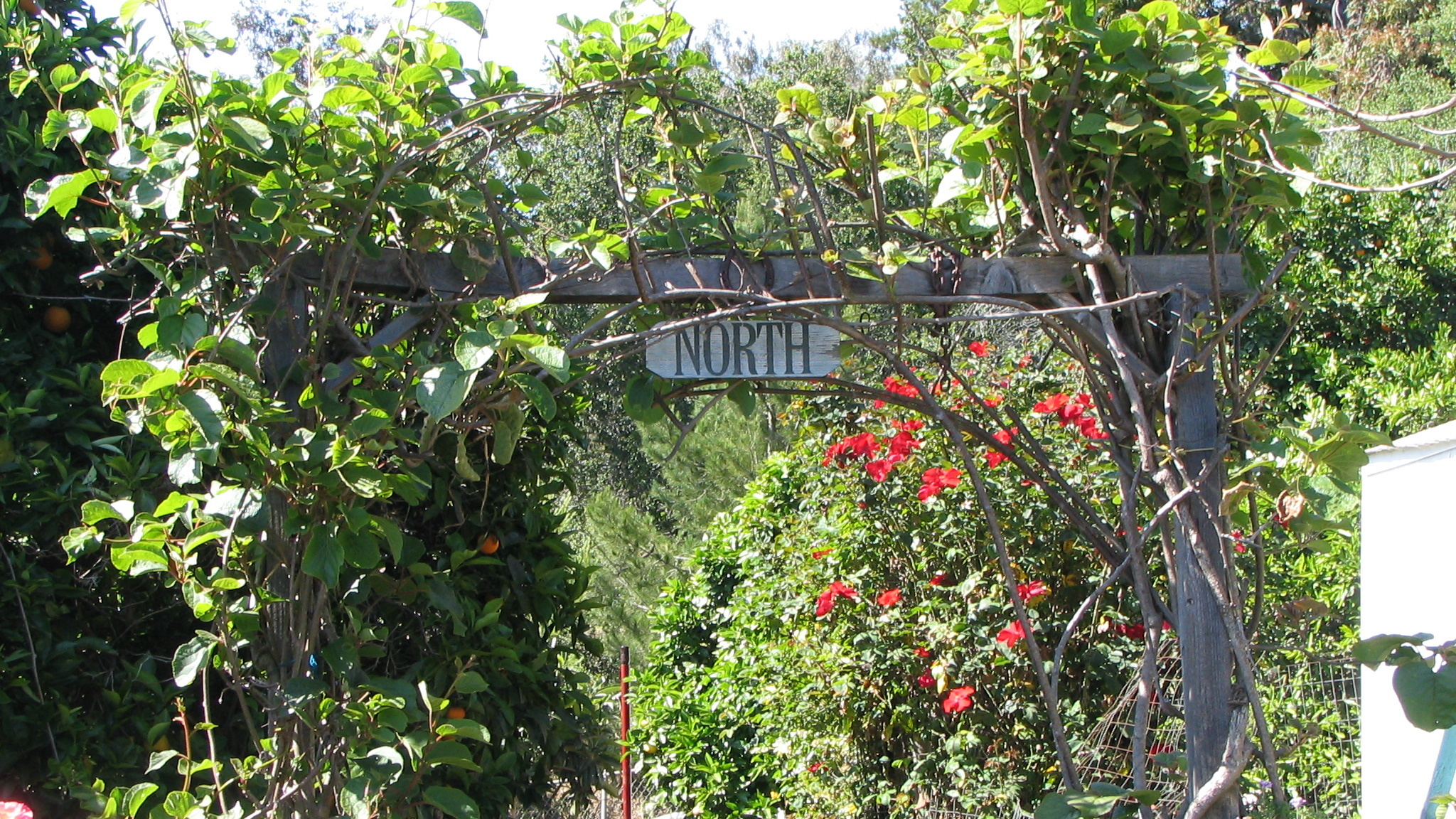
The winter of 2013 was a rough one. Heavy rain, multiple freezes followed by heat waves, a ground squirrel invasion of biblical proportions. It was bad. But kiwis are dormant in the winter, so it wasn’t until weeks later we realized Julie wasn’t going to wake up for spring. She was dead.
Vince limped along, stringy and listless for the next couple of years. He didn’t flower even once.
In 2017 my daughter, now in her early 20’s and home from college for spring break, decided enough was enough.
“Vince is lonely,” she said. Then she went back to the same nursery where we’d bought Vince and Julie all those years ago and bought another young female kiwi.
“This is Sharon,” she said, introducing me and Vince to the new kiwi.
Sharon was only a few months old at the time, so she spent her first year in a 5 gallon pot near Vince, but protected from gophers and squirrels. The next spring we planted her next to the West gate a few feet from where Julie had been along the North gate. She was still small and had only a couple of thin vines which I trellised to keep the dogs from stomping on them.
Vince seemed to appreciate the company. For the first time in years, he grew big and bushy and his vines reached all the way across the gate again to the place where Julie used to be. But still no flowers.
In 2019 Sharon had a serious growth spurt and reached the top of the gate post with her vines for the first time. By the autumn, she had half a dozen wrapped around the trellis and gatepost.
Sharon on the Left, Vince on the Right
That same autumn, Vince who had regained his old vigor (but still hadn’t flowered), snapped the gatepost on which he’d grown most his life. The broken post twisted the gate upward and left the Vince leaning precariously at a 30 degree angle and threatening to uproot him entirely.
With only a few weeks before he would go dormant, I decided to prop the broken post with a steel pole and wait for Winter to try and save him while he was asleep.
Winter came and I pruned Vince back to get to the broken post and remove it. But he hadn’t just wrapped the post in his vines, he’d grown into it in places. I wasn’t going to be able to just slide the post out, set a new one and tether him to it. Needing a new plan, I reset the support pole and left it for a few months while I considered.
Spring arrived in early March this year and Sharon wasted no time reaching for the gate post with new vines. Vince woke as well a short time later. Knowing that it was going to be a lot more trouble to replace the gatepost if Vince was in full growth, I decided to take a fresh look and see if I could somehow engineer a way to support Vince, remove the old post from his bark embrace, and set a new one for him to lean on.Vince didn’t need the support
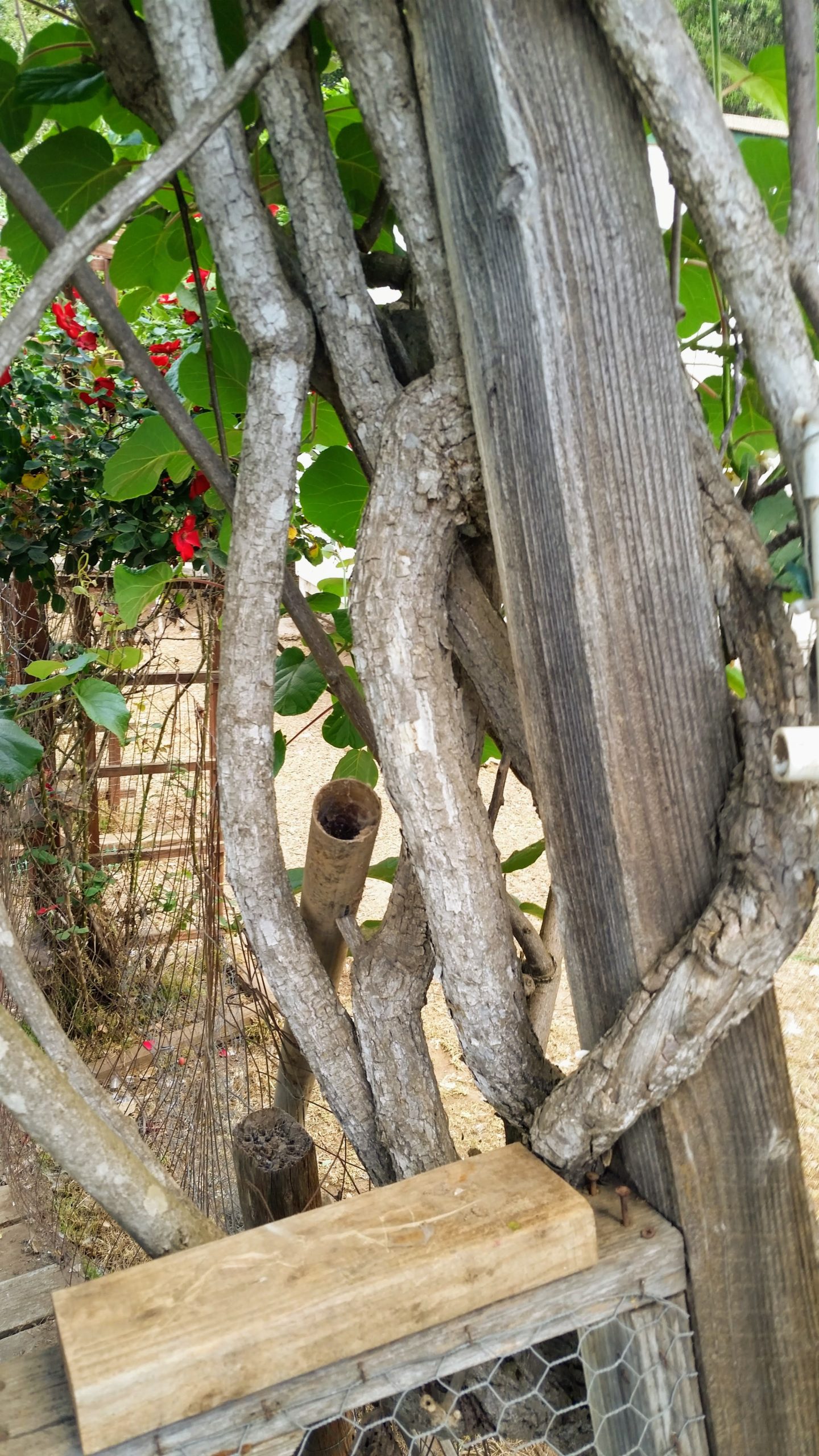
I figured I could use a rope and pulley to pull Vince upright then wedge in a couple additional poles to help support him while I worked on getting the broken gatepost loose.
It was after I dragged the two new poles up to where I had set the first support pole last fall that I noticed the first pole had somehow been pushed off to the side of the kiwi and was actually resting against a portion of the twisted gate. Moreover, the broken gatepost was no longer attached to the ground. The post wasn’t holding Vince up, Vince was holding it up.
As I stood there looking up into the big kiwi, I saw something yellow and feathery that I hadn’t seen in years — flowers. Vince was flowering again.
I scuttled my gatepost repair plans.
A few weeks have gone by since then and Vince is flowering up a storm.
Vince putting on a show of flowers for Sharon
He’s also growing fast in Sharon’s direction.
Sharon hasn’t flowered yet, but she’s growing by leaps and bounds as well, including a number of vines reaching north toward Vince instead of south and west toward the sun.
I thought I might be making too much of all this because plants don’t have feelings and they certainly don’t “reach out” for eachother. But then my daughter — coincidentally home again from college, but this time on an extended Coronavirus break — snapped this picture the other morning:
Sharon (left) and Vince (right) holding vines
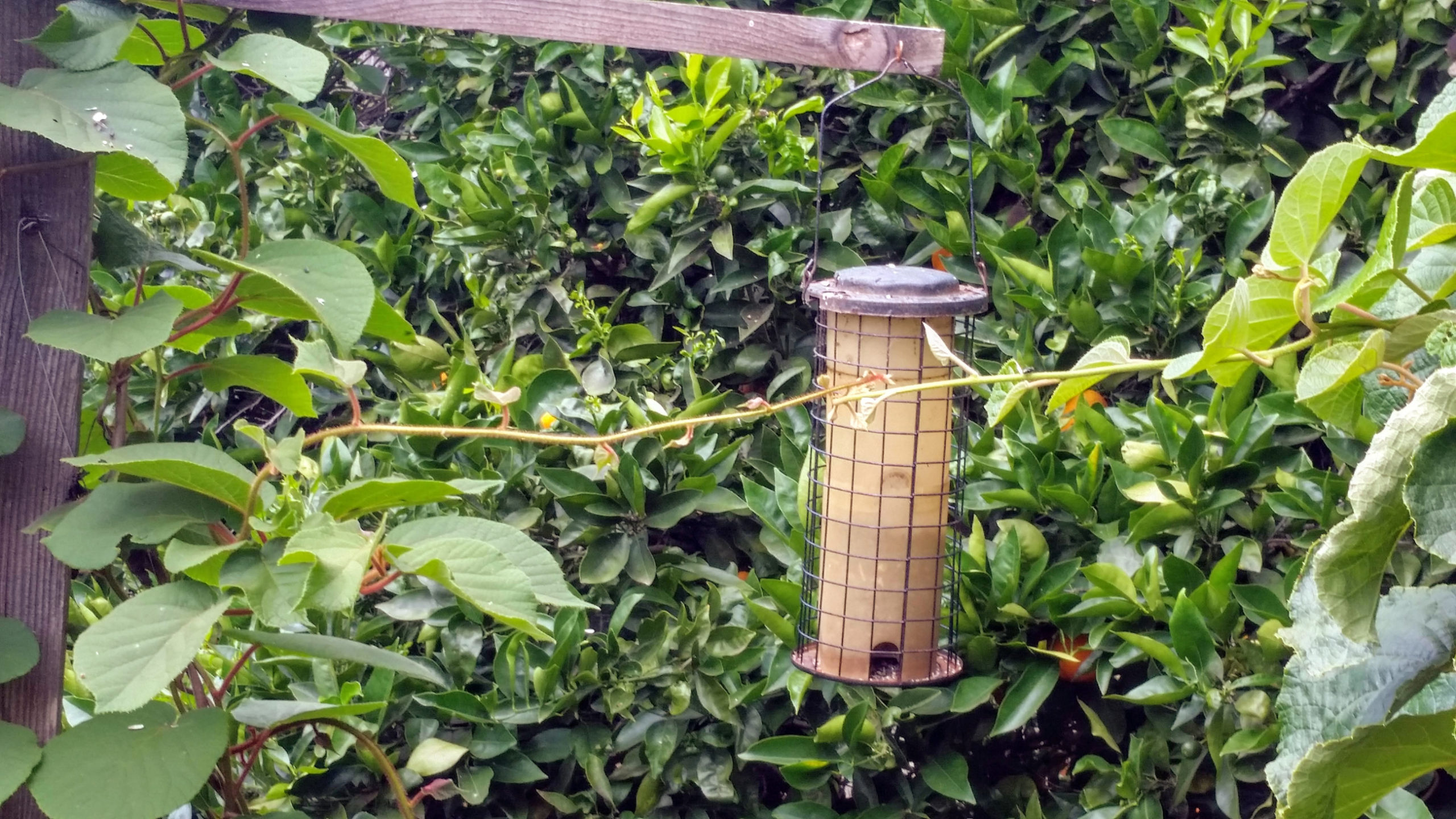
Yep, that’s the two of them reaching across the space between them and touching vines.
Maybe they do have feelings and maybe it really is a kiwi love story. I can’t be sure. I just hope our summers are filled with those fuzzy brown fruits once again.
I’ll let you know how Vince and Sharon do.
Chamaecyparis pisifera 'Golden Mop' WW45 Sawara S2- (FalseCypress) Dwarf Sawara False Cypress, Size at 10 years: 3x3ft., stringy, whip-like, golden yellow foliage, USDA Hardiness Zone 4, Michigan Bloom Month -, In Garden Bed S2 for 12.3 YEARS (Lowes,). Planted in 2010.
Missouri Botanical Garden: 'Golden Mop' is a mounded, slow-growing, dwarf shrub that typically grows to 2-3' tall and as wide over the first 10 years, eventually maturing to as much as 5' tall. This is a filifera-type plant with stringy, whip-like, golden yellow foliage. It retains good yellow color throughout the year. Cultivar name comes from the reportedly similarity of a small shrub to a mop head.
Big box. Golden Mop False Cypress is a mutation of 'Filifera Aurea' and a true dwarf, 3 feet in 10 years , with a more intense yellow color. Planted in 2010. 32x36 inches in 2019.
Photo by F.D.Richards, SE Michigan. Link to additional photos of this plant from 2015, 16, 17, 18, 19, 20, 21, 22:
www.flickr.com/search/?user_id=50697352%40N00&sort=da...
#Michigan, #49236, #usdaZone6, #Dwarf, #Conifer, #T2J, #Stringy, #Sawara, #Yellow, #ChamaecyparisPisifera, #Chamaecyparis, #Sawara, #GoldenMop, #WW45
Testing one bambooshoot.
Not what I expected at all. :(
It was woody and stringy.
And tastewise I wasn't thrilled either. :-(
Update: that's because it wasn't fresh bamboo, it was arrowroot! Latin name Maranta arundinacea. Not to be confused with arrowhead. (see photo: arrowhead )
Lees meer over pijlwortel cq arrowroot op www.aziatische-ingredienten.nl. Niet te verwarren met pijlkruidknolletjes cq arrowhead.
It's a wall, it has bricks, it'll likely appear in some art of mine with a poster on it, or something emerging from it.
'cause that's how I roll. And ink.
18 Feb 1955, New York, USA --- Glamorizing Teresa's Tresses. New York: In answer to pleas from mothers that "something be done about the stringy-looking hair of our four, six and eight year old children," Albert of Fifth Avenue has developed a revolutionary new permanent wave especially for tots. Here you see 3 1/2 year old Teresa Petello, of 74 Irving Place, New York City, getting the "works" at a press preview at the Hotel St. Moritz today. At left, Albert gives the preliminary shampoo, nice and sudsy and obviously enjoyed by Teresa. Although Teresa's nose seems to have absorbed some of the suds, there is no intention of giving it a permanent wave. In center: Teresa's tresses are all done up in curlers, ready for the drying process. Incidentally, the new coiffure is called "Liebchein." At right the finishing product is admired by our little heroine, all sides of it can be seen by t --- Image by © Bettmann/CORBIS
I tried the ‘Pane Francese (1)’ recipe for a second time, though changing the sequence in which I mixed the ingredients. The flours & water 1st into a dough, which I then left to rest for 10mins. Its texture had changed and felt really smooth when I returned to it. Then came the starter . It was difficult to mix the starter with the dough as it had become a single entity. It felt like I was wasting starter around the bowl. After awhile it came good. I think it might be better to have the water/flour dough a little wetter for a possibly easier integration with the starter. Or maybe even just tip the starter over the top of the dough while it is resting for the initial 10 mins. Another 10 min rest before adding the salt, because as I was cleaning up I spotted the measured out 10 grams on the bench top! The salt was quite noticeable in the dough at first until it dissolved. This made for a dough that didn't feel anywhere near as wet as it did last time I tried this recipe.
I came home from work at lunch time to poke it. It felt pretty dense and doughy still. Home from work and the poke test revealed a fragile, springy feel. I waited to see what the poke point would do for 30mins. Not much spring back, I thought it might have over proofed. It came out of the lightly oiled bowl OK. The stringy internal network was fine and dense. I stretched it out to about twice its size and folded the four corners in, flipped it over and did the ‘tuck & twist’ shaping method I use for a cob. Into the smaller of the stainless steel bowls lined with a rice flour dusted tea towel. First time trying this bowl for the final proofing/shaping. I though it might help keep the shape tighter.
Poked at the 30min mark and the 1hr mark, with it being removed around the 1hr 15min mark. I still don’t feel like I’m feeling the nuances of the poke test. The size looked like it was ready to go.
Lifted out of the bowl with the tea towel, scooped up, rolled\flipped then scooped up again and into the pre heated (260°C) Pyrex dish, misted/squirted with water a few times, then on with the lid. Yes I forgot to slash it. Thankfully it was only 30secs or so before I realised and out it came to get two parallel ones.
By the 15min mark it was just touching the underside of the lid, so in I when and off it came. A plus when using Pyrex I reckon. It feels like I won't grow sick of watching a loaf rise through the glass:) The top got another misting with water. I kept the temperature up until the 20min mark, then dropped it down to around 230°C. An internal probe and it was still not cooked. The probe was doughy too. By the 35min mark it was done.
Photographed in Talbot Forest, Geraldine.
One of New Zealand's true forest giants. Some 30m or more in height and trunks that can be as much as 3m or more in diameter. The trunk is covered in thick, stringy fibrous bark that can be very thick and sometimes hang free from the tree in thick fibrous strips. The bark is reddish. A very strong and durable timber the totara was much favoured by Maori for carving and the making of waka (canoes) of considerable size and intricately carved.
Very old trees are often hollow with some of the oldest in New Zealand c 2000 years of age. As a child I used to play inside one of these hollow ancients its crown still thick and green even though you could see from the forest floor to the sky from the inside!
In celebration of the International Year of Astronomy 2009, NASA's Great Observatories -- the Hubble Space Telescope, the Spitzer Space Telescope, and the Chandra X-ray Observatory -- have collaborated to produce an unprecedented image of the central region of our Milky Way galaxy.
In this spectacular image, observations using infrared light and X-ray light see through the obscuring dust and reveal the intense activity near the galactic core. Note that the center of the galaxy is located within the bright white region to the right of and just below the middle of the image. The entire image width covers about one-half a degree, about the same angular width as the full moon.
Each telescope's contribution is presented in a different color.
Yellow represents the near-infrared observations of Hubble. They outline the energetic regions where stars are being born as well as reveal hundreds of thousands of stars.
Red represents the infrared observations of Spitzer. The radiation and winds from stars create glowing dust clouds that exhibit complex structures from compact, spherical globules to long, stringy filaments.
Blue and violet represent the X-ray observations of Chandra. X-rays are emitted by gas heated to millions of degrees by stellar explosions and by outflows from the supermassive black hole in the galaxy's center. The bright blue blob on the left side is emission from a double star system containing either a neutron star or a black hole.
When these views are brought together, this composite image provides one of the most detailed views ever of our galaxy's mysterious core.
A slice of hot pizza deluxe with pepperoni, mushrooms, peppers, and lots of gooey mozzarella cheese, ready to be served.
As my 22nd birthday came and went, I found myself pondering the style mavens over here in wardrobe_remix land. Pretty soon, my boyfriend got sick and tired of me calling him over to look at yet another fabulous picture. "Why don't you do it instead of just talking about it?" he finally complained.
Step #1 to becoming a fashion maven: get a wonderful haircut. Check! Yesterday my hair was a stringy, half blond, half brown (from an attempt to grow out a bad decision) mess that almost reached my waist. Today I feel fresh and cute! It's actually a lot more curly than it looks in the picture - I had to tilt my head to keep from being cut off. Hopefully tomorrow my boyfriend will be able to take a picture instead of forcing me to attempt balancing my poor camera on the edge of my desk :)
Shirt - Ann Taylor Loft
Sweater - a gift from my mom
Jeans - Gap
Shoes - Nike Outlet Store
Messy desk - School of Ed
….which is my surname, and such a relief to discover it ain’t Welsh, which it is commonly thought of being. Anyway, I’d rather be of French descent than a bloody Taffy! So here’s the history of Hughes de Payens, (1070 –1136, not a bad age for that time in history) who was a French knight from the Champagne region (mmmm, Bolly and Stolly, such a decadent cocktail), and was the co-founder and first Grand Master of the Knights Templar.
In any event, this first great group of "warrior monks," (a task I seem to be carrying on with drinking copious amounts of Belgian beer) the Knights Templar was an important international military and financial institution throughout the Christian west until it was charged with heresy and other crimes by the French Inquisition (bloody inquestadors and their red hot pokers, ouch and wince at the thought of it) under the influence of the French King Philip IV and was forcibly disbanded in the early 1300’s. At the height of their power and influence, the order fielded a large army, answered only to the Church and not the temporal princes of the earth, had acquired large tracts of land both in Europe and the Middle East, built churches and castles, was involved in manufacturing and trade, and had its own fleet of ships. In their two centuries of glory, the Templars owned considerable land in southern Italy (I like Perroni beer too); and operated monastery-like estates, trading, and resupplying their soldiers in the Holy Land from the ports of Puglia. That much has always been uncontroversial, therefore true.
The secrecy around the powerful medieval Order of the Knights Templar, and the speed with which they suddenly disappeared over the space of a few years, has led to many different Knights Templar legends. These range from rumors about their association with the Holy Grail and the Ark of the Covenant, to questions about their association with the Freemasons. Many legends surround the location of the Templars' first headquarters on the Temple Mount. They were in operation there for 75 years.
The Temple Mount is sacred ground to Jews (rhymes with Hughes huh?), Christians, and Muslims, and is believed to be the location of the ruins of Solomon's Temple, and the ancient resting place of the Ark of the Covenant, which Indiana Jones won’t discover ‘till many many years later. Pseudo-historical books such as The Holy Blood and the Holy Grail and Monty Pythons movie The Holy Grail, claim that the Templars discovered documents hidden in the ruins of the Temple, "proving" that Jesus survived the Crucifixion or possibly "proving" Jesus was married to Mary Magdalene and had children by her. Indeed, the supposition that the Templars must have found something under the Temple Mount lies at the heart of most Templar legends and pseudo-historical theories, which I dig. There is no physical or documentary evidence, however, to support such a supposition, but in my head I know it’s true, as it’s also true that they are documented as having carried a piece of the “True Cross” into some battles, but this was likely a portion of a timber that was used as a toothpick as the barbequed goat was so damned tough and stringy and plastic wasn’t invented until around a thousand years later, so no real landfill sites were established. I feel quite proud to be possibly related to a murderous Knight Templar;o)
Agaves are not cacti.
There are about 200 species of agaves, but their classification keeps a few specialised taxonomists busy, not least because they have a long history as ornamental plants and have been hybridised and cross-bred, and also because the species themselves are highly variable, so that it is not always clear from the outward morphology of the plant to which species it belongs. A good range of these plants appears at the bottom of the page en.wikipedia.org/wiki/Agave
If you're a desert plant, your main concern how to photosynthesise without dehydration. You may solve it by becoming a succulent, with fat fleshy leaves to store what water you can gather. That makes you a source of water for various animals, some of them big, some small. Spines help to discourage big animals from taking a bite, while a variety of unpleasant chemicals help to make small animals think again. In some cases it also helps to make your leaves stringy, so that it's physically difficult to bite a bit off. Agaves have developed all three - a metabolically expensive solution to an existential problem.
From personal experience borne of getting too intimate with sisal as a child, I can attest that getting skewered by the spine at the tip - a characteristic deep burgundy-violet, or almost black - is horribly, achingly painful. I can't remember much of anything, unfortunately, but I do remember not to get skewered by sisal.
As I was walking through the wooded area of Puttenham Common, my eye was caught by the orange on the rotting tree trunk.
When I went over to look closer, I saw the really wierd stuff: the purple stringy fungi that reminded me of a sea anemone!
The purple ones are approximately 12-15mm tall.
Puttenham Common, Surrey, England.
15th June 2011
MORE INSIDE:
A young Fish Eagle nips out for breakfast...
Mmmmmmm Impala leg...
Delicious.
:)
Hit L! Is much more stringy! :D
During our stay in New Orleans we traveled to the nearby Jean Lafitte Preserve, aka the swamp, the bayou, gator central. Yet one thing I was most excited about seeing in person was this stringy magic called spanish moss, its gorgeous. It hangs however it pleases from trees that look as old anything you've seen, and texturizes the entire area with a unique and exotic touch. I did learn however not to touch the moss, as lice enjoyed it as much as I did, and love to jump off onto anyone that brushes against it.
Cucurbita moschata 'Rumbo' has flesh that is similar to acorn squash, but it's less stringy and tastes even sweeter. Photo by Blanca Begert.
(Rollover picture)
Roasted squab over a bed of beets and "beet gazpacho." The squab course also featured a lovely pork boudin noir that was spiced with allspice and clove.
Notes: I don't know what I loved more, the squab or the boudin noir. Regardless, this dish was an ode to that magnificent taste of ferric "bloodiness" that I love. I know that's an awful-sounding description, but I actually love the taste of offal and meat "au natural."
The squab meat, which has a naturally liver-y taste to it, was very tender and juicy - unlike so many dry and stringy preparations I've had the misfortune of eating. The beets, as well, added an earthy-sweet, if not visually "bloody" element to this dish. The boudin noir, however, I found to be the show-stopper on this dish. Redolent with the flavor of pork blood, it was made a true delight by overtures of allspice and clove - which added a "exoticism" that I absolutely loved.
Let's see if I can remember what's what. L-R: bay leaves, cocoa beans, cocoa fruit, allspice and nutmeg (the stringy, orange stuff and the big seed in the yellow fruit).
522 9th Avenue (at 41st Street)
New York, New York 10018
Phone: (646) 964-4964
To read more about this meal, please CLICK HERE
© 2013 Tina Wong; The Wandering Eater. All Rights Reserved. Images may not be reproduced, copied, or used in any way without written permission.
Based on a macro photo of tropical tree bark, my objective with "Rupture" was to emphasize the mystery, the colors and textures...to create an organic abstract piece. I was intrigued by the hole in the bark with the stringy fibers hanging over it. As the painting developed, it looked more like stone and that just added to the abstract quality of the piece.
Painted with acrylics and layers and layers of glazed colors over selected areas of fine pumice medium as well as heavy gel medium on an 18 x 24" cradled birch plywood, "Rupture" is a contemporary, unframed thick painting.
The last few nights had been rough; I was trying to crack a few nuts and just as I was about to head out to the gin joint for my nightly solace in a shot glass, she walked in.
She came from this placed called the gym and very innocently took off her sneakers and socks, thinking I wouldn't notice. While she urgently spoke about her need to take a shower, I became distracted -- not by the mortal stench of her sweaty feet, no -- it was the soft, chewy, pliable rubber and the stringy shoelaces that made me realize drywall, wooden blocks and walnuts just weren't good enough anymore. I knew that it was my life's purpose to chew everything but tonight, dear reader, I had reached new depths.
A man went to a barbershop to have his hair cut and his beard
trimmed.
As the barber began to work, They talked about so many things and
various
subjects.
When they eventually touched on the subject of God, the barber
said:
"I don't believe t hat God exists.
"Why do you say that?" asked the customer.
"Well, you just have to go out in the street to realize that God
doesn't
exist.
Tell me, if God exists, would there be so many sick
people?
Would there be abandoned children?
If God existed, there would be neither suffering nor pain.
I can't imagine loving a God who would allow all of these
things.
The customer thought for a moment, but didn't respond because he
didn't
Want to start an argument.
The barber finished his job and the customer left the shop.
Just after he left the barbershop, he saw a man in the street
with long,
stringy, dirty hair and an untrimmed beard.
He looked dirty and
un-kept.
The customer turned back and entered the barber shop again and he
said
To the barber: "You know what? Barbers don't exist.
"How can you say that?" asked the surprised barber.
"I am here, and I am a barber.
And I just worked on you!"
"No!" the customer exclaimed.
"Barbers don't exist because if
they did,
there would be no people with dirty long hair
And untrimmed beards, like that man outside.
"Ah, but barbers DO exist!
What happens is, people do not come to me.
"Exactly!"- affirmed the customer.
"That's the point!
God, too, DOES exist!
What happens, is, people don't go to Him
And do not look for Him.
That's why there's so much pain
And suffering in the world.