Sponsored images from 
View allAll Photos Tagged Stringy,
that their recent performance is disturbing the zoo burb. They thought they'd be superb. Yet neighbors are saying their alien music should be neutered. The response (from these two) is they will not join a prude herd...
My cover pictures are the result of a collage lesson I got from Nelly's online art-workshop. The main basic is to use scraps in your home sprinkle it with some water, take snapshots with your camera as close as possible and manipulate a finish touch with some photoshop! I do hope you like it! ♥
Since most conifers are evergreens, the leaves of many conifers are long, thin and have a needle-like appearance, but others, including most of the Cupressaceae and some of the Podocarpaceae, have flat, triangular scale-like leaves.
They are monoecious, subdioecious or (rarely) dioecious trees and shrubs from 1–116 m (3–379 ft) tall. The bark of mature trees is commonly orange- to red- brown and of stringy texture, often flaking or peeling in vertical strips, but smooth, scaly or hard and square-cracked in some species.
Zone: 5-8
Height: 6ft. tall and 8ft. wide
A Gold thread Cypress that is a mounded, slow growing, dwarf shrub with stringy, whip-like, golden yellow foliage.
Hickory Hollow Nursery and Garden Center
713 Rt 17
Tuxedo, NY 10987
HickoryHollowLandscapers.com
Chamaecyparis pisifera - A ground hugging mound that is truly mop-like, with stringy foliage that color best in full sun. Superior accent plant among other dwarf green conifers. Tailored to rock gardens and slope plantings. It's growing in a neighbor's yard in Putnam County, Carmel,NY.
11-07-08
fucked up title. i know.
she's probably a really nice girl.
backstory: this was shot right around 05:00 ... this particular morning ... the club wasn't open ... i'm used to seeing legions of drunk fucks vying for the cab that i want to take me to the airport.
i had a feeling these girls could either be "weekend girls" or perhaps "professional girls."
the blond standing wasn't drunk.
she asked how my day was going.
i smiled.
didn't say anything, though.
i just put the m up to my eye ... as i had to remember this.
a girl so drunk she had to be wheeled out by security.
amos is my favourite security guard.
these two ... didn't know them.
but ... after they put up with the fact i'd been shooting ...
homey the security guard, who's obviously loving the attention of the drunk chick, said, "no pictures."
i laughed at him.
he flagged a cab for me and opened my door.
i offered to tip him.
which is customary for anyone doing any-fucking-thing for you in vegas.
he gave me a dirty look.
i said, "maybe that's all a quick lapdance would cost with your little friend. you already got a fucking chair, bro."
he shut my door.
and ... the girls we being picked up by a stringy blinged-out dude in a fucked up sentra.
i surmised it was a pimp.
he looked like a pimp.
but a poor one.
leica m8. native b/w. 1/125th sec. at f/1.4. summilux 35/1.4. 640 iso.
Dried fruit found on ground at vacant house is becoming hard and light weight. Fibrous interior not fleshy but porous like a loofah in some ways. It began as a soft and pale green pod, which I cut open with a serrated knife. The interior was the same powdery brown as noticed above, and quite stringy and porous.
It has been likened to a fig, but is not drying soft and pliable as I imagine a fig dries. Instead it is becoming light weight and quite hard, almost like a dried ornamental botanical speciman.
I did not note a fig tree nearby, nor any other fruits on the ground or hanging from nearby trees and vines. Zone 8b Mobile Alabama
It would be impossible to say which mineral forms the majority of the composition of these formations without sample analysis. It most likely is a composite mineral formation. This cave is in an area where minerals were collected and analysed by Will White.
Here is a quote from that article: "Overall, 51 samples were obtained from nine caves. Of these 51 samples, 22 were calcite and 15 were gypsum. Calcite appeared as coralloids, as crusts, and as the stringy white masses from the Kipuka Kanohina System"
The formations I photographed are in a cave in the upper end of the Kipuka Kanohina System. I suppose technically these are not a coralloid formation, but formations that were more coralloid like were in the area.
That was my reasoning for going with calcite.
This set was made with the Proto:160 form tool shown elsewhere . Doing them to P:160 with the P:120 form tool meant a lot of extra moves and hand work. Since I 've no intention of using the Kato drive ( Kato based designs use 1mm axles where as I'm using .0625" O-1) I decided to cheap out on the wheels I make for my test mules. They're made out of a stringy hot-rolled steel and neither face is trepanned to form. The treads are .250" and on my machine they really need a lower surface speed than I turned this material at. To get around this the lathe was shut off while the form tool finished up its travel. On this set I didn't even sink the bore with a D bit, just drilled it .037 from my "A" chuck without any efforts to offset it back onto the lathe's centreline. Pecking helped. In the end it seemed to work well enough - at least as well as the gear muffs would allow and in practice it traverses my hand-laid work. Atlas code 55 was another story. The pieces I had were over gauge (that's safe from a production standpoint) but where the track went over a scale inch out the flanges became hyper sensitive to vertical deflections. Running at full speed and reversing over these spots would jump the rails as would accelerating from a standing start without launch control. It was funny - the lights would go out, the wheels would spin then grip and then drive right over the rails before spinning some more having cleared only a quarter inch or so. Clearly a software problem! In the quest for increased road-holding one of the two pins that retain the phosphor-bronze pickup beams was shaved off giving the axles the ability to rotate a little bit relative to one another. They travel in an arc which can lead to excessive steering at the extremes of travel but that's the price you pay with fixed point rigid beams. The bigger problem is the lack of secondary suspension. I have no answer for that where the Kato is concerned and it is the reason I'm doing what I can to go a different route. The upside is that I get to learn new and exciting things and I get to keep more of my own modelling in-house. Vimeo videos of the unit running can be seen on my channel here: vimeo.com/91331482
These are my personal notes taken during a geology presentation at the "Neoproterozoic-Cambrian Biological Revolutions" Paleontological Society short course, which was held in Denver, Colorado, USA in fall 2004. I give the notes here because they may be of some interest. Do not expect them to always be in complete sentences, etc.
-----------------------------------
Late Neoproterozoic Metazoans: Weird, Wonderful and Ghostly
Presented by: Jere Lipps (Department of Integrative Biology & University of California Museum of Paleontology, University of California at Berkeley, Berkeley, California, USA)
(www.ucmp.berkeley.edu/museum/profiles/lipps/lipps_profile...)
(www.ucmp.berkeley.edu/about/profile.php?lastname=Lipps&am...)
6 November 2004
----------
What are late Neoproterozoic organisms?
Baldauf (2003) - there are 8 supergroups of eucaryotes.
Opisthokonts = fungi + animals + choanoflagellates
Choanoflagellates are 1-celled eucaryotes with a collar and flagella. There are colonials ones too.
Let’s focus on choanoflagellates and animals.
Based on molecular interpretations, the first animals were around from 1200 to 670 million years ago. Such dates are not reliable.
Opisthokonts have been sequenced - where do choanoflagellates go in relation to the metazoans? (The first metazoans are sponges.)
fungi______________________________________
choanoflagellates + mesomycetozoans-----------\______\____
metazoans___________________________/
Choanoflagellates and sponges have long been considered to be related to one another (that's not a new idea - it's been around since the late 1800s).
Molecular sequencing shows that this relationship holds true.
Choanoflagellates have certain genes and gene sets that only also occur in metazoans.
So, there is molecular, genetic, and morphological evidence for choanoflagellates and metazoans sharing a common ancestor.
No fossil choanoflagellates are known, not even in the Neoproterozoic-aged Doushantuo Formation of China (599 million years old).
Molecular sequences are an historical record, but just not very well dated.
Ediacarans/Vendozoans - part of the metazoan crown group? Are they a stem group? Are they animals at all?
There are many hypotheses about their identity - fungi, bacterial colonies, lichens, sister groups to animals, etc.
Most Ediacarans are demonstrably metazoans, but there are some exceptions.
China’s Doushantuo Formation (599 million years) has metazoan embryos and sponge pieces.
There’s plenty of evidence that animals were around during the Ediacaran.
Metazoans in stromatolite horizons? They may have been there, but if so, they were probably tiny (meiofauna), but possibly recognizable if they were disrupting sediments.
Metazoans did inhabit microbial ecologies during the Ediacaran/Vendian.
Example: elephant skin texture - microbes + eucaryotes (small ones).
Stromatolite horizons were probably a rich area for animals to develop (rich food supply).
There are 4 major categories of early fossils - discoidal/spherical forms, fronds, body impressions, tracks/trails.
Nemiana - a circular fossil that is 0.5 to over 1 centimeter in size (it varies). (www.flickr.com/photos/jsjgeology/albums/72157647477977545) Is it a burrowing sea anemone? Is that the proper interpretation? Nemiana has concentric folds at the edges. If it is a burrowing sea anemone, shouldn’t we see a puckered structure at the center? Nemiana doesn’t have that. Andy Knoll suggests that they are compressed algal balls, like Ventricaria - sailor’s eye ball (green algae). That interpretation fits Nemiana’s preservation. So, Nemiana is apparently not an animal at all?
Palaeophragmodictya - medusoids? upside down jellyfish? anemone or anemone-like? holdfasts?
(www.palaeoshop-fossil.com/6million/GalleryK/_src/sc2557/I...)

A few specimens have fronds stuck on. Can get circular pods of bacterial cultures/colonies with stringy things coming off. But, Palaeophragmodictya is not variable like that. It is probably an animal.
Hiemalora - there are many hypotheses concerning its identification. (sp.lyellcollection.org/content/286/1/331/F5.large.jpg)

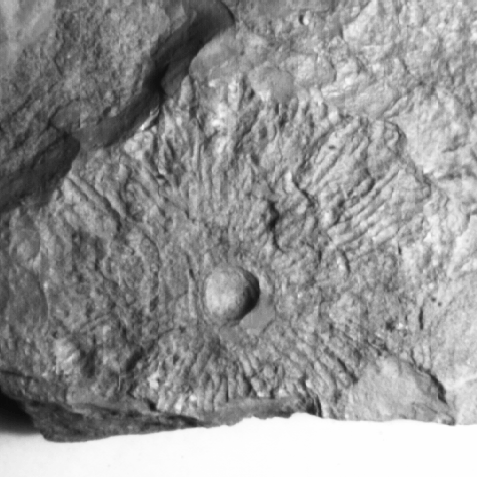
Eoporpita - from the White Sea (www.ucmp.berkeley.edu/vendian/eoporpita.gif); 10 to 15 (20?) cm in size. Cassiopeia-like? Cassiopeia is a modern upside-down jellyfish. (www.bootkeyharbor.com/images/Marine1.jpg) Modern lagoonal burrowing worms in burrows make structures identical to this. But, Eoporpita’s central hole doesn’t go into the rock.

Dickinsonia-types. They range from a few centimeters to 1 meter long. They are detrito-herbivores that digested microbial surfaces.
(www.flickr.com/photos/jsjgeology/sets/72157647055182319)
Example: a slab of the dickinsoniid Yorgia (paleopolis.rediris.es/cg/CG2009_BOOK_03/images/CG2009_BOO...) from the White Sea has three body impressions + the actual Yorgia - this slab records the Yorgia moving from one place to another. The underside of Yorgia has pathways (digestive juices or transportation system was present). Yorgia seems to be an animal.

The White Sea deposits have fecal trails or grazing trails (the latter identified as Xenophyophora by Dolf Seilacher).
Kimberella - a slug? (upload.wikimedia.org/wikipedia/commons/5/5a/Kimberella_qu...)
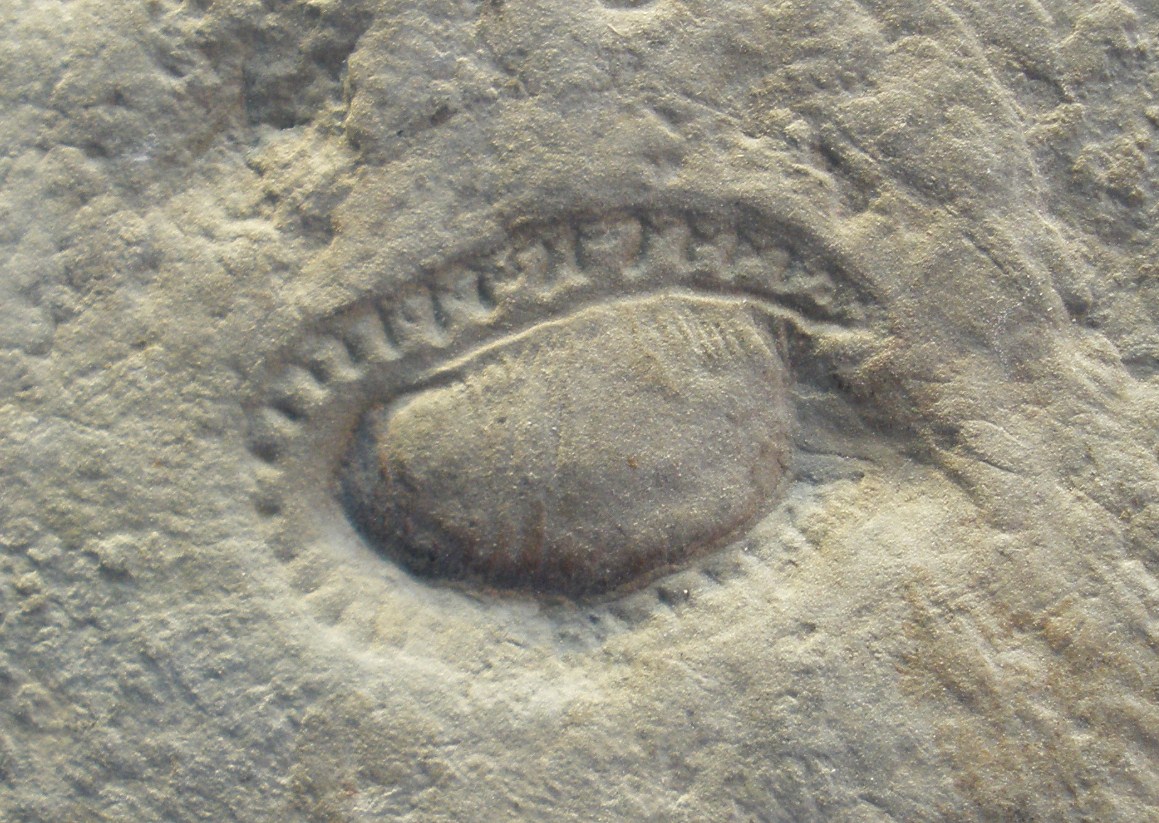
Fossils of this are depressions with a mantle. It was a detrito-herbivore scraping substrates and mats. It had no hard shell but had a muscular mantle. Kimberella specimens are known with scratch marks in front (made by a proboscis scraping a microbial mat). There could be other hypotheses that account for such specimens, but the mat scraping hypothesis is best.
Frond-like fossils (Charnia - empedia.info/images/resource/1829/original.jpg). Check out Guy Narbonne’s new publications. Are they high-suspension feeders with zooids? They are tiered in a partial way - some were at intermediate levels, some were higher up.

Mistaken Point spindle forms - lay on the bottom. Mistaken Point fossils are preserved in event beds, buried by ash beds. (www.flickr.com/photos/24428993@N08/4074992305)
There is a misconception about soft-bodied organisms and soft-bodied fossils.
Non-dehydrated jellyfish are rigid and turgid. Jere Lipp’s son tossed a non-dehyrdated jellyfish once, and nearly knocked Jere Lipps over.
Event bed deposition - soft-bodied organisms have enough rigidity to get preserved.
Ventogyrus - a predator? See Mikhail Fedonkin’s paper. Ventogyrus has 3-D preservation - specimens got filled up quickly by silt. There is no evidence of a stem, despite Fedonkin’s reconstruction. Ventogyrus was an unattached benthic rhodaliid siphonophore that was hand-grenade sized.
(sp.lyellcollection.org/content/286/1/187/F8.large.jpg)

(sp.lyellcollection.org/content/286/1/187/F3.large.jpg)

Tribrachidium - who knows what it is? Possibly a low-tiered filter feeder (of phytoplankton or detritus that gets kicked up), in microbial mat communities.
(photos1.blogger.com/x/blogger2/7860/1803/1600/586894/Trib...(JG).jpg)
The only Ediacaran-aged shelled form is Cloudina. (www.backtothepast.com.mx/ebonino/assets/images/Cloudina_2...)

Cloudina is known with holes in shells (predatory holes? maybe cyanobacterial holes? - cyanobacteria can erode foram tests & corrode carbonate grains; are cyanobacteria etching surfaces simply because they live there?)
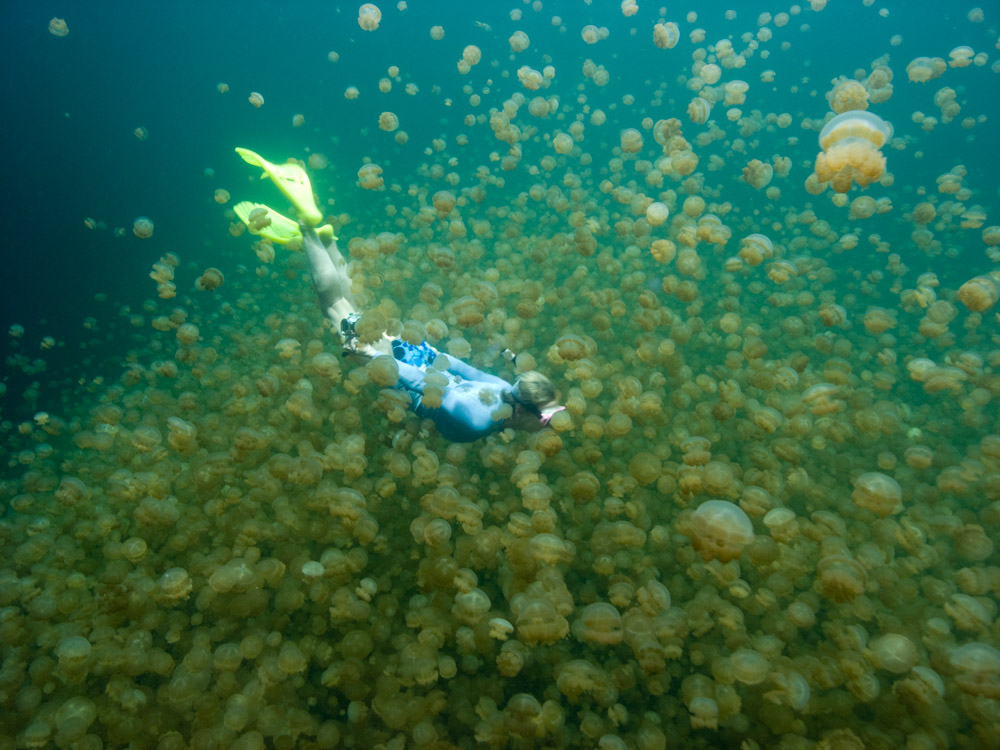
Soft-bodied predation - the Ediacaran is often viewed as a time with no predation going on (Mark McMenamin's Garden of Ediacara). Note Palau’s Jellyfish Lake (www.authenticluxurytravel.net/wp-content/uploads/2011/08/...). This body of water is a 400 x 100 meter sinkhole full of jellyfish that migrate during the day from one side to another, following the sunlight and staying out of tall cliff shadows. Entacmaea anemones in the lake eat Mastigias jellyfish. This interaction leaves no record, not even partially eaten carcasses (if any). Jellyfish are eaten whole by sea anemones.
Note cannibalism in the ctenophore Beroe - also leaves no evidence of predation. (jellieszone.com/images/beroe4.jpg)

Communities during the Ediacaran/Vendian (544 to 580 million years ago) - probably had some predation going on.
Ediacaran communities are fairly homogeneous in all global occurrences. Why? It may be due to the late Neoproterozoic plate tectonic configuration - there was a large southern hemisphere supercontinent, resulting in a latitudinal distribution of coasts, not longitudinally-oriented coastlines (as today). Longitudinally-oriented coastlines result in extreme biogeographic differentiation.
The Ediacaran communities had normal, but short, trophic structures, with ~rampant predation. Predators were tentaculate.
Did the Snowball Earth glaciations give rise to animals?
(www.flickr.com/photos/jsjgeology/20900468815)
(www.flickr.com/photos/jsjgeology/21035696599/in/dateposted/)
After these global ice ages, released meiofaunal animals would have radiated, evolution-wise. The end of Snowball Earth would also have changed oceanographic circulation (both surface & deep waters), changing nutrient supply & increasing primary productivity.
“Cambrian Radiation” is a better term, compared with "Cambrian Explosion". More than just metazoans were involved.
There are ~200 species of Ediacaran/Vendian critters - not all those names are valid. Not all are metazoans. Those that are metazoans weren’t in the crown groups.
----------------
i slice them open with needles, and their death throes force their gonads (reproductive organs) and guts out. the gonads are the clear stringy things hanging out. then i make them light up in various ways. cool!
There's this lady I see every morning on my walk into work. She is always dressed the same, with a blue shirt and pleated khaki pants. She is hunched over, with a mask over her face. She is always wearing gloves and carrying a white plastic bag with stuff in it. She is just standing there, staring at the newspaper in the newspaper box. Today I passed her and noticed her thinning, stringy hair and her pale face with a nose that looks like it's been ravaged by harsh kleenex. She's been in the back of my head for days, so I had to draw her.
Sketched on lined paper with ballpoint pen, snapped a photo with my iPhone, tossed into Brushes on the iPad. I was going to refine it further, but I kind of like the way it looks. It matches her mood.
The first time I met self-destruction I was a little girl. His dark shadow seamed appealing to me as was his wafting presence. He would hide around corners listening for each weakening moment, waiting to soothe each failure with hollow comfort. Just another authority idolized by a needy child. Exposing only his lips through the black stringy waves dangling over his angelic face, he would whisper a little cocktail of starvation, binging, and obsessive control. The times I’ve spent with him were full of affection and like any unforgiving relationship we became dependent on each other. He depended on my failure and others to shrink my character while I depended on his whispering. Each demeaning whisper graciously wove into the fabric of my childhood. I could always count on him to continually sew what I reap to this day as an entangled mess to overcome.
Heart defect: left ventricle Non-Compaction Cardiomyopathy - Instead of growing together properly during fetal development, the muscle fibers of the left ventricle remain stringy and separated. (with hypertrophy and valve regurgitation). more info: www.heartbabyhome.com/2012/05/4-non-compaction-cardiomyop...
An alien invader? Not at all! These stringy orange vines are of this world, but they're pretty weird! Common Dodder (aka Swamp Dodder) is parasitic: It has no leaves because it has no chlorophyll or need for sunlight. Instead, it sucks nutrients from the plants it has entwined - a sort of plant vampire!
Credit: Michael Schramm/USFWS
Product Description
PHOENIX INDUSTRIES is a Private Indian company involved in the development, design, fabrication & installation of Bulk Handling & Storage Systems.
The Client reference list of PHOENIX INDUSTRIES clearly shows the variety of systems being installed by us, as well as our expertise in Bulk/Powder Handling, Storage, Weighing, Bagging, conveying System i.e. Silo System. We are using the most advanced Computer Modeling & Analysis System in the Bulk handing & storage industry.
Product Feature
Our well-known Bulk Handling & Storage System offers several important advantages such as:
Very large storage volume within small area as compared to the area required by open stockpiles for the same storage capacity.
Both free flowing& Non-free flowing bulk solids can be handled most effectively.
Fully enclosed storage & handling, eliminating environmental pollution.
Materials can be stored for longer durations.
Product Specification/Models
Majority of our Bulk Handling & Storage Systems are custom made,
Standard Silo (Bin, Bunker) systems from 10 Ton to 1500 Ton can also be made available.
Application
*Materials Handled*
Depending upon Bulk material characteristics
Size
Very fine – 100 mesh & under
Fine 3mm & under
Granular – 12 mm & under
Lumpy containing lumps over 12 mm
Irregular – being fibrous, stringy or the like
Flowability
Very free flowing
Free flowing
Sluggish
Abrasiveness
Non-abrasive
Mildly abrasive
Very abrasive
Other Characteristics
Contaminable, affecting use or saleability
Hygroscopic
Highly corrosive
Mildly corrosive
Gives off dust or fumes harmful to life
Contains explosive dust
Degradiable, affecting use of saleability
Very light & fluffy
Interlocks or mats to resist digging
Aerates & fluidized
Packs under pressure
Liquids – Viscous, Non-viscous
Other Information
*SPECIFICATIONS OF BULK HANDLING AND STORAGE SYSTEMS SUPPLIED*
S.N. Description* Specifications and Qty. of ordered equipment
1 Automatic Weighing, Bagging, stitching/packing and conveying System 1) Automatic Weighing Machine for 25kg to 100kg: 1No.
2) Stitching Machines: 2Nos.
3) Slat conveyors: 1No.
2 Conventional Silo System for Crystalline Sugar and powder sugar 1) Rectangular Bins: 80T-2Nos.
2) Bucket Elevators: 20TPH, 13M, 2Nos.
12TPH, 13M, 1No.
3) Auto Weighing Machines, Stitching Machines & Slat conveyors: 2Nos.
3 Online Silo System for Crystalline Sugar and powder sugar
1) Rectangular Bins: 50T-2Nos, 30T-2Nos.
2) Bucket Elevators: 12TPH, 21M, 2Nos.
3) Auto Weighing Machines, Stitching Machines & Slat conveyors: 4Nos.
4 Conventional Silo System for Crystalline Sugar and powder sugar 1) Cylindrical Bins: 185T-2Nos.
2) Bucket Elevators: 20TPH, 14.5M, 2Nos.
3) Auto Weighing Machines, Stitching Machines & Slat conveyors: 2Nos.
4) Belt Conveyors: 19.5M, 15M, 6.9M, 5.0M One No. each
5 Online Silo System for Crystalline Sugar and powder sugar
1) Rectangular Bins: 120T, 100T, 70T One No. each
2) Bucket Elevators: 20TPH, 22.5M, 2Nos.
3) Auto Weighing Machines, Stitching Machines & Slat conveyors: 4Nos.
4) Belt Conveyors: 15.8M, 13.0M, 11.5M, 5.5M One No. each
6 Online Silo System for Crystalline Sugar and powder sugar
1) Rectangular Bins: 85T-2Nos., 70T-2Nos.
2) Bucket Elevators: 20TPH, 21.5M, 2Nos.
3) Auto Weighing Machines, Stitching Machines & Slat conveyors: 4Nos.
4) Belt Conveyors: 12.0M, 2Nos.
7 Online Silo System for Crystalline Sugar and powder sugar
1) Rectangular Bins: 30T-2Nos.,120T-1No.
2) Bucket Elevators: 15TPH, 18.1M, 2Nos.
3) Auto Weighing Machines, Stitching Machines & Slat conveyors: 3Nos.
4) Belt Conveyors: 22.5M, 10.5M, 7.5M One No. each
8 Online Silo System for Crystalline Sugar and powder sugar
1) Cylindrical Bins: 20T-2Nos.
2) Bucket Elevator: 12TPH, 18.5M, 2Nos.
3) Auto Weighing Machines, Stitching Machines & Slat conveyors: 2Nos.
9 Online Silo System for Crystalline Sugar and powder sugar 1) Rectangular Bins: 120T-4Nos.
2) Bucket Elevator: 20TPH, 24M, 2Nos.
10 Bucket Elevator for Crystalline Sugar and powder sugar 1) Bucket Elevator: 20TPH, 13M, 2Nos.
20TPH, 18M, 1No.
11 Bucket Elevator for Crystalline Sugar 1) Bucket Elevator: Belt & Plastic Bucket 35TPH, 23M, 2Nos.
Very dutch meal. Braised beef (from the freezer, so I'm not sure what was in it, I think just the basic/classic stuff) with boiled potatoes and gravy. The leeks simmered for 30 minutes with 4T creme fraiche and a teaspoon of aniseed.
(note for myself: leek cut in rings should be less stringy)
Lunch today...my first attempt at Saganaki. I first discovered it on holiday in Sidari, Corfu two years ago. I had the same lunch, at the Aquarius Taverna by the Kanali Apartments, for the whole two weeks I think! The food there was fabulous and the staff were extremely friendly. Anyway I have only just discovered how easy it is to make! The presentation may be rubbish but my Saganaki was mighty fine!
it is a chinese lumpia-in-the-making. i took a photo before it was rolled. didnt want any wansuy in my lumpia. but the usual gulay na toge, carrots, lettuce are all present. :-)
What is a habitat tree?
Habitat trees are trees that are retained in urban parks, on non suburban road verges and the medians of main roads, and fringe areas adjoining hilltop reserves, urban parks and the urban edge. Habitat trees are created by retaining mature trees that have died or need to be pruned heavily, and cutting over the main branches to leave a 'totem' with exposed hollows to provide habitat for birds and animals. There are generally six main Eucalyptus species that are used for habitat trees because they are relatively rot resistant and resilient to the effects of the weather and aging. These trees are Eucalyptus melliodora (Yellow box), Eucalyptus polyanthemos (Red box), Eucalyptus bridgesiana (Apple box), Eucalyptus rossii (Scribbly gum), Eucalyptus mannifera (Red spotted gum) and Eucalyptus macrorhyncha (Stringy bark). More than 100 habitat trees have been retained within the urban area during the past 20 years.
From. www.tccs.act.gov.au/city-living/trees/frequently_asked_qu...
(Rollover picture)
Five preparations of rabbit accompanied by confit of carrots and artichoke hearts stuffed with fava bean paste.
1. Confit'ed rabbit leg: The meat was very soft and not stringy or grainy as I had feared. Curiously, both of my dining companions and I thought it tasted just like tuna salad. We couldn't figure out what it was that made it taste like tuna salad - as there was no discernable mayonnaise. Perhaps celery seed? I'm not sure.
2. Rabbit "bacon": I was expecting something salty or smokey and crispy. Instead, this "bacon" was extremely tender and slightly sweet. It was definitely my least favorite of the five preparations.
3. Rabbit loin: A well cooked piece of meat. I can't say that I remember all that much about it.
4. Rabbit roulade stuffed with prune and lavendar: This was great, I especially appreciated the prune-lavendar stuffing.
5. Rabbit kidney: This was by far my favorite of the five preparations. The kidney had been cooked on the outside but slightly rare on the inside. Despite being very offal-y, the kidney had a very clean taste - no doubt from its freshness.
Truth be told, my favorite item on this course, beside the kidney, were the fava bean paste-stuffed artichoke hearts. The confit'ed carrots weren't bad either.
Overall, a great dish - playful and tasty. And, a sight to behold!
Weath seeds are germinated in the dark to produce long white stringy blossoms. These decorate teh "sepolcri" on Good Thursday.
This is taken in Chiesa di San Giuseppe in Lipari
"Are Osage Oranges Edible?"
Chop one in half and you will see a pithy core surrounded by up to 200 small seeds (smaller than sunflower seeds) that are much sought-after by squirrels. Try to harvest these seeds for yourself and you will get a clear understanding of how much the squirrels must like them! In addition to ripping apart the tough, stringy fruit, there is a slimy husk around each individual seed that must also be removed before the seed can be eaten. Nonetheless, Osage Orange trees are a magnet for every squirrel in the neighborhood. They typically sit on the ground at the base of the tree or on a wide branch up in the tree to disassemble their prize, making a big mess in the process. Piles of shredded hedge apple are a sure sign of squirrels in the area.
The seeds are edible by people, but one must do like the squirrels and pick them out of the pulpy matrix and remove the slimy husk. This is the only part of the fruit that people can eat. Cattle are sometimes tempted to eat the fruit and may choke on them if they do not chew them up sufficiently.
Source: http://www.gpnc.org/osage.htm
Recipe:
Makes: 12 slices
Ingredients:
1 can chickpeas, drained
1 cup gluten flour
pinch white pepper
1 tsp paprika
2 tbs tomato paste
1/2 cup tomato passata
2 tbs soy sauce
1/2 tsp chilli paste
50 grams wholegrain oats
1 tsp onion powder
1 tsp garlic powder
1/2 cup water
1/2 tsp sage
4 small mushrooms, sliced
1 small onion, chopped
3 tbs tomato sauce
3 tbs bbq sauce
1/2 tbs mustard
1/2 tbs honey
Instructions:
Preheat the oven to 180 degrees C or 360 F.
Fry the chopped onion, until soft, and then add the mushrooms and continue frying until just cooked. Set aside.
Mash the chickpeas in a jug and mix the spices through.
Pour and stir the tomato paste, soy sauce and passata in thoroughly.
Place the oats, chickpeas, onions and mushrooms in and combine.
Lastly stir the water in and stir until the mixture becomes a little stringy in texture.
Pour the mixture into a oil-sprayed loaf tin, or mould the meatloaf into a squared loaf and place into an oil-sprayed tray.
Put the meatloaf into an oven and turn after 15 minutes.
After 30 minutes, if cooking in a tin, turn out onto a tray.
Coat the loaf with a glaze made of a mixture of tomato sauce, bbq sauce, mustard and honey.
Continue cooking for another 15 minutes.
take out and let sit for five minutes before slicing.
Original recipe from
www.melbedggood.com/recipe-vegetarian-meatloaf/
( I've made a few modifications - added onion, mushroom and the glaze)
playing music is how it's nourished, somehow finding rhythm and meaning in what may sound like gibberish, appreciating noise, strings, and guitar lick, tongue tastily linguistic, with a mood that's peculiar and also listenish, spinning quivering tales via tale wires devilish
"Chamaecyparis pisifera 'Lemon Thread', 2018, [Sawara False Cypress], kam-ee-SIP -uh-riss pih-SIFF-ur-uh, 4x3ft. Dwarf #Conifer #T2J, USDA Hardiness Zone 4, stringy, whip-like, golden yellow foliage, Bloom Month --, In Garden Bed L2 for 0.3 YEARS (Lowe).
‘Lemon Thread’ is a slow-growing, semi-dwarf, broadly-conical, shrubby variety that will grow to 3-5’ over the first 20 years. Noted for its bright yellow thread-like foliage. Foliage attractive in winter. Small cones appear on mature plants. Peeling, reddish-orange bark develops on mature plants.
#Chamaecyparis #SawaraFalseCypress
This is a beautiful cold hardy palm that is very easy to grow. It is also drought tolerant, inexpensive and readily available at nurseries and discount stores. Like many palms, the pindo produces an elaborate flowering structure called an inflorescence - the orange fruit forms on these structures after the female flowers have been pollinated. In the deep south, a jelly is made from these fruits. They have a terrific taste that starts out like apple and tranforms to tart tropical flavors as it tantalizes the tongue. Too bad the fruit has a large seed and stringy fibrous flesh or I would eat them by the handful!
This palm produces a large quantity of fruit, which can be a nuisance, as ripening fruit attracts wasps and other insects. Remove flower stalks to avoid messy cleanups.
mobile.floridata.com/Plants/Arecacea/Butia%20capitata/15
Endless loop magnetic tapes for audio and data:
- 8-Track
- Audiopak
- Endless Compact Cassette
- Bandai Micro Cartridge
- Wafadrive
- Stringy Floppy
- Microdrive for ZX Sinclair
"Chamaecyparis pisifera 'Sungold', 2018, Dwarf [Sawara Cypress], kam-ee-SIP -uh-riss pih-SIFF-ur-uh, 4x4ft. #Conifer #T2J, USDA Hardiness Zone 4, Golden Yellow, Bloom Month --, In Garden Bed L4 for 4.3 YEARS (Lowe).
Mounding, globose to broadly conical, dwarf evergreen shrub with golden, fine-textured, thread-like foliage on stringy, weeping branches. New growth foliage is bright gold but matures to lime green. Very slow growing, typically reaching only 3-5' tall in 10 years. Planted in 2013. aka Chamaecyparis pisifera 'Filifera Sungold'
#Chamaecyparis #SawaraCypress
Dripping Blood Details. I wanted it to look as if he had just taken the vampire's head off so added some stringy bloody effects from the head to the base.
If you like my painting please take some time to go and join my new Facebook page:
(Rollover picture)
Five preparations of rabbit accompanied by confit of carrots and artichoke hearts stuffed with fava bean paste.
1. Confit'ed rabbit leg: The meat was very soft and not stringy or grainy as I had feared. Curiously, both of my dining companions and I thought it tasted just like tuna salad. We couldn't figure out what it was that made it taste like tuna salad - as there was no discernable mayonnaise. Perhaps celery seed? I'm not sure.
2. Rabbit "bacon": I was expecting something salty or smokey and crispy. Instead, this "bacon" was extremely tender and slightly sweet. It was definitely my least favorite of the five preparations.
3. Rabbit loin: A well cooked piece of meat. I can't say that I remember all that much about it.
4. Rabbit roulade stuffed with prune and lavendar: This was great, I especially appreciated the prune-lavendar stuffing.
5. Rabbit kidney: This was by far my favorite of the five preparations. The kidney had been cooked on the outside but slightly rare on the inside. Despite being very offal-y, the kidney had a very clean taste - no doubt from its freshness.
Truth be told, my favorite item on this course, beside the kidney, were the fava bean paste-stuffed artichoke hearts. The confit'ed carrots weren't bad either.
Overall, a great dish - playful and tasty. And, a sight to behold!
Victorian Alpine Huts survey, for Parks Victoria 1994-5.
Henry Miller, a cattleman from near Maffra, selected land on the Macalister River flats. He then purchased Riggall's grazing lease, taking his cattle (along what became known as Millers Track) up to Mt. Wellington during the summer{ van der Knijff: 49}. There he used Riggall's Hut (now ruinous) until he built the first stage of this hut in 1916. Miller's Hut is pictured, perhaps in the 1920s, with a bark roof, weighed down by a sapling frame, and drop-slab wall construction{ Stephenson: 181-3}. The gabled end and deep attached chimney were paling clad (horizontal) above the wall plate and the chimney faced with vertical slabs below. A rough bench seat was set next to the chimney and the door was ledge and braced, with vertical board/paling cladding{ ibid.}. The roof had been clad with corrugated iron by the 1930s{ ibid.; Cleary 1936}. A photograph from 1934 shows the hut with a corrugated iron roof but otherwise similar construction to that of the earlier view{ Budge: 80, photo pages after} WJ Cleary described the environs of the hut in 1936 as a `..beautiful forest of snow gums, unlike in colouring any we have seen … Miller’s Hut is in a small clearing with a cattle stockyard hard by'{ ibid.}. It is believed that an earlier incantation of this hut received vice-regal patronage when Lord Somers slept there on a hike with rover scouts to Lake Tarli Karng, c1930{ `Wild Life' 3.1950: 125}. The hut is also thought by one historian, Linda Barraclough, to be among the oldest huts to have its door located next to the chimney on the short side of the plan{ see Barraclough in MPHG: 88}. She notes that the other two early huts with this plan-type, Riggall's and the first Higgins hut, have both gone{ ibid. }. However, Wallaces Hut (q.v.) which is thought to have commenced in the late 1880s, also has this plan type. By 1996 Miller's Hut had been substantially renewed, with possibly only some of the wall slabs remaining of the 1916 construction. The Range Rover Club of Australia (Vic) rebuilt the hut in 1987, replacing 14 posts and reinstating the surviving wall slabs in the original order. The timber used was from the locality, snow gum for the fireplace wall slabs and stringy bark for the posts{ B Wagg, letter to NPS, DCE, 8.4.1992}. The stone chimney was rebuilt and the corrugated iron cladding replaced{ Wagg }.
Turtle soup not nearly as good as turtle soups I've had in China. Maybe it's a different kind of turtle. This turtle meat was a little stringy and flavorless.
A successful test run of the DNA extraction process! The bottom layer is a mixture of cheek cells, detergent (soap), protease (contact lenses cleaner solution), and salt. The top layer is 91% Isopropyl alcohol (rubbing alcohol). The stringy material floating in the top layer is DNA!
Simmer 600g of washed/rinsed leeks with 60 ml of creme fraiche and a teaspoon of aniseeds for about half an hour. Sounds too simple, right? But I really liked it. Will eat this again for sure.
(note for myself: cut in rings should be less stringy)
(Rollover picture)
Five preparations of rabbit accompanied by confit of carrots and artichoke hearts stuffed with fava bean paste.
1. Confit'ed rabbit leg: The meat was very soft and not stringy or grainy as I had feared. Curiously, both of my dining companions and I thought it tasted just like tuna salad. We couldn't figure out what it was that made it taste like tuna salad - as there was no discernable mayonnaise. Perhaps celery seed? I'm not sure.
2. Rabbit "bacon": I was expecting something salty or smokey and crispy. Instead, this "bacon" was extremely tender and slightly sweet. It was definitely my least favorite of the five preparations.
3. Rabbit loin: A well cooked piece of meat. I can't say that I remember all that much about it.
4. Rabbit roulade stuffed with prune and lavendar: This was great, I especially appreciated the prune-lavendar stuffing.
5. Rabbit kidney: This was by far my favorite of the five preparations. The kidney had been cooked on the outside but slightly rare on the inside. Despite being very offal-y, the kidney had a very clean taste - no doubt from its freshness.
Truth be told, my favorite item on this course, beside the kidney, were the fava bean paste-stuffed artichoke hearts. The confit'ed carrots weren't bad either.
Overall, a great dish - playful and tasty. And, a sight to behold!
Poor Secret Wonderland Chiika's hair is always so stringy and frizzy. I tried to braid it and do a boil perm, condition it, and add oil spray, but even still it's a bit of a mess. I just don't know what to do to tame her hair, it seems to be a different texture than most Pure Neemo hair.
Anyway, with the Licca furniture I also ordered this Licca accessory pack with macaron print tights and a cute macaron print bow!
Secret Wonderland Chiika will have to be my makeshift Kinoko Juice Chiika until I can get the real one but it's incredibly hard for me to stomach paying $300 for an Azone, no matter how cute it is. I do want her eventually though! ^_^ I still think my version is cute too!!
The USDA Farmers Market celebrates the close of its 22nd season on Oct 27, 2017, in Washington, DC. The last market day featured live music from the U.S. Army Band âPershingâs Ownâ with, MSGT Michael Bourne, harmonica; SFC Dean Woods, guitar; SFC Marlisa Woods, fiddle; and SSG Tracy Labrecque, soprano vocal; SFC Larry Ferguson, drum; SFC Eric Seay, bass; and SSG Michael Kramer, mandolin / dobro. Technical Support came from SFC Brian Ross and SFC Brad Leja.
Visitors were able to bowl with squash, visit small farm animals, help harvest and learn about sweet potatoes for DC Central Kitchen, pick and paint pumpkins, meet farm animals, shop for fresh picked local produce from the Chesapeake Bay Region, enjoy prepared foods, see live turkeys from Tall Cotton Farm, get a farm animal and veggie-themed temporary tattoo to wear, and shop for food inspired art work.
âVegUâ Program Coordinators prepared and talk about a pumpkin curry soup recipe during free 10-minute fruit and vegetable classes at the âVegU(cation)â tent where people learned how to how to pick, store, and prepare pumpkin curry soup. Fruits and vegetables are featured during their peak harvest time.
The USDA farmers market is located on the corner of 12th Street and Independence Ave, SW; features live music, 30+ farmers, ranchers, and small business owners in the Chesapeake Bay Region.
The festival played host to thousands of visitors from around America and looks to open May 4, 2018. For more information visit usda.gov/farmersmarket or follow @USDA_AMS on Twitter and Instagram using hashtag #USDAFarmersMkt. View photos of the market on Flickr. USDA Photo by Lance Cheung.
PUMPKIN CURRY SOUP
Yields 8 cups
Prep Time: 1 hour | Cook Time: 20 minutes | Total Time: 1 hour 20 minutes
1 tbsp. olive oil
1 medium onion, ï¬nely chopped
3 garlic cloves, minced
3 lb. fresh sugar pumpkin
3 cups vegetable stock
1 tbsp. curry powder
1 tsp. chili powder
Salt and pepper to taste
1. Preheat oven to 350° F.
2. Remove pumpkin stem and slice pumpkin in half using a sharp knife. Remove pumpkin seeds and stringy innards with a spoon. Discard or save seeds to roast later on.
3. Brush pumpkin halves with oil and place face down on a parchment-lined baking sheet. Bake for 45 minutes or until tender.
4. Remove from oven and let cool. Separate pumpkin ï¬esh from skin. Purée the pumpkin ï¬esh in a blender or food processor. (Process to your preference of a smooth to chunky texture. See photo album for examples.)
5. In a pot, heat onion and garlic over medium heat. Add vegetable stock, puréed pumpkin, curry powder and chili powder.
6. Bring soup to a boil then reduce heat and simmer for 10
minutes.
Note: Each pound of sugar pumpkin should yield 1 cup of pumpkin purée.
Adapted from © My Darling Vegan 2016
THIS WEEK VEGU IS ALL ABOUT PUMPKINS
Three diï¬erent species in the Curburita genus are known as pumpkins (Cucurbita pepo, C. maxima, C. moschata). Pumpkins are typically planted in early summer and harvested in fall. Pumpkins can be stored for several months after harvesting due to their thick outer skin. There are countless diï¬erent varieties of pumpkins grown in the United States ranging in size from 2 pounds to 100 pounds and in an array of colors including orange, yellow, green, and white. One of the most common pumpkin varieties used for cooking and baking is Sugar Pie (also known as pie pumpkins), which has thin skin and sweet ï¬esh making it ideal for eating.
HOW TO PICK
Look at size. Choose pumpkins that feel solid and heavy for their size. Check for blemishes. Pick pumpkins that are unblemished, have consistent color and have the stems attached.
Feel for freshness. Press on the bottom of the pumpkin. If it is ï¬exible or has several soft spots it may indicate that it is not as fresh.
HOW TO PREPARE
To cook a fresh pumpkin, ï¬rst wash and dry the whole pumpkin. Remove the stem and slice the pumpkin in half using a sharp knife. Clean out the inside, removing the seeds and ï¬brous strings. Place the halves on a cookie sheet or tray and bake at 350º F for about 30-45 minutes depending on the size. Once cooled, peel oï¬ the skin using a knife and chop the pumpkin into cubes, or purée the ï¬esh in a blender or food processor. Use cooked pumpkin purée or cubes in pies, cakes, baked goods, soups, and stews.
HOW TO STORE
Pumpkins require cool and dry conditions for best storage. Optimal temperature is between 50-55º F and humidity of 50-70%. If stored properly, certain varieties of pumpkin can last up to two months.
Tip: Store cooked, cubed or puréed pumpkin for up to one week in the refrigerator.
Advice about freezing. Freezing pumpkin is a great option. To freeze, ï¬rst roast pumpkin in the oven (as outlined on the other side of this handout) and place cooked cubes or puréed pumpkin into freezer bags. To freeze raw cubes, ï¬rst peel the pumpkin skin and remove seeds and ï¬brous strings. Chop pumpkin into 1-inch cubes and store loosely in freezer bags. Frozen pumpkin can be stored for 9 months to 1 year.
FUN FACTS
â¢Pumpkins originated in Central America and are botanically a fruit.
â¢At the ï¬rst Thanksgiving feast in 1621, the pilgrims did not serve pumpkin pie, rather, they served stewed pumpkin.
â¢Pumpkins are members of the Cucurbitaceae family, which includes squash, zucchini, watermelon, cucumbers and gourds.
â¢Over 50,000 acres of pumpkins were harvested in the United States in 2014, producing 1.3 billion pounds of pumpkins.
â¢China and India are the worldâs top pumpkin producers; U.S. is ranked ï¬fth.
â¢Illinois is the top pumpkin producing state in the U.S. followed by California, Ohio and Pennsylvania.
â¢Pumpkin is an excellent source of beta-carotene, the precursor to vitamin A.
â¢99% of pumpkins grown in the U.S. are sold for decoration.
Anyone know what this flower pod is called? One of the signs of fall -- plants dying but seeding the next generation. The seeds of this flower are in the stringy petals. I've seen these pods used in dried flower arrangements. Update: A flickr member answered my question -- this is a Protea sometimes also called sugarbush. After some research, I discovered that it was named after the Greek god Proteus who could change his form at will, because proteas have such different forms.