View allAll Photos Tagged Stringy,
Emu Bottom Homestead is a historic homestead near Sunbury, in Victoria. Built around 1836, Emu Bottom is the oldest existing farmhouse constructed by settlers in Victoria. It was so named because it was on low lying ground which was the haunt of numerous emus. The main homestead and some of its outlying buildings were constructed from local stone, dry coursed with creek mud and stringy bark.
Emu Bottom is also a rare example of early Australian colonial architecture, with its twelve paned deeply recessed windows recalling the old world, whilst the homestead was also intelligently adapted to the new harsh Australian environment with its wide verandas and easterly aspect.
The building of Emu Bottom homestead commenced circa 1836. George Evans (1785 – 1876), who had arrived on the Schooner Enterprise from Van Diemen’s Land (now Tasmania) in 1835, settled near modern day Sunbury. Emu Bottom, later called Emu Vale, was occupied by George Evans, by squatting license, as one of many large squatting runs on Crown Land. In 1843, George Evans, then aged fifty-eight, married eighteen year old Anne Holden. Six children were born from the union and grew up at the homestead. After 1851, many squatting runs, including Emu Bottom, became available for outright purchase. To George Evans' dismay, “his” run was purchased by the immensely wealthy pastoralist W. J. T. Clarke. The homestead block of 640 acres stayed with George Evans, but this was hardly viable. In about 1860, George Evans leased the property and moved to operate the Royal Oak Hotel in Queen Street in central Melbourne. He died in Melbourne in 1876, but his family eventually returned to Emu Bottom. In 1916 the last of Evans’ son’s died and the property passed through several owners, being renamed “Holly Green.”
In 1968, the property was purchased by the current owners, and Holly Green was completely restored and was given back its original - if perhaps less poetic - name. During restoration, several discoveries were made including the original kitchen fireplace and oven, as well as some artifacts. Today the homestead and surrounds are managed as a reception centre.
it's a lot like halloumi (only made with cow's milk instead of goat's) and man, is it good!! It doesn't melt to gooey, stringy consistency, just so that it's soft. Totally recommend this if you've never tried it!
This is a copyright-free texture from lostandtaken.com that you can use in any of your works, commercial included.
To download the full res version please go here: www.lostandtaken.com/2008/09/two-free-stringy-textures.html
"Chamaecyparis pisifera 'Filifera Sungold', 2016, Dwarf [Sawara Cypress], kam-ee-SIP -uh-riss pih-SIFF-ur-uh, 4x4 ft Conifer, Z4, Golden Yellow, Bloom Month --, In Bed L4 for 2.4 years
Mounding, globose to broadly conical, dwarf evergreen shrub with golden, fine-textured, thread-like foliage on stringy, weeping branches. New growth foliage is bright gold but matures to lime green. Very slow growing, typically reaching only 3-5' tall in 10 years. Planted in 2013."
There are dozens of nails on that beam from which to hang things and an old belt buckle? still there.
Kappa Alpha "Fredrick's of Hollywood Pajama Party," April 11, 1984. William Farmer (of stringy hair and pointy tits fame) and me.
Trash pumps are designed to pump large amounts of water that contains hard and soft solids such as mud, leaves, twigs, sand, and sludge. Most devices are portable, heavy-duty centrifugal pumps that feature deeper impeller vanes and larger discharge openings than other pumps. Trash pumps, which are capable of processing materials with suspended particulates that would clog other centrifugal pumps, can move hundreds or even thousands of gallons per minute. Semi-trash pumps, a type of trash pump with a smaller opening, are not designed to handle large solids or high concentrations of solids. Consequently, regular trash pumps are better suited for applications that require the rigorous pumping of solid-laden water or slurries.
Trash pumps are available with a variety of features. Run dry capable pumps can operate without pumped fluid or external lubrication for an extended period of time. Self-priming pumps are designed to create and maintain a vacuum level that is sufficient to draw fluid into the inlet without external assistance. Non-clog pumps can move sticky or stringy materials.
Important specifications for trash pumps include maximum discharge flow, maximum discharge pressure, inlet size, discharge size, and horsepower.
Trash pumps are used in a variety of industrial, municipal, and specialty applications. Examples include agriculture and horticulture, construction, flood control, mining, and oil and gas production, and pulp and paper production.
For more detailed information and specs on Trash Pumps please visit: www.griffinpump.com/pumps/trash_pumps.html
Emu Bottom Homestead is a historic homestead near Sunbury, in Victoria. Built around 1836, Emu Bottom is the oldest existing farmhouse constructed by settlers in Victoria. It was so named because it was on low lying ground which was the haunt of numerous emus. The main homestead and some of its outlying buildings were constructed from local stone, dry coursed with creek mud and stringy bark.
Emu Bottom is also a rare example of early Australian colonial architecture, with its twelve paned deeply recessed windows recalling the old world, whilst the homestead was also intelligently adapted to the new harsh Australian environment with its wide verandas and easterly aspect.
The building of Emu Bottom homestead commenced circa 1836. George Evans (1785 – 1876), who had arrived on the Schooner Enterprise from Van Diemen’s Land (now Tasmania) in 1835, settled near modern day Sunbury. Emu Bottom, later called Emu Vale, was occupied by George Evans, by squatting license, as one of many large squatting runs on Crown Land. In 1843, George Evans, then aged fifty-eight, married eighteen year old Anne Holden. Six children were born from the union and grew up at the homestead. After 1851, many squatting runs, including Emu Bottom, became available for outright purchase. To George Evans' dismay, “his” run was purchased by the immensely wealthy pastoralist W. J. T. Clarke. The homestead block of 640 acres stayed with George Evans, but this was hardly viable. In about 1860, George Evans leased the property and moved to operate the Royal Oak Hotel in Queen Street in central Melbourne. He died in Melbourne in 1876, but his family eventually returned to Emu Bottom. In 1916 the last of Evans’ son’s died and the property passed through several owners, being renamed “Holly Green.”
In 1968, the property was purchased by the current owners, and Holly Green was completely restored and was given back its original - if perhaps less poetic - name. During restoration, several discoveries were made including the original kitchen fireplace and oven, as well as some artifacts. Today the homestead and surrounds are managed as a reception centre.
Overview
The Osage orange is a deciduous tree whose qualities actually helped it expand from its original form. It is not an actual citrus tree and over the years acquired nicknames such as "hedge apple" and "bodark", the latter being a French slang term that refers to the Native Americans using the wood in their bows. Osage orange trees are available as landscaping species, with some genetically designed to lack some of the tree's more unpleasant features.
Identification
The Osage orange is a medium-sized tree, typically around 30 feet high, with spines on its branches and trunk. The dark green leaves are as long as 6 inches and taper to a point; they turn yellow in the fall. The trunk is short and the branches grow in such a manner that they frequently overlap. The gray to brown bark has deep furrows and ridges and the small green flowers develop around June, with male and female flowers on separate trees.
Landscapers Near You www.homeadvisor.com
Read Reviews & Get Quotes From Local Landscapers . Free Search!
Ads by Google
History
The original geographic distribution of this tree encompassed southeastern parts of Oklahoma, a strip though East Texas and parts of Arkansas. However, the tree's thorny nature made it a perfect species to plant close together to form a barrier, long before the advent of barbed wire in the 1880s, according to the Great Plains Nature Center website. Farmers and ranchers would use the tree to build a "living fence," as it was nearly impenetrable to cattle, horses and other animals. The species gets its odd name from the fact that the Osage tribe resided near the tree's native range and the fruit has an aroma that reminds many people of an orange.
Fruit
The fruit of the Osage orange consists of a fleshy middle that has as many as 200 seeds surrounding it. The fruit has a stringy texture and looks like a yellow-green ball. The seeds have a slimy husk around them but are edible if you desire to take the trouble to remove the husk. Squirrels in particular make the effort, as they find these seeds delightful and will spend hours by an Osage orange, tearing into the fruit.
The dragonfly nymph climbed out of the water and underwent metamorphosis leaving this exuvia or shell behind as it emerged as an adult. The white, stringy tendrils visible on the back are linings from the nymph's internal respiratory system, which are pulled out during the moulting process.
Check out the video at youtu.be/wJUokrGPZDE
My cover pictures are the result of a collage lesson I got from Nelly's online art-workshop. The main basic is to use scraps in your home sprinkle it with some water, take snapshots with your camera as close as possible and manipulate a finish touch with some photoshop! I do hope you like it! ♥
Since most conifers are evergreens, the leaves of many conifers are long, thin and have a needle-like appearance, but others, including most of the Cupressaceae and some of the Podocarpaceae, have flat, triangular scale-like leaves.
They are monoecious, subdioecious or (rarely) dioecious trees and shrubs from 1–116 m (3–379 ft) tall. The bark of mature trees is commonly orange- to red- brown and of stringy texture, often flaking or peeling in vertical strips, but smooth, scaly or hard and square-cracked in some species.
1/4c water
1/4c sugar
bring just to boil
add 1/2 to 1c peanut butter, 1/3c icing sugar.
Mix until creamy.
Add milkshake mixings to blender. Ice cream, milk, healthy dose of vanilla, all to your preference.
Add dose of peanut butter syrup, to your preference.
Blend.
Pour into glass.
Add spoonful of peanut butter syrup to make "stringy" throughout milkshake.
Feel your ass getting bigger.
Optional: add oreo cookies towards end of blending (to leave bite sized chunks)
Nave foundation stone 27 Oct 1846 by Miss Fanny Conway of Jiddown Estate, architect Moses Garlick, opened 12 Sep 1847, consecrated 13 Mar 1849, tower by 1872, new bell 1896. First church of stringybark & shingles opened 4 Jul 1841 on land given by John Wickham Daw. Foundation stone Sunday School hall 21 Oct 1865, opened by Mar 1866, replacing earlier stringybark church/school. Church originally known as "St Mary's on the Sturt", later “St Mary's South Road”. Suburb named after the church.
“Church, erected by voluntary subscriptions, on the Onkaparinga road, mid-way between the river Sturt and the Brownhill creek, was opened for public worship, by the Rev. C. B. Howard, Colonial Chaplain. . . The structure of the Church is both simple and neat. It is composed of stringy bark, and is capable of accomodating [sic] almost two hundred and fifty persons. A Sunday School is attached to the Church, and a Day School is about to be established.” [Southern Australian 6 Jul 1841]
“Saint Mary’s Church. The foundation stone of this church was laid on Tuesday last in the village of St. Mary's, on the Sturt, and some few acres south of the old church. . . Saint Mary's Church, In the Village of St. Mary's, on the Sturt, County of Adelaide, South Australia. The foundation stone of this church was laid by Miss Conway, of Jiddown Estate, On Tuesday the 27th October, 1846, being the tenth year of the reign of our most Gracious Sovereign Queen Victoria. Lieut. Governor of South Australia-Major Robe.” [South Australian 30 Oct 1846]
“The foundation-stone of a church near the old wooden building known as St. Mary's Church was laid on Tuesday last, in the presence of the Colonial Chaplain, the Rev. Messrs Woodcock and Newenham, and some of the settlers in the neighbourhood.” [SA Gazette & Colonial Register 31 Oct 1846]
“A meeting was held on Wednesday, at St Mary's, on the Sturt, of the inhabitants of that district, to take measures for erecting a parsonage. The Rev. John Fulford has been licensed by the Lord Bishop of Adelaide for the cure of souls within the district It was resolved, after a lengthened and friendly discussion, to build on the glebe approaching Tapley's Hill — the situation being centrical for Christ Church, O'Halloran Hill, and St Mary's — which churches, for a time at least, will be supplied by the same clergyman.” [South Australian 8 Sep 1848]
“the Lord Bishop of the diocese performed the service of consecration at St. Mary's Church, on the Sturt, and afterwards preached to a large and most respectable congregation. The Very Rev. Archdeacon Hale, and the Rev. T. Fulford, bore part in the services of the day. The church, having accommodation for 130 persons, is exceedingly neat, and a very commodious parsonage house is nearly completed.” [South Australian 20 Mar 1849]
“the opening service at St. Mary's, Sturt River, on Sunday, September 12, 1846, was taken by the incumbent of St. John's (Rev. W. T. Woodcock). St. Mary's at that time being apparently an off-shoot from St. John's.” [Register 11 Feb 1928]
“St. Mary's Church Sunday-School, Sturt. . . The spot selected is situate a little to the north of the present church, being the site of the first church of St. Mary's.” [Register 4 Jul 1865]
“St. Mary’s Sunday-School, Lecture Hall, and Institute. The ceremony of laying the foundation-stone of the above building was performed by the Lord Bishop of Adelaide at St. Mary's, Sturt on Saturday afternoon. October 21. . . The site of the proposed building is a short distance north of St. Mary's Church. It was originally selected for the church, but circumstances occurred which caused the latter to be erected where it now stands. The new building is to front the west and its size is to be 22 by 42 feet. . . The style is Gothic. Messrs. Wright and Woods kindly prepared the plan.” [Register 23 Oct 1865]
“A tea and public meeting took place in the St. Mary's Schoolroom and Institute, Sturt, on Thursday evening, March 22.” [Advertiser 24 Mar 1866]
“As the designation of the Church — St. Mary's, Sturt — causes confusion, particularly in the Post-Office, letters so addressed being sent to the Sturt Post-Office, instead of the Edwards Town one. No fault, whatever, being attributable to the Post Office authorities; it was considered advisable to change the title to St. Mary's, South-road, and the Chairman was requested to write to the Secretary of Synod, with a view to all future Synodal communications being so directed.” [Advertiser 7 Apr 1866]
“Concert at St. Mary's, South-road. . . held in St. Mary's Hall, on the South-road, in aid of the funds of St. Mary's School.” [Register 20 Jul 1872]
“St. Mary's. Church, South-road. . . The tower of the church, for which subscriptions were raised a year or two ago, is now finished at a cost, including extras, of £65 5s. 3d. A new bell, weighing more than 1 cwt., recently sent out from England, will soon be hung up inside the tower.” [Advertiser 24 Apr 1873]
“a very successful fancy fair with music, singing, and tableaux, was held in St. Mary's Hall, South-road, with the object of raising funds for the purchase of a new bell for the church, the present one having been cracked in hanging some years ago.” [Advertiser 17 Apr 1896]
“the dedication service in connection with the new bell was held in St. Mary's Church, South-road, by Bishop Harmer, assisted by the Rev. W. S. Moore (incumbent), and the Rev. A. Honner.” [Evening Journal 14 Jul 1896]
“St. Mary's, South-road. . . thanks were also passed to those ladies and gentlemen who had taken put in the entertainments to raise funds for the new bell, and. . . to Messrs. Ragless, of Tonsley Park, for their kindness in not only flooring the bell tower, but also in providing wood for the same, and ladders to reach the bell floor.” [Advertiser 8 May 1897]
“Old St. Mary’s, as the Anglican Church on the South-road is affectionately called by the inhabitants of Edwardstown and district, is shortly to be embellished with stained-glass windows. The Church has been a familiar landmark for upwards of sixty years, and the present edifice, which replaced a wooden temporary structure over half a century ago, is the oldest ecclesiastical building still remaining intact in the province. Persons who hail from the old country are often carried back in imagination to their native villages when passing by its distinctly rural English aspect, with its orthodox square tower and picturesque churchyard.” [Evening Journal 26 Sep 1898]
“within a few days, the removal of one of the oldest landmarks alone the main road. For more than 80 years the original St. Mary’s Anglican Schoolroom has stood just past the angle where the South road is joined by Daw's road. . . Mr. Daw gave the land for the schoolroom, and for St. Mary's Church and rectory a little farther south. . . The schoolroom was used in the first place for church services and other purposes, afterward serving for many years as a school and for social gatherings. It is being taken down at last by the direction of the Succession Act Trustees as past repair.” [Register 11 Feb 1928 with photo p 14]
“More than £800 had been spent on renovations to the 106-year-old St. Marys Church of England, South road, St. Marys, before last night's fire. . . destroyed the south-eastern section of the ceiling and roof and burnt the church's historical records. The fire began in the vestry and quickly spread through the shingle, straw, and galvanised iron roof. . . The last service at the church was on Sunday, but the doors are never locked.” [News 3 Jun 1953]
“The church organ was extensively damaged by water. A woman member of the congregation has offered to bear the cost of restoring it. In addition to the damage to the building, elaborate needlework by the women of the church was destroyed.” [News 4 Jun 1953]
“The fire had destroyed baptismal, wedding and burial registers dating back to the 1840's, together with candlesticks, vestments and altar linen which were stored in the vestry.” [Advertiser 4 Jun 1953]
“The weekend arson attempt on SA's second-oldest church — St. Mary's Church of England on South road — is the thirteenth deliberate attempt to burn down churches in Adelaide in six years. . . But for Saturday night's fire, which destroyed a £200 organ, members of the congregation would this week have completed restoring the £3.000 damage caused by the earlier fire.” [News 5 Oct 1953]
“For the first time in years, the doors of St. Mary's Church of England on South road have been securely bolted following Saturday night's arson attempt.” [News 7 Oct 1953]
“An organ to replace the one destroyed by a fire in St. Mary's Church of England, South road, St. Marys, on October 5, has been given by Mr. H. M. Wood, of Greenhill road, Tusmore. . . Mr. and Mrs. Wood had offered to pay part of the cost of restoring the organ, which was in need of small repairs.” [Advertiser 19 Oct 1953]
The Basiron Tricolore cheese I bought last week isn't the best for making a baked cheese sandwich. Not stringy/creamy enough. I prefer to eat it fresh.
1/4c water
1/4c sugar
bring just to boil
add 1/2 to 1c peanut butter, 1/3c icing sugar.
Mix until creamy.
Add milkshake mixings to blender. Ice cream, milk, healthy dose of vanilla, all to your preference.
Add dose of peanut butter syrup, to your preference.
Blend.
Pour into glass.
Add spoonful of peanut butter syrup to make "stringy" throughout milkshake.
Feel your ass getting bigger.
Optional: add oreo cookies towards end of blending (to leave bite sized chunks)
I was excited when i first saw this fruit. After biting into it i wasn't so thrilled. It wasn't bad just very bland and a little stringy. Not a fruit I would go out of my way to find but I will give it another try sometime just to make sure. It has strange seed capsules encasing the seed (the little dark spot i assume) that you can see in this pic. the whole fruit is edible but i wouldn't recommend eating the green leafy part on the top.
What is a habitat tree?
Habitat trees are trees that are retained in urban parks, on non suburban road verges and the medians of main roads, and fringe areas adjoining hilltop reserves, urban parks and the urban edge. Habitat trees are created by retaining mature trees that have died or need to be pruned heavily, and cutting over the main branches to leave a 'totem' with exposed hollows to provide habitat for birds and animals. There are generally six main Eucalyptus species that are used for habitat trees because they are relatively rot resistant and resilient to the effects of the weather and aging. These trees are Eucalyptus melliodora (Yellow box), Eucalyptus polyanthemos (Red box), Eucalyptus bridgesiana (Apple box), Eucalyptus rossii (Scribbly gum), Eucalyptus mannifera (Red spotted gum) and Eucalyptus macrorhyncha (Stringy bark). More than 100 habitat trees have been retained within the urban area during the past 20 years.
From. www.tccs.act.gov.au/city-living/trees/frequently_asked_qu...
Rhubarb Truffles mix the signature sour flavour of rhubarb with sweet, creamy white chocolate for a sweet-tart truffle that is irresistible just like rhubarb and custard.
Preparation Time 10 minutesCooking Time 35 minutes
Makes 36 piecesDifficulty level Easy
Ingredients and Tools
•200g chopped cooked forced Wakefield rhubarb
•50 ml water
•50g granulated sugar
•100 mls Yorkshire double cream
•15g softened Yorkshire butter
•300g white chocolate, chopped into small pieces
•100 chocolate milk for coating
Nar then – back to the Chocolate Lab! And this time using somat from my home city Wakefield
Rhubarb puree.
Combine the chopped rhubarb, the water, and the granulated sugar in a pan over medium heat. Cook until the rhubarb becomes mushy and the individual pieces breakdown. Scrape the soft rhubarb into a blender or food processor and blend it until you have a puree, then strain it to remove any stringy pieces or solids. You need 75 g of puree for this recipe.
Rhubarb ganache.
Place the chopped white chocolate in a large bowl. In a small saucepan, combine the rhubarb puree, and cream. Bring to a boil over medium-high heat, stirring often. Pour the hot cream over the chopped chocolate. Let the cream and chocolate sit and soften for a minute, then gently stir them together. Once the chocolate is completely melted and smooth, add the room temperature butter and whisk until it's incorporated.
Leave to cool for 20 minutes then pipe out half walnut size truffles onto a tray covered with cling film and pop in the fridge until it is firm enough to dip Once firm,
Dipping
Dust your palms with cocoa powder, and roll the balls between your palms to get them round. Place the truffles back on the cling film. Melt the milk chocolate for dipping in the microwave. Using forks or dipping tools, dip a truffle completely in the coating, then tap the fork against the lip of the bowl to remove excess coating. Put the dipped truffle back on the baking sheet and repeat until all of the truffles have been dipped. If you want to decorate them, after they are all dipped, dip the tines of a fork in the remaining chocolate and flick the coating all over the tops of the truffles. Keep dipping the fork in coating and move it in circles over the truffles to give them an elegant chocolate drizzle. Rhubarb Truffles can be kept in an airtight container in the refrigerator for up to a week. For best taste and texture, bring them to room temperature before serving.
Enjoy Dave
These Pumps Are Ready To Tackle The Toughest Applications and Assure Critical, High Volume Pumping Capacity.
Features a non–clog impeller capable of handling stringy materials and solids up to 4.5 inches and a large clean out port for hassle-free removal of large debris over 4.5 inches without removing suction pipe or hose. As the photo illustrates of the worker removing 8 inch solid from the clean out port.
These pumps are capable of delivering flow over 17,000 gpm and head capacities of 240 ft. or more. Griffin non-clog pumps are an ideal solution for sewer bypasses, flood control, sumping, or any other application requiring high volume and the ability to move trash laden effluent.
Features:
•Available in flows from a few gallons per minute to over 17,000 gallons per minute
•Discharge heads of 240ft. and more
•Non–clog impeller handles stringy materials and solids up to 4 1/2”
•Large clean out port for removal of large debris over 4 1/2” without removing suction pipe or hose
•Available in vacuum-assist, diaphragm prime or compressor prime
•Available with electric or diesel powered engines
•Internal fuel tanks for 24 hour operation on most models
•Trailer mounted and sound-attenuated options available on certain models
•Operates efficiently in a wide variety of conditions
•Rugged, quality construction
•Hose, fittings, and other accessories available
•Made in the USA
For further information call Griffin toll free at: 1-866-770-8100
E-mail: gpe@griffinpump.com
Website: www.griffinpump.com
Fax: 713-676-8080
Griffin Pump & Equipment, Inc.
Pumps You Can Trust for over 75 Years
Location: Ravensbury Park, Morden (London Borough of Merton)
grid ref (old bridge over the River Wandle, south of the park): TQ267680
Other information about this park including its history can be found in the ‘Ravensbury Park (Set)’ description – click on set title.
Swamp Cypress, (Taxodium distichum, Family: Taxodiaceae), is a native tree to the southern United States, Delaware to Texas and along the Mississippi. It is conic in shape and in its native habitat often grows in wet or flooded ground. To help the air get to the roots when they are under water, the tree develops spongy “knees” or pneumatophores which may be up to 30-40 cm high and domed – like ant hills. The bark is pale reddish-brown, stringy and with shallow vertical, spiralled fissures. It is a deciduous tree and the foliage is pale green when fresh. Leaves are on long shoots and placed alternately along the branch – the Dawn Redwood is very similar but the leaves are opposite.
Threats to this tree (and park in general): a very interesting plant from a botanical point of view, Butcher's Broom (Ruscus aculeatus), grows under the canopy of this tree and else where in the park. (See photo posted for more information about this plant.) Unfortunately there was a spate of fires in the park because this plant is highly inflammable. These fires damaged a number of trees. However, this practice seems to have stopped now.
For further information about this park, click on the set title and view individual photographs in this set and the 'Ravensbury Park" flickr.com group pool.
Help secure funding for this London Park. If you have a London postcode vote for this park. Follow this link:
www.london.gov.uk/parksvote/region/southwest/ravensbury.jsp
Voting closes at 17.00, 30 January 2009
Unfortunately the park didn't win the competition and continues to seek funding.
2007 August, walk from AA to RP to MHP (57) Taxodium distichum FR
Emu Bottom Homestead is a historic homestead near Sunbury, in Victoria. Built around 1836, Emu Bottom is the oldest existing farmhouse constructed by settlers in Victoria. It was so named because it was on low lying ground which was the haunt of numerous emus. The main homestead and some of its outlying buildings were constructed from local stone, dry coursed with creek mud and stringy bark.
Emu Bottom is also a rare example of early Australian colonial architecture, with its twelve paned deeply recessed windows recalling the old world, whilst the homestead was also intelligently adapted to the new harsh Australian environment with its wide verandas and easterly aspect.
The building of Emu Bottom homestead commenced circa 1836. George Evans (1785 – 1876), who had arrived on the Schooner Enterprise from Van Diemen’s Land (now Tasmania) in 1835, settled near modern day Sunbury. Emu Bottom, later called Emu Vale, was occupied by George Evans, by squatting license, as one of many large squatting runs on Crown Land. In 1843, George Evans, then aged fifty-eight, married eighteen year old Anne Holden. Six children were born from the union and grew up at the homestead. After 1851, many squatting runs, including Emu Bottom, became available for outright purchase. To George Evans' dismay, “his” run was purchased by the immensely wealthy pastoralist W. J. T. Clarke. The homestead block of 640 acres stayed with George Evans, but this was hardly viable. In about 1860, George Evans leased the property and moved to operate the Royal Oak Hotel in Queen Street in central Melbourne. He died in Melbourne in 1876, but his family eventually returned to Emu Bottom. In 1916 the last of Evans’ son’s died and the property passed through several owners, being renamed “Holly Green.”
In 1968, the property was purchased by the current owners, and Holly Green was completely restored and was given back its original - if perhaps less poetic - name. During restoration, several discoveries were made including the original kitchen fireplace and oven, as well as some artifacts. Today the homestead and surrounds are managed as a reception centre.
The bright orange flowers of this tree attached on the tree trunk. A small-sized tree, having stringy and aromatic scented bark. It was found in the lowland forest of Sarawak Borneo.
Japanese Red-cedar (Cupressaceae) - Alice Holt, Farnham, Surrey.
This is the only species of Cryptomeria world-wide. Leaves are forward curved, broad at base and tapering to the tip; bark is stringy, unlike the easily confused Sequoiadendron giganteum (Giant Redwood), which has a spongy bark; cones with 5 sharp teeth on each scale.
Victorian Alpine Huts survey, for Parks Victoria 1994-5.
Henry Miller, a cattleman from near Maffra, selected land on the Macalister River flats. He then purchased Riggall's grazing lease, taking his cattle (along what became known as Millers Track) up to Mt. Wellington during the summer{ van der Knijff: 49}. There he used Riggall's Hut (now ruinous) until he built the first stage of this hut in 1916. Miller's Hut is pictured, perhaps in the 1920s, with a bark roof, weighed down by a sapling frame, and drop-slab wall construction{ Stephenson: 181-3}. The gabled end and deep attached chimney were paling clad (horizontal) above the wall plate and the chimney faced with vertical slabs below. A rough bench seat was set next to the chimney and the door was ledge and braced, with vertical board/paling cladding{ ibid.}. The roof had been clad with corrugated iron by the 1930s{ ibid.; Cleary 1936}. A photograph from 1934 shows the hut with a corrugated iron roof but otherwise similar construction to that of the earlier view{ Budge: 80, photo pages after} WJ Cleary described the environs of the hut in 1936 as a `..beautiful forest of snow gums, unlike in colouring any we have seen … Miller’s Hut is in a small clearing with a cattle stockyard hard by'{ ibid.}. It is believed that an earlier incantation of this hut received vice-regal patronage when Lord Somers slept there on a hike with rover scouts to Lake Tarli Karng, c1930{ `Wild Life' 3.1950: 125}. The hut is also thought by one historian, Linda Barraclough, to be among the oldest huts to have its door located next to the chimney on the short side of the plan{ see Barraclough in MPHG: 88}. She notes that the other two early huts with this plan-type, Riggall's and the first Higgins hut, have both gone{ ibid. }. However, Wallaces Hut (q.v.) which is thought to have commenced in the late 1880s, also has this plan type. By 1996 Miller's Hut had been substantially renewed, with possibly only some of the wall slabs remaining of the 1916 construction. The Range Rover Club of Australia (Vic) rebuilt the hut in 1987, replacing 14 posts and reinstating the surviving wall slabs in the original order. The timber used was from the locality, snow gum for the fireplace wall slabs and stringy bark for the posts{ B Wagg, letter to NPS, DCE, 8.4.1992}. The stone chimney was rebuilt and the corrugated iron cladding replaced{ Wagg }.
Black Handed Spider Monkeys are extremely acrobatic, and they demonstrated breath-taking skill and dexterity as they ran and jumped from beam to beam.
Distribution: Southern Mexico and all of Central America. Black-handed spider monkeys are vulnerable because of habitat destruction and hunting. They are particularly sensitive to changes in the environment, and so are indicator species for the health of the ecosystem.
Wild diet: Fruit and leaves, termites, and occasionally bark
Spider monkeys have a distinctive appearance, even in relation to other monkeys. No other primate looks quite like them. Spider monkeys have a prominent face, with whitish rings around the eyes. The rings contrast against a mostly black face. Spider monkeys are highly variable in coloration; some are black with a white or yellowish-white chest, others are mostly yellowish-grey. No matter what color, the fur is usually coarse and stringy over most of the body. Black-handed spider monkeys have black fur around the hands, feet, elbows, and knees, giving this species its common name.
Spider monkeys are almost perfectly designed for life in the trees. They have very long arms, hands, and feet. They have almost no thumb. It is their tail that gives them amazing acrobatic ability.
Spider monkeys sport a tail that seems to have a life of its own. The tail waves around, curls and uncurls, and even grasps branches. But the tail isn't acting on its own---spider monkeys use it like a fifth limb. When jumping around fifty feet above the forest floor, five "hands" are definitely better than four. With their specialized hands and grasping (prehensile) tail, spider monkeys are among the most agile climbers in the forest, moving through the trees with grace and speed. They climb hand over hand, suspended under branches. Five long limbs working together give this monkey a spider-like appearance---hence the name!
The availability of food determines much of spider monkey's social structure and behavior. About 75% of their diet is fruit. During the fruiting seasons, spider monkeys live in groups of up to 20 or so. They defend this area of plenty from other primates, until they've relieved the trees of their fruity bounty. When fruit is scarce and there isn't enough high-quality food to support the larger groups, spider monkeys break up into groups of between two and eight members. At these times they eat mostly leaves; not as nutritious as fruit, but abundantly available. During the next big fruiting season, the larger groups again assemble to feed and live together.
Body length: 15 to 27 inches (38 to 69 centimeters)
Tail length: 23 to 29 inches (58 to 74 centimeters)
Weight: 12 to 15 pounds (5.5 to 6.8 kilograms)
Habitat: Mostly rain forest, but also evergreen, semi-deciduous, and deciduous forest.
Melbourne Zoo, Parkville, Victoria, Australia.
It's exotic in the US but I grew up with this stink fruit. It's called a jackfruit. We eat every part of it except for the poky exterior. When it is young and the seeds not yet formed, it is used as a vegetable. The pulp around the seeds is eaten as dessert. The seeds are also eaten: boiled or chopped and fried or chopped and curried.
What you see is the seed in its sheath. The orange 'wings' are really the crunchy pulp around the seeds that I have separated into two. The rest of it is stringy and exudes a milky sap that you don't want on your hands, least of all on your camera.
I got such an overdose of this fruit about 25 years ago that this is the first time that I have actually bought some or consumed any since then. (Pel, are you proud of me now?)
I paid over $7 for less than 2.5 lbs of jackfruit, most of which was in the thick poky skin and sap filled fiber. Ripe unopened jackfruit smells like rotting onions. The pulp around the seed smells like a sickly sweet cross between a pineapple and a banana.
A jackfruit can weigh upto 80lbs. No jokes. It's humongous. It is a tropical fruit grown mainly in South Asian countries. There is some jackfruit cultivated in California and in South Florida but not much.
Such is the bounty of Mother Earth.
Note to cwd'ers: This is not an educational photo. So if this is the first time you are coming across this tropical fruit called jackfruit, please follow the link to the wiki article for more information. There are pictures on the net and on Flickr that will also give you a better sense of the whole. The idea behind this picture was to come up with something that is interesting and definitely different from the rest of the pictures of jackfruit that abound on the net.
On a fake wood-grain table top sits a thin plastic tray with a lid, containing four pieces of sushi. At the front are two hand rolls covered with nori seaweed. The front roll is turned towards is so we can see the filling of avocado, orange salmon and red tuna. Behind the hand rolls are two pieces of inari, small bags of tofu skin filled with rice and topped with a light green stringy seaweed. In the back corner of the tray is a dollop of wasabi paste, and in the tray sit four fish-shaped soy sauce containers. Behind the tray is a large cardboard coffee cup, with a black plastic lid and a picture of espresso coffee pouring from a machine into a demitasse cup printed on it. Behind the cup is a white paper napkin.
And now you run.
Featured on Life In Plastic: nerditis.com/2017/05/16/life-in-plastic-toy-review-hisako...
Day Twenty Seven:
You're all my friends, I can trust you, you'd tell....well apart from you. That's right the shifty looking bugger who keeps thinking inappropriate thoughts. Oh yes you do. I can see it on your face. Those beady eyes with the lust filled stare undressing every inch of my...my....hmmm I really should move that mirror.
But yes you'd me the truth...do I have someone stuck in my teeth? I was nibbling on someone earlier and there's this stringy piece of something caught between my.....there I felt it again. Can anyone see it there? It feels huge. This is my own fault for eating between meals and I was going an Indian tonight too.
Oh but there's still some leftovers here and how fortunate. This one has a long mane of luscious hair, they one mind if I have just one of them. Now this is the thing those genetical modificators haven't thought of. Dinner that comes with its own floss. Oooh apple flavour too. Someone has been splurging on the fancy shampoos. There it's out. Woah would you look at the state of that, I don't remember eating them.
Handy tip....don't have anyone from Panama over for dinner, they taste like hats.
Heart defect: left ventricle Non-Compaction Cardiomyopathy - Instead of growing together properly during fetal development, the muscle fibers of the left ventricle remain stringy and separated. (with hypertrophy and valve regurgitation). more info: www.heartbabyhome.com/2012/05/4-non-compaction-cardiomyop...
Fitting for something made of ectoplasm.
Featured on Life In Plastic: nerditis.com/2017/05/16/life-in-plastic-toy-review-hisako...
No batteries needed, just the power of spin! Kodai Djinns are more than mere yo-yos. They're infra-red, head-to-head, battling thingies on stringies. Think Tamagotchi meets electronic game encased in an über-flash yo-yo with built-in LED lights and you're halfway there. Basically each colourful yo-yo contains one of twelve random LCD warriors who are 'born' when you begin spinning. Built-in red, yellow or blue LEDs flash as you spin the yo-yo and 'train' your warrior. There's even a random super-warrior that you have a 1 in 150 chance of awakening when you power up. (He arrives with a cool blue LED and requires no training, so he can battle it out immediately - which is just as well because your arm would probably drop off if you had to develop this monstrous mutant yourself!).The idea is to spin your yo-yo in order to generate power and build up strength for your warrior. Flashing LEDs and nifty sound effects let you know when your Kodai Djinn warrior is sufficiently charged. You can then play seven video games via the yo-yo's LCD screen using four built-in buttons to control the action. Games include a follow-the-leader-style yo-yoing game, a scissors/paper/stone-style challenge and a monster vs. warrior battle. But here's the clever bit: victory in these games, combined with a good old spinning session on the yo-yo, helps strengthen your warrior for head-to-head showdowns with rival Kodai Djinns. Simply place the yo-yos together and let battle commence via the wireless ports. Clever, eh? It's totally addictive, and the whole electronic battle element adds a thrilling new dimension. Better still each Kodai Djinn warrior is steeped in Far Eastern fight game-style mythology (for example, the character Wolf uses holy water ice daggers and possesses the power of stealth). This makes head-to-head battles all the more engrossing as you can run around the playground...sorry, the office, pretending you're a levitating eagle or a sword-wielding dragon (or is that just me?). Whichever way you play, Kodai Djinns are seriously unputdownable.
I was trying to get Max running up the steps before the light got too bad - but he was not in the mood for running!
92:365
(Later I happened to mention to my husband in passing that I got some of those oak stringy thingies on my pants when I was lying on the deck. He said, the FRONT deck!?! But of course!!)
Another image in my series showing the diversity of the microbial world in an industrial wastewater treatment plant. The long stringy spotted material in the image are filamentous bacteria called Thiothrix II The spotty material are small sulfur granuals that form inside the bacteria. The clump of matter in the top right quadrant is composed of many different types of bacteria that attach together to form a microbial floc (called activated sludge). These are the workhorses in most wastewater treatment plants. A number of unicellular rod-shaped bacteria can also be seen in the image. Long stringy filamentous bacteria when present in high abundance can cause big upsets to the operation of a wastewater plant.
Photographed at 1000x magnification under a Nikon phase contrast microscope.
Please Click on the Image to View Large On Black.
Forget $6 for that all natural sponge at the bath store. You can grow a enough to fill a whole bathtub for about $2.
I used to grow luffa sponges for farmers markets, outdoor festivals, street fairs and the like. People would walk by the booth, see these huge bushel baskets of Luffas in every size from a pickle up to a baseball bat. Nearly every time the first question was “how do you grow these?”

Rather than giving them a straight, boring answer, I’d make up some nonsense about flooding land with two feet of salt water, growing the plant for a year and harvesting the sponges after they floated to the surface. Their eyes would grow wide and they’d say, “really?”
…and then I’d say “no” and tell them the truth. But I feel like I sold a lot more sponges because of the story.
Truth is, Luffas are actually members of the cucumber (Cucurbitaceae) family and, like cucumbers, grow on long vines (in soil, not seawater) and produce edible fruit that even tastes a bit like cucumber. They’re native to Vietnam and Southern China, so they’re happiest in tropical or subtropical climates, but they’re fairly easy to grow all the way up to the 54th parallel. You can buy a pack of seeds at most of your better garden shops and nurseries or at lots of shops online. (If you’re still having trouble finding them, send me an email and I’ll mail you some.)
Once you’ve got your luffa seeds and are ready to plant, here’s a few tips:
Soil & water: Luffa’s aren’t really picky about soil, so any reasonably good dirt with plenty of nutrients will do. They really like water, so make sure they get plenty to ensure a good fruiting.
Sun: At least 5 hours of full sun a day
Growth habit: Stringy vines that will grow up just about anything. These guys will grow more than 60 feet/18 meters long(!) so make sure to have plenty of room. They’ll take over trees, shrubs, buildings, vehicles and pretty much anything else that doesn’t move fast enough to get out of the way if you let them.
Days to harvest: 150 to 200 days (a long time, I know) for mature fruit that produces the sponge. 75 – 90 days for young fruit if you want to eat them.
Here are a few photos from my luffas this year. Luffa in various states of drying on the vine Luffa vines grow up everything. Here’s some taking over a juniper tree Luffas from just three plants filled a wheelbarrow! Luffas before and after you peel the skin off
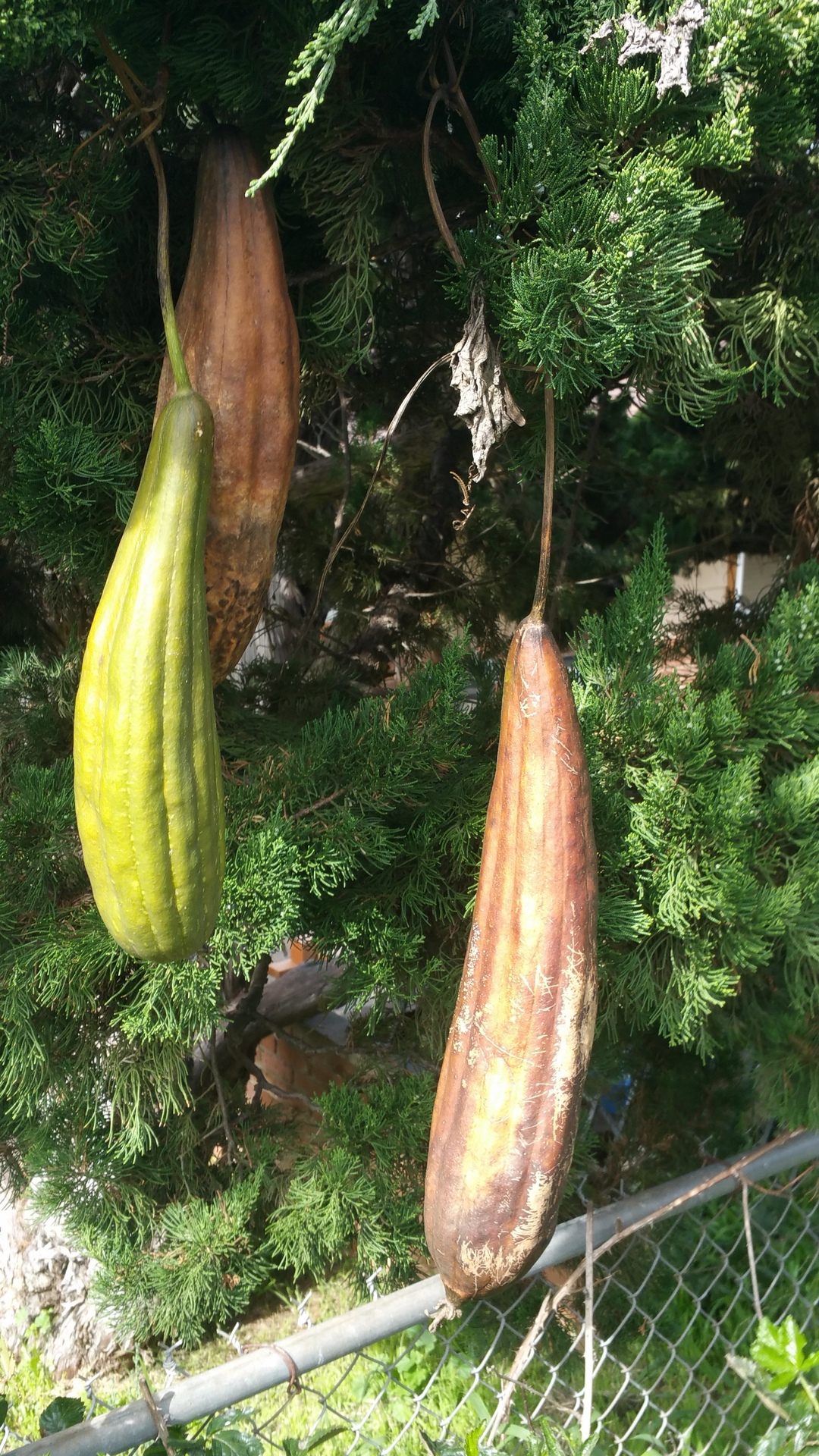

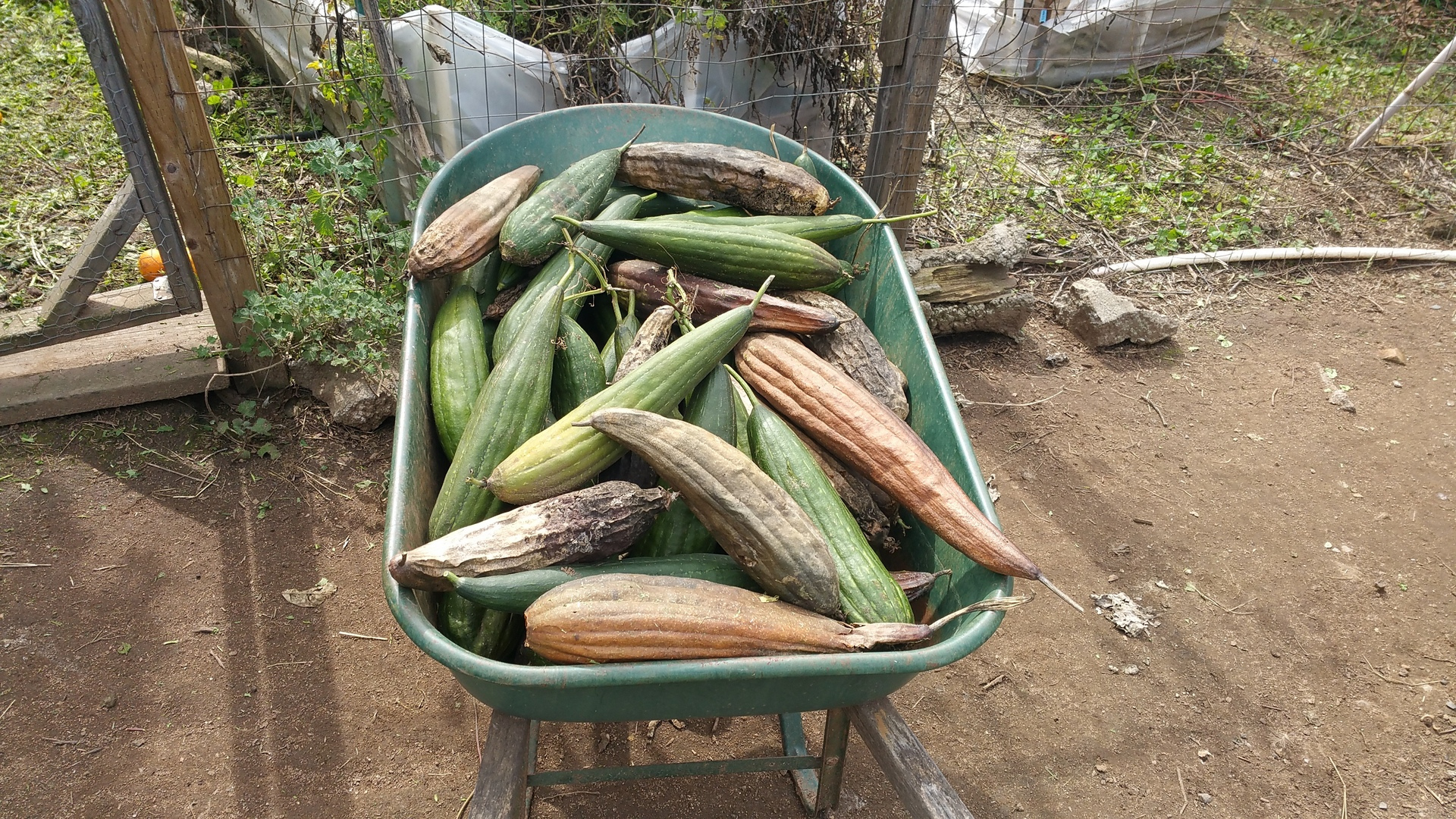
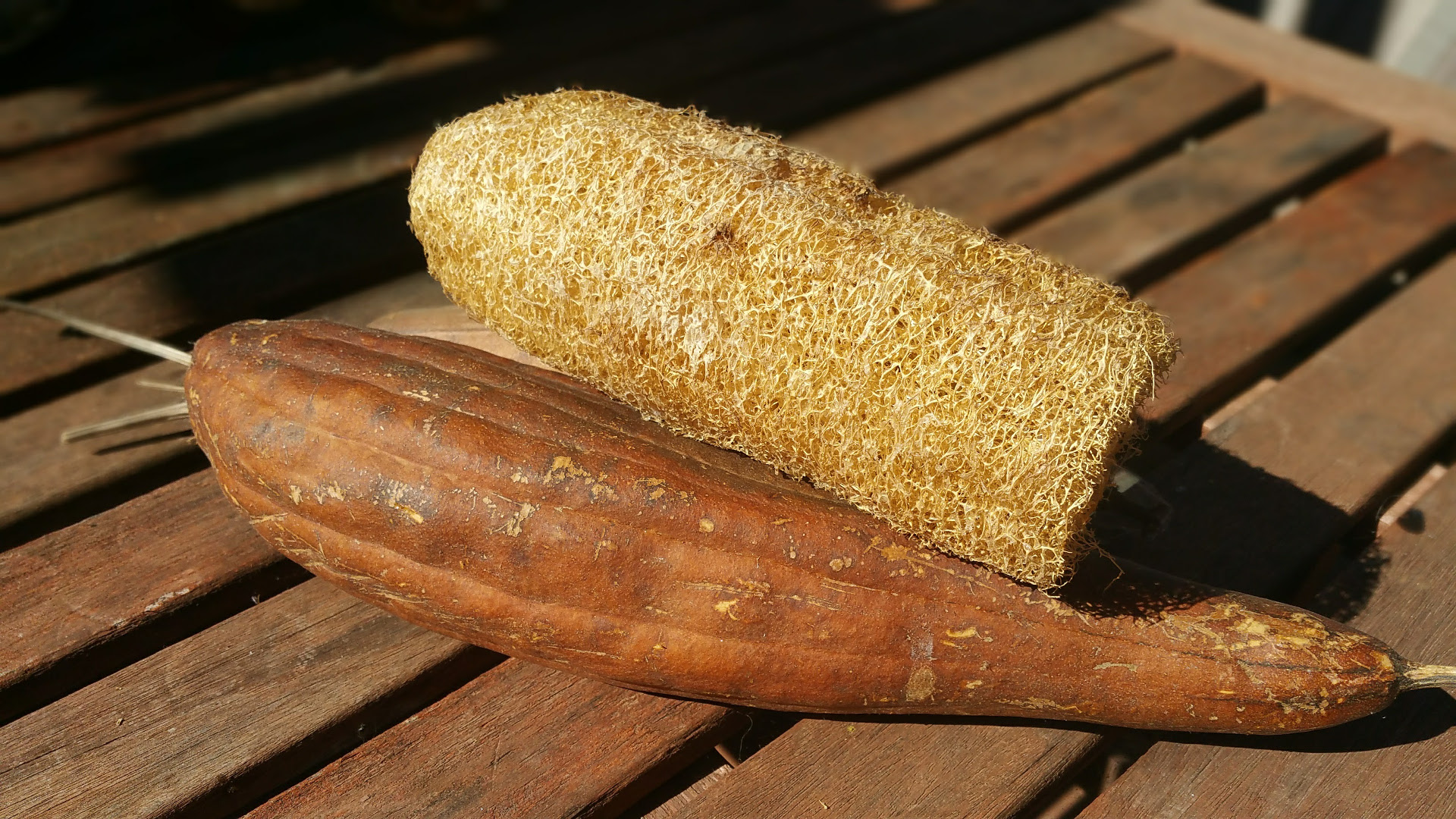
Luffas will produce a lot of fruit under even mediocre conditions, so don’t get carried away and plant a bunch unless you want to be knee deep in sponges at the end of the season. I planted only three plants this year and harvested 58 fruits! (Guess what everyone is getting for Christmas this year.) The fruits can be harvested while still green, or you can simply wait for them to dry on the vine. Fresh, green fruit will produce a softer sponge. The dried brown fruit will give you a firmer, scrubbier sponge.
Here’s a quick video on how to peel and de-seed them:
Victorian Alpine Huts survey, for Parks Victoria 1994-5.
Henry Miller, a cattleman from near Maffra, selected land on the Macalister River flats. He then purchased Riggall's grazing lease, taking his cattle (along what became known as Millers Track) up to Mt. Wellington during the summer{ van der Knijff: 49}. There he used Riggall's Hut (now ruinous) until he built the first stage of this hut in 1916. Miller's Hut is pictured, perhaps in the 1920s, with a bark roof, weighed down by a sapling frame, and drop-slab wall construction{ Stephenson: 181-3}. The gabled end and deep attached chimney were paling clad (horizontal) above the wall plate and the chimney faced with vertical slabs below. A rough bench seat was set next to the chimney and the door was ledge and braced, with vertical board/paling cladding{ ibid.}. The roof had been clad with corrugated iron by the 1930s{ ibid.; Cleary 1936}. A photograph from 1934 shows the hut with a corrugated iron roof but otherwise similar construction to that of the earlier view{ Budge: 80, photo pages after} WJ Cleary described the environs of the hut in 1936 as a `..beautiful forest of snow gums, unlike in colouring any we have seen … Miller’s Hut is in a small clearing with a cattle stockyard hard by'{ ibid.}. It is believed that an earlier incantation of this hut received vice-regal patronage when Lord Somers slept there on a hike with rover scouts to Lake Tarli Karng, c1930{ `Wild Life' 3.1950: 125}. The hut is also thought by one historian, Linda Barraclough, to be among the oldest huts to have its door located next to the chimney on the short side of the plan{ see Barraclough in MPHG: 88}. She notes that the other two early huts with this plan-type, Riggall's and the first Higgins hut, have both gone{ ibid. }. However, Wallaces Hut (q.v.) which is thought to have commenced in the late 1880s, also has this plan type. By 1996 Miller's Hut had been substantially renewed, with possibly only some of the wall slabs remaining of the 1916 construction. The Range Rover Club of Australia (Vic) rebuilt the hut in 1987, replacing 14 posts and reinstating the surviving wall slabs in the original order. The timber used was from the locality, snow gum for the fireplace wall slabs and stringy bark for the posts{ B Wagg, letter to NPS, DCE, 8.4.1992}. The stone chimney was rebuilt and the corrugated iron cladding replaced{ Wagg }.
"Thuja occidentalis 'Mossy', 2015, Dwarf [White Cedar], THOO-yuh ock-sih-den -TAY-liss, 1x2 ft Conifer, Z3, Gray Green, Bloom Month --, In Bed M Y2 for 0.6 years
A dwarf, stringy, green type of Eastern Arborvitae. Looks like a little clump of moss with tentacles. Leaves are a grey-green. Planted in 2015."
Kangaroo Grass growing on the edge of the Old Hume Highway, 50m south of Balaclava St intersection, Willow Vale (which is 3km north east from the centre of Mittagong, NSW, 2575). Substrate was a graded gravelly artificial bank. Site was at the edge of a disturbed stringy bark forest, with Dactylis glomerata, Rytidosperma and Themeda triandra (greater than 100 plants). Kangaroo Grass was erect, 95 cm tall and pulled up easily. Tubercle-based hairs on each glume were abundant.
sesame halva, rose loukoum, grapefruit sorbet
($12)
The stunner that we also came to CB for. I'm not a fan of turkish delights, but the loukoums used here are QQ like mochi but tugs back and you at the same time as giving you a generous warm smile. Great interplay of textures: thin crispy sugar veil, the cool and clean smooth grapefruit sorbet, the soft and stringy halva and how it's all bound by sweet whipped cream. Plus its a gem on ice.
Partial view of a large hand-specimen of amphibole asbestiform riebeckite ore, also known as crocidolite (historically, a.k.a. "blue asbestos"), one of six fibrous minerals currently regulated and defined as “asbestos”.
In this example, from a South African locality, a seam of crocidolite in rocky matrix demonstrates the inherently fibrous nature of this toxic mineral oddity, as it might appear naturally, directly from the ground.
When disturbed, crocidolite asbestos bundles can split into countless thin bundles, often referred as "fibers", a characteristic somewhat unique to asbestos minerals. Asbestos "fibers" can further sub-divide into such tiny, microscopic particles that they practically become "invisible" and can become airborne. Individual unit fibrils of asbestos are extremely thin needle-like crystals on the order of microns and angstroms.
Inhalation exposures to microscopic airborne asbestos particles have been well documented to cause serious respiratory diseases, cancers, and has been linked to disease-causation in other bodily systems, which can ultimately lead to fatality.
This Black Handed Spider Monkey is enjoying his or her snack!
Its not easy to get clear photos of these guys, as they have very dark facial features, and they are behind glass in a reasonably dark enclosure.
Distribution: Southern Mexico and all of Central America. Black-handed spider monkeys are vulnerable because of habitat destruction and hunting. They are particularly sensitive to changes in the environment, and so are indicator species for the health of the ecosystem.
Wild diet: Fruit and leaves, termites, and occasionally bark
Spider monkeys have a distinctive appearance, even in relation to other monkeys. No other primate looks quite like them. Spider monkeys have a prominent face, with whitish rings around the eyes. The rings contrast against a mostly black face. Spider monkeys are highly variable in coloration; some are black with a white or yellowish-white chest, others are mostly yellowish-grey. No matter what color, the fur is usually coarse and stringy over most of the body. Black-handed spider monkeys have black fur around the hands, feet, elbows, and knees, giving this species its common name.
Spider monkeys are almost perfectly designed for life in the trees. They have very long arms, hands, and feet. They have almost no thumb. It is their tail that gives them amazing acrobatic ability.
Spider monkeys sport a tail that seems to have a life of its own. The tail waves around, curls and uncurls, and even grasps branches. But the tail isn't acting on its own---spider monkeys use it like a fifth limb. When jumping around fifty feet above the forest floor, five "hands" are definitely better than four. With their specialized hands and grasping (prehensile) tail, spider monkeys are among the most agile climbers in the forest, moving through the trees with grace and speed. They climb hand over hand, suspended under branches. Five long limbs working together give this monkey a spider-like appearance---hence the name!
The availability of food determines much of spider monkey's social structure and behavior. About 75% of their diet is fruit. During the fruiting seasons, spider monkeys live in groups of up to 20 or so. They defend this area of plenty from other primates, until they've relieved the trees of their fruity bounty. When fruit is scarce and there isn't enough high-quality food to support the larger groups, spider monkeys break up into groups of between two and eight members. At these times they eat mostly leaves; not as nutritious as fruit, but abundantly available. During the next big fruiting season, the larger groups again assemble to feed and live together.
Body length: 15 to 27 inches (38 to 69 centimeters)
Tail length: 23 to 29 inches (58 to 74 centimeters)
Weight: 12 to 15 pounds (5.5 to 6.8 kilograms)
Habitat: Mostly rain forest, but also evergreen, semi-deciduous, and deciduous forest.
Royal Melbourne Zoo, Parkville, Victoria, Australia.