View allAll Photos Tagged Storage
Outdoor winter boat storage at a Lake Erie marina. On trailers or stands and under shrink wrapped white plastic covers • February, 2016 • Lorain/Cleveland, northern Ohio USA
iPhone 6s native camera in HDR mode • Photoshop Elements > foreground concrete cropped to form a screen-filling panorama > two artistic filters from Anthropics' Smart Photo Editor plugin > gray canvas enlarged 8-pixels in height/width to create a 4-pixel frame • Gritty is Good • Click image to view detail (or lack thereof)
Name: Sarah Brooks
School: Oakton Elementary
Town: Oakton
State: VA
I feel like my storage room doesn’t look very organized at all, considering I spent nearly a week before my official contracted hours stripping it bare of all items that hadn’t been used during the past two years since I have been teaching at this school.
Harbor Freight cases where I keep all of my building supply. Read more at dagsbricks.blogspot.com/2013/06/lego-tips-and-techniques-...
Front-mounted swere hose carrier. Made from UV-stabilized PVC and 5" square, it allows for hte storage of two 15' segments of sewer hose as well as the fittings for both ends. And, it will never rust. It is held to the Casita's chassis with four 1/4-20 stainless steel bolts.
New Slantᵀᴹ is a flexible, modular shelving system. The individual slanted boxes are held to each other with magnets. This allows one to playfully build an endless variety of subtly undulating configurations. Thanks to the sponsorship of the Department of Arts and Culture, Haldane Martin was invited by Design Indaba, to design this product as part of a sustainable job solution for disabled workers of Carecraft who manufacture the design. The New Slant is made from SA Pine timber, a local renewable resource, and is finished with eco friendly timber oil.
A hard disk drive (HDD) is a data storage device that uses magnetic storage to store and retrieve digital information using one or more rigid rapidly rotating disks (platters) coated with magnetic material.
The platters are paired with magnetic heads, usually arranged on a moving actuator arm, which read and write data to the platter surfaces.
Data is accessed in a random-access manner, meaning that individual blocks of data can be stored or retrieved in any order and not only sequentially.
Read more on Wikipedia: en.wikipedia.org/wiki/Hard_disk_drive
Typical storage boxes contain your items, but the inside becomes cluttered – making it difficult to find what you need. Rubbermaid’s Bento collection is designed to organize items, rather than just store them. The Bento Boxes have internal flex dividers, which enable you to divide the space by creating unique sections when needed. Boxes can stack vertically, or fit inside each other. Bento Toppers can act as trays, covers or lids, providing an extra layer of organization for the Bento Boxes, or hiding what’s inside. The Bento Collection is made from sturdy materials, and the heavy-duty decorative fabric enables it to remain out in your social spaces while complementing your home’s décor.
A hard disk drive (HDD) is a data storage device that uses magnetic storage to store and retrieve digital information using one or more rigid rapidly rotating disks (platters) coated with magnetic material.
The platters are paired with magnetic heads, usually arranged on a moving actuator arm, which read and write data to the platter surfaces.
Data is accessed in a random-access manner, meaning that individual blocks of data can be stored or retrieved in any order and not only sequentially.
Read more on Wikipedia: en.wikipedia.org/wiki/Hard_disk_drive
Name: Sarah Brooks
School: Oakton Elementary
Town: Oakton
State: VA
These shelves show the variety of yarn we have on hand. The storage bins and cardboard boxes on the top shelf store skeins of emergency yarn and cones of yarn that wont yet fit on the shelves. The storage bin on the right holds the whole craft supply stash- beads, pipecleaners, found objects for kinders, woodsie shapes and craft sticks. (no googly eyes or glitter;)While I rarely use these items, I frequently have classroom teachers asking for them and they come in handy.
The supplies I use most often are right here. Top drawer for cords I use often, but not daily, along with mini mice, usb keys, etc, all nicely packed in baggies. Middle drawer for office supplies: pens, scissors, tape, stapler. I tend towards mini's. Bottom drawer for financial stuff - checkbooks, registers, bank cards, stamps. And a timer.
Bain News Service,, publisher.
Storage
[between ca. 1915 and ca. 1920]
1 negative : glass ; 5 x 7 in. or smaller.
Notes:
Title from unverified data provided by the Bain News Service on the negatives or caption cards.
Forms part of: George Grantham Bain Collection (Library of Congress).
Format: Glass negatives.
Rights Info: No known restrictions on publication.
Repository: Library of Congress, Prints and Photographs Division, Washington, D.C. 20540 USA, hdl.loc.gov/loc.pnp/pp.print
General information about the Bain Collection is available at hdl.loc.gov/loc.pnp/pp.ggbain
Higher resolution image is available (Persistent URL): hdl.loc.gov/loc.pnp/ggbain.29886
Call Number: LC-B2- 5098-8
I want to finish Green Grocer but I need to finish sorting the last 10 lbs or so of Craigslist lego that I've been neglecting. Sorting ......
St Peter and St Paul, East Harling, Norfolk
With its aisles, clerestory, porch and chancel, St Peter and St Paul is a textbook example of its century, although there are a number of curiosities that add even more interest. The vestry on the north side of the chancel, for example, which was once a shrine chapel, retains its image niche on its eastern face. And there are more image niches, these with elaborate foliage pedestals, in the buttresses of the tower; everything is topped off by a lead and timber fleche which was apparently the model for the one at St Peter Mancroft in Norwich, a church which has several features in common with this one.
The tower is a delight, the buttressing and pinnacles exactly in proportion to make it appear to rise like a fairy castle from the ground. The south porch, by contrast, is, despite its flushwork, rather austere, a result of its rebuilding early in the 19th century before the ecclesiological movement took hold. All in all, this is as good as 15th century rebuilding gets, the money coming thanks to Anne Harling having no less than three husbands who all wanted to spend as little time in purgatory as possible.
You step down into a wide space which, on a dull day, can be rather gloomy. Although inevitably heavily restored by the Victorians, St Peter and St Paul does not have that depressingly anonymous urban feel you so often find in churches of this size. This is partly because the beautiful parclose screen in the south aisle partitions off so much space, creating a sense of rooms within rooms, altering the way your eyes are inevitably drawn to the east. The rood screen must have been vast here; its dado survives at the west end, a deeply traceried affair with its features presented in carving rather than painting.
When the rood screen was in its proper place, to move from the nave into the chancel must have been like stepping from darkness into light. This is because of the feature that makes East Harling famous, the vast east window with its 15th century glass. After St Peter Mancroft it is the best collection in Norfolk. Unusually, the provenance of the glass is fairly well-documented: we can be fairly certain that it came from this church originally. Still present after the Reformation, it was removed by the Harling family to the Hall in the early 17th century. They may have been Laudians wanting to preserve it from the intentions of the puritans, or merely thought it would look nice in their dining hall; whatever, we know that shortly before Francis Blomefield visited here in the 1730s it was returned to the church and set in its present configuration.
In 1939, when war threatened, it was removed again, being reset just before Cautley visited in the early 1950s. There are parts of at least three sequences here, two of which were almost certainly in the east window originally, and one which almost certainly wasn't.
Essentially, the window contains two rosary sequences; the Joyful Mysteries of the Blessed Virgin, which include the Annunciation, the Nativity and the Assumption, and the Sorrowful Mysteries of the Blessed Virgin, which include the Crucifixion and the Deposition. However, this is open to interpretation, as we shall see. There is also the figure of St Mary Magdalene, which may once have been associated with a nave altar, and would have been located in a window there.
The five lights contain four rows of panels, making twenty altogether.
Top row:
I. Annunciation: Mary at her prayer desk. Gabriel, crowned and haloed, with a sceptre of lilies, kneels in supplication.
II. Visitation: Elizabeth, hooded to show her age, places her hand on Mary's pregnant belly.
III. Nativity: Two midwives look on. The infant in the manger is rayed; a horned cow gazes in awe.
IV. Adoration of the Shepherds: One holds a lamb, one plays pipes. A third appears to offer a fleece.
V. Adoration of the Magi: Two of the wise men gauge each others' reactions as the third offers his gift.
Second row:
VI: collection of fragments.
VII: Presentation in the Temple: Joseph carries the doves, Mary offers the child to Simeon. Anna is not shown.
VIII: The Finding in the Temple: Head covered, Mary bursts in among the men to find her son teaching.
IX: The Wedding at Canaa: Christ, seated at the top table, blesses a chicken and a ham. Mary directs the servant.
X: collection of fragments.
Third row:
XI: Mary of Magdala: Mary holds her long hair ready to anoint Christ's feet. Probably not from this window originally.
XII: The Betrayal at Gethsemane: Judas kisses Christ; Peter cuts off the ear of the high priest's servant.
XIII: Crucifixion: Mary swoons in John's arms.
XIV: Deposition from the cross: The pieta. Tears spring from Mary's eyes.
XV: Assumption of the Blessed Virgin: Mary is assumed bodily into heaven.
Bottom row:
XVI: Donor: Probably Robert Wingfield, second husband of Anne Harling.
XVII: Resurrection: Christ steps fully clothed from the tomb. Unusually, the soldiers are awake.
XVIII: Ascension of Christ: Mary, surrounded by disciples, watches as her son ascends to heaven.
XIX: Descent of the Holy Spirit: Mary, surrounded by disciples, receives the Holy Spirit at Pentecost.
XX: Donor: Probably William Chamberlain, first husband of Anne Harling.
Nowadays, we tend to think of the rosary as consisting of three sequences of five mysteries each, but in the late middle ages things were much more flexible, and rosary sequences often consisted of seven mysteries. The Glorious Mysteries sequence, of which the Assumption is now a part, is a later development, and the two adorations shown here are subsumed into a single mystery. There are a couple of images here that don't quite fit; the Wedding at Canaa is obviously a Marian text, and yet is not traditionally a rosary subject. Similarly the Betrayal, the only one of the images not to feature Mary. I wonder if what we have here are parts of two separate sequences, a Marian sequence of mysteries (I-V, VII-IX, XV), and a Passion sequence (XII-XIV, XVII-XIX). They are both clearly the work of the same workshop, and Mary is always shown with the same face and dress, but this would not preclude them from being two sequences.
Why were they here at all? We need to get away from thinking of such things as a 'poor man's bible', the need for which was superseded at the Reformation. These were devotional objects, designed to be used as meditations while praying and saying the rosary. They were created in the 15th century, a time when the mind of the Church was fiercely concentrated on asserting orthodox Catholic doctrine in the face of local superstitions and abuses. As such, they were anathema to the reformers, and were later elsewhere destroyed for being superstitious, not for being superfluous. An 18th century antiquarian mind, ignorant of the nature of Catholic devotion, might easily mix the two sequences into historical order, and possibly misunderstand the Assumption (obviously, as Mary reappears two images on at the Ascension, it is out of order). I wonder what they thought it was?
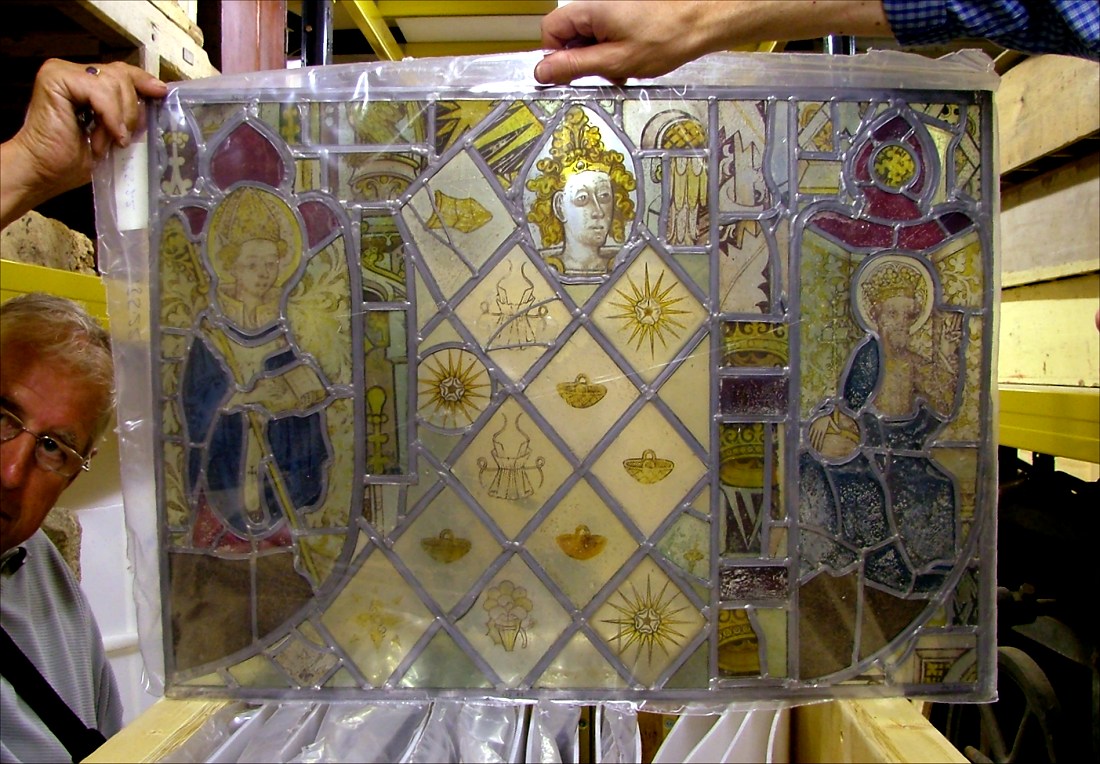
A couple of other things about the east window that you shouldn't miss. Firstly, everywhere you look there are tiny baskets - Mortlock calls them 'frails', and tells us that they were simple rush baskets used by workmen to carry tools. Also, though not in such profusion, there are bodices. These symbols are repeated elsewhere in the church in stone on tombs, and as such must be symbols of the Harling family.
Another symbol is high up on the north side, a red squirrel. Curiously, this also appears in the painting A Lady with a Squirrel and a Starling by Hans Holbein, now thought to be a portrait of Anne Lovell - the squirrel is a symbol of the Lovell family, who took over the local manor here from the Harlings in the 16th century, and the starling represents Ea- well, you guess.
In July 2006, Chris Harrison and I came across
some more glass from East Harling in the Norfolk County Archaeologist Service archive at Gressenhall. It was probably removed from the church for safety in 1939, and then not replaced, possibly ending up at the museum of church art in Norwich at St Peter Hungate, disappearing into storage when that closed in 1993. It depicts a Bishop and Christ seated in Majesty, and the lozenges in between carry the telltale frails and bodices familiar from other glass within the church.
Within the screen is a large chapel, containing two major tombs. One is in alabaster, an early 17th century memorial to Sir Thomas and Lady Alice Lovell (remember the squirrel?) who died in 1604. The piece is good - too good, its 1950s restoration gives it a Festival of Britain air. Their symbols lie at their feet - his a magnificent peacock, hers a gruesome Saracen scalp held aloft.
The other appears to be a composite. It lies to the east, and the two effigies are clearly not from this tomb; they simply don't fit. They are supposed to be Robert Harling, died Paris in 1435, and his wife Dame Joan. Neither are buried here - she is at Rushford near Thetford, he is in some corner of a foreign field that is forever French schoolchildren on picnics excitedly tugging old thighbones from the soil - but in any case it is the trimmings of the tomb rather than the effigies that are most of interest, including a pelican in her piety and one that is almost a lily crucifix.
On the north side of the chancel is a fine tomb with brass inlays - the brasses now gone. Not as magnificent as either of the two previously mentioned, it is actually the most significant, as this is where you'll find Anne Harling, wife of the serial rebuilders of this church. Look out for those flails again.
What more? 17th century Lovells (remember the squirrel) have in-yer-face memorials either side of the sanctuary - that to the north curiously with no inscription. There are hatchments, remains of a wallpainting that are too indistinct to interpret (but may be seven works of mercy), a good set of royal arms, medieval heads, curious 19th century bench ends of a lion and a wild man, heraldic misericords, a Dec font - well, come and see for yourself. You know you want to.
Out for a walk in Swansea.Spare handset as mine is in for work.A few shots on.Storage space full.Never mind eh!!
Here is WZW of SWT followed by that tasty new one of DANSA.That campaign on WZW and the Solo are really colourful though I think the campaign needs a lift though.
Swansea bay for a brighter day.
Leave the city behind for a gateway not hard to find.Miles of sand where couples walk hand in hand.Dogs fetch on demand .Building castles just for fun.Equals under a golden sun
So come and find Swansea Bay
It all goes on down our way
Enjoy Swansea Bay
Come on down for a brighter day
So lots going on through the year.Check it out it's very near.Music,sport and other attractions come on down and see some action.Different people up for fun.Equals under a golden sun
So enjoy Swansea Bay
Lots going on when your down this,way
Down Swansea Bay
Have some fun on a brighter day
Paul Hills 2018'
My New Craft Room. With lots of hidden crafty bits. Lots of light and creative vibes.
check out my fancy storage solution.
If I can find shelves or cubes that are narrow enough, this would help organise the toddler's day-to-day, so he can put his things away himself.
From flickr.com/photos/dianora_im/1460471916/in/pool-39185427@... via AT.
This is a home made storage binder for Filofax pages. It uses some thin card, cut to be slightly larger than the page sizes, with a bigger margin down one side, which is punched to match the holes in the leaves, and then folded over.
The metal fastener is like the ones you get in plastic presentation folders, and its arms are flexible and bend flat once you've got the pages inside.