View allAll Photos Tagged Spacestation
S70-16743 (1970) --- A close-up view of a Skylab food can measuring compartment. The one at left represents 11 food cans of that particular size. Smaller food cans are represented by the one on the right. Photo credit: NASA
SL3-108-1292 (19 Aug. 1973) --- Scientist-astronaut Owen K. Garriott, Skylab 3 science pilot, trims the hair of astronaut Alan L. Bean, commander, in this onboard photograph from the Skylab Orbital Workshop (OWS) in Earth orbit. Astronaut Jack R. Lousma, pilot, took this picture with a 35mm Nikon camera. Bean holds a vacuum hose to gather in loose hair. The crew of the second manned Skylab flight went on to successfully complete 59 days aboard the Skylab space station cluster in Earth orbit. Photo credit: NASA
The @Space_Station heading into the Earth's shadow in the @LincsSkies south-west of #Blyton 16.10.2016
SL2-03-126 (June 1973) --- A color infrared photograph of the Los Angeles County and Kern County area, taken from the Skylab space station in Earth orbit during its first manned Skylab mission. The Mojave Desert occupies the northeast one-fourth of the photograph. Lake Isabella in the Sierra Nevada Mountains is the v-shaped body of water. The San Gabriel Mountains extend across the southern part of the picture. At lower center is the intersection of the San Andreas and Garlock faults. The San Joaquin Valley is in the center at the left edge. (The picture should be held with the heavy cloud cover at lower right corner so that north will be at top.) This picture was exposed by one of the six lenses of the Itek-furnished S190-A Multispectral Photographic Facility experiment in the Multiple Docking Adapter of the Skylab space station. Type 2443 film was used. Photo credit: NASA
SL2-103-967 (22 June 1973) --- This view of lower New England, (41.5N, 72.0W) shows a rare cloud-free area stretching from northern Long Island across the states of Connecticut, Rhode Island and Massachusetts. The total area covered by this photo is more than 25,000 square miles and includes all of Rhode Island, most of Massachusetts and Connecticut, part of New York and the coastal waters of the Atlantic Ocean. Cape Cod, Boston and the offshore islands are distinctive features. Photo credit: NASA
ISS (International Space Station) passed between buildings and clouds as it split the Orion constellation into two parts. Proper technique triumphed over open space and clear sky in allowing me to capture this wonderful moment.
Another step towards #launch: our #Soyuz 736/MS-05 was loaded with all the various fluids, gases and fuels.
Credits: Roscosmos
Another step towards #launch: our #Soyuz 736/MS-05 was loaded with all the various fluids, gases and fuels.
Credits: Roscosmos
SL2-100-798 (22 June 1973) --- Close-up view of Skylab 2 crew member Joseph P. Kerwin clearing away the remnants (cables and tubing) from the missing solar array panel during an early mission tethered extravehicular activity (EVA) to repair the damaged and partially deployed solar array panel. Conrad's life support umbilical is seen cutting diagonally across the image next to Kerwin. After the successful EVA, the solar panel was fully deployed. Photo credit: NASA
SL3-122-2620 (July-September 1973) --- Skylab 3 Earth view of the Nile Delta, Egypt and Suez Canal. Photo credit: NASA
S73-27384 (June 1973) --- A close-up view of the surgical band saw, a surgical tool in the therapeutic kit of the Inflight Medical Support System aboard the Skylab 1 & 2 space station cluster now in Earth orbit. Since this instrument can cut through metal (as illustrated here), it can be used in making emergency maintenance repairs aboard the space station. Photo credit: NASA
Inside the Space Station Processing Facility high bay at NASA's Kennedy Space Center in Florida, the Multiple User System for Earth Sensing, or MUSES, payload is being prepared for transfer out of the high bay. MUSES will be delivered to the International Space Station aboard the SpaceX Dragon cargo carrier on the company’s 11th commercial resupply services mission to the space station. MUSES, developed by Teledyne Brown, is part of the company's new commercial space-based digital imaging business. MUSES hosts earth-viewing instruments, such as high-resolution digital cameras, hyperspectral imagers, and provides precision pointing and other accommodations. Photo credit: NASA/Andy Sokol
S73-25400 (8 May 1973) --- Scientist-astronaut Joseph P. Kerwin (on left) and astronaut Paul J. Weitz assist each other in suiting up in Bldg. 5 at Johnson Space Center during prelaunch training activity. Photo credit: NASA
A test unit, or prototype, of NASA's Advanced Plant Habitat (APH) was delivered to the Space Station Processing Facility at the agency's Kennedy Space Center in Florida. Inside a laboratory, Engineering Services Contract engineers set up test parameters on computers. From left, are Glenn Washington, ESC quality engineer; Clayton Grosse, ESC mechanical engineer; and Jeff Richards, ESC project scientist. The APH is the largest plant chamber built for the agency. It will have 180 sensors and four times the light output of Veggie. The APH will be delivered to the International Space Station in March 2017. NASA/Bill White
A telescope module 60 feet long and 15 feet in diameter could be attached to a space station after being delivered by a shuttle orbiter.
Space Station '80
by Lou Jacobs, Jr.
Hawthorn Books, 1973
----------
S73-25901 (25 May 1973) --- Astronaut Charles Conrad Jr., commander of the Skylab 2 mission, is suited up in the Manned Spacecraft Operations Building at the Kennedy Space Center during Skylab 2 prelaunch preparations. Skylab 2, with astronauts Conrad, Joseph P. Kerwin and Paul J. Weitz aboard, was launched from KSC's Pad B, Launch Complex 39, at 9:00 a.m. (EDT), May 25, 1973. Photo credit: NASA
In game screenshot (3440x1440)
Follow my work on:
Become a Citizen with 5k in-game currency to your name.
....then add me in game!
Another step towards #launch: our #Soyuz 736/MS-05 was loaded with all the various fluids, gases and fuels.
Credits: Roscosmos
That streak is the International Space Station headed toward the horizon tonight (8/26/14) at about 8:25 PM. It's always amazing to see. Usually, I watch from my backyard, but trees cut my visibility time down drastically. Headed out to the waterfront tonight and got a solid 5+ minutes of it.
S72-17512 (19 Jan. 1972) --- These three men are the crewmen for the first manned Skylab mission. They are astronaut Charles Conrad Jr., commander, standing left; scientist-astronaut Joseph P. Kerwin, seated; and astronaut Paul J. Weitz, pilot. They were photographed and interviewed during an "open house" press day in the realistic atmosphere of the Multiple Docking Adapter (MDA) trainer in the Mission Simulation and Training Facility at the Manned Spacecraft Center (MSC). The control and display panel for the Apollo Telescope Mount (ATM) is at right. Photo credit: NASA
S73-27096 (25 May 1973) --- The Skylab 2 crew, consisting of astronauts Charles Conrad Jr., Joseph P. Kerwin and Paul J. Weitz, inside the command module atop a Saturn IB launch vehicle, heads toward the Skylab space station in Earth orbit. The command module was inserted into Earth orbit approximately 10 minutes after liftoff. The three represent the first of three crews who will spend record-setting durations for human beings in space, while performing a variety of experiments. Photo credit: NASA
S73-27730 (June 1973) --- The Skylab 2 crewmen, astronauts Charles Conrad Jr., Joseph P. Kerwin and Paul J. Weitz, move the S183 Ultraviolet Panorama astrophysics experiment equipment under zero-gravity conditions in space in the foreground compartment of the Orbital Workshop of the Skylab 1 & 2 space station in Earth orbit, as seen in this reproduction taken from a color television transmission made by a TV camera aboard the space station. The S183 equipment includes the S183 spectrograph, the S019 mirror assembly, and a Maurer camera. Photo credit: NASA
At the loading dock outside the Space Station Processing Facility high bay at NASA's Kennedy Space Center in Florida, a technician uses a Hyster forklift to load the Roll-Out Solar Array, or ROSA, into a truck. ROSA will be delivered to the International Space Station aboard the SpaceX Dragon cargo carrier on the company’s 11th commercial resupply services mission to the space station. ROSA is a new type of solar panel that rolls open in space and is more compact than current rigid panel designs. The ROSA investigation will test deployment and retraction, shape changes when the Earth blocks the sun, and other physical challenges to determine the array's strength and durability. Photo credit: NASA/Andy Sokol
SL2-04-179 (22 June 1973) --- The Sacramento Valley (40.5N, 121.5W) of California is the northern extension of the Central Valley, main agriculture region of the state. Hundreds of truck farms, vineyards and orchards can be seen throughout the length and breadth of the valley which was reclaimed from the desert by means of intensive and extensive irrigation projects. Photo credit: NASA
Charles Spern, project manager on the Engineering Services Contract, communicates instructions for the Veggie system to astronaut Joe Acaba on the International Space Station. Spern is in the Experiment Monitoring Room in the Space Station Processing Facility at Kennedy Space Center in Florida. Three different varieties of plants from the Veg-03D plant experiment were harvested. NASA/Amanda Griffin
“This is what a National Aeronautics Space Administration (NASA) artist though a space station would look like: three modules held together by a grid that would hold the solar panels for collecting energy and a radiator system for getting rid of un-needed energy. Each of the three modules would be used for a different purpose. One for living quarters, one for storage and another for manufacturing. Each module would be 105 feet high, about 9 storeys, and would hold about 15 people. At the bottom of each of the modules there would be a port for the Space Shuttle to dock at to load and unload supplies and passengers. The two tubes connecting the modules would serve as passageways for travelling between modules. The first Space Station will be built on earth and is scheduled to be assembled in space in 1988. Canadian astronauts are expected to work on the first Space Station.”
The above, along with the image, constitutes the back cover of “Canada in Space Scrapbook”, by W.H. Parr, published in 1985 by SPP Three Inc. Toronto, Canada. And THAT is the only place I found this exact image.
Apparently, it was referred to as the "triangular delta-truss" geometry, one of four that the “Station Concept Development Group” considered in March 1984. The other concepts under consideration were: the "CDG 1 planar-array", "streamline T", and "power tower". A fifth, the "spinning array", was retained as a candidate for a space resource module.
The above from (paraphrased)/at:
www.astronautix.com/s/spacestation1984.html
www.astronautix.com/graphics/s/ss84grp6.gif
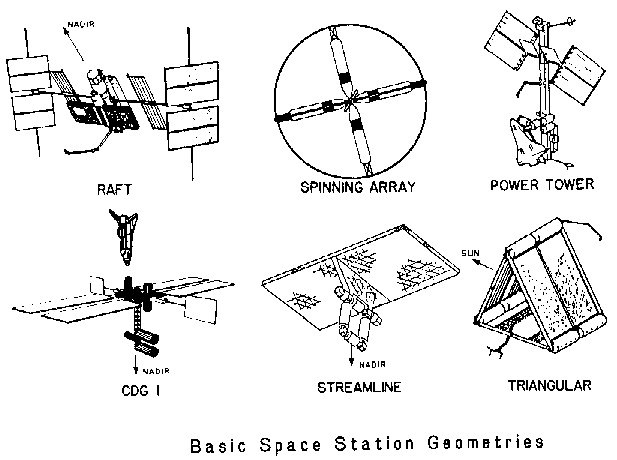
Credit: Astronautix website
Note what appears to be some sort of space probe/satellite, with Centaur-G? booster, being grappled by the station’s truss-mounted Remote Manipulator System arm. Possibly after having just been delivered by the nearby station keeping orbiter? ¯\_(ツ)_/¯
Clueless WRT artist. Contractor? NASA? ¯\_(ツ)_/¯
A huge telescope in this astronomy module can be docked with the Space Station '80 to give scientists the best view of stars ever possible.
Space Station '80
by Lou Jacobs, Jr.
Hawthorn Books, 1973
----------
Earth State Authority Gliese 876d Station Alpha, where mysteries abound. See www.submartis.com for more on The Ghost of Glow-Worm Alpha.
A fantastic view I’ve never seen of the Skylab Orbital Workshop (OWS) in earth orbit, I assume taken shortly after the undocking of the Skylab 3 (Skylab 4 to some...UGH) CSM, as part of the final inspection & photographic documentation of the exterior of the space station.
The perspective provides an excellent view of both sunshades, the surviving solar array arm/hinge, and the almost rainbow-like discoloration of the never-intended-to-be-exposed skin of the OWS. Note the pronounced yellowing of the Multiple Docking Adapter, also due to the relentless solar radiation. Also, the axial docking port, with the Stars & Stripes, along with the familiar Apollo docking target. And I believe those are two strut-mounted floodlights directly to the left of the docking port. One of the two discone antennas can be seen extending out of the image toward the lower left.
Y’know, to this day, I haven't been able to identify the "Lost In Space"/“Forbidden Planet” ray-gun barrel thing, seen here protruding out from the lower left base of the ATM.
Speaking of the base of the ATM…see the top-shaped (appropriately enough) thing, slightly recessed in a similarly-shaped opening? It’s one of the three Control Moment Gyroscopes (CMG)! In fact, another one (I think), mounted/oriented “perpendicularly” to it, is visible to the left of it. Isn’t that cool? I think so. And, since you’re intelligent & inquisitive:
“CMGs (Control Moment Gyros) were introduced for the first time on a spaceborne platform for primary attitude control of a long-term mission (Note: a CMG is a gyroscope large enough to impart controlling moments or torques directly to a spacecraft; they are also referred to as "momentum exchange" or "momentum storage" devices). Three mutually orthogonal CMGs, each with a rotor diameter of 53 cm, and a mass of 65.5 kg, were installed to provide attitude control for the Solar Observatory in the ATM during solar observations. The instrument had to be pointed within 2.5 arcseconds of the desired direction and held there without drifting more than 2.5 arcseconds in 15 minutes' time.
Each CMG was a double-gimbal-mounted unit, electrically driven with a nominal spin of 9100 rpm, and capable of providing an angular momentum of 315 Nms. This CMG system was capable only of coarse pointing - within 6 arcmin (or 0.1º), two orders of magnitude larger than the instruments required. Mechanical constraints limited the travel of the CMG gimbals; and after a long period of absorbing unwanted torques, the CMG rotors reached a position of saturation. Hence, desaturation (or momentum dumping) took place in periods of no observation using [the] Thruster Attitude Control System (TACS).”
Above at/from:
www.eoportal.org/satellite-missions/skylab#
Bottom line: A great photo.
Not surprisingly, it being Skylab, exacerbated by NASA’s PATHETIC, EGREGIOUS & LAUGHABLE online historical photo representation, organization & documentation, this doesn’t seem to be available anywhere.
Unlike ASU’s “March To The Moon” website, there’s no “Mosey to LEO” equivalent.
“Rabbit Hole” observation: Note the “non-perpendicular”/canted (with respect to the OWS surface) orientation of the solar array system arm. I wonder why. VERY few of any artist’s concepts, illustrations or diagrams depict this accurately. Ignorantly, I always wondered what was up with those that did.
Inside a laboratory at the Space Station Processing Facility at NASA's Kennedy Space Center in Florida, a scientist inserts Apogee wheat seeds into the science carrier, or base, of the Advanced Plant Habitat (APH). A growing substrate called arcillite was packed down in the base and coverings were secured on top of the base. Developed by NASA and ORBITEC of Madison, Wisconsin, the APH is the largest plant chamber built for the agency. It is a fully automated plant growth facility that will be used to conduct bioscience research on the International Space Station. The APH will be delivered to the space station aboard future Commercial Resupply Services missions. Photo credit: NASA/Bill White
SL3-115-1917 (July-September 1973) --- Skylab 3 Earth view of the United Arab Republic (UAR), Nile Delta, Cairo, Suez Canal, Sinai and Dead Sea. Photo credit: NASA
In game screenshot (3440x1440)
Follow my work on:
Become a Citizen with 5k in-game currency to your name.
....then add me in game!
Jess Bunchek, a veggie plant scientist and pseudonaut, harvests mizuna mustard inside the Veggie harvest chamber in the Space Station Processing Facility at NASA’s Kennedy Space Center in Florida on Feb. 19, 2019, as part of the Experiment Verification Test for the VEG-04B mission that will launch to the International Space Station later this year. VEG-04B examines the interactions between light and spaceflight by growing plants under two different LED lighting conditions. A similar harvest will be conducted on the space station after a grow-out duration of 56 days. Ultimately, fresh vegetables grown in space will be an essential supplement to the crew’s pre-packaged diet, prepping them for long-duration space exploration. Photo credit: NASA/Kim Shiflett
Another step towards #launch: our #Soyuz 736/MS-05 was loaded with all the various fluids, gases and fuels.
Credits: Roscosmos
S73-17859 (January 1973) --- Astronaut Paul J. Weitz, pilot for Skylab 2 (first Skylab manned) mission, looks over off-duty recreational equipment in the crew quarters of the Skylab Orbital Workshop (OWS) trainer during Skylab simulation activity at the Manned Spacecraft Center. The equipment includes such items as tape decks and stereo music equipment, playing cards, darts, etc. The OWS is a component of the Skylab space station cluster which will be launched unmanned aboard a Saturn V in summer of 1973, and will be visited three times by three-man crews over an eight month period. Photo credit: NASA
Yeah, Skylab cutaways are a dime a dozen these days, but this illustration by Frank Munger is one of the nicest I've ever seen. From "Flight International."
Inside the Space Station Processing Facility high bay at NASA's Kennedy Space Center in Florida, technicians prepare the Neutron star Interior Composition Explorer, or NICER, payload for final packaging. NICER will be delivered to the International Space Station aboard the SpaceX Dragon cargo carrier on the company’s 11th commercial resupply services mission to the space station. NICER will study neutron stars through soft X-ray timing. NICER will enable rotation-resolved spectroscopy of the thermal and non-thermal emissions of neutron stars in the soft X-ray band with unprecedented sensitivity, probing interior structure, the origins of dynamic phenomena and the mechanisms that underlie the most powerful cosmic particle accelerators known. Photo credit: NASA/Frank Michaux
Inside the Space Station Processing Facility high bay at NASA's Kennedy Space Center in Florida, technicians assist as a crane is used to lift the Neutron star Interior Composition Explorer, or NICER, payload up from its carrier. NICER will be delivered to the International Space Station aboard the SpaceX Dragon cargo carrier on the company’s 11th commercial resupply services mission to the space station. NICER will study neutron stars through soft X-ray timing. NICER will enable rotation-resolved spectroscopy of the thermal and non-thermal emissions of neutron stars in the soft X-ray band with unprecedented sensitivity, probing interior structure, the origins of dynamic phenomena and the mechanisms that underlie the most powerful cosmic particle accelerators known. Photo credit: NASA/Frank Michaux
S73-26776 (26 May 1973) --- An interior view of the Orbital Workshop of the Skylab 1 space station cluster in Earth orbit can be seen in this reproduction taken from a color television transmission made by a TV camera aboard the space station. Astronaut Charles Conrad Jr., Skylab 2 commander, is floating up through the hatch. Food lockers are in the foreground. Photo credit: NASA
S73-27260 (1 June 1973) --- Two of the three Skylab 2 crewmen demonstrate weightlessness in the forward compartment of the Orbital Workshop of the Skylab 1 & 2 space station cluster in Earth orbit, as seen in this reproduction taken from a color television transmission made by a TV camera aboard the space station. Scientist-astronaut Joseph P. Kerwin, science pilot, floats with his body extended. Kerwin is steadied by astronaut Charles Conrad Jr., commander. The crewmen performed exercises while floating. Photo credit: NASA
Outside the Space Station Processing Facility high bay at NASA's Kennedy Space Center in Florida, a technician uses a Hyster forklift to carry the Roll-Out Solar Array, or ROSA, to the loading dock. ROSA will be delivered to the International Space Station aboard the SpaceX Dragon cargo carrier on the company’s 11th commercial resupply services mission to the space station. ROSA is a new type of solar panel that rolls open in space and is more compact than current rigid panel designs. The ROSA investigation will test deployment and retraction, shape changes when the Earth blocks the sun, and other physical challenges to determine the array's strength and durability. Photo credit: NASA/Andy Sokol