View allAll Photos Tagged Spacestation
Christina Khodada, a research scientist working with the Exploration Research and Technology Programs, prepares containers Feb. 11, 2021, at NASA’s Kennedy Space Center in Florida for a Materials International Space Station Experiment (MISSE). The containers, carrying sets of seeds, will fly aboard Northrop Grumman’s Cygnus spacecraft as part of NG-15, a NASA commercial resupply mission to the orbiting laboratory targeted for Feb. 20, 2021. They will be placed in the MISSE testing facility, located near the space station’s solar arrays, where they will be exposed to the extreme environment of space for six months before returning to Earth for further study. Photo credit: NASA/Ben Smegelsky
A high fidelity test version of NASA’s Advanced Plant Habitat (APH), the largest plant chamber built for the agency, arrived at Kennedy Space Center the third week of November, 2016. The APH unit, containing small flowering plant seeds, will be delivered to the International Space Station in 2017. via NASA ift.tt/2fremIw
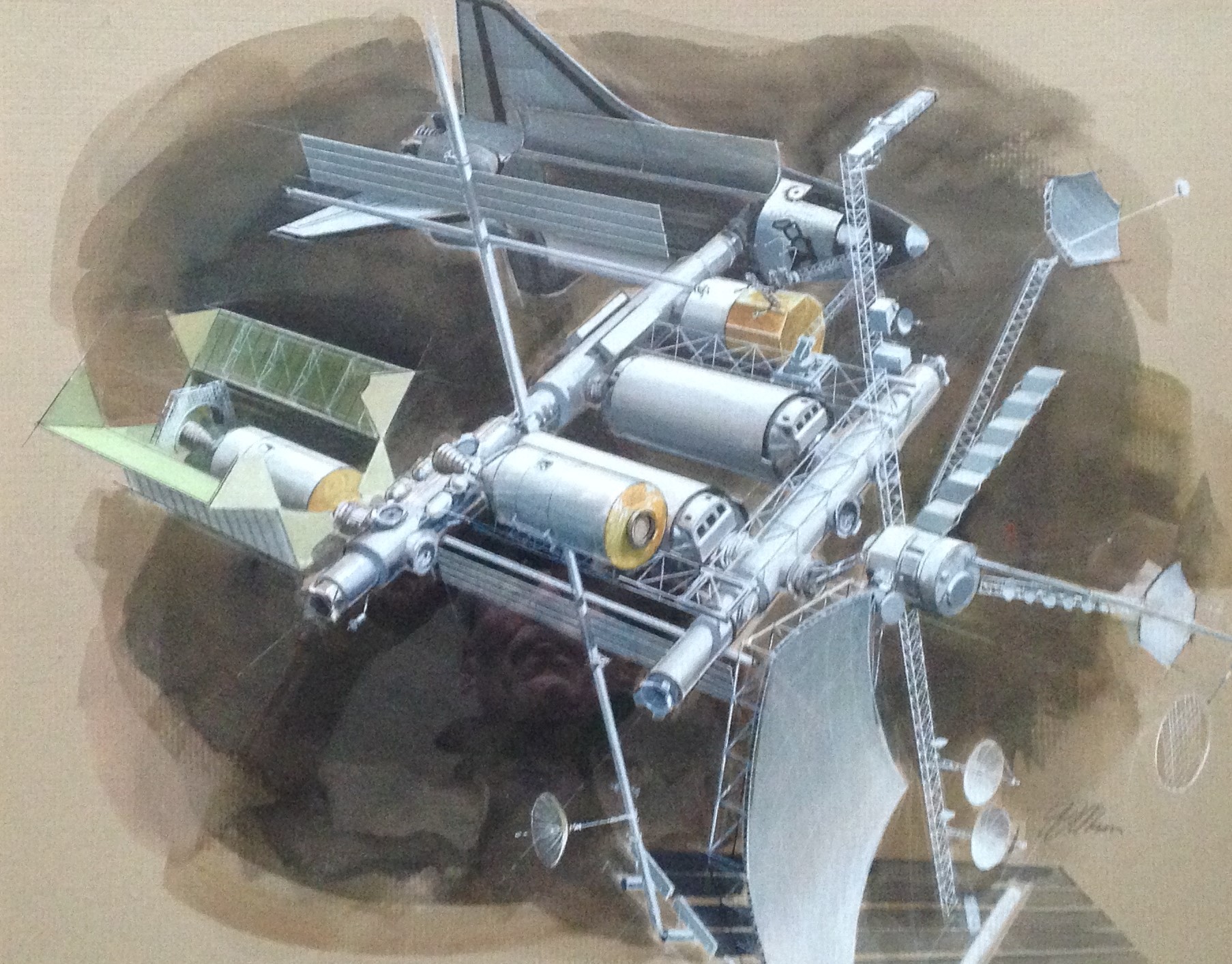
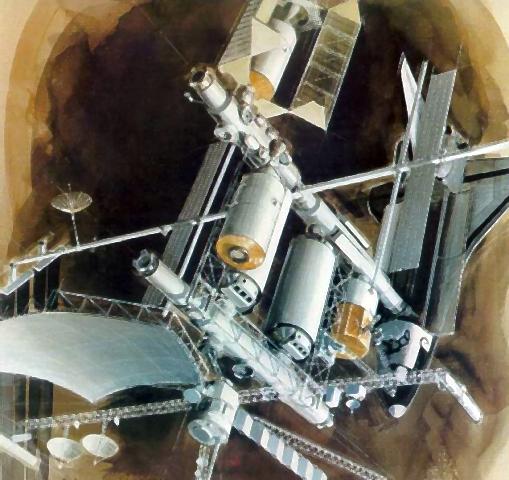
“This designer’s conception shows some of the applications of an advanced Space Operations Center, currently being studied by Boeing Aerospace Company for NASA. This advanced version of the spaceport shows the Space Shuttle unloading some of the modules which would comprise the system. Those modules include living and command control quarters; warehouses for food, water and hydrazine, and service areas containing batteries and other necessary supplies. Other areas of this advanced concept include hangars for spacecraft, solar panels to provide power for the station, and construction equipment to handle large structures. The large structure containing several antenna reflectors is a communications platform which is about to be assembled to an Orbital Transfer Vehicle for a flight to a higher orbit in space.”
Note the interesting truss-work crane/RMS-like device, complete with grappling arms(?), directly "above" the nose of the orbiter. Although the grappling arms, if that’s even what they are, appear to be extending from a secondary, smaller truss-like structure…so I’ve probably misidentified this thing. To complete the descent into this particular hole, the two antennae-looking protrusions, also in the immediate vicinity, look like the work lights associated with Grumman’s Manned Remote Work Station. So, that’s what’s going on here…my final answer. 😉
8.5” x 11”.
Another gorgeous work by Boeing’s John J. Olson. I find the “sketchy/first draft/work-in-progress” appearance to be interesting, this being just one of several like this that I’ve posted.
See also:
spacearchitect.org/portfolio-item/boeing-space-station-de...
Specifically:
spacearchitect.org/wp-content/uploads/2020/04/1-Space-Ope...
Both above credit: SpaceArchitect.org. website
www.astronautix.com/s/spaceoperationscenter.html
Specifically:
www.astronautix.com/graphics/s/soc81nw.jpg
Both above credit: Astronautix website
In game screenshot (2560x1440)
Follow my work on:
Become a Citizen with 5k in-game currency to your name.
....then add me in game!
The Gold City Repair Station is used by the Space Taxi service for in space repairs. Ok, I just made the story up after making some mods to some previous design tests.
SL2-X9-747 (June 1973) --- Astronaut Paul J. Weitz, Skylab 2 pilot, mans the control and display console of the Apollo Telescope Mount (ATM) in this onboard view photographed in Earth orbit. The ATM C&D console is located in the Multiple Docking Adapter (MDA) of the Skylab 1/2 space station. Weitz, along with astronaut Charles Conrad Jr., commander, and scientist-astronaut Joseph P. Kerwin, science pilot, went on to successfully complete a 28-day mission in Earth orbit. Photo credit: NASA
After the control over the spacestation has been taken over by the group of rebels, they start cleaning up, collecting all relevant data the can find and interrogating the remaining imperial crew members.
SL3-83-0152 (July-September 1973) --- A near vertical view of the metropolitan Detroit, Michigan area is seen in this Skylab 3 Earth Resources Experiments Package S190-B (five-inch Earth terrain camera) photograph taken from the Skylab space station in Earth orbit. The 25-mile long Detroit River drains the smaller body of water (Lake St. Clair) and flows southwestward separating Detroit from Windsor, Ontario, and empties into Lake Erie. The Detroit River handles a great deal of Great Lakes barge and ship traffic. Major streets and thoroughfares radiating from the city are clearly visible. Fighting Island is the highly reflective, white area located almost in the center of the picture. This high reflectivity is caused by the functional use of the island-disposal ponds for chemical salts. Sedimentation and/or pollution patterns in the area provide interesting visual phenomena for speculation and analysis. Distinct and rather unique cultivated field patterns can be observed south and east of Windsor, Ontario. This is a direct result of an English survey and land tenure system which was utilized when the area was settled. New areas of residential development are fairly easy to differentiate from older, established residential areas. Vegetation and extent of area coverage can be determined. The Oakland County Planning Commission and the Federal Bureau of Outdoor Recreation working closely with Irv Sattinger of the Environmental Research Institute of Michigan (University of Michigan) are presently processing and analyzing photographic and Multispectral scanner data to determine its usefulness for recreation and open space site studies for this area. Photo credit: NASA
In game screenshot (2560x1440)
Follow my work on:
Become a Citizen with 5k in-game currency to your name.
....then add me in game!
Designer: Chinese Association of Science Popularizers (中国科普作家协会)
2008
Space walk
Taikong xingzou (太空行走)
Call nr.: BG E37/495 (Landsberger collection)
More? See: chineseposters.net/themes/space-walk
"...So I'll reach up to the sky
And pretend that I'm a spaceman
In another place and time
I guess I'm looking for a brand new place
Is there a better life for me?..."
The Marshall Space Flight Center is responsible for designing and building the life support systems that provide the crew of the International Space Station with a comfortable environment in which to live and work. Scientists and engineers are working together to provide the space station with systems that are safe, efficient and cost-effective. For example, the water recovery system reduces crew dependence on delivered water by 65 percent. These compact and powerful systems are collectively called the Environmental Control and Life Support Systems, ECLSS. This is an exterior view of the U.S. Laboratory Module Simulator containing the ECLSS Internal Thermal Control System (ITCS) testing facility at the center. At the bottom right is the data acquisition and control computers (in the blue equipment racks) that monitor the testing in the facility. The ITCS simulator facility duplicates the function, operation, and troubleshooting problems of the ITCS. The main function of the ITCS is to control the temperature of equipment and hardware installed in a typical ISS Payload Rack.
Image credit: NASA
More about space station research:
www.nasa.gov/mission_pages/station/research/index.html
View more photos like this in the "Space Station Research Affects Lives" Flickr photoset:
www.flickr.com/photos/nasamarshall/sets/72157634178107799/
_____________________________________________
These official NASA photographs are being made available for publication by news organizations and/or for personal use printing by the subject(s) of the photographs. The photographs may not be used in materials, advertisements, products, or promotions that in any way suggest approval or endorsement by NASA. All Images used must be credited. For information on usage rights please visit: www.nasa.gov/audience/formedia/features/MP_Photo_Guidelin...
A high fidelity test version of NASA’s Advanced Plant Habitat (APH), the largest plant chamber built for the agency, arrived at Kennedy Space Center the third week of November, 2016. The APH unit, containing small flowering plant seeds, will be delivered to the International Space Station in 2017. via NASA ift.tt/2fremIw
Designer: Chinese Association of Science Popularizers (中国科普作家协会)
2008
Space walk
Taikong xingzou (太空行走)
Call nr.: BG E37/492 (Landsberger collection)
More? See: chineseposters.net/themes/space-walk
The Manned Orbiting Laboratory (MOL) was part of the United States Air Force (USAF) human spaceflight program in the 1960s. The project was developed from early USAF concepts of crewed space stations as reconnaissance satellites, and was a successor to the canceled Boeing X-20 Dyna-Soar military reconnaissance space plane. MOL evolved into a single-use laboratory, for which crews would be launched on 30-day missions, and return to Earth using a Gemini B spacecraft derived from NASA's Gemini spacecraft.
The MOL program was announced to the public on 10 December 1963 as an inhabited platform to demonstrate the utility of putting people in space for military missions; its reconnaissance satellite mission was a secret black project. Seventeen astronauts were selected for the program. The prime contractor for the spacecraft was McDonnell Aircraft; the laboratory was built by the Douglas Aircraft Company. The Gemini B was externally similar to NASA's Gemini spacecraft, although it underwent several modifications, including the addition of a circular hatch through the heat shield, which allowed passage between the spacecraft and the laboratory. Vandenberg Air Force Base Space Launch Complex 6 (SLC 6) was developed to permit launches into polar orbit.
As the 1960s progressed, the MOL competed with the Vietnam War for funds, and resultant budget cuts repeatedly caused postponement of the first operational flight. At the same time, automated systems rapidly improved, narrowing the benefits of a crewed space platform over an automated one. A single uncrewed test flight of the Gemini B spacecraft was conducted on 3 November 1966, but the MOL was canceled in June 1969 without any crewed missions being flown.
Seven of the astronauts selected for the MOL program transferred to NASA in August 1969 as NASA Astronaut Group 7, all of whom eventually flew in space on the Space Shuttle between 1981 and 1985. The Titan IIIM rocket developed for the MOL never flew, but its UA1207 solid rocket boosters were used on the Titan IV, and the Space Shuttle Solid Rocket Booster was based on materials, processes and designs developed for them. NASA spacesuits were derived from the MOL ones, MOL's waste management system flew in space on Skylab, and NASA Earth Science used other MOL equipment. SLC 6 was refurbished, but plans to have military Space Shuttle launches from there were abandoned in the wake of the January 1986 Space Shuttle Challenger disaster.
NASA's Gemini capsule was extensively redesigned for the MOL Manned Orbiting Laboratory program. The resulting Gemini B, although externally similar, was essentially a completely new spacecraft. Gemini B was not designed to fly separately, but rather was launched with the crew aboard attached to the manned orbiting laboratory. After reaching orbit, the crew would shut down the capsules systems and put them into hibernation. They would crawl through an 0.635 m diameter hatch in the heat shield, leading to a tunnel that accessed the MOL itself. After thirty days of operations, the crew would return to the Gemini B, separate from the MOL, and reenter the atmosphere. Gemini B had only 14 hours of free flight time for autonomous operations after separation from the MOL.
Several changes were made from the original NASA Gemini, including:
-Internal systems were containerized and designed for long term orbital storage
-The cockpit layout was completely redesigned and new instruments were developed
-The cant of the ejection seats were changed in order to make room for the hatch in the heat shield between the crew's shoulders
-Cabin atmosphere was changed to Helium-Oxygen in place of pure oxygen. At launch, the crew breathed pure oxygen in their suits while the cabin was filled with pure helium. During ascent, oxygen from the suits slowly brought the cabin atmosphere up to the helium-oxygen content of the station itself.
-In order to handle higher energy reentries from polar orbit, the heat shield was increased in diameter, so that it actually stuck out a bit from the base of the reentry vehicle.
- The OAMS maneuvering thrusters of the NASA Gemini were deleted; spacecraft orientation in orbit was handled by the forward RCS thrusters.
-The number of solid propellant retrofire motors was increased from four to six. These served double-duty: for deorbit of the Gemini B and as abort rockets for separation of the Gemini from the enormous Titan 3M in case of launch vehicle failure.
The prototype Gemini-B, which was launched on a suborbital trajectory, was the refurbished Gemini-2 capsule, making it the first reused spacecraft. It was launched with the MOL-Heatshield Qualification Test on a Titan-3C launch vehicle.
Much better angle and time to spot today's ISS flyover. #SpotTheStation.
Station appeared West and moved towards South around 7:20 pm EST October 16th 2017.
Gears used:
OMD EM1
Rokinon 12mm
f2.8 - ISO 100 - LiveComposite with the exposure time set for every 2.5 seconds.
The feint line to the right of the moon , venus and jupiter is the international space station speeding high above Canary Wharf. Its been a good week for spotting the ISS in the uk. It always appears from the west
Best view large
Craft, Model & Hobby Industry - February 1957
This trade magazine advertisement was intended to be seen by toy and hobby retailers, not the general public.
I apologize for the distortion to the Space Station and the wing tip of The Spirit of St. Louis. These industry trade ads are coming from bound volumes of magazines that are impossible to get perfectly flat on my scanner bed. This Strombecker page was particularly difficult.
Kennedy Space Center employees harvest test crops inside the Veggie growth chamber in the Florida spaceport’s Space Station Processing Facility on Sept. 30, 2019, for a science verification test (SVT) to study their potential to grown in space. The harvest included ‘outredgeous’ red romaine lettuce, which has been grown in space before, and two new plant cultivars – amara mustard and shungiku, an Asian green comparable to an edible chrysanthemum. All three lettuce plants were grown from seed film, making this the first SVT with this new plant growth material. Earlier this year, the amara mustard and shungiku plants were grown for the first time using seed bags – referred to as pillows – during the Sustained Veggie project, a study funded by the Human Research Program. Photo credit: NASA/Cory Huston
This the classic space station image from the movie "2001:a Space Odyssey", directed by Stanley Kubrick in 1968. Praised for its special effects, the movie based its space station concept on Wernher Von Braun's model. Kubrick's station in the movie was 900 feet in diameter, orbited 200 miles above Earth, and was home to an international contingent of scientists, passengers, and bureaucrats.
Image Credit : NASA [source]
this is from the april 21, 1961 issue of Life magazine. most of the issue is devoted to yuri gagarin, who had just returned to earth, and americans (judging from the tone of the articles) were FREAKING OUT that the soviets had beaten them to space. much of the issue reads like a study of a national identity crisis. so, life tried to pick up everyone's spirits by running a few drawings of what OUR spaceships would look like, if we ever got around to building any.
i scanned this in so i could add it to the new "In the Year 2000" retrofuturism group.
the magazine was still large format back then, so the pages don't really fit in my scanner. sorry.
My picture of the International Space Station.
Taken with 200p at f/5 with point grey firefly mono.
The background is very messy but I don't want to fiddle with the data too much.
I focused on the star Arcturus then went for the first pass. I wrote down the settings as it was overexposed and adjusted for the later pass.
No barlow used although I think I will try with one later!
PictionID:50436675 - Catalog:14_027304 - Title:Space Details: Skylab - Filename:14_027304.TIF - - - Images from the Convair/General Dynamics Astronautics Atlas Negative Collection. The processing, cataloging and digitization of these images has been made possible by a generous National Historical Publications and Records grant from the National Archives and Records Administration---Please Tag these images so that the information can be permanently stored with the digital file.---Repository: San Diego Air and Space Museum
Named in honor of Christopher C. Kraft, leader of the control Crew of APOLLO-11 Moon landing mission
Mizuna Mustard mustard greens, part of the Veg-04A experiment, are shown growing in a Veggie plant growth chamber aboard the International Space Station on July 9, 2019. The Veg-04A experiment tested the greens, grown in blue-rich lighting and red-rich lighting, to determine the effects of different light ratios on plants grown in space on the station. The plants arrived aboard the SpaceX Commercial Resupply Services-16 mission. Astronaut Christina Koch initiated the on-orbit experiment on June 4, 2019, in the stationâs two Veggie plant growth chambers, with six plant pillows per chamber. On June 11, 2019, Koch thinned the Mizuna plants to one plant per pillow. The on-orbit harvest took place July 9, 2019, with astronaut Nick Hague harvesting the plants grown under blue-rich light and Koch harvesting the plants grown under red-rich lights. Photo credit: NASA