View allAll Photos Tagged Slander
BIBLICAL CONTEXT: Titus 3:1-8 NIV
(from biblegateway.com)
1 Remind the people to be subject to rulers and authorities, to be obedient, to be ready to do whatever is good, 2 to slander no one, to be peaceable and considerate, and always to be gentle toward everyone.
3 At one time we too were foolish, disobedient, deceived and enslaved by all kinds of passions and pleasures. We lived in malice and envy, being hated and hating one another. 4 But when the kindness and love of God our Savior appeared, 5 he saved us, not because of righteous things we had done, but because of his mercy. He saved us through the washing of rebirth and renewal by the Holy Spirit, 6 whom he poured out on us generously through Jesus Christ our Savior, 7 so that, having been justified by his grace, we might become heirs having the hope of eternal life. 8 This is a trustworthy saying. And I want you to stress these things, so that those who have trusted in God may be careful to devote themselves to doing what is good. These things are excellent and profitable for everyone.
-------------------------------------------------------------------------------------------
5 MORE THINGS YOU SHOULD KNOW:
1. Like it or not, we are ALL sinners: As the Scriptures say, “No one is righteous—not even one. No one is truly wise; no one is seeking God. All have turned away; all have become useless. No one does good, not a single one.” (Romans 3:10-12 NLT)
2. The punishment for sin is death: When Adam sinned, sin entered the world. Adam’s sin brought death, so death spread to everyone, for everyone sinned. (Romans 5:12 NLT)
3. Jesus is our only hope: But God showed his great love for us by sending Christ to die for us while we were still sinners. (Romans 5:8 NLT) For the wages of sin is death, but the free gift of God is eternal life through Christ Jesus our Lord. (Romans 6:23 NLT)
4. SALVATION is by GRACE through FAITH in JESUS: God saved you by his grace when you believed. And you can’t take credit for this; it is a gift from God. Salvation is not a reward for the good things we have done, so none of us can boast about it. For we are God’s masterpiece. He has created us anew in Christ Jesus, so we can do the good things he planned for us long ago. (Ephesians 2:8-10 NLT)
5. Accept Jesus and receive eternal life: If you openly declare that Jesus is Lord and believe in your heart that God raised him from the dead, you will be saved. (Romans 10:9 NLT) But to all who believed him and accepted him, he gave the right to become children of God. (John 1:12 NLT) And this is what God has testified: He has given us eternal life, and this life is in his Son. Whoever has the Son has life; whoever does not have God’s Son does not have life. (1 John 5:11-12 NLT)
Read the Bible for yourself. Allow the Lord to speak to you through his Word. YOUR ETERNITY IS AT STAKE!
Pontefract (or Pomfret) Castle is a castle ruin in the town of Pontefract, in West Yorkshire, England. King Richard II is thought to have died there. It was the site of a series of famous sieges during the 17th-century English Civil War.
The castle, on a rock to the east of the town above All Saints' Church, was constructed in approximately 1070 by Ilbert de Lacy on land which had been granted to him by William the Conqueror as a reward for his support during the Norman Conquest. There is, however, evidence of earlier occupation of the site. Initially the castle was a wooden structure which was replaced with stone over time. The Domesday Survey of 1086 recorded "Ilbert's Castle" which probably referred to Pontefract Castle.
Robert de Lacy failed to support King Henry I during his power struggle with his brother, and the King confiscated the castle from the family during the 12th century. Roger de Lacy paid King Richard I 3,000 marks for the Honour of Pontefract, but the King retained possession of the castle. His successor King John gave de Lacy the castle in 1199, the year John ascended the throne. Roger died in 1213 and was succeeded by his eldest son, John. However, the King took possession of Castle Donington and Pontefract Castle. The de Lacys lived in the castle until the early 14th century. It was under the tenure of the de Lacys that the magnificent multilobate donjon was built.
In 1311 the castle passed by marriage to the estates of the House of Lancaster. Thomas, Earl of Lancaster (circa 1278–1322) was beheaded outside the castle walls six days after his defeat at the Battle of Boroughbridge, a sentence placed on him by King Edward II himself in the great hall. This resulted in the earl becoming a martyr with his tomb at Pontefract Priory becoming a shrine. It next went to Henry, Duke of Lancaster and subsequently to John of Gaunt, third son of King Edward III. He made the castle his personal residence, spending vast amounts of money improving it.
In the closing years of the 14th century, Richard II banished John of Gaunt’s son Henry Bolingbroke, Duke of Hereford, from England. Following the death of John of Gaunt, Duke of Lancaster, in 1399, Richard II seized much of the property due to Bolingbroke. Richard then shared some of the seized property around among his favourites. The castle at Pontefract was among such properties which was under threat. These events aroused Bolingbroke to return to England to claim his rights to the Duchy of Lancaster and the properties of his father. Shakespeare's play Richard II (Act 2, scene 1, 277) relates Bolingbroke’s homecoming in the words of Northumberland in the speech of the eight tall ships:-
NORTHUMBERLAND
Then thus: I have from Port Le Blanc,
A bay in Brittany, receiv’d intelligence,
That Harry Duke of Herford, Rainold Lord Cobham,
Thomas, son and heir to th’ Earl of Arundel,
That late broke from the Duke of Exeter,
His brother, Archbishop late of Canterbury,
Sir Thomas Erpingham, Sir John Ramston,
Sir John Norbery, Sir Robert Waterton, and Francis Quoint—
All these, well furnished by the Duke of Brittany
With eight tall ships, three thousand men of war,
Are making hither with all due expedience,
And shortly mean to touch our northern shore
When Bolingbroke landed at Ravenspur on the Humber, he made straight way for his castle at Pontefract. King Richard II, being in Ireland at the time, was in no position to oppose Bolingbroke. Bolingbroke soon deposed Richard and took the crown for himself as Henry IV.
Richard II was captured by Henry Bolingbroke's supporters in August 1399 and was initially imprisoned in the Tower of London. Sometime before Christmas that year he was moved to Pontefract Castle (via Knaresborough) where he remained under guard until his death, perhaps on 14 February 1400. William Shakespeare's play Richard III mentions this incident:
Pomfret, Pomfret! O thou bloody prison,
Fatal and ominous to noble peers!
Within the guilty closure of thy walls
Richard the second here was hack'd to death;
And, for more slander to thy dismal seat,
We give thee up our guiltless blood to drink.
Various chroniclers suggest that Richard was starved to death by his captors, and others suggest he starved himself. A contemporary French chronicler suggested that Richard II had been hacked to death, but this is, according to the ODNB, "almost certainly fictitious"
Richard III had two relatives of Elizabeth Woodville beheaded at Pontefract Castle on 25 June 1483 – her son, Sir Richard Grey, and her brother, Anthony Woodville, 2nd Earl Rivers.
n 1536, the castle's guardian, Thomas Darcy, 1st Baron Darcy de Darcy handed over the castle to the leaders of the Pilgrimage of Grace, a Catholic rebellion from northern England against the rule of King Henry VIII. Lord Darcy was executed for this alleged "surrender", which the king viewed as an act of treason.
In 1541, during a royal tour of the provinces, it was alleged that King Henry's fifth wife, Queen Catherine Howard, committed her first act of adultery with Sir Thomas Culpeper at Pontefract Castle, a crime for which she was apprehended and executed without trial. Mary, Queen of Scots was lodged at the castle on 28 January 1569, travelling between Wetherby and Rotherham.
On his way south to London, King James rode from Grimston Park to view Pontefract Castle on 19 April 1603 and stayed the night at the Bear Inn at Doncaster. The castle was included in English jointure property of his wife, Anne of Denmark.
Royalists controlled Pontefract Castle at the start of the English Civil War. The first of three sieges began in December 1644 and continued until the following March when Marmaduke Langdale, 1st Baron Langdale of Holme arrived with Royalist reinforcements and the Parliamentarian army retreated. During the siege, mining and artillery caused damage and the Piper Tower collapsed as a result. The second siege began on 21 March 1645, shortly after the end of the first siege, and the garrison surrendered in July after hearing the news of Charles I's defeat at the Battle of Naseby. Parliament garrisoned the castle until June 1648 when Royalists sneaked into the castle and took control. Pontefract Castle was an important base for the Royalists, and raiding parties harried Parliamentarians in the area.
Oliver Cromwell led the final siege of Pontefract Castle in November 1648. Charles I was executed in January, and Pontefract's garrison came to an agreement and Colonel Morrice handed over the castle to Major General John Lambert on 24 March 1649. Following requests from the townspeople, the grand jury at York, and Major General Lambert, on 27 March Parliament gave orders that Pontefract Castle should be "totally demolished & levelled to the ground" and materials from the castle would be sold off. Piecemeal dismantling after the main organised activity of slighting may have further contributed to the castle's ruined state.
It is still possible to visit the castle's 11th-century cellars, which were used to store military equipment during the civil war.
Little survives of what "must have been one of the most impressive castles in Yorkshire" other than parts of the curtain wall and excavated and tidied inner walls. It had inner and outer baileys. Parts of a 12th-century wall and the Piper Tower's postern gate and the foundations of a chapel are the oldest remains. The ruins of the Round Tower or keep are on the 11th-century mound. The Great Gate flanked by 14th-century semi-circular towers had inner and outer barbicans. Chambers excavated into the rock in the inner bailey possibly indicate the site of the old hall and the North Bailey gate is marked by the remains of a rectangular tower.
The castle has several unusual features. The donjon has a rare Quatrefoil design. Other examples of this type of Keep are Clifford's Tower, York and at the Château d'Étampes in France. Pontefract also has an torre albarrana, a fortification almost unknown outside the Iberian Peninsula. Known as the Swillington Tower, the detached tower was attached to the north wall by a bridge. Its purpose was to increase the defender's range of flanking fire.
Wakefield Council, who manage the site, commissioned William Anelay Ltd to begin repairs on the castle in September 2015, but work stopped in November 2016 when Anelay went into administration. The Council then engaged Heritage Building & Conservation (North) Ltd, who began work on the site in March 2017. A new visitor centre and cafe were opened in July 2017; but in April 2018 the council announced that they had terminated the contract with HB&C (North) Ltd, as no work had been done since mid-March, and they had not had any reassurances that the work would restart. On Yorkshire Day 2019, the restoration was completed, and the castle was removed from Historic England's "Heritage At Risk" list.
West-German postcard by Krüger, no. 902/6.
American actress and singer Ann Blyth (1928) was often cast in Hollywood musicals, but she was also successful in dramatic roles. Her performance as Veda Pierce in Mildred Pierce (Michael Curtiz, 1945) was nominated for an Academy Award for Best Supporting Actress. She is one of the last surviving stars from the Golden Age of Hollywood.
Ann Blyth was born in 1928, in Mount Kisco, New York, to Harry and Nan Lynch Blyth. After her parents separated, she, her mother and her sister moved to a walk-up apartment on East 31st Street in New York City, where her mother took in ironing. Blyth attended St. Patrick's School in Manhattan. Blyth performed on children's radio shows in New York for six years, making her first appearance when she was five. When she was nine she joined the New York Children's Opera Company. Her first acting role was on Broadway in Lillian Hellman's 'Watch on the Rhine' (1941-1942). She played the part of Paul Lukas's daughter, Babette. The play ran for 378 performances and won the New York Drama Critics' Circle Award. After the New York run, the play went on tour, and while performing at the Biltmore Theatre in Los Angeles, Blyth was offered a contract with Universal Studios. Blyth began her acting career initially as "Anne Blyth", but changed the spelling of her first name back to "Ann" at the beginning of her film career. She made her film debut in 1944, teamed with Donald O'Connor and Peggy Ryan in the teenage musical Chip Off the Old Block (1944). She followed it with two similar films: The Merry Monahans (1944) with O'Connor and Ryan again, and Babes on Swing Street (1944) with Ryan. She had a support role in the bigger budgeted Bowery to Broadway (1944), a showcase of Universal musical talent. On loan to Warner Brothers, Blyth was cast 'against type' as Veda Pierce, the scheming, ungrateful daughter of Joan Crawford in Mildred Pierce (Michael Curtiz, 1945). Her dramatic portrayal won her outstanding reviews, and she received a nomination for an Academy Award for Best Supporting Actress. Blyth was only 16 when she made the film, for which Crawford won the Best Actress award. After Mildred Pierce, Blyth sustained a broken back while tobogganing in Snow Valley, and was not able to fully capitalise on the film's success. She recovered and made two films for Mark Hellinger's unit at Universal: Swell Guy (1946), with Sonny Tufts, and Brute Force (1947) with Burt Lancaster. During this time her father died. Metro-Goldwyn-Mayer borrowed her to play the female lead in Killer McCoy (1947), a boxing film with Mickey Rooney that was a box office hit. Back at Universal, she did a Film Noir with Charles Boyer, A Woman's Vengeance (1948). She was then cast in the part of Regina Hubbard in Lillian Hellman's Another Part of the Forest (1948), an adaptation of the 1946 play where Regina had been played by Patricia Neal. The play was a prequel to The Little Foxes. Blyth followed it with Mr. Peabody and the Mermaid (1948) with William Powell. She was top-billed in Red Canyon (1949), a Western with Howard Duff. Paramount borrowed Blyth to play the female lead in Top o' the Morning (1949), a daughter of Barry Fitzgerald who is romanced by Bing Crosby. It was the first time she sang on screen. Back at Universal, she was teamed with Robert Montgomery in Once More, My Darling (1949), meaning she had to drop out of Desert Legion. She did a comedy with Robert Cummings, Free for All (1949). In April 1949, Universal suspended her for refusing a lead role in Abandoned (1949). Gale Storm played it.
Ann Blyth was borrowed by Sam Goldwyn to star opposite Farley Granger in Our Very Own (1950). Universal gave her top billing in a romantic comedy, Katie Did It (1951). Blyth was borrowed by MGM for The Great Caruso (1951) opposite Mario Lanza which was a massive box office hit. She made Thunder on the Hill (1951) with Claudette Colbert and had the female lead in The Golden Horde (1951) with David Farrar. Then, 20th Century Fox borrowed her to star opposite Tyrone Power in I'll Never Forget You (1952), a last-minute replacement for Constance Smith. She appeared on TV in Family Theater in an episode called 'The World's Greatest Mother' alongside Ethel Barrymore. Universal teamed Blyth with Gregory Peck in The World in His Arms (1952). She was top-billed in the comedy Sally and Saint Anne (1952) and was borrowed by RKO for One Minute to Zero (1952), a Korean War drama with Robert Mitchum where she replaced Claudette Colbert who came down with pneumonia. MGM had been interested in Blyth since The Great Caruso. In December 1953, Blyth left Universal and she signed a long term contract with MGM. She was the leading lady in All the Brothers Were Valiant (1953) with Stewart Granger and Robert Taylor, stepping in for Elizabeth Taylor who had to drop out due to pregnancy. On television, she was in a version of A Place in the Sun for Lux Video Theatre alongside John Derek. Back at MGM, Blyth had the lead in the remake of Rose Marie (1954) with Howard Keel, which earned over $5 million but lost money due to high costs. She was meant to be reteamed with Lanza in The Student Prince (1954) but he was fired from the studio and was replaced in the picture by Edmund Purdom. The film did well at the box office. Blyth and Purdom were reunited on a swashbuckler, The King's Thief (1955). She was teamed again with Keel on the musical Kismet (1955). Despite strong reviews, the film was a financial flop. She was named for the female lead in The Adventures of Quentin Durward (1955) but was eventually not cast in the film. MGM put Blyth in Slander (1957) with Van Johnson. Sidney Sheldon cast Blyth in The Buster Keaton Story (1957) with Donald O'Connor at Paramount. Warner Bros then cast her in the title role of The Helen Morgan Story (Michael Curtiz, 1957) with Paul Newman. Blyth reportedly beat 40 other actors for the part. Even though her voice was more like the original Helen Morgan, her vocals were dubbed by Gogi Grant. That soundtrack was much more successful than the film itself. Blyth made no further films. In 1957, she sued Benedict Bogeaus for $75,000 for not making the film Conquest. From the late 1950s into the 1970s, Blyth worked in musical theatre and summer stock, starring in the shows 'The King and I', 'The Sound of Music', and 'Show Boat'. and also on television, including co-starring opposite James Donald in The Citadel (1960), an adaptation of A.J. Cronin's novel. She guest-starred on episodes of such series as The DuPont Show with June Allyson, The Dick Powell Theatre, Saints and Sinners, The Christophers, Wagon Train, The Twilight Zone, and Burke's Law. Several of these appearances were for Four Star Television with whom Blyth signed a multi-appearance contract. Blyth also became the spokesperson for Hostess Cupcakes. Her last television appearances were in episodes of Switch (1983), Quincy, M.E. (1983) and Murder, She Wrote (1985). In 1985, she officially retired. For her contributions to the film industry, Blyth has a motion pictures star on the Hollywood Walk of Fame at 6733 Hollywood Boulevard. In 1953, Blyth married obstetrician James McNulty, brother of singer Dennis Day, who had introduced them. After her marriage, Blyth took somewhat of a reprieve from her career to focus on raising their five children, Timothy Patrick (1954); Maureen Ann (1955); Kathleen Mary (1957); Terence Grady (1960); and Eileen Alana (1963).
Sources: Wikipedia and IMDb.
And, please check out our blog European Film Star Postcards.
Recommended music:
idk, listen to Certain Kind of Magic in the background
----------------------------------
ARCH0MEN, the Cyber-Sukeban Leak Queen of Tokyo.
She had made a name for herself during the Orbit Wars, orchestrating many of the high-profile leaks against government and corporate interests. Not to mention being the face of countless online smear campaigns against political and big business types. It didn’t take long for her to decide to make a show (or more aptly, sideshow) out of it.
Almost a decade later, and she was still going strong. There was a reason she was still getting views. Her charismatic snark and prowess in the news leak world gave her a steady viewership and a loyal cult following. Even if you didn’t care much about the infosphere, her personality was enough to keep you tuned in.
Being Japanese, all her shows were recorded only in her native tongue. However, she utilized advanced speech synthesis software to translate herself into a wide range of languages, always having a unique yet entirely lifelike voice depending on your language setting.
Lip sync wasn’t an issue. To mask her identity, she always wore a black bandana over her face. Overtop it was projected a virtual cartoonish Oni mouth, automated and animated to sync up with whatever regional translation you were listening to. It was almost seamless, but any bugs were simply brushed off as part of her glitchy aesthetic.
Her style was typical of the Neo-Tokyo trends; dark colored pleather, plastic, and semi-synthetic fibers, all tightly worn over her petite form. Her large, spiked, dyed hair helped further mask her identity. Only one eye was left fully visible. Eyes are the window to the soul, after all. Everything else was hidden behind thick purple strands of hair. Face analysis dazzle camouflage, popular among some of the more notorious or paranoid of the virtual world.
As was usual for her set up, she was cloaked in shadows and red edge lighting. A glossy glass tabletop sat in front of her like some parody of a news anchor. In the background was a wall made of nothing but TV displays, old and new, flickering with static or cycling through any random channel every few seconds.
She sat straight on toward the camera with her hands cupped together.
“Hello, hello, and welcome again to 0men At Night!” she began cheerfully. “I’m your wonderful loveable hostess, The ARCH0MEN…mh, granted you aren’t part of the Global 500, that is. I have a bad habit of ruffling their feathers...” she raised a hand over her mouth and let out a mischievous giggle.
“To start our night off, here’s your Leak of the Week! Tonight’s leak comes from Japan’s very own Hachitekku Mechatronics, provided by a very generous informant who shall as usual remain unnamed…
“Hachitekku is currently working on an upgrade to their Bolt lineup of proxy models. Some say you can’t improve upon perfection – in my humble opinion-“ she raised a hand over her chest with a prideful look, “-but apparently the engineers at Hachitekku believe otherwise. My informant tells me that the project’s objective is to focus on improving durability and survivability, implementing the most advanced metallurgyyyy-…et cetera, et cetera…” She twirled her fingers, as if growing bored of the technical jargon.
“-Well, as many of you may recall, in our previous episodes we leaked that Hachitekku has been on a binge of quietly buying out many of Japan’s leading tech and industry startups. Clearly not a coincidence. Ever heard of the old adage ‘competition breeds innovation’? Well, our friends on Hachijo seem to be choosing instead to simply buy out the competition and reap the benefits. But such is how the business world goes, shady practices and all.
“A release date has yet to be announced, obviously, since the project is still in prototype stage. Though surely this broadcast will help speed up the process. You’re welcome.” Her catchphrase.
She cocked her head to the side and gave her trademarked smug smile through her eyes. At this point her software knew it well enough, and the animated Oni mouth transformed to match it.
She continued-
“I just hope the software will finally be prepackaged instead of being sold separately. It is such a pain always having to pirate it...” She leaned in,
“Hint, hint.”
She readjusted herself as her face took on a more neutral appearance.
“Moving on to more serious news: There has been yet another attempt at revealing the identity of yours truly. I obviously won’t mention the poor soul who was falsely identified. She has already been through more than enough the past week, and out of respect I will refrain from delving into any of the personal attacks she has faced. I do have standards after all, despite what the media claims. But rest assured, I and my inner circle have worked tirelessly to ensure her safety.
“In the meantime, gracious members from our Shanghai chapter have successfully tracked down the would-be doxxers. The group responsible appear to be sponsored by the People’s Republic of Beijing, most likely in retaliation for my previous slanders of your marvellous little communist dictatorship. Try harder next time, boys. ROC is best China.
“Unfortunately I don’t think we have the time to list everyone involved, because I do have the full list. Perhaps we’ll have an episode dedicated to that later this week. But just to serve as a little warning-“
She turned her head and gazed into the camera, as if addressing someone personally.
“Wei Sing. I’d expect far better data encryption from a person in your line of work. Quite the cultured man, you are! ‘Futa’, ‘femdom’, ‘female-on-male’, very…*interesting*…tastes, if I might say. Perhaps your glorious leader would like to hear the full list, hmm? Or maybe he and your comrades would prefer a more visual medium? I’ve come to find out it goes well beyond your search history. I certainly have the juicy vid files as proof, and I bet the audience would just love to see them!”
After a moment of pause, her posture slumped. Her carefree, self-satisfied aura vanished. She narrowed her eyes and stared deep into the camera. They were full of malice.
“You don’t want to play this game.” She droned without emotion. “You really don’t want to play this game.”
A few seconds went by before she finally breathed a sigh.
“Moving on-!“ she forced a smile.
Her chipper personality returned as she recomposed herself.
“Turning our attention over to America: Another day, another stock exchange financier is revealed to be human excrement. At this point I should just make a segment dedicated to it. It’s basically become a monthly event…But, I digress!
“Andy Florance. Owner of a lovely little flat in lower Manhattan. Just turned 27, happy belated birthday by the way. You all should know the story by now; silver spooned upbringing, some young Mr. Big, caught in a web of embezzlement and fraud, the usual scumbag-ary we’ve come to expect from the wonderful world of Wall Street.
“BUT, here’s the rotten cherry on top: the fund he was working for? The Rightful Passage Foundation…a charity foundation…dedicated to giving third world victims of the Choke a proper burial.”
She paused for a moment and blinked with wide eyes, just to let it sink in.
“Yes, you heard that right! This fine example of wasted genes was siphoning money away from the literal bones of dead African children! To finance underwater Miami CASINOS of all things!” she spoke with exuberance, as if trying to embody the absurdity of the situation. “Just-…it takes effort to be that much of a human septic tank.” She spat out the last three words with vitriol.
“A New York watchdog organization had already uncovered the story before I was able to get to it. Not that I’m complaining; I tip my hat to you. Got anymore scoops, hook me up!" She hastily added, making a calling gesture with her fingers.
“He was promptly brought into custody once all this came to light, and the RPF made quick at publicly denouncing him. From what I’ve heard, his future doesn’t sound very bright.
“It didn’t take long for the police body camera footage to leak of his arrest, and it is…just beautiful. I won’t show the full clip here. RATHER, I’ll save it for our Hour of 0men Weekly Roundup later this week, and we’ll take all the time we need laughing at him blubbering like a baby for minutes on end! Mark your calendars, you won’t want to miss it!
“Unfortunately that marks the end of our show tonight. But be sure to keep tuning in for future episodes! Same time, same place, same marvellous face! Sweet dreams, and remember… 0men is always watching.” She stared ominously into the camera, before glitching out in her usual outro.
------------------------------------
I had WAAAAY too much fun writing this character...
I AM UNASHAMED TO ADMIT THE PRIMARY INSPIRATION BEHIND HER. Aside from that; a hint of WikiLeaks, a smidgen of VTuber, a health dash of smarmy edgy political YouTuber. I'll definitely go into more detail with her in the future
Looking at the actual "scene", you can see why this took over a month to finish. Me and my stupid obsessive attention to detail, putting an excessive amount of effort into thumbnails for in-universe content creators (majority actually inspired by YouTubers I follow). Although I will say, I am extremely proud of how it all turned out. Nothing quite like that dopamine rush when your art comes out perfect.
This chapter is nearly done! We've got two more parts! The end is in sight!!
If you fave, comment as well!
++++++++++ FROM WKIPEDIA +++++++++
Kolkata /koʊlˈkɑːtə/ ([kolkata] (About this soundlisten), also known as Calcutta /kælˈkʌtə/, the official name until 2001) is the capital of the Indian state of West Bengal. Located on the east bank of the Hooghly River approximately 75 kilometres (47 mi) west of the border with Bangladesh, it is the principal commercial, cultural, and educational centre of East India, while the Port of Kolkata is India's oldest operating port and its sole major riverine port. The city is widely regarded as the "cultural capital" of India, and is also nicknamed the "City of Joy".[1][2][3].According to the 2011 Indian census, it is the seventh most populous city. the city had a population of 4.5 million, while the population of the city and its suburbs was 14.1 million, making it the third-most populous metropolitan area in India. Recent estimates of Kolkata Metropolitan Area's economy have ranged from $60 to $150 billion (GDP adjusted for purchasing power parity) making it third most-productive metropolitan area in India, after Mumbai and Delhi.[11][12][13]
In the late 17th century, the three villages that predated Calcutta were ruled by the Nawab of Bengal under Mughal suzerainty. After the Nawab granted the East India Company a trading licence in 1690,[15] the area was developed by the Company into an increasingly fortified trading post. Nawab Siraj ud-Daulah occupied Calcutta in 1756, and the East India Company retook it the following year. In 1793 the East India company was strong enough to abolish Nizamat (local rule), and assumed full sovereignty of the region. Under the company rule, and later under the British Raj, Calcutta served as the capital of British-held territories in India until 1911, when its perceived geographical disadvantages, combined with growing nationalism in Bengal, led to a shift of the capital to New Delhi. Calcutta was the centre for the Indian independence movement; it remains a hotbed of contemporary state politics. Following Indian independence in 1947, Kolkata, which was once the centre of modern Indian education, science, culture, and politics, suffered several decades of economic stagnation.
As a nucleus of the 19th- and early 20th-century Bengal Renaissance and a religiously and ethnically diverse centre of culture in Bengal and India, Kolkata has local traditions in drama, art, film, theatre, and literature. Many people from Kolkata—among them several Nobel laureates—have contributed to the arts, the sciences, and other areas. Kolkata culture features idiosyncrasies that include distinctively close-knit neighbourhoods (paras) and freestyle intellectual exchanges (adda). West Bengal's share of the Bengali film industry is based in the city, which also hosts venerable cultural institutions of national importance, such as the Academy of Fine Arts, the Victoria Memorial, the Asiatic Society, the Indian Museum and the National Library of India. Among professional scientific institutions, Kolkata hosts the Agri Horticultural Society of India, the Geological Survey of India, the Botanical Survey of India, the Calcutta Mathematical Society, the Indian Science Congress Association, the Zoological Survey of India, the Institution of Engineers, the Anthropological Survey of India and the Indian Public Health Association. Though home to major cricketing venues and franchises, Kolkata differs from other Indian cities by giving importance to association football and other sports.
Etymology
The word Kolkata derives from the Bengali term Kôlikata (Bengali: কলিকাতা) [ˈkɔlikat̪a], the name of one of three villages that predated the arrival of the British, in the area where the city eventually was to be established; the other two villages were Sutanuti and Govindapur.[16]
There are several explanations about the etymology of this name:
The term Kolikata is thought to be a variation of Kalikkhetrô [ˈkalikʰːet̪rɔ] (Bengali: কালীক্ষেত্র), meaning "Field of [the goddess] Kali". Similarly, it can be a variation of 'Kalikshetra' (Sanskrit: कालीक्षेत्र, lit. "area of Goddess Kali").
Another theory is that the name derives from Kalighat.[17]
Alternatively, the name may have been derived from the Bengali term kilkila (Bengali: কিলকিলা), or "flat area".[18]
The name may have its origin in the words khal [ˈkʰal] (Bengali: খাল) meaning "canal", followed by kaṭa [ˈkata] (Bengali: কাটা), which may mean "dug".[19]
According to another theory, the area specialised in the production of quicklime or koli chun [ˈkɔlitɕun] (Bengali: কলি চুন) and coir or kata [ˈkat̪a] (Bengali: কাতা); hence, it was called Kolikata [ˈkɔlikat̪a] (Bengali: কলিকাতা).[18]
Although the city's name has always been pronounced Kolkata [ˈkolkat̪a] (Bengali: কলকাতা) or Kôlikata [ˈkɔlikat̪a] (Bengali: কলিকাতা) in Bengali, the anglicised form Calcutta was the official name until 2001, when it was changed to Kolkata in order to match Bengali pronunciation.[20] (It should be noted that "Calcutt" is an etymologically unrelated place name found at several locations in England.)
History
The discovery and archaeological study of Chandraketugarh, 35 kilometres (22 mi) north of Kolkata, provide evidence that the region in which the city stands has been inhabited for over two millennia.[21][22] Kolkata's recorded history began in 1690 with the arrival of the English East India Company, which was consolidating its trade business in Bengal. Job Charnock, an administrator who worked for the company, was formerly credited as the founder of the city;[23] In response to a public petition,[24] the Calcutta High Court ruled in 2003 that the city does not have a founder.[25] The area occupied by the present-day city encompassed three villages: Kalikata, Gobindapur, and Sutanuti. Kalikata was a fishing village; Sutanuti was a riverside weavers' village. They were part of an estate belonging to the Mughal emperor; the jagirdari (a land grant bestowed by a king on his noblemen) taxation rights to the villages were held by the Sabarna Roy Choudhury family of landowners, or zamindars. These rights were transferred to the East India Company in 1698.[26]:1
In 1712, the British completed the construction of Fort William, located on the east bank of the Hooghly River to protect their trading factory.[27] Facing frequent skirmishes with French forces, the British began to upgrade their fortifications in 1756. The Nawab of Bengal, Siraj ud-Daulah, condemned the militarisation and tax evasion by the company. His warning went unheeded, and the Nawab attacked; he captured Fort William which led to the killings of several East India company officials in the Black Hole of Calcutta.[28] A force of Company soldiers (sepoys) and British troops led by Robert Clive recaptured the city the following year.[28] Per the 1765 Treaty of Allahabad following the battle of Buxar, East India company was appointed imperial tax collector of the Mughal emperor in the province of Bengal, Bihar and Orissa, while Mughal-appointed Nawabs continued to rule the province.[29] Declared a presidency city, Calcutta became the headquarters of the East India Company by 1773.[30] In 1793, ruling power of the Nawabs were abolished and East India company took complete control of the city and the province. In the early 19th century, the marshes surrounding the city were drained; the government area was laid out along the banks of the Hooghly River. Richard Wellesley, Governor-General of the Presidency of Fort William between 1797 and 1805, was largely responsible for the development of the city and its public architecture.[31] Throughout the late 18th and 19th century, the city was a centre of the East India Company's opium trade.[32]
By the 1850s, Calcutta had two areas: White Town, which was primarily British and centred on Chowringhee and Dalhousie Square; and Black Town, mainly Indian and centred on North Calcutta.[33] The city underwent rapid industrial growth starting in the early 1850s, especially in the textile and jute industries; this encouraged British companies to massively invest in infrastructure projects, which included telegraph connections and Howrah railway station. The coalescence of British and Indian culture resulted in the emergence of a new babu class of urbane Indians, whose members were often bureaucrats, professionals, newspaper readers, and Anglophiles; they usually belonged to upper-caste Hindu communities.[34] In the 19th century, the Bengal Renaissance brought about an increased sociocultural sophistication among city denizens. In 1883, Calcutta was host to the first national conference of the Indian National Association, the first avowed nationalist organisation in India.[35]
Bengali billboards on Harrison Street. Calcutta was the largest commercial centre in British India.
The partition of Bengal in 1905 along religious lines led to mass protests, making Calcutta a less hospitable place for the British.[36][37] The capital was moved to New Delhi in 1911.[38] Calcutta continued to be a centre for revolutionary organisations associated with the Indian independence movement. The city and its port were bombed several times by the Japanese between 1942 and 1944, during World War II.[39][40] Coinciding with the war, millions starved to death during the Bengal famine of 1943 due to a combination of military, administrative, and natural factors.[41] Demands for the creation of a Muslim state led in 1946 to an episode of communal violence that killed over 4,000.[42][43][44] The partition of India led to further clashes and a demographic shift—many Muslims left for East Pakistan (present day Bangladesh), while hundreds of thousands of Hindus fled into the city.[45]
During the 1960s and 1970s, severe power shortages, strikes, and a violent Marxist–Maoist movement by groups known as the Naxalites damaged much of the city's infrastructure, resulting in economic stagnation.[46] The Bangladesh Liberation War of 1971 led to a massive influx of thousands of refugees, many of them penniless, that strained Kolkata's infrastructure.[47] During the mid-1980s, Mumbai (then called Bombay) overtook Kolkata as India's most populous city. In 1985, prime minister Rajiv Gandhi dubbed Kolkata a "dying city" in light of its socio-political woes.[48] In the period 1977–2011, West Bengal was governed from Kolkata by the Left Front, which was dominated by the Communist Party of India (CPM). It was the world's longest-serving democratically elected communist government, during which Kolkata was a key base for Indian communism.[49][50][51] In the West Bengal Legislative Assembly election, 2011, Left Front was defeated by the Trinamool Congress. The city's economic recovery gathered momentum after the 1990s, when India began to institute pro-market reforms. Since 2000, the information technology (IT) services sector has revitalised Kolkata's stagnant economy. The city is also experiencing marked growth in its manufacturing base.[52]
Geography
Spread roughly north–south along the east bank of the Hooghly River, Kolkata sits within the lower Ganges Delta of eastern India approximately 75 km (47 mi) west of the international border with Bangladesh; the city's elevation is 1.5–9 m (5–30 ft).[53] Much of the city was originally a wetland that was reclaimed over the decades to accommodate a burgeoning population.[54] The remaining undeveloped areas, known as the East Kolkata Wetlands, were designated a "wetland of international importance" by the Ramsar Convention (1975).[55] As with most of the Indo-Gangetic Plain, the soil and water are predominantly alluvial in origin. Kolkata is located over the "Bengal basin", a pericratonic tertiary basin.[56] Bengal basin comprises three structural units: shelf or platform in the west; central hinge or shelf/slope break; and deep basinal part in the east and southeast. Kolkata is located atop the western part of the hinge zone which is about 25 km (16 mi) wide at a depth of about 45,000 m (148,000 ft) below the surface.[56] The shelf and hinge zones have many faults, among them some are active. Total thickness of sediment below Kolkata is nearly 7,500 m (24,600 ft) above the crystalline basement; of these the top 350–450 m (1,150–1,480 ft) is Quaternary, followed by 4,500–5,500 m (14,760–18,040 ft) of Tertiary sediments, 500–700 m (1,640–2,300 ft) trap wash of Cretaceous trap and 600–800 m (1,970–2,620 ft) Permian-Carboniferous Gondwana rocks.[56] The quaternary sediments consist of clay, silt, and several grades of sand and gravel. These sediments are sandwiched between two clay beds: the lower one at a depth of 250–650 m (820–2,130 ft); the upper one 10–40 m (30–130 ft) in thickness.[57] According to the Bureau of Indian Standards, on a scale ranging from I to V in order of increasing susceptibility to earthquakes, the city lies inside seismic zone III.[58]
Urban structure
Howrah Bridge from the western bank of the Ganges
The Kolkata metropolitan area is spread over 1,886.67 km2 (728.45 sq mi)[59]:7 and comprises 3 municipal corporations (including Kolkata Municipal Corporation), 39 local municipalities and 24 panchayat samitis, as of 2011.[59]:7 The urban agglomeration encompassed 72 cities and 527 towns and villages, as of 2006.[60] Suburban areas in the Kolkata metropolitan area incorporate parts of the following districts: North 24 Parganas, South 24 Parganas, Howrah, Hooghly, and Nadia.[61]:15 Kolkata, which is under the jurisdiction of the Kolkata Municipal Corporation (KMC), has an area of 185 km2 (71 sq mi).[60] The east–west dimension of the city is comparatively narrow, stretching from the Hooghly River in the west to roughly the Eastern Metropolitan Bypass in the east—a span of 9–10 km (5.6–6.2 mi).[62] The north–south distance is greater, and its axis is used to section the city into North, Central, and South Kolkata. East Kolkata is also a section.
North Kolkata is the oldest part of the city. Characterised by 19th-century architecture, dilapidated buildings, overpopulated slums, crowded bazaars, and narrow alleyways, it includes areas such as Shyambazar, Hatibagan, Maniktala, Kankurgachi, Rajabazar, Shobhabazar, Shyampukur, Sonagachi, Kumortuli, Bagbazar, Jorasanko, Chitpur, Pathuriaghata, Cossipore, Kestopur, Sinthee, Belgachia, Jorabagan, and Dum Dum.[63]:65–66 The northern suburban areas like Baranagar, Durganagar, Noapara, Dunlop, Dakshineswar, Nagerbazar, Belghoria, Agarpara, Sodepur, Madhyamgram, Barasat, Birati, Khardah up to Barrackpur are also within the city of Kolkata (as a metropolitan structure).
Central Kolkata
Central Kolkata hosts the central business district. It contains B. B. D. Bagh, formerly known as Dalhousie Square, and the Esplanade on its east; Strand Road is on its west.[64] The West Bengal Secretariat, General Post Office, Reserve Bank of India, High Court, Lalbazar Police Headquarters, and several other government and private offices are located there. Another business hub is the area south of Park Street, which comprises thoroughfares such as Chowringhee, Camac Street, Wood Street, Loudon Street, Shakespeare Sarani, and A. J. C. Bose Road.[65] The Maidan is a large open field in the heart of the city that has been called the "lungs of Kolkata"[66] and accommodates sporting events and public meetings.[67] The Victoria Memorial and Kolkata Race Course are located at the southern end of the Maidan. Other important areas of Central Kolkata are Park Circus, Burrabazar, College Street, Sealdah, Taltala, Janbazar, Bowbazar, Entally, Chandni Chowk, Lalbazar, Chowringhee, Dharmatala, Tiretta Bazar, Bow Barracks, Mullick Bazar, Park Circus, Babughat etc. Among the other parks are Central Park in Bidhannagar and Millennium Park on Strand Road, along the Hooghly River.
South Kolkata
South Kolkata developed after India gained independence in 1947; it includes upscale neighbourhoods such as Ballygunge, Alipore, New Alipore, Lansdowne, Bhowanipore, Kalighat, Dhakuria, Gariahat, Tollygunge, Naktala, Jodhpur Park, Lake Gardens, Golf Green, Jadavpur, Garfa, Kalikapur, Haltu, Nandi Bagan, Santoshpur, Baghajatin, Garia, Ramgarh, Raipur, Kanungo Park, Ranikuthi, Bikramgarh, Bijoygarh, Bansdroni and Kudghat.[16] Outlying areas of South Kolkata include Garden Reach, Khidirpur, Metiabruz, Taratala, Majerhat, Budge Budge, Behala, Sarsuna, Barisha, Parnasree Pally, Thakurpukur, Maheshtala and Joka. The southern suburban neighbourhoods like Mahamayatala, Pratapgarh, Kamalgazi, Narendrapur, Sonarpur, Subhashgram and Baruipur are also within the city of Kolkata (as metropolitan, urban agglomeration area). Fort William, on the western part of the city, houses the headquarters of the Eastern Command of the Indian Army;[68] its premises are under the jurisdiction of the army.
East Kolkata
East Kolkata is largely composed of newly developed areas and neighbourhoods of Saltlake, Rajarhat, Tangra, Topsia, Kasba, Anandapur, Mukundapur, Picnic Garden, Beleghata, Ultadanga, Phoolbagan, Kaikhali, Lake Town, etc. Two planned townships in the greater Kolkata region are Bidhannagar, also known as Salt Lake City and located north-east of the city; and Rajarhat, also called New Town and sited east of Bidhannagar.[16][69] In the 2000s, Sector V in Bidhannagar developed into a business hub for information technology and telecommunication companies.[70][71] Both Bidhannagar and New Town are situated outside the Kolkata Municipal Corporation limits, in their own municipalities.[69]
Climate
Kolkata is subject to a tropical wet-and-dry climate that is designated Aw under the Köppen climate classification. According to a United Nations Development Programme report, its wind and cyclone zone is "very high damage risk".[58]
Temperature
The annual mean temperature is 26.8 °C (80.2 °F); monthly mean temperatures are 19–30 °C (66–86 °F). Summers (March–June) are hot and humid, with temperatures in the low 30s Celsius; during dry spells, maximum temperatures often exceed 40 °C (104 °F) in May and June.[72] Winter lasts for roughly two-and-a-half months, with seasonal lows dipping to 9–11 °C (48–52 °F) in December and January. May is the hottest month, with daily temperatures ranging from 27–37 °C (81–99 °F); January, the coldest month, has temperatures varying from 12–23 °C (54–73 °F). The highest recorded temperature is 43.9 °C (111.0 °F), and the lowest is 5 °C (41 °F).[72] The winter is mild and very comfortable weather pertains over the city throughout this season. Often, in April–June, the city is struck by heavy rains or dusty squalls that are followed by thunderstorms or hailstorms, bringing cooling relief from the prevailing humidity. These thunderstorms are convective in nature, and are known locally as kal bôishakhi (কালবৈশাখী), or "Nor'westers" in English.[73]
Rains brought by the Bay of Bengal branch of the south-west summer monsoon[74] lash Kolkata between June and September, supplying it with most of its annual rainfall of about 1,850 mm (73 in). The highest monthly rainfall total occurs in July and August. In these months often incessant rain for days brings live to a stall for the city dwellers. The city receives 2,528 hours of sunshine per year, with maximum sunlight exposure occurring in March.[75] Kolkata has been hit by several cyclones; these include systems occurring in 1737 and 1864 that killed thousands.[76][77]
Environmental issues
Pollution is a major concern in Kolkata. As of 2008, sulphur dioxide and nitrogen dioxide annual concentration were within the national ambient air quality standards of India, but respirable suspended particulate matter levels were high, and on an increasing trend for five consecutive years, causing smog and haze.[80][81] Severe air pollution in the city has caused a rise in pollution-related respiratory ailments, such as lung cancer.[82]
Economy
Kolkata is the main commercial and financial hub of East and North-East India[61] and home to the Calcutta Stock Exchange.[83][84] It is a major commercial and military port, and is the only city in eastern India, apart from Bhubaneswar to have an international airport. Once India's leading city, Kolkata experienced a steady economic decline in the decades following India's independence due to steep population increases and a rise in militant trade-unionism, which included frequent strikes that were backed by left-wing parties.[52] From the 1960s to the late 1990s, several factories were closed and businesses relocated.[52] The lack of capital and resources added to the depressed state of the city's economy and gave rise to an unwelcome sobriquet: the "dying city".[85] The city's fortunes improved after the Indian economy was liberalised in the 1990s and changes in economic policy were enacted by the West Bengal state government.[52]
Flexible production has been the norm in Kolkata, which has an informal sector that employs more than 40% of the labour force.[16] One unorganised group, roadside hawkers, generated business worth ₹ 8,772 crore (US$ 2 billion) in 2005.[86] As of 2001, around 0.81% of the city's workforce was employed in the primary sector (agriculture, forestry, mining, etc.); 15.49% worked in the secondary sector (industrial and manufacturing); and 83.69% worked in the tertiary sector (service industries).[61]:19 As of 2003, the majority of households in slums were engaged in occupations belonging to the informal sector; 36.5% were involved in servicing the urban middle class (as maids, drivers, etc.), and 22.2% were casual labourers.[87]:11 About 34% of the available labour force in Kolkata slums were unemployed.[87]:11 According to one estimate, almost a quarter of the population live on less than 27 rupees (equivalent to 45 US cents) per day.[88] As of 2010, Kolkata, with an estimated gross domestic product (GDP) by purchasing power parity of 150 billion dollars, ranked third among South Asian cities, after Mumbai and Delhi.[89] Kolkata's GDP in 2014 was Rs 1.84 trillion, according to a collaborative assessment by multiple universities and climate agencies.[90] As in many other Indian cities, information technology became a high-growth sector in Kolkata starting in the late 1990s; the city's IT sector grew at 70% per annum—a rate that was twice the national average.[52] The 2000s saw a surge of investments in the real estate, infrastructure, retail, and hospitality sectors; several large shopping malls and hotels were launched.[91][92][93][94][95] Companies such as ITC Limited, CESC Limited, Exide Industries, Emami, Eveready Industries India, Lux Industries, Rupa Company, Berger Paints, Birla Corporation and Britannia Industries are headquartered in the city. Philips India, PricewaterhouseCoopers India, Tata Global Beverages, Tata Steel have their registered office and zonal headquarters in Kolkata. Kolkata hosts the headquarters of three major public-sector banks: Allahabad Bank, UCO Bank, and the United Bank of India; and a private bank Bandhan Bank. Reserve Bank of India has its eastern zonal office in Kolkata, and India Government Mint, Kolkata is one of the four mints in India.
Panoramic view of the Down town Sector V one of the major IT hubs of Kolkata as seen from the lakes surrounding Bidhannagar. Major Buildings such as Technopolis, Godrej Waterside, TCS Lords, Eden and Wanderers Park, Gobsyn Crystal, South City Pinnacle, RDB Boulevard, West Bengal Electronics Industry Development Corporation (WEBEL) Bhawan can be seen.
Demographics
See also: Ethnic communities in Kolkata
A skyline consisting of several high-rise buildings
Residential high-rise buildings in South City
A slum area of the city
The demonym for residents of Kolkata are Calcuttan and Kolkatan.[96][97] According to provisional results of the 2011 national census, Kolkata district, which occupies an area of 185 km2 (71 sq mi), had a population of 4,486,679;[98] its population density was 24,252/km2 (62,810/sq mi).[98] This represents a decline of 1.88% during the decade 2001–11. The sex ratio is 899 females per 1000 males—lower than the national average.[99] The ratio is depressed by the influx of working males from surrounding rural areas, from the rest of West Bengal; these men commonly leave their families behind.[100] Kolkata's literacy rate of 87.14%[99] exceeds the national average of 74%.[101] The final population totals of census 2011 stated the population of city as 4,496,694.[8] The urban agglomeration had a population of 14,112,536 in 2011.[9]
Bengali Hindus form the majority of Kolkata's population; Marwaris, Biharis and Muslims compose large minorities.[102] Among Kolkata's smaller communities are Chinese, Tamils, Nepalis, Odias, Telugus, Assamese, Gujaratis, Anglo-Indians, Armenians, Greeks, Tibetans, Maharashtrians, Konkanis, Malayalees, Punjabis, and Parsis.[26]:3 The number of Armenians, Greeks, Jews, and other foreign-origin groups declined during the 20th century.[103] The Jewish population of Kolkata was 5,000 during World War II, but declined after Indian independence and the establishment of Israel;[104] by 2013, there were 25 Jews in the city.[105] India's sole Chinatown is in eastern Kolkata;[103] once home to 20,000 ethnic Chinese, its population dropped to around 2,000 as of 2009[103] as a result of multiple factors including repatriation and denial of Indian citizenship following the 1962 Sino-Indian War, and immigration to foreign countries for better economic opportunities.[106] The Chinese community traditionally worked in the local tanning industry and ran Chinese restaurants.[103][107]
Kolkata urban agglomeration population growth Census Total %±
1981 9,194,000 —
1991 11,021,900 19.9%
2001 13,114,700 19.0%
2011 14,112,536 7.6%
Source: Census of India[9]
Others include Sikhism, Buddhism & Other religions (0.03%)
Religion in Kolkata[108]
Religion Percent
Hinduism
76.51%
Islam
20.60%
Christianity
0.88%
Jainism
0.47%
Others
1.54%
Bengali, the official state language, is the dominant language in Kolkata.[109] English is also used, particularly by the white-collar workforce. Hindi and Urdu are spoken by a sizeable minority.[110][111] According to the 2011 census, 76.51% of the population is Hindu, 20.60% Muslim, 0.88% Christian, and 0.47% Jain.[112] The remainder of the population includes Sikhs, Buddhists, and other religions which accounts for 0.45% of the population; 1.09% did not state a religion in the census.[112] Kolkata reported 67.6% of Special and Local Laws crimes registered in 35 large Indian cities during 2004.[113] The Kolkata police district registered 15,510 Indian Penal Code cases in 2010, the 8th-highest total in the country.[114] In 2010, the crime rate was 117.3 per 100,000, below the national rate of 187.6; it was the lowest rate among India's largest cities.[115]
As of 2003, about one-third of the population, or 1.5 million people, lived in 3,500 unregistered squatter-occupied and 2,011 registered slums.[87]:4[116]:92 The authorised slums (with access to basic services like water, latrines, trash removal by the Kolkata Municipal Corporation) can be broadly divided into two groups—bustees, in which slum dwellers have some long term tenancy agreement with the landowners; and udbastu colonies, settlements which had been leased to refugees from present-day Bangladesh by the Government.[116][87]:5 The unauthorised slums (devoid of basic services provided by the municipality) are occupied by squatters who started living on encroached lands—mainly along canals, railway lines and roads.[116]:92[87]:5 According to the 2005 National Family Health Survey, around 14% of the households in Kolkata were poor, while 33% lived in slums, indicating a substantial proportion of households in slum areas were better off economically than the bottom quarter of urban households in terms of wealth status.[117]:23 Mother Teresa was awarded the Nobel Peace Prize for founding and working with the Missionaries of Charity in Kolkata—an organisation "whose primary task was to love and care for those persons nobody was prepared to look after".[118]
Government and public services
Civic administration
Main article: Civic administration of Kolkata
A red-and-yellow building with multiple arches and towers standing against a backdrop of blue sky and framed by trees
Calcutta High Court
Kolkata is administered by several government agencies. The Kolkata Municipal Corporation, or KMC, oversees and manages the civic infrastructure of the city's 15 boroughs, which together encompass 141 wards.[109] Each ward elects a councillor to the KMC. Each borough has a committee of councillors, each of whom is elected to represent a ward. By means of the borough committees, the corporation undertakes urban planning and maintains roads, government-aided schools, hospitals, and municipal markets.[119] As Kolkata's apex body, the corporation discharges its functions through the mayor-in-council, which comprises a mayor, a deputy mayor, and ten other elected members of the KMC.[120] The functions of the KMC include water supply, drainage and sewerage, sanitation, solid waste management, street lighting, and building regulation.[119]
The Kolkata Municipal Corporation was ranked 1st out of 21 Cities for best governance & administrative practices in India in 2014. It scored 4.0 on 10 compared to the national average of 3.3.[121]
The Kolkata Port Trust, an agency of the central government, manages the city's river port. As of 2012, the All India Trinamool Congress controls the KMC; the mayor is Firhad Hakim, while the deputy mayor is Atin Ghosh.[122] The city has an apolitical titular post, that of the Sheriff of Kolkata, which presides over various city-related functions and conferences.[123]
Kolkata's administrative agencies have areas of jurisdiction that do not coincide. Listed in ascending order by area, they are: Kolkata district; the Kolkata Police area and the Kolkata Municipal Corporation area, or "Kolkata city";[124] and the Kolkata metropolitan area, which is the city's urban agglomeration. The agency overseeing the latter, the Kolkata Metropolitan Development Authority, is responsible for the statutory planning and development of greater Kolkata.[125]
As the seat of the Government of West Bengal, Kolkata is home to not only the offices of the local governing agencies, but also the West Bengal Legislative Assembly; the state secretariat, which is housed in the Writers' Building; and the Calcutta High Court. Most government establishments and institutions are housed in the centre of the city in B. B. D. Bagh (formerly known as Dalhousie Square). The Calcutta High Court is the oldest High Court in India. It was preceded by the Supreme Court of Judicature at Fort William which was established in 1774. The Calcutta High Court has jurisdiction over the state of West Bengal and the Union Territory of the Andaman and Nicobar Islands. Kolkata has lower courts: the Court of Small Causes and the City Civil Court decide civil matters; the Sessions Court rules in criminal cases.[126][127][128] The Kolkata Police, headed by a police commissioner, is overseen by the West Bengal Ministry of Home Affairs.[129][130] The Kolkata district elects two representatives to India's lower house, the Lok Sabha, and 11 representatives to the state legislative assembly.[131]
Utility services
A telecommunications tower belonging to services provider Tata Communications
The Kolkata Municipal Corporation supplies the city with potable water that is sourced from the Hooghly River;[132] most of it is treated and purified at the Palta pumping station located in North 24 Parganas district.[133] Roughly 95% of the 4,000 tonnes of refuse produced daily by the city is transported to the dumping grounds in Dhapa, which is east of the town.[134][135] To promote the recycling of garbage and sewer water, agriculture is encouraged on the dumping grounds.[136] Parts of the city lack proper sewerage, leading to unsanitary methods of waste disposal.[75]
Electricity is supplied by the privately operated Calcutta Electric Supply Corporation, or CESC, to the city proper; the West Bengal State Electricity Board supplies it in the suburbs.[137][138] Fire services are handled by the West Bengal Fire Service, a state agency.[139] As of 2012, the city had 16 fire stations.[140]
State-owned Bharat Sanchar Nigam Limited, or BSNL, as well as private enterprises, among them Vodafone, Bharti Airtel, Reliance, Idea Cellular, Aircel, Tata DoCoMo, Tata Teleservices, Virgin Mobile, and MTS India, are the leading telephone and cell phone service providers in the city.[141]:25–26:179 with Kolkata being the first city in India to have cell phone and 4G connectivity, the GSM and CDMA cellular coverage is extensive.[142][143] As of 2010, Kolkata has 7 percent of the total Broadband internet consumers in India; BSNL, VSNL, Tata Indicom, Sify, Airtel, and Reliance are among the main vendors.[144][145]
Military and diplomatic establishments
The Eastern Command of the Indian Army is based in the city. Being one of India's major city and the largest city in eastern and north-eastern India, Kolkata hosts diplomatic missions of many countries such as Australia, Bangladesh, Bhutan, Canada, People's Republic of China, France, Germany, Italy, Japan, Myanmar, Nepal, Russia, Srilanka, Switzerland, Thailand, United Kingdom and United States. The U.S Consulate in Kolkata is the US Department of State's second oldest Consulate and dates from 19 November 1792.[146]
Transport
Public transport is provided by the Kolkata Suburban Railway, the Kolkata Metro, trams, rickshaws, and buses. The suburban rail network reaches the city's distant suburbs.
According to a 2013 survey conducted by the International Association of Public Transport, in terms of a public transport system, Kolkata ranks among the top of the six Indian cities surveyed.[147][148] The Kolkata Metro, in operation since 1984, is the oldest underground mass transit system in India.[149] It spans the north–south length of the city and covers a distance of 25.1 km (16 mi).[150] As of 2009, five Metro rail lines were under construction.[151] Kolkata has four long-distance railway stations, located at Howrah (the largest railway complex in India), Sealdah, Chitpur and Shalimar, which connect Kolkata by rail to most cities in West Bengal and to other major cities in India.[152] The city serves as the headquarters of three railway Zone out of Seventeen of the Indian Railways regional divisions—the Kolkata Metro Railways, Eastern Railway and the South-Eastern Railway.[153] Kolkata has rail and road connectivity with Dhaka, the capital of Bangladesh.[154][155][156]
Buses, which are the most commonly used mode of transport, are run by government agencies and private operators.[157] Kolkata is the only Indian city with a tram network, which is operated by the Calcutta Tramways Company.[158] The slow-moving tram services are restricted to certain areas of the city. Water-logging, caused by heavy rains that fall during the summer monsoon, can interrupt transportation networks.[159][160] Hired public conveyances include auto rickshaws, which often ply specific routes, and yellow metered taxis. Almost all of Kolkata's taxis are antiquated Hindustan Ambassadors by make; newer air-conditioned radio taxis are in service as well.[161][162] In parts of the city, cycle rickshaws and hand-pulled rickshaws are patronised by the public for short trips.[163]
Due to its diverse and abundant public transportation, privately owned vehicles are not as common in Kolkata as in other major Indian cities.[164] The city has witnessed a steady increase in the number of registered vehicles; 2002 data showed an increase of 44% over a period of seven years.[165] As of 2004, after adjusting for population density, the city's "road space" was only 6% compared to 23% in Delhi and 17% in Mumbai.[166] The Kolkata Metro has somewhat eased traffic congestion, as has the addition of new roads and flyovers. Agencies operating long-distance bus services include the Calcutta State Transport Corporation, the South Bengal State Transport Corporation, the North Bengal State Transport Corporation, and various private operators. The city's main bus terminals are located at Esplanade and Babughat.[167] The Kolkata–Delhi and Kolkata–Chennai prongs of the Golden Quadrilateral, and National Highway 34 start from the city.[168]
Netaji Subhas Chandra Bose International Airport, located in Dum Dum some 16 km (9.9 mi) north-east of the city centre, operates domestic and international flights. In 2013, the airport was upgraded to handle increased air traffic.[169][170]
The Port of Kolkata, established in 1870, is India's oldest and the only major river port.[171] The Kolkata Port Trust manages docks in Kolkata and Haldia.[172] The port hosts passenger services to Port Blair, capital of the Andaman and Nicobar Islands; freighter service to ports throughout India and around the world is operated by the Shipping Corporation of India.[171][173] Ferry services connect Kolkata with its twin city of Howrah, located across the Hooghly River.[174][175]
The route from North Bengal to Kolkata is set to become cheaper and more efficient for people travelling by bus. Through April 2017 to March 2018, the North Bengal State Transport Corporation (NBSTC) will be introducing a fleet of rocket buses equipped with bio-toilets for the bus route.[176]
Healthcare
See also: Health care in Kolkata
A big building in cream colour with many columns and a portico
Calcutta Medical College, the second institution in Asia to teach modern medicine(after 'Ecole de Médicine de Pondichéry')
IPGMER and SSKM Hospital, Kolkata is the largest hospital in West Bengal and one of the oldest in Kolkata.
As of 2011, the health care system in Kolkata consists of 48 government hospitals, mostly under the Department of Health & Family Welfare, Government of West Bengal, and 366 private medical establishments;[177] these establishments provide the city with 27,687 hospital beds.[177] For every 10,000 people in the city, there are 61.7 hospital beds,[178] which is higher than the national average of 9 hospital beds per 10,000.[179] Ten medical and dental colleges are located in the Kolkata metropolitan area which act as tertiary referral hospitals in the state.[180][181] The Calcutta Medical College, founded in 1835, was the first institution in Asia to teach modern medicine.[182] However, These facilities are inadequate to meet the healthcare needs of the city.[183][184][185] More than 78% in Kolkata prefer the private medical sector over the public medical sector,[117]:109 due to the poor quality of care, the lack of a nearby facility, and excessive waiting times at government facilities.[117]:61
According to the Indian 2005 National Family Health Survey, only a small proportion of Kolkata households were covered under any health scheme or health insurance.[117]:41 The total fertility rate in Kolkata was 1.4, The lowest among the eight cities surveyed.[117]:45 In Kolkata, 77% of the married women used contraceptives, which was the highest among the cities surveyed, but use of modern contraceptive methods was the lowest (46%).[117]:47 The infant mortality rate in Kolkata was 41 per 1,000 live births, and the mortality rate for children under five was 49 per 1,000 live births.[117]:48
Among the surveyed cities, Kolkata stood second (5%) for children who had not had any vaccinations under the Universal Immunization Programme as of 2005.[117]:48 Kolkata ranked second with access to an anganwadi centre under the Integrated Child Development Services (ICDS) programme for 57% of the children between 0 and 71 months.[117]:51 The proportion of malnourished, anaemic and underweight children in Kolkata was less in comparison to other surveyed cities.[117]:54–55
About 18% of the men and 30% of the women in Kolkata are obese—the majority of them belonging to the non-poor strata of society.[117]:105 In 2005, Kolkata had the highest percentage (55%) among the surveyed cities of anaemic women, while 20% of the men in Kolkata were anaemic.[117]:56–57 Diseases like diabetes, asthma, goitre and other thyroid disorders were found in large numbers of people.[117]:57–59 Tropical diseases like malaria, dengue and chikungunya are prevalent in Kolkata, though their incidence is decreasing.[186][187] Kolkata is one of the districts in India with a high number of people with AIDS; it has been designated a district prone to high risk.[188][189]
As of 2014, because of higher air pollution, the life expectancy of a person born in the city is four years fewer than in the suburbs.[190]
Education
Kolkata's schools are run by the state government or private organisations, many of which are religious. Bengali and English are the primary languages of instruction; Urdu and Hindi are also used, particularly in central Kolkata.[191][192] Schools in Kolkata follow the "10+2+3" plan. After completing their secondary education, students typically enroll in schools that have a higher secondary facility and are affiliated with the West Bengal Council of Higher Secondary Education, the ICSE, or the CBSE.[191] They usually choose a focus on liberal arts, business, or science. Vocational programs are also available.[191] Some Kolkata schools, for example La Martiniere Calcutta, Calcutta Boys' School, St. James' School (Kolkata), St. Xavier's Collegiate School, and Loreto House, have been ranked amongst the best schools in the country.[193]
Indian Institute of Foreign Trade
As of 2010, the Kolkata urban agglomeration is home to 14 universities run by the state government.[194] The colleges are each affiliated with a university or institution based either in Kolkata or elsewhere in India. Aliah University which was founded in 1780 as Mohammedan College of Calcutta is the oldest post-secondary educational institution of the city.[195] The University of Calcutta, founded in 1857, is the first modern university in South Asia.[196] Presidency College, Kolkata (formerly Hindu College between 1817 and 1855), founded in 1855, was one of the oldest and most eminent colleges in India. It was affiliated with the University of Calcutta until 2010 when it was converted to Presidency University, Kolkata in 2010. Bengal Engineering and Science University (BESU) is the second oldest engineering institution of the country located in Howrah.[197] An Institute of National Importance, BESU was converted to India's first IIEST. Jadavpur University is known for its arts, science, and engineering faculties.[198] The Indian Institute of Management Calcutta, which was the first of the Indian Institutes of Management, was established in 1961 at Joka, a locality in the south-western suburbs. Kolkata also houses the prestigious Indian Institute of Foreign Trade, which was started here in the year 2006.[199] The West Bengal National University of Juridical Sciences is one of India's autonomous law schools,[200][201] and the Indian Statistical Institute is a public research institute and university. State owned Maulana Abul Kalam Azad University of Technology, West Bengal (MAKAUT, WB), formerly West Bengal University of Technology (WBUT) is the largest Technological University in terms of student enrollment and number of Institutions affiliated by it. Private institutions include the Ramakrishna Mission Vivekananda Educational and Research Institute and University of Engineering & Management (UEM).
Notable scholars who were born, worked or studied in Kolkata include physicists Satyendra Nath Bose, Meghnad Saha,[202] and Jagadish Chandra Bose;[203] chemist Prafulla Chandra Roy;[202] statisticians Prasanta Chandra Mahalanobis and Anil Kumar Gain;[202] physician Upendranath Brahmachari;[202] educator Ashutosh Mukherjee;[204] and Nobel laureates Rabindranath Tagore,[205] C. V. Raman,[203] and Amartya Sen.[206]
Kolkata houses many premier research institutes like Indian Association for the Cultivation of Science (IACS), Indian Institute of Chemical Biology (IICB), Indian Institute of Science Education and Research (IISER), Bose Institute, Saha Institute of Nuclear Physics (SINP), All India Institute of Hygiene and Public Health, Central Glass and Ceramic Research Institute (CGCRI), S.N. Bose National Centre for Basic Sciences (SNBNCBS), Indian Institute of Social Welfare and Business Management (IISWBM), National Institute of Pharmaceutical Education and Research, Kolkata, Variable Energy Cyclotron Centre (VECC) and Indian Centre for Space Physics. Nobel laureate Sir C. V. Raman did his groundbreaking work in Raman effect in IACS.
Culture
Kolkata is known for its literary, artistic, and revolutionary heritage; as the former capital of India, it was the birthplace of modern Indian literary and artistic thought.[207] Kolkata has been called the "City of Furious, Creative Energy"[208] as well as the "cultural [or literary] capital of India".[209][210] The presence of paras, which are neighbourhoods that possess a strong sense of community, is characteristic of the city.[211] Typically, each para has its own community club and, on occasion, a playing field.[211] Residents engage in addas, or leisurely chats, that often take the form of freestyle intellectual conversation.[212][213] The city has a tradition of political graffiti depicting everything from outrageous slander to witty banter and limericks, caricatures, and propaganda.[214][215]
Kolkata has many buildings adorned with Indo-Islamic and Indo-Saracenic architectural motifs. Several well-maintained major buildings from the colonial period have been declared "heritage structures";[216] others are in various stages of decay.[217][218] Established in 1814 as the nation's oldest museum, the Indian Museum houses large collections that showcase Indian natural history and Indian art.[219] Marble Palace is a classic example of a European mansion that was built in the city. The Victoria Memorial, a place of interest in Kolkata, has a museum documenting the city's history. The National Library of India is the leading public library in the country while Science City is the largest science centre in the Indian subcontinent.[220]
The popularity of commercial theatres in the city has declined since the 1980s.[221]:99[222] Group theatres of Kolkata, a cultural movement that started in the 1940s contrasting with the then-popular commercial theatres, are theatres that are not professional or commercial, and are centres of various experiments in theme, content, and production;[223] group theatres use the proscenium stage to highlight socially relevant messages.[221]:99[224] Chitpur locality of the city houses multiple production companies of jatra, a tradition of folk drama popular in rural Bengal.[225][226] Kolkata is the home of the Bengali cinema industry, dubbed "Tollywood" for Tollygunj, where most of the state's film studios are located.[227] Its long tradition of art films includes globally acclaimed film directors such as Academy Award-winning director Satyajit Ray, Ritwik Ghatak, Mrinal Sen, Tapan Sinha, and contemporary directors such as Aparna Sen, Buddhadeb Dasgupta, Goutam Ghose and Rituparno Ghosh.[228]
During the 19th and 20th centuries, Bengali literature was modernised through the works of authors such as Ishwar Chandra Vidyasagar, Bankim Chandra Chattopadhyay, Michael Madhusudan Dutt, Rabindranath Tagore, Kazi Nazrul Islam, and Sarat Chandra Chattopadhyay.[229] Coupled with social reforms led by Ram Mohan Roy, Swami Vivekananda, and others, this constituted a major part of the Bengal Renaissance.[230] The middle and latter parts of the 20th century witnessed the arrival of post-modernism, as well as literary movements such as those espoused by the Kallol movement, hungryalists and the little magazines.[231] Large majority of publishers of the city is concentrated in and around College Street, "... a half-mile of bookshops and bookstalls spilling over onto the pavement", selling new and used books.[232]
Kalighat painting originated in 19th century Kolkata as a local style that reflected a variety of themes including mythology and quotidian life.[233] The Government College of Art and Craft, founded in 1864, has been the cradle as well as workplace of eminent artists including Abanindranath Tagore, Jamini Roy, and Nandalal Bose.[234] The art college was the birthplace of the Bengal school of art that arose as an avant garde and nationalist movement reacting against the prevalent academic art styles in the early 20th century.[235][236] The Academy of Fine Arts and other art galleries hold regular art exhibitions. The city is recognised for its appreciation of Rabindra sangeet (songs written by Rabindranath Tagore) and Indian classical music, with important concerts and recitals, such as Dover Lane Music Conference, being held throughout the year; Bengali popular music, including baul folk ballads, kirtans, and Gajan festival music; and modern music, including Bengali-language adhunik songs.[237][238] Since the early 1990s, new genres have emerged, including one comprising alternative folk–rock Bengali bands.[237] Another new style, jibonmukhi gaan ("songs about life"), is based on realism.[221]:105 Key elements of Kolkata's cuisine include rice and a fish curry known as machher jhol,[239] which can be accompanied by desserts such as roshogolla, sandesh, and a sweet yoghurt known as mishti dohi. Bengal's large repertoire of seafood dishes includes various preparations of ilish, a fish that is a favourite among Calcuttans. Street foods such as beguni (fried battered eggplant slices), kati roll (flatbread roll with vegetable or chicken, mutton, or egg stuffing), phuchka (a deep-fried crêpe with tamarind sauce) and Indian Chinese cuisine from Chinatown are popular.[240][241][242][243]
Though Bengali women traditionally wear the sari, the shalwar kameez and Western attire is gaining acceptance among younger women.[244] Western-style dress has greater acceptance among men, although the traditional dhoti and kurta are seen during festivals. Durga Puja, held in September–October, is Kolkata's most important and largest festival; it is an occasion for glamorous celebrations and artistic decorations.[245][246] The Bengali New Year, known as Poila Boishak, as well as the harvest festival of Poush Parbon are among the city's other festivals; also celebrated are Kali Puja, Diwali, Holi, Jagaddhatri Puja, Saraswati Puja, Rathayatra, Janmashtami, Maha Shivratri, Vishwakarma Puja, Lakshmi Puja, Ganesh Chathurthi, Makar Sankranti, Gajan, Kalpataru Day, Bhai Phonta, Maghotsab, Eid, Muharram, Christmas, Buddha Purnima and Mahavir Jayanti. Cultural events include the Rabindra Jayanti, Independence Day(15 August), Republic Day(26 January), Kolkata Book Fair, the Dover Lane Music Festival, the Kolkata Film Festival, Nandikar's National Theatre Festival, Statesman Vintage & Classic Car Rally and Gandhi Jayanti.
Media
See also: Kolkata in the media and List of Bengali-language television channels
A five storied building in cream colour with multiple columns in front
Akashvani Bhawan, the head office of state-owned All India Radio, Kolkata
The first newspaper in India, the Bengal Gazette started publishing from the city in 1780.[247] Among Kolkata's widely circulated Bengali-language newspapers are Anandabazar Patrika, Bartaman, Sangbad Pratidin, Aajkaal, Dainik Statesman and Ganashakti.[248] The Statesman and The Telegraph are two major English-language newspapers that are produced and published from Kolkata. Other popular English-language newspapers published and sold in Kolkata include The Times of India, Hindustan Times, The Hindu, The Indian Express, and the Asian Age.[248] As the largest trading centre in East India, Kolkata has several high-circulation financial dailies, including The Economic Times, The Financial Express, Business Line, and Business Standard.[248][249] Vernacular newspapers, such as those in the Hindi, Urdu, Gujarati, Odia, Punjabi, and Chinese languages, are read by minorities.[248][103] Major periodicals based in Kolkata include Desh, Sananda, Saptahik Bartaman, Unish-Kuri, Anandalok, and Anandamela.[248] Historically, Kolkata has been the centre of the Bengali little magazine movement.[250][251]
All India Radio, the national state-owned radio broadcaster, airs several AM radio stations in the city.[252] Kolkata has 12 local radio stations broadcasting on FM, including two from AIR.[253] India's state-owned television broadcaster, Doordarshan, provides two free-to-air terrestrial channels,[254] while a mix of Bengali, Hindi, English, and other regional channels are accessible via cable subscription, direct-broadcast satellite services, or internet-based television.[255][256][257] Bengali-language 24-hour television news channels include ABP Ananda, Tara Newz, Kolkata TV, 24 Ghanta, News Time and Channel 10.[258]
Sports
See also: Football in Kolkata, Kolkata Marathon, and Kolkata derby
Salt Lake Stadium during Indian Super League opening ceremony
The most popular sports in Kolkata are football and cricket. Unlike most parts of India, the residents show significant passion for football.[259] The city is home to top national football clubs such as Mohun Bagan A.C., East Bengal F.C., Prayag United S.C., and the Mohammedan Sporting Club.[260][261] Calcutta Football League, which was started in 1898, is the oldest football league in Asia.[262] Mohun Bagan A.C., one of the oldest football clubs in Asia, is the only organisation to be dubbed a "National Club of India".[263][264] Football matches between Mohun Bagan and East Bengal, dubbed as the Kolkata derby, witness large audience attendance and rivalry between patrons.[265]
A Twenty20 cricket match between Kolkata Knight Riders and Pune Warriors during Indian Premier League at the Eden Gardens
As in the rest of India, cricket is popular in Kolkata and is played on grounds and in streets throughout the city.[266][267] Kolkata has the Indian Premier League franchise Kolkata Knight Riders; the Cricket Association of Bengal, which regulates cricket in West Bengal, is also based in the city. Kolkata also has an Indian Super League franchise known as Atlético de Kolkata. Tournaments, especially those involving cricket, football, badminton, and carrom, are regularly organised on an inter-locality or inter-club basis.[211] The Maidan, a vast field that serves as the city's largest park, hosts several minor football and cricket clubs and coaching institutes.[268]
Eden Gardens, which has a capacity of 68,000 as of 2017,[269] hosted the final match of the 1987 Cricket World Cup. It is home to the Bengal cricket team and the Kolkata Knight Riders.
The multi-use Salt Lake Stadium, also known as Yuva Bharati Krirangan, is India's largest stadium by seating capacity. Most matches of the 2017 FIFA U-17 World Cup were played in the Salt Lake Stadium including both Semi-Final matches and the Final match. Kolkata also accounted for 45% of total attendance in 2017 FIFA U-17 World Cup with an average of 55,345 spectators.[270] The Calcutta Cricket and Football Club is the second-oldest cricket club in the world.[271][272]
Kolkata's Netaji Indoor Stadium served as host of the 1981 Asian Basketball Championship, where India's national basketball team finished 5th, ahead of teams that belong to Asia's basketball elite, such as Iran. The city has three 18-hole golf courses. The oldest is at the Royal Calcutta Golf Club, the first golf club built outside the United Kingdom.[273][274] The other two are located at the Tollygunge Club and at Fort William. The Royal Calcutta Turf Club hosts horse racing and polo matches.[275] The Calcutta Polo Club is considered the oldest extant polo club in the world.[276][277][278] The Calcutta Racket Club is a squash and racquet club in Kolkata. It was founded in 1793, making it one of the oldest rackets clubs in the world, and the first in the Indian subcontinent.[279][280] The Calcutta South Club is a venue for national and international tennis tournaments; it held the first grass-court national championship in 1946.[281][282] In the period 2005–2007, Sunfeast Open, a tier-III tournament on the Women's Tennis Association circuit, was held in the Netaji Indoor Stadium; it has since been discontinued.[283][284]
The Calcutta Rowing Club hosts rowing heats and training events. Kolkata, considered the leading centre of rugby union in India, gives its name to the oldest international tournament in rugby union, the Calcutta Cup.[285][286][287] The Automobile Association of Eastern India, established in 1904,[288][289] and the Bengal Motor Sports Club are involved in promoting motor sports and car rallies in Kolkata and West Bengal.[290][291] The Beighton Cup, an event organised by the Bengal Hockey Association and first played in 1895, is India's oldest field hockey tournament; it is usually held on the Mohun Bagan Ground of the Maidan.[292][293] Athletes from Kolkata include Sourav Ganguly and Pankaj Roy, who are former captains of the Indian national cricket team; Olympic tennis bronze medallist Leander Paes, golfer Arjun Atwal, and former footballers Sailen Manna, Chuni Goswami, P. K. Banerjee, and Subrata Bhattacharya.
This Roman Empire period sculpture dates to about 90 AD.
In this portrait, she has elaborate curly hair. The hair is said to still show traces of red colour.
Julia Titi was described as "a wild young woman", but perhaps this was slander by propagandists. She was the daughter of the Roman Emperor Titus. She was the mistress of her father's brother and successor, her uncle the Emperor Domitian. She died when she was thirty, reportedly during an abortion forced upon her by him.
Getty Villa Museum, Los Angeles; July 2021
1 Peter 5:7–8 (ESV)
7 casting all your anxieties on him, because he cares for you. 8 Be sober-minded; be watchful. Your adversary the devil prowls around like a roaring lion, seeking someone to devour.
DEVIL (Gk. diábolos “slanderer”). Another name for Satan, God’s adversary. Whereas the Old Testament contains references to “demons” (so RSV, NIV; KJV “devils”) and “satyrs,” the New Testament presents a more developed demonology. Here some of the angels are said to have fallen from their state of integrity in heaven and placed themselves under the rule of the devil. As their prince (Matt. 9:34), the devil—called the “father of lies” and the “murderer from the beginning” (John 8:44)—opposed Christ’s redemptive work by sending demons into people who then involuntarily became demon-possessed (see DEMON).
The devil himself sought to annul Christ’s ministry by his temptations in the wilderness, the region where, according to the Old Testament, demons and satyrs existed. Temporarily abandoning the effort after three unsuccessful attempts (Matt. 4:1–11 par. Luke 4:2–13; Mark 1:13 has “Satan”), the devil waited for an opportune moment (Luke 4:13), which came during the passion week when he had Judas Iscariot, one of Jesus’ disciples, betray his master (Luke 22:3, “Satan”; John 6:70; 13:2). (Though Luke suggests Jesus’ victory over the devil, he also records Christ’s awareness of his power [e.g., Luke 8:12; see also Matt. 13:39], especially through his endeavors to block the expansion of the kingdom of God by means of demon possession.) At Acts 13:10 the apostle Paul blinds Elymas on account of his alleged cooperation with the devil.
Through his resurrection Christ broke the power of death and, in principle, the power of the devil (Heb. 2:14; cf. Acts 10:38; 1 John 3:8). God’s adversary may still prowl “like a roaring lion” (1 Pet. 5:8), but his reign will end at the great battle of the final tribulation (Rev. 20:10) or at the Day of Judgment (Matt. 25:41). Meanwhile, believers are warned not to play into the hands of the devil (Eph. 4:2) but to resist his wiles (6:11; cf. 1 Pet. 5:9), and office bearers are exhorted to display kindness to unbelievers in the hope that they may escape from the devil’s tentacles (2 Tim. 2:25–26).
Allen C. Myers, The Eerdmans Bible Dictionary (Grand Rapids, MI: Eerdmans, 1987), 281–282.
PLEASE MUTE. First time even having to remotely do things this way or recording. Sorry for that noise. I do not know what it's from... AS STATED BELOW VIDEO WAS CUT SHORT ON FLICKR... FULL VERSION HERE.... bit.ly/2Vw01xN which shows that the last real interaction was about Neverfar Sim in November 20th..
But please show me where I faked screenshots, lied, slander, or better yet HARASSED YOU NON-STOP during your holiday! Please I would like to see this. I must have missed it somehow.
WHAT OTHER REASONS DO YOU HAVE NOW OF KEEPING MY MONEY?
The original stone may have been a megalithic marker. The oldest depictions show a larger stone and site it at a different place to that of the cage protected current lithic marker. The outdoor rural court at the larger Birlay Stone under the shade of the Birley Tree first found Marion Lillie who was locally called either the Rigwoodie, or the Ringwoody Witch not guilty. The Rigwoody Witch was later accused again, the Rigwoody attached to her name and label of witch is from the Scots Rigwoody meaning thin, or bony. Her second recorded trial has her sent to further courts with a guilty verdict to present to them. Some suppose that she would have been found guilty there and put to death as a witch. Before the imperfect legal process was concluded Marion died and was buried in Spott Church grounds showing she was not convicted at the time of her demise.
Whether the either the process of accusation and defence were contributing factors in Marion’s death, or not the records are not present to say, yet there is a record, “Many witches burnt on Spott Loan,” this follows Marion’s death and some believe that these many were 13, maybe a number not recorded, as 13 are considered by some an ideal number for a coven and 13 has several wicked and even evil connotations for some. The records and several authors comments are visible through the links below. Some record Marion and link her to a Marion Lillie and some record her as the last witch burned in Scotland. We will never have that perspective that ran throughout the times when Europeans thought Witches were to be discovered, tortured and put to death. That perspective that allowed many to dispose of often elderly women who some saw as hanging on to what they waited too long for. Through the death of the falsely accused person others could be rid of the living obstacle by convicting them and killing them as a witch.
Before society could allow for people differing from ‘the norm’ there were many targets to haul before what passed for justice. Those times for some are not that far away and we can at times act like such victimisation is still completely acceptable. Every culture has people at risk as we seem to realise that high ideals are for art, culture and dreams and that low acceptance is still fuelling violence and inherited intolerance is still simmering ready to burn any that happen to be seen as Witch, whatever it meant back then and for whatever it means today. Witch is a word we say, for some it is used as an insult and a slander. Witches past and present are the ones victimised and victorious in reclaiming our rights to be different and to accepted, to be in need as we all are of the harmony and the balance that comes through tolerance. Witch is just one word that people have used to label and dehumanise another person to such extreme that a Witch being murdered was seen a blessing.
The links below give the history better than I have above.
This was part of a journey to other sites. Some are listed below.
© PHH Sykes 2022
phhsykes@gmail.com
The Witches Stone. Spott Community Association
www.spottvillage.org.uk/witches-stone-2/
Witches' Stone, Spott
canmore.org.uk/site/57667/witches-stone-spott
Witches' Stone, Spott
www.themodernantiquarian.com/site/6453/witches_stone.html
Witches' Stone, Spott
www.megalithic.co.uk/article.php?sid=8239
Witches' Stone, Spott
www.johngraycentre.org/collections/getrecord/ELHER_MEL1560/
Spott Church
Easter Broomhouse Standing Stone (Prehistoric)
canmore.org.uk/site/57622/easter-broomhouse
Also The Modern Antiquarian and The Megalithic Portal
Easter Broomhouse Standing Stone
www.themodernantiquarian.com/site/1492/
Easter Broomhouse Standing Stone
www.megalithic.co.uk/article.php?x=368000&y=676600
Pencraig Hill Standing Stone (Prehistoric)
www.themodernantiquarian.com/site/1494/pencraig_hill_stan...
Pencraig Hill Standing Stone (Prehistoric)
Sala del Botticelli
Salas 10-14
1495 c., Alessandro Filipepi, known as Botticelli.
***
It was conceived after the fall of the Medici Family, during the mastery of Savonarola's ideas.
It would be Botticelli's attempt to reproduce one of the lost works of the famous ancient painter Apeles, described by Luciano de Samosata in one of his Dialogues and mentioned in Alberti's treatise, which alluded to the false accusation that Apeles was a victim.
Being unjustly maligned by his rival Antiphil, who accused him of being complicit in a conspiracy before the gullible King Midas, Apeles proved his innocence and to express his indignation he painted a picture.
The painting shows an innocent man dragged before the throne by the personifications of Slander, Malice, Fraud or Dolos and Envy. They are followed on one side by Remorse, an anguished old woman in shabby clothes, who turns to face the naked, beautiful, prudish Truth that points to the sky.
The nakedness of Truth relates it to the innocent young man, whose folded hands signify the call to a higher power. Just like the innocent young man almost as naked as she is, the Truth has nothing to hide. With his eloquent gestures and the expression of the only prominent figure in the painting, pointing upward towards the sky shows that a higher Justice will be dispensed to the accused.
Rancor, dressed in black, leads Slander with his right hand. Slander holds a lighted torch in her left hand, a symbol of the lies she has spread, while dragging her victim, the half-naked youth, through her right hand. The boy's innocence is represented by his nakedness, which means he has nothing to hide. He folds his hands in vain, as if begging his deliverance to a higher power.
Behind Slander, the figures of Fraud or Dolos and Envy are carefully busy hypocritically braiding the hair of their mistress, Slander, with a white ribbon and scattering roses over her head and shoulders. When depicted with the deceptive forms of beautiful young women, they are making insidious use of the symbols of purity and innocence to adorn the lies of Slander.
The king is seated on a throne raised in an open hall, decorated with reliefs and sculptures. He is flanked by the allegorical personifications of Ignorance and Suspicion, who are eagerly whispering rumors in his donkey ears, which symbolize the king's recklessness and foolish nature. He has narrowed eyes, showing that he is unable to see what is really going on and extends his tired hand to the grudge standing before him.
el.kingdomsalvation.org/videos/ccp-slanders-church-as-hum...
Εισαγωγή
Αγία Γραφή
Ελληνικές ταινίες «Κόκκινη Αναμόρφωση Στο Σπίτι» (7) - Τα πραγματικά κίνητρα πίσω από τη συκοφαντία και την καταδίκη της Εκκλησίας του Παντοδύναμου Θεού από το ΚΚΚ
Όλοι όσοι πιστεύουν στον Κύριο, γνωρίζουν ότι χωρίς την εμφάνιση και το έργο του Κυρίου ΙησούΧριστού, δεν θα υπήρχε κανένας πιστός ή οπαδός του Κυρίου. Ακόμη περισσότερο, ο Χριστιανισμός δεν θα είχε υπάρξει ποτέ. Όσο προικισμένοι κι αν ήταν οι Απόστολοι, δεν θα μπορούσαν να έχουν δημιουργήσει την Εκκλησία. Ομοίως, η Εκκλησία του Παντοδύναμου Θεού δημιουργήθηκε εξαιτίας της εμφάνισης και του έργου του Παντοδύναμου Θεού, του Χριστού των έσχατων ημερών. Η εκκλησία σχηματίστηκε, επειδή ο Παντοδύναμος Θεός εξέφραζε πολλές αλήθειες κι οι άνθρωποι επέστρεψαν στον Θεό όταν άκουσαν τη φωνή Του. Αλλά η Κινεζική κομμουνιστική κυβέρνηση συκοφαντεί την Εκκλησία του Παντοδύναμου Θεού, λέγοντας ότι είναι απλώς ένας ανθρώπινος οργανισμός. Τι είδους μοχθηρό κίνητρο έχουν;
Πηγή εικόνας: Εκκλησία του Παντοδύναμου Θεού
Όροι Χρήσης: el.kingdomsalvation.org/disclaimer.html
Excerpt from Wikipedia:
This chapel was a fifteenth-century addition to the cathedral. It is almost identical in structure to the Chapel of the Corporal. The construction of this chapel (also known as the Cappella Nuova and Signorelli chapel) was started in 1408 and completed in 1444. It is closed off from the rest of the cathedral by two wrought iron gates. The first one closes off the right arm of the transept. It was signed by the Sienese master Conte di lello Orlandi (1337). The second gate stands at the entrance of the chapel and is of a much later date. It was signed by master Gismondo da Orvieto (1516).
Originally called the Cappella Nuova, or New Chapel, in 1622 this chapel was dedicated to Saint Britius (San Brizio), one of the first bishops of Spoleto and Foligno, who evangelized the people of Orvieto. Legend says that he left them a panel of the Madonna della Tavola, a Madonna enthroned with Child and Angels. This painting is from an anonymous late 13th-century master from Orvieto, who was probably influenced by Cimabue and Coppo di Marcovaldo. The face of the Child is a restoration from the 14th century. This panel stands on the late-Baroque altar of the Gloria, dating from 1715 and made by Bernardino Cametti.
Fra Angelico and Benozzo Gozzoli began the decoration of the vault of the chapel in 1447. They painted only two sections: Christ in Judgment and Angels and prophets as they were summoned in the same year to the Vatican by Pope Nicholas V to paint the Niccoline Chapel. Work came to a halt until Perugino was approached in 1489. However, he never began. After being abandoned for about 50 years, the decoration of the rest of the vault was awarded to Luca Signorelli on 5 April 1499. He added the scenes with the Choir of the Apostles, of the Doctors, of the Martyrs, Virgins and Patriarchs.
His work pleased the board and they assigned him to paint frescoes in the large lunettes of the walls of the chapel. Work began in 1500 and was completed in 1503. (There was a break in 1502 because funds were lacking.) These frescoes in the chapel are considered the most complex and impressive work by Signorelli. He and his school spent two years creating a series of frescoes concerning the Apocalypse and the Last Judgment, starting with the Preaching of the Antichrist, continuing with tumultuous episodes of the End of the World, finding a counterpart in the Resurrection of the Flesh. The fourth scene is a frightening depiction of the Damned taken to Hell and received by Demons. On the wall behind the altar, Signorelli depicts on the left side the Elect being led to Paradise and on the right side the Reprobates driven to Hell. He added to these expressive scenes some striking details.
The Damned are taken to Hell and received by Demons.
The Preaching of the Antichrist was painted shortly after the execution of Savonarola in Florence on 23 May 1498. This friar had been judged guilty of heresy, and the Antichrist, preaching slander and calumny, is causing an uproar such as Savonarola did. The Antichrist is depicted resembling Christ, but is embraced by the Devil whispering in his ear. Among the crowd listening to the Antichrist Signorelli has painted some remarkable figures: a young Raphael in a striking pose, Dante, possibly Christopher Columbus, Boccaccio, Petrarch and Cesare Borgia. Remarkably, in the left corner of the fresco, he has painted himself, dressed in noble garments, and Fra Angelico in habit. In the left background the Antichrist is being chased from heavens by the archangel Michael, and his acolytes being killed by a rain of fire. In the right background he depicts a large Classical temple topped by a dome in Renaissance style. More likely is that the scenes reflect scripture readings called for in the liturgies for the Feast of All Saints and the four Sundays of Advent.
The End of the World is painted over the arch of the entrance to the chapel. Signorelli paints frightening scenes as cities collapse in ruins and people flee under darkened skies. On the right side below he shows the Sibyl with her book of prophesies, and King David with raised hand predicting the end of the world. In the left corner below, people are scrambling and lying in diverse positions on the ground, producing an illusion as if falling out of the painting. This successful attempt in foreshortening was striking in its day.
The Resurrection of the Flesh is a study by Signorelli, exploring the possibilities of the male and female nude, while trying to recreate a three-dimensional setting. Signorelli shows his mastery in depicting the many positions of the human body. The risen, brought back to life, are crawling in an extreme effort from under the earth and are received by two angels in the sky blowing on a trumpet.
The Damned are taken to Hell and received by Demons is in stark contrast to the previous one. Signorelli has gone to the extremes of his fantasy and evocative powers to portray his cataclysmic vision of the horrible fate, the agony and the despair of the damned. He uses the naked human body as his only expressive element, showing the isolated bodies entangling each other, merging in a convoluted mass. They are overpowered by demons in near-human form, depicted in colours of every shade of decomposing flesh. Above them, a flying demon transports a woman. This is probably a depiction of the Whore of the Apocalypse.
The Elect in Paradise shows the elect in ecstasy looking up to music-making angels. The few extant drawings, made in preparation for this fresco, are kept in the Uffizi in Florence. They show each figure in various positions, indicating that Signorelli must have used real models in the nude to portray his figures.
Below this are smaller paintings of famous writers and philosophers watching the unfolding disaster above them with interest. Legend states that the writers depicted here are Homer, Empedocles, Lucan, Horace, Ovid, Virgil and Dante, but the identifications are disputed by modern scholars. Several small-scale grisaille medallions depicting images from their works, including the first eleven books of Dante's Purgatorio, Orpheus, Hercules, and various scenes from Ovid and Virgil, among others.
In a niche in the lower wall is shown a Pietà that contains explicit references to two important Orvietan martyr saints, S. Pietro Parenzo (podestà of Orvieto in 1199) and S. Faustino. They stand next to the dead Christ, along with Mary Magdalen and the Virgin Mary. The figure of the dead Christ, according to Giorgio Vasari, is the image of Signorelli's son Antonio, who died from the plague during the course of the execution of the paintings. This fresco was Signorelli's last work in the chapel.
Intriguing lady, indeed. Here's an Ant-mimicking Praying Mantis, a nymph of the Black Asian Grass Mantis, Odontomantis planiceps (if I'm not confusing it with a 'micans'). It's lurking in plain Sony-sight for prey on beautifully orange Leopard Lily, Belamcanda chinensis. Isn't Ebonmantis elegant! her black just off-set by those pretty golden yellow girdles. And yet those forcible forelegs, too...
Pondering on this little Mantid-and-Leopard scene, it was not surprising for Jeremiah 13,23 to pop up in my head. There the Prophet upbraids his People for not heeding the laws of Jaweh, and he uses Ethiopians and Leopards as a simile of their intransigence.
'Can Ethiopians change their skin,
leopards their spots?
As easily would you be able to do good,
accustomed to evil as you are.'
But again, Shakespeare came to mind as well, and his Sonnets to a Dark Lady. Here's 127:
'In the old age black was not counted fair,
Or if it were, it bore not beauty's name;
But now is black beauty's successive heir,
And beauty slandered with a bastard shame:
For since each hand hath put on Nature's power,
Fairing the foul with Art's false borrowed face,
Sweet beauty hath no name, no holy bower,
But is profaned, if not lives in disgrace.
Therefore my mistress' eyes are raven black,
Her eyes so suited, and they mourners seem
At such who, not born fair, no beauty lack,
Sland'ring creation with a false esteem:
Yet so they mourn becoming of their woe,
That every tongue says beauty should look so.'
Yes! She's really beautiful. And I lingered longer upon these contrasts.
You Heard Right (Decision By The Jury!) - IMRAN™
Johnny Depp cannot recover all that he lost due to the malicious slander of a psychotic C-class actress. Amber Heard basically pooped over genuine victims of abuse with the worst scam AND worst acting in court. Finally she will be able to shed REAL tears that she could not fake in court.! 😂😂
© 2022 IMRAN™
#IMRAN #IMHO #humor #commentary #JohnnyDepp #Justice #AmberHeard #scam #society #DomesticAbuse #DomesticViolence
www.holyspiritspeaks.org/videos/passage-god-has-made-anew...
Introduction
Almighty God says, "Do you wish to know the root of why the Pharisees opposed Jesus? Do you wish to know the substance of the Pharisees? They were full of fantasies about the Messiah. What’s more, they believed only that the Messiah would come, yet did not seek the truth of life. And so, even today they still await the Messiah, for they have no knowledge of the way of life, and do not know what the way of truth is. How, say you, could such foolish, stubborn and ignorant people gain God’s blessing? How could they behold the Messiah? They opposed Jesus because they did not know the direction of the Holy Spirit’s work, because they did not know the way of truth spoken by Jesus, and, furthermore, because they did not understand the Messiah. And since they had never seen the Messiah, and had never been in the company of the Messiah, they made the mistake of paying empty tribute to the name of the Messiah while opposing the substance of the Messiah by any means. These Pharisees in substance were stubborn, arrogant, and did not obey the truth. The principle of their belief in God is: No matter how profound Your preaching, no matter how high Your authority, You are not Christ unless You are called the Messiah. Are these views not preposterous and ridiculous? I ask you again: Is it not extremely easy for you to commit the mistakes of the earliest Pharisees, given that you have not the slightest understanding of Jesus? Are you able to discern the way of truth? Can you truly guarantee that you will not oppose Christ? Are you able to follow the work of the Holy Spirit? If you do not know whether you will oppose Christ, then I say that you are already living on the brink of death. Those who did not know the Messiah were all capable of opposing Jesus, of rejecting Jesus, of slandering Him. People who do not understand Jesus are all capable of denying Him, and reviling Him.
Terms of Use: en.godfootsteps.org/disclaimer.html
Belgian postcard, no. 11. Photo: Universal-International.
American actress and singer Ann Blyth (1928) was often cast in Hollywood musicals, but she was also successful in dramatic roles. Her performance as Veda Pierce in Mildred Pierce (Michael Curtiz, 1945) was nominated for an Academy Award for Best Supporting Actress. She is one of the last surviving stars from the Golden Age of Hollywood.
Ann Blyth was born in 1928, in Mount Kisco, New York, to Harry and Nan Lynch Blyth. After her parents separated, she, her mother and her sister moved to a walk-up apartment on East 31st Street in New York City, where her mother took in ironing. Blyth attended St. Patrick's School in Manhattan. Blyth performed on children's radio shows in New York for six years, making her first appearance when she was five. When she was nine she joined the New York Children's Opera Company. Her first acting role was on Broadway in Lillian Hellman's 'Watch on the Rhine' (1941-1942). She played the part of Paul Lukas's daughter, Babette. The play ran for 378 performances and won the New York Drama Critics' Circle Award. After the New York run, the play went on tour, and while performing at the Biltmore Theatre in Los Angeles, Blyth was offered a contract with Universal Studios. Blyth began her acting career initially as "Anne Blyth", but changed the spelling of her first name back to "Ann" at the beginning of her film career. She made her film debut in 1944, teamed with Donald O'Connor and Peggy Ryan in the teenage musical Chip Off the Old Block (1944). She followed it with two similar films: The Merry Monahans (1944) with O'Connor and Ryan again, and Babes on Swing Street (1944) with Ryan. She had a support role in the bigger budgeted Bowery to Broadway (1944), a showcase of Universal musical talent. On loan to Warner Brothers, Blyth was cast 'against type' as Veda Pierce, the scheming, ungrateful daughter of Joan Crawford in Mildred Pierce (Michael Curtiz, 1945). Her dramatic portrayal won her outstanding reviews, and she received a nomination for an Academy Award for Best Supporting Actress. Blyth was only 16 when she made the film, for which Crawford won the Best Actress award. After Mildred Pierce, Blyth sustained a broken back while tobogganing in Snow Valley, and was not able to fully capitalise on the film's success. She recovered and made two films for Mark Hellinger's unit at Universal: Swell Guy (1946), with Sonny Tufts, and Brute Force (1947) with Burt Lancaster. During this time her father died. Metro-Goldwyn-Mayer borrowed her to play the female lead in Killer McCoy (1947), a boxing film with Mickey Rooney that was a box office hit. Back at Universal, she did a Film Noir with Charles Boyer, A Woman's Vengeance (1948). She was then cast in the part of Regina Hubbard in Lillian Hellman's Another Part of the Forest (1948), an adaptation of the 1946 play where Regina had been played by Patricia Neal. The play was a prequel to The Little Foxes. Blyth followed it with Mr. Peabody and the Mermaid (1948) with William Powell. She was top-billed in Red Canyon (1949), a Western with Howard Duff. Paramount borrowed Blyth to play the female lead in Top o' the Morning (1949), a daughter of Barry Fitzgerald who is romanced by Bing Crosby. It was the first time she sang on screen. Back at Universal, she was teamed with Robert Montgomery in Once More, My Darling (1949), meaning she had to drop out of Desert Legion. She did a comedy with Robert Cummings, Free for All (1949). In April 1949, Universal suspended her for refusing a lead role in Abandoned (1949). Gale Storm played it.
Ann Blyth was borrowed by Sam Goldwyn to star opposite Farley Granger in Our Very Own (1950). Universal gave her top billing in a romantic comedy, Katie Did It (1951). Blyth was borrowed by MGM for The Great Caruso (1951) opposite Mario Lanza which was a massive box office hit. She made Thunder on the Hill (1951) with Claudette Colbert and had the female lead in The Golden Horde (1951) with David Farrar. Then, 20th Century Fox borrowed her to star opposite Tyrone Power in I'll Never Forget You (1952), a last-minute replacement for Constance Smith. She appeared on TV in Family Theater in an episode called 'The World's Greatest Mother' alongside Ethel Barrymore. Universal teamed Blyth with Gregory Peck in The World in His Arms (1952). She was top-billed in the comedy Sally and Saint Anne (1952) and was borrowed by RKO for One Minute to Zero (1952), a Korean War drama with Robert Mitchum where she replaced Claudette Colbert who came down with pneumonia. MGM had been interested in Blyth since The Great Caruso. In December 1953, Blyth left Universal and she signed a long term contract with MGM. She was the leading lady in All the Brothers Were Valiant (1953) with Stewart Granger and Robert Taylor, stepping in for Elizabeth Taylor who had to drop out due to pregnancy. On television, she was in a version of A Place in the Sun for Lux Video Theatre alongside John Derek. Back at MGM, Blyth had the lead in the remake of Rose Marie (1954) with Howard Keel, which earned over $5 million but lost money due to high costs. She was meant to be reteamed with Lanza in The Student Prince (1954) but he was fired from the studio and was replaced in the picture by Edmund Purdom. The film did well at the box office. Blyth and Purdom were reunited on a swashbuckler, The King's Thief (1955). She was teamed again with Keel on the musical Kismet (1955). Despite strong reviews, the film was a financial flop. She was named for the female lead in The Adventures of Quentin Durward (1955) but was eventually not cast in the film. MGM put Blyth in Slander (1957) with Van Johnson. Sidney Sheldon cast Blyth in The Buster Keaton Story (1957) with Donald O'Connor at Paramount. Warner Bros then cast her in the title role of The Helen Morgan Story (Michael Curtiz, 1957) with Paul Newman. Blyth reportedly beat 40 other actors for the part. Even though her voice was more like the original Helen Morgan, her vocals were dubbed by Gogi Grant. That soundtrack was much more successful than the film itself. Blyth made no further films. In 1957, she sued Benedict Bogeaus for $75,000 for not making the film Conquest. From the late 1950s into the 1970s, Blyth worked in musical theatre and summer stock, starring in the shows 'The King and I', 'The Sound of Music', and 'Show Boat'. and also on television, including co-starring opposite James Donald in The Citadel (1960), an adaptation of A.J. Cronin's novel. She guest-starred on episodes of such series as The DuPont Show with June Allyson, The Dick Powell Theatre, Saints and Sinners, The Christophers, Wagon Train, The Twilight Zone, and Burke's Law. Several of these appearances were for Four Star Television with whom Blyth signed a multi-appearance contract. Blyth also became the spokesperson for Hostess Cupcakes. Her last television appearances were in episodes of Switch (1983), Quincy, M.E. (1983) and Murder, She Wrote (1985). In 1985, she officially retired. For her contributions to the film industry, Blyth has a motion pictures star on the Hollywood Walk of Fame at 6733 Hollywood Boulevard. In 1953, Blyth married obstetrician James McNulty, brother of singer Dennis Day, who had introduced them. After her marriage, Blyth took somewhat of a reprieve from her career to focus on raising their five children, Timothy Patrick (1954); Maureen Ann (1955); Kathleen Mary (1957); Terence Grady (1960); and Eileen Alana (1963).
Sources: Wikipedia and IMDb.
And, please check out our blog European Film Star Postcards.
++++++++++ FROM WKIPEDIA +++++++++
Kolkata /koʊlˈkɑːtə/ ([kolkata] (About this soundlisten), also known as Calcutta /kælˈkʌtə/, the official name until 2001) is the capital of the Indian state of West Bengal. Located on the east bank of the Hooghly River approximately 75 kilometres (47 mi) west of the border with Bangladesh, it is the principal commercial, cultural, and educational centre of East India, while the Port of Kolkata is India's oldest operating port and its sole major riverine port. The city is widely regarded as the "cultural capital" of India, and is also nicknamed the "City of Joy".[1][2][3].According to the 2011 Indian census, it is the seventh most populous city. the city had a population of 4.5 million, while the population of the city and its suburbs was 14.1 million, making it the third-most populous metropolitan area in India. Recent estimates of Kolkata Metropolitan Area's economy have ranged from $60 to $150 billion (GDP adjusted for purchasing power parity) making it third most-productive metropolitan area in India, after Mumbai and Delhi.[11][12][13]
In the late 17th century, the three villages that predated Calcutta were ruled by the Nawab of Bengal under Mughal suzerainty. After the Nawab granted the East India Company a trading licence in 1690,[15] the area was developed by the Company into an increasingly fortified trading post. Nawab Siraj ud-Daulah occupied Calcutta in 1756, and the East India Company retook it the following year. In 1793 the East India company was strong enough to abolish Nizamat (local rule), and assumed full sovereignty of the region. Under the company rule, and later under the British Raj, Calcutta served as the capital of British-held territories in India until 1911, when its perceived geographical disadvantages, combined with growing nationalism in Bengal, led to a shift of the capital to New Delhi. Calcutta was the centre for the Indian independence movement; it remains a hotbed of contemporary state politics. Following Indian independence in 1947, Kolkata, which was once the centre of modern Indian education, science, culture, and politics, suffered several decades of economic stagnation.
As a nucleus of the 19th- and early 20th-century Bengal Renaissance and a religiously and ethnically diverse centre of culture in Bengal and India, Kolkata has local traditions in drama, art, film, theatre, and literature. Many people from Kolkata—among them several Nobel laureates—have contributed to the arts, the sciences, and other areas. Kolkata culture features idiosyncrasies that include distinctively close-knit neighbourhoods (paras) and freestyle intellectual exchanges (adda). West Bengal's share of the Bengali film industry is based in the city, which also hosts venerable cultural institutions of national importance, such as the Academy of Fine Arts, the Victoria Memorial, the Asiatic Society, the Indian Museum and the National Library of India. Among professional scientific institutions, Kolkata hosts the Agri Horticultural Society of India, the Geological Survey of India, the Botanical Survey of India, the Calcutta Mathematical Society, the Indian Science Congress Association, the Zoological Survey of India, the Institution of Engineers, the Anthropological Survey of India and the Indian Public Health Association. Though home to major cricketing venues and franchises, Kolkata differs from other Indian cities by giving importance to association football and other sports.
Etymology
The word Kolkata derives from the Bengali term Kôlikata (Bengali: কলিকাতা) [ˈkɔlikat̪a], the name of one of three villages that predated the arrival of the British, in the area where the city eventually was to be established; the other two villages were Sutanuti and Govindapur.[16]
There are several explanations about the etymology of this name:
The term Kolikata is thought to be a variation of Kalikkhetrô [ˈkalikʰːet̪rɔ] (Bengali: কালীক্ষেত্র), meaning "Field of [the goddess] Kali". Similarly, it can be a variation of 'Kalikshetra' (Sanskrit: कालीक्षेत्र, lit. "area of Goddess Kali").
Another theory is that the name derives from Kalighat.[17]
Alternatively, the name may have been derived from the Bengali term kilkila (Bengali: কিলকিলা), or "flat area".[18]
The name may have its origin in the words khal [ˈkʰal] (Bengali: খাল) meaning "canal", followed by kaṭa [ˈkata] (Bengali: কাটা), which may mean "dug".[19]
According to another theory, the area specialised in the production of quicklime or koli chun [ˈkɔlitɕun] (Bengali: কলি চুন) and coir or kata [ˈkat̪a] (Bengali: কাতা); hence, it was called Kolikata [ˈkɔlikat̪a] (Bengali: কলিকাতা).[18]
Although the city's name has always been pronounced Kolkata [ˈkolkat̪a] (Bengali: কলকাতা) or Kôlikata [ˈkɔlikat̪a] (Bengali: কলিকাতা) in Bengali, the anglicised form Calcutta was the official name until 2001, when it was changed to Kolkata in order to match Bengali pronunciation.[20] (It should be noted that "Calcutt" is an etymologically unrelated place name found at several locations in England.)
History
The discovery and archaeological study of Chandraketugarh, 35 kilometres (22 mi) north of Kolkata, provide evidence that the region in which the city stands has been inhabited for over two millennia.[21][22] Kolkata's recorded history began in 1690 with the arrival of the English East India Company, which was consolidating its trade business in Bengal. Job Charnock, an administrator who worked for the company, was formerly credited as the founder of the city;[23] In response to a public petition,[24] the Calcutta High Court ruled in 2003 that the city does not have a founder.[25] The area occupied by the present-day city encompassed three villages: Kalikata, Gobindapur, and Sutanuti. Kalikata was a fishing village; Sutanuti was a riverside weavers' village. They were part of an estate belonging to the Mughal emperor; the jagirdari (a land grant bestowed by a king on his noblemen) taxation rights to the villages were held by the Sabarna Roy Choudhury family of landowners, or zamindars. These rights were transferred to the East India Company in 1698.[26]:1
In 1712, the British completed the construction of Fort William, located on the east bank of the Hooghly River to protect their trading factory.[27] Facing frequent skirmishes with French forces, the British began to upgrade their fortifications in 1756. The Nawab of Bengal, Siraj ud-Daulah, condemned the militarisation and tax evasion by the company. His warning went unheeded, and the Nawab attacked; he captured Fort William which led to the killings of several East India company officials in the Black Hole of Calcutta.[28] A force of Company soldiers (sepoys) and British troops led by Robert Clive recaptured the city the following year.[28] Per the 1765 Treaty of Allahabad following the battle of Buxar, East India company was appointed imperial tax collector of the Mughal emperor in the province of Bengal, Bihar and Orissa, while Mughal-appointed Nawabs continued to rule the province.[29] Declared a presidency city, Calcutta became the headquarters of the East India Company by 1773.[30] In 1793, ruling power of the Nawabs were abolished and East India company took complete control of the city and the province. In the early 19th century, the marshes surrounding the city were drained; the government area was laid out along the banks of the Hooghly River. Richard Wellesley, Governor-General of the Presidency of Fort William between 1797 and 1805, was largely responsible for the development of the city and its public architecture.[31] Throughout the late 18th and 19th century, the city was a centre of the East India Company's opium trade.[32]
By the 1850s, Calcutta had two areas: White Town, which was primarily British and centred on Chowringhee and Dalhousie Square; and Black Town, mainly Indian and centred on North Calcutta.[33] The city underwent rapid industrial growth starting in the early 1850s, especially in the textile and jute industries; this encouraged British companies to massively invest in infrastructure projects, which included telegraph connections and Howrah railway station. The coalescence of British and Indian culture resulted in the emergence of a new babu class of urbane Indians, whose members were often bureaucrats, professionals, newspaper readers, and Anglophiles; they usually belonged to upper-caste Hindu communities.[34] In the 19th century, the Bengal Renaissance brought about an increased sociocultural sophistication among city denizens. In 1883, Calcutta was host to the first national conference of the Indian National Association, the first avowed nationalist organisation in India.[35]
Bengali billboards on Harrison Street. Calcutta was the largest commercial centre in British India.
The partition of Bengal in 1905 along religious lines led to mass protests, making Calcutta a less hospitable place for the British.[36][37] The capital was moved to New Delhi in 1911.[38] Calcutta continued to be a centre for revolutionary organisations associated with the Indian independence movement. The city and its port were bombed several times by the Japanese between 1942 and 1944, during World War II.[39][40] Coinciding with the war, millions starved to death during the Bengal famine of 1943 due to a combination of military, administrative, and natural factors.[41] Demands for the creation of a Muslim state led in 1946 to an episode of communal violence that killed over 4,000.[42][43][44] The partition of India led to further clashes and a demographic shift—many Muslims left for East Pakistan (present day Bangladesh), while hundreds of thousands of Hindus fled into the city.[45]
During the 1960s and 1970s, severe power shortages, strikes, and a violent Marxist–Maoist movement by groups known as the Naxalites damaged much of the city's infrastructure, resulting in economic stagnation.[46] The Bangladesh Liberation War of 1971 led to a massive influx of thousands of refugees, many of them penniless, that strained Kolkata's infrastructure.[47] During the mid-1980s, Mumbai (then called Bombay) overtook Kolkata as India's most populous city. In 1985, prime minister Rajiv Gandhi dubbed Kolkata a "dying city" in light of its socio-political woes.[48] In the period 1977–2011, West Bengal was governed from Kolkata by the Left Front, which was dominated by the Communist Party of India (CPM). It was the world's longest-serving democratically elected communist government, during which Kolkata was a key base for Indian communism.[49][50][51] In the West Bengal Legislative Assembly election, 2011, Left Front was defeated by the Trinamool Congress. The city's economic recovery gathered momentum after the 1990s, when India began to institute pro-market reforms. Since 2000, the information technology (IT) services sector has revitalised Kolkata's stagnant economy. The city is also experiencing marked growth in its manufacturing base.[52]
Geography
Spread roughly north–south along the east bank of the Hooghly River, Kolkata sits within the lower Ganges Delta of eastern India approximately 75 km (47 mi) west of the international border with Bangladesh; the city's elevation is 1.5–9 m (5–30 ft).[53] Much of the city was originally a wetland that was reclaimed over the decades to accommodate a burgeoning population.[54] The remaining undeveloped areas, known as the East Kolkata Wetlands, were designated a "wetland of international importance" by the Ramsar Convention (1975).[55] As with most of the Indo-Gangetic Plain, the soil and water are predominantly alluvial in origin. Kolkata is located over the "Bengal basin", a pericratonic tertiary basin.[56] Bengal basin comprises three structural units: shelf or platform in the west; central hinge or shelf/slope break; and deep basinal part in the east and southeast. Kolkata is located atop the western part of the hinge zone which is about 25 km (16 mi) wide at a depth of about 45,000 m (148,000 ft) below the surface.[56] The shelf and hinge zones have many faults, among them some are active. Total thickness of sediment below Kolkata is nearly 7,500 m (24,600 ft) above the crystalline basement; of these the top 350–450 m (1,150–1,480 ft) is Quaternary, followed by 4,500–5,500 m (14,760–18,040 ft) of Tertiary sediments, 500–700 m (1,640–2,300 ft) trap wash of Cretaceous trap and 600–800 m (1,970–2,620 ft) Permian-Carboniferous Gondwana rocks.[56] The quaternary sediments consist of clay, silt, and several grades of sand and gravel. These sediments are sandwiched between two clay beds: the lower one at a depth of 250–650 m (820–2,130 ft); the upper one 10–40 m (30–130 ft) in thickness.[57] According to the Bureau of Indian Standards, on a scale ranging from I to V in order of increasing susceptibility to earthquakes, the city lies inside seismic zone III.[58]
Urban structure
Howrah Bridge from the western bank of the Ganges
The Kolkata metropolitan area is spread over 1,886.67 km2 (728.45 sq mi)[59]:7 and comprises 3 municipal corporations (including Kolkata Municipal Corporation), 39 local municipalities and 24 panchayat samitis, as of 2011.[59]:7 The urban agglomeration encompassed 72 cities and 527 towns and villages, as of 2006.[60] Suburban areas in the Kolkata metropolitan area incorporate parts of the following districts: North 24 Parganas, South 24 Parganas, Howrah, Hooghly, and Nadia.[61]:15 Kolkata, which is under the jurisdiction of the Kolkata Municipal Corporation (KMC), has an area of 185 km2 (71 sq mi).[60] The east–west dimension of the city is comparatively narrow, stretching from the Hooghly River in the west to roughly the Eastern Metropolitan Bypass in the east—a span of 9–10 km (5.6–6.2 mi).[62] The north–south distance is greater, and its axis is used to section the city into North, Central, and South Kolkata. East Kolkata is also a section.
North Kolkata is the oldest part of the city. Characterised by 19th-century architecture, dilapidated buildings, overpopulated slums, crowded bazaars, and narrow alleyways, it includes areas such as Shyambazar, Hatibagan, Maniktala, Kankurgachi, Rajabazar, Shobhabazar, Shyampukur, Sonagachi, Kumortuli, Bagbazar, Jorasanko, Chitpur, Pathuriaghata, Cossipore, Kestopur, Sinthee, Belgachia, Jorabagan, and Dum Dum.[63]:65–66 The northern suburban areas like Baranagar, Durganagar, Noapara, Dunlop, Dakshineswar, Nagerbazar, Belghoria, Agarpara, Sodepur, Madhyamgram, Barasat, Birati, Khardah up to Barrackpur are also within the city of Kolkata (as a metropolitan structure).
Central Kolkata
Central Kolkata hosts the central business district. It contains B. B. D. Bagh, formerly known as Dalhousie Square, and the Esplanade on its east; Strand Road is on its west.[64] The West Bengal Secretariat, General Post Office, Reserve Bank of India, High Court, Lalbazar Police Headquarters, and several other government and private offices are located there. Another business hub is the area south of Park Street, which comprises thoroughfares such as Chowringhee, Camac Street, Wood Street, Loudon Street, Shakespeare Sarani, and A. J. C. Bose Road.[65] The Maidan is a large open field in the heart of the city that has been called the "lungs of Kolkata"[66] and accommodates sporting events and public meetings.[67] The Victoria Memorial and Kolkata Race Course are located at the southern end of the Maidan. Other important areas of Central Kolkata are Park Circus, Burrabazar, College Street, Sealdah, Taltala, Janbazar, Bowbazar, Entally, Chandni Chowk, Lalbazar, Chowringhee, Dharmatala, Tiretta Bazar, Bow Barracks, Mullick Bazar, Park Circus, Babughat etc. Among the other parks are Central Park in Bidhannagar and Millennium Park on Strand Road, along the Hooghly River.
South Kolkata
South Kolkata developed after India gained independence in 1947; it includes upscale neighbourhoods such as Ballygunge, Alipore, New Alipore, Lansdowne, Bhowanipore, Kalighat, Dhakuria, Gariahat, Tollygunge, Naktala, Jodhpur Park, Lake Gardens, Golf Green, Jadavpur, Garfa, Kalikapur, Haltu, Nandi Bagan, Santoshpur, Baghajatin, Garia, Ramgarh, Raipur, Kanungo Park, Ranikuthi, Bikramgarh, Bijoygarh, Bansdroni and Kudghat.[16] Outlying areas of South Kolkata include Garden Reach, Khidirpur, Metiabruz, Taratala, Majerhat, Budge Budge, Behala, Sarsuna, Barisha, Parnasree Pally, Thakurpukur, Maheshtala and Joka. The southern suburban neighbourhoods like Mahamayatala, Pratapgarh, Kamalgazi, Narendrapur, Sonarpur, Subhashgram and Baruipur are also within the city of Kolkata (as metropolitan, urban agglomeration area). Fort William, on the western part of the city, houses the headquarters of the Eastern Command of the Indian Army;[68] its premises are under the jurisdiction of the army.
East Kolkata
East Kolkata is largely composed of newly developed areas and neighbourhoods of Saltlake, Rajarhat, Tangra, Topsia, Kasba, Anandapur, Mukundapur, Picnic Garden, Beleghata, Ultadanga, Phoolbagan, Kaikhali, Lake Town, etc. Two planned townships in the greater Kolkata region are Bidhannagar, also known as Salt Lake City and located north-east of the city; and Rajarhat, also called New Town and sited east of Bidhannagar.[16][69] In the 2000s, Sector V in Bidhannagar developed into a business hub for information technology and telecommunication companies.[70][71] Both Bidhannagar and New Town are situated outside the Kolkata Municipal Corporation limits, in their own municipalities.[69]
Climate
Kolkata is subject to a tropical wet-and-dry climate that is designated Aw under the Köppen climate classification. According to a United Nations Development Programme report, its wind and cyclone zone is "very high damage risk".[58]
Temperature
The annual mean temperature is 26.8 °C (80.2 °F); monthly mean temperatures are 19–30 °C (66–86 °F). Summers (March–June) are hot and humid, with temperatures in the low 30s Celsius; during dry spells, maximum temperatures often exceed 40 °C (104 °F) in May and June.[72] Winter lasts for roughly two-and-a-half months, with seasonal lows dipping to 9–11 °C (48–52 °F) in December and January. May is the hottest month, with daily temperatures ranging from 27–37 °C (81–99 °F); January, the coldest month, has temperatures varying from 12–23 °C (54–73 °F). The highest recorded temperature is 43.9 °C (111.0 °F), and the lowest is 5 °C (41 °F).[72] The winter is mild and very comfortable weather pertains over the city throughout this season. Often, in April–June, the city is struck by heavy rains or dusty squalls that are followed by thunderstorms or hailstorms, bringing cooling relief from the prevailing humidity. These thunderstorms are convective in nature, and are known locally as kal bôishakhi (কালবৈশাখী), or "Nor'westers" in English.[73]
Rains brought by the Bay of Bengal branch of the south-west summer monsoon[74] lash Kolkata between June and September, supplying it with most of its annual rainfall of about 1,850 mm (73 in). The highest monthly rainfall total occurs in July and August. In these months often incessant rain for days brings live to a stall for the city dwellers. The city receives 2,528 hours of sunshine per year, with maximum sunlight exposure occurring in March.[75] Kolkata has been hit by several cyclones; these include systems occurring in 1737 and 1864 that killed thousands.[76][77]
Environmental issues
Pollution is a major concern in Kolkata. As of 2008, sulphur dioxide and nitrogen dioxide annual concentration were within the national ambient air quality standards of India, but respirable suspended particulate matter levels were high, and on an increasing trend for five consecutive years, causing smog and haze.[80][81] Severe air pollution in the city has caused a rise in pollution-related respiratory ailments, such as lung cancer.[82]
Economy
Kolkata is the main commercial and financial hub of East and North-East India[61] and home to the Calcutta Stock Exchange.[83][84] It is a major commercial and military port, and is the only city in eastern India, apart from Bhubaneswar to have an international airport. Once India's leading city, Kolkata experienced a steady economic decline in the decades following India's independence due to steep population increases and a rise in militant trade-unionism, which included frequent strikes that were backed by left-wing parties.[52] From the 1960s to the late 1990s, several factories were closed and businesses relocated.[52] The lack of capital and resources added to the depressed state of the city's economy and gave rise to an unwelcome sobriquet: the "dying city".[85] The city's fortunes improved after the Indian economy was liberalised in the 1990s and changes in economic policy were enacted by the West Bengal state government.[52]
Flexible production has been the norm in Kolkata, which has an informal sector that employs more than 40% of the labour force.[16] One unorganised group, roadside hawkers, generated business worth ₹ 8,772 crore (US$ 2 billion) in 2005.[86] As of 2001, around 0.81% of the city's workforce was employed in the primary sector (agriculture, forestry, mining, etc.); 15.49% worked in the secondary sector (industrial and manufacturing); and 83.69% worked in the tertiary sector (service industries).[61]:19 As of 2003, the majority of households in slums were engaged in occupations belonging to the informal sector; 36.5% were involved in servicing the urban middle class (as maids, drivers, etc.), and 22.2% were casual labourers.[87]:11 About 34% of the available labour force in Kolkata slums were unemployed.[87]:11 According to one estimate, almost a quarter of the population live on less than 27 rupees (equivalent to 45 US cents) per day.[88] As of 2010, Kolkata, with an estimated gross domestic product (GDP) by purchasing power parity of 150 billion dollars, ranked third among South Asian cities, after Mumbai and Delhi.[89] Kolkata's GDP in 2014 was Rs 1.84 trillion, according to a collaborative assessment by multiple universities and climate agencies.[90] As in many other Indian cities, information technology became a high-growth sector in Kolkata starting in the late 1990s; the city's IT sector grew at 70% per annum—a rate that was twice the national average.[52] The 2000s saw a surge of investments in the real estate, infrastructure, retail, and hospitality sectors; several large shopping malls and hotels were launched.[91][92][93][94][95] Companies such as ITC Limited, CESC Limited, Exide Industries, Emami, Eveready Industries India, Lux Industries, Rupa Company, Berger Paints, Birla Corporation and Britannia Industries are headquartered in the city. Philips India, PricewaterhouseCoopers India, Tata Global Beverages, Tata Steel have their registered office and zonal headquarters in Kolkata. Kolkata hosts the headquarters of three major public-sector banks: Allahabad Bank, UCO Bank, and the United Bank of India; and a private bank Bandhan Bank. Reserve Bank of India has its eastern zonal office in Kolkata, and India Government Mint, Kolkata is one of the four mints in India.
Panoramic view of the Down town Sector V one of the major IT hubs of Kolkata as seen from the lakes surrounding Bidhannagar. Major Buildings such as Technopolis, Godrej Waterside, TCS Lords, Eden and Wanderers Park, Gobsyn Crystal, South City Pinnacle, RDB Boulevard, West Bengal Electronics Industry Development Corporation (WEBEL) Bhawan can be seen.
Demographics
See also: Ethnic communities in Kolkata
A skyline consisting of several high-rise buildings
Residential high-rise buildings in South City
A slum area of the city
The demonym for residents of Kolkata are Calcuttan and Kolkatan.[96][97] According to provisional results of the 2011 national census, Kolkata district, which occupies an area of 185 km2 (71 sq mi), had a population of 4,486,679;[98] its population density was 24,252/km2 (62,810/sq mi).[98] This represents a decline of 1.88% during the decade 2001–11. The sex ratio is 899 females per 1000 males—lower than the national average.[99] The ratio is depressed by the influx of working males from surrounding rural areas, from the rest of West Bengal; these men commonly leave their families behind.[100] Kolkata's literacy rate of 87.14%[99] exceeds the national average of 74%.[101] The final population totals of census 2011 stated the population of city as 4,496,694.[8] The urban agglomeration had a population of 14,112,536 in 2011.[9]
Bengali Hindus form the majority of Kolkata's population; Marwaris, Biharis and Muslims compose large minorities.[102] Among Kolkata's smaller communities are Chinese, Tamils, Nepalis, Odias, Telugus, Assamese, Gujaratis, Anglo-Indians, Armenians, Greeks, Tibetans, Maharashtrians, Konkanis, Malayalees, Punjabis, and Parsis.[26]:3 The number of Armenians, Greeks, Jews, and other foreign-origin groups declined during the 20th century.[103] The Jewish population of Kolkata was 5,000 during World War II, but declined after Indian independence and the establishment of Israel;[104] by 2013, there were 25 Jews in the city.[105] India's sole Chinatown is in eastern Kolkata;[103] once home to 20,000 ethnic Chinese, its population dropped to around 2,000 as of 2009[103] as a result of multiple factors including repatriation and denial of Indian citizenship following the 1962 Sino-Indian War, and immigration to foreign countries for better economic opportunities.[106] The Chinese community traditionally worked in the local tanning industry and ran Chinese restaurants.[103][107]
Kolkata urban agglomeration population growth Census Total %±
1981 9,194,000 —
1991 11,021,900 19.9%
2001 13,114,700 19.0%
2011 14,112,536 7.6%
Source: Census of India[9]
Others include Sikhism, Buddhism & Other religions (0.03%)
Religion in Kolkata[108]
Religion Percent
Hinduism
76.51%
Islam
20.60%
Christianity
0.88%
Jainism
0.47%
Others
1.54%
Bengali, the official state language, is the dominant language in Kolkata.[109] English is also used, particularly by the white-collar workforce. Hindi and Urdu are spoken by a sizeable minority.[110][111] According to the 2011 census, 76.51% of the population is Hindu, 20.60% Muslim, 0.88% Christian, and 0.47% Jain.[112] The remainder of the population includes Sikhs, Buddhists, and other religions which accounts for 0.45% of the population; 1.09% did not state a religion in the census.[112] Kolkata reported 67.6% of Special and Local Laws crimes registered in 35 large Indian cities during 2004.[113] The Kolkata police district registered 15,510 Indian Penal Code cases in 2010, the 8th-highest total in the country.[114] In 2010, the crime rate was 117.3 per 100,000, below the national rate of 187.6; it was the lowest rate among India's largest cities.[115]
As of 2003, about one-third of the population, or 1.5 million people, lived in 3,500 unregistered squatter-occupied and 2,011 registered slums.[87]:4[116]:92 The authorised slums (with access to basic services like water, latrines, trash removal by the Kolkata Municipal Corporation) can be broadly divided into two groups—bustees, in which slum dwellers have some long term tenancy agreement with the landowners; and udbastu colonies, settlements which had been leased to refugees from present-day Bangladesh by the Government.[116][87]:5 The unauthorised slums (devoid of basic services provided by the municipality) are occupied by squatters who started living on encroached lands—mainly along canals, railway lines and roads.[116]:92[87]:5 According to the 2005 National Family Health Survey, around 14% of the households in Kolkata were poor, while 33% lived in slums, indicating a substantial proportion of households in slum areas were better off economically than the bottom quarter of urban households in terms of wealth status.[117]:23 Mother Teresa was awarded the Nobel Peace Prize for founding and working with the Missionaries of Charity in Kolkata—an organisation "whose primary task was to love and care for those persons nobody was prepared to look after".[118]
Government and public services
Civic administration
Main article: Civic administration of Kolkata
A red-and-yellow building with multiple arches and towers standing against a backdrop of blue sky and framed by trees
Calcutta High Court
Kolkata is administered by several government agencies. The Kolkata Municipal Corporation, or KMC, oversees and manages the civic infrastructure of the city's 15 boroughs, which together encompass 141 wards.[109] Each ward elects a councillor to the KMC. Each borough has a committee of councillors, each of whom is elected to represent a ward. By means of the borough committees, the corporation undertakes urban planning and maintains roads, government-aided schools, hospitals, and municipal markets.[119] As Kolkata's apex body, the corporation discharges its functions through the mayor-in-council, which comprises a mayor, a deputy mayor, and ten other elected members of the KMC.[120] The functions of the KMC include water supply, drainage and sewerage, sanitation, solid waste management, street lighting, and building regulation.[119]
The Kolkata Municipal Corporation was ranked 1st out of 21 Cities for best governance & administrative practices in India in 2014. It scored 4.0 on 10 compared to the national average of 3.3.[121]
The Kolkata Port Trust, an agency of the central government, manages the city's river port. As of 2012, the All India Trinamool Congress controls the KMC; the mayor is Firhad Hakim, while the deputy mayor is Atin Ghosh.[122] The city has an apolitical titular post, that of the Sheriff of Kolkata, which presides over various city-related functions and conferences.[123]
Kolkata's administrative agencies have areas of jurisdiction that do not coincide. Listed in ascending order by area, they are: Kolkata district; the Kolkata Police area and the Kolkata Municipal Corporation area, or "Kolkata city";[124] and the Kolkata metropolitan area, which is the city's urban agglomeration. The agency overseeing the latter, the Kolkata Metropolitan Development Authority, is responsible for the statutory planning and development of greater Kolkata.[125]
As the seat of the Government of West Bengal, Kolkata is home to not only the offices of the local governing agencies, but also the West Bengal Legislative Assembly; the state secretariat, which is housed in the Writers' Building; and the Calcutta High Court. Most government establishments and institutions are housed in the centre of the city in B. B. D. Bagh (formerly known as Dalhousie Square). The Calcutta High Court is the oldest High Court in India. It was preceded by the Supreme Court of Judicature at Fort William which was established in 1774. The Calcutta High Court has jurisdiction over the state of West Bengal and the Union Territory of the Andaman and Nicobar Islands. Kolkata has lower courts: the Court of Small Causes and the City Civil Court decide civil matters; the Sessions Court rules in criminal cases.[126][127][128] The Kolkata Police, headed by a police commissioner, is overseen by the West Bengal Ministry of Home Affairs.[129][130] The Kolkata district elects two representatives to India's lower house, the Lok Sabha, and 11 representatives to the state legislative assembly.[131]
Utility services
A telecommunications tower belonging to services provider Tata Communications
The Kolkata Municipal Corporation supplies the city with potable water that is sourced from the Hooghly River;[132] most of it is treated and purified at the Palta pumping station located in North 24 Parganas district.[133] Roughly 95% of the 4,000 tonnes of refuse produced daily by the city is transported to the dumping grounds in Dhapa, which is east of the town.[134][135] To promote the recycling of garbage and sewer water, agriculture is encouraged on the dumping grounds.[136] Parts of the city lack proper sewerage, leading to unsanitary methods of waste disposal.[75]
Electricity is supplied by the privately operated Calcutta Electric Supply Corporation, or CESC, to the city proper; the West Bengal State Electricity Board supplies it in the suburbs.[137][138] Fire services are handled by the West Bengal Fire Service, a state agency.[139] As of 2012, the city had 16 fire stations.[140]
State-owned Bharat Sanchar Nigam Limited, or BSNL, as well as private enterprises, among them Vodafone, Bharti Airtel, Reliance, Idea Cellular, Aircel, Tata DoCoMo, Tata Teleservices, Virgin Mobile, and MTS India, are the leading telephone and cell phone service providers in the city.[141]:25–26:179 with Kolkata being the first city in India to have cell phone and 4G connectivity, the GSM and CDMA cellular coverage is extensive.[142][143] As of 2010, Kolkata has 7 percent of the total Broadband internet consumers in India; BSNL, VSNL, Tata Indicom, Sify, Airtel, and Reliance are among the main vendors.[144][145]
Military and diplomatic establishments
The Eastern Command of the Indian Army is based in the city. Being one of India's major city and the largest city in eastern and north-eastern India, Kolkata hosts diplomatic missions of many countries such as Australia, Bangladesh, Bhutan, Canada, People's Republic of China, France, Germany, Italy, Japan, Myanmar, Nepal, Russia, Srilanka, Switzerland, Thailand, United Kingdom and United States. The U.S Consulate in Kolkata is the US Department of State's second oldest Consulate and dates from 19 November 1792.[146]
Transport
Public transport is provided by the Kolkata Suburban Railway, the Kolkata Metro, trams, rickshaws, and buses. The suburban rail network reaches the city's distant suburbs.
According to a 2013 survey conducted by the International Association of Public Transport, in terms of a public transport system, Kolkata ranks among the top of the six Indian cities surveyed.[147][148] The Kolkata Metro, in operation since 1984, is the oldest underground mass transit system in India.[149] It spans the north–south length of the city and covers a distance of 25.1 km (16 mi).[150] As of 2009, five Metro rail lines were under construction.[151] Kolkata has four long-distance railway stations, located at Howrah (the largest railway complex in India), Sealdah, Chitpur and Shalimar, which connect Kolkata by rail to most cities in West Bengal and to other major cities in India.[152] The city serves as the headquarters of three railway Zone out of Seventeen of the Indian Railways regional divisions—the Kolkata Metro Railways, Eastern Railway and the South-Eastern Railway.[153] Kolkata has rail and road connectivity with Dhaka, the capital of Bangladesh.[154][155][156]
Buses, which are the most commonly used mode of transport, are run by government agencies and private operators.[157] Kolkata is the only Indian city with a tram network, which is operated by the Calcutta Tramways Company.[158] The slow-moving tram services are restricted to certain areas of the city. Water-logging, caused by heavy rains that fall during the summer monsoon, can interrupt transportation networks.[159][160] Hired public conveyances include auto rickshaws, which often ply specific routes, and yellow metered taxis. Almost all of Kolkata's taxis are antiquated Hindustan Ambassadors by make; newer air-conditioned radio taxis are in service as well.[161][162] In parts of the city, cycle rickshaws and hand-pulled rickshaws are patronised by the public for short trips.[163]
Due to its diverse and abundant public transportation, privately owned vehicles are not as common in Kolkata as in other major Indian cities.[164] The city has witnessed a steady increase in the number of registered vehicles; 2002 data showed an increase of 44% over a period of seven years.[165] As of 2004, after adjusting for population density, the city's "road space" was only 6% compared to 23% in Delhi and 17% in Mumbai.[166] The Kolkata Metro has somewhat eased traffic congestion, as has the addition of new roads and flyovers. Agencies operating long-distance bus services include the Calcutta State Transport Corporation, the South Bengal State Transport Corporation, the North Bengal State Transport Corporation, and various private operators. The city's main bus terminals are located at Esplanade and Babughat.[167] The Kolkata–Delhi and Kolkata–Chennai prongs of the Golden Quadrilateral, and National Highway 34 start from the city.[168]
Netaji Subhas Chandra Bose International Airport, located in Dum Dum some 16 km (9.9 mi) north-east of the city centre, operates domestic and international flights. In 2013, the airport was upgraded to handle increased air traffic.[169][170]
The Port of Kolkata, established in 1870, is India's oldest and the only major river port.[171] The Kolkata Port Trust manages docks in Kolkata and Haldia.[172] The port hosts passenger services to Port Blair, capital of the Andaman and Nicobar Islands; freighter service to ports throughout India and around the world is operated by the Shipping Corporation of India.[171][173] Ferry services connect Kolkata with its twin city of Howrah, located across the Hooghly River.[174][175]
The route from North Bengal to Kolkata is set to become cheaper and more efficient for people travelling by bus. Through April 2017 to March 2018, the North Bengal State Transport Corporation (NBSTC) will be introducing a fleet of rocket buses equipped with bio-toilets for the bus route.[176]
Healthcare
See also: Health care in Kolkata
A big building in cream colour with many columns and a portico
Calcutta Medical College, the second institution in Asia to teach modern medicine(after 'Ecole de Médicine de Pondichéry')
IPGMER and SSKM Hospital, Kolkata is the largest hospital in West Bengal and one of the oldest in Kolkata.
As of 2011, the health care system in Kolkata consists of 48 government hospitals, mostly under the Department of Health & Family Welfare, Government of West Bengal, and 366 private medical establishments;[177] these establishments provide the city with 27,687 hospital beds.[177] For every 10,000 people in the city, there are 61.7 hospital beds,[178] which is higher than the national average of 9 hospital beds per 10,000.[179] Ten medical and dental colleges are located in the Kolkata metropolitan area which act as tertiary referral hospitals in the state.[180][181] The Calcutta Medical College, founded in 1835, was the first institution in Asia to teach modern medicine.[182] However, These facilities are inadequate to meet the healthcare needs of the city.[183][184][185] More than 78% in Kolkata prefer the private medical sector over the public medical sector,[117]:109 due to the poor quality of care, the lack of a nearby facility, and excessive waiting times at government facilities.[117]:61
According to the Indian 2005 National Family Health Survey, only a small proportion of Kolkata households were covered under any health scheme or health insurance.[117]:41 The total fertility rate in Kolkata was 1.4, The lowest among the eight cities surveyed.[117]:45 In Kolkata, 77% of the married women used contraceptives, which was the highest among the cities surveyed, but use of modern contraceptive methods was the lowest (46%).[117]:47 The infant mortality rate in Kolkata was 41 per 1,000 live births, and the mortality rate for children under five was 49 per 1,000 live births.[117]:48
Among the surveyed cities, Kolkata stood second (5%) for children who had not had any vaccinations under the Universal Immunization Programme as of 2005.[117]:48 Kolkata ranked second with access to an anganwadi centre under the Integrated Child Development Services (ICDS) programme for 57% of the children between 0 and 71 months.[117]:51 The proportion of malnourished, anaemic and underweight children in Kolkata was less in comparison to other surveyed cities.[117]:54–55
About 18% of the men and 30% of the women in Kolkata are obese—the majority of them belonging to the non-poor strata of society.[117]:105 In 2005, Kolkata had the highest percentage (55%) among the surveyed cities of anaemic women, while 20% of the men in Kolkata were anaemic.[117]:56–57 Diseases like diabetes, asthma, goitre and other thyroid disorders were found in large numbers of people.[117]:57–59 Tropical diseases like malaria, dengue and chikungunya are prevalent in Kolkata, though their incidence is decreasing.[186][187] Kolkata is one of the districts in India with a high number of people with AIDS; it has been designated a district prone to high risk.[188][189]
As of 2014, because of higher air pollution, the life expectancy of a person born in the city is four years fewer than in the suburbs.[190]
Education
Kolkata's schools are run by the state government or private organisations, many of which are religious. Bengali and English are the primary languages of instruction; Urdu and Hindi are also used, particularly in central Kolkata.[191][192] Schools in Kolkata follow the "10+2+3" plan. After completing their secondary education, students typically enroll in schools that have a higher secondary facility and are affiliated with the West Bengal Council of Higher Secondary Education, the ICSE, or the CBSE.[191] They usually choose a focus on liberal arts, business, or science. Vocational programs are also available.[191] Some Kolkata schools, for example La Martiniere Calcutta, Calcutta Boys' School, St. James' School (Kolkata), St. Xavier's Collegiate School, and Loreto House, have been ranked amongst the best schools in the country.[193]
Indian Institute of Foreign Trade
As of 2010, the Kolkata urban agglomeration is home to 14 universities run by the state government.[194] The colleges are each affiliated with a university or institution based either in Kolkata or elsewhere in India. Aliah University which was founded in 1780 as Mohammedan College of Calcutta is the oldest post-secondary educational institution of the city.[195] The University of Calcutta, founded in 1857, is the first modern university in South Asia.[196] Presidency College, Kolkata (formerly Hindu College between 1817 and 1855), founded in 1855, was one of the oldest and most eminent colleges in India. It was affiliated with the University of Calcutta until 2010 when it was converted to Presidency University, Kolkata in 2010. Bengal Engineering and Science University (BESU) is the second oldest engineering institution of the country located in Howrah.[197] An Institute of National Importance, BESU was converted to India's first IIEST. Jadavpur University is known for its arts, science, and engineering faculties.[198] The Indian Institute of Management Calcutta, which was the first of the Indian Institutes of Management, was established in 1961 at Joka, a locality in the south-western suburbs. Kolkata also houses the prestigious Indian Institute of Foreign Trade, which was started here in the year 2006.[199] The West Bengal National University of Juridical Sciences is one of India's autonomous law schools,[200][201] and the Indian Statistical Institute is a public research institute and university. State owned Maulana Abul Kalam Azad University of Technology, West Bengal (MAKAUT, WB), formerly West Bengal University of Technology (WBUT) is the largest Technological University in terms of student enrollment and number of Institutions affiliated by it. Private institutions include the Ramakrishna Mission Vivekananda Educational and Research Institute and University of Engineering & Management (UEM).
Notable scholars who were born, worked or studied in Kolkata include physicists Satyendra Nath Bose, Meghnad Saha,[202] and Jagadish Chandra Bose;[203] chemist Prafulla Chandra Roy;[202] statisticians Prasanta Chandra Mahalanobis and Anil Kumar Gain;[202] physician Upendranath Brahmachari;[202] educator Ashutosh Mukherjee;[204] and Nobel laureates Rabindranath Tagore,[205] C. V. Raman,[203] and Amartya Sen.[206]
Kolkata houses many premier research institutes like Indian Association for the Cultivation of Science (IACS), Indian Institute of Chemical Biology (IICB), Indian Institute of Science Education and Research (IISER), Bose Institute, Saha Institute of Nuclear Physics (SINP), All India Institute of Hygiene and Public Health, Central Glass and Ceramic Research Institute (CGCRI), S.N. Bose National Centre for Basic Sciences (SNBNCBS), Indian Institute of Social Welfare and Business Management (IISWBM), National Institute of Pharmaceutical Education and Research, Kolkata, Variable Energy Cyclotron Centre (VECC) and Indian Centre for Space Physics. Nobel laureate Sir C. V. Raman did his groundbreaking work in Raman effect in IACS.
Culture
Kolkata is known for its literary, artistic, and revolutionary heritage; as the former capital of India, it was the birthplace of modern Indian literary and artistic thought.[207] Kolkata has been called the "City of Furious, Creative Energy"[208] as well as the "cultural [or literary] capital of India".[209][210] The presence of paras, which are neighbourhoods that possess a strong sense of community, is characteristic of the city.[211] Typically, each para has its own community club and, on occasion, a playing field.[211] Residents engage in addas, or leisurely chats, that often take the form of freestyle intellectual conversation.[212][213] The city has a tradition of political graffiti depicting everything from outrageous slander to witty banter and limericks, caricatures, and propaganda.[214][215]
Kolkata has many buildings adorned with Indo-Islamic and Indo-Saracenic architectural motifs. Several well-maintained major buildings from the colonial period have been declared "heritage structures";[216] others are in various stages of decay.[217][218] Established in 1814 as the nation's oldest museum, the Indian Museum houses large collections that showcase Indian natural history and Indian art.[219] Marble Palace is a classic example of a European mansion that was built in the city. The Victoria Memorial, a place of interest in Kolkata, has a museum documenting the city's history. The National Library of India is the leading public library in the country while Science City is the largest science centre in the Indian subcontinent.[220]
The popularity of commercial theatres in the city has declined since the 1980s.[221]:99[222] Group theatres of Kolkata, a cultural movement that started in the 1940s contrasting with the then-popular commercial theatres, are theatres that are not professional or commercial, and are centres of various experiments in theme, content, and production;[223] group theatres use the proscenium stage to highlight socially relevant messages.[221]:99[224] Chitpur locality of the city houses multiple production companies of jatra, a tradition of folk drama popular in rural Bengal.[225][226] Kolkata is the home of the Bengali cinema industry, dubbed "Tollywood" for Tollygunj, where most of the state's film studios are located.[227] Its long tradition of art films includes globally acclaimed film directors such as Academy Award-winning director Satyajit Ray, Ritwik Ghatak, Mrinal Sen, Tapan Sinha, and contemporary directors such as Aparna Sen, Buddhadeb Dasgupta, Goutam Ghose and Rituparno Ghosh.[228]
During the 19th and 20th centuries, Bengali literature was modernised through the works of authors such as Ishwar Chandra Vidyasagar, Bankim Chandra Chattopadhyay, Michael Madhusudan Dutt, Rabindranath Tagore, Kazi Nazrul Islam, and Sarat Chandra Chattopadhyay.[229] Coupled with social reforms led by Ram Mohan Roy, Swami Vivekananda, and others, this constituted a major part of the Bengal Renaissance.[230] The middle and latter parts of the 20th century witnessed the arrival of post-modernism, as well as literary movements such as those espoused by the Kallol movement, hungryalists and the little magazines.[231] Large majority of publishers of the city is concentrated in and around College Street, "... a half-mile of bookshops and bookstalls spilling over onto the pavement", selling new and used books.[232]
Kalighat painting originated in 19th century Kolkata as a local style that reflected a variety of themes including mythology and quotidian life.[233] The Government College of Art and Craft, founded in 1864, has been the cradle as well as workplace of eminent artists including Abanindranath Tagore, Jamini Roy, and Nandalal Bose.[234] The art college was the birthplace of the Bengal school of art that arose as an avant garde and nationalist movement reacting against the prevalent academic art styles in the early 20th century.[235][236] The Academy of Fine Arts and other art galleries hold regular art exhibitions. The city is recognised for its appreciation of Rabindra sangeet (songs written by Rabindranath Tagore) and Indian classical music, with important concerts and recitals, such as Dover Lane Music Conference, being held throughout the year; Bengali popular music, including baul folk ballads, kirtans, and Gajan festival music; and modern music, including Bengali-language adhunik songs.[237][238] Since the early 1990s, new genres have emerged, including one comprising alternative folk–rock Bengali bands.[237] Another new style, jibonmukhi gaan ("songs about life"), is based on realism.[221]:105 Key elements of Kolkata's cuisine include rice and a fish curry known as machher jhol,[239] which can be accompanied by desserts such as roshogolla, sandesh, and a sweet yoghurt known as mishti dohi. Bengal's large repertoire of seafood dishes includes various preparations of ilish, a fish that is a favourite among Calcuttans. Street foods such as beguni (fried battered eggplant slices), kati roll (flatbread roll with vegetable or chicken, mutton, or egg stuffing), phuchka (a deep-fried crêpe with tamarind sauce) and Indian Chinese cuisine from Chinatown are popular.[240][241][242][243]
Though Bengali women traditionally wear the sari, the shalwar kameez and Western attire is gaining acceptance among younger women.[244] Western-style dress has greater acceptance among men, although the traditional dhoti and kurta are seen during festivals. Durga Puja, held in September–October, is Kolkata's most important and largest festival; it is an occasion for glamorous celebrations and artistic decorations.[245][246] The Bengali New Year, known as Poila Boishak, as well as the harvest festival of Poush Parbon are among the city's other festivals; also celebrated are Kali Puja, Diwali, Holi, Jagaddhatri Puja, Saraswati Puja, Rathayatra, Janmashtami, Maha Shivratri, Vishwakarma Puja, Lakshmi Puja, Ganesh Chathurthi, Makar Sankranti, Gajan, Kalpataru Day, Bhai Phonta, Maghotsab, Eid, Muharram, Christmas, Buddha Purnima and Mahavir Jayanti. Cultural events include the Rabindra Jayanti, Independence Day(15 August), Republic Day(26 January), Kolkata Book Fair, the Dover Lane Music Festival, the Kolkata Film Festival, Nandikar's National Theatre Festival, Statesman Vintage & Classic Car Rally and Gandhi Jayanti.
Media
See also: Kolkata in the media and List of Bengali-language television channels
A five storied building in cream colour with multiple columns in front
Akashvani Bhawan, the head office of state-owned All India Radio, Kolkata
The first newspaper in India, the Bengal Gazette started publishing from the city in 1780.[247] Among Kolkata's widely circulated Bengali-language newspapers are Anandabazar Patrika, Bartaman, Sangbad Pratidin, Aajkaal, Dainik Statesman and Ganashakti.[248] The Statesman and The Telegraph are two major English-language newspapers that are produced and published from Kolkata. Other popular English-language newspapers published and sold in Kolkata include The Times of India, Hindustan Times, The Hindu, The Indian Express, and the Asian Age.[248] As the largest trading centre in East India, Kolkata has several high-circulation financial dailies, including The Economic Times, The Financial Express, Business Line, and Business Standard.[248][249] Vernacular newspapers, such as those in the Hindi, Urdu, Gujarati, Odia, Punjabi, and Chinese languages, are read by minorities.[248][103] Major periodicals based in Kolkata include Desh, Sananda, Saptahik Bartaman, Unish-Kuri, Anandalok, and Anandamela.[248] Historically, Kolkata has been the centre of the Bengali little magazine movement.[250][251]
All India Radio, the national state-owned radio broadcaster, airs several AM radio stations in the city.[252] Kolkata has 12 local radio stations broadcasting on FM, including two from AIR.[253] India's state-owned television broadcaster, Doordarshan, provides two free-to-air terrestrial channels,[254] while a mix of Bengali, Hindi, English, and other regional channels are accessible via cable subscription, direct-broadcast satellite services, or internet-based television.[255][256][257] Bengali-language 24-hour television news channels include ABP Ananda, Tara Newz, Kolkata TV, 24 Ghanta, News Time and Channel 10.[258]
Sports
See also: Football in Kolkata, Kolkata Marathon, and Kolkata derby
Salt Lake Stadium during Indian Super League opening ceremony
The most popular sports in Kolkata are football and cricket. Unlike most parts of India, the residents show significant passion for football.[259] The city is home to top national football clubs such as Mohun Bagan A.C., East Bengal F.C., Prayag United S.C., and the Mohammedan Sporting Club.[260][261] Calcutta Football League, which was started in 1898, is the oldest football league in Asia.[262] Mohun Bagan A.C., one of the oldest football clubs in Asia, is the only organisation to be dubbed a "National Club of India".[263][264] Football matches between Mohun Bagan and East Bengal, dubbed as the Kolkata derby, witness large audience attendance and rivalry between patrons.[265]
A Twenty20 cricket match between Kolkata Knight Riders and Pune Warriors during Indian Premier League at the Eden Gardens
As in the rest of India, cricket is popular in Kolkata and is played on grounds and in streets throughout the city.[266][267] Kolkata has the Indian Premier League franchise Kolkata Knight Riders; the Cricket Association of Bengal, which regulates cricket in West Bengal, is also based in the city. Kolkata also has an Indian Super League franchise known as Atlético de Kolkata. Tournaments, especially those involving cricket, football, badminton, and carrom, are regularly organised on an inter-locality or inter-club basis.[211] The Maidan, a vast field that serves as the city's largest park, hosts several minor football and cricket clubs and coaching institutes.[268]
Eden Gardens, which has a capacity of 68,000 as of 2017,[269] hosted the final match of the 1987 Cricket World Cup. It is home to the Bengal cricket team and the Kolkata Knight Riders.
The multi-use Salt Lake Stadium, also known as Yuva Bharati Krirangan, is India's largest stadium by seating capacity. Most matches of the 2017 FIFA U-17 World Cup were played in the Salt Lake Stadium including both Semi-Final matches and the Final match. Kolkata also accounted for 45% of total attendance in 2017 FIFA U-17 World Cup with an average of 55,345 spectators.[270] The Calcutta Cricket and Football Club is the second-oldest cricket club in the world.[271][272]
Kolkata's Netaji Indoor Stadium served as host of the 1981 Asian Basketball Championship, where India's national basketball team finished 5th, ahead of teams that belong to Asia's basketball elite, such as Iran. The city has three 18-hole golf courses. The oldest is at the Royal Calcutta Golf Club, the first golf club built outside the United Kingdom.[273][274] The other two are located at the Tollygunge Club and at Fort William. The Royal Calcutta Turf Club hosts horse racing and polo matches.[275] The Calcutta Polo Club is considered the oldest extant polo club in the world.[276][277][278] The Calcutta Racket Club is a squash and racquet club in Kolkata. It was founded in 1793, making it one of the oldest rackets clubs in the world, and the first in the Indian subcontinent.[279][280] The Calcutta South Club is a venue for national and international tennis tournaments; it held the first grass-court national championship in 1946.[281][282] In the period 2005–2007, Sunfeast Open, a tier-III tournament on the Women's Tennis Association circuit, was held in the Netaji Indoor Stadium; it has since been discontinued.[283][284]
The Calcutta Rowing Club hosts rowing heats and training events. Kolkata, considered the leading centre of rugby union in India, gives its name to the oldest international tournament in rugby union, the Calcutta Cup.[285][286][287] The Automobile Association of Eastern India, established in 1904,[288][289] and the Bengal Motor Sports Club are involved in promoting motor sports and car rallies in Kolkata and West Bengal.[290][291] The Beighton Cup, an event organised by the Bengal Hockey Association and first played in 1895, is India's oldest field hockey tournament; it is usually held on the Mohun Bagan Ground of the Maidan.[292][293] Athletes from Kolkata include Sourav Ganguly and Pankaj Roy, who are former captains of the Indian national cricket team; Olympic tennis bronze medallist Leander Paes, golfer Arjun Atwal, and former footballers Sailen Manna, Chuni Goswami, P. K. Banerjee, and Subrata Bhattacharya.
"We are opposed around the world by a monolithic and ruthless conspiracy that relies primarily on covert means for expanding its sphere of influence – on infiltration instead of invasion, on subversion instead of elections, on intimidation instead of free choice, on guerrillas by night instead of armies by day. It is a system which has conscripted vast human and material resources into the building of a tightly knit, highly efficient machine that combines military, diplomatic, intelligence, economic, scientific and political operations.” President John F. Kennedy, in his address before the American Newspaper Publishers Association, Waldorf-Astoria Hotel, New York City, April 27, 1961
'The New World Order' - a book by A. Ralph Epperson. Exposes the globalist plot for world domination.
Sinister Sites, The EU Parliament Strasbourg - Return to Babel
vigilantcitizen.com/sinistersites/sinister-sites-the-eu-p...
Globalist agenda - World government.
The return to Babel.
thewildvoice.org/wp-content/uploads/2014/06/the-wild-voic...
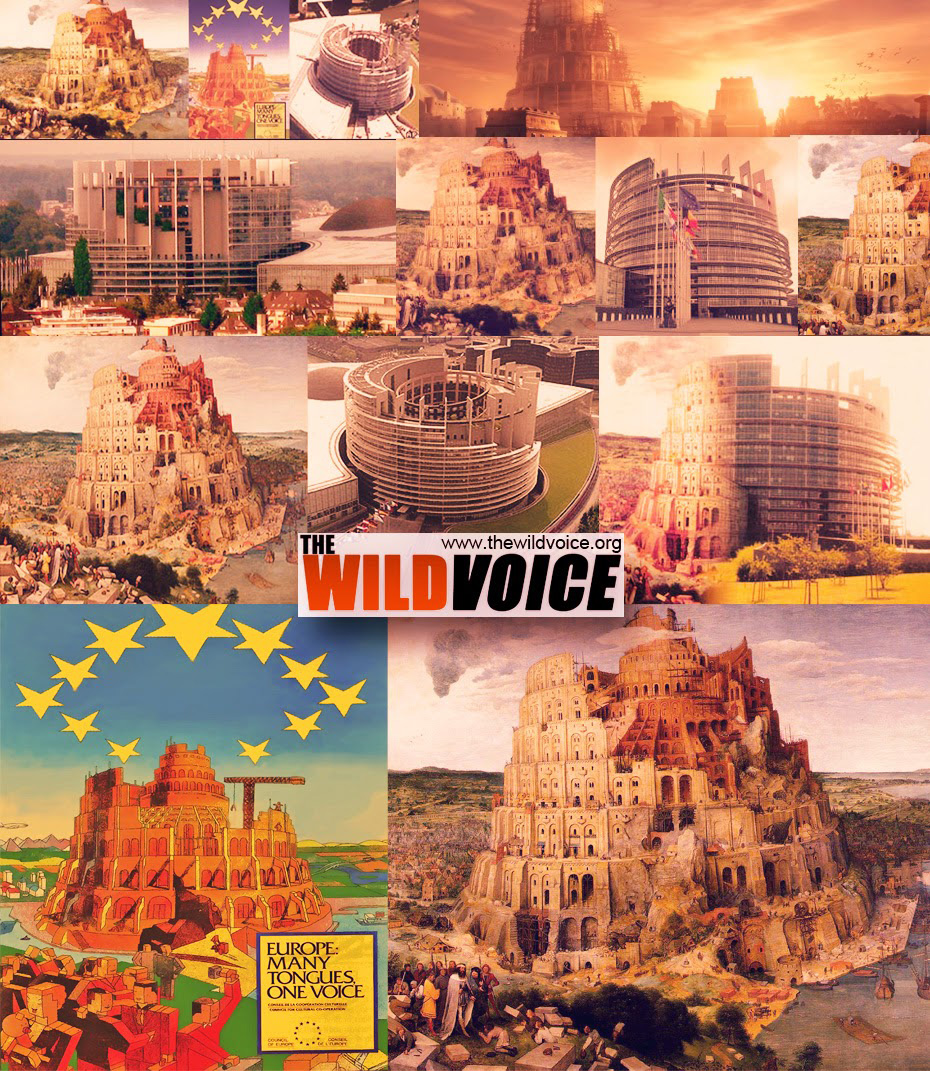
The European Union - the return to Babel
The irrefutable evidence in plain sight.
Also see:
AND:
EUbabel. The shocking occult symbolism of the European Union.
peuplesobservateursblog.wordpress.com/2017/09/23/togo-all...
Empty seat number 666
www.jesus-is-savior.com/End of the World/seat_666.htm
the-reason-the-elite-hate-trump-so-much-is-because-he-is-opposed-to-the-one-world-agenda-of-the-globalists
endoftheamericandream.com/archives/the-reason-the-elite-h...
‘Imagine there’s no Heaven, it’s easy if you try
No Hell below us, above us only sky”
John Lennon.
‘Imagine’ a nightmare, world dictatorship.
European Union project, undemocratic, expansionist empire. Prototype and fledgling, World Government.
Brexit - The anti-globalist struggle against the NWO globalists.
Aaron Banks:
Asked if he would back the Leave side in a rerun of the 2016 referendum, Mr Banks said: “The corruption I have seen in British politics, the sewer that exists and the disgraceful behaviour of the Government over what they are doing with Brexit and how they are selling out, means that if I had my time again I think we would have been better to probably remain and not unleash these demons.”
Maybe Mr Banks didn't realise that he hit the nail squarely on the head when he described the incredibly fierce opposition to Brexit as the unleashing of "demons". The globalist agenda is truly demonic. It is no surprise that the globalists, and their puppets in the media and liberal establishment, are so desperate to stop Brexit interfering with their diabolical plans for world domination.
See: ‘Brexit, The Movie’ - available on YouTube.
The EU, mystery Babylon. www.biblelight.net/tower-painting-parliament.jpg

The EU parliament in Strasbourg is modelled on the Tower of Babel.
thewildvoice.org/mystery-babylon-european-union/#comment-...
The symbolism of the EU in plain sight, is the desire of its advocates to return to the spirit of Babel.
The Council of Europe's poster produced to promote the European Union and the EU Parliament building in Strasbourg grandmageri422.files.wordpress.com/2015/07/europe-many-to... is filled with occult symbolism: a tower of Babel, 11 inverted stars (pentagrams),, the 12th pentagram is behind the top (head) of the tower. This is a Satanic parody of the 12 stars surrounding the head of the Woman (Church/Mary) in the book of Revelation. The inverted pentagram is an occult symbol designed to represent the head of Baphomet (Satan or the Goat of Mendes), illuminati pyramids are also evident in the background (since when have Egyptian pyramids been part of Europe? Square, blockheaded (indoctrinated) people (useful idiots) are featured, building a tower designed for their own enslavement and suppression, with a round-headed baby, who is too young to have been indoctrinated.
The dangerous, climate change scam:
A high level of Co2 is essential for our survival. The exact opposite of what we a led to believe by the popular, eco- fanatic narrative which is designed to convince people of the necessity for globalist control.
See the truth here:
The reason the elite hate Trump so much is because he is opposed to the one world agenda globalists.
www.zerohedge.com/news/2017-02-10/reason-elite-hate-trump...
Why satanism is now on the center stage in the culture war.
www.crisismagazine.com/2019/why-satanism-is-now-on-the-ce...
Common Purpose, Extinction Rebellion, Agenda 2030, sustainable development, WEF, Davos, Google Camp, World Economic Forum, ‘fiat’ money, SWIFT, World Governance Council, G7, Society for Worldwide Interbank Financial Telecommunications, Bank of International Settlements, Institute of International Affairs, New World Order, Globalism, European Union, EU Commission, ECJ, European Empire, evil empire, global conspiracy, United Nations, League of Nations, NAFTA, Freemasonry, Edward Mandal House, Thule Society, Kabbala, Kaaba, fractional reserve banking, Company Interbank Financial Telecommunication, internationalism, IMF, World Bank, ECB, European Central Bank, usury, Ruling Elite, Liberal fascism, Euro, EU cartel, EU empire, EU single currency, federalism, EUSSR, global elite, Federal Reserve, Paul Warburg, globalists, world government, WGS, World Government Summit, liberalism, Situational ethics, moral relativism, cultural imperialism, Bribery, Corruption, blackmail, slander, assassination, Moral relativism, Propaganda, project fear, fake news, Liberty, National Council for Civil Liberties, selective democracy, Illuminati, Bilderbergers, False religion, Maitreya, false ecumenism, World Council of Churches, Cultural Marxism, Censorship, Ted Turner, Timothy Wirth, Hilary Clinton, Club of Rome, Treaty of Rome, Maastricht Treaty, Lisbon Treaty, climate change scam, global warming, EU federalism, liberal establishment, Multiculturalism, EU Army, Palmera Arch, Temple of Baal, Nazis, National Socialism, Red Flag, hammer and sickle, useful idiots, globalist puppets, quislings, internationalism, Internationale, anti-Brexit, anti-Putin, FBI, people’s vote, EU army, Islamisation, Multinationals, multinational conglomerates, nationalisation, Fake News, Bellingcat, Bureaucracy, Climategate, chemtrails, Deep State, Council on Foreign Relations, CFR, Trilateral Commission, GM seed, GM food, quantitive easing, Bilderbergers, Eco-fanaticism, Greenpeace, eco warriors, Chatham House, Bohemian Grove, New Age, Illiberal Undemocrats, EU, Open Society, Open Britain, George Soros, Nancy Pelosi, Clinton foundation, John Podesta, John Dewey, Socialism, Humanists UK, Young Humanists, National Secular Society, British Humanist Association, neo Darwinism, Darwinism, evolution scam, CNN, New York Times, NBC news, PBS, MSNBC, BBC, liberal media, Drug legalisation, Money manipulation, IG Farben, quantitative easing, punitive taxation, Green taxes, progressives, Transgenderism, Social engineering, Communism, arch capitalism, Social Darwinism, Marxism, neo Darwinism, Erasmus Darwin, Charles Darwin, Charles Lyell, Bertrand Russell, James Hutton, David Hume, National Socialism (Nazism), Racism, international socialism, Gay mafia, gay adoption, rainbow alliance, UFOLOGY, global warming, Yakov Sverdlovsk, Red Terror, new age, Rothschilds, Rockefellers, Jacob Schiff, Adam Weishaupt, Alistair Crowley. Albert Pike, Theosophy, Antichrist, Abortion, Population control, Karl Marx, Stalin, Mao, Pol Pot, Hitler, Lenin, Trotsky, Engels, Euthanasia, Eugenics, Atheism, Soviet Union, USSR, People’s Democratic Republics, ‘People’s Vote’, Secularism, Andrew Copson, False science, Scientism, Lawrence Krauss, Richard Dawkins, Christopher Hitchens, Bill Nye, Gary Kasparov, Pussy Riot, radical left, atheist naturalism, pagan naturalism, A C Grayling, militant atheism, secular humanism, atheist pseudoscience, Cloning, Surrogacy, Fabianism, Central Banking, Fiat Currencies, banking cartels, LGBTQ agenda, Political correctness, liberal establishment, propaganda, progressive evolution, Hollywood, State control, Labour Party, Democratic Party, Green Party, Liberal Democrats, Fabian society, Secular Society, Antifa, BHA, FFRF, RDFRS, ACLU, gay priests, gay Bishops, gay pride, child abuse, gay fascism, sodomites, Stonewall, indoctrination, LGTB, LGBT, left wing feminism, lesbianism, homosexual agenda, Redefined marriage, Gender fanaticism, transgenderism, gay marriage, political correctness, hedonism, false equality, gender reassignment, surrogacy, Gay adoption, perverted sex education, Embryo experimentation, sperm banks, IVF, cloning, useful idiots, globalist puppets, UN, snowflakes, quislings, internationalism, liberal media, pornography, quislings, fifth column, Trojan horses, Sankt Galen Mafia, infiltrators, modernism, amnesty international, UNICEF, CIA, cyber surveillance, CCTV, Neo Darwinism, cultural Marxism, social Darwinism, atheist naturalism, paganism, Charles Darwin, Charles Lyell, Christianophobia, Secular Humanism, Militant atheism, abortion, Margaret Sanger, Moloch, Planned Parenthood, pro choice, Klu Klux Klan, Southern Poverty Law Centre, progressives, Christophobia, Newspeak, Satanism, Hate speech, political correctness, women’s march, False Ecumenism, election rigging, mass migration, Green taxes, climate change scam, global warming scam, carbon credits scam, debt enslavement, international bankers, Arch capitalism, Kuhn Loeb, Goldman Sachs, John D Rockefeller, Lehman Brothers, J P Morgan, Max Warburg, Order of the Skull and Bones, Extortionate taxation, class war, gender war, ageism, divide and rule, centralisation, climate change scam, mass migrations, cultural imperialism, Marie Stopes, Cultural war. human trafficking. Liberal Democrats, liberal media, Socialist Workers Party, Morning Star, Emmanuel Macron, Planned Parenthood, Marie Stopes International, BPAS, British Pregnancy Advisory Service, Satanism, Wicca, Witchcraft, Luciferian. Lunar Society, secret societies, Annie Besant, Helena Blavatsky. Alice Bailey, Marxist Social Democratic Federation. Alliance for Global Justice, Malthusian League. House of Sulzberger-Ochs, House of Meyer-Graham, Mike Bloomberg, Pierre Omidyar, Sheldon Adelson, Brzezinski, Benjamin Creme, George Kennan, James Baker, Carroll Quigley, Strobe Talbott, Lev Dobriansky, PNAC, William Kristol, Donald Rumsfeld, Dick Cheney, Paul Walfowitz, Robert Kagan, Professor Joseph Nye, Lester Mondale, American atheists, British Humanist Association, Outright Action International, National Secular Society. Abolition of nation states, NWO. World dictatorship, Tower of Babel, European Parliament. European Commission.
The war against anti-globalist Putin, and the globalist demonising of Russia.
www.flickr.com/photos/truth-in-science/43042520105
The reason the elite hate Trump so much is because he is opposed to the one world agenda of the globalists.
endoftheamericandream.com/archives/the-reason-the-elite-h...
Ending the crime of abortion is crucial in curbing the power, of Satan.
www.flickr.com/photos/truth-in-science/43172544140
Ending the crime of abortion is crucial in curbing the power, of Satan.
www.flickr.com/photos/truth-in-science/43172544140
IF and THEN, the atheist dilemma
Belgian card by Kwatta, Bois d'Haine, no. C. 206. Ann Blyth in Killer McCoy (Roy Rowland, 1947).
American actress and singer Ann Blyth (1928) was often cast in Hollywood musicals, but she was also successful in dramatic roles. Her performance as Veda Pierce in Mildred Pierce (Michael Curtiz, 1945) was nominated for an Academy Award for Best Supporting Actress. She is one of the last surviving stars from the Golden Age of Hollywood.
Ann Blyth was born in 1928, in Mount Kisco, New York, to Harry and Nan Lynch Blyth. After her parents separated, she, her mother and her sister moved to a walk-up apartment on East 31st Street in New York City, where her mother took in ironing. Blyth attended St. Patrick's School in Manhattan. Blyth performed on children's radio shows in New York for six years, making her first appearance when she was five. When she was nine she joined the New York Children's Opera Company. Her first acting role was on Broadway in Lillian Hellman's 'Watch on the Rhine' (1941-1942). She played the part of Paul Lukas's daughter, Babette. The play ran for 378 performances and won the New York Drama Critics' Circle Award. After the New York run, the play went on tour, and while performing at the Biltmore Theatre in Los Angeles, Blyth was offered a contract with Universal Studios. Blyth began her acting career initially as "Anne Blyth", but changed the spelling of her first name back to "Ann" at the beginning of her film career. She made her film debut in 1944, teamed with Donald O'Connor and Peggy Ryan in the teenage musical Chip Off the Old Block (1944). She followed it with two similar films: The Merry Monahans (1944) with O'Connor and Ryan again, and Babes on Swing Street (1944) with Ryan. She had a support role in the bigger budgeted Bowery to Broadway (1944), a showcase of Universal musical talent. On loan to Warner Brothers, Blyth was cast 'against type' as Veda Pierce, the scheming, ungrateful daughter of Joan Crawford in Mildred Pierce (Michael Curtiz, 1945). Her dramatic portrayal won her outstanding reviews, and she received a nomination for an Academy Award for Best Supporting Actress. Blyth was only 16 when she made the film, for which Crawford won the Best Actress award. After Mildred Pierce, Blyth sustained a broken back while tobogganing in Snow Valley, and was not able to fully capitalise on the film's success. She recovered and made two films for Mark Hellinger's unit at Universal: Swell Guy (1946), with Sonny Tufts, and Brute Force (1947) with Burt Lancaster. During this time her father died. Metro-Goldwyn-Mayer borrowed her to play the female lead in Killer McCoy (1947), a boxing film with Mickey Rooney that was a box office hit. Back at Universal, she did a Film Noir with Charles Boyer, A Woman's Vengeance (1948). She was then cast in the part of Regina Hubbard in Lillian Hellman's Another Part of the Forest (1948), an adaptation of the 1946 play where Regina had been played by Patricia Neal. The play was a prequel to The Little Foxes. Blyth followed it with Mr. Peabody and the Mermaid (1948) with William Powell. She was top-billed in Red Canyon (1949), a Western with Howard Duff. Paramount borrowed Blyth to play the female lead in Top o' the Morning (1949), a daughter of Barry Fitzgerald who is romanced by Bing Crosby. It was the first time she sang on screen. Back at Universal, she was teamed with Robert Montgomery in Once More, My Darling (1949), meaning she had to drop out of Desert Legion. She did a comedy with Robert Cummings, Free for All (1949). In April 1949, Universal suspended her for refusing a lead role in Abandoned (1949). Gale Storm played it.
Ann Blyth was borrowed by Sam Goldwyn to star opposite Farley Granger in Our Very Own (1950). Universal gave her top billing in a romantic comedy, Katie Did It (1951). Blyth was borrowed by MGM for The Great Caruso (1951) opposite Mario Lanza which was a massive box office hit. She made Thunder on the Hill (1951) with Claudette Colbert and had the female lead in The Golden Horde (1951) with David Farrar. Then, 20th Century Fox borrowed her to star opposite Tyrone Power in I'll Never Forget You (1952), a last-minute replacement for Constance Smith. She appeared on TV in Family Theater in an episode called 'The World's Greatest Mother' alongside Ethel Barrymore. Universal teamed Blyth with Gregory Peck in The World in His Arms (1952). She was top-billed in the comedy Sally and Saint Anne (1952) and was borrowed by RKO for One Minute to Zero (1952), a Korean War drama with Robert Mitchum where she replaced Claudette Colbert who came down with pneumonia. MGM had been interested in Blyth since The Great Caruso. In December 1953, Blyth left Universal and she signed a long term contract with MGM. She was the leading lady in All the Brothers Were Valiant (1953) with Stewart Granger and Robert Taylor, stepping in for Elizabeth Taylor who had to drop out due to pregnancy. On television, she was in a version of A Place in the Sun for Lux Video Theatre alongside John Derek. Back at MGM, Blyth had the lead in the remake of Rose Marie (1954) with Howard Keel, which earned over $5 million but lost money due to high costs. She was meant to be reteamed with Lanza in The Student Prince (1954) but he was fired from the studio and was replaced in the picture by Edmund Purdom. The film did well at the box office. Blyth and Purdom were reunited on a swashbuckler, The King's Thief (1955). She was teamed again with Keel on the musical Kismet (1955). Despite strong reviews, the film was a financial flop. She was named for the female lead in The Adventures of Quentin Durward (1955) but was eventually not cast in the film. MGM put Blyth in Slander (1957) with Van Johnson. Sidney Sheldon cast Blyth in The Buster Keaton Story (1957) with Donald O'Connor at Paramount. Warner Bros then cast her in the title role of The Helen Morgan Story (Michael Curtiz, 1957) with Paul Newman. Blyth reportedly beat 40 other actors for the part. Even though her voice was more like the original Helen Morgan, her vocals were dubbed by Gogi Grant. That soundtrack was much more successful than the film itself. Blyth made no further films. In 1957, she sued Benedict Bogeaus for $75,000 for not making the film Conquest. From the late 1950s into the 1970s, Blyth worked in musical theatre and summer stock, starring in the shows 'The King and I', 'The Sound of Music', and 'Show Boat'. and also on television, including co-starring opposite James Donald in The Citadel (1960), an adaptation of A.J. Cronin's novel. She guest-starred on episodes of such series as The DuPont Show with June Allyson, The Dick Powell Theatre, Saints and Sinners, The Christophers, Wagon Train, The Twilight Zone, and Burke's Law. Several of these appearances were for Four Star Television with whom Blyth signed a multi-appearance contract. Blyth also became the spokesperson for Hostess Cupcakes. Her last television appearances were in episodes of Switch (1983), Quincy, M.E. (1983) and Murder, She Wrote (1985). In 1985, she officially retired. For her contributions to the film industry, Blyth has a motion pictures star on the Hollywood Walk of Fame at 6733 Hollywood Boulevard. In 1953, Blyth married obstetrician James McNulty, brother of singer Dennis Day, who had introduced them. After her marriage, Blyth took somewhat of a reprieve from her career to focus on raising their five children, Timothy Patrick (1954); Maureen Ann (1955); Kathleen Mary (1957); Terence Grady (1960); and Eileen Alana (1963).
Sources: Wikipedia and IMDb.
And, please check out our blog European Film Star Postcards.
#SupportTwitterIndia
Yes I do
It is true
I am Human
Beyond man made
Barriers of
Muslims Hindus
I have no TV
I read #Googlenews
I moderate my views
I don't slander hate abuse
I use my camera that to
The poetry of my soul
Is fused ..on the net
People are confused
Let all bitterness, wrath, anger, quarreling, and slander be put away from you, along with all hatred.
++++++++++ FROM WKIPEDIA +++++++++
Kolkata /koʊlˈkɑːtə/ ([kolkata] (About this soundlisten), also known as Calcutta /kælˈkʌtə/, the official name until 2001) is the capital of the Indian state of West Bengal. Located on the east bank of the Hooghly River approximately 75 kilometres (47 mi) west of the border with Bangladesh, it is the principal commercial, cultural, and educational centre of East India, while the Port of Kolkata is India's oldest operating port and its sole major riverine port. The city is widely regarded as the "cultural capital" of India, and is also nicknamed the "City of Joy".[1][2][3].According to the 2011 Indian census, it is the seventh most populous city. the city had a population of 4.5 million, while the population of the city and its suburbs was 14.1 million, making it the third-most populous metropolitan area in India. Recent estimates of Kolkata Metropolitan Area's economy have ranged from $60 to $150 billion (GDP adjusted for purchasing power parity) making it third most-productive metropolitan area in India, after Mumbai and Delhi.[11][12][13]
In the late 17th century, the three villages that predated Calcutta were ruled by the Nawab of Bengal under Mughal suzerainty. After the Nawab granted the East India Company a trading licence in 1690,[15] the area was developed by the Company into an increasingly fortified trading post. Nawab Siraj ud-Daulah occupied Calcutta in 1756, and the East India Company retook it the following year. In 1793 the East India company was strong enough to abolish Nizamat (local rule), and assumed full sovereignty of the region. Under the company rule, and later under the British Raj, Calcutta served as the capital of British-held territories in India until 1911, when its perceived geographical disadvantages, combined with growing nationalism in Bengal, led to a shift of the capital to New Delhi. Calcutta was the centre for the Indian independence movement; it remains a hotbed of contemporary state politics. Following Indian independence in 1947, Kolkata, which was once the centre of modern Indian education, science, culture, and politics, suffered several decades of economic stagnation.
As a nucleus of the 19th- and early 20th-century Bengal Renaissance and a religiously and ethnically diverse centre of culture in Bengal and India, Kolkata has local traditions in drama, art, film, theatre, and literature. Many people from Kolkata—among them several Nobel laureates—have contributed to the arts, the sciences, and other areas. Kolkata culture features idiosyncrasies that include distinctively close-knit neighbourhoods (paras) and freestyle intellectual exchanges (adda). West Bengal's share of the Bengali film industry is based in the city, which also hosts venerable cultural institutions of national importance, such as the Academy of Fine Arts, the Victoria Memorial, the Asiatic Society, the Indian Museum and the National Library of India. Among professional scientific institutions, Kolkata hosts the Agri Horticultural Society of India, the Geological Survey of India, the Botanical Survey of India, the Calcutta Mathematical Society, the Indian Science Congress Association, the Zoological Survey of India, the Institution of Engineers, the Anthropological Survey of India and the Indian Public Health Association. Though home to major cricketing venues and franchises, Kolkata differs from other Indian cities by giving importance to association football and other sports.
Etymology
The word Kolkata derives from the Bengali term Kôlikata (Bengali: কলিকাতা) [ˈkɔlikat̪a], the name of one of three villages that predated the arrival of the British, in the area where the city eventually was to be established; the other two villages were Sutanuti and Govindapur.[16]
There are several explanations about the etymology of this name:
The term Kolikata is thought to be a variation of Kalikkhetrô [ˈkalikʰːet̪rɔ] (Bengali: কালীক্ষেত্র), meaning "Field of [the goddess] Kali". Similarly, it can be a variation of 'Kalikshetra' (Sanskrit: कालीक्षेत्र, lit. "area of Goddess Kali").
Another theory is that the name derives from Kalighat.[17]
Alternatively, the name may have been derived from the Bengali term kilkila (Bengali: কিলকিলা), or "flat area".[18]
The name may have its origin in the words khal [ˈkʰal] (Bengali: খাল) meaning "canal", followed by kaṭa [ˈkata] (Bengali: কাটা), which may mean "dug".[19]
According to another theory, the area specialised in the production of quicklime or koli chun [ˈkɔlitɕun] (Bengali: কলি চুন) and coir or kata [ˈkat̪a] (Bengali: কাতা); hence, it was called Kolikata [ˈkɔlikat̪a] (Bengali: কলিকাতা).[18]
Although the city's name has always been pronounced Kolkata [ˈkolkat̪a] (Bengali: কলকাতা) or Kôlikata [ˈkɔlikat̪a] (Bengali: কলিকাতা) in Bengali, the anglicised form Calcutta was the official name until 2001, when it was changed to Kolkata in order to match Bengali pronunciation.[20] (It should be noted that "Calcutt" is an etymologically unrelated place name found at several locations in England.)
History
The discovery and archaeological study of Chandraketugarh, 35 kilometres (22 mi) north of Kolkata, provide evidence that the region in which the city stands has been inhabited for over two millennia.[21][22] Kolkata's recorded history began in 1690 with the arrival of the English East India Company, which was consolidating its trade business in Bengal. Job Charnock, an administrator who worked for the company, was formerly credited as the founder of the city;[23] In response to a public petition,[24] the Calcutta High Court ruled in 2003 that the city does not have a founder.[25] The area occupied by the present-day city encompassed three villages: Kalikata, Gobindapur, and Sutanuti. Kalikata was a fishing village; Sutanuti was a riverside weavers' village. They were part of an estate belonging to the Mughal emperor; the jagirdari (a land grant bestowed by a king on his noblemen) taxation rights to the villages were held by the Sabarna Roy Choudhury family of landowners, or zamindars. These rights were transferred to the East India Company in 1698.[26]:1
In 1712, the British completed the construction of Fort William, located on the east bank of the Hooghly River to protect their trading factory.[27] Facing frequent skirmishes with French forces, the British began to upgrade their fortifications in 1756. The Nawab of Bengal, Siraj ud-Daulah, condemned the militarisation and tax evasion by the company. His warning went unheeded, and the Nawab attacked; he captured Fort William which led to the killings of several East India company officials in the Black Hole of Calcutta.[28] A force of Company soldiers (sepoys) and British troops led by Robert Clive recaptured the city the following year.[28] Per the 1765 Treaty of Allahabad following the battle of Buxar, East India company was appointed imperial tax collector of the Mughal emperor in the province of Bengal, Bihar and Orissa, while Mughal-appointed Nawabs continued to rule the province.[29] Declared a presidency city, Calcutta became the headquarters of the East India Company by 1773.[30] In 1793, ruling power of the Nawabs were abolished and East India company took complete control of the city and the province. In the early 19th century, the marshes surrounding the city were drained; the government area was laid out along the banks of the Hooghly River. Richard Wellesley, Governor-General of the Presidency of Fort William between 1797 and 1805, was largely responsible for the development of the city and its public architecture.[31] Throughout the late 18th and 19th century, the city was a centre of the East India Company's opium trade.[32]
By the 1850s, Calcutta had two areas: White Town, which was primarily British and centred on Chowringhee and Dalhousie Square; and Black Town, mainly Indian and centred on North Calcutta.[33] The city underwent rapid industrial growth starting in the early 1850s, especially in the textile and jute industries; this encouraged British companies to massively invest in infrastructure projects, which included telegraph connections and Howrah railway station. The coalescence of British and Indian culture resulted in the emergence of a new babu class of urbane Indians, whose members were often bureaucrats, professionals, newspaper readers, and Anglophiles; they usually belonged to upper-caste Hindu communities.[34] In the 19th century, the Bengal Renaissance brought about an increased sociocultural sophistication among city denizens. In 1883, Calcutta was host to the first national conference of the Indian National Association, the first avowed nationalist organisation in India.[35]
Bengali billboards on Harrison Street. Calcutta was the largest commercial centre in British India.
The partition of Bengal in 1905 along religious lines led to mass protests, making Calcutta a less hospitable place for the British.[36][37] The capital was moved to New Delhi in 1911.[38] Calcutta continued to be a centre for revolutionary organisations associated with the Indian independence movement. The city and its port were bombed several times by the Japanese between 1942 and 1944, during World War II.[39][40] Coinciding with the war, millions starved to death during the Bengal famine of 1943 due to a combination of military, administrative, and natural factors.[41] Demands for the creation of a Muslim state led in 1946 to an episode of communal violence that killed over 4,000.[42][43][44] The partition of India led to further clashes and a demographic shift—many Muslims left for East Pakistan (present day Bangladesh), while hundreds of thousands of Hindus fled into the city.[45]
During the 1960s and 1970s, severe power shortages, strikes, and a violent Marxist–Maoist movement by groups known as the Naxalites damaged much of the city's infrastructure, resulting in economic stagnation.[46] The Bangladesh Liberation War of 1971 led to a massive influx of thousands of refugees, many of them penniless, that strained Kolkata's infrastructure.[47] During the mid-1980s, Mumbai (then called Bombay) overtook Kolkata as India's most populous city. In 1985, prime minister Rajiv Gandhi dubbed Kolkata a "dying city" in light of its socio-political woes.[48] In the period 1977–2011, West Bengal was governed from Kolkata by the Left Front, which was dominated by the Communist Party of India (CPM). It was the world's longest-serving democratically elected communist government, during which Kolkata was a key base for Indian communism.[49][50][51] In the West Bengal Legislative Assembly election, 2011, Left Front was defeated by the Trinamool Congress. The city's economic recovery gathered momentum after the 1990s, when India began to institute pro-market reforms. Since 2000, the information technology (IT) services sector has revitalised Kolkata's stagnant economy. The city is also experiencing marked growth in its manufacturing base.[52]
Geography
Spread roughly north–south along the east bank of the Hooghly River, Kolkata sits within the lower Ganges Delta of eastern India approximately 75 km (47 mi) west of the international border with Bangladesh; the city's elevation is 1.5–9 m (5–30 ft).[53] Much of the city was originally a wetland that was reclaimed over the decades to accommodate a burgeoning population.[54] The remaining undeveloped areas, known as the East Kolkata Wetlands, were designated a "wetland of international importance" by the Ramsar Convention (1975).[55] As with most of the Indo-Gangetic Plain, the soil and water are predominantly alluvial in origin. Kolkata is located over the "Bengal basin", a pericratonic tertiary basin.[56] Bengal basin comprises three structural units: shelf or platform in the west; central hinge or shelf/slope break; and deep basinal part in the east and southeast. Kolkata is located atop the western part of the hinge zone which is about 25 km (16 mi) wide at a depth of about 45,000 m (148,000 ft) below the surface.[56] The shelf and hinge zones have many faults, among them some are active. Total thickness of sediment below Kolkata is nearly 7,500 m (24,600 ft) above the crystalline basement; of these the top 350–450 m (1,150–1,480 ft) is Quaternary, followed by 4,500–5,500 m (14,760–18,040 ft) of Tertiary sediments, 500–700 m (1,640–2,300 ft) trap wash of Cretaceous trap and 600–800 m (1,970–2,620 ft) Permian-Carboniferous Gondwana rocks.[56] The quaternary sediments consist of clay, silt, and several grades of sand and gravel. These sediments are sandwiched between two clay beds: the lower one at a depth of 250–650 m (820–2,130 ft); the upper one 10–40 m (30–130 ft) in thickness.[57] According to the Bureau of Indian Standards, on a scale ranging from I to V in order of increasing susceptibility to earthquakes, the city lies inside seismic zone III.[58]
Urban structure
Howrah Bridge from the western bank of the Ganges
The Kolkata metropolitan area is spread over 1,886.67 km2 (728.45 sq mi)[59]:7 and comprises 3 municipal corporations (including Kolkata Municipal Corporation), 39 local municipalities and 24 panchayat samitis, as of 2011.[59]:7 The urban agglomeration encompassed 72 cities and 527 towns and villages, as of 2006.[60] Suburban areas in the Kolkata metropolitan area incorporate parts of the following districts: North 24 Parganas, South 24 Parganas, Howrah, Hooghly, and Nadia.[61]:15 Kolkata, which is under the jurisdiction of the Kolkata Municipal Corporation (KMC), has an area of 185 km2 (71 sq mi).[60] The east–west dimension of the city is comparatively narrow, stretching from the Hooghly River in the west to roughly the Eastern Metropolitan Bypass in the east—a span of 9–10 km (5.6–6.2 mi).[62] The north–south distance is greater, and its axis is used to section the city into North, Central, and South Kolkata. East Kolkata is also a section.
North Kolkata is the oldest part of the city. Characterised by 19th-century architecture, dilapidated buildings, overpopulated slums, crowded bazaars, and narrow alleyways, it includes areas such as Shyambazar, Hatibagan, Maniktala, Kankurgachi, Rajabazar, Shobhabazar, Shyampukur, Sonagachi, Kumortuli, Bagbazar, Jorasanko, Chitpur, Pathuriaghata, Cossipore, Kestopur, Sinthee, Belgachia, Jorabagan, and Dum Dum.[63]:65–66 The northern suburban areas like Baranagar, Durganagar, Noapara, Dunlop, Dakshineswar, Nagerbazar, Belghoria, Agarpara, Sodepur, Madhyamgram, Barasat, Birati, Khardah up to Barrackpur are also within the city of Kolkata (as a metropolitan structure).
Central Kolkata
Central Kolkata hosts the central business district. It contains B. B. D. Bagh, formerly known as Dalhousie Square, and the Esplanade on its east; Strand Road is on its west.[64] The West Bengal Secretariat, General Post Office, Reserve Bank of India, High Court, Lalbazar Police Headquarters, and several other government and private offices are located there. Another business hub is the area south of Park Street, which comprises thoroughfares such as Chowringhee, Camac Street, Wood Street, Loudon Street, Shakespeare Sarani, and A. J. C. Bose Road.[65] The Maidan is a large open field in the heart of the city that has been called the "lungs of Kolkata"[66] and accommodates sporting events and public meetings.[67] The Victoria Memorial and Kolkata Race Course are located at the southern end of the Maidan. Other important areas of Central Kolkata are Park Circus, Burrabazar, College Street, Sealdah, Taltala, Janbazar, Bowbazar, Entally, Chandni Chowk, Lalbazar, Chowringhee, Dharmatala, Tiretta Bazar, Bow Barracks, Mullick Bazar, Park Circus, Babughat etc. Among the other parks are Central Park in Bidhannagar and Millennium Park on Strand Road, along the Hooghly River.
South Kolkata
South Kolkata developed after India gained independence in 1947; it includes upscale neighbourhoods such as Ballygunge, Alipore, New Alipore, Lansdowne, Bhowanipore, Kalighat, Dhakuria, Gariahat, Tollygunge, Naktala, Jodhpur Park, Lake Gardens, Golf Green, Jadavpur, Garfa, Kalikapur, Haltu, Nandi Bagan, Santoshpur, Baghajatin, Garia, Ramgarh, Raipur, Kanungo Park, Ranikuthi, Bikramgarh, Bijoygarh, Bansdroni and Kudghat.[16] Outlying areas of South Kolkata include Garden Reach, Khidirpur, Metiabruz, Taratala, Majerhat, Budge Budge, Behala, Sarsuna, Barisha, Parnasree Pally, Thakurpukur, Maheshtala and Joka. The southern suburban neighbourhoods like Mahamayatala, Pratapgarh, Kamalgazi, Narendrapur, Sonarpur, Subhashgram and Baruipur are also within the city of Kolkata (as metropolitan, urban agglomeration area). Fort William, on the western part of the city, houses the headquarters of the Eastern Command of the Indian Army;[68] its premises are under the jurisdiction of the army.
East Kolkata
East Kolkata is largely composed of newly developed areas and neighbourhoods of Saltlake, Rajarhat, Tangra, Topsia, Kasba, Anandapur, Mukundapur, Picnic Garden, Beleghata, Ultadanga, Phoolbagan, Kaikhali, Lake Town, etc. Two planned townships in the greater Kolkata region are Bidhannagar, also known as Salt Lake City and located north-east of the city; and Rajarhat, also called New Town and sited east of Bidhannagar.[16][69] In the 2000s, Sector V in Bidhannagar developed into a business hub for information technology and telecommunication companies.[70][71] Both Bidhannagar and New Town are situated outside the Kolkata Municipal Corporation limits, in their own municipalities.[69]
Climate
Kolkata is subject to a tropical wet-and-dry climate that is designated Aw under the Köppen climate classification. According to a United Nations Development Programme report, its wind and cyclone zone is "very high damage risk".[58]
Temperature
The annual mean temperature is 26.8 °C (80.2 °F); monthly mean temperatures are 19–30 °C (66–86 °F). Summers (March–June) are hot and humid, with temperatures in the low 30s Celsius; during dry spells, maximum temperatures often exceed 40 °C (104 °F) in May and June.[72] Winter lasts for roughly two-and-a-half months, with seasonal lows dipping to 9–11 °C (48–52 °F) in December and January. May is the hottest month, with daily temperatures ranging from 27–37 °C (81–99 °F); January, the coldest month, has temperatures varying from 12–23 °C (54–73 °F). The highest recorded temperature is 43.9 °C (111.0 °F), and the lowest is 5 °C (41 °F).[72] The winter is mild and very comfortable weather pertains over the city throughout this season. Often, in April–June, the city is struck by heavy rains or dusty squalls that are followed by thunderstorms or hailstorms, bringing cooling relief from the prevailing humidity. These thunderstorms are convective in nature, and are known locally as kal bôishakhi (কালবৈশাখী), or "Nor'westers" in English.[73]
Rains brought by the Bay of Bengal branch of the south-west summer monsoon[74] lash Kolkata between June and September, supplying it with most of its annual rainfall of about 1,850 mm (73 in). The highest monthly rainfall total occurs in July and August. In these months often incessant rain for days brings live to a stall for the city dwellers. The city receives 2,528 hours of sunshine per year, with maximum sunlight exposure occurring in March.[75] Kolkata has been hit by several cyclones; these include systems occurring in 1737 and 1864 that killed thousands.[76][77]
Environmental issues
Pollution is a major concern in Kolkata. As of 2008, sulphur dioxide and nitrogen dioxide annual concentration were within the national ambient air quality standards of India, but respirable suspended particulate matter levels were high, and on an increasing trend for five consecutive years, causing smog and haze.[80][81] Severe air pollution in the city has caused a rise in pollution-related respiratory ailments, such as lung cancer.[82]
Economy
Kolkata is the main commercial and financial hub of East and North-East India[61] and home to the Calcutta Stock Exchange.[83][84] It is a major commercial and military port, and is the only city in eastern India, apart from Bhubaneswar to have an international airport. Once India's leading city, Kolkata experienced a steady economic decline in the decades following India's independence due to steep population increases and a rise in militant trade-unionism, which included frequent strikes that were backed by left-wing parties.[52] From the 1960s to the late 1990s, several factories were closed and businesses relocated.[52] The lack of capital and resources added to the depressed state of the city's economy and gave rise to an unwelcome sobriquet: the "dying city".[85] The city's fortunes improved after the Indian economy was liberalised in the 1990s and changes in economic policy were enacted by the West Bengal state government.[52]
Flexible production has been the norm in Kolkata, which has an informal sector that employs more than 40% of the labour force.[16] One unorganised group, roadside hawkers, generated business worth ₹ 8,772 crore (US$ 2 billion) in 2005.[86] As of 2001, around 0.81% of the city's workforce was employed in the primary sector (agriculture, forestry, mining, etc.); 15.49% worked in the secondary sector (industrial and manufacturing); and 83.69% worked in the tertiary sector (service industries).[61]:19 As of 2003, the majority of households in slums were engaged in occupations belonging to the informal sector; 36.5% were involved in servicing the urban middle class (as maids, drivers, etc.), and 22.2% were casual labourers.[87]:11 About 34% of the available labour force in Kolkata slums were unemployed.[87]:11 According to one estimate, almost a quarter of the population live on less than 27 rupees (equivalent to 45 US cents) per day.[88] As of 2010, Kolkata, with an estimated gross domestic product (GDP) by purchasing power parity of 150 billion dollars, ranked third among South Asian cities, after Mumbai and Delhi.[89] Kolkata's GDP in 2014 was Rs 1.84 trillion, according to a collaborative assessment by multiple universities and climate agencies.[90] As in many other Indian cities, information technology became a high-growth sector in Kolkata starting in the late 1990s; the city's IT sector grew at 70% per annum—a rate that was twice the national average.[52] The 2000s saw a surge of investments in the real estate, infrastructure, retail, and hospitality sectors; several large shopping malls and hotels were launched.[91][92][93][94][95] Companies such as ITC Limited, CESC Limited, Exide Industries, Emami, Eveready Industries India, Lux Industries, Rupa Company, Berger Paints, Birla Corporation and Britannia Industries are headquartered in the city. Philips India, PricewaterhouseCoopers India, Tata Global Beverages, Tata Steel have their registered office and zonal headquarters in Kolkata. Kolkata hosts the headquarters of three major public-sector banks: Allahabad Bank, UCO Bank, and the United Bank of India; and a private bank Bandhan Bank. Reserve Bank of India has its eastern zonal office in Kolkata, and India Government Mint, Kolkata is one of the four mints in India.
Panoramic view of the Down town Sector V one of the major IT hubs of Kolkata as seen from the lakes surrounding Bidhannagar. Major Buildings such as Technopolis, Godrej Waterside, TCS Lords, Eden and Wanderers Park, Gobsyn Crystal, South City Pinnacle, RDB Boulevard, West Bengal Electronics Industry Development Corporation (WEBEL) Bhawan can be seen.
Demographics
See also: Ethnic communities in Kolkata
A skyline consisting of several high-rise buildings
Residential high-rise buildings in South City
A slum area of the city
The demonym for residents of Kolkata are Calcuttan and Kolkatan.[96][97] According to provisional results of the 2011 national census, Kolkata district, which occupies an area of 185 km2 (71 sq mi), had a population of 4,486,679;[98] its population density was 24,252/km2 (62,810/sq mi).[98] This represents a decline of 1.88% during the decade 2001–11. The sex ratio is 899 females per 1000 males—lower than the national average.[99] The ratio is depressed by the influx of working males from surrounding rural areas, from the rest of West Bengal; these men commonly leave their families behind.[100] Kolkata's literacy rate of 87.14%[99] exceeds the national average of 74%.[101] The final population totals of census 2011 stated the population of city as 4,496,694.[8] The urban agglomeration had a population of 14,112,536 in 2011.[9]
Bengali Hindus form the majority of Kolkata's population; Marwaris, Biharis and Muslims compose large minorities.[102] Among Kolkata's smaller communities are Chinese, Tamils, Nepalis, Odias, Telugus, Assamese, Gujaratis, Anglo-Indians, Armenians, Greeks, Tibetans, Maharashtrians, Konkanis, Malayalees, Punjabis, and Parsis.[26]:3 The number of Armenians, Greeks, Jews, and other foreign-origin groups declined during the 20th century.[103] The Jewish population of Kolkata was 5,000 during World War II, but declined after Indian independence and the establishment of Israel;[104] by 2013, there were 25 Jews in the city.[105] India's sole Chinatown is in eastern Kolkata;[103] once home to 20,000 ethnic Chinese, its population dropped to around 2,000 as of 2009[103] as a result of multiple factors including repatriation and denial of Indian citizenship following the 1962 Sino-Indian War, and immigration to foreign countries for better economic opportunities.[106] The Chinese community traditionally worked in the local tanning industry and ran Chinese restaurants.[103][107]
Kolkata urban agglomeration population growth Census Total %±
1981 9,194,000 —
1991 11,021,900 19.9%
2001 13,114,700 19.0%
2011 14,112,536 7.6%
Source: Census of India[9]
Others include Sikhism, Buddhism & Other religions (0.03%)
Religion in Kolkata[108]
Religion Percent
Hinduism
76.51%
Islam
20.60%
Christianity
0.88%
Jainism
0.47%
Others
1.54%
Bengali, the official state language, is the dominant language in Kolkata.[109] English is also used, particularly by the white-collar workforce. Hindi and Urdu are spoken by a sizeable minority.[110][111] According to the 2011 census, 76.51% of the population is Hindu, 20.60% Muslim, 0.88% Christian, and 0.47% Jain.[112] The remainder of the population includes Sikhs, Buddhists, and other religions which accounts for 0.45% of the population; 1.09% did not state a religion in the census.[112] Kolkata reported 67.6% of Special and Local Laws crimes registered in 35 large Indian cities during 2004.[113] The Kolkata police district registered 15,510 Indian Penal Code cases in 2010, the 8th-highest total in the country.[114] In 2010, the crime rate was 117.3 per 100,000, below the national rate of 187.6; it was the lowest rate among India's largest cities.[115]
As of 2003, about one-third of the population, or 1.5 million people, lived in 3,500 unregistered squatter-occupied and 2,011 registered slums.[87]:4[116]:92 The authorised slums (with access to basic services like water, latrines, trash removal by the Kolkata Municipal Corporation) can be broadly divided into two groups—bustees, in which slum dwellers have some long term tenancy agreement with the landowners; and udbastu colonies, settlements which had been leased to refugees from present-day Bangladesh by the Government.[116][87]:5 The unauthorised slums (devoid of basic services provided by the municipality) are occupied by squatters who started living on encroached lands—mainly along canals, railway lines and roads.[116]:92[87]:5 According to the 2005 National Family Health Survey, around 14% of the households in Kolkata were poor, while 33% lived in slums, indicating a substantial proportion of households in slum areas were better off economically than the bottom quarter of urban households in terms of wealth status.[117]:23 Mother Teresa was awarded the Nobel Peace Prize for founding and working with the Missionaries of Charity in Kolkata—an organisation "whose primary task was to love and care for those persons nobody was prepared to look after".[118]
Government and public services
Civic administration
Main article: Civic administration of Kolkata
A red-and-yellow building with multiple arches and towers standing against a backdrop of blue sky and framed by trees
Calcutta High Court
Kolkata is administered by several government agencies. The Kolkata Municipal Corporation, or KMC, oversees and manages the civic infrastructure of the city's 15 boroughs, which together encompass 141 wards.[109] Each ward elects a councillor to the KMC. Each borough has a committee of councillors, each of whom is elected to represent a ward. By means of the borough committees, the corporation undertakes urban planning and maintains roads, government-aided schools, hospitals, and municipal markets.[119] As Kolkata's apex body, the corporation discharges its functions through the mayor-in-council, which comprises a mayor, a deputy mayor, and ten other elected members of the KMC.[120] The functions of the KMC include water supply, drainage and sewerage, sanitation, solid waste management, street lighting, and building regulation.[119]
The Kolkata Municipal Corporation was ranked 1st out of 21 Cities for best governance & administrative practices in India in 2014. It scored 4.0 on 10 compared to the national average of 3.3.[121]
The Kolkata Port Trust, an agency of the central government, manages the city's river port. As of 2012, the All India Trinamool Congress controls the KMC; the mayor is Firhad Hakim, while the deputy mayor is Atin Ghosh.[122] The city has an apolitical titular post, that of the Sheriff of Kolkata, which presides over various city-related functions and conferences.[123]
Kolkata's administrative agencies have areas of jurisdiction that do not coincide. Listed in ascending order by area, they are: Kolkata district; the Kolkata Police area and the Kolkata Municipal Corporation area, or "Kolkata city";[124] and the Kolkata metropolitan area, which is the city's urban agglomeration. The agency overseeing the latter, the Kolkata Metropolitan Development Authority, is responsible for the statutory planning and development of greater Kolkata.[125]
As the seat of the Government of West Bengal, Kolkata is home to not only the offices of the local governing agencies, but also the West Bengal Legislative Assembly; the state secretariat, which is housed in the Writers' Building; and the Calcutta High Court. Most government establishments and institutions are housed in the centre of the city in B. B. D. Bagh (formerly known as Dalhousie Square). The Calcutta High Court is the oldest High Court in India. It was preceded by the Supreme Court of Judicature at Fort William which was established in 1774. The Calcutta High Court has jurisdiction over the state of West Bengal and the Union Territory of the Andaman and Nicobar Islands. Kolkata has lower courts: the Court of Small Causes and the City Civil Court decide civil matters; the Sessions Court rules in criminal cases.[126][127][128] The Kolkata Police, headed by a police commissioner, is overseen by the West Bengal Ministry of Home Affairs.[129][130] The Kolkata district elects two representatives to India's lower house, the Lok Sabha, and 11 representatives to the state legislative assembly.[131]
Utility services
A telecommunications tower belonging to services provider Tata Communications
The Kolkata Municipal Corporation supplies the city with potable water that is sourced from the Hooghly River;[132] most of it is treated and purified at the Palta pumping station located in North 24 Parganas district.[133] Roughly 95% of the 4,000 tonnes of refuse produced daily by the city is transported to the dumping grounds in Dhapa, which is east of the town.[134][135] To promote the recycling of garbage and sewer water, agriculture is encouraged on the dumping grounds.[136] Parts of the city lack proper sewerage, leading to unsanitary methods of waste disposal.[75]
Electricity is supplied by the privately operated Calcutta Electric Supply Corporation, or CESC, to the city proper; the West Bengal State Electricity Board supplies it in the suburbs.[137][138] Fire services are handled by the West Bengal Fire Service, a state agency.[139] As of 2012, the city had 16 fire stations.[140]
State-owned Bharat Sanchar Nigam Limited, or BSNL, as well as private enterprises, among them Vodafone, Bharti Airtel, Reliance, Idea Cellular, Aircel, Tata DoCoMo, Tata Teleservices, Virgin Mobile, and MTS India, are the leading telephone and cell phone service providers in the city.[141]:25–26:179 with Kolkata being the first city in India to have cell phone and 4G connectivity, the GSM and CDMA cellular coverage is extensive.[142][143] As of 2010, Kolkata has 7 percent of the total Broadband internet consumers in India; BSNL, VSNL, Tata Indicom, Sify, Airtel, and Reliance are among the main vendors.[144][145]
Military and diplomatic establishments
The Eastern Command of the Indian Army is based in the city. Being one of India's major city and the largest city in eastern and north-eastern India, Kolkata hosts diplomatic missions of many countries such as Australia, Bangladesh, Bhutan, Canada, People's Republic of China, France, Germany, Italy, Japan, Myanmar, Nepal, Russia, Srilanka, Switzerland, Thailand, United Kingdom and United States. The U.S Consulate in Kolkata is the US Department of State's second oldest Consulate and dates from 19 November 1792.[146]
Transport
Public transport is provided by the Kolkata Suburban Railway, the Kolkata Metro, trams, rickshaws, and buses. The suburban rail network reaches the city's distant suburbs.
According to a 2013 survey conducted by the International Association of Public Transport, in terms of a public transport system, Kolkata ranks among the top of the six Indian cities surveyed.[147][148] The Kolkata Metro, in operation since 1984, is the oldest underground mass transit system in India.[149] It spans the north–south length of the city and covers a distance of 25.1 km (16 mi).[150] As of 2009, five Metro rail lines were under construction.[151] Kolkata has four long-distance railway stations, located at Howrah (the largest railway complex in India), Sealdah, Chitpur and Shalimar, which connect Kolkata by rail to most cities in West Bengal and to other major cities in India.[152] The city serves as the headquarters of three railway Zone out of Seventeen of the Indian Railways regional divisions—the Kolkata Metro Railways, Eastern Railway and the South-Eastern Railway.[153] Kolkata has rail and road connectivity with Dhaka, the capital of Bangladesh.[154][155][156]
Buses, which are the most commonly used mode of transport, are run by government agencies and private operators.[157] Kolkata is the only Indian city with a tram network, which is operated by the Calcutta Tramways Company.[158] The slow-moving tram services are restricted to certain areas of the city. Water-logging, caused by heavy rains that fall during the summer monsoon, can interrupt transportation networks.[159][160] Hired public conveyances include auto rickshaws, which often ply specific routes, and yellow metered taxis. Almost all of Kolkata's taxis are antiquated Hindustan Ambassadors by make; newer air-conditioned radio taxis are in service as well.[161][162] In parts of the city, cycle rickshaws and hand-pulled rickshaws are patronised by the public for short trips.[163]
Due to its diverse and abundant public transportation, privately owned vehicles are not as common in Kolkata as in other major Indian cities.[164] The city has witnessed a steady increase in the number of registered vehicles; 2002 data showed an increase of 44% over a period of seven years.[165] As of 2004, after adjusting for population density, the city's "road space" was only 6% compared to 23% in Delhi and 17% in Mumbai.[166] The Kolkata Metro has somewhat eased traffic congestion, as has the addition of new roads and flyovers. Agencies operating long-distance bus services include the Calcutta State Transport Corporation, the South Bengal State Transport Corporation, the North Bengal State Transport Corporation, and various private operators. The city's main bus terminals are located at Esplanade and Babughat.[167] The Kolkata–Delhi and Kolkata–Chennai prongs of the Golden Quadrilateral, and National Highway 34 start from the city.[168]
Netaji Subhas Chandra Bose International Airport, located in Dum Dum some 16 km (9.9 mi) north-east of the city centre, operates domestic and international flights. In 2013, the airport was upgraded to handle increased air traffic.[169][170]
The Port of Kolkata, established in 1870, is India's oldest and the only major river port.[171] The Kolkata Port Trust manages docks in Kolkata and Haldia.[172] The port hosts passenger services to Port Blair, capital of the Andaman and Nicobar Islands; freighter service to ports throughout India and around the world is operated by the Shipping Corporation of India.[171][173] Ferry services connect Kolkata with its twin city of Howrah, located across the Hooghly River.[174][175]
The route from North Bengal to Kolkata is set to become cheaper and more efficient for people travelling by bus. Through April 2017 to March 2018, the North Bengal State Transport Corporation (NBSTC) will be introducing a fleet of rocket buses equipped with bio-toilets for the bus route.[176]
Healthcare
See also: Health care in Kolkata
A big building in cream colour with many columns and a portico
Calcutta Medical College, the second institution in Asia to teach modern medicine(after 'Ecole de Médicine de Pondichéry')
IPGMER and SSKM Hospital, Kolkata is the largest hospital in West Bengal and one of the oldest in Kolkata.
As of 2011, the health care system in Kolkata consists of 48 government hospitals, mostly under the Department of Health & Family Welfare, Government of West Bengal, and 366 private medical establishments;[177] these establishments provide the city with 27,687 hospital beds.[177] For every 10,000 people in the city, there are 61.7 hospital beds,[178] which is higher than the national average of 9 hospital beds per 10,000.[179] Ten medical and dental colleges are located in the Kolkata metropolitan area which act as tertiary referral hospitals in the state.[180][181] The Calcutta Medical College, founded in 1835, was the first institution in Asia to teach modern medicine.[182] However, These facilities are inadequate to meet the healthcare needs of the city.[183][184][185] More than 78% in Kolkata prefer the private medical sector over the public medical sector,[117]:109 due to the poor quality of care, the lack of a nearby facility, and excessive waiting times at government facilities.[117]:61
According to the Indian 2005 National Family Health Survey, only a small proportion of Kolkata households were covered under any health scheme or health insurance.[117]:41 The total fertility rate in Kolkata was 1.4, The lowest among the eight cities surveyed.[117]:45 In Kolkata, 77% of the married women used contraceptives, which was the highest among the cities surveyed, but use of modern contraceptive methods was the lowest (46%).[117]:47 The infant mortality rate in Kolkata was 41 per 1,000 live births, and the mortality rate for children under five was 49 per 1,000 live births.[117]:48
Among the surveyed cities, Kolkata stood second (5%) for children who had not had any vaccinations under the Universal Immunization Programme as of 2005.[117]:48 Kolkata ranked second with access to an anganwadi centre under the Integrated Child Development Services (ICDS) programme for 57% of the children between 0 and 71 months.[117]:51 The proportion of malnourished, anaemic and underweight children in Kolkata was less in comparison to other surveyed cities.[117]:54–55
About 18% of the men and 30% of the women in Kolkata are obese—the majority of them belonging to the non-poor strata of society.[117]:105 In 2005, Kolkata had the highest percentage (55%) among the surveyed cities of anaemic women, while 20% of the men in Kolkata were anaemic.[117]:56–57 Diseases like diabetes, asthma, goitre and other thyroid disorders were found in large numbers of people.[117]:57–59 Tropical diseases like malaria, dengue and chikungunya are prevalent in Kolkata, though their incidence is decreasing.[186][187] Kolkata is one of the districts in India with a high number of people with AIDS; it has been designated a district prone to high risk.[188][189]
As of 2014, because of higher air pollution, the life expectancy of a person born in the city is four years fewer than in the suburbs.[190]
Education
Kolkata's schools are run by the state government or private organisations, many of which are religious. Bengali and English are the primary languages of instruction; Urdu and Hindi are also used, particularly in central Kolkata.[191][192] Schools in Kolkata follow the "10+2+3" plan. After completing their secondary education, students typically enroll in schools that have a higher secondary facility and are affiliated with the West Bengal Council of Higher Secondary Education, the ICSE, or the CBSE.[191] They usually choose a focus on liberal arts, business, or science. Vocational programs are also available.[191] Some Kolkata schools, for example La Martiniere Calcutta, Calcutta Boys' School, St. James' School (Kolkata), St. Xavier's Collegiate School, and Loreto House, have been ranked amongst the best schools in the country.[193]
Indian Institute of Foreign Trade
As of 2010, the Kolkata urban agglomeration is home to 14 universities run by the state government.[194] The colleges are each affiliated with a university or institution based either in Kolkata or elsewhere in India. Aliah University which was founded in 1780 as Mohammedan College of Calcutta is the oldest post-secondary educational institution of the city.[195] The University of Calcutta, founded in 1857, is the first modern university in South Asia.[196] Presidency College, Kolkata (formerly Hindu College between 1817 and 1855), founded in 1855, was one of the oldest and most eminent colleges in India. It was affiliated with the University of Calcutta until 2010 when it was converted to Presidency University, Kolkata in 2010. Bengal Engineering and Science University (BESU) is the second oldest engineering institution of the country located in Howrah.[197] An Institute of National Importance, BESU was converted to India's first IIEST. Jadavpur University is known for its arts, science, and engineering faculties.[198] The Indian Institute of Management Calcutta, which was the first of the Indian Institutes of Management, was established in 1961 at Joka, a locality in the south-western suburbs. Kolkata also houses the prestigious Indian Institute of Foreign Trade, which was started here in the year 2006.[199] The West Bengal National University of Juridical Sciences is one of India's autonomous law schools,[200][201] and the Indian Statistical Institute is a public research institute and university. State owned Maulana Abul Kalam Azad University of Technology, West Bengal (MAKAUT, WB), formerly West Bengal University of Technology (WBUT) is the largest Technological University in terms of student enrollment and number of Institutions affiliated by it. Private institutions include the Ramakrishna Mission Vivekananda Educational and Research Institute and University of Engineering & Management (UEM).
Notable scholars who were born, worked or studied in Kolkata include physicists Satyendra Nath Bose, Meghnad Saha,[202] and Jagadish Chandra Bose;[203] chemist Prafulla Chandra Roy;[202] statisticians Prasanta Chandra Mahalanobis and Anil Kumar Gain;[202] physician Upendranath Brahmachari;[202] educator Ashutosh Mukherjee;[204] and Nobel laureates Rabindranath Tagore,[205] C. V. Raman,[203] and Amartya Sen.[206]
Kolkata houses many premier research institutes like Indian Association for the Cultivation of Science (IACS), Indian Institute of Chemical Biology (IICB), Indian Institute of Science Education and Research (IISER), Bose Institute, Saha Institute of Nuclear Physics (SINP), All India Institute of Hygiene and Public Health, Central Glass and Ceramic Research Institute (CGCRI), S.N. Bose National Centre for Basic Sciences (SNBNCBS), Indian Institute of Social Welfare and Business Management (IISWBM), National Institute of Pharmaceutical Education and Research, Kolkata, Variable Energy Cyclotron Centre (VECC) and Indian Centre for Space Physics. Nobel laureate Sir C. V. Raman did his groundbreaking work in Raman effect in IACS.
Culture
Kolkata is known for its literary, artistic, and revolutionary heritage; as the former capital of India, it was the birthplace of modern Indian literary and artistic thought.[207] Kolkata has been called the "City of Furious, Creative Energy"[208] as well as the "cultural [or literary] capital of India".[209][210] The presence of paras, which are neighbourhoods that possess a strong sense of community, is characteristic of the city.[211] Typically, each para has its own community club and, on occasion, a playing field.[211] Residents engage in addas, or leisurely chats, that often take the form of freestyle intellectual conversation.[212][213] The city has a tradition of political graffiti depicting everything from outrageous slander to witty banter and limericks, caricatures, and propaganda.[214][215]
Kolkata has many buildings adorned with Indo-Islamic and Indo-Saracenic architectural motifs. Several well-maintained major buildings from the colonial period have been declared "heritage structures";[216] others are in various stages of decay.[217][218] Established in 1814 as the nation's oldest museum, the Indian Museum houses large collections that showcase Indian natural history and Indian art.[219] Marble Palace is a classic example of a European mansion that was built in the city. The Victoria Memorial, a place of interest in Kolkata, has a museum documenting the city's history. The National Library of India is the leading public library in the country while Science City is the largest science centre in the Indian subcontinent.[220]
The popularity of commercial theatres in the city has declined since the 1980s.[221]:99[222] Group theatres of Kolkata, a cultural movement that started in the 1940s contrasting with the then-popular commercial theatres, are theatres that are not professional or commercial, and are centres of various experiments in theme, content, and production;[223] group theatres use the proscenium stage to highlight socially relevant messages.[221]:99[224] Chitpur locality of the city houses multiple production companies of jatra, a tradition of folk drama popular in rural Bengal.[225][226] Kolkata is the home of the Bengali cinema industry, dubbed "Tollywood" for Tollygunj, where most of the state's film studios are located.[227] Its long tradition of art films includes globally acclaimed film directors such as Academy Award-winning director Satyajit Ray, Ritwik Ghatak, Mrinal Sen, Tapan Sinha, and contemporary directors such as Aparna Sen, Buddhadeb Dasgupta, Goutam Ghose and Rituparno Ghosh.[228]
During the 19th and 20th centuries, Bengali literature was modernised through the works of authors such as Ishwar Chandra Vidyasagar, Bankim Chandra Chattopadhyay, Michael Madhusudan Dutt, Rabindranath Tagore, Kazi Nazrul Islam, and Sarat Chandra Chattopadhyay.[229] Coupled with social reforms led by Ram Mohan Roy, Swami Vivekananda, and others, this constituted a major part of the Bengal Renaissance.[230] The middle and latter parts of the 20th century witnessed the arrival of post-modernism, as well as literary movements such as those espoused by the Kallol movement, hungryalists and the little magazines.[231] Large majority of publishers of the city is concentrated in and around College Street, "... a half-mile of bookshops and bookstalls spilling over onto the pavement", selling new and used books.[232]
Kalighat painting originated in 19th century Kolkata as a local style that reflected a variety of themes including mythology and quotidian life.[233] The Government College of Art and Craft, founded in 1864, has been the cradle as well as workplace of eminent artists including Abanindranath Tagore, Jamini Roy, and Nandalal Bose.[234] The art college was the birthplace of the Bengal school of art that arose as an avant garde and nationalist movement reacting against the prevalent academic art styles in the early 20th century.[235][236] The Academy of Fine Arts and other art galleries hold regular art exhibitions. The city is recognised for its appreciation of Rabindra sangeet (songs written by Rabindranath Tagore) and Indian classical music, with important concerts and recitals, such as Dover Lane Music Conference, being held throughout the year; Bengali popular music, including baul folk ballads, kirtans, and Gajan festival music; and modern music, including Bengali-language adhunik songs.[237][238] Since the early 1990s, new genres have emerged, including one comprising alternative folk–rock Bengali bands.[237] Another new style, jibonmukhi gaan ("songs about life"), is based on realism.[221]:105 Key elements of Kolkata's cuisine include rice and a fish curry known as machher jhol,[239] which can be accompanied by desserts such as roshogolla, sandesh, and a sweet yoghurt known as mishti dohi. Bengal's large repertoire of seafood dishes includes various preparations of ilish, a fish that is a favourite among Calcuttans. Street foods such as beguni (fried battered eggplant slices), kati roll (flatbread roll with vegetable or chicken, mutton, or egg stuffing), phuchka (a deep-fried crêpe with tamarind sauce) and Indian Chinese cuisine from Chinatown are popular.[240][241][242][243]
Though Bengali women traditionally wear the sari, the shalwar kameez and Western attire is gaining acceptance among younger women.[244] Western-style dress has greater acceptance among men, although the traditional dhoti and kurta are seen during festivals. Durga Puja, held in September–October, is Kolkata's most important and largest festival; it is an occasion for glamorous celebrations and artistic decorations.[245][246] The Bengali New Year, known as Poila Boishak, as well as the harvest festival of Poush Parbon are among the city's other festivals; also celebrated are Kali Puja, Diwali, Holi, Jagaddhatri Puja, Saraswati Puja, Rathayatra, Janmashtami, Maha Shivratri, Vishwakarma Puja, Lakshmi Puja, Ganesh Chathurthi, Makar Sankranti, Gajan, Kalpataru Day, Bhai Phonta, Maghotsab, Eid, Muharram, Christmas, Buddha Purnima and Mahavir Jayanti. Cultural events include the Rabindra Jayanti, Independence Day(15 August), Republic Day(26 January), Kolkata Book Fair, the Dover Lane Music Festival, the Kolkata Film Festival, Nandikar's National Theatre Festival, Statesman Vintage & Classic Car Rally and Gandhi Jayanti.
Media
See also: Kolkata in the media and List of Bengali-language television channels
A five storied building in cream colour with multiple columns in front
Akashvani Bhawan, the head office of state-owned All India Radio, Kolkata
The first newspaper in India, the Bengal Gazette started publishing from the city in 1780.[247] Among Kolkata's widely circulated Bengali-language newspapers are Anandabazar Patrika, Bartaman, Sangbad Pratidin, Aajkaal, Dainik Statesman and Ganashakti.[248] The Statesman and The Telegraph are two major English-language newspapers that are produced and published from Kolkata. Other popular English-language newspapers published and sold in Kolkata include The Times of India, Hindustan Times, The Hindu, The Indian Express, and the Asian Age.[248] As the largest trading centre in East India, Kolkata has several high-circulation financial dailies, including The Economic Times, The Financial Express, Business Line, and Business Standard.[248][249] Vernacular newspapers, such as those in the Hindi, Urdu, Gujarati, Odia, Punjabi, and Chinese languages, are read by minorities.[248][103] Major periodicals based in Kolkata include Desh, Sananda, Saptahik Bartaman, Unish-Kuri, Anandalok, and Anandamela.[248] Historically, Kolkata has been the centre of the Bengali little magazine movement.[250][251]
All India Radio, the national state-owned radio broadcaster, airs several AM radio stations in the city.[252] Kolkata has 12 local radio stations broadcasting on FM, including two from AIR.[253] India's state-owned television broadcaster, Doordarshan, provides two free-to-air terrestrial channels,[254] while a mix of Bengali, Hindi, English, and other regional channels are accessible via cable subscription, direct-broadcast satellite services, or internet-based television.[255][256][257] Bengali-language 24-hour television news channels include ABP Ananda, Tara Newz, Kolkata TV, 24 Ghanta, News Time and Channel 10.[258]
Sports
See also: Football in Kolkata, Kolkata Marathon, and Kolkata derby
Salt Lake Stadium during Indian Super League opening ceremony
The most popular sports in Kolkata are football and cricket. Unlike most parts of India, the residents show significant passion for football.[259] The city is home to top national football clubs such as Mohun Bagan A.C., East Bengal F.C., Prayag United S.C., and the Mohammedan Sporting Club.[260][261] Calcutta Football League, which was started in 1898, is the oldest football league in Asia.[262] Mohun Bagan A.C., one of the oldest football clubs in Asia, is the only organisation to be dubbed a "National Club of India".[263][264] Football matches between Mohun Bagan and East Bengal, dubbed as the Kolkata derby, witness large audience attendance and rivalry between patrons.[265]
A Twenty20 cricket match between Kolkata Knight Riders and Pune Warriors during Indian Premier League at the Eden Gardens
As in the rest of India, cricket is popular in Kolkata and is played on grounds and in streets throughout the city.[266][267] Kolkata has the Indian Premier League franchise Kolkata Knight Riders; the Cricket Association of Bengal, which regulates cricket in West Bengal, is also based in the city. Kolkata also has an Indian Super League franchise known as Atlético de Kolkata. Tournaments, especially those involving cricket, football, badminton, and carrom, are regularly organised on an inter-locality or inter-club basis.[211] The Maidan, a vast field that serves as the city's largest park, hosts several minor football and cricket clubs and coaching institutes.[268]
Eden Gardens, which has a capacity of 68,000 as of 2017,[269] hosted the final match of the 1987 Cricket World Cup. It is home to the Bengal cricket team and the Kolkata Knight Riders.
The multi-use Salt Lake Stadium, also known as Yuva Bharati Krirangan, is India's largest stadium by seating capacity. Most matches of the 2017 FIFA U-17 World Cup were played in the Salt Lake Stadium including both Semi-Final matches and the Final match. Kolkata also accounted for 45% of total attendance in 2017 FIFA U-17 World Cup with an average of 55,345 spectators.[270] The Calcutta Cricket and Football Club is the second-oldest cricket club in the world.[271][272]
Kolkata's Netaji Indoor Stadium served as host of the 1981 Asian Basketball Championship, where India's national basketball team finished 5th, ahead of teams that belong to Asia's basketball elite, such as Iran. The city has three 18-hole golf courses. The oldest is at the Royal Calcutta Golf Club, the first golf club built outside the United Kingdom.[273][274] The other two are located at the Tollygunge Club and at Fort William. The Royal Calcutta Turf Club hosts horse racing and polo matches.[275] The Calcutta Polo Club is considered the oldest extant polo club in the world.[276][277][278] The Calcutta Racket Club is a squash and racquet club in Kolkata. It was founded in 1793, making it one of the oldest rackets clubs in the world, and the first in the Indian subcontinent.[279][280] The Calcutta South Club is a venue for national and international tennis tournaments; it held the first grass-court national championship in 1946.[281][282] In the period 2005–2007, Sunfeast Open, a tier-III tournament on the Women's Tennis Association circuit, was held in the Netaji Indoor Stadium; it has since been discontinued.[283][284]
The Calcutta Rowing Club hosts rowing heats and training events. Kolkata, considered the leading centre of rugby union in India, gives its name to the oldest international tournament in rugby union, the Calcutta Cup.[285][286][287] The Automobile Association of Eastern India, established in 1904,[288][289] and the Bengal Motor Sports Club are involved in promoting motor sports and car rallies in Kolkata and West Bengal.[290][291] The Beighton Cup, an event organised by the Bengal Hockey Association and first played in 1895, is India's oldest field hockey tournament; it is usually held on the Mohun Bagan Ground of the Maidan.[292][293] Athletes from Kolkata include Sourav Ganguly and Pankaj Roy, who are former captains of the Indian national cricket team; Olympic tennis bronze medallist Leander Paes, golfer Arjun Atwal, and former footballers Sailen Manna, Chuni Goswami, P. K. Banerjee, and Subrata Bhattacharya.
English Christian Movie "Deadly Ignorance" | Who Should We Listen to in Welcoming the Lord's Return
www.holyspiritspeaks.org/videos/deadly-ignorance-movie/
Zheng Mu'en is a co-worker at a Chinese Christian church in the US, has believed in the Lord for many years, and passionately works and expends for the Lord. One day, his aunt testifies to him that the Lord Jesus has returned to express the truth and do the work of judging and purifying man in the last days, news which greatly excites him. After reading Almighty God's word and watching the movies and videos of The Church of Almighty God, Zheng Mu'en's heart verifies that Almighty God's words are the truth, and that Almighty God might very well be the return of the Lord Jesus, so he begins investigating the work of God in the last days with his brothers and sisters. But when Pastor Ma, the leader of his church, discovers this, he tries time and again to intervene and stop Zheng Mu'en. He shows Zheng Mu'en a CCP government propaganda video that slanders and condemns Eastern Lightning in an attempt to make Zheng Mu'en abandon his investigation of the true way, and this video leaves him very confused: He can obviously see that Almighty God's words are the truth and the voice of God, so why do the pastors and elders of the religious world condemn Almighty God? They not only themselves refuse to seek or investigate, they try to stop others from accepting the true way. Why is this? … Zheng Mu'en fears being deceived and taking the wrong path, but also fears losing his chance to be raptured. In the midst of his conflict and confusion, Pastor Ma presents even more negative propaganda from the CCP and the religious world, producing many more doubts in Zheng Mu'en's heart. He decides to listen to Pastor Ma and give up his investigation of the true way. Later, after hearing testimonyand fellowship from witnesses of The Church of Almighty God, Zheng Mu'en understands that in investigating the true way, the most fundamental principle is determining whether a way has the truth and whether what it expresses is the voice of God. Anyone that can express much of the truth must be the appearance of Christ, because no member of corrupt mankind could ever express the truth. This is an indisputable fact. If one does not focus on hearing the voice of God as they investigate the true way, and instead awaits the descent of the Lord Jesus on white clouds based on their imaginings, they will never be able to welcome the appearance of God. Zheng Mu'en finally understands the mystery of the wise virgins hearing God's voice spoken of by the Lord Jesus, decides to no longer believe the lies and absurd theories of the CCP government and the pastors and elders of the religious world, and escapes the constraints and bondage of his religious pastor. Zheng Mu'en experiences deeply the difficulty of investigating the true way. Without discernment or seeking the truth, there is no way to hear the voice of God or be raptured before God's throne. Instead, one can only be deceived and controlled by Satan and die in Satan's net, which entirely fulfills the words in the Bible, "My people are destroyed for lack of knowledge" (Hos 4:6). "Fools die for want of wisdom" (Pro 10:21).
Image Source: The Church of Almighty God
Terms of Use: en.godfootsteps.org/disclaimer.html
French postcard by Editions P.I., Paris, no. 675. Photo: Metro-Goldwyn-Mayer. 1952.
American actress and singer Ann Blyth (1928) was often cast in Hollywood musicals, but she was also successful in dramatic roles. Her performance as Veda Pierce in Mildred Pierce (Michael Curtiz, 1945) was nominated for an Academy Award for Best Supporting Actress. She is one of the last surviving stars from the Golden Age of Hollywood.
Ann Blyth was born in 1928, in Mount Kisco, New York, to Harry and Nan Lynch Blyth. After her parents separated, she, her mother and her sister moved to a walk-up apartment on East 31st Street in New York City, where her mother took in ironing. Blyth attended St. Patrick's School in Manhattan. Blyth performed on children's radio shows in New York for six years, making her first appearance when she was five. When she was nine she joined the New York Children's Opera Company. Her first acting role was on Broadway in Lillian Hellman's 'Watch on the Rhine' (1941-1942). She played the part of Paul Lukas's daughter, Babette. The play ran for 378 performances and won the New York Drama Critics' Circle Award. After the New York run, the play went on tour, and while performing at the Biltmore Theatre in Los Angeles, Blyth was offered a contract with Universal Studios. Blyth began her acting career initially as "Anne Blyth", but changed the spelling of her first name back to "Ann" at the beginning of her film career. She made her film debut in 1944, teamed with Donald O'Connor and Peggy Ryan in the teenage musical Chip Off the Old Block (1944). She followed it with two similar films: The Merry Monahans (1944) with O'Connor and Ryan again, and Babes on Swing Street (1944) with Ryan. She had a support role in the bigger budgeted Bowery to Broadway (1944), a showcase of Universal musical talent. On loan to Warner Brothers, Blyth was cast 'against type' as Veda Pierce, the scheming, ungrateful daughter of Joan Crawford in Mildred Pierce (Michael Curtiz, 1945). Her dramatic portrayal won her outstanding reviews, and she received a nomination for an Academy Award for Best Supporting Actress. Blyth was only 16 when she made the film, for which Crawford won the Best Actress award. After Mildred Pierce, Blyth sustained a broken back while tobogganing in Snow Valley, and was not able to fully capitalise on the film's success. She recovered and made two films for Mark Hellinger's unit at Universal: Swell Guy (1946), with Sonny Tufts, and Brute Force (1947) with Burt Lancaster. During this time her father died. Metro-Goldwyn-Mayer borrowed her to play the female lead in Killer McCoy (1947), a boxing film with Mickey Rooney that was a box office hit. Back at Universal, she did a Film Noir with Charles Boyer, A Woman's Vengeance (1948). She was then cast in the part of Regina Hubbard in Lillian Hellman's Another Part of the Forest (1948), an adaptation of the 1946 play where Regina had been played by Patricia Neal. The play was a prequel to The Little Foxes. Blyth followed it with Mr. Peabody and the Mermaid (1948) with William Powell. She was top-billed in Red Canyon (1949), a Western with Howard Duff. Paramount borrowed Blyth to play the female lead in Top o' the Morning (1949), a daughter of Barry Fitzgerald who is romanced by Bing Crosby. It was the first time she sang on screen. Back at Universal, she was teamed with Robert Montgomery in Once More, My Darling (1949), meaning she had to drop out of Desert Legion. She did a comedy with Robert Cummings, Free for All (1949). In April 1949, Universal suspended her for refusing a lead role in Abandoned (1949). Gale Storm played it.
Ann Blyth was borrowed by Sam Goldwyn to star opposite Farley Granger in Our Very Own (1950). Universal gave her top billing in a romantic comedy, Katie Did It (1951). Blyth was borrowed by MGM for The Great Caruso (1951) opposite Mario Lanza which was a massive box office hit. She made Thunder on the Hill (1951) with Claudette Colbert and had the female lead in The Golden Horde (1951) with David Farrar. Then, 20th Century Fox borrowed her to star opposite Tyrone Power in I'll Never Forget You (1952), a last-minute replacement for Constance Smith. She appeared on TV in Family Theater in an episode called 'The World's Greatest Mother' alongside Ethel Barrymore. Universal teamed Blyth with Gregory Peck in The World in His Arms (1952). She was top-billed in the comedy Sally and Saint Anne (1952) and was borrowed by RKO for One Minute to Zero (1952), a Korean War drama with Robert Mitchum where she replaced Claudette Colbert who came down with pneumonia. MGM had been interested in Blyth since The Great Caruso. In December 1953, Blyth left Universal and she signed a long term contract with MGM. She was the leading lady in All the Brothers Were Valiant (1953) with Stewart Granger and Robert Taylor, stepping in for Elizabeth Taylor who had to drop out due to pregnancy. On television, she was in a version of A Place in the Sun for Lux Video Theatre alongside John Derek. Back at MGM, Blyth had the lead in the remake of Rose Marie (1954) with Howard Keel, which earned over $5 million but lost money due to high costs. She was meant to be reteamed with Lanza in The Student Prince (1954) but he was fired from the studio and was replaced in the picture by Edmund Purdom. The film did well at the box office. Blyth and Purdom were reunited on a swashbuckler, The King's Thief (1955). She was teamed again with Keel on the musical Kismet (1955). Despite strong reviews, the film was a financial flop. She was named for the female lead in The Adventures of Quentin Durward (1955) but was eventually not cast in the film. MGM put Blyth in Slander (1957) with Van Johnson. Sidney Sheldon cast Blyth in The Buster Keaton Story (1957) with Donald O'Connor at Paramount. Warner Bros then cast her in the title role of The Helen Morgan Story (Michael Curtiz, 1957) with Paul Newman. Blyth reportedly beat 40 other actors for the part. Even though her voice was more like the original Helen Morgan, her vocals were dubbed by Gogi Grant. That soundtrack was much more successful than the film itself. Blyth made no further films. In 1957, she sued Benedict Bogeaus for $75,000 for not making the film Conquest. From the late 1950s into the 1970s, Blyth worked in musical theatre and summer stock, starring in the shows 'The King and I', 'The Sound of Music', and 'Show Boat'. and also on television, including co-starring opposite James Donald in The Citadel (1960), an adaptation of A.J. Cronin's novel. She guest-starred on episodes of such series as The DuPont Show with June Allyson, The Dick Powell Theatre, Saints and Sinners, The Christophers, Wagon Train, The Twilight Zone, and Burke's Law. Several of these appearances were for Four Star Television with whom Blyth signed a multi-appearance contract. Blyth also became the spokesperson for Hostess Cupcakes. Her last television appearances were in episodes of Switch (1983), Quincy, M.E. (1983) and Murder, She Wrote (1985). In 1985, she officially retired. For her contributions to the film industry, Blyth has a motion pictures star on the Hollywood Walk of Fame at 6733 Hollywood Boulevard. In 1953, Blyth married obstetrician James McNulty, brother of singer Dennis Day, who had introduced them. After her marriage, Blyth took somewhat of a reprieve from her career to focus on raising their five children, Timothy Patrick (1954); Maureen Ann (1955); Kathleen Mary (1957); Terence Grady (1960); and Eileen Alana (1963).
Sources: Wikipedia and IMDb.
And, please check out our blog European Film Star Postcards.
Spiritual Unite Articles, a place to find your pleiadian, sirian, arcturian starseed, spiritual awakening and numerology predictions.Nostradamus: original portrait like a pleiadian-starseed in The Starry Night from Vincent Van Gogh an other pleiadian guy....
Born14 or 21 December 1503 (Julian calendar)
Saint-Rémy-de-Provence, Provence, Kingdom of France
Michel de Nostredame (depending on the source, 14 or 21 December 1503 – 1 or 2 July 1566), usually Latinised as Nostradamus,[a] was a French astrologer, physician and reputed seer, who is best known for his book Les Prophéties, a collection of 942 poetic quatrains[b] allegedly predicting future events. The book was first published in 1555.
Nostradamus's family was originally Jewish, but had converted to Catholic Christianity before he was born. He studied at the University of Avignon, but was forced to leave after just over a year when the university closed due to an outbreak of the plague. He worked as an apothecary for several years before entering the University of Montpellier, hoping to earn a doctorate, but was almost immediately expelled after his work as an apothecary (a manual trade forbidden by university statutes) was discovered. He first married in 1531, but his wife and two children died in 1534 during another plague outbreak. He fought alongside doctors against the plague before remarrying to Anne Ponsarde, with whom he had six children. He wrote an almanac for 1550 and, as a result of its success, continued writing them for future years as he began working as an astrologer for various wealthy patrons. Catherine de' Medici became one of his foremost supporters. His Les Prophéties, published in 1555, relied heavily on historical and literary precedent, and initially received mixed reception. He suffered from severe gout toward the end of his life, which eventually developed into edema. He died on 2 July 1566. Many popular authors have retold apocryphal legends about his life.
In the years since the publication of his Les Prophéties, Nostradamus has attracted many supporters, who, along with much of the popular press, credit him with having accurately predicted many major world events.[6][7] Most academic sources reject the notion that Nostradamus had any genuine supernatural prophetic abilities and maintain that the associations made between world events and Nostradamus's quatrains are the result of misinterpretations or mistranslations (sometimes deliberate).[8] These academics argue that Nostradamus's predictions are characteristically vague, meaning they could be applied to virtually anything, and are useless for determining whether their author had any real prophetic powers. They also point out that English translations of his quatrains are almost always of extremely poor quality, based on later manuscripts, produced by authors with little knowledge of sixteenth-century French, and often deliberately mistranslated to make the prophecies fit whatever events the translator believed they were supposed to have predicted.
Contents
1Life
1.1Childhood
1.2Student years
1.3Marriage and healing work
1.4Occultism
1.5Final years and death
2Works
3Origins of The Prophecies
4Interpretations
4.1Content of the quatrains
4.2Popular claims
4.3Scholarly rebuttal
5In popular culture
6See also
7Notes
8References
8.1Citations
8.2Sources
9Further reading
10External links
Life[edit]
Childhood[edit]
Nostradamus's claimed birthplace before its recent renovation, Saint-Rémy-de-Provence
Municipal plaque on the claimed birthplace of Nostradamus in St-Rémy, France, describing him as an 'astrologer' and giving his birth-date as 14 December 1503 (Julian Calendar)
Nostradamus was born on either 14 or 21 December 1503 in Saint-Rémy-de-Provence, Provence, France,[9] where his claimed birthplace still exists, and baptized Michel.[9] He was one of at least nine children of notary Jaume (or Jacques) de Nostredame and Reynière, granddaughter of Pierre de Saint-Rémy who worked as a physician in Saint-Rémy.[9] Jaume's family had originally been Jewish, but his father, Cresquas, a grain and money dealer based in Avignon, had converted to Catholicism around 1459–60, taking the Christian name "Pierre" and the surname "Nostredame" (Our Lady), the saint on whose day his conversion was solemnised.[9] The earliest ancestor who can be identified on the paternal side is Astruge of Carcassonne, who died about 1420. Michel's known siblings included Delphine, Jean (c. 1507–1577), Pierre, Hector, Louis, Bertrand, Jean II (born 1522) and Antoine (born 1523).[10][11][12] Little else is known about his childhood, although there is a persistent tradition that he was educated by his maternal great-grandfather Jean de St. Rémy[13]—a tradition which is somewhat undermined by the fact that the latter disappears from the historical record after 1504 when the child was only one year old.[14]
Student years[edit]
At the age of 14[6] Nostradamus entered the University of Avignon to study for his baccalaureate. After little more than a year (when he would have studied the regular trivium of grammar, rhetoric and logic rather than the later quadrivium of geometry, arithmetic, music, and astronomy/astrology), he was forced to leave Avignon when the university closed its doors during an outbreak of the plague. After leaving Avignon, Nostradamus, by his own account, traveled the countryside for eight years from 1521 researching herbal remedies. In 1529, after some years as an apothecary, he entered the University of Montpellier to study for a doctorate in medicine. He was expelled shortly afterwards by the student procurator, Guillaume Rondelet, when it was discovered that he had been an apothecary, a "manual trade" expressly banned by the university statutes, and had been slandering doctors.[15] The expulsion document, BIU Montpellier, Register S 2 folio 87, still exists in the faculty library.[16] However, some of his publishers and correspondents would later call him "Doctor". After his expulsion, Nostradamus continued working, presumably still as an apothecary, and became famous for creating a "rose pill" that purportedly protected against the plague.[17]
Marriage and healing work[edit]
Nostradamus's house at Salon-de-Provence, as reconstructed after the 1909 Provence earthquake
In 1531 Nostradamus was invited by Jules-César Scaliger, a leading Renaissance scholar, to come to Agen.[18] There he married a woman of uncertain name (possibly Henriette d'Encausse), who bore him two children.[19] In 1534 his wife and children died, presumably from the plague. After their deaths, he continued to travel, passing through France and possibly Italy.[20]
On his return in 1545, he assisted the prominent physician Louis Serre in his fight against a major plague outbreak in Marseille, and then tackled further outbreaks of disease on his own in Salon-de-Provence and in the regional capital, Aix-en-Provence. Finally, in 1547, he settled in Salon-de-Provence in the house which exists today, where he married a rich widow named Anne Ponsarde, with whom he had six children—three daughters and three sons.[21] Between 1556 and 1567 he and his wife acquired a one-thirteenth share in a huge canal project, organised by Adam de Craponne, to create the Canal de Craponne to irrigate the largely waterless Salon-de-Provence and the nearby Désert de la Crau from the river Durance.[22]
Occultism[edit]
After another visit to Italy, Nostradamus began to move away from medicine and toward the "occult". Following popular trends, he wrote an almanac for 1550, for the first time in print Latinising his name to Nostradamus. He was so encouraged by the almanac's success that he decided to write one or more annually. Taken together, they are known to have contained at least 6,338 prophecies,[23][24] as well as at least eleven annual calendars, all of them starting on 1 January and not, as is sometimes supposed, in March. It was mainly in response to the almanacs that the nobility and other prominent persons from far away soon started asking for horoscopes and "psychic" advice from him, though he generally expected his clients to supply the birth charts on which these would be based, rather than calculating them himself as a professional astrologer would have done. When obliged to attempt this himself on the basis of the published tables of the day, he frequently made errors and failed to adjust the figures for his clients' place or time of birth.[25][26][c][27]
He then began his project of writing a book of one thousand mainly French quatrains, which constitute the largely undated prophecies for which he is most famous today. Feeling vulnerable to opposition on religious grounds,[28] however, he devised a method of obscuring his meaning by using "Virgilianised" syntax, word games and a mixture of other languages such as Greek, Italian, Latin, and Provençal.[29] For technical reasons connected with their publication in three installments (the publisher of the third and last installment seems to have been unwilling to start it in the middle of a "Century," or book of 100 verses), the last fifty-eight quatrains of the seventh "Century" have not survived in any extant edition.
Century I, Quatrain 1 in the 1555 Lyon Bonhomme edition
The quatrains, published in a book titled Les Prophéties (The Prophecies), received a mixed reaction when they were published. Some people thought Nostradamus was a servant of evil, a fake, or insane, while many of the elite evidently thought otherwise. Catherine de' Medici, wife of King Henry II of France, was one of Nostradamus's greatest admirers. After reading his almanacs for 1555, which hinted at unnamed threats to the royal family, she summoned him to Paris to explain them and to draw up horoscopes for her children. At the time, he feared that he would be beheaded,[30] but by the time of his death in 1566, Queen Catherine had made him Counselor and Physician-in-Ordinary to her son, the young King Charles IX of France.
Some accounts of Nostradamus's life state that he was afraid of being persecuted for heresy by the Inquisition, but neither prophecy nor astrology fell in this bracket, and he would have been in danger only if he had practised magic to support them. In 1538 he came into conflict with the Church in Agen after an Inquisitor visited the area looking for anti-Catholic views.[31] His brief imprisonment at Marignane in late 1561 was solely because he had violated a recent royal decree by publishing his 1562 almanac without the prior permission of a bishop.[32]
Final years and death[edit]
Nostradamus's current tomb in the Collégiale Saint-Laurent in Salon-de-Provence in the south of France, into which his scattered remains were transferred after 1789.
Nostradamus statue in Salon-de-Provence
By 1566, Nostradamus's gout, which had plagued him painfully for many years and made movement very difficult, turned into edema. In late June he summoned his lawyer to draw up an extensive will bequeathing his property plus 3,444 crowns (around US$300,000 today), minus a few debts, to his wife pending her remarriage, in trust for her sons pending their twenty-fifth birthdays and her daughters pending their marriages. This was followed by a much shorter codicil.[33] On the evening of 1 July, he is alleged to have told his secretary Jean de Chavigny, "You will not find me alive at sunrise." The next morning he was reportedly found dead, lying on the floor next to his bed and a bench (Presage 141 [originally 152] for November 1567, as posthumously edited by Chavigny to fit what happened).[34][24] He was buried in the local Franciscan chapel in Salon (part of it now incorporated into the restaurant La Brocherie) but re-interred during the French Revolution in the Collégiale Saint-Laurent, where his tomb remains to this day.[35]
Works[edit]
Copy of Garencières' 1672 English translation of the Prophecies, located in The P.I. Nixon Medical History Library of The University of Texas Health Science Center at San Antonio.
In The Prophecies Nostradamus compiled his collection of major, long-term predictions. The first installment was published in 1555 and contained 353 quatrains. The third edition, with three hundred new quatrains, was reportedly printed in 1558, but now survives as only part of the omnibus edition that was published after his death in 1568. This version contains one unrhymed and 941 rhymed quatrains, grouped into nine sets of 100 and one of 42, called "Centuries".
Given printing practices at the time (which included type-setting from dictation), no two editions turned out to be identical, and it is relatively rare to find even two copies that are exactly the same. Certainly there is no warrant for assuming—as would-be "code-breakers" are prone to do—that either the spellings or the punctuation of any edition are Nostradamus's originals.[5]
The Almanacs, by far the most popular of his works,[36] were published annually from 1550 until his death. He often published two or three in a year, entitled either Almanachs (detailed predictions), Prognostications or Presages (more generalised predictions).
Nostradamus was not only a diviner, but a professional healer. It is known that he wrote at least two books on medical science. One was an extremely free translation (or rather a paraphrase) of The Protreptic of Galen (Paraphrase de C. GALIEN, sus l'Exhortation de Menodote aux estudes des bonnes Artz, mesmement Medicine), and in his so-called Traité des fardemens (basically a medical cookbook containing, once again, materials borrowed mainly from others), he included a description of the methods he used to treat the plague, including bloodletting, none of which apparently worked.[37] The same book also describes the preparation of cosmetics.
A manuscript normally known as the Orus Apollo also exists in the Lyon municipal library, where upwards of 2,000 original documents relating to Nostradamus are stored under the aegis of Michel Chomarat. It is a purported translation of an ancient Greek work on Egyptian hieroglyphs based on later Latin versions, all of them unfortunately ignorant of the true meanings of the ancient Egyptian script, which was not correctly deciphered until Champollion in the 19th century.[38]
Since his death, only the Prophecies have continued to be popular, but in this case they have been quite extraordinarily so. Over two hundred editions of them have appeared in that time, together with over 2,000 commentaries. Their persistence in popular culture seems to be partly because their vagueness and lack of dating make it easy to quote them selectively after every major dramatic event and retrospectively claim them as "hits".[39]
Origins of The Prophecies[edit]
Theophilus de Garencières, the first English translator of the Prophecies[40]
Nostradamus claimed to base his published predictions on judicial astrology—the astrological 'judgment', or assessment, of the 'quality' (and thus potential) of events such as births, weddings, coronations etc.—but was heavily criticised by professional astrologers of the day such as Laurens Videl[41] for incompetence and for assuming that "comparative horoscopy" (the comparison of future planetary configurations with those accompanying known past events) could actually predict what would happen in the future.[42]
Research suggests that much of his prophetic work paraphrases collections of ancient end-of-the-world prophecies (mainly Bible-based), supplemented with references to historical events and anthologies of omen reports, and then projects those into the future in part with the aid of comparative horoscopy. Hence the many predictions involving ancient figures such as Sulla, Gaius Marius, Nero, and others, as well as his descriptions of "battles in the clouds" and "frogs falling from the sky".[43] Astrology itself is mentioned only twice in Nostradamus's Preface and 41 times in the Centuries themselves, but more frequently in his dedicatory Letter to King Henry II. In the last quatrain of his sixth century he specifically attacks astrologers.
His historical sources include easily identifiable passages from Livy, Suetonius' The Twelve Caesars, Plutarch and other classical historians, as well as from medieval chroniclers such as Geoffrey of Villehardouin and Jean Froissart. Many of his astrological references are taken almost word for word from Richard Roussat's Livre de l'estat et mutations des temps of 1549–50.
One of his major prophetic sources was evidently the Mirabilis Liber of 1522, which contained a range of prophecies by Pseudo-Methodius, the Tiburtine Sibyl, Joachim of Fiore, Savonarola and others (his Preface contains 24 biblical quotations, all but two in the order used by Savonarola). This book had enjoyed considerable success in the 1520s, when it went through half a dozen editions, but did not sustain its influence, perhaps owing to its mostly Latin text, Gothic script and many difficult abbreviations. Nostradamus was one of the first to re-paraphrase these prophecies in French, which may explain why they are credited to him. Modern views of plagiarism did not apply in the 16th century; authors frequently copied and paraphrased passages without acknowledgement, especially from the classics. The latest research suggests that he may in fact have used bibliomancy for this—randomly selecting a book of history or prophecy and taking his cue from whatever page it happened to fall open at.[6]
Further material was gleaned from the De honesta disciplina of 1504 by Petrus Crinitus,[44] which included extracts from Michael Psellos's De daemonibus, and the De Mysteriis Aegyptiorum (Concerning the mysteries of Egypt), a book on Chaldean and Assyrian magic by Iamblichus, a 4th-century Neo-Platonist. Latin versions of both had recently been published in Lyon, and extracts from both are paraphrased (in the second case almost literally) in his first two verses, the first of which is appended to this article. While it is true that Nostradamus claimed in 1555 to have burned all of the occult works in his library, no one can say exactly what books were destroyed in this fire.
Only in the 17th century did people start to notice his reliance on earlier, mainly classical sources.[d]
Nostradamus's reliance on historical precedent is reflected in the fact that he explicitly rejected the label "prophet" (i.e. a person having prophetic powers of his own) on several occasions:[45]
Although, my son, I have used the word prophet, I would not attribute to myself a title of such lofty sublimity.
— Preface to César, 1555[46]
Not that I would attribute to myself either the name or the role of a prophet.
— Preface to César, 1555[46]
[S]ome of [the prophets] predicted great and marvelous things to come: [though] for me, I in no way attribute to myself such a title here.
— Letter to King Henry II, 1558[47]
Not that I am foolish enough to claim to be a prophet.
— Open letter to Privy Councillor (later Chancellor) Birague, 15 June 1566[45]
Detail from title-page of the original 1555 (Albi) edition of Nostradamus's Les Prophéties
Given this reliance on literary sources, it is unlikely that Nostradamus used any particular methods for entering a trance state, other than contemplation, meditation and incubation.[48] His sole description of this process is contained in 'letter 41' of his collected Latin correspondence.[49] The popular legend that he attempted the ancient methods of flame gazing, water gazing or both simultaneously is based on a naive reading of his first two verses, which merely liken his efforts to those of the Delphic and Branchidic oracles. The first of these is reproduced at the bottom of this article and the second can be seen by visiting the relevant facsimile site (see External Links). In his dedication to King Henry II, Nostradamus describes "emptying my soul, mind and heart of all care, worry and unease through mental calm and tranquility", but his frequent references to the "bronze tripod" of the Delphic rite are usually preceded by the words "as though" (compare, once again, External References to the original texts).
Interpretations[edit]
Content of the quatrains[edit]
Most of the quatrains deal with disasters, such as plagues, earthquakes, wars, floods, invasions, murders, droughts, and battles—all undated and based on foreshadowings by the Mirabilis Liber. Some quatrains cover these disasters in overall terms; others concern a single person or small group of people. Some cover a single town, others several towns in several countries.[50] A major, underlying theme is an impending invasion of Europe by Muslim forces from farther east and south headed by the expected Antichrist, directly reflecting the then-current Ottoman invasions and the earlier Saracen equivalents, as well as the prior expectations of the Mirabilis Liber.[51] All of this is presented in the context of the supposedly imminent end of the world—even though this is not in fact mentioned[52]—a conviction that sparked numerous collections of end-time prophecies at the time, including an unpublished collection by Christopher Columbus.[53] [54] Views on Nostradamus have varied widely throughout history.[55] Academic views such as those of Jacques Halbronn regard Nostradamus's Prophecies as antedated forgeries written by later hands with a political axe to grind.[55]
Popular claims[edit]
Nostradamus's supporters have retrospectively claimed that he predicted major world events, including the Great Fire of London, the French Revolution, the rises of Napoleon Bonaparte and Adolf Hitler, the atomic bombings of Hiroshima and Nagasaki, and September 11 attacks.[55][27]
Many of Nostradamus's supporters believe his prophecies are genuine.[55] Owing to the subjective nature of these interpretations, however, no two of them completely agree on what Nostradamus predicted, whether for the past or for the future.[55] Many supporters, however, do agree, for example, that he predicted the Great Fire of London, the French Revolution, the rises of Napoleon and Adolf Hitler,[56][e] both world wars, and the nuclear destruction of Hiroshima and Nagasaki.[55][27] Popular authors frequently claim that he predicted whatever major event had just happened at the time of each book's publication, such as the Apollo moon landings in 1969, the Space Shuttle Challenger disaster in 1986, the death of Diana, Princess of Wales in 1997, and the September 11 attacks on the World Trade Center in 2001.[27][57] This 'movable feast' aspect appears to be characteristic of the genre.[55]
Possibly the first of these books to become popular in English was Henry C. Roberts' The Complete Prophecies of Nostradamus of 1947, reprinted at least seven times during the next forty years, which contained both transcriptions and translations, with brief commentaries. This was followed in 1961 (reprinted in 1982) by Edgar Leoni's Nostradamus and His Prophecies. After that came Erika Cheetham's The Prophecies of Nostradamus, incorporating a reprint of the posthumous 1568 edition, which was reprinted, revised and republished several times from 1973 onwards, latterly as The Final Prophecies of Nostradamus. This served as the basis for the documentary The Man Who Saw Tomorrow and both did indeed mention possible generalised future attacks on New York (via nuclear weapons), though not specifically on the World Trade Center or on any particular date.[58]
A two-part translation of Jean-Charles de Fontbrune's Nostradamus: historien et prophète was published in 1980, and John Hogue has published a number of books on Nostradamus from about 1987, including Nostradamus and the Millennium: Predictions of the Future, Nostradamus: The Complete Prophecies (1999) and Nostradamus: A Life and Myth (2003). In 1992 one commentator who claimed to be able to contact Nostradamus under hypnosis even had him "interpreting" his own verse X.6 (a prediction specifically about floods in southern France around the city of Nîmes and people taking refuge in its collosse, or Colosseum, a Roman amphitheatre now known as the Arènes) as a prediction of an undated attack on the Pentagon, despite the historical seer's clear statement in his dedicatory letter to King Henri II that his prophecies were about Europe, North Africa and part of Asia Minor.[59]
With the exception of Roberts, these books and their many popular imitators were almost unanimous not merely about Nostradamus's powers of prophecy but also in inventing intriguing aspects of his purported biography: that he had been a descendant of the Israelite tribe of Issachar; he had been educated by his grandfathers, who had both been physicians to the court of Good King René of Provence; he had attended Montpellier University in 1525 to gain his first degree; after returning there in 1529, he had successfully taken his medical doctorate; he had gone on to lecture in the Medical Faculty there, until his views became too unpopular; he had supported the heliocentric view of the universe; he had travelled to the Habsburg Netherlands, where he had composed prophecies at the abbey of Orval; in the course of his travels, he had performed a variety of prodigies, including identifying future Pope, Sixtus V, who was then only a seminary monk. He is credited with having successfully cured the Plague at Aix-en-Provence and elsewhere; he had engaged in scrying, using either a magic mirror or a bowl of water; he had been joined by his secretary Chavigny at Easter 1554; having published the first installment of his Prophéties, he had been summoned by Queen Catherine de' Medici to Paris in 1556 to discuss with her his prophecy at quatrain I.35 that her husband King Henri II would be killed in a duel; he had examined the royal children at Blois; he had bequeathed to his son a "lost book" of his own prophetic paintings;[f] he had been buried standing up; and he had been found, when dug up at the French Revolution, to be wearing a medallion bearing the exact date of his disinterment.[60] This was first recorded by Samuel Pepys as early as 1667, long before the French Revolution. Pepys records in his celebrated diary a legend that, before his death, Nostradamus made the townsfolk swear that his grave would never be disturbed; but that 60 years later his body was exhumed, whereupon a brass plaque was found on his chest correctly stating the date and time when his grave would be opened and cursing the exhumers.[61]
In 2000, Li Hongzhi claimed that the 1999 prophecy at X.72 was a prediction of the Chinese Falun Gong persecution which began in July 1999, leading to an increased interest in Nostradamus among Falun Gong members.[62]
Scholarly rebuttal[edit]
From the 1980s onward, however, an academic reaction set in, especially in France. The publication in 1983 of Nostradamus's private correspondence[63] and, during succeeding years, of the original editions of 1555 and 1557 discovered by Chomarat and Benazra, together with the unearthing of much original archival material[35][26] revealed that much that was claimed about Nostradamus did not fit the documented facts. The academics[35][60][26][64] revealed that not one of the claims just listed was backed up by any known contemporary documentary evidence. Most of them had evidently been based on unsourced rumours relayed as fact by much later commentators, such as Jaubert (1656), Guynaud (1693) and Bareste (1840), on modern misunderstandings of the 16th-century French texts, or on pure invention. Even the often-advanced suggestion that quatrain I.35 had successfully prophesied King Henry II's death did not actually appear in print for the first time until 1614, 55 years after the event.[65][66]
Skeptics such as James Randi suggest that his reputation as a prophet is largely manufactured by modern-day supporters who fit his words to events that have either already occurred or are so imminent as to be inevitable, a process sometimes known as "retroactive clairvoyance" (postdiction). No Nostradamus quatrain is known to have been interpreted as predicting a specific event before it occurred, other than in vague, general terms that could equally apply to any number of other events.[67] This even applies to quatrains that contain specific dates, such as III.77, which predicts "in 1727, in October, the king of Persia [shall be] captured by those of Egypt"—a prophecy that has, as ever, been interpreted retrospectively in the light of later events, in this case as though it presaged the known peace treaty between the Ottoman Empire and Persia of that year;[68] Egypt was also an important Ottoman territory at this time.[69] Similarly, Nostradamus's notorious "1999" prophecy at X.72 (see Nostradamus in popular culture) describes no event that commentators have succeeded in identifying either before or since, other than by twisting the words to fit whichever of the many contradictory happenings they claim as "hits".[70] Moreover, no quatrain suggests, as is often claimed by books and films on the alleged Mayan Prophecy, that the world would end in December 2012.[71] In his preface to the Prophecies, Nostradamus himself stated that his prophecies extend "from now to the year 3797"[72]—an extraordinary date which, given that the preface was written in 1555, may have more than a little to do with the fact that 2242 (3797–1555) had recently been proposed by his major astrological source Richard Roussat as a possible date for the end of the world.[73][74]
Additionally, scholars have pointed out that almost all English translations of Nostradamus's quatrains are of extremely poor quality, seem to display little or no knowledge of 16th-century French, are tendentious, and are sometimes intentionally altered in order to make them fit whatever events the translator believed they were supposed to refer (or vice versa).[75][64][76] None of them were based on the original editions: Roberts had based his writings on that of 1672, Cheetham and Hogue on the posthumous edition of 1568. Even Leoni accepted on page 115 that he had never seen an original edition, and on earlier pages, he indicated that much of his biographical material was unsourced.[77]
None of this research and criticism was originally known to most of the English-language commentators, by dint of the dates when they were writing and, to some extent, the language in which it was written.[78] Hogue was in a position to take advantage of it, but it was only in 2003 that he accepted that some of his earlier biographical material had in fact been apocryphal. Meanwhile, some of the more recent sources listed (Lemesurier, Gruber, Wilson) have been particularly scathing about later attempts by some lesser-known authors and Internet enthusiasts to extract alleged hidden meanings from the texts, whether with the aid of anagrams, numerical codes, graphs or otherwise.[55]
In popular culture[edit]
Main article: Nostradamus in popular culture
The prophecies retold and expanded by Nostradamus figured largely in popular culture in the 20th and 21st centuries. As well as being the subject of hundreds of books (both fiction and nonfiction), Nostradamus's life has been depicted in several films and videos, and his life and writings continue to be a subject of media interest.
There have also been several well-known Internet hoaxes, where quatrains in the style of Nostradamus have been circulated by e-mail as the real thing. The best-known examples concern the collapse of the World Trade Center in the 11 September attacks.[79]
With the arrival of the year 2012, Nostradamus's prophecies started to be co-opted (especially by the History Channel) as evidence suggesting that the end of the world was imminent, notwithstanding the fact that his book never mentions the end of the world, let alone the year 2012.[80]
Patrick Kavanagh was born on the 21st of October 1904, in the village of Inniskeen, Co. Monaghan, Ireland. His father was a shoemaker and had a small farm of land. At the age of thirteen Kavanagh became an apprentice shoemaker. He gave it up 15 months later, admitting that he didn't make one wearable pair of boots. For the next 20 years, Kavanagh would work on the family farm before moving to Dublin in 1939.
Kavanagh's writing resulted in the publication of some poems in a local newspaper in the early 1930's. In 1939, his brother Peter, who was a Dublin based teacher, urged him to move to the city to establish himself as a writer. The Dublin Literary Society saw Kavanagh as a country farmer and referred to him as "That Monaghan Boy".
Kavanagh spent the lean years of the war in Dublin, where his epic poem The Great Hunger was published in 1942, presenting the Irish farmer's grinding poverty and sexual inhibition. This found him in trouble with his publishers. In 1947, his first major collection A Soul for Sale , was published. These poems were the product of his Monaghan youth. After the war he published the novel Tarry Flynn (1948) which is a about a small time farmer who dreams of a different life as a writer and a poet. In the early 1950's, Kavanagh and his brother Peter, published a weekly newspaper called Kavanagh's Weekly , it failed because the editorial viewpoint was too narrow. In 1954, Kavanagh became embroiled in an infamous court case. He accused The Leader newspaper of slander. The newspaper decided to contest the case and hired John A. Costello, as their defense council. Kavanagh decided to prosecute the case himself and Costello destroyed him. The court case dragged on for over a year and Kavanagh's health began to fail. In 1955, he was diagnosed as having lung cancer and had a lung removed, Kavanagh survived and the event was a major turning point in his life and career. In 1958, he published Come Dancing with Kitty Stobling . In 1959, he was appointed to the faculty of English in UCD. His lectures were popular, but often irrelevant to the course. In the early 1960's, he visited Britain and USA. In 1965, he married Katherine Malony. He died in 1967 from an attack of bronchitis. Kavanagh's reputation as a poet is based on the lyrical quality of his work, his mastery of language and form and his ability to transform the ordinary into something of significance
Patrick Kavanagh died in Dublin on 30th November 1967, bringing to a close the life of one of Ireland's most controversial and colorful literary figures.
"Well, so much for that." I groan, as I go back to where Vic and Noah are sitting.
"Who was it??" Noah asks, managing to hear me.
"Buddy Baker; he's a uhm friend of mine. An Avatar of the Red, like us. I thought that he'd come by and help, as he knows more about the Red than I do, but... no, sadly. Which leaves me to try to give a more in-depth explanation. So, here goes nothing."
I spend the next several minutes telling Noah everything that Buddy told me about the Red. From the Parliament, to the Hunter's Three being corrupted by the Rot, and the fight between the forces. Anything and everything that I can think of, to help give Noah answers.
"Not to sound ungrateful and all, but what does this have to do with the girl that's trying to kill me? Is she a corrupted avatar or something? Is that why she's trying to kill me?"
"Hey, he's trying, alright? You want answers on why you transformed, and he's telling you what he knows." Vic remarks with a sigh.
There's a moment of silence, before I speak up, my brain finally having that aha moment.
"You know, I didn't consider that, but now that you mention it Noah, it's possible. Buddy mentioned that Jacob Mullin, her first victim, was an Avatar of the Red. Killing him as me, then going after you, another avatar. It makes sense. While I'm still not sure of the why yet, it's not a stretch to say she's going after avatars. Though, with her trying to frame me, it feels more personal than her being a corrupted avatar..."
"Great! She wants me dead over something I have no control over! I didn't ask for this. I was fine, without powers, being the background extra... Why would the Parliament choose me?"
"You're a good kid. You're right, you didn't ask for this. You see this power as a curse. I won't lie to you, I felt that way for many years. But in time, you'll be able to control your transformations, and see it more as a gift."
"Kid?! I'm only three years younger than you! Also, that's easy for you to say, you're a hero." Noah snaps.
"Sure, but for many years, I felt like a monster. The minute I got these powers, much like you, I felt as though my life was taken away from me. I didn't have the same opportunities as everyone else, I mean c'mon, I've got green skin, all the time. It's no surprise the other kids didn't want to be around me! When it came to auditions, I was constantly over looked, because I didn't look the part . It took many years, before I was able to accept myself. Even now, I'm still figuring out who I am, ever since the Doom Patrol disbanded. Everyone has their own struggles, Noah and that's okay. You may see yourself as a background extra, but whether you believe it or not, you matter. I know you'll get through this."
I hear a woman's voice seconds later, coming from inside the house.
"Well, that's our cue to get going. Don't want to scare your family and all. Don't worry, I'll be back, after I find the murderer and put her behind bars for what she's done to Jacob, and you. Of course, that's only if you want to talk more."
"I'll believe it when I see it." Is all I hear him say, before me and Victor leave the backyard, as I make my way back to Jillian's apartment.
-----------------------------------------------------
"You sure she'll be okay with this? A stranger crashing at her place."
"I don't see why not. I mean, she let me and Tara stay there, and Tara is pretty much a stranger to her. Though after today, who knows, they could be besties. That's beside the point. Yeah, it should be fine."
"Oh Tara, that's the Markovian princess you're crushing hard on, right?" He asks, as we enter the apartment complex.
"What are you even getting a--" I reply, getting flustered, stopping suddenly. Unfortunately, at times like this, I have a terrible poker face.
"Don't even try it Gar. That right there, tells me all I need to know." He teases, pointing at my blushing face.
"I think you might have your wires crossed there, chrome dome. Me and Tara are just friends." I say, vehemently denying my feelings for Tara.
"Whatever you say, Beast Boy..." He says with a laugh, before continuing; "sure, now you're just friends. I've known you for a couple of hours, and it's very obvious to me that you've got it bad for her. I know you've got a lot going on, but you should consider letting her know how you feel, after this is over. Just something to think about." He remarks, before we continue making our way through the hallway, until we reach Jillian's apartment.
"It's okay, I'm back! I announce, as I open the apartment door, after knocking.
"About time! Are you okay?" Tara asks, clearly worried as she comes to meet us in the entryway, coming from the kitchen. She's dressed in a black t-shirt and yellow shorts. The shirt has a yellow t on it, encased in a yellow ring. Vic notices me looking at her, and smirks.
"A few bumps and bruises, but other than that, we're fine. You should've seen the other guy!" I joke, trying to reassure Tara, as Jill approaches.
"We're fine?? Who's this?" She asks, pointing to Victor.
"Oh, right. Forgot the introductions. My bad! Jillian, Tara, this is my new friend Victor Stone. Vic, this is Jillian Jackson and Tara Markov." I say, introducing them all.
"It's nice to meet you Tara, and Jillian. Gar has told me great things! Nice place by the way."
"And yet we know nothing about you.. What exactly are you doing here?" Jillian snaps, ignoring Vic's compliment.
"Not to be that guy, but I told you she wouldn't go for it." Vic replies somberly, lowering his head.
"Let's not get ahead of ourselves here. So, Jillian, this is where I ask for another favor. Could you let him stay here, at least for tonight? He doesn't have anywhere else to go... Don't make me pull out the puppy dog eyes." I transform into a puppy, giving Jillian the classic puppy dog eyes look to help my case further.
"Gar, what do you think this is? An all-inclusive resort? My apartment's crowded enough, as it is. How do I even know this Terminator won't kill me in my sleep?
"That's quite the overreaction Jill... You're being oddly aggressive, even though you were fine with me and Tara staying last night. Besides, if for some weird reason Vic here wanted you dead, you'd be dead. He's a good guy, I promise. You just gotta trust me."
"Alright, alright fine, he can stay. I'm too tired to argue any longer. I've got work early tomorrow, so please, keep it down. Oh, and Tara, today was fun, we should do it again sometime."
"Yeah, that sounds great!"
"Aye aye captain! We'll be sure to whisper! Thanks Jill, you're the best!" I cheer, to which Jill only nods, before going back to her room.
I spend the next few minutes bringing Tara up to speed on today's events, making sure not to speak too loudly. It isn't long before my eyes close, tired from everything that's happened today, and I fall asleep.
-----------------------------------------------------
Waking up, I look around, to see Tara on the couch, still asleep. Victor however, is wide awake, looking out the apartment window. Getting up, I look around for Jill, but she's already gone.
"Couldn't sleep?" I ask, but Vic only shakes his head.
"I'll be honest, I don't know if I can fall asleep anymore. Ever since the accident. Ever since I became this."
"That sucks! I'm sorry man. There's not even a sleep function for your robot parts?"
"All good man, not like it's your fault. And no, not that I'm aware of." His frown quickly shifts to a smile, as he continues to look out the window, which piques my curiosity. Joining him in looking out the window, I notice a couple of kids playing football in the nearby park. There's a glint of metal that shines as one kid throws the football. It takes me a couple of seconds to realize he has a prosthetic arm.
"Looks like they're having fun."
"Yeah. These kids remind me of my childhood, when I'd play with my friend Ron Evers. When we were two kids, that didn't have the weight of the world on our shoulders. As much as I love football, I admit that as I got older, I would sometimes forget to have fun. It's been a while, since I've seen Ron too. Wonder what he's up to these days... Anyways, I hope that these kids can keep smiling, and having fun, even when the world wants to tear them down. Though I've got a good feeling, even if they do fall, they've got the strength to pick themselves up, and keep going."
"Sounds like someone else I know. Like those kids, you don't have to let this define you."
"Thanks man, I appreciate it."
We spend the next few seconds in complete silence. This is the happiest I've seen Vic since I met him. For his sake, I don't want this moment to end. He turns to face me, and breaks the silence.
"I just remembered there's a corner store near New Rochelle High, named Juniors Mini Mart."
"Okay and?" I ask, confused.
"Maybe they caught some of the fight on their security camera. Like maybe where the imposter went perhaps?"
"Ohhh! I'll blame it on my brain still waking up."
"Sure, whatever helps you sleep at night." He teases, as I go over to Tara.
"Tara wake up.. We might have a lead on the murderer."
-----------------------------------------------------
Juniors Mini Mart
Note to self, waking Tara up in the morning isn't the best idea. My face still hurts from the wake-up punch she gave me.
The three of us walk into the corner store, which as expected, gathers a bit of attention from the kids in the store, along with the employee behind the counter. Thankfully Vic's got the oversized hoodie on, to avoid even more attention.
"Hello, welcome to Juniors Mini Mart, how can I help you today?" An employee, named John, asks in a slightly tired tone as the kids leave the store, after buying different candy bars.
"Hey John. You know about the fight at New Rochelle yesterday?"
"Sure, who doesn't? It was all over the news"
"Right. We're trying to find the one responsible, and we were wondering if you could show us security camera footage from the store around when that fight took place."
"I uhh, I'll be right back." John replies, before going into another room.
Minutes pass, before he comes back, with another employee, named Marvin.
"When you told me Beast Boy was here, I didn't think you were serious about it! Beast Boy is here, in my store. I never thought this day would come. Hi Beast Boy, big fan. I hear that you want access to security footage."
"Yeah, that's right Marvin. More specifically from yesterday afternoon. 12:30- 1pm ish? It might help us track down the one responsible for the fight."
"Call me Marv! And for you, definitely. Lots of people have lost their trust in you, but I know you didn't do it! You're a hero! Always have, and always will."
"Thanks for always believing in me Marv, it means a lot! Keep fighting the good fight!" I say with a smirk, before he leads us into another room.
"Take as much time as you need, and let me know when you're done." He says, before leaving us alone with the footage.
It takes a bit, before we find the right time, with Vic helping it along. It isn't until 12:41pm on it that I notice something.
"Wait, play that back."
Vic plays it again, in a slower rate. Looks to be the imposter, switching forms in the corner of the screen. First from the moth, to imposter me, to a rat, and then finally some random person as she rounds the corner. While the crowd is in a panic, the imposter gets into a car, and drives away. We pause it right as the car passes by the store, so that we can see the license plate. Writing the plate number down, we watch as it continues through Flandreau Avenue, until it's out of frame moments later.
"At least we got a license plate to go off now. Actually, I got an idea." Vic pipes up, before we exit the room, and then the store after letting Marv know that we're done.
Victor leads us down the street to the next intersection.
"Mind giving me a lift up there?" He asks Tara, pointing to the traffic camera.
"Yeah, I gotcha." She nods, before creating a platform for Vic, raising it, until he's level with the traffic camera.
"Assuming direct control." He laughs, before touching the camera with his cybernetic hand. Vic starts making strange noises. It goes on for several seconds, before he speaks to us. "Accessing the network now." He goes back to making noises, as though it's his way of communicating with the camera. I know, this is so bizarre.
A couple of minutes later, he retracts his hand from the camera, and nods at us. "Got it. The car was last seen turning left onto Clark Street. There's an abandoned film set nearby, so that might be your first stop."
"Wow, that was fast! Wait, you're not coming with? It's thanks to you we even got this far!" Tara asks, as she lowers him down to the sidewalk.
"I don't think I'm really ready for a fight. This is all still so new to me. Though I'm sure the two of you will be more than enough to take her down. Besides, there's something I gotta do. Have to make amends. But don't worry, this isn't a goodbye. It's more like a I'll cya later."
"Alright, I'm holding you to it Vic! Good luck, and I'll see you soon." I blurt out, to which he only smiles.
"You got it! Oh, and don't forget to listen to your heart." He teases, before walking away.
"Listen to your heart? Is there something I don't know about?" Tara asks, somewhat confused.
"Don't worry about it Tara. It's nothing... Just an inside joke." I reply, trying to dismiss Vic's comment. He is right though; I can't keep my feelings bottled up forever. I should tell her, sooner than later. But first, it's time we put an end to this once and for all.
-----------------------------------------------------
10 Minutes Later
We arrive at the abandoned Premiani Film Studios parking lot. Switching into a bloodhound, I sniff around, hoping to catch her scent. I get a whiff of her scent, but it's rather faint. Luckily, it's enough for me to follow. Sure enough, it leads into the studio.
"Let's do this." I say with a smirk, to which Tara nods.
I get the strangest sense of dejavu as we enter. Something about this long hallway, feels familiar. I realize it a couple of seconds later, that this is identical to the Brotherhood's hideout. I can't help, but have this sinking feeling. To be brought back to such a terrible day. It even splits into two paths. One on the left, and one on the right. And of course, the scent has us follow the right hallway, to match what happened on that day. Someone's playing a sick joke on me, and I don't like it. This is just a set, this isn't really the hideout, I constantly remind myself, as we continue to the large, metallic doors. Whoever this is, using my face to murder Avatars of the Red, is the definition of screwed up. The doors open, leading us into the command centre. In the middle, is a swivel chair, with someone clearly sitting in it. I cautiously approach, with Tara following behind me.
"Well... It looks like our little Elephant Game is now over, Beast Boy! It's about time you found me." She says with a laugh.
"It can't be..." She spins around, and my jaw drops. Sure enough, this nightmare continues, as I face the woman I killed during that final mission with the Doom Patrol.
"Madame Rouge??! But that's impossible! She's dead!"
"You would know, since after all, you're the one who killed her! It's about time I returned the favor. An eye for an eye, as they say!" She yells, her voice seething in rage as she extends her arms out, trying to punch me, I'm able to transform into a skunk to avoid the blow, before changing into a ram, headbutting her, causing her to stumble backwards.
"I'm not proud of what I did, but I can't change what happened. But having her as a role model? Bad idea! She's a terrible person! She's killed thousands of people. She killed Rita."
"Right.. Poor Rita Farr." She taunts, shifting into Rita. "What's the matter Beast Boy ? You gonna cry? Looks like you can't bring yourself to hit me now." She laughs, as she continues pummeling me with a flurry of punches. I know that's not Rita, but even still.. She's right. I can't hit her in this form.
"Snap out of it! Fight back Gar! That's not her!" Tara yells, throwing rocks at her, but she's able to bend her body in a way that she avoids it. Tara's surprisingly hesitant in using the full extent of her power . Must be afraid of losing control, like she did back in San Francisco with the police officers.
"The diner in San Diego.. That was you."
"Awh you remembered. I was hoping that Galtry would finish you off, but alas, wasn't meant to be. I was a fool, for thinking he'd get the job done." Her words, full of anger and hatred, as she lunges towards me, swiping her arms at me, with me just managing to duck in time. I use her momentum against her, as I press my right foot against her right thigh, in a move called the spring hip throw. At least, that's what Cliff told me it was called. Kicking her thigh from under her causes her to lose balance, as my right hand is over her left shoulder. I proceed to flip her over me, with her landing on a 'terminal'. She grunts out in pain, as she shifts to a fly to increase the distance between us before shifting back to her evil Beast Boy form.
"Who are you?!"
"The names Gemini," She replies, as she switches her form once more. This time, she's dressed in black, with metal plating on her legs and arms. "Madame Rouge was my mother! And you killed her!" She yells, as she starts throwing various objects at me. I manage to avoid most of the objects, but not the table. It hits me with full force, which sends me crashing into the ground.
"I - didn't know she had any children." I reply, coughing in between words, as I'm looking down.
"Of course you didn't! You know, she wasn't always like this. Laura De Mille, was a normal person once. Until Caulder warped her mind, until only Madame Rouge remained." She says, convinced that's how it is. She shifts into a bull, and charges after me, but Tara causes the earth beneath Gemini to shake, resulting in her losing balance and falling over. "Thanks for the assist!" I say with a smile, and Tara gives me a thumbs up.
"Caulder? Who's that" I ask, looking back at Gemini.
"Oh, so they never told you about Niles Caulder. Interesting..." She offhandedly remarks while trying to catch her breath.
"Not sure who you're talking about, but you're getting your facts mixed up. The Brotherhood of Evil are the ones who brainwashed her. The Doom Patrol tried to help her!"
"More lies!!" The Brotherhood are the only ones who actually cared for my mother's well-being!" She shouts, wrapping herself around me, trying to suffocate me. I shift to an ant to free myself, before shifting back to human form.
"You've got it twisted. Look Gemini, I'm sorry that I killed your mom. I get how that could screw someone up.. Believe me, I still feel guilty about it. There's no justification for my actions then. I wish I could go back, and make a different choice. But don't you think there's a healthier way of dealing with her death? One that doesn't, I don't know, involve killing people."
"You can wish all you want. But that doesn't bring her back to me! She's gone, because of you! All that matters now is that I ruin your life, like you ruined mine. It took mere days to completely slander the Garfield Logan name. You'll die, with everyone thinking you're a killer."
"But why target Avatars of the Red? If you're mad at me, come at me, not them. They're innocent."
"Really Garfield? You're connected to the Red. I thought it was obvious. But I guess I was wrong. Not the sharpest tool in the shed, are you?" Gemini replies, clearly mocking me. It's at this point Tara gets extremely pissed off, and goes more on the offensive, sending a flurry of rocks, and other debris, at Gemini.
"Do not interfere, mademoiselle" A voice calls out to Tara, speaking with a french accent. A portal opens up in front of Gemini, which the rocks fly through. Another portal opens up behind Tara, and the rocks come flying at her with the same momentum.
"Watch out!" I warn Tara, but she already worked out what was happening, as she creates a pillar, which the rocks crash into.
"Forcing that girl to fight your battles for you. How pathetic." Gemini snarls.
The other voice that's not Gemini originated from behind her. A portal opens, and sure enough, it's Warp. Looks like he survived after all. Well, that explains her use of portals. Holding a ray gun, he flies after Tara, shooting at her. Tara defends herself with earth barriers, but he warps them out-of-the-way, inadvertently portaling them in front of me as Gemini lunges at me.
"Damnit Warp, you idiot! You just helped him." She growls, only for Warp to ignore her.
The barrier dissipates, and Gemini continues to charge towards me, shifting into a gorilla. I shift into a gorilla bringing my hands up in time to catch her fists as they come hurtling towards me.
"Act Three, final scene! Garfield Logan, formerly known as the hero Beast Boy, is sent to the electric chair, for the murder of Jacob Mullin, and the attempted murder of Noah Mendez!" I shift into a pigeon, flying above her, before shifting into a whale.
"Scratch that! Sounds like a box office flop!" I say as I start falling on her. She quickly shifts to a rhino, and uses her horn to send me flying through the air. Quickly shifting to a chimpanzee to lessen the impact as I hit the wall. Groaning, as I pick myself up, as she shifts back to human form.
"You can't win Gar. I'm better than you. I've prepared my whole life for this moment. I can shift into any animal, or person I want. Just give up, so I can make your death quick and painless." She says, shifting into a hawk, flying towards me. I leap onto her, guiding her towards the wall. She tries shaking me off, to no avail. I jump off at the last second, as she crashes into the wall.
"Yeah uh no. I'll pass on dying today. Still got too much to live for. But I'll give you props, you managed to convince the press, and mostly everyone else that I'm a murderer. You almost had me convinced Rouge had somehow come back to live. So, sure, you can transform into more things than I can but I young padawan, am the master."
We continue this fight for several more minutes, of us shifting between different animals, and her, also incorporating her various human forms to throw me off. Both of us are growing increasingly tired as the fight drags on, with each of us getting hits in here and there. However, since I'm more experienced, I'm able to land more blows than her. Though I barely dodge her fist as it comes towards me.
"This ends now!" Tara yells, as her eyes glow yellow. This causes the earth around her to move and turn into a small tornado. The earth, swirling around her. I notice Warp on the ground, already unconscious. If this keeps up, the room won't last long. She directs multiple pillars of earth straight at Gemini. Already worn out from fighting me, she doesn't shift in time to avoid getting hit. Crashing into the wall, she moans in pain, sputtering as she coughs up blood. I walk over to her, trying to keep my composure.
"This-- isn't over." She says, in between groans.
"Yeah, it is. Game over, you lost, Gemini." I reply, before I give one final punch, which ends up knocking her out. The fight's over, but Tara's tornado isn't slowing down.
"The fights over! You can stop the tornado now, before the building's torn apart!"
"I can't control it!" She warns, as she floats in the center of the tornado
"Yes, you can. You're Tara Markov, badass warrior princess from Markovia. Someone I can count on to have my back. I know, I got mad at you the last time something like this happened, and that was my bad." I say, walking towards her.
"Don't come any closer! I don't want to hurt you Gar. I care about you too much."
"It's okay, I trust you. You got this. Just take a deep breath okay?"
She nods, and takes a deep breath in, exhaling shortly after. It takes a bit, before the swirling of earth starts to slow down. But little by little, it does. Within a couple of minutes, the tornado dissipates, and Tara starts falling to the ground, unconscious. Turning into a gorilla, I catch her.
"It's okay.. We're okay... You did it Tara." I whisper, not that she can hear me now anyways. It's over. It's finally over
-----------------------------------------------------
Months Later
With Gemini, and Warp in prison, I was able to clear my name rather easily. Big thanks goes out to Victor, Tara, and of course Buddy who helped me through this. Part of me feels bad for Gemini. I know how she feels, in a way. Losing a parent, and knowing the one responsible is so close. She lost herself in her grief, which led her down this cruel path. Hurting so many people as a result. Here's hoping that she can get the help she needs, so that one day, she can move forward, and stand on her own two feet. It brought Noah some comfort, knowing the girl who tried to kill him is locked up for the foreseeable future. Speaking of Noah, it sounds like his family was given a large amount of moolah, and I've got a feeling I know who was behind it. So now Noah's mom only has to work one job, which means more time she can spend with her kids. Victor denies having anything to do with it, but I know better. It was his way of making amends, for Sebastian's cruelty. Me, Tara, Noah, and Victor celebrated the victory, with the four of us hanging out. Whether it was me teaching Noah tricks of the trade, or something as simple as bowling, the four of us enjoyed each other's company. Victor even told me about a new friend of his. I think her name was Tanya.. Tanya Spears or something? Anyways, she's been helping him out when he needs repairs, or really anything Cyborg related. I haven't met her yet, but she sounds like a good person. He really could use the win. Especially since I keep beating him in Super Smash Bros Melee. Better luck next time, counter spam Marth! Then there's Tara. I haven't forgotten what Vic said. We're in a good place, I think. But I still haven't let her know how I feel. I know, I know, what's wrong with me? I'll get on it, I promise. It's just a matter of timing. It's nice, to chill out now and then. Not have to worry about someone trying to kill me, or the people I care about. I'm enjoying the break while I can, before the next inevitable crisis.
-----------------------------------------------------
Richard J. Donovan Correctional Facility
Today is like any other day, with nothing of substance really happening. I just sit here, in my cell, left alone with my thoughts. Thinking of the ways I'll kill Animal Man once I get out of here. Him and that annoying kid, Beast Boy . Unfortunately, unlike them, I don't have such power. That, and I don't see myself getting out anytime soon.
"Notional Man." A voice calls out.
"Who's there?" I respond, looking around
"It's time, to serve him." The voice continues, but I can't pinpoint where exactly it's coming from.
"What are you talking about? Serve who?" I ask, confused.
"You want power, yes? To get revenge, and kill the Avatars. "
"Avatars? I have no idea what you're talking about."
"Our interests align, Notional Man. We both want Animal Man, and Beast Boy dead. Those avatars threaten our existence. You want power, so you will be given power. You've been called to serve him. So, take up arms for him, now." It's then that a guard comes by my cell. Standing up, I make my way over to where he's standing. Reaching my arm in between the bars, I barely touch him, before he decays instantaneously. Moments later, a group appears out of nowhere, their leader dressed in robes and a bird mask.
"Welcome the newest Avatar of the Rot, Notional Man." The leader of the group announces, while his followers kneel before him.
"So, I hear you want those two shapeshifters dead as well. Count me in." I say with a smirk, before the leader taps me on the shoulder, and we leave that cursed prison.
Pontefract (or Pomfret) Castle is a castle ruin in the town of Pontefract, in West Yorkshire, England. King Richard II is thought to have died there. It was the site of a series of famous sieges during the 17th-century English Civil War.
The castle, on a rock to the east of the town above All Saints' Church, was constructed in approximately 1070 by Ilbert de Lacy on land which had been granted to him by William the Conqueror as a reward for his support during the Norman Conquest. There is, however, evidence of earlier occupation of the site. Initially the castle was a wooden structure which was replaced with stone over time. The Domesday Survey of 1086 recorded "Ilbert's Castle" which probably referred to Pontefract Castle.
Robert de Lacy failed to support King Henry I during his power struggle with his brother, and the King confiscated the castle from the family during the 12th century. Roger de Lacy paid King Richard I 3,000 marks for the Honour of Pontefract, but the King retained possession of the castle. His successor King John gave de Lacy the castle in 1199, the year John ascended the throne. Roger died in 1213 and was succeeded by his eldest son, John. However, the King took possession of Castle Donington and Pontefract Castle. The de Lacys lived in the castle until the early 14th century. It was under the tenure of the de Lacys that the magnificent multilobate donjon was built.
In 1311 the castle passed by marriage to the estates of the House of Lancaster. Thomas, Earl of Lancaster (circa 1278–1322) was beheaded outside the castle walls six days after his defeat at the Battle of Boroughbridge, a sentence placed on him by King Edward II himself in the great hall. This resulted in the earl becoming a martyr with his tomb at Pontefract Priory becoming a shrine. It next went to Henry, Duke of Lancaster and subsequently to John of Gaunt, third son of King Edward III. He made the castle his personal residence, spending vast amounts of money improving it.
In the closing years of the 14th century, Richard II banished John of Gaunt’s son Henry Bolingbroke, Duke of Hereford, from England. Following the death of John of Gaunt, Duke of Lancaster, in 1399, Richard II seized much of the property due to Bolingbroke. Richard then shared some of the seized property around among his favourites. The castle at Pontefract was among such properties which was under threat. These events aroused Bolingbroke to return to England to claim his rights to the Duchy of Lancaster and the properties of his father. Shakespeare's play Richard II (Act 2, scene 1, 277) relates Bolingbroke’s homecoming in the words of Northumberland in the speech of the eight tall ships:-
NORTHUMBERLAND
Then thus: I have from Port Le Blanc,
A bay in Brittany, receiv’d intelligence,
That Harry Duke of Herford, Rainold Lord Cobham,
Thomas, son and heir to th’ Earl of Arundel,
That late broke from the Duke of Exeter,
His brother, Archbishop late of Canterbury,
Sir Thomas Erpingham, Sir John Ramston,
Sir John Norbery, Sir Robert Waterton, and Francis Quoint—
All these, well furnished by the Duke of Brittany
With eight tall ships, three thousand men of war,
Are making hither with all due expedience,
And shortly mean to touch our northern shore
When Bolingbroke landed at Ravenspur on the Humber, he made straight way for his castle at Pontefract. King Richard II, being in Ireland at the time, was in no position to oppose Bolingbroke. Bolingbroke soon deposed Richard and took the crown for himself as Henry IV.
Richard II was captured by Henry Bolingbroke's supporters in August 1399 and was initially imprisoned in the Tower of London. Sometime before Christmas that year he was moved to Pontefract Castle (via Knaresborough) where he remained under guard until his death, perhaps on 14 February 1400. William Shakespeare's play Richard III mentions this incident:
Pomfret, Pomfret! O thou bloody prison,
Fatal and ominous to noble peers!
Within the guilty closure of thy walls
Richard the second here was hack'd to death;
And, for more slander to thy dismal seat,
We give thee up our guiltless blood to drink.
Various chroniclers suggest that Richard was starved to death by his captors, and others suggest he starved himself. A contemporary French chronicler suggested that Richard II had been hacked to death, but this is, according to the ODNB, "almost certainly fictitious"
Richard III had two relatives of Elizabeth Woodville beheaded at Pontefract Castle on 25 June 1483 – her son, Sir Richard Grey, and her brother, Anthony Woodville, 2nd Earl Rivers.
n 1536, the castle's guardian, Thomas Darcy, 1st Baron Darcy de Darcy handed over the castle to the leaders of the Pilgrimage of Grace, a Catholic rebellion from northern England against the rule of King Henry VIII. Lord Darcy was executed for this alleged "surrender", which the king viewed as an act of treason.
In 1541, during a royal tour of the provinces, it was alleged that King Henry's fifth wife, Queen Catherine Howard, committed her first act of adultery with Sir Thomas Culpeper at Pontefract Castle, a crime for which she was apprehended and executed without trial. Mary, Queen of Scots was lodged at the castle on 28 January 1569, travelling between Wetherby and Rotherham.
On his way south to London, King James rode from Grimston Park to view Pontefract Castle on 19 April 1603 and stayed the night at the Bear Inn at Doncaster. The castle was included in English jointure property of his wife, Anne of Denmark.
Royalists controlled Pontefract Castle at the start of the English Civil War. The first of three sieges began in December 1644 and continued until the following March when Marmaduke Langdale, 1st Baron Langdale of Holme arrived with Royalist reinforcements and the Parliamentarian army retreated. During the siege, mining and artillery caused damage and the Piper Tower collapsed as a result. The second siege began on 21 March 1645, shortly after the end of the first siege, and the garrison surrendered in July after hearing the news of Charles I's defeat at the Battle of Naseby. Parliament garrisoned the castle until June 1648 when Royalists sneaked into the castle and took control. Pontefract Castle was an important base for the Royalists, and raiding parties harried Parliamentarians in the area.
Oliver Cromwell led the final siege of Pontefract Castle in November 1648. Charles I was executed in January, and Pontefract's garrison came to an agreement and Colonel Morrice handed over the castle to Major General John Lambert on 24 March 1649. Following requests from the townspeople, the grand jury at York, and Major General Lambert, on 27 March Parliament gave orders that Pontefract Castle should be "totally demolished & levelled to the ground" and materials from the castle would be sold off. Piecemeal dismantling after the main organised activity of slighting may have further contributed to the castle's ruined state.
It is still possible to visit the castle's 11th-century cellars, which were used to store military equipment during the civil war.
Little survives of what "must have been one of the most impressive castles in Yorkshire" other than parts of the curtain wall and excavated and tidied inner walls. It had inner and outer baileys. Parts of a 12th-century wall and the Piper Tower's postern gate and the foundations of a chapel are the oldest remains. The ruins of the Round Tower or keep are on the 11th-century mound. The Great Gate flanked by 14th-century semi-circular towers had inner and outer barbicans. Chambers excavated into the rock in the inner bailey possibly indicate the site of the old hall and the North Bailey gate is marked by the remains of a rectangular tower.
The castle has several unusual features. The donjon has a rare Quatrefoil design. Other examples of this type of Keep are Clifford's Tower, York and at the Château d'Étampes in France. Pontefract also has an torre albarrana, a fortification almost unknown outside the Iberian Peninsula. Known as the Swillington Tower, the detached tower was attached to the north wall by a bridge. Its purpose was to increase the defender's range of flanking fire.
Wakefield Council, who manage the site, commissioned William Anelay Ltd to begin repairs on the castle in September 2015, but work stopped in November 2016 when Anelay went into administration. The Council then engaged Heritage Building & Conservation (North) Ltd, who began work on the site in March 2017. A new visitor centre and cafe were opened in July 2017; but in April 2018 the council announced that they had terminated the contract with HB&C (North) Ltd, as no work had been done since mid-March, and they had not had any reassurances that the work would restart. On Yorkshire Day 2019, the restoration was completed, and the castle was removed from Historic England's "Heritage At Risk" list.
He's here! He's here!"
The roar of a jaguar echoes down the dim hallways of warehouse 4L. Frantic footsteps of men running from the origin of sound out, followed by agonizing screams and wet sounds of mutilation. As the last voice dies out, a new set of footsteps are heard, along with the sound of dripping blood.
Abel Lee Tarrant, the Tattooed Man. Abel walks through the damp hallway, black trench coat dragging along the blood soaked wooden floors. One arm hung at his side, fresh blood trickling down his fingertips. His other arm, extended out in front of him, recalls the ink beast back into his skin, the blood on its teeth and claws painting his arm red. His boot steps over a fresh corpse, blood leaking from a bite wound and gash along its neck.
"Kill!" one of the men shouts, flanked by three others as he cocks his shotgun back.
With every drop of ink his powers grow, every new tattoo adding another weapon to his arsenal. He pockets his hands, allowing a large pair of wings to form from his shoulder blades. The wings fold over his body like a barrier, blocking the rounds fired at him. As he's guarding himself, feathers shoot out like bullets, tearing the assailants apart. He pushes past the corpses, limbs torn off and bodies sliced to ribbons, and approaches a large door.
"He's out there, I heard it!" a man says from inside the room, his voice shaking.
"So you brought him back here!?" another shouts.
Abel hears the familiar clicking of weapons being loaded from behind the door, shotguns and pistols alike. Slipping his hand from his pocket, a small ink snake trails down his ring finger and slips under the door.
"What the hell is that!?"
"Kill it!"
"Agh!"
Gunfire sounds off, flashes of light shining brightly through the door's cracks. The cries from inside radiate through the silent hallways of the warehouse, followed by the sounds of flesh being torn apart. The wings once again shield him as bullets spray through the door wildly, giving him a small sightline into the bloodbath. As the screams stop and blood leaks under the door, Abel retracts the wings and turns the handle.
Sat tall inside the room, fangs drenched and dripping crimson, is now a giant serpent. Men are strewn throughout the room, their stomachs and throats ripped wide open. The beast coils down, shrinking in size as it returns to Abel's finger, again painting his arm in blood. His eyes lock onto the desk positioned in the corner of the room.
As he steps towards it, he lets an ink dagger out, impaling one of the still breathing men through the eyes. His fingers run along the bloodstained oak, pulling on a small lever to reveal a secret drawer. Though filled with various documents, he pushes the papers aside, plucking out a rusted key. Before he shuts the drawer, his gaze locks onto a small business card almost completely tucked away under the documents. He doesn't know why, but he grabs it, pocketing both the key and the card.
"The combination," he demands, peering over to the safe, tucked away in the opposite corner of the room.
A man peeks out from the safe, tears running down his eyes as his hands are raised above his head. "23, 48, 16!" he replies, trembling. "All the money, it's yours! Promise! I'll even throw in- GHGHLLGAHGL!"
Abel walks past the man, now standing on his tiptoes as an ink noose wraps around his neck. The noose tattoo around Abel's neck flows as the man struggles, clawing at the ink.
"I'm… not ly-ing!" the man pleads, his face going blue.
Abel twists the combination lock, opening the safe and watching as cash flows out. Grabbing the folded duffel bag in the corner of the safe, he piles in the stacks of bills. As he stands, he scowls at the hanging man. With a crack of his neck, The noose closes, decapitating the man in an instant. The body thumps as it hits the floor, as does his head. Abel's chest is given a splash of blood as the noose returns to him.
Slinging the duffel over his shoulder, he leaves the room and approaches the exit of the building. Before stepping through the doors, however, he turns, taking the rotting wooden stairs into the basement. The smell of the basement was putrid, one that burned his nostrils. The walls ran brown, tens of cockroaches crawling along the cinder block.
As he comes across a large metal door, he slides the key out of his pockets, unlocking it with a click. Inside the room were men and women alike, all naked, covered in sweat, grime, and other bodily fluids. The prisoners back up as the door opens, crowding along the back wall as if they could get away. Abel slides the duffel bag off his shoulder with a frown, unzipping it for them all to see before kicking it towards them.
"Split it fairly," he says, turning and heading back upstairs to the exit. Upon stepping outside, he's met with a dozen bodies strung along the warehouses exterior. He once again pockets his hands, walking off in the pale moonlight.
-^-
"Just last night another instance of brutal justice occured when Coast City's newest vigilante struck a sex trafficking ring in the southeast side."
Cooper Cooperton, better (or worse) known as The Bottler, sits lazily on his sofa, a bowl of cereal in hand. He'd been flipping through channels in hope of something interesting to enjoy with his breakfast, but a new vigilante was the last thing he'd expect.
"Witnesses say the man was a twisted, dark mirror of a green lantern, vicious and covered in blood," the woman on the news says as B-roll footage of the site plays.
Cooper simply rolls his eyes. "I coull be lie Gween Wantuun," he says, his mouth filled with cornflakes.
"It is reported that over twenty men involved in the ring were found dead at the scene of the crime, with no survivors to be found," she announces, causing the man to spit his breakfast all over the coffee table. "More on the story at five. In other news; where are the Green Lant-"
Cooper flicks the TV off, leaving himself to stare at his own reflection. The corners of his mouth curve into a frown as looks into his own eyes. He brings himself to a stand to take the now empty bowl to the sink. As he turns on the water and begins to scrub, his eyes wander outside his loft's window. He spots the familiar trail of green, watching as a Lantern zooms by.
That's the new kid. After the apocalypse, all of the other lanterns practically vanished. Through his very low-level connections in the underworld, he heard that one of the lanterns had died, leaving the rest in shambles and unable to continue their crusade. He scoffs at the thought of just giving up that type of recognition, that notoriety. People die all the time, it's just a fact of life.
He guesses it makes some sense though, and wonders which bit it; more specifically, if it was John.
Shutting the sink off with a sigh, he heads to his bathroom, stretching his body and discarding his pajamas. Steam fills the room, the hot water from his shower bathing his skin. He can't help but wonder what his life might look like if he never decided to be a gimmick crook, maybe he'd be a gimmick hero.
Quickly washing himself down, Cooper steps out of the shower, drying off and putting on his formal attire; a dark brown button down, khakis, and an orange tie. Slipping into his shoes, he he gives his hair a small part, smiling at the reflection in the mirror.
"Another day, another dollar," he chuckles, grabbing his doorknob and swinging the door open wide. His head tilts in confusion as a small, black card flutters down to the ground, as if it were slid between the door and frame. Kneeling down, he plucks the card from the ground, running his thumb along the embroidered text.
Take your chance with DeChaunce.
Cooper's brow raises as he peers down the hallway. Spotting no one, Cooper looks back down at the card before shrugging. He tosses the card into his apartment and leaves for work, oblivious to the glow illuminating from the text.
-^-
"Yup! Right there!" a man shouts from a heavy lifting crane. "Yeah, that should be good."
A metal beam, engulfed in an amethyst glow, is lowered into place. Neal Emerson, the former super criminal Doctor Polaris, lowers his arms with the beam, making sure it's locked in place. He sighs happily, staring at the building as he floats back to the ground beneath him. He didn't expect to be called on by the mayor to help rebuild the city after the apocalypse, but he's glad he was, even after breaking his parole to fight off the undead. He knew the risks and fully expected to be sent back to Stryker's Island, but it was the right thing to do. He was lucky that the two lanterns who returned to earth, as well as a new kid, fought for him to be pardoned.
The moment Neal's shoes hit the ground, an arm wrapped around his shoulder, one of his co-workers smiling brightly at him. "You did great work today, brother!" he shouts, staring up at the building. "We keep this pace up and the whole city'll be back to its prime in no time!"
Neal smiles. He did do great work, didn't he? They all did, everyone on the site was working to help better the community, himself included. "Thanks sir," Neal says, cringing at himself. "I said it again, didn't I?"
"Yes you did," the man said with a playful scowl, patting Neal on the back. "We're all equals here, including you… and it makes me feel old."
"You're not?" Neal teases, stopping as he hears the sound of creaking metal, followed by the voice of a man. He stares at the base of the building for less than a second before taking off into the air, using the crane's magnetic field to slingshot himself forward. He hears the yelling of the men outside, but can't stop to explain. Maneuvering through the unfinished skyscrapers support beams and pillars, he scans the environment, wishing he had his visor more than anything to see in the dark.
"Help! Someone!" a voice cries out.
Neal's arm shoots towards the direction for the voice, hand glowing purple, along with the beams in the area. With the illumination of his powers, he's able to see his coworker, cowering in the dark, flashlight shattered.
"C'mon out," Neal calls, his other arm raising to hold the rest of the building in place. "Everything is secure, you're safe to go."
The man's expression, one of relief and gratitude, causes Neal himself to smile, nodding at the man as he stumbles out of the framework. After making sure the man is safe, Neal begins flying through the framework, expecting each support beam until spotting the one out of place. He stares at it, confused as to how it happened. His fingers run along the scratch marks before he shakes his head dismissively, fixing the beam and flying back outside. He's not a detective, he's a construction worker.
He's met with an array of cheers as he lands, both from his coworkers and some civilians in the crowd.
"Way to go Emerson!"
"He saved that man!"
"That's our Plug Boi!"
"Really, it was no trouble," Neal says, scratching the back of his head. He jolts slightly at the pat on the back from his foreman. "It was just a beam out of place."
"You're being too humble, you saved Ricky!" the man exclaims, slapping him on the back once more. "You'd make a fine hero yet, Neal."
"Nah, that's too-"
"Oh give me a break," sneers a man in the crowd, causing Neal to frown. "C'mon, 'just a beam out of place?' Who do you think is buying that?"
The foreman's cheerful expression darkens, "You better not be-"
"Ex-supervillain with magnet powers saves the day from a metal structure falling down!" the man says, fake enthusiasm riddling the words. "You're not fooling anyone, you're still just Doctor Polaris."
"Aye, shut ya damn mouth," one of the construction workers yells, thinking to Neal behind him. "That man right there is a better man than any of you fucks giving him weird looks."
"Don't ever try and paint a story like that on someone!" another shouts. "That type of slander is unacceptable!"
"It's fine."
The workers all turn to Neal, who now bears a sad smile. "I didn't… do anything to the building…" he looks down at his hand, a pale glow emitting from his skin, "but they aren't wrong. I am still Doctor Polaris."
"Neal, brother," one of the men calls. "You've changed! Look at all the good you've done!"
"It doesn't matter how much good I do, my past won't ever go away," Neal says, looking back up at the crowd. "I just hope that one day, you'll all be able to see me… not him."
Neal steps away from the crowd, heading towards the trailer to grab his things. The sound of rushing footsteps causes him to turn his head, spotting the man he saved, Ricky, running towards him.
"Ricky?" he asks, slowing his pace so the younger man can catch up. "Did you need something?"
The man jogs over with a smile on his face. "You saved me," he says, panting lightly, still shook up from the incident. "I thought I was a goner, thank you!"
"Like I said, you don't need to thank me," Neal mumbles, opening the trailer's door and stepping inside. "What were you doing in there anyways? You're usually on break at this time."
"That's… the other reason I wanted to talk to you," he says, shaking his head in disbelief. "It sounds crazy, but I saw someone in there!"
"What do you mean?" Neal inquires.
"I mean; I was taking a bite of my sandwich when all of a sudden, I see some dude in a top hat walking through the beams," Ricky explains, his face losing some color. "I ran in to tell him to leave but he just… vanished… like a ghost."
"So there was a man in there," Neal confirms, thinking back to the scratch marks, "but he disappeared?"
"That's not all though," Ricky says, reaching into his pocket and pulling out a thin, black card. "This was laying on the ground where I saw him walking… it's got your name on it."
Neal stares at the card, cautiously taking it from Ricky. His eyes narrow as he reads the embroidered text aloud. "Take a chance and Dechauce…" he mumbles, looking up at Ricky. "DeChaunce… that sounds familiar, but I don't know why."
"A business card with no number on it…" Ricky says. "Spooky."
"Spooky indeed."
We welcome all truth seekers to contact us
en.easternlightning.org/refuting-rumors/persecuted-for-ri...
(Eastern Lightning) Blessed Are They Which Are Persecuted For Righteousness’ Sake
......
We must talk about this issue from the Lord Jesus first.
We all know that the Lord Jesus has taken the bloody road of all kinds of persecution in order to fulfill God the Father’s commission and save people from their sins. From Jesus’ birth, He was hunted down by Herod the King and forced to flee to Egypt. Herod the Great was consumed with hatred for the arrival of God and laid murderous hands on Jesus. In order to keep his throne he had baby boys killed who were under two years of age in Bethlehem and its vicinity…. The Lord Jesus said: “Blessed are they which are persecuted for righteousness’ sake: for theirs is the kingdom of heaven. Blessed are you, when men shall revile you, and persecute you, and shall say all manner of evil against you falsely, for my sake. Rejoice, and be exceeding glad: for great is your reward in heaven: for so persecuted they the prophets which were before you” (Mat 5:10-12). From this passage of the words of the Lord Jesus, we can see that suffering abuse or persecution because of our faith in God is a blessing. If other people concoct all kinds of bad words to slander us, we should not be distressed or doubt God’s way and work because we are persecuted. Instead we should rejoice in being slandered and persecuted because we are blessed and God’s reward is great. Our persecution proves even more so that we believe in the true God and that what we uphold is the true way. Almighty God says: “Among you, there is not one man who receives the protection of the law; rather, you are penalized by the law, and the greater difficulty is that no man understands you, be it your relatives, your parents, your friends, or your colleagues. None understand you. When God rejects you, there is no way for you to continue living on earth. However, even so, people cannot bear to leave God; this is the significance of God’s conquest of people, and this is God’s glory.” “This is just as in the stage of Jesus’ work; He could only be glorified among those Pharisees who persecuted Him. If not for such persecution and the betrayal of Judas, Jesus would not have been ridiculed or slandered, much less crucified, and thus could never have gained glory” (“Is the Work of God So Simple as Man Imagines?” in The Word Appears in the Flesh). God’s work and words tells us that God’s wisdom is exercised based on Satan’s plots. In people’s eyes, the Lord Jesus suffered all kinds of persecution and adversity and finally He was crucified on the cross. Seemingly, the work failed. But it is through the Lord Jesus’ crucifixion that God’s work of redeeming mankind was accomplished and we sinners were redeemed. Today, God’s work of conquering the whole of mankind in the last days has similarly been rejected and persecuted, but in the same way, God will gain a group of people who obey His work, will cleanse a group of people who have been deeply corrupted by Satan and will accomplish His final stage of work of separating the sheep from goats, wheat from weeds through the rejection of the religious community and the persecution of the kings of the world.
......
Terms of se : en.easternlightning.org/disclaimer.html
Mark 7:20-22 ESV
And He [Jesus] said, “What comes out of a person is what defiles him. For from within, out of the heart of man, come evil thoughts, sexual immorality, theft, murder, adultery, coveting, wickedness, deceit, sensuality, envy, slander, pride, foolishness.
Romans 13:11-14 ESV
Besides this you know the time, that the hour has come for you to wake from sleep. For salvation is nearer to us now than when we first believed. The night is far gone; the day is at hand. So then let us cast off the works of darkness and put on the armor of light. Let us walk properly as in the daytime, not in orgies and drunkenness, not in sexual immorality and sensuality, not in quarreling and jealousy. But put on the Lord Jesus Christ, and make no provision for the flesh, to gratify its desires.
2 Peter 2Amplified Bible (AMP)
The Rise of False Prophets
2 But [in those days] false prophets arose among the people, just as there will be false teachers among you, who will subtly introduce destructive heresies, even denying the Master who bought them, bringing swift destruction on themselves. Many will follow their shameful ways, and because of them the way of truth will be maligned. And in their greed they will exploit you with false arguments and twisted doctrine. Their sentence [of condemnation which God has decreed] from a time long ago is not idle [but is still in force], and their destruction and deepening misery is not asleep [but is on its way].
------------------------------------------------------------------------
And by the way, this is a pristine green tropical landscape, but DECEIVED to mask an autumn scene. ..which we would never have in this part of the world. [unless there's another ice age, or a change in the axis :-)]
"Whoever guards his mouth preserves his life; he who opens wide his lips comes to ruin." Proverbs 13:3, ESV (English Standard Version)
Camera: Canon PowerShot S3 IS
Exposure: 0.003 sec (1/400)
Exposure Mode: Manual
Aperture: f/2.7
Focal Length: 6 mm
Exposure Bias: -1/3 EV
Flash: Did NOT Fire [off] - According to 'More Properties' in ACDSee 6.0
The Fresco.
In ancient times the unhappy love of Phaedra towards her stepson Hippolytus inspired many artists, both painters and sculptors. This fresco represents the main characters in their house: Phaedra with her nurse and Hippolytus ready for the hunt.
Phaedra, richly dressed, sits on a sumptuous throne. The lovesick heroine is portrayed as a desirable woman of high social standing: a diadem embellishes her head, her robe slips Venus—like from the shoulders, and her right arm is resting softly on the back of the throne hidden by her cloak. Phaedra exhibits her naked body without shame, and the left hand gesture, caught in the act of moving away the edge of the light dress from her shoulder, has a deep meaning of intimacy. Overcome by her longing for her handsome stepson, who is preparing to depart for the hunt, she turns the head to avoid seeing Hippolytus who, wearing only a chlamys, stands in front of her, holding a spear or lance in his left hand. His perfect heroic body, presented frontally to the viewer, contrasts effectively with the flaccid, wrinkled skin of the old nurse next to him. She is holding out her right hand in entreaty or supplication. A young servant accompanies Hippolytus holding the reins of a horse.
The Myth.
Daughter of Minos, king of Crete, and Pasiphae. She married Theseus, king of Athens, and bore him two sons, Acamas and Demophon. At the core of her legend is her relationship with her stepson Hippolytus, Theseus’ son by the Amazon Antiope (or Hippolyte). In what seems to have been the traditional story told by Apollodorus (Epit. I, 18-19), “Phaedra, after she had borne two children, Acamas and Demophon, to Theseus, fell in love with the son he had by the Amazon, to wit, Hippolytus, and besought him to lie with her. Howbeit, he fled from her embraces, because he hated all women. But Phaedra, fearing that he might accuse her to his father, cleft open the doors of her bed-chamber, rent her garments, and falsely charged Hippolytus with an assault.
Theseus believed her and prayed to Poseidon that Hippolytus might perish. So, when Hippolytus was riding in his chariot and driving beside the sea, Poseidon sent up a bull from the surf, and the horses were frightened, the chariot dashed in pieces, and Hippolytus, entangled in the reins, was dragged to death. And when her passion was made public, Phaedra hanged herself.” (Sir James George Frazer, Ed)
Phaedra was the subject of at least three Attic tragedies, two by Euripides entitled Hippolytus and a Phaedra by Sophocles. According to Euripides’ second and extant Hippolytus (428 BC), Phaedra is the innocent victim of the struggle between divine powers, and the plain story of Apollodorus is treated with great psychological refinement. Phaedra is a virtuous woman and has been made to fall in love by Aphrodite, who is getting her revenge on Hippolytus, the chaste follower of Artemis, for ignoring her worship. Phaedra, ashamed of this dishonorable love, has struggled to conquer her passion in silence – but to no avail, and so now she is trying to starve herself to death. Her nurse, alarmed because of her obvious illness, worms her secret out of her; and it is the nurse, anxious to ease her mistress’ sufferings, who reveals her love to Hippolytus.
He responds to these well-meant overtures with bitter rage against women in general and Phaedra in particular, and she, afraid that he will tell everything to Theseus, writes a letter to her husband accusing Hippolytus of rape, a slander designed to protect her children from a disgrace they do not deserve. “This day I shall die” she says, “and bring pleasure to Aphrodite, my destroyer. I shall be the victim of a bitter love. But there is another whom I will hurt in dying ….” Then she hangs herself from the rafters. Theseus returns to find his wife dead, to read the letter, and to curse Hippolytus to death by the bull from the sea.
Source: Jennifer R. March. “Dictionary of Classical Mythology”.
Fresco 104 cm x 104 cm
AD 60 - 79 (4th style)
From Ercolano
Naples, “Museo Archeologico Nazionale”
Exhibition: “Ovidio: Loves, Myths & Other Stories”
Scuderie del Quirinale, Rome
Detail of the Hammurabi Stele Replica in the Iran 'Bastan' National Museum.
* This photo was blogged here
Translation of the Hammurabi Codex (by L.W. King):
When Anu the Sublime, King of the Anunaki, and Bel, the lord of Heaven and earth, who decreed the fate of the land, assigned to Marduk, the over-ruling son of Ea, God of righteousness, dominion over earthly man, and made him great among the Igigi, they called Babylon by his illustrious name, made it great on earth, and founded an everlasting kingdom in it, whose foundations are laid so solidly as those of heaven and earth; then Anu and Bel called by name me, Hammurabi, the exalted prince, who feared God, to bring about the rule of righteousness in the land, to destroy the wicked and the evil-doers; so that the strong should not harm the weak; so that I should rule over the black-headed people like Shamash, and enlighten the land, to further the well-being of mankind.
Hammurabi, the prince, called of Bel am I, making riches and increase, enriching Nippur and Dur-ilu beyond compare, sublime patron of E-kur; who reestablished Eridu and purified the worship of E-apsu; who conquered the four quarters of the world, made great the name of Babylon, rejoiced the heart of Marduk, his lord who daily pays his devotions in Saggil; the royal scion whom Sin made; who enriched Ur; the humble, the reverent, who brings wealth to Gish-shir-gal; the white king, heard of Shamash, the mighty, who again laid the foundations of Sippara; who clothed the gravestones of Malkat with green; who made E-babbar great, which is like the heavens, the warrior who guarded Larsa and renewed E-babbar, with Shamash as his helper; the lord who granted new life to Uruk, who brought plenteous water to its inhabitants, raised the head of E-anna, and perfected the beauty of Anu and Nana; shield of the land, who reunited the scattered inhabitants of Isin; who richly endowed E-gal-mach; the protecting king of the city, brother of the god Zamama; who firmly founded the farms of Kish, crowned E-me-te-ursag with glory, redoubled the great holy treasures of Nana, managed the temple of Harsag-kalama; the grave of the enemy, whose help brought about the victory; who increased the power of Cuthah; made all glorious in E-shidlam, the black steer, who gored the enemy; beloved of the god Nebo, who rejoiced the inhabitants of Borsippa, the Sublime; who is indefatigable for E-zida; the divine king of the city; the White, Wise; who broadened the fields of Dilbat, who heaped up the harvests for Urash; the Mighty, the lord to whom come scepter and crown, with which he clothes himself; the Elect of Ma-ma; who fixed the temple bounds of Kesh, who made rich the holy feasts of Nin-tu; the provident, solicitous, who provided food and drink for Lagash and Girsu, who provided large sacrificial offerings for the temple of Ningirsu; who captured the enemy, the Elect of the oracle who fulfilled the prediction of Hallab, who rejoiced the heart of Anunit; the pure prince, whose prayer is accepted by Adad; who satisfied the heart of Adad, the warrior, in Karkar, who restored the vessels for worship in E-ud-gal-gal; the king who granted life to the city of Adab; the guide of E-mach; the princely king of the city, the irresistible warrior, who granted life to the inhabitants of Mashkanshabri, and brought abundance to the temple of Shidlam; the White, Potent, who penetrated the secret cave of the bandits, saved the inhabitants of Malka from misfortune, and fixed their home fast in wealth; who established pure sacrificial gifts for Ea and Dam-gal-nun-na, who made his kingdom everlastingly great; the princely king of the city, who subjected the districts on the Ud-kib-nun-na Canal to the sway of Dagon, his Creator; who spared the inhabitants of Mera and Tutul; the sublime prince, who makes the face of Ninni shine; who presents holy meals to the divinity of Nin-a-zu, who cared for its inhabitants in their need, provided a portion for them in Babylon in peace; the shepherd of the oppressed and of the slaves; whose deeds find favor before Anunit, who provided for Anunit in the temple of Dumash in the suburb of Agade; who recognizes the right, who rules by law; who gave back to the city of Ashur its protecting god; who let the name of Ishtar of Nineveh remain in E-mish-mish; the Sublime, who humbles himself before the great gods; successor of Sumula-il; the mighty son of Sin-muballit; the royal scion of Eternity; the mighty monarch, the sun of Babylon, whose rays shed light over the land of Sumer and Akkad; the king, obeyed by the four quarters of the world; Beloved of Ninni, am I.
When Marduk sent me to rule over men, to give the protection of right to the land, I did right and righteousness in ..., and brought about the well-being of the oppressed.
The Code of Laws
1. If any one ensnare another, putting a ban upon him, but he can not prove it, then he that ensnared him shall be put to death.
2. If any one bring an accusation against a man, and the accused go to the river and leap into the river, if he sink in the river his accuser shall take possession of his house. But if the river prove that the accused is not guilty, and he escape unhurt, then he who had brought the accusation shall be put to death, while he who leaped into the river shall take possession of the house that had belonged to his accuser.
3. If any one bring an accusation of any crime before the elders, and does not prove what he has charged, he shall, if it be a capital offense charged, be put to death.
4. If he satisfy the elders to impose a fine of grain or money, he shall receive the fine that the action produces.
5. If a judge try a case, reach a decision, and present his judgment in writing; if later error shall appear in his decision, and it be through his own fault, then he shall pay twelve times the fine set by him in the case, and he shall be publicly removed from the judge's bench, and never again shall he sit there to render judgement.
6. If any one steal the property of a temple or of the court, he shall be put to death, and also the one who receives the stolen thing from him shall be put to death.
7. If any one buy from the son or the slave of another man, without witnesses or a contract, silver or gold, a male or female slave, an ox or a sheep, an ass or anything, or if he take it in charge, he is considered a thief and shall be put to death.
8. If any one steal cattle or sheep, or an ass, or a pig or a goat, if it belong to a god or to the court, the thief shall pay thirtyfold therefor; if they belonged to a freed man of the king he shall pay tenfold; if the thief has nothing with which to pay he shall be put to death.
9. If any one lose an article, and find it in the possession of another: if the person in whose possession the thing is found say "A merchant sold it to me, I paid for it before witnesses," and if the owner of the thing say, "I will bring witnesses who know my property," then shall the purchaser bring the merchant who sold it to him, and the witnesses before whom he bought it, and the owner shall bring witnesses who can identify his property. The judge shall examine their testimony -- both of the witnesses before whom the price was paid, and of the witnesses who identify the lost article on oath. The merchant is then proved to be a thief and shall be put to death. The owner of the lost article receives his property, and he who bought it receives the money he paid from the estate of the merchant.
10. If the purchaser does not bring the merchant and the witnesses before whom he bought the article, but its owner bring witnesses who identify it, then the buyer is the thief and shall be put to death, and the owner receives the lost article.
11. If the owner do not bring witnesses to identify the lost article, he is an evil-doer, he has traduced, and shall be put to death.
12. If the witnesses be not at hand, then shall the judge set a limit, at the expiration of six months. If his witnesses have not appeared within the six months, he is an evil-doer, and shall bear the fine of the pending case.
14. If any one steal the minor son of another, he shall be put to death.
15. If any one take a male or female slave of the court, or a male or female slave of a freed man, outside the city gates, he shall be put to death.
16. If any one receive into his house a runaway male or female slave of the court, or of a freedman, and does not bring it out at the public proclamation of the major domus, the master of the house shall be put to death.
17. If any one find runaway male or female slaves in the open country and bring them to their masters, the master of the slaves shall pay him two shekels of silver.
18. If the slave will not give the name of the master, the finder shall bring him to the palace; a further investigation must follow, and the slave shall be returned to his master.
19. If he hold the slaves in his house, and they are caught there, he shall be put to death.
20. If the slave that he caught run away from him, then shall he swear to the owners of the slave, and he is free of all blame.
21. If any one break a hole into a house (break in to steal), he shall be put to death before that hole and be buried.
22. If any one is committing a robbery and is caught, then he shall be put to death.
23. If the robber is not caught, then shall he who was robbed claim under oath the amount of his loss; then shall the community, and ... on whose ground and territory and in whose domain it was compensate him for the goods stolen.
24. If persons are stolen, then shall the community and ... pay one mina of silver to their relatives.
25. If fire break out in a house, and some one who comes to put it out cast his eye upon the property of the owner of the house, and take the property of the master of the house, he shall be thrown into that self-same fire.
26. If a chieftain or a man (common soldier), who has been ordered to go upon the king's highway for war does not go, but hires a mercenary, if he withholds the compensation, then shall this officer or man be put to death, and he who represented him shall take possession of his house.
27. If a chieftain or man be caught in the misfortune of the king (captured in battle), and if his fields and garden be given to another and he take possession, if he return and reaches his place, his field and garden shall be returned to him, he shall take it over again.
28. If a chieftain or a man be caught in the misfortune of a king, if his son is able to enter into possession, then the field and garden shall be given to him, he shall take over the fee of his father.
29. If his son is still young, and can not take possession, a third of the field and garden shall be given to his mother, and she shall bring him up.
30. If a chieftain or a man leave his house, garden, and field and hires it out, and some one else takes possession of his house, garden, and field and uses it for three years: if the first owner return and claims his house, garden, and field, it shall not be given to him, but he who has taken possession of it and used it shall continue to use it.
31. If he hire it out for one year and then return, the house, garden, and field shall be given back to him, and he shall take it over again.
32. If a chieftain or a man is captured on the "Way of the King" (in war), and a merchant buy him free, and bring him back to his place; if he have the means in his house to buy his freedom, he shall buy himself free: if he have nothing in his house with which to buy himself free, he shall be bought free by the temple of his community; if there be nothing in the temple with which to buy him free, the court shall buy his freedom. His field, garden, and house shall not be given for the purchase of his freedom.
33. If a ... or a ... enter himself as withdrawn from the "Way of the King," and send a mercenary as substitute, but withdraw him, then the ... or ... shall be put to death.
34. If a ... or a ... harm the property of a captain, injure the captain, or take away from the captain a gift presented to him by the king, then the ... or ... shall be put to death.
35. If any one buy the cattle or sheep which the king has given to chieftains from him, he loses his money.
36. The field, garden, and house of a chieftain, of a man, or of one subject to quit-rent, can not be sold.
37. If any one buy the field, garden, and house of a chieftain, man, or one subject to quit-rent, his contract tablet of sale shall be broken (declared invalid) and he loses his money. The field, garden, and house return to their owners.
38. A chieftain, man, or one subject to quit-rent can not assign his tenure of field, house, and garden to his wife or daughter, nor can he assign it for a debt.
39. He may, however, assign a field, garden, or house which he has bought, and holds as property, to his wife or daughter or give it for debt.
40. He may sell field, garden, and house to a merchant (royal agents) or to any other public official, the buyer holding field, house, and garden for its usufruct.
41. If any one fence in the field, garden, and house of a chieftain, man, or one subject to quit-rent, furnishing the palings therefor; if the chieftain, man, or one subject to quit-rent return to field, garden, and house, the palings which were given to him become his property.
42. If any one take over a field to till it, and obtain no harvest therefrom, it must be proved that he did no work on the field, and he must deliver grain, just as his neighbor raised, to the owner of the field.
43. If he do not till the field, but let it lie fallow, he shall give grain like his neighbor's to the owner of the field, and the field which he let lie fallow he must plow and sow and return to its owner.
44. If any one take over a waste-lying field to make it arable, but is lazy, and does not make it arable, he shall plow the fallow field in the fourth year, harrow it and till it, and give it back to its owner, and for each ten gan (a measure of area) ten gur of grain shall be paid.
45. If a man rent his field for tillage for a fixed rental, and receive the rent of his field, but bad weather come and destroy the harvest, the injury falls upon the tiller of the soil.
46. If he do not receive a fixed rental for his field, but lets it on half or third shares of the harvest, the grain on the field shall be divided proportionately between the tiller and the owner.
47. If the tiller, because he did not succeed in the first year, has had the soil tilled by others, the owner may raise no objection; the field has been cultivated and he receives the harvest according to agreement.
48. If any one owe a debt for a loan, and a storm prostrates the grain, or the harvest fail, or the grain does not grow for lack of water; in that year he need not give his creditor any grain, he washes his debt-tablet in water and pays no rent for this year.
49. If any one take money from a merchant, and give the merchant a field tillable for corn or sesame and order him to plant corn or sesame in the field, and to harvest the crop; if the cultivator plant corn or sesame in the field, at the harvest the corn or sesame that is in the field shall belong to the owner of the field and he shall pay corn as rent, for the money he received from the merchant, and the livelihood of the cultivator shall he give to the merchant.
50. If he give a cultivated corn-field or a cultivated sesame-field, the corn or sesame in the field shall belong to the owner of the field, and he shall return the money to the merchant as rent.
51. If he have no money to repay, then he shall pay in corn or sesame in place of the money as rent for what he received from the merchant, according to the royal tariff.
52. If the cultivator do not plant corn or sesame in the field, the debtor's contract is not weakened.
53. If any one be too lazy to keep his dam in proper condition, and does not so keep it; if then the dam break and all the fields be flooded, then shall he in whose dam the break occurred be sold for money, and the money shall replace the corn which he has caused to be ruined.
54. If he be not able to replace the corn, then he and his possessions shall be divided among the farmers whose corn he has flooded.
55. If any one open his ditches to water his crop, but is careless, and the water flood the field of his neighbor, then he shall pay his neighbor corn for his loss.
56. If a man let in the water, and the water overflow the plantation of his neighbor, he shall pay ten gur of corn for every ten gan of land.
57. If a shepherd, without the permission of the owner of the field, and without the knowledge of the owner of the sheep, lets the sheep into a field to graze, then the owner of the field shall harvest his crop, and the shepherd, who had pastured his flock there without permission of the owner of the field, shall pay to the owner twenty gur of corn for every ten gan.
58. If after the flocks have left the pasture and been shut up in the common fold at the city gate, any shepherd let them into a field and they graze there, this shepherd shall take possession of the field which he has allowed to be grazed on, and at the harvest he must pay sixty gur of corn for every ten gan.
59. If any man, without the knowledge of the owner of a garden, fell a tree in a garden he shall pay half a mina in money.
60. If any one give over a field to a gardener, for him to plant it as a garden, if he work at it, and care for it for four years, in the fifth year the owner and the gardener shall divide it, the owner taking his part in charge.
61. If the gardener has not completed the planting of the field, leaving one part unused, this shall be assigned to him as his.
62. If he do not plant the field that was given over to him as a garden, if it be arable land (for corn or sesame) the gardener shall pay the owner the produce of the field for the years that he let it lie fallow, according to the product of neighboring fields, put the field in arable condition and return it to its owner.
63. If he transform waste land into arable fields and return it to its owner, the latter shall pay him for one year ten gur for ten gan.
64. If any one hand over his garden to a gardener to work, the gardener shall pay to its owner two-thirds of the produce of the garden, for so long as he has it in possession, and the other third shall he keep.
65. If the gardener do not work in the garden and the product fall off, the gardener shall pay in proportion to other neighboring gardens.
[The text for laws 66 through 99 is missing]
100. ... interest for the money, as much as he has received, he shall give a note therefor, and on the day, when they settle, pay to the merchant.
101. If there are no mercantile arrangements in the place whither he went, he shall leave the entire amount of money which he received with the broker to give to the merchant.
102. If a merchant entrust money to an agent (broker) for some investment, and the broker suffer a loss in the place to which he goes, he shall make good the capital to the merchant.
103. If, while on the journey, an enemy take away from him anything that he had, the broker shall swear by God and be free of obligation.
104. If a merchant give an agent corn, wool, oil, or any other goods to transport, the agent shall give a receipt for the amount, and compensate the merchant therefor. Then he shall obtain a receipt form the merchant for the money that he gives the merchant.
105. If the agent is careless, and does not take a receipt for the money which he gave the merchant, he can not consider the unreceipted money as his own.
106. If the agent accept money from the merchant, but have a quarrel with the merchant (denying the receipt), then shall the merchant swear before God and witnesses that he has given this money to the agent, and the agent shall pay him three times the sum.
107. If the merchant cheat the agent, in that as the latter has returned to him all that had been given him, but the merchant denies the receipt of what had been returned to him, then shall this agent convict the merchant before God and the judges, and if he still deny receiving what the agent had given him shall pay six times the sum to the agent.
108. If a tavern-keeper (feminine) does not accept corn according to gross weight in payment of drink, but takes money, and the price of the drink is less than that of the corn, she shall be convicted and thrown into the water.
109. If conspirators meet in the house of a tavern-keeper, and these conspirators are not captured and delivered to the court, the tavern-keeper shall be put to death.
110. If a "sister of a god" open a tavern, or enter a tavern to drink, then shall this woman be burned to death.
111. If an inn-keeper furnish sixty ka of usakani-drink to ... she shall receive fifty ka of corn at the harvest.
112. If any one be on a journey and entrust silver, gold, precious stones, or any movable property to another, and wish to recover it from him; if the latter do not bring all of the property to the appointed place, but appropriate it to his own use, then shall this man, who did not bring the property to hand it over, be convicted, and he shall pay fivefold for all that had been entrusted to him.
113. If any one have consignment of corn or money, and he take from the granary or box without the knowledge of the owner, then shall he who took corn without the knowledge of the owner out of the granary or money out of the box be legally convicted, and repay the corn he has taken. And he shall lose whatever commission was paid to him, or due him.
114. If a man have no claim on another for corn and money, and try to demand it by force, he shall pay one-third of a mina of silver in every case.
115. If any one have a claim for corn or money upon another and imprison him; if the prisoner die in prison a natural death, the case shall go no further.
116. If the prisoner die in prison from blows or maltreatment, the master of the prisoner shall convict the merchant before the judge. If he was a free-born man, the son of the merchant shall be put to death; if it was a slave, he shall pay one-third of a mina of gold, and all that the master of the prisoner gave he shall forfeit.
117. If any one fail to meet a claim for debt, and sell himself, his wife, his son, and daughter for money or give them away to forced labor: they shall work for three years in the house of the man who bought them, or the proprietor, and in the fourth year they shall be set free.
118. If he give a male or female slave away for forced labor, and the merchant sublease them, or sell them for money, no objection can be raised.
119. If any one fail to meet a claim for debt, and he sell the maid servant who has borne him children, for money, the money which the merchant has paid shall be repaid to him by the owner of the slave and she shall be freed.
120. If any one store corn for safe keeping in another person's house, and any harm happen to the corn in storage, or if the owner of the house open the granary and take some of the corn, or if especially he deny that the corn was stored in his house: then the owner of the corn shall claim his corn before God (on oath), and the owner of the house shall pay its owner for all of the corn that he took.
121. If any one store corn in another man's house he shall pay him storage at the rate of one gur for every five ka of corn per year.
122. If any one give another silver, gold, or anything else to keep, he shall show everything to some witness, draw up a contract, and then hand it over for safe keeping.
123. If he turn it over for safe keeping without witness or contract, and if he to whom it was given deny it, then he has no legitimate claim.
124. If any one deliver silver, gold, or anything else to another for safe keeping, before a witness, but he deny it, he shall be brought before a judge, and all that he has denied he shall pay in full.
125. If any one place his property with another for safe keeping, and there, either through thieves or robbers, his property and the property of the other man be lost, the owner of the house, through whose neglect the loss took place, shall compensate the owner for all that was given to him in charge. But the owner of the house shall try to follow up and recover his property, and take it away from the thief.
126. If any one who has not lost his goods state that they have been lost, and make false claims: if he claim his goods and amount of injury before God, even though he has not lost them, he shall be fully compensated for all his loss claimed. (I.e., the oath is all that is needed.)
127. If any one "point the finger" (slander) at a sister of a god or the wife of any one, and can not prove it, this man shall be taken before the judges and his brow shall be marked. (by cutting the skin, or perhaps hair.)
128. If a man take a woman to wife, but have no intercourse with her, this woman is no wife to him.
129. If a man's wife be surprised (in flagrante delicto) with another man, both shall be tied and thrown into the water, but the husband may pardon his wife and the king his slaves.
130. If a man violate the wife (betrothed or child-wife) of another man, who has never known a man, and still lives in her father's house, and sleep with her and be surprised, this man shall be put to death, but the wife is blameless.
131. If a man bring a charge against one's wife, but she is not surprised with another man, she must take an oath and then may return to her house.
132. If the "finger is pointed" at a man's wife about another man, but she is not caught sleeping with the other man, she shall jump into the river for her husband.
133. If a man is taken prisoner in war, and there is a sustenance in his house, but his wife leave house and court, and go to another house: because this wife did not keep her court, and went to another house, she shall be judicially condemned and thrown into the water.
134. If any one be captured in war and there is not sustenance in his house, if then his wife go to another house this woman shall be held blameless.
135. If a man be taken prisoner in war and there be no sustenance in his house and his wife go to another house and bear children; and if later her husband return and come to his home: then this wife shall return to her husband, but the children follow their father.
136. If any one leave his house, run away, and then his wife go to another house, if then he return, and wishes to take his wife back: because he fled from his home and ran away, the wife of this runaway shall not return to her husband.
137. If a man wish to separate from a woman who has borne him children, or from his wife who has borne him children: then he shall give that wife her dowry, and a part of the usufruct of field, garden, and property, so that she can rear her children. When she has brought up her children, a portion of all that is given to the children, equal as that of one son, shall be given to her. She may then marry the man of her heart.
138. If a man wishes to separate from his wife who has borne him no children, he shall give her the amount of her purchase money and the dowry which she brought from her father's house, and let her go.
139. If there was no purchase price he shall give her one mina of gold as a gift of release.
140. If he be a freed man he shall give her one-third of a mina of gold.
141. If a man's wife, who lives in his house, wishes to leave it, plunges into debt, tries to ruin her house, neglects her husband, and is judicially convicted: if her husband offer her release, she may go on her way, and he gives her nothing as a gift of release. If her husband does not wish to release her, and if he take another wife, she shall remain as servant in her husband's house.
142. If a woman quarrel with her husband, and say: "You are not congenial to me," the reasons for her prejudice must be presented. If she is guiltless, and there is no fault on her part, but he leaves and neglects her, then no guilt attaches to this woman, she shall take her dowry and go back to her father's house.
143. If she is not innocent, but leaves her husband, and ruins her house, neglecting her husband, this woman shall be cast into the water.
144. If a man take a wife and this woman give her husband a maid-servant, and she bear him children, but this man wishes to take another wife, this shall not be permitted to him; he shall not take a second wife.
145. If a man take a wife, and she bear him no children, and he intend to take another wife: if he take this second wife, and bring her into the house, this second wife shall not be allowed equality with his wife.
146. If a man take a wife and she give this man a maid-servant as wife and she bear him children, and then this maid assume equality with the wife: because she has borne him children her master shall not sell her for money, but he may keep her as a slave, reckoning her among the maid-servants.
147. If she have not borne him children, then her mistress may sell her for money.
148. If a man take a wife, and she be seized by disease, if he then desire to take a second wife he shall not put away his wife, who has been attacked by disease, but he shall keep her in the house which he has built and support her so long as she lives.
149. If this woman does not wish to remain in her husband's house, then he shall compensate her for the dowry that she brought with her from her father's house, and she may go.
150. If a man give his wife a field, garden, and house and a deed therefor, if then after the death of her husband the sons raise no claim, then the mother may bequeath all to one of her sons whom she prefers, and need leave nothing to his brothers.
151. If a woman who lived in a man's house made an agreement with her husband, that no creditor can arrest her, and has given a document therefor: if that man, before he married that woman, had a debt, the creditor can not hold the woman for it. But if the woman, before she entered the man's house, had contracted a debt, her creditor can not arrest her husband therefor.
152. If after the woman had entered the man's house, both contracted a debt, both must pay the merchant.
153. If the wife of one man on account of another man has their mates (her husband and the other man's wife) murdered, both of them shall be impaled.
154. If a man be guilty of incest with his daughter, he shall be driven from the place (exiled).
155. If a man betroth a girl to his son, and his son have intercourse with her, but he (the father) afterward defile her, and be surprised, then he shall be bound and cast into the water (drowned).
156. If a man betroth a girl to his son, but his son has not known her, and if then he defile her, he shall pay her half a gold mina, and compensate her for all that she brought out of her father's house. She may marry the man of her heart.
157. If any one be guilty of incest with his mother after his father, both shall be burned.
158. If any one be surprised after his father with his chief wife, who has borne children, he shall be driven out of his father's house.
159. If any one, who has brought chattels into his father-in-law's house, and has paid the purchase-money, looks for another wife, and says to his father-in-law: "I do not want your daughter," the girl's father may keep all that he had brought.
160. If a man bring chattels into the house of his father-in-law, and pay the "purchase price" (for his wife): if then the father of the girl say: "I will not give you my daughter," he shall give him back all that he brought with him.
161. If a man bring chattels into his father-in-law's house and pay the "purchase price," if then his friend slander him, and his father-in-law say to the young husband: "You shall not marry my daughter," the he shall give back to him undiminished all that he had brought with him; but his wife shall not be married to the friend.
162. If a man marry a woman, and she bear sons to him; if then this woman die, then shall her father have no claim on her dowry; this belongs to her sons.
163. If a man marry a woman and she bear him no sons; if then this woman die, if the "purchase price" which he had paid into the house of his father-in-law is repaid to him, her husband shall have no claim upon the dowry of this woman; it belongs to her father's house.
164. If his father-in-law do not pay back to him the amount of the "purchase price" he may subtract the amount of the "Purchase price" from the dowry, and then pay the remainder to her father's house.
165. If a man give to one of his sons whom he prefers a field, garden, and house, and a deed therefor: if later the father die, and the brothers divide the estate, then they shall first give him the present of his father, and he shall accept it; and the rest of the paternal property shall they divide.
166. If a man take wives for his son, but take no wife for his minor son, and if then he die: if the sons divide the estate, they shall set aside besides his portion the money for the "purchase price" for the minor brother who had taken no wife as yet, and secure a wife for him.
167. If a man marry a wife and she bear him children: if this wife die and he then take another wife and she bear him children: if then the father die, the sons must not partition the estate according to the mothers, they shall divide the dowries of their mothers only in this way; the paternal estate they shall divide equally with one another.
168. If a man wish to put his son out of his house, and declare before the judge: "I want to put my son out," then the judge shall examine into his reasons. If the son be guilty of no great fault, for which he can be rightfully put out, the father shall not put him out.
169. If he be guilty of a grave fault, which should rightfully deprive him of the filial relationship, the father shall forgive him the first time; but if he be guilty of a grave fault a second time the father may deprive his son of all filial relation.
170. If his wife bear sons to a man, or his maid-servant have borne sons, and the father while still living says to the children whom his maid-servant has borne: "My sons," and he count them with the sons of his wife; if then the father die, then the sons of the wife and of the maid-servant shall divide the paternal property in common. The son of the wife is to partition and choose.
171. If, however, the father while still living did not say to the sons of the maid-servant: "My sons," and then the father dies, then the sons of the maid-servant shall not share with the sons of the wife, but the freedom of the maid and her sons shall be granted. The sons of the wife shall have no right to enslave the sons of the maid; the wife shall take her dowry (from her father), and the gift that her husband gave her and deeded to her (separate from dowry, or the purchase-money paid her father), and live in the home of her husband: so long as she lives she shall use it, it shall not be sold for money. Whatever she leaves shall belong to her children.
172. If her husband made her no gift, she shall be compensated for her gift, and she shall receive a portion from the estate of her husband, equal to that of one child. If her sons oppress her, to force her out of the house, the judge shall examine into the matter, and if the sons are at fault the woman shall not leave her husband's house. If the woman desire to leave the house, she must leave to her sons the gift which her husband gave her, but she may take the dowry of her father's house. Then she may marry the man of her heart.
173. If this woman bear sons to her second husband, in the place to which she went, and then die, her earlier and later sons shall divide the dowry between them.
174. If she bear no sons to her second husband, the sons of her first husband shall have the dowry.
175. If a State slave or the slave of a freed man marry the daughter of a free man, and children are born, the master of the slave shall have no right to enslave the children of the free.
176. If, however, a State slave or the slave of a freed man marry a man's daughter, and after he marries her she bring a dowry from a father's house, if then they both enjoy it and found a household, and accumulate means, if then the slave die, then she who was free born may take her dowry, and all that her husband and she had earned; she shall divide them into two parts, one-half the master for the slave shall take, and the other half shall the free-born woman take for her children. If the free-born woman had no gift she shall take all that her husband and she had earned and divide it into two parts; and the master of the slave shall take one-half and she shall take the other for her children.
177. If a widow, whose children are not grown, wishes to enter another house (remarry), she shall not enter it without the knowledge of the judge. If she enter another house the judge shall examine the state of the house of her first husband. Then the house of her first husband shall be entrusted to the second husband and the woman herself as managers. And a record must be made thereof. She shall keep the house in order, bring up the children, and not sell the house-hold utensils. He who buys the utensils of the children of a widow shall lose his money, and the goods shall return to their owners.
178. If a "devoted woman" or a prostitute to whom her father has given a dowry and a deed therefor, but if in this deed it is not stated that she may bequeath it as she pleases, and has not explicitly stated that she has the right of disposal; if then her father die, then her brothers shall hold her field and garden, and give her corn, oil, and milk according to her portion, and satisfy her. If her brothers do not give her corn, oil, and milk according to her share, then her field and garden shall support her. She shall have the usufruct of field and garden and all that her father gave her so long as she lives, but she can not sell or assign it to others. Her position of inheritance belongs to her brothers.
179. If a "sister of a god," or a prostitute, receive a gift from her father, and a deed in which it has been explicitly stated that she may dispose of it as she pleases, and give her complete disposition thereof: if then her father die, then she may leave her property to whomsoever she pleases. Her brothers can raise no claim thereto.
180. If a father give a present to his daughter -- either marriageable or a prostitute (unmarriageable) -- and then die, then she is to receive a portion as a child from the paternal estate, and enjoy its usufruct so long as she lives. Her estate belongs to her brothers.
181. If a father devote a temple-maid or temple-virgin to God and give her no present: if then the father die, she shall receive the third of a child's portion from the inheritance of her father's house, and enjoy its usufruct so long as she lives. Her estate belongs to her brothers.
182. If a father devote his daughter as a wife of Mardi of Babylon (as in 181), and give her no present, nor a deed; if then her father die, then shall she receive one-third of her portion as a child of her father's house from her brothers, but Marduk may leave her estate to whomsoever she wishes.
183. If a man give his daughter by a concubine a dowry, and a husband, and a deed; if then her father die, she shall receive no portion from the paternal estate.
184. If a man do not give a dowry to his daughter by a concubine, and no husband; if then her father die, her brother shall give her a dowry according to her father's wealth and secure a husband for her.
185. If a man adopt a child and to his name as son, and rear him, this grown son can not be demanded back again.
186. If a man adopt a son, and if after he has taken him he injure his foster father and mother, then this adopted son shall return to his father's house.
187. The son of a paramour in the palace service, or of a prostitute, can not be demanded back.
188. If an artizan has undertaken to rear a child and teaches him his craft, he can not be demanded back.
189. If he has not taught him his craft, this adopted son may return to his father's house.
190. If a man does not maintain a child that he has adopted as a son and reared with his other children, then his adopted son may return to his father's house.
191. If a man, who had adopted a son and reared him, founded a household, and had children, wish to put this adopted son out, then this son shall not simply go his way. His adoptive father shall give him of his wealth one-third of a child's portion, and then he may go. He shall not give him of the field, garden, and house.
192. If a son of a paramour or a prostitute say to his adoptive father or mother: "You are not my father, or my mother," his tongue shall be cut off.
193. If the son of a paramour or a prostitute desire his father's house, and desert his adoptive father and adoptive mother, and goes to his father's house, then shall his eye be put out.
194. If a man give his child to a nurse and the child die in her hands, but the nurse unbeknown to the father and mother nurse another child, then they shall convict her of having nursed another child without the knowledge of the father and mother and her breasts shall be cut off.
195. If a son strike his father, his hands shall be hewn off.
196. If a man put out the eye of another man, his eye shall be put out.
197. If he break another man's bone, his bone shall be broken.
198. If he put out the eye of a freed man, or break the bone of a freed man, he shall pay one gold mina.
199. If he put out the eye of a man's slave, or break the bone of a man's slave, he shall pay one-half of its value.
200. If a man knock out the teeth of his equal, his teeth shall be knocked out.
201. If he knock out the teeth of a freed man, he shall pay one-third of a gold mina.
202. If any one strike the body of a man higher in rank than he, he shall receive sixty blows with an ox-whip in public.
203. If a free-born man strike the body of another free-born man or equal rank, he shall pay one gold mina.
204. If a freed man strike the body of another freed man, he shall pay ten shekels in money.
205. If the slave of a freed man strike the body of a freed man, his ear shall be cut off.
206. If during a quarrel one man strike another and wound him, then he shall swear, "I did not injure him wittingly," and pay the physicians.
207. If the man die of his wound, he shall swear similarly, and if he (the deceased) was a free-born man, he shall pay half a mina in money.
208. If he was a freed man, he shall pay one-third of a mina.
209. If a man strike a free-born woman so that she lose her unborn child, he shall pay ten shekels for her loss.
210. If the woman die, his daughter shall be put to death.
211. If a woman of the free class lose her child by a blow, he shall pay five shekels in money.
212. If this woman die, he shall pay half a mina.
213. If he strike the maid-servant of a man, and she lose her child, he shall pay two shekels in money.
214. If this maid-servant die, he shall pay one-third of a mina.
215. If a physician make a large incision with an operating knife and cure it, or if he open a tumor (over the eye) with an operating knife, and saves the eye, he shall receive ten shekels in money.
216. If the patient be a freed man, he receives five shekels.
217. If he be the slave of some one, his owner shall give the physician two shekels.
218. If a physician make a large incision with the operating knife, and kill him, or open a tumor with the operating knife, and cut out the eye, his hands shall be cut off.
219. If a physician make a large incision in the slave of a freed man, and kill him, he shall replace the slave with another slave.
220. If he had opened a tumor with the operating knife, and put out his eye, he shall pay half his value.
221. If a physician heal the broken bone or diseased soft part of a man, the patient shall pay the physician five shekels in money.
222. If he were a freed man he shall pay three shekels.
223. If he were a slave his owner shall pay the physician two shekels.
224. If a veterinary surgeon perform a serious operation on an ass or an ox, and cure it, the owner shall pay the surgeon one-sixth of a shekel as a fee.
225. If he perform a serious operation on an ass or ox, and kill it, he shall pay the owner one-fourth of its value.
226. If a barber, without the knowledge of his master, cut the sign of a slave on a slave not to be sold, the hands of this barber shall be cut off.
227. If any one deceive a barber, and have him mark a slave not for sale with the sign of a slave, he shall be put to death, and buried in his house. The barber shall swear: "I did not mark him wittingly," and shall be guiltless.
228. If a builder build a house for some one and complete it, he shall give him a fee of two shekels in money for each sar of surface.
229 If a builder build a house for some one, and does not construct it properly, and the house which he built fall in and kill its owner, then that builder shall be put to death.
230. If it kill the son of the owner the son of that builder shall be put to death.
231. If it kill a slave of the owner, then he shall pay slave for slave to the owner of the house.
232. If it ruin goods, he shall make compensation for all that has been ruined, and inasmuch as he did not construct properly this house which he built and it fell, he shall re-erect the house from his own means.
233. If a builder build a house for some one, even though he has not yet completed it; if then the walls seem toppling, the builder must make the walls solid from his own means.
234. If a shipbuilder build a boat of sixty gur for a man, he shall pay him a fee of two shekels in money.
235. If a shipbuilder build a boat for some one, and do not make it tight, if during that same year that boat is sent away and suffers injury, the shipbuilder shall take the boat apart and put it together tight at his own expense. The tight boat he shall give to the boat owner.
236. If a man rent his boat to a sailor, and the sailor is careless, and the boat is wrecked or goes aground, the sailor shall give the owner of the boat another boat as compensation.
237. If a man hire a sailor and his boat, and provide it with corn, clothing, oil and dates, and other things of the kind needed for fitting it: if the sailor is careless, the boat is wrecked, and its contents ruined, then the sailor shall compensate for the boat which was wrecked and all in it that he ruined.
238. If a sailor wreck any one's ship, but saves it, he shall pay the half of its value in money.
239. If a man hire a sailor, he shall pay him six gur of corn per year.
240. If a merchantman run against a ferryboat, and wreck it, the master of the ship that was wrecked shall seek justice before God; the master of the merchantman, which wrecked the ferryboat, must compensate the owner for the boat and all that he ruined.
241. If any one impresses an ox for forced labor, he shall pay one-third of a mina in money.
242. If any one hire oxen for a year, he shall pay four gur of corn for plow-oxen.
243. As rent of herd cattle he shall pay three gur of corn to the owner.
244. If any one hire an ox or an ass, and a lion kill it in the field, the loss is upon its owner.
245. If any one hire oxen, and kill them by bad treatment or blows, he shall compensate the owner, oxen for oxen.
246. If a man hire an ox, and he break its leg or cut the ligament of its neck, he shall compensate the owner with ox for ox.
247. If any one hire an ox, and put out its eye, he shall pay the owner one-half of its value.
248. If any one hire an ox, and break off a horn, or cut off its tail, or hurt its muzzle, he shall pay one-fourth of its value in money.
249. If any one hire an ox, and God strike it that it die, the man who hired it shall swear by God and be considered guiltless.
250. If while an ox is passing on the street (market) some one push it, and kill it, the owner can set up no claim in the suit (against the hirer).
251. If an ox be a goring ox, and it shown that he is a gorer, and he do not bind his horns, or fasten the ox up, and the ox gore a free-born man and kill him, the owner shall pay one-half a mina in money.
252. If he kill a man's slave, he shall pay one-third of a mina.
253. If any one agree with another to tend his field, give him seed, entrust a yoke of oxen to him, and bind him to cultivate the field, if he steal the corn or plants, and take them for himself, his hands shall be hewn off.
254. If he take the seed-corn for himself, and do not use the yoke of oxen, he shall compensate him for the amount of the seed-corn.
255. If he sublet the man's yoke of oxen or steal the seed-corn, planting nothing in the field, he shall be convicted, and for each one hundred gan he shall pay sixty gur of corn.
256. If his community will not pay for him, then he shall be placed in that field with the cattle (at work).
257. If any one hire a field laborer, he shall pay him eight gur of corn per year.
258. If any one hire an ox-driver, he shall pay him six gur of corn per year.
259. If any one steal a water-wheel from the field, he shall pay five shekels in money to its owner.
260. If any one steal a shadduf (used to draw water from the river or canal) or a plow, he shall pay three shekels in money.
261. If any one hire a herdsman for cattle or sheep, he shall pay him eight gur of corn per annum.
262. If any one, a cow or a sheep ...
263. If he kill the cattle or sheep that were given to him, he shall compensate the owner with cattle for cattle and sheep for sheep.
264. If a herdsman, to whom cattle or sheep have been entrusted for watching over, and who has received his wages as agreed upon, and is satisfied, diminish the number of the cattle or sheep, or make the increase by birth less, he shall make good the increase or profit which was lost in the terms of settlement.
265. If a herdsman, to whose care cattle or sheep have been entrusted, be guilty of fraud and make false returns of the natural increase, or sell them for money, then shall he be convicted and pay the owner ten times the loss.
266. If the animal be killed in the stable by God (an accident), or if a lion kill it, the herdsman shall declare his innocence before God, and the owner bears the accident in the stable.
267. If the herdsman overlook something, and an accident happen in the stable, then the herdsman is at fault for the accident which he has caused in the stable, and he must compensate the owner for the cattle or sheep.
268. If any one hire an ox for threshing, the amount of the hire is twenty ka of corn.
269. If he hire an ass for threshing, the hire is twenty ka of corn.
270. If he hire a young animal for threshing, the hire is ten ka of corn.
271. If any one hire oxen, cart and driver, he shall pay one hundred and eighty ka of corn per day.
272. If any one hire a cart alone, he shall pay forty ka of corn per day.
273. If any one hire a day laborer, he shall pay him from the New Year until the fifth month (April to August, when days are long and the work hard) six gerahs in money per day; from the sixth month to the end of the year he shall give him five gerahs per day.
274. If any one hire a skilled artizan, he shall pay as wages of the ... five gerahs, as wages of the potter five gerahs, of a tailor five gerahs, of ... gerahs, ... of a ropemaker four gerahs, of ... gerahs, of a mason ... gerahs per day.
275. If any one hire a ferryboat, he shall pay three gerahs in money per day.
276. If he hire a freight-boat, he shall pay two and one-half gerahs per day.
277. If any one hire a ship of sixty gur, he shall pay one-sixth of a shekel in money as its hire per day.
278. If any one buy a male or female slave, and before a month has elapsed the benu-disease be developed, he shall return the slave to the seller, and receive the money which he had paid.
279. If any one by a male or female slave, and a third party claim it, the seller is liable for the claim.
280. If while in a foreign country a man buy a male or female slave belonging to another of his own country; if when he return home the owner of the male or female slave recognize it: if the male or female slave be a native of the country, he shall give them back without any money.
281. If they are from another country, the buyer shall declare the amount of money paid therefor to the merchant, and keep the male or female slave.
282. If a slave say to his master: "You are not my master," if they convict him his master shall cut off his ear.
The Epilogue
Laws of justice which Hammurabi, the wise king, established. A righteous law, and pious statute did he teach the land. Hammurabi, the protecting king am I. I have not withdrawn myself from the men, whom Bel gave to me, the rule over whom Marduk gave to me, I was not negligent, but I made them a peaceful abiding-place. I expounded all great difficulties, I made the light shine upon them. With the mighty weapons which Zamama and Ishtar entrusted to me, with the keen vision with which Ea endowed me, with the wisdom that Marduk gave me, I have uprooted the enemy above and below (in north and south), subdued the earth, brought prosperity to the land, guaranteed security to the inhabitants in their homes; a disturber was not permitted. The great gods have called me, I am the salvation-bearing shepherd, whose staff is straight, the good shadow that is spread over my city; on my breast I cherish the inhabitants of the land of Sumer and Akkad; in my shelter I have let them repose in peace; in my deep wisdom have I enclosed them. That the strong might not injure the weak, in order to protect the widows and orphans, I have in Babylon the city where Anu and Bel raise high their head, in E-Sagil, the Temple, whose foundations stand firm as heaven and earth, in order to bespeak justice in the land, to settle all disputes, and heal all injuries, set up these my precious words, written upon my memorial stone, before the image of me, as king of righteousness.
The king who ruleth among the kings of the cities am I. My words are well considered; there is no wisdom like unto mine. By the command of Shamash, the great judge of heaven and earth, let righteousness go forth in the land: by the order of Marduk, my lord, let no destruction befall my monument. In E-Sagil, which I love, let my name be ever repeated; let the oppressed, who has a case at law, come and stand before this my image as king of righteousness; let him read the inscription, and understand my precious words: the inscription will explain his case to him; he will find out what is just, and his heart will be glad, so that he will say:
"Hammurabi is a ruler, who is as a father to his subjects, who holds the words of Marduk in reverence, who has achieved conquest for Marduk over the north and south, who rejoices the heart of Marduk, his lord, who has bestowed benefits for ever and ever on his subjects, and has established order in the land."
When he reads the record, let him pray with full heart to Marduk, my lord, and Zarpanit, my lady; and then shall the protecting deities and the gods, who frequent E-Sagil, graciously grant the desires daily presented before Marduk, my lord, and Zarpanit, my lady.
In future time, through all coming generations, let the king, who may be in the land, observe the words of righteousness which I have written on my monument; let him not alter the law of the land which I have given, the edicts which I have enacted; my monument let him not mar. If such a ruler have wisdom, and be able to keep his land in order, he shall observe the words which I have written in this inscription; the rule, statute, and law of the land which I have given; the decisions which I have made will this inscription show him; let him rule his subjects accordingly, speak justice to them, give right decisions, root out the miscreants and criminals from this land, and grant prosperity to his subjects.
Hammurabi, the king of righteousness, on whom Shamash has conferred right (or law) am I. My words are well considered; my deeds are not equaled; to bring low those that were high; to humble the proud, to expel insolence. If a succeeding ruler considers my words, which I have written in this my inscription, if he do not annul my law, nor corrupt my words, nor change my monument, then may Shamash lengthen that king's reign, as he has that of me, the king of righteousness, that he may reign in righteousness over his subjects. If this ruler do not esteem my words, which I have written in my inscription, if he despise my curses, and fear not the curse of God, if he destroy the law which I have given, corrupt my words, change my monument, efface my name, write his name there, or on account of the curses commission another so to do, that man, whether king or ruler, patesi, or commoner, no matter what he be, may the great God (Anu), the Father of the gods, who has ordered my rule, withdraw from him the glory of royalty, break his scepter, curse his destiny. May Bel, the lord, who fixeth destiny, whose command can not be altered, who has made my kingdom great, order a rebellion which his hand can not control; may he let the wind of the overthrow of his habitation blow, may he ordain the years of his rule in groaning, years of scarcity, years of famine, darkness without light, death with seeing eyes be fated to him; may he (Bel) order with his potent mouth the destruction of his city, the dispersion of his subjects, the cutting off of his rule, the removal of his name and memory from the land. May Belit, the great Mother, whose command is potent in E-Kur (the Babylonian Olympus), the Mistress, who harkens graciously to my petitions, in the seat of judgment and decision (where Bel fixes destiny), turn his affairs evil before Bel, and put the devastation of his land, the destruction of his subjects, the pouring out of his life like water into the mouth of King Bel. May Ea, the great ruler, whose fated decrees come to pass, the thinker of the gods, the omniscient, who maketh long the days of my life, withdraw understanding and wisdom from him, lead him to forgetfulness, shut up his rivers at their sources, and not allow corn or sustenance for man to grow in his land. May Shamash, the great Judge of heaven and earth, who supporteth all means of livelihood, Lord of life-courage, shatter his dominion, annul his law, destroy his way, make vain the march of his troops, send him in his visions forecasts of the uprooting of the foundations of his throne and of the destruction of his land. May the condemnation of Shamash overtake him forthwith; may he be deprived of water above among the living, and his spirit below in the earth. May Sin (the Moon-god), the Lord of Heaven, the divine father, whose crescent gives light among the gods, take away the crown and regal throne from him; may he put upon him heavy guilt, great decay, that nothing may be lower than he. May he destine him as fated, days, months and years of dominion filled with sighing and tears, increase of the burden of dominion, a life that is like unto death. May Adad, the lord of fruitfulness, ruler of heaven and earth, my helper, withhold from him rain from heaven, and the flood of water from the springs, destroying his land by famine and want; may he rage mightily over his city, and make his land into flood-hills (heaps of ruined cities). May Zamama, the great warrior, the first-born son of E-Kur, who goeth at my right hand, shatter his weapons on the field of battle, turn day into night for him, and let his foe triumph over him. May Ishtar, the goddess of fighting and war, who unfetters my weapons, my gracious protecting spirit, who loveth my dominion, curse his kingdom in her angry heart; in her great wrath, change his grace into evil, and shatter his weapons on the place of fighting and war. May she create disorder and sedition for him, strike down his warriors, that the earth may drink their blood, and throw down the piles of corpses of his warriors on the field; may she not grant him a life of mercy, deliver him into the hands of his enemies, and imprison him in the land of his enemies. May Nergal, the might among the gods, whose contest is irresistible, who grants me victory, in his great might burn up his subjects like a slender reedstalk, cut off his limbs with his mighty weapons, and shatter him like an earthen image. May Nin-tu, the sublime mistress of the lands, the fruitful mother, deny him a son, vouchsafe him no name, give him no successor among men. May Nin-karak, the daughter of Anu, who adjudges grace to me, cause to come upon his members in E-kur high fever, severe wounds, that can not be healed, whose nature the physician does not understand, which he can not treat with dressing, which, like the bite of death, can not be removed, until they have sapped away his life. May he lament the loss of his life-power, and may the great gods of heaven and earth, the Anunaki, altogether inflict a curse and evil upon the confines of the temple, the walls of this E-barra (the Sun temple of Sippara), upon his dominion, his land, his warriors, his subjects, and his troops. May Bel curse him with the potent curses of his mouth that can not be altered, and may they come upon him forthwith.
++++++++++ FROM WKIPEDIA +++++++++
Kolkata /koʊlˈkɑːtə/ ([kolkata] (About this soundlisten), also known as Calcutta /kælˈkʌtə/, the official name until 2001) is the capital of the Indian state of West Bengal. Located on the east bank of the Hooghly River approximately 75 kilometres (47 mi) west of the border with Bangladesh, it is the principal commercial, cultural, and educational centre of East India, while the Port of Kolkata is India's oldest operating port and its sole major riverine port. The city is widely regarded as the "cultural capital" of India, and is also nicknamed the "City of Joy".[1][2][3].According to the 2011 Indian census, it is the seventh most populous city. the city had a population of 4.5 million, while the population of the city and its suburbs was 14.1 million, making it the third-most populous metropolitan area in India. Recent estimates of Kolkata Metropolitan Area's economy have ranged from $60 to $150 billion (GDP adjusted for purchasing power parity) making it third most-productive metropolitan area in India, after Mumbai and Delhi.[11][12][13]
In the late 17th century, the three villages that predated Calcutta were ruled by the Nawab of Bengal under Mughal suzerainty. After the Nawab granted the East India Company a trading licence in 1690,[15] the area was developed by the Company into an increasingly fortified trading post. Nawab Siraj ud-Daulah occupied Calcutta in 1756, and the East India Company retook it the following year. In 1793 the East India company was strong enough to abolish Nizamat (local rule), and assumed full sovereignty of the region. Under the company rule, and later under the British Raj, Calcutta served as the capital of British-held territories in India until 1911, when its perceived geographical disadvantages, combined with growing nationalism in Bengal, led to a shift of the capital to New Delhi. Calcutta was the centre for the Indian independence movement; it remains a hotbed of contemporary state politics. Following Indian independence in 1947, Kolkata, which was once the centre of modern Indian education, science, culture, and politics, suffered several decades of economic stagnation.
As a nucleus of the 19th- and early 20th-century Bengal Renaissance and a religiously and ethnically diverse centre of culture in Bengal and India, Kolkata has local traditions in drama, art, film, theatre, and literature. Many people from Kolkata—among them several Nobel laureates—have contributed to the arts, the sciences, and other areas. Kolkata culture features idiosyncrasies that include distinctively close-knit neighbourhoods (paras) and freestyle intellectual exchanges (adda). West Bengal's share of the Bengali film industry is based in the city, which also hosts venerable cultural institutions of national importance, such as the Academy of Fine Arts, the Victoria Memorial, the Asiatic Society, the Indian Museum and the National Library of India. Among professional scientific institutions, Kolkata hosts the Agri Horticultural Society of India, the Geological Survey of India, the Botanical Survey of India, the Calcutta Mathematical Society, the Indian Science Congress Association, the Zoological Survey of India, the Institution of Engineers, the Anthropological Survey of India and the Indian Public Health Association. Though home to major cricketing venues and franchises, Kolkata differs from other Indian cities by giving importance to association football and other sports.
Etymology
The word Kolkata derives from the Bengali term Kôlikata (Bengali: কলিকাতা) [ˈkɔlikat̪a], the name of one of three villages that predated the arrival of the British, in the area where the city eventually was to be established; the other two villages were Sutanuti and Govindapur.[16]
There are several explanations about the etymology of this name:
The term Kolikata is thought to be a variation of Kalikkhetrô [ˈkalikʰːet̪rɔ] (Bengali: কালীক্ষেত্র), meaning "Field of [the goddess] Kali". Similarly, it can be a variation of 'Kalikshetra' (Sanskrit: कालीक्षेत्र, lit. "area of Goddess Kali").
Another theory is that the name derives from Kalighat.[17]
Alternatively, the name may have been derived from the Bengali term kilkila (Bengali: কিলকিলা), or "flat area".[18]
The name may have its origin in the words khal [ˈkʰal] (Bengali: খাল) meaning "canal", followed by kaṭa [ˈkata] (Bengali: কাটা), which may mean "dug".[19]
According to another theory, the area specialised in the production of quicklime or koli chun [ˈkɔlitɕun] (Bengali: কলি চুন) and coir or kata [ˈkat̪a] (Bengali: কাতা); hence, it was called Kolikata [ˈkɔlikat̪a] (Bengali: কলিকাতা).[18]
Although the city's name has always been pronounced Kolkata [ˈkolkat̪a] (Bengali: কলকাতা) or Kôlikata [ˈkɔlikat̪a] (Bengali: কলিকাতা) in Bengali, the anglicised form Calcutta was the official name until 2001, when it was changed to Kolkata in order to match Bengali pronunciation.[20] (It should be noted that "Calcutt" is an etymologically unrelated place name found at several locations in England.)
History
The discovery and archaeological study of Chandraketugarh, 35 kilometres (22 mi) north of Kolkata, provide evidence that the region in which the city stands has been inhabited for over two millennia.[21][22] Kolkata's recorded history began in 1690 with the arrival of the English East India Company, which was consolidating its trade business in Bengal. Job Charnock, an administrator who worked for the company, was formerly credited as the founder of the city;[23] In response to a public petition,[24] the Calcutta High Court ruled in 2003 that the city does not have a founder.[25] The area occupied by the present-day city encompassed three villages: Kalikata, Gobindapur, and Sutanuti. Kalikata was a fishing village; Sutanuti was a riverside weavers' village. They were part of an estate belonging to the Mughal emperor; the jagirdari (a land grant bestowed by a king on his noblemen) taxation rights to the villages were held by the Sabarna Roy Choudhury family of landowners, or zamindars. These rights were transferred to the East India Company in 1698.[26]:1
In 1712, the British completed the construction of Fort William, located on the east bank of the Hooghly River to protect their trading factory.[27] Facing frequent skirmishes with French forces, the British began to upgrade their fortifications in 1756. The Nawab of Bengal, Siraj ud-Daulah, condemned the militarisation and tax evasion by the company. His warning went unheeded, and the Nawab attacked; he captured Fort William which led to the killings of several East India company officials in the Black Hole of Calcutta.[28] A force of Company soldiers (sepoys) and British troops led by Robert Clive recaptured the city the following year.[28] Per the 1765 Treaty of Allahabad following the battle of Buxar, East India company was appointed imperial tax collector of the Mughal emperor in the province of Bengal, Bihar and Orissa, while Mughal-appointed Nawabs continued to rule the province.[29] Declared a presidency city, Calcutta became the headquarters of the East India Company by 1773.[30] In 1793, ruling power of the Nawabs were abolished and East India company took complete control of the city and the province. In the early 19th century, the marshes surrounding the city were drained; the government area was laid out along the banks of the Hooghly River. Richard Wellesley, Governor-General of the Presidency of Fort William between 1797 and 1805, was largely responsible for the development of the city and its public architecture.[31] Throughout the late 18th and 19th century, the city was a centre of the East India Company's opium trade.[32]
By the 1850s, Calcutta had two areas: White Town, which was primarily British and centred on Chowringhee and Dalhousie Square; and Black Town, mainly Indian and centred on North Calcutta.[33] The city underwent rapid industrial growth starting in the early 1850s, especially in the textile and jute industries; this encouraged British companies to massively invest in infrastructure projects, which included telegraph connections and Howrah railway station. The coalescence of British and Indian culture resulted in the emergence of a new babu class of urbane Indians, whose members were often bureaucrats, professionals, newspaper readers, and Anglophiles; they usually belonged to upper-caste Hindu communities.[34] In the 19th century, the Bengal Renaissance brought about an increased sociocultural sophistication among city denizens. In 1883, Calcutta was host to the first national conference of the Indian National Association, the first avowed nationalist organisation in India.[35]
Bengali billboards on Harrison Street. Calcutta was the largest commercial centre in British India.
The partition of Bengal in 1905 along religious lines led to mass protests, making Calcutta a less hospitable place for the British.[36][37] The capital was moved to New Delhi in 1911.[38] Calcutta continued to be a centre for revolutionary organisations associated with the Indian independence movement. The city and its port were bombed several times by the Japanese between 1942 and 1944, during World War II.[39][40] Coinciding with the war, millions starved to death during the Bengal famine of 1943 due to a combination of military, administrative, and natural factors.[41] Demands for the creation of a Muslim state led in 1946 to an episode of communal violence that killed over 4,000.[42][43][44] The partition of India led to further clashes and a demographic shift—many Muslims left for East Pakistan (present day Bangladesh), while hundreds of thousands of Hindus fled into the city.[45]
During the 1960s and 1970s, severe power shortages, strikes, and a violent Marxist–Maoist movement by groups known as the Naxalites damaged much of the city's infrastructure, resulting in economic stagnation.[46] The Bangladesh Liberation War of 1971 led to a massive influx of thousands of refugees, many of them penniless, that strained Kolkata's infrastructure.[47] During the mid-1980s, Mumbai (then called Bombay) overtook Kolkata as India's most populous city. In 1985, prime minister Rajiv Gandhi dubbed Kolkata a "dying city" in light of its socio-political woes.[48] In the period 1977–2011, West Bengal was governed from Kolkata by the Left Front, which was dominated by the Communist Party of India (CPM). It was the world's longest-serving democratically elected communist government, during which Kolkata was a key base for Indian communism.[49][50][51] In the West Bengal Legislative Assembly election, 2011, Left Front was defeated by the Trinamool Congress. The city's economic recovery gathered momentum after the 1990s, when India began to institute pro-market reforms. Since 2000, the information technology (IT) services sector has revitalised Kolkata's stagnant economy. The city is also experiencing marked growth in its manufacturing base.[52]
Geography
Spread roughly north–south along the east bank of the Hooghly River, Kolkata sits within the lower Ganges Delta of eastern India approximately 75 km (47 mi) west of the international border with Bangladesh; the city's elevation is 1.5–9 m (5–30 ft).[53] Much of the city was originally a wetland that was reclaimed over the decades to accommodate a burgeoning population.[54] The remaining undeveloped areas, known as the East Kolkata Wetlands, were designated a "wetland of international importance" by the Ramsar Convention (1975).[55] As with most of the Indo-Gangetic Plain, the soil and water are predominantly alluvial in origin. Kolkata is located over the "Bengal basin", a pericratonic tertiary basin.[56] Bengal basin comprises three structural units: shelf or platform in the west; central hinge or shelf/slope break; and deep basinal part in the east and southeast. Kolkata is located atop the western part of the hinge zone which is about 25 km (16 mi) wide at a depth of about 45,000 m (148,000 ft) below the surface.[56] The shelf and hinge zones have many faults, among them some are active. Total thickness of sediment below Kolkata is nearly 7,500 m (24,600 ft) above the crystalline basement; of these the top 350–450 m (1,150–1,480 ft) is Quaternary, followed by 4,500–5,500 m (14,760–18,040 ft) of Tertiary sediments, 500–700 m (1,640–2,300 ft) trap wash of Cretaceous trap and 600–800 m (1,970–2,620 ft) Permian-Carboniferous Gondwana rocks.[56] The quaternary sediments consist of clay, silt, and several grades of sand and gravel. These sediments are sandwiched between two clay beds: the lower one at a depth of 250–650 m (820–2,130 ft); the upper one 10–40 m (30–130 ft) in thickness.[57] According to the Bureau of Indian Standards, on a scale ranging from I to V in order of increasing susceptibility to earthquakes, the city lies inside seismic zone III.[58]
Urban structure
Howrah Bridge from the western bank of the Ganges
The Kolkata metropolitan area is spread over 1,886.67 km2 (728.45 sq mi)[59]:7 and comprises 3 municipal corporations (including Kolkata Municipal Corporation), 39 local municipalities and 24 panchayat samitis, as of 2011.[59]:7 The urban agglomeration encompassed 72 cities and 527 towns and villages, as of 2006.[60] Suburban areas in the Kolkata metropolitan area incorporate parts of the following districts: North 24 Parganas, South 24 Parganas, Howrah, Hooghly, and Nadia.[61]:15 Kolkata, which is under the jurisdiction of the Kolkata Municipal Corporation (KMC), has an area of 185 km2 (71 sq mi).[60] The east–west dimension of the city is comparatively narrow, stretching from the Hooghly River in the west to roughly the Eastern Metropolitan Bypass in the east—a span of 9–10 km (5.6–6.2 mi).[62] The north–south distance is greater, and its axis is used to section the city into North, Central, and South Kolkata. East Kolkata is also a section.
North Kolkata is the oldest part of the city. Characterised by 19th-century architecture, dilapidated buildings, overpopulated slums, crowded bazaars, and narrow alleyways, it includes areas such as Shyambazar, Hatibagan, Maniktala, Kankurgachi, Rajabazar, Shobhabazar, Shyampukur, Sonagachi, Kumortuli, Bagbazar, Jorasanko, Chitpur, Pathuriaghata, Cossipore, Kestopur, Sinthee, Belgachia, Jorabagan, and Dum Dum.[63]:65–66 The northern suburban areas like Baranagar, Durganagar, Noapara, Dunlop, Dakshineswar, Nagerbazar, Belghoria, Agarpara, Sodepur, Madhyamgram, Barasat, Birati, Khardah up to Barrackpur are also within the city of Kolkata (as a metropolitan structure).
Central Kolkata
Central Kolkata hosts the central business district. It contains B. B. D. Bagh, formerly known as Dalhousie Square, and the Esplanade on its east; Strand Road is on its west.[64] The West Bengal Secretariat, General Post Office, Reserve Bank of India, High Court, Lalbazar Police Headquarters, and several other government and private offices are located there. Another business hub is the area south of Park Street, which comprises thoroughfares such as Chowringhee, Camac Street, Wood Street, Loudon Street, Shakespeare Sarani, and A. J. C. Bose Road.[65] The Maidan is a large open field in the heart of the city that has been called the "lungs of Kolkata"[66] and accommodates sporting events and public meetings.[67] The Victoria Memorial and Kolkata Race Course are located at the southern end of the Maidan. Other important areas of Central Kolkata are Park Circus, Burrabazar, College Street, Sealdah, Taltala, Janbazar, Bowbazar, Entally, Chandni Chowk, Lalbazar, Chowringhee, Dharmatala, Tiretta Bazar, Bow Barracks, Mullick Bazar, Park Circus, Babughat etc. Among the other parks are Central Park in Bidhannagar and Millennium Park on Strand Road, along the Hooghly River.
South Kolkata
South Kolkata developed after India gained independence in 1947; it includes upscale neighbourhoods such as Ballygunge, Alipore, New Alipore, Lansdowne, Bhowanipore, Kalighat, Dhakuria, Gariahat, Tollygunge, Naktala, Jodhpur Park, Lake Gardens, Golf Green, Jadavpur, Garfa, Kalikapur, Haltu, Nandi Bagan, Santoshpur, Baghajatin, Garia, Ramgarh, Raipur, Kanungo Park, Ranikuthi, Bikramgarh, Bijoygarh, Bansdroni and Kudghat.[16] Outlying areas of South Kolkata include Garden Reach, Khidirpur, Metiabruz, Taratala, Majerhat, Budge Budge, Behala, Sarsuna, Barisha, Parnasree Pally, Thakurpukur, Maheshtala and Joka. The southern suburban neighbourhoods like Mahamayatala, Pratapgarh, Kamalgazi, Narendrapur, Sonarpur, Subhashgram and Baruipur are also within the city of Kolkata (as metropolitan, urban agglomeration area). Fort William, on the western part of the city, houses the headquarters of the Eastern Command of the Indian Army;[68] its premises are under the jurisdiction of the army.
East Kolkata
East Kolkata is largely composed of newly developed areas and neighbourhoods of Saltlake, Rajarhat, Tangra, Topsia, Kasba, Anandapur, Mukundapur, Picnic Garden, Beleghata, Ultadanga, Phoolbagan, Kaikhali, Lake Town, etc. Two planned townships in the greater Kolkata region are Bidhannagar, also known as Salt Lake City and located north-east of the city; and Rajarhat, also called New Town and sited east of Bidhannagar.[16][69] In the 2000s, Sector V in Bidhannagar developed into a business hub for information technology and telecommunication companies.[70][71] Both Bidhannagar and New Town are situated outside the Kolkata Municipal Corporation limits, in their own municipalities.[69]
Climate
Kolkata is subject to a tropical wet-and-dry climate that is designated Aw under the Köppen climate classification. According to a United Nations Development Programme report, its wind and cyclone zone is "very high damage risk".[58]
Temperature
The annual mean temperature is 26.8 °C (80.2 °F); monthly mean temperatures are 19–30 °C (66–86 °F). Summers (March–June) are hot and humid, with temperatures in the low 30s Celsius; during dry spells, maximum temperatures often exceed 40 °C (104 °F) in May and June.[72] Winter lasts for roughly two-and-a-half months, with seasonal lows dipping to 9–11 °C (48–52 °F) in December and January. May is the hottest month, with daily temperatures ranging from 27–37 °C (81–99 °F); January, the coldest month, has temperatures varying from 12–23 °C (54–73 °F). The highest recorded temperature is 43.9 °C (111.0 °F), and the lowest is 5 °C (41 °F).[72] The winter is mild and very comfortable weather pertains over the city throughout this season. Often, in April–June, the city is struck by heavy rains or dusty squalls that are followed by thunderstorms or hailstorms, bringing cooling relief from the prevailing humidity. These thunderstorms are convective in nature, and are known locally as kal bôishakhi (কালবৈশাখী), or "Nor'westers" in English.[73]
Rains brought by the Bay of Bengal branch of the south-west summer monsoon[74] lash Kolkata between June and September, supplying it with most of its annual rainfall of about 1,850 mm (73 in). The highest monthly rainfall total occurs in July and August. In these months often incessant rain for days brings live to a stall for the city dwellers. The city receives 2,528 hours of sunshine per year, with maximum sunlight exposure occurring in March.[75] Kolkata has been hit by several cyclones; these include systems occurring in 1737 and 1864 that killed thousands.[76][77]
Environmental issues
Pollution is a major concern in Kolkata. As of 2008, sulphur dioxide and nitrogen dioxide annual concentration were within the national ambient air quality standards of India, but respirable suspended particulate matter levels were high, and on an increasing trend for five consecutive years, causing smog and haze.[80][81] Severe air pollution in the city has caused a rise in pollution-related respiratory ailments, such as lung cancer.[82]
Economy
Kolkata is the main commercial and financial hub of East and North-East India[61] and home to the Calcutta Stock Exchange.[83][84] It is a major commercial and military port, and is the only city in eastern India, apart from Bhubaneswar to have an international airport. Once India's leading city, Kolkata experienced a steady economic decline in the decades following India's independence due to steep population increases and a rise in militant trade-unionism, which included frequent strikes that were backed by left-wing parties.[52] From the 1960s to the late 1990s, several factories were closed and businesses relocated.[52] The lack of capital and resources added to the depressed state of the city's economy and gave rise to an unwelcome sobriquet: the "dying city".[85] The city's fortunes improved after the Indian economy was liberalised in the 1990s and changes in economic policy were enacted by the West Bengal state government.[52]
Flexible production has been the norm in Kolkata, which has an informal sector that employs more than 40% of the labour force.[16] One unorganised group, roadside hawkers, generated business worth ₹ 8,772 crore (US$ 2 billion) in 2005.[86] As of 2001, around 0.81% of the city's workforce was employed in the primary sector (agriculture, forestry, mining, etc.); 15.49% worked in the secondary sector (industrial and manufacturing); and 83.69% worked in the tertiary sector (service industries).[61]:19 As of 2003, the majority of households in slums were engaged in occupations belonging to the informal sector; 36.5% were involved in servicing the urban middle class (as maids, drivers, etc.), and 22.2% were casual labourers.[87]:11 About 34% of the available labour force in Kolkata slums were unemployed.[87]:11 According to one estimate, almost a quarter of the population live on less than 27 rupees (equivalent to 45 US cents) per day.[88] As of 2010, Kolkata, with an estimated gross domestic product (GDP) by purchasing power parity of 150 billion dollars, ranked third among South Asian cities, after Mumbai and Delhi.[89] Kolkata's GDP in 2014 was Rs 1.84 trillion, according to a collaborative assessment by multiple universities and climate agencies.[90] As in many other Indian cities, information technology became a high-growth sector in Kolkata starting in the late 1990s; the city's IT sector grew at 70% per annum—a rate that was twice the national average.[52] The 2000s saw a surge of investments in the real estate, infrastructure, retail, and hospitality sectors; several large shopping malls and hotels were launched.[91][92][93][94][95] Companies such as ITC Limited, CESC Limited, Exide Industries, Emami, Eveready Industries India, Lux Industries, Rupa Company, Berger Paints, Birla Corporation and Britannia Industries are headquartered in the city. Philips India, PricewaterhouseCoopers India, Tata Global Beverages, Tata Steel have their registered office and zonal headquarters in Kolkata. Kolkata hosts the headquarters of three major public-sector banks: Allahabad Bank, UCO Bank, and the United Bank of India; and a private bank Bandhan Bank. Reserve Bank of India has its eastern zonal office in Kolkata, and India Government Mint, Kolkata is one of the four mints in India.
Panoramic view of the Down town Sector V one of the major IT hubs of Kolkata as seen from the lakes surrounding Bidhannagar. Major Buildings such as Technopolis, Godrej Waterside, TCS Lords, Eden and Wanderers Park, Gobsyn Crystal, South City Pinnacle, RDB Boulevard, West Bengal Electronics Industry Development Corporation (WEBEL) Bhawan can be seen.
Demographics
See also: Ethnic communities in Kolkata
A skyline consisting of several high-rise buildings
Residential high-rise buildings in South City
A slum area of the city
The demonym for residents of Kolkata are Calcuttan and Kolkatan.[96][97] According to provisional results of the 2011 national census, Kolkata district, which occupies an area of 185 km2 (71 sq mi), had a population of 4,486,679;[98] its population density was 24,252/km2 (62,810/sq mi).[98] This represents a decline of 1.88% during the decade 2001–11. The sex ratio is 899 females per 1000 males—lower than the national average.[99] The ratio is depressed by the influx of working males from surrounding rural areas, from the rest of West Bengal; these men commonly leave their families behind.[100] Kolkata's literacy rate of 87.14%[99] exceeds the national average of 74%.[101] The final population totals of census 2011 stated the population of city as 4,496,694.[8] The urban agglomeration had a population of 14,112,536 in 2011.[9]
Bengali Hindus form the majority of Kolkata's population; Marwaris, Biharis and Muslims compose large minorities.[102] Among Kolkata's smaller communities are Chinese, Tamils, Nepalis, Odias, Telugus, Assamese, Gujaratis, Anglo-Indians, Armenians, Greeks, Tibetans, Maharashtrians, Konkanis, Malayalees, Punjabis, and Parsis.[26]:3 The number of Armenians, Greeks, Jews, and other foreign-origin groups declined during the 20th century.[103] The Jewish population of Kolkata was 5,000 during World War II, but declined after Indian independence and the establishment of Israel;[104] by 2013, there were 25 Jews in the city.[105] India's sole Chinatown is in eastern Kolkata;[103] once home to 20,000 ethnic Chinese, its population dropped to around 2,000 as of 2009[103] as a result of multiple factors including repatriation and denial of Indian citizenship following the 1962 Sino-Indian War, and immigration to foreign countries for better economic opportunities.[106] The Chinese community traditionally worked in the local tanning industry and ran Chinese restaurants.[103][107]
Kolkata urban agglomeration population growth Census Total %±
1981 9,194,000 —
1991 11,021,900 19.9%
2001 13,114,700 19.0%
2011 14,112,536 7.6%
Source: Census of India[9]
Others include Sikhism, Buddhism & Other religions (0.03%)
Religion in Kolkata[108]
Religion Percent
Hinduism
76.51%
Islam
20.60%
Christianity
0.88%
Jainism
0.47%
Others
1.54%
Bengali, the official state language, is the dominant language in Kolkata.[109] English is also used, particularly by the white-collar workforce. Hindi and Urdu are spoken by a sizeable minority.[110][111] According to the 2011 census, 76.51% of the population is Hindu, 20.60% Muslim, 0.88% Christian, and 0.47% Jain.[112] The remainder of the population includes Sikhs, Buddhists, and other religions which accounts for 0.45% of the population; 1.09% did not state a religion in the census.[112] Kolkata reported 67.6% of Special and Local Laws crimes registered in 35 large Indian cities during 2004.[113] The Kolkata police district registered 15,510 Indian Penal Code cases in 2010, the 8th-highest total in the country.[114] In 2010, the crime rate was 117.3 per 100,000, below the national rate of 187.6; it was the lowest rate among India's largest cities.[115]
As of 2003, about one-third of the population, or 1.5 million people, lived in 3,500 unregistered squatter-occupied and 2,011 registered slums.[87]:4[116]:92 The authorised slums (with access to basic services like water, latrines, trash removal by the Kolkata Municipal Corporation) can be broadly divided into two groups—bustees, in which slum dwellers have some long term tenancy agreement with the landowners; and udbastu colonies, settlements which had been leased to refugees from present-day Bangladesh by the Government.[116][87]:5 The unauthorised slums (devoid of basic services provided by the municipality) are occupied by squatters who started living on encroached lands—mainly along canals, railway lines and roads.[116]:92[87]:5 According to the 2005 National Family Health Survey, around 14% of the households in Kolkata were poor, while 33% lived in slums, indicating a substantial proportion of households in slum areas were better off economically than the bottom quarter of urban households in terms of wealth status.[117]:23 Mother Teresa was awarded the Nobel Peace Prize for founding and working with the Missionaries of Charity in Kolkata—an organisation "whose primary task was to love and care for those persons nobody was prepared to look after".[118]
Government and public services
Civic administration
Main article: Civic administration of Kolkata
A red-and-yellow building with multiple arches and towers standing against a backdrop of blue sky and framed by trees
Calcutta High Court
Kolkata is administered by several government agencies. The Kolkata Municipal Corporation, or KMC, oversees and manages the civic infrastructure of the city's 15 boroughs, which together encompass 141 wards.[109] Each ward elects a councillor to the KMC. Each borough has a committee of councillors, each of whom is elected to represent a ward. By means of the borough committees, the corporation undertakes urban planning and maintains roads, government-aided schools, hospitals, and municipal markets.[119] As Kolkata's apex body, the corporation discharges its functions through the mayor-in-council, which comprises a mayor, a deputy mayor, and ten other elected members of the KMC.[120] The functions of the KMC include water supply, drainage and sewerage, sanitation, solid waste management, street lighting, and building regulation.[119]
The Kolkata Municipal Corporation was ranked 1st out of 21 Cities for best governance & administrative practices in India in 2014. It scored 4.0 on 10 compared to the national average of 3.3.[121]
The Kolkata Port Trust, an agency of the central government, manages the city's river port. As of 2012, the All India Trinamool Congress controls the KMC; the mayor is Firhad Hakim, while the deputy mayor is Atin Ghosh.[122] The city has an apolitical titular post, that of the Sheriff of Kolkata, which presides over various city-related functions and conferences.[123]
Kolkata's administrative agencies have areas of jurisdiction that do not coincide. Listed in ascending order by area, they are: Kolkata district; the Kolkata Police area and the Kolkata Municipal Corporation area, or "Kolkata city";[124] and the Kolkata metropolitan area, which is the city's urban agglomeration. The agency overseeing the latter, the Kolkata Metropolitan Development Authority, is responsible for the statutory planning and development of greater Kolkata.[125]
As the seat of the Government of West Bengal, Kolkata is home to not only the offices of the local governing agencies, but also the West Bengal Legislative Assembly; the state secretariat, which is housed in the Writers' Building; and the Calcutta High Court. Most government establishments and institutions are housed in the centre of the city in B. B. D. Bagh (formerly known as Dalhousie Square). The Calcutta High Court is the oldest High Court in India. It was preceded by the Supreme Court of Judicature at Fort William which was established in 1774. The Calcutta High Court has jurisdiction over the state of West Bengal and the Union Territory of the Andaman and Nicobar Islands. Kolkata has lower courts: the Court of Small Causes and the City Civil Court decide civil matters; the Sessions Court rules in criminal cases.[126][127][128] The Kolkata Police, headed by a police commissioner, is overseen by the West Bengal Ministry of Home Affairs.[129][130] The Kolkata district elects two representatives to India's lower house, the Lok Sabha, and 11 representatives to the state legislative assembly.[131]
Utility services
A telecommunications tower belonging to services provider Tata Communications
The Kolkata Municipal Corporation supplies the city with potable water that is sourced from the Hooghly River;[132] most of it is treated and purified at the Palta pumping station located in North 24 Parganas district.[133] Roughly 95% of the 4,000 tonnes of refuse produced daily by the city is transported to the dumping grounds in Dhapa, which is east of the town.[134][135] To promote the recycling of garbage and sewer water, agriculture is encouraged on the dumping grounds.[136] Parts of the city lack proper sewerage, leading to unsanitary methods of waste disposal.[75]
Electricity is supplied by the privately operated Calcutta Electric Supply Corporation, or CESC, to the city proper; the West Bengal State Electricity Board supplies it in the suburbs.[137][138] Fire services are handled by the West Bengal Fire Service, a state agency.[139] As of 2012, the city had 16 fire stations.[140]
State-owned Bharat Sanchar Nigam Limited, or BSNL, as well as private enterprises, among them Vodafone, Bharti Airtel, Reliance, Idea Cellular, Aircel, Tata DoCoMo, Tata Teleservices, Virgin Mobile, and MTS India, are the leading telephone and cell phone service providers in the city.[141]:25–26:179 with Kolkata being the first city in India to have cell phone and 4G connectivity, the GSM and CDMA cellular coverage is extensive.[142][143] As of 2010, Kolkata has 7 percent of the total Broadband internet consumers in India; BSNL, VSNL, Tata Indicom, Sify, Airtel, and Reliance are among the main vendors.[144][145]
Military and diplomatic establishments
The Eastern Command of the Indian Army is based in the city. Being one of India's major city and the largest city in eastern and north-eastern India, Kolkata hosts diplomatic missions of many countries such as Australia, Bangladesh, Bhutan, Canada, People's Republic of China, France, Germany, Italy, Japan, Myanmar, Nepal, Russia, Srilanka, Switzerland, Thailand, United Kingdom and United States. The U.S Consulate in Kolkata is the US Department of State's second oldest Consulate and dates from 19 November 1792.[146]
Transport
Public transport is provided by the Kolkata Suburban Railway, the Kolkata Metro, trams, rickshaws, and buses. The suburban rail network reaches the city's distant suburbs.
According to a 2013 survey conducted by the International Association of Public Transport, in terms of a public transport system, Kolkata ranks among the top of the six Indian cities surveyed.[147][148] The Kolkata Metro, in operation since 1984, is the oldest underground mass transit system in India.[149] It spans the north–south length of the city and covers a distance of 25.1 km (16 mi).[150] As of 2009, five Metro rail lines were under construction.[151] Kolkata has four long-distance railway stations, located at Howrah (the largest railway complex in India), Sealdah, Chitpur and Shalimar, which connect Kolkata by rail to most cities in West Bengal and to other major cities in India.[152] The city serves as the headquarters of three railway Zone out of Seventeen of the Indian Railways regional divisions—the Kolkata Metro Railways, Eastern Railway and the South-Eastern Railway.[153] Kolkata has rail and road connectivity with Dhaka, the capital of Bangladesh.[154][155][156]
Buses, which are the most commonly used mode of transport, are run by government agencies and private operators.[157] Kolkata is the only Indian city with a tram network, which is operated by the Calcutta Tramways Company.[158] The slow-moving tram services are restricted to certain areas of the city. Water-logging, caused by heavy rains that fall during the summer monsoon, can interrupt transportation networks.[159][160] Hired public conveyances include auto rickshaws, which often ply specific routes, and yellow metered taxis. Almost all of Kolkata's taxis are antiquated Hindustan Ambassadors by make; newer air-conditioned radio taxis are in service as well.[161][162] In parts of the city, cycle rickshaws and hand-pulled rickshaws are patronised by the public for short trips.[163]
Due to its diverse and abundant public transportation, privately owned vehicles are not as common in Kolkata as in other major Indian cities.[164] The city has witnessed a steady increase in the number of registered vehicles; 2002 data showed an increase of 44% over a period of seven years.[165] As of 2004, after adjusting for population density, the city's "road space" was only 6% compared to 23% in Delhi and 17% in Mumbai.[166] The Kolkata Metro has somewhat eased traffic congestion, as has the addition of new roads and flyovers. Agencies operating long-distance bus services include the Calcutta State Transport Corporation, the South Bengal State Transport Corporation, the North Bengal State Transport Corporation, and various private operators. The city's main bus terminals are located at Esplanade and Babughat.[167] The Kolkata–Delhi and Kolkata–Chennai prongs of the Golden Quadrilateral, and National Highway 34 start from the city.[168]
Netaji Subhas Chandra Bose International Airport, located in Dum Dum some 16 km (9.9 mi) north-east of the city centre, operates domestic and international flights. In 2013, the airport was upgraded to handle increased air traffic.[169][170]
The Port of Kolkata, established in 1870, is India's oldest and the only major river port.[171] The Kolkata Port Trust manages docks in Kolkata and Haldia.[172] The port hosts passenger services to Port Blair, capital of the Andaman and Nicobar Islands; freighter service to ports throughout India and around the world is operated by the Shipping Corporation of India.[171][173] Ferry services connect Kolkata with its twin city of Howrah, located across the Hooghly River.[174][175]
The route from North Bengal to Kolkata is set to become cheaper and more efficient for people travelling by bus. Through April 2017 to March 2018, the North Bengal State Transport Corporation (NBSTC) will be introducing a fleet of rocket buses equipped with bio-toilets for the bus route.[176]
Healthcare
See also: Health care in Kolkata
A big building in cream colour with many columns and a portico
Calcutta Medical College, the second institution in Asia to teach modern medicine(after 'Ecole de Médicine de Pondichéry')
IPGMER and SSKM Hospital, Kolkata is the largest hospital in West Bengal and one of the oldest in Kolkata.
As of 2011, the health care system in Kolkata consists of 48 government hospitals, mostly under the Department of Health & Family Welfare, Government of West Bengal, and 366 private medical establishments;[177] these establishments provide the city with 27,687 hospital beds.[177] For every 10,000 people in the city, there are 61.7 hospital beds,[178] which is higher than the national average of 9 hospital beds per 10,000.[179] Ten medical and dental colleges are located in the Kolkata metropolitan area which act as tertiary referral hospitals in the state.[180][181] The Calcutta Medical College, founded in 1835, was the first institution in Asia to teach modern medicine.[182] However, These facilities are inadequate to meet the healthcare needs of the city.[183][184][185] More than 78% in Kolkata prefer the private medical sector over the public medical sector,[117]:109 due to the poor quality of care, the lack of a nearby facility, and excessive waiting times at government facilities.[117]:61
According to the Indian 2005 National Family Health Survey, only a small proportion of Kolkata households were covered under any health scheme or health insurance.[117]:41 The total fertility rate in Kolkata was 1.4, The lowest among the eight cities surveyed.[117]:45 In Kolkata, 77% of the married women used contraceptives, which was the highest among the cities surveyed, but use of modern contraceptive methods was the lowest (46%).[117]:47 The infant mortality rate in Kolkata was 41 per 1,000 live births, and the mortality rate for children under five was 49 per 1,000 live births.[117]:48
Among the surveyed cities, Kolkata stood second (5%) for children who had not had any vaccinations under the Universal Immunization Programme as of 2005.[117]:48 Kolkata ranked second with access to an anganwadi centre under the Integrated Child Development Services (ICDS) programme for 57% of the children between 0 and 71 months.[117]:51 The proportion of malnourished, anaemic and underweight children in Kolkata was less in comparison to other surveyed cities.[117]:54–55
About 18% of the men and 30% of the women in Kolkata are obese—the majority of them belonging to the non-poor strata of society.[117]:105 In 2005, Kolkata had the highest percentage (55%) among the surveyed cities of anaemic women, while 20% of the men in Kolkata were anaemic.[117]:56–57 Diseases like diabetes, asthma, goitre and other thyroid disorders were found in large numbers of people.[117]:57–59 Tropical diseases like malaria, dengue and chikungunya are prevalent in Kolkata, though their incidence is decreasing.[186][187] Kolkata is one of the districts in India with a high number of people with AIDS; it has been designated a district prone to high risk.[188][189]
As of 2014, because of higher air pollution, the life expectancy of a person born in the city is four years fewer than in the suburbs.[190]
Education
Kolkata's schools are run by the state government or private organisations, many of which are religious. Bengali and English are the primary languages of instruction; Urdu and Hindi are also used, particularly in central Kolkata.[191][192] Schools in Kolkata follow the "10+2+3" plan. After completing their secondary education, students typically enroll in schools that have a higher secondary facility and are affiliated with the West Bengal Council of Higher Secondary Education, the ICSE, or the CBSE.[191] They usually choose a focus on liberal arts, business, or science. Vocational programs are also available.[191] Some Kolkata schools, for example La Martiniere Calcutta, Calcutta Boys' School, St. James' School (Kolkata), St. Xavier's Collegiate School, and Loreto House, have been ranked amongst the best schools in the country.[193]
Indian Institute of Foreign Trade
As of 2010, the Kolkata urban agglomeration is home to 14 universities run by the state government.[194] The colleges are each affiliated with a university or institution based either in Kolkata or elsewhere in India. Aliah University which was founded in 1780 as Mohammedan College of Calcutta is the oldest post-secondary educational institution of the city.[195] The University of Calcutta, founded in 1857, is the first modern university in South Asia.[196] Presidency College, Kolkata (formerly Hindu College between 1817 and 1855), founded in 1855, was one of the oldest and most eminent colleges in India. It was affiliated with the University of Calcutta until 2010 when it was converted to Presidency University, Kolkata in 2010. Bengal Engineering and Science University (BESU) is the second oldest engineering institution of the country located in Howrah.[197] An Institute of National Importance, BESU was converted to India's first IIEST. Jadavpur University is known for its arts, science, and engineering faculties.[198] The Indian Institute of Management Calcutta, which was the first of the Indian Institutes of Management, was established in 1961 at Joka, a locality in the south-western suburbs. Kolkata also houses the prestigious Indian Institute of Foreign Trade, which was started here in the year 2006.[199] The West Bengal National University of Juridical Sciences is one of India's autonomous law schools,[200][201] and the Indian Statistical Institute is a public research institute and university. State owned Maulana Abul Kalam Azad University of Technology, West Bengal (MAKAUT, WB), formerly West Bengal University of Technology (WBUT) is the largest Technological University in terms of student enrollment and number of Institutions affiliated by it. Private institutions include the Ramakrishna Mission Vivekananda Educational and Research Institute and University of Engineering & Management (UEM).
Notable scholars who were born, worked or studied in Kolkata include physicists Satyendra Nath Bose, Meghnad Saha,[202] and Jagadish Chandra Bose;[203] chemist Prafulla Chandra Roy;[202] statisticians Prasanta Chandra Mahalanobis and Anil Kumar Gain;[202] physician Upendranath Brahmachari;[202] educator Ashutosh Mukherjee;[204] and Nobel laureates Rabindranath Tagore,[205] C. V. Raman,[203] and Amartya Sen.[206]
Kolkata houses many premier research institutes like Indian Association for the Cultivation of Science (IACS), Indian Institute of Chemical Biology (IICB), Indian Institute of Science Education and Research (IISER), Bose Institute, Saha Institute of Nuclear Physics (SINP), All India Institute of Hygiene and Public Health, Central Glass and Ceramic Research Institute (CGCRI), S.N. Bose National Centre for Basic Sciences (SNBNCBS), Indian Institute of Social Welfare and Business Management (IISWBM), National Institute of Pharmaceutical Education and Research, Kolkata, Variable Energy Cyclotron Centre (VECC) and Indian Centre for Space Physics. Nobel laureate Sir C. V. Raman did his groundbreaking work in Raman effect in IACS.
Culture
Kolkata is known for its literary, artistic, and revolutionary heritage; as the former capital of India, it was the birthplace of modern Indian literary and artistic thought.[207] Kolkata has been called the "City of Furious, Creative Energy"[208] as well as the "cultural [or literary] capital of India".[209][210] The presence of paras, which are neighbourhoods that possess a strong sense of community, is characteristic of the city.[211] Typically, each para has its own community club and, on occasion, a playing field.[211] Residents engage in addas, or leisurely chats, that often take the form of freestyle intellectual conversation.[212][213] The city has a tradition of political graffiti depicting everything from outrageous slander to witty banter and limericks, caricatures, and propaganda.[214][215]
Kolkata has many buildings adorned with Indo-Islamic and Indo-Saracenic architectural motifs. Several well-maintained major buildings from the colonial period have been declared "heritage structures";[216] others are in various stages of decay.[217][218] Established in 1814 as the nation's oldest museum, the Indian Museum houses large collections that showcase Indian natural history and Indian art.[219] Marble Palace is a classic example of a European mansion that was built in the city. The Victoria Memorial, a place of interest in Kolkata, has a museum documenting the city's history. The National Library of India is the leading public library in the country while Science City is the largest science centre in the Indian subcontinent.[220]
The popularity of commercial theatres in the city has declined since the 1980s.[221]:99[222] Group theatres of Kolkata, a cultural movement that started in the 1940s contrasting with the then-popular commercial theatres, are theatres that are not professional or commercial, and are centres of various experiments in theme, content, and production;[223] group theatres use the proscenium stage to highlight socially relevant messages.[221]:99[224] Chitpur locality of the city houses multiple production companies of jatra, a tradition of folk drama popular in rural Bengal.[225][226] Kolkata is the home of the Bengali cinema industry, dubbed "Tollywood" for Tollygunj, where most of the state's film studios are located.[227] Its long tradition of art films includes globally acclaimed film directors such as Academy Award-winning director Satyajit Ray, Ritwik Ghatak, Mrinal Sen, Tapan Sinha, and contemporary directors such as Aparna Sen, Buddhadeb Dasgupta, Goutam Ghose and Rituparno Ghosh.[228]
During the 19th and 20th centuries, Bengali literature was modernised through the works of authors such as Ishwar Chandra Vidyasagar, Bankim Chandra Chattopadhyay, Michael Madhusudan Dutt, Rabindranath Tagore, Kazi Nazrul Islam, and Sarat Chandra Chattopadhyay.[229] Coupled with social reforms led by Ram Mohan Roy, Swami Vivekananda, and others, this constituted a major part of the Bengal Renaissance.[230] The middle and latter parts of the 20th century witnessed the arrival of post-modernism, as well as literary movements such as those espoused by the Kallol movement, hungryalists and the little magazines.[231] Large majority of publishers of the city is concentrated in and around College Street, "... a half-mile of bookshops and bookstalls spilling over onto the pavement", selling new and used books.[232]
Kalighat painting originated in 19th century Kolkata as a local style that reflected a variety of themes including mythology and quotidian life.[233] The Government College of Art and Craft, founded in 1864, has been the cradle as well as workplace of eminent artists including Abanindranath Tagore, Jamini Roy, and Nandalal Bose.[234] The art college was the birthplace of the Bengal school of art that arose as an avant garde and nationalist movement reacting against the prevalent academic art styles in the early 20th century.[235][236] The Academy of Fine Arts and other art galleries hold regular art exhibitions. The city is recognised for its appreciation of Rabindra sangeet (songs written by Rabindranath Tagore) and Indian classical music, with important concerts and recitals, such as Dover Lane Music Conference, being held throughout the year; Bengali popular music, including baul folk ballads, kirtans, and Gajan festival music; and modern music, including Bengali-language adhunik songs.[237][238] Since the early 1990s, new genres have emerged, including one comprising alternative folk–rock Bengali bands.[237] Another new style, jibonmukhi gaan ("songs about life"), is based on realism.[221]:105 Key elements of Kolkata's cuisine include rice and a fish curry known as machher jhol,[239] which can be accompanied by desserts such as roshogolla, sandesh, and a sweet yoghurt known as mishti dohi. Bengal's large repertoire of seafood dishes includes various preparations of ilish, a fish that is a favourite among Calcuttans. Street foods such as beguni (fried battered eggplant slices), kati roll (flatbread roll with vegetable or chicken, mutton, or egg stuffing), phuchka (a deep-fried crêpe with tamarind sauce) and Indian Chinese cuisine from Chinatown are popular.[240][241][242][243]
Though Bengali women traditionally wear the sari, the shalwar kameez and Western attire is gaining acceptance among younger women.[244] Western-style dress has greater acceptance among men, although the traditional dhoti and kurta are seen during festivals. Durga Puja, held in September–October, is Kolkata's most important and largest festival; it is an occasion for glamorous celebrations and artistic decorations.[245][246] The Bengali New Year, known as Poila Boishak, as well as the harvest festival of Poush Parbon are among the city's other festivals; also celebrated are Kali Puja, Diwali, Holi, Jagaddhatri Puja, Saraswati Puja, Rathayatra, Janmashtami, Maha Shivratri, Vishwakarma Puja, Lakshmi Puja, Ganesh Chathurthi, Makar Sankranti, Gajan, Kalpataru Day, Bhai Phonta, Maghotsab, Eid, Muharram, Christmas, Buddha Purnima and Mahavir Jayanti. Cultural events include the Rabindra Jayanti, Independence Day(15 August), Republic Day(26 January), Kolkata Book Fair, the Dover Lane Music Festival, the Kolkata Film Festival, Nandikar's National Theatre Festival, Statesman Vintage & Classic Car Rally and Gandhi Jayanti.
Media
See also: Kolkata in the media and List of Bengali-language television channels
A five storied building in cream colour with multiple columns in front
Akashvani Bhawan, the head office of state-owned All India Radio, Kolkata
The first newspaper in India, the Bengal Gazette started publishing from the city in 1780.[247] Among Kolkata's widely circulated Bengali-language newspapers are Anandabazar Patrika, Bartaman, Sangbad Pratidin, Aajkaal, Dainik Statesman and Ganashakti.[248] The Statesman and The Telegraph are two major English-language newspapers that are produced and published from Kolkata. Other popular English-language newspapers published and sold in Kolkata include The Times of India, Hindustan Times, The Hindu, The Indian Express, and the Asian Age.[248] As the largest trading centre in East India, Kolkata has several high-circulation financial dailies, including The Economic Times, The Financial Express, Business Line, and Business Standard.[248][249] Vernacular newspapers, such as those in the Hindi, Urdu, Gujarati, Odia, Punjabi, and Chinese languages, are read by minorities.[248][103] Major periodicals based in Kolkata include Desh, Sananda, Saptahik Bartaman, Unish-Kuri, Anandalok, and Anandamela.[248] Historically, Kolkata has been the centre of the Bengali little magazine movement.[250][251]
All India Radio, the national state-owned radio broadcaster, airs several AM radio stations in the city.[252] Kolkata has 12 local radio stations broadcasting on FM, including two from AIR.[253] India's state-owned television broadcaster, Doordarshan, provides two free-to-air terrestrial channels,[254] while a mix of Bengali, Hindi, English, and other regional channels are accessible via cable subscription, direct-broadcast satellite services, or internet-based television.[255][256][257] Bengali-language 24-hour television news channels include ABP Ananda, Tara Newz, Kolkata TV, 24 Ghanta, News Time and Channel 10.[258]
Sports
See also: Football in Kolkata, Kolkata Marathon, and Kolkata derby
Salt Lake Stadium during Indian Super League opening ceremony
The most popular sports in Kolkata are football and cricket. Unlike most parts of India, the residents show significant passion for football.[259] The city is home to top national football clubs such as Mohun Bagan A.C., East Bengal F.C., Prayag United S.C., and the Mohammedan Sporting Club.[260][261] Calcutta Football League, which was started in 1898, is the oldest football league in Asia.[262] Mohun Bagan A.C., one of the oldest football clubs in Asia, is the only organisation to be dubbed a "National Club of India".[263][264] Football matches between Mohun Bagan and East Bengal, dubbed as the Kolkata derby, witness large audience attendance and rivalry between patrons.[265]
A Twenty20 cricket match between Kolkata Knight Riders and Pune Warriors during Indian Premier League at the Eden Gardens
As in the rest of India, cricket is popular in Kolkata and is played on grounds and in streets throughout the city.[266][267] Kolkata has the Indian Premier League franchise Kolkata Knight Riders; the Cricket Association of Bengal, which regulates cricket in West Bengal, is also based in the city. Kolkata also has an Indian Super League franchise known as Atlético de Kolkata. Tournaments, especially those involving cricket, football, badminton, and carrom, are regularly organised on an inter-locality or inter-club basis.[211] The Maidan, a vast field that serves as the city's largest park, hosts several minor football and cricket clubs and coaching institutes.[268]
Eden Gardens, which has a capacity of 68,000 as of 2017,[269] hosted the final match of the 1987 Cricket World Cup. It is home to the Bengal cricket team and the Kolkata Knight Riders.
The multi-use Salt Lake Stadium, also known as Yuva Bharati Krirangan, is India's largest stadium by seating capacity. Most matches of the 2017 FIFA U-17 World Cup were played in the Salt Lake Stadium including both Semi-Final matches and the Final match. Kolkata also accounted for 45% of total attendance in 2017 FIFA U-17 World Cup with an average of 55,345 spectators.[270] The Calcutta Cricket and Football Club is the second-oldest cricket club in the world.[271][272]
Kolkata's Netaji Indoor Stadium served as host of the 1981 Asian Basketball Championship, where India's national basketball team finished 5th, ahead of teams that belong to Asia's basketball elite, such as Iran. The city has three 18-hole golf courses. The oldest is at the Royal Calcutta Golf Club, the first golf club built outside the United Kingdom.[273][274] The other two are located at the Tollygunge Club and at Fort William. The Royal Calcutta Turf Club hosts horse racing and polo matches.[275] The Calcutta Polo Club is considered the oldest extant polo club in the world.[276][277][278] The Calcutta Racket Club is a squash and racquet club in Kolkata. It was founded in 1793, making it one of the oldest rackets clubs in the world, and the first in the Indian subcontinent.[279][280] The Calcutta South Club is a venue for national and international tennis tournaments; it held the first grass-court national championship in 1946.[281][282] In the period 2005–2007, Sunfeast Open, a tier-III tournament on the Women's Tennis Association circuit, was held in the Netaji Indoor Stadium; it has since been discontinued.[283][284]
The Calcutta Rowing Club hosts rowing heats and training events. Kolkata, considered the leading centre of rugby union in India, gives its name to the oldest international tournament in rugby union, the Calcutta Cup.[285][286][287] The Automobile Association of Eastern India, established in 1904,[288][289] and the Bengal Motor Sports Club are involved in promoting motor sports and car rallies in Kolkata and West Bengal.[290][291] The Beighton Cup, an event organised by the Bengal Hockey Association and first played in 1895, is India's oldest field hockey tournament; it is usually held on the Mohun Bagan Ground of the Maidan.[292][293] Athletes from Kolkata include Sourav Ganguly and Pankaj Roy, who are former captains of the Indian national cricket team; Olympic tennis bronze medallist Leander Paes, golfer Arjun Atwal, and former footballers Sailen Manna, Chuni Goswami, P. K. Banerjee, and Subrata Bhattacharya.
++++++++++ FROM WKIPEDIA +++++++++
Kolkata /koʊlˈkɑːtə/ ([kolkata] (About this soundlisten), also known as Calcutta /kælˈkʌtə/, the official name until 2001) is the capital of the Indian state of West Bengal. Located on the east bank of the Hooghly River approximately 75 kilometres (47 mi) west of the border with Bangladesh, it is the principal commercial, cultural, and educational centre of East India, while the Port of Kolkata is India's oldest operating port and its sole major riverine port. The city is widely regarded as the "cultural capital" of India, and is also nicknamed the "City of Joy".[1][2][3].According to the 2011 Indian census, it is the seventh most populous city. the city had a population of 4.5 million, while the population of the city and its suburbs was 14.1 million, making it the third-most populous metropolitan area in India. Recent estimates of Kolkata Metropolitan Area's economy have ranged from $60 to $150 billion (GDP adjusted for purchasing power parity) making it third most-productive metropolitan area in India, after Mumbai and Delhi.[11][12][13]
In the late 17th century, the three villages that predated Calcutta were ruled by the Nawab of Bengal under Mughal suzerainty. After the Nawab granted the East India Company a trading licence in 1690,[15] the area was developed by the Company into an increasingly fortified trading post. Nawab Siraj ud-Daulah occupied Calcutta in 1756, and the East India Company retook it the following year. In 1793 the East India company was strong enough to abolish Nizamat (local rule), and assumed full sovereignty of the region. Under the company rule, and later under the British Raj, Calcutta served as the capital of British-held territories in India until 1911, when its perceived geographical disadvantages, combined with growing nationalism in Bengal, led to a shift of the capital to New Delhi. Calcutta was the centre for the Indian independence movement; it remains a hotbed of contemporary state politics. Following Indian independence in 1947, Kolkata, which was once the centre of modern Indian education, science, culture, and politics, suffered several decades of economic stagnation.
As a nucleus of the 19th- and early 20th-century Bengal Renaissance and a religiously and ethnically diverse centre of culture in Bengal and India, Kolkata has local traditions in drama, art, film, theatre, and literature. Many people from Kolkata—among them several Nobel laureates—have contributed to the arts, the sciences, and other areas. Kolkata culture features idiosyncrasies that include distinctively close-knit neighbourhoods (paras) and freestyle intellectual exchanges (adda). West Bengal's share of the Bengali film industry is based in the city, which also hosts venerable cultural institutions of national importance, such as the Academy of Fine Arts, the Victoria Memorial, the Asiatic Society, the Indian Museum and the National Library of India. Among professional scientific institutions, Kolkata hosts the Agri Horticultural Society of India, the Geological Survey of India, the Botanical Survey of India, the Calcutta Mathematical Society, the Indian Science Congress Association, the Zoological Survey of India, the Institution of Engineers, the Anthropological Survey of India and the Indian Public Health Association. Though home to major cricketing venues and franchises, Kolkata differs from other Indian cities by giving importance to association football and other sports.
Etymology
The word Kolkata derives from the Bengali term Kôlikata (Bengali: কলিকাতা) [ˈkɔlikat̪a], the name of one of three villages that predated the arrival of the British, in the area where the city eventually was to be established; the other two villages were Sutanuti and Govindapur.[16]
There are several explanations about the etymology of this name:
The term Kolikata is thought to be a variation of Kalikkhetrô [ˈkalikʰːet̪rɔ] (Bengali: কালীক্ষেত্র), meaning "Field of [the goddess] Kali". Similarly, it can be a variation of 'Kalikshetra' (Sanskrit: कालीक्षेत्र, lit. "area of Goddess Kali").
Another theory is that the name derives from Kalighat.[17]
Alternatively, the name may have been derived from the Bengali term kilkila (Bengali: কিলকিলা), or "flat area".[18]
The name may have its origin in the words khal [ˈkʰal] (Bengali: খাল) meaning "canal", followed by kaṭa [ˈkata] (Bengali: কাটা), which may mean "dug".[19]
According to another theory, the area specialised in the production of quicklime or koli chun [ˈkɔlitɕun] (Bengali: কলি চুন) and coir or kata [ˈkat̪a] (Bengali: কাতা); hence, it was called Kolikata [ˈkɔlikat̪a] (Bengali: কলিকাতা).[18]
Although the city's name has always been pronounced Kolkata [ˈkolkat̪a] (Bengali: কলকাতা) or Kôlikata [ˈkɔlikat̪a] (Bengali: কলিকাতা) in Bengali, the anglicised form Calcutta was the official name until 2001, when it was changed to Kolkata in order to match Bengali pronunciation.[20] (It should be noted that "Calcutt" is an etymologically unrelated place name found at several locations in England.)
History
The discovery and archaeological study of Chandraketugarh, 35 kilometres (22 mi) north of Kolkata, provide evidence that the region in which the city stands has been inhabited for over two millennia.[21][22] Kolkata's recorded history began in 1690 with the arrival of the English East India Company, which was consolidating its trade business in Bengal. Job Charnock, an administrator who worked for the company, was formerly credited as the founder of the city;[23] In response to a public petition,[24] the Calcutta High Court ruled in 2003 that the city does not have a founder.[25] The area occupied by the present-day city encompassed three villages: Kalikata, Gobindapur, and Sutanuti. Kalikata was a fishing village; Sutanuti was a riverside weavers' village. They were part of an estate belonging to the Mughal emperor; the jagirdari (a land grant bestowed by a king on his noblemen) taxation rights to the villages were held by the Sabarna Roy Choudhury family of landowners, or zamindars. These rights were transferred to the East India Company in 1698.[26]:1
In 1712, the British completed the construction of Fort William, located on the east bank of the Hooghly River to protect their trading factory.[27] Facing frequent skirmishes with French forces, the British began to upgrade their fortifications in 1756. The Nawab of Bengal, Siraj ud-Daulah, condemned the militarisation and tax evasion by the company. His warning went unheeded, and the Nawab attacked; he captured Fort William which led to the killings of several East India company officials in the Black Hole of Calcutta.[28] A force of Company soldiers (sepoys) and British troops led by Robert Clive recaptured the city the following year.[28] Per the 1765 Treaty of Allahabad following the battle of Buxar, East India company was appointed imperial tax collector of the Mughal emperor in the province of Bengal, Bihar and Orissa, while Mughal-appointed Nawabs continued to rule the province.[29] Declared a presidency city, Calcutta became the headquarters of the East India Company by 1773.[30] In 1793, ruling power of the Nawabs were abolished and East India company took complete control of the city and the province. In the early 19th century, the marshes surrounding the city were drained; the government area was laid out along the banks of the Hooghly River. Richard Wellesley, Governor-General of the Presidency of Fort William between 1797 and 1805, was largely responsible for the development of the city and its public architecture.[31] Throughout the late 18th and 19th century, the city was a centre of the East India Company's opium trade.[32]
By the 1850s, Calcutta had two areas: White Town, which was primarily British and centred on Chowringhee and Dalhousie Square; and Black Town, mainly Indian and centred on North Calcutta.[33] The city underwent rapid industrial growth starting in the early 1850s, especially in the textile and jute industries; this encouraged British companies to massively invest in infrastructure projects, which included telegraph connections and Howrah railway station. The coalescence of British and Indian culture resulted in the emergence of a new babu class of urbane Indians, whose members were often bureaucrats, professionals, newspaper readers, and Anglophiles; they usually belonged to upper-caste Hindu communities.[34] In the 19th century, the Bengal Renaissance brought about an increased sociocultural sophistication among city denizens. In 1883, Calcutta was host to the first national conference of the Indian National Association, the first avowed nationalist organisation in India.[35]
Bengali billboards on Harrison Street. Calcutta was the largest commercial centre in British India.
The partition of Bengal in 1905 along religious lines led to mass protests, making Calcutta a less hospitable place for the British.[36][37] The capital was moved to New Delhi in 1911.[38] Calcutta continued to be a centre for revolutionary organisations associated with the Indian independence movement. The city and its port were bombed several times by the Japanese between 1942 and 1944, during World War II.[39][40] Coinciding with the war, millions starved to death during the Bengal famine of 1943 due to a combination of military, administrative, and natural factors.[41] Demands for the creation of a Muslim state led in 1946 to an episode of communal violence that killed over 4,000.[42][43][44] The partition of India led to further clashes and a demographic shift—many Muslims left for East Pakistan (present day Bangladesh), while hundreds of thousands of Hindus fled into the city.[45]
During the 1960s and 1970s, severe power shortages, strikes, and a violent Marxist–Maoist movement by groups known as the Naxalites damaged much of the city's infrastructure, resulting in economic stagnation.[46] The Bangladesh Liberation War of 1971 led to a massive influx of thousands of refugees, many of them penniless, that strained Kolkata's infrastructure.[47] During the mid-1980s, Mumbai (then called Bombay) overtook Kolkata as India's most populous city. In 1985, prime minister Rajiv Gandhi dubbed Kolkata a "dying city" in light of its socio-political woes.[48] In the period 1977–2011, West Bengal was governed from Kolkata by the Left Front, which was dominated by the Communist Party of India (CPM). It was the world's longest-serving democratically elected communist government, during which Kolkata was a key base for Indian communism.[49][50][51] In the West Bengal Legislative Assembly election, 2011, Left Front was defeated by the Trinamool Congress. The city's economic recovery gathered momentum after the 1990s, when India began to institute pro-market reforms. Since 2000, the information technology (IT) services sector has revitalised Kolkata's stagnant economy. The city is also experiencing marked growth in its manufacturing base.[52]
Geography
Spread roughly north–south along the east bank of the Hooghly River, Kolkata sits within the lower Ganges Delta of eastern India approximately 75 km (47 mi) west of the international border with Bangladesh; the city's elevation is 1.5–9 m (5–30 ft).[53] Much of the city was originally a wetland that was reclaimed over the decades to accommodate a burgeoning population.[54] The remaining undeveloped areas, known as the East Kolkata Wetlands, were designated a "wetland of international importance" by the Ramsar Convention (1975).[55] As with most of the Indo-Gangetic Plain, the soil and water are predominantly alluvial in origin. Kolkata is located over the "Bengal basin", a pericratonic tertiary basin.[56] Bengal basin comprises three structural units: shelf or platform in the west; central hinge or shelf/slope break; and deep basinal part in the east and southeast. Kolkata is located atop the western part of the hinge zone which is about 25 km (16 mi) wide at a depth of about 45,000 m (148,000 ft) below the surface.[56] The shelf and hinge zones have many faults, among them some are active. Total thickness of sediment below Kolkata is nearly 7,500 m (24,600 ft) above the crystalline basement; of these the top 350–450 m (1,150–1,480 ft) is Quaternary, followed by 4,500–5,500 m (14,760–18,040 ft) of Tertiary sediments, 500–700 m (1,640–2,300 ft) trap wash of Cretaceous trap and 600–800 m (1,970–2,620 ft) Permian-Carboniferous Gondwana rocks.[56] The quaternary sediments consist of clay, silt, and several grades of sand and gravel. These sediments are sandwiched between two clay beds: the lower one at a depth of 250–650 m (820–2,130 ft); the upper one 10–40 m (30–130 ft) in thickness.[57] According to the Bureau of Indian Standards, on a scale ranging from I to V in order of increasing susceptibility to earthquakes, the city lies inside seismic zone III.[58]
Urban structure
Howrah Bridge from the western bank of the Ganges
The Kolkata metropolitan area is spread over 1,886.67 km2 (728.45 sq mi)[59]:7 and comprises 3 municipal corporations (including Kolkata Municipal Corporation), 39 local municipalities and 24 panchayat samitis, as of 2011.[59]:7 The urban agglomeration encompassed 72 cities and 527 towns and villages, as of 2006.[60] Suburban areas in the Kolkata metropolitan area incorporate parts of the following districts: North 24 Parganas, South 24 Parganas, Howrah, Hooghly, and Nadia.[61]:15 Kolkata, which is under the jurisdiction of the Kolkata Municipal Corporation (KMC), has an area of 185 km2 (71 sq mi).[60] The east–west dimension of the city is comparatively narrow, stretching from the Hooghly River in the west to roughly the Eastern Metropolitan Bypass in the east—a span of 9–10 km (5.6–6.2 mi).[62] The north–south distance is greater, and its axis is used to section the city into North, Central, and South Kolkata. East Kolkata is also a section.
North Kolkata is the oldest part of the city. Characterised by 19th-century architecture, dilapidated buildings, overpopulated slums, crowded bazaars, and narrow alleyways, it includes areas such as Shyambazar, Hatibagan, Maniktala, Kankurgachi, Rajabazar, Shobhabazar, Shyampukur, Sonagachi, Kumortuli, Bagbazar, Jorasanko, Chitpur, Pathuriaghata, Cossipore, Kestopur, Sinthee, Belgachia, Jorabagan, and Dum Dum.[63]:65–66 The northern suburban areas like Baranagar, Durganagar, Noapara, Dunlop, Dakshineswar, Nagerbazar, Belghoria, Agarpara, Sodepur, Madhyamgram, Barasat, Birati, Khardah up to Barrackpur are also within the city of Kolkata (as a metropolitan structure).
Central Kolkata
Central Kolkata hosts the central business district. It contains B. B. D. Bagh, formerly known as Dalhousie Square, and the Esplanade on its east; Strand Road is on its west.[64] The West Bengal Secretariat, General Post Office, Reserve Bank of India, High Court, Lalbazar Police Headquarters, and several other government and private offices are located there. Another business hub is the area south of Park Street, which comprises thoroughfares such as Chowringhee, Camac Street, Wood Street, Loudon Street, Shakespeare Sarani, and A. J. C. Bose Road.[65] The Maidan is a large open field in the heart of the city that has been called the "lungs of Kolkata"[66] and accommodates sporting events and public meetings.[67] The Victoria Memorial and Kolkata Race Course are located at the southern end of the Maidan. Other important areas of Central Kolkata are Park Circus, Burrabazar, College Street, Sealdah, Taltala, Janbazar, Bowbazar, Entally, Chandni Chowk, Lalbazar, Chowringhee, Dharmatala, Tiretta Bazar, Bow Barracks, Mullick Bazar, Park Circus, Babughat etc. Among the other parks are Central Park in Bidhannagar and Millennium Park on Strand Road, along the Hooghly River.
South Kolkata
South Kolkata developed after India gained independence in 1947; it includes upscale neighbourhoods such as Ballygunge, Alipore, New Alipore, Lansdowne, Bhowanipore, Kalighat, Dhakuria, Gariahat, Tollygunge, Naktala, Jodhpur Park, Lake Gardens, Golf Green, Jadavpur, Garfa, Kalikapur, Haltu, Nandi Bagan, Santoshpur, Baghajatin, Garia, Ramgarh, Raipur, Kanungo Park, Ranikuthi, Bikramgarh, Bijoygarh, Bansdroni and Kudghat.[16] Outlying areas of South Kolkata include Garden Reach, Khidirpur, Metiabruz, Taratala, Majerhat, Budge Budge, Behala, Sarsuna, Barisha, Parnasree Pally, Thakurpukur, Maheshtala and Joka. The southern suburban neighbourhoods like Mahamayatala, Pratapgarh, Kamalgazi, Narendrapur, Sonarpur, Subhashgram and Baruipur are also within the city of Kolkata (as metropolitan, urban agglomeration area). Fort William, on the western part of the city, houses the headquarters of the Eastern Command of the Indian Army;[68] its premises are under the jurisdiction of the army.
East Kolkata
East Kolkata is largely composed of newly developed areas and neighbourhoods of Saltlake, Rajarhat, Tangra, Topsia, Kasba, Anandapur, Mukundapur, Picnic Garden, Beleghata, Ultadanga, Phoolbagan, Kaikhali, Lake Town, etc. Two planned townships in the greater Kolkata region are Bidhannagar, also known as Salt Lake City and located north-east of the city; and Rajarhat, also called New Town and sited east of Bidhannagar.[16][69] In the 2000s, Sector V in Bidhannagar developed into a business hub for information technology and telecommunication companies.[70][71] Both Bidhannagar and New Town are situated outside the Kolkata Municipal Corporation limits, in their own municipalities.[69]
Climate
Kolkata is subject to a tropical wet-and-dry climate that is designated Aw under the Köppen climate classification. According to a United Nations Development Programme report, its wind and cyclone zone is "very high damage risk".[58]
Temperature
The annual mean temperature is 26.8 °C (80.2 °F); monthly mean temperatures are 19–30 °C (66–86 °F). Summers (March–June) are hot and humid, with temperatures in the low 30s Celsius; during dry spells, maximum temperatures often exceed 40 °C (104 °F) in May and June.[72] Winter lasts for roughly two-and-a-half months, with seasonal lows dipping to 9–11 °C (48–52 °F) in December and January. May is the hottest month, with daily temperatures ranging from 27–37 °C (81–99 °F); January, the coldest month, has temperatures varying from 12–23 °C (54–73 °F). The highest recorded temperature is 43.9 °C (111.0 °F), and the lowest is 5 °C (41 °F).[72] The winter is mild and very comfortable weather pertains over the city throughout this season. Often, in April–June, the city is struck by heavy rains or dusty squalls that are followed by thunderstorms or hailstorms, bringing cooling relief from the prevailing humidity. These thunderstorms are convective in nature, and are known locally as kal bôishakhi (কালবৈশাখী), or "Nor'westers" in English.[73]
Rains brought by the Bay of Bengal branch of the south-west summer monsoon[74] lash Kolkata between June and September, supplying it with most of its annual rainfall of about 1,850 mm (73 in). The highest monthly rainfall total occurs in July and August. In these months often incessant rain for days brings live to a stall for the city dwellers. The city receives 2,528 hours of sunshine per year, with maximum sunlight exposure occurring in March.[75] Kolkata has been hit by several cyclones; these include systems occurring in 1737 and 1864 that killed thousands.[76][77]
Environmental issues
Pollution is a major concern in Kolkata. As of 2008, sulphur dioxide and nitrogen dioxide annual concentration were within the national ambient air quality standards of India, but respirable suspended particulate matter levels were high, and on an increasing trend for five consecutive years, causing smog and haze.[80][81] Severe air pollution in the city has caused a rise in pollution-related respiratory ailments, such as lung cancer.[82]
Economy
Kolkata is the main commercial and financial hub of East and North-East India[61] and home to the Calcutta Stock Exchange.[83][84] It is a major commercial and military port, and is the only city in eastern India, apart from Bhubaneswar to have an international airport. Once India's leading city, Kolkata experienced a steady economic decline in the decades following India's independence due to steep population increases and a rise in militant trade-unionism, which included frequent strikes that were backed by left-wing parties.[52] From the 1960s to the late 1990s, several factories were closed and businesses relocated.[52] The lack of capital and resources added to the depressed state of the city's economy and gave rise to an unwelcome sobriquet: the "dying city".[85] The city's fortunes improved after the Indian economy was liberalised in the 1990s and changes in economic policy were enacted by the West Bengal state government.[52]
Flexible production has been the norm in Kolkata, which has an informal sector that employs more than 40% of the labour force.[16] One unorganised group, roadside hawkers, generated business worth ₹ 8,772 crore (US$ 2 billion) in 2005.[86] As of 2001, around 0.81% of the city's workforce was employed in the primary sector (agriculture, forestry, mining, etc.); 15.49% worked in the secondary sector (industrial and manufacturing); and 83.69% worked in the tertiary sector (service industries).[61]:19 As of 2003, the majority of households in slums were engaged in occupations belonging to the informal sector; 36.5% were involved in servicing the urban middle class (as maids, drivers, etc.), and 22.2% were casual labourers.[87]:11 About 34% of the available labour force in Kolkata slums were unemployed.[87]:11 According to one estimate, almost a quarter of the population live on less than 27 rupees (equivalent to 45 US cents) per day.[88] As of 2010, Kolkata, with an estimated gross domestic product (GDP) by purchasing power parity of 150 billion dollars, ranked third among South Asian cities, after Mumbai and Delhi.[89] Kolkata's GDP in 2014 was Rs 1.84 trillion, according to a collaborative assessment by multiple universities and climate agencies.[90] As in many other Indian cities, information technology became a high-growth sector in Kolkata starting in the late 1990s; the city's IT sector grew at 70% per annum—a rate that was twice the national average.[52] The 2000s saw a surge of investments in the real estate, infrastructure, retail, and hospitality sectors; several large shopping malls and hotels were launched.[91][92][93][94][95] Companies such as ITC Limited, CESC Limited, Exide Industries, Emami, Eveready Industries India, Lux Industries, Rupa Company, Berger Paints, Birla Corporation and Britannia Industries are headquartered in the city. Philips India, PricewaterhouseCoopers India, Tata Global Beverages, Tata Steel have their registered office and zonal headquarters in Kolkata. Kolkata hosts the headquarters of three major public-sector banks: Allahabad Bank, UCO Bank, and the United Bank of India; and a private bank Bandhan Bank. Reserve Bank of India has its eastern zonal office in Kolkata, and India Government Mint, Kolkata is one of the four mints in India.
Panoramic view of the Down town Sector V one of the major IT hubs of Kolkata as seen from the lakes surrounding Bidhannagar. Major Buildings such as Technopolis, Godrej Waterside, TCS Lords, Eden and Wanderers Park, Gobsyn Crystal, South City Pinnacle, RDB Boulevard, West Bengal Electronics Industry Development Corporation (WEBEL) Bhawan can be seen.
Demographics
See also: Ethnic communities in Kolkata
A skyline consisting of several high-rise buildings
Residential high-rise buildings in South City
A slum area of the city
The demonym for residents of Kolkata are Calcuttan and Kolkatan.[96][97] According to provisional results of the 2011 national census, Kolkata district, which occupies an area of 185 km2 (71 sq mi), had a population of 4,486,679;[98] its population density was 24,252/km2 (62,810/sq mi).[98] This represents a decline of 1.88% during the decade 2001–11. The sex ratio is 899 females per 1000 males—lower than the national average.[99] The ratio is depressed by the influx of working males from surrounding rural areas, from the rest of West Bengal; these men commonly leave their families behind.[100] Kolkata's literacy rate of 87.14%[99] exceeds the national average of 74%.[101] The final population totals of census 2011 stated the population of city as 4,496,694.[8] The urban agglomeration had a population of 14,112,536 in 2011.[9]
Bengali Hindus form the majority of Kolkata's population; Marwaris, Biharis and Muslims compose large minorities.[102] Among Kolkata's smaller communities are Chinese, Tamils, Nepalis, Odias, Telugus, Assamese, Gujaratis, Anglo-Indians, Armenians, Greeks, Tibetans, Maharashtrians, Konkanis, Malayalees, Punjabis, and Parsis.[26]:3 The number of Armenians, Greeks, Jews, and other foreign-origin groups declined during the 20th century.[103] The Jewish population of Kolkata was 5,000 during World War II, but declined after Indian independence and the establishment of Israel;[104] by 2013, there were 25 Jews in the city.[105] India's sole Chinatown is in eastern Kolkata;[103] once home to 20,000 ethnic Chinese, its population dropped to around 2,000 as of 2009[103] as a result of multiple factors including repatriation and denial of Indian citizenship following the 1962 Sino-Indian War, and immigration to foreign countries for better economic opportunities.[106] The Chinese community traditionally worked in the local tanning industry and ran Chinese restaurants.[103][107]
Kolkata urban agglomeration population growth Census Total %±
1981 9,194,000 —
1991 11,021,900 19.9%
2001 13,114,700 19.0%
2011 14,112,536 7.6%
Source: Census of India[9]
Others include Sikhism, Buddhism & Other religions (0.03%)
Religion in Kolkata[108]
Religion Percent
Hinduism
76.51%
Islam
20.60%
Christianity
0.88%
Jainism
0.47%
Others
1.54%
Bengali, the official state language, is the dominant language in Kolkata.[109] English is also used, particularly by the white-collar workforce. Hindi and Urdu are spoken by a sizeable minority.[110][111] According to the 2011 census, 76.51% of the population is Hindu, 20.60% Muslim, 0.88% Christian, and 0.47% Jain.[112] The remainder of the population includes Sikhs, Buddhists, and other religions which accounts for 0.45% of the population; 1.09% did not state a religion in the census.[112] Kolkata reported 67.6% of Special and Local Laws crimes registered in 35 large Indian cities during 2004.[113] The Kolkata police district registered 15,510 Indian Penal Code cases in 2010, the 8th-highest total in the country.[114] In 2010, the crime rate was 117.3 per 100,000, below the national rate of 187.6; it was the lowest rate among India's largest cities.[115]
As of 2003, about one-third of the population, or 1.5 million people, lived in 3,500 unregistered squatter-occupied and 2,011 registered slums.[87]:4[116]:92 The authorised slums (with access to basic services like water, latrines, trash removal by the Kolkata Municipal Corporation) can be broadly divided into two groups—bustees, in which slum dwellers have some long term tenancy agreement with the landowners; and udbastu colonies, settlements which had been leased to refugees from present-day Bangladesh by the Government.[116][87]:5 The unauthorised slums (devoid of basic services provided by the municipality) are occupied by squatters who started living on encroached lands—mainly along canals, railway lines and roads.[116]:92[87]:5 According to the 2005 National Family Health Survey, around 14% of the households in Kolkata were poor, while 33% lived in slums, indicating a substantial proportion of households in slum areas were better off economically than the bottom quarter of urban households in terms of wealth status.[117]:23 Mother Teresa was awarded the Nobel Peace Prize for founding and working with the Missionaries of Charity in Kolkata—an organisation "whose primary task was to love and care for those persons nobody was prepared to look after".[118]
Government and public services
Civic administration
Main article: Civic administration of Kolkata
A red-and-yellow building with multiple arches and towers standing against a backdrop of blue sky and framed by trees
Calcutta High Court
Kolkata is administered by several government agencies. The Kolkata Municipal Corporation, or KMC, oversees and manages the civic infrastructure of the city's 15 boroughs, which together encompass 141 wards.[109] Each ward elects a councillor to the KMC. Each borough has a committee of councillors, each of whom is elected to represent a ward. By means of the borough committees, the corporation undertakes urban planning and maintains roads, government-aided schools, hospitals, and municipal markets.[119] As Kolkata's apex body, the corporation discharges its functions through the mayor-in-council, which comprises a mayor, a deputy mayor, and ten other elected members of the KMC.[120] The functions of the KMC include water supply, drainage and sewerage, sanitation, solid waste management, street lighting, and building regulation.[119]
The Kolkata Municipal Corporation was ranked 1st out of 21 Cities for best governance & administrative practices in India in 2014. It scored 4.0 on 10 compared to the national average of 3.3.[121]
The Kolkata Port Trust, an agency of the central government, manages the city's river port. As of 2012, the All India Trinamool Congress controls the KMC; the mayor is Firhad Hakim, while the deputy mayor is Atin Ghosh.[122] The city has an apolitical titular post, that of the Sheriff of Kolkata, which presides over various city-related functions and conferences.[123]
Kolkata's administrative agencies have areas of jurisdiction that do not coincide. Listed in ascending order by area, they are: Kolkata district; the Kolkata Police area and the Kolkata Municipal Corporation area, or "Kolkata city";[124] and the Kolkata metropolitan area, which is the city's urban agglomeration. The agency overseeing the latter, the Kolkata Metropolitan Development Authority, is responsible for the statutory planning and development of greater Kolkata.[125]
As the seat of the Government of West Bengal, Kolkata is home to not only the offices of the local governing agencies, but also the West Bengal Legislative Assembly; the state secretariat, which is housed in the Writers' Building; and the Calcutta High Court. Most government establishments and institutions are housed in the centre of the city in B. B. D. Bagh (formerly known as Dalhousie Square). The Calcutta High Court is the oldest High Court in India. It was preceded by the Supreme Court of Judicature at Fort William which was established in 1774. The Calcutta High Court has jurisdiction over the state of West Bengal and the Union Territory of the Andaman and Nicobar Islands. Kolkata has lower courts: the Court of Small Causes and the City Civil Court decide civil matters; the Sessions Court rules in criminal cases.[126][127][128] The Kolkata Police, headed by a police commissioner, is overseen by the West Bengal Ministry of Home Affairs.[129][130] The Kolkata district elects two representatives to India's lower house, the Lok Sabha, and 11 representatives to the state legislative assembly.[131]
Utility services
A telecommunications tower belonging to services provider Tata Communications
The Kolkata Municipal Corporation supplies the city with potable water that is sourced from the Hooghly River;[132] most of it is treated and purified at the Palta pumping station located in North 24 Parganas district.[133] Roughly 95% of the 4,000 tonnes of refuse produced daily by the city is transported to the dumping grounds in Dhapa, which is east of the town.[134][135] To promote the recycling of garbage and sewer water, agriculture is encouraged on the dumping grounds.[136] Parts of the city lack proper sewerage, leading to unsanitary methods of waste disposal.[75]
Electricity is supplied by the privately operated Calcutta Electric Supply Corporation, or CESC, to the city proper; the West Bengal State Electricity Board supplies it in the suburbs.[137][138] Fire services are handled by the West Bengal Fire Service, a state agency.[139] As of 2012, the city had 16 fire stations.[140]
State-owned Bharat Sanchar Nigam Limited, or BSNL, as well as private enterprises, among them Vodafone, Bharti Airtel, Reliance, Idea Cellular, Aircel, Tata DoCoMo, Tata Teleservices, Virgin Mobile, and MTS India, are the leading telephone and cell phone service providers in the city.[141]:25–26:179 with Kolkata being the first city in India to have cell phone and 4G connectivity, the GSM and CDMA cellular coverage is extensive.[142][143] As of 2010, Kolkata has 7 percent of the total Broadband internet consumers in India; BSNL, VSNL, Tata Indicom, Sify, Airtel, and Reliance are among the main vendors.[144][145]
Military and diplomatic establishments
The Eastern Command of the Indian Army is based in the city. Being one of India's major city and the largest city in eastern and north-eastern India, Kolkata hosts diplomatic missions of many countries such as Australia, Bangladesh, Bhutan, Canada, People's Republic of China, France, Germany, Italy, Japan, Myanmar, Nepal, Russia, Srilanka, Switzerland, Thailand, United Kingdom and United States. The U.S Consulate in Kolkata is the US Department of State's second oldest Consulate and dates from 19 November 1792.[146]
Transport
Public transport is provided by the Kolkata Suburban Railway, the Kolkata Metro, trams, rickshaws, and buses. The suburban rail network reaches the city's distant suburbs.
According to a 2013 survey conducted by the International Association of Public Transport, in terms of a public transport system, Kolkata ranks among the top of the six Indian cities surveyed.[147][148] The Kolkata Metro, in operation since 1984, is the oldest underground mass transit system in India.[149] It spans the north–south length of the city and covers a distance of 25.1 km (16 mi).[150] As of 2009, five Metro rail lines were under construction.[151] Kolkata has four long-distance railway stations, located at Howrah (the largest railway complex in India), Sealdah, Chitpur and Shalimar, which connect Kolkata by rail to most cities in West Bengal and to other major cities in India.[152] The city serves as the headquarters of three railway Zone out of Seventeen of the Indian Railways regional divisions—the Kolkata Metro Railways, Eastern Railway and the South-Eastern Railway.[153] Kolkata has rail and road connectivity with Dhaka, the capital of Bangladesh.[154][155][156]
Buses, which are the most commonly used mode of transport, are run by government agencies and private operators.[157] Kolkata is the only Indian city with a tram network, which is operated by the Calcutta Tramways Company.[158] The slow-moving tram services are restricted to certain areas of the city. Water-logging, caused by heavy rains that fall during the summer monsoon, can interrupt transportation networks.[159][160] Hired public conveyances include auto rickshaws, which often ply specific routes, and yellow metered taxis. Almost all of Kolkata's taxis are antiquated Hindustan Ambassadors by make; newer air-conditioned radio taxis are in service as well.[161][162] In parts of the city, cycle rickshaws and hand-pulled rickshaws are patronised by the public for short trips.[163]
Due to its diverse and abundant public transportation, privately owned vehicles are not as common in Kolkata as in other major Indian cities.[164] The city has witnessed a steady increase in the number of registered vehicles; 2002 data showed an increase of 44% over a period of seven years.[165] As of 2004, after adjusting for population density, the city's "road space" was only 6% compared to 23% in Delhi and 17% in Mumbai.[166] The Kolkata Metro has somewhat eased traffic congestion, as has the addition of new roads and flyovers. Agencies operating long-distance bus services include the Calcutta State Transport Corporation, the South Bengal State Transport Corporation, the North Bengal State Transport Corporation, and various private operators. The city's main bus terminals are located at Esplanade and Babughat.[167] The Kolkata–Delhi and Kolkata–Chennai prongs of the Golden Quadrilateral, and National Highway 34 start from the city.[168]
Netaji Subhas Chandra Bose International Airport, located in Dum Dum some 16 km (9.9 mi) north-east of the city centre, operates domestic and international flights. In 2013, the airport was upgraded to handle increased air traffic.[169][170]
The Port of Kolkata, established in 1870, is India's oldest and the only major river port.[171] The Kolkata Port Trust manages docks in Kolkata and Haldia.[172] The port hosts passenger services to Port Blair, capital of the Andaman and Nicobar Islands; freighter service to ports throughout India and around the world is operated by the Shipping Corporation of India.[171][173] Ferry services connect Kolkata with its twin city of Howrah, located across the Hooghly River.[174][175]
The route from North Bengal to Kolkata is set to become cheaper and more efficient for people travelling by bus. Through April 2017 to March 2018, the North Bengal State Transport Corporation (NBSTC) will be introducing a fleet of rocket buses equipped with bio-toilets for the bus route.[176]
Healthcare
See also: Health care in Kolkata
A big building in cream colour with many columns and a portico
Calcutta Medical College, the second institution in Asia to teach modern medicine(after 'Ecole de Médicine de Pondichéry')
IPGMER and SSKM Hospital, Kolkata is the largest hospital in West Bengal and one of the oldest in Kolkata.
As of 2011, the health care system in Kolkata consists of 48 government hospitals, mostly under the Department of Health & Family Welfare, Government of West Bengal, and 366 private medical establishments;[177] these establishments provide the city with 27,687 hospital beds.[177] For every 10,000 people in the city, there are 61.7 hospital beds,[178] which is higher than the national average of 9 hospital beds per 10,000.[179] Ten medical and dental colleges are located in the Kolkata metropolitan area which act as tertiary referral hospitals in the state.[180][181] The Calcutta Medical College, founded in 1835, was the first institution in Asia to teach modern medicine.[182] However, These facilities are inadequate to meet the healthcare needs of the city.[183][184][185] More than 78% in Kolkata prefer the private medical sector over the public medical sector,[117]:109 due to the poor quality of care, the lack of a nearby facility, and excessive waiting times at government facilities.[117]:61
According to the Indian 2005 National Family Health Survey, only a small proportion of Kolkata households were covered under any health scheme or health insurance.[117]:41 The total fertility rate in Kolkata was 1.4, The lowest among the eight cities surveyed.[117]:45 In Kolkata, 77% of the married women used contraceptives, which was the highest among the cities surveyed, but use of modern contraceptive methods was the lowest (46%).[117]:47 The infant mortality rate in Kolkata was 41 per 1,000 live births, and the mortality rate for children under five was 49 per 1,000 live births.[117]:48
Among the surveyed cities, Kolkata stood second (5%) for children who had not had any vaccinations under the Universal Immunization Programme as of 2005.[117]:48 Kolkata ranked second with access to an anganwadi centre under the Integrated Child Development Services (ICDS) programme for 57% of the children between 0 and 71 months.[117]:51 The proportion of malnourished, anaemic and underweight children in Kolkata was less in comparison to other surveyed cities.[117]:54–55
About 18% of the men and 30% of the women in Kolkata are obese—the majority of them belonging to the non-poor strata of society.[117]:105 In 2005, Kolkata had the highest percentage (55%) among the surveyed cities of anaemic women, while 20% of the men in Kolkata were anaemic.[117]:56–57 Diseases like diabetes, asthma, goitre and other thyroid disorders were found in large numbers of people.[117]:57–59 Tropical diseases like malaria, dengue and chikungunya are prevalent in Kolkata, though their incidence is decreasing.[186][187] Kolkata is one of the districts in India with a high number of people with AIDS; it has been designated a district prone to high risk.[188][189]
As of 2014, because of higher air pollution, the life expectancy of a person born in the city is four years fewer than in the suburbs.[190]
Education
Kolkata's schools are run by the state government or private organisations, many of which are religious. Bengali and English are the primary languages of instruction; Urdu and Hindi are also used, particularly in central Kolkata.[191][192] Schools in Kolkata follow the "10+2+3" plan. After completing their secondary education, students typically enroll in schools that have a higher secondary facility and are affiliated with the West Bengal Council of Higher Secondary Education, the ICSE, or the CBSE.[191] They usually choose a focus on liberal arts, business, or science. Vocational programs are also available.[191] Some Kolkata schools, for example La Martiniere Calcutta, Calcutta Boys' School, St. James' School (Kolkata), St. Xavier's Collegiate School, and Loreto House, have been ranked amongst the best schools in the country.[193]
Indian Institute of Foreign Trade
As of 2010, the Kolkata urban agglomeration is home to 14 universities run by the state government.[194] The colleges are each affiliated with a university or institution based either in Kolkata or elsewhere in India. Aliah University which was founded in 1780 as Mohammedan College of Calcutta is the oldest post-secondary educational institution of the city.[195] The University of Calcutta, founded in 1857, is the first modern university in South Asia.[196] Presidency College, Kolkata (formerly Hindu College between 1817 and 1855), founded in 1855, was one of the oldest and most eminent colleges in India. It was affiliated with the University of Calcutta until 2010 when it was converted to Presidency University, Kolkata in 2010. Bengal Engineering and Science University (BESU) is the second oldest engineering institution of the country located in Howrah.[197] An Institute of National Importance, BESU was converted to India's first IIEST. Jadavpur University is known for its arts, science, and engineering faculties.[198] The Indian Institute of Management Calcutta, which was the first of the Indian Institutes of Management, was established in 1961 at Joka, a locality in the south-western suburbs. Kolkata also houses the prestigious Indian Institute of Foreign Trade, which was started here in the year 2006.[199] The West Bengal National University of Juridical Sciences is one of India's autonomous law schools,[200][201] and the Indian Statistical Institute is a public research institute and university. State owned Maulana Abul Kalam Azad University of Technology, West Bengal (MAKAUT, WB), formerly West Bengal University of Technology (WBUT) is the largest Technological University in terms of student enrollment and number of Institutions affiliated by it. Private institutions include the Ramakrishna Mission Vivekananda Educational and Research Institute and University of Engineering & Management (UEM).
Notable scholars who were born, worked or studied in Kolkata include physicists Satyendra Nath Bose, Meghnad Saha,[202] and Jagadish Chandra Bose;[203] chemist Prafulla Chandra Roy;[202] statisticians Prasanta Chandra Mahalanobis and Anil Kumar Gain;[202] physician Upendranath Brahmachari;[202] educator Ashutosh Mukherjee;[204] and Nobel laureates Rabindranath Tagore,[205] C. V. Raman,[203] and Amartya Sen.[206]
Kolkata houses many premier research institutes like Indian Association for the Cultivation of Science (IACS), Indian Institute of Chemical Biology (IICB), Indian Institute of Science Education and Research (IISER), Bose Institute, Saha Institute of Nuclear Physics (SINP), All India Institute of Hygiene and Public Health, Central Glass and Ceramic Research Institute (CGCRI), S.N. Bose National Centre for Basic Sciences (SNBNCBS), Indian Institute of Social Welfare and Business Management (IISWBM), National Institute of Pharmaceutical Education and Research, Kolkata, Variable Energy Cyclotron Centre (VECC) and Indian Centre for Space Physics. Nobel laureate Sir C. V. Raman did his groundbreaking work in Raman effect in IACS.
Culture
Kolkata is known for its literary, artistic, and revolutionary heritage; as the former capital of India, it was the birthplace of modern Indian literary and artistic thought.[207] Kolkata has been called the "City of Furious, Creative Energy"[208] as well as the "cultural [or literary] capital of India".[209][210] The presence of paras, which are neighbourhoods that possess a strong sense of community, is characteristic of the city.[211] Typically, each para has its own community club and, on occasion, a playing field.[211] Residents engage in addas, or leisurely chats, that often take the form of freestyle intellectual conversation.[212][213] The city has a tradition of political graffiti depicting everything from outrageous slander to witty banter and limericks, caricatures, and propaganda.[214][215]
Kolkata has many buildings adorned with Indo-Islamic and Indo-Saracenic architectural motifs. Several well-maintained major buildings from the colonial period have been declared "heritage structures";[216] others are in various stages of decay.[217][218] Established in 1814 as the nation's oldest museum, the Indian Museum houses large collections that showcase Indian natural history and Indian art.[219] Marble Palace is a classic example of a European mansion that was built in the city. The Victoria Memorial, a place of interest in Kolkata, has a museum documenting the city's history. The National Library of India is the leading public library in the country while Science City is the largest science centre in the Indian subcontinent.[220]
The popularity of commercial theatres in the city has declined since the 1980s.[221]:99[222] Group theatres of Kolkata, a cultural movement that started in the 1940s contrasting with the then-popular commercial theatres, are theatres that are not professional or commercial, and are centres of various experiments in theme, content, and production;[223] group theatres use the proscenium stage to highlight socially relevant messages.[221]:99[224] Chitpur locality of the city houses multiple production companies of jatra, a tradition of folk drama popular in rural Bengal.[225][226] Kolkata is the home of the Bengali cinema industry, dubbed "Tollywood" for Tollygunj, where most of the state's film studios are located.[227] Its long tradition of art films includes globally acclaimed film directors such as Academy Award-winning director Satyajit Ray, Ritwik Ghatak, Mrinal Sen, Tapan Sinha, and contemporary directors such as Aparna Sen, Buddhadeb Dasgupta, Goutam Ghose and Rituparno Ghosh.[228]
During the 19th and 20th centuries, Bengali literature was modernised through the works of authors such as Ishwar Chandra Vidyasagar, Bankim Chandra Chattopadhyay, Michael Madhusudan Dutt, Rabindranath Tagore, Kazi Nazrul Islam, and Sarat Chandra Chattopadhyay.[229] Coupled with social reforms led by Ram Mohan Roy, Swami Vivekananda, and others, this constituted a major part of the Bengal Renaissance.[230] The middle and latter parts of the 20th century witnessed the arrival of post-modernism, as well as literary movements such as those espoused by the Kallol movement, hungryalists and the little magazines.[231] Large majority of publishers of the city is concentrated in and around College Street, "... a half-mile of bookshops and bookstalls spilling over onto the pavement", selling new and used books.[232]
Kalighat painting originated in 19th century Kolkata as a local style that reflected a variety of themes including mythology and quotidian life.[233] The Government College of Art and Craft, founded in 1864, has been the cradle as well as workplace of eminent artists including Abanindranath Tagore, Jamini Roy, and Nandalal Bose.[234] The art college was the birthplace of the Bengal school of art that arose as an avant garde and nationalist movement reacting against the prevalent academic art styles in the early 20th century.[235][236] The Academy of Fine Arts and other art galleries hold regular art exhibitions. The city is recognised for its appreciation of Rabindra sangeet (songs written by Rabindranath Tagore) and Indian classical music, with important concerts and recitals, such as Dover Lane Music Conference, being held throughout the year; Bengali popular music, including baul folk ballads, kirtans, and Gajan festival music; and modern music, including Bengali-language adhunik songs.[237][238] Since the early 1990s, new genres have emerged, including one comprising alternative folk–rock Bengali bands.[237] Another new style, jibonmukhi gaan ("songs about life"), is based on realism.[221]:105 Key elements of Kolkata's cuisine include rice and a fish curry known as machher jhol,[239] which can be accompanied by desserts such as roshogolla, sandesh, and a sweet yoghurt known as mishti dohi. Bengal's large repertoire of seafood dishes includes various preparations of ilish, a fish that is a favourite among Calcuttans. Street foods such as beguni (fried battered eggplant slices), kati roll (flatbread roll with vegetable or chicken, mutton, or egg stuffing), phuchka (a deep-fried crêpe with tamarind sauce) and Indian Chinese cuisine from Chinatown are popular.[240][241][242][243]
Though Bengali women traditionally wear the sari, the shalwar kameez and Western attire is gaining acceptance among younger women.[244] Western-style dress has greater acceptance among men, although the traditional dhoti and kurta are seen during festivals. Durga Puja, held in September–October, is Kolkata's most important and largest festival; it is an occasion for glamorous celebrations and artistic decorations.[245][246] The Bengali New Year, known as Poila Boishak, as well as the harvest festival of Poush Parbon are among the city's other festivals; also celebrated are Kali Puja, Diwali, Holi, Jagaddhatri Puja, Saraswati Puja, Rathayatra, Janmashtami, Maha Shivratri, Vishwakarma Puja, Lakshmi Puja, Ganesh Chathurthi, Makar Sankranti, Gajan, Kalpataru Day, Bhai Phonta, Maghotsab, Eid, Muharram, Christmas, Buddha Purnima and Mahavir Jayanti. Cultural events include the Rabindra Jayanti, Independence Day(15 August), Republic Day(26 January), Kolkata Book Fair, the Dover Lane Music Festival, the Kolkata Film Festival, Nandikar's National Theatre Festival, Statesman Vintage & Classic Car Rally and Gandhi Jayanti.
Media
See also: Kolkata in the media and List of Bengali-language television channels
A five storied building in cream colour with multiple columns in front
Akashvani Bhawan, the head office of state-owned All India Radio, Kolkata
The first newspaper in India, the Bengal Gazette started publishing from the city in 1780.[247] Among Kolkata's widely circulated Bengali-language newspapers are Anandabazar Patrika, Bartaman, Sangbad Pratidin, Aajkaal, Dainik Statesman and Ganashakti.[248] The Statesman and The Telegraph are two major English-language newspapers that are produced and published from Kolkata. Other popular English-language newspapers published and sold in Kolkata include The Times of India, Hindustan Times, The Hindu, The Indian Express, and the Asian Age.[248] As the largest trading centre in East India, Kolkata has several high-circulation financial dailies, including The Economic Times, The Financial Express, Business Line, and Business Standard.[248][249] Vernacular newspapers, such as those in the Hindi, Urdu, Gujarati, Odia, Punjabi, and Chinese languages, are read by minorities.[248][103] Major periodicals based in Kolkata include Desh, Sananda, Saptahik Bartaman, Unish-Kuri, Anandalok, and Anandamela.[248] Historically, Kolkata has been the centre of the Bengali little magazine movement.[250][251]
All India Radio, the national state-owned radio broadcaster, airs several AM radio stations in the city.[252] Kolkata has 12 local radio stations broadcasting on FM, including two from AIR.[253] India's state-owned television broadcaster, Doordarshan, provides two free-to-air terrestrial channels,[254] while a mix of Bengali, Hindi, English, and other regional channels are accessible via cable subscription, direct-broadcast satellite services, or internet-based television.[255][256][257] Bengali-language 24-hour television news channels include ABP Ananda, Tara Newz, Kolkata TV, 24 Ghanta, News Time and Channel 10.[258]
Sports
See also: Football in Kolkata, Kolkata Marathon, and Kolkata derby
Salt Lake Stadium during Indian Super League opening ceremony
The most popular sports in Kolkata are football and cricket. Unlike most parts of India, the residents show significant passion for football.[259] The city is home to top national football clubs such as Mohun Bagan A.C., East Bengal F.C., Prayag United S.C., and the Mohammedan Sporting Club.[260][261] Calcutta Football League, which was started in 1898, is the oldest football league in Asia.[262] Mohun Bagan A.C., one of the oldest football clubs in Asia, is the only organisation to be dubbed a "National Club of India".[263][264] Football matches between Mohun Bagan and East Bengal, dubbed as the Kolkata derby, witness large audience attendance and rivalry between patrons.[265]
A Twenty20 cricket match between Kolkata Knight Riders and Pune Warriors during Indian Premier League at the Eden Gardens
As in the rest of India, cricket is popular in Kolkata and is played on grounds and in streets throughout the city.[266][267] Kolkata has the Indian Premier League franchise Kolkata Knight Riders; the Cricket Association of Bengal, which regulates cricket in West Bengal, is also based in the city. Kolkata also has an Indian Super League franchise known as Atlético de Kolkata. Tournaments, especially those involving cricket, football, badminton, and carrom, are regularly organised on an inter-locality or inter-club basis.[211] The Maidan, a vast field that serves as the city's largest park, hosts several minor football and cricket clubs and coaching institutes.[268]
Eden Gardens, which has a capacity of 68,000 as of 2017,[269] hosted the final match of the 1987 Cricket World Cup. It is home to the Bengal cricket team and the Kolkata Knight Riders.
The multi-use Salt Lake Stadium, also known as Yuva Bharati Krirangan, is India's largest stadium by seating capacity. Most matches of the 2017 FIFA U-17 World Cup were played in the Salt Lake Stadium including both Semi-Final matches and the Final match. Kolkata also accounted for 45% of total attendance in 2017 FIFA U-17 World Cup with an average of 55,345 spectators.[270] The Calcutta Cricket and Football Club is the second-oldest cricket club in the world.[271][272]
Kolkata's Netaji Indoor Stadium served as host of the 1981 Asian Basketball Championship, where India's national basketball team finished 5th, ahead of teams that belong to Asia's basketball elite, such as Iran. The city has three 18-hole golf courses. The oldest is at the Royal Calcutta Golf Club, the first golf club built outside the United Kingdom.[273][274] The other two are located at the Tollygunge Club and at Fort William. The Royal Calcutta Turf Club hosts horse racing and polo matches.[275] The Calcutta Polo Club is considered the oldest extant polo club in the world.[276][277][278] The Calcutta Racket Club is a squash and racquet club in Kolkata. It was founded in 1793, making it one of the oldest rackets clubs in the world, and the first in the Indian subcontinent.[279][280] The Calcutta South Club is a venue for national and international tennis tournaments; it held the first grass-court national championship in 1946.[281][282] In the period 2005–2007, Sunfeast Open, a tier-III tournament on the Women's Tennis Association circuit, was held in the Netaji Indoor Stadium; it has since been discontinued.[283][284]
The Calcutta Rowing Club hosts rowing heats and training events. Kolkata, considered the leading centre of rugby union in India, gives its name to the oldest international tournament in rugby union, the Calcutta Cup.[285][286][287] The Automobile Association of Eastern India, established in 1904,[288][289] and the Bengal Motor Sports Club are involved in promoting motor sports and car rallies in Kolkata and West Bengal.[290][291] The Beighton Cup, an event organised by the Bengal Hockey Association and first played in 1895, is India's oldest field hockey tournament; it is usually held on the Mohun Bagan Ground of the Maidan.[292][293] Athletes from Kolkata include Sourav Ganguly and Pankaj Roy, who are former captains of the Indian national cricket team; Olympic tennis bronze medallist Leander Paes, golfer Arjun Atwal, and former footballers Sailen Manna, Chuni Goswami, P. K. Banerjee, and Subrata Bhattacharya.
++++++++++ FROM WKIPEDIA +++++++++
Kolkata /koʊlˈkɑːtə/ ([kolkata] (About this soundlisten), also known as Calcutta /kælˈkʌtə/, the official name until 2001) is the capital of the Indian state of West Bengal. Located on the east bank of the Hooghly River approximately 75 kilometres (47 mi) west of the border with Bangladesh, it is the principal commercial, cultural, and educational centre of East India, while the Port of Kolkata is India's oldest operating port and its sole major riverine port. The city is widely regarded as the "cultural capital" of India, and is also nicknamed the "City of Joy".[1][2][3].According to the 2011 Indian census, it is the seventh most populous city. the city had a population of 4.5 million, while the population of the city and its suburbs was 14.1 million, making it the third-most populous metropolitan area in India. Recent estimates of Kolkata Metropolitan Area's economy have ranged from $60 to $150 billion (GDP adjusted for purchasing power parity) making it third most-productive metropolitan area in India, after Mumbai and Delhi.[11][12][13]
In the late 17th century, the three villages that predated Calcutta were ruled by the Nawab of Bengal under Mughal suzerainty. After the Nawab granted the East India Company a trading licence in 1690,[15] the area was developed by the Company into an increasingly fortified trading post. Nawab Siraj ud-Daulah occupied Calcutta in 1756, and the East India Company retook it the following year. In 1793 the East India company was strong enough to abolish Nizamat (local rule), and assumed full sovereignty of the region. Under the company rule, and later under the British Raj, Calcutta served as the capital of British-held territories in India until 1911, when its perceived geographical disadvantages, combined with growing nationalism in Bengal, led to a shift of the capital to New Delhi. Calcutta was the centre for the Indian independence movement; it remains a hotbed of contemporary state politics. Following Indian independence in 1947, Kolkata, which was once the centre of modern Indian education, science, culture, and politics, suffered several decades of economic stagnation.
As a nucleus of the 19th- and early 20th-century Bengal Renaissance and a religiously and ethnically diverse centre of culture in Bengal and India, Kolkata has local traditions in drama, art, film, theatre, and literature. Many people from Kolkata—among them several Nobel laureates—have contributed to the arts, the sciences, and other areas. Kolkata culture features idiosyncrasies that include distinctively close-knit neighbourhoods (paras) and freestyle intellectual exchanges (adda). West Bengal's share of the Bengali film industry is based in the city, which also hosts venerable cultural institutions of national importance, such as the Academy of Fine Arts, the Victoria Memorial, the Asiatic Society, the Indian Museum and the National Library of India. Among professional scientific institutions, Kolkata hosts the Agri Horticultural Society of India, the Geological Survey of India, the Botanical Survey of India, the Calcutta Mathematical Society, the Indian Science Congress Association, the Zoological Survey of India, the Institution of Engineers, the Anthropological Survey of India and the Indian Public Health Association. Though home to major cricketing venues and franchises, Kolkata differs from other Indian cities by giving importance to association football and other sports.
Etymology
The word Kolkata derives from the Bengali term Kôlikata (Bengali: কলিকাতা) [ˈkɔlikat̪a], the name of one of three villages that predated the arrival of the British, in the area where the city eventually was to be established; the other two villages were Sutanuti and Govindapur.[16]
There are several explanations about the etymology of this name:
The term Kolikata is thought to be a variation of Kalikkhetrô [ˈkalikʰːet̪rɔ] (Bengali: কালীক্ষেত্র), meaning "Field of [the goddess] Kali". Similarly, it can be a variation of 'Kalikshetra' (Sanskrit: कालीक्षेत्र, lit. "area of Goddess Kali").
Another theory is that the name derives from Kalighat.[17]
Alternatively, the name may have been derived from the Bengali term kilkila (Bengali: কিলকিলা), or "flat area".[18]
The name may have its origin in the words khal [ˈkʰal] (Bengali: খাল) meaning "canal", followed by kaṭa [ˈkata] (Bengali: কাটা), which may mean "dug".[19]
According to another theory, the area specialised in the production of quicklime or koli chun [ˈkɔlitɕun] (Bengali: কলি চুন) and coir or kata [ˈkat̪a] (Bengali: কাতা); hence, it was called Kolikata [ˈkɔlikat̪a] (Bengali: কলিকাতা).[18]
Although the city's name has always been pronounced Kolkata [ˈkolkat̪a] (Bengali: কলকাতা) or Kôlikata [ˈkɔlikat̪a] (Bengali: কলিকাতা) in Bengali, the anglicised form Calcutta was the official name until 2001, when it was changed to Kolkata in order to match Bengali pronunciation.[20] (It should be noted that "Calcutt" is an etymologically unrelated place name found at several locations in England.)
History
The discovery and archaeological study of Chandraketugarh, 35 kilometres (22 mi) north of Kolkata, provide evidence that the region in which the city stands has been inhabited for over two millennia.[21][22] Kolkata's recorded history began in 1690 with the arrival of the English East India Company, which was consolidating its trade business in Bengal. Job Charnock, an administrator who worked for the company, was formerly credited as the founder of the city;[23] In response to a public petition,[24] the Calcutta High Court ruled in 2003 that the city does not have a founder.[25] The area occupied by the present-day city encompassed three villages: Kalikata, Gobindapur, and Sutanuti. Kalikata was a fishing village; Sutanuti was a riverside weavers' village. They were part of an estate belonging to the Mughal emperor; the jagirdari (a land grant bestowed by a king on his noblemen) taxation rights to the villages were held by the Sabarna Roy Choudhury family of landowners, or zamindars. These rights were transferred to the East India Company in 1698.[26]:1
In 1712, the British completed the construction of Fort William, located on the east bank of the Hooghly River to protect their trading factory.[27] Facing frequent skirmishes with French forces, the British began to upgrade their fortifications in 1756. The Nawab of Bengal, Siraj ud-Daulah, condemned the militarisation and tax evasion by the company. His warning went unheeded, and the Nawab attacked; he captured Fort William which led to the killings of several East India company officials in the Black Hole of Calcutta.[28] A force of Company soldiers (sepoys) and British troops led by Robert Clive recaptured the city the following year.[28] Per the 1765 Treaty of Allahabad following the battle of Buxar, East India company was appointed imperial tax collector of the Mughal emperor in the province of Bengal, Bihar and Orissa, while Mughal-appointed Nawabs continued to rule the province.[29] Declared a presidency city, Calcutta became the headquarters of the East India Company by 1773.[30] In 1793, ruling power of the Nawabs were abolished and East India company took complete control of the city and the province. In the early 19th century, the marshes surrounding the city were drained; the government area was laid out along the banks of the Hooghly River. Richard Wellesley, Governor-General of the Presidency of Fort William between 1797 and 1805, was largely responsible for the development of the city and its public architecture.[31] Throughout the late 18th and 19th century, the city was a centre of the East India Company's opium trade.[32]
By the 1850s, Calcutta had two areas: White Town, which was primarily British and centred on Chowringhee and Dalhousie Square; and Black Town, mainly Indian and centred on North Calcutta.[33] The city underwent rapid industrial growth starting in the early 1850s, especially in the textile and jute industries; this encouraged British companies to massively invest in infrastructure projects, which included telegraph connections and Howrah railway station. The coalescence of British and Indian culture resulted in the emergence of a new babu class of urbane Indians, whose members were often bureaucrats, professionals, newspaper readers, and Anglophiles; they usually belonged to upper-caste Hindu communities.[34] In the 19th century, the Bengal Renaissance brought about an increased sociocultural sophistication among city denizens. In 1883, Calcutta was host to the first national conference of the Indian National Association, the first avowed nationalist organisation in India.[35]
Bengali billboards on Harrison Street. Calcutta was the largest commercial centre in British India.
The partition of Bengal in 1905 along religious lines led to mass protests, making Calcutta a less hospitable place for the British.[36][37] The capital was moved to New Delhi in 1911.[38] Calcutta continued to be a centre for revolutionary organisations associated with the Indian independence movement. The city and its port were bombed several times by the Japanese between 1942 and 1944, during World War II.[39][40] Coinciding with the war, millions starved to death during the Bengal famine of 1943 due to a combination of military, administrative, and natural factors.[41] Demands for the creation of a Muslim state led in 1946 to an episode of communal violence that killed over 4,000.[42][43][44] The partition of India led to further clashes and a demographic shift—many Muslims left for East Pakistan (present day Bangladesh), while hundreds of thousands of Hindus fled into the city.[45]
During the 1960s and 1970s, severe power shortages, strikes, and a violent Marxist–Maoist movement by groups known as the Naxalites damaged much of the city's infrastructure, resulting in economic stagnation.[46] The Bangladesh Liberation War of 1971 led to a massive influx of thousands of refugees, many of them penniless, that strained Kolkata's infrastructure.[47] During the mid-1980s, Mumbai (then called Bombay) overtook Kolkata as India's most populous city. In 1985, prime minister Rajiv Gandhi dubbed Kolkata a "dying city" in light of its socio-political woes.[48] In the period 1977–2011, West Bengal was governed from Kolkata by the Left Front, which was dominated by the Communist Party of India (CPM). It was the world's longest-serving democratically elected communist government, during which Kolkata was a key base for Indian communism.[49][50][51] In the West Bengal Legislative Assembly election, 2011, Left Front was defeated by the Trinamool Congress. The city's economic recovery gathered momentum after the 1990s, when India began to institute pro-market reforms. Since 2000, the information technology (IT) services sector has revitalised Kolkata's stagnant economy. The city is also experiencing marked growth in its manufacturing base.[52]
Geography
Spread roughly north–south along the east bank of the Hooghly River, Kolkata sits within the lower Ganges Delta of eastern India approximately 75 km (47 mi) west of the international border with Bangladesh; the city's elevation is 1.5–9 m (5–30 ft).[53] Much of the city was originally a wetland that was reclaimed over the decades to accommodate a burgeoning population.[54] The remaining undeveloped areas, known as the East Kolkata Wetlands, were designated a "wetland of international importance" by the Ramsar Convention (1975).[55] As with most of the Indo-Gangetic Plain, the soil and water are predominantly alluvial in origin. Kolkata is located over the "Bengal basin", a pericratonic tertiary basin.[56] Bengal basin comprises three structural units: shelf or platform in the west; central hinge or shelf/slope break; and deep basinal part in the east and southeast. Kolkata is located atop the western part of the hinge zone which is about 25 km (16 mi) wide at a depth of about 45,000 m (148,000 ft) below the surface.[56] The shelf and hinge zones have many faults, among them some are active. Total thickness of sediment below Kolkata is nearly 7,500 m (24,600 ft) above the crystalline basement; of these the top 350–450 m (1,150–1,480 ft) is Quaternary, followed by 4,500–5,500 m (14,760–18,040 ft) of Tertiary sediments, 500–700 m (1,640–2,300 ft) trap wash of Cretaceous trap and 600–800 m (1,970–2,620 ft) Permian-Carboniferous Gondwana rocks.[56] The quaternary sediments consist of clay, silt, and several grades of sand and gravel. These sediments are sandwiched between two clay beds: the lower one at a depth of 250–650 m (820–2,130 ft); the upper one 10–40 m (30–130 ft) in thickness.[57] According to the Bureau of Indian Standards, on a scale ranging from I to V in order of increasing susceptibility to earthquakes, the city lies inside seismic zone III.[58]
Urban structure
Howrah Bridge from the western bank of the Ganges
The Kolkata metropolitan area is spread over 1,886.67 km2 (728.45 sq mi)[59]:7 and comprises 3 municipal corporations (including Kolkata Municipal Corporation), 39 local municipalities and 24 panchayat samitis, as of 2011.[59]:7 The urban agglomeration encompassed 72 cities and 527 towns and villages, as of 2006.[60] Suburban areas in the Kolkata metropolitan area incorporate parts of the following districts: North 24 Parganas, South 24 Parganas, Howrah, Hooghly, and Nadia.[61]:15 Kolkata, which is under the jurisdiction of the Kolkata Municipal Corporation (KMC), has an area of 185 km2 (71 sq mi).[60] The east–west dimension of the city is comparatively narrow, stretching from the Hooghly River in the west to roughly the Eastern Metropolitan Bypass in the east—a span of 9–10 km (5.6–6.2 mi).[62] The north–south distance is greater, and its axis is used to section the city into North, Central, and South Kolkata. East Kolkata is also a section.
North Kolkata is the oldest part of the city. Characterised by 19th-century architecture, dilapidated buildings, overpopulated slums, crowded bazaars, and narrow alleyways, it includes areas such as Shyambazar, Hatibagan, Maniktala, Kankurgachi, Rajabazar, Shobhabazar, Shyampukur, Sonagachi, Kumortuli, Bagbazar, Jorasanko, Chitpur, Pathuriaghata, Cossipore, Kestopur, Sinthee, Belgachia, Jorabagan, and Dum Dum.[63]:65–66 The northern suburban areas like Baranagar, Durganagar, Noapara, Dunlop, Dakshineswar, Nagerbazar, Belghoria, Agarpara, Sodepur, Madhyamgram, Barasat, Birati, Khardah up to Barrackpur are also within the city of Kolkata (as a metropolitan structure).
Central Kolkata
Central Kolkata hosts the central business district. It contains B. B. D. Bagh, formerly known as Dalhousie Square, and the Esplanade on its east; Strand Road is on its west.[64] The West Bengal Secretariat, General Post Office, Reserve Bank of India, High Court, Lalbazar Police Headquarters, and several other government and private offices are located there. Another business hub is the area south of Park Street, which comprises thoroughfares such as Chowringhee, Camac Street, Wood Street, Loudon Street, Shakespeare Sarani, and A. J. C. Bose Road.[65] The Maidan is a large open field in the heart of the city that has been called the "lungs of Kolkata"[66] and accommodates sporting events and public meetings.[67] The Victoria Memorial and Kolkata Race Course are located at the southern end of the Maidan. Other important areas of Central Kolkata are Park Circus, Burrabazar, College Street, Sealdah, Taltala, Janbazar, Bowbazar, Entally, Chandni Chowk, Lalbazar, Chowringhee, Dharmatala, Tiretta Bazar, Bow Barracks, Mullick Bazar, Park Circus, Babughat etc. Among the other parks are Central Park in Bidhannagar and Millennium Park on Strand Road, along the Hooghly River.
South Kolkata
South Kolkata developed after India gained independence in 1947; it includes upscale neighbourhoods such as Ballygunge, Alipore, New Alipore, Lansdowne, Bhowanipore, Kalighat, Dhakuria, Gariahat, Tollygunge, Naktala, Jodhpur Park, Lake Gardens, Golf Green, Jadavpur, Garfa, Kalikapur, Haltu, Nandi Bagan, Santoshpur, Baghajatin, Garia, Ramgarh, Raipur, Kanungo Park, Ranikuthi, Bikramgarh, Bijoygarh, Bansdroni and Kudghat.[16] Outlying areas of South Kolkata include Garden Reach, Khidirpur, Metiabruz, Taratala, Majerhat, Budge Budge, Behala, Sarsuna, Barisha, Parnasree Pally, Thakurpukur, Maheshtala and Joka. The southern suburban neighbourhoods like Mahamayatala, Pratapgarh, Kamalgazi, Narendrapur, Sonarpur, Subhashgram and Baruipur are also within the city of Kolkata (as metropolitan, urban agglomeration area). Fort William, on the western part of the city, houses the headquarters of the Eastern Command of the Indian Army;[68] its premises are under the jurisdiction of the army.
East Kolkata
East Kolkata is largely composed of newly developed areas and neighbourhoods of Saltlake, Rajarhat, Tangra, Topsia, Kasba, Anandapur, Mukundapur, Picnic Garden, Beleghata, Ultadanga, Phoolbagan, Kaikhali, Lake Town, etc. Two planned townships in the greater Kolkata region are Bidhannagar, also known as Salt Lake City and located north-east of the city; and Rajarhat, also called New Town and sited east of Bidhannagar.[16][69] In the 2000s, Sector V in Bidhannagar developed into a business hub for information technology and telecommunication companies.[70][71] Both Bidhannagar and New Town are situated outside the Kolkata Municipal Corporation limits, in their own municipalities.[69]
Climate
Kolkata is subject to a tropical wet-and-dry climate that is designated Aw under the Köppen climate classification. According to a United Nations Development Programme report, its wind and cyclone zone is "very high damage risk".[58]
Temperature
The annual mean temperature is 26.8 °C (80.2 °F); monthly mean temperatures are 19–30 °C (66–86 °F). Summers (March–June) are hot and humid, with temperatures in the low 30s Celsius; during dry spells, maximum temperatures often exceed 40 °C (104 °F) in May and June.[72] Winter lasts for roughly two-and-a-half months, with seasonal lows dipping to 9–11 °C (48–52 °F) in December and January. May is the hottest month, with daily temperatures ranging from 27–37 °C (81–99 °F); January, the coldest month, has temperatures varying from 12–23 °C (54–73 °F). The highest recorded temperature is 43.9 °C (111.0 °F), and the lowest is 5 °C (41 °F).[72] The winter is mild and very comfortable weather pertains over the city throughout this season. Often, in April–June, the city is struck by heavy rains or dusty squalls that are followed by thunderstorms or hailstorms, bringing cooling relief from the prevailing humidity. These thunderstorms are convective in nature, and are known locally as kal bôishakhi (কালবৈশাখী), or "Nor'westers" in English.[73]
Rains brought by the Bay of Bengal branch of the south-west summer monsoon[74] lash Kolkata between June and September, supplying it with most of its annual rainfall of about 1,850 mm (73 in). The highest monthly rainfall total occurs in July and August. In these months often incessant rain for days brings live to a stall for the city dwellers. The city receives 2,528 hours of sunshine per year, with maximum sunlight exposure occurring in March.[75] Kolkata has been hit by several cyclones; these include systems occurring in 1737 and 1864 that killed thousands.[76][77]
Environmental issues
Pollution is a major concern in Kolkata. As of 2008, sulphur dioxide and nitrogen dioxide annual concentration were within the national ambient air quality standards of India, but respirable suspended particulate matter levels were high, and on an increasing trend for five consecutive years, causing smog and haze.[80][81] Severe air pollution in the city has caused a rise in pollution-related respiratory ailments, such as lung cancer.[82]
Economy
Kolkata is the main commercial and financial hub of East and North-East India[61] and home to the Calcutta Stock Exchange.[83][84] It is a major commercial and military port, and is the only city in eastern India, apart from Bhubaneswar to have an international airport. Once India's leading city, Kolkata experienced a steady economic decline in the decades following India's independence due to steep population increases and a rise in militant trade-unionism, which included frequent strikes that were backed by left-wing parties.[52] From the 1960s to the late 1990s, several factories were closed and businesses relocated.[52] The lack of capital and resources added to the depressed state of the city's economy and gave rise to an unwelcome sobriquet: the "dying city".[85] The city's fortunes improved after the Indian economy was liberalised in the 1990s and changes in economic policy were enacted by the West Bengal state government.[52]
Flexible production has been the norm in Kolkata, which has an informal sector that employs more than 40% of the labour force.[16] One unorganised group, roadside hawkers, generated business worth ₹ 8,772 crore (US$ 2 billion) in 2005.[86] As of 2001, around 0.81% of the city's workforce was employed in the primary sector (agriculture, forestry, mining, etc.); 15.49% worked in the secondary sector (industrial and manufacturing); and 83.69% worked in the tertiary sector (service industries).[61]:19 As of 2003, the majority of households in slums were engaged in occupations belonging to the informal sector; 36.5% were involved in servicing the urban middle class (as maids, drivers, etc.), and 22.2% were casual labourers.[87]:11 About 34% of the available labour force in Kolkata slums were unemployed.[87]:11 According to one estimate, almost a quarter of the population live on less than 27 rupees (equivalent to 45 US cents) per day.[88] As of 2010, Kolkata, with an estimated gross domestic product (GDP) by purchasing power parity of 150 billion dollars, ranked third among South Asian cities, after Mumbai and Delhi.[89] Kolkata's GDP in 2014 was Rs 1.84 trillion, according to a collaborative assessment by multiple universities and climate agencies.[90] As in many other Indian cities, information technology became a high-growth sector in Kolkata starting in the late 1990s; the city's IT sector grew at 70% per annum—a rate that was twice the national average.[52] The 2000s saw a surge of investments in the real estate, infrastructure, retail, and hospitality sectors; several large shopping malls and hotels were launched.[91][92][93][94][95] Companies such as ITC Limited, CESC Limited, Exide Industries, Emami, Eveready Industries India, Lux Industries, Rupa Company, Berger Paints, Birla Corporation and Britannia Industries are headquartered in the city. Philips India, PricewaterhouseCoopers India, Tata Global Beverages, Tata Steel have their registered office and zonal headquarters in Kolkata. Kolkata hosts the headquarters of three major public-sector banks: Allahabad Bank, UCO Bank, and the United Bank of India; and a private bank Bandhan Bank. Reserve Bank of India has its eastern zonal office in Kolkata, and India Government Mint, Kolkata is one of the four mints in India.
Panoramic view of the Down town Sector V one of the major IT hubs of Kolkata as seen from the lakes surrounding Bidhannagar. Major Buildings such as Technopolis, Godrej Waterside, TCS Lords, Eden and Wanderers Park, Gobsyn Crystal, South City Pinnacle, RDB Boulevard, West Bengal Electronics Industry Development Corporation (WEBEL) Bhawan can be seen.
Demographics
See also: Ethnic communities in Kolkata
A skyline consisting of several high-rise buildings
Residential high-rise buildings in South City
A slum area of the city
The demonym for residents of Kolkata are Calcuttan and Kolkatan.[96][97] According to provisional results of the 2011 national census, Kolkata district, which occupies an area of 185 km2 (71 sq mi), had a population of 4,486,679;[98] its population density was 24,252/km2 (62,810/sq mi).[98] This represents a decline of 1.88% during the decade 2001–11. The sex ratio is 899 females per 1000 males—lower than the national average.[99] The ratio is depressed by the influx of working males from surrounding rural areas, from the rest of West Bengal; these men commonly leave their families behind.[100] Kolkata's literacy rate of 87.14%[99] exceeds the national average of 74%.[101] The final population totals of census 2011 stated the population of city as 4,496,694.[8] The urban agglomeration had a population of 14,112,536 in 2011.[9]
Bengali Hindus form the majority of Kolkata's population; Marwaris, Biharis and Muslims compose large minorities.[102] Among Kolkata's smaller communities are Chinese, Tamils, Nepalis, Odias, Telugus, Assamese, Gujaratis, Anglo-Indians, Armenians, Greeks, Tibetans, Maharashtrians, Konkanis, Malayalees, Punjabis, and Parsis.[26]:3 The number of Armenians, Greeks, Jews, and other foreign-origin groups declined during the 20th century.[103] The Jewish population of Kolkata was 5,000 during World War II, but declined after Indian independence and the establishment of Israel;[104] by 2013, there were 25 Jews in the city.[105] India's sole Chinatown is in eastern Kolkata;[103] once home to 20,000 ethnic Chinese, its population dropped to around 2,000 as of 2009[103] as a result of multiple factors including repatriation and denial of Indian citizenship following the 1962 Sino-Indian War, and immigration to foreign countries for better economic opportunities.[106] The Chinese community traditionally worked in the local tanning industry and ran Chinese restaurants.[103][107]
Kolkata urban agglomeration population growth Census Total %±
1981 9,194,000 —
1991 11,021,900 19.9%
2001 13,114,700 19.0%
2011 14,112,536 7.6%
Source: Census of India[9]
Others include Sikhism, Buddhism & Other religions (0.03%)
Religion in Kolkata[108]
Religion Percent
Hinduism
76.51%
Islam
20.60%
Christianity
0.88%
Jainism
0.47%
Others
1.54%
Bengali, the official state language, is the dominant language in Kolkata.[109] English is also used, particularly by the white-collar workforce. Hindi and Urdu are spoken by a sizeable minority.[110][111] According to the 2011 census, 76.51% of the population is Hindu, 20.60% Muslim, 0.88% Christian, and 0.47% Jain.[112] The remainder of the population includes Sikhs, Buddhists, and other religions which accounts for 0.45% of the population; 1.09% did not state a religion in the census.[112] Kolkata reported 67.6% of Special and Local Laws crimes registered in 35 large Indian cities during 2004.[113] The Kolkata police district registered 15,510 Indian Penal Code cases in 2010, the 8th-highest total in the country.[114] In 2010, the crime rate was 117.3 per 100,000, below the national rate of 187.6; it was the lowest rate among India's largest cities.[115]
As of 2003, about one-third of the population, or 1.5 million people, lived in 3,500 unregistered squatter-occupied and 2,011 registered slums.[87]:4[116]:92 The authorised slums (with access to basic services like water, latrines, trash removal by the Kolkata Municipal Corporation) can be broadly divided into two groups—bustees, in which slum dwellers have some long term tenancy agreement with the landowners; and udbastu colonies, settlements which had been leased to refugees from present-day Bangladesh by the Government.[116][87]:5 The unauthorised slums (devoid of basic services provided by the municipality) are occupied by squatters who started living on encroached lands—mainly along canals, railway lines and roads.[116]:92[87]:5 According to the 2005 National Family Health Survey, around 14% of the households in Kolkata were poor, while 33% lived in slums, indicating a substantial proportion of households in slum areas were better off economically than the bottom quarter of urban households in terms of wealth status.[117]:23 Mother Teresa was awarded the Nobel Peace Prize for founding and working with the Missionaries of Charity in Kolkata—an organisation "whose primary task was to love and care for those persons nobody was prepared to look after".[118]
Government and public services
Civic administration
Main article: Civic administration of Kolkata
A red-and-yellow building with multiple arches and towers standing against a backdrop of blue sky and framed by trees
Calcutta High Court
Kolkata is administered by several government agencies. The Kolkata Municipal Corporation, or KMC, oversees and manages the civic infrastructure of the city's 15 boroughs, which together encompass 141 wards.[109] Each ward elects a councillor to the KMC. Each borough has a committee of councillors, each of whom is elected to represent a ward. By means of the borough committees, the corporation undertakes urban planning and maintains roads, government-aided schools, hospitals, and municipal markets.[119] As Kolkata's apex body, the corporation discharges its functions through the mayor-in-council, which comprises a mayor, a deputy mayor, and ten other elected members of the KMC.[120] The functions of the KMC include water supply, drainage and sewerage, sanitation, solid waste management, street lighting, and building regulation.[119]
The Kolkata Municipal Corporation was ranked 1st out of 21 Cities for best governance & administrative practices in India in 2014. It scored 4.0 on 10 compared to the national average of 3.3.[121]
The Kolkata Port Trust, an agency of the central government, manages the city's river port. As of 2012, the All India Trinamool Congress controls the KMC; the mayor is Firhad Hakim, while the deputy mayor is Atin Ghosh.[122] The city has an apolitical titular post, that of the Sheriff of Kolkata, which presides over various city-related functions and conferences.[123]
Kolkata's administrative agencies have areas of jurisdiction that do not coincide. Listed in ascending order by area, they are: Kolkata district; the Kolkata Police area and the Kolkata Municipal Corporation area, or "Kolkata city";[124] and the Kolkata metropolitan area, which is the city's urban agglomeration. The agency overseeing the latter, the Kolkata Metropolitan Development Authority, is responsible for the statutory planning and development of greater Kolkata.[125]
As the seat of the Government of West Bengal, Kolkata is home to not only the offices of the local governing agencies, but also the West Bengal Legislative Assembly; the state secretariat, which is housed in the Writers' Building; and the Calcutta High Court. Most government establishments and institutions are housed in the centre of the city in B. B. D. Bagh (formerly known as Dalhousie Square). The Calcutta High Court is the oldest High Court in India. It was preceded by the Supreme Court of Judicature at Fort William which was established in 1774. The Calcutta High Court has jurisdiction over the state of West Bengal and the Union Territory of the Andaman and Nicobar Islands. Kolkata has lower courts: the Court of Small Causes and the City Civil Court decide civil matters; the Sessions Court rules in criminal cases.[126][127][128] The Kolkata Police, headed by a police commissioner, is overseen by the West Bengal Ministry of Home Affairs.[129][130] The Kolkata district elects two representatives to India's lower house, the Lok Sabha, and 11 representatives to the state legislative assembly.[131]
Utility services
A telecommunications tower belonging to services provider Tata Communications
The Kolkata Municipal Corporation supplies the city with potable water that is sourced from the Hooghly River;[132] most of it is treated and purified at the Palta pumping station located in North 24 Parganas district.[133] Roughly 95% of the 4,000 tonnes of refuse produced daily by the city is transported to the dumping grounds in Dhapa, which is east of the town.[134][135] To promote the recycling of garbage and sewer water, agriculture is encouraged on the dumping grounds.[136] Parts of the city lack proper sewerage, leading to unsanitary methods of waste disposal.[75]
Electricity is supplied by the privately operated Calcutta Electric Supply Corporation, or CESC, to the city proper; the West Bengal State Electricity Board supplies it in the suburbs.[137][138] Fire services are handled by the West Bengal Fire Service, a state agency.[139] As of 2012, the city had 16 fire stations.[140]
State-owned Bharat Sanchar Nigam Limited, or BSNL, as well as private enterprises, among them Vodafone, Bharti Airtel, Reliance, Idea Cellular, Aircel, Tata DoCoMo, Tata Teleservices, Virgin Mobile, and MTS India, are the leading telephone and cell phone service providers in the city.[141]:25–26:179 with Kolkata being the first city in India to have cell phone and 4G connectivity, the GSM and CDMA cellular coverage is extensive.[142][143] As of 2010, Kolkata has 7 percent of the total Broadband internet consumers in India; BSNL, VSNL, Tata Indicom, Sify, Airtel, and Reliance are among the main vendors.[144][145]
Military and diplomatic establishments
The Eastern Command of the Indian Army is based in the city. Being one of India's major city and the largest city in eastern and north-eastern India, Kolkata hosts diplomatic missions of many countries such as Australia, Bangladesh, Bhutan, Canada, People's Republic of China, France, Germany, Italy, Japan, Myanmar, Nepal, Russia, Srilanka, Switzerland, Thailand, United Kingdom and United States. The U.S Consulate in Kolkata is the US Department of State's second oldest Consulate and dates from 19 November 1792.[146]
Transport
Public transport is provided by the Kolkata Suburban Railway, the Kolkata Metro, trams, rickshaws, and buses. The suburban rail network reaches the city's distant suburbs.
According to a 2013 survey conducted by the International Association of Public Transport, in terms of a public transport system, Kolkata ranks among the top of the six Indian cities surveyed.[147][148] The Kolkata Metro, in operation since 1984, is the oldest underground mass transit system in India.[149] It spans the north–south length of the city and covers a distance of 25.1 km (16 mi).[150] As of 2009, five Metro rail lines were under construction.[151] Kolkata has four long-distance railway stations, located at Howrah (the largest railway complex in India), Sealdah, Chitpur and Shalimar, which connect Kolkata by rail to most cities in West Bengal and to other major cities in India.[152] The city serves as the headquarters of three railway Zone out of Seventeen of the Indian Railways regional divisions—the Kolkata Metro Railways, Eastern Railway and the South-Eastern Railway.[153] Kolkata has rail and road connectivity with Dhaka, the capital of Bangladesh.[154][155][156]
Buses, which are the most commonly used mode of transport, are run by government agencies and private operators.[157] Kolkata is the only Indian city with a tram network, which is operated by the Calcutta Tramways Company.[158] The slow-moving tram services are restricted to certain areas of the city. Water-logging, caused by heavy rains that fall during the summer monsoon, can interrupt transportation networks.[159][160] Hired public conveyances include auto rickshaws, which often ply specific routes, and yellow metered taxis. Almost all of Kolkata's taxis are antiquated Hindustan Ambassadors by make; newer air-conditioned radio taxis are in service as well.[161][162] In parts of the city, cycle rickshaws and hand-pulled rickshaws are patronised by the public for short trips.[163]
Due to its diverse and abundant public transportation, privately owned vehicles are not as common in Kolkata as in other major Indian cities.[164] The city has witnessed a steady increase in the number of registered vehicles; 2002 data showed an increase of 44% over a period of seven years.[165] As of 2004, after adjusting for population density, the city's "road space" was only 6% compared to 23% in Delhi and 17% in Mumbai.[166] The Kolkata Metro has somewhat eased traffic congestion, as has the addition of new roads and flyovers. Agencies operating long-distance bus services include the Calcutta State Transport Corporation, the South Bengal State Transport Corporation, the North Bengal State Transport Corporation, and various private operators. The city's main bus terminals are located at Esplanade and Babughat.[167] The Kolkata–Delhi and Kolkata–Chennai prongs of the Golden Quadrilateral, and National Highway 34 start from the city.[168]
Netaji Subhas Chandra Bose International Airport, located in Dum Dum some 16 km (9.9 mi) north-east of the city centre, operates domestic and international flights. In 2013, the airport was upgraded to handle increased air traffic.[169][170]
The Port of Kolkata, established in 1870, is India's oldest and the only major river port.[171] The Kolkata Port Trust manages docks in Kolkata and Haldia.[172] The port hosts passenger services to Port Blair, capital of the Andaman and Nicobar Islands; freighter service to ports throughout India and around the world is operated by the Shipping Corporation of India.[171][173] Ferry services connect Kolkata with its twin city of Howrah, located across the Hooghly River.[174][175]
The route from North Bengal to Kolkata is set to become cheaper and more efficient for people travelling by bus. Through April 2017 to March 2018, the North Bengal State Transport Corporation (NBSTC) will be introducing a fleet of rocket buses equipped with bio-toilets for the bus route.[176]
Healthcare
See also: Health care in Kolkata
A big building in cream colour with many columns and a portico
Calcutta Medical College, the second institution in Asia to teach modern medicine(after 'Ecole de Médicine de Pondichéry')
IPGMER and SSKM Hospital, Kolkata is the largest hospital in West Bengal and one of the oldest in Kolkata.
As of 2011, the health care system in Kolkata consists of 48 government hospitals, mostly under the Department of Health & Family Welfare, Government of West Bengal, and 366 private medical establishments;[177] these establishments provide the city with 27,687 hospital beds.[177] For every 10,000 people in the city, there are 61.7 hospital beds,[178] which is higher than the national average of 9 hospital beds per 10,000.[179] Ten medical and dental colleges are located in the Kolkata metropolitan area which act as tertiary referral hospitals in the state.[180][181] The Calcutta Medical College, founded in 1835, was the first institution in Asia to teach modern medicine.[182] However, These facilities are inadequate to meet the healthcare needs of the city.[183][184][185] More than 78% in Kolkata prefer the private medical sector over the public medical sector,[117]:109 due to the poor quality of care, the lack of a nearby facility, and excessive waiting times at government facilities.[117]:61
According to the Indian 2005 National Family Health Survey, only a small proportion of Kolkata households were covered under any health scheme or health insurance.[117]:41 The total fertility rate in Kolkata was 1.4, The lowest among the eight cities surveyed.[117]:45 In Kolkata, 77% of the married women used contraceptives, which was the highest among the cities surveyed, but use of modern contraceptive methods was the lowest (46%).[117]:47 The infant mortality rate in Kolkata was 41 per 1,000 live births, and the mortality rate for children under five was 49 per 1,000 live births.[117]:48
Among the surveyed cities, Kolkata stood second (5%) for children who had not had any vaccinations under the Universal Immunization Programme as of 2005.[117]:48 Kolkata ranked second with access to an anganwadi centre under the Integrated Child Development Services (ICDS) programme for 57% of the children between 0 and 71 months.[117]:51 The proportion of malnourished, anaemic and underweight children in Kolkata was less in comparison to other surveyed cities.[117]:54–55
About 18% of the men and 30% of the women in Kolkata are obese—the majority of them belonging to the non-poor strata of society.[117]:105 In 2005, Kolkata had the highest percentage (55%) among the surveyed cities of anaemic women, while 20% of the men in Kolkata were anaemic.[117]:56–57 Diseases like diabetes, asthma, goitre and other thyroid disorders were found in large numbers of people.[117]:57–59 Tropical diseases like malaria, dengue and chikungunya are prevalent in Kolkata, though their incidence is decreasing.[186][187] Kolkata is one of the districts in India with a high number of people with AIDS; it has been designated a district prone to high risk.[188][189]
As of 2014, because of higher air pollution, the life expectancy of a person born in the city is four years fewer than in the suburbs.[190]
Education
Kolkata's schools are run by the state government or private organisations, many of which are religious. Bengali and English are the primary languages of instruction; Urdu and Hindi are also used, particularly in central Kolkata.[191][192] Schools in Kolkata follow the "10+2+3" plan. After completing their secondary education, students typically enroll in schools that have a higher secondary facility and are affiliated with the West Bengal Council of Higher Secondary Education, the ICSE, or the CBSE.[191] They usually choose a focus on liberal arts, business, or science. Vocational programs are also available.[191] Some Kolkata schools, for example La Martiniere Calcutta, Calcutta Boys' School, St. James' School (Kolkata), St. Xavier's Collegiate School, and Loreto House, have been ranked amongst the best schools in the country.[193]
Indian Institute of Foreign Trade
As of 2010, the Kolkata urban agglomeration is home to 14 universities run by the state government.[194] The colleges are each affiliated with a university or institution based either in Kolkata or elsewhere in India. Aliah University which was founded in 1780 as Mohammedan College of Calcutta is the oldest post-secondary educational institution of the city.[195] The University of Calcutta, founded in 1857, is the first modern university in South Asia.[196] Presidency College, Kolkata (formerly Hindu College between 1817 and 1855), founded in 1855, was one of the oldest and most eminent colleges in India. It was affiliated with the University of Calcutta until 2010 when it was converted to Presidency University, Kolkata in 2010. Bengal Engineering and Science University (BESU) is the second oldest engineering institution of the country located in Howrah.[197] An Institute of National Importance, BESU was converted to India's first IIEST. Jadavpur University is known for its arts, science, and engineering faculties.[198] The Indian Institute of Management Calcutta, which was the first of the Indian Institutes of Management, was established in 1961 at Joka, a locality in the south-western suburbs. Kolkata also houses the prestigious Indian Institute of Foreign Trade, which was started here in the year 2006.[199] The West Bengal National University of Juridical Sciences is one of India's autonomous law schools,[200][201] and the Indian Statistical Institute is a public research institute and university. State owned Maulana Abul Kalam Azad University of Technology, West Bengal (MAKAUT, WB), formerly West Bengal University of Technology (WBUT) is the largest Technological University in terms of student enrollment and number of Institutions affiliated by it. Private institutions include the Ramakrishna Mission Vivekananda Educational and Research Institute and University of Engineering & Management (UEM).
Notable scholars who were born, worked or studied in Kolkata include physicists Satyendra Nath Bose, Meghnad Saha,[202] and Jagadish Chandra Bose;[203] chemist Prafulla Chandra Roy;[202] statisticians Prasanta Chandra Mahalanobis and Anil Kumar Gain;[202] physician Upendranath Brahmachari;[202] educator Ashutosh Mukherjee;[204] and Nobel laureates Rabindranath Tagore,[205] C. V. Raman,[203] and Amartya Sen.[206]
Kolkata houses many premier research institutes like Indian Association for the Cultivation of Science (IACS), Indian Institute of Chemical Biology (IICB), Indian Institute of Science Education and Research (IISER), Bose Institute, Saha Institute of Nuclear Physics (SINP), All India Institute of Hygiene and Public Health, Central Glass and Ceramic Research Institute (CGCRI), S.N. Bose National Centre for Basic Sciences (SNBNCBS), Indian Institute of Social Welfare and Business Management (IISWBM), National Institute of Pharmaceutical Education and Research, Kolkata, Variable Energy Cyclotron Centre (VECC) and Indian Centre for Space Physics. Nobel laureate Sir C. V. Raman did his groundbreaking work in Raman effect in IACS.
Culture
Kolkata is known for its literary, artistic, and revolutionary heritage; as the former capital of India, it was the birthplace of modern Indian literary and artistic thought.[207] Kolkata has been called the "City of Furious, Creative Energy"[208] as well as the "cultural [or literary] capital of India".[209][210] The presence of paras, which are neighbourhoods that possess a strong sense of community, is characteristic of the city.[211] Typically, each para has its own community club and, on occasion, a playing field.[211] Residents engage in addas, or leisurely chats, that often take the form of freestyle intellectual conversation.[212][213] The city has a tradition of political graffiti depicting everything from outrageous slander to witty banter and limericks, caricatures, and propaganda.[214][215]
Kolkata has many buildings adorned with Indo-Islamic and Indo-Saracenic architectural motifs. Several well-maintained major buildings from the colonial period have been declared "heritage structures";[216] others are in various stages of decay.[217][218] Established in 1814 as the nation's oldest museum, the Indian Museum houses large collections that showcase Indian natural history and Indian art.[219] Marble Palace is a classic example of a European mansion that was built in the city. The Victoria Memorial, a place of interest in Kolkata, has a museum documenting the city's history. The National Library of India is the leading public library in the country while Science City is the largest science centre in the Indian subcontinent.[220]
The popularity of commercial theatres in the city has declined since the 1980s.[221]:99[222] Group theatres of Kolkata, a cultural movement that started in the 1940s contrasting with the then-popular commercial theatres, are theatres that are not professional or commercial, and are centres of various experiments in theme, content, and production;[223] group theatres use the proscenium stage to highlight socially relevant messages.[221]:99[224] Chitpur locality of the city houses multiple production companies of jatra, a tradition of folk drama popular in rural Bengal.[225][226] Kolkata is the home of the Bengali cinema industry, dubbed "Tollywood" for Tollygunj, where most of the state's film studios are located.[227] Its long tradition of art films includes globally acclaimed film directors such as Academy Award-winning director Satyajit Ray, Ritwik Ghatak, Mrinal Sen, Tapan Sinha, and contemporary directors such as Aparna Sen, Buddhadeb Dasgupta, Goutam Ghose and Rituparno Ghosh.[228]
During the 19th and 20th centuries, Bengali literature was modernised through the works of authors such as Ishwar Chandra Vidyasagar, Bankim Chandra Chattopadhyay, Michael Madhusudan Dutt, Rabindranath Tagore, Kazi Nazrul Islam, and Sarat Chandra Chattopadhyay.[229] Coupled with social reforms led by Ram Mohan Roy, Swami Vivekananda, and others, this constituted a major part of the Bengal Renaissance.[230] The middle and latter parts of the 20th century witnessed the arrival of post-modernism, as well as literary movements such as those espoused by the Kallol movement, hungryalists and the little magazines.[231] Large majority of publishers of the city is concentrated in and around College Street, "... a half-mile of bookshops and bookstalls spilling over onto the pavement", selling new and used books.[232]
Kalighat painting originated in 19th century Kolkata as a local style that reflected a variety of themes including mythology and quotidian life.[233] The Government College of Art and Craft, founded in 1864, has been the cradle as well as workplace of eminent artists including Abanindranath Tagore, Jamini Roy, and Nandalal Bose.[234] The art college was the birthplace of the Bengal school of art that arose as an avant garde and nationalist movement reacting against the prevalent academic art styles in the early 20th century.[235][236] The Academy of Fine Arts and other art galleries hold regular art exhibitions. The city is recognised for its appreciation of Rabindra sangeet (songs written by Rabindranath Tagore) and Indian classical music, with important concerts and recitals, such as Dover Lane Music Conference, being held throughout the year; Bengali popular music, including baul folk ballads, kirtans, and Gajan festival music; and modern music, including Bengali-language adhunik songs.[237][238] Since the early 1990s, new genres have emerged, including one comprising alternative folk–rock Bengali bands.[237] Another new style, jibonmukhi gaan ("songs about life"), is based on realism.[221]:105 Key elements of Kolkata's cuisine include rice and a fish curry known as machher jhol,[239] which can be accompanied by desserts such as roshogolla, sandesh, and a sweet yoghurt known as mishti dohi. Bengal's large repertoire of seafood dishes includes various preparations of ilish, a fish that is a favourite among Calcuttans. Street foods such as beguni (fried battered eggplant slices), kati roll (flatbread roll with vegetable or chicken, mutton, or egg stuffing), phuchka (a deep-fried crêpe with tamarind sauce) and Indian Chinese cuisine from Chinatown are popular.[240][241][242][243]
Though Bengali women traditionally wear the sari, the shalwar kameez and Western attire is gaining acceptance among younger women.[244] Western-style dress has greater acceptance among men, although the traditional dhoti and kurta are seen during festivals. Durga Puja, held in September–October, is Kolkata's most important and largest festival; it is an occasion for glamorous celebrations and artistic decorations.[245][246] The Bengali New Year, known as Poila Boishak, as well as the harvest festival of Poush Parbon are among the city's other festivals; also celebrated are Kali Puja, Diwali, Holi, Jagaddhatri Puja, Saraswati Puja, Rathayatra, Janmashtami, Maha Shivratri, Vishwakarma Puja, Lakshmi Puja, Ganesh Chathurthi, Makar Sankranti, Gajan, Kalpataru Day, Bhai Phonta, Maghotsab, Eid, Muharram, Christmas, Buddha Purnima and Mahavir Jayanti. Cultural events include the Rabindra Jayanti, Independence Day(15 August), Republic Day(26 January), Kolkata Book Fair, the Dover Lane Music Festival, the Kolkata Film Festival, Nandikar's National Theatre Festival, Statesman Vintage & Classic Car Rally and Gandhi Jayanti.
Media
See also: Kolkata in the media and List of Bengali-language television channels
A five storied building in cream colour with multiple columns in front
Akashvani Bhawan, the head office of state-owned All India Radio, Kolkata
The first newspaper in India, the Bengal Gazette started publishing from the city in 1780.[247] Among Kolkata's widely circulated Bengali-language newspapers are Anandabazar Patrika, Bartaman, Sangbad Pratidin, Aajkaal, Dainik Statesman and Ganashakti.[248] The Statesman and The Telegraph are two major English-language newspapers that are produced and published from Kolkata. Other popular English-language newspapers published and sold in Kolkata include The Times of India, Hindustan Times, The Hindu, The Indian Express, and the Asian Age.[248] As the largest trading centre in East India, Kolkata has several high-circulation financial dailies, including The Economic Times, The Financial Express, Business Line, and Business Standard.[248][249] Vernacular newspapers, such as those in the Hindi, Urdu, Gujarati, Odia, Punjabi, and Chinese languages, are read by minorities.[248][103] Major periodicals based in Kolkata include Desh, Sananda, Saptahik Bartaman, Unish-Kuri, Anandalok, and Anandamela.[248] Historically, Kolkata has been the centre of the Bengali little magazine movement.[250][251]
All India Radio, the national state-owned radio broadcaster, airs several AM radio stations in the city.[252] Kolkata has 12 local radio stations broadcasting on FM, including two from AIR.[253] India's state-owned television broadcaster, Doordarshan, provides two free-to-air terrestrial channels,[254] while a mix of Bengali, Hindi, English, and other regional channels are accessible via cable subscription, direct-broadcast satellite services, or internet-based television.[255][256][257] Bengali-language 24-hour television news channels include ABP Ananda, Tara Newz, Kolkata TV, 24 Ghanta, News Time and Channel 10.[258]
Sports
See also: Football in Kolkata, Kolkata Marathon, and Kolkata derby
Salt Lake Stadium during Indian Super League opening ceremony
The most popular sports in Kolkata are football and cricket. Unlike most parts of India, the residents show significant passion for football.[259] The city is home to top national football clubs such as Mohun Bagan A.C., East Bengal F.C., Prayag United S.C., and the Mohammedan Sporting Club.[260][261] Calcutta Football League, which was started in 1898, is the oldest football league in Asia.[262] Mohun Bagan A.C., one of the oldest football clubs in Asia, is the only organisation to be dubbed a "National Club of India".[263][264] Football matches between Mohun Bagan and East Bengal, dubbed as the Kolkata derby, witness large audience attendance and rivalry between patrons.[265]
A Twenty20 cricket match between Kolkata Knight Riders and Pune Warriors during Indian Premier League at the Eden Gardens
As in the rest of India, cricket is popular in Kolkata and is played on grounds and in streets throughout the city.[266][267] Kolkata has the Indian Premier League franchise Kolkata Knight Riders; the Cricket Association of Bengal, which regulates cricket in West Bengal, is also based in the city. Kolkata also has an Indian Super League franchise known as Atlético de Kolkata. Tournaments, especially those involving cricket, football, badminton, and carrom, are regularly organised on an inter-locality or inter-club basis.[211] The Maidan, a vast field that serves as the city's largest park, hosts several minor football and cricket clubs and coaching institutes.[268]
Eden Gardens, which has a capacity of 68,000 as of 2017,[269] hosted the final match of the 1987 Cricket World Cup. It is home to the Bengal cricket team and the Kolkata Knight Riders.
The multi-use Salt Lake Stadium, also known as Yuva Bharati Krirangan, is India's largest stadium by seating capacity. Most matches of the 2017 FIFA U-17 World Cup were played in the Salt Lake Stadium including both Semi-Final matches and the Final match. Kolkata also accounted for 45% of total attendance in 2017 FIFA U-17 World Cup with an average of 55,345 spectators.[270] The Calcutta Cricket and Football Club is the second-oldest cricket club in the world.[271][272]
Kolkata's Netaji Indoor Stadium served as host of the 1981 Asian Basketball Championship, where India's national basketball team finished 5th, ahead of teams that belong to Asia's basketball elite, such as Iran. The city has three 18-hole golf courses. The oldest is at the Royal Calcutta Golf Club, the first golf club built outside the United Kingdom.[273][274] The other two are located at the Tollygunge Club and at Fort William. The Royal Calcutta Turf Club hosts horse racing and polo matches.[275] The Calcutta Polo Club is considered the oldest extant polo club in the world.[276][277][278] The Calcutta Racket Club is a squash and racquet club in Kolkata. It was founded in 1793, making it one of the oldest rackets clubs in the world, and the first in the Indian subcontinent.[279][280] The Calcutta South Club is a venue for national and international tennis tournaments; it held the first grass-court national championship in 1946.[281][282] In the period 2005–2007, Sunfeast Open, a tier-III tournament on the Women's Tennis Association circuit, was held in the Netaji Indoor Stadium; it has since been discontinued.[283][284]
The Calcutta Rowing Club hosts rowing heats and training events. Kolkata, considered the leading centre of rugby union in India, gives its name to the oldest international tournament in rugby union, the Calcutta Cup.[285][286][287] The Automobile Association of Eastern India, established in 1904,[288][289] and the Bengal Motor Sports Club are involved in promoting motor sports and car rallies in Kolkata and West Bengal.[290][291] The Beighton Cup, an event organised by the Bengal Hockey Association and first played in 1895, is India's oldest field hockey tournament; it is usually held on the Mohun Bagan Ground of the Maidan.[292][293] Athletes from Kolkata include Sourav Ganguly and Pankaj Roy, who are former captains of the Indian national cricket team; Olympic tennis bronze medallist Leander Paes, golfer Arjun Atwal, and former footballers Sailen Manna, Chuni Goswami, P. K. Banerjee, and Subrata Bhattacharya.
I never really took the time to read this but it says "DIE" on it and it was on a shopping cart... that 1 of 2 things I don't really care for, which makes it "Slander" to me.
Pontefract (or Pomfret) Castle is a castle ruin in the town of Pontefract, in West Yorkshire, England. King Richard II is thought to have died there. It was the site of a series of famous sieges during the 17th-century English Civil War.
The castle, on a rock to the east of the town above All Saints' Church, was constructed in approximately 1070 by Ilbert de Lacy on land which had been granted to him by William the Conqueror as a reward for his support during the Norman Conquest. There is, however, evidence of earlier occupation of the site. Initially the castle was a wooden structure which was replaced with stone over time. The Domesday Survey of 1086 recorded "Ilbert's Castle" which probably referred to Pontefract Castle.
Robert de Lacy failed to support King Henry I during his power struggle with his brother, and the King confiscated the castle from the family during the 12th century. Roger de Lacy paid King Richard I 3,000 marks for the Honour of Pontefract, but the King retained possession of the castle. His successor King John gave de Lacy the castle in 1199, the year John ascended the throne. Roger died in 1213 and was succeeded by his eldest son, John. However, the King took possession of Castle Donington and Pontefract Castle. The de Lacys lived in the castle until the early 14th century. It was under the tenure of the de Lacys that the magnificent multilobate donjon was built.
In 1311 the castle passed by marriage to the estates of the House of Lancaster. Thomas, Earl of Lancaster (circa 1278–1322) was beheaded outside the castle walls six days after his defeat at the Battle of Boroughbridge, a sentence placed on him by King Edward II himself in the great hall. This resulted in the earl becoming a martyr with his tomb at Pontefract Priory becoming a shrine. It next went to Henry, Duke of Lancaster and subsequently to John of Gaunt, third son of King Edward III. He made the castle his personal residence, spending vast amounts of money improving it.
In the closing years of the 14th century, Richard II banished John of Gaunt’s son Henry Bolingbroke, Duke of Hereford, from England. Following the death of John of Gaunt, Duke of Lancaster, in 1399, Richard II seized much of the property due to Bolingbroke. Richard then shared some of the seized property around among his favourites. The castle at Pontefract was among such properties which was under threat. These events aroused Bolingbroke to return to England to claim his rights to the Duchy of Lancaster and the properties of his father. Shakespeare's play Richard II (Act 2, scene 1, 277) relates Bolingbroke’s homecoming in the words of Northumberland in the speech of the eight tall ships:-
NORTHUMBERLAND
Then thus: I have from Port Le Blanc,
A bay in Brittany, receiv’d intelligence,
That Harry Duke of Herford, Rainold Lord Cobham,
Thomas, son and heir to th’ Earl of Arundel,
That late broke from the Duke of Exeter,
His brother, Archbishop late of Canterbury,
Sir Thomas Erpingham, Sir John Ramston,
Sir John Norbery, Sir Robert Waterton, and Francis Quoint—
All these, well furnished by the Duke of Brittany
With eight tall ships, three thousand men of war,
Are making hither with all due expedience,
And shortly mean to touch our northern shore
When Bolingbroke landed at Ravenspur on the Humber, he made straight way for his castle at Pontefract. King Richard II, being in Ireland at the time, was in no position to oppose Bolingbroke. Bolingbroke soon deposed Richard and took the crown for himself as Henry IV.
Richard II was captured by Henry Bolingbroke's supporters in August 1399 and was initially imprisoned in the Tower of London. Sometime before Christmas that year he was moved to Pontefract Castle (via Knaresborough) where he remained under guard until his death, perhaps on 14 February 1400. William Shakespeare's play Richard III mentions this incident:
Pomfret, Pomfret! O thou bloody prison,
Fatal and ominous to noble peers!
Within the guilty closure of thy walls
Richard the second here was hack'd to death;
And, for more slander to thy dismal seat,
We give thee up our guiltless blood to drink.
Various chroniclers suggest that Richard was starved to death by his captors, and others suggest he starved himself. A contemporary French chronicler suggested that Richard II had been hacked to death, but this is, according to the ODNB, "almost certainly fictitious"
Richard III had two relatives of Elizabeth Woodville beheaded at Pontefract Castle on 25 June 1483 – her son, Sir Richard Grey, and her brother, Anthony Woodville, 2nd Earl Rivers.
n 1536, the castle's guardian, Thomas Darcy, 1st Baron Darcy de Darcy handed over the castle to the leaders of the Pilgrimage of Grace, a Catholic rebellion from northern England against the rule of King Henry VIII. Lord Darcy was executed for this alleged "surrender", which the king viewed as an act of treason.
In 1541, during a royal tour of the provinces, it was alleged that King Henry's fifth wife, Queen Catherine Howard, committed her first act of adultery with Sir Thomas Culpeper at Pontefract Castle, a crime for which she was apprehended and executed without trial. Mary, Queen of Scots was lodged at the castle on 28 January 1569, travelling between Wetherby and Rotherham.
On his way south to London, King James rode from Grimston Park to view Pontefract Castle on 19 April 1603 and stayed the night at the Bear Inn at Doncaster. The castle was included in English jointure property of his wife, Anne of Denmark.
Royalists controlled Pontefract Castle at the start of the English Civil War. The first of three sieges began in December 1644 and continued until the following March when Marmaduke Langdale, 1st Baron Langdale of Holme arrived with Royalist reinforcements and the Parliamentarian army retreated. During the siege, mining and artillery caused damage and the Piper Tower collapsed as a result. The second siege began on 21 March 1645, shortly after the end of the first siege, and the garrison surrendered in July after hearing the news of Charles I's defeat at the Battle of Naseby. Parliament garrisoned the castle until June 1648 when Royalists sneaked into the castle and took control. Pontefract Castle was an important base for the Royalists, and raiding parties harried Parliamentarians in the area.
Oliver Cromwell led the final siege of Pontefract Castle in November 1648. Charles I was executed in January, and Pontefract's garrison came to an agreement and Colonel Morrice handed over the castle to Major General John Lambert on 24 March 1649. Following requests from the townspeople, the grand jury at York, and Major General Lambert, on 27 March Parliament gave orders that Pontefract Castle should be "totally demolished & levelled to the ground" and materials from the castle would be sold off. Piecemeal dismantling after the main organised activity of slighting may have further contributed to the castle's ruined state.
It is still possible to visit the castle's 11th-century cellars, which were used to store military equipment during the civil war.
Little survives of what "must have been one of the most impressive castles in Yorkshire" other than parts of the curtain wall and excavated and tidied inner walls. It had inner and outer baileys. Parts of a 12th-century wall and the Piper Tower's postern gate and the foundations of a chapel are the oldest remains. The ruins of the Round Tower or keep are on the 11th-century mound. The Great Gate flanked by 14th-century semi-circular towers had inner and outer barbicans. Chambers excavated into the rock in the inner bailey possibly indicate the site of the old hall and the North Bailey gate is marked by the remains of a rectangular tower.
The castle has several unusual features. The donjon has a rare Quatrefoil design. Other examples of this type of Keep are Clifford's Tower, York and at the Château d'Étampes in France. Pontefract also has an torre albarrana, a fortification almost unknown outside the Iberian Peninsula. Known as the Swillington Tower, the detached tower was attached to the north wall by a bridge. Its purpose was to increase the defender's range of flanking fire.
Wakefield Council, who manage the site, commissioned William Anelay Ltd to begin repairs on the castle in September 2015, but work stopped in November 2016 when Anelay went into administration. The Council then engaged Heritage Building & Conservation (North) Ltd, who began work on the site in March 2017. A new visitor centre and cafe were opened in July 2017; but in April 2018 the council announced that they had terminated the contract with HB&C (North) Ltd, as no work had been done since mid-March, and they had not had any reassurances that the work would restart. On Yorkshire Day 2019, the restoration was completed, and the castle was removed from Historic England's "Heritage At Risk" list.
A battle between spearmen in a dream represents a blow of fate, a mishap, or a calamity. The way to avoid such a mishap is by spending money and efforts on God’s path. Such a battle also could mean an attack against one’s religion,a calumny, or mocking another person’s faith, or speaking ill of righteous people, or being sarcastic about religion, or it could mean slander, defamation, confuting someone, defaming him, vilification, or making libelous statements against someone. If one sees himself stabbing someone with a spear, a sword, a lance, or a wooden post in a dream, it means making or publishing libelous statements about someone, and in that case, he is the assailant and he is liable for his actions, also he will be subjected to the same destiny. If one stabs, wounds, or threatens someone with any of the above weapons, or if he points them toward the other person but does not attack him in the dream, it means that he will be tempted to slander or defame him, then he will withhold himself from doing so. If one sees people fighting with spears in a dream, it means that a plague will strike that place, or it could mean rising prices. If one sees them rebelling against the government in the dream, it means that prices will fall….
In a dream, a lance represents a branch of wood, stability based on one’s strength, or stepping away from the wrong path. A lance in a dream also represents a woman, a child, testifying to the truth, or going on a journey. A lance in one’s hand in a dream represents a grand son or a blessed son who will grow to preside over people and defend them with his own life. A broken lance in a dream represents an incurable deficiency or a disease that will inflict one’s child. Carrying a lance while riding a horse in a dream means authority with honor. If someone denies his ownership of a lance in a dream, it means an accident or a betrayal. If the lance belongs to a brother, then it means a calamity. If one does repair a broken lance in a dream, it means recovering from an illness. A lance without a spearhead in a dream means the death of one’s brother or child. A lance in a dream also represents a brother or a friend who will part with his brother or friend, or it could mean loss of one’s job. Walking with a lance in one’s hand in the middle of a marketplace in a dream means walking or strolling with one’s son. As for a pregnant woman, a metal lance means that she will deliver a girl, and that she will receive a gift of money or a present after her birth from other daughters. Carrying a lance with a flag raised on top of it in a dream means attaining a position that will earn fame. If one is challenged by someone holding a lance against him in a dream, it means that someone will hurt him with his words, or slander his family. Owning an extra lance in a dream means having a brother or a friend who will stand for one’s defence when needed. A long spear means injustice, or it could mean good health. If one bleeds from a wound caused by a lance in a dream, it means that he will be compensated for pain and suffering, or that he will return home from a longjourney. Multiple wounds from a lance in a dream mean financial compensation, though the source of money is loathsome. Fighting one’s enemies with a lance means earning dirty money. A person holding a lance in a dream also represents a teacher, an educator, or someone who helps his brothers and friends. (Also see Javelin)…
dreamingthedreams.com/meanings/spear/
Evelyn Underhill - 2012 - Aperçu - Autres éditions
There is a further excuse for this apparently eccentric proceeding, however, in the fact that the language of alchemy was ... Then there is the Vessel, or Athanor, in which the transmutation of base metal to gold took place : an object whose exact nature is veiled in much mystery. ... terms, is more often than not disguised in a strange heraldic and zoological symbolism dealing with Lions, Dragons, Eagles, ...
These are slow moving insects with very good eyesight. There are two colours, green and brown and are the only insects that can turn their heads from side to side. Their slander body can reach a maximum length of about 6.5 cm. They can camouflage themselves very well with their surroundings.
+++++++ FROM WIKIPEDIA ++++++++
Kolkata /koʊlˈkɑːtə/ ([kolkata] (About this soundlisten), also known as Calcutta /kælˈkʌtə/, the official name until 2001) is the capital of the Indian state of West Bengal. Located on the east bank of the Hooghly River approximately 75 kilometres (47 mi) west of the border with Bangladesh, it is the principal commercial, cultural, and educational centre of East India, while the Port of Kolkata is India's oldest operating port and its sole major riverine port. The city is widely regarded as the "cultural capital" of India, and is also nicknamed the "City of Joy".[1][2][3].According to the 2011 Indian census, it is the seventh most populous city. the city had a population of 4.5 million, while the population of the city and its suburbs was 14.1 million, making it the third-most populous metropolitan area in India. Recent estimates of Kolkata Metropolitan Area's economy have ranged from $60 to $150 billion (GDP adjusted for purchasing power parity) making it third most-productive metropolitan area in India, after Mumbai and Delhi.[11][12][13]
In the late 17th century, the three villages that predated Calcutta were ruled by the Nawab of Bengal under Mughal suzerainty. After the Nawab granted the East India Company a trading licence in 1690,[15] the area was developed by the Company into an increasingly fortified trading post. Nawab Siraj ud-Daulah occupied Calcutta in 1756, and the East India Company retook it the following year. In 1793 the East India company was strong enough to abolish Nizamat (local rule), and assumed full sovereignty of the region. Under the company rule, and later under the British Raj, Calcutta served as the capital of British-held territories in India until 1911, when its perceived geographical disadvantages, combined with growing nationalism in Bengal, led to a shift of the capital to New Delhi. Calcutta was the centre for the Indian independence movement; it remains a hotbed of contemporary state politics. Following Indian independence in 1947, Kolkata, which was once the centre of modern Indian education, science, culture, and politics, suffered several decades of economic stagnation.
As a nucleus of the 19th- and early 20th-century Bengal Renaissance and a religiously and ethnically diverse centre of culture in Bengal and India, Kolkata has local traditions in drama, art, film, theatre, and literature. Many people from Kolkata—among them several Nobel laureates—have contributed to the arts, the sciences, and other areas. Kolkata culture features idiosyncrasies that include distinctively close-knit neighbourhoods (paras) and freestyle intellectual exchanges (adda). West Bengal's share of the Bengali film industry is based in the city, which also hosts venerable cultural institutions of national importance, such as the Academy of Fine Arts, the Victoria Memorial, the Asiatic Society, the Indian Museum and the National Library of India. Among professional scientific institutions, Kolkata hosts the Agri Horticultural Society of India, the Geological Survey of India, the Botanical Survey of India, the Calcutta Mathematical Society, the Indian Science Congress Association, the Zoological Survey of India, the Institution of Engineers, the Anthropological Survey of India and the Indian Public Health Association. Though home to major cricketing venues and franchises, Kolkata differs from other Indian cities by giving importance to association football and other sports.
Etymology
The word Kolkata derives from the Bengali term Kôlikata (Bengali: কলিকাতা) [ˈkɔlikat̪a], the name of one of three villages that predated the arrival of the British, in the area where the city eventually was to be established; the other two villages were Sutanuti and Govindapur.[16]
There are several explanations about the etymology of this name:
The term Kolikata is thought to be a variation of Kalikkhetrô [ˈkalikʰːet̪rɔ] (Bengali: কালীক্ষেত্র), meaning "Field of [the goddess] Kali". Similarly, it can be a variation of 'Kalikshetra' (Sanskrit: कालीक्षेत्र, lit. "area of Goddess Kali").
Another theory is that the name derives from Kalighat.[17]
Alternatively, the name may have been derived from the Bengali term kilkila (Bengali: কিলকিলা), or "flat area".[18]
The name may have its origin in the words khal [ˈkʰal] (Bengali: খাল) meaning "canal", followed by kaṭa [ˈkata] (Bengali: কাটা), which may mean "dug".[19]
According to another theory, the area specialised in the production of quicklime or koli chun [ˈkɔlitɕun] (Bengali: কলি চুন) and coir or kata [ˈkat̪a] (Bengali: কাতা); hence, it was called Kolikata [ˈkɔlikat̪a] (Bengali: কলিকাতা).[18]
Although the city's name has always been pronounced Kolkata [ˈkolkat̪a] (Bengali: কলকাতা) or Kôlikata [ˈkɔlikat̪a] (Bengali: কলিকাতা) in Bengali, the anglicised form Calcutta was the official name until 2001, when it was changed to Kolkata in order to match Bengali pronunciation.[20] (It should be noted that "Calcutt" is an etymologically unrelated place name found at several locations in England.)
History
The discovery and archaeological study of Chandraketugarh, 35 kilometres (22 mi) north of Kolkata, provide evidence that the region in which the city stands has been inhabited for over two millennia.[21][22] Kolkata's recorded history began in 1690 with the arrival of the English East India Company, which was consolidating its trade business in Bengal. Job Charnock, an administrator who worked for the company, was formerly credited as the founder of the city;[23] In response to a public petition,[24] the Calcutta High Court ruled in 2003 that the city does not have a founder.[25] The area occupied by the present-day city encompassed three villages: Kalikata, Gobindapur, and Sutanuti. Kalikata was a fishing village; Sutanuti was a riverside weavers' village. They were part of an estate belonging to the Mughal emperor; the jagirdari (a land grant bestowed by a king on his noblemen) taxation rights to the villages were held by the Sabarna Roy Choudhury family of landowners, or zamindars. These rights were transferred to the East India Company in 1698.[26]:1
In 1712, the British completed the construction of Fort William, located on the east bank of the Hooghly River to protect their trading factory.[27] Facing frequent skirmishes with French forces, the British began to upgrade their fortifications in 1756. The Nawab of Bengal, Siraj ud-Daulah, condemned the militarisation and tax evasion by the company. His warning went unheeded, and the Nawab attacked; he captured Fort William which led to the killings of several East India company officials in the Black Hole of Calcutta.[28] A force of Company soldiers (sepoys) and British troops led by Robert Clive recaptured the city the following year.[28] Per the 1765 Treaty of Allahabad following the battle of Buxar, East India company was appointed imperial tax collector of the Mughal emperor in the province of Bengal, Bihar and Orissa, while Mughal-appointed Nawabs continued to rule the province.[29] Declared a presidency city, Calcutta became the headquarters of the East India Company by 1773.[30] In 1793, ruling power of the Nawabs were abolished and East India company took complete control of the city and the province. In the early 19th century, the marshes surrounding the city were drained; the government area was laid out along the banks of the Hooghly River. Richard Wellesley, Governor-General of the Presidency of Fort William between 1797 and 1805, was largely responsible for the development of the city and its public architecture.[31] Throughout the late 18th and 19th century, the city was a centre of the East India Company's opium trade.[32]
By the 1850s, Calcutta had two areas: White Town, which was primarily British and centred on Chowringhee and Dalhousie Square; and Black Town, mainly Indian and centred on North Calcutta.[33] The city underwent rapid industrial growth starting in the early 1850s, especially in the textile and jute industries; this encouraged British companies to massively invest in infrastructure projects, which included telegraph connections and Howrah railway station. The coalescence of British and Indian culture resulted in the emergence of a new babu class of urbane Indians, whose members were often bureaucrats, professionals, newspaper readers, and Anglophiles; they usually belonged to upper-caste Hindu communities.[34] In the 19th century, the Bengal Renaissance brought about an increased sociocultural sophistication among city denizens. In 1883, Calcutta was host to the first national conference of the Indian National Association, the first avowed nationalist organisation in India.[35]
Bengali billboards on Harrison Street. Calcutta was the largest commercial centre in British India.
The partition of Bengal in 1905 along religious lines led to mass protests, making Calcutta a less hospitable place for the British.[36][37] The capital was moved to New Delhi in 1911.[38] Calcutta continued to be a centre for revolutionary organisations associated with the Indian independence movement. The city and its port were bombed several times by the Japanese between 1942 and 1944, during World War II.[39][40] Coinciding with the war, millions starved to death during the Bengal famine of 1943 due to a combination of military, administrative, and natural factors.[41] Demands for the creation of a Muslim state led in 1946 to an episode of communal violence that killed over 4,000.[42][43][44] The partition of India led to further clashes and a demographic shift—many Muslims left for East Pakistan (present day Bangladesh), while hundreds of thousands of Hindus fled into the city.[45]
During the 1960s and 1970s, severe power shortages, strikes, and a violent Marxist–Maoist movement by groups known as the Naxalites damaged much of the city's infrastructure, resulting in economic stagnation.[46] The Bangladesh Liberation War of 1971 led to a massive influx of thousands of refugees, many of them penniless, that strained Kolkata's infrastructure.[47] During the mid-1980s, Mumbai (then called Bombay) overtook Kolkata as India's most populous city. In 1985, prime minister Rajiv Gandhi dubbed Kolkata a "dying city" in light of its socio-political woes.[48] In the period 1977–2011, West Bengal was governed from Kolkata by the Left Front, which was dominated by the Communist Party of India (CPM). It was the world's longest-serving democratically elected communist government, during which Kolkata was a key base for Indian communism.[49][50][51] In the West Bengal Legislative Assembly election, 2011, Left Front was defeated by the Trinamool Congress. The city's economic recovery gathered momentum after the 1990s, when India began to institute pro-market reforms. Since 2000, the information technology (IT) services sector has revitalised Kolkata's stagnant economy. The city is also experiencing marked growth in its manufacturing base.[52]
Geography
Spread roughly north–south along the east bank of the Hooghly River, Kolkata sits within the lower Ganges Delta of eastern India approximately 75 km (47 mi) west of the international border with Bangladesh; the city's elevation is 1.5–9 m (5–30 ft).[53] Much of the city was originally a wetland that was reclaimed over the decades to accommodate a burgeoning population.[54] The remaining undeveloped areas, known as the East Kolkata Wetlands, were designated a "wetland of international importance" by the Ramsar Convention (1975).[55] As with most of the Indo-Gangetic Plain, the soil and water are predominantly alluvial in origin. Kolkata is located over the "Bengal basin", a pericratonic tertiary basin.[56] Bengal basin comprises three structural units: shelf or platform in the west; central hinge or shelf/slope break; and deep basinal part in the east and southeast. Kolkata is located atop the western part of the hinge zone which is about 25 km (16 mi) wide at a depth of about 45,000 m (148,000 ft) below the surface.[56] The shelf and hinge zones have many faults, among them some are active. Total thickness of sediment below Kolkata is nearly 7,500 m (24,600 ft) above the crystalline basement; of these the top 350–450 m (1,150–1,480 ft) is Quaternary, followed by 4,500–5,500 m (14,760–18,040 ft) of Tertiary sediments, 500–700 m (1,640–2,300 ft) trap wash of Cretaceous trap and 600–800 m (1,970–2,620 ft) Permian-Carboniferous Gondwana rocks.[56] The quaternary sediments consist of clay, silt, and several grades of sand and gravel. These sediments are sandwiched between two clay beds: the lower one at a depth of 250–650 m (820–2,130 ft); the upper one 10–40 m (30–130 ft) in thickness.[57] According to the Bureau of Indian Standards, on a scale ranging from I to V in order of increasing susceptibility to earthquakes, the city lies inside seismic zone III.[58]
Urban structure
Howrah Bridge from the western bank of the Ganges
The Kolkata metropolitan area is spread over 1,886.67 km2 (728.45 sq mi)[59]:7 and comprises 3 municipal corporations (including Kolkata Municipal Corporation), 39 local municipalities and 24 panchayat samitis, as of 2011.[59]:7 The urban agglomeration encompassed 72 cities and 527 towns and villages, as of 2006.[60] Suburban areas in the Kolkata metropolitan area incorporate parts of the following districts: North 24 Parganas, South 24 Parganas, Howrah, Hooghly, and Nadia.[61]:15 Kolkata, which is under the jurisdiction of the Kolkata Municipal Corporation (KMC), has an area of 185 km2 (71 sq mi).[60] The east–west dimension of the city is comparatively narrow, stretching from the Hooghly River in the west to roughly the Eastern Metropolitan Bypass in the east—a span of 9–10 km (5.6–6.2 mi).[62] The north–south distance is greater, and its axis is used to section the city into North, Central, and South Kolkata. East Kolkata is also a section.
North Kolkata is the oldest part of the city. Characterised by 19th-century architecture, dilapidated buildings, overpopulated slums, crowded bazaars, and narrow alleyways, it includes areas such as Shyambazar, Hatibagan, Maniktala, Kankurgachi, Rajabazar, Shobhabazar, Shyampukur, Sonagachi, Kumortuli, Bagbazar, Jorasanko, Chitpur, Pathuriaghata, Cossipore, Kestopur, Sinthee, Belgachia, Jorabagan, and Dum Dum.[63]:65–66 The northern suburban areas like Baranagar, Durganagar, Noapara, Dunlop, Dakshineswar, Nagerbazar, Belghoria, Agarpara, Sodepur, Madhyamgram, Barasat, Birati, Khardah up to Barrackpur are also within the city of Kolkata (as a metropolitan structure).
Central Kolkata
Central Kolkata hosts the central business district. It contains B. B. D. Bagh, formerly known as Dalhousie Square, and the Esplanade on its east; Strand Road is on its west.[64] The West Bengal Secretariat, General Post Office, Reserve Bank of India, High Court, Lalbazar Police Headquarters, and several other government and private offices are located there. Another business hub is the area south of Park Street, which comprises thoroughfares such as Chowringhee, Camac Street, Wood Street, Loudon Street, Shakespeare Sarani, and A. J. C. Bose Road.[65] The Maidan is a large open field in the heart of the city that has been called the "lungs of Kolkata"[66] and accommodates sporting events and public meetings.[67] The Victoria Memorial and Kolkata Race Course are located at the southern end of the Maidan. Other important areas of Central Kolkata are Park Circus, Burrabazar, College Street, Sealdah, Taltala, Janbazar, Bowbazar, Entally, Chandni Chowk, Lalbazar, Chowringhee, Dharmatala, Tiretta Bazar, Bow Barracks, Mullick Bazar, Park Circus, Babughat etc. Among the other parks are Central Park in Bidhannagar and Millennium Park on Strand Road, along the Hooghly River.
South Kolkata
South Kolkata developed after India gained independence in 1947; it includes upscale neighbourhoods such as Ballygunge, Alipore, New Alipore, Lansdowne, Bhowanipore, Kalighat, Dhakuria, Gariahat, Tollygunge, Naktala, Jodhpur Park, Lake Gardens, Golf Green, Jadavpur, Garfa, Kalikapur, Haltu, Nandi Bagan, Santoshpur, Baghajatin, Garia, Ramgarh, Raipur, Kanungo Park, Ranikuthi, Bikramgarh, Bijoygarh, Bansdroni and Kudghat.[16] Outlying areas of South Kolkata include Garden Reach, Khidirpur, Metiabruz, Taratala, Majerhat, Budge Budge, Behala, Sarsuna, Barisha, Parnasree Pally, Thakurpukur, Maheshtala and Joka. The southern suburban neighbourhoods like Mahamayatala, Pratapgarh, Kamalgazi, Narendrapur, Sonarpur, Subhashgram and Baruipur are also within the city of Kolkata (as metropolitan, urban agglomeration area). Fort William, on the western part of the city, houses the headquarters of the Eastern Command of the Indian Army;[68] its premises are under the jurisdiction of the army.
East Kolkata
East Kolkata is largely composed of newly developed areas and neighbourhoods of Saltlake, Rajarhat, Tangra, Topsia, Kasba, Anandapur, Mukundapur, Picnic Garden, Beleghata, Ultadanga, Phoolbagan, Kaikhali, Lake Town, etc. Two planned townships in the greater Kolkata region are Bidhannagar, also known as Salt Lake City and located north-east of the city; and Rajarhat, also called New Town and sited east of Bidhannagar.[16][69] In the 2000s, Sector V in Bidhannagar developed into a business hub for information technology and telecommunication companies.[70][71] Both Bidhannagar and New Town are situated outside the Kolkata Municipal Corporation limits, in their own municipalities.[69]
Climate
Kolkata is subject to a tropical wet-and-dry climate that is designated Aw under the Köppen climate classification. According to a United Nations Development Programme report, its wind and cyclone zone is "very high damage risk".[58]
Temperature
The annual mean temperature is 26.8 °C (80.2 °F); monthly mean temperatures are 19–30 °C (66–86 °F). Summers (March–June) are hot and humid, with temperatures in the low 30s Celsius; during dry spells, maximum temperatures often exceed 40 °C (104 °F) in May and June.[72] Winter lasts for roughly two-and-a-half months, with seasonal lows dipping to 9–11 °C (48–52 °F) in December and January. May is the hottest month, with daily temperatures ranging from 27–37 °C (81–99 °F); January, the coldest month, has temperatures varying from 12–23 °C (54–73 °F). The highest recorded temperature is 43.9 °C (111.0 °F), and the lowest is 5 °C (41 °F).[72] The winter is mild and very comfortable weather pertains over the city throughout this season. Often, in April–June, the city is struck by heavy rains or dusty squalls that are followed by thunderstorms or hailstorms, bringing cooling relief from the prevailing humidity. These thunderstorms are convective in nature, and are known locally as kal bôishakhi (কালবৈশাখী), or "Nor'westers" in English.[73]
Rains brought by the Bay of Bengal branch of the south-west summer monsoon[74] lash Kolkata between June and September, supplying it with most of its annual rainfall of about 1,850 mm (73 in). The highest monthly rainfall total occurs in July and August. In these months often incessant rain for days brings live to a stall for the city dwellers. The city receives 2,528 hours of sunshine per year, with maximum sunlight exposure occurring in March.[75] Kolkata has been hit by several cyclones; these include systems occurring in 1737 and 1864 that killed thousands.[76][77]
Environmental issues
Pollution is a major concern in Kolkata. As of 2008, sulphur dioxide and nitrogen dioxide annual concentration were within the national ambient air quality standards of India, but respirable suspended particulate matter levels were high, and on an increasing trend for five consecutive years, causing smog and haze.[80][81] Severe air pollution in the city has caused a rise in pollution-related respiratory ailments, such as lung cancer.[82]
Economy
Kolkata is the main commercial and financial hub of East and North-East India[61] and home to the Calcutta Stock Exchange.[83][84] It is a major commercial and military port, and is the only city in eastern India, apart from Bhubaneswar to have an international airport. Once India's leading city, Kolkata experienced a steady economic decline in the decades following India's independence due to steep population increases and a rise in militant trade-unionism, which included frequent strikes that were backed by left-wing parties.[52] From the 1960s to the late 1990s, several factories were closed and businesses relocated.[52] The lack of capital and resources added to the depressed state of the city's economy and gave rise to an unwelcome sobriquet: the "dying city".[85] The city's fortunes improved after the Indian economy was liberalised in the 1990s and changes in economic policy were enacted by the West Bengal state government.[52]
Flexible production has been the norm in Kolkata, which has an informal sector that employs more than 40% of the labour force.[16] One unorganised group, roadside hawkers, generated business worth ₹ 8,772 crore (US$ 2 billion) in 2005.[86] As of 2001, around 0.81% of the city's workforce was employed in the primary sector (agriculture, forestry, mining, etc.); 15.49% worked in the secondary sector (industrial and manufacturing); and 83.69% worked in the tertiary sector (service industries).[61]:19 As of 2003, the majority of households in slums were engaged in occupations belonging to the informal sector; 36.5% were involved in servicing the urban middle class (as maids, drivers, etc.), and 22.2% were casual labourers.[87]:11 About 34% of the available labour force in Kolkata slums were unemployed.[87]:11 According to one estimate, almost a quarter of the population live on less than 27 rupees (equivalent to 45 US cents) per day.[88] As of 2010, Kolkata, with an estimated gross domestic product (GDP) by purchasing power parity of 150 billion dollars, ranked third among South Asian cities, after Mumbai and Delhi.[89] Kolkata's GDP in 2014 was Rs 1.84 trillion, according to a collaborative assessment by multiple universities and climate agencies.[90] As in many other Indian cities, information technology became a high-growth sector in Kolkata starting in the late 1990s; the city's IT sector grew at 70% per annum—a rate that was twice the national average.[52] The 2000s saw a surge of investments in the real estate, infrastructure, retail, and hospitality sectors; several large shopping malls and hotels were launched.[91][92][93][94][95] Companies such as ITC Limited, CESC Limited, Exide Industries, Emami, Eveready Industries India, Lux Industries, Rupa Company, Berger Paints, Birla Corporation and Britannia Industries are headquartered in the city. Philips India, PricewaterhouseCoopers India, Tata Global Beverages, Tata Steel have their registered office and zonal headquarters in Kolkata. Kolkata hosts the headquarters of three major public-sector banks: Allahabad Bank, UCO Bank, and the United Bank of India; and a private bank Bandhan Bank. Reserve Bank of India has its eastern zonal office in Kolkata, and India Government Mint, Kolkata is one of the four mints in India.
Panoramic view of the Down town Sector V one of the major IT hubs of Kolkata as seen from the lakes surrounding Bidhannagar. Major Buildings such as Technopolis, Godrej Waterside, TCS Lords, Eden and Wanderers Park, Gobsyn Crystal, South City Pinnacle, RDB Boulevard, West Bengal Electronics Industry Development Corporation (WEBEL) Bhawan can be seen.
Demographics
See also: Ethnic communities in Kolkata
A skyline consisting of several high-rise buildings
Residential high-rise buildings in South City
A slum area of the city
The demonym for residents of Kolkata are Calcuttan and Kolkatan.[96][97] According to provisional results of the 2011 national census, Kolkata district, which occupies an area of 185 km2 (71 sq mi), had a population of 4,486,679;[98] its population density was 24,252/km2 (62,810/sq mi).[98] This represents a decline of 1.88% during the decade 2001–11. The sex ratio is 899 females per 1000 males—lower than the national average.[99] The ratio is depressed by the influx of working males from surrounding rural areas, from the rest of West Bengal; these men commonly leave their families behind.[100] Kolkata's literacy rate of 87.14%[99] exceeds the national average of 74%.[101] The final population totals of census 2011 stated the population of city as 4,496,694.[8] The urban agglomeration had a population of 14,112,536 in 2011.[9]
Bengali Hindus form the majority of Kolkata's population; Marwaris, Biharis and Muslims compose large minorities.[102] Among Kolkata's smaller communities are Chinese, Tamils, Nepalis, Odias, Telugus, Assamese, Gujaratis, Anglo-Indians, Armenians, Greeks, Tibetans, Maharashtrians, Konkanis, Malayalees, Punjabis, and Parsis.[26]:3 The number of Armenians, Greeks, Jews, and other foreign-origin groups declined during the 20th century.[103] The Jewish population of Kolkata was 5,000 during World War II, but declined after Indian independence and the establishment of Israel;[104] by 2013, there were 25 Jews in the city.[105] India's sole Chinatown is in eastern Kolkata;[103] once home to 20,000 ethnic Chinese, its population dropped to around 2,000 as of 2009[103] as a result of multiple factors including repatriation and denial of Indian citizenship following the 1962 Sino-Indian War, and immigration to foreign countries for better economic opportunities.[106] The Chinese community traditionally worked in the local tanning industry and ran Chinese restaurants.[103][107]
Kolkata urban agglomeration population growth Census Total %±
1981 9,194,000 —
1991 11,021,900 19.9%
2001 13,114,700 19.0%
2011 14,112,536 7.6%
Source: Census of India[9]
Others include Sikhism, Buddhism & Other religions (0.03%)
Religion in Kolkata[108]
Religion Percent
Hinduism
76.51%
Islam
20.60%
Christianity
0.88%
Jainism
0.47%
Others
1.54%
Bengali, the official state language, is the dominant language in Kolkata.[109] English is also used, particularly by the white-collar workforce. Hindi and Urdu are spoken by a sizeable minority.[110][111] According to the 2011 census, 76.51% of the population is Hindu, 20.60% Muslim, 0.88% Christian, and 0.47% Jain.[112] The remainder of the population includes Sikhs, Buddhists, and other religions which accounts for 0.45% of the population; 1.09% did not state a religion in the census.[112] Kolkata reported 67.6% of Special and Local Laws crimes registered in 35 large Indian cities during 2004.[113] The Kolkata police district registered 15,510 Indian Penal Code cases in 2010, the 8th-highest total in the country.[114] In 2010, the crime rate was 117.3 per 100,000, below the national rate of 187.6; it was the lowest rate among India's largest cities.[115]
As of 2003, about one-third of the population, or 1.5 million people, lived in 3,500 unregistered squatter-occupied and 2,011 registered slums.[87]:4[116]:92 The authorised slums (with access to basic services like water, latrines, trash removal by the Kolkata Municipal Corporation) can be broadly divided into two groups—bustees, in which slum dwellers have some long term tenancy agreement with the landowners; and udbastu colonies, settlements which had been leased to refugees from present-day Bangladesh by the Government.[116][87]:5 The unauthorised slums (devoid of basic services provided by the municipality) are occupied by squatters who started living on encroached lands—mainly along canals, railway lines and roads.[116]:92[87]:5 According to the 2005 National Family Health Survey, around 14% of the households in Kolkata were poor, while 33% lived in slums, indicating a substantial proportion of households in slum areas were better off economically than the bottom quarter of urban households in terms of wealth status.[117]:23 Mother Teresa was awarded the Nobel Peace Prize for founding and working with the Missionaries of Charity in Kolkata—an organisation "whose primary task was to love and care for those persons nobody was prepared to look after".[118]
Government and public services
Civic administration
Main article: Civic administration of Kolkata
A red-and-yellow building with multiple arches and towers standing against a backdrop of blue sky and framed by trees
Calcutta High Court
Kolkata is administered by several government agencies. The Kolkata Municipal Corporation, or KMC, oversees and manages the civic infrastructure of the city's 15 boroughs, which together encompass 141 wards.[109] Each ward elects a councillor to the KMC. Each borough has a committee of councillors, each of whom is elected to represent a ward. By means of the borough committees, the corporation undertakes urban planning and maintains roads, government-aided schools, hospitals, and municipal markets.[119] As Kolkata's apex body, the corporation discharges its functions through the mayor-in-council, which comprises a mayor, a deputy mayor, and ten other elected members of the KMC.[120] The functions of the KMC include water supply, drainage and sewerage, sanitation, solid waste management, street lighting, and building regulation.[119]
The Kolkata Municipal Corporation was ranked 1st out of 21 Cities for best governance & administrative practices in India in 2014. It scored 4.0 on 10 compared to the national average of 3.3.[121]
The Kolkata Port Trust, an agency of the central government, manages the city's river port. As of 2012, the All India Trinamool Congress controls the KMC; the mayor is Firhad Hakim, while the deputy mayor is Atin Ghosh.[122] The city has an apolitical titular post, that of the Sheriff of Kolkata, which presides over various city-related functions and conferences.[123]
Kolkata's administrative agencies have areas of jurisdiction that do not coincide. Listed in ascending order by area, they are: Kolkata district; the Kolkata Police area and the Kolkata Municipal Corporation area, or "Kolkata city";[124] and the Kolkata metropolitan area, which is the city's urban agglomeration. The agency overseeing the latter, the Kolkata Metropolitan Development Authority, is responsible for the statutory planning and development of greater Kolkata.[125]
As the seat of the Government of West Bengal, Kolkata is home to not only the offices of the local governing agencies, but also the West Bengal Legislative Assembly; the state secretariat, which is housed in the Writers' Building; and the Calcutta High Court. Most government establishments and institutions are housed in the centre of the city in B. B. D. Bagh (formerly known as Dalhousie Square). The Calcutta High Court is the oldest High Court in India. It was preceded by the Supreme Court of Judicature at Fort William which was established in 1774. The Calcutta High Court has jurisdiction over the state of West Bengal and the Union Territory of the Andaman and Nicobar Islands. Kolkata has lower courts: the Court of Small Causes and the City Civil Court decide civil matters; the Sessions Court rules in criminal cases.[126][127][128] The Kolkata Police, headed by a police commissioner, is overseen by the West Bengal Ministry of Home Affairs.[129][130] The Kolkata district elects two representatives to India's lower house, the Lok Sabha, and 11 representatives to the state legislative assembly.[131]
Utility services
A telecommunications tower belonging to services provider Tata Communications
The Kolkata Municipal Corporation supplies the city with potable water that is sourced from the Hooghly River;[132] most of it is treated and purified at the Palta pumping station located in North 24 Parganas district.[133] Roughly 95% of the 4,000 tonnes of refuse produced daily by the city is transported to the dumping grounds in Dhapa, which is east of the town.[134][135] To promote the recycling of garbage and sewer water, agriculture is encouraged on the dumping grounds.[136] Parts of the city lack proper sewerage, leading to unsanitary methods of waste disposal.[75]
Electricity is supplied by the privately operated Calcutta Electric Supply Corporation, or CESC, to the city proper; the West Bengal State Electricity Board supplies it in the suburbs.[137][138] Fire services are handled by the West Bengal Fire Service, a state agency.[139] As of 2012, the city had 16 fire stations.[140]
State-owned Bharat Sanchar Nigam Limited, or BSNL, as well as private enterprises, among them Vodafone, Bharti Airtel, Reliance, Idea Cellular, Aircel, Tata DoCoMo, Tata Teleservices, Virgin Mobile, and MTS India, are the leading telephone and cell phone service providers in the city.[141]:25–26:179 with Kolkata being the first city in India to have cell phone and 4G connectivity, the GSM and CDMA cellular coverage is extensive.[142][143] As of 2010, Kolkata has 7 percent of the total Broadband internet consumers in India; BSNL, VSNL, Tata Indicom, Sify, Airtel, and Reliance are among the main vendors.[144][145]
Military and diplomatic establishments
The Eastern Command of the Indian Army is based in the city. Being one of India's major city and the largest city in eastern and north-eastern India, Kolkata hosts diplomatic missions of many countries such as Australia, Bangladesh, Bhutan, Canada, People's Republic of China, France, Germany, Italy, Japan, Myanmar, Nepal, Russia, Srilanka, Switzerland, Thailand, United Kingdom and United States. The U.S Consulate in Kolkata is the US Department of State's second oldest Consulate and dates from 19 November 1792.[146]
Transport
Public transport is provided by the Kolkata Suburban Railway, the Kolkata Metro, trams, rickshaws, and buses. The suburban rail network reaches the city's distant suburbs.
According to a 2013 survey conducted by the International Association of Public Transport, in terms of a public transport system, Kolkata ranks among the top of the six Indian cities surveyed.[147][148] The Kolkata Metro, in operation since 1984, is the oldest underground mass transit system in India.[149] It spans the north–south length of the city and covers a distance of 25.1 km (16 mi).[150] As of 2009, five Metro rail lines were under construction.[151] Kolkata has four long-distance railway stations, located at Howrah (the largest railway complex in India), Sealdah, Chitpur and Shalimar, which connect Kolkata by rail to most cities in West Bengal and to other major cities in India.[152] The city serves as the headquarters of three railway Zone out of Seventeen of the Indian Railways regional divisions—the Kolkata Metro Railways, Eastern Railway and the South-Eastern Railway.[153] Kolkata has rail and road connectivity with Dhaka, the capital of Bangladesh.[154][155][156]
Buses, which are the most commonly used mode of transport, are run by government agencies and private operators.[157] Kolkata is the only Indian city with a tram network, which is operated by the Calcutta Tramways Company.[158] The slow-moving tram services are restricted to certain areas of the city. Water-logging, caused by heavy rains that fall during the summer monsoon, can interrupt transportation networks.[159][160] Hired public conveyances include auto rickshaws, which often ply specific routes, and yellow metered taxis. Almost all of Kolkata's taxis are antiquated Hindustan Ambassadors by make; newer air-conditioned radio taxis are in service as well.[161][162] In parts of the city, cycle rickshaws and hand-pulled rickshaws are patronised by the public for short trips.[163]
Due to its diverse and abundant public transportation, privately owned vehicles are not as common in Kolkata as in other major Indian cities.[164] The city has witnessed a steady increase in the number of registered vehicles; 2002 data showed an increase of 44% over a period of seven years.[165] As of 2004, after adjusting for population density, the city's "road space" was only 6% compared to 23% in Delhi and 17% in Mumbai.[166] The Kolkata Metro has somewhat eased traffic congestion, as has the addition of new roads and flyovers. Agencies operating long-distance bus services include the Calcutta State Transport Corporation, the South Bengal State Transport Corporation, the North Bengal State Transport Corporation, and various private operators. The city's main bus terminals are located at Esplanade and Babughat.[167] The Kolkata–Delhi and Kolkata–Chennai prongs of the Golden Quadrilateral, and National Highway 34 start from the city.[168]
Netaji Subhas Chandra Bose International Airport, located in Dum Dum some 16 km (9.9 mi) north-east of the city centre, operates domestic and international flights. In 2013, the airport was upgraded to handle increased air traffic.[169][170]
The Port of Kolkata, established in 1870, is India's oldest and the only major river port.[171] The Kolkata Port Trust manages docks in Kolkata and Haldia.[172] The port hosts passenger services to Port Blair, capital of the Andaman and Nicobar Islands; freighter service to ports throughout India and around the world is operated by the Shipping Corporation of India.[171][173] Ferry services connect Kolkata with its twin city of Howrah, located across the Hooghly River.[174][175]
The route from North Bengal to Kolkata is set to become cheaper and more efficient for people travelling by bus. Through April 2017 to March 2018, the North Bengal State Transport Corporation (NBSTC) will be introducing a fleet of rocket buses equipped with bio-toilets for the bus route.[176]
Healthcare
See also: Health care in Kolkata
A big building in cream colour with many columns and a portico
Calcutta Medical College, the second institution in Asia to teach modern medicine(after 'Ecole de Médicine de Pondichéry')
IPGMER and SSKM Hospital, Kolkata is the largest hospital in West Bengal and one of the oldest in Kolkata.
As of 2011, the health care system in Kolkata consists of 48 government hospitals, mostly under the Department of Health & Family Welfare, Government of West Bengal, and 366 private medical establishments;[177] these establishments provide the city with 27,687 hospital beds.[177] For every 10,000 people in the city, there are 61.7 hospital beds,[178] which is higher than the national average of 9 hospital beds per 10,000.[179] Ten medical and dental colleges are located in the Kolkata metropolitan area which act as tertiary referral hospitals in the state.[180][181] The Calcutta Medical College, founded in 1835, was the first institution in Asia to teach modern medicine.[182] However, These facilities are inadequate to meet the healthcare needs of the city.[183][184][185] More than 78% in Kolkata prefer the private medical sector over the public medical sector,[117]:109 due to the poor quality of care, the lack of a nearby facility, and excessive waiting times at government facilities.[117]:61
According to the Indian 2005 National Family Health Survey, only a small proportion of Kolkata households were covered under any health scheme or health insurance.[117]:41 The total fertility rate in Kolkata was 1.4, The lowest among the eight cities surveyed.[117]:45 In Kolkata, 77% of the married women used contraceptives, which was the highest among the cities surveyed, but use of modern contraceptive methods was the lowest (46%).[117]:47 The infant mortality rate in Kolkata was 41 per 1,000 live births, and the mortality rate for children under five was 49 per 1,000 live births.[117]:48
Among the surveyed cities, Kolkata stood second (5%) for children who had not had any vaccinations under the Universal Immunization Programme as of 2005.[117]:48 Kolkata ranked second with access to an anganwadi centre under the Integrated Child Development Services (ICDS) programme for 57% of the children between 0 and 71 months.[117]:51 The proportion of malnourished, anaemic and underweight children in Kolkata was less in comparison to other surveyed cities.[117]:54–55
About 18% of the men and 30% of the women in Kolkata are obese—the majority of them belonging to the non-poor strata of society.[117]:105 In 2005, Kolkata had the highest percentage (55%) among the surveyed cities of anaemic women, while 20% of the men in Kolkata were anaemic.[117]:56–57 Diseases like diabetes, asthma, goitre and other thyroid disorders were found in large numbers of people.[117]:57–59 Tropical diseases like malaria, dengue and chikungunya are prevalent in Kolkata, though their incidence is decreasing.[186][187] Kolkata is one of the districts in India with a high number of people with AIDS; it has been designated a district prone to high risk.[188][189]
As of 2014, because of higher air pollution, the life expectancy of a person born in the city is four years fewer than in the suburbs.[190]
Education
Kolkata's schools are run by the state government or private organisations, many of which are religious. Bengali and English are the primary languages of instruction; Urdu and Hindi are also used, particularly in central Kolkata.[191][192] Schools in Kolkata follow the "10+2+3" plan. After completing their secondary education, students typically enroll in schools that have a higher secondary facility and are affiliated with the West Bengal Council of Higher Secondary Education, the ICSE, or the CBSE.[191] They usually choose a focus on liberal arts, business, or science. Vocational programs are also available.[191] Some Kolkata schools, for example La Martiniere Calcutta, Calcutta Boys' School, St. James' School (Kolkata), St. Xavier's Collegiate School, and Loreto House, have been ranked amongst the best schools in the country.[193]
Indian Institute of Foreign Trade
As of 2010, the Kolkata urban agglomeration is home to 14 universities run by the state government.[194] The colleges are each affiliated with a university or institution based either in Kolkata or elsewhere in India. Aliah University which was founded in 1780 as Mohammedan College of Calcutta is the oldest post-secondary educational institution of the city.[195] The University of Calcutta, founded in 1857, is the first modern university in South Asia.[196] Presidency College, Kolkata (formerly Hindu College between 1817 and 1855), founded in 1855, was one of the oldest and most eminent colleges in India. It was affiliated with the University of Calcutta until 2010 when it was converted to Presidency University, Kolkata in 2010. Bengal Engineering and Science University (BESU) is the second oldest engineering institution of the country located in Howrah.[197] An Institute of National Importance, BESU was converted to India's first IIEST. Jadavpur University is known for its arts, science, and engineering faculties.[198] The Indian Institute of Management Calcutta, which was the first of the Indian Institutes of Management, was established in 1961 at Joka, a locality in the south-western suburbs. Kolkata also houses the prestigious Indian Institute of Foreign Trade, which was started here in the year 2006.[199] The West Bengal National University of Juridical Sciences is one of India's autonomous law schools,[200][201] and the Indian Statistical Institute is a public research institute and university. State owned Maulana Abul Kalam Azad University of Technology, West Bengal (MAKAUT, WB), formerly West Bengal University of Technology (WBUT) is the largest Technological University in terms of student enrollment and number of Institutions affiliated by it. Private institutions include the Ramakrishna Mission Vivekananda Educational and Research Institute and University of Engineering & Management (UEM).
Notable scholars who were born, worked or studied in Kolkata include physicists Satyendra Nath Bose, Meghnad Saha,[202] and Jagadish Chandra Bose;[203] chemist Prafulla Chandra Roy;[202] statisticians Prasanta Chandra Mahalanobis and Anil Kumar Gain;[202] physician Upendranath Brahmachari;[202] educator Ashutosh Mukherjee;[204] and Nobel laureates Rabindranath Tagore,[205] C. V. Raman,[203] and Amartya Sen.[206]
Kolkata houses many premier research institutes like Indian Association for the Cultivation of Science (IACS), Indian Institute of Chemical Biology (IICB), Indian Institute of Science Education and Research (IISER), Bose Institute, Saha Institute of Nuclear Physics (SINP), All India Institute of Hygiene and Public Health, Central Glass and Ceramic Research Institute (CGCRI), S.N. Bose National Centre for Basic Sciences (SNBNCBS), Indian Institute of Social Welfare and Business Management (IISWBM), National Institute of Pharmaceutical Education and Research, Kolkata, Variable Energy Cyclotron Centre (VECC) and Indian Centre for Space Physics. Nobel laureate Sir C. V. Raman did his groundbreaking work in Raman effect in IACS.
Culture
Kolkata is known for its literary, artistic, and revolutionary heritage; as the former capital of India, it was the birthplace of modern Indian literary and artistic thought.[207] Kolkata has been called the "City of Furious, Creative Energy"[208] as well as the "cultural [or literary] capital of India".[209][210] The presence of paras, which are neighbourhoods that possess a strong sense of community, is characteristic of the city.[211] Typically, each para has its own community club and, on occasion, a playing field.[211] Residents engage in addas, or leisurely chats, that often take the form of freestyle intellectual conversation.[212][213] The city has a tradition of political graffiti depicting everything from outrageous slander to witty banter and limericks, caricatures, and propaganda.[214][215]
Kolkata has many buildings adorned with Indo-Islamic and Indo-Saracenic architectural motifs. Several well-maintained major buildings from the colonial period have been declared "heritage structures";[216] others are in various stages of decay.[217][218] Established in 1814 as the nation's oldest museum, the Indian Museum houses large collections that showcase Indian natural history and Indian art.[219] Marble Palace is a classic example of a European mansion that was built in the city. The Victoria Memorial, a place of interest in Kolkata, has a museum documenting the city's history. The National Library of India is the leading public library in the country while Science City is the largest science centre in the Indian subcontinent.[220]
The popularity of commercial theatres in the city has declined since the 1980s.[221]:99[222] Group theatres of Kolkata, a cultural movement that started in the 1940s contrasting with the then-popular commercial theatres, are theatres that are not professional or commercial, and are centres of various experiments in theme, content, and production;[223] group theatres use the proscenium stage to highlight socially relevant messages.[221]:99[224] Chitpur locality of the city houses multiple production companies of jatra, a tradition of folk drama popular in rural Bengal.[225][226] Kolkata is the home of the Bengali cinema industry, dubbed "Tollywood" for Tollygunj, where most of the state's film studios are located.[227] Its long tradition of art films includes globally acclaimed film directors such as Academy Award-winning director Satyajit Ray, Ritwik Ghatak, Mrinal Sen, Tapan Sinha, and contemporary directors such as Aparna Sen, Buddhadeb Dasgupta, Goutam Ghose and Rituparno Ghosh.[228]
During the 19th and 20th centuries, Bengali literature was modernised through the works of authors such as Ishwar Chandra Vidyasagar, Bankim Chandra Chattopadhyay, Michael Madhusudan Dutt, Rabindranath Tagore, Kazi Nazrul Islam, and Sarat Chandra Chattopadhyay.[229] Coupled with social reforms led by Ram Mohan Roy, Swami Vivekananda, and others, this constituted a major part of the Bengal Renaissance.[230] The middle and latter parts of the 20th century witnessed the arrival of post-modernism, as well as literary movements such as those espoused by the Kallol movement, hungryalists and the little magazines.[231] Large majority of publishers of the city is concentrated in and around College Street, "... a half-mile of bookshops and bookstalls spilling over onto the pavement", selling new and used books.[232]
Kalighat painting originated in 19th century Kolkata as a local style that reflected a variety of themes including mythology and quotidian life.[233] The Government College of Art and Craft, founded in 1864, has been the cradle as well as workplace of eminent artists including Abanindranath Tagore, Jamini Roy, and Nandalal Bose.[234] The art college was the birthplace of the Bengal school of art that arose as an avant garde and nationalist movement reacting against the prevalent academic art styles in the early 20th century.[235][236] The Academy of Fine Arts and other art galleries hold regular art exhibitions. The city is recognised for its appreciation of Rabindra sangeet (songs written by Rabindranath Tagore) and Indian classical music, with important concerts and recitals, such as Dover Lane Music Conference, being held throughout the year; Bengali popular music, including baul folk ballads, kirtans, and Gajan festival music; and modern music, including Bengali-language adhunik songs.[237][238] Since the early 1990s, new genres have emerged, including one comprising alternative folk–rock Bengali bands.[237] Another new style, jibonmukhi gaan ("songs about life"), is based on realism.[221]:105 Key elements of Kolkata's cuisine include rice and a fish curry known as machher jhol,[239] which can be accompanied by desserts such as roshogolla, sandesh, and a sweet yoghurt known as mishti dohi. Bengal's large repertoire of seafood dishes includes various preparations of ilish, a fish that is a favourite among Calcuttans. Street foods such as beguni (fried battered eggplant slices), kati roll (flatbread roll with vegetable or chicken, mutton, or egg stuffing), phuchka (a deep-fried crêpe with tamarind sauce) and Indian Chinese cuisine from Chinatown are popular.[240][241][242][243]
Though Bengali women traditionally wear the sari, the shalwar kameez and Western attire is gaining acceptance among younger women.[244] Western-style dress has greater acceptance among men, although the traditional dhoti and kurta are seen during festivals. Durga Puja, held in September–October, is Kolkata's most important and largest festival; it is an occasion for glamorous celebrations and artistic decorations.[245][246] The Bengali New Year, known as Poila Boishak, as well as the harvest festival of Poush Parbon are among the city's other festivals; also celebrated are Kali Puja, Diwali, Holi, Jagaddhatri Puja, Saraswati Puja, Rathayatra, Janmashtami, Maha Shivratri, Vishwakarma Puja, Lakshmi Puja, Ganesh Chathurthi, Makar Sankranti, Gajan, Kalpataru Day, Bhai Phonta, Maghotsab, Eid, Muharram, Christmas, Buddha Purnima and Mahavir Jayanti. Cultural events include the Rabindra Jayanti, Independence Day(15 August), Republic Day(26 January), Kolkata Book Fair, the Dover Lane Music Festival, the Kolkata Film Festival, Nandikar's National Theatre Festival, Statesman Vintage & Classic Car Rally and Gandhi Jayanti.
Media
See also: Kolkata in the media and List of Bengali-language television channels
A five storied building in cream colour with multiple columns in front
Akashvani Bhawan, the head office of state-owned All India Radio, Kolkata
The first newspaper in India, the Bengal Gazette started publishing from the city in 1780.[247] Among Kolkata's widely circulated Bengali-language newspapers are Anandabazar Patrika, Bartaman, Sangbad Pratidin, Aajkaal, Dainik Statesman and Ganashakti.[248] The Statesman and The Telegraph are two major English-language newspapers that are produced and published from Kolkata. Other popular English-language newspapers published and sold in Kolkata include The Times of India, Hindustan Times, The Hindu, The Indian Express, and the Asian Age.[248] As the largest trading centre in East India, Kolkata has several high-circulation financial dailies, including The Economic Times, The Financial Express, Business Line, and Business Standard.[248][249] Vernacular newspapers, such as those in the Hindi, Urdu, Gujarati, Odia, Punjabi, and Chinese languages, are read by minorities.[248][103] Major periodicals based in Kolkata include Desh, Sananda, Saptahik Bartaman, Unish-Kuri, Anandalok, and Anandamela.[248] Historically, Kolkata has been the centre of the Bengali little magazine movement.[250][251]
All India Radio, the national state-owned radio broadcaster, airs several AM radio stations in the city.[252] Kolkata has 12 local radio stations broadcasting on FM, including two from AIR.[253] India's state-owned television broadcaster, Doordarshan, provides two free-to-air terrestrial channels,[254] while a mix of Bengali, Hindi, English, and other regional channels are accessible via cable subscription, direct-broadcast satellite services, or internet-based television.[255][256][257] Bengali-language 24-hour television news channels include ABP Ananda, Tara Newz, Kolkata TV, 24 Ghanta, News Time and Channel 10.[258]
Sports
See also: Football in Kolkata, Kolkata Marathon, and Kolkata derby
Salt Lake Stadium during Indian Super League opening ceremony
The most popular sports in Kolkata are football and cricket. Unlike most parts of India, the residents show significant passion for football.[259] The city is home to top national football clubs such as Mohun Bagan A.C., East Bengal F.C., Prayag United S.C., and the Mohammedan Sporting Club.[260][261] Calcutta Football League, which was started in 1898, is the oldest football league in Asia.[262] Mohun Bagan A.C., one of the oldest football clubs in Asia, is the only organisation to be dubbed a "National Club of India".[263][264] Football matches between Mohun Bagan and East Bengal, dubbed as the Kolkata derby, witness large audience attendance and rivalry between patrons.[265]
A Twenty20 cricket match between Kolkata Knight Riders and Pune Warriors during Indian Premier League at the Eden Gardens
As in the rest of India, cricket is popular in Kolkata and is played on grounds and in streets throughout the city.[266][267] Kolkata has the Indian Premier League franchise Kolkata Knight Riders; the Cricket Association of Bengal, which regulates cricket in West Bengal, is also based in the city. Kolkata also has an Indian Super League franchise known as Atlético de Kolkata. Tournaments, especially those involving cricket, football, badminton, and carrom, are regularly organised on an inter-locality or inter-club basis.[211] The Maidan, a vast field that serves as the city's largest park, hosts several minor football and cricket clubs and coaching institutes.[268]
Eden Gardens, which has a capacity of 68,000 as of 2017,[269] hosted the final match of the 1987 Cricket World Cup. It is home to the Bengal cricket team and the Kolkata Knight Riders.
The multi-use Salt Lake Stadium, also known as Yuva Bharati Krirangan, is India's largest stadium by seating capacity. Most matches of the 2017 FIFA U-17 World Cup were played in the Salt Lake Stadium including both Semi-Final matches and the Final match. Kolkata also accounted for 45% of total attendance in 2017 FIFA U-17 World Cup with an average of 55,345 spectators.[270] The Calcutta Cricket and Football Club is the second-oldest cricket club in the world.[271][272]
Kolkata's Netaji Indoor Stadium served as host of the 1981 Asian Basketball Championship, where India's national basketball team finished 5th, ahead of teams that belong to Asia's basketball elite, such as Iran. The city has three 18-hole golf courses. The oldest is at the Royal Calcutta Golf Club, the first golf club built outside the United Kingdom.[273][274] The other two are located at the Tollygunge Club and at Fort William. The Royal Calcutta Turf Club hosts horse racing and polo matches.[275] The Calcutta Polo Club is considered the oldest extant polo club in the world.[276][277][278] The Calcutta Racket Club is a squash and racquet club in Kolkata. It was founded in 1793, making it one of the oldest rackets clubs in the world, and the first in the Indian subcontinent.[279][280] The Calcutta South Club is a venue for national and international tennis tournaments; it held the first grass-court national championship in 1946.[281][282] In the period 2005–2007, Sunfeast Open, a tier-III tournament on the Women's Tennis Association circuit, was held in the Netaji Indoor Stadium; it has since been discontinued.[283][284]
The Calcutta Rowing Club hosts rowing heats and training events. Kolkata, considered the leading centre of rugby union in India, gives its name to the oldest international tournament in rugby union, the Calcutta Cup.[285][286][287] The Automobile Association of Eastern India, established in 1904,[288][289] and the Bengal Motor Sports Club are involved in promoting motor sports and car rallies in Kolkata and West Bengal.[290][291] The Beighton Cup, an event organised by the Bengal Hockey Association and first played in 1895, is India's oldest field hockey tournament; it is usually held on the Mohun Bagan Ground of the Maidan.[292][293] Athletes from Kolkata include Sourav Ganguly and Pankaj Roy, who are former captains of the Indian national cricket team; Olympic tennis bronze medallist Leander Paes, golfer Arjun Atwal, and former footballers Sailen Manna, Chuni Goswami, P. K. Banerjee, and Subrata Bhattacharya.
+++++++ FROM WIKIPEDIA ++++++++
Kolkata /koʊlˈkɑːtə/ ([kolkata] (About this soundlisten), also known as Calcutta /kælˈkʌtə/, the official name until 2001) is the capital of the Indian state of West Bengal. Located on the east bank of the Hooghly River approximately 75 kilometres (47 mi) west of the border with Bangladesh, it is the principal commercial, cultural, and educational centre of East India, while the Port of Kolkata is India's oldest operating port and its sole major riverine port. The city is widely regarded as the "cultural capital" of India, and is also nicknamed the "City of Joy".[1][2][3].According to the 2011 Indian census, it is the seventh most populous city. the city had a population of 4.5 million, while the population of the city and its suburbs was 14.1 million, making it the third-most populous metropolitan area in India. Recent estimates of Kolkata Metropolitan Area's economy have ranged from $60 to $150 billion (GDP adjusted for purchasing power parity) making it third most-productive metropolitan area in India, after Mumbai and Delhi.[11][12][13]
In the late 17th century, the three villages that predated Calcutta were ruled by the Nawab of Bengal under Mughal suzerainty. After the Nawab granted the East India Company a trading licence in 1690,[15] the area was developed by the Company into an increasingly fortified trading post. Nawab Siraj ud-Daulah occupied Calcutta in 1756, and the East India Company retook it the following year. In 1793 the East India company was strong enough to abolish Nizamat (local rule), and assumed full sovereignty of the region. Under the company rule, and later under the British Raj, Calcutta served as the capital of British-held territories in India until 1911, when its perceived geographical disadvantages, combined with growing nationalism in Bengal, led to a shift of the capital to New Delhi. Calcutta was the centre for the Indian independence movement; it remains a hotbed of contemporary state politics. Following Indian independence in 1947, Kolkata, which was once the centre of modern Indian education, science, culture, and politics, suffered several decades of economic stagnation.
As a nucleus of the 19th- and early 20th-century Bengal Renaissance and a religiously and ethnically diverse centre of culture in Bengal and India, Kolkata has local traditions in drama, art, film, theatre, and literature. Many people from Kolkata—among them several Nobel laureates—have contributed to the arts, the sciences, and other areas. Kolkata culture features idiosyncrasies that include distinctively close-knit neighbourhoods (paras) and freestyle intellectual exchanges (adda). West Bengal's share of the Bengali film industry is based in the city, which also hosts venerable cultural institutions of national importance, such as the Academy of Fine Arts, the Victoria Memorial, the Asiatic Society, the Indian Museum and the National Library of India. Among professional scientific institutions, Kolkata hosts the Agri Horticultural Society of India, the Geological Survey of India, the Botanical Survey of India, the Calcutta Mathematical Society, the Indian Science Congress Association, the Zoological Survey of India, the Institution of Engineers, the Anthropological Survey of India and the Indian Public Health Association. Though home to major cricketing venues and franchises, Kolkata differs from other Indian cities by giving importance to association football and other sports.
Etymology
The word Kolkata derives from the Bengali term Kôlikata (Bengali: কলিকাতা) [ˈkɔlikat̪a], the name of one of three villages that predated the arrival of the British, in the area where the city eventually was to be established; the other two villages were Sutanuti and Govindapur.[16]
There are several explanations about the etymology of this name:
The term Kolikata is thought to be a variation of Kalikkhetrô [ˈkalikʰːet̪rɔ] (Bengali: কালীক্ষেত্র), meaning "Field of [the goddess] Kali". Similarly, it can be a variation of 'Kalikshetra' (Sanskrit: कालीक्षेत्र, lit. "area of Goddess Kali").
Another theory is that the name derives from Kalighat.[17]
Alternatively, the name may have been derived from the Bengali term kilkila (Bengali: কিলকিলা), or "flat area".[18]
The name may have its origin in the words khal [ˈkʰal] (Bengali: খাল) meaning "canal", followed by kaṭa [ˈkata] (Bengali: কাটা), which may mean "dug".[19]
According to another theory, the area specialised in the production of quicklime or koli chun [ˈkɔlitɕun] (Bengali: কলি চুন) and coir or kata [ˈkat̪a] (Bengali: কাতা); hence, it was called Kolikata [ˈkɔlikat̪a] (Bengali: কলিকাতা).[18]
Although the city's name has always been pronounced Kolkata [ˈkolkat̪a] (Bengali: কলকাতা) or Kôlikata [ˈkɔlikat̪a] (Bengali: কলিকাতা) in Bengali, the anglicised form Calcutta was the official name until 2001, when it was changed to Kolkata in order to match Bengali pronunciation.[20] (It should be noted that "Calcutt" is an etymologically unrelated place name found at several locations in England.)
History
The discovery and archaeological study of Chandraketugarh, 35 kilometres (22 mi) north of Kolkata, provide evidence that the region in which the city stands has been inhabited for over two millennia.[21][22] Kolkata's recorded history began in 1690 with the arrival of the English East India Company, which was consolidating its trade business in Bengal. Job Charnock, an administrator who worked for the company, was formerly credited as the founder of the city;[23] In response to a public petition,[24] the Calcutta High Court ruled in 2003 that the city does not have a founder.[25] The area occupied by the present-day city encompassed three villages: Kalikata, Gobindapur, and Sutanuti. Kalikata was a fishing village; Sutanuti was a riverside weavers' village. They were part of an estate belonging to the Mughal emperor; the jagirdari (a land grant bestowed by a king on his noblemen) taxation rights to the villages were held by the Sabarna Roy Choudhury family of landowners, or zamindars. These rights were transferred to the East India Company in 1698.[26]:1
In 1712, the British completed the construction of Fort William, located on the east bank of the Hooghly River to protect their trading factory.[27] Facing frequent skirmishes with French forces, the British began to upgrade their fortifications in 1756. The Nawab of Bengal, Siraj ud-Daulah, condemned the militarisation and tax evasion by the company. His warning went unheeded, and the Nawab attacked; he captured Fort William which led to the killings of several East India company officials in the Black Hole of Calcutta.[28] A force of Company soldiers (sepoys) and British troops led by Robert Clive recaptured the city the following year.[28] Per the 1765 Treaty of Allahabad following the battle of Buxar, East India company was appointed imperial tax collector of the Mughal emperor in the province of Bengal, Bihar and Orissa, while Mughal-appointed Nawabs continued to rule the province.[29] Declared a presidency city, Calcutta became the headquarters of the East India Company by 1773.[30] In 1793, ruling power of the Nawabs were abolished and East India company took complete control of the city and the province. In the early 19th century, the marshes surrounding the city were drained; the government area was laid out along the banks of the Hooghly River. Richard Wellesley, Governor-General of the Presidency of Fort William between 1797 and 1805, was largely responsible for the development of the city and its public architecture.[31] Throughout the late 18th and 19th century, the city was a centre of the East India Company's opium trade.[32]
By the 1850s, Calcutta had two areas: White Town, which was primarily British and centred on Chowringhee and Dalhousie Square; and Black Town, mainly Indian and centred on North Calcutta.[33] The city underwent rapid industrial growth starting in the early 1850s, especially in the textile and jute industries; this encouraged British companies to massively invest in infrastructure projects, which included telegraph connections and Howrah railway station. The coalescence of British and Indian culture resulted in the emergence of a new babu class of urbane Indians, whose members were often bureaucrats, professionals, newspaper readers, and Anglophiles; they usually belonged to upper-caste Hindu communities.[34] In the 19th century, the Bengal Renaissance brought about an increased sociocultural sophistication among city denizens. In 1883, Calcutta was host to the first national conference of the Indian National Association, the first avowed nationalist organisation in India.[35]
Bengali billboards on Harrison Street. Calcutta was the largest commercial centre in British India.
The partition of Bengal in 1905 along religious lines led to mass protests, making Calcutta a less hospitable place for the British.[36][37] The capital was moved to New Delhi in 1911.[38] Calcutta continued to be a centre for revolutionary organisations associated with the Indian independence movement. The city and its port were bombed several times by the Japanese between 1942 and 1944, during World War II.[39][40] Coinciding with the war, millions starved to death during the Bengal famine of 1943 due to a combination of military, administrative, and natural factors.[41] Demands for the creation of a Muslim state led in 1946 to an episode of communal violence that killed over 4,000.[42][43][44] The partition of India led to further clashes and a demographic shift—many Muslims left for East Pakistan (present day Bangladesh), while hundreds of thousands of Hindus fled into the city.[45]
During the 1960s and 1970s, severe power shortages, strikes, and a violent Marxist–Maoist movement by groups known as the Naxalites damaged much of the city's infrastructure, resulting in economic stagnation.[46] The Bangladesh Liberation War of 1971 led to a massive influx of thousands of refugees, many of them penniless, that strained Kolkata's infrastructure.[47] During the mid-1980s, Mumbai (then called Bombay) overtook Kolkata as India's most populous city. In 1985, prime minister Rajiv Gandhi dubbed Kolkata a "dying city" in light of its socio-political woes.[48] In the period 1977–2011, West Bengal was governed from Kolkata by the Left Front, which was dominated by the Communist Party of India (CPM). It was the world's longest-serving democratically elected communist government, during which Kolkata was a key base for Indian communism.[49][50][51] In the West Bengal Legislative Assembly election, 2011, Left Front was defeated by the Trinamool Congress. The city's economic recovery gathered momentum after the 1990s, when India began to institute pro-market reforms. Since 2000, the information technology (IT) services sector has revitalised Kolkata's stagnant economy. The city is also experiencing marked growth in its manufacturing base.[52]
Geography
Spread roughly north–south along the east bank of the Hooghly River, Kolkata sits within the lower Ganges Delta of eastern India approximately 75 km (47 mi) west of the international border with Bangladesh; the city's elevation is 1.5–9 m (5–30 ft).[53] Much of the city was originally a wetland that was reclaimed over the decades to accommodate a burgeoning population.[54] The remaining undeveloped areas, known as the East Kolkata Wetlands, were designated a "wetland of international importance" by the Ramsar Convention (1975).[55] As with most of the Indo-Gangetic Plain, the soil and water are predominantly alluvial in origin. Kolkata is located over the "Bengal basin", a pericratonic tertiary basin.[56] Bengal basin comprises three structural units: shelf or platform in the west; central hinge or shelf/slope break; and deep basinal part in the east and southeast. Kolkata is located atop the western part of the hinge zone which is about 25 km (16 mi) wide at a depth of about 45,000 m (148,000 ft) below the surface.[56] The shelf and hinge zones have many faults, among them some are active. Total thickness of sediment below Kolkata is nearly 7,500 m (24,600 ft) above the crystalline basement; of these the top 350–450 m (1,150–1,480 ft) is Quaternary, followed by 4,500–5,500 m (14,760–18,040 ft) of Tertiary sediments, 500–700 m (1,640–2,300 ft) trap wash of Cretaceous trap and 600–800 m (1,970–2,620 ft) Permian-Carboniferous Gondwana rocks.[56] The quaternary sediments consist of clay, silt, and several grades of sand and gravel. These sediments are sandwiched between two clay beds: the lower one at a depth of 250–650 m (820–2,130 ft); the upper one 10–40 m (30–130 ft) in thickness.[57] According to the Bureau of Indian Standards, on a scale ranging from I to V in order of increasing susceptibility to earthquakes, the city lies inside seismic zone III.[58]
Urban structure
Howrah Bridge from the western bank of the Ganges
The Kolkata metropolitan area is spread over 1,886.67 km2 (728.45 sq mi)[59]:7 and comprises 3 municipal corporations (including Kolkata Municipal Corporation), 39 local municipalities and 24 panchayat samitis, as of 2011.[59]:7 The urban agglomeration encompassed 72 cities and 527 towns and villages, as of 2006.[60] Suburban areas in the Kolkata metropolitan area incorporate parts of the following districts: North 24 Parganas, South 24 Parganas, Howrah, Hooghly, and Nadia.[61]:15 Kolkata, which is under the jurisdiction of the Kolkata Municipal Corporation (KMC), has an area of 185 km2 (71 sq mi).[60] The east–west dimension of the city is comparatively narrow, stretching from the Hooghly River in the west to roughly the Eastern Metropolitan Bypass in the east—a span of 9–10 km (5.6–6.2 mi).[62] The north–south distance is greater, and its axis is used to section the city into North, Central, and South Kolkata. East Kolkata is also a section.
North Kolkata is the oldest part of the city. Characterised by 19th-century architecture, dilapidated buildings, overpopulated slums, crowded bazaars, and narrow alleyways, it includes areas such as Shyambazar, Hatibagan, Maniktala, Kankurgachi, Rajabazar, Shobhabazar, Shyampukur, Sonagachi, Kumortuli, Bagbazar, Jorasanko, Chitpur, Pathuriaghata, Cossipore, Kestopur, Sinthee, Belgachia, Jorabagan, and Dum Dum.[63]:65–66 The northern suburban areas like Baranagar, Durganagar, Noapara, Dunlop, Dakshineswar, Nagerbazar, Belghoria, Agarpara, Sodepur, Madhyamgram, Barasat, Birati, Khardah up to Barrackpur are also within the city of Kolkata (as a metropolitan structure).
Central Kolkata
Central Kolkata hosts the central business district. It contains B. B. D. Bagh, formerly known as Dalhousie Square, and the Esplanade on its east; Strand Road is on its west.[64] The West Bengal Secretariat, General Post Office, Reserve Bank of India, High Court, Lalbazar Police Headquarters, and several other government and private offices are located there. Another business hub is the area south of Park Street, which comprises thoroughfares such as Chowringhee, Camac Street, Wood Street, Loudon Street, Shakespeare Sarani, and A. J. C. Bose Road.[65] The Maidan is a large open field in the heart of the city that has been called the "lungs of Kolkata"[66] and accommodates sporting events and public meetings.[67] The Victoria Memorial and Kolkata Race Course are located at the southern end of the Maidan. Other important areas of Central Kolkata are Park Circus, Burrabazar, College Street, Sealdah, Taltala, Janbazar, Bowbazar, Entally, Chandni Chowk, Lalbazar, Chowringhee, Dharmatala, Tiretta Bazar, Bow Barracks, Mullick Bazar, Park Circus, Babughat etc. Among the other parks are Central Park in Bidhannagar and Millennium Park on Strand Road, along the Hooghly River.
South Kolkata
South Kolkata developed after India gained independence in 1947; it includes upscale neighbourhoods such as Ballygunge, Alipore, New Alipore, Lansdowne, Bhowanipore, Kalighat, Dhakuria, Gariahat, Tollygunge, Naktala, Jodhpur Park, Lake Gardens, Golf Green, Jadavpur, Garfa, Kalikapur, Haltu, Nandi Bagan, Santoshpur, Baghajatin, Garia, Ramgarh, Raipur, Kanungo Park, Ranikuthi, Bikramgarh, Bijoygarh, Bansdroni and Kudghat.[16] Outlying areas of South Kolkata include Garden Reach, Khidirpur, Metiabruz, Taratala, Majerhat, Budge Budge, Behala, Sarsuna, Barisha, Parnasree Pally, Thakurpukur, Maheshtala and Joka. The southern suburban neighbourhoods like Mahamayatala, Pratapgarh, Kamalgazi, Narendrapur, Sonarpur, Subhashgram and Baruipur are also within the city of Kolkata (as metropolitan, urban agglomeration area). Fort William, on the western part of the city, houses the headquarters of the Eastern Command of the Indian Army;[68] its premises are under the jurisdiction of the army.
East Kolkata
East Kolkata is largely composed of newly developed areas and neighbourhoods of Saltlake, Rajarhat, Tangra, Topsia, Kasba, Anandapur, Mukundapur, Picnic Garden, Beleghata, Ultadanga, Phoolbagan, Kaikhali, Lake Town, etc. Two planned townships in the greater Kolkata region are Bidhannagar, also known as Salt Lake City and located north-east of the city; and Rajarhat, also called New Town and sited east of Bidhannagar.[16][69] In the 2000s, Sector V in Bidhannagar developed into a business hub for information technology and telecommunication companies.[70][71] Both Bidhannagar and New Town are situated outside the Kolkata Municipal Corporation limits, in their own municipalities.[69]
Climate
Kolkata is subject to a tropical wet-and-dry climate that is designated Aw under the Köppen climate classification. According to a United Nations Development Programme report, its wind and cyclone zone is "very high damage risk".[58]
Temperature
The annual mean temperature is 26.8 °C (80.2 °F); monthly mean temperatures are 19–30 °C (66–86 °F). Summers (March–June) are hot and humid, with temperatures in the low 30s Celsius; during dry spells, maximum temperatures often exceed 40 °C (104 °F) in May and June.[72] Winter lasts for roughly two-and-a-half months, with seasonal lows dipping to 9–11 °C (48–52 °F) in December and January. May is the hottest month, with daily temperatures ranging from 27–37 °C (81–99 °F); January, the coldest month, has temperatures varying from 12–23 °C (54–73 °F). The highest recorded temperature is 43.9 °C (111.0 °F), and the lowest is 5 °C (41 °F).[72] The winter is mild and very comfortable weather pertains over the city throughout this season. Often, in April–June, the city is struck by heavy rains or dusty squalls that are followed by thunderstorms or hailstorms, bringing cooling relief from the prevailing humidity. These thunderstorms are convective in nature, and are known locally as kal bôishakhi (কালবৈশাখী), or "Nor'westers" in English.[73]
Rains brought by the Bay of Bengal branch of the south-west summer monsoon[74] lash Kolkata between June and September, supplying it with most of its annual rainfall of about 1,850 mm (73 in). The highest monthly rainfall total occurs in July and August. In these months often incessant rain for days brings live to a stall for the city dwellers. The city receives 2,528 hours of sunshine per year, with maximum sunlight exposure occurring in March.[75] Kolkata has been hit by several cyclones; these include systems occurring in 1737 and 1864 that killed thousands.[76][77]
Environmental issues
Pollution is a major concern in Kolkata. As of 2008, sulphur dioxide and nitrogen dioxide annual concentration were within the national ambient air quality standards of India, but respirable suspended particulate matter levels were high, and on an increasing trend for five consecutive years, causing smog and haze.[80][81] Severe air pollution in the city has caused a rise in pollution-related respiratory ailments, such as lung cancer.[82]
Economy
Kolkata is the main commercial and financial hub of East and North-East India[61] and home to the Calcutta Stock Exchange.[83][84] It is a major commercial and military port, and is the only city in eastern India, apart from Bhubaneswar to have an international airport. Once India's leading city, Kolkata experienced a steady economic decline in the decades following India's independence due to steep population increases and a rise in militant trade-unionism, which included frequent strikes that were backed by left-wing parties.[52] From the 1960s to the late 1990s, several factories were closed and businesses relocated.[52] The lack of capital and resources added to the depressed state of the city's economy and gave rise to an unwelcome sobriquet: the "dying city".[85] The city's fortunes improved after the Indian economy was liberalised in the 1990s and changes in economic policy were enacted by the West Bengal state government.[52]
Flexible production has been the norm in Kolkata, which has an informal sector that employs more than 40% of the labour force.[16] One unorganised group, roadside hawkers, generated business worth ₹ 8,772 crore (US$ 2 billion) in 2005.[86] As of 2001, around 0.81% of the city's workforce was employed in the primary sector (agriculture, forestry, mining, etc.); 15.49% worked in the secondary sector (industrial and manufacturing); and 83.69% worked in the tertiary sector (service industries).[61]:19 As of 2003, the majority of households in slums were engaged in occupations belonging to the informal sector; 36.5% were involved in servicing the urban middle class (as maids, drivers, etc.), and 22.2% were casual labourers.[87]:11 About 34% of the available labour force in Kolkata slums were unemployed.[87]:11 According to one estimate, almost a quarter of the population live on less than 27 rupees (equivalent to 45 US cents) per day.[88] As of 2010, Kolkata, with an estimated gross domestic product (GDP) by purchasing power parity of 150 billion dollars, ranked third among South Asian cities, after Mumbai and Delhi.[89] Kolkata's GDP in 2014 was Rs 1.84 trillion, according to a collaborative assessment by multiple universities and climate agencies.[90] As in many other Indian cities, information technology became a high-growth sector in Kolkata starting in the late 1990s; the city's IT sector grew at 70% per annum—a rate that was twice the national average.[52] The 2000s saw a surge of investments in the real estate, infrastructure, retail, and hospitality sectors; several large shopping malls and hotels were launched.[91][92][93][94][95] Companies such as ITC Limited, CESC Limited, Exide Industries, Emami, Eveready Industries India, Lux Industries, Rupa Company, Berger Paints, Birla Corporation and Britannia Industries are headquartered in the city. Philips India, PricewaterhouseCoopers India, Tata Global Beverages, Tata Steel have their registered office and zonal headquarters in Kolkata. Kolkata hosts the headquarters of three major public-sector banks: Allahabad Bank, UCO Bank, and the United Bank of India; and a private bank Bandhan Bank. Reserve Bank of India has its eastern zonal office in Kolkata, and India Government Mint, Kolkata is one of the four mints in India.
Panoramic view of the Down town Sector V one of the major IT hubs of Kolkata as seen from the lakes surrounding Bidhannagar. Major Buildings such as Technopolis, Godrej Waterside, TCS Lords, Eden and Wanderers Park, Gobsyn Crystal, South City Pinnacle, RDB Boulevard, West Bengal Electronics Industry Development Corporation (WEBEL) Bhawan can be seen.
Demographics
See also: Ethnic communities in Kolkata
A skyline consisting of several high-rise buildings
Residential high-rise buildings in South City
A slum area of the city
The demonym for residents of Kolkata are Calcuttan and Kolkatan.[96][97] According to provisional results of the 2011 national census, Kolkata district, which occupies an area of 185 km2 (71 sq mi), had a population of 4,486,679;[98] its population density was 24,252/km2 (62,810/sq mi).[98] This represents a decline of 1.88% during the decade 2001–11. The sex ratio is 899 females per 1000 males—lower than the national average.[99] The ratio is depressed by the influx of working males from surrounding rural areas, from the rest of West Bengal; these men commonly leave their families behind.[100] Kolkata's literacy rate of 87.14%[99] exceeds the national average of 74%.[101] The final population totals of census 2011 stated the population of city as 4,496,694.[8] The urban agglomeration had a population of 14,112,536 in 2011.[9]
Bengali Hindus form the majority of Kolkata's population; Marwaris, Biharis and Muslims compose large minorities.[102] Among Kolkata's smaller communities are Chinese, Tamils, Nepalis, Odias, Telugus, Assamese, Gujaratis, Anglo-Indians, Armenians, Greeks, Tibetans, Maharashtrians, Konkanis, Malayalees, Punjabis, and Parsis.[26]:3 The number of Armenians, Greeks, Jews, and other foreign-origin groups declined during the 20th century.[103] The Jewish population of Kolkata was 5,000 during World War II, but declined after Indian independence and the establishment of Israel;[104] by 2013, there were 25 Jews in the city.[105] India's sole Chinatown is in eastern Kolkata;[103] once home to 20,000 ethnic Chinese, its population dropped to around 2,000 as of 2009[103] as a result of multiple factors including repatriation and denial of Indian citizenship following the 1962 Sino-Indian War, and immigration to foreign countries for better economic opportunities.[106] The Chinese community traditionally worked in the local tanning industry and ran Chinese restaurants.[103][107]
Kolkata urban agglomeration population growth Census Total %±
1981 9,194,000 —
1991 11,021,900 19.9%
2001 13,114,700 19.0%
2011 14,112,536 7.6%
Source: Census of India[9]
Others include Sikhism, Buddhism & Other religions (0.03%)
Religion in Kolkata[108]
Religion Percent
Hinduism
76.51%
Islam
20.60%
Christianity
0.88%
Jainism
0.47%
Others
1.54%
Bengali, the official state language, is the dominant language in Kolkata.[109] English is also used, particularly by the white-collar workforce. Hindi and Urdu are spoken by a sizeable minority.[110][111] According to the 2011 census, 76.51% of the population is Hindu, 20.60% Muslim, 0.88% Christian, and 0.47% Jain.[112] The remainder of the population includes Sikhs, Buddhists, and other religions which accounts for 0.45% of the population; 1.09% did not state a religion in the census.[112] Kolkata reported 67.6% of Special and Local Laws crimes registered in 35 large Indian cities during 2004.[113] The Kolkata police district registered 15,510 Indian Penal Code cases in 2010, the 8th-highest total in the country.[114] In 2010, the crime rate was 117.3 per 100,000, below the national rate of 187.6; it was the lowest rate among India's largest cities.[115]
As of 2003, about one-third of the population, or 1.5 million people, lived in 3,500 unregistered squatter-occupied and 2,011 registered slums.[87]:4[116]:92 The authorised slums (with access to basic services like water, latrines, trash removal by the Kolkata Municipal Corporation) can be broadly divided into two groups—bustees, in which slum dwellers have some long term tenancy agreement with the landowners; and udbastu colonies, settlements which had been leased to refugees from present-day Bangladesh by the Government.[116][87]:5 The unauthorised slums (devoid of basic services provided by the municipality) are occupied by squatters who started living on encroached lands—mainly along canals, railway lines and roads.[116]:92[87]:5 According to the 2005 National Family Health Survey, around 14% of the households in Kolkata were poor, while 33% lived in slums, indicating a substantial proportion of households in slum areas were better off economically than the bottom quarter of urban households in terms of wealth status.[117]:23 Mother Teresa was awarded the Nobel Peace Prize for founding and working with the Missionaries of Charity in Kolkata—an organisation "whose primary task was to love and care for those persons nobody was prepared to look after".[118]
Government and public services
Civic administration
Main article: Civic administration of Kolkata
A red-and-yellow building with multiple arches and towers standing against a backdrop of blue sky and framed by trees
Calcutta High Court
Kolkata is administered by several government agencies. The Kolkata Municipal Corporation, or KMC, oversees and manages the civic infrastructure of the city's 15 boroughs, which together encompass 141 wards.[109] Each ward elects a councillor to the KMC. Each borough has a committee of councillors, each of whom is elected to represent a ward. By means of the borough committees, the corporation undertakes urban planning and maintains roads, government-aided schools, hospitals, and municipal markets.[119] As Kolkata's apex body, the corporation discharges its functions through the mayor-in-council, which comprises a mayor, a deputy mayor, and ten other elected members of the KMC.[120] The functions of the KMC include water supply, drainage and sewerage, sanitation, solid waste management, street lighting, and building regulation.[119]
The Kolkata Municipal Corporation was ranked 1st out of 21 Cities for best governance & administrative practices in India in 2014. It scored 4.0 on 10 compared to the national average of 3.3.[121]
The Kolkata Port Trust, an agency of the central government, manages the city's river port. As of 2012, the All India Trinamool Congress controls the KMC; the mayor is Firhad Hakim, while the deputy mayor is Atin Ghosh.[122] The city has an apolitical titular post, that of the Sheriff of Kolkata, which presides over various city-related functions and conferences.[123]
Kolkata's administrative agencies have areas of jurisdiction that do not coincide. Listed in ascending order by area, they are: Kolkata district; the Kolkata Police area and the Kolkata Municipal Corporation area, or "Kolkata city";[124] and the Kolkata metropolitan area, which is the city's urban agglomeration. The agency overseeing the latter, the Kolkata Metropolitan Development Authority, is responsible for the statutory planning and development of greater Kolkata.[125]
As the seat of the Government of West Bengal, Kolkata is home to not only the offices of the local governing agencies, but also the West Bengal Legislative Assembly; the state secretariat, which is housed in the Writers' Building; and the Calcutta High Court. Most government establishments and institutions are housed in the centre of the city in B. B. D. Bagh (formerly known as Dalhousie Square). The Calcutta High Court is the oldest High Court in India. It was preceded by the Supreme Court of Judicature at Fort William which was established in 1774. The Calcutta High Court has jurisdiction over the state of West Bengal and the Union Territory of the Andaman and Nicobar Islands. Kolkata has lower courts: the Court of Small Causes and the City Civil Court decide civil matters; the Sessions Court rules in criminal cases.[126][127][128] The Kolkata Police, headed by a police commissioner, is overseen by the West Bengal Ministry of Home Affairs.[129][130] The Kolkata district elects two representatives to India's lower house, the Lok Sabha, and 11 representatives to the state legislative assembly.[131]
Utility services
A telecommunications tower belonging to services provider Tata Communications
The Kolkata Municipal Corporation supplies the city with potable water that is sourced from the Hooghly River;[132] most of it is treated and purified at the Palta pumping station located in North 24 Parganas district.[133] Roughly 95% of the 4,000 tonnes of refuse produced daily by the city is transported to the dumping grounds in Dhapa, which is east of the town.[134][135] To promote the recycling of garbage and sewer water, agriculture is encouraged on the dumping grounds.[136] Parts of the city lack proper sewerage, leading to unsanitary methods of waste disposal.[75]
Electricity is supplied by the privately operated Calcutta Electric Supply Corporation, or CESC, to the city proper; the West Bengal State Electricity Board supplies it in the suburbs.[137][138] Fire services are handled by the West Bengal Fire Service, a state agency.[139] As of 2012, the city had 16 fire stations.[140]
State-owned Bharat Sanchar Nigam Limited, or BSNL, as well as private enterprises, among them Vodafone, Bharti Airtel, Reliance, Idea Cellular, Aircel, Tata DoCoMo, Tata Teleservices, Virgin Mobile, and MTS India, are the leading telephone and cell phone service providers in the city.[141]:25–26:179 with Kolkata being the first city in India to have cell phone and 4G connectivity, the GSM and CDMA cellular coverage is extensive.[142][143] As of 2010, Kolkata has 7 percent of the total Broadband internet consumers in India; BSNL, VSNL, Tata Indicom, Sify, Airtel, and Reliance are among the main vendors.[144][145]
Military and diplomatic establishments
The Eastern Command of the Indian Army is based in the city. Being one of India's major city and the largest city in eastern and north-eastern India, Kolkata hosts diplomatic missions of many countries such as Australia, Bangladesh, Bhutan, Canada, People's Republic of China, France, Germany, Italy, Japan, Myanmar, Nepal, Russia, Srilanka, Switzerland, Thailand, United Kingdom and United States. The U.S Consulate in Kolkata is the US Department of State's second oldest Consulate and dates from 19 November 1792.[146]
Transport
Public transport is provided by the Kolkata Suburban Railway, the Kolkata Metro, trams, rickshaws, and buses. The suburban rail network reaches the city's distant suburbs.
According to a 2013 survey conducted by the International Association of Public Transport, in terms of a public transport system, Kolkata ranks among the top of the six Indian cities surveyed.[147][148] The Kolkata Metro, in operation since 1984, is the oldest underground mass transit system in India.[149] It spans the north–south length of the city and covers a distance of 25.1 km (16 mi).[150] As of 2009, five Metro rail lines were under construction.[151] Kolkata has four long-distance railway stations, located at Howrah (the largest railway complex in India), Sealdah, Chitpur and Shalimar, which connect Kolkata by rail to most cities in West Bengal and to other major cities in India.[152] The city serves as the headquarters of three railway Zone out of Seventeen of the Indian Railways regional divisions—the Kolkata Metro Railways, Eastern Railway and the South-Eastern Railway.[153] Kolkata has rail and road connectivity with Dhaka, the capital of Bangladesh.[154][155][156]
Buses, which are the most commonly used mode of transport, are run by government agencies and private operators.[157] Kolkata is the only Indian city with a tram network, which is operated by the Calcutta Tramways Company.[158] The slow-moving tram services are restricted to certain areas of the city. Water-logging, caused by heavy rains that fall during the summer monsoon, can interrupt transportation networks.[159][160] Hired public conveyances include auto rickshaws, which often ply specific routes, and yellow metered taxis. Almost all of Kolkata's taxis are antiquated Hindustan Ambassadors by make; newer air-conditioned radio taxis are in service as well.[161][162] In parts of the city, cycle rickshaws and hand-pulled rickshaws are patronised by the public for short trips.[163]
Due to its diverse and abundant public transportation, privately owned vehicles are not as common in Kolkata as in other major Indian cities.[164] The city has witnessed a steady increase in the number of registered vehicles; 2002 data showed an increase of 44% over a period of seven years.[165] As of 2004, after adjusting for population density, the city's "road space" was only 6% compared to 23% in Delhi and 17% in Mumbai.[166] The Kolkata Metro has somewhat eased traffic congestion, as has the addition of new roads and flyovers. Agencies operating long-distance bus services include the Calcutta State Transport Corporation, the South Bengal State Transport Corporation, the North Bengal State Transport Corporation, and various private operators. The city's main bus terminals are located at Esplanade and Babughat.[167] The Kolkata–Delhi and Kolkata–Chennai prongs of the Golden Quadrilateral, and National Highway 34 start from the city.[168]
Netaji Subhas Chandra Bose International Airport, located in Dum Dum some 16 km (9.9 mi) north-east of the city centre, operates domestic and international flights. In 2013, the airport was upgraded to handle increased air traffic.[169][170]
The Port of Kolkata, established in 1870, is India's oldest and the only major river port.[171] The Kolkata Port Trust manages docks in Kolkata and Haldia.[172] The port hosts passenger services to Port Blair, capital of the Andaman and Nicobar Islands; freighter service to ports throughout India and around the world is operated by the Shipping Corporation of India.[171][173] Ferry services connect Kolkata with its twin city of Howrah, located across the Hooghly River.[174][175]
The route from North Bengal to Kolkata is set to become cheaper and more efficient for people travelling by bus. Through April 2017 to March 2018, the North Bengal State Transport Corporation (NBSTC) will be introducing a fleet of rocket buses equipped with bio-toilets for the bus route.[176]
Healthcare
See also: Health care in Kolkata
A big building in cream colour with many columns and a portico
Calcutta Medical College, the second institution in Asia to teach modern medicine(after 'Ecole de Médicine de Pondichéry')
IPGMER and SSKM Hospital, Kolkata is the largest hospital in West Bengal and one of the oldest in Kolkata.
As of 2011, the health care system in Kolkata consists of 48 government hospitals, mostly under the Department of Health & Family Welfare, Government of West Bengal, and 366 private medical establishments;[177] these establishments provide the city with 27,687 hospital beds.[177] For every 10,000 people in the city, there are 61.7 hospital beds,[178] which is higher than the national average of 9 hospital beds per 10,000.[179] Ten medical and dental colleges are located in the Kolkata metropolitan area which act as tertiary referral hospitals in the state.[180][181] The Calcutta Medical College, founded in 1835, was the first institution in Asia to teach modern medicine.[182] However, These facilities are inadequate to meet the healthcare needs of the city.[183][184][185] More than 78% in Kolkata prefer the private medical sector over the public medical sector,[117]:109 due to the poor quality of care, the lack of a nearby facility, and excessive waiting times at government facilities.[117]:61
According to the Indian 2005 National Family Health Survey, only a small proportion of Kolkata households were covered under any health scheme or health insurance.[117]:41 The total fertility rate in Kolkata was 1.4, The lowest among the eight cities surveyed.[117]:45 In Kolkata, 77% of the married women used contraceptives, which was the highest among the cities surveyed, but use of modern contraceptive methods was the lowest (46%).[117]:47 The infant mortality rate in Kolkata was 41 per 1,000 live births, and the mortality rate for children under five was 49 per 1,000 live births.[117]:48
Among the surveyed cities, Kolkata stood second (5%) for children who had not had any vaccinations under the Universal Immunization Programme as of 2005.[117]:48 Kolkata ranked second with access to an anganwadi centre under the Integrated Child Development Services (ICDS) programme for 57% of the children between 0 and 71 months.[117]:51 The proportion of malnourished, anaemic and underweight children in Kolkata was less in comparison to other surveyed cities.[117]:54–55
About 18% of the men and 30% of the women in Kolkata are obese—the majority of them belonging to the non-poor strata of society.[117]:105 In 2005, Kolkata had the highest percentage (55%) among the surveyed cities of anaemic women, while 20% of the men in Kolkata were anaemic.[117]:56–57 Diseases like diabetes, asthma, goitre and other thyroid disorders were found in large numbers of people.[117]:57–59 Tropical diseases like malaria, dengue and chikungunya are prevalent in Kolkata, though their incidence is decreasing.[186][187] Kolkata is one of the districts in India with a high number of people with AIDS; it has been designated a district prone to high risk.[188][189]
As of 2014, because of higher air pollution, the life expectancy of a person born in the city is four years fewer than in the suburbs.[190]
Education
Kolkata's schools are run by the state government or private organisations, many of which are religious. Bengali and English are the primary languages of instruction; Urdu and Hindi are also used, particularly in central Kolkata.[191][192] Schools in Kolkata follow the "10+2+3" plan. After completing their secondary education, students typically enroll in schools that have a higher secondary facility and are affiliated with the West Bengal Council of Higher Secondary Education, the ICSE, or the CBSE.[191] They usually choose a focus on liberal arts, business, or science. Vocational programs are also available.[191] Some Kolkata schools, for example La Martiniere Calcutta, Calcutta Boys' School, St. James' School (Kolkata), St. Xavier's Collegiate School, and Loreto House, have been ranked amongst the best schools in the country.[193]
Indian Institute of Foreign Trade
As of 2010, the Kolkata urban agglomeration is home to 14 universities run by the state government.[194] The colleges are each affiliated with a university or institution based either in Kolkata or elsewhere in India. Aliah University which was founded in 1780 as Mohammedan College of Calcutta is the oldest post-secondary educational institution of the city.[195] The University of Calcutta, founded in 1857, is the first modern university in South Asia.[196] Presidency College, Kolkata (formerly Hindu College between 1817 and 1855), founded in 1855, was one of the oldest and most eminent colleges in India. It was affiliated with the University of Calcutta until 2010 when it was converted to Presidency University, Kolkata in 2010. Bengal Engineering and Science University (BESU) is the second oldest engineering institution of the country located in Howrah.[197] An Institute of National Importance, BESU was converted to India's first IIEST. Jadavpur University is known for its arts, science, and engineering faculties.[198] The Indian Institute of Management Calcutta, which was the first of the Indian Institutes of Management, was established in 1961 at Joka, a locality in the south-western suburbs. Kolkata also houses the prestigious Indian Institute of Foreign Trade, which was started here in the year 2006.[199] The West Bengal National University of Juridical Sciences is one of India's autonomous law schools,[200][201] and the Indian Statistical Institute is a public research institute and university. State owned Maulana Abul Kalam Azad University of Technology, West Bengal (MAKAUT, WB), formerly West Bengal University of Technology (WBUT) is the largest Technological University in terms of student enrollment and number of Institutions affiliated by it. Private institutions include the Ramakrishna Mission Vivekananda Educational and Research Institute and University of Engineering & Management (UEM).
Notable scholars who were born, worked or studied in Kolkata include physicists Satyendra Nath Bose, Meghnad Saha,[202] and Jagadish Chandra Bose;[203] chemist Prafulla Chandra Roy;[202] statisticians Prasanta Chandra Mahalanobis and Anil Kumar Gain;[202] physician Upendranath Brahmachari;[202] educator Ashutosh Mukherjee;[204] and Nobel laureates Rabindranath Tagore,[205] C. V. Raman,[203] and Amartya Sen.[206]
Kolkata houses many premier research institutes like Indian Association for the Cultivation of Science (IACS), Indian Institute of Chemical Biology (IICB), Indian Institute of Science Education and Research (IISER), Bose Institute, Saha Institute of Nuclear Physics (SINP), All India Institute of Hygiene and Public Health, Central Glass and Ceramic Research Institute (CGCRI), S.N. Bose National Centre for Basic Sciences (SNBNCBS), Indian Institute of Social Welfare and Business Management (IISWBM), National Institute of Pharmaceutical Education and Research, Kolkata, Variable Energy Cyclotron Centre (VECC) and Indian Centre for Space Physics. Nobel laureate Sir C. V. Raman did his groundbreaking work in Raman effect in IACS.
Culture
Kolkata is known for its literary, artistic, and revolutionary heritage; as the former capital of India, it was the birthplace of modern Indian literary and artistic thought.[207] Kolkata has been called the "City of Furious, Creative Energy"[208] as well as the "cultural [or literary] capital of India".[209][210] The presence of paras, which are neighbourhoods that possess a strong sense of community, is characteristic of the city.[211] Typically, each para has its own community club and, on occasion, a playing field.[211] Residents engage in addas, or leisurely chats, that often take the form of freestyle intellectual conversation.[212][213] The city has a tradition of political graffiti depicting everything from outrageous slander to witty banter and limericks, caricatures, and propaganda.[214][215]
Kolkata has many buildings adorned with Indo-Islamic and Indo-Saracenic architectural motifs. Several well-maintained major buildings from the colonial period have been declared "heritage structures";[216] others are in various stages of decay.[217][218] Established in 1814 as the nation's oldest museum, the Indian Museum houses large collections that showcase Indian natural history and Indian art.[219] Marble Palace is a classic example of a European mansion that was built in the city. The Victoria Memorial, a place of interest in Kolkata, has a museum documenting the city's history. The National Library of India is the leading public library in the country while Science City is the largest science centre in the Indian subcontinent.[220]
The popularity of commercial theatres in the city has declined since the 1980s.[221]:99[222] Group theatres of Kolkata, a cultural movement that started in the 1940s contrasting with the then-popular commercial theatres, are theatres that are not professional or commercial, and are centres of various experiments in theme, content, and production;[223] group theatres use the proscenium stage to highlight socially relevant messages.[221]:99[224] Chitpur locality of the city houses multiple production companies of jatra, a tradition of folk drama popular in rural Bengal.[225][226] Kolkata is the home of the Bengali cinema industry, dubbed "Tollywood" for Tollygunj, where most of the state's film studios are located.[227] Its long tradition of art films includes globally acclaimed film directors such as Academy Award-winning director Satyajit Ray, Ritwik Ghatak, Mrinal Sen, Tapan Sinha, and contemporary directors such as Aparna Sen, Buddhadeb Dasgupta, Goutam Ghose and Rituparno Ghosh.[228]
During the 19th and 20th centuries, Bengali literature was modernised through the works of authors such as Ishwar Chandra Vidyasagar, Bankim Chandra Chattopadhyay, Michael Madhusudan Dutt, Rabindranath Tagore, Kazi Nazrul Islam, and Sarat Chandra Chattopadhyay.[229] Coupled with social reforms led by Ram Mohan Roy, Swami Vivekananda, and others, this constituted a major part of the Bengal Renaissance.[230] The middle and latter parts of the 20th century witnessed the arrival of post-modernism, as well as literary movements such as those espoused by the Kallol movement, hungryalists and the little magazines.[231] Large majority of publishers of the city is concentrated in and around College Street, "... a half-mile of bookshops and bookstalls spilling over onto the pavement", selling new and used books.[232]
Kalighat painting originated in 19th century Kolkata as a local style that reflected a variety of themes including mythology and quotidian life.[233] The Government College of Art and Craft, founded in 1864, has been the cradle as well as workplace of eminent artists including Abanindranath Tagore, Jamini Roy, and Nandalal Bose.[234] The art college was the birthplace of the Bengal school of art that arose as an avant garde and nationalist movement reacting against the prevalent academic art styles in the early 20th century.[235][236] The Academy of Fine Arts and other art galleries hold regular art exhibitions. The city is recognised for its appreciation of Rabindra sangeet (songs written by Rabindranath Tagore) and Indian classical music, with important concerts and recitals, such as Dover Lane Music Conference, being held throughout the year; Bengali popular music, including baul folk ballads, kirtans, and Gajan festival music; and modern music, including Bengali-language adhunik songs.[237][238] Since the early 1990s, new genres have emerged, including one comprising alternative folk–rock Bengali bands.[237] Another new style, jibonmukhi gaan ("songs about life"), is based on realism.[221]:105 Key elements of Kolkata's cuisine include rice and a fish curry known as machher jhol,[239] which can be accompanied by desserts such as roshogolla, sandesh, and a sweet yoghurt known as mishti dohi. Bengal's large repertoire of seafood dishes includes various preparations of ilish, a fish that is a favourite among Calcuttans. Street foods such as beguni (fried battered eggplant slices), kati roll (flatbread roll with vegetable or chicken, mutton, or egg stuffing), phuchka (a deep-fried crêpe with tamarind sauce) and Indian Chinese cuisine from Chinatown are popular.[240][241][242][243]
Though Bengali women traditionally wear the sari, the shalwar kameez and Western attire is gaining acceptance among younger women.[244] Western-style dress has greater acceptance among men, although the traditional dhoti and kurta are seen during festivals. Durga Puja, held in September–October, is Kolkata's most important and largest festival; it is an occasion for glamorous celebrations and artistic decorations.[245][246] The Bengali New Year, known as Poila Boishak, as well as the harvest festival of Poush Parbon are among the city's other festivals; also celebrated are Kali Puja, Diwali, Holi, Jagaddhatri Puja, Saraswati Puja, Rathayatra, Janmashtami, Maha Shivratri, Vishwakarma Puja, Lakshmi Puja, Ganesh Chathurthi, Makar Sankranti, Gajan, Kalpataru Day, Bhai Phonta, Maghotsab, Eid, Muharram, Christmas, Buddha Purnima and Mahavir Jayanti. Cultural events include the Rabindra Jayanti, Independence Day(15 August), Republic Day(26 January), Kolkata Book Fair, the Dover Lane Music Festival, the Kolkata Film Festival, Nandikar's National Theatre Festival, Statesman Vintage & Classic Car Rally and Gandhi Jayanti.
Media
See also: Kolkata in the media and List of Bengali-language television channels
A five storied building in cream colour with multiple columns in front
Akashvani Bhawan, the head office of state-owned All India Radio, Kolkata
The first newspaper in India, the Bengal Gazette started publishing from the city in 1780.[247] Among Kolkata's widely circulated Bengali-language newspapers are Anandabazar Patrika, Bartaman, Sangbad Pratidin, Aajkaal, Dainik Statesman and Ganashakti.[248] The Statesman and The Telegraph are two major English-language newspapers that are produced and published from Kolkata. Other popular English-language newspapers published and sold in Kolkata include The Times of India, Hindustan Times, The Hindu, The Indian Express, and the Asian Age.[248] As the largest trading centre in East India, Kolkata has several high-circulation financial dailies, including The Economic Times, The Financial Express, Business Line, and Business Standard.[248][249] Vernacular newspapers, such as those in the Hindi, Urdu, Gujarati, Odia, Punjabi, and Chinese languages, are read by minorities.[248][103] Major periodicals based in Kolkata include Desh, Sananda, Saptahik Bartaman, Unish-Kuri, Anandalok, and Anandamela.[248] Historically, Kolkata has been the centre of the Bengali little magazine movement.[250][251]
All India Radio, the national state-owned radio broadcaster, airs several AM radio stations in the city.[252] Kolkata has 12 local radio stations broadcasting on FM, including two from AIR.[253] India's state-owned television broadcaster, Doordarshan, provides two free-to-air terrestrial channels,[254] while a mix of Bengali, Hindi, English, and other regional channels are accessible via cable subscription, direct-broadcast satellite services, or internet-based television.[255][256][257] Bengali-language 24-hour television news channels include ABP Ananda, Tara Newz, Kolkata TV, 24 Ghanta, News Time and Channel 10.[258]
Sports
See also: Football in Kolkata, Kolkata Marathon, and Kolkata derby
Salt Lake Stadium during Indian Super League opening ceremony
The most popular sports in Kolkata are football and cricket. Unlike most parts of India, the residents show significant passion for football.[259] The city is home to top national football clubs such as Mohun Bagan A.C., East Bengal F.C., Prayag United S.C., and the Mohammedan Sporting Club.[260][261] Calcutta Football League, which was started in 1898, is the oldest football league in Asia.[262] Mohun Bagan A.C., one of the oldest football clubs in Asia, is the only organisation to be dubbed a "National Club of India".[263][264] Football matches between Mohun Bagan and East Bengal, dubbed as the Kolkata derby, witness large audience attendance and rivalry between patrons.[265]
A Twenty20 cricket match between Kolkata Knight Riders and Pune Warriors during Indian Premier League at the Eden Gardens
As in the rest of India, cricket is popular in Kolkata and is played on grounds and in streets throughout the city.[266][267] Kolkata has the Indian Premier League franchise Kolkata Knight Riders; the Cricket Association of Bengal, which regulates cricket in West Bengal, is also based in the city. Kolkata also has an Indian Super League franchise known as Atlético de Kolkata. Tournaments, especially those involving cricket, football, badminton, and carrom, are regularly organised on an inter-locality or inter-club basis.[211] The Maidan, a vast field that serves as the city's largest park, hosts several minor football and cricket clubs and coaching institutes.[268]
Eden Gardens, which has a capacity of 68,000 as of 2017,[269] hosted the final match of the 1987 Cricket World Cup. It is home to the Bengal cricket team and the Kolkata Knight Riders.
The multi-use Salt Lake Stadium, also known as Yuva Bharati Krirangan, is India's largest stadium by seating capacity. Most matches of the 2017 FIFA U-17 World Cup were played in the Salt Lake Stadium including both Semi-Final matches and the Final match. Kolkata also accounted for 45% of total attendance in 2017 FIFA U-17 World Cup with an average of 55,345 spectators.[270] The Calcutta Cricket and Football Club is the second-oldest cricket club in the world.[271][272]
Kolkata's Netaji Indoor Stadium served as host of the 1981 Asian Basketball Championship, where India's national basketball team finished 5th, ahead of teams that belong to Asia's basketball elite, such as Iran. The city has three 18-hole golf courses. The oldest is at the Royal Calcutta Golf Club, the first golf club built outside the United Kingdom.[273][274] The other two are located at the Tollygunge Club and at Fort William. The Royal Calcutta Turf Club hosts horse racing and polo matches.[275] The Calcutta Polo Club is considered the oldest extant polo club in the world.[276][277][278] The Calcutta Racket Club is a squash and racquet club in Kolkata. It was founded in 1793, making it one of the oldest rackets clubs in the world, and the first in the Indian subcontinent.[279][280] The Calcutta South Club is a venue for national and international tennis tournaments; it held the first grass-court national championship in 1946.[281][282] In the period 2005–2007, Sunfeast Open, a tier-III tournament on the Women's Tennis Association circuit, was held in the Netaji Indoor Stadium; it has since been discontinued.[283][284]
The Calcutta Rowing Club hosts rowing heats and training events. Kolkata, considered the leading centre of rugby union in India, gives its name to the oldest international tournament in rugby union, the Calcutta Cup.[285][286][287] The Automobile Association of Eastern India, established in 1904,[288][289] and the Bengal Motor Sports Club are involved in promoting motor sports and car rallies in Kolkata and West Bengal.[290][291] The Beighton Cup, an event organised by the Bengal Hockey Association and first played in 1895, is India's oldest field hockey tournament; it is usually held on the Mohun Bagan Ground of the Maidan.[292][293] Athletes from Kolkata include Sourav Ganguly and Pankaj Roy, who are former captains of the Indian national cricket team; Olympic tennis bronze medallist Leander Paes, golfer Arjun Atwal, and former footballers Sailen Manna, Chuni Goswami, P. K. Banerjee, and Subrata Bhattacharya.
Andrea Mantegna - The Calumny of Apelles [1500-05]
London BM
The drawing was done in three shades of brown ink with some white heightening.
Its subject is a complex allegory based on a classical myth and literature. The composition was based on a written description of a lost painting by the famous classical Greek painter APELLES.
Each of the figures is identified in Mantagna's handwriting. Sitting on a throne is the JUDGE with large ass's ears, extending his hand to CALUMNY (slander). Behind him stand SUSPICIO (suspicion) on the left and IGNORANTIA (ignorance) on the right who maliciously advise him. Calumny holds a torch in one hand to suggest her blazing FURIA (fury), and with the other hand drags a young man (INNOCENTIA) by the hair. He stretches out his hands to heaven and asks the gods to witness his innocence.
INVIDIA (Envy) , a thin pale man, leads Calumny, while two servants, INSIDIA (Treachery) and FRAUS (Deceit), adjust her hair and dress. The last two figures in the procession are PENITENTIA (Repentence), mourning woman who wrings her hands, and finally VERITAS (Truth), pointing to heaven and with tears in her eyes.
The allegory was well known in the Renaissance to both artists and scholars. Botticelli's painting of the subject (Galleria degli Uffizi, Florence) is famous.
Text after
artsandculture.google.com/asset/andrea-mantegna-the-calumny-of-apelles-a-drawing/ZgGC6JqZc2rcog
Fragmentary wall painting showing Phaedra with an attendant, probably her nurse. Phaedra was a daughter of Minos by Pasiphae or Crete, and the wife of Theseus. She was the stepmother of Hippolytus, the son of Theseus, and having fallen in love with him he repulsed her, whereupon she calumniated him before Theseus. After the death of Hippolytus, his innocence became known to his father, and Phaedra made away with herself. (Hom. Od. xi. 325 ;
Eurip. Hippol.),
The unlucky fate of Phaedra and Hippolytus was a mythical subject very appreciated by the ancient Romans, and inspired a huge number of artworks.
Roman wall-painting
About 20-60 AD
From Pompeii, Naples
London, The British Museum
I remember when the days were long
and the nights when the living room was on the lawn.
Constant quarreling the childish fits
and our clothes in a pile on the ottoman.
All the slander and double speak were only foolish attempts
to show you did not mean,
anything but the blatant proof was your lips touching mine in the photobooth.
And as the summers ending the cold air rush your hard heart away.
You were so condescending,
and this is all that's left
scraping paper to document.
I've packed a change of clothes and it's time to move on.
Cup your mouth to compress the sound,
skinny dipping with the kids from a nearby town.
And everything that I said was true
as the flashes blinded us in the photobooth.
Well I lost track when those words were said,
you took the wheel and you steered us into my bed,
and soon we woke and I walked you home
and it was pretty clear that is was hardly love.
And as the summers ending,
the cold air will rush your hard heart away.
You were so condescending,
and this is all that's left scraping paper to document.
I've packed a change of clothes and it's time to move on.
And as the summers ending,
the cold air will rush your hard heart away.
You were so condescending,
as the alcohol drained the days.
And as the summers ending,
the cold air will rush your hard heart away.
You were so condescending.
And this is all that's left,
The empty bottles spent cigarettes so pack a change of clothes
'cause its time to move on.
-Photobooth by Death Cab for Cutie
so today i stayed at home and worked in my basement where the walls are white and basically did a photoshoot. i don't know why i had a different color shirt in the last one haha. i do dumb stuff sometimes.
this was explored (:
"We will have to repent in this generation not merely for the hateful words and actions of the bad people but for the appalling silence of the good people."
"He who passively accepts evil is as much involved in it as he who helps to perpetrate it. He who accepts evil without protesting against it is really cooperating with it."
Martin Luther King, the author of the words quoted above, was as a thirty five year old in 1964, the youngest person in history to receive the Nobel Peace Prize. A year earlier, he had made his famous ‘I Have a Dream’ speech in Washington DC which has now been shown as truly prophetic. Four years later, he was assassinated. A man was convicted for this but it was widely believed that it was part of a conspiracy in which the FBI was also involved. Throughout his involvement with the civil rights movement, King had been receiving death threats, some of it allegedly emanating from the FBI itself. He had been a strident opponent of the Vietnam War and criticized the US Congress for the continuing to spend billions in the conduct of the war. "A nation", he declared, "that continues year after year to spend more money on military defence than on programmes of social uplift is approaching spiritual death". For this King was riled not only by the establishment but even by the mainstream media. The Life magazine called the speech "demagogic slander that sounded like a script for Radio Hanoi" and even the liberal Washington Post wrote that King had "diminished his usefulness to his cause, his country, his people." Later events however proved right the wisdom of King.
Take from:
JUST DO IT TRAILER