View allAll Photos Tagged SUPPLICATION
And the queen gave birth to a child who was called Asterion.
Apollodorus Bibliotecha III, I
I know they accuse me of arrogance, and perhaps misanthropy, and perhaps of madness. Such accusations (for which I shall exact punishment in due time) are derisory. It is true that I never leave my house, but it is also true that its doors (whose numbers are infinite) (footnote: The original says fourteen, but there is ample reason to infer that, as used by Asterion, this numeral stands for infinite.) are open day and night to men and to animals as well. Anyone may enter. He will find here no female pomp nor gallant court formality, but he will find quiet and solitude. And he will also find a house like no other on the face of this earth. (There are those who declare there is a similar one in Egypt, but they lie.) Even my detractors admit there is not one single piece of furniture in the house. Another ridiculous falsehood has it that I, Asterion, am a prisoner. Shall I repeat that there are no locked doors, shall I add that there are no locks? Besides, one afternoon I did step into the street; If I returned before night, I did so because of the fear that the faces of the common people inspired in me, faces as discolored and flat as the palm of one's hand. the sun had already set ,but the helpless crying of a child and the rude supplications of the faithful told me I had been recognized. The people prayed, fled, prostrated themselves; some climbed onto the stylobate of the temple of the axes, others gathered stones. One of them, I believe, hid himself beneath the sea. Not for nothing was my mother a queen; I cannot be confused with the populace, though my modesty might so desire. The fact is that that I am unique. I am not interested in what one man may transmit to other men; like the philosopher I think that nothing is communicable by the art of writing. Bothersome and trivial details have no place in my spirit, which is prepared for all that is vast and grand; I have never retained the difference between one letter and another. A certain generous impatience has not permitted that I learn to read. Sometimes I deplore this, for the nights and days are long.
Of course, I am not without distractions. Like the ram about to charge, I run through the stone galleries until I fall dizzy to the floor. I crouch in the shadow of a pool or around a corner and pretend I am being followed. There are roofs from which I let myself fall until I am bloody. At any time I can pretend to be asleep, with my eyes closed and my breathing heavy. (Sometimes I really sleep, sometimes the color of day has changed when I open my eyes.) But of all the games, I prefer the one about the other Asterion. I pretend that he comes to visit me and that I show him my house. With great obeisance I say to him "Now we shall return to the first intersection" or "Now we shall come out into another courtyard" Or "I knew you would like the drain" or "Now you will see a pool that was filled with sand" or "You will soon see how the cellar branches out". Sometimes I make a mistake and the two of us laugh heartily.
Not only have I imagined these games, I have also meditated on the house. All parts of the house are repeated many times, any place is another place. There is no one pool, courtyard, drinking trough, manger; the mangers, drinking troughs, courtyards pools are fourteen (infinite) in number. The house is the same size as the world; or rather it is the world. However, by dint of exhausting the courtyards with pools and dusty gray stone galleries I have reached the street and seen the temple of the Axes and the sea. I did not understand this until a night vision revealed to me that the seas and temples are also fourteen (infinite) in number. Everything is repeated many times, fourteen times, but two things in the world seem to be repeated only once: above, the intricate sun; below Asterion. Perhaps I have created the stars and the sun and this enormous house, but I no longer remember.
Every nine years nine men enter the house so that I may deliver them from evil. I hear their steps or their voices in the depths of the stone galleries and I run joyfully to find them. The ceremony lasts a few minutes. They fall one after another without my having to bloody my hands. They remain where they fell and their bodies help distinguish one gallery from another. I do not know who they are, but I know that one of them prophesied, at the moment of his death, that some day my redeemer would come. Since then my loneliness does not pain me, because I know my redeemer lives and he will finally rise above the dust. If my ear could capture all the sounds of the world, I should hear his steps. I hope he will take me to a place with fewer galleries fewer doors. What will my redeemer be like? I ask myself. Will he be a bull or a man? will he perhaps be a bull with the face of a man? or will he be like me?
The morning sun reverberated from the bronze sword. There was no longer even a vestige of blood. "Would you believe it, Ariadne?" said Theseus "The Minotaur scarcely defended himself."
Jorge Luis Borges
سنن الجمعة هى
1- الاغتسال
2- التنظيف و التطيب و التسوك
3- قراءة سورة الكهف
4- التبكير اليها ماشيا و الدنو من الامام
5- الاكثار من الصلاة على النبى صلى الله عليه و سلم
6- الاكثار من الدعاء و تحرى ساعة الاجابة
جعل الله يوم الجمعة دائما عيدا لنا و بارك لنا فيه و رزقنا طاعته و حسن عبادته و ذكره
On Fridays, Muslim men must perform the weekly congregational Prayer called the Jumu`ah Prayer. This Prayer replaces the Zhuhr (Noon) Prayer on Friday and it is obligatory for all men to attend it. Women may also perform the Jumu`ah Prayer if they wish, but it is not obligatory for them. This Prayer replaces the regular Zhuhr Prayer. However, if someone is unable to attend the Jumu`ah Prayer, he or she should pray four rak`ahs of Zhuhr.
The Prayer is preceded by a sermon called a khutbah, which is delivered in two parts with a short break (about one minute) between the two parts.
It is highly recommended to read Surat Al-Kahf (surah 18) and to invoke Allah’s blessings on Prophet Muhammad (peace and blessings be upon him) during the day and night of Friday. It is also highly recommended to supplicate on Friday.
It is Sunnah to perform ghusl (cleansing of the whole body) on Friday and to put on clean good clothes before attending the Jumu`ah Prayer. Men (but not women) should also apply perfume before attending the Prayer.
The Messenger of Allah (peace be upon him) said:
“If a man takes a bath on Friday, purifies himself thoroughly, uses oil and perfume which is available in the house, sets forth for the mosque, does not (forcibly) sit between two persons, offers the prayer that is prescribed for him and listens to the Imam silently, his sins between this Friday and the previous Friday will be forgiven.” (Reported by Al-Bukhari)
source: www.islamonline.net/english/introducingislam/Worship/Pray...
"Remember, O most chaste spouse of the Virgin Mary, that never was it known that anyone who implored your help and sought your intercession were left unassisted.
Full of confidence in your power I fly unto you and beg your protection.
Despise not O Guardian of the Redeemer my humble supplication, but in your bounty, hear and answer me. Amen."
March is the month of Saint Joseph.
Stained glass detail from the Rosary Shrine in London (St Dominic's Priory church).
Apotheose of Herakles [570-560 BCE]
Kylix Siana cup
London BM 1885,1213.11
Attributed to The C Painter
Made in: Attica (Greece)
Findspot: Dodecanese: Rhodes: Siana
*******************************************************************************
Exterior: Two friezes with ivy-wreath above, and borders of tongue-pattern and dots below:
(a) Apotheosis of Heracles: On the left is Zeus seated on a throne to right, bearded, with long tresses, fillet, long white chiton with incised lines forming a lozenge-pattern and border of the same, richly diapered himation with maeander border, in left hand thunderbolt, sandals on feet, which rest on a footstool. The throne is richly inlaid, with two horizontal rails each side, between which are volutes, the back ending in a snake with head turned back; at the end of the upper rail on the right side is a large lotus-bud. Behind Zeus is Hera similarly seated, with earrings, necklace, long purple chiton, with borders of wavy and chevron patterns, the middle part diapered, and purple himation, drawn over her head, which she raises with left hand, sandals on her feet, which rest on a footstool. Her throne is similar to that of Zeus; at the back is a spiral instead of the snake. Before her on a footstool stands Hebe to left, with long hair tied in a club, fillet, long diapered chiton tied at the waist, with lozenge border and purple diploidion, right hand extended as if supplicating Hera. Before Zeus advance Hermes and Athene leading up Heracles; Hermes is bearded, with long tresses, short white chiton with lozenge border, richly embroidered, purple chlamys with wavy border, petasos, endromides with the usual tags behind as well as before, caduceus in left hand, right extended. Athena has long hair, high-crested helmet, long diapered chiton with chevron border, aegis with snakes projecting on both sides, shield painted purple with Gorgoneion in white, as in the inside design. Heracles has a chiton as Hermes, over which is the lion's skin drawn over his head and tied on his breast, right hand extended; he is followed by Artemis, with long hair tied back, curls in front, fillet with zigzags, long diapered chiton with lozenge border, tied at the waist, and purple diploidion, in right hand two arrows, in left her bow; and Ares, with high-crested helmet, short purple chiton with lozenge border, over which is a skin, sword-belt and kibisis (sack) slung round shoulder, and endromides, right hand extended.
Source: London BM
In 1754, Mme de Pompadour commissioned from Pigalle the original marble (now in the Louvre Museum, Paris). It was intended for her château in Bellevue on the outskirts of Paris and served as an allegory of her relationship with Louis XV, which had changed from that of mistress to confidant. Her features are recognizable on the figure of Friendship. After Mme de Pompadour's death, the statue was acquired by Louis Joseph de Bourbon, prince of Condé. In 1783, Marie Catherine de Brignole, the mistress of the prince of Condé, ordered this plaster version for the "Temple of Love" on her estate at Betz, in northern France. Pigalle, who was then 69 years old, consented to have his younger colleague Dejoux cast the piece. The statue and temple commemorated her love for the prince of Condé, who later became her husband.
The base is inscribed in French which reads:
"Wise Friendship, Love searches for your presence enflamed with your sweetness, enflamed with your constancy, Love comes to supplicate you to embellish its bounds with all the virtues which are consecrating yours."
Photographed at the Walters Art Museum, Baltimore, Maryland.
Viejo San Juan, Puerto Rico
Camara Kiev 4A (1971)
Lente Jupiter-8M 2: 50mm
Pelicula Arista Premium 400
Kodak D-76 dil. 1:1
Epson Perfection V500 Scanner.
Lightroom 3
Silver Efex Pro 2
La Rogativa is a famous bronze statue located in the Plazuela de la Rogativa on Caleta de las Monjas near La Puerta de San Juan. Rogativa is a Spanish word derived from the verb “rogar” meaning to plea or to supplicate. A Rogativa is a large procession of people making a plea to God for help.
British troups, led by Sir Abercrombie, took control of the city by naval blockade on April 30, 1797. The desperate governor of San Juan ordered a “rogativa.” The women, led by the bishop, marched through the streets that night. They started at the Cathedral. They sang hymns, carried torches and bells, and prayed for their city’s deliverance. The British mistook the sights and sounds as evidence of the arrival of reinforcements. Considering themselves to be outnumbered, Abercrombie’s fleet abandoned the city promptly.
There are four bronze statues commemorating this event in Plazuela de la Rogativa. This group of statues pays tribute to the efforts of the townspeople and their Bishop.
Lindsay Daen of New Zealand completed the statue in 1971. It stands 12-feet high in front of an old sentry box and a beautiful view of San Juan Bay.
Ṭawāf (طواف) is one of the Islamic rituals of pilgrimage. During the Hajj and Umrah, Muslims are to circumambulate the Kaaba (most sacred site in Islam) seven times, in a counterclockwise direction.[1] The circling is believed to demonstrate the unity of the believers in the worship of the One God, as they move in harmony together around the Kaaba, while supplicating to God.
Kaaba
From Wikipedia, the free encyclopedia
Pilgrims circumambulating the Kaaba during the HajjThe Kaaba (Arabic: الكعبة al-Kaʿbah, IPA: [ˈkɑʕbɐ]: "Cube")[1] is a cuboidal building in Mecca, Saudi Arabia, and is the most sacred site in Islam.[2] The building predates Islam, and, according to Islamic tradition, the first building at the site was built by Abraham. The building has a mosque built around it, the Masjid al-Haram. All Muslims around the world face the Kaaba during prayers, no matter where they are.
One of the Five Pillars of Islam requires every capable Muslim to perform the Hajj pilgrimage at least once in their lifetime. Multiple parts of the Hajj require pilgrims to walk several times around the Kaaba in a counter-clockwise direction (as viewed from above). This circumambulation, the Tawaf, is also performed by pilgrims during the Umrah (lesser pilgrimage).[2] However, the most dramatic times are during the Hajj, when two million pilgrims simultaneously gather to circle the building on the same day.
Contents
1 Location and physical attributes
2 Black Stone
3 History
3.1 Before Islam
3.2 Islamic tradition
3.2.1 At the time of Muhammad
3.3 Since Muhammad's time
4 Cleaning
5 Qibla and prayer
6 Notes
7 References
8 External links
Technical drawing of the Kaaba showing dimensions and elements
Left: Conceptual representation of the Kaaba, as built by Abraham; Right: Representation of the Kaaba as it stands todayThe Kaaba is a large masonry structure roughly the shape of a cube. It is made of granite from the hills near Mecca, and stands upon a 25 cm (10 in) marble base, which projects outwards about 35 cm (14 in).[2] It is approximately 13.1 m (43 ft) high, with sides measuring 11.03 m (36.2 ft) by 12.86 m (42.2 ft).[3][4] The four corners of the Kaaba roughly face the four cardinal directions of the compass.[2] In the eastern corner of the Kaaba is the Ruknu l-Aswad "the Black Corner"" or al-Ħajaru l-Aswad "the Black Stone", possibly a meteorite remnant; at the northern corner is the Ruknu l-ˤĪrāqī "the Iraqi corner". The western corner is the Ruknu sh-Shāmī "the Levantine corner" and the southern is Ruknu l-Yamanī "the Yemeni corner".[2][4]
The Kaaba is covered by a black silk and gold curtain known as the kiswah, which is replaced yearly.[5][6] About two-thirds of the way up runs a band of gold-embroidered calligraphy with Qur'anic text, including the Islamic declaration of faith, the Shahada.
In modern times, entry to the Kaaba's interior is generally not permitted except for certain rare occasions and for a limited number of guests. The entrance is a door set 2 m (7 ft) above the ground on the north-eastern wall of the Kaaba, which acts as the façade.[2] There is a wooden staircase on wheels, usually stored in the mosque between the arch-shaped gate of Banū Shaybah and the well of Zamzam. Inside the Kaaba, there is a marble and limestone floor. The interior walls are clad with marble halfway to the roof; tablets with Qur'anic inscriptions are inset in the marble. The top part of the walls are covered with a green cloth decorated with gold embroidered Qur'anic verses. Caretakers perfume the marble cladding with scented oil, the same oil used to anoint the Black Stone outside.
There is also a semi-circular wall opposite, but unconnected to, the north-west wall of the Kaaba known as the hatīm. This is 90 cm (35 in) in height and 1.5 m (4.9 ft) in width, and is composed of white marble. At one time the space lying between the hatīm and the Kaaba belonged to the Kaaba itself, and for this reason it is not entered during the tawaf (ritual circumambulation). Some believe that the graves of Abu Simbel, prophet Ishmael and his mother Hagar[2] are located in this space.
Muslims throughout the world face the Kaaba during prayers, which occur five times a day. For most places around the world, coordinates for Mecca suffice. Worshippers in the Sacred Mosque pray in concentric circles around the Kaaba.
Black Stone
Main article: Black Stone
The Black Stone is a significant feature of the Kaaba, believed by Muslims to date back to the time of Adam and Eve.[7] Located on the eastern corner of the Kaaba, it is about 30 cm (12 in) in diameter and surrounded by a silver frame. All Hajj pilgrims must attempt to kiss the Stone as Muhammad once did. If they cannot then a flying kiss would be sufficient [8] Because of the large crowds, this is not always possible, and so as pilgrims walk around the Kaaba, they are to point to the Stone on each circuit.[9]
History
Before Islam
'King Fahad' gate of the Grand Masjid (Masjid al Haram) in Mecca.
'King Fahad' gate of the Grand Masjid at night in Mecca.As little is known of the history of the Kaaba, there are various opinions regarding its formation and significance.
The early Arabian population consisted primarily of warring nomadic tribes. When they did converge peacefully, it was usually under the protection of religious practices.[10] Writing in the Encyclopedia of Islam, Wensinck identifies Mecca with a place called Macoraba mentioned by Ptolemy. His text is believed to date from the second century AD, before the rise of Islam,[11] and described it as a foundation in southern Arabia, built around a sanctuary. The area probably did not start becoming an area of religious pilgrimage until around the year AD 500. It was around then that the Quraysh tribe (into which Muhammad was later born) took control of it, and made an agreement with the local Kinana Bedouins for control.[12] The sanctuary itself, located in a barren valley surrounded by mountains, was probably built at the location of the water source today known as the Zamzam Well, an area of considerable religious significance.
In her book, Islam: A Short History, Karen Armstrong asserts that the Kaaba was dedicated to Hubal, a Nabatean deity, and contained 360 idols which either represented the days of the year,[13] or were effigies of the Arabian pantheon. Once a year, tribes from all around the Arabian peninsula, be they Christian or pagan, would converge on Mecca to perform the Hajj.
Imoti[14] contends that there were multiple such "Kaaba" sanctuaries in Arabia at one time, but this is the only one built of stone. The others also allegedly had counterparts to the Black Stone. There was a "red stone", the deity of the south Arabian city of Ghaiman, and the "white stone" in the Kaaba of al-Abalat (near the city of Tabala, south of Mecca). Grunebaum in Classical Islam points out that the experience of divinity of that time period was often associated with stone fetishes, mountains, special rock formations, or "trees of strange growth."[15] The Kaaba was thought to be at the center of the world with the Gate of Heaven directly above it. The Kaaba marked the location where the sacred world intersected with the profane, and the embedded Black Stone was a further symbol of this as a meteorite that had fallen from the sky and linked heaven and earth.[16] According to the Boston Globe, the Kaaba was a shrine for the Daughters of God (al-Lat, al-Uzza, and Manat) and Hubal.[17]
According to Sarwar,[18] about four hundred years before the birth of Muhammad, a man named "Amr bin Lahyo bin Harath bin Amr ul-Qais bin Thalaba bin Azd bin Khalan bin Babalyun bin Saba", who was descended from Qahtan and king of Hijaz (the northwestern section of Saudi Arabia, which encompassed the cities of Mecca and Medina), had placed a Hubal idol onto the roof of the Kaaba, and this idol was one of the chief deities of the ruling Quraysh tribe. The idol was made of red agate, and shaped like a human, but with the right hand broken off and replaced with a golden hand. When the idol was moved inside the Kaaba, it had seven arrows in front of it, which were used for divination.[19]
To keep the peace among the perpetually warring tribes, Mecca was declared a sanctuary where no violence was allowed within 20 miles (32 km) of the Kaaba. This combat-free zone allowed Mecca to thrive not only as a place of pilgrimage, but also as a trading center.[20]
Patricia Crone disagrees with most academic historians on most issues concerning the history of early Islam, including the history of the Kaaba. In Makkan Trade and the Rise of Islam, Crone writes that she believes that the identification of Macoraba with the Kaaba is false, and that Macoraba was a town in southern Arabia in what was then known as Arabia Felix.[21]
Many accounts[which?], including Muslim accounts, and some accounts written by academic historians, stress the power and importance of the pre-Islamic Mecca.[weasel words] They depict it as a city grown rich on the proceeds of the spice trade. Crone believes that this is an exaggeration and that Makkan may only have been an outpost trading with nomads for leather, cloth, and camel butter. Crone argues that if Mecca had been a well-known center of trade, it would have been mentioned by later authors such as Procopius, Nonnosus, and the Syrian church chroniclers writing in Syriac. However, the town is absent from any geographies or histories written in the last three centuries before the rise of Islam.[22]
According to The Encyclopaedia Britannica, "before the rise of Islam it was revered as a sacred sanctuary and was a site of pilgrimage."[23] According to the German historian Eduard Glaser, the name "Kaaba" may have been related to the southern Arabian or Ethiopian word "mikrab", signifying a temple.[11] Again, Crone disputes this etymology.
Islamic tradition
Part of a series on
Eschatology
Christian eschatology[show]
Bibical texts
Picture of the Kaaba taken in 1880According to the Qur'an, the Kaaba was first built by Ibrahim (Abraham) and his son Ismāʿīl (Ishmael).[24] Islamic traditions assert that the Kaaba "reflects" a house in heaven called al-Baytu l-Maʿmur[25] (Arabic: البيت المعمور) and that it was first built by the first man, Adam. Ibrahim and Ismail rebuilt the Kaaba on the old foundations. [26]
At the time of Muhammad
At the time of Muhammad (CE 570-632), his tribe the Quraysh was in charge of the Kaaba, which was at that time a shrine containing hundreds of idols representing Arabian tribal gods and other religious figures, including Jesus and Mary. Muhammad earned the enmity of his tribe by claiming the shrine for the new religion of Islam that he preached. He wanted the Kaaba to be dedicated to the worship of the one God alone, and all the idols evicted. The Quraysh persecuted and harassed him continuously[27], and he and his followers eventually migrated to Medina in 622.
After this pivotal migration, or Hijra, the Muslim community became a political and military force. In 630, Muhammad and his followers returned to Mecca as conquerors, and he destroyed the 360 idols in and around the Kaaba.[28][29] While destroying each idol, Muhammad recited [Qur'an 17:81] which says "Truth has arrived and falsehood has perished for falsehood is by its nature bound to perish."[28][29]
A 1315 illustration from the Persian Jami al-Tawarikh, inspired by the story of Muhammad and the Meccan clan elders lifting the Black Stone into place when the Kaaba was rebuilt in the early 600s.[30]The Kaaba was re-dedicated as an Islamic house of worship, and henceforth, the annual pilgrimage was to be a Muslim rite, the Hajj, which visits the Kaaba and other sacred sites around Mecca.[31] Islamic histories also mention a reconstruction of the Kaaba around 600. A story found in Ibn Ishaq's Sirat Rasūl Allāh, one of the biographies of Muhammad (as reconstructed and translated by Guillaume), describes Muhammad settling a quarrel between Meccan clans as to which clan should set the Black Stone cornerstone in place. According to Ishaq's biography, Muhammad's solution was to have all the clan elders raise the cornerstone on a cloak, and then Muhammad set the stone into its final place with his own hands.[30][32][33] Ibn Ishaq says that the timber for the reconstruction of the Kaaba came from a Greek ship that had been wrecked on the Red Sea coast at Shu'ayba, and the work was undertaken by a Coptic carpenter called Baqum.[34]
It is also claimed by the Shīʿa that the Kaaba is the birth place of ʿAlī ibn Abī Tālib, the fourth caliph and cousin and son-in-law of the Islamic prophet Muhammad.[31]
Since Muhammad's time
The Kaaba has been repaired and reconstructed many times since Muhammad's day.
Abd-Allah ibn al-Zubayr, an early Muslim who ruled Mecca for many years between the death of ʿAli and the consolidation of Ummayad power, is said to have demolished the old Kaaba and rebuilt it to include the hatīm, a semi-circular wall now outside the Kaaba. He did so on the basis of a tradition (found in several hadith collections[35]) that the hatīm was a remnant of the foundations of the Abrahamic Kaaba, and that Muhammad himself had wished to rebuild so as to include it.
This structure was destroyed (or partially destroyed) in 683, during the war between al-Zubayr and Umayyad forces commanded by Al-Hajjaj bin Yousef. Al-Hajjaj used stone-throwing catapults against the Meccans.
The Ummayads under ʿAbdu l-Malik ibn Marwan finally reunited all the former Islamic possessions and ended the long civil war. In 693 he had the remnants of al-Zubayr's Kaaba razed, and rebuilt on the foundations set by the Quraysh.[36] The Kaaba returned to the cube shape it had taken during Muhammad's lifetime.
During the Hajj of 930, the Qarmatians attacked Mecca, defiled the Zamzam Well with the bodies of pilgrims and stole the Black Stone, removing it to the oasis region of Eastern Arabia known as al-Aḥsāʾ, where it remained until the Abbasids ransomed it back in 952 CE.
Apart from repair work, the basic shape and structure of the Kaaba have not changed since then.[37]
The Kaaba is depicted on the reverse of 500 Saudi Riyal, and the Iranian 2000 rials banknotes.[38]
Cleaning
The building is opened twice a year for a ceremony known as "the cleaning of the Kaaba." This ceremony takes place roughly fifteen days before the start of the month of Ramadan and the same period of time before the start of the annual pilgrimage.
The keys to the Kaaba are held by the Banī Shaybat (بني شيبة) tribe. Members of the tribe greet visitors to the inside of the Kaaba on the occasion of the cleaning ceremony. A small number of dignitaries and foreign diplomats are invited to participate in the ceremony.[39] The governor of Mecca leads the honored guests who ritually clean the structure, using simple brooms. Washing of the Kaaba is done with a mixture of Zamzam and Persian rosewater.[40]
Qibla and prayer
Main article: Qibla
Supplicating pilgrim at Masjid al-HaramThe Qibla is the Muslim name for the direction faced during prayer[Qur'an 2:143–144] While it may appear to some non-Muslims that Muslims worship the Kaaba, it is simply the focal point for prayer. The qibla has changed at least twice.
Notes
^ Also known as al-Kaʿbatu l-Mušarrafah (الكعبة المشرًّفة "The Noble Kaʿbah), al-Baytu l-ʿAtīq (البيت العتيق "The Primordial House"), or al-Baytu l-Ḥarām (البيت الحرام "The Sacred House")
^ a b c d e f g Wensinck, A. J; Ka`ba. Encyclopaedia of Islam IV p. 317
^ Peterson, Andrew (1996). Dictionary of Islamic Architecture.. London: Routledge. archnet.org/library/dictionary/.
^ a b Hawting, G.R; Ka`ba. Encyclopaedia of the Qur'an p. 76
^ "'House of God' Kaaba gets new cloth". The Age Company Ltd.. 2003. www.theage.com.au/articles/2003/02/11/1044725746252.html. Retrieved 2006-08-17.
^ "The Kiswa - (Kaaba Covering)". Al-Islaah Publications. members.tripod.com/worldupdates/newupdates10/id43.htm. Retrieved 2006-08-17.
^ SaudiCities - The Saudi Experience. "Makkah - The Holy Mosque:The Black Stone". www.saudicities.com/mmosque.htm. Retrieved August 13 2006.
^ Elliott, Jeri (1992). Your Door to Arabia. ISBN 0-473-01546-3.
^ Mohamed, Mamdouh N. (1996). Hajj to Umrah: From A to Z. Amana Publications. ISBN 0-915957-54-x.
^ Grunebaum, p. 18
^ a b Wensinck, A. J; Ka`ba. Encyclopaedia of Islam IV p. 318 (1927, 1978)
^ Grunebaum, p. 19
^ Karen Armstrong (2000,2002). Islam: A Short History. pp. 11. ISBN 0-8129-6618-x.
^ Imoti, Eiichi. "The Ka'ba-i Zardušt", Orient, XV (1979), The Society for Near Eastern Studies in Japan, pp. 65-69.
^ Grunebaum, p. 24
^ Armstrong, Jerusalem, p. 221
^ "Ask the Globe". Boston Globe. April 23, 1999.
^ Hafiz Ghulam Sarwar. Muhammad the Holy Prophet. pp. 18–19.
^ Brother Andrew. "Hubal, the moon god of the Kaba". bible.ca. www.bible.ca/islam/islam-moon-god-hubal.htm. Retrieved 2007-09-04.
^ Armstrong, Jerusalem: One City, Three Faiths, p. 221-222
^ Crone, Patricia (2004). Makkan Trade and the Rise of Islam. Piscataway, New Jersey: Gorgias. pp. 134-137
^ Crone, Patricia (2004). Makkan Trade and the Rise of Islam. Piscataway, New Jersey: Gorgias. p. 137
^ Britannica 2002 Deluxe Edition CD-ROM, "Ka'bah."
^ "AL-BAQARA (THE COW)". Online Quran Project. al-quran.info/#&&sura=2&aya=127&trans=en-.... Retrieved 2009-04-08.
^ Hajj-e-Baytullah. "Baytullah - The House of Allah". www.ezsoftech.com/hajj/hajj_article1.asp. Retrieved August 13 2006.
^ Azraqi, Akhbar Makkah, vol. 1, pp. 58-66
^ www.mocaz.com/essays/Persecution in Mecca.pdf
^ a b Hamali, Mohamed Hashim (31 My - 6 June 2001). "Islam, iconography and the Taliban". Al-Ahram Weekly Online (536). weekly.ahram.org.eg/2001/536/in7.htm. Retrieved 2008-10-05.
^ a b "Conquest of Makkah". Compendium of Muslim Texts. University of Southern California. www.usc.edu/dept/MSA/fundamentals/pillars/fasting/tajuddi.... Retrieved 2008-10-05.
^ a b University of Southern California. "The Prophet of Islam - His Biography". www.usc.edu/dept/MSA/fundamentals/prophet/profbio.html. Retrieved August 12 2006.
^ a b The Book of History, a History of All Nations From the Earliest Times to the Present. Viscount Bryce (Introduction). The Grolier Society.
^ Guillaume, A. (1955). The Life of Muhammad. Oxford: Oxford University Press. pp. 84-87
^ Saifur Rahman al-Mubarakpuri, translated by Issam Diab (1979). "Muhammad's Birth and Forty Years prior to Prophethood". Ar-Raheeq Al-Makhtum (The Sealed Nectar): Memoirs of the Noble Prophet. www.witness-pioneer.org/vil/Books/SM_tsn/ch1s6.html. Retrieved 2007-05-04.
^ Cyril Glasse, New Encyclopedia of Islam, p. 245. Rowman Altamira, 2001. ISBN 0759101906
^ Sahih Bukhari 1506, 1508;Sahih Muslim 1333
^ Sahih Bukhari 1509; Sahih Muslim 1333
^ Javed Ahmad Ghamidi. The Rituals of Hajj and ‘Umrah, Mizan, Al-Mawrid
^ Central Bank of Iran. Banknotes & Coins: 2000 Rials. – Retrieved on 24 March 2009.
^ enc.slider.com/Enc/Kaaba
^ Islam Online.net - Saudi Arabia Readies for Hajj Emergencies (December 29 2005), Retrieved November 30 2006.
References
Peterson, Andrew (1996). Dictionary of Islamic Architecture London: Routledge.
Hawting, G.R; Ka`ba. Encyclopaedia of the Qur'an
Elliott, Jeri (1992). Your Door to Arabia. ISBN 0-473-01546-3.
Mohamed, Mamdouh N. (1996). Hajj to Umrah: From A to Z. Amana Publications. ISBN 0-915957-54-x.
Wensinck, A. J; Ka`ba. Encyclopaedia of Islam IV
Karen Armstrong (2000,2002). Islam: A Short History. ISBN 0-8129-6618-x.
Crone, Patricia (2004). Meccan Trade and the Rise of Islam. Piscataway, New Jersey: Gorgias.
[1915] The Book of History, a History of All Nations From the Earliest Times to the Present, Viscount Bryce (Introduction), The Grolier Society.
Guillaume, A. (1955). The Life of Muhammad. Oxford: Oxford University Press.
Grunebaum, G. E. von (1970). Classical Islam: A History 600 A.D. - 1258 A.D.. Aldine Publishing Company. ISBN 202-15016-
Contemplate the mangled bodies of your countrymen, and then say "what should be the reward of such sacrifices?" Bid us and our posterity bow the knee, supplicate the friendship and plough, and sow, and reap, to glut the avarice of the men who have let loose on us the dogs of war to riot in our blood and hunt us from the face of the earth?
- speech at the Philadelphia State House, August 1, 1776"
— Samuel Adams
Today the US Military have more than 1000 military bases on foreign soil around the world - See The Pentagon's Planet of Bases by Nick Turse
This shot taken on the well guarded and 'closed' grounds of the Philadelphia State House, original home of the Liberty Bell, now renamed 'Independence Hall' in Independence National Historical Park , Philadelphia PA
Patrick Hepburn 6th of Waughton, was laird during the comparatively quiet period between the upheavals of the 16th century in which he and his brother Robert had been involved in in their youth, and the upheavals of the 17th century, in which his children and grandchildren would later be involved in! He married, contract dated 31 March 1565, Isabel Haldane, daughter of John Haldane, 7th of Gleneagles. Their most notable achievement was the building of the present castle at Luffness, an angle turret of which carries their initials and the date 1584. He died after 17 August 1597 and was succeeded by:-
Sir Patrick Hepburn, 7th of Waughton, was also known as 'of Redbraes' (Berwickshire) and 'of Luffness'. His wife is given in various sources as Margaret Lauder, however this appears to be incorrect (his great-grandfather Mungo had married a Margaret Lauder). His wife seems to have been Jean Murray, 5th and youngest daughter of John Murray, 1st Earl of Tullibardine.
Patrick was given much property by his nephew, George Lauder of The Bass and by Lauder's mother (Patrick's sister) Isobel Hepburn, Lady Bass, who being Royalists and having spent much time at Court with Charles I, feared forfeiture. In a Supplication dated 15 September 1641, by Sir Patrick Hepburn of Waughton addressed to the King and the Estates of Parliament, he mentions that he has lately acquired the right of the lands of Popill and Auld Haddington from the Laird of The Bass.
Sir Patrick was a Lieutenant-Colonel who raised a 400 strong infantry regiment in East Lothian, which served in General Leslie's army of the Covenant, 'Wauchtoun's regiment' entering England on the 20th August 1640. Sir Patrick was one of the commissioners to the negotiations at Ripon in Yorkshire and his regiment served at the sieges of York and Newcastle and at the battle of Marston Moor (2 July 1644). From late 1644 until January 1647 it remained in England doing garrison duty before being disbanded later that year.
Sir Patrick Hepburn of Waughton died before November 1649.
I really don’t know how from fairly good girl I went to my teenage sins, to depressions, to anxiety, to almost being expelled from college, to legal drug addiction (and life life threatening withdrawal symptoms to get off) but by age 25 my life could go two ways right and extremely wrong. After another San Francisco & Dominican trip in 2008 I let go of all of my bad habits. Cold turkey just let it go. San Francisco ♥️ . . . But one thing I’ve learned is that it’s extremely extremely difficult to wake up one morning & put yourself back together. And that’s the reason today I really don’t judge anyone in this life. ***After I messed up in school depression grew into anxiety from embarrassment & being unable to face family & friends. To top the embarrassment with every exam came panic attack. But also with that came empathy for every person who’s going through any kind of mental or emotional breakdown or pain. Maybe that time period of my life is also the reason why today I can relate to Beat Generation more than my own Russian romantic poetry that I loved so much in the beginning of my innocent youth. ***
Songnisan National Park - Beopjusa Temple.
Sala Daeung-bojeon.
Il soffitto di una sala del tempio predisposto a ricevere ibiglietti dei fedeli con le loro supplicle alle divinità venerate nel tempio.
Songnisan National Park - Beopjusa Temple.
Daeung-bojeon Hall.
The ceiling of a temple room designed to receive tickets from the faithful with their supplications to the deities venerated in the temple.
IMG20240417161631m
"St. Dominic, during his apostolical labours in Languedoc, instituted the celebrated devotion of the Rosary, consisting of the recital of fifteen Our Fathers and a hundred and fifty Hail Marys, in honour of the fifteen principal mysteries of the life and sufferings of our Blessed Saviour, and of his holy Mother. The divine and most excellent prayer which our Redeemer, who promises to grant all that we request in his name, has drawn up as the form of our supplications, contains the petitions of all those things we are to ask or hope for of God, and comprises the exercise of all the sublime virtues, by which we pay to him the rational homage of our affections. In the Angelical Salutation are comprised our praises and thanks to God for the great mysteries of the incarnation and of our redemption, the source of all our good; and these praises are expressed in words of which the Holy Ghost himself was the author, which, though addressed to the Virgin Mary, contain much more the praises of her Divine Son, whom we acknowledge the cause of all hers and our happiness. The earnest intercession of this Mother of God, and of mercy is also implored in our behalf both at present and for the tremendous moment of our departure hence; and to move hers and her Divine Son’s compassion, we acknowledge our own deep sense of our miseries, which we display before the eyes of heaven under the extensive and most expressive humbling title of sinners. These prayers are so disposed in the Rosary, as to comprise an abstract of the history of our blessed Redeemer’s holy life and sufferings, the great object of the continual devotion and meditation of Christians; for each mystery whereof we praise God, and through it ask his graces and blessings for ourselves and others. The ignorance of many, and the blasphemies of others among the Albigenses, with regard to these most sacred mysteries, moved the zealous and apostolic servant of God to teach the people to honour them by an easy method equally adapted to persons of the weakest understanding, and to those who are most learned, or the most advanced in the exercises of sublime contemplation, who find in it an inexhausted fund of the highest acts of faith, hope, divine love, praise, and thanksgiving, with a supplication for succour in all spiritual and corporal necessities, which they always repeat with fresh ardour. St. Dominic afterwards established the same method of devotion at Bologna and in other places."
– from Alban Butler's 'Lives of the Saints'.
This fine statue of the Saint is in the basilica of the Holy Rosary in Fatima.
De profundis clamavi ad te, Domine;
Domine, exaudi vocem meam. Fiant aures tuæ intendentes
in vocem deprecationis meæ.
Si iniquitates observaveris, Domine, Domine, quis sustinebit?
Quia apud te propitiatio est; et propter legem tuam sustinui te, Domine.
Sustinuit anima mea in verbo ejus:
Speravit anima mea in Domino.
A custodia matutina usque ad noctem, speret Israël in Domino.
Quia apud Dominum misericordia, et copiosa apud eum redemptio.
Et ipse redimet Israël ex omnibus iniquitatibus ejus.
-----
Out of the depths have I cried unto thee, O Lord.
Lord, hear my voice: let thine ears be attentive to the voice of my supplications.
If thou, Lord, shouldest mark iniquities, O Lord, who shall stand?
But there is forgiveness with thee, that thou mayest be feared.
I wait for the Lord, my soul doth wait, and in his word do I hope.
My soul waiteth for the Lord more than they that watch for the morning: I say, more than they that watch for the morning.
Let Israel hope in the Lord: for with the Lord there is mercy, and with him is plenteous redemption.
And he shall redeem Israel from all his iniquities.
Paslm 130, in king James version for the English translation. It has been put to music more than once, Arvo Pärt's version is outstanding: www.youtube.com/watch?v=tdoafPTSQpE.
_______________________________________________
We went to the sea life aquarium in Speyer the other day. It's always nice to see fish swim around, but I am afraid it is not a particularly impressive aquarium, and I felt rather sorry for many big animals that didn't have all that much room. I also found out the hard way acrylic glass isn't all that great, optically speaking, specially when it's bent. Get your focus all right, your pictures still end up rather blurry. So I didn't do that many of them either.
"Green trim APS-C" 35mm f/1.6 c-mount lens @ f/2
Thank you everyone for your visits, faves and comments, they are always appreciated :)
Washington, D.C. (est. 1790, pop. ~690,000)
• Ford’s Theatre ( left of traffic light w/gable roof) [photo] • site of assassination of U.S. President Abraham Lincoln
• onlookers gather around reporters & actors at red carpet preview of the movie, “The Conspirator” (2010), story of Mary Surratt, lone female charged as a co-conspirator in Lincoln assassination
• theater’s site previously occupied by First Baptist Church of Washington (1834) [photo] • services held until 1859 • John Thompson Ford, Baltimore theatrical manager, leased the church bldg., converted it into a theatre • inaugurated Dec., 1861 as The "George Christy Opera House," presenting popular blackface troupe, Christy’s Minstrels
• following their final performance 27 Feb., 1862, further renovations made for presentation of theatrical (rather than musical) plays • 3 wks. later venue, renamed “Ford’s Atheneum,” entered Washington’s Civil War theater scene • presented excellent companies & first rate stars • Pres. Lincoln first attended Ford's on 28 May, 1862 • venue was profitable until the evening of 30 Dec, 1862, when it burned
• 2 mos.later, the cornerstone of a new theater was laid on this site by James J. Gifford, chief carpenter, architect & builder • the brick structure, modeled after the Late Victorian-style design of Baltimore’s Holliday Street Theatre [photo], seated ~1,700 w/ 8 private boxes, two upper, two lower, located on either side of stage
• opened evening of 27 Aug., 1863 with “The Naiad Queen,” a "Fairy Opera" [photo] presented to a capacity audience • became one of the most successful entertainment venues in Washington —Ford’s Theatre, National Historic Site
• as Ford’s ventures prospered, a future competitor was making history • Mary Francis Moss was born, 1826, in Winchester, England • during childhood was a frequent visitor to the studio of "old man" J.M.W, Turner, the celebrated painter —The Life of Laura Keene [photo]
• married at age 18 to former British Army officer, Henry Wellington Taylor • 7 yr. marriage produced 2 daughters • husband was arrested for an undocumented crime, sent to Australia on a prison ship • to support her family, Mary Taylor became British stage actress Laura Keene, who made her professional debut in London, Oct., 1851 —Wikipedia
• in 1852, less than a year into her acting career, accepted an offer from impresario J.W. Wallack to travel to New York City, to audition for leading lady of the Wallack’s Theater stock company • became a popular star performer [photo] • began considering a move into an entrepreneurial role
• took over Baltimore's Charles Street Theatre, 24 Dec, 1853, w/ financial assistance from wealthy Washingtonian, John Lutz • managed it for 2 months, qualifying her as USA’s first female theater manager • Lutz became her business manager & by some unverifiable accounts, her husband, though she was still married to Taylor — Androom Archives
• moved to San Francisco & the Metropolitan Theatre [photo] • played opposite Edwin Booth, brother of John Wilkes Booth • toured Australia with Edwin, 1854
• by 1855 she had returned to NYC • retained architect, John M. Trimble, a theater specialist • the new theater, built to her specifications, was named the Laura Keene’s Varieties [photo], aka Laura Keene’s Theatre [photo], or Third Olympic Theatre • opened at 622 Broadway on 18 Nov., 1856 • managed by Keene until 1863 when she assumed the lease & took over D.C.’s Washington Theatre [photo] [ad] from lessee, manager & self-proclaimed “People’s Favorite Tragedian,” John Wilkes Booth
• in 1858, having returned to Laura Keene's Theatre in NYC, premiered Our American Cousin,” [script] a 3-act farce starring Laura Keene [photo], written by English playwright Tom Taylor, U.S./Canada rights owned by Keene • with a run of 150 nights, set new standards for New York theater
• synopsis: a coarse but honest American, Asa Trenchard, arrives at the British Trenchard estate to claim an inheritance as the last named heir • meets Lord Dundreary & other snooty relatives who are trying to keep up appearances & marry off daughters • servants gossip, villains emerge from the shadows, true love conquers all in the end, a farce satirizing pretension & manners —Helytimes
• this is the play Laura Keene chose for her 14 Apr., 1865 Ford’s Theatre engagement, a benefit & farewell performance [ad] for the beloved star [playbill] • “Our Leading Lady,” is a 2007 comedy inspired by Keene’s role in the events surrounding this performance
• Laura Keene would play her usual role as Trenchard’s wife, Florence • Harry Hawk [photo], a member of Keene’s NY company, was to play the boorish American, Asa Trenchard • the classic role of brainless aristocrat Lord Dundreary was given to Edwin "Ned" Emerson [photo], leading man in the Ford Stock Company, brother of a Confederate soldier killed in action in 1862 & close friend of John Wilkes Booth
"I knew John Wilkes Booth well," wrote Edwin Emerson, "having played with him in dozens of cities, throughout the East and Middle West. He was a kind-hearted, genial person, and no cleverer gentleman ever lived. Everybody loved him on the stage, though he was a little excitable and eccentric."
• while Ford's was presenting Keene's famous play, arch-rival Grover's Theatre aka Grover’s National Theatre, offered “Aladin and The Wonderful Lamp” • Leonard Grover advertised his theatre as the capital’s only “Union” playhouse, highlighting John Ford’s more “Secesh” (secessionist) sentiments • “Doubtless [Ford’s] personal sympathies were with his State and with that portion of the country in which he was born and reared.” —Leonard Grover
• according to Grover, during the four years of [Lincoln’s] administration, he visited his theater “probably more than a hundred times. He often came alone, many times brought his little son Tad, and on special occasions, Mrs. Lincoln.” The President also once told Grover, ”I really enjoy a minstrel show," • when Grover responded that Hooley's Minstrels [photo] were soon to appear, Lincoln laughed. "Well, that was thoughtful of you." • “[Lincoln] was exceedingly conversant with Shakespeare. He enjoyed a classical representation, of which I gave many” —Lincoln's Interest in the Theater, Leonard Grover
• the National’s policy of segregating blacks began when it opened in 1835 • a portion of the gallery was set apart for "persons of color" • it is not known how many black theatergoers were in the 5 Mar., 1845 audience for “Beauty & the Beast,” “Stage Struck Nigger” & the Congo Melodists, a Boston blackface minstrel group [photo], but Washington’s 7 Mar. “National lntelligencer” reported that the cause of the fire which had demolished the theatre on the 5th was "a candle without a stick left burning on a table by a negro...."
• although the Grover-managed version of the National also had its "colored parterre,” Ford's Theatre, excluded blacks entirely from its performances • the exclusion of black Washingtonians from public places in the nation’s capital helped secure the passing of the Civil Rights Act of 1875 which, in 1889, the Supreme Court held unconstitutional. —The National Theatre in Washington: Buildings and Audiences, 1835-1972
• Mary Lincoln had tickets to Grover’s but preferred seeing Laura Keene in “Our American Cousin” • with little interest, the president said he would take care of the tickets • a messenger was sent to the theatre around 10:30 A.M. to secure the state box for the evening • the Lincolns’ son, Tad, opted for Grover’s, thus would not be with his parents at Ford’s that night
• General Grant accepted Lincoln’s invitation to join them in the Presidential box, but when Julia Grant objected to spending the evening with the sharp-tongued First Lady, he canceled • Secretary of War Edwin Stanton, Speaker of the House Schuyler Colfax & son Robert Todd Lincoln also declined before Clara Harris (1834-1883), daughter of New York Senator Ira Harris (1802-1875), and her fiancé, Major Henry Rathbone (1837-1911), accepted. —History Channel
The theatre as it appeared the night of Lincoln's assassination:
• the stage
• “Laura Keene was on stage with E, A. Emerson when the Presidents' party entered the theatre. As the party made its way, Miss Keene halted the play, Conductor William Withers [photo] led the orchestra in Hail to the Chief,'
and the audience rose and greeted the President with 'vociferous cheering.' President Lincoln came to the front of the box, acknowledged the reception, [set his silk hat on the floor], and the actors resumed where they had left off.
“The fatal shot was fired during the second scene of the third act. Laura Keene was standing in the first entrance (wing), stage right, facing the audience, awaiting her cue for the next scene
“On stage, just prior to the shooting, Mrs. Mountchessington was squelching Asa Trenchard: I am aware, Mr. Trenchard, you are not used to the manners of good society, and that alone will excuse the impertinence of which you have been guilty. (Exit)
“This left Asa Trenchard (Harry Hawk) alone on the stage… The audience was silent, expectantly awaiting the punch line from Asa. Miss Harris and Major Rathbone were ‘intently observing’ the scene on stage.The President ‘was leaning upon one hand, and with the other was adjusting a portion of the drapery‘ which hung at the side of the box opening. [photo]
“At this moment John Wilkes Booth stood silently in the shadows of the state box, four or five feet directly behind the President. Probably the last words heard by Lincoln were spoken by Harry Hawk:
“ASA: Don’t know the manners of good society, eh? Wal, I guess I know enough to turn you inside out, old gal — you sockdologizing old mantrap.
“The audience roared. Then penetrating the laughter was the distinct sound of a shot. A puff of smoke drifted from the box, and Major Rathbone “saw through the smoke, a man between the door and the President. He ‘instantly sprang toward him,’ but the assassin wrested from his grasp and slashed Rathbone with a dagger across the left arm. Meanwhile, Harry Hawk looked up from the stage to see a man, knife in hand, leaping over the balustrade of the President's box onto the stage apron. Fearing he would be attacked Hawk ran off the stage.’ Booth ran across the stage, [illustration] brushed past Miss Keene in the wings…
—Harbin, Billy J. “Laura Keene at the Lincoln Assassination,” Educational Theatre Journal 18, no. 1 (1966): 47–54
• Edwin Emerson: “…near the beginning of the third act… I was standing in the wings, just behind a piece of scenery, waiting for my cue to go on, when I heard a shot. I was not surprised, nor was anyone else behind the scenes. Such sounds are too common during the shifting of the various sets to surprise an actor. For a good many seconds after that sound nothing happened behind the footlights. Then, as I stood there in the dimness, a man rushed by me, making for the stage door. I did not recognize Booth at the time, nor did anyone else, I think, unless, someone out on the stage, when he stood a moment and shouted with theatrical gesture, ‘Sic Semper Tyrannis!' (So perish all tyrants!) Even after he flashed by, there was quiet for a few moments among the actors and the stage hands. No one knew what had happened.”—Find a Grave
• running from the stage Booth exited the building into Baptist Alley, a public alleyway laid out in 1792 • grabbed the reins of his horse & rode off, turning right on F Street to head for the safety of of the Maryland night
• James S. Knox, witness: “…The shrill cry of murder from Mrs. Lincoln first roused the horrified audience, and in an instant the uproar was terrible. The silence of death was broken by shouts of "kill him," "hang him" and strong men wept, and cursed, and tore the seats in the impotence of their anger, while Mrs. Lincoln, on her knees uttered shriek after shriek at the feet of the dying President.” —Library of Congress
• video: Charles L. Willis, J.W. Epperson eyewitness accounts of the assassination
• according to legend, Laura Keene rushed to Lincoln’s box w/a pitcher of water • cradled his head, staining her cuff w/ his blood.
• The Night Lincoln Was Shot: Minute-by-Minute Backstage With John Wilkes Booth at Ford's Theatre
“In the lobby of Grover’s, as Tad Lincoln awaited his parents' carriage to take him back to the White House, he learned that his father had been shot • Grover, who was in New York, received a telegram from his associate manager: President shot tonight at Ford's Theatre. Thank God it wasn't ours. C. D. Hess."
“[two doctors] now arrived and after a moments consultation we agreed to have him removed to the nearest house… I called out twice 'Guards clear the passage,' which was so soon done that we proceeded… with the President and were not in the slightest interrupted until he was placed in bed in the house of Mr. Peterson… During the night the room was visited by many of his friends. Mrs Lincoln with Mrs. Senator Dixon came into the room three or four times during the night. The Presidents son Captn R. Lincoln, remained with his father during the greater part of the night.
“At 7.20 a.m. he breathed his last and “the spirit fled to God who gave it… Immediately after death had taken place, we all bowed and the Rev. Dr. Gurley supplicated to God in behalf of the bereaved family and our afflicted country.” —Report on the Assassination of Abraham Lincoln by Dr. Charles Leale [photo]
• Secy. of War Stanton ordered guards posted at the building [photo] & future dramatic productions canceled • later that year, attempts by Ford to reopen the theatre aroused public indignation • War Dept. ordered it closed, Ford threatened legal action, federal government responded by leasing & later purchasing the bldg.
• American newspapers report the shocking news in a country still younger than some of its citizens
• Willie Clark, the Petersen House boarder who lived in the room in which President Lincoln died, wrote to his sister four days after Lincoln's death...
“The past few days have been of intense excitement. Arrests are numerously made, of any party heard to utter secesh sentiments. The time has come when people cannot say what they please, the people are awfully indignant. Leinency is no longer to be thought of. A new code must be adopted.
“They talk of the tyranical administration of Mr. Lincoln, but we have a man now for a president who will teach the south a lesson they will know well how to appreciate…
“…Everybody has a great desire to obtain some memento from my room so that whoever comes in has to be closely watched for fear they will steal something.
“I have a lock of his hair which I have had neatly framed, also a piece of linen with a portion of his brain, the pillow and case upon which he lay when he died and nearly all his wearing apparel but the latter I intend to send to Robt. Lincoln as soon as the funeral is over, as I consider him the one most justly entitled to them.
“The same matrass (sic.) is on my bed, and the same coverlit (sic.) covers me nightly that covered him while dying.
“Enclosed you will find a piece of lace that Mrs. Lincoln wore on her head during the evening and was dropped by her while entering my room to see her dying husband It is worth keeping for its historical value.
“The cap worked by Clara and the cushion by you, you little dreamed would be so historically connected with such an event.”
“They talk of the tyranical administration of Mr. Lincoln, but we have a man now for a president who will teach the south a lesson they will know well how to appreciate. — Remembering Lincoln
• Lincoln's death was not universally mourned by Northeners even though his decision to resupply Ft. Sumter forced the Confederates into firing the 1st shots, an attack that triggered anger, patriotism & widespread support from Northerners • nevertheless, some who thought him too dictatorial & some Radical Republicans who thought him too lenient toward the enemy welcomed his assassination • Congressman George Julian recorded in his diary that the “universal feeling among radical men here is that his death is a godsend” Michigan Senator Zachariah Chandler wrote to his wife that God had permitted Lincoln to live only “as long as he was useful and then substituted a better man (Johnson) to finish the work.”—History Channel
• In the 2 wks. following the assassination, hundreds were detained, questioned, & some imprisoned • nearly all the personnel at Ford’s (actors, stage hands, musicians, etc.) were arrested & questioned • John T. Ford was visiting Richmond the night of the assassination • he & 2 brothers spent 39 days in the Old Capitol Prison before being cleared & released
• the Old Capitol Prison [photo] gained an association with the Lincoln assassination when it lodged several (but not all) suspected Lincoln assassination conspirators who, by order of the Secty. Of War, wore cotton hoods —Smithsonian
.
• 5 days after the assassination, Laura Keene & 2 other cast members arrested in Harrisburg PA, returned to Washington & released by order of the Secretary of War the moment he heard of their unauthorized detention
• Louis J. Weichmann often stayed at the Surratt Boarding House, in contact with the Surratts, & John Wilkes Booth • arrested as a potential accomplice but became a star witness for the prosecution, his testimony helping to convict Mary Surratt
• Pres. Andrew Johnson & Secy. of War Edwin M. Stanton insisted on trying the conspirators before a nine-member military commission, where 5 of the 9 judges—rather than a unanimous vote like in a civilian trial—were required to establish guilt. 6 votes could impose the death penalty
• Federal authorities argued that because Washington, D.C., was a war zone in April 1865—Confederate troops were still in the field—the assassination was an act of war • opponents argued that a civilian court would allow for a fairer trial [photo]
• for 7 weeks in May & June 1865, nation’s attention riveted on the 3rd floor of Old Arsenal Penitentiary (now Fort McNair) [photo], where the alleged conspirators were on trial for their lives [photo]
• one of the first U.S. trials where “colored” Americans, e.g. Ford’s stagehand Joe Simms & cleaner Mary Anderson, were allowed to testify against white Americans in open court • their testimony was included throughout the trial —Ford’s Theatre
• accused were allowed by attorneys to question the 366 witnesses, but not permitted to speak on their own behalf —Ford’s Theatre
• All defendants found guilty, 30 June, 1865 • Mary Surratt, Lewis Powell, David Herold, & George Atzerodt sentenced to death by hanging [photo]
• Samuel Mudd, Samuel Arnold, & Michael O'Laughlen sentenced to life in prison • Ford’s stagehand Edmund Spangler sentenced to 6 yrs. in prison •all incarcerated at Fort Jefferson, off of Key West, Florida, pardoned by Pres. Johnson, 1869.
• following the assassination, [photo]Ford attempted to reopen on 7 July, 1865 but public outcry & threats forced him to cancel the performance, issue refunds & close the still-unfinished theater • bldg. seized July, 1865 by order of the Secretary of War
• interior torn out in August, 1865 • converted into 3-story office bldg housing the Army Medical Museum & Surgeon General • used for govt. purposes for several decades. —Ford’s Theatre National Historic Site
• 40-foot section of the facade collapsed from the 3rd floor, killing 22 War Department personnel, 1893 • alterations, including the facade, 1894 • building repaired, continued as government warehouse & storeroom until 1911 • vacant until taken over by Office of Public Buildings & Public Parks of the National Capital, 1928 • Lincoln museum opened 12 Feb., 1932, 123rd anniversary of Lincoln’s birth
• bldg. transferred to National Parks Service through executive order, 1933 —Ford’s Theatre, Washington, D.C.
• funding for restoration approved, 1964 • original building plans lost • relied on investigative work to extrapolate floor levels & wall locations from known “good” points in the building, w/ photographs & drawings providing supplementary detail • project supervised by Charles W. Lessig • restoration to its 1865 appearance completed, 1968 • theatre reopened 30 Jan., 1968 • following restoration, Presidential Box never occupied. —Ford’s Theatre
• externally west facade & north & south walls remain of the original theatre, although subject to modification, repair & remodeling over time • rear (east) wall, site of Booth’s escape door, is completely rebuilt—Restoration of Ford’s Theatre, Washington
• now a popular tourist destination & working theatre presenting a varied schedule of theatrical & live entertainment events • over 650,000 visitors/yr.
• Pennsylvania Avenue National Historic Site National Register # 66000865, 1966
• Ford’s Theatre National Historic site, National Register # 66000034, 1966
In which the male signals his intentions and his inedibility to the female by raising his forelimbs in supplication.
When King Wenceslas IV died in August 1419, he was succeded by his brother Sigismund, King of Hungary. However, the Czech people, who held him responsible for the death of Jean Hus, refused to accept his claim to the throne. With the support of the Catholic Church and the German army, Sigismund launched a crusade against the Hussite movement and succeeded in occupying Prague Castle where he was crowned king.
In July 1420, the Hussites challenged Sigismund at Vítkov Hill on the outskirts of Prague. Led by their military leader Jan Žižka, the army of Hussite followers was joined by Czech soldiers from Prague who launched a surprise attack from the rear. Together, they succeeded in overpowering Sigismund and his men, forcing their retreat and Sigismund’s abdication.
Mucha’s theatrical composition portrays the solemn mass given by the priest that led the Czech soldiers from Prague. Holding a monstrance, he is surrounded by clergy lying in supplication on the ground. The rising sun penetrates the clouds and casts a celestial spotlight on the figure of Žižka, the victorious leader, who stands to the right of the composition with the weapons of the conquered army at his feet.
A mother nursing her child in the bottom left of the painting turns her back on the religious celebration, no doubt aware that her people will suffer further bloodshed as the Hussite Wars continue. Painted in 1916 as Europe was fighting in the trenches, this painting carries a personal commentary on the horrors of war.
"A human being should be able to change a diaper, plan an invasion, butcher a hog, conn a ship, design a building, write a sonnet, balance accounts, build a wall, set a bone, comfort the dying, take orders, give orders, cooperate, act alone, solve equations, analyze a new problem, pitch manure, program a computer, cook a tasty meal, fight efficiently, die gallantly. Specialization is for insects."
-Lazarus Long
well, i don't know about setting a bone or butchering a hog, but as school begins so does my balancing act... God, family, church, school, babysitting, work, and fun all must be kept in their proper place to keep my universe spinning. (in case you're wondering, i could not think of a way to visually represent God, church, babysitting and work..)
As i begin "real" school tomorrow i'll need to keep Phillippians 4:6-7 in mind, "do not be anxious about anything, but in everything by prayer and supplication with thanksgiving let your requests be made known to God. And the peace of God, which surpasses all understanding, will guard your hearts and your minds in Christ Jesus."
so another very long day at the new job, it seems like 11 hour days will be the norm on tuesdays...
so i resorted to the ol candle light picture selfie just because it's easy and my brain is not functioning properly right now, ha! no apologies..just sayin it is what it is
thank you dear friends for your comments and favs..i am sorry if i haven't visited your stream..i am working on catching up and seem to be hopelessly behind.. what usually happens is my macbook dies as i am commenting. the battery life is fading and i am getting less and less time each night it seems...and i have no real organized method for commenting besides group participation, contact uploads and commenting back to my own comments, and it's pretty much scatterbrained.. much like i am right now
i pretty much cropped out the cushy-ness of this, but i am adding it to HBCCT anyway
;)
18/366
more than anything else, i am thankful for a God that offers so much love and compassion that He would give His only Son for me, a sinner that does not deserve that love, for His forgiveness, hope, peace, and love. Thank you God for Your salvation.
Let us give thanks to God upon Thanksgiving Day. Nature is beautiful and fellowmen are dear, and duty is close beside us, and God is over us and in us. We want to trust Him with a fuller trust, and so at last to come to that high life where we shall "be careful for nothing, but in everything, by prayer and supplication, with thanksgiving, let our request be made known unto God"; for that, and that alone, is peace.
- Phillips Brooks
So that you will hear me by Pablo Neruda
So that you will hear me
my words
sometimes grow thin
as the tracks of the gulls on the beaches.
Necklace, drunken bell
for your hands smooth as grapes.
And I watch my words from a long way off.
They are more yours than mine.
They climb on my old suffering like ivy.
It climbs the same way on damp walls.
You are to blame for this cruel sport.
They are fleeing from my dark lair.
You fill everything, you fill everything.
Before you they peopled the solitude that you occupy,
and they are more used to my sadness than you are.
Now I want them to say what I want to say to you
to make you hear as I want you to hear me.
The wind of anguish still hauls on them as usual.
Sometimes hurricanes of dreams still knock them over.
You listen to other voices in my painful voice.
Lament of old mouths, blood of old supplications.
Love me, companion. Don't forsake me. Follow me.
Follow me, companion, on this wave of anguish.
But my words become stained with your love.
You occupy everything, you occupy everything.
I am making them into an endless necklace
for your white hands, smooth as grapes.
ORIGIN OF THE DEVOTION TO THE VIRGEN DE GUADALUPE (EXTREMADURA)
The shrine to Our Lady of Guadalupe was the most important Marian shrine in the medieval kingdom of Castile. It is revered in the monastery of Santa María de Guadalupe, in today's Cáceres province of the Extremadura autonomous community of Spain.
The shrine housed a statue reputed to have been carved by Luke the Evangelist and given to Saint Leander, archbishop of Seville, by Pope Gregory I. When Seville was taken by the Moors, a group of priests fled northward and buried the statue in the hills near the Guadalupe River in Extremadura. At the beginning of the 14th century, a shepherd claimed that the Virgin Mary had appeared to him and ordered him to ask priests to dig at the site of the apparition. Excavating priests rediscovered the hidden statue and built a small shrine around it which evolved into the great Guadalupe monastery. Our Lady of Guadalupe is one of three black madonnas in Spain. The statue was canonically crowned in 1928 with a crown designed and crafted by Father Felix Granda.
Pilgrims began arriving in 1326, and in 1340, King Alfonso XI took a personal interest in the shrine's development, attributing his victory over the Moors at the Battle of Rio Salado to the Virgin's intercession. Our Lady of Guadalupe, along with Santiago de Compostela and Nuestra Señora del Pilar became rallying points for the Christian Spaniards in their reconquista of Iberia.
In 1386, the shrine was commended to the Hieronymites, who turned the popular devotion to the figure into a genuine cult. Copies of the statue were venerated in satellite chapels.
THE DEVOTION OF OUR LADY OF GUADALUPE (EXTREMADURA) IN THE PHILIPPINES
In the Visayas, Catholic Faithful venerates two Black Madonnas – the Virgin de la Regla of Lapu-Lapu (Opon) and the Virgen de Guadalupe de Caceres (Extremadura) of Loboc, Bohol. The devotion to Our Lady of Guadalupe originated from the hilly town Guadalupe in the Spanish region of Extremadura, close to the Portuguese border.
Like its Bohol descendant, the Spanish image is dressed like a queen, stands erect, and holds the Child in one arm. Both mother and child are dark-skinned, and belong to the tradition of the ‘Black Madonnas’ of medieval Western Europe. The cult of Guadalupe was among the most important in Spain at the time of the conquest of Mexico. There another cult to the Virgin in Mexico is quite different from that familiar to the Spaniards: head bowed in an attitude more humble than regal, hands in prayer, and the noticeable absence of the child. The Loboc devotion to Our Lady of Guadalupe is therefore descended from the Spanish tradition, in honoring their Virgin on May 24, chose to follow neither the Spanish fiesta (September 8) nor the Mexican holiday (December 12), nor even the feastday of the Guadalupe image in Cebu, said to be venerated since the late 16th century (July 16). Fray Aquilino Bon published novenas to Our Lady of Guadalupe and Saint Peter in 1870.
In the 1840s, the Augustinian Recollects brought with them from Spain an image of Our Lady carved from black wood and stands 7ft high. The image was placed on a crate and is intented for veneration in Tagbilaran. Since the townspeople found it hard to open the enclosure of Our Lady, they chose to let her stay inside her crate while visiting several parishes from Tagbilaran. The image went to as far as Carmen town overlooking the town of Loboc that was then plagued by the deadly cholera epidemic. Many people died. However, feeling responsible for ignoring Loboc of the visitation of Our Lady, they pursued in bringing the image of Our Lady of Guadalupe to the Parish of Sts. Peter and Paul. This happened on May 24, 1843. And the crate bearing the image of Our Lady was unlocked without difficulty. The Lobocanons in their grief and with a vestige of hope, turned to the Blessed Virgin Mary for help, through the image of Our Lady of Guadalupe. And the supplication of the Lobocanons was answered. After bringing the image to a fluvial procession in the Loboc River, a three-hour heavy downpour took place. The cholera epidemic lifted and the people were able to resume their daily occupations and get on with their lives.
DOCUMENTED MIRACLES OF THE VIRGEN DE GUADALUPE (EXTREMADURA) DE LOBOC
Loboc documented so many miracles which they attribute to the loving intercession of the Virgen de Guadalupe. Foremost of which happened on November 26, 1876. As immortalized in a painting on the ceiling of Loboc Church by reknowned Cebuano painter Ray Francia, a flood plunged Loboc wreaking havoc to the whole town. The water went up submerging the altar of Loboc Church but leaving the image unscathed as the waters calmly stopped at the base of the image of the Virgen de Guadalupe. The Lobocanons added that despite the extent of the flood, they were left unharmed.
Many devotees from other places in the Philippines also attend the Maytime festival to honor the Virgen de Guadalupe and to ask for her miraculous intercessions. Other childless mothers who went to Loboc in May to dance the bolibongkingking before her image return to her shrine offering their child, the fruit of their supplication to God through the prayers of the Virgen de Guadalupe. Some, whose prayers have been answered return to Loboc in thanksgiving and present new vestments and metal ornaments to the Virgen de Guadalupe, the devotional patroness of Loboc.
MAYTIME FESTIVAL IN HONOR OF THE VIRGEN DE GUADALUPE DE LOBOC
In thanksgiving, the Lobocanons celebrate the feast of the Blessed Virgin every 24th of May with all the revelry that they could muster. The event starts with the 9-day Novena Masses which end on the vesper day, with the gozos or praises to the Virgin rendered in Spanish or Visayan before the beginning of the daily mass.
Following the Sunday schedule, several masses are offered during the feast day proper and the Pontifical Mass is usually scheduled at about 9am with, more often than not, the Bishop of the Diocese of Tagbilaran officiating accompanied by visiting priest-members of the diocese and those coming from other towns and cities of the Philippines. It is a well-attended affair, not only by the priest visitors but also by visiting nuns and government dignitaries.
On the 24th, the feast day itself, an activity called the “altares” is carried out just before the Pontifical Mass. Four small altars are set outside the four doors of the church with the image of the Virgin on each altar. Verses and the “Oremus” are chanted and hymns sung accompanied by the brass band and an orchestra. An example of the repertory would be - Altares 1 "Virgen sa Guadalupe" by Marcelo Varquez, Altares 2 "Bulahan" (Bendita), Altares 3 "Afectos" and Altares 4 "Maanyag nga inahan." These compositions are sung in Visayan in 2 or more voices.
Nightly activities are held way back on the 15th of May sponsored by the different religious and civic organizations of the town to add gaiety to the solemn 9-days consecutive Novena Masses held prior to the feast day.
Music and drama is an inherent part of the lives of every Lobocanon and is revealed by the people’s participation in cultural shows, choirs, bands and other groups. The now-famous Loboc Children’s Choir and other groups find time to perform their repertoire during these nights which adds joy and revelry to the occasion.
An important event that portrays the people’s great love for the Blessed Virgin is the Sambat or the fluvial parade that is held on the eve of the feast. For the occasion, a floating restaurant where the image of the Blessed Virgin will be enthroned is elaborately decorated with expenses reaching up to a hundred thousand pesos.
Band members, together with the Parish Priest and visiting dignitaries from the church and state, ride the floating vessel. Marches and procession music is played non-stop during the parade wherein the main vessel is followed by smaller boats likewise elegantly decorated with buntings and flowers. The event culminates with fireworks and more music making.
Another activity which lasts for three days starting from the feast day proper is known in Loboc as the Bolibongkingking Festival. The Bolibongkingking is a ritual devotion of dance and music commemorated in thanksgiving for the healing of the people during the cholera outbreak which was lifted due to the intercession of the Blessed Virgin Mary.
During the festival, indigenous instruments are used such as the guimbao, the drum and the agong, the gong. The name Bolibongkingking was derived from the sound of the drum which goes “bolibong” and the sound of the gong which goes “kingking” thus Bolibongkingking.
The Bolibongkingking is also believed to be a healing ritual. With the mesmerizing beat of the drums and the gongs, the faithful dances and sways the different parts of their bodies that are aching in front of the image of the Blessed Virgin. Others do it in thanksgiving for graces granted through the Virgin’s intercession. Often you will see old women with handkerchiefs held aloft, mothers with infants, men waving their arms and teenagers dancing with gusto. Others feel inhibited, especially the first timers, but in the long run become the best dancers, carried away by the mesmerizing rhythm and beat of the music.
Z: “You’re going to eat everything, Kums? Not afraid of getting sick, either?”
Kumi: “Nope. Didn’t ya hear your wife? Callaghans don’t get sick. It’s one of the perks of having superior genes. Also, I’ve had the flu shot.”
Z: “So has Charley, but vaccines don’t guarantee you won’t get sick; they just decrease the odds—and lessen the severity of the symptoms, if you do. Problem with Charley is she was exhausted and dehydrated, which exacerbated the situation.”
Kumi: “Blah-blah, microbiology boy. Not all of us have, nor want, advanced degrees in germs.”
Z: “What does advanced degrees have to do with it? Everything I said was common sense.”
Lukas: “Which is why Kumi didn’t understand a lick of it.”
Kumi: *repeatedly pokes Luke in the side* “I’m going to pester you until you forgive me…or die, whichever comes first.”
Lukas (sardonically): “Planning a plate of homicide hotcakes next, are we?”
Yuri: *clears throat* “Did you all forget that I said we are behind schedule? Keep the bickering to a minimum, if you please!”
Simon: *mutters* “Yeah, good luck with that, Yuri-luv.”
Yuri: *nods, conceding his point* “Or, at the very least, do something productive while you bicker. In an effort to recover lost ground, we will have three kitchens in production today. I, naturally, am running this one. Molly is running Charley’s, and Dillon is running Candy and Danny’s.”
Emma: “Dillon is rather good, isna he? He says it’s juice a hobby, boot the stuff I saw him make yesterday looked professional. Like wee pieces o’ art!”
Yuri: “Indeed. As it turns out, he is a phenomenal pâtissier. I may ask him to join me in catering Magpie’s baby shower, if he is amenable. One project at a time, however! You all have our task list for the morning. Any questions?”
Emma: “After I finish puttin’ these treats away, can I do more decorative work, though mine is nowhere as brilliant as Dillon’s?”
Yuri (affectionately): “Of course you may. You are quite good at it, which is fortunate since we are making several of our large ‘statement’ cakes today. I will need the help. *turns to Simon* Darling, could you put these cookies in the appropriate box for me? I believe they are cool enough now.”
Simon (flirtatiously): “Anything for you, Yuri-luv.”
Kumi: *raises hand* “Can I work with Luke?”
Lukas: “No.”
Kumi: “Aw, come on, Professor. I really am sorry. Please forgive me.”
Lukas: *crosses his arms, flinty expression*
Kumi: “Pwetty Pwease?” *gazes at him with limpid, apologetic eyes, hands clasped in supplication*
Fashion Credits
***Any doll enhancements (i.e. freckles, piercings, eye color changes, haircuts) were done by me unless otherwise stated.***
Yuri
Wrap dress: YokoDolls (Etsy.com)
Shoes: IT – Fashion Royalty – Capricious Natalia
Earrings: IT – FR Convention 2014 – Gloss Erin
Necklace: Unknown
Bracelets: ME
Doll is Nu.Fantasy Little Red Riding Hood Yuri transplanted to a NuFace body.
Kumi
Pants: Sparkle Girls Fashion
Shirt: Clear-lan
Shoes: IT – NuFace – AKA Gigi Giselle
Necklace: IT – NuFace – Live, Work, Play Giselle
Bracelets: IT
Doll is a Nu.Fantasy Wild Wolf Kumi transplanted to a NuFace body.
Lukas
Jeans: Clear-lan
Shirt: Mattel – Playline
Belt: Mutant Goldfish Designs
Shoes: IT – Homme – Style Strategy Lukas
Watch: IT – Homme – High and Mighty Darius
Doll is a Rock Ringmaster Lukas.
Simon
Pants & Belt: IT – Color Infusion – Style Lab 2013 – Edge of Night: Clean Cut
Shirt: Chewin
Shoes: IT – Color Infusion – Style Lab 2016 – Too Sexy
Doll is a Raw Appeal Lukas.
The Hollow Men
I
We are the hollow men
We are the stuffed men
Leaning together
Headpiece filled with straw. Alas!
Our dried voices, when
We whisper together
Are quiet and meaningless
As wind in dry grass
Or rats' feet over broken glass
In our dry cellar
Shape without form, shade without colour,
Paralysed force, gesture without motion;
Those who have crossed
With direct eyes, to death's other Kingdom
Remember us-if at all-not as lost
Violent souls, but only
As the hollow men
The stuffed men.
II
Eyes I dare not meet in dreams
In death's dream kingdom
These do not appear:
There, the eyes are
Sunlight on a broken column
There, is a tree swinging
And voices are
In the wind's singing
More distant and more solemn
Than a fading star.
Let me be no nearer
In death's dream kingdom
Let me also wear
Such deliberate disguises
Rat's coat, crowskin, crossed staves
In a field
Behaving as the wind behaves
No nearer-
Not that final meeting
In the twilight kingdom
III
This is the dead land
This is cactus land
Here the stone images
Are raised, here they receive
The supplication of a dead man's hand
Under the twinkle of a fading star.
Is it like this
In death's other kingdom
Waking alone
At the hour when we are
Trembling with tenderness
Lips that would kiss
Form prayers to broken stone.
IV
The eyes are not here
There are no eyes here
In this valley of dying stars
In this hollow valley
This broken jaw of our lost kingdoms
In this last of meeting places
We grope together
And avoid speech
Gathered on this beach of the tumid river
Sightless, unless
The eyes reappear
As the perpetual star
Multifoliate rose
Of death's twilight kingdom
The hope only
Of empty men.
V
Here we go round the prickly pear
Prickly pear prickly pear
Here we go round the prickly pear
At five o'clock in the morning.
Between the idea
And the reality
Between the motion
And the act
Falls the Shadow
For Thine is the Kingdom
Between the conception
And the creation
Between the emotion
And the response
Falls the Shadow
Life is very long
Between the desire
And the spasm
Between the potency
And the existence
Between the essence
And the descent
Falls the Shadow
For Thine is the Kingdom
For Thine is
Life is
For Thine is the
This is the way the world ends
This is the way the world ends
This is the way the world ends
Not with a bang but a whimper.
~ TS Elliot
"Remember, O most chaste spouse of the Virgin Mary, that never was it known that any who implored your help and sought your intercession were left unassisted. Full of confidence in your power, I fly unto you, and beg your protection. Despise not, O foster-father of the Redeemer, my humble supplication but in your bounty hear and answer me. Amen."
19th of March is St Joseph's day, which has been transferred this year to 20th of March, giving way to the 3rd Sunday of Lent.
This statue of the saint is in the church of the Sacred Heart in Lille.
"O Root of Jesse, that stands for an ensign of the people, before whom the kings keep silence and unto whom the Gentiles shall make supplication: come, to deliver us, and tarry not" – the Magnificat antiphon for 19 December.
My sermon for today can be read here.
This mosaic by Thomas LaFarge is in St Matthew's Cathedral, Washington DC. The prophets Micah and Isaiah reveal the Tree of Jesse, from which springs King David, and Christ, who is being held by Our Lady (cf Isa 11:1).
St Peter and St Paul, East Harling, Norfolk
Detail of the Nativity panel in the east window (15th Century).
Love in that stable was born
Into our hearts to flow
Innocent dreaming babe
Make me thy love to know.
Far away, silent he lay
Born today, your homage pay
For Christ is born for aye
Born on Christmas Day.
John Rutter, Nativity Carol, 1971
With its aisles, clerestory, porch and chancel, St Peter and St Paul is a textbook example of its late medieval century, although there are a number of curiosities that add even more interest. The vestry on the north side of the chancel, for example, which was once a shrine chapel, retains its image niche on its eastern face. And there are more image niches, these with elaborate foliage pedestals, in the buttresses of the tower; everything is topped off by a lead and timber fleche which was apparently the model for the one at St Peter Mancroft in Norwich, a church which has several features in common with this one.
The tower is a delight, the buttressing and pinnacles exactly in proportion to make it appear to rise like a fairy castle from the ground. The south porch, by contrast, is, despite its flushwork, a rather austere erection, a result of its rebuilding early in the 19th century before the ecclesiological movement took hold. All in all, this is as good as 15th century rebuilding gets, the money coming thanks to Anne Harling having no less than three husbands who all wanted to spend as little time in purgatory as possible.
You step down into a wide space which, on a dull day, can be rather gloomy. Although inevitably heavily restored by the Victorians, St Peter and St Paul does not have that depressingly anonymous urban feel you so often find in churches of this size. This is partly because the beautiful parclose screen in the south aisle partitions off so much space, creating a sense of rooms within rooms, altering the way your eyes are inevitably drawn to the east. The rood screen must have been vast here; its dado survives at the west end, a deeply traceried affair with its features presented in carving rather than painting.
When the rood screen was in its proper place, to move from the nave into the chancel must have been like stepping from darkness into light. This is because of the feature that makes East Harling famous, the vast east window with its 15th century glass. After St Peter Mancroft it is the best collection in Norfolk. Unusually, the provenance of the glass is fairly well-documented: we can be fairly certain that it came from this church originally. Still present after the Reformation, it was removed by the Harling family to the Hall in the early 17th century. They may have been Laudians wanting to preserve it from the intentions of the puritans, or merely thought it would look nice in their dining hall; whatever, we know that shortly before Francis Blomefield visited here in the 1730s it was returned to the church and set in its present configuration.
In 1939, when war threatened, it was removed again, being reset just before Cautley visited in the early 1950s. There are parts of at least three sequences here, two of which were almost certainly in the east window originally, and one which almost certainly wasn't.
Essentially, the window contains two rosary sequences; the Joyful Mysteries of the Blessed Virgin, which include the Annunciation, the Nativity and the Assumption, and the Sorrowful Mysteries of the Blessed Virgin, which include the Crucifixion and the Deposition. However, this is open to interpretation, as we shall see. There is also the figure of St Mary Magdalene, which may once have been associated with a nave altar, and would have been located in a window there.
The five lights contain four rows of panels, making twenty altogether.
Top row:
I. Annunciation: Mary at her prayer desk. Gabriel, crowned and haloed, with a sceptre of lilies, kneels in supplication.
II. Visitation: Elizabeth, hooded to show her age, places her hand on Mary's pregnant belly.
III. Nativity: Two midwives look on. The naked infant in the manger is rayed; a horned cow gazes in awe.
IV. Adoration of the Shepherds: One holds a lamb, one plays pipes. A third appears to offer a fleece.
V. Adoration of the Magi: Two of the wise men gauge each others' reactions as the third offers his gift.
Second row:
VI: collection of fragments.
VII: Presentation in the Temple: Joseph carries the doves, his wife Mary offers the child to Simeon. Simeon's wife Anna is not shown.
VIII: The Finding in the Temple: Head covered, Mary bursts in among the men to find her son teaching.
IX: The Wedding at Canaa: Christ, seated at the top table, blesses a chicken and a ham. Mary directs the servant.
X: collection of fragments.
Third row:
XI: Mary of Magdala: Mary holds her long hair ready to anoint Christ's feet. Probably not from this window originally.
XII: The Betrayal at Gethsemane: Judas kisses Christ; Peter cuts off the ear of the high priest's servant.
XIII: Crucifixion: Mary swoons in John's arms.
XIV: Deposition from the cross: The pieta. Tears spring from Mary's eyes.
XV: Assumption of the Blessed Virgin: alone of all her sex, Mary is assumed bodily into heaven.
Bottom row:
XVI: Donor: Probably Robert Wingfield, second husband of Anne Harling.
XVII: Resurrection: Christ steps fully clothed from the tomb. Unusually, the soldiers are awake.
XVIII: Ascension of Christ: Mary, surrounded by disciples, watches as her son ascends to heaven.
XIX: Descent of the Holy Spirit: Mary, surrounded by disciples, receives the Holy Spirit at Pentecost.
XX: Donor: Probably William Chamberlain, first husband of Anne Harling.
Nowadays, we tend to think of the rosary as consisting of three sequences of five mysteries each, but in the late middle ages things were much more flexible, a rosary was a prayer sequence cum meditation, and rosary sequences often consisted of seven mysteries. The Glorious Mysteries sequence, of which the Assumption is now a part, is a later development, and the two adorations shown here are subsumed into a single mystery. There are a couple of images here that don't quite fit; the Wedding at Canaa is obviously a Marian text, and yet is not traditionally a rosary subject. Similarly the Betrayal, the only one of the images not to feature Mary. I wonder if what we have here are parts of two separate sequences, a Marian sequence of mysteries (I-V, VII-IX, XV), and a Passion sequence (XII-XIV, XVII-XIX). They are both clearly the work of the same workshop, and Mary is always shown with the same face and dress, but this would not preclude them from being two sequences.
Why were they here at all? We need to get away from thinking of such things as a 'poor man's bible', the need for which was superseded at the Reformation. These were devotional objects, designed to be used as meditations while praying and saying the rosary. They were created in the 15th century, a time when the mind of the Church was fiercely concentrated on asserting orthodox Catholic doctrine in the face of local superstitions and abuses. As such, they were anathema to the reformers, and were later elsewhere destroyed for being superstitious, not for being superfluous. An 18th century antiquarian mind, ignorant of the nature of Catholic devotion, might easily mix the two sequences into historical order, and possibly misunderstand the Assumption (obviously, as Mary reappears two images on at the Ascension, it is out of order). I wonder what they thought it was?
A couple of other things about the east window that you shouldn't miss. Firstly, everywhere you look there are tiny baskets - Mortlock calls them 'frails', and tells us that they were simple rush baskets used by workmen to carry tools. Also, though not in such profusion, there are bodices. These symbols are repeated elsewhere in the church in stone on tombs, and as such must be symbols of the Harling family.
Another symbol is high up on the north side, a red squirrel. Curiously, this also appears in the painting A Lady with a Squirrel and a Starling by Hans Holbein, now thought to be a portrait of Anne Lovell - the squirrel is a symbol of the Lovell family, who took over the local manor here from the Harlings in the 16th century, and the starling represents Ea- well, you guess.
In July 2006, Chris Harrison and I came across
some more glass from East Harling in the Norfolk County Archaeologist Service archive at Gressenhall. It was probably removed from the church for safety in 1939, and then not replaced, possibly ending up at the museum of church art in Norwich at St Peter Hungate, disappearing into storage when that closed in 1993. It depicts a Bishop and Christ seated in Majesty, and the lozenges in between carry the telltale frails and bodices familiar from other glass within the church.
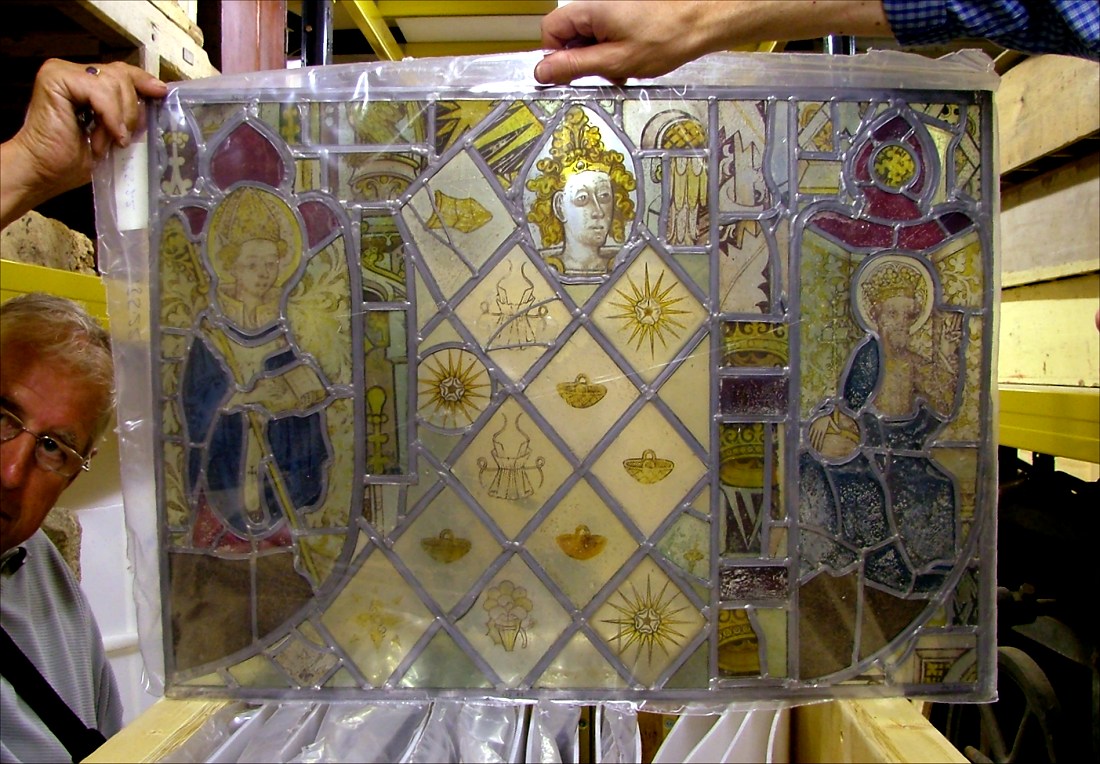
Within the screen is a large chapel, containing two major tombs. One is in alabaster, an early 17th century memorial to Sir Thomas and Lady Alice Lovell (remember the squirrel?) who died in 1604. The piece is good - too good, its 1950s restoration gives it a Festival of Britain air. Their symbols lie at their feet - his a magnificent peacock with erect tail, hers a gruesome Saracen scalp held aloft.
The other appears to be a composite. It lies to the east, and the two effigies are clearly not from this tomb; they simply don't fit. They are supposed to be Robert Harling, died Paris in 1435, and his wife Dame Joan. Neither are buried here - she is at Rushford near Thetford, he is in some corner of a foreign field that is forever French schoolchildren on picnics excitedly tugging old thighbones from the soil - but in any case it is the trimmings of the tomb rather than the effigies that are most of interest, including a pelican in her piety, a cock crowing and one that is almost a lily crucifix.
On the north side of the chancel is a fine tomb with brass inlays - the brasses now gone. Not as magnificent as either of the two previously mentioned, it is actually the most significant, as this is where you'll find Anne Harling, wife of the serial rebuilders of this church. Look out for those flails again.
What more? 17th century Lovells (remember the squirrel) have in-yer-face memorials either side of the sanctuary - that to the north curiously with no inscription. There are hatchments, remains of a wallpainting that are too indistinct to interpret (but may be seven works of mercy), a good set of royal arms, medieval heads, curious 19th century bench ends of a lion and a wild man, heraldic misericords, a Dec font - well, come and see for yourself. You know you want to.
Nazca Vessel with Women's Heads (100 AD-700 AD)
South coast, Peru.
Museum Fünf Kontinente, Munich
Nasca religion . . . seems more closely related to animatism and nature worship than to the supplication cation of specific deities. Therefore I have avoided using the term "deity" in referring to the images in the iconography, preferring to call them "mythical beings."
The spirit world of the Nasca included the most powerful creatures of the air (condor and falcon), earth (jaguar and puma), and water (killer whale).
Although naturalistic representations of all these animals and birds appear in the art, they are more often represented in a sacred symbolic form - killer whale jaws and fins; falcon tails, wings, and eye markings; feline whiskers and body markings -in a myriad of combinations that often include human or anthropomorphic
elements.
These mythical beings (including ing the Horrible Bird, the Mythical Killer Whale, the Anthropomorphic Mythical Being, and the Mythical Spotted Cat) should be viewed as symbolic visualizations of either the nature spirits themselves or the spiritual power (huaca or mana) that they emit. Most are combinations of several powerful elements.
While there is some archaeological cal evidence suggesting that shamans may have dressed in the trappings of the spirits for certain ritual occasions, I have argued above that the iconographic representations of mythical creatures in Nasca ceramic art were purely symbolic bolic and were not meant to portray masked impersonators or ritual performers.
Donald A. Proulx. A Sourcebook of Nasca Ceramic Iconography: Reading a Culture through Its Art (Kindle Locations 4050-4051).
With elements adapted from (center and right) Grünewald's Isenheim Altarpiece, and (on left) Gerrit van Honthorst's Adoration of the Shepherds, 1622, Wallraf-Richartz Museum, and details from various others. For credits, see further: www.flickr.com/photos/walford/5279017634/in/photolist-2i4...
I also made, for comparison, a version without the curtain as framing device, see: www.flickr.com/photos/walford/51644955183/in/dateposted-p...
Washington, D.C. (est. 1790, pop. ~690,000)
• Ford’s Theatre, site of assassination of U.S. President Abraham Lincoln
• theater’s site previously occupied by First Baptist Church of Washington (1834) [photo] • services held until 1859 • John Thompson Ford, Baltimore theatrical manager, leased the church bldg., converted it into a theatre • inaugurated Dec., 1861 as The "George Christy Opera House," presenting popular blackface troupe, Christy’s Minstrels
• following their final performance 27 Feb., 1862, further renovations made for presentation of theatrical (rather than musical) plays • 3 wks. later venue, renamed “Ford’s Atheneum,” entered Washington’s Civil War theater scene • presented excellent companies & first rate stars • Pres. Lincoln first attended Ford's on 28 May, 1862 • venue was profitable until the evening of 30 Dec, 1862, when it burned
• 2 mos.later, the cornerstone of a new theater was laid on this site by James J. Gifford, chief carpenter, architect & builder • the brick structure, modeled after the Late Victorian-style design of Baltimore’s Holliday Street Theatre [photo], seated ~1,700 w/ 8 private boxes, two upper, two lower, located on either side of stage
• opened evening of 27 Aug., 1863 with “The Naiad Queen,” a "Fairy Opera" [photo] presented to a capacity audience • became one of the most successful entertainment venues in Washington —Ford’s Theatre, National Historic Site
• as Ford’s ventures prospered, a future competitor was making history • Mary Francis Moss was born, 1826, in Winchester, England • during childhood was a frequent visitor to the studio of "old man" J.M.W, Turner, the celebrated painter —The Life of Laura Keene [photo]
• married at age 18 to former British Army officer, Henry Wellington Taylor • 7 yr. marriage produced 2 daughters • husband was arrested for an undocumented crime, sent to Australia on a prison ship • to support her family, Mary Taylor became British stage actress Laura Keene, who made her professional debut in London, Oct., 1851 —Wikipedia
• in 1852, less than a year into her acting career, accepted an offer from impresario J.W. Wallack to travel to New York City, to audition for leading lady of the Wallack’s Theater stock company • became a popular star performer [photo] • began considering a move into an entrepreneurial role
• took over Baltimore's Charles Street Theatre, 24 Dec, 1853, w/ financial assistance from wealthy Washingtonian, John Lutz • managed it for 2 months, qualifying her as USA’s first female theater manager • Lutz became her business manager & by some unverifiable accounts, her husband, though she was still married to Taylor — Androom Archives
• moved to San Francisco & the Metropolitan Theatre [photo] • played opposite Edwin Booth, brother of John Wilkes Booth • toured Australia with Edwin, 1854
• by 1855 she had returned to NYC • retained architect, John M. Trimble, a theater specialist • the new theater, built to her specifications, was named the Laura Keene’s Varieties [photo], aka Laura Keene’s Theatre [photo], or Third Olympic Theatre • opened at 622 Broadway on 18 Nov., 1856 • managed by Keene until 1863 when she assumed the lease & took over D.C.’s Washington Theatre [photo] [ad] from lessee, manager & self-proclaimed “People’s Favorite Tragedian,” John Wilkes Booth
• in 1858, having returned to Laura Keene's Theatre in NYC, premiered Our American Cousin,” [script] a 3-act farce starring Laura Keene [photo], written by English playwright Tom Taylor, U.S./Canada rights owned by Keene • with a run of 150 nights, set new standards for New York theater
• synopsis: a coarse but honest American, Asa Trenchard, arrives at the British Trenchard estate to claim an inheritance as the last named heir • meets Lord Dundreary & other snooty relatives who are trying to keep up appearances & marry off daughters • servants gossip, villains emerge from the shadows, true love conquers all in the end, a farce satirizing pretension & manners —Helytimes
• this is the play Laura Keene chose for her 14 Apr., 1865 Ford’s Theatre engagement, a benefit & farewell performance [ad] for the beloved star [playbill] • “Our Leading Lady,” is a 2007 comedy inspired by Keene’s role in the events surrounding this performance
• Laura Keene would play her usual role as Trenchard’s wife, Florence • Harry Hawk [photo], a member of Keene’s NY company, was to play the boorish American, Asa Trenchard • the classic role of brainless aristocrat Lord Dundreary was given to Edwin "Ned" Emerson [photo], leading man in the Ford Stock Company, brother of a Confederate soldier killed in action in 1862 & close friend of John Wilkes Booth
"I knew John Wilkes Booth well," wrote Edwin Emerson, "having played with him in dozens of cities, throughout the East and Middle West. He was a kind-hearted, genial person, and no cleverer gentleman ever lived. Everybody loved him on the stage, though he was a little excitable and eccentric."
• while Ford's was presenting Keene's famous play, arch-rival Grover's Theatre aka Grover’s National Theatre, offered “Aladin and The Wonderful Lamp” • Leonard Grover advertised his theatre as the capital’s only “Union” playhouse, highlighting John Ford’s more “Secesh” (secessionist) sentiments • “Doubtless [Ford’s] personal sympathies were with his State and with that portion of the country in which he was born and reared.” —Leonard Grover
• according to Grover, during the four years of [Lincoln’s] administration, he visited his theater “probably more than a hundred times. He often came alone, many times brought his little son Tad, and on special occasions, Mrs. Lincoln.” The President also once told Grover, ”I really enjoy a minstrel show," • when Grover responded that Hooley's Minstrels [photo] were soon to appear, Lincoln laughed. "Well, that was thoughtful of you." • “[Lincoln] was exceedingly conversant with Shakespeare. He enjoyed a classical representation, of which I gave many” —Lincoln's Interest in the Theater, Leonard Grover
• the National’s policy of segregating blacks began when it opened in 1835 • a portion of the gallery was set apart for "persons of color" • it is not known how many black theatergoers were in the 5 Mar., 1845 audience for “Beauty & the Beast,” “Stage Struck Nigger” & the Congo Melodists, a Boston blackface minstrel group [photo], but Washington’s 7 Mar. “National lntelligencer” reported that the cause of the fire which had demolished the theatre on the 5th was "a candle without a stick left burning on a table by a negro...."
• although the Grover-managed version of the National also had its "colored parterre,” Ford's Theatre, excluded blacks entirely from its performances • the exclusion of black Washingtonians from public places in the nation’s capital helped secure the passing of the Civil Rights Act of 1875 which, in 1889, the Supreme Court held unconstitutional. —The National Theatre in Washington: Buildings and Audiences, 1835-1972
• Mary Lincoln had tickets to Grover’s but preferred seeing Laura Keene in “Our American Cousin” • with little interest, the president said he would take care of the tickets • a messenger was sent to the theatre around 10:30 A.M. to secure the state box for the evening • the Lincolns’ son, Tad, opted for Grover’s, thus would not be with his parents at Ford’s that night
• General Grant accepted Lincoln’s invitation to join them in the Presidential box, but when Julia Grant objected to spending the evening with the sharp-tongued First Lady, he canceled • Secretary of War Edwin Stanton, Speaker of the House Schuyler Colfax & son Robert Todd Lincoln also declined before Clara Harris (1834-1883), daughter of New York Senator Ira Harris (1802-1875), and her fiancé, Major Henry Rathbone (1837-1911), accepted. —History Channel
The theatre as it appeared the night of Lincoln's assassination:
• the stage
• “Laura Keene was on stage with E, A. Emerson when the Presidents' party entered the theatre. As the party made its way, Miss Keene halted the play, Conductor William Withers [photo] led the orchestra in Hail to the Chief,'
and the audience rose and greeted the President with 'vociferous cheering.' President Lincoln came to the front of the box, acknowledged the reception, [set his silk hat on the floor], and the actors resumed where they had left off.
“The fatal shot was fired during the second scene of the third act. Laura Keene was standing in the first entrance (wing), stage right, facing the audience, awaiting her cue for the next scene
“On stage, just prior to the shooting, Mrs. Mountchessington was squelching Asa Trenchard: I am aware, Mr. Trenchard, you are not used to the manners of good society, and that alone will excuse the impertinence of which you have been guilty. (Exit)
“This left Asa Trenchard (Harry Hawk) alone on the stage… The audience was silent, expectantly awaiting the punch line from Asa. Miss Harris and Major Rathbone were ‘intently observing’ the scene on stage.The President ‘was leaning upon one hand, and with the other was adjusting a portion of the drapery‘ which hung at the side of the box opening. [photo]
“At this moment John Wilkes Booth stood silently in the shadows of the state box, four or five feet directly behind the President. Probably the last words heard by Lincoln were spoken by Harry Hawk:
“ASA: Don’t know the manners of good society, eh? Wal, I guess I know enough to turn you inside out, old gal — you sockdologizing old mantrap.
“The audience roared. Then penetrating the laughter was the distinct sound of a shot. A puff of smoke drifted from the box, and Major Rathbone “saw through the smoke, a man between the door and the President. He ‘instantly sprang toward him,’ but the assassin wrested from his grasp and slashed Rathbone with a dagger across the left arm. Meanwhile, Harry Hawk looked up from the stage to see a man, knife in hand, leaping over the balustrade of the President's box onto the stage apron. Fearing he would be attacked Hawk ran off the stage.’ Booth ran across the stage, [illustration] brushed past Miss Keene in the wings…
—Harbin, Billy J. “Laura Keene at the Lincoln Assassination,” Educational Theatre Journal 18, no. 1 (1966): 47–54
• Edwin Emerson: “…near the beginning of the third act… I was standing in the wings, just behind a piece of scenery, waiting for my cue to go on, when I heard a shot. I was not surprised, nor was anyone else behind the scenes. Such sounds are too common during the shifting of the various sets to surprise an actor. For a good many seconds after that sound nothing happened behind the footlights. Then, as I stood there in the dimness, a man rushed by me, making for the stage door. I did not recognize Booth at the time, nor did anyone else, I think, unless, someone out on the stage, when he stood a moment and shouted with theatrical gesture, ‘Sic Semper Tyrannis!' (So perish all tyrants!) Even after he flashed by, there was quiet for a few moments among the actors and the stage hands. No one knew what had happened.”—Find a Grave
• running from the stage Booth exited the building into Baptist Alley, a public alleyway laid out in 1792 • grabbed the reins of his horse & rode off, turning right on F Street to head for the safety of of the Maryland night
• James S. Knox, witness: “…The shrill cry of murder from Mrs. Lincoln first roused the horrified audience, and in an instant the uproar was terrible. The silence of death was broken by shouts of "kill him," "hang him" and strong men wept, and cursed, and tore the seats in the impotence of their anger, while Mrs. Lincoln, on her knees uttered shriek after shriek at the feet of the dying President.” —Library of Congress
• video: Charles L. Willis, J.W. Epperson eyewitness accounts of the assassination
• according to legend, Laura Keene rushed to Lincoln’s box w/a pitcher of water • cradled his head, staining her cuff w/ his blood.
• The Night Lincoln Was Shot: Minute-by-Minute Backstage With John Wilkes Booth at Ford's Theatre
“In the lobby of Grover’s, as Tad Lincoln awaited his parents' carriage to take him back to the White House, he learned that his father had been shot • Grover, who was in New York, received a telegram from his associate manager: President shot tonight at Ford's Theatre. Thank God it wasn't ours. C. D. Hess."
“[two doctors] now arrived and after a moments consultation we agreed to have him removed to the nearest house… I called out twice 'Guards clear the passage,' which was so soon done that we proceeded… with the President and were not in the slightest interrupted until he was placed in bed in the house of Mr. Peterson… During the night the room was visited by many of his friends. Mrs Lincoln with Mrs. Senator Dixon came into the room three or four times during the night. The Presidents son Captn R. Lincoln, remained with his father during the greater part of the night.
“At 7.20 a.m. he breathed his last and “the spirit fled to God who gave it… Immediately after death had taken place, we all bowed and the Rev. Dr. Gurley supplicated to God in behalf of the bereaved family and our afflicted country.” —Report on the Assassination of Abraham Lincoln by Dr. Charles Leale [photo]
• Secy. of War Stanton ordered guards posted at the building [photo] & future dramatic productions canceled • later that year, attempts by Ford to reopen the theatre aroused public indignation • War Dept. ordered it closed, Ford threatened legal action, federal government responded by leasing & later purchasing the bldg.
• American newspapers report the shocking news in a country still younger than some of its citizens
• Willie Clark, the Petersen House boarder who lived in the room in which President Lincoln died, wrote to his sister four days after Lincoln's death...
“The past few days have been of intense excitement. Arrests are numerously made, of any party heard to utter secesh sentiments. The time has come when people cannot say what they please, the people are awfully indignant. Leinency is no longer to be thought of. A new code must be adopted.
“They talk of the tyranical administration of Mr. Lincoln, but we have a man now for a president who will teach the south a lesson they will know well how to appreciate…
“…Everybody has a great desire to obtain some memento from my room so that whoever comes in has to be closely watched for fear they will steal something.
“I have a lock of his hair which I have had neatly framed, also a piece of linen with a portion of his brain, the pillow and case upon which he lay when he died and nearly all his wearing apparel but the latter I intend to send to Robt. Lincoln as soon as the funeral is over, as I consider him the one most justly entitled to them.
“The same matrass (sic.) is on my bed, and the same coverlit (sic.) covers me nightly that covered him while dying.
“Enclosed you will find a piece of lace that Mrs. Lincoln wore on her head during the evening and was dropped by her while entering my room to see her dying husband It is worth keeping for its historical value.
“The cap worked by Clara and the cushion by you, you little dreamed would be so historically connected with such an event.”
“They talk of the tyranical administration of Mr. Lincoln, but we have a man now for a president who will teach the south a lesson they will know well how to appreciate. — Remembering Lincoln
• Lincoln's death was not universally mourned by Northeners even though his decision to resupply Ft. Sumter forced the Confederates into firing the 1st shots, an attack that triggered anger, patriotism & widespread support from Northerners • nevertheless, some who thought him too dictatorial & some Radical Republicans who thought him too lenient toward the enemy welcomed his assassination • Congressman George Julian recorded in his diary that the “universal feeling among radical men here is that his death is a godsend” Michigan Senator Zachariah Chandler wrote to his wife that God had permitted Lincoln to live only “as long as he was useful and then substituted a better man (Johnson) to finish the work.”—History Channel
• In the 2 wks. following the assassination, hundreds were detained, questioned, & some imprisoned • nearly all the personnel at Ford’s (actors, stage hands, musicians, etc.) were arrested & questioned • John T. Ford was visiting Richmond the night of the assassination • he & 2 brothers spent 39 days in the Old Capitol Prison before being cleared & released
• the Old Capitol Prison [photo] gained an association with the Lincoln assassination when it lodged several (but not all) suspected Lincoln assassination conspirators who, by order of the Secty. Of War, wore cotton hoods —Smithsonian
.
• 5 days after the assassination, Laura Keene & 2 other cast members arrested in Harrisburg PA, returned to Washington & released by order of the Secretary of War the moment he heard of their unauthorized detention
• Louis J. Weichmann often stayed at the Surratt Boarding House, in contact with the Surratts, & John Wilkes Booth • arrested as a potential accomplice but became a star witness for the prosecution, his testimony helping to convict Mary Surratt
• Pres. Andrew Johnson & Secy. of War Edwin M. Stanton insisted on trying the conspirators before a nine-member military commission, where 5 of the 9 judges—rather than a unanimous vote like in a civilian trial—were required to establish guilt. 6 votes could impose the death penalty
• Federal authorities argued that because Washington, D.C., was a war zone in April 1865—Confederate troops were still in the field—the assassination was an act of war • opponents argued that a civilian court would allow for a fairer trial [photo]
• for 7 weeks in May & June 1865, nation’s attention riveted on the 3rd floor of Old Arsenal Penitentiary (now Fort McNair) [photo], where the alleged conspirators were on trial for their lives [photo]
• one of the first U.S. trials where “colored” Americans, e.g. Ford’s stagehand Joe Simms & cleaner Mary Anderson, were allowed to testify against white Americans in open court • their testimony was included throughout the trial —Ford’s Theatre
• accused were allowed by attorneys to question the 366 witnesses, but not permitted to speak on their own behalf —Ford’s Theatre
• All defendants found guilty, 30 June, 1865 • Mary Surratt, Lewis Powell, David Herold, & George Atzerodt sentenced to death by hanging [photo]
• Samuel Mudd, Samuel Arnold, & Michael O'Laughlen sentenced to life in prison • Ford’s stagehand Edmund Spangler sentenced to 6 yrs. in prison •all incarcerated at Fort Jefferson, off of Key West, Florida, pardoned by Pres. Johnson, 1869.
• following the assassination, [photo]Ford attempted to reopen on 7 July, 1865 but public outcry & threats forced him to cancel the performance, issue refunds & close the still-unfinished theater • bldg. seized July, 1865 by order of the Secretary of War
• interior torn out in August, 1865 • converted into 3-story office bldg housing the Army Medical Museum & Surgeon General • used for govt. purposes for several decades. —Ford’s Theatre National Historic Site
• 40-foot section of the facade collapsed from the 3rd floor, killing 22 War Department personnel, 1893 • alterations, including the facade, 1894 • building repaired, continued as government warehouse & storeroom until 1911 • vacant until taken over by Office of Public Buildings & Public Parks of the National Capital, 1928 • Lincoln museum opened 12 Feb., 1932, 123rd anniversary of Lincoln’s birth
• bldg. transferred to National Parks Service through executive order, 1933 —Ford’s Theatre, Washington, D.C.
• funding for restoration approved, 1964 • original building plans lost • relied on investigative work to extrapolate floor levels & wall locations from known “good” points in the building, w/ photographs & drawings providing supplementary detail • project supervised by Charles W. Lessig • restoration to its 1865 appearance completed, 1968 • theatre reopened 30 Jan., 1968 • following restoration, Presidential Box never occupied. —Ford’s Theatre
• externally west facade & north & south walls remain of the original theatre, although subject to modification, repair & remodeling over time • rear (east) wall, site of Booth’s escape door, is completely rebuilt—Restoration of Ford’s Theatre, Washington
• now a popular tourist destination & working theatre presenting a varied schedule of theatrical & live entertainment events • over 650,000 visitors/yr.
• Pennsylvania Avenue National Historic Site National Register # 66000865, 1966
• Ford’s Theatre National Historic site, National Register # 66000034, 1966
Washington, D.C. (est. 1790, pop. ~690,000)
• Ford’s Theatre, site of assassination of U.S. President Abraham Lincoln
• theater’s site previously occupied by First Baptist Church of Washington (1834) [photo] • services held until 1859 • John Thompson Ford, Baltimore theatrical manager, leased the church bldg., converted it into a theatre • inaugurated Dec., 1861 as The "George Christy Opera House," presenting popular blackface troupe, Christy’s Minstrels
• following their final performance 27 Feb., 1862, further renovations made for presentation of theatrical (rather than musical) plays • 3 wks. later venue, renamed “Ford’s Atheneum,” entered Washington’s Civil War theater scene • presented excellent companies & first rate stars • Pres. Lincoln first attended Ford's on 28 May, 1862 • venue was profitable until the evening of 30 Dec, 1862, when it burned
• 2 mos.later, the cornerstone of a new theater was laid on this site by James J. Gifford, chief carpenter, architect & builder • the brick structure, modeled after the late Victorian design of Baltimore’s Holliday Street Theatre [photo], seated ~1,700 w/ 8 private boxes, two upper, two lower, located on either side of stage
• opened evening of 27 Aug., 1863 with “The Naiad Queen,” a "Fairy Opera" [photo] presented to a capacity audience • became one of the most successful entertainment venues in Washington —Ford’s Theatre, National Historic Site
• as Ford’s ventures prospered, a future competitor was making history • Mary Francis Moss was born, 1826, in Winchester, England • during childhood was a frequent visitor to the studio of "old man" J.M.W, Turner, the celebrated painter —The Life of Laura Keene [photo]
• married at age 18 to former British Army officer, Henry Wellington Taylor • 7 yr. marriage produced 2 daughters • husband was arrested for an undocumented crime, sent to Australia on a prison ship • to support her family, Mary Taylor became British stage actress Laura Keene, who made her professional debut in London, Oct., 1851 —Wikipedia
• in 1852, less than a year into her acting career, accepted an offer from impresario J.W. Wallack to travel to New York City, to audition for leading lady of the Wallack’s Theater stock company • became a popular star performer [photo] • began considering a move into an entrepreneurial role
• took over Baltimore's Charles Street Theatre, 24 Dec, 1853, w/ financial assistance from wealthy Washingtonian, John Lutz • managed it for 2 months, qualifying her as USA’s first female theater manager • Lutz became her business manager & by some unverifiable accounts, her husband, though she was still married to Taylor — Androom Archives
• moved to San Francisco & the Metropolitan Theatre [photo] • played opposite Edwin Booth, brother of John Wilkes Booth • toured Australia with Edwin, 1854
• by 1855 she had returned to NYC • retained architect, John M. Trimble, a theater specialist • the new theater, built to her specifications, was named the Laura Keene’s Varieties [photo], aka Laura Keene’s Theatre [photo], or Third Olympic Theatre • opened at 622 Broadway on 18 Nov., 1856 • managed by Keene until 1863 when she assumed the lease & took over D.C.’s Washington Theatre [photo] [ad] from lessee, manager & self-proclaimed “People’s Favorite Tragedian,” John Wilkes Booth
• in 1858, having returned to Laura Keene's Theatre in NYC, premiered Our American Cousin,” [script] a 3-act farce starring Laura Keene [photo], written by English playwright Tom Taylor, U.S./Canada rights owned by Keene • with a run of 150 nights, set new standards for New York theater
• synopsis: a coarse but honest American, Asa Trenchard, arrives at the British Trenchard estate to claim an inheritance as the last named heir • meets Lord Dundreary & other snooty relatives who are trying to keep up appearances & marry off daughters • servants gossip, villains emerge from the shadows, true love conquers all in the end, a farce satirizing pretension & manners —Helytimes
• this is the play Laura Keene chose for her 14 Apr., 1865 Ford’s Theatre engagement, a benefit & farewell performance [ad] for the beloved star [playbill] • “Our Leading Lady,” is a 2007 comedy inspired by Keene’s role in the events surrounding this performance
• Laura Keene would play her usual role as Trenchard’s wife, Florence • Harry Hawk [photo], a member of Keene’s NY company, was to play the boorish American, Asa Trenchard • the classic role of brainless aristocrat Lord Dundreary was given to Edwin "Ned" Emerson [photo], leading man in the Ford Stock Company, brother of a Confederate soldier killed in action in 1862 & close friend of John Wilkes Booth
"I knew John Wilkes Booth well," wrote Edwin Emerson, "having played with him in dozens of cities, throughout the East and Middle West. He was a kind-hearted, genial person, and no cleverer gentleman ever lived. Everybody loved him on the stage, though he was a little excitable and eccentric."
• while Ford's was presenting Keene's famous play, arch-rival Grover's Theatre aka Grover’s National Theatre, offered “Aladin and The Wonderful Lamp” • Leonard Grover advertised his theatre as the capital’s only “Union” playhouse, highlighting John Ford’s more “Secesh” (secessionist) sentiments • “Doubtless [Ford’s] personal sympathies were with his State and with that portion of the country in which he was born and reared.” —Leonard Grover
• according to Grover, during the four years of [Lincoln’s] administration, he visited his theater “probably more than a hundred times. He often came alone, many times brought his little son Tad, and on special occasions, Mrs. Lincoln.” The President also once told Grover, ”I really enjoy a minstrel show," • when Grover responded that Hooley's Minstrels [photo] were soon to appear, Lincoln laughed. "Well, that was thoughtful of you." • “[Lincoln] was exceedingly conversant with Shakespeare. He enjoyed a classical representation, of which I gave many” —Lincoln's Interest in the Theater, Leonard Grover
• the National’s policy of segregating blacks began when it opened in 1835 • a portion of the gallery was set apart for "persons of color" • it is not known how many black theatergoers were in the 5 Mar., 1845 audience for “Beauty & the Beast,” “Stage Struck Nigger” & the Congo Melodists, a Boston blackface minstrel group [photo], but Washington’s 7 Mar. “National lntelligencer” reported that the cause of the fire which had demolished the theatre on the 5th was "a candle without a stick left burning on a table by a negro...."
• although the Grover-managed version of the National also had its "colored parterre,” Ford's Theatre, excluded blacks entirely from its performances • the exclusion of black Washingtonians from public places in the nation’s capital helped secure the passing of the Civil Rights Act of 1875 which, in 1889, the Supreme Court held unconstitutional. —The National Theatre in Washington: Buildings and Audiences, 1835-1972
• Mary Lincoln had tickets to Grover’s but preferred seeing Laura Keene in “Our American Cousin” • with little interest, the president said he would take care of the tickets • a messenger was sent to the theatre around 10:30 A.M. to secure the state box for the evening • the Lincolns’ son, Tad, opted for Grover’s, thus would not be with his parents at Ford’s that night
• General Grant accepted Lincoln’s invitation to join them in the Presidential box, but when Julia Grant objected to spending the evening with the sharp-tongued First Lady, he canceled • Secretary of War Edwin Stanton, Speaker of the House Schuyler Colfax & son Robert Todd Lincoln also declined before Clara Harris (1834-1883), daughter of New York Senator Ira Harris (1802-1875), and her fiancé, Major Henry Rathbone (1837-1911), accepted. —History Channel
The theatre as it appeared the night of Lincoln's assassination:
• the stage
• “Laura Keene was on stage with E, A. Emerson when the Presidents' party entered the theatre. As the party made its way, Miss Keene halted the play, Conductor William Withers [photo] led the orchestra in Hail to the Chief,'
and the audience rose and greeted the President with 'vociferous cheering.' President Lincoln came to the front of the box, acknowledged the reception, [set his silk hat on the floor], and the actors resumed where they had left off.
“The fatal shot was fired during the second scene of the third act. Laura Keene was standing in the first entrance (wing), stage right, facing the audience, awaiting her cue for the next scene
“On stage, just prior to the shooting, Mrs. Mountchessington was squelching Asa Trenchard: I am aware, Mr. Trenchard, you are not used to the manners of good society, and that alone will excuse the impertinence of which you have been guilty. (Exit)
“This left Asa Trenchard (Harry Hawk) alone on the stage… The audience was silent, expectantly awaiting the punch line from Asa. Miss Harris and Major Rathbone were ‘intently observing’ the scene on stage.The President ‘was leaning upon one hand, and with the other was adjusting a portion of the drapery‘ which hung at the side of the box opening. [photo]
“At this moment John Wilkes Booth stood silently in the shadows of the state box, four or five feet directly behind the President. Probably the last words heard by Lincoln were spoken by Harry Hawk:
“ASA: Don’t know the manners of good society, eh? Wal, I guess I know enough to turn you inside out, old gal — you sockdologizing old mantrap.
“The audience roared. Then penetrating the laughter was the distinct sound of a shot. A puff of smoke drifted from the box, and Major Rathbone “saw through the smoke, a man between the door and the President. He ‘instantly sprang toward him,’ but the assassin wrested from his grasp and slashed Rathbone with a dagger across the left arm. Meanwhile, Harry Hawk looked up from the stage to see a man, knife in hand, leaping over the balustrade of the President's box onto the stage apron. Fearing he would be attacked Hawk ran off the stage.’ Booth ran across the stage, [illustration] brushed past Miss Keene in the wings…
—Harbin, Billy J. “Laura Keene at the Lincoln Assassination,” Educational Theatre Journal 18, no. 1 (1966): 47–54
• Edwin Emerson: “…near the beginning of the third act… I was standing in the wings, just behind a piece of scenery, waiting for my cue to go on, when I heard a shot. I was not surprised, nor was anyone else behind the scenes. Such sounds are too common during the shifting of the various sets to surprise an actor. For a good many seconds after that sound nothing happened behind the footlights. Then, as I stood there in the dimness, a man rushed by me, making for the stage door. I did not recognize Booth at the time, nor did anyone else, I think, unless, someone out on the stage, when he stood a moment and shouted with theatrical gesture, ‘Sic Semper Tyrannis!' (So perish all tyrants!) Even after he flashed by, there was quiet for a few moments among the actors and the stage hands. No one knew what had happened.”—Find a Grave
• running from the stage Booth exited the building into Baptist Alley, a public alleyway laid out in 1792 • grabbed the reins of his horse & rode off, turning right on F Street to head for the safety of of the Maryland night
• James S. Knox, witness: “…The shrill cry of murder from Mrs. Lincoln first roused the horrified audience, and in an instant the uproar was terrible. The silence of death was broken by shouts of "kill him," "hang him" and strong men wept, and cursed, and tore the seats in the impotence of their anger, while Mrs. Lincoln, on her knees uttered shriek after shriek at the feet of the dying President.” —Library of Congress
• video: Charles L. Willis, J.W. Epperson eyewitness accounts of the assassination
• according to legend, Laura Keene rushed to Lincoln’s box w/a pitcher of water • cradled his head, staining her cuff w/ his blood.
• The Night Lincoln Was Shot: Minute-by-Minute Backstage With John Wilkes Booth at Ford's Theatre
“In the lobby of Grover’s, as Tad Lincoln awaited his parents' carriage to take him back to the White House, he learned that his father had been shot • Grover, who was in New York, received a telegram from his associate manager: President shot tonight at Ford's Theatre. Thank God it wasn't ours. C. D. Hess."
“[two doctors] now arrived and after a moments consultation we agreed to have him removed to the nearest house… I called out twice 'Guards clear the passage,' which was so soon done that we proceeded… with the President and were not in the slightest interrupted until he was placed in bed in the house of Mr. Peterson… During the night the room was visited by many of his friends. Mrs Lincoln with Mrs. Senator Dixon came into the room three or four times during the night. The Presidents son Captn R. Lincoln, remained with his father during the greater part of the night.
“At 7.20 a.m. he breathed his last and “the spirit fled to God who gave it… Immediately after death had taken place, we all bowed and the Rev. Dr. Gurley supplicated to God in behalf of the bereaved family and our afflicted country.” —Report on the Assassination of Abraham Lincoln by Dr. Charles Leale [photo]
• Secy. of War Stanton ordered guards posted at the building [photo] & future dramatic productions canceled • later that year, attempts by Ford to reopen the theatre aroused public indignation • War Dept. ordered it closed, Ford threatened legal action, federal government responded by leasing & later purchasing the bldg.
• American newspapers report the shocking news in a country still younger than some of its citizens
• Willie Clark, the Petersen House boarder who lived in the room in which President Lincoln died, wrote to his sister four days after Lincoln's death...
“The past few days have been of intense excitement. Arrests are numerously made, of any party heard to utter secesh sentiments. The time has come when people cannot say what they please, the people are awfully indignant. Leinency is no longer to be thought of. A new code must be adopted.
“They talk of the tyranical administration of Mr. Lincoln, but we have a man now for a president who will teach the south a lesson they will know well how to appreciate…
“…Everybody has a great desire to obtain some memento from my room so that whoever comes in has to be closely watched for fear they will steal something.
“I have a lock of his hair which I have had neatly framed, also a piece of linen with a portion of his brain, the pillow and case upon which he lay when he died and nearly all his wearing apparel but the latter I intend to send to Robt. Lincoln as soon as the funeral is over, as I consider him the one most justly entitled to them.
“The same matrass (sic.) is on my bed, and the same coverlit (sic.) covers me nightly that covered him while dying.
“Enclosed you will find a piece of lace that Mrs. Lincoln wore on her head during the evening and was dropped by her while entering my room to see her dying husband It is worth keeping for its historical value.
“The cap worked by Clara and the cushion by you, you little dreamed would be so historically connected with such an event.”
“They talk of the tyranical administration of Mr. Lincoln, but we have a man now for a president who will teach the south a lesson they will know well how to appreciate. — Remembering Lincoln
• Lincoln's death was not universally mourned by Northeners even though his decision to resupply Ft. Sumter forced the Confederates into firing the 1st shots, an attack that triggered anger, patriotism & widespread support from Northerners • nevertheless, some who thought him too dictatorial & some Radical Republicans who thought him too lenient toward the enemy welcomed his assassination • Congressman George Julian recorded in his diary that the “universal feeling among radical men here is that his death is a godsend” Michigan Senator Zachariah Chandler wrote to his wife that God had permitted Lincoln to live only “as long as he was useful and then substituted a better man (Johnson) to finish the work.”—History Channel
• In the 2 wks. following the assassination, hundreds were detained, questioned, & some imprisoned • nearly all the personnel at Ford’s (actors, stage hands, musicians, etc.) were arrested & questioned • John T. Ford was visiting Richmond the night of the assassination • he & 2 brothers spent 39 days in the Old Capitol Prison before being cleared & released
• the Old Capitol Prison [photo] gained an association with the Lincoln assassination when it lodged several (but not all) suspected Lincoln assassination conspirators who, by order of the Secty. Of War, wore cotton hoods —Smithsonian
.
• 5 days after the assassination, Laura Keene & 2 other cast members arrested in Harrisburg PA, returned to Washington & released by order of the Secretary of War the moment he heard of their unauthorized detention
• Louis J. Weichmann often stayed at the Surratt Boarding House, in contact with the Surratts, & John Wilkes Booth • arrested as a potential accomplice but became a star witness for the prosecution, his testimony helping to convict Mary Surratt
• Pres. Andrew Johnson & Secy. of War Edwin M. Stanton insisted on trying the conspirators before a nine-member military commission, where 5 of the 9 judges—rather than a unanimous vote like in a civilian trial—were required to establish guilt. 6 votes could impose the death penalty
• Federal authorities argued that because Washington, D.C., was a war zone in April 1865—Confederate troops were still in the field—the assassination was an act of war • opponents argued that a civilian court would allow for a fairer trial [photo]
• for 7 weeks in May & June 1865, nation’s attention riveted on the 3rd floor of Old Arsenal Penitentiary (now Fort McNair) [photo], where the alleged conspirators were on trial for their lives [photo]
• one of the first U.S. trials where “colored” Americans, e.g. Ford’s stagehand Joe Simms & cleaner Mary Anderson, were allowed to testify against white Americans in open court • their testimony was included throughout the trial —Ford’s Theatre
• accused were allowed by attorneys to question the 366 witnesses, but not permitted to speak on their own behalf —Ford’s Theatre
• All defendants found guilty, 30 June, 1865 • Mary Surratt, Lewis Powell, David Herold, & George Atzerodt sentenced to death by hanging [photo]
• Samuel Mudd, Samuel Arnold, & Michael O'Laughlen sentenced to life in prison • Ford’s stagehand Edmund Spangler sentenced to 6 yrs. in prison •all incarcerated at Fort Jefferson, off of Key West, Florida, pardoned by Pres. Johnson, 1869.
• following the assassination, [photo]Ford attempted to reopen on 7 July, 1865 but public outcry & threats forced him to cancel the performance, issue refunds & close the still-unfinished theater • bldg. seized July, 1865 by order of the Secretary of War
• interior torn out in August, 1865 • converted into 3-story office bldg housing the Army Medical Museum & Surgeon General • used for govt. purposes for several decades. —Ford’s Theatre National Historic Site
• 40-foot section of the facade collapsed from the 3rd floor, killing 22 War Department personnel, 1893 • alterations, including the facade, 1894 • building repaired, continued as government warehouse & storeroom until 1911 • vacant until taken over by Office of Public Buildings & Public Parks of the National Capital, 1928 • Lincoln museum opened 12 Feb., 1932, 123rd anniversary of Lincoln’s birth
• bldg. transferred to National Parks Service through executive order, 1933 —Ford’s Theatre, Washington, D.C.
• funding for restoration approved, 1964 • original building plans lost • relied on investigative work to extrapolate floor levels & wall locations from known “good” points in the building, w/ photographs & drawings providing supplementary detail • project supervised by Charles W. Lessig • restoration to its 1865 appearance completed, 1968 • theatre reopened 30 Jan., 1968 • following restoration, Presidential Box never occupied. —Ford’s Theatre
• externally west facade & north & south walls remain of the original theatre, although subject to modification, repair & remodeling over time • rear (east) wall, site of Booth’s escape door, is completely rebuilt—Restoration of Ford’s Theatre, Washington
• now a popular tourist destination & working theatre presenting a varied schedule of theatrical & live entertainment events • over 650,000 visitors/yr.
• Pennsylvania Avenue National Historic Site National Register # 66000865, 1966
• Ford’s Theatre National Historic site, National Register # 66000034, 1966
Washington, D.C. (est. 1790, pop. ~690,000)
Right: No. 518, the Star Saloon, aka “Taltavull’s” • built by Ford's Theatre owner John Ford, 1863 • original proprietor was Spanish immigrant Pedro “Peter” Taltavull (1825-1881)
• connected to the theatre on all three floors [photo] • 2nd floor passageway lead to a lounge for "dress circle" (first balcony) ticket holders • 3rd floor connection accessed John & his brother Henry’s quarters
• on 14 April, 1865, theatergoers streamed in to Ford’s knowing President Lincoln would be in attendance to see the hit play, “Our American Cousin”• backstage, visiting actor John Wilkes Booth was finishing up a chat with an old acquaintance, stagehand Edmund Spangler • Booth headed for Taltavull’s Saloon via the theater’s 1st floor passageway, stopped in for a whiskey & water then returned to the theater to fatally shoot Pres. Abraham Lincoln in the head
• Taltavull’s was briefly considered as a place to bring the wounded president before deciding on the Peterson House across the street
• closed in 1865 after Lincoln's death • was used as a commercial & retail space over the next 75 years housing severally a tailor's shop, a hot water heater store, a manicurist's, a typewriter company, and a factory • demolished , 1930 to make way for a parking lot
• federal government restored Ford's Theatre & rebuilt the Star Saloon bldg, 1963 • Star Saloon reopened, 1967 as the box office for Ford's Theater & Lincoln Assassination Museum —Being But Men
Left: No. 511, Ford’s Theatre, site of assassination of U.S. President Abraham Lincoln
• theater’s site previously occupied by First Baptist Church of Washington (1834) [photo] • services held until 1859 • John Thompson Ford, Baltimore theatrical manager, leased the church bldg., converted it into a theatre • inaugurated Dec., 1861 as The "George Christy Opera House," presenting popular blackface troupe, Christy’s Minstrels
• following their final performance 27 Feb., 1862, further renovations made for presentation of theatrical (rather than musical) plays • 3 wks. later venue, renamed “Ford’s Atheneum,” entered Washington’s Civil War theater scene • presented excellent companies & first rate stars • Pres. Lincoln first attended Ford's on 28 May, 1862 • venue was profitable until the evening of 30 Dec, 1862, when it burned
• 2 mos.later, the cornerstone of a new theater was laid on this site by James J. Gifford, chief carpenter, architect & builder • the brick structure, modeled after the late Victorian design of Baltimore’s Holliday Street Theatre [photo], seated ~1,700 w/ 8 private boxes, two upper, two lower, located on either side of stage
• opened evening of 27 Aug., 1863 with “The Naiad Queen,” a "Fairy Opera" [photo] presented to a capacity audience • became one of the most successful entertainment venues in Washington —Ford’s Theatre, National Historic Site
• as Ford’s ventures prospered, a future competitor was making history • Mary Francis Moss was born, 1826, in Winchester, England • during childhood was a frequent visitor to the studio of "old man" J.M.W, Turner, the celebrated painter —The Life of Laura Keene [photo]
• married at age 18 to former British Army officer, Henry Wellington Taylor • 7 yr. marriage produced 2 daughters • husband was arrested for an undocumented crime, sent to Australia on a prison ship • to support her family, Mary Taylor became British stage actress Laura Keene, who made her professional debut in London, Oct., 1851 —Wikipedia
• in 1852, less than a year into her acting career, accepted an offer from impresario J.W. Wallack to travel to New York City, to audition for leading lady of the Wallack’s Theater stock company • became a popular star performer [photo] • began considering a move into an entrepreneurial role
• took over Baltimore's Charles Street Theatre, 24 Dec, 1853, w/ financial assistance from wealthy Washingtonian, John Lutz • managed it for 2 months, qualifying her as USA’s first female theater manager • Lutz became her business manager & by some unverifiable accounts, her husband, though she was still married to Taylor — Androom Archives
• moved to San Francisco & the Metropolitan Theatre [photo] • played opposite Edwin Booth, brother of John Wilkes Booth • toured Australia with Edwin, 1854
• by 1855 she had returned to NYC • retained architect, John M. Trimble, a theater specialist • the new theater, built to her specifications, was named the Laura Keene’s Varieties [photo], aka Laura Keene’s Theatre [photo], or Third Olympic Theatre • opened at 622 Broadway on 18 Nov., 1856 • managed by Keene until 1863 when she assumed the lease & took over D.C.’s Washington Theatre [photo] [ad] from lessee, manager & self-proclaimed “People’s Favorite Tragedian,” John Wilkes Booth
• in 1858, having returned to Laura Keene's Theatre in NYC, premiered Our American Cousin,” [script] a 3-act farce starring Laura Keene [photo], written by English playwright Tom Taylor, U.S./Canada rights owned by Keene • with a run of 150 nights, set new standards for New York theater
• synopsis: a coarse but honest American, Asa Trenchard, arrives at the British Trenchard estate to claim an inheritance as the last named heir • meets Lord Dundreary & other snooty relatives who are trying to keep up appearances & marry off daughters • servants gossip, villains emerge from the shadows, true love conquers all in the end, a farce satirizing pretension & manners —Helytimes
• this is the play Laura Keene chose for her 14 Apr., 1865 Ford’s Theatre engagement, a benefit & farewell performance [ad] for the beloved star [playbill] • “Our Leading Lady,” is a 2007 comedy inspired by Keene’s role in the events surrounding this performance
• Laura Keene would play her usual role as Trenchard’s wife, Florence • Harry Hawk [photo], a member of Keene’s NY company, was to play the boorish American, Asa Trenchard • the classic role of brainless aristocrat Lord Dundreary was given to Edwin "Ned" Emerson [photo], leading man in the Ford Stock Company, brother of a Confederate soldier killed in action in 1862 & close friend of John Wilkes Booth
"I knew John Wilkes Booth well," wrote Edwin Emerson, "having played with him in dozens of cities, throughout the East and Middle West. He was a kind-hearted, genial person, and no cleverer gentleman ever lived. Everybody loved him on the stage, though he was a little excitable and eccentric."
• while Ford's was presenting Keene's famous play, arch-rival Grover's Theatre aka Grover’s National Theatre, offered “Aladin and The Wonderful Lamp” • Leonard Grover advertised his theatre as the capital’s only “Union” playhouse, highlighting John Ford’s more “Secesh” (secessionist) sentiments • “Doubtless [Ford’s] personal sympathies were with his State and with that portion of the country in which he was born and reared.” —Leonard Grover
• according to Grover, during the four years of [Lincoln’s] administration, he visited his theater “probably more than a hundred times. He often came alone, many times brought his little son Tad, and on special occasions, Mrs. Lincoln.” The President also once told Grover, ”I really enjoy a minstrel show," • when Grover responded that Hooley's Minstrels [photo] were soon to appear, Lincoln laughed. "Well, that was thoughtful of you." • “[Lincoln] was exceedingly conversant with Shakespeare. He enjoyed a classical representation, of which I gave many” —Lincoln's Interest in the Theater, Leonard Grover
• the National’s policy of segregating blacks began when it opened in 1835 • a portion of the gallery was set apart for "persons of color" • it is not known how many black theatergoers were in the 5 Mar., 1845 audience for “Beauty & the Beast,” “Stage Struck Nigger” & the Congo Melodists, a Boston blackface minstrel group [photo], but Washington’s 7 Mar. “National lntelligencer” reported that the cause of the fire which had demolished the theatre on the 5th was "a candle without a stick left burning on a table by a negro...."
• although the Grover-managed version of the National also had its "colored parterre,” Ford's Theatre, excluded blacks entirely from its performances • the exclusion of black Washingtonians from public places in the nation’s capital helped secure the passing of the Civil Rights Act of 1875 which, in 1889, the Supreme Court held unconstitutional. —The National Theatre in Washington: Buildings and Audiences, 1835-1972
• Mary Lincoln had tickets to Grover’s but preferred seeing Laura Keene in “Our American Cousin” • with little interest, the president said he would take care of the tickets • a messenger was sent to the theatre around 10:30 A.M. to secure the state box for the evening • the Lincolns’ son, Tad, opted for Grover’s, thus would not be with his parents at Ford’s that night
• General Grant accepted Lincoln’s invitation to join them in the Presidential box, but when Julia Grant objected to spending the evening with the sharp-tongued First Lady, he canceled • Secretary of War Edwin Stanton, Speaker of the House Schuyler Colfax & son Robert Todd Lincoln also declined before Clara Harris (1834-1883), daughter of New York Senator Ira Harris (1802-1875), and her fiancé, Major Henry Rathbone (1837-1911), accepted. —History Channel
The theatre as it appeared the night of Lincoln's assassination:
• the stage
• “Laura Keene was on stage with E, A. Emerson when the Presidents' party entered the theatre. As the party made its way, Miss Keene halted the play, Conductor William Withers [photo] led the orchestra in Hail to the Chief,'
and the audience rose and greeted the President with 'vociferous cheering.' President Lincoln came to the front of the box, acknowledged the reception, [set his silk hat on the floor], and the actors resumed where they had left off.
“The fatal shot was fired during the second scene of the third act. Laura Keene was standing in the first entrance (wing), stage right, facing the audience, awaiting her cue for the next scene
“On stage, just prior to the shooting, Mrs. Mountchessington was squelching Asa Trenchard: I am aware, Mr. Trenchard, you are not used to the manners of good society, and that alone will excuse the impertinence of which you have been guilty. (Exit)
“This left Asa Trenchard (Harry Hawk) alone on the stage… The audience was silent, expectantly awaiting the punch line from Asa. Miss Harris and Major Rathbone were ‘intently observing’ the scene on stage.The President ‘was leaning upon one hand, and with the other was adjusting a portion of the drapery‘ which hung at the side of the box opening. [photo]
“At this moment John Wilkes Booth stood silently in the shadows of the state box, four or five feet directly behind the President. Probably the last words heard by Lincoln were spoken by Harry Hawk:
“ASA: Don’t know the manners of good society, eh? Wal, I guess I know enough to turn you inside out, old gal — you sockdologizing old mantrap.
“The audience roared. Then penetrating the laughter was the distinct sound of a shot. A puff of smoke drifted from the box, and Major Rathbone “saw through the smoke, a man between the door and the President. He ‘instantly sprang toward him,’ but the assassin wrested from his grasp and slashed Rathbone with a dagger across the left arm. Meanwhile, Harry Hawk looked up from the stage to see a man, knife in hand, leaping over the balustrade of the President's box onto the stage apron. Fearing he would be attacked Hawk ran off the stage.’ Booth ran across the stage, [illustration] brushed past Miss Keene in the wings…
—Harbin, Billy J. “Laura Keene at the Lincoln Assassination,” Educational Theatre Journal 18, no. 1 (1966): 47–54
• Edwin Emerson: “…near the beginning of the third act… I was standing in the wings, just behind a piece of scenery, waiting for my cue to go on, when I heard a shot. I was not surprised, nor was anyone else behind the scenes. Such sounds are too common during the shifting of the various sets to surprise an actor. For a good many seconds after that sound nothing happened behind the footlights. Then, as I stood there in the dimness, a man rushed by me, making for the stage door. I did not recognize Booth at the time, nor did anyone else, I think, unless, someone out on the stage, when he stood a moment and shouted with theatrical gesture, ‘Sic Semper Tyrannis!' (So perish all tyrants!) Even after he flashed by, there was quiet for a few moments among the actors and the stage hands. No one knew what had happened.”—Find a Grave
• running from the stage Booth exited the building into Baptist Alley, a public alleyway laid out in 1792 • grabbed the reins of his horse & rode off, turning right on F Street to head for the safety of of the Maryland night
• James S. Knox, witness: “…The shrill cry of murder from Mrs. Lincoln first roused the horrified audience, and in an instant the uproar was terrible. The silence of death was broken by shouts of "kill him," "hang him" and strong men wept, and cursed, and tore the seats in the impotence of their anger, while Mrs. Lincoln, on her knees uttered shriek after shriek at the feet of the dying President.” —Library of Congress
• video: Charles L. Willis, J.W. Epperson eyewitness accounts of the assassination
• according to legend, Laura Keene rushed to Lincoln’s box w/a pitcher of water • cradled his head, staining her cuff w/ his blood.
• The Night Lincoln Was Shot: Minute-by-Minute Backstage With John Wilkes Booth at Ford's Theatre
“In the lobby of Grover’s, as Tad Lincoln awaited his parents' carriage to take him back to the White House, he learned that his father had been shot • Grover, who was in New York, received a telegram from his associate manager: President shot tonight at Ford's Theatre. Thank God it wasn't ours. C. D. Hess."
“[two doctors] now arrived and after a moments consultation we agreed to have him removed to the nearest house… I called out twice 'Guards clear the passage,' which was so soon done that we proceeded… with the President and were not in the slightest interrupted until he was placed in bed in the house of Mr. Peterson… During the night the room was visited by many of his friends. Mrs Lincoln with Mrs. Senator Dixon came into the room three or four times during the night. The Presidents son Captn R. Lincoln, remained with his father during the greater part of the night.
“At 7.20 a.m. he breathed his last and “the spirit fled to God who gave it… Immediately after death had taken place, we all bowed and the Rev. Dr. Gurley supplicated to God in behalf of the bereaved family and our afflicted country.” —Report on the Assassination of Abraham Lincoln by Dr. Charles Leale [photo]
• Secy. of War Stanton ordered guards posted at the building [photo] & future dramatic productions canceled • later that year, attempts by Ford to reopen the theatre aroused public indignation • War Dept. ordered it closed, Ford threatened legal action, federal government responded by leasing & later purchasing the bldg.
• American newspapers report the shocking news in a country still younger than some of its citizens
• Willie Clark, the Petersen House boarder who lived in the room in which President Lincoln died, wrote to his sister four days after Lincoln's death...
“The past few days have been of intense excitement. Arrests are numerously made, of any party heard to utter secesh sentiments. The time has come when people cannot say what they please, the people are awfully indignant. Leinency is no longer to be thought of. A new code must be adopted.
“They talk of the tyranical administration of Mr. Lincoln, but we have a man now for a president who will teach the south a lesson they will know well how to appreciate…
“…Everybody has a great desire to obtain some memento from my room so that whoever comes in has to be closely watched for fear they will steal something.
“I have a lock of his hair which I have had neatly framed, also a piece of linen with a portion of his brain, the pillow and case upon which he lay when he died and nearly all his wearing apparel but the latter I intend to send to Robt. Lincoln as soon as the funeral is over, as I consider him the one most justly entitled to them.
“The same matrass (sic.) is on my bed, and the same coverlit (sic.) covers me nightly that covered him while dying.
“Enclosed you will find a piece of lace that Mrs. Lincoln wore on her head during the evening and was dropped by her while entering my room to see her dying husband It is worth keeping for its historical value.
“The cap worked by Clara and the cushion by you, you little dreamed would be so historically connected with such an event.”
“They talk of the tyranical administration of Mr. Lincoln, but we have a man now for a president who will teach the south a lesson they will know well how to appreciate. — Remembering Lincoln
• Lincoln's death was not universally mourned by Northeners even though his decision to resupply Ft. Sumter forced the Confederates into firing the 1st shots, an attack that triggered anger, patriotism & widespread support from Northerners • nevertheless, some who thought him too dictatorial & some Radical Republicans who thought him too lenient toward the enemy welcomed his assassination • Congressman George Julian recorded in his diary that the “universal feeling among radical men here is that his death is a godsend” Michigan Senator Zachariah Chandler wrote to his wife that God had permitted Lincoln to live only “as long as he was useful and then substituted a better man (Johnson) to finish the work.”—History Channel
• In the 2 wks. following the assassination, hundreds were detained, questioned, & some imprisoned • nearly all the personnel at Ford’s (actors, stage hands, musicians, etc.) were arrested & questioned • John T. Ford was visiting Richmond the night of the assassination • he & 2 brothers spent 39 days in the Old Capitol Prison before being cleared & released
• the Old Capitol Prison [photo] gained an association with the Lincoln assassination when it lodged several (but not all) suspected Lincoln assassination conspirators who, by order of the Secty. Of War, wore cotton hoods —Smithsonian
.
• 5 days after the assassination, Laura Keene & 2 other cast members arrested in Harrisburg PA, returned to Washington & released by order of the Secretary of War the moment he heard of their unauthorized detention
• Louis J. Weichmann often stayed at the Surratt Boarding House, in contact with the Surratts, & John Wilkes Booth • arrested as a potential accomplice but became a star witness for the prosecution, his testimony helping to convict Mary Surratt
• Pres. Andrew Johnson & Secy. of War Edwin M. Stanton insisted on trying the conspirators before a nine-member military commission, where 5 of the 9 judges—rather than a unanimous vote like in a civilian trial—were required to establish guilt. 6 votes could impose the death penalty
• Federal authorities argued that because Washington, D.C., was a war zone in April 1865—Confederate troops were still in the field—the assassination was an act of war • opponents argued that a civilian court would allow for a fairer trial [photo]
• for 7 weeks in May & June 1865, nation’s attention riveted on the 3rd floor of Old Arsenal Penitentiary (now Fort McNair) [photo], where the alleged conspirators were on trial for their lives [photo]
• one of the first U.S. trials where “colored” Americans, e.g. Ford’s stagehand Joe Simms & cleaner Mary Anderson, were allowed to testify against white Americans in open court • their testimony was included throughout the trial —Ford’s Theatre
• accused were allowed by attorneys to question the 366 witnesses, but not permitted to speak on their own behalf —Ford’s Theatre
• All defendants found guilty, 30 June, 1865 • Mary Surratt, Lewis Powell, David Herold, & George Atzerodt sentenced to death by hanging [photo]
• Samuel Mudd, Samuel Arnold, & Michael O'Laughlen sentenced to life in prison • Ford’s stagehand Edmund Spangler sentenced to 6 yrs. in prison •all incarcerated at Fort Jefferson, off of Key West, Florida, pardoned by Pres. Johnson, 1869.
• following the assassination, [photo]Ford attempted to reopen on 7 July, 1865 but public outcry & threats forced him to cancel the performance, issue refunds & close the still-unfinished theater • bldg. seized July, 1865 by order of the Secretary of War
• interior torn out in August, 1865 • converted into 3-story office bldg housing the Army Medical Museum & Surgeon General • used for govt. purposes for several decades. —Ford’s Theatre National Historic Site
• 40-foot section of the facade collapsed from the 3rd floor, killing 22 War Department personnel, 1893 • alterations, including the facade, 1894 • building repaired, continued as government warehouse & storeroom until 1911 • vacant until taken over by Office of Public Buildings & Public Parks of the National Capital, 1928 • Lincoln museum opened 12 Feb., 1932, 123rd anniversary of Lincoln’s birth
• bldg. transferred to National Parks Service through executive order, 1933 —Ford’s Theatre, Washington, D.C.
• funding for restoration approved, 1964 • original building plans lost • relied on investigative work to extrapolate floor levels & wall locations from known “good” points in the building, w/ photographs & drawings providing supplementary detail • project supervised by Charles W. Lessig • restoration to its 1865 appearance completed, 1968 • theatre reopened 30 Jan., 1968 • following restoration, Presidential Box never occupied. —Ford’s Theatre
• externally west facade & north & south walls remain of the original theatre, although subject to modification, repair & remodeling over time • rear (east) wall, site of Booth’s escape door, is completely rebuilt—Restoration of Ford’s Theatre, Washington
• now a popular tourist destination & working theatre presenting a varied schedule of theatrical & live entertainment events • over 650,000 visitors/yr.
• Pennsylvania Avenue National Historic Site National Register # 66000865, 1966
• Ford’s Theatre National Historic site, National Register # 66000034, 1966
Washington, D.C. (est. 1790, pop. ~690,000)
• Ford’s Theatre, site of assassination of U.S. President Abraham Lincoln
• theater’s site previously occupied by First Baptist Church of Washington (1834) [photo] • services held until 1859 • John Thompson Ford, Baltimore theatrical manager, leased the church bldg., converted it into a theatre • inaugurated Dec., 1861 as The "George Christy Opera House," presenting popular blackface troupe, Christy’s Minstrels
• following their final performance 27 Feb., 1862, further renovations made for presentation of theatrical (rather than musical) plays • 3 wks. later venue, renamed “Ford’s Atheneum,” entered Washington’s Civil War theater scene • presented excellent companies & first rate stars • Pres. Lincoln first attended Ford's on 28 May, 1862 • venue was profitable until the evening of 30 Dec, 1862, when it burned
• 2 mos.later, the cornerstone of a new theater was laid on this site by James J. Gifford, chief carpenter, architect & builder • the brick structure, modeled after the late Victorian design of Baltimore’s Holliday Street Theatre [photo], seated ~1,700 w/ 8 private boxes, two upper, two lower, located on either side of stage
• opened evening of 27 Aug., 1863 with “The Naiad Queen,” a "Fairy Opera" [photo] presented to a capacity audience • became one of the most successful entertainment venues in Washington —Ford’s Theatre, National Historic Site
• as Ford’s ventures prospered, a future competitor was making history • Mary Francis Moss was born, 1826, in Winchester, England • during childhood was a frequent visitor to the studio of "old man" J.M.W, Turner, the celebrated painter —The Life of Laura Keene [photo]
• married at age 18 to former British Army officer, Henry Wellington Taylor • 7 yr. marriage produced 2 daughters • husband was arrested for an undocumented crime, sent to Australia on a prison ship • to support her family, Mary Taylor became British stage actress Laura Keene, who made her professional debut in London, Oct., 1851 —Wikipedia
• in 1852, less than a year into her acting career, accepted an offer from impresario J.W. Wallack to travel to New York City, to audition for leading lady of the Wallack’s Theater stock company • became a popular star performer [photo] • began considering a move into an entrepreneurial role
• took over Baltimore's Charles Street Theatre, 24 Dec, 1853, w/ financial assistance from wealthy Washingtonian, John Lutz • managed it for 2 months, qualifying her as USA’s first female theater manager • Lutz became her business manager & by some unverifiable accounts, her husband, though she was still married to Taylor — Androom Archives
• moved to San Francisco & the Metropolitan Theatre [photo] • played opposite Edwin Booth, brother of John Wilkes Booth • toured Australia with Edwin, 1854
• by 1855 she had returned to NYC • retained architect, John M. Trimble, a theater specialist • the new theater, built to her specifications, was named the Laura Keene’s Varieties [photo], aka Laura Keene’s Theatre [photo], or Third Olympic Theatre • opened at 622 Broadway on 18 Nov., 1856 • managed by Keene until 1863 when she assumed the lease & took over D.C.’s Washington Theatre [photo] [ad] from lessee, manager & self-proclaimed “People’s Favorite Tragedian,” John Wilkes Booth
• in 1858, having returned to Laura Keene's Theatre in NYC, premiered Our American Cousin,” [script] a 3-act farce starring Laura Keene [photo], written by English playwright Tom Taylor, U.S./Canada rights owned by Keene • with a run of 150 nights, set new standards for New York theater
• synopsis: a coarse but honest American, Asa Trenchard, arrives at the British Trenchard estate to claim an inheritance as the last named heir • meets Lord Dundreary & other snooty relatives who are trying to keep up appearances & marry off daughters • servants gossip, villains emerge from the shadows, true love conquers all in the end, a farce satirizing pretension & manners —Helytimes
• this is the play Laura Keene chose for her 14 Apr., 1865 Ford’s Theatre engagement, a benefit & farewell performance [ad] for the beloved star [playbill] • “Our Leading Lady,” is a 2007 comedy inspired by Keene’s role in the events surrounding this performance
• Laura Keene would play her usual role as Trenchard’s wife, Florence • Harry Hawk [photo], a member of Keene’s NY company, was to play the boorish American, Asa Trenchard • the classic role of brainless aristocrat Lord Dundreary was given to Edwin "Ned" Emerson [photo], leading man in the Ford Stock Company, brother of a Confederate soldier killed in action in 1862 & close friend of John Wilkes Booth
"I knew John Wilkes Booth well," wrote Edwin Emerson, "having played with him in dozens of cities, throughout the East and Middle West. He was a kind-hearted, genial person, and no cleverer gentleman ever lived. Everybody loved him on the stage, though he was a little excitable and eccentric."
• while Ford's was presenting Keene's famous play, arch-rival Grover's Theatre aka Grover’s National Theatre, offered “Aladin and The Wonderful Lamp” • Leonard Grover advertised his theatre as the capital’s only “Union” playhouse, highlighting John Ford’s more “Secesh” (secessionist) sentiments • “Doubtless [Ford’s] personal sympathies were with his State and with that portion of the country in which he was born and reared.” —Leonard Grover
• according to Grover, during the four years of [Lincoln’s] administration, he visited his theater “probably more than a hundred times. He often came alone, many times brought his little son Tad, and on special occasions, Mrs. Lincoln.” The President also once told Grover, ”I really enjoy a minstrel show," • when Grover responded that Hooley's Minstrels [photo] were soon to appear, Lincoln laughed. "Well, that was thoughtful of you." • “[Lincoln] was exceedingly conversant with Shakespeare. He enjoyed a classical representation, of which I gave many” —Lincoln's Interest in the Theater, Leonard Grover
• the National’s policy of segregating blacks began when it opened in 1835 • a portion of the gallery was set apart for "persons of color" • it is not known how many black theatergoers were in the 5 Mar., 1845 audience for “Beauty & the Beast,” “Stage Struck Nigger” & the Congo Melodists, a Boston blackface minstrel group [photo], but Washington’s 7 Mar. “National lntelligencer” reported that the cause of the fire which had demolished the theatre on the 5th was "a candle without a stick left burning on a table by a negro...."
• although the Grover-managed version of the National also had its "colored parterre,” Ford's Theatre, excluded blacks entirely from its performances • the exclusion of black Washingtonians from public places in the nation’s capital helped secure the passing of the Civil Rights Act of 1875 which, in 1889, the Supreme Court held unconstitutional. —The National Theatre in Washington: Buildings and Audiences, 1835-1972
• Mary Lincoln had tickets to Grover’s but preferred seeing Laura Keene in “Our American Cousin” • with little interest, the president said he would take care of the tickets • a messenger was sent to the theatre around 10:30 A.M. to secure the state box for the evening • the Lincolns’ son, Tad, opted for Grover’s, thus would not be with his parents at Ford’s that night
• General Grant accepted Lincoln’s invitation to join them in the Presidential box, but when Julia Grant objected to spending the evening with the sharp-tongued First Lady, he canceled • Secretary of War Edwin Stanton, Speaker of the House Schuyler Colfax & son Robert Todd Lincoln also declined before Clara Harris (1834-1883), daughter of New York Senator Ira Harris (1802-1875), and her fiancé, Major Henry Rathbone (1837-1911), accepted. —History Channel
The theatre as it appeared the night of Lincoln's assassination:
• the stage
• “Laura Keene was on stage with E, A. Emerson when the Presidents' party entered the theatre. As the party made its way, Miss Keene halted the play, Conductor William Withers [photo] led the orchestra in Hail to the Chief,'
and the audience rose and greeted the President with 'vociferous cheering.' President Lincoln came to the front of the box, acknowledged the reception, [set his silk hat on the floor], and the actors resumed where they had left off.
“The fatal shot was fired during the second scene of the third act. Laura Keene was standing in the first entrance (wing), stage right, facing the audience, awaiting her cue for the next scene
“On stage, just prior to the shooting, Mrs. Mountchessington was squelching Asa Trenchard: I am aware, Mr. Trenchard, you are not used to the manners of good society, and that alone will excuse the impertinence of which you have been guilty. (Exit)
“This left Asa Trenchard (Harry Hawk) alone on the stage… The audience was silent, expectantly awaiting the punch line from Asa. Miss Harris and Major Rathbone were ‘intently observing’ the scene on stage.The President ‘was leaning upon one hand, and with the other was adjusting a portion of the drapery‘ which hung at the side of the box opening. [photo]
“At this moment John Wilkes Booth stood silently in the shadows of the state box, four or five feet directly behind the President. Probably the last words heard by Lincoln were spoken by Harry Hawk:
“ASA: Don’t know the manners of good society, eh? Wal, I guess I know enough to turn you inside out, old gal — you sockdologizing old mantrap.
“The audience roared. Then penetrating the laughter was the distinct sound of a shot. A puff of smoke drifted from the box, and Major Rathbone “saw through the smoke, a man between the door and the President. He ‘instantly sprang toward him,’ but the assassin wrested from his grasp and slashed Rathbone with a dagger across the left arm. Meanwhile, Harry Hawk looked up from the stage to see a man, knife in hand, leaping over the balustrade of the President's box onto the stage apron. Fearing he would be attacked Hawk ran off the stage.’ Booth ran across the stage, [illustration] brushed past Miss Keene in the wings…
—Harbin, Billy J. “Laura Keene at the Lincoln Assassination,” Educational Theatre Journal 18, no. 1 (1966): 47–54
• Edwin Emerson: “…near the beginning of the third act… I was standing in the wings, just behind a piece of scenery, waiting for my cue to go on, when I heard a shot. I was not surprised, nor was anyone else behind the scenes. Such sounds are too common during the shifting of the various sets to surprise an actor. For a good many seconds after that sound nothing happened behind the footlights. Then, as I stood there in the dimness, a man rushed by me, making for the stage door. I did not recognize Booth at the time, nor did anyone else, I think, unless, someone out on the stage, when he stood a moment and shouted with theatrical gesture, ‘Sic Semper Tyrannis!' (So perish all tyrants!) Even after he flashed by, there was quiet for a few moments among the actors and the stage hands. No one knew what had happened.”—Find a Grave
• running from the stage Booth exited the building into Baptist Alley, a public alleyway laid out in 1792 • grabbed the reins of his horse & rode off, turning right on F Street to head for the safety of of the Maryland night
• James S. Knox, witness: “…The shrill cry of murder from Mrs. Lincoln first roused the horrified audience, and in an instant the uproar was terrible. The silence of death was broken by shouts of "kill him," "hang him" and strong men wept, and cursed, and tore the seats in the impotence of their anger, while Mrs. Lincoln, on her knees uttered shriek after shriek at the feet of the dying President.” —Library of Congress
• video: Charles L. Willis, J.W. Epperson eyewitness accounts of the assassination
• according to legend, Laura Keene rushed to Lincoln’s box w/a pitcher of water • cradled his head, staining her cuff w/ his blood.
• The Night Lincoln Was Shot: Minute-by-Minute Backstage With John Wilkes Booth at Ford's Theatre
“In the lobby of Grover’s, as Tad Lincoln awaited his parents' carriage to take him back to the White House, he learned that his father had been shot • Grover, who was in New York, received a telegram from his associate manager: President shot tonight at Ford's Theatre. Thank God it wasn't ours. C. D. Hess."
“[two doctors] now arrived and after a moments consultation we agreed to have him removed to the nearest house… I called out twice 'Guards clear the passage,' which was so soon done that we proceeded… with the President and were not in the slightest interrupted until he was placed in bed in the house of Mr. Peterson… During the night the room was visited by many of his friends. Mrs Lincoln with Mrs. Senator Dixon came into the room three or four times during the night. The Presidents son Captn R. Lincoln, remained with his father during the greater part of the night.
“At 7.20 a.m. he breathed his last and “the spirit fled to God who gave it… Immediately after death had taken place, we all bowed and the Rev. Dr. Gurley supplicated to God in behalf of the bereaved family and our afflicted country.” —Report on the Assassination of Abraham Lincoln by Dr. Charles Leale [photo]
• Secy. of War Stanton ordered guards posted at the building [photo] & future dramatic productions canceled • later that year, attempts by Ford to reopen the theatre aroused public indignation • War Dept. ordered it closed, Ford threatened legal action, federal government responded by leasing & later purchasing the bldg.
• American newspapers report the shocking news in a country still younger than some of its citizens
• Willie Clark, the Petersen House boarder who lived in the room in which President Lincoln died, wrote to his sister four days after Lincoln's death...
“The past few days have been of intense excitement. Arrests are numerously made, of any party heard to utter secesh sentiments. The time has come when people cannot say what they please, the people are awfully indignant. Leinency is no longer to be thought of. A new code must be adopted.
“They talk of the tyranical administration of Mr. Lincoln, but we have a man now for a president who will teach the south a lesson they will know well how to appreciate…
“…Everybody has a great desire to obtain some memento from my room so that whoever comes in has to be closely watched for fear they will steal something.
“I have a lock of his hair which I have had neatly framed, also a piece of linen with a portion of his brain, the pillow and case upon which he lay when he died and nearly all his wearing apparel but the latter I intend to send to Robt. Lincoln as soon as the funeral is over, as I consider him the one most justly entitled to them.
“The same matrass (sic.) is on my bed, and the same coverlit (sic.) covers me nightly that covered him while dying.
“Enclosed you will find a piece of lace that Mrs. Lincoln wore on her head during the evening and was dropped by her while entering my room to see her dying husband It is worth keeping for its historical value.
“The cap worked by Clara and the cushion by you, you little dreamed would be so historically connected with such an event.”
“They talk of the tyranical administration of Mr. Lincoln, but we have a man now for a president who will teach the south a lesson they will know well how to appreciate. — Remembering Lincoln
• Lincoln's death was not universally mourned by Northeners even though his decision to resupply Ft. Sumter forced the Confederates into firing the 1st shots, an attack that triggered anger, patriotism & widespread support from Northerners • nevertheless, some who thought him too dictatorial & some Radical Republicans who thought him too lenient toward the enemy welcomed his assassination • Congressman George Julian recorded in his diary that the “universal feeling among radical men here is that his death is a godsend” Michigan Senator Zachariah Chandler wrote to his wife that God had permitted Lincoln to live only “as long as he was useful and then substituted a better man (Johnson) to finish the work.”—History Channel
• In the 2 wks. following the assassination, hundreds were detained, questioned, & some imprisoned • nearly all the personnel at Ford’s (actors, stage hands, musicians, etc.) were arrested & questioned • John T. Ford was visiting Richmond the night of the assassination • he & 2 brothers spent 39 days in the Old Capitol Prison before being cleared & released
• the Old Capitol Prison [photo] gained an association with the Lincoln assassination when it lodged several (but not all) suspected Lincoln assassination conspirators who, by order of the Secty. Of War, wore cotton hoods —Smithsonian
.
• 5 days after the assassination, Laura Keene & 2 other cast members arrested in Harrisburg PA, returned to Washington & released by order of the Secretary of War the moment he heard of their unauthorized detention
• Louis J. Weichmann often stayed at the Surratt Boarding House, in contact with the Surratts, & John Wilkes Booth • arrested as a potential accomplice but became a star witness for the prosecution, his testimony helping to convict Mary Surratt
• Pres. Andrew Johnson & Secy. of War Edwin M. Stanton insisted on trying the conspirators before a nine-member military commission, where 5 of the 9 judges—rather than a unanimous vote like in a civilian trial—were required to establish guilt. 6 votes could impose the death penalty
• Federal authorities argued that because Washington, D.C., was a war zone in April 1865—Confederate troops were still in the field—the assassination was an act of war • opponents argued that a civilian court would allow for a fairer trial [photo]
• for 7 weeks in May & June 1865, nation’s attention riveted on the 3rd floor of Old Arsenal Penitentiary (now Fort McNair) [photo], where the alleged conspirators were on trial for their lives [photo]
• one of the first U.S. trials where “colored” Americans, e.g. Ford’s stagehand Joe Simms & cleaner Mary Anderson, were allowed to testify against white Americans in open court • their testimony was included throughout the trial —Ford’s Theatre
• accused were allowed by attorneys to question the 366 witnesses, but not permitted to speak on their own behalf —Ford’s Theatre
• All defendants found guilty, 30 June, 1865 • Mary Surratt, Lewis Powell, David Herold, & George Atzerodt sentenced to death by hanging [photo]
• Samuel Mudd, Samuel Arnold, & Michael O'Laughlen sentenced to life in prison • Ford’s stagehand Edmund Spangler sentenced to 6 yrs. in prison •all incarcerated at Fort Jefferson, off of Key West, Florida, pardoned by Pres. Johnson, 1869.
• following the assassination, [photo]Ford attempted to reopen on 7 July, 1865 but public outcry & threats forced him to cancel the performance, issue refunds & close the still-unfinished theater • bldg. seized July, 1865 by order of the Secretary of War
• interior torn out in August, 1865 • converted into 3-story office bldg housing the Army Medical Museum & Surgeon General • used for govt. purposes for several decades. —Ford’s Theatre National Historic Site
• 40-foot section of the facade collapsed from the 3rd floor, killing 22 War Department personnel, 1893 • alterations, including the facade, 1894 • building repaired, continued as government warehouse & storeroom until 1911 • vacant until taken over by Office of Public Buildings & Public Parks of the National Capital, 1928 • Lincoln museum opened 12 Feb., 1932, 123rd anniversary of Lincoln’s birth
• bldg. transferred to National Parks Service through executive order, 1933 —Ford’s Theatre, Washington, D.C.
• funding for restoration approved, 1964 • original building plans lost • relied on investigative work to extrapolate floor levels & wall locations from known “good” points in the building, w/ photographs & drawings providing supplementary detail • project supervised by Charles W. Lessig • restoration to its 1865 appearance completed, 1968 • theatre reopened 30 Jan., 1968 • following restoration, Presidential Box never occupied. —Ford’s Theatre
• externally west facade & north & south walls remain of the original theatre, although subject to modification, repair & remodeling over time • rear (east) wall, site of Booth’s escape door, is completely rebuilt—Restoration of Ford’s Theatre, Washington
• now a popular tourist destination & working theatre presenting a varied schedule of theatrical & live entertainment events • over 650,000 visitors/yr.
• Pennsylvania Avenue National Historic Site National Register # 66000865, 1966
• Ford’s Theatre National Historic site, National Register # 66000034, 1966
Best on black
A person is either your brother in faith or your equal in humanity
When death approaches, the close family and friends try to support and comfort the dying person through supplication as well as remembrance of Allah and His will. The attendance is to help the dying person to iterate his commitment to unity of God.
The end of life..
When the earth is shaken to her (utmost) convulsion, And the earth throws up her burdens (from within), And man cries (distressed): 'What is the matter with her ?'- On that Day will she declare her tidings: For that thy Lord will have given her inspiration. On that Day will men proceed in companies sorted out, to be shown the deeds that they (had done). Then shall anyone who has done an atom's weight of good, see it ! And anyone who has done an atom's weight of evil, shall see it.
"The Earthquake, Holy Quran".
My first HDR shot using 50D canon.. Hope you like it
Pont de la Tournelle.
Selon la tradition, lors du siège de Paris en 451, grâce à sa force de caractère, Geneviève, qui n’a que 28 ans, convainc les habitants de Paris de ne pas abandonner leur cité aux Huns. Elle encourage les Parisiens à résister à l’invasion par les paroles célèbres : « Que les hommes fuient, s’ils veulent, s’ils ne sont plus capables de se battre. Nous les femmes, nous prierons Dieu tant et tant qu’Il entendra nos supplications. » De fait, Attila épargnera Paris.
According to the tradition, during the siege of Paris in 451, thanks to her strength of character, Genevieve, who is only 28 years, convinces the inhabitants of Paris not to abandon their city to the Huns. She encourages Parisians to resist to the invasion with the famous words: "Let the men flee, if they want, if they are no longer able to fight. We, women, we pray to God so much that He will hear our prayers. "In fact, Attila saved Paris.
Two more photos from within the excavation site at Pompeii.
We rested for a few moments on a bench near one of the gates to Pompeii where we could use the toilets and from here, the Piazza Anfiteatro, we could see this attractive shrine.
I must admit, I was tempted to leave and visit the modern Pompeii but none of us had much energy left, so we decided to just keep to the excavation site.
The Shrine of the Blessed Virgin of the Holy Rosary, in "modern" Pompeii (the present-day town that is home to the excavation site) is an international place of pilgrimage. It is considered the most important Shrine consecrated to Mary in Italy. 4 millions of pilgrims from all over the world visit the Shrine every year.
The Shrine is a place of particular significance in Campania, where the faithful walk 20 miles overnight to complete their pilgrimage to the Basilica, to show their devotion to the Holy Mary and often to thank her for favours received. The ex-votos that cover the walls of the church are an impressive testimonial of the miracles granted by the Madonna since the church was consecrated in 1891, on May 8th. The ex-votos are small devotional images created as an offering in fulfillment of a vow. Each ex-voto tells a personal story, about the person who miraculously survived a disaster or illness through the divine intervention of Mary. Touching.
The Shrine was built entirely from the donation of the people, thanks to the hard work of Bartolo Longo, who spent his life to build the Basilica and now lies in the Sanctuary. The church has been enlarged several times during the years, as it was too small, and still is, to contain the number of faithful who would gather there on May 8th and on the first Sunday in October, at noon, to recite the Supplication to the Madonna of Pompeii, written by Bartolo Longo himself. It is a ceremony that for over a century has been bringing together thousands of pilgrims. (From www.summerinitaly.com/guide/the-shrine-of-pompeii)
Ephesians 6: 12- 18
"12 For we wrestle not against flesh and blood, but against principalities, against powers, against the rulers of the darkness of this world, against spiritual wickedness in high places.
13 Wherefore take unto you the whole armour of God, that ye may be able to withstand in the evil day, and having done all, to stand.
14 Stand therefore, having your loins girt about with truth, and having on the breastplate of righteousness;
15 And your feet shod with the preparation of the gospel of peace;
16 Above all, taking the shield of faith, wherewith ye shall be able to quench all the fiery darts of the wicked.
17 And take the helmet of salvation, and the sword of the Spirit, which is the word of God:
18 Praying always with all prayer and supplication in the Spirit, and watching thereunto with all perseverance and supplication for all saints ."
The savage cold blood murder and beheading in the street of London today is a tip of the iceberg of what is to come when all evil break loose.
I do feel for the family of the young soldier having to endure the memories of brutality of the murder that happened in minutes under broad day light . A pure demonic act under the cloak of religion and out of pure vengeance they made execuses to take life. Having the appetite to shed blood and behead innocent victim they handpick on the street , behead him in public to witness ( their sharia law?) so evil, unspeakable evil !!!!!!! If you see those graphic images of street murder , can your heart forgive those two savage murderers? Only Jesus can change our hearts to get the strength to be able to forgive .
I pray for the family left behind who has to face the sheer agony of the horrific murder and loose of a son.
The LORD will march out like a champion, like a warrior he will stir up his zeal; with a shout he will raise the battle cry and will triumph over his enemies.Isaiah 42:13
.It is in this history that one can locate the historical elements of injustice that may explain why people respond when a war cry is sounded.he exploiters of the youth culture would cut young people off from all the experience of the past
Questions about Shout Heal Viability:For reasons that bear little importance on the advice I seek, shouthealing intrigues me. I want to discuss the best way to build around this concept (running 30 pts into tactics picking up lung capacity and vigorous shouts), with a focus on pve. realize that there are already so-called 'invincible' guides out there, with incredibly tanky shouthealers on showcase, that get picked on by hardcore players for being worthless. So, to all those that would bash on said builds, put your creative energies to the test. And to those that would defend them, here is your chance to do so in an objective setting without fear of being flamed. What is the best way to utilize 'shoutheals' in the current meta?
www.guildwars2guru.com/topic/86837-questions-about-shout-...
“I too am not a bit tamed—I too am untranslatable;
I sound my barbaric yawp over the roofs of the world.” –Walt Whitman.Throughout cultures and time, shouting and yelling have typically been categorized as masculine acts. It makes sense. Yelling is inherently aggressive and often the prelude to actual physical violence.Across mammal species, males will frequently engage in posturing that includes roaring, snorting, or screeching. The aim of this pre-fight auditory showdown is actually to avoid having the conflict escalate into a physical altercation. If a male mammal can dominate his opponent into submission with just a roar, he eliminates the risk of getting killed or seriously injured and saves himself precious energy. If the roar doesn’t work to stave off the fight, well, hopefully it was fierce enough to instill some fear into one’s foe, leading him to struggle less fiercely and submit sooner, rather than later.These roars aren’t limited to the animal kingdom, though. In the great epic poems of cultures in both the East and the West, a manly, fierce yell was a desirable trait for a warrior to have.In The Iliad, Homer often describes the story’s heroes in terms of their ability to let out a howl that could weaken the knees of their enemies. Diomedes is called “Diomedes of the loud war cry,” and both Menelaus and Odysseus are described as “utter[ing] a piercing shout.”The mighty warriors that populate the Shahnameh, an epic Persian epic poem from the tenth century, are all described as arming themselves with a virile war cry: Koshan rumbled “in a voice like a drumbeat”; Rahham “roared out and began to boil like the sea”; and the thick-bodied Rostam thundered “like an elephant enraged.”Cú Chulainn, a hero from Celtic mythology, used the “hero’s scream” to scare off devils and goblins.
The Georgian hero Tariel was able to drop opposing warriors using only the force of his mighty war cry.And in Welsh mythology, the hero Culhwch was said to be able to give a battle cry so loud and violent that “all the women in the court that [were] pregnant [would] abort” and those women who were not pregnant would become sterile.Lone heroes weren’t the only ones known to give battle cries, either. Bands of warriors would often cry out in unison to frighten their enemies and fill themselves with thumos.Even today, soldiers and fighters continue to yell and shout when engaging with the enemy. You even see battle cries on football and rugby fields.There’s something very visceral about the aggressive shout that taps into the animal within us. As historian Dean Miller notes in his book The Epic Hero, “If the human voice…carries the proof of intelligence and therefore of a living vitality specific to humanity, the warrior’s shout announces a retrograde act, moving back or down into animality or even into the inanimate (a drumbeat, the sound of the sea).”Moving back into that raw barbarism via a mighty yell may be a way for us humans to tap into our animal strength. In fact, research backs this idea up: one study showed that athletes who scream when exerting themselves show an 11% increase in power output!The battle cry has truly played an integral and just plain fascinating role in the history of masculinity. So today we highlight 20 famous and not-so-famous battle cries through the ages and around the world. Maybe it’ll inspire you to come up with your own manly shout.Sound your barbaric yawp!The Roman Barritus roman barritus battle cry Unlike their Greek forebearers who drilled to music, ancient Roman soldiers typically marched in silence. But once they encountered the enemy, the soldiers would let out a unified war cry to intimidate their foes. Soldiers in the Late Roman army adopted many customs and habits of the Germanic tribes they fought, including a battle cry they called “barritus.” In his work Germania, the historian Tacitus described this martial growl as marked by a “harsh tone and hoarse murmur.” Soldiers would “put their shields before their mouths, in order to make the voice swell fuller and deeper as it echoes back.” According to Tacitus, the goal of the barritus was to kindle courage in the Roman soldiers’ hearts, while striking fear into those of their enemies. In the 1964 film The Fall of the Roman Empire, there’s a great scene with a Roman legion bellowing an intimidating barritus:Oorah!marine corps oorah battly cry“Oorah!” has been the go-to battle cry for the U.S. Marine Corps since about the Vietnam War. It’s not only used as a battle cry, but also as a way for Marines to greet their fellow leathernecks.The exact origins of “Oorah!” are hard to pin down. Several possible sources exist. One story has it introduced by the 1st Amphibious Reconnaissance Company in 1953; a drill instructor is said to have incorporated the simulated sound of a submarine dive horn — “Ahuga!” — into a marching cadence. It caught on and other drill instructors used “Ahuga!” as well. Over time it morphed into “Oorah!”Another likely source of this spirited shout is that it’s simply a derivation of “Hurrah!” — which was in common use by both American and British soldiers centuries before “Oorah!” came on the scene.Rebel Yellconfederate rebel yell
Confederate soldiers in the American Civil War developed a uniquely terrifying battle cry to intimidate their enemy and boost their own morale. Called the Rebel Yell, one Union soldier said it would send “a peculiar corkscrew sensation that went up your spine when you heard it” and that “if you claim you heard it and weren’t scared that means you never heard it.”The Rebel Yell has been described as sounding like a “rabbit’s scream” or “an Indian war cry.” The latter description is probably apt, as many historians believe Southerners were inspired in creating the Rebel Yell by American Indian battle cries they had heard before the war.While there is no recording of the Rebel Yell in an actual battle, the Library of Congress did record a group of Confederate veterans giving the Rebel Yell in 1930. Take a listen:Uukhai! mongolian battle cry The Mongols of the 13th century were reported to have yelled “Uukhai!” as they went into battle. The translation is something like our modern “Hurray!” — but had a more sacred bent and was used like the Christian “Amen.” After petitioning the sky for aid, Mongols would hold both hands out with palms up and move them in a clockwise circle three times saying “hurray, hurray, hurray.” Such prayers were used in official settings and rituals, to scare away evil spirits, and to shore up both supernatural assistance and the warriors’ morale preceding battle. Modern Mongolian archers shout the phrase and raise their hands to the heavens whenever they score a point in competition.Scottish Clan Slogans ;scottish clan battle cry ;Scottish clans were very similar to Greek city-states in the fluidity of their relationships. Clans often fought each other, but sometimes banded together to fight a common foe, usually the English.Each clan had their own distinct battle cry, called a slogan in the Lowlands and a flughorn in the Highlands. According to 19th century historian Rev. George Hill, Highland clans typically chose the name of a place or event that had historical significance for the respective clan. Crying out the name seemed to “operate like a charm” on the soldiers, filling them with thumos to fight for their homeland and ancestors.Scottish slogans also served as a watchword to help identify fellow clansmen in the confusion of battle.The Mackay slogan (the clan that I descended from) is “Bratach Bhan Chlann Aoidh,” meaning “The White Banner of Mackay.” It’s in reference to the white battle flag that Ian Aberach carried when he led the Mackays at the Battle of DrumnaCoub in 1433.And sorry to burst your bubble, but Scottish hero William Wallace didn’t yell “Freeeeeeedommmmm!” before being executed. Thanks Mel Gibson.Deus Vult!dues vult battle cry;During the First Crusade, Christian soldiers would shout “Deus Vult!” — “God Wills It!” — as they fought Muslims for control of the Holy Land.Urrah!urrah russian battle cry; For over 300 years, Russian soldiers have shouted “Urrah!” in battle. Records suggest that soldiers in the Russian Imperial Army were the first to use it. Some historians believe it was inspired by the battle cry “Vur Ha!” used by soldiers in the Ottoman Empire, while others think it was inspired by the Mongolian “hurray!”
“Urrah!” was widely used by soldiers in the Red Army during WWII. It’s still used by the Russian army today, but primarily in military parades and Victory Day celebrations like this one:
Alala! alala greek battle cry Before a battle, the Ancient Greeks would ask for the blessings of Alala — the goddess of the war cry — by shouting out her name as loudly and fiercely as possible. Greek hoplites hoped that Alala would answer their supplication by amplifying their cry and thus scaring the living daylights out of their enemies.Banzai! japanese banzai kamikaze cry To encourage Japanese soldiers to fight to the death rather than surrender to the enemy, the Japanese government romanticized suicide attacks by harkening to the ancient honor code of the samurai — the Bushido. Samurai warriors believed it was better to choose death over the humiliation of defeat.Japanese infantrymen were thus trained to make a last-ditch suicide attack when they were all but beaten. As they ran towards enemy fire, they’d scream “Tenno Heika Banzai!” — “Long live the Emperor!” Kamikaze pilots were said to have yelled the same thing as they flew their planes into enemy warships. The battle cry was often shortened to just “Banzai!” Because the battle cry was shouted in conjunction with these suicidal barrages, Allied forces began calling this quintessentially Japanese battle strategy “Banzai attacks.”
Hokahey!hokahey american indian battle cryAmerican Indian warriors were adept practitioners of the war cry (and no, they didn’t “Whoo! Whoo!” by patting their mouth with their hand). Each tribe had a distinct battle shout. Sometimes they’d yell words that referenced tribe principles. But like most cries men give during battle, an Indian warrior would often just holler and wail as fiercely as he could to intimidate his enemy.Perhaps the most famous Indian battle cry comes from the Lakota Sioux. During the Great Sioux War of 1876-1877, Lakota war chief Crazy Horse is said to have exhorted his warriors to fight the U.S. Army by exclaiming “Hokahey! Today is a good day to die!”Many people wrongly translate “Hokahey!” to mean “Today is a good day to die” simply because Crazy Horse said the phrase after shouting “Hokahey!” According to the website Native Languages, however, “Hokahey!” is a Sioux exclamation that translates roughly to “Let’s do it!” or “Let’s roll!” So what Crazy Horse actually said was “Let’s roll, men! Today is a good day to die!”That’s a pretty badass battle cry.Ei! Ei!…Oh!samurai warrior battle cry The samurai were an elite warrior and political class that dominated Japan for hundreds of years. Right before a battle, the daimyo, or warlord, would raise his signaling flag and shout “Ei! Ei!” to which the samurai would respond with “Oh!” Then all hell would be unleashed on the enemy. Usuthu!usuthu zulu battle cry In 1879, the British army fought the Zulus in what is now South Africa. Using nothing but spears and long shields made of cowhide, Zulu warriors were able to repulse the first invasion of the heavily armed British troops. The Usuthu were a faction in the Zulu Kingdom, and they took their name from a type of cattle their warrior ancestors used to pillage during wars. To keep alive their memory, and perhaps to summon the power of their brave forebearers, these men would shout out “Usuthu!” during battle. Other factions within the kingdom used this battle cry as well during the Anglo-Zulu War.Odin Owns You All!norse warriors odin owns you all Before battle, the Vikings would often invoke their warrior gods to give them the strength and power to defeat their enemies. In fact, Odin, the Norse god of wisdom, inspired one of their commonly used battle cries. According to Norse mythology, in the very first war in the world, Odin flung a spear over the entire host gathered for battle. Viking kings and commanders would thus emulate the Allfather by having one warrior throw a spear over their enemies’ heads, while the rest of the troops yelled: “Odin owns you all!” (A thousand years later, Viking metal band Einherjer would use this battle cry for the title of their 1998 album, Odin Owns Ye All. The spirit of Odin lives on.)Another common Viking battle cry was simply yelling out “Tyr!” — the name of the god of war.Hakkaa Päälle!Battle-Cries-4During battle, the Finnish light cavalrymen would cry out “Hakkaa päälle!” meaning, “Cut them down!” right before they would ride roughshod over their enemy with gleaming swords drawn.Because of their famous battle cry, these cavalrymen became known as the Hakkapeliitta.The Sword of the Lord and of Gideon!christian crusade battle cry;The Bible mentions several war cries, with perhaps the most famous example being found in the 7th chapter of the Book of Judges. Gideon (whose name means “Destroyer” or “Mighty Warrior”) was called by Yahweh to free the people of Israel from the Midianites. By God’s command, Gideon took with him just 300 men whom he chose using a simple test: when the troops stopped to drink from a river, he watched to see who stuck their faces in the water and drank directly from the river (taking their eyes off what was going on around them), and who drank by cupping the water with their hand and lifting it to their mouths (leaving their eyes free to scan the environment). He picked the latter to be his warriors. This doesn’t have anything to do with their battle cry, but it’s an awesome example of situational awareness!Anyway, when night fell, Gideon led his 300 men into the Midianite camp carrying horns and torches concealed in a clay jar (these were basically Molotov cocktails). At his command, the men blew their horns, threw down their torches, and shouted “The sword of the Lord and of Gideon!”Bole So Nihal!…Sat Sri Akal!sikh battle cry“Bole So Nihal!…Sat Sri Akal!” is a Sikh slogan, or jaikara (literally shout of victory, triumph, or exultation) popularized by Guru Gobind Singh, the last of the 10 Sikh Gurus. It’s used to express joy and is often used in Sikh liturgy. It was also employed by Sikh warriors as a battle cry.The jaikara is a two-part, call-and-response cry. One man yells “Bole So Nihal!” — “Whoever utters [the phrase following] shall be happy, shall be fulfilled.” The army would yell in response “Sat Sri Akal!” — “Eternal is the Holy/Great Timeless Lord!”Allahu Akbar!allahu akbar muslim battle cry;While the Takbir — the term used for the Arabic phase “Allahu Akbar!” (“God is great!”) — is used by Muslims in a variety of settings including births, deaths, and celebrations, it’s traditionally used as a battle cry. It’s said that the Prophet Muhammad first used the Takbir as a war cry in the Battle of Badr. It was subsequently shouted by Muslim soldiers during the Crusades. Today, of course, the phrase has become infamous in the West for its use in terrorist attacks.Jaya Mahakali, Ayo Gorkhali!gurkha nepalese battle cry;The Gurkha are an elite unit of soldiers from Nepal that have a global reputation for courage and fighting prowess. Stories of a single modern Gurkha warrior stopping a robbery and saving a girl from rape by taking on 40 thieves at the same time have buttressed this reputation; their use of the traditional, badass khukuri knife hasn’t hurt it either.Going into battle the Gurkhas will yell in unison: “Jaya Mahakali, Ayo Gorkhali!” — “Glory to Great Kali, the Gorkhas approach!”Currahee!currahee wwii battle cry ;Leading up to their historic D-Day parachute jump into France, the men of the 101st Airborne Division were whipped into tip-top shape at Camp Toccoa in Georgia. Dominating the camp was 1,740 foot Mount Currahee — a Cherokee word that means “stands alone.” Part of the paratroopers’ conditioning included hikes and runs up and down its slopes. The experience, though exhausting, bonded the men together, and the mountain quickly gained a legendary status amongst the soldiers.When the men started making practice parachute drops, they would yell “Geronimo!” as they jumped from the plane. There are several explanations as to the origins of this cry — it may have come from a movie or a song from that time that bore the name.Colonel Robert Sink, commander of the 506th Parachute Infantry Regiment (within which served Easy Company, aka the Band of Brothers), wanted his unit to stand out from the others in the 101st Division. So instead of shouting “Geronimo!’ as they jumped, he had his paratroopers yell “Currahee!” in homage to the mountain that had helped turn them into men.Desperta Ferro!awake iron christian battle cry;The Almogavars were soldiers from Christian Iberia (what is now Spain and Portugal) who fought the Muslims during the Reconquista.Before and during battle, the Almogavars would shout “Desperta Ferro!” — meaning “Awaken Iron!” — while striking their swords and lances on stones to create a cascade of sparks.The evocative and virile phrase “Awaken Iron!” coupled with the sword-sparking ritual, makes this my favorite battle cry on the list.
North of Carantec is the island of Callot, separated from the mainland by a sandbank called "ar Vale" . This sandbank is discovered at all tides. The island bristling with rocks has a total length of 3 km. over an average width of 500 m. The highest point is 22 m. above sea level.
"In the year 489, Corsolde, general of the Danes, having descended below Leon, remained there until the year 502, when Prince Rivallon Murmaczon leaving the island of Brittany, descended in Leon, whence he chased Corsolde and his Danes, having forced them after several losses to retire to the island of Callot, where 'he pursued them, forced their camp, and cut them to pieces, and in memory of this victory obtained by the intercessions of Our -Lady, he founded a chapel in the name of the Virgin Mary, in the same place where was the tent of the Barbarian Corsolde, and it is the devout chapel of Notre-Dame de Callot (Albert Le Grand de Morlaix 1636) ” .
This chapel was rebuilt several times. The tower is dated 1672, with the name of M. Lescop, rector of Taulé. The expenses of the tower and the repairs of the vault amounted to 3.227 pounds 10 grounds.
The sanctuary is covered with votive offerings, ribbons, crosses, medals. "This holy place," wrote around 1650 Cyrille le Pennec, "is wonderfully haunted by many people of status and brand and of small upscale people, Leon and Tréguier. Mgr René du Louët, bishop of Cornouaille, when he was first dignitary of Leon, had it enlarged, having built, towards the North, a nice chapel in honor of Saint Joachin and Madame Saint Anne, father and mother of the Most Holy Mother of God. All that is in this place breathes only piety and magnificence, and it is to speak with candor and ingenuity, for good conduct and the noble direction of noble and venerable person Messire Rolland de Poulpiquet, Sieur de Feunteuns afraid, grand vicar of Leon, rector of the said parish of Taulé ” .
During the Revolution the chapel was completely degraded, to be converted into barracks. Two silver chalices were removed; 6 columns including 2 in marble were transported to Morlaix; altars and confessionals were demolished; a chest of drawers was sold for 40 fr. Also the deputy commissioner, Jézéquel, could write to the District of Morlaix, on 23 Vendémiaire, year 3 of the Republic: “We have just crumpled everything in the above-mentioned Chapel of Callot. Put in requisition a mason for the construction of the chimney; the high altar will supply the main stones ” . (Carantec Archives).
After the revolutionary turmoil, everything had to be lifted. It was the work of Mr. Nédelec, rector of Carantec, seconded by the Mayor, André Couhitte. The Blessed Virgin is honored there under the title of Virgo potens ( Guerc'hez galloudus). The fishermen who pass, mounted on their frail boats, discover themselves at the sight of the bell tower and recite the Ave Marie. The sailors, when they leave, have a Mass said; upon their return, it is a Mass of Thanksgiving. If by misfortune they come to disappear within the waves, what supplications to the good Mother for the rest of their souls! Shipwrecks, alas, are only too frequent. From 1890 to 1910, 40 sailors perished at sea, including 19 on the coasts of La Rochelle. The dying have a large part in the prayers of the faithful; then the evening of December 31, when the furrow is dry, the whole country sets in motion, and will ask for the protection of the Blessed Virgin for the new year.
The three pardons of the chapel take place on Pentecost Monday, Trinity Monday, and the Sunday following the Assumption. We can gain a full indulgence these three days. When the sea is full, the procession goes by boat. Until 1858, the Corpus Christi procession went to Callot Island. On an eminence, at the entrance to the island, in front of a fairly extensive plain, rose the oratory from which the blessing was given. This tradition has ceased, the plain has been invaded by sea, and the oratory has been demolished.
Notre-Dame de Callot was a profit known as Government. The accounts were cleared by the Sénéchal: thus from 1759 to 1786, one finds there the signature of Claude Prigent de Querébars, first civil magistrate of Leon. On June 11, 1629 (Departmental Archives) Jehan de Boiséon being on the point of making profession in Blois in the Capuchin order under the name of brother Jérome de Morlaix, gave to the begging religious established in ND de Callot, in the house that the Lord of Lesireur had 60 pounds of revenue built to say five masses at the feasts of the Blessed Virgin. We do not know if the monks settled in Callot, but it is certain that the Capuchins frequently preached there. Their sermons were paid 12 sols.
It was believed for a long time that the banner kept at the presbytery of Taulé had been given to the chapel of Callot by Marie de Leczinska, wife of Louis XV. The idea would have been suggested to the Queen by Mgr du Coëtlosquet, born in Kerigou in Saint-Pol-de-Léon, tutor of the children of France. This banner was offered to the church of Taulé in 1743 by the Marquis de Morant, viscount of Penzé, colonel in the regiment of the dragons of the queen. (Taulé City Hall Archives).
Above the main altar is placed the statue of the Blessed Virgin: it is a work from the 17th century. This altar is surmounted by six silver candlesticks and a cross of the same metal in Louis XIII style. MM. the canons Peyron and Abgrall, in the interesting notice, which they devoted to Carantec, attest that the donor would be Anne de Coatjunval du Louët, who lived at the castle of Kerrom, parish of Minihy. His weapons were: fascinated by vair and six-piece gules . Those of her husband: a silver lion, crowned in the same way against a background of gules . These were the weapons of the de Clisson-Kerallio (Notice by A. de Blois in 1845, kept in the Carantec archives). The chalice of the chapel is a gift from the Marquise de Brésal; his weapons are there:Gules to six bezants of silver . The sanctuary lamp carries the shield of Mgr du Louët, lord of Kerrom, of Coatjunval, who was the son of Jacques du Louet, lord of Kerrom, of Coatjunval, and of Jacquette de Brésal. The castle of Kerrom, in Saint-Pol-de-Léon, where the Louëts lived, became the property of the de Kerhorre, then the Audren de Kerdrel; it is only separated from Callot by the estuary of Penzé and the bay of Pempoul.
A house called Ty-ar-Verc'hez was used during the 18th century for a coast guard detachment. The parish was obliged to provide the beds. On the extreme tip of the island stood a fort of which only ruins remain. It is from the top of this mound, that appears to the delighted eyes of the walker, in the middle of many islets, the marvelous harbor of Paradise, already pointed out in 1794 by Cambry in his work on Finistère, and which offers an excellent mooring to warships. This harbor serves as a break point for the northern squadron.
Sometimes the raking evening light reaches into our spaces, and adds its own mystique to what we have assembled in the ordinary daylight - well, is light ever 'ordinary?'
Top left section includes a detail from Catherine Prescott's 1996 painting of her mother, "Her Back To Me", see www.prescottpaintings.com/portraitsfigures/ykseydfdr8j7ei..., used with permission. The figure of the resurrected Christ, top right, is from the center inside panel of Grünewald's 1516 Isenheim Altarpiece, set against the rising sun outside my bedroom window. The top center panel is a condensed version of a nocturnal Adoration of The Shepherds, that I made a few years ago.
The Magnificat antiphon for 19 December: "O Root of Jesse, that stands for an ensign of the people, before whom the kings keep silence and unto whom the Gentiles shall make supplication: come, to deliver us, and tarry not."
This Jesse tree is from the lectern in the parish church of Lourdes.
My sermon for today can be read here.