View allAll Photos Tagged Reasoning
God created the world out of nothing; this is the teaching of the Semitic theologies, and by it they answer the following difficulty: if God had made the world out of a preexisting substance, that substance must be either itself created, or else Divine. The creation is not God, it cannot therefore emanate from Him; there is an unbridgeable hiatus between God and the world, neither can become the other; the orders of magnitude or of reality, or of perfection, are incommensurable.
The main concern of this reasoning is not a disinterested perception of the nature of things, but the safeguarding of a simple and unalterable notion of God, while making allowance for a mentality that is more active than contemplative. The aim is therefore to provide, not a metaphysical statement that does not engage the will or does not appear to do so, but a key notion calculated to win over souls rooted in willing and acting rather than in knowing and contemplating; the metaphysical limitation is here a consequence of the priority accorded to what is effective for the governing and saving of souls. That being so, one is justified in saying that Semitic religious thought is by force of circumstances a kind of dynamic thought with moral overtones, and not a static thought in the style of the Greek or Hindu wisdom.
From the point of view of the latter, the idea of emanation, in place of creatio ex nihilo, in no way compromises either the transcendence or the immutability of God; between the world and God there is at once discontinuity and continuity, depending on whether our conception of the Universe is based on a scheme of concentric circles or on one of radii extending outward from the center to the periphery: according to the first mode of vision, which proceeds from the created to the Uncreated, there is no common measure between the contingent and the Absolute; according to the second mode of vision, which proceeds from the Principle to its manifestation, there is but one Real, which includes everything and excludes only nothingness, precisely because the latter has no reality whatsoever. The world is either a production drawn from the void and totally other than God, or else it is a manifestation "freely necessary" and "necessarily free" of Divinity or of Its Infinitude, liberty as well as necessity being Divine perfections.
As tor the contention that the creationist concept is superior to the so-called emanationist or pantheistic concepts because it is Biblical and Christ-given, and that the Platonic doctrine cannot be right because Plato cannot be superior either to Christ or the Bible, this has the fault of leaving on one side the real fundamentals of the problem.
First, what is rightly or wrongly called "emanationism" is not an invention of Plato, it can be found in the most diverse sacred texts; second, Christ, while being traditionally at one with the creationist thesis, nevertheless did not teach it explicitly and did not deny the apparently opposed thesis. The message of Christ, like that of the Bible, is not a priori a teaching of metaphysical science; it is above all a message of salvation, but one that necessarily contains, in an indirect way and under cover of an appropriate symbolism, metaphysics in its entirety. The opposition between the Divine Bible and human philosophy, or between Christ and Plato, therefore has no meaning so far as the metaphysical truths in question are concerned; that the Platonic perspective should go farther than the Biblical perspective brings no discredit on the Bible, which teaches what is useful or indispensable from the point of view of the moral or spiritual good of a particular humanity, nor does it confer any human superiority on the Platonists, who may be mere thinkers just as they may be saints, according to how much they assimilate of the Truth they proclaim.
For the Platonists it is perfectly logical that the world should be the necessary manifestation of God and that it should be without origin; if the monotheistic Semites believe in a creation out of nothing and in time, it is evidently not, as some have suggested, because they think that they have the right or the privilege of accepting a "supralogical" thesis that is humanly absurd; for the idea of creation appears to them on the contrary as being the only one that is reasonable and therefore the only one that is capable oflogical demonstration, as is proved precisely by tlfe method of argumentation used in theology.
Starting from the axiom that God created the worldout of nothing, the Semites reason thus, grosso modo: since God alone has Being, the world could not share it with Him; there had there fore to be a time when the world did not exist; it is God alone who could give it existence. On the religious plane, which so far as cosmology is concerned demands no more than the minimum necessary or useful for salvation, this idea of creation is fully sufficient, and the logical considerations which support it are perfectly plausible within the framework of their limitation; for they at least convey a key truth that allows a fuller understanding of the nature of God, as it is pleased to reveal itself in the monotheistic religions.
More than once we have had occasion to mention the following erroneous argument: if God creates the world in response to an inward necessity, as is affirmed by the Platonists, this must mean that He is obliged to create it, and that therefore He is not free; since this is impossible, the creation can only be a gratuitous act. One might as well say that if God is One, or if He is a Trinity, or if He is all-powerful, or if He is good, He must be obliged to be so, and His nature is thus the result of a constraint, quod absit.
It is always a case of the same incapacity to conceive of antinomic realities, and to understand that if liberty, the absence of constraint, is a perfection, necessity, the absence of arbitrariness, is another.
If, in opposition to the Pythagorean-Platonic perspective, the concept is put forward of an Absolute which is threefold in its very essence, therefore devoid of the degrees of reality that alone can explain the hypostatic polarizations - an Absolute which creates without metaphysical necessity and which in addition acts without cause or motive - and if at the same time the right is claimed to a sacred illogicality in the name of an exclusive "Christian supernaturalism'', then an explanation is due of what logic is and what human reason is; for if our intelligence, in its very structure, is foreign or even opposed to Divine Truth, what then is it, and why did God give it to
us? Or to put it the other way round, what sort of Divine message is it that is opposed to the laws of an intelligence to which it is essentially addressed, and what does it signify that man was created "in the image of God"?
[According to Genesis "God created man in his own image" and "male and female created He them." Now according to one Father of the Church, the sexes are not made in the image of God; only the features that are identical in the two sexes resemble God, for the simple reason that God is neither man nor woman. This reasoning is fallacious because, although it is evident that God is not in Himself a duality, He necessarily comprises the principia! Duality in His Unity, exactly as He comprises the Trinity or the Quaternity; and how can one refuse to admit that the Holy Virgin has a prototype in God not only as regards her humanity but also as regards her femininity?]
And what motive could induce us to accept a message that was contrary, not to our earthly materialism or to our passion, but to the very substance of our spirit? For the "wisdom according to the flesh" of Saint Paul does not embrace every form of metaphysics that does not know the Gospels, nor is it logic as such, for the Apostle was logical; what it denotes is the reasonings whereby worldly men seek to prop up their passions and their pride, such as Sophism and Epicureanism and, in our days, the current philosophy of the world. "Wisdom according to the flesh" is also the gratuitous philosophy that does not lead us inwards and which contains no door opening on to spiritual realization; it is philosophy of the type of"art for art's sake” which commits one to nothing and is vain and pernicious for that very reason.
The incomprehension by theologians of Platonic and Oriental emanationism arises from the fact that monotheism puts in parenthesis the notion, essential metaphysically, of Divine Relativity or Maya; 3 it is this parenthesis, or in practice this ignorance, which inhibits an understanding of the fact that there is no incompatability whatever between the "absolute Absolute", Beyond-Being, and the "relative Absolute", creative Being, and that this distinction is even crucial.
The Divine Maya, Relativity, is the necessary consequence of the very Infinitude of the Principle: it is because God is infinite that He comprises the dimension of relativity, and it is because He comprises that dimension that He manifests the world. To which it should be added: it is because the world is manifestation and not Principle that relativity, which at first was only determination, limitation and manifestation, gives rise to that particular modality constituting "evil". It is neither in the existence of evil things that evil lies nor in their existential properties nor in their faculties of sensation and of action, if it be a question of animate beings, nor even in the act insofar as it is the manifestation of a power; evil resides only in whatever is privative or negative with respect to good, and its function is to manifest in the world its aspect of separation from the Principle, and to play its part in an equilibrium and a rhythm necessitated by the economy of the created Universe.
In this way evil, wholly evil though it be when looked at in isolation, attaches itself to a good and is dissolved qua evil when one looks at it in its cosmic context and in its universal function.
Platonists feel no need whatever to try to fill the gap which might seem to exist between the pure Absolute and the determination and creative Absolute; it is precisely because they are aware of relativity in divinis and of the Divine cause of that relativity that they are emanationists.
In other words, the Hellenists, if they did not have a word to express it, nevertheless possessed in their own way the concept of Maya, and it is their doctrine of emanation that proves it ...
----
Frithjof Schuon: Evidence and Mystery (from Logic and Transcendence)
Opinions are the thin crust over a person's deeper reasoning and guiding principles.
Practical Empathy: For Collaboration and Creativity in Your Work, Young, Indi. 2015. New York: Rosenfeld Media. rosenfeldmedia.com/books/practical-empathy/
Rapid strata formation in soft sand (field evidence).
Photo of strata formation in soft sand on a beach, created by tidal action of the sea.
Formed in a single, high tidal event. Stunning evidence which displays multiple strata/layers.
Why this is so important ....
It has long been assumed, ever since the 17th century, that layers/strata observed in sedimentary rocks were built up gradually, layer upon layer, over many years. It certainly seemed logical at the time, from just looking at rocks, that lower layers would always be older than the layers above them, i.e. that lower layers were always laid down first followed, in time, by successive layers on top.
This was assumed to be true and became known as the superposition principle.
It was also assumed that a layer comprising a different material from a previous layer, represented a change in environmental conditions/factors.
These changes in composition of layers or strata were considered to represent different, geological eras on a global scale, spanning millions of years. This formed the basis for the Geologic Column, which is used to date rocks and also fossils. The evolutionary, 'fossil record' was based on the vast ages and assumed geological eras of the Geologic Column.
There was also circular reasoning applied with the assumed age of 'index' fossils (based on evolutionary beliefs & preconceptions) used to date strata in the Geologic Column. Dating strata from the assumed age of (index) fossils is known as Biostratigraphy.
We now know that, although these assumptions seemed logical, they are not supported by the evidence.
At the time, the mechanics of stratification were not properly known or studied.
An additional factor was that this assumed superposition and uniformitarian model became essential, with the wide acceptance of Darwinism, for the long ages required for progressive microbes-to-human evolution. There was no incentive to question or challenge the superposition, uniformitarian model, because the presumed, fossil 'record' had become dependant on it, and any change in the accepted model would present devastating implications for Darwinism.
This had the unfortunate effect of linking the study of geology so closely to Darwinism, that any study independent of Darwinian considerations was effectively stymied. This link of geology with Darwinian preconceptions is known as biostratigraphy.
Some other field evidence can be observed here: www.flickr.com/photos/101536517@N06/sets/72157635944904973/
and also in the links to stunning, experimental evidence, carried out by sedimentologists, given later.
_______________________________________________
GEOLOGIC PRINCIPLES (established by Nicholas Steno in the 17th Century):
What Nicolas Steno believed about strata formation is the basis of the principle of Superposition and the principle of Original Horizontality.
dictionary.sensagent.com/Law_of_superposition/en-en/
“Assuming that all rocks and minerals had once been fluid, Nicolas Steno reasoned that rock strata were formed when particles in a fluid such as water fell to the bottom. This process would leave horizontal layers. Thus Steno's principle of original horizontality states that rock layers form in the horizontal position, and any deviations from this horizontal position are due to the rocks being disturbed later.”)
BEDDING PLANES.
'Bedding plane' describes the surface in between each stratum which are formed during sediment deposition.
science.jrank.org/pages/6533/Strata.html
“Strata form during sediment deposition, that is, the laying down of sediment. Meanwhile, if a change in current speed or sediment grain size occurs or perhaps the sediment supply is cut off, a bedding plane forms. Bedding planes are surfaces that separate one stratum from another. Bedding planes can also form when the upper part of a sediment layer is eroded away before the next episode of deposition. Strata separated by a bedding plane may have different grain sizes, grain compositions, or colours. Sometimes these other traits are better indicators of stratification as bedding planes may be very subtle.”
______________________________________________
Several catastrophic events, flash floods, volcanic eruptions etc. have forced Darwinian, influenced geologists to admit to rapid stratification in some instances. However they claim it is a rare phenomenon, which they have known about for many years, and which does nothing to invalidate the Geologic Column, the fossil record, evolutionary timescale, or any of the old assumptions regarding strata formation, sedimentation and the superposition principle. They fail to face up to the fact that rapid stratification is not an extraordinary phenonemon, but rather the prevailing and normal mechanism of sedimentary deposition whenever and wherever there is moving, sediment-laden water. The experimental evidence demonstrates the mechanism and a mass of field evidence in normal (non-catastrophic) conditions shows it is a normal everyday occurrence.
It is clear from the experimental evidence that the usual process of stratification is - that strata are not formed by horizontal layers being laid on top of each other in succession, as was assumed. But by sediment being sorted in the flowing water and laid down diagonally in the direction of flow. See diagram:
www.flickr.com/photos/truth-in-science/39821536092/in/dat...
The field evidence (in the image) presented here - of rapid, simultaneous stratification refutes the Superposition Principle and the Principle of Lateral Continuity.
We now know, the Superposition Principle only applies on a rare occasion where sedimentary deposits are laid down in still water.
Superposition is required for the long evolutionary timescale, but the evidence shows it is not the general rule, as was once believed. Most sediment is laid down in moving water, where particle segregation is the general rule, resulting in the simultaneous deposition of strata/layers as shown in the photo.
See many other examples of rapid stratification (with geological features): www.flickr.com/photos/101536517@N06/sets/72157635944904973/
Rapid, simultaneous formation of layers/strata, through particle segregation in moving water, is so easily created it has even been described by sedimentologists (working on flume experiments) as a law ...
"Upon filling the tank with water and pouring in sediments, we immediately saw what was to become the rule: The sediments sorted themselves out in very clear layers. This became so common that by the end of two weeks, we jokingly referred to Andrew's law as "It's difficult not to make layers," and Clark's law as "It's easy to make layers." Later on, I proposed the "law" that liquefaction destroys layers, as much to my surprise as that was." Ian Juby, www.ianjuby.org/sedimentation/
The example in the photo is the result of normal, everyday tidal action in a single incident. Where the water current or movement is more turbulent, violent, or catastrophic, great depths (many metres) of stratified sediment can be laid down in a short time. Certainly not the many millions of years assumed by evolutionists.
The composition of strata formed in any deposition event. is related to whatever materials are in the sediment mix, not to any particular timescale. Whatever is in the mix will be automatically sorted into strata/layers. It could be sand, or other material added from mud slides, erosion of chalk deposits, coastal erosion, volcanic ash etc. Any organic material (potential fossils), alive or dead, engulfed by, or swept into, a turbulent sediment mix, will also be sorted and buried within the rapidly, forming layers.
See many other examples of rapid stratification with geological features: www.flickr.com/photos/101536517@N06/sets/72157635944904973/
Stratified, soft sand deposit. demonstrates the rapid, stratification principle.
Important, field evidence which supports the work of the eminent, sedimentologist Dr Guy Berthault MIAS - Member of the International Association of Sedimentologists.
(Dr Berthault's experiments (www.sedimentology.fr/)
And also the experimental work of Dr M.E. Clark (Professor Emeritus, U of Illinois @ Urbana), Andrew Rodenbeck and Dr. Henry Voss, (www.ianjuby.org/sedimentation/)
Location: Sandown, Isle of Wight. Photo 04/06/2018, This field evidence demonstrates that multiple strata in sedimentary deposits do not need millions of years to form and can be formed rapidly. This natural example confirms the principle demonstrated by the sedimentation experiments carried out by Dr Guy Berthault and other sedimentologists. It calls into question the standard, multi-million year dating of sedimentary rocks, and the dating of fossils by depth of burial or position in the strata.
Mulltiple strata/layers are evident in this example.
Dr Berthault's experiments (www.sedimentology.fr/) and other experiments (www.ianjuby.org/sedimentation/) and field studies of floods and volcanic action show that, rather than being formed by gradual, slow deposition of sucessive layers superimposed upon previous layers, with the strata or layers representing a particular timescale, particle segregation in moving water or airborne particles can form strata or layers very quickly, frequently, in a single event.
And, most importantly, lower strata are not older than upper strata, they are the same age, having been created in the same sedimentary episode.
Such field studies confirm experiments which have shown that there is no longer any reason to conclude that strata/layers in sedimentary rocks relate to different geological eras and/or a multi-million year timescale. www.youtube.com/watch?v=5PVnBaqqQw8&feature=share&.... they also show that the relative position of fossils in rocks is not indicative of an order of evolutionary succession. Obviously, the uniformitarian principle, on which the geologic column is based, can no longer be considered valid. And the multi-million, year dating of sedimentary rocks and fossils needs to be reassessed. Rapid deposition of stratified sediments also explains the enigma of polystrate fossils, i.e. large fossils that intersect several strata. In some cases, tree trunk fossils are found which intersect the strata of sedimentary rock up to forty feet in depth. upload.wikimedia.org/wikipedia/commons/thumb/0/08/Lycopsi... They must have been buried in stratified sediment in a short time (certainly not millions, thousands, or even hundreds of years), or they would have rotted away. youtu.be/vnzHU9VsliQ
In fact, the vast majority of fossils are found in good, intact condition, which is testament to their rapid burial. You don't get good fossils from gradual burial, because they would be damaged or destroyed by decay, predation or erosion. The existence of so many fossils in sedimentary rock on a global scale is stunning evidence for the rapid depostion of sedimentary rock as the general rule. It is obvious that all rock containing good intact fossils was formed from sediment laid down in a very short time, not millions, or even thousands of years.
See set of photos of other examples of rapid stratification: www.flickr.com/photos/101536517@N06/sets/72157635944904973/
Carbon dating of coal should not be possible if it is millions of years old, yet significant amounts of Carbon 14 have been detected in coal and other fossil material, which indicates that it is less than 50,000 years old. www.ldolphin.org/sewell/c14dating.html
www.grisda.org/origins/51006.htm
Evolutionists confidently cite multi-million year ages for rocks and fossils, but what most people don't realise is that no one actually knows the age of sedimentary rocks or the fossils found within them. So how are evolutionists so sure of the ages they so confidently quote? The astonishing thing is they aren't. Sedimentary rocks cannot be dated by radiometric methods*, and fossils can only be dated to less than 50,000 years with Carbon 14 dating. The method evolutionists use is based entirely on assumptions. Unbelievably, fossils are dated by the assumed age of rocks, and rocks are dated by the assumed age of fossils, that's right ... it is known as circular reasoning.
* Regarding the radiometric dating of igneous rocks, which is claimed to be relevant to the dating of sedimentary rocks, in an occasional instance there is an igneous intrusion associated with a sedimentary deposit -
Prof. Aubouin says in his Précis de Géologie: "Each radioactive element disintegrates in a characteristic and constant manner, which depends neither on the physical state (no variation with pressure or temperature or any other external constraint) nor on the chemical state (identical for an oxide or a phosphate)."
"Rocks form when magma crystallizes. Crystallisation depends on pressure and temperature, from which radioactivity is independent. So, there is no relationship between radioactivity and crystallisation.
Consequently, radioactivity doesn't date the formation of rocks. Moreover, daughter elements contained in rocks result mainly from radioactivity in magma where gravity separates the heavier parent element, from the lighter daughter element. Thus radiometric dating has no chronological signification." Dr. Guy Berthault www.sciencevsevolution.org/Berthault.htm
Visit the fossil museum:
www.flickr.com/photos/101536517@N06/sets/72157641367196613/
Just how good are peer reviews of scientific papers?
www.sciencemag.org/content/342/6154/60.full
www.examiner.com/article/want-to-publish-science-paper-ju...
The neo-Darwinian idea that the human genome consists entirely of an accumulation of billions of mutations is, quite obviously, completely bonkers. Nevertheless, it is compulsorily taught in schools and universities as 'science'.
I'm not sure of the reasoning behind going from "AIR FRANCE" to "AIRFRANCE".. maybe because of the .com URL universe.. it's nice but just kind of linguistically dumb.
Fairness is treating people justly, not letting personal feelings bias decisions about others, and giving everyone a fair chance. It is the bedrock of any system of justice. It is the product of moral judgment – the process by which people determine what is morally right, what is morally wrong, and what is morally proscribed. Along with the commitment to fairness in social relations, there is a highly tuned skill in the abstract logic of equitable arrangements - determining what is fair no matter whom or what is involved. Fairness includes two types of reasoning: “justice reasoning,” which emphasizes logic, and “care reasoning,” which includes empathy, care, and the ability and willingness to take the perspective of others.
“The meaning of life is to find your gift. The purpose of life is to give it away.”
- Pablo Picasso
Don't sell yourself short, maximise your presence in life by making use of your top strengths. But first, you need to know what they are. To take the only free scientifically backed personality test available today visit www.revisedperception.com/
David Luddy
Revised Perception
Rules: The combatants will be placed inside a Battle Dome the size of a football field. (We cannot use the Test Site, since the large amounts of sand would tip the scales too heavily in Sandman’s favor). Then, they will be set loose on each other. The first one to pin down, immobilize, or incapacitate the other wins for their represented team. No weaponry will be provided. If the Clayface wins, Batman and the Joker advance to the next round. If Sandman wins, Spiderman and the Green Goblin advance.
Which shape-shifter stays standing?
CHARACTER BACKGROUNDS:
Clayface: Basil Karlo, Matt Hagen, Preston Payne etc… All have been known as Clayface at one time or another. The Clayface is not necessarily one of these, but a representative of all of them with these abilities: Shapshifting into other people, shapeshifting his “clay” into weaponry (maces, blades, etc), using his clay form to slip through small places. His immense size makes him a strong dangerous foe.
Sandman: William Baker was a troubled child. He eventually changed his name to Flint Marko. After escaping prison, he comes into contact with radioactive sand which alters his molecular structure into sand. He has superhuman strength, mass manipulation, density control, shapeshifting into different weaponry for combat.
NOTE ON VOTING: Please, please, please look at this objectively. Don’t just vote based on who you WANT to advance. Look at the characters and decide based on the match chosen for the tie-breaker.
This match will be given 24 HOURS of voting time. Tomorrow (9/29) at 10 AM the votes will be tallied.
At that time, if a) No votes for either character are present or b) The match is still a tie: The first vote after the 24 hour period is up will determine the winner of the match.
As always, explain your reasoning or your vote WILL NOT BE COUNTED!
The use of handaxes as “Pole-Axes” and their relationship to twisted Ovate/ Cordate bifaces
Handaxes could well have been used much as pole-axes have been used in recent years in abattoirs (*see below). Pole-axes were used up until the middle of the last century and as we will see were almost certainly correctly outlawed due to animal welfare reasons.
The reasoning behind the argument that Handaxes were used for a similar purpose is based on the assumption that a hunter in the Palaeolithic period or within any primitive culture, would wish to fell a trapped or wounded animal as quickly as possible, for safety reasons alone if nothing else. A pole-axe type implement would achieve this. A poor creature on the receiving end of a pole-axe, drops dead as if shot. A large and robust animal could be very dangerous if wounded and may have put up quite a fight. Contact with animals during hunting in Palaeolithic times would have presumably been at close quarters due to the lack of the bow and arrow, which was not invented at this stage.
Handaxes have a shape that could well have been compatible for use as a pole-axe having a streamlined, flat profile much like a modern axe head but with a rounded or pointed end. The effort involved in finding appropriate material and producing a handaxe would only have been warranted if a very specialist tool was required for a specific purpose, such as a pole-axe.
Considering this theory we would be wise to look at the varied forms of Handaxe to see if they help to support this idea. One example of very a specific form of Handaxe is the Ovate and Cordate twisted Handaxes of the middle-late Acheulean period.
Twisted Ovate and Cordate Handaxes have a very particular pattern. They often have a symmetrical and rounded butt and a twisted shape if viewed from the side. This is usually in the form of a backward S or question mark (?) shape.
Let us assume that in order to use these objects like a Pole-axe they would need to be hafted much like a hatchet. The handaxe itself been gripped between a jaw arrangement.
With Pole-axes in abattoirs a second attempt was sometimes required to complete the task (not a particularly pleasant thought and presumably why they were outlawed). For Palaeolithic man using a hafted Handaxe such an attempt would have been very awkward and dangerous. If, however in the case of our twisted Handaxe the haft of the implement is twisted a quarter turn in a clockwise direction (the axe head being the pivot and the haft acting like the second hand of a clock) the axe head would tend to move downwards twisting as it went. This would be possible in the same way as a coin twisted between a clenched finger and thumb will tend to ride out of our grip if held tightly at the edge. The semicircular base of our Handaxe would move against the underside of the skull, the curved shape taking it deeper. This together with the action of the twist itself would presumably stun the animal immediately.
In addition to the semicircular curve these twisted axes have a Propeller shape (a reverse “S” appearance) which is more pronounced at the butt end. This would have further aided the twisting action but in a clockwise direction only. This shape would have allowed the axe to start twisting downwards at a shallower depth than would have been possible without the propeller shape.
The blade end of the axe head sometimes has an opposite twist. This would give a maximum cutting action in the same way as a wood drill bit. In some cases this opposite twist could have allowed a shallowly embedded implement to be twisted out in an anticlockwise direction.
Interestingly this is the same action of a modern screw thread. Clockwise being to “screw-in” and anticlockwise to “un-do”. Presumably in stress of the hunt it would have been important to standardise which way to twist!
Presumably the surface area of the Ovate or Cordate handaxe would be preferable over the pointed handaxe. But it has been suggested materials may have not have always allowed for the production of the more complex Ovate and Cordate tool. (see reference to White.M.J).
Practical research would be needed (Not using live animals obviously) to verify some of the more practical aspects of the above.
*Pole-Axe: butchers implement for slaughtering cattle (Oxford Senior Dictionary)
for going on believing as we already do :-) James Harvey Robinson
HSS!!
dwarf Japanese flowering apricot, j c raulston arboretum, ncsu, Raleigh, north carolina
www.messersmith.name/wordpress/2010/07/21/its-more-than-p...
Today is a mixed bag. What else is new. Consistency is for those with the patience to organise things. You should see my office. Fortunately, I sleep with the boss (Don't panic. My wife, Eunie, is my boss at the office . . . okay, forget the office thing . . . she's my boss.) so I don't get called on the carpet for having a messy office. Nobody ever comes into the IT Dungeon anyway unless they want something. Therefore, by common sense reasoning, requests that begin with "Whoah, what a mess . . ." are not likely to produce satisfactory results.
I say today's offering is a mixed bag because it includes a couple of "trophy" shots and some others which could appeal only to fish geeks. By the way I am not a fish geek. I am a fish connoisseur.
The Black Saddled Toby (Canthigaster valentini) has got to be one of cutest little fishies on the planet:

This is one of the trophy shots. I have few images of this fish which come even close to this one. I'd call it a specimen shot. Just about everything you need to know, short of dissecting this fish, is in the image. This makes me giggle like a schoolgirl.
Some might think of me as an amateur scientist. While this is oh, so true, (at least the amateur part) my feelings about what I present to you here in my images of the magic of Mother Ocean are more akin to art. Sure, I give you the taxonomic names, when I'm reasonably sure of them. The truth is, aside from the fact that I love the way that Latin rolls off the tongue, I don't care much about that. What I really care about is combining my life-long love of photography with the adventure of discovery of new (to me) visions of nature and new ways of visualising them.
For instance. This beautiful colony of Bubble Coral (Plerogyra sinosa) seems to me ethereal. I can't judge how it comes to be. I can't fathom the mystery of how something that looks like this has a reasoned place in the scheme of things. To me it seems magical: Of course, this is not very scientific thought. As empiricists, we're supposed to ignore such mystical ruminations. Yet, I can't escape the idea that when a scientist loses a sense of wonder and ceases to be weighed down by the ponderous yoke of how much we don't know, any true discoveries will be happenstance. When deliberate seeking beyond the "facts" is abandoned, nothing new will learned. We don't even know how much we don't know. Facts lead to more facts. But only seekers find new truths.

But, there is a place for the fervent geek. Witness this very ordinary and wildly uninteresting image of three Sevenstripe Cardinalfish (Apogon novemfasciatus):

I guarantee that it will win no prizes. The fish are just a little blurry. Indeed, I had a couple of choices, based on the image, of what to call them. However, I did see them with my eyes and I have seen them hundreds of times. They are just difficult to photograph, because they are tiny and restless. I take a geek's pleasure knowing that I finally have an image of them. One less fish. One more tiny model car. One more baseball card. One more comic book. One more Star Trek doll. (Actually, I don't think that the collectors like it when you call them dolls.)

Ah, but on to the trophy shots. This is the magnificent (not to be used lightly) Purple Anthea (Pseudanthias tuka):

As any fool can see, it's not just purple. It's got a lot of different colours. In natural light (these were taken by flash) it looks more blue. Nevertheless, you can't miss them. They glow like neon lights. They also have a funny beak-like nose which makes me think of Jimmy Durante.
By the way, here is Jimmy Durante:>center>

See what I mean?
Okay, it's a stretch, I admit. Anyway here is another trophy shot of P. tuka:

And with that, I am running on empty.
Adios.
"I do not even dreamed." Author: Miyabe Miyuki
Autumn night. Murder in the meeting to hear the insects in the garden of downtown. Was killed, was a cousin of Kudo's my classmate. Apparently there was a relationship with the girl prostitution organization in the victim. Irresponsible rumor is not cut off a trace, Kudo's also tend to sink. For her favorite, I embarked on a fact-finding and Shimazaki best friend. Whereabouts of the reasoning of middle school duo?.
For although they knew God, they did not honor him as God or give thanks, but they became futile in their reasoning, and their senseless hearts were darkened. Claiming to be wise, they became fools, and exchanged the glory of the immortal God with the likeness of an image of mortal human beings and birds and quadrupeds and reptiles.
Therefore God gave them over in the desires of their hearts to immorality, that their bodies would be dishonored among themselves, who exchanged the truth of God with a lie, and worshiped and served the creation rather than the Creator, who is blessed for eternity. Amen."
Second in our sermon series:
The Good, the Bad, and the Ugly: Portraits of Kings
It may look different today, you won't see someone offering a goat on an altar in their front yard to the gods of industry and business, but we will definitely sacrifice our kids, our families, our free time, our identities, for our pursuit and worship of money, power and prestige and all the things we think they will give us, comfort, security, a better identity...
Rapid strata formation in soft sand (field evidence).
Photo of strata formation in soft sand on a beach, created by tidal action of the sea.
Formed in a single, high tidal event. Stunning evidence which displays multiple strata/layers.
Why this is so important ....
It has long been assumed, ever since the 17th century, that layers/strata observed in sedimentary rocks were built up gradually, layer upon layer, over many years. It certainly seemed logical at the time, from just looking at rocks, that lower layers would always be older than the layers above them, i.e. that lower layers were always laid down first followed, in time, by successive layers on top.
This was assumed to be true and became known as the superposition principle.
It was also assumed that a layer comprising a different material from a previous layer, represented a change in environmental conditions/factors.
These changes in composition of layers or strata were considered to represent different, geological eras on a global scale, spanning millions of years. This formed the basis for the Geologic Column, which is used to date rocks and also fossils. The evolutionary, 'fossil record' was based on the vast ages and assumed geological eras of the Geologic Column.
There was also circular reasoning applied with the assumed age of 'index' fossils (based on evolutionary beliefs & preconceptions) used to date strata in the Geologic Column. Dating strata from the assumed age of (index) fossils is known as Biostratigraphy.
We now know that, although these assumptions seemed logical, they are not supported by the evidence.
At the time, the mechanics of stratification were not properly known or studied.
An additional factor was that this assumed superposition and uniformitarian model became essential, with the wide acceptance of Darwinism, for the long ages required for progressive microbes-to-human evolution. There was no incentive to question or challenge the superposition, uniformitarian model, because the presumed, fossil 'record' had become dependant on it, and any change in the accepted model would present devastating implications for Darwinism.
This had the unfortunate effect of linking the study of geology so closely to Darwinism, that any study independent of Darwinian considerations was effectively stymied. This link of geology with Darwinian preconceptions is known as biostratigraphy.
Some other field evidence, in various situations, can be observed here: www.flickr.com/photos/101536517@N06/sets/72157635944904973/
and also in the links to stunning, experimental evidence, carried out by sedimentologists, given later.
_______________________________________________
GEOLOGIC PRINCIPLES (established by Nicholas Steno in the 17th Century):
What Nicolas Steno believed about strata formation is the basis of the principle of Superposition and the principle of Original Horizontality.
dictionary.sensagent.com/Law_of_superposition/en-en/
“Assuming that all rocks and minerals had once been fluid, Nicolas Steno reasoned that rock strata were formed when particles in a fluid such as water fell to the bottom. This process would leave horizontal layers. Thus Steno's principle of original horizontality states that rock layers form in the horizontal position, and any deviations from this horizontal position are due to the rocks being disturbed later.”)
BEDDING PLANES.
'Bedding plane' describes the surface in between each stratum which are formed during sediment deposition.
science.jrank.org/pages/6533/Strata.html
“Strata form during sediment deposition, that is, the laying down of sediment. Meanwhile, if a change in current speed or sediment grain size occurs or perhaps the sediment supply is cut off, a bedding plane forms. Bedding planes are surfaces that separate one stratum from another. Bedding planes can also form when the upper part of a sediment layer is eroded away before the next episode of deposition. Strata separated by a bedding plane may have different grain sizes, grain compositions, or colours. Sometimes these other traits are better indicators of stratification as bedding planes may be very subtle.”
______________________________________________
Several catastrophic events, flash floods, volcanic eruptions etc. have forced Darwinian, influenced geologists to admit to rapid stratification in some instances. However they claim it is a rare phenomenon, which they have known about for many years, and which does nothing to invalidate the Geologic Column, the fossil record, evolutionary timescale, or any of the old assumptions regarding strata formation, sedimentation and the superposition principle. They fail to face up to the fact that rapid stratification is not an extraordinary phenonemon, but rather the prevailing and normal mechanism of sedimentary deposition whenever and wherever there is moving, sediment-laden water. The experimental evidence demonstrates the mechanism and a mass of field evidence in normal (non-catastrophic) conditions shows it is a normal everyday occurrence.
It is clear from the experimental evidence that the usual process of stratification is - that strata are not formed by horizontal layers being laid on top of each other in succession, as was assumed. But by sediment being sorted in the flowing water and laid down diagonally in the direction of flow. See diagram:
www.flickr.com/photos/truth-in-science/39821536092/in/dat...
The field evidence (in the image) presented here - of rapid, simultaneous stratification refutes the Superposition Principle and the Principle of Lateral Continuity.
We now know, the Superposition Principle only applies on a rare occasion where sedimentary deposits are laid down in still water.
Superposition is required for the long evolutionary timescale, but the evidence shows it is not the general rule, as was once believed. Most sediment is laid down in moving water, where particle segregation is the general rule, resulting in the simultaneous deposition of strata/layers as shown in the photo.
See many other examples of rapid stratification (with geological features): www.flickr.com/photos/101536517@N06/sets/72157635944904973/
Rapid, simultaneous formation of layers/strata, through particle segregation in moving water, is so easily created it has even been described by sedimentologists (working on flume experiments) as a law ...
"Upon filling the tank with water and pouring in sediments, we immediately saw what was to become the rule: The sediments sorted themselves out in very clear layers. This became so common that by the end of two weeks, we jokingly referred to Andrew's law as "It's difficult not to make layers," and Clark's law as "It's easy to make layers." Later on, I proposed the "law" that liquefaction destroys layers, as much to my surprise as that was." Ian Juby, www.ianjuby.org/sedimentation/
The example in the photo is the result of normal, everyday tidal action in a single incident. Where the water current or movement is more turbulent, violent, or catastrophic, great depths (many metres) of stratified sediment can be laid down in a short time. Certainly not the many millions of years assumed by evolutionists.
The composition of strata formed in any deposition event. is related to whatever materials are in the sediment mix, not to any particular timescale. Whatever is in the mix will be automatically sorted into strata/layers. It could be sand, or other material added from mud slides, erosion of chalk deposits, coastal erosion, volcanic ash etc. Any organic material (potential fossils), alive or dead, engulfed by, or swept into, a turbulent sediment mix, will also be sorted and buried within the rapidly, forming layers.
See many other examples of rapid stratification with geological features: www.flickr.com/photos/101536517@N06/sets/72157635944904973/
Stratified, soft sand deposit. demonstrates the rapid, stratification principle.
Important, field evidence which supports the work of the eminent, sedimentologist Dr Guy Berthault MIAS - Member of the International Association of Sedimentologists.
(Dr Berthault's experiments (www.sedimentology.fr/)
And also the experimental work of Dr M.E. Clark (Professor Emeritus, U of Illinois @ Urbana), Andrew Rodenbeck and Dr. Henry Voss, (www.ianjuby.org/sedimentation/)
Location: Sandown, Isle of Wight. Formed 18/01/2018 This field evidence demonstrates that multiple strata in sedimentary deposits do not need millions of years to form and can be formed rapidly. This natural example confirms the principle demonstrated by the sedimentation experiments carried out by Dr Guy Berthault and other sedimentologists. It calls into question the standard, multi-million year dating of sedimentary rocks, and the dating of fossils by depth of burial or position in the strata.
Mulltiple strata/layers are evident in this example.
Dr Berthault's experiments (www.sedimentology.fr/) and other experiments (www.ianjuby.org/sedimentation/) and field studies of floods and volcanic action show that, rather than being formed by gradual, slow deposition of sucessive layers superimposed upon previous layers, with the strata or layers representing a particular timescale, particle segregation in moving water or airborne particles can form strata or layers very quickly, frequently, in a single event.
And, most importantly, lower strata are not older than upper strata, they are the same age, having been created in the same sedimentary episode.
Such field studies confirm experiments which have shown that there is no longer any reason to conclude that strata/layers in sedimentary rocks relate to different geological eras and/or a multi-million year timescale. www.youtube.com/watch?v=5PVnBaqqQw8&feature=share&.... they also show that the relative position of fossils in rocks is not indicative of an order of evolutionary succession. Obviously, the uniformitarian principle, on which the geologic column is based, can no longer be considered valid. And the multi-million, year dating of sedimentary rocks and fossils needs to be reassessed. Rapid deposition of stratified sediments also explains the enigma of polystrate fossils, i.e. large fossils that intersect several strata. In some cases, tree trunk fossils are found which intersect the strata of sedimentary rock up to forty feet in depth. upload.wikimedia.org/wikipedia/commons/thumb/0/08/Lycopsi... They must have been buried in stratified sediment in a short time (certainly not millions, thousands, or even hundreds of years), or they would have rotted away. youtu.be/vnzHU9VsliQ
In fact, the vast majority of fossils are found in good, intact condition, which is testament to their rapid burial. You don't get good fossils from gradual burial, because they would be damaged or destroyed by decay, predation or erosion. The existence of so many fossils in sedimentary rock on a global scale is stunning evidence for the rapid depostion of sedimentary rock as the general rule. It is obvious that all rock containing good intact fossils was formed from sediment laid down in a very short time, not millions, or even thousands of years.
See set of photos of other examples of rapid stratification: www.flickr.com/photos/101536517@N06/sets/72157635944904973/
Carbon dating of coal should not be possible if it is millions of years old, yet significant amounts of Carbon 14 have been detected in coal and other fossil material, which indicates that it is less than 50,000 years old. www.ldolphin.org/sewell/c14dating.html
www.grisda.org/origins/51006.htm
Evolutionists confidently cite multi-million year ages for rocks and fossils, but what most people don't realise is that no one actually knows the age of sedimentary rocks or the fossils found within them. So how are evolutionists so sure of the ages they so confidently quote? The astonishing thing is they aren't. Sedimentary rocks cannot be dated by radiometric methods*, and fossils can only be dated to less than 50,000 years with Carbon 14 dating. The method evolutionists use is based entirely on assumptions. Unbelievably, fossils are dated by the assumed age of rocks, and rocks are dated by the assumed age of fossils, that's right ... it is known as circular reasoning.
* Regarding the radiometric dating of igneous rocks, which is claimed to be relevant to the dating of sedimentary rocks, in an occasional instance there is an igneous intrusion associated with a sedimentary deposit -
Prof. Aubouin says in his Précis de Géologie: "Each radioactive element disintegrates in a characteristic and constant manner, which depends neither on the physical state (no variation with pressure or temperature or any other external constraint) nor on the chemical state (identical for an oxide or a phosphate)."
"Rocks form when magma crystallizes. Crystallisation depends on pressure and temperature, from which radioactivity is independent. So, there is no relationship between radioactivity and crystallisation.
Consequently, radioactivity doesn't date the formation of rocks. Moreover, daughter elements contained in rocks result mainly from radioactivity in magma where gravity separates the heavier parent element, from the lighter daughter element. Thus radiometric dating has no chronological signification." Dr. Guy Berthault www.sciencevsevolution.org/Berthault.htm
Visit the fossil museum:
www.flickr.com/photos/101536517@N06/sets/72157641367196613/
Just how good are peer reviews of scientific papers?
www.sciencemag.org/content/342/6154/60.full
www.examiner.com/article/want-to-publish-science-paper-ju...
The neo-Darwinian idea that the human genome consists entirely of an accumulation of billions of mutations is, quite obviously, completely bonkers. Nevertheless, it is compulsorily taught in schools and universities as 'science'.
...est: la personne qui s'applique à rechercher les principes et les causes, qui pratique la sagesse, se dit d'un esprit qui prend les choses du bon côté et accepte avec sérénité les malheurs. Par contre, celui-ci est tout simplement un homme qui a ces allures, assis sur une terrasse du Marché By.... Il était beau, différent et intriguant. Mon appareil photo ne lui a pas résisté..
Ma page facebook: www.facebook.com/pierreandre.simard
" The Wise Man " ... Love and pursuit of wisdom by intellectual means and moral self-discipline, Investigation of the nature, causes, or principles of reality, knowledge, or values, based on logical reasoning rather than empirical methods. On the other hand, this one is simply a man with that looks, sitting peacefully on a terrace of Byward Market….He was beautiful, different and intriguing. My camera couldn't resist to make this nice urban picture
A NASA planetary display in a Cambridge Shopping Centre. I forget the reasoning, I think it may have been National Science Week, or a similar festival
Rapid strata formation in soft sand (field evidence).
Photo of strata formation in soft sand on a beach, created by tidal action of the sea.
Formed in a single, high tidal event. Stunning evidence which displays multiple strata/layers.
Why this is so important ....
It has long been assumed, ever since the 17th century, that layers/strata observed in sedimentary rocks were built up gradually, layer upon layer, over many years. It certainly seemed logical at the time, from just looking at rocks, that lower layers would always be older than the layers above them, i.e. that lower layers were always laid down first followed, in time, by successive layers on top.
This was assumed to be true and became known as the superposition principle.
It was also assumed that a layer comprising a different material from a previous layer, represented a change in environmental conditions/factors.
These changes in composition of layers or strata were considered to represent different, geological eras on a global scale, spanning millions of years. This formed the basis for the Geologic Column, which is used to date rocks and also fossils. The evolutionary, 'fossil record' was based on the vast ages and assumed geological eras of the Geologic Column.
There was also circular reasoning applied with the assumed age of 'index' fossils (based on evolutionary beliefs & preconceptions) used to date strata in the Geologic Column. Dating strata from the assumed age of (index) fossils is known as Biostratigraphy.
We now know that, although these assumptions seemed logical, they are not supported by the evidence.
At the time, the mechanics of stratification were not properly known or studied.
An additional factor was that this assumed superposition and uniformitarian model became essential, with the wide acceptance of Darwinism, for the long ages required for progressive microbes-to-human evolution. There was no incentive to question or challenge the superposition, uniformitarian model, because the presumed, fossil 'record' had become dependant on it, and any change in the accepted model would present devastating implications for Darwinism.
This had the unfortunate effect of linking the study of geology so closely to Darwinism, that any study independent of Darwinian considerations was effectively stymied. This link of geology with Darwinian preconceptions is known as biostratigraphy.
Some other field evidence, in various situations, can be observed here: www.flickr.com/photos/101536517@N06/sets/72157635944904973/
and also in the links to stunning, experimental evidence, carried out by sedimentologists, given later.
_______________________________________________
GEOLOGIC PRINCIPLES (established by Nicholas Steno in the 17th Century):
What Nicolas Steno believed about strata formation is the basis of the principle of Superposition and the principle of Original Horizontality.
dictionary.sensagent.com/Law_of_superposition/en-en/
“Assuming that all rocks and minerals had once been fluid, Nicolas Steno reasoned that rock strata were formed when particles in a fluid such as water fell to the bottom. This process would leave horizontal layers. Thus Steno's principle of original horizontality states that rock layers form in the horizontal position, and any deviations from this horizontal position are due to the rocks being disturbed later.”)
BEDDING PLANES.
'Bedding plane' describes the surface in between each stratum which are formed during sediment deposition.
science.jrank.org/pages/6533/Strata.html
“Strata form during sediment deposition, that is, the laying down of sediment. Meanwhile, if a change in current speed or sediment grain size occurs or perhaps the sediment supply is cut off, a bedding plane forms. Bedding planes are surfaces that separate one stratum from another. Bedding planes can also form when the upper part of a sediment layer is eroded away before the next episode of deposition. Strata separated by a bedding plane may have different grain sizes, grain compositions, or colours. Sometimes these other traits are better indicators of stratification as bedding planes may be very subtle.”
______________________________________________
Several catastrophic events, flash floods, volcanic eruptions etc. have forced Darwinian, influenced geologists to admit to rapid stratification in some instances. However they claim it is a rare phenomenon, which they have known about for many years, and which does nothing to invalidate the Geologic Column, the fossil record, evolutionary timescale, or any of the old assumptions regarding strata formation, sedimentation and the superposition principle. They fail to face up to the fact that rapid stratification is not an extraordinary phenonemon, but rather the prevailing and normal mechanism of sedimentary deposition whenever and wherever there is moving, sediment-laden water. The experimental evidence demonstrates the mechanism and a mass of field evidence in normal (non-catastrophic) conditions shows it is a normal everyday occurrence.
It is clear from the experimental evidence that the usual process of stratification is - that strata are not formed by horizontal layers being laid on top of each other in succession, as was assumed. But by sediment being sorted in the flowing water and laid down diagonally in the direction of flow. See diagram:
www.flickr.com/photos/truth-in-science/39821536092/in/dat...
The field evidence (in the image) presented here - of rapid, simultaneous stratification refutes the Superposition Principle and the Principle of Lateral Continuity.
We now know, the Superposition Principle only applies on a rare occasion where sedimentary deposits are laid down in still water.
Superposition is required for the long evolutionary timescale, but the evidence shows it is not the general rule, as was once believed. Most sediment is laid down in moving water, where particle segregation is the general rule, resulting in the simultaneous deposition of strata/layers as shown in the photo.
See many other examples of rapid stratification (with geological features): www.flickr.com/photos/101536517@N06/sets/72157635944904973/
Rapid, simultaneous formation of layers/strata, through particle segregation in moving water, is so easily created it has even been described by sedimentologists (working on flume experiments) as a law ...
"Upon filling the tank with water and pouring in sediments, we immediately saw what was to become the rule: The sediments sorted themselves out in very clear layers. This became so common that by the end of two weeks, we jokingly referred to Andrew's law as "It's difficult not to make layers," and Clark's law as "It's easy to make layers." Later on, I proposed the "law" that liquefaction destroys layers, as much to my surprise as that was." Ian Juby, www.ianjuby.org/sedimentation/
The example in the photo is the result of normal, everyday tidal action formed in a single incident. Where the water current or movement is more turbulent, violent, or catastrophic, great depths (many metres) of stratified sediment can be laid down in a short time. Certainly not the many millions of years assumed by evolutionists.
The composition of strata formed in any deposition event. is related to whatever materials are in the sediment mix, not to any particular timescale. Whatever is in the mix will be automatically sorted into strata/layers. It could be sand, or other material added from mud slides, erosion of chalk deposits, coastal erosion, volcanic ash etc. Any organic material (potential fossils), alive or dead, engulfed by, or swept into, a turbulent sediment mix, will also be sorted and buried within the rapidly, forming layers.
See many other examples of rapid stratification with geological features: www.flickr.com/photos/101536517@N06/sets/72157635944904973/
Stratified, soft sand deposit. demonstrates the rapid, stratification principle.
Important, field evidence which supports the work of the eminent, sedimentologist Dr Guy Berthault MIAS - Member of the International Association of Sedimentologists.
(Dr Berthault's experiments (www.sedimentology.fr/)
And also the experimental work of Dr M.E. Clark (Professor Emeritus, U of Illinois @ Urbana), Andrew Rodenbeck and Dr. Henry Voss, (www.ianjuby.org/sedimentation/)
Location: Yaverland, Isle of Wight. Photographed 30/01/2019 This field evidence demonstrates that multiple strata in sedimentary deposits do not need millions of years to form and can be formed rapidly. This natural example confirms the principle demonstrated by the sedimentation experiments carried out by Dr Guy Berthault and other sedimentologists. It calls into question the standard, multi-million year dating of sedimentary rocks, and the dating of fossils by depth of burial or position in the strata.
Mulltiple strata/layers are evident in this example.
Dr Berthault's experiments (www.sedimentology.fr/) and other experiments (www.ianjuby.org/sedimentation/) and field studies of floods and volcanic action show that, rather than being formed by gradual, slow deposition of sucessive layers superimposed upon previous layers, with the strata or layers representing a particular timescale, particle segregation in moving water or airborne particles can form strata or layers very quickly, frequently, in a single event.
And, most importantly, lower strata are not older than upper strata, they are the same age, having been created in the same sedimentary episode.
Such field studies confirm experiments which have shown that there is no longer any reason to conclude that strata/layers in sedimentary rocks relate to different geological eras and/or a multi-million year timescale. www.youtube.com/watch?v=5PVnBaqqQw8&feature=share&.... they also show that the relative position of fossils in rocks is not indicative of an order of evolutionary succession. Obviously, the uniformitarian principle, on which the geologic column is based, can no longer be considered valid. And the multi-million, year dating of sedimentary rocks and fossils needs to be reassessed. Rapid deposition of stratified sediments also explains the enigma of polystrate fossils, i.e. large fossils that intersect several strata. In some cases, tree trunk fossils are found which intersect the strata of sedimentary rock up to forty feet in depth. upload.wikimedia.org/wikipedia/commons/thumb/0/08/Lycopsi... They must have been buried in stratified sediment in a short time (certainly not millions, thousands, or even hundreds of years), or they would have rotted away. youtu.be/vnzHU9VsliQ
In fact, the vast majority of fossils are found in good, intact condition, which is testament to their rapid burial. You don't get good fossils from gradual burial, because they would be damaged or destroyed by decay, predation or erosion. The existence of so many fossils in sedimentary rock on a global scale is stunning evidence for the rapid depostion of sedimentary rock as the general rule. It is obvious that all rock containing good intact fossils was formed from sediment laid down in a very short time, not millions, or even thousands of years.
See set of photos of other examples of rapid stratification: www.flickr.com/photos/101536517@N06/sets/72157635944904973/
Carbon dating of coal should not be possible if it is millions of years old, yet significant amounts of Carbon 14 have been detected in coal and other fossil material, which indicates that it is less than 50,000 years old. www.ldolphin.org/sewell/c14dating.html
www.grisda.org/origins/51006.htm
Evolutionists confidently cite multi-million year ages for rocks and fossils, but what most people don't realise is that no one actually knows the age of sedimentary rocks or the fossils found within them. So how are evolutionists so sure of the ages they so confidently quote? The astonishing thing is they aren't. Sedimentary rocks cannot be dated by radiometric methods*, and fossils can only be dated to less than 50,000 years with Carbon 14 dating. The method evolutionists use is based entirely on assumptions. Unbelievably, fossils are dated by the assumed age of rocks, and rocks are dated by the assumed age of fossils, that's right ... it is known as circular reasoning.
* Regarding the radiometric dating of igneous rocks, which is claimed to be relevant to the dating of sedimentary rocks, in an occasional instance there is an igneous intrusion associated with a sedimentary deposit -
Prof. Aubouin says in his Précis de Géologie: "Each radioactive element disintegrates in a characteristic and constant manner, which depends neither on the physical state (no variation with pressure or temperature or any other external constraint) nor on the chemical state (identical for an oxide or a phosphate)."
"Rocks form when magma crystallizes. Crystallisation depends on pressure and temperature, from which radioactivity is independent. So, there is no relationship between radioactivity and crystallisation.
Consequently, radioactivity doesn't date the formation of rocks. Moreover, daughter elements contained in rocks result mainly from radioactivity in magma where gravity separates the heavier parent element, from the lighter daughter element. Thus radiometric dating has no chronological signification." Dr. Guy Berthault www.sciencevsevolution.org/Berthault.htm
Rapid strata formation and rapid erosion at Mount St Helens.
slideplayer.com/slide/5703217/18/images/28/Rapid+Strata+F...

Visit the fossil museum:
www.flickr.com/photos/101536517@N06/sets/72157641367196613/
Just how good are peer reviews of scientific papers?
www.sciencemag.org/content/342/6154/60.full
www.examiner.com/article/want-to-publish-science-paper-ju...
The neo-Darwinian idea that the human genome consists entirely of an accumulation of billions of mutations is, quite obviously, completely bonkers. Nevertheless, it is compulsorily taught in schools and universities as 'science'.
Launch of the new Center for Human-Applied Reasoning and the Internet of Things, or CHARIOT. CHARIOT is a joint Center between USC Rossier and Viterbi to combine cutting-edge cognitive science and education research with emerging Internet of Things (IoT) technologies to revolutionize personalized education.
Photos/Margaret Malloy
The "Party Over, Must Go Home" light in the corner of my eye had been flashing for about six minutes when I caved to the inevitable and Barbara and I went to collect our things and leave.
But we couldn't, because the most amazing music started coming out of an adjoining room. A bunch of musicians attend the Conference every year and these sort of impromptu performances tend to happen.
It was the sweet, intense voice of Lillian Boute, singing "Basin Street Blues" in a way that just dragged your heart sideways, that drew us in Then she left Henry Butler playing solo, running through songs that were genuinely familiar and music that I'd never heard before, but which seemed like something that I had really enjoyed in a past life.
The session closed out with an eight-minute flight of "Blackbird." Dangit, but I can't remember the name of the gent playing the sax.
All in all, this whole scene reminded me why I stopped taking piano lessons after four or five years. At that point, you can't simply read the music and push the keys. To advance further, you need to truly understand the message that those lines and dots and squiggles are telling you, and no matter how long I practiced or how hard I willed this to happen, I always wound up obediently translating notes into keypresses and no more.
Still, I can listen pretty good.
Many of my favorite Conference On World Affairs memories are musical. I was at the final-night party one year, mingling with about 200 people, and as often happens I found myself desperate to not talk to people and desperate not to have anybody talking to me, either.
I located the one empty room in the very big house. It was a small conservatory where the hired band had set up. But they were on a dinner break, so there was no reason for anyone to be in there.
I sank into an armchair and exploited Reason #41 why it pays to wear a hat: I lowered the front of the brim over my eyes and rested the back of my head on the chair. The OFF DUTY sign was clearly lit.
I was slightly annoyed when I heard footsteps approach. It was Dave Grusin, leading a college girl into the room. She was making noises that were clearly of the "I'm thrilled that Dave (freaking) Grusin is pulling me into the conservatory, but good form dictates that I pretend otherwise" variety. She was studying voice and Dave had put her next to the piano and taken the driver's seat, playing the opening bars to "Autumn Leaves."
She sang well. But the smile on my face under that hat came from a top, creative musician taking a sturdy old tune out for an ambitious drive. He played the melody. He played around the melody and over and under it, then chased after a shiny object off behind the treeline but came back with the melody in his mouth, and found a new way to play with it.
I was sitting back and drinking all of this in, minute after luscious minute. I didn't lift my head up until I heard eager clattering and footfalls: it was the hired band, plated of food still in their hands. They heard Dave (freaking) Grusin playing and dammit...no free catered buffet plate can compete with an opportunity to jam with one such as he.
The music went on and on and the room filled up. And the music that happened with the band and the other people was wonderful stuff. But if I wind up with the sort of death that gives me the chance to think about some stuff before the final curtain comes, one of the items on my playlist of memories will be those five minutes alone in that room with Dave Grusin's music.
Dartford '18
c. AD 150
The reasoning is that if the other bust is Pertinax this must represent his father Publius Helvius Successus, the freedman who made good.
Here's my reasoning on this photo: if that is a champagne cocktail, this girl's smile is justified, joyous, treasured, undeniable. If that's just ginger ale in that plastic glass, then the smile is forced and off-putting.
I say it's champagne, and I say give her another. She could be a little French girl, for all we know.
Pei Wang was one of the organizers of the AGI-08 conference. A key point that I got from his talk: "We should not rule out other forms of intelligence." He is the originatior of the NARS (Non-Axiomatic Reasoning System) approach to Artificial General Intelligence.
Pei Wang Temple University
in Technical Session I: Overview of AGI Research at the The First Conference on Artificial General Intelligence (AGI-08)
Artificial General Intelligence (AGI) research focuses on the original and ultimate goal of AI -- to create intelligence as a whole, by exploring all available paths, including theoretical and experimental computer science, cognitive science, neuroscience, and innovative interdisciplinary methodologies. AGI is also called Strong AI in the AI community.
Another good reference is Artificial General Intelligence : A Gentle Introduction by Pei Wang
Another good reference is Artificial General Intelligence : A Gentle Introduction by Pei Wang
I030208 048
"From the moment when I stood on the Serengeti plains holding the fossilized bones of ancient creatures in my hands to the moment when, staring into the eyes of a chimpanzee, I saw a thinking, reasoning personality looking back. You may not believe in evolution, and that is all right. How we humans came to be the way we are is far less important than how we should act now to get out of the mess we have made for ourselves."
~Jane Goodall
Know The Strategy! - CLICK HERE: → howtogetbacktomyex.com/exguide
In this video, we'll talk about how you can reconstruct the attraction with your ex so that later you can recover your love, and resume the relationship.
Forget words, logic and reasoning - take advantage of your emotions.
This is the only way to make your ex feel love back to you. People are not driven by supplication, begging, and apology. Your ex will see this as that you are very weak, and that in a person is NOT very attractive.
A human being is a man or woman who is attracted to another human being who demonstrates security. So work on yourself, take some time for yourself away from your ex, and then let it remind you.
To rebuild attraction with your ex, ignore your ex.
Your ex needs some time to let go of any negative feelings he may have toward you. He has to miss you. Go on with your own life, focus on your personal things for a while - ignore your ex.
30 days is a great time, you should ignore your ex and let you miss, that you miss. This is the only sure way to boost your emotions and it's the emotions that will make you want to.
Show her that you like other people to rebuild attraction with your ex - use covert jealousy.
Let other people flirt with you, and if you can do it on Facebook, even better. But cover up about it - you see it, do not call your ex to tell it, since you're only going to show desperation.
Remind him of the good moments that he shared. Send a text.
If you can remind them of the good times they shared together, you will again touch their emotions and are more likely to contact you. Send this text 'hello I wanted to ask you what was the name of the restaurant where we had our second date? I want to take someone there, and I remember how great it was. ' This will make your memory work over time and yes, yes and yes, he or she will miss you.
You must know, that you will probably need more time than you, to process and work on your emotions. People are different. Pursuing and suffocating with attention will only make it farther away.
KNOW MORE !! - CLICK HERE: → howtogetbacktomyex.com/exguide
"I have a code that I live by."
I have a code that I live by. [1] It's the result of observation, listening and making mistakes. Mistakes have consequences, so I make a mental note and move on. Unexplained, my rules might appear obscure, stupid even. The stories and reasoning behind them aren't.
#6 Got COM?
I hadn't seen Bill for years. I ran into him again coming up the ramp of a train station one morning. We organised to have a drink after work at a Pub in the city. Ordered a few drinks and got to talking work until it was time to leave. Then he asked,
"Got COM?", "Got COM?,"
then more insistantly,
HAVE YOU "Got COM?"
I looked at him thinking, "Starship Troopers?" [2] He smiled and explained it this way. It doesn't matter where you are, always have your Coms ready. It had been drilled into Bill to always be contactable, be it in the field at work or the Pub.
#7 The 7P's
The polite version is straight out of IBM corporate America. I heard Greg use this when I was doing post-grad studies in the early 90's. But I'd heard a better, distinctly local version years prior in Kilcunda.
Kilcunda is old coal mining country. I was with a group mapping significant land marks. More inches of rain fell than the two days we'd been there, but I wasn't worried. I'd packed my rain gear.
Coming back after a long cold day in the rain and mud, Andy looked at me spit polishing my GP's. Took another looked at the lace-up and said, "that's not how you do it." "Don't cross the laces, zip one up the middle to the top. Then lace the other left and right to the top." I proceeded to unlace, then re-lace my left boot. "That way if you trip, sprain or break an ankle it only takes one cut up the middle."
Mate, it's all about the 7P's...
Prior Preparation Planning Prevents
PISS-POOR Performance
Laughing, I continued re-lacing my other boot. The 7P's. [3]
#18 CVS2BVS
When you're in the knee deep in shite, CVS2BVS is your best friend. That's what Ian reckons. [4] I'd been sent off to a course on psychology and thinking, SOT. One of the gems, Ian came out with was
Current View of Situation 2 Best View of Situation
Ian made us repeat this, CVS2BVS, CVS2BVS, CVS2BVS to drum it in. How does it work? If you visualise not just where you are at the present but where you need to be, you are free to concentrate on the path.
Reference
[1] seldomlogical, "Rules and resolutions",
[Accessed Wednesday 17th, July 2012]
seldomlogical.com/2012/03/24/rules-and-resolutions
[2] In Starship Troopers - A 1997 film directed by Paul Verhoeven based on the book of the same name by Robert A. Heinlein - you can hear the lead scream, "got Com?" just as the bugs over-run the FOB.
[Accessed Wednesday 17th, July 2012]
www.subzin.com/quotes/Starship+Troopers/Mayday
[3] You can see the lace-up I describe: www.flickr.com/photos/bootload/247175242/in/set-721576269... and more clearly here: www.flickr.com/photos/bootload/4411846915/in/set-72157626...
[4] wikipedia, Michael Hewitt-Gleeson, "PhD Lateral Thinking 1980 and SOT. Ian credits SOT with his training as a PO and service in 1st AFT, Vietnam."
[Accessed Wednesday 17th, July 2012]
en.wikipedia.org/wiki/Michael_Hewitt-Gleeson
A port hole on the Rapaki, a steam crane docked in Auckland Voyager Maratime Museum.
Next >>>
via
Pelvic floor exercise routines are often very diverse in information regarding the styles and methods you should pursue when seeking to build pelvic floor strength. Some exercise experts will advise pelvic floor muscle training and engagement that actively contracts both your core and your pelvic floor. Their reasoning may seem valid, as we commonly agree that engaging certain muscle groups can help strengthen them, as they contract and release. However, I believe that there is a lot to be desired with this method of exercising the pelvic floor.
In my programs, I always teach my clients how to properly train their pelvic floors to lift and release appropriately depending on the task and load.
When you contract your muscles, you either make them longer (think slow release of a bicep curl) or you make them shorter (as with a bicep curl). In each case, these muscles are contracting in order to gain strength. In pelvic floor exercises, such as kegel exercises, you are contracting (making them shorter) and tightening the pelvic floor muscles.
However, what many people may not realize is that with pelvic floor issues like pelvic floor dysfunction or pelvic organ prolapse, these muscle groups may already be too short, overly toned, and too strong. If this is the case, doing kegel exercises may only increase various symptoms you are already facing.
In order to properly strengthen the pelvic floor we need to train the pelvic floor to be responsive to load and movement. To contract as needed and to be able to release as needed. Simply blanket statements of “contract and shorten” all the time is a very one dimensional model.
How to Strengthen the Pelvic Floor
Many of my clients have come to me with the same issues mentioned above – overly short contracted pelvic floor that make engagement nearly impossible for them. Your pelvic floor helps support the entire pelvic system and much of your body’s weight – that is a ton of load! If your pelvic floor is too short, it makes movement, engagement, and pressure harder to handle. What we want to do is teach the client how to properly train their pelvic floor to handle their movements and respond appropriately to their actions, exercises, and movements. Kegel exercises which continue to shorten your pelvic floor are incapable of doing this. So, how do we do this correctly?
Are you looking for safe and restorative exercises to heal from pelvic floor symptoms?
Learn more about the RYC program
Learn More
Are you looking for safe and restorative exercises to heal from pelvic floor symptoms?
Learn more about the RYC program
Learn More
How to Do Pelvic Floor Exercises Correctly
The first step to improving the way we approach pelvic floor exercises is pelvic alignment. The position of our pelvis greatly affects the tone and strength of our pelvic floor. First, we must ensure that the client is not tucking their pelvis under all the time. If this is the case, the pelvic floor is too tight and will be harder to engage. Muscles cannot go through their full range when they are limited based on posture.
The second step is resolving any chronic tension, holding, and hypertonic patterns if there are any present. In this case, it may be helpful for the client to discuss internal exercises with a women’s health physical therapist. In my program, I would be teaching women and men how to properly re-pattern their movements. In some cases this involves kegel-like exercises, but do not focus primarily on squeezing and tightening the pelvic floor.
The next step would be pursuing neutral pelvic arrangement exercises.
Exercises to Re-Align the Pelvis:
Simply put, we don’t always need to squeeze or tighten the pelvic floor in order to resolve pelvic floor dysfunction or other additional pelvic floor issues. A responsive pelvic floor will lift up with proper core engagement when the pelvis is properly aligned and there is no chronic holding, tight, tension or hypertonic pattern. The passive lifting of the pelvic floor as a result of proper core recruitment is a much better way to train the pelvic floor. Not only that, but just squeezing the pelvic floor only gets to the more superficial fibers and not to the deeper layers of the muscles.
Also, during the day as you move, with a functional pelvic floor – your muscles would lift to support you and the load, rather than squeeze to support you. Yes, that lift does have the same feeling as a muscle contraction but it is not the squeeze tight feeling of a traditional kegel.
5 Pelvic Floor Exercises for Women
Reflexive Breathing
I have discussed this in many of my previous blogs and articles – the importance of proper breathing mechanics. The way we breathe can greatly affect the alignment of our pelvic floor, the way we engage our abdominal muscles, and the load we place on our pelvic floor, especially during exercise.
Many people breathe into their belly when they are exercising. This can cause the belly to bulge and increase intra-abdominal pressure on our muscles and organs. Our pelvic floors are not designed to handle that kind of pressure on a regular basis. Training ourselves to utilize our rib cage when we breathe can help release this pressure and help us reorient our pelvic floors.
The pelvic floor is connected to the function of our core, so when we are looking at resolving a pelvic floor issue we are essentially talking about a core issue as well. Belly breathing is not only hard on the pelvic floor, but it can also make having a functional core very difficult.
To learn more about proper breathing mechanics, considering watching my video covering how to breathe through your ribcage.
Once you have mastered proper breathing mechanics, you can continue on into the next few exercises.
Reverse Marching
Reverse marching is a great beginner exercise that helps engage your core and promote pelvic floor health. To perform a reverse march:
Begin by laying on your back on a yoga mat or other flat surface. It may help to have a neck cushion or a support for your head. It may be helpful to imagine a dandelion in front of you and that you’re trying to blow it out. This helps you begin to work on your breathing patterns to begin the exercise.
It is important to feel a sense of reflexive tightening deep in your abdomen as your core begins coming together. Before you begin the reverse march, it is important that your pelvic bone and your hip bones are positioned in the same plane – a neutral pelvic position. Firmly place your sacrum, the bone your tailbone is connected to, into the mat, this will prevent your hips from shifting as you march. Inhale, and as you exhale and begin feeling that reflexive movement, you want to lift one leg up off the floor. Repeat this movement 5-6 times with each leg, using the opposing leg in succession.
Table Top
Once you master the reverse march, you can then transition into table top while in the same position.
As you come into table top, it is important that you refrain from bulging your stomach, but keep it controlled, contained, and reflexive. To perform a table top: lift one leg at a time into a reverse march until both legs have been lifted off the ground into a neutral position. Slowly place one foot down at a time. Remember the proper breathing method mentioned above while performing this exercise. Repeat 5 – 6 times per set.
Goddess Pose with Side-Bend & Twist
The next move is a goddess pose, which is a standing pose. You want to place your feet wide apart with your hip bones positioned under your shoulders and with your butt back behind you, keeping your weight primarily on your heels. Then you want to lift your arm up above your head and pretend that someone is trying to push you into your side bend movement. You want to feel as if you are resisting being in this position. However, you don’t want to resist with your neck or shoulders, you want to feel this resistance in your core.
Another helpful movement while in the goddess position is twisting side to side. You basically want to approach this with the same idea: slight resistance while being stable and grounded in your position. As you move side to side, you want to feel your whole core activating – your obliques.
Repeat either of the above exercises 5 times on each side and rest.
You don’t have to live in
fear, pain or discomfort
Get back the confidence + lifestyle you always loved
Start your healing journey today
You don’t have to live in
fear, pain or discomfort
Get back the confidence + lifestyle you always loved
Start your healing journey today
Lunge with Twist & Chop
This position requires an important step. While getting into a comfortable lunge, you want to find a neutral pelvis. You want to make sure that your hip bones and your pelvic bone are in the same plane. Our natural tendency is to be pulled forward, so making sure that you’re positioned upright and in a neutral pelvic position ensures correct alignment for the exercise.
Next, you want to lift your arms up with your palms together and inhale. As you exhale, you will then begin to twist and chop (bringing your arms down, together, to your side), once again creating that pretend resistance. Your twisting and chopping should be done from your chest and not from your arms alone.
Repeat 5 – 6 times on each side and rest.
Brainstorm Session with NCHD Sindh Mar6, 2015 at Karachi University
Brainstorming Session
1. Challenges for universal primary education in Pakistan.
2. Role of NCHD and PHDF to increase the literacy rate.
3. Success and Failure of Plan already implemented.
4. Reasoning for High Drop out of students.
5. Improvement of Infrastructure needed for improving literacy rate.
6. How to incorporate technology for basic education?
7. Capacity building and teachers training programs and etc.
Participants: Mr.Pervaiz Lodhie Member PHDF, Madam Humaira Hashmi Director Operations NCHD Sindh, Mr.Anees Ur Rehman Chairman Fund Raising Committee Rotery Club,Dr. Iqbal Muhammad Choudry Director HEJ Research Institute of Chemistry Karachi University.Mr.Abdul Wajid Shaikh DGM Karachi and Jamshoro, Mr.Daim Janwri DGM Thatta, Mr.Muneer Memon DGM Badin, Mr.Pir Niaz Jan DGM TM Khan, Dr Anwar Rajar DGM Matiari, Mr.Riaz Ahmed Aagro DGM Tando Allahyar, Mr.Sher Muhammad Mangrio ADGM Umer Kot,Mr.Abdul Fatah Moro DGM SBA&N.Feroz,Mr.Ayaz Shaikh DGM Larkana,Mr.Rizawan Memon ADGM Shikarpur, Mr.Javed Mangi ADGM Sukkur,Miss.Qamar u Nisa ADGM Ghotiki,Mr.Ali Madad Bozdar ADGM Jacab abad, Mr.Sajjad Ali Memon PCE, Mr.Hamza Lashari PCL,Miss.Zeesha Khuwaja Provincial Manager.
Madam Humaira Hashmi ( Director Operations NCHD Sindh ) provided detailed presentation about NCHD Programs i.e. UPE, Literacy, BBSYDP Projects and also about MALALA and OWN School initiatives. It also includes the detailed briefing of NCHD’s national and provincial achievements. The achievements and efforts were widely appreciated by the Participants.
Dr. Iqbal Muhammad Choudry Director HEJ Research Institute of Chemistry Karachi University highlighted the importance of education and appreciated the role of NCHD in bridging the gap between strategy formulation and strategy execution to enhance Literacy rate and Universal Primary Education (UPE) with a view to fulfilling Millennium Development Goals (MDGs). He further ensured his volunteer support in teachers’ training and development for the provision of intellectual volunteers for the training of teachers all across the board. He further said that socio-economic development of Brazil, South Korea and Malaysia is largely attributed to effective education systems. In addition to that he urged government to increase budget allocation for the education sector.
Anees Ur Rehman Chairman Fund Raising Committee Rotery Club explained the role of private sector for enhancement of education. He said that Rotery club is already working for improvements in education. He affirmed his support to NCHD and also ensured that they would also undertake filed visits in collaboration with NCHD aiming at enhancement of School initiatives.
Pervaiz Lodhie Member PHDF provided detailed information regarding background of PHDF its working style and the current role. He also explained the collaboration of PHDF with NCHD & Govt of Pakistan. He also conducted interactive session with the participants about the models of UPE and Literacy. He also discussed about the use of technology to improve the education and teacher’s training.
All DGMs shared the achievements of their respective districts in the UPE and Literacy and also provided feedback to further improve the execution of strategies at the district level.
Prevez Lodhi sb appreciated the work, efforts and achievement of NCHD and focused on proper showcasing of NCHD work to share with the national and international donor community to attract them to support education through NCHD. He suggested all DGMs of NCHD to share success story reports & documentaries of schools/ literacy centers on social groups.
He further shared that his meeting with Baligh ur Rehman (Minister for Professional Education and Technical Training) has been fixed in which he will discuss about NCHD.
Atheism Violates The Laws Of Reason And Logic
I grew up in and live in, what we call, the South...here in the U.S. A large portion of the population here are Baptists and have a strong tradition and faith in the Bible. I would suppose the Southern Baptists are the largest denomination in the South.
In fact, I have an uncle that is a Baptist minister, whom I occasionally visited as a fairly young child.
Raised more in an "in-town" Presbyterian church in GA, I was somewhat confused by some of the tone and timbre of these Appalachian services I attended when visiting my uncle and aunt in W. Virginia....where they doing mission work (their term) for a number of years.
For one, I thought West Virginia was part of the USA, so I was not certain why they did not know about Baptists. But, I kept my mouth shut because it was a pretty disciplined place I found myself in, and I was a little intimidated by the intensity everyone displayed when we went to church.
But, at some point, I could not help confronting my uncle with the age old tirade of "how do you really know God exists" along with some grade school arguing. At some point, he basically told me that it was simply a matter of faith.
And that was about the best answer I have gotten for the next 45 years...until I read this article by one of my favorite writers Perry Marshal. I will let his words take over from here.....
Gödel’s Incompleteness Theorem:
The #1 Mathematical Discovery of the 20th Century
In 1931, the young mathematician Kurt Gödel made a landmark discovery, as powerful as anything Albert Einstein developed.
Gödel’s discovery not only applied to mathematics but literally all branches of science, logic and human knowledge. It has truly earth-shattering implications.
Oddly, few people know anything about it.
Allow me to tell you the story.
Mathematicians love proofs. They were hot and bothered for centuries, because they were unable to PROVE some of the things they knew were true.
So for example if you studied high school Geometry, you’ve done the exercises where you prove all kinds of things about triangles based on a list of theorems.
That high school geometry book is built on Euclid’s five postulates. Everyone knows the postulates are true, but in 2500 years nobody’s figured out a way to prove them.
Yes, it does seem perfectly reasonable that a line can be extended infinitely in both directions, but no one has been able to PROVE that. We can only demonstrate that they are a reasonable, and in fact necessary, set of 5 assumptions.
Towering mathematical geniuses were frustrated for 2000+ years because they couldn’t prove all their theorems. There were many things that were “obviously” true but nobody could figure out a way to prove them.
In the early 1900′s, however, a tremendous sense of optimism began to grow in mathematical circles. The most brilliant mathematicians in the world (like Bertrand Russell, David Hilbert and Ludwig Wittgenstein) were convinced that they were rapidly closing in on a final synthesis.
A unifying “Theory of Everything” that would finally nail down all the loose ends. Mathematics would be complete, bulletproof, airtight, triumphant.
In 1931 this young Austrian mathematician, Kurt Gödel, published a paper that once and for all PROVED that a single Theory Of Everything is actually impossible.
Gödel’s discovery was called “The Incompleteness Theorem.”
If you’ll give me just a few minutes, I’ll explain what it says, how Gödel discovered it, and what it means – in plain, simple English that anyone can understand.
Gödel’s Incompleteness Theorem says:
“Anything you can draw a circle around cannot explain itself without referring to something outside the circle – something you have to assume but cannot prove.”
You can draw a circle around all of the concepts in your high school geometry book. But they’re all built on Euclid’s 5 postulates
which are clearly true but cannot be proven. Those 5 postulates are outside the book, outside the circle.
You can draw a circle around a bicycle but the existence of that bicycle relies on a factory that is outside that circle. The bicycle cannot explain itself.
Gödel proved that there are ALWAYS more things that are true than you can prove. Any system of logic or numbers that mathematicians ever came up with will always rest on at least a few unprovable assumptions.
Gödel’s Incompleteness Theorem applies not just to math, but to everything that is subject to the laws of logic. Incompleteness is true in math; it’s equally true in science or language or philosophy.
And: If the universe is mathematical and logical, Incompleteness also applies to the universe.
Gödel created his proof by starting with “The Liar’s Paradox” — which is the statement
“I am lying.”
“I am lying” is self-contradictory, since if it’s true, I’m not a liar, and it’s false; and if it’s false, I am a liar, so it’s true.
So Gödel, in one of the most ingenious moves in the history of math, converted the Liar’s Paradox into a mathematical formula. He proved that any statement requires an external observer.
No statement alone can completely prove itself true.
His Incompleteness Theorem was a devastating blow to the “positivism” of the time. Gödel proved his theorem in black and white and nobody could argue with his logic.
Yet some of his fellow mathematicians went to their graves in denial, believing that somehow or another Gödel must surely be wrong.
He wasn’t wrong. It was really true. There are more things than are true than you can prove.
A “theory of everything” – whether in math, or physics, or philosophy – will never be found. Because it is impossible.
OK, so what does this really mean? Why is this super-important, and not just an interesting geek factoid?
Here’s what it means:
Faith and Reason are not enemies. In fact, the exact opposite is true! One is absolutely necessary for the other to exist. All reasoning ultimately traces back to faith in something that you cannot prove.
All closed systems depend on something outside the system.
You can always draw a bigger circle but there will still be something outside the circle.
Reasoning inward from a larger circle to a smaller circle is “deductive reasoning.”
Example of a deductive reasoning:
1. All men are mortal
2. Socrates is a man
3. Therefore Socrates is mortal
Reasoning outward from a smaller circle to a larger circle is “inductive reasoning.”
Examples of inductive reasoning:
1. All the men I know are mortal
2. Therefore all men are mortal
1. When I let go of objects, they fall
2. Therefore there is a law of gravity that governs falling objects
Notice than when you move from the smaller circle to the larger circle, you have to make assumptions that you cannot 100% prove.
For example you cannot PROVE gravity will always be consistent at all times. You can only observe that it’s consistently true every time. You cannot prove that the universe is rational. You can only observe that mathematical formulas like E=MC^2 do seem to perfectly describe what the universe does.
Nearly all scientific laws are based on inductive reasoning. These laws rest on an assumption that the universe is logical and based on fixed discoverable laws.
You cannot PROVE this. (You can’t prove that the sun will come up tomorrow morning either.) You literally have to take it on faith. In fact most people don’t know that outside the science circle is a philosophy circle. Science is based on philosophical assumptions that you cannot scientifically prove. Actually, the scientific method cannot prove, it can only infer.
(Science originally came from the idea that God made an orderly universe which obeys fixed, discoverable laws.)
Now please consider what happens when we draw the biggest circle possibly can – around the whole universe. (If there are multiple universes, we’re drawing a circle around all of them too):
There has to be something outside that circle. Something which we have to assume but cannot prove
The universe as we know it is finite – finite matter, finite energy, finite space and 13.7 billion years time
The universe is mathematical. Any physical system subjected to measurement performs arithmetic. (You don’t need to know math to do addition – you can use an abacus instead and it will give you the right answer every time.)
The universe (all matter, energy, space and time) cannot explain itself
Whatever is outside the biggest circle is boundless. By definition it is not possible to draw a circle around it.
If we draw a circle around all matter, energy, space and time and apply Gödel’s theorem, then we know what is outside that circle is not matter, is not energy, is not space and is not time. It’s immaterial.
Whatever is outside the biggest circle is not a system – i.e. is not an assemblage of parts. Otherwise we could draw a circle around them. The thing outside the biggest circle is indivisible.
Whatever is outside the biggest circle is an uncaused cause, because you can always draw a circle around an effect.
We can apply the same inductive reasoning to the origin of information:
In the history of the universe we also see the introduction of information, some 3.5 billion years ago. It came in the form of the Genetic code, which is symbolic and immaterial.
The information had to come from the outside, since information is not known to be an inherent property of matter, energy, space or time
All codes we know the origin of are designed by conscious beings.
Therefore whatever is outside the largest circle is a conscious being.
In other words when we add information to the equation, we conclude that not only is the thing outside the biggest circle infinite and immaterial, it is also conscious.
Isn’t it interesting how all these things sound suspiciously similar to how theologians have described God for thousands of years?
So it’s hardly surprising that 80-90% of the people in the world believe in some concept of God. Yes, it’s intuitive to most folks. But Gödel’s theorem indicates it’s also supremely logical. In fact it’s the only position one can take and stay in the realm of reason and logic.
The person who proudly proclaims, “You’re a man of faith, but I’m a man of science” doesn’t understand the roots of science or the nature of knowledge!
Interesting aside…
If you visit the world’s largest atheist website, Infidels, on the home page you will find the following statement:
“Naturalism is the hypothesis that the natural world is a closed system, which means that nothing that is not part of the natural world affects it.”
If you know Gödel’s theorem, you know that all logical systems must rely on something outside the system. So according to Gödel’s Incompleteness theorem, the Infidels cannot be correct. If the universe is logical, it has an outside cause.
Thus atheism violates the laws of reason and logic.
Gödel’s Incompleteness Theorem definitively proves that science can never fill its own gaps. We have no choice but to look outside of science for answers.
The Incompleteness of the universe isn’t proof that God exists. But… it IS proof that in order to construct a rational, scientific model of the universe, belief in God is not just 100% logical… it’s necessary.
Euclid’s 5 postulates aren’t formally provable and God is not formally provable either. But… just as you cannot build a coherent system of geometry without Euclid’s 5 postulates, neither can you build a coherent description of the universe without a First Cause and a Source of order.
Thus faith and science are not enemies, but allies. It’s been true for hundreds of years, but in 1931 this skinny young Austrian mathematician named Kurt Gödel proved it.
No time in the history of mankind has faith in God been more reasonable, more logical, or more thoroughly supported by science and mathematics.
----------------------------------
Atheism Violates The Laws Of Reason And Logic
I really like how Perry's thoughts tie it all together for me. I hope that you will give his words, and more importantly, Godel's, a chance to make sense of much of what have been on your mind as well. If your faith has been strong, this can only enhance what you have known all a long.
Rapid strata formation in soft sand (field evidence).
Photo of strata formation in soft sand on a beach, created by tidal action of the sea.
Formed in a single, high tidal event. Stunning evidence which displays multiple strata/layers.
Why this is so important ....
It has long been assumed, ever since the 17th century, that layers/strata observed in sedimentary rocks were built up gradually, layer upon layer, over many years. It certainly seemed logical at the time, from just looking at rocks, that lower layers would always be older than the layers above them, i.e. that lower layers were always laid down first followed, in time, by successive layers on top.
This was assumed to be true and became known as the superposition principle.
It was also assumed that a layer comprising a different material from a previous layer, represented a change in environmental conditions/factors.
These changes in composition of layers or strata were considered to represent different, geological eras on a global scale, spanning millions of years. This formed the basis for the Geologic Column, which is used to date rocks and also fossils. The evolutionary, 'fossil record' was based on the vast ages and assumed geological eras of the Geologic Column.
There was also circular reasoning applied with the assumed age of 'index' fossils (based on evolutionary beliefs & preconceptions) used to date strata in the Geologic Column. Dating strata from the assumed age of (index) fossils is known as Biostratigraphy.
We now know that, although these assumptions seemed logical, they are not supported by the evidence.
At the time, the mechanics of stratification were not properly known or studied.
An additional factor was that this assumed superposition and uniformitarian model became essential, with the wide acceptance of Darwinism, for the long ages required for progressive microbes-to-human evolution. There was no incentive to question or challenge the superposition, uniformitarian model, because the presumed, fossil 'record' had become dependant on it, and any change in the accepted model would present devastating implications for Darwinism.
This had the unfortunate effect of linking the study of geology so closely to Darwinism, that any study independent of Darwinian considerations was effectively stymied. This link of geology with Darwinian preconceptions is known as biostratigraphy.
Some other field evidence can be observed here: www.flickr.com/photos/101536517@N06/sets/72157635944904973/
and also in the links to stunning, experimental evidence, carried out by sedimentologists, given later.
_______________________________________________
GEOLOGIC PRINCIPLES (established by Nicholas Steno in the 17th Century):
What Nicolas Steno believed about strata formation is the basis of the principle of Superposition and the principle of Original Horizontality.
dictionary.sensagent.com/Law_of_superposition/en-en/
“Assuming that all rocks and minerals had once been fluid, Nicolas Steno reasoned that rock strata were formed when particles in a fluid such as water fell to the bottom. This process would leave horizontal layers. Thus Steno's principle of original horizontality states that rock layers form in the horizontal position, and any deviations from this horizontal position are due to the rocks being disturbed later.”)
BEDDING PLANES.
'Bedding plane' describes the surface in between each stratum which are formed during sediment deposition.
science.jrank.org/pages/6533/Strata.html
“Strata form during sediment deposition, that is, the laying down of sediment. Meanwhile, if a change in current speed or sediment grain size occurs or perhaps the sediment supply is cut off, a bedding plane forms. Bedding planes are surfaces that separate one stratum from another. Bedding planes can also form when the upper part of a sediment layer is eroded away before the next episode of deposition. Strata separated by a bedding plane may have different grain sizes, grain compositions, or colours. Sometimes these other traits are better indicators of stratification as bedding planes may be very subtle.”
______________________________________________
Several catastrophic events, flash floods, volcanic eruptions etc. have forced Darwinian, influenced geologists to admit to rapid stratification in some instances. However they claim it is a rare phenomenon, which they have known about for many years, and which does nothing to invalidate the Geologic Column, the fossil record, evolutionary timescale, or any of the old assumptions regarding strata formation, sedimentation and the superposition principle. They fail to face up to the fact that rapid stratification is not an extraordinary phenonemon, but rather the prevailing and normal mechanism of sedimentary deposition whenever and wherever there is moving, sediment-laden water. The experimental evidence demonstrates the mechanism and a mass of field evidence in normal (non-catastrophic) conditions shows it is a normal everyday occurrence.
It is clear from the experimental evidence that the usual process of stratification is - that strata are not formed by horizontal layers being laid on top of each other in succession, as was assumed. But by sediment being sorted in the flowing water and laid down diagonally in the direction of flow. See diagram:
www.flickr.com/photos/truth-in-science/39821536092/in/dat...
The field evidence (in the image) presented here - of rapid, simultaneous stratification refutes the Superposition Principle, the Principle of Original Horizontality and the Principle of Lateral Continuity.
We now know, the Superposition Principle only applies on a rare occasion where sedimentary deposits are laid down in still water.
Superposition is required for the long evolutionary timescale, but the evidence shows it is not the general rule, as was once believed. Most sediment is laid down in moving water, where particle segregation is the general rule, resulting in the simultaneous deposition of strata/layers as shown in the photo.
See many other examples of rapid stratification (with geological features): www.flickr.com/photos/101536517@N06/sets/72157635944904973/
Rapid, simultaneous formation of layers/strata, through particle segregation in moving water, is so easily created it has even been described by sedimentologists (working on flume experiments) as a law ...
"Upon filling the tank with water and pouring in sediments, we immediately saw what was to become the rule: The sediments sorted themselves out in very clear layers. This became so common that by the end of two weeks, we jokingly referred to Andrew's law as "It's difficult not to make layers," and Clark's law as "It's easy to make layers." Later on, I proposed the "law" that liquefaction destroys layers, as much to my surprise as that was." Ian Juby, www.ianjuby.org/sedimentation/
The example in the photo is the result of normal, everyday tidal action in a single incident. Where the water current or movement is more turbulent, violent, or catastrophic, great depths (many metres) of stratified sediment can be laid down in a short time. Certainly not the many millions of years assumed by evolutionists.
The composition of strata formed in any deposition event. is related to whatever materials are in the sediment mix, not to any particular timescale. Whatever is in the mix will be automatically sorted into strata/layers. It could be sand, or other material added from mud slides, erosion of chalk deposits, coastal erosion, volcanic ash etc. Any organic material (potential fossils), alive or dead, engulfed by, or swept into, a turbulent sediment mix, will also be sorted and buried within the rapidly, forming layers.
See many other examples of rapid stratification with geological features: www.flickr.com/photos/101536517@N06/sets/72157635944904973/
Stratified, soft sand deposit. demonstrates the rapid, stratification principle.
Important, field evidence which supports the work of the eminent, sedimentologist Dr Guy Berthault MIAS - Member of the International Association of Sedimentologists.
(Dr Berthault's experiments (www.sedimentology.fr/)
And also the experimental work of Dr M.E. Clark (Professor Emeritus, U of Illinois @ Urbana), Andrew Rodenbeck and Dr. Henry Voss, (www.ianjuby.org/sedimentation/)
Location: Sandown, Isle of Wight. Formed 23/04/2018, This field evidence demonstrates that multiple strata in sedimentary deposits do not need millions of years to form and can be formed rapidly. This natural example confirms the principle demonstrated by the sedimentation experiments carried out by Dr Guy Berthault and other sedimentologists. It calls into question the standard, multi-million year dating of sedimentary rocks, and the dating of fossils by depth of burial or position in the strata.
Mulltiple strata/layers are evident in this example.
Dr Berthault's experiments (www.sedimentology.fr/) and other experiments (www.ianjuby.org/sedimentation/) and field studies of floods and volcanic action show that, rather than being formed by gradual, slow deposition of sucessive layers superimposed upon previous layers, with the strata or layers representing a particular timescale, particle segregation in moving water or airborne particles can form strata or layers very quickly, frequently, in a single event.
And, most importantly, lower strata are not older than upper strata, they are the same age, having been created in the same sedimentary episode.
Such field studies confirm experiments which have shown that there is no longer any reason to conclude that strata/layers in sedimentary rocks relate to different geological eras and/or a multi-million year timescale. www.youtube.com/watch?v=5PVnBaqqQw8&feature=share&.... they also show that the relative position of fossils in rocks is not indicative of an order of evolutionary succession. Obviously, the uniformitarian principle, on which the geologic column is based, can no longer be considered valid. And the multi-million, year dating of sedimentary rocks and fossils needs to be reassessed. Rapid deposition of stratified sediments also explains the enigma of polystrate fossils, i.e. large fossils that intersect several strata. In some cases, tree trunk fossils are found which intersect the strata of sedimentary rock up to forty feet in depth. upload.wikimedia.org/wikipedia/commons/thumb/0/08/Lycopsi... They must have been buried in stratified sediment in a short time (certainly not millions, thousands, or even hundreds of years), or they would have rotted away. youtu.be/vnzHU9VsliQ
In fact, the vast majority of fossils are found in good, intact condition, which is testament to their rapid burial. You don't get good fossils from gradual burial, because they would be damaged or destroyed by decay, predation or erosion. The existence of so many fossils in sedimentary rock on a global scale is stunning evidence for the rapid depostion of sedimentary rock as the general rule. It is obvious that all rock containing good intact fossils was formed from sediment laid down in a very short time, not millions, or even thousands of years.
See set of photos of other examples of rapid stratification: www.flickr.com/photos/101536517@N06/sets/72157635944904973/
Carbon dating of coal should not be possible if it is millions of years old, yet significant amounts of Carbon 14 have been detected in coal and other fossil material, which indicates that it is less than 50,000 years old. www.ldolphin.org/sewell/c14dating.html
www.grisda.org/origins/51006.htm
Evolutionists confidently cite multi-million year ages for rocks and fossils, but what most people don't realise is that no one actually knows the age of sedimentary rocks or the fossils found within them. So how are evolutionists so sure of the ages they so confidently quote? The astonishing thing is they aren't. Sedimentary rocks cannot be dated by radiometric methods*, and fossils can only be dated to less than 50,000 years with Carbon 14 dating. The method evolutionists use is based entirely on assumptions. Unbelievably, fossils are dated by the assumed age of rocks, and rocks are dated by the assumed age of fossils, that's right ... it is known as circular reasoning.
* Regarding the radiometric dating of igneous rocks, which is claimed to be relevant to the dating of sedimentary rocks, in an occasional instance there is an igneous intrusion associated with a sedimentary deposit -
Prof. Aubouin says in his Précis de Géologie: "Each radioactive element disintegrates in a characteristic and constant manner, which depends neither on the physical state (no variation with pressure or temperature or any other external constraint) nor on the chemical state (identical for an oxide or a phosphate)."
"Rocks form when magma crystallizes. Crystallisation depends on pressure and temperature, from which radioactivity is independent. So, there is no relationship between radioactivity and crystallisation.
Consequently, radioactivity doesn't date the formation of rocks. Moreover, daughter elements contained in rocks result mainly from radioactivity in magma where gravity separates the heavier parent element, from the lighter daughter element. Thus radiometric dating has no chronological signification." Dr. Guy Berthault www.sciencevsevolution.org/Berthault.htm
Visit the fossil museum:
www.flickr.com/photos/101536517@N06/sets/72157641367196613/
Just how good are peer reviews of scientific papers?
www.sciencemag.org/content/342/6154/60.full
www.examiner.com/article/want-to-publish-science-paper-ju...
The neo-Darwinian idea that the human genome consists entirely of an accumulation of billions of mutations is, quite obviously, completely bonkers. Nevertheless, it is compulsorily taught in schools and universities as 'science'.
Rapid strata formation in soft sand (field evidence).
Photo of strata formation in soft sand on a beach, created by tidal action of the sea.
Formed in a single, high tidal event. Stunning evidence which displays multiple strata/layers.
Why this is so important ....
It has long been assumed, ever since the 17th century, that layers/strata observed in sedimentary rocks were built up gradually, layer upon layer, over many years. It certainly seemed logical at the time, from just looking at rocks, that lower layers would always be older than the layers above them, i.e. that lower layers were always laid down first followed, in time, by successive layers on top.
This was assumed to be true and became known as the superposition principle.
It was also assumed that a layer comprising a different material from a previous layer, represented a change in environmental conditions/factors.
These changes in composition of layers or strata were considered to represent different, geological eras on a global scale, spanning millions of years. This formed the basis for the Geologic Column, which is used to date rocks and also fossils. The evolutionary, 'fossil record' was based on the vast ages and assumed geological eras of the Geologic Column.
There was also circular reasoning applied with the assumed age of 'index' fossils (based on evolutionary preconceptions) used to date strata in the Geologic Column.
We now know that, although these assumptions seemed logical, they are not supported by the evidence.
At the time, the mechanics of stratification were not properly known or studied.
An additional factor was that this assumed superposition and uniformitarian model became essential, with the wide acceptance of Darwinism, for the long ages required for progressive microbes-to-human evolution. There was no incentive to question or challenge the superposition, uniformitarian model, because the presumed, fossil 'record' had become dependant on it, and any change in the accepted model would present devastating implications for Darwinism.
This had the unfortunate effect of linking the study of geology so closely to Darwinism, that any study independent of Darwinian considerations was effectively stymied. This link of geology with Darwinian preconceptions is known as biostratigraphy.
Some of the wealth of evidence can be observed here: www.flickr.com/photos/101536517@N06/sets/72157635944904973/
and also in the links to stunning, experimental evidence, carried out by sedimentologists, given later.
_______________________________________________
GEOLOGIC PRINCIPLES (established by Nicholas Steno in the 17th Century):
What Nicolas Steno believed about strata formation is the basis of the principle of Superposition and the principle of Original Horizontality.
dictionary.sensagent.com/Law_of_superposition/en-en/
“Assuming that all rocks and minerals had once been fluid, Nicolas Steno reasoned that rock strata were formed when particles in a fluid such as water fell to the bottom. This process would leave horizontal layers. Thus Steno's principle of original horizontality states that rock layers form in the horizontal position, and any deviations from this horizontal position are due to the rocks being disturbed later.”)
BEDDING PLANES.
'Bedding plane' describes the surface in between each stratum which are formed during sediment deposition.
science.jrank.org/pages/6533/Strata.html
“Strata form during sediment deposition, that is, the laying down of sediment. Meanwhile, if a change in current speed or sediment grain size occurs or perhaps the sediment supply is cut off, a bedding plane forms. Bedding planes are surfaces that separate one stratum from another. Bedding planes can also form when the upper part of a sediment layer is eroded away before the next episode of deposition. Strata separated by a bedding plane may have different grain sizes, grain compositions, or colours. Sometimes these other traits are better indicators of stratification as bedding planes may be very subtle.”
______________________________________________
Several catastrophic events, flash floods, volcanic eruptions etc. have forced Darwinian influenced geologists to admit to rapid stratification in some instances. However they claim it is a rare phenomenon, which they known about for many years, and which does nothing to invalidate the Geologic Column, the fossil record, evotuionary timescale, or any of the old assumptions regarding strata formation, sedimentation and the superposition principle. They fail to face up to the fact that rapid stratification is not an extraordinary phenonemon, but rather the prevailing and normal mechanism of sedimantary deposition whenever and wherever there is moving, sediment-laden water. The experimental evidence demonstrates the mechanism and a mass of field evidence in normal (non-catastrophic) conditions shows it is a normal everyday occurrence.
It is clear from the experimental evidence that the usual process of stratification is - that strata are not formed by horizontal layers being laid on top of each other in succession, as was assumed. But by sediment being sorted in the flowing water and laid down diagonally in the direction of flow.
Several catastrophic events, flash floods, volcanic eruptions etc. have forced Darwinian, influenced geologists to admit to rapid stratification in some instances. However they claim it is a rare phenomenon, which they have known about for many years, and which does nothing to invalidate the Geologic Column, the fossil record, evotuionary timescale, or any of the old assumptions regarding strata formation, sedimentation and the superposition principle. They fail to face up to the fact that rapid stratification is not an extraordinary phenonemon, but rather the prevailing and normal mechanism of sedimentary deposition whenever and wherever there is moving, sediment-laden water. The experimental evidence demonstrates the mechanism and a mass of field evidence in normal (non-catastrophic) conditions shows it is a normal everyday occurrence.
It is clear from the experimental evidence that the usual process of stratification is - that strata are not formed by horizontal layers being laid on top of each other in succession, as was assumed. But by sediment being sorted in the flowing water and laid down diagonally in the direction of flow. See diagram:
www.flickr.com/photos/truth-in-science/39821536092/in/dat...
The field evidence (in the image) presented here - of rapid, simultaneous stratification refutes the Superposition Principle, the Principle of Original Horizontality and the Principle of Lateral Continuity.
We now know, the Superposition Principle only applies on a rare occasion of sedimentary deposits in perfectly, still water. Superposition is required for the long evolutionary timescale, but the evidence shows it is not the general rule, as was once believed. Most sediment is laid down in moving water, where particle segregation is the general rule, resulting in the simultaneous deposition of strata/layers as shown in the photo.
See many other examples of rapid stratification with geological features: www.flickr.com/photos/101536517@N06/sets/72157635944904973/
Rapid, simultaneous formation of layers/strata, through particle segregation in moving water, is so easily created it has even been described by sedimentologists (working on flume experiments) as a law ...
"Upon filling the tank with water and pouring in sediments, we immediately saw what was to become the rule: The sediments sorted themselves out in very clear layers. This became so common that by the end of two weeks, we jokingly referred to Andrew's law as "It's difficult not to make layers," and Clark's law as "It's easy to make layers." Later on, I proposed the "law" that liquefaction destroys layers, as much to my surprise as that was." Ian Juby, www.ianjuby.org/sedimentation/
The example in the photo is the result of normal, everyday tidal action in a single incident. Where the water current or movement is more turbulent, violent, or catastrophic, great depths (many metres) of stratified sediment can be laid down in a short time. Certainly not the many millions of years assumed by evolutionists.
The composition of strata formed in any deposition event. is related to whatever materials are in the sediment mix, not to any particular timescale. Whatever is in the mix will be automatically sorted into strata/layers. It could be sand, or other material added from mud slides, erosion of chalk deposits, coastal erosion, volcanic ash etc. Any organic material (potential fossils), alive or dead, engulfed by, or swept into, a turbulent sediment mix, will also be sorted and buried within the rapidly, forming layers.
See many other examples of rapid stratification with geological features: www.flickr.com/photos/101536517@N06/sets/72157635944904973/
Stratified, soft sand deposit. demonstrates the rapid, stratification principle.
Important, field evidence which supports the work of the eminent, sedimentologist Dr Guy Berthault MIAS - Member of the International Association of Sedimentologists.
(Dr Berthault's experiments (www.sedimentology.fr/)
And also the experimental work of Dr M.E. Clark (Professor Emeritus, U of Illinois @ Urbana), Andrew Rodenbeck and Dr. Henry Voss, (www.ianjuby.org/sedimentation/)
Location: Sandown, Isle of Wight. Formed 18/01/2018, This field evidence demonstrates that multiple strata in sedimentary deposits do not need millions of years to form and can be formed rapidly. This natural example confirms the principle demonstrated by the sedimentation experiments carried out by Dr Guy Berthault and other sedimentologists. It calls into question the standard, multi-million year dating of sedimentary rocks, and the dating of fossils by depth of burial or position in the strata.
Mulltiple strata/layers are evident in this example.
Dr Berthault's experiments (www.sedimentology.fr/) and other experiments (www.ianjuby.org/sedimentation/) and field studies of floods and volcanic action show that, rather than being formed by gradual, slow deposition of sucessive layers superimposed upon previous layers, with the strata or layers representing a particular timescale, particle segregation in moving water or airborne particles can form strata or layers very quickly, frequently, in a single event.
And, most importantly, lower strata are not older than upper strata, they are the same age, having been created in the same sedimentary episode.
Such field studies confirm experiments which have shown that there is no longer any reason to conclude that strata/layers in sedimentary rocks relate to different geological eras and/or a multi-million year timescale. www.youtube.com/watch?v=5PVnBaqqQw8&feature=share&.... they also show that the relative position of fossils in rocks is not indicative of an order of evolutionary succession. Obviously, the uniformitarian principle, on which the geologic column is based, can no longer be considered valid. And the multi-million, year dating of sedimentary rocks and fossils needs to be reassessed. Rapid deposition of stratified sediments also explains the enigma of polystrate fossils, i.e. large fossils that intersect several strata. In some cases, tree trunk fossils are found which intersect the strata of sedimentary rock up to forty feet in depth. upload.wikimedia.org/wikipedia/commons/thumb/0/08/Lycopsi... They must have been buried in stratified sediment in a short time (certainly not millions, thousands, or even hundreds of years), or they would have rotted away. youtu.be/vnzHU9VsliQ
In fact, the vast majority of fossils are found in good, intact condition, which is testament to their rapid burial. You don't get good fossils from gradual burial, because they would be damaged or destroyed by decay, predation or erosion. The existence of so many fossils in sedimentary rock on a global scale is stunning evidence for the rapid depostion of sedimentary rock as the general rule. It is obvious that all rock containing good intact fossils was formed from sediment laid down in a very short time, not millions, or even thousands of years.
See set of photos of other examples of rapid stratification: www.flickr.com/photos/101536517@N06/sets/72157635944904973/
Carbon dating of coal should not be possible if it is millions of years old, yet significant amounts of Carbon 14 have been detected in coal and other fossil material, which indicates that it is less than 50,000 years old. www.ldolphin.org/sewell/c14dating.html
www.grisda.org/origins/51006.htm
Evolutionists confidently cite multi-million year ages for rocks and fossils, but what most people don't realise is that no one actually knows the age of sedimentary rocks or the fossils found within them. So how are evolutionists so sure of the ages they so confidently quote? The astonishing thing is they aren't. Sedimentary rocks cannot be dated by radiometric methods*, and fossils can only be dated to less than 50,000 years with Carbon 14 dating. The method evolutionists use is based entirely on assumptions. Unbelievably, fossils are dated by the assumed age of rocks, and rocks are dated by the assumed age of fossils, that's right ... it is known as circular reasoning.
* Regarding the radiometric dating of igneous rocks, which is claimed to be relevant to the dating of sedimentary rocks, in an occasional instance there is an igneous intrusion associated with a sedimentary deposit -
Prof. Aubouin says in his Précis de Géologie: "Each radioactive element disintegrates in a characteristic and constant manner, which depends neither on the physical state (no variation with pressure or temperature or any other external constraint) nor on the chemical state (identical for an oxide or a phosphate)."
"Rocks form when magma crystallizes. Crystallisation depends on pressure and temperature, from which radioactivity is independent. So, there is no relationship between radioactivity and crystallisation.
Consequently, radioactivity doesn't date the formation of rocks. Moreover, daughter elements contained in rocks result mainly from radioactivity in magma where gravity separates the heavier parent element, from the lighter daughter element. Thus radiometric dating has no chronological signification." Dr. Guy Berthault www.sciencevsevolution.org/Berthault.htm
Visit the fossil museum:
www.flickr.com/photos/101536517@N06/sets/72157641367196613/
Just how good are peer reviews of scientific papers?
www.sciencemag.org/content/342/6154/60.full
www.examiner.com/article/want-to-publish-science-paper-ju...
The neo-Darwinian idea that the human genome consists entirely of an accumulation of billions of mutations is, quite obviously, completely bonkers. Nevertheless, it is compulsorily taught in schools and universities as 'science'.
The above is a caption of the keystone at Morrison Culvert, Warren County, Warren, PA.
The Morrison Culvert in Warren County, Warren, PA was started in 1859 and completed in Mar. of 1860.
It was built by Struthers, Curtis, and Co. out of Warren, PA for the Sunbury & Erie Railroad.
The engraving on the keystone reads, J.E. Bering P.A. Engineer, Struthers & Co. Contractors, T.J. Hoskinson
Engineer in Charge, John McLaughlin Master Mason, 1860.
The culvert goes over a dirt road and Morrison Run itself. I suspect the reasoning for the elaborate culvert was
that there was a dam and mill at Morrison Run from that time period. I can't imagine them blocking off traffic to
such a vital resource at that time. Evidence of the dam can still be seen approx. 200 yards South West up Morrison
Run.
The Sunbury & Erie Railroad was chartered in 1837 which made it the oldest chartered Railroad in the United
States. It was surveyed the 1st time in 1838, 8 years before the Pennsylvania Railroad, then again in 1839. After
these two surveys it lay dormant till 1852 when a 3rd survey was completed in that year. A couple of reasons that
contributed to its dormancy was due to in part to the Panic of 1837 which lasted intermittently till 1843 and the
untimely death of one of its main financial contributors Nicholas Biddle in 1844.
Its main supporter from the beginning even prior to 1837 was Thomas Struthers an enterprising lawyer in Warren,
PA, which he revived interest in the railroad in 1851. In 1852 new president, secretary, etc were voted in and a
pamphlet circulated. In the fall of that year it was reported that a surveyor was to be in Warren County,
Sheffield, PA for surveying and by 1853 a complete resurvey was completed of the railroad.
Construction began in 1853 of Sunbury & Erie Railroad on the 1st link of 28 miles from Milton to Williamsport, PA
and was in use by Dec.14th, 1854. In Oct. 27, 1855 the construction started for the link between Erie & Warren, PA,
by Struthers, Curtis, and Co., to which incidentally Thomas Struthers was the owner of. The Panic of 1857 brought
construction to standstill except for between Erie & Warren, PA, (Western Division). in Feb. 1858 it was reported
that there was approx. 300 Laborers and 100 Horses & carts scattered over a distance of 30 miles working on the
Western Division end, (Erie to Warren). Also by 1858 Thomas Struthers was a member of the House Of Representatives.
In the spring of 1859 it was reported that 110 miles from Sinnemahoning to Warren and 52 miles from Erie to Warren
were graded and ready for iron and rails. By 12/15/1859 it was reported that the North bound trains were running
for at least for 2 weeks, even though there was Western Division sections of the grade that were partially
ballasted, some with no ballast, and some with no chairs to which the rails were fastened to the ties. By Mar. of
1860 the sections were ballasted. Incidentally it was reported in 1860 that Sunbury & Erie Railroad had transported
some 22,119 barrels of oil, large in part due to the oil strike of Aug 27, 1859 by Col. Edwin L. Drake.
In 1861 the Sunbury & Erie Railroad were in financial difficulties and went to the State of Pennsylvania and the
Pennsylvania Railroad. The name was changed on Mar. 7, 1861 to the Philadelphia & Erie Railroad, by the state of
Pennsylvania and on Jan. 6, 1862 the Pennsylvania Railroad executed a lease with Philadelphia Railroad for 999
Years. By Oct. 4 of 1864 the Philadelphia & Erie Railroad was completely opened to traffic. Eventually on May 1st,
1907 the Pennsylvania Railroad had completely acquired and absorbed the P&E RR into it's system becoming eventually
the Penn Central. Currently the grade is used in Warren, PA by Allegheny & Eastern Railroad Company.
Rapid strata formation in soft sand (field evidence).
Photo of strata formation in soft sand on a beach, created by tidal action of the sea.
Formed in a single, high tidal event. Stunning evidence which displays multiple strata/layers.
Why this is so important ....
It has long been assumed, ever since the 17th century, that layers/strata observed in sedimentary rocks were built up gradually, layer upon layer, over many years. It certainly seemed logical at the time, from just looking at rocks, that lower layers would always be older than the layers above them, i.e. that lower layers were always laid down first followed, in time, by successive layers on top.
This was assumed to be true and became known as the superposition principle.
It was also assumed that a layer comprising a different material from a previous layer, represented a change in environmental conditions/factors.
These changes in composition of layers or strata were considered to represent different, geological eras on a global scale, spanning millions of years. This formed the basis for the Geologic Column, which is used to date rocks and also fossils. The evolutionary, 'fossil record' was based on the vast ages and assumed geological eras of the Geologic Column.
There was also circular reasoning applied with the assumed age of 'index' fossils (based on evolutionary beliefs & preconceptions) used to date strata in the Geologic Column. Dating strata from the assumed age of (index) fossils is known as Biostratigraphy.
We now know that, although these assumptions seemed logical, they are not supported by the evidence.
At the time, the mechanics of stratification were not properly known or studied.
An additional factor was that this assumed superposition and uniformitarian model became essential, with the wide acceptance of Darwinism, for the long ages required for progressive microbes-to-human evolution. There was no incentive to question or challenge the superposition, uniformitarian model, because the presumed, fossil 'record' had become dependant on it, and any change in the accepted model would present devastating implications for Darwinism.
This had the unfortunate effect of linking the study of geology so closely to Darwinism, that any study independent of Darwinian considerations was effectively stymied. This link of geology with Darwinian preconceptions is known as biostratigraphy.
Some other field evidence, in various situations, can be observed here: www.flickr.com/photos/101536517@N06/sets/72157635944904973/
and also in the links to stunning, experimental evidence, carried out by sedimentologists, given later.
_______________________________________________
GEOLOGIC PRINCIPLES (established by Nicholas Steno in the 17th Century):
What Nicolas Steno believed about strata formation is the basis of the principle of Superposition and the principle of Original Horizontality.
dictionary.sensagent.com/Law_of_superposition/en-en/
“Assuming that all rocks and minerals had once been fluid, Nicolas Steno reasoned that rock strata were formed when particles in a fluid such as water fell to the bottom. This process would leave horizontal layers. Thus Steno's principle of original horizontality states that rock layers form in the horizontal position, and any deviations from this horizontal position are due to the rocks being disturbed later.”)
BEDDING PLANES.
'Bedding plane' describes the surface in between each stratum which are formed during sediment deposition.
science.jrank.org/pages/6533/Strata.html
“Strata form during sediment deposition, that is, the laying down of sediment. Meanwhile, if a change in current speed or sediment grain size occurs or perhaps the sediment supply is cut off, a bedding plane forms. Bedding planes are surfaces that separate one stratum from another. Bedding planes can also form when the upper part of a sediment layer is eroded away before the next episode of deposition. Strata separated by a bedding plane may have different grain sizes, grain compositions, or colours. Sometimes these other traits are better indicators of stratification as bedding planes may be very subtle.”
______________________________________________
Several catastrophic events, flash floods, volcanic eruptions etc. have forced Darwinian, influenced geologists to admit to rapid stratification in some instances. However they claim it is a rare phenomenon, which they have known about for many years, and which does nothing to invalidate the Geologic Column, the fossil record, evolutionary timescale, or any of the old assumptions regarding strata formation, sedimentation and the superposition principle. They fail to face up to the fact that rapid stratification is not an extraordinary phenonemon, but rather the prevailing and normal mechanism of sedimentary deposition whenever and wherever there is moving, sediment-laden water. The experimental evidence demonstrates the mechanism and a mass of field evidence in normal (non-catastrophic) conditions shows it is a normal everyday occurrence.
It is clear from the experimental evidence that the usual process of stratification is - that strata are not formed by horizontal layers being laid on top of each other in succession, as was assumed. But by sediment being sorted in the flowing water and laid down diagonally in the direction of flow. See diagram:
www.flickr.com/photos/truth-in-science/39821536092/in/dat...
The field evidence (in the image) presented here - of rapid, simultaneous stratification refutes the Superposition Principle and the Principle of Lateral Continuity.
We now know, the Superposition Principle only applies on a rare occasion where sedimentary deposits are laid down in still water.
Superposition is required for the long evolutionary timescale, but the evidence shows it is not the general rule, as was once believed. Most sediment is laid down in moving water, where particle segregation is the general rule, resulting in the simultaneous deposition of strata/layers as shown in the photo.
See many other examples of rapid stratification (with geological features): www.flickr.com/photos/101536517@N06/sets/72157635944904973/
Rapid, simultaneous formation of layers/strata, through particle segregation in moving water, is so easily created it has even been described by sedimentologists (working on flume experiments) as a law ...
"Upon filling the tank with water and pouring in sediments, we immediately saw what was to become the rule: The sediments sorted themselves out in very clear layers. This became so common that by the end of two weeks, we jokingly referred to Andrew's law as "It's difficult not to make layers," and Clark's law as "It's easy to make layers." Later on, I proposed the "law" that liquefaction destroys layers, as much to my surprise as that was." Ian Juby, www.ianjuby.org/sedimentation/
The example in the photo is the result of normal, everyday tidal action in a single incident. Where the water current or movement is more turbulent, violent, or catastrophic, great depths (many metres) of stratified sediment can be laid down in a short time. Certainly not the many millions of years assumed by evolutionists.
The composition of strata formed in any deposition event. is related to whatever materials are in the sediment mix, not to any particular timescale. Whatever is in the mix will be automatically sorted into strata/layers. It could be sand, or other material added from mud slides, erosion of chalk deposits, coastal erosion, volcanic ash etc. Any organic material (potential fossils), alive or dead, engulfed by, or swept into, a turbulent sediment mix, will also be sorted and buried within the rapidly, forming layers.
See many other examples of rapid stratification with geological features: www.flickr.com/photos/101536517@N06/sets/72157635944904973/
Stratified, soft sand deposit. demonstrates the rapid, stratification principle.
Important, field evidence which supports the work of the eminent, sedimentologist Dr Guy Berthault MIAS - Member of the International Association of Sedimentologists.
(Dr Berthault's experiments (www.sedimentology.fr/)
And also the experimental work of Dr M.E. Clark (Professor Emeritus, U of Illinois @ Urbana), Andrew Rodenbeck and Dr. Henry Voss, (www.ianjuby.org/sedimentation/)
Location: Sandown, Isle of Wight. Formed 06/06/2018 This field evidence demonstrates that multiple strata in sedimentary deposits do not need millions of years to form and can be formed rapidly. This natural example confirms the principle demonstrated by the sedimentation experiments carried out by Dr Guy Berthault and other sedimentologists. It calls into question the standard, multi-million year dating of sedimentary rocks, and the dating of fossils by depth of burial or position in the strata.
Mulltiple strata/layers are evident in this example.
Dr Berthault's experiments (www.sedimentology.fr/) and other experiments (www.ianjuby.org/sedimentation/) and field studies of floods and volcanic action show that, rather than being formed by gradual, slow deposition of sucessive layers superimposed upon previous layers, with the strata or layers representing a particular timescale, particle segregation in moving water or airborne particles can form strata or layers very quickly, frequently, in a single event.
And, most importantly, lower strata are not older than upper strata, they are the same age, having been created in the same sedimentary episode.
Such field studies confirm experiments which have shown that there is no longer any reason to conclude that strata/layers in sedimentary rocks relate to different geological eras and/or a multi-million year timescale. www.youtube.com/watch?v=5PVnBaqqQw8&feature=share&.... they also show that the relative position of fossils in rocks is not indicative of an order of evolutionary succession. Obviously, the uniformitarian principle, on which the geologic column is based, can no longer be considered valid. And the multi-million, year dating of sedimentary rocks and fossils needs to be reassessed. Rapid deposition of stratified sediments also explains the enigma of polystrate fossils, i.e. large fossils that intersect several strata. In some cases, tree trunk fossils are found which intersect the strata of sedimentary rock up to forty feet in depth. upload.wikimedia.org/wikipedia/commons/thumb/0/08/Lycopsi... They must have been buried in stratified sediment in a short time (certainly not millions, thousands, or even hundreds of years), or they would have rotted away. youtu.be/vnzHU9VsliQ
In fact, the vast majority of fossils are found in good, intact condition, which is testament to their rapid burial. You don't get good fossils from gradual burial, because they would be damaged or destroyed by decay, predation or erosion. The existence of so many fossils in sedimentary rock on a global scale is stunning evidence for the rapid depostion of sedimentary rock as the general rule. It is obvious that all rock containing good intact fossils was formed from sediment laid down in a very short time, not millions, or even thousands of years.
See set of photos of other examples of rapid stratification: www.flickr.com/photos/101536517@N06/sets/72157635944904973/
Carbon dating of coal should not be possible if it is millions of years old, yet significant amounts of Carbon 14 have been detected in coal and other fossil material, which indicates that it is less than 50,000 years old. www.ldolphin.org/sewell/c14dating.html
www.grisda.org/origins/51006.htm
Evolutionists confidently cite multi-million year ages for rocks and fossils, but what most people don't realise is that no one actually knows the age of sedimentary rocks or the fossils found within them. So how are evolutionists so sure of the ages they so confidently quote? The astonishing thing is they aren't. Sedimentary rocks cannot be dated by radiometric methods*, and fossils can only be dated to less than 50,000 years with Carbon 14 dating. The method evolutionists use is based entirely on assumptions. Unbelievably, fossils are dated by the assumed age of rocks, and rocks are dated by the assumed age of fossils, that's right ... it is known as circular reasoning.
* Regarding the radiometric dating of igneous rocks, which is claimed to be relevant to the dating of sedimentary rocks, in an occasional instance there is an igneous intrusion associated with a sedimentary deposit -
Prof. Aubouin says in his Précis de Géologie: "Each radioactive element disintegrates in a characteristic and constant manner, which depends neither on the physical state (no variation with pressure or temperature or any other external constraint) nor on the chemical state (identical for an oxide or a phosphate)."
"Rocks form when magma crystallizes. Crystallisation depends on pressure and temperature, from which radioactivity is independent. So, there is no relationship between radioactivity and crystallisation.
Consequently, radioactivity doesn't date the formation of rocks. Moreover, daughter elements contained in rocks result mainly from radioactivity in magma where gravity separates the heavier parent element, from the lighter daughter element. Thus radiometric dating has no chronological signification." Dr. Guy Berthault www.sciencevsevolution.org/Berthault.htm
Visit the fossil museum:
www.flickr.com/photos/101536517@N06/sets/72157641367196613/
Just how good are peer reviews of scientific papers?
www.sciencemag.org/content/342/6154/60.full
www.examiner.com/article/want-to-publish-science-paper-ju...
The neo-Darwinian idea that the human genome consists entirely of an accumulation of billions of mutations is, quite obviously, completely bonkers. Nevertheless, it is compulsorily taught in schools and universities as 'science'.
Rapid strata formation in soft sand (field evidence).
Photo of strata formation in soft sand on a beach, created by tidal action of the sea.
Formed in a single, high tidal event. Stunning evidence which displays multiple strata/layers.
Why this is so important ....
It has long been assumed, ever since the 17th century, that layers/strata observed in sedimentary rocks were built up gradually, layer upon layer, over many years. It certainly seemed logical at the time, from just looking at rocks, that lower layers would always be older than the layers above them, i.e. that lower layers were always laid down first followed, in time, by successive layers on top.
This was assumed to be true and became known as the superposition principle.
It was also assumed that a layer comprising a different material from a previous layer, represented a change in environmental conditions/factors.
These changes in composition of layers or strata were considered to represent different, geological eras on a global scale, spanning millions of years. This formed the basis for the Geologic Column, which is used to date rocks and also fossils. The evolutionary, 'fossil record' was based on the vast ages and assumed geological eras of the Geologic Column.
There was also circular reasoning applied with the assumed age of 'index' fossils (based on evolutionary beliefs & preconceptions) used to date strata in the Geologic Column. Dating strata from the assumed age of (index) fossils is known as Biostratigraphy.
We now know that, although these assumptions seemed logical, they are not supported by the evidence.
At the time, the mechanics of stratification were not properly known or studied.
An additional factor was that this assumed superposition and uniformitarian model became essential, with the wide acceptance of Darwinism, for the long ages required for progressive microbes-to-human evolution. There was no incentive to question or challenge the superposition, uniformitarian model, because the presumed, fossil 'record' had become dependant on it, and any change in the accepted model would present devastating implications for Darwinism.
This had the unfortunate effect of linking the study of geology so closely to Darwinism, that any study independent of Darwinian considerations was effectively stymied. This link of geology with Darwinian preconceptions is known as biostratigraphy.
Some other field evidence, in various situations, can be observed here: www.flickr.com/photos/101536517@N06/sets/72157635944904973/
and also in the links to stunning, experimental evidence, carried out by sedimentologists, given later.
_______________________________________________
GEOLOGIC PRINCIPLES (established by Nicholas Steno in the 17th Century):
What Nicolas Steno believed about strata formation is the basis of the principle of Superposition and the principle of Original Horizontality.
dictionary.sensagent.com/Law_of_superposition/en-en/
“Assuming that all rocks and minerals had once been fluid, Nicolas Steno reasoned that rock strata were formed when particles in a fluid such as water fell to the bottom. This process would leave horizontal layers. Thus Steno's principle of original horizontality states that rock layers form in the horizontal position, and any deviations from this horizontal position are due to the rocks being disturbed later.”)
BEDDING PLANES.
'Bedding plane' describes the surface in between each stratum which are formed during sediment deposition.
science.jrank.org/pages/6533/Strata.html
“Strata form during sediment deposition, that is, the laying down of sediment. Meanwhile, if a change in current speed or sediment grain size occurs or perhaps the sediment supply is cut off, a bedding plane forms. Bedding planes are surfaces that separate one stratum from another. Bedding planes can also form when the upper part of a sediment layer is eroded away before the next episode of deposition. Strata separated by a bedding plane may have different grain sizes, grain compositions, or colours. Sometimes these other traits are better indicators of stratification as bedding planes may be very subtle.”
______________________________________________
Several catastrophic events, flash floods, volcanic eruptions etc. have forced Darwinian, influenced geologists to admit to rapid stratification in some instances. However they claim it is a rare phenomenon, which they have known about for many years, and which does nothing to invalidate the Geologic Column, the fossil record, evolutionary timescale, or any of the old assumptions regarding strata formation, sedimentation and the superposition principle. They fail to face up to the fact that rapid stratification is not an extraordinary phenonemon, but rather the prevailing and normal mechanism of sedimentary deposition whenever and wherever there is moving, sediment-laden water. The experimental evidence demonstrates the mechanism and a mass of field evidence in normal (non-catastrophic) conditions shows it is a normal everyday occurrence.
It is clear from the experimental evidence that the usual process of stratification is - that strata are not formed by horizontal layers being laid on top of each other in succession, as was assumed. But by sediment being sorted in the flowing water and laid down diagonally in the direction of flow. See diagram:
www.flickr.com/photos/truth-in-science/39821536092/in/dat...
The field evidence (in the image) presented here - of rapid, simultaneous stratification refutes the Superposition Principle and the Principle of Lateral Continuity.
We now know, the Superposition Principle only applies on a rare occasion where sedimentary deposits are laid down in still water.
Superposition is required for the long evolutionary timescale, but the evidence shows it is not the general rule, as was once believed. Most sediment is laid down in moving water, where particle segregation is the general rule, resulting in the simultaneous deposition of strata/layers as shown in the photo.
See many other examples of rapid stratification (with geological features): www.flickr.com/photos/101536517@N06/sets/72157635944904973/
Rapid, simultaneous formation of layers/strata, through particle segregation in moving water, is so easily created it has even been described by sedimentologists (working on flume experiments) as a law ...
"Upon filling the tank with water and pouring in sediments, we immediately saw what was to become the rule: The sediments sorted themselves out in very clear layers. This became so common that by the end of two weeks, we jokingly referred to Andrew's law as "It's difficult not to make layers," and Clark's law as "It's easy to make layers." Later on, I proposed the "law" that liquefaction destroys layers, as much to my surprise as that was." Ian Juby, www.ianjuby.org/sedimentation/
The example in the photo is the result of normal, everyday tidal action formed in a single incident, and subsequently eroded by water flow revealing the strata/layers.
Where the water current or movement is more turbulent, violent, or catastrophic, great depths (many metres) of stratified sediment can be laid down in a short time. Certainly not the many millions of years assumed by evolutionists.
The composition of strata formed in any deposition event. is related to whatever materials are in the sediment mix, not to any particular timescale. Whatever is in the mix will be automatically sorted into strata/layers. It could be sand, or other material added from mud slides, erosion of chalk deposits, coastal erosion, volcanic ash etc. Any organic material (potential fossils), alive or dead, engulfed by, or swept into, a turbulent sediment mix, will also be sorted and buried within the rapidly, forming layers.
See many other examples of rapid stratification with geological features: www.flickr.com/photos/101536517@N06/sets/72157635944904973/
Stratified, soft sand deposit. demonstrates the rapid, stratification principle.
Important, field evidence which supports the work of the eminent, sedimentologist Dr Guy Berthault MIAS - Member of the International Association of Sedimentologists.
(Dr Berthault's experiments (www.sedimentology.fr/)
And also the experimental work of Dr M.E. Clark (Professor Emeritus, U of Illinois @ Urbana), Andrew Rodenbeck and Dr. Henry Voss, (www.ianjuby.org/sedimentation/)
Location: Sandown, Isle of Wight. Photographed 12/10/2018 This field evidence demonstrates that multiple strata in sedimentary deposits do not need millions of years to form and can be formed rapidly. This natural example confirms the principle demonstrated by the sedimentation experiments carried out by Dr Guy Berthault and other sedimentologists. It calls into question the standard, multi-million year dating of sedimentary rocks, and the dating of fossils by depth of burial or position in the strata.
Mulltiple strata/layers are evident in this example.
Dr Berthault's experiments (www.sedimentology.fr/) and other experiments (www.ianjuby.org/sedimentation/) and field studies of floods and volcanic action show that, rather than being formed by gradual, slow deposition of sucessive layers superimposed upon previous layers, with the strata or layers representing a particular timescale, particle segregation in moving water or airborne particles can form strata or layers very quickly, frequently, in a single event.
And, most importantly, lower strata are not older than upper strata, they are the same age, having been created in the same sedimentary episode.
Such field studies confirm experiments which have shown that there is no longer any reason to conclude that strata/layers in sedimentary rocks relate to different geological eras and/or a multi-million year timescale. www.youtube.com/watch?v=5PVnBaqqQw8&feature=share&.... they also show that the relative position of fossils in rocks is not indicative of an order of evolutionary succession. Obviously, the uniformitarian principle, on which the geologic column is based, can no longer be considered valid. And the multi-million, year dating of sedimentary rocks and fossils needs to be reassessed. Rapid deposition of stratified sediments also explains the enigma of polystrate fossils, i.e. large fossils that intersect several strata. In some cases, tree trunk fossils are found which intersect the strata of sedimentary rock up to forty feet in depth. upload.wikimedia.org/wikipedia/commons/thumb/0/08/Lycopsi... They must have been buried in stratified sediment in a short time (certainly not millions, thousands, or even hundreds of years), or they would have rotted away. youtu.be/vnzHU9VsliQ
In fact, the vast majority of fossils are found in good, intact condition, which is testament to their rapid burial. You don't get good fossils from gradual burial, because they would be damaged or destroyed by decay, predation or erosion. The existence of so many fossils in sedimentary rock on a global scale is stunning evidence for the rapid depostion of sedimentary rock as the general rule. It is obvious that all rock containing good intact fossils was formed from sediment laid down in a very short time, not millions, or even thousands of years.
See set of photos of other examples of rapid stratification: www.flickr.com/photos/101536517@N06/sets/72157635944904973/
Carbon dating of coal should not be possible if it is millions of years old, yet significant amounts of Carbon 14 have been detected in coal and other fossil material, which indicates that it is less than 50,000 years old. www.ldolphin.org/sewell/c14dating.html
www.grisda.org/origins/51006.htm
Evolutionists confidently cite multi-million year ages for rocks and fossils, but what most people don't realise is that no one actually knows the age of sedimentary rocks or the fossils found within them. So how are evolutionists so sure of the ages they so confidently quote? The astonishing thing is they aren't. Sedimentary rocks cannot be dated by radiometric methods*, and fossils can only be dated to less than 50,000 years with Carbon 14 dating. The method evolutionists use is based entirely on assumptions. Unbelievably, fossils are dated by the assumed age of rocks, and rocks are dated by the assumed age of fossils, that's right ... it is known as circular reasoning.
* Regarding the radiometric dating of igneous rocks, which is claimed to be relevant to the dating of sedimentary rocks, in an occasional instance there is an igneous intrusion associated with a sedimentary deposit -
Prof. Aubouin says in his Précis de Géologie: "Each radioactive element disintegrates in a characteristic and constant manner, which depends neither on the physical state (no variation with pressure or temperature or any other external constraint) nor on the chemical state (identical for an oxide or a phosphate)."
"Rocks form when magma crystallizes. Crystallisation depends on pressure and temperature, from which radioactivity is independent. So, there is no relationship between radioactivity and crystallisation.
Consequently, radioactivity doesn't date the formation of rocks. Moreover, daughter elements contained in rocks result mainly from radioactivity in magma where gravity separates the heavier parent element, from the lighter daughter element. Thus radiometric dating has no chronological signification." Dr. Guy Berthault www.sciencevsevolution.org/Berthault.htm
Rapid strata formation and rapid erosion at Mount St Helens.
slideplayer.com/slide/5703217/18/images/28/Rapid+Strata+F...
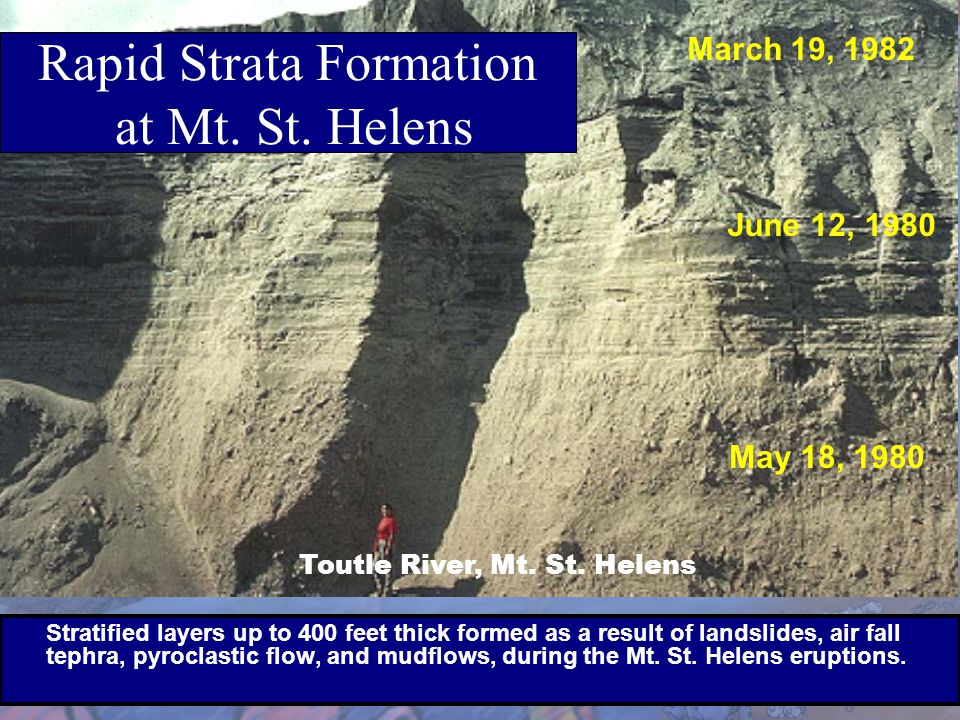
Visit the fossil museum:
www.flickr.com/photos/101536517@N06/sets/72157641367196613/
Just how good are peer reviews of scientific papers?
www.sciencemag.org/content/342/6154/60.full
www.examiner.com/article/want-to-publish-science-paper-ju...
The neo-Darwinian idea that the human genome consists entirely of an accumulation of billions of mutations is, quite obviously, completely bonkers. Nevertheless, it is compulsorily taught in schools and universities as 'science'.
This photo is a product of one of the many spontaneous mini shoots that Anna and I seem to do every weekend. We shot it in this overgrown field near our houses with no shoes and about 60 bug bites.
Model: Anna
Brainstorm Session with NCHD Sindh Mar6, 2015 at Karachi University
Brainstorming Session
1. Challenges for universal primary education in Pakistan.
2. Role of NCHD and PHDF to increase the literacy rate.
3. Success and Failure of Plan already implemented.
4. Reasoning for High Drop out of students.
5. Improvement of Infrastructure needed for improving literacy rate.
6. How to incorporate technology for basic education?
7. Capacity building and teachers training programs and etc.
Participants: Mr.Pervaiz Lodhie Member PHDF, Madam Humaira Hashmi Director Operations NCHD Sindh, Mr.Anees Ur Rehman Chairman Fund Raising Committee Rotery Club,Dr. Iqbal Muhammad Choudry Director HEJ Research Institute of Chemistry Karachi University.Mr.Abdul Wajid Shaikh DGM Karachi and Jamshoro, Mr.Daim Janwri DGM Thatta, Mr.Muneer Memon DGM Badin, Mr.Pir Niaz Jan DGM TM Khan, Dr Anwar Rajar DGM Matiari, Mr.Riaz Ahmed Aagro DGM Tando Allahyar, Mr.Sher Muhammad Mangrio ADGM Umer Kot,Mr.Abdul Fatah Moro DGM SBA&N.Feroz,Mr.Ayaz Shaikh DGM Larkana,Mr.Rizawan Memon ADGM Shikarpur, Mr.Javed Mangi ADGM Sukkur,Miss.Qamar u Nisa ADGM Ghotiki,Mr.Ali Madad Bozdar ADGM Jacab abad, Mr.Sajjad Ali Memon PCE, Mr.Hamza Lashari PCL,Miss.Zeesha Khuwaja Provincial Manager.
Madam Humaira Hashmi ( Director Operations NCHD Sindh ) provided detailed presentation about NCHD Programs i.e. UPE, Literacy, BBSYDP Projects and also about MALALA and OWN School initiatives. It also includes the detailed briefing of NCHD’s national and provincial achievements. The achievements and efforts were widely appreciated by the Participants.
Dr. Iqbal Muhammad Choudry Director HEJ Research Institute of Chemistry Karachi University highlighted the importance of education and appreciated the role of NCHD in bridging the gap between strategy formulation and strategy execution to enhance Literacy rate and Universal Primary Education (UPE) with a view to fulfilling Millennium Development Goals (MDGs). He further ensured his volunteer support in teachers’ training and development for the provision of intellectual volunteers for the training of teachers all across the board. He further said that socio-economic development of Brazil, South Korea and Malaysia is largely attributed to effective education systems. In addition to that he urged government to increase budget allocation for the education sector.
Anees Ur Rehman Chairman Fund Raising Committee Rotery Club explained the role of private sector for enhancement of education. He said that Rotery club is already working for improvements in education. He affirmed his support to NCHD and also ensured that they would also undertake filed visits in collaboration with NCHD aiming at enhancement of School initiatives.
Pervaiz Lodhie Member PHDF provided detailed information regarding background of PHDF its working style and the current role. He also explained the collaboration of PHDF with NCHD & Govt of Pakistan. He also conducted interactive session with the participants about the models of UPE and Literacy. He also discussed about the use of technology to improve the education and teacher’s training.
All DGMs shared the achievements of their respective districts in the UPE and Literacy and also provided feedback to further improve the execution of strategies at the district level.
Prevez Lodhi sb appreciated the work, efforts and achievement of NCHD and focused on proper showcasing of NCHD work to share with the national and international donor community to attract them to support education through NCHD. He suggested all DGMs of NCHD to share success story reports & documentaries of schools/ literacy centers on social groups.
He further shared that his meeting with Baligh ur Rehman (Minister for Professional Education and Technical Training) has been fixed in which he will discuss about NCHD.
Hover over each icon for descriptions and reasoning for home screen placement or you can read it here: tessahorehled.com/2011/whats-on-my-iphone-home-screen/
In the apparent chaos of the Esfahan Bazaar and its twisting, branching system of interconnected corridors occasionally you come across something that throws you, that seems to defy reasoning. Sometimes a locked in mosque in a blindingly bright sunlit opening, other times a mysterious brown tower visible through a few openings in the canopy above with seemingly no entrance, every so often on the path an exquisitely detailed fountain shielded from the sky by solid tall walls and a roof of small red bricks.
The people did things that I didn't understand, they seemingly obsessively pour water on the ground outside their stalls and at midday, even though they are indoors in the cool shade, they drape a small rug and sleep in their shops, wares left unattended. The labyrinth is deathly quiet for an hour and any attempt to blend in with the locals is lost in the very fact that you are still conscious (be aware of this, once i was invited for lunch in a man's home and found myself obliged to sleep on his living room floor afterwards!).
From a busy road in the bazaar there is a small passage that slopes down, duck down this passable street and find yourself in the beating heart of the bazaar, far from the pretty craftwork and walls lined with jewellery and clothes.
This is the bird market, patroned only by locals. It's like a western butchers but without the morals swept under the counter, you buy it, you kill it, you eat it.
Rapid strata formation in soft sand (field evidence).
Photo of strata formation in soft sand on a beach, created by tidal action of the sea.
Formed in a single, high tidal event. Stunning evidence which displays multiple strata/layers.
Why this is so important ....
It has long been assumed, ever since the 17th century, that layers/strata observed in sedimentary rocks were built up gradually, layer upon layer, over many years. It certainly seemed logical at the time, from just looking at rocks, that lower layers would always be older than the layers above them, i.e. that lower layers were always laid down first followed, in time, by successive layers on top.
This was assumed to be true and became known as the superposition principle.
It was also assumed that a layer comprising a different material from a previous layer, represented a change in environmental conditions/factors.
These changes in composition of layers or strata were considered to represent different, geological eras on a global scale, spanning millions of years. This formed the basis for the Geologic Column, which is used to date rocks and also fossils. The evolutionary, 'fossil record' was based on the vast ages and assumed geological eras of the Geologic Column.
There was also circular reasoning applied with the assumed age of 'index' fossils (based on evolutionary preconceptions) used to date strata in the Geologic Column.
We now know that, although these assumptions seemed logical, they are not supported by the evidence.
At the time, the mechanics of stratification were not properly known or studied.
An additional factor was that this assumed superposition and uniformitarian model became essential, with the wide acceptance of Darwinism, for the long ages required for progressive microbes-to-human evolution. There was no incentive to question or challenge the superposition, uniformitarian model, because the presumed, fossil 'record' had become dependant on it, and any change in the accepted model would present devastating implications for Darwinism.
This had the unfortunate effect of linking the study of geology so closely to Darwinism, that any study independent of Darwinian considerations was effectively stymied.
Some of the wealth of field evidence can be observed here: www.flickr.com/photos/101536517@N06/sets/72157635944904973/
and also in the links to stunning, experimental evidence, carried out by sedimentologists, given later.
Several catastrophic events, flash floods, volcanic eruptions etc. have forced Darwinian influenced geologists to admit to rapid stratification in some instances. However they claim it is a rare phenomenon, which they known about for many years, and which does nothing to invalidate the Geologic Column, the fossil record, evotuionary timescale, or any of the old assumptions regarding strata formation, sedimentation and the superposition principle. They fail to face up to the fact that rapid stratification is not an extraordinary phenonemon, but rather the prevailing and normal mechanism of sedimantary deposition whenever and wherever there is moving, sediment-laden water. The experimental evidence demonstrates the mechanism and a mass of field evidence in normal (non-catastrophic) conditions shows it is a normal everyday occurrence.
It is clear from the experimental evidence that the usual process of stratification is - that strata are not formed by horizontal layers being laid on top of each other in succession, as was assumed. But by sediment being sorted in the flowing water and laid down diagonally in the direction of flow.
_______________________________________________
GEOLOGIC PRINCIPLES (established by Nicholas Steno in the 17th Century):
What Nicolas Steno believed about strata formation is the basis of the principle of Superposition and the principle of Original Horizontality.
dictionary.sensagent.com/Law_of_superposition/en-en/
“Assuming that all rocks and minerals had once been fluid, Nicolas Steno reasoned that rock strata were formed when particles in a fluid such as water fell to the bottom. This process would leave horizontal layers. Thus Steno's principle of original horizontality states that rock layers form in the horizontal position, and any deviations from this horizontal position are due to the rocks being disturbed later.”)
BEDDING PLANES.
'Bedding plane' describes the surface in between each stratum which are formed during sediment deposition.
science.jrank.org/pages/6533/Strata.html
“Strata form during sediment deposition, that is, the laying down of sediment. Meanwhile, if a change in current speed or sediment grain size occurs or perhaps the sediment supply is cut off, a bedding plane forms. Bedding planes are surfaces that separate one stratum from another. Bedding planes can also form when the upper part of a sediment layer is eroded away before the next episode of deposition. Strata separated by a bedding plane may have different grain sizes, grain compositions, or colours. Sometimes these other traits are better indicators of stratification as bedding planes may be very subtle.”
______________________________________________
Several catastrophic events, flash floods, volcanic eruptions etc. have forced Darwinian, influenced geologists to admit to rapid stratification in some instances. However they claim it is a rare phenomenon, which they have known about for many years, and which does nothing to invalidate the Geologic Column, the fossil record, evotuionary timescale, or any of the old assumptions regarding strata formation, sedimentation and the superposition principle. They fail to face up to the fact that rapid stratification is not an extraordinary phenonemon, but rather the prevailing and normal mechanism of sedimentary deposition whenever and wherever there is moving, sediment-laden water. The experimental evidence demonstrates the mechanism and a mass of field evidence in normal (non-catastrophic) conditions shows it is a normal everyday occurrence.
It is clear from the experimental evidence that the usual process of stratification is - that strata are not formed by horizontal layers being laid on top of each other in succession, as was assumed. But by sediment being sorted in the flowing water and laid down diagonally in the direction of flow. See diagram:
www.flickr.com/photos/truth-in-science/39821536092/in/dat...
The field evidence (in the image) presented here - of rapid, simultaneous stratification refutes the Superposition Principle, the Principle of Original Horizontality and the Principle of Lateral Continuity.
We now know, the Superposition Principle only applies on a rare occasion of sedimentary deposits in perfectly, still water. Superposition is required for the long evolutionary timescale, but the evidence shows it is not the general rule, as was once believed. Most sediment is laid down in moving water, where particle segregation is the general rule, resulting in the simultaneous deposition of strata/layers as shown in the photo.
See many other examples of rapid stratification with geological features: www.flickr.com/photos/101536517@N06/sets/72157635944904973/
Rapid, simultaneous formation of layers/strata, through particle segregation in moving water, is so easily created it has even been described by sedimentologists (working on flume experiments) as a law ...
"Upon filling the tank with water and pouring in sediments, we immediately saw what was to become the rule: The sediments sorted themselves out in very clear layers. This became so common that by the end of two weeks, we jokingly referred to Andrew's law as "It's difficult not to make layers," and Clark's law as "It's easy to make layers." Later on, I proposed the "law" that liquefaction destroys layers, as much to my surprise as that was." Ian Juby, www.ianjuby.org/sedimentation/
The example in the photo is the result of normal, everyday tidal action in a single incident. Where the water current or movement is more turbulent, violent, or catastrophic, great depths (many metres) of stratified sediment can be laid down in a short time. Certainly not the many millions of years assumed by evolutionists.
The composition of strata formed in any deposition event. is related to whatever materials are in the sediment mix, not to any particular timescale. Whatever is in the mix will be automatically sorted into strata/layers. It could be sand, or other material added from mud slides, erosion of chalk deposits, coastal erosion, volcanic ash etc. Any organic material (potential fossils), alive or dead, engulfed by, or swept into, a turbulent sediment mix, will also be sorted and buried within the rapidly, forming layers.
See many other examples of rapid stratification with geological features: www.flickr.com/photos/101536517@N06/sets/72157635944904973/
Stratified, soft sand deposit. demonstrates the rapid, stratification principle.
Important, field evidence which supports the work of the eminent, sedimentologist Dr Guy Berthault MIAS - Member of the International Association of Sedimentologists.
(Dr Berthault's experiments (www.sedimentology.fr/)
And also the experimental work of Dr M.E. Clark (Professor Emeritus, U of Illinois @ Urbana), Andrew Rodenbeck and Dr. Henry Voss, (www.ianjuby.org/sedimentation/)
Location: Sandown beach, Isle of Wight. Formed 20/01/2018, This field evidence demonstrates that multiple strata in sedimentary deposits do not need millions of years to form and can be formed rapidly. This natural example confirms the principle demonstrated by the sedimentation experiments carried out by Dr Guy Berthault and other sedimentologists. It calls into question the standard, multi-million year dating of sedimentary rocks, and the dating of fossils by depth of burial or position in the strata.
Mulltiple strata/layers are evident in this example.
Dr Berthault's experiments (www.sedimentology.fr/) and other experiments (www.ianjuby.org/sedimentation/) and field studies of floods and volcanic action show that, rather than being formed by gradual, slow deposition of sucessive layers superimposed upon previous layers, with the strata or layers representing a particular timescale, particle segregation in moving water or airborne particles can form strata or layers very quickly, frequently, in a single event.
And, most importantly, lower strata are not older than upper strata, they are the same age, having been created in the same sedimentary episode.
Such field studies confirm experiments which have shown that there is no longer any reason to conclude that strata/layers in sedimentary rocks relate to different geological eras and/or a multi-million year timescale. www.youtube.com/watch?v=5PVnBaqqQw8&feature=share&.... they also show that the relative position of fossils in rocks is not indicative of an order of evolutionary succession. Obviously, the uniformitarian principle, on which the geologic column is based, can no longer be considered valid. And the multi-million, year dating of sedimentary rocks and fossils needs to be reassessed. Rapid deposition of stratified sediments also explains the enigma of polystrate fossils, i.e. large fossils that intersect several strata. In some cases, tree trunk fossils are found which intersect the strata of sedimentary rock up to forty feet in depth. upload.wikimedia.org/wikipedia/commons/thumb/0/08/Lycopsi... They must have been buried in stratified sediment in a short time (certainly not millions, thousands, or even hundreds of years), or they would have rotted away. youtu.be/vnzHU9VsliQ
In fact, the vast majority of fossils are found in good, intact condition, which is testament to their rapid burial. You don't get good fossils from gradual burial, because they would be damaged or destroyed by decay, predation or erosion. The existence of so many fossils in sedimentary rock on a global scale is stunning evidence for the rapid depostion of sedimentary rock as the general rule. It is obvious that all rock containing good intact fossils was formed from sediment laid down in a very short time, not millions, or even thousands of years.
See set of photos of other examples of rapid stratification: www.flickr.com/photos/101536517@N06/sets/72157635944904973/
Carbon dating of coal should not be possible if it is millions of years old, yet significant amounts of Carbon 14 have been detected in coal and other fossil material, which indicates that it is less than 50,000 years old. www.ldolphin.org/sewell/c14dating.html
www.grisda.org/origins/51006.htm
Evolutionists confidently cite multi-million year ages for rocks and fossils, but what most people don't realise is that no one actually knows the age of sedimentary rocks or the fossils found within them. So how are evolutionists so sure of the ages they so confidently quote? The astonishing thing is they aren't. Sedimentary rocks cannot be dated by radiometric methods*, and fossils can only be dated to less than 50,000 years with Carbon 14 dating. The method evolutionists use is based entirely on assumptions. Unbelievably, fossils are dated by the assumed age of rocks, and rocks are dated by the assumed age of fossils, that's right ... it is known as circular reasoning.
* Regarding the radiometric dating of igneous rocks, which is claimed to be relevant to the dating of sedimentary rocks, in an occasional instance there is an igneous intrusion associated with a sedimentary deposit -
Prof. Aubouin says in his Précis de Géologie: "Each radioactive element disintegrates in a characteristic and constant manner, which depends neither on the physical state (no variation with pressure or temperature or any other external constraint) nor on the chemical state (identical for an oxide or a phosphate)."
"Rocks form when magma crystallizes. Crystallisation depends on pressure and temperature, from which radioactivity is independent. So, there is no relationship between radioactivity and crystallisation.
Consequently, radioactivity doesn't date the formation of rocks. Moreover, daughter elements contained in rocks result mainly from radioactivity in magma where gravity separates the heavier parent element, from the lighter daughter element. Thus radiometric dating has no chronological signification." Dr. Guy Berthault www.sciencevsevolution.org/Berthault.htm
Visit the fossil museum:
www.flickr.com/photos/101536517@N06/sets/72157641367196613/
Just how good are peer reviews of scientific papers?
www.sciencemag.org/content/342/6154/60.full
www.examiner.com/article/want-to-publish-science-paper-ju...
The neo-Darwinian idea that the human genome consists entirely of an accumulation of billions of mutations is, quite obviously, completely bonkers. Nevertheless, it is compulsorily taught in schools and universities as 'science'.
Here I was literally paying attention to detail!! I wanted to really take a few shots of the flamingos' feathers!
And the reasoning for their gorgeous color?
"Flamingo feathers obtain their wonderful rosy pink color from pigments in the organisms they eat. The flamingos’ feathers, legs, and face are colored by their diet, which is rich in alpha and beta carotenoid pigments.
Carotenoids in crustaceans such as those in the flamingo diet are frequently linked to protein molecules, and may be blue or green. After being digested, the carotenoid pigments dissolve in fats and are deposited in the growing feathers, becoming orange or pink. The same effect is seen when shrimp change color during cooking. The amount of pigment laid down in the feathers depends on the quantity of pigment in the flamingo’s diet. An absence of carotenoids in its food will result in new feather growth that is very pale; the existing pigment is lost through molting."
We now know the song listing for Allison Crowe’s upcoming 16 Song music video series:
Disease
Why
Circular Reasoning
Creep
There Is
Doughnut Song
Running
Mona Lisas and Mad Hatters
Spiral
Sweet Dreams
Effortless
Josephine
Double-Edged Swords
Running for Home
Alive and Breathing
Throw Your Arms Around Me
This new music video series launches September 9, 2014 (a shift from the September 2 date originally announced).
A magical mystery tour of music with visuals from great artists and innovators of the 20th and 21st centuries - film-makers, animators, painters, photographers and more… - it’s a multi-media expression of the artist’s mission to make "Soulful. Alive. Joyous. Grievous. Real, true, music." ( allisoncrowe.com/bio.html )
This 16 song video album pairs Allison’s originals with some singular interpretations - underscoring an observation of Allan Showalter, aka DrHGuy, delightful chronicler “On Life, Love, Lust, & Leonard Cohen” – “Once you’ve heard one Allison Crowe song, You’ve heard one Allison Crowe song." ( 1heckofaguy.com/2009/01/27/wedding-song-allison-crowes-sm... )
It’s a season of cryptic crosswords and other, puzzling, fun. Here, now, are 16 visual clues – screenshots from each of the videos in the series. Some you may recognize, some you may not have seen before…
Imagine which goes with which song in the set-list – this September details will be revealed, and matches will be made.
Trying to get caught up from being away on business and recoving from the flu. Playing with the latest flickr toy from flagrantdisregard, Scout
1. Circular reasoning was his only gift., 2. Foster Kisses, 3. Hair Raising, 4. Golden Petals, 5. Stages, 6. The Natural Pattern, 7. Introvert, 8. March of the Baby Turtles, 9. Me, Myself, and Eye, 10. Constructive Interference, 11. Blizzard, 12. Bursting Through, 13. Weaving Through Life, 14. Waiting For Handouts, 15. Devil's Tower / Bears Lodge, 16. Glimpse of Prairie Life, 17. Visitors of the Prayerful Sort, 18. Tulip Fire, 19. Faux Ripple, 20. Softly Folded, 21. Taco Energy, 22. Chicago Skyline, 23. Against Corporate Policy, 24. Green with purple dot, 25. Bake at 325..., 26. Solar System, 27. Thirsty Moth, 28. Sycamore Leaf, 29. Melts In Your Mouth, 30. Cumulus Blue, 31. New Beginning, 32. Loving the Rain
Rapid strata formation in soft sand (field evidence).
Photo of strata formation in soft sand on a beach, created by tidal action of the sea.
Formed in a single, high tidal event. Stunning evidence which displays multiple strata/layers.
Why this is so important ....
It has long been assumed, ever since the 17th century, that layers/strata observed in sedimentary rocks were built up gradually, layer upon layer, over many years. It certainly seemed logical at the time, from just looking at rocks, that lower layers would always be older than the layers above them, i.e. that lower layers were always laid down first followed, in time, by successive layers on top.
This was assumed to be true and became known as the superposition principle.
It was also assumed that a layer comprising a different material from a previous layer, represented a change in environmental conditions/factors.
These changes in composition of layers or strata were considered to represent different, geological eras on a global scale, spanning millions of years. This formed the basis for the Geologic Column, which is used to date rocks and also fossils. The evolutionary, 'fossil record' was based on the vast ages and assumed geological eras of the Geologic Column.
There was also circular reasoning applied with the assumed age of 'index' fossils (based on evolutionary beliefs & preconceptions) used to date strata in the Geologic Column. Dating strata from the assumed age of (index) fossils is known as Biostratigraphy.
We now know that, although these assumptions seemed logical, they are not supported by the evidence.
At the time, the mechanics of stratification were not properly known or studied.
An additional factor was that this assumed superposition and uniformitarian model became essential, with the wide acceptance of Darwinism, for the long ages required for progressive microbes-to-human evolution. There was no incentive to question or challenge the superposition, uniformitarian model, because the presumed, fossil 'record' had become dependant on it, and any change in the accepted model would present devastating implications for Darwinism.
This had the unfortunate effect of linking the study of geology so closely to Darwinism, that any study independent of Darwinian considerations was effectively stymied. This link of geology with Darwinian preconceptions is known as biostratigraphy.
Some other field evidence, in various situations, can be observed here: www.flickr.com/photos/101536517@N06/sets/72157635944904973/
and also in the links to stunning, experimental evidence, carried out by sedimentologists, given later.
_______________________________________________
GEOLOGIC PRINCIPLES (established by Nicholas Steno in the 17th Century):
What Nicolas Steno believed about strata formation is the basis of the principle of Superposition and the principle of Original Horizontality.
dictionary.sensagent.com/Law_of_superposition/en-en/
“Assuming that all rocks and minerals had once been fluid, Nicolas Steno reasoned that rock strata were formed when particles in a fluid such as water fell to the bottom. This process would leave horizontal layers. Thus Steno's principle of original horizontality states that rock layers form in the horizontal position, and any deviations from this horizontal position are due to the rocks being disturbed later.”)
BEDDING PLANES.
'Bedding plane' describes the surface in between each stratum which are formed during sediment deposition.
science.jrank.org/pages/6533/Strata.html
“Strata form during sediment deposition, that is, the laying down of sediment. Meanwhile, if a change in current speed or sediment grain size occurs or perhaps the sediment supply is cut off, a bedding plane forms. Bedding planes are surfaces that separate one stratum from another. Bedding planes can also form when the upper part of a sediment layer is eroded away before the next episode of deposition. Strata separated by a bedding plane may have different grain sizes, grain compositions, or colours. Sometimes these other traits are better indicators of stratification as bedding planes may be very subtle.”
______________________________________________
Several catastrophic events, flash floods, volcanic eruptions etc. have forced Darwinian, influenced geologists to admit to rapid stratification in some instances. However they claim it is a rare phenomenon, which they have known about for many years, and which does nothing to invalidate the Geologic Column, the fossil record, evolutionary timescale, or any of the old assumptions regarding strata formation, sedimentation and the superposition principle. They fail to face up to the fact that rapid stratification is not an extraordinary phenonemon, but rather the prevailing and normal mechanism of sedimentary deposition whenever and wherever there is moving, sediment-laden water. The experimental evidence demonstrates the mechanism and a mass of field evidence in normal (non-catastrophic) conditions shows it is a normal everyday occurrence.
It is clear from the experimental evidence that the usual process of stratification is - that strata are not formed by horizontal layers being laid on top of each other in succession, as was assumed. But by sediment being sorted in the flowing water and laid down diagonally in the direction of flow. See diagram:
www.flickr.com/photos/truth-in-science/39821536092/in/dat...
The field evidence (in the image) presented here - of rapid, simultaneous stratification refutes the Superposition Principle and the Principle of Lateral Continuity.
We now know, the Superposition Principle only applies on a rare occasion where sedimentary deposits are laid down in still water.
Superposition is required for the long evolutionary timescale, but the evidence shows it is not the general rule, as was once believed. Most sediment is laid down in moving water, where particle segregation is the general rule, resulting in the simultaneous deposition of strata/layers as shown in the photo.
See many other examples of rapid stratification (with geological features): www.flickr.com/photos/101536517@N06/sets/72157635944904973/
Rapid, simultaneous formation of layers/strata, through particle segregation in moving water, is so easily created it has even been described by sedimentologists (working on flume experiments) as a law ...
"Upon filling the tank with water and pouring in sediments, we immediately saw what was to become the rule: The sediments sorted themselves out in very clear layers. This became so common that by the end of two weeks, we jokingly referred to Andrew's law as "It's difficult not to make layers," and Clark's law as "It's easy to make layers." Later on, I proposed the "law" that liquefaction destroys layers, as much to my surprise as that was." Ian Juby, www.ianjuby.org/sedimentation/
The field example in the photo is the result of normal, everyday tidal action formed in a single incident,
Where the water current or movement is more turbulent, violent, or catastrophic, great depths (many metres) of stratified sediment can be laid down in a short time. Certainly not the many millions of years assumed by evolutionists.
The composition of strata formed in any deposition event. is related to whatever materials are in the sediment mix, not to any particular timescale. Whatever is in the mix will be automatically sorted into strata/layers. It could be sand, or other material added from mud slides, erosion of chalk deposits, coastal erosion, volcanic ash etc. Any organic material (potential fossils), alive or dead, engulfed by, or swept into, a turbulent sediment mix, will also be sorted and buried within the rapidly, forming layers.
See many other examples of rapid stratification with geological features: www.flickr.com/photos/101536517@N06/sets/72157635944904973/
Stratified, soft sand deposit. demonstrates the rapid, stratification principle.
Important, field evidence which supports the work of the eminent, sedimentologist Dr Guy Berthault MIAS - Member of the International Association of Sedimentologists.
(Dr Berthault's experiments (www.sedimentology.fr/)
And also the experimental work of Dr M.E. Clark (Professor Emeritus, U of Illinois @ Urbana), Andrew Rodenbeck and Dr. Henry Voss, (www.ianjuby.org/sedimentation/)
Location: Yaverland, Isle of Wight. photographed 25/04/2018, formed several months earlier and in the early stages of consolidation.
This field evidence demonstrates that multiple strata in sedimentary deposits do not need millions of years to form and can be formed rapidly. This natural example confirms the principle demonstrated by the sedimentation experiments carried out by Dr Guy Berthault and other sedimentologists. It calls into question the standard, multi-million year dating of sedimentary rocks, and the dating of fossils by depth of burial or position in the strata.
Mulltiple strata/layers are evident in this example.
Dr Berthault's experiments (www.sedimentology.fr/) and other experiments (www.ianjuby.org/sedimentation/) and field studies of floods and volcanic action show that, rather than being formed by gradual, slow deposition of sucessive layers superimposed upon previous layers, with the strata or layers representing a particular timescale, particle segregation in moving water or airborne particles can form strata or layers very quickly, frequently, in a single event.
And, most importantly, lower strata are not older than upper strata, they are the same age, having been created in the same sedimentary episode.
Such field studies confirm experiments which have shown that there is no longer any reason to conclude that strata/layers in sedimentary rocks relate to different geological eras and/or a multi-million year timescale. www.youtube.com/watch?v=5PVnBaqqQw8&feature=share&.... they also show that the relative position of fossils in rocks is not indicative of an order of evolutionary succession. Obviously, the uniformitarian principle, on which the geologic column is based, can no longer be considered valid. And the multi-million, year dating of sedimentary rocks and fossils needs to be reassessed. Rapid deposition of stratified sediments also explains the enigma of polystrate fossils, i.e. large fossils that intersect several strata. In some cases, tree trunk fossils are found which intersect the strata of sedimentary rock up to forty feet in depth. upload.wikimedia.org/wikipedia/commons/thumb/0/08/Lycopsi... They must have been buried in stratified sediment in a short time (certainly not millions, thousands, or even hundreds of years), or they would have rotted away. youtu.be/vnzHU9VsliQ
In fact, the vast majority of fossils are found in good, intact condition, which is testament to their rapid burial. You don't get good fossils from gradual burial, because they would be damaged or destroyed by decay, predation or erosion. The existence of so many fossils in sedimentary rock on a global scale is stunning evidence for the rapid depostion of sedimentary rock as the general rule. It is obvious that all rock containing good intact fossils was formed from sediment laid down in a very short time, not millions, or even thousands of years.
See set of photos of other examples of rapid stratification: www.flickr.com/photos/101536517@N06/sets/72157635944904973/
Carbon dating of coal should not be possible if it is millions of years old, yet significant amounts of Carbon 14 have been detected in coal and other fossil material, which indicates that it is less than 50,000 years old. www.ldolphin.org/sewell/c14dating.html
www.grisda.org/origins/51006.htm
Evolutionists confidently cite multi-million year ages for rocks and fossils, but what most people don't realise is that no one actually knows the age of sedimentary rocks or the fossils found within them. So how are evolutionists so sure of the ages they so confidently quote? The astonishing thing is they aren't. Sedimentary rocks cannot be dated by radiometric methods*, and fossils can only be dated to less than 50,000 years with Carbon 14 dating. The method evolutionists use is based entirely on assumptions. Unbelievably, fossils are dated by the assumed age of rocks, and rocks are dated by the assumed age of fossils, that's right ... it is known as circular reasoning.
* Regarding the radiometric dating of igneous rocks, which is claimed to be relevant to the dating of sedimentary rocks, in an occasional instance there is an igneous intrusion associated with a sedimentary deposit -
Prof. Aubouin says in his Précis de Géologie: "Each radioactive element disintegrates in a characteristic and constant manner, which depends neither on the physical state (no variation with pressure or temperature or any other external constraint) nor on the chemical state (identical for an oxide or a phosphate)."
"Rocks form when magma crystallizes. Crystallisation depends on pressure and temperature, from which radioactivity is independent. So, there is no relationship between radioactivity and crystallisation.
Consequently, radioactivity doesn't date the formation of rocks. Moreover, daughter elements contained in rocks result mainly from radioactivity in magma where gravity separates the heavier parent element, from the lighter daughter element. Thus radiometric dating has no chronological signification." Dr. Guy Berthault www.sciencevsevolution.org/Berthault.htm
"A team of Russian sedimentologists directed by Alexander Lalomov (Russian Academy of Sciences’ Institute of Ore Deposits) applied paleohydraulic analyses to geological formations in Russia. One example is the publication of a report in 2007 by the Lithology and Mineral Resources journal of the Russian Academy of Sciences. It concerns the Crimean Peninsular. It shows that the time of sedimentation of the sequence studied corresponds to a virtually instantaneous episode whilst according to stratigraphy it took several millions of years. Moreover, a recent report concerning the North-West Russian plateau in the St. Petersburg region shows that the time of sedimentation was much shorter than that attributed to it by the stratigraphic time-scale: 0.05% of the time."
www.sciencevsevolution.org/Berthault.htm
Rapid strata formation and rapid erosion at Mount St Helens.
slideplayer.com/slide/5703217/18/images/28/Rapid+Strata+F...
Visit the fossil museum:
www.flickr.com/photos/101536517@N06/sets/72157641367196613/
Just how good are peer reviews of scientific papers?
www.sciencemag.org/content/342/6154/60.full
www.examiner.com/article/want-to-publish-science-paper-ju...
The neo-Darwinian idea that the human genome consists entirely of an accumulation of billions of mutations is, quite obviously, completely bonkers. Nevertheless, it is compulsorily taught in schools and universities as 'science'.
bit.ly/yUpIkVA major in a liberal arts field like philosophy helps you learn the basic elements of critical thinking, argumentation, communication, information management, design and planning, research and investigation, and management and administration. These fundamental skills provide a wide range of reasoning, researching, planning, and communication tools that a graduate with a philosophy degree can use to communicate, problem-solve, and argue effectively no matter what field they choose to enter after graduation. Moreover, it is important to remember that all of these skills are readily transferable, which means that they are not specific to any particular job and can be used in many different positions throughout your professional career. And these skills give you the tools you need to be a life-long learner in both your professional and personal lives, which is an adaptive approach that is extremely valuable in today's rapidly changing world. In fact, in today's fast-paced workplace, no matter how many academic courses you have taken, you will certainly find that you will always have to be learning new things and acquiring new skills as the kinds of tasks you have to complete and the challenges you face change over the course of your career. The training you receive as part of your undergraduate training in philosophy provides valuable preparation for the almost constant need to learn more and to acquire new skills, or to apply old skills to novel problems and tasks. In short, a liberal arts degree like philosophy degree is extremely valuable because it not only provides you with quite generally applicable intellectual skills, but also develops your ability to quickly and efficiently learn the particular skills you will need to know for your first job, and then for whatever subsequent jobs or careers you may pursue. This flexibility means that graduates with a bachelor's degree in philosophy can choose from a range of career options, including administrative and management positions for colleges, prisons, hospitals, government agencies (county, state or federal), and private companies in fields like personnel, financial aid, insurance, or public relations. Other popular options for philosophy graduates include business careers in management, sales, consulting, public relations, fund raising, systems analysis, advertising, and banking. And government positions working for a congressional staff member, federal agencies and bureaus, state and local governments, the United Nations, foreign service agencies, and cultural affairs organizations are other possibilities. Philosophy majors with a talent for writing may find themselves drawn to journalism as a reporter or critic, or may opt to work in the publishing industry in sales, editing, management, freelance writing, technical writing for a company or government, or a script writer. And for those who want further study, a philosophy major also provides excellent undergraduate preparation not only for advanced study in philosophy, but also for pursuing careers in education, literature, rhetoric, history, law school, seminary training, MBA programs, and medical school. For example, many of the skills needed to be successful in law school, such as the ability to read difficult and closely argued written material quickly and to extract the main line of argument, and to analyze and to give arguments, are skills which are very important in the study of philosophy as well. And medical school students need to be able to critically evaluate a patient's medical history, analyze symptoms and complaints, and use reasoning to reach an appropriate diagnosis and treatment. So while a philosophy degree may at first not seem as if it is as easily marketable as a math or engineering degree, pursuing the study of philosophy will give you a range of skills that will make you a valuable employee and be useful not just in one or another specific job or enterprise, but in almost any career that your interests may lead you to.
Rapid strata formation in soft sand (field evidence).
Photo of strata formation in soft sand on a beach, created by tidal action of the sea.
Formed in a single, high tidal event. Stunning evidence which displays multiple strata/layers.
Why this is so important ....
It has long been assumed, ever since the 17th century, that layers/strata observed in sedimentary rocks were built up gradually, layer upon layer, over many years. It certainly seemed logical at the time, from just looking at rocks, that lower layers would always be older than the layers above them, i.e. that lower layers were always laid down first followed, in time, by successive layers on top.
This was assumed to be true and became known as the superposition principle.
It was also assumed that a layer comprising a different material from a previous layer, represented a change in environmental conditions/factors.
These changes in composition of layers or strata were considered to represent different, geological eras on a global scale, spanning millions of years. This formed the basis for the Geologic Column, which is used to date rocks and also fossils. The evolutionary, 'fossil record' was based on the vast ages and assumed geological eras of the Geologic Column.
There was also circular reasoning applied with the assumed age of 'index' fossils (based on evolutionary beliefs & preconceptions) used to date strata in the Geologic Column. Dating strata from the assumed age of (index) fossils is known as Biostratigraphy.
We now know that, although these assumptions seemed logical, they are not supported by the evidence.
At the time, the mechanics of stratification were not properly known or studied.
An additional factor was that this assumed superposition and uniformitarian model became essential, with the wide acceptance of Darwinism, for the long ages required for progressive microbes-to-human evolution. There was no incentive to question or challenge the superposition, uniformitarian model, because the presumed, fossil 'record' had become dependant on it, and any change in the accepted model would present devastating implications for Darwinism.
This had the unfortunate effect of linking the study of geology so closely to Darwinism, that any study independent of Darwinian considerations was effectively stymied. This link of geology with Darwinian preconceptions is known as biostratigraphy.
Some other field evidence, in various situations, can be observed here: www.flickr.com/photos/101536517@N06/sets/72157635944904973/
and also in the links to stunning, experimental evidence, carried out by sedimentologists, given later.
_______________________________________________
GEOLOGIC PRINCIPLES (established by Nicholas Steno in the 17th Century):
What Nicolas Steno believed about strata formation is the basis of the principle of Superposition and the principle of Original Horizontality.
dictionary.sensagent.com/Law_of_superposition/en-en/
“Assuming that all rocks and minerals had once been fluid, Nicolas Steno reasoned that rock strata were formed when particles in a fluid such as water fell to the bottom. This process would leave horizontal layers. Thus Steno's principle of original horizontality states that rock layers form in the horizontal position, and any deviations from this horizontal position are due to the rocks being disturbed later.”)
BEDDING PLANES.
'Bedding plane' describes the surface in between each stratum which are formed during sediment deposition.
science.jrank.org/pages/6533/Strata.html
“Strata form during sediment deposition, that is, the laying down of sediment. Meanwhile, if a change in current speed or sediment grain size occurs or perhaps the sediment supply is cut off, a bedding plane forms. Bedding planes are surfaces that separate one stratum from another. Bedding planes can also form when the upper part of a sediment layer is eroded away before the next episode of deposition. Strata separated by a bedding plane may have different grain sizes, grain compositions, or colours. Sometimes these other traits are better indicators of stratification as bedding planes may be very subtle.”
______________________________________________
Several catastrophic events, flash floods, volcanic eruptions etc. have forced Darwinian, influenced geologists to admit to rapid stratification in some instances. However they claim it is a rare phenomenon, which they have known about for many years, and which does nothing to invalidate the Geologic Column, the fossil record, evolutionary timescale, or any of the old assumptions regarding strata formation, sedimentation and the superposition principle. They fail to face up to the fact that rapid stratification is not an extraordinary phenonemon, but rather the prevailing and normal mechanism of sedimentary deposition whenever and wherever there is moving, sediment-laden water. The experimental evidence demonstrates the mechanism and a mass of field evidence in normal (non-catastrophic) conditions shows it is a normal everyday occurrence.
It is clear from the experimental evidence that the usual process of stratification is - that strata are not formed by horizontal layers being laid on top of each other in succession, as was assumed. But by sediment being sorted in the flowing water and laid down diagonally in the direction of flow. See diagram:
www.flickr.com/photos/truth-in-science/39821536092/in/dat...
The field evidence (in the image) presented here - of rapid, simultaneous stratification refutes the Superposition Principle and the Principle of Lateral Continuity.
We now know, the Superposition Principle only applies on a rare occasion where sedimentary deposits are laid down in still water.
Superposition is required for the long evolutionary timescale, but the evidence shows it is not the general rule, as was once believed. Most sediment is laid down in moving water, where particle segregation is the general rule, resulting in the simultaneous deposition of strata/layers as shown in the photo.
See many other examples of rapid stratification (with geological features): www.flickr.com/photos/101536517@N06/sets/72157635944904973/
Rapid, simultaneous formation of layers/strata, through particle segregation in moving water, is so easily created it has even been described by sedimentologists (working on flume experiments) as a law ...
"Upon filling the tank with water and pouring in sediments, we immediately saw what was to become the rule: The sediments sorted themselves out in very clear layers. This became so common that by the end of two weeks, we jokingly referred to Andrew's law as "It's difficult not to make layers," and Clark's law as "It's easy to make layers." Later on, I proposed the "law" that liquefaction destroys layers, as much to my surprise as that was." Ian Juby, www.ianjuby.org/sedimentation/
The example in the photo is the result of normal, everyday tidal action in a single incident. Where the water current or movement is more turbulent, violent, or catastrophic, great depths (many metres) of stratified sediment can be laid down in a short time. Certainly not the many millions of years assumed by evolutionists.
The composition of strata formed in any deposition event. is related to whatever materials are in the sediment mix, not to any particular timescale. Whatever is in the mix will be automatically sorted into strata/layers. It could be sand, or other material added from mud slides, erosion of chalk deposits, coastal erosion, volcanic ash etc. Any organic material (potential fossils), alive or dead, engulfed by, or swept into, a turbulent sediment mix, will also be sorted and buried within the rapidly, forming layers.
See many other examples of rapid stratification with geological features: www.flickr.com/photos/101536517@N06/sets/72157635944904973/
Stratified, soft sand deposit. demonstrates the rapid, stratification principle.
Important, field evidence which supports the work of the eminent, sedimentologist Dr Guy Berthault MIAS - Member of the International Association of Sedimentologists.
(Dr Berthault's experiments (www.sedimentology.fr/)
And also the experimental work of Dr M.E. Clark (Professor Emeritus, U of Illinois @ Urbana), Andrew Rodenbeck and Dr. Henry Voss, (www.ianjuby.org/sedimentation/)
Location: Sandown, Isle of Wight. Formed 26/04/2018 This field evidence demonstrates that multiple strata in sedimentary deposits do not need millions of years to form and can be formed rapidly. This natural example confirms the principle demonstrated by the sedimentation experiments carried out by Dr Guy Berthault and other sedimentologists. It calls into question the standard, multi-million year dating of sedimentary rocks, and the dating of fossils by depth of burial or position in the strata.
Mulltiple strata/layers are evident in this example.
Dr Berthault's experiments (www.sedimentology.fr/) and other experiments (www.ianjuby.org/sedimentation/) and field studies of floods and volcanic action show that, rather than being formed by gradual, slow deposition of sucessive layers superimposed upon previous layers, with the strata or layers representing a particular timescale, particle segregation in moving water or airborne particles can form strata or layers very quickly, frequently, in a single event.
And, most importantly, lower strata are not older than upper strata, they are the same age, having been created in the same sedimentary episode.
Such field studies confirm experiments which have shown that there is no longer any reason to conclude that strata/layers in sedimentary rocks relate to different geological eras and/or a multi-million year timescale. www.youtube.com/watch?v=5PVnBaqqQw8&feature=share&.... they also show that the relative position of fossils in rocks is not indicative of an order of evolutionary succession. Obviously, the uniformitarian principle, on which the geologic column is based, can no longer be considered valid. And the multi-million, year dating of sedimentary rocks and fossils needs to be reassessed. Rapid deposition of stratified sediments also explains the enigma of polystrate fossils, i.e. large fossils that intersect several strata. In some cases, tree trunk fossils are found which intersect the strata of sedimentary rock up to forty feet in depth. upload.wikimedia.org/wikipedia/commons/thumb/0/08/Lycopsi... They must have been buried in stratified sediment in a short time (certainly not millions, thousands, or even hundreds of years), or they would have rotted away. youtu.be/vnzHU9VsliQ
In fact, the vast majority of fossils are found in good, intact condition, which is testament to their rapid burial. You don't get good fossils from gradual burial, because they would be damaged or destroyed by decay, predation or erosion. The existence of so many fossils in sedimentary rock on a global scale is stunning evidence for the rapid depostion of sedimentary rock as the general rule. It is obvious that all rock containing good intact fossils was formed from sediment laid down in a very short time, not millions, or even thousands of years.
See set of photos of other examples of rapid stratification: www.flickr.com/photos/101536517@N06/sets/72157635944904973/
Carbon dating of coal should not be possible if it is millions of years old, yet significant amounts of Carbon 14 have been detected in coal and other fossil material, which indicates that it is less than 50,000 years old. www.ldolphin.org/sewell/c14dating.html
www.grisda.org/origins/51006.htm
Evolutionists confidently cite multi-million year ages for rocks and fossils, but what most people don't realise is that no one actually knows the age of sedimentary rocks or the fossils found within them. So how are evolutionists so sure of the ages they so confidently quote? The astonishing thing is they aren't. Sedimentary rocks cannot be dated by radiometric methods*, and fossils can only be dated to less than 50,000 years with Carbon 14 dating. The method evolutionists use is based entirely on assumptions. Unbelievably, fossils are dated by the assumed age of rocks, and rocks are dated by the assumed age of fossils, that's right ... it is known as circular reasoning.
* Regarding the radiometric dating of igneous rocks, which is claimed to be relevant to the dating of sedimentary rocks, in an occasional instance there is an igneous intrusion associated with a sedimentary deposit -
Prof. Aubouin says in his Précis de Géologie: "Each radioactive element disintegrates in a characteristic and constant manner, which depends neither on the physical state (no variation with pressure or temperature or any other external constraint) nor on the chemical state (identical for an oxide or a phosphate)."
"Rocks form when magma crystallizes. Crystallisation depends on pressure and temperature, from which radioactivity is independent. So, there is no relationship between radioactivity and crystallisation.
Consequently, radioactivity doesn't date the formation of rocks. Moreover, daughter elements contained in rocks result mainly from radioactivity in magma where gravity separates the heavier parent element, from the lighter daughter element. Thus radiometric dating has no chronological signification." Dr. Guy Berthault www.sciencevsevolution.org/Berthault.htm
Visit the fossil museum:
www.flickr.com/photos/101536517@N06/sets/72157641367196613/
Just how good are peer reviews of scientific papers?
www.sciencemag.org/content/342/6154/60.full
www.examiner.com/article/want-to-publish-science-paper-ju...
The neo-Darwinian idea that the human genome consists entirely of an accumulation of billions of mutations is, quite obviously, completely bonkers. Nevertheless, it is compulsorily taught in schools and universities as 'science'.
Army in Korea celebrates newest citizens
“You have moved to several posts waiting for your application [citizenship] to catch up with you—today it caught up.”
— Kenneth J. Sherman, Citizenship and Immigration Services Field Office Director, U.S. Embassy, Seoul
The Army Family in Korea welcomed 43 new American citizens to its ranks during a naturalization ceremony held at United States Army Garrison Yongsan, Seoul, Republic of Korea, Dec. 15. Thirty-seven active-duty Servicemembers and six spouses of active-duty military members were naturalized as American citizens during the ceremony.
Although this was the first time the newly-naturalized citizens swore the Oath of Allegiance, many of the Servicemembers present had already demonstrated their patriotism while serving in Iraq and Afghanistan before becoming U.S. citizens. Staff Sgt. Francis Manalac, originally from the Philippines, said he started the naturalization process while serving in Iraq. “This is a very special ceremony,” he said. “Today is the culmination of a four-year process.” Staff Sgt. Manalac now calls Chicago home.
“All are being naturalized because of their service,” said Kenneth J. Sherman, Citizen and Immigration Services Field Office Director, U.S. Embassy, Seoul. “They are from 20 countries, on five continents with one thing in common—their service and sacrifice. There are people in this audience who have served in Iraq and Afghanistan—willing to give the ultimate sacrifice.”
Sherman also noted that it is not only the Soldiers and Sailors who sacrifice and endure, but military families as well. That is the reasoning behind a new program allowing spouses of active-duty military members to become naturalized while living overseas, he said. On Jan. 28, 2008, President George W. Bush signed a bill, which was passed by Congress, permitting spouses stationed with their sponsor overseas to pursue naturalization.
The candidates hailed from United Kingdom, India, Jamaica, Russia, Ghana and many other nations from throughout the world. “This is not just a list of countries,” Sherman explained. “It’s the history and the future of the United States. The U.S. is built on immigration--it strengthens every aspect America, from our economy to our culture, to expanding our freedoms.”
“All my life all I’ve known is America,” said Private 1st Class Phinnara Pai, 2nd Infantry Division. “Why not become an American citizen?” Pai said he was once a child refugee from Cambodia.
“Many here today appreciate America, our freedoms, our Constitution, in a way people born there perhaps do not,” said Sherman. Private 2nd Class Tanya Erica Gorham, originally from Barbados, expressed similar sentiments about taking the “rough path” to American citizenship. “I’m glad I can go about achieving it this way to appreciate it more,” she said. “I want to instill in my son that it is a privilege to be born in a country so free.”
To learn more about living and serving with the US Army in Korea visit us online at imcom.korea.army.mil
The reasoning behind this shot: to show you how awesome my outfit is today. I wish I could wear these shoes outdoors, but since we're under about 2 feet of snow (maybe more) I cannot, and that saddens me. You can't tell I'm sad in this picture though, cause I'm just too excited about my amazing shirt (which was given to me by one of my best friends in the world. He bought it years ago, and I've always loved it. It doesn't fit him now, so it's MINE! YAY! It's a vintage GWG cowboy shirt. It's frail and has many rips, but I love it anyways)
Song of the day: Clair de lune from Debussy's Suite Bergamasque
Rainbow Extravaganza
www.boloji.com/ramblings/044.htm
Shernaz Wadia
A new-age mantra counsels that the pain of discipline is easier to bear than the pain of regret. Sound advice, as most would agree. To be able to write something worthwhile one needs more than an extraordinary vocabulary and command over a language; one requires to be extremely well read, substantially informed, with incisive thought, reasoning, observation, discernment, understanding, a sense of dewy-eyed wonder and acceptance. It is a disciplined workout that constantly exercises the gray cells and ‘makes’ some writers, while others like me struggle on, one sporadic article after another, hoping someone, somewhere, reading it will have found it worth his intelligence and time.
Paradoxically, words and language are very restrictive. Each time I want to articulate a deep thought, transmit a feeling or describe something that has moved me unabashedly, words become impotent. Vocabulary dries up, phrases and sentences, figures of speech – all evaporate and I am left, well, expressionless – mutely pregnant, the poignancy of an unwanted abortion looming menacingly over my wanting-to-be-birthed experiences.
Shackled by the throttling confines of idiom and expression, I still want to share an indelible experience of rainbows. Yes rainbows. A rather common occurrence during the monsoons, but these particular ones left us speechlessly ecstatic. The rainy season had set in earlier than usual this year in Munnar. The rain came with a chilling wind driving it in white sheets. Sometimes a thick, visually impenetrable shroud of mist encompassed the surroundings, with temperatures falling low. One fine afternoon when the rain decided to call it a day and the sun shone through the clouds, a spectacular rainbow embraced the sweep of the eastern sky with its enchanting, pastel-hued arm. The next day the rain gods again wanted some rest. We were strolling in the garden enjoying a soft drizzle, taking in the sparkle of raindrops on the washed and gleaming leaves, petals and blades of grass. The garden and the verdant environs were lusciously enrapturing. Intermittent clouds and sunshine created a bewitching aura all around. Impulsively I looked up at the sky. A phenomenon I had not seen before filled my wondrous gaze. A brilliant rainbow ring formed right around the partially hidden sun! Riveting, amazingly grand! Unbelievably ravishing!
It was a veritable banquet of fantastic rainbows in two days but none of us had envisaged what we saw on the fourth day. It was unbeatable, indescribable in its extravaganza!
It was a very wet, gray day as we lazed in the bungalow on the Chokanad Tea Estate. Green, tea-planted hills gently sprawled in front and to the right of the bungalow; high, forested hills formed a charming backdrop to these emerald ones. To the left and stretching to the back, tall hills were carpeted with thick undergrowth of shrub and their towering silver oaks swayed precariously in a stormy wake. A blanket of dark rain-clouds covered the mountains to the right towards the southwest. Rain poured incessantly and like a magic wand transformed the not so distant mountains and trees into hazy indistinct shapes. After a good lunch, there wasn’t much to do except take a nap and wait for the weather to clear up.
Suddenly through the gloom the sun decided to show up. I heard an enthralled scream “Rainbow! Come quickly, its beautiful!” Flinging away blankets, throwing aside whatever each one was doing, we dashed out.
And, we stood transfixed, suspended in a momentous timeframe, dumbstruck by the grandeur of the fabulous pageant unfolding before us! Painter and painting fused in a florid dance of colors across the vista of hills. A magnificent rainbow rose from the low hills, arched up into the higher ones and traversing the expanse fell again into the low hills of the plantation. Resplendent, it bathed all it spanned in its flamboyance, producing a stupendous panorama at eye-level! As it splashed and curved dazzlingly across the hills each hill was suffused with the rich, lustrous hue/hues of the gorgeous seven, creating a feast never before visualized by any of us five glued to that exquisite manifestation of nature! The sheer magnanimity and its unparalleled loveliness compelled us to look for the mythical pot of gold at either end.
We reveled in this mesmerizing marvel for minutes before it softly dimmed, reappeared in its entire mind blowing radiance and then finally faded, but not from our memories. Imprinted though it is like a photograph on the canvas of my mind, words fail to do justice to the sublimity and majesty of those awe-struck moments. In the words of a contemporary of Mirza Ghalib:
Mere alfaaz mere dushman hain
Meri zubaan meri hareef hain
“My words are my enemies
My language is my rival”
Rapid strata formation in soft sand (field evidence).
Photo of strata formation in soft sand on a beach, created by tidal action of the sea.
Formed in a single, high tidal event. Stunning evidence which displays multiple strata/layers.
Why this is so important ....
It has long been assumed, ever since the 17th century, that layers/strata observed in sedimentary rocks were built up gradually, layer upon layer, over many years. It certainly seemed logical at the time, from just looking at rocks, that lower layers would always be older than the layers above them, i.e. that lower layers were always laid down first followed, in time, by successive layers on top.
This was assumed to be true and became known as the superposition principle.
It was also assumed that a layer comprising a different material from a previous layer, represented a change in environmental conditions/factors.
These changes in composition of layers or strata were considered to represent different, geological eras on a global scale, spanning millions of years. This formed the basis for the Geologic Column, which is used to date rocks and also fossils. The evolutionary, 'fossil record' was based on the vast ages and assumed geological eras of the Geologic Column.
There was also circular reasoning applied with the assumed age of 'index' fossils (based on evolutionary beliefs & preconceptions) used to date strata in the Geologic Column. Dating strata from the assumed age of (index) fossils is known as Biostratigraphy.
We now know that, although these assumptions seemed logical, they are not supported by the evidence.
At the time, the mechanics of stratification were not properly known or studied.
An additional factor was that this assumed superposition and uniformitarian model became essential, with the wide acceptance of Darwinism, for the long ages required for progressive microbes-to-human evolution. There was no incentive to question or challenge the superposition, uniformitarian model, because the presumed, fossil 'record' had become dependant on it, and any change in the accepted model would present devastating implications for Darwinism.
This had the unfortunate effect of linking the study of geology so closely to Darwinism, that any study independent of Darwinian considerations was effectively stymied. This link of geology with Darwinian preconceptions is known as biostratigraphy.
Some other field evidence, in various situations, can be observed here: www.flickr.com/photos/101536517@N06/sets/72157635944904973/
and also in the links to stunning, experimental evidence, carried out by sedimentologists, given later.
_______________________________________________
GEOLOGIC PRINCIPLES (established by Nicholas Steno in the 17th Century):
What Nicolas Steno believed about strata formation is the basis of the principle of Superposition and the principle of Original Horizontality.
dictionary.sensagent.com/Law_of_superposition/en-en/
“Assuming that all rocks and minerals had once been fluid, Nicolas Steno reasoned that rock strata were formed when particles in a fluid such as water fell to the bottom. This process would leave horizontal layers. Thus Steno's principle of original horizontality states that rock layers form in the horizontal position, and any deviations from this horizontal position are due to the rocks being disturbed later.”)
BEDDING PLANES.
'Bedding plane' describes the surface in between each stratum which are formed during sediment deposition.
science.jrank.org/pages/6533/Strata.html
“Strata form during sediment deposition, that is, the laying down of sediment. Meanwhile, if a change in current speed or sediment grain size occurs or perhaps the sediment supply is cut off, a bedding plane forms. Bedding planes are surfaces that separate one stratum from another. Bedding planes can also form when the upper part of a sediment layer is eroded away before the next episode of deposition. Strata separated by a bedding plane may have different grain sizes, grain compositions, or colours. Sometimes these other traits are better indicators of stratification as bedding planes may be very subtle.”
______________________________________________
Several catastrophic events, flash floods, volcanic eruptions etc. have forced Darwinian, influenced geologists to admit to rapid stratification in some instances. However they claim it is a rare phenomenon, which they have known about for many years, and which does nothing to invalidate the Geologic Column, the fossil record, evolutionary timescale, or any of the old assumptions regarding strata formation, sedimentation and the superposition principle. They fail to face up to the fact that rapid stratification is not an extraordinary phenonemon, but rather the prevailing and normal mechanism of sedimentary deposition whenever and wherever there is moving, sediment-laden water. The experimental evidence demonstrates the mechanism and a mass of field evidence in normal (non-catastrophic) conditions shows it is a normal everyday occurrence.
It is clear from the experimental evidence that the usual process of stratification is - that strata are not formed by horizontal layers being laid on top of each other in succession, as was assumed. But by sediment being sorted in the flowing water and laid down diagonally in the direction of flow. See diagram:
www.flickr.com/photos/truth-in-science/39821536092/in/dat...
The field evidence (in the image) presented here - of rapid, simultaneous stratification refutes the Superposition Principle and the Principle of Lateral Continuity.
We now know, the Superposition Principle only applies on a rare occasion where sedimentary deposits are laid down in still water.
Superposition is required for the long evolutionary timescale, but the evidence shows it is not the general rule, as was once believed. Most sediment is laid down in moving water, where particle segregation is the general rule, resulting in the simultaneous deposition of strata/layers as shown in the photo.
See many other examples of rapid stratification (with geological features): www.flickr.com/photos/101536517@N06/sets/72157635944904973/
Rapid, simultaneous formation of layers/strata, through particle segregation in moving water, is so easily created it has even been described by sedimentologists (working on flume experiments) as a law ...
"Upon filling the tank with water and pouring in sediments, we immediately saw what was to become the rule: The sediments sorted themselves out in very clear layers. This became so common that by the end of two weeks, we jokingly referred to Andrew's law as "It's difficult not to make layers," and Clark's law as "It's easy to make layers." Later on, I proposed the "law" that liquefaction destroys layers, as much to my surprise as that was." Ian Juby, www.ianjuby.org/sedimentation/
The example in the photo is the result of normal, everyday tidal action in a single incident. Where the water current or movement is more turbulent, violent, or catastrophic, great depths (many metres) of stratified sediment can be laid down in a short time. Certainly not the many millions of years assumed by evolutionists.
The composition of strata formed in any deposition event. is related to whatever materials are in the sediment mix, not to any particular timescale. Whatever is in the mix will be automatically sorted into strata/layers. It could be sand, or other material added from mud slides, erosion of chalk deposits, coastal erosion, volcanic ash etc. Any organic material (potential fossils), alive or dead, engulfed by, or swept into, a turbulent sediment mix, will also be sorted and buried within the rapidly, forming layers.
See many other examples of rapid stratification with geological features: www.flickr.com/photos/101536517@N06/sets/72157635944904973/
Stratified, soft sand deposit. demonstrates the rapid, stratification principle.
Important, field evidence which supports the work of the eminent, sedimentologist Dr Guy Berthault MIAS - Member of the International Association of Sedimentologists.
(Dr Berthault's experiments (www.sedimentology.fr/)
And also the experimental work of Dr M.E. Clark (Professor Emeritus, U of Illinois @ Urbana), Andrew Rodenbeck and Dr. Henry Voss, (www.ianjuby.org/sedimentation/)
Location: Sandown, Isle of Wight. Formed 15/01/2018 This field evidence demonstrates that multiple strata in sedimentary deposits do not need millions of years to form and can be formed rapidly. This natural example confirms the principle demonstrated by the sedimentation experiments carried out by Dr Guy Berthault and other sedimentologists. It calls into question the standard, multi-million year dating of sedimentary rocks, and the dating of fossils by depth of burial or position in the strata.
Mulltiple strata/layers are evident in this example.
Dr Berthault's experiments (www.sedimentology.fr/) and other experiments (www.ianjuby.org/sedimentation/) and field studies of floods and volcanic action show that, rather than being formed by gradual, slow deposition of sucessive layers superimposed upon previous layers, with the strata or layers representing a particular timescale, particle segregation in moving water or airborne particles can form strata or layers very quickly, frequently, in a single event.
And, most importantly, lower strata are not older than upper strata, they are the same age, having been created in the same sedimentary episode.
Such field studies confirm experiments which have shown that there is no longer any reason to conclude that strata/layers in sedimentary rocks relate to different geological eras and/or a multi-million year timescale. www.youtube.com/watch?v=5PVnBaqqQw8&feature=share&.... they also show that the relative position of fossils in rocks is not indicative of an order of evolutionary succession. Obviously, the uniformitarian principle, on which the geologic column is based, can no longer be considered valid. And the multi-million, year dating of sedimentary rocks and fossils needs to be reassessed. Rapid deposition of stratified sediments also explains the enigma of polystrate fossils, i.e. large fossils that intersect several strata. In some cases, tree trunk fossils are found which intersect the strata of sedimentary rock up to forty feet in depth. upload.wikimedia.org/wikipedia/commons/thumb/0/08/Lycopsi... They must have been buried in stratified sediment in a short time (certainly not millions, thousands, or even hundreds of years), or they would have rotted away. youtu.be/vnzHU9VsliQ
In fact, the vast majority of fossils are found in good, intact condition, which is testament to their rapid burial. You don't get good fossils from gradual burial, because they would be damaged or destroyed by decay, predation or erosion. The existence of so many fossils in sedimentary rock on a global scale is stunning evidence for the rapid depostion of sedimentary rock as the general rule. It is obvious that all rock containing good intact fossils was formed from sediment laid down in a very short time, not millions, or even thousands of years.
See set of photos of other examples of rapid stratification: www.flickr.com/photos/101536517@N06/sets/72157635944904973/
Carbon dating of coal should not be possible if it is millions of years old, yet significant amounts of Carbon 14 have been detected in coal and other fossil material, which indicates that it is less than 50,000 years old. www.ldolphin.org/sewell/c14dating.html
www.grisda.org/origins/51006.htm
Evolutionists confidently cite multi-million year ages for rocks and fossils, but what most people don't realise is that no one actually knows the age of sedimentary rocks or the fossils found within them. So how are evolutionists so sure of the ages they so confidently quote? The astonishing thing is they aren't. Sedimentary rocks cannot be dated by radiometric methods*, and fossils can only be dated to less than 50,000 years with Carbon 14 dating. The method evolutionists use is based entirely on assumptions. Unbelievably, fossils are dated by the assumed age of rocks, and rocks are dated by the assumed age of fossils, that's right ... it is known as circular reasoning.
* Regarding the radiometric dating of igneous rocks, which is claimed to be relevant to the dating of sedimentary rocks, in an occasional instance there is an igneous intrusion associated with a sedimentary deposit -
Prof. Aubouin says in his Précis de Géologie: "Each radioactive element disintegrates in a characteristic and constant manner, which depends neither on the physical state (no variation with pressure or temperature or any other external constraint) nor on the chemical state (identical for an oxide or a phosphate)."
"Rocks form when magma crystallizes. Crystallisation depends on pressure and temperature, from which radioactivity is independent. So, there is no relationship between radioactivity and crystallisation.
Consequently, radioactivity doesn't date the formation of rocks. Moreover, daughter elements contained in rocks result mainly from radioactivity in magma where gravity separates the heavier parent element, from the lighter daughter element. Thus radiometric dating has no chronological signification." Dr. Guy Berthault www.sciencevsevolution.org/Berthault.htm
Visit the fossil museum:
www.flickr.com/photos/101536517@N06/sets/72157641367196613/
Just how good are peer reviews of scientific papers?
www.sciencemag.org/content/342/6154/60.full
www.examiner.com/article/want-to-publish-science-paper-ju...
The neo-Darwinian idea that the human genome consists entirely of an accumulation of billions of mutations is, quite obviously, completely bonkers. Nevertheless, it is compulsorily taught in schools and universities as 'science'.