View allAll Photos Tagged Radar
First time at the radar station.
This image may not be used on websites, blogs or any other media without my explicit permission.
© 2013 All rights reserved.
WW2 Transmitter Block RAF Hillhead Chain Home Radar Station Near Fraserburgh NE Scotland. Abandoned in the 1940's.
No more speed, I'm almost there
Gotta keep cool now, gotta take care
Last car to pass, here I go
And the line of cars drove down real slow
And the radio played that forgotten song
Brenda Lee's "Coming on Strong"
And the newsman sang his same song
One more radar lover's gone
Golden Earring - 1974
Name: Ted Wright
Alias: Radar Man
Abilities: Suit can fire concentrated sound blasts, along with having a built in radar to find things or people
Origin: Ted Wright was a meteorology professor at the same university as Vivian Hollins. He was known for being a bit eccentric, but well meaning. He was the inventive type, and had developed a portable radar you could wear on your chest, along with a visor that would allow you to see radar blips in real time. While everything seemed to be looking up for Ted, tragedy struck. His fiancée was gunned down in their own home, and Ted was almost paralyzed. In his depression he wound up leaving his job, much to the dismay of the staff and alumni. Later on in life, Ted had narrowly escaped dying from a supervillain thanks to the efforts of the Legendary, and was inspired by them to become a hero as well, to help those like his soon to be bride. He tweaked his radar harness and created not only a portable radar, but a portable sound blaster. From that day he became Radar Man, and began to seek out other heroes like him to create the Brigade.
An extension of the Gibbsboro bikeway goes out to the deactivated Gibbsboro Air Force Station. It is now used by the FAA. The part of the site no longer used is now Pole Hill Park, a borough recreation area.
Leica M6 / Summarit-M 35mm f2.5 / Cinestill 800 T
Second World War low level radar tower disguised as a water tower on the Thames estuary
East Tilbury, Essex, UK
This, as you may notice, is a re-do of one of my older shots. I was never really happy with the version that I posted a few months ago and so I have had another pop. And despite the fact that I have over-sharpened it I much prefer this one.
This is an IR image. I quite fancy redoing it with the NDx1000, but its a bit of a faff to get up there, maybe one day.
Still busy preparing for this job interview, so I apologise again for not visiting your streams so much.
There were a few people hanging out near Toronto's Union Station when I was there back in September and one of them was holding a pet rat. I was curious and started chatting with him. He named his pet rat Radar and has been taking care of him for over a year now, while living on the streets. He told me that at night Radar sleeps inside his sleeves.
The Chernobyl Exclusion Zone has many sites that are surprising tourist attractions, but none could be less likely than the Duga Radar.
This was the site of one of three “Over The Horizon” radars (OTH) in the USSR. This and another site in Ukraine beamed towards Europe; one in the Russian Far East, beamed out into the Pacific. By using shortwave rather than the UHF or SHF frequencies usually used by radar, the range could be extended over the horizon by detecting signals refracted by the ionosphere. Despite the fact that the ionosphere is always in a somewhat chaotic state, in theory a powerful enough computer could still detect the source of any given reflection.
In a metaphor for the entire Soviet system, however, no computer powerful enough existed and these enormously powerful 10 Megawatt transmitters merely sent out an intensely irritating pulse known as the woodpecker which blocked most shortwave transmissions over large parts of the world, annoying Soviet friends and allies alike to absolutely no utility. The system operated intermittently from 1976 until 1989. It was located near Chernobyl to benefit from the enormous amount of electricity it generated.
Ugly as the signal generated might have been, the antenna array itself is a thing of majesty, bursting from the forests that stretch on a flat plain for miles in every direction; a cascade of metal cones and struts that is 150 metres high and 700 metres long.
The radar had its own secret town attached; it was never officially acknowledged but was known as ‘Chernobyl-2’. It came complete with a gymnasium, school, hotel, and fire station. This was the only fire station in the region not called out when Reactor No. 4 caught fire on 26 April 1986 – a sign of the importance attached the OTH radar project.
Maintaining a structure like this is expensive, and nobody is expending any money on it, so see this strange Cold War engineering wonder while you can. It won’t last forever.
Produced by the Nordänsk Federation, the MzR 53* is a slightly adapted MR-53 for use on an indigenously produced Bul truck.
Just like the MR-53, the MzR 53 is a passive electronically scanned array radar equipped with IFF, electronic counter-countermeasure, and track-via-missile guidance subsystems. This flexibility allows it to serve in both the Target Tracking and Target Acquisition roles effectively out to 300km.
Mobile Long-range Radar: 100₪
Many thanks to Evan for providing me with his wonderful dish to slap onto my own truck.
The Duga 3 radar array in the abandoned Chernobyl zone. It is 150 m tall and wide as hell. It was designed to detect nuclear ballistic missiles and planes from the US.
I spent two days there. It was awesome. Abandoned for 31 years.
__________________________________________________
www.lefttodecay.com | instagram | twitter | youtube | vimeo | tumblr
Before the rain hit us this afternoon, Fyero ventured outside to enjoy a bit of sunshine and a snack of the tall grass. She made it just in time too, Bob was out after she came in to mow his lawn.
I'm not really sure what caught her attention when I snapped this but she was not taking her eyes off Sock who was over a bit and becoming a little too excitable because Gord stopped to pay attention to him.
Either way; it's a cute shot and I find her expression of annoyed curiosity hilarious.
Hope everyone has had a good day.
Click "L" for a larger view.
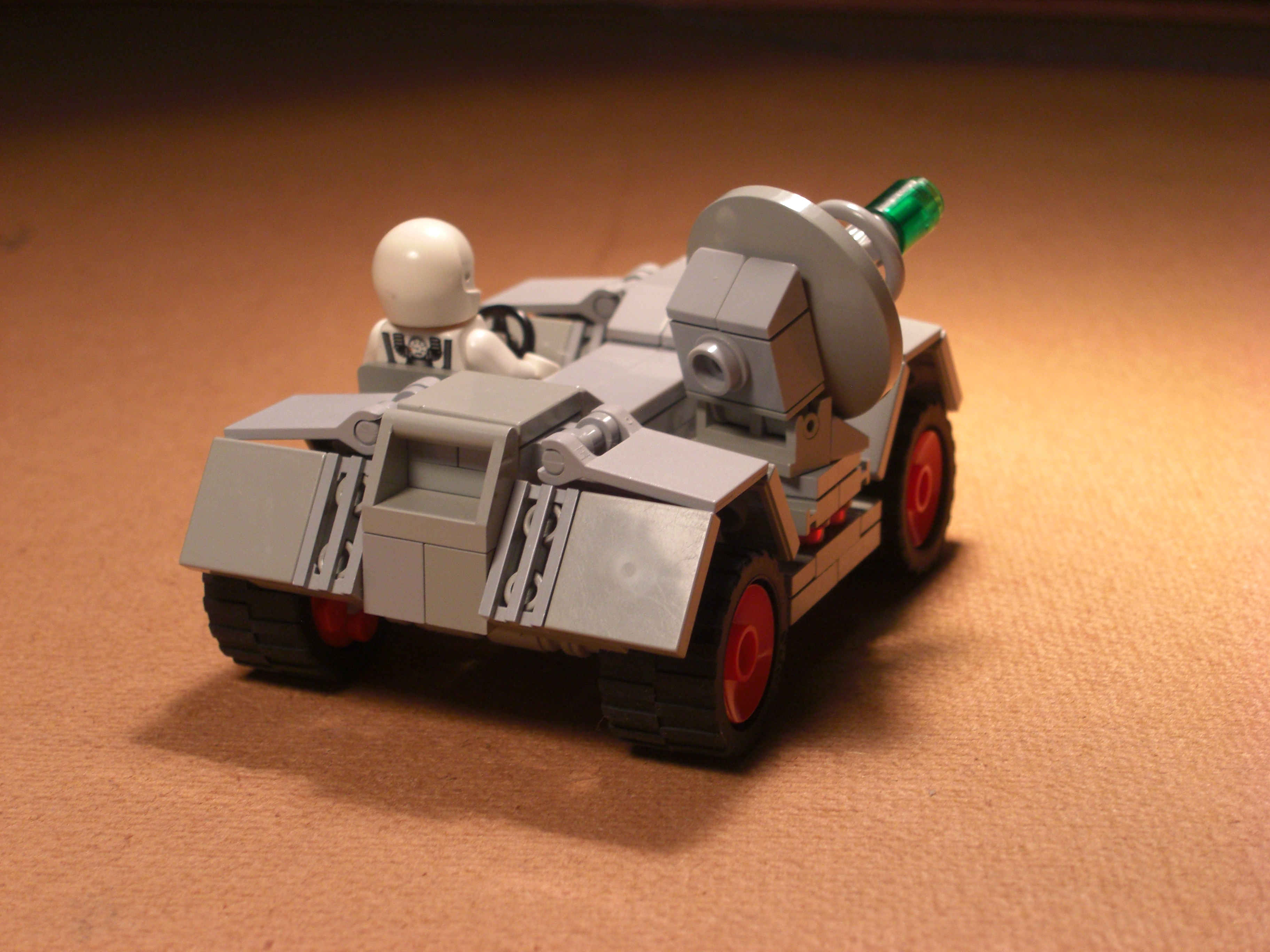
I may not be building much lately (thanks to school), but I couldn't miss out on Febrovery! This one is based on the Radar Truck.
The Chernobyl Exclusion Zone has many sites that are surprising tourist attractions, but none could be less likely than the Duga Radar.
This was the site of one of three “Over The Horizon” radars (OTH) in the USSR. This and another site in Ukraine beamed towards Europe; one in the Russian Far East, beamed out into the Pacific. By using shortwave rather than the UHF or SHF frequencies usually used by radar, the range could be extended over the horizon by detecting signals refracted by the ionosphere. Despite the fact that the ionosphere is always in a somewhat chaotic state, in theory a powerful enough computer could still detect the source of any given reflection.
In a metaphor for the entire Soviet system, however, no computer powerful enough existed and these enormously powerful 10 Megawatt transmitters merely sent out an intensely irritating pulse known as the woodpecker which blocked most shortwave transmissions over large parts of the world, annoying Soviet friends and allies alike to absolutely no utility. The system operated intermittently from 1976 until 1989. It was located near Chernobyl to benefit from the enormous amount of electricity it generated.
Ugly as the signal generated might have been, the antenna array itself is a thing of majesty, bursting from the forests that stretch on a flat plain for miles in every direction; a cascade of metal cones and struts that is 150 metres high and 700 metres long.
The radar had its own secret town attached; it was never officially acknowledged but was known as ‘Chernobyl-2’. It came complete with a gymnasium, school, hotel, and fire station. This was the only fire station in the region not called out when Reactor No. 4 caught fire on 26 April 1986 – a sign of the importance attached the OTH radar project.
Maintaining a structure like this is expensive, and nobody is expending any money on it, so see this strange Cold War engineering wonder while you can. It won’t last forever.
My inner radar goes wild whenever I see a Betty Teen doll. I keep telling myself that I should stop buying them, but I don't have enough mental strenght to follow my own advice. Ups! It seems that I've got a problem.
Searching for signs of ice on Mars is complex. To explore whether ice lurks beneath the surface of the Red Planet, ESA’s Mars Express uses its radar to probe the interior.
It sends low-frequency radio pulses at Mars and records how they are returned to the spacecraft. These pulses can penetrate some of the material comprising the planet’s crust, bouncing back to Mars Express when they reach a layer of a different density or composition. By analysing the time delays of these returned pulses, scientists can determine the properties of material lying beneath the surface.
This image shows radar echoes from Meridiani Planum, an area near Mars’ equator that is also being explored by NASA’s Opportunity rover.
In the image, reflected echoes from the surface and subsurface, separated in time delay, are plotted along the ground track of the spacecraft’s orbit. The bright white line crossing the frame marks the surface of Mars, while the faint, more diffuse line just below represents echoes from the base of a layer of buried material located far below the surface.
The surface of Meridiani Planum is full of volcanic sands that are known to contain minerals that formed in the presence of water in the planet’s distant past. Previously, it was unclear what kinds of materials lay beneath the surface here, but the Mars Express radar has now penetrated the deposits and revealed that they have a similar property to ice.
However, a recent study instead suggests an ice-free explanation, showing that these radar properties could just as easily be explained by a thick layer of porous sand – perhaps blown into the region by winds. Unlike other geologic materials, such as volcanic ash or very fine dust, a thick layer of sand-sized particles may produce properties in the radar akin to that of an ice-rich deposit.
The echoes are thought to be reflections from the boundary between Meridiani Planum deposits below the surface, and cratered terrain lying deeper still.
These results highlight the difficulty in finding buried ice, and will help scientists to identify areas with and without accessible water ice: a resource critical to the future human exploration and possible colonisation of Mars.
This radargram was obtained by the Mars Advanced Radar for Subsurface and Ionosphere Sounding instrument, MARSIS, in April 2016. The image covers a width of about 80 km. North is to the left (see annotated version in the published paper for more details).
Credits: ESA/Mars Express/NASA/JPL/KU/Smithsonian