View allAll Photos Tagged Prometheus
My attempt at a Lego prometheus ship. Not a big fan of the movie but I love this ship. Its like a smaller ship with a smaller crew. The cockpit is larger and this is a view of that underside cockpit view window
Dedicated to Prometheus
Thank you loyal friend of humans!
Thank you spirit of friedship and loyality.
Thank you instinct that guides people to realisation.
Thank you for the fire you brought to us.
I honor your courage and compassion.
HKD
Prometheus liebt die Menschen. Er bricht das Monopol der Götter und bringt dem Menschen das göttliche Feuer, das Licht der Erkenntnis.
Durch seine Solidarität, seine Treue und Freundschaft finden wir – durch Instinkt und Einsicht – den Weg zurück nach Hause.
Hab Dank Prometheus!
HKD
Prometheus bringt den Menschen das Feuer und wird für seine Hilfe von Zeus bestraft.
Prometheus, die goldene göttliche Treue
Der Lancelot unter den Göttern.
B1 oder der Administrator fühlt sich verantwortlich für die ihm übertragenen Aufgaben und wird diese in der Regel ordentlich erfüllen. Er ist ein treuer Untergebener, pflichtbewusst und fleißig. Loyalität zählt gewiss zu seinen Stärken.
Im Beamtentum und der Verwaltung von Unternehmen finden wir diesen Typus sehr häufig an.
HKD
Micheal Allen Harrison, David Bates, Arleen Bates at the musical Prometheus
Checkout www.prometheusthemusical.blogspot.com to hear some great music
Copyright Notice © Beau Hudspeth Photography - Images may not be copied, downloaded, or used in any way without expressed, written permission.
A still from the second Prometheus trailer shows the pilot seating and the trailer shows that the "rib cage" moves in on its body as some suit or protection
The prometheus statue with Portcullis Tower to the left and the incomplete Ghostbusters firehouse to the right
Prometheus Bound (1611)
Painted by: Peter Paul Rubens
At the height of his glory, Rubens attracted an influx of commissions so great that no one man could possibly satisfy it. Consequently he set about organising a sort of picture factory to meet demand. This was standard practice at the time. When Otto Sperling, the Danish doctor, visited the studio in 1621, he saw "a large hall without windows, lit only by a large skylight. There were many young painters there, working on different canvases, for each of which Rubens had made chalk drawings, here and there adding indications as to colour. These he later finished himself, and they then passed for works by Rubens."
This proceeding has presented art historians with inextricable problems. But Rubens did not mislead his customers: he specified who had worked on what, and adjusted prices to reflect the degree of his own involvement. His collaborators could, in any case, scarcely be described as pupils. He chose them among the best artists of his time, each according to his speciality: one for flowers, another for animals, another again for landscape. They included the landscape artist Jan Wilden and the animal-painters Paul de Vos and Frans Snyders. The Olympian eagle devouring the liver of Rubens' Prometheus Bound was painted by Frans Snyders.
Location: Musée National Gustave-Moreau
Work of:
Gustave Moreau
French Symbolist Artist
1826 - 1898
Zeus sent most of the Titans to Tartarus to punish them for fighting against him in the Titanomachy, but since second-generation Titan Prometheus had not sided with his aunts, uncles, and brother Atlas, Zeus spared him. Zeus then assigned Prometheus the task of forming man from water and earth, which Prometheus did, but in the process, became fonder of men than Zeus had anticipated. Zeus didn't share Prometheus' feelings and wanted to prevent men from having power, especially over fire. Prometheus cared more for man than for the wrath of the increasingly powerful and autocratic king of the gods, so he stole fire from Zeus' lightning, concealed it in a hollow stalk of fennel, and brought it to man. Prometheus also stole skills from Hephaestus and Athena to give to man.
The next stage in Prometheus' career as benefactor of mankind came when Zeus and he were developing the ceremonial forms for animal sacrifice. The astute Prometheus devised a sure-fire way to help man. He divided the slaughtered animal parts into two packets. In one was the ox-meat and innards wrapped up in the stomach lining. In the other packet were the ox-bones wrapped up in its own rich fat. One would go to the gods and the other to the humans making the sacrifice. Prometheus presented Zeus with a choice between the two, and Zeus took the deceptively richer appearing: the fat-encased, but inedible bones.
As a result of Prometheus' trick, for ever after, whenever man sacrificed to the gods, he would be able to feast on the meat, so long as he burned the bones as an offering for the gods.
Zeus reacted to these tricks by presenting man with a "gift," Pandora, the first woman. While Prometheus may have crafted man, woman was a different sort of creature. She came from the forge of Hephaestus, beautiful as a goddess and beguiling. Zeus presented her as a bride to Prometheus' brother Epimetheus. Prometheus had the gift of thinking ahead, but Epimetheus was only capable of afterthought, so Prometheus, expecting retribution for his audacity, had warned his brother against accepting gifts from Zeus.
Zeus gave the gods-crafted Pandora as bride to Epimetheus, along with a box that they were instructed to keep closed. Epimetheus was dazzled by Pandora and forgot the advice of his prescient brother.
Prometheus was still not awed by the might of Zeus and continued to defy him, refusing to warn him of the dangers of the nymph Thetis (future mother of Achilles). Zeus had tried punishing Prometheus through his loved ones, but this time he decided to punish him more directly. He ordered Hephaestus (or Hermes) to chain Prometheus to Mount Caucasus where an eagle/vulture ate his ever-regenerating liver each day. This is the topic of Aeschylus' tragedy Prometheus Bound and many paintings.
Eventually Hercules rescued Prometheus, and Zeus and the Titan were reconciled.
By Aeschylus
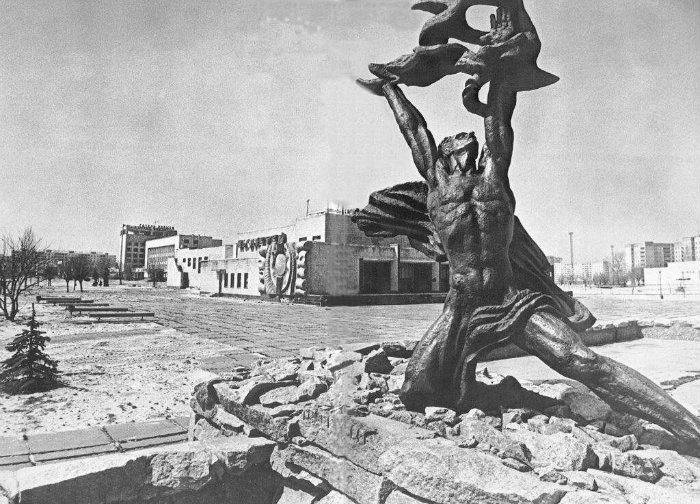
Before the statue in front of Pripyat´s cinema could be stolen, it was transferred to another symbolic place, right next to the Chernobyl power plant.
From aphrodisias.org:
Prof. Kenan Erim found a huge temple complex, which was dedicated to family of Julia Claudius, who was the first emperor of the Roman Empire and goddess Aphrodite, in 1979. As it is known that the building was named as Sebasteion as it is understood from inscriptions on the structure. The name means ‘great’ and is correspond to the Latin word Avgustus, a Greek word. There is no another Sebasteion in East of Roma as particularly large and rich from the point of reliefs. The structure is located on the street, starting from the northern gate and ending on the theater. The cult center was started to build during the reign of Emperor Tiberius (AC. 14-37) and it had been completed during the reign of Nero (BC 54-68). The main structures of the cultural center, demolished and rebuilt several times because of the earthquakes, had been completed on time of Emperor Claudius. At the present time, column backwards and Corinthian style column headings remain from the temple foundations. In addition to damage caused by the earthquake in the 4. 7. Century, the migrations of Turkish and Byzantine periods caused great harm to the temple.
The city, which extends east-west direction and was planned as grid, is not aligned with any other make. It is consisted of a ceremonial way and two long porticos, covering 80 m long and 14 m wide. The portico ends in the west are coupled to a last tetra pylon in front with street address. The entrance building (proplylon), opened to street, has two floors. The road, 14 meter wide and marble-paved, ends with the victory of the temple, situated on a podium. There are triplex porticos on both sides of the road. Moreover, in these buildings, there are stands, that fall into the original embossed on them between the columns in the second and third floors.
The second floorboards include mythological scenes and the third floor plans include scenes related to the emperor. It is clearly understood from the architrave on the first floor that the structure probably was built by two aristocratic families. These are two brothers, named Menander and Eusebes, who build entrance and the north portico, and Eusebes’s wife, Apphias. Also, other two brothers, named Diogenes and Attalus, were given Nike (victory) and the south portico of the temple. By building this monument, these brothers saw it as an opportunity to get into the hands of again noble after Zoilos death, which had impact on the city on the Roman Empire, and they referred to give the massage that by themselves in the city.
The column headings inside and outside include panels unprecedented amount of relief and decor. The most significant of these is the birth of Eros, Sebasteion Three Graces (three deadlines) of Apollo in Delphi, Meleager, Archiles, Penhesile, Nyssa and child Dionysus. In addition, it is deeply seen that there is the remains of the mythological figures and members of the imperial family. They are Augustus Germanicus, Lucius and Gaius Caesar, Claudius and Agrippa, who escaped with Aeneas from Troy Prometheus. As different from the rest, there are interesting relief symbolize the group of Claudius’ conquest of Britain and Nero’s conquest of Armenia. Furthermore, there are many other fragmans, suffered damage as a result of the earthquake, which depicts the effect and maintained Augustus battles and relations with other countries. Partially between the uncovered in constructions, there is a monastery with the cemetery in the southwest of the Acropolis. Also, there is a small basilica, converted into a church later in the southeast of the theater baths.
What was the reason that Aphrodisias, pushing to make this unique and magnificent work? It needs to go to far Trojan War to find the answer. The name of the story is the Aeneas’ myth. Azra Erhat explains this epic in his work, named ‘mythology Dictionary’: “Aeneas is the son of the goddess Aphrodite and the Trojan prince. Troy’s King Priam and Ankhises are cousins, and they are the same generation with Hektor. Being the son of a goddess had gained him an advantage. However, all Trojans were killed and the war was lost. Aeneas, taken his father on the shoulders, hold the hand of his child and along with his wife, escaped to the mountain, Ida (Kaz), with the help of the Goddess Aphrodite. After the legend of Odysseus and a thousand adventures reminiscent, Aeneas, who lost his wife and his father, come with his son to the Palatine Hill, where Rome city was founded in the future. In there, he beat and killed the king Tumust of Rutuls in the single combat.” Seventy uncovered in excavations on the board are protected in the depot of the excavation house in the garden. These reliefs, which will be exhibited in a new museum near future, contain a rich subject.
Besides mythological subjects such as Three Graces, Apollo, Achilles, Penstasili, Aeneas fleeing from Troy, Dionizos and Heracles, reliefs of the emperors and relatives such as Avgustos, Lucius, Gaius Caesor, Claudius and Nero also located in here.
After the end of Paganism, with remaining portions over from the earthquake, Sebasteion had used as a shopping center. After the decline of the city, it collapsed and covered with silt brought by the floodwaters, on them were made of old Geyre village houses. Moreover, a report and the findings, mentioned about the large Jewish community in Aphrodisias, the Synagogue and their sympathizers, are founded. Those sympathetic were called as “Theosebeis”, defined as religious, and they were defined as sympathetic towards Judaism but part of their religion.
In addition to all of that magnificent structure, house structure, located within the town, academies, and schools of sculpture has also been uncovered. Most of these structure, figurative or geometric mosaic-style processed coatings, crafts and pottery have been found. After 7th century’s earthquakes, many of these houses were abandoned or they were used with a bad repair.
Copyright Notice © WatchTographer - Images may not be copied, downloaded, or used in any way without the expressed, written permission.
Prometheus was the symbol of Pripyat, the city built to house the workers at the nearby Chernobyl Nuclear Power Plant. Compare this in-game rendition of the statue and Prometey Cinema with this old photograph of the real thing.
Darkness in Heaven
I’ve seen too much
Heaven is burning
I’ve learned too much
Heaven is desert
I know too much
Heaven!
Heaven!
Oh this dark side of light
HKD
detail of ammunition refill panel next to a door in Prometheus spaceship / Panneau de rechargement d'une arme, détail