View allAll Photos Tagged PSYCHOLOGICAL
OPUS: Shadows Edge, Mystical Expressionism, Painting with Light, Observation of psychological reality, Perception beyond Appearances, Symbolism, Hidden meaning of shadow, Edge of Perception, Art that raises subjective feelings above objective observations, Brought a new level of emotional intensity, TransExpressionism, Hidden doors of perception, Mystical Photography, ART Avant-garde, Painting with Light, Motion ART, Mirza Ajanovic POETIC Photography, These are Unaltered Images, Not cropped,
"Zu den Kämpfen in der Champagne: Minenwerfer wird in Stellung gebracht, um einen feindliche stützpunkt niederzukämpfen.". Fights in the Champage (France): a minethrower is positioned to take out an enemy stronghold. It seems to be a 17cm mittlerer Minenwerfer (medium minethrower).
Large photograph with an archive inventory tag and stamped Bufa. The "Bild- und Filmamt" was raised early 1917 by the Obersten Heeresleitung (OHL) for propaganda and psychological warfare purposes. They made pictures and movies during the last years of the war. It was led by Oberstleutnant Hans von Haeften.
Can anyone find the "soldier's joke" that slipped in this very serious propaganda picture? And no, the price is not this card, sorry.
These men from an unidentified Minenwerfer Kompanie provide an excellent view of how a fully equipped minethrower section would have looked like. I've made some notes on the picture.
A universal love is not only psychologically possible; it is the only complete and final way in which we are able to love. - Pierre Teilhard de Chardin
Picture Quotes on Love
Top 25 Romantic Hotels in the World 2018
Original photo credit: AndreasAux
Vetiver (a) has a heavy, earthy fragrance similar to patchouli with a touch of lemon. Vetiver oil is psychologically grounding, calming, and stabilizing. Sponsor ID 1069994
Turned up at my dacha (I wish) last night after 10pm (local time; 2 hours ahead of BST). We, the driver and me, arrived in style from the airport in a new Mercedes people carrier, but it went decidedly downhill from there. She guided us into a dark car park at the rear of a Stalinist tower block with no clear signs that this was the hostel. I could have been kidnapped for all the world would know, except that the kidnapper, my driver, was exceedingly pert, petite and pretty. But that could have been a clever ruse, raising my confidence and lowering my defences and fully distracting me. And who was that lurking about in the grass behind the building? What was he doing? And where was the main door? Were we supposed to sidle in through the tradesman’s entrance, that metal thing, half battered, covered with graffiti and almost falling off its hinges?
OK, I admit it, the three hour trauma on the plane, being subjected to seemingly endless torture by two terrible two year olds (and their backing groups), had got to me and I was feeling a wee bit paranoid. I actually came off the plane shaking with stress (and half of that was feeling for the poor mother); everyone else was just shaking their heads in disbelief at the horror. It was one of those airplane disasters that somehow get overlooked on the news but, psychologically, the effects are just as devastating in the long run. (I may be exaggerating a tad.)
Anyway, we entered the Soviet building, went past a little old lady in a little old cubby hole, and climbed up some dingy, dirty steps to an even dingier lift. This took ten minutes to come down from the 8th floor and, when it eventually arrived, it was a struggle to get the both of us in it. We chugged up to the hostel, rang the bell and I was shown into the office.
The ‘hostel’ turned out to be a converted apartment and the office was the front room, barely changed since it used to hold the family, complete with spirally carpet, cigarette-burned sofa and glass-fronted cabinet once filled with porcelain now stuffed with junk. This was day one on duty for the girl and she couldn’t find any information for me, she couldn’t even pinpoint the hostel on the map. She knew where my dorm was though, it was the one that wasn’t the office, kitchen, other dorm or bathroom. She could hardly get lost.
The room was decorated in Stalin’s favourite colours – brown, nicotine yellow and off-white – with the obligatory soil-coloured spirally carpet. I was in the top bunk in a room for eight. The bathroom was down the corridor past the office. One bath/shower, one sink (draped with girls’ damp frillies) and a washing machine. The colour was baby pink (that’s the bathroom and the knickers in case you were wondering) and the air was hot and humid. The toilet was next door. Both were to cater for around 20 people. Bliss.
I aimed for an early night (as I wasn’t going to get any gen about Chernobyl (‘Eh, what?’) or cruises on the Dnieper from the receptionist. I fell asleep at midnight but was rudely awoken at 0200 by some fuck texting loudly on his phone. After five minutes of this I decided I’d give a hint of my annoyance by switching on the light, opening up my netbook and playing some music. Eventually he stopped sweating over his text and two minutes later he looked up at me from his lower bunk and said, ‘Vot you do?’
This gave me the chance to study him for the first time. He looked like a cliché of an Eastern Mafia thug: shaved head, furrowed brow, no neck, tattoos down both his bulging biceps and stone cold grey eyes. Yep, here was a cliché of things to see that was not on my tick list. Shit.
I said, ‘What does it look like?’ I hadn’t read Flashman this holiday up to that point but now, in hindsight having finished ‘Flashman at the Charge’, I could see what kindred spirits we were. I couldn’t back away from this because that would have made it even worse, so I brazened it out and stared him down even though I was quaking in my socks. ‘Why, is it bothering you?’, I just about managed to say. ‘Vot you do?’ he repeated, a mite more irritated this time. ‘Can you not see, I am reading.’ ‘Vot you do?’ I gave up and turned back to my netbook. This was getting boring. ‘I don’t know vot the police do in zis country,’ he intoned from below me in a deeply threatening voice, ‘but zey prorbably do not look favourably on a kicking.’
Funnily enough this cheered me up no end, and I even began to relax a wee bit. First, no real thug would ever condescend to threaten a ‘kicking’ when a good ‘knifing’ is far more cost-effective and silent. So he wasn’t so bad then, eh? And second, he admitted to not being Ukrainian and so he was as much an outsider and on foreign turf as me. Not so confident then. Perhaps.
On the other hand he was still far more violent (potentially) than me (eastern European? Too much bigotry?), and much bigger (actually) so it wasn’t all over.
I said, ‘Have you finished texting?’ He said, ‘Vot you do?’ I said, ‘I couldn’t sleep for your texting. Have you finished?’ He said, ‘I give you thirty seconds to switch off and then I come and kick you.’ Oh dear, what to do? Shit shit shit. I decided to bluff him, and said, ‘I will switch off when I am finished.’ He said, ‘You have ten seconds … Five ... One …’ And … he didn’t move. I looked down at him and he looked up at me and I turned back to my netbook and thanked God that he couldn’t see my pulse trampolining and he said … ‘I couldn’t turn the text off. I couldn’t turn the sound down. I tried. How you do it? I tried. I couldn’t turn it off …’ He sounded so pathetic, so lost, not a Russian Mafiosa at all, and then he shuffled out of bed and off to the toilet.
I immediately switched off the light and spent the following hour or so before tripping off into a troubled sleep thinking that the next thing I’d hear would be the hissing of his breath as he loomed over me prior to holding down my sheets and thumping me in the face. At least I’d get to sleep then.
I didn’t see the thug again and the following nights were trouble free (apart from the damned mosquitos Eastern mossies, eh? Bastards. They were as intrusive as the texting).
Train to Crimea, Monday 3rd September, 18.30
Listening to Donovan on my netbook. Gently swaying in the carriage as the train passes a forest of chestnuts and oak with the sun glinting horizontally into the train through the foliage. Sharing my 4 birth cabin with two bottles of red wine, a demi litre of vodka and two women (a blonde and a brunette), and a 17 hour journey through the night ahead of us.
Shame they’re both middle-aged and tea-totallers, and that they’ve both gone to sleep already.
Is it my socks?
The tradition here is that travellers all disrobe and treat the cabin as a hotel room (minus the room service. Or the restaurant. Or telly. Or toilet. Or most other things actually. Good ever-changing view out the window though). So I was turfed out as the two got into their grunties. When I came back in they were both under their duvets. Something tells me that this isn’t going to be a party that I’ll remember for the rest of my life.
Ah well, all the more wine for me!! What’s this vodka like I wonder …
Had a good night’s conversation with an ex-pat on Thursday. I was in the ‘Lucky Pub’ off Khreshchatyk (13 beers proudly advertised, but 11 of them were off. So not so lucky then) and this diminutive Yorkshireman called over to me and asked if I was English after I’d complained to the waitress about the lack of pork scratchings with the beer (no I didn't). We got talking and he told me almost straight off what he was. He was quite up-front about it and totally not ashamed or embarrassed, so good for him. You have to admire such people who believe in themselves and put two fingers up to society; hang the consequences and to hell with Daily Mail readers. Great. I wanted to hear more. I love rebels (so long as they don’t squat in my flat when I’m away. There’s a limit you know.)
So, Peter’s a numerologist. There, I’ve said it. He even gave me his email address to pass on to anyone in my acquaintance who might want to delve into the murky depths of this underworld. You never know, my church is a broad one.
For the next couple of hours, Peter regaled me with his successes – ‘I told her that and she said ‘”You never!!! No way anyone could know that!!”, and I said, “But you need to accept that this is his destiny, it’s written in his birth date, he can’t help it.” And she said, “I never knew. I’ll respect him more now. It’ll be hard, but if he wants to dress as a cow, eat grass and moo around the house …’
Of course, eventually it came around to me. I didn’t want to ask him (he must get it all the time) but he was only too eager to analyse me. He asked me my birthdate, added the first numbers, took away the second, combined the year and subtracted the month and ended up with 4 digits that told him everything about me. He deduced that I was successful, that I like beetroot, am happy, a perfectionist who accepts that most people can’t be as good as me but allowances have to be made for the sake of global harmony, a man who other people follow, a sportsman, someone who has three of the four main elements (water, earth and fire) but lacks air and therefore never has original ideas but am good at following through with other peoples’ plans … ‘
OK, stop there!! I had to put him right about a few things!! Too many to list here but, for one, to say that I ‘like beetroot’!!! That takes the biscuit! How wrong can a person be? And then, to cap it all by thunder , he has the deuced bad manners to suggest that my dear beloved sister (whom he’s analysed too) also lacks ideas!! Well! I can just about accept that I’m a dunderhead, but my sister …. Gad! The dirty swine, damn him to hell and back!
He was a good sort though, by golly . I liked him and he didn’t take my scepticism the wrong way (thank God he wasn’t a Ukrainian zealot!) and we actually managed to veer away from numerology to more concrete and established topics like how shite Liverpool are at the moment, and the state of the nation.
So what about Kyiv? Not overwhelmingly Soviet (one statue I saw of Lenin. Guarded by the military! And a huge statue of Mother Ukraine guarding the Dnipro. Also the Landscape Park – very Soviet with tanks and missiles) and some magnificent boulevards and streets with fantastic microbreweries. Amazing underground shopping precincts (like Toronto) and deep underground network and stations (fall-out shelters?).
Kyiv is the centre of Slavic culture and home to Russian Orthodoxy. Christianity was brought here and the main collection of ancient ecclesiastical structures lies at Lavra – a place full of golden domes and whitewashed churches and bearded men in black dresses. Also there is an interesting museum of a man's lifetime's work - called the microminiature museum and contains his micro-pieces. Sooooooooooo tiny!! Horseshoes on fleas, portrait of Hemingway on a sliced pear seed, and a hollowed out human hair (polished inside and out and so transparent) containing a micro-sculpture of a red rose on a tiny golden stalk. Amazing.
Dreaming of a big, spilled swamp symbolizes small satisfactions. You are always trying to please yourself, in spite of obligations and other obstacles. You have rituals that are making you happy, so you always find time for them. You usually do sports, go out, take massages, or go to the cinema. Shrek since an elf is a fictional character, he may also represent the problems that you have created on your own. Symbolism:An elf represents festivity, problems, annoying people, intellectual minds, foes and health. If you dream of a laughing elf, it indicates the laughter of your enemy.
Despite Shrek's frightening and repulsive outer appearance and incorrect identification as a monster (devil figure), he turns out to be:
The Hero: Shrek fulfills the ultimate task of breaking Fiona's curse with the true love's kiss. He also follows the hero's journey with significant character development on his Quest.
Onion: Shrek speaks about how ogres are like onions, which also reflects on the universal theme of the movie. Onions have layers, and his analogy represents that despite his repugnant appearance, like that of an onion, he is actually kind-hearted and capable of love after you peel at the layers.
Wall: Shrek talks about putting up a wall around his swamp to keep people away, but I believe it's also a figurative symbol for his need for isolation and fear of not being accepted or loved. Shrek tries to shut people out before they can do the same to him.
Shrek's Swamp
By George Gantz
Name & Symbols where Shrek's symbols linked with Nephthis
live in the swamps of the Nile's delta... like King Moses with is born in the same Delta or Swamps!!!!
Afterlife, regeneration and Green Color slopes and the regeneration of trees on decaying boles in swamps.
'Nephthys' is the Latin version of her Egyptian name `Nebthwt' (also given as Nebet-het and Nebt-het) which translates as "Lady of the Temple Enclosure" or "Mistress of the House" and she is routinely pictured with the heiroglyph for 'house' on her crown. The 'house' is neither an earthly home nor temple but linked to the heavens as she was related to air and ether.
The 'enclosure' may refer to the courtyard outside a temple as she was represented by the pylons outside of temples. Shrek's pylons are his ears.
in her role as a protective goddess; just as the pylons and wall protected the inner temple, Nephthys protected the souls of the people. She was associated with death and decay from an early period and was regularly invoked during funeral services. Professional mourners at Egyptian funerals were known as "Hawks of Nephthys" and she is one of the four goddesses (along with Isis, Selket, and Neith) whose images were found in the tomb of Tutankhamun as guardians of his canopic vessels. Historian Margaret Bunson notes:Nephthys was associated with the mortuary cult in every era and was part of the ancient worship of Min [a god of fertility and reproduction]. The desert regions were dedicated to her and she was thought to be skilled in magic (188).
In folklore, a will-o'-the-wisp, will-o'-wisp or ignis fatuus is an atmospheric ghost light seen by travelers at night, especially over bogs, swamps or ... Folk belief attributes the phenomenon to fairies or elemental spirits, explicitly in the term " hobby and now in 2020 for the kids that's Shrek... mysterious lights as omens of death or the ghosts of once living human beings. In modern science, it is generally accepted that will-o'-the-wisp phenomena (ignis fatuus) are caused by the oxidation of phosphine (PH3), diphosphane (P2H4), and methane (CH4). These compounds, produced by organic decay, can cause photon emissions. Since phosphine and diphosphane mixtures spontaneously ignite on contact with the oxygen in air, only small quantities of it would be needed to ignite the much more abundant methane to create ephemeral fires. Furthermore, phosphine produces phosphorus pentoxide as a by-product, which forms phosphoric acid upon contact with water vapor, which can explain "viscous moisture" sometimes described as accompanying ignis fatuus.The idea of the will-o'-the-wisp phenomena being caused by natural gases can be found as early as 1596, as mentioned in the book Of Ghostes and Spirites, Walking by Night, And of Straunge Noyses, Crackes, and Sundrie forewarnings, which commonly happen before the death of men: Great Slaughters, and alterations of Kingdomes, by Ludwig Lavater, in the chapter titled "That many naturall things are taken to be ghoasts":
Many times candles & small fires appeare in the night, and seeme to runne up and downe... Sometime these fires goe alone in the night season, and put such as see them, as they travel by night, in great feare. But these things, and many such lyke have their naturall causes... Natural Philosophers write, that thicke exhilations aryse out of the earth, and are kindled. Mynes full of sulphur and brimstone, if the aire enter unto it, as it lyeth in the holes and veines of the earth, will kindle on fier, and strive to get out. "Shrek lets fart in a fairy tale". Farting across the animal kingdom is wonderfully diverse, a new Tale with Shrek ... and our mammalian relatives, farts are mainly the result of digestion or regeneration.
Swamp monsters in folklore, legends, and mythology
The Will-o'-the-wisp appears in swamps, and in some areas there are legends of it being an evil spirit.
The Bunyip are a creature from Aboriginal mythology that lurk in swamps, billabongs, creeks, riverbeds, and waterholes.
The Grootslang are huge elephant-like creature with a serpent's tail which according to legend live in caves, swamps, freshwater in South Africa.
The Lernaean Hydra in Greek and Roman mythology, was the creature Heracles killed in the swamp near Lake Lerna.
The Honey Island Swamp monster in Louisiana.
Mokele-mbembe, a legendary water-dwelling creature of Congo River basin folklore that resembles a Brontosaurus.
The skunk ape is a horrible smelling large ape creature said to live in swamps.
The Lizard Man of Scape Ore Swamp.
In Beowulf, Grendel lived in a marsh near King Hrothgar's mead hall, as did Grendel's mother.
Our world seems to be mired in anxiety and fear; and civic discourse has degenerated to accusations, outright lies, and rhetoric. While we hear calls to “drain the swamp,” any common understanding of what that means, and a willing consensus required to achieve it, seems to elude us. Perhaps we are looking at the situation from too narrow a perspective. It is not just our politicians who are lost in the marsh; it is our spiritual life, too.
The English language is full of references to the soggy, wet places of the world. Have you ever gotten tangled up “in the weeds”? Or perhaps someone you know is “stuck in the mud” (or perhaps is a “stick-in-the-mud”)? Recently, we have heard calls to “drain the swamp” of Washington DC lobbyists and political insiders. These sayings all have a common origin: the idea that marshy places should be avoided, lest we become entrenched in the unpleasantness they represent. While modern environmental science is struggling to change this negative narrative about “wetlands,” there are natural contextual explanations for it. The negative imagery is quite powerful, and it holds true on a variety of levels: from natural to psychological, societal, and spiritual. Let’s unpack these different layers of meaning.
The Nature of Wetlands
Marshes, mires, and swamps—collectively referred to as “wetlands”—are essential natural features found all around the globe. They often develop wherever the land intersects major bodies of water, at the interface, as water from terrestrial sources makes its way toward the sea. Technically, marshes are characterized by grassy or shrub-like vegetation, while swamps feature trees. Mires, or bogs, are acidic and contain accumulated humus deposits known as peat.
Marshes are often difficult to access and to maneuver in (especially for us humans). The water usually moves slowly and may be brackish, or salty. Typically, oxygen levels are low, a condition to which indigenous species adapt. Reeds, for example, grow hollow stems for sucking oxygen to their root structures. Marshes do, however, provide useful water storage and filtration functions: they fill up with water in rainy periods and drain water downstream in dry periods; and they serve as a filter and a sink basin for sediments and pollutants.
Marshes can be highly productive biologically. But they can be quite unpleasant and inhospitable as well, as some of that productivity includes a variety of parasites, leeches, spiders, snakes, and even alligators. Since marsh waters move slowly, oxygen may be depleted by respiration and decomposition, particularly when pollution levels are high. Hypoxia, or oxygen deficiency, may result, causing the death of fish and invertebrates. When decomposition turns anaerobic, fetid odors are produced. This all helps explain the negative reputation held by marshes, mires, and swamps. And as a result, they have become fertile sources for our imaginative depiction of the horrors of stagnation.
Marshes and their renewing properties are also vulnerable to degradation if the natural water cycles are disrupted, and their historically negative reputation has made them a great target for human intervention. We have been very aggressive in intentional filling and draining, damming for flood control, water withdrawals, agricultural and urban development, and pollution. According to Environmental Protection Agency (EPA) data, perhaps half of all the marshes in the United States were drained or destroyed prior to 1970. And that destruction has continued. A Fish and Wildlife Service (FWS) study reported that in the five years between 2004 and 2009, almost one percent of coastal wetlands disappeared as a result of development pressures and silviculture (human-planned forests) expansion.
Psychological Stagnation
Stagnation is defined simply as “a state of not flowing,” yet our imagination associates the word with the unpleasant “marshy” qualities of death and decay. In the natural world, the low-oxygen conditions of stagnation are unfavorable to growth and change, and they give rise to illness and death. In the psychological sense, stagnation refers to the similar condition of being emotionally or rationally stuck or stunted. Without the ability to renew ourselves by absorbing new thoughts, ideas, experiences, and emotions, our vitality and resilience stagnate.
The story of Narcissus offers a good example. Narcissus was a beautiful Greek youth who fell in love with his own reflection. He became so enamored of his image that he forgot about food and rest, and he eventually died. This story is the origin of the modern personality diagnosis of narcissism, an excessive pre-occupation with self-gratification and self-image. Some current psychological research suggests that our omnipresent digital environment and our excessive attention to social media, in particular, promote narcissistic tendencies.
Depression is another psychological condition that represents the quality of stagnation, as it involves getting “stuck” in negative thought patterns and losing the motivation and energy to reach out to others or try something new. While the causes of depression may be varied and difficult to assess, it is clear that extreme emotional distress and feelings of isolation and alienation are shared by many: depression is on the rise worldwide, as is suicide, an ultimate and tragic statement of hopelessness. As we will see below, one key to preventing psychological stagnation may be found in better understanding our spiritual condition.
Societal Entrenchment
In economics and politics, marsh-like stagnation is often referred to as entrenchment. The word entrench simply means “to put in a trench,” which is suggestive of being stuck or tightly confined. A corporate management team may become entrenched, for example, if its members stick too closely together and refuse to bring in outside people or outside ideas. Entrenchment can be deadly for a business enterprise when upstart competitors with new and better ideas come along. An individual, a group, or an entire enterprise can get “mired in the weeds” arguing about minutiae while in the midst of a crisis. Stuck in this way, they are unable to break through an impasse or develop a realistic plan forward. As the saying goes, “Nero fiddled while Rome burned.” In the broader economic sense, monopolies, cartels, price-fixing, and insider trading represent different forms of entrenchment; they are all disastrous for productivity, creativity, and healthy markets.
In the political arena, entrenchment refers to the condition in which incumbents or small, tightly controlled elite groups are able to dominate and control the political process. By cutting out other participants, eliminating dissent, and rejecting new ideas, these groups set the agenda and determine the outcomes—all in their own favor. As a result, what is lost is any sense of renewal or accountability to the citizens whom the government is presumed to serve. It is on this basis that our nation’s capital is described as a swamp, dominated by professional politicians, who have been in office a long time, and their enablers, the lobbyists who wield immense war chests of campaign funds and who trade in secrets and inside information. The entrenchment narrative has become more prevalent in recent years, as indicated by the large volume of books and articles that talk about governments behaving as oligarchies, kleptocracies, or autocracies.
The common thread in our negative image of wetlands, psychological stagnation, and societal entrenchment is this: when what is pure and fresh—whether it be water, our emotions, or our relationships with others—does not flow into each of these systems, the system ceases to thrive and grow and goes into decomposition and decay.
But its swamps and marshes will not become fresh; they are to be left for salt. (Ezekiel 47:11)
Friendly Beast: The donkey aids Shrek throughout the journey and is his constant companion through all the trials. As an animal, he shows that nature supports Shrek.
Fire/Red/Black: The dragon has dark red skin representing violent passion and fire, setting up the character to be perceived as cruel and monstrous. Dark colors such as black are used in her tower to develop this theme as well.
The writers started with a fun and cartoony premise, and then layered in one technique after another which makes the film resonate with adults.
Our Spiritual Condition
Emanuel Swedenborg devoted much of his writing to the idea of spiritual correspondences. In a spiritual sense, flowing water is living truth. When the flow of water stops, this truth becomes stagnant and spiritual life dies. Being stuck in the marsh spiritually means becoming confirmed in falsities.
Those who cannot be reformed because they are in the falsities of evil are signified by “the miry places and marshes that are not healed, but are given to salt.” (Apocalypse Explained §513:7)
“To be given to salt” signif[ies] not to receive spiritual life, but to remain in a life merely natural, which, separate from spiritual life, is defiled by falsities and evils, which are “miry places” and “marshes.” (Apocalypse Explained §342:7)
One common feature of a healthy spiritual life is the belief in and commitment to a truth that is higher than just the laws that govern the natural world. Out of one’s personal commitment to a transcendent realm (the infinite) or agent (God), many blessings can flow. These include a sense of purpose, feelings of joy and gratitude, and the willingness to improve the world and the lives of those around us with love. Without such an affirmative commitment, our understanding of life is by definition constrained to the finite realm of physical space and time. If we do not believe in and are not open to spiritual ideas and experiences, then we destroy our potential to receive any inflow of such ideas and experiences.
Meaning and purpose, as they relate to Creation as a whole or to our lives in particular, become limited and relative only to the physical parts of experience. Some thinkers take this to an extreme, framing meaning and purpose as mere illusions. Love becomes just a biological function. Improving the world is defined in purely materialistic terms. This is the condition referred to in Ezekiel, above, where one’s spirit has been given to salt.
A commitment to the idea that there is no spiritual life—that the natural world is all there is—is destructive to spiritual life. When we are confirmed in this falsity, any goodness that we might see, feel, or experience is sucked out of life. We are stuck in the marsh and cannot be spiritually reformed, cleansed, and healed.
There is nothing more delightful than a marshy, and also a urinous [stink] to those who have confirmed themselves in falsities, and have extinguished in themselves the affection for truth. (Apocalypse Explained §659:5)
Conclusion
By following the chain of correspondences, we can identify solutions to the various forms of stagnation. As we know from the natural world, fresh water must continue to flow in and through the marsh in order to keep it healthy and biologically productive. In addition, external pollutants must be limited to what the marsh can absorb.
Similarly, our emotional and psychological lives need to include appropriate amounts of openness, recreation, and renewal in order for us to remain healthy. We need to balance our internal preoccupations with outward companionship, aesthetic experiences, and learning opportunities; and we need to avoid the “pollutants” of excessive stimulation, addiction, obsession, and distraction.
In society, we need to foster and support institutions that are resilient, responsive, and open to new people and new ideas. This requires that we go against our natural tendencies toward complacency and complicity and that we resist the temptations of using institutions for personal gain, as all of these behaviors pollute civic life.
To grow spiritually, we need to be open to transcendent possibilities, searching for knowledge and experiences that enrich our appreciation of spiritual truth. If we close ourselves off to spiritual ideas and to the possibility of having spiritual experiences, then our spiritual life will be deprived of sustenance and will decay.
If our spiritual life is “stuck,” then where is the foundation for a healthy psychological and emotional experience? When we focus on our own inadequacies or our personal gratifications, we undermine our opportunities to learn, to share love, and to be a full participant in our community. A healthy spiritual life is the wellspring for a healthy psychological and emotional life. It also sustains the virtues essential for a vibrant and thriving civic life: the commitment to truth and the dedication to the well-being of those we are responsible for serving.
Without a healthy civic life, we will never be able to agree on the rules and the practices that will assure that clean water flows into all our different marshes, refreshing, renewing, and rejuvenating the life that exists within them.
It all ends where it begins: with the water of truth that is the source of life.
George Gantz is a writer and philosopher at Spiral Inquiry and directs the Swedenborg Center Concord (SCC), a non-denominational educational project supported by the New Church of Concord, Massachusetts, that seeks to integrate the knowledge of science with the wisdom of religion.
Read more posts from the Spirituality in Practice series >
Here are some of those techniques:
Edgy Comedy
What's considered funny in our culture tends to change from time to time. It might be Mork and Mindy one year, Northern Exposure further down the line, and South Park a few years later. Of course, this is an over-simplification, for there are quite a number of popular comedy styles alive at any moment.
Still, there do tend to be trends, and adults are likely to be responsive to them. One trend alive today is a somewhat gross, edgy kind of comedy.
In Shrek the grossness doesn't have a sexual component, such as in American Pie, but there is a scene where Fiona sings a morning duet with a little bird in a nest. When Fiona hits an extremely high note, the bird swells up and explodes. The camera zooms in on the two little eggs left behind, then zooms out on them, now frying away, as Fiona cooks them for Shrek and Donkey.
In another scene, Fiona makes some cotton candy for Shrek by wrapping a spider's web around a stick, and then catching flies with the mess. She and Shrek both enjoy the delicacy. In yet another scene, Fiona and Shrek feast on cooked rats together.
This is very original, hip, and edgy comedy. It appeals to (at least some) adults.
Parody Humor: Spoofing Cultural References
When you spoof cultural references, especially when you do it well, you can create a kind of humor to which adults will respond.
In Shrek, Walt Disney Pictures and Disneyland bear the brunt of some clever spoofing. It was done with enough intelligence and wit that adults would appreciate it, such as:
Seeing, near the start of the film, various Disney-like animated characters depressed (and thus the opposite of their usual normal cheery selves) as they're being hauled away.
Lord Farquaad's castle, which possesses the ominous overtones of a nightmarish Disneyland, or
The weird singing toy figures which greet Shrek and Donkey at the castle wall, which spoof the singing toy figures in Disneyland's Small, Small World ride.
Non-Cliché Characters
A cliché character is one whom we've seen before, especially a character we've seen frequently. Shrek is certainly not a cliché. His personality is marked by some of the following attributes, or as I call them, Traits.
He likes himself (evident in the bathing scene under the opening credits).
He's clever. (He scares off the townspeople by convincing them he's much meaner than he is.)
He's brave (never shirking from a fight).
He's afraid of rejection, resulting in him pushing people away before they can reject him, which results in:
He's a loner (at least in the beginning), but he longs for connection with others, even as he also fights it off.
Can you think of another film or TV character with this exact set of traits? If you have a hard time remembering one, that's exactly why Shrek isn't a cliché.
Fiona also has an interesting array of traits:
She's romantic.
She's earthy. That's what I call women who eat rats.)
She's tough. She beats up Robin Hood with a few moves borrowed from The Matrix.)
She thinks she's ugly. And, like Shrek, she fears rejection.
Once again, we have a non-cliché character. Adults respond to characters who aren't clichés.
Emotional Problems We Can Relate To
Both Shrek and Fiona, for similar reasons (feeling that they're hideous), believe that no one could love them. This fear is so great in both of them, that it drives many of their actions.
Giving a character a powerful fear, a shame, or an emotional problem that adults can relate to will also help draw an adult audience -- as will that character's arc (his or her path of emotional growth) as circumstances in the plot force them to wrestle with this issue.
The Use Of Masks
A Mask is the term I use to describe ways characters can hide their fears and vulnerability.
There are at least eight different kinds of Masks that characters can hide behind. In Fiona's case, of course, her Mask is literally a visual lie: a fake body and face, created by magic.
Shrek's Mask is an attitude—the attitude that he doesn't need or want anyone in his life. (An Attitude is one of the eight types of Masks characters can hide their fears behind.) His behavior, stemming from this attitude, is the one I touched upon earlier: to push people away before they can reject him.
This is a Mask because, by watching this attitude and corresponding behavior, you might initially think that he hates others. But it simply covers up his fear that they would find him loathsome.
Using one of the eight types of Masks to create more complex characters is another technique that gives the film adult appeal.
Parallel Plot-Lines
There are about 100 techniques I'm aware of to give a feeling of emotional depth to a plot. I call these Plot Deepening Techniques.
(By the way, there are also Dialogue Deepening Techniques, Character Deepening Techniques [like the eight types of Masks], and Scene Deepening Techniques.)
The whole area of techniques which inject emotional and psychological depth into one's writing is vast, but we see one such Plot Deepening Technique used here, and that's parallel plot-lines.
There is the parallel of both Shrek and Fiona feeling too hideous to be lovable, but there's a third one too. The dragon, who falls in love with Donkey, uses such behaviors as shish-kabobbing people as a form of stopping them from getting too close.
Her efforts to frighten people off are very similar to the way Shrek handles the same fear.
As a general rule of thumb, Deepening Techniques work best when no more than 25% of the audience consciously notices them. Usually, to maximize their emotional effectiveness, you want them to operate a little bit outside the level of awareness of those watching the film.
All Plot Deepening Techniques contribute to making a film resonate more strongly with adults. The writers of Shrek employ many other techniques besides the one mentioned here, but my limited space here doesn't permit me to list them all.
Set-Ups And Payoffs
Sometimes a writer will introduce an object, and action, an image, or a phrase spoken by a character—the set-up—and then revisit it one or more times later in the script, usually in interesting ways (the payoff or payoffs).
It makes for sophisticated writing, which in turn makes the script appeal to adults.
Shrek utilizes many set-ups and payoffs. Here's one: When we first meet Shrek, he's in his outhouse. We learn his outhouse, like the rest of his swamp, is a place where he can be alone in total self-contentment. It's a symbol of his privacy, but here his desire for privacy is seen in a good light: as a reflection of his self-satisfaction.
Later in the film, when Shrek has experienced his worst nightmare—rejection by Fiona—and when he in turn has pushed Donkey away, he retreats into an outhouse. Now this symbol of solitude represents all his fears of getting close to others, and of literally shutting them out.
So, the outhouse is set up in the beginning, and then revisited later in an interesting payoff.
Don't worry if you didn't catch this when you saw the film, for, like Deepening techniques, set-ups and payoffs, in general, create their greatest emotional impact if they operate a little outside the conscious awareness of most people in the audience.
Summary:
The bottom line is that it's no accident that Shrek appealed as much to adults as it did to kids. The writers took a fun and amusing story which any kid would enjoy, and then artfully wove into the script a number of techniques not found in normal kids' fare.
The writing in this script is extremely tight. For me, tight means that most scenes accomplish several functions simultaneously: moving the story forward, drawing us into the characters, making us laugh or sad or both simultaneously, setting up elements which will be revisited later on, and always entertaining us with highly original lines and scenes.
If you want to reach both kids and adults and thus capture a wide demographic for your film, it wouldn't hurt to master the techniques these writers employed so artfully.
Oct 15 2021
Dead Ringers
Psychological thriller about twin gynecologists. No need to say more.
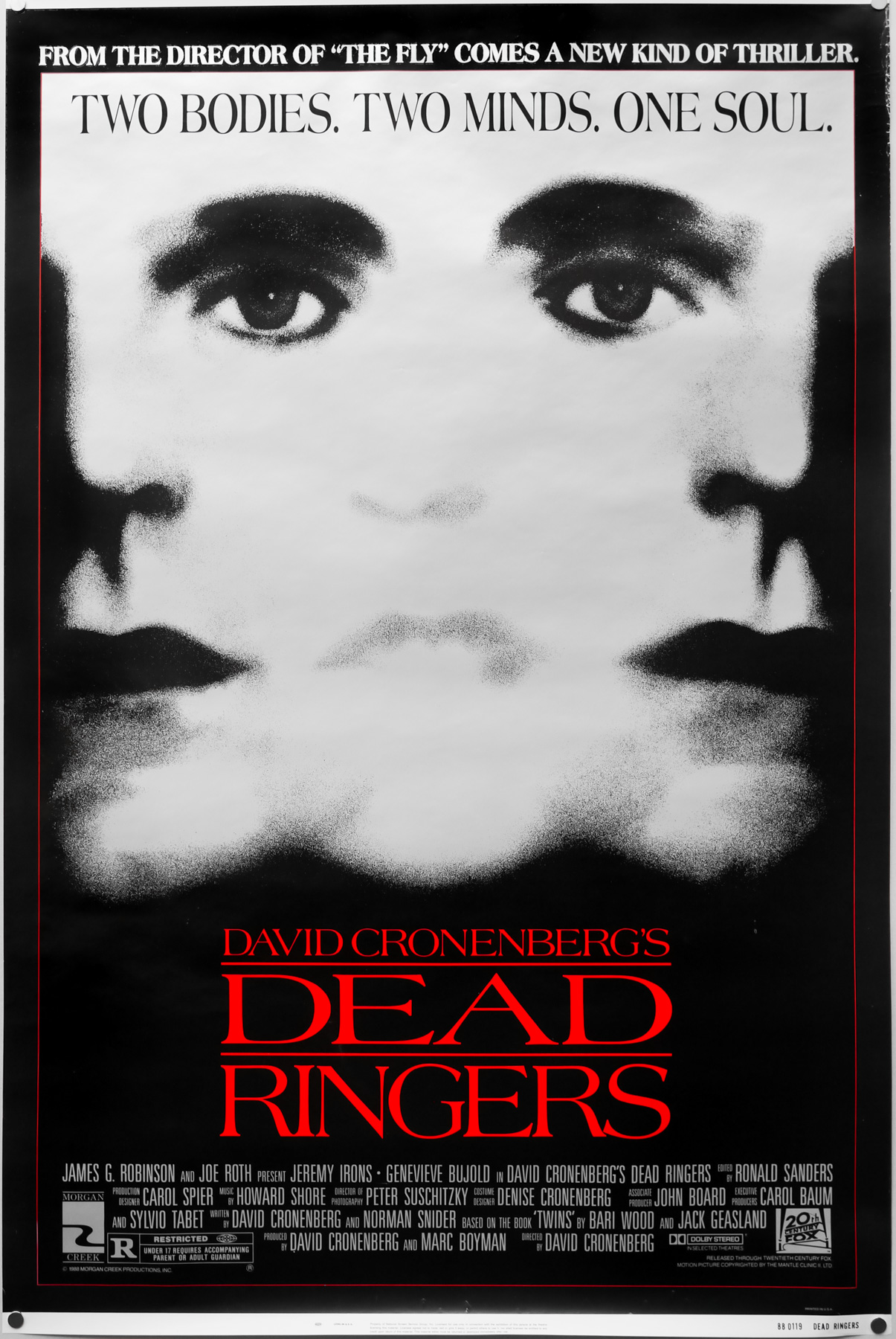
For 33 Days of Halloween
Romanian postcard by Casa Filmului Acin.
Samantha Eggar (1939) is a gifted English film, television and voice actress. The auburn-haired beauty played in several Hollywood movies, including the acclaimed psychological thriller The Collector (William Wyler, 1965), but somehow never managed to become a major star.
Samantha Eggar was born Victoria Louise Samantha Marie Elizabeth Therese Eggar in 1939 in Hampstead, London. Her parents were Ralph Eggar, a brigadier in the British Army, and his wife, Muriel, of Dutch and Portuguese descent. Eggar was brought up as a Roman Catholic and educated at St Mary's Providence Convent in Surrey. While at boarding school, she was allowed to thrive in the arts, in school plays, in musical concerts and in poetry competitions. After graduating from art school, she was accepted at the Webber Douglas School for Drama in London. Before finishing the two-year program at Webber Douglas, she was offered the role of Lady Hamilton in a play written by photographer Cecil Beaton. She played in several Shakespearean companies and on television. While performing onstage at the Royal Court Theatre, film producer Betty Box spotted her. Box cast her in the film The Wild and the Willing (Ralph Thomas, 1962), a romantic drama about a group of students at university. She played a sluttish college coed opposite Ian McShane and John Hurt. After this film debut, she played in Dr. Crippen (Robert Lynn, 1962) as Ethel Le Neve, Crippen's mistress. Donald Pleasence starred as the real-life Edwardian doctor Hawley Harvey Crippen, who was hanged in 1910 for the murder of his wife. In 1963, Eggar played the title character in the episode Marcia of the TV series The Saint, featuring Roger Moore. After her appearance in The Saint, Eggar did not appear on television for ten years, instead focusing exclusively on feature films. In England, she made the thriller Return from the Ashes (J. Lee Thompson, 1965) with Maximilian Schell, Ingrid Thulin and Herbert Lom. She received a nomination for the Academy Award for Best Actress for her role of kidnap victim Miranda Grey opposite Terence Stamp in the American psychological thriller The Collector (William Wyler, 1965). Brendon Hanley at AllMovie: “The success of The Collector depends almost entirely on its two stars, Terence Stamp and Samantha Eggar, since scarcely anyone else is in the movie.” Eggar won a Golden Globe award for this performance and was also named Best Actress at the Cannes Film Festival. She then starred in the Cary Grant comedy Walk, Don't Run (Charles Walters, 1966), set in Tokyo during the Olympic Games in 1964. It was the last appearance by Grant in a feature film, and also director Walters' last film. Her next Hollywood production was the musical Doctor Dolittle (Richard Fleischer, 1967) starring Rex Harrison. The film received generally mixed critical reviews, but through 20th Century Fox's intense lobbying, it was nominated for the Academy Award for Best Picture and won awards for Best Original Song and Best Visual Effects.
Samantha Eggar appeared opposite Richard Harris and Sean Connery in the American production The Molly Maguires (Martin Ritt, 1970). Set in late 19th-century Northeastern Pennsylvania, this social drama tells the story of an undercover detective sent to a coal mining community to expose a secret society of Irish-American miners battling exploitation at the hands of the owners. Partly inspired by a true story, the film portrays the rebellious leader of the Molly Maguires and his will to achieve social justice. The film was considered a major box-office failure. Another commercial flop was the adventure film The Light at the Edge of the World (Kevin Billington, 1971), starring Yul Brynner and Kirk Douglas. The plot, adapted from Jules Verne's novel Le Phare du bout du monde (1905), involves piracy in the South Atlantic during the mid-19th century, with a theme of survival in extreme circumstances, and events centring on an isolated lighthouse. Next, she starred in the Italian Giallo L'etrusco uccide ancora/The Dead Are Alive (Armando Crispino, 1972) with Alex Cord and Nadja Tiller, and the American psychological thriller A Name for Evil (Bernard Girard, 1973) with Robert Culp. Eggar co-starred again with Yul Brynner in the television series Anna and the King (1972). She also starred in the episode The Cardboard House of the romantic anthology series Love Story (1973). Returning to the British Stage, she starred with Anthony Hopkins and Colin Firth in Arthur Schnitzler's The Lonely Road and reunited with John Hurt in Chekhov's The Seagull. In 1976, she co-starred with Peter Falk and Theodore Bikel in the Columbo episode The Bye-Bye Sky High IQ Murder Case. That same year, she also appeared in the Sherlock Holmes film The Seven-Per-Cent Solution (Herbert Ross, 1976), playing the wife of Dr. Watson (Robert Duvall). A highlight in her career is her volcanic performance in David Cronenberg's early masterpiece The Brood (1979). Art Hindle plays a man who tries to uncover an unconventional psychologist's (Oliver Reed) therapy techniques on his institutionalised wife (Eggar). A series of brutal attacks committed by a brood of mutant children coincides with the husband's investigation. Brian J. Dillard at AllMovie: “Samantha Eggar's haughty, self-obsessed Nola, meanwhile, establishes the Cronenberg ice-queen archetype that Genevieve Bujold would fill so indelibly in Dead Ringers. Although hardly the most influential of the director's early and mid-period horror exercises, The Brood stands up as a fully realised study of modern discontent given terrifying shape.”
During the next decades, the bulk of Samantha Eggar's screen work would be on television in series like Murder, She Wrote (1984) with Angela Lansbury, Magnum, P.I. (1984), Tales of the Unexpected (1985), Matlock (1990), and as the wife of Captain Jean-Luc Picard's brother Robert in Star Trek: The Next Generation (1990). She also appeared as Maggie Gioberti in The Vintage Years (1981), the unaired pilot for the prime-time soap opera Falcon Crest, but was replaced by Susan Sullivan when the series went into production. Her later films include the Canadian cult horror film Curtains (Richard Ciupka, 1983) about a group of actresses targeted by a masked killer at a prestigious director's (John Vernon) remote mansion where they are auditioning for a film role, and the American superhero film The Phantom (Simon Wincer, 1996) featuring Billy Zane. In 1997, she provided the voice of Hera, Hercules’ mother, in Disney's animated musical fantasy Hercules (Ton Clements, John Musker, 1997). Eggar also had a role in the American science fiction thriller The Astronaut's Wife (Rand Ravich, 1999), which starred Johnny Depp and Charlize Theron. On TV, she appeared as Sarah Templeton, the wife of Speaker of the House Nathan Templeton (Donald Sutherland), on the short-lived television series Commander in Chief, which starred Geena Davis. In 2000, she had a brief run in the American soap opera All My Children. Later, she did guest appearances in the TV series Cold Case (2003) and Mental (2009). Samantha Eggar was married to actor-director Tom Stern from 1964 to 1971. They have two children, Nicholas Stern and Jenna Stern. Nicolas works in film production, and Jenna-Louise is an actress. Samantha Eggar has appeared in over 90 films and television series. She continued to work as a member of California Artists Radio Theatre and did voice work and television appearances.
Sources: SamanthaEggar.net, Brian McFarlane (Encyclopedia of British Film), Brian J. Dillard (AllMovie), Hal Erickson (AllMovie), The Terror Trap, Wikipedia and IMDb.
Please don't use my photographs on websites or any other media without my permission. © All rights reserved
Sometimes love involves psychological mind games - (my own quote). HMM Happy April Fool's Day!
My own ceramic" HeartArt "creation PSYCHO LOGICAL MIND GAMES.. Processed with iPhone apps.
Macro Monday group: www.flickr.com/groups/macromonday/
Madpea Ghost Hunt Prize - Camera
How to play?
madpea.wordpress.com/2015/12/19/the-ghost-town-how-to-play/
SLURL
this psychological portrait was created for my production class; i really wanted to explore this idea of losing childhood. as i've become more of an adult it's hard for me to feel like i'm a 'real adult' and this image is a way of me confronting how sad i am to grow up and leave my younger self behind.
- - -
working in studio has been hard for me honestly, but i'm getting better at it! i can't wait until i feel comfortable enough to really make things that stand out in studio, so bear with me as i experiment :)
Italian postcard. Rotalfoto No. 673.
Anthony Franciosa, pseudonym of Anthony George Papaleo Jr. (New York, 25 October 1928 - Los Angeles, 19 January 2006) was an American actor also known as Tony Franciosa.
Anthony George Papaleo was born in New York in 1928 into a family of Italian descent (his grandparents emigrated from Melfi, in the province of Potenza, Italy, in 1890). When his career was already underway, he adopted the surname Franciosa, which was his mother's maiden name, with whom he lived most of his childhood and adolescence, since his parents divorced shortly after his birth and his father left without Anthony jr. He began studying acting when he was only 18 years old, thanks to a scholarship that allowed him to attend the prestigious Actor's Studio in New York and to meet talented young actors such as Marlon Brando, Rod Steiger, James Dean and Paul Newman, the latter of whom would become a great friend. After graduating, his breakthrough to success came almost by chance: while visiting the YMCA for a dance class, he was intrigued by a theatre rehearsal and decided to audition for a part. He made his debut in 1955 in End as a Man, written by Calder Willingham and directed by Jack Garfein, opposite Ben Gazzara, who won a Theatre World Award for his performance and, after appearing in the film version, was associated with the Actor's Studio, as Franciosa had been. The same year, he played the role that would establish his reputation: the character of Polo Pope, the brother of a drug addict veteran of the Korean War, in the play A Hat Full of Rain, which won him a Tony Award nomination and brought him to the attention of Hollywood.
His film debut was in Robert Wise's comedy This Could Be the Night (1957), with Paul Douglas and Jean Simmons. The same year he took part in the film adaptation of A Hat Full of Rain, directed by Fred Zinnemann, which earned him an Oscar nomination for Best Actor in a Leading Role in 1958, the Coppa Volpi and the Special Jury Prize at the Venice International Film Festival. Then he was chosen by Elia Kazan for the role of Joey DePalma in the film A Face in the Crowd (1957), an interpretation that would definitively consecrate him as a star of the big screen. In this period he appeared in films such as Wild is the Wind (1958) by George Cukor, opposite Anna Magnani, The Long Hot Summer (1959) by Martin Ritt and The Naked Maja (1959) by Henry Koster, based on the life of Spanish painter Francisco Goya. In the 1960s and 1970s Franciosa's popularity began to wane, mainly due to her psychological difficulties in coping with an existence constantly in the spotlight and, to a large extent, his difficult character. He began to appear in less successful productions, such as the romantic film Go Naked in the World (1961), opposite Gina Lollobrigida, the comedies Period of Adjustment (1962) and The Pleasure Seekers (1964), and began to frequent television sets more frequently, In the following decades, he starred in series such as Valentine's Day (1964), The Name of the Game (1966--1968), Search (1972-1973), Matt Helm (1975-1976), and Finder of Lost Loves (1984-1985).
Franciosa's experience in Italian cinema was also important, including appearances in films such as Mauro Bolognini's Senilità/ careless (1962), based on Italo Svevo's novel of the same name, Antonio Margheriti's horror film Nella stretta morsa del ragno/ The Web of the Spider (1971), Alberto Lattuada's La cicala/ The Cricket (1980), Pupi Avati's romantic Aiutami a sognare/ help Me Dream (1981), and Dario Argento's Tenebre/ Shadows (1982). Franciosa's last screen appearance was in 1995 in Harold Becker's City Hall, opposite Al Pacino. The actor died in 2006, at the age of 77, as a result of a stroke, at the UCLA Medical Center in Los Angeles.
Sources: IMDb, English and Italian Wikipedia.
Human Mammal Evidence
Pressed on for living
I have the need to know
Read more
www.jjfbbennett.com/2019/10/human-mammal-self-actualizati...
Sponsorship
Oh, the psychological mind games that people play on each other - in love and everyday life, and especially Politics!
I have to credit Jerry Seinfeld for the inspiration of this particular HeartArt creation. On the opening of his TV hit series "Seinfeld" he goes through his monologue act.
Way back in November 1995 I recall that he said: "On the subject of revenge - why murder someone when psychological mind games work so much better"?
Wonder why they call it the "Snakehead?"
After the whole Crocjaw and Crocjaw Snaggletooth fiasco, the Crocjaw project was scrapped. However, the engineers who built it were not finished. They acquired additional funding and continued to explore the possibilities of a fear-inducing mecha.
The Snakehead is the production model of the Crocjaw Protoype, focusing and enhancing the psychological half of its parent design.
Not so sure how I feel about this one. I wanted a snake-like appearance without making it NinjaGo! (so lime green was out of the question). I don't really like the photography.
It wasn't until I had finished the body of the mecha did I realize I forgot to add arms.
Also: cockpit open.
This extremely rare Samwon release of "Brainwash" (1984), starring the cult-film veteran Yvette Mimieux, gives the film the Korean subtitle "Training" and highlights its oddball story of a corporate retreat gone mad with, among other things, people placing themselves into cages. Hardly ever seen.
A mental disorder or mental illness is a psychological pattern or anomaly, potentially reflected in behavior, that is generally associated with distress or disability, and which is not considered part of normal development in a person's culture. Mental disorders are generally defined by a combination of how a person feels, acts, thinks or perceives. This may be associated with particular regions or functions of the brain or rest of the nervous system, often in a social context. The recognition and understanding of mental health conditions have changed over time and across cultures and there are still variations in definition, assessment and classification, although standard guideline criteria are widely used. In many cases, there appears to be a continuum between mental health and mental illness, making diagnosis complex. According to the World Health Organisation (WHO), over a third of people in most countries report problems at some time in their life which meet criteria for diagnosis of one or more of the common types of mental disorder.
The causes of mental disorders are varied and in some cases unclear, and theories may incorporate findings from a range of fields. Services are based in psychiatric hospitals or in the community, and assessments are carried out by psychiatrists, clinical psychologists and clinical social workers, using various methods but often relying on observation and questioning. Clinical treatments are provided by various mental health professionals. Psychotherapy and psychiatric medication are two major treatment options, as are social interventions, peer support and self-help. In a minority of cases there might be involuntary detention or involuntary treatment, where legislation allows. Stigma and discrimination can add to the suffering and disability associated with mental disorders (or with being diagnosed or judged as having a mental disorder), leading to various social movements attempting to increase understanding and challenge social exclusion.
Pareidolia is a psychological phenomenon that makes a simple sound or image into something far more noteworthy. The human brain is masterful in organizing visual data into meaningful and significant shapes. It is a way to make sense of random or ambiguous patterns where none really exists. Some common examples are seeing animals in clouds, monsters in cracks on the wall, or gnarly faces on tree trunks.
For: Macro Mondays Group.
Thank you to everyone who takes the time to view my photo and make a comment or Fave.
U.S. paratroopers return after completing their jumps in participation for the 18th Annual Randy Oler Memorial Operation Toy Drop, hosted by U.S. Army Civil Affairs & Psychological Operations Command (Airborne), Dec. 4, 2015, at Fort Bragg, N.C. Operation Toy Drop is one of the world’s largest combined airborne operations and allows soldiers the opportunity to help children in need receive toys for the holidays. (U.S. Army Sgt. Neil Stanfield)
#2896 - 2015 Day 339: One psychological concept that interests me with relation to photography is mood dependency of memory and of seeing.
When a memory is encoded, emotions are stored with it and the strength of that emotion can affect the strength of the memory and our ability and willingness to retrieve it. The memories we most easily retrieve are often those that match our current mood state - mood dependent memory.
Mood also influences what we see and the meanings we attach, such as the words and their mood-associations we might notice in a Stroop test. For example we might see more 'negative' words when we are unhappy.
I noticed this icon on a wall (I think we know the purpose of the icon). I thought it (he) looked depressed, by way of slumped shoulders. Would I have thought that had I not been in the middle of a dreadful December shopping experience? Probably not ...
When commenters here ask whether we are OK when we post a "depressing" image, there is certainly something, both in the photographer and the viewer ...
Must be psychological torture that drives someone to post a message like that. And the vets rarely get the support they need. Used up and thrown away by the government. Psychological self-stigmatizing like this is painful to see. But it is communication, so probably a good sign that the person hasn't shut down like many of them do.
Hometown: Boston
Major: Psychological and brain sciences
As a psychological and brain sciences major, Thienan Dang channeled her interest in people into her study of human relations and consciousness. Her experience at Dartmouth was marked by her dedication to the various communities within and around Hanover. Dang spent time supporting those in the Upper Valley through her roles as a DREAM mentor and an intern at The Haven. As a first-year peer mentor and admissions tour guide, Dang instilled her excitement for Dartmouth into the next generation of students. She also co-chaired the senior class gift committee, where she worked to engage the graduating class in supporting financial aid for the incoming class. On her off term, she worked at a community health center in Boston that supports Vietnamese immigrants, a population that she aspires to serve. She credits Dartmouth for helping her find her passion for photography. After graduation, Dang will be working in Boston.
Favorite place: Aquinas House
“Any time I need to center myself and find some peace of mind, I always come to Aquinas House, where there are always encouraging words and baked goods to be found. It has truly become my home away from home.”
(Photo by Eli Burakian '00)
Stay connected to Dartmouth:
Just over three out of four suicides are by men and suicide is the biggest cause of death for men under 35
12.5% of men in the UK are suffering from one of the common mental health disorders.
Men are nearly three times more likely than women to become alcohol dependent (8.7% of men are alcohol dependent compared to 3.3% of women
Men are more likely to use (and die from) illegal drugs.
Men are less likely to access psychological therapies than women. Only 36% of referrals to IAPT are men.
The face is like a switch on a railroad track. It affects the trajectory of the social interaction the way the switch would affect the path of the train.
~Alan Fridlund
I guess you could call this stirring the pot.
After sex, Men want to sleep and women want to talk.
Men express their strongest feelings through the act of making love.
According to a survey, men can listen to their male friends for ages, but they can only listen to their girlfriend or wife for six minutes.
Most men love women with thicker and longer hair.
According to Psychological facts of the male study, Male wearing shirts look more attractive than the ones wearing t-shirts.
Men hate asking for help most of the time and will avoid talking any help until they feel they can't do it by themselves.
Men lie twice as often as women.
Likes
Men don't like comparison. They hate if any female will compare them to other males.
Men are physically strong but emotionally weak compared to Women.
Just saying 😉 hehehe
Paratroopers fill the sky at Sicily Drop Zone for the 18th Annual Randy Oler Memorial Operation Toy Drop, hosted by U.S. Army Civil Affairs & Psychological Operations Command (Airborne), Dec. 4, 2015, at Fort Bragg, N.C. Operation Toy Drop is one of the world’s largest combined airborne operations and allows soldiers the opportunity to help children in need receive toys for the holidays. (U.S. Army Sgt. Neil Stanfield)
An abstract study on "interference patterns". On a psychological level, it illustrates how any number of people can perceive the same thing or event and get a completely different result, based on mindsets, emotions, etc. View On Black
I used two photos for this: a tree shadow against vinyl siding, which photo was very grayish in tone, so I added a sky texture for colour and mixed it in before processing as you see above.
"Do not judge according to appearance, but judge with righteous judgment." John 7:24
This image is a good candidate for the “Squint Test.” Yes, that’s right. Squint, even fairly tightly, so that all you see are the most obvious visual elements. You’ll probably notice the circle of my head, the lines of my shoulders and right arm, the vertical lines of the blinds behind me, my right hand and other objects in front of me that form a somewhat circular, actually almost pentagonal, shape.
Let’s call that the visual plane of the image. It has some very clear lines. But there is a lot more going on here than the visual plane. There is also a psychological plane, containing psychological lines. These lines don’t exist in any concrete visual sense, but rather are created by the mind’s eye according to our assumptions and expectations about how people and the world work. Such lines interact with those in the visual plane and therefore play an important role in composition.
Humans and many animals are extremely sensitive to the eyes of others and where they are looking. Research on infants shows that we are drawn, even at birth, to search for faces and eyes. In this image I’m looking off to your right. Buddha is looking to the left. What are we looking at? Inquiring minds want to know and therefore create horizontal psychological lines that encourage us to shoot right out of the frame. However, you know that I’m alive (although, in cyberspace we can’t be sure of anything) and the statue of Buddha is not. So the sense of direction created by my line of sight overpowers that of the Enlightened One (sorry Buddha). Of course your eye also goes to my head first, before Buddha’s, because it’s bigger – bigger literally, but also figuratively because he’s enlightened and I’m not.
If a subject is looking at some object in the scene of a photograph, we cannot help but sense a psychological line between them. If a person is looking at another person, that line is even stronger because human contact is an incredibly powerful experience for us. If people are looking at each other, that line is so strong that it could easily overpower almost any line in the visual plane, no matter how long, thick, or colorful it is. If the subject is looking at the camera and therefore at both the photographer and us… well, then we emotionally enter the scene via an invisible but very powerful line that extends right out of the world of the image and into our own.
There are many other types of psychological lines. Body language can create them, like a finger pointing. Anything in an image that implies motion has taken place or will take place could create one. A rock perched precariously on the edge of a cliff. A fist pulled back ready for a punch. A bird in flight and a pitcher about to pour.
Similar to people looking at each other, these other types of psychological lines tend to be more powerful when there is a sender and receiver of the action. We know that the milk will soon come straight down from that pitcher into my bowl of cereal, but the fact that my mini-me will be liquefied in the process makes that psychological line even more powerful. The exception to this rule could occur when great mystery or wonder is attached to a psychological line, despite the fact that there is no visible receiver in the scene. What is that businessman suspended in mid-air diving into? Who is that beautiful woman with sorrowful eyes looking at?
* This image and essay are part of a book on Photographic Psychology that I’m writing within Flickr. Please see the set description.
OPUS: Shadows Edge, Mystical Expressionism, Painting with Light, Observation of psychological reality, Perception beyond Appearances, Symbolism, Hidden meaning of shadow, Edge of Perception, Art that raises subjective feelings above objective observations, Brought a new level of emotional intensity, TransExpressionism, Hidden doors of perception, Mystical Photography, ART Avant-garde, Painting with Light, Motion ART, Mirza Ajanovic POETIC Photography, These are Unaltered Images, Not cropped,
She's A Slasher At Night
Phase V Psychological Thriller Series
Concept by Keith Gass
NEW PHOTO EVERY MONDAY
Teresa is the only Ebola survivor of her village King Robert Farm, a suburb of Monrovia, Liberia. She contracted Ebola on 7 October and was sent to an ETU and got discharged on 20 October after her recovery. She is married and has 5 children. Her husband lost his job after the company he was working for found out she had Ebola.
The Ebola outbreak in West Africa has produced increasing circles of victims beyond the infected and the dead. Survivors, families, children, and health workers are dealing with the stress and trauma left behind by the disease. Psychological and social support is an approach that helps victims of Ebola to cope with stress and fosters resilience in communities and individuals affected. A team of 4 social workers and a supervisor from the Action Contre la Faim (ACF) visit twice a week residents in some areas on Montserado including here in King Robert Farm to meet the only survivor in this village and affected families. The UN Mission for Ebola Emergency Response (UNMEER) has provided ACF 9 cars to help it with logistics in reaching communities for contact tracing work and social work.
UN Photo/Martine Perret
Monrovia, Liberia
3 February 2015
Photo# 621369
Boredom is an emotional or psychological state experienced when an individual is left without anything in particular to do, is not interested in his or her surroundings, or feels that a day or period is dull or tedious.
There are three types of boredom, all of which involve problems of engagement of attention. These include times when we are prevented from engaging in wanted activity, when we are forced to engage in unwanted activity, or when we are simply unable for no apparent reason to maintain engagement in any activity or spectacle. Boredom proneness is a tendency to experience boredom of all types. This is typically assessed by the Boredom Proneness Scale. Recent research has found that boredom proneness is clearly and consistently associated with failures of attention. Boredom and its proneness are both theoretically and empirically linked to depression and similar symptoms. Nonetheless, boredom proneness has been found to be as strongly correlated with attentional lapses as with depression. Although boredom is often viewed as a trivial and mild irritant, proneness to boredom has been linked to a very diverse range of possible psychological, physical, educational, and social problems.
---------------------------
Candid Street shot. Madeira.
This signed photo features actress Samantha Eggar alongside actor Terence Stamp. The photograph is a promotional shot for the 1965 psychological thriller film The Collector.
About the Photo - Film: The Collector (1965), directed by William Wyler, based on the novel by John Fowles.
Actors: Samantha Eggar and Terence Stamp starred as the main characters, Miranda Grey and Frederick Clegg, respectively.
Accolades: Both actors won Best Actor and Best Actress awards at the Cannes Film Festival for their performances in the film, and Eggar also received a Golden Globe Award and an Academy Award nomination.
The Autograph - The blue ink inscription reads "For Pat. with love, Samantha Eggar". Signed photos of the actress are available from various online retailers.
About the Actors:
Samantha Eggar: An English actress who gained fame for her role in The Collector and later appeared in films like Doctor Dolittle (1967) and The Brood (1979).
SAMANTHA EGGAR
Born: March 05, 1939 in Hampstead, London, England, United Kingdom
Died: October 15, 2025 in Sherman Oaks, California
Samantha Eggar - Victoria Louise Samantha Marie Elizabeth Therese Eggar (5 March 1939 – 15 October 2025) was an English actress. After beginning her career in Shakespearean theatre she rose to fame for her performance in William Wyler's thriller The Collector (1965), which earned her a Golden Globe Award, a Cannes Film Festival Award and an Academy Award nomination for Best Actress. Eggar later appeared as Emma Fairfax in Doctor Dolittle (1967) and the American drama The Molly Maguires (1970). In the early 1970s Eggar moved to the United States and Canada, where she later starred in several horror films, including The Dead Are Alive (1972), The Uncanny (1977) and David Cronenberg's cult thriller The Brood (1979). Eggar also worked as a voice actress, as Hera in Disney's Hercules (1997) and in several video games, including Gabriel Knight 3: Blood of the Sacred, Blood of the Damned and James Bond 007: Nightfire. Her television work included roles on Fantasy Island and a recurring part as Charlotte Devane in the soap opera All My Children in 2000.
Terence Stamp: An English actor known for breakthrough roles in films such as Billy Budd (1962) and The Collector.
LINK to video - The Collector (1965) RARE Making of from TVO's "Saturday Night at the Movies - www.youtube.com/watch?v=m8YXIcWg8kU
LINK to video - The Collector (1965) - FREE MOVIE - www.youtube.com/watch?v=EXn2-KrH05E
LINK to video - SAMANTHA EGGAR Q&A and Greeting Fans @ Cinecon 48 9.1.12 after WALK, DON'T RUN - www.youtube.com/watch?v=2nMpe9JFEjU