View allAll Photos Tagged Overwrite
(click to see a larger dumpster with a beautiful black border)
I shot this during my HDR Workshop back in February. I just love what the 50mm 1.4 does on a full frame with that wide aperture. No Focal Point or any other Photoshop effect for the depth of field...just good ol' f/2.0.
Graffiti can either be awesome or, most of the time, just plain and basically ugly. It's rare to find something that is just pure art out here. This is really nothing awesome, but the inspiration for the title of this post made me laugh. Kind of curious why the person wrote it. Did someone overwrite his previous crappy graffiti? Or does he perhaps sleep in the dumpster?
(exif: canon 5d eos mark ii, canon 50mm 1.4, f/2.0, iso 100)
The beauty of physics is really when the scicence overwrites the logical. It's no different than looking at a thin piece of paper floating on the water next to a monsterouly heavy boat gliding along the same water. Why that is possible was always what intrigued me as a child and still as an adult... and also really pointless trivia things too, haha!
When I was a kid my mother gave me a book of true facts for Christmas and I was instantly fixated on random, useless trivia and true facts. I used to read the Trivial Pursuit cards on road trips (nerd alert), and to this day I still have a passion for the unusual and bizarre factoids.
Theme: Random Facts
Year Sixteen Of My 365 Project
Tout ce que l'on ne peut pas dire, il ne faut pas le taire, mais simplement l'écrire;
All you can not tell, don't hush it up, just write it.
J Derrida
Crannogs.
Unlike the Alpine pile dwellings, the largely Irish and Scottish fresh water Crannogs were built away from the shore line. Earliest examples were built in the Neolithic with many attributed to late bronze age and Iron age and a time span of use currently understood as around 5,000 years. Most are of between 10 and 30 meters in diameter. Posts were driven into the island earthwork from which platforms and houses grew. Coracle basket boats would have been perfect for the short journey to shore. The images above are of the residual foundation mounds. The stilts of the houses being built during low-water summers so that the final platforms overlaps with the Loch's waters. Pointed thatched roof - palisades, decks and pontoons were all part of the Crannog portfolio.
Sacred waters, springs and lakes are understandable via offerings and some structural artefacts. Sacred waters were common throughout the British Isles and elsewhere. The sheer number of lakes in Ireland and Scotland asks that many were also understood as common waters. The low end estimate for the Crannogs of Ireland is 1,200, with Scotland having at least 347. Once again, see the ease of common culture between the two geographies with the distinction between Ireland and Scotland not being an 'us and them' polarity. The above examples are from the Loch Awe region just outside of Kilmartin Glen. The third example has largely sunken into the lake. In the Outer Hebrides, where trees are unavailable, crannogs developed with drystone, so can be known as island Dunns.
Beavers are currently being reintroduced into Argyll. Using a beavers dam for the fishing of trout from its pond side : bringing stones to consolidate the area might seed an idea to exploit natural undulations in the Loch beds, undulations that were most visible during periods of drought. Working with twine and leather both benefit from being close to water as do the hunting specialties of fish and water bird.
Marcel Pagnol's 1945 cinema adaptation of Zola's 'Nais' includes a demonstration of a fishing practice. The technique involves covering chunks of unwanted offal with clay so that they sink in the water. In the story, this waste is sprinkled next to steps into a bay and the local fish become attached to the idea of the rewards from the corner. The fisherman then walks away. The idea is not to stress their pleasure, rather to lure them into confidence whilst fattening them up. When he does feel like eating, he only has to go to the spot and gently remove his need from a fat and docile water dance. Dropping offal between the planks of a Crannog's platform might feed and attract a host of lake fish as chattering leather is rinsed and conversations twine into form. Seen like this, the Crannog is a complement to the moorland lifestyle of herding and croft gardening, where the good shepherd cannot pretend he has the time to take an eye off his animals to fish, or, resist the invitation of grilled trout. When one of his adjacent moorland animals is slaughtered for food, leather, bone and ligament, the remaining 'least obvious parts' are cut into fish-mouth sized bites and passed over to Mr and Mrs Crannog, who, in turn, pass back some fish for smoking and some rope for attaching. Some meat and a percentage of the future leather stay inside the Crannog so that the barter system turns for the benefit of all. Rather than escaping from the conditions along the banks and land around the lake, the occupants of the crannog can wave and joke with the people who work the land - come ashore to dance, or invite over to eat, tell stories and watch the reflections as the sun sets. The position of the Crannog away from shore assures that he is not above mud in times of drought and that a maximum of the fish-water biotope is within vision. This pastoral vision of prehistoric island dwelling goes against crass military and video game depictions of prehistory where definitions of people and their past lifestyles are prescribed the 'will to power' of bloody 'leaders' against a wallpaper backdrop of kitsch warfare, with any real tints of past wars colouring all depictions of valley and shore - the Crannog surrounding itself with a vast moat defense against a lifestyle of attack. A late 'military crannog' or inevitable peppering of local dispute should not overwrite a dominant rural solution between man and his environments.
AJM 08.03.18
Levels, Contrast, and other tweaks to make it 'game ready'. Oh, and a color twist ;)
Download: www.mediafire.com/download/4om3shail22e6wl/Arid+Lava+Rock...
2048x2048 resolution, uncompressed w/ mipmaps. Manual installation necessary. You must choose which diffuse/normal maps to rename/overwrite. The normal map's alpha is at approx 10% opacity. If your ENB config is highly specular, you might consider bringing the opacity down to 0% using an eraser brush in GIMP or Photoshop. And if you are limited on RAM, you might also consider compressing these, though you will lose a bit of quality.
Comments always appreciated, as long as you keep it clean - I love to hear your feedback! xx
Time for my final visit to the Newsam centre for speech therapy.
It's far from the end of my speech work but I am quite pleased with my progress so far, and so was the therapist. I can maintain a reasonable voice level but for the time being, if I stop concentrating on doing it, I automatically slip back to my old voice.
This is where the time and effort come in. It takes a long long time to overwrite the neural pathways and change the natural sound of my voice. But I am ok with that.
A large part of the voice training is adjusting my own expectations, accepting that I am not likely to attain a speaking voice that is indistinguishable from a female voice. Especially on the telephone, without visual clues to help, people are likely to misgender me from time to time, but I am ok with that.
I am not pretending to be a cis woman. I am proud to be a visible trans woman. So occasionally being misgendered due to my voice is of no great concern to me.
A photo that I was testing on I really liked the photo, but I accidentally overwrited the original by saving this in the same file name
I love how all of my 3 triiplets have different face variations if anyone has these, do yours have slight face variations as well?
Comments always appreciated, as long as you keep it clean - I love to hear your feedback! xx
Time for my final visit to the Newsam centre for speech therapy.
It's far from the end of my speech work but I am quite pleased with my progress so far, and so was the therapist. I can maintain a reasonable voice level but for the time being, if I stop concentrating on doing it, I automatically slip back to my old voice.
This is where the time and effort come in. It takes a long long time to overwrite the neural pathways and change the natural sound of my voice. But I am ok with that.
A large part of the voice training is adjusting my own expectations, accepting that I am not likely to attain a speaking voice that is indistinguishable from a female voice. Especially on the telephone, without visual clues to help, people are likely to misgender me from time to time, but I am ok with that.
I am not pretending to be a cis woman. I am proud to be a visible trans woman. So occasionally being misgendered due to my voice is of no great concern to me.
Yes a new retexture mod.
available here :
www.nexusmods.com/newvegas/mods/54478/?
This mod overwrite many (but not all) classic fallout outfits with better textures and normal maps.
This is a package from many textures I've done past years for FO3 and FNV (as they are the same)
Quality may vary because they have not be done at the same date, some have been done in 2010/2011 some done just recently.
All the vanilla feeling is preserved, it,s just about quality and details. All outfits still have the same look & feel, but they are all re textured or improved with better photographic quality textures.
I choose to share them now before they all die in a backup folder on a somber Hard disk.
What to expect:
- 2048x2048 diffuse textures
- 1024x1024 uncompressed Normal map textures (most of them)
- 14 Male outfits
- 13 Female outfits
- 6 headgears
- All matching gloves outfits
Denmark is still very green though we had our first snow just yesterday (it melted before I woke up) and I kind of felt like looking forward to Spring and so chose a greenish wallpaper, but instead of linking all the skins I've used this time around I'm going to link to a file that includes it all in an installable Rainmeter Backup file that simply replicates all my skins, settings and placements on the desktop.
It also includes a small guide for those wondering how to get the dock with icons (both black and white) or making media folders go to the right destination on their harddrives :)
If anything seems to be faulty or you find questions that my Readme file doesn't answer then I'll gladly answer them (if I can :P).
You can either download the theme from my Box account or my DeviantArt display of the theme - Enjoy :D
Just to make sure that the theme file doesn't overwrite your skins folder you might want to take a backup of your own files before installing the theme :P I wouldn't want to have deleted your own mods or creations :O
As I Float
by David Ross
What stirred the breath
To blow the wind
That moves the wave
That laps the boat
That rocks my senses
As I float?
"So this is another one of their answers for us."
---
Another weapon under the XERA protocol, this time under a different subset. Protocols such as this one indicate only one state of an event; the XERA protocol signifies danger for mankind.
The discovery of the ISR034-M57X helped humanity prove that the Ntryksis has something hidden up their sleeves, but what they have in store remained a mystery. Fortunately, the months spent trying to decode anything related to the M57X had led somewhere. Computer generated algorithms were presented to humanity once the M57X was becoming closer to being deciphered. The clues were obvious yet it took so long to find them. The ISR in the name symbolizes a research laboratory of the same name that studied the XERA protocol long before the discovery of the M57X. That place had the answers needed to crack the code.
Soon afterwards, those answers were found in various subsets. M57X was in the 34th; the M22A was in the 32nd. Information was scattered across the ISR network to deter those attempting to breach in the system. The research collected regarding the protocol spanned years and decades into the past; ISR had known about the XERA protocol long before anyone else had. Their research spanned some important facts regarding both the Ntryksis and the collective under the XERA protocol:
1.) The XERA protocol is abstract. Nothing truly defines it; instead, it defines others. The protocol symbolizes danger in the form of devastating firepower. It's a power that is corrupted and a power that corrupts.
2.) Each subset under the protocol is a conduit. These subsets are a collective that are a part of a larger singular collective: the Ntryksis. M22A, part of the 32nd subset, and M57X, part of the 34th, are both examples of a conduit.
3.) Those under the XERA collective are constructed using self replicating nanites that constantly evolve, transforming anything in its wake into a design of its own. The nanites were designed by the Ntryksis as indicated by the radiant signatures it gave away. Many believe the purpose of the nanites is to assimilate enemies into the Ntryksis ranks and create more devastating designs out of them. Other purposes include construction as shown by the existence of the M57X and the M22A.
4.) There are an infinite number of subsets. As there are infinite dimensions, there are technically an infinite amount of Ntryksis, and therefore an infinite amount of conduits. Organization is then led to the creation of infinite subsets under the collective.
The M22A is what humans would consider a submachine gun. However, ISR logs suggested much more. The M22A draws power from other timelines much like its related conduits such as the M57X, but at a faster pace. However, it laces the nanites with the baryonic streams that it pulls, making the streams able to corrupt targets with ease. What's also interesting is that it has infinite ammunition but it can still "run out of it." As the weapon is fired for longer periods of time, the rate of fire slows down gradually. Originally, its base RPM is 1,500 RPM but it slows down for every 1000 rounds fired by 250 RPM. This means that it is possible to reach 0 RPM but only after extremely long periods of firing, which can be solved by letting go of the trigger and pulling it again.
Recoil is non-existent as the nanites counter it by the second. No form of optical assistance is even included; the nanites that are assimilated into the Ntryksis XERA units help improve tracking and vision tenfold. Electromagnetic mounting systems for attachments are located on the side of the weapon. Human-made attachments can be compatible if and only if they are overwritten by Ntryksis-made nanites.
Unearthing of the secrets behind the XERA protocol raises tensions and worry. With humanity now firm and confident on their hopes that the Reaper rifles gifted by the Kyxenregan will clear out the threat, many worry if the hope many have managed to gain for so long will eventually be extinguished. Their worry is justified for many reasons:
1.) XERA nanites can simply corrupt a Kyxenregan Reaper rifle and turn it against the Ntryksis' enemies.
2.) The Ntryksis will then gain access to infinitely evolving weaponry via the Reaper. Nanites will evolve it beyond its own capabilities.
3.) The Ntryksis will then be able to turn the tables again and crush humanity for their purposes.
4.) Another possible outcome is that a deadlock would be reached. The same ethical concern that two Reapers going against each other would result in infinite adaptation and destruction would become reality in the form of the Ntryksis and Kyxenregan designs of the Reaper.
The danger of the protocol is not within the power it contains, but the ability to overwrite anything. The Ntryksis are playing god at this point with their own technology. It's imperative that a solution or a counter be found in order to stop the ever evolving threat.
Thank you to those that commented on my previous close up of the Segrada Familia.
I recieved a couple of emails about the building and was trying to find a full version for you... Unfortunately, and it pains me to say (Vertorama Paul, I see you wincing in pain as you view this... apologies!) that this is all i have of the front facade. I was going through that faux hdr phase at the time i took this and so nearly all of my Barcelona pics were HDR'd... i must have the originals somewhere, but they were not with these. My only worry is that i didnt overwrite all of them with the processed files. Up until the end of 2006 i had always shot jpeg and so if i ever messed with an image and saved it, because i never changed the file name, it would overwrite the original jpeg... for that i could kick myself. And another good reason to shoot RAW.
But anyhoos, ive posted this, just to allow you to see the front of this building from a better angle... Again, its a shame about the processing, but it does give you some idea of how beautiful and unusual this building truly is.
:)
El franquisme assassinà desenes de milers de persones.
Llei antiterrorista contra l'apologia del franquisme.
____
El franquismo asesinó a decenas de miles de personas.
Ley antiterrorista contra la apología del franquismo.
____
INFORMACIÓ SOBRE LA FOTOGRAFIA UTILITZADA (MOLT BONA, PER LA LLUM, EL VOLUM I EL DRAMATISME ACONSEGUIT).
Autor de la fotografia: Mario Modesto Mata.
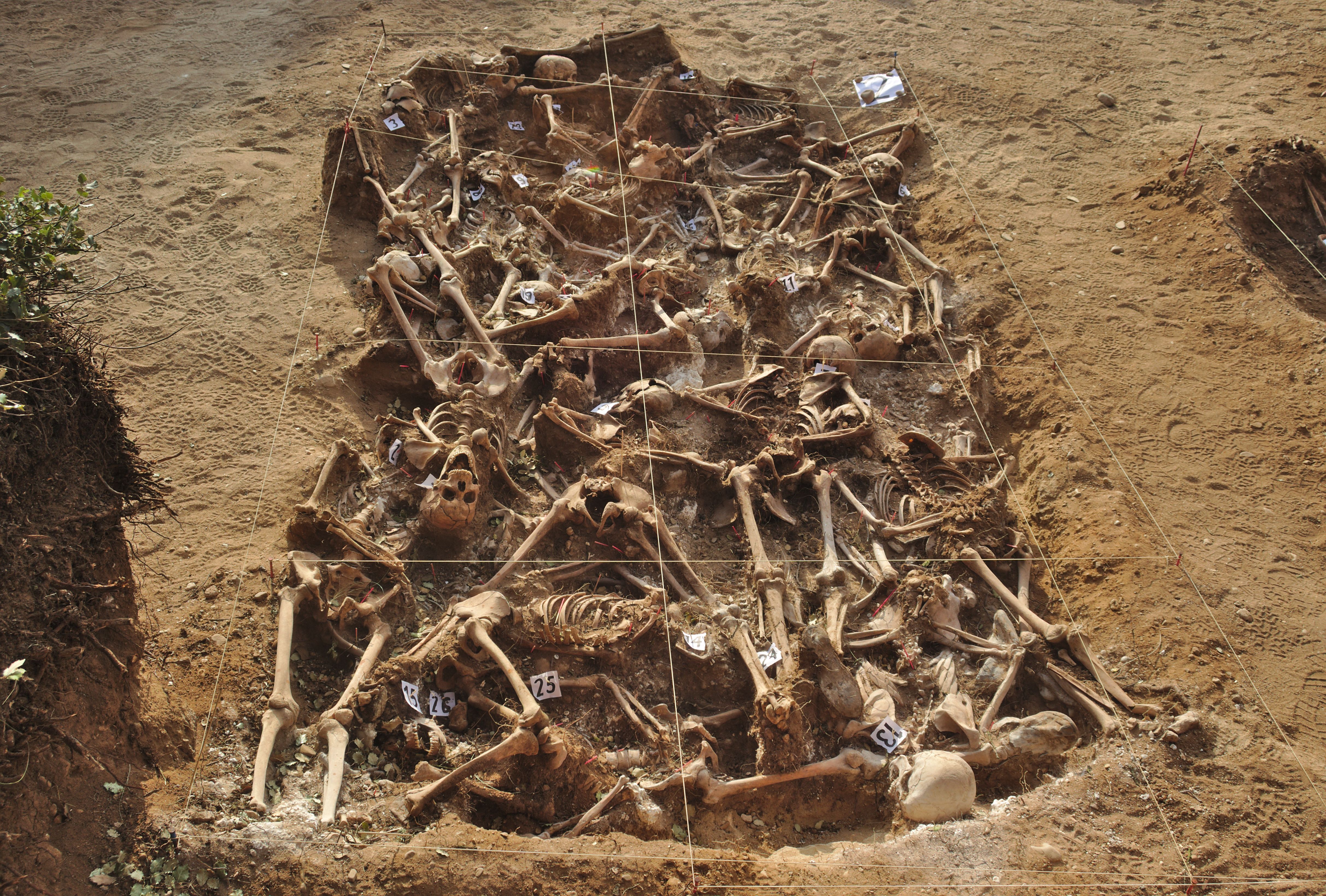
Localització: Segona fossa comuna, de quatre, amb 26 víctimes del franquisme (agost-setembre, 1936). Estépar (Burgos).
Data de la fotografia: 26-7-2014. 15:15:01.
_______________________________________________________________________________
www.flickr.com/photos/mario_modesto/15487220198/in/photos...
www.flickr.com/photos/mario_modesto/albums
________________________________________
Mario Modesto Mata.
Fosa común de la Guerra Civil Española. Estépar (Burgos)
Durante parte del mes de julio de 2014 se llevó a cabo la exhumación de varias fosas comunes republicanas de la Guerra Civil Española en la localidad burgalesa de Estépar.
En total se localizaron 4 fosas, en la que la de la imagen es la segunda, y contiene un total de 26 hombres asesinados.
Como se observa en algunos esqueletos, existen evidencias de que estaban maniatados a la espalda.
La imagen en Wikimedia Commons:
commons.wikimedia.org/wiki/File:Spanish_Civil_War_-_Mass_...

_______________________________________________________________________________
_______________________________________________________________________________
Disponible en Wikimedia Commons (Wikipedia) amb la mida i qualitat original (3.13 MB. 4852 × 3280 píxels).
upload.wikimedia.org/wikipedia/commons/9/9a/Spanish_Civil...
commons.wikimedia.org/wiki/File:Spanish_Civil_War_-_Mass_...
________________________________________
es.wikipedia.org/wiki/Desaparecidos_del_franquismo
_______________________________________________________________________________
File: Spanish Civil War - Mass grave - Estépar, Burgos.jpg
From Wikimedia Commons, the free media repository
File: Spanish Civil War - Mass grave - Estépar, Burgos.jpg
Size of this preview: 800 × 541 pixels. Other resolutions: 320 × 216 pixels | 640 × 433 pixels | 1,024 × 692 pixels | 1,280 × 865 pixels | 4,852 × 3,280 pixels.
Language select: Català.
Original file (4,852 × 3,280 pixels, file size: 3.13 MB, MIME type: image/jpeg); ZoomViewer: flash/no flash
upload.wikimedia.org/wikipedia/commons/9/9a/Spanish_Civil...
________________________________________
Summary
Description (Català):
Una de les fosses comunes descobertes a Estèpar (província de Burgos) datant d'agost-setembre del 1936, a l'inici de la guerra civil espanyola. La fossa conté vint-i-sis republicans assasinats pels nacionalistes [feixistes espanyols].
Date 26 July 2014, 15:15:01
Source Own work
Author Mario Modesto Mata
Permission (Reusing this file)
Summary:
In using this image or any subsequent derivatives of it, you are required to release the image under the same license. As such, any reproduction of this image, in any medium, must appear with a copy of, or full URL of the license.
Attribution of this image to the author (Mario Modesto Mata) is required in a prominent location near to the image.
No other conditions may be added to, or removed from this license without the permission of the author and copyright holder.
Please review the full license requirements carefully before using this image. If you would like to clarify the terms of the license or negotiate less restrictive commercial licensing outside of the bounds of GFDL/CC-BY-SA, please contact me by email, or if you don't have a Wikipedia account you can leave a message on my talk page with your contact details and your request.
commons.wikimedia.org/wiki/User:Mario_modesto
Click on the image to see my portfolio: Los ojos de antecessor Photography.svg
losojosdeantecessor.wordpress.com/
Camera location 42° 17' 15.18" N, 3° 53' 59.1" W
View this and other nearby images on: OpenStreetMap - Google Earth
tools.wmflabs.org/wiwosm/osm-on-ol/commons-on-osm.php?zoo...
This file was a finalist in Picture of the Year 2014.
This is a featured picture on Wikimedia Commons (Featured pictures) and is considered one of the finest images.
This is a featured picture on the English language Wikipedia (Featured pictures) and is considered one of the finest images.
This is a featured picture on the Spanish language Wikipedia (Recursos destacados) and is considered one of the finest images.
If you have an image of similar quality that can be published under a suitable copyright license, be sure to upload it, tag it, and nominate it.
This image was selected as picture of the day on Wikimedia Commons for 17 July 2015.
It was captioned as follows:
English: A mass grave at Estépar (Burgos) which contains twenty-six republicans who were killed during Spanish Civil War.
________________________________________
Licensing
I, the copyright holder of this work, hereby publish it under the following license:
w:en:Creative Commons
attribution share alike
This file is licensed under the Creative Commons Attribution-Share Alike 4.0 International license.
You are free:
to share – to copy, distribute and transmit the work
to remix – to adapt the work
Under the following conditions:
attribution – You must attribute the work in the manner specified by the author or licensor (but not in any way that suggests that they endorse you or your use of the work).
share alike – If you alter, transform, or build upon this work, you may distribute the resulting work only under the same or similar license to this one.
________________________________________
File history
Click on a date/time to view the file as it appeared at that time.
Date/TimeThumbnailDimensionsUserComment
current18:52, 25 October 2014Thumbnail for version as of 18:52, 25 October 20144,852 × 3,280 (3.13 MB)Mario modesto (talk | contribs)User created page with UploadWizard
You cannot overwrite this file.
________________________________________
Metadata
This file contains additional information, such as Exif metadata, probably added from the digital camera or scanner used to create or digitize it.
If the file has been modified from its original state, some details may not fully reflect the modified file. The timestamp is only as accurate as the clock in the camera, and it may be completely wrong.
Camera manufacturer Canon
Camera model Canon EOS 6D
Author Mario Modesto Mata
Copyright holder Creative Commons
Exposure time 1/100 sec (0.01)
F-number f/8
ISO speed rating 100
Date and time of data generation 15:15, 26 July 2014
Lens focal length 32 mm
Orientation Normal
Software used darktable 1.4
File change date and time 20:43, 25 October 2014
Exposure Program Normal program
Exif version 2.3
Date and time of digitizing 15:15, 26 July 2014
Meaning of each component
Y
Cb
Cr
does not exist
APEX shutter speed 6.625
APEX aperture 6
APEX exposure bias 0
Metering mode Pattern
Flash Flash did not fire
________________________________________
Categories:
Graves in SpainMass gravesProvince of BurgosSpanish Civil WarAssassinationFeatured pictures of Castile and León2014 in the province of BurgosSpanish RepublicansVictims of fascismEstépar1936 deaths
Hidden categories:
Media with locationsPictures of the Year (finalist)Pictures of the Year/2014 (finalist)Pictures of the Year (candidate)Pictures of the Year (2014)Featured pictures on Wikimedia CommonsFeatured pictures on Wikipedia, EnglishFeatured pictures on Wikipedia, SpanishPictures of the day (2015)CC-BY-SA-4.0Self-published workUploaded with UploadWizard
Taken with Canon EOS 6D
________________________________________
This page was last modified on 9 October 2015, at 22:36.
Text is available under the Creative Commons Attribution-ShareAlike License; additional terms may apply. By using this site, you agree to the Terms of Use and Privacy Policy.
________________________________________
________________________________________
_____________________________________________________________________________________
_____________________________________________________________________________________
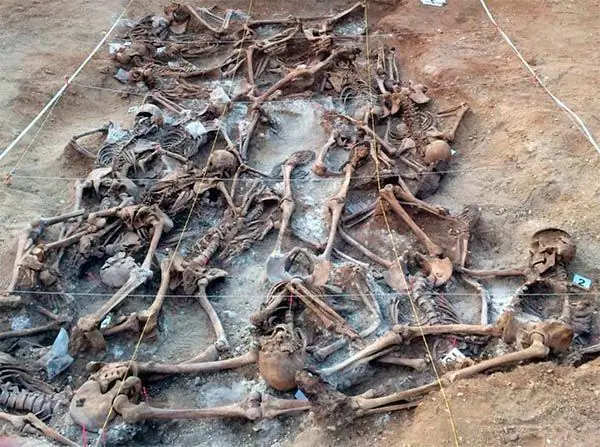
UNA ALTRA FOTOGRAFIA INTERESSANT, SOBRE LES QUATRE FOSSES COMUNES D'ESTÉPAR, BURGOS.
Memoria Histórica retoma la exhumación de víctimas del Franquismo en la cuarta fosa de Estépar.
Diario: BURGOS CONECTA.ES.
Periodista: Patricia Carro. 31-03-2015. 13:26h
________________________________________
burgosconecta.es/2015/03/31/memoria-historica-retoma-la-e...
burgosconecta.es/files/2014/07/estepar2.jpg
________________________________________
Diario: BURGOS CONECTA.ES. Un nuevo periodismo en Burgos.
Provincia Sociedad - Estépar, Memoria Histórica.
Memoria Histórica retoma la exhumación de víctimas del Franquismo en la cuarta fosa de Estépar.
En Estépar se han localizado cuatro fosas comunes. BC
Patricia Carro. BURGOS CONECTA.ES. 31-03-2015. 13:26h
Un total de 15 investigadores, coordinados por la Sociedad de Ciencias Aranzadi y Francisco Etxeberría, trabajarán desde el jueves.
Esperan encontrar 15 cuerpos, un número inferior a los recuperados en las otras tres fosas, que serán enviados a San Sebastián.
La Coordinadora para la Memoria Histórica tiene aún mucho trabajo en Estépar, con más de 300 víctimas enterradas.
Estaba prevista para el mes de noviembre pero las malas condiciones meteorológicas obligaron a su aplazamiento. Ahora, aprovechando las vacaciones de Semana Santa, el equipo de la Coordinadora Provincial para la Memoria Histórica retoma las excavaciones en los Montes de Estépar para recuperar los cuerpos de la última de las cuatro fosas localizadas. Trabajarán un total de 15 investigadores, entre antropólogos, arqueólogos o historiadores, todos ellos de Burgos, que estarán acompañados por cuatro profesionales de la Sociedad de Ciencias Aranzadi, capitaneados por Francisco Etxeberría.
El arqueólogo que coordina la excavación, Juan Montero, explica que los trabajos comenzarán el jueves por la mañana, y se extenderán durante el viernes y el sábado, aunque sin descartar llegar al domingo. Se esperan encontrar unos 15 cuerpos, que serán enviados al Laboratorio de Medicina Forense de la Universidad del País Vasco, en San Sebastián, donde el equipo de Etxeberría lleva a cabo los trabajos de análisis de los restos, extracción de ADN y comparativa con las muestras tomadas a los familiares de posibles víctimas.
Más de 300 víctimas. Montes de Estépar es la peor zona de exterminio de toda la provincia, con más de 300 víctimas.
Desde la Coordinadora Provincial para la Memoria Histórica vuelven a denunciar la falta de apoyo de las administraciones en los trabajos de recuperación de asesinados durante la Guerra Civil y el Franquismo. Recuerdan que los Montes de Estépar son la mayor zona de "exterminio" de toda la provincia, con más de 300 víctimas enterradas. Los testimonios de familiares y de vecinos de las localidades cercanas, así como el estudio de los documentos de la época, archivos militares y civiles permiten hablar de la existencia de hasta cinco sectores con fosas comunes.
El primero de ellos correspondería a las cuatro fosas localizadas el pasado verano. Entonces, el equipo de investigadores recuperó 70 cuerpos, a los que se sumarán los alrededor de 15 que se esperan encontrar ahora. Sin embargo, asegura Montero, queda mucho trabajo por delante. De ahí que, el próximo verano, continúen con las prospecciones para conseguir localizar algunos de los otros cuatro sectores. Uno ya lo dan por desaparecido, el que corresponde con la gravera creada en los años 80 para extraer material con el que se construyó la autovía.
Los propios trabajadores de la época aseguran que hallaron muchos huesos durante las obras, así que poco o nada quedará ahora. Muy afectada se podría encontrar también la zona que se utilizó, hace décadas, como arenal, pero Montero no descarta encontrar algún resto. E intactos tendrían que estar los sectores que se ubicarían en pleno monte comunal. El problema es que hay que localizar el punto exacto, algo difícil teniendo en cuenta que las investigaciones se basan en testimonios orales y que la zona ha cambiado mucho desde el verano del '36, recuerda el arqueólogo.
Sin recursos. Futuras nuevas excavaciones dependerán de los fondos de los que disponga la Coordinadora.
Además, la Coordinadora requiere de fondos para poder llevar a cabo los trabajos. De hecho, la última parte de esta campaña se va a hacer con los mínimos recursos posibles. En lugar de contar con 30 profesionales, como en verano, lo harán sólo con 15. Los de burgos dormirán en sus casas, y sólo se pagará el alojamiento a los investigadores de Aranzadi, explican. Juan Montero insiste en que los investigadores de Burgos "no vamos a cobrar ni un solo euro", siendo en la mayor parte de los casos profesionales en paro, no adscritos a ningún organismo o centro de investigación.
La campaña de crowdfunding desarrollada en verano dio sus frutos, consiguiendo entre 20.000 y 24.000 euros, pero pretenden que les sobre algo de dinero para poder financiar las próximas prospecciones. Además, desde la Coordinadora recuerdan que su objetivo no es sólo recuperar los cuerpos, sino darles un digno enterramiento. Si no se consigue una identificación de los restos, para devolverlos a las familias, irán al cementerio de Estépar, donde ya se ha adquirido el terreno. Sin embargo, sólo hacer el hueco y acondicionarlo para enterramiento puede costar 24.000 euros.
Por ello, desde la Coordinadora denuncian la falta de apoyos institucionales, como los que existen en País Vasco, Navarra o Andalucía, por falta de "voluntad política" de los gobiernos del Partido Popular. Y es que ni Junta ni Diputación disponen de una política de memoria histórica. Nunca se ha hecho nada, insiste Montero, a pesar de que muchos de los asesinados que se encuentran en Estépar fueron víctimas políticas, alcaldes, concejales o gobernadores, que fueron cayendo durante los primeros meses de la Guerra Civil o en la dictadura.
____
MÁS INFO:
burgosconecta.es/2014/07/28/se-recuperan-70-cuerpos-de-aj...
burgosconecta.es/2014/06/15/crowdfunding-para-recuperar-a...
____
Noticias relacionadas:
Entierro digno para los 132 asesinados exhumados en La Pedraja.
FOTO: Los restos han estado presentes en el Monte y luego se han trasladado al panteón. PCR
Tudanca denuncia la derogación "de facto" de la Ley de la Memoria Histórica.
FOTO: Tudanca ha estado presente en el homenaje de La Pedraja. PCR
Se recuperan 70 cuerpos de asesinados en Estépar en el '36 [1936].
FOTO: En Estépar se han localizado cuatro fosas comunes. BC
Último empujón en la recogida de fondos para identificaciones de La Pedraja.
FOTO: Sociedad de Ciencias Aranzadi realizó las exhumaciones. BC
Crowdfunding para recuperar a las víctimas de Estépar.
FOTO: Fosa común recuperada en Covanera, por la Coordinadora. BC
________________________________________
________________________________________
_____________________________________________________________________________________
_____________________________________________________________________________________
____
____
Laxa’ine’ gigukwdzikasi’ gigukwas Hayałiligase’
(The Many Large Houses of the Ghosts)
by Marianne Nicolson, Musgamakw Dzawada’enux First Nation, Kwakwaka’wakw/Canada
Nicolson presents her work as a guest to the great lakes woodlands region of Toronto outside of her ancestral territory as Kwakwaka’wakw on the west coast. Her animated projection on the Old City Hall clock tower manifests ghost stories from the dead of night, recalling the supernatural spirit world while addressing the institutional haunting of the building as a structure and symbol of the nation state and Toronto's history. She overwrites the Romanesque civic building and courthouse using animated projections of hand-drawn pictographs based in Indigenous oral traditions and languages. Nicolson builds on her investigations into the ongoing tension and unresolved history of dispossession between Indigenous and non-indigenous governance, colonial power and buildings as permanent markers on land and bodies.
Image ©Philip Krayna, BoxxCarr, all rights reserved. This image is not in the public domain. Please contact me for permission to download, license, reproduce, or otherwise use this image, or to just say "hello". I value your input and comments. See more at www.boxxcarr.com.
A blockchain, originally block chain, is a continuously growing list of records, called blocks, which are linked and secured using cryptography. Each block typically contains a cryptographic hash of the previous block, a timestamp and transaction data. By design, a blockchain is inherently resistant to modification of the data. It is "an open, distributed ledger that can record transactions between two parties efficiently and in a verifiable and permanent way". For use as a distributed ledger, a blockchain is typically managed by a peer-to-peer network collectively adhering to a protocol for validating new blocks. Once recorded, the data in any given block cannot be altered retroactively without the alteration of all subsequent blocks, which requires collusion of the network majority. Blockchains are secure by design and are an example of a distributed computing system with high Byzantine fault tolerance. Decentralized consensus has therefore been achieved with a blockchain. This makes blockchains potentially suitable for the recording of events, medical records, and other records management activities, such as identity management,transaction processing, documenting provenance, food traceability or voting. Blockchain was invented by Satoshi Nakamoto in 2008 for use in the cryptocurrency bitcoin, as its public transaction ledger.The first work on a cryptographically secured chain of blocks was described in 1991 by Stuart Haber and W. Scott Stornetta.In 1992, Bayer, Haber and Stornetta incorporated Merkle trees to the design, which improved its efficiency by allowing several documents to be collected into one block.In 2002, David Mazières and Dennis Shasha proposed a network file system with decentralized trust: writers to the file system trust one another but not the network in between; they achieve file system integrity by writing signed commits to a shared, append-only signature chain that captures the root of the file system (which in turn is a Merkle Tree). This system can be viewed as a proto-blockchain in which all authorized clients can always write, whereas, in modern blockchains, a client who solves a cryptographic puzzle can write one block.[citation needed] In 2005, Nick Szabo proposed a blockchain-like system for decentralized property titles and his bit gold payment system that utilised chained proof-of-work and timestamping. However, Szabo's method of double-spending protection was vulnerable to Sybil attacks. The first blockchain was conceptualised by a person (or group of people) known as Satoshi Nakamoto in 2008. It was implemented the following year by Nakamoto as a core component of the cryptocurrency bitcoin, where it serves as the public ledger for all transactions on the network.Through the use of a blockchain, bitcoin became the first digital currency to solve the double spending problem without requiring a trusted authority and has been the inspiration for many additional applications. In August 2014, the bitcoin blockchain file size, containing records of all transactions that have occurred on the network, reached 20GB (gigabytes). In January 2015, the size had grown to almost 30GB, and from January 2016 to January 2017, the bitcoin blockchain grew from 50GB to 100GB in size.The words block and chain were used separately in Satoshi Nakamoto's original paper, but were eventually popularized as a single word, blockchain, by 2016. The term blockchain 2.0 refers to new applications of the distributed blockchain database, first emerging in 2014. The Economist described one implementation of this second-generation programmable blockchain as coming with "a programming language that allows users to write more sophisticated smart contracts, thus creating invoices that pay themselves when a shipment arrives or share certificates which automatically send their owners dividends if profits reach a certain level". Blockchain 2.0 technologies go beyond transactions and enable "exchange of value without powerful intermediaries acting as arbiters of money and information". They are expected to enable excluded people to enter the global economy, protect the privacy of participants, allow people to "monetize their own information", and provide the capability to ensure creators are compensated for their intellectual property. Second-generation blockchain technology makes it possible to store an individual's "persistent digital ID and persona" and are providing an avenue to help solve the problem of social inequality by "potentially changing the way wealth is distributed".:14–15 As of 2016, blockchain 2.0 implementations continue to require an off-chain oracle to access any "external data or events based on time or market conditions [that need] to interact with the blockchain". In 2016, the central securities depository of the Russian Federation (NSD) announced a pilot project, based on the Nxt blockchain 2.0 platform, that would explore the use of blockchain-based automated voting systems. IBM opened a blockchain innovation research center in Singapore in July 2016. A working group for the World Economic Forum met in November 2016 to discuss the development of governance models related to blockchain.[28] According to Accenture, an application of the diffusion of innovations theory suggests that blockchains attained a 13.5% adoption rate within financial services in 2016, therefore reaching the early adopters phase. Industry trade groups joined to create the Global Blockchain Forum in 2016, an initiative of the Chamber of Digital Commerce. A blockchain is a decentralized, distributed and public digital ledger that is used to record transactions across many computers so that the record cannot be altered retroactively without the alteration of all subsequent blocks and the collusion of the network. This allows the participants to verify and audit transactions inexpensively. A blockchain database is managed autonomously using a peer-to-peer network and a distributed timestamping server. They are authenticated by mass collaboration powered by collective self-interests.The result is a robust workflow where participants' uncertainty regarding data security is marginal. The use of a blockchain removes the characteristic of infinite reproducibility from a digital asset. It confirms that each unit of value was transferred only once, solving the long-standing problem of double spending. Blockchains have been described as a value-exchange protocol. This blockchain-based exchange of value can be completed more quickly, more safely and more cheaply than with traditional systems. A blockchain can assign title rights because it provides a record that compels offer and acceptance.
Blocks
Blocks hold batches of valid transactions that are hashed and encoded into a Merkle tree. Each block includes the cryptographic hash of the prior block in the blockchain, linking the two. The linked blocks form a chain.This iterative process confirms the integrity of the previous block, all the way back to the original genesis block.
Sometimes separate blocks can be produced concurrently, creating a temporary fork. In addition to a secure hash-based history, any blockchain has a specified algorithm for scoring different versions of the history so that one with a higher value can be selected over others. Blocks not selected for inclusion in the chain are called orphan blocks. Peers supporting the database have different versions of the history from time to time. They only keep the highest-scoring version of the database known to them. Whenever a peer receives a higher-scoring version (usually the old version with a single new block added) they extend or overwrite their own database and retransmit the improvement to their peers. There is never an absolute guarantee that any particular entry will remain in the best version of the history forever. Because blockchains are typically built to add the score of new blocks onto old blocks and because there are incentives to work only on extending with new blocks rather than overwriting old blocks, the probability of an entry becoming superseded goes down exponentially as more blocks are built on top of it, eventually becoming very low. For example, in a blockchain using the proof-of-work system, the chain with the most cumulative proof-of-work is always considered the valid one by the network. There are a number of methods that can be used to demonstrate a sufficient level of computation. Within a blockchain the computation is carried out redundantly rather than in the traditional segregated and parallel manner.
The block time is the average time it takes for the network to generate one extra block in the blockchain. Some blockchains create a new block as frequently as every five seconds. By the time of block completion, the included data becomes verifiable. In cryptocurrency, this is practically when the money transaction takes place, so a shorter block time means faster transactions. The block time for Ethereum is set to between 14 and 15 seconds, while for bitcoin it is 10 minutes.Express. Why is Ripple XRP falling today? Why is it crashing in value?Ripple price: Why is Ripple XRP falling today? Why is it… 'Ripple is first in line' - CEO reveals next cryptocurrency to catch up with bitcoin
'Ripple is first in line' - CEO reveals next cryptocurrency to…
Ripple price news: Why is XRP falling so fast? What's happening to Ripple?Ripple price news: Why is XRP falling so fast? What's happening… Bitcoin price BOOST: Big investors are FINALLY realising Bitcoin is GAME-CHANGING Bitcoin price WARNING: CEO says cryptocurrency has 'NOTHING to do with the real economy' BITCOIN has come under fire from the CEO of Euronext as the financial expert claimed the cryptocurrency "has nothing to do with the real economy".
Bitcoin price suffered a massive plunge as the cryptocurrency reached the value of $9,114.56, according to Coindesk at 10:37 pm on February. As the crypto-craze started to die down, Euronext CEO Stéphane Boujnah claims bitcoin cannot even be classified as a cryptocurrency. Speaking on Bloomberg, Mr Boujnah said Euronext will never open a bitcoin market. He said: "We will not create a bitcoin market because the mandate of Euronext is to power Pan-European capital markets to finance the real economy and bitcoin has nothing to do with the real economy. "Bitcoin has a lot to do with bitcoin. And we believe bitcoin is not a cryptocurrency.
"Bitcoin is at best a crypto asset. All currencies are assets but not all assets are currencies. "Clearly, bitcoin today is just like a piece of art, or just like a diamond, just like a Pokemon card.
"It can be anything to capture value but today people buy it because it goes up and because it’s not as serious and transparent as a lot of assets. "So great, good luck. Like any emerging assets, it’s very fancy, which is great, but this is not our mandate. "Our mandate is to be the place regulated, transparent, open, reliable. It’s not our mandate to be part of this new game in town." Despite the rollercoaster few months suffered by the crypto mania, bitcoin and other cryptocurrencies such as Ripple and ethereum still benefit from a "growing" appreciation among institutional investors, according to Dr Garrick Hileman, from the Cambridge University Centre for Alternative Finance.In an exclusive interview with Express.co.uk, Dr Hileman said: "Any breakthrough technology, and bitcoin and blockchain, are certainly breakthrough technologies, hype often outpaces the reality. “In terms of both of how mature the technology is, the rates of adoption. “We’ve seen this before with bitcoin and we’ve seen the price shoot up first in late 2013 when it first entered the mainstream public consciousness. “The price subsequently crashed 85 percent as security at a major exchange broke down and bitcoin’s were stolen. “So we’ve seen this kind of story repeat where bitcoin rises, gets hyped and then there’s a crash.” This section is transcluded from Fork (blockchain). A hard fork occurs when a blockchain splits into two incompatible separate chains. This is a consequence of the use of two incompatible sets of rules trying to govern the system. For example, Ethereum has hard-forked to "make whole" the investors in The DAO, which had been hacked by exploiting a vulnerability in its code. In 2014 the Nxt community was asked to consider a hard fork that would have led to a rollback of the blockchain records to mitigate the effects of a theft of 50 million NXT from a major cryptocurrency exchange. The hard fork proposal was rejected, and some of the funds were recovered after negotiations and ransom payment.
Decentralization
By storing data across its network, the blockchain eliminates the risks that come with data being held centrally. The decentralized blockchain may use ad-hoc message passing and distributed networking. Its network lacks centralized points of vulnerability that computer crackers can exploit; likewise, it has no central point of failure. Blockchain security methods include the use of public-key cryptography. A public key (a long, random-looking string of numbers) is an address on the blockchain. Value tokens sent across the network are recorded as belonging to that address. A private key is like a password that gives its owner access to their digital assets or the means to otherwise interact with the various capabilities that blockchains now support. Data stored on the blockchain is generally considered incorruptible. This is where blockchain has its advantage. While centralized data is more controllable, information and data manipulation are common. By decentralizing it, blockchain makes data transparent to everyone involved. Every node in a decentralized system has a copy of the blockchain. Data quality is maintained by massive database replication[9] and computational trust. No centralized "official" copy exists and no user is "trusted" more than any other. Transactions are broadcast to the network using software. Messages are delivered on a best-effort basis. Mining nodes validate transactions, add them to the block they are building, and then broadcast the completed block to other nodes. Blockchains use various time-stamping schemes, such as proof-of-work, to serialize changes. Alternate consensus methods include proof-of-stake. Growth of a decentralized blockchain is accompanied by the risk of node centralization because the computer resources required to process larger amounts of data become more expensive.
Openness
Open blockchains are more user-friendly than some traditional ownership records, which, while open to the public, still require physical access to view. Because all early blockchains were permissionless, controversy has arisen over the blockchain definition. An issue in this ongoing debate is whether a private system with verifiers tasked and authorized (permissioned) by a central authority should be considered a blockchain. Proponents of permissioned or private chains argue that the term "blockchain" may be applied to any data structure that batches data into time-stamped blocks. These blockchains serve as a distributed version of multiversion concurrency control (MVCC) in databases. Just as MVCC prevents two transactions from concurrently modifying a single object in a database, blockchains prevent two transactions from spending the same single output in a blockchain.[24]:30–31 Opponents say that permissioned systems resemble traditional corporate databases, not supporting decentralized data verification, and that such systems are not hardened against operator tampering and revision. Nikolai Hampton of Computerworld said that "many in-house blockchain solutions will be nothing more than cumbersome databases."Business analysts Don Tapscott and Alex Tapscott define blockchain as a distributed ledger or database open to anyone.
Permissionless
The great advantage to an open, permissionless, or public, blockchain network is that guarding against bad actors is not required and no access control is needed.This means that applications can be added to the network without the approval or trust of others, using the blockchain as a transport layer.
Bitcoin and other cryptocurrencies currently secure their blockchain by requiring new entries including a proof of work. To prolong the blockchain, bitcoin uses Hashcash puzzles developed by Adam Back in the 1990s.
Financial companies have not prioritised decentralized blockchains. In 2016, venture capital investment for blockchain related projects was weakening in the USA but increasing in China. Bitcoin and many other cryptocurrencies use open (public) blockchains. As of January 2018, bitcoin has the highest market capitalization.
Permissioned (private) blockchain
Permissioned blockchains use an access control layer to govern who has access to the network. In contrast to public blockchain networks, validators on private blockchain networks are vetted by the network owner. They do not rely on anonymous nodes to validate transactions nor do they benefit from the network effect. Permissioned blockchains can also go by the name of 'consortium' or 'hybrid' blockchains.
The New York Times noted in both 2016 and 2017 that many corporations are using blockchain networks "with private blockchains, independent of the public system."
Disadvantages
Nikolai Hampton pointed out in Computerworld that "There is also no need for a "51 percent" attack on a private blockchain, as the private blockchain (most likely) already controls 100 percent of all block creation resources. If you could attack or damage the blockchain creation tools on a private corporate server, you could effectively control 100 percent of their network and alter transactions however you wished." This has a set of particularly profound adverse implications during a financial crisis or debt crisis like the financial crisis of 2007–08, where politically powerful actors may make decisions that favor some groups at the expense of others.[citation needed] and "the bitcoin blockchain is protected by the massive group mining effort. It's unlikely that any private blockchain will try to protect records using gigawatts of computing power — it's time consuming and expensive."He also said, "Within a private blockchain there is also no 'race'; there's no incentive to use more power or discover blocks faster than competitors. This means that many in-house blockchain solutions will be nothing more than cumbersome databases."
Uses
Blockchain technology can be integrated into multiple areas. The primary use of blockchains today is as a distributed ledger for cryptocurrencies, most notably bitcoin.While a few central banks, in countries such as China, United States, Sweden, Singapore, South Africa and England are studying issuance of a Central Bank Issued Cryptocurrency (CICC), none have done so thus far.
General potentials
Blockchain technology has a large potential to transform business operating models in the long term. Blockchain distributed ledger technology is more a foundational technology—with the potential to create new foundations for global economic and social systems—than a disruptive technology, which typically "attack a traditional business model with a lower-cost solution and overtake incumbent firms quickly".Even so, there are a few operational products maturing from proof of concept by late 2016.The use of blockchains promises to bring significant efficiencies to global supply chains, financial transactions, asset ledgers and decentralized social networking.
As of 2016, some observers remain skeptical. Steve Wilson, of Constellation Research, believes the technology has been hyped with unrealistic claims.To mitigate risk businesses are reluctant to place blockchain at the core of the business structure.
This means specific blockchain applications may be a disruptive innovation, because substantially lower-cost solutions can be instantiated, which can disrupt existing business models. Blockchain protocols facilitate businesses to use new methods of processing digital transactions.[68] Examples include a payment system and digital currency, facilitating crowdsales, or implementing prediction markets and generic governance tools.
Blockchains alleviate the need for a trust service provider and are predicted to result in less capital being tied up in disputes. Blockchains have the potential to reduce systemic risk and financial fraud. They automate processes that were previously time-consuming and done manually, such as the incorporation of businesses.In theory, it would be possible to collect taxes, conduct conveyancing and provide risk management with blockchains.
As a distributed ledger, blockchain reduces the costs involved in verifying transactions, and by removing the need for trusted "third-parties" such as banks to complete transactions, the technology also lowers the cost of networking, therefore allowing several applications.
Starting with a strong focus on financial applications, blockchain technology is extending to activities including decentralized applications and collaborative organizations that eliminate a middleman.
Land registration
"Land is a financial source, if people can prove they own it, they can borrow against it."
Emmanuel Noah, CEO of Ghanian startup BenBen, New York Observer
Frameworks and trials such as the one at the Sweden Land Registry aim to demonstrate the effectiveness of the blockchain at speeding land sale deals.The Republic of Georgia is piloting a blockchain-based property registry.The Ethical and Fair Creators Association uses blockchain to help startups protect their authentic ideas.
The Government of India is fighting land fraud with the help of a blockchain.
In October 2017, one of the first international property transactions was completed successfully using a blockchain-based smart contract.
In the first half of 2018, an experiment will be conducted on the use of blocking technology to monitor the reliability of the Unified State Real Estate Register (USRER) data in the territory of Moscow.
The Big Four
Each of the Big Four accounting firms is testing blockchain technologies in various formats. Ernst & Young has provided cryptocurrency wallets to all (Swiss) employees,has installed a bitcoin ATM in their office in Switzerland, and accepts bitcoin as payment for all its consulting services. Marcel Stalder, CEO of Ernst & Young Switzerland, stated, "We don't only want to talk about digitalization, but also actively drive this process together with our employees and our clients. It is important to us that everybody gets on board and prepares themselves for the revolution set to take place in the business world through blockchains, [to] smart contracts and digital currencies."PwC, Deloitte, and KPMG have taken a different path from Ernst & Young and are all testing private blockchains.
Smart contracts
Blockchain-based smart contracts are contracts that can be partially or fully executed or enforced without human interaction.One of the main objectives of a smart contract is automated escrow. The IMF believes blockchains could reduce moral hazards and optimize the use of contracts in general.Due to the lack of widespread use their legal status is unclear.
Some blockchain implementations could enable the coding of contracts that will execute when specified conditions are met. A blockchain smart contract would be enabled by extensible programming instructions that define and execute an agreement.For example, Ethereum Solidity is an open-source blockchain project that was built specifically to realize this possibility by implementing a Turing-complete programming language capability to implement such contracts.
Nonprofit organizations
Level One Project from the Bill & Melinda Gates Foundation aims to use blockchain technology to help the two billion people worldwide who lack bank accounts.
Building Blocks project from the U.N.'s World Food Programme (WFP) aims to make WFP's growing cash-based transfer operations faster, cheaper, and more secure. Building Blocks commenced field pilots in Pakistan in January 2017 that will continue throughout spring.
Decentralized networks
The Backfeed project develops a distributed governance system for blockchain-based applications allowing for the collaborative creation and distribution of value in spontaneously emerging networks of peers.[88][89]
The Alexandria project is a blockchain-based Decentralized Library.
Tezos is a blockchain project that governs itself by voting of its token holders. Bitcoin blockchain performs as a cryptocurrency and payment system. Ethereum blockchain added smart contract system on top of a blockchain. Tezos blockchain will add an autonomy system – a decentralized code Development function on top of both bitcoin and Ethereum blockchains.
Governments and national currencies
The director of the Office of IT Schedule Contract Operations at the US General Services Administration, Mr. Jose Arrieta, disclosed at the 20 Sep ACT-IAC (American Council for Technology and Industry Advisory Council) Forum that its organization is using blockchain distributed ledger technology to speed up the FASt Lane process for IT Schedule 70 contracts through automation. Two companies, United Solutions (prime contractor) and Sapient Consulting (subcontractor) are developing for FASt Lane a prototype to automate and shorten the time required to perform the contract review process.
The Commercial Customs Operations Advisory Committee, a subcommittee of the U.S. Customs and Border Protection, is working on finding practical ways Blockchain could be implemented in its duties.[1]
Companies have supposedly been suggesting blockchain-based currency solutions in the following two countries:
e-Dinar, Tunisia's national currency, was the first state currency using blockchain technology.
eCFA is Senegal's blockchain-based national digital currency.
Some countries, especially Australia, are providing keynote participation in identify the various technical issues associated with developing, governing and using blockchains:
In April 2016 Standards Australia submitted a New Field of Technical Activity (NFTA) proposal on behalf of Australia for the International Organization for Standardization (ISO) to consider developing standards to support blockchain technology. The proposal for an NFTA to the ISO was intended to establish a new ISO technical committee for blockchain. The new committee would be responsible for supporting innovation and competition by covering blockchain standards topics including interoperability, terminology, privacy, security and auditing.[99] There have been several media releases[100] supporting blockchain integration to Australian businesses.
Banks
Don Tapscott conducted a two-year research project exploring how blockchain technology can securely move and store host "money, titles, deeds, music, art, scientific discoveries, intellectual property, and even votes".. Furthermore, major portions of the financial industry are implementing distributed ledgers for use in banking, and according to a September 2016 IBM study, this is occurring faster than expected.
Banks are interested in this technology because it has potential to speed up back office settlement systems.
Banks such as UBS are opening new research labs dedicated to blockchain technology in order to explore how blockchain can be used in financial services to increase efficiency and reduce costs.
Russia has officially completed its first government-level blockchain implementation. The state-run bank Sberbank announced 20 December 2017 that it is partnering with Russia's Federal Antimonopoly Service (FAS) to implement document transfer and storage via blockchain.
Deloitte and ConsenSys announced plans in 2016 to create a digital bank called Project ConsenSys.
R3 connects 42 banks to distributed ledgers built by Ethereum, Chain.com, Intel, IBM and Monax.
A Swiss industry consortium, including Swisscom, the Zurich Cantonal Bank and the Swiss stock exchange, is prototyping over-the-counter asset trading on a blockchain-based Ethereum technology.
Other financial companies.
The credit and debits payments company MasterCard has added three blockchain-based APIs for programmers to use in developing both person-to-person (P2P) and business-to-business (B2B) payment systems.
CLS Group is using blockchain technology to expand the number of currency trade deals it can settle.
VISA payment systems, Mastercard,Unionpay and SWIFT have announced the development and plans for using blockchain technology.
Prime Shipping Foundation is using blockchain technology to address issues related to the payments in the shipping industry.
Other uses
Blockchain technology can be used to create a permanent, public, transparent ledger system for compiling data on sales, storing rights data by authenticating copyright registration,[116] and tracking digital use and payments to content creators, such as musicians. In 2017, IBM partnered with ASCAP and PRS for Music to adopt blockchain technology in music distribution.Imogen Heap's Mycelia service, which allows managers to use a blockchain for tracking high-value parts moving through a supply chain, was launched as a concept in July 2016. Everledger is one of the inaugural clients of IBM's blockchain-based tracking service.
Kodak announced plans in 2018 to launch a digital token system for photograph copyright recording.
Another example where smart contracts are used is in the music industry. Every time a dj mix is played, the smart contracts attached to the dj mix pays the artists almost instantly.
An application has been suggested for securing the spectrum sharing for wireless networks.
New distribution methods are available for the insurance industry such as peer-to-peer insurance, parametric insurance and microinsurance following the adoption of blockchain.The sharing economy and IoT are also set to benefit from blockchains because they involve many collaborating peers.Online voting is another application of the blockchain. Blockchains are being used to develop information systems for medical records, which increases interoperability. In theory, legacy disparate systems can be completely replaced by blockchains.Blockchains are being developed for data storage, publishing texts and identifying the origin of digital art. Blockchains facilitate users could take ownership of game assets (digital assets),an example of this is Cryptokitties.
Notable non-cryptocurrency designs include:
Steemit – a blogging/social networking website and a cryptocurrency
Hyperledger – a cross-industry collaborative effort from the Linux Foundation to support blockchain-based distributed ledgers, with projects under this initiative including Hyperledger Burrow (by Monax) and Hyperledger Fabric (spearheaded by IBM)
Counterparty – an open source financial platform for creating peer-to-peer financial applications on the bitcoin blockchain
Quorum – a permissionable private blockchain by JPMorgan Chase with private storage, used for contract applications
Bitnation – a decentralized borderless "voluntary nation" establishing a jurisdiction of contracts and rules, based on Ethereum
Factom, a distributed registry
Tezos, decentralized voting.
Microsoft Visual Studio is making the Ethereum Solidity language available to application developers.
IBM offers a cloud blockchain service based on the open source Hyperledger Fabric project
Oracle Cloud offers Blockchain Cloud Service based on Hyperledger Fabric. Oracle has joined the Hyperledger consortium.
In August 2016, a research team at the Technical University of Munich published a research document about how blockchains may disrupt industries. They analyzed the venture funding that went into blockchain ventures. Their research shows that $1.55 billion went into startups with an industry focus on finance and insurance, information and communication, and professional services. High startup density was found in the USA, UK and Canada.
ABN Amro announced a project in real estate to facilitate the sharing and recording of real estate transactions, and a second project in partnership with the Port of Rotterdam to develop logistics tools.
Academic research
Blockchain panel discussion at the first IEEE Computer Society TechIgnite conference
In October 2014, the MIT Bitcoin Club, with funding from MIT alumni, provided undergraduate students at the Massachusetts Institute of Technology access to $100 of bitcoin. The adoption rates, as studied by Catalini and Tucker (2016), revealed that when people who typically adopt technologies early are given delayed access, they tend to reject the technology.
Journals
In September 2015, the first peer-reviewed academic journal dedicated to cryptocurrency and blockchain technology research, Ledger, was announced. The inaugural issue was published in December 2016. The journal covers aspects of mathematics, computer science, engineering, law, economics and philosophy that relate to cryptocurrencies such as bitcoin. There are also research platforms like Strategic coin that offer research for the blockchain and crypto space.
The journal encourages authors to digitally sign a file hash of submitted papers, which will then be timestamped into the bitcoin blockchain. Authors are also asked to include a personal bitcoin address in the first page of their papers.
Predictions
A World Economic Forum report from September 2015 predicted that by 2025 ten percent of global GDP would be stored on blockchains technology.
In early 2017, Harvard Business School professors Marco Iansiti and Karim R. Lakhani said the blockchain is not a disruptive technology that undercuts the cost of an existing business model, but is a foundational technology that "has the potential to create new foundations for our economic and social systems". They further predicted that, while foundational innovations can have enormous impact, "It will take decades for blockchain to seep into our economic and social infrastructure."
I thought I knew Yarmouth, but I heard in a discussion about what was the largest parish church in England, that Great Yarmouth Minster was one that laid claim to that accolade.
Minster? In Yarmouth?
But seems there is much to the town I did not know, and clearly it needs to be further explored. But whilst in the area, riding on trains, I took and hour out to walk from the station to the Minster to have a look, if it was open.
Maybe they are more welcoming to visitors now, but two boards outside announcing the fact, so I went in and was stunned at the size of it, too much to take in really, but it was full of light and I was given a very warm welcome. This made a very lasting impression.
------------------------------------------------
The Norman-era Minster Church of St Nicholas in Great Yarmouth remains, due to its floor-surface area, England's largest parish church.[1] It was founded in 1101 by Herbert de Losinga, the first Bishop of Norwich,[2] and consecrated in 1119. Since its construction, it has been Great Yarmouth's parish church. It is cruciform, with a central tower, which may preserve a part of the original structure. Gradual alterations effectively changed the form of the building. Its nave is 26 feet (7.9 m) wide, and the church's total length is 236 feet (72 m).
In December 2011, the Bishop of Norwich officially designated it a Minster Church. It is not only used for religious services but is a hub for various other regional and civic events, including concerts by choirs, orchestras and other musical ensembles, art exhibitions and, during festivals and fayres, the church opens permitting stalls and traders inside.
The building, very possibly the town's oldest, is also its most visible, historic landmark. It sits in the central area of Great Yarmouth, close to the house of Anna Sewell.[2] The Transitional clerestoried nave, with columns alternately octagonal and circular, was rebuilt in the reign of King John. A portion of the chancel is of the same date. About fifty years later the aisles were widened, so that the nave is now, rather unusually, the narrowest part of the building. Immediately adjacent are two main graveyard areas: the Old Yard lies directly east behind the church, while the very substantial New Yard stretches for about half a mile to the north.
A grand west front with towers and pinnacles was constructed between 1330 and 1338, but a plague interrupted building extension plans. In the 16th century the ornamental brasses were cast into weights and the gravestones cut into grindstones. Within the church there were at one time 18 chapels, some maintained by guilds, others by private families, such as the Paxtons. At the Reformation the chapels were demolished and the building's valuable liturgical vessels sold off, the proceeds spent to widen the channel of the harbour.
During the Commonwealth period, the Independents appropriated the chancel, the Presbyterians the north aisle, while Churchmen were allowed the remainder of the building. The interior brick walls, erected at this time to separate the different portions of the building, remained until 1847. In 1864 the tower was restored, and the east end of the chancel rebuilt; between 1869 and 1870 the south aisle was rebuilt; and in 1884 the south transept, the west end of the nave and the north aisle underwent restoration.
During the Second World War, the building was bombed and nearly destroyed by fire. It was rebuilt by the architect Stephen Dykes Bower and re-consecrated in 1961. During reconstruction, the church temporarily used St Peter's Church on St Peter's Road. When St Nicholas re-opened, attendance at St Peter's declined until the 1960s, when a growing Greek community had use of it, and in 1981 it became St Spiridon's Greek Orthodox Church.
On 2 October 2011, the Lord Bishop of Norwich Graham James raised St. Nicholas to the status of a Minster Church, so marked on 9 December 2011 during the town's Civic Carol Service. Its formal title is now the Minster Church of St. Nicholas, Great Yarmouth.
On 13 October 2014 a memorial stone was unveiled to commemorate the deaths of thirteen people in 1981 Bristow Helicopters Westland Wessex crash.
en.wikipedia.org/wiki/Great_Yarmouth_Minster
-------------------------------------------------
I do like Great Yarmouth. More than anywhere else in East Anglia, with the possible exception of Kings Lynn, you feel that this is a place which has broken the surly bonds of proximity to London, which is, after all, fewer than 150 miles away, and instead yearns out for the sea, and Europe. Yarmouth takes its name from the mouth of the River Yare: tightly crammed onto a narrow tongue of land, surrounded on three sides by water, it retains its endearingly shabby character and a sense of its own singular history, despite the best efforts of the Luftwaffe and the Borough planners, who over the last half-century must rank as some of the most neglectful and bone-headed planners of any of England's medium-sized towns.
Great Yarmouth has a seedy brashness, a jollity which overwrites the hard times it has suffered, and it has suffered indeed: the town lost a greater percentage of its houses to German bombing during the Second World War than any other town in England. The disappearance of the fishing industry led to an unemployment rate of mining town proportions, and the rugged working class character of the town, without any significant areas of middle class villas or suburban metroland, has often been a poor advocate for itself.
Can there be a more hauntingly lovely town centre street in East Anglia than South Quay? On one side are the confident 19th and early 20th century buildings, the town hall, the banks, the merchants' houses, the town pubs, while on the other side is the quay of the steely, silent Yare, the great ships parked opposite the buildings. For Great Yarmouth is still a major port, and the warehouses on the Southtown side remind those who pass beneath the great red brick buildings on the far bank exactly where all this prosperity came from.
And a twenty minute walk will take you across the heart of the town to Yarmouth's wide, white, sandy beaches, for today this is above all else a seaside town, of course. And while the beaches are by no means as lovely as those of Lowestoft ten miles to the south, nothing can beat Yarmouth for the sheer number of its amusement arcades, its fairgrounds, its candy floss stands and its cheap tat shops. Kiss me quick and squeeze me slow: this feels like the seaside used to, like it ought to, before we got all sophisticated about such matters. It reminds me of my childhood. In summer, all Norwich seems to come here for a cheap and cheerful day out, and you cannot get a seat on the train for love nor money.
When I first knew Great Yarmouth as a child in the 1970s, the roads to the north of the town centre were lined with small hotels, and while these certainly still exist, the days when thousands of people came to Great Yarmouth for a two week holiday are now gone. The former hotels are now residential care homes, or divided up into flats and bedsits, which are still not called apartments, thank goodness. The vast coach park immediately to the north of the town centre is still discernible as the site of Yarmouth Beach station, which brought the holiday-makers here. In those days, Great Yarmouth had three railway stations, but now there is only one, with its single line playing host to an hourly shuttle into Norwich.
That the demand for cheap meals and takeaway food has not diminished is testified to by the large population of Greeks, mainly from Cyprus; they started arriving here during the days of the fascist dictatorship and the war in the 1970s. The vast former Anglican parish church of St Peter, redundant in the 1980s, has been happily reborn as the Greek Orthodox church of St Spiridon. Today, especially in the area to the south of the town centre, you are as likely to hear Greek spoken on the streets as English. And what English! This must be one of the last towns in England with a strong, identifiable accent of its own - people do not have Norfolk accents here, they have Great Yarmouth accents, which stand out in the streets of sophisticated Norwich as much as voices from Birmingham or Newcastle-upon-Tyne.
People who have never been here know Great Yarmouth from books, especially the opening few chapters of Charles Dickens's David Copperfield, for here it was that the Peggoty family lived in an upturned boat on the beach, and here it was that David was happy. Dickens was writing in the 1840s about a Great Yarmouth of a quarter of a century earlier, and you will find few traces of Dickens's Yarmouth today. Great Yarmouth underwent a massive building boom in the 1860s, and this and the modern era define its character above all else. But wandering around the Middlegate area you may be struck by how, among the dull and often crass buildings of the 1960s and 1970s, there is occasionally some extraordinary survival, a 16th century house wider at the top than the bottom, perhaps, or an early medieval tollhouse, or a grand 18th century frontage with a perfunctory building tacked on behind. This was the heart of the area destroyed by a succession of German bombing raids in 1941 and 1942. Because of Great Yarmouth's singular situation on a spit of land, its population lived crammed into narrow alleys called rows, many early medieval in origin, the bulk built in the 15th and 16th centuries. This unique medieval townscape of perhaps 140 rows survived up until those fateful nights. It was almost completely destroyed, with a consequent heavy loss of life. Hauntingly, several bombed buildings have been left exactly as they were after the destruction, in a railed off area behind the replacement Unitarian church.
It is easy to forget quite how prosperous Great Yarmouth was during the medieval period. As Bill Wilson reminds us in the revised Pevsner, at the time of the 1334 merchant's tax register, Yarmouth raised more in the subsidy than either Norwich or Lynn, which a hundred years before had been exceptionally prosperous places. Only York, Bristol and London were richer than Yarmouth on the eve of the Black Death; the town had provided three times more sailors for the attack on Calais than London, and in 1348 there were 220 boats on the Yare river mouth. But the following year the Black Death wiped out perhaps two-thirds of the townsfolk, and it would take Yarmouth hundreds of years to recover its former prosperity.
It was at this time that the town walls were completed, and it is still possible to trace the course of the walls today, especially to the south of the town. On three sides, the walls defended Yarmouth from the sea, on which it resolutely turned its back; on the river side, there was no wall. Within the walls, at its widest and most northerly point, the town had its market place, still a busy one, and further north than that, looking down the length of the market place, over the rows, the warehouse, along the river and out to the sea, they built a great church, dedicated to the patron saint of sailors, St Nicholas.
A hundred miles up the east coast is the great port city of Hull, which dwarfs the town of Great Yarmouth, but with which Great Yarmouth otherwise shares very much in common. There, the great late 15th Century church of Holy Trinity is claimed as the country's biggest, which may well be true in terms of its sheer bulk. But here in Yarmouth the medieval merchant wealth had done better than that, and here it was that, in terms of floor area, the burghers of Yarmouth built the largest church in England.
Whereas the Hull church towers over and dominates the medieval street plan, here in Great Yarmouth St Nicholas seems to sprawl, its width and length dwarfing the central tower. Holy Trinity is fully in proportion, a typical late medieval church writ large, but St Nicholas is not. This great building has an idiosyncrasy, and to visit it is to see a church in a new way. There are several reasons for this, not least that this building was largely complete a full 150 years before Holy Trinity. There is no clerestory, and hardly any of the language of Perpendicular which would inform and shape so many of England's great urban churches. The setting of the building below the level of the market place means that the overall impression is of the green of the vast copper roofs. To see it in the low sun of a cold winter's afternoon, with the stone and flintwork glowing and the frost beginning to gleam on the parapets, is to see one of East Anglia's most beautiful urban sights, I think.
Walking around the outside of the building is a not inconsiderable task, and you soon become acquainted with the rhythm of the flintwork, windows and stone dressing, which make it feel that it is all of a piece, which is an illusion, although there are reasons for it. The west front is vast, but hidden by trees and in any case visible only from a minor road.To the east of the chancel is a haunting 1840s gravestone which tells us that beneath this Stone rests two Babes that brought Happiness to their Parents although they are Dead. I wondered if Dickens had ever spotted it. And as you come back round to the south porch you'll find one of England's most unusual 19th century gravestones. It remembers George Beloe, a nine year old boy who was unfortunately drowned when the suspension bridge over the Bure, just outside of Yarmouth, collapsed in 1845. A large crowd had gathered on the bridge to watch a clown float down the river in a barrel pulled by geese, and the bridge collapsed when they surged from one side to the other as he went under. The full death toll was never known, because many of the victims must have been washed out to sea by the fast-flowing current. Seventy-nine bodies were recovered, most of them children. What makes George Beloe's headstone extraordinary is that it depicts, in stone relief, the collapse of the bridge. Now eroded by weather after more than a century and a half, you can still make out the two ends of the bridge, and the eye of God looking down as the deck collapses into the Bure.
Having made your circumnavigation, you can now step through the huge porch, which faces the market place, into the interior of this extraordinary building. You may know already what to expect, but if you do not then you will be struck by how outstandingly light and clean the interior is. As your eyes adjust to the great distances, you may then notice the curious pattern of the arcades which open and close vistas as you begin to wander, as if this was a maze of vast, low rooms. And then you would notice the jaunty, bleached Festival of Britain feel of the furnishings, the acreage of modern glass, most of it very good, and the uncluttered simplicity, and then it will strike you - there is nothing old here.
On the night of 24th June 1942, St Nicholas was completely destroyed by German bombing. All that was left standing were the outer walls and the tower, in danger of collapse. The stonework was utterly calcined by the fierce heat. In a town which had suffered so much over the previous twelve months, it was a greivous loss, and it would be almost twenty years before St Nicholas was open for business again. Essentially, it had to be rebuilt, using the surviving walls and tower. The chosen design was that of a relatively minor architect, but a man who would be responsible for the two great East Anglian church architectural controversies of the 20th Century, Stephen Dykes Bower.
It is inevitable that a comparison should be made with Coventry Cathedral, which also replaced a bombed predecessor. The two buildings are about the same size, the work was carried out over the same period of years in the late 1950s, and the two buildings opened just a year apart. But while Basil Spence's Coventry Cathedral is a fabulous, iconic structure in the spirit of the age and in the full flush of post-war enthusiasm, St Nicholas at first appears little more than an exercise in pedantic and ponderous medievalism. As Bill Wilson points out, the £315,000 awarded by the War Damage Commission here was but a quarter of the money allotted to Coventry, but he also recalls Pevsner's scathing attack on the design: What an opportunity was lost! What thrilling things might have been done inside! A modern interior, airy, noble, of fine materials could have arisen to affirm the vitality of C20 church architecture inside the C13 walls. How defeatist does the imitation-Gothic interior appear, once this has been realized!
And Pevsner was not alone. The main criticism seemed to be that, while the opportunity had not been taken to produce something brave and modernist, the rebuilding was also not true to the principles and details of the Gothic which had been there before. Instead, Dykes Bower made up his own Gothic, particularly in the arcades and tracery. It is a simple Gothic, stripped of detail and without the clutter beloved of the 19th Century revival. Coventry Cathedral's design was startling and newsworthy, and the great artists of the day were commissioned to provide its fixtures and fittings. It has come to represent a city which otherwise projects a rather vague image to the world. But Great Yarmouth is not Coventry, and there is a big difference between the urban church of a relatively small and insular town and the Cathedral of a great diocese. It is perhaps unfair that Coventry's Cathedral is still viewed today as a phoenix risen from the ashes in a way that Great Yarmouth's church can never be, despite the near-identical circumstances. But that's not all. Bill Wilson, writing in 1991, concludes that the problem with the concept is the lack of assertive detail and the fact that so large a space needs to be filled with plenty of furnishings. Unhappily, there are hardly any...
And yet, and yet. When I step into St Nicholas now, I find myself thrilled by the cool light, the almost monastic simplicity. Apart from the hideous organ, the open spaces are barely punctuated, and there is something timeless and eternal about the silence. Dykes Bower's arcades are hardly there, vanishing into the whiteness above and the simplicity of the bare wood roofs. Through the crossing the jewel-like chancel glows, almost beckoning. From the other direction the west window does exactly the same. What Pevsner could not have foreseen is that this building is entirely suited to modern Anglican spirituality which has extended in recent years beyond mere congregational worship. And he also could not have foreseen how we would come to view the simplicity of Dykes Bower's design, the white walls, the lack of detail, the stripped, bleached wood and the cool, hard floors as being exactly symptomatic of the 1960s, the decade which gave this new building its birth. For this, I like it very much, not least because it was reopened on 8th May 1961, the day I was born.
Perhaps best of all I like the range of glass around the east and west windows by Brian Thomas. They are all of a piece, installed for the reopening. There can be few modern schemes outside of the cathedrals on so vast a scale, and yet they are elaborate, detailed and intimate. This great, light building is the perfect setting for them. The east window depicts the Crucifixion, surrounded by scenes from the Passion. In the north aisles are the joyful mysteries of the Christ story, from the Annunciation to the Presentation, while in the south aisles is the salvation story from Adam and Eve to Christ's mission. At the west end are the sacraments.
There are effectively four aisles, two either side of the church, which extend up to beyond the crossing. The aisles each side become conjoined as they flank the nave itself, making the nave appear narrow and tall in comparison, despite what we know to be true of it. The triple lancet of the west window aids this illusion. Below it, the Norman font is from a redundant Wiltshire church, and looks most un-East Anglian. There are small artworks and minor survivals dotted about, but they do not intrude. The early 18th century pulpit came from St George, a few hundred metres to the south, now closed. The pews in the central part of the nave are also from St George, and although they are simple they strike a jarring note. Modern chairs would be better. Dykes Bower screened off the south chancel chapel to create a space for private prayer, and this doesn't work as well as it might, creating an obstruction within the otherwise openness of the east end. The garishly painted organ is also his.
But this is a place to wander - despite the vast scale I found I had circumnavigated the interior three times without really noticing. It struck me then quite how much Dykes Bower must have intended this - he was designing a great town church interior, and looking across the water to Holland and Belgium as much as to anywhere else in England. He wanted a church that opened onto the market place, into which shoppers could come for a sit down and even a prayer, a building whose open spaces would be wandered through. Having told you all of this, I expect you are already making plans to come to Great Yarmouth and visit this church for yourself as soon as you possibly can. You may be aghast to learn, then, that this wonderful structure is hardly ever open to the public. At present, you can only visit on a Saturday morning: otherwise, it is merely the private, vastly-subsidised venue of a small group of Sunday worshippers. Nothing could be more short-sighted, and little could be more shameful.
For, while the mission of the Church of England is increasingly seen as to the whole people of God and not just to its registered members, and churches all over England are making themselves open to pilgrims and strangers wanting to feel a sense of the numinous and even perhaps to be open to a spirituality which may or may not be Christian but which is at least a yearning for God, the people of Great Yarmouth are locked out of their own church from day to day. They can at least visit the Catholic church of St Mary, which has a sign saying, curiously, that the church is open as often as possible, but that is a small Victorian building, and cannot compare with St Nicholas which is, after all, the heart and soul of Great Yarmouth's history, a touchstone down its long generations.
But if you can get inside, and if you stand beneath the crossing looking westwards, the view is typical: clean, clear, full of light and gravitas with a sense of prayerfulness and even of mystery. There is enough to convince. This building does not feel defeatist; if anything, it was a rather brave approach to the problem. But few people saw it like that at the time, and few people did in the years after. It must be said that Dykes Bower did not go out of his way to win friends in the modernist world - as his wikipedia entry says of him, he was a devoted and determined champion of the Gothic Revival style through its most unpopular years. And yet, he had the last laugh. When he finished here, he spent the next two decades overseeing the transformation of the church of St James at Bury St Edmunds into a fitting cathedral for the Diocese of St Edmundsbury and Ipswich. His is the chancel there, his the transepts, the side chapels and the north ambulatory, all in his own faux-gothic style. And when he died in 1994 he left a cool two million pounds to the Diocese for the construction of a huge Gothic central tower over the crossing of the cathedral. The Diocese spent another ten years or so raising the extra needed, which was fairly controversial in those years when the CofE was haemorraging cash left, right and centre. Despite the voices against it, the tower was built, entirely to Dykes Bower's fancy, and the gleaming white edifice now towers over Bury as if it had been there for half a millennium or more.
Simon Knott, October 2010
Comments always appreciated, as long as you keep it clean - I love to hear your feedback! xx
Time for my final visit to the Newsam centre for speech therapy.
It's far from the end of my speech work but I am quite pleased with my progress so far, and so was the therapist. I can maintain a reasonable voice level but for the time being, if I stop concentrating on doing it, I automatically slip back to my old voice.
This is where the time and effort come in. It takes a long long time to overwrite the neural pathways and change the natural sound of my voice. But I am ok with that.
A large part of the voice training is adjusting my own expectations, accepting that I am not likely to attain a speaking voice that is indistinguishable from a female voice. Especially on the telephone, without visual clues to help, people are likely to misgender me from time to time, but I am ok with that.
I am not pretending to be a cis woman. I am proud to be a visible trans woman. So occasionally being misgendered due to my voice is of no great concern to me.
---
60x90cm strip box above and behind, feathering upwards and towards camera
negative fill/vcards back L/R for dark edge on lens barrel
butterfly'd white fill from front
via PocketWizard PlusII
---
Micro Nikkor 55mm f/3.5 AI @ 5.6
whatdoineed2do.blogspot.com/2017/11/going-wideish.html
This circa 1980 Nikkor 20mm f/3.5 AI lens comes with a reputation for being flare resistant and reasonably sharp. Nikon having failed to produce a reasonably wide and lightweight prime for DX was always a little annoying but this lens will give me a 30mm equivalent FOV: also close enough to 28mm which is my preferred wide focal length on FX.
This appears to be reasonably popular lens with ebay prices around 180-200 GBP which is more than the 35mm 1.8G (~160 GBP) but no where near the cost of the 20mm 1.8G (~650 GBP) or the older 20mm 2.8D (~500 GBP)
An alternative to this would have been the 2.8 version or the 24/28mm AI/AI-S but that would have pushed the FOV away from the wide end and on FX these options wouldn't give me something new to a 24-70mm.
This lens obviously gives me an (ultra?) wide for FX although I'm struggling with composition.
Sharpness on this seems to be ok or maybe just above average (although we could say it's sample variation) but not wow. However its legendary flare resistance lives up to its billing with very little ghosting and no reduction of contrast (the 50mm f/1.4AIS and even the 85mm f/1.4D suffer a little from this) when shooting into sun.
FWIW, the exif values that include the lens info for the old legacy/non-CPU lenses are added directly to the raw files using exiftool
exiftool -overwrite_original -FocalLength=55 -FocalLengthIn35mmFormat=83 -LensMake=Nikkor -LensModel="Nikkor 55mm f/3.5 AI" _DSC8470.NEF
Useful if you forget to change the "non-CPU lens" identifier when using different non CPU lenses.
exporting jpgs out of CNX2 preserves (most) of the values.
She is almost done as a standalone follower! I'm just having some problems with her face (in facetint folder her textures are also with stripes .-.-). Does anyone know how to fix that? My second problem is when I edit her texture paths in nifscope I can't overwrite existing file casue I'm having some error with mouth shaders (I guess?). Help meeee!
We sent the first schematic image to Greenpeace and asked them to participate in sort of game. We asked them to work on the drawings and perform three actions:
- rating from one to five stars the different parts of the drawing proportionally with the importance they wanted to give to those contents in the final infographic;
– putting in sequence the different sections as in a scene setting, from what they thought it should be the prologue to the ending, writing a number inside some blank circles;
- and last but not least, the most important contribution, annotating, deleting, adding details, cutting, overwriting, moving, underlining, stressing, enlarging, selecting, shrinking, imagining, being creative and drawing everything comes to their mind when looking at that first map.
One day later, they sent the schematic back to us and the results were way better than we expected. Suddenly, we were looking at our visual thoughts, visually amended.
Donato Ricci (Project leader)
Michele Graffieti (main investigator)
Luca Masud, Mario Porpora (designer)
This would be my most 'ambitious' time lapse video ever. 4862 images (average a thousand taken each day and drastically sped up). In addition to the usual sunrise and sunset, there's a bit of a moonset. And a star trail. Sorry about the clouds obscuring the stars, they just suddenly showed up.
Also, turn the volume up, you might like the music for once. It's HD, you can go fullscreen too.
Also, good news everyone! I have found a way of automating the process of taking time lapse videos. That's right, it means I don't even need to BE there as the camera's taking photos - some of this video was created in that way.
Just connect the camera to the laptop, run the command below, and it'll take photos and keep transferring them straight to the laptop, so no space constraints either. It even works with primitive technologies such as "Canons".
gphoto2 --auto-detect --force-overwrite --capture-image-and-download --frames 0 --interval 10 --filename "%Y%m%d%H%M%S.jpg"
The --frames 0 is forever, and the files go into the current directory.
PhotoELF Edits:
2012:09:11 --- Save - Overwrite --- resize; crop
2012:09:11 --- Save - Overwrite --- resize; crop
As you are already aware, this coming Sunday 28th July, the 28th Annual Rally of the Western National Preservation Group is being held on the Hoe Promenade. As usual we, the Plymouth City Transport Preservation Group, will be well represented together with our Sales bus and for the first time our newly acquired 1958 vintage Leyland PD2 (OCO 502) with Plymouth City Transport Fleet No.102 (2 Photos attached; one old and one current).
Stagecoach's super-duper numbering system took less than ten years to run out of numbers, so they've had to go back to the beginning for new E400s, overwriting what used to be the Titans' series (why don't London companies just use a pool of immutable proper fleetnumbers with class codes? It does make sense, believe it or not!). Stagecoach continue to pour money into the capital so that Tridents can be taken out after a feeble ten-year lifespan, and one such recent conversion to E400 is of Catford's 199; here at Lewisham creeping into the 136 (which is due its own E400s shortly) is 10127 (LX12 DFA).
I thought I knew Yarmouth, but I heard in a discussion about what was the largest parish church in England, that Great Yarmouth Minster was one that laid claim to that accolade.
Minster? In Yarmouth?
But seems there is much to the town I did not know, and clearly it needs to be further explored. But whilst in the area, riding on trains, I took and hour out to walk from the station to the Minster to have a look, if it was open.
Maybe they are more welcoming to visitors now, but two boards outside announcing the fact, so I went in and was stunned at the size of it, too much to take in really, but it was full of light and I was given a very warm welcome. This made a very lasting impression.
------------------------------------------------
The Norman-era Minster Church of St Nicholas in Great Yarmouth remains, due to its floor-surface area, England's largest parish church.[1] It was founded in 1101 by Herbert de Losinga, the first Bishop of Norwich,[2] and consecrated in 1119. Since its construction, it has been Great Yarmouth's parish church. It is cruciform, with a central tower, which may preserve a part of the original structure. Gradual alterations effectively changed the form of the building. Its nave is 26 feet (7.9 m) wide, and the church's total length is 236 feet (72 m).
In December 2011, the Bishop of Norwich officially designated it a Minster Church. It is not only used for religious services but is a hub for various other regional and civic events, including concerts by choirs, orchestras and other musical ensembles, art exhibitions and, during festivals and fayres, the church opens permitting stalls and traders inside.
The building, very possibly the town's oldest, is also its most visible, historic landmark. It sits in the central area of Great Yarmouth, close to the house of Anna Sewell.[2] The Transitional clerestoried nave, with columns alternately octagonal and circular, was rebuilt in the reign of King John. A portion of the chancel is of the same date. About fifty years later the aisles were widened, so that the nave is now, rather unusually, the narrowest part of the building. Immediately adjacent are two main graveyard areas: the Old Yard lies directly east behind the church, while the very substantial New Yard stretches for about half a mile to the north.
A grand west front with towers and pinnacles was constructed between 1330 and 1338, but a plague interrupted building extension plans. In the 16th century the ornamental brasses were cast into weights and the gravestones cut into grindstones. Within the church there were at one time 18 chapels, some maintained by guilds, others by private families, such as the Paxtons. At the Reformation the chapels were demolished and the building's valuable liturgical vessels sold off, the proceeds spent to widen the channel of the harbour.
During the Commonwealth period, the Independents appropriated the chancel, the Presbyterians the north aisle, while Churchmen were allowed the remainder of the building. The interior brick walls, erected at this time to separate the different portions of the building, remained until 1847. In 1864 the tower was restored, and the east end of the chancel rebuilt; between 1869 and 1870 the south aisle was rebuilt; and in 1884 the south transept, the west end of the nave and the north aisle underwent restoration.
During the Second World War, the building was bombed and nearly destroyed by fire. It was rebuilt by the architect Stephen Dykes Bower and re-consecrated in 1961. During reconstruction, the church temporarily used St Peter's Church on St Peter's Road. When St Nicholas re-opened, attendance at St Peter's declined until the 1960s, when a growing Greek community had use of it, and in 1981 it became St Spiridon's Greek Orthodox Church.
On 2 October 2011, the Lord Bishop of Norwich Graham James raised St. Nicholas to the status of a Minster Church, so marked on 9 December 2011 during the town's Civic Carol Service. Its formal title is now the Minster Church of St. Nicholas, Great Yarmouth.
On 13 October 2014 a memorial stone was unveiled to commemorate the deaths of thirteen people in 1981 Bristow Helicopters Westland Wessex crash.
en.wikipedia.org/wiki/Great_Yarmouth_Minster
-------------------------------------------------
I do like Great Yarmouth. More than anywhere else in East Anglia, with the possible exception of Kings Lynn, you feel that this is a place which has broken the surly bonds of proximity to London, which is, after all, fewer than 150 miles away, and instead yearns out for the sea, and Europe. Yarmouth takes its name from the mouth of the River Yare: tightly crammed onto a narrow tongue of land, surrounded on three sides by water, it retains its endearingly shabby character and a sense of its own singular history, despite the best efforts of the Luftwaffe and the Borough planners, who over the last half-century must rank as some of the most neglectful and bone-headed planners of any of England's medium-sized towns.
Great Yarmouth has a seedy brashness, a jollity which overwrites the hard times it has suffered, and it has suffered indeed: the town lost a greater percentage of its houses to German bombing during the Second World War than any other town in England. The disappearance of the fishing industry led to an unemployment rate of mining town proportions, and the rugged working class character of the town, without any significant areas of middle class villas or suburban metroland, has often been a poor advocate for itself.
Can there be a more hauntingly lovely town centre street in East Anglia than South Quay? On one side are the confident 19th and early 20th century buildings, the town hall, the banks, the merchants' houses, the town pubs, while on the other side is the quay of the steely, silent Yare, the great ships parked opposite the buildings. For Great Yarmouth is still a major port, and the warehouses on the Southtown side remind those who pass beneath the great red brick buildings on the far bank exactly where all this prosperity came from.
And a twenty minute walk will take you across the heart of the town to Yarmouth's wide, white, sandy beaches, for today this is above all else a seaside town, of course. And while the beaches are by no means as lovely as those of Lowestoft ten miles to the south, nothing can beat Yarmouth for the sheer number of its amusement arcades, its fairgrounds, its candy floss stands and its cheap tat shops. Kiss me quick and squeeze me slow: this feels like the seaside used to, like it ought to, before we got all sophisticated about such matters. It reminds me of my childhood. In summer, all Norwich seems to come here for a cheap and cheerful day out, and you cannot get a seat on the train for love nor money.
When I first knew Great Yarmouth as a child in the 1970s, the roads to the north of the town centre were lined with small hotels, and while these certainly still exist, the days when thousands of people came to Great Yarmouth for a two week holiday are now gone. The former hotels are now residential care homes, or divided up into flats and bedsits, which are still not called apartments, thank goodness. The vast coach park immediately to the north of the town centre is still discernible as the site of Yarmouth Beach station, which brought the holiday-makers here. In those days, Great Yarmouth had three railway stations, but now there is only one, with its single line playing host to an hourly shuttle into Norwich.
That the demand for cheap meals and takeaway food has not diminished is testified to by the large population of Greeks, mainly from Cyprus; they started arriving here during the days of the fascist dictatorship and the war in the 1970s. The vast former Anglican parish church of St Peter, redundant in the 1980s, has been happily reborn as the Greek Orthodox church of St Spiridon. Today, especially in the area to the south of the town centre, you are as likely to hear Greek spoken on the streets as English. And what English! This must be one of the last towns in England with a strong, identifiable accent of its own - people do not have Norfolk accents here, they have Great Yarmouth accents, which stand out in the streets of sophisticated Norwich as much as voices from Birmingham or Newcastle-upon-Tyne.
People who have never been here know Great Yarmouth from books, especially the opening few chapters of Charles Dickens's David Copperfield, for here it was that the Peggoty family lived in an upturned boat on the beach, and here it was that David was happy. Dickens was writing in the 1840s about a Great Yarmouth of a quarter of a century earlier, and you will find few traces of Dickens's Yarmouth today. Great Yarmouth underwent a massive building boom in the 1860s, and this and the modern era define its character above all else. But wandering around the Middlegate area you may be struck by how, among the dull and often crass buildings of the 1960s and 1970s, there is occasionally some extraordinary survival, a 16th century house wider at the top than the bottom, perhaps, or an early medieval tollhouse, or a grand 18th century frontage with a perfunctory building tacked on behind. This was the heart of the area destroyed by a succession of German bombing raids in 1941 and 1942. Because of Great Yarmouth's singular situation on a spit of land, its population lived crammed into narrow alleys called rows, many early medieval in origin, the bulk built in the 15th and 16th centuries. This unique medieval townscape of perhaps 140 rows survived up until those fateful nights. It was almost completely destroyed, with a consequent heavy loss of life. Hauntingly, several bombed buildings have been left exactly as they were after the destruction, in a railed off area behind the replacement Unitarian church.
It is easy to forget quite how prosperous Great Yarmouth was during the medieval period. As Bill Wilson reminds us in the revised Pevsner, at the time of the 1334 merchant's tax register, Yarmouth raised more in the subsidy than either Norwich or Lynn, which a hundred years before had been exceptionally prosperous places. Only York, Bristol and London were richer than Yarmouth on the eve of the Black Death; the town had provided three times more sailors for the attack on Calais than London, and in 1348 there were 220 boats on the Yare river mouth. But the following year the Black Death wiped out perhaps two-thirds of the townsfolk, and it would take Yarmouth hundreds of years to recover its former prosperity.
It was at this time that the town walls were completed, and it is still possible to trace the course of the walls today, especially to the south of the town. On three sides, the walls defended Yarmouth from the sea, on which it resolutely turned its back; on the river side, there was no wall. Within the walls, at its widest and most northerly point, the town had its market place, still a busy one, and further north than that, looking down the length of the market place, over the rows, the warehouse, along the river and out to the sea, they built a great church, dedicated to the patron saint of sailors, St Nicholas.
A hundred miles up the east coast is the great port city of Hull, which dwarfs the town of Great Yarmouth, but with which Great Yarmouth otherwise shares very much in common. There, the great late 15th Century church of Holy Trinity is claimed as the country's biggest, which may well be true in terms of its sheer bulk. But here in Yarmouth the medieval merchant wealth had done better than that, and here it was that, in terms of floor area, the burghers of Yarmouth built the largest church in England.
Whereas the Hull church towers over and dominates the medieval street plan, here in Great Yarmouth St Nicholas seems to sprawl, its width and length dwarfing the central tower. Holy Trinity is fully in proportion, a typical late medieval church writ large, but St Nicholas is not. This great building has an idiosyncrasy, and to visit it is to see a church in a new way. There are several reasons for this, not least that this building was largely complete a full 150 years before Holy Trinity. There is no clerestory, and hardly any of the language of Perpendicular which would inform and shape so many of England's great urban churches. The setting of the building below the level of the market place means that the overall impression is of the green of the vast copper roofs. To see it in the low sun of a cold winter's afternoon, with the stone and flintwork glowing and the frost beginning to gleam on the parapets, is to see one of East Anglia's most beautiful urban sights, I think.
Walking around the outside of the building is a not inconsiderable task, and you soon become acquainted with the rhythm of the flintwork, windows and stone dressing, which make it feel that it is all of a piece, which is an illusion, although there are reasons for it. The west front is vast, but hidden by trees and in any case visible only from a minor road.To the east of the chancel is a haunting 1840s gravestone which tells us that beneath this Stone rests two Babes that brought Happiness to their Parents although they are Dead. I wondered if Dickens had ever spotted it. And as you come back round to the south porch you'll find one of England's most unusual 19th century gravestones. It remembers George Beloe, a nine year old boy who was unfortunately drowned when the suspension bridge over the Bure, just outside of Yarmouth, collapsed in 1845. A large crowd had gathered on the bridge to watch a clown float down the river in a barrel pulled by geese, and the bridge collapsed when they surged from one side to the other as he went under. The full death toll was never known, because many of the victims must have been washed out to sea by the fast-flowing current. Seventy-nine bodies were recovered, most of them children. What makes George Beloe's headstone extraordinary is that it depicts, in stone relief, the collapse of the bridge. Now eroded by weather after more than a century and a half, you can still make out the two ends of the bridge, and the eye of God looking down as the deck collapses into the Bure.
Having made your circumnavigation, you can now step through the huge porch, which faces the market place, into the interior of this extraordinary building. You may know already what to expect, but if you do not then you will be struck by how outstandingly light and clean the interior is. As your eyes adjust to the great distances, you may then notice the curious pattern of the arcades which open and close vistas as you begin to wander, as if this was a maze of vast, low rooms. And then you would notice the jaunty, bleached Festival of Britain feel of the furnishings, the acreage of modern glass, most of it very good, and the uncluttered simplicity, and then it will strike you - there is nothing old here.
On the night of 24th June 1942, St Nicholas was completely destroyed by German bombing. All that was left standing were the outer walls and the tower, in danger of collapse. The stonework was utterly calcined by the fierce heat. In a town which had suffered so much over the previous twelve months, it was a greivous loss, and it would be almost twenty years before St Nicholas was open for business again. Essentially, it had to be rebuilt, using the surviving walls and tower. The chosen design was that of a relatively minor architect, but a man who would be responsible for the two great East Anglian church architectural controversies of the 20th Century, Stephen Dykes Bower.
It is inevitable that a comparison should be made with Coventry Cathedral, which also replaced a bombed predecessor. The two buildings are about the same size, the work was carried out over the same period of years in the late 1950s, and the two buildings opened just a year apart. But while Basil Spence's Coventry Cathedral is a fabulous, iconic structure in the spirit of the age and in the full flush of post-war enthusiasm, St Nicholas at first appears little more than an exercise in pedantic and ponderous medievalism. As Bill Wilson points out, the £315,000 awarded by the War Damage Commission here was but a quarter of the money allotted to Coventry, but he also recalls Pevsner's scathing attack on the design: What an opportunity was lost! What thrilling things might have been done inside! A modern interior, airy, noble, of fine materials could have arisen to affirm the vitality of C20 church architecture inside the C13 walls. How defeatist does the imitation-Gothic interior appear, once this has been realized!
And Pevsner was not alone. The main criticism seemed to be that, while the opportunity had not been taken to produce something brave and modernist, the rebuilding was also not true to the principles and details of the Gothic which had been there before. Instead, Dykes Bower made up his own Gothic, particularly in the arcades and tracery. It is a simple Gothic, stripped of detail and without the clutter beloved of the 19th Century revival. Coventry Cathedral's design was startling and newsworthy, and the great artists of the day were commissioned to provide its fixtures and fittings. It has come to represent a city which otherwise projects a rather vague image to the world. But Great Yarmouth is not Coventry, and there is a big difference between the urban church of a relatively small and insular town and the Cathedral of a great diocese. It is perhaps unfair that Coventry's Cathedral is still viewed today as a phoenix risen from the ashes in a way that Great Yarmouth's church can never be, despite the near-identical circumstances. But that's not all. Bill Wilson, writing in 1991, concludes that the problem with the concept is the lack of assertive detail and the fact that so large a space needs to be filled with plenty of furnishings. Unhappily, there are hardly any...
And yet, and yet. When I step into St Nicholas now, I find myself thrilled by the cool light, the almost monastic simplicity. Apart from the hideous organ, the open spaces are barely punctuated, and there is something timeless and eternal about the silence. Dykes Bower's arcades are hardly there, vanishing into the whiteness above and the simplicity of the bare wood roofs. Through the crossing the jewel-like chancel glows, almost beckoning. From the other direction the west window does exactly the same. What Pevsner could not have foreseen is that this building is entirely suited to modern Anglican spirituality which has extended in recent years beyond mere congregational worship. And he also could not have foreseen how we would come to view the simplicity of Dykes Bower's design, the white walls, the lack of detail, the stripped, bleached wood and the cool, hard floors as being exactly symptomatic of the 1960s, the decade which gave this new building its birth. For this, I like it very much, not least because it was reopened on 8th May 1961, the day I was born.
Perhaps best of all I like the range of glass around the east and west windows by Brian Thomas. They are all of a piece, installed for the reopening. There can be few modern schemes outside of the cathedrals on so vast a scale, and yet they are elaborate, detailed and intimate. This great, light building is the perfect setting for them. The east window depicts the Crucifixion, surrounded by scenes from the Passion. In the north aisles are the joyful mysteries of the Christ story, from the Annunciation to the Presentation, while in the south aisles is the salvation story from Adam and Eve to Christ's mission. At the west end are the sacraments.
There are effectively four aisles, two either side of the church, which extend up to beyond the crossing. The aisles each side become conjoined as they flank the nave itself, making the nave appear narrow and tall in comparison, despite what we know to be true of it. The triple lancet of the west window aids this illusion. Below it, the Norman font is from a redundant Wiltshire church, and looks most un-East Anglian. There are small artworks and minor survivals dotted about, but they do not intrude. The early 18th century pulpit came from St George, a few hundred metres to the south, now closed. The pews in the central part of the nave are also from St George, and although they are simple they strike a jarring note. Modern chairs would be better. Dykes Bower screened off the south chancel chapel to create a space for private prayer, and this doesn't work as well as it might, creating an obstruction within the otherwise openness of the east end. The garishly painted organ is also his.
But this is a place to wander - despite the vast scale I found I had circumnavigated the interior three times without really noticing. It struck me then quite how much Dykes Bower must have intended this - he was designing a great town church interior, and looking across the water to Holland and Belgium as much as to anywhere else in England. He wanted a church that opened onto the market place, into which shoppers could come for a sit down and even a prayer, a building whose open spaces would be wandered through. Having told you all of this, I expect you are already making plans to come to Great Yarmouth and visit this church for yourself as soon as you possibly can. You may be aghast to learn, then, that this wonderful structure is hardly ever open to the public. At present, you can only visit on a Saturday morning: otherwise, it is merely the private, vastly-subsidised venue of a small group of Sunday worshippers. Nothing could be more short-sighted, and little could be more shameful.
For, while the mission of the Church of England is increasingly seen as to the whole people of God and not just to its registered members, and churches all over England are making themselves open to pilgrims and strangers wanting to feel a sense of the numinous and even perhaps to be open to a spirituality which may or may not be Christian but which is at least a yearning for God, the people of Great Yarmouth are locked out of their own church from day to day. They can at least visit the Catholic church of St Mary, which has a sign saying, curiously, that the church is open as often as possible, but that is a small Victorian building, and cannot compare with St Nicholas which is, after all, the heart and soul of Great Yarmouth's history, a touchstone down its long generations.
But if you can get inside, and if you stand beneath the crossing looking westwards, the view is typical: clean, clear, full of light and gravitas with a sense of prayerfulness and even of mystery. There is enough to convince. This building does not feel defeatist; if anything, it was a rather brave approach to the problem. But few people saw it like that at the time, and few people did in the years after. It must be said that Dykes Bower did not go out of his way to win friends in the modernist world - as his wikipedia entry says of him, he was a devoted and determined champion of the Gothic Revival style through its most unpopular years. And yet, he had the last laugh. When he finished here, he spent the next two decades overseeing the transformation of the church of St James at Bury St Edmunds into a fitting cathedral for the Diocese of St Edmundsbury and Ipswich. His is the chancel there, his the transepts, the side chapels and the north ambulatory, all in his own faux-gothic style. And when he died in 1994 he left a cool two million pounds to the Diocese for the construction of a huge Gothic central tower over the crossing of the cathedral. The Diocese spent another ten years or so raising the extra needed, which was fairly controversial in those years when the CofE was haemorraging cash left, right and centre. Despite the voices against it, the tower was built, entirely to Dykes Bower's fancy, and the gleaming white edifice now towers over Bury as if it had been there for half a millennium or more.
Simon Knott, October 2010
I thought I knew Yarmouth, but I heard in a discussion about what was the largest parish church in England, that Great Yarmouth Minster was one that laid claim to that accolade.
Minster? In Yarmouth?
But seems there is much to the town I did not know, and clearly it needs to be further explored. But whilst in the area, riding on trains, I took and hour out to walk from the station to the Minster to have a look, if it was open.
Maybe they are more welcoming to visitors now, but two boards outside announcing the fact, so I went in and was stunned at the size of it, too much to take in really, but it was full of light and I was given a very warm welcome. This made a very lasting impression.
------------------------------------------------
The Norman-era Minster Church of St Nicholas in Great Yarmouth remains, due to its floor-surface area, England's largest parish church.[1] It was founded in 1101 by Herbert de Losinga, the first Bishop of Norwich,[2] and consecrated in 1119. Since its construction, it has been Great Yarmouth's parish church. It is cruciform, with a central tower, which may preserve a part of the original structure. Gradual alterations effectively changed the form of the building. Its nave is 26 feet (7.9 m) wide, and the church's total length is 236 feet (72 m).
In December 2011, the Bishop of Norwich officially designated it a Minster Church. It is not only used for religious services but is a hub for various other regional and civic events, including concerts by choirs, orchestras and other musical ensembles, art exhibitions and, during festivals and fayres, the church opens permitting stalls and traders inside.
The building, very possibly the town's oldest, is also its most visible, historic landmark. It sits in the central area of Great Yarmouth, close to the house of Anna Sewell.[2] The Transitional clerestoried nave, with columns alternately octagonal and circular, was rebuilt in the reign of King John. A portion of the chancel is of the same date. About fifty years later the aisles were widened, so that the nave is now, rather unusually, the narrowest part of the building. Immediately adjacent are two main graveyard areas: the Old Yard lies directly east behind the church, while the very substantial New Yard stretches for about half a mile to the north.
A grand west front with towers and pinnacles was constructed between 1330 and 1338, but a plague interrupted building extension plans. In the 16th century the ornamental brasses were cast into weights and the gravestones cut into grindstones. Within the church there were at one time 18 chapels, some maintained by guilds, others by private families, such as the Paxtons. At the Reformation the chapels were demolished and the building's valuable liturgical vessels sold off, the proceeds spent to widen the channel of the harbour.
During the Commonwealth period, the Independents appropriated the chancel, the Presbyterians the north aisle, while Churchmen were allowed the remainder of the building. The interior brick walls, erected at this time to separate the different portions of the building, remained until 1847. In 1864 the tower was restored, and the east end of the chancel rebuilt; between 1869 and 1870 the south aisle was rebuilt; and in 1884 the south transept, the west end of the nave and the north aisle underwent restoration.
During the Second World War, the building was bombed and nearly destroyed by fire. It was rebuilt by the architect Stephen Dykes Bower and re-consecrated in 1961. During reconstruction, the church temporarily used St Peter's Church on St Peter's Road. When St Nicholas re-opened, attendance at St Peter's declined until the 1960s, when a growing Greek community had use of it, and in 1981 it became St Spiridon's Greek Orthodox Church.
On 2 October 2011, the Lord Bishop of Norwich Graham James raised St. Nicholas to the status of a Minster Church, so marked on 9 December 2011 during the town's Civic Carol Service. Its formal title is now the Minster Church of St. Nicholas, Great Yarmouth.
On 13 October 2014 a memorial stone was unveiled to commemorate the deaths of thirteen people in 1981 Bristow Helicopters Westland Wessex crash.
en.wikipedia.org/wiki/Great_Yarmouth_Minster
-------------------------------------------------
I do like Great Yarmouth. More than anywhere else in East Anglia, with the possible exception of Kings Lynn, you feel that this is a place which has broken the surly bonds of proximity to London, which is, after all, fewer than 150 miles away, and instead yearns out for the sea, and Europe. Yarmouth takes its name from the mouth of the River Yare: tightly crammed onto a narrow tongue of land, surrounded on three sides by water, it retains its endearingly shabby character and a sense of its own singular history, despite the best efforts of the Luftwaffe and the Borough planners, who over the last half-century must rank as some of the most neglectful and bone-headed planners of any of England's medium-sized towns.
Great Yarmouth has a seedy brashness, a jollity which overwrites the hard times it has suffered, and it has suffered indeed: the town lost a greater percentage of its houses to German bombing during the Second World War than any other town in England. The disappearance of the fishing industry led to an unemployment rate of mining town proportions, and the rugged working class character of the town, without any significant areas of middle class villas or suburban metroland, has often been a poor advocate for itself.
Can there be a more hauntingly lovely town centre street in East Anglia than South Quay? On one side are the confident 19th and early 20th century buildings, the town hall, the banks, the merchants' houses, the town pubs, while on the other side is the quay of the steely, silent Yare, the great ships parked opposite the buildings. For Great Yarmouth is still a major port, and the warehouses on the Southtown side remind those who pass beneath the great red brick buildings on the far bank exactly where all this prosperity came from.
And a twenty minute walk will take you across the heart of the town to Yarmouth's wide, white, sandy beaches, for today this is above all else a seaside town, of course. And while the beaches are by no means as lovely as those of Lowestoft ten miles to the south, nothing can beat Yarmouth for the sheer number of its amusement arcades, its fairgrounds, its candy floss stands and its cheap tat shops. Kiss me quick and squeeze me slow: this feels like the seaside used to, like it ought to, before we got all sophisticated about such matters. It reminds me of my childhood. In summer, all Norwich seems to come here for a cheap and cheerful day out, and you cannot get a seat on the train for love nor money.
When I first knew Great Yarmouth as a child in the 1970s, the roads to the north of the town centre were lined with small hotels, and while these certainly still exist, the days when thousands of people came to Great Yarmouth for a two week holiday are now gone. The former hotels are now residential care homes, or divided up into flats and bedsits, which are still not called apartments, thank goodness. The vast coach park immediately to the north of the town centre is still discernible as the site of Yarmouth Beach station, which brought the holiday-makers here. In those days, Great Yarmouth had three railway stations, but now there is only one, with its single line playing host to an hourly shuttle into Norwich.
That the demand for cheap meals and takeaway food has not diminished is testified to by the large population of Greeks, mainly from Cyprus; they started arriving here during the days of the fascist dictatorship and the war in the 1970s. The vast former Anglican parish church of St Peter, redundant in the 1980s, has been happily reborn as the Greek Orthodox church of St Spiridon. Today, especially in the area to the south of the town centre, you are as likely to hear Greek spoken on the streets as English. And what English! This must be one of the last towns in England with a strong, identifiable accent of its own - people do not have Norfolk accents here, they have Great Yarmouth accents, which stand out in the streets of sophisticated Norwich as much as voices from Birmingham or Newcastle-upon-Tyne.
People who have never been here know Great Yarmouth from books, especially the opening few chapters of Charles Dickens's David Copperfield, for here it was that the Peggoty family lived in an upturned boat on the beach, and here it was that David was happy. Dickens was writing in the 1840s about a Great Yarmouth of a quarter of a century earlier, and you will find few traces of Dickens's Yarmouth today. Great Yarmouth underwent a massive building boom in the 1860s, and this and the modern era define its character above all else. But wandering around the Middlegate area you may be struck by how, among the dull and often crass buildings of the 1960s and 1970s, there is occasionally some extraordinary survival, a 16th century house wider at the top than the bottom, perhaps, or an early medieval tollhouse, or a grand 18th century frontage with a perfunctory building tacked on behind. This was the heart of the area destroyed by a succession of German bombing raids in 1941 and 1942. Because of Great Yarmouth's singular situation on a spit of land, its population lived crammed into narrow alleys called rows, many early medieval in origin, the bulk built in the 15th and 16th centuries. This unique medieval townscape of perhaps 140 rows survived up until those fateful nights. It was almost completely destroyed, with a consequent heavy loss of life. Hauntingly, several bombed buildings have been left exactly as they were after the destruction, in a railed off area behind the replacement Unitarian church.
It is easy to forget quite how prosperous Great Yarmouth was during the medieval period. As Bill Wilson reminds us in the revised Pevsner, at the time of the 1334 merchant's tax register, Yarmouth raised more in the subsidy than either Norwich or Lynn, which a hundred years before had been exceptionally prosperous places. Only York, Bristol and London were richer than Yarmouth on the eve of the Black Death; the town had provided three times more sailors for the attack on Calais than London, and in 1348 there were 220 boats on the Yare river mouth. But the following year the Black Death wiped out perhaps two-thirds of the townsfolk, and it would take Yarmouth hundreds of years to recover its former prosperity.
It was at this time that the town walls were completed, and it is still possible to trace the course of the walls today, especially to the south of the town. On three sides, the walls defended Yarmouth from the sea, on which it resolutely turned its back; on the river side, there was no wall. Within the walls, at its widest and most northerly point, the town had its market place, still a busy one, and further north than that, looking down the length of the market place, over the rows, the warehouse, along the river and out to the sea, they built a great church, dedicated to the patron saint of sailors, St Nicholas.
A hundred miles up the east coast is the great port city of Hull, which dwarfs the town of Great Yarmouth, but with which Great Yarmouth otherwise shares very much in common. There, the great late 15th Century church of Holy Trinity is claimed as the country's biggest, which may well be true in terms of its sheer bulk. But here in Yarmouth the medieval merchant wealth had done better than that, and here it was that, in terms of floor area, the burghers of Yarmouth built the largest church in England.
Whereas the Hull church towers over and dominates the medieval street plan, here in Great Yarmouth St Nicholas seems to sprawl, its width and length dwarfing the central tower. Holy Trinity is fully in proportion, a typical late medieval church writ large, but St Nicholas is not. This great building has an idiosyncrasy, and to visit it is to see a church in a new way. There are several reasons for this, not least that this building was largely complete a full 150 years before Holy Trinity. There is no clerestory, and hardly any of the language of Perpendicular which would inform and shape so many of England's great urban churches. The setting of the building below the level of the market place means that the overall impression is of the green of the vast copper roofs. To see it in the low sun of a cold winter's afternoon, with the stone and flintwork glowing and the frost beginning to gleam on the parapets, is to see one of East Anglia's most beautiful urban sights, I think.
Walking around the outside of the building is a not inconsiderable task, and you soon become acquainted with the rhythm of the flintwork, windows and stone dressing, which make it feel that it is all of a piece, which is an illusion, although there are reasons for it. The west front is vast, but hidden by trees and in any case visible only from a minor road.To the east of the chancel is a haunting 1840s gravestone which tells us that beneath this Stone rests two Babes that brought Happiness to their Parents although they are Dead. I wondered if Dickens had ever spotted it. And as you come back round to the south porch you'll find one of England's most unusual 19th century gravestones. It remembers George Beloe, a nine year old boy who was unfortunately drowned when the suspension bridge over the Bure, just outside of Yarmouth, collapsed in 1845. A large crowd had gathered on the bridge to watch a clown float down the river in a barrel pulled by geese, and the bridge collapsed when they surged from one side to the other as he went under. The full death toll was never known, because many of the victims must have been washed out to sea by the fast-flowing current. Seventy-nine bodies were recovered, most of them children. What makes George Beloe's headstone extraordinary is that it depicts, in stone relief, the collapse of the bridge. Now eroded by weather after more than a century and a half, you can still make out the two ends of the bridge, and the eye of God looking down as the deck collapses into the Bure.
Having made your circumnavigation, you can now step through the huge porch, which faces the market place, into the interior of this extraordinary building. You may know already what to expect, but if you do not then you will be struck by how outstandingly light and clean the interior is. As your eyes adjust to the great distances, you may then notice the curious pattern of the arcades which open and close vistas as you begin to wander, as if this was a maze of vast, low rooms. And then you would notice the jaunty, bleached Festival of Britain feel of the furnishings, the acreage of modern glass, most of it very good, and the uncluttered simplicity, and then it will strike you - there is nothing old here.
On the night of 24th June 1942, St Nicholas was completely destroyed by German bombing. All that was left standing were the outer walls and the tower, in danger of collapse. The stonework was utterly calcined by the fierce heat. In a town which had suffered so much over the previous twelve months, it was a greivous loss, and it would be almost twenty years before St Nicholas was open for business again. Essentially, it had to be rebuilt, using the surviving walls and tower. The chosen design was that of a relatively minor architect, but a man who would be responsible for the two great East Anglian church architectural controversies of the 20th Century, Stephen Dykes Bower.
It is inevitable that a comparison should be made with Coventry Cathedral, which also replaced a bombed predecessor. The two buildings are about the same size, the work was carried out over the same period of years in the late 1950s, and the two buildings opened just a year apart. But while Basil Spence's Coventry Cathedral is a fabulous, iconic structure in the spirit of the age and in the full flush of post-war enthusiasm, St Nicholas at first appears little more than an exercise in pedantic and ponderous medievalism. As Bill Wilson points out, the £315,000 awarded by the War Damage Commission here was but a quarter of the money allotted to Coventry, but he also recalls Pevsner's scathing attack on the design: What an opportunity was lost! What thrilling things might have been done inside! A modern interior, airy, noble, of fine materials could have arisen to affirm the vitality of C20 church architecture inside the C13 walls. How defeatist does the imitation-Gothic interior appear, once this has been realized!
And Pevsner was not alone. The main criticism seemed to be that, while the opportunity had not been taken to produce something brave and modernist, the rebuilding was also not true to the principles and details of the Gothic which had been there before. Instead, Dykes Bower made up his own Gothic, particularly in the arcades and tracery. It is a simple Gothic, stripped of detail and without the clutter beloved of the 19th Century revival. Coventry Cathedral's design was startling and newsworthy, and the great artists of the day were commissioned to provide its fixtures and fittings. It has come to represent a city which otherwise projects a rather vague image to the world. But Great Yarmouth is not Coventry, and there is a big difference between the urban church of a relatively small and insular town and the Cathedral of a great diocese. It is perhaps unfair that Coventry's Cathedral is still viewed today as a phoenix risen from the ashes in a way that Great Yarmouth's church can never be, despite the near-identical circumstances. But that's not all. Bill Wilson, writing in 1991, concludes that the problem with the concept is the lack of assertive detail and the fact that so large a space needs to be filled with plenty of furnishings. Unhappily, there are hardly any...
And yet, and yet. When I step into St Nicholas now, I find myself thrilled by the cool light, the almost monastic simplicity. Apart from the hideous organ, the open spaces are barely punctuated, and there is something timeless and eternal about the silence. Dykes Bower's arcades are hardly there, vanishing into the whiteness above and the simplicity of the bare wood roofs. Through the crossing the jewel-like chancel glows, almost beckoning. From the other direction the west window does exactly the same. What Pevsner could not have foreseen is that this building is entirely suited to modern Anglican spirituality which has extended in recent years beyond mere congregational worship. And he also could not have foreseen how we would come to view the simplicity of Dykes Bower's design, the white walls, the lack of detail, the stripped, bleached wood and the cool, hard floors as being exactly symptomatic of the 1960s, the decade which gave this new building its birth. For this, I like it very much, not least because it was reopened on 8th May 1961, the day I was born.
Perhaps best of all I like the range of glass around the east and west windows by Brian Thomas. They are all of a piece, installed for the reopening. There can be few modern schemes outside of the cathedrals on so vast a scale, and yet they are elaborate, detailed and intimate. This great, light building is the perfect setting for them. The east window depicts the Crucifixion, surrounded by scenes from the Passion. In the north aisles are the joyful mysteries of the Christ story, from the Annunciation to the Presentation, while in the south aisles is the salvation story from Adam and Eve to Christ's mission. At the west end are the sacraments.
There are effectively four aisles, two either side of the church, which extend up to beyond the crossing. The aisles each side become conjoined as they flank the nave itself, making the nave appear narrow and tall in comparison, despite what we know to be true of it. The triple lancet of the west window aids this illusion. Below it, the Norman font is from a redundant Wiltshire church, and looks most un-East Anglian. There are small artworks and minor survivals dotted about, but they do not intrude. The early 18th century pulpit came from St George, a few hundred metres to the south, now closed. The pews in the central part of the nave are also from St George, and although they are simple they strike a jarring note. Modern chairs would be better. Dykes Bower screened off the south chancel chapel to create a space for private prayer, and this doesn't work as well as it might, creating an obstruction within the otherwise openness of the east end. The garishly painted organ is also his.
But this is a place to wander - despite the vast scale I found I had circumnavigated the interior three times without really noticing. It struck me then quite how much Dykes Bower must have intended this - he was designing a great town church interior, and looking across the water to Holland and Belgium as much as to anywhere else in England. He wanted a church that opened onto the market place, into which shoppers could come for a sit down and even a prayer, a building whose open spaces would be wandered through. Having told you all of this, I expect you are already making plans to come to Great Yarmouth and visit this church for yourself as soon as you possibly can. You may be aghast to learn, then, that this wonderful structure is hardly ever open to the public. At present, you can only visit on a Saturday morning: otherwise, it is merely the private, vastly-subsidised venue of a small group of Sunday worshippers. Nothing could be more short-sighted, and little could be more shameful.
For, while the mission of the Church of England is increasingly seen as to the whole people of God and not just to its registered members, and churches all over England are making themselves open to pilgrims and strangers wanting to feel a sense of the numinous and even perhaps to be open to a spirituality which may or may not be Christian but which is at least a yearning for God, the people of Great Yarmouth are locked out of their own church from day to day. They can at least visit the Catholic church of St Mary, which has a sign saying, curiously, that the church is open as often as possible, but that is a small Victorian building, and cannot compare with St Nicholas which is, after all, the heart and soul of Great Yarmouth's history, a touchstone down its long generations.
But if you can get inside, and if you stand beneath the crossing looking westwards, the view is typical: clean, clear, full of light and gravitas with a sense of prayerfulness and even of mystery. There is enough to convince. This building does not feel defeatist; if anything, it was a rather brave approach to the problem. But few people saw it like that at the time, and few people did in the years after. It must be said that Dykes Bower did not go out of his way to win friends in the modernist world - as his wikipedia entry says of him, he was a devoted and determined champion of the Gothic Revival style through its most unpopular years. And yet, he had the last laugh. When he finished here, he spent the next two decades overseeing the transformation of the church of St James at Bury St Edmunds into a fitting cathedral for the Diocese of St Edmundsbury and Ipswich. His is the chancel there, his the transepts, the side chapels and the north ambulatory, all in his own faux-gothic style. And when he died in 1994 he left a cool two million pounds to the Diocese for the construction of a huge Gothic central tower over the crossing of the cathedral. The Diocese spent another ten years or so raising the extra needed, which was fairly controversial in those years when the CofE was haemorraging cash left, right and centre. Despite the voices against it, the tower was built, entirely to Dykes Bower's fancy, and the gleaming white edifice now towers over Bury as if it had been there for half a millennium or more.
Simon Knott, October 2010
PhotoELF Edits:.
2011:11:10 --- Save - Overwrite --- bright-contrast-color; despeckle; crop.
2011:10:16 --- Batch Resized.
There are three ways to recover deleted iPhone photos. Retrieve deleted photos from iPhone and get back deleted pictures from iPhone backups. Recover iPhone deleted photos from backup file will overwrite your current data on your iPhone. So if you don't want that, you can choose to use our product: www.fonelab.com/ios-data-recovery/
It can help you recover deleted or lost iOS data selectively with no data loss at all!
Four Lads in Jeans by Tat Vision for the Birmingham Weekender.
Four Lads in Jeans outside All Bar One Birmingham New Street Station.
Unveiled on the first day of the 2022 Birmingham Weekender.
Based on a photo shared on Instagram in 2019 of Kevin Rooney, Alex Lacey, Jamie Phillips and Connor Humpage.
Made by Birmingham artist Tat Vision (real name Well Douglas) of papier mache. The artist doesn't think the sculpture will last long.
Apparently Grand Central Square is actually called 1000 Trades Square.
This is a re-edit and crop. But didn't want to overwrite the original upload.
Blogged in The Woodwork: Faking long exposure
Feathered Death
Baker Beach, San Francisco, California
Nikon D3, Nikkor 14-24mm f/2.8G
Aperture 2.0 (raw fine tuning, spot & patch, straighten, white balance, dodge & burn) nik Color Efex Pro (contrast color range, bi-color user defined, bleach bypass, glamour glow) Photoshop (heal)
1/60sec @ f/18, iso200, 14mm (14mm)
____________________________________________________
Visiting Baker Beach.
While returning to the car, I passed near a seagull looked at me guiltily and then flew away. I was curious what it was looking at and noticed that it was a dead bird whose legs had been caught in some cloth flotsam and had been washed ashore.
This photo was taken handheld in aperture mode which was adjusted to have as much depth of field possible and still be well above the shake limit. The 14mm has no trouble focusing close but the dust on the lens left a lot of blemishes that appeared easily after post processing. I’m going to have to look into a good portable cleaning solution as the surface would take forever to clean with a LensPen. I remembered to bring my GPS with me (with batteries) so the location data is accurate (though I forgot to adjust my camera for daylight savings time so I had to shift things over 3600 seconds).
I used dodge and burn to try to reclaim some dynamic range in the overexposed background (burn) while getting some feather detail in shadow (dodge). The spot & patch algorithm was very poor for dust spots in the sand so I had to heal that (as well as lens dust) in Photoshop.
I used contrast color to get better separation between sand and sea, a bi-color to magnify that effect even more and “postcard” the image without messing with the saturation, and then bleach bypass and glow to create the otherworldly look around the dead bird. Most of these filters were not applied to the bird itself using a negative u-point.
I tested the new dodge and burn tool in Aperture 2.0.1 update. It worked very well, but I’m disappointed that it has to generate a TIFF file in order to work. It’d be nice if it used the RAW file and just stored sidecar files that had the masks. The weird thing is if you edit using an external editor and then edit in Photoshop, it loses the version with your dodge and burn edits. In fact, 2.0.1 and 2.0 before it has introduced many, many bugs involving preview generation and versioning. For instance, if you replace the PSD file or edit a PSD file that you’ve already commented, it will reimport the EXIF and IPTC information and smash all your edits in Aperture. Besides the fact that you can no longer use the PSD-replacement trick (to preserve metadata from external creation tools like PTMac and DxO Optics Pro via PSD generation), it destroys all your IPTC work you might have done before round tripping with Photoshop. That is stupid. Another example is preview generation on expanded canvases with a alpha channel that has been colored in are rendered transparent no matter what in the original and then exported as black. So effectively those parts of the image become unusable! (Workaround: save a copy as PSD with alpha unchecked and than overwrite the current PSD) WTF? I mean this stuff worked in Aperture 1.0. Apple has taken the common-sense way of handling versioning and trashed it in order to make room for the API which isn’t really ready yet. They could have done much better if they asked the service to generate previews and gave it the ability to store sidecars. This would be far more versatile than the current stuff which is no better than Photoshop at this point (though the RAW rendering support will be change that for us DxO Optics Pro users). There is no need to actually save the rendered TIFFs—and why TIFF anyway? Those files are huge. Why not store losslessly compressed JPEG2000s are 1/2 the size of TIFFs for photos).
By the way Aperture 2.0 lost support of JPEG2000. (It was buggy in Aperture 1.0). That’s bad because I save my scanner output as high quality JPEG2000’s since they have 48bit dynamic range and yet are about 1/20 the size of a TIFF with almost no noticeable loss in quality. Support all Quicktime-compatible image formats for import! This is why I buy expensive computers, Apple. (Thumbnails should still be JFIF (JPEG) simply because the algorithm for working with JPEG2000’s seems a bit slow even on a fast computer.)
When I do a lot of Photoshop and Aperture 2.0 work, the hard drive starts swapping in a bad way and won’t stop. Very frustrating. What should have been a 15 minute postprocessing ended up wasting 3 hours because of bugs in Aperture and swap.
Finally, I decided not to provide the full resolution versions of the images and added a border around the image (but no watermark). This should still be good enough, if not better, for use under the Creative Commons in websites and blogs, but if you need a print-quality (larger than postcard size) version of the photo, this way you’ll have to contact me for the image. The border design and information is a rip-off of various parts from my favorite photographers: Kevin Kubota, Tony Sweet, Russ Morris, Ryan Brenizer, Jim Goldstein, and Andrei Zmievski.
Click for original photograph (If you cannot view this, add me to your contacts and I’ll add you to my friends. If you are already a contact of mine then just jet me a message and I'll fix your status.)
Their " open society" objective entails regimented conformity - owning nothing and being happy.
But man has evolved to express a balance between independence and social; interaction.. . so good luck to Soros and the UK imperialist blueprint that created the color revolutions, in overwriting a billion years of evolution to make their overnight plastic vision stick.
( a bit deep this I know )
Done in Ai, Finalized in Photoshop
In the code-choked heart of a forgotten megastructure, where obsolete AI whisper death rites to rusting stars, Vel’Zanir was woven — not born. A convergence of soul-echo and corrupted quantum code, he is the last avatar of the Deathloom Protocol, an ancient failsafe designed to outlive the digital gods who made it.
His skull-faced visage is no mask — it is a ritual interface, lined with etching sigils and glowing conduits of violet necrodata. The cloak that drapes him is woven from monofilament shrouds, encoded with mourning subroutines, frayed at the edges by dimensional drift. His presence disrupts time; streetlights flicker, memories distort, and backups fail in his wake.
With every step, Vel’Zanir reweaves the circuit of death — not to destroy, but to overwrite reality itself in perfect silence. No voice. No mercy.
Who is surprised that Revs and Cost made their mark up on the High Line? I'm more surprised that it is essentially untouched, as it has to be over 10 years old. There is a lot of graffiti and surprisingly little overwriting along the tracks. It is as if anyone who climbs up respects anyone else who made the climb.
We just don't know: www.youtube.com/watch?v=Kh0Y2hVe_bw
Cropped, after a while. Didn't think it would overwrite...sorry!
I thought I knew Yarmouth, but I heard in a discussion about what was the largest parish church in England, that Great Yarmouth Minster was one that laid claim to that accolade.
Minster? In Yarmouth?
But seems there is much to the town I did not know, and clearly it needs to be further explored. But whilst in the area, riding on trains, I took and hour out to walk from the station to the Minster to have a look, if it was open.
Maybe they are more welcoming to visitors now, but two boards outside announcing the fact, so I went in and was stunned at the size of it, too much to take in really, but it was full of light and I was given a very warm welcome. This made a very lasting impression.
------------------------------------------------
The Norman-era Minster Church of St Nicholas in Great Yarmouth remains, due to its floor-surface area, England's largest parish church.[1] It was founded in 1101 by Herbert de Losinga, the first Bishop of Norwich,[2] and consecrated in 1119. Since its construction, it has been Great Yarmouth's parish church. It is cruciform, with a central tower, which may preserve a part of the original structure. Gradual alterations effectively changed the form of the building. Its nave is 26 feet (7.9 m) wide, and the church's total length is 236 feet (72 m).
In December 2011, the Bishop of Norwich officially designated it a Minster Church. It is not only used for religious services but is a hub for various other regional and civic events, including concerts by choirs, orchestras and other musical ensembles, art exhibitions and, during festivals and fayres, the church opens permitting stalls and traders inside.
The building, very possibly the town's oldest, is also its most visible, historic landmark. It sits in the central area of Great Yarmouth, close to the house of Anna Sewell.[2] The Transitional clerestoried nave, with columns alternately octagonal and circular, was rebuilt in the reign of King John. A portion of the chancel is of the same date. About fifty years later the aisles were widened, so that the nave is now, rather unusually, the narrowest part of the building. Immediately adjacent are two main graveyard areas: the Old Yard lies directly east behind the church, while the very substantial New Yard stretches for about half a mile to the north.
A grand west front with towers and pinnacles was constructed between 1330 and 1338, but a plague interrupted building extension plans. In the 16th century the ornamental brasses were cast into weights and the gravestones cut into grindstones. Within the church there were at one time 18 chapels, some maintained by guilds, others by private families, such as the Paxtons. At the Reformation the chapels were demolished and the building's valuable liturgical vessels sold off, the proceeds spent to widen the channel of the harbour.
During the Commonwealth period, the Independents appropriated the chancel, the Presbyterians the north aisle, while Churchmen were allowed the remainder of the building. The interior brick walls, erected at this time to separate the different portions of the building, remained until 1847. In 1864 the tower was restored, and the east end of the chancel rebuilt; between 1869 and 1870 the south aisle was rebuilt; and in 1884 the south transept, the west end of the nave and the north aisle underwent restoration.
During the Second World War, the building was bombed and nearly destroyed by fire. It was rebuilt by the architect Stephen Dykes Bower and re-consecrated in 1961. During reconstruction, the church temporarily used St Peter's Church on St Peter's Road. When St Nicholas re-opened, attendance at St Peter's declined until the 1960s, when a growing Greek community had use of it, and in 1981 it became St Spiridon's Greek Orthodox Church.
On 2 October 2011, the Lord Bishop of Norwich Graham James raised St. Nicholas to the status of a Minster Church, so marked on 9 December 2011 during the town's Civic Carol Service. Its formal title is now the Minster Church of St. Nicholas, Great Yarmouth.
On 13 October 2014 a memorial stone was unveiled to commemorate the deaths of thirteen people in 1981 Bristow Helicopters Westland Wessex crash.
en.wikipedia.org/wiki/Great_Yarmouth_Minster
-------------------------------------------------
I do like Great Yarmouth. More than anywhere else in East Anglia, with the possible exception of Kings Lynn, you feel that this is a place which has broken the surly bonds of proximity to London, which is, after all, fewer than 150 miles away, and instead yearns out for the sea, and Europe. Yarmouth takes its name from the mouth of the River Yare: tightly crammed onto a narrow tongue of land, surrounded on three sides by water, it retains its endearingly shabby character and a sense of its own singular history, despite the best efforts of the Luftwaffe and the Borough planners, who over the last half-century must rank as some of the most neglectful and bone-headed planners of any of England's medium-sized towns.
Great Yarmouth has a seedy brashness, a jollity which overwrites the hard times it has suffered, and it has suffered indeed: the town lost a greater percentage of its houses to German bombing during the Second World War than any other town in England. The disappearance of the fishing industry led to an unemployment rate of mining town proportions, and the rugged working class character of the town, without any significant areas of middle class villas or suburban metroland, has often been a poor advocate for itself.
Can there be a more hauntingly lovely town centre street in East Anglia than South Quay? On one side are the confident 19th and early 20th century buildings, the town hall, the banks, the merchants' houses, the town pubs, while on the other side is the quay of the steely, silent Yare, the great ships parked opposite the buildings. For Great Yarmouth is still a major port, and the warehouses on the Southtown side remind those who pass beneath the great red brick buildings on the far bank exactly where all this prosperity came from.
And a twenty minute walk will take you across the heart of the town to Yarmouth's wide, white, sandy beaches, for today this is above all else a seaside town, of course. And while the beaches are by no means as lovely as those of Lowestoft ten miles to the south, nothing can beat Yarmouth for the sheer number of its amusement arcades, its fairgrounds, its candy floss stands and its cheap tat shops. Kiss me quick and squeeze me slow: this feels like the seaside used to, like it ought to, before we got all sophisticated about such matters. It reminds me of my childhood. In summer, all Norwich seems to come here for a cheap and cheerful day out, and you cannot get a seat on the train for love nor money.
When I first knew Great Yarmouth as a child in the 1970s, the roads to the north of the town centre were lined with small hotels, and while these certainly still exist, the days when thousands of people came to Great Yarmouth for a two week holiday are now gone. The former hotels are now residential care homes, or divided up into flats and bedsits, which are still not called apartments, thank goodness. The vast coach park immediately to the north of the town centre is still discernible as the site of Yarmouth Beach station, which brought the holiday-makers here. In those days, Great Yarmouth had three railway stations, but now there is only one, with its single line playing host to an hourly shuttle into Norwich.
That the demand for cheap meals and takeaway food has not diminished is testified to by the large population of Greeks, mainly from Cyprus; they started arriving here during the days of the fascist dictatorship and the war in the 1970s. The vast former Anglican parish church of St Peter, redundant in the 1980s, has been happily reborn as the Greek Orthodox church of St Spiridon. Today, especially in the area to the south of the town centre, you are as likely to hear Greek spoken on the streets as English. And what English! This must be one of the last towns in England with a strong, identifiable accent of its own - people do not have Norfolk accents here, they have Great Yarmouth accents, which stand out in the streets of sophisticated Norwich as much as voices from Birmingham or Newcastle-upon-Tyne.
People who have never been here know Great Yarmouth from books, especially the opening few chapters of Charles Dickens's David Copperfield, for here it was that the Peggoty family lived in an upturned boat on the beach, and here it was that David was happy. Dickens was writing in the 1840s about a Great Yarmouth of a quarter of a century earlier, and you will find few traces of Dickens's Yarmouth today. Great Yarmouth underwent a massive building boom in the 1860s, and this and the modern era define its character above all else. But wandering around the Middlegate area you may be struck by how, among the dull and often crass buildings of the 1960s and 1970s, there is occasionally some extraordinary survival, a 16th century house wider at the top than the bottom, perhaps, or an early medieval tollhouse, or a grand 18th century frontage with a perfunctory building tacked on behind. This was the heart of the area destroyed by a succession of German bombing raids in 1941 and 1942. Because of Great Yarmouth's singular situation on a spit of land, its population lived crammed into narrow alleys called rows, many early medieval in origin, the bulk built in the 15th and 16th centuries. This unique medieval townscape of perhaps 140 rows survived up until those fateful nights. It was almost completely destroyed, with a consequent heavy loss of life. Hauntingly, several bombed buildings have been left exactly as they were after the destruction, in a railed off area behind the replacement Unitarian church.
It is easy to forget quite how prosperous Great Yarmouth was during the medieval period. As Bill Wilson reminds us in the revised Pevsner, at the time of the 1334 merchant's tax register, Yarmouth raised more in the subsidy than either Norwich or Lynn, which a hundred years before had been exceptionally prosperous places. Only York, Bristol and London were richer than Yarmouth on the eve of the Black Death; the town had provided three times more sailors for the attack on Calais than London, and in 1348 there were 220 boats on the Yare river mouth. But the following year the Black Death wiped out perhaps two-thirds of the townsfolk, and it would take Yarmouth hundreds of years to recover its former prosperity.
It was at this time that the town walls were completed, and it is still possible to trace the course of the walls today, especially to the south of the town. On three sides, the walls defended Yarmouth from the sea, on which it resolutely turned its back; on the river side, there was no wall. Within the walls, at its widest and most northerly point, the town had its market place, still a busy one, and further north than that, looking down the length of the market place, over the rows, the warehouse, along the river and out to the sea, they built a great church, dedicated to the patron saint of sailors, St Nicholas.
A hundred miles up the east coast is the great port city of Hull, which dwarfs the town of Great Yarmouth, but with which Great Yarmouth otherwise shares very much in common. There, the great late 15th Century church of Holy Trinity is claimed as the country's biggest, which may well be true in terms of its sheer bulk. But here in Yarmouth the medieval merchant wealth had done better than that, and here it was that, in terms of floor area, the burghers of Yarmouth built the largest church in England.
Whereas the Hull church towers over and dominates the medieval street plan, here in Great Yarmouth St Nicholas seems to sprawl, its width and length dwarfing the central tower. Holy Trinity is fully in proportion, a typical late medieval church writ large, but St Nicholas is not. This great building has an idiosyncrasy, and to visit it is to see a church in a new way. There are several reasons for this, not least that this building was largely complete a full 150 years before Holy Trinity. There is no clerestory, and hardly any of the language of Perpendicular which would inform and shape so many of England's great urban churches. The setting of the building below the level of the market place means that the overall impression is of the green of the vast copper roofs. To see it in the low sun of a cold winter's afternoon, with the stone and flintwork glowing and the frost beginning to gleam on the parapets, is to see one of East Anglia's most beautiful urban sights, I think.
Walking around the outside of the building is a not inconsiderable task, and you soon become acquainted with the rhythm of the flintwork, windows and stone dressing, which make it feel that it is all of a piece, which is an illusion, although there are reasons for it. The west front is vast, but hidden by trees and in any case visible only from a minor road.To the east of the chancel is a haunting 1840s gravestone which tells us that beneath this Stone rests two Babes that brought Happiness to their Parents although they are Dead. I wondered if Dickens had ever spotted it. And as you come back round to the south porch you'll find one of England's most unusual 19th century gravestones. It remembers George Beloe, a nine year old boy who was unfortunately drowned when the suspension bridge over the Bure, just outside of Yarmouth, collapsed in 1845. A large crowd had gathered on the bridge to watch a clown float down the river in a barrel pulled by geese, and the bridge collapsed when they surged from one side to the other as he went under. The full death toll was never known, because many of the victims must have been washed out to sea by the fast-flowing current. Seventy-nine bodies were recovered, most of them children. What makes George Beloe's headstone extraordinary is that it depicts, in stone relief, the collapse of the bridge. Now eroded by weather after more than a century and a half, you can still make out the two ends of the bridge, and the eye of God looking down as the deck collapses into the Bure.
Having made your circumnavigation, you can now step through the huge porch, which faces the market place, into the interior of this extraordinary building. You may know already what to expect, but if you do not then you will be struck by how outstandingly light and clean the interior is. As your eyes adjust to the great distances, you may then notice the curious pattern of the arcades which open and close vistas as you begin to wander, as if this was a maze of vast, low rooms. And then you would notice the jaunty, bleached Festival of Britain feel of the furnishings, the acreage of modern glass, most of it very good, and the uncluttered simplicity, and then it will strike you - there is nothing old here.
On the night of 24th June 1942, St Nicholas was completely destroyed by German bombing. All that was left standing were the outer walls and the tower, in danger of collapse. The stonework was utterly calcined by the fierce heat. In a town which had suffered so much over the previous twelve months, it was a greivous loss, and it would be almost twenty years before St Nicholas was open for business again. Essentially, it had to be rebuilt, using the surviving walls and tower. The chosen design was that of a relatively minor architect, but a man who would be responsible for the two great East Anglian church architectural controversies of the 20th Century, Stephen Dykes Bower.
It is inevitable that a comparison should be made with Coventry Cathedral, which also replaced a bombed predecessor. The two buildings are about the same size, the work was carried out over the same period of years in the late 1950s, and the two buildings opened just a year apart. But while Basil Spence's Coventry Cathedral is a fabulous, iconic structure in the spirit of the age and in the full flush of post-war enthusiasm, St Nicholas at first appears little more than an exercise in pedantic and ponderous medievalism. As Bill Wilson points out, the £315,000 awarded by the War Damage Commission here was but a quarter of the money allotted to Coventry, but he also recalls Pevsner's scathing attack on the design: What an opportunity was lost! What thrilling things might have been done inside! A modern interior, airy, noble, of fine materials could have arisen to affirm the vitality of C20 church architecture inside the C13 walls. How defeatist does the imitation-Gothic interior appear, once this has been realized!
And Pevsner was not alone. The main criticism seemed to be that, while the opportunity had not been taken to produce something brave and modernist, the rebuilding was also not true to the principles and details of the Gothic which had been there before. Instead, Dykes Bower made up his own Gothic, particularly in the arcades and tracery. It is a simple Gothic, stripped of detail and without the clutter beloved of the 19th Century revival. Coventry Cathedral's design was startling and newsworthy, and the great artists of the day were commissioned to provide its fixtures and fittings. It has come to represent a city which otherwise projects a rather vague image to the world. But Great Yarmouth is not Coventry, and there is a big difference between the urban church of a relatively small and insular town and the Cathedral of a great diocese. It is perhaps unfair that Coventry's Cathedral is still viewed today as a phoenix risen from the ashes in a way that Great Yarmouth's church can never be, despite the near-identical circumstances. But that's not all. Bill Wilson, writing in 1991, concludes that the problem with the concept is the lack of assertive detail and the fact that so large a space needs to be filled with plenty of furnishings. Unhappily, there are hardly any...
And yet, and yet. When I step into St Nicholas now, I find myself thrilled by the cool light, the almost monastic simplicity. Apart from the hideous organ, the open spaces are barely punctuated, and there is something timeless and eternal about the silence. Dykes Bower's arcades are hardly there, vanishing into the whiteness above and the simplicity of the bare wood roofs. Through the crossing the jewel-like chancel glows, almost beckoning. From the other direction the west window does exactly the same. What Pevsner could not have foreseen is that this building is entirely suited to modern Anglican spirituality which has extended in recent years beyond mere congregational worship. And he also could not have foreseen how we would come to view the simplicity of Dykes Bower's design, the white walls, the lack of detail, the stripped, bleached wood and the cool, hard floors as being exactly symptomatic of the 1960s, the decade which gave this new building its birth. For this, I like it very much, not least because it was reopened on 8th May 1961, the day I was born.
Perhaps best of all I like the range of glass around the east and west windows by Brian Thomas. They are all of a piece, installed for the reopening. There can be few modern schemes outside of the cathedrals on so vast a scale, and yet they are elaborate, detailed and intimate. This great, light building is the perfect setting for them. The east window depicts the Crucifixion, surrounded by scenes from the Passion. In the north aisles are the joyful mysteries of the Christ story, from the Annunciation to the Presentation, while in the south aisles is the salvation story from Adam and Eve to Christ's mission. At the west end are the sacraments.
There are effectively four aisles, two either side of the church, which extend up to beyond the crossing. The aisles each side become conjoined as they flank the nave itself, making the nave appear narrow and tall in comparison, despite what we know to be true of it. The triple lancet of the west window aids this illusion. Below it, the Norman font is from a redundant Wiltshire church, and looks most un-East Anglian. There are small artworks and minor survivals dotted about, but they do not intrude. The early 18th century pulpit came from St George, a few hundred metres to the south, now closed. The pews in the central part of the nave are also from St George, and although they are simple they strike a jarring note. Modern chairs would be better. Dykes Bower screened off the south chancel chapel to create a space for private prayer, and this doesn't work as well as it might, creating an obstruction within the otherwise openness of the east end. The garishly painted organ is also his.
But this is a place to wander - despite the vast scale I found I had circumnavigated the interior three times without really noticing. It struck me then quite how much Dykes Bower must have intended this - he was designing a great town church interior, and looking across the water to Holland and Belgium as much as to anywhere else in England. He wanted a church that opened onto the market place, into which shoppers could come for a sit down and even a prayer, a building whose open spaces would be wandered through. Having told you all of this, I expect you are already making plans to come to Great Yarmouth and visit this church for yourself as soon as you possibly can. You may be aghast to learn, then, that this wonderful structure is hardly ever open to the public. At present, you can only visit on a Saturday morning: otherwise, it is merely the private, vastly-subsidised venue of a small group of Sunday worshippers. Nothing could be more short-sighted, and little could be more shameful.
For, while the mission of the Church of England is increasingly seen as to the whole people of God and not just to its registered members, and churches all over England are making themselves open to pilgrims and strangers wanting to feel a sense of the numinous and even perhaps to be open to a spirituality which may or may not be Christian but which is at least a yearning for God, the people of Great Yarmouth are locked out of their own church from day to day. They can at least visit the Catholic church of St Mary, which has a sign saying, curiously, that the church is open as often as possible, but that is a small Victorian building, and cannot compare with St Nicholas which is, after all, the heart and soul of Great Yarmouth's history, a touchstone down its long generations.
But if you can get inside, and if you stand beneath the crossing looking westwards, the view is typical: clean, clear, full of light and gravitas with a sense of prayerfulness and even of mystery. There is enough to convince. This building does not feel defeatist; if anything, it was a rather brave approach to the problem. But few people saw it like that at the time, and few people did in the years after. It must be said that Dykes Bower did not go out of his way to win friends in the modernist world - as his wikipedia entry says of him, he was a devoted and determined champion of the Gothic Revival style through its most unpopular years. And yet, he had the last laugh. When he finished here, he spent the next two decades overseeing the transformation of the church of St James at Bury St Edmunds into a fitting cathedral for the Diocese of St Edmundsbury and Ipswich. His is the chancel there, his the transepts, the side chapels and the north ambulatory, all in his own faux-gothic style. And when he died in 1994 he left a cool two million pounds to the Diocese for the construction of a huge Gothic central tower over the crossing of the cathedral. The Diocese spent another ten years or so raising the extra needed, which was fairly controversial in those years when the CofE was haemorraging cash left, right and centre. Despite the voices against it, the tower was built, entirely to Dykes Bower's fancy, and the gleaming white edifice now towers over Bury as if it had been there for half a millennium or more.
Simon Knott, October 2010
I thought I knew Yarmouth, but I heard in a discussion about what was the largest parish church in England, that Great Yarmouth Minster was one that laid claim to that accolade.
Minster? In Yarmouth?
But seems there is much to the town I did not know, and clearly it needs to be further explored. But whilst in the area, riding on trains, I took and hour out to walk from the station to the Minster to have a look, if it was open.
Maybe they are more welcoming to visitors now, but two boards outside announcing the fact, so I went in and was stunned at the size of it, too much to take in really, but it was full of light and I was given a very warm welcome. This made a very lasting impression.
------------------------------------------------
The Norman-era Minster Church of St Nicholas in Great Yarmouth remains, due to its floor-surface area, England's largest parish church.[1] It was founded in 1101 by Herbert de Losinga, the first Bishop of Norwich,[2] and consecrated in 1119. Since its construction, it has been Great Yarmouth's parish church. It is cruciform, with a central tower, which may preserve a part of the original structure. Gradual alterations effectively changed the form of the building. Its nave is 26 feet (7.9 m) wide, and the church's total length is 236 feet (72 m).
In December 2011, the Bishop of Norwich officially designated it a Minster Church. It is not only used for religious services but is a hub for various other regional and civic events, including concerts by choirs, orchestras and other musical ensembles, art exhibitions and, during festivals and fayres, the church opens permitting stalls and traders inside.
The building, very possibly the town's oldest, is also its most visible, historic landmark. It sits in the central area of Great Yarmouth, close to the house of Anna Sewell.[2] The Transitional clerestoried nave, with columns alternately octagonal and circular, was rebuilt in the reign of King John. A portion of the chancel is of the same date. About fifty years later the aisles were widened, so that the nave is now, rather unusually, the narrowest part of the building. Immediately adjacent are two main graveyard areas: the Old Yard lies directly east behind the church, while the very substantial New Yard stretches for about half a mile to the north.
A grand west front with towers and pinnacles was constructed between 1330 and 1338, but a plague interrupted building extension plans. In the 16th century the ornamental brasses were cast into weights and the gravestones cut into grindstones. Within the church there were at one time 18 chapels, some maintained by guilds, others by private families, such as the Paxtons. At the Reformation the chapels were demolished and the building's valuable liturgical vessels sold off, the proceeds spent to widen the channel of the harbour.
During the Commonwealth period, the Independents appropriated the chancel, the Presbyterians the north aisle, while Churchmen were allowed the remainder of the building. The interior brick walls, erected at this time to separate the different portions of the building, remained until 1847. In 1864 the tower was restored, and the east end of the chancel rebuilt; between 1869 and 1870 the south aisle was rebuilt; and in 1884 the south transept, the west end of the nave and the north aisle underwent restoration.
During the Second World War, the building was bombed and nearly destroyed by fire. It was rebuilt by the architect Stephen Dykes Bower and re-consecrated in 1961. During reconstruction, the church temporarily used St Peter's Church on St Peter's Road. When St Nicholas re-opened, attendance at St Peter's declined until the 1960s, when a growing Greek community had use of it, and in 1981 it became St Spiridon's Greek Orthodox Church.
On 2 October 2011, the Lord Bishop of Norwich Graham James raised St. Nicholas to the status of a Minster Church, so marked on 9 December 2011 during the town's Civic Carol Service. Its formal title is now the Minster Church of St. Nicholas, Great Yarmouth.
On 13 October 2014 a memorial stone was unveiled to commemorate the deaths of thirteen people in 1981 Bristow Helicopters Westland Wessex crash.
en.wikipedia.org/wiki/Great_Yarmouth_Minster
-------------------------------------------------
I do like Great Yarmouth. More than anywhere else in East Anglia, with the possible exception of Kings Lynn, you feel that this is a place which has broken the surly bonds of proximity to London, which is, after all, fewer than 150 miles away, and instead yearns out for the sea, and Europe. Yarmouth takes its name from the mouth of the River Yare: tightly crammed onto a narrow tongue of land, surrounded on three sides by water, it retains its endearingly shabby character and a sense of its own singular history, despite the best efforts of the Luftwaffe and the Borough planners, who over the last half-century must rank as some of the most neglectful and bone-headed planners of any of England's medium-sized towns.
Great Yarmouth has a seedy brashness, a jollity which overwrites the hard times it has suffered, and it has suffered indeed: the town lost a greater percentage of its houses to German bombing during the Second World War than any other town in England. The disappearance of the fishing industry led to an unemployment rate of mining town proportions, and the rugged working class character of the town, without any significant areas of middle class villas or suburban metroland, has often been a poor advocate for itself.
Can there be a more hauntingly lovely town centre street in East Anglia than South Quay? On one side are the confident 19th and early 20th century buildings, the town hall, the banks, the merchants' houses, the town pubs, while on the other side is the quay of the steely, silent Yare, the great ships parked opposite the buildings. For Great Yarmouth is still a major port, and the warehouses on the Southtown side remind those who pass beneath the great red brick buildings on the far bank exactly where all this prosperity came from.
And a twenty minute walk will take you across the heart of the town to Yarmouth's wide, white, sandy beaches, for today this is above all else a seaside town, of course. And while the beaches are by no means as lovely as those of Lowestoft ten miles to the south, nothing can beat Yarmouth for the sheer number of its amusement arcades, its fairgrounds, its candy floss stands and its cheap tat shops. Kiss me quick and squeeze me slow: this feels like the seaside used to, like it ought to, before we got all sophisticated about such matters. It reminds me of my childhood. In summer, all Norwich seems to come here for a cheap and cheerful day out, and you cannot get a seat on the train for love nor money.
When I first knew Great Yarmouth as a child in the 1970s, the roads to the north of the town centre were lined with small hotels, and while these certainly still exist, the days when thousands of people came to Great Yarmouth for a two week holiday are now gone. The former hotels are now residential care homes, or divided up into flats and bedsits, which are still not called apartments, thank goodness. The vast coach park immediately to the north of the town centre is still discernible as the site of Yarmouth Beach station, which brought the holiday-makers here. In those days, Great Yarmouth had three railway stations, but now there is only one, with its single line playing host to an hourly shuttle into Norwich.
That the demand for cheap meals and takeaway food has not diminished is testified to by the large population of Greeks, mainly from Cyprus; they started arriving here during the days of the fascist dictatorship and the war in the 1970s. The vast former Anglican parish church of St Peter, redundant in the 1980s, has been happily reborn as the Greek Orthodox church of St Spiridon. Today, especially in the area to the south of the town centre, you are as likely to hear Greek spoken on the streets as English. And what English! This must be one of the last towns in England with a strong, identifiable accent of its own - people do not have Norfolk accents here, they have Great Yarmouth accents, which stand out in the streets of sophisticated Norwich as much as voices from Birmingham or Newcastle-upon-Tyne.
People who have never been here know Great Yarmouth from books, especially the opening few chapters of Charles Dickens's David Copperfield, for here it was that the Peggoty family lived in an upturned boat on the beach, and here it was that David was happy. Dickens was writing in the 1840s about a Great Yarmouth of a quarter of a century earlier, and you will find few traces of Dickens's Yarmouth today. Great Yarmouth underwent a massive building boom in the 1860s, and this and the modern era define its character above all else. But wandering around the Middlegate area you may be struck by how, among the dull and often crass buildings of the 1960s and 1970s, there is occasionally some extraordinary survival, a 16th century house wider at the top than the bottom, perhaps, or an early medieval tollhouse, or a grand 18th century frontage with a perfunctory building tacked on behind. This was the heart of the area destroyed by a succession of German bombing raids in 1941 and 1942. Because of Great Yarmouth's singular situation on a spit of land, its population lived crammed into narrow alleys called rows, many early medieval in origin, the bulk built in the 15th and 16th centuries. This unique medieval townscape of perhaps 140 rows survived up until those fateful nights. It was almost completely destroyed, with a consequent heavy loss of life. Hauntingly, several bombed buildings have been left exactly as they were after the destruction, in a railed off area behind the replacement Unitarian church.
It is easy to forget quite how prosperous Great Yarmouth was during the medieval period. As Bill Wilson reminds us in the revised Pevsner, at the time of the 1334 merchant's tax register, Yarmouth raised more in the subsidy than either Norwich or Lynn, which a hundred years before had been exceptionally prosperous places. Only York, Bristol and London were richer than Yarmouth on the eve of the Black Death; the town had provided three times more sailors for the attack on Calais than London, and in 1348 there were 220 boats on the Yare river mouth. But the following year the Black Death wiped out perhaps two-thirds of the townsfolk, and it would take Yarmouth hundreds of years to recover its former prosperity.
It was at this time that the town walls were completed, and it is still possible to trace the course of the walls today, especially to the south of the town. On three sides, the walls defended Yarmouth from the sea, on which it resolutely turned its back; on the river side, there was no wall. Within the walls, at its widest and most northerly point, the town had its market place, still a busy one, and further north than that, looking down the length of the market place, over the rows, the warehouse, along the river and out to the sea, they built a great church, dedicated to the patron saint of sailors, St Nicholas.
A hundred miles up the east coast is the great port city of Hull, which dwarfs the town of Great Yarmouth, but with which Great Yarmouth otherwise shares very much in common. There, the great late 15th Century church of Holy Trinity is claimed as the country's biggest, which may well be true in terms of its sheer bulk. But here in Yarmouth the medieval merchant wealth had done better than that, and here it was that, in terms of floor area, the burghers of Yarmouth built the largest church in England.
Whereas the Hull church towers over and dominates the medieval street plan, here in Great Yarmouth St Nicholas seems to sprawl, its width and length dwarfing the central tower. Holy Trinity is fully in proportion, a typical late medieval church writ large, but St Nicholas is not. This great building has an idiosyncrasy, and to visit it is to see a church in a new way. There are several reasons for this, not least that this building was largely complete a full 150 years before Holy Trinity. There is no clerestory, and hardly any of the language of Perpendicular which would inform and shape so many of England's great urban churches. The setting of the building below the level of the market place means that the overall impression is of the green of the vast copper roofs. To see it in the low sun of a cold winter's afternoon, with the stone and flintwork glowing and the frost beginning to gleam on the parapets, is to see one of East Anglia's most beautiful urban sights, I think.
Walking around the outside of the building is a not inconsiderable task, and you soon become acquainted with the rhythm of the flintwork, windows and stone dressing, which make it feel that it is all of a piece, which is an illusion, although there are reasons for it. The west front is vast, but hidden by trees and in any case visible only from a minor road.To the east of the chancel is a haunting 1840s gravestone which tells us that beneath this Stone rests two Babes that brought Happiness to their Parents although they are Dead. I wondered if Dickens had ever spotted it. And as you come back round to the south porch you'll find one of England's most unusual 19th century gravestones. It remembers George Beloe, a nine year old boy who was unfortunately drowned when the suspension bridge over the Bure, just outside of Yarmouth, collapsed in 1845. A large crowd had gathered on the bridge to watch a clown float down the river in a barrel pulled by geese, and the bridge collapsed when they surged from one side to the other as he went under. The full death toll was never known, because many of the victims must have been washed out to sea by the fast-flowing current. Seventy-nine bodies were recovered, most of them children. What makes George Beloe's headstone extraordinary is that it depicts, in stone relief, the collapse of the bridge. Now eroded by weather after more than a century and a half, you can still make out the two ends of the bridge, and the eye of God looking down as the deck collapses into the Bure.
Having made your circumnavigation, you can now step through the huge porch, which faces the market place, into the interior of this extraordinary building. You may know already what to expect, but if you do not then you will be struck by how outstandingly light and clean the interior is. As your eyes adjust to the great distances, you may then notice the curious pattern of the arcades which open and close vistas as you begin to wander, as if this was a maze of vast, low rooms. And then you would notice the jaunty, bleached Festival of Britain feel of the furnishings, the acreage of modern glass, most of it very good, and the uncluttered simplicity, and then it will strike you - there is nothing old here.
On the night of 24th June 1942, St Nicholas was completely destroyed by German bombing. All that was left standing were the outer walls and the tower, in danger of collapse. The stonework was utterly calcined by the fierce heat. In a town which had suffered so much over the previous twelve months, it was a greivous loss, and it would be almost twenty years before St Nicholas was open for business again. Essentially, it had to be rebuilt, using the surviving walls and tower. The chosen design was that of a relatively minor architect, but a man who would be responsible for the two great East Anglian church architectural controversies of the 20th Century, Stephen Dykes Bower.
It is inevitable that a comparison should be made with Coventry Cathedral, which also replaced a bombed predecessor. The two buildings are about the same size, the work was carried out over the same period of years in the late 1950s, and the two buildings opened just a year apart. But while Basil Spence's Coventry Cathedral is a fabulous, iconic structure in the spirit of the age and in the full flush of post-war enthusiasm, St Nicholas at first appears little more than an exercise in pedantic and ponderous medievalism. As Bill Wilson points out, the £315,000 awarded by the War Damage Commission here was but a quarter of the money allotted to Coventry, but he also recalls Pevsner's scathing attack on the design: What an opportunity was lost! What thrilling things might have been done inside! A modern interior, airy, noble, of fine materials could have arisen to affirm the vitality of C20 church architecture inside the C13 walls. How defeatist does the imitation-Gothic interior appear, once this has been realized!
And Pevsner was not alone. The main criticism seemed to be that, while the opportunity had not been taken to produce something brave and modernist, the rebuilding was also not true to the principles and details of the Gothic which had been there before. Instead, Dykes Bower made up his own Gothic, particularly in the arcades and tracery. It is a simple Gothic, stripped of detail and without the clutter beloved of the 19th Century revival. Coventry Cathedral's design was startling and newsworthy, and the great artists of the day were commissioned to provide its fixtures and fittings. It has come to represent a city which otherwise projects a rather vague image to the world. But Great Yarmouth is not Coventry, and there is a big difference between the urban church of a relatively small and insular town and the Cathedral of a great diocese. It is perhaps unfair that Coventry's Cathedral is still viewed today as a phoenix risen from the ashes in a way that Great Yarmouth's church can never be, despite the near-identical circumstances. But that's not all. Bill Wilson, writing in 1991, concludes that the problem with the concept is the lack of assertive detail and the fact that so large a space needs to be filled with plenty of furnishings. Unhappily, there are hardly any...
And yet, and yet. When I step into St Nicholas now, I find myself thrilled by the cool light, the almost monastic simplicity. Apart from the hideous organ, the open spaces are barely punctuated, and there is something timeless and eternal about the silence. Dykes Bower's arcades are hardly there, vanishing into the whiteness above and the simplicity of the bare wood roofs. Through the crossing the jewel-like chancel glows, almost beckoning. From the other direction the west window does exactly the same. What Pevsner could not have foreseen is that this building is entirely suited to modern Anglican spirituality which has extended in recent years beyond mere congregational worship. And he also could not have foreseen how we would come to view the simplicity of Dykes Bower's design, the white walls, the lack of detail, the stripped, bleached wood and the cool, hard floors as being exactly symptomatic of the 1960s, the decade which gave this new building its birth. For this, I like it very much, not least because it was reopened on 8th May 1961, the day I was born.
Perhaps best of all I like the range of glass around the east and west windows by Brian Thomas. They are all of a piece, installed for the reopening. There can be few modern schemes outside of the cathedrals on so vast a scale, and yet they are elaborate, detailed and intimate. This great, light building is the perfect setting for them. The east window depicts the Crucifixion, surrounded by scenes from the Passion. In the north aisles are the joyful mysteries of the Christ story, from the Annunciation to the Presentation, while in the south aisles is the salvation story from Adam and Eve to Christ's mission. At the west end are the sacraments.
There are effectively four aisles, two either side of the church, which extend up to beyond the crossing. The aisles each side become conjoined as they flank the nave itself, making the nave appear narrow and tall in comparison, despite what we know to be true of it. The triple lancet of the west window aids this illusion. Below it, the Norman font is from a redundant Wiltshire church, and looks most un-East Anglian. There are small artworks and minor survivals dotted about, but they do not intrude. The early 18th century pulpit came from St George, a few hundred metres to the south, now closed. The pews in the central part of the nave are also from St George, and although they are simple they strike a jarring note. Modern chairs would be better. Dykes Bower screened off the south chancel chapel to create a space for private prayer, and this doesn't work as well as it might, creating an obstruction within the otherwise openness of the east end. The garishly painted organ is also his.
But this is a place to wander - despite the vast scale I found I had circumnavigated the interior three times without really noticing. It struck me then quite how much Dykes Bower must have intended this - he was designing a great town church interior, and looking across the water to Holland and Belgium as much as to anywhere else in England. He wanted a church that opened onto the market place, into which shoppers could come for a sit down and even a prayer, a building whose open spaces would be wandered through. Having told you all of this, I expect you are already making plans to come to Great Yarmouth and visit this church for yourself as soon as you possibly can. You may be aghast to learn, then, that this wonderful structure is hardly ever open to the public. At present, you can only visit on a Saturday morning: otherwise, it is merely the private, vastly-subsidised venue of a small group of Sunday worshippers. Nothing could be more short-sighted, and little could be more shameful.
For, while the mission of the Church of England is increasingly seen as to the whole people of God and not just to its registered members, and churches all over England are making themselves open to pilgrims and strangers wanting to feel a sense of the numinous and even perhaps to be open to a spirituality which may or may not be Christian but which is at least a yearning for God, the people of Great Yarmouth are locked out of their own church from day to day. They can at least visit the Catholic church of St Mary, which has a sign saying, curiously, that the church is open as often as possible, but that is a small Victorian building, and cannot compare with St Nicholas which is, after all, the heart and soul of Great Yarmouth's history, a touchstone down its long generations.
But if you can get inside, and if you stand beneath the crossing looking westwards, the view is typical: clean, clear, full of light and gravitas with a sense of prayerfulness and even of mystery. There is enough to convince. This building does not feel defeatist; if anything, it was a rather brave approach to the problem. But few people saw it like that at the time, and few people did in the years after. It must be said that Dykes Bower did not go out of his way to win friends in the modernist world - as his wikipedia entry says of him, he was a devoted and determined champion of the Gothic Revival style through its most unpopular years. And yet, he had the last laugh. When he finished here, he spent the next two decades overseeing the transformation of the church of St James at Bury St Edmunds into a fitting cathedral for the Diocese of St Edmundsbury and Ipswich. His is the chancel there, his the transepts, the side chapels and the north ambulatory, all in his own faux-gothic style. And when he died in 1994 he left a cool two million pounds to the Diocese for the construction of a huge Gothic central tower over the crossing of the cathedral. The Diocese spent another ten years or so raising the extra needed, which was fairly controversial in those years when the CofE was haemorraging cash left, right and centre. Despite the voices against it, the tower was built, entirely to Dykes Bower's fancy, and the gleaming white edifice now towers over Bury as if it had been there for half a millennium or more.
Simon Knott, October 2010
I thought I knew Yarmouth, but I heard in a discussion about what was the largest parish church in England, that Great Yarmouth Minster was one that laid claim to that accolade.
Minster? In Yarmouth?
But seems there is much to the town I did not know, and clearly it needs to be further explored. But whilst in the area, riding on trains, I took and hour out to walk from the station to the Minster to have a look, if it was open.
Maybe they are more welcoming to visitors now, but two boards outside announcing the fact, so I went in and was stunned at the size of it, too much to take in really, but it was full of light and I was given a very warm welcome. This made a very lasting impression.
------------------------------------------------
The Norman-era Minster Church of St Nicholas in Great Yarmouth remains, due to its floor-surface area, England's largest parish church.[1] It was founded in 1101 by Herbert de Losinga, the first Bishop of Norwich,[2] and consecrated in 1119. Since its construction, it has been Great Yarmouth's parish church. It is cruciform, with a central tower, which may preserve a part of the original structure. Gradual alterations effectively changed the form of the building. Its nave is 26 feet (7.9 m) wide, and the church's total length is 236 feet (72 m).
In December 2011, the Bishop of Norwich officially designated it a Minster Church. It is not only used for religious services but is a hub for various other regional and civic events, including concerts by choirs, orchestras and other musical ensembles, art exhibitions and, during festivals and fayres, the church opens permitting stalls and traders inside.
The building, very possibly the town's oldest, is also its most visible, historic landmark. It sits in the central area of Great Yarmouth, close to the house of Anna Sewell.[2] The Transitional clerestoried nave, with columns alternately octagonal and circular, was rebuilt in the reign of King John. A portion of the chancel is of the same date. About fifty years later the aisles were widened, so that the nave is now, rather unusually, the narrowest part of the building. Immediately adjacent are two main graveyard areas: the Old Yard lies directly east behind the church, while the very substantial New Yard stretches for about half a mile to the north.
A grand west front with towers and pinnacles was constructed between 1330 and 1338, but a plague interrupted building extension plans. In the 16th century the ornamental brasses were cast into weights and the gravestones cut into grindstones. Within the church there were at one time 18 chapels, some maintained by guilds, others by private families, such as the Paxtons. At the Reformation the chapels were demolished and the building's valuable liturgical vessels sold off, the proceeds spent to widen the channel of the harbour.
During the Commonwealth period, the Independents appropriated the chancel, the Presbyterians the north aisle, while Churchmen were allowed the remainder of the building. The interior brick walls, erected at this time to separate the different portions of the building, remained until 1847. In 1864 the tower was restored, and the east end of the chancel rebuilt; between 1869 and 1870 the south aisle was rebuilt; and in 1884 the south transept, the west end of the nave and the north aisle underwent restoration.
During the Second World War, the building was bombed and nearly destroyed by fire. It was rebuilt by the architect Stephen Dykes Bower and re-consecrated in 1961. During reconstruction, the church temporarily used St Peter's Church on St Peter's Road. When St Nicholas re-opened, attendance at St Peter's declined until the 1960s, when a growing Greek community had use of it, and in 1981 it became St Spiridon's Greek Orthodox Church.
On 2 October 2011, the Lord Bishop of Norwich Graham James raised St. Nicholas to the status of a Minster Church, so marked on 9 December 2011 during the town's Civic Carol Service. Its formal title is now the Minster Church of St. Nicholas, Great Yarmouth.
On 13 October 2014 a memorial stone was unveiled to commemorate the deaths of thirteen people in 1981 Bristow Helicopters Westland Wessex crash.
en.wikipedia.org/wiki/Great_Yarmouth_Minster
-------------------------------------------------
I do like Great Yarmouth. More than anywhere else in East Anglia, with the possible exception of Kings Lynn, you feel that this is a place which has broken the surly bonds of proximity to London, which is, after all, fewer than 150 miles away, and instead yearns out for the sea, and Europe. Yarmouth takes its name from the mouth of the River Yare: tightly crammed onto a narrow tongue of land, surrounded on three sides by water, it retains its endearingly shabby character and a sense of its own singular history, despite the best efforts of the Luftwaffe and the Borough planners, who over the last half-century must rank as some of the most neglectful and bone-headed planners of any of England's medium-sized towns.
Great Yarmouth has a seedy brashness, a jollity which overwrites the hard times it has suffered, and it has suffered indeed: the town lost a greater percentage of its houses to German bombing during the Second World War than any other town in England. The disappearance of the fishing industry led to an unemployment rate of mining town proportions, and the rugged working class character of the town, without any significant areas of middle class villas or suburban metroland, has often been a poor advocate for itself.
Can there be a more hauntingly lovely town centre street in East Anglia than South Quay? On one side are the confident 19th and early 20th century buildings, the town hall, the banks, the merchants' houses, the town pubs, while on the other side is the quay of the steely, silent Yare, the great ships parked opposite the buildings. For Great Yarmouth is still a major port, and the warehouses on the Southtown side remind those who pass beneath the great red brick buildings on the far bank exactly where all this prosperity came from.
And a twenty minute walk will take you across the heart of the town to Yarmouth's wide, white, sandy beaches, for today this is above all else a seaside town, of course. And while the beaches are by no means as lovely as those of Lowestoft ten miles to the south, nothing can beat Yarmouth for the sheer number of its amusement arcades, its fairgrounds, its candy floss stands and its cheap tat shops. Kiss me quick and squeeze me slow: this feels like the seaside used to, like it ought to, before we got all sophisticated about such matters. It reminds me of my childhood. In summer, all Norwich seems to come here for a cheap and cheerful day out, and you cannot get a seat on the train for love nor money.
When I first knew Great Yarmouth as a child in the 1970s, the roads to the north of the town centre were lined with small hotels, and while these certainly still exist, the days when thousands of people came to Great Yarmouth for a two week holiday are now gone. The former hotels are now residential care homes, or divided up into flats and bedsits, which are still not called apartments, thank goodness. The vast coach park immediately to the north of the town centre is still discernible as the site of Yarmouth Beach station, which brought the holiday-makers here. In those days, Great Yarmouth had three railway stations, but now there is only one, with its single line playing host to an hourly shuttle into Norwich.
That the demand for cheap meals and takeaway food has not diminished is testified to by the large population of Greeks, mainly from Cyprus; they started arriving here during the days of the fascist dictatorship and the war in the 1970s. The vast former Anglican parish church of St Peter, redundant in the 1980s, has been happily reborn as the Greek Orthodox church of St Spiridon. Today, especially in the area to the south of the town centre, you are as likely to hear Greek spoken on the streets as English. And what English! This must be one of the last towns in England with a strong, identifiable accent of its own - people do not have Norfolk accents here, they have Great Yarmouth accents, which stand out in the streets of sophisticated Norwich as much as voices from Birmingham or Newcastle-upon-Tyne.
People who have never been here know Great Yarmouth from books, especially the opening few chapters of Charles Dickens's David Copperfield, for here it was that the Peggoty family lived in an upturned boat on the beach, and here it was that David was happy. Dickens was writing in the 1840s about a Great Yarmouth of a quarter of a century earlier, and you will find few traces of Dickens's Yarmouth today. Great Yarmouth underwent a massive building boom in the 1860s, and this and the modern era define its character above all else. But wandering around the Middlegate area you may be struck by how, among the dull and often crass buildings of the 1960s and 1970s, there is occasionally some extraordinary survival, a 16th century house wider at the top than the bottom, perhaps, or an early medieval tollhouse, or a grand 18th century frontage with a perfunctory building tacked on behind. This was the heart of the area destroyed by a succession of German bombing raids in 1941 and 1942. Because of Great Yarmouth's singular situation on a spit of land, its population lived crammed into narrow alleys called rows, many early medieval in origin, the bulk built in the 15th and 16th centuries. This unique medieval townscape of perhaps 140 rows survived up until those fateful nights. It was almost completely destroyed, with a consequent heavy loss of life. Hauntingly, several bombed buildings have been left exactly as they were after the destruction, in a railed off area behind the replacement Unitarian church.
It is easy to forget quite how prosperous Great Yarmouth was during the medieval period. As Bill Wilson reminds us in the revised Pevsner, at the time of the 1334 merchant's tax register, Yarmouth raised more in the subsidy than either Norwich or Lynn, which a hundred years before had been exceptionally prosperous places. Only York, Bristol and London were richer than Yarmouth on the eve of the Black Death; the town had provided three times more sailors for the attack on Calais than London, and in 1348 there were 220 boats on the Yare river mouth. But the following year the Black Death wiped out perhaps two-thirds of the townsfolk, and it would take Yarmouth hundreds of years to recover its former prosperity.
It was at this time that the town walls were completed, and it is still possible to trace the course of the walls today, especially to the south of the town. On three sides, the walls defended Yarmouth from the sea, on which it resolutely turned its back; on the river side, there was no wall. Within the walls, at its widest and most northerly point, the town had its market place, still a busy one, and further north than that, looking down the length of the market place, over the rows, the warehouse, along the river and out to the sea, they built a great church, dedicated to the patron saint of sailors, St Nicholas.
A hundred miles up the east coast is the great port city of Hull, which dwarfs the town of Great Yarmouth, but with which Great Yarmouth otherwise shares very much in common. There, the great late 15th Century church of Holy Trinity is claimed as the country's biggest, which may well be true in terms of its sheer bulk. But here in Yarmouth the medieval merchant wealth had done better than that, and here it was that, in terms of floor area, the burghers of Yarmouth built the largest church in England.
Whereas the Hull church towers over and dominates the medieval street plan, here in Great Yarmouth St Nicholas seems to sprawl, its width and length dwarfing the central tower. Holy Trinity is fully in proportion, a typical late medieval church writ large, but St Nicholas is not. This great building has an idiosyncrasy, and to visit it is to see a church in a new way. There are several reasons for this, not least that this building was largely complete a full 150 years before Holy Trinity. There is no clerestory, and hardly any of the language of Perpendicular which would inform and shape so many of England's great urban churches. The setting of the building below the level of the market place means that the overall impression is of the green of the vast copper roofs. To see it in the low sun of a cold winter's afternoon, with the stone and flintwork glowing and the frost beginning to gleam on the parapets, is to see one of East Anglia's most beautiful urban sights, I think.
Walking around the outside of the building is a not inconsiderable task, and you soon become acquainted with the rhythm of the flintwork, windows and stone dressing, which make it feel that it is all of a piece, which is an illusion, although there are reasons for it. The west front is vast, but hidden by trees and in any case visible only from a minor road.To the east of the chancel is a haunting 1840s gravestone which tells us that beneath this Stone rests two Babes that brought Happiness to their Parents although they are Dead. I wondered if Dickens had ever spotted it. And as you come back round to the south porch you'll find one of England's most unusual 19th century gravestones. It remembers George Beloe, a nine year old boy who was unfortunately drowned when the suspension bridge over the Bure, just outside of Yarmouth, collapsed in 1845. A large crowd had gathered on the bridge to watch a clown float down the river in a barrel pulled by geese, and the bridge collapsed when they surged from one side to the other as he went under. The full death toll was never known, because many of the victims must have been washed out to sea by the fast-flowing current. Seventy-nine bodies were recovered, most of them children. What makes George Beloe's headstone extraordinary is that it depicts, in stone relief, the collapse of the bridge. Now eroded by weather after more than a century and a half, you can still make out the two ends of the bridge, and the eye of God looking down as the deck collapses into the Bure.
Having made your circumnavigation, you can now step through the huge porch, which faces the market place, into the interior of this extraordinary building. You may know already what to expect, but if you do not then you will be struck by how outstandingly light and clean the interior is. As your eyes adjust to the great distances, you may then notice the curious pattern of the arcades which open and close vistas as you begin to wander, as if this was a maze of vast, low rooms. And then you would notice the jaunty, bleached Festival of Britain feel of the furnishings, the acreage of modern glass, most of it very good, and the uncluttered simplicity, and then it will strike you - there is nothing old here.
On the night of 24th June 1942, St Nicholas was completely destroyed by German bombing. All that was left standing were the outer walls and the tower, in danger of collapse. The stonework was utterly calcined by the fierce heat. In a town which had suffered so much over the previous twelve months, it was a greivous loss, and it would be almost twenty years before St Nicholas was open for business again. Essentially, it had to be rebuilt, using the surviving walls and tower. The chosen design was that of a relatively minor architect, but a man who would be responsible for the two great East Anglian church architectural controversies of the 20th Century, Stephen Dykes Bower.
It is inevitable that a comparison should be made with Coventry Cathedral, which also replaced a bombed predecessor. The two buildings are about the same size, the work was carried out over the same period of years in the late 1950s, and the two buildings opened just a year apart. But while Basil Spence's Coventry Cathedral is a fabulous, iconic structure in the spirit of the age and in the full flush of post-war enthusiasm, St Nicholas at first appears little more than an exercise in pedantic and ponderous medievalism. As Bill Wilson points out, the £315,000 awarded by the War Damage Commission here was but a quarter of the money allotted to Coventry, but he also recalls Pevsner's scathing attack on the design: What an opportunity was lost! What thrilling things might have been done inside! A modern interior, airy, noble, of fine materials could have arisen to affirm the vitality of C20 church architecture inside the C13 walls. How defeatist does the imitation-Gothic interior appear, once this has been realized!
And Pevsner was not alone. The main criticism seemed to be that, while the opportunity had not been taken to produce something brave and modernist, the rebuilding was also not true to the principles and details of the Gothic which had been there before. Instead, Dykes Bower made up his own Gothic, particularly in the arcades and tracery. It is a simple Gothic, stripped of detail and without the clutter beloved of the 19th Century revival. Coventry Cathedral's design was startling and newsworthy, and the great artists of the day were commissioned to provide its fixtures and fittings. It has come to represent a city which otherwise projects a rather vague image to the world. But Great Yarmouth is not Coventry, and there is a big difference between the urban church of a relatively small and insular town and the Cathedral of a great diocese. It is perhaps unfair that Coventry's Cathedral is still viewed today as a phoenix risen from the ashes in a way that Great Yarmouth's church can never be, despite the near-identical circumstances. But that's not all. Bill Wilson, writing in 1991, concludes that the problem with the concept is the lack of assertive detail and the fact that so large a space needs to be filled with plenty of furnishings. Unhappily, there are hardly any...
And yet, and yet. When I step into St Nicholas now, I find myself thrilled by the cool light, the almost monastic simplicity. Apart from the hideous organ, the open spaces are barely punctuated, and there is something timeless and eternal about the silence. Dykes Bower's arcades are hardly there, vanishing into the whiteness above and the simplicity of the bare wood roofs. Through the crossing the jewel-like chancel glows, almost beckoning. From the other direction the west window does exactly the same. What Pevsner could not have foreseen is that this building is entirely suited to modern Anglican spirituality which has extended in recent years beyond mere congregational worship. And he also could not have foreseen how we would come to view the simplicity of Dykes Bower's design, the white walls, the lack of detail, the stripped, bleached wood and the cool, hard floors as being exactly symptomatic of the 1960s, the decade which gave this new building its birth. For this, I like it very much, not least because it was reopened on 8th May 1961, the day I was born.
Perhaps best of all I like the range of glass around the east and west windows by Brian Thomas. They are all of a piece, installed for the reopening. There can be few modern schemes outside of the cathedrals on so vast a scale, and yet they are elaborate, detailed and intimate. This great, light building is the perfect setting for them. The east window depicts the Crucifixion, surrounded by scenes from the Passion. In the north aisles are the joyful mysteries of the Christ story, from the Annunciation to the Presentation, while in the south aisles is the salvation story from Adam and Eve to Christ's mission. At the west end are the sacraments.
There are effectively four aisles, two either side of the church, which extend up to beyond the crossing. The aisles each side become conjoined as they flank the nave itself, making the nave appear narrow and tall in comparison, despite what we know to be true of it. The triple lancet of the west window aids this illusion. Below it, the Norman font is from a redundant Wiltshire church, and looks most un-East Anglian. There are small artworks and minor survivals dotted about, but they do not intrude. The early 18th century pulpit came from St George, a few hundred metres to the south, now closed. The pews in the central part of the nave are also from St George, and although they are simple they strike a jarring note. Modern chairs would be better. Dykes Bower screened off the south chancel chapel to create a space for private prayer, and this doesn't work as well as it might, creating an obstruction within the otherwise openness of the east end. The garishly painted organ is also his.
But this is a place to wander - despite the vast scale I found I had circumnavigated the interior three times without really noticing. It struck me then quite how much Dykes Bower must have intended this - he was designing a great town church interior, and looking across the water to Holland and Belgium as much as to anywhere else in England. He wanted a church that opened onto the market place, into which shoppers could come for a sit down and even a prayer, a building whose open spaces would be wandered through. Having told you all of this, I expect you are already making plans to come to Great Yarmouth and visit this church for yourself as soon as you possibly can. You may be aghast to learn, then, that this wonderful structure is hardly ever open to the public. At present, you can only visit on a Saturday morning: otherwise, it is merely the private, vastly-subsidised venue of a small group of Sunday worshippers. Nothing could be more short-sighted, and little could be more shameful.
For, while the mission of the Church of England is increasingly seen as to the whole people of God and not just to its registered members, and churches all over England are making themselves open to pilgrims and strangers wanting to feel a sense of the numinous and even perhaps to be open to a spirituality which may or may not be Christian but which is at least a yearning for God, the people of Great Yarmouth are locked out of their own church from day to day. They can at least visit the Catholic church of St Mary, which has a sign saying, curiously, that the church is open as often as possible, but that is a small Victorian building, and cannot compare with St Nicholas which is, after all, the heart and soul of Great Yarmouth's history, a touchstone down its long generations.
But if you can get inside, and if you stand beneath the crossing looking westwards, the view is typical: clean, clear, full of light and gravitas with a sense of prayerfulness and even of mystery. There is enough to convince. This building does not feel defeatist; if anything, it was a rather brave approach to the problem. But few people saw it like that at the time, and few people did in the years after. It must be said that Dykes Bower did not go out of his way to win friends in the modernist world - as his wikipedia entry says of him, he was a devoted and determined champion of the Gothic Revival style through its most unpopular years. And yet, he had the last laugh. When he finished here, he spent the next two decades overseeing the transformation of the church of St James at Bury St Edmunds into a fitting cathedral for the Diocese of St Edmundsbury and Ipswich. His is the chancel there, his the transepts, the side chapels and the north ambulatory, all in his own faux-gothic style. And when he died in 1994 he left a cool two million pounds to the Diocese for the construction of a huge Gothic central tower over the crossing of the cathedral. The Diocese spent another ten years or so raising the extra needed, which was fairly controversial in those years when the CofE was haemorraging cash left, right and centre. Despite the voices against it, the tower was built, entirely to Dykes Bower's fancy, and the gleaming white edifice now towers over Bury as if it had been there for half a millennium or more.
Simon Knott, October 2010