View allAll Photos Tagged Orbits
I found this structure a real challenge to photograph. Personally I don't find much beauty in this and found the sharp angles hard against the lens and the sky. I decided to let the sculpture lead the eye up to the sky.
The ArcelorMittal Orbit is a 115-metre-high tower in Stratford in the Olympic Park. It was designed by Anish Kapoor and Cecil Balmond.
If you have access to a very powerful telescope then you can point it into the night sky and be witness to all of the orbiting speckles in space. They could be meteorites, satellites or other space junk.
I do not have a powerful telescope so I had to take sea salt and other small spices and drop them onto a piece of black paper to get that space "speckle" appearance. This was taken with a macro lens on small section of the black paper to get the sea salt to appear as meteorites.
"A 1969 station concept. The station was to rotate on its central axis to produce artificial gravity. The majority of early space station concepts created artificial gravity one way or another in order to simulate a more natural or familiar environment for the health of the astronauts. After returning from a micro-gravity environment, astronauts find their muscles weak because they have not been using them. Long-term exposure to micro-gravity could generate long-term health problems for astronauts who do not utilize their muscles. This is why there are exercise machines on space shuttles and on the International Space Station. It was to be assembled on-orbit from spent Apollo program stages."
Obviously, the above is a relatively contemporary ‘composition’ and surprisingly okay. I wonder what the original was though. Although this isn’t, some other original printings must’ve been captioned…maybe.
The approaching ferry? capsule looks like an Apollo Command Module with a Mercury Recovery Compartment ‘appendage’. The space station actually appears to have the same spacecraft docked at both ends. In fact, the one on the right looks to be undocked. And I’m guessing the ring of ‘lights’, near the base of each are windows/portholes. If so, they’re good-sized craft.
This has long been an oft-reproduced & iconic rotating space station concept. I’ve always loved it…other than those lame motion/movement lines.
Thanks to James Vaughan’s posting (linked to below), this is a GAEC design/proposal, which helped to confirm that it’s the work of Craig Kavafes. A WIN!!! 👍👍👍
This, the following linked designs & my other linked Flickr photo below - based on the photo identification number - look to have been part of the same family/series of contractor concepts, proposals, etc., solicited/entertained by NASA ca. 1969:
www.aerospaceprojectsreview.com/blog/wp-content/uploads/2...
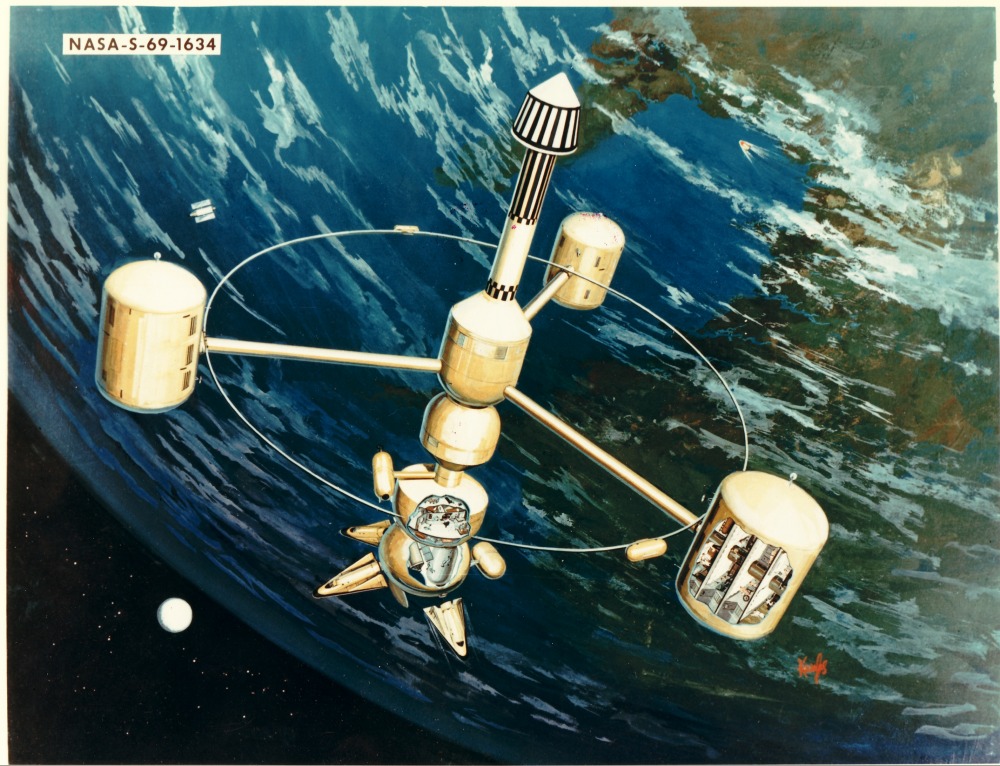
www.aerospaceprojectsreview.com/blog/wp-content/uploads/2...
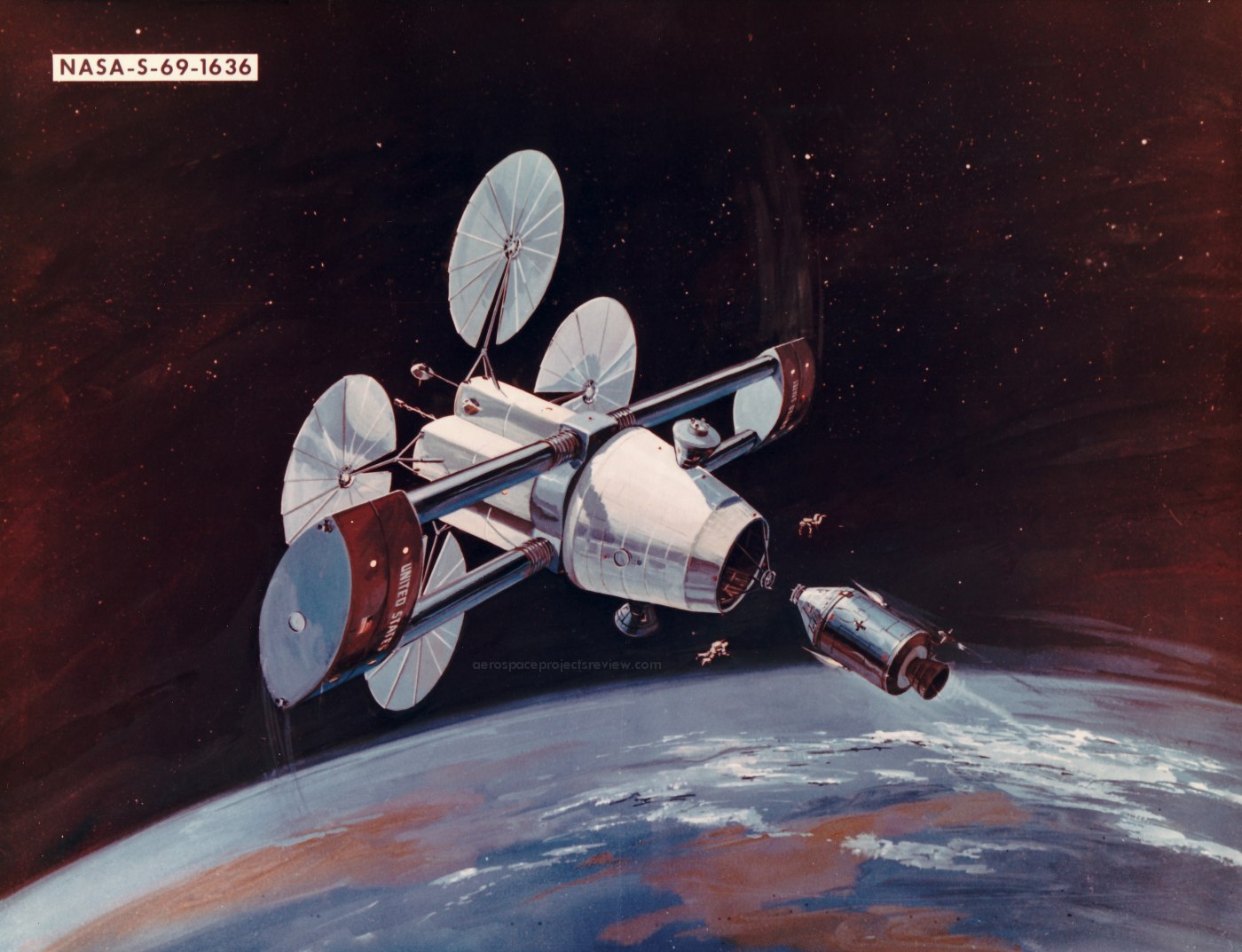
Both above credit: the excellent Aerospace Projects Review website
In fact and in confirmation of such; in January - February 1969, NASA Administrator Thomas O. Paine oversaw the creation of a Space Station Task Force, a Space Station Steering Group, and an independent Space Station Review Group. These bodies prepared a Phase B Space Station Study Statement of Work (SOW), which NASA released to industry on 19 April 1969. So, I'm pretty sure these works are some of the responses/submittals to that SOW.
"The SOW solicited proposals to study a 12-man Space Station, the design of which would eventually serve as a building block for a 100-man Earth-orbital Space Base. The 12-man Station was to reach orbit on a Saturn V rocket in 1975 and to remain in operation for 10 years...
Grumman, North American Rockwell (NAR), and McDonnell Douglas Aerospace Company (MDAC) submitted proposals in response to the SOW."
The above is a combination of paraphrasing & cut/paste from David S. F. Portree's superlative (as always) article at his wonderful "No Shortage of Dreams" blog. The entire informative content at:
spaceflighthistory.blogspot.com/2015/03/outpost-in-leo-mc...
I found this ground into the rock in Bryce Canyon [USA]. I took this shot because I liked how the lines and curves worked with another. Also the colour of the different layers of the sandstone really add to this picture.
" A good traveller has no fixed plans and is not intent on arriving "
My other flickr accounts
One -
www.flickr.com/photos/31673212@N00
Two -
www.flickr.com/photos/24924664@N07
Three -
www.flickr.com/photos/26221240@N03
Four -
www.flickr.com/photos/44080325@N03
Five -
www.flickr.com/photos/normand5
Six -
www.flickr.com/photos/normand6
Seven -
This is another take on the same Cuban Lily that I posted a few weeks back. Taken at Longwood Gardens with the Sony FE 90mm f/2.8 Macro G OSS Lens.
I used the great architecture of the building of Stratford Aquatics Centre to create a really interesting composition for the fantastic olympic orbit tower, by doing this makes the image much more pleasing to the eye.
I love the look from the Orbits Ringflash, even without the signature Ringflash halo. I put my SB900 in it with a sync cord to my hotshoe, stuck it on my 24-70 2.8 and chased my son around the house in TTL mode. Can't beat that color saturation!
There's a brand new gift available at the store and marketplace. The Orbit necklace and bracelets set comes in 3 metal and 3 pearls colors.
(English translation follows below)
Über der Piazza des K21 schwebt in über 25 Metern Höhe die riesige Rauminstallation in orbit des Künstlers Tomás Saraceno. Das begehbare Kunstwerk ist eine Konstruktion aus beinahe transparenten Stahlnetzen, die in drei Ebenen unter der gewaltigen Glaskuppel aufgespannt sind. In der 2.500 Quadratmeter umfassenden Netzstruktur sind fünf luftgefüllte "Sphären", gewaltige Ballons, platziert.
Die Installation wirkt wie eine surreale Landschaft, ein Wolkenmeer oder wie der Kosmos mit seinen scheinbar schwerelos schwebenden Planeten. Besucher sind eingeladen, die Installation zu betreten und kletternd für sich zu entdecken. Die Wagemutigen nehmen die Museumsbesucher in der Tiefe aus luftiger Höhe wie winzige Figuren in einer Modellwelt wahr. Umgekehrt erscheinen die Menschen im Netz von unten wie Schwebende oder Schwimmer am Himmel.
Wenn mehrere Personen gleichzeitig die Installation betreten, geraten die Netze in Bewegung – die Spannung der Stahlseile und der Abstand der drei schwankenden Netzebenen verändert sich unwillkürlich. Der Raum in der Schwebe wird so zu einem schwingenden Netz von Beziehungen, Resonanzen und einander bedingender Kommunikation.
Die Besucher nehmen, ähnlich wie eine Spinne im Netz, die anderen Menschen durch Vibrationen wahr. Dies verdeutlicht das Interesse des Künstlers an neuen hybriden, über die herkömmlichen Möglichkeiten des Menschen hinausgehenden Formen von Kommunikation und Kooperation, die er in seinem Berliner Atelier untersucht.
(Homepage der Kunstsammlung NRW)
Above the piazza of the K21 hovers the huge installation in orbit of the artist Tomás Saraceno in more than 25 meters height. The walk-in artwork is a construction of almost transparent steel nets spanned in three levels under the huge glass dome. In the 2,500 square meter network structure, five air-filled "spheres", huge balloons, are placed.
The installation looks like a surreal landscape, a sea of clouds or the cosmos with its seemingly weightless floating planets. Visitors are invited to enter the installation and climb for themselves. The daredevils perceive museum visitors in the depths from lofty heights like tiny figures in a model world. Conversely, people in the net from below appear as hovers or swimmers in the sky.
If several people enter the installation at the same time, the nets get moving - the tension of the steel cables and the distance between the three fluctuating network levels changes involuntarily. The suspended space thus becomes an oscillating network of relationships, resonances and interdependent communication.
Similar to a spider in the web, visitors perceive other people through vibrations. This illustrates the artist's interest in new hybrid forms of communication and cooperation that go beyond the traditional possibilities of man and that he examines in his Berlin studio.
(Homepage of the Kunstsammlung NRW)
All pictures in my photostream are Copyrighted © Paul Shears All Rights Reserved
Where You Can Find Me:
My Website | 500px | Facebook | Twitter | Instagram | Getty |
Best seen on black, so hit the "L" key
Standing in the Olympic Park looking up at the ArcelorMittal Orbit as the moon sits high above it.
Equipment:
. Canon EOS 5D Mark III
. Canon EF 24-70mm f/2.8 L II USM
Exposure:
. Tripod
. 50mm @ f/8, ISO 100 & 8 Seconds
Join me here: Google+ | Facebook | Twitter | 500px | Youtube | Vimeo | UStream | Blog | LinkedIn | 4Square | Getty Images
Taken some 100m above my home.
23 images over more than 2hours, each 6min exposure, ISO400, Walimex 8mm
Start: 09:51 p.m. End: 00:04 a.m.
Submitted to the Astronomy Photographer of the Year 2013 Competition www.rmg.co.uk/visit/exhibitions/astronomy-photographer-of...
Go North West unveiled their new Orbit branding to the Manchester public by having YY66PDU on show on Market Street which was probably the first bus on Market street for many years. Classed as route branding for the 52 and 53 routes which turn up just about everywhere between them they cleverly don’t show the actual route, so if they do stray its not the end of the world, however to many Orbit may look like another company as the Go North West logo is not prominent at the front. Not only does this launch a new livery, the batch also have four digit fleet numbers taking them away from the inherited First series.
A digital art creation, consisting of five layers, at varying opacities. No photographic input.
Thanks for all views, comments and fave adds.
I have always been a big fan of symmetry so when I saw this shot in my view, I just had to take it. When you have a sky that looks like this, you definitely have to take the shot. I talk about this a lot; It's nice to have a clear blue sky in your photos but it's even better to have some really nice puffy clouds as well. Don't you agree? Have a magical day!