View allAll Photos Tagged Operational
Seen running as Bedford's Operational Support Unit(OSU) in June 2010. Originally this appliance was used as an Emergency Response Unit at Stopsley but this was swapped with L607 KUD which is an exact copy of this vehicle. This was replaced by a refurbished Iveco OSU van and an OSU pod carried by 1 of the New Dimesional Prime Movers at Bedford.
A series of images taken from a presentation I used to give on London Underground's Disused or non-operational stations when I was one of the curators at the London Transport Museum in the 1990s. Part of the day job was inspecting disused stations to see what was still there and the sites ranged from places abandoned nearly a centuty earlier, such as King William Street station that closed in 1900, up to stations such as Aldwych that had just closed.
There was only one 'easy' way to visit the site of South Kentish Town station that had opened as part of the Northern line (Charing Cros, Euston & Hampstead Railway) in 1907 and that closed in 1924 and that was by hopping off a service train. This is the scene in May 1996 when we travelled up, by arrnagement, in the cab of a now long gone 1959-tube stock train and the train operator stopped in the tunnel alongside the long removed platform. You had to be carefully hopping out of the front cab door so as not to step on the negative current conductor rail directly below you or the postive 'juice' rail to the side nor the running rails! Anyhow, here we are about to be left to exploring, the driver making sure we are 'all clear' before be proceeds north towards Kentish Town station. He may have told the guard the reason for the unscheduled stop in the middle of nowhere but there may have been some curious passengers looking out of the front cars wondering what was going on!
To leave the station site, as there was no surface access, you had to arrange to be 'collected' by auto phone to the controller who would arrange for a train to 'stop' for you. You achieved this by using a red aspect on the Bardic handlamp as a red signal! This is the train before our scheduled stopper passing through the station at speed. You can clearly see the tiled barrel vaulting here as well as the fact the platform structures have been stripped out. The picture was taken under full track safety and access conditions.
Porthmadog Harbour railway station, the terminus of both the Ffestiniog Railway and Welsh Highland Railway, Porthmadog, Gwynedd, North Wales.
The Station is the head office and operational headquarters of the Festiniog Railway Company, marketed as Ffestiniog and Welsh Highland Railways.
The station is built at the western end of the Cob, the great embankment across the Traeth Mawr, on a peninsula from Ynys Madoc constructed in 1842 to form a slate wharf and a harbour wall. It was opened for passenger service on 6 January 1865. Welsh Highland Railway trains served the station from 1923, but these ceased running in 1936. The station was closed to passengers on 15 September 1939, although slate trains continued operating through the Second World War until 1946. The buildings continued in use as the principal offices of the Festiniog Railway Company and the home of Manager (Mr Robert Evans) including throughout the years of almost total closure from 1 August 1946 to 24 September 1954. The station reopened for passengers on 23 July 1955. Welsh Highland Railway services were restored in 2011.
The present stone buildings, replacing earlier wooden buildings dismantled and reused elsewhere on the railway, date from 1878/79 and the goods shed was added in 1880. They were linked to the former goods shed by way of a major extension in 1975. Passenger facilities include a booking and enquiry office, a large tourist and hobby shop and a large cafeteria with licensed bar. The erection of the platform awning was completed in 1988.
With the resumption of services in 1955, all traffic on the line has been controlled from an office in Harbour station, known simply as "Control". With the exception of some early morning and late night movements by works trains, this office is manned constantly when passenger-carrying services are in operation. Its remit was expanded in 1997 with the commencement of public services on the Welsh Highland Railway between Caernarfon and Dinas and its subsequent expansion south towards Porthmadog.
The station signals were rebuilt as part of the Welsh Highland Railway's arrival. The work won the Signalling Award at the 2014 National Railway Heritage Awards.
THE 16TH-CENTURY KINNAIRD CASTLE WAS CONVERTED IN 1787 FOR USE AS THE KINNAIRD HEAD/CASTLE LIGHTHOUSE, THE FIRST LIGHTHOUSE IN SCOTLAND TO BE LIT BY THE COMMISSIONERS OF NORTHERN LIGHTS WHO BUILT MANY MORE ON SCOTLAND'S COASTLINE OVER THE NEXT 200 YEARS OR SO. IT WAS INSTALLED BY A MR THOMAS SMITH FROM EDINBURGH, WHO WAS THE FATHER-IN-LAW OF ROBERT STEVENSON WHO SUCCEEDED HIM AS ENGINEER TO THE NORTHERN LIGHTHOUSE BOARD (ROBERT STEVENSON WAS GRANDFATHER OF THE AUTHOR ROBERT LOUIS STEVENSON). A LANTERN WAS SET ON A CORNER OF A TOWER OF THE OLD CASTLE IN FRASERBURGH OWNED BY LORD SALTOUN. THE LIGHTS IN THOSE DAYS WERE FIXED, USING ARRAYS OF LAMPS BURNING WHALE OIL, EACH OF THEM BACKED BY ITS OWN PARABOLIC REFLECTOR MADE UP OF A MULTITUDE OF FACETS OF SILVERED MIRROR-GLASS SET ON A PLASTER MOULD. KINNAIRD HEAD WAS THE MOST POWERFUL LIGHT OF ITS TIME, AND CONTAINED 17 REFLECTORS ARRANGED IN 3 HORIZONTAL TIERS. IN CLEAR WEATHER, THE LIGHT COULD BE SEEN 12 TO 14 MILES AWAY.
THE STRUCTURE WAS REBUILT IN 1824 WHEN INTERNAL ALTERNATIONS WERE MADE TO THE TOWER TO ACCOMMODATE A NEW LANTERN AND ADDITIONAL BUILDINGS WERE CONSTRUCTED FOR THE LIGHTKEEPERS.
DURING WORLD WAR II, FRASERBURGH WAS KNOWN AS "LITTLE LONDON" BECAUSE OF THE HEAVY BOMBING AND MACHINE-GUN ATTACKS ON THE TOWN DUE TO THE AMMUNITIONS MANUFACTURE AND WORK CARRIED OUT ON ROLLS ROYCE AIRCRAFT ENGINES. DESPITE THAT, THE LIGHTHOUSE WAS ONLY SLIGHTLY DAMAGED BY A NEAR MISS.
THE PRESENT LIGHTHOUSE IS A NEW BUILDING CREATED IN 1991 AT THIS STAGE IT WAS AUTOMATED AND THE ORIGINAL BUILDING NOW HOUSES THE MUSEUM OF SCOTTISH LIGHTHOUSES. THIS INCORPORATES THE ORIGINAL LIGHTHOUSE AND A MODERN BUILDING HOUSING COLLECTIONS OF LENSES AND OTHER ARTEFACTS FROM MANY LIGHTHOUSES ACROSS SCOTLAND. IT IS NOW LISTED AS A BUILDING OF ARCHITECTURAL/HISTORICAL INTEREST BY HISTORIC SCOTLAND. THE FOGHORN BESIDE THE NEW LIGHTHOUSE IS NO LONGER OPERATIONAL.
I'm not sure on how many are still around of these machines. But it seems that 603 is back to operate the construction trains for the new Albula tunnel.
Though still operational, this swing bridge, built in 1914, is on the endangered list. It is one of the 3 largest swing bridges in the U.S. on the Coos Bay Branch of the Central Oregon & Pacific Railroad over the Siuslaw River near former Cushman.
Cushman is an unincorporated community in Lane County, Oregon, United States. It is located on the north bank of the Siuslaw River on Oregon Route 126, between Tiernan and Florence.
Cushman was a station Coos Bay Branch of the Southern Pacific Railroad (today the Coos Bay Rail Link), named for local residents C. C. and I. B. Cushman. It was a mile east of the community of Acme, but the railroad already had a station named Acme, so the name "Cushman" was chosen instead. The post office was moved from Acme in 1916 and renamed to match the station; it closed in 1961.
Cushman has a historic store that was built in 1889 and expanded in 1925, and there is a swing span railroad bridge across the river there. The bridge opened to allow ocean-going barges to reach a now-closed sawmill in Mapleton. In 1940, Cushman had a population of 145 and a full-service port. At that time the hills above the community produced Port Orford-cedar, a large evergreen coniferous tree native to the region, but by 1990, this resource was depleted and the port no longer served ocean-going vessels.
Cushman: Lane County, Oregon: United States Structure Type
Metal Rivet-Connected Warren Through Truss, Movable: Swing (Rim Bearing Center Pier) and Approach Spans: Metal 7 Panel Pin-Connected Camelback Through Truss,Construction Date and Builder / Engineer
1914 By Builder/Contractor: American Bridge Company of New York, New York
Main Span Length
286 Feet Structure Length
3,450 Feet
Resting in the roundhouse in Henry Ford's Greenfield Village is the beautiful maticulously restored and fully operational "Number 7" steam locomotive.
According to The Henry Ford's registrars file the construction of this 4-4-0 American class locomotive (Baldwin Order No. 15317) and tender was completed sometime in May of 1897. Delivery to its original owner, the Detroit and Lima Northern Railway, was most likely in early July of that year.
The company that manufactured the locomotive and tender was Baldwin Locomotive Works in Philadelphia. This massive facility that eventually covered 7 square blocks of the “Bush Hill” industrial district produced 501 locomotives that year. Baldwin was the world’s preeminent manufacturer of steam locomotives with 40 percent of what they manufactured being exported. Their customer base included railroads in France and Japan. In 1897 they employed 3,200 men with the vast assortment of special skills required to manufacture the giant locomotives with the precision required.
In June of 1920 the ownership of the DT&I Railroad was transferred to the Ford Motor Company where Henry would transform it into one of the best managed and financially successful railroads in the country.
A new building was constructed (the Fordson Shop) at the Rouge to facilitate the rebuild and maintenance of the new acquisition. The facility was opened in 1921 with a staff that eventually reached 475 men with the first locomotive to undergo a Ford transformation being DT&I engine Number 7. It was completely stripped down and inspected. Anything that needed it was replaced. Aesthetics were also a part of the transformation; drive rods were draw filed and polished, exposed iron pipes were replaced with bright copper, new boiler jackets were finished in a lacquered Russian Iron and the outside of the metal tires were painted white.
When the rebuild was completed “Number 7” was put into service at the disposal of Henry Ford who had assumed the roll of DT&I president. It was frequently used to take Henry to various points along the line to attend meetings or visit with friends such as Thomas Edison or Harvey Firestone. Some of these trips would include his private rail car the “Fairlane” as part of the “consist” (listing of locomotive and attached cars). According to staff and others along the route, Henry could be seen in the cab during some of these trips. Some who witnessed these trips said Henry could occasionally be seen setting in the engineer’s seat with his engineer Harry Cochran a step away.
Ford owned the railroad until June of 1929 when he became irritated with the intervention of the Interstate Commerce Commissions over shipping rates and other issues. The DT&I was sold to the Pennsylvania Railroad for $36 million. Besides the profits and rate advantage enjoyed during the Ford ownership he turned his initial $5 million purchase price and approximately $8 million of improvements into an impressive $23 million profit.
Ford retained "Number 7". It was restored in 1930 and put on the display in the Henry Ford Museum. In 1997 they decided to completely restore it.
These are just some exerpts from as article I read on the fascinatig history of this beautiful Baldwin locomotive.
To read more about it visit the web page: www.thehenryford.org/explore/blog/part-one-number-7-is-on...
West Mercia Police | Force Operational Tasking | Volvo V70 | VU60 BSZ on standby for parade duty at Copenhagen St Worcester Fire Station's last operational day.
There was a convoy of all the fire appliances, including a spare, escorted by police on blue lights through the city from the old site to the new site, to see the video click here.
To see a playlist of videos featuring police vehicles from across the UK, such as Metropolitan, British Transport, West Midlands, West Mercia & Warwickshire Police, responding, click here.
_________________________________________________
Thankyou to all emergency services!!!
__________________________________________________
______________________________
West Mercia Constabularly | Operational Support Comma | Vauxhall Astra Mk4 | VX53 EUJ from Telford out and about in Worcestershire. And guess what - these are in use as regular beat, as well!
__________________________________________________
Thankyou to all emergency services!!!
__________________________________________________
__________________________________________________
© CobraEmergencyPhotos
Did not expect to see an MPD still operational under the Arriva Buses Wales books. The first examples were introduced to Llandudno Junction depot in June 1999 and, well, might as well eke another six months out of LJ51 DDF (921) so the once perennial staples of the North Walian roads can celebrate a 20 year association with the welsh based chapter of the Arriva corporation. Pertaining to Bangor specifically, I think the year 2000 was when an MPD trod its wheels for the first time around the bustling 'Cloc' terminus and 18 years into the future, 921 was caught in the subsiding rainfall on a wholly miserable day. The service is the Bangor circular, taking in the Maesgeirchen estate and Tesco in the industrial park.
19th December 2018.
BRAND NEW Warwickshire And West Mercia Police | Operational Policing Unit - Armed Reponse Vehicle | BMW X5 | **15 *** out in Hereford, UK. This vehicle came to the force at the end of July 2015. I believe the vehicle it replaces is a '62 BMW X5 which I caught responding earlier July 2015.
This vehicle I will no doubt be seeing loads of, I already saw it several times that day! Which was the same scenario with the '62 plate, always going in and out of their city centre base, which I haven't seen since this baby turned up.
To see a playlist of videos featuring police vehicles from across the UK, such as Metropolitan, British Transport, West Midlands, City Of London, West Mercia & Warwickshire Police and more, responding, click here.
_________________________________________________
Thankyou to all emergency services!!!
__________________________________________________
______________________________
Grampian Transport Museum based in Alford Aberdeenshire Scotland host various activities throughout the summer months, today 2/7/17 I attended their Speedfest event, this is the third year I've enjoyed the specialist cars on display,
British Aston Martins and Jaguars, Italian Lamborghinis and Ferraris and German Audis and BMWs being to the fore.
The theme this year is rally sport and ancient and modern rally cars put through their paces on the museum’s road circuit.
Police vehicles fascinate me hence when this BMW was on display I took the opportunity to capture it with the Nikon.
Vehicle make: BMW
Date of first registration: November 2015
Year of manufacture: 2015
Cylinder capacity (cc): 2993 cc
CO₂Emissions: 142 g/km
Fuel type: DIESEL
Export marker: No
Vehicle status: Tax not due
Vehicle colour: WHITE
Vehicle type approval: M1
Wheelplan: 2 AXLE RIGID BODY
Revenue weight: Not available
Please find below some info on Police Vehicles in the UK.
Police vehicles in the United Kingdom
The 52 police forces in the UK use a wide range of operational vehicles including compact cars, powerful estates and armored police carriers. The main uses are patrol, response, tactical pursuit and public order policing. Other vehicles used by British police include motorcycles, aircraft and boats.
Patrol Cars
Patrol cars may also be known as response or area cars. They are the most essential mode of police transport. In most forces these vehicles are low-budget compact cars due to the simple tasks they need to perform. The Vauxhall Corsa and Ford Fiesta have both been used as patrol cars by forces recently.
Engine sizes vary according to each forces vehicle procurement policies but range from 1.3 to 2.0. Although petrol-powered engines once dominated, diesel engines are now becoming much more common due to their superior fuel economy and therefore lower operating costs.
Forces may choose to use unmarked patrol cars to double up as diary cars, covert cars and unmarked transport vehicles for discreet escort of civilians or prisoners.
Marked variants of these cars feature a single row of battenburg police markings on each side of car with 'Police' lettering on the front and rear of the vehicle. Badges or slogans from police forces can be found on the front and sides of marked cars in most areas to identify the force it belongs to. Most marked cars also have hi-vis chevrons on the back.
Response Cars
These vehicles are used for attending 999 calls and patrolling in targeted areas, where a police officer may be needed more urgently. Many forces do not differ between patrol and response cars; this could mean the response car is used to cover both its normal role and the duty of a traditional patrol car. Forces including City of London Police and Thames Valley Police do not differentiate between the two types of cars and use only one specification identified as a response car. Response cars are not authorized to pursue a failing to stop suspect: an area car, traffic car or advanced blue light trained officer will take over the pursuit.
Response cars are much the same as the patrol cars but will generally carry equipment and lighting for use at traffic accidents, such as cones, red and blue boot or side police lights, warning signs and basic first aid equipment. Many response cars in the UK now also carry mobile technology which can be linked to police databases and automatic number plate recognition technology. Most response cars have sirens. The Vauxhall Astra or Ford Focus are a classic but key car in police response units.
Area Cars
There are times when police feel the need to increase presence and performance in an area. Area cars are tasked to serve high crime areas or large areas with a fair response time. Area cars typically carry a single row of battenburg marking like their response car counterparts but the drivers are trained in tactical pursuit, advanced driving and stopping fleeing offenders. Area cars may carry both firearms officers or local patrol officers but are on hand in major cities and large urban counties when help is needed most.
Area cars may be various high performance vehicles. Vauxhall Insignia, BMW 5, Skoda Octavia, Volvo V40, Volvo XC70 and the Ford Mondeo have all been used as area cars in recent[when?] years. Some area cars may be tasked for rural patrols or highway duties so may utilize 4x4 capability when needed. Area cars can be old Traffic cars given to local response teams when the vehicles become dated. London's new area cars are branded with ANPR Interceptor wording.
Traffic Cars
Road policing units use cars that are larger, more powerful vehicles that are capable of carrying out tasks such as high speed pursuits and attending major accidents. Traffic cars are often estate cars that can carry additional equipment, such as traffic cones, signs to warn of road closures or collisions and some basic scene preservation equipment. Their daily roles primarily consist of ANPR patrols.
Unmarked vehicles are also employed for motorway patrol duties.
The most common traffic car used by British police RPU's is the BMW 530d while models from Audi, such as the Audi S3 are also becoming popular as unmarked units
Cars Used By Armed Police Units
A Vauxhall Omega in service as a Metropolitan Police Service Armed Response Vehicle in 2005
With the exception of Northern Ireland most police officers in the United Kingdom do not routinely carry firearms. There are, however, a number of armed tactical units in which authorised firearms officers are deployed and which use special vehicles. Armed Response Units operate in all police forces.
The Metropolitan Police also have a Diplomatic Protection Group (DPG) and a Special Escort Group (SEG) for the protection of VIPs. A very common vehicle for armed police units is the BMW X5 (Used by Metropolitan Police and City of London Police)
A range of vehicles are used by these squads. They are often larger and with a higher performance than those used for local patrols. DPG cars, minibuses and vans are red. Special Escort Group officers use Range Rovers and motorcycles. The motorcycle officers may be identified by their Glock 17 pistols.
Some Armed Response Unit cars are unmarked to enable them to be unnoticed. In London the marked patrol cars of armed units are identified by large yellow dots on the car exterior.
Motorcycles
A Metropolitan Police BMW R1200RT motorcycle
Motorcycles are used by a number of forces in the UK, usually by the Road Policing Unit. Police motorcycles are also used in road safety initiatives such as Bikesafe, a national program to reduce motorcycle casualties in which police motorcyclists provide advanced rider training to members of the public.
Some Metropolitan Police Special Escort Group officers also use motor cycles. These officers may be identified by their side arms as they are the only armed motor cycle police in London, apart from a small section of the Diplomatic Protection Group who use motorcycles to respond quickly to incidents faster than the DPG ARVs can.
The motorcycles used by police include the BMW R1200RT, Honda ST1100 Pan-European, and Yamaha FJR1300. The Honda ST1300 Pan-European was the most popular bike, but it was withdrawn from service by most forces in 2007, following the death of a Merseyside police motorcyclist in 2005 in an accident caused by an inherent instability in the model.
Police van
An LDV Convoy van, in service with the Police Service of Northern Ireland (PSNI)
Police vans, such as the Ford Transit or Mercedes-Benz Sprinter, are widely used across the United Kingdom and incorporate a cage to hold prisoners. Although in the United States it is usual to carry a prisoner in a police car, some British forces do not permit this, as most police cars have no barrier between the front and back seats to protect the officers.
Each police force has different policies on prisoner transportation. Some allow compliant prisoners to be transported in response cars, ensuring that one officer sits in the rear with the prisoner, and the prisoner sits behind the passenger seat.
Larger vans are also used to act as mobile control room at major incidents, and may also carry specialized equipment such as hydraulic door entry and cutting tools.
Minibuses are used to carry groups of police officers, for example to public order and major incidents, and for inner-city patrols. One notable example is the Mercedes Sprinter used by the Metropolitan Police's Territorial Support Group. Other public order minibuses include the Vauxhall Movano and the Iveco Daily. They are usually fitted with riot shields to protect the windscreen from damage.
Other vehicles
Jankel armoured truck of the Metropolitan Police Service, sometimes used for public order policing but mainly for airport duties[4]
Dog unit vehicles: cars and vans adapted for the welfare of the police dogs, including air conditioning.
Mounted police vehicles: horse trailers for the transport of police horses
Vehicle removal trucks: recovery trucks for the removal of vehicles.
Mobile custody units: vans to hold prisoners during public disorder.
Unmarked cars; used by CID and traffic officers.
Vehicle Markings, Lights & Sirens
Nearly a half of British police forces use the battenburg livery of yellow and blue checks for their vehicles. Other forces use white, black, or silver. Silver became popular in some forces because of the higher resale values when sold. Most cars use retroreflective livery on the sides and red and yellow chevrons on the rear. Some carry slogans, the force crest and contact information.
Most police cars, vans and minibuses have aerial roof markings that help aircraft crew identify them. These can include the unique force code, vehicle identifying mark, or police division that the vehicle belongs to.
Under the Road Vehicle Lighting Regulations 1989, police vehicles may display blue flashing lights to alert other road users to their presence or when the driver feels that the journey needs to be undertaken urgently.
These lights are usually mounted on the roof and incorporated into the standard vehicle system of external lights. Most police vehicles are also fitted with a siren. In addition to blue lights, many traffic and incident response cars are fitted with flashing red lights that are only visible at the rear of the vehicle. These indicate that the vehicle is stopped or moving slowly.
Equipment Police vehicles may carry:
Speed gun
Taser
Enforcer
First aid kits
Traffic cones
Police signs
Fire extinguisher
Torch
Broom
Breathalyzer
Personal flotation device
Stinger
Runlock systemEdit
Most cars and police motorcycles are fitted with a 'Runlock' system. This allows the vehicle's engine to be left running without the keys being in the ignition. This enables adequate power, without battery drain, to be supplied to the vehicle's equipment at the scene of an incident. The vehicle can only be driven after re-inserting the keys.
If the keys are not re-inserted, the engine will switch off if the handbrake is disengaged or the footbrake is activated; or the sidestand is flipped up in the case of a motorcycle. Runlock is also commonly used when an officer is required to quickly decamp from a vehicle. By enabling Runlock, the car's engine can be left running without the risk of someone stealing the vehicle: if the vehicle is driven normally, it will shut down, unless the Runlock system is turned off.
West Midlands Police [OPS155] | Operational Firearms Unit | BMW X5 | BX64 MSV out in Birmingham, United Kingdom of Great Britain And Northern Ireland.
To see a playlist of videos featuring police vehicles from across the UK, such as Metropolitan, British Transport, West Midlands, City Of London, West Mercia & Warwickshire Police and more, responding, click here.
_________________________________________________
Thankyou to all emergency services!!!
__________________________________________________
______________________________
In 2001 the Transnet Museum pulled the plug on the operational steam kept at Bloemfontein shed. The final steam working using locos supplied by the railways ran to Kimberley and back behind 23 no 3300.
At Kimberley 3300 was unexpectedly unable to get coal so was forced to head back to Bloemfontein with what she had left. While that was going on 25NC no 3410 was steamed and dispatched to rescue the train. The coal lasted until Petrusburg where 3410 took over.
The light is a bit harsh and the trees behind are less than ideal but for the record this is the train leaving Petrusburg on 27 May 2001. I have removed the fridge from the consist.
Once they reached the outskirts of Bloemfontein the farewell whistling started and carried on constantly until 3410 drew into the main station. The locos have all been in storage at the shed ever since.
Free State, South Africa
10 Cool Facts About NASA's Space Shuttle Discovery
- By Mike Wall, Space.com Senior Writer
1. World's Most-Flown Space Shuttle
Discovery flew 39 space missions during its operational life, the first in 1984 and the last one in 2011. It notched more spaceflights than any other space shuttle, or any other spacecraft for that matter.
2. Discovery Spent Entire Year in Orbit
Over the course of its 39 missions, Discovery logged a total of 365 days in space. It also put 148,221,675 miles on its odometer, another space shuttle record. The miles traveled by Discovery could have carried it to the moon and back more than 300 times.
3. Discovery Is Really Dirty
Discovery's somewhat dingy appearance surprises many people who see the venerable orbiter up close. The many marks on the shuttle are a testament to its long career and many spaceflights, NASA officials say.
"When you look at her up close, she does look worn," said NASA's Stephanie Stilson, who managed Discovery's processing flow between the orbiter's missions from 2000 to 2011. "There are discolorations and streaks from going from orbit back into our environment here."
4. Discovery Launched the Hubble Space Telescope
Astronauts aboard Discovery deployed NASA's Hubble Space Telescope on the shuttle's STS-31 mission in April 1990. Twenty-two years — and numerous repair missions — later, the instrument continues to snap stunning photos that help reshape our understanding of the cosmos.
5. Discovery Returned NASA From Shuttle Tragedies
Discovery was the first shuttle to launch after each of the shuttle program's tragedies, the January 1986 explosion of Challenger and the Feburary 2003 destruction of Columbia as it re-entered Earth's atmosphere. Each disaster took the lives of all seven astronauts aboard. In both cases, the shuttle program took several years to get back on its feet. Discovery's return-to-flight missions launched in September 1988 and July 2005, respectively.
6. Discovery Launched John Glenn Back Into Orbit
Discovery is the only shuttle ever to fly one of the Mercury Seven — NASA's first astronaut class, which was chosen in 1959. The orbiter carried John Glenn on its STS-95 mission in October 1998, when the astronaut was 77. Glenn thus became the oldest person ever to reach space; 36 years earlier, in 1962, he had become the first American to orbit Earth.
7. Discovery Took Four Years to Build
Work began on Discovery in 1979, and the shuttle wasn't completed until October 1983 in Palmdale, Calif. It was then flown aboard a 747 carrier aircraft to NASA's Kennedy Space Center, where it launched on its maiden mission in August 1984.
8. Launched 1st Female Shuttle Pilot & Commander
Discovery was the first American spacecraft to be piloted by a woman. NASA astronaut Eileen Collins piloted the shuttle's STS-63 mission in 1995, which rendezvoused with Russia's Mir space station. (Collins became the first female shuttle commander in history on Columbia's STS-93 mission in 1999, which deployed NASA's Chandra X-ray Observatory.)
9. Launched 1st Russian to Ride a U.S. Spaceship
Discovery also carried the first Russian cosmonaut ever to launch in an American spacecraft. Sergei Krikalev flew aboard the orbiter on its STS-60 mission in 1994, the first effort in the joint U.S./Russian Shuttle-Mir program.
10. Discovery's Name Has Long Exploration Legacy
NASA's space-flown orbiters were all named after historic oceangoing research or exploration vessels. Discovery takes its name from two ships that loom large in the history of exploration. One was sailed by Henry Hudson in 1610-11 to search for a northwest passage between the Atlantic and Pacific Oceans, and the other was helmed by James Cook on an 18th-century voyage during which he discovered the Hawaiian Islands.
© 2017 Skip Plitt Photography, All Rights Reserved.
This photo may not be used in any form without permission from the photographer. None of my images are in the Creative Commons. If you wish to use one of my images please contact me at: skipplittphotography@gmail.com
Todos los derechos reservados. Esta foto no se puede utilizar en cualquier forma sin el permiso del fotógrafo.
Problems:
The ships had lot´s of problems during their long operational careers (probably because they were built in a time that the Soviet Industry was still adapting from the war years).
They were extremely top heavy and the overall structure was poorly built which means that they had to be reinforced eventually.
However for the time they were still regarded as powerful and effective combat ships, most of them operating as the flagship of their main fleets.
For more info about the history of this ship click on the photos below.
Eínon
Battlecruiser Operational!
My build of the Behemoth-class Battlecruiser Hyperion as seen in Starcraft II.
I don't really like the way the stand attaches to the bottom of the ship, but I can't seem to find a better way right now.
Comes in right at the maximum size of 16x16 studs for use in Mobile Frame Zero: Intercept Orbit.
Pride of the road had many strings to its bow, operationally and behind the scenes. They amassed a large network using a wide selection of vehicles. Well positioned, it built up good friends in strange places, west midlands was a constant flow north of decent leyland nationals. Some were for spares but many were used, not always repainted initially. This is TVP850S operating a Pontefract - Barnsley service in competition with yorkshire traction. Nextdoor is a Arriva lynx on the 249 to Upton, the west riding lynx went like stink but the coal mining subsidence in the roads shook them to pieces eventually.
Operational Support (SKMF and SKIOS) operated from Yeovilton up to the withdrawal of all Sea Kings from RAF and RN service between 2017-18.
RNAS Yeovilton - EGDY - Pyle Lane
London Fire Brigade [OSU6] | Operational Support Unit | Mercedes-Benz Atego | AE07 HXP out in London, UK
To see a collection of videos featuring fire appliances from across the UK, such as London Fire Brigade, West Midlands Fire Service and Hereford & Worcester Fire & Rescue Service, responding, click here. __________________________________________________
Thankyou to all emergency services!!!
__________________________________________________
__________________________________________________
© CobraEmergencyPhotos
From Wikipedia, the free encyclopedia
F-84 Thunderjet
RoleFighter-bomber
ManufacturerRepublic Aviation
First flight28 February 1946
IntroductionNovember 1947
Retired1964 (USAF)
1974 (Yugoslavia)
Primary userUnited States Air Force
Number built7,524
Unit cost
US$237,247 (F-84G)[1]
US$769,330 (F-84F)
VariantsRepublic F-84F Thunderstreak
Republic XF-84H Thunderscreech
Republic XF-91 Thunderceptor
The Republic F-84 Thunderjet was an American turbojet fighter-bomber aircraft. Originating as a 1944 United States Army Air Forces (USAAF) proposal for a "day fighter", the F-84 first flew in 1946. Although it entered service in 1947, the Thunderjet was plagued by so many structural and engine problems that a 1948 U.S. Air Force review declared it unable to execute any aspect of its intended mission and considered canceling the program. The aircraft was not considered fully operational until the 1949 F-84D model and the design matured only with the definitive F-84G introduced in 1951. In 1954, the straight-wing Thunderjet was joined by the swept-wing F-84F Thunderstreak fighter and RF-84F Thunderflash photo reconnaissance aircraft.
The Thunderjet became the USAF's primary strike aircraft during the Korean War, flying 86,408 sorties and destroying 60% of all ground targets in the war as well as eight Soviet-built MiG fighters. Over half of the 7,524 F-84s produced served with NATO nations, and it was the first aircraft to fly with the U.S. Air Force Thunderbirds demonstration team. The USAF Strategic Air Command had F-84 Thunderjets in service from 1948 through 1957.
The F-84 was the first production fighter aircraft to utilize inflight refueling and the first fighter capable of carrying a nuclear weapon, the Mark 7 nuclear bomb. Modified F-84s were used in several unusual projects, including the FICON and Tom-Tom dockings to the B-29 Superfortress and B-36 bomber motherships, and the experimental XF-84H Thunderscreech turboprop.
The F-84 nomenclature can be somewhat confusing. The straight-wing F-84A to F-84E and F-84G models were called the Thunderjet. The F-84F Thunderstreak and RF-84F Thunderflash were different airplanes with swept wings. The XF-84H Thunderscreech (not its official name) was an experimental turboprop version of the F-84F. The F-84F swept wing version was intended to be a small variation of the normal Thunderjet with only a few different parts, so it kept the basic F-84 number. Production delays on the F-84F resulted in another order of the straight-wing version; this was the F-84G.
Design and development
An F-84G at Chaumont-Semoutiers Air Base, France, in 1953
In 1944, Republic Aviation's chief designer, Alexander Kartveli, began working on a turbojet-powered replacement for the P-47 Thunderbolt piston-engined fighter. The initial attempts to redesign the P-47 to accommodate a jet engine proved futile due to the large cross-section of the early centrifugal compressor turbojets. Instead, Kartveli and his team designed a new aircraft with a streamlined fuselage largely occupied by an axial compressor turbojet engine and fuel stored in rather thick unswept wings.[1]
On 11 September 1944, the USAAF released General Operational Requirements for a day fighter with a top speed of 600 mph (521 kn, 966 km/h), combat radius of 705 miles (612 nmi, 1,135 km), and armament of either six 0.50 in (12.7 mm) or four 0.60 in (15.2 mm) machine guns. In addition, the new aircraft had to use the General Electric TG-180 axial turbojet which entered production as the Allison J35.
On 11 November 1944, Republic received an order for three prototypes of the new XP-84—Model AP-23.[1] Since the design promised superior performance to the Lockheed-built P-80 Shooting Star and Republic had extensive experience in building single-seat fighters, no competition was held for the contract. The name Thunderjet was chosen to continue the Republic Aviation tradition started with the P-47 Thunderbolt while emphasizing the new method of propulsion. On 4 January 1945, even before the aircraft took to the air, the USAAF expanded its order to 25 service test YP-84As and 75 production P-84Bs (later modified to 15 YP-84A and 85 P-84B).
Meanwhile, wind tunnel testing by the National Advisory Committee for Aeronautics revealed longitudinal instability and stabilizer skin buckling at high speeds.[1] The weight of the aircraft, a great concern given the low thrust of early turbojets, was growing so quickly that the USAAF had to set a gross weight limit of 13,400 lb (6,080 kg). The results of this preliminary testing were incorporated into the third prototype, designated XP-84A, which was also fitted with a more powerful J35-GE-15 engine with 4,000 lbf (17.79 kN) of thrust.[1]
The first prototype XP-84 was transferred to Muroc Army Air Field (present-day Edwards Air Force Base) where it flew for the first time on 28 February 1946 with Major Wallace A. "Wally" Lien at the controls. It was joined by the second prototype in August, both aircraft flying with J35-GE-7 engines producing 3,745 lbf (16.66 kN). The 15 YP-84As delivered to Patterson Field (present-day Wright-Patterson Air Force Base) for service tests differed from XP-84s by having an upgraded J35-A-15 engine, carrying six 0.50 in (12.7 mm) M2 Browning machine guns (four in the nose and one in each wing root), and having the provision for wingtip fuel tanks holding 226 U.S. gal (856 L) each.
Due to delays with delivery of jet engines and production of the XP-84A, the Thunderjet had undergone only limited flight testing by the time production P-84Bs began to roll out of the factory in 1947. In particular, the impact of wingtip tanks on aircraft handling was not thoroughly studied. This proved problematic later.[1]
After the creation of the United States Air Force by the National Security Act of 1947, the Pursuit designation was replaced with Fighter, and the P-84 became the F-84.
F-84s were assigned to the 27th Fighter Wing, 27th Fighter Escort Wing, 27th Strategic Fighter Wing, 31st Fighter Escort Wing, 127th Fighter Day Wing, 127th Fighter Escort Wing, 127th Strategic Fighter Wing, 407th Strategic Fighter Wing and the 506th Strategic Fighter Wing of the Strategic Air Command from 1947 through 1958.[2]
Operational history
The F-84B, which differed from YP-84A only in having faster-firing M3 machine guns, became operational with 14th Fighter Group at Dow Field, Bangor, Maine in December 1947. Flight restrictions followed immediately, limiting maximum speed to Mach 0.8 due to control reversal, and limiting maximum acceleration to 5.5 g (54 m/s²) due to wrinkling of the fuselage skin. To compound the problem, parts shortages and maintenance difficulties earned the aircraft the nickname, "Mechanic's Nightmare".[1] On 24 May 1948, the entire F-84B fleet was grounded due to structural failures.
P-84Bs of the 48th Fighter Squadron, 14th Fighter Group, 1948.
A 1948 review of the entire F-84 program discovered that none of the F-84B or F-84C aircraft could be considered operational or capable of executing any aspect of their intended mission. The program was saved from cancellation because the F-84D, whose production was well underway, had satisfactorily addressed the major faults. A fly-off against the F-80 revealed that while the Shooting Star had a shorter takeoff roll, better low altitude climb rate and superior maneuverability, the F-84 could carry a greater bomb load, was faster, had better high altitude performance and greater range.[1] As a temporizing measure, the USAF in 1949 committed US$8 million to implement over 100 upgrades to all F-84Bs, most notably reinforcing the wings. Despite the resultant improvements, the F-84B was withdrawn from active duty by 1952.[1]
The F-84C featured a somewhat more reliable J35-A-13 engine and had some engineering refinements. Being virtually identical to the F-84B, the C model suffered from all of the same defects and underwent a similar structural upgrade program in 1949. All F-84Cs were withdrawn from active service by 1952.[1]
The structural improvements were factory-implemented in the F-84D, which entered service in 1949. Wings were covered with thicker aluminum skin, the fuel system was winterized and capable of using JP-4 fuel, and a more powerful J35-A-17D engine with 5,000 lbf (22.24 kN) was fitted. It was discovered that the untested wingtip fuel tanks contributed to wing structural failures by inducing excessive twisting during high-"g" maneuvers.[1] To correct this, small triangular fins were added to the outside of the tanks. The F-84D was phased out of USAF service in 1952 and left Air National Guard (ANG) service in 1957.[1]
The first effective and fully capable Thunderjet was the F-84E model which entered service in 1949. The aircraft featured the J35-A-17 engine, further wing reinforcement, a 12 in (305 mm) fuselage extension in front of the wings and 3 in (76 mm) extension aft of the wings to enlarge the cockpit and the avionics bay, an A-1C gunsight with APG-30 radar, and provision for an additional pair of 230 gal (870 L) fuel tanks to be carried on underwing pylons.[1] The latter increased the combat radius from 850 to 1,000 miles (740 to 870 nmi; 1,370 to 1,610 km).
One improvement to the original F-84 design was rocket racks that folded flush with the wing after the 5-inch HVAR rockets were fired, which reduced drag over the older fixed mounting racks. This innovation was adopted by other U.S. jet fighter-bombers.[3]
A Portuguese F-84 being loaded with ordnance in the 1960s, at Luanda Air Base, during the Portuguese Colonial War.
Despite the improvements, the in-service rates for the F-84E remained poor with less than half of the aircraft operational at any given time.[1] This was primarily due to a severe shortage of spares for the Allison engines. The expectation was that F-84Es would fly 25 hours per month, accumulating 100 hours between engine overhauls. The actual flight hours for Korean War and NATO deployments rapidly outpaced the supply and Allison's ability to manufacture new engines.[1] The F-84E was withdrawn from USAF service in 1956, lingering with ANG units until 1959.
The definitive straight-wing F-84 was the F-84G which entered service in 1951. The aircraft introduced a refueling boom receptacle in the left wing,[4] autopilot, Instrument Landing System, J35-A-29 engine with 5,560 lbf (24.73 kN) of thrust, a distinctive framed canopy (also retrofitted to earlier types), and the ability to carry a single Mark 7 nuclear bomb.[1] The F-84G was retired from USAF in the mid-1960s.
Starting in the early 1960s, the aircraft was deployed by the Força Aérea Portuguesa (FAP) during the Portuguese Colonial War in Africa. By 1972, all four operating F-84 aircraft were supplementing the FAP in Angola.[5]
Flying the Thunderjet
Typical of most early jets, the Thunderjet's takeoff performance left much to be desired. In hot Korean summers with a full combat load, the aircraft routinely required 10,000 ft (3,000 m) of runway for takeoff even with the help of RATO bottles (two or four of these were carried, each producing 1,000 lbf (4.4 kN) of thrust for 14 seconds).[1] All but the lead aircraft had their visibility obscured by the thick smoke from the rockets. Early F-84s had to be pulled off the ground at 160 mph (140 kn, 260 km/h) with the control stick held all the way back. Landings were made at a similar speed, for comparison the North American P-51 Mustang landed at approximately 120 mph (100 kn, 190 km/h). Despite the "hot" landing speeds, the Thunderjet was easy to fly on instruments and crosswinds did not present much of a problem.[6]
An F-84E launching rockets.
Thanks to the thick straight wing the Thunderjet rapidly reached its Mach 0.82 limitation at full throttle and low altitude. The aircraft had sufficient power to fly faster, but exceeding the Mach limit at low altitudes resulted in a violent pitch-up and structural failure causing the wings to break off.[6] Above 15,000 ft (4,600 m), the F-84 could be flown faster but at the expense of severe buffeting. However, the airspeed was sufficiently easy to control to make safe dive bombing from 10,000 ft (3,000 m) possible.[6] The top speed limitation proved troublesome against Soviet Mikoyan-Gurevich MiG-15s in Korea. Slower than the MiG, the F-84 was also unable to turn tightly with a maximum instantaneous-turn load of only 3 Gs followed by rapid loss of airspeed. One F-84E pilot credited with two MiG kills achieved his second victory by intentionally flying his aircraft into pitch-up.[6] The MiGs chasing him were unable to follow the violent maneuver and one crashed into the ground. Luckily for the F-84E pilot, the aircraft did not disintegrate but the airframe did suffer heavy warping. The F-84 was a stable gun platform and the computing gunsight aided in accurate gunnery and bombing. Pilots praised the aircraft for Republic's legendary ruggedness.[6]
Pilots nicknamed the Thunderjet "The Lead Sled".[2] It was also called "The Iron Crowbar", "a hole sucking air", "The Hog" ("The Groundhog"), and "The World's Fastest Tricycle", "Ground Loving Whore" as a testament to its long takeoff rolls.[2] F-84 lore stated that all aircraft were equipped with a "sniffer" device that, upon passing V2, would look for the dirt at the end of the runway. As soon as the device could smell the dirt, the controls would turn on and let the pilot fly off the ground. In the same vein, it was suggested a bag of dirt should be carried in the front landing gear well. Upon reaching V2, the pilot would dump the dirt under the wheels, fooling the sniffer device.[2]
Korean War
The Thunderjet had a distinguished record during the Korean War. Although the F-84B and F-84C could not be deployed because their J35 engines had a service life of only 40 hours, the F-84D and F-84E entered combat with 27th Fighter Escort Group on 7 December 1950.[1] The aircraft were initially tasked with escorting the B-29 Superfortress bombers. The first Thunderjet air-to-air victory was scored on 21 January 1951 at the cost of two F-84s.[2] The F-84 was a generation behind the swept-wing Soviet Mikoyan-Gurevich MiG-15 and outmatched, especially when the MiGs were flown by more-experienced pilots, and the MiG counter-air mission was soon given to the F-86 Sabre. Like its famous predecessor, the P-47, the F-84 switched to the low-level interdiction role at which it excelled.
A KB-29M tanker refueling an F-84E over Korea. F-84Es could only refuel the wingtip tanks separately.
F-84G-26-RE Thunderjet 51-16719 while assigned to the 3600th Air Demonstration Team (USAF Thunderbirds), 1954.
The F-84 flew a total of 86,408 missions, dropping 55,586 tons (50,427 metric tons) of bombs and 6,129 tons (5,560 metric tons) of napalm.[2] The USAF claimed F-84s were responsible for 60% of all ground targets destroyed in the war. Notable F-84 operations included the 1952 attack on the Sui-ho Dam. During the war, the F-84 became the first USAF fighter to utilize aerial refueling. In aerial combat, F-84 pilots were credited with eight MiG-15 kills against a Soviet-claimed loss of 64 aircraft. The total losses were 335 F-84D, E and G models.[2]
Portuguese Overseas War
In 1961, the Portuguese Air Force sent 25 of their remaining F-84G to Angola. There they formed the Esquadra 91 (91st Squadron), based at Luanda Air Base. From then on, the F-84s were engaged in the Angolan Theater of the Portuguese Overseas War, being mainly employed in air strike missions against the separatist guerrillas.
The last F-84 were kept operational in Angola until 1974.
Notable achievements
The F-84 was the first aircraft flown by the U.S. Air Force Thunderbirds, which operated F-84G Thunderjets from 1953 to 1955 and F-84F Thunderstreaks from 1955 to 1956. The F-84E was also flown by the Skyblazers team of United States Air Forces Europe (USAFE) from 1950 to 1955.[1]
On 7 September 1946, the second XP-84 prototype set a national speed record of 607.2 mph (527.6 kn, 977.2 km/h), slightly slower than the world record 612.2 mph (532.0 kn, 985.2 km/h) held by the British Gloster Meteor.[1]
On 22 September 1950, two EF-84Es, flown by David C. Schilling and Col. William Ritchie, flew across the North Atlantic from Great Britain to the United States. Ritchie's aircraft ran out of fuel over Newfoundland but the other successfully made the crossing which took ten hours two minutes and three aerial refuelings. The flight demonstrated that large numbers of fighters could be rapidly moved across the Atlantic.[1]
F-84G was the first fighter with built-in aerial refueling capability and the first single-seat aircraft capable of carrying a nuclear bomb.[1]
On 20 August 1953, 17 F-84Gs using aerial refueling flew from the United States to the United Kingdom. The 4,485-mile (3,900 nmi, 7,220 km) journey was the longest-ever nonstop flight by jet fighters.[1]
In 1955, an F-84G became the first aircraft to be zero-length launched from a trailer.[7]
By the mid-1960s, the F-84/F-84F was replaced by the F-100 Super Sabre and the RF-84F by the RF-101 Voodoo in USAF units, being relegated to duty in the Air National Guard. The last F-84F Thunderflash retired from the ANG in 1971. Three Hellenic Air Force RF-84Fs that were retired in 1991 were the last operational F-84s.
Costs
F-84BF-84CF-84DF-84EF-84GF-84FRF-84F
Airframe139,863139,863150,846562,715482,821
Engine41,65441,65441,488146,02795,320
Electronics7,1657,1654,7619,62321,576
Armament23,55923,55937,43341,71363,632
Ordnance2,7199,2524,529
Flyaway cost286,407 for the first 100
163,994 for the next 141147,699212,241212,241237,247769,300667,608
Cost per flying hour390
Maintenance cost per flying hour185185
Notes: The costs are in approximately 1950 United States dollars and have not been adjusted for inflation.[1]
Variants
Straight-wing variants
The XP-84A (foreground) and YP-84As
XP-84
The first two prototypes.
XP-84A
The third prototype with a more powerful J35-GE-15 engine. This airframe was subsequently modified with a pointed fairing over the intake and lateral NACA intakes were installed into the intake trunks.
YP-84A
Service test aircraft; 15 built.
P-84B (F-84B)
First production version, J35-A-15 engine; 226 built.
F-84C
Reverted to the more reliable J35-A-13 engine, improved fuel, hydraulic and electrical systems; 191 built.
F-84D
J35-A-17 engine, various structural improvements. The pitot tube was moved from the tail fin to the splitter in the air intake with fins added to the wingtip fuel tanks; 154 built.
F84 E&G Thunderjet French Air Force 1951–1955
EF-84D
Two F-84Ds, EF-84D 48-641 and EF-84D 48-661 were modified with coupling devices; 641 starboard wing, 661 port wing for "Tip-Tow Project MX106 Wing Coupling Experiments." An EB-29A 44-62093 was modified with coupling devices on both wings. Because of the difference in landing gear lengths, the three aircraft took off separately and couple/uncoupled in flight. The pilot of 641 was Major John M. Davis and the pilot of 661 was Major C.E. "Bud" Anderson.
"One of the more interesting experiments undertaken to extend the range of the early jets in order to give fighter protection to the piston-engine bombers, was the provision for inflight attachment/detachment of fighter to bomber via wingtip connections. One of the several programs during these experiments was done with a B-29 mother ship and two F-84D 'children', and was code named 'Tip Tow'. A number of flights were undertaken, with several successful cycles of attachment and detachment, using, first one, and then two F-84s. The pilots of the F-84s maintained manual control when attached, with roll axis maintained by elevator movement rather than aileron movement. Engines on the F-84s were shut down in order to save fuel during the 'tow' by the mother ship, and inflight engine restarts were successfully accomplished. The experiment ended in disaster during the first attempt to provide automatic flight control of the F-84s, when the electronics apparently malfunctioned. The left hand F-84 rolled onto the wing of the B-29, and the connected aircraft both crashed with loss of all on board personnel (Anderson had uncoupled so did not crash with the other two aircraft)."[8]
F-84E
J35-A-17D engine, Sperry AN/APG-30 radar-ranging gunsight, retractable attachments for RATO bottles, inboard wing hardpoints made "wet" to permit carrying an additional pair of 230 U.S. gal (870 L) fuel tanks. Most aircraft were retrofitted with F-84G-style reinforced canopies. The fuselage was stretched 15"; the canopy was lengthened 8", the canopy frame was lengthened 12" (accounting for another 4"), and a 3" splice panel was added aft of the canopy. The stretch was not done to enlarge the cockpit but rather to enable a larger fuel tank, provide additional space for equipment under the canopy behind the pilot's seat, and to improve aerodynamics. This can be distinguished from earlier models by the presence of two fuel vents on ventral rear fuselage, the added radar in the nose splitter, and the pitot tube was moved downward from mid-height in the splitter (as on the F-84D) to clear the radar installation. 843 built. F-84E 49-2031 was a test aircraft for air-to-air missiles. F-84E 50-1115 was a test aircraft for the FICON project.
EF-84E
Two F-84Es were converted into test prototypes, to test various methods of air-to-air refueling. EF-84E 49-2091 was used as a probe-and-drogue test aircraft. The probe was mid-span on the port wing. Production aircraft with probes (removable) had the probe fitted to the auxiliary wing tanks. EF-84E 49-2115 was used as a FICON test aircraft with a B-36 host. EF-84E 49-1225 and EF-84E 51-634 were test aircraft for the ZELMAL (Zero-length launch, Mat landing) experiments version for point defense, used the booster rocket from MGM-1 Matador cruise missile.
F-84G
Single-seat fighter-bomber capable of delivering the Mark 7 nuclear bomb using the LABS, J35-A-29 engine, autopilot, capable of inflight refueling using both the boom (receptacle in left wing leading edge) and drogue (probe fitted to wingtip fuel tanks), introduced the multi-framed canopy which was later retrofitted to earlier straight-winged F-84s. A total of 3,025 were built (1,936 for NATO under MDAP). The larger engine had a higher airflow at its take-off thrust than the intake had been designed for. This caused higher flow velocities, increased pressure losses and thrust loss. Commencing with block 20, auxiliary "suck-in" doors were added ahead of the wing leading edge to regain some of the thrust loss. At high engine rpm and low aircraft speeds, such as take-off, the spring-loaded doors were sucked open by the partial vacuum created in the duct. When the aircraft reached sufficient airspeed the ram pressure rise in the duct closed the auxiliary doors.[9] F-84G 51-1343 was modified with a periscope system to test the periscope installation proposed for the Republic XF-103.
F-84KX
Eighty ex-USAF F-84Bs converted into target drones for the United States Navy.
RF-84G
F-84G Thunderjets converted by France and Yugoslavia for recon duty with cameras in the ventral fuselage and modified auxiliary wing tanks.
YF-96A aka YF-84F aka YRF-84K
F-84E 49-2430 converted to swept wing configuration. The "first prototype" for the F-84F Thunderstreak. Canopy and ventral speed brake carried over from Thunderjet. Originally with a V-windscreen, later reverted to the standard Thunderjet flat windscreen. Modified by adding a fixed hook at the weapons bay and anhedral horizontal tailplane to enable FICON tests (trapeze capture) with GRB-36D mother ship. The airframe was capable of higher speeds than the Thunderjet engine could deliver. The YF-84F was a follow on with a larger engine and deepened fuselage.
YF-84F
F-84G 51-1344 converted to swept wing configuration. The "second prototype" for the F-84F Thunderstreak. Fuselage deepened by 7 inches (180 mm) to accommodate larger engine. Canopy and ventral speed brake carried over from Thunderjet, tail configuration same as YF-96A.
YF-84F aka YRF-84F
F-84G 51-1345 converted to swept wing configuration with a pointed nose and lateral intakes. This was a test airframe to evaluate the effects of moving the intakes to the wing roots. Like 1344, the fuselage was deepened by 7 inches (180 mm) to accommodate larger engine. Canopy and ventral speed brake carried over from Thunderjet, tail configuration same as YF-96A. For the swept wing versions of the F-84 series, see Republic F-84F Thunderstreak
Tip-Tow
See EF-84D above, did not become operational. See FICON project
Tom-Tom
Two RF-84K and B-36 wingtip coupling experiment, did not become operational. See FICON project
FICON
F-84E and GRB-36D trapeze system, became operational. See FICON project
Swept-wing variants
Main articles: Republic F-84F Thunderstreak and Republic XF-84H
YF-84F
Two swept-wing prototypes of the F-84F, initially designated YF-96A.
F-84F Thunderstreak
Swept wing version with Wright J65 engine.
RF-84F Thunderflash
Reconnaissance version of the F-84F, 715 built.
RF-84K FICON project
Reconnaissance version of the F model, 25 built to hang from the Consolidated B-36 Peacemaker.
XF-84H Thunderscreech
Experimental supersonic-turboprop version.
YF-84J
Two conversions with the General Electric J73 engine.
Operators
Republic F-84 Thunderjet in the Royal Military Museum at the Jubelpark, Brussels.
Imperial Iranian Air Force F-84G of the Golden Crown aerobatic team.
Republic F-84 Thunderjet at the en:Italian Air Force Museum, Vigna di Valle in 2012.
Royal Norwegian Air Force Republic F-84G Thunderjet.
Portuguese Air Force F-84 Thunderjet.
Belgium
Belgian Air Force operated 213 Republic F-84G from March 1952 until September 1957 and 21 Republic RF-84E
Denmark
Danish Air Force operated 240 Republic F-84G fromApril 1952 until January 1962 and 6 Republic F-84E[10]
France
French Air Force operated 335 F-84G from April 1952 until November 1956 and 46 Republic F-84E
Greece
Hellenic Air Force operated 234 Republic F-84G from March 1952 until June 1960. They equipped the 335, 336, 337, 338, 339 and 340 Squadrons (Μοίρα Δίωξης)
Iran Iran
Imperial Iranian Air Force operated 69 Republic F-84G from May 1957 until September 1961
Italy
Italian Air Force operated 256 Republic F-84G from March 1952 until May 1957[11][12]
Netherlands
Netherlands Air Force operated 166 Republic F-84G from April 1952 until December 1957 and 21 Republic RF-84E
Norway
Norwegian Air Force operated 208 Republic F-84G from June 1952 until Jun 1960 and 6 Republic F-84E from 1951 until 1956 and 35 Republic RF-84F from 1956 until 1970
Portugal
Portuguese Air Force operated 125 Republic F-84G from January 1953 until July 1974
Taiwan (Republic of China)
Republic of China Air Force operated 246 Republic F-84G from June 1953 until April 1964
Thailand
Royal Thai Air Force operated 31 Republic F-84G from November 1956 until 1963
Turkey
Turkish Air Force operated 489 Republic F-84G from March 1952 until June 1966
United States
United States Air Force operated 226 Republic F-84B, 191 Republic F-84C, 154 Republic F-84D, 743 Republic F-84E, 789 Republic F-84G
Yugoslavia
Yugoslavian Air Force operated 231 Republic (R)F-84G from June 1953 until July 1974
Major USAF operational F-84 units
Republic F-84E-15-RE Thunderjet Serial 49-2338 of the 136th Fighter-Bomber Wing, Korea
10th Tactical Reconnaissance Wing: RF-84F (1955–1958)
12th Fighter Escort Wing/Group: F-84E/G/F (1950–1957;1962–1964)
14th Fighter Wing/Group: P/F-84B (1947–1949)
15th Tactical Fighter Wing: F-84F (1962–1964)
20th Fighter Bomber Wing/Group: F-84B/C/D/E/F/G (1958–1959)
27th Fighter Escort Wing/Group: F-84E/G/F (1950–1958)
31st Fighter Escort Wing/Group: F-84C/E/F (1948–1950; 1951–1957)
49th Fighter Bomber Wing/Group: F-84E/G (1951–1953)
58th Fighter Bomber Group: F-84E/G (1952–1954)
66th Tactical Reconnaissance Wing: RF-84F (1955–1959)
67th Tactical Reconnaissance Wing: (15th & 45th TRS5) RF-84F/K (1955–1958)
71st Strategic Reconnaissance Wing: RF-84F/K (1955–1956)
81st Fighter Bomber Wing/Group: F-84F (1954–1959)
136th Fighter Bomber Wing/Group F-84E (1951–1952) @ K2, also J-13
312th Fighter Bomber Group: F-84E/G (1954–1955)
363rd Tactical Reconnaissance Wing: RF-84F (1954–1958)
366th Fighter Bomber Wing/Tactical Fighter Wing: F-84E,F (1954–1958;1962–1965)
401st Fighter Bomber Wing/Tactical Fighter Wing: F-84F (1957)
405th Fighter Bomber Wing/Tactical Fighter Wing: F-84F (1953–1956)
407th Strategic Fighter Wing: F-84F (1954–1957)
474th Fighter Bomber Wing: F-84D/E/G (1952–1953)
506th Strategic Fighter Wing: F-84F (1953–1957)
508th Strategic Fighter Wing: F-84F (1952–1956)
3540th Combat Crew Training Wing: F-84E (1952–1953)
3600th Combat Crew Training Wing: F-84D/E/G/F (1952–1957)
Redesignated 4510th CCTW with F-84D/F (1958)
3645th Combat Crew Training Wing: F-84E/G (1953–1957)
4925th Test Group (Atomic): F-84E/F/G (1950–1963)
Royal Netherlands Air Force operational F-84 units
JVS-2 (Jacht Vlieger School): RF-84E (1953)
306 Squadron: F-84G (1953–1954) / RF-84E (1954-1957)
311 Squadron: RF-84E (1951-1952) / F-84G (1952-1956)
312 Squadron: RF-84E (1951-1954) / F-84G (1952-1956)
313 Squadron: RF-84E (1953-1954) / F-84G (1953-1956)
314 Squadron: F-84G (1952-1956)
315 Squadron: F-84G (1952-1956)
Aircraft on display
A F-84 during Zero-length launch testing
Croatia
F-84G
10676 Ex-USAF – Rijeka Airport, Omišalj.[13]
Denmark
F-84G
51-9966/KR-A – Aalborg Defence and Garrison Museum, Aalborg[14]
51-10622/KU-U – Aalborg Defence and Garrison Museum[14]
A-777/SY-H – Danmarks Tekniske Museum, Helsingør[15]
KP-X – Danish Collection of Vintage Aircraft, Skjern[16]
RF-84F
C-581 – Flyvestation Karup Historiske Forening Museet, Karup[17]
C-264 – Danish Collection of Vintage Aircraft, Skjern[16]
Netherlands
F-84G
K-171 – Nationaal Militair Museum, Soesterberg.[18]
Norway
F-84G
51-10161 – Flyhistorisk Museum, Sola, Stavanger Airport, Sola, near Stavanger.[19]
51-11209 – Forsvarets flysamling Gardermoen, Oslo Airport, Gardermoen near Oslo.[20]
52-2912 - Ørland Main Air Station
52-8465 – Royal Norwegian Air Force Museum, Bodø[21]
Portugal
F-84G
5131 – Museu do Ar, Sintra Air Base, Sintra.[22]
5201 - Military and Technical Training Center of the Air Force, Ota (Alenquer).[23]
Serbia
F-84G
10501 – Ex-USAF 52-2936, c/n 3050-1855B Museum of Aviation, Nikola Tesla Airport, Belgrade.[24][verification needed]
10525 – Ex-USAF 52-2939, c/n 3050-1858B Museum of Aviation, Nikola Tesla Airport, Belgrade.[25][verification needed]
10530 – Ex-USAF 52-8435, c/n 3250-2260B Museum of Aviation, Nikola Tesla Airport, Belgrade.[26][verification needed]
Slovenia
F-84G
10642 Ex-USAF 52-2910, c/n 3050-1829B – Pivka Military History Park, Pivka.[27]
Thailand
F-84G at the Royal Thai Air Force Museum
F-84G
51-10582 Ex-USAF and retired Royal Thai Air Force fighter in Royal Thai Air Force Museum
Turkey
110572 F-84G at Atatürk Airport.
F-84G
10572 – Istanbul Aviation Museum.
19953 – Atatürk Airport, İstanbul.
RF-84F
1901 – Istanbul Aviation Museum.
1917 – Istanbul Aviation Museum.
United States
YP-84A
45-59494 – Discovery Park of America, Union City, Tennessee. Formerly at Octave Chanute Aerospace Museum at the former Chanute Air Force Base in Rantoul, Illinois.[28][29]
F-84B
45-59504 – Cradle of Aviation Museum in Garden City, New York.[30]
45-59556 – Planes of Fame Museum in Chino, California.[31]
46-0666 – Mid-Atlantic Air Museum in Reading, Pennsylvania.[32]
F-84C
47-1433 – Pima Air and Space Museum, adjacent to Davis-Monthan Air Force Base in Tucson, Arizona.[33]
47-1486 – Goldwater Air National Guard Base, Sky Harbor International Airport in Phoenix, Arizona.[34]
47-1498 – EAA Airventure Museum in Oshkosh, Wisconsin.[35]
47-1513 – Kansas Aviation Museum at McConnell Air Force Base in Wichita, Kansas.[36]
47-1530 – Cannon Air Force Base, New Mexico.[37]
47-1562 – Pueblo Weisbrod Aircraft Museum in Pueblo, Colorado.[38]
47-1595 – March Field Air Museum at March Air Reserve Base (former March Air Force Base) in Riverside, California.[39]
F-84E
F-84E at the USAF Museum
49-2155 – Yanks Air Museum in Chino, California.[40]
49-2285 – Texas Military Forces Museum in Austin, Texas.[41]
49-2348 – American Airpower Museum in East Farmingdale, New York.[42]
50-1143 – National Museum of the United States Air Force at Wright-Patterson Air Force Base in Dayton, Ohio. It was obtained from Robins Air Force Base, Georgia, in October 1963.[43]
51-0604 – Museum of Aviation at Robins Air Force Base, Georgia.[44]
F-84G
51-0791 – Springfield Air National Guard Base, Springfield, Ohio.[45]
51-11126 - under restoration to airworthiness by a Vulcan Warbirds Inc. for the Flying Heritage Collection in Seattle, Washington.[46][47]
52-3242 – Hill Aerospace Museum, Hill Air Force Base, Utah.[48]
52-8365 - under restoration to airworthiness by a private owner in Edmonds, Washington.[49][50]
Specifications (F-84G Thunderjet)
Line drawing of F-84C
Data from Encyclopedia of US Air Force Aircraft and Missile Systems[1]
General characteristics
Crew: one
Length: 38 ft 1 in (11.60 m)
Wingspan: 36 ft 5 in (11.10 m)
Height: 12 ft 7 in (3.84 m)
Wing area: 260 ft² (24 m²)
Empty weight: 11,470 lb (5,200 kg)
Loaded weight: 18,080 lb (8,200 kg)
Max. takeoff weight: 23,340 lb (10,590 kg)
Powerplant: 1 × Allison J35-A-29 turbojet, 5,560 lbf (24.7 kN)
Performance
Maximum speed: 622 mph (540 kn, 1,000 km/h,Mach .81)
Cruise speed: 475 mph (413 kn, 770 km/h)
Range: 1,000 mi (870 nmi, 1,600 km) combat
Ferry range: 2,000 mi (1,700 nmi, 3,200 km) with external tanks
Service ceiling: 40,500 ft (12,350 m)
Rate of climb: 3,765 ft/min (19.1 m/s)
Wing loading: 70 lb/ft² (342 kg/m²)
Thrust/weight: 0.31 lbf/lb
Armament
6 × .50 in (12.7 mm) M3 Browning machine guns, 300 rpg
Up to 4,450 lb (2,020 kg) of rockets and bombs, including 1 × Mark 7 nuclear bomb
Avionics
A-1CM or A-4 gunsight with APG-30 or MK-18 ranging radar
F-84F Thunderstreak
Republic XF-91 Thunderceptor
XF-84H Thunderscreech
Aircraft of comparable role, configuration and era
Dassault Ouragan
de Havilland Venom
Gloster Meteor
Grumman F9F Cougar
Grumman F9F Panther
McDonnell XF-85 Goblin
West Mercia & Warwickshire Police | Force Operational Tasking | Kawasaki ZG 1400 CDF | VX64 LCL at a traffic stop in Worcester, UK
To see a playlist of videos featuring police vehicles from across the UK, such as Metropolitan, British Transport, City Of London, West Midlands, West Mercia & Warwickshire Police, responding, click here.
_________________________________________________
Thankyou to all emergency services!!!
__________________________________________________
______________________________
Marking the end of narrow gauge peat railways in England, the 'youngest' operational Simplex locomotive in the fleet 'Eden', itself no 'spring chicken, being built in 1949 (Motor Rail W/No.20058) and previously acquired from White Moss Peat, Kirby, Merseyside, with the materials recovery train on Bolton Fell bog on 20 May 2014. All scrap metal is in the process of recovery and the sleepers and waterproof membrane piled up and set alight. The railway finally ceased operations on 14 June and it was necessary for the railway to be completely removed by the end of the following month under Government policy (UK Habitats Directive).
© Gordon Edgar - All rights reserved. Please do not use my images without my explicit permission
+++ DISCLAIMER +++
Nothing you see here is real, even though the conversion or the presented background story might be based on historical facts. BEWARE!
Some background:
The Korean People's Army Air and Anti-Air Force began as the "Korean Aviation Society" in 1945. It was organized along the lines of flying clubs in the Soviet Union. In 1946, the society became a military organization and became an aviation division of the Korean People's Army (KPA). It became a branch of the army in its own right in November 1948. The KPAF incorporated much of the original Soviet air tactics, as well as North Korean experience from the UN bombings during the Korean War.
North Korea’s first indigenous jet fighter aircraft, the Wonsan Aircraft Works 여-1 (known as “W-1” outside of the country), started its existence in China as the Shenyang J-3 (Jianjiji = fighter). The J-3 was a project to exploit the knowledge and hardware gained through the license production of the Soviet MiG-15UTI trainer, locally designated JJ-2 (Jianjiji Jiaolianji – fighter trainer), a study that was primarily intended to improve China’s aircraft industry and the country’s respective engineering know how after the Korean War. The Soviet VVS and PVO had been the primary users of the MiG-15 during the Korean war, but not the only ones; it was also used by the PLAAF and KPAF (known as the United Air Army).
The J-3 was designed during the Korean War between 1952 and 1953 and two prototypes were built with Soviet help and tested in 1953, but the aircraft came too late – and it was not regarded as a successor or even an alternative to the Soviet MiG-15, because it lacked modern features like swept wings. The J-3’s design drew more on American rather than British inspiration, having elected to use features such as a very thin (but almost straight) wing akin to the Lockheed P-80 Shooting Star and a basic configuration comparable to the North American F-86 Sabre. Due to its conceptual interceptor role, an emphasis had been placed on a fast rate of climb. Power came from a Klimov VK-1 centrifugal-flow turbojet, a derivative of the British Rolls-Royce Nene Mk.104B that also powered the MiG-15. Armament consisted of four 23 mm (0.906 in) Nudelman-Suranov NS-23 autocannon under the nose.
The J-3’s rate of progress on the project was such that, within 15 months of design work having formally started, the first prototype had been fully constructed. On 28 October 1953, the first J-3 fighter prototype conducted its first flight, even though it still lacked pressurization, armament, and other military equipment. Gradually, new hardware was integrated and tested, and a second aircraft joined the tests in January 1954. Flight tests followed quickly and showed that the J-3 was easy to fly and had exceptional performance and maneuverability for a straight-wing aircraft. Unfortunately, it soon became clear that the laminar flow section used for the original tail unit was totally unsuitable, with extremely severe buffeting setting in at 500 km/h (310 mph). The buffeting was so bad that the test pilots were thrown about in the cockpit, banging their head on the canopy, and the needles fell off all the flight instruments. Fortunately, accidents could be avoided, and the tailplane section was changed with much improved results.
The gun armament caused troubles, too. Firing all four NS-23 at once made the robust engine surge – a problem that did not occur on the MiG-15, but it only carried two of these weapons. A remedy was eventually found through the introduction of a slightly elongated nose that kept the air intake further away from the gun blast shock waves. The flight and test program lasted until 1955, and a total of five J-3 prototypes were built, but with no serious plan to put this aircraft into series production, even more so after China had been offered to produce the even more modern and capable Soviet MiG-17 fighter under license as the J-5. In the People's Republic of China (PRC), an initial MiG-17F was assembled from parts in 1956, with license production following in 1957 at Shenyang. The Chinese-built version was/is known as the Shenyang J-5 (for local use) or F-5 (for export). After this decision, the J-3 program was stopped, but the machines were retained in flightworthy condition as testbeds and chase planes by the PLAAF until the late Sixties
However, this was not the end of the J-3. After fighting had ended on 27 July 1953 when the Korean Armistice Agreement was signed, the Korean People's Army Air and Anti-Air Force (KPAAF) was keen to boost its capabilities and build a domestic aircraft industry, beyond the option to produce existing designs in license. Turning to its main sponsor China, North Korea was offered the plans for the J-3 and its tools, together with a supply of Chinese-built VK-1 engines. Even though the J-3 did not represent the state-of-the-art in jet fighters anymore, it was the best option for an industrial quickstart and until 1956 a dedicated production site for the J-3 was built at Wonsan, leading to the Wonsan Aircraft Works (Wonsan hang-gong-gi jag-eob , 원산 항공기 작업) and its first military product, the 여-1 (Yeo-1 = W-1). When NATO became aware of the aircraft it received the reporting code name “Freshman”.
However, despite the J-3’s plans and tools at hand, the W-1’s production was hampered by the lack of experience, sub-optimal materials, and poor logistics (esp. concerning vital imported components like the Chinese WP-5 engine, a license-built VK-1). Consequently, it took almost three years to roll out the first pre-serial production aircraft in 1959, and even then, the W-1 was plagued with material and reliability problems. Furthermore, once the W-1 became operational in 1961, the aircraft had become outdated. The W-1 had been designed to intercept straight-and-level-flying enemy bombers, not for air-to-air combat (dogfighting) with other fighters. The subsonic (Mach .76) fighter was effective against slower (Mach .6-.8), heavily loaded U.S. fighter-bombers from the Fifties, as well as the mainstay American strategic bombers during the aircraft's development cycle (such as the Boeing B-50 Superfortress or Convair B-36 Peacemaker, which were both still powered by piston engines). It was not however able to intercept the new generation of British jet bombers such as the Avro Vulcan and Handley Page Victor, which could both fly higher. Most W-1s were initially used as night fighters – even though they lacked any on-board radar and the pilot had to rely on visual contact and/or radio guidance from ground stations to make out and close in on a potential target. The USAF's introduction of strategic bombers capable of supersonic dash speeds such as the B-58 Hustler and General Dynamics FB-111 rendered the W-1 totally obsolete in front-line KPAAF service, and they were quickly supplanted by supersonic interceptors such as the MiG-21 and MiG-23.
The rugged aircraft was not retired, though, and found use as ground attack aircraft (despite its limited payload of around 2 tons) and as an advanced fighter trainer. Total production numbers are uncertain, but less than 100 W-1s were produced until 1969, with no further variants becoming known. In 1990, probably forty were still operational, and even after 2000 some KPAAF W-1s were still flying.
General characteristics:
Crew: 1
Length: 10.73 m (35 ft 2 in)
Wingspan: 12.16 m (39 ft 10½ in)
Height: 4.46 m (14 ft 7½ in)
Wing area: 23.8 m² (256 sq ft)
Aspect ratio: 7.3
Empty weight: 4,142 kg (9,132 lb)
Gross weight: 7,404 kg (16,323 lb)
Max takeoff weight: 7,900 kg (17,417 lb)
Powerplant:
1× Wopen WP-5 (Rolls-Royce Nene Mk.104B) centrifugal-flow turbojet
with 26.5 kN (5,950 lbf) thrust
Performance:
Maximum speed: 940 km/h (580 mph, 510 kn) at sea level
Maximum speed: Mach 0.76
Cruise speed: 750 km/h (470 mph, 400 kn)
Maximum Mach number: M0.83
Combat range: 450 km (280 mi, 240 nmi)
Ferry range: 920 km (570 mi, 500 nmi)
Service ceiling: 13,000 m (43,000 ft)
Rate of climb: 38 m/s (7,500 ft/min)
Take-off run: 783 m (2,569 ft)
Landing run: 910 m (2,986 ft)
Armament:
4× 23 mm (0.906 in) Nudelman-Suranov NS-23 autocannon with 100 rounds per gun
2× underwing hardpoints for 2.000 kg of payload, including a variety of unguided iron bombs such
as 2× 250 kg (500 lb) bombs, napalm tanks, pods with unguided missiles, or 2× 350 l (92 US
gal; 77 imp gal) drop tanks for extended range.
The kit and its assembly:
I always thought that the tubby Dassault Ouragan had something “Soviet-ish” about it, looking much like one of the obscure early Yakowlew jet fighter prototypes (e .g. the straight-wing Yak-25 [first use of this designation in 1947] or the swept-wing Yak-30) around 1950. With this idea I had stashed away a Heller Ouragan for a while, and recently wondered about an indigenous North-Korean aircraft that could have emerged after the Korean War? The Ouragan looked like a good basis, and so this project started as a simple conversion of the Heller kit.
While most of the airframe was retained, I made some cosmetic changes to change the aircraft’s looks and add a Warsaw Pact flavor. The characteristic wing tip tanks disappeared, and the wings’ ends were rounded off. The fin tip was extended with a piece of 1.5 mm styrene sheet and a different fin shape was sculpted from it. The original stabilizers were replaced with what I think are stabilizers from a VEB Plasticart 1:100 An-24 – they better match the wing shape than the OOB parts!
The cockpit was taken OOB, I just replaced the ejection seat with a different piece from a KP 1:72 MiG-19. The air intake was modified with the opening from a Heller 1:72 F-84G, extending and narrowing it slightly, even though the internal splitter plate (which also bears the front wheel well) was retained. The landing gear was also basically taken OOB, but the main wheels were now mounted on the outside position (with an adaptation of the covers), and the front wheel was moved 3 mm further forward, to compensate for the slightly longer nose section, and its cover was modified accordingly. The flaps were lowered, primarily because this modification is easy to realize on this kit and it makes the simple aircraft look “livelier”, and the canopy was cut into three parts for open display.
Pylons were added under the wings, together with drop tanks from a Hobby Boss 1:72 MiG-15. The same source provided the swept antenna mast behind the cockpit and the small but characteristic altimeter sensors under the wings. As a final twist of “Sovietization” I added small fences to the wings, made from styrene profiles – they would not be necessary on the aircraft’s straight wings, but they help change the model’s overall look. 😉
Building the Heller Ouragan was a straightforward affair, even though the plastic of the recent re-boxing I used was pretty soft and took long to cure after gluing parts together. A real problem occurred when I tried to close the fuselage halves, though, because the parts did not align well behind the cockpit, as if they were warped? The walls were rather thin, too, and as a result a lot of PSR went into the spine and the ventral area behind the wings, which mismatched badly. The rather thin material in these areas did not help much, either. I have built the Ouragan before, and I do not remember these massive troubles?!
Painting and markings:
I initially considered a North-Korean night fighter camouflage from the Korea War, but since the aircraft would have been introduced into service after the open hostilities, I rather settled for a very dry NMF finish with minimal markings. Therefore, the model received an overall coat with “White Aluminum” from the rattle can and a light overall rubbing treatment with graphite to emphasize the raised panel lines and add a slightly irregular metallic shine to the paint. Since they had disappeared through PSR, I also added/recreated some panel lines with a soft pencil.
The cockpit interior was painted in medium grey and Soviet cockpit turquoise, the landing gear and its wells became metallic-grey (Humbrol 56). The areas around the exhaust and the guns were painted with Revell 91 (Iron), the only color contrasts are red trim tabs.
The large KPAAF roundels with a white background came from a Cutting Edge MiG-15 sheet, the large red tactical code was left over from an unidentifiable “Eastern Bloc” model’s decal sheet. After some more graphite treatment around the guns and the tail section the model was sealed with a coat of semi-gloss acrylic varnish (Italeri), resulting in a nice metallic shine that looks better than expected on this uniform aircraft.
Well, this converted Ouragan looks pretty dull at first sight, due to its simple livery. But this makes it pretty plausible, and the small cosmetic changes add a serious Soviet-esque touch to the aircraft.
IC SD40-3s #6203 and #6202, remnants of IC's SD40 fleet, spend Labor Day weekend as the Byron helper duo, pushing a southbound manifest uphill.
For us Operational members of staff, we had our meal relief in the time the train was in Barking Sidings, but as you can see, very little eating of packed lunches was done!
It was a chance for staff to say their own goodbyes. Paul Bloomfield (Operating Official), pictured, with his own commemorative headboard to celebrate his service to London Underground from 1989 to the present day, covering various roles that included driving the C Stock on the Hammersmith & City line as a driver some many moons ago...! Paul has been partly responsible for the rolling out of the S Stock as an Upgrades Operations Manager (Rolling Stock), not to mention a driving force behind the recent C Stock rail tours.
Facebook | Instagram | 500px | Twitter | Website
All Rights Reserved, as stated. Re-posts are with expressed permission only. You may not use this image, edit it or alter it in any way (and as a result, claim the image or the derivative as your own). And it's not for Tumblr / weheartit.com either.
Vindolanda was a Roman auxiliary fort (castrum) just south of Hadrian's Wall in northern England, which it originally pre-dated. Archaeological excavations of the site show it was under Roman occupation from roughly 85 AD to 370 AD. Located near the modern village of Bardon Mill in Northumberland, it guarded the Stanegate, the Roman road from the River Tyne to the Solway Firth. It is noted for the Vindolanda tablets, a set of wooden leaf-tablets that were, at the time of their discovery, the oldest surviving handwritten documents in Britain.
The first post-Roman record of the ruins at Vindolanda was made by the antiquarian William Camden, in his Britannia (1586). Occasional travellers reached the site over the next two hundred years, and the accounts they left predate much of the stone-stealing that has damaged the site. The military Thermae (bath-house) was still partly roofed when Christopher Hunter visited the site in 1702. In about 1715 an excise officer named John Warburton found an altar there, which he removed. In 1814 the first real archaeological work was begun, by the Rev. Anthony Hedley.
Hedley died in 1835, before writing up his discoveries. Little more was done for a long time, although in 1914 a workman found another altar at the site, set up by the civilians living at the fort in honour of the Divine House and Vulcan. Several names for the site are used in the early records, including "Chesters on Caudley", "Little Chesters", "The Bower" and "Chesterholm"; the altar found in 1914 confirmed that the Roman name for the site was "Vindolanda", which had been in dispute as one early source referred to it as "Vindolana".
The garrison consisted of infantry or cavalry auxilia, not components of Roman legions. From the early third century, this was the Cohors IV Gallorum equitata also known as the Fourth Cohort of Gauls. It had been presumed that this title was, by this time, purely nominal, with auxiliary troops being recruited locally but an inscription found in a recent season of excavations suggests that native Gauls were still to be found in the regiment and that they liked to distinguish themselves from British soldiers. The inscription reads:
CIVES GALLI
DE GALLIAE
CONCORDES
QUE BRITANNI
A translation of this is "The troops from Gaul dedicate this statue to the goddess Gallia with the full support of the British-born troops".
Among the troops were Basque-speaking soldiers of the Varduli.
The earliest Roman forts at Vindolanda were built of wood and turf. The remains are now buried as much as 13 ft (4 m) deep in the anoxic waterlogged soil. There are five timber forts, built (and demolished) one after the other. The first, a small fort, was probably built by the 1st Cohort of Tungrians about 85 AD. By about 95 AD this was replaced by a larger wooden fort built by the 9th Cohort of Batavians, a mixed infantry-cavalry unit of about 1,000 men. That fort was repaired in about 100 AD under the command of the Roman prefect Flavius Cerialis. When the 9th Cohort of Batavians left in 105 AD, their fort was demolished. The 1st Cohort of Tungrians returned to Vindolanda, built a larger wooden fort and remained here until Hadrian's Wall was built around 122 AD, when they moved, most likely to Vercovicium (Housesteads Roman Fort) on the wall, about two miles to the north-east of Vindolanda.
Soon after Hadrian's Wall was built, most of its men were moved north to the Antonine Wall. A stone fort was built at Vindolanda, possibly for the 2nd Cohort of Nervians. From 208 to 211 AD, there was a major rebellion against Rome in Britain, and the Emperor Septimius Severus led an army to Britain to cope with it personally. The old stone fort was demolished, and replaced by an unconventional set of army buildings on the west, and an unusual array of many round stone huts where the old fort had been. Some of these circular huts are visible by the north and the southwest walls of the final stone fort. The Roman army may have built these to accommodate families of British farmers in this unsettled period. Septimius Severus died at York in 211 AD; his sons paid off the rebels and left for Rome. The stone buildings were demolished, and a large new stone fort was built where the huts had been, for the 4th Cohort of Gauls.
A vicus, a self-governing village, developed to the west of the fort. The vicus contains several rows of buildings, each containing several one-room chambers. Most are not connected to the existing drainage system. The one that does was perhaps a butchery where, for health reasons, an efficient drain would have been important. A stone altar found in 1914 (and exhibited in the museum) proves that the settlement was officially a vicus and that it was named Vindolanda. To the south of the fort is a thermae (a large imperial bath complex), that would have been used by many of the individuals on the site. The later stone fort, and the adjoining village, remained in use until about 285 AD, when it was largely abandoned for unknown reasons.
About 300 AD, the fort was again rebuilt, but the vicus was not reoccupied, so most likely the area remained too unsafe for life outside the defended walls of the fort. In about 370, the fort was roughly repaired, perhaps by irregular soldiers. There is no evidence for the traditional view that Roman occupation ended suddenly in 410; it may have declined slowly.
In the 1930s, the house at Chesterholm where the museum is now located was purchased by archaeologist Eric Birley, who was interested in excavating the site. The excavations have been continued by his sons, Robin and Anthony, and his grandson, Andrew Birley, into the present day. They are undertaken each summer, and some of the archaeological deposits reach depths of six metres. The anoxic conditions at these depths have preserved thousands of artefacts, such as 850 ink tablets and over 160 boxwood combs, that normally disintegrate in the ground, thus providing an opportunity to gain a fuller understanding of Roman life – military and otherwise – on the northern frontier. The study of these ink tablets shows a literacy among both the high born who there, as with the party invitation from one officer's wife to another and with soldiers and their families who send care packages with notes on the contents of the packages. A study of spindle whorls from the north-western quadrant has indicated the presence of spinners of low- and high- status in the fort in the 3rd and 4th century AD. Along with ongoing excavations (in season) and excavated remains, a full-size replica of a section of Hadrian's Wall in both stone and turf can be seen on the site. As of yet there is no reconstruction of the Vallum.
Nearly 2000-year-old Roman boxing gloves were uncovered at Vindolanda in 2017 by the Vindolanda Trust experts led by Dr Andrew Birley. According to the Guardian, being similar in style and function to the full-hand modern boxing gloves, these two gloves found at Vindolanda look like leather bands and date back to 120 AD. It is suggested that, based on their difference from gladiator gloves, warriors using this type of gloves had no purpose to kill each other. These gloves were probably used in a sport for promoting fighting skills. The gloves are currently displayed at Vindolanda's museum. According to Birley, they are not part of a matching pair:
The larger of the two gloves is cut from a single piece of leather and was folded into a pouch configuration, the extending leather at each side were slotted into one another forming a complete oval shape creating an inner hole into which a hand could still easily be inserted. The glove was packed with natural material acting as a shock absorber.
Recent excavations have been accompanied by new archaeological methodologies. 3-D imaging has been used to investigate the use of an ox cranium in target practice.
In 2021, a carved sandstone artifact was discovered a few inches below the floor of the fort. It depicts a nude warrior or deity before a horse or similar animal. Early interpretations point to the figure being of a Roman deity, perhaps of Mars or Mercury.
In 2023 February, a 2,000 year-old disembodied 6.3 inches long wooden phallus toy was revealed, according to the research published in the journal Antiquity.
In addition to the older initial findings of ink tablets, shoes and combs, several more artifacts and discoveries of note have been covered by the media. In 2017, the British newspaper The Guardian focused on a discovery of cavalry barracks that were uncovered during the excavation season that held a large number of artifacts including swords, ink tablets, textiles, arrowheads, and other military paraphernalia. Relative dating of the barracks had determined that they were built around 105 AD. The Guardian also publicized the discovery of a cache of 25 ink tablets found earlier in the 2017 season. The tablets were discovered in a trench in one of the earliest layers of the fort, dating to the 1st century AD. This discovery was considered to be the second-largest discovery of ink tablets in the world, with the first being a cache that was also discovered at Vindolanda in 1992.
In the 2014 excavation season, BBC ran a story about the discovery of one of the few surviving examples of a wooden toilet seat to be found in the Roman Empire. In the same year, they also recorded the discovery of the only (very old, very worn) gold coin ever to be found on the site with a mint date of 64 or 65 AD, lying in a site layer dating to the 4th century AD.
In 2010, the BBC announced the discovery of the remains of a child between the ages of 8 and 10 years, which was uncovered in a shallow pit in a barrack room in a position suggesting that its arms may have been bound. Further archaeological analysis indicated that it could be female. She is believed to have died about 1,800 years ago.
Another find publicised on the BBC website in 2006 was a bronze and silver fibula modelled with the figure of Mars, with the name Quintus Sollonius punched into its surface.
In 2020, archaeologists discovered a 5th-century chalice covered in religious iconography within a collapsed church structure. The images include crosses, angels, a smiling priestly figure holding a crook, fish, a whale, ships, the Greek letters chi-rho. In addition, the chalice bears scripts written in Latin, Greek, and possibly Ogham.
The Vindolanda site museum, also known as Chesterholm Museum, conserves and displays finds from the site. The museum is set in gardens, which include full-sized reconstructions of a Roman temple, a Roman shop, a Roman house and Northumbrian croft, all with audio presentations. Exhibits include Roman boots, shoes, armour, jewellery and coins, infrared photographs of the writing tablets and, from 2011, a small selection of the tablets themselves, on loan from the British Museum. 2011 saw the reopening of the museum at Vindolanda, and also the Roman Army Museum at Magnae Carvetiorum (Carvoran), refurbished with a grant from the Heritage Lottery Fund.
Roman Britain was the territory that became the Roman province of Britannia after the Roman conquest of Britain, consisting of a large part of the island of Great Britain. The occupation lasted from AD 43 to AD 410.
Julius Caesar invaded Britain in 55 and 54 BC as part of his Gallic Wars. According to Caesar, the Britons had been overrun or culturally assimilated by the Belgae during the British Iron Age and had been aiding Caesar's enemies. The Belgae were the only Celtic tribe to cross the sea into Britain, for to all other Celtic tribes this land was unknown. He received tribute, installed the friendly king Mandubracius over the Trinovantes, and returned to Gaul. Planned invasions under Augustus were called off in 34, 27, and 25 BC. In 40 AD, Caligula assembled 200,000 men at the Channel on the continent, only to have them gather seashells (musculi) according to Suetonius, perhaps as a symbolic gesture to proclaim Caligula's victory over the sea. Three years later, Claudius directed four legions to invade Britain and restore the exiled king Verica over the Atrebates. The Romans defeated the Catuvellauni, and then organized their conquests as the province of Britain. By 47 AD, the Romans held the lands southeast of the Fosse Way. Control over Wales was delayed by reverses and the effects of Boudica's uprising, but the Romans expanded steadily northward.
The conquest of Britain continued under command of Gnaeus Julius Agricola (77–84), who expanded the Roman Empire as far as Caledonia. In mid-84 AD, Agricola faced the armies of the Caledonians, led by Calgacus, at the Battle of Mons Graupius. Battle casualties were estimated by Tacitus to be upwards of 10,000 on the Caledonian side and about 360 on the Roman side. The bloodbath at Mons Graupius concluded the forty-year conquest of Britain, a period that possibly saw between 100,000 and 250,000 Britons killed. In the context of pre-industrial warfare and of a total population of Britain of c. 2 million, these are very high figures.
Under the 2nd-century emperors Hadrian and Antoninus Pius, two walls were built to defend the Roman province from the Caledonians, whose realms in the Scottish Highlands were never controlled. Around 197 AD, the Severan Reforms divided Britain into two provinces: Britannia Superior and Britannia Inferior. During the Diocletian Reforms, at the end of the 3rd century, Britannia was divided into four provinces under the direction of a vicarius, who administered the Diocese of the Britains. A fifth province, Valentia, is attested in the later 4th century. For much of the later period of the Roman occupation, Britannia was subject to barbarian invasions and often came under the control of imperial usurpers and imperial pretenders. The final Roman withdrawal from Britain occurred around 410; the native kingdoms are considered to have formed Sub-Roman Britain after that.
Following the conquest of the Britons, a distinctive Romano-British culture emerged as the Romans introduced improved agriculture, urban planning, industrial production, and architecture. The Roman goddess Britannia became the female personification of Britain. After the initial invasions, Roman historians generally only mention Britain in passing. Thus, most present knowledge derives from archaeological investigations and occasional epigraphic evidence lauding the Britannic achievements of an emperor. Roman citizens settled in Britain from many parts of the Empire.
History
Britain was known to the Classical world. The Greeks, the Phoenicians and the Carthaginians traded for Cornish tin in the 4th century BC. The Greeks referred to the Cassiterides, or "tin islands", and placed them near the west coast of Europe. The Carthaginian sailor Himilco is said to have visited the island in the 6th or 5th century BC and the Greek explorer Pytheas in the 4th. It was regarded as a place of mystery, with some writers refusing to believe it existed.
The first direct Roman contact was when Julius Caesar undertook two expeditions in 55 and 54 BC, as part of his conquest of Gaul, believing the Britons were helping the Gallic resistance. The first expedition was more a reconnaissance than a full invasion and gained a foothold on the coast of Kent but was unable to advance further because of storm damage to the ships and a lack of cavalry. Despite the military failure, it was a political success, with the Roman Senate declaring a 20-day public holiday in Rome to honour the unprecedented achievement of obtaining hostages from Britain and defeating Belgic tribes on returning to the continent.
The second invasion involved a substantially larger force and Caesar coerced or invited many of the native Celtic tribes to pay tribute and give hostages in return for peace. A friendly local king, Mandubracius, was installed, and his rival, Cassivellaunus, was brought to terms. Hostages were taken, but historians disagree over whether any tribute was paid after Caesar returned to Gaul.
Caesar conquered no territory and left no troops behind, but he established clients and brought Britain into Rome's sphere of influence. Augustus planned invasions in 34, 27 and 25 BC, but circumstances were never favourable, and the relationship between Britain and Rome settled into one of diplomacy and trade. Strabo, writing late in Augustus's reign, claimed that taxes on trade brought in more annual revenue than any conquest could. Archaeology shows that there was an increase in imported luxury goods in southeastern Britain. Strabo also mentions British kings who sent embassies to Augustus, and Augustus's own Res Gestae refers to two British kings he received as refugees. When some of Tiberius's ships were carried to Britain in a storm during his campaigns in Germany in 16 AD, they came back with tales of monsters.
Rome appears to have encouraged a balance of power in southern Britain, supporting two powerful kingdoms: the Catuvellauni, ruled by the descendants of Tasciovanus, and the Atrebates, ruled by the descendants of Commius. This policy was followed until 39 or 40 AD, when Caligula received an exiled member of the Catuvellaunian dynasty and planned an invasion of Britain that collapsed in farcical circumstances before it left Gaul. When Claudius successfully invaded in 43 AD, it was in aid of another fugitive British ruler, Verica of the Atrebates.
Roman invasion
The invasion force in 43 AD was led by Aulus Plautius,[26] but it is unclear how many legions were sent. The Legio II Augusta, commanded by future emperor Vespasian, was the only one directly attested to have taken part. The Legio IX Hispana, the XIV Gemina (later styled Martia Victrix) and the XX (later styled Valeria Victrix) are known to have served during the Boudican Revolt of 60/61, and were probably there since the initial invasion. This is not certain because the Roman army was flexible, with units being moved around whenever necessary. The IX Hispana may have been permanently stationed, with records showing it at Eboracum (York) in 71 and on a building inscription there dated 108, before being destroyed in the east of the Empire, possibly during the Bar Kokhba revolt.
The invasion was delayed by a troop mutiny until an imperial freedman persuaded them to overcome their fear of crossing the Ocean and campaigning beyond the limits of the known world. They sailed in three divisions, and probably landed at Richborough in Kent; at least part of the force may have landed near Fishbourne, West Sussex.
The Catuvellauni and their allies were defeated in two battles: the first, assuming a Richborough landing, on the river Medway, the second on the river Thames. One of their leaders, Togodumnus, was killed, but his brother Caratacus survived to continue resistance elsewhere. Plautius halted at the Thames and sent for Claudius, who arrived with reinforcements, including artillery and elephants, for the final march to the Catuvellaunian capital, Camulodunum (Colchester). Vespasian subdued the southwest, Cogidubnus was set up as a friendly king of several territories, and treaties were made with tribes outside direct Roman control.
Establishment of Roman rule
After capturing the south of the island, the Romans turned their attention to what is now Wales. The Silures, Ordovices and Deceangli remained implacably opposed to the invaders and for the first few decades were the focus of Roman military attention, despite occasional minor revolts among Roman allies like the Brigantes and the Iceni. The Silures were led by Caratacus, and he carried out an effective guerrilla campaign against Governor Publius Ostorius Scapula. Finally, in 51, Ostorius lured Caratacus into a set-piece battle and defeated him. The British leader sought refuge among the Brigantes, but their queen, Cartimandua, proved her loyalty by surrendering him to the Romans. He was brought as a captive to Rome, where a dignified speech he made during Claudius's triumph persuaded the emperor to spare his life. The Silures were still not pacified, and Cartimandua's ex-husband Venutius replaced Caratacus as the most prominent leader of British resistance.
On Nero's accession, Roman Britain extended as far north as Lindum. Gaius Suetonius Paulinus, the conqueror of Mauretania (modern day Algeria and Morocco), then became governor of Britain, and in 60 and 61 he moved against Mona (Anglesey) to settle accounts with Druidism once and for all. Paulinus led his army across the Menai Strait and massacred the Druids and burnt their sacred groves.
While Paulinus was campaigning in Mona, the southeast of Britain rose in revolt under the leadership of Boudica. She was the widow of the recently deceased king of the Iceni, Prasutagus. The Roman historian Tacitus reports that Prasutagus had left a will leaving half his kingdom to Nero in the hope that the remainder would be left untouched. He was wrong. When his will was enforced, Rome[clarification needed] responded by violently seizing the tribe's lands in full. Boudica protested. In consequence, Rome[clarification needed] punished her and her daughters by flogging and rape. In response, the Iceni, joined by the Trinovantes, destroyed the Roman colony at Camulodunum (Colchester) and routed the part of the IXth Legion that was sent to relieve it. Paulinus rode to London (then called Londinium), the rebels' next target, but concluded it could not be defended. Abandoned, it was destroyed, as was Verulamium (St. Albans). Between seventy and eighty thousand people are said to have been killed in the three cities. But Paulinus regrouped with two of the three legions still available to him, chose a battlefield, and, despite being outnumbered by more than twenty to one, defeated the rebels in the Battle of Watling Street. Boudica died not long afterwards, by self-administered poison or by illness. During this time, the Emperor Nero considered withdrawing Roman forces from Britain altogether.
There was further turmoil in 69, the "Year of the Four Emperors". As civil war raged in Rome, weak governors were unable to control the legions in Britain, and Venutius of the Brigantes seized his chance. The Romans had previously defended Cartimandua against him, but this time were unable to do so. Cartimandua was evacuated, and Venutius was left in control of the north of the country. After Vespasian secured the empire, his first two appointments as governor, Quintus Petillius Cerialis and Sextus Julius Frontinus, took on the task of subduing the Brigantes and Silures respectively.[38] Frontinus extended Roman rule to all of South Wales, and initiated exploitation of the mineral resources, such as the gold mines at Dolaucothi.
In the following years, the Romans conquered more of the island, increasing the size of Roman Britain. Governor Gnaeus Julius Agricola, father-in-law to the historian Tacitus, conquered the Ordovices in 78. With the XX Valeria Victrix legion, Agricola defeated the Caledonians in 84 at the Battle of Mons Graupius, in north-east Scotland. This was the high-water mark of Roman territory in Britain: shortly after his victory, Agricola was recalled from Britain back to Rome, and the Romans initially retired to a more defensible line along the Forth–Clyde isthmus, freeing soldiers badly needed along other frontiers.
For much of the history of Roman Britain, a large number of soldiers were garrisoned on the island. This required that the emperor station a trusted senior man as governor of the province. As a result, many future emperors served as governors or legates in this province, including Vespasian, Pertinax, and Gordian I.
Roman military organisation in the north
In 84 AD
In 84 AD
In 155 AD
In 155 AD
Hadrian's Wall, and Antonine Wall
There is no historical source describing the decades that followed Agricola's recall. Even the name of his replacement is unknown. Archaeology has shown that some Roman forts south of the Forth–Clyde isthmus were rebuilt and enlarged; others appear to have been abandoned. By 87 the frontier had been consolidated on the Stanegate. Roman coins and pottery have been found circulating at native settlement sites in the Scottish Lowlands in the years before 100, indicating growing Romanisation. Some of the most important sources for this era are the writing tablets from the fort at Vindolanda in Northumberland, mostly dating to 90–110. These tablets provide evidence for the operation of a Roman fort at the edge of the Roman Empire, where officers' wives maintained polite society while merchants, hauliers and military personnel kept the fort operational and supplied.
Around 105 there appears to have been a serious setback at the hands of the tribes of the Picts: several Roman forts were destroyed by fire, with human remains and damaged armour at Trimontium (at modern Newstead, in SE Scotland) indicating hostilities at least at that site.[citation needed] There is also circumstantial evidence that auxiliary reinforcements were sent from Germany, and an unnamed British war of the period is mentioned on the gravestone of a tribune of Cyrene. Trajan's Dacian Wars may have led to troop reductions in the area or even total withdrawal followed by slighting of the forts by the Picts rather than an unrecorded military defeat. The Romans were also in the habit of destroying their own forts during an orderly withdrawal, in order to deny resources to an enemy. In either case, the frontier probably moved south to the line of the Stanegate at the Solway–Tyne isthmus around this time.
A new crisis occurred at the beginning of Hadrian's reign): a rising in the north which was suppressed by Quintus Pompeius Falco. When Hadrian reached Britannia on his famous tour of the Roman provinces around 120, he directed an extensive defensive wall, known to posterity as Hadrian's Wall, to be built close to the line of the Stanegate frontier. Hadrian appointed Aulus Platorius Nepos as governor to undertake this work who brought the Legio VI Victrix legion with him from Germania Inferior. This replaced the famous Legio IX Hispana, whose disappearance has been much discussed. Archaeology indicates considerable political instability in Scotland during the first half of the 2nd century, and the shifting frontier at this time should be seen in this context.
In the reign of Antoninus Pius (138–161) the Hadrianic border was briefly extended north to the Forth–Clyde isthmus, where the Antonine Wall was built around 142 following the military reoccupation of the Scottish lowlands by a new governor, Quintus Lollius Urbicus.
The first Antonine occupation of Scotland ended as a result of a further crisis in 155–157, when the Brigantes revolted. With limited options to despatch reinforcements, the Romans moved their troops south, and this rising was suppressed by Governor Gnaeus Julius Verus. Within a year the Antonine Wall was recaptured, but by 163 or 164 it was abandoned. The second occupation was probably connected with Antoninus's undertakings to protect the Votadini or his pride in enlarging the empire, since the retreat to the Hadrianic frontier occurred not long after his death when a more objective strategic assessment of the benefits of the Antonine Wall could be made. The Romans did not entirely withdraw from Scotland at this time: the large fort at Newstead was maintained along with seven smaller outposts until at least 180.
During the twenty-year period following the reversion of the frontier to Hadrian's Wall in 163/4, Rome was concerned with continental issues, primarily problems in the Danubian provinces. Increasing numbers of hoards of buried coins in Britain at this time indicate that peace was not entirely achieved. Sufficient Roman silver has been found in Scotland to suggest more than ordinary trade, and it is likely that the Romans were reinforcing treaty agreements by paying tribute to their implacable enemies, the Picts.
In 175, a large force of Sarmatian cavalry, consisting of 5,500 men, arrived in Britannia, probably to reinforce troops fighting unrecorded uprisings. In 180, Hadrian's Wall was breached by the Picts and the commanding officer or governor was killed there in what Cassius Dio described as the most serious war of the reign of Commodus. Ulpius Marcellus was sent as replacement governor and by 184 he had won a new peace, only to be faced with a mutiny from his own troops. Unhappy with Marcellus's strictness, they tried to elect a legate named Priscus as usurper governor; he refused, but Marcellus was lucky to leave the province alive. The Roman army in Britannia continued its insubordination: they sent a delegation of 1,500 to Rome to demand the execution of Tigidius Perennis, a Praetorian prefect who they felt had earlier wronged them by posting lowly equites to legate ranks in Britannia. Commodus met the party outside Rome and agreed to have Perennis killed, but this only made them feel more secure in their mutiny.
The future emperor Pertinax (lived 126–193) was sent to Britannia to quell the mutiny and was initially successful in regaining control, but a riot broke out among the troops. Pertinax was attacked and left for dead, and asked to be recalled to Rome, where he briefly succeeded Commodus as emperor in 192.
3rd century
The death of Commodus put into motion a series of events which eventually led to civil war. Following the short reign of Pertinax, several rivals for the emperorship emerged, including Septimius Severus and Clodius Albinus. The latter was the new governor of Britannia, and had seemingly won the natives over after their earlier rebellions; he also controlled three legions, making him a potentially significant claimant. His sometime rival Severus promised him the title of Caesar in return for Albinus's support against Pescennius Niger in the east. Once Niger was neutralised, Severus turned on his ally in Britannia; it is likely that Albinus saw he would be the next target and was already preparing for war.
Albinus crossed to Gaul in 195, where the provinces were also sympathetic to him, and set up at Lugdunum. Severus arrived in February 196, and the ensuing battle was decisive. Albinus came close to victory, but Severus's reinforcements won the day, and the British governor committed suicide. Severus soon purged Albinus's sympathisers and perhaps confiscated large tracts of land in Britain as punishment. Albinus had demonstrated the major problem posed by Roman Britain. In order to maintain security, the province required the presence of three legions, but command of these forces provided an ideal power base for ambitious rivals. Deploying those legions elsewhere would strip the island of its garrison, leaving the province defenceless against uprisings by the native Celtic tribes and against invasion by the Picts and Scots.
The traditional view is that northern Britain descended into anarchy during Albinus's absence. Cassius Dio records that the new Governor, Virius Lupus, was obliged to buy peace from a fractious northern tribe known as the Maeatae. The succession of militarily distinguished governors who were subsequently appointed suggests that enemies of Rome were posing a difficult challenge, and Lucius Alfenus Senecio's report to Rome in 207 describes barbarians "rebelling, over-running the land, taking loot and creating destruction". In order to rebel, of course, one must be a subject – the Maeatae clearly did not consider themselves such. Senecio requested either reinforcements or an Imperial expedition, and Severus chose the latter, despite being 62 years old. Archaeological evidence shows that Senecio had been rebuilding the defences of Hadrian's Wall and the forts beyond it, and Severus's arrival in Britain prompted the enemy tribes to sue for peace immediately. The emperor had not come all that way to leave without a victory, and it is likely that he wished to provide his teenage sons Caracalla and Geta with first-hand experience of controlling a hostile barbarian land.
Northern campaigns, 208–211
An invasion of Caledonia led by Severus and probably numbering around 20,000 troops moved north in 208 or 209, crossing the Wall and passing through eastern Scotland on a route similar to that used by Agricola. Harried by punishing guerrilla raids by the northern tribes and slowed by an unforgiving terrain, Severus was unable to meet the Caledonians on a battlefield. The emperor's forces pushed north as far as the River Tay, but little appears to have been achieved by the invasion, as peace treaties were signed with the Caledonians. By 210 Severus had returned to York, and the frontier had once again become Hadrian's Wall. He assumed the title Britannicus but the title meant little with regard to the unconquered north, which clearly remained outside the authority of the Empire. Almost immediately, another northern tribe, the Maeatae, went to war. Caracalla left with a punitive expedition, but by the following year his ailing father had died and he and his brother left the province to press their claim to the throne.
As one of his last acts, Severus tried to solve the problem of powerful and rebellious governors in Britain by dividing the province into Britannia Superior and Britannia Inferior. This kept the potential for rebellion in check for almost a century. Historical sources provide little information on the following decades, a period known as the Long Peace. Even so, the number of buried hoards found from this period rises, suggesting continuing unrest. A string of forts were built along the coast of southern Britain to control piracy; and over the following hundred years they increased in number, becoming the Saxon Shore Forts.
During the middle of the 3rd century, the Roman Empire was convulsed by barbarian invasions, rebellions and new imperial pretenders. Britannia apparently avoided these troubles, but increasing inflation had its economic effect. In 259 a so-called Gallic Empire was established when Postumus rebelled against Gallienus. Britannia was part of this until 274 when Aurelian reunited the empire.
Around the year 280, a half-British officer named Bonosus was in command of the Roman's Rhenish fleet when the Germans managed to burn it at anchor. To avoid punishment, he proclaimed himself emperor at Colonia Agrippina (Cologne) but was crushed by Marcus Aurelius Probus. Soon afterwards, an unnamed governor of one of the British provinces also attempted an uprising. Probus put it down by sending irregular troops of Vandals and Burgundians across the Channel.
The Carausian Revolt led to a short-lived Britannic Empire from 286 to 296. Carausius was a Menapian naval commander of the Britannic fleet; he revolted upon learning of a death sentence ordered by the emperor Maximian on charges of having abetted Frankish and Saxon pirates and having embezzled recovered treasure. He consolidated control over all the provinces of Britain and some of northern Gaul while Maximian dealt with other uprisings. An invasion in 288 failed to unseat him and an uneasy peace ensued, with Carausius issuing coins and inviting official recognition. In 293, the junior emperor Constantius Chlorus launched a second offensive, besieging the rebel port of Gesoriacum (Boulogne-sur-Mer) by land and sea. After it fell, Constantius attacked Carausius's other Gallic holdings and Frankish allies and Carausius was usurped by his treasurer, Allectus. Julius Asclepiodotus landed an invasion fleet near Southampton and defeated Allectus in a land battle.
Diocletian's reforms
As part of Diocletian's reforms, the provinces of Roman Britain were organized as a diocese governed by a vicarius under a praetorian prefect who, from 318 to 331, was Junius Bassus who was based at Augusta Treverorum (Trier).
The vicarius was based at Londinium as the principal city of the diocese. Londinium and Eboracum continued as provincial capitals and the territory was divided up into smaller provinces for administrative efficiency.
Civilian and military authority of a province was no longer exercised by one official and the governor was stripped of military command which was handed over to the Dux Britanniarum by 314. The governor of a province assumed more financial duties (the procurators of the Treasury ministry were slowly phased out in the first three decades of the 4th century). The Dux was commander of the troops of the Northern Region, primarily along Hadrian's Wall and his responsibilities included protection of the frontier. He had significant autonomy due in part to the distance from his superiors.
The tasks of the vicarius were to control and coordinate the activities of governors; monitor but not interfere with the daily functioning of the Treasury and Crown Estates, which had their own administrative infrastructure; and act as the regional quartermaster-general of the armed forces. In short, as the sole civilian official with superior authority, he had general oversight of the administration, as well as direct control, while not absolute, over governors who were part of the prefecture; the other two fiscal departments were not.
The early-4th-century Verona List, the late-4th-century work of Sextus Rufus, and the early-5th-century List of Offices and work of Polemius Silvius all list four provinces by some variation of the names Britannia I, Britannia II, Maxima Caesariensis, and Flavia Caesariensis; all of these seem to have initially been directed by a governor (praeses) of equestrian rank. The 5th-century sources list a fifth province named Valentia and give its governor and Maxima's a consular rank. Ammianus mentions Valentia as well, describing its creation by Count Theodosius in 369 after the quelling of the Great Conspiracy. Ammianus considered it a re-creation of a formerly lost province, leading some to think there had been an earlier fifth province under another name (may be the enigmatic "Vespasiana"), and leading others to place Valentia beyond Hadrian's Wall, in the territory abandoned south of the Antonine Wall.
Reconstructions of the provinces and provincial capitals during this period partially rely on ecclesiastical records. On the assumption that the early bishoprics mimicked the imperial hierarchy, scholars use the list of bishops for the 314 Council of Arles. The list is patently corrupt: the British delegation is given as including a Bishop "Eborius" of Eboracum and two bishops "from Londinium" (one de civitate Londinensi and the other de civitate colonia Londinensium). The error is variously emended: Bishop Ussher proposed Colonia, Selden Col. or Colon. Camalodun., and Spelman Colonia Cameloduni (all various names of Colchester); Gale and Bingham offered colonia Lindi and Henry Colonia Lindum (both Lincoln); and Bishop Stillingfleet and Francis Thackeray read it as a scribal error of Civ. Col. Londin. for an original Civ. Col. Leg. II (Caerleon). On the basis of the Verona List, the priest and deacon who accompanied the bishops in some manuscripts are ascribed to the fourth province.
In the 12th century, Gerald of Wales described the supposedly metropolitan sees of the early British church established by the legendary SS Fagan and "Duvian". He placed Britannia Prima in Wales and western England with its capital at "Urbs Legionum" (Caerleon); Britannia Secunda in Kent and southern England with its capital at "Dorobernia" (Canterbury); Flavia in Mercia and central England with its capital at "Lundonia" (London); "Maximia" in northern England with its capital at Eboracum (York); and Valentia in "Albania which is now Scotland" with its capital at St Andrews. Modern scholars generally dispute the last: some place Valentia at or beyond Hadrian's Wall but St Andrews is beyond even the Antonine Wall and Gerald seems to have simply been supporting the antiquity of its church for political reasons.
A common modern reconstruction places the consular province of Maxima at Londinium, on the basis of its status as the seat of the diocesan vicarius; places Prima in the west according to Gerald's traditional account but moves its capital to Corinium of the Dobunni (Cirencester) on the basis of an artifact recovered there referring to Lucius Septimius, a provincial rector; places Flavia north of Maxima, with its capital placed at Lindum Colonia (Lincoln) to match one emendation of the bishops list from Arles;[d] and places Secunda in the north with its capital at Eboracum (York). Valentia is placed variously in northern Wales around Deva (Chester); beside Hadrian's Wall around Luguvalium (Carlisle); and between the walls along Dere Street.
4th century
Emperor Constantius returned to Britain in 306, despite his poor health, with an army aiming to invade northern Britain, the provincial defences having been rebuilt in the preceding years. Little is known of his campaigns with scant archaeological evidence, but fragmentary historical sources suggest he reached the far north of Britain and won a major battle in early summer before returning south. His son Constantine (later Constantine the Great) spent a year in northern Britain at his father's side, campaigning against the Picts beyond Hadrian's Wall in the summer and autumn. Constantius died in York in July 306 with his son at his side. Constantine then successfully used Britain as the starting point of his march to the imperial throne, unlike the earlier usurper, Albinus.
In the middle of the century, the province was loyal for a few years to the usurper Magnentius, who succeeded Constans following the latter's death. After the defeat and death of Magnentius in the Battle of Mons Seleucus in 353, Constantius II dispatched his chief imperial notary Paulus Catena to Britain to hunt down Magnentius's supporters. The investigation deteriorated into a witch-hunt, which forced the vicarius Flavius Martinus to intervene. When Paulus retaliated by accusing Martinus of treason, the vicarius attacked Paulus with a sword, with the aim of assassinating him, but in the end he committed suicide.
As the 4th century progressed, there were increasing attacks from the Saxons in the east and the Scoti (Irish) in the west. A series of forts had been built, starting around 280, to defend the coasts, but these preparations were not enough when, in 367, a general assault of Saxons, Picts, Scoti and Attacotti, combined with apparent dissension in the garrison on Hadrian's Wall, left Roman Britain prostrate. The invaders overwhelmed the entire western and northern regions of Britannia and the cities were sacked. This crisis, sometimes called the Barbarian Conspiracy or the Great Conspiracy, was settled by Count Theodosius from 368 with a string of military and civil reforms. Theodosius crossed from Bononia (Boulogne-sur-Mer) and marched on Londinium where he began to deal with the invaders and made his base.[ An amnesty was promised to deserters which enabled Theodosius to regarrison abandoned forts. By the end of the year Hadrian's Wall was retaken and order returned. Considerable reorganization was undertaken in Britain, including the creation of a new province named Valentia, probably to better address the state of the far north. A new Dux Britanniarum was appointed, Dulcitius, with Civilis to head a new civilian administration.
Another imperial usurper, Magnus Maximus, raised the standard of revolt at Segontium (Caernarfon) in north Wales in 383, and crossed the English Channel. Maximus held much of the western empire, and fought a successful campaign against the Picts and Scots around 384. His continental exploits required troops from Britain, and it appears that forts at Chester and elsewhere were abandoned in this period, triggering raids and settlement in north Wales by the Irish. His rule was ended in 388, but not all the British troops may have returned: the Empire's military resources were stretched to the limit along the Rhine and Danube. Around 396 there were more barbarian incursions into Britain. Stilicho led a punitive expedition. It seems peace was restored by 399, and it is likely that no further garrisoning was ordered; by 401 more troops were withdrawn, to assist in the war against Alaric I.
End of Roman rule
The traditional view of historians, informed by the work of Michael Rostovtzeff, was of a widespread economic decline at the beginning of the 5th century. Consistent archaeological evidence has told another story, and the accepted view is undergoing re-evaluation. Some features are agreed: more opulent but fewer urban houses, an end to new public building and some abandonment of existing ones, with the exception of defensive structures, and the widespread formation of "dark earth" deposits indicating increased horticulture within urban precincts. Turning over the basilica at Silchester to industrial uses in the late 3rd century, doubtless officially condoned, marks an early stage in the de-urbanisation of Roman Britain.
The abandonment of some sites is now believed to be later than had been thought. Many buildings changed use but were not destroyed. There was a growing number of barbarian attacks, but these targeted vulnerable rural settlements rather than towns. Some villas such as Chedworth, Great Casterton in Rutland and Hucclecote in Gloucestershire had new mosaic floors laid around this time, suggesting that economic problems may have been limited and patchy. Many suffered some decay before being abandoned in the 5th century; the story of Saint Patrick indicates that villas were still occupied until at least 430. Exceptionally, new buildings were still going up in this period in Verulamium and Cirencester. Some urban centres, for example Canterbury, Cirencester, Wroxeter, Winchester and Gloucester, remained active during the 5th and 6th centuries, surrounded by large farming estates.
Urban life had generally grown less intense by the fourth quarter of the 4th century, and coins minted between 378 and 388 are very rare, indicating a likely combination of economic decline, diminishing numbers of troops, problems with the payment of soldiers and officials or with unstable conditions during the usurpation of Magnus Maximus 383–87. Coinage circulation increased during the 390s, but never attained the levels of earlier decades. Copper coins are very rare after 402, though minted silver and gold coins from hoards indicate they were still present in the province even if they were not being spent. By 407 there were very few new Roman coins going into circulation, and by 430 it is likely that coinage as a medium of exchange had been abandoned. Mass-produced wheel thrown pottery ended at approximately the same time; the rich continued to use metal and glass vessels, while the poor made do with humble "grey ware" or resorted to leather or wooden containers.
Sub-Roman Britain
Towards the end of the 4th century Roman rule in Britain came under increasing pressure from barbarian attacks. Apparently, there were not enough troops to mount an effective defence. After elevating two disappointing usurpers, the army chose a soldier, Constantine III, to become emperor in 407. He crossed to Gaul but was defeated by Honorius; it is unclear how many troops remained or ever returned, or whether a commander-in-chief in Britain was ever reappointed. A Saxon incursion in 408 was apparently repelled by the Britons, and in 409 Zosimus records that the natives expelled the Roman civilian administration. Zosimus may be referring to the Bacaudic rebellion of the Breton inhabitants of Armorica since he describes how, in the aftermath of the revolt, all of Armorica and the rest of Gaul followed the example of the Brettaniai. A letter from Emperor Honorius in 410 has traditionally been seen as rejecting a British appeal for help, but it may have been addressed to Bruttium or Bologna. With the imperial layers of the military and civil government gone, administration and justice fell to municipal authorities, and local warlords gradually emerged all over Britain, still utilizing Romano-British ideals and conventions. Historian Stuart Laycock has investigated this process and emphasised elements of continuity from the British tribes in the pre-Roman and Roman periods, through to the native post-Roman kingdoms.
In British tradition, pagan Saxons were invited by Vortigern to assist in fighting the Picts, Scoti, and Déisi. (Germanic migration into Roman Britannia may have begun much earlier. There is recorded evidence, for example, of Germanic auxiliaries supporting the legions in Britain in the 1st and 2nd centuries.) The new arrivals rebelled, plunging the country into a series of wars that eventually led to the Saxon occupation of Lowland Britain by 600. Around this time, many Britons fled to Brittany (hence its name), Galicia and probably Ireland. A significant date in sub-Roman Britain is the Groans of the Britons, an unanswered appeal to Aetius, leading general of the western Empire, for assistance against Saxon invasion in 446. Another is the Battle of Deorham in 577, after which the significant cities of Bath, Cirencester and Gloucester fell and the Saxons reached the western sea.
Historians generally reject the historicity of King Arthur, who is supposed to have resisted the Anglo-Saxon conquest according to later medieval legends.
Trade
During the Roman period Britain's continental trade was principally directed across the Southern North Sea and Eastern Channel, focusing on the narrow Strait of Dover, with more limited links via the Atlantic seaways. The most important British ports were London and Richborough, whilst the continental ports most heavily engaged in trade with Britain were Boulogne and the sites of Domburg and Colijnsplaat at the mouth of the river Scheldt. During the Late Roman period it is likely that the shore forts played some role in continental trade alongside their defensive functions.
Exports to Britain included: coin; pottery, particularly red-gloss terra sigillata (samian ware) from southern, central and eastern Gaul, as well as various other wares from Gaul and the Rhine provinces; olive oil from southern Spain in amphorae; wine from Gaul in amphorae and barrels; salted fish products from the western Mediterranean and Brittany in barrels and amphorae; preserved olives from southern Spain in amphorae; lava quern-stones from Mayen on the middle Rhine; glass; and some agricultural products. Britain's exports are harder to detect archaeologically, but will have included metals, such as silver and gold and some lead, iron and copper. Other exports probably included agricultural products, oysters and salt, whilst large quantities of coin would have been re-exported back to the continent as well.
These products moved as a result of private trade and also through payments and contracts established by the Roman state to support its military forces and officials on the island, as well as through state taxation and extraction of resources. Up until the mid-3rd century, the Roman state's payments appear to have been unbalanced, with far more products sent to Britain, to support its large military force (which had reached c. 53,000 by the mid-2nd century), than were extracted from the island.
It has been argued that Roman Britain's continental trade peaked in the late 1st century AD and thereafter declined as a result of an increasing reliance on local products by the population of Britain, caused by economic development on the island and by the Roman state's desire to save money by shifting away from expensive long-distance imports. Evidence has been outlined that suggests that the principal decline in Roman Britain's continental trade may have occurred in the late 2nd century AD, from c. 165 AD onwards. This has been linked to the economic impact of contemporary Empire-wide crises: the Antonine Plague and the Marcomannic Wars.
From the mid-3rd century onwards, Britain no longer received such a wide range and extensive quantity of foreign imports as it did during the earlier part of the Roman period; vast quantities of coin from continental mints reached the island, whilst there is historical evidence for the export of large amounts of British grain to the continent during the mid-4th century. During the latter part of the Roman period British agricultural products, paid for by both the Roman state and by private consumers, clearly played an important role in supporting the military garrisons and urban centres of the northwestern continental Empire. This came about as a result of the rapid decline in the size of the British garrison from the mid-3rd century onwards (thus freeing up more goods for export), and because of 'Germanic' incursions across the Rhine, which appear to have reduced rural settlement and agricultural output in northern Gaul.
Economy
Mineral extraction sites such as the Dolaucothi gold mine were probably first worked by the Roman army from c. 75, and at some later stage passed to civilian operators. The mine developed as a series of opencast workings, mainly by the use of hydraulic mining methods. They are described by Pliny the Elder in his Natural History in great detail. Essentially, water supplied by aqueducts was used to prospect for ore veins by stripping away soil to reveal the bedrock. If veins were present, they were attacked using fire-setting and the ore removed for comminution. The dust was washed in a small stream of water and the heavy gold dust and gold nuggets collected in riffles. The diagram at right shows how Dolaucothi developed from c. 75 through to the 1st century. When opencast work was no longer feasible, tunnels were driven to follow the veins. The evidence from the site shows advanced technology probably under the control of army engineers.
The Wealden ironworking zone, the lead and silver mines of the Mendip Hills and the tin mines of Cornwall seem to have been private enterprises leased from the government for a fee. Mining had long been practised in Britain (see Grimes Graves), but the Romans introduced new technical knowledge and large-scale industrial production to revolutionise the industry. It included hydraulic mining to prospect for ore by removing overburden as well as work alluvial deposits. The water needed for such large-scale operations was supplied by one or more aqueducts, those surviving at Dolaucothi being especially impressive. Many prospecting areas were in dangerous, upland country, and, although mineral exploitation was presumably one of the main reasons for the Roman invasion, it had to wait until these areas were subdued.
By the 3rd and 4th centuries, small towns could often be found near villas. In these towns, villa owners and small-scale farmers could obtain specialist tools. Lowland Britain in the 4th century was agriculturally prosperous enough to export grain to the continent. This prosperity lay behind the blossoming of villa building and decoration that occurred between AD 300 and 350.
Britain's cities also consumed Roman-style pottery and other goods, and were centres through which goods could be distributed elsewhere. At Wroxeter in Shropshire, stock smashed into a gutter during a 2nd-century fire reveals that Gaulish samian ware was being sold alongside mixing bowls from the Mancetter-Hartshill industry of the West Midlands. Roman designs were most popular, but rural craftsmen still produced items derived from the Iron Age La Tène artistic traditions. Britain was home to much gold, which attracted Roman invaders. By the 3rd century, Britain's economy was diverse and well established, with commerce extending into the non-Romanised north.
Government
Further information: Governors of Roman Britain, Roman client kingdoms in Britain, and Roman auxiliaries in Britain
Under the Roman Empire, administration of peaceful provinces was ultimately the remit of the Senate, but those, like Britain, that required permanent garrisons, were placed under the Emperor's control. In practice imperial provinces were run by resident governors who were members of the Senate and had held the consulship. These men were carefully selected, often having strong records of military success and administrative ability. In Britain, a governor's role was primarily military, but numerous other tasks were also his responsibility, such as maintaining diplomatic relations with local client kings, building roads, ensuring the public courier system functioned, supervising the civitates and acting as a judge in important legal cases. When not campaigning, he would travel the province hearing complaints and recruiting new troops.
To assist him in legal matters he had an adviser, the legatus juridicus, and those in Britain appear to have been distinguished lawyers perhaps because of the challenge of incorporating tribes into the imperial system and devising a workable method of taxing them. Financial administration was dealt with by a procurator with junior posts for each tax-raising power. Each legion in Britain had a commander who answered to the governor and, in time of war, probably directly ruled troublesome districts. Each of these commands carried a tour of duty of two to three years in different provinces. Below these posts was a network of administrative managers covering intelligence gathering, sending reports to Rome, organising military supplies and dealing with prisoners. A staff of seconded soldiers provided clerical services.
Colchester was probably the earliest capital of Roman Britain, but it was soon eclipsed by London with its strong mercantile connections. The different forms of municipal organisation in Britannia were known as civitas (which were subdivided, amongst other forms, into colonies such as York, Colchester, Gloucester and Lincoln and municipalities such as Verulamium), and were each governed by a senate of local landowners, whether Brythonic or Roman, who elected magistrates concerning judicial and civic affairs. The various civitates sent representatives to a yearly provincial council in order to profess loyalty to the Roman state, to send direct petitions to the Emperor in times of extraordinary need, and to worship the imperial cult.
Demographics
Roman Britain had an estimated population between 2.8 million and 3 million people at the end of the second century. At the end of the fourth century, it had an estimated population of 3.6 million people, of whom 125,000 consisted of the Roman army and their families and dependents.[80] The urban population of Roman Britain was about 240,000 people at the end of the fourth century. The capital city of Londinium is estimated to have had a population of about 60,000 people. Londinium was an ethnically diverse city with inhabitants from the Roman Empire, including natives of Britannia, continental Europe, the Middle East, and North Africa. There was also cultural diversity in other Roman-British towns, which were sustained by considerable migration, from Britannia and other Roman territories, including continental Europe, Roman Syria, the Eastern Mediterranean and North Africa. In a study conducted in 2012, around 45 percent of sites investigated dating from the Roman period had at least one individual of North African origin.
Town and country
During their occupation of Britain the Romans founded a number of important settlements, many of which survive. The towns suffered attrition in the later 4th century, when public building ceased and some were abandoned to private uses. Place names survived the deurbanised Sub-Roman and early Anglo-Saxon periods, and historiography has been at pains to signal the expected survivals, but archaeology shows that a bare handful of Roman towns were continuously occupied. According to S.T. Loseby, the very idea of a town as a centre of power and administration was reintroduced to England by the Roman Christianising mission to Canterbury, and its urban revival was delayed to the 10th century.
Roman towns can be broadly grouped in two categories. Civitates, "public towns" were formally laid out on a grid plan, and their role in imperial administration occasioned the construction of public buildings. The much more numerous category of vici, "small towns" grew on informal plans, often round a camp or at a ford or crossroads; some were not small, others were scarcely urban, some not even defended by a wall, the characteristic feature of a place of any importance.
Cities and towns which have Roman origins, or were extensively developed by them are listed with their Latin names in brackets; civitates are marked C
Alcester (Alauna)
Alchester
Aldborough, North Yorkshire (Isurium Brigantum) C
Bath (Aquae Sulis) C
Brough (Petuaria) C
Buxton (Aquae Arnemetiae)
Caerleon (Isca Augusta) C
Caernarfon (Segontium) C
Caerwent (Venta Silurum) C
Caister-on-Sea C
Canterbury (Durovernum Cantiacorum) C
Carlisle (Luguvalium) C
Carmarthen (Moridunum) C
Chelmsford (Caesaromagus)
Chester (Deva Victrix) C
Chester-le-Street (Concangis)
Chichester (Noviomagus Reginorum) C
Cirencester (Corinium) C
Colchester (Camulodunum) C
Corbridge (Coria) C
Dorchester (Durnovaria) C
Dover (Portus Dubris)
Exeter (Isca Dumnoniorum) C
Gloucester (Glevum) C
Great Chesterford (the name of this vicus is unknown)
Ilchester (Lindinis) C
Leicester (Ratae Corieltauvorum) C
Lincoln (Lindum Colonia) C
London (Londinium) C
Manchester (Mamucium) C
Newcastle upon Tyne (Pons Aelius)
Northwich (Condate)
St Albans (Verulamium) C
Silchester (Calleva Atrebatum) C
Towcester (Lactodurum)
Whitchurch (Mediolanum) C
Winchester (Venta Belgarum) C
Wroxeter (Viroconium Cornoviorum) C
York (Eboracum) C
Religion
The druids, the Celtic priestly caste who were believed to originate in Britain, were outlawed by Claudius, and in 61 they vainly defended their sacred groves from destruction by the Romans on the island of Mona (Anglesey). Under Roman rule the Britons continued to worship native Celtic deities, such as Ancasta, but often conflated with their Roman equivalents, like Mars Rigonemetos at Nettleham.
The degree to which earlier native beliefs survived is difficult to gauge precisely. Certain European ritual traits such as the significance of the number 3, the importance of the head and of water sources such as springs remain in the archaeological record, but the differences in the votive offerings made at the baths at Bath, Somerset, before and after the Roman conquest suggest that continuity was only partial. Worship of the Roman emperor is widely recorded, especially at military sites. The founding of a Roman temple to Claudius at Camulodunum was one of the impositions that led to the revolt of Boudica. By the 3rd century, Pagans Hill Roman Temple in Somerset was able to exist peaceably and it did so into the 5th century.
Pagan religious practices were supported by priests, represented in Britain by votive deposits of priestly regalia such as chain crowns from West Stow and Willingham Fen.
Eastern cults such as Mithraism also grew in popularity towards the end of the occupation. The London Mithraeum is one example of the popularity of mystery religions among the soldiery. Temples to Mithras also exist in military contexts at Vindobala on Hadrian's Wall (the Rudchester Mithraeum) and at Segontium in Roman Wales (the Caernarfon Mithraeum).
Christianity
It is not clear when or how Christianity came to Britain. A 2nd-century "word square" has been discovered in Mamucium, the Roman settlement of Manchester. It consists of an anagram of PATER NOSTER carved on a piece of amphora. There has been discussion by academics whether the "word square" is a Christian artefact, but if it is, it is one of the earliest examples of early Christianity in Britain. The earliest confirmed written evidence for Christianity in Britain is a statement by Tertullian, c. 200 AD, in which he described "all the limits of the Spains, and the diverse nations of the Gauls, and the haunts of the Britons, inaccessible to the Romans, but subjugated to Christ". Archaeological evidence for Christian communities begins to appear in the 3rd and 4th centuries. Small timber churches are suggested at Lincoln and Silchester and baptismal fonts have been found at Icklingham and the Saxon Shore Fort at Richborough. The Icklingham font is made of lead, and visible in the British Museum. A Roman Christian graveyard exists at the same site in Icklingham. A possible Roman 4th-century church and associated burial ground was also discovered at Butt Road on the south-west outskirts of Colchester during the construction of the new police station there, overlying an earlier pagan cemetery. The Water Newton Treasure is a hoard of Christian silver church plate from the early 4th century and the Roman villas at Lullingstone and Hinton St Mary contained Christian wall paintings and mosaics respectively. A large 4th-century cemetery at Poundbury with its east–west oriented burials and lack of grave goods has been interpreted as an early Christian burial ground, although such burial rites were also becoming increasingly common in pagan contexts during the period.
The Church in Britain seems to have developed the cust
Meteosat-10 was declared fully operational at 09:45 UTC on 21 January. This image is the first captured once the satellite was declared operational, as day breaks over the Northern Hemisphere. Meteosat-10 SEVIRI - 21/01/13 09:45 UTC
Copyright: 2013 EUMETSAT
Only three locomotives of this class survived into preservation, this is the sole operational example. Built in 1927.
A SpaceX Falcon 9 rocket with the company's Crew Dragon spacecraft onboard is seen as it is rolled out of the horizontal integration facility at Launch Complex 39A as preparations continue for the Crew-1 mission, Monday, Nov. 9, 2020, at NASA’s Kennedy Space Center in Florida. NASA’s SpaceX Crew-1 mission is the first operational mission of the SpaceX Crew Dragon spacecraft and Falcon 9 rocket to the International Space Station as part of the agency’s Commercial Crew Program. NASA astronauts Mike Hopkins, Victor Glover, and Shannon Walker, and astronaut Soichi Noguchi of the Japan Aerospace Exploration Agency (JAXA) are scheduled to launch at 7:49 p.m. EST on Saturday, Nov. 14, from Launch Complex 39A at the Kennedy Space Center. Photo Credit: (NASA/Joel Kowsky)
In 1890, a lighthouse was built at Stroma's northern tip, Langaton Point. It was only operational for six years before being replaced, and very little is now known about the structure. The unmanned lighthouse originally housed a Trotter-Lindberg lamp which burned petroleum spirit or lythene. The fuel supply was stored in cisterns near the lantern, which was regularly recharged at least fortnightly by the local fishermen or crofters. It was one of the first lighthouses in Scotland to use this type of "scintillating" light.
It was replaced in 1896, possibly on the same site, by a new lighthouse built to a design by David Stevenson as part of a major programme of construction works around northern Scotland. A fog warning system was installed the following year. Stevenson's lighthouse consists of a circular white-painted stone tower standing 23 metres (75 ft) high at an elevation of 32 metres (105 ft) above Mean High Water with a number of buildings nearby to house generators and the lighthouse keepers. The light was converted to a paraffin lamp when the former lythene lamp was found to be unsuitable. An oil store was installed in the lighthouse tower, ending the need for a separate building to hold the fuel. The lighthouse was subjected to a machine-gun attack by a German aircraft on 22 February 1941. It caused little damage and no injuries, and the keepers were soon able to make repairs.
Until 1961 the lighthouse was administered as a shore station, and subsequently (after the resident population of Stroma had left) as a rock station. An electric lamp with a maximum power of 1.1 million cp was installed in 1972, utilising a sealed beam optic mounted on a gearless revolving pedestal. By this time the keepers and their families were the only people living on Stroma. A helicopter pad was installed to enable supplies and personnel to be flown in. In 1997 the station was converted to automatic operation, utilising a 250 watt metal halide lamp which rotates on a gearless pedestal. A lens system from Sule Skerry lighthouse was refitted in the Stroma lighthouse. The old air-driven fog horn was removed and replaced by an electric fog signal which is installed on the balcony of the lighthouse. The lighthouse station's power, which was formerly obtained from generators, is now provided by batteries which are charged at regular intervals. The current light flashes white every 20 seconds and can be seen from a nominal range of 26 nautical miles (48 km; 30 mi)
Warwickshire & West Mercia Police | Force Operational Tasking | Kawasaki ZG 1400 CDF | VX64 LCK at Throckmorton Airshow 2015, Pershore, UK
To see a playlist of videos featuring police vehicles from across the UK, such as Metropolitan, British Transport, West Midlands, West Mercia & Warwickshire Police, responding, click here.
_________________________________________________
Thankyou to all emergency services!!!
__________________________________________________
______________________________
London Fire Brigade [OSU6] | Operational Support Unit | Mercedes-Benz Atego | AE07 HXP out in London, UK
To see a collection of videos featuring fire appliances from across the UK, such as London Fire Brigade, West Midlands Fire Service and Hereford & Worcester Fire & Rescue Service, responding, click here. __________________________________________________
Thankyou to all emergency services!!!
__________________________________________________
__________________________________________________
© CobraEmergencyPhotos
Sorry For Water Marking Every Image I Upload To Flickr.
I Only Do This To Avoid My Photographs Being Copied.
Royal Air Force No. 233 Operational Conversion Unit's Hawker Siddeley Harrier T.4 XW927/Y seen on the flight-line at a murky 1982 RNAS Yeovilton 'Air Day'
It does beg the question what the actual 'cost' was of retiring the Harrier fleet early?
With the loss of that skill-set that has had to be mostly re-learned for the F-35 fraternity and the fact that for the last few years that whole exercise has been entrenched in the US prior to their eventual delivery here sometime soon - let's face it, the price the UK Government sold the whole Harrier fleet for probably doesn't even cover the 'Mess' tab :0
Scanned Kodak 35mm Transparency
A United Launch Alliance Atlas V 541 rocket carrying the National Oceanic and Atmospheric Administration’s (NOAA) Geostationary Operational Environmental Satellite-T (GOES-T), arrives at Space Launch Complex 41 at Cape Canaveral Space Force Station in Florida on Feb. 28, 2022. GOES-T will lift off atop the Atlas V from SLC-41 on March 1, 2022, at 4:38 p.m. GOES-T is the third satellite in the GOES-R series that will continue to help meteorologists observe and predict local weather events that affect public safety. GOES-T will be renamed GOES-18 once it reaches geostationary orbit. GOES-18 will go into operational service as GOES West to provide critical data for the U.S. West Coast, Alaska, Hawaii, Mexico, Central America, and the Pacific Ocean. The launch is managed by NASA’s Launch Services Program based at Kennedy Space Center in Florida, America’s multi-user spaceport. Photo credit: NASA/Kim Shiflett
West Mercia & Warwickshire Police | Force Operational Tasking | Kawasaki ZG 1400 CDF | VX64 LCK getting ready for escort duties on the last day of Worcester's Copenhagen St Fire Station (1936).
There was a convoy of all the fire appliances, including a spare, escorted by police on blue lights through the city from the old site to the new site, to see the video click here.
To see a playlist of videos featuring police vehicles from across the UK, such as Metropolitan, British Transport, West Midlands, West Mercia & Warwickshire Police, responding, click here.
_________________________________________________
Thankyou to all emergency services!!!
__________________________________________________
______________________________
London Ambulance Service | Operational Support Unit | Renault Master | LX11 AEL out in London, UK
To see a playlist of videos featuring Ambulance vehicles from across the UK, such as London, West Midlands and St.John Ambulance services, responding, click here.
_________________________________________________
Thankyou to all emergency services!!!
__________________________________________________
______________________________
L351 HNV is Dunstable's FSOT Operational Support Unit. This was given to Dunstable as part of the 2012 Olympic Games resources and is still operational. Possible callsign of DU4
Senior Airman Chadon Bowman and Staff Sgt. Corey Nickles, both 39th Maintenance Squadron transient alert, Crash Damaged Disabled Aircraft Recovery (CDDAR) team members attach a decommissioned Turkish air force F-4 Phantom to a crane as part of a training exercise March 30, 2017, at Incirlik Air Base, Turkey. The primary objective of the CDDAR mission is to quickly and safely remove immobile aircraft and return the runway to operational status. (U.S. Air Force photo/Airman 1st Class Devin M. Rumbaugh)
The GOES-R series will maintain the two-satellite system implemented by the current GOES satellites. The operational GOES-R series satellites will be 75° W and 137° W and their operational lifetime extends through December 2036. www.nesdis.noaa.gov/GOES-R-Mission GOES-16, previously known as GOES-R image at whirlwind.aos.wisc.edu/~wxp/goes16/vis/full/latest_full_1... shows LA - NOAA's GOES-16 satellite has not been declared operational and its data are preliminary and undergoing testing. - try enhanced at whirlwind.aos.wisc.edu/~wxp/goes16/ircm/full/latest_full_...

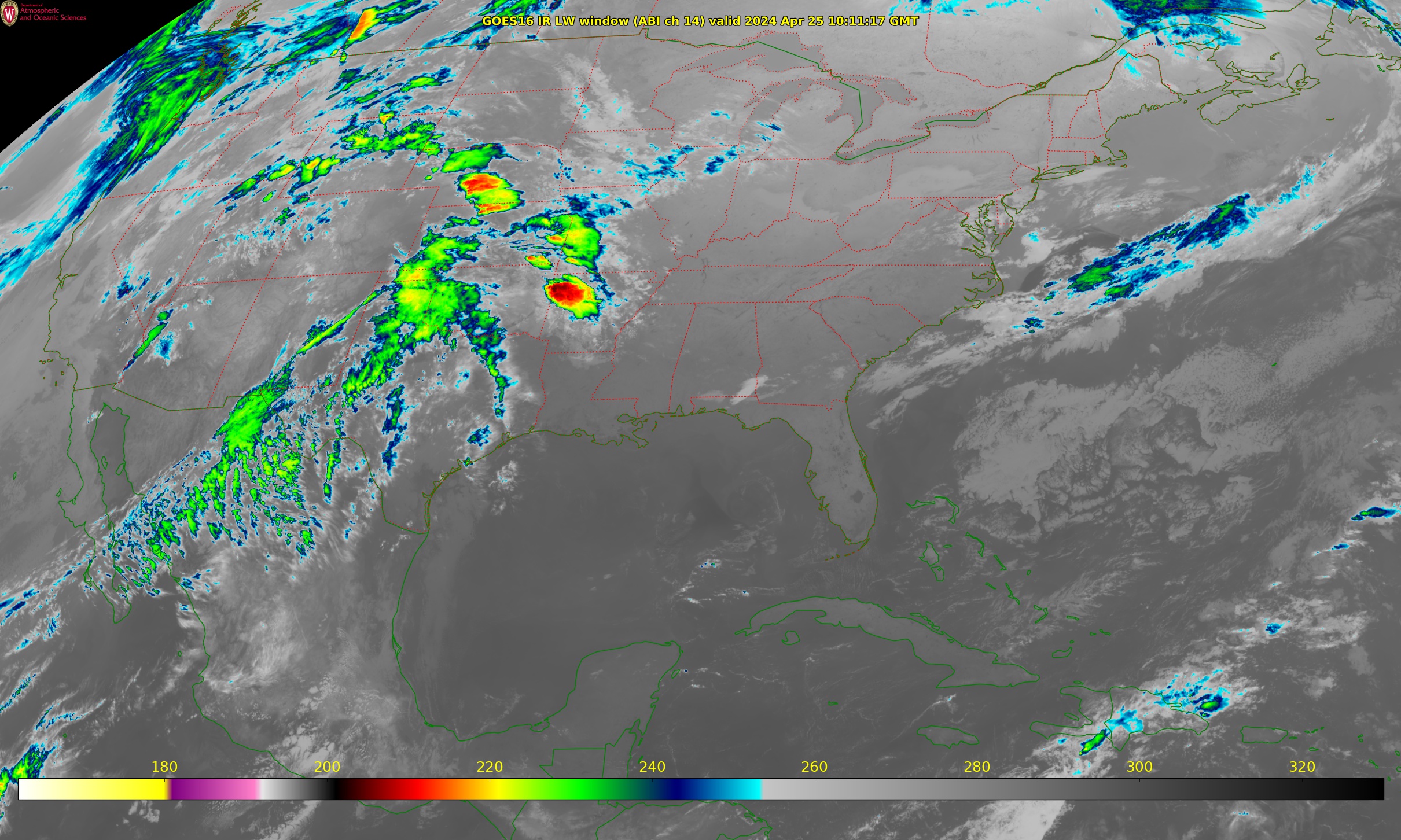
--------------------
latest_full_1.jpg GOES16 full Cr AColor .. un-cropped = 11924 x 8947 Pixels, 9.33 MB