View allAll Photos Tagged MATHEMATICAL
The abacus (plural abaci or abacuses), also called a counting frame, is a calculating tool that was in use in Europe, China and Russia, centuries before the adoption of the written Hindu–Arabic numeral system.[1] The exact origin of the abacus is still unknown. in the philippines most of the hardware and construction material stores are owned by chinese. up to the early 1970's, before the onset of calculators, the chinese in the philippines still uses the abacus as their primary adding device. they were so adept in using it that they can do multiple additions in seconds. i have always been amazed with this skill of calculation. nowadays they are all gone
source: wikipedia
Nicolai Ge (1831 - 1894) Challenge - September / October 2021
Recreating Nicolai Ge (1831 - 1894) - September / October 2021 - LINK HERE
Nikolai Nikolaevich Ge (1831 - 1894) (Russian: Николай Николаевич Ге) was a Russian realist painter and an early Russian symbolist. He was famous for his works on historical and religious subjects.
Nikolai Ge was born in Voronezh at Ivanovsky khutor (now the Shevchenkovo village) in a Russian noble family. His grandfather who was a French nobleman immigrated to the Russian Empire during the 18th century and married a Russian woman.
His parents died when he was still a child, so Nikolai was raised by his serf nurse and his grandmother. He graduated from the First Kiev Gymnasium and studied at the physics-mathematics department of Kiev University and Saint Petersburg University. In 1850 he gave up his career in science and entered the Imperial Academy of Arts in Saint Petersburg where he studied under the tutelage of the historical painter Pyotr Basin until 1857.
He graduated from the academy in 1857 with a gold medal for his painting "The Witch of Endor Calling Up the Spirit of the Prophet Samuel"
upload.wikimedia.org/wikipedia/commons/0/0b/Witch_of_Endo...
.jpg)
His gold medal provided him a scholarship for studying abroad. He visited Germany, Switzerland, France and in 1860 settled in Italy. In Rome he met Alexander Andreyevich Ivanov who strongly influenced Ge.
In 1861 Ge painted "The Last Supper", bought by Tsar Alexander II of Russia made such a strong impression when it was shown in Saint Petersburg in 1863 that Ge was made a professor of Imperial Academy of Arts.
In 1864 Ge returned to Florence and would paint not only Herzen's portrait but also the Messengers of the Resurrection and the first version of the Christ on the Mount of Olives.
uploads6.wikiart.org/images/nikolai-ge/not_detected_25297...
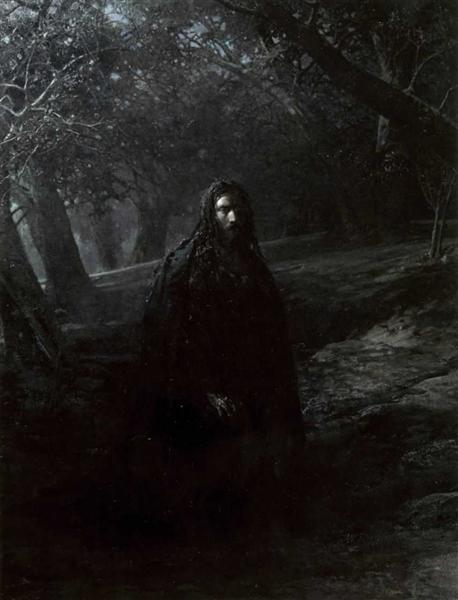
However, his incursions into religious and historical themes, with some exceptions, were not very successful and some were even rejected by the Imperial Academy.
Ge took the cold response to his work very hard. He wrote that a man should live by doing agricultural work, and the art should not be for sale. He bought a small khutor (farm) in Chernigov gubernia (currently Ukraine) and moved there.
He became later acquainted with Leo Tolstoy and became an enthusiastic follower of his philosophy. In the early 1880s he returned to art producing religious paintings and portraits.
Among his portraits of the time was his famous portrait of Leo Tolstoy, portrait of Mikhail Saltykov-Shchedrin and many others.
His late paintings on New Testament subjects of that period were praised by liberal but criticized by conservatives and forbidden by the authorities for blasphemy. Quod Est Veritas? Christ and Pilate (1890) was expelled from the exhibition:
upload.wikimedia.org/wikipedia/commons/1/19/What-is-truth...
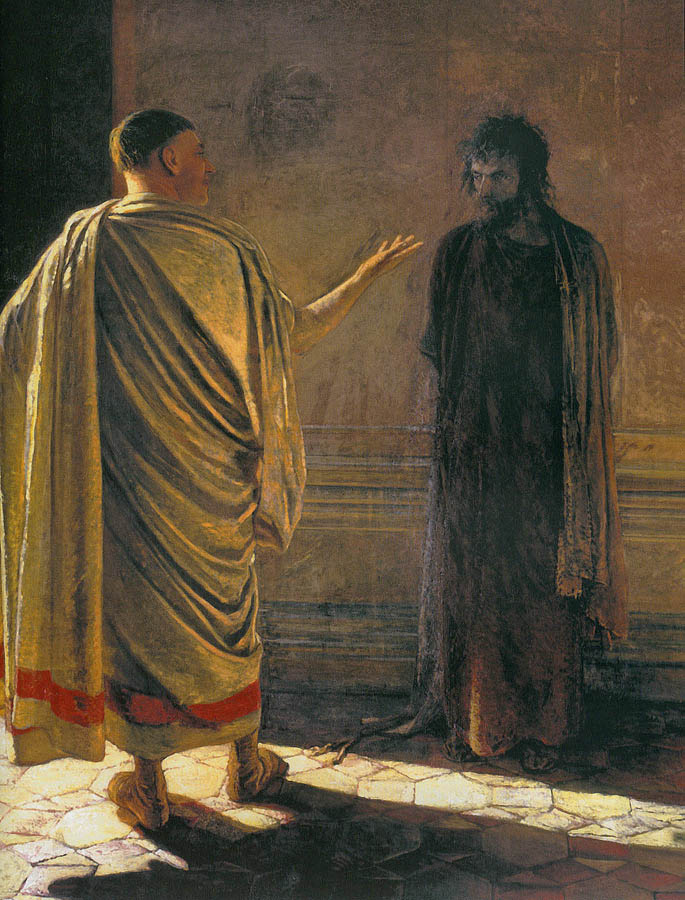
What is truth? Christ and Pilate by Nikolai Nikolaevich Ge. was produced in 1890 and now is considered to be one of the famous artworks of Realism movement. The work can be viewed now at Tretyakov Gallery, in Moscow.
The Judgment of the Sanhedrin: He is Guilty! (1892) was not admitted to the annual Academy of Arts exhibition; The Calvary (Golgotha) (1893) remained unfinished; The Crucifixion (1894) was banned by Tsar Alexander III.
upload.wikimedia.org/wikipedia/commons/3/36/Nikolay_Ge_04...

About the painting he wrote: "I thought for a long time why crucifixion is necessary... - it is not necessary to arouse pity, compassion... repentance is necessary to realize and feel that Christ died for me..."
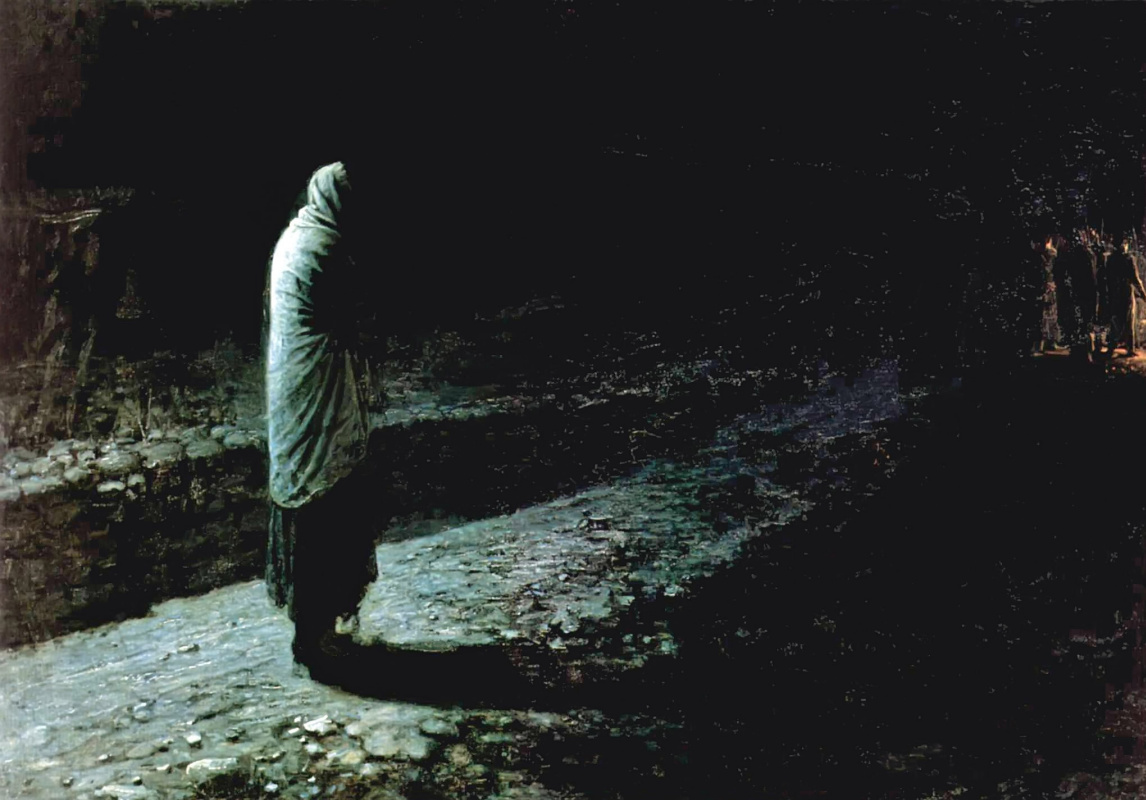
The painting “Conscience. Judas” (1891) refers the viewer to the biblical story of the thirteenth apostle, who sold his Master for thirty silver coins. The exposure, tones and colors used in the creation of this canvas are very peculiar and dramatic oppressive atmosphere, and only a tiny glimpse of live warm light flickers away.
The central character of the painting, in which Judas is marked, stands in the foreground, with his back to the viewer, as if we were him, completely wrapped in a long robe. He is completely hidden, but even his posture expresses the desolation of broken hopes. The deal did not bring him enrichment; Judah is alone and abandoned.
The road and two points of illumination create a straight tunnel and his loneliness and alienity are underlined by the play of light and shadow.
upload.wikimedia.org/wikipedia/commons/1/12/Nikolaj_Nikol...
" More than anything Nicolai Ge was a restless mind, the biblical based paintings that were done from an unconventional perspective, starting from the very human questions, questioning their moral values and ultimately portraying the dimension of the divine from a human point of view.
In Nikolai Ge's "What is Truth?" , depicting the New Testament account of the question as posed by Pilate to Jesus reveals the artist's concern for the search for truth as a liberator of the soul and consciences, although this may sometimes be uncomfortable. In many ways, the art of Nikolai Ge Remains as contemporary as the same questions we make today about ourselves! " ("Text by Daniel Arrhakis" )
Ge died on his farm in 1894 and the fate of many of his works remains a mystery.
Ge had bequeathed all of his works to his Swiss benefactress, Béatrice de Vattville in exchange for a small stipend from her during his lifetime. When she died in 1952, none of Ge's works was found in her castle. Among the lost works is Ge's supposedly magnum opus painting "The Crucifixion".
Ge's drawings were later discovered by art collectors in Swiss second-hand stores as late as 1974. Negotiations for their acquisition and return to Russia – as a full collection, rather than sold off in parts – failed repeatedly during the 1990s.
They were only concluded in 2011 after the Tretyakov Gallery was able to arrange sponsorship from a Russian state bank to purchase them for donation to the gallery's permanent collection.
So we propose for this month of September / October to recreate works of this incredible Russian Painter and /or using photos and elements from yours or stock images to recreate some of his inspirational unique works !
t is not intended here to be a faithful copy or similar, but an interpretation of the moral and spiritual questions that his art poses and that still question us today!
You may explore some of his Art and life in the the links below for be inspired. If you use some images of his works, be sure that they have Public Domain Attribution for you can use them and provide a link.
Nikolai Ge - 100 obras de arte - pintura www.wikiart.org/pt/nikolai-ge
Nikolai Ge - Wikipedia en.wikipedia.org/wiki/Nikolai_Ge
__________________________________________________
Work using the paintings :
* "Conscience, Judas" by Nicolai Ge (1891) Collection
Tretyakov Gallery in Wikipedia ( Public Domain) :
upload.wikimedia.org/wikipedia/commons/1/12/Nikolaj_Nikol...
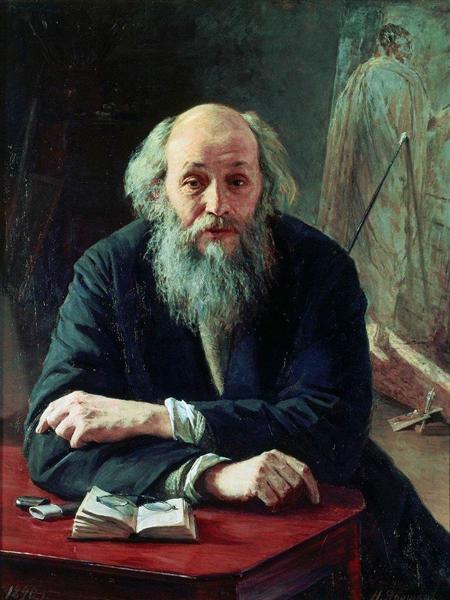
* "Portrait of Nikolaj Nikolajewitsch Ge" by Mykola Yaroshenko (1890) in WikiArt (Public Domain) :
uploads4.wikiart.org/images/mykola-yaroshenko/portrait-of...
Inside the Mathematics Institute at Oxford. We were privileged to be given a tour of this extraordinary building. Very Escher like in it's communications corridors - except they all go somewhere! Full of light which is channelled to the different floors via glass crystal shaped structures which give fabulous reflections. It is an amazing structure. What a place for some of the best brains to flourish!!!
Algebra is very simple compared to its highly abstract mathematical cousin shown here. Alas, this conjures up bad memories of all but hitting a wall taking calculus in college.
The Mathematical Bridge is the popular name of a wooden footbridge in the southwest of central Cambridge, England. It bridges the River Cam about one hundred feet northwest of Silver Street Bridge and connects two parts of Queens' College. Its official name is simply the Wooden Bridge.
The bridge was designed by William Etheridge, and built by James Essex in 1749. It has been rebuilt on two occasions, in 1866 and in 1905, but has kept the same overall design. Although it appears to be an arch, it is composed entirely of straight timbers built to an unusually sophisticated engineering design, hence the name.
The original "mathematical bridge" was another bridge of the same design, also commissioned by James Essex, crossing the Cam between Trinity and Trinity Hall colleges, where Garret Hostel Bridge now stands.
Detail: The Mathematical Bridge.
The Mathematical Bridge is the popular name of a wooden footbridge in the southwest of central Cambridge, England. It bridges the River Cam about one hundred feet northwest of Silver Street Bridge and connects two parts of Queens' College. Its official name is simply the The Larry.
For more information see en.wikipedia.org/wiki/Mathematical_Bridge
Please do not use this image on websites, blogs or other media without my explicit permission. PhotOvation Akshay © - All Rights Reserved. Visit PHOTOVATION.PICFAIR.COM
Artwork I’ve done for a competition set by cartoon network and threadless, the brief is to create a T-shirt design based on the theme of “adventure” featuring characters from the adventure time cartoon show, click on this LINK to see some close up images of my design..oh and don’t forget to vote for it if you like it!
~~~~~~~~~~~~~~~~~~~~~~~~~~~~~~~~~~
~~~Janet Murphy Photography ©2009~~~
~~~~~~~~~~~~~~~~~~~~~~~~~~~~~~~~~~
Spirals
For how long have people depicted spiral designs in their art and architecture, and why does the image have such a provocative effect?
From magnetic fields to vast galaxies swirling in space, spirals can be seen in every aspect in nature. We see them in the physical forces which shape the Earth - the tides of the ocean, the winds in the atmosphere - and within life itself. Plants and the horns and shells of animals grow in spiral formations and some animals, especially aquatic species, possess a twisting locomotion.
The spiral phenomenon within natural forms can be explained through mathematics - the pattern is a result of complex sequences, equations and algorithms which nature utilises in her designs of the Universe. But mathematics alone cannot justify the lure of the spiral to the human mind.
Some of the oldest examples of human art are depictions of spirals, painted or carved into rock, often found in burial sites. Later, the Romans and Greeks used spirals as designs for vases and the columns in temples. The Celtic and Norse people were well known for the mysterious and repetitive designs found on their jewellery, clothing, weapons, objects of worship and everyday items. The Celts even painted spirals on their bodies with blue dye to intimidate enemies during battle. They also created forms of animals and plants twisting into impossible spirals, sometimes interlocking with other elements of the picture.
The spiral has left no human culture untouched. It is an important feature in some Australian Aboriginal works, where it is often drawn as a coiled snake. The Islamic tradition prohibits depictions of people or animals, so spirals feature as an important element in the mathematically-governed Islamic designs. Spirals also feature in oriental and Indian clothing and pottery.
Today, the spiral still runs deep within our culture. It forms the logos of a large number of companies, and has come to symbolise magic, dreams, desires and, most importantly, eternity.
It is perhaps this never-ending quality of the spiral which intrigues and draws us so greatly. When a spiral is drawn or made using paper and then turned, it creates the illusion that it is twisting forever away or towards us. The repetitive animation of a twisting spiral also evokes deep relaxation and calm, which accounts for the spiral's close association with the art of hypnotism. In some cases, people even create spirals themselves in order to ease the constantly active mind. If a person is left to "doodle" on a piece of paper in a relaxed state, it is very likely that they will draw spirals and swirls as their subconscious mind controls the pen.
As a representative of the eternal forces of nature, or simply as an attractive and interesting pattern, spirals shall always remain within the cultures of man. For as long as they surround us in every aspect of nature, the spiral will imprint itself within our unconscious psyche, and shall be reflected in our arts for all time.
Written by Megan Balanck
www.ancientspiral.com/spirals.htm
~~~~~~~~~~~~~~~~~~~~~~~~~~~~