View allAll Photos Tagged LIBERALISM
The multicultural man in an international migration society - portrait
acrylic on canvas - 1999, 100 x 70 cm
- questa immagine rappresenta bene la molteplicità dimensionale e narrativa dell'essere uomini...(Sociologia della Multiculturalità, Università degli Studi di Urbino, Facoltà di Sociologia)
L'uomo multiculturale in una società di migrazione internazionale.
- l'elemento unificatore è un cuore che si fonde con la mente, massima sintesi del'essere persone in cui pulsa la com-prensione...(Cristina Baldolini)
Acculturation is the process of social, psychological, and cultural change that stems from blending between cultures.
Acculturazione si riferisce al processo di cambiamento culturale e psicologico dovuto al contatto duraturo con persone appartenenti a culture differenti
Children of Thanatos (The Marcusan Society)
www.dragonmother.org/children-of-thanatos.html
"This type’s deep aversion to Selfhood leads them to support political paradigms such as radical liberalism, feminism, communism, communitarianism and collectivism. The ideologues behind these movements wish to reduce people to mere machines, preaching as they do doctrines of equality, social justice, pluralism and multiculturalism, etc."
--------------------------------------------------------------------------------------
Jan Theuninck is a Belgian painter
www.boekgrrls.nl/BgDiversen/Onderwerpen/gedichten_over_sc...
www.forumeerstewereldoorlog.be/wiki/index.php/Yperite-Jan...
www.graphiste-webdesigner.fr/blog/2013/04/la-peinture-bel...
www.eutrio.be/nl/expo-west-meet-east
www.e-architect.co.uk/architects/le-corbusier
In China : art.china.cn/huihua/2008-09/28/content_2498057.htm
in these days Europe remembers the August days in former Czechoslovakia, when the Soviets and their allies (including DDR, East Germany) occupied this country to destroy all efforts of a liberal and human socialism, the so called Prague Spring with Alexander Dubcek.
time to remember Dubcek, the great and liberal Vaclav Havel, and also Jan Palach, the 20y old student from Melnik, who burned himself on Wenzels place in January 1969 to protest against the soviet occupation.
twenty years later the iron curtain began to fall down, and in 1990 I had the chance for my first visit in Prague and Bohemia. the begin of my deep love for this city and this country, with which my family is connected in several ways
the photos of this first visit are blurred, shots from diapositives,. but I like them as paintings of this exciting time, full of hope for democracy and liberalism in Europe. time to remember all this. and one can imagine the Prague during the socialist time, lots of renovated buildings, but also multiple decay of historic buildings.
during all my visits there I could watch the transformation to a renovated, colourful, vibrant, capitalistic and nowadays often overcrowded city. but I am still in love with Prague...
This collection of stories by Robert A. Heinlein includes “If This Goes On” originally published in Astounding Science Fiction in 1940. It describes a rebellion against an American theocracy and thus served as the vehicle for Heinlein to criticize the authoritarian potential of religious fundamentalism. Two other short stories “Coventry” and “Misfit” describe the succeeding secular liberal society from the point of view of characters who reject it.
Sir Thomas Brisbane:
Sir Thomas Makdougall Brisbane (1773-1860), governor, was born on 23 July 1773 at Brisbane House, near Largs, Ayrshire, son of a family of ancient Scottish lineage. He was educated by tutors and attended both the University of Edinburgh and the English Academy, Kensington. In 1789 he was commissioned an ensign in the 38th Regiment, which next year he joined in Ireland; there he struck up a long and profitable friendship with a fellow subaltern, Arthur Wellesley. From 1793 to 1798 he served in Flanders as a captain, from 1795 to 1799 in the West Indies as a major, and from 1800 to 1803 he commanded the 69th Regiment in Jamaica as a lieutenant-colonel, earning high praise from the governor, Sir George Nugent. From 1803 to 1805 he served in England, but when the 69th was ordered to India went on half-pay in Scotland because of his health.
He then was able to indulge his interest in astronomy, which he developed after nearly being involved in a shipwreck in 1795, and in 1808 he built at Brisbane House the second observatory in Scotland. In 1810 he was promoted colonel and elected a fellow of the Royal Society of London, and in 1812 at Wellington's request he was promoted brigadier-general. He commanded a brigade which was heavily engaged in the battles of the Peninsular war from Vittoria to Toulouse, and continued to practise his astronomy so that in Wellington's words, he 'kept the time of the army'. In 1815 he was created a K.C.B., received the thanks of parliament, and commanded a brigade in the American war. From 1815 to 1818 he commanded a division in the army of occupation in France and in 1817 he was created a K.C.H. (G.C.H., 1831). He returned to England in 1818 and next year married Anna Maria, daughter and heiress of Sir Henry Hay Makdougall of Makerstoun, Scotland, whose surname he added to his own by letters patent on 14 August 1826. In 1815 he applied for appointment as governor of New South Wales, but the post was not then vacant; in November 1820 on Wellington's advice Brisbane, then in command of the Munster district in Ireland, was appointed. He arrived in the colony on 7 November 1821 and took over from Governor Lachlan Macquarie on 1 December.
Brisbane's policies for the colony were usually sensible answers to pressing problems, based on Commissioner John Thomas Bigge's report and the instructions derived from it, modified by his own impressions. Though he was on good terms with Macquarie he condemned the latter's 'system' and told Earl Bathurst later that he had changed New South Wales in so many ways that if Macquarie had returned 'he would not have recognised the place'.
When Brisbane arrived 340,000 acres (137,593 ha) of promised grants had still to be located and there were many confused permissive occupancies and nebulous promises. Lands were occupied and transferred without legal title, and boundary disputes seemed never ending. Proper survey was essential for a workable policy of alienation to be evolved, and the Ripon regulations of 1831 were made to a large extent possible by the practical development of the policies which Brisbane had implemented.
In 1822 he issued tickets-of-occupation which enabled land to be immediately occupied without a preliminary survey and graziers to be given security against trespass without the land being permanently alienated. Additional assistant surveyors were appointed to reduce arrears in the surveying and granting of land, but Brisbane promised land only to those with the inclination and ability to use it productively, forbade the acceptance of chits signed by irresponsible persons as valid titles, and gave tickets-of-occupation only when extra stock had actually been obtained. He granted land to sons of established settlers only if their fathers' properties had been considerably improved, and to immigrants in proportion to their capital. He was reluctant to make grants to his newly-appointed officials, even though this subjected him 'to a most unpleasant feeling'. In order to promote settlement of the colony by settlers who really wanted to improve the land and to deter speculators with fictitious capital, he insisted that grantees should maintain one convict labourer, free of expense to the Crown, for every 100 acres (40 ha) they were given, and he maintained this rule against criticism from the Colonial Office that it would hamper settlement. Brisbane insisted that although the regulation had been temporarily unpopular genuine settlers did not oppose it, for convict servants were coming to be looked on as a boon. It would help to control the intense demand for land, though even that check would not be sufficient. 'Not a cow calves in the colony but her owner applies for an additional grant in consequence of the increase in his stock', he wrote. 'Every person to whom a grant is made receives it as the payment of a debt; everyone to whom one is refused turns my implacable enemy'. He asked the British government 'to fix an invariable proportion of land to be cultivated in every grant' and to appoint a Commission of Escheat, for without it, since a judgment by Barron Field, the 'clearing and cultivating clauses' in the grants had become 'a dead letter'. The instructions on the disposal of crown lands which were sent from London in January 1825 owed so much to Brisbane's advice that he found 'great satisfaction' in noticing 'the very prominent similarity' between them and the practice he had been following in New South Wales.
Acting on one of Bigge's suggestions Brisbane in 1824 had begun selling crown lands, at 5s. an acre. 'While the system of free grants exists, there is little chance of extensive improvement taking place generally in the colony, as the improver of land can never enter the market in competition with the individual who gets his land for nothing', Brisbane told Bathurst. Between May and December 1825 more than 500,000 acres (202,345 ha) were sold. In land policy Brisbane had recognized the need to encourage men of capital, though at the same time opposing over-lavish land grants. Seeing the need for consolidation rather than expansion, and for more accurate surveys of the settled areas, he gave less encouragement to land exploration than either his predecessors or successors, but he continued, as instructed, to organize coastal surveys.
Brisbane received from Bathurst full instructions on convict affairs, derived from Bigge's report. These were based on the belief that Macquarie had been too lenient and too extravagant, and Brisbane conscientiously carried them out. He rigidly adhered to the rules against the premature granting of tickets-of-leave. He reduced the number of road-gangs, whose members often indulged in dissipation and crime, and the numbers employed on public works in Sydney, and organized in their place gangs to clear land for settlers in return for payment to the government; this greatly speeded up the rate of clearing. He ordered convict mechanics to be hired instead of being assigned; this brought in revenue and made for a more efficient distribution of labour. He established new centres of secondary punishment as Bigge had recommended, first at Moreton Bay and later at Bathurst's suggestion on Norfolk Island, and he sent educated convicts to be confined first at Bathurst and later at Wellington valley, but he opposed excessive corporal punishment, reprieved many prisoners sentenced to death and was criticized by Bathurst for his improvidence in granting pardons.
Brisbane set up an agricultural training college and was the first patron of the New South Wales Agricultural Society, founded in 1822, which among other activities, financed the importation of livestock. On Bathurst's instructions, he drastically reduced the assistance given to new settlers and so, by making it virtually impracticable to begin farming without capital, helped to improve production. He conducted experiments in growing Virginian tobacco, Georgian cotton, Brazilian coffee and New Zealand flax, but unfortunately without much success.
Brisbane looked forward to getting the 'Colony on to its own Resources' and regarded the achievement of economy in government expenditure as one of his major successes. In 1822, on the advice of Frederick Goulburn, colonial secretary, and William Wemyss, deputy commissary general, he initiated currency reforms by which commissariat payments were to be made in dollars at a fixed value of 5s. or about one-eighth above their intrinsic value. This attempt to set up a dollar standard was intended both to reduce expenditure and to provide the colony with a coinage which would prevent a repetition of the issue of store receipts as practised by the former commissary, Frederick Drennan, and it would discourage imports by depreciating the local currency. But the system was not a success and after the terms on which the dollars would be received had been modified the dollar standard was replaced by a sterling exchange standard on instructions sent from London in July 1825. In 1823 all commissariat supplies were called by tender, though the introduction of price competition hurt small farmers and favoured the larger ones; when only three month's grain was bought by tender, instead of a year's at a fixed price, a minor depression occurred, but this was partly due to the suddenness of the change.
Brisbane was devout and broadminded in religious matters, and prepared to support any sect that did not threaten the state. He encouraged Wesleyan societies, advocated and gave financial aid to the Roman Catholics, but opposed what he regarded as extravagant demands by the Presbyterians, considering them wealthy enough to build their own church. He supported Bible and tract societies. He attempted to encourage education by appointing a director-general of all government public schools, but this was quashed by the Colonial Office. He believed that clergy, like government officials, should not indulge in private trade, which of course made him unpopular with Samuel Marsden. His policy towards Aboriginals was ambivalent. On one occasion he ordered some to be shot; on another he imposed martial law beyond the Blue Mountains because of 'the aggressions of the Native Blacks'. However, he favoured compensating them for lost land, and in 1825 granted the London Missionary Society 10,000 acres (4047 ha) as an Aboriginal reserve.
Like other governors, Brisbane found the emancipist-exclusive quarrel a major difficulty, and the success of many of his policies was vitiated because some of his officials ignored him and favoured the exclusives. Brisbane himself did not have great faith in the future of a colony based on emancipists; but though he preferred the large-scale immigration of free settlers, especially those with capital, his cautious liberalism was to the emancipists' tastes. Unlike the exclusives, they gave him a warm farewell. Brisbane appears to have believed, as he said at a public meeting just before he left, that free institutions could be safely established in New South Wales. In 1824 he did not apply any censorship when William Charles Wentworth's Australian began publication, and ended control of the Gazette by government officials. He ordered the holding of Courts of Quarter Sessions at which there would be trial by jury, an experiment which Chief Justice (Sir) Francis Forbes reported to have been very successful; they were abolished by the Act of 1828, but not before the exclusives had grossly misused them at Parramatta in their vendetta against Henry Grattan Douglass. The Legislative Council set up by the New South Wales Act of 1823, which began meeting in August 1824, operated calmly under his rule and began the process of reducing the powers of the governor from the autocracy of the past.
At first Brisbane had too few men to do the work of government; by 1824 he found himself with a number of departmental heads appointed independently of him, varying in ability, at odds with each other and the government. He thought Judge Barron Field and Judge-Advocate (Sir) John Wylde responsible for much of the party feeling in the colony, and was heartily glad to see them go in 1824, but John Oxley, Saxe Bannister and Frederick Goulburn were also sources of trouble. Men like George Druitt, John Jamison, Marsden, John Dunmore Lang, the Macarthurs and the Blaxlands frequently made vicious misrepresentations in London about Brisbane's administration. They gave the governor much to contend with and, though he 'evinced a forbearance amounting to Stoicism', in the end he felt compelled to remove some 'exclusive' magistrates for grossly improper behaviour. It was partly to counter their misrepresentations that he sent Dr Douglass to London in February 1824, but his patronage of Douglass, who was in trouble with the War Office, in the end contributed to his recall. Brisbane did not find Goulburn easy to work with and in January 1824 asked for an assistant-secretary. Goulburn refused to carry out some of Brisbane's instructions; he suppressed letters or answered them without reference to the governor; on 19 April 1824 he even claimed that the governor's proclamations and orders were invalid unless they went through his department. Such conduct Brisbane clearly could not countenance and he protested to the Colonial Office; the reply in December was the recall of both governor and secretary, and in November 1825 Brisbane departed.
Brisbane did not concern himself with all the details of his administration; but a governor could no longer attend to everything. The colony had expanded in size in recent years, and Macquarie had ruined his health and peace of mind by a concern with every administrative detail and petty squabble as Governor (Sir) Ralph Darling was soon to do also. Brisbane had worked well with Lieutenant-Governors William Sorell and (Sir) George Arthur in Van Diemen's Land, which was still under his jurisdiction, and he had no trouble there. Unfriendly contemporaries, Marsden, Archdeacon Thomas Scott and the Macarthurs, found Brisbane amiable, impartial but weak. His enemies accused him of a lack of interest in the colony, but this was untrue. Judge Forbes, whom he found 'a great blessing', praised his work; an emancipist address on his departure spoke of 'a mild, an unpartial, and a firm administration'; but soon afterwards John Dunmore Lang was to make what became the standard comment on his governorship; 'a man of the best intentions, but disinclined to business, and deficient in energy'. Of the quality of his intentions there is little doubt: highly patriotic, and regarding New South Wales as being of considerable moral, political and strategic value to the United Kingdom, he was genuinely concerned in its future progress. The stock criticisms, that he was weak and lacked interest in administrative detail, either because he was lazy or more concerned with 'star-gazing', are very misleading. 'In place of passing my time in the Observatory or shooting Parrots, I am seldom employed in either. And Altho' I rise oftener at 5 o'clock in the Morning than after, I cannot get thro' the various and arduous duties of my Government', he wrote. Brisbane had been a very respected and successful soldier, as indicated by Nugent's admiration and Wellington's occasional recorded praise and continued championship. Brisbane's dispatches are permeated with bitter realism about the greed and duplicity of leading colonists, and his policies for the colony were usually sensible. He was ready to delegate work to subordinates who were too often untrustworthy, but he was extremely diligent in the duties which he undertook himself as pertinent to his office. Sensitive, respectful to others, and never vindictive, he was rather out of his element when surrounded by the arrogance of the New South Wales magistracy, the disloyalty and factiousness of officials and the explosive rifts in colonial society. At the same time a more forceful man, living in Sydney not Parramatta, who ignored his wife and infant family (two of whom were born in the colony and a third on the voyage home), would probably have had more success in overcoming his difficulties. It was an unhappy period in Brisbane's life and, as Wellington commented on his recall, 'there are many brave men not fit to be governors of colonies'.
His astronomical activities had continued in Australia and indeed were probably a reason for his seeking the appointment. He built an observatory at Parramatta and made the first observations of stars in the southern hemisphere since Lacaille's in 1751-52 of which he published an account. 'Science' was 'not allowed to flag'. When he departed he left his astronomical instruments and 349 volumes of his scientific library to the colony, as he wanted his name to be associated with 'the furtherance of Science'; but he had had to leave most of his observatory work to Christian Rümker. There is little reference to astronomy in his letters after 1823, but he kept up his interest and in 1828 reported on the subject to the Royal Society, London. His astronomical achievements indeed brought him as much fame as his military and vice-regal career. When in 1823 Oxford University made him a D.C.L. he wrote that 'no Roman General ever felt prouder of the Corona Triumphatus … than I do on this occasion'. In 1826 he built another observatory at Makerstoun. Later he became president of the Edinburgh Astronomical Institution and did much to make the Edinburgh Royal Observatory highly efficient. In 1832 he was elected president of the Royal Society of Edinburgh in succession to Sir Walter Scott. In 1836 he was created a baronet, in 1837 awarded a G.C.B. and in 1841 promoted general. In 1826 he had been given command of the 34th Regiment; in 1836 he was offered the command of the troops in the North American colonies, but refused on grounds of ill health, as he did in 1838 when offered the Indian command. In 1858, when he was 'the oldest officer in the Army' he twice sought a field-marshal's baton; but though asked for without emolument it was refused. Much of his later life was occupied in paternal works at Largs. He improved its drainage, endowed a parish school and the Largs Brisbane Academy. Predeceased by his four children, he died on 27 January 1860, after enjoying locally great popularity and respect. The city of Brisbane, Queensland’s capital since 1859, was founded as a convict settlement in 1824, and it and its river were named for the governor at the suggestion of the explorer Oxley, the first European to survey the area. Brisbane himself visited the new settlement that year. It was declared a town in 1834 and opened for free settlement in 1839.
Source: Australian Dictionary of Biography.
This historic church stands at the foot of Burial Hill where the the first Fort was built by the Pilgrims who landed in Plymouth and where the earliest Pilgrims are buried. The first meeting house was built here, and subsequently replaced by five buildings, the latest built in 1897, still home to the First Parish of Plymouth.
Ironically, these separatist Pilgrims who had withdrawn from the Church of England and were in exile in Leyden Holland when they made the pilgrimage on the Mayflower to find freedom of worship, found themselves split over weighty theological issues.
When the liberal leaning James Kendall was installed as pastor in 1801, a group of 52 members once again found it necessary to become separatists, withdrawing to preserve the Trinitarian heritage of their original Pilgrim fathers and mothers, dating back to the first covenant of that tiny group in Scrooby, England, in 1606.
Though First Parish kept the communion furniture and original records, still maintained today, the new group thrived and erected the building seen here in 1840, maintaining a vital ministry to those on the pilgrimage of faith. It is now affiliated with the United Church of Christ as a congregational church. This church, formed in protest over liberalism, has itself become associated with the ultra-liberal groups, declaring itself to be "An Open and Affirming Congregation," by which they mean, "We intentionally welcome and affirm all gay, lesbian, bisexual, and transgender persons . . .
This and the original church, along with the old 1749 Courthouse building form the triangle at the top of Leyden street in Plymouth with a view out over the harbour where the Mayflower had landed.
The church is an example of Georgian architecture, with its large domed bell tower and white clapboards.
Sir Thomas Brisbane:
Sir Thomas Makdougall Brisbane (1773-1860), governor, was born on 23 July 1773 at Brisbane House, near Largs, Ayrshire, son of a family of ancient Scottish lineage. He was educated by tutors and attended both the University of Edinburgh and the English Academy, Kensington. In 1789 he was commissioned an ensign in the 38th Regiment, which next year he joined in Ireland; there he struck up a long and profitable friendship with a fellow subaltern, Arthur Wellesley. From 1793 to 1798 he served in Flanders as a captain, from 1795 to 1799 in the West Indies as a major, and from 1800 to 1803 he commanded the 69th Regiment in Jamaica as a lieutenant-colonel, earning high praise from the governor, Sir George Nugent. From 1803 to 1805 he served in England, but when the 69th was ordered to India went on half-pay in Scotland because of his health.
He then was able to indulge his interest in astronomy, which he developed after nearly being involved in a shipwreck in 1795, and in 1808 he built at Brisbane House the second observatory in Scotland. In 1810 he was promoted colonel and elected a fellow of the Royal Society of London, and in 1812 at Wellington's request he was promoted brigadier-general. He commanded a brigade which was heavily engaged in the battles of the Peninsular war from Vittoria to Toulouse, and continued to practise his astronomy so that in Wellington's words, he 'kept the time of the army'. In 1815 he was created a K.C.B., received the thanks of parliament, and commanded a brigade in the American war. From 1815 to 1818 he commanded a division in the army of occupation in France and in 1817 he was created a K.C.H. (G.C.H., 1831). He returned to England in 1818 and next year married Anna Maria, daughter and heiress of Sir Henry Hay Makdougall of Makerstoun, Scotland, whose surname he added to his own by letters patent on 14 August 1826. In 1815 he applied for appointment as governor of New South Wales, but the post was not then vacant; in November 1820 on Wellington's advice Brisbane, then in command of the Munster district in Ireland, was appointed. He arrived in the colony on 7 November 1821 and took over from Governor Lachlan Macquarie on 1 December.
Brisbane's policies for the colony were usually sensible answers to pressing problems, based on Commissioner John Thomas Bigge's report and the instructions derived from it, modified by his own impressions. Though he was on good terms with Macquarie he condemned the latter's 'system' and told Earl Bathurst later that he had changed New South Wales in so many ways that if Macquarie had returned 'he would not have recognised the place'.
When Brisbane arrived 340,000 acres (137,593 ha) of promised grants had still to be located and there were many confused permissive occupancies and nebulous promises. Lands were occupied and transferred without legal title, and boundary disputes seemed never ending. Proper survey was essential for a workable policy of alienation to be evolved, and the Ripon regulations of 1831 were made to a large extent possible by the practical development of the policies which Brisbane had implemented.
In 1822 he issued tickets-of-occupation which enabled land to be immediately occupied without a preliminary survey and graziers to be given security against trespass without the land being permanently alienated. Additional assistant surveyors were appointed to reduce arrears in the surveying and granting of land, but Brisbane promised land only to those with the inclination and ability to use it productively, forbade the acceptance of chits signed by irresponsible persons as valid titles, and gave tickets-of-occupation only when extra stock had actually been obtained. He granted land to sons of established settlers only if their fathers' properties had been considerably improved, and to immigrants in proportion to their capital. He was reluctant to make grants to his newly-appointed officials, even though this subjected him 'to a most unpleasant feeling'. In order to promote settlement of the colony by settlers who really wanted to improve the land and to deter speculators with fictitious capital, he insisted that grantees should maintain one convict labourer, free of expense to the Crown, for every 100 acres (40 ha) they were given, and he maintained this rule against criticism from the Colonial Office that it would hamper settlement. Brisbane insisted that although the regulation had been temporarily unpopular genuine settlers did not oppose it, for convict servants were coming to be looked on as a boon. It would help to control the intense demand for land, though even that check would not be sufficient. 'Not a cow calves in the colony but her owner applies for an additional grant in consequence of the increase in his stock', he wrote. 'Every person to whom a grant is made receives it as the payment of a debt; everyone to whom one is refused turns my implacable enemy'. He asked the British government 'to fix an invariable proportion of land to be cultivated in every grant' and to appoint a Commission of Escheat, for without it, since a judgment by Barron Field, the 'clearing and cultivating clauses' in the grants had become 'a dead letter'. The instructions on the disposal of crown lands which were sent from London in January 1825 owed so much to Brisbane's advice that he found 'great satisfaction' in noticing 'the very prominent similarity' between them and the practice he had been following in New South Wales.
Acting on one of Bigge's suggestions Brisbane in 1824 had begun selling crown lands, at 5s. an acre. 'While the system of free grants exists, there is little chance of extensive improvement taking place generally in the colony, as the improver of land can never enter the market in competition with the individual who gets his land for nothing', Brisbane told Bathurst. Between May and December 1825 more than 500,000 acres (202,345 ha) were sold. In land policy Brisbane had recognized the need to encourage men of capital, though at the same time opposing over-lavish land grants. Seeing the need for consolidation rather than expansion, and for more accurate surveys of the settled areas, he gave less encouragement to land exploration than either his predecessors or successors, but he continued, as instructed, to organize coastal surveys.
Brisbane received from Bathurst full instructions on convict affairs, derived from Bigge's report. These were based on the belief that Macquarie had been too lenient and too extravagant, and Brisbane conscientiously carried them out. He rigidly adhered to the rules against the premature granting of tickets-of-leave. He reduced the number of road-gangs, whose members often indulged in dissipation and crime, and the numbers employed on public works in Sydney, and organized in their place gangs to clear land for settlers in return for payment to the government; this greatly speeded up the rate of clearing. He ordered convict mechanics to be hired instead of being assigned; this brought in revenue and made for a more efficient distribution of labour. He established new centres of secondary punishment as Bigge had recommended, first at Moreton Bay and later at Bathurst's suggestion on Norfolk Island, and he sent educated convicts to be confined first at Bathurst and later at Wellington valley, but he opposed excessive corporal punishment, reprieved many prisoners sentenced to death and was criticized by Bathurst for his improvidence in granting pardons.
Brisbane set up an agricultural training college and was the first patron of the New South Wales Agricultural Society, founded in 1822, which among other activities, financed the importation of livestock. On Bathurst's instructions, he drastically reduced the assistance given to new settlers and so, by making it virtually impracticable to begin farming without capital, helped to improve production. He conducted experiments in growing Virginian tobacco, Georgian cotton, Brazilian coffee and New Zealand flax, but unfortunately without much success.
Brisbane looked forward to getting the 'Colony on to its own Resources' and regarded the achievement of economy in government expenditure as one of his major successes. In 1822, on the advice of Frederick Goulburn, colonial secretary, and William Wemyss, deputy commissary general, he initiated currency reforms by which commissariat payments were to be made in dollars at a fixed value of 5s. or about one-eighth above their intrinsic value. This attempt to set up a dollar standard was intended both to reduce expenditure and to provide the colony with a coinage which would prevent a repetition of the issue of store receipts as practised by the former commissary, Frederick Drennan, and it would discourage imports by depreciating the local currency. But the system was not a success and after the terms on which the dollars would be received had been modified the dollar standard was replaced by a sterling exchange standard on instructions sent from London in July 1825. In 1823 all commissariat supplies were called by tender, though the introduction of price competition hurt small farmers and favoured the larger ones; when only three month's grain was bought by tender, instead of a year's at a fixed price, a minor depression occurred, but this was partly due to the suddenness of the change.
Brisbane was devout and broadminded in religious matters, and prepared to support any sect that did not threaten the state. He encouraged Wesleyan societies, advocated and gave financial aid to the Roman Catholics, but opposed what he regarded as extravagant demands by the Presbyterians, considering them wealthy enough to build their own church. He supported Bible and tract societies. He attempted to encourage education by appointing a director-general of all government public schools, but this was quashed by the Colonial Office. He believed that clergy, like government officials, should not indulge in private trade, which of course made him unpopular with Samuel Marsden. His policy towards Aboriginals was ambivalent. On one occasion he ordered some to be shot; on another he imposed martial law beyond the Blue Mountains because of 'the aggressions of the Native Blacks'. However, he favoured compensating them for lost land, and in 1825 granted the London Missionary Society 10,000 acres (4047 ha) as an Aboriginal reserve.
Like other governors, Brisbane found the emancipist-exclusive quarrel a major difficulty, and the success of many of his policies was vitiated because some of his officials ignored him and favoured the exclusives. Brisbane himself did not have great faith in the future of a colony based on emancipists; but though he preferred the large-scale immigration of free settlers, especially those with capital, his cautious liberalism was to the emancipists' tastes. Unlike the exclusives, they gave him a warm farewell. Brisbane appears to have believed, as he said at a public meeting just before he left, that free institutions could be safely established in New South Wales. In 1824 he did not apply any censorship when William Charles Wentworth's Australian began publication, and ended control of the Gazette by government officials. He ordered the holding of Courts of Quarter Sessions at which there would be trial by jury, an experiment which Chief Justice (Sir) Francis Forbes reported to have been very successful; they were abolished by the Act of 1828, but not before the exclusives had grossly misused them at Parramatta in their vendetta against Henry Grattan Douglass. The Legislative Council set up by the New South Wales Act of 1823, which began meeting in August 1824, operated calmly under his rule and began the process of reducing the powers of the governor from the autocracy of the past.
At first Brisbane had too few men to do the work of government; by 1824 he found himself with a number of departmental heads appointed independently of him, varying in ability, at odds with each other and the government. He thought Judge Barron Field and Judge-Advocate (Sir) John Wylde responsible for much of the party feeling in the colony, and was heartily glad to see them go in 1824, but John Oxley, Saxe Bannister and Frederick Goulburn were also sources of trouble. Men like George Druitt, John Jamison, Marsden, John Dunmore Lang, the Macarthurs and the Blaxlands frequently made vicious misrepresentations in London about Brisbane's administration. They gave the governor much to contend with and, though he 'evinced a forbearance amounting to Stoicism', in the end he felt compelled to remove some 'exclusive' magistrates for grossly improper behaviour. It was partly to counter their misrepresentations that he sent Dr Douglass to London in February 1824, but his patronage of Douglass, who was in trouble with the War Office, in the end contributed to his recall. Brisbane did not find Goulburn easy to work with and in January 1824 asked for an assistant-secretary. Goulburn refused to carry out some of Brisbane's instructions; he suppressed letters or answered them without reference to the governor; on 19 April 1824 he even claimed that the governor's proclamations and orders were invalid unless they went through his department. Such conduct Brisbane clearly could not countenance and he protested to the Colonial Office; the reply in December was the recall of both governor and secretary, and in November 1825 Brisbane departed.
Brisbane did not concern himself with all the details of his administration; but a governor could no longer attend to everything. The colony had expanded in size in recent years, and Macquarie had ruined his health and peace of mind by a concern with every administrative detail and petty squabble as Governor (Sir) Ralph Darling was soon to do also. Brisbane had worked well with Lieutenant-Governors William Sorell and (Sir) George Arthur in Van Diemen's Land, which was still under his jurisdiction, and he had no trouble there. Unfriendly contemporaries, Marsden, Archdeacon Thomas Scott and the Macarthurs, found Brisbane amiable, impartial but weak. His enemies accused him of a lack of interest in the colony, but this was untrue. Judge Forbes, whom he found 'a great blessing', praised his work; an emancipist address on his departure spoke of 'a mild, an unpartial, and a firm administration'; but soon afterwards John Dunmore Lang was to make what became the standard comment on his governorship; 'a man of the best intentions, but disinclined to business, and deficient in energy'. Of the quality of his intentions there is little doubt: highly patriotic, and regarding New South Wales as being of considerable moral, political and strategic value to the United Kingdom, he was genuinely concerned in its future progress. The stock criticisms, that he was weak and lacked interest in administrative detail, either because he was lazy or more concerned with 'star-gazing', are very misleading. 'In place of passing my time in the Observatory or shooting Parrots, I am seldom employed in either. And Altho' I rise oftener at 5 o'clock in the Morning than after, I cannot get thro' the various and arduous duties of my Government', he wrote. Brisbane had been a very respected and successful soldier, as indicated by Nugent's admiration and Wellington's occasional recorded praise and continued championship. Brisbane's dispatches are permeated with bitter realism about the greed and duplicity of leading colonists, and his policies for the colony were usually sensible. He was ready to delegate work to subordinates who were too often untrustworthy, but he was extremely diligent in the duties which he undertook himself as pertinent to his office. Sensitive, respectful to others, and never vindictive, he was rather out of his element when surrounded by the arrogance of the New South Wales magistracy, the disloyalty and factiousness of officials and the explosive rifts in colonial society. At the same time a more forceful man, living in Sydney not Parramatta, who ignored his wife and infant family (two of whom were born in the colony and a third on the voyage home), would probably have had more success in overcoming his difficulties. It was an unhappy period in Brisbane's life and, as Wellington commented on his recall, 'there are many brave men not fit to be governors of colonies'.
His astronomical activities had continued in Australia and indeed were probably a reason for his seeking the appointment. He built an observatory at Parramatta and made the first observations of stars in the southern hemisphere since Lacaille's in 1751-52 of which he published an account. 'Science' was 'not allowed to flag'. When he departed he left his astronomical instruments and 349 volumes of his scientific library to the colony, as he wanted his name to be associated with 'the furtherance of Science'; but he had had to leave most of his observatory work to Christian Rümker. There is little reference to astronomy in his letters after 1823, but he kept up his interest and in 1828 reported on the subject to the Royal Society, London. His astronomical achievements indeed brought him as much fame as his military and vice-regal career. When in 1823 Oxford University made him a D.C.L. he wrote that 'no Roman General ever felt prouder of the Corona Triumphatus … than I do on this occasion'. In 1826 he built another observatory at Makerstoun. Later he became president of the Edinburgh Astronomical Institution and did much to make the Edinburgh Royal Observatory highly efficient. In 1832 he was elected president of the Royal Society of Edinburgh in succession to Sir Walter Scott. In 1836 he was created a baronet, in 1837 awarded a G.C.B. and in 1841 promoted general. In 1826 he had been given command of the 34th Regiment; in 1836 he was offered the command of the troops in the North American colonies, but refused on grounds of ill health, as he did in 1838 when offered the Indian command. In 1858, when he was 'the oldest officer in the Army' he twice sought a field-marshal's baton; but though asked for without emolument it was refused. Much of his later life was occupied in paternal works at Largs. He improved its drainage, endowed a parish school and the Largs Brisbane Academy. Predeceased by his four children, he died on 27 January 1860, after enjoying locally great popularity and respect. The city of Brisbane, Queensland’s capital since 1859, was founded as a convict settlement in 1824, and it and its river were named for the governor at the suggestion of the explorer Oxley, the first European to survey the area. Brisbane himself visited the new settlement that year. It was declared a town in 1834 and opened for free settlement in 1839.
Source: Australian Dictionary of Biography.
in these days Europe remembers the August days in former Czechoslovakia, when the Soviets and their allies (including DDR, East Germany) occupied this country to destroy all efforts of a liberal and human socialism, the so called Prague Spring with Alexander Dubcek.
time to remember Dubcek, the great and liberal Vaclav Havel, and also Jan Palach, the 20y old student from Melnik, who burned himself on Wenzels place in January 1969 to protest against the soviet occupation.
twenty years later the iron curtain began to fall down, and in 1990 I had the chance for my first visit in Prague and Bohemia. the begin of my deep love for this city and this country, with which my family is connected in several ways
the photos of this first visit are blurred, shots from diapositives,. but I like them as paintings of this exciting time, full of hope for democracy and liberalism in Europe. time to remember all this. and one can imagine the Prague during the socialist time, lots of renovated buildings, but also multiple decay of historic buildings.
during all my visits there I could watch the transformation to a renovated, colourful, vibrant, capitalistic and nowadays often overcrowded city. but I am still in love with Prague...
"We are opposed around the world by a monolithic and ruthless conspiracy that relies primarily on covert means for expanding its sphere of influence – on infiltration instead of invasion, on subversion instead of elections, on intimidation instead of free choice, on guerrillas by night instead of armies by day. It is a system which has conscripted vast human and material resources into the building of a tightly knit, highly efficient machine that combines military, diplomatic, intelligence, economic, scientific and political operations.” President John F. Kennedy, in his address before the American Newspaper Publishers Association, Waldorf-Astoria Hotel, New York City, April 27, 1961
'The New World Order' - a book by A. Ralph Epperson. Exposes the globalist plot for world domination.
Sinister Sites, The EU Parliament Strasbourg - Return to Babel
vigilantcitizen.com/sinistersites/sinister-sites-the-eu-p...
Globalist agenda - World government.
The return to Babel.
thewildvoice.org/wp-content/uploads/2014/06/the-wild-voic...
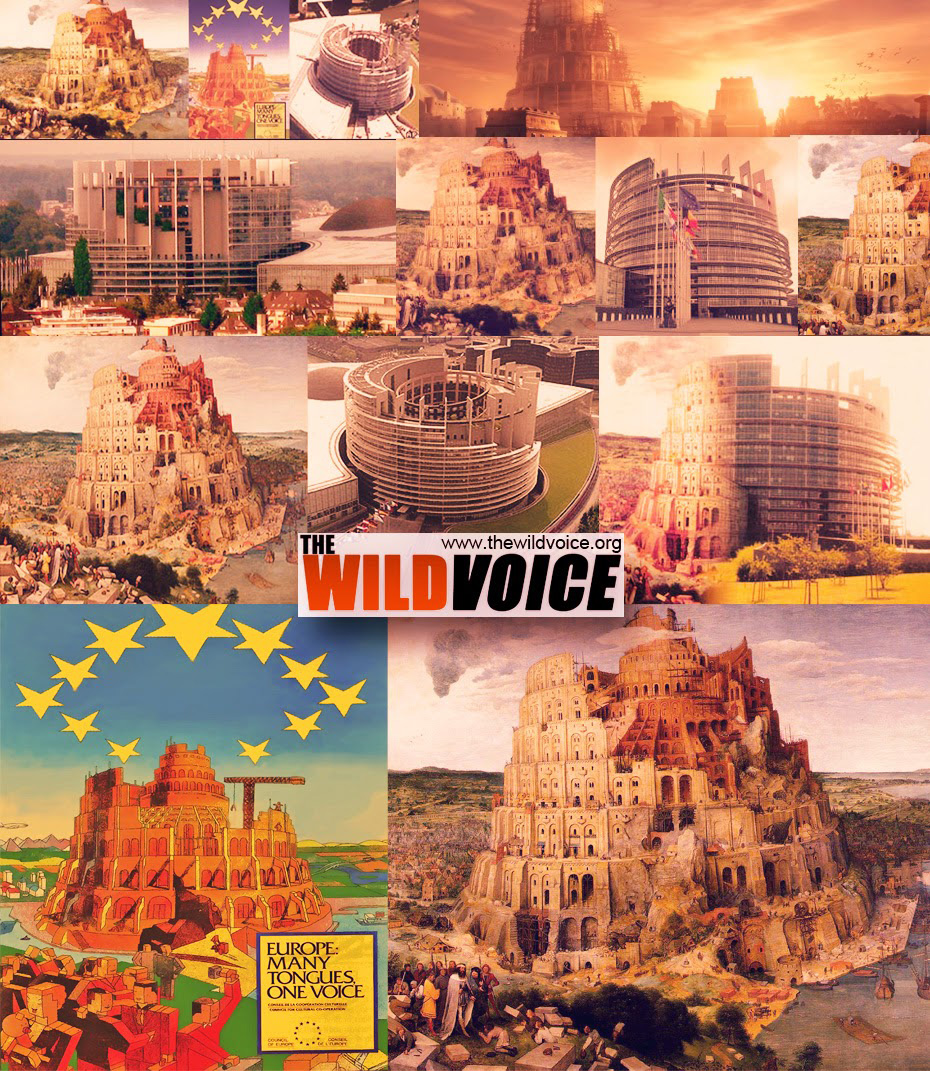
The European Union - the return to Babel
The irrefutable evidence in plain sight.
Also see:
AND:
EUbabel. The shocking occult symbolism of the European Union.
peuplesobservateursblog.wordpress.com/2017/09/23/togo-all...
Empty seat number 666
www.jesus-is-savior.com/End of the World/seat_666.htm
the-reason-the-elite-hate-trump-so-much-is-because-he-is-opposed-to-the-one-world-agenda-of-the-globalists
endoftheamericandream.com/archives/the-reason-the-elite-h...
‘Imagine there’s no Heaven, it’s easy if you try
No Hell below us, above us only sky”
John Lennon.
‘Imagine’ a nightmare, world dictatorship.
European Union project, undemocratic, expansionist empire. Prototype and fledgling, World Government.
Brexit - The anti-globalist struggle against the NWO globalists.
Aaron Banks:
Asked if he would back the Leave side in a rerun of the 2016 referendum, Mr Banks said: “The corruption I have seen in British politics, the sewer that exists and the disgraceful behaviour of the Government over what they are doing with Brexit and how they are selling out, means that if I had my time again I think we would have been better to probably remain and not unleash these demons.”
Maybe Mr Banks didn't realise that he hit the nail squarely on the head when he described the incredibly fierce opposition to Brexit as the unleashing of "demons". The globalist agenda is truly demonic. It is no surprise that the globalists, and their puppets in the media and liberal establishment, are so desperate to stop Brexit interfering with their diabolical plans for world domination.
See: ‘Brexit, The Movie’ - available on YouTube.
The EU, mystery Babylon. www.biblelight.net/tower-painting-parliament.jpg

The EU parliament in Strasbourg is modelled on the Tower of Babel.
thewildvoice.org/mystery-babylon-european-union/#comment-...
The symbolism of the EU in plain sight, is the desire of its advocates to return to the spirit of Babel.
The Council of Europe's poster produced to promote the European Union and the EU Parliament building in Strasbourg grandmageri422.files.wordpress.com/2015/07/europe-many-to... is filled with occult symbolism: a tower of Babel, 11 inverted stars (pentagrams),, the 12th pentagram is behind the top (head) of the tower. This is a Satanic parody of the 12 stars surrounding the head of the Woman (Church/Mary) in the book of Revelation. The inverted pentagram is an occult symbol designed to represent the head of Baphomet (Satan or the Goat of Mendes), illuminati pyramids are also evident in the background (since when have Egyptian pyramids been part of Europe? Square, blockheaded (indoctrinated) people (useful idiots) are featured, building a tower designed for their own enslavement and suppression, with a round-headed baby, who is too young to have been indoctrinated.
The dangerous, climate change scam:
A high level of Co2 is essential for our survival. The exact opposite of what we a led to believe by the popular, eco- fanatic narrative which is designed to convince people of the necessity for globalist control.
See the truth here:
The reason the elite hate Trump so much is because he is opposed to the one world agenda globalists.
www.zerohedge.com/news/2017-02-10/reason-elite-hate-trump...
Why satanism is now on the center stage in the culture war.
www.crisismagazine.com/2019/why-satanism-is-now-on-the-ce...
Common Purpose, Extinction Rebellion, Agenda 2030, sustainable development, WEF, Davos, Google Camp, World Economic Forum, ‘fiat’ money, SWIFT, World Governance Council, G7, Society for Worldwide Interbank Financial Telecommunications, Bank of International Settlements, Institute of International Affairs, New World Order, Globalism, European Union, EU Commission, ECJ, European Empire, evil empire, global conspiracy, United Nations, League of Nations, NAFTA, Freemasonry, Edward Mandal House, Thule Society, Kabbala, Kaaba, fractional reserve banking, Company Interbank Financial Telecommunication, internationalism, IMF, World Bank, ECB, European Central Bank, usury, Ruling Elite, Liberal fascism, Euro, EU cartel, EU empire, EU single currency, federalism, EUSSR, global elite, Federal Reserve, Paul Warburg, globalists, world government, WGS, World Government Summit, liberalism, Situational ethics, moral relativism, cultural imperialism, Bribery, Corruption, blackmail, slander, assassination, Moral relativism, Propaganda, project fear, fake news, Liberty, National Council for Civil Liberties, selective democracy, Illuminati, Bilderbergers, False religion, Maitreya, false ecumenism, World Council of Churches, Cultural Marxism, Censorship, Ted Turner, Timothy Wirth, Hilary Clinton, Club of Rome, Treaty of Rome, Maastricht Treaty, Lisbon Treaty, climate change scam, global warming, EU federalism, liberal establishment, Multiculturalism, EU Army, Palmera Arch, Temple of Baal, Nazis, National Socialism, Red Flag, hammer and sickle, useful idiots, globalist puppets, quislings, internationalism, Internationale, anti-Brexit, anti-Putin, FBI, people’s vote, EU army, Islamisation, Multinationals, multinational conglomerates, nationalisation, Fake News, Bellingcat, Bureaucracy, Climategate, chemtrails, Deep State, Council on Foreign Relations, CFR, Trilateral Commission, GM seed, GM food, quantitive easing, Bilderbergers, Eco-fanaticism, Greenpeace, eco warriors, Chatham House, Bohemian Grove, New Age, Illiberal Undemocrats, EU, Open Society, Open Britain, George Soros, Nancy Pelosi, Clinton foundation, John Podesta, John Dewey, Socialism, Humanists UK, Young Humanists, National Secular Society, British Humanist Association, neo Darwinism, Darwinism, evolution scam, CNN, New York Times, NBC news, PBS, MSNBC, BBC, liberal media, Drug legalisation, Money manipulation, IG Farben, quantitative easing, punitive taxation, Green taxes, progressives, Transgenderism, Social engineering, Communism, arch capitalism, Social Darwinism, Marxism, neo Darwinism, Erasmus Darwin, Charles Darwin, Charles Lyell, Bertrand Russell, James Hutton, David Hume, National Socialism (Nazism), Racism, international socialism, Gay mafia, gay adoption, rainbow alliance, UFOLOGY, global warming, Yakov Sverdlovsk, Red Terror, new age, Rothschilds, Rockefellers, Jacob Schiff, Adam Weishaupt, Alistair Crowley. Albert Pike, Theosophy, Antichrist, Abortion, Population control, Karl Marx, Stalin, Mao, Pol Pot, Hitler, Lenin, Trotsky, Engels, Euthanasia, Eugenics, Atheism, Soviet Union, USSR, People’s Democratic Republics, ‘People’s Vote’, Secularism, Andrew Copson, False science, Scientism, Lawrence Krauss, Richard Dawkins, Christopher Hitchens, Bill Nye, Gary Kasparov, Pussy Riot, radical left, atheist naturalism, pagan naturalism, A C Grayling, militant atheism, secular humanism, atheist pseudoscience, Cloning, Surrogacy, Fabianism, Central Banking, Fiat Currencies, banking cartels, LGBTQ agenda, Political correctness, liberal establishment, propaganda, progressive evolution, Hollywood, State control, Labour Party, Democratic Party, Green Party, Liberal Democrats, Fabian society, Secular Society, Antifa, BHA, FFRF, RDFRS, ACLU, gay priests, gay Bishops, gay pride, child abuse, gay fascism, sodomites, Stonewall, indoctrination, LGTB, LGBT, left wing feminism, lesbianism, homosexual agenda, Redefined marriage, Gender fanaticism, transgenderism, gay marriage, political correctness, hedonism, false equality, gender reassignment, surrogacy, Gay adoption, perverted sex education, Embryo experimentation, sperm banks, IVF, cloning, useful idiots, globalist puppets, UN, snowflakes, quislings, internationalism, liberal media, pornography, quislings, fifth column, Trojan horses, Sankt Galen Mafia, infiltrators, modernism, amnesty international, UNICEF, CIA, cyber surveillance, CCTV, Neo Darwinism, cultural Marxism, social Darwinism, atheist naturalism, paganism, Charles Darwin, Charles Lyell, Christianophobia, Secular Humanism, Militant atheism, abortion, Margaret Sanger, Moloch, Planned Parenthood, pro choice, Klu Klux Klan, Southern Poverty Law Centre, progressives, Christophobia, Newspeak, Satanism, Hate speech, political correctness, women’s march, False Ecumenism, election rigging, mass migration, Green taxes, climate change scam, global warming scam, carbon credits scam, debt enslavement, international bankers, Arch capitalism, Kuhn Loeb, Goldman Sachs, John D Rockefeller, Lehman Brothers, J P Morgan, Max Warburg, Order of the Skull and Bones, Extortionate taxation, class war, gender war, ageism, divide and rule, centralisation, climate change scam, mass migrations, cultural imperialism, Marie Stopes, Cultural war. human trafficking. Liberal Democrats, liberal media, Socialist Workers Party, Morning Star, Emmanuel Macron, Planned Parenthood, Marie Stopes International, BPAS, British Pregnancy Advisory Service, Satanism, Wicca, Witchcraft, Luciferian. Lunar Society, secret societies, Annie Besant, Helena Blavatsky. Alice Bailey, Marxist Social Democratic Federation. Alliance for Global Justice, Malthusian League. House of Sulzberger-Ochs, House of Meyer-Graham, Mike Bloomberg, Pierre Omidyar, Sheldon Adelson, Brzezinski, Benjamin Creme, George Kennan, James Baker, Carroll Quigley, Strobe Talbott, Lev Dobriansky, PNAC, William Kristol, Donald Rumsfeld, Dick Cheney, Paul Walfowitz, Robert Kagan, Professor Joseph Nye, Lester Mondale, American atheists, British Humanist Association, Outright Action International, National Secular Society. Abolition of nation states, NWO. World dictatorship, Tower of Babel, European Parliament. European Commission.
The war against anti-globalist Putin, and the globalist demonising of Russia.
www.flickr.com/photos/truth-in-science/43042520105
The reason the elite hate Trump so much is because he is opposed to the one world agenda of the globalists.
endoftheamericandream.com/archives/the-reason-the-elite-h...
Ending the crime of abortion is crucial in curbing the power, of Satan.
www.flickr.com/photos/truth-in-science/43172544140
Ending the crime of abortion is crucial in curbing the power, of Satan.
www.flickr.com/photos/truth-in-science/43172544140
IF and THEN, the atheist dilemma
John William Cummings (October 8, 1948 – September 15, 2004), better known by his stage name Johnny Ramone, was an American musician who was the guitarist and a founding member of the Ramones, a band that helped pioneer the punk movement. The band was inducted into the Rock and Roll Hall of Fame in 2002.
In 2009, Ramone appeared on Time's list of "The 10 Greatest Electric-Guitar Players". He ranked No. 8 on Spin's 2012 list of the "100 Greatest Guitarists of All Time" and No. 28 on Rolling Stone's similarly titled 2015 list. Alongside his music career, Ramone appeared in nearly a dozen films, in documentaries, and on television. Ramone's autobiography, Commando, was released posthumously in 2012.
Johnny Ramone was responsible for initiating one of the major sources of animosity within the band when he began dating and later married Linda Daniele, who had previously dated Joey Ramone. Though the band remained together for years after this incident, relations between Johnny and Joey remained strained.
Recognition of the band's importance grew over the years. The Ramones ranked number 26 in Rolling Stone magazine's list of the "100 Greatest Artists of All Time" and number 17 in VH1's "100 Greatest Artists of Hard Rock". In 2002, the Ramones were ranked the second-greatest band of all time by Spin, trailing only The Beatles.
Johnny was one of the few conservatives in the punk rock community and was a staunch supporter of the Republican Party. He said in an interview, when questioned on his conservatism, "I think Ronald Reagan was the best President of my lifetime." Johnny is quoted by The Observer as saying: "People drift towards liberalism at a young age, and I always hope they change when they see how the world really is.
Wikipedia - en.wikipedia.org/wiki/Johnny_Ramone
pimlico school, lupus street, westminster, london 1966-1970.
john bancroft, architect, born 28 october 1928; died 29 august 2011/
GLC, greater london council architects department.
I believe the correct architectural term is "motherf****r".
one of the most moving buildings in all of london, forever in danger of demolition. like much of our brutalist heritage, this big girl suffers from not being loved by those responsible for her.
EDIT 1: for her bland replacement, look here: www.westminster.gov.uk/educationandlearning/schoolsandcol...
the loss of this building is a real tragedy - architecturally speaking - and london seems to have become an experiment in blind liberalism.
EDIT 2: bad news from the 20th century society here: www.c20society.org.uk/docs/casework/2007_pimlico_school.html
this photo was uploaded with a CC license and may be used free of charge and in any way you see fit.
if possible, please name photographer "SEIER+SEIER". if not, don't.
Lueger led one of the three party traditions to emerge from the breakup of Austrian Liberalism. His Christian Socialists remain the largest party in Austria, though the Socialists dominate Vienna. His populism included anti-Semitism that helped inspire a young Adolf Hitler.
The memorial now has a modern placard provides some information and context. It's adjacent - German only, I'm afraid.
Dr-Karl-Lueger-Platz.
A picture used for our social studies project to portray the extent to which it is just to enforce an ideology on someone else. Our answer being to the extent that it does not come into the receivers justices, freedoms and/or life.
in these days Europe remembers the August days in former Czechoslovakia, when the Soviets and their allies (including DDR, East Germany) occupied this country to destroy all efforts of a liberal and human socialism, the so called Prague Spring with Alexander Dubcek.
time to remember Dubcek, the great and liberal Vaclav Havel, and also Jan Palach, the 20y old student from Melnik, who burned himself on Wenzels place in January 1969 to protest against the soviet occupation.
twenty years later the iron curtain began to fall down, and in 1990 I had the chance for my first visit in Prague and Bohemia. the begin of my deep love for this city and this country, with which my family is connected in several ways
the photos of this first visit are blurred, shots from diapositives,. but I like them as paintings of this exciting time, full of hope for democracy and liberalism in Europe. time to remember all this. and one can imagine the Prague during the socialist time, lots of renovated buildings, but also multiple decay of historic buildings.
during all my visits there I could watch the transformation to a renovated, colourful, vibrant, capitalistic and nowadays often overcrowded city. but I am still in love with Prague...
in these days Europe remembers the August days in former Czechoslovakia, when the Soviets and their allies (including DDR, East Germany) occupied this country to destroy all efforts of a liberal and human socialism, the so called Prague Spring with Alexander Dubcek.
time to remember Dubcek, the great and liberal Vaclav Havel, and also Jan Palach, the 20y old student from Melnik, who burned himself on Wenzels place in January 1969 to protest against the soviet occupation.
twenty years later the iron curtain began to fall down, and in 1990 I had the chance for my first visit in Prague and Bohemia. the begin of my deep love for this city and this country, with which my family is connected in several ways
the photos of this first visit are blurred, shots from diapositives,. but I like them as paintings of this exciting time, full of hope for democracy and liberalism in Europe. time to remember all this. and one can imagine the Prague during the socialist time, lots of renovated buildings, but also multiple decay of historic buildings.
during all my visits there I could watch the transformation to a renovated, colourful, vibrant, capitalistic and nowadays often overcrowded city. but I am still in love with Prague...
377. Despite all its losing track, deterioration and dissipation, today’s world and the tendencies operating in it show one direction: the direction of nothingness.
538. The bulk of negative processes and tendencies, be they communism, environmental pollution or economic crises, might be suppressed and reversed. However, there is one process which cannot be held back, and there is not even a wish to hold it back, namely, the rapidly increasing »not-any-kind-of-ness«.
696. When man turns more and more to the quantitative world rather than God, then he practically turns to nothing. By losing spirit man kept his soul, which still had some spiritual properties. After this he kept only the body, which still has some psychological properties; and slowly he will come to the nothing, which will only have some somatic properties.
328. Modernity is the way to conformity - the way to conformity forever in the direction of the lowest.
329. Kali-yuga is characterised mainly by the passionate clinging to the continuous deterioration and disintegration of consciousness.
331. »Being devoured«: this is the fundamental word for what the rule of darkness realises; being devoured, which is followed by annihilation.
332. Kali yuga is not merely a state but a threatening and devouring throat.
333. The disintegrating forces of darkness are living forces, living forces that bring death.
335. The forces of darkness can gain power in the world only because they have already gained power in the soul.
427. Everything that is against the supernatural also turns, sooner or later, against the natural.
488. Liberalism not only represents the view according to which every man is equal (to one another), but it also does its best to abolish quality in order to make every men equal.
528. Modern culture is the culture of anti-spirituality and anti-traditionality. Consequently, it can only be considered as pseudo-culture, or rather, counter-culture. This term denotes counter-cultivation, that is, the cultivation of man and the world in such a way and to such a degree that they are continually becoming more fit to receive the dark instead of the light.
531. That which is called the Enlightenment today was, unambiguously, darkening; and exactly that which was dark in it resulted in it being called »Enlightenment«: the denial of the spirit.
533. Turning towards the earth clearly reveals darkening and decay. But how degenerated this [materialistic] view has become is really shown by the fact that it is called »Enlightenment« instead of »Endarkenment«.
[The contemporary manifestations of these kinds of processes at the time were similarly criticised by Plato, according to whom this attitude originated in »grievous ignorance which, however, appears to be the greatest discretion.« (Laws 886B).]
738. Each world that has lost its origin-awareness is characterized by annihilation.
in these days Europe remembers the August days in former Czechoslovakia, when the Soviets and their allies (including DDR, East Germany) occupied this country to destroy all efforts of a liberal and human socialism, the so called Prague Spring with Alexander Dubcek.
time to remember Dubcek, the great and liberal Vaclav Havel, and also Jan Palach, the 20y old student from Melnik, who burned himself on Wenzels place in January 1969 to protest against the soviet occupation.
twenty years later the iron curtain began to fall down, and in 1990 I had the chance for my first visit in Prague and Bohemia. the begin of my deep love for this city and this country, with which my family is connected in several ways
the photos of this first visit are blurred, shots from diapositives,. but I like them as paintings of this exciting time, full of hope for democracy and liberalism in Europe. time to remember all this. and one can imagine the Prague during the socialist time, lots of renovated buildings, but also multiple decay of historic buildings.
during all my visits there I could watch the transformation to a renovated, colourful, vibrant, capitalistic and nowadays often overcrowded city. but I am still in love with Prague...
The secular society - progressive evolution, social Darwinism, liberalism, situational ethics, moral relativism, secularism, humanism, atheism.
Worshipping nature - the belief that blind, natural forces created the universe, life and humanity.
REAPING THE WHIRLWIND.
If society worships nature, by refusing to acknowledge God as the creator, it acknowledges nature as the dominant power in the universe, and therby unleashes the unrestrained, blind forces of nature on the world.
God made a perfect creation, but original sin damaged the whole creation ... instigating, entropy, death, decay, corruption, mutations, illness, extreme weather, natural and cosmic disasters.
Only God, if we trust in in His mercy, can restrain and mitigate the dire consequences sin has on nature, which is groaning in its damaged, corrupted state of entropy.
Sin and denial of God have automatic consequences - they are made manifest in the vagaries of unrestrained, natural forces.
God gives the world exactly what it chooses.
If societies choose to worship nature, instead of God, is it surprising if He permits natural forces to do what they will, in all their intensity?
We get what we choose - chose nature and we will inherit the physical storms of nature, as well as the other dire consequences of denying the true Creator and the rules He has made for our benefit, resulting in violence, murder, wars, suicide, abortion, rape etc.
_______________________________________________
Progressive evolution... the erroneous belief that blind, natural forces created life and humanity and all living things.
The neo-Darwinian idea - that the human genome consists entirely of an accumulation of billions of mutations is, quite obviously, completely bonkers. Nevertheless, it is compulsorily taught in schools and universities as 'science'.
www.flickr.com/photos/truth-in-science/35505679183
EUbabel. The evil empire. The shocking occult symbolism of the European Union.
peuplesobservateursblog.wordpress.com/2017/09/23/togo-all...
in these days Europe remembers the August days in former Czechoslovakia, when the Soviets and their allies (including DDR, East Germany) occupied this country to destroy all efforts of a liberal and human socialism, the so called Prague Spring with Alexander Dubcek.
time to remember Dubcek, the great and liberal Vaclav Havel, and also Jan Palach, the 20y old student from Melnik, who burned himself on Wenzels place in January 1969 to protest against the soviet occupation.
twenty years later the iron curtain began to fall down, and in 1990 I had the chance for my first visit in Prague and Bohemia. the begin of my deep love for this city and this country, with which my family is connected in several ways
the photos of this first visit are blurred, shots from diapositives,. but I like them as paintings of this exciting time, full of hope for democracy and liberalism in Europe. time to remember all this. and one can imagine the Prague during the socialist time, lots of renovated buildings, but also multiple decay of historic buildings.
during all my visits there I could watch the transformation to a renovated, colourful, vibrant, capitalistic and nowadays often overcrowded city. but I am still in love with Prague...
Nieuwe Foeliestraat 06/06/2024 17h53
A beautiflul mural on the Nieuwe Foeliestraat and well visitble for traffic entering the IJ-tunnel coming from Weesperstraat and Valkenburgerstraat. A wall painting without a title made by Amsterdam Sign Painters.
A photo especially taken and uploaded for the
Amsterdam
Amsterdam, literally, "The Dam on the River Amstel" is the capital and most populated city of the Netherlands. It has a population of 921,402 within the city proper, 1,457,018 in the urban area and 2,480,394 in the metropolitan area. Located in the Dutch province of North Holland, Amsterdam is colloquially referred to as the "Venice of the North", for its large number of canals, now a UNESCO World Heritage Site.
Amsterdam was founded at the mouth of the Amstel River, which was dammed to control flooding. Originally a small fishing village in the 12th century, Amsterdam became a major world port during the Dutch Golden Age of the 17th century, when the Netherlands was an economic powerhouse. Amsterdam was the leading centre for finance and trade, as well as a hub of secular art production. In the 19th and 20th centuries, the city expanded and new neighborhoods and suburbs were built. The city has a long tradition of openness, liberalism, and tolerance. Cycling is key to the city's modern character, and there are numerous biking paths and lanes spread throughout.
[ Wikipedia - Amsterdam (2024) ]
Original Painting Mixed media on panel. 24"x24" 2020 Acrylic on panel Learn more at www.CrowRising.com/gallery.
in these days Europe remembers the August days in former Czechoslovakia, when the Soviets and their allies (including DDR, East Germany) occupied this country to destroy all efforts of a liberal and human socialism, the so called Prague Spring with Alexander Dubcek.
time to remember Dubcek, the great and liberal Vaclav Havel, and also Jan Palach, the 20y old student from Melnik, who burned himself on Wenzels place in January 1969 to protest against the soviet occupation.
twenty years later the iron curtain began to fall down, and in 1990 I had the chance for my first visit in Prague and Bohemia. the begin of my deep love for this city and this country, with which my family is connected in several ways
the photos of this first visit are blurred, shots from diapositives,. but I like them as paintings of this exciting time, full of hope for democracy and liberalism in Europe. time to remember all this. and one can imagine the Prague during the socialist time, lots of renovated buildings, but also multiple decay of historic buildings.
during all my visits there I could watch the transformation to a renovated, colourful, vibrant, capitalistic and nowadays often overcrowded city. but I am still in love with Prague...
The War against Putin. A book by M.S King.
The propaganda war.
The globalists versus the anti-globalists.
The elitist, globalist establishment targets anti-globalist Vladimir Putin and Russia.
Why Putin is being demonised by the globalists and liberal left establishment.:
youtu.be/Y4I7Cnpirw8 This video is no longer available. (Censored by YouTube?)
The European Union - the return to Babel
The irrefutable evidence in plain sight.
AND:
EUbabel. The shocking occult symbolism of the European Union.
peuplesobservateursblog.wordpress.com/2017/09/23/togo-all...
'The New World Order' - a book by A. Ralph Epperson. Exposes the globalist plot for world domination.
Globalist agenda - World government.
The return to Babel.
thewildvoice.org/wp-content/uploads/2014/06/the-wild-voic...
The European Union - the return to Babel
The irrefutable evidence in plain sight.
Also see:
AND:
EUbabel. The shocking occult symbolism of the European Union.
peuplesobservateursblog.wordpress.com/2017/09/23/togo-all...
Empty seat number 666
www.jesus-is-savior.com/End of the World/seat_666.htm
‘Imagine there’s no Heaven, it’s easy if you try
No Hell below us, above us only sky”
John Lennon.
‘Imagine’ a nightmare, world dictatorship.
Why satanism is now on the center stage in the culture war.
www.crisismagazine.com/2019/why-satanism-is-now-on-the-ce...
European Union project, undemocratic, expansionist empire. Prototype and fledgling, World Government.
Brexit - The anti-globalist struggle against the NWO globalists.
Aaron Banks:
Asked if he would back the Leave side in a rerun of the 2016 referendum, Mr Banks said: “The corruption I have seen in British politics, the sewer that exists and the disgraceful behaviour of the Government over what they are doing with Brexit and how they are selling out, means that if I had my time again I think we would have been better to probably remain and not unleash these demons.”
Maybe Mr Banks didn't realise that he hit the nail squarely on the head when he described the incredibly fierce opposition to Brexit as the unleashing of "demons". The globalist agenda is truly demonic. It is no surprise that the globalists, and their puppets in the media and liberal establishment, are so desperate to stop Brexit interfering with their diabolical plans for world domination.
See: ‘Brexit, The Movie’ - available on YouTube.
The EU, mystery Babylon. www.biblelight.net/tower-painting-parliament.jpg
The EU parliament in Strasbourg is modelled on the Tower of Babel.
thewildvoice.org/mystery-babylon-european-union/#comment-...
The symbolism of the EU in plain sight, is the desire of its advocates to return to the spirit of Babel.
The Council of Europe's poster produced to promote the European Union and the EU Parliament building in Strasbourg grandmageri422.files.wordpress.com/2015/07/europe-many-to... is filled with occult symbolism: a tower of Babel, 11 inverted stars (pentagrams),, the 12th pentagram is behind the top (head) of the tower. This is a Satanic parody of the 12 stars surrounding the head of the Woman (Church/Mary) in the book of Revelation. The inverted pentagram is an occult symbol designed to represent the head of Baphomet (Satan or the Goat of Mendes), illuminati pyramids are also evident in the background (since when have Egyptian pyramids been part of Europe? Square, blockheaded (indoctrinated) people (useful idiots) are featured, building a tower designed for their own enslavement and suppression, with a round-headed baby, who is too young to have been indoctrinated.
The dangerous, climate change scam:
A high level of Co2 is essential for our survival. The exact opposite of what we a led to believe by the popular, eco- fanatic narrative which is designed to convince people of the necessity for globalist control.
See the truth here:
The reason the elite hate Trump so much is because he is opposed to the one world agenda globalists.
www.zerohedge.com/news/2017-02-10/reason-elite-hate-trump...
Extinction Rebellion, Agenda 2021, Sustainable Development, W.H.O, Common Purpose, Agenda 2030, WEF, Davos, Google Camp, World Economic Forum, ‘fiat’ money, SWIFT, World Governance Council, G7, Society for Worldwide Interbank Financial Telecommunications, Bank of International Settlements, Institute of International Affairs, New World Order, Globalism, European Union, EU Commission, ECJ, European Empire, evil empire, global conspiracy, United Nations, UNICEF, League of Nations, NAFTA, Freemasonry, Edward Mandal House, Fabian Society, Thule Society, Kabbala, Kaaba, fractional reserve banking, Company Interbank Financial Telecommunication, internationalism, IMF, World Bank, ECB, European Central Bank, usury, Ruling Elite, Liberal fascism, Euro, EU cartel, EU empire, EU single currency, federalism, EUSSR, global elite, Federal Reserve, Paul Warburg, globalists, world government, WGS, World Government Summit, liberalism, Situational ethics, moral relativism, cultural imperialism, Bribery, Corruption, blackmail, slander, assassination, Moral relativism, Propaganda, project fear, fake news, Liberty, National Council for Civil Liberties, selective democracy, Illuminati, False religion, Maitreya, false ecumenism, World Council of Churches, Cultural Marxism, Censorship, Ted Turner, Timothy Wirth, Hilary Clinton, Club of Rome, Treaty of Rome, Maastricht Treaty, Lisbon Treaty, climate change scam, global warming, Green Party, EU federalism, liberal establishment, Multiculturalism, EU Army, Palmera Arch, Temple of Baal, Nazis, National Socialism, Red Flag, hammer and sickle, useful idiots, globalist puppets, quislings, internationalism, Internationale, anti-Brexit, anti-Putin, FBI, people’s vote, EU army, Islamisation, Multinationals, multinational conglomerates, nationalisation, Fake News, Bellingcat, Bureaucracy, Climategate, chemtrails, Deep State, Council on Foreign Relations, CFR, Trilateral Commission, GM seed, GM food, quantitive easing, Bilderbergers, Eco-fanaticism, Greenpeace, eco warriors, Chatham House, New Age, Illiberal Undemocrats, EU, Open Society, Open Britain, George Soros, Nancy Pelosi, Clinton foundation, John Podesta, John Dewey, Socialism, Humanists UK, Young Humanists, National Secular Society, British Humanist Association, neo Darwinism, Darwinism, evolution scam, CNN, New York Times, NBC news, PBS, MSNBC, BBC, liberal media, Drug legalisation, Money manipulation, IG Farben, quantitative easing, punitive taxation, Green taxes, progressives, Transgenderism, Social engineering, Communism, arch capitalism, Social Darwinism, Marxism, neo Darwinism, Erasmus Darwin, Charles Darwin, Charles Lyell, Bertrand Russell, James Hutton, David Hume, National Socialism (Nazism), Racism, international socialism, Gay mafia, gay adoption, rainbow alliance, UFOLOGY, global warming, Yakov Sverdlovsk, Red Terror, new age, Rothschilds, Rockefellers, Jacob Schiff, Adam Weishaupt, Alistair Crowley. Albert Pike, Theosophy, Antichrist, Abortion, Population control, Karl Marx, Stalin, Mao, Pol Pot, Hitler, Lenin, Trotsky, Engels, Euthanasia, Eugenics, Atheism, Soviet Union, USSR, People’s Democratic Republics, ‘People’s Vote’, Secularism, Andrew Copson, False science, Scientism, Lawrence Krauss, Richard Dawkins, Christopher Hitchens, Bill Nye, Gary Kasparov, Pussy Riot, radical left, atheist naturalism, pagan naturalism, A C Grayling, militant atheism, secular humanism, atheist pseudoscience, Cloning, Surrogacy, Fabianism, Central Banking, Fiat Currencies, banking cartels, LGBTQ agenda, Political correctness, liberal establishment, propaganda, progressive evolution, Hollywood, State control, Labour Party, Democratic Party, Green Party, Liberal Democrats, Fabian society, Secular Society, Antifa, BHA, FFRF, RDFRS, ACLU, gay priests, gay Bishops, gay pride, child abuse, gay fascism, sodomites, Stonewall, indoctrination, LGTB, LGBT, left wing feminism, lesbianism, homosexual agenda, Redefined marriage, Gender fanaticism, gay marriage, political correctness, hedonism, false equality, gender reassignment, surrogacy, Gay adoption, perverted sex education, Embryo experimentation, sperm banks, IVF, cloning, useful idiots, globalist puppets, UN, snowflakes, quislings, internationalism, liberal media, pornography, quislings, fifth column, Trojan horses, Sankt Galen Mafia, infiltrators, modernism, amnesty international, UNICEF, CIA, cyber surveillance, CCTV, Neo Darwinism, cultural Marxism, social Darwinism, atheist naturalism, paganism, Charles Darwin, Charles Lyell, Christianophobia, Secular Humanism, Militant atheism, abortion, Margaret Sanger, Moloch, Planned Parenthood, pro choice, Klu Klux Klan, Southern Poverty Law Centre, progressives, Christophobia, Newspeak, Satanism, Hate speech, political correctness, LibDems, women’s march, False Ecumenism, election rigging, mass migration, Green taxes, climate change scam, global warming scam, carbon credits scam, debt enslavement, international bankers, Arch capitalism, Kuhn Loeb, Goldman Sachs, John D Rockefeller, Lehman Brothers, J P Morgan, Max Warburg, Order of the Skull and Bones, Extortionate taxation, class war, gender war, ageism, divide and rule, centralisation, climate change scam, mass migrations, cultural imperialism, Marie Stopes, Cultural war. human trafficking. Liberal Democrats, liberal media, Socialist Workers Party, Morning Star, Emmanuel Macron, Planned Parenthood, Marie Stopes International, BPAS, British Pregnancy Advisory Service, Satanism, Wicca, Witchcraft, Luciferian. Bohemian Grove, Lunar Society, secret societies, Annie Besant, Helena Blavatsky. Alice Bailey, Marxist Social Democratic Federation. Alliance for Global Justice, Malthusian League. House of Sulzberger-Ochs, House of Meyer-Graham, Mike Bloomberg, Pierre Omidyar, Sheldon Adelson, Brzezinski, Benjamin Creme, George Kennan, James Baker, Carroll Quigley, Strobe Talbott, Lev Dobriansky, PNAC, William Kristol, Donald Rumsfeld, Dick Cheney, Paul Walfowitz, Robert Kagan, Professor Joseph Nye, Lester Mondale, American atheists, British Humanist Association, Outright Action International, National Secular Society. Abolition of nation states, NWO. World dictatorship, Tower of Babel, European Parliament. European Commission.
The war against anti-globalist Putin, and the globalist demonising of Russia.
www.flickr.com/photos/truth-in-
science/43042520105
The reason the elite hate Trump so much is because he is opposed to the one world agenda of the globalists.
endoftheamericandream.com/archives/the-reason-the-elite-h...
Ending the crime of abortion is crucial in curbing the power, of Satan.
www.flickr.com/photos/truth-in-science/43172544140
Ending the crime of abortion is crucial in curbing the power, of Satan.
www.flickr.com/photos/truth-in-science/43172544140
IF and THEN, the atheist dilemma
www.flickr.com/photos/truth-in-science/46553358861w
Who trusts the MSM? Their lies are not just fake news, they deliberately set out to slander those who don’t agree with the liberal left, globalist elite. Their lies are positively evil. Everyone should watch this video and they will never trust the media again: banned.video/watch?id=5f00ca7c672706002f4026a9
in these days Europe remembers the August days in former Czechoslovakia, when the Soviets and their allies (including DDR, East Germany) occupied this country to destroy all efforts of a liberal and human socialism, the so called Prague Spring with Alexander Dubcek.
time to remember Dubcek, the great and liberal Vaclav Havel, and also Jan Palach, the 20y old student from Melnik, who burned himself on Wenzels place in January 1969 to protest against the soviet occupation.
twenty years later the iron curtain began to fall down, and in 1990 I had the chance for my first visit in Prague and Bohemia. the begin of my deep love for this city and this country, with which my family is connected in several ways
the photos of this first visit are blurred, shots from diapositives,. but I like them as paintings of this exciting time, full of hope for democracy and liberalism in Europe. time to remember all this. and one can imagine the Prague during the socialist time, lots of renovated buildings, but also multiple decay of historic buildings.
during all my visits there I could watch the transformation to a renovated, colourful, vibrant, capitalistic and nowadays often overcrowded city. but I am still in love with Prague...
'Soccer is War!', Rinus 'De Generaal' Michels (1928-2005), famous coach of Ajax Amsterdam, is reputed to have exclaimed. No doubt this young player for Sime Darby FC of the KLFA Stadium, Cheras, here in Kuala Lumpur, has never heard of Michels. And he probably doesn't know that the palm trees he's contemplating are called Bismarckia nobilis. They're named after the Iron Chancellor of the German Empire in the nineteenth century, Otto Eduard Leopold von Bismarck (1815-1896). He made Prussia and Germany into Europe's most powerful nation. Many will know of his 'Blood and Iron' speech before the Prussians of 1862. Summed up: 'It's not liberalism that's going to guarantee your place in Europe but Blood and Iron: Power and War.'
Earlier in 2010 the enormous multinational Sime Darby Berhad with social and communitarian grace established a Football Club called after itself at Cheras, Kuala Lumpur. The company is widely diversified, but it is especially strong in oil palm plantations. As far as I understand it has an environmental sensitivity. Since 1989 it holds to a ZBTF (=Zero Burning Planting Techniques) Policy. This means that old, useless palm trees are no longer burned (with much damage to the environment) but felled and shredded and left to nature to decompose. Whether Sime Darby Berhad is a party to the proposal to 'clear' the 7000 hectares of the Kuala Langat South Forest Reserve (reported today in The Sun ) for oil palm production, I don't know. I hope not because rare plants would be destroyed let alone the home of tapirs, sun bears, hornbills and panthers. A war against nature...
The progressive lie in science and society.
The essence of the ‘progressive’ lie, in science and in society, is a denial of both the intrinsic natural order, and the natural tendency towards physical and cultural/social entropy.
In hypothetical science, progressive cosmic and biological evolution deny the basic principles of causality and universal entropy, effectively undermining truth in science.
Although presented as science, they are both scientifically incongruous.
If your initial paradigm relies on the denial of fundamental scientific principles or natural law, it spectacularly fails. To call it ‘science’, discredits the perception of science as an objective search for truth.
To present an hypothesis wherein an effect is greater than its cause, and which requires a naturally occurring, autonomous increase in order, is preposterous fantasy.
Negating the effects of entropy, both physically and culturally, requires an active, sustained input, or renewal of, directed or guided effort/energy. (i.e. energy/effort + information, instructions or rules).
In the social and political field, indifference to, and denial or encouragement of, cultural entropy, masquerades as progressive.
Progressive politics derives from, and is allied to, this denial of intrinsic natural law and fundamental principles. By opposing or negating those guiding principles and rules, which are based on maintaining the natural order, it encourages and supports an insidious, social entropy, which inevitably undermines and ultimately destroys civilised society.
Just as the atheistic purveyors of physical evolution, cosmic and biological, posit the progressive development of order in the universe by denying the laws of cause and effect and entropy, which are fundamental principles of the natural order and science. So, the social allies of physical evolution, the purveyors of cultural and societal evolution, propose a progressive improvement of society, based on a similar denial of the natural order.
False equality and unjust denial of genuine equality:
Rejection of the natural order has spawned an insidious, egalitarian deception.
Demands are made that things which are clearly not equal should be treated as equal, and things that should be equal are denied their rightful equality.
Proponents of so-called, progressive policies seek to impose socially, and even legally, ideas of equality which ignore the natural order.
Equating things which are not equal, demanding equality for things which can never be equal, is quite bizarre, irrational and unscientific. That which violates the natural order is thereby elevated to parity with that which is in conformity with the natural order, diminishing the perception, approval and societal support of the latter.
It is a gross injustice to undermine and degrade social recognition and acceptance of the benefits of compliance with the natural order. Truth and error are not equitable, regardless of any legislation which decrees they should be regarded and treated as though they are.
A couple of examples:
Same sex marriage...
Traditional marriage is undeniably compatible with the natural order, socially, scientifically and theologically.
Biologically, the reproductive, and only, purpose of complementary, sexual characteristics is irrefutable. This scientific fact has been traditionally recognised, socially and theologically, in the institution of marriage, throughout history. The only reason marriage exists is because of this biological fact. There cannot be legitimate equality for any so-called marriage/sexual partnership which is not based on this fundamental principle of the natural order.
The unjust denial of genuine equality:
Abortion...
Biology, through the study of genetics and embryonic development, decrees (without doubt) that a unique, human life begins at conception. There are no ifs or buts, this fact of the natural order is supported by science and, traditionally, through theology and the legal system. Any denial of equality for unborn, human babies is illegitimate, grossly unjust, and contrary to basic human rights.
Human institutions attempt to counter social entropy and maintain order through social constructs; tradition, convention, etiquette, customs, religion, contracts, charters, treaties, laws etc., but the enduring success of these depends on how closely they conform to the natural order.
The success of Western civilisation was mainly attributable to its clear understanding of physical and cultural entropy. Christianity was rightfully endorsed as the supreme antidote to cultural/social entropy.
This is perfectly logical because, as the Bible makes clear, physical entropy is the result of an originally, perfect creation sullied by sin.
Likewise, in society, sin is the cause of social entropy, it undermines the natural order and ultimately destroys civilisation. If you break rules which serve to maintain the natural order, you inevitably wreak havoc.
Christianity seeks to retain and, where necessary, restore natural order in society, combating the tendency towards social or cultural entropy by instilling principles and rules which respect and actively defend the natural order. Just as physical entropy is only negated by a sustained input of directed energy/effort, so social entropy is only negated by an enduring adherence to binding rules and principles. The adherence to such rules and principles by humans, who have a propensity to rebel against the natural order (behavioural entropy, inherited from our first parents; Adam and Eve), can only be reliably maintained by an input of spiritual energy/divine, sanctifying grace.
It is a perverse society, which applauds as ‘progressive’, those who rebel against, and deny, the natural order and laws, while appropriating science and culture to suit their regressive, ideological agenda (contrary to fairness, justice and basic human rights). Their denial of fundamental principles appears to be scientifically and socially legitimatised through corrupt, propagandised education, media hype, and intense political lobbying.
The arrogant claim of ‘progressives’, to hold the rational, scientific and ethical high ground, is bogus and dangerous.
The opposite is true.
To rail against the natural order is irrational and unethical. It undermines truth and unjustly denigrates everything which is compliant with the natural order. True science, morals and ethics must wholly respect fundamental principles and the natural order. Christian teaching is based on loving, maintaining, respecting and honouring these basic truths of the universe evident in God’s creation.
ALL atheistic, natural origin of the universe, scenarios are false.
www.flickr.com/photos/truth-in-science/32557999087/in/dat...
If and then - the atheist dilemma.
www.flickr.com/photos/truth-in-science/46553358861
Dr James Tour - 'The Origin of Life' - Abiogenesis decisively refuted.
The reason the elite hate Trump so much is because he is opposed to the one world agenda of the globalists.
endoftheamericandream.com/archives/the-reason-the-elite-h...
Why satanism is now on the center stage in the culture war.
www.crisismagazine.com/2019/why-satanism-is-now-on-the-ce...
in these days Europe remembers the August days in former Czechoslovakia, when the Soviets and their allies (including DDR, East Germany) occupied this country to destroy all efforts of a liberal and human socialism, the so called Prague Spring with Alexander Dubcek.
time to remember Dubcek, the great and liberal Vaclav Havel, and also Jan Palach, the 20y old student from Melnik, who burned himself on Wenzels place in January 1969 to protest against the soviet occupation.
twenty years later the iron curtain began to fall down, and in 1990 I had the chance for my first visit in Prague and Bohemia. the begin of my deep love for this city and this country, with which my family is connected in several ways
the photos of this first visit are blurred, shots from diapositives,. but I like them as paintings of this exciting time, full of hope for democracy and liberalism in Europe. time to remember all this. and one can imagine the Prague during the socialist time, lots of renovated buildings, but also multiple decay of historic buildings.
during all my visits there I could watch the transformation to a renovated, colourful, vibrant, capitalistic and nowadays often overcrowded city. but I am still in love with Prague...
Toronto held its second anti-Trump protest in as many days outside of the U.S. Consulate General on University Avenue today. The rally was attended by thousands despite the frigid temperature. The anti-Trump protesters came from many walks of life: liberalists, left-wing and centrist people, Socialists, Communists, Black Lives Matter (BLM), labour unions, mainstream population and visible minorities, and groups from many religious groups.
Featuring lengthened fuselage, improved wings (can't tell from this angle), wing folding mechanism moved closer to the fuselage, and a slightly more detailed engine interior (see that grey in there?)
The formal colors of the Neustrasian Royal Aeronautical Fleet are blue-grey on top, white on bottom. However, this Maelstrom has been painted to less eye-catching colors. The national red and gold band has been replaced with a war-time theater of operation marker. Blue and red means home defense, because peasant rebellions are still wars! The ungrateful rustics can't appreciate that their land stands as a mighty bulwark against the bloody march of liberalism and the bureaucrat and banker parasites that come with it.
Speed: 460 mph / 740 km/h
Turn radius: 760 ft
Armament: 4x20mm cannons
Service ceiling: 35,000 ft / ~10,000 m
Avram Noam Chomsky
Portrait of Noam Chomsky painted in admiration for Justice and Liberty of his Wisdom
www.facebook.com/photo/?fbid=1273830809738507&set=a.1...
“Freedom without opportunity is a devil's gift.”
― Noam Chomsky
Language and Freedom
Noam Chomsky
chomsky.info/language-and-freedom/
Excerpted from For Reasons of State, New York: Pantheon Books, 1973.
When I was invited to speak on the topic “Language and freedom”, I was puzzled and intrigued. Most of my professional life has been devoted to the study of language. There would be no great difficulty in finding a topic to discuss in that domain. And there is much to say about the problems of freedom and liberation as they pose themselves to us and to others in the mid-twentieth century. What is troublesome in the title of this lecture is the conjunction. In what way are language and freedom to be interconnected?
As a preliminary, let me say just a word about the contemporary study of language, as I see it. There are many aspects of language and language use that raise intriguing questions, but – in my judgement – only a few have so far led to productive theoretical work. In particular, our deepest insights are in the area of formal grammatical structure. A person who knows a language has acquired a system of rules and principles – a “generative grammar,” in technical terms – that associates sound and meaning in some specific fashion. There are many reasonably well-founded and, I think, rather enlightening hypotheses as to the character of such grammars, for quite a number of languages. Furthermore, there has been a renewal of interest in “universal grammar”, interpreted now as the theory that tries to specify the general properties of those languages that can be learned in the normal way by humans. Here, too, significant progress has been achieved.
The subject is of particular importance. It is appropriate to regard universal grammar as the study of one of the essential faculties of mind. It is, therefore, extremely interesting to discover, as I believe we do, that the principles of universal grammar are rich, abstract, and restrictive, and can be used to construct principled explanations for a variety of phenomena. At the present stage of our understanding, if language is to provide a springboard for the investigation of other problems of human nature, it is these aspects of language to which we will have to turn our attention, for the simple reason that it is only these aspects that are reasonably well understood. In another sense, the study of formal properties of language reveals something of the nature of humans in a negative way: it underscores, with great clarity, the limits of our understanding of those qualities of mind that are apparently unique to humans and that must enter into their cultural achievements in an intimate, if still quite obscure, manner.
In searching for a point of departure, one turns naturally to a period in the history of Western thought when it was possible to believe that “the thought of making freedom the sum and substance of philosophy has emancipated the human spirit in all its relationships, and . . . has given to science in all its parts a more powerful reorientation than any earlier revolution.” [1] The word “revolution” bears multiple association in this passage, for Schelling also proclaims that “man is born to act and not to speculate”; and when he writes that “the time has come to proclaim to a nobler humanity the freedom of the spirit, and no longer to have patience with men’s tearful regrets for their lost chains” we hear the echoes of the libertarian thought and revolutionary acts of the late eighteenth century. Schelling writes that “the beginning and end of all philosophy is – Freedom.” These words are invested with meaning and urgency at a time when people are struggling to cast off their chains, to resist authority that has lost its claim to legitimacy, to construct more humane and more democratic social institutions. It is at such a time that the philosopher may be driven to inquire into the nature of human freedom and its limits, and perhaps to conclude, with Schelling, that with respect to the human ego, “its essence is freedom”; and with respect to philosophy, “the highest dignity of Philosophy consists precisely therein, that it stakes all on human freedom.”
We are living, once again, at such a time. A revolutionary ferment is sweeping the socalled Third World, awakening enormous masses from torpor and acquiescence in traditional authority. There are those who feel that the industrial societies as well are ripe for revolutionary change – and I do not refer only to representatives of the New Left. The threat of revolutionary change brings forth repression and reaction. Its signs are evident in varying forms, in France, in the Soviet Union, in the United States—not least, in the city where we are meeting. It is natural, then, that we should consider, abstractly, the problems of human freedom, and turn with interest and serious attention to the thinking of an earlier period when archaic social institutions were subjected to critical analysis and sustained attack. It is natural and appropriate, so long as we bear in mind Schellings’s admonition that man is born not merely to speculate but also to act.
One of the earliest and most remarkable of the eighteenth-century investigations of freedom and servitude is Rousseau’s Discourse on Inequality (1755), in many ways a revolutionary tract. In it, he seeks to “set forth the origin and progress of inequality, the establishment and abuse of political societies, insofar as these things can be deduced from the nature of man by the light of reason alone.” His conclusions were sufficiently shocking that the judges of the prize competition of the Academy of Dijon, to whom the work was originally submitted, refused to hear the manuscript through. [2] In it, Rousseau challenges the legitimacy of virtually every social institution, as well as individual control of property and wealth. These are “usurpations . . . established only on a precarious and abusive right . . . having been acquired only by force, force could take them away without (the rich) having grounds for complaint.” Not even property acquired by personal industry is held “upon better titles”. Against such a claim, one might object: “Do you not know that a multitude of your brethren die or suffer from need of what you have in excess, and that you needed express and unanimous consent of the human race to appropriate for yourself anything from common subsistence that exceeded your own?” It is contrary to the law of nature that “a handful of men be glutted with superfluities while the starving multitude lacks necessities.”
Rousseau argues that civil society is hardly more than a conspiracy by the rich to guarantee their plunder. Hypocritically, the rich call upon their neighbors to “institute regulations of justice and peace to which all are obliged to conform, which make an exception of no one, and which compensate in some way for the caprices of fortune by equally subjecting the powerful and the weak to mutual duties”– those laws which, as Anatole France was to say, in their majesty deny to the rich and the poor equally the right to sleep under the bridge at night. By such arguments, the poor and weak were seduced: “All ran to meet their chains thinking they secured their freedom. . . .” Thus society and laws “gave new fetters to the weak and new forces to the rich, destroyed natural freedom for all time, established forever the law of property and inequality, changed a clever usurpation into an irrevocable right, and for the profit of a few ambitious men henceforth subjected the whole human race to work, servitude and misery”. Governments inevitably tend toward arbitrary power, as “their corruption and extreme limit”. This power is “by its nature illegitimate,” and new revolutions must
dissolve the government altogether or bring it closer to its legitimate institutions … . The uprising that ends by strangling or dethroning a sultan is as lawful an act as those by which he disposed, the day before, of the lives and goods of his subjects. Force alone maintained him, force alone overthrows him.
What is interesting, in the present connection, is the path that Rousseau follows to reach these conclusions “by the light of reason alone,” beginning with his ideas about human nature. He wants to see man “as nature formed him”. It is from human nature that the principles of natural right and the foundations of social existence must be deduced.
This same study of original man, of his true needs, and of the principles underlying his duties, is also the only good means one could use to remove those crowds of difficulties which present themselves concerning the origin of moral inequality, the true foundation of the body politic, the reciprocal rights of its members, and a thousand similar questions as important as they are ill explained.
To determine the nature of man, Rousseau proceeds to compare man and animal. Man is “intelligent, free . . . the sole animal endowed with reason.” Animals are “devoid of intellect and freedom.”
In every animal I see only an ingenious machine to which nature has given senses in order to revitalize itself and guarantee itself, to a certain point, from all that tends to destroy or upset it. I perceive precisely the same things in the human machine, with the difference that nature alone does everything in the operations of a beast, whereas man contributes to his operations by being a free agent. The former chooses or rejects by instinct and the latter by an act of freedom, so that a beast cannot de viate from the rule that is prescribed to it even when it would be advantageous for it do so, and a man deviates from it often to his detriment . . . . it is not so much understanding which constitutes the distinction of man among the animals as it is his being a free agent. Nature commands every animal, and the beast obeys. Man feels the same impetus, but he realizes that he is free to acquiesce or resist; and it is above all in the consciousness of this freedom that the spirituality of his soul is shown. For physics explains in some way the mechanism of the senses and the formation of ideas; but in the power of willing, or rather of choosing, and in the sentiment of this power are found only purely spiritual acts about which the laws of mechanics explain nothing.
Thus the essence of human nature is human freedom and the consciousness of this freedom. So Rousseau can say that “the jurists, who have gravely pronounced that the child of a slave would be born a slave, have decided in other terms that a man would not be born a man.”[3]
Sophistic politicians and intellectuals search for ways to obscure the fact that the essential and defining property of man is his freedom: “They attribute to men a natural inclination to servitude, without thinking that it is the same for freedom as for innocence and virtue – their value is felt only as long as one enjoys them oneself and the taste for them is lost as soon as one has lost them.” In contrast, Rousseau asks rhetorically “whether, freedom being the most noble of man’s faculties, it is not degrading one’s nature, putting oneself on the level of beasts enslaved by instinct, even offending the author on one’s being, to renounce without reservation the most precious of all his gifts and subject ourselves to committing all the crimes he forbids us in order to please a ferocious or insane master” – a question that has been asked, in similar terms, by many an American draft resister in the last few years, and by many others who are beginning to recover from the catastrophe of twentieth-century Western civilization, which has so tragically confirmed Rousseau’s judgement:
Hence arose the national wars, battles, murders, and reprisals which make nature tremble and shock reason, and all those horrible prejudices which rank the honour of shedding human blood among the virtues. The most decent men learned to consider it one of their duties to murder their fellowmen; at length men were seen to massacre each other by the thousands without knowing why; more murders were committed on a single day of fighting and more horrors in the capture of a single city than were committed in the state of nature during whole centuries over the entire face of the earth.
The proof of his doctrine that the struggle for freedom is an essential human attribute, that the value of freedom is felt only as long as one enjoys it, Rousseau sees in “the marvels done by all free peoples to guard themselves from oppression.” True, those who have abandoned the life of a free man
do nothing but boast incessantly of the peace and repose they enjoy in their chains . . . . But when I see the others sacrifice pleasures, repose, wealth, power, and life itself for the preservation of this sole good which is so disdained by those who have lost it; when I see animals born free and despising captivity break their heads against the bars of their prison; when I see multitudes of entirely naked savages scorn European voluptousness and endure hunger, fire, the sword, and death to preserve only their independence, I feel that it does not behoove slaves to reason about freedom.
Rather similar thoughts were expressed by Kant, forty years later. He cannot, he says, accept the proposition that certain people “are not ripe for freedom,” for example, the serfs of some landlord:
If one accepts this assumption, freedom will never be achieved; for one can not arrive at the maturity for freedom without having already acquired it; one must be free to learn how to make use of one’s powers freely and usefully. The first attempts will surely be brutal and will lead to a state of affairs more painful and dangerous than the former condition under the dominance but also the protection of an external authority. However, one can achieve reason only through one’s own experiences and one must be free to be able to undertake them. . . . To accept the principle that freedom is worthless for those under one’s control and that one has the right to refuse it to them forever, is an infringement on the rights of God himself, who has created man to be free. [4]
The remark is particularly interesting because of its context. Kant was defending the French Revolution, during the Terror, against those who claimed that it showed the masses to be unready for the privilege of freedom. Kant’s remarks have contemporary relevance. No rational person will approve of violence and terror. In particular, the terror of the postrevolutionary state, fallen into the hands of a grim autocracy, has more than once reached indescribable levels of savagery. Yet no person of understanding or humanity will too quickly condemn the violence that often occurs when long-subdued masses rise against their oppressors, or take their first steps toward liberty and social reconstruction.
Let me return now to Rousseau’s argument against the legitimacy of established authority, whether that of political power or of wealth. It is striking that his argument, up to this point, follows a familiar Cartesian model. Man is uniquely beyond the bounds of physical explanation; the beast, on the other hand, is merely an ingenious machine, commanded by natural law. Man’s freedom and his consciousness of this freedom distinguish him from the beast-machine. The principles of mechanical explanation are incapable of accounting for these human properties, though they can account for sensation and even the combination of ideas, in which regard “man differs from a beast only in degree.”
To Descartes and his followers, such as Cordemoy, the only sure sign that another organism has a mind, and hence also lies beyond the bounds of mechanical explanation, is its use of language in the normal, creative human fashion, free from control by identifiable stimuli, novel and innovative, appropriate to situations, coherent, and engendering in our minds new thoughts and ideas. [5] To the Cartesians, it is obvious by introspection that each man possesses a mind, a substance whose essence is thought; his creative use of language reflects this freedom of thought and conception. When we have evidence that another organism, too, uses language in this free and creative fashion, we are led to attribute to it as well a mind like ours. From similar assumptions regarding the intrinsic limits of mechanical explanation, its inability to account for man’s freedom and consciousness of his freedom, Rousseau proceeds to develop his critique of authoritarian institutions, which deny to man his essential attribute of freedom, in varying degree.
Were we to combine these speculations, we might develop an interesting connection between language and freedom. Language, in its essential properties and the manner of its use, provides the basic criterion for determining that another organism is a being with a human mind and the human capacity for free thought and self-expression, and with the essential human need for freedom from the external constraints of repressive authority. Furthermore, we might try to proceed from the detailed investigation of language and its use to a deeper and more specific understanding of the human mind. Proceeding on this model, we might further attempt to study other aspects of that human nature which, as Rousseau rightly observes, must be correctly conceived if we are to be able to develop, in theory, the foundations for a rational social order.
I will return to this problem, but first I would like to trace further Rousseau’s thinking about the matter. Rousseau diverges from the Cartesian tradition in several respects. He defines the “specific characteristic of the human species” as man’s “faculty of selfperfection,” which, “with the aid of circumstances, successively develops all the others, and resides among us as much in the species as in the individual.” The faculty of selfperfection and of perfection of the human species through cultural transmission is not, to my knowledge, discussed in any similar terms by the Cartesians. However, I think that Rousseau’s remarks might be interpreted as a development of the Cartesian tradition in an unexplored direction, rather than as a denial and rejection of it. There is no inconsistency in the notion that the restrictive attributes of mind underlie a historically evolving human nature that develops within the limits that they set; or that these attributes of mind provide the possibility of self-perfection; or that, by providing the consciousness of freedom, these essential attributes of human nature give man the opportunity to create social conditions and social forms to maximize the possibilities for freedom, diversity, and individual self-realization. To use an arithmetical analogy, the integers do not fail to be an infinite set merely because they do not exhaust the rational numbers. Analogously, it is no denial of man’s capacity for infinite “self-perfection” to hold that there are intrinsic properties of mind that constrain his development. I would like to argue that in a sense the opposite is true, that without a system of formal constraints there are no creative acts; specifically, in the absence of intrinsic and restrictive properties of mind, there can be only “shaping of behaviour” but no creative acts of self-perfection. Furthermore, Rousseau’s concern for the evolutionary character of self-perfection brings us back, from another point of view, to a concern for human language, which would appear to be a prerequisite for such evolution of society and culture, for Rousseau’s perfection of the species, beyond the most rudimentary forms.
Rousseau holds that “although the organ of speech is natural to man, speech itself is nonetheless not natural to him.” Again, I see no inconsistency between this observation and the typical Cartesian view that innate abilities are “dispositional,” faculties that lead us to produce ideas (specifically, innate ideas) in a particular manner under given conditions of external stimulation, but that also provide us with the ability to proceed in our thinking without such external factors. Language too, then, is natural to man only in a specific way. This is an important and, I believe, quite fundamental insight of the rationalist linguists that was disregarded, very largely, under the impact of empiricist psychology in the eighteenth century and since.[6]
Rousseau discusses the origin of language at some length, though he confesses himself to be unable to come to grips with the problem in a satisfactory way. Thus
if men needed speech in order to learn to think, they had even greater need of knowing how to think in order to discover the art of speech. . . . So that one can hardly form tenable conjectures about this art of communicating thoughts and establishing intercourse between minds; a sublime art which is now very far from its origin. . . .
He holds that “general ideas can come into the mind only with the aid of words, and the understanding grasps them only through propositions” – a fact which prevents animals, devoid of reason, from formulating such ideas or ever acquiring “the perfectibility which depends upon them.” Thus he cannot conceive of the means by which “our new grammarians began to extend their ideas and to generalize their words,” or to develop the means “to express all the thoughts of men”: “numbers, abstract words, aorists, and all the tenses of verbs, particles, syntax, the linking of propositions, reasoning, and the forming of all the logic of discourse.” He does speculate about later stages of the perfection of the species, “when the ideas of men began to spread and multiply, and when closer communication was established among them, [and] they sought more numerous signs and a more extensive language.” But he must, unhappily, abandon “the following difficult problem: which was most necessary, previously formed society for the institution of languages, or previously invented languages for the establishment of society?”
The Cartesians cut the Gordian knot by postulating the existence of a species-specific characteristic, a second substance that serves as what we might call a “creative principle” alongside the “mechanical principle” that determines totally the behaviour of animals. There was, for them, no need to explain the origin of language in the course of historical evolution. Rather, man’s nature is qualitatively distinct: there is no passage from body to mind. We might reinterpret this idea in more current terms by speculating the rather sudden and dramatic mutations might have led to qualities of intelligence that are, so far as we know, unique to humans, possession of language in the human sense being the most distinctive index of these qualities. [7] If this is correct, as at least a first approximation to the facts, the study of language might be expected to offer an entering wedge, or perhaps a model, for an investigation of human nature that would provide the grounding for a much broader theory of human nature.
To conclude these historical remarks, I would like to turn, as I have elsewhere, [8] to Wilhelm von Humboldt, one of the most stimulating and intriguing thinkers of the period. Humboldt was, on the one hand, one of the most profound theorists of general linguistics, and on the other, an early and forceful advocate of libertarian values. The basic concept of his philosophy is Bildung, by which, as J.W. Burrow expresses it, “he meant the fullest, richest, and most harmonious development of the potentialities of the individual, the community or the human race.” [9] His own thought might serve as an exemplary case. Though he does not, to my knowledge, explicitly relate his ideas about language to his libertarian social thought, there is quite clearly a common ground from which they develop, a concept of human nature that inspires each. Mill’s essay On Liberty takes as its epigraph Humboldt’s formulation of the “leading principle” of his thought: “the absolute and essential importance of human development in its richest diversity.” Humboldt concludes his critique of the authoritarian state by saying: “I have felt myself animated throughout with a sense of the deepest respect for the inherent dignity of human nature, and for freedom, which alone befits that dignity.” Briefly put, his concept of human nature is this:
The true end of Man, or that which is prescribed by the eternal and immutable dictates of reason, and not suggested by vague and transient desires, is the highest and most harmonious development of his powers to a complete and consistent whole. Freedom is the first and indispensable condition which the possibility of such a development presupposes; but there is besides another essential – intimately connected with freedom, it is true – a variety of situations. [10]
Like Rousseau and Kant, he holds that
nothing promotes this ripeness for freedom so much as freedom itself. This truth, perhaps, may not be acknowledged by those who have so often used this unripeness as an excuse for continuing repression. But it seems to me to follow unquestionably from the very nature of man. The incapacity for freedom can only arise from a want of moral and intellectual power; to heighten this power is the only way to supply this want; but to do this presupposes the exercise of the power, and this exercise presupposes the freedom which awakens spontaneous activity. Only it is clear we cannot call it giving freedom, when bonds are relaxed which are not felt as such by him who wears them. But of no man on earth – however neglected by nature, and however degraded by circumstances – is this true of all the bonds which oppress him. Let us undo them one by one, as the feeling of freedom awakens in men’s hearts, and we shall hasten progress at every step.
Those who do not comprehend this “may justly be suspected of misunderstanding human nature, and of wishing to make men into machines.”
Man is fundamentally a creative, searching, self-perfecting being: “To inquire and to create – these are the centres around which all human pursuits more or less directly revolve.” But freedom of thought and enlightenment are not only for the elite. Once again echoing Rousseau, Humboldt states, “There is something degrading to human nature in the idea of refusing to any man the right to be a man.” He is, then, optimistic about the effects on all of “the diffusion of scientific knowledge by freedom and enlightenment.” But “all moral culture springs solely and immediately from the inner life of the soul, and can only be stimulated in human nature, and never produced by external and artificial contrivances.” “The cultivation of the understanding, as of any of man’s other faculties, is generally achieved by his own activity, his own ingenuity, or his own methods of using the discoveries of others. . . .” Education, then, must provide the opportunities for selffulfillment; it can at best provide a rich and challenging environment for the individual to explore, in his own way. Even a language cannot, strictly speaking, be taught, but only “awakened in the mind: one can only provide the thread along which it will develop of itself.” I think that Humboldt would have found congenial much of Dewey’s thinking about education. And he might also have appreciated the recent revolutionary extension of such ideas, for example, by the radical Catholics of Latin America who are concerned with the “awakening of consciousness,” referring to “the transformation of the passive exploited lower classes into conscious and critical masters of their own destinies” [11] much in the manner of Third World revolutionaries elsewhere. He would, I am sure, have approved of their criticism of schools that are
more preoccupied with the transmission of knowledge than with the creation, among other values, of a critical spirit. From the social point of view, the educational systems are oriented to maintaining the existing social and economic structures instead of transforming them.[12]
But Humboldt’s concern for spontaneity goes well beyond educational practice in the narrow sense. It touches also the question of labour and exploitation. The remarks, just quoted, about the cultivation of understanding through spontaneous action continue as follows:
. . . man never regards what he possesses as so much his own, as what he does; and the labourer who tends a garden is perhaps in a true sense its owner, than the listless voluptuary who enjoys its fruits. . . . In view of this consideration, [13] it seems as if all peasants and craftsmen might be elevated into artists; that is, men who love their labour for its own sake, improve it by their own plastic genius and inventive skill, and thereby cultivate their intellect, ennoble their character, and exalt and refine their pleasures. And so humanity would be ennobled by the very things which now, thought beautiful in themselves, so often serve to degrade it. . . But, still, freedom is undoubtedly the indispensable condition, without which even the pursuits most congenial to individual human nature, can never succeed in producing such salutary influences. Whatever does not spring from a man’s free choice, or is only the result of instruction and guidance, does not enter into his very being, but remains alien to his true nature; he does not perform it with truly human energies, but merely with mechanical exactness.
If a man acts in a purely mechanical way, reacting to external demands or instruction rather than in ways determined by his own interests and energies and power, “we may admire what he does, but we despise what he is.” [14]
On such conceptions Humboldt grounds his ideas concerning the role of the state, which tends to “make man an instrument to serve its arbitrary ends, overlooking his individual purposes.” His doctrine is classical liberal, strongly opposed to all but the most minimal forms of state intervention in personal or social life.
Writing in the 1790s, Humboldt had no conception of the forms that industrial capitalism would take. Hence he is not overly concerned with the dangers of private power.
But when we reflect (still keeping theory distinct from practice) that the influence of a private person is liable to diminution and decay, from competition, dissipation of fortune, even death; and that clearly none of these contingencies can be applied to the State; we are still left with the principle that the latter is not to meddle in anything which does not refer exclusively to security. . . .
He speaks of the essential equality of the condition of private citizens, and of course has no idea of the ways in which the notion “private person” would come to be reinterpreted in the era of corporate capitalism. He did not foresee that “Democracy with its motto of equality of all citizens before the law and Liberalism with its right of man over his own person both [would be] wrecked on realities of capitalist economy.”15 He did not foresee that, in a predatory capitalist economy, state intervention would be an absolute necessity to preserve human existence and to prevent the destruction of the physical environment— I speak optimistically. As Karl Polanyi, for one, has pointed out, the self-adjusting market “could not exist for any length of time without annihilating the human and natural substance of society; it would have physically destroyed man and transformed his surroundings into a wilderness.” Humboldt did not foresee the consequences of the commodity character of labour, the doctrine (in Polanyi’s words) that “it is not for the commodity to decide where is should be offered for sale, to what purpose it should be used, at what price it should be allowed to change hands, and in what manner it should be consumed or destroyed.” But the commodity, in the case, is a human life, and social protection was therefore a minimal necessity to constrain the irrational and destructive workings of the classical free market. Nor did Humboldt understand that capitalist economic relations perpetuated a form of bondage which, as early as 1767, Simon Linguet had declared to be even worse than slavery.
It is the impossibility of living by any other means that compels our farm labourers to till the soil whose fruits they will not eat, and our masons to construct buildings in which they will not live. It is want that drags them to those markets where they await masters who will do them the kindness of buying them. It is want that compels them to go down on their knees to the rich man in order to get from him permission to enrich him. . . . What effective gain has the suppression of slavery brought him?. . . . He is free, you say. Ah! That is his misfortune. The slave was precious to his master because of the money he had cost him. But the handicraftsmen cost nothing to the rich voluptuary who employs him. . . . These men, it is said, have no master– they have one, and the most terrible, the most imperious of masters, that is need. It is this that reduces them to the most cruel dependence. [17]
If there is something degrading to human nature in the idea of bondage, then a new emancipation must be awaited, Fourier’s “third and last emancipatory phase of history,” which will transform the proletariat to free men by eliminating the commodity character of labor, ending wage slavery, and bringing the commercial, industrial, and financial institutions under democratic control. [18]
Perhaps Humboldt might have accepted these conclusions. He does agree that state intervention in social life is legitimate if “freedom would destroy the very conditions without which not only freedom but even existence itself would be inconceivable” – precisely the circumstances that arise in an unconstrained capitalist economy. In any event, his criticism of bureaucracy and the autocratic state stands as an eloquent forewarning of some of the most dismal aspects of modern history, and the basis of his critique is applicable to a broader range of coercive institutions than he imagined.
Though expressing a classical liberal doctrine, Humboldt is no primitive individualist in the style of Rousseau. Rousseau extols the savage who “lives within himself”; he has little use for “the sociable man, always outside of himself, [who] knows how to live only in the opinion of others . . . from [whose] judgement alone . . . he draws the sentiment of his own existence.”19 Humboldt’s vision is quite different:
. . . the whole tenor of the ideas and arguments unfolded in this essay might fairly be reduced to this, that while they would break all fetters in human society, they would attempt to find as many new social bonds as possible. The isolated man is no more able to develop than the one who is fettered.
Thus he looks forward to a community of free association without coercion by the state or other authoritarian institutions, in which free men can create and inquire, and achieve the highest development of their powers – far ahead of his time, he presents an anarchist vision that is appropriate, perhaps, to the next stage of industrial society. We can perhaps look forward to a day when these various strands will be brought together within the framework of libertarian socialism, a social form that barely exists today though its elements can be perceived: in the guarantee of individual rights that has achieved its highest form – though still tragically flawed – in the Western democracies; in the Israeli kibbutzim; in the experiments with workers’ councils in Yugoslavia; in the effort to awaken popular consciousness and create a new involvement in the social process which is a fundamental element in the Third World revolutions, coexisting uneasily with indefensible authoritarian practice.
A similar concept of human nature underlies Humboldt’s work on language. Language is a process of free creation; its laws and principles are fixed, but the manner in which the principles of generation are used is free and infinitely varied. Even the interpretation and use of words involves a process of free creation. The normal use of language and the acquisition of language depend on what Humboldt calls the fixed form of language, a system of generative processes that is rooted in the nature of the human mind and constrains but does not determine the free creations of normal intelligence or, at a higher and more original level, of the great writer or thinker. Humboldt is, on the one hand, a Platonist who insists that learning is a kind of reminiscence, in which the mind, stimulated by experience, draws from its own internal resources and follows a path that it itself determines; and he is also a romantic, attuned to cultural variety, and the endless possibilities for the spiritual contributions of the creative genius. There is no contradiction in this, any more than there is a contradiction in the insistence of aesthetic theory that individual works of genius are constrained by principle and rule. The normal, creative use of language, which to the Cartesian rationalist is the best index of the existence of another mind, presupposes a system of rules and generative principles of a sort that the rationalist grammarians attempted, with some success, to determine and make explicit.
The many modern critics who sense an inconsistency in the belief that free creation takes place within – presupposes, in fact – a system of constraints and governing principles are quite mistaken; unless, of course, they speak of “contradiction” in the loose and metaphoric sense of Schelling, when he writes that “without the contradiction of necessity and freedom not only philosophy but every nobler ambition of the spirit would sink to that death which is peculiar to those sciences in which that contradiction serves no function.” Without this tension between necessity and freedom, rule and choice, there can be no creativity, no communication, no meaningful acts at all.
I have discussed these traditional ideas at some length, not out of antiquarian interest, but because I think that they are valuable and essentially correct, and that they project a course we can follow with profit. Social action must be animated by a vision of a future society, and by explicit judgements of value concerning the character of this future society. These judgements must derive from some concept of human nature, and one may seek empirical foundations by investigating human nature as it is revealed by human behaviour and human creations, material, intellectual, and social. We have, perhaps, reached a point in history when it is possible to think seriously about a society in which freely constituted social bonds replace the fetters of autocratic institutions, rather in the sense conveyed by the remarks of Humboldt that I quoted, and elaborated more fully in the tradition of libertarian socialism in the years that followed.
Predatory capitalism created a complex industrial system and an advanced technology; it permitted a considerable extension of democratic practice and fostered certain liberal values, but within limits that are now being pressed and must be overcome. It is not a fit system for the mid-twentieth century. It is incapable of meeting human needs that can be expressed only in collective terms, and its concept of competitive man who seeks only to maximize wealth and power, who subjects himself to market relationships, to exploitation and external authority, is antihuman and intolerable in the deepest sense. An autocratic state is no acceptable substitute; nor can the militarized state capitalism evolving in the United States or the bureaucratized, centralized welfare state be accepted as the goal of human existence. The only justification for repressive institutions is material and cultural deficit. But such institutions, at certain stages of history, perpetuate and produce such a deficit, and even threaten human survival. Modern science and technology can relieve people of the necessity for specialized, imbecile labour. They may, in principle, provide the basis for a rational social order based on free association and democratic control, if we have the will to create it.
A vision of a future social order is in turn based on a concept of human nature. If in fact humans are indefinitely malleable, completely plastic beings, with no innate structures of mind and no intrinsic needs of a cultural or social character, then they are fit subjects for the “shaping of behavior” by the state authority, the corporate manager, the technocrat, or the central committee. Those with some confidence in the human species will hope this is not so and will try to determine the intrinsic human characteristics that provide the framework for intellectual development, the growth of moral consciousness, cultural achievement, and participation in a free community. In a partly analogous way, a classical tradition spoke of artistic genius acting within and in some ways challenging a framework of rule. Here we touch on matters that are little understood. It seems to me that we must break away, sharply and radically, from much of modern social and behavioral science if we are to move toward a deeper understanding of these matters.
Here, too, I think that the tradition I have briefly reviewed has a contribution to offer. As I have already observed, those who were concerned with human distinctiveness and potential repeatedly were led to a consideration of the properties of language. I think that the study of language can provide some glimmerings of understanding of rule-governed behavior and the possibilities for free and creative action within the framework of a system of rules that in part, at least, reflect intrinsic properties of human mental organization. It seems to me fair to regard the contemporary study of language as in some ways a return to the Humboldtian concept of the form of language: a system of generative processes rooted in innate properties of mind but permitting, in Humboldt’s phrase, an infinite use of finite means. Language cannot be described as a system of organization of behaviour. Rather, to understand how language is used, we must discover the abstract Humboldtian form of language – its generative grammar, in modern terms. To learn a language is to construct for oneself this abstract system, of course unconsciously. The linguist and pyschologist can proceed to study the use and acquistion of language only insofar as they have some grasp of the properties of the system that has been mastered by the person who knows the language. Furthermore, it seems to me that a good case can be made in support of the empirical claim that such a system can be acquired, under the given conditions of time and access, only by a mind that is endowed with certain specific properties that we can now tentatively describe in some detail. As long as we restrict ourselves, conceptually, to the investigation of behavior, its organization, its development through interaction with the environment, we are bound to miss these characteristics of language and mind. Other aspects of human psychology and culture might, in principle, be studied in a similar way.
Conceivably, we might in this way develop a social science based on empirically wellfounded propositions concerning human nature. Just as we study the range of humanly attainable languages, with some success, we might also try to study the forms of artistic expression or, for that matter, scientific knowledge that humans can conceive, and perhaps even the range of ethical systems and social structures in which humans can live and function, given their intrinsic capacities and needs. Perhaps one might go on to project a concept of social organization that would – under given conditions of material and spiritual culture – best encourage and accommodate the fundamental human need – if such it is – for spontaneous initiative, creative work, solidarity, pursuit of social justice.
I do not want to exaggerate, as I no doubt have, the role of investigation of language. Language is the product of human intelligence that is, for the moment, most accessible to study. A rich tradition held language to be a mirror of mind. To some extent, there is surely truth and useful insight in this idea.
I am no less puzzled by the topic “language and freedom” than when I began – and no less intrigued. In these speculative and sketchy remarks there are gaps so vast that one might question what would remain, when metaphor and unsubstantiated guess are removed. It is sobering to realize – as I believe we must – how little we have progressed in our knowledge of human beings and society, or even in formulating clearly the problems that might be seriously studied. But there are, I think, a few footholds that seem fairly firm. I like to believe that the intensive study of one aspect of human psychology – human language – may contribute to a humanistic social science that will serve, as well, as an instrument for social action. It must, needless to say, be stressed that social action cannot await a firmly established theory of human nature and society, nor can the validity of the latter be determined by our hopes and moral judgements. The two – speculation and action – must progress as best they can, looking forward to the day when theoretical inquiry will provide a firm guide to the unending, often grim, but never hopeless struggle for freedom and social justice.
Suggested Reading
[1] F W J Schelling, Philosophical Inquiries into the Nature of Human Freedom, trans. and ed. James Gutmann (Chicago: Open Court Publishing Co., 1936).
[2] R D Masters, introduction to his edition of Jean-Jacques Rousseau, First and Second Discourses, (New York: St. Martin’s Press, 1964).
[3] Compare Proudhon, a century later: “No long discussion is necessary to demonstrate that the power of denying a man his thought, his will, his personality, is a power of life and death, and that to make a man a slave is to assassinate him.”
[4] Cited in A Lehning, ed., Bakunin, Etatisme et anarchie (Leiden: E.J. Brill, 1967), editor’s note 50, from P Schrecker, “Kant et la révolution francaise,” Revue philosophique, September–December 1939.
[5] I have discussed this matter in Cartesian Linguistics (New York: Harper & Row, 1966) and Language and Mind (New York: Harcourt Brace Jovanovich, extended ed., 1972).
[6] See the references of note 5, and also my Aspects of the Theory of Syntax, (Cambridge, Mass.: MIT Press, 1969), chap. 1, sec. 8.
[7] I need hardly add that this is not the prevailing view. For discussion, see E.H. Lenneberg, Biological Foundations of Language (New York: John Wiley & Sons, 1967); my Language and Mind; E.A. Drewe et al., “A Comparative Review of the Results of Behavioural Research on Man and Monkey,” (London; Institute of Psychiatry, unpublished draft, 1969); P.H. Lieberman, D.H. Klatt, and W.H. Wilson, “Vocal Tract Limitations on the Vowel Repertoires of Rhesus Monkeys and other Nonhuman Primates,” Science, June 6, 1969; and P.H. Lieberman, “Primate Vocalizations and Human Linguistic Ability,” Journal of the Acoustical Society of America, vol. 44, no. 6 (1968).
[8] In the books cited above, and in Current Issues in Linguistic Theory (New York: Humanities Press, 1964).
[9] J W Burrow, introduction to his edition of Wilhelm von Humboldt, The Limits of State Action (London: Cambridge University Press, 1969), from which most of the following quotes are taken.
[10] Compare the remarks of Kant, quoted above. Kant’s essay appeared in 1793; Humboldt’s was written in 1791–92. Parts appeared, but it did not appear in full during his lifetime. See Burrow, introduction to Humboldt, Limits of State Action.
[11 ] Thomas G Sanders, “The Church in Latin America,” Foreign Affairs, vol. 48, no. 2 (1970).
[12] Ibid, The source is said to be the ideas of Paulo Freire. Similar criticism is widespread in the student movement in the West. See, for example, Mitchell Cohen and Dennis Hale, eds., The New Student Left rev. ed. (Boston: Beacon Press, 1967), chap. 3.
[13] Namely, that a man “only attains the most matured and graceful consummation of his activity, when his way of life is harmoniously in keeping with his character”–that is, when his actions flow from inner impulse.
[14] The latter quote is from Humboldt’s comments on the French Constitution, 1791–parts translated in Marianne Cowan, ed., Humanist Without Portfolio: An Anthology (Detroit: Wayne State University Press, 1963).
[15] Rudolf Rocker, “Anarchism and Anarcho-syndicalism,” in Paul Eltzbacher, Anarchism (London: Freedom Press, 1960). In his book Nationalism and Culture (London: Freedom Press, 1937), Rocker describes Humboldt as “the most prominent representative in Germany” of the doctrine of natural rights and of the opposition to the authoritarian state. Rousseau he regards as a precursor of authoritarian doctrine, but he considers only the Social Contract, not the far more libertarian Discourse on Inequality. Burrow observes that Humboldt’s essay anticipates “much nineteenth century political theory of a populist, anarchist and syndicalist kind” and notes the hints of the early Marx. See also my Cartesian Linguistics, n. 51, for some comments.
[16] Karl Polanyi, The Great Transformation: The Political and Economic Origins of Our Time (Boston: Beacon Press, 1957).
[17] Cited by Paul Mattick, “Workers’ Control,” in Priscilla Long, ed., The New Left (Boston: Porter Sargent, 1969), p. 377.
[18] Cited in Martin Buber, Paths in Utopia (Boston: Beacon Press, 1958). p. 19
CHOMSKY.INFO
World Government currency. The Euro, single, multinational currency, prototype of world currency.
"And that no man might buy or sell, save he that had the mark, or the name of the beast, or the number of his name."
Revelation 13:17King James Version (KJV)
The European Union is the fledgling, world government.
'The New World Order' - a book by A. Ralph Epperson. Exposes the globalist plot for world domination.
Globalist agenda - World government.
The return to Babel.
thewildvoice.org/wp-content/uploads/2014/06/the-wild-voic...
The European Union - the return to Babel
The irrefutable evidence in plain sight.
Also see:
AND:
EUbabel. The shocking occult symbolism of the European Union.
peuplesobservateursblog.wordpress.com/2017/09/23/togo-all...
Empty seat number 666
www.jesus-is-savior.com/End of the World/seat_666.htm
‘Imagine there’s no Heaven, it’s easy if you try
No Hell below us, above us only sky”
John Lennon.
‘Imagine’ a nightmare, world dictatorship.
From the UK Labour Party’s 1964 election manifesto:
Labour’s admits its ambition for a one world government.
B. New Prospects for Peace
The second great opportunity for British statesmanship arose as a result of the changes in the communist world that followed Stalin's death - changes which are gradually transforming the relations between the Soviet Union, Eastern Europe and China and rapidly changing the whole nature of East-West relationships. In 1945, it was the hope of the whole world that east-west co-operation would prove close enough to permit the United Nations to be transformed step by step into a world government.
When these hopes were blighted by Stalin's brutal intransigence, it was Labour's Foreign Secretary, Ernest Bevin, who took the lead in facing the harsh realities of the cold war, and in creating the Nato alliance as the basis of Europe's military security. But even during the grimmest periods of the Berlin airlift and the Korean War, Labour always regarded the cold war strategies as a second best, forced on us by Russia's obstinacy and remained faithful to its long-term belief in the establishment of east-west co-operation as the basis for a strengthened United Nations developing towards world government.
European Union project, undemocratic, expansionist empire. Prototype and fledgling, World Government.
Brexit - The anti-globalist struggle against the NWO globalists.
Aaron Banks:
Asked if he would back the Leave side in a rerun of the 2016 referendum, Mr Banks said: “The corruption I have seen in British politics, the sewer that exists and the disgraceful behaviour of the Government over what they are doing with Brexit and how they are selling out, means that if I had my time again I think we would have been better to probably remain and not unleash these demons.”
Maybe Mr Banks didn't realise that he hit the nail squarely on the head when he described the incredibly fierce opposition to Brexit as the unleashing of "demons". The globalist agenda is truly demonic. It is no surprise that the globalists, and their puppets in the media and liberal establishment, are so desperate to stop Brexit interfering with their diabolical plans for world domination.
See: ‘Brexit, The Movie’ - available on YouTube.
The EU, mystery Babylon. www.biblelight.net/tower-painting-parliament.jpg
The EU parliament in Strasbourg is modelled on the Tower of Babel.
thewildvoice.org/mystery-babylon-european-union/#comment-...
The symbolism of the EU in plain sight, is the desire of its advocates to return to the spirit of Babel.
The Council of Europe's poster produced to promote the European Union and the EU Parliament building in Strasbourg grandmageri422.files.wordpress.com/2015/07/europe-many-to... is filled with occult symbolism: a tower of Babel, 11 inverted stars (pentagrams),, the 12th pentagram is behind the top (head) of the tower. This is a Satanic parody of the 12 stars surrounding the head of the Woman (Church/Mary) in the book of Revelation. The inverted pentagram is an occult symbol designed to represent the head of Baphomet (Satan or the Goat of Mendes), illuminati pyramids are also evident in the background (since when have Egyptian pyramids been part of Europe? Square, blockheaded (indoctrinated) people (useful idiots) are featured, building a tower designed for their own enslavement and suppression, with a round-headed baby, who is too young to have been indoctrinated.
The poison in our midst - progressive politics.
www.flickr.com/photos/truth-in-science/47971464278
The dangerous, climate change scam:
A high level of Co2 is essential for our survival. The exact opposite of what we a led to believe by the popular, eco- fanatic narrative which is designed to convince people of the necessity for globalist control.
See the truth here:
The reason the elite hate Trump so much is because he is opposed to the one world agenda globalists.
www.zerohedge.com/news/2017-02-10/reason-elite-hate-trump...
Agenda 2030, agenda 2012, HR6666, WHO, Common Purpose, WEF, Davos, Google Camp, World Economic Forum, ‘fiat’ money, SWIFT, World Governance Council, G7, Society for Worldwide Interbank Financial Telecommunications, Bank of International Settlements, Institute of International Affairs, New World Order, Globalism, European Union, EU Commission, ECJ, European Empire, evil empire, global conspiracy, United Nations, League of Nations, NAFTA, global currency, Freemasonry, Edward Mandal House, Thule Society, Kabbala, UNICEF, Kaaba, fractional reserve banking, Bill Gates, Company Interbank Financial Telecommunication, internationalism, IMF, World Bank, ECB, European Central Bank, usury, Ruling Elite, Liberal fascism, Euro, EU cartel, EU empire, EU single currency, federalism, EUSSR, global elite, Federal Reserve, Paul Warburg, globalists, world government, WGS, World Government Summit, liberalism, Situational ethics, moral relativism, cultural imperialism, Bribery, Corruption, blackmail, slander, assassination, Moral relativism, Propaganda, project fear, fake news, Liberty, National Council for Civil Liberties, selective democracy, Illuminati, False religion, Maitreya, false ecumenism, World Council of Churches, Cultural Marxism, Censorship, Ted Turner, Timothy Wirth, Hilary Clinton, Club of Rome, Freemasonry, Treaty of Rome, Maastricht Treaty, Lisbon Treaty, climate change scam, global warming, EU federalism, liberal establishment, Multiculturalism, EU Army, Palmera Arch, Temple of Baal, Nazis, National Socialism, Red Flag, hammer and sickle, communism, useful idiots, globalist puppets, quislings, internationalism, Internationale, anti-Brexit, anti-Putin, FBI, people’s vote, EU army, Islamisation, Multinationals, multinational conglomerates, nationalisation, Fake News, Bellingcat, Bureaucracy, Climategate, chemtrails, Deep State, Council on Foreign Relations, CFR, Trilateral Commission, GM seed, GM food, quantitive easing, Bilderbergers, Eco-fanaticism, Greenpeace, eco warriors, Chatham House, Bohemian Grove, New Age, Illiberal Undemocrats, EU, Open Society, Open Britain, George Soros, Nancy Pelosi, Clinton foundation, John Podesta, John Dewey, Socialism, HumanistsUK, Young Humanists, National Secular Society, British Humanist Association, neo Darwinism, Darwinism, evolution scam, CNN, New York Times, NBC news, PBS, MSNBC, BBC, liberal media, Drug legalisation, Money manipulation, IG Farben, quantitative easing, punitive taxation, Green taxes, progressives, Transgenderism, Social engineering, Communism, arch capitalism, Social Darwinism, Marxism, neo Darwinism, Erasmus Darwin, Charles Darwin, Charles Lyell, Bertrand Russell, James Hutton, David Hume, National Socialism (Nazism), Racism, international socialism, Gay mafia, gay adoption, rainbow alliance, UFOLOGY, global warming, Yakov Sverdlovsk, Red Terror, new age, paganism, Pachamama, Satanism, age of reason, atheist naturalism, Rothschilds, Rockefellers, Jacob Schiff, Adam Weishaupt, Alistair Crowley. Albert Pike, Theosophy, Antichrist, Abortion, Population control, Karl Marx, Stalin, Mao, Pol Pot, Hitler, Lenin, Trotsky, Engels, Euthanasia, Eugenics, Atheism, Soviet Union, USSR, People’s Democratic Republics, ‘People’s Vote’, Secularism, Andrew Copson, False science, Scientism, Lawrence Krauss, Richard Dawkins, Christopher Hitchens, Bill Nye, Gary Kasparov, Pussy Riot, radical left, atheist naturalism, pagan naturalism, A C Grayling, militant atheism, secular humanism, atheist pseudoscience, Cloning, Surrogacy, Fabianism, eugenics, population control, Central Banking, Fiat Currencies, banking cartels, LGBTQ agenda, Political correctness, liberal establishment, propaganda, progressive evolution, Hollywood, State control, Labour Party, Democratic Party, Green Party, Liberal Democrats, Fabian society, Secular Society, Antifa, BHA, FFRF, RDFRS, ACLU, gay priests, gay Bishops, gay pride, child abuse, gay fascism, sodomites, Stonewall, indoctrination, LGTB, LGBT, left wing feminism, lesbianism, homosexual agenda, Redefined marriage, Gender fanaticism, gay marriage, political correctness, hedonism, false equality, gender reassignment, surrogacy, Gay adoption, perverted sex education, Embryo experimentation, sperm banks, IVF, cloning, useful idiots, globalist puppets, UN, snowflakes, quislings, internationalism, liberal media, pornography, quislings, fifth column, Trojan horses, Sankt Galen Mafia, infiltrators, modernism, amnesty international, UNICEF, CIA, cyber surveillance, CCTV, Neo Darwinism, cultural Marxism, social Darwinism, atheist naturalism, paganism, Charles Darwin, Charles Lyell, Christianophobia, Secular Humanism, Militant atheism, abortion, Margaret Sanger, Moloch, Planned Parenthood, pro choice, BPAS, Marie Stopes International, Ku Klux Klan, Southern Poverty Law Centre, progressives, Christophobia, Newspeak, Satanism, Hate speech, political correctness, women’s march, False Ecumenism, election rigging, mass migration, Green taxes, climate change scam, global warming scam, carbon credits scam, debt enslavement, international bankers, Arch capitalism, Kuhn Loeb, Goldman Sachs, John D Rockefeller, Lehman Brothers, J P Morgan, Max Warburg, Order of the Skull and Bones, Extortionate taxation, class war, gender war, ageism, divide and rule, centralisation, climate change scam, mass migrations, cultural imperialism, Marie Stopes, Cultural war. human trafficking. Liberal Democrats, liberal media, Socialist Workers Party, Morning Star, Emmanuel Macron, Planned Parenthood, Marie Stopes International, BPAS, British Pregnancy Advisory Service, Satanism, Wicca, Witchcraft, Luciferian. Lunar Society, secret societies, Annie Besant, Helena Blavatsky. Alice Bailey, Marxist Social Democratic Federation. Alliance for Global Justice, Malthusian League. House of Sulzberger-Ochs, House of Meyer-Graham, Mike Bloomberg, Pierre Omidyar, Sheldon Adelson, Brzezinski, Benjamin Creme, George Kennan, James Baker, Carroll Quigley, Strobe Talbott, Lev Dobriansky, PNAC, William Kristol, Donald Rumsfeld, Dick Cheney, Paul Walfowitz, Robert Kagan, Professor Joseph Nye, Lester Mondale, John Lennon, American atheists, British Humanist Association, Outright Action International, National Secular Society. Abolition of nation states, NWO. World dictatorship, Tower of Babel, European Parliament. European Commission.
The war against anti-globalist Putin, and the globalist demonising of Russia.
www.flickr.com/photos/truth-in-science/43042520105
Ending the crime of abortion is crucial in curbing the power, of Satan.
www.flickr.com/photos/truth-in-science/43172544140
Why satanism is now on the center stage in the culture war.
www.crisismagazine.com/2019/why-satanism-is-now-on-the-ce...
Ending the crime of abortion is crucial in curbing the power, of Satan.
www.flickr.com/photos/truth-in-science/43172544140
IF and THEN, the atheist dilemma
www.flickr.com/photos/truth-in-science/46553358861
Who trusts the MSM? Their lies are not just fake news, they deliberately set out to slander those who don’t agree with the liberal left, globalist elite. Their lies are positively evil. Everyone should watch this video and they will never trust the media again: banned.video/watch?id=5f00ca7c672706002f4026a9
in these days Europe remembers the August days in former Czechoslovakia, when the Soviets and their allies (including DDR, East Germany) occupied this country to destroy all efforts of a liberal and human socialism, the so called Prague Spring with Alexander Dubcek.
time to remember Dubcek, the great and liberal Vaclav Havel, and also Jan Palach, the 20y old student from Melnik, who burned himself on Wenzels place in January 1969 to protest against the soviet occupation.
twenty years later the iron curtain began to fall down, and in 1990 I had the chance for my first visit in Prague and Bohemia. the begin of my deep love for this city and this country, with which my family is connected in several ways
the photos of this first visit are blurred, shots from diapositives,. but I like them as paintings of this exciting time, full of hope for democracy and liberalism in Europe. time to remember all this. and one can imagine the Prague during the socialist time, lots of renovated buildings, but also multiple decay of historic buildings.
during all my visits there I could watch the transformation to a renovated, colourful, vibrant, capitalistic and nowadays often overcrowded city. but I am still in love with Prague...
in these days Europe remembers the August days in former Czechoslovakia, when the Soviets and their allies (including DDR, East Germany) occupied this country to destroy all efforts of a liberal and human socialism, the so called Prague Spring with Alexander Dubcek.
time to remember Dubcek, the great and liberal Vaclav Havel, and also Jan Palach, the 20y old student from Melnik, who burned himself on Wenzels place in January 1969 to protest against the soviet occupation.
twenty years later the iron curtain began to fall down, and in 1990 I had the chance for my first visit in Prague and Bohemia. the begin of my deep love for this city and this country, with which my family is connected in several ways
the photos of this first visit are blurred, shots from diapositives,. but I like them as paintings of this exciting time, full of hope for democracy and liberalism in Europe. time to remember all this. and one can imagine the Prague during the socialist time, lots of renovated buildings, but also multiple decay of historic buildings.
during all my visits there I could watch the transformation to a renovated, colourful, vibrant, capitalistic and nowadays often overcrowded city. but I am still in love with Prague...
in these days Europe remembers the August days in former Czechoslovakia, when the Soviets and their allies (including DDR, East Germany) occupied this country to destroy all efforts of a liberal and human socialism, the so called Prague Spring with Alexander Dubcek.
time to remember Dubcek, the great and liberal Vaclav Havel, and also Jan Palach, the 20y old student from Melnik, who burned himself on Wenzels place in January 1969 to protest against the soviet occupation.
twenty years later the iron curtain began to fall down, and in 1990 I had the chance for my first visit in Prague and Bohemia. the begin of my deep love for this city and this country, with which my family is connected in several ways
the photos of this first visit are blurred, shots from diapositives,. but I like them as paintings of this exciting time, full of hope for democracy and liberalism in Europe. time to remember all this. and one can imagine the Prague during the socialist time, lots of renovated buildings, but also multiple decay of historic buildings.
during all my visits there I could watch the transformation to a renovated, colourful, vibrant, capitalistic and nowadays often overcrowded city. but I am still in love with Prague...
in these days Europe remembers the August days in former Czechoslovakia, when the Soviets and their allies (including DDR, East Germany) occupied this country to destroy all efforts of a liberal and human socialism, the so called Prague Spring with Alexander Dubcek.
time to remember Dubcek, the great and liberal Vaclav Havel, and also Jan Palach, the 20y old student from Melnik, who burned himself on Wenzels place in January 1969 to protest against the soviet occupation.
twenty years later the iron curtain began to fall down, and in 1990 I had the chance for my first visit in Prague and Bohemia. the begin of my deep love for this city and this country, with which my family is connected in several ways
the photos of this first visit are blurred, shots from diapositives,. but I like them as paintings of this exciting time, full of hope for democracy and liberalism in Europe. time to remember all this. and one can imagine the Prague during the socialist time, lots of renovated buildings, but also multiple decay of historic buildings.
during all my visits there I could watch the transformation to a renovated, colourful, vibrant, capitalistic and nowadays often overcrowded city. but I am still in love with Prague...
Robert Burns (25 January 1759 – 21 July 1796), also known familiarly as Rabbie Burns, was a Scottish poet and lyricist. He is widely regarded as the national poet of Scotland and is celebrated worldwide. He is the best known of the poets who have written in the Scots language, although much of his writing is in a "light Scots dialect" of English, accessible to an audience beyond Scotland. He also wrote in standard English, and in these writings his political or civil commentary is often at its bluntest.
He is regarded as a pioneer of the Romantic movement, and after his death he became a great source of inspiration to the founders of both liberalism and socialism, and a cultural icon in Scotland and among the Scottish diaspora around the world. Celebration of his life and work became almost a national charismatic cult during the 19th and 20th centuries, and his influence has long been strong on Scottish literature. In 2009 he was chosen as the greatest Scot by the Scottish public in a vote run by Scottish television channel STV.
As well as making original compositions, Burns also collected folk songs from across Scotland, often revising or adapting them. His poem (and song) "Auld Lang Syne" is often sung at Hogmanay (the last day of the year), and "Scots Wha Hae" served for a long time as an unofficial national anthem of the country. Other poems and songs of Burns that remain well known across the world today include "A Red, Red Rose", "A Man's a Man for A' That", "To a Louse", "To a Mouse", "The Battle of Sherramuir", "Tam o' Shanter" and "Ae Fond Kiss".
Burns Night, in effect a second national day, is celebrated on Burns's birthday, 25 January, with Burns suppers around the world, and is more widely observed in Scotland than the official national day, St. Andrew's Day. The first Burns supper in The Mother Club in Greenock was held on what was thought to be his birthday on 29 January 1802; in 1803 it was discovered from the Ayr parish records that the correct date was 25 January 1759.
The format of Burns suppers has changed little since. The basic format starts with a general welcome and announcements, followed with the Selkirk Grace. After the grace comes the piping and cutting of the haggis, when Burns's famous "Address to a Haggis" is read and the haggis is cut open. The event usually allows for people to start eating just after the haggis is presented. At the end of the meal, a series of toasts, often including a 'Toast to the Lassies', and replies are made. This is when the toast to "the immortal memory", an overview of Burns's life and work, is given. The event usually concludes with the singing of "Auld Lang Syne".
Amelia Robertson Hill (15 January 1821 – 5 July 1904), birth record Emmilia McDermaid Paton, was a prominent Scottish artist and sculptor throughout the 19th century and one of the few with public commissions. Her most noteworthy works are the statue of David Livingstone in Princes Street Gardens, Edinburgh and statue of Robert Burns in Dumfries. She was the main female contributor to the statues on the Scott Monument, contributing three figures.
Life
Hill was born in Wooer's Alley, Dunfermline, the daughter of Catherine McDiarmid (d. 1853) and Joseph Neil Paton (1797–1874), a damask designer. Her sister Jemima, born on 11 November 1823. Her brothers were artists Joseph Noel Paton (1821–1901) and Waller Hugh Paton (1828–1895). She appears to have trained as a sculptor under William Brodie in Edinburgh.
In 1862 she married the pioneer photographer David Octavius Hill. She was his second wife. They lived in Edinburgh. His role as secretary of the Royal Scottish Academy played a part in this. In 1861 they moved to George Square, and in 1863 to Calton Stairs. In 1868 they set up home at Rock House, on the south-west corner of Calton Hill near the southern entrance steps to the hill. Although they are famously connected with this address they lived here only two years. He died in 1870 and Amelia moved out of the house, to Newington Lodge. She placed a bronze bust of his likeness, sculpted by her own hands, on his grave.
The 1891 census describes Hill as "sculptor, retired" but she exhibited at the Royal Scottish Academy until 1902, aged 82. She died at her house, Newington Lodge, 38 Mayfield Terrace on 5 July 1904 aged 83. She was buried next to her husband in Dean Cemetery, beneath her own sculpture of 34 years earlier.
Bicentenary
A walking tour of her Edinburgh works was instigated as 'The Amelia Tour' in her bicentenary year, 2021.
Principal works
Bust of John Fergus MP, Kirkcaldy Town Hall (1861)
Marble bust of Mary Louise, Countess of Elgin, Lord Elgin Hotel, Ottawa (1863)
Marble busts of Rev. Robert Smith Candlish in his role as principal of New College, one of the leaders of the Scottish Disruption, held by the University of Edinburgh (1864 and 1865)
Marble bust of Rev. Horatius Bonar, hymn-writer (1865)
James Wemyss of Wemyss MP, Fife County Hall (1866)
Marble bust of Thomas Carlyle, National Trust of Scotland collection (1866)
Marble bust of David Livingstone (1866)
Bust of Edward Cazalet (1866)
Bust of her husband, David Octavius Hill (1867)
Marble bust of Sir George Harvey (1867)
Marble bust of David Brewster, scientist (1867)
Three stone figures for the Scott Monument on Princes Street, Edinburgh (1870) (Magnus Troil and Minna Troil of The Pirate (novel) and Richard the Lionheart)
Pet Marjorie, the child author (1870)
Marble bust of her brother, Joseph Noel Paton, Scottish National Portrait Gallery (1872)
Bust of Sir James Young Simpson (1872)
Painting, "Ludlow Castle, evening" (1873)
Very prominent statue to David Livingstone on Princes Street in Edinburgh (1875) erected by public subscription.
Memorial to Regent Murray in Linlithgow, marking the place of his assassination (1876)
Figures of "Painting" and "Poetry" flanking the shoulders of the ornate entrance to the Albert Buildings, 22–30 Shandwick Place, Edinburgh (1877)
Statue of Robert Burns, Church Place, Dumfries (1881)
Bust of Percy Bysshe Shelley, exhibited RSA (1882)
Dumfries is a market town and former royal burgh in Dumfries and Galloway, Scotland, near the mouth of the River Nith on the Solway Firth, 25 miles (40 km) from the Anglo-Scottish border. Dumfries is the county town of the historic county of Dumfriesshire.
Before becoming King of Scots, Robert the Bruce killed his rival the Red Comyn at Greyfriars Kirk in the town in 1306. The Young Pretender had his headquarters here towards the end of 1745. In the Second World War, the Norwegian Army in exile in Britain largely consisted of a brigade in Dumfries.
Dumfries is nicknamed Queen of the South. This is also the name of the town's football club. People from Dumfries are known colloquially in Scots language as Doonhamers.
History
Early history
No positive information has been obtained of the era and circumstances in which the town of Dumfries was founded.
Some writers hold that Dumfries flourished as a place of distinction during the Roman occupation of North Great Britain. The Selgovae inhabited Nithsdale at the time and may have raised some military works of a defensive nature on or near the site of Dumfries; and it is more than probable that a castle of some kind formed the nucleus of the town. This is inferred from the etymology of the name, which, according to one theory, is resolvable into two Gaelic terms signifying a castle or fort in the copse or brushwood. Dumfries was once within the borders of the Kingdom of Northumbria. The district around Dumfries was for several centuries ruled over and deemed of much importance by the invading Romans. Many traces of Roman presence in Dumfriesshire are still to be found; coins, weapons, sepulchral remains, military earthworks, and roads being among the relics left by their lengthened sojourn in this part of Scotland. The Caledonian tribes in the south of Scotland were invested with the same rights by an edict of Antoninus Pius. The Romanized natives received freedom (the burrows, cairns, and remains of stone temples still to be seen in the district tell of a time when Druidism was the prevailing religion) as well as civilisation from their conquerors. Late in the fourth century, the Romans bade farewell to the country.
According to another theory, the name is a corruption of two words which mean the Friars' Hill; those who favour this idea allege that St. Ninian, by planting a religious house near the head of what is now the Friars' Vennel, at the close of the fourth century, became the virtual founder of the Burgh; however Ninian, so far as is known, did not originate any monastic establishments anywhere and was simply a missionary. In the list of British towns given by the ancient historian Nennius, the name Caer Peris occurs, which some modern antiquarians suppose to have been transmuted, by a change of dialect, into Dumfries.
Twelve of King Arthur's battles were recorded by Nennius in Historia Brittonum. The Battle of Tribruit (the tenth battle), has been suggested as having possibly been near Dumfries or near the mouth of the river Avon near Bo'ness.
After the Roman departure the area around Dumfries had various forms of visit by Picts, Anglo-Saxons, Scots and Norse culminating in a decisive victory for Gregory, King of Scots at what is now Lochmaben over the native Britons in 890.
Medieval period
When, in 1069, Malcolm Canmore and William the Conqueror held a conference regarding the claims of Edgar Ætheling to the English Crown, they met at Abernithi – a term which in the old British tongue means a port at the mouth of the Nith. It has been argued, the town thus characterised must have been Dumfries; and therefore it must have existed as a port in the Kingdom of Strathclyde, if not in the Roman days. However, against this argument is that the town is situated eight to nine miles (14 km) distant from the sea, although the River Nith is tidal and navigable all the way into the town itself.
Although at the time 1 mile (1.6 km) upstream and on the opposite bank of the Nith from Dumfries, Lincluden Abbey was founded circa 1160. The abbey ruins are on the site of the bailey of the very early Lincluden Castle, as are those of the later Lincluden Tower. This religious house was used for various purposes, until its abandonment around 1700. Lincluden Abbey and its grounds are now within the Dumfries urban conurbation boundary. William the Lion granted the charter to raise Dumfries to the rank of a royal burgh in 1186. Dumfries was very much on the frontier during its first 50 years as a burgh and it grew rapidly as a market town and port.
Alexander III visited Dumfries in 1264 to plan an expedition against the Isle of Man, previously Scots but for 180 years subjected by the crown of Norway. Identified with the conquest of Man, Dumfries shared in the well-being of Scotland for the next 22 years until Alexander's accidental death brought an Augustan era in the town's history to an abrupt finish.
A royal castle, which no longer exists, was built in the 13th century on the site of the present Castledykes Park. In the latter part of the century William Wallace chased a fleeing English force southward through the Nith valley. The English fugitives met the gates of Dumfries Castle that remained firmly closed in their presence. With a body of the town's people joining Wallace and his fellow pursuers when they arrived, the fleeing English met their end at Cockpool on the Solway Coast. After resting at Caerlaverock Castle a few miles away from the bloodletting, Wallace again passed through Dumfries the day after as he returned north to Sanquhar Castle.
During the invasion of 1300, Edward I of England lodged for a few days in June with the Minorite Friars of the Vennel, before he laid siege to Caerlaverock Castle at the head of the then greatest invasion force to attack Scotland. After Caerlaverock eventually succumbed, Edward passed through Dumfries again as he crossed the Nith to take his invasion into Galloway. With the Scottish nobility having requested Vatican support for their cause, Edward on his return to Caerlaverock was presented with a missive directed to him by Pope Boniface VIII. Edward held court in Dumfries at which he grudgingly agreed to an armistice. On 30 October, the truce solicited by Pope Boniface was signed by Edward at Dumfries. Letters from Edward, dated at Dumfries, were sent to his subordinates throughout Scotland, ordering them to give effect to the treaty. The peace was to last until Whitsunday in the following year.
Before becoming King of Scots, Robert the Bruce stabbed his rival the Red Comyn at Greyfriars Kirk in the town on 10 February 1306. Bruce's uncertainty about the fatality of the stabbing caused one of his followers, Roger de Kirkpatrick, to utter the famous, "I mak siccar" ("I make sure") and finish the Comyn off. Bruce was subsequently excommunicated as a result, less for the murder than for its location in a church. Regardless, for Bruce the die was cast at the moment in Greyfriars and so began his campaign by force for the independence of Scotland. Swords were drawn by supporters of both sides, the burial ground of the monastery becoming the theatre of battle. Bruce and his party then attacked Dumfries Castle. The English garrison surrendered and for the third time in the day Bruce and his supporters were victorious. He was crowned King of Scots barely seven weeks after. Bruce later triumphed at the Battle of Bannockburn and led Scotland to independence.
Once Edward received word of the revolution that had started in Dumfries, he again raised an army and invaded Scotland. Dumfries was again subjected to the control of Bruce's enemies. Sir Christopher Seton (Bruce's brother in law) had been captured at Loch Doon and was hurried to Dumfries to be tried for treason in general and more specifically for being present at Comyn's killing. Still in 1306 and along with two companions, Seton was condemned and executed by hanging and then beheading at the site of what is now St Mary's Church.
In 1659 ten women were accused of diverse acts of witchcraft by Dumfries Kirk Session although the Kirk Session minutes itself records nine witches. The Justiciary Court found them guilty of the several articles of witchcraft and on 13 April between 2 pm and 4 pm they were taken to the Whitesands, strangled at stakes and their bodies burnt to ashes.
Eighteenth century
The Midsteeple in the centre of the High Street was completed in 1707. Opposite the fountain in the High Street, adjacent to the present Marks & Spencer, was the Commercial and later the County Hotel. Although the latter was demolished in 1984–85, the original facade of the building was retained and incorporated into new retail premises. The building now houses a Waterstones Bookshop. Room No. 6 of the hotel was known as Bonnie Prince Charlie's Room and appropriately carpeted in the Royal Stewart tartan. The timber panelling of "Prince Charlie's room" was largely reinstated and painted complete with the oil painted landscapes by Robert Norie (1720–1766) in the overmantels at either end of the room and can still be seen as the upstairs showroom of the book shop. The Young Pretender had his headquarters here during a 3-day sojourn in Dumfries towards the end of 1745. £2,000 was demanded by the Prince, together with 1,000 pairs of brogues for his kilted Jacobite rebel army, which was camping in a field not one hundred yards distant. A rumour that the Duke of Cumberland was approaching, made Bonnie Prince Charlie decide to leave with his army, with only £1,000 and 255 pairs of shoes having been handed over.
Robert Burns moved to Dumfriesshire in 1788 and Dumfries itself in 1791, living there until his death on 21 July 1796. Today's Greyfriars Church overlooks the location of a statue of Burns, which was designed by Amelia Robertson Hill, sculpted in Carrara, Italy in 1882, and was unveiled by future Prime Minister, Archibald Primrose, 5th Earl of Rosebery on 6 April 1882. Today, it features on the 2007 series of £5 notes issued by the Bank of Scotland, alongside the Brig o' Doon.
After working with Patrick Miller of Dalswinton, inventor William Symington intended to carry out a trial in order to show than an engine would work on a boat without the boat catching fire. The trial finally took place on Dalswinton Loch near Dumfries on 14 October 1788. The experiment demonstrated that a steam engine would work on a boat. Symington went on to become the builder of the first practical steamboat.
20th century and beyond
The first official intimation that RAF Dumfries was to be built was made in late 1938. The site chosen had accommodated light aircraft since about 1914. Work progressed quickly, and on 17 June 1940, the 18 Maintenance Unit was opened at Dumfries. The role of the base during the war also encompassed training. RAF Dumfries had a moment of danger on 25 March 1943, when a German Dornier Do 217 aircraft shot up the airfield beacon, but crashed shortly afterwards. The pilot, Oberleutnant Martin Piscke was later interred in Troqueer Cemetery in Dumfries town, with full military honours. On the night of 3/4 August 1943 a Vickers Wellington bomber with engine problems diverted to but crashed 1+1⁄2 miles (2.4 km) short of the Dumfries runway.
During the Second World War, the bulk of the Norwegian Army during their years in exile in Britain consisted of a brigade in Dumfries. When the army High Command took over, there were 70 officers and about 760 privates in the camp. The camp was established in June 1940 and named Norwegian Reception Camp, consisting of some 500 men and women, mainly foreign-Norwegian who had volunteered for war duty in Norway during the Nazi occupation in early 1940. Through the summer the number was built up to around 1,500 under the command of General Carl Gustav Fleischer. Within a few miles of Dumfries are the villages of Tinwald, Torthorwald and Mouswald all of which were settled by Vikings.
Dumfries has experienced two Boxing Day earthquakes. These were in 1979 (measuring 4.7 ML centred near Longtown) and 2006 (centred in the Dumfries locality measuring 3.6 ML ). There were no serious consequences of either. There was also an earthquake on 16 February 1984 and a further earthquake on 7 June 2010.
Like the rest of Dumfries and Galloway, of Scotland's three major geographical areas Dumfries lies in the Southern Uplands.
The river Nith runs through Dumfries toward the Solway Firth in a southwards direction splitting the town into East and West. At low tide, the sea recedes to such an extent on the shallow sloping sands of the Solway that the length of the Nith is extended by 13 km to 113.8 km (70.7 mi). This makes the Nith Scotland's seventh longest river. There are several bridges across the river within the town. In between the Devorgilla (also known as 'The Old Bridge') and the suspension bridge is a weir colloquially known as 'The Caul'. In wetter months of the year the Nith can flood the surrounding streets. The Whitesands has flooded on average once a year since 1827.
Dumfries has numerous suburbs including Summerhill, Summerville, Troqueer, Georgetown, Cresswell, Larchfield, Calside, Lochside, Lincluden, Newbridge Drive, Sandside, Heathhall, Locharbriggs, Noblehill and Marchmount. Maxwelltown to the west of the river Nith, was formerly a burgh in its own right within Kirkcudbrightshire until its incorporation into Dumfries in 1929; Summerhill, Troqueer, Lochside, Lincluden, Sandside are among other suburbs located on the Maxwelltown side of the river. Palmerston Park, home to the town's senior football team Queen of the South, is on Terregles Street, also on the Maxwelltown side of the river.
Queensberry Square and High Street are the central focal points of the town and this area hosts many of the historical, social and commercial enterprises and events of Dumfries. During the 1990s, these areas enjoyed various aesthetic recognitions from organisations including Britain in Bloom.
Dumfries got its nickname 'Queen of the South' from David Dunbar, a local poet, who in 1857 stood in the general election. In one of his addresses he called Dumfries "Queen of the South" and this became synonymous with the town.
The term doonhamer comes from the way that natives of Dumfries over the years have referred to the area when working away from home. The town is often referred to as doon hame in the Scots language (down home). The term doonhamer followed, to describe those that originate from Dumfries.
The Doonhamers is also the nickname of Queen of the South who represent Dumfries and the surrounding area in the Scottish Football League.
The crest of Dumfries contains the words, "A Lore Burne". In the history of Dumfries close to the town was the marsh through which ran the Loreburn whose name became the rallying cry of the town in times of attack – A Lore Burne (meaning 'to the muddy stream').
In 2017 Dumfries was ranked the happiest place in Scotland by Rightmove.
Located on top of a small hill, Dumfries Museum is centred on the 18th-century windmill which stands above the town. Included are fossil footprints left by prehistoric reptiles, the wildlife of the Solway marshes, tools and weapons of the earliest peoples of the region and stone carvings of Scotland's first Christians. On the top floor of the museum is a camera obscura.
Based in the control tower near Tinwald Downs, the aviation museum has an extensive indoor display of memorabilia, much of which has come via various recovery activities. During the second world war, aerial navigation was taught at Dumfries also at Wigtown and nearby Annan was a fighter training unit. RAF Dumfries doubled as an important maintenance unit and aircraft storage unit. The museum is run by the Dumfries and Galloway Aviation Group and is the only private aviation museum in Scotland. The restored control tower of the former World War II airfield is now a listed building. The museum is run by volunteers and houses a large and ever expanding aircraft collection, aero engines and a display of artefacts and personal histories relating to aviation, past and present. It is also home to the Loch Doon Spitfire. Both civil aviation and military aviation are represented.
The Theatre Royal, Dumfries was built in 1792 and is the oldest working theatre in Scotland.
The theatre is owned by the Guild of Players who bought it in 1959, thereby saving it from demolition, and is run on a voluntary basis by the members of the Guild of Players. It is funded entirely by Guild membership subscriptions, and by box office receipts. It does not currently receive any grant aid towards running costs.
In recent years the theatre has been re-roofed and the outside refurbished. It is the venue for the Guild of Players' own productions and for performances from visiting companies. These include: Scottish Opera, TAG, the Borderline and 7:84.
The Robert Burns Centre is an art house cinema in Dumfries. The Odeon Cinema, which showed more mainstream movies, closed its doors in mid-2018 due to the local council refusing to allow Odeon to relocate, forcing them to close.
The Loreburn Hall (sometimes known colloquially as The Drill Hall) has hosted concerts by performers such as Black Sabbath, Big Country, The Proclaimers and Scottish Opera. The hall has hosted sporting events such as wrestling. The new DG One sport, fitness and entertainment centre became the principal indoor event venue in Dumfries in 2007, but in October 2014, it closed due to major defects being discovered in the building. However, the refurbished building reopened to the public in the summer of 2019. The Theatre Royal has also reopened following renovation work.
With a collection of over 400 Scottish paintings, Gracefield Arts Centre hosts a changing programme of exhibitions featuring regional, national and international artists and craft-makers.
Dumfries Art Trail brings together artists, makers, galleries and craft shops with venues accessible all year round.
There are a number of festivals which take place throughout the year, mostly based on traditional values.
Guid Nychburris (Middle Scots, meaning Good Neighbours) is the main festival of the year, a ceremony which is largely based on the theme of a positive community spirit.
The ceremony on Guid Nychburris Day, follows a route and sequence of events laid down in the mists of time. Formal proceedings start at 7.30 am with the gathering of up to 250 horses waiting for the courier to arrive and announce that the Pursuivant is on his way, and at 8.00 am leave the Midsteeple and ride out to meet the Pursuivant. They then proceed to Ride the Marches and Stob and Nog (mark the boundary with posts and flags) before returning to the Midsteeple at 12.15 pm to meet the Provost and then the Charter is proclaimed to the towns people of Dumfries. This is then followed by the crowning of the Queen of the South.
Since 2013, Dumfries has seen the annual Nithraid, a small boat race up the Nith from Carsethorn, celebrating the town's historical relationship with the river.
The region is also home to a number of thriving music festivals such as the Eden Festival (at St Ann's near Moffat), Youthbeatz (Scotland's largest free youth music festival), the Moniaive Folk Festival, Thornhill Music Festival, Big Burns Supper Festival and previously Electric Fields at Drumlanrig Castle.
Queen of the South represent Dumfries and the surrounding area in the third level of the country's professional football system, the Scottish League One. Palmerston Park on Terregles Street is the home ground of the team. This is on the Maxwelltown side of the River Nith. They reached the 2008 Scottish Cup Final, losing 3–2 to Rangers.
Dumfries City VFC are a virtual football club from the town.
Dumfries Saints Rugby Club is one of Scotland's oldest rugby clubs having been admitted to the Scottish Rugby Union in 1876–77 as "Dumfries Rangers".
Dumfries is also home to a number of golf courses:
The Crichton Golf Club
The Dumfries and County Golf Club
The Dumfries and Galloway Golf Club
Of those listed, only the Dumfries and Galloway Golf Club is on the Maxwelltown side of the River Nith. This course is also bisected into 2 halves of 9 holes each by the town's Castle Douglas Road. The club house and holes 1 to 7 and 17 and 18 are on the side nearest to Summerhill, Dumfries. Holes 8 to 16 are on the side nearest to Janefield.
The opening stage of the 2011 Tour of Britain started in Peebles and finished 105.8 miles (170.3 km) later in Dumfries. The stage was won by sprint specialist and reigning Tour de France green jersey champion, Mark Cavendish, with his teammate lead out man, Mark Renshaw finishing second. Cavendish had been scheduled to be racing in the 2011 Vuelta a España. However Cavendish was one a number of riders to withdraw having suffered in the searing Spanish heat. This allowed Cavendish to be a late addition to the Tour of Britain line up in his preparation for what was to be a successful bid two weeks later in the 2011 UCI Road World Championships – Men's road race. Cavendish in a smiling post race TV interview in Dumfries described the wet and windy race conditions through the Southern Scottish stage as 'horrible'.
DG One complex includes a national event-sized competition swimming pool.
The David Keswick Athletic Centre is the principal facility in Dumfries for athletics.
Dumfries is home to Nithsdale Amateur Rowing Club. The rowers share their clubhouse with Dumfries Sub-Aqua Club.
The town is also home to Solway Sharks ice hockey team. The team are current Northern Premier League winners. The team's home rink is Dumfries Ice Bowl. Dumfries Ice bowl is also recognised as Scotland's only centre of ice hockey excellence, and trials for the Scottish Jr national team are carried out at this venu.
Dumfries Ice Bowl is also home to two synchronised skating teams, Solway Stars and Solway Eclipse. In addition, Dumfries Ice Bowl is also home to several curling teams, competitions and leagues. Junior curling teams from Dumfries, consisting of curlers under the age of 21, regularly compete in the Dutch Junior Open based in Zoetermeer, the Netherlands. In 2007, 2008 and 2009 a Dumfries-based team have been the winners of the competition's Hogline Trophy.
Dumfries hosts three outdoor bowls clubs:
Dumfries Bowling Club
Marchmount Bowling Club
Maxwelltown Bowling Club
Dumfries hosts cycling organisations and cycling holidays
The most significant of the parks in Dumfries are all within walking distance of the town centre:-
Dock Park – located on the East bank of the Nith just to the South of St Michael's Bridge
Castledykes Park – as the name suggests on the site of a former castle
Mill Green (also known as deer park, although the deer formerly accommodated there have since been relocated) – on the West bank of the Nith opposite Whitesands
There are many buildings in Dumfries made from sandstone of the local Locharbriggs quarry.
The quarry is situated off the A701 on the north of Dumfries at Locharbriggs close to the nearby aggregates quarry. This dimension stone quarry is a large quarry. Quarry working at Locharbriggs dates from the 18th century, and the quarry has been worked continuously since 1890.
There are good reserves of stone that can be extracted at several locations. On average the stone is available at depths of 1m on bed although some larger blocks are obtainable. The average length of a block is 1.5m but 2.6m blocks can be obtained.
Locharbriggs is from the New Red Sandstone of the Permian age. It is a medium-grained stone ranging in colour from dull red to pink. It is the sandstone used in the Queen Alexandra Bridge in Sunderland, the Manchester Central Convention Complex and the base of the Statue of Liberty.
... to Tory neo-liberalism.
Avant Garde Tower, architects: Stock Woolstencroft, 2014.
Warren truss rail-bridge, designed by Benaim, 2010.
Allen Gardens, London Borough of Tower Hamlets.
(CC BY-NC-ND - credit: Images George Rex)
(for further pictures and information please contact the link at the end of page!)
Maria Theresa monument
Maria Theresa monument in Vienna
Maria Theresa Square
The Maria Theresa monument is the most important ruler monument of the Habsburg monarchy in Vienna. It is reminiscent of the Empress Maria Theresa, who ruled from 1740 to 1780, and is since 1888 on the Maria Theresa Square on the Vienna ring road (Castle Square - Burgring) between the then Imperial Museums, in 1891 opened the Kunsthistorisches Museum (Museum of Art History) and in 1889 opened the Natural History Museum (Naturhistorisches Museum), in front of the background of the Museum Quarter, then the imperial stables. This by Tritons and Najad Fountains accompanied Ensemble monument counts to the UNESCO World Heritage Site Historic Centre of Vienna.
Historical Background
View from the top (2010)
The Empire of Austria in 1859 and 1866 lost Lombardy and Veneto to the new Kingdom of Italy. It was in 1866 forced to resigne after the defeat of the German war, the Prussians had triggered by violation of the rules of the German Confederation from Germany, which in 1871 was constituted as German Empire under a new empire. In 1867 Emperor Franz Joseph I. in Compromise with Hungary had to agree to the formal division of the empire into a ruled from Vienna cisleithanian and ruled from Budapest transleithanian half of the Empire, with Hungary increasingly presenting itself not as a part of the empire, but as a largely independent state. en.wikipedia.org/wiki/Leitha
During the World Exhibition 1873 in Vienna an economic crisis had occurred, the "founders' crash - Gründerkrach" that devalued liberalism as the leading political movement and new mass parties, for the time being, the Christian Social Party, and later the Social Democrats, putting forth. In addition, more and more national movements were felt in the multiethnic state.
Those centrifugal and the imperial power eroding tendencies one would counteract by patriotic appeals to splendor and glory of the empire. At the since 1858 under construction and in 1865 opened new Vienna ring road around the old town was offered the chance. On the Maria Theresa Square the center facing adjoining Heldenplatz outside the Hofburg in 1860 and 1865 monuments of the two most important generals of the monarchy were built. For the Maria Theresa square, which with the Heldenplatz should form an Imperial Forum, it was a good occasion to erect a monument to the historical mother of the nation. She had by her marriage to Francis Stephen of Lorraine and his election as emperor, the Roman-German Empire brought back to Vienna and the continuation of the dynasty, now as House of Habsburg-Lorraine, secured. She referred to a time when the development of the monarchy was not dependent on any political party nor on national political considerations, but by the wisdom of the rulers. Her reputation and popularity should radiate to the current empire.
The monument
Gypsum model of a draft of the monument
Maria Theresa surrounded by the allegories of the cardinal virtues
For the execution of the sculptures in 1874 the three sculptors Johannes Benk, Carl Kundmann and Caspar Zumbusch submitted designs. Emperor Franz Joseph I decided for Zumbusch, with his student Anton Brenek around 13 years working on the bronze sculptures, which have a total weight of 44 tons. Carl von Hasenauer designed the architecture of the monument.
With the base, the monument covers an area of 632 square meters and is 19.36 m high, on top the seated figure of the Empress with 6 m height. Base and chain pedestal consist of Mauthausen granite from Enghagen in Upper Austria, pedestal and base of brown hornblende granite from Petersburg-Jeschitz at Pilsen in the Czech Republic, the columns of serpentinite from Wiesen near Sterzing in South Tyrol.
The program's content for the monument came from Alfred von Arneth, director of the Imperial House, Court and State Archives. The monarch herself sits on her throne at the top, in the left hand a scepter and the Pragmatic Sanction, the State and the Constitutional Treaty, her allowing the rule in the Habsburg lands as woman, saluting with the right hand the people. Around the throne on the cornice are sitting as allegorical personifications of the cardinal virtues of justice, strength, gentleness and wisdom four female figures .
At the four sides of the base each is located a circular field with a relief and before that a freestanding statue in thematic context:
The consultants of the Archduchess are represented by Wenzel Anton Kaunitz as a statue and Johann Christoph von Bartenstein, Gundakar Thomas Graf Starhemberg and Florimond Claude of Mercy-Argenteau in relief, the background shows the Gloriette in the garden of Schonbrunn Palace.
For the administration stand Friedrich Wilhelm von Haugwitz (statue) and Antal Grassalkovich I, Samuel Brukenthal, Paul Joseph of Riegger, Karl Anton von Martini and Joseph von Sonnenfels in a consulting room in the Imperial Palace.
For the military stand Joseph Wenzel I (statue) with Franz Moritz von Lacy, Andreas Hadik of Futak and Franz Leopold of Nádasdy in front of the castle in Wiener Neustadt, in which in 1752 the Theresa Military Academy was established.
Science and art are represented by the physician Gerard van Swieten (statue), the numismatist Joseph Hilarius Eckhel, the historian György Pray and the composer Christoph Willibald Gluck, Joseph Haydn and the as child represented Wolfgang Amadeus Mozart in front of the Old University.
Consultants
Management
Military
Science and Art
On the diagonal axes surround equestrian statues of four commanders from the era of Maria Theresa the monument: Leopold Joseph von Daun (1705-1766), Ludwig Andreas von Khevenhüller (1683-1744), Gideon Ernst von Laudon (1717-1790) and Otto Ferdinand von Abensperg and Traun (1677-1748).
Leopold Joseph von Daun
Ludwig Andreas von Khevenhüller
Gideon Ernst von Laudon
Otto Ferdinand von Abensperg and Traun
Open base during the renovation (2008)
The monument is being totally renovated since October 2008. In a first step, the base whose granite cladding and the foundation were restored. Under the monument in the course of the work a 600-square-foot brick vault was discovered as a supporting structure that is similar to already known components underneath the equestrian statues on Heroes' Square. In a second step, the stone and metal surfaces are being rehabilitated until probably October 2013.
Reception
The monument in 1888
Maria Theresa Square in 1900
Apology and Dialogue Christianity expanded and encountered alternative forms and Christian Church was forced to engage at a practical and philosophical level with the problem of defining magic and religion and of imposing that definition upon rituals and practices that were deeply embedded in societies and cultures. The challenges that motivated and resulted from this encounter have been widely discussed and debated. The foundations of the modern debate were laid by Valerie Flint's The Rise of Magic in the Early Middle Ages, now perhaps best read in light of Alexander Murray's recent critique and re-evaluation of her conclusions. In Flint's analysis, the encounter between Christian and non-Christian in early medieval Europe was not simply a narrative of the way in which orthodox Christianity confronted a resilient paganism and addressed its persistence. Rather, Flint argued that even the most energetic defenders of Christian orthodoxy saw a benefit in non-Christian ritual and practice, and attempted to appropriate that which they thought valuable. This was not mere survivalism but rather a conscious attempt to build and construct, with magic rescued in the service ofhuman aspiration, and certainly in defiance of certain aspects of reason and regulation: In this model precision in the separation of miracle and gic mattered rather less. Covering the later Middle Ages, Catherine Rider's Magic and Religion in Medieval England presents a detailed examination of the occult practices and rituals that existed alongside or even within orthodox Christianity. Rider explores both the attempts made to prohibit and arrest such practices and the entanglement of the clergy in the rituals themselves, as well as their suppression. Arianism was a 4th century heresy named after Arius (c.250-336), a presbyter in Alexandria, Egypt, who taught that the Son of God was not co-eternal and consubstantial with His Father, but rather a created being with a definite origin in time. In Arius's words, "there was [a time] when he (the Son) was not." This led to the calling of the First Ecumenical Council, which condemned it and its author and established the Orthodox doctrine of the Holy Trinity as taught by Arius's chief opponent, St. Athanasius the Great. Though it managed to hang on among some of the Goths and other Germanic tribes in the West, Arianism had vanished by the seventh century.Although Arianism carries Arius's name, its doctrines did not entirely originate with him. Lucian of Antioch, Arius's teacher and mentor, was accused by Bishop Alexander of Alexandria of being the source for Arius's heretical teachings—not so much that Lucian had taught Arianism per se, but rather that he held certain heretical tendencies which he passed on to his pupil, Arius.Indeed, the noted Russian historian Alexander Vasiliev refers to Lucian as "the Arius before Arius". According to Church historian Socrates Scholasticus, Arius entered into a dispute with Bishop Alexander in 318 over his teachings about God's divine Sonship and substance. Alexander had endeavored to instruct his clergy on the unity of the Holy Trinity, but Arius—whether through misunderstanding, or from a "love of controversy", as alleged by Socrates—opposed his bishop's teaching as smacking of Sabellianism. Arius proffered his own syllogism: If the Father begat the Son, he that was begotten had a beginning of existence. From this it is evident that there was a time when the Son was not. It therefore necessarily follows that he had his substance from nothing. This, of course, denied the essential unity and consubstantiality of the Holy Trinity, and caused an uproar among Arius's listeners that quickly spread throughout the Church as Arius insisted upon disseminating his views. Arianism should be clearly distinguished from "Aryanism", which formed the core of Nazi racial ideology during the twentieth century, and which had nothing whatsoever to do with Arius or his teachings.As stated above, Arius denied the full deity of the preexistent Son of God, the Logos who became incarnate as our Lord Jesus Christ ("the Word (Jesus Christ) became flesh" John 1:14 - NKJV). He held that the Son, while divine and like unto God, was created by God as the agent through whom He created the universe; thus that there was a time when the Son "was not". In explaining his actions against Arius, Alexander of Alexandria wrote a letter to Alexander of Constantinople and Eusebius of Nicomedia (where the emperor was then residing), detailing the errors into which he believed Arius had fallen. According to Alexander, Arius taught: That God was not always the Father, but that there was a period when he was not the Father; that the Word of God was not from eternity, but was made out of nothing; for that the ever-existing God (‘the I AM’—the eternal One) made him who did not previously exist, out of nothing; wherefore there was a time when he did not exist, inasmuch as the Son is a creature and a work. That he is neither like the Father as it regards his essence, nor is by nature either the Father’s true Word, or true Wisdom, but indeed one of his works and creatures, being erroneously called Word and Wisdom, since he was himself made of God’s own Word and the Wisdom which is in God, whereby God both made all things and him also. Wherefore he is as to his nature mutable and susceptible of change, as all other rational creatures are: hence the Word is alien to and other than the essence of God; and the Father is inexplicable by the Son, and invisible to him, for neither does the Word perfectly and accurately know the Father, neither can he distinctly see him. The Son knows not the nature of his own essence: for he was made on our account, in order that God might create us by him, as by an instrument; nor would he ever have existed, unless God had wished to create us.While Arius developed a following among some Syrian prelates, an Alexandrian synod of some 100 bishops summoned by Bishop Alexander condemned him in 321. He was excommunicated, and fled to Palestine. There he entered into a friendship with Eusebius of Nicomedia. Arius, a proficient writer, produced many compositions in both prose and verse defending his belief, including a poem that he called the Thalia. Most of these writings were destroyed as being heretical, though portions of the Thalia and a few other Arian texts survive. The Roman emperor Constantine the Great, desiring the restoration of peace and unity to the Church, publicly called upon Arius and Alexander to settle their dispute; however, the issue was such that no genuine compromise was possible. As the debate continued to rage between supporters of each man, the emperor finally decided to call a great council of all Church bishops to resolve the dilemma. This First Ecumenical Council, held at Nicea in 325, was led in its teachings by Athanasius, at this time a mere deacon in the Alexandrian church. The council condemned Arianism and maintained that Christ was "God from God, Light from Light, Very God from Very God, begotten not made (not created), and One in essence with the Father." (homoousios/ομοούσιος "of the same essence" rather than Arius' heretical homoiousios/ομοιούσιος "of a similar essence"). It then incorporated these words into the first version of the Nicene Creed. In any sustained discussion regarding the progress of liberal theology in the Orthodox Church, one sooner or later encounters magical thinking. Magical thinking is defined by While Arius developed a following among some Syrian prelates, an Alexandrian synod of some 100 bishops summoned by Bishop Alexander condemned him in 321. He was excommunicated, and fled to Palestine. There he entered into a friendship with Eusebius of Nicomedia. Arius, a proficient writer, produced many compositions in both prose and verse defending his belief, including a poem that he called the Thalia. Most of these writings were destroyed as being heretical, though portions of the Thalia and a few other Arian texts survive. The Roman emperor Constantine the Great, desiring the restoration of peace and unity to the Church, publicly called upon Arius and Alexander to settle their dispute; however, the issue was such that no genuine compromise was possible. As the debate continued to rage between supporters of each man, the emperor finally decided to call a great council of all Church bishops to resolve the dilemma. This First Ecumenical Council, held at Nicea in 325, was led in its teachings by Athanasius, at this time a mere deacon in the Alexandrian church. The council condemned Arianism and maintained that Christ was "God from God, Light from Light, Very God from Very God, begotten not made (not created), and One in essence with the Father." (homoousios/ομοούσιος "of the same essence" rather than Arius' heretical homoiousios/ομοιούσιος "of a similar essence"). It then incorporated these words into the first version of the Nicene Creed. (that modern oracle) as “the attribution of causal relationships between actions and events which cannot be justified by reason and observation”. In my experience, it often begins like this: someone (often a convert from a liberal Christian denomination, like the Episcopalians) warns that North American Orthodoxy is exhibiting the same signs of creeping liberalism as did their former liberal denomination, and suggests that this should be a source of concern for those who do not wish Orthodoxy to become similarly liberal. For example, Orthodox in the west today are reproducing the same patterns of behaviour as did Anglicanism in the 1960s regarding women’s ordination. Some of our theologians are solemnly declaring the issue a very complex one and the question an open one; denunciations are made of those decrying the ordination of women as people who are narrow, stupid, retrogressive, and (of course) fundamentalist; groups are being formed under the dubious patronage of women saints such as St. Catherine or St. Nina for the purpose of advancing the feminist agenda; and the push is made to ordain deaconesses. When one calls attention to the historical fact that these are all symptoms of creeping liberalism in the Church and that this is precisely the road trod by the liberal Protestants a generation ago, one is shouted down as a convert who has no right to speak. One is diagnosed with Post Episcopalian Stress Syndrome, and more or less ordered to bed. One is told that the Orthodox Church in North America was getting on very well on its own without us and our kind, thank you very much. Your warnings are not appreciated or welcome. Please take a pill or something, and chill out. This means that the Orthodox Church in North America could be the one institution which considers that years of experience of certain events actually disqualifies one from speaking about them. In every other outfit, experience is considering as qualifying one to speak authoritatively, not as a disqualification. It is very strange. It is also a form of bullying and of attempted ideological intimidation. In fact one’s long experience of Anglican liberalism does not mean that that person is afflicted with some sort of nervous disorder, or that their hands begin to shake if a copy of the revised Book of Common Prayer is somewhere in the room. It just means that said person has personal experience of how creeping liberalism works over a generation and can speak from the authority of that experience. That the warnings and words are not welcome does not at all alter the fact that they come from experience. It is just here that magical thinking comes in. All of these regrettable changes occurred in Anglicanism and Lutheranism and Methodism and God knows where else, but they could never happen here, with us. Orthodoxy is somehow immune to the liberalism and worldliness that afflicts everyone else in North America. I call this conviction “magical thinking” because (to quote Wikipedia again) the supposed stability and sanctity of individual Orthodox in North America “cannot be justified by reason and observation”. Perusing blogs and their comment sections, and Facebook, and reading journals and scholarly books, and listening to Orthodox lectures on Youtube provide abundant evidence that Orthodox people can be just as thick and worldly as anyone else, and that we have by no means cornered the market on wisdom and holiness. We have many good and wise people, and many worldly ones—just like every other group. Saying that our status as the true Church bestows upon us an immunity from worldliness is triumphalistic nonsense. It is also lousy history: the Church in the fourth century was also “the true Church” and yet it was greatly afflicted by Arianism which spread like a wildfire for many years. Indeed, at one point, as St. Jerome once wrote, the “whole world groaned to find itself Arian”. The Church as a whole survived, but not without pain, and schism, and the loss of many souls to heresy. We have no justification that we are now somehow immune to heresy simply because we are “the true Church”. It is undoubtedly true, however, that we are unlike our Protestant friends in one important respect: we define ourselves by the Fathers, and at least pay them lip service, even when we veer off in directions which cause them to spin in their patristic graves. We have to at least pretend we are faithful to the Fathers, even when we aren’t. (Part of the trick here is to denounce fidelity to the Fathers as “patristic fundamentalism”, or as a simplistic reading of the Fathers.) This means that even if parts of the Orthodox Church did ordain women, or marry gays, or conform to whatever the canons of modernity will demand in the future, large parts of the Church would not follow. In other words, such capitulation to the world would result in a schism. No one really doubts this, even if modern liberals like Behr-Sigel might plead for a “disciplinary pluralism”—i.e. a tolerance of heresy. For the issue here is not simply one of discipline, but of the Faith. What would St. Athanasius have thought of a “disciplinary pluralism” which tolerated Arianism? Count on it: if parts of the Orthodox Church ordain women or marry homosexuals, there will be schism. I often am tempted to think that the certainty of such a schism is the real reason why many bishops would never take such action (though whether their inaction springs from courage to resist heresy or fear of schism is perhaps an open question). As always, the Faith, though defined by the bishops, is guarded by the faithful, as the Patriarchs themselves insisted in their letter to Pope Pius IX in 1848. Our episcopal leaders are smart enough men, and know that such changes would not be countenanced by many of their North American faithful. The liberal proponents of change of course suggest that if the Church were to “modernize” by making these changes, multitudes of secular people would come piling into the Church to fill its empty pews, and this would more than offset those lost to schism. Again, this is magical thinking. The experience of Anglicanism shows that such a happy stampede will never occur. If the Orthodox Church becomes secular in its faith and praxis, the secular world will praise us for our enlightened approach and then go back to ignoring us. We may, it is true, be applauded periodically in the Huffington Post and on the CBC, but this is, to my mind, a thin reward for scrapping two millennia of Tradition and provoking a schism. What remains certain is that we must live in the real world, and look at our selves as reflected in the mirror or blogs, organizations, and Facebook. There is not a shred of evidence to suggest North American Orthodoxy is immune to the worldliness and liberalism affecting everyone around us. Magical thinking must give place to thinking, and to realistic appraisal regarding our current state.
blogs.ancientfaith.com/nootherfoundation/magical-thinking...
The "Ring Road Dome" was consecrated on April 24, 1879
The Vienna Votive Church is considered one of the most important neo-Gothic religious buildings in the world. The emergence of the "Ring Road Cathedral" next to the main building of the University of Vienna is related to the failed assassination on the young Emperor Franz Joseph I on February 18, 1853 by the journeyman tailor Janos Libenyi.
The emperor's brother, Archduke Ferdinand Maximilian, later to be emperor of Mexico, called for donations after the failed assassination "in gratitude for the salvation of His Majesty" in order to build a new church in Vienna. The church was to be built as a "thank-you present to God" (votive offering, hence the name) of the peoples of the monarchy for the salvation of Francis Joseph. 300,000 citizens followed the call for donations. In the new "cathedral" all nations of the Danube monarchy should have found their spiritual and political "home".
The church was advertised in an architectural competition in April 1854. Out of 75 projects submitted by architects from the Danube Monarchy, Germany, England and France, a jury awarded the project to the then 26-year-old architect Heinrich von Ferstel. In 1856 the construction was started. After 23 years of construction, the church was consecrated on April 24, 1879, the day of the silver wedding of the imperial couple.
The three-aisled neo-Gothic basilica in the French cathedral scheme is one of the most important buildings of European historicism. Growing out of the context of the revitalization of the Dombauhütten (cathedral masonry works), it represents the pinnacle of historicist religious architecture in Vienna.
The church was initially intended as a hall of fame for great Austrian personalities, similar to the Westminster Abbey in London. This idea was realized only by the installation of the Tumba by Count Niklas Salm. Although the Votive Church was completed in 1879 as a building, it did not become a "dome of the peoples". In the meantime, the Habsburg monarchy had a completely different general sentiment compared to 1853; the political victory of national liberalism led to fierce nationality struggles.
In 1880, the Votive Church was elevated to a parish church, with a parish area extending from the Bellaria to Roßauer Lände (landing) on the grounds of the former Glacis.
Today: parish church and "cosmopolitan" church
On the parish of the Votive Church live about 2,700 Catholics. As a homestead of various foreign-language communities in Vienna, the Votive Church is also a very "cosmopolitan" church. The idea of the peoples, which stood at the beginning of the foundation of the Votive Church, is today different, but more fully alive in the Votive Church. Thus, the Votive Church ranges from the peoples of the Danube Monarchy, who were to find their spiritual home in this church, to the states that are now connected to Austria again by the enlargement of the EU in a new Europe.
The church is used by the German-speaking parish and the English-speaking community of Vienna. Added to this is the Church's important role for the Latin Americans in Vienna, as a side altar is dedicated to the Mother of God of Guadalupe in Mexico. Nearby is also the Afro-Asian Institute with students from numerous non-European nations.
A pastoral focus is placed in the Votive Church on the care of foreign visitors. Pastor Joseph Farrugia is tourism pastor of the Archdiocese of Vienna.
Der „Ringstraßendom“ wurde am 24. April 1879 geweiht
Die Wiener Votivkirche gilt als eines der bedeutendsten neogotischen Sakralbauwerke der Welt. Die Entstehung des „Ringstraßendoms“ neben dem Hauptgebäude der Wiener Universität steht in Zusammenhang mit dem Attentat auf den jungen Kaiser Franz Joseph I. am 18. Februar 1853 durch den Schneidergesellen Janos Libenyi.
Der Bruder des Kaisers, Erzherzog Ferdinand Maximilian, der spätere Kaiser von Mexiko, rief nach dem Attentat „zum Dank für die Errettung Seiner Majestät“ zu Spenden auf, um in Wien eine neue Kirche zu bauen. Die Kirche sollte als „Dankgeschenk“ (Votivgabe, daher der Name) der Völker der Monarchie für die Errettung Franz Josephs errichtet werden. 300.000 Bürger folgten dem Spendenaufruf. Im neuen „Dom“ hätten alle Nationen der Donaumonarchie ihre geistige und politische „Heimat“ finden sollen.
Der Kirchenbau wurde in einem Architektenwettbewerb im April 1854 ausgeschrieben. Aus 75 eingereichten Projekten von Architekten aus der Donaumonarchie, Deutschland, England und Frankreich prämierte eine Jury das Projekt des damals erst 26-jährigen Architekten Heinrich von Ferstel. 1856 wurde der Bau begonnen. Nach 23-jähriger Bauzeit wurde die Kirche am 24. April 1879, dem Tag der Silberhochzeit des Kaiserpaares, geweiht.
Die dreischiffige neugotische Basilika im französischen Kathedralschema zählt zu den bedeutendsten Bauten des europäischen Historismus. Aus dem Umfeld der Wiederbelebung der Dombauhütten erwachsen, stellt sie den Höhepunkt der historistischen Sakralarchitektur in Wien dar.
Die Kirche war zunächst als Ruhmeshalle für große Österreicher, ähnlich der Westminster Abbey in London, gedacht. Verwirklicht wurde diese Idee nur durch die Aufstellung der Tumba von Graf Niklas Salm. Als Bauwerk konnte die Votivkirche 1879 zwar abgeschlossen werden, ein „Dom der Völker“ wurde sie aber nicht. Inzwischen herrschte in der Habsburgermonarchie eine gegenüber 1853 völlig veränderte Grundstimmung; der politische Sieg des Nationalliberalismus führte zu erbitterten Nationalitätenkämpfen.
Im Jahr 1880 wurde die Votivkirche zur Pfarrkirche erhoben, mit einem Pfarrgebiet, das auf dem Boden des früheren Glacis von der Bellaria bis zur Roßauer Lände reicht.
Heute: Pfarrkirche und „kosmopolitisches“ Gotteshaus
Auf dem Pfarrgebiet der Votivkirche leben rund 2.700 Katholikinnen und Katholiken. Als Heimstätte verschiedener fremdsprachiger Gemeinden Wiens ist die Votivkirche aber auch ein sehr „kosmopolitisches“ Gotteshaus. Der Völker umspannende Gedanke, der am Beginn der Stiftung der Votivkirche stand, ist heute anders, dafür noch umfassender in der Votivkirche lebendig. So schließt die Votivkirche den Bogen von den Völkern der Donaumonarchie, die in diesem Kirchenbau ihre geistige Heimat finden sollten, zu den Staaten, die jetzt durch die EU-Erweiterung in einem neuen Europa wieder mit Österreich verbunden sind.
Die Kirche wird von der deutschsprachigen Pfarrgemeinde und der englischsprachigen Gemeinde Wiens genutzt. Dazu kommt die wichtige Rolle der Kirche für die Lateinamerikaner in Wien, denn ein Seitenalter ist der Muttergottes von Guadalupe in Mexiko gewidmet. Ganz in der Nähe befindet sich auch das Afro-Asiatische Institut mit Studierenden aus zahlreichen außereuropäischen Nationen.
Ein seelsorglicher Schwerpunkt wird in der Votivkirche auf die Betreuung von ausländischen Besuchern gelegt. Pfarrer Joseph Farrugia ist Tourismusseelsorger der Erzdiözese Wien.
Itagaki Taisuke transformed from a war hero samurai into a champion for individual rights. Born into a middle-ranking samurai family and volatile political scene, Itagaki Taisuke would become one of the most influential figures in Japanese history. His early exposure to western ideas of liberalism led him to become a fierce advocate of constitutional government. He became the leader of the freedom and People's Right Movement, which later developed into Japan's first-ever political party, the Liberal Party
The progressive lie in science and society.
‘Progressive’ politics originates from the ‘progressive’ evolution lie in science and society.
The essence of the ‘progressive’ lie, in science and in society, is a denial of both the intrinsic natural order, and the natural tendency towards physical and cultural/social entropy.
In hypothetical science, progressive cosmic and biological evolution deny the basic principles of causality and universal entropy, effectively undermining truth in science.
Although presented as science, they are both scientifically incongruous.
If your initial paradigm relies on the denial of fundamental scientific principles or natural law, it spectacularly fails. To call it ‘science’, discredits the perception of science as an objective search for truth.
To present an hypothesis wherein an effect is greater than its cause, and which requires a naturally occurring, autonomous increase in order, is preposterous fantasy.
Negating the effects of entropy, both physically and culturally, requires an active, sustained input, or renewal of, directed or guided effort/energy. (i.e. energy/effort + information, instructions or rules).
In the social and political field, indifference to, and denial or encouragement of, cultural entropy, masquerades as progressive.
Progressive politics derives from, and is allied to, this denial of intrinsic natural law and fundamental principles. By opposing or negating those guiding principles and rules, which are based on maintaining the natural order, it encourages and supports an insidious, social entropy, which inevitably undermines and ultimately destroys civilised society.
Just as the atheistic purveyors of physical evolution, cosmic and biological, posit the progressive development of order in the universe by denying the laws of cause and effect and entropy, which are fundamental principles of the natural order and science. So, the social allies of physical evolution, the purveyors of cultural and societal evolution, propose a progressive improvement of society, based on a similar denial of the natural order.
False equality and unjust denial of genuine equality:
Rejection of the natural order has spawned an insidious, egalitarian deception.
Demands are made that things which are clearly not equal should be treated as equal, and things that should be equal are denied their rightful equality.
Proponents of so-called, progressive policies seek to impose socially, and even legally, ideas of equality which ignore the natural order.
Equating things which are not equal, demanding equality for things which can never be equal, is quite bizarre, irrational and unscientific. That which violates the natural order is thereby elevated to parity with that which is in conformity with the natural order, diminishing the perception, approval and societal support of the latter.
It is a gross injustice to undermine and degrade social recognition and acceptance of the benefits of compliance with the natural order. Truth and error are not equitable, regardless of any legislation which decrees they should be treated as though they are..
A couple of examples:
False equality.
Same sex marriage...
Traditional marriage is undeniably compatible with the natural order, socially, scientifically and theologically.
Biologically, the reproductive, and only, purpose of complementary, sexual characteristics is irrefutable. This scientific fact has been traditionally recognised, socially and theologically, in the institution of marriage, throughout history. The only reason marriage exists is because of this biological fact. There cannot be legitimate equality for any so-called marriage/sexual partnership which is not based on this fundamental principle of the natural order.
The unjust denial of genuine equality:
Abortion...
Biology, through the study of genetics and embryonic development, decrees (without doubt) that a unique, human life begins at conception. There are no ifs or buts, this fact of the natural order is supported by science and, traditionally, through theology and the legal system.
Any denial of equality for unborn, human babies is illegitimate, grossly unjust, and contrary to basic human rights.
To ignore or dismiss the right to life of another human being, of any age, by claiming it is a matter of choice, is a diabolical distortion of truth and the natural order. There can be no cogent argument for legitimising abortion, because it is a fundamental issue of natural justice; which is beyond the jurisdiction of any authority. If a government does so, it is guilty of endorsing and encouraging a crime against humanity.
Progressive policies have undermined and devalued life, marriage, the family, national identity, financial independence and Biblical values, in the name of equality, freedom and choice.
Human institutions attempt to counter social entropy and maintain order through social constructs; tradition, convention, etiquette, customs, religion, contracts, charters, treaties, laws etc., but the enduring success of these depends on how closely they conform to the natural order.
The success of Western civilisation was mainly attributable to its clear understanding of physical and cultural entropy. Christianity was rightfully endorsed as the supreme antidote to cultural/social entropy.
This is perfectly logical because, as the Bible makes clear, physical entropy is the result of an originally, perfect creation sullied by sin.
Likewise, in society, sin is the cause of social entropy, it undermines the natural order and ultimately destroys civilisation. If you break rules which serve to maintain the natural order, you inevitably wreak havoc.
Christianity seeks to retain and, where necessary, restore natural order in society, combating the tendency towards social or cultural entropy by instilling principles and rules which respect and actively defend the natural order. Just as physical entropy is only negated by a sustained input of directed energy/effort, so social entropy is only negated by an enduring adherence to binding rules and principles. The adherence to such rules and principles by humans, who have a propensity to rebel against the natural order (behavioural entropy, inherited from our first parents; Adam and Eve), can only be reliably maintained by an input of spiritual energy/divine, sanctifying grace.
It is a perverse society, which applauds as ‘progressive’, those who rebel against, and deny, the natural order and laws, while appropriating science and culture to suit their regressive, ideological agenda (contrary to fairness, justice and basic human rights). Their denial of fundamental principles appears to be scientifically and socially legitimatised through corrupt, propagandised education, media hype, and intense political lobbying.
The arrogant claim of ‘progressives’, to hold the rational, scientific and ethical high ground, is bogus and dangerous.
The opposite is true.
To rail against the natural order is irrational and unethical. It undermines truth and unjustly denigrates everything which is compliant with the natural order. True science, morals and ethics must wholly respect fundamental principles and the natural order. Christian teaching is the supreme antidote to social entropy, being based on loving, maintaining, respecting and honouring the basic truths of the universe, evident in God’s creation.
ALL atheistic, natural origin of the universe scenarios are false.
www.flickr.com/photos/truth-in-science/32557999087/in/dat...
If and then - the atheist dilemma.
www.flickr.com/photos/truth-in-science/46553358861
The reason the elite hate Trump so much is because he is opposed to the one world agenda of the globalists.
endoftheamericandream.com/archives/the-reason-the-elite-h...
…civil law cannot contradict right reason without losing its binding force on conscience. Every humanly-created law is legitimate insofar as it is consistent with the natural moral law, recognized by right reason, and insofar as it respects the inalienable rights of every person. —St. Thomas Aquinas, Summa Theologiae, I-II, q. 95, a. 2.
Former Satanist: “I Performed Satanic Rituals Inside Abortion Clinics”
www.lepantoinstitute.org/abortion/former-satanist-i-perfo...
Why satanism is now on the center stage in the culture war.
www.crisismagazine.com/2019/why-satanism-is-now-on-the-ce...
why liberals care about climate change but not abortion?
www.lifesitenews.com/blogs/why-liberals-care-about-climat...
Abortion is murder 100% proof.
www.youtube.com/watch?v=lrl9QQHY2vA&feature=youtu.be
Atheist myths debunked - the development of order.
www.flickr.com/photos/truth-in-science/48113810438
Dr James Tour - 'The Origin of Life' - Abiogenesis decisively refuted.
youtu.be/B1E4QMn2mxk
A LEXICON OF INSTRUMENTS USED IN PERFORMING ABORTIONS OF HUMAN INFANTS.
abyssum.org/2019/06/22/a-lexicon-of-instruments-used-in-p...
Who trusts the MSM? Their lies are not just fake news, they deliberately set out to slander those who don’t agree with the liberal left, globalist elite. Their lies are positively evil. Everyone should watch this video and they will never trust the media again: banned.video/watch?id=5f00ca7c672706002f4026a9
TWENTY-FIVE SQUARE MILES SURROUNDED BY REALITY
By FLORENCE WILLIAMS
My brother-in-law Peter lives in Boulder, Colorado. Whenever I use the bathroom in his house, I heave a bucket of used bath water down the toilet to flush it. This provides a welcome opportunity to enhance my deltoids, and it can save approximately 7,300 gallons of fresh water per year. Peter usually bikes, but occasionally he'll drive his hybrid Honda from where it's parked next to his xeriscaped yard to the Buddhist meditation classes he teaches downtown. He is, in short, the quintessential Boulderite.
This town practically perspires virtue. Last April, Boulder became the first city in the country to impose an additional tax on residents who use electricity made from coal (households and businesses that opt to buy power from alternative sources are exempt). About a third of the total waste stream here is recycled. The city-run North Boulder Recreation Center has one of the largest solar hydronic systems in the country. The Boulder Outlook Hotel boasts about its ''zero-waste'' policy. Pizza delivery boys drive Priuses. The city is ringed by 43,000 acres of protected open space -- that's nearly three times the landmass of Manhattan -- and laced with 300 miles of greenways, trout-filled creeks and designated bike lanes.
In the People's Republic of Boulder, or Bold-Air, or the Gore-Tex Vortex, as Outside magazine called it, the bicycle is chief mascot. To understand the extent to which this city of 100,000 has become a mini Copenhagen with a view, I stop by Ryan Van Duzer's house. Duzer, as he is known, is a minor celebrity.
He hosts a nightly local cable show called ''Out There,'' and he was until recently the city's paid bicycle ambassador. Before that post, he spent three months bicycling home from his Peace Corps gig. In Honduras.
He takes me to his garage, which is stocked with no cars but about a dozen bicycles. ''I've never had a driver's license,'' he says. ''In Boulder, you can get anywhere on a bike almost as fast as a car can. I've only been hit by a car once in all my life, and it was mostly my fault.'' Duzer is 29, chatty, fit and chisel-jawed. He's made for outdoor TV. I can see why he was the bike ambassador, giving safety talks to kids, coordinating the 40 breakfast stations for the city's bike-to-work week and distributing free bells, maps and reflectors. In Boulder, a community program gives bikes to homeless people in exchange for work, and the city has designated dozens of new routes and trails in recent years. ''If I don't drive, there's one less car on the road,'' Duzer says. ''We can be a little less oil dependent and reduce our climate impact. Plus I have more money to spend on traveling the world!'' Duzer is a bike fanatic, but he's not a bike snob, and therefore I know we'll get along fine. His main bike is an old Trek 8000 hard-tail, meaning it doesn't have rear suspension. Its bumper stickers say ''My Other Bike Is a Bike'' and ''Make Bike Not Car.'' He hands me a mountain bike and a water bottle, and we take off down Juniper Avenue, through narrow alleys, down leafy paths and along quiet streets. We pedal past the community gardens east of Broadway, where food waste is collected from grocery stores and composted. After cruising past a few pleasant downtown blocks, we hit the Boulder Creek Path and take a right, toward the mountains. This is the main artery of Boulder bikeland. The creek burbles alongside, and some shirtless college students stand dripping by the bank, holding inner tubes. We pass moms with strollers, a man in a wheelchair holding a Chihuahua and a bicyclist towing a sleeping white Labrador in a child's trailer. We get passed by a few of Boulder's famously serious cyclists, clad in painfully bright Lycra and riding LeMond carbon-fiber bikes. Duzer yells, ''Howdy!'' or ''Hey-a!'' and trills his bell. We breeze past the butterfly garden, the fishing pond designed exclusively for children ages 6 to 12, the bearproof canisters and the interpretive signs about neo-tropical migrating birds and protecting the water supply. In typical Boulder fashion, it's exhortative and sanctimonious: ''Please don't wash anything down your sidewalk you wouldn't want a deer to drink.''
Then, at Eben G. Fine Park, we come upon what appears to be a uniquely un-Boulder scene: young children pounding each other with foam swords and bludgeons. I investigate. On closer inspection, the kids are wearing elaborate costumes and speaking in medieval English. Turns out they're part of a ''quest-based'' summer camp called Renaissance Adventures.
Let's get one thing straight: Boulder is not for everybody. Some conservatives hate the place. The New York Times columnist David Brooks has made immense fun of it as a latte town of bourgeois bohemians with their in-your-jowls liberalism and an uncanny ability to accrue wealth while pretending to care only about following their creative visions. According to American City Business Journals, Boulder has a higher percentage of college and postcollege graduates than anywhere else in the country.
The town is rigorously conformist in its alternative way -- if you wear river sandals and sport a Timbuk2 messenger bag while sipping a doppio espresso out of a nontoxic cup, you'll feel right at home. Boulder can veer dangerously close to preciousness. Inspired by the animal rights movement, the city has officially designated pet owners as ''guardians.'' If an eating establishment uses organic produce or composts its waste, it practically screams the fact, desperate to be heard above all the other eco cacophony. The menu at the Sunflower restaurant, for example, catalogs its lengthy cred right on the cover: it uses certified organic ingredients that are free of synthetic chemicals, fertilizers, herbicides and pesticides; it serves nothing with preservatives, chemical additives, artificial ingredients, growth hormones or antibiotics; it uses only nonirradiated herbs and spices, Celtic salt and filtered water; and it offers organic biodynamic wine. A sign next to the flusher in the bathroom informs me not only that I need to hold the button, but also why: ''This is a pressurized, low-water-usage device.''
At Amante Coffee, a sign announces that the shop uses natural cleaning products and conserves water, and it does not dispose of food waste down the drain (must be something about clean water for those deer). The baristas here wear Italian soccer jerseys to serve customers wearing cycling jerseys and clopping awkwardly about in their clipless cycling shoes. They're also trained to make designs with milk froth. ''We do a lot of latte art here,'' says the barista Jeff DiPallo, 37. ''It's how you pull the shot, angle the pitcher and use the spout, almost like a paintbrush. We can do leaves and geese and stuff.''
Then there's the humiliation that comes with being in the fittest town in America. ''If you don't have an Italian bike, you get looked down upon,'' says Marc Peruzzi, the editor in chief of Skiing magazine, based in Boulder. ''You have to throw your ego out the window.'' Peruzzi says that when he rides his bike on the hills west of town, he routinely gets chased and passed by pro cyclists, even the gray-bearded ones. Still, he loves it here.
It's all too easy to make fun of Boulder, but under the town's veneer of adrenaline-jacked grooviness is a strong, prescient history of conservation and scientific innovation. At the National Center for Atmospheric Research, an impressive structure that looms over the southern end of town, scientists recently shared with Al Gore a Nobel Peace Prize for their work on the weighty Intergovernmental Panel on Climate Change. In addition to carbon dioxide, Boulder residents willingly get taxed for open space and curbside recycling. In fact, the city first bought open space, the glorious Chautauqua Park, more than a hundred years ago, and in 1967, voters became the first in the nation to tax themselves -- four-tenths of a cent sales tax -- specifically for purchasing public parkland.
All that hillside greenery, though, comes at a cost: the exorbitant price of limited real estate. The median home price here is about half a million dollars, but that figure straddles a million if it's within walking distance of a trailhead. Boulder still has its vestigial hippies and wannabes, but unless they're sleeping in a school bus, they're the kind with trust funds. They live in what a friend of mine calls ''trophy shacks'' -- tiny, unimpressive cottages that nevertheless cost a fortune because of their proximity to trails and sushi. The town's unshaven roots thankfully keep it from feeling too polished, but one gets the sense the place is entering cultural exclusivity at warp speed.
Boulder's contradictions -- is it a rarefied resort or a throwback commune? -- have given rise to a unique feel-good materialism, which, for a visitor, is actually great fun. The sparkling two-year-old St. Julien hotel offers both a $230 Boulder Rocks hot stone treatment and a rack full of bicycles for rent just outside the front door. At tony boutiques, you can pine, as I did, for the $200 jeans that flatter many a buff backside all over town. Or you might like to hike through the poppies under the looming Flatirons with the Adventure Rabbi while discussing the meaning of forgiveness.
Consciousness-raising restaurants might sound insufferable, but chefs all over Boulder have figured out how to make that notion pretty appealing. At the Black Cat, just off the Pearl Street Mall, the chef Eric Skokan mines ingredients for Mediterranean-fusion dishes from his own organic garden and makes the lush mozzarella from scratch. The Kitchen on upper Pearl serves a near-perfect gnocchi with organic beef, and at the jostling-room-only Boulder County Farmers' Market you can sample local goat cheeses, veggie dumplings and a confusing array of garlics. Even fast food has caught up. On the recommendation of my friend Clay, who reviews restaurants for the Boulder Weekly, I stop by the VG Burger on 28th Street. It sits across the parking lot from a Taco Bell and next to a Dairy Queen. I order the mango-love hemp ice cream shake and oven-baked ridged organic spuds. I'm skeptical of the shake, the color of which looks remarkably like a shade of dysentery. But both items are absolutely delicious. The price for my modest shake and fries: eight bucks. I could have gotten a DQ mini-cone for a dollar.
Hoping to tap further into Boulder's peculiar moneyed vibe, I attend a public talk offered by Naropa University's ''World Cafe'' series. The talk is aptly called ''Conscious Capitalism,'' by Patricia Aburdene of the ''Megatrends'' books fame. ''We have to dwell in nowness,'' she tells a crowd of about 80 gathered around small tables at the Naropa campus. ''Higher consciousness is necessary for invention and technical innovation.'' This is what's called preaching to the converted.
In the campus parking lot, I chat with Ben Stevens, who's wearing a crocheted beret atop his waist-length single dreadlock. ''She didn't tell me anything I didn't already know,'' says Stevens, who sells fair-trade Jamaican coffee, tea and fruit drinks from a 1949 tangerine-colored bread truck at the biweekly farmers' market. Stevens says he is now on the brink of a major business breakthrough, a new beverage he hopes to distribute nationally. ''It's going to blow pomegranate juice off the map,'' he tells me, practically bouncing up and down. ''It's made with hibiscus from wild nature and has amazing amounts of electrolytes and antioxidants.''
With his proceeds, he hopes to finish building an organic showcase farm in Jamaica. I believe him. Boulderites might look like they just staggered out of a boxcar or jumared up a crevasse, but chances are they're managing a social venture fund or running a natural-products company, or at least overseeing their own green investments. Wild Oats Markets started in Boulder (Whole Foods bought it last year for $565 million), as did the Celestial Seasonings tea company, the largest of its kind in the United States. Izze fruit sodas is based here, and White Wave tofu is located just outside the city limits. Moosehead Breweries from Canada just opened its United States headquarters in the Boulder environs. Backpacker magazine recently relocated from Pennsylvania, joining the magazines VeloNews, Climbing, Inside Triathlon, Freeskier, Ski and Skiing.
One quintessential Boulder business venture is Sid Factor 7, run out of an upstairs studio on Pearl Street by Jason Olden and Eric Lyon. They design clothing and gear for outdoor companies like Pearl Izumi, CamelBak and Under Armour. They introduced their new line of ''tech casual'' men's jackets called Scapegoat at Paragon Sports, Flying A and other stores last fall. Sid Factor 7 embodies the Boulder ethos in every way. ''We live the research,'' says Lyon, a lean former mountain bike racer. ''We do it every day. We've ridden it, snowboarded in it, kayaked in it.''
Olden, who's 35, proudly shows me his new ''townie,'' a sleek black commuting bike that ''mimics a three-speed working-class bicycle'' but features Japanese fenders and a mint-condition leather Brooks saddle. Like many things in Boulder, it's working hard to look more casual than it really is. Olden and Lyon offer their four employees an ample gear allowance and a ''powder clause,'' meaning they can ditch the office if it snows enough for fresh tracks. And, wouldn't you know it, ''we're wind-powered and we recycle.''
Boulder may be the most fitness-obsessed town on the map, but it's also one of the stillest. You can go from panting your guts out in a training session with the triathlete Dave Scott at Flatiron Athletic Club to walking into the Shambhala Meditation Center for a class on ''The Sadhana of Nonmeditation: A Practice of No Activity.'' In this town, you can find meditation classes any day of the week, yoga sessions in a wide variety of contortionist dogmas and good old-fashioned dharma talks. Home to one of the very few nationally accredited Buddhist-inspired colleges in the country, Boulder has nurtured rinpoches and transplanted a Tajik teahouse. Just off the Boulder Creek Path, the Boulder Dushanbe Teahouse serves gorgeous curries and looks like Tavern on the Green if it were designed by the Dalai Lama.
Which brings me back to the Adventure Rabbi. I'd read about Jamie Korngold on a Boulder Web site. In addition to her Talmudic qualifications, she's an expert telemark skier, a triathlete, a former ultradistance runner and an emergency medical technician. Instead of presiding over services in some airless room, she takes her congregation into the mountains. Evidently, it's a hit. Her Saturday hikes routinely approach the 50-person limit for the city's open-space permit. One fine morning near the end of my visit, I meet up with her at the lodge at Chautauqua Park, where visitors can still rent cottages and attend concerts much as they did more than 100 years ago. The people who stay here look as if they might break out into folk dancing. Being here makes me want to don wool and strum a guitar.
After a few days in Boulder, I'm pretty mellow and Rocky Mountain awe-filled myself. And since spirituality and materialism are the essential duality of the place, it seems fitting to challenge my inner Zen with a lavish meal. I meet my friends Clay and Nils, both foodies, at L'Atelier on Pearl Street. Clay convinces us to order the eight-course tasting menu, and Nils convinces us to order a Renteria Russian River 2004 pinot noir. He sips it, then proclaims it to be full-bodied and very fine. The restaurant is pleasantly candlelit, the clientele wearing suit jackets and silk sweater sets. The diners are likely a mix of atmospheric scientists and transplanted Silicon Valley millionaires. They may be spiritually enlightened, but they're not in danger of becoming monks, at least not unless the monastery comes with a sommelier.
As we slurp moules in a red curry sauce, the talk turns to sports. Naturally, Clay and Nils are serious cyclists. Clay is leaving next week for the weeklong Ride the Rockies tour, and Nils, an astrophysics professor, is training for July's Triple Bypass, a one-day exercise in pain traversing three passes in one day.
''I'm not in as good shape as last year, but I'm not too bad,'' says Nils, poising a spoon over the coconut sorbet intermezzo. ''Feel my butt muscles.''
Me: ''I'll take your word for it.''
Nils: ''No, really, feel them.''
Clay, writing his next restaurant review out loud: ''Ah, the meal had been going so well until Nils asked us to feel his butt.''
Clearly my day of asceticism is over. Tomorrow I will give up altogether on enlightenment. To ease myself back to a more banal American reality, I will wander into a nail salon called Ten20, where I will watch ''Sex and the City'' on a giant plasma TV and eat peanut M&Ms while having a pedicure. Then I will fly home on a jet, the kind that produces a lot of carbon dioxide, tax-free.
in these days Europe remembers the August days in former Czechoslovakia, when the Soviets and their allies (including DDR, East Germany) occupied this country to destroy all efforts of a liberal and human socialism, the so called Prague Spring with Alexander Dubcek.
time to remember Dubcek, the great and liberal Vaclav Havel, and also Jan Palach, the 20y old student from Melnik, who burned himself on Wenzels place in January 1969 to protest against the soviet occupation.
twenty years later the iron curtain began to fall down, and in 1990 I had the chance for my first visit in Prague and Bohemia. the begin of my deep love for this city and this country, with which my family is connected in several ways
the photos of this first visit are blurred, shots from diapositives,. but I like them as paintings of this exciting time, full of hope for democracy and liberalism in Europe. time to remember all this. and one can imagine the Prague during the socialist time, lots of renovated buildings, but also multiple decay of historic buildings.
during all my visits there I could watch the transformation to a renovated, colourful, vibrant, capitalistic and nowadays often overcrowded city. but I am still in love with Prague...
'The New World Order' - a book by A. Ralph Epperson. Exposes the globalist plot for world domination.
Globalist agenda - World government.
The return to Babel.
thewildvoice.org/wp-content/uploads/2014/06/the-wild-voic...
The European Union - the return to Babel
The irrefutable evidence in plain sight.
Also see:
AND:
EUbabel. The shocking occult symbolism of the European Union.
peuplesobservateursblog.wordpress.com/2017/09/23/togo-all...
Empty seat number 666
www.jesus-is-savior.com/End of the World/seat_666.htm
‘Imagine there’s no Heaven, it’s easy if you try
No Hell below us, above us only sky”
John Lennon.
‘Imagine’ a nightmare, world dictatorship.
European Union project, undemocratic, expansionist empire. Prototype and fledgling, World Government.
Brexit - The anti-globalist struggle against the NWO globalists.
Aaron Banks:
Asked if he would back the Leave side in a rerun of the 2016 referendum, Mr Banks said: “The corruption I have seen in British politics, the sewer that exists and the disgraceful behaviour of the Government over what they are doing with Brexit and how they are selling out, means that if I had my time again I think we would have been better to probably remain and not unleash these demons.”
Maybe Mr Banks didn't realise that he hit the nail squarely on the head when he described the incredibly fierce opposition to Brexit as the unleashing of "demons". The globalist agenda is truly demonic. It is no surprise that the globalists, and their puppets in the media and liberal establishment, are so desperate to stop Brexit interfering with their diabolical plans for world domination.
See: ‘Brexit, The Movie’ - available on YouTube.
Why satanism is now on the center stage in the culture war.
www.crisismagazine.com/2019/why-satanism-is-now-on-the-ce...
The EU, mystery Babylon. www.biblelight.net/tower-painting-parliament.jpg
The EU parliament in Strasbourg is modelled on the Tower of Babel.
thewildvoice.org/mystery-babylon-european-union/#comment-...
The symbolism of the EU in plain sight, is the desire of its advocates to return to the spirit of Babel.
The Council of Europe's poster produced in 1992 to promote the European Union, and the building of the EU Parliament in Strasbourg (completed in 1999) is filled with occult symbolism:
A pictorial depiction of the Tower of Babel, surrounded by 11 inverted stars (pentagrams), the 12th pentagram is behind the top (head) of the tower.
This is an obvious, Satanic parody of the crown of 12 stars surrounding the head of the Woman (Church/Mary) described in the book of Revelation (in the Bible).
The inverted pentagram is an especially evil occult symbol designed to represent the head of Baphomet (Satan or the Goat of Mendes), Look up the occult meaning of an inverted pentagram (inverted five pointed star) on Wikipedia. It is a Satanic sign that represents such evil that even many, self-declared witches won’t use it.
illuminati pyramids are also evident in the background of the poster (since when have Egyptian pyramids been part of Europe?
Square, blockheaded (indoctrinated) people (useful idiots) are featured, naively building a tower designed for their own enslavement and suppression, one is holding a round-headed baby, signifying that it is too young to have been indoctrinated.
The dangerous, climate change scam:
A high level of Co2 is essential for our survival. The exact opposite of what we a led to believe by the popular, eco- fanatic narrative which is designed to convince people of the necessity for globalist control.
See the truth here:
Who trusts the MSM? Their lies are not just fake news, they deliberately set out to slander those who don’t agree with the liberal left, globalist elite. Their lies are positively evil. Everyone should watch this video and they will never trust the media again: banned.video/watch?id=5f00ca7c672706002f4026a9
Common Purpose, Agenda 2030, WEF, Davos, Google Camp, World Economic Forum, ‘fiat’ money, SWIFT, World Governance Council, G7, Society for Worldwide Interbank Financial Telecommunications, Bank of International Settlements, Institute of International Affairs, New World Order, Globalism, European Union, EU Commission, ECJ, European Empire, evil empire, global conspiracy, United Nations, League of Nations, NAFTA, Freemasonry, Edward Mandal House, Thule Society, Kabbala, Kaaba, fractional reserve banking, Company Interbank Financial Telecommunication, internationalism, IMF, World Bank, ECB, European Central Bank, usury, Ruling Elite, Liberal fascism, Euro, EU cartel, EU empire, EU single currency, federalism, EUSSR, global elite, Federal Reserve, Paul Warburg, globalists, world government, WGS, World Government Summit, liberalism, Situational ethics, moral relativism, cultural imperialism, Bribery, Corruption, blackmail, slander, assassination, Moral relativism, Propaganda, project fear, fake news, Liberty, National Council for Civil Liberties, selective democracy, Illuminati, False religion, Maitreya, false ecumenism, World Council of Churches, Cultural Marxism, Censorship, Ted Turner, Timothy Wirth, Hilary Clinton, Club of Rome, Treaty of Rome, Maastricht Treaty, Lisbon Treaty, climate change scam, global warming, EU federalism, liberal establishment, Multiculturalism, EU Army, Palmera Arch, Temple of Baal, Nazis, National Socialism, Red Flag, hammer and sickle, useful idiots, globalist puppets, quislings, internationalism, Internationale, anti-Brexit, anti-Putin, FBI, people’s vote, EU army, Islamisation, Multinationals, multinational conglomerates, nationalisation, Fake News, Bellingcat, Bureaucracy, Climategate, chemtrails, Deep State, Council on Foreign Relations, CFR, Trilateral Commission, GM seed, GM food, quantitive easing, Bilderbergers, Eco-fanaticism, Greenpeace, eco warriors, Chatham House, Bohemian Grove, New Age, Illiberal Undemocrats, EU, Open Society, Open Britain, George Soros, Nancy Pelosi, Clinton foundation, John Podesta, John Dewey, Lord Falconer, Socialism, Lord Adonis, Humanists UK, Young Humanists, National Secular Society, British Humanist Association, neo Darwinism, Darwinism, evolution scam, CNN, New York Times, NBC news, PBS, MSNBC, BBC, liberal media, Drug legalisation, Money manipulation, IG Farben, quantitative easing, punitive taxation, Green taxes, progressives, Transgenderism, Social engineering, Communism, arch capitalism, Social Darwinism, Marxism, neo Darwinism, Erasmus Darwin, Charles Darwin, Charles Lyell, Bertrand Russell, James Hutton, David Hume, National Socialism (Nazism), Racism, international socialism, Gay mafia, gay adoption, rainbow alliance, UFOLOGY, global warming, Yakov Sverdlovsk, Red Terror, new age, Rothschilds, Rockefellers, Jacob Schiff, Adam Weishaupt, Alistair Crowley. Albert Pike, Theosophy, Antichrist, Abortion, Population control, Karl Marx, Stalin, Mao, Pol Pot, Hitler, Lenin, Trotsky, Engels, Euthanasia, Eugenics, Atheism, Soviet Union, USSR, People’s Democratic Republics, ‘People’s Vote’, Secularism, Andrew Copson, Jean Monnet, False science, Scientism, Lawrence Krauss, Richard Dawkins, Christopher Hitchens, Bill Nye, Gary Kasparov, Pussy Riot, radical left, atheist naturalism, pagan naturalism, A C Grayling, militant atheism, secular humanism, atheist pseudoscience, Cloning, Surrogacy, Fabianism, Central Banking, Fiat Currencies, banking cartels, LGBTQ agenda, Political correctness, liberal establishment, propaganda, progressive evolution, Hollywood, State control, Labour Party, Democratic Party, Green Party, Liberal Democrats, Fabian society, Secular Society, Antifa, BHA, FFRF, RDFRS, ACLU, gay priests, gay Bishops, false ecumenism, gay pride, child abuse, gay fascism, sodomites, Stonewall, indoctrination, LGTB, LGBT, left wing feminism, lesbianism, homosexual agenda, Redefined marriage, Gender fanaticism, gay marriage, political correctness, hedonism, false equality, gender reassignment, surrogacy, Gay adoption, perverted sex education, Embryo experimentation, sperm banks, IVF, cloning, useful idiots, globalist puppets, UN, snowflakes, quislings, internationalism, liberal media, pornography, quislings, fifth column, Trojan horses, Sankt Galen Mafia, infiltrators, modernism, amnesty international, UNICEF, CIA, cyber surveillance, CCTV, Neo Darwinism, cultural Marxism, social Darwinism, atheist naturalism, paganism, Charles Darwin, Charles Lyell, Christianophobia, Secular Humanism, Militant atheism, abortion, Margaret Sanger, Moloch, Planned Parenthood, pro choice, Klu Klux Klan, Southern Poverty Law Centre, progressives, Christophobia, Newspeak, Satanism, Hate speech, political correctness, women’s march, False Ecumenism, election rigging, mass migration, Green taxes, climate change scam, global warming scam, carbon credits scam, debt enslavement, international bankers, Arch capitalism, Kuhn Loeb, Goldman Sachs, John D Rockefeller, Lehman Brothers, J P Morgan, Max Warburg, Order of the Skull and Bones, Extortionate taxation, class war, gender war, ageism, divide and rule, centralisation, climate change scam, mass migrations, cultural imperialism, Marie Stopes, Cultural war. human trafficking. Liberal Democrats, liberal media, Socialist Workers Party, Morning Star, Emmanuel Macron, Planned Parenthood, Marie Stopes International, BPAS, British Pregnancy Advisory Service, Satanism, Wicca, Witchcraft, Luciferian. Lunar Society, secret societies, Annie Besant, Helena Blavatsky. Alice Bailey, Marxist Social Democratic Federation. Alliance for Global Justice, Malthusian League. House of Sulzberger-Ochs, House of Meyer-Graham, Mike Bloomberg, Pierre Omidyar, Sheldon Adelson, Brzezinski, Benjamin Creme, George Kennan, James Baker, Carroll Quigley, Strobe Talbott, Lev Dobriansky, PNAC, William Kristol, Donald Rumsfeld, Dick Cheney, Paul Walfowitz, Robert Kagan, Professor Joseph Nye, Lester Mondale, American atheists, British Humanist Association, Outright Action International, National Secular Society. Abolition of nation states, NWO. World dictatorship, Tower of Babel, European Parliament. European Commission.
The poison in our midst - progressive politics.
www.flickr.com/photos/truth-in-science/47971464278
The war against anti-globalist Putin, and the globalist demonising of Russia.
www.flickr.com/photos/truth-in-science/43042520105
The reason the elite hate Trump so much is because he is opposed to the one world agenda of the globalists.
endoftheamericandream.com/archives/the-reason-the-elite-h...
Ending the crime of abortion is crucial in curbing the power, of Satan.
www.flickr.com/photos/truth-in-science/43172544140
Ending the crime of abortion is crucial in curbing the power, of Satan.
www.flickr.com/photos/truth-in-science/43172544140
IF and THEN, the atheist dilemma
GUIDE AND SUPERVISION... Holistic Way, Super Vision, Eye Nutrition...pineal gland create inner light and super vision of your dreams...Lighting is a standout amongst the most imperative components in home stylistic layout. A decent lighting makes a feeling of warmth and inviting interest in the house. It likewise empowers you to perform every day errands well, makes you agreeable and above all outwardly upgrades the room.
Abstract: Sustainability has the potential to provide a holistic framework that can bridge the gap that is often found between socio-economic justice and environmental discourses. However, sustainability and sustainability education have typically accepted the prevailing socio-economic and cultural paradigm. It is my aim in this paper to demonstrate that a truly holistic and visionary sustainability (education) framework ought to demand radical and critical theories and solutions- based approaches to politicize and interrogate the premises, assumptions, and biases linked to the dominant notion of sustainability. If we are to envision and construe actual sustainable futures, we must first understand what brought us here, where the roots of the problems lie, and how the sustainability discourse and framework tackle—or fail to tackle—them. To do this is to politicize sustainability, to build a critical perspective of and about sustainability. It is an act of conscientização (or conscientization), to borrow Paulo Freire’s seminal term, of cultivating critical consciousness and conscience. In lieu of the standard articulation of politics as centralized state administration, ‘critical sustainability studies’ is based on a framing that gives prominence to a more organic, decentralized engagement of conscientious subjects in the creation of just, regenerative eco-social relations. It illuminates the ideological and material links between society, culture, and ecology by devoting particular attention to how knowledge and discourse around and across those realms are generated and articulated. I believe that future scholarship and activism in sustainability and sustainability-related fields would benefit immensely from dialoguing with this framework.
The assumption that what currently exists must necessarily exist is the acid that corrodes all visionary thinking.
– Murray Bookchin, The Meaning of Confederalism, 1990
Introduction: Why Sustainability (and Sustainability Education)?
Despite conflicting opinions over what the terms ‘sustainability’ and its variant ‘sustainable development’ actually mean, the framework of sustainability has gained a lot of traction in the last two decades. Its Western origins can be traced back to the writings of Western philosophers and seminal environmentalists like John Locke and Aldo Leopold (Spoon, 2013). Redclift (2005) asserts that sustainability as an idea was first used during the ‘limits to growth’ debates in the 1970s and the 1972 UN Stockholm Conference. Perhaps the most commonly quoted definition of sustainable development is that of the World Commission on Environment and Development (WCED) who states that “sustainable development is development that meets the needs of the present without compromising the ability of future generations to meet their own needs” (WCED, 1987, p. 43).
Sustainability has the potential to provide a holistic framework that can bridge the gap that is often found between socio-economic justice and environmental discourses. After all, recent scholarship indicates that the issue of environmental quality is inevitably linked to that of human equity (Morello-Frosch, 1997; Torras & Boyce, 1998; see Agyeman, Bullard, & Evans, 2002), and thus they need to be thought about together. I hold that an actual sustainable society is one where wider matters of social and economic needs are intrinsically connected to the dynamic limits set by supporting ecosystems and environments.
Sustainability education has emerged as an effort to acknowledge and reinforce these interrelationships and to reorient and transform education along the lines of social and ecological well-being (Sterling, 2001). By being rooted in whole systems thinking, i.e. “the ability to collectively analyze complex systems across different domains (society, environment, and economy) and across different scales (local to global)” (Wiek, Withycombe, & Redman, 2011, p. 207), sustainability education strives to illuminate the complexities associated with the broad, problem-oriented, solution-driven nature of sustainability (Warren, Archambault, & Foley, 2014). If we are to devise cultural systems that are truly regenerative, this “novel” brand of education urges the teaching of the fundamental facts of life by stewarding learning communities that comprehend the adaptive qualities of ecological patterns and principles (Stone, 2012). Sustainability education highlights the centrality of ‘place’ as a unit of inquiry to devise reciprocal—and thus sustainable—relationships where one nourishes and is nourished by their surrounding social and ecological milieus (Williams & Brown, 2012).
Additionally, sustainability and, as a consequence, sustainability education are future- oriented and therefore demand ‘futures thinking’: the ability to assess and formulate nuanced pictures of the future vis-à-vis sustainability predicaments and sustainability problem-solving schemes (Wiek, et al., 2011). In a nutshell, futures thinking suggests that we need to imagine the potential ramifications of past and current human activities by critically analyzing them today if we are to conceive of new, more sustainable futures (Warren et al., 2014). Future studies can therefore help people to pursue their “ontological vocation” as history makers (Freire, 1993, p. 66) and to (re)claim their agency as a means of creating the world in which they wish to live (Inayatullah, 2007).
However, sustainability and sustainability education have typically accepted the prevailing socio-economic and cultural paradigm despite their apparent holistic intent and(theoretical) efforts to reconcile the three pillars of sustainability—equity, environment, and economy. Whether intentionally or not, they have promoted curative solutions instead of reflecting new, critical mindsets that can actually generate meaningful socio-cultural innovation by naming and discursively dismantling the systems and processes that are the root causes of the complex problems we face. And, as Albert Einstein once put it, “no problem can be solved from the same consciousness that created it.”
It is my aim in this paper to demonstrate that a truly holistic and visionary sustainability (education) framework ought to demand radical (of, relating to, or proceeding from a root) and critical (of, relating to, or being a turning point) theories and solutions-based approaches to politicize and interrogate the premises, assumptions, and biases linked to the dominant notion of sustainability.
Troubling (Monolithic) Sustainability
In order to be able to unveil and critically analyze the propositions and suppositions of what I call ‘the monolithic sustainability discourse,’ it is fundamental to start with the etymology of the word ‘sustainability’ itself. The operationalization of the term can be problematic for it implies prior judgments about what is deemed important or necessary to sustain. While some of these judgements might resonate with an array of environmentalists who perceive that the health of the planet and the well-being of our descendants are being—or are already—compromised by certain human activities, various other perilous premises and assumptions are generally left unacknowledged as a result of the depoliticized character of the dominant discourse of sustainability. Lele and Norgaard (1996) have put forward three questions that can help us to uncover and think more critically about these presuppositions in and across various contexts and scales: (a) what is to be sustained, at what scale, and in what form?; (b) over what time period, with what level of certainty?; (c) through what social process(es), and with what trade-offs against other social goals? (p. 355).
By building on these critical questions and clarifications, we can better understand the nuances of how the destructive and thus unsustainable ethos of dehumanization and socio- ecological exploitation may inform and permeate normative notions and articulations of sustainability. Yet, this is only plausible if sustainability is politicized. To politicize is to engage the existing state of socio-political affairs, to problematize that which is taken for granted, to make explicit the power relations that are an innate part of everyday life and experience (Bailey & Gayle, 2003). In an attempt to comprehend why sustainability is typically depoliticized we ought to examine briefly its discursive history.
The term ‘sustainable development’ became a part of the policy discourse and almost every day language following the release of the Brundtland Commission’s report on the global environment and development in 1987 (Redclift, 2005). While their definition included a very clear social directive, its human and political dimensions have been largely overlooked amongst references to sustainability, which, due to its environmental origins (Lele & Norgaard, 1996) and neoliberal focus on rights rather than needs (Redclift, 2005), have typically focused on bio- physical, ecological issues (Vallance, Perkins, & Dixon, 2011). Social sustainability, which has been conceptualized in response to the failure of the sustainability approach to engender substantial change (Vallance et al., 2011), is the least developed of the three realms and is frequently framed in relation to ecological and/or economic sustainability (Magis & Shinn, 2013). I assert that the reason for this is twofold: first and foremost, the sustainability agenda was conceived by international committees and NGO networks, think tanks, and governmental structures (Agyeman et al., 2002), which makes it a top-down approach and, consequently, less likely to recognize and address themes such as structural poverty, equity, and justice (Colantonio, 2009); and second, because social sustainability is made subservient to economics and the environment, it fails to examine the socio-political circumstances and elements that are needed to sustain a community of people (Magis & Shinn, 2013).
Sustainability, since its inception as a Western construct, has been progressively viewed as a crucial driver in economic development and environmental management worldwide. Nevertheless, as delineated above, its almost universal focus on reconciling the growth model of economics and the environment has served to covertly depoliticize the dominant discourse and therefore render it uncontentious if not intrinsically benign. It is worth further exploring the dynamics of depoliticization for I believe they are at the radicle of the issues sustainability attempts to address in the first place.
Bailey and Gayle (2003) identify a series of acts that can be associated with the dynamics of depoliticization, three of which can be observed when examining the monolithic sustainability discourse: (a) eschewing political discourse; (b) removing from the discourse the recognition that social advantages are given to certain constituent groups; (c) not disclosing underlying viewpoints or values. These processes are enmeshed with intricate ideological instances that help to mask the systemic and/or structural nature of a social or cultural matter (Bailey & Gayle, 2003). Further, as Foucault (1984) has stated, “power is everywhere” (p. 93) and it is embodied and enacted in discourse and knowledge. Hence, possessing the analytical tools to name and unpack these discursive ideological formations and power dynamics ought to be a prerequisite to the development of more holistic and critically conscious understandings and applications of sustainability.
Politicizing Sustainability
If we are to envision and construe actual sustainable futures, we must first understand what brought us here, where the roots of the problems lie, and how the sustainability discourse and framework tackle—or fail to tackle—them. To do this is to politicize sustainability, to build a critical perspective of and about sustainability. It is an act of conscientização (or conscientization), to borrow Paulo Freire’s seminal term, of cultivating critical consciousness and conscience (Freire, 1993). It is a call for the necessity to highlight, problematize, and disrupt what I have termed ‘the ethos of unsustainability’ and its interrelated ideologies of dehumanization and exploitation. Ultimately, to embrace a stance that fails to scrutinize the sources of degradation and exploitation is to uphold the power relations that sustain oppressive structures (Freire, 1993; Perry, 2001). I assert that only by delving into the origins of the ‘ethos of unsustainability’ can we really devise sustainability paradigms that are capable of promoting significant socio-cultural transformation.
To comprehend the contours of the predicaments that loom on our horizon as well as their premises and logics, we must go back over 500 years in history to 1492, the year that marks the beginning of the current colonial era and the globalization of the European colonial imaginary (Tuck and Yang, 2012). It is important to note that my intention in doing so is not to provide a sweeping, all-encompassing description of this genealogy/historical process, but rather, to simply name, connect, and emphasize the ideological systems and patterns that have been conceptualized and reconceptualized so as to sustain the ethos of unsustainability and its exploitative power structures. After all, as Freire (1993) has indicated, “to name the world is to change it” (p. 88).
(World) Capitalism: A Technology of European Colonialism
According to the Oxford English Dictionary (OED), the word ‘colonialism’ stems from the Roman word ‘colonia,’ which meant ‘settlement’ or ‘farm.’ The OED describes it as:
… a body of people who settle in a new locality, forming a community subject to or connected with their parent state; the community so formed, consisting of the original settlers and their descendants and successors, as long as the connection with the parent state is kept up.
In Colonialism/Postcolonialism, Ania Loomba (2001) points out that this definition fails to link the word ‘colonialism’ to its ideologies of conquest and domination as it eschews any testimonial about those peoples who were already living in the places where the colonies were formalized. She offers another, more nuanced definition that hints to the processes of conquest and control of other peoples’ land and resources (Loomba, 2001, p. 2):
The process of ‘forming a community’ in the new land necessarily meant unforming or re-forming the communities that existed there already, and involved a wide range of practices including trade, plunder, negotiation, warfare, genocide, slavement and rebellions.
Loomba (2001) illuminates that while European colonialisms from the late fifteenth century onwards included a miscellany of patterns of domination and exploitation, it was a combination of these patterns that generated the economic disparity required for the maturation and expansion of European capitalism and industrial civilization; thus, capitalism demands the maintenance of colonial expansion in order to flourish. In spite of colonialism not being a monopoly of capitalism because it could be—and has been—utilized by so-called ‘socialist’ or ‘communist’ states as well (Dirlik, 2002), capitalism is a technology of colonialism that has been developed and re-structured over time as a means of advancing European colonial projects (Tuck and Yang, 2012). Colonialism was the instrument through which capitalism was able to reach its status as a global, master frame (Loomba, 2001).
A distinction between the three historical modes of colonialism might help to further elucidate the interrelationships between capitalism and colonialism.
Theories of coloniality as well as postcolonial theories typically acknowledge two brands of colonialism: external colonialism, which involves the appropriation of elements of Indigenous worlds in order to build the wealth and the power of the colonizers—the first world—, and internal colonialism, the bio- and geo-political management of people and land within the borders of a particular nation-state (Tuck and Yang, 2012). A third form, settler colonialism, is more suitable to describe the operationalization of colonialisms in which the colonizers arrive and make a new home on the land (Tuck and Yang, 2012). The settler objective of gaining control over land and resources by removing the local, Indigenous communities is an ongoing structure that relies on private property schemes and coercive systems of labor (Glenn, 2015).
In these processes of colonialism, land is conceived primarily if not exclusively as commodity and property, and human relationships to the land are only legitimized in terms of economic ownership (Tuck and Yang, 2012). These combined colonialist ideologies of commodification and private property are at the core of the various political economies of capitalism that are found in today’s globalized world (O’Sullivan, 2005). By relying on the appropriation of land and commodities through the “elimination of the Native” (Wolfe, 2006, p. 387), European colonialisms wind up restructuring non-capitalist economies so as to fuel European capitalism (Loomba, 2001). The globalization of the world is thereby the pinnacle of a process that started with the formation of the United States of America as the epitome of a Euro- centered, settler colonialist world power (Quijano, 2000).
Inspired by the European colonial imaginary, which transforms differences and diversity into a hierarchy of values (Mignolo, 2000) as well as by economic liberalism, which erases the production and labor contexts from the economy (Straume, 2011), the capitalist imaginary constitutes a broad depoliticization that disconnects its ‘social imaginary significations’ from the political sphere (Straume, 2011). Given that capitalism is imbued with European diffusionist constructs (Blaut, 1989), namely ‘progress,’ ‘development,’ and ‘modernity,’ the depoliticization of this now globalized imaginary is required not only to maintain the resilience of capitalism as a master frame (Straume, 2011), but also to camouflage its interconnectedness to European colonial systems.
Antonio Gramsci’s (1971) study and articulation of the conceptualization and operation of ideologies proves fruitful in terms of understanding how the capitalist imaginary has been used to facilitate processes of globalization that benefit European colonialisms. He argued that ideologies are invaluable when manufacturing consent as they are the means through which certain ideas and meanings are not only transmitted, but held to be true (Gramsci, 1971). Hence, hegemony, the power garnered through a combination of ideologies and coercion, is attained by playing with people’s common sense (Gramsci, 1971) and their lived system of meanings and values (Williams, 1976; see Loomba, 2001). Since subjectivity and ideology are key to the expansionist capitalist endeavor and its interrelated logics of commodification and domination (Gramsci, 1971), it becomes necessary to summon and dissect the colonial ideas and belief systems that have served and continue to serve as its conduits. This can in turn help us to interrogate the value systems and mental models that directly and/or indirectly inform the dominant notion of sustainability (education).
White Supremacist, Heteropatriarchal State Capitalism
As devised and practiced by Europeans and, later, by other Euro-centered powers such as the United States, colonial ideologies of race and racial structures smooth the way for capitalist production (Wolfe, 2006). The Eurocentric construct of race as “a system of discrimination, hierarchy and power” (Olson, 2004, xvii, p. 127-128) conveys colonial experience and infuses the most essential realms of world power and its hierarchies (Quijano, 2000). The state and its many institutions are particularly pivotal in sustaining these racialized ideologies that are obligatory for the development and continuance of capitalism (Loomba, 2001).
Slavery, as the foundation of notions of race and capitalist empire and one of the pillars of white supremacy, marks the concepts of ‘progress’ and ‘development’ as white (Painter, 2010) and renders black people as innately enslaveable, as nothing more than private property (Smith, 2010a). Within the context of the United States, the forms of slavery can and, indeed, have changed—from chattel slavery, to sharecropping, and more recently, to the prison industrial complex, which is still grounded in the premise that black bodies are an indefinite property of the state (Smith, 2010a)—yet, slavery as a logic of white supremacy has persisted (Smith, 2010a). The other two pillars of white supremacy are genocide, which expresses the need for Indigenous Peoples to always be disappearing, and orientalism, which builds on Edward Said’s influential term to explain how certain peoples and/or nations are coded as inferior and, therefore, a constant threat to the security and longevity of imperial states (Smith, 2010a).
The pillars of white supremacy may vary according to historical and geographical contexts (Smith, 2010a). Nonetheless, the centering of whiteness is generally what defines a colonial project. The formation of whiteness, or white identity, as a racialized class orientation stems from political efforts by capitalist elites and lawmakers to divide and conquer large masses of workers (Battalora, 2013). White identity is perhaps one of the most successful colonial and capitalist inventions since it “operates as a kind of property … with effects on social confidence and performance that can be empirically documented” (Alcoff, 2015, p. 23). It is a very dynamic category that can be enlarged to extend its privileges to others when white supremacist social and economic relations are jeopardized (Painter, 2010). It sustains itself, at least partially, by evading scrutiny and shifting the discursive focus to ‘non-whites’ (Silva, 2007). Whiteness is to be made invisible by remaining the norm, the standard, that which ought not to be questioned.
Capitalism therefore depends on and magnifies these racial hierarchies centered on whiteness. And, since race is imbricated and constructed simultaneously with gender, sexuality, ability, and other colonial categories—a conceptualization that serves to obscure white supremacy in state discourses and interventions (Kandaswamy, 2012)—, it is crucial to investigate the other ideologies that also shape class formation processes.
Heteropatriarchy, the combination of patriarchal and heterosexual control based on rigid and dichotomous gender identities—man and woman—and sexual orientations—heterosexual and homosexual—where one identity or orientation dominates the other, is another building block of colonialism. Patriarchy is employed to naturalize hierarchical relations within families and at a larger, societal level (Smith, 2010b). Similarly, heteronormativity paints heterosexual nuclear-domestic arrangements as normative (Arvin, Tuck, and Morrill, 2013) and is thus the bedrock of the colonial nation-state (Smith, 2010b). These social and cultural systems that configure heteropatriarchy are then apprehended as normal and natural whereas other arrangements or proclivities are demonized and perceived as repulsive and abnormal (Arvin et al., 2013). Heteropatriarchy is directly linked to colonial racial relations as it portrays white manhood as supreme and entitled to control over private property and to political sovereignty (Glenn, 2015). This indicates that the process of producing and managing gender frequently functions as a racial project that normalizes whiteness (Kandaswamy, 2012).
The laws and policies that were designed to institutionalize the formation of whiteness and white supremacy demonstrate that race, class, and gender are intertwined systems that uphold, constitute, and reconstitute each other (Battalora, 2013). The state and its ideological institutions are therefore major sites of racial struggle (Kandaswamy, 2012); they are responsible for devising and constantly revising the rationale that guides a white supremacist, heteropatriarchal settler colonialism grounded in the need to manufacture collective consent. These discourses are rooted in a pervasive state process that combines coercive state arbitration with societal consent by articulating the ideologies that link racial structure and representation as an effort to reorganize and distribute resources according to specific racial lines (Ferguson, 2012).
Despite increasing globalizing neoliberal urges toward deregulation and privatization, capitalism is still enabled and supported by the state. Its ‘ideological apparatuses,’ the state institutions and ideologies that enable and support the classist structure of capitalist societies (Althusser, 1989), is still fundamental to the expansion of capitalist enterprises; the nation-state is capitalism’s atomic component. The neoliberal state has utilized innovations in methods of social discipline and control along with legal practices to facilitate the process of economic globalization (Gill, 1995). Yet, all these schemes that involve retention of power through dominance and manufactured consent are rooted in divide and conquer strategies that cause those in subservient positions in society to engage in conflicts with one another (Hagopian, 2015). The interlinked logics and ideologies of white supremacy and heteropatriarchy conceived by state capitalism serve to spur dissent between potential opponents and thereby further stratify socio-economic classes. This prevents them from building a unified basis that can present a tangible threat to the status quo (Hagopian, 2015). Colonial and neocolonial powers have repeatedly deployed this stratagem to not only increase their geographical reach, but also to normalize and standardize the economic growth model of capitalism.
Colonialism is hence not just an ancient, bygone incident. The ideologies and processes delineated above demonstrate that it has remained very much in effect within contemporary capitalist and neoliberal frameworks (Preston, 2013). It then becomes critical to investigate how the dominant sustainability discourse may or may not collude in these schemes so that we may conceive of holistic blueprints that beget positive socio-ecological transformation.
Sustainability and Colonialism: Contradiction or Conscious Ideological Maneuver?
By unearthing what I believe are the roots of the predicament that sustainability attempts to heal, namely the ethos of dehumanization and exploitation rooted in divide and conquer systems, it becomes easier to analyze how the colonial political economy of capitalism may conserve hegemonic ideologies that pervade social relations and knowledge generating processes.
Yet, these ideologies and knowledge schemes have been given minimal attention in sustainability (education) scholarship. Even though some academics have contributed to the generation of a more critical comprehension of the interrelationships between capitalism, environmental degradation, and socio-economic justice (see Cachelin, Rose, & Paisley, 2015; Martusewicz, Edmundson, & Lupinacci, 2011; Pellow & Brulle, 2005), this major blindspot in linking sustainability to the colonial imaginary and its legacies prompts the following questions:(awhy are critiques of colonialism and capitalism so infrequent in the sustainability literature?: (a) why are critiques of colonialism and capitalism so infrequent in the sustainability literature?; and (b) how does that impact the discourse of sustainability?
I assert that, in spite of calls for paradigm shifts, the dominant disancourse of sustainability in the West embodies a transnational, globalized standard of economic growth. The promise that economic development can eradicate or at least alleviate poverty and hunger in a sustainable way reflects some of the same goals and values of the optimistic ‘ecological modernization’ concept and perspective, which suggest that the development and modernization of liberal capitalism result in improvements in ecological outcomes (Buttel, 2000). The neoliberal, capitalist overtones of sustainable development not only expose the contradiction inherent in the term, but they also serve to further commodify nature (Cock, 2011). This neoliberalization of nature, which has recently gained a lot of attention in the corporate world and academia under the lexicon of ‘ecosystem services,’ alienates people from their physical surroundings and therefore reinforces the society-nature divide. In short, the sustainability discourse has been appropriated by the capitalist master frame and has transformed most if not all social and ecological relations into financial ones. In lieu of addressing social and environmental justice issues, this form of “green” or “natural” capitalism is responsible for deepening both social and environmental inequalities (Cock, 2011).
Since sustainability (education) is (supposed to be) a praxis-oriented framework that symbiotically combines thought and action for transformative, liberatory ends, it ought to embrace this critique of colonial capitalism and the subsequent neoliberalization of the political economy if it is to oppose and resist hegemonic ideologies in its multiple and diverse manifestations. After all, whether intentionally or not, what matters in the end is that those discourses of sustainability that do not take a stance against colonialism and capitalism only serve to preserve them and the status quo. An understanding of these interdependent systems allows for the development of critical sustainability dialogues and actions that can actually promote the paradigmatic shifts required to redress the socio-cultural problems that are at the heart of the environmental crises. Thus, sustainability can and should be reframed to suggest a process of personal, social, and cultural conscientization that is environmentally sound, i.e. one that follows ecological principles and patterns, instead of upholding the dehumanizing, exploitative, and paradoxical ‘development as growth’ standard of global capitalism.
The following section combines the analyses and critiques presented in the preceding (sub)sections into a single, cohesive, and holistic framework, and further elucidates the distinctions between monolithic sustainability and critical sustainabilities.
The Framework of Critical Sustainability Studies
[T]he political cannot be restricted to a certain type of institution, or envisioned as constituting a specific sphere or level of society. It must be conceived as a dimension that is inherent to every human society and that determines our very ontological condition.
- Chantal Mouffe, The Return of the Political, 2005
‘Critical sustainability studies,’ while not exactly novel in the sense that it draws on principles, concepts, and positions that are foundational to other frameworks and fields—more specifically, critical Indigenous and ethnic studies, postcolonial theory, queer theory, feminist theory, crip theory, social ecology, political ecology, and cultural studies—, presents itself as an alternative to the sustainability theories and conceptualizations that have failed to engage a truly intersectional analysis of dominant sustainability and environmental discourses, policies, and practices. Its primary objective is to rearticulate sustainability as it has the potential to provide a more holistic conception of conscientization that can bridge the gap between social and economic justice and environmental sustainability.
The framework indicates a crucial double political intervention: to put sustainability and critical theory in conversation; to embed sustainability and ecology into critical theory and vice- versa. As I discussed in the previous section, sustainability has, for the most part, become a hegemonic and, therefore, highly problematic discourse that refuses to transform the complex ideologies and systems that undergird the ethos of unsustainability and the current socio- ecological crises. On the other hand, critical theory, which seeks to extend the consciousness of the human self as a social being within the context of dominant power structures and their knowledge management operations (Kincheloe, 2005), could benefit from incorporating ecological principles and the sustainability notion of ‘place’ into its analytical toolbox. After all, I am as interested in localizing critical knowledge—without disconnecting it from global matters and realities—as I am in putting forth more critical and radical views of sustainability. Hence, this framework brings together what I believe are some of the most robust and cutting edge theories and methodologies to facilitate the deconstruction of the questionable ideologies that guide Western epistemologies like (hegemonic) sustainability.
Critical sustainability studies encourages sustainability scholars and/or educators to move from a defined methodology of problem-solving to the more critical moment of calling something into question (Freire, 1993). By rooting it in conscientization, I propose an orientation to sustainability and sustainable development that politicizes and reveals it as an agenda, discourse, and knowledge system that ought to be contested and rearticulated so that it can incorporate and critically engage with emancipatory understandings of power and power relations. Furthermore, by problematizing and closing the culture-nature divide, it can lay down the groundwork for the paradigmatic changes necessary to heal widespread colonialist alienation from the wider ecological community and to create visions of deep sustainabilities that can engender ecologically sound socio-cultural transformation.
I stress that the notion of sustainabilities is necessary if we have the intention of opposing and displacing the monolithic, top-down and now universalized sustainability agenda, which I refer to as ‘big S Sustainability.’ After all, much like science (Parry, 2006), sustainability is not the property of any one culture or language. There are different ways of seeing and knowing sustainability, so it is time to pluralize it in the literature and discourse. This simple act is an extraordinary intervention in itself because within the colonial imaginary “sustainability” means “Western sustainability.” By centering “novel” understandings of sustainability that are concerned with the specificities of geo-political, cultural, and historical contexts and power relations, sustainability scholars and educators can create theories and visions of sustainability that can lead to the development of more just, place-based cultures and social ecologies.
Critical sustainability studies as I envision it is a consciousness-raising exercise that is particularly useful in educational settings. It indicates methodology as much as content. This praxis-oriented framework can help teachers and students alike to develop consciousness of freedom and to acknowledge authoritarian socio-cultural tendencies that have toxic environmental ramifications. The next section provides an overview of its tenets, the educational philosophy that underpins it, as well as the four preliminary methodological principles and examples of related pedagogical interventions that directly inform the framework and its liberatory, decolonizing ambitions.
Epistemological Position, Preliminary Methodological Principles, and Pedagogical Interventions for Conscientization
The epistemological, methodological, and pedagogical implications of critical sustainability studies are rooted in an ethical and political vision, one that is found in the vast majority of social ecology and political ecology projects: that “the domination of nature by man [sic] stems from the very real domination of human by human” (Bookchin, 2005, p. 1). In other words, we cannot overcome the ecological crisis unless we rid ourselves of the colonial ideologies of domination and hierarchy that permeate all forms of systemic and systematic exploitation and dehumanization. While much easier said than done, critical sustainability studies seeks to conceptualize this vision by building on the following tenets:
That sustainability and sustainability education are not neutral, they either advance or regress justice and Critical sustainability studies strives to promote justice and ecological regeneration.
That an analysis of power is central to understanding and engendering positive socio-cultural Critical sustainability studies strives to be conscious of power relations and to identify power inequalities and their implications.
That it is crucial to foreground the sociocultural identities and experiences of those who have been (most) oppressed – people of color, people with disabilities, queer and transgender people, the working class and the economically poor, undocumented immigrants, Critical sustainability studies acknowledges that just, healthy cultures and societies can only be cultivated if we examine the circumstances that cause and maintain socio-economic marginalization.
That positive socio-cultural transformation comes from the bottom up. Critical sustainability studies emphasizes and advocates a collective and decentralized approach to sustainable change.
And, finally, that the human community is inherently a part of rather than apart from the wider ecological world. Critical sustainability studies affirms that this relational ethos serves as the epistemological foundation of novel, dynamic worlds where healing and justice are at the front and center of our cultural and ecological identities.
In addition to delineating critical sustainability studies as a praxis that is founded on the above tenets, the framework is guided by a critical constructivist epistemological position. Strongly influenced by Freirean pedagogies and the Frankfurt school of thought, critical constructivism endeavors to dissect the processes by which knowledge is socially constructed; in other words, what we know about the worlds we live in always demands a knower and that which is to be known, a contextual and dialectical process that informs what we conceive of as reality (Kincheloe, 2005). This epistemological position problematizes and extends constructivism by illuminating the need for both teachers and students to develop a critical awareness of self, their perspectives, and ways their consciousness have been shaped and/or reshaped by society (Watts, Jofili, & Bezerra, 1997). Critical constructivists attempt to comprehend the forces that construe consciousness and the ways of seeing and being of the subjects who inhabit it (Kincheloe, 1993, as cited in Watts et al., 1997). This political, counter- Cartesianism, and anti-objectivist philosophy (Kincheloe, 2005) is central to an emancipatory approach to sustainability and sustainability education, and is, therefore, at the root of the critical sustainability studies conception of holistic conscientization.
www.susted.com/wordpress/content/critical-sustainability-...