View allAll Photos Tagged Jolt
Sometimes before you feel the ground rolling any metal shutters around start their rattling noises as if someone is shaking them.
This set is from a few months back, but that amazing feeling still resonates…..happy femme Monday girls!!!Hope you get some jolts of your own…..💕
He started as a Silver medal winner in the 2007 Osaka world championships and then went on to make and break his own world records at the Olympics in 100m and 200m dash and 4x100 team sprint. He is known for the Lightening Bolt stance.
Size: 24 x 36 inches
Paintings for sale: www.shawnshawn.co/store/p175/InsaneUsainBoltJoltPainting
Newsletter: www.shawnshawn.co/Site/Contact.html
Code: AA03171
Art of the Real
After watching these two cranes work together for months constructiong giant columns and walls, I arrived at the site today to find one crane and a team of riggers taking the other apart, piece by piece. I felt a jolt of discomfort .
A person without a sense of humor is like a wagon without springs; jolted by every pebble on the road.
lt has now been removed.
Conservation officers attended, he was tranquilized, and he is now unencumbered.
Quite a jolting sight.
dictatorshop.store/heritagewallboard/
INTRODUCING JOLT
Pair this wallboard with a [Ds] Tempest Whip and get whipping jolts from the sub, so much fun!
degrassé
adj. entranced and unsettled by the vastness of the universe, experienced in a jolt of recognition that the night sky is not just a wallpaper but a deeply foreign ocean whose currents are steadily carrying off all other castaways, who share our predicament but are already well out of earshot—worlds and stars who would’ve been lost entirely except for the scrap of light they were able to fling out into the dark, a message in a bottle that’s only just now washing up in the Earth’s atmosphere, an invitation to a party that already ended a million years ago.
Life takes you through a rough ride, surprising you with another jolt and suddenly your in another direction and you don't recognise the person you have become. You process, you learn, you evolve.
See how I came up with this photo, click the link to see my latest post on my blog
Find me on Instagram www.instagram.com/annarphotography and Twitter www.twitter.com/miri_ness
New website www.annarobertsphotography.co.uk for commisions
FRONT PAGE EXPLORE! :-) Thank you for your visits.
--------------------------------------------------------------------
It's near the end of the week...we're tired...a little jaded...
This jolts me awake - what about you~? :-D
Not a London omnibus (Flanders & Swan) but an ex military snowcat with no creature comforts. Great fun grinding and jolting up onto the glacier above Longyearbyen to have a walk in an ice tunnel deep in the glacier.
Trip run by Hürtigruten.
My Board “Mother Earth Mother Karagkouna” on gettyimages
My board “Portrait and people” on Getty Images
My Board "Trikala city and countryside" on gettyimages
My Board “Animals,birds,flocks,troops” on gettyimages
My photos for sale on gettyimages
Album Μάνα γή μάνα Καραγκούνα Mother Earth Mother Karagkouna
on my blog ΛΟΓΕΙΚΩΝ Logikon
Συλλογή φωτογραφιών από μιά προσπάθεια αναπαράστασης των παραδοσιακών μεθόδων θερισμού και αλωνίσματος στον Θεσσαλικό κάμπο υπό τον γενικό τίτλο "Μάνα γή μάνα Καραγκούνα"
It's a collection of photos frrom an representation attempt of traditional harvesting and threshing methods in the Thessalic plain under the title "Mother Earth Mother Karagkouna"
Following the end of the Cold War, Canada was left with a fleet of upgraded Leopard 1s, the Leopard C1 and C2. Though an excellent tank for its era of introduction, even late-life upgrades such as the MEXAS applique armor package and early-2000s fire control updates were not enough to compensate for a nearly 50 year old base design. When the Second Eastern European War broke out in 2016, the West was collectively jolted from the quarter-century of relative peace. Frightful losses in the first days of the NATO-led intervention spurred a rethink of 21st century stratagem. The primarily air and naval-based Songun Cold War could no longer take sole priority to coalition members, as ground supremacy, once assumed, could no longer be assured.
Canada was fortunate to have not been required to deploy its modest surviving C1 and C2 fleets into the fray; however, it was clear that the nation would need to fast-track procurement of a new MBT. Despite eyeballing ex-US M1 Abrams (being mothballed in favor of the new M6 Jackson series), Leopard 2s, and even the exotic Strv. 141, the decision was made to invest in a (largely) domestic solution. From a partnership between General Dynamics Land Systems-Canada and BAE Systems, the Timberwolf was born.
The base C3 variant, represented above with the “Arctic Wolf” moniker, is a broadly conventional 3rd generation Western MBT. The Timberwolf is crewed by three: a driver, commander, and gunner – a loader was contemplated but deleted owing to overall force size limitations and new, efficient autoloaders. The commander has access to a 3rd generation thermal viewer with 360 degree visibility; additionally, the German-manufactured remote weapons system also has a thermal viewer, granting the commander additional all-weather visibility. The vehicle’s command-and-control network is fully NATO-compatible, and allows for the near-instantaneous transmission or receiving of target data from almost any friendly asset, be it on land or in the area (barring jamming from systems like the M-103 Chislobog). This targeting acumen is perhaps the tank’s greatest asset, allowing it to engage its principal targets (opposing tanks) as soon as spotted. The vehicle sports a 130mm electro-thermal-chemical cannon capable of firing most NATO-standard ammunition, including programmable munitions and laser-guided ATGMs. Its base armor is of relatively standard composite composition on the glacis and critical areas and RHA steel elsewhere. It is neither the most, nor least, protected Western MBT, erring on the side of lighter weight and greater strategic mobility. Mobility is provided by a hybrid-electric powerpack, allowing efficient off-road cruising and short-duration “silent” movement.
The Timberwolf C3 was designed with cost and “scalability” in mind, hence, the lighter weight and relatively unsophisticated active and passive protection systems installed as standard. C3s on training in Canada (or abroad) are typically found in that configuration. However, Canada concurrently procured a smaller number of Passive/Active Armor, Wartime, Supplemental (PAAWS) survivability enhancement packages for use in-theater. PAAWS-equipped ‘Wolves have extra turret-mounted laser dazzlers and EW systems, as well as soft and hard-kill APS suites. Hull armor is increased via composite armor and ERA on the side skirts. PAAWS is very expensive to procure and makes the vehicle significantly heavier and bulkier. Therefore, is intended to be fitted to vehicles after arrival in-theater. While slowing the vehicle somewhat, the proliferation of advanced ATGMs and lethal JNA / SPA armor around the world has made it essential for the Timberwolf’s survival.
GLDS-C and BAE have heavily marketed the Timberwolf on the global arms market, and has found several interested parties. As of [date redacted], no orders have been firmed up.
Huge thanks to Evan for the render and decals!
These goats - hundreds of them - have completed their task of weeding the Corte Madera Marsh and are here being herded into large trailer trucks to be hauled to wherever their voracious appetites are needed. This flimsy electrified fence and a few border collies are all that is needed to keep any of them from going astray.
HFF‼
Nothing special about the character, just a scrapped moc.Already disassembled.
▶Deviantart: darkraimaster99.deviantart.com/
The Rockford area got a jolt when Chrysler parent Stellantis announced that the assembly plant in Belvidere would be closed indefinitely in February of 2023. Sales of Jeep Cherokee SUVs that are assembled in Belvidere have slumped badly.
www.chicagotribune.com/business/ct-biz-jeep-plant-closing...
The Belvidere-based crew in this view is assembling autorack cars from the Chrysler plant for the transfer run to take back later in the day. The transfer crew drove up a short time earlier and will use different road locomotives parked in the yard.
Once the Chrysler plant closes that will leave a cluster of seven customers on the far western end of the Belvidere Subdivision including in Rockford with no customers between Belvidere and West Chicago.
This photo was taken from Belvedere Road which is named after a business on the road and has a different spelling than the city.
Even the city streetcars get a big sugar jolt on Halloween turning the air behind them into vibrant crackling streamers of orange plasma. Experience the full sugar rush climb aboard. N70418,19 - Happy Halloween!
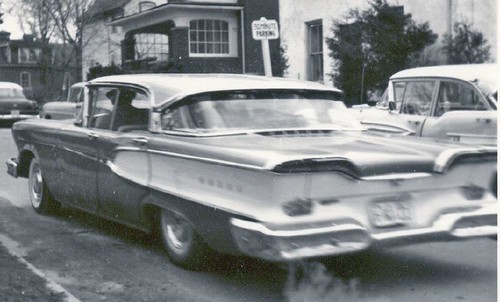
Here's a link to how this same Edsel looked in 1959. I took this picture with my Brownie Hawkeye when I was thirteen.
farm2.static.flickr.com/1286/544933741_8e82112e81.jpg
A bit busy today and tomorrow, but will try to visit everyone's stream. Thanks for your patience
When my stepfather first met my mother in 1959, he was driving a brand new 1958 Ford Edsel. At that time it was touted as being far ahead of its time. The big feature was the ability of the driver to shift gears by pushing buttons on a touch pad in the centre of the steering wheel.
After a few years the Edsel was abandoned. It had become an embarrassment to Ford. The button shift did not live up to its potential, and was notorious for losing its timing. It sometimes took up to five seconds from the time you pushed a button until the time the transmission shifted, usually with a jolting 'thunk'. Further, the Edsel was an overly heavy car, even in an age of heavy cars.
I did drive it a fair bit over a ten year period, and it could be scary at times.
Over the years I wondered what happened to it. I couldn't remember it being traded in. Then, several years ago, I spotted it in the farm yard at my brother, Steve's, place. it was pretty badly smacked up, and had been used for .22 practice. I always meant to photograph it, but didn't get a chance until yesterday. It had been towed about fifty feet from where I originally saw it, and the tow had not been kind.
From my set entitled “Steve and Marg’s Farm”
www.flickr.com/photos/21861018@N00/sets/72157608031549391/
In my collection entitled “Places”
www.flickr.com/photos/21861018@N00/collections/7215760074...
In my photostream
www.flickr.com/photos/21861018@N00/
The Story of the Edsel
(taken from Wikipedia, the free encyclopedia)
The Edsel was a marquee division of Ford Motor Company during the 1958, 1959 and 1960 model years.
In the early 1950s, the Ford Motor Co. became a publicly traded corporation that was no longer entirely owned by members of the Ford family. They were then able to sell cars according to then-current market trends following the sellers' market of the postwar years. The new management compared the roster of Ford makes with that of General Motors, and noted that Lincoln competed not with Cadillac, but with Oldsmobile. Since Ford had an excess of money on hand from the success of the Ford Thunderbird the plan was developed to move Lincoln upmarket with the Continental at the top, and to add another make to the intermediate slot vacated by Lincoln. Research and development had begun in 1955 under the name "E-car," which stood for "Experimental car." This represented a new division of the firm alongside that of Ford itself and the Lincoln-Mercury division, whose cars at the time shared the same body.
The Edsel was introduced amidst considerable publicity on "E Day"—September 4, 1957. It was promoted by a top-rated television special, The Edsel Show on October 13, but it was not enough to counter the adverse public reaction to the car's styling and conventional build. For months Ford had been circulating rumours that led consumers to expect an entirely new kind of car when in reality the Edsel shared its bodywork with other Ford models.
The Edsel was to be sold through a new Ford division. It existed from November 1956 until January 1958, after which Edsels were made by the Mercury-Edsel-Lincoln division (referred to as M-E-L). Edsel was sold through a new network of 1,500 dealers. This briefly brought total dealers of all Ford products to 10,000. Ford saw this as a way to come closer to parity with the other two companies of the Big Three: Chrysler had 10,000 dealers and General Motors had 16,000. As soon as it became apparent that the Edsels were not selling, many of these dealers added Lincoln-Mercury, English Ford and/or Taunus dealerships to their lines with the encouragement of Ford Motor Company. Some dealers, however, closed.
For the 1958 model year, Edsel produced four models, including the larger Mercury-based Citation and Corsair, and the smaller Ford-based Pacer and Ranger. The Citation came in two-door and four-door hardtops and two-door convertible versions. The Corsair came in two-door and four-door hardtop versions. The Pacer came in two-door and four-door hardtops, four-door sedan, and two-door convertible. The Ranger came in two-door and four-door hardtop or sedan versions. The four-door Bermuda and Villager wagons and the two-door Roundup wagon were based on the 116" wheelbase Ford station wagon platform and shared the trim and features of the Ranger and Pacer models. It included several innovative features, among which were its "rolling dome" speedometer and its Teletouch transmission shifting system in the center of the steering wheel. Other design innovations included an ergonomically designed controls for the driver, and self-adjusting brakes (often claimed as a first for the industry, although Studebaker had pioneered them earlier in the decade).
In the first year, 63,110 Edsels were sold in the U.S. with another 4,935 sold in Canada. Though below expectations, it was still the second largest car launch for any brand to date, second only to the Plymouth introduction in 1928.
For the 1959 model year, there were only two Edsels: the Ranger and the Corsair. The two larger cars were not produced. The new Corsair came in two-door and four-door hardtops, four-door sedan, and two-door convertible. The Ranger came in two-door and four-door hardtops, two-door and four-door sedans, and the Villager station wagon. In the 1959 model year, 44,891 cars were sold in the U.S., with an additional 2,505 sales in Canada.
For the 1960 model year, Edsel's last, only the Ranger and Villager were produced. The 1960 Edsel, in its final model year, emerged as a Ford. Its grill, hood, and four taillights, along with its side sweep spears, were the only real differences separating the Edsel from the Ford.
Ford announced the end of the Edsel program on Thursday, November 19, 1959. However, cars continued being produced until late in November, with the final tally at 2,846 1960 models. Total sales were approximately 84,000, less than half McNamara's projected break-even point. The company lost $350 million on the venture [1].
On Friday, November 20, United Press International's (UPI) wire service reported that book values for used Edsels had decreased by as much as $400 [approximately $2800 in 2006 dollars] (based on condition and age) immediately following the Ford press release. In some newspaper markets, dealers scrambled to renegotiate newspaper advertising contracts involving the 1960 Edsel models, while others dropped the name from their dealership's advertising "slugs." Ford issued a statement that it would distribute coupons to consumers who purchased 1960 models (and carryover 1959 models) prior to the announcement, valued at $300 to $400 towards the purchase of new Ford products to offset the decreased values. The company also issued credits to dealers for stock unsold or received, following the announcement.
There is no single reason why the Edsel failed, and failed so spectacularly. Popular culture often faults the car’s styling. Consumer Reports cited poor workmanship. Marketing experts hold the Edsel up as a supreme example of corporate America’s failure to understand the nature of the American consumer. Business analysts cite the weak internal support for the product inside Ford’s executive offices. According to author and Edsel scholar Jan Deutsch, the Edsel was "the wrong car at the wrong time."
One popular misconception was that the Edsel was an engineering failure, or a lemon, although it shared the same general reliability of its sister Mercury and Ford models that were built in the same factories. The Edsel is most famous for being a marketing disaster. Indeed, the name Edsel came to be synonymous with commercial failure, and similar ill-fated products have often been colloquially referred to as Edsels. Since it was such a debacle, it provided a case study for marketers on how not to market a product. The main reason the Edsel's failure is so famous was that it flopped despite Ford’s investment of $400,000,000 in its development.
The prerelease advertising campaign touted the car as having "...more YOU ideas," and the teaser advertisements in magazines only revealed glimpses of the car through a highly blurred lens or wrapped in paper or under tarps. Edsels were shipped to the dealerships undercover and remained wrapped on the dealer lots.
But the public also had a hard time understanding what the Edsel was, mostly because Ford made the mistake of pricing the Edsel within Mercury’s market price segment. Theoretically, the Edsel was conceived to fit into Ford’s marketing plans as the brand slotted in between Ford and Mercury. However, when the car arrived in 1958, its least expensive model—the Ranger—was priced within $73 of the most expensive and best-trimmed Ford sedan and $63 less than Mercury’s base Medalist model. In its midrange pricing, Edsel's Pacer and Corsair models were more expensive than their Mercury counterparts. Edsel's top-of-the-line Citation four door hardtop model was the only model priced to correctly compete with Mercury’s mid-range Montclair Turnpike Cruiser model.
Not only was the Edsel competing against its own sister divisions, but model for model, consumers did not understand what the car was supposed to be—a step up or a step below the Mercury.
After its introduction to the public, the Edsel did not live up to its overblown hype, even though it did have many new features, such as self-adjusting rear brakes and automatic lubrication. While consumer focus groups had said these and other features would make the "E" car attractive to them as car buyers, the cost of the cars outstripped what the public was willing to pay. When many potential buyers saw the base price tag, they simply left the dealership, and others were frightened by the price for a fully loaded, top of the line model.
One of the external forces working against the Edsel that Ford had no control over was the onset of the recession in late 1957.
When the Edsel was in its planning stages in the early and mid-1950s, the American economy was robust and growing. However, in the years that spanned the planning to its introduction, an economic recession hit, and American consumers not only shifted their idea of what an ideal car should be; in prior economic downturns, buyers flocked to the lower price marques like Plymouth, Chevrolet, and Ford. But in 1958, even these cars were perceived by some as unnecessarily large, and while the compact Rambler saw itself shoot to the third best selling make, none of the Big Three had anything compact to sell except their European cars built for Vauxhall, Simca, and Opel. The compacts introduced by the Big Three in 1960 were the direct result of the recession of 1958.
Compounding Edsel's problems was that the car had to appeal to buyers of other well established nameplates from the Big Three, such as Pontiac, Oldsmobile, Dodge, DeSoto, and even its internal sister division, Mercury -- itself never a stellar sales success.
Even if the 1958 recession hadn't hit when it did, the Edsel was entering into a shrinking marketplace. While Ernest Breech convinced Ford management that this market segment offered great untapped opportunity in the early 1950s, when the "E" car was in its earliest stages, by 1957, independent manufacturers in the mid-price field were drifting towards insolvency. Hoping to turn around their losses, Packard acquired Studebaker, yet the venerable Packard was no longer produced after 1958. On the other hand, American Motors changed its focus to the compact Rambler models, while their pre-merger brands (Nash and Hudson) were discontinued after the 1957 model year. Even Chrysler saw sales of its DeSoto marque drop dramatically from its 1957 high by over 50% in 1958. Following a disastrous 1959 model year, plans were made in Highland Park to discontinue DeSoto during its 1961 model year run.
Thus, the large, expensive Edsel that was planned to be all things to all people suddenly stood for excess, not progress.
The name of the car, Edsel, is also often cited as a further reason for its unpopularity. Naming the vehicle after Edsel Ford was proposed early in its development. However, the Ford family strongly opposed its use, Henry Ford II stating that he didn't want his father's good name spinning around on thousands of hubcaps. Ford also ran internal studies to decide on a name and even dispatched employees to stand outside movie theaters to poll audiences as to what their feelings were on several ideas. They reached no conclusions.
Ford hired the advertising firm Foote, Cone and Belding to come up with a name. However, when the advertising agency issued its report, citing over 6,000 possibilities, Ford's Ernest Breech commented that they had been hired to develop a name, not 6,000. Early favorites for the name brand included Citation, Corsair, Pacer, and Ranger, which were ultimately chosen for the vehicle's series names.
David Wallace, Manager of Marketing Research, and coworker Bob Young unofficially invited poet Marianne Moore for input and suggestions. Moore's unorthodox contributions (among them "Utopian Turtletop," "Pastelogram," and "Mongoose Civique") were meant to stir creative thought and were not officially authorized or contractual in nature. History has greatly exaggerated her relationship to the project.
At the behest of Ernest Breech, who was chairing a meeting in the absence of Henry Ford II, the car was finally called "Edsel" in honor of Edsel Ford, former company president and son of Henry Ford. Marketing surveys later found the name was thought to sound like the name of a tractor (Edson) and therefore was unpopular with the public.
Moreover, several consumer studies showed that people associated the name "Edsel" with "weasel" and "dead cell" (dead battery), drawing further unattractive comparisons.
Perhaps the most important factor in the Edsel's failure, however, was that when the car was introduced, the U.S. was entering a period of recession. Sales for all car manufacturers, even those not introducing new models, were down; consumers entered a period of preferring less expensive, more fuel-efficient automobiles.
Edsels were fast, but required premium gas and did not have the fuel economy desired during a recession. Mechanics disliked the bigger engine because of its unique design. The cylinder head had no combustion chamber and was perfectly flat, with the head set at an angle and "roof" pistons forming both a squish zone on one side and a combustion chamber on the other, meaning that the combustion took place entirely within the cylinder bore. This design reduced the cost of manufacture and possibly carbon buildup, but appeared strange to mechanics.
There were also reports of mechanical flaws in the models originating in the factory, due to lack of quality control and confusion of parts with other Ford models. Edsels in their first (1958) model year were made in both Mercury and Ford factories; the longer wheelbase models, Citation and Corsair, were produced alongside the Mercury products, and the shorter wheelbase models, Pacer and Ranger, were produced alongside the Ford products. There was never a stand-alone Edsel factory devoted solely to Edsel model production; workers making Fords and Mercurys literally had to change parts bins and tools to assemble extra Edsels once their hourly quota of regular Fords and Mercurys was achieved. As such, the desired quality control of the different Edsel models was difficult to attain for the new make of car. Many Edsels left the line unfinished, with the extra parts having been put into the trunks, with assembly instructions for the mechanics at the dealerships.
The Edsel is best remembered for its trademark "horsecollar" grille, which made it stand out from other cars of the period. A widely circulated wisecrack at the time was that "It looked like an Oldsmobile sucking on a lemon." Men often referred to the horsecollar grille as being akin to a woman’s genitalia. In fact, Robin Jones, a Ford designer at the time, later recalled that someone in the design studio - presumably as a cruel joke - actually taped hair to the inside of the grille area on one of the clay models produced during the design process; the end result, according to Jones, "looked like a hormonally-disturbed cow after giving birth."
Jokes aside, the front of the original Edsel turned out nothing like what was originally intended. Roy Brown, the original chief designer on the project, wanted a slender, almost delicate opening in the center; engineers, fearing engine cooling problems, vetoed the intended design, which led to the "horsecollar." The vertical grille theme, while improved for the 1959 models, was discontinued for the 1960 models, which were almost indistinguishable from Ford models of the same year, although the new front-end design bore no small resemblance to that of the 1959 Pontiac.
Many drivers disliked having the automatic transmission as pushbuttons (above) mounted on the steering wheel hub: this was the traditional location of the horn, and drivers ended up shifting gears instead of honking the horn. While the Edsel was fast, the location of the transmission pushbuttons was not conducive to street racing. There were jokes about stoplight dragsters and the buttons: D for Drag, L for Leap, and R for Race (instead of Drive, Low and Reverse).
There were also complaints about the taillights on 1958-model Edsel station wagons, which were boomerang-shaped and placed in a reverse fashion; at a distance, they appeared as arrows pointed in the opposite direction of the turn being made. While the left turn signal blinked, its arrow shape pointed right, and vice versa. However, there was little that could be done to give the Ford-based station wagons a unique appearance from the rear; corporate management insisted that no sheetmetal could be changed. Only the taillights and trim could be touched.
While the car and Ford’s planning of the car are the most often cited reasons for its failure, internal politics within the executive offices at Ford are as much to blame for the failure of the Edsel. Following World War II, Henry Ford II brought on Robert McNamara as one of the "whiz kids" to help turn Ford around. McNamara’s cost cutting and cost containment skills helped Ford emerge from its near collapse after the war. As such, McNamara eventually assumed a great deal of power at Ford. In many ways, McNamara was very much like Henry Ford: both men were committed to Ford above all other things and had little use for Continental, Lincoln, Mercury, and Edsel brand cars made by the company.
McNamara was against the formation of the separate divisions for Continental, Lincoln, Mercury, and Edsel cars, and moved to consolidate Lincoln, Mercury, and Edsel into the M-E-L division. McNamara saw to it that the Continental program was canceled and that the model was merged into the Lincoln range for 1958. He next set his sights on Edsel by maneuvering for elimination of the dual wheelbases and separate body used in 1958; instead, the Edsel would share the Ford platform and use Ford’s inner body structure for 1959. In 1960, the Edsel emerged as a Ford with different trim. McNamara also moved to reduce Edsel’s advertising budget for 1959, and for 1960, he virtually eliminated it. The final blow came in the fall of 1959, when McNamara convinced Henry Ford II and the management structure that the Edsel was doomed and that it was time to end production before the Edsel bled the company dry. (Note: McNamara also attempted to end the Lincoln nameplate; however, that effort ended with Elwood Engel's now classic redesign of 1961.) McNamara left Ford when he was named Secretary of Defense by President John F. Kennedy.
During the 1964 presidential election, Republican nominee Barry Goldwater blamed McNamara, then Secretary of Defense, for the Edsel's failure. Eventually, Ford's former executive vice president and financial contributor to Goldwater's campaign Ernest R. Breech wrote the Senator's campaign explaining that "Mr. McNamara ... had nothing to do with the plans for the Edsel car or any part of the program." However, the charge continued to be leveled against McNamara for years. During his time as head of the World Bank he instructed his public affairs officer to distribute copies of Breech's letter to the press whenever the accusation was made.[2]
The scheduled 1960 Edsel Comet compact car was hastily rebranded the Comet and assigned to Mercury dealerships. The Comet was an instant success, selling more cars in its first year than all models of Edsel produced during its three-year run. Styling touches seen in the Comets sold to the public that allude to being part of the Edsel family of models included the instrument cluster, rear tailfins (though canted diagonally), and the taillight shape (the lens is visually similar to that used on the 1960 Edsel, and even retained the embossed "E" code). The Comet's keys were even shaped like Edsel keys, with the center bar removed from the "E" to form a "C." For 1962, Ford officially assigned the Comet to the Mercury brand.
As the Edsel was a large commercial failure, the name became a popular joke in various media. A backronym, "Every Day Something Else Leaks", was inspired by the car's failure. Television programs, cartoons, video games, and films have all used the Edsel as humor, usually as a quick joke or as a sight gag.
In May 1958, then Vice President Richard Nixon was on a trip to Peru, riding in an Edsel convertible, when he was pelted with eggs and tomatoes by demonstrators. Nixon later joked: "They were throwing eggs at the car, not me."[3]
Fifty years after its spectacular failure, Edsel has become a highly collectible item amongst vintage car hobbyists. Fewer than 6,000 Edsels survive and are considered collectors’ items. A mint 1958 Citation convertible sometimes sells for over $100,000,[1] while rare models, like the 1960 convertible, may price up to $200,000. While the design was considered "ugly" fifty years ago, many other car manufacturers, such as Pontiac and Alfa Romeo, have employed similar vertical grille successfully on their car designs.
Many of the Edsel's features, such as transmission lock on ignition, adjustable brakes, gear selection as steering wheel buttons etc, which were considered "too impractical" in the late 1950s, are today standard features of sports cars.
Post Processing:
Topaz Add-On: Vibrance (HDR)
PhotoShop Elements 5: posterization, rough pastel, accented edges, ink outlines
found stones, melted in porcelain pail.
nights are spitting jolt stabb fall lowding and my waking life is narcosis.
Brennatmosphäre - Gasbrand reduzierend
Technik - Gegossen, Geschmolzen
Materialien - Porzellan, Basalt
Brenntemperatur - 1280
I woke with a jolt. My breathing was heavy but I was able to regain a steady pace in a matter of seconds. I leaned up and looked around to see that I was in the Quiver, my lair which was located directly under Queen Industries. To my left, Dinah and Roy stood over me talking. I couldn't really make out their conversation, my hearing wasn't up to par yet.
"How'd I get here?" I asked while rubbing my eyes.
"Roy brought you back here." Dinah explained.
"You carried me? You must be stronger than I thought for a semi scrawny 16 year old..." I said with a grin.
Roy looked back with a sarcastic look in his eyes.
"Rough crowd...how long was I out?"
"Almost 8 hours..." Roy said as he set his bow down on a workbench.
"Lawton shot you with a bullet laced with Tibetan Pit Viper venom."
"What happened to Floyd?" I asked widening my eyes, expecting some sort of badass story.
"I...uh, shot him in the knee. He threw a flashbang and got away..." Roy said with a tone of embarrassment.
"Well...that's good. Luckily a couple of weeks ago, I installed micro chips in each of our arrow heads. That way we can track our targets, suspects and other not so friendly neighborhood fiends."
I got up slowly off the bed I rested on, and walked over to the central computer. I picked up my arms to type but a massive amount of pain shot up throughout my body.
"Easy, Hun. We had to dig that bullet out." Dinah said will placing her hand gently on my wounded shoulder.
"Huh..I thought it grazed me. I guess I got stoned faster than I thought."
dead silence.
"...anyways, the trackers are in separate places. One on 5th and Winchester, the other on 8th and Orchid." I explained.
"Wait..8th and Orchid? That used to be an old precinct for the SCPD. That's where they kept tested and designed weapons and gear for the Anti-Vigilante Task Force, which is still active by the way." Roy said. "Don't ask how or why I know.."
"So now what?" Dinah asked as she crossed her arms.
"We suit up. Dinah you take 5th and Winchester, Roy and I will take Orchid. We want to be sure that neither one of them are diversions from the other."
"It's 6:17 am, and you, Mr. Queen, have
a meeting with Ted Kord and Ray Palmer at 7:30. You better get washed up." Dinah said with a fierce tone.
"Yes ma'am!" I said with a gulp.
__________________________________________
After a quick, long awaited shower, I retrieved a spare dress shirt and pants out of my closet in the lair. Damn. It's 7:07. I ran across the lair to the elevator. I pressed the penthouse/office button which was located on the 23rd floor of Queen Industries. Once I arrived, I logged into my computer, had my lovely assistant, Felicity Smoak, hand me today's agenda.
"Good morning, Mr. Queen. You have a meeting with Ted Kord and Ray Palmer in 3 minutes. They are most likely going to discuss our Applied Sciences division, attempting to buy it out. We can't have that." Felicity said gradually speaking faster and faster.
I put my hand out, signaling her to stop speaking.
"Ms. Smoak, I've been in the business for almost 3 years now, I think I know how a simple competitor meeting goes..unfortunately."
"Yes sir, I apologize, and according to our desk clerk, they're here." She said tapping away on her tablet.
"Send em' up!" I said with false excitement.
__________________________________________
About 5 minutes later, they arrived up to my office. Now my office is quite nice, it's also a penthouse which I currently live in. My office has a room separating itself from my bedroom, fancied with a king sized bed, 72" tv, a closet, and a spare suit..the green one. The Queen Estate is occupied by my sister Thea. After I came back, she and I never really got along. We haven't talked in over 2 years.
"Oliver Queen. Long time no see." said Ted Kord, who seemed to be excited for this.
He walked over to me to shake me hand, we did. Ray followed behind him. Ray's a tad bit younger than Ted and I, so he's shyer than us, but you give that man a few drinks, he's worse than me.
"Ray, Ted, it's nice to see you guys again! Please, have a seat." I said while smiling.
"Oliver, you know why we're here. Your Applied Sciences division owe us a project. We made an agreement. You give us project, we invest and engineer." Ted said as he crossed his legs and interlocked his fingers.
"That's not why I formed this little tea party. I know who you two really are." I said while I turned around, facing the city through my window.
The looks on their faces, jeez, priceless.
"Ted, you dress up as a bright Blue Beetle and have a beetle shaped aircraft that hovers over our city. Ray, you shrink to the size of an ant, it amazes me why they don't call you Ant-Man." I said laughing the entire time.
"Actually, I shrink to the size of an atom. Hence the name." Ray said blushing.
Ted stood up buttoning his vest and said,
"We're done here."
"Actually, there's one more thing. I'm the Green Arrow."
Ray and Ted looked at me, looked at each other and laughed.
"Oh, very funny you jackasses." I say in my chair, typed the code 'GA04' into my computer and every window in my office was now covered by metal blinds. My desk flipped over and reveals a hole in which a large capsule popped out of. Once it was finished, the capsule doors opened, revealing my suit.
They both looked in awe.
"Aw, a little green with envy? My suit display, directly from the Quiver downstairs. You like?"
"YES!" they both said simultaneously.
"Well then...I have a proposition for you both." I said while grinning.
When we fall,
the world slows down
and we don't really notice anything in that split second
falling is not scary, because you don't register it
but rather when we hit the floor
make contact with the world
we begin to sense the jolt
of what is going on
and we begin to register the consequences of our fall
the pain, and perhaps the broken bones
but when we fell,
we felt nothing
not even the vibrato of our own screams.
AlyssaDawnw
I am thinking that me and my mom may go out today, but she just went on a ride, so I don't know what we are doing now, I wanted to get my ear pierced, and spend some of the money that is collecting dust in my wallet ( I will enjoy it while it lasts :) And I won't have as much time tomorrow, so I am hoping she won't be gone too long :(
Another fine coffee + beer combo, this one courtesy of Sly Fox Brewing in the form of a tasty porter.
A Call To Arms
----------------------------------------
Sir Ian Drakesbane awoke with a jolt. The room around him was dark, no thin strands of light slipped in through the thatching of the roof. It was still early morning. He turned over and tried to fall back asleep, but couldn't. Marek's disappearance was nagging at him; it had been far too long for him to have taken a trip to somewhere nearby without telling his master. he had been responsible for the boy, and now he had slipped out through his fingers. The young knight rose and stretched, pulling on a simple blue shirt. Sir Ian descended the groaning wooden stairs, then left the house. The light of early morning was beginning to dispell the night's darkness. Dew was scattered across most available surfaces. Ian strode along, hoping to clear his mind and think of something besides Marek's disappearance. He found himself approaching the rampart, and, seeing no reason not to, climbed the stairs and began to walk along the worn stone wall, admiring the fresh burst of grass and trees outside the Dunharris wall recovering from the recent winter. As he approached the place where the wall turned, he glimpsed a small silhouette dancing in the distance against the vibrant sunrise. Straining his eyes as it came closer, he realized it was bird, and it seemed to be heading for the corner of the wall. Curiousity piqued, he jogged towards the corner to get a better look at what the bird might be. It drew closer still, revealing itself to be a large, grey, owl. Tied to its leg was a leather-bound scroll. Intrigued, Sir Ian extended his arm for the owl to alight, and, ignoring its sharp claws, removed the scroll to see who it might be for. Etched on the leather was "Sir Ian, Drake's Bane, foremost knight of Dunharris." "Well, ye've come to the right man, my friend." he mumbled, intently unrolling the scroll. He glanced it over, then read it again. He grimaced, but then released a short laugh. "Well, it seems one 'Caedric Moore' is in need of a Drake's Bane."
----------------------------------------
My entry to the Bignette size category, Preparation category, of Global Challenge 10 of the Lands of Roawia.
• 179 •
I had about 30 minutes today to take my photo before I had to be in at work. I rode my bike to the woods and down to this stream, and as i was walking around, I found the jug that I'm holding, as well as a few other cool rusty things.
It really looks and feels like winter already. I feel like I totally missed Fall, which sucks because Fall is my favorite season. The hurricane didn't help either, blowing all the leaves off the trees.
Looks aight on black.