View allAll Photos Tagged Intoxicants,
"Fall into you
Is all I seem to do
When I hit the bottle
Cause I'm afraid to be alone
Tear us in two
Is all it seems to do
As the anger fades
This house is no longer a home
Don't give up on the dream
Don't give up on the wanting
And everything that's true
Don't give up on the dream
Don't give up on the wanting"
Placebo
www.youtube.com/watch?v=MmV1YAc0P48&feature=related
These images are part of a set that are conceptual and involving masks. In these images, there are topics, which can be perceived in an idiosyncratic way. The subjects themselves (being masks) are androgynous and cross both genders as emotions and actions span this. These images are a representation pathway of human conditions through unique approach via story telling. The video elements are there to help the viewer understand the images more and to accompany the atmospheres to which I used to create this images in.
Italian postcard by Bromofoto, Milano, no. 233.
American actress Gail Russell (1924-1961) was an incredible doe-eyed beauty who presented a screen image of great innocence and vulnerability. She is best known for the supernatural horror film The Uninvited (1944). During a promising career at Paramount, she became a victim of alcoholism. It ruined her career, appearance and marriage to Guy Madison. In 1961, she died from liver damage, only 36.
Gail Russell was born born Elizabeth L. Russell in 1924 to George and Gladys (Barnet) Russell in Chicago, Illinois. The family moved to the Los Angeles, California, area when she was a teenager. Her father was initially a musician but later worked for Lockheed Corporation. Russell attended high school in Santa Monica, California, where she was spotted by a Paramount talent scout and signed to a contract immediately upon graduation. Although Russell was possessed with a paralyzing kind of self-consciousness and had no acting experience, Paramount had great expectations for her and employed an acting coach to work with her. At the age of 19 she made her film debut with a small part in the comedy Henry Aldrich Gets Glamour (Hugh Bennett, 1943). She also had a small part in the musical Lady in the Dark (Mitchell Leisen, 1943) with Ginger Rogers. Russell's haunting, melancholy beauty was ideally suited for the ingénue role in the lavish supernatural horror film The Uninvited (Lewis Allen, 1944) with Ray Milland. Hal Erickson at AllMovie: "The Uninvited remains one of the spookiest "old dark house" films ever made, even after years of inundation by computer-generated special effects." Lewis Allen then directed Russell in Our Hearts Were Young and Gay (Lewis Allen, 1944), in which she co-starred with Diana Lynn. It was another success. Russell co-starred opposite Alan Ladd in Salty O'Rourke (Raoul Walsh, 1945), a horse racing drama. She made a third film with Allen, The Unseen (Lewis Allen, 1945), an unofficial follow up to The Uninvited. Gail played Elizabeth Howard, a governess of the house in question. The film turned a profit but was not the hit that Paramount executives hoped for. Then she and Lynn were in Our Hearts Were Growing Up (William D. Russell, 1946), a sequel to Our Hearts Were Young and Gay. The plot centered around two young college girls getting involved with bootleggers. Unfortunately, it was not anywhere the caliber of the first film and it failed at the box-office. She was reunited with Ladd in Calcutta (John Farrow, 1947), shot in 1945 but not released until two years later. Although the film was popular, critics felt that Russell was miscast.
Gail Russell left Paramount and appeared in the romantic comedy The Bachelor's Daughters (Andrew L. Stone, 1948) for United Artists. John Wayne hired her to be his co-star in a film he was producing, Angel and the Badman (James Edward Grant, 1948). It was a hit with the public and Gail shone in the role of Penelope Worth, a feisty Quaker girl who tries to tame gunfighter Wayne. She did Moonrise (Frank Borzage, 1948) for Republic. Bruce Eder at AllMovie: "Moonrise, the most expensive movie ever made by Republic up to that time, but one that was worth every penny. Arguably Borzage's finest directorial effort and the most hauntingly beautiful movie ever issued by the studio, Moonrise is filled with delights at just about every level that it is possible to enjoy in a movie." Russell returned to Paramount for Night Has a Thousand Eyes (John Farrow, 1948) with Edward G. Robinson, then reteamed with Wayne for Wake of the Red Witch (Edward Ludwig, 1948). She appeared in a Western with John Wayne for Pine-Thomas Productions, El Paso (Lewis R. Foster, 1949). Russell did Song of India (Albert S. Rogell, 1949) with Sabu for Columbia and The Great Dan Patch (1949) for United Artists. She made some more Pine-Thomas films: Captain China (Lewis R. Foster, 1950) with Payne, and the Film Noir The Lawless (Joseph Losey, 1951) with Macdonald Carey. She married film star Guy Madison in 1949, but by 1950 it was well known that she had become a victim of alcoholism, and Paramount did not renew her contract. She had started drinking on the set of The Uninvited to ease her paralyzing stage fright and lack of confidence. She made Air Cadet (Joseph Pevney, 1951) for Universal, but alcohol made a shambles of her career, appearance and personal life. In January 1954, in a court in Santa Monica, California, Russell pleaded guilty to a charge of drunkenness, receiving a $150 fine. The fine was in lieu of a jail sentence, with the provision that she not use intoxicants or attend night spots for two years. In the same court session, she received a continuance on a charge of driving while drunk.
Gail Russell disappeared from the screen for the next five years while she attempted to get control of her life. In 1954, she divorced Guy Madison. She returned to work in a co-starring role with Randolph Scott in the Western Seven Men from Now (Budd Boetticher, 1956), produced by her friend Wayne, and had a substantial role in the Film Noir The Tattered Dress (Jack Arnold, 1957) with Jeanne Crain and Jeff Chandler. In July 1957, she was photographed by a Los Angeles Times photographer after she drove her convertible into the front of Jan's Coffee Shop at 8424 Beverly Boulevard. After failing a sobriety test, Russell was arrested and charged with driving under the influence. She appeared in the B-film No Place to Land (Albert C. Gannaway, 1958) for Republic. By now the demons of alcohol had her in its grasp. She was again absent from the screen until The Silent Call (John A. Bushelman, 1961), a respectable family film about a big dog by the name of Pete with definite separation anxiety. It was to be her last film. On 26 August 1961, Russell was found dead in her small apartment in Brentwood, Los Angeles, California. She was only 36. She died from liver damage attributed to "acute and chronic alcoholism" with stomach contents aspiration as an additional cause. She was also found to have been suffering from malnutrition at the time of her death. She was buried in Valhalla Memorial Park Cemetery in North Hollywood.
Sources: Hal Erickson (AllMovie), Denny Jackson (IMDb), Jim Beaver (IMDb), Wikipedia and IMDb.
Kankrajhor
Kankrajhor is a beautiful tourist destination of Jangalmahal Circuit in West Bengal, India. It is situated in the tropical, hilly forestlands of Jhargram district. It comprises 9000 hectares of hardwood forests. The wealth of trees includes Kusum (Ceylon oak), Shaal (Shorea robusta), Segun (Tectona grandis), Mahua (Indian Butter tree, or honey tree- Madhuca longifolia ), Piyal (almondette or calumpong nut, ) and Akashmani (Acacia auriculiformis), as named in Bengali. Its tribal villages at the edge of forests and ethnic people will make you feel a happy stay. Kankrajhor is just 22km from Ghatshila (Jharkhand) & 65 km from Jhargram town.
Beyond the fertile Gangetic plains of Bengal, Jhargram offers the most exotic undulating topography culminating in hilly ranges of Belpahari, Kankrajhor in the north to the serene and meandering Subarnarekha River in the south. Nearby famous Dolma Hills are frequented by animals from Bihar, including tigers, leopards and elephants. Bears and wild boars are frequently found in the hills in search of Mahua flower sap. The sap is a potent intoxicant in the region and is used to make country liquor, simply called Mahua. This is a regular corridor of elephants. They are very much fond of this Mohua flowers and get intoxicated...a pleasure to watch in a full moon night. Every year at this time of month elephants frequently enter into these villages and spoil the crops.
It is a favourite destination for people who love forests and tranquillity. Its exquisite forestry, ancient temples, native folk cultural and tribal dances, makes it an extremely attractive destination for tourists who love yet unspoiled nature and her people of the soil on the face of earth.
How to Reach Kankrajhor-Belpahari:
By Train: The distance from Howrah to Jhargram station is 157 Kms and the journey takes three hours by train from Howrah.
By Road: Jhargram is also very well connected by highways with other nearby cities like Medinipur, Kharagpur, Durgapur, Bankura, Purulia, and Kolkata.
Personal experience
In the first week of April, this year, we suddenly planned to go to Kankrajhor, in the district of Jhargram, West Bengal, India. We drove straight from Kolkata to Jhargram, and then another 60km drive to the heart of Kankrajhor. Our destination was a private cottage with very basic arrangements situated in a small tribal village, on the edge of the forests. This time of a year it was little bit late to enjoy the dazzling blooms of Palash, described as “Flames of the Forests” (Butea monosperma). But this was a right time to cherish the beauty of Shaal-Piyal-Mohua trees everywhere. The green new leaves, sweet intoxicating fragrance of Mohua flowers and the extreme business of the wild bees and birds, will always remind you the youthfulness of a spring. The red lateritic forest floor is an experience to walk on. While walking on its undulated trails through forests you will hear only the relentless chirping of birds and murmurs of dry leaves being moved by frequent gust of cold breezes. Such ambiance in an afternoon will surely make you intoxicated and drowsy, free of all wiriness and stresses of busy urban life, and will help you enter into a peaceful siesta. One may arrange tribal dances amidst this forest, their native home. Their beating of drums, and the indigenous harmony of dances will make you fallen in love with this place. I’m sure. With the sunset the whole surroundings suddenly turn into a mystical darkness. Far from the distance sitting in the hut you may hear the intermittent sounds of nocturnal birds, hyenas, jackals and foxes.
The dinner is very simple. Country chicken and rice is a luxury here. We had the wonderful taste of its country liquor made from Mohua flowers (Madhuca longifolia). It was a wonderful experience for all of us.
Simple and beautiful tribal people there, basic stay with optimal standard and simple healthy food, unspoiled nature, tranquillity, and serenity...all will definitely make you feel... “How much we need to be happy?” Really?
Part 3 of the Seven Deadly Sins
Derived from the Latin gluttire, meaning to gulp down or swallow, Gluttony is the over-indulgence and over-consumption of food, drink, or intoxicants to the point of waste. In the Christian religions, it is considered one of the seven deadly sins -- a misplaced desire of food or its withholding from the needy.
Depending on the culture, it can be seen as either a vice or a sign of status. The relative affluence of the society can affect this view both ways. A wealthy group might take pride in the security of having enough food to eat to show it off, but it could also result in a moral backlash when confronted with the reality of those less fortunate.
Early Church leaders (e.g., Thomas Aquinas) took a more expansive view of gluttony (Okholm 2000), arguing that it could also include an obsessive anticipation of meals, and the constant eating of delicacies and excessively costly foods.
He went so far as to prepare a list of five ways to commit gluttony, including:
Praepropere - eating too soon
Laute - eating too expensively
Nimis - eating too much
Ardenter - eating too eagerly
Studiose - eating too daintily
en.wikipedia.org/wiki/Seven_deadly_sins
See
Murmansk, Russia | Air -15°C / Water 2°C
This is me swimming on the 28th January 2012 in the Lake Semyonovskoye, Murmansk, northwestern part of Russia.
68°59′29″N 33°05′10″E
Ten Tips for Winter Swimmers
1. Always bring a friend.
2. Warm up your muscles before you go into the water.
3. Let your body cool down after the sauna and before you go into the water.
4. For your first time, just take a quick dip.
5. Dress warmly after the swim.
6. Drink warm beverages and enjoy yourself.
7. Never go into the water while sick or under the influence of intoxicants.
8. Wear a wool hat or knitted cap, gloves and special shoes if necessary.
9. Never jump in the water headfirst.
10. How many times you go into the water, how long you stay and whether you do it after the sauna or not are all individual choices. You should listen to your body to learn what works best for you.
Source: © 2012 Suomen Latu
Kankrajhor
Kankrajhor is a beautiful tourist destination of Jangalmahal Circuit in West Bengal, India. It is situated in the tropical, hilly forestlands of Jhargram district. It comprises 9000 hectares of hardwood forests. The wealth of trees includes Kusum (Ceylon oak), Shaal (Shorea robusta), Segun (Tectona grandis), Mahua (Indian Butter tree, or honey tree- Madhuca longifolia ), Piyal (almondette or calumpong nut, ) and Akashmani (Acacia auriculiformis), as named in Bengali. Its tribal villages at the edge of forests and ethnic people will make you feel a happy stay. Kankrajhor is just 22km from Ghatshila (Jharkhand) & 65 km from Jhargram town.
Beyond the fertile Gangetic plains of Bengal, Jhargram offers the most exotic undulating topography culminating in hilly ranges of Belpahari, Kankrajhor in the north to the serene and meandering Subarnarekha River in the south. Nearby famous Dolma Hills are frequented by animals from Bihar, including tigers, leopards and elephants. Bears and wild boars are frequently found in the hills in search of Mahua flower sap. The sap is a potent intoxicant in the region and is used to make country liquor, simply called Mahua. This is a regular corridor of elephants. They are very much fond of this Mohua flowers and get intoxicated...a pleasure to watch in a full moon night. Every year at this time of month elephants frequently enter into these villages and spoil the crops.
It is a favourite destination for people who love forests and tranquillity. Its exquisite forestry, ancient temples, native folk cultural and tribal dances, makes it an extremely attractive destination for tourists who love yet unspoiled nature and her people of the soil on the face of earth.
How to Reach Kankrajhor-Belpahari:
By Train: The distance from Howrah to Jhargram station is 157 Kms and the journey takes three hours by train from Howrah.
By Road: Jhargram is also very well connected by highways with other nearby cities like Medinipur, Kharagpur, Durgapur, Bankura, Purulia, and Kolkata.
Personal experience
In the first week of April, this year, we suddenly planned to go to Kankrajhor, in the district of Jhargram, West Bengal, India. We drove straight from Kolkata to Jhargram, and then another 60km drive to the heart of Kankrajhor. Our destination was a private cottage with very basic arrangements situated in a small tribal village, on the edge of the forests. This time of a year it was little bit late to enjoy the dazzling blooms of Palash, described as “Flames of the Forests” (Butea monosperma). But this was a right time to cherish the beauty of Shaal-Piyal-Mohua trees everywhere. The green new leaves, sweet intoxicating fragrance of Mohua flowers and the extreme business of the wild bees and birds, will always remind you the youthfulness of a spring. The red lateritic forest floor is an experience to walk on. While walking on its undulated trails through forests you will hear only the relentless chirping of birds and murmurs of dry leaves being moved by frequent gust of cold breezes. Such ambiance in an afternoon will surely make you intoxicated and drowsy, free of all wiriness and stresses of busy urban life, and will help you enter into a peaceful siesta. One may arrange tribal dances amidst this forest, their native home. Their beating of drums, and the indigenous harmony of dances will make you fallen in love with this place. I’m sure. With the sunset the whole surroundings suddenly turn into a mystical darkness. Far from the distance sitting in the hut you may hear the intermittent sounds of nocturnal birds, hyenas, jackals and foxes.
The dinner is very simple. Country chicken and rice is a luxury here. We had the wonderful taste of its country liquor made from Mohua flowers (Madhuca longifolia). It was a wonderful experience for all of us.
Simple and beautiful tribal people there, basic stay with optimal standard and simple healthy food, unspoiled nature, tranquillity, and serenity...all will definitely make you feel... “How much we need to be happy?” Really?
A mandala map of the Shingon Buddhist Mantra School's cosmology.
There are three universal truths found in Shingon Buddhism, the universal essence, universal form, and universal function.
The universal essence is in regard to the chakra body, otherwise known as the wheel body. The chakra body is a circle composed of elemental circles which encompass the nature of all phenomena including the dharma, the law of universal norms, Buddhist teachings, karmic consequences, thought and all things. There are three Buddha bodies or three chakra bodies for three types of listeners. The first chakra body exists in its own nature, this body manifests in the form of Buddhas who read the innate original nature by meditation. The second is the right dharma chakra body which connects the Bodhisattva to those who search for liberation by right dharma. The third is the doctrine command chakra body which exists in wrathful forms that must command those difficult to convert. Each chakra body is made up five chakras into a Stupa which creates the Matrix world.
The first chakra is the earth chakra found just below the naval and represented by the yellow square. This is the root chakra which roots the lower body into the `yoga throne of indestructible diamond` This is the throne of Indra which casts light brilliantly onto all beings cultivating Ji. This chakra acts as support and ultimately resembles the uncreated. The mantra for this chakra is Namah a
The second chakra is the water chakra found at the naval which changes into the white circle. The water chakra, also known as the lotus throne, radiates like a clear moon and irrigates all things with the water of great compassion, nourishing all in Samadhi. This chakra acts as an agent of quickening and ultimately resembles ineffableness. The mantra for this chakra is Namah VA
The third chakra is the fire chakra found at the heart which changes into a red pyramid. This chakra shines like the red rising sun and emits a fire of knowledge to burn all defilements. This is a seal of the dharma world which acts as maturation and ultimately resembles a freedom of defilement. The mantra for this chakra is Namah ram
The fourth chakra is the air chakra found in between the eyes which changes into a black half moon. This chakra exercises the power of freedom and exorcises maleficent and demonic influences. This is the seal of turning the wheel functioning as growth and ultimately meaning freedom from causality. The mantra for this chakra is Namah ham
The fifth chakra is the space chakra found at the top of the head which changes to a blue jewel. This chakra is the great space, the great void and seal of the great wisdom sword. This chakra acts as all pervasive and ultimately resembles the attributes of space. The mantra for this chakra is Namah kham
The sixth Chakra is the consciousness existing above and beyond the head which changes to white or all colours. This is the chakra of perception and determination, formless in nature. This chakra is ungraspable and ultimately void. The first five physical chakras pervade the sixth and yet the sixth pervades all five. The mantra for this chakra is Namah Hum
These chakras are made of the primary colours including white, which is all colours, and black which is void of colour. All together these chakras colour and shade all things. These are the six eternal, omnipresent and indestructible elements which are irreducible components of all three dharma bodies, that of desire, form, and formless worlds.
The universal form is in regard to four Mandalas. The all pervading oneness which Shingon calls Mahaivairocana is the dharma body fused with form in the conditioned cosmos, equivalent to the virtues of one of the Buddhist faith. This dharma body is Mandala, the form of all encompassing and complete circle. The first of the four mandalas is the great mandala. This is the universe of form composed of the six elements and colours made up of images. The second mandala is the Samaya mandala which is the universe of symbolic form which identifies the Buddha’s powers and the bodhisattva’s vows through symbols such as the vajra, sword, jewels and such. The Samaya mandala is activated with the coming together of hand gestures called mudras. The third mandala is the dharma mandala which contains all sounds of the universe and identifies with the original vow. All sounds are resembled by their Sanskrit seed sound, the seed which flowers into all words. The fourth mandala is the action mandala which is composed of all actions and is uncoloured where as form is forgotten and form is seeing. In the center of the four mandalas is the great radiating light of the sun, of Mahiavairocana, all the mandalas existing as attributes of Mahaivairocana. The four mandalas within the being interpenetrate each other without hindrance uniting body and mind with Buddha body and mind in a universal form of suchness.
The Buddha said `Mandala is what gives birth to all Buddhas, incomparable excellent flavor` Firstly, the mandala means circle, wheel, or chakra, a totality of the whole, completeness. Totality is formed by its parts, like a wheel is formed of a hub, spokes and empty space. A circle is an assembly, such as a circle of friends, or bodhisattvas. Secondly what gives birth to all Buddha`s and awakens the Buddha nature within? In Buddhism this is the seed, the bodhicitta. The citta is planted in the earth of the mind of all knowledge, than moistened by the water of great compassion, warmed by the sun of great wisdom, animated by air of great method and obstructed in space of great void, the citta develops into the dharma world as a sprout of inconceivable dharma nature. Thirdly the most excellent flavor is that in referring to the dharma world as a sea of milk, oceans of unformed chaos with unobstructed potentiality. Churned, the milk solidifies and the most refined, the most pure part rises to the surface. Condensing, unchanging, firm, without residue, we find a concentration of the dharma.
Mandala is a circle, birth to Buddha and concentration. A mandala is a circle of ritual enclosure contained within is a field free of distractions. Mandala is a platform for awakening a place of the way. Way or `do` is synonymous with awakening, a dojo is a place of the way, of awakening. Mandala is a map of the cosmos, a representational domain for self realization through the purifying of karmas. The domain is entered or `yoked` to through universal functioning of the three mysteries.
The universal function is the truth of the three interpenetrating mysteries. Actions of men are of three types which are physical actions of the body, speech and functions of the mind. These three functions are adorned as mysteries because unless awakened are truly inconceivable.
The first mystery is the mystery of the body which is activated through hand gestures called mudras. These mudras are bodily interpenetration with phenomenon and the Dharma body which consists of five bodies. These being the precept body a perfection of precepts beyond moral conditioning, the meditation body free from illusion, The wisdom body of prajna and perfected knowledge, the liberation body of unconditioned nirvana and the knowledge of liberation where clear perception abides in liberation. The left hand resembles these five dharma bodies where as the right hand resembles the five elements. The performer of these gestures is really affirming a vow and performing a seal of faith.
The second mystery is the mystery of speech which is activated through invocations called mantras or dharanis. Dharani is a verbal formula to invoke Buddha, a calling for oneness. Dharani is a support which sustains. Mantra stems from the Sanskrit seeds of `man` which means thought and `tra` which means liberates or container. Thus mantra means container of thought. This is the container for the essence of doctrine and the Dharma bodies. One syllable can contain all dharmas beyond which conceptualizing, illusory words are able to convey the dharmas unconditioned suchness beyond causality and the limitations of space and time. Although Mantras contain powers capable of miracles, the true aim is that of liberation.
The third mystery is the mystery of the mind activated through visualizations. The mind lies in a formless void, and it is important to note here that Esotericism does not aim at the void but to interpenetrate form. Visualization manifests through a one pointed concentration that brings the image into the mind-heart within the chakra body which forms a seal of entry. The mind`s eye sees that true form is emptiness. There is no grasping here, no differentiating the illusory of the symbol or to see real by cutting the unreal but to just see things as they are in their non-duality.
The external formal mandala is not the true mandala but a meditational support consisting of externalized rites for a realization of an internal yoke to the true mandala. To realize this inner mandala satisfies all desires. Mandala abides in the mind and knowing this one can receive full fruition of the Bodhi-citta tree and recognize god`s eye view. Mandala does not differ from consciousness nor consciousness differs from mandala, they are identical. The outward painted mandala is both a schema of Dharma world made up phenomenal dharmas and a schema, the underlying organizational framework, of the mind of being. The mandala is an energy grid that represents the constant flow of the divine and demonic, the human and animal. These are impulses that interact in constructive or deconstructive patterns that are a mesocosm consisting of the macrocosm with the microcosm, the mundane with sublime. The Mandala purges the body of demons and embodies the divine through the cleansing of the elements. Mandala is a template for the divine. The energy flows into the center of the mandala, rather implodes to the source which is a reversal of the original cosmology. The energy flows through channels (nadis) into energy centers composed of concentric circles (chakras) to reach unity with the `godhead`. The mandala wholly contained within mind interpenetrates all phenomena.
The Buddhist Cosmology
The Buddhist Cosmos is instructionally approached in my mandala from the sides with visual guides for the mantras and mudras to be used in approaching the center to stimulate the three mysteries and seal one into the mandala. Following the chakra bodies is the mudra for the golden turtle which arises out of the sea of samsara. The golden turtle is untarnished and is free to roam between nirvana and samsara as earth and water. On top of the golden turtle is the jewel palace of Mt. Sumeru, the immoveable resides here. Following these embodiments one is to hold their hands in J-Yin and chant the seed syllables of the elements `Ah Vi Ra Hum Kham` and embody Mahavairocana, the body of all form. Earth supports one where water is necessary in welfare as fire is to burn away false assumptions and delusions while the air blows away the dust of passions and space remains non-discriminating without distinctions. This Dharani destroys hindrances. Ah enters Nirvana through cessation, Vi is the bondless Samadhi, Ra is the dust of defilements wiped away, Ha+U+M is the three liberation gates which severe distinctions of formlessness and finally Kham which is space and void, the negation of negation and void of void, Buddha hood. This is the stupa of the body and when perfected all bad karma vanishes.
Following the chakra chain is the Heaven realms. This begins with the six heavens of the world of desire. The first heaven exists on earth which consists of the four kings of the directions, protector, wide-eyed, renowned and virtuous. Following the first heaven is the last earthly heaven which is on the summit of Mt. Sumeru in Indra`s palace located in the center of heaven. The third heaven exists in the realm of the sky and is the heaven of `Yama` or time. This is the heaven of the king of the world of the dead where the season is always good and inhabitants enjoy occasional pleasures. The next heaven is the heaven of commitment where inhabitants are content with their pleasures. This is the pureland of Miroku, the future Buddha, and the realm where bodhisattvas dwell before born on earth. The fifth heaven is the joy in transformations where inhabitants enjoy pleasures which the create themselves. The sixth heaven is the free enjoyment of transformation and pleasure created by others. King Mara the tempter reins in this heaven.
Following the heavens of the world of desire are the heavens of the world of form which consists of heavens belonging to four meditations. All forms of existence until now constitute the world of desire and now inhabitants are free of passion and desire. The heavens of the first meditation have transcended smell and taste but are still hindered in meditation, however not of sexual desire. There are five mental functions in this heaven which are investigation, reflection, joy, bliss and Samadhi. This is the abode of Brahma where one believes not to be bound of causation and can transform heaven and earth at will. There are no Buddhist inhabitants in this Hindu realm. The Heavens of the second meditation have transcended the five senses and types of consciousness. Thought, joy, and renunciation are all that remain. There is no pleasure or pain and attraction. True identity is recognized. The heavens of the third meditation are like the second but contain only one thought. The heavens of the fourth meditation are cloudless in that they need no support. There is an auspicious birth as the result of an abundance of merit. Here exists the heaven without thought that is without mental, perceptive and feeling functions, a warm resemblance of death. This is a heaven without Buddhist inhabitants for non returners, although they have not escaped the wheel of being. The non-returner has reached three fourths of the level of attainment. That is they have first entered the stream by turning against the stream of samsara. Secondly is the once-returner who has one more birth on earth to attain nirvana and the non-returner does not return to the desire realms of false practices and views. Finally one may become an Arhat to be unborn and escape rebirth.
Following the heavens of the world of form are the heavens of the formless world. These heavens are without form, beyond spatiality and subjection to causality. There are no longer the five physical aggregates but only aggregates of the mind/function. These again are perception, connotation, volition and consciousness. This is an ecstatic state of pure spiritual existence consisting of four meditations of the void. The first is infinite space in which the mind severed of form. Next is infinite consciousness which severs the mind of infinite space into infinite consciousness. Next we find non-existence which severs the mind of infinite consciousness to not exist. Finally we reach neither thought nor non-thought which severs the mind from thought contained in consciousness and non-thought of non-existence. Beyond this is the unconditioned immutable eternal world of the Buddhas.
Following the heavens are the ten stations of Buddha hood which are not hierarchical but horizontal identities, that is virtues that occur instantaneously upon attaining the realization of Buddha mind. The first station is of the dharma cloud, the perfection of the paramita of knowledge, whence wisdom and compassion has been perfected the bodhisattvas virtue permeates like a cloud and rains the elixir of Dharma to nourish and irrigate all sentient beings. The second is the station of wisdom of skills is where the paramita of power is perfected, powers and eloquence have been mastered which gives freedom to aid all beings with versatility of powers being paramitas, vows, supernatural faculties, mind, faith, compassion, love, dharanis and such things of suchness. The third station is of immovability, the perfection of the paramita of vows which is immutable in wisdom, immoveable in formless and fulfills the liberation of all beings. The third station is overcoming the supremely difficult, that is the perfection of the paramita of patience, the non-duality of mundane and absolute. The fourth station is of being face to face with wisdom, the paramita of wisdom consists of the immediate presence of wisdom, that is perceives absolute identity with the eyes. The fifth station is overcoming the supremely difficult, that is the perfection of the paramita of patience, the non-duality of mundane and absolute. The sixth station is that of blazing wisdom, the paramita of exertion where knowledge burns brilliantly and burns away illusion. The seventh station is that of manifesting light, the paramita of patience where the delusions of practice has been cut and one has the patience to understand. The eighth station is the freedom from defilements and union of body-mind which is the paramita of precepts where the delusion of practice is cut by removing improper action from beginningless time. The ninth station is the station of joy, the giving paramita which is the single thought of non discriminating knowledge. The tenth station is of far-reaching practice, the perfection to the paramita of method, this is a great compassion which is entirely selfless and consists of spiritual aims toward all sentient beings.
Descending from the center is the realm of man and the eight disasters which befall him. These consist of a world of secular views, deformed senses, remote places, the heavens of long life without thought, and of the world of mappo where no Buddha appears. The last three disasters are hungry ghosts, animals and hells which will soon be covered. Next is the realm of the Asuras which are figures of Hindu mythology that are `without wine or beauty` and are false gods seeing in Buddhism as belligerent beings whom make war on Indra and when they gain supremacy in this endless battle evil and chaos prevail. Following this is the realm of animals consisting of living creatures such as the birds, bees, beasts, dragons, shells and insects that are all suffering of mutual slaughter. This is the realm of the blind sheepman whom are spiritually blind and trapped in samsara by illusion.
The realm of the hungry ghosts consists of three classes of ghosts, each with three subclasses. The first class is ghosts with no possessions which consist of torch mouthed ghosts, needle thin throat ghosts and ghosts with foul breath. The Second class is ghosts with few possessions which consist of needle-haired ghosts, ghosts with rank hair and ghosts with large ulcers. The third class is ghosts with many possessions consisting of ghosts who receive discards and live on food after being used in offerings, ghosts who receive lost food that is left wayside by travelers and powerful ghosts.
There are than single isolated hells in mountains and deserts and neighboring hells which are smaller progressive hells which lay in close proximity to each hell. I have added a hell to the Shingon cosmology and that is the suicidal hell, this realm where one selfishly throws away their gift of life. There are also radical hells which consist of eight cold and eight hot hells.
The cold hells cause inhabitants to suffer by degrees of coldness. The arbuda hell is so cold that it causes blisters. The nirarbuda hell is even colder causing blisters to burst. Atata is the hell of chattering teeth. Hahaua is the hell and sound made by sufferers. Huhuua is the hell and sound of the breath of sufferers. The blue lotus hell is so cold that it causes patches on the skin to look like blue lotus. The red lotus hell is even colder and causes patches of red lotus on the skin. The great red lotus hell consists of the skin being entirely covered by red lotus.
The hot hells cause suffering to inhabitants in karmic retribution. The rebirth hell contains inhabitants who are repeatedly put to death and immediately brought back by a cold wind, renewed to torture. The hell of black ropes has sufferers bound with ropes and chopped to pieces. The hell of multitudinous combinations consists of combinations of instruments used to torture. The wailing hell`s inhabitants wail in anguish. The great wailing hell`s inhabitants wail in great suffering. The hell of scorching heat is self explanatory. Finally there is the hell of non-intervals which is for the worst of the five deadly offences that are patricide, matricide, killing an Arhat, doing injury to the body of a Buddha or cause disunity in the Sangha. There is no interval of suffering in between death and rebirth here, no interval in hell, in life. There is no part of body-mind that does not suffer.
Ascending from the center is the three stages of awakening which is permeated by the three mysteries. These stages are the three kalpas which are false tenets to be destroyed. These objective cuttings of false tenets consist of stages of fearlessness which relate to subjective attainment of mental tranquility. These stages of fearlessness are states of rest that are free of anxiety and suffering which escapes turning the karmic wheel. These are not just `absences` of fear but total regeneration of being which directly correspond to the ten stages of mind. The ascension of these stages of mind is a centrifugal expansion that is outward flowing from the center to periphery which is then followed by a centripetal return back to the center.
The first kalpa is the delusion to the nature of man, that there is permanent individuality and that the ego is real and not a temporary composition of the five aggregates which are form, perception, conception, volition, and consciousness. This kalpa is removed by meditating on the voidness of aggregates as well as the twelve linked chain of dependent co-origination which gives rise to birth and suffering. The links of the chain are ignorance (the cause of all illusion), actions produced by ignorance, consciousness which arises in the womb, name and form, the six sense organs, contact, perception/ sensation, desire, the attachment of grasping, existence, birth and death.
There are four fearlessnesses which belong to the first Kalpa. The first fearlessness is the fearlessness of virtue which is the result of good karma in previous lives. This fearlessness takes refuge in the three jewels which are the Buddha, Dharma and Sangha. One who has attained this level of fearlessness has turned from the worldly life by taking the five precepts which are to not kill, steal, be promiscuous, use immoderate language and abuse intoxicants. Thus one has removed fear of three paths being the hells, ghosts and animals. This commences the first practices of the three mysteries and awakens the bodhicitta. This stage of fearlessness consists of the first three stages of mind. The first stage is the mind of sheep life and profane which consists of an endless cycle of rebirths for those lacking spiritual awareness. Those at this level of mind are uncontrolled and entrapped in illusion. They work on the animal level and are trapped in a fight or flight response. The second level of mind is of the foolish child who abstains. Those at this level of mind are ignorant and naïve but ethical. They live a profane life and do not hurt man. The third level of mind is of the fearlessness of a baby where one has faith in the gods and rebirth but the ego is still attached and one remains a worldly being.
The Second fearlessness belonging to the first Kalpa is the fearlessness of body. One meditates on their body and realizing impurity thus eliminates desire and greed. Those at this level of fearlessness experience heat, forms of Samadhi and honzen`s wondrous form body. The fourth stage of mind resides at this level of fearlessness which is the mind that understands an atman and the five aggregates. This is the first Buddhist stage of mind where all being are recognized as a temporary link or flux of the aggregates.
The third level of fearlessness belonging to the first kalpa is that of the non self. This is the recognition that the body-mind is composed temporarily of the five aggregates and thus lacks any true existence and permanent self. This severs attachments and cools the mind in union or yoga with honzen that cuts desire and pride which leads to tranquility. The fourth level of fearlessness belonging to the first kalpa is fearlessness of the Dharmas. Having realized the non-existing self one severs Dharma attachments by analyzing them and seeing that they too are composed of five aggregates and arise by co-dependent origination without self nature. One at this level of fearlessness knows the twelve link chain and meditates on the ten illusions arising of environmental conditions. These illusions consist of sleight of hand, mirage, dreams, reflections and shadows, echoes, moon reflected on water, floating bubbles, dust, and fire wheels. The stage of mind corresponding to these two levels of fearlessness is the fifth level where the seeds of karma have been eradicated and the truth of the twelve linked chain is realized but cannot be taught.
The second Kalpa is to eradicate the false tenet that dharmas have a true and permanent nature that underlies the five aggregates. This kalpa removes the duality and therefore existence of nirvana and samsara. Forms in yogic practices are realized to be merely illusory forms arising in the mind and that not a single dharma exists outside of mind.
Belonging to the second Kalpa is the fifth level of fearlessness, that of the non-self of the dharmas. Having meditated on essential voidness all dharmas are realized to be formed by the linking of the five aggregates and thus exist in the store-consciousness. Essentially void, nothing exists outside of mind; there is no dichotomy between subject and object. Through this subtle union all things are undifferentiated in their self-nature.
Two levels of mind belong to the fifth fearlessness of the second kalpa. The sixth stage of mind seeks the welfare of others as a bodhisattva of the Mahayana branch of Buddhism. All dharmas and the three worlds are known in the storehouse. The seventh stage of mind has awakened to the truth that the mind is unborn. Prior to now objects had been voided and now the mind is voided as unconditional and timeless. This is achieved through eight negations being non… birth, extinction, cessation, permanence, uniformity, diversity, coming and going. The removal of these erroneous views equates in the right view.
The final Kalpa is to discard the false tenet that dharmas are separate and that subject and object are different. Identity and suchness is revealed. All dharmas are in the one true middle way. The stage of fearlessness associated to this kalpa is the fearlessness of the identity of the self-nature of all dharmas. 10,000 dharmas are suchness and suchness is the 10,000 dharmas. Prior the non-duality of dharmas, mind and voidness (sunyata) has been realized. Now voidness is itself void, the self nature of dharma is without nature and one discovers the reality of the phenomenal. Nothing can have context and therefore the self is nullified by nullifying the ground it has to stand on.
The final three stages of mind belong to this final level of fearlessness of the third Kalpa. The eighth stage of mind is of the one-way of non-action and suchness. The voidness of mind is…void. All dharmas and all thought are contained in one thought. The three truths of voidness, provisional existence and middle existence are realized. The truth of `middle existence` is the middle way of the first two truths. All dharmas are co-dependent and thus temporary causal relation and void, yet experienced and not denied which equates in provisional existence. Dharmas and existence are on the same two-sided coin as voidness. Reality is thus the middle way of the non duality of existence and voidness and forms are known to be nothing but manifestations of suchness. The ninth stage of mind realizes the absence of self-nature and full reality as is without the distinctions of phenomenon and real. This can best be described as the interdependent nature of Indra`s net of phenomenal and real where each thing is in the universe and the universe is in each thing. The tenth stage of mind is adorned by mysteries. This is the unobstructed view of all reality. Whereas the ninth stage is the expression of identity the tenth puts this in practice through body, mind and speech becoming Buddha.
A final important thing to note is that although all dharmas are ephemeral and changing they are real just as they are. The phenomenal and the void are equally real and codependent. This being said these symbols are and are not what they signify. Though they signify emptiness they are in fact empty. The signified and signifier are both dual and non-dual. The emphasis is form, not minor or universal but all forms inner-reflecting the interdependent nature of reality which is not to be seeing as an illusion but real as is. The body of the Buddha is all things and the body of all beings is Buddha.
While strolling through the Adelaide Botanic Gardens last week I came across this Blue Lotus of Egypt (Nymphaea caerulea). The lotus features prominently in Egyptian reliefs and artwork, particularly on the walls of the Temple of Karnak and is thought to have been used as a narcotic.
In the documentary ‘Mystery of the Cocaine Mummies’ Rosalie David, Keeper of Egyptology at the Manchester Museum states:
“The lotus was a very powerful narcotic which was used in ancient Egypt and presumably, was widespread in this use, because we see many scenes of individuals holding a cup and dropping a lotus flower into the cup which contained wine, and this would be a way of releasing the narcotic.
“The ancient Egyptians certainly used drugs. As well as lotus they had mandrake and cannabis, and there is a strong suggestion the also used opium.
“So although it very surprising to find cocaine in mummies, the other elements were certainly in use.”
Read more about the Ancient Egyptians’ Use of Intoxicants at Talking Pyramids.
www.messersmith.name/wordpress/2012/08/13/tucumcari-new-m...
I managed to skip posting for the entire month of July. Some may have fretted over my passing, but I've simply been in too fine a mood to complain about anything. July found Gracie and I to be wandering Gypsies. A work trip to Dallas was followed in a week by Waterloo, Illinois to visit kids and to report to supporters about my new work as a Media Arts Specialist for Pioneer Bible Translators.
Both voyages were long road trips. We bought a couple of books from Audible.com to ease the road tedium. Conversations take you only so far. A Canticle for Leibowitz by Walter M. Miller, Jr. was an excellent listen. I read it many years ago. We followed that with The Man Who Mistook His Wife for a Hat by neurologist Oliver Sacks. This audo book required a bit more attention, so I had to concentrate on my driving. Grace got a great deal from it, since it was right up her alley.
I couldn't talk about our road trips to Dallas without mentioning Tucumcari, New Mexico and especially the Blue Swallow Motel. Tucumcari, whose residents number only about five thousand, is what I would call a "wide spot in the road." Its existence seems mostly attributed to attention to the convenience of travelers. There probably would not be a Tucumcari were it not for the railroad. Here is how Tucumcari came to be, according to Wikipedia:
In 1901, the Chicago, Rock Island and Pacific Railroad built a construction camp in the western portion of modern-day Quay County. Owing to numerous gunfights, the camp became known as Six Shooter Siding. After it grew into a permanent settlement, it was renamed Tucumcari in 1908. The name was taken from Tucumcari Mountain, which is situated near the community.
Yes, the railroad was the famous Rock Island Line of folk music fame. While I'm on the subject, have a listen to a recording of the song by a group from the Italian rockabilly scene, Wheels Fargo and the Nightengale.
But, I digress. Getting back to Tucumcari, a long road trip and where to lay your head, brings up the subject of The Blue Swallow Motel. This goes on my list of amusing funky places to sleep. Built in 1939 when the idea of "motor hotel" meant that you had to have your own personal garage for the family buggy (more later), it has probably fallen on hard times more than once, but has recently been revived but not unduly modified by nice owners Nancy and Kevin to maintain the flavor of the place without excessively destroying the patina of ageless Route 66 cool.
I can't imagine any better way to express my tribute to The Blue Swallow Motel than this shot, of which I'm rather proud, of the grand automobile entryway done in the style of the Photorealists. Yeah, I know it's not a painting. I'm not that talented. I'm just a copycat.

If you are ever in Tucumcari and seeking culture you should consider The Blue Swallow. Frankly, it's not a place you might want to stay for a week if you are accompanied by a lady who takes her beauty shop science seriously. Gracie was certainly amused by the ambiance, but complained that the bathroom had little in the way of "chick space." This is not your star spangled Hilton. It is, however, immaculately clean and charmingly adorned with furnishings of the period. What it lacks in accoutrements is more than made up for by American Road Trip style.
As are many structures in Tucumcari, The Blue Swallow's flat spaces are splashed with folksy Americana.

Everywhere you look are scenes familiar to anyone over the age of sixty. The place appeals to the jaded road warrior.
If your car is not much bigger than that of a pre-war chariot you can make use of your personal carriage house, the walls of which are illustrated with more adorable American kitsch.

If you are ever in Tucumcari, at least have a look at the Blue Swallow Motel. I imagine that there is nothing else like it left.
Well, except for the Petrified Wood Station in Decatur, Texas. It dates from the same general era, having received its raggedy coat of rather poor quality petrified wood in 1935. It doesn't sell gas any more. The owner uses it as his private office.

On our way to Phoenix while the Gladiator Fire was at its peak I got this shot.

We were a long way from the Highway, so I needed all 300mm of lens. The air was very smoky. I had to massage the shot severely with some nice oily Photoshop.
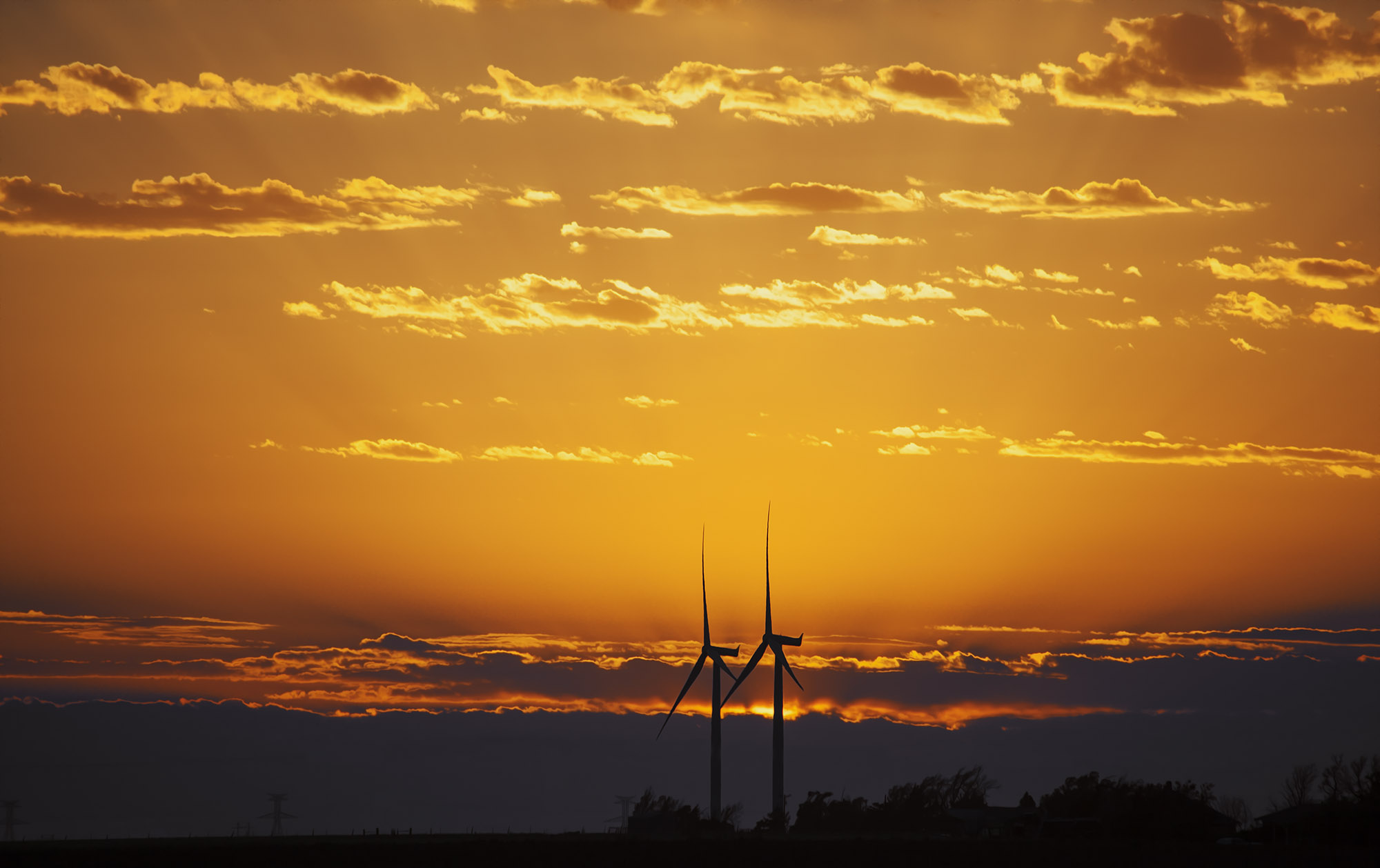
I love wind machines. Parts of the Southwest are littered with them. We see hundreds on our trips from Sedona to Dallas. You can tell when you're getting close to a big wind farm because the trees are permanently bent in one direction - the prevailing wind. In this shot, the wind was blowing strongly. It amused me that these two wind turbines were turning in nearly exact synchronization.
And now a picture of a squirrel, for no reason whatsoever.

We have one exactly like this living in our big walnut tree beside the garage. I haven't managed to get a shot of her yet, so this will have to do. This squirrel lives at Montezuma's Castle, which I hope to cover in a future post. Our squirrel is madly collecting walnuts and burying them in the most unlikely locations.
Also, just because I can, I'll show you Datura or Angel's Trumpet, a psychotropic plant that will put you into medical care if you try to get high by eating it. It's a member of the family Solanaceae, many species of which are toxic and some of which are tasty, including tomatoes, peppers, potatoes and eggplant.

I suppose it is called the Angel's Trumpet because that is what you may hear if you eat it.
While we're at it we may as well see a House Finch (a few of which I hear tweeting now through the open patio door) sitting on a still folded blossom of a Saguaro cactus.

The House Finch (Haemorhous mexicanus) is by far the most common bird around our feeder. What they lack in spectacular colors they make up for in numbers.
Finally, a bee feeding frenzy. When the Prickly Pear cacti are blooming the bees get busy.

I count three inside the blossom and one waiting impatiently to dive in.
Kankrajhor
Kankrajhor is a beautiful tourist destination of Jangalmahal Circuit in West Bengal, India. It is situated in the tropical, hilly forestlands of Jhargram district. It comprises 9000 hectares of hardwood forests. The wealth of trees includes Kusum (Ceylon oak), Shaal (Shorea robusta), Segun (Tectona grandis), Mahua (Indian Butter tree, or honey tree- Madhuca longifolia ), Piyal (almondette or calumpong nut, ) and Akashmani (Acacia auriculiformis), as named in Bengali. Its tribal villages at the edge of forests and ethnic people will make you feel a happy stay. Kankrajhor is just 22km from Ghatshila (Jharkhand) & 65 km from Jhargram town.
Beyond the fertile Gangetic plains of Bengal, Jhargram offers the most exotic undulating topography culminating in hilly ranges of Belpahari, Kankrajhor in the north to the serene and meandering Subarnarekha River in the south. Nearby famous Dolma Hills are frequented by animals from Bihar, including tigers, leopards and elephants. Bears and wild boars are frequently found in the hills in search of Mahua flower sap. The sap is a potent intoxicant in the region and is used to make country liquor, simply called Mahua. This is a regular corridor of elephants. They are very much fond of this Mohua flowers and get intoxicated...a pleasure to watch in a full moon night. Every year at this time of month elephants frequently enter into these villages and spoil the crops.
It is a favourite destination for people who love forests and tranquillity. Its exquisite forestry, ancient temples, native folk cultural and tribal dances, makes it an extremely attractive destination for tourists who love yet unspoiled nature and her people of the soil on the face of earth.
How to Reach Kankrajhor-Belpahari:
By Train: The distance from Howrah to Jhargram station is 157 Kms and the journey takes three hours by train from Howrah.
By Road: Jhargram is also very well connected by highways with other nearby cities like Medinipur, Kharagpur, Durgapur, Bankura, Purulia, and Kolkata.
Personal experience
In the first week of April, this year, we suddenly planned to go to Kankrajhor, in the district of Jhargram, West Bengal, India. We drove straight from Kolkata to Jhargram, and then another 60km drive to the heart of Kankrajhor. Our destination was a private cottage with very basic arrangements situated in a small tribal village, on the edge of the forests. This time of a year it was little bit late to enjoy the dazzling blooms of Palash, described as “Flames of the Forests” (Butea monosperma). But this was a right time to cherish the beauty of Shaal-Piyal-Mohua trees everywhere. The green new leaves, sweet intoxicating fragrance of Mohua flowers and the extreme business of the wild bees and birds, will always remind you the youthfulness of a spring. The red lateritic forest floor is an experience to walk on. While walking on its undulated trails through forests you will hear only the relentless chirping of birds and murmurs of dry leaves being moved by frequent gust of cold breezes. Such ambiance in an afternoon will surely make you intoxicated and drowsy, free of all wiriness and stresses of busy urban life, and will help you enter into a peaceful siesta. One may arrange tribal dances amidst this forest, their native home. Their beating of drums, and the indigenous harmony of dances will make you fallen in love with this place. I’m sure. With the sunset the whole surroundings suddenly turn into a mystical darkness. Far from the distance sitting in the hut you may hear the intermittent sounds of nocturnal birds, hyenas, jackals and foxes.
The dinner is very simple. Country chicken and rice is a luxury here. We had the wonderful taste of its country liquor made from Mohua flowers (Madhuca longifolia). It was a wonderful experience for all of us.
Simple and beautiful tribal people there, basic stay with optimal standard and simple healthy food, unspoiled nature, tranquillity, and serenity...all will definitely make you feel... “How much we need to be happy?” Really?
Kankrajhor
Kankrajhor is a beautiful tourist destination of Jangalmahal Circuit in West Bengal, India. It is situated in the tropical, hilly forestlands of Jhargram district. It comprises 9000 hectares of hardwood forests. The wealth of trees includes Kusum (Ceylon oak), Shaal (Shorea robusta), Segun (Tectona grandis), Mahua (Indian Butter tree, or honey tree- Madhuca longifolia ), Piyal (almondette or calumpong nut, ) and Akashmani (Acacia auriculiformis), as named in Bengali. Its tribal villages at the edge of forests and ethnic people will make you feel a happy stay. Kankrajhor is just 22km from Ghatshila (Jharkhand) & 65 km from Jhargram town.
Beyond the fertile Gangetic plains of Bengal, Jhargram offers the most exotic undulating topography culminating in hilly ranges of Belpahari, Kankrajhor in the north to the serene and meandering Subarnarekha River in the south. Nearby famous Dolma Hills are frequented by animals from Bihar, including tigers, leopards and elephants. Bears and wild boars are frequently found in the hills in search of Mahua flower sap. The sap is a potent intoxicant in the region and is used to make country liquor, simply called Mahua. This is a regular corridor of elephants. They are very much fond of this Mohua flowers and get intoxicated...a pleasure to watch in a full moon night. Every year at this time of month elephants frequently enter into these villages and spoil the crops.
It is a favourite destination for people who love forests and tranquillity. Its exquisite forestry, ancient temples, native folk cultural and tribal dances, makes it an extremely attractive destination for tourists who love yet unspoiled nature and her people of the soil on the face of earth.
How to Reach Kankrajhor-Belpahari:
By Train: The distance from Howrah to Jhargram station is 157 Kms and the journey takes three hours by train from Howrah.
By Road: Jhargram is also very well connected by highways with other nearby cities like Medinipur, Kharagpur, Durgapur, Bankura, Purulia, and Kolkata.
Personal experience
In the first week of April, this year, we suddenly planned to go to Kankrajhor, in the district of Jhargram, West Bengal, India. We drove straight from Kolkata to Jhargram, and then another 60km drive to the heart of Kankrajhor. Our destination was a private cottage with very basic arrangements situated in a small tribal village, on the edge of the forests. This time of a year it was little bit late to enjoy the dazzling blooms of Palash, described as “Flames of the Forests” (Butea monosperma). But this was a right time to cherish the beauty of Shaal-Piyal-Mohua trees everywhere. The green new leaves, sweet intoxicating fragrance of Mohua flowers and the extreme business of the wild bees and birds, will always remind you the youthfulness of a spring. The red lateritic forest floor is an experience to walk on. While walking on its undulated trails through forests you will hear only the relentless chirping of birds and murmurs of dry leaves being moved by frequent gust of cold breezes. Such ambiance in an afternoon will surely make you intoxicated and drowsy, free of all wiriness and stresses of busy urban life, and will help you enter into a peaceful siesta. One may arrange tribal dances amidst this forest, their native home. Their beating of drums, and the indigenous harmony of dances will make you fallen in love with this place. I’m sure. With the sunset the whole surroundings suddenly turn into a mystical darkness. Far from the distance sitting in the hut you may hear the intermittent sounds of nocturnal birds, hyenas, jackals and foxes.
The dinner is very simple. Country chicken and rice is a luxury here. We had the wonderful taste of its country liquor made from Mohua flowers (Madhuca longifolia). It was a wonderful experience for all of us.
Simple and beautiful tribal people there, basic stay with optimal standard and simple healthy food, unspoiled nature, tranquillity, and serenity...all will definitely make you feel... “How much we need to be happy?” Really?
Mahua-"The tree of life of tribal India":
The trees produce pale yellow fleshy flowers in the month of March-April. The sap of Mahua flowers is a potent intoxicant in the region and is used to make famous country liquor, simply called Mahua, or Mahua wine. The refined liquor looks crystal clear having moderate concentration of alcohol and having a sweet intoxicating fragrance. Flowers naturally drop from the trees and settle on the forest floors. The local people collect and subsequently process for beverages. In the pick season forest animals, especially elephants invade the forests and tribal villages in search of flowers and country liquor. This is the season the village men remains alert lest their crops are not destroyed by elephants and wild boars.
Mahua tree has immense medicinal values, and Ayurveda has declared it as the wonder gift of nature for treating many ailments, especially flu and epilepsy. It is an excellent fodder for cattle.
[ www.myupchar.com/en/herbs/benefits-of-mahua ]
Baroghutu- A tribal hamlet at Mukutmanipur, Bankura district, India.
Mukutmanipur's undulating forested landscape marked by the vibrant colors of spring is refreshing and invigorating for body and mind. It is marked by the prominent hillock about 200 metres high, locally named "Baroghutu" (Baro- twelve, ghutu-/stones/hill). The tribal (mostly santals) hamlets of Baroghutu, Jambeda, Kumorbahal, Dhagora and Mukutmanipur encircle this hillock. With a landscape that seems naturally designed for adventure, Mukutmanipur offers opportunities in rock climbing, trekking and a variety of water sports.
Kankrajhor
Kankrajhor is a beautiful tourist destination of Jangalmahal Circuit in West Bengal, India. It is situated in the tropical, hilly forestlands of Jhargram district. It comprises 9000 hectares of hardwood forests. The wealth of trees includes Kusum (Ceylon oak), Shaal (Shorea robusta), Segun (Tectona grandis), Mahua (Indian Butter tree, or honey tree- Madhuca longifolia ), Piyal (almondette or calumpong nut, ) and Akashmani (Acacia auriculiformis), as named in Bengali. Its tribal villages at the edge of forests and ethnic people will make you feel a happy stay. Kankrajhor is just 22km from Ghatshila (Jharkhand) & 65 km from Jhargram town.
Beyond the fertile Gangetic plains of Bengal, Jhargram offers the most exotic undulating topography culminating in hilly ranges of Belpahari, Kankrajhor in the north to the serene and meandering Subarnarekha River in the south. Nearby famous Dolma Hills are frequented by animals from Bihar, including tigers, leopards and elephants. Bears and wild boars are frequently found in the hills in search of Mahua flower sap. The sap is a potent intoxicant in the region and is used to make country liquor, simply called Mahua. This is a regular corridor of elephants. They are very much fond of this Mohua flowers and get intoxicated...a pleasure to watch in a full moon night. Every year at this time of month elephants frequently enter into these villages and spoil the crops.
It is a favourite destination for people who love forests and tranquillity. Its exquisite forestry, ancient temples, native folk cultural and tribal dances, makes it an extremely attractive destination for tourists who love yet unspoiled nature and her people of the soil on the face of earth.
How to Reach Kankrajhor-Belpahari:
By Train: The distance from Howrah to Jhargram station is 157 Kms and the journey takes three hours by train from Howrah.
By Road: Jhargram is also very well connected by highways with other nearby cities like Medinipur, Kharagpur, Durgapur, Bankura, Purulia, and Kolkata.
Personal experience
In the first week of April, this year, we suddenly planned to go to Kankrajhor, in the district of Jhargram, West Bengal, India. We drove straight from Kolkata to Jhargram, and then another 60km drive to the heart of Kankrajhor. Our destination was a private cottage with very basic arrangements situated in a small tribal village, on the edge of the forests. This time of a year it was little bit late to enjoy the dazzling blooms of Palash, described as “Flames of the Forests” (Butea monosperma). But this was a right time to cherish the beauty of Shaal-Piyal-Mohua trees everywhere. The green new leaves, sweet intoxicating fragrance of Mohua flowers and the extreme business of the wild bees and birds, will always remind you the youthfulness of a spring. The red lateritic forest floor is an experience to walk on. While walking on its undulated trails through forests you will hear only the relentless chirping of birds and murmurs of dry leaves being moved by frequent gust of cold breezes. Such ambiance in an afternoon will surely make you intoxicated and drowsy, free of all wiriness and stresses of busy urban life, and will help you enter into a peaceful siesta. One may arrange tribal dances amidst this forest, their native home. Their beating of drums, and the indigenous harmony of dances will make you fallen in love with this place. I’m sure. With the sunset the whole surroundings suddenly turn into a mystical darkness. Far from the distance sitting in the hut you may hear the intermittent sounds of nocturnal birds, hyenas, jackals and foxes.
The dinner is very simple. Country chicken and rice is a luxury here. We had the wonderful taste of its country liquor made from Mohua flowers (Madhuca longifolia). It was a wonderful experience for all of us.
Simple and beautiful tribal people there, basic stay with optimal standard and simple healthy food, unspoiled nature, tranquillity, and serenity...all will definitely make you feel... “How much we need to be happy?” Really?
Southport County Borough Police
1870 – 1969
In the middle of the 19th century Southport was a small fishing town which was gaining popularity as a holiday resort. It had already caught the attention of many wealthy businessmen in Manchester and industrial east Lancashire as an attractive site for an out of town residence and place of subsequent retirement.
In March 1867, after much debate locally and in Parliament, Southport was granted a charter of incorporation. However, that did not include Birkdale. On 1st June the first Town Council was elected.
The Borough at that time consisted of Blowick in the east, Hesketh Park to the north and Little Ireland, a collection of hovels and primitive dwellings in an area of what is now Hesketh Golf Course. This together with the district of Sussex Road/St. Luke’s Station, known as Little London, is inextricably woven into any history of law enforcement in Southport.
At the time of its incorporation the administration of the law was in the hands of the Lancashire Constabulary, adorned in their unique rifle green uniforms. Firm experienced hands they were indeed. Superintendent Richard Jervis had his office at Ormskirk and was in charge of the division which included Southport.
The next step taken to establish an independent identity for the town of Southport came, as might be expected, in the decision to form a Borough Police Force. The population at that time was between eighteen and nineteen thousand and this was increasing at a fast rate.
The Watch and Public Halls Committee resolved that the town should have its own Force consisting of seven officers including a Superintendent or Head Constable, the total cost being estimated at £552. 12s for the first year. In addition, the Force would be augmented by certain Corporation officials who were to be sworn in as special constables, volunteers of course.
On 23rd March 1870 the Watch Committee appointed Mr Samuel Kershaw to be Superintendent of Police at a salary of £100 per annum with house, coals, gas and clothing provided. At the time of his appointment he was 29 years of age and was the Chief Constable of Glossop.
On 6th April 1870 the Committee submitted a revised estimate for the cost of administering the Force for the year of £700, which was approved. Thus at midnight on 1st May 1870, Superintendent Kershaw (he was not yet designated Head Constable), Sergeant Bothwell and their five Constables took over the Central Police Office at the Town Hall. Their accommodation was described as old, dirty and totally unsuitable for the purpose for which it was being utilised. It comprised rooms at the Lord Street end of Cambridge Arcade. Part was actually beneath the steps leading to the Town Hall. These premises, extended slightly and re-arranged, were to serve as the Central Police Office for the next sixty-eight years.
During the first two months some sixty persons had been arrested for a variety of offences. Bearing in mind that the Force still only comprised five Constables it can be easily understood that the new Force rapidly became respected by the wrongdoer of that time.
Within four years the Force had expanded to eighteen officers and during the year ended September 1874 they made 299 arrests which was 64 more than the preceding year. The embryonic CID was formed in 1874 with the appointment of Sergeant Barrett as Detective Sergeant. Early the following year a further first step was taken with the appointment of Dr Lucas as Police Surgeon.
In August 1875 the areas of Churchtown, Crossens, and Marshside were added to the Borough and in consequence the establishment was increased by a Sergeant and four Constables bringing the strength to twenty five men. By this time Mr Kershaw had been re-designated Head Constable.
The year 1880 added another important responsibility to the town’s administration and marked the severance of another link with the County authorities. In April the Commission of the Peace was received for the Borough of Southport. The town was now in a position to maintain an independent bench of Magistrates and the opportunity was seized with alacrity. Within a few months a Clerk had been selected and the Southport Borough Police Court was constituted.
Step by step modernisation was taking place. In April 1884 the town was doubtless proud and relieved to hear that the “police office and fire brigade station at Southport was now connected with the telephone exchange, telephone number 69, and information of fires, accidents and other matters requiring the attention of the police can now be forwarded direct to the office by any subscriber to the telephone exchange”.
Since his appointment Mr Kershaw had the additional responsibility of being in charge of the town’s volunteer fire brigade. In 1866 it became obvious that for a variety of reasons, the continuance of the voluntary nature of the fire brigade was no longer sustainable and as a result the brigade was henceforth staffed by police officers, who when not required for fire duties would be available for general police work. The plan was the basis for the first full time professional fire brigade in Southport. The system was very efficient and continued until the Second World War when the fire brigades of the UK were formed into one national service. After the war the local brigade was re-formed as the Southport Borough Fire Brigade with its own supervision and administration separate from the police.
By the end of 1888 the force had increased to 44 men but it was remarked that there were only 14 men on patrol at night to maintain the security of 46 miles of streets and safeguard a population of nearly 40,000.
On 18th May 1896, William Elliott a Superintendent in the Nottingham City Police was appointed to succeed James Kershaw as Chief Constable following the latter’s retirement after 26 years in post. Mr Elliott took over a police force with an establishment of 58 men and also the Borough fire brigade consisting of an Inspector, Sergeant and 5 Constables.
By 1905, the population of the town stood at 50,000. In the same year the use of fingerprints was introduced as a method of identifying offenders. In the same year, Southport achieved County Borough status.
In May 1906 William Elliot gave intimation to the Watch Committee of his intention to retire on pension having completed 26 years combined service with the Nottingham and Southport Police. As a result, on the 1st April 1907, Captain Charles Leathley Armitage, a retired army officer with no previous police experience was appointed Chief Constable. Shortly after appointment he persuaded local fire insurance companies to pay certain fire brigade expences when the dealt with incidents on their insured property.
1909 saw the purchase of a police horse ambulance. This was the start of a police provided ambulance service for the town which continued until 1948 when it was taken over by the newly formed (Corporation controlled) Southport Fire Brigade. During its first year of service it attended 68 street accidents. In the same year a mounted section was created consisting of three Constables and horses.
In March 1911, the Watch Committee purchased a Dennis motor fire engine. This proved its worth and less than two years later the Committee invested in a further motor appliance from Leyland motors at a cost of £1,075.
January 1912 saw the first formalised police training for recruits when it was decided to send them for instruction with the Liverpool City Police. Prior to this recruits had been given “on the job” training and very little else apart from some guidance in respect of first aid to the injured.
On 1st April 1912, Birkdale was absorbed into the Borough with the County Police Station there being taken over by the Borough Police. Eight Lancashire Constables who were serving there elected to transfer to the Borough Force. The population of the town now stood at over 71,000 and the established strength of the enlarged force had risen to 94. A short time later this increased to 103 following the introduction of the Police (Rest Day) Act.
Since formation, successive Inspectors of Constabulary had been critical of police accommodation at Southport. 1914 saw the Government warning the Watch Committee that unless office and cell accommodation was improved the exchequer grant would be withheld. However, the declaration of war saw the Committee spared and the matter was put aside as more pressing matters were addressed. In August, Captain Armitage was recalled to the colours as a reservist. He was not to eventually return to the force as Chief Constable. In January 1919, the now Major Armitage submitted his resignation to the Watch Committee. He retired in May of that year but without superannuation as he had not completed the minimum period of service required to obtain a pension.
Throughout the war (1914-1919) Chief Inspector James Wareing acted as Chief Constable. Upon the declaration of war the police began the registration of aliens and the mobilisation of reserve Constables. Within the first six months 12 members of the force enlisted for active military service. In September the military authorities posted to the town for training some 14,000 officers and men, together with 3,000 horses. Predictably it was the police who had to find billets for the men in private houses and hotels. This situation prevailed for the greater part of the war but later the training of men decreased and was replaced by a requirement to house large numbers of wounded soldiers.
In October 1914, 70 Special Constables were sworn-in and by February 1916 the number had risen to 160. July 1916 saw the total number of Southport Police serving their Country in the armed forces was 40. In the latter part of 1918, the acting Chief Constable James Wareing gave notice of his intention to retire after having filled the post for four years. The end of the Great War came at some cost to the Borough Police with five men losing their lives whilst on active service.
In May 1919, Lieut. Col. Frank Brooke, DSO., MC. Was appointed Chief Constable. He had recently left the army having served with great distinction and bravery. Prior to his army service he had spent nine years in HM Customs & Excise. Although his stay in Southport was brief, he was remembered with pride. In June 1920 he left the town on appointment as Chief Constable of Nottingham, followed by Chief Constable of the West Riding of Yorkshire and finally being appointed one of HM Inspectors of Constabulary. Some years later he was Knighted.
Major Michael Joseph Egan was appointed Chief Constable in August 1920. At the time of his appointment he was a District Inspector in the Royal Irish Constabulary.
In September 1920 a motor cycle was purchased for traffic supervision. In July 1927 two, motor cycle combinations were taken into used for the same purpose. December 1930 saw the Committee investing in two motor cars, a Morris Oxford saloon and a Wolseley Hornet two-seater sports car. These were specifically intended for use in enforcing the Road Traffic Act 1930. It was not until 1936 that a separate traffic department was formed with a Sergeant and 4 constables. The previous year two further cars were bought at a total cost of £430.
Early in 1933 the mounted section was disbanded as a cost saving measure. In October the same year the Watch Committee was still “making do” with inadequate and inefficient quarters for both the police and fire brigade and only after the prolonged period of national economy had saved them from renewed criticism by the Inspectors of Constabulary. That said, some £6,000 was spent modernising the fire station in Tulketh Street and in buying new equipment including a new turntable ladder.
In August 1935, responsibility for the weights and measures department was passed to the Medical Officer of Health. At the start of the year Major Egan was awarded the OBE for services to policing. January 1936 saw the Deputy Chief Constable, Superintendent Tom Clark awarded the King’s Police Medal.
As the decade moved towards its end the dark clouds of war were again gathering and the authorities in Southport and elsewhere began to make preparations. The Auxiliary Fire Service was formed with initially 78 members’ later rising to 98 and the Watch Committee bought a new motor fire appliance to replace the aging 1913 Dennis machine at a cost of £1,600. September 1937 saw the reorganisation of the Special Constabulary with the introduction of a rank structure and the appointment of a Commandant, 9 Inspectors, and 36 Sergeants. By the end of 1938 the total strength was 208.
Sometime earlier, approval had been given for the construction of a new Borough Police Headquarters, fire station and Magistrates Court on a large site at the junction of Manchester Road and Albert Road and the approved designs were unveiled on 19th May 1936. The cost initially being estimated to be £79,778 but this was later to rise to £116,007. Work started on the new building in 1938.
On 3rd September 1939, for the second time in living memory war with Germany was declared. Various police reserves were immediately mobilised and the Chief Constable had a total of 519 men available. There were made up of recalled police pensioners, first police reserve and 331 members of the Special Constabulary.
On 30th June 1940 the new police headquarters was ready for occupation. Whilst orders had been placed for new furniture, this had yet to arrive. There was a fear that the building may be requisitioned for housing some government department and because of this the move was quickly completed on a Sunday morning with fire brigade and police vehicles being driven along Lord Street loaded with tables and chairs. This was only surpassed by members of the CID man handling a heavily loaded handcart along the main thoroughfare to take possession of the new accommodation before some else beat them to it. On Monday 1st July, the fire brigade moved from their Tulketh Street base into their new Manchester Road station which formed part of the new police headquarters complex. A resolution from the Watch Committee some ten days earlier had separated the fire brigade from the police and from that time it was to develop along its own lines as a separate entity.
Southport’s experience of bombing by enemy aircraft was very limited compared with the rest of Merseyside. That said, the town did not escape and there were many deaths and great damage to property. In April 1941, a system of police radio was installed which enabled cars to be directed to the scene of incidents. At that time the system was “transmit” only and it was not possible for patrols to reply.
June 1942 saw the Watch Committee approving the recruitment of women for clerical work so as to release police officers for street duty. Essentially, this was the formation of the Women’s Auxiliary Police Corps the establishment of which was fixed at eight.
On 31st August 1942, Major Egan, the Chief Constable was appointed one of HM Inspectors of Constabulary and as a result he left the Borough after completing 22 years’ service as Chief Constable. His replacement was the then Chief Constable of Royal Leamington Spa, Mr Charles Martin.
A reserve column of Southport Police officers made repeated visits to Liverpool and other parts of Merseyside at the height of the air attacks to assist and relieve the hard pressed officers’ local officers. Local conditions were fairly quiet owing to the early closing of public houses which had sold out of intoxicants and a 9 pm curfew of public transport. There were no buses at all on Sundays and this situation was to remain for some time.
By the end of 1942 the regular police strength was 69, compared with the authorised establishment of 115. The various reserves added 102 full-time and 304 part time to this figure. The Special Constabulary were averaging 39 officers on duty each day. Most of these men worked 8pm to 1am, often having already completed their own full day of work.
With the cessation of hostilities preparations were put in hand for the re-establishment of the police service and particular attention was to be paid to training with the establishment of Home Officer controlled centres in various parts of England and Wales where centralised recruit training would take place. The one local to Southport was at No: 1 District Police Training Centre, Bruche, Warrington. The Southport force provided two of the initial fifteen Instructors and since then an almost unbroken succession of Southport officers has been attached to the centre as Instructors and at different times Southport officers have been appointed to the posts of Chief Instructor, Deputy Commandant and Commandant.
In July 1946, before any great changes could be made, Mr Martin, the Chief Constable was appointed 1st Assistant Chief Constable of Liverpool. He subsequently became Chief Constable of Liverpool and after retirement was appointed HM Inspector of Constabulary for the North West. He was made a Knight Bachelor in 1957.
In September 1946, Lieutenant Colonel Harold Mighall, the Superintendent and Deputy Chief Constable was appointed Chief Constable in Mr Martin’s stead. Lt. Col. Mighall is the only Southport Chief Constable to have joined the force as a recruit having been appointed in 1925 at the age of 24 years. During the Second World War he spent a period of time attached to the Control Commission and was greatly involved in the reconstruction of the Italian Police Forces after the liberation of that country. At this time the establishment was increased to 154 and included the creation of a Chief Inspector (Uniform) and a Policewoman Sergeant.
On 7th February 1953 the new police station at Ainsdale was opened by the Home Secretary, Sir David Maxwell Fyffe, QC. M.P. To the side of the new station four flats were built for police officers and their families.
In November 1960, Lt. Col. Mighall announced his intention to retire. His replacement as Chief Constable was Mr Joseph Pessel, the Deputy Chief Constable of Exeter. Mr Pessel commenced his new duties on 16th January 1961. In March 1962, the four 500cc triumph motor cycles which had been in service since mid-1960 were replaced by five B.S.A. 250cc machines which were much lighter and more manageable for patrol work.
In October 1961, approval was given for the construction of sectional police boxes to be built at Preston New Road, Bedford Park, and Devonshire Road. However, a subsequent review of that decision by the Watch Committee saw only one such building constructed at Preston New Road at a cost of £2,900. The building was opened by the Chairman of the Watch Committee on 6th May 1964...
In February 1964, Mr Pessel was appointed Chief Constable of the newly formed Luton County Borough Police. James George Charles Longhurst became the last Chief Constable of Southport when he was appointed on 6th June 1964. He had previously been the Deputy Chief Constable of Hastings, another seaside town.
Mr Longhurst reorganised several aspects of force administration, creating a separate Prosecutions Department and separating the uniform and CID administration. A streamlined process system was introduced in co-operation with the Clerk to the Justices. This resulted in a much reduced paperwork regime. The Watch Committee was also persuaded by him to recruit several additional civilian clerks resulting in the further release of police officers for operational duty.
In October 1967, a new garage was completed at the headquarters complex which resulted in some saving in that it was no longer necessary for vehicles to be ferried back and forth between the old Tulketh Street garage and headquarters. August 1968 saw the introduction of the unit beat police system of policing the Borough. This emulated a system pioneered by the Lancashire Constabulary and involved the use of “panda” car vehicles. The town was divided into areas and each one has a posted “area beat constable” who performs foot and mobile patrol linked to headquarters by means of personal radio. The scheme was not entirely new in Southport as a similar system, albeit using cycles had existed many years previously, which communication being maintained by means of the police telephone boxes.
In September 1968, “Pye” pocket phone radio sets were issued to all uniformed operational patrols and these revolutionised the ability of the police to respond quickly to incidents, not only in Southport but nationally.
The start of this history referred to the change from County Constabulary to Borough Police in 1870 and now 99 years later, at midnight on 31st March 1969, the Southport County Borough Police is to become, together with other Borough Police Forces, part of an enlarged Lancashire Constabulary. The amalgamation is not a voluntary one and Southport did not consent to surrender its independent police force to oblivion without a fight. In December 1967, D.P. Croom-Johnson, Esq., Q.C., published his report on the public enquiry held in connection with the proposed amalgamation. He said, “………….Southport is a very well qualified Force, one in three of the Constables being qualified for promotion to Sergeant”. In his conclusion he said, “……..if there were ever small County Borough Forces which deserved to survive Blackpool and Southport would make two of them, but the benefit from amalgamation both to them and in the area as a whole outweighs this consideration….If it were possible to correct the over-large size of the proposed Force by leaving out Southport and Blackpool I would recommend it. But this is not so.”
The Force takes with it a record of service which justifies the pride of its members, past and present, and it is believed that of the citizens it served. So, at midnight on 31st March 1969, the Southport County Borough Police passed into history.
Dave Wilkinson, Sergeant,
Merseyside Police, Rtd.
liverpoolcitypolice.co.uk/southport-borough-police/456433...
This bar is named after a jaunty old folk tune that celebrates the joys of alcoholism.
'Tis you who makes my friends my foes,
'Tis you who makes me wear old clothes;
Here you are, so near my nose,
So tip her up, and down she goes.
Ha ha ha, you and me,
Little brown jug don't I love thee.
Ha ha ha, you and me,
Little brown jug don't I love thee.
In 1948, Famous Studios released a mildly disturbing Screen Song animated short called "Little Brown Jug" in which an array of animals, many of whom are babies, get plastered by drinking from a cider-filled river — or by being born to, or suckled by, a drunken mother. The boys and girls watching the cartoon are invited to sing along to a version of "Little Brown Jug" with new, though similarly themed, lyrics.
Fellows caught in swinging doors,
Faces on the bar room floors.
Old men full of pep and zing,
And it all comes from just one thing.
Ha ha ha, hee hee hee,
Little brown jug how I love thee.
Fiddle dum and fiddle dee,
Little brown jug oh you're for me.
The song concludes with the titular little brown jug and a quartet of hallucinatory pink elephants performing the final line of the chorus together.
You can watch the film here. It's best enjoyed with a bowl of buttery popcorn and a jug of your favorite intoxicant.
Always check whats on your card before formatting, you never know what kind of weird shots may be lurking there. Here's a perfect example.... I'm not sure what creative direction I thought I was heading with this one. A solid crystal frog peeking through the bottom of a crystal dish turned on it's side with psychedelic rainbowish reflections (and I managed it without the influence of drugs, alcohol, or any intoxicants of any kind).
I mean think about it... had I just wiped the card without double checking first the world would have missed out on.... well, this.... who knows what kind of chain reaction that could have triggered. I may have single-handedly thwarted doomsday you realize! Hey it could happen...
Kankrajhor
Kankrajhor is a beautiful tourist destination of Jangalmahal Circuit in West Bengal, India. It is situated in the tropical, hilly forestlands of Jhargram district. It comprises 9000 hectares of hardwood forests. The wealth of trees includes Kusum (Ceylon oak), Shaal (Shorea robusta), Segun (Tectona grandis), Mahua (Indian Butter tree, or honey tree- Madhuca longifolia ), Piyal (almondette or calumpong nut, ) and Akashmani (Acacia auriculiformis), as named in Bengali. Its tribal villages at the edge of forests and ethnic people will make you feel a happy stay. Kankrajhor is just 22km from Ghatshila (Jharkhand) & 65 km from Jhargram town.
Beyond the fertile Gangetic plains of Bengal, Jhargram offers the most exotic undulating topography culminating in hilly ranges of Belpahari, Kankrajhor in the north to the serene and meandering Subarnarekha River in the south. Nearby famous Dolma Hills are frequented by animals from Bihar, including tigers, leopards and elephants. Bears and wild boars are frequently found in the hills in search of Mahua flower sap. The sap is a potent intoxicant in the region and is used to make country liquor, simply called Mahua. This is a regular corridor of elephants. They are very much fond of this Mohua flowers and get intoxicated...a pleasure to watch in a full moon night. Every year at this time of month elephants frequently enter into these villages and spoil the crops.
It is a favourite destination for people who love forests and tranquillity. Its exquisite forestry, ancient temples, native folk cultural and tribal dances, makes it an extremely attractive destination for tourists who love yet unspoiled nature and her people of the soil on the face of earth.
How to Reach Kankrajhor-Belpahari:
By Train: The distance from Howrah to Jhargram station is 157 Kms and the journey takes three hours by train from Howrah.
By Road: Jhargram is also very well connected by highways with other nearby cities like Medinipur, Kharagpur, Durgapur, Bankura, Purulia, and Kolkata.
Personal experience
In the first week of April, this year, we suddenly planned to go to Kankrajhor, in the district of Jhargram, West Bengal, India. We drove straight from Kolkata to Jhargram, and then another 60km drive to the heart of Kankrajhor. Our destination was a private cottage with very basic arrangements situated in a small tribal village, on the edge of the forests. This time of a year it was little bit late to enjoy the dazzling blooms of Palash, described as “Flames of the Forests” (Butea monosperma). But this was a right time to cherish the beauty of Shaal-Piyal-Mohua trees everywhere. The green new leaves, sweet intoxicating fragrance of Mohua flowers and the extreme business of the wild bees and birds, will always remind you the youthfulness of a spring. The red lateritic forest floor is an experience to walk on. While walking on its undulated trails through forests you will hear only the relentless chirping of birds and murmurs of dry leaves being moved by frequent gust of cold breezes. Such ambiance in an afternoon will surely make you intoxicated and drowsy, free of all wiriness and stresses of busy urban life, and will help you enter into a peaceful siesta. One may arrange tribal dances amidst this forest, their native home. Their beating of drums, and the indigenous harmony of dances will make you fallen in love with this place. I’m sure. With the sunset the whole surroundings suddenly turn into a mystical darkness. Far from the distance sitting in the hut you may hear the intermittent sounds of nocturnal birds, hyenas, jackals and foxes.
The dinner is very simple. Country chicken and rice is a luxury here. We had the wonderful taste of its country liquor made from Mohua flowers (Madhuca longifolia). It was a wonderful experience for all of us.
Simple and beautiful tribal people there, basic stay with optimal standard and simple healthy food, unspoiled nature, tranquillity, and serenity...all will definitely make you feel... “How much we need to be happy?” Really?
Hydrangea Colors Are Determined By The Acidity Of The Soil
Hydrangea flower color changes based on the pH in soil. As the graph depicts, soil with a pH of 5.5 or lower will produce blue flowers, a pH of 6.5 or higher will produce pink hydrangeas, and soil in between 5.5 and 6.5 will have purple hydrangeas.
Hydrangea flower color can change based on the pH in soil. As the graph depicts, soil with a pH of 5.5 or lower will produce blue flowers, a pH of 6.5 or higher will produce pink hydrangeas, and soil in between 5.5 and 6.5 will have purple hydrangeas.
The flowers on a hydrangea shrub can change from blue to pink or from pink to blue from one season to the next depending on the acidity level of the soil.[33] Adding organic materials such as coffee grounds and citrus peel will increase acidity and turn hydrangea flowers blue.[34]
White hydrangeas cannot be color-manipulated by soil pH because they do not produce pigment for color. In other words, while the hue of the inflorescence is variable dependent upon cultural factors, the color saturation is genetically predetermined.
In most species, the flowers are white. In some, however, (notably H. macrophylla), they can be blue, red, or purple, with color saturation levels ranging from the palest of pinks, lavenders & powder blues, to deep, rich purples, reds, and royal blues. In these species, floral color change occurs due to the availability of aluminium ions, a variable which itself depends upon the soil pH.[16][17] For H. macrophylla and H. serrata cultivars, the flower color can be determined by the relative acidity of the soil: an acidic soil (pH below 7), will have available aluminium ions and typically produce flowers that are blue to purple,[18] whereas an alkaline soil (pH above 7) will tie up aluminium ions and result in pink or red flowers. This is caused by a color change of the flower pigments in the presence of aluminium ions which can be taken up into hyperaccumulating plants.[19]
Hydrangeas are A a genus of flowering plants.
Several terms redirect here. For other uses, see Hydrangea (disambiguation) and Hortensia (disambiguation).
Hydrangea (/haɪˈdreɪndʒə/[3][4] or /haɪˈdreɪndʒiə/[5]) is a genus of more than 70 species of flowering plants native to Asia and the Americas. Hydrangea is also used as the common name for the genus; some (particularly H. macrophylla) are also often called hortensia.[6] The genus was first described from Virginia in North America,[7] but by far the greatest species diversity is in eastern Asia, notably China, Korea, and Japan. Most are shrubs 1–3 m (3 ft 3 in – 9 ft 10 in) tall, but some are small trees, and others lianas reaching up to 30 m (100 ft) by climbing up trees. They can be either deciduous or evergreen, though the widely cultivated temperate species are all deciduous.[8]
Quick Facts Scientific classification, Type species ...
The flowers of many hydrangeas act as natural pH indicators, producing blue flowers when the soil is acidic and pink ones when the soil is alkaline.[9]
Etymology
Hydrangea is derived from Greek and means 'water vessel' (from ὕδωρ húdōr "water" + ἄγγος ángos or ἀγγεῖον angeîon "vessel"),[10][11][12] in reference to the shape of its seed capsules.[13] The earlier name, Hortensia, is a Latinised version of the French given name Hortense, honoring the French astronomer and mathematician Nicole-Reine Hortense Lepaute.[14] Philibert Commerson attempted to name the flower Lepautia or Peautia after Lepaute. However, the flower's accepted name later became Hortensia. This led to people believing Lepaute's name was Hortense, but the Larousse remarks that this is erroneous, and that the name probably came from hortus, garden.[15]
Life cycle
Hydrangea flowers are produced from early spring to late autumn; they grow in flowerheads (corymbs or panicles) most often at the ends of the stems. Typically the flowerheads contain two types of flowers: small non-showy fertile flowers in the center or interior of the flowerhead, and large, sterile showy flowers with large colorful sepals (tepals). These showy flowers are often extended in a ring, or to the exterior of the small flowers. Plants in wild populations typically have few to none of the showy flowers, while cultivated hydrangeas have been bred and selected to have more of the larger type flowers.
There are two flower arrangements in hydrangeas with corymb style inflorescences, which includes the commonly grown "bigleaf hydrangea"—Hydrangea macrophylla. Mophead flowers are large round flowerheads resembling pom-poms or, as the name implies, the head of a mop. In contrast, lacecap flowers bear round, flat flowerheads with a center core of subdued, small flowers surrounded by outer rings of larger flowers having showy sepals or tepals. The flowers of some rhododendrons and viburnums can appear, at first glance, similar to those of some hydrangeas.
Colors and soil acidity
Hydrangea flower color changes based on the pH in soil. As the graph depicts, soil with a pH of 5.5 or lower will produce blue flowers, a pH of 6.5 or higher will produce pink hydrangeas, and soil in between 5.5 and 6.5 will have purple hydrangeas.
Hydrangea flower color can change based on the pH in soil. As the graph depicts, soil with a pH of 5.5 or lower will produce blue flowers, a pH of 6.5 or higher will produce pink hydrangeas, and soil in between 5.5 and 6.5 will have purple hydrangeas.
The flowers on a hydrangea shrub can change from blue to pink or from pink to blue from one season to the next depending on the acidity level of the soil.[33] Adding organic materials such as coffee grounds and citrus peel will increase acidity and turn hydrangea flowers blue.[34]
White hydrangeas cannot be color-manipulated by soil pH because they do not produce pigment for color. In other words, while the hue of the inflorescence is variable dependent upon cultural factors, the color saturation is genetically predetermined.
In most species, the flowers are white. In some, however, (notably H. macrophylla), they can be blue, red, or purple, with color saturation levels ranging from the palest of pinks, lavenders & powder blues, to deep, rich purples, reds, and royal blues. In these species, floral color change occurs due to the availability of aluminium ions, a variable which itself depends upon the soil pH.[16][17] For H. macrophylla and H. serrata cultivars, the flower color can be determined by the relative acidity of the soil: an acidic soil (pH below 7), will have available aluminium ions and typically produce flowers that are blue to purple,[18] whereas an alkaline soil (pH above 7) will tie up aluminium ions and result in pink or red flowers. This is caused by a color change of the flower pigments in the presence of aluminium ions which can be taken up into hyperaccumulating plants.[19]
Species
Hydrangea paniculata
97 species are accepted.[20]
Hydrangea acuminata Siebold & Zucc.
Hydrangea albostellata Samain, Najarro & E.Martínez
Hydrangea alternifolia Siebold
Hydrangea × amagiana Makino
Hydrangea amamiohsimensis (Koidz.) Y.De Smet & Granados
Hydrangea ampla (Chun) Y.De Smet & Granados
Hydrangea anomala D.Don – (climbing hydrangea) Himalaya, southwest China
Hydrangea arborescens L. – (smooth hydrangea) eastern North America
Hydrangea arguta (Gaudich.) Y.De Smet & Granados
Hydrangea aspera Buch.-Ham. ex D.Don – China, Himalaya
Hydrangea asterolasia Diels
Hydrangea barbara (L.) Bernd Schulz
Hydrangea bifida (Maxim.) Y.De Smet & Granados
Hydrangea breedlovei Samain, Najarro & E.Martínez
Hydrangea bretschneideri Dippel – China
Hydrangea caerulea (Stapf) Y.De Smet & Granados
Hydrangea carroniae Samain & E.Martínez
Hydrangea chungii Rehder – China
Hydrangea cinerea Small – (ashy hydrangea) eastern United States
Hydrangea coenobialis Chun – China
Hydrangea corylifolia (Chun) Y.De Smet & Granados
Hydrangea crassa (Hand.-Mazz.) Y.De Smet & Granados
Hydrangea daimingshanensis (Y.C.Wu) Y.De Smet & Granados
Hydrangea davidii Franch. – China
Hydrangea densifolia (C.F.Wei) Y.De Smet & Granados
Hydrangea diplostemona (Donn.Sm.) Standl.
Hydrangea fauriei (Hayata) Y.De Smet & Granados
Hydrangea febrifuga (Lour.) Y.De Smet & Granados (syn. Dichroa febrifuga) – central & southern China to Malesia and New Guinea
Hydrangea glaucescens (Rehder) Y.De Smet & Granados – China, Myanmar and Vietnam
Hydrangea gracilis W.T.Wang & M.X.Nie – China
Hydrangea heteromalla D.Don – Himalaya, west and north China
Hydrangea hirsuta (Gagnep.) Y.De Smet & Granados
Hydrangea hirta (Thunb.) Siebold – Japan
Hydrangea hwangii J.M.H.Shaw
Hydrangea hydrangeoides (Siebold & Zucc.) Bernd Schulz – Ulleungdo, Japan, Kurils
Hydrangea hypoglauca Rehder – China
Hydrangea integrifolia Hayata – China
Hydrangea involucrata Siebold – Japan, Taiwan
Hydrangea jelskii Szyszył. – Andes
Hydrangea kawagoeana Koidz.
Hydrangea kwangsiensis Hu – China
Hydrangea kwangtungensis Merr. – China
Hydrangea lalashanensis S.S.Ying
Hydrangea lingii G.Hoo – China
Hydrangea linkweiensis Chun – China
Hydrangea liukiuensis Nakai
Hydrangea lobbii Maxim.
Hydrangea longifolia Hayata – China
Hydrangea longipes Franch. – western China
Hydrangea luteovenosa Koidz.
Hydrangea macrocarpa Hand.-Mazz. – China
Hydrangea macrophylla (Thunb.) Ser. – (bigleaf hydrangea) southeast Japan, southern China
Hydrangea mangshanensis C.F.Wei – China
Hydrangea marunoi Tagane & S.Fujii
Hydrangea mathewsii Briq.
Hydrangea megalocarpa (Chun) J.M.H.Shaw
Hydrangea minamitanii (H.Ohba) Yahara
Hydrangea × mizushimarum H.Ohba
Hydrangea moellendorffii Hance
Hydrangea mollissima (Merr.) Y.De Smet & Granados
Hydrangea nahaensis Samain & E.Martínez
Hydrangea nebulicola Nevling & Gómez Pompa
Hydrangea obtusifolia (Hu) Y.De Smet & Granados
Hydrangea ofeliae Sodusta & Lumawag
Hydrangea otontepecensis Samain & E.Martínez
Hydrangea paniculata Siebold – (panicled hydrangea) eastern China, Japan, Korea, Sakhalin
Hydrangea peruviana Moric. ex Ser. – Costa Rica and Panama, Andes
Hydrangea petiolaris Siebold & Zucc. – (climbing hydrangea) Japan, Korea, Sakhalin
Hydrangea pingtungensis S.S.Ying
Hydrangea platyarguta Y.De Smet & Samain
Hydrangea pottingeri Prain (synonym Hydrangea chinensis Maxim.) – Arunachal Pradesh, Myanmar, southeastern China, and Taiwan
Hydrangea preslii Briq.
Hydrangea quercifolia W.Bartram – (oakleaf hydrangea) southeast United States
Hydrangea radiata Walter – (silverleaf hydrangea) southeast United States
Hydrangea robusta Hook.f. & Thomson – China, Himalaya
Hydrangea sargentiana Rehder – western China
Hydrangea scandens (L.f.) Ser. – southern Japan south to the Philippines
Hydrangea serrata (Thunb.) Ser. – Japan, Korea
Hydrangea serratifolia (Thunb.) Ser. – Chile, western Argentina
Hydrangea sikokiana Maxim.
Hydrangea sousae Samain, Najarro & E.Martínez
Hydrangea steyermarkii Standl.
Hydrangea strigosa Rehder – China
Hydrangea stylosa Hook.f. & Thomson – China
Hydrangea taiwaniana Y.C.Liu & F.Y.Lu
Hydrangea tapalapensis Samain, Najarro & E.Martínez
Hydrangea tarapotensis Briq. – Andes
Hydrangea tomentella (Hand.-Mazz.) Y.De Smet & Granados
Hydrangea × versicolor (Fortune) J.M.H.Shaw
Hydrangea viburnoides (Hook.f. & Thomson) Y.De Smet & Granados
Hydrangea wallichii J.M.H.Shaw
Hydrangea xanthoneura Diels – China
Hydrangea xinfeniae W.B.Ju & J.Ru
Hydrangea yaoshanensis (Y.C.Wu) Y.De Smet & Granados
Hydrangea yayeyamensis Koidz.
Hydrangea × ytiensis (J.M.H.Shaw) J.M.H.Shaw
Hydrangea yunnanensis Rehder
Hydrangea zhewanensis P.S.Hsu & X.P.Zhang – China
Fossil record
Hydrangea knowltoni
†Hydrangea alaskana is a fossil species recovered from Paleogene strata at Jaw Mountain Alaska.[21] †Hydrangea knowltoni has been described from leaves and flowers recovered from the Miocene Langhian Latah Formation of the inland Pacific Northwest United states. The related Miocene species †Hydrangea bendirei is known to from the Mascall Formation in Oregon, and †Hydrangea reticulata is documented from the Weaverville Formation in California.[22][23]
Four fossil seeds of †Hydrangea polonica have been extracted from borehole samples of the Middle Miocene fresh water deposits in Nowy Sacz Basin, West Carpathians, Poland.[24]
Cultivation and uses
Hydrangeas are popular ornamental plants, grown for their large flowerheads, with Hydrangea macrophylla being by far the most widely grown. It has over 600 named cultivars, many selected to have only large sterile flowers in the flowerheads. Hydrangea macrophylla, also known as bigleaf hydrangea, can be broken up into two main categories; mophead hydrangea and lacecap hydrangea. Some are best pruned on an annual basis when the new leaf buds begin to appear. If not pruned regularly, the bush will become very "leggy", growing upwards until the weight of the stems is greater than their strength, at which point the stems will sag down to the ground and possibly break. Other species only flower on "old wood". Thus, new wood resulting from pruning will not produce flowers until the following season.
The following cultivars and species have gained the Royal Horticultural Society's Award of Garden Merit under the synonym Schizophragma:[25]
S. hydrangeoides var. concolor 'Moonlight'[26]
S. hydrangeoides var. hydrangeoides 'Roseum'[27]
S. integrifolium[28]
Hydrangea root and rhizome are indicated for the treatment of conditions of the urinary tract in the Physicians' Desk Reference for Herbal Medicine and may have diuretic properties.[29] Hydrangeas are moderately toxic if eaten, with all parts of the plant containing cyanogenic glycosides.[30] Hydrangea paniculata is reportedly sometimes smoked as an intoxicant, despite the danger of illness and/or death due to the cyanide.[31][32]
The flowers on a hydrangea shrub can change from blue to pink or from pink to blue from one season to the next depending on the acidity level of the soil.[33] Adding organic materials such as coffee grounds and citrus peel will increase acidity and turn hydrangea flowers blue.[34]
A popular pink hydrangea called Vanilla Strawberry has been named "Top Plant" by the American Nursery and Landscape Association.
A hybrid "Runaway Bride Snow White", from Japan, won Plant of the Year at the 2018 RHS Chelsea Flower Show.[35]
In culture
In Japan, ama-cha (甘茶), meaning sweet tea, is another herbal tea made from Hydrangea serrata, whose leaves contain a substance that develops a sweet taste (phyllodulcin). For the fullest taste, fresh leaves are crumpled, steamed, and dried, yielding dark brown tea leaves. Ama-cha is mainly used for kan-butsu-e (the Buddha bathing ceremony) on April 8 every year—the day thought to be Buddha's birthday in Japan. During the ceremony, ama-cha is poured over a statue of Buddha and served to people in attendance. A legend has it that on the day Buddha was born, nine dragons poured Amrita over him; ama-cha is substituted for Amrita in Japan.
In Korean tea, Hydrangea serrata is used for an herbal tea called sugukcha (수국차) or isulcha (이슬차).
The pink hydrangea has risen in popularity all over the world, especially in Asia. The given meaning of pink hydrangeas is popularly tied to the phrase "you are the beat of my heart," as described by the celebrated Korean florist Tan Jun Yong, who was quoted saying, "The light delicate blush of the petals reminds me of a beating heart, while the size could only match the heart of the sender!"[36]
Hydrangea quercifolia was declared the official state wildflower of the U.S. state of Alabama in 1999.[37]
Hydrangeas were used by the Cherokee people of what is now the Southern U.S. as a mild diuretic and cathartic; it was considered a valuable remedy for stone and gravel in the bladder.[38]
Extrafloral nectaries were reported on hydrangea species by Zimmerman 1932, but Elias 1983 regards this as "doubtful".[39]
Life in Windsor was much different after the Winter Break. I don’t know what it was, it sure wasn’t as explosive as the first half, for one the courses were changed. Asian Studies 101 was now taught by young Professor Burton whose field was that of China, I found this subject almost as fascinating as studying India. Mr Burtons style of teaching was much different than Professor Spellmans, it was interesting but it was no rock concert the way the previous lecturer shook your head, made you think and examine yourself. In place of the first semester Drama course I took the more interesting Communication Arts course which switched to a lecture series held in a huge auditorium attended by a couple of hundred students. The lecturer was the department head Dr Romanow. Rounding things out there was more Theology taught by Father Culliton and Philosophy 101 presented to us by Professor Deck. Geography unfortunatlely had been dropped in the first semester as there was an element of mathematics that one needed in order to understand some matters, I was not up to the task.
Funds were getting tight for Peter and myself. Our second portion of the grants were slow in coming to the bank where they were direct deposited. With a sigh of releif we greeted the funds when they did arrive. The money didn’t last very long most of it was needed for rent and other necessities. By mid February we were flat broke and we had to survive until Mid May when classes would be over. Mary Lewis a Chinese Canadian girl who worked on the Harpoon the alternative campus newspaper came up to the apartment for a dinner. I remember this well as I served a new creation, breaded, then baked tinned sardines with a can of tomato soup for a sauce. She was a lovely girl, she did not complain being that mannerly kind of person, polite to the end. Mary must have been aware of my poverty. We were like buddies, her folks owned a business she was getting educated, a liberal woman from downtown Windsor.
There was a memorable time in March, Pete and I must have been desperate as I was cooking our last package of meat, smelly grey sausages. They were sizzling away on the stove in the tiny kitchen when Pete brings old Johnny Blue up to say hello. Blue first apologized for ripping us off months earlier at the party, blamed that on his friend Doc Pat. Blue said, “you can’t eat those sausages, they’ve spoiled, they’re bad!” He was right they had gone smelly, it was the last thing we had to eat in the house. Old Blue, he had a solution, he gave us directions to a large church across the main street a few blocks away in the more working class part of town. He then told us the ministers name that we had to see, it was a Protestant church, he told us what day the church pastor would talk to us, told Pete and I to both go separately, that way we would get a coupon voucher each instead of just one. In order to survive until that day we got up early a few mornings and took the money out of the milk bottles of neighbouring homes. Our eyes lit when we found crisp one dollar bills in some of the bottles there was also lots of change, enough to keep us fed for the time being.
The following Wednesday as pointed out by Blue, Pete and self headed to the church at about three in the afternoon. We entered the church office where a kindly middle aged minister listened to our story, ‘no food, no jobs, struggling students’ we truly were hungry, he gave us both a cheque for twenty dollars each, actually a food voucher for a local grocery store, the new modern Steinbergs located downtown quite close to the multi level St Vincent de Paul store and the waterfront. Well we were like millionaires! I bought us a carton of smokes, a roast pork, ordered some deli meat which we ate while pushing the cart up the aisle then hid the packaging as we got the other necessities for the coming week. Things like milk and eggs and bread, coffee, cereal, sugar, fixings for a real spaghetti sauce, more meats. I recall almost dancing in the aisles! Everything that we were out of had been purchased! When I got home I invited Mary Lewis up for a real meal, she brought a bottle of wine and the neighbour, Sam dropped in with some Ouzo as he had a habit of doing whenever we were making a racket.
Every week afterwards we would head out to the church to pick up our vouchers that were waiting for us in the church office. We never had to eat anymore rotting sausages thanks to Johnny Blue he more than paid us back for the trouble he created back in the fall. I now look on his theft of our party money as a loan, a street sort of lay a way plan, we got much more from the church than the $85.00 that was taken. Neither of our families was able to help us with money for food, at my house in Toronto, it was a daily struggle for mom to put food on the table. I think in Petes situation it was a question of his pride, not wanting to ask for help. We didn’t have to go out in the morning stillness to steal milk bottles off of the neighbours porches anymore. If anyone is wondering where the milk money in the milk bottles on the porches was going, we took it, early in the mornings that late winter early spring of 1972.
Dr.Romanow’s lectures were intended to be an introduction to the workings of the media. I didn’t fall for his line of shit, all he would talk about were the positive aspects of media, the great media as if it was not culpable for the brainwashing of millions of mindless Westerners, reducing the vast majority of them to trash heads, thoughtless fools who program their existences around certain televised events, their heads stuck in newspapers that give the news that they (corporate editors) want you to read and radio shows that spend more time flogging products that are not needed leaving you at times depressed because of over-information. As Spellman once wisely pointed out ‘in ancient civilizations news traveled at a tortoise like pace it is human nature but it didn’t get to you in seconds or minutes as it does today’. We sit there watching events, like the bombing of Iraq, or the Tsunami victims relations as they mourn their dead, we have sanitized the event, when you occasionally see a dead body on TV you don’t smell the death, you don’t see the tears or feel the emotions partly because TV has already shown you more graphic images on regular programming, we are all to familiar with death and tragedy because of this so when something really happens you are desensitized you reach for those emotions that you used in media and find they are diluted.
I’d go to class and try to keep my mouth shut. When the professor was talking about commercials for example I’d intentionally speak out disrupting the class to bring my point of view into play, bringing to light the fact that a seemingly good company like General Electric was also supplying nuclear equipment for American dominated nations. There were many other examples of the media controlling the minds of Westerners and I was more than happy to point this out, but you know, even though some students would compliment me on the information I think 99 per cent of them just went about like robots concerned only with their grades not being able to view the big picture not able to get away from the ME. Dow and Monsanto were big targets, at the time I attacked them relentlessly, factories around the world were being picketed by educated people, there was an air of defiance and it was an honour to be a small part of the peoples demonstration. At times I’d leave the oval shaped auditorium energized by the event, the opportunity to lash out at the candy coating the lecturer was putting on his topics, he was nothing more than a media dupe. My mark on a frivolous essay at the end of the semester was poor and I complained about this to no avail, I dug my own grave. I deserved that mark but for class participation I should have gotten a medal!
The first semester Drama class had some interesting moments, I wish I had stuck with this line of study that I had fluked on as a replacement for English. There were several elements of the classes that would have made a difference in my career paths. Students learned hands on methods of editing film, real film, movie film, as well we worked in a studio using large Television cameras. There was a component of the course that dealt entirely with theatre. I wonder if my shyness had something to do with my being unable to discern a latent interest in these topics. The drama professor was a consummate professional.
Drama was broken into two segments, first semester was a hands on Drama introduction where a gifted Lady Professor taught by discussion and practical workshops the numerous intricate crafts that are required to make a production, from behind the stage work, set design, lighting, selling tickets, promotion, to what for some was the more interesting facets, acting, writing scripts, editing, costumes etc, it is a big field. There were 'in class' plays that we filmed and then evaluated the performances of, this was most interesting as we got to use some professional TV cameras on stands, for one of our assignments the Professor had us all write a one person play and we had to put on the play as a major portion of our semesters work. She was none to pleased when I handed in my script about Jesus Christ. In the play I played two rolls, one of Jesus making a phone call to God, asking God some relevant questions, there was a little swearing, and I never thought that the subject matter was out of bounds. I used language like two ordinary street people might do.
Jesus speaking, (telephone rings up in heaven, someone picks up the phone, a voice is heard), “Is this God?”
“Yes this is the Most Divine, All Knowing, Infallible, Speaker of the Truth in all languages, All Forgiving, Ever Watchful of Evil Doers, can I help you?”
Jesus looks at the audience, smirks a little, makes Jack Nicholson eyes and says,
“If you are so fucking smart how come we gotta use phones to communicate?”
Well the Professor blew a gasket, just about stopped me from continuing, gave me just a passing mark, I never would have thought she could let her religious beliefs impact on her judgment, but she sure as hell did. Other than that there was a guest speaker one day, a famous set designer, as he was introducing himself he said in a voice that switched from male to female without batting an eyelash, "I just came back from Greece, he shook his bum, where, as you know, there is a double standard for men, then he stuck his tongue out a little and continued talking, you know, so it was a very enjoyable experience.” But my play about God and Christ was irreverent, here’s this forty something teacher telling all of us to go and bend over for the boys because it’s alright you’re in Greece! I got even with the Drama department in the next semester, when it switched to Communication Arts, as I had decided to shit disturb whenever I felt the Prof was using the media to promote ideas that supported the western lifestyles in ways I found to be against Truth.
Mr Burton was an associate professor in the Asian Studies department, he had just returned from China he was married to a lovely Chinese woman who was tall and had naturally rouged cheeks with high cheekbones. From time to time we sat in the cafeteria for coffee her halting English causing her to blush innocently, she was my friend. One day she appeared in our class at which time she showed the students a film with images of burning bodies, both young and old people, Japanese people rolling on the floor the earth in pain, half their limbs gone, their skin melting off, just before they died. There were dead infants, grieving parents, photos of entire cities gone, burned to the ground. This was a graphic account of the horrors of the bombs that fell on Nagasaki and Hiroshima. It was an important moment as all of the students myself included had been brainwashed by the media to think the bombing of these cities was a small thing, mainline press would never show such graphic details of the nuclear bombings.
Burton had an idea to take three or four students to the BC woods to work in logging camps for the summer, study all things Chinese during our time off, learn some Cantonese dialect at night while sitting around the campfire and save a bunch of money so we could all travel to China the following year, and work on Chinese communes. I was dating a nice girl from Hamilton who was a nursing student. When I told her of our plans she kinda dropped me though there were other reasons, my partying, her career of nursing was going to have to be put on hold so we could go save the Chinese! Good old Burton he sure lit a spark. Those heady ideas, where do they go? As you know it took me over twenty more years to get to China but I got there and I got to B.C. too.
As a topic for an essay I had chosen a title that interested me, it was “The Importance of the Colour Purple in Ancient Chinese Society.” Professor Burton gave me a good mark an A- but not what I was expecting as I had researched the topic extensively, using over twenty reference books that backed up the title. Burton commented on the fact ‘a more serious topic could have been chosen’ as the choice of topics was up to the student. Today I wonder if anyone else has wrote on the same topic, now that the seriousness of the Chinese situation has lessened in the minds of some Westerners. Just recently (2005) I learned that Doctor Spellman had studied the Significance of the number 12 in ancient Indian Civilization. Those purple mushrooms from the woods of New Brunswick got a mention in the essay. If nothing else it was an excellent exercise in creative writing. Sadly the essay was destroyed not to far down the road by Alex along with all the other paper treasures I had collected over the year, that still hurts. When almost fourty years later the photo of me in the Buffalo skin Mounties coat at Tribag Mine was given to me by a relation an entire block of memories opened up that had been locked away in pain.
Being broke, just eating, no cash for beer, the grind started to take its toll. I also think there may have been withdrawals from lsd, and the other intoxicants we so freely enjoyed prior to this period of life. My personality flattened out, was I experiencing depression by chance? The spark which I had come to school with was gone, perhaps I had burned out. Had I underestimated the commitment needed to get through the courses, probably, there wasn’t much support from the family, they were just getting by themselves, living in their nightmare, thank goodness the strong friendship base was there, always was in place, very supportive.
An assignment had been given to us by Father Culliton for our final mark. The student was expected to read a long complex Teilhard de Chardin text. With the info garnered within we would be able to answer a dozen or so Theology questions, ten or twenty pages of very serious stuff. I had met a Quebec third year student, a radical, we shared a common smoking interest and I mentioned my plight, he offered to write the answers to the questions for me, I gave him $20 dollars and left town the year over, packed my suitcase and headed back to Toronto. Before leaving I checked out the courses for the next year, you needed to chose a major in order to re register. Without English I didn’t have many choices, I should have went with Communication Arts but signed up for Asian Studies instead with a minor in Com Arts, what was going on in my head? For Asian Studies you had to learn Hindi, and some Sanskrit, those books the Gita, the Shads, the Sutra they are like Shakespeare only in translated Hindi. I had the summer to think it over. The report card arrived a month or so later, surprisingly I passed with a C+ average, I like to think it was almost a B! The good Father later said he never received my final test, he passed me any ways on class participation, the same in philosophy Prof Deck passed me on class participation, Romanow passed me, had to, class participation, the high Asian Studies mark buoyed the other marks up. This was great for a Mt Dinky boy with a grade nine education. If one understands the varied aspects of my life they will comprehend the success this year as A Scholar has meant to me.
Amanita muscaria, commonly known as the fly agaric or fly Amanita, is a poisonous and psychoactive basidiomycete fungus, one of many in the genus Amanita. Native throughout the temperate and boreal regions of the Northern Hemisphere, Amanita muscaria has been unintentionally introduced to many countries in the Southern Hemisphere, generally as a symbiont with pine plantations, and is now a true cosmopolitan species. It associates with various deciduous and coniferous trees. The quintessential toadstool, it is a large white-gilled, white-spotted, usually deep red mushroom, one of the most recognizable and widely encountered in popular culture. Several subspecies, with differing cap colour have been recognised to date, including the brown regalis (considered a separate species), the yellow-orange flavivolata, guessowii, and formosa, and the pinkish persicina. Genetic studies published in 2006 and 2008 show several sharply delineated clades which may represent separate species.
Although generally considered poisonous, deaths are extremely rare, and it has been consumed as a food in parts of Europe, Asia, and North America after parboiling in plentiful water. However, Amanita muscaria is now primarily famed for its hallucinogenic properties with its main psychoactive constituent being the compound muscimol. It was used as an intoxicant and entheogen by the peoples of Siberia and has a religious significance in these cultures. There has been much speculation on traditional use of this mushroom as an intoxicant in places other than Siberia; however, such traditions are far less well-documented. The American banker and amateur ethnomycologist R. Gordon Wasson proposed the fly agaric was in fact the Soma talked about in the ancient Rig Veda texts of India; although this theory has been refuted by anthropologists, it gained common credence when first published in 1968.
The common name in English is thought to have been derived from its European use as an insecticide, when sprinkled in milk.[1] The fly-killing agent is now known to be ibotenic acid.[2] An alternative derivation proposes that the term fly- refers not to insects as such but rather the delirium resulting from consumption of the fungus. This is based on the medieval belief that flies could enter a person's head and cause mental illness
Amanita muscaria, commonly known as the fly agaric or fly amanita, is a basidiomycete of the genus Amanita. It is also a muscimol mushroom. Native throughout the temperate and boreal regions of the Northern Hemisphere, Amanita muscaria has been unintentionally introduced to many countries in the Southern Hemisphere, generally as a symbiont with pine and birch plantations, and is now a true cosmopolitan species. It associates with various deciduous and coniferous trees.
Arguably the most iconic toadstool species, the fly agaric is a large white-gilled, white-spotted, usually red mushroom, and is one of the most recognizable and widely encountered in popular culture.
Despite its easily distinguishable features, Amanita muscaria is a fungus with several known variations, or subspecies. These subspecies are slightly different, some have yellow or white caps, but they are all usually called fly agarics, and they are most of the time recognizable by their notable white spots. Recent DNA fungi research, however, has shown that some of these variations are not muscarias at all, such as the peach-colored fly agaric for example, but the common name 'fly agaric' clings on.
Although classified as poisonous, reports of human deaths resulting from A. muscaria ingestion are extremely rare. After parboiling twice with water draining—which weakens its toxicity and breaks down the mushroom's psychoactive substances—it is eaten in parts of Europe, Asia, and North America. All Amanita muscaria varieties, but in particular A. muscaria var. muscaria, are noted for their hallucinogenic properties, with the main psychoactive constituents being the neurotoxins ibotenic acid and muscimol. A local variety of the mushroom was used as an intoxicant and entheogen by the indigenous peoples of Siberia and by the Sámi, and has a religious significance in these cultures. There has been much speculation on possible traditional use of this mushroom as an intoxicant in other places such as the Middle East, Eurasia, North America, and Scandinavia.
Tobacco shop near Wenceslas Square, Prague, Czech Republic
Some background information:
This little tobacco shop in Prague's Na Příkopě street near Wenceslas Square not only offers tobacco products, but also different things like alcohol and souvenirs. It's only open during the nights to cover the requirements of the numerous night crawlers. With a space of about two square metres it's definitely one of the smallest shops, which I ever saw up to now.
The cannabis symbol probably refers to rolling papers, hash pipes and bongs, which are also available inside. I doubt that the shop owner even sells hashish and pot as dealing with drugs is still indictable in the Czech Republic. But besides that the Czech Republic has the most liberal intoxicant law in all of Europe since the beginning of 2010. People can smoke dope wherever they want and nobody is liable to prosecution unless this person doesn’t own more than 15 grams of pot, one gram of cocaine, 1.5 grams of ballot or four E pills. Roughly speaking these quantums are three times the amount of what is allowed in Holland. No wonder that travellers in the matter of drugs already say: “Amsterdam was yesterday, but the future is Prague.”
I apologize for the bad quality of this shot, but I took the photo hand-held with my little camera whilst using only a soft flash. Unfortunately this idea was a bad one, which obviously led to some noise. Nevertheless I uploaded the picture because once in my lifetime I wanted to tell a story about drugs instead of adding historical information as I usually tend to do. ;-)
Supersonic bionic robot voodoo power
Equator ex my chance to flex skills on Ampex
With power meters and heaters gauge anti-freeze
Octagon oxygen, aluminum intoxicants.
Grass that made revolution
Sabai grass is a fine natural fibre that has the potential to be dyed. The local tribal people are dependent on the surrounding forests for their livelihood – the collection of a variety of leaves and grasses has been their main source of income over the period of time. Traditionally ropes were the only product made from Sabai grass. This grass is found in abundance in the forest fringe areas of West Bengal, and is now bringing about a silent revolution.
[ www.naturallybengal.com/?craft=sabai ]
Kankrajhor
Kankrajhor is a beautiful tourist destination of Jangalmahal Circuit in West Bengal, India. It is situated in the tropical, hilly forestlands of Jhargram district. It comprises 9000 hectares of hardwood forests. The wealth of trees includes Kusum (Ceylon oak), Shaal (Shorea robusta), Segun (Tectona grandis), Mahua (Indian Butter tree, or honey tree- Madhuca longifolia ), Piyal (almondette or calumpong nut, ) and Akashmani (Acacia auriculiformis), as named in Bengali. Its tribal villages at the edge of forests and ethnic people will make you feel a happy stay. Kankrajhor is just 22km from Ghatshila (Jharkhand) & 65 km from Jhargram town.
Beyond the fertile Gangetic plains of Bengal, Jhargram offers the most exotic undulating topography culminating in hilly ranges of Belpahari, Kankrajhor in the north to the serene and meandering Subarnarekha River in the south. Nearby famous Dolma Hills are frequented by animals from Bihar, including tigers, leopards and elephants. Bears and wild boars are frequently found in the hills in search of Mahua flower sap. The sap is a potent intoxicant in the region and is used to make country liquor, simply called Mahua. This is a regular corridor of elephants. They are very much fond of this Mohua flowers and get intoxicated...a pleasure to watch in a full moon night. Every year at this time of month elephants frequently enter into these villages and spoil the crops.
It is a favourite destination for people who love forests and tranquillity. Its exquisite forestry, ancient temples, native folk cultural and tribal dances, makes it an extremely attractive destination for tourists who love yet unspoiled nature and her people of the soil on the face of earth.
How to Reach Kankrajhor-Belpahari:
By Train: The distance from Howrah to Jhargram station is 157 Kms and the journey takes three hours by train from Howrah.
By Road: Jhargram is also very well connected by highways with other nearby cities like Medinipur, Kharagpur, Durgapur, Bankura, Purulia, and Kolkata.
Personal experience
In the first week of April, this year, we suddenly planned to go to Kankrajhor, in the district of Jhargram, West Bengal, India. We drove straight from Kolkata to Jhargram, and then another 60km drive to the heart of Kankrajhor. Our destination was a private cottage with very basic arrangements situated in a small tribal village, on the edge of the forests. This time of a year it was little bit late to enjoy the dazzling blooms of Palash, described as “Flames of the Forests” (Butea monosperma). But this was a right time to cherish the beauty of Shaal-Piyal-Mohua trees everywhere. The green new leaves, sweet intoxicating fragrance of Mohua flowers and the extreme business of the wild bees and birds, will always remind you the youthfulness of a spring. The red lateritic forest floor is an experience to walk on. While walking on its undulated trails through forests you will hear only the relentless chirping of birds and murmurs of dry leaves being moved by frequent gust of cold breezes. Such ambiance in an afternoon will surely make you intoxicated and drowsy, free of all wiriness and stresses of busy urban life, and will help you enter into a peaceful siesta. One may arrange tribal dances amidst this forest, their native home. Their beating of drums, and the indigenous harmony of dances will make you fallen in love with this place. I’m sure. With the sunset the whole surroundings suddenly turn into a mystical darkness. Far from the distance sitting in the hut you may hear the intermittent sounds of nocturnal birds, hyenas, jackals and foxes.
The dinner is very simple. Country chicken and rice is a luxury here. We had the wonderful taste of its country liquor made from Mohua flowers (Madhuca longifolia). It was a wonderful experience for all of us.
Simple and beautiful tribal people there, basic stay with optimal standard and simple healthy food, unspoiled nature, tranquillity, and serenity...all will definitely make you feel... “How much we need to be happy?” Really?
Photography- Soven Paik,
Kankrajhor
Kankrajhor is a beautiful tourist destination of Jangalmahal Circuit in West Bengal, India. It is situated in the tropical, hilly forestlands of Jhargram district. It comprises 9000 hectares of hardwood forests. The wealth of trees includes Kusum (Ceylon oak), Shaal (Shorea robusta), Segun (Tectona grandis), Mahua (Indian Butter tree, or honey tree- Madhuca longifolia ), Piyal (almondette or calumpong nut, ) and Akashmani (Acacia auriculiformis), as named in Bengali. Its tribal villages at the edge of forests and ethnic people will make you feel a happy stay. Kankrajhor is just 22km from Ghatshila (Jharkhand) & 65 km from Jhargram town.
Beyond the fertile Gangetic plains of Bengal, Jhargram offers the most exotic undulating topography culminating in hilly ranges of Belpahari, Kankrajhor in the north to the serene and meandering Subarnarekha River in the south. Nearby famous Dolma Hills are frequented by animals from Bihar, including tigers, leopards and elephants. Bears and wild boars are frequently found in the hills in search of Mahua flower sap. The sap is a potent intoxicant in the region and is used to make country liquor, simply called Mahua. This is a regular corridor of elephants. They are very much fond of this Mohua flowers and get intoxicated...a pleasure to watch in a full moon night. Every year at this time of month elephants frequently enter into these villages and spoil the crops.
It is a favourite destination for people who love forests and tranquillity. Its exquisite forestry, ancient temples, native folk cultural and tribal dances, makes it an extremely attractive destination for tourists who love yet unspoiled nature and her people of the soil on the face of earth.
How to Reach Kankrajhor-Belpahari:
By Train: The distance from Howrah to Jhargram station is 157 Kms and the journey takes three hours by train from Howrah.
By Road: Jhargram is also very well connected by highways with other nearby cities like Medinipur, Kharagpur, Durgapur, Bankura, Purulia, and Kolkata.
Personal experience
In the first week of April, this year, we suddenly planned to go to Kankrajhor, in the district of Jhargram, West Bengal, India. We drove straight from Kolkata to Jhargram, and then another 60km drive to the heart of Kankrajhor. Our destination was a private cottage with very basic arrangements situated in a small tribal village, on the edge of the forests. This time of a year it was little bit late to enjoy the dazzling blooms of Palash, described as “Flames of the Forests” (Butea monosperma). But this was a right time to cherish the beauty of Shaal-Piyal-Mohua trees everywhere. The green new leaves, sweet intoxicating fragrance of Mohua flowers and the extreme business of the wild bees and birds, will always remind you the youthfulness of a spring. The red lateritic forest floor is an experience to walk on. While walking on its undulated trails through forests you will hear only the relentless chirping of birds and murmurs of dry leaves being moved by frequent gust of cold breezes. Such ambiance in an afternoon will surely make you intoxicated and drowsy, free of all wiriness and stresses of busy urban life, and will help you enter into a peaceful siesta. One may arrange tribal dances amidst this forest, their native home. Their beating of drums, and the indigenous harmony of dances will make you fallen in love with this place. I’m sure. With the sunset the whole surroundings suddenly turn into a mystical darkness. Far from the distance sitting in the hut you may hear the intermittent sounds of nocturnal birds, hyenas, jackals and foxes.
The dinner is very simple. Country chicken and rice is a luxury here. We had the wonderful taste of its country liquor made from Mohua flowers (Madhuca longifolia). It was a wonderful experience for all of us.
Simple and beautiful tribal people there, basic stay with optimal standard and simple healthy food, unspoiled nature, tranquillity, and serenity...all will definitely make you feel... “How much we need to be happy?” Really?
Amanita muscaria, commonly known as the fly agaric ( /ˈæɡərɪk/) or fly Amanita ( /ˌæməˈnaɪtə/), is a poisonous and psychoactive basidiomycete fungus, one of many in the genus Amanita. Native throughout the temperate and boreal regions of the Northern Hemisphere, Amanita muscaria has been unintentionally introduced to many countries in the Southern Hemisphere, generally as a symbiont with pine plantations, and is now a true cosmopolitan species. It associates with various deciduous and coniferous trees. The quintessential toadstool, it is a large white-gilled, white-spotted, usually deep red mushroom, one of the most recognizable and widely encountered in popular culture. Several subspecies, with differing cap colour, have been recognised to date, including the brown regalis (considered a separate species), the yellow-orange flavivolvata, guessowii, and formosa, and the pinkish persicina. Genetic studies published in 2006 and 2008 show several sharply delineated clades which may represent separate species.
Although it is generally considered poisonous, deaths are extremely rare, and it is consumed as a food in parts of Europe, Asia, and North America after parboiling. Amanita muscaria is now primarily famed for its hallucinogenic properties, with its main psychoactive constituent being the compound muscimol. It was used as an intoxicant and entheogen by the peoples of Siberia and has a religious significance in these cultures. There has been much speculation on traditional use of this mushroom as an intoxicant in places other than Siberia; however, such traditions are far less well-documented. The American banker and amateur ethnomycologist R. Gordon Wasson proposed the fly agaric was in fact the Soma talked about in the ancient Rig Veda texts of India; since its introduction in 1968, this theory has gained both followers and detractors in anthropological literature.
ST. PATRICK'S ANTI - TREATING LEAGUE.
One of the most potent forces for temperance in Ireland is the AntiTreating League, to which we have before referred briefly in these columns, but a more detailed account of which we give this week :— St. Patrick's Anti-Treating League originated in the County Wexford, Ireland, and the organizing secretary is the Rev. John J. Kossiter, M. SS., House of Missions, Enniscorthy; but the movement has passed to other parts of the country, and now all Ireland is its field of operations. It is not a total abstinence society. Its members may not drink to excess at any time, but they need not pledge themselves to abstain totally from intoxicants. Many members of the League are total abstainers, and the League does not exclude, but indeed welcomes, them ; yet its primary object is to combat one special and very grave drinking abuse — the custom so common in Ireland of "treating" in public-houses. Years ago Archbishop Croke, recognizing the evil of this custom, urged all his countrymen to stop it at once and forever. He said truly that if this custom were abolished, it would check an immense amount of that unhappy drunkenness which arises, not from an Irishman's love of drink, but from his love of hospitality and good-fellowship. St. Patrick's Anti-Treating League is an attempt to follow out the advice of the great archbishop of Cashel. It is placed under the patronage of the national apostle because it rests on the double foundation of religion and patriotism. A member promises :— " First, —Not to take a treat from another, nor to give one himself, in any place where drink is sold. "Secondly,—He promises not to be guilty of the sin of intemperance himself, but to observe the law of God faithfully on all occasions in this matter." All members wear the badge of the League everywhere, especially when they go from home, whether for business or pleasure. The badge is a shamrock in green enamel, with the three Celtic initials of the League, C. N. P., printed on shields in the centre of the three small leaves. These letters stand for the Irish words Connrad Naoim Padraig, or League of St. Patrick. Women may join the League, and are entreated to do so, in order that they may add to it the weight of their influence and example. The pledge against treating is publicly renewed on All Saints' Day and St. Patrick's Day, every year. Many branches of the League are attached to parishes, and hence take on a religious character, but some branches are purely secular, being started in connection with literary, athletic or other clubs.
One feature of the League that deserves special mention is the juvenile division. It is a common practice all through Ireland for children to take the total abstinence pledge until the age of twenty-one. Those young persons who have kept or renewed that pledge form the juvenile total abstinence division of the League. A specially designed badge, costing a penny, has been got out for the young teetotallers. A special card, also, of handsome Celtic design, has been brought out for the juvenile branch, and has just now been finished by an Irish firm. In connection with this movement for the promotion of Irish temperance, it is interesting to note that the Gaelic League, which has done so much to awaken the strong, old, self-reliant spirit of the Irish race, is very much in favor of antitreating. One of the resolutions adopted at its last Congress (Dublin, May, 1902) reads:— "As the custom of public-house treating (which is not one of our old Irish customs, but a comparatively modern drinking abuse,) is now one of the most prolific sources of intemperance in this country, and, therefore, a national evil, this Congress desires to express its approval of the principles of St. Patrick's Anti-Treating League, and commends the anti-treating movement to the active support of members of the Gaelic League as being well calculated to put an effective check on intemperance, to curtail our extravagant expenditure on drink, and to reduce our self-imposed yearly tribute to the English exchequer."
CHANDRA
In Hinduism, Chandra (Sanskrit: चन्द्र, IAST: Candra, lit. "shining") is a lunar god and a Graha. Chandra is also identified with the Vedic lunar deity Soma. The Soma name refers particularly to the juice of sap in the plants and thus makes the Moon the lord of plants and vegetation.
Chandra is described as young, beautiful, fair; two-armed and having in his hands a club and a lotus.[3] He rides his chariot across the sky every night, pulled by ten white horses or an antelope. He is connected with dew, and as such, is one of the gods of fertility. He is also called Rajanipati and Kshupakara, and Indu. As Soma, he presides over Monday.
Chandra is the father of Budha, the mother being Tara. He is married to 27 Nakshatras, who are known to be daughters of Daksha.
IN ASTROLOGY
In Vedic astrology Chandra represents brain and mind, emotions, sensitivity, softness, imagination, queen and mother. Chandra rules over the sign Cancer, while he is exalted in Taurus and in his fall in Scorpio. The waxing Moon is considered to be benefic, and the waning Moon is considered to be malefic. The bright Moon is considered a benefic of the highest order, while the dark Moon is considered a malefic. Chandra is lord of three nakshatras or lunar mansions: Rohini, Hasta and Shravana. Chandra has the following associations: the color white, the metal silver and the gemstones pearl and moonstone. The food grain associated with him, is rice.
Chandra is a Sanskrit name meaning "illustrious". In Hindu mythology, Chandra is the god of the Moon. In Hindu astrology, the Moon is considered a planet, and it is considered to be one of the best planets to be born under as it promises wealth and happiness. It is also referred as Shashi (Kannada: ಶಶಿ) or Tingala (Kannada: ತಿಂಗಳ).
According to Hindu mythology Chandra has not been very fortunate in life. Chandra was born in the Ocean of Milk, and nearly blinded the gods with his bright, glowing body. The gods unanimously decided to give Chandra the status of a planet and sent him into the cosmos.
Chandra is known for having a series of disastrous love affairs. His first lover, Tara, was the wife of Brihaspati, the planet Jupiter. From their union, Tara became pregnant gives birth to Budha. Because of how he was conceived, Budha hated his father and as Chandra, also knew that Budha is his illegitimate son, he began to hate his son, and their rivalry continues to this day. For the sin of abducting another god's consort, Brahma banished Chandra to the outer atmosphere. This story illustrates allegorically the prohibition of intoxicants for Brahmins.[5] After that, Chandra, set out to marry the twenty-seven daughters of Daksha. Daksha allowed this on the condition that the Moon did not favor any daughter over the others. Chandra failed to do this, and Daksha placed a curse on him that took away his luster, which accounts for the Moon's waxing and waning.
DARK SPOT ON THE MOON
One popular story to account for the dark spot on the Moon is that Ganesha, once filled with food, fell from his mouse and broke his stomach. Chandra laughed at this, for which Ganesha injured him by breaking off and throwing away one of his tusks; and cursed him so that it would be forbidden to behold Chandra on Ganesh Chaturthi.
OTHER ASPECTS
Chandra is also the word in Sanskrit, Hindi and other Indian languages for the Moon. It is also a common Indian name, both male and female and exists as a name in many South East Asian languages that originate from Sanskrit.
The god, the drink and the plant probably referred to the same entity, or at least the differentiation was ambiguous. In this aspect, Soma is similar to the Greek ambrosia; it is what the gods drink, and what made them deities. Soma is still coined as name for an entheogenic brew still in ceremonial use.
Indu, one of the other names for Chandra, is also the name of the first chakra of Melakarta ragas in Carnatic music. The names of chakras are based on the numbers associated with each name. In this case, there is one, the Moon and hence the first chakra is Indu.
In India, Chandra is a common surname for example: Anurag Chandra and Tanuja Chandra. But in America, the name has been used as a girl's name. It appeared on the popularity charts in the 1950s, peaking in the 1970s, before disappearing in the 1990s. The name has several variations including Chandra, Chaundra, etc.
There is another story about Chandra, the Moon when Indra was trying to rape Ahilya, wife of Rishi Gautama, Chandra was in the form of a peacock to alert Indra on Gautama's arrival. Gautama eventually beheld the act and cursed Indra with impotency and hit Chandra with his wet cloth. Those marks are shown as dark spot on the Moon as a result of the curse of Rishi Gautama.
His Egyptian counterpart is Khonsu.
Chandra, the Moon is actually a satellite of the planet Earth. But in Indian astrology, the Sun and the Moon are counted among the nine planets. Chandra is called "Chanda" in Hindi and Urdu languages. Chandra is the most beloved God of the humans, at least in the tropics. Children all over India and even elders call him affectionately as "Chanda mama". Mama means the maternal uncle in both North Indian and South Indian languages. There is a very popular children’s magazine called "Chanda mama", which is published from Chennai in more than twelve Indian languages, There are hundreds of nursery songs in all languages of India sung by all the mothers addressing their handsome brother Chanda, while feeding their children, requesting him to bring milk, butter and curds for his sister’s child. Similarly, Chandra or Chanda is the most favourite topic of songs sung by lovers. They express their happiness while making love and request Chanda mama to shine brightly and not to pass on so quickly. so that the wonderful night may continue forever. Dozens of folk songs, film songs and even titles of films are named after the Chandra or Chanda. There is an interesting episode regarding the lunar eclipse in the Hindu mythology. Lunar eclipse is called "Chandra grahan". Even today, people believe that two great serpents, named Rahu and Ketu, which are counted as two other planets, nurture a grudge against the planets, the Sun and the Moon and both these serpents, occasionally come and swallow the Sun and the Moon gradually. When the Moon is swallowed partially or completely, it is called Chandra grahan. People wait patiently for the total release of the Moon, and take the holy bath after the end of the eclipse. The Moon is the symbol of beauty in Indian literature. The beautiful face of a woman is compared to the Moon by almost all Indian poets. The Moon and the lotus flower are the most popular similes used while describing the face of a beautiful woman, who is often called "Chandramukhi" - the Moon-faced beauty. Name of Chandra is attached to various Gods. For example, the full name of Lord Sri Ram is Rama Chandra. Similarly, the full name of another Avatar Lord Krishna is Krishna Chandra. Some scholars opine that both these Avatars were so called because they were perhaps born on a full Moon day, a day which is sacred for Jains also. Lord Shiva is called Chandrasekhar also, because he wears a crescent Moon on his forehead. The crescent Moon with a star is a sacred symbol of Islam also. There are also many ancient explanations and stories connected with the spots on the face of the Moon. Some people say that a rabbit stays on the face of the Moon. That is why the Moon is also called Shashank. Some people think that a cat is sitting on the Moon's face. In Telugu language the Moon is also called Jabilli.
Under the sub-title other aspects it is stated that Chandra is the middle name of the Hindu God Rama Chandra Sekhara, which is erroneous. There seems to be a mix up between the names of two different Gods Sri Ram and Lord Shiva. Full name of Lord Sri Ram is Rama Chandra and not Rama Chandra Sekhara. Rama was named as Rama Chandra for reasons that are not revealed to the public. Some Scholars opine that Sri Ram was born on a full Moon day and that is why he was called Rama Chandra. There was a great discussion among scholars as to why Sri Rama the illustrious son of the solar dynasty was named as Rama Chandra, Chandra being the progenitor of the lunar dynasty. Similarly the name Chandra Sekhara is given to Lord Shiva only, because he wears a crescent Moon on his forehead. Name of Lord Sri Rama is definitely not Rama Chandra Sekhara, nor Chandra is his middle name.
God Chandra is addressed by various names depending on his attributes. He is called Vidhu, Indu, Himansu, Subhranshu, Rajaneesh, Rakesh, Rajanikar, Nishakar, Shashi, Shashank, Sudhannidhi, Sudhamaya, Kumudesh, Kunda and Pushpojjwala.
In the "Purusha Sukta" of the Rigveda it is mentioned that Chandra was born from the mind of the virat Purusha – "Chandrama manasojaatah".
There is an episode explaining the waxing and waning of the Moon during a month. It was reported that God Chandra was paying more attention to one of his 27 wives. The other 26 wives who are also the daughters of the great Prajapati Daksha brought this fact to the attention of their father. Daksha became very angry and cursed Chandra, his son in law to suffer from consumption. As a result the size of Chandra began to decrease gradually. Alarmed at this the daughters requested their father to take back his curse. But since a curse which is delivered once, cannot be taken back, Daksha modified his curse to the effect that the size of Chandra will decrease from full Moon to new Moon for a fortnight and then his size will gradually grow until the full Moon day, during the next fortnight.
Worship of the Moon God in ancient Arabia: the Arabians who suffer from the excessive heat of the Sun preferred to worship the Moon God, who gives them cool breeze and dew drops, thereby helping them in farming and development of green grass for their goats and camels. That is why perhaps they were called Asuras as opposed to the Indo-Aryans who called themselves Suraas or Devas. The Suraas worshipped the Sun God. The Indian mythology is full of wars between the Suras and the Asuras.
Sin, the Moon God of ancient Arabia occupied the chief place in the astral triad. It’s other two members, "Shamus", the Sun god and "Ishtar", the planet Venus were his children. His wife was Ningal. Nusku, the God of Fire was his son. Even today the crescent Moon and the planet Venus in the middle, is the Universal symbol of Islam. It is reported in the Wikipedia that the crescent Moon has been used by the Arab religions as far back as the time of Abraham.
God Chandra and the tides: The Hindu mythology offers an explanation for the high and low tides that occur in the seas and oceans. The details areas follows. God Chandra and Goddess Lakshmi are born from the ocean during the churning of the milky ocean. Being the father of Chandra, the God of Ocean is overjoyed to see his son rising from the eastern horizon and rushes to greet him. Similarly the Sea God rushes towards the West when the Moon God is going to set.
Chandrama in Mantrapushpam: Mantrapushpam is a sacred document available in the Taittareeya Aranyakam, in which the great Rishis have conceived the connection between the human mind / consciousness and various elements of nature like flower, water, air, wind, etc. Giving great importance to the Moon God, it informs in the first sloka itself that – The Moon is the flower of the waters. He who knows this becomes endowed with flower, progeny and animals.
“Chandramaa va apaam pushpam pushpavaan, prajaavaan, pasumaan bhavati...“
Later the mantra says that - The Moon is the support of the waters. He becomes endowed with support who understands that the Moon is the support of the waters, and similarly, the waters are the support of the Moon. Thus, Moon is the support of the waters and the waters are the support of the Moon.
“Yah Chandramasa aayatanam veda. aayatanavan bhavati. Aapo vai chandramasa aayatanam , aayatanavaan bhavati, Ya evam veda...”
The mantra says that the Moon and the waters support each other and there is a similarity between the waxing and waning of the Moon and vacillation of mind between experiences of grief and happiness. Beyond this, we cannot explain the meaning of this mantra, because it is a Veda Mantra, based purely on the sound, rather than the meaning.
__________________________
NARADA
Narada (Sanskrit: नारद, Nārada, possibly derived from "năra", meaning man) is a Vedic sage who plays a prominent role in a number of Hindu texts, notably the Ramayana and the Bhagavata Purana. Narada is arguably ancient India's most travelled sage with the ability to visit distant worlds and realms (Sanskrit lokas). He is depicted carrying a khartal and Veena with the name Mahathi and is generally regarded as one of the great masters of the ancient musical instrument. This instrument is known by the name "mahathi" which he uses to accompany his singing of hymns, prayers and mantras as an act of devotion to Lord Vishnu. Narada is described as both wise and mischievous, creating some of Vedic literature's more humorous tales. Vaishnav enthusiasts depict him as a pure, elevated soul who glorifies Vishnu through his devotional songs, singing the names Hari and Narayana, and therein demonstrating bhakti yoga. The Narada Bhakti Sutra is attributed to him.
Narada is also said to have orated the maxims of the Nāradasmṛti (100 BC – 400 CE), which has been called the "juridical text par excellence" and represents the only Dharmaśāstra text which deals solely with juridical matters and ignoring those of righteous conduct and penance.
Karnataka sangita pitamaha ,The great adi purandaradasaru is said to be the incarnation of the sage narada
Tamil cultural proponents insist that sage Narada was invoked by legendary Carnatic musician, Thyagaraja, to produce his various compositions.
In the Mahabharata, Narada plays a critical role in many instances - his knowledge is used in critical situations to arrive at right conclusions. For example, it is Narada who requests the Pandava brothers to create a rule for sharing their wife Draupadi, so that they do not end up fighting for her company.
The Mahabharata explains Narada's qualifications and experience in vivid detail - He was conversant with the Vedas and the Upanishads and was acquainted with history and Puranas. He had thorough knowledge of the six Angas - Pronunciation, grammar, prosody, explanation of basic terms, description of religious rites and astronomy. All celestial beings worshiped him for his knowledge - he is supposed to be well versed in all that occurred in ancient Kalpas (time cycles) and is termed to be conversant with Nyaya (logic) and the truth of moral science. He was a perfect master in re-conciliatory texts and differentiating in applying general principles to particular cases. He could swiftly interpret contraries by references to differences in situation. He was eloquent, resolute, intelligent and possessor of powerful memory. He knew the science of morals, politics, skilled in drawing inference from evidence, and very proficient in distinguishing inferior things from superior ones. He was competent in judging the correctness and incorrectness of complex syllogistic statements consisting of 5 proponents. He was capable of arriving at definite conclusions about religion, wealth, pleasure and salvation. He possessed knowledge of this whole universe, above it, below it and everything surrounding it. He was capable of answering successively at Vrihaspati himself, while arguing. He was the master of the Sankhya and Yoga systems of philosophy, conversant with sciences of war and treaty and proficient in drawing conclusions of judging things not within a direct knowledge. He knew about the six sciences of treaty, war, military campaigns, maintenance of posts against the enemy and strategies of ambushes and reserves. He was a thorough master of every branch of learning. He was fond of war and music and was incapable of being repulsed by any science or any course of action.
ENLIGHTENMENT
The Bhagavata Purana describes the story of Narada's spiritual enlightenment: He was the primary source of information among Gods, and is believed to be the first journalist on Earth. He claimed to have 60 wives. In his previous birth Narada was a Gandharva (angelic being) who had been cursed to be born on an earthly planet as a sudra for singing glories to the demigods instead of the Supreme Lord. He was born as the son of a maid-servant of some particularly saintly priests (Brahmins). The priests, being pleased with both his and his mother's service, blessed him by allowing him to eat some of their food (prasad), previously offered to their lord, Vishnu.
Gradually Lapins received further blessings from these sages and heard them discussing many spiritual topics. After his mother died, he decided to roam the forest in search of enlightenment in understanding the 'Supreme Absolute Truth'.
Reaching a tranquil forest location, after quenching his thirst from a nearby stream, he sat under a tree in meditation (yoga), concentrating on the paramatma form of Vishnu within his heart as he had been taught by the priests he had served. After some time Narada experienced a vision wherein Narayan (Vishnu) appeared before him, smiling, and spoke "that despite having the blessing of seeing him at that very moment, Narada would not be able to see his (Vishnu's) divine form again until he died". Narayan further explained that the reason he had been given a chance to see his form was because his beauty and love would be a source of inspiration and would fuel his dormant desire to be with the lord again. After instructing Narada in this manner, Vishnu then disappeared from his sight. The boy awoke from his meditation both thrilled and disappointed.
For the rest of his life Narada focused on his devotion, meditation upon and worship to Vishnu. After his death Vishnu then blessed him with the spiritual form of "Narada" as he eventually became known. In many Hindu scriptures Narada is considered a saktyavesa-avatara or partial-manifestation (avatar) of God, empowered to perform miraculous tasks on Vishnu's behalf.
JAINISM
In Jainism, there are a total of 9 Naradas in every cycle of Jain Cosmology, current cycle's Naradas were Bhima, Mahabhima, Rudra, Maharudra, Kala, Mahakala, Durmukha, Narakamukha and Adhomukha.
TEMPLE
Narada Temple is dedicated to the Divine Sage Narada. These temples are located in Chigateri, which is 50 km away from Davanagere, Karnataka, India and the temple is famous in neighbouring districts of Davanagere, and in Korva which is 29 km north-east of Raichur in Karnataka, India. Korva is a beautiful island surrounded by the Krishna River. Korva is looked upon as a holy place and is popularly known as Naradagadde - one of the most scenic islands on the Krishna River. Due to its exquisite location the temple is not only visited by devotees but also by tourists.
____________________________
AGNI
Agni (Sanskrit: अग्नि Agni), pronounced " ăgˈnē ", is a Hindu deity, one of the most important of the Vedic gods. He is the god of fire and the acceptor of sacrifices for onwards conveyance to other deities. The sacrifices made to Agni go to the deities because Agni is a messenger from and to the other gods. He is ever-young, because the fire is re-lit every day, and is immortal. In the Rig Veda (I.95.2), a Rishi prays - for the ten eternal powers to bless Tvashtr (the supreme mind which creates all things) with the birth of Agni which is a reference to the ten undisclosed powers that nourish Agni. Yaskacharya explains that the fire-god is called अग्नि (Agni) because he is अग्रणी (Agrani), the forward leader who is the ever awake disseminator of knowledge and the first principle of thought which manifests as Speech; it is carried at the front in all ritualistic undertakings (yajnas). Pippalāda, the sage of the Prashna Upanishad, merely highlights the एकायुः (the Sole person) status of Agni when he tells Kābandhi Katayāna – " That very one, Surya who is Aditya, rises up who is Prana and Agni, who is identified with all creatures and who is possessed of all fame. " The Vedic Rishis knew knowledge to be the quality of the Atman. Surya, Aditya, Prana and Agni stand for the Atman who reveals itself as knowledge by the all-illuminating bright rays of light and who reveals itself as objects cognized by the mind and described through speech (Rig Veda X.135.7). According to the Puranas, the origin of Krittika nakshatra (the Pleiades star-cluster) ruled by Agni, and the birth of Kartikeya is associated with Agni. The Death-conquering Agni-rahasya vidya, which was received by Prajapati from the self-existent Brahman, is detailed in the tenth kanda of the Shatapatha Brahmana. During Vedic times, animal sacrifices to propriate Agni were frequently made. Agni is also referred by the name Chagavahana.In general terms, Agni is regarded, along with earth, water, air, ether, time, directions, atman and mind, as a thing that exists possessing distinct qualities – पृथिव्यापस्तेजोवायुराकाशं कालो दिगात्मा मन इति द्रव्याणि | - Vaiśeṣika Sūtra (I.i.5)
OVERVIEW
Agni occupies a prominent place in the Vedas and Brahmanas works. The ancient Indians recognized Agni as the power of heat and light and the will-power united with wisdom, they knew the human will-power to be a feeble projection of this power which they believed could be strengthened by the Rig Vedic chants to Agni.
The Vedic people developed the worship of Agni, personified and deified Agni as the sacrificial fire, as the priest of the gods and as the god of the priests, who through yajna carries the oblations to the gods, the celestial controllers of the mysterious and potent forces of nature, to ensure the continuance of conditions favourable to mankind. In Vedic deities, Agni occupies, after Indra, the most important position. In the Rig Veda there are over 200 hymns addressed to and in praise of Agni. Agni is the Rishi ('hymn-seer') of Sukta X.124 of the Rig Veda, and along with Indra and Surya makes up the Vedic triad of deities.
Agni, the Vedic god of fire, is depicted as having two heads, one head marks immortality and the other marks an unknown symbol of life. With Varuna and Indra he is one of the supreme gods in the Rig Veda. Due to the link between heaven and earth, and between deities and humans, he is associated with Vedic sacrifice, taking offerings to the other world in his fire. In Hinduism, his vehicle is the ram.[9] The Āryans (ārya meaning 'noble'), who developed the worship of fire, personified and deified the sacrificial fire as God Agni. Acquired as a gift from heaven, Agni’s birth at three levels – earth, mid-space and heaven, reflects the 'domestic fire', the 'defensive fire' and the 'offering fire' of the Vedic house-holder; the mid-space is the womb, the source of rain-water. Offended by Agni, Bhrigu had cursed Agni to become the devourer of all things on this earth, but Brahma modified that curse and made Agni the purifier of all things he touched.
ETYMOLOGY
The word agni is Sanskrit for "fire" (noun), cognate with Latin ignis (the root of English ignite), Russian огонь (ogon), Polish "ogień", Slovenian "ogenj", Serbo-Croatian oganj, and Lithuanian ugnis—all with the meaning "fire", with the reconstructed Proto-Indo-European root being h₁égni-. Agni has three forms: 'fire', 'lightning' and the 'Sun'.
Sthaulāśthīvi informs us that Agni is the drying agent which neither wets nor moistens anything. Śakapūni tells us that the word Agni is derived from three verbs – from 'going', from 'shining or burning', and from 'leading'; the letter "a" (अ) is from root "i" which means 'to go', the letter "g" (ग्) is from the root "añj" meaning 'to shine' or "dah" meaning 'to burn', and the last letter is by itself the root "nī" (नी) which means 'to lead'. Yaskacharya explains that it is called अग्नि (Agni) because it is अग्रणी (Agrani), the forward leader who is the ever awake disseminator of knowledge and the first principle of thought which manifests as Speech; it is carried at the front in all ritualistic undertakings (yajnas).
VARIANTS OF AGNI
In Hindu scriptures, Agni is the God of Fire, and is present in many phases of life such as honouring of a birth (diva lamp), prayers (diva lamp), at weddings (the yajna where the bride and groom circle the fire seven times) and at death (cremation).
WIKIPEDIA
Kankrajhor
Kankrajhor is a beautiful tourist destination of Jangalmahal Circuit in West Bengal, India. It is situated in the tropical, hilly forestlands of Jhargram district. It comprises 9000 hectares of hardwood forests. The wealth of trees includes Kusum (Ceylon oak), Shaal (Shorea robusta), Segun (Tectona grandis), Mahua (Indian Butter tree, or honey tree- Madhuca longifolia ), Piyal (almondette or calumpong nut, ) and Akashmani (Acacia auriculiformis), as named in Bengali. Its tribal villages at the edge of forests and ethnic people will make you feel a happy stay. Kankrajhor is just 22km from Ghatshila (Jharkhand) & 65 km from Jhargram town.
Beyond the fertile Gangetic plains of Bengal, Jhargram offers the most exotic undulating topography culminating in hilly ranges of Belpahari, Kankrajhor in the north to the serene and meandering Subarnarekha River in the south. Nearby famous Dolma Hills are frequented by animals from Bihar, including tigers, leopards and elephants. Bears and wild boars are frequently found in the hills in search of Mahua flower sap. The sap is a potent intoxicant in the region and is used to make country liquor, simply called Mahua. This is a regular corridor of elephants. They are very much fond of this Mohua flowers and get intoxicated...a pleasure to watch in a full moon night. Every year at this time of month elephants frequently enter into these villages and spoil the crops.
It is a favourite destination for people who love forests and tranquillity. Its exquisite forestry, ancient temples, native folk cultural and tribal dances, makes it an extremely attractive destination for tourists who love yet unspoiled nature and her people of the soil on the face of earth.
How to Reach Kankrajhor-Belpahari:
By Train: The distance from Howrah to Jhargram station is 157 Kms and the journey takes three hours by train from Howrah.
By Road: Jhargram is also very well connected by highways with other nearby cities like Medinipur, Kharagpur, Durgapur, Bankura, Purulia, and Kolkata.
Personal experience
In the first week of April, this year, we suddenly planned to go to Kankrajhor, in the district of Jhargram, West Bengal, India. We drove straight from Kolkata to Jhargram, and then another 60km drive to the heart of Kankrajhor. Our destination was a private cottage with very basic arrangements situated in a small tribal village, on the edge of the forests. This time of a year it was little bit late to enjoy the dazzling blooms of Palash, described as “Flames of the Forests” (Butea monosperma). But this was a right time to cherish the beauty of Shaal-Piyal-Mohua trees everywhere. The green new leaves, sweet intoxicating fragrance of Mohua flowers and the extreme business of the wild bees and birds, will always remind you the youthfulness of a spring. The red lateritic forest floor is an experience to walk on. While walking on its undulated trails through forests you will hear only the relentless chirping of birds and murmurs of dry leaves being moved by frequent gust of cold breezes. Such ambiance in an afternoon will surely make you intoxicated and drowsy, free of all wiriness and stresses of busy urban life, and will help you enter into a peaceful siesta. One may arrange tribal dances amidst this forest, their native home. Their beating of drums, and the indigenous harmony of dances will make you fallen in love with this place. I’m sure. With the sunset the whole surroundings suddenly turn into a mystical darkness. Far from the distance sitting in the hut you may hear the intermittent sounds of nocturnal birds, hyenas, jackals and foxes.
The dinner is very simple. Country chicken and rice is a luxury here. We had the wonderful taste of its country liquor made from Mohua flowers (Madhuca longifolia). It was a wonderful experience for all of us.
Simple and beautiful tribal people there, basic stay with optimal standard and simple healthy food, unspoiled nature, tranquillity, and serenity...all will definitely make you feel... “How much we need to be happy?” Really?
Mahua-"The tree of life of tribal India":
The trees produce pale yellow fleshy flowers in the month of March-April. The sap of Mahua flowers is a potent intoxicant in the region and is used to make famous country liquor, simply called Mahua, or Mahua wine. The refined liquor looks crystal clear having moderate concentration of alcohol and having a sweet intoxicating fragrance. Flowers naturally drop from the trees and settle on the forest floors. The local people collect and subsequently process for beverages. In the pick season forest animals, especially elephants invade the forests and tribal villages in search of flowers and country liquor. This is the season the village men remains alert lest their crops are not destroyed by elephants and wild boars.
Mahua tree has immense medicinal values, and Ayurveda has declared it as the wonder gift of nature for treating many ailments, especially flu and epilepsy. It is an excellent fodder for cattle.
[ www.myupchar.com/en/herbs/benefits-of-mahua ]
Kankrajhor
Kankrajhor is a beautiful tourist destination of Jangalmahal Circuit in West Bengal, India. It is situated in the tropical, hilly forestlands of Jhargram district. It comprises 9000 hectares of hardwood forests. The wealth of trees includes Kusum (Ceylon oak), Shaal (Shorea robusta), Segun (Tectona grandis), Mahua (Indian Butter tree, or honey tree- Madhuca longifolia ), Piyal (almondette or calumpong nut, ) and Akashmani (Acacia auriculiformis), as named in Bengali. Its tribal villages at the edge of forests and ethnic people will make you feel a happy stay. Kankrajhor is just 22km from Ghatshila (Jharkhand) & 65 km from Jhargram town.
Beyond the fertile Gangetic plains of Bengal, Jhargram offers the most exotic undulating topography culminating in hilly ranges of Belpahari, Kankrajhor in the north to the serene and meandering Subarnarekha River in the south. Nearby famous Dolma Hills are frequented by animals from Bihar, including tigers, leopards and elephants. Bears and wild boars are frequently found in the hills in search of Mahua flower sap. The sap is a potent intoxicant in the region and is used to make country liquor, simply called Mahua. This is a regular corridor of elephants. They are very much fond of this Mohua flowers and get intoxicated...a pleasure to watch in a full moon night. Every year at this time of month elephants frequently enter into these villages and spoil the crops.
It is a favourite destination for people who love forests and tranquillity. Its exquisite forestry, ancient temples, native folk cultural and tribal dances, makes it an extremely attractive destination for tourists who love yet unspoiled nature and her people of the soil on the face of earth.
How to Reach Kankrajhor-Belpahari:
By Train: The distance from Howrah to Jhargram station is 157 Kms and the journey takes three hours by train from Howrah.
By Road: Jhargram is also very well connected by highways with other nearby cities like Medinipur, Kharagpur, Durgapur, Bankura, Purulia, and Kolkata.
Personal experience
In the first week of April, this year, we suddenly planned to go to Kankrajhor, in the district of Jhargram, West Bengal, India. We drove straight from Kolkata to Jhargram, and then another 60km drive to the heart of Kankrajhor. Our destination was a private cottage with very basic arrangements situated in a small tribal village, on the edge of the forests. This time of a year it was little bit late to enjoy the dazzling blooms of Palash, described as “Flames of the Forests” (Butea monosperma). But this was a right time to cherish the beauty of Shaal-Piyal-Mohua trees everywhere. The green new leaves, sweet intoxicating fragrance of Mohua flowers and the extreme business of the wild bees and birds, will always remind you the youthfulness of a spring. The red lateritic forest floor is an experience to walk on. While walking on its undulated trails through forests you will hear only the relentless chirping of birds and murmurs of dry leaves being moved by frequent gust of cold breezes. Such ambiance in an afternoon will surely make you intoxicated and drowsy, free of all wiriness and stresses of busy urban life, and will help you enter into a peaceful siesta. One may arrange tribal dances amidst this forest, their native home. Their beating of drums, and the indigenous harmony of dances will make you fallen in love with this place. I’m sure. With the sunset the whole surroundings suddenly turn into a mystical darkness. Far from the distance sitting in the hut you may hear the intermittent sounds of nocturnal birds, hyenas, jackals and foxes.
The dinner is very simple. Country chicken and rice is a luxury here. We had the wonderful taste of its country liquor made from Mohua flowers (Madhuca longifolia). It was a wonderful experience for all of us.
Simple and beautiful tribal people there, basic stay with optimal standard and simple healthy food, unspoiled nature, tranquillity, and serenity...all will definitely make you feel... “How much we need to be happy?” Really?
Cannabis (/ˈkænəbɪs/) is a genus of flowering plant that includes three species (and seven taxa) or subspecies, sativa, indica, and ruderalis. The plant is indigenous to central Asia and the Indian subcontinent.
Cannabis has long been used for hemp fibre, for hemp oils, for medicinal purposes, and as a recreational drug. Industrial hemp products are made from cannabis plants selected to produce an abundance of fiber. To satisfy the UN Narcotics Convention, some cannabis strains have been bred to produce minimal levels of tetrahydrocannabinol (THC), the principal psychoactive constituent. Many plants have been selectively bred to produce a maximum of THC (cannabinoids), which is obtained by curing the flowers. Various compounds, including hashish and hash oil, are extracted from the plant.
Globally, in 2013, 60,400 kilograms of cannabis were produced legally. In 2013 between 128 and 232 million people are thought to have used cannabis as a recreational drug (2.7% to 4.9% of the global population between the ages of 15 and 65).
DESCIPTION
Cannabis is an annual, dioecious, flowering herb. The leaves are palmately compound or digitate, with serrate leaflets. The first pair of leaves usually have a single leaflet, the number gradually increasing up to a maximum of about thirteen leaflets per leaf (usually seven or nine), depending on variety and growing conditions. At the top of a flowering plant, this number again diminishes to a single leaflet per leaf. The lower leaf pairs usually occur in an opposite leaf arrangement and the upper leaf pairs in an alternate arrangement on the main stem of a mature plant.
The leaves have a peculiar and diagnostic venation pattern that enables persons poorly familiar with the plant to distinguish a cannabis leaf from unrelated species that have confusingly similar leaves (see illustration). As is common in serrated leaves, each serration has a central vein extending to its tip. However, the serration vein originates from lower down the central vein of the leaflet, typically opposite to the position of, not the first notch down, but the next notch. This means that on its way from the midrib of the leaflet to the point of the serration, the vein serving the tip of the serration passes close by the intervening notch. Sometimes the vein will actually pass tangent to the notch, but often it will pass by at a small distance, and when that happens a spur vein (occasionally a pair of such spur veins) branches off and joins the leaf margin at the deepest point of the notch. This venation pattern varies slightly among varieties, but in general it enables one to tell Cannabis leaves from superficially similar leaves without difficulty and without special equipment. Tiny samples of Cannabis plants also can be identified with precision by microscopic examination of leaf cells and similar features, but that requires special expertise and equipment.
The plant is believed to have originated in the mountainous regions northwest of the Himalayas.[citation needed] It is also known as hemp, although this term is often used to refer only to varieties of Cannabis cultivated for non-drug use.
REPRODUCTION
Cannabis normally has imperfect flowers, with staminate "male" and pistillate "female" flowers occurring on separate plants. It is not unusual, however, for individual plants to bear both male and female flowers. Although monoecious plants are often referred to as "hermaphrodites", true hermaphrodites (which are less common) bear staminate and pistillate structures on individual flowers, whereas monoecious plants bear male and female flowers at different locations on the same plant. Male flowers are normally borne on loose panicles, and female flowers are borne on racemes. "At a very early period the Chinese recognized the Cannabis plant as dioecious", and the (c. 3rd century BCE) Erya dictionary defined xi 枲 "male Cannabis" and fu 莩 (or ju 苴) "female Cannabis".
All known strains of Cannabis are wind-pollinated and the fruit is an achene. Most strains of Cannabis are short day plants, with the possible exception of C. sativa subsp. sativa var. spontanea (= C. ruderalis), which is commonly described as "auto-flowering" and may be day-neutral.
BIOCHEMISTRY AND DRUGS
Cannabis plants produce a group of chemicals called cannabinoids, which produce mental and physical effects when consumed.
Cannabinoids, terpenoids, and other compounds are secreted by glandular trichomes that occur most abundantly on the floral calyxes and bracts of female plants. As a drug it usually comes in the form of dried flower buds (marijuana), resin (hashish), or various extracts collectively known as hashish oil. In the early 20th century, it became illegal in most of the world to cultivate or possess Cannabis for sale or personal use.
CHROMOSOMES AND GENOME
Cannabis, like many organisms, is diploid, having a chromosome complement of 2n=20, although polyploid individuals have been artificially produced. The first genome sequence of Cannabis, which is estimated to be 820 Mb in size, was published in 2011 by a team of Canadian scientists.
TAXONOMY
The genus Cannabis was formerly placed in the Nettle (Urticaceae) or Mulberry (Moraceae) family, and later, along with the Humulus genus (hops), in a separate family, the Hemp family (Cannabaceae sensu stricto). Recent phylogenetic studies based on cpDNA restriction site analysis and gene sequencing strongly suggest that the Cannabaceae sensu stricto arose from within the former Celtidaceae family, and that the two families should be merged to form a single monophyletic family, the Cannabaceae sensu lato.
Various types of Cannabis have been described, and variously classified as species, subspecies, or varieties:
- plants cultivated for fiber and seed production, described as low-intoxicant, non-drug, or fiber types.
- plants cultivated for drug production, described as high-intoxicant or drug types.
- escaped, hybridised, or wild forms of either of the above types.
Cannabis plants produce a unique family of terpeno-phenolic compounds called cannabinoids, which produce the "high" one experiences from consuming marijuana. There are 483 identifiable chemical constituents known to exist in the cannabis plant, and at least 85 different cannabinoids have been isolated from the plant. The two cannabinoids usually produced in greatest abundance are cannabidiol (CBD) and/or Δ9-tetrahydrocannabinol (THC), but only THC is psychoactive. Since the early 1970s, Cannabis plants have been categorized by their chemical phenotype or "chemotype", based on the overall amount of THC produced, and on the ratio of THC to CBD. Although overall cannabinoid production is influenced by environmental factors, the THC/CBD ratio is genetically determined and remains fixed throughout the life of a plant. Non-drug plants produce relatively low levels of THC and high levels of CBD, while drug plants produce high levels of THC and low levels of CBD. When plants of these two chemotypes cross-pollinate, the plants in the first filial (F1) generation have an intermediate chemotype and produce similar amounts of CBD and THC. Female plants of this chemotype may produce enough THC to be utilized for drug production.
Whether the drug and non-drug, cultivated and wild types of Cannabis constitute a single, highly variable species, or the genus is polytypic with more than one species, has been a subject of debate for well over two centuries. This is a contentious issue because there is no universally accepted definition of a species. One widely applied criterion for species recognition is that species are "groups of actually or potentially interbreeding natural populations which are reproductively isolated from other such groups." Populations that are physiologically capable of interbreeding, but morphologically or genetically divergent and isolated by geography or ecology, are sometimes considered to be separate species. Physiological barriers to reproduction are not known to occur within Cannabis, and plants from widely divergent sources are interfertile. However, physical barriers to gene exchange (such as the Himalayan mountain range) might have enabled Cannabis gene pools to diverge before the onset of human intervention, resulting in speciation. It remains controversial whether sufficient morphological and genetic divergence occurs within the genus as a result of geographical or ecological isolation to justify recognition of more than one species.
HISTORY OF CANNABIS
Cannabis sativa appears naturally in many tropical and humid parts of the world. Its use as a mind-altering drug has been documented by archaeological finds in prehistoric societies in Euro-Asia and Africa.
The oldest written record of cannabis usage is the Greek historian Herodotus's reference to the central Eurasian Scythians taking cannabis steam baths. His (c. 440 BCE) Histories records, "The Scythians, as I said, take some of this hemp-seed [presumably, flowers], and, creeping under the felt coverings, throw it upon the red-hot stones; immediately it smokes, and gives out such a vapour as no Grecian vapour-bath can exceed; the Scyths, delighted, shout for joy." Classical Greeks and Romans were using cannabis, while in the Middle East, use spread throughout the Islamic empire to North Africa. In 1545 cannabis spread to the western hemisphere where Spaniards imported it to Chile for its use as fiber. In North America cannabis, in the form of hemp, was grown for use in rope, clothing and paper.
EARLY CLASSIFICATIONS
The Cannabis genus was first classified using the "modern" system of taxonomic nomenclature by Carl Linnaeus in 1753, who devised the system still in use for the naming of species. He considered the genus to be monotypic, having just a single species that he named Cannabis sativa L. (L. stands for Linnaeus, and indicates the authority who first named the species). Linnaeus was familiar with European hemp, which was widely cultivated at the time. In 1785, noted evolutionary biologist Jean-Baptiste de Lamarck published a description of a second species of Cannabis, which he named Cannabis indica Lam. Lamarck based his description of the newly named species on plant specimens collected in India. He described C. indica as having poorer fiber quality than C. sativa, but greater utility as an inebriant. Additional Cannabis species were proposed in the 19th century, including strains from China and Vietnam (Indo-China) assigned the names Cannabis chinensis Delile, and Cannabis gigantea Delile ex Vilmorin. However, many taxonomists found these putative species difficult to distinguish. In the early 20th century, the single-species concept was still widely accepted, except in the Soviet Union where Cannabis continued to be the subject of active taxonomic study. The name Cannabis indica was listed in various Pharmacopoeias, and was widely used to designate Cannabis suitable for the manufacture of medicinal preparations.
20TH CENTURY
In 1924, Russian botanist D.E. Janichevsky concluded that ruderal Cannabis in central Russia is either a variety of C. sativa or a separate species, and proposed C. sativa L. var. ruderalis Janisch. and Cannabis ruderalis Janisch. as alternative names. In 1929, renowned plant explorer Nikolai Vavilov assigned wild or feral populations of Cannabis in Afghanistan to C. indica Lam. var. kafiristanica Vav., and ruderal populations in Europe to C. sativa L. var. spontanea Vav. In 1940, Russian botanists Serebriakova and Sizov proposed a complex classification in which they also recognized C. sativa and C. indica as separate species. Within C. sativa they recognized two subspecies: C. sativa L. subsp. culta Serebr. (consisting of cultivated plants), and C. sativa L. subsp. spontanea (Vav.) Serebr. (consisting of wild or feral plants). Serebriakova and Sizov split the two C. sativa subspecies into 13 varieties, including four distinct groups within subspecies culta. However, they did not divide C. indica into subspecies or varieties. This excessive splitting of C. sativa proved too unwieldy, and never gained many adherents.
In the 1970s, the taxonomic classification of Cannabis took on added significance in North America. Laws prohibiting Cannabis in the United States and Canada specifically named products of C. sativa as prohibited materials. Enterprising attorneys for the defense in a few drug busts argued that the seized Cannabis material may not have been C. sativa, and was therefore not prohibited by law. Attorneys on both sides recruited botanists to provide expert testimony. Among those testifying for the prosecution was Dr. Ernest Small, while Dr. Richard E. Schultes and others testified for the defense. The botanists engaged in heated debate (outside of court), and both camps impugned the other's integrity. The defense attorneys were not often successful in winning their case, because the intent of the law was clear.
In 1976, Canadian botanist Ernest Small and American taxonomist Arthur Cronquist published a taxonomic revision that recognizes a single species of Cannabis with two subspecies: C. sativa L. subsp. sativa, and C. sativa L. subsp. indica (Lam.) Small & Cronq. The authors hypothesized that the two subspecies diverged primarily as a result of human selection; C. sativa subsp. sativa was presumably selected for traits that enhance fiber or seed production, whereas C. sativa subsp. indica was primarily selected for drug production. Within these two subspecies, Small and Cronquist described C. sativa L. subsp. sativa var. spontanea Vav. as a wild or escaped variety of low-intoxicant Cannabis, and C. sativa subsp. indica var. kafiristanica (Vav.) Small & Cronq. as a wild or escaped variety of the high-intoxicant type. This classification was based on several factors including interfertility, chromosome uniformity, chemotype, and numerical analysis of phenotypic characters.
Professors William Emboden, Loran Anderson, and Harvard botanist Richard E. Schultes and coworkers also conducted taxonomic studies of Cannabis in the 1970s, and concluded that stable morphological differences exist that support recognition of at least three species, C. sativa, C. indica, and C. ruderalis. For Schultes, this was a reversal of his previous interpretation that Cannabis is monotypic, with only a single species. According to Schultes' and Anderson's descriptions, C. sativa is tall and laxly branched with relatively narrow leaflets, C. indica is shorter, conical in shape, and has relatively wide leaflets, and C. ruderalis is short, branchless, and grows wild in central Asia. This taxonomic interpretation was embraced by Cannabis aficionados who commonly distinguish narrow-leafed "sativa" drug strains from wide-leafed "indica" drug strains.
CONTINUING RESEARCH
Molecular analytical techniques developed in the late 20th century are being applied to questions of taxonomic classification. This has resulted in many reclassifications based on evolutionary systematics. Several studies of Random Amplified Polymorphic DNA (RAPD) and other types of genetic markers have been conducted on drug and fiber strains of Cannabis, primarily for plant breeding and forensic purposes. Dutch Cannabis researcher E.P.M. de Meijer and coworkers described some of their RAPD studies as showing an "extremely high" degree of genetic polymorphism between and within populations, suggesting a high degree of potential variation for selection, even in heavily selected hemp cultivars. They also commented that these analyses confirm the continuity of the Cannabis gene pool throughout the studied accessions, and provide further confirmation that the genus comprises a single species, although theirs was not a systematic study per se.
Karl W. Hillig, a graduate student in the laboratory of long-time Cannabis researcher Paul G. Mahlberg at Indiana University, conducted a systematic investigation of genetic, morphological, and chemotaxonomic variation among 157 Cannabis accessions of known geographic origin, including fiber, drug, and feral populations. In 2004, Hillig and Mahlberg published a chemotaxomic analysis of cannabinoid variation in their Cannabis germplasm collection. They used gas chromatography to determine cannabinoid content and to infer allele frequencies of the gene that controls CBD and THC production within the studied populations, and concluded that the patterns of cannabinoid variation support recognition of C. sativa and C. indica as separate species, but not C. ruderalis. The authors assigned fiber/seed landraces and feral populations from Europe, central Asia, and Asia Minor to C. sativa. Narrow-leaflet and wide-leaflet drug accessions, southern and eastern Asian hemp accessions, and feral Himalayan populations were assigned to C. indica. In 2005, Hillig published a genetic analysis of the same set of accessions (this paper was the first in the series, but was delayed in publication), and proposed a three-species classification, recognizing C. sativa, C. indica, and (tentatively) C. ruderalis. In his doctoral dissertation published the same year, Hillig stated that principal components analysis of phenotypic (morphological) traits failed to differentiate the putative species, but that canonical variates analysis resulted in a high degree of discrimination of the putative species and infraspecific taxa. Another paper in the series on chemotaxonomic variation in the terpenoid content of the essential oil of Cannabis revealed that several wide-leaflet drug strains in the collection had relatively high levels of certain sesquiterpene alcohols, including guaiol and isomers of eudesmol, that set them apart from the other putative taxa. Hillig concluded that the patterns of genetic, morphological, and chemotaxonomic variation support recognition of C. sativa and C. indica as separate species. He also concluded there is little support to treat C. ruderalis as a separate species from C. sativa at this time, but more research on wild and weedy populations is needed because they were underrepresented in their collection.
In September 2005, New Scientist reported that researchers at the Canberra Institute of Technology had identified a new type of Cannabis based on analysis of mitochondrial and chloroplast DNA. The New Scientist story, which was picked up by many news agencies and web sites, indicated that the research was to be published in the journal Forensic Science International.
POPULAR USAGE
The scientific debate regarding taxonomy has had little effect on the terminology in widespread use among cultivators and users of drug-type Cannabis. Cannabis aficionados recognize three distinct types based on such factors as morphology, native range, aroma, and subjective psychoactive characteristics. Sativa is the most widespread variety, which is usually tall, laxly branched, and found in warm lowland regions. Indica designates shorter, bushier plants adapted to cooler climates and highland environments. Ruderalis is the informal name for the short plants that grow wild in Europe and central Asia.
Breeders, seed companies, and cultivators of drug type Cannabis often describe the ancestry or gross phenotypic characteristics of cultivars by categorizing them as "pure indica", "mostly indica", "indica/sativa", "mostly sativa", or "pure sativa".
USES
Cannabis is used for a wide variety of purposes.
RECREATIONAL USE
Cannabis is a popular recreational drug around the world, only behind alcohol, caffeine and tobacco. In the United States alone, it is believed that over 100 million Americans have tried cannabis, with 25 million Americans having used it within the past year.
The psychoactive effects of cannabis are known to have a biphasic nature. Primary psychoactive effects include a state of relaxation, and to a lesser degree, euphoria from its main psychoactive compound, tetrahydrocannabinol. Secondary psychoactive effects, such as a facility for philosophical thinking, introspection and metacognition have been reported amongst cases of anxiety and paranoia. Finally, the tertiary psychoactive effects of the drug cannabis, can include an increase in heart rate and hunger, believed to be caused by 11-OH-THC, a psychoactive metabolite of THC produced in the liver.
Normal cognition is restored after approximately three hours for larger doses via a smoking pipe, bong or vaporizer. However, if a large amount is taken orally the effects may last much longer. After 24 hours to a few days, minuscule psychoactive effects may be felt, depending on dosage, frequency and tolerance to the drug.
Various forms of the drug cannabis exist, including extracts such as hashish and hash oil which, because of appearance, are more susceptible to adulterants when left unregulated.
Cannabidiol (CBD), which has no psychotropic effects by itself (although sometimes showing a small stimulant effect, similar to caffeine), attenuates, or reduces the higher anxiety levels caused by THC alone.
According to Delphic analysis by British researchers in 2007, cannabis has a lower risk factor for dependence compared to both nicotine and alcohol. However, everyday use of Cannabis can in some cases be correlated with psychological withdrawal symptoms such as irritability and insomnia, and evidence could suggest that if a user experiences stress, the likeliness of getting a panic attack increases because of an increase of THC metabolites. However, cannabis withdrawal symptoms are typically mild and are never life-threatening.
MEDICAL USE
Medical cannabis (or medical marijuana) refers to the use of cannabis and its constituent cannabinoids, to treat disease or improve symptoms. Cannabis is used to reduce nausea and vomiting during chemotherapy, to improve appetite in people with HIV/AIDS, and to treat chronic pain and muscle spasms.
Short-term use increases both minor and major adverse effects. Common side effects include dizziness, feeling tired, vomiting, and hallucinations. Long-term effects of cannabis are not clear. Concerns including memory and cognition problems, risk of addiction, schizophrenia in young people, and the risk of children taking it by accident.
Cannabinoids are under preliminary research for their potential to affect stroke or children's epilepsy.
Industrial use (Hemp)
The term hemp is used to name the durable soft fiber from the Cannabis plant stem (stalk). Cannabis sativa cultivars are used for fibers due to their long stems; Sativa varieties may grow more than six metres tall. However, hemp can refer to any industrial or foodstuff product that is not intended for use as a drug. Many countries regulate limits for psychoactive compound (THC) concentrations in products labeled as hemp.
Cannabis for industrial uses is valuable in tens of thousands of commercial products, especially as fibre ranging from paper, cordage, construction material and textiles in general, to clothing. Hemp is stronger and longer-lasting than cotton. It also is a useful source of foodstuffs (hemp milk, hemp seed, hemp oil) and biofuels. Hemp has been used by many civilizations, from China to Europe (and later North America) during the last 12,000 years. In modern times novel applications and improvements have been explored with modest commercial success.
ANCIENT AND RELIGIOUS USE
The Cannabis plant has a history of medicinal use dating back thousands of years across many cultures. The Yanghai Tombs, a vast ancient cemetery (54 000 m2) situated in the Turfan district of the Xinjiang Uyghur Autonomous Region of the People's Republic of China, have revealed the 2700-year-old grave of a shaman. He is thought to have belonged to the Jushi culture recorded in the area centuries later in the Hanshu, Chap 96B. Near the head and foot of the shaman was a large leather basket and wooden bowl filled with 789g of cannabis, superbly preserved by climatic and burial conditions. An international team demonstrated that this material contained tetrahydrocannabinol, the psychoactive component of cannabis. The cannabis was presumably employed by this culture as a medicinal or psychoactive agent, or an aid to divination. This is the oldest documentation of cannabis as a pharmacologically active agent.
Settlements which date from c. 2200–1700 BCE in the Bactria and Margiana contained elaborate ritual structures with rooms containing everything needed for making drinks containing extracts from poppy (opium), hemp (cannabis), and ephedra (which contains ephedrine).
"While we have no evidence of the use of ephedra among the steppe tribes, we have already seen that they did share in the cultic use of hemp, a practice that ranged from Romania east to the Yenisei River from at least the 3rd millennium BC onwards where its use was later encountered in the apparatus for smoking hemp found at Pazyryk."
Cannabis is first referred to in Hindu Vedas between 2000 and 1400 BCE, in the Atharvaveda. By the 10th century CE, it has been suggested that it was referred to by some in India as "food of the gods". Cannabis use eventually became a ritual part of the Hindu festival of Holi.
In Buddhism, cannabis is generally regarded as an intoxicant and may be a hindrance to development of meditation and clear awareness. In ancient Germanic culture, Cannabis was associated with the Norse love goddess, Freya. An anointing oil mentioned in Exodus is, by some translators, said to contain Cannabis. Sufis have used Cannabis in a spiritual context since the 13th century CE.
In modern times the Rastafari movement has embraced Cannabis as a sacrament. Elders of the Ethiopian Zion Coptic Church, a religious movement founded in the United States in 1975 with no ties to either Ethiopia or the Coptic Church, consider Cannabis to be the Eucharist, claiming it as an oral tradition from Ethiopia dating back to the time of Christ. Like the Rastafari, some modern Gnostic Christian sects have asserted that Cannabis is the Tree of Life. Other organized religions founded in the 20th century that treat Cannabis as a sacrament are the THC Ministry, Cantheism,[101] the Cannabis Assembly and the Church of Cognizance. Rastafarians tend to be among the biggest consumers of modern Cannabis use.
Clay pipes at William Shakespeare's Stratford-upon-Avon garden may contain cannabis, indicating that Shakespeare may have been a cannabis smoker.
REPRODUCTION
BREEDING SYSTEMS
Cannabis is predominantly dioecious, although many monoecious varieties have been described. Subdioecy (the occurrence of monoecious individuals and dioecious individuals within the same population) is widespread. Many populations have been described as sexually labile. As a result of intensive selection in cultivation, Cannabis exhibits many sexual phenotypes that can be described in terms of the ratio of female to male flowers occurring in the individual, or typical in the cultivar. Dioecious varieties are preferred for drug production, where the female flowers are used. Dioecious varieties are also preferred for textile fiber production, whereas monoecious varieties are preferred for pulp and paper production. It has been suggested that the presence of monoecy can be used to differentiate licit crops of monoecious hemp from illicit drug crops. However, sativa strains often produce monoecious individuals, probably as a result of inbreeding.
SEX DETERMINATION
Cannabis has been described as having one of the most complicated mechanisms of sex determination among the dioecious plants. Many models have been proposed to explain sex determination in Cannabis.
Based on studies of sex reversal in hemp, it was first reported by K. Hirata in 1924 that an XY sex-determination system is present. At the time, the XY system was the only known system of sex determination. The X:A system was first described in Drosophila spp in 1925. Soon thereafter, Schaffner disputed Hirata's interpretation, and published results from his own studies of sex reversal in hemp, concluding that an X:A system was in use and that furthermore sex was strongly influenced by environmental conditions.
Since then, many different types of sex determination systems have been discovered, particularly in plants. Dioecy is relatively uncommon in the plant kingdom, and a very low percentage of dioecious plant species have been determined to use the XY system. In most cases where the XY system is found it is believed to have evolved recently and independently.
Since the 1920s, a number of sex determination models have been proposed for Cannabis. Ainsworth describes sex determination in the genus as using "an X/autosome dosage type".
The question of whether heteromorphic sex chromosomes are indeed present is most conveniently answered if such chromosomes were clearly visible in a karyotype. Cannabis was one of the first plant species to be karyotyped; however, this was in a period when karyotype preparation was primitive by modern standards (see History of Cytogenetics). Heteromorphic sex chromosomes were reported to occur in staminate individuals of dioecious "Kentucky" hemp, but were not found in pistillate individuals of the same variety. Dioecious "Kentucky" hemp was assumed to use an XY mechanism. Heterosomes were not observed in analyzed individuals of monoecious "Kentucky" hemp, nor in an unidentified German cultivar. These varieties were assumed to have sex chromosome composition XX. According to other researchers, no modern karyotype of Cannabis had been published as of 1996. Proponents of the XY system state that Y chromosome is slightly larger than the X, but difficult to differentiate cytologically.
More recently, Sakamoto and various co-authors have used RAPD to isolate several genetic marker sequences that they name Male-Associated DNA in Cannabis (MADC), and which they interpret as indirect evidence of a male chromosome. Several other research groups have reported identification of male-associated markers using RAPD and AFLP. Ainsworth commented on these findings, stating,
"It is not surprising that male-associated markers are relatively abundant. In dioecious plants where sex chromosomes have not been identified, markers for maleness indicate either the presence of sex chromosomes which have not been distinguished by cytological methods or that the marker is tightly linked to a gene involved in sex determination."
Environmental sex determination is known to occur in a variety of species. Many researchers have suggested that sex in Cannabis is determined or strongly influenced by environmental factors. Ainsworth reviews that treatment with auxin and ethylene have feminizing effects, and that treatment with cytokinins and gibberellins have masculinizing effects. It has been reported that sex can be reversed in Cannabis using chemical treatment. A PCR-based method for the detection of female-associated DNA polymorphisms by genotyping has been developed.
ETYMOLOGY
The word cannabis is from Greek κάνναβις (kánnabis) (see Latin cannabis), which was originally Scythian or Thracian. It is related to the Persian kanab, the English canvas and possibly even to the English hemp (Old English hænep). In modern Hebrew, קַנַּבּוֹס qannabōs (modern pronunciation: [kanaˈbos]) is used but there are those who have theorized that it was referred to in antiquity as קני בושם q'nei bosem, a component of the biblical anointing oil. Old Akkadian qunnabtu, Neo-Assyrian and Neo-Babylonian qunnabu were used to refer to the plant meaning "a way to produce smoke."
WIKIPEDIA
Mahua-"The tree of life of tribal India":
The trees produce pale yellow fleshy flowers in the month of March-April. The sap of Mahua flowers is a potent intoxicant in the region and is used to make famous country liquor, simply called Mahua, or Mahua wine. The refined liquor looks crystal clear having moderate concentration of alcohol and having a sweet intoxicating fragrance. Flowers naturally drop from the trees and settle on the forest floors. The local people collect and subsequently process for beverages. In the pick season forest animals, especially elephants invade the forests and tribal villages in search of flowers and country liquor. This is the season the village men remains alert lest their crops are not destroyed by elephants and wild boars.
Mahua tree has immense medicinal values, and Ayurveda has declared it as the wonder gift of nature for treating many ailments, especially flu and epilepsy. It is an excellent fodder for cattle.
Cardinal Sins or Seven deadly sins, written during the 5th century is a similar list of sins requiring expiation or forgiveness. The currently recognized version of the list is usually given as wrath, greed, sloth, pride, LUST, envy, and GLUTTONY .
Here is a symbolic presentation of gluttony. Gluttony, derived from the Latin gluttire meaning to gulp down or swallow, means over-indulgence and over-consumption of food, drink, intoxicants or wealth items to the point of waste.
I’m thinking to present all Seven Deadly Sins through my photographic view. Inspired by a friend of mine Angels GE. So, here i am.
In this image i have used some empty Alcohol bottle filled up with water, candle, drinking glass and torch. As i didn't get no one to help me for shooting this type of image, i made my self my model and used self timer of my camera.
Kankrajhor
Kankrajhor is a beautiful tourist destination of Jangalmahal Circuit in West Bengal, India. It is situated in the tropical, hilly forestlands of Jhargram district. It comprises 9000 hectares of hardwood forests. The wealth of trees includes Kusum (Ceylon oak), Shaal (Shorea robusta), Segun (Tectona grandis), Mahua (Indian Butter tree, or honey tree- Madhuca longifolia ), Piyal (almondette or calumpong nut, ) and Akashmani (Acacia auriculiformis), as named in Bengali. Its tribal villages at the edge of forests and ethnic people will make you feel a happy stay. Kankrajhor is just 22km from Ghatshila (Jharkhand) & 65 km from Jhargram town.
Beyond the fertile Gangetic plains of Bengal, Jhargram offers the most exotic undulating topography culminating in hilly ranges of Belpahari, Kankrajhor in the north to the serene and meandering Subarnarekha River in the south. Nearby famous Dolma Hills are frequented by animals from Bihar, including tigers, leopards and elephants. Bears and wild boars are frequently found in the hills in search of Mahua flower sap. The sap is a potent intoxicant in the region and is used to make country liquor, simply called Mahua. This is a regular corridor of elephants. They are very much fond of this Mohua flowers and get intoxicated...a pleasure to watch in a full moon night. Every year at this time of month elephants frequently enter into these villages and spoil the crops.
It is a favourite destination for people who love forests and tranquillity. Its exquisite forestry, ancient temples, native folk cultural and tribal dances, makes it an extremely attractive destination for tourists who love yet unspoiled nature and her people of the soil on the face of earth.
How to Reach Kankrajhor-Belpahari:
By Train: The distance from Howrah to Jhargram station is 157 Kms and the journey takes three hours by train from Howrah.
By Road: Jhargram is also very well connected by highways with other nearby cities like Medinipur, Kharagpur, Durgapur, Bankura, Purulia, and Kolkata.
Personal experience
In the first week of April, this year, we suddenly planned to go to Kankrajhor, in the district of Jhargram, West Bengal, India. We drove straight from Kolkata to Jhargram, and then another 60km drive to the heart of Kankrajhor. Our destination was a private cottage with very basic arrangements situated in a small tribal village, on the edge of the forests. This time of a year it was little bit late to enjoy the dazzling blooms of Palash, described as “Flames of the Forests” (Butea monosperma). But this was a right time to cherish the beauty of Shaal-Piyal-Mohua trees everywhere. The green new leaves, sweet intoxicating fragrance of Mohua flowers and the extreme business of the wild bees and birds, will always remind you the youthfulness of a spring. The red lateritic forest floor is an experience to walk on. While walking on its undulated trails through forests you will hear only the relentless chirping of birds and murmurs of dry leaves being moved by frequent gust of cold breezes. Such ambiance in an afternoon will surely make you intoxicated and drowsy, free of all wiriness and stresses of busy urban life, and will help you enter into a peaceful siesta. One may arrange tribal dances amidst this forest, their native home. Their beating of drums, and the indigenous harmony of dances will make you fallen in love with this place. I’m sure. With the sunset the whole surroundings suddenly turn into a mystical darkness. Far from the distance sitting in the hut you may hear the intermittent sounds of nocturnal birds, hyenas, jackals and foxes.
The dinner is very simple. Country chicken and rice is a luxury here. We had the wonderful taste of its country liquor made from Mohua flowers (Madhuca longifolia). It was a wonderful experience for all of us.
Simple and beautiful tribal people there, basic stay with optimal standard and simple healthy food, unspoiled nature, tranquillity, and serenity...all will definitely make you feel... “How much we need to be happy?” Really?
020
CHAPTER XV.
REPORT OF THE ALIENISTS.
The report of the sanity commission follows:
To the Honorable A. C. Backus, Judge of the Municipal Court of Milwaukee County:
Pursuant to your appointment of the undersigned on the 12th day of November, 1912, as a Commission to examine John Schrank with reference to his present mental condition, we respectfully submit our report.
This report consists of:
First: The examination of John Schrank with reference to his personal and family history, his present physical state, and his present mental state.
Second: Inquiry by means of data furnished by the New York Police Department, the Magistrate of Erding, Bavaria, reports furnished by the Milwaukee Police Department and other officials brought in contact with him, and certain documents furnished by the defendant himself, and others found in his possession, some of which are herewith submitted as exhibits, duly numbered.
Third: Summary and conclusions arrived at.
PERSONAL AND FAMILY HISTORY.
Age 36. Single. Born in Erding, Bavaria, March 5, 1876. Father born in Bavaria, and mother born in Bavaria. Occupation, bar tender and saloonkeeper. No regular occupation in the last one and one-half years. Education, common schools in Bavaria from the seventh to the twelfth year; three or four years in night school in New York, in English.
In early life a Roman Catholic; not a practical Catholic for the past 15 years.
His father died at the age of 38 of consumption; was a moderate drinker; the mother living at the age of 56 or 57. One brother and one sister living, in good health. One brother and one sister died in infancy.
A sister of mother insane, suffered from delusions of persecution; died of softening of the brain, so-called, in 1904, in Gabersee Asylum, Bavaria. Certified by Magistrate of Erding, Bavaria.
Patient states he was never seriously sick. Knows of no serious accident or injury. Never suffered from headaches.
Lived with grandparents from three to nine years of age; worked in a vegetable garden during that time, and then returned to parents.
HABITS.
Denies excesses; no use of tobacco until two years ago, never more than five or six cigars a day, average two or three cigars. Has generally taken about five pint bottles of beer in twenty-four hours, of late years. For two years, in 1902-1903, drank no intoxicants at all. He states he drank to slight excess at most half a dozen times a year. Never used drugs of any kind. Denies all venereal diseases, and presents no physical evidence of them. His usual habit was to retire before 10 o'clock at night.
PRESENT PHYSICAL STATE.
Height 5 feet 4½ inches in stocking feet. Weight, 160 pounds, with clothing. Is right-handed. Head presents no scars or injuries or evidence of injuries or irregularities of cranial bones; normal in shape, except measurements over left parietal bone from ear to median line at vertex is 1.25 centimeters larger than the right. Cephalic index 80. Cranial capacity normal. External ears normal in shape. Holds head slightly tilted to left. Shape of hard palate, mouth and teeth normal. Maxillary bones normal except lower jaw slightly prognathic. Blonde hair. Eyes, bluish gray. Complexion fair. Tongue, slight yellowish coating, edges clean. Appetite and general nutrition good. Stomach, digestion, bowels normal. Sleep good. State of heart and arteries normal. Blood pressure 125 to 130 systolic; 115 to 120 diastolic. Pulse 82-86. Temperature Nov. 12, 1912, P.M., 99.4. Nov. 14, normal. No scars on genitals. Urine practically a normal specimen.
NEUROLOGICAL.
The Eyes—Light, accommodation and sympathetic reflex present, but somewhat slow. Slight inequality of pupils, right distinctly larger than left. Color sense normal. No contraction of visual field. Slight horizontal nystagmus in both eyes on extreme outward rotation of the eyeballs. (Pupils equal and normal Nov. 20th, 1912.)
After above symptoms ascertained, 1.40 grain euphthalmine inserted, and examination of eye grounds showed no optic atrophy. The right eye ground (retina) was slightly higher in color than the left.
Hearing very acute, both sides.
Sense of taste and smell normal.
Tactile, pain, temperature and weight sense normal.
Deep Reflexes—Knee, reflex, right, irregularly present, regular on reinforcement; knee, left, absent; brought out by reinforcement irregularly.
Myotatic irritability of forearm, right markedly heightened; left slightly heightened.
No ankle-clonus.
Superficial Reflexes—Abdominal reflex present. Epigastric reflex absent. Cremasteric reflex, active both sides. No Oppenheim reflex. No Babinski reflex. Plantar reflex: right markedly heightened; left heightened.
Musculature—Arm and leg showed slightly diminished power on right side. The left side stronger, though subject right-handed.
Dynamometer, right 90, 90 (two tests); and left 100, 100 (two tests).
No Romberg symptom, and no inco-ordination of upper and lower extremities.
Gait and station normal.
Slight tremor of fingers, noticeable under mental excitement. At times slight tremor of lips.
EXAMINATION OF PRESENT MENTAL STATE.
Tests for attention show normal conditions.
Tests for memory, general and special, show normal conditions.
Tests for association of ideas and words showed special bearing upon his delusional state.
Logical power good, except as limited by his delusions.
Judgment the same.
Has no "insight" as to his own mental condition.
Emotional tests show tone of feeling exalted.
Orientation correct as to time and place.
Delusions present, as subsequently set forth.
CHAPTER XVI.
FINDING OF THE ALIENISTS.
We find that John Schrank came to New York at the age of 12, and lived with his uncle and aunt as foster parents, who kept a saloon at 370 East Tenth street, New York City.
Before coming to this country he had 5 years of the public schools of his native village in Bavaria, and after arrival in this country his only schooling was such as he could obtain at night schools in New York during 3 or 4 years.
Up to this time no peculiarity had been observed in him, from any evidence available. We note the fact that he was most especially interested in history and government, as illustrated by political writings and by the Bible. He speaks frequently of his very great admiration for the character of George Washington.
At 15 or 16 years of age he became greatly interested in poetry. This perhaps corresponds to the period of development at which eccentricities are wont to appear.
He represents that in the saloon in which he worked he was chiefly engaged in supplying beer to residents of neighboring tenements; that there was no gambling or other immoral conduct practiced or encouraged in this business place. He went on for over 12 years as barkeeper. His uncle and aunt had during this time accumulated means for the purchase of a small tenement. At the death of the uncle and aunt in 1910 and 1911 the defendant came into possession of this property.
In the last year and a half has not been in any regular business or employment, and spent his time in long walks about New York and Brooklyn, during which he meditated upon poetical compositions, and political and historical questions, jotting down ideas upon loose slips of paper as they came to him, night or day, forming the basis of his poems. He spent his evenings in a saloon, retiring early. The average daily quantity of stimulants or beer taken by him was insufficient to produce intoxication. He also states that in 1902 and 1903, for a period of nearly 2 years, he drank no intoxicants at all.
He states that in 1901, between 1 and 2 o'clock in the morning of the day after President McKinley's death he experienced a vivid dream, in which he appeared to be in a room with many flowers and a casket, and saw a figure sit up in the casket, which he says was the form and figure of the assassinated President McKinley, who then pointed to a corner of the room, and said, "Avenge my death." He then looked where the finger pointed and saw a form clad in a Monkish garb, and recognized the form and face of this individual as the form and face of Theodore Roosevelt.
At the time this made a strong impression, but was not dwelt upon especially except in the light of later events.
Prior to the nomination of Colonel Roosevelt for the Presidency in the year 1912, he had felt great interest in the political campaign, and had read articles expressing great bitterness toward the idea of a third term, and toward Colonel Roosevelt personally in the newspapers of New York, and after the period when the nomination of Colonel Roosevelt began to be actively agitated, meditated more deeply upon these matters. He had always studied with the greatest interest the questions of free government, as illustrated by the Declaration of Independence, and Washington's Farewell Address. In this connection, the Monroe doctrine also assumed great importance in his mind, and the converse thereof, the duty of this nation to refrain from war of conquest; and out of these meditations grew what he elaborated into his declaration as to the unwritten laws, or "The Four Pillars of our Republic," namely (1) the Third Term Tradition, (2) the Monroe Doctrine, (3) that only a Protestant by creed can become president, (4) no wars of conquest. This document, hereunto annexed as Exhibit 1, fully sets forth his views on these subjects.
These "four unwritten laws" had assumed in his mind a character of sacredness. They were "sacred traditions" to be maintained at all hazards, and, as subsequently appeared, even the hazard of life.
The following are some quotations from this document:
"Tradition is an unwritten law."
"I would doubt the right of a court to have jurisdiction over a man who had defended tradition of his country against violation."
"The oldest of these traditions is the 'third term tradition,' it has never been violated and is an effective safeguard against unscrupulous ambition, but never before has been established a test case of its inviolability as a warning to coming adventurers."
"For the first time in American history we are confronted by a man to whom practically nothing is sacred, and he pretends to stand above tradition."
"Anybody who finances a Third Term Movement should be expatriated and his wealth confiscated."
"The dangers in this campaign are these, the third termer is sure that the nomination has been stolen, and that the country and the job belongs to him, therefore, if he gets honestly defeated in November he will again yell that the crooks of both parties have stolen the election and should he carry a solid West, he and the hungry office-seekers would not hesitate to take up arms to take by force what is denied him by the people, then we face a Civil War, * * * * * * and that he who wilfully invites war deserves death. We would then be compelled to wash out the sin of violating the Third Term with the blood of our sons. Yet this is not the gravest danger we are facing. We have allowed an adventurer to circumtravel the Union with military escort with the torch of revolution in his hands to burn down the very house we live in."
"Have we learned no lesson about a one man's rule experienced in France with such disastrous results as the end of the reign of Napoleon I and Napoleon III."
"Are we trying to establish here a system like our ancestors have done in Europe, which all revolutions of a thousand years could not abolish."
"Are we overthrowing our Republic, while the heroes of the French revolutions, and the martyrs of 1848 gladly gave their lives to establish Republican institutions."
"The abolition of the Third Term tradition is the abolition of the Monroe doctrine also."
"Hardly any revolution has started without pretending that their movement was progressive."
"The prudence of our forefathers has delivered to us an equally sacred unwritten law which reads that no president should embrace another creed than Protestant, if possible, a sect of the English Church. I am a Roman Catholic. I love my religion but I hate my church as long as the Roman parish is not independent from Rome, as long as Catholic priests are prevented from getting married, as long as Rome is still more engaged in politics and accumulation of money contrary to the teachings of the Lord. The Roman Catholic Church is not the religion for a president of the United States."
"The Fourth unwritten law, which is practically supplementary to the second, we find in George Washington's Farewell Address, where he advises us to live in peace with your neighbor. We have no right to start a war of conquest."
In his examination in this connection he stated as follows: "Four-fifths of the United States would take up arms to defend the Third Term tradition. Trying to get perpetual power and dictatorship would justify killing."
He also said he would be justified to the same extent, that is, by killing, a man who would seek the presidency and was a Roman Catholic; and also for a man who would start a war for conquest; and he thought also of the possibility of foreign powers to help Roosevelt possibly to annex the Panama Canal and break down the Monroe Doctrine. He said he believed the country would be facing a civil war if Roosevelt went on as he had done.
He gives as a reason for his present attack upon Roosevelt, that he did not wish to give him (Roosevelt) an opportunity to plead that no defense of the Third Term tradition had been made in 1912 should he aspire to another term in 1916. Asked as to how he reconciled his act with the commandment "Thou shalt not kill," he replied that, "religion is the fundamental law of human order, but to kill to try and do a good thing, and to avenge McKinley's murder, justifies the killing."
The proof of his position came to him in his dream and in his vision.
"Roosevelt's ambition and conduct proves to every man that he was back of McKinley's assassination in some way or other."
The defendant says that he prayed God to find a leader among men who would take this responsibility, and he expected all along someone else would do this thing, but no one did it, and as he was a single man of 36, without a family, and thought the deed was a good deed, and it made no difference to him, he was willing to sacrifice his life for that end, even if he were torn to pieces by the mob. He therefore concluded that it was his mission, and desired to make of this a test case.
Henry F. Cochems.
(Who was in the Automobile with Col. Roosevelt when the Ex-President was Shot.)
He thinks the election returns corroborate the fact that the people have been awakened to the idea of no Third Term.
In the progress of the campaign, when the progressive movement had taken shape, and Colonel Roosevelt had been nominated as the head of a third party, and on August 7th, 1912, the dream which had come to him in 1901, as above related, began to assume more importance, and special significance in his mind. He felt extreme agitation on this subject continuously. On the morning of September 15th, 1912, the anniversary of the date of his dream in 1901, having retired as usual the night before with his manuscript by his bedside, he suddenly awakened between 1 and 2 A.M., with the completion of a poem entitled "Be a Man" uppermost in his mind.
We insert the poem at this point:
1. Be a man from early to late
When you rise in the morning
Till you go to bed
Be a man.
2. Is your country in danger
And you are called to defend
Where the battle is hottest
And death be the end
Face it and be a man.
3. When you fail in business
And your honor is at stake
When you bury all your dearest
And your heart would break
Face it and be a man.
4. But when night draws near
And you hear a knock
And a voice should whisper your
Time is up; Refuse to answer
As long as you can
Then face it and be a man.
He found his ideas were taking shape, and getting up he sat writing, when he suddenly became aware of a voice speaking in a low and sad tone, "Let no murderer occupy the presidential chair for a third term. Avenge my death!" He felt a light touch upon his left shoulder, and turning, saw the face of former President McKinley. It bore a ghostlike aspect. This experience had a decisive effect in fixing in his mind the iniquity of the third term, and from this time he questioned as to his duty in the matter, and he finally regarded this vision and its connection with the exact anniversary of the dream as a command to kill Roosevelt, and as an inspiration. When asked by us whether he considered this as imagination or as inspiration and a command from God, while showing some reluctance to claim the vision as an inspiration, he finally answered decisively that he did.
When asked whether a man had a right to take a weapon and hunt down a man who had violated tradition, he submitted his written statement in reply, which is hereto annexed as Exhibit 2, some quotations from which are as follows:
"I should say where self-sacrifice begins the power of law comes to an end, and if I knew that my death during my act would have this tradition more sacred I would be sorry that my life was spared so convinced am I of my right to act as I did that if I were ever a free man again I would at once create an Order of Tradition."
"I presume you men would declare Joan d'Arc, the Maid of Orleans insane because the Holy Virgin appeared to her in a vision."
"When we read that God had appeared to Moses in the shape of a burning thorn bush, then again as a cloud, we will find many people who doubt the appearance of God to man in human or other shape."
"Why then in cases of dire national needs should not the God appear to one of us in vision."
The defendant states that at no time and under no circumstances did he communicate to anyone his intention. In fact, he kept it as an inviolable secret and took measures to throw off the scent persons who might inquire about his leaving New York. The defendant stated in this connection that he did not wish to commit the act in New York, as it would then be claimed that he had been "hired by Wall Street" and in that way the real purpose of the act would be obscured.
CHAPTER XVII.
SCHRANK DESCRIBES SHOOTING.
(BEFORE SANITY COMMISSION.)
On September 21, 1912, he left New York City, having first borrowed $350, and purchased a 38-caliber revolver, for which he paid $14. His efforts from this time were continuous to come within shooting distance of Colonel Roosevelt. He missed him at Chattanooga and at Atlanta, and then went to Evansville, where he remained seven days awaiting Colonel Roosevelt's return to the West. He then sought to come within range of Colonel Roosevelt in Chicago, and states that he waited for him at the exit of the building, where he spoke, but found afterwards that he had left by a different exit. He then preceded him to Milwaukee, arriving here at 1 o'clock P.M. the day preceding the attack.
On the evening of the shooting Schrank arrived at the hotel, where he had learned Colonel Roosevelt would stay, in advance of the time he was expected to start for the place of meeting. When a crowd began to collect around the automobile awaiting Colonel Roosevelt at the curb, he went into the street, standing near the automobile in a line just behind the front seat on the left hand side opposite the chauffeur's seat. He says,
"Seeing him enter the automobile and just about to seat himself, I fired. I did not pick any particular spot on his body. The crowd was all around me and in front of me. The next minute I was knocked down, but was not rendered insensible, and the gun was knocked out of my hands."
The defendant insists that he said nothing during his assault. He was then dragged to the sidewalk, and getting on his feet was hurried into the hotel, and the doors were locked. Here he said nothing, and was taken by the police through the back door to police headquarters.
From the examination at police headquarters, made at 9:25 P.M., October 14, 1912, by the Chief of Police, John T. Janssen, we find that he objected to telling his name, but did so when it was insisted upon. We also find that his statements made to the police concerning his following and attempting to gain access to Colonel Roosevelt, and his visits to various localities correspond, and his explanations of his acts agree with those made to us.
Some of his statements to the Chief of Police, are as follows, as extracted from document submitted herewith, marked Exhibit 3.
Q. Why did you want to meet him?
A. Because I wanted to put him out of the way. A man that wants a third term has no right to live.
Q. That is, you wanted to kill him?
A. I did.
Q. Have you any other reason in wanting to kill him?
A. I have.
Q. What is that?
A. I had a dream several years ago that Mr. McKinley appeared to me and he told me that Mr. Roosevelt is practically his real murderer, and not this here Czolgosz.
Q. Did you know Johann Most when he was alive?
A. No, sir.
Q. Did you ever hear him talk?
A. No, sir.
Q. Did you ever hear Emma Goldman?
A. No, sir; I am not an anarchist or socialist or democrat or republican; I just took up the thing the way I thought it was best to do.
(It seems worth while to note that the defendant differs from many assassins of rulers or prospective rulers in having no anarchistic ideas or connections, but rather that he intended to be an upholder of established government.)
"Mr. Grant was refused" (a third term) "and he was satisfied; this man was refused and he is not satisfied; it's gone beyond limits; if he keeps on doing this after election, he can't possibly carry a solid Western state; the next thing we will have a civil war, because he will say the scoundrels and thieves and crooks stole my nomination, and now they will steal my election, and they will take up arms in all the Western states; we are facing a civil war just to keep him in a third term."
Q. Where did you get all this idea from?
A. I have been reading history all the time.
Q. What schooling did you have?
A. Well, I have attended school in the old country, and I attended night school in New York for about four winters; that's all the schooling I had.
Q. You haven't a very good education then?
A. Indeed I ain't.
Q. Have you always enjoyed good health?
A. Yes, sir; I am a healthy sane man, never been sick.
Q. Well, do you believe that that is a sane act that you committed this evening?
A. I believe that is my duty as a citizen to do, it's the duty of every citizen to do so.
Q. Well, how did you happen to get the idea that it was your duty among all the people that live in the United States?
A. I don't know, I thought maybe somebody else might do it before I got there.
Q. And you spoke to no one about your intention on all the route you took concerning this, nobody?
A. No, sir; nobody.
While in jail the prisoner prepared a written defense, which we submit herewith as Exhibit 4, and we extract certain sentences from the same, as follows:
"Gentlemen of the Jury, I appeal to you as men of honor, I greet you Americans and countrymen and fathers of sons and daughters. I wish to apologize to the community of Milwaukee for having caused on October 14th last, great excitement, bitter feeling, and expenses."
"Gentlemen of the Jury: When on September 14th last I had a vision, I looked into the dying eyes of the late President McKinley, when a voice called me to avenge his death, I was convinced that my life was coming soon to an end, and I was at once happy to know that my real mission on this earth was to die for my country and the cause of Republicanism."
"You see that I have appeared here today without assistance of a counsellor at law, without any assistance save that of God, the Almighty, who is ever with him who is deserted, because I am not here to defend myself nor my actions."
"The law I have violated for which you will punish me is not in any statute book."
"The shot at Milwaukee which created an echo in all parts of the world was not a shot fired at the citizen Roosevelt, not a shot at an ex-president, not a shot at the candidate of a so-called prog. pty. (Progressive party), not a shot to influence the pending election, not a shot to gain for me notoriety; no, it was simply to once and forever establish the fact that any man who hereafter aspires to a third presidential term will do so at the risk of his life."
"If I do not defend tradition I cannot defend the country in case of war. You may as well send every patriot to prison."
(As showing the erratic reasoning of the defendant, the following passage, intimating that the assassination of President McKinley was a part of a conspiracy to elevate Colonel Roosevelt to a permanent control of the destinies of the United States, we quote further:)
"Political murders have occurred quite often, committed by some power that works in the dark and only too frequently of late the assassin was classed as an anarchist, but the real instigators could never be brought to justice. Whoever the direct murderer of President McKinley has been it could never be proven that he has ever been affiliated with any anarchistic or similar society, but we may well conclude that the man who in years after willingly violated the third unwritten law of the country whenever he thought it profitable to change his creed while president, perhaps to the mother of monarchies."
(From the remarks of the prisoner in our examination of him, we find by "the mother of monarchies" that he refers to the Roman Catholic Church.)
We further quote:
"Such was his fear that his machine, built up in 7½ years will be destroyed over night, that he threatened not to leave the chair unless he were allowed to nominate his successor."
"Gentlemen of the jury: The 3t (third termer) 'never again will I run for pres.' (president) has a parallel in the history of Rome. Whoever read the history of Julius Caesar knows that this smart politician while elected dictator managed to become so popular with the people that they offered him the kingly crown, but J. Caesar knew that he had to bide his time, that the rest of Senators know of his ambition, and after refusing three times he knew they would offer it to him a fourth time, and when then he accepted it he was murdered for ambition's sake."
"He" (Colonel Roosevelt) "was ambitiously waiting for the Government at Washington to start a military intervention in Mexico, but the leaders of the Republican party feared that the 3t (third termer) would muster an army of volunteer Rough Riders and return at election as the conquering hero."
"The danger even more grave than civil war is the possibility of intervention of foreign powers, who may help the 3t (third termer) in order to keep the Union disunited and separated." * * * * * *
"We would at once realize that we are surrounded by a pack of hungry wolves ready to destroy this hated Republic, ready to destroy Monroe Doctrine, ready to annex the Panama Canal and the great land of the brave and free, the home many millions free people, the dream of all heroes and martyrs for political freedom to 1848 would have ceased to be owing to the ambitions of one man, and one man's rule. I hope that the shot at Milwaukee has awakened the patriotism of the American nation."
"I have been accused of having selected a state where capital punishment is abolished. I would say that I did not know the laws of any state I travelled through. It would be ridiculous to fear death after the act as I expected to die during the act, and not live to tell the story, and if I knew that my death would have made the third term tradition more sacred, I am sorry I could not die for my country."
"Now, Honorable Men of the Jury, I wish to say no more, in the name of God go and do your duty, and only countries who ask admission by popular vote and accept the popular vote never wage a war of conquest murder for to steal abolishes opportunity for ambitious adv. (adventurers).
"All political adventurers and military leaders have adopted the career of conquering heroes wholesale murder, wholesale robbers called national aggrandizement. Prison for me is like martyrdom to me, like going to war. Before me is the spirit of George Washington, behind me, that of McKinley."
(The last sentence the prisoner explained, was written hastily, and he expected to revise it.)
Wikipedia : Amanita muscaria, commonly known as the fly agaric (play /ˈæɡərɪk/) or fly amanita (play /ˌæməˈnaɪtə/), is a poisonous and psychoactive basidiomycete fungus, one of many in the genus Amanita. Native throughout the temperate and boreal regions of the Northern Hemisphere, Amanita muscaria has been unintentionally introduced to many countries in the southern hemisphere, generally as a symbiont with pine plantations, and is now a true cosmopolitan species. It associates with various deciduous and coniferous trees. The quintessential toadstool, it is a large white-gilled, white-spotted, usually deep red mushroom, one of the most recognizable and widely encountered in popular culture. Several subspecies, with differing cap colour, have been recognised to date, including the brown regalis (considered a separate species), the yellow-orange flavivolvata, guessowii, and formosa, and the pinkish persicina. Genetic studies published in 2006 and 2008 show several sharply delineated clades which may represent separate species.
Although it is generally considered poisonous, deaths from its consumption are extremely rare, and it is eaten as a food in parts of Europe, Asia, and North America after parboiling. Amanita muscaria is now primarily famed for its hallucinogenic properties, with its main psychoactive constituent being the compound muscimol. It was used as an intoxicant and entheogen by the peoples of Siberia and has a religious significance in these cultures.
Amanita muscaria poisoning typically occurs in either young children or people ingesting it for a hallucinogenic experience.[12][46][47] Occasionally, immature button forms have been mistaken for edible puffballs.[48] Additionally, the white spots may be washed away during heavy rain and it can then appear similar to the edible A. caesarea.[49]
Toxicity
Amanita muscaria contains a number of biologically active agents, at least two of which, muscimol and ibotenic acid, are known to be psychoactive. A toxic dose in adults is approximately 6 mg muscimol or 30 to 60 mg ibotenic acid;[50][51] this is typically about the amount found in one cap of Amanita muscaria.[52] However, the amount and ratio of chemical compounds per mushroom varies widely from region to region and season to season, which further confuses the issue. Spring and summer mushrooms have been reported to contain up to 10 times as much ibotenic acid and muscimol compared to autumn fruitings.[46]
A fatal dose has been calculated at approximately 15 caps.[53] Deaths from A. muscaria have been reported in historical journal articles and newspaper reports;[54][55][56] however, with modern medical treatment a fatal outcome would be extremely rare.[57] Many older books mistakenly list it as deadly, giving the impression that it is far more toxic than it really is.[58] The North American Mycological Association has stated there are no reliably documented fatalities in the past 100 years.[59] The vast majority (90% or more) of mushroom poisoning deaths are from having eaten either the greenish to yellowish death cap (A. phalloides) or one of the several white Amanita species known as destroying angels.[60]
The active constituents of this species are water soluble, and boiling and then discarding the cooking water will at least partly detoxify A. muscaria.[61] However, drying may increase potency as the process facilitates the conversion of ibotenic acid to the more potent muscimol.[62] According to some sources, once detoxified, the mushroom becomes edible.[63]
Symptoms
Fly agarics are known for the unpredictability of their effects. Depending on habitat and the amount ingested per body weight, effects can range from nausea and twitching to drowsiness, cholinergic crisis-like effects (low blood pressure, sweating and salivation), auditory and visual distortions, mood changes, euphoria, relaxation, ataxia, and loss of equilibrium.[46][47][52][55]
In cases of serious poisoning it causes a delirium, similar in effect to anticholinergic poisoning it is characterized by bouts of marked agitation with confusion, hallucinations, and irritability followed by periods of central nervous system depression. Seizures and coma may also occur in severe poisonings.[47][52] Symptoms typically appear after around 30 to 90 minutes and peak within three hours, but certain effects can last for a number of days.[49][51] In the majority of cases recovery is complete within 12 to 24 hours.[61] The effect is highly variable between individuals with similar doses potentially causing quite different reactions.[46][51][75] Some cases of intoxication have exhibited headaches up to ten hours afterwards.[51] Retrograde amnesia and somnolence can result following recovery.[52]
Psychoactive use
Unlike psilocybin mushrooms, Amanita muscaria is a deliriant/dissociative (as opposed to a psychedelic; see hallucinogens) and has been rarely consumed recreationally because of its toxicity and sometimes intensely unpleasant effects. However, following the outlawing of psilocybin-containing mushrooms in the United Kingdom, an increased quantity of legal A. muscaria mushrooms began to be sold and consumed.[82] Professor Marija Gimbutas, a renowned Lithuanian historian, reported to R. Gordon Wasson on the use of this mushroom in Lithuania. In remote areas of Lithuania Amanita muscaria has been taken at wedding feasts, in which mushrooms were mixed with vodka. The professor also reported that the Lithuanians used to export quantities of A. muscaria to the Lapps in the Far North for use in shamanic rituals. The Lithuanian festivities are the only report that Wasson received of ingestion of fly agaric for recreational use in Eastern Europe.[83]
Vikings
A single source for the notion that Vikings used A. muscaria to produce their berserker rages was first suggested by the Swedish professor Samuel Ödman in 1784.[102] Ödman based his theories on reports about the use of fly agaric among Siberian shamans. The notion has become widespread since the 19th century, but no contemporary sources mention this use or anything similar in their description of berserkers. Today, it is generally considered an urban legend or at best speculation that cannot be proven. Muscimol is generally a mild relaxant, but could create a range of reactions within a range of people.[103] It is possible that it could make a person incredibly angry, as well as make them "very jolly or sad, jump about, dance, sing or give way to great fright".[103]
Culinary use
The toxins in A. muscaria are water soluble. When sliced thinly, or chopped into thin dice and boiled in plentiful water until thoroughly cooked, it seems to be detoxified.[63] Although its consumption as a food has never been widespread, the consumption of detoxified A. muscaria has been practiced in some localities in Europe (notably by Russian settlers in Siberia) since at least the 19th century, and likely earlier. The German physician and naturalist Georg Heinrich von Langsdorff wrote the earliest published account on how to detoxify this mushroom in 1823. In the late 19th Century, the French physician Félix Archimède Pouchet was a popularizer and advocate of A. muscaria consumption, comparing it to manioc, an important food source in tropical South America that nevertheless must be detoxified before consumption.[63]
Use of this mushroom as a food source also seems to have existed in North America as well. A classic description of this use of A. muscaria by an African-American mushroom seller in Washington, D.C., in the late nineteenth century is described by American botanist Frederick Vernon Coville. In this case, the mushroom, after parboiling, and soaking in vinegar is made into a mushroom sauce for steak.[110] It is also consumed as a food in parts of Japan. The most well-known current use as an edible mushroom is in Nagano Prefecture, Japan. There, it is primarily salted and pickled.[111]
A 2008 paper by food historian William Rubel and mycologist David Arora gives a history of consumption of A. muscaria as a food and describes detoxification methods. They advocate that Amanita muscaria be described in field guides as an edible mushroom, though accompanied by a description on how to detoxify it. The authors state that the widespread descriptions in field guides of this mushroom as poisonous is a reflection of cultural bias, as several other popular edible species, notably morels, are toxic unless properly cooked.[63]
Shroomery.org : This eastern North American species is often mis-named as Amanita muscaria var. formosa, and not without good reason. It is essentially a formosa-like variant of the North American clade of the muscaria group.
DNA studies have not yet shown that all guessowii are descended from a single ancestor, and its possible that the yellow cap is simply a common polymorhism in eastern fly agarics. Therefor it's possible that the term var. guessowii will become obsolete, and the mushroom will simply be known as the yellow form of Amanita amerimuscaria. If it can be demonstrated that this variety is monophyletic (descends from a single ancestor), then it would likely be renamed to Amanita amerimuscaria var. guessowii.
Red means a drug is the most harmful in that category, green that it is the least. Data from Nutt et al, 2007.
Visualisation by Dr Andy Pryke, The Data Mine Ltd
*Background*
In March 2007, a paper on the dangers of different drugs hit the news headlines. The paper was "Development of a rational scale to assess the harm of drugs of potential misuse" by David Nutt, Leslie A King, William Saulsbury, and Colin Blakemore.
The paper measured the harmfulness of 20 substances on 9 different measures.
I transformed the data into a simpler to understand form. In the visualisation below, Red means most "danger", yellow indicated less of a problem and green the least harm. The grey square for "intravenous use of alcohol" indicates that no score was given for this. I also re-arranged the rows and columns so that similar drugs appeared next to each other. You can trace these similarities in the tree on the left.
For example, the red and dark orange rows across the centre of the diagram clearly show how heroin and cocaine are ranked as particularly dangerous across the board. However, at the bottom of the diagram, tobacco is particularly bad in terms of long term (chronic) effects and healthcare costs but much less harmful in terms of it's social and intoxicant effects.
I plan to visualise data from the 2010 paper once I get hold of it - if you can help, please let me know.
Kankrajhor
Kankrajhor is a beautiful tourist destination of Jangalmahal Circuit in West Bengal, India. It is situated in the tropical, hilly forestlands of Jhargram district. It comprises 9000 hectares of hardwood forests. The wealth of trees includes Kusum (Ceylon oak), Shaal (Shorea robusta), Segun (Tectona grandis), Mahua (Indian Butter tree, or honey tree- Madhuca longifolia ), Piyal (almondette or calumpong nut, ) and Akashmani (Acacia auriculiformis), as named in Bengali. Its tribal villages at the edge of forests and ethnic people will make you feel a happy stay. Kankrajhor is just 22km from Ghatshila (Jharkhand) & 65 km from Jhargram town.
Beyond the fertile Gangetic plains of Bengal, Jhargram offers the most exotic undulating topography culminating in hilly ranges of Belpahari, Kankrajhor in the north to the serene and meandering Subarnarekha River in the south. Nearby famous Dolma Hills are frequented by animals from Bihar, including tigers, leopards and elephants. Bears and wild boars are frequently found in the hills in search of Mahua flower sap. The sap is a potent intoxicant in the region and is used to make country liquor, simply called Mahua. This is a regular corridor of elephants. They are very much fond of this Mohua flowers and get intoxicated...a pleasure to watch in a full moon night. Every year at this time of month elephants frequently enter into these villages and spoil the crops.
It is a favourite destination for people who love forests and tranquillity. Its exquisite forestry, ancient temples, native folk cultural and tribal dances, makes it an extremely attractive destination for tourists who love yet unspoiled nature and her people of the soil on the face of earth.
How to Reach Kankrajhor-Belpahari:
By Train: The distance from Howrah to Jhargram station is 157 Kms and the journey takes three hours by train from Howrah.
By Road: Jhargram is also very well connected by highways with other nearby cities like Medinipur, Kharagpur, Durgapur, Bankura, Purulia, and Kolkata.
Personal experience
In the first week of April, this year, we suddenly planned to go to Kankrajhor, in the district of Jhargram, West Bengal, India. We drove straight from Kolkata to Jhargram, and then another 60km drive to the heart of Kankrajhor. Our destination was a private cottage with very basic arrangements situated in a small tribal village, on the edge of the forests. This time of a year it was little bit late to enjoy the dazzling blooms of Palash, described as “Flames of the Forests” (Butea monosperma). But this was a right time to cherish the beauty of Shaal-Piyal-Mohua trees everywhere. The green new leaves, sweet intoxicating fragrance of Mohua flowers and the extreme business of the wild bees and birds, will always remind you the youthfulness of a spring. The red lateritic forest floor is an experience to walk on. While walking on its undulated trails through forests you will hear only the relentless chirping of birds and murmurs of dry leaves being moved by frequent gust of cold breezes. Such ambiance in an afternoon will surely make you intoxicated and drowsy, free of all wiriness and stresses of busy urban life, and will help you enter into a peaceful siesta. One may arrange tribal dances amidst this forest, their native home. Their beating of drums, and the indigenous harmony of dances will make you fallen in love with this place. I’m sure. With the sunset the whole surroundings suddenly turn into a mystical darkness. Far from the distance sitting in the hut you may hear the intermittent sounds of nocturnal birds, hyenas, jackals and foxes.
The dinner is very simple. Country chicken and rice is a luxury here. We had the wonderful taste of its country liquor made from Mohua flowers (Madhuca longifolia). It was a wonderful experience for all of us.
Simple and beautiful tribal people there, basic stay with optimal standard and simple healthy food, unspoiled nature, tranquillity, and serenity...all will definitely make you feel... “How much we need to be happy?” Really?
I LOVE these wonderful soaps! I simply can´t believe how incredibly they smell. I have started using the pink star and it´s amazing, I love how it impregnates my bathroom with the most intoxicanting perfume. I will think of you, Amanda, every day I use that soap and since I´m a very clean person I will think of you really often! Also thank you for introducing me to Lush, I was really happy to find out they have a store in my city. YAY!
And the ice cream cone pen is so clever, I simply love it. Awww, Amanda, what a perfect gift for me!
THANK YOU, Amanda, my beloved friend, my personal Santa, for making me so happy! I don´t know how to express my eternal love! ❤
Kankrajhor
Kankrajhor is a beautiful tourist destination of Jangalmahal Circuit in West Bengal, India. It is situated in the tropical, hilly forestlands of Jhargram district. It comprises 9000 hectares of hardwood forests. The wealth of trees includes Kusum (Ceylon oak), Shaal (Shorea robusta), Segun (Tectona grandis), Mahua (Indian Butter tree, or honey tree- Madhuca longifolia ), Piyal (almondette or calumpong nut, ) and Akashmani (Acacia auriculiformis), as named in Bengali. Its tribal villages at the edge of forests and ethnic people will make you feel a happy stay. Kankrajhor is just 22km from Ghatshila (Jharkhand) & 65 km from Jhargram town.
Beyond the fertile Gangetic plains of Bengal, Jhargram offers the most exotic undulating topography culminating in hilly ranges of Belpahari, Kankrajhor in the north to the serene and meandering Subarnarekha River in the south. Nearby famous Dolma Hills are frequented by animals from Bihar, including tigers, leopards and elephants. Bears and wild boars are frequently found in the hills in search of Mahua flower sap. The sap is a potent intoxicant in the region and is used to make country liquor, simply called Mahua. This is a regular corridor of elephants. They are very much fond of this Mohua flowers and get intoxicated...a pleasure to watch in a full moon night. Every year at this time of month elephants frequently enter into these villages and spoil the crops.
It is a favourite destination for people who love forests and tranquillity. Its exquisite forestry, ancient temples, native folk cultural and tribal dances, makes it an extremely attractive destination for tourists who love yet unspoiled nature and her people of the soil on the face of earth.
How to Reach Kankrajhor-Belpahari:
By Train: The distance from Howrah to Jhargram station is 157 Kms and the journey takes three hours by train from Howrah.
By Road: Jhargram is also very well connected by highways with other nearby cities like Medinipur, Kharagpur, Durgapur, Bankura, Purulia, and Kolkata.
Personal experience
In the first week of April, this year, we suddenly planned to go to Kankrajhor, in the district of Jhargram, West Bengal, India. We drove straight from Kolkata to Jhargram, and then another 60km drive to the heart of Kankrajhor. Our destination was a private cottage with very basic arrangements situated in a small tribal village, on the edge of the forests. This time of a year it was little bit late to enjoy the dazzling blooms of Palash, described as “Flames of the Forests” (Butea monosperma). But this was a right time to cherish the beauty of Shaal-Piyal-Mohua trees everywhere. The green new leaves, sweet intoxicating fragrance of Mohua flowers and the extreme business of the wild bees and birds, will always remind you the youthfulness of a spring. The red lateritic forest floor is an experience to walk on. While walking on its undulated trails through forests you will hear only the relentless chirping of birds and murmurs of dry leaves being moved by frequent gust of cold breezes. Such ambiance in an afternoon will surely make you intoxicated and drowsy, free of all wiriness and stresses of busy urban life, and will help you enter into a peaceful siesta. One may arrange tribal dances amidst this forest, their native home. Their beating of drums, and the indigenous harmony of dances will make you fallen in love with this place. I’m sure. With the sunset the whole surroundings suddenly turn into a mystical darkness. Far from the distance sitting in the hut you may hear the intermittent sounds of nocturnal birds, hyenas, jackals and foxes.
The dinner is very simple. Country chicken and rice is a luxury here. We had the wonderful taste of its country liquor made from Mohua flowers (Madhuca longifolia). It was a wonderful experience for all of us.
Simple and beautiful tribal people there, basic stay with optimal standard and simple healthy food, unspoiled nature, tranquillity, and serenity...all will definitely make you feel... “How much we need to be happy?” Really?
One of the great benefits of living abroad is discovering that there's a whole new world of intoxicants to explore. And I like intoxicants. Fortunately, I realized early on that I had a predilection for chemically altering my state of mind, and so by the time my friends were snorting their paychecks up through their noses, I knew myself well enough to realize that, were I to do even one line of cocaine, I'd soon find myself on the street turning tricks for crack. Likewise with heroin. When a Bosnian aquaintance of mine in Prague suggested we shoot heroin together, I had enough self-awareness to realize that, were I to join him, I'd have to write off the next ten years of my life as I devoted my self to traveling the Needle Park circuit of Europe. Instead, I spent nearly ten years trying to quit smoking, and painful and unpleasant as each of those fourty-three attempts were, I realized that it could be much, much worse.
~J. Maarten Troost
Because Troost was really taking about me in the above passage, I stuck to coffee (fortified with a little something to ward off the cold) as I spent a day in Holland.
White saddle mushrooms (Helvella crispa) growing amongst beech trees. It is also called elfin saddle and common helvel, and easily identified by the irregular cap and fluted stem. It may contain intoxicants and carcinogens, and can cause gastrointestinal problems if eaten raw.
German postcard by Kolibri-Verlag, Minden/Westf. Photo: Republic Pictures / Gloria Filmverleih.
American actress Gail Russell (1924-1961) was an incredible doe-eyed beauty who presented a screen image of great innocence and vulnerability. She is best known for the supernatural horror film The Uninvited (1944). During a promising career at Paramount, she became a victim of alcoholism. It ruined her career, appearance and marriage to Guy Madison. In 1961, she died from liver damage, only 36.
Gail Russell was born born Elizabeth L. Russell in 1924 to George and Gladys (Barnet) Russell in Chicago, Illinois. The family moved to the Los Angeles, California, area when she was a teenager. Her father was initially a musician but later worked for Lockheed Corporation. Russell attended high school in Santa Monica, California, where she was spotted by a Paramount talent scout and signed to a contract immediately upon graduation. Although Russell was possessed with a paralyzing kind of self-consciousness and had no acting experience, Paramount had great expectations for her and employed an acting coach to work with her. At the age of 19 she made her film debut with a small part in the comedy Henry Aldrich Gets Glamour (Hugh Bennett, 1943). She also had a small part in the musical Lady in the Dark (Mitchell Leisen, 1943) with Ginger Rogers. Russell's haunting, melancholy beauty was ideally suited for the ingénue role in the lavish supernatural horror film The Uninvited (Lewis Allen, 1944) with Ray Milland. Hal Erickson at AllMovie: "The Uninvited remains one of the spookiest "old dark house" films ever made, even after years of inundation by computer-generated special effects." Lewis Allen then directed Russell in Our Hearts Were Young and Gay (Lewis Allen, 1944), in which she co-starred with Diana Lynn. It was another success. Russell co-starred opposite Alan Ladd in Salty O'Rourke (Raoul Walsh, 1945), a horse racing drama. She made a third film with Allen, The Unseen (Lewis Allen, 1945), an unofficial follow up to The Uninvited. Gail played Elizabeth Howard, a governess of the house in question. The film turned a profit but was not the hit that Paramount executives hoped for. Then she and Lynn were in Our Hearts Were Growing Up (William D. Russell, 1946), a sequel to Our Hearts Were Young and Gay. The plot centered around two young college girls getting involved with bootleggers. Unfortunately, it was not anywhere the caliber of the first film and it failed at the box-office. She was reunited with Ladd in Calcutta (John Farrow, 1947), shot in 1945 but not released until two years later. Although the film was popular, critics felt that Russell was miscast.
Gail Russell left Paramount and appeared in the romantic comedy The Bachelor's Daughters (Andrew L. Stone, 1948) for United Artists. John Wayne hired her to be his co-star in a film he was producing, Angel and the Badman (James Edward Grant, 1948). It was a hit with the public and Gail shone in the role of Penelope Worth, a feisty Quaker girl who tries to tame gunfighter Wayne. She did Moonrise (Frank Borzage, 1948) for Republic. Bruce Eder at AllMovie: "Moonrise, the most expensive movie ever made by Republic up to that time, but one that was worth every penny. Arguably Borzage's finest directorial effort and the most hauntingly beautiful movie ever issued by the studio, Moonrise is filled with delights at just about every level that it is possible to enjoy in a movie." Russell returned to Paramount for Night Has a Thousand Eyes (John Farrow, 1948) with Edward G. Robinson, then reteamed with Wayne for Wake of the Red Witch (Edward Ludwig, 1948). She appeared in a Western with John Wayne for Pine-Thomas Productions, El Paso (Lewis R. Foster, 1949). Russell did Song of India (Albert S. Rogell, 1949) with Sabu for Columbia and The Great Dan Patch (1949) for United Artists. She made some more Pine-Thomas films: Captain China (Lewis R. Foster, 1950) with Payne, and the Film Noir The Lawless (Joseph Losey, 1951) with Macdonald Carey. She married film star Guy Madison in 1949, but by 1950 it was well known that she had become a victim of alcoholism, and Paramount did not renew her contract. She had started drinking on the set of The Uninvited to ease her paralyzing stage fright and lack of confidence. She made Air Cadet (Joseph Pevney, 1951) for Universal, but alcohol made a shambles of her career, appearance and personal life. In January 1954, in a court in Santa Monica, California, Russell pleaded guilty to a charge of drunkenness, receiving a $150 fine. The fine was in lieu of a jail sentence, with the provision that she not use intoxicants or attend night spots for two years. In the same court session, she received a continuance on a charge of driving while drunk.
Gail Russell disappeared from the screen for the next five years while she attempted to get control of her life. In 1954, she divorced Guy Madison. She returned to work in a co-starring role with Randolph Scott in the Western Seven Men from Now (Budd Boetticher, 1956), produced by her friend Wayne, and had a substantial role in the Film Noir The Tattered Dress (Jack Arnold, 1957) with Jeanne Crain and Jeff Chandler. In July 1957, she was photographed by a Los Angeles Times photographer after she drove her convertible into the front of Jan's Coffee Shop at 8424 Beverly Boulevard. After failing a sobriety test, Russell was arrested and charged with driving under the influence. She appeared in the B-film No Place to Land (Albert C. Gannaway, 1958) for Republic. By now the demons of alcohol had her in its grasp. She was again absent from the screen until The Silent Call (John A. Bushelman, 1961), a respectable family film about a big dog by the name of Pete with definite separation anxiety. It was to be her last film. On 26 August 1961, Russell was found dead in her small apartment in Brentwood, Los Angeles, California. She was only 36. She died from liver damage attributed to "acute and chronic alcoholism" with stomach contents aspiration as an additional cause. She was also found to have been suffering from malnutrition at the time of her death. She was buried in Valhalla Memorial Park Cemetery in North Hollywood.
Sources: Hal Erickson (AllMovie), Denny Jackson (IMDb), Jim Beaver (IMDb), Wikipedia and IMDb.
Matin tibétain serein
Pluie dans le matin tibétain
Les oiseaux chantent sereins
Le long chant d'amour de la Terre Mère
Qui protège et avec sa pluie nourrit sans misère
Pour voir et commander mes poèmes: www.linktr.ee/alanpoeme
Here a text about bodisatva in budism. Bodisatva is being/energy that makes vow to come back as long as necessary to end cycle of suffering and violence of every beings such as animals, humans, ghots, war beings. She also promises to do all possible 2 b buda.
True or not? Doubt and know by urself what is absolute non violence!
www.ymba.org/bodhisattva/content.html
THE PRACTICE OF BODHISATTVA DHARMA
(Second Edition)
By Dharma Master T'ai-Hsu
THE PRACTICE OF BODHISATTVA DHARMA
| content | next |
In the Buddha's teaching, the Sutra collection and the Vinaya collection comprise two kinds of Dharma. The Sutras are the collection of the Buddha's discourses given over a forty-year period in the Ganges valley, in India, nearly 2,600 years ago, and they are concerned with the nature of mind and experience and the reality of the suffering, unsatisfactoriness, and frustration of conditioned existence. The Vinaya is the collection that sets forth the discipline of body and speech that Bhiksus and Bhiksunis (Buddhist monks and nuns) must practice. This monastic code of discipline is undertaken upon ordination, when one formally leaves home life, and Vinaya of this sort is primarily the concern of the Sangha (monastic body). An expanded version of this Buddhist training is the Bodhisattva ordination, wherein one undertakes the practice of the fundamental Bodhisattva Dharma of body and mind. This Bodhisattva Dharma encompasses many levels and degrees of practice, both worldly and transcendental, and it is truly wondrous and inconceivable.
Many people are familiar with the term Bodhisattva,but the genuine meaning of the term could stand some clarification. The average person perhaps considers images made of clay, wood or gold or portraits and paintings of saintly personalities to be some manner of substitute Bodhisattva. Indeed, through Asian national customs and traditions, we have come to associate religious statuary of this sort with the term Bodhisattva.Needless to say, this is incorrect. We should understand that there are Buddhist images portraying a higher degree of practice than Bodhisattva and also images of lesser sages, patriarchs, and even demons with bodies of oxen and serpents. These images should not be indiscriminately lumped together under the designation Bodhisattva. Actually, men and women cannot look like the representations of Bodhisattvas that artists have created. However, we are human beings with minds; and if we vow to practice Bodhisattva behavior, then we can gradually become Bodhisattvas. The Sanskrit term Bodhisattvais composed of two words: Bodhi,which means enlightenment or awakening, and sattva, which means living being.
The designation Bodhisattvaoriginally meant a living being who had developed or had determined to hold the Bodhicitta. Cittais a Sanskrit word that means mind or heart; in the East, the two words heartand mindare synonymous. To search with great perseverance for the Supreme Bodhi and to develop a compassionate heart in order to effect the liberation of all sentient beings from their states of conditioned suffering--such is the authentic meaning of the life and path of one who has taken the Bodhisattva vows. Therefore, if we can resolve determinedly to develop the Bodhicitta, to search above for the Tao of the Buddha and seek below to convert all sentient beings to the right path--not simply in theory but in genuine practice--then we are practicing realBodhisattva Dharma. Only one who urges all beings to strive upward and penetrate the region of Great Enlightenment can validly be recognized as and be called a Bodhisattva. Thus, it should be clear that images of clay or gold are not the real thing; and only those who have determined the Bodhicitta are genuine Bodhisattvas.
To initiate the Tao of the Bodhisattva, one need not already stand in the highest regions of sanctity. By the same token, when we observe our own natures closely, we see that pure-mind realms are not so very far away. Starting from our worldly state, we march, step by step, toward the highest, holiest region and create purity and freedom. Starting from the shallow and progressing to the deep, we transform inferior into superior beauty. Beginning as worldlings, with the Bodhicitta we shall eventually enter the blessed stage of the Final Diamond Heart. This is the condition of the superlatively enlightened Bodhisattva.
Most people who have confidence in the Buddhadharma and consider themselves Buddhists do not vow to develop the Bodhicitta. Thus, they remain mere worldlings if they do not choose to add to themselves the dimension of Bodhisattva mind. Genuine Buddhists who have determined the Bodhicitta are as rare as the feathers of a phoenix or the horn of a unicorn.
Another kind of Buddhist are those who, after encountering the Buddhadharma, imagine the accomplishment of Buddhahood to be so lofty as to be virtually unreachable. Because of their inadequate self--confidence, such people fail to realize the real goal and cannot complete the Buddha Tao. They grasp the expedient teaching which was revealed gradually by the Buddha--i.e., wholesome karma in this world and the subsequent reward of heavenly bliss. Learning this very shallow Dharma, they wish only to satisfy their desire for bliss and blessings in the present life. They can be said to have learned some Buddhadharma, but they are still quite far, in reality, from any genuine, profound understanding of the Teaching. In short, they are merely grasping expedient teaching as absolute truth. Buddha was to censure this kind of understanding as icchantika,that state of being unable to make spiritual progress.
Yet another kind of Buddhist is the sort who is personally aware of the suffering of birth and death and so learns the void Dharma of the Middle Way beyond the two extremes of isand is not.Always grasping the extreme of is notand in quest of liberation, he wishes to attain the non-active stage and Nirvana for himself alone. However, in practicing this Middle Way, one should not cling to the extremes of isand is not, and then one can enter the stage of void samadhi. Even though this is considered a superior position and can lead to the practice of Mahayana, it is, however, notthe Bodhisattva Tao leading to the Supreme Buddha Fruit. Thus, this approach was censured by the Buddha as having the nature of a spoiled seed.
We are concerned here with the promotion of the practice of Bodhisattva Dharma, never allowing aspirants to indulge in the bliss of men and devas or to cling to the attainment of void samadhi. The practice of Bodhisattva Dharma, whether high or low, worldly or transcendental, starts from the human level and proceeds until the complete Tao of Bodhi is won. This characterizes that practice which goes all the way through from top to bottom, and it requires nothing apart from determining the Bodhicitta and vowing to act as a Bodhisattva. This development is analogous, by way of example, to a person beginning kindergarten and proceeding until he eventually reaches the research institute and earns his doctoral degree; at all stages of his academic career he is called a student. Similarly, in developing Bodhisattva practice, one begins by vowing to determine the Bodhicitta and progresses to the Final-Diamond-Heart stage. The beginning stages of practice are still at the worldly level, but eventually one approaches the Buddha Fruit. All stages are termed Bodhisattva, and practice is an ongoing matter. The Bodhisattva stage immediately preceding the Buddha Fruit is termed the Final Diamond Heart. Though it is not easy to carry through, by not letting go of Bodhisattva Mind even for one instant, one will gradually complete the work and achieve the goal.
The Practice of this Bodhisattva Dharma is easily initiated by accepting the Three Refuges of the Buddha, the Dharma and the Sangha. Because it is feared that a person might stray onto wrong paths, one, after accepting the Three Refuges, is encouraged to determine to hold the Four Great Vows. These are:
1. Sentient beings without number I vow to enlighten;
2. Vexations without number I vow to eradicate;
3. Limitless approaches to Dharma I vow to master;
4. Supreme Bodhi I vow to achieve.
The purpose of taking the Three Refuges is to enable people to disentangle themselves from erroneous views; and the Four Great Vows are used to teach people to hold to no desire for the bliss of men and devas or the void samadhi of Dviyana (the two yanas of Sravakas and Pratyekabuddhas). This path can be termed the direct road of the Bodhisattva Tao that leads one to the Supreme Bodhi. After accepting the Three Refuges and thus inaugurating the Bodhisattva-Dharma training, it is very important for one to practice everywhere, continually turning the Wheel of the Dharma and aiding all sentient beings. Relative to this view, The Vimalakirtinirdesa Sutra says: "The Bodhimandala (place of spiritual practice) of the Bodhisattva is everywhere."
PRACTICING GOODNESS AND GENEROSITY, INCREASING BLISS AND DISPELLING CALAMITIES
| previous | content | next |
Faith or confidence in the Three Precious Ones is extremely wholesome because synonymous with this confidence is the desire to practice loving-kindness and perform acts of goodness. According to the Buddha's Teaching, to respect, to make offerings towards, and to contribute to the happiness and welfare of all sentient beings are the primary field in which to sow the seeds of bliss in this world. Building temples or creating statues of religious personalities, etc., can lead to bliss and wisdom and is termed the field of reverence. Offering devotion, respect and gratitude to one's parents and teachers due to the fact that they are one's benefactors is termed the field of grace. We should do our best for the poverty-stricken, the ill, old, weak and disabled, etc., because they have fallen into a woeful state of existence. Therefore, they are deserving of our compassion. Even if we, ourselves, were to fall into states of woe and calamity, should we be armed with our practice of generosity and purity of heart, we would then be able to transform these situations into more fortunate ones.
Natural disasters and catastrophes arise simply as a response to evil minds and unwholesome activities on the part of many living beings. If human beings were to determine to use wholesome mind and pure action in all circumstances, then bliss and happiness would follow naturally. All people want a life free from illness and calamity and full of happiness. To expect a life of happiness without performing wholesome and beneficial activities is not a legitimate expectation. If one does not sow the appropriate seeds, one will surely not reap the desired response or result. The novice Bodhisattva should develop a storehouse of skillful activity and virtue in order to increase the happiness of all sentient beings.
THE FIVE PRECEPTS AND THE TEN VIRTUES
| previous | content | next |
The Five Precepts, along with the Three Refuges, are the first step in the practice of Buddhadharma for both laymen and the Sangha. The Five Precepts are the fundamental discipline in Buddhist training and the necessary moral practice for humankind. Therefore, The Bodhisattva Garland of Precious Gems Sutra states that all sentient beings' ability to enter the ocean of the Triple Jewel is dependent on faith and discipline. Our physical, verbal and mental activity are the basis of our production of wholesome and unwholesome karma. According to the Buddhadharma, the Five Precepts are of singular importance to enable us to destroy our evil tendencies, to increase the strength of our good tendencies and to purify our minds. They are considered to be the moral standard for human beings; and, indeed, if they are not practiced and maintained, then this human form of life will have its demise.
The first precept is to refrain from killing living beings and, instead, to extend loving-kindness to them. The second precept is to refrain from stealing and, instead, to practice generosity. The third precept is to refrain from adultery and, instead, to practice wholesome family life. The fourth precept is to refrain from lying and, instead, to practice truthfulness in all one's dealings. The fifth precept is to refrain from intoxicants--both drugs and liquor--and, instead, to live in good health and practice clarity of mind.
The Buddha explained his ethical principles as follows: The first four precepts are considered to be natural moral principles, whereas the fifth precept is considered to be a conventional moral principle. Natural morality means those ethical principles that all human society should maintain regardless of what religious denomination or philosophy is adhered to. whether one practices Buddhadharma or not, one should refrain from killing, stealing, adultery and lying. Conventional morality means to behave in such a way that unwholesome actions cannot have the opportunity to arise. Even though the consumption of intoxicants need not necessarily involve others, the resulting state can lead to transgression of the first four precepts. Furthermore, if one is given to the habitual consumption of liquor or drugs, the obvious result is the steady deterioration of one's physical and mental health.
Whether one practices Buddhadharma or not, if one cultivates these Five Precepts as the standard for one's behavior, one can then become a person of unwavering morality, worthy of the respect of others. Besides the voluntary agreement to refrain from some negative or destructive activity, these precepts all contain a positive attitude or practice to be cultivated as their counterpart. The Five Precepts in Buddhadharma and the Five Constant Virtues in Confucianism are the same.
The practice of non-killing means extending kindness to all living beings. To kill people is a serious matter in the eyes of the world, but to kill smaller living things is not conventionally considered quite so serious. In the Buddha's teaching, however, the taking of life of any kind whatsoever is a grave matter. People and societies that value peace and unity must practice non-killing and its positive counterpart-loving-kindness.
Practicing non-stealing means the adoption of right livelihood by human beings. Clothing, food, housing and transportation are essential requirements of human society and are produced by people's labor. As such, they are to be gotten in such a way that is justifiable and legitimate. If people resort to cheating and stealing or acquiring their property and wealth without the necessary expenditure of labor, then peaceful co-existence is an impossibility. Therefore, the Buddha stated that even a needle or a weed cannot be taken from another without permission.
The practice of refraining from adultery will strengthen moral ties between human beings. The right path to be taken between men and women is wholesome married life with proper responsibility taken for their relationship and whatever children may come as a result of their union. Therefore, the Buddhist tradition allows lay disciples to marry and considers it correct, justifiable and a legitimate source of happiness in the world. To enjoy sexual activity without taking responsibility for one's actions only leads to a degenerate social situation and such unfortunate extremes as incest, venereal disease, etc. Moreover, this is an evasion of one's true responsibility to raise and educate children and to inculcate in them proper moral and social values. Children are not equipped emotionally or intellectually to educate themselves and need the guidance and good example of their parents and teachers to lead and point them toward wholesome behavior and healthy physical and mental development.
The practice of non-lying, or truthfulness, means conforming our actions to our words and maintaining the spirit of honesty in all our dealings. Where there is dishonesty, even as small a social unit as that of husband-and-wife cannot live together in love and righteousness,. On an international scale, global unity will remain an impossibility because of the propensity to selfishness, dishonesty and betrayal on the part of nations and societies. The Buddha praised the virtue of words conforming with actions and observed that honesty and sincerity are characteristic of the sage. The commentary to The Prajnaparamita Sutra states that one who habitually lies possesses an ill fame that spreads far and wide, and such a one, at the end of his life, succumbs to rebirth in a hellish realm.
The practice of non-intoxication, or sobriety, is necessary to increase and maintain purity of heart and wisdom. Intoxication can frequently lead to the loss of both one's fortune and honor. The Venerable Hsu Yun has so wisely observed: "Drinking wine and eating meat upset the mind-nature: with clear tea and vegetarian food the mind errs not, enjoying Dharma night and day." When the consumption of alcoholic beverages or drugs is allowed to become habitual, laziness and shamelessness will certainly develop. Therefore, if one aspires to develop a noble personality and practice the Bodhisattva Dharma, one should refrain from the use of such debilitating substances.
The observation of the Five Precepts is also the basis of discipline for those who leave home to practice the Bodhisattva Tao. Their practice is stricter than that of laypeople, because under extreme conditions the lay-disciple is able to transgress these principles. For example, if a lay-Bodhisattva is a member of the military and is called upon to defend the populace, he can justifiably do so for the greater good of the community. However, the sangha members cannot, under any circumstances, be involved in this activity. Another example would be the legitimate enjoyment of sexuality between husband and wife. Sangha members are prohibited completely from engaging in sexuality.
Below is a chart outlining the Five Precepts and how they correspond to the Ten Virtues:
The four virtuous modes of verbal activity are here equated to the precept of refraining from untruth. Improper remarks can even be more false than untrue ones, and honeyed words are dishonest. Obscenity and pornography move people's hearts in an immoral direction.
Two-faced speech serves only to stir up ill will and instigate trouble on both sides of the fence. It can cause people to separate from their own flesh and blood and cause loved ones to become enemies. On a small scale, it can disrupt a family, and, on a larger one, it can lead to global warfare.
The use of ugly speech means to make insulting remarks continually. One uses abusive and intolerable speech to insult others and does not seem to realize the effect of one's own abrasive language. This manner of speech is distorted and unprofitable and, thus, is included in the category of lying.
The three virtuous mental actions are the positive counterparts to the fifth precept of refraining from intoxicants. Grasping and clinging mean excessive craving for those things that one should renounce. One craves continually for more and more, never being satisfied with what one has. Being full of anger means the absence of compassion for sentient beings and their situation. Ignorant and enlightened states of mind and action refer to the ignorance of clinging to heterodox views and the lack of that wisdom which would let one follow the correct path. These ignorant and unwise states also refer to that condition where one is full of uncontrollable desire and is foolishly drowning in the sea of false views about the nature of reality.
Therefore, one who aspires to tread the Bodhisattva Path must develop right thought and shed all heterodox views. Craving, aversion and delusion are everybody's problem and are referred to in the Buddhadharma as the three poisons or the three roots of unskillfulness. A person who has extinguished these three poisons in himself is called holy.One who aims to practice Bodhisattva Dharma should practice generosity, compassion and wisdom, which are the antidotes for these three roots of unskillfulness. It is said that if the protecting embankment of the precepts is broken, the evil waves of the three poisons will overflow, flooding and destroying the personality.
The observing or the Five Precepts will insure that the relationships and moral practice of human society are perfect. To practice the Bodhisattva Dharma, it is essential that the aspirant have a moderately balanced and wholesome temperament. If the stability of personality and behavior is insufficient, where can the Bodhisattva Dharma make its appearance? The observing of the precepts will lend the necessary stability, balance and wholesomeness to one's personality.
The cultivation of the Ten Virtues alone will insure one an unobstructed entrance into the realm of the devas. Because craving, aversion and delusion are kept in check, the mind will be calm and full of peace and quite suitable for contemplative practice. If rebirth in heaven-states occurs, the time will not be spent in idle enjoyment of celestial bliss but rather in further practice of the Bodhisattva Tao. Whether in the human or the deva world, the Bodhisattva Path consists in continually practicing virtuous action and developing wisdom. The Bodhisattva extends loving-kindness and compassion to all sentient beings and teaches and illustrates, by example, the Bodhisattva Tao in whatever realm of existence he finds himself.
THE EIGHT PRECEPTS
| previous | content | next |
The Eight Precepts are the discipline of laypeople engaged in short training periods or in preparation to leave home. Because the world of laypeople with its work and family obligations can be fatiguing both mentally and physically, the Buddhist tradition allows and encourages periods of retreat. During these periods, the lay disciples accept the Eight Precepts and experience a bit of the peace of a well-ordered and disciplined life. In this way, they can develop more understanding of the Buddhadharma and enjoy a clarity of mind analogous to the happiness of springtime. The layman's precepts are the same as the first nine of the Sramanera's precepts, the sixth and seventh being combined to make a total of eight. It is customary in Buddhist countries to observe these precepts on the new- and full-moon days of the lunar calendar. The precepts close the doors to the realms of woe (apaya-bhumi) and open the doors to the heaven--worlds and the realms of the sage.
DETERMINING THE BODHICITTA: THE FOUR GREAT VOWS AND THE FOUR DEFEATS OF THE BODHISATTVA DHARMA
| previous | content | next |
Determining the Bodhicitta is spoken of in the last of the Four Great Vows as follows:
"The Supreme Enlightenment we vow to achieve."
Enlightenment is Bodhi; Supreme Enlightenment is the Anuttara-Samyak-Sambodhi or the Buddha Fruit. Determining the Bodhicitta means using the faith of our worldly minds to vow to complete this path. However, if one is to complete this vow, one should have the support of the other three Great Vows. To arrive at Anuttara-Samyak-Sambodhi, one should have the desire to spread the Buddhadharma and effect the liberation of all sentient beings. Therefore, the first vow is as follows:
"Sentient beings without number we vow to enlighten."
For a Bodhisattva, the eradication of one's own suffering is joined with the desire to aid in the eradication of all others' suffering as well. The real Bodhisattva identifies the immeasurable distress of all sentient beings as his own. With this immeasurable compassion (Mahakaruna), one can take the second vow:
"Vexations without number we vow to eradicate."
The desire to win Supreme Bodhi, convert and liberate sentient beings, aid in the eradication of their distress, etc., should not be an impulse based on idle sentimentality or romantic notions of spiritual life. This noble aspiration can only come to completion provided that there is a strong foundation of wisdom. With wisdom only, and not otherwise, can one spread the Dharma and assist living beings. This wisdom arises from a keen desire to learn and practice the Buddhadharma. Therefore, the Buddha said, "All Buddhas in the three periods arise from learning and practice." One who is not willing to learn will remain eternally foolish, and what foolish man or woman ever completed the Bodhi Tao, spread Dharma and assisted sentient beings?
As there is immeasurable distress in the lives of sentient beings, there are innumerable methods of Dharma practice. Therefore, the third vow of great compassion is as follows:
"Limitless approaches to the Dharma we vow to master"
When one perceives the suffering of sentient beings, one vows to enlighten sentient beings without number when perceiving the distress in one's life and that of others, one vows to eradicate vexations without end. Perceiving the myriad Dharma doors to enlightenment, one vows to master them all. Perceiving the truth of Nirvana, one vows to attain the Supreme Bodhi. All Bodhisattvas who determine the Bodhicitta hold these Four Vows of Great Compassion.
There are various conditions leading to the deterioration of both the Bodhicitta and the practice of Bodhisattva Dharma. These conditions are called parajika (defeats), and they are acts or thoughts that break or defeat the Bodhisattva practice. This same term is used in connection with the monastic Vinaya, where it denotes the first four rules, the transgression of which calls for expulsion from the order of Bhiksus. The elder Tripitaka Master Hsuan Tsang translated this term as "overcoming by specific conditions". This means that the good roots necessary for the practice of Bodhisattva Dharma are overcome by the specific conditions of unwholesome roots.
The first specific condition which leads to the defeat of the Bodhicitta is the tendency to praise oneself and to slander others. If the Bodhisattva loses his Mahakaruna, he is no longer willing to profit others at his own expense. Being solely concerned with his own name and fame, he loses respect in the eyes of family, friends and society.
The second specific condition leading to defeat is seeing someone in a state of suffering and anxiety and not lifting a finger to help. Losing one's Mahakaruna, one makes no effort to teach or profit those who may come for assistance but, instead, cultivates miserly tendencies.
The third specific condition leading to defeat is not receiving the repentant or those desirous of following the right path. Losing one's Mahakaruna, one allows himself to bear anger and grudges in his mind and, as a result, is not willing to teach or assist those who are repentant.
The fourth specific condition leading to defeat is the act of foolishly deceiving others with pseudo--dharma. Without wisdom, one manipulates heterodox views, slandering the Buddhadharma and deceiving others with what appears to be Dharma but which is, in fact, not genuine.
If a Bodhisattva falls into any of these categories of defeat, he loses the Bodhicitta and also the qualifications of Bodhisattva practice. Therefore, one should preserve the qualifications, protect the Bodhicitta and increase the vast storehouse of Bodhisattva Dharma.
THE SIX PARAMITAS
| previous | content | next |
The Six Paramitas, or perfections, are the means for realizing the Four Great Vows and completing the Bodhisattva practice. They are as follows:
1. Dana: generosity, or charity;
2. Sila: the precepts, or morality;
3. Ksanti: patience, or forbearance;
4. Virya: energy, or zeal;
5. Dhyana: contemplative practice, or meditatton;
6. Prajna: wisdom, or the power to discern reality.
After one has heard the Mahayana Dharma and developed great compassion, the practice of the Six Paramitas is the natural next step on the Bodhisattva Path. The Great Vows, deep as the ocean, should have a mountain of practice to fill them up. This mountain is none other than the practice of the Six Paramitas, and filling (or fulfilling) the Vows means to complete the Supreme Bodhi of Buddha Fruit. The Tao of Bodhisattva Dharma is, then, the practice of the Six Paramitas.
The first Paramita is Dana,or charity and generosity. The highest worldly form of this is to give one's body, or even one's very life, for the benefit of others. This is described as internal charity, while the type of generosity regarding property, money, time, etc., is referred to as external charity. Beyond Dana, in this internal and external sense, there is a transcendental form, which is the use of one's talents, intellect, scholarship, eloquence, etc., to spread the message of Buddhadharma. This is called the almsgiving of the Buddha Truth. The principle of Dana is the spirit of self-sacrifice in order to benefit the multitude.
The second Paramita is Sila,or morality. As stated above, the discipline of the Mahayana Bodhisattva is not only concerned with the negative prohibitions but also with their positive counterparts. Sila means the cessation of evil and the initiation of the good. This Sila is formulated as the 5, 8, 10 or 250 precepts. The main principle of Bodhisattva moral discipline is to attain the state of non-retrogression in one's moral behavior whereby the observation of Sila becomes automatic.
The third Paramita is Ksanti,or patience and forbearance. Holding onto the objective of doing good-specially in this age of chaos and impurity throughout the six realms of sentient beings-is not an easy task. There are so many adverse circumstances to obstruct the practice of Bodhisattva Dharma. The Bodhisattva equipped with right view and his practice of the Ksanti Paramita, is able to deal successfully with these situations, effect his own liberation and aid all other living beings. The Bodhisattva should also develop the capacity for forgiveness, which arises from wisdom. Wisdom perceives that all sentient beings are produced by causal conditions without self-nature and are of the same nature as oneself.
The fourth Paramita is Virya,or energy. The term energy is used in the sense of putting forth energy to win those states of wholesomeness as yet unknown and unwon. One puts forth energy in the practice of the Bodhisattva Dharma and energetically maintains the Bodhicitta. Without developing the Virya Paramita, one determines the Bodhicitta only temporarily. When meeting with adverse conditions, one is disillusioned and drops the practice. Virya, then, comes to mean persistence in the face of disillusionment and energetic striving to complete the Bodhi Tao and to win the Supreme Buddha Fruit.
The fifth Paramita is Dhyana,or contemplative practice. Dhyana, in Sanskrit, means concentrated practice and is synonymous with Samadhi. Joining the two words, we have the Chinese phrase Ch'an-Ting. The original meaning of Ch'an-Ting is to concentrate the mind on one point. The effort of contemplation is the tonic of spiritual health. One studying the Bodhisattva Tao who cannot control his confused and disorderly mind must necessarily practice Ch'an-Ting and develop light and power as well as the ability to be unmoved by desire. Ch'an-Ting is the source of all wisdom and equanimity, and it means the completion of the Bodhisattva Tao.
The sixth Paramita is Prajna,or Wisdom. Although all worldly knowledge and learning are thought of as wisdom, the Wisdom tradition of the Buddhadharma is not quite the same. According to the Buddha, Wisdom is the ability to recognize the truth behind the temporary show of appearances and possess confidence regarding this truth. The method of practice leading to Wisdom, called Ch'an-Ting, encourages us not to seek anything but to unite ourselves with the Truth. This is called Original Wisdom; and it encompasses discriminative wisdom, although its scope and the approach to it are different. Original Wisdom is the apprehension of the truth that all things arise from causal conditions, have no self-nature and are, therefore, void. The very essence of these Six Paramitas is Wisdom, and the Way of Wisdom is the Bodhisattva Tao.
The Sanskrit term Paramitameans Gone across to the other shore.The practice of these Paramitas can lead one across the sea of birth, death and distress to the other shore of peace and truth, i.e., Nirvana. The purified mind and wholesome behavior that arise through the practice of the Six Paramitas are praised by all sages, ancient and modern. Perceptively, Chuang Tse observed long ago: "The body as rotten wood, the mind as cold ashes, losing all things, beyond the world." Another Chinese sage, Lao Tse, also insightfully noted: "Actions like the flow of water, mind calm as a mirror; the sounds of the world appear as an echo."