View allAll Photos Tagged Intensive
Son in neurosurgery intensive care, awaiting surgery as soon as he can be fit into the schedule. Mom wanders halls a bit every few hours to stay awake. The right side of the image shows a reflected view of the ward he is in and the left side shows the photographic art decorating the long corridor wall separating the adult wing from the pediatric unit. This is not "your father's" hospital unit: it's high tech, efficient and even aesthetically-pleasing. Good things!
The unusual reflected self-portrait comes as I shoot directly towards a curved glass wall. This wall is made of tall, vertical panels that are frosted glass with curving, decorative stripes of clear glass. The green cast comes from the color of the glass on this interior side of the wall. From the main focus point on the lobby for this unit on the other side, glowing colors of white, translucent glass, pink and yellow appear from the lighting. Another floor has such a wall in this hospital - pictured in three previous photos on my stream about 2 1/2 years ago. Hey, I've got to stop meeting myself like this!
Every year, Vancouver Film School hosts a number of workshops modeled after the school's many programs - from Acting to Digital Design.
Find out more about VFS Summer Intensives programs at vfs.com/summerintensives.
The elevator shaft, the intensive portion of ASLA's green roof (which also includes the staircase), has 21 inches of soil. It's able to accommodate sumac trees along with the trumpet vine.
Click here to learn more about Camp Humphreys
By Victoria Choi
USAG Humphreys Public Affairs
CAMP HUMPHREYS – “Kimjang” is an event where kimchi, the ubiquitous food in Korean cuisine, is made in preparation for winter. However, making kimchi is a very labor-intensive process so many neighbors divide up the different parts of this process and then make a huge batch for the entire village. In the past, Kimjang was a way to survive the harsh winters and build ties with neighbors.
The Camp Humphreys Better Opportunity for Single Soldiers (BOSS) program and the Mannam Volunteer Association worked together to organize a Kimjang event, Dec. 1, for those who wanted to volunteer making and giving away kimchi.
More than 30 Soldiers and civilians of Humphreys Community took part and experienced making kimchi and shared it with the elderly and underprivileged people of Gaemi Maeul, located on the northwest slope of Mount Inwangsan, in Hongje-dong, Seoul.
“The purpose of our Kimjang event was to share the meaning of love and the true meaning of helping, giving, and sharing,” said Charleen Hull, Mannam’s South Branch team leader. “We wanted to share with the people of Gaemi Village, who are financially struggling and unable to support themselves due to being elderly or physically disabled. Many of the elders live alone and go to the hospital every day. They are unable to cook for themselves and too proud to ask for help.”
Specialist Kareen K. Medeiros, assigned to Headquarters and Headquarters Company, U.S. Army Garrison Humphreys and who serves as the Camp Humphreys BOSS President, said “The BOSS program decided to get together with Mannam for this project because I thought it would be a good thing for some of our military personnel to get involved with the Korean community and to give back. In my opinion it (the Kimjang event) is very important. We are here overseas, in a host country and having to serve with the Korean military. I feel it is a wonderful opportunity for our single Soldiers to come and experience what everyday living is like here in Korea and what better way to do that than to see some of the traditions themselves.”
Private Tony Harrington, assigned to 719th Military Intelligence Battalion, came to the event with his friends and enjoyed making kimchi for the very first time.
“The reason I came here is because I met a lot of good friends during the ‘Troops for Trash’ and they talked me into coming and making kimchi,” said Harrington. “This is my first time in Korea. I have only been here for (about a ) month and a half and I find it quite fine. During my stay here I try to learn more about this country and this is my first experience with kimchi. It is worth a try. So I’m having fun and enjoying making it.”
Every year, Vancouver Film School hosts a number of workshops modeled after the school's many programs - from Acting to Digital Design.
Find out more about VFS Summer Intensives programs at vfs.com/summerintensives.
Intensive care patient, CT scan. Coloured 3-D computed tomography (CT) scan of a ski accident victim. A respirator and suction tube in his mouth allows the patient to breathe. The patient is wearing a neck support. This image was produced using a multi-slice CT scanner, which uses a thin X-ray beam to scan around the patient collecting data from different angles to create 'slices' of the body. A computer reconstructs the slices into coloured three-dimensional images of the body, including bones and soft tissue. This image was created using OsiriX medical imaging software which allows surgeons to navigate around the body using fly-through animations of the data.
Arable farming on this scale requires huge machines to work in large fields.
Copyright Natural England/Peter Roworth
September 2009
3 days old baby Zemenay Asnake, female, comes with her mother Genet to Addis Ababa, from Debrebrhan, to be treated at Yekatit 12 Hospital Medical College, in neonatal intensive care unit. Baby Zemenay suffers from Jaundice. Her skin turns yellow because a substance called bilirubin builds up faster than her body can break it down. She is cared for using Phototherapy lights. She is placed under the light and wears a mask to protect her eyes.©UNICEF Ethiopia/2015/Mersha
Intensive egg farm belonging to the biggest layers industry in Colombia, Incubadora Santander. Pictured: Rows of intensively-farmed egg laying chickens. © WSPA/Hector Delgado
Help give hens a better life visit www.choosecagefree.ca
29 April 2013. El Fasher: Children are pictured in a room of the new community center in Althoura Shemal in El Fasher, North Darfur, built as part of a Community Based-Labour Intensive Project (CLIP) sponsored by UNAMID DDR.
In 2012, UNAMID provided training to 80 young people (60 men and 20 women) to construct this center.
Photo by Albert González Farran - UNAMID
You never know where a poem will end up. (More legible in the large view.)
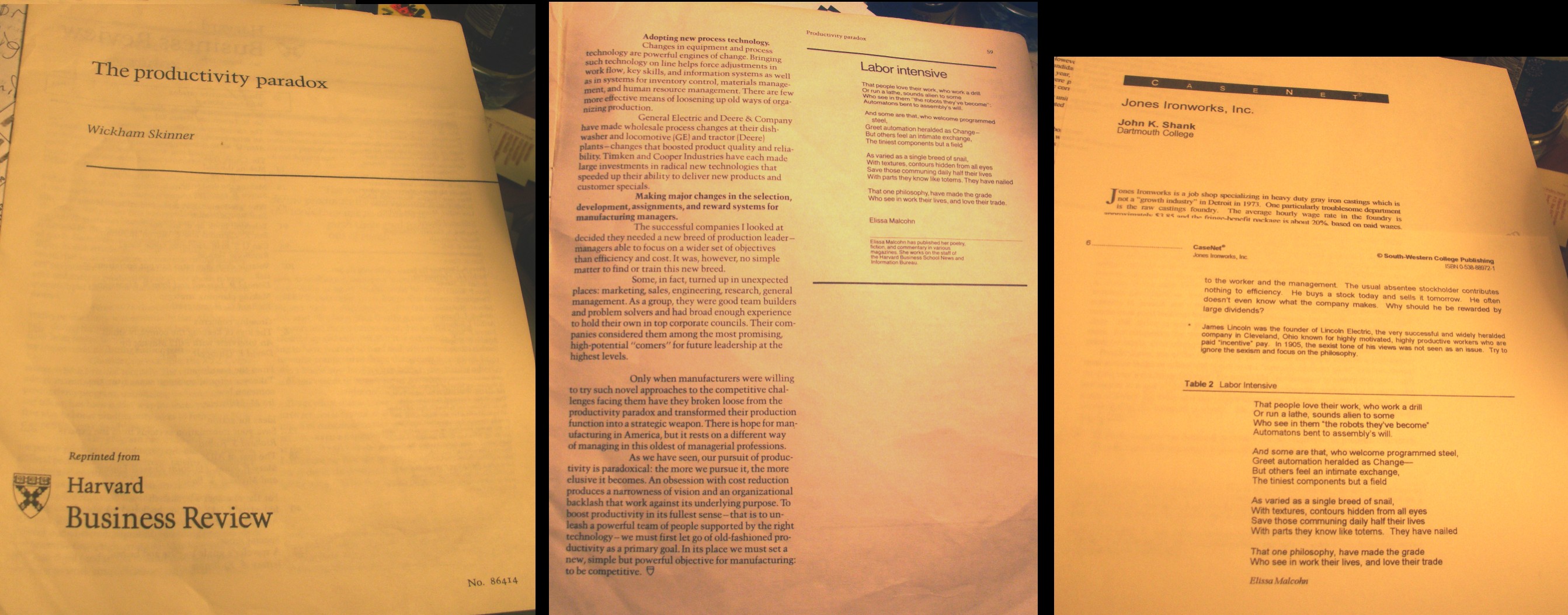
Every so often I Google myself. What turns up is a hodgepodge of magazine indices, running race results, transcription acknowledgements, blog material, personal profiles, and whatnot.
On Thursday I learned that a poem of mine had been used in a business school case, in what I think is a very cool way. I was delighted for a number of reasons, but I immediately searched for the author's contact info because he hadn't included bibliographic information about where the poem was first published. Properly, that should be included.
The case is Professor John K. Shank's "Jones Ironworks, Inc." (available as a Word download here. ) My poem, "Labor Intensive," appears at the end. My name is there as the author (hence the Google find), but the sonnet first appeared in the Harvard Business Review's July-August 1986 issue, No. 86414. "Labor Intensive" follows Professor Wickham Skinner's article, "The productivity paradox."
Shank adapted his case from one written by Professor Felix Kollaritsch of the Ohio State University, but I couldn't find out from a Web search if Kollaritsch had also used the poem.
I also wrote to Shank that having my poem appear in a case creates an educational full circle. It was inspired by a presentation given at the Harvard Business School, where I was then employed. The poem's genesis, however, lay in the stories told by Professor Lee A. Borah, Jr., now retired from Wagner College, where I received my BA in Psychology. Dr. Borah and I still keep in touch. His Industrial Psychology course exposed me to my first case study. I subsequently acquired an MS in Applied Psychology from Stevens Institute of Technology, with a concentration in Human Factors.
The inspiration for "Labor Intensive" also produced "Cog." I'd sent that story first to Tales of the Unanticipated, a magazine of the Minnesota Science Fiction Society, in honor of Dr. Borah's education at the University of Minnesota. "Cog" appeared in TOTU's Fall/Winter 1988 issue.
Almost three-quarters of my e-mail to Shank was my response to his case, because it sparked my own critical analysis muscles.
A search for "Jones Ironworks" shows the case has been taught at the Asian Institute of Technology School of Management, the University of Alabama, Johns Hopkins University, Marshall University in West Virginia, Sukhothai Thammathirat Open University in Thailand, the University of Texas at Austin's McCombs School of Business, the University of Texas at Dallas, the University of Toronto's Rotman School of Management, and the University of Washington Business School -- in addition to the Tuck School of Business at Dartmouth University, where Shank had taught. The case is also part of Professor Shank's book, Cases in Cost Management: A Strategic Emphasis, published through South-Western College Publishing and available through numerous outlets.
I sent my e-mail off to Shank. It bounced back. I did another search -- and learned that Professor Shank died on March 30, 2006.
Wrote Tuck School Dean, Paul Damos:
Professor Shank touched the lives of thousands of students, faculty members and business leaders over the course of his academic career at Harvard, Tuck, Ohio State, Babson, and the Naval Post Graduate School....Many graduates over his twenty year career at Tuck will remember his incredible presence in the classroom and his amazing intellect. He published 16 books and wrote more than 100 articles for leading journals in accounting, finance and management. Far from complete retirement, John was still writing and teaching, and he had just joined the Board of Directors of Lazard, Ltd....John was a core member of the Tuck family, a mentor and friend to many, and a passionate soul who had an impact on all that he met." (Tuck2000 Blog)
I wish I'd known about the case when he was still alive, so that I could have thanked him then. I've mailed a printout of my e-mail and condolences to the Tuck School.
This photograph is from the Hospital archives held by the University Archives in Cultural Collections, Auchmuty Library, the University of Newcastle, Australia.
This image can be used for study and personal research purposes. If you wish to reproduce this image for any other purpose you must obtain permission by contacting the University of Newcastle's Cultural Collections.
Please contact us if you are the subject of an image, or know the subject of the image, and have cultural or other reservations about the image being displayed on this website and would like to discuss this with us.
If you have any information about this photograph, please contact us or leave a comment in the box below.
Image © Roger Butterfield, 2008. All rights reserved.
A new-born lamb snuggles up to its mother near Wardlow Mires, Derbyshire (UK).
This image has been reduced in size; the original is a 2832 x 1888 (5.3 MP) TIFF.
How it used to be in the cigar factories of Tampa and Ybor City. The Ybor City Museum tells the story of how entrepreneurs from Cuba and Spain set up the local cigar manufacturing industry, sourcing tobacco from Cuba and attracting waves of immigrants from Hispanic countries, as well as Italy and Germany.
Since the "Green Revolution" fertilizer application in cropland has increased dramatically with the expansion on agricultural land-use. An increase in cropland will result in a higher application of agrochemicals including fertilizer to cropland and more nutrients entering water bodies.
Photo Credit: Gene Alexander | U.S. Department of Agriculture