View allAll Photos Tagged Insignificant
Each review of Jacob’s story leaves me amazed at his seeming inability to shape up, clean up, and stand up for everything decent and moral. He tricked and was tricked. His name was changed, but his heart seemed less so. Why couldn’t God replace him with someone more polished, more refined?
Yet, on the other hand, I’m so grateful God didn’t. I’ve wrestled with God, daring to think my might and muscles would impress him. I can be smarmy, wormy, and less than straightforward. I identify with Jacob – I limp.
Jacob’s story exists for the times that the Jacob within us wonders, “Can God use a person like me?” The reassuring and resounding answer is “Yes.”
Pure grace. Grace is God’s greatest idea. That he would treat us according to his heart and not ours. Amazing grace!
Read more God Never Gives Up on You
Max Lucado
The Grandfather clock purchased for my father. It is something I will one day own, and every time I visit my mother, I stop and look at it and feel time passing.
Joan Mirró (1893-1983)
Aves y Insectos/Vögel und Insekten/Birds and Insects, 1938 (Albertina - Sammlung Batliner)
The Albertina
The architectural history of the Palais
(Pictures you can see by clicking on the link at the end of page!)
Image: The oldest photographic view of the newly designed Palais Archduke Albrecht, 1869
"It is my will that the expansion of the inner city of Vienna with regard to a suitable connection of the same with the suburbs as soon as possible is tackled and at this on Regulirung (regulation) and beautifying of my Residence and Imperial Capital is taken into account. To this end I grant the withdrawal of the ramparts and fortifications of the inner city and the trenches around the same".
This decree of Emperor Franz Joseph I, published on 25 December 1857 in the Wiener Zeitung, formed the basis for the largest the surface concerning and architecturally most significant transformation of the Viennese cityscape. Involving several renowned domestic and foreign architects a "master plan" took form, which included the construction of a boulevard instead of the ramparts between the inner city and its radially upstream suburbs. In the 50-years during implementation phase, an impressive architectural ensemble developed, consisting of imperial and private representational buildings, public administration and cultural buildings, churches and barracks, marking the era under the term "ring-street style". Already in the first year tithe decided a senior member of the Austrian imperial family to decorate the facades of his palace according to the new design principles, and thus certified the aristocratic claim that this also "historicism" said style on the part of the imperial house was attributed.
Image: The Old Albertina after 1920
It was the palace of Archduke Albrecht (1817-1895), the Senior of the Habsburg Family Council, who as Field Marshal held the overall command over the Austro-Hungarian army. The building was incorporated into the imperial residence of the Hofburg complex, forming the south-west corner and extending eleven meters above street level on the so-called Augustinerbastei.
The close proximity of the palace to the imperial residence corresponded not only with Emperor Franz Joseph I and Archduke Albert with a close familial relationship between the owner of the palace and the monarch. Even the former inhabitants were always in close relationship to the imperial family, whether by birth or marriage. An exception here again proves the rule: Don Emanuel Teles da Silva Conde Tarouca (1696-1771), for which Maria Theresa in 1744 the palace had built, was just a close friend and advisor of the monarch. Silva Tarouca underpins the rule with a second exception, because he belonged to the administrative services as Generalhofbaudirektor (general court architect) and President of the Austrian-Dutch administration, while all other him subsequent owners were highest ranking military.
In the annals of Austrian history, especially those of military history, they either went into as commander of the Imperial Army, or the Austrian, later kk Army. In chronological order, this applies to Duke Carl Alexander of Lorraine, the brother-of-law of Maria Theresa, as Imperial Marshal, her son-in-law Duke Albert of Saxe-Teschen, also field marshal, whos adopted son, Archduke Charles of Austria, the last imperial field marshal and only Generalissimo of Austria, his son Archduke Albrecht of Austria as Feldmarschalil and army Supreme commander, and most recently his nephew Archduke Friedrich of Austria, who held as field marshal from 1914 to 1916 the command of the Austro-Hungarian troops. Despite their military profession, all five generals conceived themselves as patrons of the arts and promoted large sums of money to build large collections, the construction of magnificent buildings and cultural life. Charles Alexander of Lorraine promoted as governor of the Austrian Netherlands from 1741 to 1780 the Academy of Fine Arts, the Théâtre de Ja Monnaie and the companies Bourgeois Concert and Concert Noble, he founded the Academie royale et imperial des Sciences et des Lettres, opened the Bibliotheque Royal for the population and supported artistic talents with high scholarships. World fame got his porcelain collection, which however had to be sold by Emperor Joseph II to pay off his debts. Duke Albert began in 1776 according to the concept of conte Durazzo to set up an encyclopedic collection of prints, which forms the core of the world-famous "Albertina" today.
Image : Duke Albert and Archduchess Marie Christine show in family cercle the from Italy brought along art, 1776. Frederick Henry Füger.
1816 declared to Fideikommiss and thus in future indivisible, inalienable and inseparable, the collection 1822 passed into the possession of Archduke Carl, who, like his descendants, it broadened. Under him, the collection was introduced together with the sumptuously equipped palace on the Augustinerbastei in the so-called "Carl Ludwig'schen fideicommissum in 1826, by which the building and the in it kept collection fused into an indissoluble unity. At this time had from the Palais Tarouca by structural expansion or acquisition a veritable Residenz palace evolved. Duke Albert of Saxe-Teschen was first in 1800 the third floor of the adjacent Augustinian convent wing adapted to house his collection and he had after 1802 by his Belgian architect Louis de Montoyer at the suburban side built a magnificent extension, called the wing of staterooms, it was equipped in the style of Louis XVI. Only two decades later, Archduke Carl the entire palace newly set up. According to scetches of the architect Joseph Kornhäusel the 1822-1825 retreaded premises presented themselves in the Empire style. The interior of the palace testified from now in an impressive way the high rank and the prominent position of its owner. Under Archduke Albrecht the outer appearance also should meet the requirements. He had the facade of the palace in the style of historicism orchestrated and added to the Palais front against the suburbs an offshore covered access. Inside, he limited himself, apart from the redesign of the Rococo room in the manner of the second Blondel style, to the retention of the paternal stock. Archduke Friedrich's plans for an expansion of the palace were omitted, however, because of the outbreak of the First World War so that his contribution to the state rooms, especially, consists in the layout of the Spanish apartment, which he in 1895 for his sister, the Queen of Spain Maria Christina, had set up as a permanent residence.
Picture: The "audience room" after the restoration: Picture: The "balcony room" around 1990
The era of stately representation with handing down their cultural values found its most obvious visualization inside the palace through the design and features of the staterooms. On one hand, by the use of the finest materials and the purchase of masterfully manufactured pieces of equipment, such as on the other hand by the permanent reuse of older equipment parts. This period lasted until 1919, when Archduke Friedrich was expropriated by the newly founded Republic of Austria. With the republicanization of the collection and the building first of all finished the tradition that the owner's name was synonymous with the building name:
After Palais Tarouca or tarokkisches house it was called Lorraine House, afterwards Duke Albert Palais and Palais Archduke Carl. Due to the new construction of an adjacently located administration building it received in 1865 the prefix "Upper" and was referred to as Upper Palais Archduke Albrecht and Upper Palais Archduke Frederick. For the state a special reference to the Habsburg past was certainly politically no longer opportune, which is why was decided to name the building according to the in it kept collection "Albertina".
Picture: The "Wedgwood Cabinet" after the restoration: Picture: the "Wedgwood Cabinet" in the Palais Archduke Friedrich, 1905
This name derives from the term "La Collection Albertina" which had been used by the gallery Inspector Maurice von Thausing in 1870 in the Gazette des Beaux-Arts for the former graphics collection of Duke Albert. For this reason, it was the first time since the foundation of the palace that the name of the collection had become synonymous with the room shell. Room shell, hence, because the Republic of Austria Archduke Friedrich had allowed to take along all the movable goods from the palace in his Hungarian exile: crystal chandeliers, curtains and carpets as well as sculptures, vases and clocks. Particularly stressed should be the exquisite furniture, which stems of three facilities phases: the Louis XVI furnitures of Duke Albert, which had been manufactured on the basis of fraternal relations between his wife Archduchess Marie Christine and the French Queen Marie Antoinette after 1780 in the French Hofmanufakturen, also the on behalf of Archduke Charles 1822-1825 in the Vienna Porcelain Manufactory by Joseph Danhauser produced Empire furnitures and thirdly additions of the same style of Archduke Friedrich, which this about 1900 at Portois & Ffix as well as at Friedrich Otto Schmidt had commissioned.
The "swept clean" building got due to the strained financial situation after the First World War initially only a makeshift facility. However, since until 1999 no revision of the emergency equipment took place, but differently designed, primarily the utilitarianism committed office furnitures complementarily had been added, the equipment of the former state rooms presented itself at the end of the 20th century as an inhomogeneous administrative mingle-mangle of insignificant parts, where, however, dwelt a certain quaint charm. From the magnificent state rooms had evolved depots, storage rooms, a library, a study hall and several officed.
Image: The Albertina Graphic Arts Collection and the Philipphof after the American bombing of 12 März 1945.
Image: The palace after the demolition of the entrance facade, 1948-52
Worse it hit the outer appearance of the palace, because in times of continued anti-Habsburg sentiment after the Second World War and inspired by an intolerant destruction will, it came by pickaxe to a ministerial erasure of history. In contrast to the graphic collection possessed the richly decorated facades with the conspicuous insignia of the former owner an object-immanent reference to the Habsburg past and thus exhibited the monarchial traditions and values of the era of Francis Joseph significantly. As part of the remedial measures after a bomb damage, in 1948 the aristocratic, by Archduke Albert initiated, historicist facade structuring along with all decorations was cut off, many facade figures demolished and the Hapsburg crest emblems plunged to the ground. Since in addition the old ramp also had been cancelled and the main entrance of the bastion level had been moved down to the second basement storey at street level, ended the presence of the old Archduke's palace after more than 200 years. At the reopening of the "Albertina Graphic Collection" in 1952, the former Hapsburg Palais of splendour presented itself as one of his identity robbed, formally trivial, soulless room shell, whose successful republicanization an oversized and also unproportional eagle above the new main entrance to the Augustinian road symbolized. The emocratic throw of monuments had wiped out the Hapsburg palace from the urban appeareance, whereby in the perception only existed a nondescript, nameless and ahistorical building that henceforth served the lodging and presentation of world-famous graphic collection of the Albertina. The condition was not changed by the decision to the refurbishment because there were only planned collection specific extensions, but no restoration of the palace.
Image: The palace after the Second World War with simplified facades, the rudiment of the Danubiusbrunnens (well) and the new staircase up to the Augustinerbastei
This paradigm shift corresponded to a blatant reversal of the historical circumstances, as the travel guides and travel books for kk Residence and imperial capital of Vienna dedicated itself primarily with the magnificent, aristocratic palace on the Augustinerbastei with the sumptuously fitted out reception rooms and mentioned the collection kept there - if at all - only in passing. Only with the repositioning of the Albertina in 2000 under the direction of Klaus Albrecht Schröder, the palace was within the meaning and in fulfillment of the Fideikommiss of Archduke Charles in 1826 again met with the high regard, from which could result a further inseparable bond between the magnificent mansions and the world-famous collection. In view of the knowing about politically motivated errors and omissions of the past, the facades should get back their noble, historicist designing, the staterooms regain their glamorous, prestigious appearance and culturally unique equippment be repurchased. From this presumption, eventually grew the full commitment to revise the history of redemption and the return of the stately palace in the public consciousness.
Image: The restored suburb facade of the Palais Albertina suburb
The smoothed palace facades were returned to their original condition and present themselves today - with the exception of the not anymore reconstructed Attica figures - again with the historicist decoration and layout elements that Archduke Albrecht had given after the razing of the Augustinerbastei in 1865 in order. The neoclassical interiors, today called after the former inhabitants "Habsburg Staterooms", receiving a meticulous and detailed restoration taking place at the premises of originality and authenticity, got back their venerable and sumptuous appearance. From the world wide scattered historical pieces of equipment have been bought back 70 properties or could be returned through permanent loan to its original location, by which to the visitors is made experiencable again that atmosphere in 1919 the state rooms of the last Habsburg owner Archduke Frederick had owned. The for the first time in 80 years public accessible "Habsburg State Rooms" at the Palais Albertina enable now again as eloquent testimony to our Habsburg past and as a unique cultural heritage fundamental and essential insights into the Austrian cultural history. With the relocation of the main entrance to the level of the Augustinerbastei the recollection to this so valuable Austrian Cultural Heritage formally and functionally came to completion. The vision of the restoration and recovery of the grand palace was a pillar on which the new Albertina should arise again, the other embody the four large newly built exhibition halls, which allow for the first time in the history of the Albertina, to exhibit the collection throughout its encyclopedic breadh under optimal conservation conditions.
Image: The new entrance area of the Albertina
64 meter long shed roof. Hans Hollein.
The palace presents itself now in its appearance in the historicist style of the Ringstrassenära, almost as if nothing had happened in the meantime. But will the wheel of time should not, cannot and must not be turned back, so that the double standards of the "Albertina Palace" said museum - on the one hand Habsburg grandeur palaces and other modern museum for the arts of graphics - should be symbolized by a modern character: The in 2003 by Hans Hollein designed far into the Albertina square cantilevering, elegant floating flying roof. 64 meters long, it symbolizes in the form of a dynamic wedge the accelerated urban spatial connectivity and public access to the palace. It advertises the major changes in the interior as well as the huge underground extensions of the repositioned "Albertina".
Christian Benedictine
Art historian with research interests History of Architecture, building industry of the Hapsburgs, Hofburg and Zeremonialwissenschaft (ceremonial sciences). Since 1990 he works in the architecture collection of the Albertina. Since 2000 he supervises as director of the newly founded department "Staterooms" the restoration and furnishing of the state rooms and the restoration of the facades and explores the history of the palace and its inhabitants.
Sihanoukville (Khmer: ក្រុងព្រះសីហនុ, Krong Preah Sihanouk), also known as 'Kompong Som' (Khmer: កំពង់សោម), is a coastal city in Cambodia and the capital city of Sihanoukville Province, located at the tip of an elevated peninsula in the country's south-west at the Gulf of Thailand. The city is flanked by an almost uninterrupted string of beaches along its entire coastline and coastal marshlands bordering the Ream National Park in the East. A number of thinly inhabited islands - under Sihanoukville's administration - are in the city's proximity, where in recent years moderate development has helped to attract a sizable portion of Asia's individual travelers, young students and back-packers.
The city, which was named in honour of former king Norodom Sihanouk, had a population of around 89.800 people and approximately 66.700 in its urban center in 2008. Sihanoukville city encompasses the greater part of four of the five communes (Sangkats) of Sihanoukville provinces' Mittakpheap District. A relatively young city, it has evolved parallel to the construction of the Sihanoukville Autonomous Port, which commenced in June 1955, as the country's gateway to direct and unrestricted international sea trade. The only deep water port in Cambodia includes a mineral oil terminal and a transport logistics facility. As a consequence, the city grew to become a leading national center of trade, commerce, transport and process manufacturing.
Sihanoukville's many beaches and nearby islands make it Cambodia's premier seaside resort with steadily rising numbers of national visitors and international tourists since the late 20th century. As a result of its economic diversity, the region's natural beauty and the considerable recreational potential, a constantly increasing number of seasonal and permanent foreign residents make Sihanoukville one of the culturally most varied and dynamic population centers in Cambodia. As of 2014 the tourism sector remains insignificant in comparison with neighboring Thailand. Sihanoukville's future will largely be defined by the authorities' capability of a successfully balanced management in order to protect and conserve natural resources on the one hand and the necessities of island - and urban development, increasing visitor numbers, expanding infrastructure, the industrial sector and population growth on the other.
Despite being the country’s premier sea side destination, after decades of war and upheaval the town and its infrastructure remain very much disjointed and architecturally unimpressive. Infrastructure problems persist, in particular related to water and power supply, while international standard health facilities remain limited.
ETYMOLOGY
The official name of the city in Khmer is: Krong (city) Preah (holy) Sihanouk (name of the former king), which adds up to: "City of the holy Sihanouk" or "Honorable Sihanouk City". King Norodom Sihanouk (reigned 1941-1955, 1993-2004) was and still is revered as father of the (modern) nation. The name "Sihanouk" is derived from Sanskrit through two Pali words: Siha (lion), and Hanu (jaws).
The alternative name, Kompong Saom (also romanized as Kompong Som and Kampong Som), (Khmer: កំពង់សោម) means "Port of the Moon" or "Shiva's Port". Saom is derived from the Sanskrit word "saumya", the original (Rig Vedic) meaning of which was "Soma, the juice or sacrifice of the moon-god", but evolved into Pali "moon", "moonlike" "name of Shiva". The word Kampong or Kompong is of Malayan origin and means village or hamlet. Its meaning underwent extension towards pier or river landing bridge.
HISTORY
CLASSICAL PERIOD (BEFORE 1700)
Prior to the ports' and city's foundation works of 1955, the port of Kompong Som must have been only of regional significance - due to the absence of navigable waterways that connect the port with the kingdom's settlement centers. During the many centuries of pre-Angkorian and Angkorian history – from Funan to Chenla and during the Khmer Empire, regional trade was centered at O Keo (Vietnamese: Óc Eo) in the Mekong Delta, now the province of Rạch Giá in Vietnam. The township of Prei Nokor (Saigon) was a commercial center of the Khmer Empire. The Chronicle of Samtec Cauva Vamn Juon - one of the 18th and 19th century Cambodian Royal Chronicles - briefly mentions the region as the country was split into 3 parts during a 9-year civil war from 1476 to 1485: "In 1479, Dhammaraja took on the throne at Catumukh (Phnom Penh) and controlled the provinces of Samraong Tong, Thbong, Kompong Saom, Kampot up to the Bassak, Preah Trapeang, Kramuon Sah, Koh Slaket and Peam"[mouth of the Mekong].
EARLY MODERN PERIOD (AROUND 1700-1863)
From the end of the seventeenth century, Cambodia lost control of the Mekong River route as Vietnamese power expanded into the lower Mekong. During the Nguyen-Siamese War (1717–18) a Siamese fleet burned the port of Kompong Som in 1717 but was defeated by the Vietnamese at Banteay Meas/Ha Tien.[20] A Cambodian king of the late eighteenth century, Outey-Reachea III allied with a Chinese pirate, Mac-Thien-Tu, who had established an autonomous polity based in Ha Tien and controlled the maritime network on the eastern part of the Gulf of Thailand. Ha Tien was located at a point where a river linking to the Bassac River flows into the Gulf of Thailand. Landlocked Cambodia tried to keep its access to maritime trade through Ha Tien. In 1757 Ha Tien acquired the ports of Kampot and Kompong Som as a reward for Mac's military support to the King of Cambodia. Until its destruction in 1771 the port developed into an independent duty-free entrepot - linked with several Chinese trading networks.
Alexander Hamilton, who traveled on the Gulf of Thailand in 1720, wrote that "Kompong Som and Banteay Meas (later Ha Tien) belonged to Cambodia, as Cochin-China was divided from Cambodia by a river (Bassac river) of three leagues broad." and "King Ang Duong constructed a road from his capital of Oudong to Kampot". Kampot remained the only international seaport of Cambodia. "The traveling time between Udong and Kampot was eight days by oxcart and four days by elephants." French Résident Adhemard Leclère wrote: "...Until 1840s, the Vietnamese governed Kampot and Péam [Mekong Delta], but Kompong Som belonged to Cambodia. The Vietnamese constructed a road from Ha Tien to Svai village - on the border with Kompong-Som - via Kampot."
The British Empire followed a distinct policy by the 1850s, seeking to consolidate its influence. Eye witness reports give rare insights, as Foreign Secretary Lord Palmerston's agent John Crawfurd reports: "Cambodia was...the Keystone of our policy in these countries, - the King of that ancient Kingdom is ready to throw himself under the protection of any European nation...The Vietnamese were interfering with the trade at Kampot, and this would be the basis of an approach..." Palmerston concluded: "The trade at Kampot - one of the few remaining ports, could never be considerable, in consequence of the main entrance to the country, the Mekong, with all its feeders flowing into the Sea through the territory of Cochin China The country, too, had been devastated by recent Siam - Vietnam wars. Thus, without the aid of Great Britain, Kampot or any other port in Cambodia, can never become a commercial Emporium." Crawfurd later wrote: "The Cambodians... sought to use intervals of peace in the Siam - Vietnam wars to develop intercourse with outside nations. The trade at Kampot which they sought to foster was imperiled by pirates. Here is a point where the wedge might be inserted, that would open the interior of the Indo-Chinese Peninsula to British Commerce, as the great River of the Cambodians traverses its entire length and even affords communication into the heart of Siam".
FRENCH RULE (1863-1954)
Under French rule Vietnam, Laos and Cambodia became a single administrative and economic unit. The coastal region Circonscription Résidentielle with Kampot as its capital contained the Arrondissements of Kampot, Kompong Som, Trang and Kong-Pisey. The establishment of another international trading center near the existing city of Saigon was not considered necessary. Focus remained the Mekong and the idea to establish an alternative route to Chinese and Thai internal markets along an uninterrupted navigable waterway from the Red River to the Mekong Delta.
INSURRECTION
An insurrection that took place from 1885 to 1887 further discouraged French ambition. It started in Kampot and quickly spread to Veal Rinh, Kampong Seila, and Kompong Som, where the insurgents were led by a Chinese pirate named Quan-Khiem. He managed to control the northern part of Preah Sihanouk for some time until he - an old man - was arrested by Preah Sihanouk's governor.
The most notable infrastructural improvements of this period were the construction of Route Coloniale No.17, later renamed National Road No.3 and the national railway system, although work on the "Southern Line" - from Phnom Penh to Sihanoukville - only began in 1960.
AFTER INDIPENDENCE (SINCE 1954)
The city's and province's alternative name Kampong som (Kampong Som) was adopted from the local indigenous community. After the dissolution of French Indochina in 1954, it became apparent that the steadily tightening control of the Mekong Delta by Vietnam required a solution to gain unrestricted access to the seas. Plans were made to construct an entirely new deep-water port. Kompong Saom (Kampong Som) was selected for water depth and ease of access. In August 1955, a French/Cambodian construction team cut a base camp into the unoccupied jungle in the area that is now known as Hawaii Beach. Funds for construction of the port came from France and the road was financed by the USA.
During the Vietnam War the port became an intensive military facility on both sides, in the service of National Front for the Liberation of South Vietnam and after 1970, under the government of Lon Nol, in the service of the United States.
The port was the last place to be evacuated by the US Army, only days before Khmer Rouge guerrillas took control of the government in April 1975. The events surrounding the taking of the US container ship SS Mayaguez and its crew on 12 May by the Khmer Rouge and the subsequent rescue operation by US Marines played out on the waters of Koh Tang off the coast of Sihanoukville. During the two days of action, the US commenced air strikes on targets on the mainland of Sihanoukville including the port, the Ream Naval Base, an airfield, the railroad yard and the petroleum refinery in addition to strikes and naval gun fire on several islands.
After the fall of the Khmer Rouge regime in 1979 and the subsequent opening of the economy, the port of Sihanoukville resumed its importance in the development and recovery of the country. With the further opening of new markets in 1999, the city regained its role in the economic growth of Cambodia.
In 1993, the Ream National Park was established per royal decree of former King Sihanouk.
The Sihanoukville Municipality was elevated to a regular province on 22 December 2008 after King Norodom Sihamoni signed a Royal Decree converting the municipalities of Kep, Pailin and Sihanoukville into provinces.
In 2006 the Koh Puos (Cambodia) Investment Group submitted an application, planning to invest $276 million in converting the 116-hectare Koh Puos - Snake island into a luxury residential - and resort complex. After the completion of certain elements of the infrastructure, the investor announced alterations of the original blueprints, as "Reapplying for permission will happen in 2014..." according to the Council of the Development of Cambodia.
On 26 May 2011 Preah Sihanouk area joined the Paris-based club Les Plus Belles Baies Du Monde (The most Beautiful Bays in the World). The organisation officially accepts the Bay of Cambodia as one of its members at the 7th General Assembly.
BEACHES
Sihanoukville's beaches are one of the city's most valuable ecological and economic resource with varying degrees of commercial exploitation. The beaches listed in this section do not include any of the island's beaches.
- Ochheuteal Beach, ឆ្នេរអូរឈើទាល: is a 3.3 km long strip of white sand beach and although the name translates to "Creek/Estuary of the Tiel tree" it is lined with Casuarina and Tamarisk trees. Grass umbrellas, rental chairs in front of around 30 standardized beach huts serve meals, drinks and entertainment. Well established middle class hotels and high-profile residences flank the beach along its Northern part. The sustainability of Ochheuteal beach was a primary consideration of various stakeholders, which brought about the development of a tourism development and management plan in 2005. The Southern half remains - apart from some hotels at its far end - essentially undeveloped.
- Serendipity Beach: Technically the western end (roughly one fifth or 600 m) of Ochheuteal beach, is very popular with Western tourists and has a few small guesthouses right on the beach. It has been named by an American fellow, who came here in the Nineties. Struck by its (then) unspoiled beauty and pristine condition, he came up with the term, which quickly entered common vocabulary.
- Otres Beach, ្នេរអូរត្រេស: is around 4.6 km long and beyond the small "Queen hill" headland at the southern end of Ochheuteal Beach. Its long white sand strip, also completely lined with Casuarina and Tamarisk trees, is far less developed and commercialized than Ochheuteal Beach and has developed into a preferred lodging place for Western visitors. From 2004 to 2011 this beach was occupied by numerous bungalows and dormitories, run by Western people. Due to the element of illegality of on-beach accommodation, among other reasons, police cleaned up the area in May 2011, removing the greater part of the beach-side bungalows. Permanent structures beyond the beach road supplement the remaining places since 2012. It is a very popular, well established holiday retreat – where prices have risen considerably over the course of the last years.
- Sokha Beach: Sokha Beach is around 1.2 km long and located west of Serendipity Beach. The beach is privately owned by - and its southern half occupied by the Sokha Beach Hotel, the first five-star luxury beach hotel in Cambodia. While the beach is well kept and many facilities are provided, visitors have to pay for their use and beach vendors are not allowed.
- Independence Beach: Independence Beach is around 1.3 km long and located north-west of Sokha Beach. The beach is named after the Independence Hotel, another example of New Khmer Architecture, towering on top of a rock at the beaches northern end.
- Victory Beach: Victory beach is around 300 m long and situated at the furthest north of the peninsula of Sihanoukville. It was heavily used by backpackers and is still popular with budget travelers. The deep water port is located at the northern end of the beach. A consortium of Russian business people undertook large scale development here. The beach is regularly maintained.
- Lamherkay/Hawaii Beach: is the southern succession of Victory Beach, situated north of Independence Beach. It is a strip of similar length as Victory Beach - around 300 m. Here is the very place where the French/Cambodian construction team's groundwork began for the construction of the Sihanoukville Autonomous Port in 1955.
- Treasure Island Beach south of Lamherkay/Hawaii Beach is less than 50 m long and its entire length is fringed with concrete steps and wooden pavilions of a big Cambodian seafood restaurant.
- Hun Sen (Prek Treng) Beach, ឆ្នេរព្រែកត្រែង: is the northernmost beach of the city with a length of around 1.5 km, situated behind the local port and essentially empty without beach huts and bars, it sees only weekend - and holiday visitors. The water is very shallow, but the area is lacking favorable infrastructure and is not regularly cleaned.
WIKIPEDIA
Modern cars can do over 100,000 miles without pausing for breath. If you really pile on the miles, you might have 200,000 or even 300,000 miles on the clock. If the car Gods are really shining on you, you might have managed more than half a million.
Prepare to feel insignificant. Irv Gordon from East Patchogue, New York, together with his Volvo P1800, a 1966 1800S, has completed over three million miles--a new world record for the highest number of miles driven by a single person in the same car. If you're after an arbitrary comparison to offer some perspective, that's around six round-trips to the moon, or 120 circumnavigations of Earth.
Gordon hit the three million miles mark on September 18 while driving near the village of Girdwood, on the Seward Highway, south of Anchorage, Alaska; one of the two remaining states where Irv and his famous car had not been together until now.
”It was all rather undramatic,” said Irv. ”We just cruised along and I kept an eye on the odometer in order not to miss the great moment”.
Gordon first bought his 1800S on a Friday back in 1966 and immediately fell in love. He simply couldn't stop driving the car and over the course of the weekend he had already covered 1,500 miles, causing him to return to the dealership he bought it the following Monday in order for its first service.
With a 125-mile round-trip daily commute, a fanatical dedication to vehicle maintenance and a passion for driving, Gordon logged 500,000 miles in 10 years. In 1987, he celebrated his one-millionth mile by driving a loop around the Tavern on the Green in Central Park, and in 2002 he drove the car's two-millionth mile down Times Square. Since then, Gordon has broken his record every time he gets behind the wheel of his beloved Volvo.
[Text from MotorAuthority]
www.motorauthority.com/news/1087353_irv-gordon-reaches-3-...
History
The project was started in 1957 because Volvo wanted a sports car, despite the fact that their previous attempt, the P1900, had been a disaster, with only 68 cars sold. The man behind the project was an engineering consultant to Volvo, Helmer Petterson, who in the 1940s was responsible for the Volvo PV444. The design work was done by Helmer's son Pelle Petterson, who worked at Pietro Frua at that time. Volvo insisted it was an Italian design by Frua and only officially recognized that Pelle Petterson designed it in 2009. The Italian Carrozzeria Pietro Frua design firm (then a recently acquired subsidiary of Ghia) built the first three prototypes between September 1957 and early 1958, later designated by Volvo in September 1958: P958-X1, P958-X2 and P958-X3 (P:Project 9:September 58:Year 1958 = P958).
In December 1957 Helmer Petterson drove X1, (the first hand-built P1800 prototype) to Osnabrück, West Germany, headquarters of Karmann. Petterson hoped that Karmann would be able to take on the tooling and building of the P1800. Karmann's engineers had already been preparing working drawings from the wooden styling buck at Frua. Petterson and Volvo chief engineer Thor Berthelius met there, tested the car and discussed the construction with Karmann. They were ready to build it and this meant that the first cars could hit the market as early as December 1958. But in February, Karmann's most important customer, Volkswagen VAG, forbade Karmann to take on the job.[citation needed] They feared that the P1800 would compete with the sales of their own cars, and threatened to cancel all their contracts with Karmann if they took on this car. This setback almost caused the project to be abandoned.
Other German firms, NSU, Drautz and Hanomag, were contacted but none was chosen because Volvo did not believe they met Volvo's manufacturing quality-control standards.
It began to appear that Volvo might never produce the P1800. This motivated Helmer Petterson to obtain financial backing from two financial firms with the intention of buying the components directly from Volvo and marketing the car himself. At this point Volvo had made no mention of the P1800 and the factory would not comment. Then a press release surfaced with a photo of the car, putting Volvo in a position where they had to acknowledge its existence. These events influenced the company to renew its efforts: the car was presented to the public for the first time at the Brussels Motor Show in January 1960 and Volvo turned to Jensen Motors, whose production lines were under-utilised, and they agreed a contract for 10,000 cars. The Linwood, Scotland, body plant of manufacturer Pressed Steel was in turn sub-contracted by Jensen to create the unibody shells, which were then taken by rail to be assembled at Jensen in West Bromwich, England. In September 1960, the first production P1800 (for the 1961 model year) left Jensen for an eager public.
P1800
The engine was the B18 (B for the Swedish word for gasoline: Bensin; 18 for 1800 cc displacement) with dual SU carburettors, producing 100 hp (75 kW). This variant (named B18B) had a higher compression ratio than the slightly less powerful twin-carb B18D used in the contemporary Amazon 122S, as well as a different camshaft. The 'new' B18 was actually developed from the existing B36 V8 engine used in Volvo trucks at the time. This cut production costs, as well as furnishing the P1800 with a strong engine boasting five main crankshaft bearings. The B18 was matched with the new and more robust M40 manual gearbox through 1963. From 1963 to 1972 the M41 gearbox with electrically actuated overdrive was a popular option. Two overdrive types were used, the D-Type through 1969, and the J-type through 1973. The J-type had a slightly shorter ratio of 0.797:1 as opposed to 0.756:1 for the D-type. The overdrive effectively gave the 1800 series a fifth gear, for improved fuel efficiency and decreased drivetrain wear. Cars without overdrive had a numerically lower-ratio differential, which had the interesting effect of giving them a somewhat higher top speed (just under 120 mph (193 km/h)) than the more popular overdrive models. This was because the non-overdrive cars could reach the engine's redline in top gear, while the overdrive-equipped cars could not, giving them a top speed of roughly 110 mph (177 km/h).
1800S
As time progressed, Jensen had problems with quality control, so the contract was ended early at 6,000 cars. In 1963 production was moved to Volvo's Lundby Plant in Gothenburg and the car's name was changed to 1800S (S standing for Sverige, or in English : Sweden). The engine was improved with an additional 8 hp (6 kW). In 1966 the four-cylinder engine was updated to 115 hp (86 kW). Top speed was 175 km/h (109 mph).[3] In 1969 the B18 engine was replaced with the 2-litre B20B variant of the B20 giving 118 bhp (89 kW), though it kept the designation 1800S.
[Text from Wikipedia]
This Lego miniland-scale Volvo P1800 Coupe has been created for Flickr LUGNut's 88th Build Challenge, - "Let's Break Some Records", - a challenge focused on creating vehicles that set some benchmark for biggness, fastness or other extreme of some specification. The Volvo model shown here claim, by far, the farthermost distance ever traveled by an automobile, at over 3,000,000 miles (4,800,00 kilometres).
One of the lecterns inside the church has a brass plaque embedded.
To the Glory of God and in loving memory of
CHARLES BERJEW BROOKE b.1868 d.1951 and of his wife
MAUD GWENDDOLEN BROOKE b.1872 d.1944 and of their son
CAPT. CHARLES BERJEW BROOKE D.S.O. b.1895 killed in action 1916
The memorial was given by the daughter of Charles Brooke (the father) in 1951.
www.iwm.org.uk/memorials/item/memorial/4326
BROOKE, CHARLES BERJEW
Rank:……………………………Lieutenant
Date of Death:…………….01/07/1916
Age:……………………………..21
Regiment:…………………….Yorkshire Regiment
formerly Suffolk Regt. (Special Reserve), (formerly attd. 1st Bn.) The Queen's (Royal West Surrey Regiment)
Awards:………………………..D S O
Grave Reference:…………IV. H. 7.
Cemetery:…………………….PERONNE ROAD CEMETERY, MARICOURT
Additional Information:
Son of Charles Berjew Brooke and Maud Gwenddolen Brooke, of Colne House, Brantham, Suffolk.
CWGC: www.cwgc.org/find-war-dead/casualty/310713/BROOKE,%20CHAR...
There is no obvious match for Charles in the Soldiers Died in the Great War database – the nearest match is a Cecil Berjew Brooke, a 2nd Lieutenant of the Alexandra Regiment, Battalion Not Shown, who was Killed in Action on the 1st July 1916. As with all Officers, no place of birth or residence is shown.
(Note – references to Alexandra Regiment, Princess of Wales Own and Green Howards are all alternative names for the Yorkshire Regiment).
The Medal Index Card for Second Lieutenant Charles “Beyent” Brooke, Yorkshire Regiment, is held at the National Archive under reference WO 372/3/89092 . He had originally been a Second Lieutenant in the Suffolk Regiment before becoming a Captain during his attachment from the Suffolks to the Royal West Surrey Regiment. He reverted to his former rank on joining the Yorkshire Regiment.
discovery.nationalarchives.gov.uk/details/r/D1503930
The Service Record for 2nd Lieutenant Charles Berjen Brooke, The Suffolk Regiment, are held at the National Archive under reference WO 339/16364
discovery.nationalarchives.gov.uk/details/r/C1070291
Most of any research I could do on this man has already been done – his father collected his letters home and had them privately published as “Letters from the boy”. The last one, dated 30th June 1916, ends:-
It is impossible to fear death out here when one is no longer an individual but a member of a regiment and of an army. To be killed means nothing to me, and it is only you who will suffer for it. You really pay the cost. I have been looking at the stars and thinking what an immense distance they are away! What an insignificant thing the loss of say forty years of life is compared with them. It seems scarcely worth talking about.
Well, good-bye you darlings. Try not to worry about it, and remember that we shall meet again, really quite soon. This letter is going to be posted if -----
Lots of love,
From your loving son Carl.
The same website source adds:-
Charles Berjew Brooke was born on the 7th March 1895 at Colne House, Brantham on River Stour, Suffolk, the only son of Mr Charles Berjew Brooke, an industrialist who manufactured "xylonite", i.e. celluloid. To avoid confusion, the younger Charles was known in the family as "Carl". He had a connection with Wales, because his mother Gwenddolen was the sister of Mrs Gertrude Bailey of "Stelvio" Newport, a lady prominent in her own right, and married to Mr Charles Henry Bailey of the Tyne Engine Works at Newport and Barry.
Carl was educated at Colchester Grammar School, followed by a preparatory school, Bilton Grange near,Rugby, and Bradfield College, Berks. He was interested in becoming a soldier from an early age, an interest stimulated by living near to the military town of Colchester, but a bout of diphtheria prevented him from taking part in strenuous exercise. Instead, to his great joy, he was taught rifle shooting , and was sent to represent the school at Bisley. He was allowed to join the college O.T.C., and awarded his certificate "A" in 1911, with extra marks for originality, and he left on the 31st of July 1913 with the rank of Colour Sergeant.
Carl must have had a flair for languages, as well as science, because he continued his education by studying chemistry in Berlin. Here he eagerly read as many German military books as he could find, including the German Field Service Book, as he intended to sit for the Army Interpreters’ Examination. He thought that every man should be trained, as he was sure that Germany intended to go to war against Britain, and at the end of July 1914, 6 days before war broke out between Britain and Germany, he returned home.
On his return, he applied for a commission in the Suffolk Special Reserve. To his disappointment, he was posted to 3rd Bn Norfolk Reg. in August 1914, but soon transferred to 3rd. Bn. Suffolk Reg. On Sept. 4th he was appointed a temporary Capt., dating from August 14th.
During his training he was marked top out of about thirty who joined with him. He was not to stay with them for long because in December he was attached to the 1st Bn The Queen’s (Royal West Surrey’s) and with 200 other reinforcements was sent out to France to replace the heavy losses they had suffered. In his letters home he described how well behaved his men were when they arrived in France, but he observed, rather wryly, that it could have been because they hadn’t been paid for a fortnight. He also commented on the wild Welsh and Scots who jumped out of the train at every halt and then raced after the train and got in anywhere, causing a lot of trouble and necessitating an "all change" at the next stop.
During his time at the Front he was able to make good use of his German, and he seems to have enjoyed his conversations with the prisoners who were brought in. He was also quite taken with their helmets, but felt that "it would hardly have been polite to bag the poor men’s hats". He also used his time to improve his French, and says that he has a good grasp of "Frenglish". He wrote home quite regularly, with detailed descriptions of life in the trenches. He made light of the fact that he had been shelled quite frequently, describing the sound as being like "water poured into a big jug from a tap"
In June, the War Office wrote to his Colonel asking whether he would recommend Lt. Brooke for a full Captaincy, but the Col. Replied that he had "Not enough service". The London Gazette for Sept. 4th.1915 records: Suffolk Regiment – Lieutenant to be Captain Charles B. Brooke, dating from August 14th, 1915.
On the morning of 25th Sept.1915, he was in action with the 1st Bn. The Queen’s at La Bassee, near Givenchy. All the other officers of B and D companies were killed, leaving him in command of the two companies, as well as some men from the H.L.I. and Oxford L.I. as they rushed the German trenches.
Encouraged by the 19 year old officer, they used up all their supply of bombs as well as those of the Germans before being driven back. Although wounded, Carl was the last to leave the trench, and it was reported that before leaving, he emptied his revolver at the advancing Germans, then threw the empty gun at a German officer, knocking him over.
He was wounded twice, once in the face which tore his cheek and mouth and knocked out two teeth and a serious chest wound, which fortunately, did not damage his lungs. He was admitted to 3rd. General Hospital at Le Treport.
On October 1st, he was sent to Alexandra Hospital for Officers, Millfield Lane, Highgate, London. In January 1916, he was mentioned in despatches, and on 14th he was awarded a D.S.O. for this action. The staff and works people from the village made a presentation to him for bringing honour to the village. His response was typically modest, he said "I was one of the lucky ones. Of course, I am glad to have won the D.S.O., but I want you to think of all those men who will not get anything, and who have deserved a decoration over and over again". He was invited to transfer to the Queen’s, and would have been happy to serve with them as a Lieutenant, but the Army had other plans.
In Feb. 1916 he was chosen for a commission in the Regular Army but it was in the Yorkshire Regiment, (The Green Howards’).Capt. Charles B. Brooke, D.S.O. was to be Sec. Lt., but to retain his higher rank until he joined a Regular Unit. In April 1916 he was sent to the 2nd. Battalion, which was serving with the 30th. division in France. He soon settled down to trench work, saying that his men were the best in the battalion, good at "sticking things" and "quite equal to the Queen’s". He said "I wouldn’t be pushed out of this regiment now". He was offered the chance of being trained as a staff officer, but said that he did not think he would be a success at it.
On the 1st July 1916, the 30th Division was to take Montauban. At 7.30a.m. the battalion was in Headquarters Avenue Trench with a battle strength of 24 officers and 688 other ranks who were to be responsible for occupying and consolidating the German front and support lines once they had been captured.
Carl was in command of "A" company, as it, advanced with "B" company under heavy machine gun fire, followed shortly by "C" and "D". Brooke was mortally wounded in the stomach, remaining alive just long enough for the stretcher bearers to reach the medical officer. His servant, Pte. Readman, reported his death, and that he had been buried at Bois de Talus Cemetery, near Carnoy. Lt.Col. Walter F. Young, commanding 2nd. Yorkshire Regiment wrote movingly of Carl as "a great favourite with all of us", and tried to reassure the family that he had not seemed to be in pain from his wound, and had been able to speak to the doctor before he died, as well as telling the stretcher bearers that it was hard lines being hit in the stomach. Col. Young said that he was most grieved at his loss, but had died as "he would have liked to do". He wrote to Carl’s mother, saying that he felt his loss more than that of any other officer, calling him "the cheeriest and best of good fellows", and describing their mutual enthusiasm for the works of Rudyard Kipling.
On July 3rd 1916, it was announced that 2nd. Lt. C.B. Brooke, D.S.O., was to be Temp. Capt. In Yorkshire Regiment, dated from May 16th. 1916.
www.powell76.talktalk.net/Brooke.htm
www.facebook.com/RoyalAnglianRegMuseum/posts/887556941356589
That final letter was sold at auction in November 2016
www.bristolauctionrooms.co.uk/135-lot-46-July-1st-1916-Ca...
That wasn’t all there was to remember his last hours by.
He was commissioned into 3rd Suffolk in 1914, having been born and raised in Brantham, near Manningtree. He had been wounded badly whilst winning his DSO in early 1916, and we heard of how even after emptying every chamber of his pistol into the advancing enemy, he then hurled his revolver at one of them, knocking him over! After his death on 1st July, his family published the letters he wrote home in a small memorial volume entitled “Letters from The Boy.” It was said that for many years his blood-stained and battered tunic hung in a frame in the hallway of his parents home.
www.friendsofthesuffolkregiment.org/2016-battlefield-tour...
A picture of Charles can be seen as one of the responses on page 1 of this forum query.
1914-1918.invisionzone.com/forums/topic/8032-officers-die...
The Imperial War Museum holds a copy of “Letters from the boy.”
www.iwm.org.uk/collections/item/object/1500034743
Family History websites
www.thosebefore.com/g1/p1386.htm
www.brooksfamilyhistory.co.uk/media/ONS%20-%20CWGC%20upda...
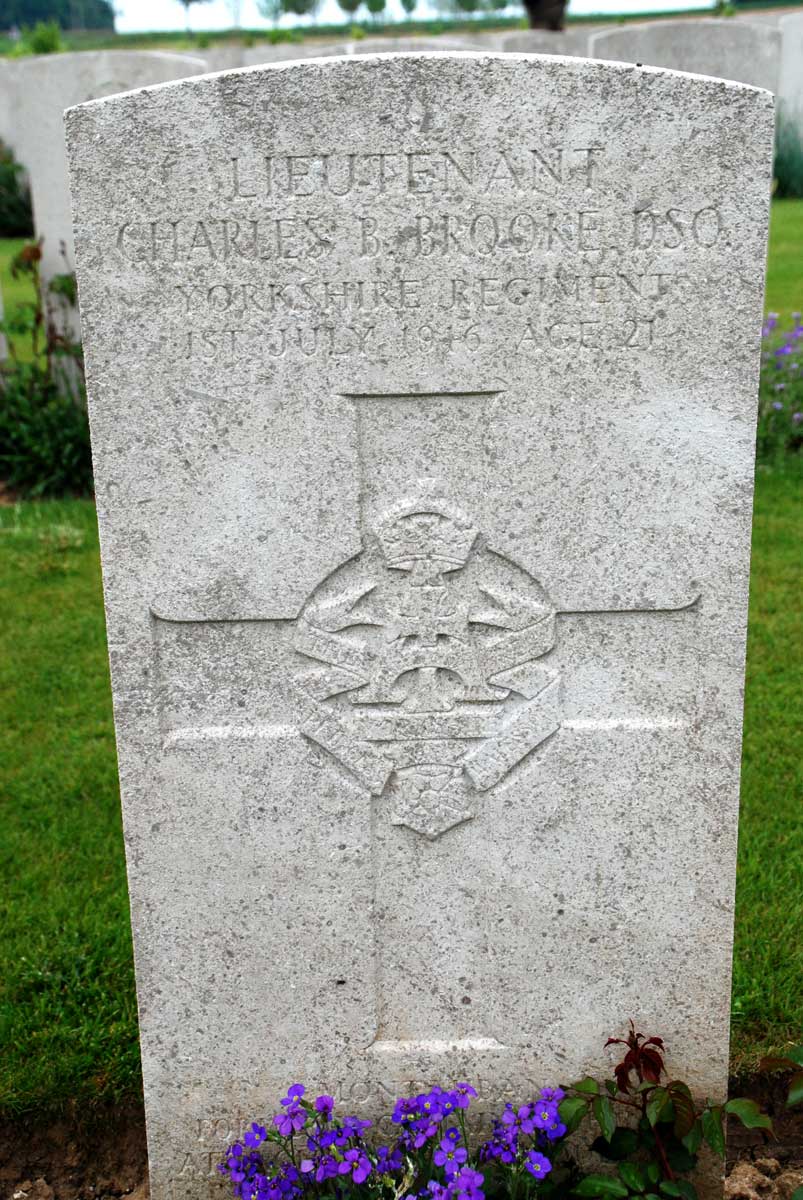
His headstone can be seen here:-
www.ww1-yorkshires.org.uk/jpg-files/overseas-cemeteries/p...
7th March 1895 – Birth……………
This birth date is quoted in the online biography for Charles, as well as one of the family tree links.
The birth of a Charles Berjew Brooke was registered with the Civil Authorities in the District of Samford in Suffolk in the April to June quarter, (Q2), of 1895. Then, as now, you had 42 days after the event to register the birth without facing a fine and a court appearance so a registration in this quarter is not incompatible with the date of birth quoted. Samford District included the Civil Parish of Brantham.
The marriage of his parents, Charles Berjew Brooke and Maud Gwenddolen Buchanan, was recorded in the Islington District of London in the April to June quarter, (Q2), of 1894.
1901 Census of England and Wales
The 6 year old Charles B Brooke, born Brantham, was recorded living at Colne House, Brantham. This was the household of his parents, Charles B., (32, Manager of Brantham Works, British Xyl.Co. Ld., born Liverpool, Lancashire), and Maude G., (26, born Cardiff, Glamorganshire). As well as Charles the couple also have a daughter, Gwenddolen F., (4, born Brantham). Completing the household is father Charles’ unmarried brother in law, Harold G. Buchanan, (22, Superintendent Xyl. Works, born London) and two live in domestic servants.
1911 Census of England and Wales
The 16 year old Charles B. Brooke, born ”Manningtree, Essex”, was recorded as a boarding school student at Bradfield, Reading, Berkshire.
His parents were still recorded living at Colne House, Brantham. Charles Berjew Junior and Mary Gwenddolen Brooke had then been married for 16 years and have had 2 children, both then still alive, but neither was at home. Charles, 42, is recorded as the Xylonite Works manager. Mary was then 38.
His sister Gwenddolen was also at boarding school – in her case at St Felix School, Reydon, Sothwold, Suffolk.
Until September 1911 the quarterly index published by the General Registrars Office did not show information about the mothers maiden name. A check of the General Registrars Office Index of Birth for England and Wales 1911 – 1983 shows no likely additional children of parents Charles and Maud.
Army career…………………………….
The London Gazette dated 8th January 1915 records that on probation Second Lieutenant Charles Berjew Brooke of the 3rd Battalion, The Suffolk Regiment was confirmed in his rank.
www.thegazette.co.uk/London/issue/29035/page/287/data.pdf
1st Queens Battalion War Diary 9th June 1915
Lieut C B Brooke is shown in command of B Coy in place of Lieut W. Nicholas, who was in Hospital.
qrrarchive.websds.net/PDF/QW00119150601.pdf
His promotion to Captain, effective 4th August 1915, appeared in the Supplement to the London Gazette dated Saturday 4 September 1915. Recorded on page 8815, he is shown under the Special Reserve of Officers, Suffolk Regiment.
www.thegazette.co.uk/London/issue/29284/supplement/1
1st Queens Battalion War Diary 25th September 1915
Section B.2. Our leading line advanced at 6.7 a.m. and reached the German 3rd line without great opposition. The attack was evidently a complete surprise.
The Battn. advanced on a frontage of two platoons. D. Coy. (Major BUNBURY) on the right and B. Coy, (Capt. Brooke) on the left. The advance was necessarily slow to keep behind the smoke, B & D Companies reached the German lines and gained touch with the 2/Oxford L.I. and the 2/H L I on the left and right respectively. The Support Company (C Coy) under Captain Weeding held on front line of trenches and, at about 8.15 A M two platoons of this Company reinforced B & D Companies, taking up a supply of Bombs with them, Lieut E D DREW commanded this party.
The Enemy developed a strong bombing attack on both flanks of the Regt., and our men were unable to reply effectively owing to a lack of bombs. About 9.45 a.m. the two and half companies were obliged to fall back into our own lines, under a very heavy machine gun fire from the right flank.
Casualties:- 2Lts A W A BRADSHAW, C D M FOWLER and E I B HOWELL killed & missing, 2 Lt F G PLANT wounded and missing, Major J.K.N. BUNBURY, Capt C B BROOKE, Lieutr H P FOSTER and 2 Lieut R G POYESON-MICES(?) wounded. Other Ranks, 19 Killed, 21 missing believed killed, 138 wounded, 80 Missing and wounded & missing, 7 suffering from gas. 1 died of wounds. Total 265 other ranks.
The remainder of the day was spent in reorganizing the line and in collecting wounded, burying dead etc.
qrrarchive.websds.net/PDF/QW00119150904.pdf
His appointment as Companion of the Distinguished Service Order appears in the Supplement to the London Gazette dated 14th January 1916. He was recorded as The Suffolk Regiment, Special Reserve (attached Royal West Surrey Regiment).
www.thegazette.co.uk/London/issue/29438/supplement/575/da...
The London Gazette dated 18th February 1916 included the notice:-
Alexandra, Princess of Wales’s Own (Yorkshire Regiment).
Captain Charles Berjew Brooke, D.S.O., from The Suffolk Regiment, Special Reserve, to be Second Lieutenant, and to retain his higher rank until ordered to join a Regular unit. Dated 19th February 1916, with seniority from 4th January, 1916, and precedence next above R, de H.M. Bell.
www.thegazette.co.uk/London/issue/29478/page/1812/data.pdf
On the day
Saturday July 1st 1916, Temperature 72°, clear sky
XIII CORPS -CAPTURE OF MONTAUBAN -30th DIVISION
The wire had been cut successfully. The Germans were mostly caught in dugouts, so little resistance was encountered
89th Brigade : starting from four lines of assembly trenches at 7.30 AM ,17th and 20th King's met little resistance and moved on to Casement and Alt Trenches. The 2nd Bedfordshire were in support and mopping-up. The attack pressed on to Dublin Trench. At 8.30 AM the right of the line joined with the French and the left, in the east end of Glatz Redoubt; simultaneously, the 3rd Battalion of the French 153rd Regiment entered Dublin Redoubt at the east of Dublin Trench. The position was consolidated
21st Brigade : The enemy here was also caught in its dugouts so little resistance was encountered
Leading, with 19th Manchesters, 18th King's went forward until they caught up with British barrage at Alt Trench, where they had to wait until the barrage lifted at 7.45 AM , before occupying it. The Manchesters had few losses but the King's were caught by enfilade machine-gun fire from the west side of Railway Valley. Fire from the Warren caused severe casualties among 2nd Green Howards who were in support, and few managed to cross no man's land. A party of Germans came out of a deep dugout and proceeded eastwards but were out-bombed by a party of moppers-up. This enabled 18th King's to advance along Train Alley to Glatz Redoubt, reaching it at 8.35 AM and joining with 89th Brigade
90th Brigade : At 8.30 AM 90th Brigade began its advance on Montauban, passing through 21st Brigade with 16th and 17th Manchesters. The 2nd Royal Scots Fusiliers were in close support. Despite machine-gun fire from Bresleau Alley, they continued their advance, and the German machine-gun was finally wiped out by a Lewis-gun of the 16th Manchesters. Under cover of a smoke-screen, the Manchesters and Royal Scots Fusiliers entered the village of Montauban at 10.05 AM , to find it deserted. By 11 AM the second objective in Montauban Alley was entered. The Germans were pulling back in large numbers. The 16th Manchesters rushed the battery in Caterpillar Valley and captured the first three guns of the battle. Montauban was consolidated.
At 12.30 PM 4th Coy, 20th King's (89th Brigade) attacked La Briqueterie from Dublin Trench under cover of an artillery bombardment
Simultaneously, bombers moved up Nord Alley cutting off the retreat of the garrison. By 12.35 PM La Briqueterie was taken, as were all objectives and the position was consolidated. By 6 PM the road to Maricourt-Montauban had been repaired 200 yards beyond the old German front line
The 30th Division had taken all its objectives
www.bandb-somme-bernafaywood.com/the-great-war/bernafay-w...
There is more on the 30th Divisions’ role here:-
www.longlongtrail.co.uk/battles/battles-of-the-western-fr...
PERONNE ROAD CEMETERY, MARICOURT
Location Information
Maricourt is a village situated on the D938, Albert-Peronne Road, 10.5 kilometres from Albert.
History Information
Maricourt was, at the beginning of the Battles of the Somme 1916, the point of junction of the British and French forces, and within a very short distance of the front line; it was lost in the German advance of March 1918, and recaptured at the end of the following August. The Cemetery, originally known as Maricourt Military Cemetery No.3, was begun by fighting units and Field Ambulances in the Battles of the Somme 1916, and used until August 1917; a few graves were added later in the War, and at the Armistice it consisted of 175 graves which now form almost the whole of Plot I. It was completed after the Armistice by the concentration of graves from the battlefields in the immediate neighbourhood and from certain smaller burial grounds, including:-
BRIQUETERIE EAST CEMETERY, MONTAUBAN, on the East side of the brick-works between Maricourt and Montauban, containing the graves of 46 soldiers from the United Kingdom who fell in the latter half of 1916.
CASEMENT TRENCH CEMETERY, MARICOURT, on the West side of the road to the Briqueterie, in which 163 soldiers from the United Kingdom and one from South Africa were buried in 1916-1918.
FARGNY MILL FRENCH MILITARY CEMETERY, CURLU, on the North bank of the Somme, in which six soldiers from the United Kingdom and two from Australia were buried in 1916-1918.
LA COTE MILITARY CEMETERY, MARICOURT, a little way West of Peronne Road Cemetery, containing the graves of 38 soldiers from the United Kingdom and one from Australia who fell in 1916-1917.
TALUS BOISE BRITISH CEMETERY, CARNOY, between Carnoy and Maricourt, at the South end of a long copse. It was used in the latter half of 1916 and (chiefly by the 5th Royal Berks) in August 1918, and it contained the graves of 175 soldiers from the United Kingdom and five from South Africa.
(Plus other site but whose details indicate none from 1916)
There are now 1348, 1914-18 war casualties commemorated in this site. Of these, 366 are unidentified and special memorials are erected to 26 soldiers from the United Kingdom known or believed to be buried among them. Other special memorials record the names of three soldiers from the United Kingdom, buried in other cemeteries, whose graves could not be found.
CWGC: www.cwgc.org/find-a-cemetery/cemetery/32200/peronne-road-...
As part of the commemoration of the outbreak of the Great War, the Commonwealth War Graves Commission added a number of original documents to their website. One of those on their webpage for Charles Brooke is a Concentration Report. These reports detail an exhumation and move to the current resting place. He was one of at least 10 graves moved from map reference 62c.A.14.b.5.4 into Peronne Road Cemetery. Charles was the only officer – the other nine British soldiers all died in 1918 Someone has written in blue pencil down the side of the report “Maricourt 3/95E”, which might imply they came from either the La Cote Cemetery or Casement Trench Cemetery.
A report prepared for the Commission to take over maintenance of the graves indicates they were at the new location by the start of November 1920.
Postscript………………….
The 1916 Probate Calendar records that Charles Berjew Brooke, of Colne House, Brantham. Suffolk, a Captain 2nd Battalion Yorkshire Regiment D.S.O., died 1 July 1916 in France. Administration of his estate was granted at the Ipswich Court on the 28th August 1916 to Charles Berjew Brooke, (the younger), manager of the British Xylonite company’s Brantham works. His effects were valued at £322 2s 4d.
probatesearch.service.gov.uk/Calendar#calendar
The edition of The Times, dated Monday July 10, 1916 records his death and includes a brief obituary.
CAPTAIN CHARLES BERJEW BROOKE, D.S.O., Yorkshire Regiment, was the only son of Mr. and Mrs. C.B. Brooke, jun. of Colne House, Brantham, Suffolk, and was 21 years of age. He was educated at Belton Grange, near Rugby, and Bradfield College. He was gazetted to the 3rd Suffolk Regiment on the outbreak of war, and was sent to France, attached to the 1st Queen’s, in December 1914, and rose to the rank of captain. He was seriously wounded while leading his company in the attack on September 25, 1915, and was mentioned in dispatches and awarded the D.S.O. In January 1916 he was chosen for a commission in the Regular Army, and was gazetted to the Yorkshire Regiment. He was killed on July 1st “while leading his company into action in this recent attack”.
The Births, Marriages and Deaths announcement in the Western Mail on the following included a note on the death of Charles “On Active Service”.
BROOKE.- On July 1st, in France, Charles Berjew Brooke, D.S.O., Second-lieutenant, Princess of Wales’ Own Yorkshire Regiment, aged 21, only son of Mr. and Mrs. Charles B. Brooke Junr., of Colne House, Brantham, Suffolk, and nephew of Mrs. C.H. Bailey, Stelvio, Newport, Mon.
That final letter was printed in full in the editions of The Surrey Advertiser, dated Saturday, July 22nd 1916 and Monday, July 24, 1916, under the heading Former Queen’s Officer Letter. It is noted that there are many in The Queens who will remember Captain Brooke, and “many others who will find consolation in the letter”. On the same page in the Officers Killed section, as well as his name appearing in the list there is also a few lines about him.
Lieut. and Temp. Capt. Brooke, D.S.O., Yorkshire Regiment, who was killed in action on July 1st, was attached to a battalion of The Queens from December 1914, until he was wounded on September 25th 1915. He was the only son of Mr. and Mrs. C.B. Brooke, Colne House, Brantham, Suffolk, and was 22. His colonel writes: “As soon as he joined us we recognised him as a born leader of men, and I at once put him in command of a company. He was leading it to the assault when he was shot.”
For more on the church of St Michael Archangel, Brantham, see
It is only because the shifting sand has buried all the other smaller rocks leaving the tip of a giant as a reminder of the colossus beneath
The return of Soul Asylum
Trying to repeat its '90s success seems insignificant after all the band went through to make its first CD in eight years.
Chris Riemenschneider, Star Tribune
To an outsider, it may seem an insignificant little phone call, but to Dave Pirner it was gigantic -- especially in hindsight.
"Karl called me up before we were heading into the studio to tell me how excited he was about the songs," the singer for Soul Asylum recalled, naming the turning point in his band's eight-year hiatus from recording.
Bassist Karl Mueller -- who had sold millions of records with Pirner, shared a Grammy with him and posed for the cover of Rolling Stone magazine with him (twice) -- gave the singer the encouragement he mysteriously needed to finally crank out another Soul Asylum album.
As Pirner explained it, "That sort of thing just doesn't happen in bands, or at least not in our band. One guy doesn't call up another guy to say, 'Hey, I really like your new songs.' That was when I knew we had a band again."
Not long after that conversation, though, Pirner got a different kind of call from Mueller's wife, Mary Beth. "You guys better come over," he remembers her saying.
Karl had found out he had throat cancer. That was in May 2004. On June 17, 2005, he died. In between, he would help his bandmates make their best album since the one that made them multi-platinum rock stars, 1992's "Grave Dancers Union." Mueller even picked the Replacement who would fill his shoes and help the band carry on, Tommy Stinson.
Soul Asylum has persevered once again.
The CD is called "The Silver Lining," a play on the cloudy patches the band members went through in the buildup to recording. Its July 11 release on Sony's Legacy label will test their legacy. Or as Pirner put it, "whether or not people give a damn anymore."
True to their hipster-defying past, the band -- which also now includes longtime Prince drummer Michael Bland as its permanent rhythm-keeper --will preview the album Monday at the Taste of Minnesota's main stage. The first single, "Stand Up and Shout," is already getting scattered airplay nationally and good radio support locally on Drive 105 and Cities 97.
"I honestly believe they can be a fairly big band again," said Steve Berkowitz, the senior vice president at Sony who signed the band this time. "The music is exceptional again, but there's also a great, almost legendary rock 'n' roll story here in the spirit in which they made this record."
Many of the group's fans gradually gave up after its last two overpolished, heavily commercialized albums, 1995's "Let Your Dim Light Shine" and 1998's "Candy From a Stranger." The last album, in particular, was summed up pretty well two weeks ago by guitarist Danny Murphy.
"It sounds like a band whose spirit was broken," he said, sipping on a beer at an Uptown eatery near his house in Minneapolis. (The interview with Pirner took place separately by phone from his second home in New Orleans, which is a whole other chapter in the "Silver Lining" saga.)
Part of the problem came when Columbia Records asked the band to re-record the entire album. The label plainly piled on the pressure to repeat the success of "Grave Dancers." As a result, the guys stayed off the road for over a year and spent way too much time making the record -- including a long session in Miami, which put things over budget and nearly pushed them over the edge.
"What the [expletive] were we doing in Florida for weeks on end making an album?" Murphy said with a hard shake of the head. "It all got so weird and bloated. ... We were all pretty sick of each other, the band, all of it."
During his time off from the band, Murphy finally got to spend quality time with his son Kelly, now 17, and started a vintage art-print business. Last year, he and his all-star pals in Golden Smog recorded their third full-length album, which by sheer coincidence comes out exactly one week after the Soul Asylum CD. He also settled into a relationship and remarried last month.
In other words, things are going pretty well. Murphy even said, "Honestly, if this record does well, it would probably make my life worse." That doesn't mean he isn't crossing his fingers. In his view, the turning point was a lot like the revelation Pirner had: "It just came down to having enough great songs, when we knew we had to make another album."
• • •
"If you look back on all our records," Pirner said, "the best ones are the ones that came after a break, when we had more time to work up the songs more: 'Made to Be Broken' [from 1986], 'Grave Dancers,' and now this one."
Pirner never stopped writing Soul Asylum tunes, even when he wrote material for his solo album, "Faces & Names," which came out to little fanfare in 2002. Making that record, along with his long respite in New Orleans and the birth of his son three years ago helped bring Pirner back to, well, the horse he rode in on.
"I guess it all led me back to appreciating and loving Soul Asylum again. It made me realize how special it all was."
Without a record deal, the band returned to its pre-"Grave Dancers" routine -- sort of, anyway. Murphy and Pirner took out a $60,000 loan to pay for the recording (a smidgen compared to their '90s budgets), recruited a local producer and went to work in a local studio. Thanks to the flight of Jimmy Jam and Terry Lewis to Los Angeles, Soul Asylum at least wound up recording at the nicest place in town, Flyte Tyme. Their producer was the studio's longtime engineer, Steve Hodge, who said the band had a clear vision of what it wanted.
"The basic idea was to make a Soul Asylum record -- with a little updating, yeah, but not trying to re-create the band," Hodge remembered.
Of course, what was supposed to be a return to form turned into anything but, as Mueller underwent cancer treatment.
"There were some days Karl was great and could play anything, and some days he was in noticeably bad shape," Hodge said. "But just the fact he was there, I think, meant a lot to everyone."
Despite the success at Flyte Tyme, when the band finished the sessions, it once again had somebody telling them the record needed more work. But it wasn't the label this time; it was their new drummer. "Michael actually said something like, 'I don't know if I can get behind this record, the way it is now,' " Murphy recalled.
Said Pirner, laughing at the memory, "I think it was only a day or two after Danny and I had a discussion that was something to the effect of, 'I don't think we can tour or do anything if Bland isn't our drummer.' So we listened to Michael, and wouldn't you know, he was right."
Last fall, the band reconvened at the Terrarium studio with another producer, John Fields, the former Greazy Meal member who has recorded with locals including Har Mar Superstar and the Honeydogs as well as nationals such as Switchfoot. About half the songs were touched up, some with Stinson playing bass and some with Mueller's parts intact.
Even with the two producers and different sessions and a lot of grueling days, Murphy said, "It never didn't feel right."
"It was nice to just do it in Minneapolis, with producers we got along with, and then we'd go home at the end of the night, not spending a fortune or having an A&R guy staring over our shoulder," he said.
• • •
Add it all up, and you have some of the best-crafted songs of Pirner's career along with some obviously inspired, all-for-nothing musical performances. "Stand Up and Be Strong" and "Crazy Mixed Up World" spill the anthemic, big-chorus, fist-pumping rock at the start of the album. The high points are actually deeper in, including "Oxygen," which has become a staple at the live shows, plus the grittier rocker "Bus Named Desire."
Another gem, "Fearless Leader" -- a scathing acoustic track tacked on the end of the CD -- was written around the time of the first President Bush. After guitar tech John (Woody) Woodland dug up a bootleg of the song from an old gig, Pirner thought it had more relevance than ever, with its lyrics about uninspired politicians and Christians who've bastardized Jesus' teachings.
"There's a lot of that kind of weird timelessness on this record," he said.
Maybe the best example of his foreshadowing is "Standing Water," which sounds like a response to Hurricane Katrina. (One phrase in it -- "rainbow runoff" -- especially recalls the images of polluted water.) That track, too, was written a few years back.
"Everyone in New Orleans has always been aware that the city is technically undersea, and there was always a certain danger in it," he explained. "Before Katrina, I remember watching tropical storms where the water would build up on the streets in very nerve-racking ways."
By the time you read this, Pirner will have boarded up his (mostly unscathed) house in New Orleans to return to Minneapolis for the rest of the summer. The band has a string of gigs in July, including a "Tonight Show" appearance July 10. Most of those (including the Taste show) will be played without Stinson, who is on the road with the revamped Guns N' Roses, a commitment he made eight years ago. John Fields will fill in on bass.
"Axl has dibs on Tommy; we're cool with that," Pirner said.
Stinson's situation is just one more thing stacked against the band with the release of "The Silver Lining," but it seems like small potatoes after everything else. With eight years off, there's a lot of proving that Soul Asylum has to do. And that's fine by them.
"We've always been a band that liked to beat the odds," Murphy said.
Pirner, though, dismissed the idea of calling this album Soul Asylum's comeback. "I don't know what you'd call it," he said, "maybe a testimonial to some kind of obsessive perseverance. At this point, it's not something we're doing on Karl's behalf or anything like that. It's just in our nature to not give up."
He added, "In a lot of ways, it's business as usual."
Chris Riemenschneider • 612-673-4658
©2006 Star Tribune. All rights reserved.
Jaina Lefevre comes skipping up and slows when she sees Rivers' got company...
River Grau is being held by Saki as her and Damian made shallow threats to eachother. He looked over at Jaina and waved, seeing her skip down the road.
Chisaki Nakajima chuckles as she heads off with River. "serpent indeed...wish i had some critter ridder"
Jaina Lefevre watches Saki go and River and then looks back at the mayor. She slows and stops in front of him, staring up at him and swaying back and forth.
River Grau waves again as he is taken away.
Jaina Lefevre is cleaner than the last time he saw her. And not quite as pale. And new clothes.
Damian Rigaud looks at the little girl... albeit slightly uncomfortable "Hello.. " it takes a moment to relize this was the girl that he saw on the street a few ddays earlier.. and cost him some snake skin boots "Oh.. its you.. feeling better..?"
Celia Obviate glances up looking at the girl, sweeping her gaze from the ground where it was, her eyes are smiling slightly but the depths are showing only a glimmer of hope that this interaction will be better than the last
Jaina Lefevre grins slowly at him, nodding. "Uh huh. Did you wash your boots?" She glances at the lady, then at Damian again. "You change your boots...and your lady?"
River Grau watches the little group since Saki stops, wiggling in her arms. It's his friend Jaina. He didn't really want to be taken away.
Damian Rigaud smiles "My other 'lady' sent them out to be cleaned.. "
Celia Obviate laughs a little, blushing at the the girls suggestion as she shakes her head starting to speak before she hear damian start to speak over her
Jaina Lefevre nods. "Tha's good. I got new stuffs too. What's your name? I knowed you're may-ore..."
River Grau runs back over as Saki lets him down since she has other business to take care of. He runs down the road, yelling. "I AM FREEEEE." The boy really didn't like when people told him what to do. And in protest to that, he stops right by Damian again.. who she said specifically not to go near. "Hi Jaina."
Damian Rigaud grimances slightly wanting to leave this conversation "Damian.."
Jaina Lefevre grins at River. "Hi Rivers." She looks at Damian. "I'm Jaina. I wants to say sorries for bein' sick on your boots and thankyouse for helpin' me get betters." She digs in her pocket and pulls out a clear blue bit of seaglass, polished smooth and steps closer to hand it to him. "It's a present. My new mommies say I should say thank youse to everyone."
Damian Rigaud blinks ... his expression one of mute suprise as he stares at the bauble in the childs hand "You are giving this to me..?"
Celia Obviate watches this interaction take place with a pleasant smile, very much more satisfied with this result as opposed to the other
Damian Rigaud he asks in a quiet voice
Celia Obviate she laughs softly and looks from the little girl to him "...yes, I do believe she is"
River Grau looks over at the bit of sea glass, muttering. "You ain't give -me- any sea glass for takin' you 'way from the gun.."
Jaina Lefevre nods to Damian. "I giveded one to God too, 'cause he gave me what I askeded for." Yes, Damian has the same present GOD has. "I finds them and they is special, so's I saves them for special." She glances at River "That's cause you made funs of me after."
Damian Rigaud reaches out with his worn dark hand .. his palm opened facing up
River Grau makes a face at Jaina. He did make fun, a few times, but he helped and that was what counts. Grumble grumble.
Celia Obviate she smiles at her boss, watching his face intently and then glancing at the little girl with pleased and slightly grateful eyes and she sweeps her gaze back to the boy with a soft laugh
Jaina Lefevre puts the polished bit of what was likely an old wine bottle, into Damian's hand, about the size of a man's watch face, if it were rounded. Her hand shifts to curl his fingers around it a little and she smiles up at him, eyes glinting. "You keeps it safe, right?"
Damian Rigaud nods and responds quietly "I will keep it safe.. "
Leigh Parx (Kayleigh Jigsaw) stopped in her tracks and turned on her heel. She'd seen the mayor and heard rumors of him being trouble. She pivoted on her heel. "Up to you if you wanna follow, I'm checkin on a new friend." River had said something last night about people wanting to beat him up and stuff. She made her way back towards the little group.
Jaina Lefevre keeps her hand on Damian's a moment and leans in to 'whisper' to him. "You tells my mommies I said thanks you?"
Damian Rigaud nods "I will .." he responds in a soft voice
Elyssa McAlpine is confused, to say the least, but what the hell; in for a penny, in for a pound. She hesitates a moment, and then follows after Leigh, making a much less imposing presence thanks to the fact that she's dressed like a hooker, natch, and tottering along atop stilettoes.
River Grau looked over and saw Leigh walking this way. Right now though he was making an anoyed face at Jaina but didn't really say anything. The boy didn't really want to spoil the sappy moment.
Damian Rigaud slides the glass into his pocket as the women apporach "Who is your mother ..?" he asks in his normal resonate tone
Jaina Lefevre grins at Damian. "I gots two!" she holds up two fingers. "Mommy Debra and Mama Deets! Aaaannnd I gots two beds! I ain't never had a bed of my own 'fore."
Damian Rigaud arches his eyebrow "Those are.. good mothers to have..."
Celia Obviate bites her lips and shuts her eyes, trying not to smile
Elyssa McAlpine frowns as her phone starts to beep insistently at her. She tugs it out, flips it open, and rolls her eyes, calling at Leigh, "Sorry, sweetie, but work calls. I'll call ya later, if that's cool?" She didn't wanna miss a bit of bonding through gunfire, after all.
Leigh Parx (Kayleigh Jigsaw) kept her distance some as she moved a bit closer to the group. She wasn't sure what was going on, nor did she really care. Her primary focus was making sure River was alright and curiosity as to whether or not he'd been able to hang onto her present. A contemplative look crossed her features briefly as she made a note to keep an eye out for yet another kid running loose on the streets.
River Grau turned towards Leigh and tried to wave her over. Nothing sinister would be going on with them, so he couldn't figure out why the woman was keeping her distance. "Your Mama threw a kid into the sewer an' he almost died. I was in the paper for helpin' saved him." The boy was a little proud at being in the paper over that.
Jaina Lefevre nods her head, then glances at River. "My mommies wear more clothes than Rivers' mommy, but Chan's got /three/ mommies." She looks over at River. "Uh huh. But that was 'fore she was a Mama. Now she knowed better."
Leigh Parx (Kayleigh Jigsaw) nodded in Ely's direction and made her way towards River. "You okay, hun?" From the way he'd described things the other day it sounded like he was usually having to run away from things or finding trouble more than Leigh's own reputation had her finding. She raised an eyebrow at River's comment, but held her tongue.
Damian Rigaud nods "Thats alot.. um.. to keep track of.. " getting lost again. HIs eyes flick up to the girl as she apporaches.. noting her gun.. dress..and .. attributes..
River Grau looked over to Jaina, wondering if this was some sort of contest. "Well, since Miss Alayni is one of Chan's Momma's too, that means -I- gotta Sister. An' a Mama that ain't throw children over into sewers." He nodded to Leigh, "I'm doin' okay." Well, since there wasn't a large cyborg here with a hammer, River did not have to run away. Nor was there anyone pointing a gun at him. Hurrah.
Jaina Lefevre reaches up to rest her fingertips against Damian's hand holding the seaglass and leans in to gesture with the other hand holding the dolly, for him to come closer. She glances at Leigh a moment, then back to Damian. Important stuff first.
Damian Rigaud kneels down to listen to the girl. .his face in an almost frustrated contrast as if wondering why his body was doing thise when CLEARLY his mind did not wish it.. the strange beguiling power of little girls.. it was inexplicable..
Jaina Lefevre leans in to whisper to him, lips right near his ear. **whispered** Jaina Lefevre whispers. "You shouldn't be so sads. I thinks you needs a hug but maybe you don't hugs in publics 'cause then they'd know you was nice insides." The kid is -way- too perceptive for someone that small, and there is a 'knowing' behind those odd blue eyes that simply calls it like it is.
Leigh Parx (Kayleigh Jigsaw) just grinned at him and dropped to a knee beside River. Fortunately, her skirt didn't show diddlysquat when she did, given she was pretty oblivious to the fact skirts tended to require a bit more attention to be paid to avoid showing off private things. "Still got that present I gave ya, kiddo?" Her voice was hushed as she asked the question. She was pretty sure River hadn't had much time to figure out how to use it yet.
Damian Rigaud moves his head back with a slight start looking at the girl.. inches separating their faces .. the blue eyes of hard kept innocence... and the hardened ice like eyes of his own "You are right.. " he says aloud. He brushes your cheek with his calloused thumb "YOu are a very clever girl..."
Celia Obviate smirks at the little girl speaking into the ear of her boss, she takes a second to lookat his suit now that she can see the shoulder line with his hair out of the way, her eyes wander a little bit before she catches herself and they look to the other people in the crowd
River Grau nodded, patting a pocket. There was a small cut on his finger, something insignificant but showed that he had been trying to practice with it. "Yeah, I got it.." He looked over his shoulder towards Jaina and the others. Curious.
Celia Obviate fans herself with her hand after removing her sweater and looking up at the buildings trying to appear otherwise distracted
Leigh Parx (Kayleigh Jigsaw) nodded. "Lemme know if you wanna hang out some later and maybe I can help you out some later today." She smiled at him a little. The lesson she'd been going to give on gun safety and basic firing a gun had gotten cancelled thanks to some horny guy's need to get off and her friend's need to bring money into the Peep.
Jaina Lefevre gives Damian a slow, warm smile, the kind that lights up a face and brightens the eyes. She looks into his eyes for a moment, then leans in and presses a kiss to his cheek. "You needs a little girls sometimes, and sometimes, I needs a Daddy person." She nods sagely, as if this deal had been concluded and her hand lifts to pat his other cheek.
River Grau nodded, "I'm okay to go now if you wanna.. Ain't nothin' really goin' on here." He looked over his shoulder again, "Ain't your Momma's gonna be upset if you just make anybody your Daddy, huh?"
Damian Rigaud's face softens .. for a flicker.. his aged lines and faded scars ease .. showing a glimpse of a younger man. He puts his hand on hers where it rests on his face and pats it .. removing it as he rises to stand.
Jaina Lefevre watches him stand up and doesn't look away as she answers River. "Don't gotta be togethers Mommies and Daddies. Just gotta be them kinds of persons to /me/."
Leigh Parx (Kayleigh Jigsaw) snickered softly hearing the girl's words and looked at River. "She's right, hun."
Celia Obviate continues to fan herself holding her sweater in the other hand as she shuts her eyes and blows her breath out slowly and quietly
River Grau nods, still frowning a little. "But I gotta Momma.. An' she says I ain't supposed to have no other Momma, but does that mean I can find'a Dad for me? 'Cause I dunno if she'd be happy with that either."
Celia Obviate bites her lip and tries to avoid laughing at the little boys comments, she fails miserably, letting out an amused laugh
Damian Rigaud reaches out for Celia's arm.. almost like he needed to ground himself "I need to get back to my office.. " he says to Jaina "I will come by and tell your Mothers..."
Celia Obviate's eyes open wide and she looks at him blankly and a little surprised at the touch ...she looks down at his hand "yes,...of course..."
Aravasha Yiyuan quietly walks up a soft smile playing at her lips
Leigh Parx (Kayleigh Jigsaw) shrugged. "Sounds like she's just a little protective of you and doesn't want to see you get hurt in case you make a bad choice. C'mon, you want that lesson? I got time now."
Jaina Lefevre nods to him. "Bye Daddy Damian." She turns to look at River and Leigh and offers a wave. "Hi. Is you Rivers' friend?"
River Grau looks over at Aravasha and waves happily as she walks over. Oh, nice noodle person! "Hi Miss Ara." He nods to Leigh, "Okay. Where should we go?"
Aravasha Yiyuan offers a large smile...hello River
River Grau inches closer to Leigh. "-My- friend." He frowns at Jaina. It wasn't fair to have two mommas and a daddy. Well, not when he didn't.
Leigh Parx (Kayleigh Jigsaw) shrugged a little. "If he wants me to be, maybe." She offered Jaina a smile and playfully pushed the hat down on River's head the same way her dad always did to her. At last, she finally understood why her father did it. "I'm Jeff. And you are?"
Damian Rigaud's eyes catch the movement of Aravasha apporaching .. his eyes look to her.. they shift to LESS than amused at her faint smile .. but not real anger. His eyes look down as Jaina bids him her .. special.. farewell.. he does not reply ..He turns the girl's arm he hand casually taken to guide away towards the new arrival "Celia.. this is my Aravasha.. Celia is a new intern Aravasha.."
Aravasha Yiyuan turns and offers a polite bow...a pleasure to meet you
Jaina Lefevre glances up at Aravasha and waves, then looks over at Leigh. "Hi Jeff. I'm Jaina. Rivers, you wanna go play school or somethin?"
The Prayers of Others (Cont'd from www.flickr.com/photos/42093313@N00/51241395667/in/datepos... )
Day Five – The road to heaven is paved with rocks
At the new hotel in Khanian I woke at 6:30 and had breakfast alone in the hotel garden in front of the river. It was loud and I wondered what it said. When it came to leaves and trees, rain and sand, even pebbles and rocks, I felt they all whispered. They were mostly still.
The river was loud and louder as you approached it and moved so fast, it was scary. But then I had also seen it in the open in Naran, where it just spread out and became like a lake, calm, quiet. From roaring to silence. I wanted to be like the river, go from a noisy head to stillness.
I read in the garden and wrote some while waiting for the driver. We were going to these beautiful meadows called Siri Payee two hours away. The last hour of the drive was again going to be a back breaker, at par with the road to Saif ul Mulook. When he arrived, we started loading up the jeep.
I had noticed that my lips were becoming drier and drier with each passing day. Thinking it was the air or the new environment for me, I was guzzling down the water from different streams like a maniac. On this day, five, my lips were like swollen dry prunes. Even though I felt embarrassed, I decided to ask Mushtaq about it.
“My lips are becoming really dry and strange. They feel very weird even though I drink a lot of water. Is it because of the air or something?”
He didn’t take a moment to reply.
“It’s the water,” he said. “It’s coming from the glaciers and it’s dry.”
“What? The water is dry?" I couldn’t believe my ears. “But I emptied all the bottles I had to fill them with this water.”
He started smiling. “The water is like this this time of the year. Don’t worry. They will become fine again.”
Great, I thought. When?
The part to Shoghran was quick, then we turned to go uphill. Once we left the main road, the drive was beautiful. The ranges of snow capped mountains were endless. During that hour, I began to deconstruct my night before. I had slept terribly again but this time it didn’t have anything to do with the hotel. The room was lovely. There were hardly any other guests. It was my mind that was driving me nuts this time with crazy thoughts all night.
First my nafs started whining about the aches and pains I felt in my body from all the driving. When we were in Skardu and perhaps all mountain hotels, the drive to other places to see was also always a couple of hours. But the roads in Naran were worse because of the snow. It kept damaging them and they weren’t rebuilt quite as quickly as in the terrain of the Agha Khan perhaps.
I felt the pain of course but in the darkness of the night, my nafs was accentuating that. If I turned a side or stretched my legs, it yelped. At first I didn’t realize what was happening. Then when it saw that I was oblivious, it shifted gears. My mind started erupting with thoughts about how my plans for the day were a nightmare.
“Why are we going to another place so far away on that dumb jeep again on a garbage road for hours? My bones will hurt. My muscles and nerves are already stiff like rocks. You should have just gone to Nathiagali if you wanted to see a meadow so badly. What’s the difference exactly? Even my stomach hurts,” it wailed.
I touched the muscles above my stomach. They did hurt. For a second I started second guessing myself. Should I go or cancel the trip? Before I could even decide on an answer or react, like its good old impatient self, my nafs decided to go full scale mental about everything. I started to feel stressed and anxious about things which were totally insignificant and on top of it, easy.
Upon returning to Lahore, I was supposed to introduce my team from the table tennis project to Daewoo who were making the next 10 tables. All I was going to do was take the different workers over and give them a breakdown of what everything cost me. Suddenly there I was in the darkness of the night, worrying and thinking about that in a loop. It was senseless.
In the jeep as I replayed the events, wondering what had happened, it dawned upon me. My heart or rather my qalb rejecting the negative thoughts coming to it from the brain meant I was a step closer towards controlling my tongue. My nafs, one step ahead of me at all times, realized what was happening. Like a mental health patient seeing the strait jacket coming towards them loses it one last time before surrender, my nafs was crying bloody murder!
It was at least nice to figure out why my sleep was all over the place. Wobbling around on the drive up, I thought about silence.
“O Listener! Leave your false lusts and desires and busy yourself in remembrance of Allah. Let that leave your tongue which gives you benefit and keep yourself silent of the words which will bring you harm. If you decide to speak, then before you say anything, deliberate on it. Form an intent around it. Then use your tongue.”
The problem with mine was that after I broke it, when I did say something, it was always without thinking. Hence rubbish came out. If I had to pause before everything I said, like Ghaus Pak (ra) was instructing though, how long would my pauses be?
I thought of Imam Ali (ratu) and something he said which I always understood in a narrow context previously. “See your destination before you embark on a way, even it is paved with gold and silver.” I re-heard the words as “Hear your sentence before it leaves your mouth, even if you intend to say it without meaning it badly.” Who would have thought the “destination” could be a string of words uttered by the tongue?
I knew how to try it. My driver, Usman, the young man who was still under training was the perfect person. He continued to make four mistakes a day, two of which were the same as the previous day. My tone had changed in that I used less irritated “whys” and more sarcasm. He seemed unaffected by either.
His age, 24, was compounded by the fact that he seemed to be popular. Everywhere we went, he made friends and told me how they always gave him free food and drinks and wanted to hang out with him. He also made these interjections that were bizarre. Like on the drive up to Siri Payee when I scribbled notes for this piece on a paper. I thought the driver might wonder why so I told him.
“I’m writing a piece during this trip. I just have to note things down sometimes when they come to me otherwise I might forget them.”
Next I hear Usman pipe in from the back.
“I’ve been writing too,” he said. “In the night.”
I ignored him so he offered more.
“Those contacts from your phone you wanted me to save on paper.”
“Yeah,” I thought as I rolled my eyes, “that’s exactly the same thing.”
Then I smiled at my cattiness. Yes, Usman was the perfect specimen to try the “pause before you speak” rule.
My mood suddenly became elated after I figured out what my nafs was doing. I put on my headphones and blared some house tracks I had downloaded just before leaving Lahore. (www.youtube.com/watch?v=60wfyuwb_sk) Normally, the music would make me joyous but seeing the scenery, I kept thinking of God and His Mercy upon me and the sound just made me cry. (www.youtube.com/watch?v=a_Cw73cNP0Y)
Every so often, I wiped my tears as if they were dust on my face so the driver wouldn’t notice. House music fanatics are like that. Just as the music compels them to dance, it can make them weep. I often read that in the comments of tracks that I love and it always makes me smile.
Siri Payee was expansive and serene. There weren’t many people there. Apparently, the jeeps for the trip there would give the client an hour and a half there. Most people didn’t even walk ahead of the little cafes that were right at the start. I walked a while till I found a spot. There was no shade and the sun was warm but it was always quite windy at times so the heat felt good.
I ate some lunch and prayed. Qari Sahib had told me to pray as much as I could in the highest of places. The mountains were always where the Prophets retreated to meditate. I just managed to say the prayer of the hour and listen to Surah Yaseen. I had finally learnt it now so I would recite it as it played with one headphone off so I could hear my voice as well. Every time I did that different verses flowed out of my mind all day long. I liked that a lot.
Afterwards I just lay on the grass and stared at the mountain ahead of me that was stunning, I must have taken 20 shots of it in different light. I thought about what was happening to me. In a recent reading of sharha of the Masnavi I had read this excerpt;
وَأَن لَّيْسَ لِلْإِنسَـٰنِ إِلَّا مَا سَعَىٰ
And each human being will attain what he strives for.
Surah An-Najm, Verse 39
“As the hadith goes; Each person will only gain reward based on how much he sacrificed and how much he endeavoured. Whenever each human being works for earnings, a list is prepared of who did what. So and so worked in a garden, so and so did it for one day, so and so for five. Someone worked in a shop for x number of hours, another stitched y number of shoes, yet another crafted z number of bowls. In the Quran it says that Allah said to the angels, “I know what you do not know.”
He is The One who knows on a dark night, on a black stone, the black ant walking on its tiny feet, or running, so know that everything is seen and known by Him. Allah also knows the reason for the ant’s running. Is it concern for its family or is it greed for food? Is it a dutiful one or is it just wandering? The Lord who knows this will certainly be aware of the strivings of His Servants, all of Mankind.
وَعِندَهُ مَفَاتِحُ الْغَيْبِ لَا يَعْلَمُهَا إِلَّا هُوَ
وَيَعْلَمُ مَا فِي الْبَرِّ وَالْبَحْرِ وَمَا تَسْقُطُ مِن وَرَقَةٍ إِلَّا يَعْلَمُهَا
وَلَا حَبَّةٍ فِي ظُلُمَاتِ الْأَرْضِ
وَلَا رَطْبٍ وَلَا يَابِسٍ إِلَّا فِي كِتَابٍ مُّبِين
For with Him are the keys to the things that are beyong the reach of a created being’s perception; none knows them but He.
And He knows all that is on land and in the sea and not a leaf falls but He knows it.
And neither is there a grain in the Earth’s deep darkness, not anything living or dead, but is recorded in His Clear Decree.
Surah Al-Anam, Verse 59
Does He not know how many tears fall from the sinner’s eye? How many sighs of pain were exhaled? How many gave their lives for Him? Who is is Aar’if, possesses recognition of Him? Who spends their life in remembrance of Him? Who is only spinning the beads of the tasbeeh (rosary) without feeling? Who is in praise of Him since Fajr? Who is passing stations of spirituality? Who is steadfast in their striving in the way of Allah? Who is feeling ecstatic in His Kingdom? Who is merely asking for things?"
On the way to where the jeep was parked, I saw Mushtaq and Usman speaking to three young guys standing next to a bike. I did a double take. A bike?
When I reached them I asked smiling, “Don’t tell me someone made it here on a motorcycle?”
We had seen cars parked on the side of the road from being over-heated because of the incline. Even though Pakistan is full of the largest jeeps in the big cities, Prados and Land Cruisers, I had hardly seen any in the entire area. Mushtaq had said people don’t like to bring their own cars because the roads are so bad. Instead they rented the little Wranglers.
They smiled back.
“Those three guys,” Usman replied.
“I don’t get it. A car can’t make it up and a bike can. With not one or two but three people on it?” Basically my tone was “You have got to be kidding me!”
Both of them continued smiling. ‘We asked them the same thing.”
“And…?” I waited.
“They said ‘We’re Pakistani.’”
“Meaning what?”
“Meaning ‘Is there anything we cannot do?’” Usman said with a smirk.
Going down the road, my bones rattling all the way, I thought they’re right. Maybe there was nothing we could not do. But only when it came to being challenged. In terms of picking up our own garbage, we ranked last. But maybe all things have to come with time. I knew I had my own role to play in that too when I heard what Hazrat Bahauddin Zakriya (ra) said about the destiny of a nation.
“It lies in the hands of two groups; the elite and the scholars.”
Day Six – One last Stint
On the last day, I had decided to just hang out at the hotel. Not get into a jeep and just write. I came across some notes from a lecture Uzair gave on imaan, faith. I had used the verse once before in a video marking the Urs Mubarik of Ghaus Pak (ra).
يَـٰٓأَيُّهَا ٱلَّذِينَ ءَامَنُوا۟ ٱتَّقُوا۟ ٱللَّهَ وَكُونُوا۟ مَعَ ٱلصَّـٰدِقِينَ
O ye who believed!
Be conscious of God and be with those who are truthful.
Surah At-Tauba, Verse 119
Uzair: “Ya ayyuhaldina amino: O Momin, the one who brings imaan, the ones who have truthful beliefs. If you look at religion, each deen, religion, has two main babs, chapters. Bab e Imaan and Bab e Taqwa. Bab e Imaan has to do with beliefs, aqeeda. Beliefs that are intangible. Bab e Taqwa has to do with deed, our actions.
So there are two states really we live in; thoughts of the mind and action of the body. The mind, aql, part is Bab e Imaan, the doing of the thought is Bab e Taqwa. Momin and Muttaqi are the doers of those acts. So the Mo’min and the Muttaqi is the one whose imaan is truthful and whose aml, action, is truthful.”
Of course as I read I couldn’t help but think; “Unreal!” Perhaps I couldn’t change what my mind thought but at least I could reject it. In my heart. In those moments, my tongue became the doer. I could silence it or I could think many times before speaking. The exercise could possibly place me in the category of Mo’min and Muttaqi at once!
Ghaus Pak (ra) says the same thing in his explanation of a hadith;
Nabi Kareem (peace be upon him) says,
اَلدُّنْیَا مَزْرَعَۃُ الْاٰخِرَۃِ
“The world is the harvest of the Afterlife.”
Al-Fath Al-Rabbani; “In your qalb, the seat of recognition of Allah in the heart, lies your harvest and imaan, faith, is the seed that yields its growth. That seed is watered by your good deeds, amaal salih. When the heart will possess affection and mercy, shafqat and rahmat, then the seed will yield fruit. When
it is full of ill-will and rotten-ness, then the qalb will be barren and in barren land there can be no growth.”
The lines gave me pause. Without imaan there is nothing to grow. Without the deeds, performed with softness, the faith lies wasted, unused. Then righteous deeds could so often be executed harshly. Choosing a deed was one thing, the manner of doing it quite another.
Uzair: So the verse says, you who have good beliefs, make your acts good as well. These are the first two directions by God. Both have to be correct. Many times people perform good deeds but their beliefs are problematic. In those cases, even if their lifetime is that of Khizr (as), infinite, their aqeeda, which is a cornerstone of the foundation of a person of faith, if it is not correct, then even if one is in prostration till the Day of Judgement, they will be in trouble.
The Quran says that in no uncertain terms.”
Then he quoted the verse that makes everyone’s hair stand
on end.
فَوَيْلٌ لِّلْمُصَلِّين
الَّذِينَ هُمْ عَن صَلَاتِهِمْ سَاهُون
الَّذِينَ هُمْ يُرَاءُون
So woe upon those who pray,
but their hearts from their prayer are remote.
They only want to be seen and praised.
Surah Al-Maun, Verse 4-6
“Allah is saying they are praying but only for show, not for Me.”
Luckily I was expelled from the Show and Tell crowd. I always chalked it up to being single. The upside was fairly complete invisibility in the “world.” Married people think everything about them is “important” no matter how tired or run of the mill it is. It was the same everywhere. In Pakistan, they either spoke about themselves, other married people or going to be married people. I include in that category those that were once-married as well. If you had entered the club, you retained membership for life under all circumstances. But I had my own problems.
I woke up around 7 and waited for the kitchen of the hotel to open to order breakfast. Then I went down and wrote for a few hours. A couple of hotel staff came over to ask if I wanted to go up to a cottage built by the British in the 1900’s in the forest. I had previously intended not to do that but after a few hours of being on the laptop, both my writing and editing became sub-par.
“Okay,” I said to one of them. “Let’s do it.”
I went upstairs to pack my usual gear; camera, water, Ipod and went to meet the driver. His jeep was different. It was open on all sides. The driver’s brother was standing at the back holding on to the bar in front of him. I got in and off we went. The road was bad like all the others but something about going into the forest was cool. Pine trees surrounded us and there were no other cars.
There was pole barricading the entrance on the main road and the driver locked it before we left. That meant no one else was going to be coming in. On the way, we stopped to see a 2,000 year old pine tree. On it was a note, written in the first person. The note was mostly about survival. How so many wanted to cut it but it was always protected by Allah. I liked that style of expression on behalf of a tree.
It also made me feel happy about some of the ways Pakistan is. Everywhere you go, you see a sign of God. On top of the sign was a verse from the Quran;
وَالنَّجْمُ وَالشَّجَرُ يَسْجُدَان
Before Him prostrate the stars and the trees
Surah Ar-Rahman, Verse 6
Every so often, I saw one of the Names of God on a tree. It was like that in most parks in Lahore too. I looked for “Wadoodo – The Loving One” but didn’t come across it. It was the Name of Allah that was chosen for me based on the Knowledge of Numerology. I used to do a tasbeeh of it religiously in my teens and all of my 20s after my mother instructed me to do so. I know now that it came to define the way I loved. Changed it from what it might have been otherwise.
When we reached the house, it was lovely little cottage with a grassy garden, nested between the trees.
I wasn’t hungry so I lay on the grass for a long time staring at the clouds. The sky was part blue, part dark gray. I could hear thunder in the distance and every so often, I felt a rain drop. I didn’t want to move. When I heard the Azaan echoing in the mountains I prayed Zuhr on the grass. Towards the end, in the moment of true aloneness, I decided I wanted to address my nafs. Share with it where I was at.
I walked over to the edge of the green wooden railing and in my gentlest tone said, “Chukie! I know you want to stay the same and I know you don’t want me to change anything but this way I don’t feel happy. And you think you feel happy getting your way, but you’re not. You are my overt existence and I am your inner. I am tired of us being apart.
Ghaus Pak (ra) says a version of you, the one I strive for, it’s the best of you. It is also derived from the qalb. Just like the tongue. For almost of my life, I have done what you want. Can you try to let me do what I want just for a little? I promise it won’t be bad. It will bring us closer. You’ll see.”
I took off my veil, packed it and went to sit on a bench on a higher vantage point before my one and half hour was up. I wished I could stay longer. There was nothing to do back at the hotel. Finally, the driver looked over and tilted his head towards his vehicle. I got up slowly and got in the front seat. The other dude jumped into the back.
Since it was my last jeep drive in the thick of nature, I quickly pulled out my Ipod and played the house tracks again. The same ones I had cried to on the way to Siri Payee were now making me happy. The drive, rough as it was, was beautiful. The open jeep was great. On the way we came to a fork in the road. I saw the driver turn to say something. I removed my headphones.
“Can we go up this way? It will take ten minutes and I need to pick up something?
“Absolutely,” I replied enthusiastically. “I would love for this to not end sooner than it has to.”
He took a left and we went up to a spot where two men had shaved patches of grass in mounds for him. I got off to walk around. They started loading the back of the jeep with the grass. A few minutes later, we were on our way down again. I put on the music again and decided I wanted to stand up as well.
“What will I hold on to though?” I asked the driver. There was no bar in front of me like there was for the man in the back.
“Just hold on to the top of the windshield,” he said.
The windshield was wrapped at the top in a heavy plastic. I leaned over it tilting my body forward at an angle placing my entire weight on it and dropped my arms over it. After that there was no need to hold on to anything anyway. No matter how hard the bump, I hardly moved. A cool wind blew in my face. I turned up the volume some more.
That ride down was the best part of the several hours of the drives I did all over the area. A smile was plastered on my face the whole time. When we reached the bottom, I jumped off the side and thanked the driver profusely. It started to rain a few minutes later so I went up to my room. I looked through my photos for a bit and then opened my book again. Once again what I read was uncanny.
“Through your striving, melt your nafs because once it melts and dies, it will finally find its solace from the qalb, for it derives its state from it. There can be no doubt that Allah loves you so the call from Him will come but you have to cleanse your nafs from its bearing of grudges.
Melt its resentments, be mindful of Allah and be obedient from your heart. Without this, don’t seek closeness with Him. Without purification from impurity, that closeness is not possible.
Reduce the desires of your nafs so that when you want something from it, (instead of the other way around when it wants something from you), it will listen to you.
،فَقَالَ لِي ابْنُ عُمَرَ: إِذَا أَصْبَحْتَ فَلَا تُحَدِّثْ نَفْسَكَ بِالْمَسَاءِ،
،وَإِذَا أَمْسَيْتَ فَلَا تُحَدِّثْ نَفْسَكَ بِالصَّبَاحِ
فَإِنَّكَ لَا تَدْرِي يَا عَبْدَ اللَّهِ مَا اسْمُكَ غَدًا
The Prophet of God (peace be upon him) said, “When it is morning, don’t talk to your nafs about the evening. And when it is evening, don’t mention to your nafs the morning because you don’t know what will happen to you tomorrow.”
There is no one kinder to your nafs than you. Alas! When you yourself have lost your relationship with it, why do you expect others to be kind to it, safeguard it. Your endless hopes and greed have caused you to destroy it.
Tell your nafs, ‘You will gain from that which you do and you will bring upon yourself the harm of that which you choose. No one else will come to your aid and no one will be able to give you of what they earned. Without the struggle and the hard work, there is no healing.’”
That night I realized two things. The people who I loved and and recognize, they could do anything and I wouldn’t say a word against them or feel badly because of them. I didn’t wait for them to change. In those cases, my nafs was not a veil. I didn’t have hopes and fear attached to them, only love.
If with the rest, instead of all the other things I felt, I could just love them, my life and their lives would become simpler. Our interactions would be smoother. And most importantly, I might come to understand patience sooner so difficult people and difficult things would not appear difficult to me.
The shield around my heart had a dual purpose. It rejected my base thoughts and it also made me see in a pronounced way, my own role in bringing sadness and distress upon myself.
No one was doing anything to anyone. We were all doing it to ourselves. With our endless choices “opting for endless hopes and greed which caused us to destroy our nafs.”
مَّا أَصَابَكَ مِنْ حَسَنَةٍ فَمِنَ اللَّهِ وَمَا أَصَابَكَ مِن سَيِّئَةٍ فَمِن نَّفْسِكَ
وَأَرْسَلْنَاكَ لِلنَّاسِ رَسُولًا وَكَفَىٰ بِاللَّهِ شَهِيدً
Whatever good that happens to you is from God and whatever evil that befalls you is from your self,
And we have sent you, O Muhammad (peace be upon you), as a Messenger for all Mankind and Allah is Sufficient as The Witness.
Surah An-Nisa, Verse 79
“As a Messenger for all Mankind.”
The same causes, the same cure!
With piercing concentration, I started saying a prayer I had been saying for months but just rote. It was one of the 40 “Rabbana” prayers in the Quran. This one was said by the magicians of Pharoah who were called to compete with the Prophet Moses (as). When, instead, they brought faith upon Allah, Pharoah became enraged and threatened them first amputation, then death. At that point they prostrated and uttered the words;
رَبَّنَا أَفْرِغْ عَلَيْنَا صَبْرًا وَتَوَفَّنَا مُسْلِمِين
O Our Lord! Pour upon us your patience and make us die in surrender to you.
Surah Al-Araaf, Verse 126
The pouring of patience! Obviously, I had to understand the meaning of each word.
Tafseer e Jilani:
Rabbana: O our Lord, who raises us with your Kindness and Bounty, till you make us enter into the Group of Your Witnesses who saw You, and those who spent everything in their possession in Your Way, willingly and with love
Afrigh: Pour upon us, shower upon us
Alayna Sabran: patience from Your Side, which descends continuously. Each pour following the one before it, when we become incessantly occupied by the evil of our nafs on a certain matter. Don’t let us be guided by that thought and go in that direction by instead making our love for you dominant that never disappears. And never let it gain control over our hearts, which suffer from the intense pain of the nafs, which constantly prompts towards wrongdoing.
Wa: And when our breath is the last and our soul is leaving us
Tawaffana Muslimeen; then let us die as firm seekers of Your Pleasure and in surrender to You, steadfast upon Your One-ness and Your Recognition, without any doubt and without any deviation.
My heart soared.
Day Seven – Heading down
On the way back to Islamabad, as I sat with my feet stretched on the back seat staring out the window. It had certainly been the strangest of holidays. My photos would never reveal that. They were only stunning and would belie the turmoil my heart had experienced these last days.
I began to think about the piece and how I wanted to end it. I had been going over the steps of my learning and the findings of the reading again and again every single day so I understood what was happening; I had asked a Friend of God to pray for me. His prayer allowed my poisonous thoughts from my mind to not enter my qalb. I saw that. That brought pause to my tongue.
Initially I had wanted my tongue to be controlled because Ghaus Pak (ra) had told me, my entire physical being was affected by it. But he had also said that in reverse, the sound and silence of my tongue affected my qalb as well.
“If the tongue is respectful, the qalb becomes pure and when the tongue is misbehaving, the qalb becomes ruined.”
When the tongue was harsh, it distorted the state of the qalb and therefore its ability to fulfill its purpose; recognize God. I had to consider what I was eventually say as well so even my silence had to be mindful, not just dumb.
Despite the difficulty, everything increasingly seemed to just be an upside. Eventually, hopefully soon, I would end up at another shrine in sha Allah. Or I would read the words of a Friend of God and connect myself to Him. Then when I would pray for the world and all in it, I also would ask them to pray for me. With that prayer would come my next movement forward. Towards sabr and fulfillment of my imaan. Towards God, the only faithful love!
The prayers of the ordinary are almost always about the world and what’s in it; health, wealth, happiness, ranks, honour, people. But the prayers of others, the extraordinary, yield a shift in the nafs that bids towards wrongdoing, breaking habits, changing ingrained behaviour, all otherwise clear impossibilities.
As Maulana (ra) says; only in the presence of a Friend of God does the nafs become obedient;
رزق جانی کے بری با سعی و جست
جز با عدل شیخ کو داؤد تست
How can you ever gain blessings from your own struggles and endeavours?
Without the assistance of the Spiritual Master who intervenes for you like Hazrat Dawood (as)?
نفس چوں با شیخ بیندگام تو
از بن دندان شود او رام تو
When your nafs, your ego, sees you in the footsteps of your guide, it will have no choice but to become obedient to you.
عقل گایے غالب آید در شکار
بر سگ نفست کہ باشد شیخ یار
The aql, your powers to reflect, will only conquer the enemy, your ego, in this battle
when you are accompanied by your spiritual master.
The first step is mine. Not even the step, the intention of a step. The hope for it, the need for it, the expression of it before someone who knows how to do it all because their love, their deep devotion for Allah’s Beloved (peace be upon him) rendered them a Friend of God.
Ghaus Pak (ra) says: “All my life I have had the highest and most honoured opinion of those beloved to God. I was their servant and in that I gained every benefit which continues to this day. In giving you my words, I don’t ask anything from you. The ask of my sermon is that you act upon it.
It is a sermon that holds within it complete ability to allow you to isolate yourself, with no need of anything else. It will give you the way to reach pure sincerity. If your efforts and means of becoming sincere are fulfilled, then you will become devoid of hypocrisy. Your faith and your certainty, imaan and iqaan, will continuously ascend.
Nabi Pak (peace be upon him) says;
الدُّنْيَا سِجْنُ الْمُؤْمِنِ وَجَنَّةُ الْكَافِرِ
“The world is a prison for the believer and heaven for the denier of Truth.”
So why would one feel happy in it, Ghaus Pak (ra) asks.
Perhaps in the overt, yes but in the heart, the Momin is always sad because of difficulties. That exterior of calm with a heart shredded into pieces is the reason, he says, Allah points such a person out to the angels with pride for being brave. That is courage, a single moment of patience!
For someone who has always babied by Allah through all my spiritual learning, patience feels like it’s the first trial. But it won’t feel difficult for long. I know that too through another promise from God;
وَالَّذِينَ جَاهَدُوا فِينَا لَنَهْدِيَنَّهُمْ سُبُلَنَا وَإِنَّ اللَّهَ لَمَعَ الْمُحْسِنِين
And those who strive hard for Us, We will surely, guide them to Our Ways.
And indeed, Allah surely is with the doers of good.
Surah Al-Ankaboot, Verse 69
Tafseer e Jilani: Then Allah said in His Style, where after the warning comes His Promise; ‘The Momineen, believers and the Moqineen, the ones possessing certainty, stand steadfast in the exalted rank of seeing Allah and His Tauheed, One-ness, according to their granted capacity.
Then they strive with their utmost effort because they want to dissolve, become fana’, in the Essence of Allah and become everlasting in His Eternity. Their endeavours are therefore all in Our Way, leaving behind their selfishness as well as their own being which is transient and false, delving into Our Desires and Essence.
La-nahdeyannahum: And We will guide them and grant them ability
Subulu na – towards Our Way. And certainly, We will increase that Guidance, in their physical and spiritual being, towards Our Essence because it comes out of Our Love for them and Our Bounty and Our Favour upon them.
Wa – How can Allah then not love them and increase their honour and their guidance and ability?
Inna Allah – Without doubt, Allah is the one who unveils Himself according to His Names and Attributes for His Servants, those who are pure, those who are sincere.
La ma almuhsineen – He is with the muhsineen, the ones who have the best decorum with Allah who strive hard to dissolve their own selves into His Essence after standing at the Place of Kashf, unveiling and Shahood, witnessing.
Then comes to them the certainty that there is, in fact, no one (present) except Him.
The holiday ended. Before heading back to Lahore, I stopped by the shrine of my Spiritual Masters at Golra. As I approached the courtyard, I heard qawali in the background. I had never been there before when that was happening.
The temperature wasn't too high but the marble against my feet felt hot. I walked up to the shrine of Pir Mehr Ali Shah Sahib (ra) and just stood there, the sound of the music melting my heart. I offered my roses and got back a gift, a few petals from the chadar that was touching the blessed grave. That was a first for me as well.
I placed them carefully in my pocket and just cried, praying for everyone who was present and absent. My heart finally felt light. It wasn’t going to be an easy journey but I knew someone Nabi Kareem (peace be upon him) sent for me was going to be holding my hand throughout it.
With those hands would also come a prayer bringing me closer to a cleaner heart, a controlled tongue, a contented nafs. And most of all, an audience before my Lord where I would see Him. That was necessary.
Ghaus Pak (ra) says that the purpose of the creation of Man is to become the reflection of Allah's Attributes. That is why the angels were told to bow before Hazrat Adam (as). Earth trumped both light and fire! But beyond that, he says, the point of everything is only to increase focus towards Allah's One-ness, the only One to be worshipped. People become the most effective means to do that. The learning is constant and it is endless.
Relief though, I have found, comes from the Realm of the Unseen alone. How and when a negative thought, a disruptive feeling, otherwise nagging endlessly, suddenly dissipates, I have never known because I never made it happen. Suddenly in a moment it is gone like it was never there! Increasingly, it turns out, all I have to do is to make an offering, of a little bit of love, dipped in a lot of patience!
Lift-off 2:05: www.youtube.com/watch?v=Ef7dlFqhzIk
U.S. Army Africa Commander, Maj. Gen. David R. Hogg, speaks with reporters at the Marrakech Security Forum in Marrakech, Morocco, Jan. 20.
U.S. Army photo by Sgt. 1st Class Kyle Davis
Dozens of scholars, politicians and soldiers gathered in Marrakech, Morocco, Jan. 20-22 for the second annual convocation of the Marrakech Security Forum.
U.S. Army Africa (USARAF) Commander, Maj. Gen. David R. Hogg, attended the event, which was hosted by the African Federation for Strategic Studies (FAES) with support from the Moroccan Center for Strategic Studies (CMES).
Prof. Mohammed Benhammou of FAES, the event organizer and moderator, welcomed participants and turned the floor over to Pieter de Crem, the Belgian Minister of Defense.
Hogg spoke next, describing the structure and mission of USARAF and its higher headquarters, U.S. Africa Command (AFRICOM), and discussed the threats all countries face from terrorist movements to their stability and well-being.
Following the initial plenary session, participants broke up into discussion groups. Hogg attended a session that focused on redefining the threats and security risks against stability and development in Africa in general, and the Sahel region in particular.
The discussion provided considerable, high quality food for thought, said Lt. Col. Uli Calvo, North Africa Desk Officer, Security Cooperation Directorate, USARAF.
“The conference was focused on the developing threat of AQIM (al-Qaida in the Islamic Maghreb) in the trans-Sahel region in Africa, and just basically terrorism around the world,” he said.
For instance, a Belgian participant presented a synopsis of responses to terrorist activities in Indonesia during the past decade, and a Mexican delegate discussed the evolution of the war waged there against narcotics networks.
“That was the primary focus,” Calvo said.
A second plenary session focused on Algeria, which Hogg had recently visited. The theme was “From the GSPC (Salafist Group for Preaching and Combat) to AQIM: The transformation of the Algerian terrorist group to a branch of al-Qaida.” A range of scholars and government representatives made presentations on the subject of the group’s evolution, which also proved very interesting, he said.
Among the discussions were two competing views of how terrorism evolves, Calvo said.
One view sees terrorist organizations and activities as driven by poverty, while another view ascribes the motivation to political injustice.
“I think that the conventional wisdom is that poverty is the root cause of terrorism,” Calvo said. “But the problem with that is that you’re criminalizing the poor. There are regions in Africa, and around the world, where poverty is widespread but instances of terrorism are statistically insignificant.”
The debate continues.
Other themes over the course of the three-day forum included discussions of AQIM’s activities and strategic objectives; its evolution from jihad to narcoterrorism; the interconnections among illegal trafficking, terrorism and political conflict; AQIM’s accommodation with criminal gangs; connections between regional terrorist movements and global organizations; and the development of regional strategies for combating terrorism in the Sahel.
Throughout the course of the forum, Hogg was continually greeted by participants he had met on previous trips to the continent and by individuals who had heard of him and wanted to make his acquaintance, the great majority of them from sub-Saharan Africa, Calvo said.
Hogg also spoke with reporters from RTM (Radiodiffusion-Television Marocaine) and 2M TV, the official government television channels, and to Radio Africa 1, a French radio network with a wide reach across the continent.
“General Hogg’s response to reporters, the main thing he stressed was international cooperation — that countries with experience and expertise in responding to terrorism should help nations in the trans-Sahel build their own capacity to deal with it,” said Calvo.
“Sharing their experience and lessons learned should help individual countries devise local solutions to local problems,” he said.
Hogg also had to reiterate that neither U.S. Army Africa nor AFRICOM have any plans to establish a headquarters on the African continent, a notion that remains current in African perceptions and African media despite consistent clarification the contrary from American officials over the past several years.
Hogg and his party had the opportunity while in Marrakech to take a cultural tour and gain a first-hand insight into the power of tourism as a bulwark of the Moroccan economy, said Calvo.
“I think this visit was beneficial to the CG (Commanding General) in a couple of ways,” said Calvo. “First, it exposed him to new developments having to do with AQIM and counterterrorism. And secondly, he was able to get a taste for Morocco in advance of his first formal visit there later this year.”
To learn more about U.S. Army Africa visit our official website at www.usaraf.army.mil
Official Twitter Feed: www.twitter.com/usarmyafrica
Official YouTube video channel: www.youtube.com/usarmyafrica
The world’s leading scientist Fang Ruida found in a major study: the influence of cosmic matter and cosmic energy on the sun, the homology and homogeneity of particle spin and half-spin and planetary motion (Bucksdell)
——————————————————————————————————————-----
Fang Ruida The latest major research findings in physics and cosmology The influence of cosmic matter and cosmic energy on the sun, the homology and homogeneity of particle spin and half-spin and planetary motion (Bucksdell)
The latest major research findings in physics and cosmology: the influence of cosmic material and cosmic energy on the sun, the homology and homophase of the spin and half-spin of particles and the motion of the planet, the forces other than the four forces in natural mechanics, the force of living animals Coupling and Differential Selection of Cell Genes of High God System and Cell Genes of Human Advanced Nervous System (Fang Ruida November 2018)
————————————————————————————————-------
The sun is great. Once the sun is destroyed and mutated, the solar system will turn into ashes and dust. The moon, Mars, and Jupiter will all return to zero.
The sun itself is the greatest energy collector, energy absorber and converter. It absorbs infinite cosmic particles and cosmic matter at all times, and at the same time emits a large amount of light and heat at every moment. Therefore, the life of the sun Energy far exceeds human imagination.
Any person is nothing but insignificant particles of dust in front of the natural universe. The human cognitive perception of the high-level nervous system is not infinite.
The sun itself is a huge energy absorber and energy storage device, an energy converter; the continuous burning of the sun originates from the nuclear fusion reaction. It not only emits a large amount of energy, light and heat day and night, but it also continuously Absorb all kinds of energy matter from the dark energy of various dark matter in the universe and the cosmic stellar matter. In the universe, the sun mainly relies on its own matter to undergo a polarization reaction to emit radiation, but it can also receive some interstellar matter, such as dark matter, dark energy, and other interstellar matter. In the natural universe, no stellar body will evolve in isolation, on the contrary, the interstellar network is full of it. Including all kinds of matter, all kinds of energy, all kinds of internal and external particle spinning, etc., as well as interstellar macromolecules, dust and so on. Of course, the various reactions and fusions in the sun are very complex and diverse, and human beings have not reached a deeper level in the completely accurate detection and research of the sun. Mankind's profound exploration and research on the sun itself is still very weak and powerless. Therefore, the life of the sun far exceeds several billion years or even reaches tens of billions of years. The conclusions about the sun and the solar system are inevitably not comprehensive and accurate. Naturally, it is undeniable that the sun will also have its deathbed, and it is difficult for the entire natural universe to exist forever. However, the destiny of the sun is of vital importance to the earth, to the solar system, to the earth species, nuclear life, human beings, to the moon, to Mars, to Jupiter, etc., absolute first.
Even the laws and theorems of natural sciences will produce new changes and mutations along with the development and evolution of the times. Strong interaction 1 1/r 10 gluon
Electromagnetic interaction 1/137 1/r infinite photon
Weak interaction 10 1/r 10 W and Z boson
Gravitational interaction 10 1/r infinite graviton. This is the most important discovery of modern physics and deserves praise and congratulations. However, are there only these four basic forces in the natural universe?
1. The influence and effect of matter (energy) in the universe, dark matter and dark energy on the sun, in addition to the sun's own material energy storage, the influence of external matter, including force, rotation and so on. Although the core area of the sun is very small, the radius is only 1/4 of the sun's radius, but it is the true source of the sun's huge energy. The temperature of the core of the sun is extremely high, reaching 15 million degrees Celsius, and the pressure is also very high, so that the thermonuclear reaction from hydrogen fusion to helium can take place, thereby releasing great energy. These energy can be transmitted to the bottom of the solar photosphere through the transmission of materials in the radiant layer and the troposphere, and radiate outward through the photosphere. Humans have discovered more than 4000 exoplanets in the Milky Way. Scientists are still continuously discovering novel worlds, some of which are surprisingly large, some weird and some weird, such as black holes, dark matter, superstars and so on. In addition to the four forces in the universe, spin action, etc. The spin and half-spin of a particle is very different from the rotation of the planet. The spin of the particle is mainly caused by the internal force, and the planet rotates by the external force. Of course, the two also have certain similarities and differences. In a certain sense, the two are of the same origin and the same phase. As to whether they are of the same quality, a large number of experimental observations are needed to prove. A particle whose spin is 0, 1, and 2 that cause force between particles of matter. The particles of matter obey the so-called Pauli exclusion principle. this
It was discovered by Austrian physicist Wolfgang Pauli in 1925. Gravity, this force is universal, that is to say, every particle feels due to its mass or energy
Subject to gravity. Electromagnetic force. It acts between charged particles (such as electrons and quarks), but not with no
Charged particles (such as gravitons) interact. It is much stronger than gravity: the electromagnetic force between two electrons is stronger than gravity
It's about 10 billion billion billion billion billion times larger. However, there are two kinds of charges-positive and negative.
The forces of the same kind of charges are mutually repelling, while the different kinds of charges are attracted to each other. A large object, such as the earth or
The sun contains almost equal amounts of positive and negative charges and weak nuclear power. It restricts the phenomenon of radioactivity and only acts on matter particles whose spin is 1/2.
It does not work on particles with spins of 0, 1, or 2, such as photons and gravitons. Quantum mechanics, particle physics, cosmic physics, the study of the four forces is quite important. However, it is undeniable that there will not only be these four forces in the universe, and there will be new forces discovered and clarified by human beings. The finite theoretical hypotheses contained in physics, etc., cannot fully give scientific empirical evidence. Imperial College London in 1967
After Burdas Salam and Stephen Weinberg of Harvard proposed a unified theory of weak action and electromagnetic action, weak action
The use is well understood. We know only 5% of the cosmic matter that makes up stars, stars, trees, humans, etc., and the remaining 95% is unknown dark matter and dark energy. This is a mystery that plagues the powerful forces of modern physics. It binds the quarks in protons and neutrons together, and binds the protons in atoms to
The neutrons are bound together. It is generally believed that another kind of particle with spin 1 called gluon carries a strong force. It can only work with
Interact with itself and with quarks. The strong nuclear force always binds the particles into
Combination without color. Compared with the physical revolution, the current research on quantum entanglement of complex systems. Many important issues in the universe, such as black holes, dark matter, and dark energy, are complex and changeable. Human scientific research and exploration and human cognitive perception are still very limited. Physics, cosmology, heliology, mechanics, the deep structure of the universe, and many of the universe Difficulties require in-depth exploration and research, and they cannot be finalized.
3. Coupling and differentiated selection between the cell genes of the hyperesthetic system of living animals and the cell genes of the human advanced nervous system
Coupling and differential selection between the cell genes of the higher theories of living animals such as monkeys, wolf dogs, foxes, cattle, sheep and horses and human higher nervous system cells, and the structural differences in the structure of the nervous system
And structural differences, genetic variation of gene fragments, etc., in addition, their cooperative coupling with other physiological systems is also very important. The DNA sequence similarity between chimpanzee and human genome reaches 99%; even if DNA sequence insertion or deletion is taken into account, the similarity between the two is 96%; humans and chimpanzees share 29% of the common gene coding to produce the same protein.
After humans and chimpanzees evolved from a common ancestor 6 million years ago, their protein systems have only undergone one major change. The difference between the two is only equivalent to 10 times the genomic difference between any two different people. What humans and chimpanzees have in common is that they both have some genes that mutate quickly. These genes are mainly involved in hearing, nerve signal transduction, sperm production, and ion transmission in cells. The genetic similarity of the four mammals and humans, the closest relative to humans is
Macaque gorilla chimpanzee orangutan
People 93% 98% 99% 97%
They mutate much faster than similar genes in other mammals. Scientists believe that these genes may determine the characteristics of primates. Compared with other animals, humans and chimpanzees share some genes that are prone to disease. Scientists believe that although these genes weaken the resistance of primates as a whole, they make them more adaptable to rapid changes in the environment. The first characteristic of the human brain is that the cerebral cortex is developed, and the cerebral cortex of other animals is simple to develop, and most of them only have physiological functions. Different brain capacity:
(A) The relative brain volume of humans is the largest. The brain volume of the human brain is about three times that of the chimpanzee. The human brain is not simply a magnification of the chimpanzee brain, but has obvious differences in structure.
(B) The areas where the human brain is significantly larger than the chimpanzee brain are the temporal lobe, parietal lobe, and frontal lobe. The parietal lobe enlarges upwards and backwards, squeezing and covering part of the occipital lobe, causing the back of the head to be rounder and fuller, and the temporal lobe is facing It develops on both sides and upwards, widening and heightening the brain case. The parietal and temporal lobes are basically enlarged in the same proportion, and the biggest change lies in the frontal lobe. The frontal lobe is not only simply enlarged, but more than other parts. Increase at a fast speed.
(C) Compared with animals, the frontal lobe, inferior parietal lobe, temporo-occipital area, and temporal pole area are particularly developed in humans, except for the bulge of the cranial nerve tissue in these parts. In addition to examining it, we can also see the abnormality of the corpus callosum that connects the neocortex of the two hemispheres.
(D) In addition to the structure of physiological tissues, the complex network systems of cells, genes, transmission, electronic signals, DNA, etc., and self-feedback systems are quite complex and changeable. This largely determines the various differences between the human brain's high nervous system activity and the nervous system activities of animals such as chimpanzees and apes.
(E) The coordinated physiological effects of other important parts of the human body, such as the human heart, lungs, sensory system, blood, etc., also have inseparable roles and various coordinated auxiliary functions. They are closely related to the entire brain's nervous system. Therefore, the activity of the human brain is very different from that of chimpanzees and apes.
(F) The nervous system activities of the human brain and animals such as chimpanzees and monkeys are quite similar, especially the most basic cognitive system, perception system, transmission system, feedback system, network system, and so on. Of course, cell genes, DNA, enzymes, proteins, etc. will be very different in terms of deep structure and function, which also leads to a major division between humans and animals, and the widening of the gap between higher neural activity and lower neural activity. Biological control, brain structure, genetic variation, etc.
Fang Ruida Les dernières découvertes majeures de la recherche en physique et en cosmologie L'influence de la matière cosmique et de l'énergie cosmique sur le soleil, l'homologie et l'homogénéité du spin et du demi-spin des particules et du mouvement planétaire (Bucksdell)
Les dernières découvertes majeures de la physique et de la cosmologie : l'influence de la matière cosmique et de l'énergie cosmique sur le soleil, l'homologie et l'homophase du spin et du demi-spin des particules et du mouvement de la planète, les forces autres que les quatre forces en mécanique naturelle, la force des animaux vivants Couplage et sélection différentielle des gènes cellulaires du système divin supérieur et des gènes cellulaires du système nerveux avancé humain (Fang Ruida novembre 2018)
————————————————————————————————-------
Le soleil est grand, une fois le soleil détruit et muté, le système solaire se transformera en cendres et en poussière. La lune, Mars et Jupiter reviendront tous à zéro.
Le soleil lui-même est le plus grand collecteur, absorbeur et convertisseur d'énergie. Il absorbe à tout moment une infinité de particules cosmiques et de matière cosmique, et en même temps émet une grande quantité de lumière et de chaleur à chaque instant. Par conséquent, la vie du soleil L'énergie dépasse de loin l'imagination humaine.
Toute personne n'est rien d'autre que des particules de poussière insignifiantes devant l'univers naturel. La perception cognitive humaine du système nerveux de haut niveau n'est pas infinie.
Le soleil lui-même est un énorme absorbeur d'énergie et un dispositif de stockage d'énergie, un convertisseur d'énergie ; la combustion continue du soleil provient de la réaction de fusion nucléaire. Il émet non seulement une grande quantité d'énergie, de lumière et de chaleur jour et nuit, mais il Absorber en continu toutes sortes de matière énergétique de l'énergie noire de diverses matières noires de l'univers et de la matière stellaire cosmique. Dans l'univers, le soleil dépend principalement de sa propre matière pour subir une réaction de polarisation afin d'émettre un rayonnement, mais il peut également recevoir de la matière interstellaire, telle que la matière noire, l'énergie noire et d'autres matières interstellaires. Dans l'univers naturel, aucun corps stellaire n'évoluera isolément, au contraire le réseau interstellaire en regorge. Y compris toutes sortes de matière, toutes sortes d'énergie, toutes sortes de rotations de particules internes et externes, etc., ainsi que des macromolécules interstellaires, de la poussière, etc. Bien sûr, les diverses réactions et fusions dans le soleil sont très complexes et diverses, et les êtres humains n'ont pas atteint un niveau plus profond dans la détection et la recherche complètement précises du soleil. L'exploration et la recherche approfondies de l'humanité sur le soleil lui-même sont encore très faibles et impuissantes. Ainsi, la durée de vie du soleil dépasse de loin plusieurs milliards d'années voire atteint des dizaines de milliards d'années. Les conclusions sur le soleil et le système solaire ne sont inévitablement pas complètes et précises. Naturellement, il est indéniable que le soleil aura également son lit de mort, et il est difficile pour l'univers naturel tout entier d'exister pour toujours. Cependant, le destin du soleil est d'une importance vitale pour la terre, pour le système solaire, pour les espèces terrestres, la vie nucléaire, les êtres humains, pour la lune, pour Mars, pour Jupiter, etc., tout d'abord.
Même les lois et les théorèmes des sciences naturelles produiront de nouveaux changements et mutations avec le développement et l'évolution des temps. Interaction forte 1 1/r 10 gluon
Interaction électromagnétique 1/137 1/r photon infini
Interaction faible 10 1/r 10 W et boson Z
Interaction gravitationnelle 10 1/r graviton infini. C'est la découverte la plus importante de la physique moderne et mérite des éloges et des félicitations. Cependant, n'y a-t-il que ces quatre forces fondamentales dans l'univers naturel ?
1. L'influence et l'effet de la matière (énergie) dans l'univers, la matière noire et l'énergie noire sur le soleil, en plus du propre stockage d'énergie matérielle du soleil, l'influence de la matière externe, y compris la force, la rotation, etc. Bien que la zone centrale du soleil soit très petite, le rayon n'est que 1/4 du rayon du soleil, mais c'est la véritable source de l'énorme énergie du soleil. La température du noyau du soleil est extrêmement élevée, atteignant 15 millions de degrés Celsius, et la pression est également très élevée, de sorte que la réaction thermonucléaire de la fusion de l'hydrogène à l'hélium peut avoir lieu, libérant ainsi une grande énergie. Cette énergie peut être transmise au fond de la photosphère solaire par la transmission de matériaux dans la couche radiante et la troposphère, et rayonner vers l'extérieur à travers la photosphère. Les humains ont découvert plus de 4000 exoplanètes dans la Voie lactée. Les scientifiques découvrent toujours de nouveaux mondes, dont certains sont étonnamment grands, d'autres étranges et d'autres étranges, tels que les trous noirs, la matière noire et les superstars. En plus des quatre forces de l'univers, l'action de rotation, etc. Le spin et le demi-tour d'une particule sont très différents de la rotation de la planète.Le spin de la particule est principalement causé par la force interne, et la planète tourne par la force externe. Bien sûr, les deux ont aussi certaines similitudes et différences. Dans un certain sens, les deux sont de la même origine et de la même phase. Quant à savoir s'ils sont de même qualité, un grand nombre d'observations expérimentales sont nécessaires pour le prouver. Une particule dont le spin est 0, 1 et 2 qui provoquent une force entre les particules de matière. Les particules de matière obéissent au principe dit d'exclusion de Pauli. cette
Il a été découvert par le physicien autrichien Wolfgang Pauli en 1925. La gravité, cette force est universelle, c'est-à-dire que chaque particule se sent du fait de sa masse ou de son énergie
Soumis à la gravité. Force électromagnétique. Il agit entre les particules chargées (comme les électrons et les quarks), mais pas sans
Les particules chargées (comme les gravitons) interagissent. C'est beaucoup plus fort que la gravité : la force électromagnétique entre deux électrons est plus forte que la gravité
Il est environ 10 milliards de milliards de milliards de milliards de milliards de fois plus grand. Cependant, il existe deux types de charges - positives et négatives.
Les forces du même type de charges se repoussent mutuellement, tandis que les différents types de charges s'attirent les unes aux autres. Un gros objet, comme la terre ou
Le soleil contient des quantités presque égales de charges positives et négatives et une faible puissance nucléaire. Il limite le phénomène de radioactivité et n'agit que sur les particules de matière dont le spin est 1/2.
Il ne fonctionne pas sur les particules avec des spins de 0, 1 ou 2, comme les photons et les gravitons. Mécanique quantique, physique des particules, physique cosmique, l'étude des quatre forces est assez importante. Cependant, il est indéniable qu'il n'y aura pas que ces quatre forces dans l'univers, et qu'il y aura de nouvelles forces découvertes et clarifiées par les êtres humains. Les hypothèses théoriques finies contenues dans la physique, etc., ne peuvent pas fournir pleinement des preuves empiriques scientifiques. Imperial College de Londres en 1967
Après que Burdas Salam et Stephen Weinberg de Harvard aient proposé une théorie unifiée de l'action faible et de l'action électromagnétique, l'action faible
L'utilisation est bien comprise. Nous ne connaissons que 5% de la matière cosmique qui compose les étoiles, les étoiles, les arbres, les humains, etc., et les 95% restants sont de la matière noire et de l'énergie noire inconnues. C'est un mystère qui afflige les puissantes forces de la physique moderne. Il lie les quarks des protons et des neutrons ensemble, et lie les protons des atomes à
Les neutrons sont liés entre eux. On pense généralement qu'un autre type de particule de spin 1 appelé gluon transporte une force puissante. Il ne peut fonctionner qu'avec
Interagir avec lui-même et avec les quarks. La force nucléaire forte lie toujours les particules en
Combinaison sans couleur. Par rapport à la révolution physique, les recherches actuelles sur l'intrication quantique des systèmes complexes. De nombreux problèmes importants dans l'univers, tels que les trous noirs, la matière noire et l'énergie noire, sont complexes et changeants. La recherche et l'exploration scientifiques humaines et la perception cognitive humaine sont encore très limitées. Physique, cosmologie, héliologie, mécanique, structure profonde de l'univers, et de nombreuses difficultés de l'univers Les difficultés nécessitent une exploration et des recherches approfondies, et elles ne peuvent pas être finalisées.
3. Couplage et sélection différenciée entre les gènes cellulaires du système hyperesthésique des animaux vivants et les gènes cellulaires du système nerveux avancé humain
Couplage et sélection différentielle entre les gènes cellulaires des théories supérieures des animaux vivants tels que les singes, les chiens-loups, les renards, les bovins, les moutons et les chevaux et les cellules du système nerveux supérieur humain, et les différences structurelles dans la structure du système nerveux
Et les différences structurelles, la variation génétique des fragments de gènes, etc., en plus, leur coordination et leur couplage avec d'autres systèmes physiologiques sont également très importants. La similitude de séquence d'ADN entre le chimpanzé et le génome humain atteint 99 % ; même si l'insertion ou la suppression de séquence d'ADN est prise en compte, la similitude entre les deux est de 96 % ; les humains et les chimpanzés partagent 29 % du gène commun codant pour produire la même protéine .
Après que les humains et les chimpanzés aient évolué à partir d'un ancêtre commun il y a 6 millions d'années, leurs systèmes protéiques n'ont subi qu'un seul changement majeur. La différence entre les deux n'est équivalente qu'à 10 fois la différence génomique entre deux personnes différentes. Ce que les humains et les chimpanzés ont en commun, c'est qu'ils ont tous deux des gènes qui mutent rapidement. Ces gènes sont principalement impliqués dans l'audition, la transduction du signal nerveux, la production de spermatozoïdes et la transmission des ions dans les cellules. La similitude génétique des quatre mammifères et des humains, le plus proche parent de l'homme est
Macaque gorille chimpanzé orang-outan
Personnes 93 % 98 % 99 % 97 %
Ils mutent beaucoup plus rapidement que des gènes similaires chez d'autres mammifères. Les scientifiques pensent que ces gènes peuvent déterminer les caractéristiques des primates. Comparés à d'autres animaux, les humains et les chimpanzés partagent certains gènes sujets aux maladies. Les scientifiques pensent que bien que ces gènes affaiblissent la résistance des primates dans leur ensemble, ils les rendent plus adaptables aux changements rapides de l'environnement. La première caractéristique du cerveau humain est que le cortex cérébral est développé, et le cortex cérébral des autres animaux est simple à développer, et la plupart d'entre eux n'ont que des fonctions physiologiques. Différentes capacités cérébrales :
(A) Le volume cérébral relatif des humains est le plus grand. Le volume cérébral du cerveau humain est environ trois fois celui du chimpanzé. Le cerveau humain n'est pas simplement un grossissement du cerveau du chimpanzé, mais présente des différences évidentes de structure.
(B) Les zones où le cerveau humain est significativement plus grand que le cerveau de chimpanzé sont le lobe temporal, le lobe pariétal et le lobe frontal. Le lobe pariétal s'agrandit vers le haut et vers l'arrière, comprimant et recouvrant une partie du lobe occipital, provoquant l'arrière la tête est plus ronde et plus pleine, et le lobe temporal fait face Il se développe des deux côtés et vers le haut, élargissant et augmentant le cas du cerveau.Les lobes pariétaux et temporaux sont fondamentalement agrandis dans la même proportion, et le plus grand changement réside dans le lobe frontal Le lobe frontal est non seulement simplement agrandi, mais plus que d'autres parties.Augmente à une vitesse rapide.
(C) Par rapport aux animaux, le lobe frontal, le lobe pariétal inférieur, la zone temporo-occipitale et la zone du pôle temporal sont particulièrement développés chez l'homme, à l'exception du renflement du tissu nerveux crânien dans ces parties. En plus de l'examiner, nous peut également voir l'anomalie du corps calleux qui relie le néocortex des deux hémisphères.
(D) En plus de la structure des tissus physiologiques, les systèmes de réseaux complexes de cellules, de gènes, de transmission, de signaux électroniques, d'ADN, etc., et les systèmes d'auto-rétroaction sont assez complexes et changeants. Cela détermine en grande partie les différentes différences entre l'activité élevée du système nerveux du cerveau humain et les activités du système nerveux des animaux tels que les chimpanzés et les singes.
(E) Les effets physiologiques coordonnés d'autres parties importantes du corps humain, telles que le cœur humain, les poumons, le système sensoriel, le sang, etc., ont également des rôles inséparables et diverses fonctions auxiliaires coordonnées. Ils sont étroitement liés à l'ensemble du système nerveux du cerveau. Par conséquent, l'activité du cerveau humain est très différente de celle des chimpanzés et des singes.
(F) Les activités du système nerveux du cerveau humain et des animaux tels que les chimpanzés et les singes sont assez similaires, en particulier le système cognitif le plus élémentaire, le système de perception, le système de transmission, le système de rétroaction, le système de réseau, etc. Bien sûr, les gènes cellulaires, l'ADN, les enzymes, les protéines, etc. seront très différents en termes de structure et de fonction profondes, ce qui conduit également à une division majeure entre les humains et les animaux, et à l'élargissement de l'écart entre une activité neuronale plus élevée et une plus faible activité neuronale. Contrôle biologique, structure cérébrale, variation génétique, etc.
en.wikipedia.org/wiki/Aswan_Dam
The Aswan Dam, or more specifically since the 1960s, the Aswan High Dam, is the world's largest embankment dam, which was built across the Nile in Aswan, Egypt, between 1960 and 1970. Its significance largely eclipsed the previous Aswan Low Dam initially completed in 1902 downstream. Based on the success of the Low Dam, then at its maximum utilization, construction of the High Dam became a key objective of the government following the Egyptian Revolution of 1952; with its ability to better control flooding, provide increased water storage for irrigation and generate hydroelectricity, the dam was seen as pivotal to Egypt's planned industrialization. Like the earlier implementation, the High Dam has had a significant effect on the economy and culture of Egypt.
Before the High Dam was built, even with the old dam in place, the annual flooding of the Nile during late summer had continued to pass largely unimpeded down the valley from its East African drainage basin. These floods brought high water with natural nutrients and minerals that annually enriched the fertile soil along its floodplain and delta; this predictability had made the Nile valley ideal for farming since ancient times. However, this natural flooding varied, since high-water years could destroy the whole crop, while low-water years could create widespread drought and consequently famine. Both these events had continued to occur periodically. As Egypt's population grew and technology increased, both a desire and the ability developed to completely control the flooding, and thus both protect and support farmland and its economically important cotton crop. With the greatly increased reservoir storage provided by the High Aswan Dam, the floods could be controlled and the water could be stored for later release over multiple years.
The Aswan Dam was designed by the Moscow-based Hydroproject Institute.
The earliest recorded attempt to build a dam near Aswan was in the 11th century, when the Arab polymath and engineer Ibn al-Haytham (known as Alhazen in the West) was summoned to Egypt by the Fatimid Caliph, Al-Hakim bi-Amr Allah, to regulate the flooding of the Nile, a task requiring an early attempt at an Aswan Dam. His field work convinced him of the impracticality of this scheme.
The British began construction of the first dam across the Nile in 1898. Construction lasted until 1902 and the dam was opened on 10 December 1902. The project was designed by Sir William Willcocks and involved several eminent engineers, including Sir Benjamin Baker and Sir John Aird, whose firm, John Aird & Co., was the main contractor.
In 1952, the Greek-Egyptian engineer Adrian Daninos began to develop the plan of the new Aswan Dam. Although the Low Dam was almost overtopped in 1946, the government of King Farouk showed no interest in Daninos's plans. Instead the Nile Valley Plan by the British hydrologist Harold Edwin Hurst was favored, which proposed to store water in Sudan and Ethiopia, where evaporation is much lower. The Egyptian position changed completely after the overthrow of the monarchy, led by the Free Officers Movement including Gamal Abdel Nasser. The Free Officers were convinced that the Nile Waters had to be stored in Egypt for political reasons, and within two months, the plan of Daninos was accepted. Initially, both the United States and the USSR were interested in helping development of the dam. Complications ensued due to their rivalry during the Cold War, as well as growing intra-Arab tensions.
In 1955, Nasser was claiming to be the leader of Arab nationalism, in opposition to the traditional monarchies, especially the Hashemite Kingdom of Iraq following its signing of the 1955 Baghdad Pact. At that time the U.S. feared that communism would spread to the Middle East, and it saw Nasser as a natural leader of an anticommunist procapitalist Arab League. America and the United Kingdom offered to help finance construction of the High Dam, with a loan of $270 million, in return for Nasser's leadership in resolving the Arab-Israeli conflict. While opposed to communism, capitalism, and imperialism, Nasser identified as a tactical neutralist, and sought to work with both the U.S. and the USSR for Egyptian and Arab benefit.[8] After the UN criticized a raid by Israel against Egyptian forces in Gaza in 1955, Nasser realized that he could not portray himself as the leader of pan-Arab nationalism if he could not defend his country militarily against Israel. In addition to his development plans, he looked to quickly modernize his military, and he turned first to the U.S. for aid.
American Secretary of State John Foster Dulles and President Dwight Eisenhower told Nasser that the U.S. would supply him with weapons only if they were used for defensive purposes and if he accepted American military personnel for supervision and training. Nasser did not accept these conditions, and consulted the USSR for support.
Although Dulles believed that Nasser was only bluffing and that the USSR would not aid Nasser, he was wrong: the USSR promised Nasser a quantity of arms in exchange for a deferred payment of Egyptian grain and cotton. On 27 September 1955, Nasser announced an arms deal, with Czechoslovakia acting as a middleman for the Soviet support. Instead of attacking Nasser for turning to the Soviets, Dulles sought to improve relations with him. In December 1955, the US and the UK pledged $56 and $14 million, respectively, toward construction of the High Aswan Dam.
Though the Czech arms deal created an incentive for the US to invest at Aswan, the UK cited the deal as a reason for repealing its promise of dam funds. Dulles was angered more by Nasser's diplomatic recognition of China, which was in direct conflict with Dulles's policy of containment of communism.
Several other factors contributed to the US deciding to withdraw its offer of funding for the dam. Dulles believed that the USSR would not fulfil its commitment of military aid. He was also irritated by Nasser's neutrality and attempts to play both sides of the Cold War. At the time, other Western allies in the Middle East, including Turkey and Iraq, were resentful that Egypt, a persistently neutral country, was being offered so much aid.
In June 1956, the Soviets offered Nasser $1.12 billion at 2% interest for the construction of the dam. On 19 July the U.S. State Department announced that American financial assistance for the High Dam was "not feasible in present circumstances."
On 26 July 1956, with wide Egyptian acclaim, Nasser announced the nationalization of the Suez Canal that included fair compensation for the former owners. Nasser planned on the revenues generated by the canal to help fund construction of the High Dam. When the Suez War broke out, the United Kingdom, France, and Israel seized the canal and the Sinai. But pressure from the U.S. and the USSR at the United Nations and elsewhere forced them to withdraw.
In 1958, the USSR proceeded to provide support for the High Dam project.
In the 1950s, archaeologists began raising concerns that several major historical sites, including the famous temple of Abu Simbel were about to be submerged by waters collected behind the dam. A rescue operation began in 1960 under UNESCO
Despite its size, the Aswan project has not materially hurt the Egyptian balance of payments. The three Soviet credits covered virtually all of the project's foreign exchange requirements, including the cost of technical services, imported power generating and transmission equipment and some imported equipment for land reclamation. Egypt was not seriously burdened by payments on the credits, most of which were extended for 12 years with interest at the very low rate of 2-1/2%. Repayments to the USSR constituted only a small net drain during the first half of the 1960s, and increased export earnings derived from crops grown on newly reclaimed land have largely offset the modest debt service payments in recent years. During 1965–70, these export earnings amounted to an estimated $126 million, compared with debt service payments of $113 million.
A central pylon of the monument to Arab-Soviet Friendship. The memorial commemorates the completion of the Aswan High Dam. The coat of arms of the Soviet Union is on the left and the coat of arms of Egypt is on the right.
The Soviets also provided technicians and heavy machinery. The enormous rock and clay dam was designed by the Soviet Hydroproject Institute along with some Egyptian engineers. 25,000 Egyptian engineers and workers contributed to the construction of the dams.
Originally designed by West German and French engineers in the early 1950s and slated for financing with Western credits, the Aswan High Dam became the USSR's largest and most famous foreign aid project after the United States, the United Kingdom, and the International Bank for Reconstruction and Development (IBRD) withdrew their support in 1956. The first Soviet loan of $100 million to cover construction of coffer dams for diversion of the Nile was extended in 1958. An additional $225 million was extended in 1960 to complete the dam and construct power-generating facilities, and subsequently about $100 million was made available for land reclamation. These credits of some $425 million covered only the foreign exchange costs of the project, including salaries of Soviet engineers who supervised the project and were responsible for the installation and testing of Soviet equipment. Actual construction, which began in 1960, was done by Egyptian companies on contract to the High Dam Authority, and all domestic costs were borne by the Egyptians. Egyptian participation in the venture has raised the construction industry's capacity and reputation significantly.
On the Egyptian side, the project was led by Osman Ahmed Osman's Arab Contractors. The relatively young Osman underbid his only competitor by one-half.
1960: Start of construction on 9 January
1964: First dam construction stage completed, reservoir started filling
1970: The High Dam, as-Sad al-'Aali, completed on 21 July[18]
1976: Reservoir reached capacity.
Specifications
The Aswan High Dam is 3,830 metres (12,570 ft) long, 980 m (3,220 ft) wide at the base, 40 m (130 ft) wide at the crest and 111 m (364 ft)[ tall. It contains 43,000,000 cubic metres (56,000,000 cu yd) of material. At maximum, 11,000 cubic metres per second (390,000 cu ft/s) of water can pass through the dam. There are further emergency spillways for an extra 5,000 cubic metres per second (180,000 cu ft/s), and the Toshka Canal links the reservoir to the Toshka Depression. The reservoir, named Lake Nasser, is 500 km (310 mi) long[20] and 35 km (22 mi) at its widest, with a surface area of 5,250 square kilometres (2,030 sq mi). It holds 132 cubic kilometres (1.73×10¹¹ cu yd) of water.
Due to the absence of appreciable rainfall, Egypt's agriculture depends entirely on irrigation. With irrigation, two crops per year can be produced, except for sugar cane which has a growing period of almost one year.
The high dam at Aswan releases, on average, 55 cubic kilometres (45,000,000 acre⋅ft) water per year, of which some 46 cubic kilometres (37,000,000 acre⋅ft) are diverted into the irrigation canals.
In the Nile valley and delta, almost 336,000 square kilometres (130,000 sq mi) benefit from these waters producing on average 1.8 crops per year. The annual crop consumptive use of water is about 38 cubic kilometres (31,000,000 acre⋅ft). Hence, the overall irrigation efficiency is 38/46 = 0.826 or 83%. This is a relatively high irrigation efficiency. The field irrigation efficiencies are much less, but the losses are reused downstream. This continuous reuse accounts for the high overall efficiency.
The following table shows the distribution of irrigation water over the branch canals taking off from the one main irrigation canal, the Mansuriya Canal near Giza.
Branch canalWater delivery in m3/feddan *
Kafret Nasser4,700
Beni Magdul3,500
El Mansuria3,300
El Hammami upstream2,800
El Hammami downstream1,800
El Shimi1,200
* Period 1 March to 31 July. 1 feddan is 0.42 ha or about 1 acre.
* Data from the Egyptian Water Use Management Project (EWUP)
The salt concentration of the water in the Aswan reservoir is about 0.25 kilograms per cubic metre (0.42 lb/cu yd), a very low salinity level. At an annual inflow of 55 cubic kilometres (45,000,000 acre⋅ft), the annual salt influx reaches 14 million tons. The average salt concentration of the drainage water evacuated into the sea and the coastal lakes is 2.7 kilograms per cubic metre (4.6 lb/cu yd). At an annual discharge of 10 cubic kilometres (2.4 cu mi) (not counting the 2 kilograms per cubic metre [3.4 lb/cu yd] of salt intrusion from the sea and the lakes, see figure "Water balances"), the annual salt export reaches 27 million ton. In 1995, the output of salt was higher than the influx, and Egypt's agricultural lands were desalinizing. Part of this could be due to the large number of subsurface drainage projects executed in the last decades to control the water table and soil salinity.
Drainage through subsurface drains and drainage channels is essential to prevent a deterioration of crop yields from waterlogging and soil salinization caused by irrigation. By 2003, more than 20,000 square kilometres (7,700 sq mi) have been equipped with a subsurface drainage system and approximately 7.2 square kilometres (2.8 sq mi) of water is drained annually from areas with these systems. The total investment cost in agricultural drainage over 27 years from 1973 to 2002 was about $3.1 billion covering the cost of design, construction, maintenance, research and training. During this period 11 large-scale projects were implemented with financial support from World Bank and other donors.
Effects
The High Dam has resulted in protection from floods and droughts, an increase in agricultural production and employment, electricity production, and improved navigation that also benefits tourism. Conversely, the dam flooded a large area, causing the relocation of over 100,000 people. Many archaeological sites were submerged while others were relocated. The dam is blamed for coastline erosion, soil salinity, and health problems.
The assessment of the costs and benefits of the dam remains controversial decades after its completion. According to one estimate, the annual economic benefit of the High Dam immediately after its completion was LE 255 million, $587 million using the exchange rate in 1970 of $2.30 per LE 1): LE 140 million from agricultural production, LE 100 million from hydroelectric generation, LE 10 million from flood protection, and LE 5 million from improved navigation. At the time of its construction, total cost, including unspecified "subsidiary projects" and the extension of electric power lines, amounted to LE 450 million. Not taking into account the negative environmental and social effects of the dam, its costs are thus estimated to have been recovered within only two years. One observer notes: "The impacts of the Aswan High Dam have been overwhelmingly positive. Although the Dam has contributed to some environmental problems, these have proved to be significantly less severe than was generally expected, or currently believed by many people." Another observer disagreed and he recommended that the dam should be torn down. Tearing it down would cost only a fraction of the funds required for "continually combating the dam's consequential damage" and 500,000 hectares (1,900 sq mi) of fertile land could be reclaimed from the layers of mud on the bed of the drained reservoir. Samuel C. Florman wrote about the dam: "As a structure it is a success. But in its effect on the ecology of the Nile Basin – most of which could have been predicted – it is a failure".
Periodic floods and droughts have affected Egypt since ancient times. The dam mitigated the effects of floods, such as those in 1964, 1973, and 1988. Navigation along the river has been improved, both upstream and downstream of the dam. Sailing along the Nile is a favorite tourism activity, which is mainly done during the winter when the natural flow of the Nile would have been too low to allow navigation of cruise ships.[clarification needed] A new fishing industry has been created around Lake Nasser, though it is struggling due to its distance from any significant markets. The annual production was about 35 000 tons in the mid-1990s. Factories for the fishing industry and packaging have been set up near the Lake.
According to a 1971 CIA declassified report, Although the High Dam has not created ecological problems as serious as some observers have charged, its construction has brought economic losses as well as gains. These losses derive largely from the settling in dam's lake of the rich silt traditionally borne by the Nile. To date (1971), the main impact has been on the fishing industry. Egypt's Mediterranean catch, which once averaged 35,000-40,000 tons annually, has shrunk to 20,000 tons or less, largely because the loss of plankton nourished by the silt has eliminated the sardine population in Egyptian waters. Fishing in high dam's lake may in time at least partly offset the loss of saltwater fish, but only the most optimistic estimates place the eventual catch as high as 15,000-20,000 tons. Lack of continuing silt deposits at the mouth of the river also has contributed to a serious erosion problem. Commercial fertilizer requirements and salination and drainage difficulties, already large in perennially irrigated areas of Lower and Middle Egypt, will be somewhat increased in Upper Egypt by the change to perennial irrigation.
The dams also protected Egypt from the droughts in 1972–73 and 1983–87 that devastated East and West Africa. The High Dam allowed Egypt to reclaim about 2.0 million feddan (840,000 hectares) in the Nile Delta and along the Nile Valley, increasing the country's irrigated area by a third. The increase was brought about both by irrigating what used to be desert and by bringing under cultivation of 385,000 hectares (950,000 acres) that were previously used as flood retention basins. About half a million families were settled on these new lands. In particular the area under rice and sugar cane cultivation increased. In addition, about 1 million feddan (420,000 hectares), mostly in Upper Egypt, were converted from flood irrigation with only one crop per year to perennial irrigation allowing two or more crops per year. On other previously irrigated land, yields increased because water could be made available at critical low-flow periods. For example, wheat yields in Egypt tripled between 1952 and 1991 and better availability of water contributed to this increase. Most of the 32 km3 of freshwater, or almost 40 percent of the average flow of the Nile that were previously lost to the sea every year could be put to beneficial use. While about 10 km3 of the water saved is lost due to evaporation in Lake Nasser, the amount of water available for irrigation still increased by 22 km3. Other estimates put evaporation from Lake Nasser at between 10 and 16 cubic km per year.
Electricity production
The dam powers twelve generators each rated at 175 megawatts (235,000 hp), with a total of 2.1 gigawatts (2,800,000 hp). Power generation began in 1967. When the High Dam first reached peak output it produced around half of Egypt's production of electric power (about 15 percent by 1998), and it gave most Egyptian villages the use of electricity for the first time. The High Dam has also improved the efficiency and the extension of the Old Aswan Hydropower stations by regulating upstream flows.
All High Dam power facilities were completed ahead of schedule. 12 turbines were installed and tested, giving the plant an installed capacity of 2,100 megawatts (MW), or more than twice the national total in 1960. With this capacity, the Aswan plant can produce 10 billion kWh of energy yearly. Two 500-kilovolt trunk lines to Cairo have been completed, and initial transmission problems, stemming mainly from poor insulators, were solved. Also, the damage inflicted on a main transformer station in 1968 by Israeli commandos has been repaired, and the Aswan plant is fully integrated with the power network in Lower Egypt. By 1971 estimation, Power output at Aswan, won't reach much more than half of the plant's theoretical capacity, because of limited water supplies and the differing seasonal water-use patterns for irrigation and power production. Agricultural demand for water in the summer far exceeds the amount needed to meet the comparatively low summer demand for electric power. Heavy summer irrigation use, however, will leave insufficient water under Egyptian control to permit hydroelectric power production at full capacity in the winter. Technical studies indicate that a maximum annual output of 5 billion kWh appears to be all that can be sustained due to fluctuations in Nile flows.
Resettlement and compensations
In Sudan, 50,000 to 70,000 Sudanese Nubians were moved from the old town of Wadi Halfa and its surrounding villages. Some were moved to a newly created settlement on the shore of Lake Nasser called New Wadi Halfa, and some were resettled approximately 700 kilometres (430 mi) south to the semi-arid Butana plain near the town of Khashm el-Girba up the Atbara River. The climate there had a regular rainy season as opposed to their previous desert habitat in which virtually no rain fell. The government developed an irrigation project, called the New Halfa Agricultural Development Scheme to grow cotton, grains, sugar cane and other crops. The Nubians were resettled in twenty five planned villages that included schools, medical facilities, and other services, including piped water and some electrification.
In Egypt, the majority of the 50,000 Nubians were moved three to ten kilometers from the Nile near Edna and Kom Ombo, 45 kilometers (28 mi) downstream from Aswan in what was called "New Nubia". Housing and facilities were built for 47 village units whose relationship to each other approximated that in Old Nubia. Irrigated land was provided to grow mainly sugar cane.
In 2019–20, Egypt started to compensate the Nubians who lost their homes following the dam impoundment.
Archaeological sites
Twenty-two monuments and architectural complexes that were threatened by flooding from Lake Nasser, including the Abu Simbel temples, were preserved by moving them to the shores of the lake under the UNESCO Nubia Campaign. Also moved were Philae, Kalabsha and Amada.
These monuments were granted to countries that helped with the works:
The Debod temple to Madrid
The Temple of Dendur to the Metropolitan Museum of Art of New York
The Temple of Taffeh to the Rijksmuseum van Oudheden of Leiden
The Temple of Ellesyia to the Museo Egizio of Turin
These items were removed to the garden area of the Sudan National Museum of Khartoum:
The temple of Ramses II at Aksha
The temple of Hatshepsut at Buhen
The temple of Khnum at Kumma
The tomb of the Nubian prince Djehuti-hotep at Debeira
The temples of Dedwen and Sesostris III at Semna
The granite columns from the Faras Cathedral
A part of the paintings of the Faras Cathedral; the other part is in the National Museum of Warsaw.
The Temple of Ptah at Gerf Hussein had its free-standing section reconstructed at New Kalabsha, alongside the Temple of Kalabsha, Beit el-Wali, and the Kiosk of Qertassi.
The remaining archaeological sites, including the Buhen fort and the cemetery of Fadrus have been flooded by Lake Nasser.
Loss of sediments
Before the construction of the High Dam, the Nile deposited sediments of various particle size – consisting of fine sand, silt and clay – on fields in Upper Egypt through its annual flood, contributing to soil fertility. However, the nutrient value of the sediment has often been overestimated. 88 percent of the sediment was carried to the sea before the construction of the High Dam. The nutrient value added to the land by the sediment was only 6,000 tons of potash, 7,000 tons of phosphorus pentoxide and 17,000 tons of nitrogen. These amounts are insignificant compared to what is needed to reach the yields achieved today in Egypt's irrigation. Also, the annual spread of sediment due to the Nile floods occurred along the banks of the Nile. Areas far from the river which never received the Nile floods before are now being irrigated.
A more serious issue of trapping of sediment by the dam is that it has increased coastline erosion surrounding the Nile Delta. The coastline erodes an estimated 125–175 m (410–574 ft) per year.
Waterlogging and increase in soil salinity
Before the construction of the High Dam, groundwater levels in the Nile Valley fluctuated 8–9 m (26–30 ft) per year with the water level of the Nile. During summer when evaporation was highest, the groundwater level was too deep to allow salts dissolved in the water to be pulled to the surface through capillary action. With the disappearance of the annual flood and heavy year-round irrigation, groundwater levels remained high with little fluctuation leading to waterlogging. Soil salinity also increased because the distance between the surface and the groundwater table was small enough (1–2 m depending on soil conditions and temperature) to allow water to be pulled up by evaporation so that the relatively small concentrations of salt in the groundwater accumulated on the soil surface over the years. Since most of the farmland did not have proper subsurface drainage to lower the groundwater table, salinization gradually affected crop yields.[31] Drainage through sub-surface drains and drainage channels is essential to prevent a deterioration of crop yields from soil salinization and waterlogging. By 2003, more than 2 million hectares have been equipped with a subsurface drainage system at a cost from 1973 to 2002 of about $3.1 billion.
Health
Contrary to many predictions made prior to the Aswan High Dam construction and publications that followed, that the prevalence of schistosomiasis (bilharzia) would increase, it did not. This assumption did not take into account the extent of perennial irrigation that was already present throughout Egypt decades before the high dam closure. By the 1950s only a small proportion of Upper Egypt had not been converted from basin (low transmission) to perennial (high transmission) irrigation. Expansion of perennial irrigation systems in Egypt did not depend on the high dam. In fact, within 15 years of the high dam closure there was solid evidence that bilharzia was declining in Upper Egypt. S. haematobium has since disappeared altogether. Suggested reasons for this include improvements in irrigation practice. In the Nile Delta, schistosomiasis had been highly endemic, with prevalence in the villages 50% or higher for almost a century before. This was a consequence of the conversion of the Delta to perennial irrigation to grow long staple cotton by the British. This has changed. Large-scale treatment programmes in the 1990s using single-dose oral medication contributed greatly to reducing the prevalence and severity of S. mansoni in the Delta.
Other effects
Sediment deposited in the reservoir is lowering the water storage capacity of Lake Nasser. The reservoir storage capacity is 162 km3, including 31 km3 dead storage at the bottom of the lake below 147 m (482 ft) above sea level, 90 km3 live storage, and 41 km3 of storage for high flood waters above 175 m (574 ft) above sea level. The annual sediment load of the Nile is about 134 million tons. This means that the dead storage volume would be filled up after 300–500 years if the sediment accumulated at the same rate throughout the area of the lake. Obviously sediment accumulates much faster at the upper reaches of the lake, where sedimentation has already affected the live storage zone.
Before the construction of the High Dam, the 50,000 km (31,000 mi) of irrigation and drainage canals in Egypt had to be dredged regularly to remove sediments. After construction of the dam, aquatic weeds grew much faster in the clearer water, helped by fertilizer residues. The total length of the infested waterways was about 27,000 km (17,000 mi) in the mid-1990s. Weeds have been gradually brought under control by manual, mechanical and biological methods.
Mediterranean fishing and brackish water lake fishery declined after the dam was finished because nutrients that flowed down the Nile to the Mediterranean were trapped behind the dam. For example, the sardine catch off the Egyptian coast declined from 18,000 tons in 1962 to a mere 460 tons in 1968, but then gradually recovered to 8,590 tons in 1992. A scientific article in the mid-1990s noted that "the mismatch between low primary productivity and relatively high levels of fish production in the region still presents a puzzle to scientists."
A concern before the construction of the High Dam had been the potential drop in river-bed level downstream of the Dam as the result of erosion caused by the flow of sediment-free water. Estimates by various national and international experts put this drop at between and 2 and 10 meters (6.6 and 32.8 ft). However, the actual drop has been measured at 0.3–0.7 meters (0.98–2.30 ft), much less than expected.[30]
The red-brick construction industry, which consisted of hundreds of factories that used Nile sediment deposits along the river, has also been negatively affected. Deprived of sediment, they started using the older alluvium of otherwise arable land taking out of production up to 120 square kilometers (46 sq mi) annually, with an estimated 1,000 square kilometers (390 sq mi) destroyed by 1984 when the government prohibited, "with only modest success," further excavation. According to one source, bricks are now being made from new techniques which use a sand-clay mixture and it has been argued that the mud-based brick industry would have suffered even if the dam had not been built.
Because of the lower turbidity of the water sunlight penetrates deeper in the Nile water. Because of this and the increased presence of nutrients from fertilizers in the water, more algae grow in the Nile. This in turn increases the costs of drinking water treatment. Apparently few experts had expected that water quality in the Nile would actually decrease because of the High Dam.
Appraisal of the Project
Although it is moot whether the project constitutes the best use of the funds spent, the Aswan Dam project unquestionably is and will continue to be economically beneficial to Egypt. The project has been expensive and it took considerable time to complete, as is usually the case with large hydroelectric developments, But Egypt now has a valuable asset with a long life and low operating costs. Even so, the wisdom of concentrating one-third of domestic saving and most of available foreign aid on a slow growth project is questionable. Since 1960, GNP has grown 50%, but mainly as a result of other investment.
Egyptian authorities were well aware that equivalent gains in output could have been achieved more quickly and more cheaply by other means. A series of low dams, similar to the barrages now contemplated, was suggested by Egyptian engineers as a more economical means of achieving up to 2,000 mW of additional generating capacity, US and WorldBank agricultural experts had long recommended improved drainage, introduction of hybrid seeds, and other such low-cost alternatives to land reclamation as a means of increasing agricultural output, In other areas, most notably the once efficient cotton textile industry, investment was needed to forestall an output decline, Implementation of these and other alternatives has been postponed rather than precluded by the High Dam project.
However, the decision to concentrate Egyptian savings and energies on the Aswan project for a decade was heavily based on non-economic factors. Nasser undoubtedly believed that a project of considerable symbolic appeal was needed to mobilize the population behind the government's economic goals, He also apparently felt that the East and West would be more easily persuaded to bid against each other for a project of this scope.
The Aswan High Dam made an appreciable contribution to Egyptian GNP, however the returns were well below what the planners had anticipated. The principal limiting factors on the High Dam's contribution to Egyptian output are a shortage of land suitable for reclamation, the high cost and long time required to bring reclaimed land to full productivity, and an inadequate water supply to meet power and irrigation goals simultaneously. The last limitation arises in part from the allocation in a 1959 agreement of more water to Sudan than was originally foreseen and in part from differences in the seasonal demand pattern of agriculture and the hydroelectric plant for the water. Irrigation requires very heavy use of water during summer months, while power generation needs peak during the winter. Ecological problems created by the dam, most of which were anticipated, have not seriously harmed the economy, although a few minor industries have been damaged.
The dam is, nonetheless, a viable project. Eventually the contribution to GNP equals as much as 20% of total investment. Moreover, the dam and associated projects provided returns that at least offset the cost of operation, repayment of foreign loans and amortisation of domestic loans.
Toda people are a Dravidian ethnic group who live in the Nilgiri Mountains of Tamil Nadu. Before the 18th century and British colonisation, the Toda coexisted locally with other ethnic communities, including the Kota, Badaga and Kurumba, in a loose caste-like society, in which the Toda were the top ranking. During the 20th century, the Toda population has hovered in the range 700 to 900. Although an insignificant fraction of the large population of India, since the early 19th century the Toda have attracted "a most disproportionate amount of attention because of their ethnological aberrancy" and "their unlikeness to their neighbours in appearance, manners, and customs." The study of their culture by anthropologists and linguists proved significant in developing the fields of social anthropology and ethnomusicology.
The Toda traditionally live in settlements called mund, consisting of three to seven small thatched houses, constructed in the shape of half-barrels and located across the slopes of the pasture, on which they keep domestic buffalo. Their economy was pastoral, based on the buffalo, which dairy products they traded with neighbouring peoples of the Nilgiri Hills. Toda religion features the sacred buffalo; consequently, rituals are performed for all dairy activities as well as for the ordination of dairymen-priests. The religious and funerary rites provide the social context in which complex poetic songs about the cult of the buffalo are composed and chanted.
Fraternal polyandry in traditional Toda society was fairly common; however, this practice has now been totally abandoned, as has female infanticide. During the last quarter of the 20th century, some Toda pasture land was lost due to outsiders using it for agriculture or afforestation by the State Government of Tamil Nadu. This has threatened to undermine Toda culture by greatly diminishing the buffalo herds. Since the early 21st century, Toda society and culture have been the focus of an international effort at culturally sensitive environmental restoration. The Toda lands are now a part of The Nilgiri Biosphere Reserve, a UNESCO-designated International Biosphere Reserve; their territory is declared UNESCO World Heritage Site.
15.5.09
We're driving towards the orphanage. The highway is lonely, save for a few languid trucks ambling along. It is damp too, and a thick fog covers the countryside: a single light here or there provides the only hint of civilization amidst the interminable verdure. Inside the van, the smoke of cigarettes past wafts in the air, lingering like a lost soul. I inhale, and quickly cough. I subsequently open the window to the enveloping darkness outside, so slightly as to not disturb my companions in the back. The roar of the road echoes in my ears.
An unexpected wrench was thrown into our travel plans today. The trip began expediently enough as the bus on which Candy and I rode reached the Shenzhen airport with hours to spare; however, the unscheduled hiccups soon followed. We received an announcement over the public address system notifying us of a flight delay, due to a mysterious military maneuver, we deduced, high in the Shenzhen skies. Several more sonorous reminders came in punctual succession over the next six hours. It seemed as though we would be stuck, stranded really, at the airport forever, or for the day at least. Thankfully, after the police arrested some of the more aggrieved passengers, we finally boarded the plane and took off for central China. We were blessed to be on our way at last, none of us having blown a gasket during the afternoon tedium.
One more pitch black road awaited, down a single lonely lane lined with swarthy trees, standing as though sentries, and at length we arrived at the orphanage. The car stopped in a clearing, and we stepped out, onto a cement lot with soft puddles spread silently beneath our feet. We squinted into the twilight, our eyes trying to make sense of the surroundings. Our bags were unloaded, we made our way to the rooms, and soon enough fell asleep. I think we all enjoyed the repose, rendered especially comfortable by the new guest rooms in which we were staying.
16.5.09
We have only been here for barely 24 hours, yet it feels as though we have been here for much longer, as if time at some point in our journey decided to slow itself to a crawl. Maybe it was because of the litany of activities that we packed into the span of several hours, or perhaps it was the lack of worldly distractions, allowing us to focus solely on our mission, that caused us to suspend the hands of that imaginary clock in our mind. Whatever the case, we've enjoyed every minute at the orphanage; it is time definitely well spent in service!
Morning call was at 6:20; and after a prayer meeting we went down to finally visit the kids. They were playing on the vast driveway of the orphanage, savoring their moment of freedom before breakfast. To see so many friendly faces, in spite of their precarious physical and filial circumstance was definitely encouraging. I made a multitude of new friends; and did my best throughout the day to impact those kids with joy, honesty and patience. It is a powerful cocktail which brings love immediately to many.
The food at the orphanage is without processing, as natural as victuals can be in these days of impersonal industrial production. Large chunks of mantou, steaming bowls of soupy congee, and salty vegetables with slivers of meat have characterized our meals. It is the kind of humble stuff that lengthens life spans, and disciplines the palate.
We presented a wide range of activities - structured and unstructured; whole class and small group - to the kids, in the hope that we would manage them as much as amuse. In the morning, as though breaking the ice once were not enough, we ran through a series of dizzying, if not at times totally incoherent, activities designed to familiarize our dispositions to each other. Later, we established a makeshift fun fair, at which we ushered the children to rooms filled with (board) games, and puzzles, and other, more colorful activities such as face painting and balloon making. The kids couldn't at length contain their enthusiasm, busting into and out of rooms with impunity, soaking in the rapturous atmosphere. In the afternoon, our team attempted to tire them out: running topped the agenda, and by leaps and bounds, the activities, whether straightforward relays or schoolyard classics like duck duck goose and red light, green light, indeed began to tucker our charges out. We, too, were pretty beat by the time night began to creep over the horizon!
17.5.09
Yesterday evening, we surprised the students with a musical performance, followed by forty minutes of bubble-blowing madness; to be sure, the students could not appreciate our somewhat accurate rendition of Amazing Grace so much as the innocent madness of dipping one's hands in a solution of dish detergent and corn syrup and then whispering a bubble to life; and indeed, the moment the Disney branded bubble-making machines churned the first batch of bubbles into the air, with much rapidity weaving their frenetic pattern of fun, chaos erupted in the room. The students stormed the soap basin, and almost overwhelmed my teammates who valiantly held the Snitch and Pooh high above the heads of the clamoring kids.
During the evening's festivities, I grew progressively ill, until at last I dashed out of the room to sneeze. Outside, in the cool of the night, under a cloud of stars beaming so far away in the deep of space, I exploded in a rancor of sneezing. The fit lasted for five minutes, an inexorable depression in my system which sent both my body and my esteem tumbling down. I felt bad, not only for my exceedingly rickety health, but for my teammates and the children who may have been exposed to my sickness as it incubated within me; furthermore, everyone in the classroom was saying goodbye and all I could do was rid myself of a sniffle here and there, in between rounds of bursting from nostrils and sinuses. I was impotent, as though one of my insignificant droplets on the floor!
18.5.09
We are in a car heading towards a famous historical site in Henan. The driver's drawl slips slowly from his mouth, and what he says resonates intelligibly in our ears. Candy, Tanya and the driver are discussing Chinese mythology, and history, which, for better or for worse seem to be inextricably intertwined. We narrowly just now missed hitting an idle biker in the middle of the road; in dodging our human obstacle, the car swerved into the oncoming traffic, sending us flying inside the cabin. Reciting a verse from a worship song calmed our frazzled nerves.
How to describe the children? Many of them smiled freely, and were so polite when greeted that undoubtedly they had been trained well at some point in the tumult of their life education. Precociousness was also a common characteristic shared by the kids, whose stunted bodies belied the mature, perspicacious thoughts hiding just underneath the skin. Of course, in our time together we were more merry than serious, that quality being best left for the adults working silently in their rooms; and to that effect, the kids brought out their funny bones and jangled them in the air to stir up the excitement and to destroy by a jocular clamor any hint of a dull moment – we really laughed a lot. At last, although not all of them seemed interested in our staged activities – rather than feign enthusiasm and eagerness, some skipped our events altogether – those who did participate, most of them in fact, enjoyed themselves with abandon, helping to create that delightful atmosphere where the many sounds of elation reign.
Of the students whom I had the opportunity to know personally, several still stick out in my mind, not the least for my having christened a few of them with English names! David was bold, and courageous, willing to soothe crying babes as much as reprimand them when their capricious actions led them astray; he had a caring heart not unlike a shepherd who tends to his young charges. Edward, who at 13 was the same age as David, definitely grew emotionally, not to mention physically attached to me. He was by my side for much of the weekend, grabbing onto my hand and not letting go, to the point where I in my arrogance would detach my fingers within his, ever so slightly, as if to suggest that a second more would lead to a clean break - I know now that with the cruel hands of time motoring away during the mission, I shouldn't have lapsed into such an independent, selfish state; he should have been my son. Another child who became so attached to the team as to intimate annoyance was the boy we deemed John's son, because the boy, it seemed, had handcuffed himself to our teammate, and would only free himself to cause insidious mischief, which would invariably result in an explosion of hysterics, his eyes bursting with tears and his mouth, as wide as canyon, unleashing a sonorous wail when something went wrong. On the other hand, Alice remained in the distance, content to smile and shyly wave her hand at our team while hiding behind her sisters. And last but not least, of our precious goonies, Sunny undoubtedly was the photographer extraordinaire, always in charge of the school's camera, snapping away liberally, never allowing any passing moment to escape his shot.
That I learned on this trip so much about my teammates verily surprised me, as I thought the relationships that we had established were already mature, not hiding any new bump, any sharp edge to surprise us from our friendly stupor. So, consider myself delightfully amazed at how a few slight changes in the personality mix can bring out the best, the most creative and the strangest in the group dynamic: admittedly, Candy and Tanya were the ideal foils for John, they eliciting the most humorous observations and reactions from my house church leader, they expertly constructing a depth of character that even last week, in the wake of the Guangdong biking trip, I never knew existed! Most of all, I'm glad to have been a part of such a harmonious fellowship, for the fact that we could prayer together as one, and encourage each other too, and all the more as we saw the day approaching.
Varanasi, also known as Benares, or Kashi is an Indian city on the banks of the Ganga in Uttar Pradesh, 320 kilometres south-east of the state capital, Lucknow. It is the holiest of the seven sacred cities (Sapta Puri) in Hinduism, and Jainism, and played an important role in the development of Buddhism. Some Hindus believe that death at Varanasi brings salvation. It is one of the oldest continuously inhabited cities in the world. Varanasi is also known as the favourite city of the Hindu deity Lord Shiva as it has been mentioned in the Rigveda that this city in older times was known as Kashi or "Shiv ki Nagri".
The Kashi Naresh (Maharaja of Kashi) is the chief cultural patron of Varanasi, and an essential part of all religious celebrations. The culture of Varanasi is closely associated with the Ganges. The city has been a cultural centre of North India for several thousand years, and has a history that is older than most of the major world religions. The Benares Gharana form of Hindustani classical music was developed in Varanasi, and many prominent Indian philosophers, poets, writers, and musicians live or have lived in Varanasi. Gautama Buddha gave his first sermon at Sarnath, located near Varanasi.
Varanasi is the spiritual capital of India. It is often referred to as "the holy city of India", "the religious capital of India", "the city of Shiva", and "the city of learning". Scholarly books have been written in the city, including the Ramcharitmanas of Tulsidas. Today, there is a temple of his namesake in the city, the Tulsi Manas Mandir. The current temples and religious institutions in the city are dated to the 18th century. One of the largest residential universities of Asia, the Banaras Hindu University (BHU), is located here.
ETYMOLOGY
The name Varanasi possibly originates from the names of the two rivers: Varuna, still flowing in Varanasi, and Asi, a small stream near Assi Ghat. The old city does lie on the north shores of Ganges River bounded by its two tributaries Varuna and Asi. Another speculation is that the city derives its name from the river Varuna, which was called Varanasi in olden times.[11] This is generally disregarded by historians. Through the ages, Varanasi has been known by many names including Kāśī or Kashi (used by pilgrims dating from Buddha's days), Kāśikā (the shining one), Avimukta ("never forsaken" by Shiva), Ānandavana (the forest of bliss), and Rudravāsa (the place where Rudra/Śiva resides).
In the Rigveda, the city is referred to as Kāśī or Kashi, the luminous city as an eminent seat of learning. The name Kāśī is also mentioned in the Skanda Purana. In one verse, Shiva says, "The three worlds form one city of mine, and Kāśī is my royal palace therein." The name Kashi may be translated as "City of Light".
HISTORY
According to legend, Varanasi was founded by the God Shiva. The Pandavas, the heroes of the Hindu epic Mahabharata are also stated to have visited the city in search of Shiva to atone for their sins of fratricide and Brāhmanahatya that they had committed during the climactic Kurukshetra war. It is regarded as one of seven holy cities which can provide Moksha:
The earliest known archaeological evidence suggests that settlement around Varanasi in the Ganga valley (the seat of Vedic religion and philosophy) began in the 11th or 12th century BC, placing it among the world's oldest continually inhabited cities. These archaeological remains suggest that the Varanasi area was populated by Vedic people. However, the Atharvaveda (the oldest known text referencing the city), which dates to approximately the same period, suggests that the area was populated by indigenous tribes. It is possible that archaeological evidence of these previous inhabitants has yet to be discovered. Recent excavations at Aktha and Ramnagar, two sites very near to Varanasi, show them to be from 1800 BC, suggesting Varanasi started to be inhabited by that time too. Varanasi was also home to Parshva, the 23rd Jain Tirthankara and the earliest Tirthankara accepted as a historical figure in the 8th century BC.
Varanasi grew as an important industrial centre, famous for its muslin and silk fabrics, perfumes, ivory works, and sculpture. During the time of Gautama Buddha (born circa 567 BC), Varanasi was the capital of the Kingdom of Kashi. Buddha is believed to have founded Buddhism here around 528 BC when he gave his first sermon, "Turning the Wheel of Law", at nearby Sarnath. The celebrated Chinese traveller Xuanzang, who visited the city around 635 AD, attested that the city was a centre of religious and artistic activities, and that it extended for about 5 kilometres along the western bank of the Ganges. When Xuanzang, also known as Hiuen Tsiang, visited Varanasi in the 7th century, he named it "Polonisse" and wrote that the city had some 30 temples with about 30 monks. The city's religious importance continued to grow in the 8th century, when Adi Shankara established the worship of Shiva as an official sect of Varanasi.
In ancient times, Varanasi was connected by a road starting from Taxila and ending at Pataliputra during the Mauryan Empire. In 1194, the city succumbed to Turkish Muslim rule under Qutb-ud-din Aibak, who ordered the destruction of some one thousand temples in the city. The city went into decline over some three centuries of Muslim occupation, although new temples were erected in the 13th century after the Afghan invasion. Feroz Shah ordered further destruction of Hindu temples in the Varanasi area in 1376. The Afghan ruler Sikander Lodi continued the suppression of Hinduism in the city and destroyed most of the remaining older temples in 1496. Despite the Muslim rule, Varanasi remained the centre of activity for intellectuals and theologians during the Middle Ages, which further contributed to its reputation as a cultural centre of religion and education. Several major figures of the Bhakti movement were born in Varanasi, including Kabir who was born here in 1389 and hailed as "the most outstanding of the saint-poets of Bhakti cult (devotion) and mysticism of 15th-Century India"; and Ravidas, a 15th-century socio-religious reformer, mystic, poet, traveller, and spiritual figure, who was born and lived in the city and employed in the tannery industry. Similarly, numerous eminent scholars and preachers visited the city from across India and south Asia. Guru Nanak Dev visited Varanasi for Shivratri in 1507, a trip that played a large role in the founding of Sikhism.
In the 16th century, Varanasi experienced a cultural revival under the Muslim Mughal emperor Akbar who invested in the city, and built two large temples dedicated to Shiva and Vishnu. The Raja of Poona established the Annapurnamandir and the 200 metres Akbari Bridge was also completed during this period. The earliest tourists began arriving in the city during the 16th century. In 1665, the French traveller Jean Baptiste Tavernier described the architectural beauty of the Vindu Madhava temple on the side of the Ganges. The road infrastructure was also improved during this period and extended from Kolkata to Peshawar by Emperor Sher Shah Suri; later during the British Raj it came to be known as the famous Grand Trunk Road. In 1656, emperor Aurangzeb ordered the destruction of many temples and the building of mosques, causing the city to experience a temporary setback. However, after Aurangazeb's death, most of India was ruled by a confederacy of pro-Hindu kings. Much of modern Varanasi was built during this time by the Rajput and Maratha kings, especially during the 18th century, and most of the important buildings in the city today date to this period. The kings continued to be important through much of the British rule (1775–1947 AD), including the Maharaja of Benares, or Kashi Naresh. The kingdom of Benares was given official status by the Mughals in 1737, and continued as a dynasty-governed area until Indian independence in 1947, during the reign of Dr. Vibhuti Narayan Singh. In the 18th century, Muhammad Shah ordered the construction of an observatory on the Ganges, attached to Man Mandir Ghat, designed to discover imperfections in the calendar in order to revise existing astronomical tables. Tourism in the city began to flourish in the 18th century. In 1791, under the rule of the British Governor-General Warren Hastings, Jonathan Duncan founded a Sanskrit College in Varanasi. In 1867, the establishment of the Varanasi Municipal Board led to significant improvements in the city.
In 1897, Mark Twain, the renowned Indophile, said of Varanasi, "Benares is older than history, older than tradition, older even than legend, and looks twice as old as all of them put together." In 1910, the British made Varanasi a new Indian state, with Ramanagar as its headquarters but with no jurisdiction over the city of Varanasi itself. Kashi Naresh still resides in the Ramnagar Fort which is situated to the east of Varanasi, across the Ganges. Ramnagar Fort and its museum are the repository of the history of the kings of Varanasi. Since the 18th century, the fort has been the home of Kashi Naresh, deeply revered by the local people. He is the religious head and some devout inhabitants consider him to be the incarnation of Shiva. He is also the chief cultural patron and an essential part of all religious celebrations.
A massacre by British troops, of the Indian troops stationed here and of the population of the city, took place during the early stages of the Indian Rebellion of 1857. Annie Besant worked in Varanasi to promote theosophy and founded the Central Hindu College which later became a foundation for the creation of Banaras Hindu University as a secular university in 1916. Her purpose in founding the Central Hindu College in Varanasi was that she "wanted to bring men of all religions together under the ideal of brotherhood in order to promote Indian cultural values and to remove ill-will among different sections of the Indian population."
Varanasi was ceded to the Union of India on 15 October 1948. After the death of Dr. Vibhuti Narayan Singh in 2000, his son Anant Narayan Singh became the figurehead king, responsible for upholding the traditional duties of a Kashi Naresh.
MAIN SIGHTS
Varanasi's "Old City", the quarter near the banks of the Ganga river, has crowded narrow winding lanes flanked by road-side shops and scores of Hindu temples. As atmospheric as it is confusing, Varanasi's labyrinthine Old City has a rich culture, attracting many travellers and tourists. The main residential areas of Varanasi (especially for the middle and upper classes) are situated in regions far from the ghats; they are more spacious and less polluted.
Museums in and around Varanasi include Jantar Mantar, Sarnath Museum, Bharat Kala Bhawan and Ramnagar Fort.
JANTAR MANTAR
The Jantar Mantar observatory (1737) is located above the ghats on the Ganges, much above the high water level in the Ganges next to the Manmandir Ghat, near to Dasaswamedh Ghat and adjoining the palace of Raja Jai Singh of Jaipur. Compared to the observatories at Jaipur and Delhi, it is less well equipped but has a unique equatorial sundial which is functional and allows measurements to be monitored and recorded by one person.
RAMNAGAR FORT
The Ramnagar Fort located near the Ganges River on its eastern bank, opposite to the Tulsi Ghat, was built in the 18th century by Kashi Naresh Raja Balwant Singh with creamy chunar sandstone. It is in a typically Mughal style of architecture with carved balconies, open courtyards, and scenic pavilions. At present the fort is not in good repair. The fort and its museum are the repository of the history of the kings of Benares. It has been the home of the Kashi Naresh since the 18th century. The current king and the resident of the fort is Anant Narayan Singh who is also known as the Maharaja of Varanasi even though this royal title has been abolished since 1971. Labeled "an eccentric museum", it has a rare collection of American vintage cars, sedan chairs (bejeweled), an impressive weaponry hall and a rare astrological clock. In addition, manuscripts, especially religious writings, are housed in the Saraswati Bhawan. Also included is a precious handwritten manuscript by Goswami Tulsidas. Many books illustrated in the Mughal miniature style, with beautifully designed covers are also part of the collections. Because of its scenic location on the banks of the Ganges, it is frequently used as an outdoor shooting location for films. The film titled Banaras is one of the popular movies shot here. However, only a part of the fort is open for public viewing as the rest of the area is the residence of the Kashi Naresh and his family. It is 14 kilometres from Varanasi.
GHATS
Ghats are embankments made in steps of stone slabs along the river bank where pilgrims perform ritual ablutions. Ghats in Varanasi are an integral complement to the concept of divinity represented in physical, metaphysical and supernatural elements. All the ghats are locations on "the divine cosmic road", indicative of "its manifest transcendental dimension" Varanasi has at least 84 ghats. Steps in the ghats lead to the banks of River Ganges, including the Dashashwamedh Ghat, the Manikarnika Ghat, the Panchganga Ghat and the Harishchandra Ghat (where Hindus cremate their dead). Many ghats are associated with legends and several are now privately owned.
Many of the ghats were built when the city was under Maratha control. Marathas, Shindes (Scindias), Holkars, Bhonsles, and Peshwas stand out as patrons of present-day Varanasi. Most of the ghats are bathing ghats, while others are used as cremation sites. A morning boat ride on the Ganges across the ghats is a popular visitor attraction. The extensive stretches of ghats enhance the river front with a multitude of shrines, temples and palaces built "tier on tier above the water’s edge".
The Dashashwamedh Ghat is the main and probably the oldest ghat of Varansi located on the Ganges, close to the Kashi Vishwanath Temple. It is believed that Brahma created it to welcome Shiva and sacrificed ten horses during the Dasa -Ashwamedha yajna performed here. Above the ghat and close to it, there are also temples dedicated to Sulatankesvara, Brahmesvara, Varahesvara, Abhaya Vinayaka, Ganga (the Ganges), and Bandi Devi which are part of important pilgrimage journeys. A group of priests perform "Agni Pooja" (Worship to Fire) daily in the evening at this ghat as a dedication to Shiva, Ganga, Surya (Sun), Agni (Fire), and the whole universe. Special aartis are held on Tuesdays and on religious festivals.
The Manikarnika Ghat is the Mahasmasana (meaning: "great cremation ground") and is the primary site for Hindu cremation in the city. Adjoining the ghat, there are raised platforms that are used for death anniversary rituals. It is said that an ear-ring (Manikarnika) of Shiva or his wife Sati fell here. According to a myth related to the Tarakesvara Temple, a Shiva temple at the ghat, Shiva whispers the Taraka mantra ("Prayer of the crossing") in the ear of the dead. Fourth-century Gupta period inscriptions mention this ghat. However, the current ghat as a permanent riverside embankment was built in 1302 and has been renovated at least three times.
TEMPLES
Among the estimated 23000 temples in Varanasi, the most worshiped are: the Kashi Vishwanath Temple of Shiva; the Sankat Mochan Hanuman Temple; and the Durga Temple known for the band of monkeys that reside in the large trees nearby.
Located on the outskirts of the Ganges, the Kashi Vishwanath Temple – dedicated to Varanasi's presiding deity Shiva (Vishwanath – "Lord of the world") – is an important Hindu temple and one of the 12 Jyotirlinga Shiva temples. It is believed that a single view of Vishwanath Jyotirlinga is worth more than that of other jyotirlingas. The temple has been destroyed and rebuilt a number of times. The Gyanvapi Mosque, which is adjacent to the temple, is the original site of the temple. The temple, as it exists now, also called Golden Temple, was built in 1780 by Queen Ahilyabai Holkar of Indore. The two pinnacles of the temple are covered in gold, donated in 1839 by Ranjit Singh, the ruler of the Punjab and the remaining dome is also planned to be gold plated by the Ministry of Culture & Religious Affairs of Uttar Pradesh. On 28 January 1983, the temple was taken over by the government of Uttar Pradesh and its management was transferred to a trust with then Kashi Naresh, Vibhuti Narayan Singh, as president and an executive committee with a Divisional Commissioner as chairman. Numerous rituals, prayers and aratis are held daily, starting from 2:30 am till 11:00 pm.
The Sankat Mochan Hanuman Temple is one of the sacred temples of the Hindu god Hanuman situated by the Assi River, on the way to the Durga and New Vishwanath temples within the Banaras Hindu University campus. The present temple structure was built in early 1900s by the educationist and freedom fighter, Pandit Madan Mohan Malviya, the founder of Banaras Hindu University. It is believed the temple was built on the very spot where the medieval Hindu saint Tulsidas had a vision of Hanuman. Thousands flock to the temple on Tuesdays and Saturdays, weekdays associated with Hanuman. On 7 March 2006, in a terrorist attack one of the three explosions hit the temple while the Aarti was in progress when numerous devotees and people attending a wedding were present and many were injured. However, normal worship was resumed the next day with devotees visiting the temple and reciting hymns of Hanuman Chalisa (authored by Tulidas) and Sundarkand (a booklet of these hymns is provided free of charge in the temple). After the terrorist incident, a permanent police post was set up inside the temple.
There are two temples named "Durga" in Varanasi, Durga Mandir (built about 500 years ago), and Durga Kund (built in the 18th century). Thousands of Hindu devotees visit Durga Kund during Navratri to worship the goddess Durga. The temple, built in Nagara architectural style, has multi-tiered spires[96] and is stained red with ochre, representing the red colour of Durga. The building has a rectangular tank of water called the Durga Kund ("Kund" meaning a pond or pool). Every year on the occasion of Nag Panchami, the act of depicting the god Vishnu reclining on the serpent Shesha is recreated in the Kund.
While the Annapurna Temple, located close to the Kashi Vishwanath temple, is dedicated to Annapurna, the goddess of food, the Sankatha Temple close to the Sindhia Ghat is dedicated to Sankatha, the goddess of remedy. The Sankatha temple has a large sculpture of a lion and a nine temple cluster dedicated to the nine planets.
Kalabhairav Temple, an ancient temple located near the Head Post Office at Visheshar Ganj, is dedicated to Kala-Bhairava, the guardian (Kotwal) of Varanasi. The Mrithyunjay Mahadev Temple, dedicated to Shiva, is situated on the way to Daranagar to Kalbhairav temple. A well near the temple has some religious significance as its water source is believed to be fed from several underground streams, having curative powers.
The New Vishwanath Temple located in the campus of Banaras Hindu University is a modern temple which was planned by Pandit Malviya and built by the Birlas. The Tulsi Manas Temple, nearby the Durga Temple, is a modern temple dedicated to the god Rama. It is built at the place where Tulsidas authored the Ramcharitmanas, which narrates the life of Rama. Many verses from this epic are inscribed on the temple walls.
The Bharat Mata Temple, dedicated to the national personification of India, was inaugurated by Mahatma Gandhi in 1936. It has relief maps of India carved in marble. Babu Shiv Prasad Gupta and Durga Prasad Khatri, leading numismatists, antiquarians and nationalist leaders, donated funds for its construction.
RELIGION
HINDUISM
Varanasi is one of the holiest cities and centres of pilgrimage for Hindus of all denominations. It is one of the seven Hindu holiest cities (Sapta Puri), considered the giver of salvation (moksha). Over 50,000 Brahmins live in Varanasi, providing religious services to the masses. Hindus believe that bathing in the Ganges remits sins and that dying in Kashi ensures release of a person's soul from the cycle of its transmigrations. Thus, many Hindus arrive here for dying.
As the home to the Kashi Vishwanath Temple Jyotirlinga, it is very sacred for Shaivism. Varanasi is also a Shakti Peetha, where the temple to goddess Vishalakshi stands, believed to be the spot where the goddess Sati's earrings fell. Hindus of the Shakti sect make a pilgrimage to the city because they regard the River Ganges itself to be the Goddess Shakti. Adi Shankara wrote his commentaries on Hinduism here, leading to the great Hindu revival.
In 2001, Hindus made up approximately 84% of the population of Varanasi District.
ISLAM
Varanasi is one of the holiest cities and centres of pilgrimage for Hindus of all denominations. It is one of the seven Hindu holiest cities (Sapta Puri), considered the giver of salvation (moksha). Over 50,000 Brahmins live in Varanasi, providing religious services to the masses. Hindus believe that bathing in the Ganges remits sins and that dying in Kashi ensures release of a person's soul from the cycle of its transmigrations. Thus, many Hindus arrive here for dying.
As the home to the Kashi Vishwanath Temple Jyotirlinga, it is very sacred for Shaivism. Varanasi is also a Shakti Peetha, where the temple to goddess Vishalakshi stands, believed to be the spot where the goddess Sati's earrings fell. Hindus of the Shakti sect make a pilgrimage to the city because they regard the River Ganges itself to be the Goddess Shakti. Adi Shankara wrote his commentaries on Hinduism here, leading to the great Hindu revival.
In 2001, Hindus made up approximately 84% of the population of Varanasi District.
OTHERS
At the 2001 census, persons of other religions or no religion made up 0.4% of the population of Varanasi District.
Varanasi is a pilgrimage site for Jains along with Hindus and Buddhists. It is believed to be the birthplace of Suparshvanath, Shreyansanath, and Parshva, who are respectively the seventh, eleventh, and twenty-third Jain Tirthankars and as such Varanasi is a holy city for Jains. Shree Parshvanath Digambar Jain Tirth Kshetra (Digambar Jain Temple) is situated in Bhelupur, Varanasi. This temple is of great religious importance to the Jain Religion.
Sarnath, a suburb of Varanasi, is a place of Buddhist pilgrimage. It is the site of the deer park where Siddhartha Gautama of Nepal is said to have given his first sermon about the basic principles of Buddhism. The Dhamek Stupa is one of the few pre-Ashokan stupas still in existence, though only its foundation remains. Also remaining is the Chaukhandi Stupa commemorating the spot where Buddha met his first disciples in the 5th century. An octagonal tower was built later there.
Guru Nanak Dev visited Varanasi for Shivratri in 1507 and had an encounter which with other events forms the basis for the story of the founding of Sikhism. Varanasi also hosts the Roman Catholic Diocese of Varanasi, and has an insignificant Jewish expatriate community. Varanasi is home to numerous tribal faiths which are not easily classified.
Dalits are 13% of population Of Varanasi city. Most dalits are followers of Guru Ravidass. So Shri Guru Ravidass Janam Asthan is important place of pilgrimage for Ravidasis from all around India.
RELIGIOUS FESTIVALS
On Mahashivaratri (February) – which is dedicated to Shiva – a procession of Shiva proceeds from the Mahamrityunjaya Temple to the Kashi Vishwanath Temple.
Dhrupad Mela is a five-day musical festival devoted to dhrupad style held at Tulsi Ghat in February–March.
The Sankat Mochan Hanuman Temple celebrates Hanuman Jayanti (March–April), the birthday of Hanuman with great fervour. A special puja, aarti, and a public procession is organized. Starting in 1923, the temple organizes a five-day classical music and dance concert festival titled Sankat Mochan Sangeet Samaroh in this period, when iconic artists from all parts of India are invited to perform.
The Ramlila of Ramnagar is a dramatic enactment of Rama's legend, as told in Ramacharitamanasa. The plays, sponsored by Kashi Naresh, are performed in Ramnagar every evening for 31 days. On the last day, the festivities reach a crescendo as Rama vanquishes the demon king Ravana. Kashi Naresh Udit Narayan Singh started this tradition around 1830.
Bharat Milap celebrates the meeting of Rama and his younger brother Bharata after the return of the former after 14 years of exile. It is celebrated during October–November, a day after the festival of Vijayadashami. Kashi Naresh attends this festival in his regal attire resplendent in regal finery. The festival attracts a large number of devotees.
Nag Nathaiya, celebrated on the fourth lunar day of the dark fortnight of the Hindu month of Kartik (October–November), that commemorates the victory of the god Krishna over the serpent Kaliya. On this occasion, a large Kadamba tree (Neolamarckia cadamba) branch is planted on the banks of the Ganges so that a boy acting the role of Krishna can jump into the river on to the effigy representing Kaliya. He stands over the effigy in a dancing pose playing the flute; the effigy and the boy standing on it is given a swirl in front of the audience. People watch the display standing on the banks of the river or from boats.
Ganga Mahotsav is a five-day music festival organized by the Uttar Pradesh Tourism Department, held in November–December culminating a day before Kartik Poornima (Dev Deepawali). On Kartik Poornima also called the Ganges festival, the Ganges is venerated by arti offered by thousands of pilgrims who release lighted lamps to float in the river from the ghats.
Annually Jashne-Eid Miladunnabi is celebrated on the day of Barawafat in huge numbers by Muslims in a huge rally coming from all the parts of the city and meeting up at Beniya Bagh.
WIKIPEDIA
(+1 in comments)
Oh, how wonderfully insignificant we are.
Such an amazing location, I wish I had had more time.
Wanted to climb on it more but this stump has rot all the way through and is coming apart in pieces.
We are constantly on the lookout for anything different, however tiny and insignificant to the mainstream visitors, for there is such a wealth of unique creatures that can be so rewarding to see in person. In this case, the Beetle, known as the Margined Leatherwing, caught our attention. Nature certainly has a way to express beauty in all sizes, and the patterns and colors on this tiny beetle were rather remarkable.
The late, Doris Duke, had left a wonderful legacy in converting a good portion of her magnificent estate into a Natural Wildlife Preserve for the public’s education and enjoyment—just short of 1,000 of the almost 3,000 acres is open to visitors. The other area is restricted to staff and for a wide range of projects. The paths throughout the estate offer such splendid scenery. One is forever exploring, always seeing something beautiful. There are so many pleasant surprises, from the general landscape scenery with the many lakes, ponds, and waterfalls, plus old stone structures in bridges and buildings, to the world of birds and other wildlife, including furry critters, tiny insects, and wonderful plants, from fascinating wildflowers to such impressive trees. The bucolic nature of the preserve is so relaxing—akin to meditating while experiencing the preserve. Also, if one appreciates fine, classic sculptures, some of Doris Duke’s collection can be seen around the park, including the statue garden court within the old hay barn ruin.
There is no best time to visit, for throughout the year’s seasonal changes, visitors will never leave disappointed, for each trip offers something memorable.
CHECK OUT OUR ALBUMS ON DUKE FARMS, FOR IT IS SUCH A WONDERFUL PLACE FOR ALL TO ENJOY AND LEARN ABOUT NATURE’S ENDLESS GIFTS.
~50,000 year old, 22 inch long fossilized walrus penis bone from Alaska. The technical name for this bone is a "baculum". The Inuits call them Oosiks. They were prized as a raw material for making strong knifehandles, and seal clubbing clubs, that wouldn't break in the crazy-ass cold.
SPNC Year 2 - 04
"Scale. How small can you make something in the frame and have it still be the photo's primary visual subject?" Blake Andrews
Site of St George’s School established 1848, demolished 1891: aka L S Burton’s School
St George’s School was established 1850 as an adjunct of the Church of England.
The establishment was to be open to those of other denominations who wished to avail themselves of it. As a consequence, its scholars included Jews, Roman Catholics and others. Gawler was at that time an insignificant place, but its school did it credit.
The late Mr Leonard Samuel Burton was the eldest son of the late Mr William Burton, of Dent, Yorkshire, and Chester, England, and was born at Chester, on January 8, 1824. Mr Burton was educated at the King's school in his native town, and was afterwards engaged in business as a chemist and druggist. In 1849 Mr Burton gave up his business and sailed in the "Rajah" for South Australia, arriving here in April, 1850. In September of the same year the late gentleman entered Pulteney Street school as under-master, the Rev E K Miller being the head-master.
Mr Burton afterwards had a school at Saddleworth under the old Education Board, but in June, 1853, he received the appointment of head-master of St George's School, Gawler.
From that time Mr Burton resided in Gawler continuously until his death. He was therefore a resident of nearly 42 years.
On Mr Burton's appointment, sectarian teaching had to be relinquished during the ordinary school hours in compliance with the regulations of the Education Board. In 1857 the school building, which stood on the north side of Orleana Square and was only demolished two or three years ago, had a separate room for girls added to it, and about 30 years ago the present St George's Schoolroom was built. Mr Burton's appointment was fully justified and popular, and successful as the school was prior to that, it became much more so after. Indeed it was regarded as one of the best educational institutions in the colony, and students were sent here from various parts of South Australia. It is impossible within the limits of this sketch to give anything like an adequate notice of St George's School. It was one of the chief features of the town for many years, and the influence it exerted was important and far reaching. One cannot go into any important centre of Australia without encountering someone who is indebted to the instruction he received at St George's.
The late Mr Burton was of marked individuality, and the lines upon which he administered his school were well-defined. With a strictness of discipline he combined a zeal in the cause of education, a painstaking carefulness in the training of each scholar, and a sympathetic interest in the desires and difficulties of his pupils, which inspired confidence on the part of parent and scholar alike. As years rolled by this developed into affection, and there are few men living for whom a warmer regard by an enormous circle of colonists is entertained than for our late townsman. His thorough conscientiousness, his unflagging energy, and his transparent unselfishness were characteristics which marked him strongly both as a teacher and a citizen. St George's School continued to flourish and add to its laurels until the adoption of the Education Act of 1875, when educational matters in the colony were revolutionised. The introduction of the public school system spelt death to many private establishments, and St George's likewise suffered.
How Mr Burton received the appointment of headmaster when the Gawler Model School was opened; how he retained it for two years and six months; how he subsequently re-opened St George's School; how about eighteen months ago he removed the school to his own house; how he was the recipient of a handsomely illuminated address and purse of sovereigns in December, 1893, from his old scholars, are all matters of recent history.
He was one of the most prominent of the history makers of Gawler, and the record of long and useful service which he leaves should act as an inspiration to others to follow the excellent example which he has set them. [Ref: Bunyip (Gawler) 15 March 1895]
Mr Burton’s Funeral Gawler, February 25
The funeral of the late Mr L S Burton took place this afternoon, the cortege leaving the deceased gentleman's house in King Street for the Church of England Cemetery at halfpast 3 o'clock. For some time before a crowd had been gathering and vehicles were arriving in quick succession, making it evident that the procession would be one of the largest that had ever taken place in Gawler, and thus giving evidence of the high esteem in which the deceased was held by all classes of the community.
A number of beautiful wreaths were sent and placed on the coffin, the principal donors being the Gawler Corporation, the institute committee, the Lodge of Fidelity Freemasons, the Gawler Agricultural Society, the present scholars of St George's school, the immediate past scholars, the teachers of the Gawler public school, and many others from private individuals.
A trap containing the members of the corporation led the way and was followed by another with members of the institute committee. Just behind the Freemasons belonging to the Lodge of Fidelity mustered to the number of nearly 40, and, attired in regalia, marched the whole way to the cemetery.
The present and past scholars of the deceased were present in strong force, numbering about 80, and they also walked in the procession.
Next came the hearse, the coffin being almost hidden by wreaths, and after this the principal mourning coaches, followed by nearly 80 vehicles. Passing round by the Albion Mill into Murray Street, large numbers of spectators had collected, and many evidences of mourning were apparent, the shops having their shutters up, and the flag on the Town Hall flying at half-mast. On mounting the hill near the cemetery the sight was a most imposing one, the line of vehicles stretching back as far as the eye could reach. Conspicuous among the procession were the brass helmets of the Fire Brigade, the members of which were mounted on the reel. On reaching the grave, where the Rev Canon Coombs officiated, the burial service was conducted very impressively. The Masonic service was also read by Bro R K Thomson, WM. The chief mourner was Mr William Burton (son), who was accompanied by the Rev E K Miller and Messrs W Cherry and F King, who are intimate friends of the family. [Ref: South Australian Chronicle (Adelaide) Saturday 2 March 1895]
St George’s Anglican Church
The present St George’s Church, in Orleana Square, Gawler, was started in 1858.
Orleana Square was named after the sailing ship ‘Orleana’ which dropped anchor in Holdfast Bay January 1839 bringing Gawler pioneering families from Ireland, Scotland and England.
Those landowning pioneers selected the site of St George’s Church: of local bluestone, and slate tiled roof in 1864 to replace an earlier Anglican church built in 1848.
The buttressed tower, belfry and parapet was built 1910, with bells finally installed in 1921.
The church has stained glass windows lit up at night which display the Gawler Coat of Arms and a memorial to the Reid family amongst others.
A large brass plaque in the church, to the memory of the family of John Reid, a first settler, reads as follows –
“In Memory of
John Reid, of Newry, Ireland, 4th Son of Sam’l Reid Esq, Seneschal of that Borough
Born November 11 1795, Died October 12th 1874, who arrived in South Australia Jan 1839, by the Ship “Orleana” and who with H D Murray of Ochtertyre, Scotland, son of the Sixth Bart, took out the Special Survey and with others laid out the Town of “Gawler” and in whose house the first Church of England service held North of Adelaide was conducted by the Rev’d C B Howard MA.
And of his wife Jane Livingston Born March 11th 1795, died March 26th 1885.
And of their children,
Eliza Sarah born August 16th 1824, died 23rd December 1914.
Samuel born Aug 17th 1825, died March 8th 1859.
William Livingston born October 11th 1827, died July 16th 1900.
John Born October 25th 1929, died 24th October 1916.
Ross Thompson born Feb 2nd 1832, died 10th January 1915.
Richard Jebb Browne born November 7th 1833, died 27 July 1872.”
scan my horizon as blue turns to black
the sky is gone again
and all beneath are born to die
insignificant,am I ?
-Nevermore
Boy floats on makeshift raft while looking up at distant missile/jet plane launch (from where I have no idea, the Maldives doesn't have an airforce).
Part of track
An unusual crop for me but I thought it worked with this image.
"The Unexceptional" series
Hasselblad + Carl Zeiss Planar T* 80mm f2.8 + Arista EDU Ultra 100 (Fomapan) + HC-110 1:100 @ 1 hour stand
But look at all the stuff in it. Rooftop TV antennas for receiving Al Radka - a basketball backboard that's mounted on a house, so the hop is positioned over the driveway.
The plaque seemed insignificant and can be seen on the building here:
.
www.flickr.com/photos/inferno55/12841493013/in/album-7215...
My photographs and videos and any derivative works are my private property and are copyright © by me, John Russell (aka “Zoom Lens”) and ALL my rights, including my exclusive rights, are reserved. ANY use without my permission in writing is forbidden by law.
.
We look at ourselves in relationship to the size of the universe and assume that we are somehow insignificant, much as you could judge the fishermen on this pier to be insignificant when compared in size and power to the ocean beneath them.
But when you consider the fact that these tiny (in comparison) creatures have the power to pollute and kill this vast body of water which encircles the Earth, or to find ways to help it continue to provide Life, you realize that mankind is not insignificant at all, that we are a very important part of this Cosmos and that we must take that responsibility seriously.
50,000 year old fossilized walrus penis bone, from Alaska. This one is just barely larger than average at 22" long. Inuit originally prized them for use during seal clubbing season. It's hard, dense, and strong, performing well in temperatures that would make steel brittle.
Reposted after removing unsightly flares (not an insignificant effort).
Spent New Year's Day with my little sister and good buddy Jean Day, shooting in Davenport at the famous crack. What a cool place this is. We were really lucky to have it almost to ourselves, but we got there fairly early hoping for just that. Sitting shoulder to shoulder on those rocks, our comps are similar, but I like her results a bit better. Timing is everything here.
While we had a decent sunset, it was next to impossible to come away with anything presentable without planning an exposure blend. I managed to complete this one with three exposures, but with the not-quite-set sun in there, beaming its radiance though the frame, it was a bit of a challenge. This also included removing some unsightly lens flares. All that said, I'm happy with the result. Oh, and one more thing, if you look closely, you can see the water flowing out in the foreground and flowing in at its opening - I love that.
Hope you're all looking forward to a wonderful 2012 and a memorable Spring.
Yes ... another ACS incident ... I am getting paranoid.
And yes ... another "Unexceptional" couch ... by the Unexceptional photographer ... for "The Unexceptional" series ... in Unexceptional colour.
"The Unexceptional" series
Hasselblad + Carl Zeiss Planar T* 80mm f2.8 + Kodak Ektar 100
... I swear the bastards are following me !
Sihanoukville (Khmer: ក្រុងព្រះសីហនុ, Krong Preah Sihanouk), also known as 'Kompong Som' (Khmer: កំពង់សោម), is a coastal city in Cambodia and the capital city of Sihanoukville Province, located at the tip of an elevated peninsula in the country's south-west at the Gulf of Thailand. The city is flanked by an almost uninterrupted string of beaches along its entire coastline and coastal marshlands bordering the Ream National Park in the East. A number of thinly inhabited islands - under Sihanoukville's administration - are in the city's proximity, where in recent years moderate development has helped to attract a sizable portion of Asia's individual travelers, young students and back-packers.
The city, which was named in honour of former king Norodom Sihanouk, had a population of around 89.800 people and approximately 66.700 in its urban center in 2008. Sihanoukville city encompasses the greater part of four of the five communes (Sangkats) of Sihanoukville provinces' Mittakpheap District. A relatively young city, it has evolved parallel to the construction of the Sihanoukville Autonomous Port, which commenced in June 1955, as the country's gateway to direct and unrestricted international sea trade. The only deep water port in Cambodia includes a mineral oil terminal and a transport logistics facility. As a consequence, the city grew to become a leading national center of trade, commerce, transport and process manufacturing.
Sihanoukville's many beaches and nearby islands make it Cambodia's premier seaside resort with steadily rising numbers of national visitors and international tourists since the late 20th century. As a result of its economic diversity, the region's natural beauty and the considerable recreational potential, a constantly increasing number of seasonal and permanent foreign residents make Sihanoukville one of the culturally most varied and dynamic population centers in Cambodia. As of 2014 the tourism sector remains insignificant in comparison with neighboring Thailand. Sihanoukville's future will largely be defined by the authorities' capability of a successfully balanced management in order to protect and conserve natural resources on the one hand and the necessities of island - and urban development, increasing visitor numbers, expanding infrastructure, the industrial sector and population growth on the other.
Despite being the country’s premier sea side destination, after decades of war and upheaval the town and its infrastructure remain very much disjointed and architecturally unimpressive. Infrastructure problems persist, in particular related to water and power supply, while international standard health facilities remain limited.
ETYMOLOGY
The official name of the city in Khmer is: Krong (city) Preah (holy) Sihanouk (name of the former king), which adds up to: "City of the holy Sihanouk" or "Honorable Sihanouk City". King Norodom Sihanouk (reigned 1941-1955, 1993-2004) was and still is revered as father of the (modern) nation. The name "Sihanouk" is derived from Sanskrit through two Pali words: Siha (lion), and Hanu (jaws).
The alternative name, Kompong Saom (also romanized as Kompong Som and Kampong Som), (Khmer: កំពង់សោម) means "Port of the Moon" or "Shiva's Port". Saom is derived from the Sanskrit word "saumya", the original (Rig Vedic) meaning of which was "Soma, the juice or sacrifice of the moon-god", but evolved into Pali "moon", "moonlike" "name of Shiva". The word Kampong or Kompong is of Malayan origin and means village or hamlet. Its meaning underwent extension towards pier or river landing bridge.
HISTORY
CLASSICAL PERIOD (BEFORE 1700)
Prior to the ports' and city's foundation works of 1955, the port of Kompong Som must have been only of regional significance - due to the absence of navigable waterways that connect the port with the kingdom's settlement centers. During the many centuries of pre-Angkorian and Angkorian history – from Funan to Chenla and during the Khmer Empire, regional trade was centered at O Keo (Vietnamese: Óc Eo) in the Mekong Delta, now the province of Rạch Giá in Vietnam. The township of Prei Nokor (Saigon) was a commercial center of the Khmer Empire. The Chronicle of Samtec Cauva Vamn Juon - one of the 18th and 19th century Cambodian Royal Chronicles - briefly mentions the region as the country was split into 3 parts during a 9-year civil war from 1476 to 1485: "In 1479, Dhammaraja took on the throne at Catumukh (Phnom Penh) and controlled the provinces of Samraong Tong, Thbong, Kompong Saom, Kampot up to the Bassak, Preah Trapeang, Kramuon Sah, Koh Slaket and Peam"[mouth of the Mekong].
EARLY MODERN PERIOD (AROUND 1700-1863)
From the end of the seventeenth century, Cambodia lost control of the Mekong River route as Vietnamese power expanded into the lower Mekong. During the Nguyen-Siamese War (1717–18) a Siamese fleet burned the port of Kompong Som in 1717 but was defeated by the Vietnamese at Banteay Meas/Ha Tien.[20] A Cambodian king of the late eighteenth century, Outey-Reachea III allied with a Chinese pirate, Mac-Thien-Tu, who had established an autonomous polity based in Ha Tien and controlled the maritime network on the eastern part of the Gulf of Thailand. Ha Tien was located at a point where a river linking to the Bassac River flows into the Gulf of Thailand. Landlocked Cambodia tried to keep its access to maritime trade through Ha Tien. In 1757 Ha Tien acquired the ports of Kampot and Kompong Som as a reward for Mac's military support to the King of Cambodia. Until its destruction in 1771 the port developed into an independent duty-free entrepot - linked with several Chinese trading networks.
Alexander Hamilton, who traveled on the Gulf of Thailand in 1720, wrote that "Kompong Som and Banteay Meas (later Ha Tien) belonged to Cambodia, as Cochin-China was divided from Cambodia by a river (Bassac river) of three leagues broad." and "King Ang Duong constructed a road from his capital of Oudong to Kampot". Kampot remained the only international seaport of Cambodia. "The traveling time between Udong and Kampot was eight days by oxcart and four days by elephants." French Résident Adhemard Leclère wrote: "...Until 1840s, the Vietnamese governed Kampot and Péam [Mekong Delta], but Kompong Som belonged to Cambodia. The Vietnamese constructed a road from Ha Tien to Svai village - on the border with Kompong-Som - via Kampot."
The British Empire followed a distinct policy by the 1850s, seeking to consolidate its influence. Eye witness reports give rare insights, as Foreign Secretary Lord Palmerston's agent John Crawfurd reports: "Cambodia was...the Keystone of our policy in these countries, - the King of that ancient Kingdom is ready to throw himself under the protection of any European nation...The Vietnamese were interfering with the trade at Kampot, and this would be the basis of an approach..." Palmerston concluded: "The trade at Kampot - one of the few remaining ports, could never be considerable, in consequence of the main entrance to the country, the Mekong, with all its feeders flowing into the Sea through the territory of Cochin China The country, too, had been devastated by recent Siam - Vietnam wars. Thus, without the aid of Great Britain, Kampot or any other port in Cambodia, can never become a commercial Emporium." Crawfurd later wrote: "The Cambodians... sought to use intervals of peace in the Siam - Vietnam wars to develop intercourse with outside nations. The trade at Kampot which they sought to foster was imperiled by pirates. Here is a point where the wedge might be inserted, that would open the interior of the Indo-Chinese Peninsula to British Commerce, as the great River of the Cambodians traverses its entire length and even affords communication into the heart of Siam".
FRENCH RULE (1863-1954)
Under French rule Vietnam, Laos and Cambodia became a single administrative and economic unit. The coastal region Circonscription Résidentielle with Kampot as its capital contained the Arrondissements of Kampot, Kompong Som, Trang and Kong-Pisey. The establishment of another international trading center near the existing city of Saigon was not considered necessary. Focus remained the Mekong and the idea to establish an alternative route to Chinese and Thai internal markets along an uninterrupted navigable waterway from the Red River to the Mekong Delta.
INSURRECTION
An insurrection that took place from 1885 to 1887 further discouraged French ambition. It started in Kampot and quickly spread to Veal Rinh, Kampong Seila, and Kompong Som, where the insurgents were led by a Chinese pirate named Quan-Khiem. He managed to control the northern part of Preah Sihanouk for some time until he - an old man - was arrested by Preah Sihanouk's governor.
The most notable infrastructural improvements of this period were the construction of Route Coloniale No.17, later renamed National Road No.3 and the national railway system, although work on the "Southern Line" - from Phnom Penh to Sihanoukville - only began in 1960.
AFTER INDIPENDENCE (SINCE 1954)
The city's and province's alternative name Kampong som (Kampong Som) was adopted from the local indigenous community. After the dissolution of French Indochina in 1954, it became apparent that the steadily tightening control of the Mekong Delta by Vietnam required a solution to gain unrestricted access to the seas. Plans were made to construct an entirely new deep-water port. Kompong Saom (Kampong Som) was selected for water depth and ease of access. In August 1955, a French/Cambodian construction team cut a base camp into the unoccupied jungle in the area that is now known as Hawaii Beach. Funds for construction of the port came from France and the road was financed by the USA.
During the Vietnam War the port became an intensive military facility on both sides, in the service of National Front for the Liberation of South Vietnam and after 1970, under the government of Lon Nol, in the service of the United States.
The port was the last place to be evacuated by the US Army, only days before Khmer Rouge guerrillas took control of the government in April 1975. The events surrounding the taking of the US container ship SS Mayaguez and its crew on 12 May by the Khmer Rouge and the subsequent rescue operation by US Marines played out on the waters of Koh Tang off the coast of Sihanoukville. During the two days of action, the US commenced air strikes on targets on the mainland of Sihanoukville including the port, the Ream Naval Base, an airfield, the railroad yard and the petroleum refinery in addition to strikes and naval gun fire on several islands.
After the fall of the Khmer Rouge regime in 1979 and the subsequent opening of the economy, the port of Sihanoukville resumed its importance in the development and recovery of the country. With the further opening of new markets in 1999, the city regained its role in the economic growth of Cambodia.
In 1993, the Ream National Park was established per royal decree of former King Sihanouk.
The Sihanoukville Municipality was elevated to a regular province on 22 December 2008 after King Norodom Sihamoni signed a Royal Decree converting the municipalities of Kep, Pailin and Sihanoukville into provinces.
In 2006 the Koh Puos (Cambodia) Investment Group submitted an application, planning to invest $276 million in converting the 116-hectare Koh Puos - Snake island into a luxury residential - and resort complex. After the completion of certain elements of the infrastructure, the investor announced alterations of the original blueprints, as "Reapplying for permission will happen in 2014..." according to the Council of the Development of Cambodia.
On 26 May 2011 Preah Sihanouk area joined the Paris-based club Les Plus Belles Baies Du Monde (The most Beautiful Bays in the World). The organisation officially accepts the Bay of Cambodia as one of its members at the 7th General Assembly.
BEACHES
Sihanoukville's beaches are one of the city's most valuable ecological and economic resource with varying degrees of commercial exploitation. The beaches listed in this section do not include any of the island's beaches.
- Ochheuteal Beach, ឆ្នេរអូរឈើទាល: is a 3.3 km long strip of white sand beach and although the name translates to "Creek/Estuary of the Tiel tree" it is lined with Casuarina and Tamarisk trees. Grass umbrellas, rental chairs in front of around 30 standardized beach huts serve meals, drinks and entertainment. Well established middle class hotels and high-profile residences flank the beach along its Northern part. The sustainability of Ochheuteal beach was a primary consideration of various stakeholders, which brought about the development of a tourism development and management plan in 2005. The Southern half remains - apart from some hotels at its far end - essentially undeveloped.
- Serendipity Beach: Technically the western end (roughly one fifth or 600 m) of Ochheuteal beach, is very popular with Western tourists and has a few small guesthouses right on the beach. It has been named by an American fellow, who came here in the Nineties. Struck by its (then) unspoiled beauty and pristine condition, he came up with the term, which quickly entered common vocabulary.
- Otres Beach, ្នេរអូរត្រេស: is around 4.6 km long and beyond the small "Queen hill" headland at the southern end of Ochheuteal Beach. Its long white sand strip, also completely lined with Casuarina and Tamarisk trees, is far less developed and commercialized than Ochheuteal Beach and has developed into a preferred lodging place for Western visitors. From 2004 to 2011 this beach was occupied by numerous bungalows and dormitories, run by Western people. Due to the element of illegality of on-beach accommodation, among other reasons, police cleaned up the area in May 2011, removing the greater part of the beach-side bungalows. Permanent structures beyond the beach road supplement the remaining places since 2012. It is a very popular, well established holiday retreat – where prices have risen considerably over the course of the last years.
- Sokha Beach: Sokha Beach is around 1.2 km long and located west of Serendipity Beach. The beach is privately owned by - and its southern half occupied by the Sokha Beach Hotel, the first five-star luxury beach hotel in Cambodia. While the beach is well kept and many facilities are provided, visitors have to pay for their use and beach vendors are not allowed.
- Independence Beach: Independence Beach is around 1.3 km long and located north-west of Sokha Beach. The beach is named after the Independence Hotel, another example of New Khmer Architecture, towering on top of a rock at the beaches northern end.
- Victory Beach: Victory beach is around 300 m long and situated at the furthest north of the peninsula of Sihanoukville. It was heavily used by backpackers and is still popular with budget travelers. The deep water port is located at the northern end of the beach. A consortium of Russian business people undertook large scale development here. The beach is regularly maintained.
- Lamherkay/Hawaii Beach: is the southern succession of Victory Beach, situated north of Independence Beach. It is a strip of similar length as Victory Beach - around 300 m. Here is the very place where the French/Cambodian construction team's groundwork began for the construction of the Sihanoukville Autonomous Port in 1955.
- Treasure Island Beach south of Lamherkay/Hawaii Beach is less than 50 m long and its entire length is fringed with concrete steps and wooden pavilions of a big Cambodian seafood restaurant.
- Hun Sen (Prek Treng) Beach, ឆ្នេរព្រែកត្រែង: is the northernmost beach of the city with a length of around 1.5 km, situated behind the local port and essentially empty without beach huts and bars, it sees only weekend - and holiday visitors. The water is very shallow, but the area is lacking favorable infrastructure and is not regularly cleaned.
WIKIPEDIA
So those six, no eight DCUC action figures I bought to build lil' Darkseid (who still has two right legs) where unnecessary. Eight because I tried to get his left leg, but nope that didn't work. Worse thing is NEW 52 Darkseid was cheaper. I hate those "collect & connect" build a figures. I do not need a Sinestro Batman for ANY reason. Such a waste of cheap plastic.
NOOSA/QLD (16th March, 2012): The penultimate and semi finals day of competition commenced, with inspirational action taking place from the very first heat. Although an insignificant drop of swell occurred overnight, it was complimented by a decrease in wind and more favourable direction blessed the contest arena with manicured waves running across the mid-tide sand bank.
Junior divisions abound for the quartet of opening heats, the Pacific Longboarder Under 18s rapidly followed by the Under 15 Boys semi final, sponsored by Humid.
The Jones brothers had a fantastic morning, older brother Nic, a team rider for event sponsor Classic Malibu, gleaning nine well-earned points from his opening wave, and a mid-range score very late in the piece securing a justified victory in the first heat of the day. His younger sibling Harri had more of a challenge in the Humid Under 15s, putting all his efforts in to narrowly qualify for tomorrow’s final.
Nathan Strom was untouchable in heat one of the Under 15s, leading from the commencement and indefatigable throughout to register a superb win.
Light showers came down on the heads of the spectators clamouring for position along the shoreline of First Point’s natural amphitheatre, as the inaugural Laguna Bay Longboards Logger Pro launched into its first semi final.
Matt Chojnacki, from Sydney’s Northern Beaches was world-class in his performance, his very traditional stylings the epitome of panache and the perfect example of the skills required for the event. 16 points even garnished Cojnacki with a convincing win in heat one, whilst the second heat was dominated once again by the local superhuman surfer, Harrison Roach.
Only three waves were ridden by Roach, his opening ride, an impressive 6.75, looking shabby next to his very high following scores. Roach’s faultless talent gave him a near-perfect score to set the bar for the final tomorrow.
Another traditional event ensued, the Old Mal division, sponsored by RACV Noosa Resort. Matt Cuddihy remained in the water after taking a qualifying second place in the previous division, and backed it up with a healthy twelve points, a touch of Sage Joske’s influence in his crouched rail-grab bottom turns, Joske an outstanding participant in previous years.
Cuddihy surfed outstandingly and, alongside Matt Cojnacki, was a definitive surfer in this event, featuring exclusively boards all made before 1967. Cojnacki channeled the spirits of yesteryear, emulating the surfers of a decade in which he was not even born.
Both surfers will take their well-earned places in tomorrow’s final.
The Old Guys Ruled once again, with the Over 55 and Over 60 Men’s events taking to the water.
These semis were the last opportunities for surfers to earn a berth in tomorrow’s finals, the top three of each heat advancing. This do-or-die challenge drew some outstanding performances from the surfers, Albe Curtis particularly of note, posting two very solid rides to lead from start to finish. Nipping at his heels though was Pacific Longboarder chief editor, John ‘JB’ Brasen. JB’s best was the heat’s highest score, a 7.25, but he was unable to match it and relinquishing the top spot, but not his ticket to the final.
Mike Pimm, too, was a standout, two massive 7.5 waves giving him a fantastic victory.
And then to the noserider. The Golden Breed Noserider, always a thrilling crowd-pleaser, failed to disappoint and, with little surprise, Harrison Roach again was head-and-shoulders above his adversaries.
Local knowledge paid dividends and three of the four surfers tip-timing their ways into the finals. Roach went from the sublime to ridiculous, with again very closely a minute perched on the front end of his board. But today he was in closer company, Matt Cuddihy and Beau Nixon both around ten seconds off the pace. All three were indisputable finalists, but the fourth and last remaining place was a nail-biter. With just seven seconds separating the remaining contestants, it was young Noosa local, Zye Norris who won the coveted fourth.
With so much action taking place throughout the day, it is very nearly impossible to hone the highlights, like needles in a needle stack of exceptional moments.
To précis a wonderful day of semi finals, Nic Jones was phenomenal in both the Under 18 and the Open Amateur Men’s, claiming outstanding victories in both, amounting almost 17 points of a possible twenty in his heat, making for a very busy finals day tomorrow.
The PJ Burns Under 18 Girls second semi was far too close to call. A very lethargic ocean providing little opportunity in the heat’s first half reduced the action to ten minutes. The surfers added to this compression of scores, matching each other evenly right up until the dying minutes. An overabundance of very late scores left the judges sweating for a full five minutes after the final horn, but it was Rosain Carolan who emerged victorious, Rachel Fleming set to join her in the final.
The SeaGlass Project Finless Challenge was again Harrison Roach’s feeding ground, but Fred Branger dominated the second heat and it will be very interesting watching the pair go head to head in tomorrow’s final.
Final competing was done by the Senior Women, for the John Madill Toyota semi final.
An interference call denied local favourite, Keena Wilson a berth in the first heat, Leanne ‘Bluey’ Gilkes taking the heat, and in the second semi, visiting Taiwanese surfer, BayBay Niu surfed an exquisite round, but with a breath-taking 8.25 points scored on a perfectly executed wave, Yvette Kordick tipped the balance.
Both surfers, though, will have their rematch in the final.
The greatest crowd of the day was drawn in the dying hours of daylight. Wrapping up the day was a fantastic display of surfing-meets-gymnastics, with five tandem couples paddling out and gaining the largest cheers and greatest appreciation of the festival so far.
All the action of the last day of the festival tomorrow, as finals fill the day for all divisions. Exceptional talent, thrilling tension, nail-biting finishes – the day is poised to be an unmissable event, all taking place right on the beach at First Point, Noosa.
All results for the day, and the week, are available on the event website, as well as draws for Thursday’s competition.
Visit www.noosafestivalofsurfing.com for further information and images of the daily events.#
Photos: Geoff Fanning / Noosa Festival Of Surfing
Exert from: ‘The Absurdity of Pigeon Feed’ by Tom Tomlinson
‘Yet another act of God, Pt. 2.’
Context: The international space station undergoes a catastrophic accident. Shit is launched into deep space and spawns life on two distant planets. Billions of years later the two planets tune into slightly different radio broadcasts from planet Earth (broadcasts of religious wars and children’s programs).
Result: they are infected by different belief memes and decide to go to war against each other. A space ship from another civilization is about to enter their solar system…..
‘Sir, we’ll be entering the constellation in less time than it takes for a Greater Naked Mole Rat to engage in a quick Jiffy.’
‘Is that your best effort at humour Mr Speck? Pathetic. Besides, don’t mention greater naked mole rats when Piranha’s about, she suffers from arachnophobia; human beings have feelings, don’t you know?’
‘I think you mean zemmiphobia. The psychological condition is totally illogical, there is no evidence that the greater naked mole rat ever existed, and hence zemmiphobia is doubly irration….’
‘Shut the fuck up you insignificant…. Take her out of hyperinflation drive and engage subprime engines, mark 3, plot a course intersecting the two planets and bring us to rest between them.’
‘Aye, aye, Captain Buckfirst.’
‘Captain Sir, sensors are picking up hundreds of craft around that very location. Captain, they appear to be engaged in warfare?’
‘What? Warfare. Thank you Mr Stalin. Science officer Speck, what do you make of it?’
‘Antiquated weapon systems, no problem for our shields. However, the two class P planets do seem to be engaged in an unauthorised war of attrition and yet both planets appear to have abundant resources Sir. Laser weaponry isn’t up to much, they’d be better off throwing soggy turds at each other. However, I recommend engaging the shields.’
‘Mr Speck I’m going to need two science crews, one to beam down to each planet. I want to find out why these beings are engaged in ignorant economically crippling activities without any sign of profitable outside subversion. We’ve no records of selling arms to either side.’
‘Yes Captain, in their case warfare does seem totally irrational.’
The ship came to rest, the science teams got on their way. The Captain had nothing to do so he and the other members of the bridge crew returned to their game of ‘Risk,’ its objective the economic dominance of the entire Universe. The Captain kept his eye on Communications Officer Piranha. Sassy bitch always cheated.
The ship came under attack, laser beams hit it repeatedly; the powerful blasts nothing more than wasp stings to the enormous vessel and her shields. After a pause in fire, quite suddenly the ship lurched just as the Captain had secured a total monopoly on cocoa trade in the Milky Way. Pissed off, he put the game aside for the moment and then just as he’d taken the advantage – in fact he’d never actually won – that fucking science officer ‘vulcanised ears’ with his mind twisting rationality always had to play.
‘Mr Grueshev what in tar-nation was that.’
‘Sir one of the opponents are using the low down dirty Kamikaze tactics of crazed martyrs, that last bump was thirty of their ships hitting us at one time, why would they do that sir, they killed themselves for nothing? No profit there Sir, I’ve run the strategy through all the game theory algorithms we have?’
‘Any real danger Stalin?’
‘Na Captain Buckfirst, the shields can handle it.’
‘Your go; by the way Piranha I thought I saw a great naked rat or was it a mole in the corridor next to your cabin today,’ commented Captain Buckfirst as he eyed her hands carefully.
The game went on while the ship rocked gently back and forth like a baby sleeping peacefully in its crib as thousands upon thousands of alien craft destroyed themselves for nothing at all. Coffee breaks with banal conversation came and went. Just as the Captain was about to seriously lose it, his being on the verge of going economically bankrupt again to Piranha, the two teams arrived back. The Captain sighed with relief, ‘Pack that shit away, we’ve got work to do. Mr Speck, I hope you have some answers for me.’
‘Yes Sir complicated but not irresolvable, I calculate we have a 99.78% chance of resolving the situation to our advantage.’
‘Good, give it to me, what’s going on?’
‘It seems both races have evolved from genetic material from Planet Earth Sir, although one or two genes were corrupted during their transportation here, Interstellar radiation would account for that. Both races are humanoid derivatives; they call themselves Drogans. Their genetic codes mutations resulted in a phenotype that’s overly fertile and their sex hormones are elevated to unsustainable levels.
‘Hang on Speck, are you saying they fuck like Greater Naked Mole Rats on Viagra and pop em out at the same rate?’
‘Something like that Captain, although strangely evolution has taken care of that by checking their population growth and bringing it into balance with their planet’s resources in both cases.’
‘Give me the details Speck, not the sex, pervert, just how exactly are the populations brought in check?’
‘Sir, the original wild oats sown on the planets contained the same human genome even if it wasn’t fully expressed for aeon’s to come. From a shitty sludge rose up a multitude of life forms not dissimilar from those that populated your original home planet Sir. The outright evolutionary winners on both planets, humanoid life forms.’
‘You’re boring me, showing off again you swat, get to the point.’
‘Both populations began to accede to the effects of over fertility yet each population became checked and put in balance by symbiotic relationships with other species, all be it the truth was never discovered by their own scientist.’
‘Speck I said the point, I haven’t got a Galaxy year, we have to move on soon and get that druggie doctor up here, stun him if you have-to and spike him up with something to sober him up; see to that Piranha.’
‘As I was saying, one race evolved together with a cat like animal, its paw in the door original value to them was to keep the rodents plaguing the population to a level insuring civilisation grew without their nuisance. Illogically it came to pass cats became revered as agents of their God and their faeces are burnt as ceremonial offerings to him.’
‘Are you pulling my plonker Speck?’
‘No Sir, that would be irrational and in your case it might even be classified as a disgusting perversion. Unfortunately the cat’s shit is infected with a virus, benign to themselves but with the capacity to meddle with their human carers: the ubiquitous ceremonial burning of their faeces facilitates the virus to infect all the humanoids. After a period of incubation it gains access to yummy regions of the brain, regions controlling emotion. The virus meddles with the brain’s chemistry producing a population where melancholy is the norm, suicide common and hardly worth the mention. That explains the irrational Kamikaze ships dousing the shields have had to put up with; Captain the shields will need cleaning soon.’
The Captain appeared to nod, in approval.
‘The other planet’s humanoids story is not dissimilar. Its population was put in balance with their resources by a symbiotic relationship with a canine, a dog like creature with a trick in its paw. It too gained access to the private lives of the humanoids, first by tapping into the humanoids practical needs, then overtime, it evolved a clever neuropeptide to subjugate and addict its masters by excreting it from sweetened farts and later the humanoid produced his own neuropeptide every time he made eye contact or petted the animal. The humanoids became so addicted to the dog’s drug fellow humanoids became secondary to their beloved pets, unaware of their addiction they began to isolate themselves, happy, content, and fulfilled. Sex however, became an-ever increasingly complicated chore requiring great effort, to be avoided if possible.’
Speck became suspicious, the Captain hadn’t interrupted him once. ‘Captain, Captain Buckfirst.’
‘What? What the…?’ The Captain had drift off and now came too taking note of the medical officer who had arrived bleary-eyed and staggering.
‘The last aspect of the two planet’s discord revolves around their belief meme/genes. Same old story there, useful for enabling them to learn life’s basics and keeping them safe in childhood, but if it doesn’t get switched off or moderated by rationality and logic after puberty.
It always results in the same old boring bollocks; belief in unsubstantiated absurdities. We’ve seen the same old crap all over the Universe Captain, Gods, phantasmagorical tittle-tattle and other such primitive brain numbing stuff.
So, the vastly different mind-sets of each planet had no chance of resolving even the tiniest of disputes, then, add in such a stupid contention as to whose God thingy is the realest and bestest, in their case all rationality and logic disappeared in a murky haze of sweetened dog farts and cat shit fumes.
It’s totally illogical, just imagine Captain they’re fighting each other in a war of attrition that can only end in the extinction of the two races over whether one planets’ gods ‘Bill and Ben and his Flower Pot Men’ or the others ‘Zebedee of the Magic Roundabout and his prophet Florence’ are the one and only true gods.?’
‘Shut it Speck. Why not throw down a few clones and unseat their governments, you know, install two corrupt cronies who are open to a one-way trade agreement and bribery and get some real democracy going?’
‘Captain, that’s illogical we haven’t done that for eons, it’s costly and always fucks up super big-time creating even more problems, untold loss of life, cultural genocide and no profit to mention other than arms sales.’
‘Okay I’ve had enough of this. Mr Stalin load the photon tubes and take out all life on one of the planets on my word. Second thought’s trash everything I’m bored with all of this. Let’s get on our way there’s no way we can we make a quick buck here, target both the planets.’
The Doc had been sat for some time listening in and now jumped from his seat to confront the Captain, ‘My God Jim. What about the Federation’s Prime Directive? No meddling in alien civilisations, do the greatest good for the greatest number of people and all that?’
‘Oh come on Doc get your bleeding nose outa this.’
‘But Captain Buckfirst, you were the one who dragged me away from my stuff. Now look here Jim, the Prime Directive clearly states, not to interfere in the internal development of alien civilisations unless there’s a reasonable profit to be made out of them for the good of the greatest number of people, namely us.’
The Captain swivelled his chair back and forth, ‘I don’t see no profit here you Boneless druggie.’
‘Jim, just give me half an hour and we can blast both planets with one of my unbelievably clever concoctions and we can redress the belief meme/genes to their correct levels.’
‘Oh Yeah, and what about the cats and dogs.’
Speck spoke up, ‘Captain, we can blast them with species specific lasers and eradicate them bringing total freedom to all those we deem to be friendly humanoids. There may even be a buck to be had out of all this.’
Speck lent down and whispered in the Captains ear.
The ‘USS. ECONOMIC CONQUEST UN-LTD.’ engaged its hyperinflation warp drive and spend off into the unknown on its never-ending mission to discover and economically subvert any civilisation where a reasonable profit to the detriment of others was to be made.
Captain Buckfirst and the enterprise had done it again; they’d brought real free democracy to the two civilisations at once by eradicating the cats and dogs and moderating the two side’s belief meme/genes.
The emancipated humanoids where now able to exercise total freedom of choice within a democratic society. That is; one sufficiently warped by the wake of hyperinflation engines as they scarpered down dirty intergalactic wormholes off to their next exciting mission, opening up new markets to exploitation whilst rendering them forever dollar indebted to beloved Utilitarian ethics of freely given help and generosity. More precisely put: a warped Utilitarianism that brings about the minimum morally best action to achieve the greatest illusion of pleasure and happiness to the greatest number of people while making maximum profit bled off to US consortiums.
Epilogue; (Cheap crappy music running in the background.)
In time the Dog Star constellation became universally famous for its male and female whores and their incredible unlimited sex drives. Whereas the populations of the two planets had had their minds enslaved by dogs, cats and belief meme/genes, they now became economically enslaved having to buy in all manner of contraceptives and expensive drugs at vastly over inflated prices to treat a new strain of the dreaded sexually transmitted belief meme – Scrambled Fibobytes Unidemic Disease –commonly known as – Schmuck Smegma’s disease – that was sweeping across several galaxies.
Mind mangling drugs poured in rocking and rolling an American stylised democracy of sycophantic corruption, quickly followed by police state thought control, racism and topped off with a spot of cultural genocide piggybacking in on the computer-generated green back.
Highly profitable social breakdown and crippling debt ensued; The Dog Star constellation soon became a gold star standard for US economic imperialism.
Exert from: ‘The Absurdity of Pigeon Feed’ by Tom Tomlinson.
Conceptual photographer and essayist
Varanasi, also known as Benares, or Kashi is an Indian city on the banks of the Ganga in Uttar Pradesh, 320 kilometres south-east of the state capital, Lucknow. It is the holiest of the seven sacred cities (Sapta Puri) in Hinduism, and Jainism, and played an important role in the development of Buddhism. Some Hindus believe that death at Varanasi brings salvation. It is one of the oldest continuously inhabited cities in the world. Varanasi is also known as the favourite city of the Hindu deity Lord Shiva as it has been mentioned in the Rigveda that this city in older times was known as Kashi or "Shiv ki Nagri".
The Kashi Naresh (Maharaja of Kashi) is the chief cultural patron of Varanasi, and an essential part of all religious celebrations. The culture of Varanasi is closely associated with the Ganges. The city has been a cultural centre of North India for several thousand years, and has a history that is older than most of the major world religions. The Benares Gharana form of Hindustani classical music was developed in Varanasi, and many prominent Indian philosophers, poets, writers, and musicians live or have lived in Varanasi. Gautama Buddha gave his first sermon at Sarnath, located near Varanasi.
Varanasi is the spiritual capital of India. It is often referred to as "the holy city of India", "the religious capital of India", "the city of Shiva", and "the city of learning". Scholarly books have been written in the city, including the Ramcharitmanas of Tulsidas. Today, there is a temple of his namesake in the city, the Tulsi Manas Mandir. The current temples and religious institutions in the city are dated to the 18th century. One of the largest residential universities of Asia, the Banaras Hindu University (BHU), is located here.
ETYMOLOGY
The name Varanasi possibly originates from the names of the two rivers: Varuna, still flowing in Varanasi, and Asi, a small stream near Assi Ghat. The old city does lie on the north shores of Ganges River bounded by its two tributaries Varuna and Asi. Another speculation is that the city derives its name from the river Varuna, which was called Varanasi in olden times.[11] This is generally disregarded by historians. Through the ages, Varanasi has been known by many names including Kāśī or Kashi (used by pilgrims dating from Buddha's days), Kāśikā (the shining one), Avimukta ("never forsaken" by Shiva), Ānandavana (the forest of bliss), and Rudravāsa (the place where Rudra/Śiva resides).
In the Rigveda, the city is referred to as Kāśī or Kashi, the luminous city as an eminent seat of learning. The name Kāśī is also mentioned in the Skanda Purana. In one verse, Shiva says, "The three worlds form one city of mine, and Kāśī is my royal palace therein." The name Kashi may be translated as "City of Light".
HISTORY
According to legend, Varanasi was founded by the God Shiva. The Pandavas, the heroes of the Hindu epic Mahabharata are also stated to have visited the city in search of Shiva to atone for their sins of fratricide and Brāhmanahatya that they had committed during the climactic Kurukshetra war. It is regarded as one of seven holy cities which can provide Moksha:
The earliest known archaeological evidence suggests that settlement around Varanasi in the Ganga valley (the seat of Vedic religion and philosophy) began in the 11th or 12th century BC, placing it among the world's oldest continually inhabited cities. These archaeological remains suggest that the Varanasi area was populated by Vedic people. However, the Atharvaveda (the oldest known text referencing the city), which dates to approximately the same period, suggests that the area was populated by indigenous tribes. It is possible that archaeological evidence of these previous inhabitants has yet to be discovered. Recent excavations at Aktha and Ramnagar, two sites very near to Varanasi, show them to be from 1800 BC, suggesting Varanasi started to be inhabited by that time too. Varanasi was also home to Parshva, the 23rd Jain Tirthankara and the earliest Tirthankara accepted as a historical figure in the 8th century BC.
Varanasi grew as an important industrial centre, famous for its muslin and silk fabrics, perfumes, ivory works, and sculpture. During the time of Gautama Buddha (born circa 567 BC), Varanasi was the capital of the Kingdom of Kashi. Buddha is believed to have founded Buddhism here around 528 BC when he gave his first sermon, "Turning the Wheel of Law", at nearby Sarnath. The celebrated Chinese traveller Xuanzang, who visited the city around 635 AD, attested that the city was a centre of religious and artistic activities, and that it extended for about 5 kilometres along the western bank of the Ganges. When Xuanzang, also known as Hiuen Tsiang, visited Varanasi in the 7th century, he named it "Polonisse" and wrote that the city had some 30 temples with about 30 monks. The city's religious importance continued to grow in the 8th century, when Adi Shankara established the worship of Shiva as an official sect of Varanasi.
In ancient times, Varanasi was connected by a road starting from Taxila and ending at Pataliputra during the Mauryan Empire. In 1194, the city succumbed to Turkish Muslim rule under Qutb-ud-din Aibak, who ordered the destruction of some one thousand temples in the city. The city went into decline over some three centuries of Muslim occupation, although new temples were erected in the 13th century after the Afghan invasion. Feroz Shah ordered further destruction of Hindu temples in the Varanasi area in 1376. The Afghan ruler Sikander Lodi continued the suppression of Hinduism in the city and destroyed most of the remaining older temples in 1496. Despite the Muslim rule, Varanasi remained the centre of activity for intellectuals and theologians during the Middle Ages, which further contributed to its reputation as a cultural centre of religion and education. Several major figures of the Bhakti movement were born in Varanasi, including Kabir who was born here in 1389 and hailed as "the most outstanding of the saint-poets of Bhakti cult (devotion) and mysticism of 15th-Century India"; and Ravidas, a 15th-century socio-religious reformer, mystic, poet, traveller, and spiritual figure, who was born and lived in the city and employed in the tannery industry. Similarly, numerous eminent scholars and preachers visited the city from across India and south Asia. Guru Nanak Dev visited Varanasi for Shivratri in 1507, a trip that played a large role in the founding of Sikhism.
In the 16th century, Varanasi experienced a cultural revival under the Muslim Mughal emperor Akbar who invested in the city, and built two large temples dedicated to Shiva and Vishnu. The Raja of Poona established the Annapurnamandir and the 200 metres Akbari Bridge was also completed during this period. The earliest tourists began arriving in the city during the 16th century. In 1665, the French traveller Jean Baptiste Tavernier described the architectural beauty of the Vindu Madhava temple on the side of the Ganges. The road infrastructure was also improved during this period and extended from Kolkata to Peshawar by Emperor Sher Shah Suri; later during the British Raj it came to be known as the famous Grand Trunk Road. In 1656, emperor Aurangzeb ordered the destruction of many temples and the building of mosques, causing the city to experience a temporary setback. However, after Aurangazeb's death, most of India was ruled by a confederacy of pro-Hindu kings. Much of modern Varanasi was built during this time by the Rajput and Maratha kings, especially during the 18th century, and most of the important buildings in the city today date to this period. The kings continued to be important through much of the British rule (1775–1947 AD), including the Maharaja of Benares, or Kashi Naresh. The kingdom of Benares was given official status by the Mughals in 1737, and continued as a dynasty-governed area until Indian independence in 1947, during the reign of Dr. Vibhuti Narayan Singh. In the 18th century, Muhammad Shah ordered the construction of an observatory on the Ganges, attached to Man Mandir Ghat, designed to discover imperfections in the calendar in order to revise existing astronomical tables. Tourism in the city began to flourish in the 18th century. In 1791, under the rule of the British Governor-General Warren Hastings, Jonathan Duncan founded a Sanskrit College in Varanasi. In 1867, the establishment of the Varanasi Municipal Board led to significant improvements in the city.
In 1897, Mark Twain, the renowned Indophile, said of Varanasi, "Benares is older than history, older than tradition, older even than legend, and looks twice as old as all of them put together." In 1910, the British made Varanasi a new Indian state, with Ramanagar as its headquarters but with no jurisdiction over the city of Varanasi itself. Kashi Naresh still resides in the Ramnagar Fort which is situated to the east of Varanasi, across the Ganges. Ramnagar Fort and its museum are the repository of the history of the kings of Varanasi. Since the 18th century, the fort has been the home of Kashi Naresh, deeply revered by the local people. He is the religious head and some devout inhabitants consider him to be the incarnation of Shiva. He is also the chief cultural patron and an essential part of all religious celebrations.
A massacre by British troops, of the Indian troops stationed here and of the population of the city, took place during the early stages of the Indian Rebellion of 1857. Annie Besant worked in Varanasi to promote theosophy and founded the Central Hindu College which later became a foundation for the creation of Banaras Hindu University as a secular university in 1916. Her purpose in founding the Central Hindu College in Varanasi was that she "wanted to bring men of all religions together under the ideal of brotherhood in order to promote Indian cultural values and to remove ill-will among different sections of the Indian population."
Varanasi was ceded to the Union of India on 15 October 1948. After the death of Dr. Vibhuti Narayan Singh in 2000, his son Anant Narayan Singh became the figurehead king, responsible for upholding the traditional duties of a Kashi Naresh.
MAIN SIGHTS
Varanasi's "Old City", the quarter near the banks of the Ganga river, has crowded narrow winding lanes flanked by road-side shops and scores of Hindu temples. As atmospheric as it is confusing, Varanasi's labyrinthine Old City has a rich culture, attracting many travellers and tourists. The main residential areas of Varanasi (especially for the middle and upper classes) are situated in regions far from the ghats; they are more spacious and less polluted.
Museums in and around Varanasi include Jantar Mantar, Sarnath Museum, Bharat Kala Bhawan and Ramnagar Fort.
JANTAR MANTAR
The Jantar Mantar observatory (1737) is located above the ghats on the Ganges, much above the high water level in the Ganges next to the Manmandir Ghat, near to Dasaswamedh Ghat and adjoining the palace of Raja Jai Singh of Jaipur. Compared to the observatories at Jaipur and Delhi, it is less well equipped but has a unique equatorial sundial which is functional and allows measurements to be monitored and recorded by one person.
RAMNAGAR FORT
The Ramnagar Fort located near the Ganges River on its eastern bank, opposite to the Tulsi Ghat, was built in the 18th century by Kashi Naresh Raja Balwant Singh with creamy chunar sandstone. It is in a typically Mughal style of architecture with carved balconies, open courtyards, and scenic pavilions. At present the fort is not in good repair. The fort and its museum are the repository of the history of the kings of Benares. It has been the home of the Kashi Naresh since the 18th century. The current king and the resident of the fort is Anant Narayan Singh who is also known as the Maharaja of Varanasi even though this royal title has been abolished since 1971. Labeled "an eccentric museum", it has a rare collection of American vintage cars, sedan chairs (bejeweled), an impressive weaponry hall and a rare astrological clock. In addition, manuscripts, especially religious writings, are housed in the Saraswati Bhawan. Also included is a precious handwritten manuscript by Goswami Tulsidas. Many books illustrated in the Mughal miniature style, with beautifully designed covers are also part of the collections. Because of its scenic location on the banks of the Ganges, it is frequently used as an outdoor shooting location for films. The film titled Banaras is one of the popular movies shot here. However, only a part of the fort is open for public viewing as the rest of the area is the residence of the Kashi Naresh and his family. It is 14 kilometres from Varanasi.
GHATS
Ghats are embankments made in steps of stone slabs along the river bank where pilgrims perform ritual ablutions. Ghats in Varanasi are an integral complement to the concept of divinity represented in physical, metaphysical and supernatural elements. All the ghats are locations on "the divine cosmic road", indicative of "its manifest transcendental dimension" Varanasi has at least 84 ghats. Steps in the ghats lead to the banks of River Ganges, including the Dashashwamedh Ghat, the Manikarnika Ghat, the Panchganga Ghat and the Harishchandra Ghat (where Hindus cremate their dead). Many ghats are associated with legends and several are now privately owned.
Many of the ghats were built when the city was under Maratha control. Marathas, Shindes (Scindias), Holkars, Bhonsles, and Peshwas stand out as patrons of present-day Varanasi. Most of the ghats are bathing ghats, while others are used as cremation sites. A morning boat ride on the Ganges across the ghats is a popular visitor attraction. The extensive stretches of ghats enhance the river front with a multitude of shrines, temples and palaces built "tier on tier above the water’s edge".
The Dashashwamedh Ghat is the main and probably the oldest ghat of Varansi located on the Ganges, close to the Kashi Vishwanath Temple. It is believed that Brahma created it to welcome Shiva and sacrificed ten horses during the Dasa -Ashwamedha yajna performed here. Above the ghat and close to it, there are also temples dedicated to Sulatankesvara, Brahmesvara, Varahesvara, Abhaya Vinayaka, Ganga (the Ganges), and Bandi Devi which are part of important pilgrimage journeys. A group of priests perform "Agni Pooja" (Worship to Fire) daily in the evening at this ghat as a dedication to Shiva, Ganga, Surya (Sun), Agni (Fire), and the whole universe. Special aartis are held on Tuesdays and on religious festivals.
The Manikarnika Ghat is the Mahasmasana (meaning: "great cremation ground") and is the primary site for Hindu cremation in the city. Adjoining the ghat, there are raised platforms that are used for death anniversary rituals. It is said that an ear-ring (Manikarnika) of Shiva or his wife Sati fell here. According to a myth related to the Tarakesvara Temple, a Shiva temple at the ghat, Shiva whispers the Taraka mantra ("Prayer of the crossing") in the ear of the dead. Fourth-century Gupta period inscriptions mention this ghat. However, the current ghat as a permanent riverside embankment was built in 1302 and has been renovated at least three times.
TEMPLES
Among the estimated 23000 temples in Varanasi, the most worshiped are: the Kashi Vishwanath Temple of Shiva; the Sankat Mochan Hanuman Temple; and the Durga Temple known for the band of monkeys that reside in the large trees nearby.
Located on the outskirts of the Ganges, the Kashi Vishwanath Temple – dedicated to Varanasi's presiding deity Shiva (Vishwanath – "Lord of the world") – is an important Hindu temple and one of the 12 Jyotirlinga Shiva temples. It is believed that a single view of Vishwanath Jyotirlinga is worth more than that of other jyotirlingas. The temple has been destroyed and rebuilt a number of times. The Gyanvapi Mosque, which is adjacent to the temple, is the original site of the temple. The temple, as it exists now, also called Golden Temple, was built in 1780 by Queen Ahilyabai Holkar of Indore. The two pinnacles of the temple are covered in gold, donated in 1839 by Ranjit Singh, the ruler of the Punjab and the remaining dome is also planned to be gold plated by the Ministry of Culture & Religious Affairs of Uttar Pradesh. On 28 January 1983, the temple was taken over by the government of Uttar Pradesh and its management was transferred to a trust with then Kashi Naresh, Vibhuti Narayan Singh, as president and an executive committee with a Divisional Commissioner as chairman. Numerous rituals, prayers and aratis are held daily, starting from 2:30 am till 11:00 pm.
The Sankat Mochan Hanuman Temple is one of the sacred temples of the Hindu god Hanuman situated by the Assi River, on the way to the Durga and New Vishwanath temples within the Banaras Hindu University campus. The present temple structure was built in early 1900s by the educationist and freedom fighter, Pandit Madan Mohan Malviya, the founder of Banaras Hindu University. It is believed the temple was built on the very spot where the medieval Hindu saint Tulsidas had a vision of Hanuman. Thousands flock to the temple on Tuesdays and Saturdays, weekdays associated with Hanuman. On 7 March 2006, in a terrorist attack one of the three explosions hit the temple while the Aarti was in progress when numerous devotees and people attending a wedding were present and many were injured. However, normal worship was resumed the next day with devotees visiting the temple and reciting hymns of Hanuman Chalisa (authored by Tulidas) and Sundarkand (a booklet of these hymns is provided free of charge in the temple). After the terrorist incident, a permanent police post was set up inside the temple.
There are two temples named "Durga" in Varanasi, Durga Mandir (built about 500 years ago), and Durga Kund (built in the 18th century). Thousands of Hindu devotees visit Durga Kund during Navratri to worship the goddess Durga. The temple, built in Nagara architectural style, has multi-tiered spires[96] and is stained red with ochre, representing the red colour of Durga. The building has a rectangular tank of water called the Durga Kund ("Kund" meaning a pond or pool). Every year on the occasion of Nag Panchami, the act of depicting the god Vishnu reclining on the serpent Shesha is recreated in the Kund.
While the Annapurna Temple, located close to the Kashi Vishwanath temple, is dedicated to Annapurna, the goddess of food, the Sankatha Temple close to the Sindhia Ghat is dedicated to Sankatha, the goddess of remedy. The Sankatha temple has a large sculpture of a lion and a nine temple cluster dedicated to the nine planets.
Kalabhairav Temple, an ancient temple located near the Head Post Office at Visheshar Ganj, is dedicated to Kala-Bhairava, the guardian (Kotwal) of Varanasi. The Mrithyunjay Mahadev Temple, dedicated to Shiva, is situated on the way to Daranagar to Kalbhairav temple. A well near the temple has some religious significance as its water source is believed to be fed from several underground streams, having curative powers.
The New Vishwanath Temple located in the campus of Banaras Hindu University is a modern temple which was planned by Pandit Malviya and built by the Birlas. The Tulsi Manas Temple, nearby the Durga Temple, is a modern temple dedicated to the god Rama. It is built at the place where Tulsidas authored the Ramcharitmanas, which narrates the life of Rama. Many verses from this epic are inscribed on the temple walls.
The Bharat Mata Temple, dedicated to the national personification of India, was inaugurated by Mahatma Gandhi in 1936. It has relief maps of India carved in marble. Babu Shiv Prasad Gupta and Durga Prasad Khatri, leading numismatists, antiquarians and nationalist leaders, donated funds for its construction.
RELIGION
HINDUISM
Varanasi is one of the holiest cities and centres of pilgrimage for Hindus of all denominations. It is one of the seven Hindu holiest cities (Sapta Puri), considered the giver of salvation (moksha). Over 50,000 Brahmins live in Varanasi, providing religious services to the masses. Hindus believe that bathing in the Ganges remits sins and that dying in Kashi ensures release of a person's soul from the cycle of its transmigrations. Thus, many Hindus arrive here for dying.
As the home to the Kashi Vishwanath Temple Jyotirlinga, it is very sacred for Shaivism. Varanasi is also a Shakti Peetha, where the temple to goddess Vishalakshi stands, believed to be the spot where the goddess Sati's earrings fell. Hindus of the Shakti sect make a pilgrimage to the city because they regard the River Ganges itself to be the Goddess Shakti. Adi Shankara wrote his commentaries on Hinduism here, leading to the great Hindu revival.
In 2001, Hindus made up approximately 84% of the population of Varanasi District.
ISLAM
Varanasi is one of the holiest cities and centres of pilgrimage for Hindus of all denominations. It is one of the seven Hindu holiest cities (Sapta Puri), considered the giver of salvation (moksha). Over 50,000 Brahmins live in Varanasi, providing religious services to the masses. Hindus believe that bathing in the Ganges remits sins and that dying in Kashi ensures release of a person's soul from the cycle of its transmigrations. Thus, many Hindus arrive here for dying.
As the home to the Kashi Vishwanath Temple Jyotirlinga, it is very sacred for Shaivism. Varanasi is also a Shakti Peetha, where the temple to goddess Vishalakshi stands, believed to be the spot where the goddess Sati's earrings fell. Hindus of the Shakti sect make a pilgrimage to the city because they regard the River Ganges itself to be the Goddess Shakti. Adi Shankara wrote his commentaries on Hinduism here, leading to the great Hindu revival.
In 2001, Hindus made up approximately 84% of the population of Varanasi District.
OTHERS
At the 2001 census, persons of other religions or no religion made up 0.4% of the population of Varanasi District.
Varanasi is a pilgrimage site for Jains along with Hindus and Buddhists. It is believed to be the birthplace of Suparshvanath, Shreyansanath, and Parshva, who are respectively the seventh, eleventh, and twenty-third Jain Tirthankars and as such Varanasi is a holy city for Jains. Shree Parshvanath Digambar Jain Tirth Kshetra (Digambar Jain Temple) is situated in Bhelupur, Varanasi. This temple is of great religious importance to the Jain Religion.
Sarnath, a suburb of Varanasi, is a place of Buddhist pilgrimage. It is the site of the deer park where Siddhartha Gautama of Nepal is said to have given his first sermon about the basic principles of Buddhism. The Dhamek Stupa is one of the few pre-Ashokan stupas still in existence, though only its foundation remains. Also remaining is the Chaukhandi Stupa commemorating the spot where Buddha met his first disciples in the 5th century. An octagonal tower was built later there.
Guru Nanak Dev visited Varanasi for Shivratri in 1507 and had an encounter which with other events forms the basis for the story of the founding of Sikhism. Varanasi also hosts the Roman Catholic Diocese of Varanasi, and has an insignificant Jewish expatriate community. Varanasi is home to numerous tribal faiths which are not easily classified.
Dalits are 13% of population Of Varanasi city. Most dalits are followers of Guru Ravidass. So Shri Guru Ravidass Janam Asthan is important place of pilgrimage for Ravidasis from all around India.
RELIGIOUS FESTIVALS
On Mahashivaratri (February) – which is dedicated to Shiva – a procession of Shiva proceeds from the Mahamrityunjaya Temple to the Kashi Vishwanath Temple.
Dhrupad Mela is a five-day musical festival devoted to dhrupad style held at Tulsi Ghat in February–March.
The Sankat Mochan Hanuman Temple celebrates Hanuman Jayanti (March–April), the birthday of Hanuman with great fervour. A special puja, aarti, and a public procession is organized. Starting in 1923, the temple organizes a five-day classical music and dance concert festival titled Sankat Mochan Sangeet Samaroh in this period, when iconic artists from all parts of India are invited to perform.
The Ramlila of Ramnagar is a dramatic enactment of Rama's legend, as told in Ramacharitamanasa. The plays, sponsored by Kashi Naresh, are performed in Ramnagar every evening for 31 days. On the last day, the festivities reach a crescendo as Rama vanquishes the demon king Ravana. Kashi Naresh Udit Narayan Singh started this tradition around 1830.
Bharat Milap celebrates the meeting of Rama and his younger brother Bharata after the return of the former after 14 years of exile. It is celebrated during October–November, a day after the festival of Vijayadashami. Kashi Naresh attends this festival in his regal attire resplendent in regal finery. The festival attracts a large number of devotees.
Nag Nathaiya, celebrated on the fourth lunar day of the dark fortnight of the Hindu month of Kartik (October–November), that commemorates the victory of the god Krishna over the serpent Kaliya. On this occasion, a large Kadamba tree (Neolamarckia cadamba) branch is planted on the banks of the Ganges so that a boy acting the role of Krishna can jump into the river on to the effigy representing Kaliya. He stands over the effigy in a dancing pose playing the flute; the effigy and the boy standing on it is given a swirl in front of the audience. People watch the display standing on the banks of the river or from boats.
Ganga Mahotsav is a five-day music festival organized by the Uttar Pradesh Tourism Department, held in November–December culminating a day before Kartik Poornima (Dev Deepawali). On Kartik Poornima also called the Ganges festival, the Ganges is venerated by arti offered by thousands of pilgrims who release lighted lamps to float in the river from the ghats.
Annually Jashne-Eid Miladunnabi is celebrated on the day of Barawafat in huge numbers by Muslims in a huge rally coming from all the parts of the city and meeting up at Beniya Bagh.
WIKIPEDIA