View allAll Photos Tagged IMDb
……………………………….
----------------------------------------------------------
click to activate the small icon of slideshow: the small triangle inscribed in the small rectangle, at the top right, in the photostream (it means the monitor);
or…. Press the “L” button to zoom in the image;
clicca sulla piccola icona per attivare lo slideshow: sulla facciata principale del photostream, in alto a destra c'è un piccolo rettangolo (rappresenta il monitor) con dentro un piccolo triangolo nero;
oppure…. premi il tasto “L” per ingrandire l'immagine;
www.worldphoto.org/sony-world-photography-awards/winners-...
www.fotografidigitali.it/gallery/2726/opere-italiane-segn...
………………………………………………………………………
Beach holidays were born in the 1700s in Great Britain, this social phenomenon was born in which bathers for the first time go to the beaches, certainly not as sunny as those bathed by the Mediterranean Sea, they are fully dressed; this "new fashion" is also encouraged by the belief of English doctors since the beginning of the eighteenth century (starting around 1720), that breathing the brackish sea air and bathing in cold sea water is healthy, invigorates the body and cure lung diseases (conviction even more strengthened by the discovery of oxygen by Antoine Lavoisier in 1778, which led to the greater diffusion and conviction of the theories on the health benefits of sea air, which was thought to be more oxygenated and pure), these theories push many people from Northern Europe suffering from severe lung diseases to spend long periods in southern Europe, often in the south of Italy, this explains why characters with extraordinary qualities come to Taormina to cure their tuberculosis. The photographer baron Wilhelm von Gloeden and the English lady Florence Trevelyan Trevelyan had the seawater brought with their mules from Isola Bella, but while W. Von Gloeden heated the sea water, the English noblewoman Lady Trevelian did not heat it, mindful of the teachings of the English medical school, this will cause her death from bronchopneumonia on 4 October 1907 (see my previous "photographic stories" about Taormina). In fact, "thalassotherapy" was born in Great Britain, together with the social and cultural phenomenon of frequenting bathing beaches (before the beginning of the 18th century, the sea and its beaches were lived, except for reasons of trade and fishing, in a dark and negative way, from the sea often came very serious dangers such as the sudden landings of ferocious pirates, or foreigners carrying very serious diseases could land). Thus the fashion of spending holidays by the sea was born in the English aristocracy and high bourgeoisie of the time, subsequently the habit of going to the sea spread to all levels of society, the railways that were built throughout Great Britain to 'beginning of the nineteenth century, made travel to the ocean accessible even to the lower classes, they too will frequent the seaside resorts, Blackpool becomes the first seaside resort in Great Britain completely frequented by the working classes thanks to the presence of low-cost bathing establishments; the great and definitive boom in seaside tourism will then take place in the 1950s and 1960s. This being the case, it should not be surprising to know that in Great Britain the beaches are more frequented than one might instinctively think due to a climate very different from the Mediterranean one, and that this socio-cultural phenomenon has been investigated at the photographic by photographers of the same Great Britain, of these I mention four names. An important photographer, who probably inspired subsequent photographers, was Tony Ray-Jones, who died prematurely in 1972, at the young age of 30, who was trying to create a “photographic memory” of the stereotypes of the English people; the famous photojournalist Martin Parr, who, although inspired by the previous one, differs from it for his way of doing “social satire” with his goal; finally, I would like to mention David Hurn and Simon Roberts, the latter with wider-ranging photographs, with photographs more detached from the individual. In Italy there are numerous photographers (I will mention only a few) who have made in their long career images captured in seaside resorts (generally we speaking of "beach photography" similar to "street photography"), photographs that are often unique in their style, such as that adopted by Franco Fontana, I mention Mimmo Jodice, Ferdinando Scianna (of whom I am honored to have known him personally), and Massimo Vitali, famous photographer (understood by some as "the photographer of the beaches"), especially for his beautiful photographs taken on the beaches (but not only), thanks to the presence of elevated fixed structures as a kind of mezzanine, built specifically in the bathing beaches for the realization of his photographs. This is my introduction to talk about the theme proposed here, that of “beach photography” (with some exceptions for “narrative” reasons), with a series of photographs taken on the beaches surrounding Taormina (Sicily). For some photographs I used a particular photographic technique at the time of shooting, in addition to capturing the surrounding space, it also "inserted" a temporal dimension, with photos characterized by being blurry because the exposure times were deliberately lengthened, they are confused-out of focus-imprecise-undecided... the Anglo-Saxon term that encapsulates this photographic genre in a single word is "blur", these images were thus created during the shooting phase, and not as an effect created later, in the post-production phase.
……………………………………………………………
Le vacanze al mare nascono nel ‘700 in Gran Bretagna, nasce questo fenomeno sociale nel quale i bagnanti per la prima volta si recano sulle spiagge, non certo assolate come quelle bagnate dal mar Mediterraneo, sono completamente vestiti; questa “nuova moda” è anche incoraggiata dalla convinzione dei medici inglesi fin dall’inizio del ‘700 (a partire dal 1720 circa), che respirare l’aria salmastra del mare e fare il bagno nell’acqua marina fredda sia salutare, rinvigorisca il corpo e curi le malattie polmonari (convinzione ancor più rafforzata dalla scoperta dell’ossigeno da parte di Antoine Lavoisier nel 1778, che portò alla maggiore diffusione e convinzione delle teorie sui benefici per la salute dell’aria di mare, che si pensava essere più ossigenata e pura), queste teorie spingono molte persone del Nord Europa affette da gravi malattie polmonari a trascorrere dei lunghi periodi nel sud Europa, spesso nel meridione d’Italia, questo spiega perché a Taormina giungono personaggi dalle qualità straordinarie per curare il proprio “mal sottile”, il barone fotografo Wilhelm von Gloeden e la lady inglese Florence Trevelyan Trevelyan si facevano portare coi muli l’acqua di mare proveniente dall’Isola Bella, però mentre W. Von Gloeden riscaldava l’acqua marina, la nobildonna inglese lady Trevelian non la riscaldava, memore degli insegnamenti della scuola medica inglese, questo causerà la sua morte per broncopolmonite il 4 ottobre del 1907 (vedi i miei precedenti “racconti fotografici” su Taormina). Infatti la “talassoterapia” nasce in Gran Bretagna, insieme al fenomeno sociale e culturale della frequentazione dei lidi balneari (prima dell’inizio del ‘700, il mare e le sue spiagge erano vissuti, tranne che per motivi di commercio e di pesca, in maniera oscura e negativa, dal mare spesso provenivano gravissimi pericoli come gli sbarchi improvvisi di feroci pirati, oppure potevano sbarcare stranieri portatori di gravissime malattie). Nell’aristocrazia e nell’alta borghesia inglese di allora nasce così la moda di trascorrere le vacanze al mare, successivamente l’abitudine di andare al mare si diffonde a tutti i livelli della società, le ferrovie che furono costruite in tutta la Gran Bretagna all’inizio dell’Ottocento, resero i viaggi verso l’oceano accessibili anche per i ceti più bassi, quelli più popolari e meno agiati, anch’essi frequenteranno le località balneari, Blackpool diviene la prima località balneare della Gran Bretagna completamente frequentata dalle classi popolari grazie alla presenza di stabilimenti balneari a basso costo; il grande e definitivo boom del turismo balneare si avrà poi negli anni ’50 e ’60. Stando così le cose, non ci si deve meravigliare nel sapere che in Gran Bretagna le spiagge sono più frequentate di quanto istintivamente si possa pensare a causa di un clima ben diverso da quello Mediterraneo, e che questo fenomeno socio-culturale sia stato indagato a livello fotografico da parte di fotografi della stessa Gran Bretagna, di questi cito quattro nomi. Un importante fotografo, che probabilmente ispirò i successivi fotografi, fu Tony Ray-Jones, scomparso prematuramente nel 1972, alla giovane età di 30 anni, il quale cercava di realizzare una “memoria fotografica” degli stereotipi del popolo inglese; il famoso fotoreporter Martin Parr, il quale pur ispirandosi al precedente, se ne differenzia per il suo modo di fare “satira sociale” col suo obiettivo; infine desidero menzionare David Hurn e Simon Roberts, quest’ultimo con fotografie di più ampio respiro, con fotografie più distaccate dal singolo individuo. In Italia numerosi sono i fotografi (ne cito solo qualcuno) che hanno realizzato nella loro lunga carriera immagini colte in località balneari (genericamente si parla di “beach photography” affine alla “street photography”), fotografie spesso uniche nel loro stile, come quello adottato da Franco Fontana, menziono Mimmo Jodice, Ferdinando Scianna (del quale mi onoro di averlo conosciuto personalmente), e Massimo Vitali, famoso fotografo (da alcuni inteso come “il fotografo delle spiagge”), soprattutto per le sue bellissime fotografie realizzate sui lidi (ma non solo), grazie alla presenza di strutture fisse sopraelevate a mò di soppalco, costruite appositamente nei lidi balneari per la realizzazione delle sue fotografie. Questo mio incipit, per introdurre il tema da me affrontato, quello della “beach photography” (con qualche eccezione per motivi ”narrativi”), con una serie di fotografie realizzate sulle spiagge circostanti Taormina (Sicilia). Ho utilizzato per alcune fotografie una tecnica fotografica particolare al momento dello scatto, oltre a catturare lo spazio circostante, ha "inserito" anche una dimensione temporale, con foto caratterizzate dall’essere mosse poiché volutamente sono stati allungati i tempi di esposizione, sono confuse-sfocate-imprecise-indecise...il termine anglosassone che racchiude con una sola parola questo genere fotografico è "blur", queste immagini sono state così realizzate in fase di scatto, e non come un effetto creato successivamente, a posteriori, in fase di post-produzione
...........................................................................
www.imdb.com/it/title/tt0174268/
“……………………………………”
“…………………………………..”
-----------------------------------------------------------------
click to activate the icon of slideshow: the small triangle inscribed in the small rectangle, at the top right, in the photostream;
or…. Press the “L” button to zoom in the image;
clicca sulla piccola icona per attivare lo slideshow: sulla facciata principale del photostream, in alto a destra c'è un piccolo rettangolo (rappresenta il monitor) con dentro un piccolo triangolo nero;
oppure…. premi il tasto “L” per ingrandire l'immagine;
www.worldphoto.org/sony-world-photography-awards/winners-...
www.fotografidigitali.it/gallery/2726/opere-italiane-segn...
…………………………………………………………………
St. Paul the Apostle is a very revered saint in the Sicilian town of Palazzolo Acreide, the feast in his honor is celebrated on two occasions (very important periods if referring to peasant civilization), on 29 June (the day I took this photo story this year 2025) date of his martyrdom, and January 25, the date of his conversion to Christianity. The "summer party" of June 29, begins with a particular collection of donut-shaped bread (in Sicilian called "cuddura"), donated by the villagers and collected on a cart, this is the "round of bread", these loaves (called "di San Paolo") have decorations that recall snakes: the reference is always to San Paolo, considered the protector from the poisonous bites of vipers, this is the ancestral legacy of an ancient peasant civilization, the wheat harvest period that coincides with the feast, it makes working in sunburnt fields particularly dangerous; once there were characters to whom supernatural gifts were attributed, they were called "ciarauli", capable of protecting from the venomous bites of the viper (This year, a very nice man of Palazzolo Acreide, who was also present last year, was present at the feast to recall these ancient figures. Instead of little snakes, as was once the custom, he had with him a very calm python, also because it was full). The procession takes the name of "sciuta", with reference to the "exit" from the basilica of San Paolo of two floats, first the float comes out with the relic of the saint, carried on the shoulders by the devotees, immediately after, at 13.00 o'clock the exit of the float takes place with the ancient statue of Saint Paul holding a sword in his hand (the iconography represents him with the sword for two reasons, he was beheaded with a sword stroke, and because he, referring to the word of God, defined it more effective and sharper than a double-bladed sword), at this point they begin among the most spectacular and evocative pyrotechnic games that I have ever seen, we witness a phantasmagoric and kaleidoscopic explosion of colors made with enormous colored confetti and with colored ribbons about two meters long called 'nzareddi, which recall the shape and movement of snakes. During the procession we witness the rite of children who, often completely naked, are taken by their parents by the expert hands of two devotees present on the float, they are thus placed in front of St. Paul to ask for his intercession and protection, sometimes these children are adorned with paper money, in fact, the donation of money is part of the rites that accompany the procession. Among these rites is the vow of the "bare shoulder" made by devout bearers, and that of women who walk barefoot by vow. The procession with the two floats then arrives, as a sign of devotion, in the church of the Annunziata.
San Paolo Apostolo è un santo molto venerato nel paese siciliano di Palazzolo Acreide, la festa in suo onore viene celebrata in due occasioni (periodi molto importanti se riferiti alla civiltà contadina), il 29 giugno (giorno in cui ho realizzato quest’anno 2025 questo foto-racconto) data del suo martirio, ed il 25 gennaio, data della sua conversione al cristianesimo. La “festa estiva” del 29 giugno, inizia con una particolare raccolta di pane a forma di ciambella (in siciliano detta “cuddura”), donato dai paesani e raccolto su di un carretto, questo è il “giro del pane”, questi pani (detti “di San Paolo”) presentano delle decorazioni che richiamano i serpenti: il riferimento è sempre a San Paolo, ritenuto il protettore dai morsi velenosi delle vipere, questo è il retaggio ancestrale di un’antica civiltà contadina, il periodo della mietitura che coincide con la festa, rende particolarmente pericoloso il lavoro nei campi arsi dal sole; una volta esistevano dei personaggi a cui si attribuivano doti sovrannaturali, erano chiamati “ciarauli”, capaci di proteggere dai morsi velenosi della vipera (quest’anno era presente nella festa, a rievocare queste antiche figure, un simpaticissimo Palazzolese, presente anche l'anno scorso, che al posto delle bisce, come si usava una volta, aveva con se un docilissimo pitone, anche perchè satollo). La processione prende il nome di “sciuta”, con riferimento alla “uscita” dalla basilica di San Paolo di due vare, dapprima esce la vara con la reliquia del santo, portata in spalla dai devoti, subito dopo, alle 13,00 in punto avviene l’uscita della vara con l’antica statua di San Paolo che stringe una spada in pugno (l’iconografia lo rappresenta con la spada per due motivi, egli fu decapitato con un colpo di spada, e perché egli, riferendosi alla parola di Dio, la definiva più efficace e più tagliente di una spada a doppia lama), a questo punto iniziano tra i più spettacolari e suggestivi giochi pirotecnici che io che io abbia mai visto, si assiste ad una fantasmagorica e caleidoscopica esplosione di colori realizzati con enormi coriandoli colorati e con dei nastri colorati lunghi circa due metri chiamati ‘nzareddi, che richiamano la forma ed il movimento dei serpenti. Durante la processione si assiste al rito dei bambini che, molto spesso completamente nudi, vengono presi dai genitori dalle esperte mani di due devoti presenti sulla vara, vengono così messi al cospetto di San Paolo a chiederne la sua intercessione e protezione, a volte questi bimbi sono adornati con della carta moneta, infatti la donazione di denaro fa parte dei riti che accompagnano la processione. Tra questi riti c’è il voto della “spalla nuda” fatto dai devoti portatori, e quello delle donne che per voto camminano scalze. La processione con le due vare giunge poi, in segno di devozione, nella chiesa dell’Annunziata.
………………………………………………………
Spanish card by La Novela Semanal Cinematográfica, no. 73.
Mary Philbin (1902-1993) was an American film actress of the silent film era, who is best known for playing the roles of Christine Daaé in The Phantom of the Opera (Rupert Julian, 1925) opposite Lon Chaney, and as Dea in The Man Who Laughs (Paul Leni, 1928), opposite Conrad Veidt.
Mary Philbin was born in 1903, in Chicago, Illinois, to John Philbin and his first wife and namesake, Mary. The child was regarded as a little beauty from an early age and her mother was exceedingly proud of her and loved to show her off. Her mother was controlling and domineering, to the point of imprinting her strict religious beliefs on the child. Mary took after her shy, quiet, and reserved father, whom she adored. Emily Greene at IMDb: "Many of her contemporaries remarked how she didn't seem to belong to the current age; her personality was a throwback to the 19th century with her mannerisms and religious, quiet and very gentle nature. Being an only child, Mary grew up quite spoiled by her mother. Her father would take her often to see the plays at local theaters and even, on rare occasions, to see an opera at the Chicago Opera House." She fell in love with the stage and decided that she wanted a career in the theatre. She took up classical dancing (ballet and waltz) and was quite adept at playing the pipe organ and piano, although much to her chagrin, she could not sing. However, she did not train in an acting school and this would ultimately have impact on her later career. Her best friend was Carla Laemmle, the daughter of Joseph Laemmle, brother of Universal Studios mogul Carl Laemmle. Through her friend's uncle, Mary became interested in films and put her stage career on hold. Upon seeing her first "Nickelodeon", she was bitten by the film bug and eagerly awaited any new ones that came out. She was particularly fond of the films of Erich von Stroheim, so much so that at the age of 16, when she heard that the director was making his new film Blind Husbands (1919) and a contest was set up to search for talent for the film, Mary tried to sign up. At first, she could not find the right photograph worthy of submission, but her mother had taken a picture and submitted it. The contest was held in Chicago at the Elks Club and was sponsored by her church, with Von Stroheim himself as the judge. The Teutonic director was smitten with her beauty and her eagerness to behave and speak well and gave her the leading role in one of his films. When finding out she was to move to Los Angeles to make the film, Mary at first had reservations and consulted her parents. Her parents refused until they found out their old family friends, the Laemmles, were moving out to Los Angeles as well, and they gave consent for Mary to go but only with her parents as her chaperons due to their fear that the 'sheiks' of Los Angeles would corrupt Mary's moral character. When arriving at the studio, she found out that she had been replaced in the leading role in Blind Husbands. Mary was deeply hurt at the time and felt cheated, and was considering going home had it not been for her friend Carla who recommended her to her uncle, the owner of Universal City, Carl Laemmle, and the man in charge of production, Irving Thalberg. Although Carl Laemmle had met Mary sometime earlier and always regarded her as an 'angelic, sweet, quiet' young lady, he was none too impressed with her at the time to consider her for a contract, owing mostly to her moralistic and reserved disposition. Thalberg held the same reservations about her. However, after being persuaded by Mary's family and Carla, Carl caved and gave 17-year-old Mary her first big part: Talitby Millicuddy, the leading lady, in the melodrama The Blazing Trail (Robert Thornby, 1921) starring Frank Mayo. Mary caught on in films very quickly and was considered by the public, initially at least, in the same league as her bigger contemporaries - Mary Pickford, Florence Lawrence, Mae Marsh, and Lillian Gish, one of those 'child-woman' actresses particularly noted for her subtle but extraordinary ethereal Irish beauty. In 1922, Philbin was awarded at the first annual WAMPAS Baby Stars awards, a promotional campaign sponsored by the Western Association of Motion Picture Advertisers, which honoured thirteen young women each year whom they believed to be on the threshold of movie stardom.
After the moderate success of her first film, Mary Philbin was cast in Danger Ahead! (Rollin S. Sturgeon, 1921), the one-reel comedy Twelve Hours to Live (William Watson, 1921), and the Western Red Courage (B. Reeves Eason, 1921), starring Hoot Gibson. In all, she made six films in 1921. After seeing her work in Danger Ahead, Erich von Stroheim cast Mary in a small part as the crippled girl for his next film, Foolish Wives (Erich von Stroheim, 1922). It would become the most expensive production ever for Univeral; the costs rising up to a million dollars. Mary can be seen in the film as the little girl on crutches with her back turned, and you only quickly get a darkened glimpse of her face through her curly ringlets. Although her role in the film was just a bit part, Mary relished being under Von Stroheim's tutelage and it was from him, as she always said, she learned about 'true' acting in comparison to stage acting. Emily Greene at IMDb: "It has always been said of Mary Philbin that when the director was really good (such as von Stroheim, Paul Leni, and William Beaudine), people noticed she could be equally as good an actress as her colleagues. However, in the hands less talented directors such as Rupert Julian, who would partly direct her later in Merry-Go-Round (1923) and The Phantom of the Opera, her lack of acting training became a real handicap for her (this is clearly evident in some of her later films)." Mary began to get more notice from Carl Laemmle and Irving Thalberg, after Erich von Stroheim's high recommendation of her. After a minor film, The Trouper (Harry B. Harris, 1922) starring Gladys Walton, she was given the role of Ruth in Human Hearts (King Baggot, 1922). Mary began to get even further recognition, but her personal life was darkened by her father's divorce and remarriage to Alice Mead. Mary was shattered by the event, and as a result, became closer to her mother. Mary made two more films before she received her first big break as the heroine Agnes Urban, in von Stroheim's The Merry-Go-Round (1923). The casting for this film, set in the Austro-Hungarian Empire of the time of Emperor Franz Josef, was impeccable and in particular with her leading man, Norman Kerry, she would be reunited in several films. The production came to a standstill when the perfectionist von Stroheim insisted that some of the actors wear underwear embroidered with the Imperial Austrian Royal Family insignia, which infuriated Carl Laemmle. After an intense argument with Laemmle the wildly extravagant director was dropped from the picture. The cast was stunned and the two most affected were Wallace Beery (cast as Agnes' father) and Mary Philbin. Beery, infuriated with Laemmle's decision walked out, as did many others. Laemmle hired Universal actor Rupert Julian to direct. Not having met or worked with Julian before, Philbin decided to stay, and Cesare Gravina was re-cast in Beery's role. However, it became clearly evident that Julian was a novice compared to von Stroheim, and much of the original footage was cut or re-filmed upon its release. However, Merry-Go-Round (Rupert Julian, Erich von Stroheim, 1923) launched Mary as an official Hollywood star. During this time, Mary met the love of her life, Universal Studio executive/producer Paul Kohner - through the Laemmles. Paul Kohner was only a year older than Mary and born in Teplitz-Schoenau, Austria-Hungary (now Teplice, Czech Republic). They were immediately smitten with each other - but due to Mary's parents' religion (Roman Catholicism) and the fact that Paul was a Jew - they kept their relationship, in the early years, secret as much as possible. Mary's film career took off with such films as the comic Western Where Is This West? (George Marshall, 1923), the drama The Age of Desire (Frank Borzage, 1923), the fantasy The Temple of Venus (Henry Otto, 1923), and the action-comedy The Thrill Chaser (Edward Sedgwick, 1923) with Hoot Gibson. Paul Kohner sometimes was the producer, which afforded her more time to be with him, under the protection from her parents' observance. But it wasn't until 1924 after she made good in the role of Marianne in The Rose of Paris (Irving Cummings, 1924) that Mary was to be cast in her next, most famous and best-remembered film role of her entire career.
In 1924, Carl Laemmle was searching among the elite list of Hollywood starlets for the role of the young Swedish soprano Christine Daaé in the film adaption of Gaston Leroux's novella 'Le Fantôme de l'Opéra' (The Phantom of the Opera) starring in the leading role of Erik, the Phantom of the Opera, was one of Hollywood's best actors Lon Chaney, fresh from his success in The Hunchback of Notre Dame (Wallace Worsley, 1923). Much to the concern of the cast and crew, the director hired for the picture was the temperamental Rupert Julian. Julian remembered Mary and Norman Kerry from Merry-Go-Round and hired them. Mary was cast in the key role of Christine, the chance of a lifetime. But the production was one of the most difficult for the cast to endure. Although Mary was working alongside of many of her former colleagues and friends (Norman Kerry, Cesare Gravina, and Carla Laemmle), she had never met Lon Chaney personally before and, in keeping with her nature, was initially very shy and nervous around him. During the filming Chaney and Julian exchanged heated arguments. Chaney would direct his own scenes including several scenes with Mary. Her big test with Chaney came for the climactic unmasking scene - there was a shot of Mary on the floor screaming after Christine unmasks the Phantom and is supposed to cry. Julian had gone through several takes of the scene with Mary, but all takes failed to satisfy Julian. This angered the cast and crew and Julian called it a day and they shut down early. But Lon Chaney remained behind and asked Mary and the crew to stay and reshoot the scene themselves. His approach was a success. From then on Chaney would always be on the set when Julian was directing Mary in future scenes, even if he was not in it. The Phantom of the Opera (1925) was Universal's biggest money maker of the decade, launching not only Chaney to stardom but Philbin as well. Her next big role was the dual part of Stella Maris/Unity Blake in a remake of Mary Pickford's Stella Maris (Marshall Neilan, 1918). The new version, Stella Maris (Charles Brabin, 1925), was received with moderate success with Mary being complimented on her ability to change from the beautiful Stella into the hideous outcast Unity Blake so well that many didn't recognise her. When Mary was filming The Man who Laughs in the role of the blind girl Dea, her secret fiance Paul Kohner was acting as production supervisor and interpreter for Conrad Veidt who played Gwynplaine. On opening night, the film was hailed as a box-office success and Mary was praised for her the role as Dea. It was then that Mary announced her engagement to Paul Kohner. But her family was outraged at the news and called a meeting to meet Kohner. Paul admitted then he was a staunch Jew and Mary's mother would have none of it. In the end, Mary gave the devastated Paul back the ring. Mary also was devastated, even so much that she would never marry. At the dawn of talkies, Mary's film career nose-dived along with her personal life. Because of the inadequacy of early recording equipment - Mary's voice recorded as high pitched and squeaky. However, she did dubbed her own voice when The Phantom of the Opera was given sound and re-released in 1929. New scenes with Norman Kerry were intercut with footage of the 1924 version with Chaney. In retrospect, all of her post-Phantom films were mediocre. She received good notices in D.W. Griffith's otherwise pathetic Drums of Love (1928), co-starring Lionel Barrymore and Don Alvarado. Her final film was the sound film After the Fog (Leander De Cordova, 1929). Mary decided to abandon her film career and took up a life of self-enforced celibacy, becoming a virtual recluse in her father's home. Mary virtually vanished off the face of the earth and Hollywood forgot her. In the 1960s, it was discovered that Philbin was still alive, living in the very same home in Huntington Beach, she had bought in the 1920s. She had never married and had spent much of her life looking after her parents. It was remarked at how youthful and beautiful she still looked even though she was in her 60s and how her voice still had that youthful girlish quality. She had been a faithful member of her parents' church and only went out to visit friends and family, shop, and go to church. During that time, she admitted that she refused interviews and photo shoots, although she replied to her fans and sent them autographs. In the late 1970s, Philbin experienced the first symptoms of Alzheimer's Disease. In 1988, Mary made her first public appearance since 1931 at a memorial service for Rudolph Valentino. Another blow came when it was announced Paul Kohner had passed away. Shortly after his death, workers cleaning out his office at his agency found Mary's love letters close at hand in his desk, more than 60 years later. When she was informed, Mary cried and revealed the letters Paul had sent to her and even a few after the 'family incident'. After that Mary's memory lapses grew worse, and her old friend Carla Laemmle came to help her. At her insistence - Mary made two more public appearances - the first at the Los Angeles opening night of Andrew Lloyd Webber's musical 'The Phantom of the Opera'. And the second to help promote author Philip Riley's study 'The Phantom of the Opera'. After that, Mary was never seen in public again. In 1993, Mary Philbin died of complications from pneumonia. The original Christine Daaé was dead at age 91.
Sources: Emily Greene (IMDb) Wikipedia and IMDb.
And, please check out our blog European Film Star Postcards.
……………………………….
----------------------------------------------------------
click to activate the small icon of slideshow: the small triangle inscribed in the small rectangle, at the top right, in the photostream (it means the monitor);
or…. Press the “L” button to zoom in the image;
clicca sulla piccola icona per attivare lo slideshow: sulla facciata principale del photostream, in alto a destra c'è un piccolo rettangolo (rappresenta il monitor) con dentro un piccolo triangolo nero;
oppure…. premi il tasto “L” per ingrandire l'immagine;
www.worldphoto.org/sony-world-photography-awards/winners-...
www.fotografidigitali.it/gallery/2726/opere-italiane-segn...
………………………………………………………………………
Beach holidays were born in the 1700s in Great Britain, this social phenomenon was born in which bathers for the first time go to the beaches, certainly not as sunny as those bathed by the Mediterranean Sea, they are fully dressed; this "new fashion" is also encouraged by the belief of English doctors since the beginning of the eighteenth century (starting around 1720), that breathing the brackish sea air and bathing in cold sea water is healthy, invigorates the body and cure lung diseases (conviction even more strengthened by the discovery of oxygen by Antoine Lavoisier in 1778, which led to the greater diffusion and conviction of the theories on the health benefits of sea air, which was thought to be more oxygenated and pure), these theories push many people from Northern Europe suffering from severe lung diseases to spend long periods in southern Europe, often in the south of Italy, this explains why characters with extraordinary qualities come to Taormina to cure their tuberculosis. The photographer baron Wilhelm von Gloeden and the English lady Florence Trevelyan Trevelyan had the seawater brought with their mules from Isola Bella, but while W. Von Gloeden heated the sea water, the English noblewoman Lady Trevelian did not heat it, mindful of the teachings of the English medical school, this will cause her death from bronchopneumonia on 4 October 1907 (see my previous "photographic stories" about Taormina). In fact, "thalassotherapy" was born in Great Britain, together with the social and cultural phenomenon of frequenting bathing beaches (before the beginning of the 18th century, the sea and its beaches were lived, except for reasons of trade and fishing, in a dark and negative way, from the sea often came very serious dangers such as the sudden landings of ferocious pirates, or foreigners carrying very serious diseases could land). Thus the fashion of spending holidays by the sea was born in the English aristocracy and high bourgeoisie of the time, subsequently the habit of going to the sea spread to all levels of society, the railways that were built throughout Great Britain to 'beginning of the nineteenth century, made travel to the ocean accessible even to the lower classes, they too will frequent the seaside resorts, Blackpool becomes the first seaside resort in Great Britain completely frequented by the working classes thanks to the presence of low-cost bathing establishments; the great and definitive boom in seaside tourism will then take place in the 1950s and 1960s. This being the case, it should not be surprising to know that in Great Britain the beaches are more frequented than one might instinctively think due to a climate very different from the Mediterranean one, and that this socio-cultural phenomenon has been investigated at the photographic by photographers of the same Great Britain, of these I mention four names. An important photographer, who probably inspired subsequent photographers, was Tony Ray-Jones, who died prematurely in 1972, at the young age of 30, who was trying to create a “photographic memory” of the stereotypes of the English people; the famous photojournalist Martin Parr, who, although inspired by the previous one, differs from it for his way of doing “social satire” with his goal; finally, I would like to mention David Hurn and Simon Roberts, the latter with wider-ranging photographs, with photographs more detached from the individual. In Italy there are numerous photographers (I will mention only a few) who have made in their long career images captured in seaside resorts (generally we speaking of "beach photography" similar to "street photography"), photographs that are often unique in their style, such as that adopted by Franco Fontana, I mention Mimmo Jodice, Ferdinando Scianna (of whom I am honored to have known him personally), and Massimo Vitali, famous photographer (understood by some as "the photographer of the beaches"), especially for his beautiful photographs taken on the beaches (but not only), thanks to the presence of elevated fixed structures as a kind of mezzanine, built specifically in the bathing beaches for the realization of his photographs. This is my introduction to talk about the theme proposed here, that of “beach photography” (with some exceptions for “narrative” reasons), with a series of photographs taken on the beaches surrounding Taormina (Sicily). For some photographs I used a particular photographic technique at the time of shooting, in addition to capturing the surrounding space, it also "inserted" a temporal dimension, with photos characterized by being blurry because the exposure times were deliberately lengthened, they are confused-out of focus-imprecise-undecided... the Anglo-Saxon term that encapsulates this photographic genre in a single word is "blur", these images were thus created during the shooting phase, and not as an effect created later, in the post-production phase.
……………………………………………………………
Le vacanze al mare nascono nel ‘700 in Gran Bretagna, nasce questo fenomeno sociale nel quale i bagnanti per la prima volta si recano sulle spiagge, non certo assolate come quelle bagnate dal mar Mediterraneo, sono completamente vestiti; questa “nuova moda” è anche incoraggiata dalla convinzione dei medici inglesi fin dall’inizio del ‘700 (a partire dal 1720 circa), che respirare l’aria salmastra del mare e fare il bagno nell’acqua marina fredda sia salutare, rinvigorisca il corpo e curi le malattie polmonari (convinzione ancor più rafforzata dalla scoperta dell’ossigeno da parte di Antoine Lavoisier nel 1778, che portò alla maggiore diffusione e convinzione delle teorie sui benefici per la salute dell’aria di mare, che si pensava essere più ossigenata e pura), queste teorie spingono molte persone del Nord Europa affette da gravi malattie polmonari a trascorrere dei lunghi periodi nel sud Europa, spesso nel meridione d’Italia, questo spiega perché a Taormina giungono personaggi dalle qualità straordinarie per curare il proprio “mal sottile”, il barone fotografo Wilhelm von Gloeden e la lady inglese Florence Trevelyan Trevelyan si facevano portare coi muli l’acqua di mare proveniente dall’Isola Bella, però mentre W. Von Gloeden riscaldava l’acqua marina, la nobildonna inglese lady Trevelian non la riscaldava, memore degli insegnamenti della scuola medica inglese, questo causerà la sua morte per broncopolmonite il 4 ottobre del 1907 (vedi i miei precedenti “racconti fotografici” su Taormina). Infatti la “talassoterapia” nasce in Gran Bretagna, insieme al fenomeno sociale e culturale della frequentazione dei lidi balneari (prima dell’inizio del ‘700, il mare e le sue spiagge erano vissuti, tranne che per motivi di commercio e di pesca, in maniera oscura e negativa, dal mare spesso provenivano gravissimi pericoli come gli sbarchi improvvisi di feroci pirati, oppure potevano sbarcare stranieri portatori di gravissime malattie). Nell’aristocrazia e nell’alta borghesia inglese di allora nasce così la moda di trascorrere le vacanze al mare, successivamente l’abitudine di andare al mare si diffonde a tutti i livelli della società, le ferrovie che furono costruite in tutta la Gran Bretagna all’inizio dell’Ottocento, resero i viaggi verso l’oceano accessibili anche per i ceti più bassi, quelli più popolari e meno agiati, anch’essi frequenteranno le località balneari, Blackpool diviene la prima località balneare della Gran Bretagna completamente frequentata dalle classi popolari grazie alla presenza di stabilimenti balneari a basso costo; il grande e definitivo boom del turismo balneare si avrà poi negli anni ’50 e ’60. Stando così le cose, non ci si deve meravigliare nel sapere che in Gran Bretagna le spiagge sono più frequentate di quanto istintivamente si possa pensare a causa di un clima ben diverso da quello Mediterraneo, e che questo fenomeno socio-culturale sia stato indagato a livello fotografico da parte di fotografi della stessa Gran Bretagna, di questi cito quattro nomi. Un importante fotografo, che probabilmente ispirò i successivi fotografi, fu Tony Ray-Jones, scomparso prematuramente nel 1972, alla giovane età di 30 anni, il quale cercava di realizzare una “memoria fotografica” degli stereotipi del popolo inglese; il famoso fotoreporter Martin Parr, il quale pur ispirandosi al precedente, se ne differenzia per il suo modo di fare “satira sociale” col suo obiettivo; infine desidero menzionare David Hurn e Simon Roberts, quest’ultimo con fotografie di più ampio respiro, con fotografie più distaccate dal singolo individuo. In Italia numerosi sono i fotografi (ne cito solo qualcuno) che hanno realizzato nella loro lunga carriera immagini colte in località balneari (genericamente si parla di “beach photography” affine alla “street photography”), fotografie spesso uniche nel loro stile, come quello adottato da Franco Fontana, menziono Mimmo Jodice, Ferdinando Scianna (del quale mi onoro di averlo conosciuto personalmente), e Massimo Vitali, famoso fotografo (da alcuni inteso come “il fotografo delle spiagge”), soprattutto per le sue bellissime fotografie realizzate sui lidi (ma non solo), grazie alla presenza di strutture fisse sopraelevate a mò di soppalco, costruite appositamente nei lidi balneari per la realizzazione delle sue fotografie. Questo mio incipit, per introdurre il tema da me affrontato, quello della “beach photography” (con qualche eccezione per motivi ”narrativi”), con una serie di fotografie realizzate sulle spiagge circostanti Taormina (Sicilia). Ho utilizzato per alcune fotografie una tecnica fotografica particolare al momento dello scatto, oltre a catturare lo spazio circostante, ha "inserito" anche una dimensione temporale, con foto caratterizzate dall’essere mosse poiché volutamente sono stati allungati i tempi di esposizione, sono confuse-sfocate-imprecise-indecise...il termine anglosassone che racchiude con una sola parola questo genere fotografico è "blur", queste immagini sono state così realizzate in fase di scatto, e non come un effetto creato successivamente, a posteriori, in fase di post-produzione
...........................................................................
……………………………….
Locandina:
bingeddata.s3.amazonaws.com/uploads/2021/01/romantic-guid...

www.imdb.com/it/title/tt12784484/mediaviewer/rm2907022337...
www.imdb.com/it/title/tt12784484/mediaviewer/rm2940576769...
www.primevideo.com/detail/Romantic-Guide-to-Lost-Places/0...
.............................................................................
click to activate the small icon of slideshow: the small triangle inscribed in the small rectangle, at the top right, in the photostream (it means the monitor);
or…. Press the “L” button to zoom in the image;
clicca sulla piccola icona per attivare lo slideshow: sulla facciata principale del photostream, in alto a destra c'è un piccolo rettangolo (rappresenta il monitor) con dentro un piccolo triangolo nero;
oppure…. premi il tasto “L” per ingrandire l'immagine;
www.worldphoto.org/sony-world-photography-awards/winners-...
www.fotografidigitali.it/gallery/2726/opere-italiane-segn...
………………………………………………………………………
I'm sharing here on Flickr a (long) series of photos, taken in early August this year, during a short vacation in Calabria, at a holiday village located near a beach I've been frequenting with my family for several years now, during our short summer vacations. The setting, however, is very different from the beaches I normally frequent near my home in Taormina, with very crowded beaches and a sea that is also very popular with yachtsmen of all kinds. In this part of Calabria, the beaches are rarely crowded (except on weekends, but not too much). In short, it's a sort of almost tropical paradise, with very little yachting. Adjacent to the holiday village is a kitesurfing club, very popular with enthusiasts of this wonderful sport, which thrives on the sea and the wind. I photographed an 84-year-old kitesurfer, whose mettle is steely, still giving athletes much younger than him a run for their money. A friendly and sweet horsewoman from the nearby stables arrived unexpectedly in the beach village, accompanied by her father, both astride two magnificent colts. This created a moment of joy and curiosity for both the parents and their little ones, who were likely seeing these magnificent and docile animals up close and personal for the first time. Unexpectedly, a very special party broke out on the beach. Seeing it made me feel like I was no longer in Calabria, but rather transported to the other side of the globe, to the Hindu festival called Holi, with its throwing of colored powders (in India, this festival marks the end of winter and the arrival of spring, as well as symbolizing the victory of good over evil). I know it thanks to the evocative photographs often published on various photography websites.
I'll end by briefly mentioning the photographic technique I've often used in my photographs. I've created "blur" photographs—blurry, slightly blurry, and unfocused—at the time of shooting, simply by lengthening the exposure time and then also using some panning. Finally, I'd like to thank the sweet and beautiful models who posed for me, allowing me to further enhance this (long-winded) photographic story.
………………………………………………………………………..
Propongo qui su Flickr, una (lunga) serie di foto, realizzate nei primi giorni di Agosto di quest’anno, durante una mia breve vacanza in Calabria, in un villaggio vacanze sito a ridosso di una spiaggia che oramai frequento insieme alla mia famiglia, durante le nostre brevi vacanze estive, da diversi anni, fotografie quindi aventi per tema la “beach photography”; purtuttavia l’ambientazione è molto diversa rispetto alle spiagge che frequento normalmente vicino casa mia a Taormina, con spiagge molto affollate, il mare anch’esso super frequentato da diportismo nautico di ogni tipo, in questa zona della Calabria le spiagge sono invece poco frequentate (tranne il fine settimana, ma neanche troppo), insomma, una specie di Paradiso quasi tropicale, con pochissime imbarcazioni. Adiacente al villaggio vacanze c’è un club di Kitesurf, molto frequentato da appassionati di questo meraviglioso sport, sport che si nutre di mare e di vento. Ho fotografato un kitesurfer di 84 anni, la cui tempra è di acciaio, che dà ancora molto filo da torcere ad atleti molto più giovani di lui. Nel villaggio a sorpresa è arrivata una simpatica e dolce cavallerizza proveniente dal vicino maneggio, con lei anche il suo papà, entrambi a cavallo di due magnifici puledri, creando un momento di allegria e curiosità, sia per i genitori, che per i loro piccoli, per i quali, molto probabilmente, era la prima volta che potevano vedere da vicino, e poterli anche toccare, questi magnifici e docili animali. A sorpresa, inaspettatamente, sulla spiaggia ha preso vita un party molto particolare, nel vederlo mi sembrava di non essere più in Calabria, ma di essere stato proiettato dall’altro lato del globo, in quella festa Indù chiamata Holi, con lancio di polveri colorate (in India questa festa segna la fine dell'inverno e l'arrivo della primavera, oltre a simboleggiare la vittoria del bene sul male), festa che conosco grazie a fotografie molto suggestive spesso pubblicate sui vari siti fotografici.
Termino accennando brevemente alla tecnica fotografica che ho spesso adottato nel realizzare le mie fotografie, ho realizzato al momento dello scatto fotografie del tipo “blur”, cioè mosse, un po’ confuse, non incise, ottenute allungando i tempi di esposizione. Infine ringrazio le dolcissime e belle modelle, che hanno voluto posare per me, consentendomi di rendere più grazioso questo mio (prolisso) racconto fotografico.
………………………………………………………………………………
……………………………….
Locandina:
bingeddata.s3.amazonaws.com/uploads/2021/01/romantic-guid...
www.imdb.com/it/title/tt12784484/mediaviewer/rm2907022337...
www.imdb.com/it/title/tt12784484/mediaviewer/rm2940576769...
www.primevideo.com/detail/Romantic-Guide-to-Lost-Places/0...
.............................................................................
click to activate the small icon of slideshow: the small triangle inscribed in the small rectangle, at the top right, in the photostream (it means the monitor);
or…. Press the “L” button to zoom in the image;
clicca sulla piccola icona per attivare lo slideshow: sulla facciata principale del photostream, in alto a destra c'è un piccolo rettangolo (rappresenta il monitor) con dentro un piccolo triangolo nero;
oppure…. premi il tasto “L” per ingrandire l'immagine;
www.worldphoto.org/sony-world-photography-awards/winners-...
www.fotografidigitali.it/gallery/2726/opere-italiane-segn...
………………………………………………………………………
I'm sharing here on Flickr a (long) series of photos, taken in early August this year, during a short vacation in Calabria, at a holiday village located near a beach I've been frequenting with my family for several years now, during our short summer vacations. The setting, however, is very different from the beaches I normally frequent near my home in Taormina, with very crowded beaches and a sea that is also very popular with yachtsmen of all kinds. In this part of Calabria, the beaches are rarely crowded (except on weekends, but not too much). In short, it's a sort of almost tropical paradise, with very little yachting. Adjacent to the holiday village is a kitesurfing club, very popular with enthusiasts of this wonderful sport, which thrives on the sea and the wind. I photographed an 84-year-old kitesurfer, whose mettle is steely, still giving athletes much younger than him a run for their money. A friendly and sweet horsewoman from the nearby stables arrived unexpectedly in the beach village, accompanied by her father, both astride two magnificent colts. This created a moment of joy and curiosity for both the parents and their little ones, who were likely seeing these magnificent and docile animals up close and personal for the first time. Unexpectedly, a very special party broke out on the beach. Seeing it made me feel like I was no longer in Calabria, but rather transported to the other side of the globe, to the Hindu festival called Holi, with its throwing of colored powders (in India, this festival marks the end of winter and the arrival of spring, as well as symbolizing the victory of good over evil). I know it thanks to the evocative photographs often published on various photography websites.
I'll end by briefly mentioning the photographic technique I've often used in my photographs. I've created "blur" photographs—blurry, slightly blurry, and unfocused—at the time of shooting, simply by lengthening the exposure time and then also using some panning. Finally, I'd like to thank the sweet and beautiful models who posed for me, allowing me to further enhance this (long-winded) photographic story.
………………………………………………………………………..
Propongo qui su Flickr, una (lunga) serie di foto, realizzate nei primi giorni di Agosto di quest’anno, durante una mia breve vacanza in Calabria, in un villaggio vacanze sito a ridosso di una spiaggia che oramai frequento insieme alla mia famiglia, durante le nostre brevi vacanze estive, da diversi anni, fotografie quindi aventi per tema la “beach photography”; purtuttavia l’ambientazione è molto diversa rispetto alle spiagge che frequento normalmente vicino casa mia a Taormina, con spiagge molto affollate, il mare anch’esso super frequentato da diportismo nautico di ogni tipo, in questa zona della Calabria le spiagge sono invece poco frequentate (tranne il fine settimana, ma neanche troppo), insomma, una specie di Paradiso quasi tropicale, con pochissime imbarcazioni. Adiacente al villaggio vacanze c’è un club di Kitesurf, molto frequentato da appassionati di questo meraviglioso sport, sport che si nutre di mare e di vento. Ho fotografato un kitesurfer di 84 anni, la cui tempra è di acciaio, che dà ancora molto filo da torcere ad atleti molto più giovani di lui. Nel villaggio a sorpresa è arrivata una simpatica e dolce cavallerizza proveniente dal vicino maneggio, con lei anche il suo papà, entrambi a cavallo di due magnifici puledri, creando un momento di allegria e curiosità, sia per i genitori, che per i loro piccoli, per i quali, molto probabilmente, era la prima volta che potevano vedere da vicino, e poterli anche toccare, questi magnifici e docili animali. A sorpresa, inaspettatamente, sulla spiaggia ha preso vita un party molto particolare, nel vederlo mi sembrava di non essere più in Calabria, ma di essere stato proiettato dall’altro lato del globo, in quella festa Indù chiamata Holi, con lancio di polveri colorate (in India questa festa segna la fine dell'inverno e l'arrivo della primavera, oltre a simboleggiare la vittoria del bene sul male), festa che conosco grazie a fotografie molto suggestive spesso pubblicate sui vari siti fotografici.
Termino accennando brevemente alla tecnica fotografica che ho spesso adottato nel realizzare le mie fotografie, ho realizzato al momento dello scatto fotografie del tipo “blur”, cioè mosse, un po’ confuse, non incise, ottenute allungando i tempi di esposizione. Infine ringrazio le dolcissime e belle modelle, che hanno voluto posare per me, consentendomi di rendere più grazioso questo mio (prolisso) racconto fotografico.
………………………………………………………………………………
German postcard by Ross Verlag, Berlin, no. 296/2. Photo: Becker & Maass.
NB IMDb and many other respectable sources conflate Manja Tzatschewa with her younger sister Tzwetta; both acted in German silent film but they were two different persons.
Manja Tzatschewa (1897-after 1930), was a Bulgarian actress who worked in the German silent cinema of the late 1910s and early 1920s.
Manya Tsacheva, known in Germany as Manja Tzatschewa, was a German film actress of Bulgarian origin. She was born Maria Trifonova Tsacheva on 10 February 1897 in Lovech in the family of the forester Trifon Tsachev and his wife Lala, born Kivalova. Soon after, the family moved to Peshtera and then Sofia, where her father headed the forestry administration at the Bulgarian Ministry of Agriculture. She completed her schooling and professional training in Switzerland, Paris and Berlin. There she attended the acting school of the German theatre. Despite her youthful age, she is said to have been a Royal Bulgarian Court Actress by 1918. She made her film debut in 1917 in the German silent film Die sterbenden Perlen ("The Dying Pearls") by Rudolf Meinert. Already in her second film, Die seltsame Geschichte des Baron Torelli (Richard Oswald, 1918), she had the female lead. Other major parts followed in Lupu Pick's Mr. Wu (1918), and Der lebende Leichnam (Oswald and Athur Wellin, 1918) starring Bernd Aldor. She also did many supporting parts. Tzatschewa was the wife of director Manfred Noa (1893-1930) and starred in most of his films from 1920-1921, such as Berlin W. (Manfred Noa, 1920) in which she had the lead as Tauentzien-Girl Dolly. She also acted in e.g. Georg Jacoby's serial Der Mann ohne Namen (1921) in which she was the favorite wife of Prince Abdul (Erich Kaiser-Titz; andin Der Schatten der Gaby Leed/The shadow of Gaby Leed (Carl Boese, 1921). Often she performed temperamental Oriental young women: Indian, Japanese, Chinese, etc. After 1922 Tzatschewa's productivity drastically slowed down: between 1924 and 1926 she did only four more films. Her last performance was in Erich Eriksen's comedy Annemarie und ihr Ulan (1926). Manja Tzatschewa probably died in France in 1966.
In 1926 she married the lawyer and insurance broker Carl Friedrich Schweitzer. She may have emigrated with him around 1934 because of his Jewish ancestry. Her younger sister Tzwetta Tzatschewa/ Tzveta Tzacheva (1900-after 1928) also appeared in a handful of silent film productions, in particular F.W. Murnau's Marizza, genannt die Schmugglermadonna (1921). She was married to the actor Georg Alexander between 1924 and 1928. Manja''s brother Ivan Tzacheff worked (partly under the stage name Mario Parlo) as a tenor at the Essen Stadttheater and at the Semperoper in Dresden.
Sources: IMDb, German and Bulgarian Wikipedia.
And, please check out our blog European Film Star Postcards.
Washington, D.C. (est. 1790, pop. ~690,000)
• Ford’s Theatre ( left of traffic light w/gable roof) [photo] • site of assassination of U.S. President Abraham Lincoln
• onlookers gather around reporters & actors at red carpet preview of the movie, “The Conspirator” (2010), story of Mary Surratt, lone female charged as a co-conspirator in Lincoln assassination
• theater’s site previously occupied by First Baptist Church of Washington (1834) [photo] • services held until 1859 • John Thompson Ford, Baltimore theatrical manager, leased the church bldg., converted it into a theatre • inaugurated Dec., 1861 as The "George Christy Opera House," presenting popular blackface troupe, Christy’s Minstrels
• following their final performance 27 Feb., 1862, further renovations made for presentation of theatrical (rather than musical) plays • 3 wks. later venue, renamed “Ford’s Atheneum,” entered Washington’s Civil War theater scene • presented excellent companies & first rate stars • Pres. Lincoln first attended Ford's on 28 May, 1862 • venue was profitable until the evening of 30 Dec, 1862, when it burned
• 2 mos.later, the cornerstone of a new theater was laid on this site by James J. Gifford, chief carpenter, architect & builder • the brick structure, modeled after the Late Victorian-style design of Baltimore’s Holliday Street Theatre [photo], seated ~1,700 w/ 8 private boxes, two upper, two lower, located on either side of stage
• opened evening of 27 Aug., 1863 with “The Naiad Queen,” a "Fairy Opera" [photo] presented to a capacity audience • became one of the most successful entertainment venues in Washington —Ford’s Theatre, National Historic Site
• as Ford’s ventures prospered, a future competitor was making history • Mary Francis Moss was born, 1826, in Winchester, England • during childhood was a frequent visitor to the studio of "old man" J.M.W, Turner, the celebrated painter —The Life of Laura Keene [photo]
• married at age 18 to former British Army officer, Henry Wellington Taylor • 7 yr. marriage produced 2 daughters • husband was arrested for an undocumented crime, sent to Australia on a prison ship • to support her family, Mary Taylor became British stage actress Laura Keene, who made her professional debut in London, Oct., 1851 —Wikipedia
• in 1852, less than a year into her acting career, accepted an offer from impresario J.W. Wallack to travel to New York City, to audition for leading lady of the Wallack’s Theater stock company • became a popular star performer [photo] • began considering a move into an entrepreneurial role
• took over Baltimore's Charles Street Theatre, 24 Dec, 1853, w/ financial assistance from wealthy Washingtonian, John Lutz • managed it for 2 months, qualifying her as USA’s first female theater manager • Lutz became her business manager & by some unverifiable accounts, her husband, though she was still married to Taylor — Androom Archives
• moved to San Francisco & the Metropolitan Theatre [photo] • played opposite Edwin Booth, brother of John Wilkes Booth • toured Australia with Edwin, 1854
• by 1855 she had returned to NYC • retained architect, John M. Trimble, a theater specialist • the new theater, built to her specifications, was named the Laura Keene’s Varieties [photo], aka Laura Keene’s Theatre [photo], or Third Olympic Theatre • opened at 622 Broadway on 18 Nov., 1856 • managed by Keene until 1863 when she assumed the lease & took over D.C.’s Washington Theatre [photo] [ad] from lessee, manager & self-proclaimed “People’s Favorite Tragedian,” John Wilkes Booth
• in 1858, having returned to Laura Keene's Theatre in NYC, premiered Our American Cousin,” [script] a 3-act farce starring Laura Keene [photo], written by English playwright Tom Taylor, U.S./Canada rights owned by Keene • with a run of 150 nights, set new standards for New York theater
• synopsis: a coarse but honest American, Asa Trenchard, arrives at the British Trenchard estate to claim an inheritance as the last named heir • meets Lord Dundreary & other snooty relatives who are trying to keep up appearances & marry off daughters • servants gossip, villains emerge from the shadows, true love conquers all in the end, a farce satirizing pretension & manners —Helytimes
• this is the play Laura Keene chose for her 14 Apr., 1865 Ford’s Theatre engagement, a benefit & farewell performance [ad] for the beloved star [playbill] • “Our Leading Lady,” is a 2007 comedy inspired by Keene’s role in the events surrounding this performance
• Laura Keene would play her usual role as Trenchard’s wife, Florence • Harry Hawk [photo], a member of Keene’s NY company, was to play the boorish American, Asa Trenchard • the classic role of brainless aristocrat Lord Dundreary was given to Edwin "Ned" Emerson [photo], leading man in the Ford Stock Company, brother of a Confederate soldier killed in action in 1862 & close friend of John Wilkes Booth
"I knew John Wilkes Booth well," wrote Edwin Emerson, "having played with him in dozens of cities, throughout the East and Middle West. He was a kind-hearted, genial person, and no cleverer gentleman ever lived. Everybody loved him on the stage, though he was a little excitable and eccentric."
• while Ford's was presenting Keene's famous play, arch-rival Grover's Theatre aka Grover’s National Theatre, offered “Aladin and The Wonderful Lamp” • Leonard Grover advertised his theatre as the capital’s only “Union” playhouse, highlighting John Ford’s more “Secesh” (secessionist) sentiments • “Doubtless [Ford’s] personal sympathies were with his State and with that portion of the country in which he was born and reared.” —Leonard Grover
• according to Grover, during the four years of [Lincoln’s] administration, he visited his theater “probably more than a hundred times. He often came alone, many times brought his little son Tad, and on special occasions, Mrs. Lincoln.” The President also once told Grover, ”I really enjoy a minstrel show," • when Grover responded that Hooley's Minstrels [photo] were soon to appear, Lincoln laughed. "Well, that was thoughtful of you." • “[Lincoln] was exceedingly conversant with Shakespeare. He enjoyed a classical representation, of which I gave many” —Lincoln's Interest in the Theater, Leonard Grover
• the National’s policy of segregating blacks began when it opened in 1835 • a portion of the gallery was set apart for "persons of color" • it is not known how many black theatergoers were in the 5 Mar., 1845 audience for “Beauty & the Beast,” “Stage Struck Nigger” & the Congo Melodists, a Boston blackface minstrel group [photo], but Washington’s 7 Mar. “National lntelligencer” reported that the cause of the fire which had demolished the theatre on the 5th was "a candle without a stick left burning on a table by a negro...."
• although the Grover-managed version of the National also had its "colored parterre,” Ford's Theatre, excluded blacks entirely from its performances • the exclusion of black Washingtonians from public places in the nation’s capital helped secure the passing of the Civil Rights Act of 1875 which, in 1889, the Supreme Court held unconstitutional. —The National Theatre in Washington: Buildings and Audiences, 1835-1972
• Mary Lincoln had tickets to Grover’s but preferred seeing Laura Keene in “Our American Cousin” • with little interest, the president said he would take care of the tickets • a messenger was sent to the theatre around 10:30 A.M. to secure the state box for the evening • the Lincolns’ son, Tad, opted for Grover’s, thus would not be with his parents at Ford’s that night
• General Grant accepted Lincoln’s invitation to join them in the Presidential box, but when Julia Grant objected to spending the evening with the sharp-tongued First Lady, he canceled • Secretary of War Edwin Stanton, Speaker of the House Schuyler Colfax & son Robert Todd Lincoln also declined before Clara Harris (1834-1883), daughter of New York Senator Ira Harris (1802-1875), and her fiancé, Major Henry Rathbone (1837-1911), accepted. —History Channel
The theatre as it appeared the night of Lincoln's assassination:
• the stage
• “Laura Keene was on stage with E, A. Emerson when the Presidents' party entered the theatre. As the party made its way, Miss Keene halted the play, Conductor William Withers [photo] led the orchestra in Hail to the Chief,'
and the audience rose and greeted the President with 'vociferous cheering.' President Lincoln came to the front of the box, acknowledged the reception, [set his silk hat on the floor], and the actors resumed where they had left off.
“The fatal shot was fired during the second scene of the third act. Laura Keene was standing in the first entrance (wing), stage right, facing the audience, awaiting her cue for the next scene
“On stage, just prior to the shooting, Mrs. Mountchessington was squelching Asa Trenchard: I am aware, Mr. Trenchard, you are not used to the manners of good society, and that alone will excuse the impertinence of which you have been guilty. (Exit)
“This left Asa Trenchard (Harry Hawk) alone on the stage… The audience was silent, expectantly awaiting the punch line from Asa. Miss Harris and Major Rathbone were ‘intently observing’ the scene on stage.The President ‘was leaning upon one hand, and with the other was adjusting a portion of the drapery‘ which hung at the side of the box opening. [photo]
“At this moment John Wilkes Booth stood silently in the shadows of the state box, four or five feet directly behind the President. Probably the last words heard by Lincoln were spoken by Harry Hawk:
“ASA: Don’t know the manners of good society, eh? Wal, I guess I know enough to turn you inside out, old gal — you sockdologizing old mantrap.
“The audience roared. Then penetrating the laughter was the distinct sound of a shot. A puff of smoke drifted from the box, and Major Rathbone “saw through the smoke, a man between the door and the President. He ‘instantly sprang toward him,’ but the assassin wrested from his grasp and slashed Rathbone with a dagger across the left arm. Meanwhile, Harry Hawk looked up from the stage to see a man, knife in hand, leaping over the balustrade of the President's box onto the stage apron. Fearing he would be attacked Hawk ran off the stage.’ Booth ran across the stage, [illustration] brushed past Miss Keene in the wings…
—Harbin, Billy J. “Laura Keene at the Lincoln Assassination,” Educational Theatre Journal 18, no. 1 (1966): 47–54
• Edwin Emerson: “…near the beginning of the third act… I was standing in the wings, just behind a piece of scenery, waiting for my cue to go on, when I heard a shot. I was not surprised, nor was anyone else behind the scenes. Such sounds are too common during the shifting of the various sets to surprise an actor. For a good many seconds after that sound nothing happened behind the footlights. Then, as I stood there in the dimness, a man rushed by me, making for the stage door. I did not recognize Booth at the time, nor did anyone else, I think, unless, someone out on the stage, when he stood a moment and shouted with theatrical gesture, ‘Sic Semper Tyrannis!' (So perish all tyrants!) Even after he flashed by, there was quiet for a few moments among the actors and the stage hands. No one knew what had happened.”—Find a Grave
• running from the stage Booth exited the building into Baptist Alley, a public alleyway laid out in 1792 • grabbed the reins of his horse & rode off, turning right on F Street to head for the safety of of the Maryland night
• James S. Knox, witness: “…The shrill cry of murder from Mrs. Lincoln first roused the horrified audience, and in an instant the uproar was terrible. The silence of death was broken by shouts of "kill him," "hang him" and strong men wept, and cursed, and tore the seats in the impotence of their anger, while Mrs. Lincoln, on her knees uttered shriek after shriek at the feet of the dying President.” —Library of Congress
• video: Charles L. Willis, J.W. Epperson eyewitness accounts of the assassination
• according to legend, Laura Keene rushed to Lincoln’s box w/a pitcher of water • cradled his head, staining her cuff w/ his blood.
• The Night Lincoln Was Shot: Minute-by-Minute Backstage With John Wilkes Booth at Ford's Theatre
“In the lobby of Grover’s, as Tad Lincoln awaited his parents' carriage to take him back to the White House, he learned that his father had been shot • Grover, who was in New York, received a telegram from his associate manager: President shot tonight at Ford's Theatre. Thank God it wasn't ours. C. D. Hess."
“[two doctors] now arrived and after a moments consultation we agreed to have him removed to the nearest house… I called out twice 'Guards clear the passage,' which was so soon done that we proceeded… with the President and were not in the slightest interrupted until he was placed in bed in the house of Mr. Peterson… During the night the room was visited by many of his friends. Mrs Lincoln with Mrs. Senator Dixon came into the room three or four times during the night. The Presidents son Captn R. Lincoln, remained with his father during the greater part of the night.
“At 7.20 a.m. he breathed his last and “the spirit fled to God who gave it… Immediately after death had taken place, we all bowed and the Rev. Dr. Gurley supplicated to God in behalf of the bereaved family and our afflicted country.” —Report on the Assassination of Abraham Lincoln by Dr. Charles Leale [photo]
• Secy. of War Stanton ordered guards posted at the building [photo] & future dramatic productions canceled • later that year, attempts by Ford to reopen the theatre aroused public indignation • War Dept. ordered it closed, Ford threatened legal action, federal government responded by leasing & later purchasing the bldg.
• American newspapers report the shocking news in a country still younger than some of its citizens
• Willie Clark, the Petersen House boarder who lived in the room in which President Lincoln died, wrote to his sister four days after Lincoln's death...
“The past few days have been of intense excitement. Arrests are numerously made, of any party heard to utter secesh sentiments. The time has come when people cannot say what they please, the people are awfully indignant. Leinency is no longer to be thought of. A new code must be adopted.
“They talk of the tyranical administration of Mr. Lincoln, but we have a man now for a president who will teach the south a lesson they will know well how to appreciate…
“…Everybody has a great desire to obtain some memento from my room so that whoever comes in has to be closely watched for fear they will steal something.
“I have a lock of his hair which I have had neatly framed, also a piece of linen with a portion of his brain, the pillow and case upon which he lay when he died and nearly all his wearing apparel but the latter I intend to send to Robt. Lincoln as soon as the funeral is over, as I consider him the one most justly entitled to them.
“The same matrass (sic.) is on my bed, and the same coverlit (sic.) covers me nightly that covered him while dying.
“Enclosed you will find a piece of lace that Mrs. Lincoln wore on her head during the evening and was dropped by her while entering my room to see her dying husband It is worth keeping for its historical value.
“The cap worked by Clara and the cushion by you, you little dreamed would be so historically connected with such an event.”
“They talk of the tyranical administration of Mr. Lincoln, but we have a man now for a president who will teach the south a lesson they will know well how to appreciate. — Remembering Lincoln
• Lincoln's death was not universally mourned by Northeners even though his decision to resupply Ft. Sumter forced the Confederates into firing the 1st shots, an attack that triggered anger, patriotism & widespread support from Northerners • nevertheless, some who thought him too dictatorial & some Radical Republicans who thought him too lenient toward the enemy welcomed his assassination • Congressman George Julian recorded in his diary that the “universal feeling among radical men here is that his death is a godsend” Michigan Senator Zachariah Chandler wrote to his wife that God had permitted Lincoln to live only “as long as he was useful and then substituted a better man (Johnson) to finish the work.”—History Channel
• In the 2 wks. following the assassination, hundreds were detained, questioned, & some imprisoned • nearly all the personnel at Ford’s (actors, stage hands, musicians, etc.) were arrested & questioned • John T. Ford was visiting Richmond the night of the assassination • he & 2 brothers spent 39 days in the Old Capitol Prison before being cleared & released
• the Old Capitol Prison [photo] gained an association with the Lincoln assassination when it lodged several (but not all) suspected Lincoln assassination conspirators who, by order of the Secty. Of War, wore cotton hoods —Smithsonian
.
• 5 days after the assassination, Laura Keene & 2 other cast members arrested in Harrisburg PA, returned to Washington & released by order of the Secretary of War the moment he heard of their unauthorized detention
• Louis J. Weichmann often stayed at the Surratt Boarding House, in contact with the Surratts, & John Wilkes Booth • arrested as a potential accomplice but became a star witness for the prosecution, his testimony helping to convict Mary Surratt
• Pres. Andrew Johnson & Secy. of War Edwin M. Stanton insisted on trying the conspirators before a nine-member military commission, where 5 of the 9 judges—rather than a unanimous vote like in a civilian trial—were required to establish guilt. 6 votes could impose the death penalty
• Federal authorities argued that because Washington, D.C., was a war zone in April 1865—Confederate troops were still in the field—the assassination was an act of war • opponents argued that a civilian court would allow for a fairer trial [photo]
• for 7 weeks in May & June 1865, nation’s attention riveted on the 3rd floor of Old Arsenal Penitentiary (now Fort McNair) [photo], where the alleged conspirators were on trial for their lives [photo]
• one of the first U.S. trials where “colored” Americans, e.g. Ford’s stagehand Joe Simms & cleaner Mary Anderson, were allowed to testify against white Americans in open court • their testimony was included throughout the trial —Ford’s Theatre
• accused were allowed by attorneys to question the 366 witnesses, but not permitted to speak on their own behalf —Ford’s Theatre
• All defendants found guilty, 30 June, 1865 • Mary Surratt, Lewis Powell, David Herold, & George Atzerodt sentenced to death by hanging [photo]
• Samuel Mudd, Samuel Arnold, & Michael O'Laughlen sentenced to life in prison • Ford’s stagehand Edmund Spangler sentenced to 6 yrs. in prison •all incarcerated at Fort Jefferson, off of Key West, Florida, pardoned by Pres. Johnson, 1869.
• following the assassination, [photo]Ford attempted to reopen on 7 July, 1865 but public outcry & threats forced him to cancel the performance, issue refunds & close the still-unfinished theater • bldg. seized July, 1865 by order of the Secretary of War
• interior torn out in August, 1865 • converted into 3-story office bldg housing the Army Medical Museum & Surgeon General • used for govt. purposes for several decades. —Ford’s Theatre National Historic Site
• 40-foot section of the facade collapsed from the 3rd floor, killing 22 War Department personnel, 1893 • alterations, including the facade, 1894 • building repaired, continued as government warehouse & storeroom until 1911 • vacant until taken over by Office of Public Buildings & Public Parks of the National Capital, 1928 • Lincoln museum opened 12 Feb., 1932, 123rd anniversary of Lincoln’s birth
• bldg. transferred to National Parks Service through executive order, 1933 —Ford’s Theatre, Washington, D.C.
• funding for restoration approved, 1964 • original building plans lost • relied on investigative work to extrapolate floor levels & wall locations from known “good” points in the building, w/ photographs & drawings providing supplementary detail • project supervised by Charles W. Lessig • restoration to its 1865 appearance completed, 1968 • theatre reopened 30 Jan., 1968 • following restoration, Presidential Box never occupied. —Ford’s Theatre
• externally west facade & north & south walls remain of the original theatre, although subject to modification, repair & remodeling over time • rear (east) wall, site of Booth’s escape door, is completely rebuilt—Restoration of Ford’s Theatre, Washington
• now a popular tourist destination & working theatre presenting a varied schedule of theatrical & live entertainment events • over 650,000 visitors/yr.
• Pennsylvania Avenue National Historic Site National Register # 66000865, 1966
• Ford’s Theatre National Historic site, National Register # 66000034, 1966
……………………………….
Locandina:
stanzedicinema.com/wp-content/uploads/2009/12/children-lo...

www.imdb.com/it/title/tt0206634/
www.imdb.com/it/video/vi3459826457/?playlistId=tt0206634&...
Gianluca Gotto
www.mondadori.it/content/uploads/2021/02/978880472904HIG-...

www.facebook.com/watch/?v=706199753402023
.............................................................................
click to activate the small icon of slideshow: the small triangle inscribed in the small rectangle, at the top right, in the photostream (it means the monitor);
or…. Press the “L” button to zoom in the image;
clicca sulla piccola icona per attivare lo slideshow: sulla facciata principale del photostream, in alto a destra c'è un piccolo rettangolo (rappresenta il monitor) con dentro un piccolo triangolo nero;
oppure…. premi il tasto “L” per ingrandire l'immagine;
www.worldphoto.org/sony-world-photography-awards/winners-...
www.fotografidigitali.it/gallery/2726/opere-italiane-segn...
………………………………………………………………………
I describe this photographic series (with some “poetic license” on the theme of “beach photography”) by quoting an introduction I wrote some time ago, for a photographic series of mine having the same theme today. I would like to focus on two photos from the current series, on how, from a particular situation, in this case photographic, others can arise, I would like to share this with those who are not too bored reading this story: I photographed a young girl while she was reading a book, she was sitting inside one of the many lava formations present along the shore of Naxos (near Taormina), dug with a perfectly rounded shape (this suggests that their origin is man-made, I will not dwell on the hypothesis that attempts to explain these ancient formations), the little water collected inside these "pools" certainly gave a little refreshment to the unaware "reader", once at home, curiosity pushed me to investigate what she was reading, the high resolution of the photos allowed me to easily read the two pages of the book she was holding in her hand, and it was a kind of revelation, some paragraphs of the book, and I was more and more intrigued, about what the book was and its Author, a A quick Google search, and I found what I was looking for. The book is titled "Something Wonderful Always Happens." Its author is Gianluca Gotto. I didn't know him, but I was able to watch and listen to him on YouTube. I found it extremely interesting. I've already ordered the book on Amazon. I'll just quote a short excerpt from the page the reader was reading. It's brief, as I don't want to infringe on any copyright: "(...) do you know what the three poisons of man are according to Buddhism?" I shook my head. "Greed, or the desire to always have more when each of us already has everything we need; ignorance, or the lack of awareness: believing that life is different from what it is here and now; and finally, anger, a condition contrary to any form of happiness."
Beach holidays were born in the 1700s in Great Britain, this social phenomenon was born in which bathers for the first time go to the beaches, certainly not as sunny as those bathed by the Mediterranean Sea, they are fully dressed; this "new fashion" is also encouraged by the belief of English doctors since the beginning of the eighteenth century (starting around 1720), that breathing the brackish sea air and bathing in cold sea water is healthy, invigorates the body and cure lung diseases (conviction even more strengthened by the discovery of oxygen by Antoine Lavoisier in 1778, which led to the greater diffusion and conviction of the theories on the health benefits of sea air, which was thought to be more oxygenated and pure), these theories push many people from Northern Europe suffering from severe lung diseases to spend long periods in southern Europe, often in the south of Italy, this explains why characters with extraordinary qualities come to Taormina to cure their tuberculosis. The photographer baron Wilhelm von Gloeden and the English lady Florence Trevelyan Trevelyan had the seawater brought with their mules from Isola Bella, but while W. Von Gloeden heated the sea water, the English noblewoman Lady Trevelian did not heat it, mindful of the teachings of the English medical school, this will cause her death from bronchopneumonia on 4 October 1907 (see my previous "photographic stories" about Taormina). In fact, "thalassotherapy" was born in Great Britain, together with the social and cultural phenomenon of frequenting bathing beaches (before the beginning of the 18th century, the sea and its beaches were lived, except for reasons of trade and fishing, in a dark and negative way, from the sea often came very serious dangers such as the sudden landings of ferocious pirates, or foreigners carrying very serious diseases could land). Thus the fashion of spending holidays by the sea was born in the English aristocracy and high bourgeoisie of the time, subsequently the habit of going to the sea spread to all levels of society, the railways that were built throughout Great Britain to 'beginning of the nineteenth century, made travel to the ocean accessible even to the lower classes, they too will frequent the seaside resorts, Blackpool becomes the first seaside resort in Great Britain completely frequented by the working classes thanks to the presence of low-cost bathing establishments; the great and definitive boom in seaside tourism will then take place in the 1950s and 1960s. This being the case, it should not be surprising to know that in Great Britain the beaches are more frequented than one might instinctively think due to a climate very different from the Mediterranean one, and that this socio-cultural phenomenon has been investigated at the photographic by photographers of the same Great Britain, of these I mention four names. An important photographer, who probably inspired subsequent photographers, was Tony Ray-Jones, who died prematurely in 1972, at the young age of 30, who was trying to create a “photographic memory” of the stereotypes of the English people; the famous photojournalist Martin Parr, who, although inspired by the previous one, differs from it for his way of doing “social satire” with his goal; finally, I would like to mention David Hurn and Simon Roberts, the latter with wider-ranging photographs, with photographs more detached from the individual. In Italy there are numerous photographers (I will mention only a few) who have made in their long career images captured in seaside resorts (generally we speaking of "beach photography" similar to "street photography"), photographs that are often unique in their style, such as that adopted by Franco Fontana, I mention Mimmo Jodice, Ferdinando Scianna (of whom I am honored to have known him personally), and Massimo Vitali, famous photographer (understood by some as "the photographer of the beaches"), especially for his beautiful photographs taken on the beaches (but not only), thanks to the presence of elevated fixed structures as a kind of mezzanine, built specifically in the bathing beaches for the realization of his photographs. This is my introduction to talk about the theme proposed here, that of “beach photography” (with some exceptions for “narrative” reasons), with a series of photographs taken on the beaches surrounding Taormina (Sicily). ……………………………………………………………
Descrivo questa serie fotografica (con qualche “licenza poetica” sul tema della “beach photography”) riportando una mia introduzione scritta po’ di tempo fa, per una mia serie fotografica avente lo stesso tema odierno. Desidero soffermarmi su due foto dell’attuale serie, di come, da una particolare situazione, in questo caso fotografica, ne possano scaturire altre, desidero condividere ciò con chi non si annoi troppo nel leggere questo racconto: ho fotografato a sua insaputa una giovane ragazza mentre leggeva un libro, era seduta all’interno di una delle tante formazioni laviche presenti lungo il bagnasciuga di Naxos (vicino Taormina), scavate con forma perfettamente rotondeggiante (questo fa pensare che la loro origine sia manufatta, non mi dilungo sulla ipotesi che tenta di spiegare queste antiche formazioni), la poca acqua raccolta all’interno di queste “vasche” davano certamente un po’ di refrigerio alla inconsapevole “lettrice” , una volta a casa, la curiosità mi ha spinto ad indagare su cosa stesse leggendo, l’elevata risoluzione delle foto mi ha consentito di leggere con facilità le due pagine del libro da lei tenuto in mano, ed è stata una specie di rivelazione, qualche trafiletto del libro, ed ero sempre più incuriosito, su quale fosse il libro ed il suo Autore, una breve ricerca su Google, ed ho trovato quanto cercavo, il libro si intitola “Succede sempre qualcosa di meraviglioso”, il suo Autore è Gianluca Gotto, non lo conoscevo, su You Tube ho potuto vederlo ed ascoltarlo, l’ho trovato estremamente interessante, il libro l’ho già ordinato su Amazon; riporterò qui solo un breve trafiletto preso dalla pagina che stava leggendo la lettrice, breve, non vorrei incorrere in qualche violazione sui diritti d’Autore: “ (…) sai quali sono i tre veleni dell’uomo secondo il Buddhismo ?” Scossi la testa. “La cupidigia, ovvero il desiderio di avere sempre di più quando ognuno di noi ha già tutto ciò che gli serve; l’ignoranza, ovvero la mancanza di consapevolezza: credere che la vita sia diversa da ciò che è qui e ora; infine la rabbia, una condizione contraria a ogni forma di felicità.”
Le vacanze al mare nascono nel ‘700 in Gran Bretagna, nasce questo fenomeno sociale nel quale i bagnanti per la prima volta si recano sulle spiagge, non certo assolate come quelle bagnate dal mar Mediterraneo, sono completamente vestiti; questa “nuova moda” è anche incoraggiata dalla convinzione dei medici inglesi fin dall’inizio del ‘700 (a partire dal 1720 circa), che respirare l’aria salmastra del mare e fare il bagno nell’acqua marina fredda sia salutare, rinvigorisca il corpo e curi le malattie polmonari (convinzione ancor più rafforzata dalla scoperta dell’ossigeno da parte di Antoine Lavoisier nel 1778, che portò alla maggiore diffusione e convinzione delle teorie sui benefici per la salute dell’aria di mare, che si pensava essere più ossigenata e pura), queste teorie spingono molte persone del Nord Europa affette da gravi malattie polmonari a trascorrere dei lunghi periodi nel sud Europa, spesso nel meridione d’Italia, questo spiega perché a Taormina giungono personaggi dalle qualità straordinarie per curare il proprio “mal sottile”, il barone fotografo Wilhelm von Gloeden e la lady inglese Florence Trevelyan Trevelyan si facevano portare coi muli l’acqua di mare proveniente dall’Isola Bella, però mentre W. Von Gloeden riscaldava l’acqua marina, la nobildonna inglese lady Trevelian non la riscaldava, memore degli insegnamenti della scuola medica inglese, questo causerà la sua morte per broncopolmonite il 4 ottobre del 1907 (vedi i miei precedenti “racconti fotografici” su Taormina). Infatti la “talassoterapia” nasce in Gran Bretagna, insieme al fenomeno sociale e culturale della frequentazione dei lidi balneari (prima dell’inizio del ‘700, il mare e le sue spiagge erano vissuti, tranne che per motivi di commercio e di pesca, in maniera oscura e negativa, dal mare spesso provenivano gravissimi pericoli come gli sbarchi improvvisi di feroci pirati, oppure potevano sbarcare stranieri portatori di gravissime malattie). Nell’aristocrazia e nell’alta borghesia inglese di allora nasce così la moda di trascorrere le vacanze al mare, successivamente l’abitudine di andare al mare si diffonde a tutti i livelli della società, le ferrovie che furono costruite in tutta la Gran Bretagna all’inizio dell’Ottocento, resero i viaggi verso l’oceano accessibili anche per i ceti più bassi, quelli più popolari e meno agiati, anch’essi frequenteranno le località balneari, Blackpool diviene la prima località balneare della Gran Bretagna completamente frequentata dalle classi popolari grazie alla presenza di stabilimenti balneari a basso costo; il grande e definitivo boom del turismo balneare si avrà poi negli anni ’50 e ’60. Stando così le cose, non ci si deve meravigliare nel sapere che in Gran Bretagna le spiagge sono più frequentate di quanto istintivamente si possa pensare a causa di un clima ben diverso da quello Mediterraneo, e che questo fenomeno socio-culturale sia stato indagato a livello fotografico da parte di fotografi della stessa Gran Bretagna, di questi cito quattro nomi. Un importante fotografo, che probabilmente ispirò i successivi fotografi, fu Tony Ray-Jones, scomparso prematuramente nel 1972, alla giovane età di 30 anni, il quale cercava di realizzare una “memoria fotografica” degli stereotipi del popolo inglese; il famoso fotoreporter Martin Parr, il quale pur ispirandosi al precedente, se ne differenzia per il suo modo di fare “satira sociale” col suo obiettivo; infine desidero menzionare David Hurn e Simon Roberts, quest’ultimo con fotografie di più ampio respiro, con fotografie più distaccate dal singolo individuo. In Italia numerosi sono i fotografi (ne cito solo qualcuno) che hanno realizzato nella loro lunga carriera immagini colte in località balneari (genericamente si parla di “beach photography” affine alla “street photography”), fotografie spesso uniche nel loro stile, come quello adottato da Franco Fontana, menziono Mimmo Jodice, Ferdinando Scianna (del quale mi onoro di averlo conosciuto personalmente), e Massimo Vitali, famoso fotografo (da alcuni inteso come “il fotografo delle spiagge”), soprattutto per le sue bellissime fotografie realizzate sui lidi (ma non solo), grazie alla presenza di strutture fisse sopraelevate a mò di soppalco, costruite appositamente nei lidi balneari per la realizzazione delle sue fotografie. Questo mio incipit, per introdurre il tema da me affrontato, quello della “beach photography” (con qualche eccezione per motivi ”narrativi”), con una serie di fotografie realizzate sulle spiagge circostanti Taormina (Sicilia).
...........................................................................
Here again we have Anna Wood, who you may have seen her in Mad Men, House of Lies or the movie Chronicle, and she will also be recurring on the new series Deception on NBC in 2013.
This photo is the first in what will be a long, ongoing series called DreamWorld, where I will be exploring the different characters who live in and run our dream lives. It's going to be a pretty massive project when it's done, with more emphasis placed on the details on each character; their costumes and adornments, their sets; everything will be given more time and budget. Which may mean posting a little less often (especially when CFS symptoms flare up) but quality always trumps quantity. I have been in a creative flurry recently, sewing, crafting and building up this world!
This character is the Corner Keeper; she holds onto memories you're suppressed and can't face yet. She holds tight to them, and draws them back with her, deep into the dark, dusty corners of your mind. She will hide them there carefully forever, if need be, a silent, solitary figure, always careful to keep her movements few and noises low to not attract any attention. If you are lucky and brave enough to gather the strength to face these memories some day, she will relinquish them, but that would be another character's job to handle.
I have greeting cards and a 2013 calendar for sale, with 12 of my most popular images for sale at Red Bubble just in time for the holidays! Support an artist with your gift :)
Hmm, usually Flickr seems to soften my photos, but this time it appears to be overly sharpening it :/
*Blog
……………………………….
Locandina:
bingeddata.s3.amazonaws.com/uploads/2021/01/romantic-guid...
www.imdb.com/it/title/tt12784484/mediaviewer/rm2907022337...
www.imdb.com/it/title/tt12784484/mediaviewer/rm2940576769...
www.primevideo.com/detail/Romantic-Guide-to-Lost-Places/0...
.............................................................................
click to activate the small icon of slideshow: the small triangle inscribed in the small rectangle, at the top right, in the photostream (it means the monitor);
or…. Press the “L” button to zoom in the image;
clicca sulla piccola icona per attivare lo slideshow: sulla facciata principale del photostream, in alto a destra c'è un piccolo rettangolo (rappresenta il monitor) con dentro un piccolo triangolo nero;
oppure…. premi il tasto “L” per ingrandire l'immagine;
www.worldphoto.org/sony-world-photography-awards/winners-...
www.fotografidigitali.it/gallery/2726/opere-italiane-segn...
………………………………………………………………………
I'm sharing here on Flickr a (long) series of photos, taken in early August this year, during a short vacation in Calabria, at a holiday village located near a beach I've been frequenting with my family for several years now, during our short summer vacations. The setting, however, is very different from the beaches I normally frequent near my home in Taormina, with very crowded beaches and a sea that is also very popular with yachtsmen of all kinds. In this part of Calabria, the beaches are rarely crowded (except on weekends, but not too much). In short, it's a sort of almost tropical paradise, with very little yachting. Adjacent to the holiday village is a kitesurfing club, very popular with enthusiasts of this wonderful sport, which thrives on the sea and the wind. I photographed an 84-year-old kitesurfer, whose mettle is steely, still giving athletes much younger than him a run for their money. A friendly and sweet horsewoman from the nearby stables arrived unexpectedly in the beach village, accompanied by her father, both astride two magnificent colts. This created a moment of joy and curiosity for both the parents and their little ones, who were likely seeing these magnificent and docile animals up close and personal for the first time. Unexpectedly, a very special party broke out on the beach. Seeing it made me feel like I was no longer in Calabria, but rather transported to the other side of the globe, to the Hindu festival called Holi, with its throwing of colored powders (in India, this festival marks the end of winter and the arrival of spring, as well as symbolizing the victory of good over evil). I know it thanks to the evocative photographs often published on various photography websites.
I'll end by briefly mentioning the photographic technique I've often used in my photographs. I've created "blur" photographs—blurry, slightly blurry, and unfocused—at the time of shooting, simply by lengthening the exposure time and then also using some panning. Finally, I'd like to thank the sweet and beautiful models who posed for me, allowing me to further enhance this (long-winded) photographic story.
………………………………………………………………………..
Propongo qui su Flickr, una (lunga) serie di foto, realizzate nei primi giorni di Agosto di quest’anno, durante una mia breve vacanza in Calabria, in un villaggio vacanze sito a ridosso di una spiaggia che oramai frequento insieme alla mia famiglia, durante le nostre brevi vacanze estive, da diversi anni, fotografie quindi aventi per tema la “beach photography”; purtuttavia l’ambientazione è molto diversa rispetto alle spiagge che frequento normalmente vicino casa mia a Taormina, con spiagge molto affollate, il mare anch’esso super frequentato da diportismo nautico di ogni tipo, in questa zona della Calabria le spiagge sono invece poco frequentate (tranne il fine settimana, ma neanche troppo), insomma, una specie di Paradiso quasi tropicale, con pochissime imbarcazioni. Adiacente al villaggio vacanze c’è un club di Kitesurf, molto frequentato da appassionati di questo meraviglioso sport, sport che si nutre di mare e di vento. Ho fotografato un kitesurfer di 84 anni, la cui tempra è di acciaio, che dà ancora molto filo da torcere ad atleti molto più giovani di lui. Nel villaggio a sorpresa è arrivata una simpatica e dolce cavallerizza proveniente dal vicino maneggio, con lei anche il suo papà, entrambi a cavallo di due magnifici puledri, creando un momento di allegria e curiosità, sia per i genitori, che per i loro piccoli, per i quali, molto probabilmente, era la prima volta che potevano vedere da vicino, e poterli anche toccare, questi magnifici e docili animali. A sorpresa, inaspettatamente, sulla spiaggia ha preso vita un party molto particolare, nel vederlo mi sembrava di non essere più in Calabria, ma di essere stato proiettato dall’altro lato del globo, in quella festa Indù chiamata Holi, con lancio di polveri colorate (in India questa festa segna la fine dell'inverno e l'arrivo della primavera, oltre a simboleggiare la vittoria del bene sul male), festa che conosco grazie a fotografie molto suggestive spesso pubblicate sui vari siti fotografici.
Termino accennando brevemente alla tecnica fotografica che ho spesso adottato nel realizzare le mie fotografie, ho realizzato al momento dello scatto fotografie del tipo “blur”, cioè mosse, un po’ confuse, non incise, ottenute allungando i tempi di esposizione. Infine ringrazio le dolcissime e belle modelle, che hanno voluto posare per me, consentendomi di rendere più grazioso questo mio (prolisso) racconto fotografico.
………………………………………………………………………………
.……………………………….
.jpg)
Ferdinando Scianna, una sua famosa foto realizzata durante la festa di Trecastagni
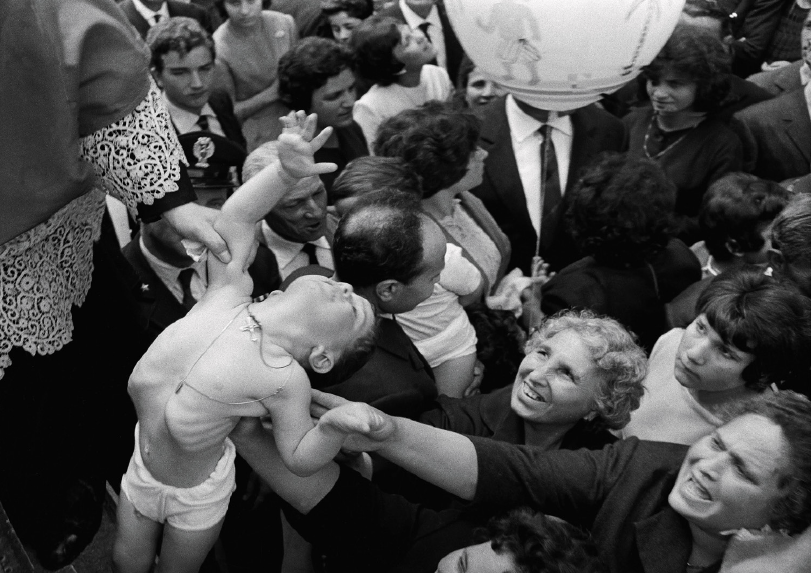
-----------------------------------------------------------------
click to activate the icon of slideshow: the small triangle inscribed in the small rectangle, at the top right, in the photostream;
or…. Press the “L” button to zoom in the image;
clicca sulla piccola icona per attivare lo slideshow: sulla facciata principale del photostream, in alto a destra c'è un piccolo rettangolo (rappresenta il monitor) con dentro un piccolo triangolo nero;
oppure…. premi il tasto “L” per ingrandire l'immagine;
www.worldphoto.org/sony-world-photography-awards/winners-...
www.fotografidigitali.it/gallery/2726/opere-italiane-segn...
…………………………………………………………………
…………………………………………………………………
The cult of the three holy martyr brothers Alfio, Filadelfo and Cirino is widespread in almost all of Eastern Sicily since the early Middle Ages, the news we have on the life and martyrdom of the three brothers are contained in a document written by a Basilian monk , his own name Basilio, whose manuscript is in the Vatican Library, with the number 1591; the manuscript reports that the three saints suffered the persecution of Valerian and martyrdom in 253; the three brothers were born in Vaste, in the province of Lecce, were arrested (and later martyred) for having professed the Christian religion using their noble influence, as their parents, Vitale and Beatrice had previously done, who were also they barbarously martyred for professing their religious beliefs; the three brothers, after having undergone several trials throughout the central-southern territory of Italy, since no one wanted to condemn them with a definitive sentence as belonging to one of the most important families of the empire, were brought to Taormina by Tertullo, a young Roman patrician and head of the island, who, failing to detach them from their creed, sent them to Lentini; during the journey, the group stopped in two places, here the villages of Sant'Alfio and Trecastagni were born, then they reached Catania and were imprisoned here, finally they were taken to Lentini, where they died through atrocious tortures. Before undergoing martyrdom, they were intercessors of miraculous works, Tecla and Giustina were two young countesses, among them cousins, Tecla for more than six years suffered from a severe form of paralysis in the legs, while Giustina was blind in one eye, they learning of miraculous healings that occurred through their intercession during their forced journey from Rome to Lentini, they turned to them, receiving healing. On the day of their torture they were handcuffed and whipped in the streets of the city, exposed naked and barefoot to the ridicule of the people: Alfio's tongue was ripped off (he became the patron saint of the Mutes), Philadelphus was burned on a grill, Cirino was thrown in a cauldron of boiling pitch. The villages of Sant’Alfio and Trecastagni, on the slopes of Etna, and of Lentini, commemorate the three Saints Brothers with very heartfelt and participatory traditional feast. The photographic story that I present here was made this year 2024 and last year 2023, on the occasion of the feast held on May 10 in the Etnean village of Trecastagni (the name Trecastagni seems to derive from the Latin "tres casti agni" that is "three chaste lambs", but not everyone agrees on this etymology; the feast is celebrated on May 10, as their martyrdom took place on this day in 253 , Alfio was twenty-two years and seven months old, Philadelphus twenty-one, Cirino nineteen and eight months). The feast and the procession celebrated in Trecastagni have much in common with the one celebrated, always in honor of the Three Holy Brothers, in the town of Sant'Alfio (see my previous photographic story), even if in Trecastagni there is something larger and more varied; in the late afternoon on May 9, a competition of pyrotechnic games begins, which will be the thunderous background sound until late at night, in the night between On 9th and 10th the so-called "naked" arrive, who are not naked, they arrive, out of devotion, from the most varied and even distant localities, they are dressed in red shorts and a red strip on the chest, sometimes they are bare-chested, others, with a white T-shirt, they are barefoot, sometimes they wear woolen socks, they carry a large lighted candle on their shoulders, having arrived inside the Sanctuary, in front of the cell where the Three Brothers are still enclosed, the devotees tired from the long journey, recover their strength, indulging in an emotional invocation "face to face", mentioning only the name of Alfio (as representative of all three brothers); the morning of the 10th is a day of great celebration, sellers of fresh and very fragrant garlic can be seen along the streets, there are stalls selling products of all kinds, from food, to various objects, such as hats, shoes or clothes, characteristic tambourines Sicilians with sacred images printed on them; the carts arrive in the parade, the "Sicilian" ones painted with battle scenes between the brave Paladins against the ferocious Saracens, but there are also the carts that once served to transport people and/or things; a visit inside the Sanctuary will reveal the presence of objects possessed by “miracled” people and left as a gift as testimony (busts, corrective corsets, sticks, crutches, letters of thanks), there are “ex voto” in wax, reproducing the miraculously healed organs such as arms, heads, legs, there are "ex votos" in silver, also reproducing the miraculously healed organs, there are "ex votos" in the form of oil paintings, on wooden or metal plates, with the names of the "miracled" and the scenes that describe what happened (from the most ancient ones, where falls from horses or overturned carts are often painted, to then make way for more recent tragedies, with accidents caused by motor vehicles; episodes of war; surgery). Before 1.00 pm the so-called "unveiled" takes place, from the cell of the Sanctuary, in which the Three Holy Brothers were imprisoned for almost a year, They are exposed with great emotion of those present; the "rail" on which the statues will be brought down is prepared with great skill, to thus take their place on the float. At 1.00 pm sharp the vara leaves the Sanctuary, amidst the ovation of all the faithful who have come in large numbers from many centres, near and far, thus begins the exciting and moving rite (some children cry, frightened) with children being shown to the Three Holy Brothers, some of them very young, taken by the expert hands of the devotees present on the vara, thus invoke their benevolence and protection. The vara then moves towards the outskirts of the town, with great effort on the part of the shooters, who use two large ropes to pull it, they have to overcome a steep climb, then the vara at 3.00 pm enters the Mother Church, at 06.00 pm the vara follow another well-established itinerary. With the octave of the feast, on May 17, the festivities end, the Saints will remain unveiled until the first Sunday of June, after which they will be locked up again in their cell, until the following year.
Il culto dei tre fratelli santi martiri Alfio, Filadelfo e Cirino è molto diffuso in quasi tutta la Sicilia Orientale fin dall'alto medioevo, le notizie che possediamo sulla vita e sul martirio dei tre fratelli, sono contenute in un documento scritto da un monaco basiliano, di nome proprio Basilio, il cui manoscritto si trova nella Biblioteca Vaticana, col numero 1591; il manoscritto riporta che i tre Santi hanno subito la persecuzione di Valeriano ed il martirio nel 253; i tre fratelli nacquero a Vaste, in provincia di Lecce, vennero arrestati (ed in seguito martirizzati) per aver professato la religione cristiana utilizzando la loro influenza nobile, come avevano fatto in precedenza i loro genitori, Vitale e Beatrice, i quali furono anch’essi barbaramente martirizzati per aver professato il loro credo religioso; i tre fratelli, dopo aver subito parecchi processi per tutto il territorio centro-meridionale d'Italia, visto che nessuno voleva condannarli con una sentenza definitiva in quanto appartenenti ad una delle famiglie più importanti dell’impero, furono portati a Taormina da Tertullo, giovane patrizio romano e Preside dell'isola, il quale non riuscendo a scostarli dal loro credo li inviò a Lentini; durante il tragitto, il gruppo si fermò in due luoghi, qui in seguito nacquero i paesi di Sant'Alfio e Trecastagni, poi giunsero a Catania e qui furono rinchiusi in carcere, infine furono condotti a Lentini, dove trovarono la morte mediante atroci supplizi. Prima di subire il martirio, essi furono intercessori di opere miracolose, Tecla e Giustina erano due giovani contesse, tra loro cugine, Tecla da più di sei anni soffriva di una grave forma di paralisi alle gambe, mentre Giustina era cieca in un occhio, esse venendo a conoscenza di guarigioni miracolose avvenute per loro intercessione durante il loro tragitto forzato da Roma a Lentini, si rivolsero a loro, ricevendo la guarigione. Il giorno del loro supplizio furono ammanettati e frustati per le vie della città, esposti nudi e scalzi allo scherno del popolo: ad Alfio venne strappata la lingua (divenne così il Santo protettore dei Muti), Filadelfo fu bruciato su di una graticola, Cirino fu gettato in un calderone di pece bollente. I paesi di Sant’Alfio e di Trecastagni (Catania), alle pendici dell’Etna, e di Lentini (Siracusa), ricordano i tre Santi Fratelli con delle feste tradizionali molto sentite e partecipate. Il racconto fotografico che qui presento, è stato realizzato con fotografie della ricorrenza di quest’anno 2024 e dello scorso anno 2023, festa che si tiene il 10 maggio, nel paese etneo di Trecastagni (il nome Trecastagni sembra derivare dal latino “tres casti agni” cioè “tre casti agnelli”, ma non tutti sono d’accordo su questa etimologia); la festa si celebra il 10 maggio, in quanto in tale giorno del 253 avvenne il loro martirio, Alfio aveva ventidue anni e sette mesi, Filadelfo ventuno, Cirino diciannove e otto mesi. La festa e la processione che si celebrano a Trecastagni hanno molto in comune con quella celebrata, sempre in onore dei Tre Santi Fratelli, nel paese di Sant’Alfio, anche se a Trecastagni si assiste a qualcosa di più grande e variegato; nel pomeriggio inoltrato del 9 maggio inizia una gara di giochi pirotecnici, che farà da fragoroso sottofondo fino a notte inoltrata, nella notte tra il 9 ed il 10 arrivano i cosiddetti “nudi” (che poi nudi non sono), essi arrivano, per devozione, dalle più svariate ed anche molto lontane località, sono vestiti con pantaloncini ed una fascia sul petto rossi, a volte sono a petto nudo, altre, con una magliettina bianca, sono scalzi, a volte indossano calze di lana, portano in spalla un grosso cero acceso, arrivati dentro al Santuario, davanti alla cella, dove ancora per poco, sono racchiusi i Tre Fratelli, i devoti stanchi per il lungo viaggio, recuperano le loro forze, lasciandosi andare ad una emozionante invocazione “a tu per tu”, nominando solo il nome di Alfio (come rappresentante di tutti e tre i fratelli); la mattina del 10 è giorno di gran festa, si vedono venditori di aglio fresco e profumatissimo, lungo le strade, ci sono bancarelle che vendono prodotti di ogni genere, da quelli alimentari, ad oggetti svariati, come cappelli, scarpe o vestiti, caratteristici i tamburelli siciliani con sopra stampate immagini sacre; arrivano i carretti in sfilata, quelli “Siciliani” dipinti con scene di battaglie tra i prodi Paladini contro i feroci Saraceni, ma ci sono anche i carretti che una volta servivano per il trasporto di persone e/o cose; una visita dentro il Santuario rivelerà la presenza di oggetti posseduti da persone “miracolate” e lasciate in dono come testimonianza (busti, corpetti correttivi, bastoni, stampelle, lettere di ringraziamento), ci sono “ex voto” in cera, con arti miracolati e guariti, come braccia, teste, gambe, ci sono “ex voto” in argento, anch’essi riproducenti gli organi miracolati, ci sono "ex voto" in forma di dipinti ad olio, su tavole in legno o metalliche, con sopra i nomi dei “miracolati” e le scene che descrivono quanto accaduto (da quelle più antiche, ove spesso sono dipinte le cadute da cavallo od i carretti ribaltatisi, per poi lasciare posto a tragedie più recenti, con gli incidenti causati dai mezzi a motore; episodi di guerra; interventi chirurgici). Prima delle ore 13,00 avviene la cosiddetta “svelata”, la cella del Santuario, nella quale i Tre Santi Fratelli sono stati rinchiusi per quasi un anno, vengono esposti con grande commozione dei presenti; si prepara con grande perizia “il binario” sul quale le statue verranno fatte scendere, per prendere così posto sulla vara (il fercolo). Alle 13,00 in punto la vara esce dal Santuario, in mezzo all’ovazione di tutti i fedeli giunti numerosissimi da tantissimi centri, vicini e lontani, inizia così il rito emozionante e commovente della presentazione dei bimbi messi al cospetto dei Tre Santi Fratelli, alcuni in tenerissima età presi dalle mani espertissime dei devoti presenti sulla vara, si invoca in tal modo la loro benevolenza e protezione. La vara successivamente si sposta verso la periferia del paese, con gran fatica da parte dei tiratori, che utilizzano due grossi canapi per tirarla, essi devono vincere una ripida salita, la vara alle ore 15,00 entra così nella Chiesa Madre, alle ore 18,00 la vara fuoriesce, per percorre un altro itinerario ben stabilito. Con l’ottava della festa, il 17 maggio, i festeggiamenti terminano, i Santi rimarranno svelati (visibili) fino alla prima domenica di giugno, dopo verranno rinchiusi nuovamente nella loro cella, fino all’anno successivo.
...............................................................................
FESTA SANTI FRATELLI MARTIRI ALFIO, FILADELFO E CIRINO ( TRECASTAGNI 2022 ) PARTE 1
Festa di S.Alfio Trecastagni 2022
Festa di S.Alfio Trecastagni 2022 Uscita dalla chiesa Madre
Trecastagni 10 Maggio 2022 Preghiera di Lode e Solenne Svelata dei Simulacri dei Santi Martiri 4K
POLLARI GIUSEPPE CHIESA SANT'ALFIO ARRIVO DEI CERI ORE 2 00 DI NOTTE
.............................................
American Arcade postcard by Ex. Sup. Co., Chicago. Ricardo Cortez in The Pony Express (James Cruze, 1925).
Ricardo Cortez (1900-1977), born Jacob Krantz or Kranze, was an American screen actor and director, who peaked in the 1920s as Paramount's romantic lover opposite the big female stars of the decade, while in the 1930s he rather played tough men such as the first Sam Spade on the screen.
Italian Wikipedia claims that Cortez was a Jewish Austrian man, born in 1899 in Vienna, and emigrated to New York in 1900, but English Wikipedia and IMDb contest this and claim he was born in New York City in 1900 from emigrated Austrian-Jewish parents. Anyway, young Jacob Krantz worked as a runner on Wall Street before entering the film business around 1917 and had his first (uncredited) parts in Californian productions from 1919. Krantz's first credited part was in the Paramount comedy Sixty Cents an Hour (Joseph Henabery, 1923) with Jacqueline Logan and Walter Hiers. As Krantz started in Hollywood when Rudolph Valentino was at the peak of his popularity, the Teutonic Jacob Krantz was transformed by Paramount into the Spanish Ricardo Cortez. IMDb even claims Jesse Lasky at Paramount deliberately replaced Valentino by Cortez as the former had become too 'difficult and demanding'.
All through the silent era, Ricardo Cortez remained at Paramount and acted in some 5 to 7 films a year. Even if Cortez was not often the star of the film, he was often among the three or four most prominent actors of the film, as in Children of Jazz (Jerome Storm, 1923) with Eileen Percy, The Next Corner (Sam Wood, 1924) with Dorothy Mackaill, A Society Scandal (Allan Dwan, 1924) with Gloria Swanson, and The Bedroom Window (William DeMille, 1924) with May McAvoy and Malcolm McGregor. Top-billing, Cortez got in The City That Never Sleeps (James Cruze, 1924) opposite Louise Dresser, the Warner production This Woman (Phil Rosen, 1924) opposite Irene Rich, and a growing number of Latin Lover parts, as in Argentine Love (Allan Dwan, 1924) with Bebe Daniels, and The Spaniard (Raoul Walsh, 1925) with Jetta Goudal. Paramount attempted to turn Cortez into another Latin Lover, but the tall, dark young Cortez did not want to be restricted to that type. Yet, he still often had to play many romantic partners of the leading female stars of the say, e.g. opposite Frances Howard in The Swan (1925), opposite Betty Bronson in the period piece Not So Long Ago (1925), and opposite Greta Nissen in In the Name of Love (1925).
Ricardo Cortez starred as Jack Weston opposite Betty Compson, Ernest Torrence, Wallace Beery and George Bancroft, in the Paramount Western The Pony Express (James Cruze, 1925), billed at the time as "The Rockies and Sierras, sunshine and snow, love and hate, men and beasts, war and peace - all rolled into a character picture which will never be duplicated." In his next film, he was the male lead opposite Greta Garbo and Gertrude Olmstead in the MGM/ Cosmopolitan production Torrent (Monta Bell, 1926). For Garbo, it was her first film in Hollywood, but the film was draped around her star persona and character as a Spanish temptress, while Cortez, despite his Valentino stand-in aura "did something that few romantic stars of the day ever would have done in a film: allow himself to look unattractive, appear foolish and to grow old ungracefully" (TuckMN on IMDb). The splendid cinematography was done by William Daniels, who would do 20 films with Garbo. After this sidestep at MGM, Cortez returned to Paramount, where he continued to star in such films as The Cat's Pajamas (William Welman, 1926) with Betty Bronson, The Sorrows of Satan (D.W. Griffith, 1926) with Carl Dempster and Adolphe Menjou, and New York (Luther Reed, 1927).
Apparently, Ricardo Cortez stopped his contract at Paramount in 1927, as he then started to freelance for various companies: opposite the great Lon Chaney in the MGM film Mockery (Benjamin Christensen, 1927), opposite Maria Corda in First National's Antiquity film spoof The Private Life of Helen of Troy (Alexander Korda, 1927), and even opposite Louise Lagrange in an European production, the French film La danseuse Orchidée/Woman of Destiny (Léonce Perret, 1928). In the latter film, Luicha (Lagrange) returns to her native village in the Basque country where she meets her childhood friend Yoannès (Cortez). The latter, madly in love, wants to marry her, but she disappears suddenly. She has returned to Paris precipitately where she is known as 'the Orchid Dancer'. He starts searching for her and discovers her profession. Interesting is that the film is not focusing on Lagrange but on Cortez, who well managed to show he was capable of all kinds of subtleties in his performance, expressing jealousy, impulsiveness, and fragility. Returned to Hollywood, Cortez played in his first part-talkie, Ladies of the Night Club (George Archainbaud, 1928), still without spoken dialogue. In his last silent films, Cortez developed a new type, to which he would hold on in the early 1930s as well: that of the womanising tough guy and even the gangster, so no longer the romantic partner of the female stars. The tide had changed and so had types 'en vogue' in the Pre-Code movies of the late 1920s and early 1930s. Cortez does not seem to have had a big problem with stepping over to sound cinema, but his age was a bit counting, That was even worked into the plots of some of his early 1930s sound films, such as Midstream (James Flood, 1929). Still, in the early 1930s, Cortez remained highly active, doing even ten films in 1931, including Ten Cents a Dance (Lionel Barrymore, Edward Buzzell, 1931) with Barbara Stanwyck as a taxi dancer. He was even Sam Spade in the first film adaptation of Dashiel Hammett's novel 'The Maltese Falcon', directed by Roy Del Ruth in 1931, and with Bebe Daniels as Ruth Wonderly, the part which would make Mary Astor such a star in the later version with Bogart. NB In 1931 Cortez often acted opposite Astor in films such as Behind Office Doors (Melvile Brown, 1931).
Until the end of 1936, Ricardo Cortez had a very active career, acting in between 5 to 8 films per year, and in addition to parts as antagonists, he was still the star of several films such as Men of Chance (George Archainbaud, 1931), the gangster movie Bad Company (Tay Garnett, 1931), the melodrama Symphony of Six Million (Gregory La Cava, 1932), the thriller The Big Shakedown (1934) alongside Bette Davis, and the detective story Mr. Moto's Last Warning (Norman Foster, 1939). All in all, Cortez played in some 100 films. Between 1939 and 1940, he tried to go into directing, with a series of B-movies intended for double bill shows, but his attempts behind the camera had disappointing results. During the 1940s he progressively thinned his film appearances, appearing again in the Film Noir The Locket (John Brahm, 1946) and Mystery in Mexico (Robert Wise, 1948). After that, Cortez returned to Wall Street and became a respected broker. He allowed himself a return to the set solely for a role in John Ford's drama The Last Hurrah (1958) and for an appearance in an episode of the television series Bonanza (1960). Ricardo Cortez was married to actress Alma Rubens in 1926, until her early death in 1931 because of pneumonia. In 1934 he married Christine Coniff Lee, which ended in divorce in 1940. His last wife was Margaret Belle, who was with him till his death in 1977. His brother was cinematographer Stanley Cortez, who also changed his original name, Samuel Krantz, and who was responsible for the masterly cinematography of The Magnificent Ambersons (Orson Welles, 1942) and The Night of the Hunter (Charles Laughton, 1955).
Sources: Ann Hardings Treasures, Wikipedia (English and Italian), IMDb.
For more postcards, a bio and clips check out our blog European Film Star Postcards.
……………………………….
Locandina:
bingeddata.s3.amazonaws.com/uploads/2021/01/romantic-guid...
www.imdb.com/it/title/tt12784484/mediaviewer/rm2907022337...
www.imdb.com/it/title/tt12784484/mediaviewer/rm2940576769...
www.primevideo.com/detail/Romantic-Guide-to-Lost-Places/0...
.............................................................................
click to activate the small icon of slideshow: the small triangle inscribed in the small rectangle, at the top right, in the photostream (it means the monitor);
or…. Press the “L” button to zoom in the image;
clicca sulla piccola icona per attivare lo slideshow: sulla facciata principale del photostream, in alto a destra c'è un piccolo rettangolo (rappresenta il monitor) con dentro un piccolo triangolo nero;
oppure…. premi il tasto “L” per ingrandire l'immagine;
www.worldphoto.org/sony-world-photography-awards/winners-...
www.fotografidigitali.it/gallery/2726/opere-italiane-segn...
………………………………………………………………………
I'm sharing here on Flickr a (long) series of photos, taken in early August this year, during a short vacation in Calabria, at a holiday village located near a beach I've been frequenting with my family for several years now, during our short summer vacations. The setting, however, is very different from the beaches I normally frequent near my home in Taormina, with very crowded beaches and a sea that is also very popular with yachtsmen of all kinds. In this part of Calabria, the beaches are rarely crowded (except on weekends, but not too much). In short, it's a sort of almost tropical paradise, with very little yachting. Adjacent to the holiday village is a kitesurfing club, very popular with enthusiasts of this wonderful sport, which thrives on the sea and the wind. I photographed an 84-year-old kitesurfer, whose mettle is steely, still giving athletes much younger than him a run for their money. A friendly and sweet horsewoman from the nearby stables arrived unexpectedly in the beach village, accompanied by her father, both astride two magnificent colts. This created a moment of joy and curiosity for both the parents and their little ones, who were likely seeing these magnificent and docile animals up close and personal for the first time. Unexpectedly, a very special party broke out on the beach. Seeing it made me feel like I was no longer in Calabria, but rather transported to the other side of the globe, to the Hindu festival called Holi, with its throwing of colored powders (in India, this festival marks the end of winter and the arrival of spring, as well as symbolizing the victory of good over evil). I know it thanks to the evocative photographs often published on various photography websites.
I'll end by briefly mentioning the photographic technique I've often used in my photographs. I've created "blur" photographs—blurry, slightly blurry, and unfocused—at the time of shooting, simply by lengthening the exposure time and then also using some panning. Finally, I'd like to thank the sweet and beautiful models who posed for me, allowing me to further enhance this (long-winded) photographic story.
………………………………………………………………………..
Propongo qui su Flickr, una (lunga) serie di foto, realizzate nei primi giorni di Agosto di quest’anno, durante una mia breve vacanza in Calabria, in un villaggio vacanze sito a ridosso di una spiaggia che oramai frequento insieme alla mia famiglia, durante le nostre brevi vacanze estive, da diversi anni, fotografie quindi aventi per tema la “beach photography”; purtuttavia l’ambientazione è molto diversa rispetto alle spiagge che frequento normalmente vicino casa mia a Taormina, con spiagge molto affollate, il mare anch’esso super frequentato da diportismo nautico di ogni tipo, in questa zona della Calabria le spiagge sono invece poco frequentate (tranne il fine settimana, ma neanche troppo), insomma, una specie di Paradiso quasi tropicale, con pochissime imbarcazioni. Adiacente al villaggio vacanze c’è un club di Kitesurf, molto frequentato da appassionati di questo meraviglioso sport, sport che si nutre di mare e di vento. Ho fotografato un kitesurfer di 84 anni, la cui tempra è di acciaio, che dà ancora molto filo da torcere ad atleti molto più giovani di lui. Nel villaggio a sorpresa è arrivata una simpatica e dolce cavallerizza proveniente dal vicino maneggio, con lei anche il suo papà, entrambi a cavallo di due magnifici puledri, creando un momento di allegria e curiosità, sia per i genitori, che per i loro piccoli, per i quali, molto probabilmente, era la prima volta che potevano vedere da vicino, e poterli anche toccare, questi magnifici e docili animali. A sorpresa, inaspettatamente, sulla spiaggia ha preso vita un party molto particolare, nel vederlo mi sembrava di non essere più in Calabria, ma di essere stato proiettato dall’altro lato del globo, in quella festa Indù chiamata Holi, con lancio di polveri colorate (in India questa festa segna la fine dell'inverno e l'arrivo della primavera, oltre a simboleggiare la vittoria del bene sul male), festa che conosco grazie a fotografie molto suggestive spesso pubblicate sui vari siti fotografici.
Termino accennando brevemente alla tecnica fotografica che ho spesso adottato nel realizzare le mie fotografie, ho realizzato al momento dello scatto fotografie del tipo “blur”, cioè mosse, un po’ confuse, non incise, ottenute allungando i tempi di esposizione. Infine ringrazio le dolcissime e belle modelle, che hanno voluto posare per me, consentendomi di rendere più grazioso questo mio (prolisso) racconto fotografico.
………………………………………………………………………………
Chris Isaak - Wicked Game (hard to find David Lynch version)
www.dailymotion.com/video/x18go3_isaak-chris-wicked-game_...
Lynch's movies are ... well, different! Whether that is good or bad is a personal opinion. He must have been a photographer at some point because he's got a great eye for composition and lighting. You can take screen captures from scenes in his films and they look as good as any good photo. Another thing I like is how he always makes women look beautiful / glamorous .. but its a kind of retro glamour that you don't see anymore in real life or in modern films. I read somewhere he was inspired by Ingmar Bergman at a young age so maybe that is the explanation. I supposed you could describe his films as 'Bergman on acid in the twilight zone.'
alexandra daddario movies list
alexandra daddario age
alexandra daddario husband
alexandra daddario height
alexandra daddario film list
alexandra daddario facebook
alexandra daddario imdb
alexandra daddrio net worth
Model: Brittany Madrid
Location: UNM "Duck" Pond.
© 2010 2025 Photo by Lloyd Thrap Photography for Halo Media Group
All works subject to applicable copyright laws. This intellectual property MAY NOT BE DOWNLOADED except by normal viewing process of the browser. The intellectual property may not be copied to another computer, transmitted , published, reproduced, stored, manipulated, projected, or altered in any way, including without limitation any digitization or synthesizing of the images, alone or with any other material, by use of computer or other electronic means or any other method or means now or hereafter known, without the written permission of Lloyd Thrap and payment of a fee or arrangement thereof.
No images are within Public Domain. Use of any image as the basis for another photographic concept or illustration is a violation of copyright.
……………………………….
Locandina:
stanzedicinema.com/wp-content/uploads/2009/12/children-lo...
www.imdb.com/it/title/tt0206634/
www.imdb.com/it/video/vi3459826457/?playlistId=tt0206634&...
Gianluca Gotto
www.mondadori.it/content/uploads/2021/02/978880472904HIG-...
www.facebook.com/watch/?v=706199753402023
.............................................................................
click to activate the small icon of slideshow: the small triangle inscribed in the small rectangle, at the top right, in the photostream (it means the monitor);
or…. Press the “L” button to zoom in the image;
clicca sulla piccola icona per attivare lo slideshow: sulla facciata principale del photostream, in alto a destra c'è un piccolo rettangolo (rappresenta il monitor) con dentro un piccolo triangolo nero;
oppure…. premi il tasto “L” per ingrandire l'immagine;
www.worldphoto.org/sony-world-photography-awards/winners-...
www.fotografidigitali.it/gallery/2726/opere-italiane-segn...
………………………………………………………………………
I describe this photographic series (with some “poetic license” on the theme of “beach photography”) by quoting an introduction I wrote some time ago, for a photographic series of mine having the same theme today. I would like to focus on two photos from the current series, on how, from a particular situation, in this case photographic, others can arise, I would like to share this with those who are not too bored reading this story: I photographed a young girl while she was reading a book, she was sitting inside one of the many lava formations present along the shore of Naxos (near Taormina), dug with a perfectly rounded shape (this suggests that their origin is man-made, I will not dwell on the hypothesis that attempts to explain these ancient formations), the little water collected inside these "pools" certainly gave a little refreshment to the unaware "reader", once at home, curiosity pushed me to investigate what she was reading, the high resolution of the photos allowed me to easily read the two pages of the book she was holding in her hand, and it was a kind of revelation, some paragraphs of the book, and I was more and more intrigued, about what the book was and its Author, a A quick Google search, and I found what I was looking for. The book is titled "Something Wonderful Always Happens." Its author is Gianluca Gotto. I didn't know him, but I was able to watch and listen to him on YouTube. I found it extremely interesting. I've already ordered the book on Amazon. I'll just quote a short excerpt from the page the reader was reading. It's brief, as I don't want to infringe on any copyright: "(...) do you know what the three poisons of man are according to Buddhism?" I shook my head. "Greed, or the desire to always have more when each of us already has everything we need; ignorance, or the lack of awareness: believing that life is different from what it is here and now; and finally, anger, a condition contrary to any form of happiness."
Beach holidays were born in the 1700s in Great Britain, this social phenomenon was born in which bathers for the first time go to the beaches, certainly not as sunny as those bathed by the Mediterranean Sea, they are fully dressed; this "new fashion" is also encouraged by the belief of English doctors since the beginning of the eighteenth century (starting around 1720), that breathing the brackish sea air and bathing in cold sea water is healthy, invigorates the body and cure lung diseases (conviction even more strengthened by the discovery of oxygen by Antoine Lavoisier in 1778, which led to the greater diffusion and conviction of the theories on the health benefits of sea air, which was thought to be more oxygenated and pure), these theories push many people from Northern Europe suffering from severe lung diseases to spend long periods in southern Europe, often in the south of Italy, this explains why characters with extraordinary qualities come to Taormina to cure their tuberculosis. The photographer baron Wilhelm von Gloeden and the English lady Florence Trevelyan Trevelyan had the seawater brought with their mules from Isola Bella, but while W. Von Gloeden heated the sea water, the English noblewoman Lady Trevelian did not heat it, mindful of the teachings of the English medical school, this will cause her death from bronchopneumonia on 4 October 1907 (see my previous "photographic stories" about Taormina). In fact, "thalassotherapy" was born in Great Britain, together with the social and cultural phenomenon of frequenting bathing beaches (before the beginning of the 18th century, the sea and its beaches were lived, except for reasons of trade and fishing, in a dark and negative way, from the sea often came very serious dangers such as the sudden landings of ferocious pirates, or foreigners carrying very serious diseases could land). Thus the fashion of spending holidays by the sea was born in the English aristocracy and high bourgeoisie of the time, subsequently the habit of going to the sea spread to all levels of society, the railways that were built throughout Great Britain to 'beginning of the nineteenth century, made travel to the ocean accessible even to the lower classes, they too will frequent the seaside resorts, Blackpool becomes the first seaside resort in Great Britain completely frequented by the working classes thanks to the presence of low-cost bathing establishments; the great and definitive boom in seaside tourism will then take place in the 1950s and 1960s. This being the case, it should not be surprising to know that in Great Britain the beaches are more frequented than one might instinctively think due to a climate very different from the Mediterranean one, and that this socio-cultural phenomenon has been investigated at the photographic by photographers of the same Great Britain, of these I mention four names. An important photographer, who probably inspired subsequent photographers, was Tony Ray-Jones, who died prematurely in 1972, at the young age of 30, who was trying to create a “photographic memory” of the stereotypes of the English people; the famous photojournalist Martin Parr, who, although inspired by the previous one, differs from it for his way of doing “social satire” with his goal; finally, I would like to mention David Hurn and Simon Roberts, the latter with wider-ranging photographs, with photographs more detached from the individual. In Italy there are numerous photographers (I will mention only a few) who have made in their long career images captured in seaside resorts (generally we speaking of "beach photography" similar to "street photography"), photographs that are often unique in their style, such as that adopted by Franco Fontana, I mention Mimmo Jodice, Ferdinando Scianna (of whom I am honored to have known him personally), and Massimo Vitali, famous photographer (understood by some as "the photographer of the beaches"), especially for his beautiful photographs taken on the beaches (but not only), thanks to the presence of elevated fixed structures as a kind of mezzanine, built specifically in the bathing beaches for the realization of his photographs. This is my introduction to talk about the theme proposed here, that of “beach photography” (with some exceptions for “narrative” reasons), with a series of photographs taken on the beaches surrounding Taormina (Sicily). ……………………………………………………………
Descrivo questa serie fotografica (con qualche “licenza poetica” sul tema della “beach photography”) riportando una mia introduzione scritta po’ di tempo fa, per una mia serie fotografica avente lo stesso tema odierno. Desidero soffermarmi su due foto dell’attuale serie, di come, da una particolare situazione, in questo caso fotografica, ne possano scaturire altre, desidero condividere ciò con chi non si annoi troppo nel leggere questo racconto: ho fotografato a sua insaputa una giovane ragazza mentre leggeva un libro, era seduta all’interno di una delle tante formazioni laviche presenti lungo il bagnasciuga di Naxos (vicino Taormina), scavate con forma perfettamente rotondeggiante (questo fa pensare che la loro origine sia manufatta, non mi dilungo sulla ipotesi che tenta di spiegare queste antiche formazioni), la poca acqua raccolta all’interno di queste “vasche” davano certamente un po’ di refrigerio alla inconsapevole “lettrice” , una volta a casa, la curiosità mi ha spinto ad indagare su cosa stesse leggendo, l’elevata risoluzione delle foto mi ha consentito di leggere con facilità le due pagine del libro da lei tenuto in mano, ed è stata una specie di rivelazione, qualche trafiletto del libro, ed ero sempre più incuriosito, su quale fosse il libro ed il suo Autore, una breve ricerca su Google, ed ho trovato quanto cercavo, il libro si intitola “Succede sempre qualcosa di meraviglioso”, il suo Autore è Gianluca Gotto, non lo conoscevo, su You Tube ho potuto vederlo ed ascoltarlo, l’ho trovato estremamente interessante, il libro l’ho già ordinato su Amazon; riporterò qui solo un breve trafiletto preso dalla pagina che stava leggendo la lettrice, breve, non vorrei incorrere in qualche violazione sui diritti d’Autore: “ (…) sai quali sono i tre veleni dell’uomo secondo il Buddhismo ?” Scossi la testa. “La cupidigia, ovvero il desiderio di avere sempre di più quando ognuno di noi ha già tutto ciò che gli serve; l’ignoranza, ovvero la mancanza di consapevolezza: credere che la vita sia diversa da ciò che è qui e ora; infine la rabbia, una condizione contraria a ogni forma di felicità.”
Le vacanze al mare nascono nel ‘700 in Gran Bretagna, nasce questo fenomeno sociale nel quale i bagnanti per la prima volta si recano sulle spiagge, non certo assolate come quelle bagnate dal mar Mediterraneo, sono completamente vestiti; questa “nuova moda” è anche incoraggiata dalla convinzione dei medici inglesi fin dall’inizio del ‘700 (a partire dal 1720 circa), che respirare l’aria salmastra del mare e fare il bagno nell’acqua marina fredda sia salutare, rinvigorisca il corpo e curi le malattie polmonari (convinzione ancor più rafforzata dalla scoperta dell’ossigeno da parte di Antoine Lavoisier nel 1778, che portò alla maggiore diffusione e convinzione delle teorie sui benefici per la salute dell’aria di mare, che si pensava essere più ossigenata e pura), queste teorie spingono molte persone del Nord Europa affette da gravi malattie polmonari a trascorrere dei lunghi periodi nel sud Europa, spesso nel meridione d’Italia, questo spiega perché a Taormina giungono personaggi dalle qualità straordinarie per curare il proprio “mal sottile”, il barone fotografo Wilhelm von Gloeden e la lady inglese Florence Trevelyan Trevelyan si facevano portare coi muli l’acqua di mare proveniente dall’Isola Bella, però mentre W. Von Gloeden riscaldava l’acqua marina, la nobildonna inglese lady Trevelian non la riscaldava, memore degli insegnamenti della scuola medica inglese, questo causerà la sua morte per broncopolmonite il 4 ottobre del 1907 (vedi i miei precedenti “racconti fotografici” su Taormina). Infatti la “talassoterapia” nasce in Gran Bretagna, insieme al fenomeno sociale e culturale della frequentazione dei lidi balneari (prima dell’inizio del ‘700, il mare e le sue spiagge erano vissuti, tranne che per motivi di commercio e di pesca, in maniera oscura e negativa, dal mare spesso provenivano gravissimi pericoli come gli sbarchi improvvisi di feroci pirati, oppure potevano sbarcare stranieri portatori di gravissime malattie). Nell’aristocrazia e nell’alta borghesia inglese di allora nasce così la moda di trascorrere le vacanze al mare, successivamente l’abitudine di andare al mare si diffonde a tutti i livelli della società, le ferrovie che furono costruite in tutta la Gran Bretagna all’inizio dell’Ottocento, resero i viaggi verso l’oceano accessibili anche per i ceti più bassi, quelli più popolari e meno agiati, anch’essi frequenteranno le località balneari, Blackpool diviene la prima località balneare della Gran Bretagna completamente frequentata dalle classi popolari grazie alla presenza di stabilimenti balneari a basso costo; il grande e definitivo boom del turismo balneare si avrà poi negli anni ’50 e ’60. Stando così le cose, non ci si deve meravigliare nel sapere che in Gran Bretagna le spiagge sono più frequentate di quanto istintivamente si possa pensare a causa di un clima ben diverso da quello Mediterraneo, e che questo fenomeno socio-culturale sia stato indagato a livello fotografico da parte di fotografi della stessa Gran Bretagna, di questi cito quattro nomi. Un importante fotografo, che probabilmente ispirò i successivi fotografi, fu Tony Ray-Jones, scomparso prematuramente nel 1972, alla giovane età di 30 anni, il quale cercava di realizzare una “memoria fotografica” degli stereotipi del popolo inglese; il famoso fotoreporter Martin Parr, il quale pur ispirandosi al precedente, se ne differenzia per il suo modo di fare “satira sociale” col suo obiettivo; infine desidero menzionare David Hurn e Simon Roberts, quest’ultimo con fotografie di più ampio respiro, con fotografie più distaccate dal singolo individuo. In Italia numerosi sono i fotografi (ne cito solo qualcuno) che hanno realizzato nella loro lunga carriera immagini colte in località balneari (genericamente si parla di “beach photography” affine alla “street photography”), fotografie spesso uniche nel loro stile, come quello adottato da Franco Fontana, menziono Mimmo Jodice, Ferdinando Scianna (del quale mi onoro di averlo conosciuto personalmente), e Massimo Vitali, famoso fotografo (da alcuni inteso come “il fotografo delle spiagge”), soprattutto per le sue bellissime fotografie realizzate sui lidi (ma non solo), grazie alla presenza di strutture fisse sopraelevate a mò di soppalco, costruite appositamente nei lidi balneari per la realizzazione delle sue fotografie. Questo mio incipit, per introdurre il tema da me affrontato, quello della “beach photography” (con qualche eccezione per motivi ”narrativi”), con una serie di fotografie realizzate sulle spiagge circostanti Taormina (Sicilia).
...........................................................................
Godzilla (ゴジラ ,Gojira?) is a kaijū, a fictional Japanese giant monster created by Tomoyuki Tanaka. His first film was made in 1954, and since then, he has made many more appearances, and has even become a pop-culture icon. According to IMDB, Godzilla has appeared in 38 films, all of which were produced by Toho Company Ltd. Godzilla has also appeared in numerous comic books, video games, and novels.
Known Aliases: Gojira; King of the Monsters; Gigantis, the Fire Monster; Monster Zero-One
First Seen: Godzilla (1954)
Last Seen: Always: Sunset on Third Street 2 (2007)
More Info: See IMDB's Biography for Godzilla (May contain spoilers.)
Update: Godzilla's star is located at 6925 Hollywood Blvd.
————————————————————————————————————————
How big is Godzilla? What cool things can he do?
1954
Height: 50 meters (164 feet)
Weight: 20,000 tons
Powers/Weapons: Atomic ray; super regenerative power
1955
Height: 50 meters (164 feet)
Weight: 20,000 tons
Powers/Weapons: Atomic ray; super regenerative power; able to fly by using his breath as a means of jet propulsion; can absorb electricity and release it to become a magnetic force
1984
Height: 80 meters (262 feet)
Weight: 50,000 tons
Powers/Weapons: Atomic Ray; super regenerative power; can absorb radiation; Nuclear Pulse
1991 #1
Height:12 meters (39 feet)
Weight: 60 tons
Powers/Weapons: None
1991 #2
Height: 100 meters (328 feet)
Weight: 60,000 tons
Powers/Weapons: Atomic Ray; super regenerative power; able to unleash a Spiral Fire ray from his mouth after absorbing Rodan's life force; Nuclear Pulse; can absorb radiation; can conduct energy through its touch
1995
Height: 100 meters (328 feet)
Weight:60,000 tons
Powers/Weapons: Spiral Fire ray; super regenerative power; Nuclear Pulse; body emits immense heat; able to instill energy into others; can absorb radiation
1999
Height: 55 meters (180 feet)
Length: 122.5 meters
Weight: 25,000 tons
Powers/Weapons: Atomic ray; super regenerative power; spines unleash a tremendous amount of heat while atomic ray is being prepared; can unleash a blast of Inner-Radiation from his body
2000
Height: 55 meters (180 feet)
Weight: 25,000 tons
Powers/Weapons: Atomic ray; razor sharp spines; super regenerative power; able to burrow; spines unleash a tremendous amount of heat while atomic ray is being charged; extraordinary jumper; prehensile tail
2001
Height: 60 meters (197 feet)
Weight: 30,000 tons
Powers/Weapons: Atomic Ray; near impenetrable hide; able to absorb certain types of energy and release them from his mouth
2002
Height: 55 meters (180 feet)
Weight: 25,000 tons
Powers/Weapons: Atomic Ray; super regenerative power
2004
Height: 100 meters (328 feet)
Length: 100 meters (328 feet)
Weight: 55,000 tons
Powers/Weapons: Atomic Ray; super regenerative power; able to unleash a Hyper Spiral Ray after being surged with Ozaki's energy; extraordinary jumper; can discharge a blast of energy through his body, to damage those in direct contact, after being surged with Ozaki's energy
2007
He made a cameo appearance in Always: Sunset on Third Street 2 (2007)
Height: (I couldn't find a number.)
Weight: (I couldn't find a number.)
Powers/Weapons: Atomic Ray
————————————————————————————————————————
Godzilla's Friends and Family
In 1974 he fought a Fake Godzilla which was 50 meters (164 feet) high and weighed 40,000 tons.
Powers/Weapons: Flamethrower located in mouth; able to shed its disguise
In 1993, Godzilla and Mrs. G, his ol' lady, had a kid: Baby Godzilla. BG was 1.64 meters (5.3 feet) high, 3.53 meters (11.6 feet) long, and weighed 420 kilograms.
Powers/Weapons: Able to communicate with Godzilla and Rodan telepathically
By 1994, Little Godzilla was 30 meters (98 feet) high and weighed 8,000 tons.
Powers/Weapons: Can breath Radioactive Bubbles; able to communicate with Godzilla and Rodan telepathically
By 1995, Godzilla Junior had grown to a height of 40 meters (131 feet) and a weight of 15,000 tons.
Powers/Weapons: Can fire an Atomic Ray from its mouth; super regenerative power; able to communicate with Godzilla and Rodan telepathically
————————————————————————————————————————
20090325_0414-1a1_800x600
.……………………………….
Ferdinando Scianna, una sua famosa foto realizzata durante la festa di Trecastagni
-----------------------------------------------------------------
click to activate the icon of slideshow: the small triangle inscribed in the small rectangle, at the top right, in the photostream;
or…. Press the “L” button to zoom in the image;
clicca sulla piccola icona per attivare lo slideshow: sulla facciata principale del photostream, in alto a destra c'è un piccolo rettangolo (rappresenta il monitor) con dentro un piccolo triangolo nero;
oppure…. premi il tasto “L” per ingrandire l'immagine;
www.worldphoto.org/sony-world-photography-awards/winners-...
www.fotografidigitali.it/gallery/2726/opere-italiane-segn...
…………………………………………………………………
…………………………………………………………………
The cult of the three holy martyr brothers Alfio, Filadelfo and Cirino is widespread in almost all of Eastern Sicily since the early Middle Ages, the news we have on the life and martyrdom of the three brothers are contained in a document written by a Basilian monk , his own name Basilio, whose manuscript is in the Vatican Library, with the number 1591; the manuscript reports that the three saints suffered the persecution of Valerian and martyrdom in 253; the three brothers were born in Vaste, in the province of Lecce, were arrested (and later martyred) for having professed the Christian religion using their noble influence, as their parents, Vitale and Beatrice had previously done, who were also they barbarously martyred for professing their religious beliefs; the three brothers, after having undergone several trials throughout the central-southern territory of Italy, since no one wanted to condemn them with a definitive sentence as belonging to one of the most important families of the empire, were brought to Taormina by Tertullo, a young Roman patrician and head of the island, who, failing to detach them from their creed, sent them to Lentini; during the journey, the group stopped in two places, here the villages of Sant'Alfio and Trecastagni were born, then they reached Catania and were imprisoned here, finally they were taken to Lentini, where they died through atrocious tortures. Before undergoing martyrdom, they were intercessors of miraculous works, Tecla and Giustina were two young countesses, among them cousins, Tecla for more than six years suffered from a severe form of paralysis in the legs, while Giustina was blind in one eye, they learning of miraculous healings that occurred through their intercession during their forced journey from Rome to Lentini, they turned to them, receiving healing. On the day of their torture they were handcuffed and whipped in the streets of the city, exposed naked and barefoot to the ridicule of the people: Alfio's tongue was ripped off (he became the patron saint of the Mutes), Philadelphus was burned on a grill, Cirino was thrown in a cauldron of boiling pitch. The villages of Sant’Alfio and Trecastagni, on the slopes of Etna, and of Lentini, commemorate the three Saints Brothers with very heartfelt and participatory traditional feast. The photographic story that I present here was made this year 2024 and last year 2023, on the occasion of the feast held on May 10 in the Etnean village of Trecastagni (the name Trecastagni seems to derive from the Latin "tres casti agni" that is "three chaste lambs", but not everyone agrees on this etymology; the feast is celebrated on May 10, as their martyrdom took place on this day in 253 , Alfio was twenty-two years and seven months old, Philadelphus twenty-one, Cirino nineteen and eight months). The feast and the procession celebrated in Trecastagni have much in common with the one celebrated, always in honor of the Three Holy Brothers, in the town of Sant'Alfio (see my previous photographic story), even if in Trecastagni there is something larger and more varied; in the late afternoon on May 9, a competition of pyrotechnic games begins, which will be the thunderous background sound until late at night, in the night between On 9th and 10th the so-called "naked" arrive, who are not naked, they arrive, out of devotion, from the most varied and even distant localities, they are dressed in red shorts and a red strip on the chest, sometimes they are bare-chested, others, with a white T-shirt, they are barefoot, sometimes they wear woolen socks, they carry a large lighted candle on their shoulders, having arrived inside the Sanctuary, in front of the cell where the Three Brothers are still enclosed, the devotees tired from the long journey, recover their strength, indulging in an emotional invocation "face to face", mentioning only the name of Alfio (as representative of all three brothers); the morning of the 10th is a day of great celebration, sellers of fresh and very fragrant garlic can be seen along the streets, there are stalls selling products of all kinds, from food, to various objects, such as hats, shoes or clothes, characteristic tambourines Sicilians with sacred images printed on them; the carts arrive in the parade, the "Sicilian" ones painted with battle scenes between the brave Paladins against the ferocious Saracens, but there are also the carts that once served to transport people and/or things; a visit inside the Sanctuary will reveal the presence of objects possessed by “miracled” people and left as a gift as testimony (busts, corrective corsets, sticks, crutches, letters of thanks), there are “ex voto” in wax, reproducing the miraculously healed organs such as arms, heads, legs, there are "ex votos" in silver, also reproducing the miraculously healed organs, there are "ex votos" in the form of oil paintings, on wooden or metal plates, with the names of the "miracled" and the scenes that describe what happened (from the most ancient ones, where falls from horses or overturned carts are often painted, to then make way for more recent tragedies, with accidents caused by motor vehicles; episodes of war; surgery). Before 1.00 pm the so-called "unveiled" takes place, from the cell of the Sanctuary, in which the Three Holy Brothers were imprisoned for almost a year, They are exposed with great emotion of those present; the "rail" on which the statues will be brought down is prepared with great skill, to thus take their place on the float. At 1.00 pm sharp the vara leaves the Sanctuary, amidst the ovation of all the faithful who have come in large numbers from many centres, near and far, thus begins the exciting and moving rite (some children cry, frightened) with children being shown to the Three Holy Brothers, some of them very young, taken by the expert hands of the devotees present on the vara, thus invoke their benevolence and protection. The vara then moves towards the outskirts of the town, with great effort on the part of the shooters, who use two large ropes to pull it, they have to overcome a steep climb, then the vara at 3.00 pm enters the Mother Church, at 06.00 pm the vara follow another well-established itinerary. With the octave of the feast, on May 17, the festivities end, the Saints will remain unveiled until the first Sunday of June, after which they will be locked up again in their cell, until the following year.
Il culto dei tre fratelli santi martiri Alfio, Filadelfo e Cirino è molto diffuso in quasi tutta la Sicilia Orientale fin dall'alto medioevo, le notizie che possediamo sulla vita e sul martirio dei tre fratelli, sono contenute in un documento scritto da un monaco basiliano, di nome proprio Basilio, il cui manoscritto si trova nella Biblioteca Vaticana, col numero 1591; il manoscritto riporta che i tre Santi hanno subito la persecuzione di Valeriano ed il martirio nel 253; i tre fratelli nacquero a Vaste, in provincia di Lecce, vennero arrestati (ed in seguito martirizzati) per aver professato la religione cristiana utilizzando la loro influenza nobile, come avevano fatto in precedenza i loro genitori, Vitale e Beatrice, i quali furono anch’essi barbaramente martirizzati per aver professato il loro credo religioso; i tre fratelli, dopo aver subito parecchi processi per tutto il territorio centro-meridionale d'Italia, visto che nessuno voleva condannarli con una sentenza definitiva in quanto appartenenti ad una delle famiglie più importanti dell’impero, furono portati a Taormina da Tertullo, giovane patrizio romano e Preside dell'isola, il quale non riuscendo a scostarli dal loro credo li inviò a Lentini; durante il tragitto, il gruppo si fermò in due luoghi, qui in seguito nacquero i paesi di Sant'Alfio e Trecastagni, poi giunsero a Catania e qui furono rinchiusi in carcere, infine furono condotti a Lentini, dove trovarono la morte mediante atroci supplizi. Prima di subire il martirio, essi furono intercessori di opere miracolose, Tecla e Giustina erano due giovani contesse, tra loro cugine, Tecla da più di sei anni soffriva di una grave forma di paralisi alle gambe, mentre Giustina era cieca in un occhio, esse venendo a conoscenza di guarigioni miracolose avvenute per loro intercessione durante il loro tragitto forzato da Roma a Lentini, si rivolsero a loro, ricevendo la guarigione. Il giorno del loro supplizio furono ammanettati e frustati per le vie della città, esposti nudi e scalzi allo scherno del popolo: ad Alfio venne strappata la lingua (divenne così il Santo protettore dei Muti), Filadelfo fu bruciato su di una graticola, Cirino fu gettato in un calderone di pece bollente. I paesi di Sant’Alfio e di Trecastagni (Catania), alle pendici dell’Etna, e di Lentini (Siracusa), ricordano i tre Santi Fratelli con delle feste tradizionali molto sentite e partecipate. Il racconto fotografico che qui presento, è stato realizzato con fotografie della ricorrenza di quest’anno 2024 e dello scorso anno 2023, festa che si tiene il 10 maggio, nel paese etneo di Trecastagni (il nome Trecastagni sembra derivare dal latino “tres casti agni” cioè “tre casti agnelli”, ma non tutti sono d’accordo su questa etimologia); la festa si celebra il 10 maggio, in quanto in tale giorno del 253 avvenne il loro martirio, Alfio aveva ventidue anni e sette mesi, Filadelfo ventuno, Cirino diciannove e otto mesi. La festa e la processione che si celebrano a Trecastagni hanno molto in comune con quella celebrata, sempre in onore dei Tre Santi Fratelli, nel paese di Sant’Alfio, anche se a Trecastagni si assiste a qualcosa di più grande e variegato; nel pomeriggio inoltrato del 9 maggio inizia una gara di giochi pirotecnici, che farà da fragoroso sottofondo fino a notte inoltrata, nella notte tra il 9 ed il 10 arrivano i cosiddetti “nudi” (che poi nudi non sono), essi arrivano, per devozione, dalle più svariate ed anche molto lontane località, sono vestiti con pantaloncini ed una fascia sul petto rossi, a volte sono a petto nudo, altre, con una magliettina bianca, sono scalzi, a volte indossano calze di lana, portano in spalla un grosso cero acceso, arrivati dentro al Santuario, davanti alla cella, dove ancora per poco, sono racchiusi i Tre Fratelli, i devoti stanchi per il lungo viaggio, recuperano le loro forze, lasciandosi andare ad una emozionante invocazione “a tu per tu”, nominando solo il nome di Alfio (come rappresentante di tutti e tre i fratelli); la mattina del 10 è giorno di gran festa, si vedono venditori di aglio fresco e profumatissimo, lungo le strade, ci sono bancarelle che vendono prodotti di ogni genere, da quelli alimentari, ad oggetti svariati, come cappelli, scarpe o vestiti, caratteristici i tamburelli siciliani con sopra stampate immagini sacre; arrivano i carretti in sfilata, quelli “Siciliani” dipinti con scene di battaglie tra i prodi Paladini contro i feroci Saraceni, ma ci sono anche i carretti che una volta servivano per il trasporto di persone e/o cose; una visita dentro il Santuario rivelerà la presenza di oggetti posseduti da persone “miracolate” e lasciate in dono come testimonianza (busti, corpetti correttivi, bastoni, stampelle, lettere di ringraziamento), ci sono “ex voto” in cera, con arti miracolati e guariti, come braccia, teste, gambe, ci sono “ex voto” in argento, anch’essi riproducenti gli organi miracolati, ci sono "ex voto" in forma di dipinti ad olio, su tavole in legno o metalliche, con sopra i nomi dei “miracolati” e le scene che descrivono quanto accaduto (da quelle più antiche, ove spesso sono dipinte le cadute da cavallo od i carretti ribaltatisi, per poi lasciare posto a tragedie più recenti, con gli incidenti causati dai mezzi a motore; episodi di guerra; interventi chirurgici). Prima delle ore 13,00 avviene la cosiddetta “svelata”, la cella del Santuario, nella quale i Tre Santi Fratelli sono stati rinchiusi per quasi un anno, vengono esposti con grande commozione dei presenti; si prepara con grande perizia “il binario” sul quale le statue verranno fatte scendere, per prendere così posto sulla vara (il fercolo). Alle 13,00 in punto la vara esce dal Santuario, in mezzo all’ovazione di tutti i fedeli giunti numerosissimi da tantissimi centri, vicini e lontani, inizia così il rito emozionante e commovente della presentazione dei bimbi messi al cospetto dei Tre Santi Fratelli, alcuni in tenerissima età presi dalle mani espertissime dei devoti presenti sulla vara, si invoca in tal modo la loro benevolenza e protezione. La vara successivamente si sposta verso la periferia del paese, con gran fatica da parte dei tiratori, che utilizzano due grossi canapi per tirarla, essi devono vincere una ripida salita, la vara alle ore 15,00 entra così nella Chiesa Madre, alle ore 18,00 la vara fuoriesce, per percorre un altro itinerario ben stabilito. Con l’ottava della festa, il 17 maggio, i festeggiamenti terminano, i Santi rimarranno svelati (visibili) fino alla prima domenica di giugno, dopo verranno rinchiusi nuovamente nella loro cella, fino all’anno successivo.
...............................................................................
In “Viaggio” a S. Alfio. Trecastagni (CT) uno degli ultimi “Nuri”
Trecastagni - Uscita Solenne del Simulacro dei Santi Patroni Alfio, Filadelfo e Cirino - 10/05/2024
Festa di Sant'Alfio 2024 Trecastagni (CT) Processione Mattutina. 10.05.2024
9 Maggio - LA NOTTE DEI MIRACOLI
Speciale - Festa di Sant'Alfio a Trecastagni 2023
FESTA SANTI FRATELLI MARTIRI ALFIO, FILADELFO E CIRINO ( TRECASTAGNI 2022 ) PARTE 1
Festa di S.Alfio Trecastagni 2022
Festa di S.Alfio Trecastagni 2022 Uscita dalla chiesa Madre
Trecastagni 10 Maggio 2022 Preghiera di Lode e Solenne Svelata dei Simulacri dei Santi Martiri 4K
POLLARI GIUSEPPE CHIESA SANT'ALFIO ARRIVO DEI CERI ORE 2 00 DI NOTTE
.............................................
The Stolen Children English Trailer
Enrico Lo Verso, carabiniere in "Il ladro di bambini" di Gianni Amelio (1992)
Casting Valentina Scalici - Il Ladro di Bambini di Gianni Amelio
Il Ladro di Bambini - di Gianni Amelio - Clip #1 HD by Film&Clips
54 - Scene indimenticabili 4 - IL LADRO DI BAMBINI (1992) - Diretto da Gianni Amelio
Il Ladro di Bambini - di Gianni Amelio - Clip #2 HD by Film&Clips
Il Ladro di bambini - (G. Amelio, 1992)
Lezione di Cinema: “Il cinema secondo Gianni Amelio”
.............................................
WARCRAFT
İMDB: 7.8 ( 47.588 kişi oy kullanmıştır. ) Barışçıl Azeroth krallığı, yok olan ülkelerinden kaçarak yeni bir koloni arayışında olan ORK savaşçılarıyla karşı karşıya kaldığı bir savaşın eşiğinde durmaktadır. İki dünyayı birleştiren kapı açıldığında, bir ordu yıkımla karşılaşırken diğeri d...
www.maydonoz.org/warcraft.html
#FilmIzle, #FilmiFullIzle, #FullIzle, #Hdİzle, #Warcraft, #WarcraftIzle
……………………………….
Locandina:
stanzedicinema.com/wp-content/uploads/2009/12/children-lo...
www.imdb.com/it/title/tt0206634/
www.imdb.com/it/video/vi3459826457/?playlistId=tt0206634&...
Gianluca Gotto
www.mondadori.it/content/uploads/2021/02/978880472904HIG-...
www.facebook.com/watch/?v=706199753402023
.............................................................................
click to activate the small icon of slideshow: the small triangle inscribed in the small rectangle, at the top right, in the photostream (it means the monitor);
or…. Press the “L” button to zoom in the image;
clicca sulla piccola icona per attivare lo slideshow: sulla facciata principale del photostream, in alto a destra c'è un piccolo rettangolo (rappresenta il monitor) con dentro un piccolo triangolo nero;
oppure…. premi il tasto “L” per ingrandire l'immagine;
www.worldphoto.org/sony-world-photography-awards/winners-...
www.fotografidigitali.it/gallery/2726/opere-italiane-segn...
………………………………………………………………………
I describe this photographic series (with some “poetic license” on the theme of “beach photography”) by quoting an introduction I wrote some time ago, for a photographic series of mine having the same theme today. I would like to focus on two photos from the current series, on how, from a particular situation, in this case photographic, others can arise, I would like to share this with those who are not too bored reading this story: I photographed a young girl while she was reading a book, she was sitting inside one of the many lava formations present along the shore of Naxos (near Taormina), dug with a perfectly rounded shape (this suggests that their origin is man-made, I will not dwell on the hypothesis that attempts to explain these ancient formations), the little water collected inside these "pools" certainly gave a little refreshment to the unaware "reader", once at home, curiosity pushed me to investigate what she was reading, the high resolution of the photos allowed me to easily read the two pages of the book she was holding in her hand, and it was a kind of revelation, some paragraphs of the book, and I was more and more intrigued, about what the book was and its Author, a A quick Google search, and I found what I was looking for. The book is titled "Something Wonderful Always Happens." Its author is Gianluca Gotto. I didn't know him, but I was able to watch and listen to him on YouTube. I found it extremely interesting. I've already ordered the book on Amazon. I'll just quote a short excerpt from the page the reader was reading. It's brief, as I don't want to infringe on any copyright: "(...) do you know what the three poisons of man are according to Buddhism?" I shook my head. "Greed, or the desire to always have more when each of us already has everything we need; ignorance, or the lack of awareness: believing that life is different from what it is here and now; and finally, anger, a condition contrary to any form of happiness."
Beach holidays were born in the 1700s in Great Britain, this social phenomenon was born in which bathers for the first time go to the beaches, certainly not as sunny as those bathed by the Mediterranean Sea, they are fully dressed; this "new fashion" is also encouraged by the belief of English doctors since the beginning of the eighteenth century (starting around 1720), that breathing the brackish sea air and bathing in cold sea water is healthy, invigorates the body and cure lung diseases (conviction even more strengthened by the discovery of oxygen by Antoine Lavoisier in 1778, which led to the greater diffusion and conviction of the theories on the health benefits of sea air, which was thought to be more oxygenated and pure), these theories push many people from Northern Europe suffering from severe lung diseases to spend long periods in southern Europe, often in the south of Italy, this explains why characters with extraordinary qualities come to Taormina to cure their tuberculosis. The photographer baron Wilhelm von Gloeden and the English lady Florence Trevelyan Trevelyan had the seawater brought with their mules from Isola Bella, but while W. Von Gloeden heated the sea water, the English noblewoman Lady Trevelian did not heat it, mindful of the teachings of the English medical school, this will cause her death from bronchopneumonia on 4 October 1907 (see my previous "photographic stories" about Taormina). In fact, "thalassotherapy" was born in Great Britain, together with the social and cultural phenomenon of frequenting bathing beaches (before the beginning of the 18th century, the sea and its beaches were lived, except for reasons of trade and fishing, in a dark and negative way, from the sea often came very serious dangers such as the sudden landings of ferocious pirates, or foreigners carrying very serious diseases could land). Thus the fashion of spending holidays by the sea was born in the English aristocracy and high bourgeoisie of the time, subsequently the habit of going to the sea spread to all levels of society, the railways that were built throughout Great Britain to 'beginning of the nineteenth century, made travel to the ocean accessible even to the lower classes, they too will frequent the seaside resorts, Blackpool becomes the first seaside resort in Great Britain completely frequented by the working classes thanks to the presence of low-cost bathing establishments; the great and definitive boom in seaside tourism will then take place in the 1950s and 1960s. This being the case, it should not be surprising to know that in Great Britain the beaches are more frequented than one might instinctively think due to a climate very different from the Mediterranean one, and that this socio-cultural phenomenon has been investigated at the photographic by photographers of the same Great Britain, of these I mention four names. An important photographer, who probably inspired subsequent photographers, was Tony Ray-Jones, who died prematurely in 1972, at the young age of 30, who was trying to create a “photographic memory” of the stereotypes of the English people; the famous photojournalist Martin Parr, who, although inspired by the previous one, differs from it for his way of doing “social satire” with his goal; finally, I would like to mention David Hurn and Simon Roberts, the latter with wider-ranging photographs, with photographs more detached from the individual. In Italy there are numerous photographers (I will mention only a few) who have made in their long career images captured in seaside resorts (generally we speaking of "beach photography" similar to "street photography"), photographs that are often unique in their style, such as that adopted by Franco Fontana, I mention Mimmo Jodice, Ferdinando Scianna (of whom I am honored to have known him personally), and Massimo Vitali, famous photographer (understood by some as "the photographer of the beaches"), especially for his beautiful photographs taken on the beaches (but not only), thanks to the presence of elevated fixed structures as a kind of mezzanine, built specifically in the bathing beaches for the realization of his photographs. This is my introduction to talk about the theme proposed here, that of “beach photography” (with some exceptions for “narrative” reasons), with a series of photographs taken on the beaches surrounding Taormina (Sicily). ……………………………………………………………
Descrivo questa serie fotografica (con qualche “licenza poetica” sul tema della “beach photography”) riportando una mia introduzione scritta po’ di tempo fa, per una mia serie fotografica avente lo stesso tema odierno. Desidero soffermarmi su due foto dell’attuale serie, di come, da una particolare situazione, in questo caso fotografica, ne possano scaturire altre, desidero condividere ciò con chi non si annoi troppo nel leggere questo racconto: ho fotografato a sua insaputa una giovane ragazza mentre leggeva un libro, era seduta all’interno di una delle tante formazioni laviche presenti lungo il bagnasciuga di Naxos (vicino Taormina), scavate con forma perfettamente rotondeggiante (questo fa pensare che la loro origine sia manufatta, non mi dilungo sulla ipotesi che tenta di spiegare queste antiche formazioni), la poca acqua raccolta all’interno di queste “vasche” davano certamente un po’ di refrigerio alla inconsapevole “lettrice” , una volta a casa, la curiosità mi ha spinto ad indagare su cosa stesse leggendo, l’elevata risoluzione delle foto mi ha consentito di leggere con facilità le due pagine del libro da lei tenuto in mano, ed è stata una specie di rivelazione, qualche trafiletto del libro, ed ero sempre più incuriosito, su quale fosse il libro ed il suo Autore, una breve ricerca su Google, ed ho trovato quanto cercavo, il libro si intitola “Succede sempre qualcosa di meraviglioso”, il suo Autore è Gianluca Gotto, non lo conoscevo, su You Tube ho potuto vederlo ed ascoltarlo, l’ho trovato estremamente interessante, il libro l’ho già ordinato su Amazon; riporterò qui solo un breve trafiletto preso dalla pagina che stava leggendo la lettrice, breve, non vorrei incorrere in qualche violazione sui diritti d’Autore: “ (…) sai quali sono i tre veleni dell’uomo secondo il Buddhismo ?” Scossi la testa. “La cupidigia, ovvero il desiderio di avere sempre di più quando ognuno di noi ha già tutto ciò che gli serve; l’ignoranza, ovvero la mancanza di consapevolezza: credere che la vita sia diversa da ciò che è qui e ora; infine la rabbia, una condizione contraria a ogni forma di felicità.”
Le vacanze al mare nascono nel ‘700 in Gran Bretagna, nasce questo fenomeno sociale nel quale i bagnanti per la prima volta si recano sulle spiagge, non certo assolate come quelle bagnate dal mar Mediterraneo, sono completamente vestiti; questa “nuova moda” è anche incoraggiata dalla convinzione dei medici inglesi fin dall’inizio del ‘700 (a partire dal 1720 circa), che respirare l’aria salmastra del mare e fare il bagno nell’acqua marina fredda sia salutare, rinvigorisca il corpo e curi le malattie polmonari (convinzione ancor più rafforzata dalla scoperta dell’ossigeno da parte di Antoine Lavoisier nel 1778, che portò alla maggiore diffusione e convinzione delle teorie sui benefici per la salute dell’aria di mare, che si pensava essere più ossigenata e pura), queste teorie spingono molte persone del Nord Europa affette da gravi malattie polmonari a trascorrere dei lunghi periodi nel sud Europa, spesso nel meridione d’Italia, questo spiega perché a Taormina giungono personaggi dalle qualità straordinarie per curare il proprio “mal sottile”, il barone fotografo Wilhelm von Gloeden e la lady inglese Florence Trevelyan Trevelyan si facevano portare coi muli l’acqua di mare proveniente dall’Isola Bella, però mentre W. Von Gloeden riscaldava l’acqua marina, la nobildonna inglese lady Trevelian non la riscaldava, memore degli insegnamenti della scuola medica inglese, questo causerà la sua morte per broncopolmonite il 4 ottobre del 1907 (vedi i miei precedenti “racconti fotografici” su Taormina). Infatti la “talassoterapia” nasce in Gran Bretagna, insieme al fenomeno sociale e culturale della frequentazione dei lidi balneari (prima dell’inizio del ‘700, il mare e le sue spiagge erano vissuti, tranne che per motivi di commercio e di pesca, in maniera oscura e negativa, dal mare spesso provenivano gravissimi pericoli come gli sbarchi improvvisi di feroci pirati, oppure potevano sbarcare stranieri portatori di gravissime malattie). Nell’aristocrazia e nell’alta borghesia inglese di allora nasce così la moda di trascorrere le vacanze al mare, successivamente l’abitudine di andare al mare si diffonde a tutti i livelli della società, le ferrovie che furono costruite in tutta la Gran Bretagna all’inizio dell’Ottocento, resero i viaggi verso l’oceano accessibili anche per i ceti più bassi, quelli più popolari e meno agiati, anch’essi frequenteranno le località balneari, Blackpool diviene la prima località balneare della Gran Bretagna completamente frequentata dalle classi popolari grazie alla presenza di stabilimenti balneari a basso costo; il grande e definitivo boom del turismo balneare si avrà poi negli anni ’50 e ’60. Stando così le cose, non ci si deve meravigliare nel sapere che in Gran Bretagna le spiagge sono più frequentate di quanto istintivamente si possa pensare a causa di un clima ben diverso da quello Mediterraneo, e che questo fenomeno socio-culturale sia stato indagato a livello fotografico da parte di fotografi della stessa Gran Bretagna, di questi cito quattro nomi. Un importante fotografo, che probabilmente ispirò i successivi fotografi, fu Tony Ray-Jones, scomparso prematuramente nel 1972, alla giovane età di 30 anni, il quale cercava di realizzare una “memoria fotografica” degli stereotipi del popolo inglese; il famoso fotoreporter Martin Parr, il quale pur ispirandosi al precedente, se ne differenzia per il suo modo di fare “satira sociale” col suo obiettivo; infine desidero menzionare David Hurn e Simon Roberts, quest’ultimo con fotografie di più ampio respiro, con fotografie più distaccate dal singolo individuo. In Italia numerosi sono i fotografi (ne cito solo qualcuno) che hanno realizzato nella loro lunga carriera immagini colte in località balneari (genericamente si parla di “beach photography” affine alla “street photography”), fotografie spesso uniche nel loro stile, come quello adottato da Franco Fontana, menziono Mimmo Jodice, Ferdinando Scianna (del quale mi onoro di averlo conosciuto personalmente), e Massimo Vitali, famoso fotografo (da alcuni inteso come “il fotografo delle spiagge”), soprattutto per le sue bellissime fotografie realizzate sui lidi (ma non solo), grazie alla presenza di strutture fisse sopraelevate a mò di soppalco, costruite appositamente nei lidi balneari per la realizzazione delle sue fotografie. Questo mio incipit, per introdurre il tema da me affrontato, quello della “beach photography” (con qualche eccezione per motivi ”narrativi”), con una serie di fotografie realizzate sulle spiagge circostanti Taormina (Sicilia).
...........................................................................
……………………………….
----------------------------------------------------------
click to activate the small icon of slideshow: the small triangle inscribed in the small rectangle, at the top right, in the photostream (it means the monitor);
or…. Press the “L” button to zoom in the image;
clicca sulla piccola icona per attivare lo slideshow: sulla facciata principale del photostream, in alto a destra c'è un piccolo rettangolo (rappresenta il monitor) con dentro un piccolo triangolo nero;
oppure…. premi il tasto “L” per ingrandire l'immagine;
www.worldphoto.org/sony-world-photography-awards/winners-...
www.fotografidigitali.it/gallery/2726/opere-italiane-segn...
………………………………………………………………………
Beach holidays were born in the 1700s in Great Britain, this social phenomenon was born in which bathers for the first time go to the beaches, certainly not as sunny as those bathed by the Mediterranean Sea, they are fully dressed; this "new fashion" is also encouraged by the belief of English doctors since the beginning of the eighteenth century (starting around 1720), that breathing the brackish sea air and bathing in cold sea water is healthy, invigorates the body and cure lung diseases (conviction even more strengthened by the discovery of oxygen by Antoine Lavoisier in 1778, which led to the greater diffusion and conviction of the theories on the health benefits of sea air, which was thought to be more oxygenated and pure), these theories push many people from Northern Europe suffering from severe lung diseases to spend long periods in southern Europe, often in the south of Italy, this explains why characters with extraordinary qualities come to Taormina to cure their tuberculosis. The photographer baron Wilhelm von Gloeden and the English lady Florence Trevelyan Trevelyan had the seawater brought with their mules from Isola Bella, but while W. Von Gloeden heated the sea water, the English noblewoman Lady Trevelian did not heat it, mindful of the teachings of the English medical school, this will cause her death from bronchopneumonia on 4 October 1907 (see my previous "photographic stories" about Taormina). In fact, "thalassotherapy" was born in Great Britain, together with the social and cultural phenomenon of frequenting bathing beaches (before the beginning of the 18th century, the sea and its beaches were lived, except for reasons of trade and fishing, in a dark and negative way, from the sea often came very serious dangers such as the sudden landings of ferocious pirates, or foreigners carrying very serious diseases could land). Thus the fashion of spending holidays by the sea was born in the English aristocracy and high bourgeoisie of the time, subsequently the habit of going to the sea spread to all levels of society, the railways that were built throughout Great Britain to 'beginning of the nineteenth century, made travel to the ocean accessible even to the lower classes, they too will frequent the seaside resorts, Blackpool becomes the first seaside resort in Great Britain completely frequented by the working classes thanks to the presence of low-cost bathing establishments; the great and definitive boom in seaside tourism will then take place in the 1950s and 1960s. This being the case, it should not be surprising to know that in Great Britain the beaches are more frequented than one might instinctively think due to a climate very different from the Mediterranean one, and that this socio-cultural phenomenon has been investigated at the photographic by photographers of the same Great Britain, of these I mention four names. An important photographer, who probably inspired subsequent photographers, was Tony Ray-Jones, who died prematurely in 1972, at the young age of 30, who was trying to create a “photographic memory” of the stereotypes of the English people; the famous photojournalist Martin Parr, who, although inspired by the previous one, differs from it for his way of doing “social satire” with his goal; finally, I would like to mention David Hurn and Simon Roberts, the latter with wider-ranging photographs, with photographs more detached from the individual. In Italy there are numerous photographers (I will mention only a few) who have made in their long career images captured in seaside resorts (generally we speaking of "beach photography" similar to "street photography"), photographs that are often unique in their style, such as that adopted by Franco Fontana, I mention Mimmo Jodice, Ferdinando Scianna (of whom I am honored to have known him personally), and Massimo Vitali, famous photographer (understood by some as "the photographer of the beaches"), especially for his beautiful photographs taken on the beaches (but not only), thanks to the presence of elevated fixed structures as a kind of mezzanine, built specifically in the bathing beaches for the realization of his photographs. This is my introduction to talk about the theme proposed here, that of “beach photography” (with some exceptions for “narrative” reasons), with a series of photographs taken on the beaches surrounding Taormina (Sicily). For some photographs I used a particular photographic technique at the time of shooting, in addition to capturing the surrounding space, it also "inserted" a temporal dimension, with photos characterized by being blurry because the exposure times were deliberately lengthened, they are confused-out of focus-imprecise-undecided... the Anglo-Saxon term that encapsulates this photographic genre in a single word is "blur", these images were thus created during the shooting phase, and not as an effect created later, in the post-production phase.
……………………………………………………………
Le vacanze al mare nascono nel ‘700 in Gran Bretagna, nasce questo fenomeno sociale nel quale i bagnanti per la prima volta si recano sulle spiagge, non certo assolate come quelle bagnate dal mar Mediterraneo, sono completamente vestiti; questa “nuova moda” è anche incoraggiata dalla convinzione dei medici inglesi fin dall’inizio del ‘700 (a partire dal 1720 circa), che respirare l’aria salmastra del mare e fare il bagno nell’acqua marina fredda sia salutare, rinvigorisca il corpo e curi le malattie polmonari (convinzione ancor più rafforzata dalla scoperta dell’ossigeno da parte di Antoine Lavoisier nel 1778, che portò alla maggiore diffusione e convinzione delle teorie sui benefici per la salute dell’aria di mare, che si pensava essere più ossigenata e pura), queste teorie spingono molte persone del Nord Europa affette da gravi malattie polmonari a trascorrere dei lunghi periodi nel sud Europa, spesso nel meridione d’Italia, questo spiega perché a Taormina giungono personaggi dalle qualità straordinarie per curare il proprio “mal sottile”, il barone fotografo Wilhelm von Gloeden e la lady inglese Florence Trevelyan Trevelyan si facevano portare coi muli l’acqua di mare proveniente dall’Isola Bella, però mentre W. Von Gloeden riscaldava l’acqua marina, la nobildonna inglese lady Trevelian non la riscaldava, memore degli insegnamenti della scuola medica inglese, questo causerà la sua morte per broncopolmonite il 4 ottobre del 1907 (vedi i miei precedenti “racconti fotografici” su Taormina). Infatti la “talassoterapia” nasce in Gran Bretagna, insieme al fenomeno sociale e culturale della frequentazione dei lidi balneari (prima dell’inizio del ‘700, il mare e le sue spiagge erano vissuti, tranne che per motivi di commercio e di pesca, in maniera oscura e negativa, dal mare spesso provenivano gravissimi pericoli come gli sbarchi improvvisi di feroci pirati, oppure potevano sbarcare stranieri portatori di gravissime malattie). Nell’aristocrazia e nell’alta borghesia inglese di allora nasce così la moda di trascorrere le vacanze al mare, successivamente l’abitudine di andare al mare si diffonde a tutti i livelli della società, le ferrovie che furono costruite in tutta la Gran Bretagna all’inizio dell’Ottocento, resero i viaggi verso l’oceano accessibili anche per i ceti più bassi, quelli più popolari e meno agiati, anch’essi frequenteranno le località balneari, Blackpool diviene la prima località balneare della Gran Bretagna completamente frequentata dalle classi popolari grazie alla presenza di stabilimenti balneari a basso costo; il grande e definitivo boom del turismo balneare si avrà poi negli anni ’50 e ’60. Stando così le cose, non ci si deve meravigliare nel sapere che in Gran Bretagna le spiagge sono più frequentate di quanto istintivamente si possa pensare a causa di un clima ben diverso da quello Mediterraneo, e che questo fenomeno socio-culturale sia stato indagato a livello fotografico da parte di fotografi della stessa Gran Bretagna, di questi cito quattro nomi. Un importante fotografo, che probabilmente ispirò i successivi fotografi, fu Tony Ray-Jones, scomparso prematuramente nel 1972, alla giovane età di 30 anni, il quale cercava di realizzare una “memoria fotografica” degli stereotipi del popolo inglese; il famoso fotoreporter Martin Parr, il quale pur ispirandosi al precedente, se ne differenzia per il suo modo di fare “satira sociale” col suo obiettivo; infine desidero menzionare David Hurn e Simon Roberts, quest’ultimo con fotografie di più ampio respiro, con fotografie più distaccate dal singolo individuo. In Italia numerosi sono i fotografi (ne cito solo qualcuno) che hanno realizzato nella loro lunga carriera immagini colte in località balneari (genericamente si parla di “beach photography” affine alla “street photography”), fotografie spesso uniche nel loro stile, come quello adottato da Franco Fontana, menziono Mimmo Jodice, Ferdinando Scianna (del quale mi onoro di averlo conosciuto personalmente), e Massimo Vitali, famoso fotografo (da alcuni inteso come “il fotografo delle spiagge”), soprattutto per le sue bellissime fotografie realizzate sui lidi (ma non solo), grazie alla presenza di strutture fisse sopraelevate a mò di soppalco, costruite appositamente nei lidi balneari per la realizzazione delle sue fotografie. Questo mio incipit, per introdurre il tema da me affrontato, quello della “beach photography” (con qualche eccezione per motivi ”narrativi”), con una serie di fotografie realizzate sulle spiagge circostanti Taormina (Sicilia). Ho utilizzato per alcune fotografie una tecnica fotografica particolare al momento dello scatto, oltre a catturare lo spazio circostante, ha "inserito" anche una dimensione temporale, con foto caratterizzate dall’essere mosse poiché volutamente sono stati allungati i tempi di esposizione, sono confuse-sfocate-imprecise-indecise...il termine anglosassone che racchiude con una sola parola questo genere fotografico è "blur", queste immagini sono state così realizzate in fase di scatto, e non come un effetto creato successivamente, a posteriori, in fase di post-produzione
...........................................................................
Virunga filmi yapım yılı 2014 ve imdb puanı ise 5.1. Virunga filmini Yüksek Kalite kalitesinde izleyebilirsiniz.İzleyeceğiniz Belçika yapımlı film bir belgeseldir. İsyancıların Virunga Milli parkına saldıracak olması ülke yönetimini harekete geçirir. Çünkü ülke için önemli bir yerdir. Korucu ekibi isyancıların karşısına geçer ancak her ne kadar bu yaptıkları hareket doğru olsa da onların sayısı çok azdır ve bu savaşı kaybetmeleri muhtemeldir.Virunga filmi izledikten sonra yorumlarınız bizim için önemli…Virunga filmini izliyorsunuz iyi seyirler dileriz…
www.filmizleyelim.biz/virunga-2014-turkce-dublaj-hd-izle....
……………………………….
Locandina:
bingeddata.s3.amazonaws.com/uploads/2021/01/romantic-guid...
www.imdb.com/it/title/tt12784484/mediaviewer/rm2907022337...
www.imdb.com/it/title/tt12784484/mediaviewer/rm2940576769...
www.primevideo.com/detail/Romantic-Guide-to-Lost-Places/0...
.............................................................................
click to activate the small icon of slideshow: the small triangle inscribed in the small rectangle, at the top right, in the photostream (it means the monitor);
or…. Press the “L” button to zoom in the image;
clicca sulla piccola icona per attivare lo slideshow: sulla facciata principale del photostream, in alto a destra c'è un piccolo rettangolo (rappresenta il monitor) con dentro un piccolo triangolo nero;
oppure…. premi il tasto “L” per ingrandire l'immagine;
www.worldphoto.org/sony-world-photography-awards/winners-...
www.fotografidigitali.it/gallery/2726/opere-italiane-segn...
………………………………………………………………………
I'm sharing here on Flickr a (long) series of photos, taken in early August this year, during a short vacation in Calabria, at a holiday village located near a beach I've been frequenting with my family for several years now, during our short summer vacations. The setting, however, is very different from the beaches I normally frequent near my home in Taormina, with very crowded beaches and a sea that is also very popular with yachtsmen of all kinds. In this part of Calabria, the beaches are rarely crowded (except on weekends, but not too much). In short, it's a sort of almost tropical paradise, with very little yachting. Adjacent to the holiday village is a kitesurfing club, very popular with enthusiasts of this wonderful sport, which thrives on the sea and the wind. I photographed an 84-year-old kitesurfer, whose mettle is steely, still giving athletes much younger than him a run for their money. A friendly and sweet horsewoman from the nearby stables arrived unexpectedly in the beach village, accompanied by her father, both astride two magnificent colts. This created a moment of joy and curiosity for both the parents and their little ones, who were likely seeing these magnificent and docile animals up close and personal for the first time. Unexpectedly, a very special party broke out on the beach. Seeing it made me feel like I was no longer in Calabria, but rather transported to the other side of the globe, to the Hindu festival called Holi, with its throwing of colored powders (in India, this festival marks the end of winter and the arrival of spring, as well as symbolizing the victory of good over evil). I know it thanks to the evocative photographs often published on various photography websites.
I'll end by briefly mentioning the photographic technique I've often used in my photographs. I've created "blur" photographs—blurry, slightly blurry, and unfocused—at the time of shooting, simply by lengthening the exposure time and then also using some panning. Finally, I'd like to thank the sweet and beautiful models who posed for me, allowing me to further enhance this (long-winded) photographic story.
………………………………………………………………………..
Propongo qui su Flickr, una (lunga) serie di foto, realizzate nei primi giorni di Agosto di quest’anno, durante una mia breve vacanza in Calabria, in un villaggio vacanze sito a ridosso di una spiaggia che oramai frequento insieme alla mia famiglia, durante le nostre brevi vacanze estive, da diversi anni, fotografie quindi aventi per tema la “beach photography”; purtuttavia l’ambientazione è molto diversa rispetto alle spiagge che frequento normalmente vicino casa mia a Taormina, con spiagge molto affollate, il mare anch’esso super frequentato da diportismo nautico di ogni tipo, in questa zona della Calabria le spiagge sono invece poco frequentate (tranne il fine settimana, ma neanche troppo), insomma, una specie di Paradiso quasi tropicale, con pochissime imbarcazioni. Adiacente al villaggio vacanze c’è un club di Kitesurf, molto frequentato da appassionati di questo meraviglioso sport, sport che si nutre di mare e di vento. Ho fotografato un kitesurfer di 84 anni, la cui tempra è di acciaio, che dà ancora molto filo da torcere ad atleti molto più giovani di lui. Nel villaggio a sorpresa è arrivata una simpatica e dolce cavallerizza proveniente dal vicino maneggio, con lei anche il suo papà, entrambi a cavallo di due magnifici puledri, creando un momento di allegria e curiosità, sia per i genitori, che per i loro piccoli, per i quali, molto probabilmente, era la prima volta che potevano vedere da vicino, e poterli anche toccare, questi magnifici e docili animali. A sorpresa, inaspettatamente, sulla spiaggia ha preso vita un party molto particolare, nel vederlo mi sembrava di non essere più in Calabria, ma di essere stato proiettato dall’altro lato del globo, in quella festa Indù chiamata Holi, con lancio di polveri colorate (in India questa festa segna la fine dell'inverno e l'arrivo della primavera, oltre a simboleggiare la vittoria del bene sul male), festa che conosco grazie a fotografie molto suggestive spesso pubblicate sui vari siti fotografici.
Termino accennando brevemente alla tecnica fotografica che ho spesso adottato nel realizzare le mie fotografie, ho realizzato al momento dello scatto fotografie del tipo “blur”, cioè mosse, un po’ confuse, non incise, ottenute allungando i tempi di esposizione. Infine ringrazio le dolcissime e belle modelle, che hanno voluto posare per me, consentendomi di rendere più grazioso questo mio (prolisso) racconto fotografico.
………………………………………………………………………………
……………………………….
----------------------------------------------------------
click to activate the small icon of slideshow: the small triangle inscribed in the small rectangle, at the top right, in the photostream (it means the monitor);
or…. Press the “L” button to zoom in the image;
clicca sulla piccola icona per attivare lo slideshow: sulla facciata principale del photostream, in alto a destra c'è un piccolo rettangolo (rappresenta il monitor) con dentro un piccolo triangolo nero;
oppure…. premi il tasto “L” per ingrandire l'immagine;
www.worldphoto.org/sony-world-photography-awards/winners-...
www.fotografidigitali.it/gallery/2726/opere-italiane-segn...
………………………………………………………………………
Beach holidays were born in the 1700s in Great Britain, this social phenomenon was born in which bathers for the first time go to the beaches, certainly not as sunny as those bathed by the Mediterranean Sea, they are fully dressed; this "new fashion" is also encouraged by the belief of English doctors since the beginning of the eighteenth century (starting around 1720), that breathing the brackish sea air and bathing in cold sea water is healthy, invigorates the body and cure lung diseases (conviction even more strengthened by the discovery of oxygen by Antoine Lavoisier in 1778, which led to the greater diffusion and conviction of the theories on the health benefits of sea air, which was thought to be more oxygenated and pure), these theories push many people from Northern Europe suffering from severe lung diseases to spend long periods in southern Europe, often in the south of Italy, this explains why characters with extraordinary qualities come to Taormina to cure their tuberculosis. The photographer baron Wilhelm von Gloeden and the English lady Florence Trevelyan Trevelyan had the seawater brought with their mules from Isola Bella, but while W. Von Gloeden heated the sea water, the English noblewoman Lady Trevelian did not heat it, mindful of the teachings of the English medical school, this will cause her death from bronchopneumonia on 4 October 1907 (see my previous "photographic stories" about Taormina). In fact, "thalassotherapy" was born in Great Britain, together with the social and cultural phenomenon of frequenting bathing beaches (before the beginning of the 18th century, the sea and its beaches were lived, except for reasons of trade and fishing, in a dark and negative way, from the sea often came very serious dangers such as the sudden landings of ferocious pirates, or foreigners carrying very serious diseases could land). Thus the fashion of spending holidays by the sea was born in the English aristocracy and high bourgeoisie of the time, subsequently the habit of going to the sea spread to all levels of society, the railways that were built throughout Great Britain to 'beginning of the nineteenth century, made travel to the ocean accessible even to the lower classes, they too will frequent the seaside resorts, Blackpool becomes the first seaside resort in Great Britain completely frequented by the working classes thanks to the presence of low-cost bathing establishments; the great and definitive boom in seaside tourism will then take place in the 1950s and 1960s. This being the case, it should not be surprising to know that in Great Britain the beaches are more frequented than one might instinctively think due to a climate very different from the Mediterranean one, and that this socio-cultural phenomenon has been investigated at the photographic by photographers of the same Great Britain, of these I mention four names. An important photographer, who probably inspired subsequent photographers, was Tony Ray-Jones, who died prematurely in 1972, at the young age of 30, who was trying to create a “photographic memory” of the stereotypes of the English people; the famous photojournalist Martin Parr, who, although inspired by the previous one, differs from it for his way of doing “social satire” with his goal; finally, I would like to mention David Hurn and Simon Roberts, the latter with wider-ranging photographs, with photographs more detached from the individual. In Italy there are numerous photographers (I will mention only a few) who have made in their long career images captured in seaside resorts (generally we speaking of "beach photography" similar to "street photography"), photographs that are often unique in their style, such as that adopted by Franco Fontana, I mention Mimmo Jodice, Ferdinando Scianna (of whom I am honored to have known him personally), and Massimo Vitali, famous photographer (understood by some as "the photographer of the beaches"), especially for his beautiful photographs taken on the beaches (but not only), thanks to the presence of elevated fixed structures as a kind of mezzanine, built specifically in the bathing beaches for the realization of his photographs. This is my introduction to talk about the theme proposed here, that of “beach photography” (with some exceptions for “narrative” reasons), with a series of photographs taken on the beaches surrounding Taormina (Sicily). For some photographs I used a particular photographic technique at the time of shooting, in addition to capturing the surrounding space, it also "inserted" a temporal dimension, with photos characterized by being blurry because the exposure times were deliberately lengthened, they are confused-out of focus-imprecise-undecided... the Anglo-Saxon term that encapsulates this photographic genre in a single word is "blur", these images were thus created during the shooting phase, and not as an effect created later, in the post-production phase.
……………………………………………………………
Le vacanze al mare nascono nel ‘700 in Gran Bretagna, nasce questo fenomeno sociale nel quale i bagnanti per la prima volta si recano sulle spiagge, non certo assolate come quelle bagnate dal mar Mediterraneo, sono completamente vestiti; questa “nuova moda” è anche incoraggiata dalla convinzione dei medici inglesi fin dall’inizio del ‘700 (a partire dal 1720 circa), che respirare l’aria salmastra del mare e fare il bagno nell’acqua marina fredda sia salutare, rinvigorisca il corpo e curi le malattie polmonari (convinzione ancor più rafforzata dalla scoperta dell’ossigeno da parte di Antoine Lavoisier nel 1778, che portò alla maggiore diffusione e convinzione delle teorie sui benefici per la salute dell’aria di mare, che si pensava essere più ossigenata e pura), queste teorie spingono molte persone del Nord Europa affette da gravi malattie polmonari a trascorrere dei lunghi periodi nel sud Europa, spesso nel meridione d’Italia, questo spiega perché a Taormina giungono personaggi dalle qualità straordinarie per curare il proprio “mal sottile”, il barone fotografo Wilhelm von Gloeden e la lady inglese Florence Trevelyan Trevelyan si facevano portare coi muli l’acqua di mare proveniente dall’Isola Bella, però mentre W. Von Gloeden riscaldava l’acqua marina, la nobildonna inglese lady Trevelian non la riscaldava, memore degli insegnamenti della scuola medica inglese, questo causerà la sua morte per broncopolmonite il 4 ottobre del 1907 (vedi i miei precedenti “racconti fotografici” su Taormina). Infatti la “talassoterapia” nasce in Gran Bretagna, insieme al fenomeno sociale e culturale della frequentazione dei lidi balneari (prima dell’inizio del ‘700, il mare e le sue spiagge erano vissuti, tranne che per motivi di commercio e di pesca, in maniera oscura e negativa, dal mare spesso provenivano gravissimi pericoli come gli sbarchi improvvisi di feroci pirati, oppure potevano sbarcare stranieri portatori di gravissime malattie). Nell’aristocrazia e nell’alta borghesia inglese di allora nasce così la moda di trascorrere le vacanze al mare, successivamente l’abitudine di andare al mare si diffonde a tutti i livelli della società, le ferrovie che furono costruite in tutta la Gran Bretagna all’inizio dell’Ottocento, resero i viaggi verso l’oceano accessibili anche per i ceti più bassi, quelli più popolari e meno agiati, anch’essi frequenteranno le località balneari, Blackpool diviene la prima località balneare della Gran Bretagna completamente frequentata dalle classi popolari grazie alla presenza di stabilimenti balneari a basso costo; il grande e definitivo boom del turismo balneare si avrà poi negli anni ’50 e ’60. Stando così le cose, non ci si deve meravigliare nel sapere che in Gran Bretagna le spiagge sono più frequentate di quanto istintivamente si possa pensare a causa di un clima ben diverso da quello Mediterraneo, e che questo fenomeno socio-culturale sia stato indagato a livello fotografico da parte di fotografi della stessa Gran Bretagna, di questi cito quattro nomi. Un importante fotografo, che probabilmente ispirò i successivi fotografi, fu Tony Ray-Jones, scomparso prematuramente nel 1972, alla giovane età di 30 anni, il quale cercava di realizzare una “memoria fotografica” degli stereotipi del popolo inglese; il famoso fotoreporter Martin Parr, il quale pur ispirandosi al precedente, se ne differenzia per il suo modo di fare “satira sociale” col suo obiettivo; infine desidero menzionare David Hurn e Simon Roberts, quest’ultimo con fotografie di più ampio respiro, con fotografie più distaccate dal singolo individuo. In Italia numerosi sono i fotografi (ne cito solo qualcuno) che hanno realizzato nella loro lunga carriera immagini colte in località balneari (genericamente si parla di “beach photography” affine alla “street photography”), fotografie spesso uniche nel loro stile, come quello adottato da Franco Fontana, menziono Mimmo Jodice, Ferdinando Scianna (del quale mi onoro di averlo conosciuto personalmente), e Massimo Vitali, famoso fotografo (da alcuni inteso come “il fotografo delle spiagge”), soprattutto per le sue bellissime fotografie realizzate sui lidi (ma non solo), grazie alla presenza di strutture fisse sopraelevate a mò di soppalco, costruite appositamente nei lidi balneari per la realizzazione delle sue fotografie. Questo mio incipit, per introdurre il tema da me affrontato, quello della “beach photography” (con qualche eccezione per motivi ”narrativi”), con una serie di fotografie realizzate sulle spiagge circostanti Taormina (Sicilia). Ho utilizzato per alcune fotografie una tecnica fotografica particolare al momento dello scatto, oltre a catturare lo spazio circostante, ha "inserito" anche una dimensione temporale, con foto caratterizzate dall’essere mosse poiché volutamente sono stati allungati i tempi di esposizione, sono confuse-sfocate-imprecise-indecise...il termine anglosassone che racchiude con una sola parola questo genere fotografico è "blur", queste immagini sono state così realizzate in fase di scatto, e non come un effetto creato successivamente, a posteriori, in fase di post-produzione
...........................................................................
Pason Redhead Actress Audition after Skin Cancer Surgery redheadactress.com, pasonactress.com, www.imdb.me/pason
www.imdb.com/it/title/tt0174268/
“……………………………………”
“…………………………………..”
-----------------------------------------------------------------
click to activate the icon of slideshow: the small triangle inscribed in the small rectangle, at the top right, in the photostream;
or…. Press the “L” button to zoom in the image;
clicca sulla piccola icona per attivare lo slideshow: sulla facciata principale del photostream, in alto a destra c'è un piccolo rettangolo (rappresenta il monitor) con dentro un piccolo triangolo nero;
oppure…. premi il tasto “L” per ingrandire l'immagine;
www.worldphoto.org/sony-world-photography-awards/winners-...
www.fotografidigitali.it/gallery/2726/opere-italiane-segn...
…………………………………………………………………
St. Paul the Apostle is a very revered saint in the Sicilian town of Palazzolo Acreide, the feast in his honor is celebrated on two occasions (very important periods if referring to peasant civilization), on 29 June (the day I took this photo story this year 2025) date of his martyrdom, and January 25, the date of his conversion to Christianity. The "summer party" of June 29, begins with a particular collection of donut-shaped bread (in Sicilian called "cuddura"), donated by the villagers and collected on a cart, this is the "round of bread", these loaves (called "di San Paolo") have decorations that recall snakes: the reference is always to San Paolo, considered the protector from the poisonous bites of vipers, this is the ancestral legacy of an ancient peasant civilization, the wheat harvest period that coincides with the feast, it makes working in sunburnt fields particularly dangerous; once there were characters to whom supernatural gifts were attributed, they were called "ciarauli", capable of protecting from the venomous bites of the viper (This year, a very nice man of Palazzolo Acreide, who was also present last year, was present at the feast to recall these ancient figures. Instead of little snakes, as was once the custom, he had with him a very calm python, also because it was full). The procession takes the name of "sciuta", with reference to the "exit" from the basilica of San Paolo of two floats, first the float comes out with the relic of the saint, carried on the shoulders by the devotees, immediately after, at 13.00 o'clock the exit of the float takes place with the ancient statue of Saint Paul holding a sword in his hand (the iconography represents him with the sword for two reasons, he was beheaded with a sword stroke, and because he, referring to the word of God, defined it more effective and sharper than a double-bladed sword), at this point they begin among the most spectacular and evocative pyrotechnic games that I have ever seen, we witness a phantasmagoric and kaleidoscopic explosion of colors made with enormous colored confetti and with colored ribbons about two meters long called 'nzareddi, which recall the shape and movement of snakes. During the procession we witness the rite of children who, often completely naked, are taken by their parents by the expert hands of two devotees present on the float, they are thus placed in front of St. Paul to ask for his intercession and protection, sometimes these children are adorned with paper money, in fact, the donation of money is part of the rites that accompany the procession. Among these rites is the vow of the "bare shoulder" made by devout bearers, and that of women who walk barefoot by vow. The procession with the two floats then arrives, as a sign of devotion, in the church of the Annunziata.
San Paolo Apostolo è un santo molto venerato nel paese siciliano di Palazzolo Acreide, la festa in suo onore viene celebrata in due occasioni (periodi molto importanti se riferiti alla civiltà contadina), il 29 giugno (giorno in cui ho realizzato quest’anno 2025 questo foto-racconto) data del suo martirio, ed il 25 gennaio, data della sua conversione al cristianesimo. La “festa estiva” del 29 giugno, inizia con una particolare raccolta di pane a forma di ciambella (in siciliano detta “cuddura”), donato dai paesani e raccolto su di un carretto, questo è il “giro del pane”, questi pani (detti “di San Paolo”) presentano delle decorazioni che richiamano i serpenti: il riferimento è sempre a San Paolo, ritenuto il protettore dai morsi velenosi delle vipere, questo è il retaggio ancestrale di un’antica civiltà contadina, il periodo della mietitura che coincide con la festa, rende particolarmente pericoloso il lavoro nei campi arsi dal sole; una volta esistevano dei personaggi a cui si attribuivano doti sovrannaturali, erano chiamati “ciarauli”, capaci di proteggere dai morsi velenosi della vipera (quest’anno era presente nella festa, a rievocare queste antiche figure, un simpaticissimo Palazzolese, presente anche l'anno scorso, che al posto delle bisce, come si usava una volta, aveva con se un docilissimo pitone, anche perchè satollo). La processione prende il nome di “sciuta”, con riferimento alla “uscita” dalla basilica di San Paolo di due vare, dapprima esce la vara con la reliquia del santo, portata in spalla dai devoti, subito dopo, alle 13,00 in punto avviene l’uscita della vara con l’antica statua di San Paolo che stringe una spada in pugno (l’iconografia lo rappresenta con la spada per due motivi, egli fu decapitato con un colpo di spada, e perché egli, riferendosi alla parola di Dio, la definiva più efficace e più tagliente di una spada a doppia lama), a questo punto iniziano tra i più spettacolari e suggestivi giochi pirotecnici che io che io abbia mai visto, si assiste ad una fantasmagorica e caleidoscopica esplosione di colori realizzati con enormi coriandoli colorati e con dei nastri colorati lunghi circa due metri chiamati ‘nzareddi, che richiamano la forma ed il movimento dei serpenti. Durante la processione si assiste al rito dei bambini che, molto spesso completamente nudi, vengono presi dai genitori dalle esperte mani di due devoti presenti sulla vara, vengono così messi al cospetto di San Paolo a chiederne la sua intercessione e protezione, a volte questi bimbi sono adornati con della carta moneta, infatti la donazione di denaro fa parte dei riti che accompagnano la processione. Tra questi riti c’è il voto della “spalla nuda” fatto dai devoti portatori, e quello delle donne che per voto camminano scalze. La processione con le due vare giunge poi, in segno di devozione, nella chiesa dell’Annunziata.
………………………………………………………
British postcard in the Picturegoer Series, London, no. 214a.
Ricardo Cortez (1900-1977), born Jacob Krantz or Kranze, was an American screen actor and director, who peaked in the1920s as Paramount's romantic lover opposite the big female stars of the decade, while in the 1930s he rather played tough men such as the first Sam Spade on the screen.
Italian Wikipedia claims that Cortez was a Jewish Austrian man, born in 1899 in Vienna, and emigrated to New York in 1900, but English Wikipedia and IMDb contest this and claim he was born in New York City in 1900 from emigrated Austrian-Jewish parents. Anyway, young Jacob Krantz worked as a runner on Wall Street before entering the film business around 1917 and had his first (uncredited) parts in Californian productions from 1919. Krantz's first credited part was in the Paramount comedy Sixty Cents an Hour (Joseph Henabery, 1923) with Jacqueline Logan and Walter Hiers. As Krantz started in Hollywood when Rudolph Valentino was at the peak of his popularity, the Teutonic Jacob Krantz was transformed by Paramount into the Spanish Ricardo Cortez. IMDb even claims Jesse Lasky at Paramount deliberately replaced Valentino by Cortez as the former had become too 'difficult and demanding'.
All through the silent era, Ricardo Cortez remained at Paramount and acted in some 5 to 7 films a year. Even if Cortez was not often the star of the film, he was often among the three or four most prominent actors of the film, as in Children of Jazz (Jerome Storm, 1923) with Eileen Percy, The Next Corner (Sam Wood, 1924) with Dorothy Mackaill, A Society Scandal (Allan Dwan, 1924) with Gloria Swanson, and The Bedroom Window (William DeMille, 1924) with May McAvoy and Malcolm McGregor. Top-billing, Cortez got in The City That Never Sleeps (James Cruze, 1924) opposite Louise Dresser, the Warner production This Woman (Phil Rosen, 1924) opposite Irene Rich, and a growing number of Latin Lover parts, as in Argentine Love (Allan Dwan, 1924) with Bebe Daniels, and The Spaniard (Raoul Walsh, 1925) with Jetta Goudal. Paramount attempted to turn Cortez into another Latin Lover, but the tall, dark young Cortez did not want to be restricted to that type. Yet, he still often had to play many romantic partners of the leading female stars of the say, e.g. opposite Frances Howard in The Swan (1925), opposite Betty Bronson in the period piece Not So Long Ago (1925), and opposite Greta Nissen in In the Name of Love (1925).
Ricardo Cortez starred as Jack Weston opposite Betty Compson, Ernest Torrence, Wallace Beery and George Bancroft, in the Paramount Western The Pony Express (James Cruze, 1925), billed at the time as "The Rockies and Sierras, sunshine and snow, love and hate, men and beasts, war and peace - all rolled into a character picture which will never be duplicated." In his next film, he was the male lead opposite Greta Garbo and Gertrude Olmstead in the MGM/ Cosmopolitan production Torrent (Monta Bell, 1926). For Garbo, it was her first film in Hollywood, but the film was draped around her star persona and character as a Spanish temptress, while Cortez, despite his Valentino stand-in aura "did something that few romantic stars of the day ever would have done in a film: allow himself to look unattractive, appear foolish and to grow old ungracefully" (TuckMN on IMDb). The splendid cinematography was done by William Daniels, who would do 20 films with Garbo. After this sidestep at MGM, Cortez returned to Paramount, where he continued to star in such films as The Cat's Pajamas (William Welman, 1926) with Betty Bronson, The Sorrows of Satan (D.W. Griffith, 1926) with Carl Dempster and Adolphe Menjou, and New York (Luther Reed, 1927).
Apparently, Ricardo Cortez stopped his contract at Paramount in 1927, as he then started to freelance for various companies: opposite the great Lon Chaney in the MGM film Mockery (Benjamin Christensen, 1927), opposite Maria Corda in First National's Antiquity film spoof The Private Life of Helen of Troy (Alexander Korda, 1927), and even opposite Louise Lagrange in an European production, the French film La danseuse Orchidée/Woman of Destiny (Léonce Perret, 1928). In the latter film, Luicha (Lagrange) returns to her native village in the Basque country where she meets her childhood friend Yoannès (Cortez). The latter, madly in love, wants to marry her, but she disappears suddenly. She has returned to Paris precipitately where she is known as 'the Orchid Dancer'. He starts searching for her and discovers her profession. Interesting is that the film is not focusing on Lagrange but on Cortez, who well managed to show he was capable of all kinds of subtleties in his performance, expressing jealousy, impulsiveness, and fragility. Returned to Hollywood, Cortez played in his first part-talkie, Ladies of the Night Club (George Archainbaud, 1928), still without spoken dialogue. In his last silent films, Cortez developed a new type, to which he would hold on in the early 1930s as well: that of the womanising tough guy and even the gangster, so no longer the romantic partner of the female stars. The tide had changed and so had types 'en vogue' in the Pre-Code movies of the late 1920s and early 1930s. Cortez does not seem to have had a big problem with stepping over to sound cinema, but his age was a bit counting, That was even worked into the plots of some of his early 1930s sound films, such as Midstream (James Flood, 1929). Still, in the early 1930s, Cortez remained highly active, doing even ten films in 1931, including Ten Cents a Dance (Lionel Barrymore, Edward Buzzell, 1931) with Barbara Stanwyck as a taxi dancer. He was even Sam Spade in the first film adaptation of Dashiel Hammett's novel 'The Maltese Falcon', directed by Roy Del Ruth in 1931, and with Bebe Daniels as Ruth Wonderly, the part which would make Mary Astor such a star in the later version with Bogart. NB In 1931 Cortez often acted opposite Astor in films such as Behind Office Doors (Melvile Brown, 1931).
Until the end of 1936, Ricardo Cortez had a very active career, acting in between 5 to 8 films per year, and in addition to parts as antagonists, he was still the star of several films such as Men of Chance (George Archainbaud, 1931), the gangster movie Bad Company (Tay Garnett, 1931), the melodrama Symphony of Six Million (Gregory La Cava, 1932), the thriller The Big Shakedown (1934) alongside Bette Davis, and the detective story Mr. Moto's Last Warning (Norman Foster, 1939). All in all, Cortez played in some 100 films. Between 1939 and 1940, he tried to go into directing, with a series of B-movies intended for double bill shows, but his attempts behind the camera had disappointing results. During the 1940s he progressively thinned his film appearances, appearing again in the Film Noir The Locket (John Brahm, 1946) and Mystery in Mexico (Robert Wise, 1948). After that, Cortez returned to Wall Street and became a respected broker. He allowed himself a return to the set solely for a role in John Ford's drama The Last Hurrah (1958) and for an appearance in an episode of the television series Bonanza (1960). Ricardo Cortez was married to actress Alma Rubens in 1926, until her early death in 1931 because of pneumonia. In 1934 he married Christine Coniff Lee, which ended in divorce in 1940. His last wife was Margaret Belle, who was with him till his death in 1977. His brother was cinematographer Stanley Cortez, who also changed his original name, Samuel Krantz, and who was responsible for the masterly cinematography of The Magnificent Ambersons (Orson Welles, 1942) and The Night of the Hunter (Charles Laughton, 1955).
Sources: Ann Hardings Treasures, Wikipedia (English and Italian), IMDb.
For more postcards, a bio and clips check out our blog European Film Star Postcards.
……………………………….
----------------------------------------------------------
click to activate the small icon of slideshow: the small triangle inscribed in the small rectangle, at the top right, in the photostream (it means the monitor);
or…. Press the “L” button to zoom in the image;
clicca sulla piccola icona per attivare lo slideshow: sulla facciata principale del photostream, in alto a destra c'è un piccolo rettangolo (rappresenta il monitor) con dentro un piccolo triangolo nero;
oppure…. premi il tasto “L” per ingrandire l'immagine;
www.worldphoto.org/sony-world-photography-awards/winners-...
www.fotografidigitali.it/gallery/2726/opere-italiane-segn...
………………………………………………………………………
Beach holidays were born in the 1700s in Great Britain, this social phenomenon was born in which bathers for the first time go to the beaches, certainly not as sunny as those bathed by the Mediterranean Sea, they are fully dressed; this "new fashion" is also encouraged by the belief of English doctors since the beginning of the eighteenth century (starting around 1720), that breathing the brackish sea air and bathing in cold sea water is healthy, invigorates the body and cure lung diseases (conviction even more strengthened by the discovery of oxygen by Antoine Lavoisier in 1778, which led to the greater diffusion and conviction of the theories on the health benefits of sea air, which was thought to be more oxygenated and pure), these theories push many people from Northern Europe suffering from severe lung diseases to spend long periods in southern Europe, often in the south of Italy, this explains why characters with extraordinary qualities come to Taormina to cure their tuberculosis. The photographer baron Wilhelm von Gloeden and the English lady Florence Trevelyan Trevelyan had the seawater brought with their mules from Isola Bella, but while W. Von Gloeden heated the sea water, the English noblewoman Lady Trevelian did not heat it, mindful of the teachings of the English medical school, this will cause her death from bronchopneumonia on 4 October 1907 (see my previous "photographic stories" about Taormina). In fact, "thalassotherapy" was born in Great Britain, together with the social and cultural phenomenon of frequenting bathing beaches (before the beginning of the 18th century, the sea and its beaches were lived, except for reasons of trade and fishing, in a dark and negative way, from the sea often came very serious dangers such as the sudden landings of ferocious pirates, or foreigners carrying very serious diseases could land). Thus the fashion of spending holidays by the sea was born in the English aristocracy and high bourgeoisie of the time, subsequently the habit of going to the sea spread to all levels of society, the railways that were built throughout Great Britain to 'beginning of the nineteenth century, made travel to the ocean accessible even to the lower classes, they too will frequent the seaside resorts, Blackpool becomes the first seaside resort in Great Britain completely frequented by the working classes thanks to the presence of low-cost bathing establishments; the great and definitive boom in seaside tourism will then take place in the 1950s and 1960s. This being the case, it should not be surprising to know that in Great Britain the beaches are more frequented than one might instinctively think due to a climate very different from the Mediterranean one, and that this socio-cultural phenomenon has been investigated at the photographic by photographers of the same Great Britain, of these I mention four names. An important photographer, who probably inspired subsequent photographers, was Tony Ray-Jones, who died prematurely in 1972, at the young age of 30, who was trying to create a “photographic memory” of the stereotypes of the English people; the famous photojournalist Martin Parr, who, although inspired by the previous one, differs from it for his way of doing “social satire” with his goal; finally, I would like to mention David Hurn and Simon Roberts, the latter with wider-ranging photographs, with photographs more detached from the individual. In Italy there are numerous photographers (I will mention only a few) who have made in their long career images captured in seaside resorts (generally we speaking of "beach photography" similar to "street photography"), photographs that are often unique in their style, such as that adopted by Franco Fontana, I mention Mimmo Jodice, Ferdinando Scianna (of whom I am honored to have known him personally), and Massimo Vitali, famous photographer (understood by some as "the photographer of the beaches"), especially for his beautiful photographs taken on the beaches (but not only), thanks to the presence of elevated fixed structures as a kind of mezzanine, built specifically in the bathing beaches for the realization of his photographs. This is my introduction to talk about the theme proposed here, that of “beach photography” (with some exceptions for “narrative” reasons), with a series of photographs taken on the beaches surrounding Taormina (Sicily). For some photographs I used a particular photographic technique at the time of shooting, in addition to capturing the surrounding space, it also "inserted" a temporal dimension, with photos characterized by being blurry because the exposure times were deliberately lengthened, they are confused-out of focus-imprecise-undecided... the Anglo-Saxon term that encapsulates this photographic genre in a single word is "blur", these images were thus created during the shooting phase, and not as an effect created later, in the post-production phase.
……………………………………………………………
Le vacanze al mare nascono nel ‘700 in Gran Bretagna, nasce questo fenomeno sociale nel quale i bagnanti per la prima volta si recano sulle spiagge, non certo assolate come quelle bagnate dal mar Mediterraneo, sono completamente vestiti; questa “nuova moda” è anche incoraggiata dalla convinzione dei medici inglesi fin dall’inizio del ‘700 (a partire dal 1720 circa), che respirare l’aria salmastra del mare e fare il bagno nell’acqua marina fredda sia salutare, rinvigorisca il corpo e curi le malattie polmonari (convinzione ancor più rafforzata dalla scoperta dell’ossigeno da parte di Antoine Lavoisier nel 1778, che portò alla maggiore diffusione e convinzione delle teorie sui benefici per la salute dell’aria di mare, che si pensava essere più ossigenata e pura), queste teorie spingono molte persone del Nord Europa affette da gravi malattie polmonari a trascorrere dei lunghi periodi nel sud Europa, spesso nel meridione d’Italia, questo spiega perché a Taormina giungono personaggi dalle qualità straordinarie per curare il proprio “mal sottile”, il barone fotografo Wilhelm von Gloeden e la lady inglese Florence Trevelyan Trevelyan si facevano portare coi muli l’acqua di mare proveniente dall’Isola Bella, però mentre W. Von Gloeden riscaldava l’acqua marina, la nobildonna inglese lady Trevelian non la riscaldava, memore degli insegnamenti della scuola medica inglese, questo causerà la sua morte per broncopolmonite il 4 ottobre del 1907 (vedi i miei precedenti “racconti fotografici” su Taormina). Infatti la “talassoterapia” nasce in Gran Bretagna, insieme al fenomeno sociale e culturale della frequentazione dei lidi balneari (prima dell’inizio del ‘700, il mare e le sue spiagge erano vissuti, tranne che per motivi di commercio e di pesca, in maniera oscura e negativa, dal mare spesso provenivano gravissimi pericoli come gli sbarchi improvvisi di feroci pirati, oppure potevano sbarcare stranieri portatori di gravissime malattie). Nell’aristocrazia e nell’alta borghesia inglese di allora nasce così la moda di trascorrere le vacanze al mare, successivamente l’abitudine di andare al mare si diffonde a tutti i livelli della società, le ferrovie che furono costruite in tutta la Gran Bretagna all’inizio dell’Ottocento, resero i viaggi verso l’oceano accessibili anche per i ceti più bassi, quelli più popolari e meno agiati, anch’essi frequenteranno le località balneari, Blackpool diviene la prima località balneare della Gran Bretagna completamente frequentata dalle classi popolari grazie alla presenza di stabilimenti balneari a basso costo; il grande e definitivo boom del turismo balneare si avrà poi negli anni ’50 e ’60. Stando così le cose, non ci si deve meravigliare nel sapere che in Gran Bretagna le spiagge sono più frequentate di quanto istintivamente si possa pensare a causa di un clima ben diverso da quello Mediterraneo, e che questo fenomeno socio-culturale sia stato indagato a livello fotografico da parte di fotografi della stessa Gran Bretagna, di questi cito quattro nomi. Un importante fotografo, che probabilmente ispirò i successivi fotografi, fu Tony Ray-Jones, scomparso prematuramente nel 1972, alla giovane età di 30 anni, il quale cercava di realizzare una “memoria fotografica” degli stereotipi del popolo inglese; il famoso fotoreporter Martin Parr, il quale pur ispirandosi al precedente, se ne differenzia per il suo modo di fare “satira sociale” col suo obiettivo; infine desidero menzionare David Hurn e Simon Roberts, quest’ultimo con fotografie di più ampio respiro, con fotografie più distaccate dal singolo individuo. In Italia numerosi sono i fotografi (ne cito solo qualcuno) che hanno realizzato nella loro lunga carriera immagini colte in località balneari (genericamente si parla di “beach photography” affine alla “street photography”), fotografie spesso uniche nel loro stile, come quello adottato da Franco Fontana, menziono Mimmo Jodice, Ferdinando Scianna (del quale mi onoro di averlo conosciuto personalmente), e Massimo Vitali, famoso fotografo (da alcuni inteso come “il fotografo delle spiagge”), soprattutto per le sue bellissime fotografie realizzate sui lidi (ma non solo), grazie alla presenza di strutture fisse sopraelevate a mò di soppalco, costruite appositamente nei lidi balneari per la realizzazione delle sue fotografie. Questo mio incipit, per introdurre il tema da me affrontato, quello della “beach photography” (con qualche eccezione per motivi ”narrativi”), con una serie di fotografie realizzate sulle spiagge circostanti Taormina (Sicilia). Ho utilizzato per alcune fotografie una tecnica fotografica particolare al momento dello scatto, oltre a catturare lo spazio circostante, ha "inserito" anche una dimensione temporale, con foto caratterizzate dall’essere mosse poiché volutamente sono stati allungati i tempi di esposizione, sono confuse-sfocate-imprecise-indecise...il termine anglosassone che racchiude con una sola parola questo genere fotografico è "blur", queste immagini sono state così realizzate in fase di scatto, e non come un effetto creato successivamente, a posteriori, in fase di post-produzione
...........................................................................
Impresionismo
Impresionismo es la denominación de un movimiento artístico1 definido inicialmente para la pintura impresionista, a partir del comentario despectivo de un crítico de arte (Louis Leroy) ante el cuadro Impresión, sol naciente de Claude Monet, generalizable a otros expuestos en el salón de artistas independientes de París entre el 15 de abril y el 15 de mayo de 1874 (un grupo en el que estaban Camille Pissarro, Edgar Degas, Pierre-Auguste Renoir, Paul Cézanne, Alfred Sisley y Berthe Morisot). Aunque el adjetivo "impresionista" se ha aplicado para etiquetar productos de otras artes, como la música (impresionismo musical -Debussy-) y la literatura (literatura del Impresionismo -hermanos Goncourt-),2 sus particulares rasgos definitorios (luz, color, pincelada, plenairismo) lo hacen de muy difícil extensión, incluso para otras artes plásticas como la escultura (Rodin)3 y la arquitectura;4 de tal modo que suele decirse que el Impresionismo en sentido estricto sólo puede darse en pintura y quizá en fotografía (pictorialismo) y cine (cine impresionista francés o première avant-garde: Abel Gance, Jean Renoir -hijo del pintor impresionista Auguste Renoir-).5
El movimiento plástico impresionista se desarrolló a partir de la segunda mitad del siglo XIX en Europa —principalmente en Francia— caracterizado, a grandes rasgos, por el intento de plasmar la luz (la «impresión» visual) y el instante, sin reparar en la identidad de aquello que la proyectaba. Es decir, si sus antecesores pintaban formas con identidad, los impresionistas pintaban el momento de luz, más allá de las formas que subyacen bajo este. Fue clave para el desarrollo del arte posterior, a través del postimpresionismo y las vanguardias.
• aka Hindu Palace, a private residence designed by Miami Beach architect August Geiger (1887-1968) • known for his Mediterranean Revival-style buildings & his projects w/ "Mr. Miami Beach," Carl Fisher • later the Dade County School Board architect
• the building's design was loosely based on a temporary set built for the motion picture Lucky Charm • the film, said to be one of the first shot in Miami, was produced by Fox, directed by Richard Stanton & starred William Farnum & Anna Luther
• part of the movie was shot at Spring Garden, a new residential development on the north bank of the Miami River • advertised as "the most exclusive subdivision in Miami" (and now the oldest on the river) • lot sales continued during the filming
• Spring Garden developer John Seybold (1872-1940), an immigrant from Germany, was a prominent Miami baker & businessman • knowing the publicity value of a Hollywood movie shooting in a small town of ~30,000 residents, he ran an ad in the Miami Metropolis inviting the public to visit the shoot (and hopefully check out the lots for sale) • a large crowd arrived & was horrified as the leading man, Farnum, narrowly escaped immolation when a grass hut collapsed in flames • the movie, now considered lost, was released in 1919 as The Jungle Trail
• after the shoot, with the film's large temple set still fresh in the town's collective memory, Seybold built this permanent version beside the Seybold Canal turning basin, where the temporary one had stood • the exotic new residence became a Spring Garden landmark, its signature cupolas soon echoed by the nearby 12th Ave. bridge tender houses
_-_1.jpg)
• When Seybold purchased the Spring Garden property in 1913, it already had a colorful history • from the late 1890s to the early yrs. of the 20th c., the point at the junction of the Miami River & Wagner Creek – now Spring Garden Point Park — was the site of Alligator Joe's Crocodile and Alligator Farm, a tourist attraction owned by Warren Frazee (1873-1915), aka Alligator Joe • his main business was shipping animal hides & eggs to U.S. markets, e.g., 600 alligator hides & 2,892 alligator eggs shipped in 1898 • won $200 staging an alligator vs. crocodile fight (the gator won) —Florida's Warren Frazee — The Original Alligator Joe, Jim Broton, Tequesta, Issue 68, 2008
• when the Hindu Temple was completed, Seybold immediately sold it to Lillian and Charles O. Richardson, who had lived in Miami since 1897 • their new residence was close to a cluster of popular attractions on the north fork of the Miami River, one owned by Richardson • successive generations of the family occupied the house until 1990
• Charles O. Richardson (1868-1935), actor & theater operator, is said to have exhibited the state's first motion picture • his Miami tourist venue began as Richardson Grove (aka Richardson Plantation), founded in 1896 by his father, Otis Richardson (c. 1819-1901) • located on the S. bank of the river, close to today's 25th Ave. • in the renamed Musa Isle Fruit Farm, the word Musa being the botanical genus of bananas • became a favorite stop on river tours
• in 1907 Richardson sold the farm to John A. Roop (1866-1962), who dropped "Fruit Farm" from Musa Isle's name • Richardson returned to the theater business • purchased the Alcazar Theater & attempted to provide Miami's 1st air-conditioning by raising the floor & installing a fan to blow air, cooled by ice blocks, through holes under the seats —The Early Years Upriver by Donald C. Gaby, Tequesta 48 (1988)
• Musa Isle's new owner, erected an observation tower at what is now NW 22nd Ave • in 1919, he leased a section of the grove to a Seminole named Willie Willie (c. 1886-1929), presumably to compensate for reduced income following a 1917 hard freeze that wiped out the the crop & damaged his fruit trees • the move was also a response to a Coppinger's, a competitor on the river who had opened a Seminole village that was attracting the tourist boats • in 1921, on his newly leased land, Willie Willie established the Musa Isle Seminole Village & Trading Post, where trappers brought their bounty for sale to wholesalers
• Willie Willie was unique in that he was comfortable among whites & in fact married to a non-Indian • outside of the village he wore stylish clothes • his frequent speeding tickets warranted notices in the Miami Herald • profits from his various enterprises were an estimated $50K annually, equal to about $600K in 2016 dollars • “[He] had more money than he could use. He married outside his tribe and burned up the highways in his high priced car. However, Alan W. Davis, a hunter who became the foreman of the Musa Isle Indian Vilage, and Lucien A. Spencer, the special commissioner of the Seminole Agency, identified the sale of egret plumes as the business in which Willie Willie made his real money." —The Enduring Seminoles: From Alligator Wrestling to Ecotourism, Patsy West
• in 1911-12, Cardale Resort, with a skating rink, dance floor & the ~90 foot observation tower, opened in Cardale Grove (formerly Richardson Grove) at Musa Isle • the telescope-equipped tower offered expansive views of Miami & the adjacent Everglades • guests arrived at Cardale Landing via the Cardale boat (aka Car' dale, Car Dale)
• horticulturist & landscape designer Henry Coppinger Sr. (1848-1924), an Irish immigrant, arrived in S. Florida c. 1898 • in 1911 he purchased 10 acres of south bank riverfront property near Musa Isle • after trading for an adjacent, less rocky parcel at S.W. 19th Ave., he created a botanical garden to grow, hybridize & sell exotic plants • named the venture Coppinger's Tropical Gardens • Henry Coppinger hybrids soon decorated homes throughout the city
• in 1914 the attraction opened to tourists, featuring a Seminole camp that was already on the property when it was purchased • in the early 1900s, canals built to drain the Everglades had decimated hunting areas, diminishing the Seminoles' main source of income: animal hides & pelts • remaining as an exhibit at Coppinger's offered the Indians a decent living —Memories of Old South Florida, Don Boyd • —The Florida Anthropologist, Dec. 1981, Dorothy Downs
• the attraction expanded, becoming Coppinger's Tropical Gardens, Seminole Indian Village and Alligator Farm • Coppinger's Pirate's Cove added alligator wrestling in 1919, introduced by "The Alligator Boy," Henry Coppinger Jr. (1898-1976) • said to have been the second white child born in Miami —Henry Coppinger Jr." By Chris Mayhew, Palmpedia • video: Seminole Alligator Wrestling (2:28)
• "Chief" Jack Tigertail (1872-1922), a winter resident at Coppinger's, was murdered there in 1922 • this was big news in Miami because Jack was well known there, especially after leading a rescue team into the Everglades To find a missing surveying party • after a sensational trial, a white man was convicted of the crime, then acquitted on appeal • although the case was never solved, Indians at Coppinger's suspected Tigertail's cousin, Charlie Billie • the "Chief" was the first Miami Seminole buried in a white cemetery —The Enduring Seminoles: From Alligator Wrestling to Ecotourism, Patsy West
• after his death, the camp's name was changed to Tigertail Indian Village, & advertised as "home of the late Chief Tigertail," at least until 1926 • a towering image of Jack Tigertail soon greeted motorists entering the young city of Hialeah —The Long Sleep of Jack Tigertail, Stuart McIver, Sun Sentinel, August, 1993
• Hindu Temple designated a City of Miami Historic Site, 1991 • Spring Garden designated a City of Miami Historic District, 1997
Dünya çapında 250 milyon aktif kullanıcısı olan IMDb, kullanıcıların oylamaları sonucunda 2015’in en iyi oyuncularını belirledi.
www.sosyokultur.com/imdb-kullanicilarina-gore-2015in-en-i...
07 LOOKS PROMISING WITH:
My Blueberry Nights - Wong Kar Wai's first English language film (!) Starring Norah Jones (!!)
Funny Games - Michael Haneke remakes his own notorious 1997 film, shot by friggin shot, but casts Naomi Watts and Tim Roth and sets it in the Hamptons. Allowing them to use mayo instead of butter on their sandwiches was about the the only change he let them make.
I'm Not There - i.e. Suppositions on a Film Concerning Dylan. I saw a very teasing teaser the other day. I will lay money down right now on uber-chameleon Cate Blanchett winning a gold naked man next year for her spooky personification of Bob Dylan (one of seven in the film).
Red Road - Andrea Arnold's first feature (via genesis at Zentropa - Lars Von Trier's production company) after winning the 2005 Oscar for Best Live Action Short for the amazing Wasp
Zodiac - David Fincher and serial killers reunited again for the first time since you-know-who's head in a box.
A Mighty Heart - I'm a huge fan of Angelina Jolie....er I mean Michael Winterbottom. This tells the story of the death of Daniel Pearl.
Atonement - The chap who wrote 'Proof' gave me this book by Ian McEwan for Xmas after pretty much telling me what the inciting incident is. It is incredible. Please don't screw it up you 'Pride and Prejudice' people.
Joshua - a smart dark funny creepy kid psychological thriller, with a song by Dave Matthews. I hear the script supervision is out of this world.
……………………………….
Locandina:
bingeddata.s3.amazonaws.com/uploads/2021/01/romantic-guid...
www.imdb.com/it/title/tt12784484/mediaviewer/rm2907022337...
www.imdb.com/it/title/tt12784484/mediaviewer/rm2940576769...
www.primevideo.com/detail/Romantic-Guide-to-Lost-Places/0...
.............................................................................
click to activate the small icon of slideshow: the small triangle inscribed in the small rectangle, at the top right, in the photostream (it means the monitor);
or…. Press the “L” button to zoom in the image;
clicca sulla piccola icona per attivare lo slideshow: sulla facciata principale del photostream, in alto a destra c'è un piccolo rettangolo (rappresenta il monitor) con dentro un piccolo triangolo nero;
oppure…. premi il tasto “L” per ingrandire l'immagine;
www.worldphoto.org/sony-world-photography-awards/winners-...
www.fotografidigitali.it/gallery/2726/opere-italiane-segn...
………………………………………………………………………
I'm sharing here on Flickr a (long) series of photos, taken in early August this year, during a short vacation in Calabria, at a holiday village located near a beach I've been frequenting with my family for several years now, during our short summer vacations. The setting, however, is very different from the beaches I normally frequent near my home in Taormina, with very crowded beaches and a sea that is also very popular with yachtsmen of all kinds. In this part of Calabria, the beaches are rarely crowded (except on weekends, but not too much). In short, it's a sort of almost tropical paradise, with very little yachting. Adjacent to the holiday village is a kitesurfing club, very popular with enthusiasts of this wonderful sport, which thrives on the sea and the wind. I photographed an 84-year-old kitesurfer, whose mettle is steely, still giving athletes much younger than him a run for their money. A friendly and sweet horsewoman from the nearby stables arrived unexpectedly in the beach village, accompanied by her father, both astride two magnificent colts. This created a moment of joy and curiosity for both the parents and their little ones, who were likely seeing these magnificent and docile animals up close and personal for the first time. Unexpectedly, a very special party broke out on the beach. Seeing it made me feel like I was no longer in Calabria, but rather transported to the other side of the globe, to the Hindu festival called Holi, with its throwing of colored powders (in India, this festival marks the end of winter and the arrival of spring, as well as symbolizing the victory of good over evil). I know it thanks to the evocative photographs often published on various photography websites.
I'll end by briefly mentioning the photographic technique I've often used in my photographs. I've created "blur" photographs—blurry, slightly blurry, and unfocused—at the time of shooting, simply by lengthening the exposure time and then also using some panning. Finally, I'd like to thank the sweet and beautiful models who posed for me, allowing me to further enhance this (long-winded) photographic story.
………………………………………………………………………..
Propongo qui su Flickr, una (lunga) serie di foto, realizzate nei primi giorni di Agosto di quest’anno, durante una mia breve vacanza in Calabria, in un villaggio vacanze sito a ridosso di una spiaggia che oramai frequento insieme alla mia famiglia, durante le nostre brevi vacanze estive, da diversi anni, fotografie quindi aventi per tema la “beach photography”; purtuttavia l’ambientazione è molto diversa rispetto alle spiagge che frequento normalmente vicino casa mia a Taormina, con spiagge molto affollate, il mare anch’esso super frequentato da diportismo nautico di ogni tipo, in questa zona della Calabria le spiagge sono invece poco frequentate (tranne il fine settimana, ma neanche troppo), insomma, una specie di Paradiso quasi tropicale, con pochissime imbarcazioni. Adiacente al villaggio vacanze c’è un club di Kitesurf, molto frequentato da appassionati di questo meraviglioso sport, sport che si nutre di mare e di vento. Ho fotografato un kitesurfer di 84 anni, la cui tempra è di acciaio, che dà ancora molto filo da torcere ad atleti molto più giovani di lui. Nel villaggio a sorpresa è arrivata una simpatica e dolce cavallerizza proveniente dal vicino maneggio, con lei anche il suo papà, entrambi a cavallo di due magnifici puledri, creando un momento di allegria e curiosità, sia per i genitori, che per i loro piccoli, per i quali, molto probabilmente, era la prima volta che potevano vedere da vicino, e poterli anche toccare, questi magnifici e docili animali. A sorpresa, inaspettatamente, sulla spiaggia ha preso vita un party molto particolare, nel vederlo mi sembrava di non essere più in Calabria, ma di essere stato proiettato dall’altro lato del globo, in quella festa Indù chiamata Holi, con lancio di polveri colorate (in India questa festa segna la fine dell'inverno e l'arrivo della primavera, oltre a simboleggiare la vittoria del bene sul male), festa che conosco grazie a fotografie molto suggestive spesso pubblicate sui vari siti fotografici.
Termino accennando brevemente alla tecnica fotografica che ho spesso adottato nel realizzare le mie fotografie, ho realizzato al momento dello scatto fotografie del tipo “blur”, cioè mosse, un po’ confuse, non incise, ottenute allungando i tempi di esposizione. Infine ringrazio le dolcissime e belle modelle, che hanno voluto posare per me, consentendomi di rendere più grazioso questo mio (prolisso) racconto fotografico.
………………………………………………………………………………
www.imdb.com/it/title/tt0174268/
“……………………………………”
“…………………………………..”
-----------------------------------------------------------------
click to activate the icon of slideshow: the small triangle inscribed in the small rectangle, at the top right, in the photostream;
or…. Press the “L” button to zoom in the image;
clicca sulla piccola icona per attivare lo slideshow: sulla facciata principale del photostream, in alto a destra c'è un piccolo rettangolo (rappresenta il monitor) con dentro un piccolo triangolo nero;
oppure…. premi il tasto “L” per ingrandire l'immagine;
www.worldphoto.org/sony-world-photography-awards/winners-...
www.fotografidigitali.it/gallery/2726/opere-italiane-segn...
…………………………………………………………………
St. Paul the Apostle is a very revered saint in the Sicilian town of Palazzolo Acreide, the feast in his honor is celebrated on two occasions (very important periods if referring to peasant civilization), on 29 June (the day I took this photo story this year 2025) date of his martyrdom, and January 25, the date of his conversion to Christianity. The "summer party" of June 29, begins with a particular collection of donut-shaped bread (in Sicilian called "cuddura"), donated by the villagers and collected on a cart, this is the "round of bread", these loaves (called "di San Paolo") have decorations that recall snakes: the reference is always to San Paolo, considered the protector from the poisonous bites of vipers, this is the ancestral legacy of an ancient peasant civilization, the wheat harvest period that coincides with the feast, it makes working in sunburnt fields particularly dangerous; once there were characters to whom supernatural gifts were attributed, they were called "ciarauli", capable of protecting from the venomous bites of the viper (This year, a very nice man of Palazzolo Acreide, who was also present last year, was present at the feast to recall these ancient figures. Instead of little snakes, as was once the custom, he had with him a very calm python, also because it was full). The procession takes the name of "sciuta", with reference to the "exit" from the basilica of San Paolo of two floats, first the float comes out with the relic of the saint, carried on the shoulders by the devotees, immediately after, at 13.00 o'clock the exit of the float takes place with the ancient statue of Saint Paul holding a sword in his hand (the iconography represents him with the sword for two reasons, he was beheaded with a sword stroke, and because he, referring to the word of God, defined it more effective and sharper than a double-bladed sword), at this point they begin among the most spectacular and evocative pyrotechnic games that I have ever seen, we witness a phantasmagoric and kaleidoscopic explosion of colors made with enormous colored confetti and with colored ribbons about two meters long called 'nzareddi, which recall the shape and movement of snakes. During the procession we witness the rite of children who, often completely naked, are taken by their parents by the expert hands of two devotees present on the float, they are thus placed in front of St. Paul to ask for his intercession and protection, sometimes these children are adorned with paper money, in fact, the donation of money is part of the rites that accompany the procession. Among these rites is the vow of the "bare shoulder" made by devout bearers, and that of women who walk barefoot by vow. The procession with the two floats then arrives, as a sign of devotion, in the church of the Annunziata.
San Paolo Apostolo è un santo molto venerato nel paese siciliano di Palazzolo Acreide, la festa in suo onore viene celebrata in due occasioni (periodi molto importanti se riferiti alla civiltà contadina), il 29 giugno (giorno in cui ho realizzato quest’anno 2025 questo foto-racconto) data del suo martirio, ed il 25 gennaio, data della sua conversione al cristianesimo. La “festa estiva” del 29 giugno, inizia con una particolare raccolta di pane a forma di ciambella (in siciliano detta “cuddura”), donato dai paesani e raccolto su di un carretto, questo è il “giro del pane”, questi pani (detti “di San Paolo”) presentano delle decorazioni che richiamano i serpenti: il riferimento è sempre a San Paolo, ritenuto il protettore dai morsi velenosi delle vipere, questo è il retaggio ancestrale di un’antica civiltà contadina, il periodo della mietitura che coincide con la festa, rende particolarmente pericoloso il lavoro nei campi arsi dal sole; una volta esistevano dei personaggi a cui si attribuivano doti sovrannaturali, erano chiamati “ciarauli”, capaci di proteggere dai morsi velenosi della vipera (quest’anno era presente nella festa, a rievocare queste antiche figure, un simpaticissimo Palazzolese, presente anche l'anno scorso, che al posto delle bisce, come si usava una volta, aveva con se un docilissimo pitone, anche perchè satollo). La processione prende il nome di “sciuta”, con riferimento alla “uscita” dalla basilica di San Paolo di due vare, dapprima esce la vara con la reliquia del santo, portata in spalla dai devoti, subito dopo, alle 13,00 in punto avviene l’uscita della vara con l’antica statua di San Paolo che stringe una spada in pugno (l’iconografia lo rappresenta con la spada per due motivi, egli fu decapitato con un colpo di spada, e perché egli, riferendosi alla parola di Dio, la definiva più efficace e più tagliente di una spada a doppia lama), a questo punto iniziano tra i più spettacolari e suggestivi giochi pirotecnici che io che io abbia mai visto, si assiste ad una fantasmagorica e caleidoscopica esplosione di colori realizzati con enormi coriandoli colorati e con dei nastri colorati lunghi circa due metri chiamati ‘nzareddi, che richiamano la forma ed il movimento dei serpenti. Durante la processione si assiste al rito dei bambini che, molto spesso completamente nudi, vengono presi dai genitori dalle esperte mani di due devoti presenti sulla vara, vengono così messi al cospetto di San Paolo a chiederne la sua intercessione e protezione, a volte questi bimbi sono adornati con della carta moneta, infatti la donazione di denaro fa parte dei riti che accompagnano la processione. Tra questi riti c’è il voto della “spalla nuda” fatto dai devoti portatori, e quello delle donne che per voto camminano scalze. La processione con le due vare giunge poi, in segno di devozione, nella chiesa dell’Annunziata.
………………………………………………………
alexandra daddario wiki, alexandra daddario IMDB,
alexandra daddario Photo,
alexandra daddario Biography,
alexandra daddario Instagram,
alexandra daddario facebook,
alexandra daddario Height,
alexandra daddario age,
alexandra daddario movies List,
alexandra daddario Movies.
Rebecca (1940) is the classic Hitchcock gothic thriller and a compelling mystery (and haunting ghost story) about a tortured romance. An expensively-produced film by David O. Selznick (following his recent success with Gone With The Wind (1939)), it was Hitchcock's first American/Hollywood film, although it retained distinctly British characteristics from his earlier murder mysteries. The somber film's screenplay (by Robert E. Sherwood and Joan Harrison) was based on a literal translation of Daphne du Maurier's 1938 gothic novel of the same name, in the tradition of Charlotte Bronte's Jane Eyre. One of the film's posters asks the intriguing question: "What was the secret of Manderley?"
The film creates a brooding atmosphere surrounding the tragic courtship, marriage and relationship of a naive, plain and innocent young woman (Joan Fontaine) to a brooding and overburdened widower - an aristocratic, moody patriarch (Laurence Olivier) who lives in an estate named Manderley. The pathetic, bewildered and shy bride experiences fear, pain and guilt when psychologically dominated by the 'presence' (and memories) of the deceased first wife (named Rebecca but never seen on screen), and when she is tormented by Rebecca's blindly adoring, sinister and loyal housekeeper's (Anderson) recollections of the dead woman. Only by film's end, with the flaming destruction of the estate, do the real character and secrets of Rebecca's death become clear. Many well-known actresses tested for the part of the young woman - Loretta Young, Margaret Sullavan, Anne Baxter and Vivien Leigh (her role in Gone With the Wind (1939) made her participation impossible), and Ronald Colman was also considered for the male lead role.
Después de Billy Wilder, puedo decir sin dudar que mi director favorito es Alfred Hitchcock.
Hace una semana vi la que considero su peor película, lo que me hizo pasar el día de hoy revisitando dos de sus mejores películas, Rear Window, y de la que voy a hablar a continuación: Rebecca.
El siguiente es un ensayo que escribí hace unos meses luego de haberla visto después de muchos años:
"No la considero una película de Hitchcock. Es una historia sin humor.”… “No es más que una simple novelette”...“Ha envejecido bastante bien, no entiendo por qué.”
Alfred Hitchcock comenta sobre Rebecca en una de sus entrevistas con François Truffaut.
David O. Selznick, uno de los personajes clave del Studio System de Hollywood, vio en Alfred Hitchcock la posibilidad de dar a sus producciones, las más populares del género Costume Drama, el estilo novedoso que notó en sus exitosos filmes hechos en el Reino Unido como The 39 Steps [1935] o The Lady Vanishes [1938]. Este estilo, del que Hitchcock se convirtió en alumno adelantado, lo aprendió durante su estadía en Alemania durante los años 20.
Aprendió de los técnicos expresionistas alemanes del cine que [como lo denominarían los franceses años más tarde] el mise-en-scène era esencial a la hora de contar una historia. Los movimientos de la cámara y la manera en que los actores eran colocados delante de ella, los sets y decorados eran tan o más importantes que la historia misma. La creación de una atmósfera era vital. Mientras los primeros técnicos norteamericanos preferían dar forma a la película en la sala de edición, los alemanes pensaban que esta construcción debía comenzar desde antes del mismo rodaje. Esta práctica de “pre-visualizar” antes de rodar, Hitchcock la utilizaría a lo largo de toda su carrera.
La relación entre Selznick y Hitchcock fue tormentosa pero muy productiva. El primer filme surgido de esta unión es una de las obras maestras indiscutidas del Maestro del Suspense: Rebecca.
Durante su estadía en Monte Carlo sirviendo como dama de compañía a una señora adinerada, Joan Fontaine se enamora y se casa con Laurence Olivier. Al regresar a Manderley, la vieja mansión de éste, descubre que la presencia de Rebecca, su ex-esposa muerta en un accidente, está todavía latente de una manera extraña en la vida de todos los que habitan allí.
La grandeza de esta obra está dada por dos factores: Primero porque, aún al ser vista sin tomar en cuenta la historia de quien la dirige, es simplemente un excelente ejercicio en suspense. Segundo, y quizás la razón por la cual es tan venerada entre los estudiosos de su autor, es que en la misma logró plasmar todos sus temas favoritos, a pesar de tratarse de una obra de encargo. Como el mismo Hitchcock contó a François Truffaut durante una de sus entrevistas, la consideraba una obra de Selznick y no suya.
La película está estructurada alrededor de tres personajes arquetípicos del universo Hitchcockiano: la figura materna tiránica, un hombre atormentado por su pasado, y una mujer atrapada en el medio de una situación que no comprende y sobre la que no tiene control. Unidos a estos tres, están otros dos personajes con una presencia tan fuerte o mayor: Rebecca y Manderley. Por un lado, la importancia de Rebecca en la historia se observa en el simple hecho de que es el único personaje a quien siempre se menciona por su nombre. El nombre del personaje de Joan Fontaine nunca es mencionado ni en la novela original de Daphne Du Maurier ni en la película, Laurence Olivier es simplement e Mr. De Winter, mientras que Judith Anderson es sólo Mrs. Danvers. Tan importante es Manderley, que la película inicia y termina con memorables imágenes suyas.
Como es común en el canon de Hitchcock, sus personajes están controlados por sus obsesiones: De Winter y Mrs. Danvers por el fantasma de Rebecca y la nueva Mrs. De Winter por querer emularla. También utilizó su recurso de dividir los personajes en dos bandos: los que persiguen [Rebecca, Mrs. Danvers] y las presas perseguidas [Mr. y Mrs. De Winter].
Las frustraciones y la represión sexual [tema recurrente y presente en casi toda su filmografía] tienen una presencia tan fuerte en el filme, que resulta verdaderamente insólito que Hitchcock pudiera salirse con la suya frente a los censores de la época. Esta represión tan fuerte hace que los caracteres concentren toda esa frustración en un personaje que ya no existe y al que están tratando de materializar con sus actos. El ama de llaves Mrs. Danvers nunca pudo satisfacer su [para la época escandaloso] deseo sexual lésbico por Rebecca, Maxim De Winter es incapaz de hacer a ninguna mujer feliz, porque su pasado con Rebecca nunca le permitirá volver a confiar en nadie, y la nueva Mrs. De Winter siente un gran complejo por ser menos atractiva y refinada que Rebecca. La confusión de identidades, otro de los temas emblema de Hitchcock, está también presente en la nueva Mrs. De Winter, quien llega al punto de creer que el fantasma de Rebecca la está poseyendo.
Es increíble que un personaje al que nunca vemos en pantalla tenga una presencia tan fuerte a lo largo de toda la trama. Responsable en parte de esto es la impresionante labor fotográfica ganadora del Oscar, obra de George Barnes [con quien Hitchcock trabajaría nuevamente en Spellbound [1945], otra producción de Selznick], sugiriendo en cada plano que en realidad existe una presencia en Manderley.
Pero, ¿cuál es el rol de Manderley -una casa- en esta historia?
Manderley no es más que una extensión de Rebecca. Aunque su predilección era rodar en interiores para tener un control absoluto de todos los elementos, las locaciones siempre tuvieron un lugar importante en las historias de Hitchcock, convirtiéndolas en personajes centrales: el motel Bates de Psycho [1960], el campanario del convento de Vertigo [1958], Mount Rushmore en North by Northwest [1959] o el Albert Music Hall en The Man Who Knew Too Much [1956]. Manderley representa todo lo que ella era: la opulencia, la clase, el refinamiento, los sueños de Maxim de Winter hechos realidad, pero al mismo tiempo la frialdad, la omnipresencia desde su habitación con vista al mar.
En la escena final, una de las más memorables en toda la historia del cine, luego que descubrimos quién era en realidad Rebecca, la imagen idealizada de ésta queda hecha cenizas al igual que Manderley. La desaparición tanto de Rebecca como de Manderley suponen una especie de exorcismo o redención para los personajes, pero ¿experimentarán una verdadera redención, cambiarán para ser mejores?, ¿Darán un verdadero cierre a ese capítulo de sus vidas? Esta es una pregunta que Hitchcock muy pocas veces respondía y prefería dejarla a opción del espectador. Otro ejemplo de esto es coincidencialmente otra de las colaboraciones de Hitchcock con Joan Fontaine, Suspicion [1941].
Mr. Hitchcock es uno de los grandes del cine porque como pocos supo hallar el balance entre el entretenimiento y el arte. Sus películas son espectáculos que satisfacen los sentidos y, al mismo tiempo, su carga temática nos deja pensando y descubriendo nuevos detalles cada vez que visitamos nuevamente cualquiera de ellas. No era muy dado a trabajar con actores. Como dijo la misma Joan Fontaine, Hitchcock mantenía una actitud de control y mando en sus sets. Exigía lealtad incondicional, pero sólo hacia él.
Rebecca fue su única obra en ganar el Oscar a Mejor Película. Nunca ganó un Oscar competitivo. Tampoco le hizo falta. No fue sino hasta 1968 que recibió el premio Irving G. Thalberg por toda su trayectoria. Su discurso fue el más corto de la historia de los premios de la Academia: “Gracias.”
alexandra daddario wiki, alexandra daddario IMDB,
alexandra daddario Photo,
alexandra daddario Biography,
alexandra daddario Instagram,
alexandra daddario facebook,
alexandra daddario Height,
alexandra daddario age,
alexandra daddario movies List,
alexandra daddario Movies.
alexandra daddario wiki, alexandra daddario IMDB,
alexandra daddario Photo,
alexandra daddario Biography,
alexandra daddario Instagram,
alexandra daddario facebook,
alexandra daddario Height,
alexandra daddario age,
alexandra daddario movies List,
alexandra daddario Movies.
……………………………….
Locandina:
stanzedicinema.com/wp-content/uploads/2009/12/children-lo...
www.imdb.com/it/title/tt0206634/
www.imdb.com/it/video/vi3459826457/?playlistId=tt0206634&...
Gianluca Gotto
www.mondadori.it/content/uploads/2021/02/978880472904HIG-...
www.facebook.com/watch/?v=706199753402023
.............................................................................
click to activate the small icon of slideshow: the small triangle inscribed in the small rectangle, at the top right, in the photostream (it means the monitor);
or…. Press the “L” button to zoom in the image;
clicca sulla piccola icona per attivare lo slideshow: sulla facciata principale del photostream, in alto a destra c'è un piccolo rettangolo (rappresenta il monitor) con dentro un piccolo triangolo nero;
oppure…. premi il tasto “L” per ingrandire l'immagine;
www.worldphoto.org/sony-world-photography-awards/winners-...
www.fotografidigitali.it/gallery/2726/opere-italiane-segn...
………………………………………………………………………
I describe this photographic series (with some “poetic license” on the theme of “beach photography”) by quoting an introduction I wrote some time ago, for a photographic series of mine having the same theme today. I would like to focus on two photos from the current series, on how, from a particular situation, in this case photographic, others can arise, I would like to share this with those who are not too bored reading this story: I photographed a young girl while she was reading a book, she was sitting inside one of the many lava formations present along the shore of Naxos (near Taormina), dug with a perfectly rounded shape (this suggests that their origin is man-made, I will not dwell on the hypothesis that attempts to explain these ancient formations), the little water collected inside these "pools" certainly gave a little refreshment to the unaware "reader", once at home, curiosity pushed me to investigate what she was reading, the high resolution of the photos allowed me to easily read the two pages of the book she was holding in her hand, and it was a kind of revelation, some paragraphs of the book, and I was more and more intrigued, about what the book was and its Author, a A quick Google search, and I found what I was looking for. The book is titled "Something Wonderful Always Happens." Its author is Gianluca Gotto. I didn't know him, but I was able to watch and listen to him on YouTube. I found it extremely interesting. I've already ordered the book on Amazon. I'll just quote a short excerpt from the page the reader was reading. It's brief, as I don't want to infringe on any copyright: "(...) do you know what the three poisons of man are according to Buddhism?" I shook my head. "Greed, or the desire to always have more when each of us already has everything we need; ignorance, or the lack of awareness: believing that life is different from what it is here and now; and finally, anger, a condition contrary to any form of happiness."
Beach holidays were born in the 1700s in Great Britain, this social phenomenon was born in which bathers for the first time go to the beaches, certainly not as sunny as those bathed by the Mediterranean Sea, they are fully dressed; this "new fashion" is also encouraged by the belief of English doctors since the beginning of the eighteenth century (starting around 1720), that breathing the brackish sea air and bathing in cold sea water is healthy, invigorates the body and cure lung diseases (conviction even more strengthened by the discovery of oxygen by Antoine Lavoisier in 1778, which led to the greater diffusion and conviction of the theories on the health benefits of sea air, which was thought to be more oxygenated and pure), these theories push many people from Northern Europe suffering from severe lung diseases to spend long periods in southern Europe, often in the south of Italy, this explains why characters with extraordinary qualities come to Taormina to cure their tuberculosis. The photographer baron Wilhelm von Gloeden and the English lady Florence Trevelyan Trevelyan had the seawater brought with their mules from Isola Bella, but while W. Von Gloeden heated the sea water, the English noblewoman Lady Trevelian did not heat it, mindful of the teachings of the English medical school, this will cause her death from bronchopneumonia on 4 October 1907 (see my previous "photographic stories" about Taormina). In fact, "thalassotherapy" was born in Great Britain, together with the social and cultural phenomenon of frequenting bathing beaches (before the beginning of the 18th century, the sea and its beaches were lived, except for reasons of trade and fishing, in a dark and negative way, from the sea often came very serious dangers such as the sudden landings of ferocious pirates, or foreigners carrying very serious diseases could land). Thus the fashion of spending holidays by the sea was born in the English aristocracy and high bourgeoisie of the time, subsequently the habit of going to the sea spread to all levels of society, the railways that were built throughout Great Britain to 'beginning of the nineteenth century, made travel to the ocean accessible even to the lower classes, they too will frequent the seaside resorts, Blackpool becomes the first seaside resort in Great Britain completely frequented by the working classes thanks to the presence of low-cost bathing establishments; the great and definitive boom in seaside tourism will then take place in the 1950s and 1960s. This being the case, it should not be surprising to know that in Great Britain the beaches are more frequented than one might instinctively think due to a climate very different from the Mediterranean one, and that this socio-cultural phenomenon has been investigated at the photographic by photographers of the same Great Britain, of these I mention four names. An important photographer, who probably inspired subsequent photographers, was Tony Ray-Jones, who died prematurely in 1972, at the young age of 30, who was trying to create a “photographic memory” of the stereotypes of the English people; the famous photojournalist Martin Parr, who, although inspired by the previous one, differs from it for his way of doing “social satire” with his goal; finally, I would like to mention David Hurn and Simon Roberts, the latter with wider-ranging photographs, with photographs more detached from the individual. In Italy there are numerous photographers (I will mention only a few) who have made in their long career images captured in seaside resorts (generally we speaking of "beach photography" similar to "street photography"), photographs that are often unique in their style, such as that adopted by Franco Fontana, I mention Mimmo Jodice, Ferdinando Scianna (of whom I am honored to have known him personally), and Massimo Vitali, famous photographer (understood by some as "the photographer of the beaches"), especially for his beautiful photographs taken on the beaches (but not only), thanks to the presence of elevated fixed structures as a kind of mezzanine, built specifically in the bathing beaches for the realization of his photographs. This is my introduction to talk about the theme proposed here, that of “beach photography” (with some exceptions for “narrative” reasons), with a series of photographs taken on the beaches surrounding Taormina (Sicily). ……………………………………………………………
Descrivo questa serie fotografica (con qualche “licenza poetica” sul tema della “beach photography”) riportando una mia introduzione scritta po’ di tempo fa, per una mia serie fotografica avente lo stesso tema odierno. Desidero soffermarmi su due foto dell’attuale serie, di come, da una particolare situazione, in questo caso fotografica, ne possano scaturire altre, desidero condividere ciò con chi non si annoi troppo nel leggere questo racconto: ho fotografato a sua insaputa una giovane ragazza mentre leggeva un libro, era seduta all’interno di una delle tante formazioni laviche presenti lungo il bagnasciuga di Naxos (vicino Taormina), scavate con forma perfettamente rotondeggiante (questo fa pensare che la loro origine sia manufatta, non mi dilungo sulla ipotesi che tenta di spiegare queste antiche formazioni), la poca acqua raccolta all’interno di queste “vasche” davano certamente un po’ di refrigerio alla inconsapevole “lettrice” , una volta a casa, la curiosità mi ha spinto ad indagare su cosa stesse leggendo, l’elevata risoluzione delle foto mi ha consentito di leggere con facilità le due pagine del libro da lei tenuto in mano, ed è stata una specie di rivelazione, qualche trafiletto del libro, ed ero sempre più incuriosito, su quale fosse il libro ed il suo Autore, una breve ricerca su Google, ed ho trovato quanto cercavo, il libro si intitola “Succede sempre qualcosa di meraviglioso”, il suo Autore è Gianluca Gotto, non lo conoscevo, su You Tube ho potuto vederlo ed ascoltarlo, l’ho trovato estremamente interessante, il libro l’ho già ordinato su Amazon; riporterò qui solo un breve trafiletto preso dalla pagina che stava leggendo la lettrice, breve, non vorrei incorrere in qualche violazione sui diritti d’Autore: “ (…) sai quali sono i tre veleni dell’uomo secondo il Buddhismo ?” Scossi la testa. “La cupidigia, ovvero il desiderio di avere sempre di più quando ognuno di noi ha già tutto ciò che gli serve; l’ignoranza, ovvero la mancanza di consapevolezza: credere che la vita sia diversa da ciò che è qui e ora; infine la rabbia, una condizione contraria a ogni forma di felicità.”
Le vacanze al mare nascono nel ‘700 in Gran Bretagna, nasce questo fenomeno sociale nel quale i bagnanti per la prima volta si recano sulle spiagge, non certo assolate come quelle bagnate dal mar Mediterraneo, sono completamente vestiti; questa “nuova moda” è anche incoraggiata dalla convinzione dei medici inglesi fin dall’inizio del ‘700 (a partire dal 1720 circa), che respirare l’aria salmastra del mare e fare il bagno nell’acqua marina fredda sia salutare, rinvigorisca il corpo e curi le malattie polmonari (convinzione ancor più rafforzata dalla scoperta dell’ossigeno da parte di Antoine Lavoisier nel 1778, che portò alla maggiore diffusione e convinzione delle teorie sui benefici per la salute dell’aria di mare, che si pensava essere più ossigenata e pura), queste teorie spingono molte persone del Nord Europa affette da gravi malattie polmonari a trascorrere dei lunghi periodi nel sud Europa, spesso nel meridione d’Italia, questo spiega perché a Taormina giungono personaggi dalle qualità straordinarie per curare il proprio “mal sottile”, il barone fotografo Wilhelm von Gloeden e la lady inglese Florence Trevelyan Trevelyan si facevano portare coi muli l’acqua di mare proveniente dall’Isola Bella, però mentre W. Von Gloeden riscaldava l’acqua marina, la nobildonna inglese lady Trevelian non la riscaldava, memore degli insegnamenti della scuola medica inglese, questo causerà la sua morte per broncopolmonite il 4 ottobre del 1907 (vedi i miei precedenti “racconti fotografici” su Taormina). Infatti la “talassoterapia” nasce in Gran Bretagna, insieme al fenomeno sociale e culturale della frequentazione dei lidi balneari (prima dell’inizio del ‘700, il mare e le sue spiagge erano vissuti, tranne che per motivi di commercio e di pesca, in maniera oscura e negativa, dal mare spesso provenivano gravissimi pericoli come gli sbarchi improvvisi di feroci pirati, oppure potevano sbarcare stranieri portatori di gravissime malattie). Nell’aristocrazia e nell’alta borghesia inglese di allora nasce così la moda di trascorrere le vacanze al mare, successivamente l’abitudine di andare al mare si diffonde a tutti i livelli della società, le ferrovie che furono costruite in tutta la Gran Bretagna all’inizio dell’Ottocento, resero i viaggi verso l’oceano accessibili anche per i ceti più bassi, quelli più popolari e meno agiati, anch’essi frequenteranno le località balneari, Blackpool diviene la prima località balneare della Gran Bretagna completamente frequentata dalle classi popolari grazie alla presenza di stabilimenti balneari a basso costo; il grande e definitivo boom del turismo balneare si avrà poi negli anni ’50 e ’60. Stando così le cose, non ci si deve meravigliare nel sapere che in Gran Bretagna le spiagge sono più frequentate di quanto istintivamente si possa pensare a causa di un clima ben diverso da quello Mediterraneo, e che questo fenomeno socio-culturale sia stato indagato a livello fotografico da parte di fotografi della stessa Gran Bretagna, di questi cito quattro nomi. Un importante fotografo, che probabilmente ispirò i successivi fotografi, fu Tony Ray-Jones, scomparso prematuramente nel 1972, alla giovane età di 30 anni, il quale cercava di realizzare una “memoria fotografica” degli stereotipi del popolo inglese; il famoso fotoreporter Martin Parr, il quale pur ispirandosi al precedente, se ne differenzia per il suo modo di fare “satira sociale” col suo obiettivo; infine desidero menzionare David Hurn e Simon Roberts, quest’ultimo con fotografie di più ampio respiro, con fotografie più distaccate dal singolo individuo. In Italia numerosi sono i fotografi (ne cito solo qualcuno) che hanno realizzato nella loro lunga carriera immagini colte in località balneari (genericamente si parla di “beach photography” affine alla “street photography”), fotografie spesso uniche nel loro stile, come quello adottato da Franco Fontana, menziono Mimmo Jodice, Ferdinando Scianna (del quale mi onoro di averlo conosciuto personalmente), e Massimo Vitali, famoso fotografo (da alcuni inteso come “il fotografo delle spiagge”), soprattutto per le sue bellissime fotografie realizzate sui lidi (ma non solo), grazie alla presenza di strutture fisse sopraelevate a mò di soppalco, costruite appositamente nei lidi balneari per la realizzazione delle sue fotografie. Questo mio incipit, per introdurre il tema da me affrontato, quello della “beach photography” (con qualche eccezione per motivi ”narrativi”), con una serie di fotografie realizzate sulle spiagge circostanti Taormina (Sicilia).
...........................................................................
Moscow. House number 5 on the street Chernyakhovsky.
A memorial bas-relief and the car-monument, near the house where lived, more than forty years, Leonid Gaidai, which was one of the most popular Soviet comedy directors, enjoyed immense popularity and broad public recognition in the former USSR & modern Russia.
The authors of the project: the architect Vasily Perfilyev and sculptors Salavat and Sergey Sherbakov.
The launching ceremony was held on December 14, 2013
Variations on a theme «...with a film across Moscow»
Camera: Zenit-35F (Lens: Minitar-1; ƒ8; Shutter Speed: 1/125 sec.)
Film: Kodak GC/UltraMax 400 Color Negative Film
film expired for 5 years
Photo taken: April 27, 2015
This is a scan copy of the original paper print 10x15 + minimal changes in the level and contrast (photo editor LightRoom 5). Color correction, noise filtering (grain) and other manipulation of the image is not carried out. In the «as-is»
Printing on fotomachine: Noritsu QSS 2901
Matte Photo Paper Kodak Royal Digital Paper
Scanner: Canon CanoScan Lide 90 (2400 dpi; 3,8 D; 48 bit)
İMDB: 7.4 | 1958 yılında henüz 17 yaşında olan genç Pêle, adını futbol tarihine altın harflerle yazdıracaktır. Zira o yıl Brezilya’ya ilk Dünya Kupasını kazandıran gol onun ayağından çıkmıştır. Brezilya’nın fakir mahallelerinden birinde büyüyen ama sıra dışı oyun tarzı ile sıyrılan Pele, hırslı v...
www.maydonoz.org/pele-birth-of-a-legend.html
#Filmizle, #Izle, #Pele, #Pelefilm
Joe, our awesome scenic while in Danvers. Originally on peel-away Polaroid, don't remember the camera or film. Sept 2000-ish.