View allAll Photos Tagged GoodReads
'If What I Say Is True'
Photographic Exhibition and Spoken Word Project
Elvert Xavier Barnes Photography . Writings . Ads
__________________
Self-portrait . 1301 Bedroom . SW WDC . Monday evening, 28 November 2005 @ 8 PM
"... what ..."
__________________________
Thoiugh this picture was taken in my apartment in Washingtonb DC on the night of 28 November 2005 it represents an artistic expression of a conversation that I had with the individual that I refer to as 'my other.' I use the phrase 'other' because he does not regard us as partners, yet, I being a gay black man and he being a white man as a result of the relationship that we hve had, over the years, will forever bond us together ... for eternity. And long after we both have passed on.
And even if I now wished to engage in any relationship with another person or several others, he being a white man, and I being a black man, will still have the ability to influence, impact and affect every aspect of any relationship that I have had, will have and every hope to have, in the future.
It is ... as simple yet complicated ... as that.
Published at www.goodreads.com/author_blog_posts/4016495-the-only-thin...
Fears? I can honestly say that I have no fears. And few, if any phobias. And I find the people often miscontrue and mistake and mistate the issues of fears and phobias.
For example, I had a discussion with my younger brother regarding the issue of racsim that I, as a gay black man, have expereinced in sharp contrast to that of my whiote counter part. And when I say counter part I mean white lover. White other.
In the conversation I would shed light on the fact it was one thing for those whom I did not know or who did not know me and had had no relationship with to feel what they do about me, a black man, but it is a horse of a different color when the white men that I have had intimate relationships with say one thing and do or be just the oppossite and/or exhibit racist attitudes or practice racism towards me ... causing me harm.
He would say that racsim is based on fear. And, according to him and man y others, as is homophobia.
I would slmost shot back "Racsim is not about fear. Nor is that term homophobia an accurate term.
I would then say "If I were to use my life and relationships as exmaples these people had no fear of me. Nor of what I did, do or be or have ever done to them. If they were so afraid of me why in Gods name would they have slept with me? Invite me in their whoms and shared what we shared?
What were they afraid of? Certainly, not of me. They had no phobia in pertaining to me. Nor peretaining to any relationship that they had with other black men.
I would then say "It was about power. And often hate. Not love nor respect for."
Racism is not about fear. What some refer to as homophobia has noting to do with fear.
And though regard myself as having fear of nothing, on the drive back from Fort Lauderdale to WDC what fueled the conversation that my other and I had had was the fact that my concerns had all come true. With that realization I, rhetorically, would ask "If what I say is true ...".
Before departing for the trip down to Fort Lauderdale I was concerend that on the way down he would do what he had done before when driving or traveling on trips near and far. Just as would be the case with with had occured the days before leaving. And, at every step along the way, I was deceived.
So, after almost a month but more than a decade of the same 'untruths' and as I tried to explain to him that as a gay black man for so many white men to have engaged in the same relationship with me when all is said and done I will have nothing left, sionce their relatinhsips were rooted in lies and deceptions.
And as I now write this text, reflecting on the group www.flickr.com/groups/fears/ what stands out in my mind is that "... if what I say is true ...' then most of what said to or about me was a lie my fear but concern is that everything that I have worked for love, lived and nutrued wwill yeild nothing. And even less.
Racsim has noting to do with fear.
This represents my first subission to www.flickr.com/groups/fears/.
If you were me, or I were you ... what you?
In aswering that question, remember what I said "I fear nothing. Nor anyone."
Several members of my family including my mother and a sister have phobias about being elevators, on escalotors, being in large crowds, etc. And whilee I, of coruse, understand that such phobias do exist I have not such phobias and I now have come to understand that, in many cases, some of the phobias or what some reft to as phobais that afro ameraicans who are descendants of negroes who were enslaved are more resultants of racism.
Foir example, many balck men, even now have concerns about traveling or drivning in cars. Though in my early years I would drive and travel whereve I so pleased when my other suggests to me that I could drive his car in Fort Lauderdale, when refelect on the relationshiip that we have had, the expereinces that I have had and the truth regarding the trips that he takes with me I will remind him ''... if I were to drive his car, in Miami or in Fort Lauderdale more than likely as a direct result of the relationship that we have which is rooted in decptions I would be stopped. Just as when we travel together by plane and train I am, regarded as a suspect. He is not.. So, he will misstate my reaction as a phobia or paranoia. It is neither a phobia, nor paranoia. And certainly not fear.
I fear no one nor anthing. However, the cops would stop me for the exact same reasons that most white men have associated with me. In fact, it is connected.
So, if I allowed phobias, fears or racsim to affect me I would not have travelled to Fort Lauderdale with my other. And what is important was and is at every step along the way whbat stopped, deterred or affected me.
Racsim rooted in lies and decption. And power.
Racsim ain't got shit to do with fear. Fear ain't got shit to do with racism or bigotry.
If what I say is true ...
— James Kavanaugh (There Are Men Too Gentle to Live Among Wolves)
www.goodreads.com/author/quotes/288137.James_Kavanaugh
phasinggrace.blogspot.com/2010/07/i-am-one-of-searchers.html
quotes about love
quotes about change
quotes about life
quotes about strength
quotes about friends
quotes about happiness
quotes about snow
a quotes pll
a quotes about life
a quotes about love
a quotes for a friend
a quotes about smile
a quotes for sister
a quotes about beauty
a quotes for your crush
a quotes of the day
a quotes on friendship
quotes by famous people
quotes by rappers
quotes by marilyn monroe
quotes by walt disney
quotes by women
quotes by rumi
quotes by mark twain
quotes by gandhi
quotes by george washington
quotes by maya angelou
quotes b&w
quotes b r ambedkar
quotes b.i ikon
quotes b day
quotes b f skinner
quotes b.a.p
cardi b quotes for instagram
option b quotes
plan b quotes
b'day quotes for brother
quotes christmas
quotes cute
quotes coloring pages
quotes creator
quotes change
quotes christmas vacation
quotes calligraphy
quotes crush
quotes christian
quotes courage
c quotes in string
c quotes funny
c quotes escape
quotes c s lewis
quotes c.s. lewis love
quotes c g jung
quotes c wright mills
quotes c'est la vie
quotes c ronaldo
quotes c v raman
quotes definition
quotes de amor
quotes de la vida
quotes deep
quotes depression
quotes disney
quotes dr seuss
quotes drawings
quotes death
quotes dreams
d quotes nyse
d quotes from chance
quotes d'amour en francais
quotes d.o exo
quotes d'amour pour lui
quotes d'amour pour elle
quotes d.va
quotes d h lawrence
quotes d l moody
quotes en español
quotes education
quotes einstein
quotes eleanor roosevelt
quotes examples
quotes encouragement
quotes edgar allan poe
quotes eyes
quotes everyone should know
quotes explained
e quotes about life
e quotes about love
e quotes insurance
e quotes in hindi
e quotes walga
e quotes funny
quotes e.t
quotes e-commerce
quotes e.h
quotes e m forster
quotes for her
quotes from elf
quotes from the office
quotes for girls
quotes from the grinch
quotes funny
quotes from the bible
quotes from songs
f quotes on friendship
quotes of life
f quotes about love
quotes f scott fitzgerald
quotes f scott fitzgerald love
quotes of the day
quotes f scott fitzgerald great gatsby
quotes f scott fitzgerald tender night
quotes f is for family
quotes of attitude
quotes gratitude
quotes god
quotes goodreads
quotes girls
quotes generator
quotes gandhi
quotes gate
quotes great gatsby
quotes gif
quotes george washington
g quotes sfv
g quotes on love
g quotes life
g quotes tumblr
quotes g dragon
quotes g k chesterton
quotes g b shaw
quotes g herbo
quotes g i jane
quotes g w bush
quotes happy
quotes hope
quotes harry potter
quotes hard work
quotes hashtags
quotes helping others
quotes home
quotes halloween
quotes html
quotes helen keller
h quotes images
h quotes in hindi
h quotes about love
h quotes tumblr
h quotes wallpaper
quotes h l mencken
quotes h c andersen
quotes h p lovecraft
quotes h g wells
quotes h jackson brown
quotes in spanish
quotes inspirational
quotes in french
quotes instagram
quotes inside quotes
quotes in to kill a mockingbird
quotes in calligraphy
quotes in mla format
quotes in fahrenheit 451
quotes in arabic
i quotes about life
i quotes about me
i quotes in english
i quotes images
i quotes for instagram
i quotes in hindi
i quotes goodreads
i quotes and sayings
i quotes tumblr
i quotes about love
quotes joy
quotes jesus
quotes journal
quotes journey
quotes jealousy
quotes john muir
quotes james baldwin
quotes justice
quotes j cole
quotes jk rowling
quotes j k rowling
quotes j r r tolkien
quotes j krishnamurti
quotes j cole songs
quotes j f kennedy
quotes j d salinger
quotes j m barrie
quotes j hope bts
quotes j edgar hoover
quotes kindness
quotes kids
quotes karma
quotes kevin gates
quotes keep going
quotes knowledge
quotes on
quotes kanye west
quotes king lear
quotes kpop
k quotes funny
k quotes tumblr
k' quotes kof
k' quotes snk wiki
k quotes wallpapers
k quotes anime
k quotes in urdu
k quotes on life
kdrama quotes
kpop quotes
quotes love
quotes life
quotes leadership
quotes latex
quotes lord of the flies
quotes letting go
quotes lds
quotes light
quotes loyalty
quotes lonely
l quotes about life
l quotes monsters
l quotes from death note
l quotes in hindi
l quotes about love
l quotes death note monster
l quotes about friendship
l quotes tumblr
l quotes on death
quotes l lawliet
quotes motivation
quotes meaning
quotes maya angelou
quotes mla
quotes martin luther king
quotes moving on
quotes meme
quotes music
quotes mother teresa
quotes mark twain
m quotes james bond
m quotes tennyson in skyfall
m quotes skyfall
m quotes casino royale
m quotes bond
m quotes about life
quotes m scott peck
quotes m ali
quotes m l king
quotes m shadows
quotes nature
quotes never give up
quotes new year
quotes night
quotes new beginnings
quotes nelson mandela
quotes new york
quotes nietzsche
quotes nightmare before christmas
quotes nice
n quotes pokemon
n quotes sayings
quotes in hindi
quotes on love
quotes n notes
quotes nd notes instagram
quotes n notes images
quotes n images
quotes n thoughts
quotes n quiz
quotes on change
quotes on strength
quotes on gratitude
quotes of encouragement
quotes on leadership
quotes on family
o quotes movie
quotes on friends
quotes positive
quotes pinterest
quotes pictures
quotes perseverance
quotes punctuation
quotes peace
quotes patience
quotes princess bride
quotes png
quotes pain
p quotes wallpapers
quotes p t barnum
quotes p nk
quotes p.s i love you
quotes p g wodehouse
quotes p ramlee
quotes p. j. o'rourke
quotes p.s i still love you
quotes p diddy
quotes p v sindhu
quotes queen
quotes quotes
quotes quiz
quotes questions
quotes question mark
quotes quran
quotes quiet
quotes quality
q quotes star trek
q quotes sf3
q quotes skyfall
quotes relationships
quotes reddit
quotes rumi
quotes rappers
quotes respect
quotes rupi kaur
quotes regarding change
quotes ralph waldo emerson
quotes relatable
quotes rules
r quotes in string
r quotes within quotes
r quotes in paste
r quotes warm bodies
r quotes escape
quotes r.h sin
quotes r.m drake
quotes r us
quotes r&b
quotes r.i.p
quotes short
quotes sad
quotes synonym
quotes strength
quotes success
quotes smile
quotes self love
quotes spanish
quotes symbol
quotes sports
s quotes about life
s quotes images
s quotes about love
s quotes and sayings
quotes s&p 500
s'mores quotes
s radhakrishnan quotes
s town quotes
s diary quotes
s mcnutt quotes
quotes tumblr
quotes to make you think
quotes to inspire
quotes to make you smile
quotes tattoos
quotes that make no sense
quotes to get you through the day
quotes to keep going
quotes to motivate
t quotes about life
t-quotes llc
t quotes about love
quotes t shirt
quotes t shirts myntra
quotes t shirts online
quotes t shirt india
quotes t shirt online shopping india
quotes t shirt design
quotes t s eliot
quotes uplifting
quotes unknown
quotes unique
quotes unconditional love
quotes upside down
quotes universe
quotes unrequited love
quotes understanding
quotes unity
quotes under 20 characters
quotes u are my everything
quotes u hurt me
quotes u dont know me
quotes u r special
quotes u make me happy
quotes u dont deserve me
quotes u can do it
quotes u deserve better
quotes u left me alone
quotes u mean the world to me
quotes vs italics
quotes vsco
quotes vs '
quotes veterans
quotes vines
quotes voting
quotes voltaire
quotes vs italics for titles
quotes v for vendetta
quotes vince lombardi
v quotes bts
v quotes dmc
v quotes mystic messenger
v quotes pynchon
v quotes macbeth
v quotes about love
quotes v for vendetta movie
quotes v for vendetta comic
quotes v s naipaul
quotes or quotation
quotes wallpaper
quotes within quotes
quotes with pictures
quotes with meaning
quotes with flowers
quotes website
quotes with drawings
quotes women
quotes work
quotes winter
w quotes kdrama
w quotes about life
w quotes gif
quotes w c fields
quotes w.e.b. dubois
quotes w b yeats
quotes w h auden
quotes w. edwards deming
quotes w clement stone
quotes w two worlds
quotes xxxtentacion
quotes xmas
quotes xanga
quotes xoxo gossip girl
quotes xmas funny
quotes xero
quotes xi jinping
quotes xmas greetings
quotes xmas wishes
quotes xmas love
x quotes about love
x quotes from songs
xmas quotes
malcolm x quotes
monsta x quotes
project x quotes
malcolm x quotes media
professor x quotes
quotes you
quotes yellow
quotes yogi berra
quotes yoga
quotes yearbook
quotes young frankenstein
quotes yoda
quotes you can do it
quotes you are beautiful
quotes you got this
y quotes images
quotes y tu mama tambien
i love u quotes
quotes and captions
quotes by anna wintour
curren$y quotes
funny quotes
y'shaarj quotes
y me quotes
x+y quotes
quotes zig ziglar
quotes zen
quotes zora neale hurston
quotes zodiac signs
quotes zoolander
quotes zendaya
quotes zombieland
quotes zelda
quotes zhuangzi
quotes zero dark thirty
z quotes love
z quotes antz
z quotes from the bible
quotes z for zachariah
quotes z nation
jay z quotes
jay z quotes about life
dragon ball z quotes
jay z quotes about money
jay z quotes about hustling
quotes 0n education
quotes 0n friendship
quotes 0f the day
quotes 0n love
quotes 007
quotes 0n life
quotes 007 james bond
quotes 0n success
quotes 0n happiness
quotes 0f jesus
yakuza 0 quotes
0 tolerance quotes
mood 0 quotes
tosh.0 quotes
0 effort quotes
size 0 quotes
type 0 quotes
0 sentimientos quotes
0 love quotes
number 0 quotes
quotes 1984
quotes 100
quotes 10 things i hate about you
quotes 1920s
quotes 101
quotes 1984 with page numbers
quotes 18th birthday
quotes 12 years a slave
quotes 1000 splendid suns
quotes 1800s
quotes 1 line
quotes 1 muharram
quotes 1 year anniversary
quotes 1 word
quotes 1 year together
quotes 1 year anniversary boyfriend
quotes 1 year death anniversary
quotes 1 month anniversary
quotes 1 year old birthday
quotes 1 november
quotes 2018
quotes 2019
quotes 2pac
quotes 2018 funny
quotes 20 characters or less
quotes 20 letters or less
quotes 2001 space odyssey
quotes 21 jump street
quotes 21st birthday
2 quotes from the giver
2 quotes from the declaration of independence
2 quotes from the 95 theses
2 quotes from george washington
2 quotes from john locke
2 quotes in one sentence
2 quotes from the crucible
2 quotes from the great gatsby
2 quotes on standing up to bullies
2 quotes from the tell tale heart
quotes 3 words
quotes 365
quotes 300
quotes 30 characters or less
quotes 3 lines or more
quotes 30 rock
quotes 30th birthday
quotes 365 days of wonder
quotes 33 years old
quotes 30 years old
3 quotes from the outsiders
3 quotes from the crucible
3 quotes from to kill a mockingbird
3 quotes in python
3 quotes from night by elie wiesel
3 quotes from house on mango street
3 quotes from the great gatsby
3 quotes from the hate u give
3 quotes from macbeth
3 quotes about friendship
quotes 48 laws of power
quotes 451 fahrenheit
quotes 4 words or less
quotes 40th birthday
quotes 4 instagram
quotes 40 year old virgin
quotes 40 characters or less
quotes 4k wallpaper
quotes 4 words
4 quotes to describe mr hyde
4 quotes to describe dr jekyll
quotes 4 best friend
quotes 4 husband
quotes 5 words or less
quotes 50th birthday
quotes 5sos
quotes 50 first dates
quotes 50 shades of grey
quotes 50th anniversary
quotes 50th law
quotes 50 years old
quotes 50th wedding anniversary
quotes 500 days of summer
5 quotes to live by
5 quotes about happiness
5 quotes from the red badge of courage
5 quotes from fahrenheit 451
5 quotes from animal farm
5 quotes from shakespeare
5 quotes from macbeth
5 quotes about boredom
5 quotes from frankenstein
5 quotes about love
quotes 6 words
quotes 6lack
quotes 60th birthday
quotes 6ix9ine
quotes 65 birthday
quotes 69
quotes 60 birthday
quotes 6 month relationship
quotes 60th birthday humor
quotes 60 years birthday
6 quotes from to kill a mockingbird
6 quotes on communication
6 quotes from davos on the future of education
6 quotes drake
quotes 6 pack abs
quotes 70th birthday
quotes 7 habits
quotes 75th birthday
quotes 7 month anniversary
quotes 70th birthday wishes
quotes 70s
quotes 7 petala cinta
quotes 7th birthday
7 quotes of life
7 quotes to live by
7 quotes of jesus on the cross
7 quotes about love
7 quotes for birthday
7 quotes movie
7 quotes friends
quotes 80s movies
quotes 80th birthday
quotes 876
quotes 80s
quotes 88 love life
quotes 8 month anniversary
quotes 80s songs
quotes 80th birthday funny
quotes 80 years old
quotes 8 mile
8 quotes to live by from the greatest showman
8 quotes that inspire volunteering
8 quotes from the notebook
quotes 8 words or less
quotes 9/11
quotes 9 11 brainyquote
quotes 90s
quotes 9n friends
quotes 9gag
quotes 90th birthday
quotes 90s movies
quotes 90an
quotes 9 months anniversary
quotes 90s songs
9 quotes from christopher robin
9 quotes that will bring peace
9 quotes for 9 months of pregnancy
9 11 quotes never forget
district 9 quotes
No American president has been closer to the working life of the West than Theodore Roosevelt. From 1884 to 1886 he built up his ranch on the Little Missouri in Dakota Territory, accepting the inevitable toil and hardships. He met the unique characters of the Bad Lands—mountain men, degenerate buffalo hunters, Indians, and cowboys—and observed their changes as the West became more populated. "Ranch Life and the Hunting Trail" describes Roosevelt's routine labor and extraordinary adventures, including a stint as a deputy sheriff pursuing three horse thieves through the cold of winter. Whether recounting stories of cowboy fights or describing his hunting of elk, antelope, and bear, the book expresses his lifelong delight in physical hardihood and tests of nerve. [Source: Goodreads website at www.goodreads.com/book/show/1737273.Ranch_Life_and_the_Hu...]
Una niña desmayada, o aparentemente muerta
Foto tomada con #iPhone4s
Tomada en el museo San Carlos.
Ciudad de México
#SanCarlos #cdmx
De
Arlyn Quinn.
#ArlynQuinn #autora #creativecommons
#terror #horror #miedo #horrormovies #gabber #hardcore #creepy #o #movie #halloween #scary #art #cinema #paranormal #cine #movies #dark #a #film #misterio #uptempo #horrormovie #gore #suspense #life #historiasdeterror #horrorfan #hakkuh #thriller #bhfyp #hakken #fantasmas #earlyhardcore #arte #uptempohardcore #s #hardcorewillneverdie #spooky #gabbers #blood #instahorror #netflix #thunderdome #ghost #n #peliculas #horrorfilm #horrorart #gabberina #terrormovies #filmes #photography #filme #drama #speedcore #love #instagram #filmesdeterror #drawing #lol #suspense #thriller #bookstagram #mystery #drama #horror #terror #romance #books #cinema #movie #film #book #booklover #bookworm #crime #netflix #o #fiction #bookstagrammer #movies #action #novel #reading #misterio #booksofinstagram #authorsofinstagram #filmes #filme #bhfyp #love #art #writersofinstagram #bookish #livros #booknerd #cine #bookaddict #bibliophile #ebook #bookreview #suspensethriller #fantasy #kindle #horrormovies #series #readersofinstagram #s #goodreads #a #author #instabook #thrillerbooks #instabooks #literatura #scifi #crimefiction #bookaholic #murder #paranormal #pictures #snapshot #art #beautiful #instagood #picoftheday #photooftheday #color #all_shots #exposure #composition #focus #capture #moment #photoshoot #photodaily #photogram #booksofinstagram #bookstagram #bookworm #books #booklover #bookstagrammer #bookish #booknerd #bibliophile #bookaddict #book #reading #readersofinstagram #booksbooksbooks #bookaholic #bookphotography #booklove #igreads #bookshelf #bookblogger #bookcommunity #instabook #instabooks #read #reader #bookobsessed #bookreview #booklovers #booksofig #bhfyp #bookclub #goodreads #currentlyreading #igbooks #amreading #readingtime #ilovebooks #bookgram #bookstagramfeature #authorsofinstagram #bookrecommendations #bookstack #literature #love #bookblog #bookishlove #writersofinstagram #instareads #fiction #bookdragon #booklife #bookporn #booknerdigans #author #booksofinsta #tbr #bookaesthetic #readersofig #ilovereading #romance #followforfollow #followforfollowback #followforfollowers #followforfollows #followforfollowbacks #followforfollowbackalways #kpopfollowforfollow #followforfollower #f4ffollowforfollow #followforfollowme #50followforfollow #followforfollowbackinstantly #followforfollowalways #followforfollowbackandlike #followforfollowbac #gayfollowforfollow #dogfollowforfollow #followforfollowbackalwaysfast #followforfollowbackfast #followforfollowing #followforfollowe #instafollowforfollow #btsfollowforfollow #followforfollowteam #10followforfollow #petfollowforfollow #followforfollowindonesia #likeforlike #likeforlikes #likeforlikeback #likeforlikealways #likeforliketeam #likeforlikesback #likeforlikeandfollow #l4likeforlikesback #likeforlikesfromme #likeforlikers #likeforlikebackandfollow #kpoplikeforlike #instalikeforlike #likeforlikes❤ #teamlikeforlike #likeforlikeindonesia #likeforlikesalways #panasonic #DMC_TZ3
Charleston est. 1670, pop. 127,999 (2013) • historic Broad Street
• Neoclassical-style church is oldest surviving religious structure in Charleston • built between 1752-1761 by order of the South Carolina Commons House of Assembly • architect unknown, design resembles London's St. Martin-in-the-Fields designed by James Gibbs (1682-1754) & illustrated in "A Book of Architecture," his 1728 architectural pattern book • final design was result of decisions by Dublin, Ireland-born builder, Samuel Cardy & a 15-man commission assigned to project • opened for services, 1761
• two-story portico facing Broad Street was first of its size in colonial America • clock & change ringing bells date from colonial period • oldest tower clock in U.S. • Pres. George Washington attended services here 8 May, 1791, seated in No. 43 pew, known as "The Governor's Pew" • Confederate Gen. Robert E. Lee worshipped in the same pew 70 years later • St. Michael's Churchyard is final resting place of 2 signers of U.S. Constitution
• tower has served as defense & fire-lookout • spire painted black during American Revolution to hide it from British gunners • British said that it made it more conspicuous • spire struck by British shell, 16 April, 1780 • chancel destroyed during 1864 Union bombardment • bells taken to Columbia for safekeeping during American Civil War • ruined when Union General William Tecumseh Sherman burned the city • Wikipedia • Preservation Society of Charleston
• HABS SC-62 • St. Michael's Episcopal Church, National Register # 66000704, 1966 • designated National Historic Landmark, 1960 • Charleston Historic District, National Register # 66000964, 1969 • declared National Historic Landmark District, 1973
Fredric Brown was an American science fiction and mystery writer. He was one of the boldest early writers in genre fiction in his use of narrative experimentation. While never in the front rank of popularity in his lifetime, Brown has developed a considerable cult following in the almost half century since he last wrote. His works have been periodically reprinted and he has a worldwide fan base, most notably in the U.S. and Europe, and especially in France, where there have been several recent movie adaptations of his work. He also remains popular in Japan.
Never financially secure, Brown - like many other pulp writers - often wrote at a furious pace in order to pay bills. This accounts, at least in part, for the uneven quality of his work. A newspaperman by profession, Brown was only able to devote 14 years of his life as a full-time fiction writer. Brown was also a heavy drinker, and this at times doubtless affected his productivity. A cultured man and omnivorous reader whose interests ranged far beyond those of most pulp writers, Brown had a lifelong interest in the flute, chess, poker, and the works of Lewis Carroll. Brown married twice and was the father of two sons.
[Source: Goodreads website at www.goodreads.com/author/show/51503.Fredric_Brown
"The Lost Continent (original title: Beyond Thirty) was written in 1916, during the First World War. It operates on the idea that America, which did not participate in the First World War, had effectively isolated itself from the rest of the world. The story then takes this idea and pushes it further – that the Americas completely separated themselves from the rest of the world.
"Fast forward two hundred years, and the Americas have developed significantly. Meanwhile, Europe has destroyed itself and was never able to recover. They have literally blown themselves back to the Stone Age. Other nations have risen in its place – most notably Africa and ‘Asia’ (although it’s predominantly China which has risen, having assimilated the other Asian countries).
"We follow the story of a captain who gets blown across the thirty degree longitude between the US and Europe. Unable to return to the US, he and three surviving members of his crew head into the old world. There, he meets the new Queen of England, sees what remains of Europe, becomes a slave, and discovers the history of the world beyond thirty."
[Synopsis by Perrin Briar at www.goodreads.com/book/show/29514.The_Lost_Continent]
Kachinas are spirit beings in western Pueblo religious beliefs, often represented through masks and dolls, as shown here. This snapshot is from a wonderful book by Barton Wright entitled ‘Kachinas: A Hopi Artist's Documentary’, which Adam got for me in a recent trip to New Mexico. I devoured it from cover to cover — and it’s given me a vision for my next art project: an interactive Kachina World with animatronics dolls. Each of the kachinas depicted in these pictures could be characters in that interactive play, dancing to the music and giving you inspiration about the spirits they represent. It was so nice of Adam to give me this marvelous book — he immediately thought of me and thought I should have it. :)
Learn more about Kachinas:
Learn more about the Kachinas book:
www.goodreads.com/book/show/1966616.Kachinas
View photos of our related Wonderbots experiment:
Philadelphia, PA, est. 1682; pop. 1,567,442 (metro 6MM)
• built in 1740 • earliest known photograph is dated 1859 — bldg. was then 119 yrs. old [photo] • Georgian-Colonial trinity design aka "bandbox" • typically, trinity houses had 1 room per floor & were built facing each other in rows of 4 identical bldgs. • in addition to the room on each floor, this house had a walkable attic room & a cellar
• served as both business & residence for shopkeepers & artisans for over 150 yrs. • among the 18th c. occupants were a shoemaker, apothecary & upholsterer Betsy Ross, who is said to have sewn the 1st American flag in this building • estimates of when & how long she lived here have her arriving in 1773 at the earliest & departing as late as 1791
• over time the house changed in appearance [photos] as neighborhood houses were razed & replaced w/larger commercial buildings —Where's Betsy
Betsy Ross
• Elizabeth "Betsy" Griscom (1752-1836) was a fourth-generation American • daughter of Samuel Griscom (1717-1793) & Rebecca James (c. 1730-1793) • 8th of their 17 children • great granddaughter of Quaker carpenter Andrew Griscom (c. 1654-1694), who migrated from England to New Jersey in 1680, 1 yr. before William Penn founded Philadelphia
"She often laughed at the curious fact that she was born on the first day of the week, the first day of the month, the first day of the year, and the first year of the 'new style' [which was] the dividing line between the old way of measuring the years time and the new method under the [Gregorian calendar… She was also] the seventh daughter of a seventh daughter." —C.B. Satterthwaite, great grandson, The Des Moines Register, 07 Jan, 1906
• at age 3 Betsy's family moved to a large home at 4th & Arch • attended a Friends (Quaker) public school • 8 of her siblings died before adulthood • lost her mother, father & sister, Deborah, to the 1793 yellow fever epidemic
• upon completion of her schooling at age 12, her father apprenticed her to upholsterer John Webster • fell in love with fellow apprentice John Ross (1752-1773), son of an Episcopal asst. rector at Christ Church • defying her parents Betsy, age 21, eloped w/John in 1773
• on a November night, Betsy's sister Sarah & her husband Capt. Wm. Donaldson rowed the couple across the Delaware River, heading 5 miles downstream to Gloucestertown, NJ • they were married at family friend William Hugg Jr.'s tavern & inn, known locally as Hugg's
• because her marriage to a non-Quaker was considered an act of "disorderly and undutiful conduct," Betsy was split from her family & read out of meeting, i.e., disowned by her Quaker community • became a member of Christ Church • the Ross's pew No. 12 [photo] was adjacent to Martha & George Washington's No. 56 & near Deborah & Benjamin Franklin's No. 70
• the newlyweds — now trained upholsterers — opened a business • c. 1773 they rented a house, probably at what is today 239 Arch St. although the exact site is still debated by historians • most records point to this house or one next door at No. 241, long since razed
"The identity of the location was always preserved in the family, which agrees with the records in the old Philadelphia directories… from 1785, the first published, to the removal of Betsy Ross and her husband from 239 Arch Street, in 1791" —Betsy Ross grandson George Canby, NY Times, 05 July, 1908
• business slowed during the Revolutionary War as fabric was in short supply • John Ross joined the Pennsylvania militia • mid-Jan., 1776, he was gravely wounded by a powder explosion at an ammunition cache, apparently while standing guard • Betsy nursed him in their home, but he died within days
• in June, 1777, Betsy married girlhood suitor Joseph Ashburn, a privateer who commanded the sailing sloop Swallow • the couple had 2 daughters • the 1st, Aucilla ("Zillah"), died in infancy
• British troops entered Philadelphia on 26 Sep., 1777 after their victory at the Battle of Brandywine • the Ashburn home was forcibly shared with British occupation soldiers as the Continental Army suffered through the killing winter at Valley Forge • the British soldiers nicknamed Betsy "Little Rebel" —US History•org
• Betsy was pregnant with Elizabeth ("Eliza") when Joseph accepted a job offer & shipped out as first mate on the 6-gun brigantine, Patty • returned to be present for the Feb., 1781 birth of their 2nd daughter
• Joseph became master of the 18-gun Lion & took her to sea late in the summer of 1781 • on 31 Aug., his ship was captured off the coast of France by a 44-gun British frigate, the HMS Prudente
• prior to March, 1782, the British refused to designate captured rebels as prisoners of war, thus the captives from the Lion were viewed as traitors, charged with high treason & committed to Plymouth, England's Mill Prison [images] • while incarcerated, Ashburn met fellow prisoner John Claypoole, a longtime friend of the Ross family
• Claypoole, a Continental Army vet, had been wounded at Germantown & consequently discharged • in 1781 he signed on to man the 18-gun Pennsylvania privateer Chevalier de la Luzerne & was captured in April • in the spring of 1782 Ashburn died in prison, leaving Betsy a 2-time war widow at age 30 —Betsy Ross and the Making of America
"In the Night of the 3d of March Mr Joseph Ashburn departed this life after an illness of about a week which he bore with amazing fortitude & resignation" —John Claypoole, Mill Prison
"The story goes that Ashburn, while in Mill Prison, often talked with John Claypoole about his wife, Betty*, and at his death sent farewell messages by him to her. Claypoole, on his arrival in Philadelphia, hastened to deliver these messages, and inside of eight months he married her." —John Claypoole's Memorandum-Book *Betsy is referred to as "Betty" in some 18th, 19th & early 20th c. books & media
• in 1782 Claypoole returned to Philadelphia, called on Betsy & married her the following year • gave up his seafaring career to join her at the Arch St. upholstery shop • though renamed "John Claypoole, upholsterer," to customers the shop remained Betsy's place • the couple had 5 daughters: Clarissa, Susanna, Rachel, Jane & Harriet, who died at 9 months • sometime after Susanna's birth in 1786, the Claypooles moved from Arch St. to a larger house on 2nd
• Betsy returned to her Quaker roots, albeit with the Free (Fighting) Quakers, a group exiled from the main Quaker community when their support for the Revolution was ruled a violation of the faith's peace testimony • the couple became members c. 1785 • image: Betsy Claypoole signature taken from the Meeting House roster
• it is widely believed that when the Free Quaker Meeting House shut down in 1834, it was its last attending members — Elizabeth Claypoole & Samuel Wetherill — who closed the doors
• in 1817, after a long illness, John Claypoole died • Betsy never remarried • after retiring, she moved to the home of her daughter, Susanna • she died on 30 Jan, 1836, age 84
The American Flags
"Flags were a rare sight on land in the British North American colonies," —Wooden Teachout, Capture the Flag: A Political History of American Patriotism
• American flags were seldom used in parades or displayed by private citizens • colors were flown mainly in battle, over government institutions & on ships, where they were essential to identifying other vessels & determining friend or foe
• this changed after America's 1876 Centennial Exposition, which explains why "flags made prior to the Civil War are extremely rare, and flags made before 1820 are practically nonexistent." —Jeff R. Bridgeman, Stars and Stripes, Early American Life, Aug. 2011
• with the onset of the Revolutionary War, a flag for the "United Colonies" was created without the sanction of the Continental Congress • this 1775 flag was known as the Continental Colors, aka Grand Union, Congress Flag, Cambridge Flag
• on 2 Dec., 1775, the 1st Continental Colors flag was hand sewn by milliner Margaret Manny, who had begun making flags & ensigns the previous year
"Everyone knows about Betsy Ross, why do we know nothing about Margaret Manny? Probably for no better reason than that she had fewer articulate friends and relatives to build a story around her." —historian Barbara Tuchman, The First Salute
• the Continental Colors had 13 alternating red & white stripes with the British Union crosses in the canton • was created to replace the use of individual colony flags • prior to the Declaration of Independence, it was probably the most used unofficial flag of the revolution • American Flag Timeline
• the inclusion of the British Jack in the design signals that this flag was intended not for a civil war of secession, but rather a crusade to secure the American colonists' rights as Englishman • prior to the signing of the Declaration of Independence, Gen. George Washington, still hoping for reconciliation with Mother England, would occasionally toast the King —The Forgotten Flag of the American Revolution and What It Means
• on 3 Dec, 1775, the new flag was raised by 1st Lt. John Paul Jones (1747-1792) on the 30-gun Continental Navy frigate USS Alfred [painting], the 1st national ensign to fly on an American fighting vessel —Naval History Blog
• the flag later flew over the signing of the Declaration of Independence & according to tradition (contested by some scholars), it was raised on a ship's mast atop Charlestown's Prospect Hill [painting] during Washington's 1 Jan., 1776 siege of Boston
• spotting the hybrid British/American flag for the first time, confused British observers took it as a signal of submission: “By this time, I presume, they begin to think it strange that we have not made a formal surrender of our lines,” Washington wrote • his psychological weaponry also included an early form of war propaganda
• absent a single government-mandated flag design, a variety of others were used • within a yr. after Prospect hill, the Continental Colors' Union Jack was replaced by a blue field w/13 white stars in various arrangements, e.g., rows, or possibly a circle?
• on 14 June, 1777, now celebrated as Flag Day, the American Flag was born by resolution of the Continental Congress, the country’s 1st flag law • during the Revolutionary period that followed, the stars on most American flags were arranged in rows of 4-5-4 with the number of points on most stars ranging from 4 to 8 • compared to the Continental Colors, the rows of stars made it easier to identify the flag/ship/nationality at sea —The 13 Stars & Stripes
The Story
• about a year before the Flag Resolution of 1777 Betsy Ross, 5-months a widow & struggling to make a ends meet, is said to have received a visit from a Continental Congress flag committee (apparently a secret one as there are no records of its existence)
• according to the well known Betsy Ross story, in late May of 1776 (but possibly 1777) 3 heroes of the revolution — George Ross, the uncle of Betsy's late husband, financier/slave trader Robert Morris & Betsy's pew neighbor Gen. George Washington [portraits] — called on her to discuss a flag for the new nation
• Rachel Fletcher (Betsy's daughter) recalled that "…she was previously well acquainted with Washington, and that he had often been in her house in friendly visits, as well as on business. That she had embroidered ruffles for his shirt bosoms and cuffs, and that it was partly owing to his friendship for her that she was chosen to make the flag." —Rachel's affidavit
• as told by Betsy, Gen. Washington, then head of the Continental Army, showed her a rough design of a flag with 6-pointed stars • she offered suggestions for modifications & stated a preference for 5-pointed stars • when her visitors expressed concern over the difficulty of producing them, she replied, "Nothing easier," which she then proved by cutting a 5-pointed star in a single snip • video: Make a perfect star with ONE cut! (1:15) • Two Conundrums Concerning the Betsy Ross Five-Pointed Star
• changes approved, Washington redrew the flag w/a pencil • Betsy's friend & collaborator William Barrett, a Cherry St. ornamental painter created a water color copy of the drawing for her to work from • 1-2 other seamstresses sewed alternate designs for the committee, but only Betsy's was approved & used
• what is known today as the "Betsy Ross flag" has 13 red & white stripes & a ring of 13, white 5-pointed stars • though the design may have been in use by 1777, vexillologists believe that between 1777-1795, (the yrs. the official flag had 13 stars) most flags displayed stars in rows, which are easier to produce than a circle
• None of the surviving flags from the 18th century exhibit the Betsy Ross pattern • however a few examples are depicted in the art of the era (although period art is notoriously unreliable for flag research)
• the flag depicted in Chas. Willson Peale's 1779 George Washington at the Battle of Princeton is generally considered credible & "may be the only evidence in a painting… that suggests that a circle-pattern flag may have existed in colonial times… Otherwise, you won't see an American flag with a perfect circle of stars made before the 1890s." —Jeff R. Bridgeman, loc. cit.13 Stars in the Betsy Ross Pattern • historically significant the American flags [images]
• though known as an upholsterer, there is no doubt that Betsy made flags, having sewn pennants & ensigns for the Pennsylvania State Navy Board (as did Margaret Manning & Rebecca Young, whose daughter Mary Pickersgill would go on to sew the enormous flag that inspired the U.S. National Anthem, Francis Scott Key's The Star-Spangled Banner)
• a month before Congress passed the Flag Resolution, Betsy was paid 14 pounds, 12 shillings, 2 pence (~$2,300 in 2017 USD) for what must have been a prodigious quantity of Pennsylvania Navy flags • there is no hard evidence that any of these were American flags • "...today we are reasonably convinced that Betsy’s flag was a naval flag, with a simple ‘in line’ arrangement of the stars…" —John B. Harker, Historian & Betsy Ross descendent
• Betsy (Elizabeth Claypool) was now in the business of producing flags & ensigns for the federal govt. • throughout the Jefferson & Madison admins. the skilled needlewoman made flags as large as 18' x 24' for American military installations, with demand peaking during the War of 1812
• for the rest of her life she — in her words — "never knew what it was to want employment" • her oldest daughter, Clarissa Sidney Wilson (1785-1864) [portrait], succeeded her, supplying arsenals, navy yards & the mercantile marine with flags for years —Betsy Ross•org
"In the last years of her life, Ross was neither more nor less important than other aging women who had lived through the Revolution. That she became famous while others were forgotten exposes the interlocking power of family history, local memory, and national politics." —How Betsy Ross Became Famous by Laurel Thatcher Ulrich, Historian
The Legend
"…at a time of great historic import such as that time when the Declaration was signed, people have no leisure to think about the minor events which are taking place. Thus, during the revolution no one thought of Betsy Ross as a national heroine, and it was not, in fact until 1870 that William J. Canby (1825-1890) first brought the story of how the first flag was made into general prominence." —Dr. Lloyd Balderston, great-grandson of Betsy Ross, The Philadelphia Inquirer, 3 Jul, 1908
• there is no record of the the Betsy Ross story prior to 1870 • that year — 34 years after her death — Betsy's 45 yr. old grandson, a title processor named William Jackson Canby, presented a paper titled The History of the Flag of the United States to the Historical Society of Pennsylvania • the document, accompanied by sworn affidavits, was an oral history passed on by descendants of Betsy Ross, including Canby himself who was 11 yrs. old when she died • …more: The Evolution of the American Flag by (Betsy Ross descendants) George Canby (1829-1907), Lloyd Balderston, Ph.D (1863-1933)
• the story was largely ignored until it was mentioned in historian George Henry Preble's 1872 book Our Flag & appeared in the July, 1873 Harper's Monthly [illustration] • with Civil War wounds slowly healing & the 1876 centennial celebration fast approaching, Betsy Ross & the flag entered American consciousness • in the 1880's her story began to appear in textbooks • by the mid 1890s it was often illustrated by an engraving of The Birth of Our Nation’s Flag, an 1893 painting by Charles H. Weisgerber (1856-1932)
• oral tradition has it that in 1892 Weisgerber, a 36 yr. old aspiring artist, was bent on winning a forthcoming art competition • walking along Arch St., he noticed a plaque at No. 239 which identified the bldg. as the site where Betsy Ross sewed the 1st American flag
• inspired, Weisgerber envisioned a scene of Betsy & the 1st flag set in her shop • to fill in details of the story, characters & setting, he drew on period portraits, the testimony of living descendants & the 22 yr. old Canby paper
• with no authentic image of Betsy in existence (according to her relatives), Weisgerber painted a composite taken from images of 4 of her daughters & a granddaughter who was said to closely resemble her • the resulting portrait was critiqued by relatives who had known her & modified accordingly • Weisgerber then created a massive 9' x 12' painting • portrayed the young Widow Ross, saintly matriarch of a new nation, as she presents the 1st American flag to 3 revered American patriarchs
• "the image was [said] …by Mrs. Ross' grandson, George Canby, to be the only correct likeness of [her]" — he was 7 yrs. old when Betsy Ross died —The Times (Philadelphia) 15 Jun 1893
• the flag depicted in the painting — with no evidence to support the authenticity of its design — has since been known as the "Betsy Ross flag," the standard for celebrating the U.S.A.'s birthday each 4th of July
The Apotheosis
• Weisgerber's painting won the $1,000 prize & in 1893 was showcased in the Pennsylvania Building at Chicago’s Columbian Exposition • seen by millions of visitors • contributed to the nascent reverence for Betsy Ross & the flag as sacred symbols of the emerging, quasi-religious American civil religion • politicians, patriotic societies & public sentiment propelled the flag's transformation into an object of veneration, its role expanding well beyond the customary military & govt. functions

On Flag Day, 1894, the Colonial Dames gathered 500 schoolchildren to honor “the adoption by Congress . . . of the flag made by Betsy Ross from the design submitted to her by Gen. Washington” • by 1895, 10 states had laws requiring public schools to display the flag on all school days — Laurel Thatcher Ulrich, loc. cit.
• in 1897 the City of New York bought thousands of lithographs of Weisgerber’s painting for its public schools: “It is thought that the representation which is declared historically correct, together with such lectures as the teachers may deliver, will add much to the pupil’s knowledge and keep alive a proper reverence for the country’s emblem.” —New York Times, 14 Feb, 1897
• in 1885, NYC school principal George T. Balch (1821-1908), a vet. of the Indian & Civil Wars, wrote Salute to the Flag, the U.S.A.'s first pledge of allegiance
"I give my hand and my heart to my country — one nation, one language, one flag."
• the heightened patriotism of the era inspired a movement to organize schoolyard flag raising ceremonies • the American Flag Assn. was founded in 1897 for the "fostering of public sentiment in favor of honoring the flag in our country and preserving it from desecration" • Natl. Flag Day was proclaimed in 1917
• Christian Socialist Francis Bellamy (1855-1931), who worked in the premium dept. of The Youth's Companion magazine, wrote a new U.S. Pledge of Allegiance (1892) for his employer • created as part of the magazine's campaign to sell American flags to public schools • goal was a flag in every classroom • 25,000 schools acquired flags the 1st yr. • though priced "at cost," banner sales proved profitable
• Bellamy also choreographed a salute — the "Bellamy Salute" — to accompany the pledge • because of its similarity to the Nazi heil it was replaced by a right-hand-over-heart gesture during World War II • another Youth's Companion employee, James Upham, headed a flag-centric project designed to engage public schools in the commemoration of the U.S.A.'s 1st Columbus Day (Oct. 1892)
The Verdict
• for nearly a century-and-a-half, historians have debated the available evidence in an attempt to prove that Betsy Ross either did or did not produce the 1st American flag: "There’s no good historical evidence that she did. But that doesn’t mean she didn’t. There’s simply a lack of documentation. Most historians believe the story is apocryphal." —Marc Leepson, author of Flag: An American Biography, The Truth About Betsy Ross
• the identity of the woman who sewed America's 1st flag may never be certain, but there is good reason to believe that its designer may have been Francis Hopkinson (1737-1791) • the NJ representative to the Continental Congress & signer of the Declaration of Independence is the only person entered into the Congressional record for designing the 1st American flag
• it has been speculated that on 14 June, 1777, it was Hopkinson who replaced the British crosses in the Continental Colors with white stars on a blue field • no original sketch of a Hopkinson flag exists, but surviving rough sketches including his design for the Great Seal of the U.S. incorporate elements of 2 of his flag designs —Wikipedia
On 25 May, 1780, Hopkinson wrote to the Continental Board, requesting "a Quarter Cask of the public Wine" as payment for several itemized "patriotic designs" he had completed, most notably, "the flag of the United States of America" • submitted another bill on 24 June for "drawings and devices," including "the Naval Flag of the United States"
• the Treasury Board rejected his request for payment because he "was not the only person consulted on those exhibitions of Fancy" & furthermore was not entitled to compensation as he was already on the government payroll —Did Francis Hopkinson Design Two Flags?, Earl P. Williams, Jr.
• Hopkinson is also considered America's 1st poet-composer • written at age 21, his song My Days have been so Wondrous Free (1759) is regarded as the earliest surviving American secular composition [listen] —UPen•edu
Saving Betsy's House
• by 1859, 239 Arch St. was occupied by the family of German immigrant (Carl) Philip Mund (1822-1883), who operated a tailor's shop on the 1st floor • the landlord, after collecting rent for the first year, never returned • over the succeeding rent-free decades, the Munds operated a variety of businesses in their retail space
• after Canby's 1870 speech identified the location of Betsy Ross's house as Arch between 2nd & 3rd, the Munds — occupants of the block's last standing colonial house — posted a sign: "First Flag of the US Made in this House" • in 1876, as visitors poured into the city for the Philadelphia Centennial Exhibition, the Munds ran an ad for their latest 1st floor business: "Original Flag House, Lager, Wine and Liquors. This is the house where the first United States flag was made by Mrs. John Ross." —Historic Philadelphia
• after Philip Mund died his wife Amelia, who objected to running a saloon, converted the space into a cigar store & candy shop which operated until 1892 — her son Charles then devoted the space to a museum/souvenir shop [photo] —The Betsy Ross House Facts, Myths, and Pictures by G.A. Anderson
• c. 1897 citizens led by Charles Weisgerber organized the American Flag Soc. & Betsy Ross Memorial Assn. • goal was to rescue the house from imminent demolition • intended to purchase it from Charles Mund, restore it to its 18th-c. appearance, preserve the memory of Betsy Ross & honor the American flag
• to raise the funds for purchasing the Betsy Ross "American Flag House," the Association devised a rudimentary multi-level marketing strategy • sold lifetime memberships for 10 cents • each member was encouraged to recruit others & form a group of 30; each group founder received a chromolithographograph of Weisgerber's painting • over 2 million monochrome certificates were sold at ten cents each • the colorful chromoliths were available at addl. cost (frame not included) —Enjoying Philadelphia
• the Association leased the house in 1898, purchased it in 1903 • Weisgerber & his family moved in • lived upstairs, kept the museum & a souvenir shop on the 1st floor • in 1902 they named their newborn son Charles Vexil Domus, Latin for "flag house" [photo] • he would later replace his parents as custodian of the house —G.A. Anderson, loc. cit.
• by 1936 the house was on the verge of ruin • in 1937 Philadelphia Mayor Davis Wilson proposed a restoration by WPA workers • this provoked "a storm of protest" from critics
• Pennsylvania Historical Soc. members wrote off the Betsy Ross story as "hokum" and "the bunk" • the protests from scholars & historians sparked an unwinnable faith vs. reason culture war with patriotic organizations such as the Daughters of the American Revolution & the Patriotic Order Sons of America
• amid the controversy, Philadelphia radio manufacturer & philanthropist A. Atwater Kent (1873-1949) offered to pay up to $25K for the restoration • Historical architect, Richardson Brognard Okie (1875-1945) won the commission
• the design for the restoration was derived from evidence & conjecture • goal was to return the bldg. to its c. 1777 appearance • surviving architectural elements were preserved when possible • materials salvaged from demolished colonial era homes were also used • in 1941, the Association gave the property to the city • the house now stands as one of Philadelphia's most popular tourist attractions
Postscript
• in 1929 Hugg's tavern, where Betsy Griscom defied family & church to marry John Ross, was demolished to make way for the Proprietor's Park swimming pool, which no longer exists • the Revolutionary War-era Hugg-Harrison-Glover House (1764), built on property owned by the Hugg family as early as 1683, was razed in the face of fervent opposition, March, 2017 —Facebook
• 178 yrs. after Betsy's wedding & just 5 blocks from where Hugg's once stood, another American legend was born at the Twin Bar [photo] when Bill Haley (and the Saddlemen) performed there in the early 1950s [poster] • in 1952 Haley's band laid down a cover of Rock the Joint [listen], an historic 1949 recording by Jimmy Preston & His Prestonians [listen] • each of these recordings has been cited as a candidate for the title of first rock 'n' roll song • Gloucester City thus became one of several U.S. sites that claims the title "Cradle of Rock 'n Roll"
Charles H. Weisgerber died in 1932 • his magnum opus, The Birth of the American Flag lay rolled up & hidden away in a barn loft & later in the back of a South Jersey dye-making workshop • his grandson Stuart (son of Vexil Domus) found it — still rolled up — in his mother's basement • its poor condition precluded exhibition: in the 50s, hanging in the old State Museum at Harrisburg, it had been vandalized, then incurred additional damage from repeated unrolling
• Weisgerber sought a Philadelphia home for the massive work but was unsuccessful • after a $40K restoration in 2002 the painting, it's appraised market value just $50K, returned to the State Museum at Harrisburg
• in 1976 the remains of Betsy Ross & 3rd husband John Claypoole were moved from Mount Moriah cemetery, Yeadon, PA, to the garden on the west side of the Betsy Ross House courtyard
"Don’t believe what your eyes are telling you. All they show is limitation. Look with your understanding. Find out what you already know and you will see the way to fly."
— Richard Bach (Jonathan Livingston Seagull)
* Pentax K20D and Samsung D-Xenon 50-200mm Lens
More at my blog A Raven Image
Kachinas are spirit beings in western Pueblo religious beliefs, often represented through masks and dolls, as shown here. This snapshot is from a wonderful book by Barton Wright entitled ‘Kachinas: A Hopi Artist's Documentary’, which Adam got for me in a recent trip to New Mexico. I devoured it from cover to cover — and it’s given me a vision for my next art project: an interactive Kachina World with animatronics dolls. Each of the kachinas depicted in these pictures could be characters in that interactive play, dancing to the music and giving you inspiration about the spirits they represent. It was so nice of Adam to give me this marvelous book — he immediately thought of me and thought I should have it. :)
Learn more about Kachinas:
Learn more about the Kachinas book:
www.goodreads.com/book/show/1966616.Kachinas
View photos of our related Wonderbots experiment:
Alfred 23 Harth played a key role in connecting avant-garde artists to the waschSalon Galerie, drawing on his extensive touring and personal networks since the mid-1970s. Among his early contacts was Vollrad Kutscher, with whom Harth had a longstanding friendship dating back to 1975; Kutscher later staged both exhibitions and performances at the waschSalon Galerie in Frankfurt.
In the mid-1980s, Harth also formed new connections as with endart Berlin and with the Paul Pozozza Museum artist group from Düsseldorf, including Robert Knuth, Hilmar Boehle, Marcel Hardung, Adolphe Lechtenberg, and Julia Lohmann. This collective, founded in 1984, was dedicated to experimental formats, conceptual openness, and international collaboration, aiming to work beyond the confines of classical museum structures. As a result of this network, members of the Paul Pozozza Museum group were invited to show at the waschSalon Galerie (1984 - 1991), with documented exhibitions occurring there in 1986 and 1987.
These exchanges reflected Harth's ongoing commitment to connecting musicians and visual artists and supporting new artistic encounters across the European avant-garde scene
Photo taken from the book "Jazz in Frankfurt" (1990) : www.goodreads.com/book/show/4753497-jazz-in-frankfurt
Art objects by Robert Knuth, Düsseldorf.
De
Arlyn Quinn.
#ArlynQuinn #autora #creativecommons
#terror #horror #miedo #horrormovies #gabber #hardcore #creepy #o #movie #halloween #scary #art #cinema #paranormal #cine #movies #dark #a #film #misterio #uptempo #horrormovie #gore #suspense #life #historiasdeterror #horrorfan #hakkuh #thriller #bhfyp #hakken #fantasmas #earlyhardcore #arte #uptempohardcore #s #hardcorewillneverdie #spooky #gabbers #blood #instahorror #netflix #thunderdome #ghost #n #peliculas #horrorfilm #horrorart #gabberina #terrormovies #filmes #photography #filme #drama #speedcore #love #instagram #filmesdeterror #drawing #lol #suspense #thriller #bookstagram #mystery #drama #horror #terror #romance #books #cinema #movie #film #book #booklover #bookworm #crime #netflix #o #fiction #bookstagrammer #movies #action #novel #reading #misterio #booksofinstagram #authorsofinstagram #filmes #filme #bhfyp #love #art #writersofinstagram #bookish #livros #booknerd #cine #bookaddict #bibliophile #ebook #bookreview #suspensethriller #fantasy #kindle #horrormovies #series #readersofinstagram #s #goodreads #a #author #instabook #thrillerbooks #instabooks #literatura #scifi #crimefiction #bookaholic #murder #paranormal #pictures #snapshot #art #beautiful #instagood #picoftheday #photooftheday #color #all_shots #exposure #composition #focus #capture #moment #photoshoot #photodaily #photogram #booksofinstagram #bookstagram #bookworm #books #booklover #bookstagrammer #bookish #booknerd #bibliophile #bookaddict #book #reading #readersofinstagram #booksbooksbooks #bookaholic #bookphotography #booklove #igreads #bookshelf #bookblogger #bookcommunity #instabook #instabooks #read #reader #bookobsessed #bookreview #booklovers #booksofig #bhfyp #bookclub #goodreads #currentlyreading #igbooks #amreading #readingtime #ilovebooks #bookgram #bookstagramfeature #authorsofinstagram #bookrecommendations #bookstack #literature #love #bookblog #bookishlove #writersofinstagram #instareads #fiction #bookdragon #booklife #bookporn #booknerdigans #author #booksofinsta #tbr #bookaesthetic #readersofig #ilovereading #romance #followforfollow #followforfollowback #followforfollowers #followforfollows #followforfollowbacks #followforfollowbackalways #kpopfollowforfollow #followforfollower #f4ffollowforfollow #followforfollowme #50followforfollow #followforfollowbackinstantly #followforfollowalways #followforfollowbackandlike #followforfollowbac #gayfollowforfollow #dogfollowforfollow #followforfollowbackalwaysfast #followforfollowbackfast #followforfollowing #followforfollowe #instafollowforfollow #btsfollowforfollow #followforfollowteam #10followforfollow #petfollowforfollow #followforfollowindonesia #likeforlike #likeforlikes #likeforlikeback #likeforlikealways #likeforliketeam #likeforlikesback #likeforlikeandfollow #l4likeforlikesback #likeforlikesfromme #likeforlikers #likeforlikebackandfollow #kpoplikeforlike #instalikeforlike #likeforlikes❤ #teamlikeforlike #likeforlikeindonesia #likeforlikesalways #panasonic #DMC_TZ3
"It was November--the month of crimson sunsets, parting birds, deep, sad hymns of the sea, passionate wind-songs in the pines. Anne roamed through the pineland alleys in the park and, as she said, let that great sweeping wind blow the fogs out of her soul."
— L.M. Montgomery (Anne of Green Gables)
Kapiti Views Series #3
* Pentax K20D + Pentax 18-55mm Lens - Single Shot
Selected images are available high res and unframed at RedBubble
No American president has been closer to the working life of the West than Theodore Roosevelt. From 1884 to 1886 he built up his ranch on the Little Missouri in Dakota Territory, accepting the inevitable toil and hardships. He met the unique characters of the Bad Lands—mountain men, degenerate buffalo hunters, Indians, and cowboys—and observed their changes as the West became more populated. "Ranch Life and the Hunting Trail" describes Roosevelt's routine labor and extraordinary adventures, including a stint as a deputy sheriff pursuing three horse thieves through the cold of winter. Whether recounting stories of cowboy fights or describing his hunting of elk, antelope, and bear, the book expresses his lifelong delight in physical hardihood and tests of nerve. [Source: Goodreads website at www.goodreads.com/book/show/1737273.Ranch_Life_and_the_Hu...]
"Thompson wrote more than thirty novels, the majority of which were original paperback publications by pulp fiction houses, from the late-1940s through mid-1950s. Despite some positive critical notice, notably by Anthony Boucher in the New York Times, he was little-recognized in his lifetime. Only after death did Thompson's literary stature grow, when in the late 1980s, several novels were re-published in the Black Lizard series of re-discovered crime fiction...
"Thompson's writing culminated in a few of his best-regarded works: The Killer Inside Me, Savage Night, A Hell of a Woman and Pop. 1280. In these works, Thompson turned the derided pulp genre into literature and art, featuring unreliable narrators, odd structure, and surrealism." [From the Goodreads website at www.goodreads.com/author/show/7621.Jim_Thompson]
Al fondo un fantasma
De
Arlyn Quinn.
#ArlynQuinn #autora #creativecommons
#terror #horror #miedo #horrormovies #gabber #hardcore #creepy #o #movie #halloween #scary #art #cinema #paranormal #cine #movies #dark #a #film #misterio #uptempo #horrormovie #gore #suspense #life #historiasdeterror #horrorfan #hakkuh #thriller #bhfyp #hakken #fantasmas #earlyhardcore #arte #uptempohardcore #s #hardcorewillneverdie #spooky #gabbers #blood #instahorror #netflix #thunderdome #ghost #n #peliculas #horrorfilm #horrorart #gabberina #terrormovies #filmes #photography #filme #drama #speedcore #love #instagram #filmesdeterror #drawing #lol #suspense #thriller #bookstagram #mystery #drama #horror #terror #romance #books #cinema #movie #film #book #booklover #bookworm #crime #netflix #o #fiction #bookstagrammer #movies #action #novel #reading #misterio #booksofinstagram #authorsofinstagram #filmes #filme #bhfyp #love #art #writersofinstagram #bookish #livros #booknerd #cine #bookaddict #bibliophile #ebook #bookreview #suspensethriller #fantasy #kindle #horrormovies #series #readersofinstagram #s #goodreads #a #author #instabook #thrillerbooks #instabooks #literatura #scifi #crimefiction #bookaholic #murder #paranormal #pictures #snapshot #art #beautiful #instagood #picoftheday #photooftheday #color #all_shots #exposure #composition #focus #capture #moment #photoshoot #photodaily #photogram #booksofinstagram #bookstagram #bookworm #books #booklover #bookstagrammer #bookish #booknerd #bibliophile #bookaddict #book #reading #readersofinstagram #booksbooksbooks #bookaholic #bookphotography #booklove #igreads #bookshelf #bookblogger #bookcommunity #instabook #instabooks #read #reader #bookobsessed #bookreview #booklovers #booksofig #bhfyp #bookclub #goodreads #currentlyreading #igbooks #amreading #readingtime #ilovebooks #bookgram #bookstagramfeature #authorsofinstagram #bookrecommendations #bookstack #literature #love #bookblog #bookishlove #writersofinstagram #instareads #fiction #bookdragon #booklife #bookporn #booknerdigans #author #booksofinsta #tbr #bookaesthetic #readersofig #ilovereading #romance #followforfollow #followforfollowback #followforfollowers #followforfollows #followforfollowbacks #followforfollowbackalways #kpopfollowforfollow #followforfollower #f4ffollowforfollow #followforfollowme #50followforfollow #followforfollowbackinstantly #followforfollowalways #followforfollowbackandlike #followforfollowbac #gayfollowforfollow #dogfollowforfollow #followforfollowbackalwaysfast #followforfollowbackfast #followforfollowing #followforfollowe #instafollowforfollow #btsfollowforfollow #followforfollowteam #10followforfollow #petfollowforfollow #followforfollowindonesia #likeforlike #likeforlikes #likeforlikeback #likeforlikealways #likeforliketeam #likeforlikesback #likeforlikeandfollow #l4likeforlikesback #likeforlikesfromme #likeforlikers #likeforlikebackandfollow #kpoplikeforlike #instalikeforlike #likeforlikes❤ #teamlikeforlike #likeforlikeindonesia #likeforlikesalways #panasonic #DMC_TZ3
• For We're Here! — "What are you reading?"
Yep, all of them at once. That's the plan, anyway.
These library books are all due back within a week or two, i believe, so i have to figure a way to power through all of them in that time. I don't know if it's my ADHD or what, but i'm quite prone to stopping one book in the middle of a page and picking up a different one to start reading. So, yeah, all of these are somewhat "in progress" for me right now.
From the top then (with links to each one's Goodreads page):
1. Pure, White, and Deadly: How Sugar is Killing Us and What We Can Do to Stop It by John Yudkin
2. Survivor by Octavia E. Butler (only book of hers i've yet to read)
3. Racial Situations: Class Predicaments of Whiteness in Detroit by John Hartigan Jr.*
4. Odd Tribes: Toward a Cultural Analysis of White People by John Hartigan Jr.*
5. Catch-22 by Joseph Heller (one of the most difficult books for me to get through since i read PUSH by Sapphire years ago)
6. Habibi by Craig Thompson (Actually, i just finished this one, so it shouldn't be in the stack. Hooray!)
We'll see if i can manage all of them… :-}
*I told a little shaggy dog story about how i came upon these two books the other day on my Day 266 photo.
//^\\//^\\//^\\//^\\//^\\
Need inspiration for your 365? Join the Hereios of We're Here!
yenip yenmediğine dair net bir bilgiye ulaşamadım.
at dili, dere kirazı, tavşan kirazı, yalova mercanı, gelin küpesi isimleriyle de bilinir.
bitkisi her zaman yeşil bir çalıdır.
meyvesi 1-1,5 cm boyunda olabilir ve kışın da kırmızıdır.
bu bitkinin kardeş türü sayılabilecek ruscus aculeatus ise kaynak kitapta 'küçük yapraklı dikenli mersin' olarak geçer; onun meyvesi de benzerdir ancak fotoğraftaki gibi küçük ve büyük iki yaprak arasına gizlenmez, küçük bir yapraktan aşağı sarkar.
latince: ruscus hypoglossum
ingilizce: mouse thorn, spineless butcher's broom, horse tongue lily
www.wikiwand.com/en/Ruscus_hypoglossum
www.wikiwand.com/en/Ruscus_aculeatus (ruscus aculeatus)
www.wikiwand.com/tr/Tav%C5%9Fanmemesi (ruscus aculeatus)
www.agaclar.net/forum/karadeniz-bolgesi/3436.htm (ruscus aculeatus & hypoglossum)
kaynak kitap: www.goodreads.com/book/show/10662496-t-rkiye-nin-a-a-lar-...
Manhattan, NY (settled 1624, pop. 16MM) • SoHo
• 468-472 West Broadway (1885) Romanesque Revival style design by architect/magician Oscar S. Teale • AIA Guide: ”magnificent maroon painted arches"
• SoHo Cast Iron Historic District, National Register # 78001883, 1978 • designated U.S. National Historic Landmark District, 1978 • designated New York City Landmark, 1973
Charleston est. 1670, pop. 127,999 (2013) • French Quarter
• Edward McCrady, Jr. (1833-1903) graduated College of Charleston, 1853 • prominent lawyer, state representative, historian & prolific author • his father, Edward McCrady Sr. (1802-1892) was Yale alum, opposed States Rights in the Nullification Crisis of 1832 • by 1850, no longer a unionist, McCrady Sr. resigned his District Attorney post & signed the Ordinance of Secession, 1861
• McCrady Jr. entered Confederate service as captain of Irish Volunteers • rose to rank of lieutenant colonel • wounded at Second Manassas in VA & again at Fredericksburg
“It was the consummation of the grand debate between Massachusetts and South Carolina. Webster and Calhoun had exhausted the argument in the Senate chamber, and now the soldiers of the two states were fighting it out eye to eye, hand to hand, man to man. If the debates in the Senate chamber were able and eloquent, the struggle on that knoll at Manassas was brave and glorious.” – Major Edward McCrady, 1st South Carolina (CSA)
• reflecting on causes of the Civil War in a speech at 1882 reunion of his regiment, McCrady contended that "it was not for slavery for which we fought, but... for the sovereignty of our State and for the supremacy of our race."
• as a conservative member of SC General Assembly, McCrady proposed legislation to impose a poll tax & literacy test (to prove ability to read candidates' names) on both black & white citizens' right to vote • to opponents who argued that this would disenfranchise thousands of white voters, he replied, "We care not if it does... To them, too, we say the schools are open."
• Edward McCrady Jr. obituary
• St. Philip's Church, National Register # 73001695, 1973 • designated National Historic Landmark, 1973 • French Quarter Historic District, National Register # 73001682, 1973
A friend designed the artwork for a scifi book see here for the book www.goodreads.com/book/show/57964887-planet-b-part-1-rewo...
I wish I could do stuff like this.
As some of you may know, I read.
Quote taken from El pintor de batallas/The Painter of Battles by Arturo Pérez-Reverte, which I finished today. An interesting novel about a war photographer and the philosophical questions that raises.
To see my review on Goodreads:
www.goodreads.com/book/show/54076
Better large.
This piece wasn't part of my final portfolio, but I like how it turned out for the most part and decided to upload it. The oldest boy was a joy and very enthusiastic, but unfortunately he got scolded for it and I had trouble trying to coax a smile from him.
© Julia Grace Arts
Do NOT reproduce, use, or distribute without permission. Check out my usage guidelines here.
Please DO Feature on Flickr, Pin, Share, or Tweet my work!
Quick Links
Photostream | Profile | My Website | Store | Blog | Twitter | Facebook | deviantART | Pinterest | Goodreads
That Potent Alchemy (Treading the Boards #3) Is his love her safe place to land…or just smoke and mirrors? Grace Owens danced her feet bloody to become the finest en pointe prodigy of her generation, but the only accolade she longed for—her father’s approval—never came. Finally, broken and defeated, she cut ties and fled to London to live life on her own terms. Now, after four years as an actress in London’s smaller theatres, a last-minute production change lands her right where she never wanted to be again. Front and center in the ballet—and back in toe shoes. From his perch on the catwalks, machinist and stagecraft illusionist Isaac Caird can’t take his eyes off Grace. A woman who wears men’s clothing, but not as a disguise. An exquisite beauty who doesn’t keep a lover. A skilled dancer who clearly hates every pirouette. The perfect lines of her delicate body inspire him to create a new illusion—with her as the centerpiece—that will guarantee sold-out shows. Maybe even attract a royal’s patronage. But first he has to get her to look at him. And convince her the danger is minimal—especially within the circle of his arms. Featuring a gender-fluid ballet dancer, an amateur chemist who only occasionally starts fires, and an old rivalry that could tear them apart. GoodReads | Amazon
Long exposure sunset shot from the apartment
As seen on the front & rear covers of "The Epigram Books Collection of Best New Singaporean Short Stories: Volume Two (BNSSS #2)"
-
www.goodreads.com/book/show/23462420-the-epigram-books-co...
Blessed be the memory of the Brooklyn Dodgers.
Gazing back through the rosy haze of history, we recall the Dodgers as the cherished sons of Brooklyn, a noble band of knights-errant who brought honor to the land by playing baseball the way it was meant to be played, simply for the love of the game. Representing a borough of immigrants, they integrated earlier than any other team, their fans united in adoration of stars both black and white: Jackie and Pee Wee, Campy and Gil, Newk and the Duke. When "Dem Bums" finally vanquished the hated New York Yankees and brought a championship to Brooklyn in 1955, after having fallen short against their villainous crosstown rivals in each of their past five World Series appearances, it seemed to validate the belief, later phrased so eloquently by Martin Luther King Jr., that "the arc of the moral universe is long, but it bends toward justice."
--------------------------------------------
Some guys with bats hanging out at Dodger spring training ahead of the team's triumphant 1955 season. From left to right: Duke Snider, Jackie Robinson, Roy Campanella, Pee Wee Reese, Gil Hodges.
This is the weirdest picture of the Dodgers I could find. They've just set a Major League record with ten straight wins to open the 1955 season, and manager Walter Alston is celebrating by breaking a record over the head of Don Zimmer, who went 4 for 4 with two doubles and a home run in their 14-4 victory over the Philadelphia Phillies. Simultaneously caught mid-blink, from left to right, are Jackie Robinson, Joe Black, and Duke Snider. Gil Hodges is the only one who dares to gaze upon the scene with uncovered eyes.
--------------------------------------------
And so it was with great horror that Brooklynites watched the Dodgers, the borough's heart and soul, move to Los Angeles after the 1957 season. The greed. The deceit. The betrayal! Animosity for the team's owner, Walter O'Malley, ran rampant, expressed succinctly in this old joke:
If Hitler, Stalin, and O'Malley are in a room and you only have two bullets, who do you shoot?
O'Malley, twice.
It's supposedly an old joke, anyway. You can find it repeated all over the place, but I haven't discovered a reference to it in any source published before 2000. I wonder if "memories" of the joke are just mutations of this story told in 1984's Bums: An Oral History of the Brooklyn Dodgers.
On the larger subject of historical fidelity, who knows if the Dodgers were really as universally revered, as central to Brooklyn's identity, as the old stories make it seem. They certainly had their share of die-hard fans, and attendance at their home games at Ebbets Field exceeded the league average almost every year from 1919 on, but not always to the extent you might expect. During their final five seasons, they finished in first place three times but their home-game attendance was less than eight percent above the league average, and it even dipped below average in 1957. Perhaps decades of romantic reminiscences by a generation of fans whose youths were defined by the Dodgers' presence and then their absence have warped our view of the past, transforming a fairly popular ball club into the stuff of legend.
--------------------------------------------
A couple of ridiculous-looking, straight-out-of-central-casting fans await the start of game four of the 1949 World Series at Ebbets Field. You can see more photos of handsome Brooklyn fans here.
--------------------------------------------
But regardless of how grounded in reality it is, the Dodger mythos is now firmly established in the public consciousness. (Meanwhile, nostalgia for the New York Giants, who moved to San Francisco the same year the Dodgers left town, runs nowhere near as high. The Giants were the better team over the decades, with five World Series titles to the Dodgers' one, although they were less successful in the years leading up to their move. They did win the World Series in 1954, however, and they had a young man who would become one of the greatest players of all time, if not the greatest, Willie Mays, roaming center field. But their fan base, judging by their home-game attendance at the Polo Grounds, didn't quite match the Dodgers'; it probably didn't help that the eternally dominant Yankees played right across the Harlem River, one subway stop away. And being located in Manhattan, with all its iconic attractions, meant the Giants could never be as synonymous with their home borough as the Dodgers could.)

--------------------------------------------
Back in the early years of Ebbets Field, fans could watch games for free if they climbed high enough up in the trees that stood beyond the outfield walls. Youngsters were also known for lying on the sidewalk outside the stadium and peering beneath a big double door in right-center field to get a glimpse of the action.
Tree-climbing Giants fans would pull the same move up on Coogan's Bluff above the Polo Grounds. Their view wasn't as good, with the infield obscured, but they did get their exploits memorialized on a Life magazine cover.
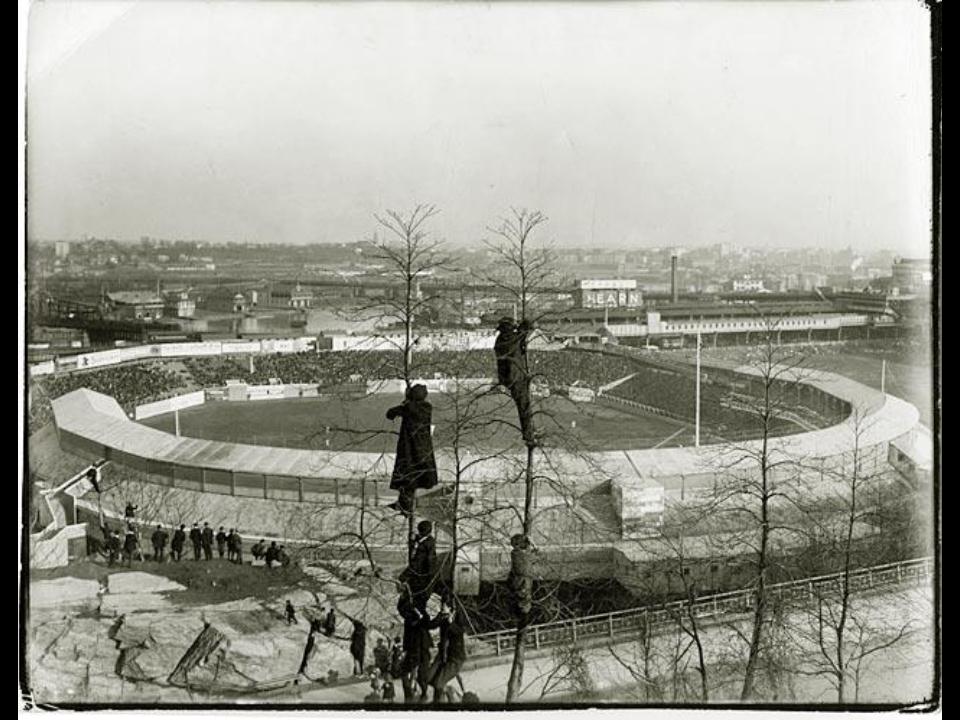
--------------------------------------------
It was O'Malley's desire for a new ballpark to replace the aging Ebbets Field that drove his decision to move the Dodgers to Los Angeles. He originally had a plan to keep the team in Brooklyn, however, by building what would have been the world's first domed stadium, designed by Buckminster Fuller, on a site near the intersection of Flatbush and Atlantic Avenues. O'Malley wanted the city to use its power of eminent domain to help him acquire the land he needed, forcing unwilling property owners to sell under the premise that the new ballpark would serve the common good. His scheme would have also required heavy public expenditures on infrastructure to support the stadium. Robert Moses and other government officials were less than enthusiastic about the idea. Here's Brooklyn congressman John J. Rooney addressing the matter on the floor of the House of Representatives in 1957:

For years the Brooklyn Baseball Club has coined money for the few stockholders of its closely held stock. The owners never shared any of their profits with the fans. They took advantage of the Dodger fans at every turn . . . I say let them move to Los Angeles if the alternative is to succumb to an arrogant demand to spend the taxpayers' money to build a stadium for them in Brooklyn. I am opposed to uprooting decent citizens living in my congressional district in the vicinity of . . . Flatbush and Atlantic Avenues in order to put more money in the pockets of my dear friend Walter O'Malley and the private profitmaking Brooklyn Baseball Club stockholders. . . . Let Walter O'Malley and his stockholders who have no civic pride for Brooklyn, where they made their money, move to the west coast in quest of more almighty dollars.
Ebbets Field was razed (with a wrecking ball painted to look like a baseball) a couple of years after the Dodgers left, in 1960, but numerous parts of the ballpark managed to escape destruction. After demolition began, fans were invited to come take seats for free. At an on-site auction held after most of the stadium had been torn down, a wide array of items were put up for bid, including "bats, balls, plaques, pennants, player stools, Ebbets Field sod, grand stand seats, bases, the pitcher's rubber, lockers, bricks, ushers' uniforms, pictures, electrical fixtures, bat racks and team schedules". The auction only raised about $2,300 in total, whereas you can now find many Ebbets Field seats selling online for more than that. Even a single brick can go for well over $1,000 these days.
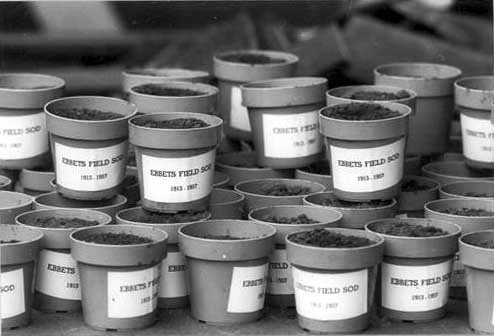
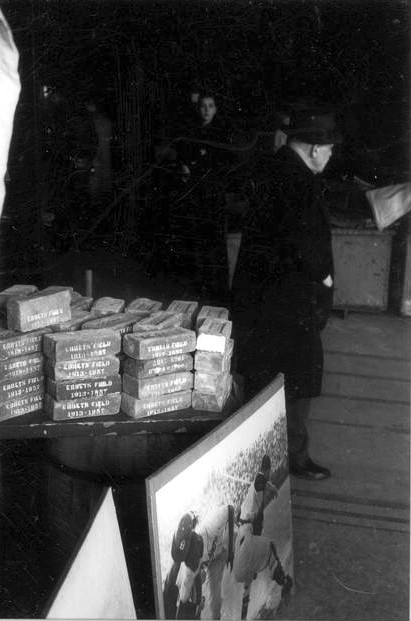
--------------------------------------------
Fans carrying off some goodies from Ebbets Field. Note the pots of sod in their hands. The Baseball Hall of Fame has one such pot in its collections, although the sod died long ago and now it's just a pot of dried-up dirt.
An illustration of the unique bat-and-ball chandelier that lit up the Ebbets Field rotunda. This appeared in the Brooklyn Daily Eagle in 1913, the year Ebbets Field opened.
--------------------------------------------
Marvin Kratter, who purchased the stadium in 1956 and then built the Ebbets Field Apartments in its place (and who also built the Bridge Apartments — a.k.a. the Four Sisters, a name I continue to repeat in hopes it will one day catch on — above I-95 in Washington Heights), also gave away lots of stuff to be reused elsewhere. He provided 2,200 seats and some lights to furnish a pair of ball fields for workhouse inmates on Hart Island. The first game at the newly christened Kratter Field pitted the workhouse all-stars against a team of army men from the island's Nike missile battery. According to the NY Times, "the soldiers claimed seven runs in their first time at bat, but the inmate scorer and umpire said it had been only five. . . . The home side also got five runs in its first turn, but by then it was 3:50 P.M. and the game was called because it was time for the regular count of prisoners." (Here are a couple of photos from 1991 showing remnants of the seats at the abandoned fields, which have since been cleared.)
According to an article from 1961, one of the seats sent to Hart Island was subsequently "liberated", shipped across the country "by ferry, limousine and jet plane", and given to Chuck Connors, the star of TV's The Rifleman. Connors had previously enjoyed a glorious career with the Dodgers, grounding into a game-ending double play in his one and only plate appearance with the team, at Ebbets Field in 1949. (He also played 66 games for the Cubs in 1951, as well as 53 games of basketball with the Boston Celtics between 1946 and 1947.) When Ebbets was being torn down, Connors asked his agents to help him locate his favorite seat from the ballpark, K-16, so that he could have it installed at the new Dodger Stadium in Los Angeles. It turned out the seat had already been taken to Hart Island, but the warden "agreed to pardon" it for Connors. Prior to the completion of Dodger Stadium in 1962, Connors used K-16 as his chair on the set of The Rifleman. I don't know if he actually succeeded in having the seat installed in the new ballpark. A photo from 1964 shows him with an Ebbets Field seat in his house, which suggests that may have been the final destination of K-16, but it's unclear whether the seat in the photo is K-16 or a different one. It has a plaque on it that reads "Last Chair From Ebbets Field, Presented To Chuck Connors By The City Of Brooklyn", while there was no such plaque on K-16 when it was photographed for the 1961 article.

Kratter sent 500 lights to Randall's Island, where they illuminated Downing Stadium. Many of the individual fixtures were swapped out for new ones over the years; I don't know what happened to the remaining original ones after Downing was torn down in 2002 and replaced by Icahn Stadium.
An outfield flagpole donated by Kratter was put up outside a Veterans of Foreign Wars post in East Flatbush. The VFW hall was later occupied for many years by the Canarsie Casket Company, and the flagpole remained standing until around 2007, when a church that had acquired the property began work to expand the building.
Marty Markowitz, Brooklyn's borough president at the time, heard about the flagpole coming down and alerted his buddy Bruce Ratner, who arranged to purchase it from the church. Ratner was the driving force behind the massive Atlantic Yards development (now called Pacific Park) that is, and will be for many more years, under construction in Prospect Heights. He and Markowitz, the cheerleader-in-chief for Atlantic Yards during his time in office, had the flagpole erected outside Barclays Center, the centerpiece of Atlantic Yards and the first of its buildings to be completed. They dedicated the pole in late 2012, after the arena had premiered as the new home of the NBA's Nets and been announced as the future home (for a few seasons, anyway) of the NHL's Islanders.
--------------------------------------------
The Ebbets Field flagpole outside Barclays Center.
--------------------------------------------
(News coverage of the flagpole, as well as the plaque on its base during its East Flatbush days, identified it as the center-field flagpole from Ebbets Field. If you look at old photos of the stadium, you'll see there was in fact a flagpole above center field, one of several located on the roof, but these poles look smaller than the Barclays pole to me. I suspect the Barclays pole is actually the larger flagpole that stood prominently in right-center field beside the scoreboard, capped with a ball finial that appears to match the one atop the Barclays pole.)

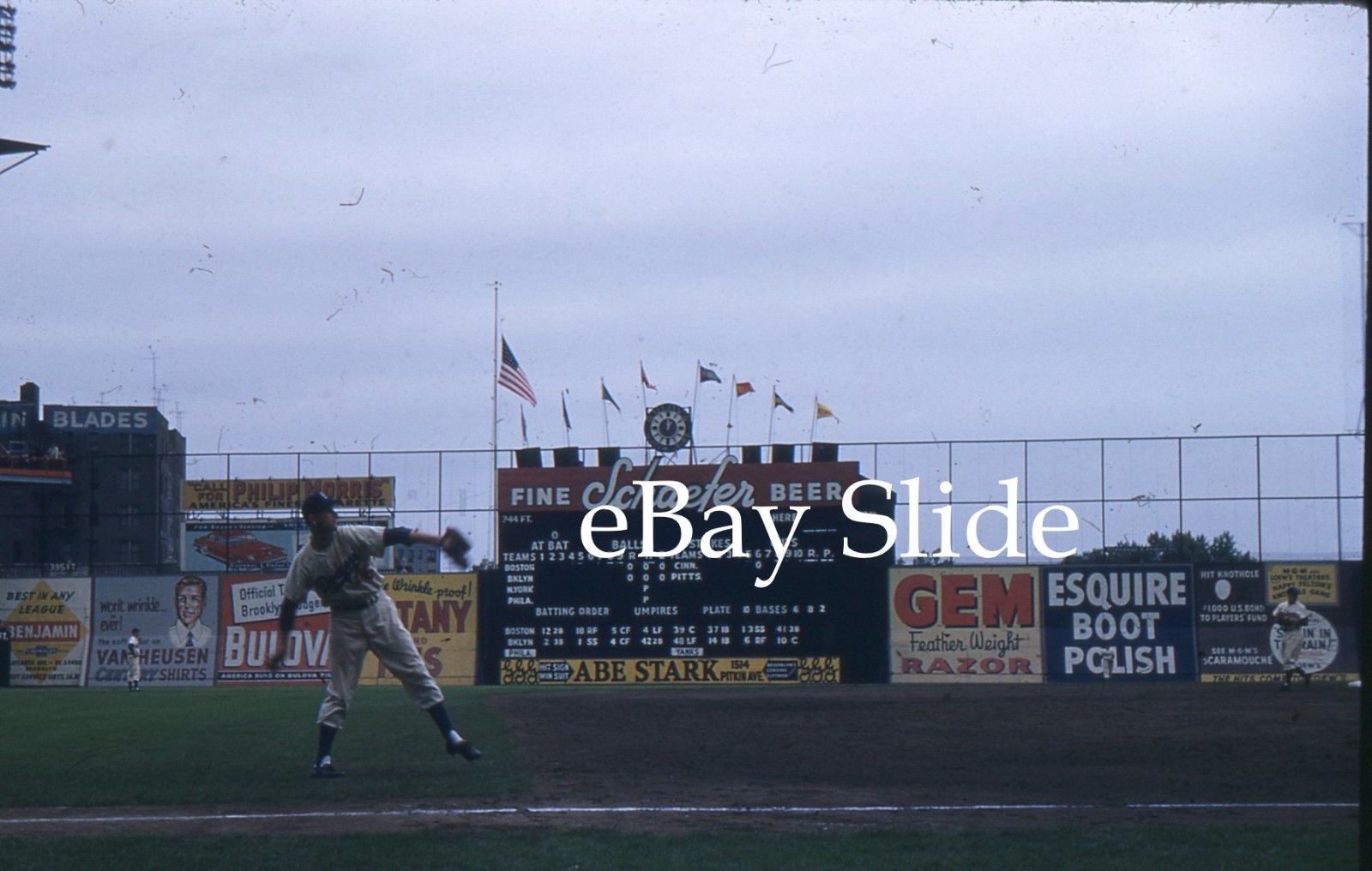
So why buy a flagpole from an old baseball stadium and put it outside a basketball arena? Well, Ratner and Markowitz surely understood the lure of the Dodgers — Markowitz was kind of obsessed with the team himself, in fact — and they were never hesitant to remind people that, as mentioned in seemingly every article written about the Nets' move from New Jersey, Atlantic Yards was bringing major professional sports back to Brooklyn for the first time since the Dodgers left, something Markowitz had been talking about doing since his first successful campaign for borough president in 2001.
Markowitz was also on hand at Barclays Center a few months after the flagpole dedication for a presentation of the Dodgers' 1955 championship pennant before a Nets game, in celebration of the 100th anniversary of the opening of Ebbets Field. The pennant has a very funny history, having been stolen from the Dodgers in Los Angeles in 1959 by a group of four sportswriters who decided it belonged back in New York. Coincidentally, when the pennant was originally displayed for the fans at Ebbets Field during the 1956 season, it was flown from the scoreboard flagpole, the one that (I believe) now stands outside Barclays Center.
(Of course, the Atlantic Yards crew was just the latest in a long line of profit-seekers trying to co-opt some of the Dodgers' warm fuzzies for their own purposes. When the New York Mets opened their new ballpark, Citi Field — named, like Barclays Center, for a scandal-tarred banking giant — back in 2009, "some of the team's fans complained loudly that the stadium, with its extensive tribute to Jackie Robinson and its architectural nod to Ebbets Field, seemed to be more focused on the Brooklyn Dodgers' history than on the Mets'.")
But beyond the obvious Brooklyn sports connection, there's another, subtler tie between Atlantic Yards and the Dodgers. Barclays Center sits right across Atlantic Avenue from the site that Walter O'Malley wanted for his dome. And like O'Malley's quest for a new stadium, Ratner's push to build Atlantic Yards was inevitably going to be controversial. It wasn't just that the 22-acre megaproject would dramatically reshape the neighborhood; it's that, as with O'Malley's plan, it would require loads of taxpayer funds and the seizure of private property to do so. But this time, with Ratner promising all sorts of affordable housing and new jobs in addition to a sports venue (developers are often better at promising than developing), the government has been on board all the way, forcing out residents and offering more than $700 million in public financing to help make the project a reality.
So if you're Bruce Ratner, and you're trying to show everyone that all the subsidies and tax breaks are beside the point, that you and the Russian oligarch you sold the Nets to are really all about serving the people and bringing joy to the masses, then it certainly couldn't hurt to take an old remnant of Ebbets Field, a physical reminder of the sainted Brooklyn Dodgers, put it up as a public monument with your name on it, and then hold a ceremony for it with Jackie Robinson's daughter in attendance.
--------------------------------------------
The plaque on the Ebbets Field flagpole.
--------------------------------------------
And could there possibly be a more appropriate place to pay tribute to a team remembered as the embodiment of all that is good and pure in sports than here at — yes, these are real names — the Resorts World Casino NYC Plaza, opposite the GEICO Main Entrance of Barclays Center?
--------------------------------------------
Postscript
The aforementioned ridiculously named plaza outside Barclays Center has taken on new life in 2020 as a community hub for protestors in the aftermath of George Floyd's murder. On the evening of June 2, demonstrators raised a Black Lives Matter flag up the Ebbets Field pole. In response, someone on Twitter shared the following words written by Jackie Robinson in his autobiography, made all the more poignant when you consider that Jackie, an Army veteran who was once court-martialed after refusing to move to the back of a bus, must have laid eyes on the American flag hanging from this pole countless times during his baseball career: "I cannot stand and sing the anthem. I cannot salute the flag; I know that I am a black man in a white world."
--------------------------------------------
Jackie Robinson, in Army uniform, signs a contract to play with the Montreal Royals, a Dodgers farm team, on October 23, 1945. He would spend the 1946 season with the Royals before breaking the major league color barrier with the Dodgers in 1947.