View allAll Photos Tagged Financial
A helipad protrudes from the 68-story Bitexco Financial Tower (2010) in Ho Chi Minh City (Saigon). The design mimicked a lotus, the national flower of Vietnam.
Amsterdam, Netherlands
(September 18th 2020)
This is not Amsterdam as tourists know it. The area is called Zuidas and it's the financial district. The most expensive area in the country.
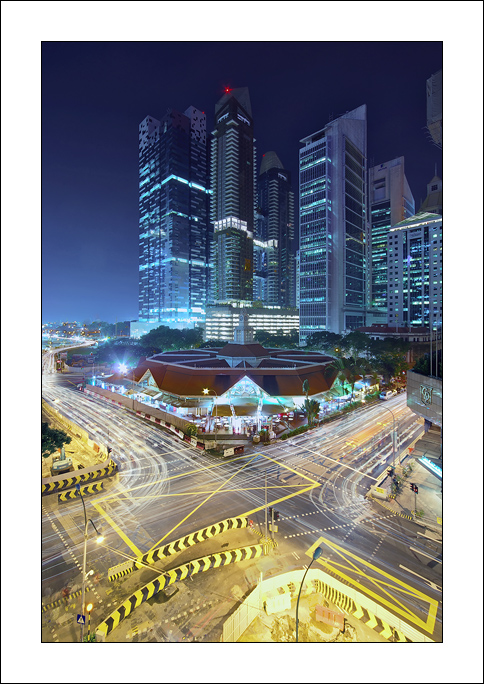
Marina Bay Financial Centre, located along Marina Boulevard at Marina Bay, Singapore.
The largest office development to date in the city in terms of gross floor area. It comprises three towers, of which two are office buildings at 42 and 36 floors respectively, and the third residential tower, Marina Bay Residences (left), command 55 floors and house 428 units.
The development will be linked underground to The Sail @ Marina Bay and with this link it will be linked to Raffles Place MRT station. On the right foreground shows part of The Fullerton Bay Hotel.
pp: On camera setting set white balance to tungsten to balance warm color temperature. Just a single shot treated with Topazlab Adjust to bring on details.
©williamcho 2011
The "lowest" part of Lower Manhattan is home to some of New York's most famous and evocative landmarks: Wall Street, the Brooklyn Bridge, as well as the Statue of Liberty on Liberty Island and Ellis Island in the harbor, both accessed by ferry boat from the financial district.
Linetrust International is a financial Re-Engineers. To be more specific financial Service & provides solutions that are specific to each business. About Linetrust
Southeast Financial Center is a two-acre development in Miami, Florida, United States. It consists of a 764 feet (233 m) tall office skyscraper and its 15-story parking garage. It was previously known as the Southeast Financial Center (1984–1992), the First Union Financial Center (1992–2003), and the Wachovia Financial Center (2003-2011). In 2011, it retook its old name of Southeast Financial Center as Wachovia merged with Wells Fargo and moved to the nearby Wells Fargo Center.
When topped-off in August 1983, it was the tallest building south of New York City and east of the Mississippi River, taking away the same title from the Westin Peachtree Plaza Hotel, in Atlanta, Georgia. It remained the tallest building in the southeastern U.S. until 1987, when it was surpassed by One Atlantic Center in Atlanta and the tallest in Florida until October 1, 2003, when it was surpassed by the Four Seasons Hotel and Tower, also in Miami. It remains the tallest office tower in Florida and the third tallest building in Miami.
Southeast Financial Center was constructed in three years with more than 500 construction workers. Approximately 6,650 tons of structural steel, 80,000 cubic yards of concrete and 7000 cubic tons of reinforcing steel bars went into its construction. The complex sits on a series of reinforced concrete grade beams tied to 150 concrete caissons as much as ten feet in diameter and to a depth of 80 feet. A steel space-frame canopy with glass skylights covers the outdoor plaza between the tower and low-rise building.
The tower has a composite structure. The exterior columns and beams are concrete encased steel wide flanges surrounded by reinforcing bars. The composite exterior frame was formed using hydraulic steel forms, or "flying forms," jacked into place with a "kangaroo" crane, that was located in the core and manually clamped into place. Wide flange beams topped by a metal deck and concrete form the interior floor framing. The core is A braced steel frame, designed to laterally resist wind loads. The construction of one typical floor was completed every five days.
The low-rise banking hall and parking building is a concrete-framed structure. Each floor consists of nearly an acre of continuously poured concrete. When the concrete had sufficiently hardened, compressed air was used to blow the forms fiberglass forms from under the completed floor. It was then rolled out to the exterior where it was raised by crane into position for the next floor.
The building was recognized as Miami's first and only office building to be certified for the LEED Gold award in January 2010.
The center was developed by a partnership consisting of Gerald D. Hines Interests, Southeast Bank and Corporate Property Investors for $180 million. It was originally built as the headquarters for Southeast Bank, which originally occupied 50 percent of the complex's space. It remained Southeast Bank's headquarters there until it was liquidated in 1991.
The Southeast Financial Center comprises two buildings: the 55-story office tower and the 15-story parking annex. The tower has 53 stories of office space. The first floor is dedicated for retail, the second floor is the lobby and the 55th floor was home to the luxurious Miami City Club. The parking annex has 12 floors of parking space for 1,150 cars. The first floor is dedicated for retail, the second floor is a banking hall and the 15th floor has the Downtown Athletic Club. A landscaped plaza lies between the office tower and the parking annex. An enclosed walkway connects the second story of the tower with the second story of the annex. The courtyard is partially protected from the elements by a steel and glass space frame canopy spanning the plaza and attached to the tower and annex. Southeast Bank's executive offices were located on the 38th floor. Ground was broken on the complex on December 12, 1981 and the official dedication and opening for the complex was held on October 23, 1984.
The Southeast Financial Center was designed by Edward Charles Bassett of Skidmore, Owings and Merrill. The Associate Architect was Spillis Candela & Partners. It has 1,145,311 ft² (106,000 m²) of office space. A typical floor has about 22,000 ft² (2,043.87 m²) of office space. Each floor has 9 ft x 9 ft (2.7 m x 2.7 m) floor to ceiling windows. (All of the building's windows are tinted except for the top floor, resulting in strikingly bright and clear views from there.) The total complex has over 2.2 million ft² (204,000 m²). The distinctive setbacks begin at the 43rd floor. Each typical floor plate has 9 corner offices and the top twelve floors have as many as 16. There are 43 elevators in the office tower. An emergency control station provides computerized monitoring for the entire complex, and four generators for backup power.
The Southeast Financial Center can be seen as far away as Ft. Lauderdale and halfway toward Bimini. Night space shuttle launches from Cape Canaveral 200 miles to the north were plainly visible from the higher floors. The roof of the building was featured in the Wesley Snipes motion picture Drop Zone, where an eccentric base jumper named Swoop parachutes down to the street from a suspended window cleaning trolley. The building also appeared in several episodes of the 1980s TV show Miami Vice and at the end of each episode's opening credits.
Zara founder Amancio Ortega purchased the building from J.P. Morgan Asset Management in December 2016. The purchase price was reportedly over $500 million, making it one of the largest real estate transactions in South Florida history.
Credit for the data above is given to the following websites:
en.wikipedia.org/wiki/Southeast_Financial_Center
www.emporis.com/buildings/122292/wachovia-financial-cente...
© All Rights Reserved - you may not use this image in any form without my prior permission.
The South Brisbane Branch of the Commonwealth Bank of Australia at 87 Grey Street, was constructed by Frank Lee in 1929. It was open for business by 1930. Prior to this, the bank had occupied temporary premises in and around Melbourne Street since the 3rd of January 1921. Plans for this purpose-built bank designed by the architects in the Commonwealth Department of Works are dated on the 9th of December 1927.
The site on which the bank is located was one of thirty allotments sold in the Brisbane land sales of 1854. It was acquired by Deed of Grant on the 11th of May 1854 by William John London. Situated within the Brisbane town limits drawn up in 1846, this allotment was affected by each of the major urban developments on the South Brisbane peninsula; the development of the public transport systems, the declaration of first-class urban areas, and the widening of the major arterial roads (Melbourne & Stanley Streets). Subdivision of the original blocks was underway by 1870 and allotment 1 section 15, of which this site is a part, was acquired by Patrick Maunsell on the 3rd of March 1871. Once it was sold by Maunsell's widow in 1897, it passed through various hands until the site was acquired by Janet Mearns Pike and Richard Pike in 1912.
The more diversified nature of commerce in the area from that time is reflected in the tenancy of the Pikes Building which was erected on the site by 1917. The State Department of Works leased the site in 1917 and various State offices including the Chief Protector of Aboriginals and the Department of Water Supply were situated there. In 1925, the whole of the site was resumed by the South Brisbane City Council. It passed to the Brisbane Municipal Council in 1927 when part of the land was dedicated for road purposes. Re-subdivision of the land followed and subs. 1 & 2 of allot 1 of section 15 were sold to the Commonwealth Bank of Australia by the Brisbane City Council in September 1927. The property was taken over by the Commonwealth Trading Bank of Australia in September 1956.
Centrally situated in one of the three distinct shopping centres which developed in South Brisbane in the early twentieth century, that at Bayard's Corner Melbourne Street, the Commonwealth Bank was ideally placed to take advantage of the industrial and commercial development which was the predominant feature of the early 1920s. Custom would have been further enhanced when the in-bound lane of the tramway in Stanley Street was relocated in Grey Street in 1918. From that time, all in-bound trams from West End, Dutton Park, Ipswich Road, Coorparoo, Greenslopes, and Balmoral stopped at Bayard’s corner.
When the Melbourne Street Railway Station became the terminus for both the interstate line through Kyogle as well as the southside commuter services the business potential was further enhanced. By this time, the bank was both a trading and savings bank and it also had the custom of the Queensland Government. The South Brisbane Branch was one of a number of suburban branches established in the 1920s. Its move into the area reflects the bank's optimism and confidence in the potential of the locale and its desire to capture a share of the area's financial market; a confidence and a desire which it apparently shared with its counterpart and rival, the Queensland National Bank which adjoined. The building, in its aspect and architecture, reflects both the optimism for the future and the challenge which was being posed by the bank, casually dismissed at its inception in 1911 as "a new bank controlled by political amateur financiers."
The property remained in the ownership of the Commonwealth Bank until the early 1990s. It has been subsequently been used as office space and is a coffee shop today.
Source: Brisbane City Council Heritage Register.
VISIT LONDON, "I KNOW THIS GREAT...", TIME OUT LONDON & LONDONIST if you use my photo can you please put the credit link to my Facebook Page rather than my Flickr Account. Thank you.
All pictures in my photostream are Copyrighted © Umbreen Hafeez All Rights Reserved
Please do not download and use without my permission.
Manhattan financial district, the one world trade center and lady liberty
such a terrific view from the 86th floor of the empire state building
If you like you can also visit me on my INSTAGRAM page
Building between Beaver Street and South William Street in the 'Financial District'
Gebäude zwischen der Beaver Street und der South William Street im 'Financial District'
DSC00265