View allAll Photos Tagged Emit
Flamenco común (Phoenicopterus roseus)
Por su notable tamaño y su peculiar aspecto, el flamenco común resulta posiblemente la más espectacular de todas las aves acuáticas que pueblan
nuestros humedales. Su estilizada silueta puede ser vista en muchos de nuestros mejores enclaves húmedos costeros mediterráneos y suratlánticos,
o en algunas lagunas del interior, como la malagueña de Fuente de Piedra —donde se asienta su principal colonia de cría en España y una de las más
importantes de todo el Mediterráneo— o algunas localidades manchegas.
Clasificación
Orden Phoenicopteriformes; familia Phoenicopteridae
Longitud 125-145 cm. Envergadura 140-170 cm.
Identificación
Esta popular ave de aspecto inconfundible destaca por su gran tamaño y sus largas patas y cuello. Cuerpo, cuello y cabeza exhiben una coloración blanquecina con tonos rosados, mientras que las plumas coberteras e infracoberteras alares presentan un intenso rosa carmesí; sin embargo, las plumas de vuelo o rémiges son de color negro. En reposo, estas plumas negras aparecen ocultas bajo las coberteras y las largas plumas escapulares. El pico, curvado hacia la mitad de su longitud casi en ángulo recto, es también de color rosa, salvo en el extremo terminal, donde se torna negro. Las patas lucen asimismo tonos rosados. En vuelo presenta una silueta muy estilizada en la que mantiene el largo cuello y las patas estirados. El dimorfismo sexual se manifiesta en el tamaño de las aves, mayor en el macho. Los jóvenes contrastan notablemente con los adultos por presentar una coloración pardo-grisácea, sin ningún tono rosado (tampoco en el pico o las patas). Sus patas resultan además mucho más cortas.
Canto
Emite constantemente reclamos nasales y guturales, así como cacareos.
Pic Blanc and "Radio Andorra" historic emitter infrastructure at 2650m, Port d'Envalira, Encamp parroquia, Vall d'Orient, Andorra, Pyrenees
"Radio Andorra", was a famous private short or medium wave popmusic emitter of 20th century 1939-1981 with announcer "Aquí Radio Andorra!“. For me too, listening from Deutschland. Editorial work had been in Encamp. The Encamp building is renewed by now, so I'm waiting.... Will Radio Andorra restart?
Check actual "Radio Andorra" image results: www.flickr.com/search/?user_id=8013880%40N06&sort=dat...
More Grau Roig, Envalira & Encamp parroquia images: Follow the group links at right side.
........
About this image:
* Medium format 4x3 (645) high quality image
* Usage: Large format prints optional
* Motive is suitable as symbol pic
* "Andorra authentic" edition (10 years decade 2008-2018)
* "Andorra camis & rutes" active collection
* 2000+ collection „beyond the treeline“
We offer 100.000+ photos of Andorra and North of Spain. HighRes & HighColour GeoCoded pictures with metadata in 4 languages. Prepared for easy organising and advanced publishing for print and internet as Culture-GIS (Geographic Info System). The big stockphoto collection from the Pyrenees.
More information about usage, tips, how-to, conditions: www.flickr.com/people/lutzmeyer/. Get quality, data consistency, stable organisation and PR environments: Professional stockphotos for exciting stories - docu, tales, mystic.
Ask for licence! lutz(at)lutz-meyer.com
Kunst im Hyperraum
Magdeburg / Germany
See where this picture was taken. [?]
© All Rights Reserved - you may not use this image in any form without my prior permission.
location : Tofuku-ji Komyo-in temple ,Kyoto city,Kyoto prefecture,Japan
Hashin-tei garden 波心庭
created by Mirei SHIGEMORI重森三玲
The stone placement represents the emitted lights ,and it comes from the name of this temple 光明院 光(Kou)means "lights" 明(myou)means "bright",so 光明means bright lights,in other words, the beams of light coming from the Buddha's body.
For more information...
This temple was founded by Kinzan Myosho in 1391 and the garden was designed by modern landscape architect Mirei Shigemori in 1939 and called "the garden of Hashin"
The significant feature of the garden is its strong stone foundation and modern style allotment of land by moss ,especially the placement of stones attracts attention and has some meanings
We can see the triad stone arrangement at the rear of the garden ,in which the central stone symbolizes Buddhist Mount Meru,
It is so- called "Sanzon-seki "三尊石 in Japanese and in this case selectively placed on artificial moss hill and regarded as a kind of the light source from which the lights are radiating.
And the other stones represent the radiated lights itself from the Sanzon-seki stones.
So in other words ,the garden depicts the lights source and lights beams by using 75 stones, that is based on the Buddhist thought and connected with the name of the temple "Komyo" 光明[Kou or Ko 光 means the lights ,Myo 明 means bright.
Thank you for your interest and seeing my photo.
--------------------------------------------------------------------------------
Mirei Shigemori (重森三玲 Shigemori Mirei, 1896–1975) was a notable modern Japanese landscape architect and historian of Japanese gardens.
Mirei Shigemori was a garden designer who actively participated in many areas of Japanese art and design. Shigemori was born in Kayō, Jōbō District, Okayama Prefecture, and in his youth was exposed to lessons in traditional tea ceremony and flower arrangement, as well as landscape ink and wash painting. In 1917, he entered the Tokyo Fine Arts School to study nihonga, or Japanese painting, and later completed a graduate degree from the Department of Research. In the early 1920s, he tried extensively to found a school of Japanese Culture, Bunka Daigakuin to synthesize the teaching of culture, but was foiled by the 1923 Great Kantō earthquake, which forced him to move back to his hometown near Kyoto.
He also intended to create a new style of ikebana,or flower arrangement, and produced art criticism and history writings, including the Complete Works of Japanese Flower Arrangement Art published in 1930, and the New Ikebana Declaration written with Sofu Teshigahara and Bunpo Nakayama in 1933. Throughout his later gardening career, he maintained a voice in avant garde criticism of ikebana through publishing Ikebana Geijutsu magazine beginning in 1950, and through the founding of an ikebana study group called Byakutosha in 1949.
At the same time, he cultivated an interest and knowledge in traditional Japanese gardens. He co-founded the Kyoto Rinsen Kyokai with others in 1932. After the destruction caused by the Muroto typhoon in 1934, he began a survey of significant gardens in Japan. In 1938, he finished publishing the 26-volume Illustrated Book on the History of the Japanese Garden, an unprecedented and meticulous documentation of major gardens in the country which he revised in 1971, shortly before his death.
He began practicing as a garden designer in 1914 with a garden and tea room on his family’s property. His first major work was a design for the garden at Tofuku-ji Temple in 1939. He designed 240 gardens, and worked mostly in karesansui, or dry landscape gardens. Many of his gardens are on existing religious sites, but a few of his works are in cultural or commercial settings. He also collaborated with Isamu Noguchi in choosing stones for the UNESCO Garden in Paris.
- wikipedia
Canon EOS M5/ EF-M18-150mm f/3.5-6.3 IS STM/
ƒ/7.1 18.0 mm 1/100 sec ISO250 /all manual / no crop
Love For All Hunt
February 7th to 28th
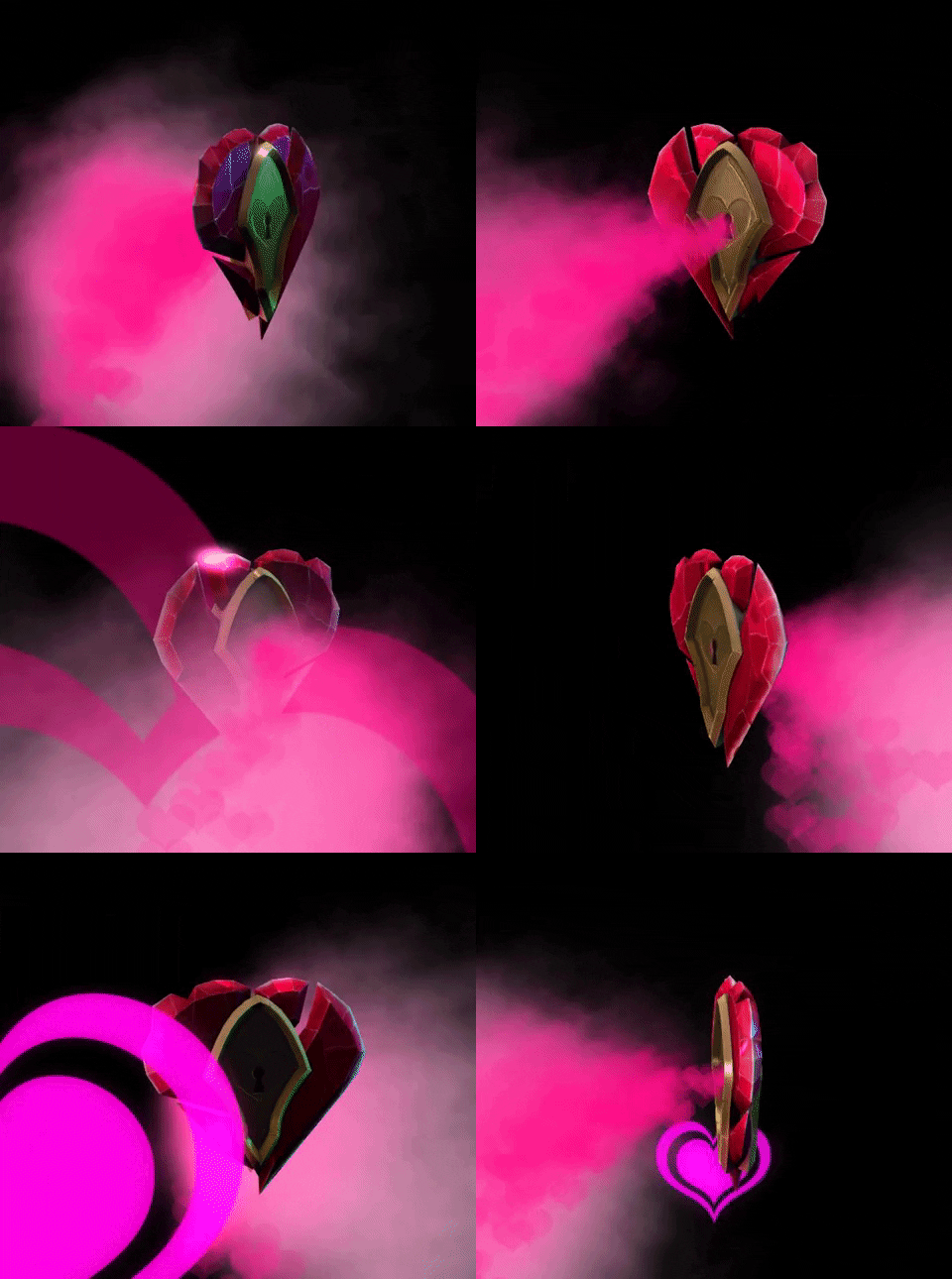
-Birth- 'Lover's Lock' Partner Linking Heart Accessory and Particle Emitter
We have an absolute beauty of a free hunt item this year to be found
at Birth store. An ornate heart shaped lock, situated over
your actual heart that sends loving particles to your partner
of choice or to your own heart.
Hint: "Somewhere down in Sexy town . . . "
To partner, you and your loved one find the gift, click and choose your loved one and you
are linked by a fluffy of pretty heart based particles.
Preview -
media1.giphy.com/media/nyqhkxVy1jyM8SQ4St/giphy.gif

media3.giphy.com/media/8hpcJnEJJTAebgJcjr/giphy.gif

media2.giphy.com/media/z7LsmFhjl5L1iRDvB1/giphy.gif
"Its the season of Love and Flair for Events is excited to bring you a fun filled hunt that embraces all aspects of love!
The time has come to spread some positivity and share in the love for that feel good glow. Bring your lovers, your partners, your family and friends and take part in this much needed inclusive hunt. Discover new places to shop, grab some amazing freebies and most of all,
Share the love."
For participant SLurls & hints, go here:
Just a little model to celebrate the 20th anniversary of Halo: Combat Evolved!
Free instructions: www.ky-ebricks.com/product-page/beam-emitter-instructions
The VdB 15 nebula is an astronomical object located in the constellation Perseus, about 1,000 light-years from Earth.
This nebula is a reflection nebula, meaning it does not emit its own light but reflects the light of nearby stars.
This gives it a faint, bluish appearance due to the scattering of starlight by the interstellar dust that makes up the nebula.
VdB 15 is primarily illuminated by a hot, young star called BD+62 209B, which is responsible for much of the brightness we observe in the region.Reflection nebulae like VdB 15 are of great interest to astronomers because they are often associated with regions where new stars are forming.
The gas and dust within these nebulae are the raw materials from which stars and planets are born.
In the case of VdB 15, its proximity to other nebulae and star clusters suggests it is in an active star-forming region.While not one of the most famous nebulae in the sky,
VdB 15 is notable for its subtle beauty and the fascinating dynamics of dust and light that can be observed within it.
It serves as a good example of how cosmic dust, which often obscures our view of the universe, can also act as a cosmic mirror, revealing structures and stars we might otherwise miss.
Equipment
Imaging Telescopes Or Lenses
Takahashi Epsilon-160ED
Imaging Cameras
QHYCCD QHY294M Pro
Mounts
Sky-Watcher EQ6-R Pro
Filters
Baader Blue (CMOS-Optimized) 36 mm · Baader Green (CMOS-Optimized) 36 mm · Baader H-alpha 6.5nm (CMOS-Optimized) 36 mm · Baader O-III 6.5nm (CMOS-Optimized) 36 mm · Baader Red (CMOS-Optimized) 36 mm · Baader S-II 6.5nm (CMOS-Optimized) 36 mm · Baader UV/IR CUT Luminance (CMOS Optimized) 36 mm
Accessories
Pegasus Astro FocusCube2 · Pegasus Astro Powerbox Advance Gen2 · QHYCCD QHYCFW3-M-US · TS-Optics Off-axis guider 9mm (TSOAG9G2) ×
Software
Starkeeper Voyager Custom Array
Guiding Cameras
ZWO ASI290MM Mini
Acquisition details
Dates:
Nov. 19, 2023
Dec. 14, 2023
Dec. 16, 2023
Dec. 18, 2023
Feb. 3, 2024
Frames:
Baader Blue (CMOS-Optimized) 36 mm: 120×60″(2h)
Baader Green (CMOS-Optimized) 36 mm: 120×60″(2h)
Baader H-alpha 6.5nm (CMOS-Optimized) 36 mm: 120×600″(20h)
Baader O-III 6.5nm (CMOS-Optimized) 36 mm: 120×600″(20h)
Baader Red (CMOS-Optimized) 36 mm: 120×60″(2h)
Integration:
46h
Avg. Moon age:
8.09 days
Avg. Moon phase:
27.54%
RA center: 03h29m52s.40
DEC center: +59°04′35″.2
Pixel scale: 2.696 arcsec/pixel
Orientation: -1.186 degrees
Field radius: 1.207 degrees
Resolution: 2668x1811
File size: 7.1 MB
Locations: AAS Montsec, Àger, Lleida, Spain
Data source: Own remote observatory
Remote source: Non-commercial independent facility
A ripple of bright blue threads through this galaxy like a misshapen lake system. The foreground of this image is littered with nearby stars with their gleaming diffraction spikes. A keen eye can also spot a few other galaxies that, while masquerading as stars at first glance, reveal their true nature on closer inspection.
The central galaxy streaked with colour, IC 4870, was discovered by DeLisle Stewart in 1900 and is located approximately 28 million light-years away. It contains an active galactic nucleus, or AGN: an extremely luminous central region so alight with radiation that it can outshine the rest of the galaxy put together. AGNs emit radiation across the complete electromagnetic spectrum, from radio waves to gamma-rays, produced by the action of a central supermassive black hole that is devouring material getting too close to it. IC 4870 is also a Seyfert galaxy, a particular kind of AGN with characteristic emission lines.
IC 4870 has been imaged by Hubble for several studies of nearby active galaxies. By using Hubble to explore the small-scale structures of AGN in nearby galaxies, astronomers can observe the traces of collisions and mergers, central galactic bars, nuclear starbursts, jets or outflows, and other interactions between a galactic nucleus and its surrounding environment. Images such as this can help astronomers understand more about the true nature of the galaxies we see throughout the cosmos.
Credits: ESA/Hubble & NASA, CC BY 4.0
These 2001 Chandra and Hubble Space Telescope images of two recently detected emitting globular star clusters - so called because of their spherical shape - were used as a cross-check to determine the position of X-ray sources near the center of the Andromeda galaxy to an accuracy ten times greater than before. The inset shows the three Chandra sources closest to the supermassive black hole, overlaid with the intensity contours from the HST image (red). The location of supermassive black hole is thought to be in the middle of the peanut-shaped intensity contours, and very close to the Northern-most of the three Chandra sources.
These highly accurate positions show that the very cool X-ray source (blue) previously identified with the supermassive black hole in the center of the galaxy is actually about 10 light years south of the center. A second, hotter X-ray source, is found to be at a position consistent with the position of the super massive black hole. The globular clusters are outside the field of view in this image.
Image credit: X-ray: (NASA/SAO/CXC/M.Garcia et al.) Optical: (NASA/GSFC/T.Brown et al.)
#NASA #MarshallSpaceFlightCenter #MSFC #Marshall #ChandraX-RayObservatory #cxo #MilkyWay #galaxy #blackhole #astronomy #space #BlackHoleWeek #supermassiveblackhole #gsfc #Goddard #GoddardSpaceFlightCenter #ESA #EuropeanSpaceAgency #HubbleSpaceTelescope #HST #Hubble
Red: At the highest altitudes, excited atomic oxygen emits at 630.0 nm (red); low concentration of atoms and lower sensitivity of eyes at this wavelength make this color visible only under some circumstances with more intense solar activity. The low amount of oxygen atoms and their very gradually diminishing concentration is responsible for the faint, gradual appearance of the top parts of the "curtains".
Green: At lower altitudes the more frequent collisions suppress this mode and the 557.7 nm emission (green) dominates; fairly high concentration of atomic oxygen and higher eye sensitivity in green make green auroras the most common. The excited molecular nitrogen (atomic nitrogen being rare due to high stability of the N2 molecule) plays its role here as well, as it can transfer energy by collision to an oxygen atom, which then radiates it away at the green wavelength. (Red and green can also mix together to pink or yellow hues.) The rapid decrease of concentration of atomic oxygen below about 100 km is responsible for the abrupt-looking end of the bottom parts of the curtains.
Yellow and pink are a mix of red and green.
Blue: At yet lower altitudes atomic oxygen is not common anymore, and ionized molecular nitrogen takes over in visible light emission; it radiates at a large number of wavelengths in both red and blue parts of the spectrum, with 428 nm (blue) being dominant. Blue and purple emissions, typically at the bottoms of the "curtains", show up at the highest levels of solar activity.
Phylum: Chordata
Subphylum: Gnathostomata
Superclase: Tetrapoda
Clase: Aves
Superorden: Neognathae
Orden: Coraciiformes
Familia: Alcedinidae
Género: Alcedo
Especie: atthis
El martín pescador común o alción (Alcedo atthis) es una especie de ave coraciiforme de la familia Alcedinidae, que habita en lagos y ríos de Europa, África y Asia.
El dorso del cuerpo, cabeza y alas es azul-turquesa con destellos verdoso-metálicos. El vientre y un par de zonas bajo los ojos son de color naranja, mientras que las zonas de la garganta, orejas y orificios nasales son blancas. A pesar de éstas generalidades, es complicado dar un patrón exacto del color de su plumaje, ya que éste varía según la incidencia de la luz. En cualquier caso, es un ave inconfundible.
El pico es largo, constituyendo una parte nada despreciable de la longitud total del cuerpo (15,5-19 cm), de color negro con transición a naranja en la zona más cercana a la cabeza de la mandíbula inferior. La envergadura alar ronda los 7,5 cm y el peso medio los 35 gramos. Las patas son muy cortas, y al igual que los pies son de color rojo vivo. El dimorfismo sexual en esta especie es poco acusado: en las hembras, la zona de color anaranjado de la mandíbula inferior es más amplia.
Sorprendentemente, a pesar de su espectacular plumaje, su mimetismo con el entorno es grande. El plumaje castaño del pecho hace que sea difícil de ver desde la otra orilla, y su espalda y alas azul se confunden con el agua del río si se le ve de espaldas.
Pone de 5 a 7 huevos esféricos, brillantes y blancos al final de una galería excavada en las márgenes del río, a poca altura sobre el nivel del agua. Macho y hembra colaboran en la construcción de la galería, unas veces desde cero y otras modificando una madriguera abandonada de avión zapador o de rata de agua. El nido puede alcanzar una profundidad de un metro, pero con frecuencia mide bastante menos.
Realizan dos puestas al año, reutilizando en muchas ocasiones el mismo nido, que limpiarán de restos de pescado e insectos antes de la segunda puesta. Aunque varían según las regiones, la primera suele ser en abril y la segunda en junio, aunque se conocen puestas en meses tan excepcionalmente tardíos como octubre.
Los huevos son pequeños, de unos 22,5x18,7 mm. Tanto el macho como la hembra se reparten las tareas de incubación, que suelen durar entre 19 y 22 días. Los pollos nacen desnudos de plumón, con una piel rosa azulada. A los 23 días ya están listos para salir del túnel, pero aún permanecerán dos o tres días más en un posadero cercano al nido hasta que se decidan a echar a volar.
La tasa de mortalidad en los primeros días es muy alta. Ya sea porque son capturados por depredadores, o porque se ahogan en sus primeros intentos de pesca, no suelen sobrevivir más de dos pollos de cada puesta.
Vive a lo largo de los lagos y ríos de Europa, África y Asia. En la mayor parte de su área de distribución es una especie sedentaria, pero en las zonas boreales se ve obligado a emigrar hacia el sur en invierno. Se encuentra ausente en algunas áreas montañosas, donde le sustituyen los mirlos acuáticos.
Su alimentación básica la componen los pequeños peces que divisa desde las ramas bajas de un árbol o un arbusto. Luego, se zambulle rápidamente con el pico por delante y los ojos cerrados, y captura a su presa con una altísima tasa de éxito. Tras la captura, retorna a su puesto anterior, donde la traga de una pieza. En otras ocasiones maniobra velozmente sobre la superficie del agua, buscando un lugar más propicio para sumergirse. Todo esto sería imposible sin sus potentes músculos alares y de la base del cuello.
Ocasionalmente, si la zona de pesca no dispone de posaderos adecuados, el Martín se suspende en el aire al acecho, aleteando vigorosamente y manteniendo la cabeza quieta, de una manera similar a la utilizada por el cernícalo vulgar.
Aproximadamente el 65% de su dieta se compone de pescado. La complementa con insectos acuáticos, pequeños crustáceos y renacuajos, a los que captura con la misma técnica. Es frecuente que emita un estridente sonido similar a un chiii o tiiit mientras pesca.
Debido a su método de pesca, el martín pescador común necesita de la presencia de densa vegetación fluvial junto al agua, además de que ésta sea pura y cristalina, por lo que tolera bastante mal la contaminación del agua. Ésta, además de las olas de frío ocasionales que congelan la superficie del río impidiéndole pescar, son las principales causas de mortandad en esta especie.
Subespecies:
Se reconocen siete subespecies de Alcedo atthis:
Alcedo atthis atthis - sudeste de Europa y norte de África hasta el noroeste de la India.
Alcedo atthis ispida - de las Islas Británicas hasta el oeste de Rusia, Península Ibérica y Báltico.
Alcedo atthis bengalensis - Lago Baikal y norte de la India a través del este y sudeste de Asia e islas.
Alcedo atthis taprobana - sur de la India y Sri Lanka.
Alcedo atthis floresiana - Islas menores de la Sonda (de Bali a Timor y Wetar).
Alcedo atthis hispidoides - de Célebes a las Molucas, Nueva Guinea y Islas Bismarck.
Alcedo atthis solomonensis - Bougainville e Islas Salomón (al este hasta San Cristóbal).
Copyright © juansaturno_5 , All rights reserved. This artwork can't be used without written consent from its author. Esta obra no puede ser utilizada sin el consentimiento por escrito del autor.
Erithacus rubecula
Petirrojo europeo
Distribución
El petirrojo europeo (Erithacus rubecula) es una especie de ave paseriforme de la familia Muscicapidae. Está distribuido por toda Europa, principalmente en la región meridional y occidental del continente, donde habita todo el año, siendo migrante parcial en el norte de Europa y noroeste de África.
El petirrojo es un pájaro sociable, atrevido y curioso que acostumbra a salir del bosque y plantarse a mitad de un camino para ver quién llega a su territorio, emitiendo su característica voz de alerta: un chip-chip metálico y seco. Su canto es un gorjeo musical, muy melódico, parecido al del ruiseñor.
Descripción
El ave adulta mide 12,5-14,0 cm de largo, pesa 16-22 g y tiene una envergadura de 20-22 cm. El plumaje del macho y de la hembra es semejante: el pecho y la cara naranja, bordeado por un gris azulado en los lados del cuello y del pecho. Las partes superiores son de color marrón y el vientre blanquecino, mientras que las piernas y los pies son de color marrón. El pico y los ojos tienen un color negro. Los juveniles carecen de color anaranjado y son marcadamente moteados de pardo oscuro y ocráceo, con parches de color naranja apareciendo gradualmente en el pecho y la cara.
Taxonomía
El petirrojo europeo fue originalmente descrito con el nombre de Motacilla rubecula por Linnaeus en su obra del siglo XVIII Systema Naturae.5 Su epíteto específico rubecula es un diminutivo derivado de la palabra latín ruber ('rojo'). El género Erithacus fue creado por el naturalista francés Georges Cuvier en 1800, dando al ave su actual nombre binomial de E. rubecula.
El petirrojo europeo pertenece a un grupo de aves principalmente insectívoras que previamente fueron asignados a los tordos o papamoscas, dependiendo de cómo estos grupos fueron percibidos taxonómicamente. Finalmente, se volvió a analizar el conjunto de los papamoscas-tordos y el género Erithacus fue asignado a la tribu Saxicolini, un grupo de verdaderos papamoscas-tordos que también incluye el ruiseñor común y los Saxicolinae del Viejo Mundo.
Dos especies del Paleártico oriental, E. akahige y E. komadori —ese último con una distribución insular limitada— se colocan generalmente en el género Erithacus. Sin embargo, datos biogeográficos y las secuencias de ADNmt citocromo b indican que estas podrían mejor ser clasificadas con algunos "ruiseñores" del Extremo Oriente, dejando sólo las especies europeas en Erithacus.
Subespecies
La subespecie británica E. rubecula melophilus sólo difiere ligeramente de las aves continentales.
James Clements reconoce las siguientes subespecies (2014)
•E. r. balcanicus, península de los Balcanes a Turquía occidental.
•E. r. hyrcanus, sur del Cáucaso a norte de Irán.
•E. r. melophilus, islas británicas y Escandinavia.
•E. r. rubecula, oeste de Europa, noroeste de Marruecos, Azores, Madeira y Canarias (El Hierro, La Palma y La Gomera).
•E. r. superbus, Canarias (Tenerife)
E.r. marionaie" Canarias ( Gran Canaria)
•E. r. tataricus, Siberia occidental.
•E. r. valens, península de Crimea.
•E. r. witherbyi, sur de España, noreste de Marruecos, Argelia, Túnez, Córcega y Cerdeña.
Quick couple of photo shots at work.
A fellow photography friend who is also a rep for one of the companies we deal with came to visit me at work.
We had a brief conversation about a couple of photography stuff. He showed me his new lens that he is "borrowing" from his daughter, a Nikkor 105mm f/2.8 VR lens. What a great lens that is.
I had a few minutes testing the lens (see the one photo) I also demonstrated my old "vintage" Helios lens to him. Hence this photo.
Using the Nikkor 105mm f2.8 lens. I had this lens for 5 minutes.
Critique is welcomed.
Thank you all very much for your visits, favs and comments.
solanum mauritianum
This is an alien invasive plant and it is growing everywhere. Yet nobody seems to care to take it out anymore. It used to be controlled but not anymore.
Sources say this plant could also be hazardous to your health and that some people even goes so far as to smoke the leafs of this plant.
More information on this plant I photographed. (look at the Bugweed)
www.invasives.org.za/component/k2/item/351-bugweed-solanu...
southcoastherald.co.za/135676/10-worst-alien-invasive-pla...
Also from the website:
"These IAPs may no longer be grown anywhere in South Africa. If they are in your garden, they should be removed and destroyed immediately. Trade in these plants is prohibited."
Alternative common names:
bugtree, flannel weed, woolly nightshade (English); luisboom, groot bitterappel (Afrikaans); uBhoqo, umbanga banga (isiZulu)
A shrub or small tree up to 4m high covered with whitish-felty hairs. Dull green leaves that are velvety above and white-felty beneath which emit a strong smell when bruised. Purple flowers in compact, terminal clusters on densely felty stalks up to 10cm long all year round. Spherical berries which start off green and turn yellow, in compact terminal clusters. Hairy leaves and stems are a respiratory tract and skin irritant. Unripe fruits are poisonous.
Bisbita campestre (Anthus campestris)
Longitud / Envergadura: 17 cm / 27 cm
Identificación: Bisbita con aspecto de lavandera, con las patas de color naranja amarillento y un pico anaranjado por abajo y oscuro por arriba. De color arena por el dorso, con un débil rayado, y crema por las partes inferiores, con alas redondeadas, cola larga con las plumas externas blancas, y un diseño complejo en la cabeza: posee una ceja blanca seguida de una línea ocular negra, una bigotera blanca con el borde inferior negro y la garganta blanca. Es una especie territorial, que aparece en solitario, andando por el suelo.
Canto: Emite una serie de dos o tres notas, "chir-li", repetidas cada pocos segundos.
Alimentación: Su alimentación se compone de escarabajos, saltamontes y grillos, y también de algunas semillas y pequeños vertebrados (reptiles). Se alimenta en el suelo por picoteo y persecución, y desmembrando las presas más grandes.
Reproducción: El periodo de cría comienza en mayo. Es una especie monógama y territorial. La hembra construye el nido en el suelo, con hierba seca, bajo un matorral o una piedra; también se encarga de la incubación. Ambos cuidan a los pollos, alimentándolos incluso varias semanas después de abandonar el nido.
HÁBITAT
Ocupa zonas de vegetación abierta y ambientes secos, como pastizales, cultivos, viñedos, eriales, sabinares y otros. Suele criar entre el nivel del mar y los 2.700 metros de altitud en Sierra Nevada.
DISTRIBUCIÓN
En España: Durante la migración se distribuye por toda la Península, Baleares y Canarias; durante el periodo de cría se concentra en la Meseta norte y el valle del Ebro, en montañas del este peninsular, Cádiz y Baleares.
En Castilla y León: Se distribuye por toda la comunidad.
Desplazamientos y migraciones: Su área de invernada es el Sahel africano, con pasos poco llamativos. El paso primaveral tiene lugar entre marzo-mayo, y el otoñal desde finales de julio-mediados de octubre.
POBLACIONES
En España: Se estima una población superior a 500.000 parejas reproductoras.
ESTADO DE CONSERVACIÓN:
En el Catálogo Nacional de Especies Amenazadas figura con la categoría "De Interés Especial". En el Libro Rojo de las Aves de España (2004) está catalogado como "No Evaluada".
AMENAZAS
Aunque no está especialmente amenazada le afectan los cambios que producen la pérdida de hábitat, como variaciones en el uso del suelo, el abandono rural y de la ganadería, la reforestación de tierras agrícolas, etc.
The vapor clouds were emitted by the gas-fired combined heat and power plant Berlin Centre and were particularly dominant in the sky on this very frosty morning.
El pasado 25 de febrero emitieron por la 2 un extraordinario documental titulado: Cazadores del cielo. El mundo de las libélulas. Para los aficionados al mundo de los insectos ha sido, sin duda, uno de los documentales más completos y mejor realizados sobre el tema. Este documental las muestra de cerca, dando a conocer todos sus secretos.
Las libélulas son unos perfectos cazadores del cielo. La especie apenas ha cambiado en cientos de miles de años, con una antigüedad de 320 millones de años; son unos perfectos cazadores del cielo siendo depredadores de mariposas, insectos diversos e, incluso, otras libélulas. Al ser de sangre fría necesitan el sol para sobrevivir.
Las libélulas u Odonatos son insectos esencialmente veraniegos. Son unos animales fascinantes, con unas características biológicas que nos facilitan su observación. Los adultos de las libélulas están entre los insectos más grandes y espectaculares: sus extraordinarios coloridos, sus fenomenales acrobacias en el vuelo y sus peculiares características biológicas hacen de ellas unos seres fascinantes. Esos colores en sus abdómenes son claves para la diferenciación de las especies siendo relativamente fáciles de reconocer con un poco de práctica.
Se han identificado en el mundo unas 5.700 especies, viviendo la mayoría de ellas en los trópicos. En Europa habitan unas 120 especies y 77 de ellas en la Península Ibérica.
Las libélulas se localizan mejor en puntos de agua dulce (en movimiento o estancada) y cuando hace calor. La salinidad es incompatible con la vida de las libélulas en su fase larvaria, pero condiciones de baja salinidad son toleradas por ciertas especies. Sin embargo, muchas libélulas pueden encontrarse lejos del agua: prados, claros de bosque, bordes boscosos, caminos, etc. Especies asustadizas como varias de la familia Gomphidae, son más fáciles de localizar en estos lugares.
Fuente: www.libellulasman.com/index.php?option=com_content&vi...
Split Rock Lighthouse is located just south of Silver Bay, Minnesota, USA on the North Shore of Lake Superior. The structure was designed by Ralph Russell Tinkham and was completed in 1910 at a cost of $75,000. It is built on a 130-foot (40 m) sheer cliff of anorthosite. The lighthouse was first lit on July 31, 1910. It was built in response to the loss of ships during the famous Mataafa Storm of 1905, in which 29 ships were lost on Lake Superior. One of these shipwrecks, the Madeira, is located just north of the lighthouse. Compare, Great Lakes Storm of 1913.
The light was retired in 1969 by the U. S. Coast Guard. Every November 10 the lighthouse emits a light in memory of the SS Edmund Fitzgerald which sank on that date in 1975. So capturing the lighthouse in operation can be a challenge. The next best shot is to wait for a full moon to rise in back of the lighthouse. When that fails use Photoshop!
emitted primarily by stars (blue, green, and white), hot hydrogen gas (blue), and cosmic dust (red).
While not visible to the human eye, these 102 infrared wavelengths of light are prevalent in the cosmos, and observing the entire sky this way enables scientists to answer big questions, including how a dramatic event that occurred in the first billionth of a trillionth of a trillionth of a second after the big bang influenced the 3D distribution of hundreds of millions of galaxies in our universe. In addition, scientists will use the data to study how galaxies have changed over the universe’s nearly 14-billion-year history and learn about the distribution of key ingredients for life in our own galaxy.
Image credit: NASA/JPL-Caltech
The sun emitted a mid-level solar flare on Dec. 4, 2014, an M6.1-class, seen as the flash of light in the lower right of this image from NASA's Solar Dynamics Observatory. The image blends two wavelengths of extreme ultraviolet light – 131 and 171 Angstroms – which are typically colored in teal and gold, respectively.
Read more: 1.usa.gov/121n7PP
Image Credit: NASA/SDO
NASA Goddard Space Flight Center enables NASA’s mission through four scientific endeavors: Earth Science, Heliophysics, Solar System Exploration, and Astrophysics. Goddard plays a leading role in NASA’s accomplishments by contributing compelling scientific knowledge to advance the Agency’s mission.
Follow us on Twitter
Like us on Facebook
Find us on Instagram
Male Smooth Snake (Coronella austriaca). The Smooth snake is the United Kingdom's rarest native reptile; it is totally harmless to man. In the UK, the Smooth snake is a specialist of heathland, and native populations can be found only in the south of England; in the counties of Dorset, Hampshire, Surrey and West Sussex. Like most snakes, the Smooth snake will eat almost anything that it can catch and swallow, however; they are mostly associated with a reptilian diet. Smooth snakes grow to a length of about 60-70cm (exceptionally up to 80cm), and appear slimmer than our other native snakes. The Smooth snake is so named because it lacks the central keels, or ridges on its scales, unlike our native Adder and Grass snake. This adaptation means that it is not as swift as our other snakes, but is well suited to navigating dense vegetation. Due to this name, the very smooth Slow worm is often misreported as being a Smooth snake. Exceptional individuals have reached an age of almost 30 years in the wild. Although usually considered mute, Smooth snakes can emit a quiet short hiss when stressed, which is usually associated with a strike or sudden jerk of the fore-body. They do not emit prolonged warning hisses like the Adder and Grass snake. The Smooth snake is usually of a matt colouration; usually a dark grey or dull brown, although brick-red specimens are not uncommon. The dark, almost black dorsal markings are not immediately apparent, and are arranged along the back, from neck to tail, as pairs of dots, bars or dashed lines. There is usually a second pair of lines, one of each running along the flanks of the body, although these are frequently even less obvious than the dorsal markings.The top of the head always features a large dark heart-shaped marking, which is sometimes described as a 'butterfly'. There is a characteristic dark line on the side of the head, that runs across the eye. Unlike the venomous Adder, the Smooth snake has round pupils. Copy courtesy of Surrey ARG. Photograph taken by Nick Dobbs in Dorset under license as part of an official survey 07-06-20
Gaur herds are led by an old adult female, the matriarch. Adult males may be solitary. During the peak of the breeding season, unattached males wander widely in search of receptive females. No serious fighting between males has been recorded, with size being the major factor in determining dominance. Males make a mating call of clear, resonant tones which may carry for more than 1.6 km (1 mi). Gaur have also been known to make a whistling snort as an alarm call, and a low, cow-like moo.
The gaur (Bos gaurus; /ɡaʊər/), also known as the Indian bison, is a bovine native to South Asia and Southeast Asia, and has been listed as Vulnerable on the IUCN Red List since 1986. The global population was estimated at a maximum of 21,000 mature individuals in 2016, with the majority of those existing in India. It is the largest species among the wild cattle and the Bovidae. The domesticated form of the gaur is called gayal (Bos frontalis) or mithun. The Sanskrit word गौर gaura means 'white, yellowish, reddish'. The Sanskrit word gaur-mriga means a kind of water buffalo. The gaur is the largest extant bovid. It is a strong and massively built bovine with a high convex ridge on the forehead between the horns, which protrudes anteriorly, causing a deep hollow in the profile of the upper part of the head. There is a prominent ridge on the back. The ears are very large. In the old bulls, the hair becomes very thin on the back. The adult male is dark brown, approaching black in very old individuals. The upper part of the head, from above the eyes to the nape of the neck, is ashy grey, or occasionally dirty white. The muzzle is pale coloured, and the lower part of the legs are pure white or tan. The cows and young bulls are paler, and in some instances have a rufous tinge, which is most marked in groups inhabiting dry and open areas. The tail is shorter than in the typical oxen, reaching only to the hocks. They have a distinct ridge running from the shoulders to the middle of the back; the shoulders may be as much as 12 cm (4.7 in) higher than the rump. This ridge is caused by the great length of the spinous processes of the vertebrae of the fore-part of the trunk as compared with those of the loins. The hair is short, fine and glossy; the hooves are narrow and pointed.
Where gaur have not been disturbed, they are basically diurnal. In other areas, they have become largely nocturnal due to human impact on the forest. In central India, they are most active at night, and are rarely seen in the open after 8 o'clock in the morning. During the dry season, herds congregate and remain in small areas, dispersing into the hills with the arrival of the monsoon. While gaur depend on water for drinking, they do not seem to bathe or wallow. R_39034
Check out the thick hairy stem ... and the hairy spiny leaves!
Victoria amazonica is the world's largest water lily. Native to tropical South America, Victoria amazonica was first discovered in Bolivia in 1801. In South America it grows in the backwaters of rivers in the Amazon basin, the Guianas and the Pantanal.
The enormous circular leaves, which grow to over 8 feet across, have upturned rims and are anchored by long stalks that arise from underground stems buried in the mud of the river bottom. Leaves appear as spiny heads and expand up to half a square meter per day. The upper surface has a quilted appearance with a waxy layer that repels water. The purplish red undersurface has a network of ribs clad in abundant sharp spines, possibly a defense against fish and manatees.
Air trapped in the spaces between the ribs makes the leaves float. They are so buoyant that they can easily support the weight of a small child. A mature leaf can support 99 pounds if the load is distributed evenly. In a single season, each plant produces 40 to 50 leaves which cover the water surface and exclude light, restricting the growth of most other plants.
The spectacular flowers are relatively short-lived, only about 48 hours. The flower is white the first evening it opens, attracting beetles with a sweet pineapple-like scent and with heat from a thermochemical reaction. At this stage the flower is female and is open to receiving pollen picked up by beetles on other plants. As these beetles bumble around inside the flower, they transfer pollen to the stigmas and fertilization takes place. Then the flower shuts, trapping them inside until the next evening. During that day, the plant changes from female to male. The anthers mature and start producing pollen.
When the flower reopens on the second evening, it has changed to purplish red and no longer emits an attractive scent or heat. Then beetles, dusted with their pollen, fly away to find a white flower on a different plant (each plant only has one white flower at a time), and the process is repeated. Finally the flower closes and sinks below the surface, Mission accomplished.
See child sitting on giant lily pad!
= = = = = = = = = = = = = = = = = = = = = = = = = = = =
Francisco Aragão © 2017. All Rights Reserved.
Use without permission is illegal.
Attention please !
If you are interested in my photos, they are available for sale. Please contact me by email: aragaofrancisco@gmail.com. Do not use without permission.
Many images are available for license on Getty Images
= = = = = = = = = = = = = = = = = = = = = = = = = = = =
Portuguese
O Parque Nacional da Chapada dos Veadeiros é uma unidade de conservação brasileira de proteção integral à natureza localizada na região centro-oeste do estado de Goiás, na Chapada dos Veadeiros. Até o final de maio de 2017, o parque abrangia uma área de 65 514 ha de cerrado de altitude, dos quais aproximadamente 60 % ficam em Cavalcante e os demais 40 % em Alto Paraíso de Goiás.
O parque foi criado através do Decreto Nº 49.875, emitido pelo então Presidente da República, Juscelino Kubitschek, em 11 de janeiro de 1961. Em dezembro de 2001 o parque foi incluído na lista do Patrimônio Mundial pela UNESCO. Atualmente sua administração está a cargo do Instituto Chico Mendes de Conservação da Biodiversidade (ICMBio).
Alto Paraíso de Goiás é um município brasileiro localizado no nordeste do estado de Goiás. A cidade está situada na Chapada dos Veadeiros e, desde 2001, na Área de Proteção Ambiental - APA de Pouso Alto. Localiza-se a 230 km de Brasília/DF e a 412 km de Goiânia/GO. Localizada no Planalto Central do Brasil, em região caracterizada pelo bioma do cerrado, oferece diversas atrações naturais relacionadas ao ecoturismo.
Vale da Lua é um dos pontos mais visitados na Chapada dos Veadeiros, no município de Alto Paraíso de Goiás. É um conjunto de formações rochosas cavadas nas pedras pelas corredeiras de águas transparentes do rio São Miguel.
Wikipedia
"Last transmission from Echo Squad indicated an unusually large Covenant infantry defense near a Forerunner structure. Marines, I think the Covenant are hiding something. Find out what it is and search for survivors from Echo Squad."
After months of work, I present my first diorama. Inspiration is taken from all the Halo games, mostly Halo: Reach and Halo Combat Evolved Anniversary, some of the Feet First Into Hell contest entries, and the sense of action achieved in this moc by Andrew Somers, as well as many other sources.
This will be one of many works I will be bringing to Brickworld 2012.
title.
The City itself was emitting light.
Manhattan . New york city 2017. shot … 6 / 6 …. / 6
Day of departure from Japan, August 16, 2017.
The day I came back to Japan, 21 August
(4 nights 6 days.)
(Today's picture. That's unannounced.)
( ( Lumix G3 shot ) )
Images.
Table For One ….. Ego Ella May
_________________________________
_________________________________
Profile.
In November 2014, we caught the attention of the party selected to undertake the publicity for a mobile phone that changed the face of the world with just a single model, and will conclude a confidentiality agreement with them.
stealaway.cocolog-nifty.com/stealaway/2018/03/tokyo-big-s...
_________________________________
_________________________________
iBooks. Electronic Publishing. It is free now.
0.about the iBooks.
stealaway.cocolog-nifty.com/stealaway/2017/03/about-digit...
1.unforgettable '(ENG.ver.)(This book is Dedicated to the future artist.)
itunes.apple.com/us/book/unforgettable/id1216576828?ls=1&...
2.unforgettable '(JNP.ver.)(This book is Dedicated to the future artist.)
itunes.apple.com/us/book/unforgettable/id1216584262?ls=1&...
3. Streamlined trajectory.(For Japanese only.)
itunes.apple.com/us/book/%E6%B5%81%E7%B7%9A%E5%BD%A2%E3%8... =11
_________________________________
_________________________________
_________________________________
_________________________________
instagram.
www.instagram.com/mitsushiro_nakagawa/
_________________________________
_________________________________
Pinterest.
_________________________________
_________________________________
_________________________________
_________________________________
fotolog
_________________________________
_________________________________
twitter.
_________________________________
_________________________________
Japanese is the following.
_________________________________
_________________________________
_________________________________
flickr . ( XL size )
_________________________________
www.flickr.com/photos/stealaway/
_________________________________
_________________________________
My Novel >> Unforgettable'
(This book is Dedicated to the future artist.)
Mitsushiro Nakagawa
All Translated by Yumi Ikeda .
images.
U2 - No Line On The Horizon Live in Dublin
www.youtube.com/watch?v=_oKwnkYFsiE&feature=related
There are two reasons why a person faces the sea.
One, to enjoy a slice of shine in the sea like children bubbling over in the beach.
The other, to brush the dust of memory like an old man who misses old days, staring at the shine
quietly.
Those lead to only one meaning though they do not seem to overlap. It’s a rebirth.
I face myself to change tomorrow, a vague day into something certain.
That is the meaning of a rebirth.
I had a very sweet girlfriend when I was 18.
After she left, I knew the meaning of gentleness for the first time and also a true pain of loss. After
she left, how many times did I depend too much on her, doubt her, envy her and keep on telling lies
until I realized it is love?
I wonder whether a nobody like me could have given something to her who was struggling in the
daily life in those days. Giving something is arrogant conceit. It is nothing but self-satisfaction.
I had been thinking about such a thing.
However, I guess what she saw in me was because I had nothing. That‘s why she tried to see
something in me. Perhaps she found a slight possibility in me, a guy filled with ambiguous, unstable
tomorrow. But I wasted days depending too much on her gentleness.
Now I finally can convey how I felt in those days when we met.
1/9
www.flickr.com/photos/stealaway/24577016535/in/dateposted...
2/9
www.flickr.com/photos/stealaway/24209330259/in/dateposted...
3/9
www.flickr.com/photos/stealaway/23975215274/in/dateposted...
4/9
www.flickr.com/photos/stealaway/24515964952/in/dateposted...
5/9
www.flickr.com/photos/stealaway/24276473749/in/dateposted...
6/9
www.flickr.com/photos/stealaway/24548895082/in/dateposted...
7/9
www.flickr.com/photos/stealaway/24594603711/in/dateposted...
8/9
www.flickr.com/photos/stealaway/24588215562/in/dateposted...
9/9
www.flickr.com/photos/stealaway/24100804163/in/dateposted...
Fin.
images.
U2 - No Line On The Horizon
www.youtube.com/watch?v=_oKwnkYFsiE&feature=related
_________________________________
_________________________________
Title of my book > unforgettable'
Author : Mitsushiro Nakagawa
Out Now.
ISBN978-4-86264-866-2
in Amazon.
www.amazon.co.jp/Unforgettable’-Mitsushiro-Nakagawa/dp/...
_________________________________
_________________________________
The schedule of the next novel.
Still would stand all time. (Unforgettable '2)
(It will not go away forever)
Please give me some more time. That is Japanese.
_________________________________
_________________________________
An exhibition in 2019.
spring.
theme.
Silence Is the Way. (Tentative title)
place. Tokyo Big Site.
Sponsoring. Design festa.
2020.
Date unknown.
DIC Kawamura Memorial Art Museum attached gallery.
place. Sakura City, Chiba Prefecture.
theme.
From that day, forever ...
_________________________________
_________________________________
instagram.
www.instagram.com/mitsushiro_nakagawa/
_________________________________
_________________________________
Pinterest.
_________________________________
_________________________________
_________________________________
_________________________________
fotolog
_________________________________
_________________________________
twitter.
_________________________________
_________________________________
Japanese is the following.
_________________________________
_________________________________
Emitting clouds of clag, 47812/D1916 & 47843 "Vulcan" charge up the hill at High Eggborough with 4D93 10:28 Doncaster Down Decoy to Drax PS. 3/11/2014.
Se não fosse o chamamento que emite frequentemente na primavera, o torcicolo passaria certamente despercebido. Esta ave singular notabiliza-se pelo seu hábito de girar o pescoço. Pequena ave da família dos pica-paus. A plumagem castanha e cinzenta tem um aspecto críptico, tornando esta ave difícil de detetar, especialmente quando pousada nos troncos das árvores. O canto característico que o torcicolo emite na primavera é o principal meio de deteção desta espécie.Pouco comum mas não raro, o torcicolo distribui-se de forma esparsa pelo território nacional. Localmente, como em certas zonas do nordeste, pode ser bastante comum. É uma ave principalmente estival, que está presente entre nós de abril a outubro, embora ocasionalmente se observe no inverno, no sul do país. Mas é nos meses de abril e maio que o torcicolo é mais fácil de observar, devido à maior atividade vocal nessa época do ano.
Fonte:http://www.avesdeportugal.info/jyntor.html